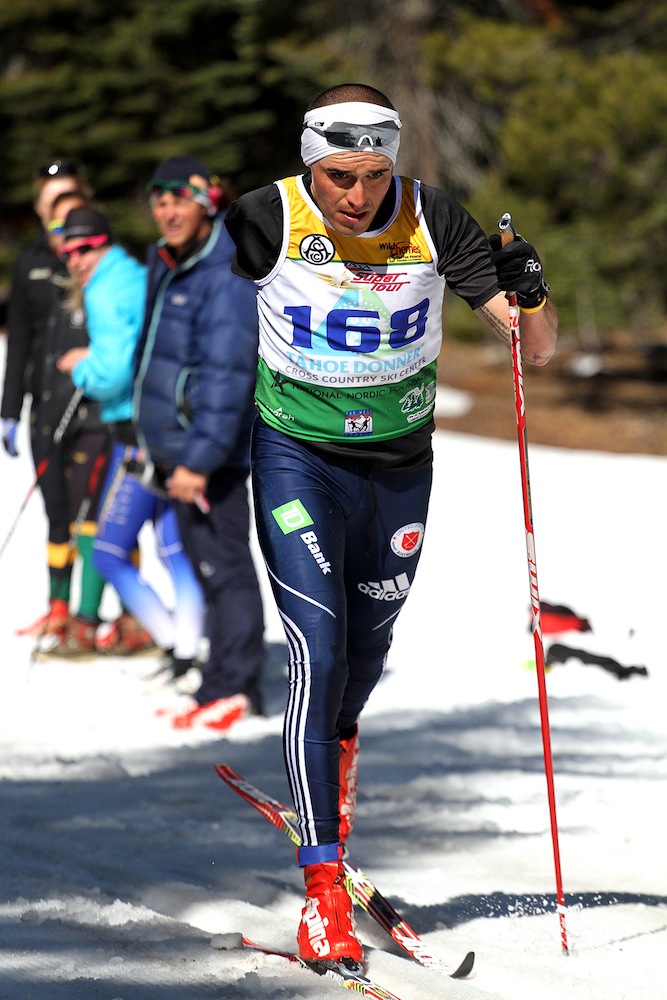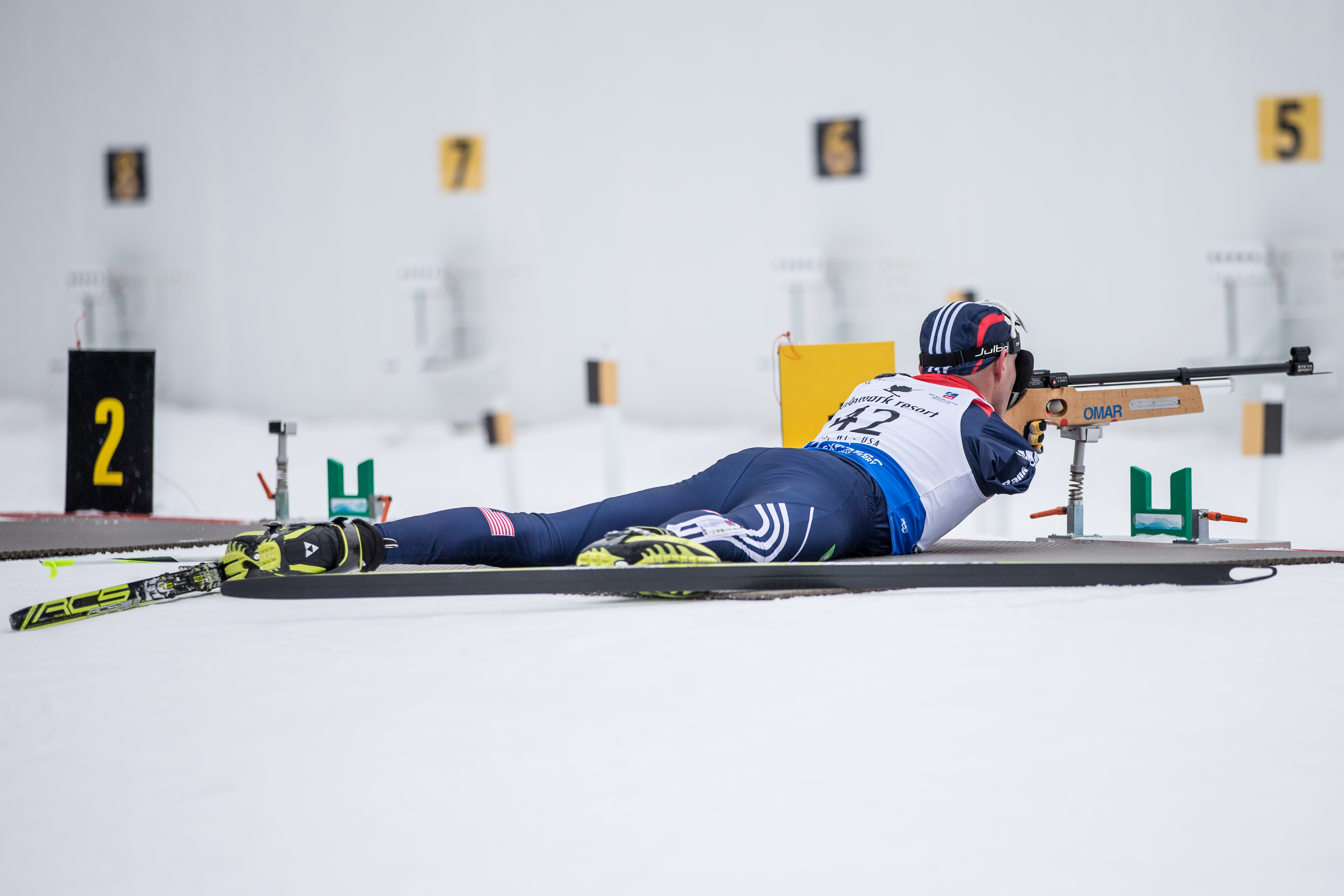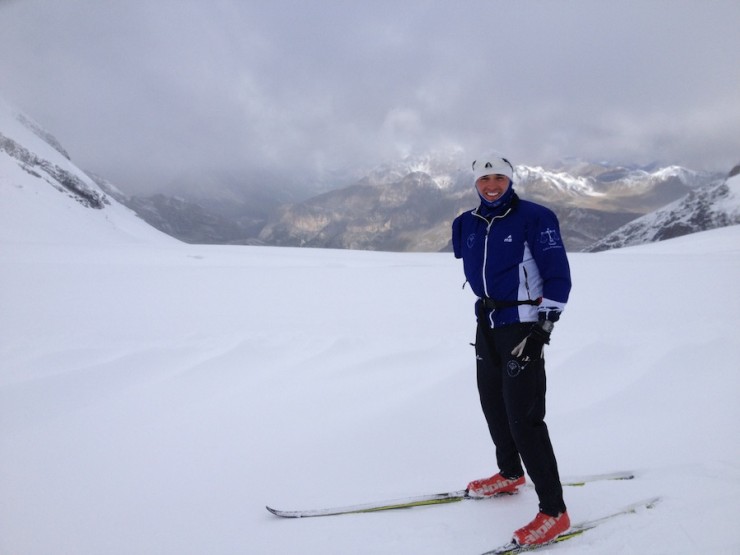
Tag: Omar Bermejo

  • Casper Mountain Biathlon Goes Big With Plans for New Range

    Casper Mountain Biathlon Goes Big With Plans for New Range

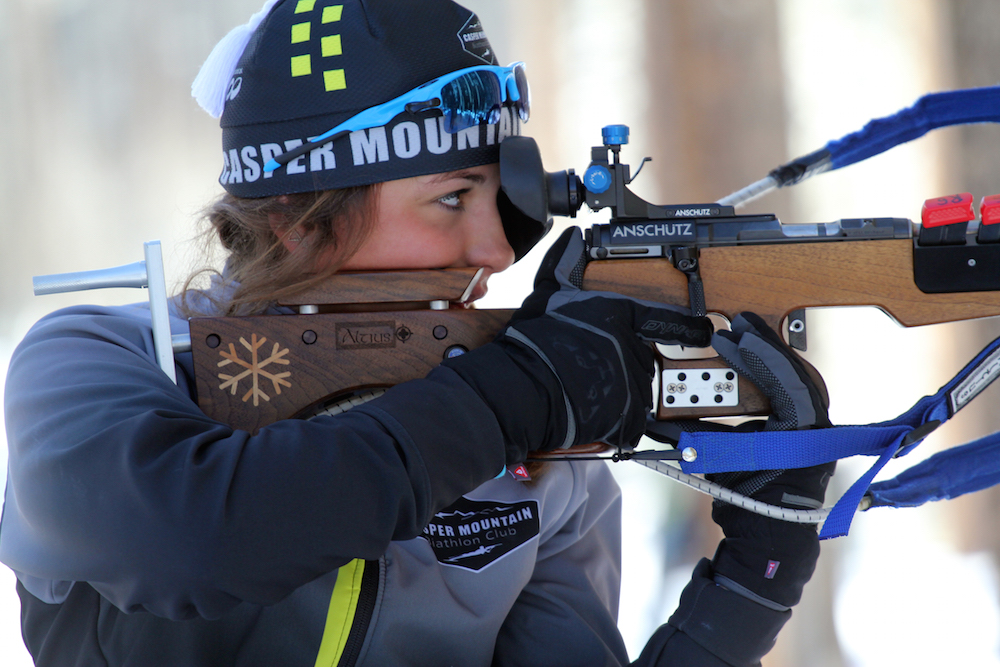
    Casper Mountain Biathlon Club athlete Rylie Garner, 16, takes aim. Garner is one of six juniors training with the CMBC year round. (Photo: CMBC)
    Casper Mountain Biathlon Club athlete Rylie Garner, 16, takes aim. Garner is one of six juniors training with the CMBC year round. (All photos: CMBC)

    Where there’s a will, there’s a way. Without a range of its own, Wyoming’s Casper Mountain Biathlon Club (CMBC) has put athletes on the podium in the junior division at biathlon national championships.

    But with donated land and the purchase of new targets, the club awarded a $728,307-dollar contract to build what might be the highest-altitude biathlon range in the U.S.

    On Aug. 13, CMBC chose the Casper-based Wayne Coleman Construction to build a range on donated land abutting the Natrona County-run Casper Mountain Trails Center. Construction started late last month, and the range is expected to be complete by early November.

    “It will be the only venue dedicated to both adaptive and able-bodied skiers,” CMBC’s president, Rob Rosser, said in a phone interview. Also a U.S. Paralympics Nordic and Biathlon development coach, Rosser competed in biathlon at the 1998 Winter Olympics and won multiple national and North American titles in the sport.
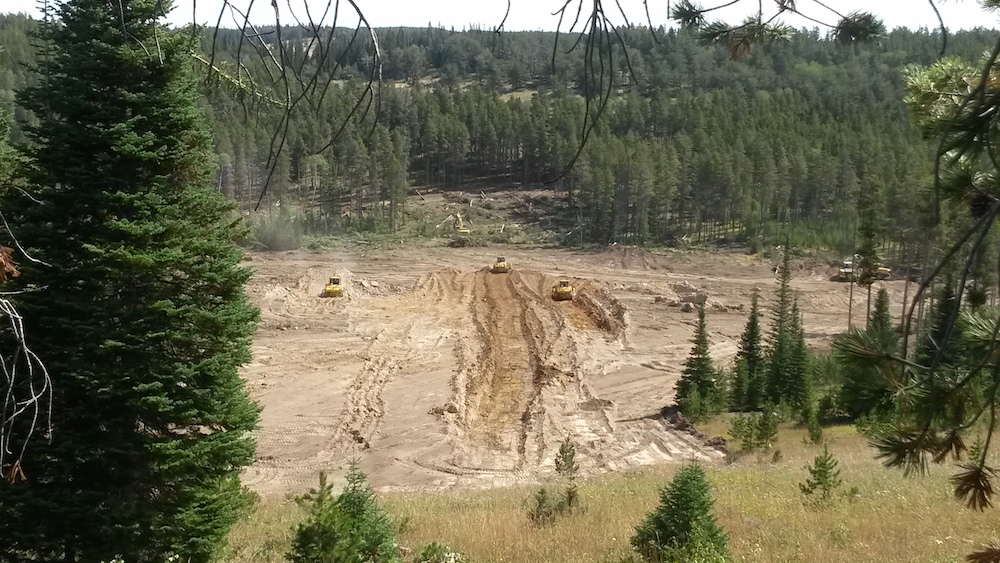
    Construction on the Casper Mountain Biathlon Club range began last month. (Photo: CMBC)
    Construction on the Casper Mountain Biathlon Club range began last month.

    Founded in 2008, CMBC gained nonprofit status in 2010. Its athletes ski at the Casper Mountain Trails Center, eight miles outside of town. The ski center includes 42-kilometers of winding trails on public land, but there’s no biathlon range.

    In Casper, there’s a shooting range where CMBC athletes can practice, but it’s not biathlon-specific.

    “We’ll shoot on paper, and then we’ll set up a metal target as well, just so they can shoot at an actual biathlon target,” Rosser said. “That’s the best we can do for now.  We’ve managed to get some decent results in less-than-perfect training venues.”

    To shoot at an actual biathlon range, CMBC athletes have to drive to a five-lane range in Lander, Wyo., 150 miles away.

    “The best range close to us is Soldier Hollow, which is six hours away,” Rosser said. “That’s the closest one with both rollerskiing and shooting.”

    They also train indoors with electronic rifles.

    “Since about 2010, we’ve trained kids with electronic rifles,” he explained.  “CMBC has had quite a few podiums at Nationals – Junior category – with the kids doing a combo of live shooting and training with the electronic systems.”

    In a follow-up email, Rosser explained that Kyle Rutar, one of the club’s athletes, placed fourth in a Junior World Trials race after training exclusively with an electronic rifle.

    “There’s nothing like doing it firsthand, skiing up to a rifle range, hearing lead hit on metal,” said Rutar in a phone interview.

    It was “definitely an adjustment” to go to from an electronic rifle to the real deal, he added.

    “The thing about the infrared rifle – everything’s dumbed down. There’s no wind, no temperature, no ballistics. All those things come in to play when you start doing it for real. … Infra-red is top notch for core shooting skills, but in race setting, you have to learn to adjust to the shooting environment in general.”
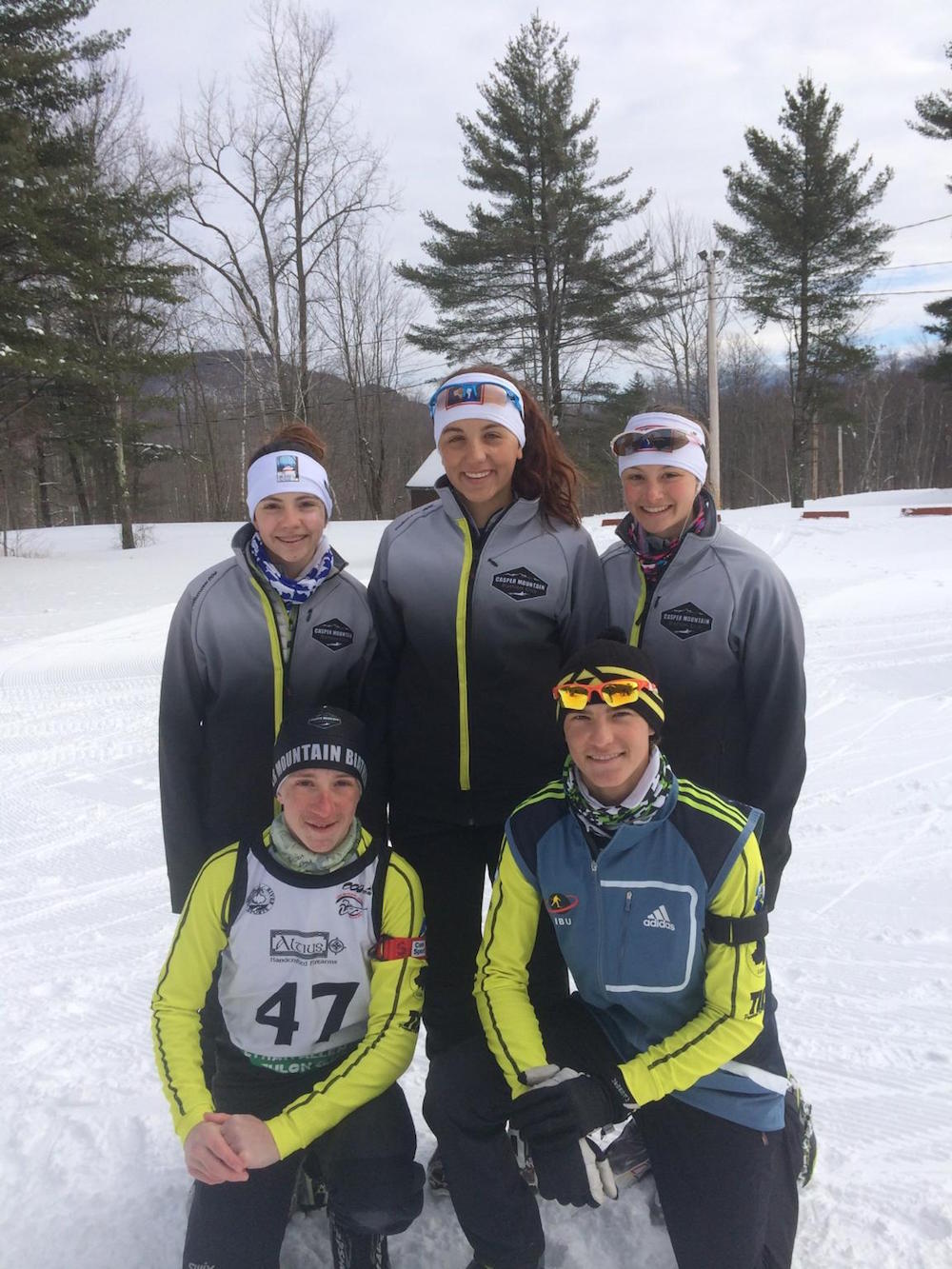
     The Casper Mountain Biathlon Club team at 2014 U.S. biathlon nationals in Jericho, Vt. (from left to right, back to front): Madison Tinker, Rylie Garner, Katherine Gruner,  and Christian Bjorklund and Jake Pearson. (Photo: CMBC)
    The Casper Mountain Biathlon Club team at 2014 U.S. biathlon nationals in Jericho, Vt. (from left to right, back to front): Madison Tinker, Rylie Garner, Katherine Gruner, and Christian Bjorklund and Jake Pearson.

    Presently, CMBC has six junior skiers ages 10 to 16 in a year-round training program: Jake Pearson, Rylie Garner, Katherine Gruner, Garrett Aune, Lu Elder, and Mac Elder.

    “Jake, Rylie and Katherine have been doing biathlon for 4 years now,” Rosser’s wife Cathy wrote in an email. “Garrett is going on his second year and Lu and Mac just started this year.”

    Cathy is CMBC’s managing director, a title with a jack-of-all-trades job description including club administration, bookkeeping, grant writing, marketing and communications and some program planning.  In addition, Ken Miech is a part-time program coordinator and assistant coach. A member of the Wyoming National Guard Biathlon Team, Miech started as a volunteer coach and now assists with program planning and execution.

    “In 2014, we had 530 people come through our program,” Cathy explained.

    Of those participants, 485 were juniors, 27 were adaptive athletes and 18 were masters. Most of the adaptive athletes are disabled veterans.

    “Without a range, we’ve focused on youth and adaptive programs,” she wrote. “Once the range is built, we will continue this emphasis and also begin to put energy into the masters program.”

    “Obviously we’re excited about having a natural range and seeing a great amount of growth because it’s a lot more fun shooting the real thing,” Rob said.

    Land for Range Donated

    According to Cathy,  a local family — the McMurrys — donated 40 acres to Natrona County specifically for the range. They also donated a second 200-acre tract that surrounds the range to the city for ski trails.

    Crediting the McMurry family’s generosity, she added, “They recognized the economic impact a biathlon venue could have on the community. They don’t have a specific interest in nordic skiing or biathlon, but they wanted to see the land used for the public good and recreation.”

    According to Cathy, the 40-acre plot where the range will be built was appraised at $318,000 dollars. She estimated the value of the additional 200 acres at $1.3 million.

    “I worked with [Rob] a little bit on the stadium design,” US Biathlon President and CEO Max Cobb said on the phone. “It’s a very impressive plan that he’s put together out there.”

    “It’s going to be the only biathlon range that I know of at 7900-feet altitude and the only one dedicated to both adaptive and able-bodied athletes,” Rosser said.

    “It’s going to be the only biathlon range that I know of at 7900-feet altitude and the only one dedicated to both adaptive and able-bodied athletes.” — Rob Rosser, Casper Mountain Biathlon Club president

    The CMBC currently owns nine electronic targets up to International Biathlon Union (IBU) standards, with plans to buy 21 additional mechanical targets.  For adaptive athletes, the International Paralympic Committee (IPC) mandates 10 audio targets for visually impaired athletes, and 10 for sitting or standing athletes. CMBC’s goal is to offer 24 targets for adaptive skiers.
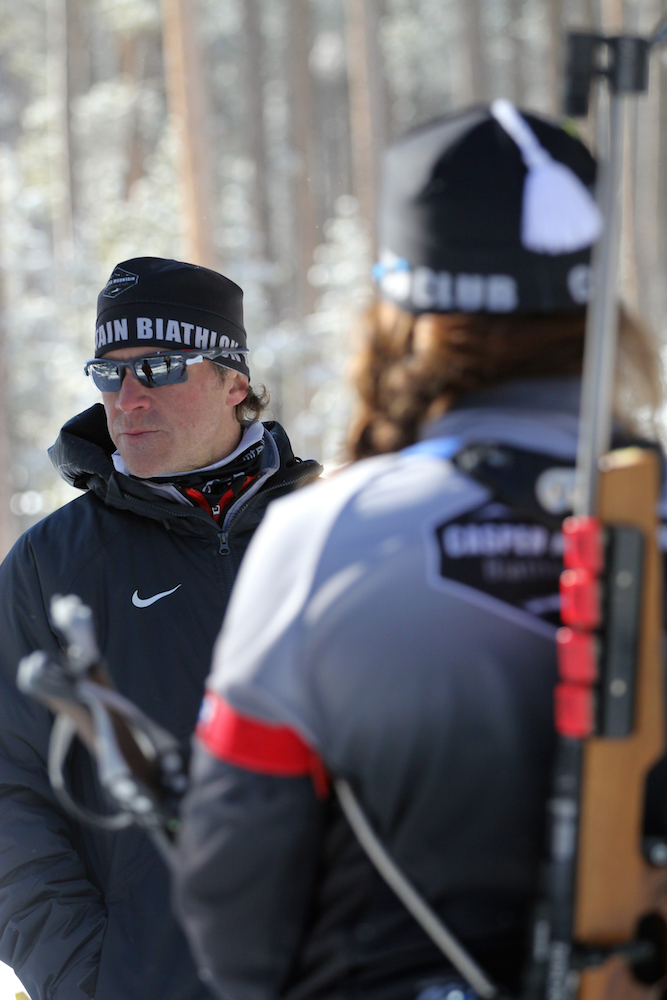
    Casper Mountain Biathlon Club president and coach Rob Rosser with athlete Rylie Garner. (Photo: CMBC)
    Casper Mountain Biathlon Club president and coach Rob Rosser with athlete Rylie Garner.

    “We’re a viable site for an IPC World Cup,” Rosser said.

    Although they’re above the IPC’s 5900-foot altitude limit, Cathy explained that “based on preliminary conversations, a waiver would be likely” to hold an IPC World Cup there.

    And while Casper Mountain is above the legal altitude limit for a biathlon or cross-country World Cup, Rosser expects to bid for Continental Cup races.  In addition, between the long snow season and the altitude, he believes Casper Mountain will be a desirable training-camp venue.

    In addition to building the range, the Rossers will also modify part of Casper Mountain’s trail system. Last November, trail designer John Morton flew to Wyoming to homologate trails to IBU, FIS and IPC standards.

    Morton helped the Rossers plan two five-kilometer loops that meet standards for all three governing bodies.

    “While [Rosser’s] top priority is biathlon with a special emphasis on Paralympic biathlon, it also makes sense to configure the trails to comply with FIS [International Ski Federation] cross-country homologation guidelines,” Morton wrote in an email.

    “We have a big puzzle with overlapping course requirements for FIS cross-country, IBU biathlon and Paralympic biathlon and cross-country. The trick is to design courses that are fun and technically challenging to ski, are great for spectators in terms of giving them plenty to see, and still fulfill the course requirements for the various governing bodies,” he added.

    Cathy explained that Wayne Coleman will be doing the earthwork and grading for the 30-point range, 10 new kilometers of homologated trails and two pedestrian underpasses.

    “It’s a very impressive plan that [Rob] put together out there,” Cobb said. “Rob asked me to weigh in on some questions and I worked with him a little bit on the [range] design.”

    U.S. Paralympics Nordic team member Omar Bermejo liked Casper Mountain so much that he moved there.

    “One of the Paralympic camps was here in Casper. When I came to train, I fell in love with the town,” he said in a phone interview.

    Of the skiing, he said it was a challenging course, especially Rosser’s homologated course, which is still being developed.

    When the range is complete, the CMBC will aim to add a paved 5 k rollerski loop leading into and out of the range. Cathy explained they’re expecting at least half of that to be complete by next summer “and the full 5 kilometers if funding allows.”

    “That’s going to make it one of the most attractive biathlon ranges in North America,” she added.

    Cobb referred to biathlon in the West as a “growing community,” pointing out that the Bridger Biathlon Club in Bozeman, Mont., recently rebuilt its range.

    “We’re seeing growth in the Rocky Mountain region, and that’s terrific,” he added.

  • 2014 U.S. Paralympics Nordic Team Nominated

    2014 U.S. Paralympics Nordic Team Nominated

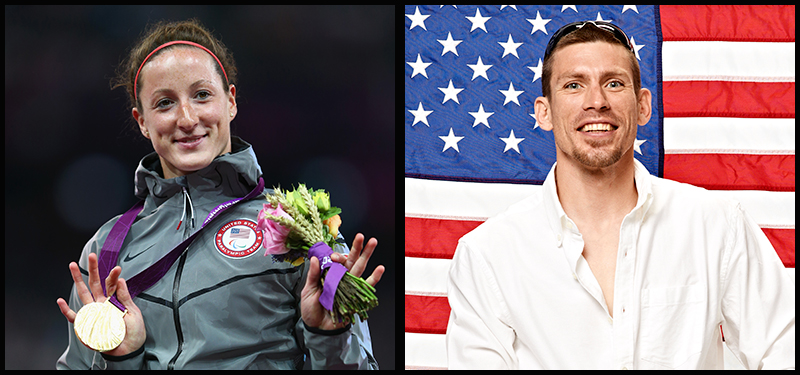
    Tatyana McFadden (l) and Jeremy Wagner are headed to the 2014 Paralympics in Sochi, Russia. (Photo: TeamUSA.org)
    Tatyana McFadden (l) and Jeremy Wagner are headed to the 2014 Paralympics from March 7-16 in Sochi, Russia. (Photo: TeamUSA.org)

    (Press release)

    COLORADO SPRINGS – U.S. Paralympics, a division of the United States Olympic Committee, announced Wednesday that 16 Nordic skiing athletes and two guides have been nominated to the 2014 U.S. Paralympic Team to compete in biathlon and cross-country skiing at the 2014 Paralympic Winter Games in Sochi, Russia, March 7-16. The nominations are subject to approval of the USOC.

    After sending six athletes to the Vancouver 2010 Paralympic Winter Games, Team USA’s Nordic roster will nearly triple in size with 12 men, four women and two guides for visually impaired athletes.

    “We are thrilled to bring such a large team of athletes and professional staff to Sochi,” said John Farra, high performance director for U.S. Paralympics Nordic skiing. “We have made a concerted effort to introduce more athletes to the sports of cross-country skiing and biathlon over the past two-and-a-half seasons, and this growth is a sign of our success in keeping many of them excited about our Nordic sports and working toward becoming internationally competitive.

    “In addition to building the numbers with new developing athletes, we have also focused many resources to help our top athletes get close to hitting the podium. Great focus was given towards equipment design for sit skiers, race ski selection and preparation in partnership with the U.S. Biathlon Association, and access to the best training camps and competitions around the world.”

    2014 U.S. Paralympic Nordic Team Nominees:
    (Subject to USOC approval)

    Women
    Monica Bascio (Evergreen, Colo.)

    Oksana Masters (Louisville, Ky.)
    Tatyana McFadden (Clarksville, Md.)
    Beth Requist (Winter Park, Colo.)

    Men

    Jake Adicoff (Sun Valley, Idaho)

    Omar Bermejo (Grand Rapids, Mich.)
    Kevin Burton (Boulder, Colo.)
    Lt. Cmdr. Dan Cnossen (Topeka, Kan.)
    Travis Dodson (Deming, N.M.)
    Sean Halsted (Spokane, Wash.)
    John Oman (Rice Lake, Wis.)
    Augusto Perez (East Syracuse, N.Y.)
    Aaron Pike (Park Rapids, Minn.)
    Bryan Price (Belton, Mo.)
    Andy Soule (San Antonio, Texas)
    Jeremy Wagner (Nanakuli, Hawaii)

    Guides

    David Chamberlain (Wilton, Maine)

    Reid Pletcher (Ketchum, Idaho)

    Three athletes return from the Vancouver 2010 Paralympic Winter Games, including Andy Soule (San Antonio, Texas) who won the first-ever U.S. medal in the Olympic or Paralympic Winter Games in the biathlon with his bronze in the men’s 2.4-kilometer race. Soule will be joined by his 2010 teammates Sean Halsted (Spokane, Wash.) and Monica Bascio (Evergreen, Colo.).

    Bascio boasts the most Winter Games experience, with Sochi marking her third Winter Games and fourth Games overall.  Having just recently retired from cycling, Bascio is one of three athletes who medaled at the London 2012 Paralympic Games. Other cross-over athletes include Tatyana McFadden (Clarksville, Md.) and Oksana Masters (Louisville, Ky.). McFadden is a 10-time Paralympic medalist in track and field, while Masters partnered with Rob Jones to become the first Americans to win a Paralympic rowing medal in the trunk and arms mixed double sculls event with their third place finish.

    More than half of the athletes nominated to the men’s team are military veterans: Omar Bermejo (Marines/Grand Rapids, Mich.), Kevin Burton (Navy/Boulder, Colo.), Travis Dodson (Marines/Deming, N.M.), Halsted (Air Force/Spokane, Wash.), Bryan Price (Army/ Belton, Mo.), Soule (Army) and Jeremy Wagner (Army Reserves/Nanakuli, Hawaii). Lieutenant Commander Dan Cnossen (Topeka, Kan.) is the only active duty member of the team as he currently serves with the United States Navy.

    Competition for Nordic skiing will take place March 8-16 with March 13 scheduled as an off-day. Nordic skiing includes both biathlon and cross-country skiing, both of which have three events contested at the Games, in addition to two cross-country relays.

    The majority of the U.S. Paralympic Nordic Skiing Team will compete in both sports. A list of events entered by each athlete will be available in February.

    The USOC and NBC Olympics have partnered to provide an unprecedented level of coverage to the Paralympic Winter Games. NBC and NBC Sports Network will combine to air 50 hours of television, starting on March 7 with the Opening Ceremony. It will be followed by daily coverage of all five Paralympic sports in the Sochi program, before the Games’ Closing Ceremony is broadcast on March 16. In addition to the unprecedented U.S. television coverage, the USOC and streaming sponsors BMW, BP, Citi, Liberty Mutual Insurance, Procter & Gamble and The Hartford will provide live online coverage at TeamUSA.org.

    U.S. Paralympic Team nominees for alpine skiing, biathlon, cross-country skiing, sled hockey, snowboarding and wheelchair curling will be finalized by the USOC no later than Feb. 21, the deadline to submit Sochi 2014 Paralympic Winter Games delegation rosters to the International Paralympic Committee. Selection procedures and dates can be found at TeamUSA.org/ParalympicGames/.

  • After 10 Years in the Marines, Bermejo on his Next Mission

    After 10 Years in the Marines, Bermejo on his Next Mission

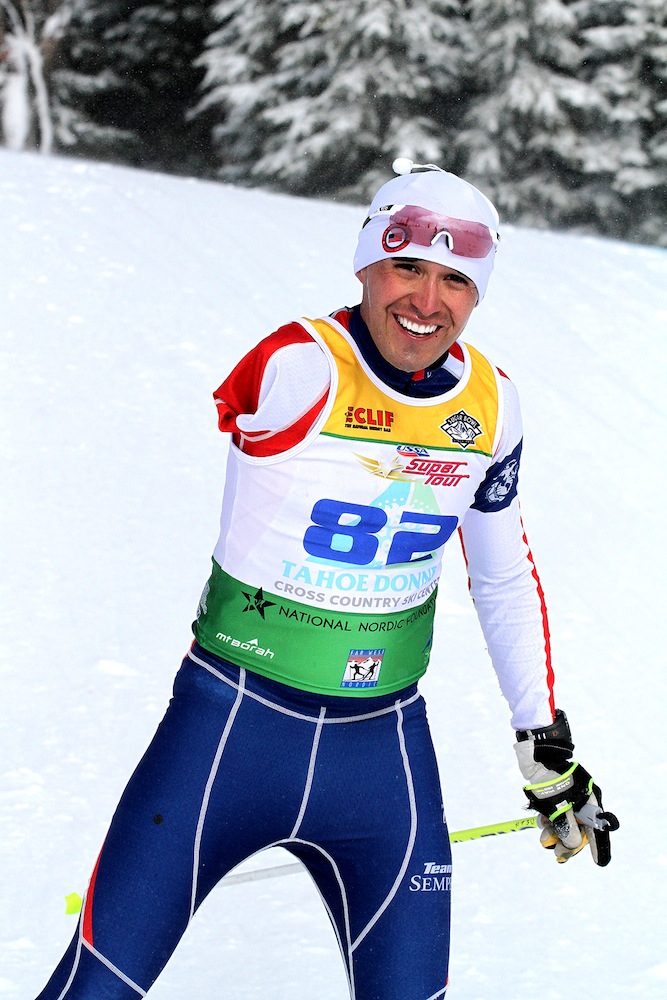
    Omar Bermejo of the U.S. Paralympics Development Team cracks a smile during the 2013 SuperTour Finals hill climb at Sugar Bowl Resort on Aug. 8 in Truckee, Calif. (Photo: Mark Nadell/MacBeth Graphics)
    Omar Bermejo of the U.S. Paralympics Development Team cracks a smile during the 2013 SuperTour Finals hill climb at Sugar Bowl Resort on April 8 in Truckee, Calif. (Photo: Mark Nadell/MacBeth Graphics)

    The wind howling sideways across Sugar Bowl’s alpine slopes in Truckee, Calif., skiers and spectators alike at the U.S. SuperTour Finals hill climb in April grimaced in the cold. The Spring Series skate race was mostly a snow squall, with competitors battling a headwind at times as they pushed toward the top.

    Rounding one of the last corners into a blustery abyss, Omar Bermejo smiled for the camera. He might as well have been back in San Diego, Calif., where he was stationed with the U.S. Marine Corps; Bermejo appeared in his own world, immune to his frigid surroundings.

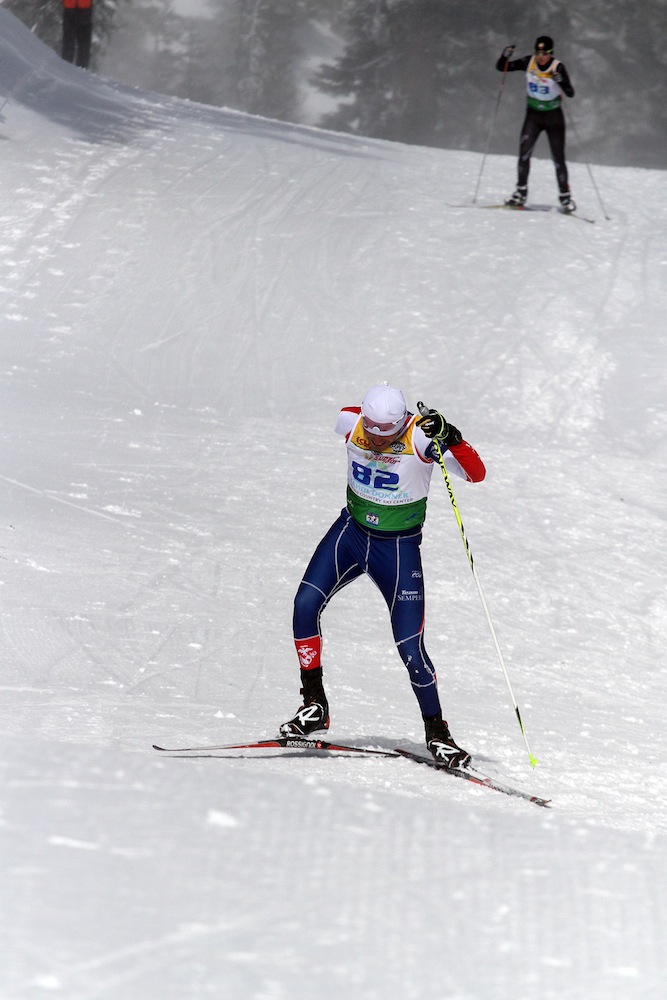
    Omar Bermejo (U.S. Paralympics) climbs more than 1,000 feet to the top of Mt. Disney at Sugar Bowl Resort for the SuperTour Finals hill climb on April 8 in Truckee, Calif. (Photo: Mark Nadell/MacBeth Graphics)
    Omar Bermejo (U.S. Paralympics) climbs more than 1,000 feet to the top of Mt. Disney at Sugar Bowl Resort for the SuperTour Finals hill climb on April 8 in Truckee, Calif. (Photo: Mark Nadell/MacBeth Graphics)

    “Being a Marine, you kind of crave those little, like, I-hate-my-life kind of moments,” Bermejo said three days later on April 11. “I don’t know, I liked it.”

    Skating was his favorite technique and doing so up a mountain wasn’t awful – even with one arm, the U.S. Paralympics Development Team member explained. A Marine for more than 10 years, Sgt. Bermejo rewarded himself for surviving four deployments in Iraq by buying a motorcycle in 2008. Cruising around that June in San Diego, he hit a patch of dirt on a curve and lost control of the bike, crashed and had his right arm amputated as a result.  

    Four months later, he started skiing for physical therapy, and it didn’t take long for the U.S. Paralympics Nordic Program to catch wind of his new hobby.

    “During my recovery, I had rehab [and the therapists] were like, ‘Hey do you want to try cross-country skiing?’ ” Bermejo, 31, recalled at Spring Series on April 11. “I was like, ‘Yeah, I want to go down some hills.’ And then they were like, ‘All right, go up that hill.’ I was like, ‘Wait a second, you tricked me!’ ”

    His voice fluctuated with excitement as he spoke, not long after racing 20 kilometers on the last day of the season. “Actually I started on classic skis and I was like, ‘Oh wow, this is like running. I feel great!’ ”

    Bermejo was, and remains, a fiercely competitive athlete. Before his accident, he was a road runner, racing 10 k’s, half marathons, you name it, Bermejo explained on the phone in June. He was just about to leave his hometown of Grand Rapids, Mich., to fly east to live and train with the Maine Winter Sports Center (MWSC) in Caribou, Maine.

    Early last season, MWSC head coach Will Sweetser helped Bermejo and Kevin Burton, a U.S. Paralympics visually impaired skier, at the SuperTour in Bozeman, Mont. The relationship continued through U.S. nationals and SuperTour Finals, with Bermejo meeting the team in March for a weeklong training camp in Maine. Ultimately, Sweetser asked Bermejo if he wanted to move there.

    “I really jumped at that,” Bermejo said. “I’m a stand-up athlete so I can sort of keep up with the able-bodied guys.”

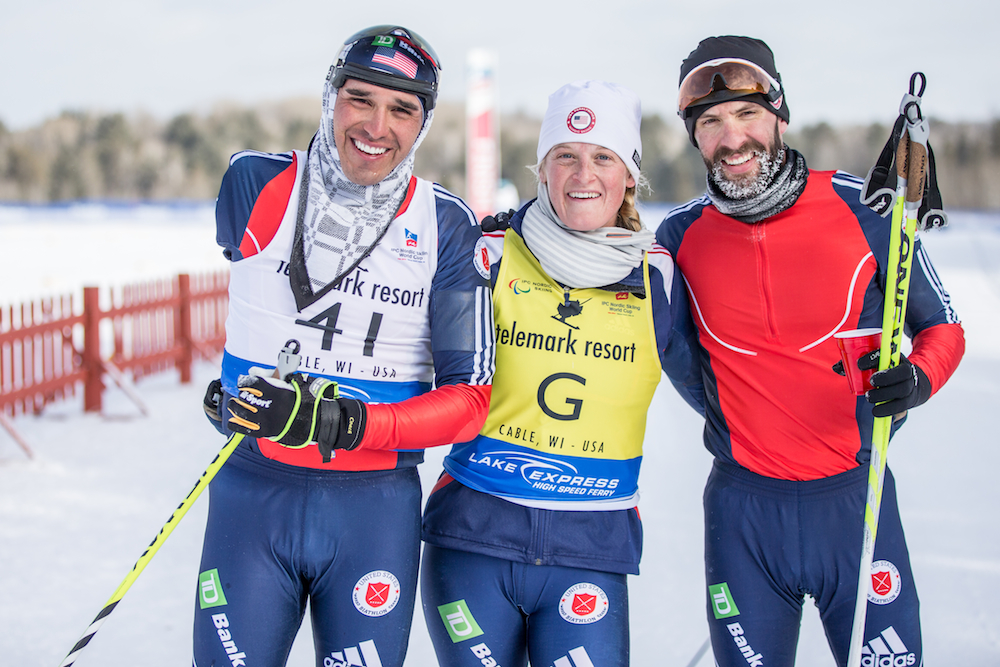
    U.S. Paralympics Development Coach Eileen Carey (c) with two of her athletes, Omar Bermejo (l) and Kevin Burton at the 2013 IPC World Cup in Cable, Wis. (Photo: James Netz)
    U.S. Paralympics Development Coach Eileen Carey (c) with two of her athletes, Omar Bermejo (l) and Kevin Burton at the 2013 IPC World Cup in Cable, Wis. (Photo: James Netz)

    By stand-up, Bermejo meant his adaptive category, which allows him to ski just like anybody else with just one arm. His able-bodied teammates include Kris Freeman, Sam Tarling and Welly Ramsey of MWSC’s Olympic Development Cross-Country Team (ODT).

    “We are really excited to have Omar join us as a member of our ODT,” Sweetser wrote in an email. “While working with him last year as a service tech, he and I hit it off. I think that many of the professional clubs can offer a whole lot of help to most stand up adaptive athletes.”

    “Pretty psyched to have Omar join us,” he added. “Our junior group love him and really get pumped to train with him.”

    Not long after settling into Maine, Bermejo presented to the MWSC juniors. In September, he traveled to Italy with top skiers like Freeman, Tarling and U.S. Ski Team member Noah Hoffman to train at altitude in the Italian Alps.

    “Sometimes I feel as if I don’t belong there since in reality I have only been skiing for only two years,” Bermejo wrote in an email. “But whenever those thoughts come around is when I tell myself that I must push myself a little harder or smarter to get through and succeed at my training.”

    ***

    Three days after ascending more than 1,000 feet to the top of Sugar Bowl’s Mt. Disney, nearly 8,000 feet above sea level, Bermejo completed the 20 k classic at U.S. Distance Nationals on a borderline-hot, slushy day. About five kilometers in, he broke his pole. With no one around to hand him a replacement, he skied the next several hills without any use of his upper body. In his first Sprint Series, Bermejo wasn’t about to quit.

    Omar Bermejo during a slushy 20 k classic at U.S. Distance Nationals on April 11 at Royal Gorge near Truckee, Calif. (Photo: Mark Nadell/MacBeth Graphics)
    Omar Bermejo during a slushy 20 k classic at U.S. Distance Nationals on April 11 at Royal Gorge near Truckee, Calif. (Photo: Mark Nadell/MacBeth Graphics)

    “I had to basically no pole the whole thing,” Bermejo said after finishing in just over an hour and a half. “Towards the way back, somebody gave me a pole so I’m like, ‘OK,’ … it was the last [race] so I had to make it count.”

    That kind of grit is what U.S. Paralympics quickly picked up on. Post-rehab, Bermejo moved to Arizona to be with friends and lift his spirits.

    “I was trying to deal with my arm being missing,” he said. “I used to be a strong guy, like great runner, so I wanted to get back to that.”

    He discovered U.S. Paralympics coach Rob Rosser was hosting a biathlon clinic at the University of Arizona and decided to check it out.

    “I was in the mode that I could do anything,” Bermejo said. “[Rosser] invited me to the Empire State Games in upstate New York and I was like, ‘Wow, this is great. I want to continue doing this.’ ”

    Arizona, he soon realized, was not the best place for skiing. Bermejo started shopping around for new places to live and train, and Marc Mast in Sun Valley, Idaho, invited him to check out his Wood River Ability Program. In the summer of 2011, Bermejo moved there permanently.

    U.S. Paralympics Development Coach Eileen Carey, formerly of the MWSC, wrote in an email that she first worked with Bermejo at a development camp in February 2012 in Lake Placid, N.Y., where he traveled for the Empire State Games.

    “Since that time he has been hooked and has dedicated himself to becoming a Paralympic skier and biathlete,” Carey explained. “He has made huge gains in such a short period, which I would attribute to his professional and driven approach. He is introspective and I think that helps him see the small progressions that he makes and keep perspective on the fact that he is not yet the athlete he will one day become.”

    “Being a Marine, you kind of crave those little, like, I-hate-my-life kind of moments, but I don’t know, I liked it.” — Bermejo on the 2013 SuperTour Finals hill climb at Sugar Bowl Resort

    Last winter, Bermejo competed at the International Paralympic Committee (IPC) World Cup in Cable, Wis., and skied well enough to earn points. That gave him affirmation and hope. In a year, he wondered if he could make the 2014 Paralympics.

    Omar Bermejo competed in both biathlon and cross-country events at the IPC World Cup in Cable, Wis., last season. (Photo: James Netz)
    Omar Bermejo competed in both biathlon and cross-country events at the IPC World Cup in Cable, Wis., last season. (Photo: James Netz)

    He decided his best shot would be in biathlon. “With my Marine background and the shooting, it’s something that holds near and dear to my heart,” he said.

    “Right now on the international level, I’m like a nobody, but I want to get there,” Bermejo added. “They’ll be like, ‘Here comes the American guy; watch out for him.’ Eventually that’s what I want to do, I want to be a force.”

    Months after his East-Coast move, Bermejo was already pleased with his progress. Sun Valley was a great start, he explained, but he needed to train with others and follow a specific outline.

    “I asked my Paralympic coaches if moving to Maine would be a good idea and they told me it would be great if I was willing to sacrifice my then current social life and my love for the west of the country,” Bermejo wrote in an email. “I must say it was tough and one hell of a move but I have made huge improvements working with all the coaches at MWSC and I believe I am ready to use my newfound skills to work in the upcoming season.”

    Along with Carey, U.S. Paralympics Nordic High Performance Director John Farra encourages stand-up athletes to train with an elite club with able-bodied nordic skiers.

    “He has made a significant commitment to the sport and it has resulted in impressive improvement for a relative newcomer,” Farra wrote in an email. “We are excited for Omar to integrate into the MWSC program and see how far they can help him progress with his skiing. “

    So far, the best thing he’s learned is to “slow down to go fast,” he wrote. “When I first started skiing just freshly out of the Marine Corps my technique was to go as hard and quick as possible and hopefully I would go fast enough, however, after a couple of races I took a beating and I was not going anywhere.”

    In Maine, he realized if he relaxed and thought more about smooth skiing and glide, he could suddenly go faster and longer without feeling tired.

    Following U.S. nationals in January, U.S. Paralympics will select its national team for the 2014 Winter Games in Sochi, Russia. While Bermejo isn’t a shoe-in for one of the 19 spots, he’s optimistic.

    “Omar is one of the athletes who is Sochi ‘Eligible’ and in a good position to be able to qualify for the Team,” Farra wrote, referring to the Paralympic-team criteria. “I would expect he will make the team if he continues to train in a professional way through next winter.”

    “Omar has been a great part of our program over the last year or so,” Carey wrote. “He is an A-lister through and through. He is one of those people you meet and hope you will know forever.”

    Looking at the strides he’s made since his accident five years ago, Bermejo feels grateful for the opportunities he’s been afforded by the U.S.

    “I am proud to have served under our flag in the military and would like to keep serving my country but this time as an inspiration to never quit and never stop dreaming no matter what happens,” he wrote.

    “I want people to know that it does not matter how fast I can complete a race, how many people I can beat, what skis or waxes I use, or even how many medals I can accrue in my lifetime.. What matters is achieving happiness..  And I know I have already won at that ever since I started Nordic skiing.”

    He has several people to thank for his quick rise within the sport, including Mast, who “was the first person that saw potential in me,” the Hall family in Casper, Wyo., “for opening their doors and allowing me to make my training easier,” and his girlfriend Lindsey Hall “for giving me the inner strength to keep going when the going is tough.”

  • The 12: Maine Winter Sports Center

    The 12: Maine Winter Sports Center

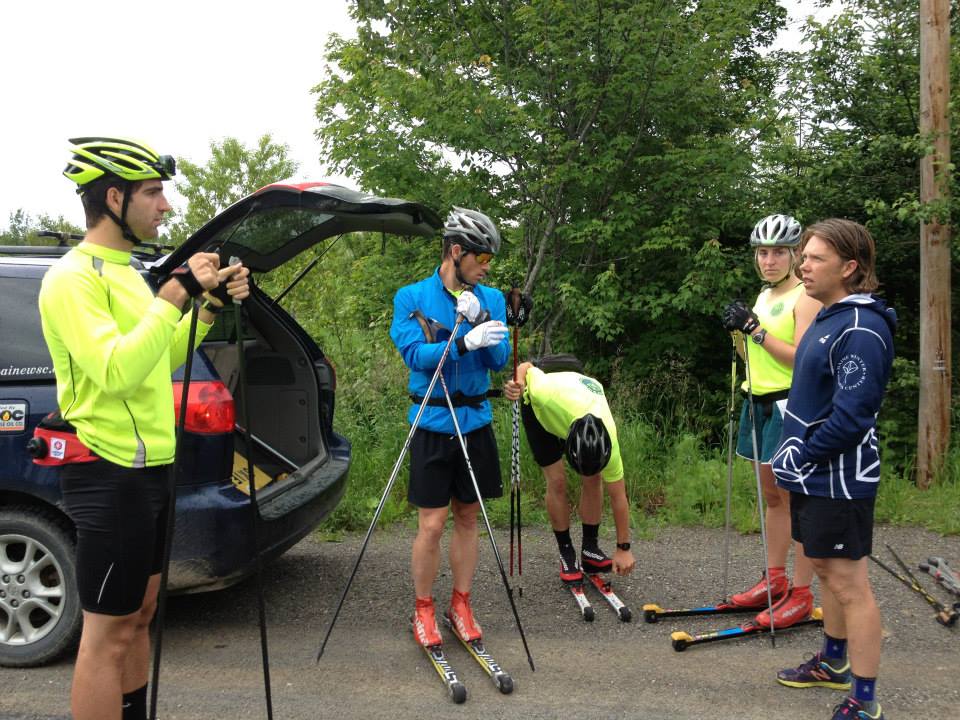
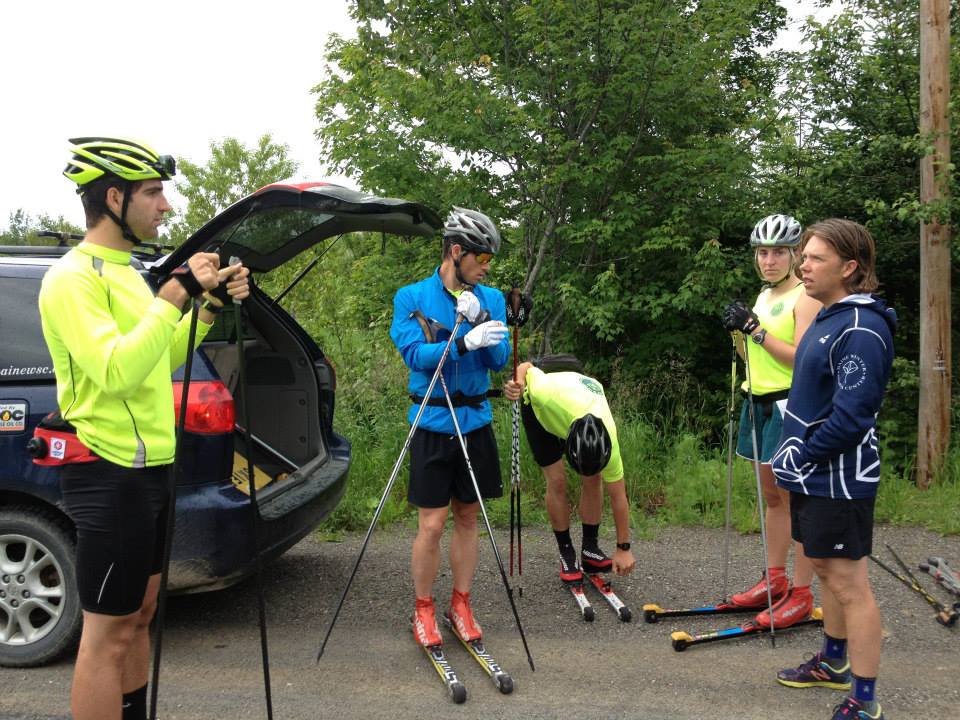
    The Maine Winter Sports Center Cross-Country Olympic Development Team (ODT) gets ready for a rollerski in northeastern Maine, with Kris Freeman (in blue), Welly Ramsey, Hilary McNamee and competitive programs director Will Sweetser (r). (Photo: https://www.facebook.com/maine.Winter.Sports.Center)
    The Maine Winter Sports Center Cross-Country Olympic Development Team (ODT) gets ready for a rollerski in northeastern Maine, with Kris Freeman (in blue), Welly Ramsey, Hilary McNamee and competitive programs director Will Sweetser (r). (Photo: MWSC/facebook.com/maine.Winter.Sports.Center)

    Note: This is the sixth preview in our series on U.S. elite teams, which we’ve dubbed the “The 12.” We asked coaches to tell us what’s new and whom to look out for in the coming season and will publish additional previews in the coming weeks in no particular order.

    Team: Maine Winter Sports Center (MWSC)

    Coaches: Will Sweetser (competitive programs director), Seth Hubbard (biathlon coach), Amber Dodge (development coach)

    Roster:

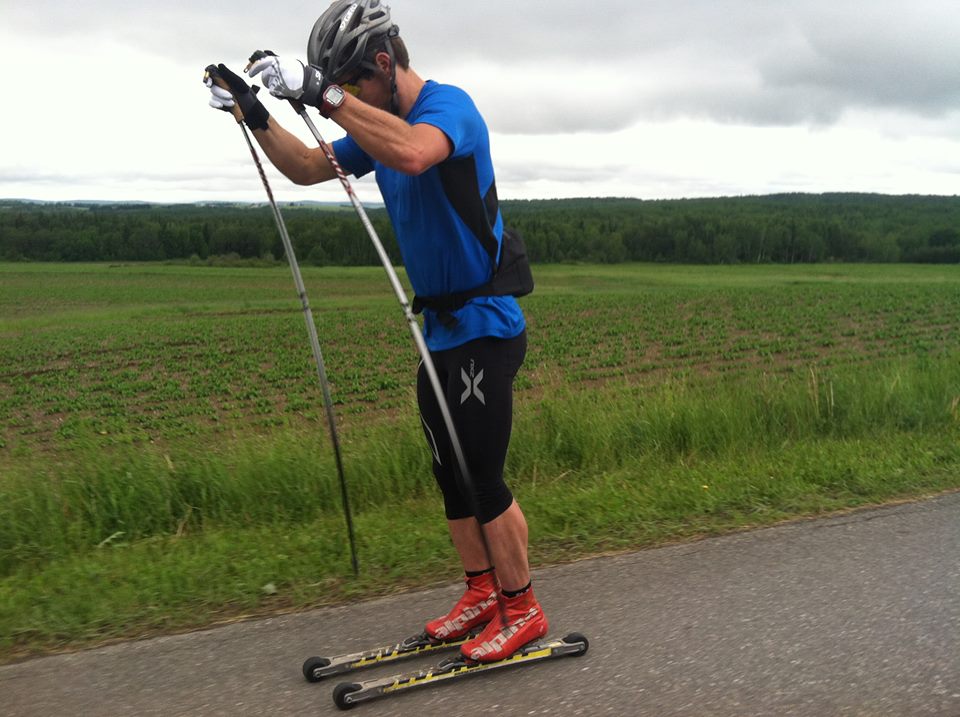
    Kris Freeman training with the MWSC in northeastern Maine. (Photo: MWSC/https://www.facebook.com/maine.Winter.Sports.Center)
    Kris Freeman training with the MWSC in northeastern Maine. (Photo: MWSC/facebook.com/maine.Winter.Sports.Center)

    Cross-Country Olympic Development Team (ODT): Kris Freeman, Sam Tarling, Welly Ramsey; Hilary McNamee, Anna Van der Rhee (trying to qualify for Sochi Olympics for The Netherlands). According to Sweetser, McNamee is focusing on finishing her studies at Dartmouth and will race primarily in New England.

    XC Post-Grads: Emily Ramsey (New Sharon, Maine), Zoe Chase-Donahue (Freeport, Maine), Sarah Becker (Yarmouth, Maine), Abby Popenoe (Portland, Maine), Austin Huneck (Clifton Park, N.Y.)

    Collegiate Summer Program: Nick Michaud (Bates College), Gabby Naranja (Bates).

    Biathlon ODT: Russell Currier (U.S. Biathlon), Raleigh Goessling, Casey Smith, Annelies Cook (U.S. Biathlon), Katrina Howe

    Biathlon Post-Grads: Brian Halligan (N.Y.), Maddie Pfaneuf (N.Y.), Mikaela Palusek (N.H.)

    Adaptive ODT: Omar Bermejo

    Katrina Howe during skate hill workout. Katrina Howe during skate hill workout. (Photo: Seth Hubbard)
    Biathlon ODT member Katrina Howe during skate hill workout. (Photo: Seth Hubbard)

    Who’s new: Tarling (2013 Dartmouth graduate), Smith (formerly of Montana State University), Bermejo (Grand Rapids, Mich.), all post-grads except Emily Ramsey (second year).

    Who’s missing: None.

    Top results last season: Sweetser intends to send a minimum of four athletes to the Olympic Winter Games or in Bermejo’s case, the Paralympics. The most-obvious four that could make that goal a reality are Freeman, Currier, Cook, and Bermejo. But look out for the new guys, including Tarling and Smith, training with the Caribou-based MWSC on the northeastern tip of Maine.

    A three-time Olympian, Freeman, 32, was not renominated to the U.S. Ski Team for the first time in a decade. He won his 16th national title last January in the 50 k classic, but finished the 2012/2013 World Cup season with with three top-30 results. Sweetser said Freeman and Ramsey have had some very productive training sessions this summer.

    “[Freeman] is nowhere near the crazy specific fitness he had late last summer, however, he is lighter, faster [ran fastest 5 k (15:53) since 2004 in June] and happier than he’s been in years,” Sweetser wrote in an e-mail.

    Sweetser added that Tarling has been an “instant plus” in MWSC’s community programs, which include juniors, high-school skiers and adults. He was a presenter at the Maine Team Camp in Fort Kent earlier this month, which hosted 43 of the state’s best high school skiers.

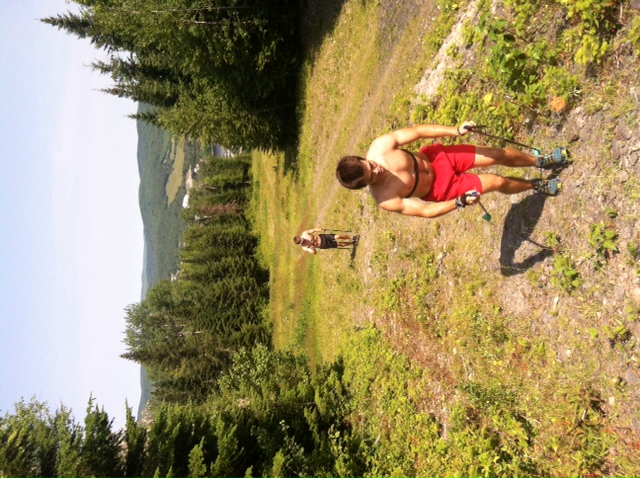
    MWSC teammates, biathlete Raleigh Goessling leading Welly Ramsey, a cross-country skier, during bounding intervals in northeastern Maine. (Photo: Seth Hubbard)
    MWSC teammates, biathlete Raleigh Goessling leading cross-country skier Welly Ramsey during bounding intervals in northeastern Maine. (Photo: Seth Hubbard)

    The 2011 NCAA 10-kilometer freestyle champion won twice on the Eastern Intercollegiate Ski Association (EISA) circuit in his senior season at Dartmouth and finished fifth in the 30k classic at U.S. nationals.

    “(Tarling) is very professional in his approach to creating a career as a ski racer,” Sweetser wrote. “He is gelling well with our entire team and is a fantastic addition at junior training camps.”

    Van der Rhee (formerly Sprague), a native of Stockholm, Maine, and Utah alum, married a man from The Netherlands and has since established citizenship there. To qualify for the Olympics, she needs World Cup starts, which may be earned with either a sub 100-point distance race or sub 120-point sprint in International Ski Federation (FIS) competition. Last year, in returning to racing after a seven year hiatus, Van der Rhee had one sub 150-point race.

    Cook leapt 38 spots (83rd to 45th) in the biathlon world rankings last year. She tallied her first World Cup top 20 in Italy and two more in the pre-Olympic races in Sochi, Russia. This will be her second year with MWSC.

    Currier, 26, is trying for his first Olympics as a returning member of the U.S. Biathlon Team. The MWSC veteran pulled out a pair of sixth-place finishes on the World Cup in 2012 and was a critical component of the U.S. relay team that finished fifth in January in Oberhof, Germany.

    Smith, 21, is one of the most promising young biathletes in the country. He competed in the International Biathlon Union (IBU) youth and junior World Championships four times each, with his best junior-world finish coming last January in the 12.5-kilometer pursuit, where he was 23rd. Smith got a feel for northern Maine when he competed at U.S. Biathlon Nationals in Fort Kent last March.

    “As expected, Casey has been a great fit with our program,” Hubbard wrote in an e-mail. “He has great energy and focus.”

    Coach’s comment:

    “From my perspective as director, this group is more of a team than we’ve ever had,” Sweetser said of the multi-tiered elite team, now in its 11th year. “We are prioritizing group training twice each week with biathletes and XC skiers together. There is no doubt that our program will have one of the best men’s distance teams in U.S. XC. These guys could easily meet all of their goals this year given the progress we’ve seen thus far.”

    ***

    Other previews: Alaska Pacific University | Bridger Ski FoundationCraftsbury GRPSSCV/Team HomeGrown | Stratton Mountain School T2

  • Fresh from Europe, Nordgren and Cook Take Sprint Titles at U.S. Biathlon Nationals

    Fresh from Europe, Nordgren and Cook Take Sprint Titles at U.S. Biathlon Nationals

    Mark Johnson leaving the start en route to placing second in the 10 k sprint. Photo: Rich Jehle.

    Fresh off of World Championships appearances in Ruhpolding, Germany, U.S. national team members Leif Nordgren and Annelies Cook won the 10 and 7.5 k sprints at U.S. Biathlon Championships in West Yellowstone, Montana, on Thursday.

    While most of the rest of the World Championships team continued on to Khanty-Mansiysk, Russia, for the final weekend of World Cup racing, Cook and Nordgren headed home for a different kind of racing – which Nordgren said was actually nice.

    “There was a great atmosphere today,” he wrote in an e-mail to FasterSkier. “I heard over a 100 racers participated, which kind of blew me away. For sure I wasn’t expecting that many, but they all looked happy to be here and it looked like they were having some fun too!

    “It was cool to go from Ruhpolding to here,” he continued. “In some ways it’s nice just to go out and have some fun during your race, without having 30,000 people screaming at you.”

    Jenny Abraham of Colorado Biathlon, fourth place senior women's 7.5 k. Photo: Rich Jehle.

    The biathletes – who hailed from at least 13 states and competed in categories ranging from boys and girls up to senior veterans – were greeted by plenty of snow, despite rain last night, and calm conditions on the range.

    In the women’s race, Cook held off fellow national team members Laura Spector and Corrine Malcolm by shooting well, earning just one penalty to their three. She picked up a 1:24 victory over Spector, with Malcolm another 15 seconds behind.

    Cook could not be reached for comment.

    In the men’s race, Nordgren won by a minute and three seconds over Mark Johnson, but the penalties were reversed: Nordgren had three, and Johnson one. Despite earning his first senior national title, Nordgren said there was plenty to improve on in his race.

    “For me the race wasn’t super great,” he admitted. “Three penalties in shooting was about two too much for today. It was a perfect day for shooting so there’s no excuse.  Skiing felt surprisingly well for having traveled so much in the last few days. It was kind of a shock to come up to this altitude and only train for a day before racing, but I took it easy skiing and it went pretty well.”

    Michael Gibson of Vermont Collegiate Biathlon placed third, roughly three and a half minutes behind Nordgren.

    Adaptive biathlon races were also held, with Sarah Edwards winning the women’s crown and Eric Frazier and Omar Bermejo winning the men’s sit-ski and standing divisions, respectively.

    Racing continues Friday for the adaptive skiers and Saturday for the able-bodied racers.

    Results

    Eric Frazier and Robert Ackerman line up at the start of the men's sit-ski race. The pair went 1-2. Photo: Rich Jehle.