From the FasterSkier archive — posts syndicated from athletes’ and coaches’ own blogs between 2004 and 2012, kept online as published. Current coverage is at fasterskier.com.
Johannes Høsflot Klæbo anchoring the Norwegian men’s 4 x 10 relay to gold on Sunday at the 2018 Olympics in PyeongChang, South Korea, while Denis Spitsov (background) celebrates silver for the Olympic Athletes for Russia. (Photo: FlyingPointRoad)
For a while in the men’s 4 x 10-kilometer relay on Sunday, it looked like the Russians might run away with the win. But that was just two classic legs and 20 k into the race, with a lot more racing to come.
While Kazakhstan’s Alexey Poltoranin had handed off in first at the first exchange, just ahead of Andrey Larkov of the Olympic Athletes from Russia, Italy, France and Norway skied together behind them, with Norway’s Didrik Tønseth trailing off the back, 18 seconds behind.
On the next classic leg, Russia’s Alexander Bolshunov put a hurt on the field. Within the first 3.3 k lap, he was 25 seconds ahead of Kazakhstan’s Yevgeniy Velichko in second, who was followed closely by Italy, Norway and France in third through fifth. Sweden’s Daniel Rickardsson had fallen farther behind to more than a minute back in sixth place, after his teammate Jens Burman lost contact with the lead group on the first leg.
By the second exchange, Russia was 24.5 seconds clear of second place, while Italy’s Francesco de Fabiani tagged Giandomenico Salvadori in second, France’s Maurice Manificat tagged Clement Parisse in third (+28.0), and Norway’s Martin Johnsrud Sundby tagged Simen Hegstad Krüger in fourth (+32.1). Kazakhstan’s Velichko had fallen off the pace and was another 19 seconds back in fifth.
Over the next 10 k, the first skate leg, Krüger and Parisse reeled in Russia’s Alexey Chervotkin, catching him before the end of their second lap. One lap later, Krüger came through the final exchange in first, tagging Johannes Høsflot Klæbo 0.4 seconds ahead of France in second. Chervotkin tagged Russia’s anchor Denis Spitsov in third, 16.2 seconds back, while Finland’s Matti Heikkinen passed Italy’s Salvadori on the last climb to put Finland in fourth (+58.6).
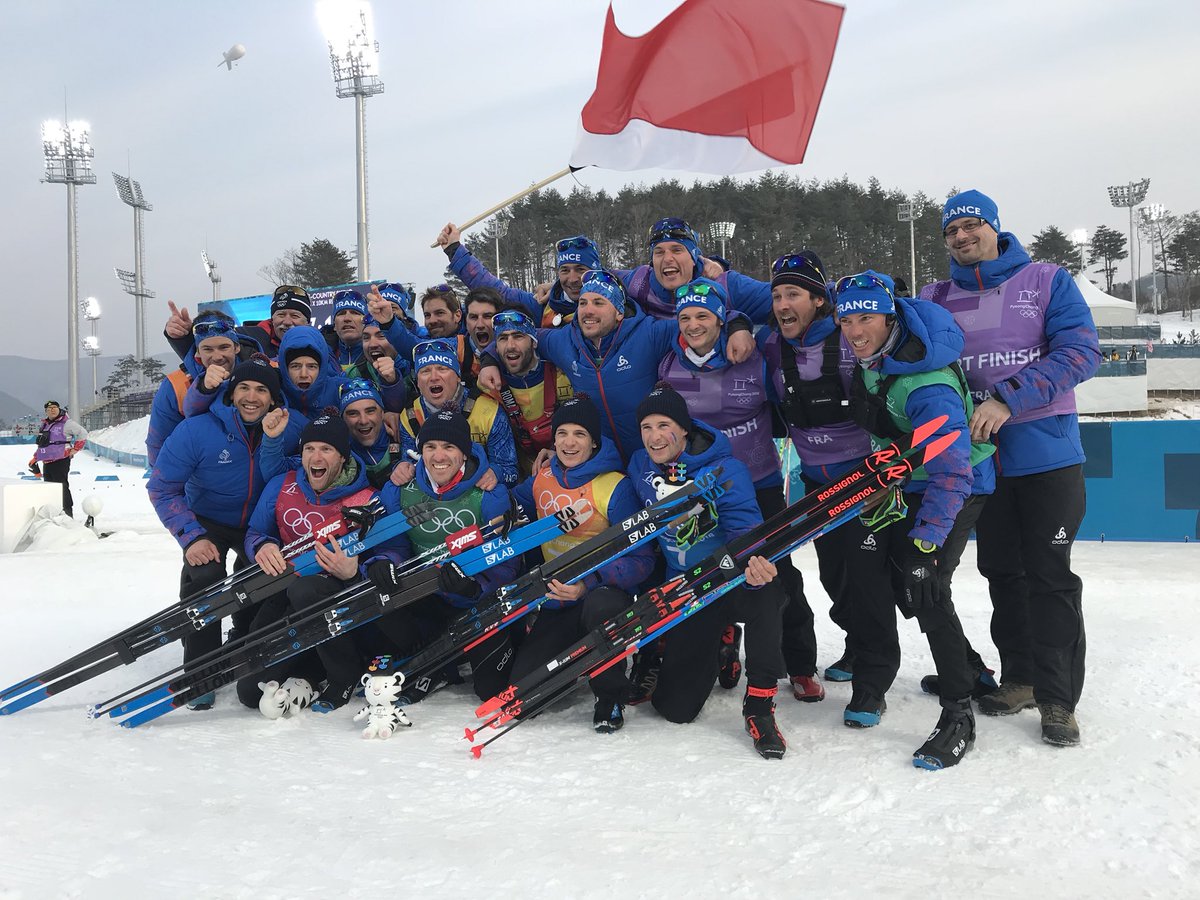
Team France celebrates its bronze-medal finish in the men’s 4 x 10 k relay at the 2018 Olympics on Sunday in PyeongChang, South Korea. (Photo: FIS Cross Country/Twitter)
Early in the final leg, France’s Adrien Backscheider took the lead ahead of Klæbo. The two held Spitsov off until the end of the second lap, where Spitsov came through the stadium first to start the final loop. Spitsov and Klæbo soon upped the pace, dropping Backscheider, and shortly after the 8.27 k checkpoint, Klæbo truly put the jets on to accelerate away from Spitsov. He dropped the Russian on a climb just before the final uphill, where it was clear that the gold was Norway’s.
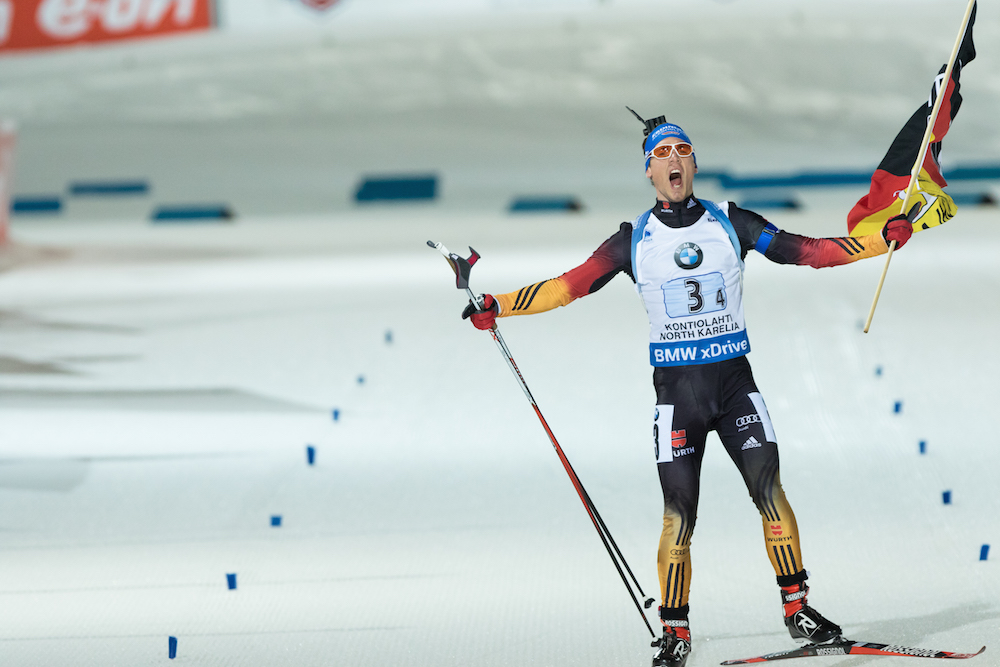
As he sped down into the stadium, Klæbo relaxed his arms, skied to the sideline and took a flag from the stands. He looked back for a moment and then crossed the finish line first in 1:33:04.9 hours, while Spitsov followed 9.4 seconds later for silver for Russia. Backscheider held on for bronze (+36.9) as his team exuberantly celebrated with him at the finish.
Finland placed fourth (+1:40.5), Sweden fifth (+2:05.6), Germany sixth (+2:08.2), Italy seventh (+2:35.2), and Kazakhstan eighth (+3:31.4). Canada was ninth (+3:41.0) for its second-best Olympic relay result (with Len Valjas, Graeme Killick, Russell Kennedy, and Knute Johnsgaard), and the U.S. finished 14th (+9:24.2), out of 14 teams, with Andy Newell, Reese Hanneman, Scott Patterson, and Noah Hoffman.
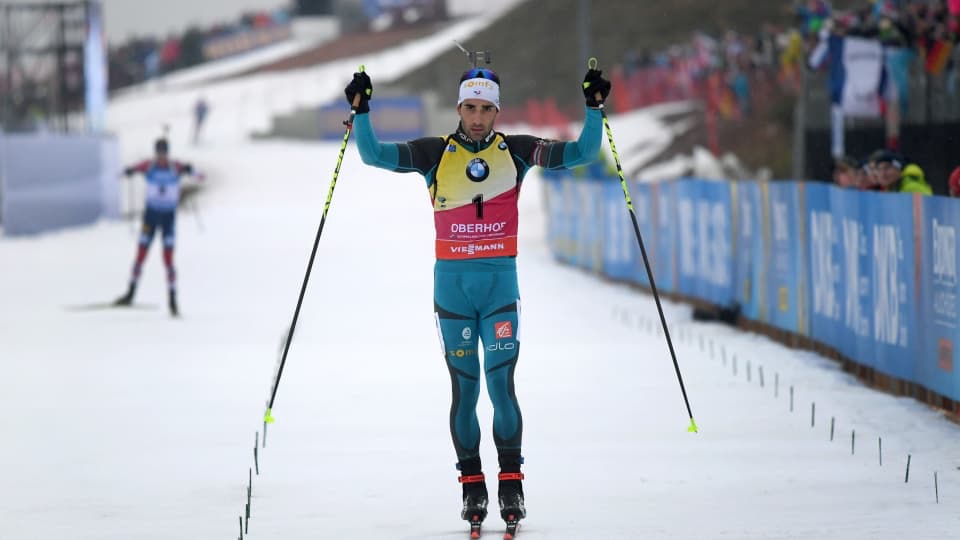
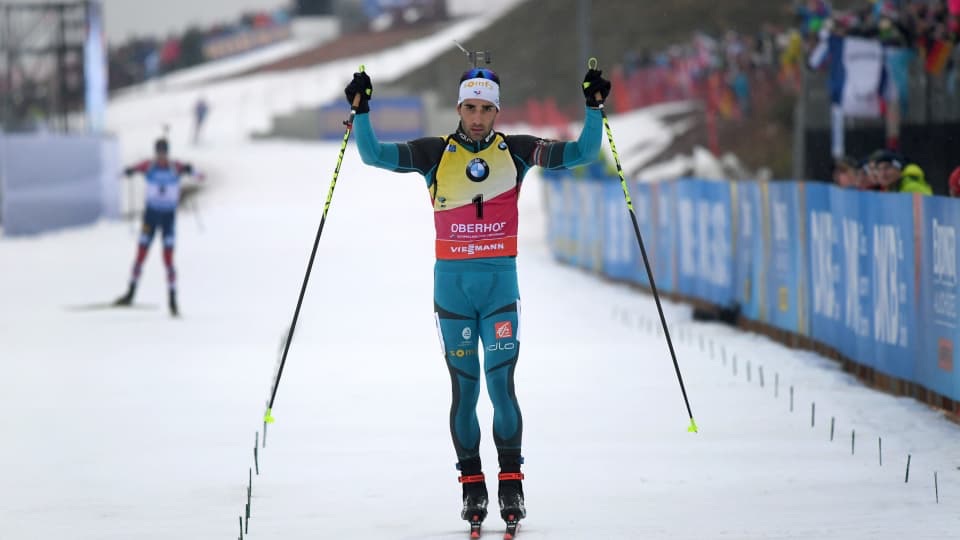
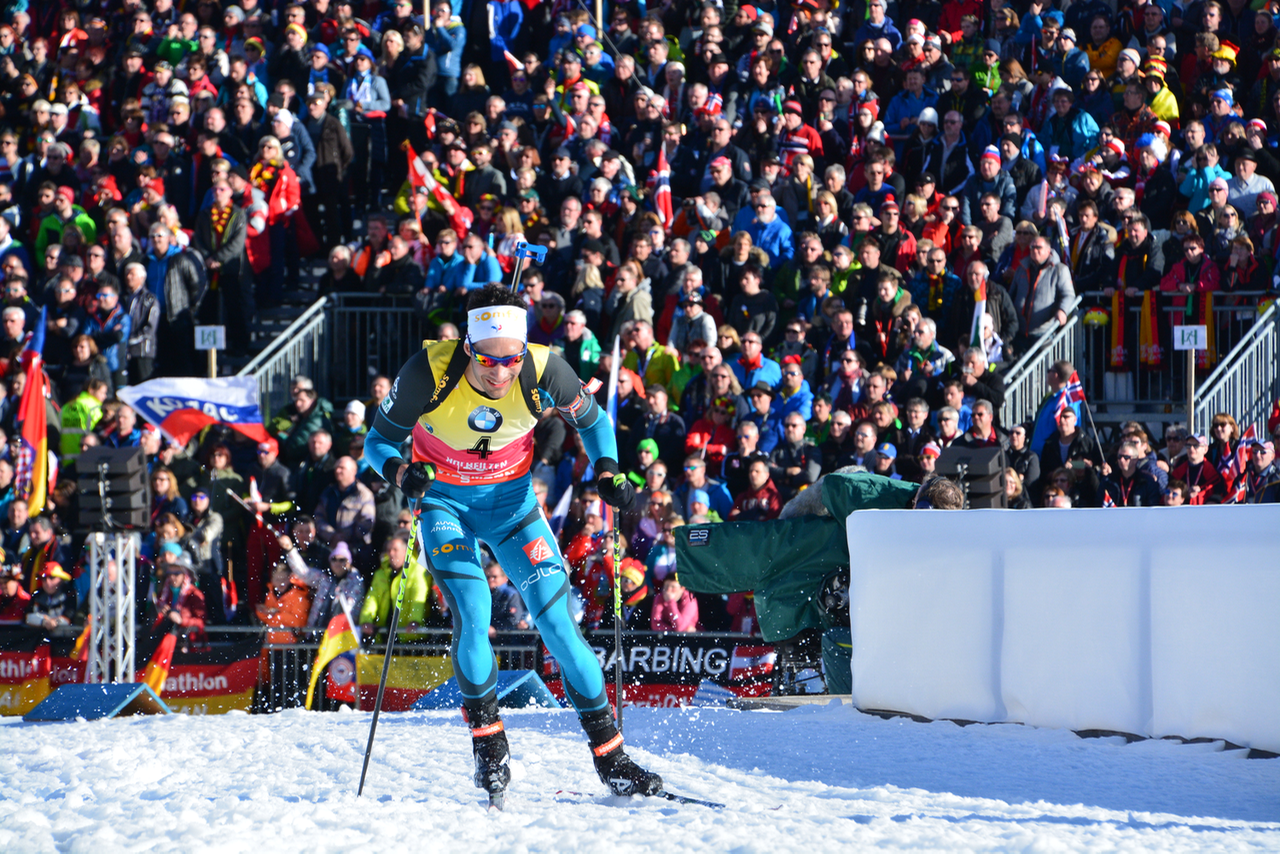
France’s Martin Fourcade lunging for his second gold of the 2018 Olympics in PyeongChang, South Korea, winning the men’s 15 k mass start on Sunday. (Photo: FlyingPointRoad)
Martin Fourcade is the champion once again. Six days after he won the 12.5-kilometer pursuit for his first gold in PyeongChang, the 29-year-old Frenchman did it again in the men’s 15 k mass start on Sunday, winning in a photo finish at the line.
He took charge on the first loop, leading the field into the range for the first prone shooting. There, Fourcade shot a penalty and slipped to 19th, but it wasn’t over.
Clean shooting on the second prone brought him up to eighth, 9.4 seconds out of first. Germany’s Benedikt Doll took that lead at that point after his second stage without a miss. Meanwhile Norway’s Johannes Thingnes Bø shot three misses on that second stage and dropped out of contention.
One loop later, Fourcade moved into first with a clean standing. He left the range about 1 second ahead of Germany’s Simon Schempp and 2 seconds ahead of Germany’s Erik Lesser, after both made it through the first three stages without a miss. Doll missed one to slip to seventh, almost 30 seconds behind.
After Fourcade and Schempp exchanged leads over the next loop, Lesser moved into first just before the final shooing, Going head to head, Fourcade and Schempp both missed one while Lesser missed two. Fourcade and Schempp still left the range in first and second, respectively, separated by 0.4 seconds, while Lesser slipped to fifth, 22.5 seconds back.
Doll left the range in third (+19.2) after cleaning and Norway’s Emil Hegle Svendsen moved into fourth (+21.9) with a clean standing stage as well.
In the end, Fourcade outlunged Schempp for the win in 35:47.3 minutes, with Schempp finishing less than a tenth of a second behind for silver, and Svendsen beat out Lesser in the finishing stretch by 0.4 seconds to claim bronze, 11.2 seconds behind, while Lesser settled for fourth (+11.6). Doll followed them in fifth (+18.8), Austria’s Julian Eberhard placed sixth (+30.7) with three penalties, Norway’s Erlend Bjøntegaard seventh (+32.1) with two misses, Norway’s Tarjei Bø eighth (+34.6) with three penalties, Sweden’s Jesper Nelin ninth (+34.6) with two misses, and Slovenia’s Jakov Fak 10th (+36.1), just ahead of the Czech Republic’s Ondřej Moravec in 11th (+36.3), with one miss each.
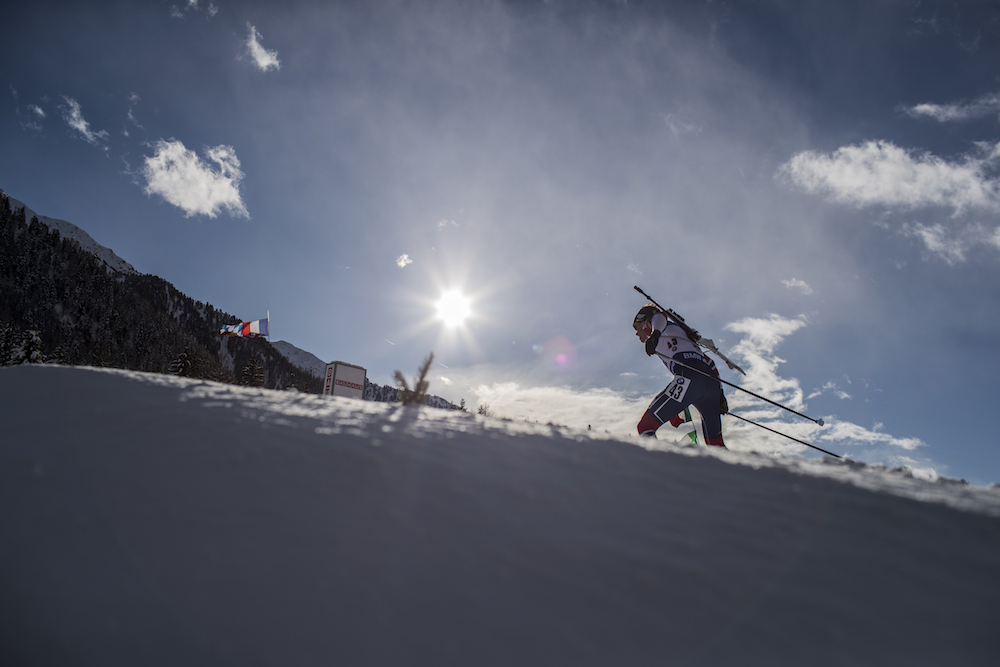
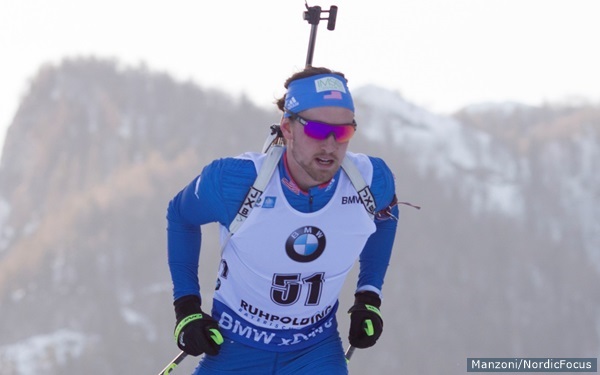
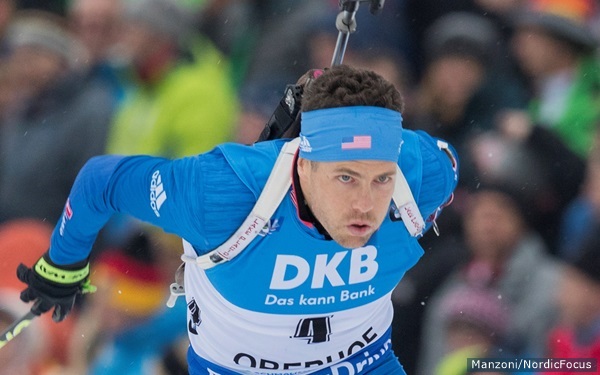
Norway’s Johannes Thingnes Bø racing to another win in the men’s 10 k sprint on a bluebird day on Friday at the IBU World Cup in Antholz, Italy. (Photo: Manzoni/NordicFocus)
IBU World Cup (Antholz, Italy): Men’s 10 k sprint
One prone penalty wasn’t enough to keep Johannes Thingnes Bø from his third-straight victory (and ninth this season, including relays) as the 24-year-old Norwegian won the men’s 10-kilometer sprint on Friday at the International Biathlon Union (IBU) World Cup in Antholz, Italy.
Bø started 42nd of 109 men and had to navigate tricky wind conditions, along with the rest of the field. After missing one target in the prone shooting, Bø left the range in third, 4.8 seconds behind the race leader at the time, Austria’s Julian Eberhard, and 2.6 seconds behind his Norwegian teammate Lars Helge Birkeland in second.
Throughout the race, Bø set the fastest course times and took a sizable lead over Birkeland and Eberhard after standing, which he cleaned and left the range 33.5 seconds ahead of Birkeland, who had also hit all five standing targets. Eberhard missed two to slip 1:11.6 minutes back.
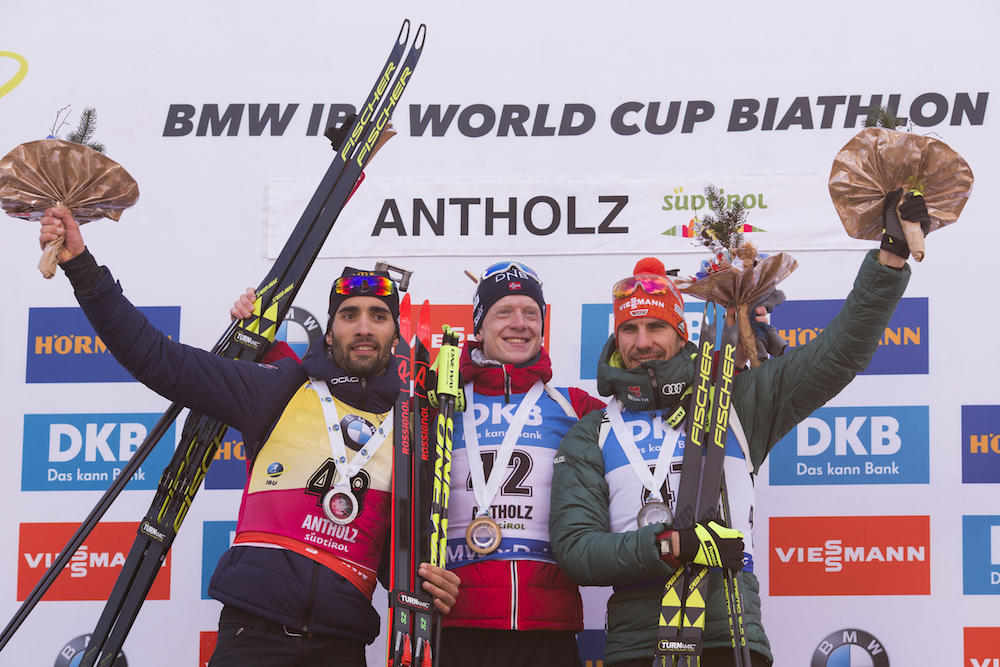
Bø went on to cross the finish line in 23:19.3 minutes, faster than France’s Martin Fourcade (who started behind him in bib 48 and cleaned both stages), as Fourcade finished 12.8 seconds back in second.
The men’s 10 k sprint podium at the IBU World Cup in Antholz, Italy, with Norway’s Johannes Thingnes Boe (c) in first, France’s Martin Fourcade (l) in second, and Germany’s Arnd Peiffer (r) in third. (Photo: Manzoni/NordicFocus)
Germany’s Arnd Pfeiffer started 47th, just ahead of Fourcade, and raced to third (+42.2) with clean shooting as well.
“In the sprint, you almost always have to shot clean,” Bø reflected after, according to an IBU press release. “After my prone miss, I knew a podium would be hard, but you never know; you fight hard. With zero in standing, I knew there was a chance … I had the times from the start and knew I had good speed today … Martin is almost always stronger than me on the last lap, but today I was not tired.”
Fourcade pointed out that this was his best sprint result in Antholz, a high-elevation venue at some 5,200 feet above sea level, since 2011, “so I am pretty satisfied,” he told the IBU.
Pfeiffer told German broadcaster ARD that he latched onto Fourcade for the last loop.
“At least I was clean on the shooting range today, that was not so easy,” Pfeiffer said, according to a translation. “I am pretty proud I managed to do that today. This was not my best day on the course, even if the position might insinuate something else. I had to toil quite a bit, and was lucky that Martin came by for the final [loop], who also wasn’t in his top shape today.
“In the end of course the result was great, I haven’t been on the podium in an individual-start race so far this season,” Pfeiffer continued. “So I am happy about 100 percent shooting accuracy and hopefully being on the podium if everything works out.”
Russia’s Anton Shipulin missed the podium by about four seconds in fourth (+46.3) with one standing miss (0+1), France’s Emilien Jacquelin placed fifth (+53.7) with clean shooting, Birkeland ended up sixth (+1:07.8) with zero penalties as well, Eberhard was seventh (+1:21.7) with two misses (0+2), Russia’s Anton Babikov eighth (+1:27.8; no penalties), Vladimir Chepelin of Belarus ninth (+1:32.3; one penalty), and the Czech Republic’s Ondrej Moravec 10th (+1:35.4; no penalties).
US Biathlon’s Lowell Bailey racing to 41st in the men’s 10 k sprint at the IBU World Cup in Antholz, Italy. (Photo: US Biathlon/NordicFocus)
Three out of five Americans qualified for Saturday’s pursuit, with Lowell Bailey leading them in 41st (+2:22.0) after one standing miss (0+1). Notably, he had the fifth-fastest overall shooting time.
Tim Burke was just another 0.4 seconds back in 43rd (+2:22.4) with three penalties (1+2), and Leif Nordgren finished 50th (+2:33.1) with two penalties (1+1) and the second-fastest overall shooting time and third-fastest range time.
Macx Davies, who was selected to Biathlon Canada’s Olympic team, was the top Canadian in 66th (+2:58.2) with three misses (1+2). Carsen Campbell finished 82nd (+3:27.9) with two penalties (2+0), Matthew Hudec was 89th (+3:40.6) with one miss (0+1), and Aidan Miller 107th (+5:00.3) with five penalties (3+2).
The men’s and women’s pursuits will be held Saturday in Antholz at 7:15 a.m. for the women and 9 a.m. for the men EST. Watch live on the Olympic Channel.
Western Canadian Championships (Red Deer, Alberta): Freestyle sprints
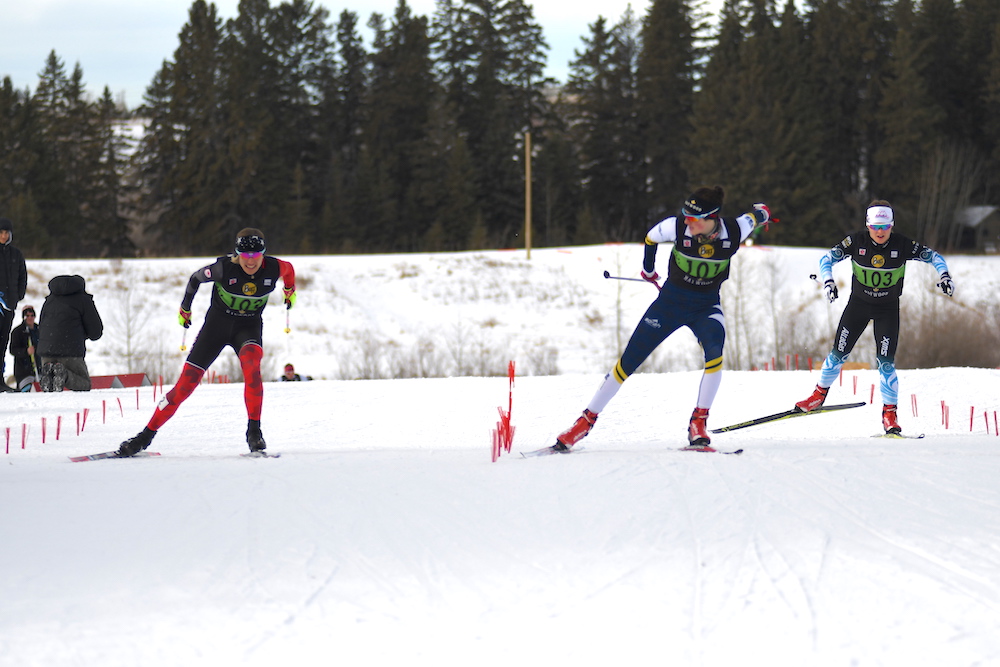
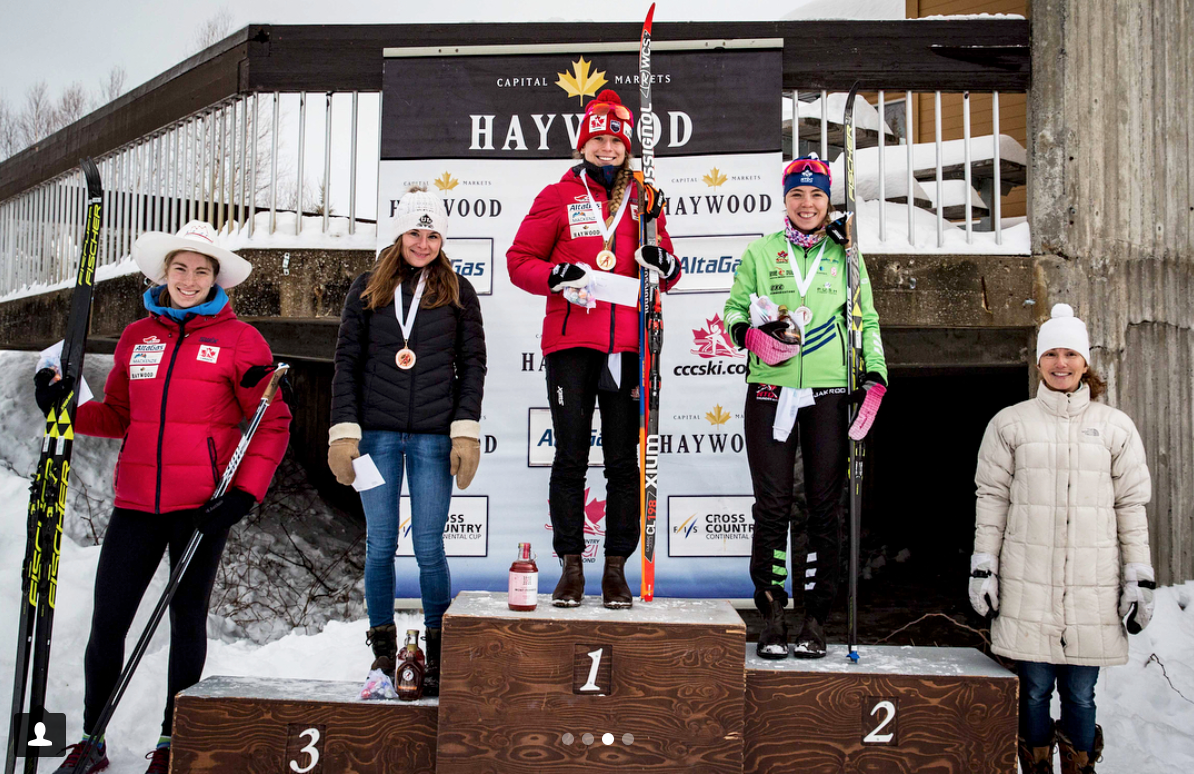
Olivia Bouffard-Nesbitt (c) holds off Zina Kocher (l) and Annika Hicks (r) to win the women’s 1.2 k freestyle sprint final on Friday at the NorAm Western Canadian Championships in Red Deer, Alberta. (Photo: Doug Stephen)
The NorAm series shifted west to to Red Deer, Alberta, for the fourth weekend of racing.
Olivia Bouffard-Nesbitt (Rocky Mountain Racers) won the women’s 1.2-kilometre freestyle sprint A-final in 3:09.12, edging out Zina Kocher (Foothills Nordic) and Annika Hicks (Alberta World Cup Academy) by 0.4 and 0.77 seconds, respectively. They qualified in the same order in a small women’s field of 20. Organizers opted to skip the quarterfinals and pinned the top 10 women from the qualifier in two semifinals.
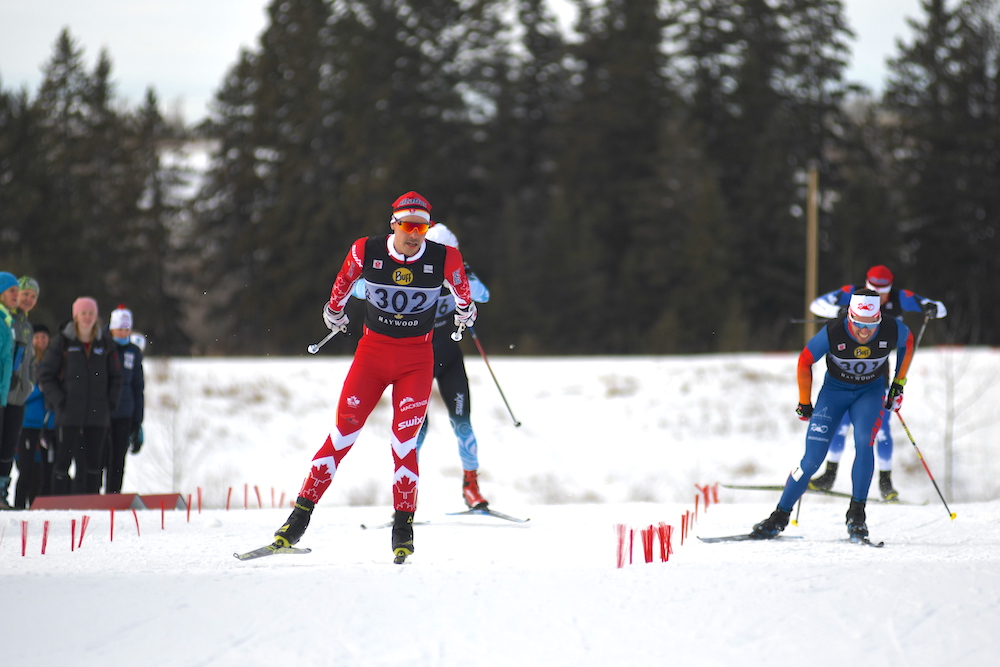
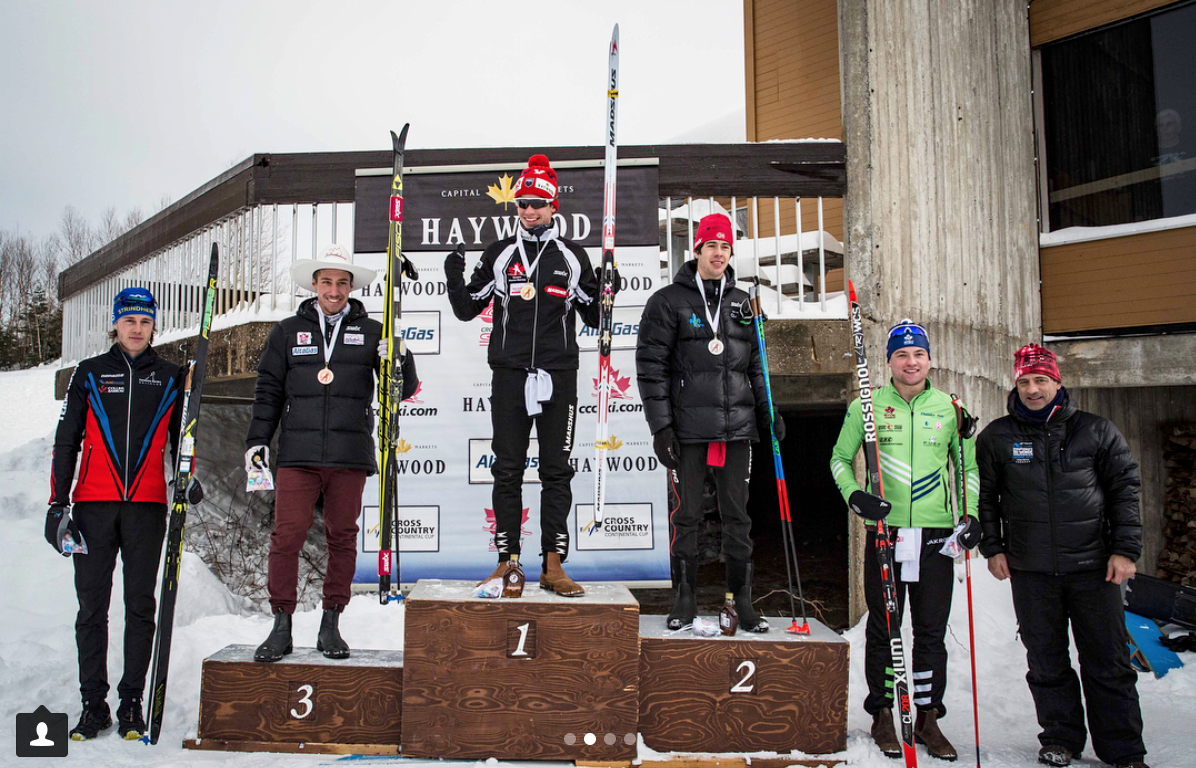
Jess Cockney (302) winning the men’s 1.2 k freestyle sprint final ahead of Russell Kennedy (r) on Friday at the NorAm Western Canadian Championships in Red Deer, Alberta. (Photo: Doug Stephen)
The men’s 1.2 k qualifier had 38 starters, and 22 advanced to the quarterfinals. After qualifying in second, 0.16 seconds off the top time set by Russell Kennedy (Team R.A.D.), Jess Cockney (Canadian World Cup Team) won his quarterfinal and semifinal and ultimately the men’s final in 2:24.29, 1.09 seconds ahead ofKennedy in second. PatrickStewart-Jones (Alberta World Cup Academy) grabbed his first podium of the season, taking third (+1.70).
Western Canadian Championships usually draw a smaller field than Easterns: more Canadians live within reasonable driving distance of Eastern Canadian Championships (hosted by Nakkertok in Cantley, Quebec) than live in all three times zones of western Canada combined.
With many of the top athletes in Europe doing final elevation camps for the Olympics and U23s/Junior World Championships, the Western Championships’ open and junior categories were particularly small this year with 287 athletes total.
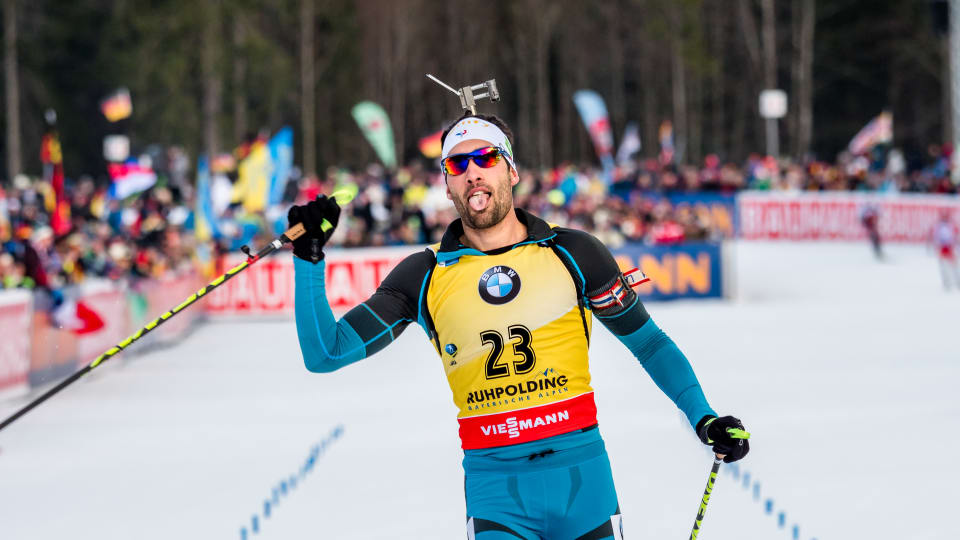
France’s Martin Fourcade after winning the men’s 20 k individual at the IBU World Cup in Ruhpolding, Germany, by more than a minute on Wednesday. (Photo: IBU/Biathlonworld)
IBU World Cup (Ruhpolding, Germany): Men’s 20 k individual
For France’s Martin Fourcade, the difference between a miss on the last shooting stage of the men’s 20-kilometer individual International Biathlon Union (IBU) World Cup on Wednesday versus perfect shooting wouldn’t have ultimately changed his result in Ruhpolding.
Despite the one-minute penalty, which was tagged onto his total time after his lone miss of the day, Fourcade still won by a minute. The Czech Republic’s Ondřej Moravec, who started 2 1/2 minutes ahead of him in bib 18 (while Fourcade wore bib 23), had successfully cleaned every stage, shooting 20-for-20, and initially crossed the finish line first — about a minute and 23 seconds ahead of former race leader Simon Eder of Austria.
But Moravec’s moment in first was fleeting as Fourcade burst into the stadium, not yet letting off the gas, seconds after Moravec finished. Fourcade took the win in 44:27.9, 1:01 ahead of Moravec in second. To indicate how fast Fourcade’s last loop was, it’s worth noting that he was 30 seconds ahead of Moravec with 4 k to go. On that final 4 k loop, he doubled his time ahead of second place.
Fourcade’s win came four days after his last race in Oberhof, Germany, the 12.5 k pursuit, which he also won.
“We are in a biathlon routine now,” he said, according to an IBU press release. “It was hard to find strong motivation with not much recovery or training this week. … Today I wanted to beat my record of podiums in a row. Today was my 14th [individual podium, including last season] in a row and I am really proud of this. I am very happy with my competition as well. Ruhpolding is place that I really love and I am happy that I continued my success here.”
Norway’s Johannes Thingnes Bø achieved his eighth-straight podium in third, 1:06.3 behind Fourcade with a single miss on the last stage as well (0+0+0+1).
“I heard the speaker, so I knew Martin had missed,” recalled Bø, who started behind Fourcade in bib 29. “I knew if I could shoot clean, there was a small chance I could beat him. I tried and missed. That was my tactic: to go for the win, not save the podium.”
He left the range for the last time 48.3 seconds back from Fourcade in first.
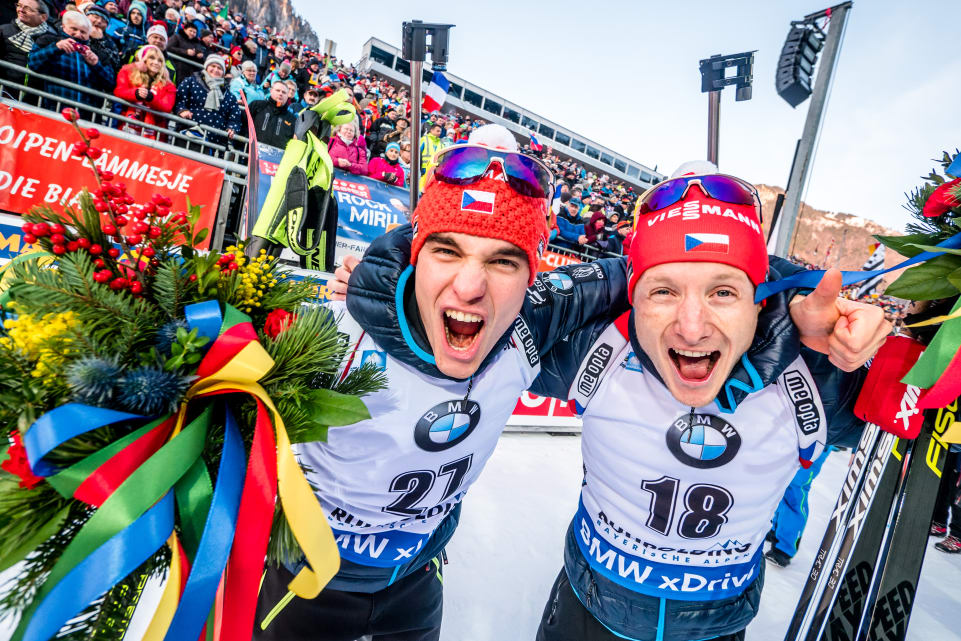
Michal Krcmar (l) and Ondřej Moravec (r) after reaching the flower ceremony in fifth and second, respectively, on Wednesday at the IBU World Cup in Ruhpolding, Germany. (Photo: IBU/Biathlonworld)
Germany’s Roman Rees shot clean and placed fourth (+1:19.1) for his first-career World Cup top 10, and the Czech Republic had two in the top five with Michal Krcmar in fifth (+1:36.6) for his best result of this season.
For Moravec, second place marked his season best as well, after finishing outside the top 10 in previous races this season.
“This podium is really important for me,” he told the IBU. “My first trimester was really bad; my shape was not good especially for the shooting. I also missed a lot of the summer training so did not have the best preparation … I am very please at how I was able to focus and have success in this race.”
Austria’s Dominik Landertinger followed in sixth (+2:21.9) with one penalty and Eder ended up seventh (+2:23.8) with one miss as well.
While the one-minute penalty per miss did not faze Fourcade, it led several North Americans to drop out of top-20 contention, particularly Tim Burke (US Biathlon), who had been in 16th after cleaning the third shooting stage. Burke had cleaned his first stage then missed one on the first standing, but was back in the top 20 with a clean third stage. On the final standing, he missed his first two shots, causing him to look up for a moment to refocus. He cleaned the last three, but still ended up with two additional minutes of penalties that put him 36th at the finish, 4:35.0 out of first (0+1+0+2).
Sean Doherty (US Biathlon) racing to 31st to lead his team in the men’s 20 k individual on Wednesday at the IBU World Cup in Ruhpolding, Germany. (Photo: US Biathlon/NordicFocus)
Sean Doherty led the U.S. men in 31st after missing two targets between the first prone and first standing stages. Ranked 76th after the second stage, he recovered to 53rd after a clean third stage and then 32nd after hitting all five targets on his last stage (1+1+0+0). With two penalties, Doherty finished the race 4:13.6 back in 31st.
“I am happy with the race today,” Doherty said, according to a US Biathlon press release. “I left some room for improvement on the range. It was a big step in the right direction from last week. We had very fast conditions on the course today and our waxing staff did a great job as usual.”
All three U.S. starters finished in the top 40, with Lowell Bailey in 37th (+4:36.4) with three misses (0+2+0+1).
Biathlon Canada was led by Christian Gow in 34th (+4:30.7), for his career-best in a 20 k individual race. After starting in bib 2, he cleaned his first and third stages to put himself in 32nd with one stage to go, within 28 seconds of the top 20. But a miss on his last standing put Gow in 39th leaving the range for the last time, and he ended up 34th at the finish (0+1+0+1).
“My shooting was just OK today,” Gow wrote in an email. “I would have liked to hit one more for sure and then I would have been completely satisfied with the race. I felt more nervous than normal in the range, and my two misses were a direct result of being a bit hesitant on the shooting mat.
“I am pretty happy with today overall,” he added. “I think this is the best skiing I’ve had in an Individual race and my best placing as well. I do wish I could have one or two shots back, but overall I am happy.”
Also for Canada, his older brother Scott Gow finished 55th (+5:13.2) with three penalties (0+1+1+1), Brendan Green placed 78th (+6:53.7) with four misses (1+0+2+1), and Macx Davies was 91st (+8:02.4) with five penalties (1+1+3+0), out of 107 finishers.
The Gow brothers and Green raced Sunday in the men’s 4 x 7.5 k in Oberhof, where they placed 10th.
“Honestly, I have been feeling pretty tired after the 3 days of racing in a row last weekend,” Christian wrote. “Our travel wasn’t too bad, but it still didn’t feel like much of a rest day.”
The Ruhpolding World Cup continues Thursday with the women’s 15 k individual (starting at 8:30 a.m. EST on the Olympic Channel). Another men’s 4 x 7.5 k relay will follow on Friday, then the women’s 4 x 6 k relay on Saturday, and the men’s and women’s mass starts on Sunday.
The women’s 10 k classic podium on Wednesday at the NorAm trials in Mont Sainte-Anne, Quebec, with Cendrine Browne (1) in first, Katherine Stewart-Jones (2) in second, and Anne-Marie Comeau (3) in third. Dahria Beatty (l) placed fourth. (Photo: Cross Country Canada/Instagram)
The NorAm trials at Mont Sainte-Anne (MSA), Québec, concluded Wednesday with the 10- and 15-kilometer classic interval starts. On the line were NorAm points, U23 and World Championships invitations, and for the women, what may well be the last Olympic spot on the Canadian team.
The action started with the men’s 15 k classic, which Ricardo Izquierdo-Bernier of the Pierre-Harvey National Training Centre (CNEPH) won in 39.07.8 minutes to punch his ticket to U23 World Championships later this month in Goms, Switzerland. He won the race ahead of Scott Hill of Barrie Cross Country (BXC) in second, who skied a fast final lap to come within 6.9 seconds of first.
Canadian Para-Nordic teammates Graham Nishikawa and Brian McKeever finished third (+30.0) and fourth (+37.4), respectively, with Nishikawa as McKeever’s guide in Paralympic events having the edge in the interval-start race the two skied on their own (Nishikawa started 64th and McKeever 55th).
According to Nishikawa, the two have been entering NorAm events that fit into their preparation for the PyeongChang Paralympics. Nishikawa wrote a quick email on his way to the airport on Wednesday.
“Happy with my week overall in MSA. Shape is good. Skis were good. Will keep improving into Korea for Paralympics,” he wrote after his second distance podium of the week.
In the women’s 10 k classic, Cendrine Browne (Canadian National U25 Team/CNEPH) continued her strong showing at trials with her second victory and fourth top-four result, taking the win in 29:47.0.
Katherine Stewart-Jones, of the U25 Team and National Team Development Centre (NTDC) Thunder Bay, and Anne-Marie Comeau (Université Laval) were virtually tied for second after the first lap, but Stewart-Jones held the speed to take second, 39.2 seconds behind Browne and 24.3 seconds ahead of Comeau in third.
About 16 seconds later, Maya MacIsaac-Jones, of the U25 Team and Rocky Mountain Racers (RMR), finished fourth (+1:21.0) ahead of Dahria Beatty, of the Canadian World Cup Team and Alberta World Cup Academy, in fifth (+1:26.6).
The selection criteria are complex, but a quick calculation suggests that Comeau, who placed second to Browne in Monday’s skiathlon, gets the provisional women’s distance spot for the PyeongChang Olympics (since Browne already established herself as the sprint leader), and Stewart-Jones, who was fifth in the skiathlon, gets the U23 Worlds berth. Stay tuned for updates and official selections.
The junior men’s 10 k classic podium on Wednesday at the NorAm trials in Mont Sainte-Anne, Quebec, with Antoine Cyr (c) in first, Félix Longpré (2) in second and Étienne Hébert (3) in third. (Photo: Cross Country Canada/Instagram)
CNEPH’s Antoine Cyr took his third win of the week in the junior men’s 10 k, finishing in 25:57.3, well ahead of local Félix Longpré (MSA) in second (+48.2) and Étienne Hébert (AWCA) in third (+55.6).
In the junior women’s 5 k, Hannah Mehain (Sovereign Lake Nordic/National Junior Team) took the win in 15:22.7, just 2.7 seconds ahead of skiathlon winner Natalie Hynes (Whitehorse Ski Club/National Junior Team) and 15.0 seconds ahead of Tuesday’s skate sprint winner Annika Richardson (NTDC Thunder Bay/National Junior Team) in third.
France’s Martin Fourcade celebrates his victory in the men’s 12.5-kilometer pursuit at the 2018 IBU World Cup in Oberhof, Germany. (Photo: IBU/Biathlonworld.com)
After cleaning the fourth and final shooting stage in the men’s 12.5-kilometer pursuit on Saturday at the 2018 International Biathlon Union (IBU) World Cup in Oberhof, Germany, Martin Fourcade of France hoisted the biathlon rifle onto his back, spun around and fully faced the way he’d come, glancing for a moment at his three closest competitors behind him: Norwegians Johannes Thingnes Bø and his older brother Tarjei Bø, and Emil Hegle Svendsen, before heading out on the final loop while his closest challengers were all still shooting on the range.
Was it a new gesture to assert his dominance in the sport instead of celebrating with a fist pump or raised arm when he crossed the finish line, or was he genuinely curious how they were doing?
“I will answer diplomatically. Yesterday I heard from the Norwegian press that Emil [Hegle Svendsen] said I feared the Norwegian team,” Fourcade said when asked about ‘the stare’ in a post-race press conference. “I have a lot of respect for them. I know how good they are because they show me every weekend. They can beat me in every competition, but I don’t fear them like they don’t fear me! It was my answer to them.”
Fourcade then looked over to Tarjei Bø sitting next to him on the podium who laughed and replied: “Really good answer!”
In the race, Johannes Bø cleaned his targets to follow his French rival onto the last loop, 16.3 seconds back, followed by his brother Tarjei another ten seconds later, while the third Norwegian Svendsen, who had shot head-to-head in a duel against Fourcade in the first stages, incurred his only miss of the day and had to ski 150 extra meters in the penalty lap, thus slipping from second to fourth.
Johannes Bø skied faster on the final loop than Fourcade, getting closer and closer, and the French biathlete surely would have kicked himself for his unorthodox maneuver on the range if he had squandered his lead and lost by inches in a finishing sprint. But that didn’t happen, and Fourcade could celebrate across the line in a time of 30:49.5 minutes, with just one penalty.
Johannes Bø crossed the line 6.3 seconds after him with three penalties, while his clean-shooting brother Tarjei finished third, 30.9 seconds back.
Svendsen, the runner-up in Friday’s sprint, had to settle for fourth place (+1:04.7) with one penalty in the pursuit, while Ukraine’s Dmytro Pidruchnyi was fifth (+1:16.2) also with one penalty.
“I missed in the first prone together with Martin, then the rest of the race I fell a little bit behind in each shooting … so I was never really in the fight for the win,” Johannes Bø said in the press conference. “But in the end I got the second place. If Martin had stood [on the range] two seconds longer maybe I would have caught him!”
Asked if it added extra pressure on the range having to shoot directly against his brother, he added with a laugh: “Yeah, it’s like a cat-and-mouse game. We have done it for as long as … some 20 years. So there is not much difference. I won, like at home.”
“I was one penalty loop behind the guys after the sprint, so I knew they had to make a [mistake] for me to have a chance,” Tarjei Bø said. “I was always some seconds behind, I was never fighting for the win but fighting for the podium. … The level was really high, we were four guys together, and to be honest it’s really fun to have these fights when you know you have to deliver your best to have a chance to win.”
Asked about the friendly rivalry with his brother, he added: “The only problem is whenever Johannes has been on the podium he has beaten me every time. It’s not so fun, so I need to improve! Today were were together at the last shooting, and he showed me he was better. So … do you have any tip for me? You all have seen biathlon for ten years, you don’t have anything?!”
Best Pursuit of the Season for Burke
Tim Burke (US Biathlon) racing to 14th in the men’s 12.5 k pursuit on Saturday at the IBU World Cup in Oberhof, Germany. (Photo: US Biathlon/NordicFocus)
US Biathlon’s Tim Burke had started the pursuit race in fourth and 20 seconds behind Fourcade after his season-best performance in Friday’s sprint, and initially remained in the top of the field in the pursuit after cleaning his first prone stage.
He then skied the next loop with eventual third-place finisher Tarjei Bø, who skied the overall 10th-fastest course time of the day while Burke was 22nd overall. Burke then incurred two penalty laps in his second prone stage
“Going with Bø on the second loop was definitely fast but I felt in control,” Burke wrote in an email to FasterSkier. “I don’t think this had anything to do with the two prone misses in the second stage. I just simply missed, which happens in biathlon sometimes.”
Burke had fallen back a bit to the eighth position as he returned to the course, then after the third loop, cleaned his first standing shooting stage, but was passed by two competitors. He missed one more in his final standing stage and set back out on the course in 14th position.
On the final lap and in an extended sprint for positions on the slightly inclined, very long and straight finish stretch in Oberhof, he skied with Russia’s Anton Shipulin (who ended up 12th, +1:43.1, with one penalty) and the Czech Republic’s Ondrej Moravec (13th, +1:43.6, three penalties) who had left the range two seconds behind him, while Burke managed to overtake Sweden’s Frederik Lindström (+1:45.8; no penalties), one of only three athletes to shoot clean in all stages.
Burke thus ended his day still in 14th, 1:43.7 behind Fourcade, with three penalties (0+2+0+1). It was his best result in a pursuit this season.
“I was able to push reasonably well on the last loop today, which was a first for me this season,” he wrote. “I will take this as a good sign for the upcoming races.”
No other athlete for US Biathlon qualified for the pursuit in the top 60 of Friday’s sprint, with Sean Doherty finishing 84th position in the sprint the day before.
Career-Best for Christian Gow
For Biathlon Canada, Christian Gow moved up from a 36th starting position after the sprint to finish 21st, 2:19.2 back, with only one penalty incurred in his last stage (0+0+0+1).
With this performance he tied his career-best individual result from a pursuit in Östersund, Sweden, during this season’s opening weekend.
“I am really happy with my result today,” Gow wrote in an email to FasterSkier. “This is one of the best ski races I have ever had, and the shooting was really solid as well. I wish I could have made one more spot, but it was a great race anyways.”
Gow wasn’t too bothered by the rainy conditions the biathletes encountered all week in Oberhof, including on Saturday.
“The course held up quite well considering the weather we have been having here, the hills were firm which made for a much more pleasant race,” he wrote in an email. “The shooting range was the calmest I have ever seen in Oberhof, so it was very manageable today.”
Gow skied the 28th-ranked course time of the day, including a second loop where he was the 11th-fastest athlete.
“I skied with [Norway’s] Lars Birkeland and [Sweden’s] Sebastian Samuelsson at different points in the race […] which was really helpful for keeping the ski pace high,” he explained.
On the range, the 24-year-old Calgary native remained clean through three stages moving up as high as 17th, until he came to the final shooting stage.
“I felt really calm for all of my range entries today, including the last one up until I hit the shooting mat,” Gow wrote. “At that point I realized that I was having a really good race and that another clean shooting would really solidify a strong result. I tried to put that aside and focus on being aggressive in the shooting in order to not allow time to think and make mistakes. Unfortunately, I was a bit too aggressive on my second shot which resulted in a miss, but I refocused really nicely from there and hit the rest.”
He came out of the penalty lap in 21st position, and kept that place into the finish by overtaking Russian-born athlete Timofei Lapshin, who races for South Korea, while being passed by Russia’s Alexander Loginov on the final lap.
Also starting in the pursuit for Biathlon Canada, his brother Scott Gow finished 50th (+4:45.0), after starting in 32nd then incurring six penalties on the range (2+1+1+2), and Brendan Green ended the race in 54th, 5:26.1 minutes back, improving by three spots while shooting three penalties (0+2+0+1).
Relay Races
The IBU World Cup weekend in Oberhof will conclude with the second relay races of the season on Sunday. The Canadians are slated to start the men’s relay with the two Gow brothers, Green, and Carsen Campbell, while the Canadian women’s team will include Sarah Beaudry, Julia Ransom, Megan Tandy and Emma Lunder.
US Biathlon won’t be able to enter a women’s or men’s relay, after the team only had Susan Dunklee and Clare Egan as well as Burke and Doherty as the athletes already qualified for the upcoming Winter Olympic Games in PyeongChang, South Korea, representing it in Oberhof. Reigning world champion Lowell Bailey, who is also prequalified for the Olympics, skipped the races in Oberhof for a longer rest and training period at home, just like he did a season ago.
The other potential candidates for PyeongChang are competing this weekend in two sprints at an IBU Cup in Brezno-Osrblie, Slovakia, which together with next week’s races in Arber, Germany, serve as the Olympic trials to round on the team.
“We will indeed miss the relay tomorrow but plan to race the relay in Ruhpolding [next Friday],” Burke wrote regarding the men’s team. “I don’t see this as a problem. In fact, it will be nice to have an extra day break with a tough 20k coming up on Wednesday.”
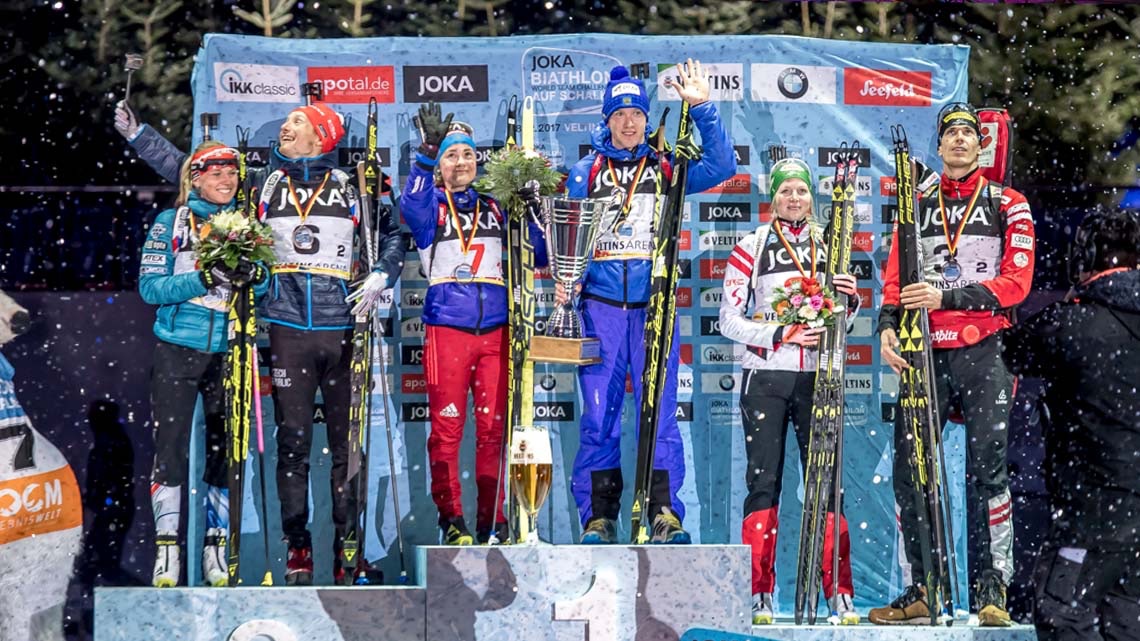
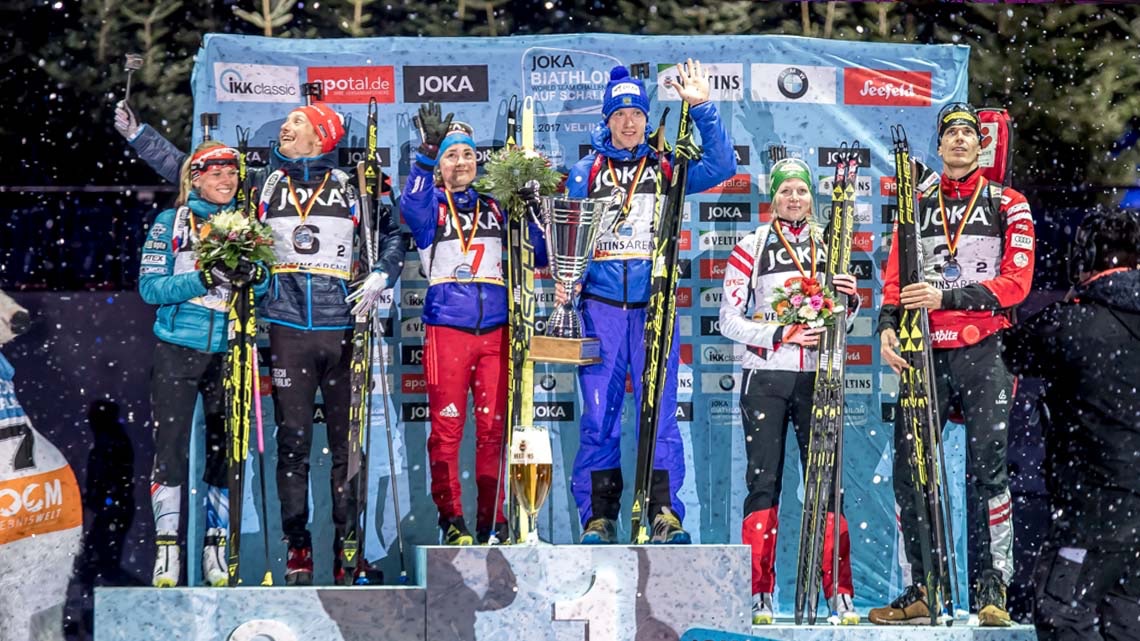
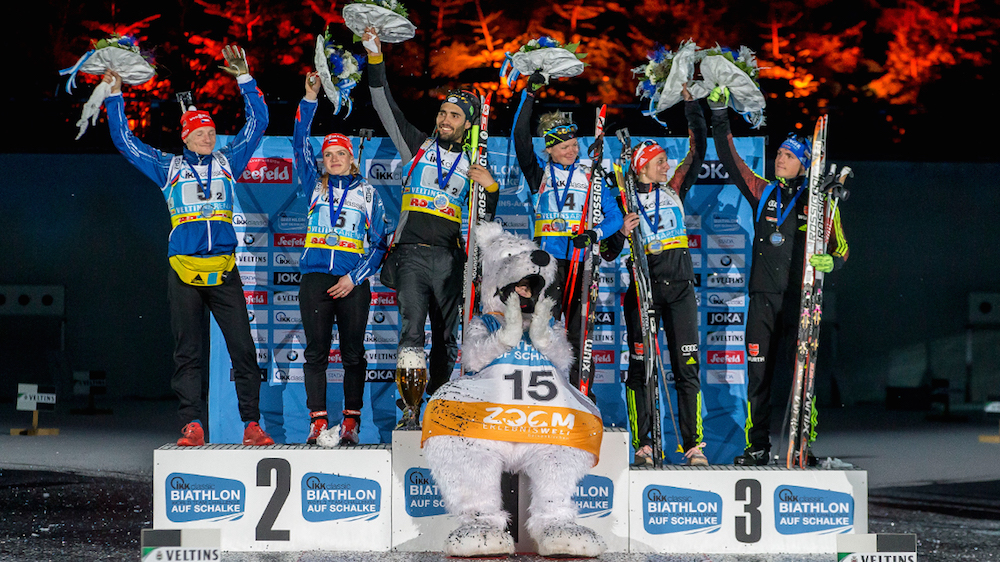
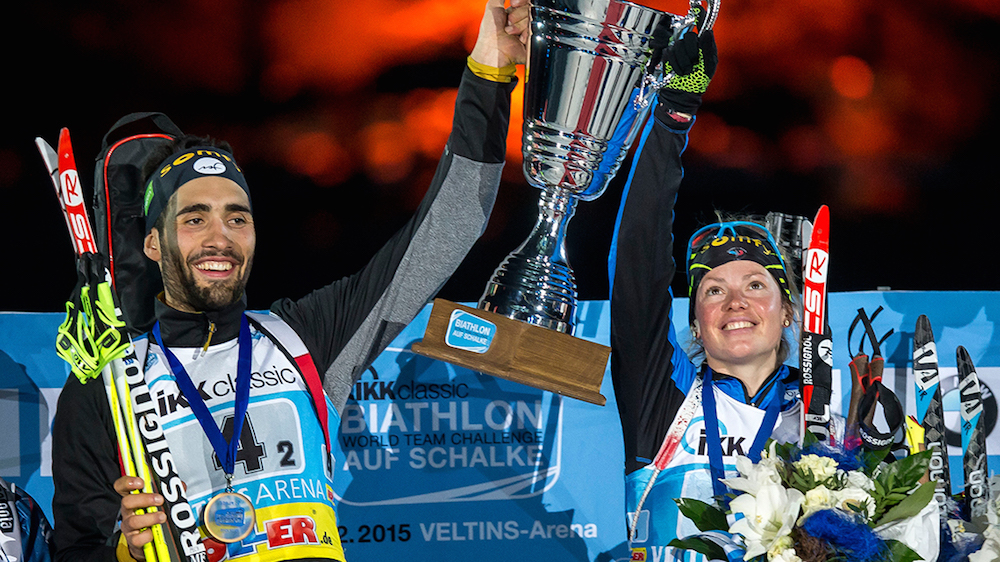
Russia’s Ekaterina Yurlova-Percht and Alexey Volkov (center, first place), Czech Republic’s Eva Puskarčíková and Ondřej Moravec (left, second place) and Austria’s Lisa-Theresa Hauser and Julian Eberhard (right, second place) on the podium of the 2017 JOKA Biathlon auf Schalke invitational race. (Photo: biathlon-aufschalke.de)
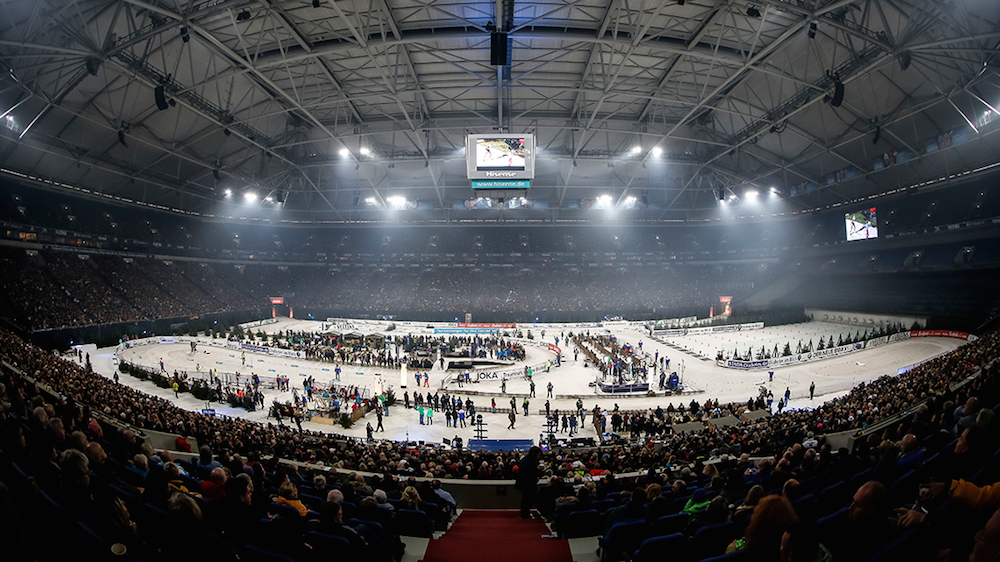
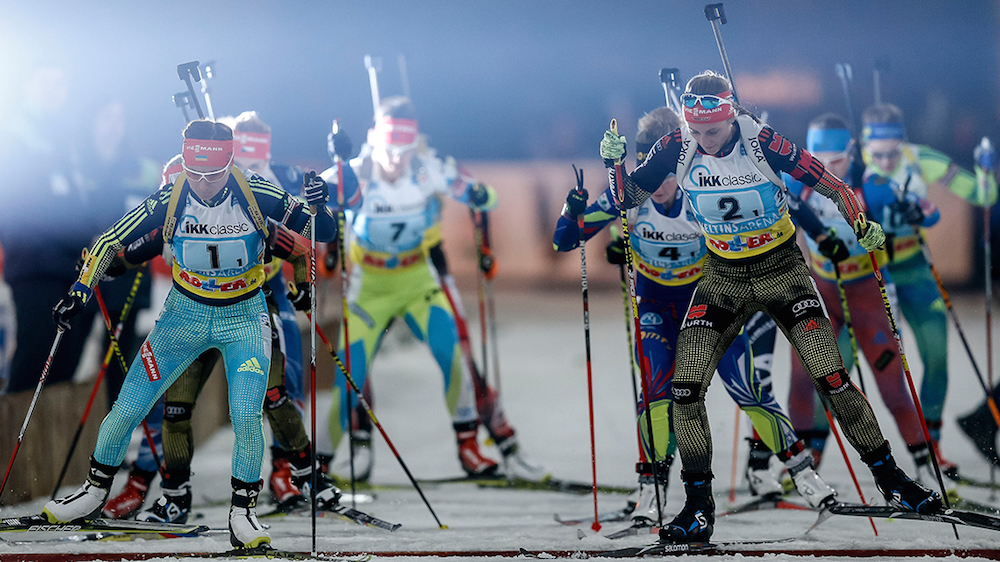
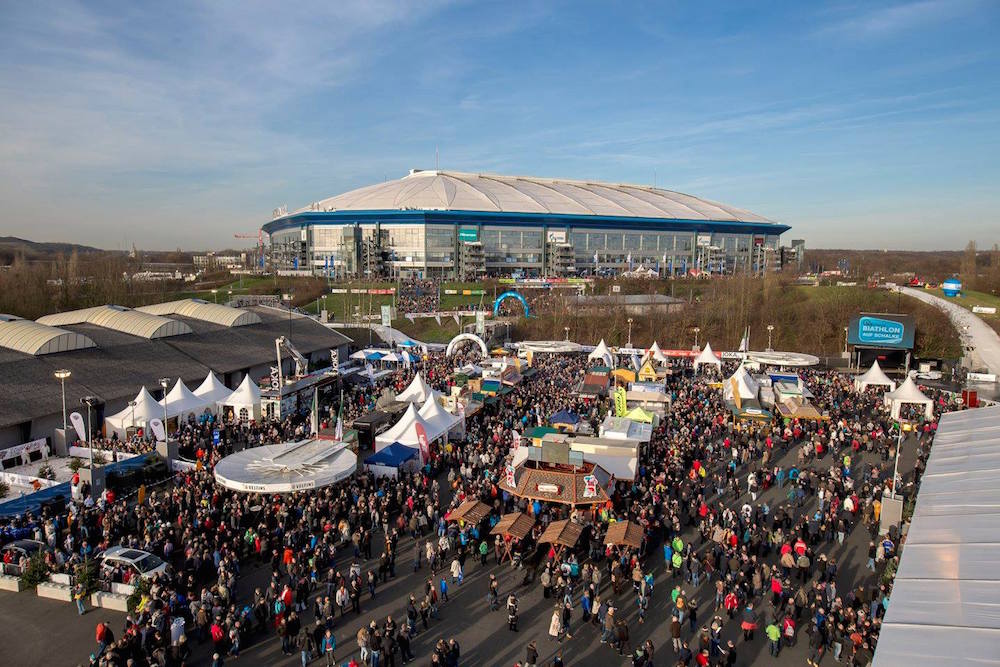
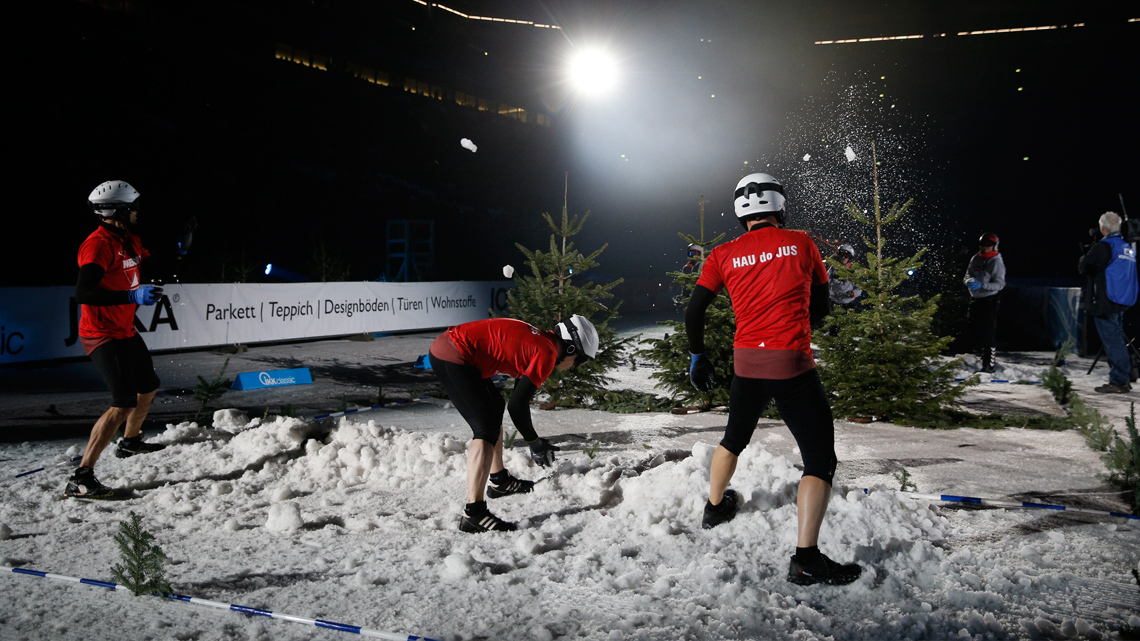
Picture some 45,000 rambunctious fans, loud music blaring, a course comprised of 10,000 cubic feet of machine-made snow, a shooting range surrounded by bulletproof glass, 1,300 fir trees as decorations, and 10 biathlon teams representing their nations, all packed into a huge stadium with a retractable roof that’s home to soccer team Schalke 04 in Gelsenkirchen, Germany. That’s the setting for the annual “Biathlon auf Schalke” two-person mixed relay show race, also known as the World Team Challenge.
Many international biathletes enjoy the event’s party atmosphere and use it as a fun way to keep their race shape sharp during the holiday break. The outdoor portion of the course meanders through a so-called “winter village” Christmas market, with the smell of food stands for the fans. Trees inside the domed arena form little forests to delineate the track and shooting range. There is entertainment like a “shoot-out” to determine the starting order, an unofficial “Snowball Fight World Championship”, fireworks, and multiple live pop-concert performances.
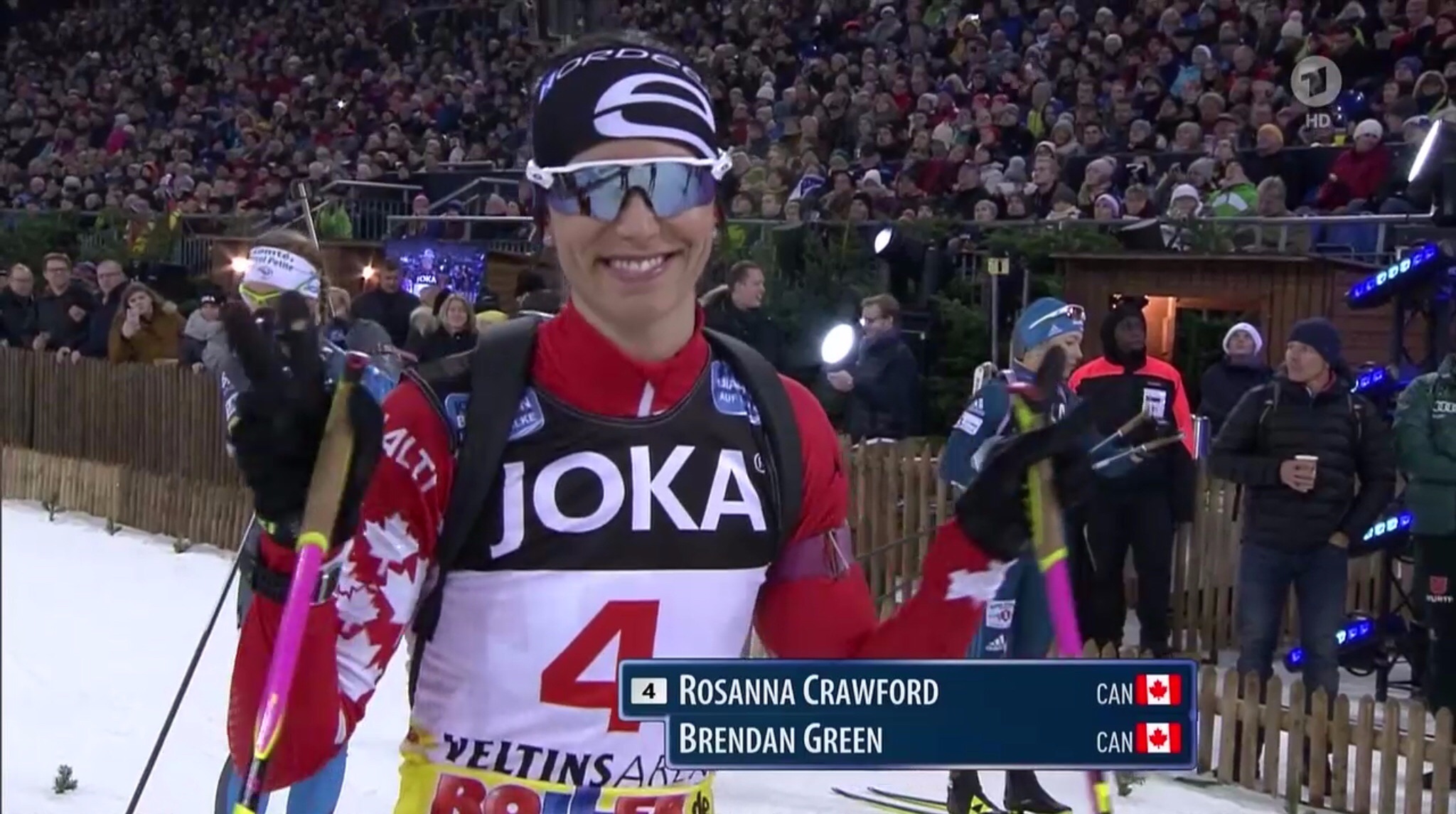
The 2017 edition took place this Thursday, Dec. 28, and this year marked the second time a Canadian relay was at the start, with Biathlon Canada represented by Rosanna Crawford and Brendan Green. Last year, Megan Tandy and Macx Davies teamed up for Canada in the mixed relay event.
Far away from the Alps in a flat region of the country previously known for its coal mining, “Biathlon auf Schalke”, while not an International Biathlon Union (IBU) sanctioned race, in its 16th season has become an annual fixture during the holiday break, bringing biathlon from the mountains to fans in the city. Each year, it has drawn a huge audiences, both in person and via television in Germany, as well as in a number of other countries where the event is also broadcast live.
“A few years ago Rosanna and I had talked about how fun it would be to race Schalke together, but it never quite fit in well with our schedule,” Green wrote in an email to FasterSkier. “This year the team stayed in Europe over Christmas and we were able to make it work.”
The World Team Challenge relay race is executed in a special format, with the main event split into two “halftimes” (as the organizers call it, borrowing a term from soccer) of a mass start race followed by a pursuit, held the same night after just a very short break.
In both races, one woman and one man form a team and exchange repeatedly, each skiing a short 1.3-kilometer loop and then having to clean a prone or standing shooting stage while not being allowed to use spare bullets — or else ski a shorter-than-normal 75-meter penalty lap — before tagging off to their teammate again. This mode of competition is comparable to the new single mixed relay format in biathlon or the team sprint in cross-country, though the pace might be even more frantic.
Rosanna Crawford at the start of the 2017 Biathlon auf Schalke invitational race. The Canadian relay team with her partner Brendan Green went on to finish seventh. (Screenshot: ARD broadcast)
“The course was tough, harder than it looked I think,” Crawford wrote. “This race is different to a single mixed relay, where you race for about 12min and then get 12min rest, this was race for about 4min and get 4min rest. Then there was only 15min in-between the two races, so it was quite difficult!”
“The pace you entered the range with skiing full gas on a shorter loop, with the added adrenaline from the crowd, I think for me was the most challenging aspect,” Green reflected in an email on Friday. “I just looked at my heart rate file and it peaked at 188 which is high for me. It never gets that high during a normal race format.”
With the women starting the “first half” pursuit race to a loud cannon boom, the event immediately began with a bit of a mishap for some teams, though Crawford got through it mostly unharmed.
“The first lap was pretty tricky, [Germany’s Franziska] Hildebrand changed lanes right on the very steepest climb and that caused me to ski into her, which then caused a pile up behind me,” Crawford wrote. “It’s a tricky course with not a lot of snow and not a lot of room to pass people, pretty much whoever leaves the range first will be leading the loop.”
Due to a number of penalties by both Crawford and Green early on, the Canadian pair initially fell back to the ninth position, before improving a little bit again when Green finally recorded his first clean shooting stage.
“The shooting atmosphere is different,” he wrote. “You don’t have to deal with certain variables such as wind [due to the closed arena], but instead have to deal with a lot of noise, bright lights, and other stimulus. It took a bit of getting used to.”
In the first years of “Biathlon auf Schalke”, the course was a rather flat loop, but in redesigns during the last few iterations the organizers added longer climbs and a fairly steep downhill section leading into a sharp right turn on the part of the track that is winding through the “winter village” outside the arena. It is supposed to now more closely resemble what athletes would see on the World Cup level.
Using artificial snow mostly coming from a permanent ski hall in a nearby city, every loop is 1.3 k long (adding up to more than 10 k throughout the event for each athlete) with about 25 meters of vertical elevation on a climb nicknamed the “Ruhrpott Glacier”, before the athletes enter the pitch inside the arena again via a tunnel, and then having to shoot in front of the 45,000 fans, often with additional music and the noise level amplified in a heated atmosphere.
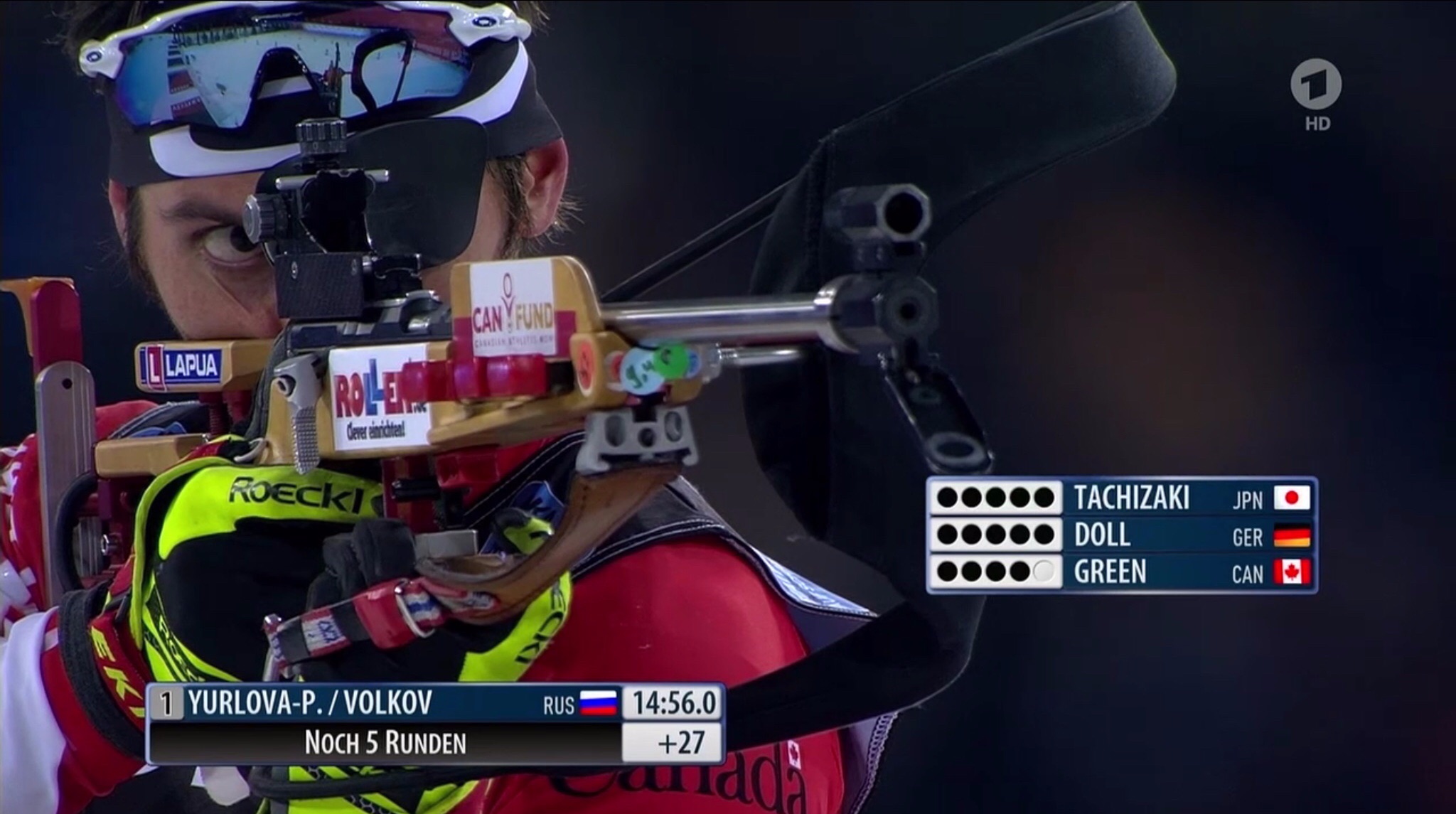
Biathlon Canada’s Brendan Green shooting a clean stage with five legs to go in the pursuit mixed relay race during the 2017 Biathlon auf Schalke invitational event. Together with his partner Rosanna Crawford, the Canadian relay finished seventh. (Screenshot: ARD broadcast)
“The course was quite challenging but it skied well and had surprisingly good flow,” Green wrote. “I anticipated that it was going to be quite physically demanding, but was still surprised at how punishing the racing was on the body.”
While one athlete was out on the track, crews of service technicians hurried to clean and prepare the skis of the athlete who was resting briefly. Unlike in most biathlon formats, where the shooting range is a no-coaching zone during a race, teams were also allowed to receive instructions after each leg and during the short 15-minute intermission between the mass start and pursuit.
“It was great to have Matthias [Ahrens] there, so he would run over to us after each shooting and show us our shots,” Crawford wrote. “Andrzej Lesnik was our wax tech and he did a great job with the skis.”
“We received feedback for our shooting from Matthias, and during the break in-between the races Rosanna and I spoke quickly about our own observations,” Green added. “In the end I think it came down to being a bit more attentive in the range and staying as focused as possible despite what was going on around us.”
The Canadians completed the first part of the event in eighth place, 1:24.1 minutes behind Russia in first.
Green came into the finish just a second behind Germany’s Benedikt Doll, who formed a team with Nadine Horchler (in place of Laura Dahlmeier, after Dahlmeier had to withdraw from the event just the day before due to illness. Organizers had previously hyped up Dahlmeier’s participation, after she had just been voted the German “female athlete of the year” as the first biathlete since Magdalena Neuner).
Pursuit Final
For the “second half” pursuit, the gaps to first place were halved respectively capped at a maximum of 45 seconds, so even the teams that had completed the mass start at the back of the field should still have a realistic shot at the top positions.
The coaching hints and adaptations on the range seemed to help, as both Canadians began the pursuit with a series of clean shooting stages, steadily moving up in the field. After her penultimate leg, Crawford tagged off in fourth position.
“Both Brendan and I felt better in the second race,” Crawford wrote. “It was too bad we had so many shooting mistakes in the mass start, would have been good to start closer to the leaders for the pursuit race. But after getting out the jitters we were able to shoot much better.”
In close head-to-head shooting duels for the positions on or just behind the podium, both Green and Crawford missed two targets in the next stages, falling back a bit again.
At the end of the pursuit, Green was beaten by inches — or 0.4 seconds — in a finish sprint with Germany’s Erik Lesser (forming the second German team with Hildebrand) and Belgium’s Michael Rösch (starting as a replacement for Slovenia’s Jakov Fak in a mixed-nation team with Ukraine’s Yuliia Dzhima) to finish the race in seventh place, the second-best result for a North American team.
“The last loop was tough,” Green remembered. “I was able to close a small gap to Lesser and Roesch on the last lap which ended in a sprint finish. I kept waiting for an opportunity and thought something might have been possible once we entered back inside the arena towards the finish, but in the end there just wasn’t enough space and we had to settle for 7th.”
“For the finish loop Brendan did a great job closing the gap to Lesser and Roesch, but there is just no room to pass!” Crawford, who had observed the scene from the sideline after completing her last leg, wrote in her email. “6th or 5th would have been amazing, but we are happy to finish 7th!”
Russian Team in Control in Both Stages
Knowing that accuracy on the range was more important than ski speed on a fairly short and narrow course, the Russian team entered two very secure shooters into the event with 2015 individual-discipline world champion Ekaterina Yurlova-Percht and Alexey Volkov, a member of the men’s gold medal-winning relays at the 2014 Olympic Games and 2017 biathlon world championships. The duo incurred the fewest penalties of all teams, only missing four of 80 targets on their road to winning both the mass start race and the following pursuit.
“With Alexey Volkov as my partner I expect everything, and I knew that Alexey is really really fast on the shooting range, and it can bring us the really good result,” Yurlova-Percht said at a post-race press conference.
At the “halftime” the Russian duo in first seemed within reach of a few other teams that were only about ten seconds back, yet in the pursuit they steadily increased their lead. After he had hit his final shot to clean the last stage to secure the victory, the otherwise subdued Volkov celebrated by raising his fist and looking to the stands in a gesture reminiscent of France’s perennial World Cup leader Martin Fourcade. He then rounded the final loop at a relaxed pace before skiing into the arms of the equally excited Yurlova waiting for him at the finish line.
“Our team was working highly focused on the shooting range today, that surely was our big advantage,” their coach Ricco Groß — himself a past winner of the World Team Challenge for Germany in an earlier iteration — told broadcaster ARD in a TV interview right after the race had concluded, according to a translation. “They solved that really well, and accordingly also won in pretty convincing fashion. … The athletes really did a great job today, that should also push our whole team, giving us some momentum and self confidence for the tasks ahead in January and February. … The atmosphere in the stadium here is gigantic, it is just crazy and incredibly fun here.”
“I want to say thanks a lot to all spectators who visited this competition today,” Yurlova added in the press conference. “This was an amazing atmosphere, and perfect feelings of support. I am really happy that all spectators were supporting not just their teams, but they were supporting everybody. And also when me and Alexey were shooting everybody was supporting us the same like the German teams.”
Both athletes had previously raced at Schalke, with Yurlova winning in 2012 with partner Anton Shipulin and placing fourth in 2015 with partner Evgeniy Garanichev as her best results, and Volvok placing third a year ago with Olga Podchufarova.
“I already thought before the start that we could win,” Volkov said, via a translator. “I have to say the course was very good, not at all flat, and if you take some risk going into the downhill anything can happen. … Today before the start I was trying to find an empty seat in the stands before the start, and I couldn’t see any. This is not just about motivation, this is a celebration [of biathlon]; you just have to be there.”
Looking over to the German team sitting next to him as the local representatives, Volkov added. “I am sure Erik [Lesser] shot faster than me today, but you know how statistics are, sometimes it’s better to shoot two seconds slower and hit everything.”
With nearly as solid shooting performances as the Russian team, the Czech Republic represented by Eva Puskarčíková and Ondřej Moravec stood in second after the mass start, behind Yurlova and Volkov (+9.2 seconds), then held that position in the following pursuit (+24.0).
Austria with Lisa-Theresa Hauser and Julian Eberhard (replacing Simon Eder on short notice) finished the World Team Challenge in third place (+43.5).
After the mass start they had been in fourth position (+10.3) just behind the Czechs and the French team of Anaïs Bescond and Emilien Jacquelin in third (+9.7). In the pursuit race Eberhard secured the position on the podium in the final shooting stage when he hit all targets standing on the range in a duel against Germany’s Lesser and France’s Jacquelin, who incurred more penalties. France finished fourth (+58.4), also slightly hampered by a fall and broken pole for Bescond during the race.
Crawford and Green were the sixth North American team to be invited to the “Biathlon auf Schalke” race and the second Canadian one. In 2008 and 2009, Lanny Barnes and Jay Hakkinen represented the US (placing ninth and sixth for the best finish by a North American team to date), in 2010 Tracy Barnes-Coliander and Tim Burke (10th), in 2012 Susan Dunklee again with Tim Burke (10th), and in 2016 Megan Tandy with Macx Davies for Canada (10th).
“Brendan and I really loved competing in Schalke!” Crawford summarized their experience. “It was like nothing we’d ever done before! There have been big crowds at World Cups and World Champs, like Nove Mesto and Oslo … but this was so different with having 45 000 people all packed into a soccer stadium! … I am really glad Brendan and I got to compete in this race once in our careers!”
While the International Biathlon Union (IBU) has adopted the mixed and single mixed relay formats in the last years as new disciplines to make the sport more attractive, “Biathlon auf Schalke” is an invitation-only race not promoted or hosted by the IBU, so there were no World Cup points to win in the event. However about €156,000 ($185,000 U.S. dollars) in prize money was awarded.
The regular IBU World Cup will resume on Thursday, Jan 4, in Oberhof, Germany, with a women’s sprint race.
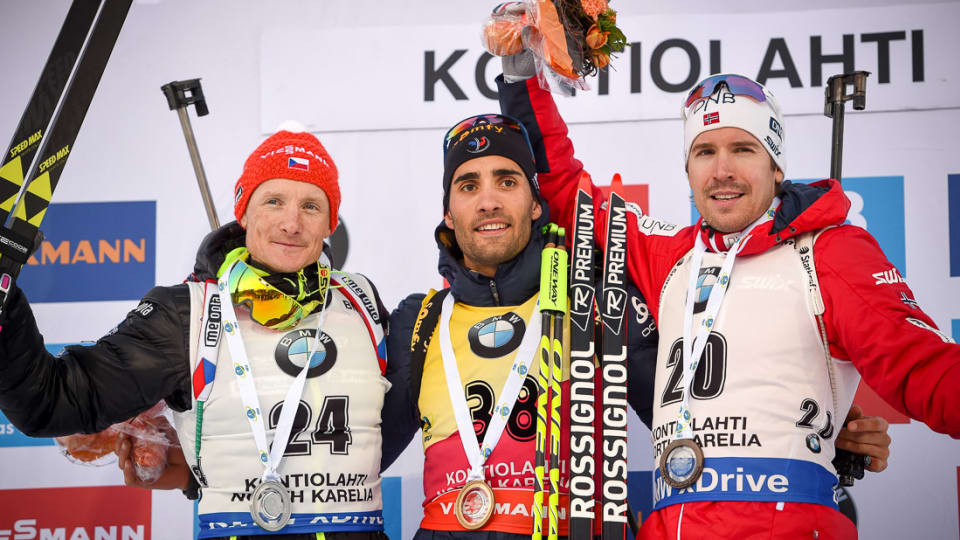
France’s World Cup sprint and total score winner Martin Fourcade (c) on the podium of the men’s 10 k sprint at the 2017 IBU World Cup in Kontiolahti, Finland, with the Czech Republic’s Ondrej Moravec (l) in second and Norway’s Emil Hegle Svendsen (r) in third. (Photo: IBU)
These days at the International Biathlon Union (IBU) World Cup in Kontiolahti, Finland, biathlon star Martin Fourcade of France is not as worried about his opponents on the course as he is about the imminent birth of his second child.
“That’s the first thing I did when I came to the finish, I checked my phone to see if my wife called,” he told German broadcaster ZDF after the race.
There was no message yet, so he declared that he also intends to race on Saturday before traveling back home. “Then I don’t know about my schedule, I have to wait what my wife decides,” he added with a laugh.
In Friday’s 10-kilometer sprint, Fourcade once again posted the best course time as he so frequently has this season, and thus was able to make up the seconds he lost after a miss in his standing shooting. At the end of the day, he was the only man in the top five without hitting all 10 targets.
After that penalty, Fourcade had to fight hard for the victory on the last loop. He crossed the finish line in 22:17.0 minutes, just 0.6 seconds ahead of Czech Republic’s Ondřej Moravec, who had taken the lead just a few minutes earlier. Three-hundred meters before the finish at the last timing point, Fourcade had been two seconds behind.
“Just after the shooting, I saw the screen [in the arena] and thought, ‘OK, five seconds back with one more penalty loop, it’s something I can do,” Fourcade explained at the post-race press conference. “Then at the first split time, I was still five seconds back and thought to myself that it’s over and I will never catch him. But at the last split time my coach said to me, ‘Only two seconds,’ so I started to believe again. I think I was really lucky to start on his back. It was a real advantage today to know about the situation.”
“I think it’s a track that suits me well,” Fourcade told ZDF. “I’ve known this place for a long time, it’s where I got my first victory in the World Cup. I love it because it’s really hard, you never stop pushing. Of course I am really satisfied, because the three guys behind me were not in PyeongChang [South Korea, at last week’s World Cup]. So I didn’t choose the best situation to win here because the travel was really hard, but I [managed] to win in PyeongChang and today so I am really proud.”
With his victory Fourcade also secured the “small crystal globe” awarded to the sprint World Cup discipline winner, after he had already locked up his sixth overall World Cup title in PyeongChang. With this 13th victory of the season, he also surpassed the all-time record for most victories within one season after he previously tied Norway’s Ole Einar Bjørndalen mark a week ago.
“I want to thank him for being such an amazing inspiration,” Fourcade said during the press conference, and added regarding his sprint title: “It’s not just business. I can remember when I won my first globe in 2010 in Oslo. I always try to remember the feeling I had. And I really respect this award, and am proud and satisfied I won it.”
Norway’s Emil Hegle Svendsen claimed the third place on the podium (+9.4), pushing his teammate Johannes Thingnes Bø to fourth. Both Moravec and Svendsen had opted against the long trip to South Korea.
“Battling with Martin is always hard,” Moravec said in the press conference. “When I saw him in the last hill it was really close with 2.2 seconds. And then I knew, ‘This is not good,’ because the last 500 meters of my race were nothing special, I was really tired on the last part of the track.”
At last month’s IBU World Championships in Hochfilzen, Austria, US Biathlon’s Lowell Bailey denied Moravec his first win of the season in the individual race by 3.3 seconds.
“It is what it is, 0.6 seconds, but today I am still really satisfied for the second place,” Moravec said. “Last time [in Hochfilzen] I was 50-50 maybe, but today it’s different.”
“I think it was a big advantage for me,” he added when asked about not traveling to PyeongChang. “Because I did a great preparation at home and took a rest … I think my result today is a good answer to this question.“
“Of course I thought about going to Korea,” Svendsen explained. “But I think if I would have gone there I would have done medium races during the last three World Cups. Now I got at least one podium, and I think it is better to have some good races than a lot of medium races. I think it was better for me to stay at home after a really bad World Championships.”
“Five podiums this year is much more than I expected,” he said when asked to reflect on his season. “Because the preparation this year was not so good. I am really happy with this after all the troubles I had last summer… But I hope I can now have six good months of training and come back stronger than ever.”
One of the earliest starters in bib 3, Bø hit all of his targets and was the race leader until Svendsen finished 2.7 seconds faster. As the race progressed, Fourcade and Moravec also finished ahead of him, pushing Bø to fourth (+12.1)
“It was quite a good race,” Bø told the IBU in an interview. “I don’t know where I could do better. So even if I’m fourth place I know I did my best today. It was high level on the shooting range today, and for myself I am quite happy with 10 hits in a fast speed. … I felt strong on the tracks, and just wish I were a little bit stronger to make the podium.”
Also shooting clean, Germany’s Arnd Peiffer finished fifth (+22.3).
“This is a demanding course with three long and steep climbs,” Peiffer told ZDF. “I am glad I got through with clean shooting on the range today. In PyeongChang, I was struggling in my standing stages … and that was pretty annoying. On the course it was a solid performance. I am still feeling the effects of the travel, but that won’t be any different for the others … So I am happy about this fifth place.”
Just behind Peiffer, Austria’s Simon Eder placed sixth (+23.0) with one penalty (0+1), and Latvia’s Andrejs Rastorgujevs missed the first World Cup podium of his career after he missed his last target to finish seventh (+25.1) with one penalty (0+1).
Kontiolahti is hosting the eighth World Cup stage of the season in place of Tyumen, Russia, which withdrew as a host in the wake of the McLaren report. Though almost 2,000 miles away from Tyumen, thanks to the new location near the northern Russian-Finnish border, a number of Russian fans still made the trip to Finland. Judging by flags, outfits and cheers, it seemed like they were about even with the local fans with the feel of a home World Cup.
Bailey Clean But Slower on Course
US Biathlon’s Lowell Bailey skiing into the finish of the men’s 10-kilometer sprint at the 2017 IBU World Cup in Kontiolahti, Finland. He placed 16th. (Photo: USBA/NordicFocus)
Another skier who managed to shoot 10-for-10 on Friday was Bailey, continuing his extremely accurate shooting form of the last few weeks. But this time, the American didn’t quite have the punch that propelled him to his historic gold medal at last month’s World Championships and another second place in PyeongChang last week. After eight straight races of placing in the top 10, Bailey finished 16th on Friday, 1:01.1 behind Fourcade.
But Bailey didn’t blame the travel from South Korea to Finland for his slower ski time than usual, after posting the 43rd-ranked course time of the day.
“It was actually a little bit longer than 24 hours,” Bailey wrote in an email to FasterSkier. “I’m not sure I can use that as an excuse; several athletes did just fine after that travel (Martin Fourcade was flying again!).
“I didn’t feel completely comfortable on my skis today,” Bailey added, regarding the race conditions. “It was an icy, unstable track and I struggled to keep a flat gliding ski … The conditions were the best we’ve had all week; not too much wind on the range and the tracks were hard and didn’t seem to break down at all.”
Coming out of the final standing stage in 12th place and 32.6 seconds out of first, he lost almost another 30 seconds on the final loop.
“I definitely didn’t have the strongest last loop,” Bailey wrote. “I just didn’t have a whole lot in the tank for the three big climbs. Some days are better than others and today I wasn’t at my best on the course. But, things can change quickly and I’m hoping to feel better for tomorrow’s pursuit.”
Three Americans, Two Canadians in the Pursuit
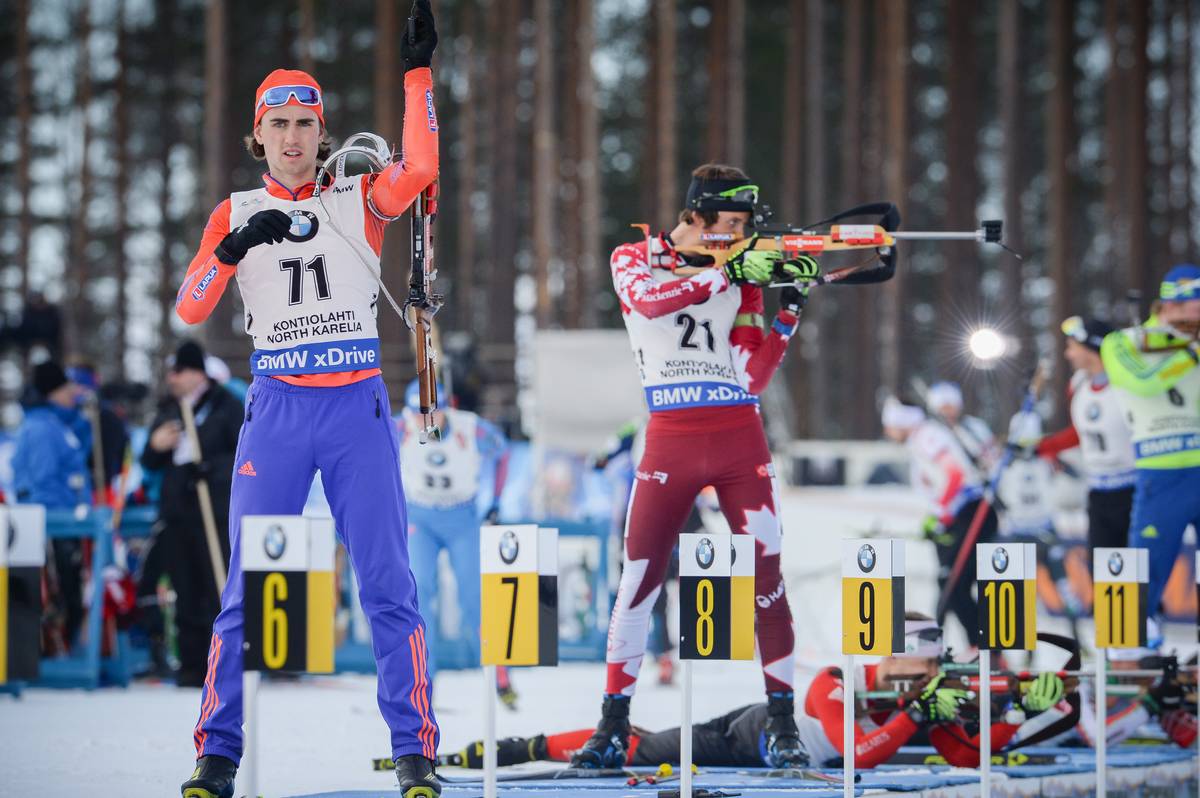
US Biathlon’s Sean Doherty (71) and Biathlon Canada’s Brendan Green (21) on the range during the second shooting stage of the men’s 10 k sprint at the IBU World Cup in Kontiolahti, Finland. (Photo: USBA/NordicFocus)
In addition to Bailey, two other Americans qualified for Saturday’s pursuit in the top 60, with Leif Nordgren in 43rd (+1:36.8) with two penalties (1+1) and Sean Doherty finishing one position behind in 44th (+1:38.5) with one standing miss (0+1).
Paul Schommer, who is replacing Tim Burke in these final World Cups, finished 84th (+3:02.5) with three misses (2+1).
Two Canadians shot clean and also qualified for the pursuit: Brendan Green in 45th (+1:41.4) and Christian Gow in 50th (+1:55.0). Scott Gow missed the top 60 in 67th (+2:21.9) with two penalties (1+1).
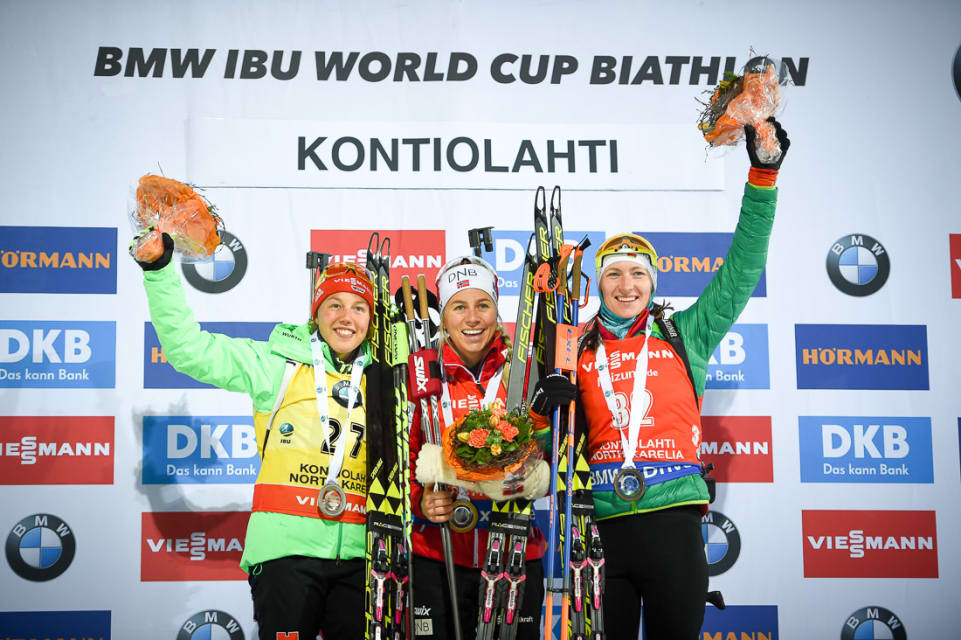
The women’s 7.5 k sprint podium on Friday at the IBU World Cup in Kontiolahti, Finland, with Norway’s Tiril Eckhoff (c) in first, Germany’s Laura Dahlmeier (l) in second, and Belarus’s Darya Domracheva (r) in third. (Photo: IBU)
IBU World Cup (Kontiolahti, Finland): Men’s & women’s sprints
[UPDATED] Fifth place is becoming a habit for US Biathlon’s Susan Dunklee, who shot 9/10 on Friday (1+0) and finished 34.9 seconds out of first for her third fifth-place result in the last three individual races.
Twice at last week’s International Biathlon Union (IBU) World Cup in PyeongChang, South Korea, Dunklee placed fifth: first in the sprint and again in the pursuit. She ended her racing there with the U.S. women’s relay, which placed 14th.
Back at it again on Friday in the women’s 7.5-kilometer sprint in Kontiolahti, Finland, Dunklee placed fifth behind Norwegian winner Tiril Eckhoff, who shot clean (0+0) and finished in 19:18.4 minutes.
Germany’s Laura Dahlmeier started in bib 27, immediately after Eckhoff (bib 26) and ended up 18.3 seconds shot of the Norwegian’s time for second place (+18.3) with one standing penalty (0+1). Darya Domracheva of Belarus started 32nd and shot clean to notch third (+20.4) for her second podium of the season (including a silver medal in the IBU World Championships pursuit).
The last starter in bib 94, Russia’s Daria Virolaynen shot clean and claimed fourth (+34.8), bumping Dunklee, the 33rd starter who initially finished fourth, by one-tenth of a second to fifth.
All three of the U.S. women that raced on Friday finished in the top 60 to qualify for Saturday’s pursuit, with Joanne Reid taking 55th (+1:59.7) with clean shooting, and Clare Egan 59th (+2:07.4) with three standing penalties (0+3).
Two Canadians qualified as well, with Emma Lunder in 56th (+2:02.8) with one miss (1+0) and Julia Ransom making the cut in 60th (+2:08.0) with one penalty (1+0) as well.
In her first World Cup start, Canada’s 19-year-old Megan Bankes — coming off a gold medal at IBU Junior World Championships in Slovenia — placed 78th (+2:56.9) with three penalties (2+1).
***
The men’s 10 k sprint podium at Friday’s World Cup in Kontiolahti, Finland, with France’s Martin Fourcade (c) in first, the Czech Republic’s Ondřej Moravec (l) in second and Norway’s Emil Hegle Svendsen (r) in third. (Photo: IBU)
Lucky No. 13. That’s how many World Cup wins France’s Martin Fourcade has accumulated this season, including his victory in the men’s 10 k sprint in Kontiolahti.
Thirteen wins puts him ahead of Norway’s Ole Einar Bjørndalen for the most wins in a single season, and Fourcade topped Friday’s race by just 0.6 seconds over the Czech Republic’s Ondřej Moravec in second place. (Bjørndalen finished about 30 seconds back in eighth.)
Fourcade started 38th, after Moravec in bib 24, and had to ski a penalty lap after missing one in his standing shooting, but was able to top Moravec’s time by fractions of a second in 22:17.0 minutes.
Moravec shot clean to reach the podium in second, along with Norway’s Emil Hegle Svendsen, who hit all 10 targets as well to place third (+9.4).
One of the earliest starters in bib 3, Norway’s Johannes Thingnes Bø hit all of his targets and was the race leader until Svendsen finished 2.7 seconds faster than him. Bø ultimately ended up fourth, and Germany’s Arnd Peiffer, the fourth man in the top five to clean, placed fifth (+22.3).
After eight straight races of placing in the top 10, Lowell Bailey finished 16th on Friday, 1:01.1 behind Fourcade despite clean shooting.
Three Americans qualified for Saturday’s pursuit, with Leif Nordgren in 43rd (+1:36.8) with two penalties (1+1) and Sean Doherty 44th (+1:38.5) with one standing miss (0+1).
Paul Schommer finished 84th (+3:02.5) with three misses (2+1).
Two Canadians shot clean and qualified for the pursuit: Brendan Green in 45th (+1:41.4) and Christian Gow in 50th (+1:55.0). Scott Gow missed the top 60 in 67th (+2:21.9) with two penalties (1+1).
USSA Cross Country Junior Championships (Lake Placid, N.Y.): 5/10/15 k classic individual starts
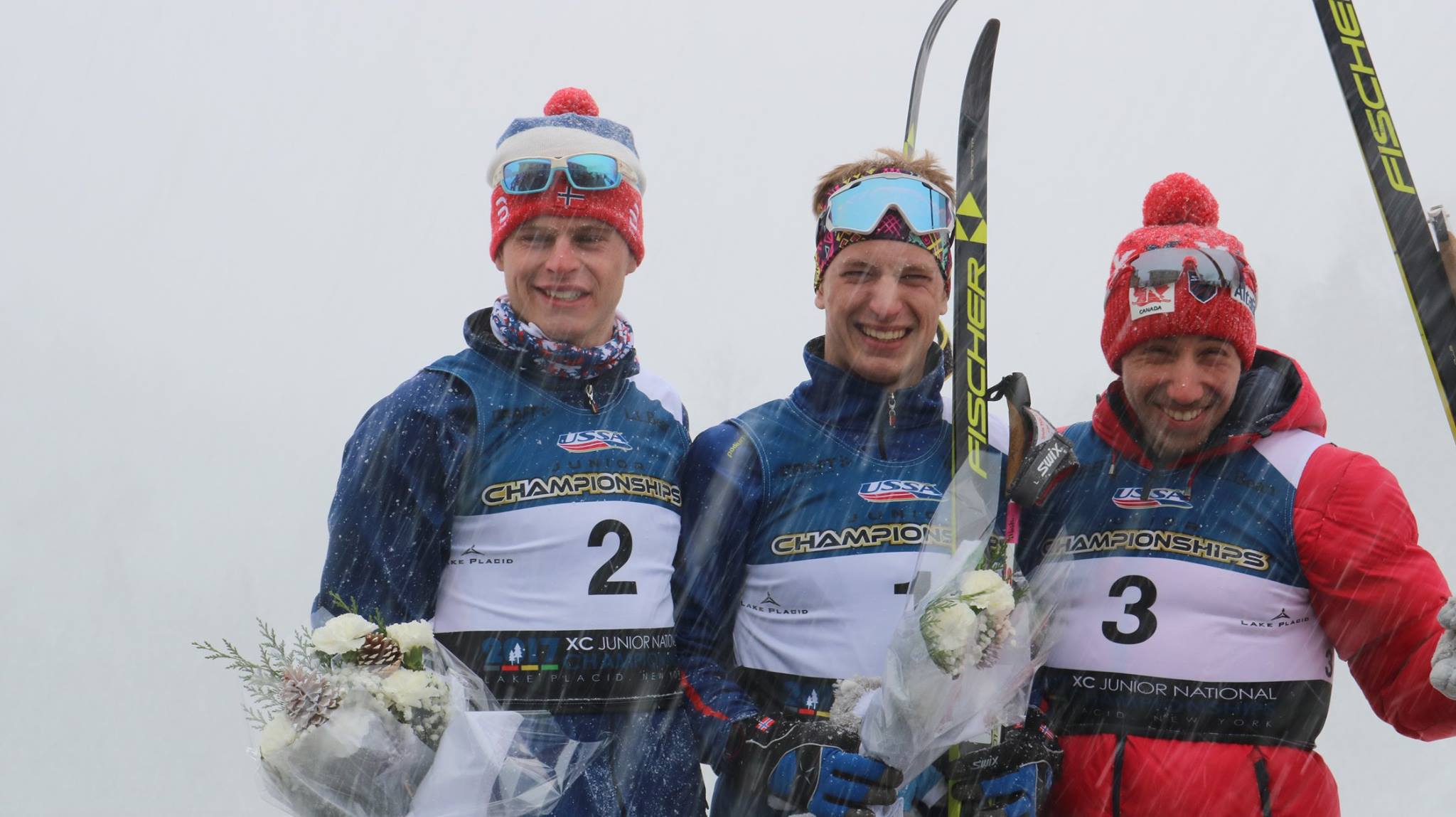
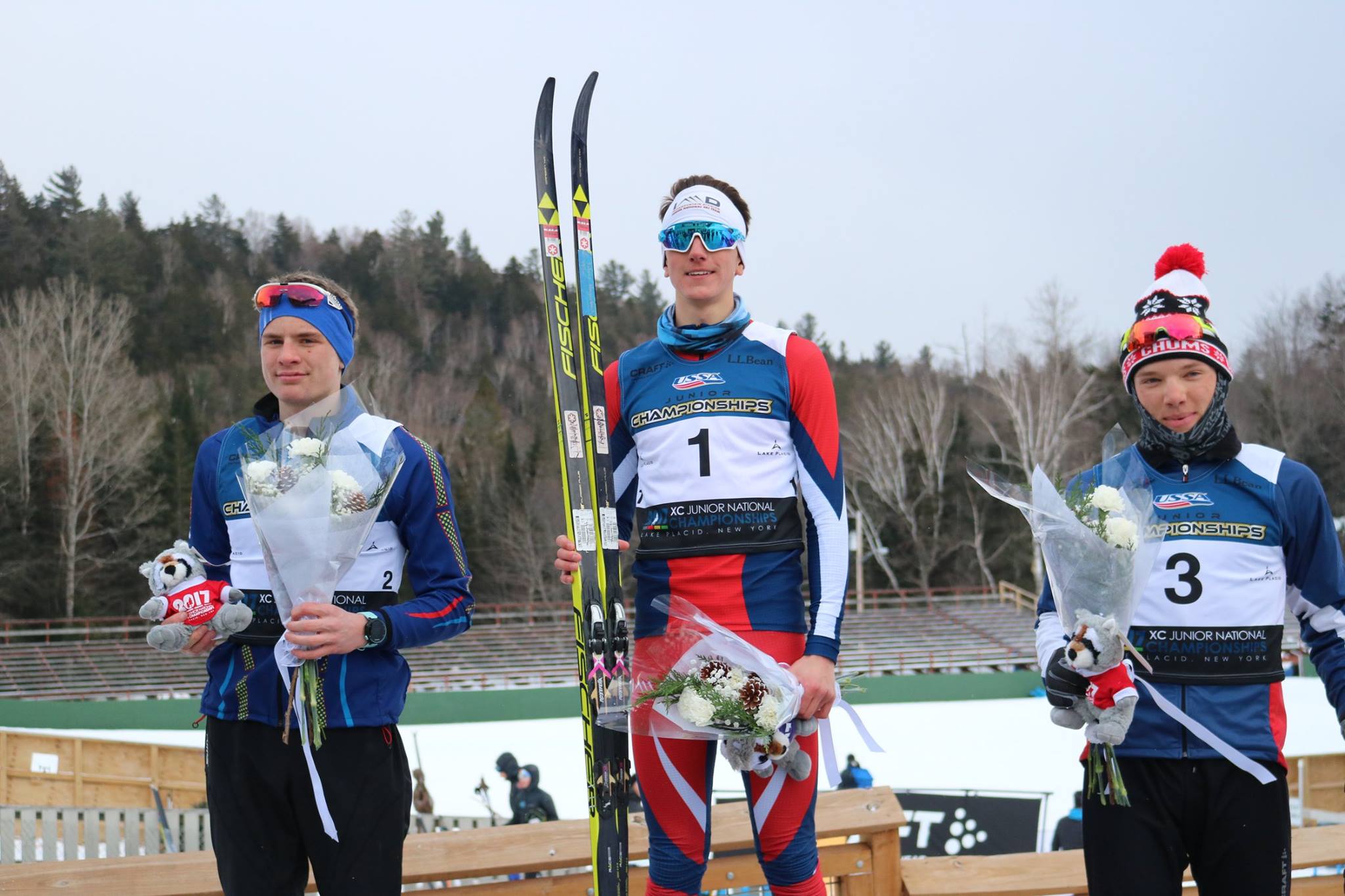
The U20 men’s 15 k classic podium on Friday at 2017 U.S. Junior Nationals in Lake Placid, N.Y., with Hunter Wonders (c) of Alaska Pacific University (APUNSC) in first, Peter Wolter (l) of the Sun Valley Ski Education Foundation (SVSEF) in second, and Canada’s Étienne Hébert (r), of Montériski in third. (Photo: India Harvey)
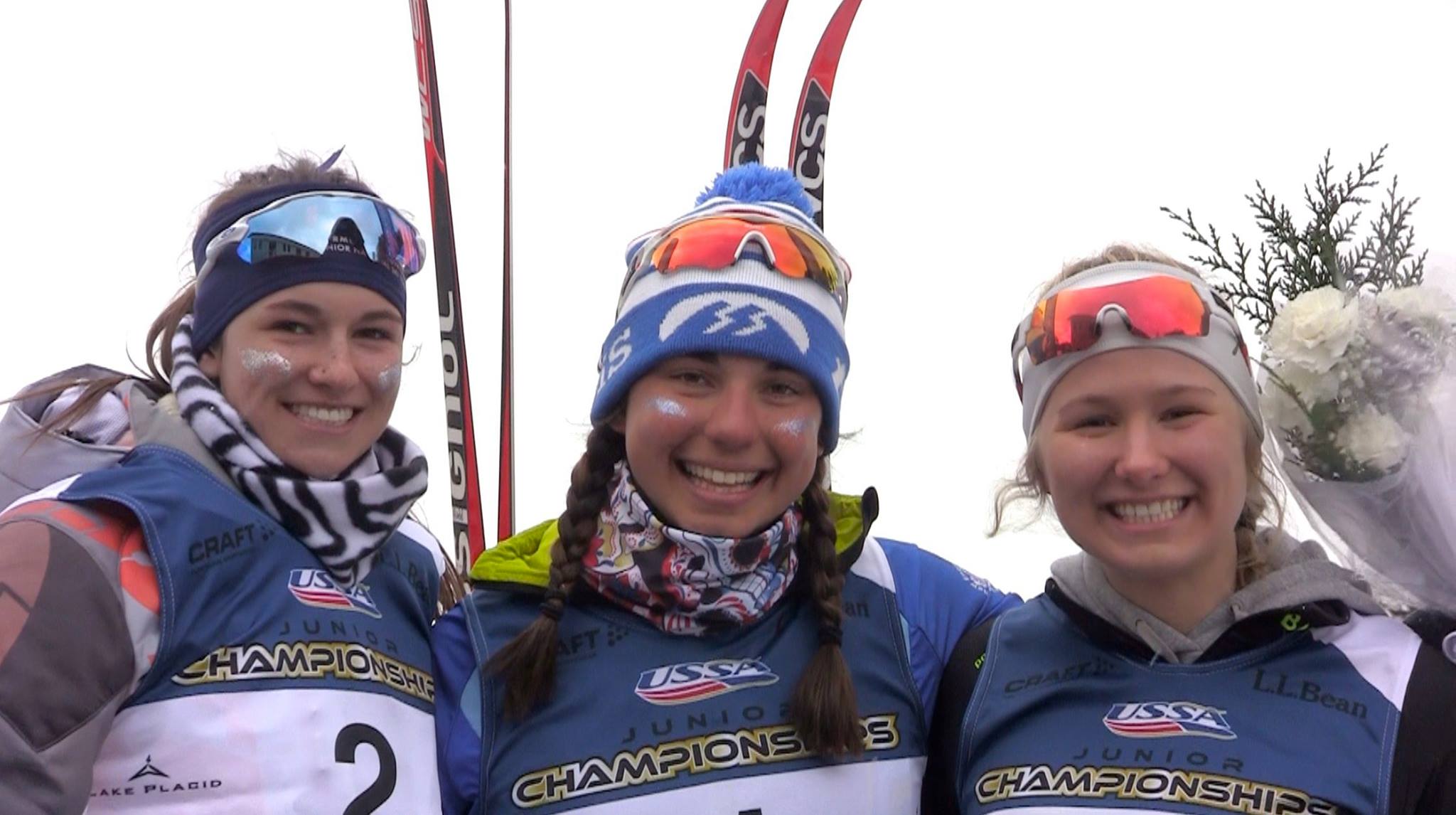
[UPDATED] On the third day of racing at U.S. Junior Nationals at the Olympic Jumping Complex in Lake Placid, N.Y., Julia Kern, representing New England and the Stratton Mountain School (SMS), completed her sweep of the U20 women’s races, winning Friday’s 10-kilometer classic individual start by 1 minute and 30.5 seconds in 32:32.3 minutes. (Kern had previously won the U20 women’s 5 k freestyle and classic sprint at Junior Nationals this week.)
Intermountain’s Leah Lange (University of Utah) joined her on the podium on Friday in second place, and the Midwest’s Hannah Rudd (Loppet Nordic Racing) tallied third place (+1:38.6).
The U20 women’s 10 k classic podium at 2017 U.S. Junior Nationals in Lake Placid, N.Y., with Julia Kern (c) of SMS in first, Leah Lange (l) University of Utah in second, and Hannah Rudd (r) of Loppet Nordic Racing in third. (Photo: India Harvey)
In the U20 men’s 15 k, Alaska’s Hunter Wonders, of Alaska Pacific University (APUNSC), finished 37 seconds ahead of anyone else in 45:15.7. Intermountain’s Peter Wolter, of the Sun Valley Ski Education Foundation (SVSEF) took second (+37.1), and Canada’s Étienne Hébert (Montériski) placed third for the second time in three races, 49.1 seconds behind Wonders. Daniel Streinz (New England/Mountain Endurance) was the third American in fourth overall (+1:00.7).
Coming of two-second place performances this week, Intermountain’s Sydney Palmer-Leger, of the Park City Nordic Ski Club (PCNSC) raced to first in the U16 girls’ 5 k in 16:42.1, 16.3 seconds ahead of Alaska’s Kendall Kramer (Nordic Ski Club of Fairbanks-FXC) in second. Novie McCabe (Pacific Northwest/Methow Valley Nordic Ski Educational Foundation), reached the podium in third (+21.9).
The U16 girls’ 5 k classic podium on Friday at U.S. Junior Nationals in Lake Placid, N.Y., with Sydney Palmer-Leger (c) of PCNSC in first, Kendall Kramer (l) of NSCF-FXC in second, and Novie McCabe (r) of the Methow Valley Nordic Ski Educational Foundation in third. (Photo: India Harvey)
A runner-up earlier in the week in the freestyle individual start, Intermountain’s Johnny Hagenbuch (SVSEF) took the win in the snowiest race of the day — the U16 boys’ 5 k — finishing just 2.5 seconds ahead of Alaska’s runner-up George Cvancara (Alaska Nordic Racing) in 15:06.8 in the closest race of the day. Intermountain had two on the podium with Skylar Patten (PCNSC) in third (+3.8).
The U16 boys’ 5 k classic podium on Friday at U.S. Junior Nationals in Lake Placid, N.Y., with Johnny Hagenbuch (c) of SVSEF in first, George Cvancara (l) of ANR in second, and Skylar Patten (r) of PCNSC in third. (Photo: India Harvey)
In the U18 boys’ 10 k, New England’s Ben Ogden (SMS) pulled out an 11.7-second victory to deny Alaska’s Gus Schumacher (Alaska Winter Stars) of his third-straight win of the week. Ogden finished first in 29:36.5, Schumacher took second for his third-consecutive podium, and Alaska’s Luke Jager (APUNSC) placed third (+29.2) for his second podium in three races.
In the U18 girls’ 10 k classic, Intermountain’s Anna Gibson (Jackson Hole Ski Club) took the win for her second-straight podium in 33:59.7, 6.9 seconds ahead of Rocky Mountain’s Ezra Smith (Summit Nordic Ski Club), who notched her second podium of the week as well, in second. Mara McCollor (Midwest/Wayzata Nordic Team) also scored a podium in third (+11.2).
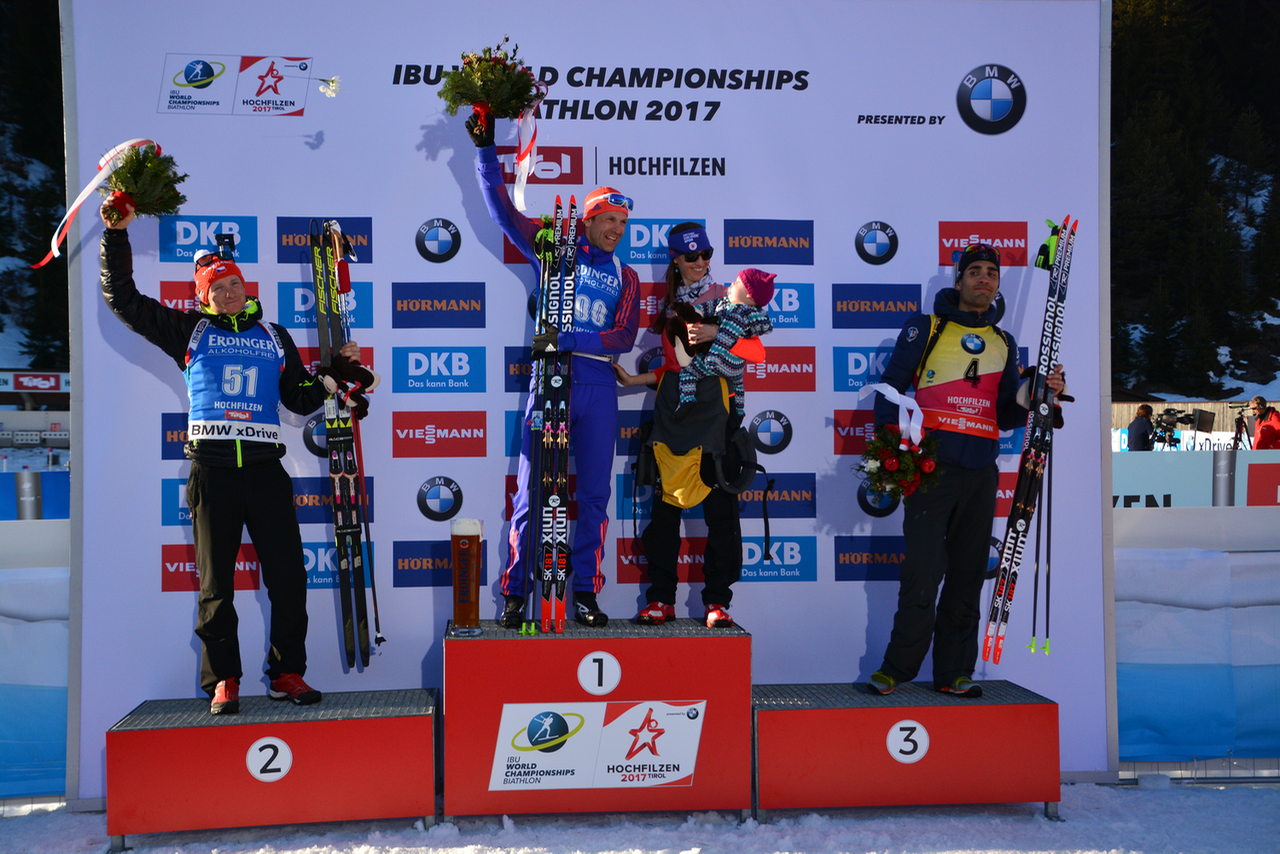
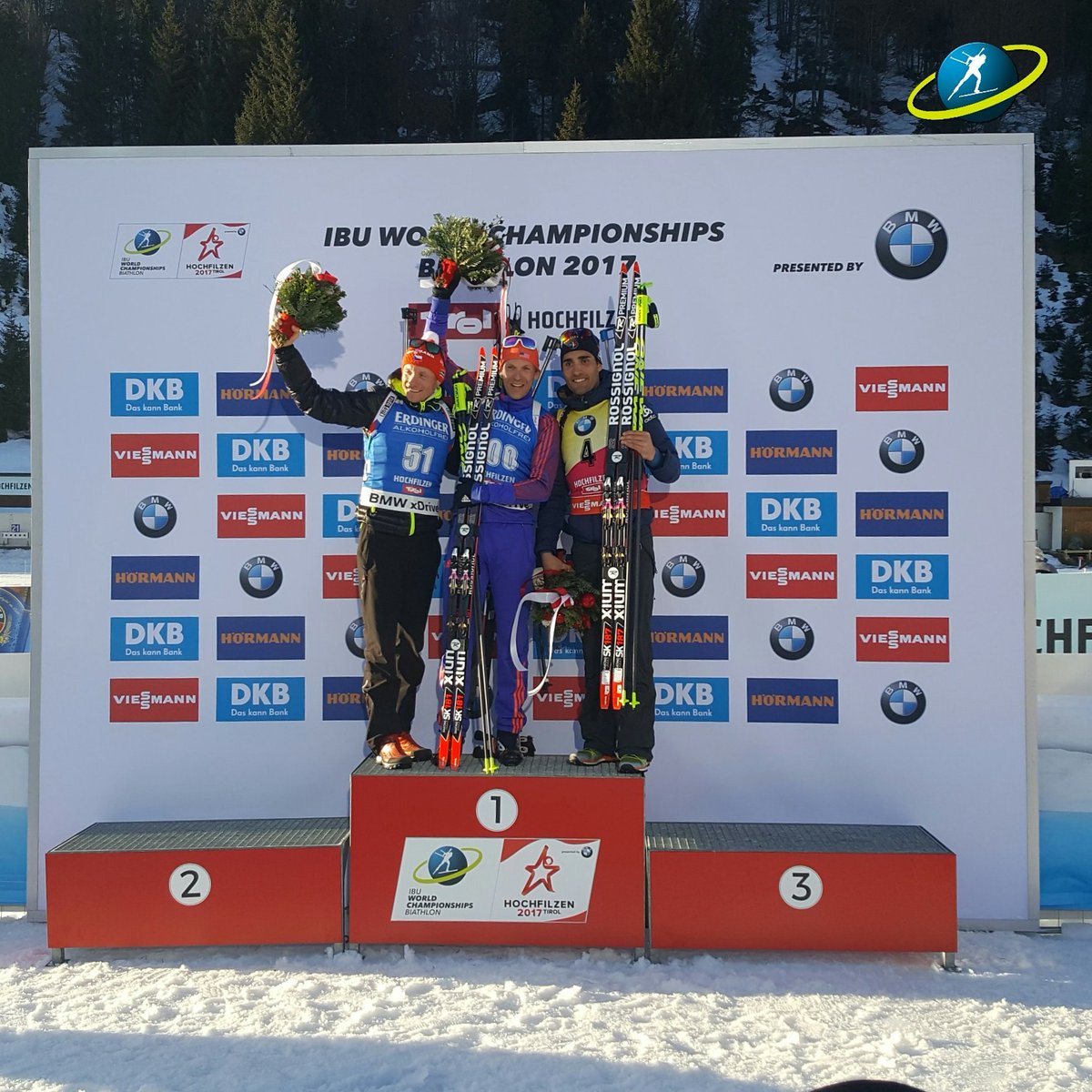
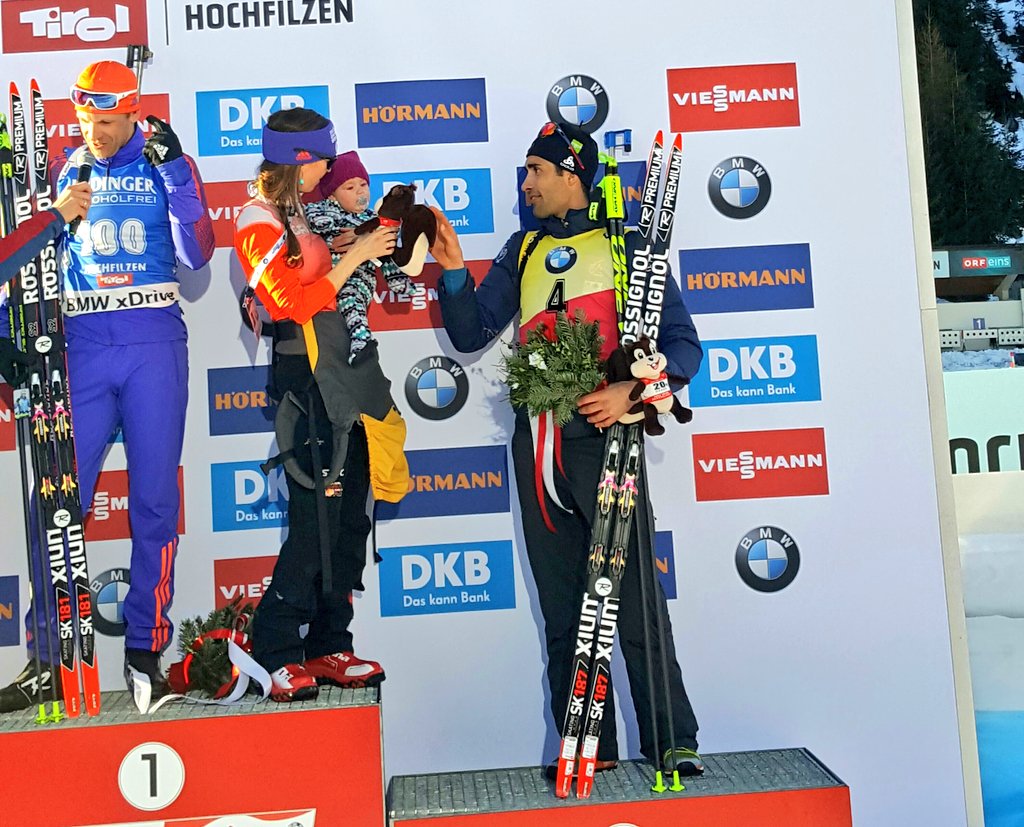
Lowell Bailey, his wife Erika, and daughter Ophelia stand atop the World Championships podium in Hochfilzen, Austria. Second-place Ondrej Moravec of the Czech Republic and third-place Martin Fourcade of France didn’t begrudge Bailey the win: “It means a lot a guy like Lowell won today for the sport,” Fourcade said. (Photo: Glen Crawford)
HOCHFILZEN, Austria–As Lowell Bailey sprinted around the final four kilometers of the 20 k individual on Thursday, the stadium announcer told the crowd that they were witnessing something special.
Fans who had been watching the sprint and pursuit earlier in the World Championships had seen Bailey come oh-so-close to the podium, only to miss out, finishing fourth in the sprint and sixth in the pursuit.
This time, he was on track to stay on that podium – and the announcer explained that it would be the first top-level win ever for an American biathlete.
The crowd went wild.
As Bailey pushed towards the finish and back towards the stadium, the crowd was asked to urge him on. They responded, as loudly as the predominantly German and Austrian fans would have cheered for their own favorites. The roar was deafening.
And from deep in his pain cave, Bailey heard.
“I did notice all the cheering,” Bailey said once he was sitting down and could process having just won World Championships gold. “It made me want to cry. This is an amazing sport, all the support we have.”
Martin Fourcade missed two shots in the 20 k individual, one more than he could afford if he wanted to win another gold medal. Instead, he settled for bronze. (Photo: Glen Crawford)
The fans weren’t the only ones pleased to see Bailey finally break through. Other competitors, too, seemed happy to see him atop the podium. That even included Ondrej Moravec, the Czech who came so close to winning his first individual World Championships gold himself.
“I am really happy for his gold medal, because he waited for this for a long time,” Moravec, who finished 3.3 seconds back to take silver, told NBC’s Chris Dupre. “As he said, from 2000 he competed first here in Hochfilzen, and I started in 2001 in Khanty-Mansiysk. So I know him long time, and he is a really good guy.”
So you’re completely happy with silver? That was the question from Peer Lange, the International Biathlon Union’s Communication Director.
“Well,” Moravec laughed. “It is like — I already won other medals, bronze, silver — but never gold. And today I was really closer ever than I was. It was a big chance for me today, but I was not good enough.”
Martin Fourcade, the pre-race favorite who finished third, was also gracious. And while the reaction from some was a surprise that an American could possibly win, Fourcade was among those who saw it as a day that had long been coming.
“I think when someone is finishing fourth in the sprint and sixth in pursuit you can say it’s not a big surprise,” he said in the press conference. “I know Lowell a bit more from this year. I know the guy.”
It was suns out, guns out for Germany’s Erik Lesser, whose one penalty kept him off the podium. He ended up fourth. (Photo: Glen Crawford)
Fourcade was referring in part to Bailey’s work as an Athlete Representative to the International Biathlon Union. Throughout the doping scandal which has built since the release of the first McLaren report, Bailey has been working to give athletes a voice in how their federation handles doping violations.
Fourcade has sometimes been right there beside him. He was among the nearly 200 signatories on a letter sent by World Cup athletes to the federation requesting action, has spoken out in the press, and led an athlete walk-out from a meeting with the federation where athletes felt that the sport’s leaders were not adequately answering their questions.
“I am really really happy for Lowell, a guy with amazing values on the track and outside,” Fourcade said in an interview with NBC’s Chris Dupre. “Lowell is our Athlete Representative for the federation. We fought together for more anti-doping rules, and it means a lot a guy like Lowell won today for the sport.”
“I really appreciated his working in the athletes committee, fighting for better conditions for the athletes, against doping,” Moravec agreed. “So that’s a great performance.”
Ole Einar Bjørndalen, the Norwegian legend who is also an Athlete Representative, said that Bailey’s commitment to representing athletes and fighting for clean sport made it even better to see him atop the podium.
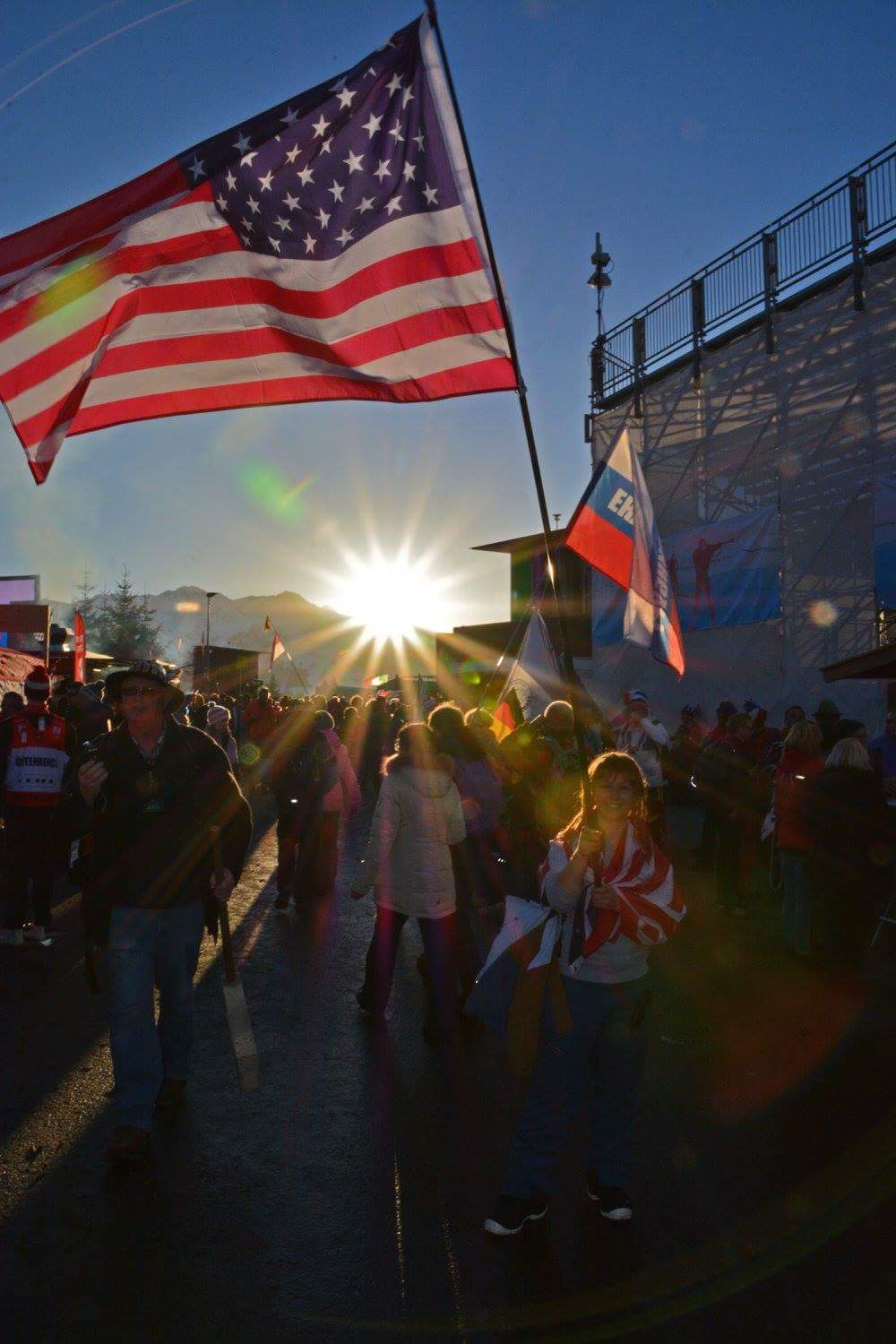
A fan holds an American flag at the end of the day on Thursday in Hochfilzen. (Photo: Glen Crawford)
“It was fantastic,” Bjørndalen said. “He is a fantastic guy, and it’s fantastic that he win in World Championship. I’m so happy for him. And he is a fantastic athlete. He is really a fair athlete, also, and I really like to compete with him.”
Germany’s Erik Lesser, who finished fourth, would have earned a medal if Bailey had missed even one shot.
“I don’t begrudge him this victory at all,” he told German broadcaster ARD. “Last year he had kind of retired already, he was at home on his bison farm or whatever, and now he comes here and becomes World Champion. He deserves that. He is a great guy with incredible experience. He has always been a good go-to guy for me when there have been any problems. That’s just the way it is.”
While Bailey could sometimes frustrate the German on the trails, that wasn’t the case on Thursday.
“In mass starts he can be a bit annoying squeezing himself into gaps, but today he pretty much squeezed himself into a gap left open by others,” Lesser said. “Four times zero, that has to be rewarded, just like Moravec. That just deserves to be honored with a medal.”
Fourcade also highlighted what all those people in the crowd who had cheered so loudly for Bailey had known: to see an American at the top of the sport, that’s not such a bad thing.
“I know how important it really is for biathlon,” Fourcade said of Bailey’s gold medal. “To see some people outside of Europe winning. I think that is the most we can do to make our sport bigger. I cannot be more satisfied about the guy winning today.”
Tim Burke was the last U.S. man to stand on a World Championships podium. He won silver in the 20 k individual in 2013, just as Josh Thompson did in 1987. Their medals had been the best-ever finishes for the U.S. – no more.
“I don’t look at like that, that’s not what it’s about,” Burke said of losing his record to his long-time training partner and friend. “It’s great for the entire team, especially for our program. You see we don’t even have a title sponsor this year. I’m sure we’re the only team that has a world champion that does not have a title sponsor, so it helps with things like that. It helps with the morale. It’s great for everyone.”
Lowell Bailey celebrates after crossing the line to win gold in the 20 k individual at IBU World Championships in Hochfilzen, Austria. (Photo: Glen Crawford)
HOCHFILZEN, Austria—Four days ago, Lowell Bailey left the shooting range after cleaning his fourth stage in the pursuit, and was in second place.
Things didn’t go his way and he saw first World Championships silver, then bronze, slip from his grasp as other men were stronger on the Hochfilzen race course’s big hills. He ultimately finished sixth, after placing fourth in the sprint.
Today, the American biathlete again left the range after cleaning his fourth stage. Two key differences: this time he had hit 20 out of 20 targets, rather than missing once. And this time, he was in first place, although he didn’t know it right away.
“I was really happy about it, obviously,’ Bailey said. “There was a surge of adrenaline immediately when I left the mat. Obviously most of the race is finished by that point, but in my mind, that was where the race began, the second I left the mat.”
Bailey was the second-to-last starter out of the 102-man field, and there was no chance of anyone behind him besting his time. When he hit the course, he had a 6.4-second lead on Ondrej Moravec of the Czech Republic.
If he could protect that lead, Bailey would become the first American ever to win a gold medal at biathlon World Championships. The U.S. has also famously never won an Olympic medal in biathlon, the last such winter sport, and Bailey had never won a World Cup before, either.
After watching a medal slip away in the pursuit, he wasn’t going to let it happen again.
“I know that my weakness on the course is the long extended climbs,” Bailey said. “If I look back to the pursuit that’s where things fell apart for me. I was okay on the fast gradual stuff, but at the long extended climbs I lost tons of time there. So today I tried to maximize my strengths… And then just mentally knowing that the last two kilometers are a lot of V1 extended climbing, I was telling myself ‘Don’t lose it on these climbs, you just gotta dig deep and find something there, because I’m not gonna lose it on these climbs’.”
He almost did. With 1,100 meters left to go, Bailey’s lead was down to 0.1 seconds. The crowd held its breath. Moravec, watching on the big screen from the finish area, shook his head, like, can you believe this?
U.S. Biathlon Association Chief of Sport Bernd Eisenbichler with Lowell Bailey after Bailey won World Championships gold in the 20 k individual in Hochfilzen, Austria. (Photo: Glen Crawford)
It was a race for the ages. But some on the U.S. team were sure that with the long swooping downhill to the finishing stretch, Bailey could eke out a win.
“It was closer and closer, and it was a tenth of a second at the last split at the very top,” U.S. teammate Tim Burke said. “But we had phenomenal skis and I knew if he was close there, he would make it. There was no way anyone had better skis than us… He owes a serious tip to the service guys.”
Bailey wasn’t as sure, but he also didn’t have any time or energy to think about it. He just stayed confident and kept fighting.
“I was in such a pain state that you are thinking like a five-year-old at that point,” he said. “But I would say that I was extremely confident in my skis today, and I think having those long downhill stretches before the finish definitely helped.”
Bailey ended up getting passed by Alexey Volkov of Russia, who had started a bib earlier but who Bailey had passed before. At first it seemed like Volkov might be an obstruction, but the Russian kept a high speed. As a result Bailey got a bit of a draft, and had someone to fight with to the finish.
“He was feeling pretty good on the last loop, and I tried to stay with him,” Bailey said of Volkov. “I mean, it’s always an advantage to see someone in front and try to stay with them. I think the battle was mostly going on in my own head. But we were skiing together, and I think that has to help in some way.”
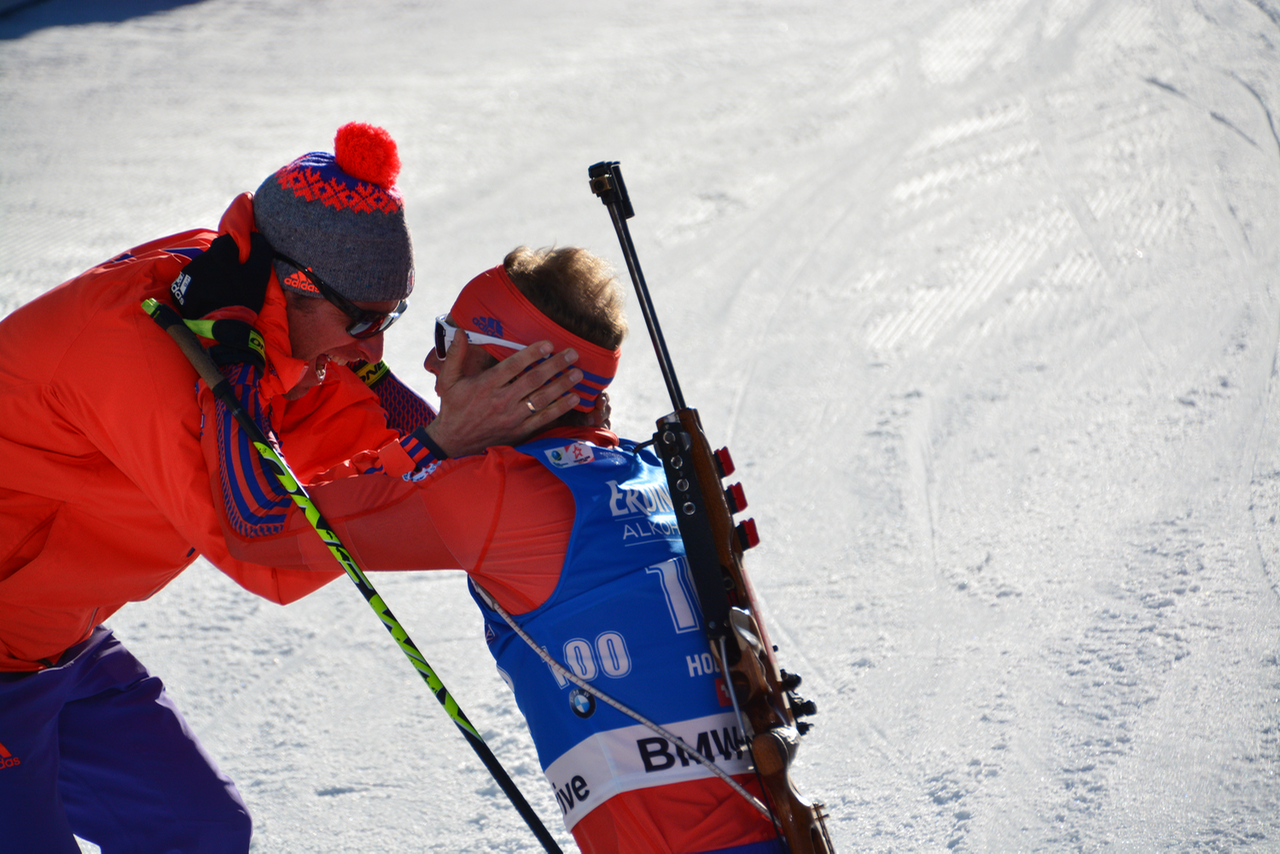
By the time he hit the finish, he had gained a few seconds back from Moravec and crossed the line with 3.3. seconds to spare. Bailey fell to his knees and U.S. Biathlon Chief of Sport Bernd Eisenbichler rushed over to embrace him.
After nearly two decades of working together – back in the day, Bailey was a junior and Eisenbichler a wax tech – the pair had done it: a World Championships medal for Bailey.
And it was gold.
“When I think about when I first met Lowell, he was probably 13 years old, in Lake Placid, and just this good young skier who put his heart into this and worked for this every day, for almost 20 years now,” U.S. Biathlon Association President and CEO Max Cobb said. “I think it is a total validation of Lowell’s career… and how we were able to engineer things. We stripped out everything that we didn’t need to do and made it really focused on developing the athletes and bring them to this level. And now we are one year out from the Olympics.”
Perfection on the Range
Four-stage races have not always been Bailey’s best friend.
“That fourth stage in a pressure situation is definitely, in my opinion, the hardest part of biathlon,” Bailey said. “And it hasn’t always been my strong point. I have lost a lot of medal opportunities in the last stage.”
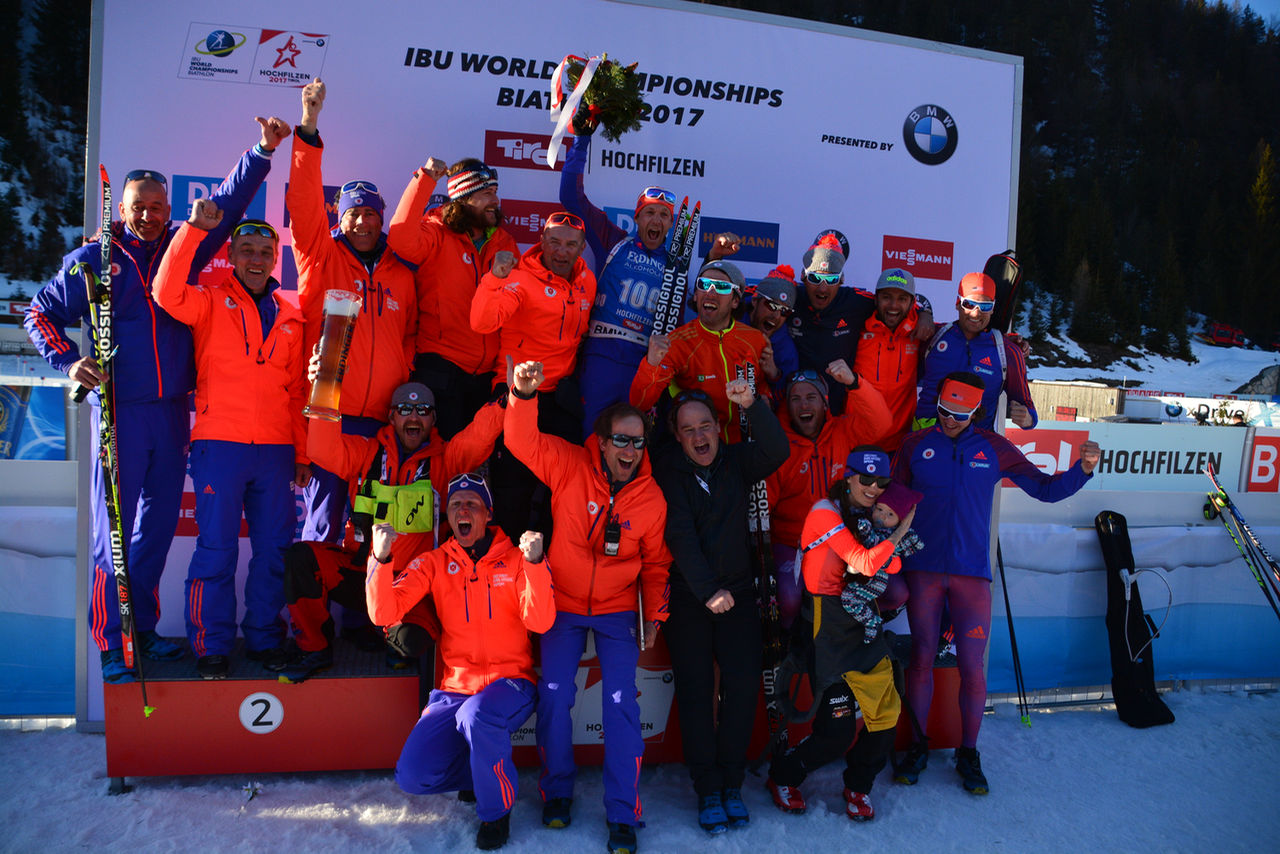
The U.S. men’s team, staff, and Bailey’s family celebrate on the podium after the flower ceremony. “Biathlon really is a team sport, and nobody achieves success like this without having a perfect environment around them,” U.S. Biathlon Association CEO Max Cobb said. “So I can’t say enough for Bernd [Eisenbichler]’s leadership, and all the great work of the coaches and ski techs and the whole support staff. Because that’s what makes it possible.” (Photo: Glen Crawford)But in the Olympics three years ago, Bailey came back from a disappointing start to the Games by focusing and turning in an eighth-place finish in the 20 k individual, his best Olympic or championship performance ever up to that point. He was one miss away from a medal, and set a new best mark for a U.S. biathlete at the Olympics.
Thinking about this World Championships, Bailey decided months ago that the 20 k would be his best shot.
“I focused on this race starting in May,” Bailey said in the press conference. “What do I need to do in my training to really prepare for this race? And so starting in May with the shooting workouts, I started going through this race in my head, and sort of doing a dress rehearsal during the training. Who is to say that helped or didn’t help, but I felt really composed today on the shooting range. I wouldn’t say I felt anymore nervous than any other day, any other race. That was good.”
Bailey knew that he would have to shoot a perfect 20 for 20. While the wind is tricky in Hochfilzen, it’s not always strong. There are always a few clean sheets and Bailey doubted he could win without one.
So he had to overcome the threat of a last-stage collapse, that pattern that had haunted him so many times in the past.
In Sunday’s pursuit, he had done it. His one missed shot came in the third stage, and then cleaning the final standing put him in that second-place position. So while the last loop of the pursuit didn’t go well, Bailey knew that he could do it on the range.
“One thing that I have learned over the years working with sports psychologists is that you are going to get distracted,” he said, gesturing as his daughter Ophelia cried in the background. “Especially at a World Championships, there are going to be distractions both externally and internally. For me actually the internal distractions are the most detrimental. You are talking to yourself in your head ‘if I do this, if I do that, if I clean then this, if I just hold it together…’ And all that is doing is taking you away from what you have trained for decades to do. The muscle memory is there, hundreds of thousands of rounds fired. So you just have to trust in your training, and also know that those are just distractions.”
In the final stage of the individual, Bailey was focusing on just two things. The crowd and the potential medal didn’t factor in.
“As you get to the competition season, you boil your shooting cues down to a few key principles,” he explained. “For me those are having a good trigger squeeze and follow-through. So it’s like two things. Trigger squeeze. Follow-through. And by the way, when you got to your first biathlon camp, those are two of the three things they teach you. But when you are in that situation, you are fighting for a World Championship medal, you have to keep things simple because that is all your brain is capable of.”
Sprint, pursuit, and individual: 50 targets, and Bailey has hit 49 of them. Fast, too. His shooting time today tied for the fourth-quickest among all the men in the field.
His focus is working, and that accomplishment was something the U.S. staff was particularly proud of. As Bailey started taking his first shots of that last stage, U.S. men’s coach Jonas Johansson breathed a sigh of relief. While watching it was “horrible”, he said, he was also sure Bailey could come through.
“I knew when he started to execute the shooting like planned, that this can go,” Johansson said. “Normally before, he has been a little too cautious in those situations, and stepped back a little bit. But now he went for it. I’m so happy for him that he really pulled it off and he came through clean.”
Four k or 40 k?
While cleaning all 20 targets was a big part of the work, Bailey still had to ski four more kilometers to seal the deal after he finished shooting.
“I didn’t know that I would come out in first place, but I knew that if there was ever a point where every second mattered, it’s directly after you have gone 20 for 20 in an individual,” Bailey said. “So I knew that those four kilometers were going be the deciding factor, and I knew it was going to be a matter of seconds. It was just that rush of adrenaline: ‘I worked so hard to get to this point, I need to do this’.”
Bailey, one of the last men to leave the start house in Hochfilzen. (Photo: Glen Crawford)
He described the four kilometers as agonizing, especially those big climbs that he knew were his weakness. In the press conference, Bailey joked that it felt more like 40 kilometers than just four.
“Fortunately I had great skis, and I had a U.S. staff member seemingly every hundred meters along that track,” he said later. “But every hundred meters it was a sprint. Every hundred meters was ‘go as hard as you can for this hundred meters, and then when you get to the end of that hundred meters, go as hard as you can and just keep doing that.’ I thought the finish line was never going to come. I was just like, I don’t know how much longer I can do this, because the finish line is just not showing up.”
That final loop ended up being one of Bailey’s fastest of the day. And that earned him gold.
As he climbed up onto the top step of the podium after his race, he was joined by his wife, Erika, and their daughter. Martin Fourcade of France, the superstar who took bronze, handed the girl a plush toy he had received as a prize. Everyone seemed happy.
“I think Lowell has a really good mix of biathlon and life with his daughter and his wife,” Johansson said. “I think that’s something really good for him, to have them around to be able to relax. And to also be able to have pure biathlon focus when he’s racing and he’s training. That’s a skill he had today, he did it one-hundred percent.”
Johansson, a Swede, has been working with the U.S. men’s team for three years. Watching the whole men’s team succeed, including this medal for Bailey, has been rewarding, he said.
“It’s a fantastic team in every way and it’s hard workers,” Johansson said. “Most of these athletes are maybe not the most talented on day one, but they are hard workers, and Lowell is one of them. He’s worked hard for many years and now he’s on the top… Lowell and also the other athletes on the team, they have this potential. I mean, they’ve shown before that they can be up on the podium and fighting for the podium, so it’s an unbelievable day.”
Teammate Burke, the last U.S. man to stand on the World Championships podium when he won silver in the 20 k individual in 2013, was thrilled for Bailey.
“He deserves it, especially this week,” Burke said. “He’s been so on, with the fourth place, sixth place, and today he needed the perfect race and he absolutely had, that’s the perfect race. It doesn’t get any better than that.”
Other North American Results
23. Leif Nordgren, USA, 1-0-0-1 (+2:53.6)
36. Tim Burke, USA, 1-1-0-2 (+4:14.4)
42. Macx Davies, Canada, 0-0-0-1 (+4:25.2)
43. Scott Gow, Canada, 0-1-0-1 (+4:29.1)
58. Sean Doherty, USA, 1-1-2-0 (+6:04.4)
86. Brendan Green, Canada, 2-1-0-2 (+9:33.9)
Christian Gow of Canada did not finish.
-Alex Kochon, Jason Albert, and Harald Zimmer contributed
Lowell Bailey (c) became the first American to win gold at IBU World Championships on Thursday after topping the men’s 20 k individual in Hochfilzen, Austria. He is joined on the podium by Ondřej Moravec (l) of the Czech Republic and France’s Martin Fourcade (r). (Photo: IBU World Champs/Twitter)
IBU World Championships (Hochfilzen, Austria): Men’s 20 k individual
Lowell Bailey became the first American biathlete to become a world champion on Thursday in the men’s 20-kilometer individual race at 2017 International Biathlon Union (IBU) World Championships in Hochfilzen, Austria.
Wearing lucky bib 100, Bailey started near the back of the field and cleaned four consecutive stages in the longest-format race on the circuit, then finished with the new best time of 48:07.4 minutes, 3.3 seconds faster than the Czech Republic’s Ondřej Moravec (who started 51st and also hit all 20 targets).
Bailey even beat out France’s Martin Fourcade, the pursuit champion who had previously won 10 World Cup races this season, by 21.2 seconds.
While he had come close to the podium in fourth in the sprint last Saturday, Feb. 11, Bailey’s best World Cup result was second in a 2014 World Cup sprint in Kontiolahti, Finland. His World Championships gold medal on Thursday topped that of his teammate, Tim Burke, who had taken a historic silver for the U.S. in the 20 k individual at 2013 World Championships in Nove Mesto, Czech Republic.
France’s Martin Fourcade hands his stuffed-animal prize to Lowell Bailey’s daughter Ophelia as they join him on the podium of the men’s 20 k individual at 2017 IBU World Championships in Hochfilzen, Austria. (Photo: IBU World Champs/Twitter)
“This is a perfect day, absolutely,” Bailey told German broadcaster ARD after. “This is the most perfect day of my biathlon career. To shoot clean at World Championships … every single part of my race fit together today. I have so many people to thank for that. Years, decades of support, and people cheering me on for so long. I’ll remember this for the rest of my life.”
He was joined on the podium by his wife, Erika, and infant daughter, Ophelia. In the same interview with ARD, he credited Erika for supporting his decision to continue racing.
“I’m so thankful for the people who came to me and allowed me to continue my career,” he said. “The first one to think of is my wife Erika who supported me in my decision. We had our daughter Ophelia this summer, and of course this makes things much more interesting as a family. We had to be creative in our training this year, but it all worked out. So thankful for them, and grateful for everyone who has helped me so far.”
Also for the U.S., Leif Nordgren placed 23rd (+2:53.6) with two penalties for his best result of these championships, Burke was 36th (+4:14.4) with four misses, and Sean Doherty 58th (+6:04.4) with four penalties as well.
Macx Davies led Canada in 42nd (+4:25.2) with one miss, Scott Gow was four seconds behind in 43rd (+4:29.1) with two penalties, and Brendan Green finished 86th (+9:33.9) with five penalties. Christian Gow did not finish.
Eric Frenzel (r) leads German teammates Vinzenz Geiger (c) and Fabian Rießle (l) toward a sweep of the podium in the Nordic Combined World Cup individual normal hill/10 k on Sunday in Ramsau, Austria. (Photo: FIS Nordic Combined/Facebook)
Welcome to The Rundown, your quick primer of need-to-know information about the day’s racing. We’ll be updating this digest as the day goes on with additional results, photos and quotes. The Rundown is NOT a race report; stay tuned for complete race reports later today with interviews from the day’s top racers.
***
FIS Nordic Combined Continental Cup in Klingenthal
[UPDATE] Ben Loomis tallied two top 10’s and his U.S. Nordic Combined teammate Ben Berend notched eighth place this past weekend at the Continental Cup in Klingenthal, Germany.
Loomis ended the three-day series on Sunday by placing fifth in the large hill/10 k for his second-best result at the Continental Cup level (he finished fourth last year in the normal hill/10 k competition in Park City, Utah). Loomis put himself in position by jumping to sixth then racing to fifth, 49.9 seconds behind Japan’s winner Go Yamamoto, who finished in 24:06.4.
Florian Dagn of Austria placed second (+6.0) after jumping to first. Yamamoto jumped to second and headed out on the course seven seconds behind him.
Norway’s Sindre Ure Soetvik placed third (+28.8), after starting the 10 k in third. Germany’s David Welde finished fourth (+36.0), moving up after jumping to eighth.
Also on Sunday, Berend placed 15th (+2:25.3) and Jasper Good was 35th (+3:07).
Berend started the long weekend out with an eighth-place finish in the large hill/5 k on Friday. He jumped to fourth and finished the ski race in eighth, 1:09.2 minutes behind Germany’s Maximilian Pfordte, who won in 10:58.9.
Pfordte posted the best jump to start the 5 k first, then held his lead for a 16.4-second victory over Yamamoto in second. Dagn placed third (+18.3) after jumping to second, and Yamamoto’s jump ranked third.
Also for the U.S., Good finished 21st (+2:05.8) for his best result of the weekend, Loomis was 28th (+2:50.5) and Stephen Schumann 29th (+2:52.1).
On Saturday, it was Loomis who tallied another eighth place for the U.S. in the large hill/10 k. He jumped to 10th then improved to eighth, finishing 58 seconds behind German winner Tobias Simon. While Simon dominated the jump as well as the race, winning by 10.1 seconds, Yamamoto repeated in second place and Austria’s Thomas Joebstl reached the podium in third (+38.3).
Berend finished 25th (+1:45.9) and Good 45th (+3:24.9) on Day 2.
The Nordic Combined World Cup resumed this weekend in Ramsau, Austria, with Germany not only topping but sweeping the podium in both individual normal hill/10 k competitions.
On Saturday, Team Germany swept the top four, with Johannes Rydzek notching his third individual win of the season, ahead of teammates Fabian Rießle (+1.5) and Eric Frenzel (+8.7). Vinzenz Geiger completed the sweep in fourth (+15.0), a career best for the 19 year old after placing seventh earlier this month in Lillehammer, Norway.
Frenzel led after the jump on the 98-meter hill, which put him 2 seconds ahead of the second-best jumper, Austria’s Mario Seidl, in the 10 k Gundersen start. (Seidl went on to place seventh.)
Rydzek posted the third-best jump and started 10 seconds back, while Rießle started another 10 seconds later in seventh. Rydzek went on to ski the fifth-fastest course time and Rießle was third fastest en route to first and second at the finish.
Americans Taylor Fletcher and Bryan Fletcher finished 27th (+1:17.6) and 29th (+1:18.4), respectively, and Adam Loomis was 47th (+3:16.2).
Taylor started 41st, 1:18 back, and Bryan started five seconds later in 43rd. Bryan posted the seventh-fastest course time and ended with a photo finish with Finland’s Arttu Maekiaho, which Maekiaho took by 0.1 seconds for 28th. Loomis started 50th.
Day 2 in Ramsau went to Frenzel, who won the normal hill/10 k in 22:49.4. Rießle repeated in second (+0.8) and Geiger improved on his career best for his first podium in third (+23.4). Seidl again jumped to first and this time ended up fourth (+24.3).
Frenzel started third and raced to first, Rießle moved up from fourth in the jump to second, and Geiger made the most of his second-best jump.
Taylor Fletcher skied the third-fastest course time to move up from 46th after the jump to 22nd at the finish (+1:20.2). Bryan Fletcher finished 32nd (+1:33.5), losing one place after starting 31st.
The Nordic Combined World Cup goes on holiday break until resuming Jan. 7-8 in Lahti, Finland.
The NorAm mini tour in Rossland, British Columbia, wrapped up with a classic pursuit race on Sunday.
In the women’s 10 k classic, APU’s Chelsea Holmes continued her strong form, winning the mini tour with an aggregate time of 1:08:04.4. Holmes finished the 10 k in 35:35.4 minutes, 6.2 seconds behind fastest woman of the day, Katherine Stewart-Jones (NTDC Thunder Bay).
SMS Elite’s Erika Flowers continued her podium-filled visit to Canada with the third-fastest ski of the day, 48.1 seconds behind Stewart-Jones, to take second overall, 2:23.9 behind Holmes. AWCA’s Olivia Bouffard-Nesbitt was the fifth fastest in the 10 k to hold on to third overall (+3:25.2), while Stewart-Jones was just 0.5 seconds back in fourth overall.
NTDC Thunder Bay’s Evan Palmer-Charrette used a fourth-fastest ski in the 15 k to keep the overall title, with an aggregate time of 1:28:54.0. Alexis Dumas (CNEPH) skied 1:14.7 faster than Palmer-Charrette to climb from sixth at the start to second overall (+52.2). AWCA’s Jack Carlyle had the second-fastest time of the day, 29.9 seconds behind Dumas, to climb into third overall (+1:10.1).
National Para-Nordic guide Erik Carleton had the third-fastest 15 k time, 1:01.3 back, but it wasn’t enough to catch Team R.A.D.’s Russell Kennedy, who placedfourth overall (+1:20.8).
Full results (with tabs for the overall and time of the day)
***
FIS Cross-Country World Cup in La Clusaz: Men’s and women’s relays
Team Norway I emerged victorious in Sunday’s men’s 4 x 8 k mixed relay event in La Clusaz, France, with Didrik Tønseth leading the winning group’s first classic leg.
After crossing in seventh, Tønseth handed off to Martin Johnsrud Sundby for a second classic leg. Sundby dropped a spot, finishing his classic leg in eighth. Sundby tagged off to Anders Gløersen for the first freestyle leg.
Gløersen rocketed the team to first, and held the position straight through his 7.5 k. The final leg for Norway’s winning team went to Finn Hågen Krogh. The Norwegian men’s team completed the relay event in a total time of 1:11:25.7
Second place overall, two-tenths of a second behind, was team Russia, led by Evgeniy Belov for the first classic leg. Belov handed off to Alexander Legkov for the second classic leg, with Legkov putting down the third fastest time by the time he returned to the exchange zone.
The third and first freestyle leg for Russia went to Alexey Chervotkin, who maintained the team’s third place position. Anchoring the team was Sergey Ustiugov, who managed to maneuver the team from third place to second during his final freestyle leg.
The men’s 4 x 8 k relay podium on Sunday in La Clusaz, France, with Russia in second (left four) Norway first (center four) and France third overall. (Photo: FIS Cross-Country/twitter)
Rounding out the men’s mixed relay podium on Sunday was France I (+7.7).
Jean-Marc Gaillard led team France’s first classic leg, racing in a sixth position into the exchange zone. Gaillard handed off to Alexis Jeannerod, who moved up to fifth place by the end of his classic leg.
Skiing the third and first freestyle leg was Clement Parisse who held onto fifth place and tagged off to Maurice Manificat for the final freestyle leg. Manificat managed to move around Sweden’s Axel Ekstrløm and Germany’s Lucas Bøgl for third place overall.
Neither Canada or the U.S. entered a men’s relay team due to illness.
In the women’s 4 x 4 k relay event, it was another Norwegian team who stood atop the podium.
Ingvild Flugstad Østberg led the women’s first classic leg, skiing in first place until her hand-off to Marit Bjørgen. Bjørgen maintained the first place position during her classic leg, tagging off to Ragnhild Haga.
Haga completed the first freestyle leg for Norway, handing off to Heidi Weng, who anchored the team’s last freestyle leg. The Norwegian women finished in a total time of 39:23.3.
In second was team Finland, 50.2 seconds behind Norway’s winning time. Aino-Kaisa Saarinen started the first classic leg for Finland, passing off to Anne Kyllønen.
The women’s 4 x 4 k mixed relay podium on Sunday in La Clusaz, France. Norway (c) took the win ahead of team Finland in second (l) and Sweden in third. (Photo: FIC Cross-Country/Twitter)
Taking on the first freestyle leg for Finland was Riitta-Liisa Roponen, who tagged off to Laura Mononen for the final freestyle leg.
Rounding out the relay podium in third overall was team Sweden (+1:08.9). Emma Wiken raced the first classic leg, who tagged off to Stina Nilsson for the second classic leg. Maria Rydqvist raced the first freestyle leg and handed off to Anna Dyvik, who anchored the team to third.
Only one U.S. women’s relay team was entered on Sunday, with both Jessie Diggins and Sadie Bjornsen out due to illness. Sophie Caldwell led the U.S.’s first classic leg, followed by Rosie Brennan. Liz Stephen followed Brennan, taking on the first freestyle leg. Anchoring the team was Kikkan Randall in the final freestyle leg. The Americans finished in seventh overall (+2:26.0).
Canada also entered a women’s team in Sunday’s relay. Emily Nishikawa led the first classic leg, and handed off to Cendrine Browne for the second classic leg. Dahria Beatty raced the first freestyle leg and tagged off to Sophie Carrier-Laforte, who anchored the team to 12th overall (+4:07.9).
IBU World Cup in Nove Mesto: Men’s and women’s mass starts
Gabriela Koukalová of the Czech Republic looks to her home crowd as she wins the women’s 12.5 k mass start on Sunday at the IBU World Cup in Nove Mesto, Czech Republic. She fended off Germany’s Laura Dahlmeier (r), who took second. (Photo: IBU)
Despite skiing in 14th at one point in the men’s 15 k mass start on Sunday, France’s Martin Fourcade came back to win the International Biathlon Union (IBU) World Cup in Nove Mesto, Czech Republic.
That makes him seven for eight in individual races so far this season.
Fourcade started with bib 1 as the overall World Cup leader and finished first in 36:18.9 minutes, despite a penalty on his second prone that put him in 14th and 22 seconds back heading out on his third loop.
He rebounded with a clean third shooting to move into third, 2.5 seconds behind Ukraine’s Dmytro Pidruchnyi in first and 1.3 seconds behind Russia’s Anton Babikov in second.
By the final shooting stage, Fourcade was back in first with clean shooting (0+1+0+0), 28 seconds clear of Babikov in second. Babikov had his first penalty of the day on the final stage (0+0+0+1) to drop out of contention.
Germany’s Simon Schempp (1+1+0+0) came out on top of an eight-way battle for second place on the final loop. Schempp took it, 8.3 seconds after Fourcade and 1.1 seconds ahead of Babikov in third (+9.4).
The Czech Republic’s Ondrej Moravec was 0.3 seconds off the podium in fourth (+9.7), Pidruchnyi placed fifth (+10.2), Russia’s Matvey Eliseev finished sixth (+11.0), Norway’s Ole Einar Bjørndalen was back in the top 10 in seventh (+11.3), France’s Quentin Fillon Maillet notched his second-straight top 10 in eighth (+13.7), and Norway’s Johannes Thingnes Bø finished at the back of that pack in ninth (+19.8).
American Lowell Bailey missed the top 20 by 10 seconds in 21st (+1:17.1). He had three penalties, two of which came on the last stage (0+1+0+2) to drop him from ninth to 20th at the start of the final loop.
Bailey retained his spot in ninth in the overall World Cup standings, while Fourcade continues to lead, 158 points ahead of Shipulin in second.
In the women’s 12.5 k mass start, Gabriela Koukalová delivered to her home fans in Nove Mesto, Czech Republic, racing to her second win of the season in 34:42.1.
“I was so nervous before the race so it was amazing,” Koukalová said, according to an IBU press release. “I have so many emotions; it’s even more emotional than at the Olympics. I would like to say thanks to all the spectators and I hope I was able to make a nice Christmas present to all of them.”
The defending World Cup champion beat the current World Cup leader, Germany’s Laura Dahlmeier, by 3.1 seconds after shooting a single penalty and cleaning the last two stages (0+1+0+0) to move into first. Dahlmeier missed two on the first stage to drop 23rd, but cleaned her last three stages (2+0+0+0) to capture second at the finish. She passed three athletes on the last lap, including Italy’s Dorothea Wierer, who ended up third (+9.7) with one miss (1+0+0+0).
“I don’t really know what happened with those two misses,” she told German broadcaster ARD. “But in terms of skiing I had a great day on the course, and I had skis that were the bomb. It’s just a lot of fun when you can make the podium reaching the second place despite a large deficit in the beginning. I am overjoyed.”
Germany’s Vanessa Hinz rebounded from Friday’s sprint (where she placed 73rd) to end up fourth (+15.5) with a single penalty (0+0+1+0). None of the 29 finishers hit every target, and American Susan Dunklee did not start.
Dahlmeier leads the overall World Cup standings by 98 points over Finland’s Kaisa Mäkäräinen, and Koukalova is third, just seven points behind Mäkäräinen. Dunklee is 11th.
The IBU World Cup now goes on holiday break until resuming Jan. 5 in Oberhof, Germany.
The third IBU Cup was held on Dec. 16-17 in Obertilliach, Austria. In the men’s 20 k individual on Friday, the top three finishers were France’s Antonin Guigonnat, with a winning time of 49:58.6, Russia’s Yury Shopin in second (+32.2), and Germany’s Florian Graf in third (+35.6). Each of the top three had one miss, and Canada’s Matthew Hudec was the top North American in 34th (+4:11.3) with two penalties (0+2+0+0). Also for Canada, Carsen Campbell finished 38th with three penalties (1+2+0+0), Matthew Neumann was 53rd with three penalties (0+2+0+1) out of 118 finishers.
In the women’s 15 k individual on Friday, Germany’s Karolin Horchler took the win with clean shooting (0+0+0+0) in 44:54.7. France’s Coline Varcin was 1.1 seconds back in second with one penalty (1+0+0+0), and third went to Russia’s Daria Virolaynen (+30.2), who had one miss as well (0+1+0+0). Canada’s Nadia Moser was the top North American in 35th (+5:10.8) with two penalties (0+1+1+0). Also for Canada, Erin Yungblut placed 66th with five penalties (0+3+0+2).
In the men’s 10 k sprint on Saturday, two Norwegians took first and second with Henrik L’Abee-Lund winning in 23:29.9, and Vetle Sjastad Christiansen 13.9 seconds back in second. Third was claimed by Germany’s Phillipp Nawrath (+29.5) and all of the top three shot clean. Neumann led Canada in 47th (+2:20) with one miss (1+0). Campbell missed two (1+1) and finished 59th (+2:47.4), and Hudec was 64th (+2:58.9) with two penalties as well (1+1). Canada’s Pearce Hanna finished 87th, with two misses (2+0), out of 125 finishers.
In the women’s 7.5 k sprint, Russia swept the podium with Virolaynen winning in 20:31.5, followed closely by Uliana Kaisheva (+3.7), and then Anna Nikulina (+23.1). Virolaynen missed one (0+1), Kaisheva cleaned (0+0) and Nikulina had a standing miss as well (0+1). The top North American was Canada’s Megan Bankes in 30th (+2:08.1), with one prone penalty (1+0). Also for Canada, Sarah Beaudry finished 34th (+2:18.1), with two standing misses (0+2), Yungblut was 45th (+2:40.6) with clean shooting (0+0), and Moser finished 49th (+2:45.5) with two misses (1+1), out of 85 women.
France’s Martin Fourcade skiing up a climb on his way to winning the men’s 15-kilometer mass start on Sunday at the IBU World Cup in Nove Mesto, Czech Republic, while leading Germany’s Simon Schempp (6) and Ole Einar Bjørndalen. (Photo: IBU)
“The soft the supple step and sturdy pace, that in the smallest of all circles turns, moves like a dance of strength around a core in which a mighty will is standing stunned.”
– The Panther, second verse, by Rainer Maria Rilke. English translation by Stanley Appelbaum
At the turn of the 19th century, the Bohemian-Austrian poet and novelist Rilke frequently visited the town of Nove Mesto, Czech Republic, on holidays with his family. Later he spent several years in Paris, France, where in 1902 he was inspired by his observation of a panther pacing through its cage in a menagerie.
These days, French biathlete Martin Fourcade is turning circles through the woods of Nove Mesto with all the elegance and strength of a panther, only he is in no way caged in, frequently leaving his opponents “standing stunned”.
On Sunday in the International Biathlon Union (IBU) World Cup men’s 15-kilometer mass start, Fourcade only once struggled with his shooting accuracy in the second prone stage, having to ski a penalty lap and falling back half a minute to 14th place in the middle of the field of 30 starters. But in the end, his victory was once more not in doubt, while behind him an exciting sprint finish developed on the final loop with eight athletes vying for the remaining two positions on the podium.
Fourcade crossed the line in a time of 36:18.9 minutes with one penalty (0+1+0+0) to win the first mass start of the season, skiing at a slower pace only on the last loop, knowing he had a secure lead of almost 30 seconds after the final shooting.
“It was a really tense race,” Fourcade said during the press conference. “It was a really nervous [atmosphere] on the shooting range, and I think all the athletes felt it. So I really enjoyed it.”
Fourcade completed the hat trick of winning the sprint, pursuit and mass start in Nove Mesto, and it was his seventh win in eight individual races of the season.
“I had a wonderful beginning of the season so far,” Fourcade explained. “I just try to enjoy it … In the sprint my shape was good, but in the competitions yesterday and today I felt really, really good on the skis. I had extra power and could push a lot, and recovered really fast. Just wonderful days on the skis today and yesterday as well.”
Germany’s Simon Schempp celebrates his second place as he crosses the line of the men’s 15 k mass start on Sunday at the IBU World Cup in Nove Mesto, Czech Republic. Russia’s Anton Babikov (16) secured third place ahead of seven others. (Photo: IBU)
On the last loop Germany’s Simon Schempp created a small gap to win the second-place battle between eight athletes (+8.3), and Russia’s Ivan Babikov secured the third position on the podium (+9.4). Schempp had two penalties in the prone stages (1+1+0+0), while Babikov had one in the final standing shooting (0+0+0+1).
“I did it the way I already had planned it yesterday,” Schempp, who had lost a photo finish for third place in Saturday’s pursuit, told German TV broadcaster ARD. “Today it worked great, today there was no icy patch in my way. I had a bit of strength left on the last loop, and that result is sensational.”
“This actually is the first season for me where I have been at three World Cups in a row,” Babikov commented on his good recent races and the finish sprint via a translator during the press conference. “I am very glad that I had enough strength to be with such high-profile athletes.”
They were helped somewhat by a fall of Norway’s Johannes Thingnes Bø on a left turn in a downhill. He had led the chase group until that point, but lost a pole and fell back to the back of that group, finishing ninth (+19.8).
“It’s really annoying since I felt really good, I feel like I had a good chance,” Bø told Norwegian broadcaster NRK. “It’s unnecessary to fall, it’s all my fault, and it’s disappointing. I’ve been really close in many of the past races and then this happens. I’m determined to come back strong.”
“I managed to barely jump over his ski,” Schempp recounted the situation to ARD. “I narrowly avoided falling over him and crashing myself. There is just an icy patch on that downhill, and he hit it. It’s not easy to ski down there, especially on the final loop when the podium is on the line and everyone is already enormously tired.”
In front of a home crowd of more than 33,000 enthusiastic fans, Ondrej Moravec of the Czech Republic, who had broken his rifle stock in half in a crash during the pursuit a day before and thus had to start Sunday’s race with a spare rifle, finished fourth (+9.7), just behind Babikov.
“I missed one in the last standing, it was too much risk maybe,” Moravec, who shot two penalties (1+0+0+1), told the IBU in an interview. “It was 50/50 if I can beat Simon and Anton Babikov. But I am happy. I felt quite good during the last loop, but it was not enough for the first three. But still I am satisfied with the fourth place, [being in the] flower ceremony and the home crowd.”
Bailey in the Hunt for Most of Race
Lowell Bailey (US Biathlon) racing to 21st in the men’s 15 k mass start on Sunday at the IBU World Cup in Nove Mesto, Czech Republic. (Photo: USBA/NordicFocus)
US Biathlon’s Lowell Bailey was the lone North American starter qualified for the elite mass start, which is comprised of the 25 athletes leading the overall World Cup standings at that time (Bailey is currently ranked ninth), plus five athletes not among those with the best results of the competition week.
Bailey started his race day strong, remaining in the top 10 on the first loop and shooting clean in the first prone stage. He left the range in fourth place, just 6.2 seconds behind the Russia’s Anton Shipulin, who was leading the race at that time. On that loop, the leaders slowed the pace and the field bunched up again, with 20 athletes within ten seconds of one another.
In the second prone stage, Bailey missed one, leaving the penalty lap in 15th and 23.1 seconds back, just one place behind Fourcade, who had also incurred a penalty in that stage.
Bailey was unable to ski with Fourcade, but held a position near the top 20 and managed to shoot clean in the first standing stage while a number of his nearest competitors missed. The American returned to the course in ninth position and only 22 seconds out of first.
While losing a few more seconds to a hard-charging Fourcade, who decided the race on that next loop, Bailey moved up to eighth place entering the final shooting, but then had two more misses and had to ski twice through the penalty lap again, which cost him almost a minute to the top of the field.
He ended his race in 21st, 1:17.1 minutes back, with three penalties (0+1+0+2). In the two other races in Nove Mesto, Bailey placed 20th in the sprint and ninth in the pursuit, his best result in an individual race since the 2013/14 season.
“Today was a solid race until the end,” Bailey commented in a US Biathlon press release. “Sometimes things just don’t go your way and today was one of those days. Still satisfied with the start of the season and looking forward to some down time at home.”
The IBU World Cup takes a two-week break for the holidays, before returning on Jan. 5 with a men’s sprint in Oberhof, Germany.
“I am a bit sad about this [upcoming break] because I want this to never stop,” a smiling Fourcade told reporters during the press conference. “And now it will be two weeks of Christmas time, I will eat a lot of chocolates and I will be back in a poor shape! So we will see. But I am also happy to be back home. I will see my daughter tomorrow, and it has been a long time since I saw her. So, yeah, it will be cool.”
American Lowell Bailey racing to ninth in the men’s 12.5 k pursuit on Saturday at the IBU World Cup in Nove Mesto, Czech Republic, with Canada’s Scott Gow (r) chasing. Gow ended up 40th. (Photo: USBA/NordicFocus)
As Lowell Bailey rounded the course on Saturday in Nove Mesto, Czech Republic, a total of five times in the men’s 12.5-kilometer pursuit, he couldn’t hear a thing his coaches were shouting at him.
The 35,000 spectators in the stadium and lining the track were overpowering them, but their movements gave the US Biathlon veteran all the information he needed to know.
“It was, by far, the loudest spectator crowd I’ve ever experienced,” Bailey recalled on the phone on Saturday. “… There were stands on the course, bleacher stands, that was packed 15, 20 people deep, and I literally couldn’t hear a single bit of information that the coaches were screaming at me.”
After hitting every target in his final shooting stage, Bailey left the range for the last time in 11th, four seconds out of ninth. He wasn’t certain of his place or how many people he should try to catch on the last lap, he just knew it was go-time.
“I figured I was close to the top ten because of where I shot and who I was around, and the way the coaches were moving, jumping up and down,” he said. “But it was literally so loud I couldn’t hear a single bit of information.”
Bailey ended up passing those two competitors just seconds ahead of him on the last climb. He pushed through the finish for ninth place — his best result since placing second in a sprint in March 2014 — 1:22.1 minutes behind the winner, France’s Martin Fourcade, and about a second back from eighth. Behind him, the top Czech skier of the day, Michal Krcmar finished five seconds later in 10th, and Russia’s Evgeniy Garanichev was another second back in 11th.
Martin Fourcade after winning the 12.5 k pursuit at the IBU World Cup in Nove Mesto, Czech Republic, for his 55th World Cup victory, with Russian runner-up Anton Shipulin (r). Including Sunday’s mass start, Fourcade has won 10 of the 11 races so far this season (including relays). (Photo: IBU)
“It was one of those days when I had a little bit left in the tank, and I really like this course, especially the last half,” Bailey said. “I was able to make up enough time in the technical sections to get in a position to pass those guys … I was pretty psyched about my last lap, for sure.”
Bailey had started the day in 20th, 48 seconds behind Fourcade, based on the 10 k sprint on Thursday. Fourcade headed out on course with a two-second lead on Russia’s Anton Shipulin, the sprint runner-up. The man slated to start third, Norway’s Emil Hegle Svendsen, did not start because of a cold.
Shipulin passed Fourcade early and left the range 1.3 seconds ahead of him with the clean shooting and the fastest range time in the first prone stage. Fourcade hit all five targets as well, but four seconds slower than Shipulin. The fourth starter, Norway’s Johannes Thingnes Bø, missed one to drop to fifth.
Meanwhile, Bailey missed his first shot of the day.
“When I was shooting I was pretty frustrated to miss that last shot in my first prone,” he said. “That’s not a way you want to start a pursuit.”
That put him in 25th, 1:17 minutes behind the leaders. One loop later, with a clean second prone, Bailey was back in the top 20 in 19th (+1:18.5).
There, Shipulin cleaned again to firmly take control in first, while Fourcade missed one to fall 22.6 seconds back to second with a penalty lap.
A Czech favorite, Ondrej Moravec crashed and broke his rifle in half on the second loop, before that second stage.
“There was a lot of ice on the course, and there was this one downhill in particular that was really treacherous; you just really had to be on your toes going through it,” Bailey said. “I think it was a series of curves, and a lot of the top biathletes were struggling there. … You could tell it had taken victims every time because there were broken poles strewn everywhere. It was one of the most difficult downhills sections I’ve ever witnessed on the World Cup.”
Fortunately for Bailey, he made it to the finish without an incident.
“We had great skis today. The wax crews have done good jobs, they have really nailed it, so I have to thank them,” he said.
With the fastest course time on the third lap, Fourcade raced his way back into the lead, cleaning the first standing stage and leaving the range 10.9 seconds ahead of Shipulin, who had his first penalty of the day.
France’s Quentin Fillon Maillet moved into fourth with his third clean stage, behind Bø, who had cleaned the last two stages as well.
Bailey missed one on that standing but remained in 16th after the eighth-fastest course time on the third loop. At the end of the day, his course time averaged out to 11th overall.
“I’m really happy with that course time,” he reflected. “To get a top 20 in this field with Martin Fourcade and Svendsen and Bø. That’s my target, and then if you can put together a good shooting performance, you can be vying for the podium, so that’s where I want to be.”
Martin Fourcade celebrating his 55th World Cup victory in Saturday’s 12.5 k pursuit in Nove Mesto, Czech Republic, which he won by 30.2 seconds over Russia’s Anton Shipulin. (Photo: IBU)
On the final standing stage, Fourcade thrived under pressure as usual, cleaning his targets while Shipulin again missed one. This time, Fourcade started the last loop with a 40.8-second cushion to Shipulin, and eased up to a casual pace to take in his surroundings, acknowledge the crowd, and finally bow to thank them before finishing first in 32:53.6, without anyone else in sight.
“My wish is to be as complete a biathlete as possible, not just because I ski fast,” Fourcade said, according to an IBU press release. “That’s what I trained all summer and what I am trying to do now. These kind of wins are the best for an athlete.”
After leaving the penalty lap and distancing himself from the two skiers closest to him, Shipulin also eased off on the last loop. Fillon Maillet had moved into third and Germany’s Simon Schempp fourth with clean shooting on the last stage, leaving the range within four seconds of each other and about nine seconds behind Shipulin.
While Shipulin crossed the line in second, 30.2 seconds after Fourcade, Maillet and Schempp battled throughout the 2.5 k loop for third. Maillet outlunged Schempp by 0.1 seconds at the finish, taking third (+38.3) while Schempp — who shot clean to rise from 17th at the start — placed fourth (+38.4). (Maillet had started just ahead of him in 16th and also cleaned all 20 targets to reach the podium.)
“Today many athletes shot clean because of the good conditions,” Shipulin said after, according to an IBU press release. “After the race I told myself that I must shoot clean in these conditions … Martin is very strong throughout the whole season, so it’s very complicated to compete against such a strong athlete. Hopefully he will give us a new year’s present and let us compete for the win in 2017.”
Bø took fifth (+1:02.7) with three penalties (1+0+0+2), and Bailey crossed the line 19.4 seconds later in ninth (1+0+1+0).
“I’ve done this sport long enough that I know you can make the best plan, and best preparation, and then things don’t go the way you want them to go,” Bailey said. “But I feel like the preparation was really good this year, the training conditions, the training group, the coaching, the staff that we have now, all those variables are good and in the right place, and I’m really satisfied with the way this season has started.”
Two Canadian men also started the pursuit, with Scott Gow heading out in 18th and Brendan Green in 52nd. After a clean first prone, Gow had three penalties (0+2+1+0) and ended up 40th (+3:31.2) while Green finished 54th (+5:30.6) with five misses (1+0+3+1).
In his first pursuit since 2014, American Russell Currier was lapped on his fourth loop.
Bailey was the lone North American to qualify for the 30-man mass start, where he placed 21st on Sunday, 1:17.1 minutes back from winner — once again — Fourcade. Bailey is currently ninth in the overall World Cup standings. Stay tuned for the men’s 15 k mass start report.
The women’s 12.5 k mass start starts at 8:15 EST. American Susan Dunklee was slated to start but did not. Watch it live on Eurovisionsports.tv.
Lowell Bailey (US Biathlon) shooting through the snowstorm in Ruhpolding, Germany, on his way to 14th place in the 20 k individual. (Photo: USBA/NordicFocus)
What was the value of perfect shooting in Ruhpolding today?
In the 20 k individual, only Ondrej Moravec of the Czech Republic and Maxim Tsvetkov of Russia shot clean over all four stages. But it got them only fourth and fifth place, respectively – a wooden medal for Moravec.
He was happy to clean the fourth four-stage race of his career, podium or no.
For French star Martin Fourcade, it was the opposite: one penalty, coming in the third stage, but he took home the win by 17.5 seconds over Simon Eder of Austria. By not shooting clean, he missed another prize.
“I said if I shot clean, I would shave my beard,” Fourcade said in an IBU video interview after the press conference. “I’m sad because today it wasn’t so far off. Like in the mass start, it was just one. Maybe I have to say that if I shoot more than 90% I can shave.”
Joking aside, it was a big day for Fourcade, who won his fifth World Cup this season to extend his Total Score lead. It was also the 44th win of his career (including Olympic Games), tying him with French legend Raphael Poirée.
France’s Martin Fourcade celebrates across the line as he won the men’s 15 k mass start on Sunday in Ruhpolding, Germany. (Photo: IBU/Eberhard Thonfeld)
(That still leaves him 50 wins behind Ole Einar Bjørndlen of Norway, who placed 44th today with an uncharacteristic four penalties.)
The weather played a large role in the race, with snow falling heavily for the early starters and creating near-whiteout conditions. It also softened up the trails, making it difficult to overtake slower competitors in some sections.
“It was snowing really hard for the early starters, and then it tapered off towards the middle of the race,” said U.S. biathlete Lowell Bailey, who started in bib 25. “I think you saw in the results that the higher bib numbers generally had better conditions… It was challenging. You always hope to be on the good side of the luck curve, but that’s what we sign up for.”
And Fourcade had one of those higher bibs – 42. Anton Shipulin of Russia was the early leader, but was bumped down first by Eder and then by Fourcade. He ended up third (+28.9).
“Anton didn’t have luck,” Fourcade told French newspaper L’Equipe. “If he had gone out with my bib, we would have had a much tighter race…. on the first two loops, I had the same conditions as other athletes who had started before me. On the third loop I could tell the track was getting faster, and I knew that behind me there were athletes like Johannes Bø [of Norway] who would benefit.”
Bø was a threat until the last shooting stage, where he missed three shots. He eventually finished 16th.
That left Eder in second place. He could have taken the win – as he did in the pursuit last weekend – but missed one shot in the final stage.
“The last shooting was a test for my nerves, because I got information about my position on the loop, so I knew what was at stake,” Eder told Austrian broadcaster ORD. “Of course I’m annoyed by the miss, but the wind [situation] was not so easy. I am super happy about the podium.”
Bailey 14th, Masters the Fourth Stage
Bailey had finished last weekend’s stage in Ruhpolding on a sour note, missing two shots in the final stage of the mass start to drop from the top ten down to 16th.
“I was pretty bummed with the last stage of the mass start on Sunday,” he said. “I felt like it wasn’t what I had trained to do. It wasn’t the level of shooting that I’ve worked in the training season to get to. So I was bummed, especially since in the last two mass starts I’d had those chances and kind of let them get away.”
Lowell Bailey trying to make sense of the snowstorm in Ruhpolding. (Photo: U.S. Biathlon/NordicFocus)
Today, he was determine to get that final stage back.
“One of the biggest problems – it’s a very common problem in any shooting sport or any sport where you can get distracted easily – is just that,” he said. “It’s getting distracted and getting away from your game plan.”
Bailey had one missed shot in his first prone stage, but he didn’t let it get to him. At that point the snow was blowing hard, and he knew that few other men would have a perfect day.
As the race went on, he cleaned the second stage, then the third.
And on the fourth? He cleaned that one too.
“When I left the range, I definitely felt like ‘okay, that was more like it’,” he said.
That left him in 14th overall, two minutes and 47 seconds behind Fourcade.
Bailey is shooting for his best performances in the North American period of Worl Cups, in Fort Kent, Maine, and Canmore, Alberta – and of course at World Championships in Oslo in March.
But he’s also working on process goals and to have as many “quality races” as he can. The fourth stage was an example of that.
“That was my main focus, and to be honest it’s something I’ve been working on for years,” he explained. “I think every biathlete finds the final stage of a race to be the most difficult. So it’s not like I just took a couple of days and worked on it. But I really made a conscious effort to analyze what happened and try to really focus today on the internal things rather than the external feedback. In shooting your external feedback is what’s going on on the target, if you’re hitting, if you’re missing. A lot of times that can affect and distract you versus if you just think about executing the actual actions that go into good shooting.”
He also knows not to rest on his laurels: there are plenty more long races where he is going to have to focus and fight.
“I’ve been around long enough to know that there’s pretty much nothing in biathlon that gets nailed down and you can say, okay, that’s taken care of,” Bailey laughed. “It’s constantly changing, and you have good days and bad days, and you definitely – the second you turn around and say ‘okay, I’ve got this handled’, usually that means you don’t have it handled.”
Teammate Leif Nordgren, recently moved back up to the World Cup after a brief stint on the IBU Cup, was a late starter and was skiing in the top 15. But the fourth stage got the better of him. The U.S. Biathlon twitter feed reported that both were split bullets, making it even more frustrating.
Along with his two other teammates, Nordgren finished the day with three penalties. He landed 27th (+3:32.8), closely followed by Tim Burke in 30th (+3:45.2). Sean Doherty rounded out the U.S. finishers in 75th (+7:03.4).
Green Leads Canada in 18th
Brendan Green led the Canadian team in 18th place (+3:11.0) with two penalties. It was his first race back after the holiday break, and the best result of his season so far.
“It definitely feels good to be back into the top 20,” Green wrote in an email. “Hopefully this is a turning point in my season and more good results will follow. It was a challenging race today with difficult ski conditions, but I was able to just put my head down so to speak and tough it out. I am happy with my performance on the range, especially with how I was able to focus and execute on my last bout of shooting.”
He was laid low by injuries over the break, but seems to be back to full power.
“Initially it was planned that I would race last week as well, but some ongoing back problems forced me to cancel my flight last minute and spend the following week in Canmore focusing on rehab,” he explained. “It was a disappointing way for me to start the New Year, but considering that at this time last week I couldn’t bend over to touch my knees, I’m happy with today. I’m optimistic to see what the next weeks bring and I’m looking forward to the rest of the season.”
Christian Gow was the next Canadian in 46th (+4:32.0, one penalty), followed by Nathan Smith in 51st (+4:44.5) and Macx Davies in 52nd (+4:46.3) with three and two penalties, respectively. Scott Gow finished 100th with eight penalties (+11:27.0).
France’s Martin Fourcade celebrates across the line as he won the men’s 15 k mass start on Sunday in Ruhpolding, Germany, for his 41st IBU World Cup win. (Photo: IBU/Eberhard Thonfeld)
Still suffering from the aftermath of an illness earlier this weekend, French biathlete Martin Fourcade was back to his usual strength in Sunday’s 15-kilometer mass start in Ruhpolding, Germany, winning in a time of 34:07.2 with one penalty while skiing the second-fastest course time of all starters. Ondrej Moravec of the Czech Republic finished second, (+13.7), and Norway’s Tarjei Bø third, (+29.7).
With the 41st win of his career, Fourcade extended his lead in the overall World Cup standings to his biggest rivals, and is now also leading the mass start score after two competitions.
Fourcade was one of the best performers in Ruhpolding, finishing fourth in the sprint and second in the pursuit.
“That’s cool, after two competitions close to the victory I am really satisfied to win this competition in Ruhpolding,” he added in an IBU video interview. “Yesterday it was a really close gap from the victory. Today I am satisfied about my whole competition, but especially my shooting spirit.”
Fourcade had one missed target in the first shooting stage, but then climbed up through the standings as he cleaned round after round.
On the penultimate loop, he caught the leaders and with Norway’s Emil Hegle Svendsen managed to create a gap to a chase group led by Moravec and Russia’s Evgeniy Garanichev.
Fourcade came into the last shooting stage with Svendsen. But while Fourcade managed to clean the stage again and leave it still in first place, Svendsen lost his position in the race by shooting three more penalties for four total. He only finished in 13th place, 1:12.3 minutes back.
Fourcade meanwhile took the lead after the final stage, and extended it from 5.8 seconds to his eventual comfortable margin.
“I was really confident on my last shoot, about my chances to shoot clean,” Fourcade said in a video interview after the press conference. “I thought that Emil will be with me on the last loop, but he had three mistakes and so he didn’t fight with me. And on my last loop I was confident to keep my gap to Ondrej Moravec. So that was a quite good and exciting competition.”
Ondrej Moravec of the Czech Republic after cleaning the 15 k mass start for his first IBU World Cup podium of the season on Sunday in Ruhpolding, Germany. (Photo: Fischer/NordicFocus)
Moravec was the only one of the 30-man field to clean in all four stages. It was the first podium of the World Cup season for the three-time medalist from the 2014 Olympics.
“For sure it is a relief; I feel much more comfortable now,” Moravec said in the press conference. “I think this is the third zero [shooting competition] in my life. That was good work … especially in standing, because yesterday I was too risky on the range in the pursuit. So today I am satisfied with my work on the shooting range, focusing on the job.”
Bø, who had placed second in the sprint and fourth in the pursuit this weekend, shot three penalties.
“I cannot quite understand that I managed to get back up there, because I got the worst possible start,” Bø told NRK. “There were strong winds on the first shooting, and I got two misses … I struggled my way into third. I was determined to go well on the last shooting.”
Norway’s Tarjei Bø (2) racing to third in the men’s 15 k mass start, at the IBU World Cup in Ruhpolding, Germany. He’s currently third in the overall World Cup standings as well. (Photo: Fischer/NordicFocus)
Even after cleaning the final round, Bø left the range in seventh place.
Fourcade’s older brother Simon left the shooting range in third position, skiing out on the final loop 27.3 seconds back. But three athletes from a chase group were still able to pass him, with Bø ultimately able to secure the last spot on the podium in a sprint on the finish stretch. He finished just ahead of Ukraine’s Dmytro Pidruchnyi in fourth (+31.4, two penalties), Germany’s Arnd Peiffer in fifth (+33.3 with one penalty), Simon Fourcade in sixth (+36.9 with one penalty), and Garanichev in seventh place (+38.4 with two penalties).
Bø skied the fastest course time of the day and was able to prevail in a larger chase group on the final loop.
“To be honest, I am not so surprised,” Bø said in the press conference regarding his season so far and this race in particular, achieving a podium despite three penalties. “I have not been so good on the overall World Cup in many years due to a lot of things, I missed events due to sickness, and so on. I was happy to win medals last year [at the World Championships], but in the total score I have been really bad for three years. This year I had no trouble at all, and I know I will fight every race. So I am really happy about the total score.”
Bø currently stands in third position after this race, behind Martin Fourcade and his teammate Svendsen.
Two North Americans in the Mass Start
Lowell Bailey (US Biathlon) on his way to 16th in the men’s 15 k mass start at the IBU World Cup in Ruhpolding, Germany. (Photo: USBA/NordicFocus)
Two North American men — American Lowell Bailey and Canadian Nathan Smith — had qualified for the mass start by virtue of being ranked in the top 25 of the World Cup.
US Biathlon’s Tim Burke, who was narrowly outside that group and had hoped to be called up from a “reserve athletes standby list”, did not get his wish granted. Norway’s Ole Einar Bjørndalen, who is ranked ahead of him, returned from illness for his first race of the weekend. Bjørndalen finished the day in 12th place, with three penalties.
Bailey’s race got off to a good start, with clean rounds in both prone shooting stages despite difficult wind conditions. In the third stage, Bailey had the first miss of his day, and came out of the penalty lap still in ninth place, 27.1 seconds back, as several athletes at the top of the field incurred penalties as well.
He came into the last shooting stage in a pack of athletes still with a chance for at least a top-10 position, but two more misses set him back. He left the range and penalty laps again in 15th place. On the final loop he slipped to 16th, 1:15.2 back.
“Ahhhhhhh!!!!” That about sums it up! So close. Thx to USBA wax crew… INCREDIBLE SKIS!!!“ Bailey tweeted after the competition.
Canada’s Nathan Smith, who had hoped to build on the strong skiing and shooting form he had demonstrated to achieve a sixth place in the pursuit on Saturday, struggled through a difficult day on the shooting range.
With changing winds repeatedly forcing athletes to adapt their sights – for example blowing strongly left-to-right in the first stage and then almost not at all on the second stage – Smith recorded six misses on the day, only shooting clean during his final stage (1+2+3+0).
He finished the day in 25th place, 2:23.4 back from Fourcade.
View of the indoor section of the ski track and the shooting range inside the arena at the Biathlon auf Schalke, or World Team Challenge, in Gelsenkirchen, Germany. (Photo: Biathlon-aufSchalke.de)
Biathletes competing in the international IBU World Cup tour are used to large crowds by now, with races often attended by 5,000 to 10,000 spectators per day. But the annual World Team Challenge, a two-person relay invitational in Gelsenkirchen, Germany, is on something of a different level. Athletes skied on artificial snow through a park around a huge soccer arena, before entering the pitch inside via a tunnel, and then shooting in front of nearly 41,000 raucous fans, with music blaring and the noise level amplified indoors many times.
Two days ago on Monday, France’s Marie Dorin-Habert and her relay partner Martin Fourcade managed to perform the best among the 10 participating teams in this wild atmosphere, winning the final pursuit in 33:57.6 minutes (for about 12 kilometers of skiing, plus six penalty laps). The Czech Republic’s Gabriela Soukalová and Ondrej Moravec placed second, 12.6 seconds back (with three penalties), and third place went to local fan favorites, Germany’s Vanessa Hinz and Simon Schempp, 22.2 seconds behind with four penalties.
Fourcade already had two 2014 Olympic gold medals, six World Championships titles, and 46 World Cup wins in every discipline and just about every World Cup location. But he had yet to seize a victory in Gelsenkirchen’s arena and was eager to change that.
“It’s amazing, this is the only competition I did not win yet,” he explained in an interview with host TV broadcaster WDR after the race. “This morning I talked to Marie that it would be great to finally win it, and together we are a really strong team.”
The World Team Challenge relay race is held in a special format, with one woman and one man forming a team and exchanging repeatedly, each skiing a 1.3-kilometer loop and having to clean a shooting stage, or ski a short 75-meter penalty lap, before tagging off to their teammate. This mode of competition is fairly similar to biathlon’s new single mixed relay or the team sprint in cross-country.
Yet the location is vastly different, far away from any mountain range, in a flat region of Germany formerly known for its coal mines. And with the teams entering a darkened soccer stadium to a light show, a PA announcer, and loud music including the theme from “Pirates of the Caribbean,” the scene can be likened to the entrance introductions of NBA players or professional boxers.
The World Team Challenge, also known as “Biathlon auf Schalke” by the name of German first-league soccer team Schalke 04, which plays its home games in the domed Veltins Arena under a retractable roof and a large JumboTron-style video cube, was created to be a fun race event during the World Cup season’s holiday break.
The 2015 World Team Challenge podium, with France’s Martin Fourcade and Marie Dorin-Habert (c) celebrating their victory, the Czech Republic’s Ondrej Moravec and Gabriela Soukalova in second place (left), and Germany’s Vanessa Hinz and Simon Schempp in third place (right). (Photo: Biathlon-aufSchalke.de)
Even more so than a regular World Cup, the race is held in a huge party atmosphere. The outdoor portion of the track meanders through a so-called “winter village” Christmas market with food stands for the fans. An abundance of Christmas trees inside the arena form little forests to delineate the track and shooting range, and entertainment includes a “shootout” to determine the starting order, the “Snowball Fight World Championship” (however undisputed that title may be), multiple live pop music performances, and an indoor fireworks show.
Now in its 14th season, the World Team Challenge has become a fixed institution circled on the calendar for many biathletes during the holiday break, ever since the German duo Michael Greis and Martina Glagow (now Beck) won the inaugural event in 2002.
The athletes invited to the race, by and large, take it seriously each year and are impressed by the atmosphere.
“Oh, it’s huge. It’s amazing to ski in front of such an audience,” Germany’s Hinz told WDR. “It’s something very different, the pressure is a little higher because everything goes by so fast … I was just overwhelmed.”
For Hinz and Schempp, it was their first podium finish and first time participating. Hinz, a former cross-country skier who switched to biathlon two seasons ago, achieved her first major success as a member of Germany’s gold medal-winning women’s relay team at the 2015 World Championships. For the World Team Challenge, she hadn’t planned to compete until the night before, as she replaced Schempp’s original partner Laura Dahlmeier who was sidelined with an illness.
“I was completely nervous,” Hinz said, according to news agency SID. “The fans were crazy, a huge compliment to the audience.”
There are no World Cup points to win in the event, yet the stakes are still high. World Team Challenge organizers guaranteed prize money of at least €10,000 for all starting duos, and this year, the winners got €14,000 per person, as well as a newly introduced challenge cup trophy.
In the past, sometimes the winners also received a new car, but arguably that prize was harder to split between two people, plus a small crew of coaches and technicians. Overall, €156,000 ($170,000) in total prize money was awarded.
“The form of this competition, short rounds, fast shootings, I like that, it’s pretty cool, a spectacular show for the viewers,” Germany’s Erik Lesser said in an interview with WDR. Lesser was last year’s runner-up with teammate Franziska Hildebrand.
“In my opinion, this is an event to show people who normally don’t get to watch us what biathlon is all about, and I think we managed to do that today.”
New Track ‘On World Cup Level’
Ukraine’s Valj Semerenko (bib 1, left) and Germany’s Vanessa Hinz (bib 2, right) lead a group of athletes on the outside section of the ski track during the 2015 World Team Challenge in Gelsenkirchen, Germany. (Photo: Biathlon-aufSchalke.de)
For the 2015 edition, the Biathlon auf Schalke organizing committee, led by Herbert Fritzenwenger, an Olympic cross-country skier and biathlete who’s currently a color commentator for biathlon broadcasts on the German TV network ZDF, designed a new track through a park that incorporated multiple more difficult climbs and downhill sections on the part that is built outside the soccer arena.
In the past it was a rather flat loop, but this year it was supposed to more closely resemble what athletes would see “on the World Cup level,” as the organizers announced in a presentation before the race.
“It’s not exactly ‘The Wall’ of Ruhpolding or the ‘Birxsteig’ in Oberhof,” Fritzenwenger said, referencing two notoriously difficult climbs at the two World Cup locations in Germany. “But the athletes will feel that it is more difficult than in prior years.”
Using snow mostly coming from an artificial ski tunnel in a nearby city, every round was now almost 1300 meters long with 30 meters of vertical climb, which added up to about 300 meters for the men and 240 for the women for the whole day.
After some years where the organizers experimented with rifles using a laser aim, the athletes now use their own rifles with real ammunition on the 10-position range again, with bulletproof glass walls and an empty section behind it to protect the audience.
The increased difficulty of the course was evident during the races. Despite an indoor shooting range with no dreaded wind influence, most athletes produced more misses and thus had to skate more penalty laps than they normally would in a World Cup, also due to the fact that they were not allowed to use spare rounds.
The new track was also designed to be wider, offering more possibilities to pass each other and thereby make for more interesting race situations than in prior years.
“The athletes really enjoy it,” Fritzenwenger said in a pre-race press release.
Yet during the competition, it quickly became obvious that a sharp right hairpin turn coming out of a new downhill section was rather difficult. Many athletes not only had to use all their cornering skills to pass this section safely, but even had to resort to snowplowing to slow down and not crash into a fence, something especially the men rarely do during World Cup races. Those who didn’t reduce speed enough had to pay for it, with Russia’s Evgeniy Garanichev falling twice in the same spot, potentially costing his team a podium finish. Other athletes also made contact with the snow in this turn, including Germany’s Lesser and Slovenia’s Teja Gregorin.
“It was quite exhausting,” Hinz said in a post-race interview with WDR. “You can’t relax in the downhill sections because you have to focus so much. In the first rounds it’s still fine, but then it becomes increasingly difficult. It was really hard for me today, because those climbs were also pretty steep.
“We aren’t machines, everyone is giving their best, but for us, this is a regular competition,” she added. “We are trying to win, that’s why were are giving it all we have.”
(Photo: Facebook/Biathlon-aufSchalke.de)
(Photo: Facebook/Biathlon-aufSchalke.de)
(Photo: Biathlon-aufSchalke.de)
(Photo: Facebook/Biathlon-aufSchalke.de)
Two ‘Halftimes’: Mass Start and Pursuit
As in prior years, the field of 10 teams was indeed world class. It was not just comprised of athletes who are all active on the World Cup circuit, but several who are currently in the top 10 in the overall World Cup ranking for both women (1. Soukalová, 2. Dorin-Habert, 3. Hildebrand, 5. Wierer) and men (1. M. Fourcade, 3. Schempp, 8. Garanichev).
It was a long race day for the athletes, with a shootout (more on that later) followed by the main event split into two “halftimes” as the organizers called it, borrowing a term from soccer. At first, a nine-loop mass start (the women skied four loops; the men five) on the 1.3 k course, followed by a pursuit race of that length the same evening, after just a short intermission break. Thus the women had to ski about 10 k, while the men had to ski 13 k.
Prone and standing shootings interchanged, and because the loops were comparatively short and intense, shooting accuracy was even more important than in regular World Cup races. It turned into an up-and-down event, and almost all teams remained in contention for the podium for a long time.
While one athlete was out on the track, crews of wax technicians hurried to clean and prepare the skis of the athlete who was receiving a short pause, very similar to a cross-country team sprint.
“We are mostly using fluid spray-on wax, that is faster [to apply], and also because temperatures outside are about 8 degrees Celsius,” a technician for the two German teams explained, while simultaneously preparing skis during a brief in-race interview with WDR, before his athletes needed them back in the exchange zone.
After what the organizers called the “first half,” the mass-start part of the event, Russia with Ekaterina Yurlova and Garanichev was in the lead with a winning time of 33:47.6, ahead of defending champion Ukraine, with Valj Semerenko and Sergei Semenov 12.8 seconds back, and France 14.3 seconds back in third place. Germany’s Hinz and Schempp were 15.2 seconds out of first in fourth.
The “winter village” outside the arena at the 2015 Biathlon auf Schalke, or World Team Challenge, in Gelsenkirchen, Germany. (Photo: Facebook/Biathlon-aufSchalke.de)
But the organizers have come up with a clever way to make things more interesting for the viewers, and give all teams a fair chance and motivation until the end. They did so by reducing the deficit to the winner by halving each team’s time back, and making the maximum deficit 45 seconds. Thus Sweden and Italy, who had finished the mass start only in ninth and 10th, respectively, still had a chance to move up.
And the podium indeed would be flipped during the “second half” pursuit race.
The Czech Republic with overall women’s World Cup leader Soukalová and teammate Moravec had only finished in seventh, 53.1 seconds behind, but were able to make up a lot of ground in the pursuit, helped by the start rule and shooting only three more penalty laps.
With six rounds left in the pursuit, local favorites Schempp and Hinz briefly took the lead when Hinz managed to clean her targets, while Russia’s Yurlova and Ukraine’s Semerenko had to ski into the penalty loop, causing very excited standing ovations from the home crowd.
“One can only dream to come into the arena in first place, that roar and those masses of people were incredible,” Hinz told WDR.
“The atmosphere when we were in the lead was gigantic, this is something very unique,” added her partner Schempp.
However that excited feeling of being the leaders in front of their fans didn’t last very long. After Hinz missed a shot on the next stage, Dorin-Habert caught up with her again.
As they did repeatedly in the last World Cup weekend in Pokljuka, Slovenia, Schempp and Fourcade skied together for one loop after the exchange, but with three loops to go, Schempp caused another miss in a prone shooting stage while Fourcade cleaned his targets with amazing speed, and was able to create a small gap to Schempp, Moravec, Garanichev, and Ukraine’s Semenov.
“Of course he took a lot of risk in that last prone shooting, he finished very, very fast, but went out with a zero while I had one miss,” Fourcade’s opponent Schempp remembered in a post-race interview with WDR. “Then there was a gap, but nevertheless we can be very satisfied [with the third place], participating for the first time while they already had experience. And we indeed are!”
After Dorin-Habert had managed to keep the lead, Fourcade skied another fast round, jumping up the climbs to come into the final shooting in first place. He cleaned all his targets just before Moravec as the closest pursuer had even begun shooting. Fourcade knew he had beaten out his competitors, immediately turning and raising his right fist.
Moravec managed to clean his shooting stage, too, and defended the second place for the Czech team 12.6 seconds behind France, greeted in the finish by Soukalová.
It was a special event for Moravec not just because of the excellent result, but also because he is soon expecting the birth of his child sometime during the next week.
Schempp was able to still secure the third place for his team, cleaning his last standing shooting after coming into the range behind Austria’s Simon Eder, Garanichev and Semenov, and skiing to the finish 22.2 seconds back.
After coming in fourth place just 7.4 seconds behind the podium, Garanichev was a bit disappointed to have given up the Russian lead from the mass start with too many penalty laps and his two crashes on the track. But it was a hectic race also due to his personal life circumstances. Similar to the Czech Republic’s Moravec, he told reporters that he intended to board a plane back to Russia at 6 a.m. the next morning, hoping to be home in time for the birth of his child expected already for Jan. 1.
Ahead of the pack, Fourcade was able to ski a relaxed final round, repeatedly slowing down a bit to waive to the fans. Dorin-Habert waited for him behind the finish line to hug him immediately after he had crossed it, with the audience cheering for all remaining teams until they were in the finish, too.
“Maybe he has three legs, or three lungs, he is so strong,” a smiling Dorin-Habert joked after the race with WDR. “I don’t know how he does it, he is so fast. And if he is not in shape for once, he [still] shoots very well.”
It was France’s first victory in the event, after the same two athletes had achieved a second place in 2012, and four more podium finishes for other French athletes before.
“In 2012 I was in the lead with Marie Dorin here,” Fourcade recalled. “But then I fell on the last lap and hurt my shoulder. We only came in second, so I was very disappointed.”
This year everything worked out for the French team. “It was a wonderful competition,” Fourcade said. “My family, my friends are here. This is the best way to end 2015.”
French teammates Martin Fourcade and Marie Dorin-Habert hoist the new cup challenge trophy after winning the 2015 Biathlon World Team Challenge on Dec. 28. (Photo: Biathlon-aufSchalke.de)
Official Race Results: 2015 World Team Challenge
France (Marie Dorin-Habert, Martin Fourcade), 33.57.6
Czech Republic (Gabriela Soukalová, Ondrej Moravec), +12.6
Germany I (Vanessa Hinz, Simon Schemp), +22.2
Russia (Ekaterina Yurlova, Evgeniy Garanichev), +29.6
Ukraine (Valj Semerenko, Sergei Semenov), +31.7
Austria (Lisa Hauser, Simon Eder), +46.8
Germany II (Franziska Hildebrand, Erik Lesser), +1:46.8
Slovenia (Teja Gregorin, Jakov Fak), +1:57.6
Italy (Dorothea Wierer, Lukas Hofer), +2:27.1
Sweden (Emma Nilsson, Tobias Arwidson), +2:55.3
Notably Absent
No North American athletes participated in the World Team Challenge this year. In 2008 and 2009 Lanny Barnes and Jay Hakkinen represented the U.S. (placing ninth, then sixth for the best finish to date), in 2010 Tracy Barnes-Coliander and Tim Burke placed 10th, and in 2012 Susan Dunklee again with Burke finished 10th.
As for Biathlon Canada, no Canadian team has participated in the event to date.
It was unknown to the author whether North American teams had not been invited, or simply chose the longer rest over the holidays without additional travel and competition stress.
Norway, which usually has been a mainstay at this event, declined to send a team this year, citing a season preparation focus on the upcoming World Championships at home in Oslo.
Fun Pre-Race Events (i.e. The Shootout)
The 2015 Snowball Fight World Championships took place on Dec. 28 as part of the Biathlon auf Schalke in Gelsenkirchen, Germany. (Photo: Biathlon-aufSchalke.de)
Before the main event there also was a race among local junior teams called the “German Team Challenge,” with the duo Anna Weidel (age 19, perhaps best-known in the U.S. as a silver medalist in sprint and pursuit at the 2014 IBU Junior World Championships in Presque Isle, Maine) and Dominic Reiter (20) victorious.
Also before the two main races, Slovenia’s Gregorin won a lighthearted “shootout” event among all participating women and men, coming from behind after several other athletes missed their final shot and lost time having to reload spares manually. In this competition the athletes — while not wearing skis — were asked to hit 20 targets as fast as possible (five prone, five standing, five prone, and five standing), using as many spare rounds as necessary. Gregorin narrowly beat out Lesser, with Austria’s Eder in third, Fourcade in fourth, Ukraine’s Semereko in fifth, and Czech Republic’s Soukalova in sixth place. Gregorin had already won the women’s first round to move into the final of the best three women and three men.
As for the winners of the mentioned “2015 Snowball Fight World Championships” between 24 three-person teams? That honor went to the defending champions “Hau do Jus” from Wuppertal, Germany, narrowly beating out team “Snow Turtles” with 72 to 70 hits.
Nobody asked Fourcade and Dorin-Habert if they intend to also aim for this title next year.
Next World Cups
The regular IBU Biathlon World Cup season will resume on Jan. 7, with the next two World Cups both held in Ruhpolding, Germany, after the organizing committee in Oberhof, also Germany, had to cancel due to complete lack of snow in the region combined with too warm temperatures to produce artificial one.
“I’m happy that Ruhpolding has accepted the challenge and is doing everything to successfully host this World Cup,” Germany’s Schempp, who has made the town his home, described the difficult snow situation in an interview with German network ARD over the weekend. “It won’t be easy, but they are going all-out to make it happen. Two days ago I was training there, and right now it doesn’t look great with regards to the track, there is only about 1.2 or 1.3 kilometers. But with everything they do and it [the weather] supposed to become colder, I believe we’ll find really good conditions to race there in early January.
“Of course the situation is bitter for Oberhof,” he added.
Start of the men’s 15 k mass start on Sunday at IBU World Championships in Kontiolahti, Finland, with Martin Fourcade (r) and Norway’s Johannes Thingnes Bø (l) leading and Canada’s Nathan Smith (behind Bø in red and white) near the front. Smith went on to miss two on the first shooting stage and one in the third stage to finish 23rd overall. (Photo: Kontiolahden Urheilijat/Kari Kuninkaanniemi)
KONTIOLAHTI, Finland — All four North American men in Sunday’s 15-kilometer mass start had moments from 2015 IBU World Championships they could hold onto, high points of the last week and a half they could drum up and replay in their minds.
Some were fresher than others. For American Lowell Bailey, it was cleaning every stage after a single miss on his first prone of the mass start, leading a chase group behind the leaders then tagging on to the main pack and finishing 35 seconds behind the winner in 13th — his best result of these World Championships.
For his teammate, Tim Burke, who finished 10.6 seconds behind him in 14th, it was racing hard on his second lap to catch the leaders, then hanging in and beating out Norway’s Emil Hegle Svendsen, who racked up two silver medals over the last week, in a photo finish. It was also Burke’s best result of the 2015 championships.
Canada’s Brendan Green experienced the sensations of skiing fifth on his second-to-last lap of the mass start after cleaning all three stages leading up to that point. While he fell behind over the next 2.5 k and missed one of his shots in the final standing for 19-for-20 shooting, that kind of shooting was still something he could be proud of. He also tallied his third 21st place in four individual races at worlds, and he placed 16th in the pursuit.
And his teammate, Nathan Smith had the physical evidence of a silver medal to remind him what he accomplished eight days earlier.
“It would be nice to have another race close to that level,” the 29-year-old Smith said after placing 23rd in the mass start with three penalties, two of which came in the first prone. He finished 1:19.4 behind Slovenia’s Jakov Fak, who won in 36:24.9.
On March 7, Smith became the first Canadian male biathlete to medal at World Championships. The next day, he placed 13th in the pursuit, and on Thursday, finished 44th in the 20 k individual. On Saturday, he hit all 10 of his targets as the second leg of the men’s relay to lift the Canadians from 22nd to 10th. They ended up 19th.
“I’d say my relay was close to that level, but I’m still pretty happy with how world champs went,” Smith said. “Before this, my best race ever at world champs was [43rd in 2012] so all my races have been better than that.”
Lowell Bailey (US Biathlon) en route to 13th in the men’s 15 k mass start for his best result of the 2015 IBU World Championships in Kontiolahti, Finland.
Bailey put himself in contention for what looked like a possible top 10 heading into his last lap on Sunday. After a single prone penalty put him back in 23rd, 26.4 seconds out of the lead, he rose to 11th after the last shooting without another miss all race.
“I was happy with my mental game today,” Bailey said. “I was able to stay with it and even in the last standing, while I was shooting, it was just, ‘I’m here, I’m shooting and I’m trying to do what I know how to do. The race is whatever it’ll be.’ ”
After the first prone, Bailey, Burke and Smith all slipped outside the top 20 with at least one miss (Smith had two). The top 20 men out of that stage cleaned, including Green in 16th.
“It’s a tough way to start off a mass start because that group of clean guys leaves and you’re left kind of at the back of the pack,” Bailey explained. “I just tried to regroup. I knew that it’s only one penalty, it’s a four-stage race, so I really just tried to … pace myself and stay in it so I had a little bit left on the last loop, which was good to have.”
Within 25 seconds of Norwegian race leader Ole Einar Bjørndalen heading into the last lap, Bailey initially dropped to 13th when Russia’s Evgeniy Garanichev and Svendsen passed him. He passed Svendsen back after the steepest climb and nearly caught Sweden’s Fredrik Lindström, finishing 0.3 seconds behind him in 13th.
“I’m happy, top 15 at world champs, it’s where I wanted to be,” Bailey, 33, said after his ninth World Championships. “This week’s been kind of up and down. I’m happy with my shooting and the relays [with eighth place in the mixed relay] were solid. Overall, there was no fireworks, but it was a solid week for me, especially considering where I came from. I wasn’t even in the points [at the World Cup] in Oslo. I was sick for the other World Cup before that.”
Burke, also 33 and in his ninth World Championships, was pleased with his second individual top 15 and third top 20 over the past eight days in Kontiolahti.
He explained he had to reset after Saturday’s relay, in which he used four spares and skied two penalty loops on the third leg to drop from eighth to 15th.
Tim Burke (US Biathlon) approaches the range during the men’s 15 k mass start on the last day of 2015 IBU World Championships in Kontiolahti, Finland. He went on to place 14th for his best result of the championships.
“It was tough to regroup after that,” Burke said. “I felt bad for the other guys because they did a great job, but I just wanted to refocus and try to have a solid race here today.”
Before the mass start, he decided he was going to take his time shooting and go back to the basics.
“I knew I was going to give away time on the shooting range, but I didn’t care,” Burke said. “Just try to go for each shot, one shot to the next. I felt a lot more comfortable doing that, and that combined with really good skiing today, I was very happy with how I felt. I was able to attack a lot.”
After an early prone penalty put him back in 26th, 32.1 seconds out of first, Burke pushed hard on his second lap to catch the 24-man lead pack and came into the range within 13 seconds of Norway’s Johannes Thingnes Bø up front.
“I just went out aggressive on the loop and halfway through, I realized that front group was taking it easy,” Burke recalled. “I saw I had an opportunity to catch back up, and any time you can do that, you have to do it.
“I definitely burned some matches on that second loop catching up,” he added. “Luckily, I shot clean in the second prone so I was able to get back in the group and take a breather for a loop.”
While taking it easy within the lead pack doesn’t usually happen, but Burke explained this race was unique.
“It was pretty crazy, the front group was just not going fast,” he said. “No one wanted to lead. There were 20 guys that came into the last shooting. I’ve never seen that.”
Out of the final stage, Bjørndalen emerged 1.6 seconds ahead in first, having cleaned all four stages. Fellow Norwegian Tarjei Bø cleaned the last shooting to head out in second, and Ondrej Moravec of the Czech Republic left the range in third, 3.4 seconds back. Also with a clean final standing, Fak was the fourth man to join that group, 4.1 seconds after Bjørndalen.
While the frontrunners battled for three podium spots, there was a 10-second gap to Germany’s Simon Schempp, who cleaned the last stage to move into fifth. France’s Simon Fourcade, Svendsen and Garanichev each missed one to fall back in the standings, from second to sixth for Fourcade, and 12th and 13th for Svendsen and Garanichev, respectively.
That’s where Bailey found himself in 11th, and Burke was 37.5 seconds back in 17th after two more penalties, one on each standing stage. Burke skied the sixth-fastest course time overall to finish 14th, just ahead of Svendsen in 15th and one-tenth of a second ahead of Germany’s Benedikt Doll in 16th.
“Overall, solid,” Burke said of his World Championships. “It’s better than what I’ve done so far this year so I have to be happy with that, but it’s not what I’m here for. It’s not what I think I’m capable of, but it’s a step in the right direction.”
Brendan Green (Biathlon Canada) racing the men’s 15 k mass start on the last day of 2015 IBU World Championships in Kontiolahti, Finland. While he skied up to fifth with clean shooting through the first three stages, he ended up 19th with a miss on the last stage and placed 21st.
With three flawless shooting stages, Green started his penultimate lap in fifth, 13.6 seconds behind Simon Fourcade, the leader at the time, and 6.4 seconds behind Moravec in fourth.
“That was pretty fun,” Green said of the race overall. “It was unreal how tight it was. I don’t think I’ve ever been in a mass start quite like that. It was fun to be in the mix. The skiing still isn’t quite there, but the saving grace was being in the pack of guys. I think that enabled me to dig a bit deeper and hurt a bit more.”
While skiing alone in fifth, the 28-year-old Canadian said the pace picked up considerably on that lap, which he expected. On the climb known as the “wall,” Green was 16 seconds back in 13th, just ahead of Burke.
“Lower down on the course I got caught by a group,” Green said. “I was able to kind of stay with them, but it was so tight. There was a big group of guys and I don’t think anything was really decided until that last standing.”
There, he missed one and dropped to 19th, 43.5 seconds out of the lead. Green finished 21st, 1:08.3 after the winner.
“I gave it my best today and it was working out pretty good until the last standing,” he said. “I have to be happy with the shooting today. It was a good race and it’s more experience under my belt for the future.
“All in all for the championships, I’m pretty happy with how I did,” Green added. “I wish my preparation could’ve been better and more as planned, but that’s the way it goes sometimes.”
Leading into the championships, Green had to rehab a back injury and spent some time away from skiing.
“Hopefully next year my form is a little better and I can keep the same shooting and improve upon these results,” he said.
Slovenia’s Jakov Fak (r) attacked on the last lap and held off Ondrej Moravec of the Czech Republic (l), in second, and Norway’s Tarjei Bø (back r), in third, as well as Norway’s Ole Einar Bjørndalen (back l), in fourth, to win the men’s 15 k mass start on the last day of 2015 IBU World Championships in Kontiolahti, Finland. (Photo: Kontiolahden Urheilijat/Risto Kuittinen)
Fak Finally Gets His
As predicted, the race came down to the final shooting, and really, the last lap, where Fak took control. Without wasting much time, the Slovenian made a point to get in front of Moravec and the Norwegians, and by the top of the wall, he had successfully gapped Bjørndalen and Tarjei Bø.
“After the shooting, I saw that Ole Einar was in front of me,” Bø recalled in a press conference. “I turned around and saw these two guys [Moravec and Fak] and I knew the medals would be delivered out to three of the four. I was trying to go for the gold medal. Jakov increased the speed in the second last of the uphills. I tried to follow him and I did it almost as good as I was planning to, but in the last hill, he and Ondrej were too strong for me and Ole … there was no energy left.”
Moravec held on, but barely.
“I know how fast he is,” the Czech said of Fak, whom he has trained with for several summers. “He take a little bit advantage on the last uphill, so I say, ‘OK, you win,’ but I believe that I can take some medal in the end.”
The two sprinted toward the finish together, and Fak outlasted Moravec by a 1 second for his first medal of the week and second World Championships title.
“It was a very hard World Championships for me,” Fak explained in the conference. “When you look at the competition schedule before the World Championships, you see a lot of races, then when you are not satisfied with your competitions, you have less and less chance every day.
“Today was the last day,” he continued. “When I was standing on the start, I saw all the medal winners before me. I was the first with the number without the medal and I wanted to get it so much.”
He earned it ahead of not only Moravec, but also Bø, who medaled in five out of six races at 2015 worlds (excluding the 20 k individual). Bø finished 3.7 seconds back in third for his fourth bronze of the week. He also earned silver with the men’s relay on Friday.
Norway’s Tarjei Bø with his five medals from 2015 IBU World Championships in Kontiolahti, Finland. He took bronze on Sunday in the men’s 15 k mass start, the final race. (Photo: Kontiolahden Urheilijat/Kari Kuninkaanniemi)
“In both Khanty-Mansiysk and Nove Mesto [World Championships], I took individual gold medal. I like that color better,” said Bø, a four-time world champion between 2011 and 2013. “But still with five medals, even if it’s not a gold medal, I’m so happy. It was a strange winter and even here, I’m not skiing as good as I’m hoping to do, but my shooting has been incredible.”
Fak, Moravec and Bø all shot 19-for-20, with Fak missing one in the third stage, Moravec missing one in the first prone, and Bø missing one in the third stage as well. Bjørndalen cleaned and ended up fourth, 10.2 seconds after Fak and 6.5 seconds off the podium.
A happy German team celebrates its second win in two days of relays at 2015 IBU World Championships in Kontiolahti, Finland, with the men’s 4 x 7.5 k victory on Saturday. Above, from left to right: Erik Lesser, Daniel Böhm, Arnd Peiffer, and Simon Schempp. (Photo: Kontiolahden Urheilijat/Kari Kuninkaanniemi)
KONTIOLAHTI, Finland — After more than a week of waiting, Simon Schempp could finally enjoy the 2015 IBU World Championships in Kontiolahti, specifically the last two hundred meters of the men’s 4 x 7.5-kilometer relay and everything that came after that.
Schempp, 27, had been given the task of anchoring the German team on Saturday, and after two races in which he failed to medal (including his 77th place in the sprint), it seemed like a tall order.
But Schempp spent much of this season ranked second overall in the IBU World Cup, so he simply needed to restore his confidence back to its pre-World Championships level. He did so in Thursday’s 20 k individual, placing eighth.
“I caught the self confidence for today and was prepared for this relay,” he explained in press conference after Saturday’s relay.
Germany’s Simon Schempp soaks up his team’s victory after anchoring the men’s relay to gold on Saturday at 2015 IBU World Championships in Kontiolahti, Finland. (Photo: Kontiolahden Urheilijat/Risto Kuittinen)
Things were better then — he had secured a 15.4-second victory for his team, matching the gold the German women won in the 4 x 6 k relay the day before.
His teammate Arnd Pfeiffer shot a perfect 10-for-10 on the third leg to tag him in first at the final exchange, 15.3 seconds ahead of Norway. Schempp proceeded to clean prone without any need for spares then used a single spare in standing to leave the range for the last time 15 seconds ahead of Emil Hegle Svendsen in second.
Svendsen also shot clean on his first stage and used a spare in standing to neither make up nor lose ground to Schempp, which he tried to change on the last lap. Meanwhile, French anchor Martin Fourcade went from fifth (behind the Czech Republic and Slovenia) to fourth on his first lap and used one spare to emerge from prone in third, 41.6 seconds out of first and 28.3 seconds from second.
The next time and final time around, Fourcade rattled off five quick shots to clean standing with the second-fastest range time. He remained in third, but within 25.6 seconds of Schempp and 10.6 of Svendsen.
Considering that, Svendsen had to think about defending silver and pressing for gold simultaneously on his last 2.5 k loop.
“I just tried to ski fast and didn’t look much behind,” Svendsen said in the press conference. “I tried to catch Simon, but had no chance.”
After being cheered on by his teammates while leaving the range, Schempp extended his gap to 19 seconds a kilometer into the final lap, then 20.9 seconds less than a kilometer later.
He finished 15.4 seconds ahead of Svendsen, taking the time to enjoy the finishing stretch while carrying the German flag.
“Only the last two-hundred meters I could enjoy because before, I gave all I have,” Schempp said. “I’m really happy and proud to be a part of this team.”
The Germans achieved gold with first and second skiers, Erik Lesser, who won the pursuit last Sunday, and Daniel Böhm, who opened the championships in sixth with the mixed relay.
Lesser hit all 10 of his targets without any problems to hand off in third, 6.4 seconds behind Norway’s Ole Einar Bjørndalen, who also cleaned to take the lead, and France’s Simon Fourcade, who cleaned as well to trail in second.
“I think all the team was determined to get a medal today,” Simon Fourcade said in the conference. In the last week, he placed fourth in both the sprint and 20 k individual.
“I know the relay is not only about me; I wanted to do my best on the first leg to give the best position to [my teammates],” he added.
During the second leg, Norway dropped to fifth with three standing spares from Tarjei Bø. Jean-Guillaume Béatrix used one spare in each stage to bring France into first by the second exchange, 0.7 seconds ahead of Italy and 3.1 seconds ahead of Böhm — who used two standing spares to keep Germany in third.
“Today, I felt a lot of tension in our team. Everybody wanted to have this victory,” Böhm recalled. “Watching the two others after me was harder than skiing.”
“I felt a lot of tension in our team. Everybody wanted to have this victory. Watching the two others after me was harder than skiing.” — Daniel Böhm, Germany’s second leg on its gold-medal winning relay
Just over a year ago, the German men took silver in the 2014 Olympic relay behind Russia. They had the same team and same order.
“I was very nervous today, even more nervous before the individual races,” Peiffer said.
Johannes Thingnes Bø of Norway leads Germany’s Arnd Peiffer up and over the wall during the third leg of the men’s 4 x 7.5 k relay at 2015 IBU World Championships in Kontiolahti, Finland. Germany went on to win gold and Norway took silver ahead of France. (Photo: Kontiolahden Urheilijat/Janina Joutsen)
He took the lead with a flawless prone, leaving the range 2 seconds ahead of Norway’s Johannes Thingnes Bø, who also cleaned. Bø passed him early in the lap and the two skied together into the range for standing. There, Peiffer cleaned again and Bø used a spare, which made the difference.
“I knew that I was together with Johannes and it was going to be a hard last lap so I tried to save some energy and tried to [have a] good standing shooting,” Peiffer explained.
He left the range 13.3 seconds ahead of Bø, and the Czech Republic’s Michal Slesinger moved into second during that last lap of the third leg, coming within 14 seconds of Peiffer. Bø passed Slesinger back before the exchange, and the Czech tagged in third — one tenth of a second behind Norway.
With Ondrej Moravec skiing the last leg, the Czech Republic slipped to fourth with his three prone spares. Russia’s Anton Shipulin and Austria’s Dominik Landertinger both hit every standing target without any slipups to overtake Moravec before the final lap. The Czech fell to sixth, where he would end up at the finish, behind Russia in fourth and Austria in fifth.
While Germany won in 1:13.49.5 and Norway was 15.4 seconds back in second, Fourcade pushed hard on the last lap aim for silver, but came up 18.2 seconds short in third.
“I was really happy to conclude what the team did,” Fourcade said in the conference. “Jean-Guillaume and Simon [Fourcade] were perfect on the track and on the shooting range. I think we had a bit more pressure, but we are really satisfied with this third place.”
Bailey Surges for Early Lead
AmericanLowell Bailey thrust himself into the spotlight as the first skier for the U.S., taking the lead 1.8 k in and holding it as he and the 27-team field approached the range for the first time.
Lowell Bailey (US Biathlon) led early as the first leg in the men’s 4 x 7.5 k relay at 2015 IBU World Championships and ultimately handed off in seventh. The U.S. ended up 14th with two penalties and 11 spares in Kontiolahti, Finland. (Photo: USBA/NordicFocus)
Perhaps even more impressive was the fact that Bailey started near the back of the pack in the seventh of nine rows.
While the start was congested from his vantage point, Bailey explained he was able to use his fast skis and an eye for an opening before the first descent to move toward the front. By the first uphill, he found himself around fourth.
“Then I got to the front, and I think [Austria’s Daniel] Mesotitsch was trying to slow things down,” Bailey said. “On the wall, I just figured there’s no real advantage in this range to go in third or fourth. Normally it can be, but in this range, being in first is fine.
“I was just going my own pace and I wasn’t sure where that would end up, but I figured there can’t be any harm in going to the front and staying up there,” he added. “No one wanted to pass and that was fine with me.”
During that prone stage, Bailey cleaned without any spares and left the range in sixth, 3.6 seconds out of first. The following lap, he pushed the pace once again on the “wall,” the course’s biggest climb, to move into second behind Mesotitsch.
American Lowell Bailey (r) enters the range for prone with race leaders Daniel Mesotitsch of Austria (second from r), France’s Simon Fourcade (second from l), and Norway’s Ole Einar Bjørndalen (l) during the men’s 4 x 7.5 k relay at 2015 IBU World Championships in Kontiolahti, Finland.
Bailey entered the standing stage with the leaders, where he used two spares to clean standing and slipped to ninth, nearly 23 seconds out of first. He went on hand off to teammate Leif Nordgren in seventh, 30.3 seconds back.
“I lost contact with that lead group, but all in all, I was pretty happy with it,” Bailey said of his race. “Using two extras, that’s an extra 20 seconds, but what we want to do today is, if we all can perform at our normal capacity, then I think we can have a solid result. It’s not like all four of us have to shoot the moon. We all have to have good, solid days.”
On a good day, the U.S. would finish with less than eight spares, he said. Even better would be if they ended up with six.
“It’s not like all four of us have to shoot the moon. We all have to have good, solid days.” — Lowell Bailey (US Biathlon)
Despite Nordgren keeping the team in contention, using one spare in each round and tagging Tim Burke in eighth at the second exchange, the Americans ended up with more extras and penalties than they’d hoped.
Burke used one spare in prone then all three in standing before skiing two penalty laps. When Nordgren tagged him in eighth, Burke had been 34.7 seconds out of first. By the time he handed off to anchor Sean Doherty, the U.S. was 2:22 back in 15th.
Leif Nordgren (US Biathlon) leads Jaroslav Soukup (Czech Republic) while skiing the second leg for the U.S. men’s relay team at 2015 IBU World Championships in Kontiolahti, Finland. After receiving the tag from Lowell Bailey in seventh, Nordgren handed off to Tim Burke in eighth. (Photo: USBA/NordicFocus)
“Standing, I bobbled the spare a little bit … it was probably an extra second or two,” Nordgren explained of his second leg. “I came back again with one extra and pushed as hard as I could the last loop. In the relay, you just have to do what you can, and hopefully it comes together [for] all four of us.”
Doherty used all three spares during prone, but escaped without a penalty to hold onto 15th. In standing, he hit every target without any extras to move into 14th.
He finished 14th, 3:31.6 behind Germany and 6.5 seconds after Finland in 13th. In all, the Americans had two penalties and 11 spares.
“I stared pretty hard and I paid for it in prone,” Doherty said. “I had a good skiing day today and course is in good shape, so it was fun, but it was tough to be out of the mix a little bit.”
Earlier this season, Doherty, 19, skied the second leg on the U.S. men’s relay, which placed eighth at the World Cup in Antholz, Italy. Before that, he was the third leg on the team that placed 16th at the 2014 Olympics.
In terms of what it felt like to anchor his first World Championships relay, Doherty said he didn’t read too much into the start order.
“It’s a compliment in a way if they think I’m mature enough as an athlete to handle that role well,” he said. “It wasn’t the same pressure as if we were fighting for the medals, but still, I’m not gonna want to miss.”
Christian Gow Gets Up Front, Smith Shoots 10-for-10
Starting Saturday’s race off for Canada, Christian Gow started in the second row in bib 6 and moved into fifth by 1.8 k. Following Bailey, he entered prone in the lead pack, around seventh.
Christian Gow (Biathlon Canada) approaches the range for his standing stage during the men’s 7.5 k relay at 2015 IBU World Championships in Kontiolahti, Finland.
“I thought quite a bit about the start of this race and just the way the course flows,” Gow, 21, explained.
He wanted to avoid the accordion stop-and-go effect of being near the back before short pitches and any crashes on a particularly icy downhill corner.
“I knew I wanted to be right with the top guys,” Gow said. “I knew that was totally possible. I had a blast on that first loop. … It felt so easy to just stay right at the front. That’s an amazing feeling. I know it doesn’t mean much, per say, but to be able to ski with some of my idols and just feel so relaxed, like really feel like I belong in that group, the relays are for sure my favorite for that. It’s such a great experience and so much fun.”
In prone, he used two spares to drop to 24th, 27.5 seconds out of first. He moved back into 23rd heading into the range for standing, before using another extra there and heading into his last lap in 22nd.
“I’m really happy with what I did skiing,” Gow said. “I finally felt strong on skis, but my shooting wasn’t quite there. I think I was pretty nervous coming in just so far up. I don’t think I was quite as settled as I should have been.”
Gow tagged teammate Nathan Smith in 22nd, 1:20 back. Smith proceeded to shoot a perfect 10-for-10 with the fastest shooting and fourth-fastest course times of the second leg to bring the Canadians to 10th.
“It was actually a really good race for me, my second best race here,” said Smith, who earned silver in the sprint last weekend. “I skied pretty relaxed. It was pretty icy, though, so my shins were hurting by the last lap. If I can do a race like today again tomorrow [in the mass start], it will be a really good result.”
In terms of team goals, he said their “middle goal” was a top eight, “really good would have been top six.” At the last World Cup relay in Oslo, Norway, the Canadian men placed fifth with the same lineup. They were seventh at the Olympics with Jean-Phillipe Le Guellec, Scott Perras, Brendan Green, and Smith as the anchor.
“It’s so fast right now that if you have a few spares, it puts you way back, more than normal,” Smith explained of Saturday’s boilerplate conditions.
After he tagged Scott Gow in 10th, 44.8 seconds behind the leaders, Gow used all three spares and had two penalty loops in prone to fall to 19th, 2:11.1 out of first.
“The whole race wasn’t very good,” Scott Gow said. “I felt good going into today, but I was gassed the whole time and then prone was really bad, I have no idea what happened there.”
In standing, he used two more spares but remained in 19th, 3 minutes back, before tagging Green in the same position, 3:48.5 behind.
“[I] was so far back that they only thing I could try to do was to ski hard and try to make up as much time as possible. It couldn’t get any worse so it was worth just going for it,” Scott said.
“We came in fifth in Oslo, we’ve had sixth places, top tens before, so I think the expectation was if everyone pulled their own weight and put in little bit extra in the range, that we could walk away with a top eight and maybe another fifth place would be great,” he added. “It’s a little disappointing to not even be close.”
Receiving the tag 40 seconds behind Sweden, which was 18th, Green said he raced hard for a couple laps to see if he could catch its anchor, Ted Armgren, but he was too far ahead.
Green cleaned prone and used one standing spare to maintain 19th and avoid being lapped, which happened to Poland in 20th as well as seven other teams behind them.
“On the last loop, the techs told me I had a cushion so I was able to relax and kind of coast it home,” Green said after finishing 19th, 5:03.4 behind Germany.
In all, the Canadians had two penalties and nine spares.
“Today definitely didn’t turn out the way were hoping, but the guys tried their best,” Green said. “It happens from time to time. It’s always unfortunate when it’s at World Championships, but you’ve got to roll with the punches, I guess.”
He said his solid-shooting streak was a good indicator for Sunday’s mass start, which he qualified for along with Smith for Canada, and Burke and Bailey for the U.S.
“I’m definitely a little tired. Tomorrow will be the sixth race [here], but I’m definitely excited at the opportunity,” Green said. “Mass starts are always a lot of fun and pretty tense, so looking forward to it.”
A relieved Martin Fourcade of France crosses the line in first in Thursday’s 20 k individual at the 2015 IBU World Championships, 20.9 seconds faster than Norway’s Emil Hegle Svendsen to win his first medal of the championships in 47:29.4 in Kontiolahti, Finland. (Photo: Kontiolahden Urheilijat/Kaisa Kontiainen)
KONTIOLAHTI, Finland — Approaching the final shooting of Thursday’s 20-kilometer individual race at IBU World Championships, about eight seconds out of first, Martin Fourcade knew there was only one thing to do: hit every target.
But he didn’t overthink it. In fact, the 26-year-old Frenchman said he was on “automatic pilot” for that final standing stage. With the third-fastest range time for that bout, he ripped off five shots and knocked down each one. Fourcade took the lead, 3.5 seconds ahead of Norway’s Emil Hegle Svendsen, who started 8 1/2 minutes before him. Then he tore into his final 4 k lap.
“I was really focused and I was looking straight at my coach because I wanted to feel the confidence in the eyes,” Fourcade said in a post-race press conference.
He had made all but one shot leading up to that point, missing one on his first standing. There, Fourcade in bib 34 of 127, slipped from first to ninth overall, 34 seconds behind Norway’s Johannes Thingnes Bø in first. From then on, Fourcade clawed back into contention for his first individual medal of the 2015 World Championships.
“I thought this morning that I won seven of my last 10 individual races in the World Cup so that means that’s a good competition for me,” he said of the 20 k. “But I also have to remember that I was 84th in the [individual at the] opening of the season in Östersund. That’s biathlon and that’s what makes it so exciting.”
Fourcade had started the 2015 World Championships off with silver in the mixed relay, then placed 12th in the sprint before finishing seventh in the pursuit. While the individual medal eluded him until Thursday, Fourcade said his mind wasn’t on that during the race.
“I knew after two shoots that I was not far from the lead, even with one penalty so I knew that anything was possible,” he said. “It was more about what I have to do than which result I could take.”
Emil Hegle Svendsen of Norway racing to silver in the men’s 20 k individual at 2015 IBU World Championships in Kontiolahti, Finland. (Photo: Kontiolahden Urheilijat/Kari Kuninkaanniemi)
The man he finished 20.9 seconds ahead of and essentially took gold from, Svendsen felt similarly. The eight-time world champion and three-time Olympic gold medalist had yet to reach the podium this year in Kontiolahti, either.
“I think it’s been three months since I had a good race,” Svendsen, one of four men to clean the four-stage race, said in the press conference. “It’s been a long time since I’ve been feeling like I could be on the podium and it’s good to be back. I always want to be on top and people expect that of me. I’m very proud of my silver today.”
Fourcade entered the race as the defending world champion from 2013, as well as the 2014 Olympic champion in the 20 k individual in Sochi, Russia. Two years ago at World Championships in Nove Mesto, Czech Republic, he took a medal in every event except the mass start.
Heading into Thursday, with two individual races remaining at worlds, some wondered if the favorites like Fourcade and Svendsen would make it back to the podium. So far, these championships have been highlighted by several gold medalists without a prior World Cup win.
“My beginning of World Championship is not bad,” Fourcade said. “I had a really good mixed relay. … In the sprint, I was kind of unlucky with the wind conditions. A lot of athletes missed in that race. Emil did, also the second in the World Cup rankings, Simon Schempp [of Germany] had seven mistakes.”
But what mattered most at the end of the day to Fourcade, the overall World Cup leader, was what he had achieved. His older brother, Simon Fourcade, 30, had started third and led the race with perfect shooting until Svendsen came through, cleaning and skiing faster to finish 24.8 seconds ahead of him. While Svendsen’s lead seemed significant, it wasn’t anything Fourcade couldn’t widdle down. On the final lap, he made up more than 17 seconds on Svendsen.
“When I think about where I was this spring, thinking about missing the biathlon season due to my mononucleosis, today I was so proud to be on top of the podium and winning the individual,” Fourcade said. “That is something that is so crazy, and I realize how lucky I am.”
A happy Ondrej Moravec (Czech Republic) after taking bronze in the men’s 20 k individual at 2015 IBU World Championships on Thursday in Kontiolahti, Finland. (Photo: Kontiolahden Urheilijat/Kari Kuninkaanniemi)
Only one later starter came anywhere close to the top two: Ondrej Moravec of the Czech Republic. He started 40th, three minutes after Fourcade, and cleaned every stage except his first standing — just like Fourcade. He entered the last lap with nearly 32 seconds to make up on Fourcade and a 14-second deficit to Simon in third.
“I had good information [on that loop],” Moravec said in the press conference. “I heard in the beginning of the loop that maybe I lost some seconds, but I tried to push so hard so I’m satisfied I did it.”
He bested the time of one of the Fourcades, edging Simon by 5.2 seconds for bronze. It was Simon’s second fourth-place finish at these championships after he missed the podium by 4.2 seconds in the sprint.
For Moravec, it was his second medal of the championships after anchoring the Czech mixed relay to gold a week ago. A silver medalist in the pursuit and third in the mass start at the Sochi Olympics, he had never reached the World Championships podium until this year.
“I think the big events are motivation for all of the athletes, especially World Championships,” Moravec said. “It’s a big motivation for me and I’m so glad I take the medal.”
Ukraine’s Sergey Semenov placed fifth, 56 seconds behind Fourcade, with a single penalty on his first prone, and Norway’s Ole Einar Bjørndalen made the flower ceremony as well in sixth (+1:12.1) with one miss on his first prone. After two initial clean stages, Bø ended up seventh with one penalty on his second prone.
In addition to Svendsen and Simon Fourcade, Russia’s Alexey Volkov (in ninth) and Yuryi Liadov of Belarus (in 17th) were the two other competitors to shoot 20-for-20.
“The conditions were perfect,” Svendsen said. “The tracks was really good and practically no wind on the shooting range so good day to shoot 20.”
Green 21st, Bailey 24th
Brendan Green (Biathlon Canada) on his was to 21st in the men’s 20 k individual at 2015 IBU World Championships on Thursday in Kontiolahti, Finland.
Leading the way for Canada, Brendan Green finished in his somewhat-habitual spot of 21st on Thursday (after tying for 21st in the sprint last weekend and placing 21st in the 20 k individual at the Sochi Olympics). It was his second-best result of the championships so far, after he placed 16th in the pursuit.
“It’s been a really phenomenal week shooting,” Green said after going 19-for-20 with a single penalty on his first prone. “I’m a little bit surprised … In our training camp, I really wasn’t able to shoot much at all. Today, I really wasn’t able to do anything on the skis, and unfortunately wasn’t able to capitalize on the really good shooting.”
The 53rd starter, he worked his way into the top 30 with three-consecutive clean stages, including the last standing. At the finish, Green sat in the top 20 and ultimately finished 11.9 seconds outside of it in 21st, 2:59.6 behind Fourcade.
“I’m definitely happy with my result this championships, but when I bring my worst skiing of the year here it’s a little frustrating,” the 28 year old said. “The shooting’s just really clicking at the moment.”
While his shooting time ranked 11th, his overall course time was 49th. Green explained that Kontiolahti’s steep and “punchy” climbs don’t necessarily suit his strengths (he prefers more gradual or rolling terrain), adding that wasn’t an excuse. During the race, he backed off on the climbs slightly to prevent himself from red lining.
With the effort and the World Championships points he’s accumulated throughout the week, Green appeared to have qualified for Sunday’s mass start in 23rd out of 30 starters, based on a provisional start list. Americans Tim Burke, who was 31st on Thursday, and Lowell Bailey, who led his team in 24th, also qualified in 26th and 28th, respectively.
Canada’s Nathan Smith, who placed 44th in the individual with five penalties, had already secured his start with his sprint silver medal.
Lowell Bailey (US Biathlon) en route to 24th in the men’s 20 k individual at 2015 IBU World Championships on Thursday in Kontiolahti, Finland. (Photo: USBA/NordicFocus)
In his ninth World Championships, Bailey, 33, finished 24th in the 20 k with despite two early prone misses. He went on to clean his next three stages to finish 3:10 behind Fourcade.
“The only way to get back into the race is to shoot well,” he said. “I misjudged the wind. I was out on the left and I should’ve taken more clicks. I saw a lot of guys missing early and I should have reacted and I wasn’t decisive enough with the first prone. I’m happy with the rest of the race. I skied better than I have this whole series so that’s the silver lining.”
Surprised to miss two on his first bout — he said he hadn’t missed a prone all week — Bailey made corrections that led him to rise from 101st overall after the first stage to 23rd after the last standing. He ended up with the 22nd-ranked shooting time and 35th-ranked course time overall.
Burke was the second American in 31st, and despite having four minutes worth of penalties, he finished 3:52.7 behind the winner with the seventh-fastest course time.
Tim Burke (US Biathlon) on his way to 31st in the men’s 20 k individual at 2015 IBU World Championships on Thursday in Kontiolahti, Finland. (Photo: USBA/NordicFocus)
“I feel like this year has probably been my best ski year ever and at the same time it’s been for sure my worst shooting year, so it’s frustrating,” Burke said.
While his shooting on Thursday was an improvement over recent races, with one miss in each of the first two stages and then two more in the final standing, he said, “It’s not bad, but it’s not world class, and that’s all I’m interested in.
“Today was one of my better days this year on skis; I felt strong the whole race, but four is just way too many penalties for an individual race with conditions like this,” he added, referring to the hard-packed, icy course.
After a clean third stage, he thought a top 10 might have been possible if he hit all his targets on the fourth stage. He crossed the finish line in 11th and ended up 31st.
Threatening to beat Burke’s time at the finish, his teammate Leif Nordgren, who started nearly 40 minutes after him, placed 33rd, 3.4 seconds after Burke.
Leif Nordgren (US Biathlon) racing to 33rd in the men’s 20 k individual at 2015 IBU World Championships on Thursday in Kontiolahti, Finland. (Photo: USBA/NordicFocus)
Nordgren cleaned his first stage before missing one on each bout thereafter. He had the ninth-fastest range time overall.
“Any time you are in an individual, you have to see one or zero misses to have a really good day,” he explained. “I was definitely aiming for 95-percent shooting and good skiing. I am really happy with the way I skied. I think I was pretty strong, and shooting was so-so.”
While 33rd stood as his best individual result of these championships, Nordgren said his showing in Kontiolahti left something to be desired.
“I am a little disappointed on how the week has gone individually,” he said. “With the shape I had coming in and how I started off in the mixed relay [in which he anchored the U.S. to eighth], I was really hoping for more.
“My shape is good, better than it has been in a couple of years,” he added. “And that has carried through a couple weeks now. I feel like, in that regard, I have kind of gone up a step and I can be happy with that and take that … the next season.”
Sean Doherty (US Biathlon) placed 47th on Thursday in the men’s 20 k individual at 2015 IBU World Championships in Kontiolahti, Finland, for the second-best result of his career. (Photo: USBA/NordicFocus)
Nineteen-year-old Sean Doherty was the fourth U.S. man in 47th (+5:15.5) with three penalties (0+1+2+0). The result was his second best of his career after placing 45th in the pursuit last weekend.
“I knew I was capable of a little better shooting, but I feel like I skied a great 20 k,” he said. “I just tried to start under control with the pace and try to keep picking it up lap to lap, and it worked out well.
“My prone shooting has been a little up and down lately, but standing was good and I’m looking forward to the relay [on Saturday],” Doherty added. “I’m happy with my individual performances [here]. It was really good to make the pursuit; that was a big goal of mine. I’m getting good experience and things to work on for the summer.”
Canada’s second man, Smith placed 44th (+5:03.2) with five minutes of penalties (0+1+2+2). After a clean first prone, he initially had the lead as the 28th starter. Fourcade came through 2 seconds faster to take control, and Smith went on to miss one on his second shooting to fall out of the top 10.
“I thought with the one standing miss that, OK, I can still hit 19, it’s still gonna be a really good race,” Smith reflected. “My second prone felt sketchy and I missed two, and I kind of lost my edge bit in the last standing, too.”
Five days after he medaled in the sprint, Smith said felt relaxed before Thursday’s race.
Nathan Smith (Biathlon Canada) cleaned his first shooting to take an early lead, but missed five total to end up 44th on Thursday in the men’s 20 k individual at 2015 IBU World Championships in Kontiolahti, Finland. (Photo: Kontiolahden Urheilijat/Samuli Kuittinen)
“I felt like the last couple days went back to normal,” he said. “[But] you have that in the back of your mind, that if I have the perfect race I can medal, but I don’t think the pressure is what I did it. It’s just a day where I missed five.”
Canadian brothers Scott Gow and Christian Gow finished eight seconds apart in 63rd and 65th, respectively. Scott missed four (1+1+1+1) while Christian missed three with a clean last standing (1+1+1+0).
“I was hoping for 90-percent [shooting] or more, especially because it is such a nice day on the range. The wind is so marginal compared to what we have been dealing with,” Scott said. “Eighty percent is the minimum so I achieved the minimum. It is not necessarily a disappointment, but the goal was more 90 percent, so in that sense it is a little bit of a letdown.”
In two previous races in Kontiolahti, Scott, 24, placed 50th in the sprint and 52nd in the pursuit.
“It was kind of average for me,” he said. “No standout races where I shot 100 percent and was flying on the track, but I also didn’t have a total meltdown where I only hit half my targets and was totally dying. Overall I’m happy.”
For Christian, 21, it was his best result in two races at worlds after placing 73rd in the sprint.
“I struggled a bit this week shooting,” Christian said. “Today I just wanted to relax and hit some targets. All three misses were completely my fault, just overthinking the last shot two times. I was happy to come in on the last one and clean it no problem and get back into the rhythm. I’m hoping that good feeling back on the range, I can carry that forward to the relay for a good shooting day.”
In terms of how he’ll leave his first World Championships, he said a recent chat with his coach helped him put it in perspective.
“I hold myself to a really high standard,” Christian said. “Racing on the World Cup has been pretty challenging for me for that just because it is so tough to feel like you are accomplishing anything. Everyone is so fast and everyone is such a good shooter, there is no room for error at all.
“I am happy to be here,” he added. “Of course, I would like to come away with some results that later on I could look at and be super proud of. I am not going to be disappointed with what I have done so far. I am just trying to learn from it and make the most of it while I am here.”
Ondrej Moravec celebrates a sizable win for the Czech Republic in Thursday’s mixed relay at 2015 IBU World Championships in Kontiolahti, Finland. (Photo: Kontiolahden Urheilijat/Jarno Artika)
KONTIOLAHTI, Finland — At least one team finished with big smiles at the end of Thursday’s epically slow-and-slushy 2 x 6 + 2 x 7 kilometer mixed relay on the first day of the 2015 International Biathlon Union (IBU) World Championships in eastern Finland.
Ondrej Moravec anchored the Czech Republic to gold, and with plenty of time to play with before doing so, he grabbed his nation’s flag from a stadium spectator to carry across the line.
Ondrej Moravec celebrates at the finish after anchoring the Czech Republic to gold in Thursday’s mixed relay at 2015 IBU World Championships in Kontiolahti, Finland. (Photo: Kontiolahden Urheilijat/Jarno Artika)
Picking up one leg and pumping his free arm in the air, Moravec flashed a huge grin at the 4,500-person crowd and was greeted by three happy teammates in the finishing pen. Like the rest of the 26-team field, they had been through a lot in the last 1:20.27.2 hours, but what counted was that they handled the conditions better than any other team and came out on top.
Veronika Vitkova, Gabriela Soukalova, Michal Slesinger, and Moravec combined for a penalty-free effort, using a total of eight spares en route to the win. They finished 20.2 seconds ahead of France, which used eight spares as well. The defending Olympic mixed-relay champions, Norway finished third, 27.7 seconds back with three spares and a penalty loop.
While the Czech Republic, which notched silver from the mixed relay at the 2014 Sochi Olympics, consistently skied in the top three, its team mostly had the task of chasing down Belarus, which got out to an 20-second lead with second-leg Darya Domracheva.
Domracheva had come back from getting tagged in fifth, 19.4 seconds behind Vitkova as the first-leg leader. After trailing Japan’s Fuyuko Suzuki for most of her three 2 k laps, Vitkova pushed ahead of her before the exchange to give Soukalova a 2.1-second lead.
And while Soukalova was put in a prime position, after Vitkova used two spares on each round but cleaned to keep them at the front of the pack, she was nervous.
“I was afraid of the race before the start because I really don’t like these conditions,” Soukalova said in a post-race press conference about the at-least-ankle-deep snow in above-freezing temperatures. “It was really hard, but I tried to go [in] with a clear mind and just enjoy the race.”
Finland’s Kaisa Mäkäräinen racing from 11th to second as the second leg of the mixed relay at 2015 IBU World Championships in Kontiolahti, Finland. Her team went on to place ninth. (Photo: Kontiolahden Urheilijat/Jarno Artika)
She ended up cleaning both her stages and tagging Slesingr in third, 25.7 seconds after Domracheva and 5.7 seconds behind Finland’s Kaisa Mäkäräinen, who cleaned to bring her team from 11th (after Mari Laukkanen’s first leg) to second.
“You could see in the end of the race, one kilometer before the finish, I was completely exhausted,” Soukalova said. “So I really appreciate the good job of the rest of the team.”
After the second exchange, Slesingr brought the Czechs to second with a clean prone and two standing spares. He followed Vladimir Chepelin of Belarus out of the range for the second time, about 25 seconds back, after Chepelin used three standing spares.
With one 2.5 k lap to go, Slesingr closed the gap to 11.7 seconds and tagged Moravec in second. Norway handed off in third, 45 seconds back, after Johannes Thingnes Bø lifted the team from sixth to third with clean shooting.
From there, Moravec proceeded to stalk Belarusian anchor Yuryi Liadov, who used one spare in prone. On the second lap, Moravec passed Liadov and led him into the range for the last time.
While Liadov missed three more standing to leave the range for the last time in fourth, 25.7 seconds out of first, Moravec (who used one spare in each bout) remained in control heading into the final lap, leading France’s Martin Fourcade in second by 18.2 seconds. Fourcade cleaned both stages to bring France from fourth to second by the last stage, and he ended up skiing the fastest anchor leg to come within 15 seconds of Moravec by 6.1 k.
But with 1.4 k to go, the Czech anchor solidified the victory with the second-fastest course time on the last leg, 7 seconds slower than Fourcade.
“I was so surprised the Belarusian guy was a long time ahead of the race,” Moravec told the IBU media after the race. “I think it was also pretty good result for them, but I believe for myself that I can beat him and I did it and I was so happy.”
Anais Bescond of France (center, in black) leads the first leg out of the start in Thursday’s mixed relay at IBU World Championships in Kontiolahti, Finland. (Photo: Biathlon Canada/NordicFocus)
Belarus finished fourth, 31 seconds out of first and 4.3 seconds off the podium.
“I think it was a pretty good race for everybody on the team,” Moravec said in the press conference. “It was perfect.”
After Anais Bescond’s first leg, in which she used four spares (one prone and three standing), France rose from 12th to fourth with Marie Dorin Habert, who cleaned prone and used one standing spare. She also skied the third-fastest second leg after Mäkäräinen and Domracheva, respectively.
“I’m very happy with this medal and I hope next year we could change medals with the Czechs,” Habert said in the conference. “We have to work hard for it, but it’s a very nice day for the French team, too.”
Jean-Guillaume Béatrix kept France in fourth with a clean first stage and used three spares standing, coming into the final exchange 1:10.5 out of the lead and 25.6 seconds after third.
“It’s like running in the sand here,” Beatrix recalled. “I’m happy that in the end we can be on the podium because it was unbelievably hard.”
“It’s like running in the sand here. … It was unbelievably hard.” — Jean-Guillaume Béatrix (France)
Fourcade clawed back more than 15 seconds within his first two kilometers and proceeded to shoot a perfect 10-for-10 to keep his team ahead of Norway for silver.
The 2 x 6 + 2 x 7.5 k mixed relay at 2015 IBU World Championships in Kontiolahti, Finland, with the Czech Republic gold medalists (c), France (l) in second, and Norway (r) in third. (Photo: Kontiolahden Urheilijat/Jarno Artika)
“I have no thoughts about missing the team relay,” Fourcade said when asked whether he considered skipping the coed event to prepare for other races at World Championships. “It was important to me and important to team France so I’m really happy I did [it] and really happy we catch some medals.”
While Norway’s Fanny Well-Strand Horn cleaned both her stages to tag off in sixth, Tiril Eckhoff used all three spares in standing and skied a penalty loop. Yet she still managed to keep Norway in sixth, 1:32.4 out of first.
“It always sucks to get the penalty, but I just have to go and hope for the guys to take medal and they did so that was really good,” Eckhoff said.
The team’s third leg, Johannes Thingnes Bø noted how fast their skis were despite the conditions.
“The most [important] part of my race was the good skis today — they were really fast and also our shooting today was really strong,” the 21-year-old Bø said. “We had just one shooting that was bad. We are happy to get a medal.”
The Norwegian mixed-relay team, (from left to right) with Fanny Well-Strand Horn, Tiril Eckhoff, Tarjei Bø, and Johannes Thingnes Bø, after earning bronze at 2015 IBU World Championships in Kontiolahti, Finland.
His older brother, Tarjei Bø, who anchored the team to third, cleaned as well.
“We are always happy with the medal. Of course, we’re going for the gold medal each relay … but still bronze is good,” Tarjei, 26, said. “It’s a big difference with bronze medal and fourth place. I think as a group, we’re happy.”
And at the end of the day, the Belarus team — at least Domracheva — wasn’t bummed, either.
“This is the best place for a few years for us in mixed relay,” she told the IBU. “From start to start, we have better and better results. Fourth place is really close to the podium, and I’m glad with my own race and it was not easy conditions today. We saw for our guys also some really strong competitors, and it was a good biathlon fight.”
Also in the top 10, Austria placed fifth (+1:00.3) with three total spares, Germany was sixth (+1:22.8) with six spares, Italy finished seventh (+1:24.7) with 10 spares, and the U.S. tied its best World Championships mixed-relay result in eighth (+1:46.6) with one penalty and eight spares. Finland ended up ninth (+1:59.5) with eighth spares and Russia was 10th (+2:00.2) with just two spares.
Ukraine finished 11th (+2:10.3) ahead of Canada in 12th (+2:27.9). The Canadians tied their nation’s mixed-relay best at World Championships in 12th (a year after placing 11th at the Olympics) with a total of four spares. After leading the first two laps of the race, Japan placed 21st out of 26 teams.
The Czech Republic mixed relay team celebrates with anchor Ondrej Moravec (second from l) at the finish after winning Thursday’s race by 20.2 seconds over France at 2015 IBU World Championships in Kontiolahti, Finland.