From the FasterSkier archive — posts syndicated from athletes’ and coaches’ own blogs between 2004 and 2012, kept online as published. Current coverage is at fasterskier.com.

Tag: OPA Cup

  • “It’s a Good Time to be an American Ski Racer”: A Look Inside the OPA Cup Finals Trip to Sappada, ITA

    “It’s a Good Time to be an American Ski Racer”: A Look Inside the OPA Cup Finals Trip to Sappada, ITA

    While World Cup Finals were underway in mid-March in Falun, Sweden, a second contingent of top American skiers was lining up roughly 2,000 kilometers south to race in the OPA Cup Finals in Sappada, Italy. Located along the northern edge of Italy near the Austrian border, the small town is nestled among the spectacular, jagged massifs of the Italian Dolomites, roughly an hour’s drive east of Toblach, which typically hosts the final stages of the Tour de Ski. The team spent the week prior to competition training in Toblach, which features similarly spectacular views, along with the benefits of the delicious food and drink one might expect when traveling in Italy. 

    For those unfamiliar with the OPA Cup, it is an international race series featuring predominantly European athletes racing just below the World Cup level. The US Ski & Snowboard development program typically facilitates a trip to OPA Cup Finals to provide athletes who may not have earned World Cup starts the opportunity to experience high level competition overseas. Qualification is based on national rankings, beginning with those racing on the World Cup, and proceeding through the top domestic racers, depending on declines. Often, there is overlap between the teams for the FIS Junior/U23 World Ski Championship teams and the OPA Cup teams, which may conveniently allow some athletes to prolong their stay in Europe and attend both events. 

    “Generally the trip is geared toward athletes that are a bit older, who either have had World Cup starts or on track for that,” explained US Ski Team Development Team coach Greta Anderson.
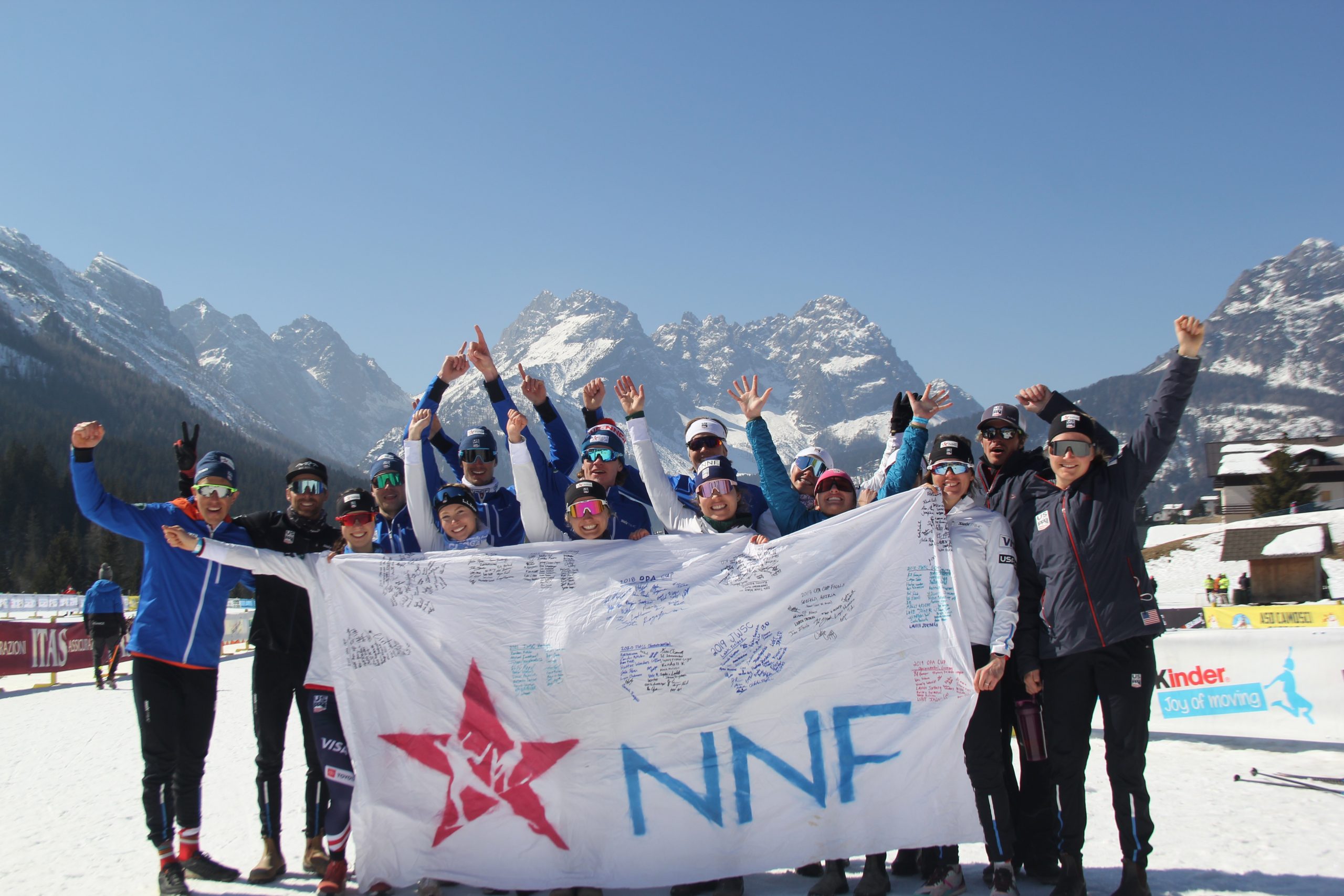
    The American OPA Cup Finals team celebrates fast races and bluebird days in Sappada, Italy. (Photo: Bryan Fish/NNF)

    Identifying it on its list of “Pillar Projects”, the National Nordic Foundation (NNF) helps subsidize the cost of the trip for the qualified athletes. The trip can accommodate up to 16 skiers, who are generally kept to an approximately even male to female ratio through the qualification criteria. This year, due to conflicting schedules and a number of declines, thirteen athletes attended, with nine women and four men. 

    In alphabetical order, the senior men included: Braden Becker (CGRP), Logan Diekmann (BSF Pro), Finn O’Connell (BSF Pro), Karl Schultz (SVSEF). Senior women included: Mariah Bredal (BSF Pro), Margie Freed (CGRP), Alex Lawson (CGRP), Hannah Rudd (BSF Pro), Becca Rorabaugh (APU), Lina Sutro (SMS T2), and Alayna Sonnesyn (SMS T2). 

    This year, two U20 athletes headed from World Juniors in Lygna, NOR to Italy along with D-Team coaches Anderson and Bryan Fish: Kate Oldham (Aspen Valley Ski Club) and Annie McColgan (UVM). 

    “It’s pretty cool that we have more racers that are racing professionally or post collegiately than, I think, ever in the US, and they have more clubs and places to choose from,” said Anderson. “There were several athletes that, especially because racing was shut down on the East Coast last year and I happened to be in Alaska and wasn’t wasn’t traveling very much before I took this job, it was kind of the first time I’ve gotten to work with them, or the first time I’ve gotten to work with them in three or four years. So it was really cool to get to know Alayna Sonnesyn a little better and Lina Sutro a little better, and Margie Freed and Alex Lawson, who I’ve seen race many times, but it was the first time I’ve gotten to really work with them and get to know them. The same with Braden Becker and Karl Schultz… So it was a pleasure on the trip to get to work with some new athletes that have come through different development systems and are excited about and ready to make that next step. And this racing circuit is a really good opportunity for that.”

    Anderson took the lead with organizing the trip and supporting athletes, working alongside US Ski & Snowboard Cross Country Sport Development Manager and long-time OPA Finals trip lead coach Bryan Fish. The wax support staff included BSF Pro Team head coach Andy Newell, former APU athlete and current staff member Peter Kling, and Jackson Hole comp team coach Jon Filardo. 

    US Ski & Snowboard Cross Country D-Team head coach Greta Anderson supports athletes during the Sun Valley SuperTour races in January. (Photo: Tobias Albrigtsen / @untraceableg)

    Anderson identified the OPA Finals trip as a key development opportunity for a number of reasons: though perhaps lower pressure than World Cup, it’s a professional race circuit with small but competitively dense fields, athletes race aggressively and tactically in a style younger athletes who have not yet raced at this level may not have experienced, and it offers the opportunity for an athlete to dial in some of the small but significant factors details that support success adapting to a new and different environment following long international travel.

    “Bryan’s been doing [the OPA Cup Finals] trip for a long time,” Anderson said. “So Peter Kling, who was on a coaching staff, and Becca Rorabaugh, they were like, ‘I’m pretty sure that we were on Bryan’s first ever OPA Cup trip.’ And it used to be that we started at the bottom of the results sheet and started looking upward for names. And right now we’re starting at the top and we don’t have to look very far down.”

    In two days of racing, the US had seven top-10 finishes, with another set of athletes finishing well-within the top-20. Highlighting the US team was SMS T2’s Sonnesyn, who took third in the 10 k classic on Saturday the 12th, and won the 10 k skate the following day. 
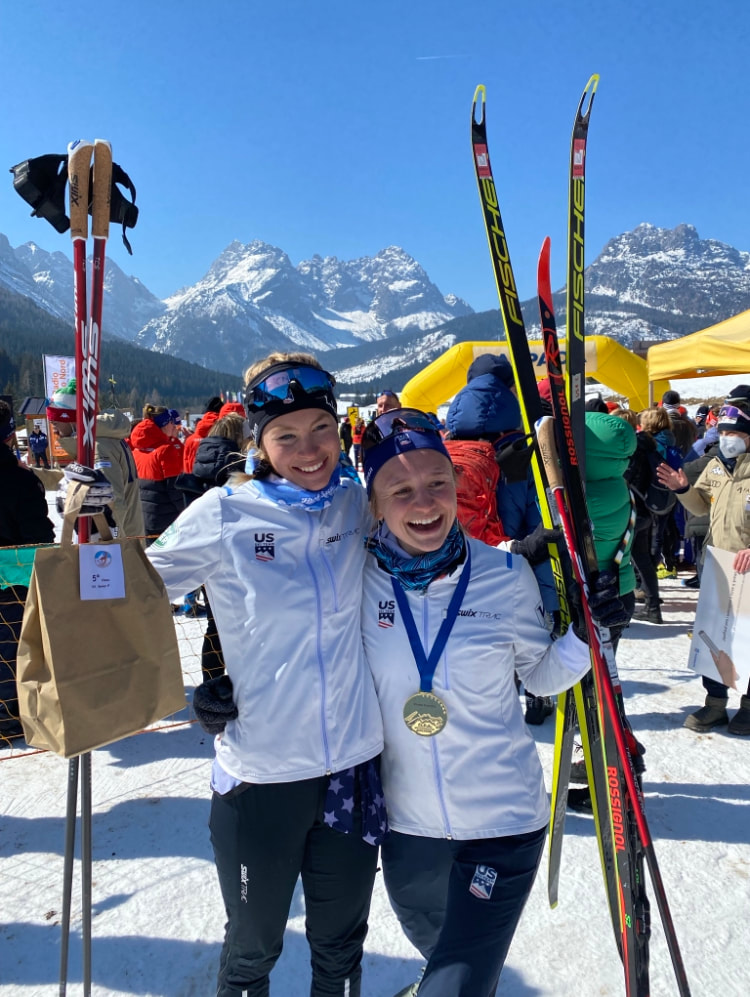
    Alayna Sonnesyn (SMS T2) takes the win in the 10 k skate at Opa Cup Finals in Sappada, ITA, with Mariah Bredal (BSF Pro) finishing just behind in fifth. (Photo courtesy of Alayna Sonnesyn)

    “It’s pretty special,” Anderson said of the performances in Sappada. “It’s awesome to get to see that. For Alayna to start a race and say like, ‘What’s my plan to try to win this?’ It’s not just, ‘Hey, we’re here to participate and learn,’ but ‘Hey, we’re here to participate and learn but also we’re going to try to win.’ And I think, with that comes — not only from staff but from racers — this level of professionalism. Okay, we’re going to select skis. We’re going to make sure we’re organized and in a good place. Where can we be? Where can we do feeds? How can we set you up to have the success you need to have? 

    “It just feels like a really good time to be an American ski racer.”

    After winning two of the first five SuperTour races this season, and finishing on the podium in each of the others, Sonnesyn was offered starts at the Tour de Ski, where she hoped she could achieve strong enough international results to qualify for the Olympic Team. But these goals did not come to fruition; Sonnesyn struggled to find the same race sensations while on the World Cup and tap into the fitness she knew was still there, which was reflected in results below her expectations. She shared her disappointment openly on her blog and social media, providing a relatable and important example to her followers that the pro-skier journey is not immune to bumps in the road. 

    “My experience on the World Cup this year – it was quite demoralizing, to be honest,” said Sonnesyn in a call from the airport as she was on her way to SuperTour Finals in Whistler. “And then, after the Tour de Ski, I got COVID. And it just really put a damper on the whole winter for me. And I started questioning like, ‘Okay, am I fit? And I like, can I race? Well, like, what have I been training for? This is really bad timing with COVID, too.’ So I was just pretty down. But then I was able to have really great SuperTour races, back in January and February, and then to be able to race internationally again in Italy. It wasn’t a World Cup, but it was still very high level of racing. So to have it go so well kind of reaffirmed to me that I belong on the international stage. And I definitely needed that, a little bit, just to give myself more confidence moving forward and motivation as well. So I’m really excited about the races and how they went and what I did to prepare for them and kind of my mental attitude around them, too.”
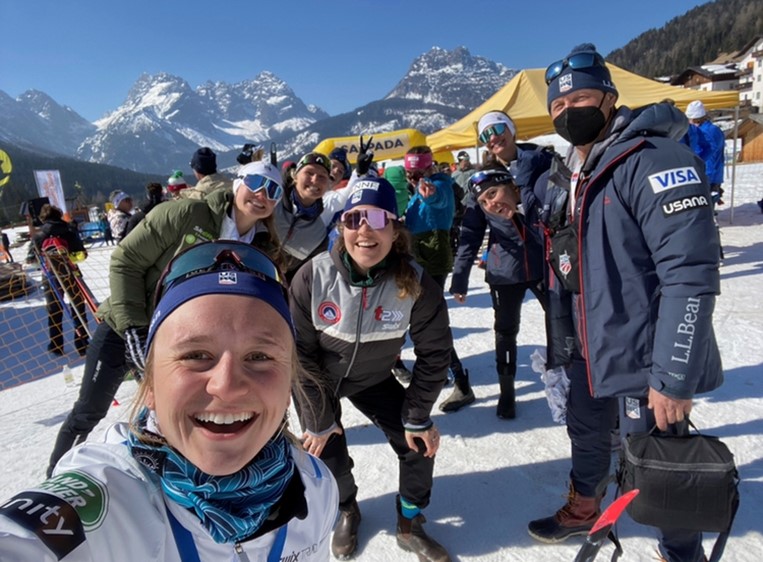
    A selfie in Sappada: the American team prepares for race day at Opa Cup Finals. (Photo: Alayna Sonnesyn)

    As she reflected on the trip and her experiences racing internationally over the last few seasons, Sonnesyn echoed Anderson’s sentiments about the progression of the American team at the event.

    “Compared to my first OPA Cup trip, which was in 2018, I think there were maybe two or three top 10 performances. And they were exciting, but for the most part, it was kind of like, ‘We’re just here to get the experience. We’re not really sure what we’re doing.’ And I think that the way the US is developing right now, the way that new courses are being built in Cable or Duluth, or wherever it is – they are preparing us better for racing internationally. And I think that was shown in the results that we had in Sappada. And it was just so exciting during that 10 k skate on Sunday to cross the finish line in first, and then turn around and see a ton of my other US teammates come in right behind me. That’s not something that was happening four years ago. So I think we are really developing and that is a huge thanks to so many different people and so many reasons, but it’s exciting to see.”

    Sonnesyn also spoke to the importance these international opportunities have provided her specifically, speaking from the perspective of what she dubbed a “bubble athlete” who has oscillated between World Cup and domestic racing over the last four seasons. She got her first World Cup starts in Quebec in March, 2019, and has been offered starts beginning in Period 2 each season since. Though this is a key stepping stone in the process toward consistent World Cup racing, she expressed that bubble athletes can have a challenging time planning seasons in advance and need to be prepared to adapt quickly to more frequent overseas travel.

    “I think that every single experience that an athlete has going and racing internationally, and traveling, and competing at that higher level, it all adds up to be super beneficial and a great learning experience. For example, I have gotten really great at overcoming jet lag, which the first couple of international trips I went on, I had no idea how to handle. I tried my best to do what I could, but it’s hard. And also to know what little things you want from home, like after being in Europe for four or five weeks, what do you really want from the US? 

    “And then also, how do you work in a new environment? A lot of times, if you’re going over to the World Cup, sometimes you’re provided a wax tech or sometimes not, or you have to bring your own, but you have to be willing to work with whoever you get.” 

    Sonnesyn explained that on the Sappada trip, she had worked with each of the techs before, but on her first trip in 2018, it was her first experience working with those wax staff members. Given the importance of ski choice and wax, working together effectively is imperative to an athlete’s success, but it requires dialogue and practice. 

    “Being ready to communicate effectively with the staff, what do you need? How do you want your skis prepared? What do you need from a hotel? All those things seem like such small little details, but they really add up with the more experiences you have.”
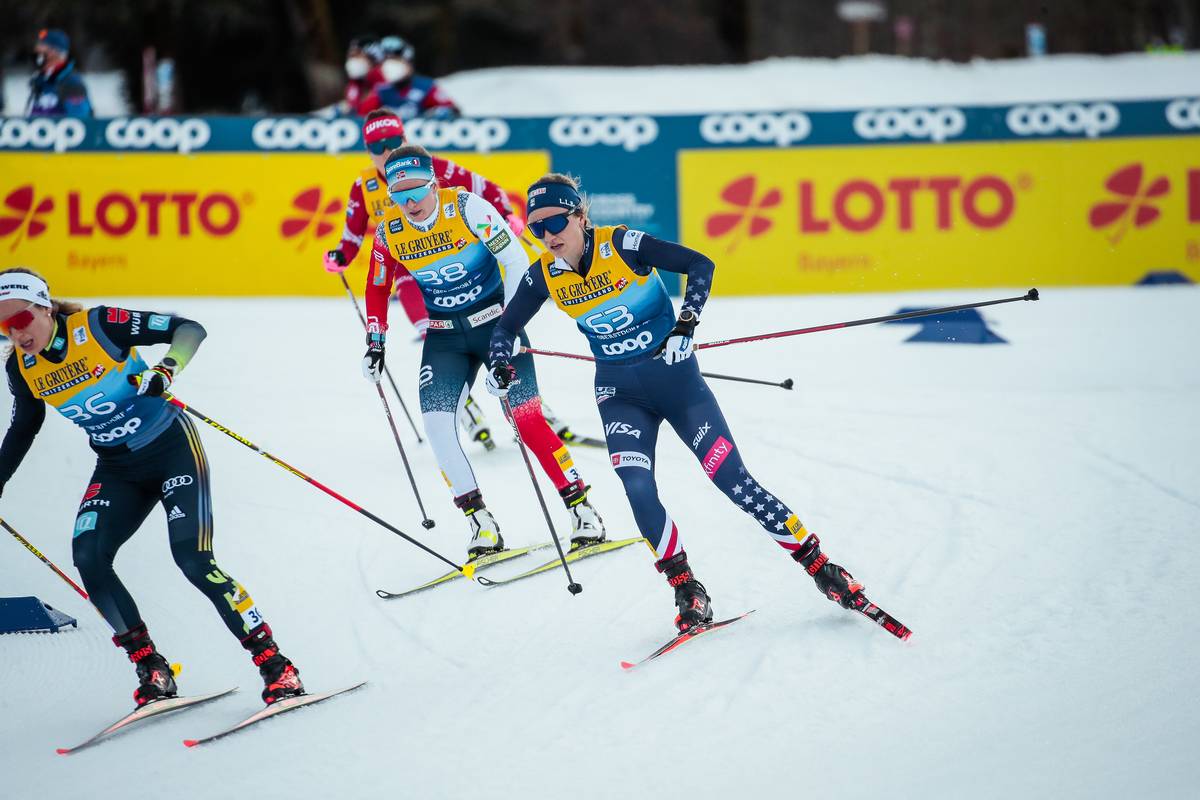
    Alayna Sonnesyn races in Oberstdorf, Germany during the 2021/22 Tour de Ski. (Photo: NordicFocus)

    She also spoke to the differences in the style of racing between the US and her international experiences, and how a trip like Sappada better athletes for what they might encounter should they be offered a World Cup start down the line. 

    “When it comes to racing: the courses in Europe are very challenging and very technical. Downhills, uphills, flats – whatever it is, there’s a lot of it, and you have to be ready to go for it. And then the competitors are fierce. They know how to be aggressive in a race, and you have to know how to hold your own. So it just helps to have that experience to understand how you approach the race. How aggressive are you going to be? How are you going to pace the race? How are you going to handle others around you?”

    With the highest levels of competition for our sport happening across the pond, it is easy to understand why opportunities like the OPA Cup trip provide an essential bridge for developing athletes. But it is not simply the facilitation of this trip that has led to marked improvement for the American team.

    “I think we’re open to change right now,” Anderson said as she reflected on her key takeaways from the experience in Italy and her first season coaching the D-Team. “I think the US, in a year with COVID, and lots of challenges logistically and politically in the world, we handle those changes better than almost any other country does. And I think that’s really shown here.” 

    Alex Lawson skates to 7th in the 10 k skate during OPA Cup Finals in Sappada, ITA. (Photo: Bryan Fish / NNF)

    While the OPA Cup crew was putting together a very solid day in the 10/15 k skate, the team of Rosie Brennan, Zak Ketterson, Scott Patterson, and Jessie Diggins had taken the win in the thrilling 4 x 5 k mixed relay in Falun. As the team in Sappada mingled near the finish to support the final racers as they skied through, Anderson said that a Swiss national team coach walked over and showed them the World Cup result on the phone. 

    Layered on top of the broader success at the OPA Cup Finals, Anderson expressed that this opened her athletes’ eyes to what might be possible for them in the years to come also. In particular, the Falun results of Zak Ketterson, a newcomer to the World Cup who ended his debut season with a 15th place finish in the 15 k skate and a mixed relay win.

    “[The guys racing at OPA Cup] are like, ‘Oh, man, I beat Zak sometimes’, or ‘I’m right with him’, ‘I trained with him in college.’ The level of confidence that brings… ‘Maybe maybe I can do that too.’”

    Moreover, Anderson expressed that this relay gold medal speaks to the equity of skiing in the US. “That we have good female athletes, and we have good male athletes, and we have a good balance of the two, and teams that are mutually supportive of each other,” she said. “Not every country has that.” 

    Boiling down the experience and her feelings as the season wraps up, Anderson concluded, “I have nothing but good things to say about our athletes right now. I’m really impressed with them. They handle the change better than anyone, and I think as a staff and from an organizational perspective, we’re trying to keep up, remove barriers, make sure they’re supported. And we’re open to trying new things, and it seems that we’re excelling in places where we’re willing to experiment and get our feet wet.”

    Kate Oldham (AVSC) races the 10k classic during Opa Cup Finals in Sappada, ITA. (Photo: Bryan Fish / NNF)

    Providing additional insights from the perspective of an OPA Cup Finals first-timer, FasterSkier also heard from U20 athlete Kate Oldham, who trains with the Aspen Valley Ski & Snowboard Club (AVSC) and competes for Middlebury College. Oldham took 11th place in both the 10 k classic and skate in the junior women’s category. 

    “Sappada was incredible,” Oldham wrote. “In congruence with the pre-camp in Toblach, the OPA Cup trip was unforgettable… My favorite ski to-date was on a long ski over the pass from Cortina to Toblach, stopping midway for trail side pastries and cappuccinos! Being with a group of older athletes was a valuable change from the World Junior trip because each team member brought new energy and experience to the group. Between that and the gelato shop next door to our hotel, the trip couldn’t have gotten much better!  

    “One of the things I think are most valuable about training and racing camps is the exposure to coaches and athletes outside one’s home team. For years I have been seeking out opportunities to attend regional and national camps that would bring new perspectives, training groups, and social dynamics to push me and help me adapt my own training method while making friends from schools and clubs all over the country. This winter I was lucky enough to have both my club coach and a group of skilled and passionate wax technicians/trip leaders selected from all around the US to lead the trips to Junior World Championships and OPA Cup finals. I know that over the six years I’ve been skiing competitively I have developed the competence to independently navigate high-level skiing events, but having techs to guide me through the process at the international level was extremely helpful, particularly when one of them I had worked closely with for those six years of training and racing.

    “With new coaches come new perspectives. Another set of eyes, a different experience, or a new phrase can be all it takes for the pieces of new advice to click into place. Or maybe a coach has a different perspective on the bigger picture of skiing that resonates with you unlike the philosophy you previously knew… which of the infinitely wide range of mindsets in ski racing works best for you? Which one reminds you why you love ski racing? Which one helps you stay motivated through the hardest parts of the season when the last thing you want to do is get out the door for training? Which one eases the heartbreak of coming so close to a goal but falling short despite your hardest effort? Without a doubt, cross country skiing is a delicate balance of internal and external factors, but having great teammates and coaches like the ones I got to know and work with in Europe this winter is certainly a key ingredient to the recipe for success in the lifelong pursuit of excellence on the race course and off.” 

    Full Results for OPA Cup Finals

  • Sunday Rundown: Ramsau, Toblach, Annecy, St. Ulrich, Rossland (Updated)

    Sunday Rundown: Ramsau, Toblach, Annecy, St. Ulrich, Rossland (Updated)

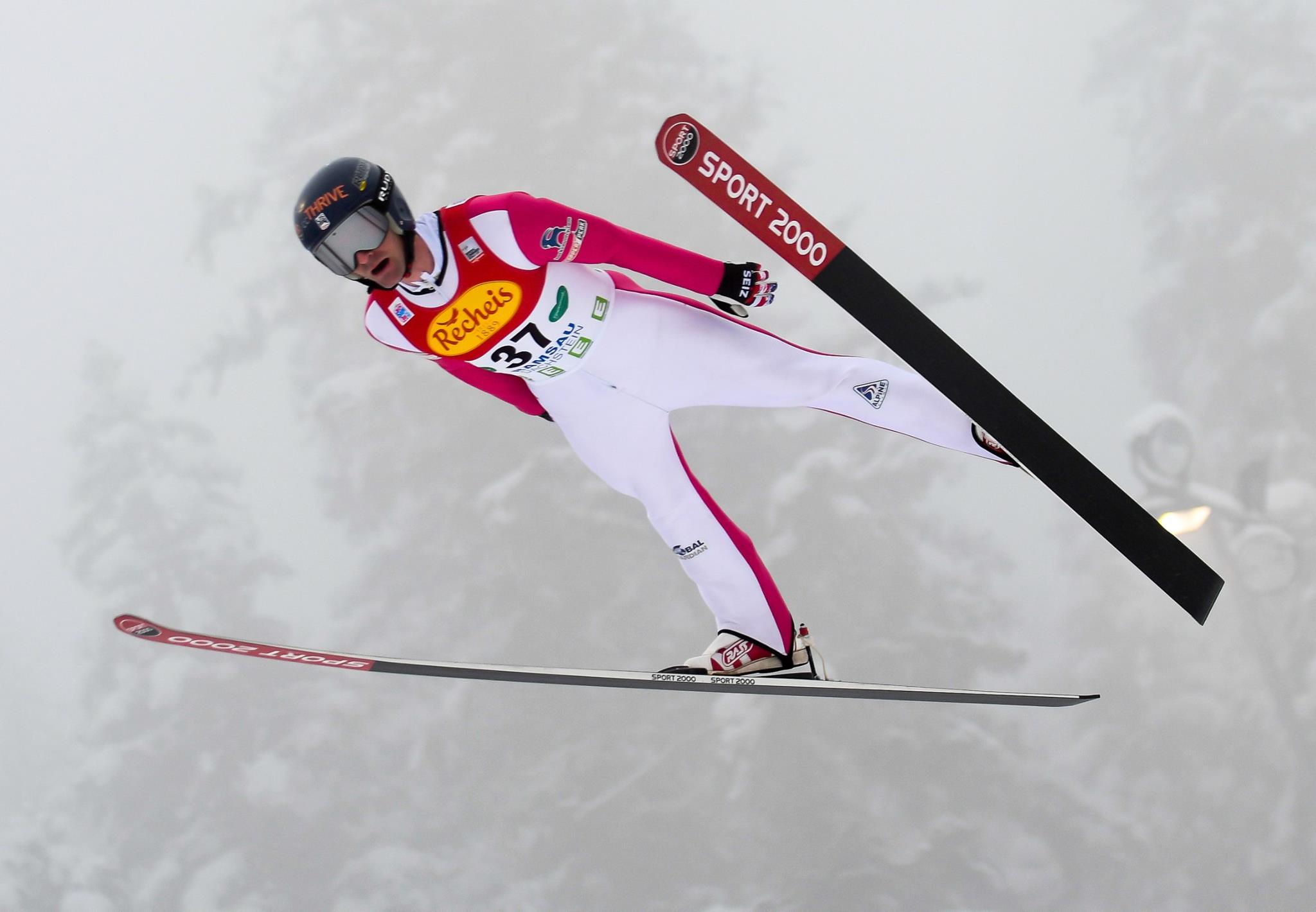
    Bryan Fletcher (USA Nordic) jumping to 45th in the Nordic Combined World Cup on Sunday in Ramsau, Austria. In the 10 k that followed, he skied the third-fastest time to finish 14th overall. (Photo: Romina Eggert/USA Nordic Facebook)

    NorAm mini tour (Rossland, B.C.): 10/15 k freestyle pursuits

    Team Gregg ended the Rossland NorAm mini tour with another double win, with American Caitlin Gregg and her husband Brian Gregg winning the 10- and 15-kilometer freestyle pursuits, respectively, at the Black Jack Ski Club trails.

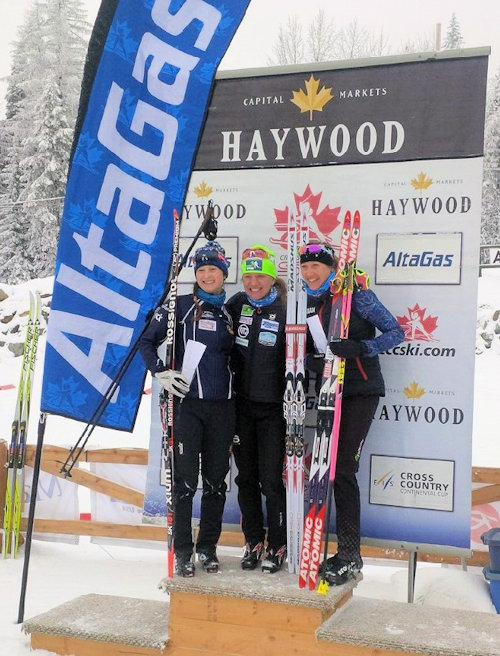
    The women’s 10 k freestyle pursuit podium at the NorAm in Rossland, B.C., with American Caitlin Gregg (c) in first, and Canadians Zina Kocher (l) and Andrea Dupont (r), in second and third, respectively. (Photo: Cross Country Canada)

    Caitlin capped the long weekend with her third-straight win, a 48.28-second victory over former Canadian biathlete Zina Kocher (Foothills Nordic). Caitlin started first and was first across the finish in 29:02.86, while Kocher started ninth and rose to second place for her second-consecutive podium (after placing third in Saturday’s skate sprint). Andrea Dupont (Rocky Mountain Racers) started fourth and finished third (+1:58.35) for her second-straight podium as well (she was second in the skate sprint behind Gregg).

    Lisle Compton of the National Team Development Centre (NTDC) Thunder Bay and Canadian National Junior Team finished fourth overall (+2:07.03), Frederique Vezina of the Pierre-Harvey National Training Centre (CNEPH) was fifth (+2:16.10), and Annika Hicks of the Alberta World Cup Academy (AWCA) sixth (+2:16.51). Laura Leclair (CNEPH) placed seventh, Kaia Andal (Caledonia Nordic) was the top junior in eighth overall, Jaqueline Mourao (Brazil Ski Team) ninth, and Sophie Carrier-Laforte (Skinouk) 10th.

    Brian, who won the Rossland men’s 10 k classic on Friday, also started Sunday’s 15 k freestyle pursuit first and finished in that position in 38:43.93. Andy Shields (Lappe Nordic) raced to second overall, 7.65 seconds back, after starting fourth, and Jack Carlyle (AWCA) reached the podium in third (+8.75) after starting 10th.

    Evan Palmer-Charrette (NTDC Thunder Bay) ended the weekend in fourth (+17.68), Philippe Boucher (CNEPH) was fifth (+19.02), Brian McKeever (Canadian Para-Nordic Ski Team) sixth (+22.16), Michael Somppi (AWCA) seventh (+34.62), Alexis Dumas (CNEPH) eighth (+52.78), Bob Thompson (NTDC Thunder Bay) ninth (+54.76), and Julien Locke (Black Jack/Canadian U25 Team) 10th (+1:04.46).

    Results

    ***

    FIS Nordic Combined World Cup (Ramsau, Austria): Saturday & Sunday individual competitions

    Bryan Fletcher (USA Nordic) notched seventh in the Nordic Combined World Cup this weekend in Ramsau, Austria, for his best result since January 2016. (Photo: USA Nordic/Facebook)

    After a bye week, the Nordic Combined World Cup resumed in Ramsau am Dachstein, Austria, with back-to-back individual normal hill/10-kilometer Gundersen starts on Saturday and Sunday.

    On Saturday, American Bryan Fletcher posted his best individual result in nearly two years in seventh place, 32.6 seconds behind German winner Eric Frenzel.

    Saturday’s individual competition on Ramsau’s 98-meter hill started out with Japan’s Taihei Kato going farthest in the jump portion, the Czech Republic’s Tomas Portyk jumping to second, and Frenzel jumping to third. Fletcher tied Japan’s Yoshito Watabe for 28th and the two started the 10 k race 1:02 minutes back accordingly.

    While Frenzel picked off two places to finish first in 24:05.8 minutes, Fletcher moved up 21 spots to seventh place with the second-fastest course time of 23:48.4.

    Germany had two on the podium with Fabian Rießle just 0.7 seconds back in second place, and Norway’s Jan Schmid finished third, 8.1 seconds behind Frenzel.

    On Sunday, Rießle climbed to the top step on the podium, winning the weekend’s second normal hill/10 k in 26:12.5.

    Norway’s Jørgen Graabak led after the jump portion, yet ultimately finished sixth, 9.8 seconds behind Rießle.

    Rießle jumped to ninth and started 18 seconds out of first, then took the win on the four-lap course by just 0.3 seconds over Italy’s Alessandro Pittin. The Italian notched second place after starting 36th based on his jump and racing the fastest 10 k time in 25:00.8.

    Finland’s Eero Hirvonen finished third (+1.5) after starting 10th, and Schmid was another 2 seconds back in fourth (+3.5) after jumping to seventh. Frenzel did not start.

    Three Americans qualified for Sunday’s competition. Fletcher jumped to 45th and started 1:30 back, yet rose to 14th (+43.7) with the third-fastest course time. His younger brother Taylor Fletcher skied the second-fastest course time to finish 34th (+2:01.6), up 24 places after jumping to 58th. Adam Loomis finished 52nd (+4:38.6) after jumping to 59th.

    The U.S. Nordic Combined team is headed back to the states to prepare for U.S. Olympic trials later this month, according to the USA Nordic Facebook page.

    Results: Saturday | Sunday

    ***

    FIS Cross Country World Cup (Toblach, Italy): 10/15 k classic pursuits

    Norway’s Johannes Høsflot Klæbo after winning the men’s 15 k classic pursuit for his seventh World Cup win of the season on Sunday in Toblach, Italy. With win No. 7, he has the most wins before the new year in FIS Cross Country World Cup history. (Photo: FIS Cross Country/Twitter)

    Women’s report

    Men’s report

    If you thought Johannes Høsflot Klæbo was out, think again. After placing 10th in the men’s 15-kilometer freestyle on Saturday in Toblach, the 21-year-old Norwegian raced to his seventh victory of the season in the men’s 15 k pursuit on Sunday.

    In doing so, Klæbo broke the record for the most World Cup wins before the New Year: he’s tallied seven in the last eight races he’s contested.

    On Sunday, he started 10th, 36 seconds behind his Norwegian teammate Simen Hegstad Krüger, who won the 15 k freestyle and started first. Klæbo had worked his way up to third by 11.4 k, and at the finish, he edged Russia’s Sergey Ustiugov by 1.9 seconds for the win in 33:31.1 minutes.

    Ustiugov, who started fifth, claimed second, and Kazakhstan’s Alexey Poltoranin rose from 14th to third place (+4.5), ahead of Russia’s Alexander Bessmertnykh in fourth (+9.7), Finland’s Matti Heikkinen in fifth (+9.8), France’s Maurice Manificat in sixth (+10.7), Norway’s Hans Christer Holund in seventh (+11.1), Switzerland’s Dario Cologna in eighth (+11.8), Canada’s Alex Harvey in ninth (+16.3), and Krüger in 10th (+24.0). Norway’s defending Overall and Distance World Cup champion, Martin Johnsrud Sundby placed 11th (+34.4) after starting 20th based on his result on Saturday.

    Erik Bjornsen once again led the U.S. men, racing from 29th at the start to 26th (+1:43.1). Scott Patterson improved from 42nd to 39th (+2:37.2), Paddy Caldwell moved up from 52nd to 44th (+2:57.7), and Noah Hoffman slipped to 49th (+3:01.7) after starting 40th.

    Canada’s Devon Kershaw moved up five places to 33rd (+2:02.8), Graeme Killick finished 50th (+3:42.0), Russell Kennedy 66th (+5:05.8), and Knute Johnsgaard moved up six places to finish 76th (+6:20.8).

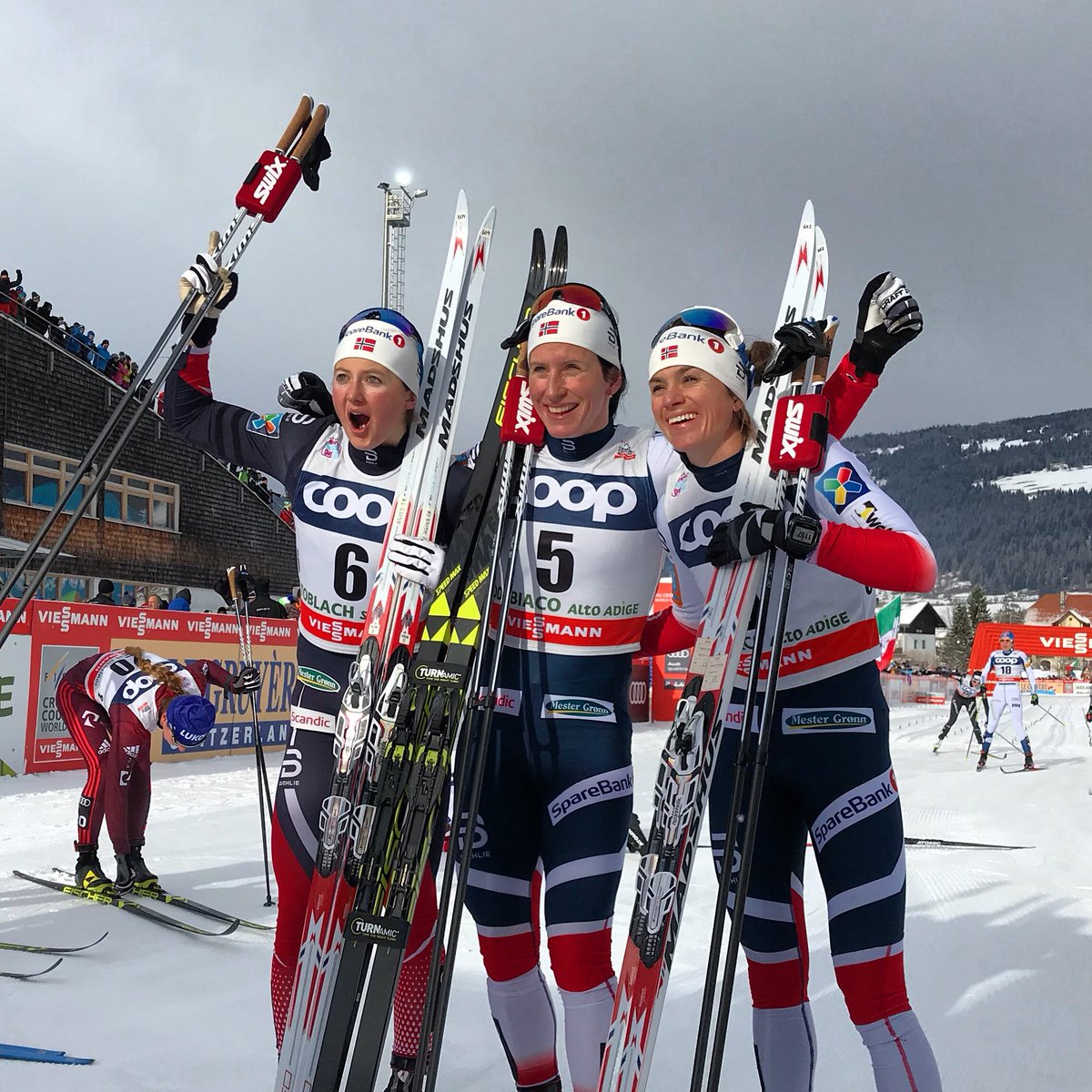
    The all-Norwegian women’s 10 k classic pursuit podium on Sunday at the World Cup in Toblach, Italy, with Marit Bjørgen (c) in first, Ingvild Flugstad Østberg (l) in second and Heidi Weng (r) in third. (Photo: FIS Cross Country/Twitter)

    In the women’s 10 k classic pursuit earlier in the day in Toblach, Norway’s Marit Bjørgen overcame a 22-second starting deficit to take the win by just 0.3 seconds over her teammates Ingvild Flugstad Østberg in second. It was an all-Norwegian podium with Heidi Weng in third (+0.8).

    Bjørgen started fifth, 22 seconds behind Swedish race leader Charlotte Kalla, based on their results in Saturday’s 10 k freestyle individual start. By the 6.4 k checkpoint, Bjørgen led a pack of four other Norwegians and Kalla — all within 1.4 seconds of first. At 8.5 k, Bjørgen led Østberg in second and Weng in third, while another Norwegian Astrid Uhrenholdt Jacobsen skied another eight seconds back with teammate Ragnhild Haga in fourth and fifth, respectively. By that point, Kalla was skiing alone, another 11.7 seconds in sixth, while American Jessie Diggins led a group 25 seconds behind Kalla in sixth.

    Ultimately, Bjørgen finished first in 25:19.3 and formed an all-Norwegian podium with Østberg and Weng, Jacobsen placed fourth, 21.5 seconds out of first and 20.7 seconds behind Weng in third.

    Haga was fifth (+31.8), Kalla sixth (+41.9), Diggins seventh (+53.7), Russia’s Natalia Nepryaeva eighth (+54.2), American Sadie Bjornsen ninth (+55.2), and Austria’s Teresa Stadlober 10th (+55.6) in a photo finish with Finland’s Kerttu Niskanen, who placed 11th (+55.6).

    For the U.S. Ski Team, Diggins and Bjornsen retained their starting positions of seventh and ninth, respectively, while Rosie Brennan started 19th and finished 25th (+2:14.6). Chelsea Holmes (Alaska Pacific University) finished 39th (+3:03.8) and Liz Stephen (USST) finished 48th (+4:05.2).

    Canada’s Emily Nishikawa placed 53rd (+4:14.5), Dahria Beatty finished 63rd (+5:44.7), Cendrine Browne 66th (+5:57.7), and Katherine Stewart-Jones 70th (+7:31.5).

    Results: Women | Men

    ***

    IBU World Cup (Annecy, France): Women’s and men’s mass starts

    Women’s report

    Men’s report

    France’s Justine Braisaz won her first International Biathlon Union (IBU) World Cup race of the season on Sunday at home in Annecy, France, topping the women’s 12.5 k mass start by 11.2 seconds in 37:19.4.

    While Braisaz shot 19-for-20 (0+0+1+0), Iryna Kryuko of Belarus cleaned the four-stage race for second place, her first World Cup podium. Germany’s Laura Dahlmeier, who won Saturday’s 10 k pursuit, placed third (+19.9) with two penalties (0+1+0+1).

    Two North Americans qualified for the selective mass start, with Susan Dunklee (US Biathlon) racing to 20th (+1:16.3) with three misses (1+0+1+1), and Emma Lunder (Biathlon Canada) placing 28th (+2:21.4) with a single penalty (1+0+0+0).

    In the men’s 15 k mass start that followed, France’s Martin Fourcade finally got the win he was looking for, shooting clean and beating his main rival Johannes Thingnes Bø of Norway by 3.9 seconds. Fourcade crossed the finish line first in 36:30.3, Bø settled for second after skiing two early penalty loops (2+0+0+0) and Germany’s Erik Lesser tallied his second podium in Annecy (after placing third in the sprint) in third place again (+6.2) with clean shooting.

    Two Americans and a Canadian qualified for the mass start, with US Biathlon’s Lowell Bailey leading them in 23rd (+2:22.4) with three penalties, Sean Doherty following in 24th (+2:52.5) with four misses, and Biathlon Canada’s Scott Gow finishing 26th (+4:05.4) with five penalties.

    Results: Women| Men

    ***

    OPA Cup (St. Ulrich, Austria): 10/15 k freestyle pursuits

    On the final day of Alpen Cup (a.k.a. OPA Cup) racing in St. Ulrich, Ida Sargent of the U.S. Ski Team (USST) scored her third-straight top five with a fifth place in the women’s 10 k freestyle mass start. She previously placed third in the skate sprint and 5 k classic on Friday and Saturday.

    Germany’s Julia Belger won the women’s mass start on Sunday in 28:33.6, while Saturday’s 5 k winner, Elena Soboleva of Russia placed second (+0.7). Russia had two on the podium with Mariya Istomina in third (+6.4). Germany’s Elisabeth Schicho finished fourth (+15.8), just ahead of Sargent in fifth (+15.9).

    Germany’s Antonia Fräbel placed sixth (+17.1), followed by American Sophie Caldwell in seventh (+17.9). The USST had three in the top 10 with Julia Kern in 10th (+41.9), out of 60 finishers.

    In the men’s 15 k freestyle mass start, Beda Klee of Switzerland took the win in 37:14.6, 2.4 seconds ahead of Germany’s Thomas Bing in second. Six-time Olympian Sergey Dolidovich of Belarus reached the podium in third (+4.5).

    The U.S. had two men in the race, with Simi Hamilton finishing 14th, 16 seconds out of first, and Andy Newell finishing 71st (+2:25.2) out of 118.

    Results: Women | Men

  • Saturday Rundown: Annecy, Toblach, St. Ulrich, Rossland (Updated)

    Saturday Rundown: Annecy, Toblach, St. Ulrich, Rossland (Updated)

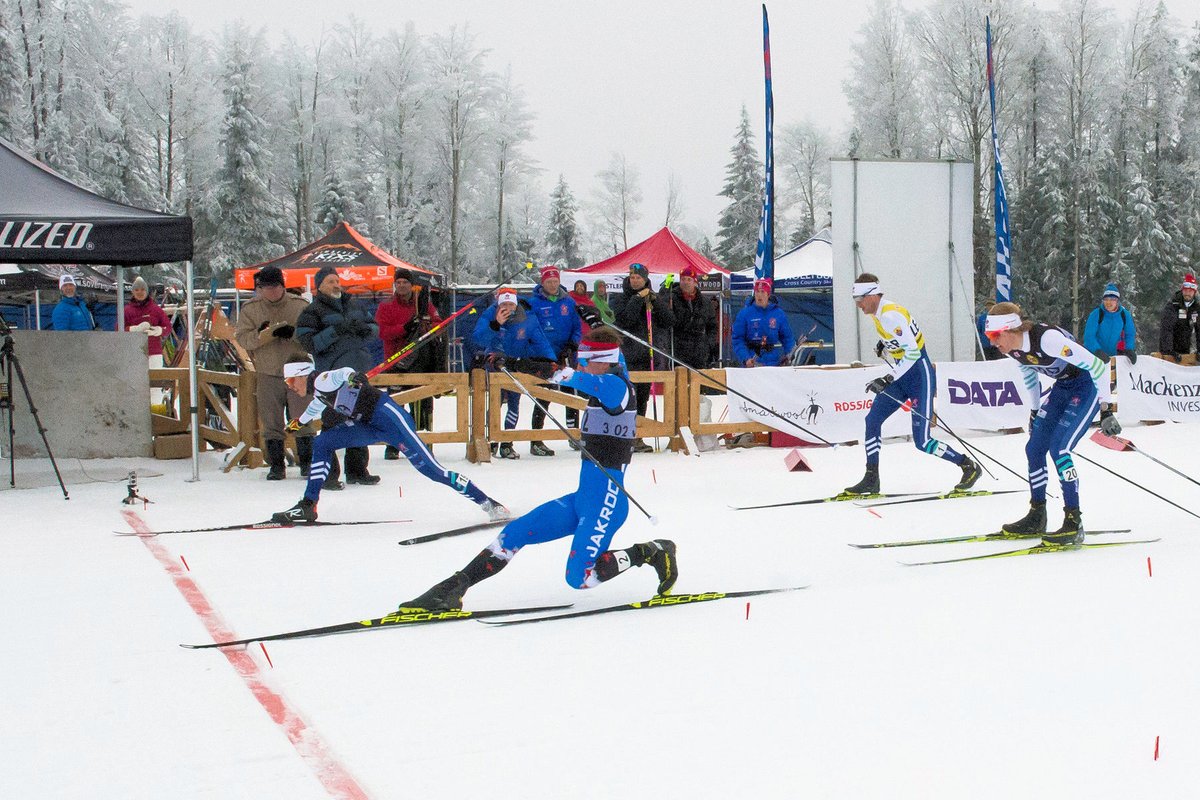
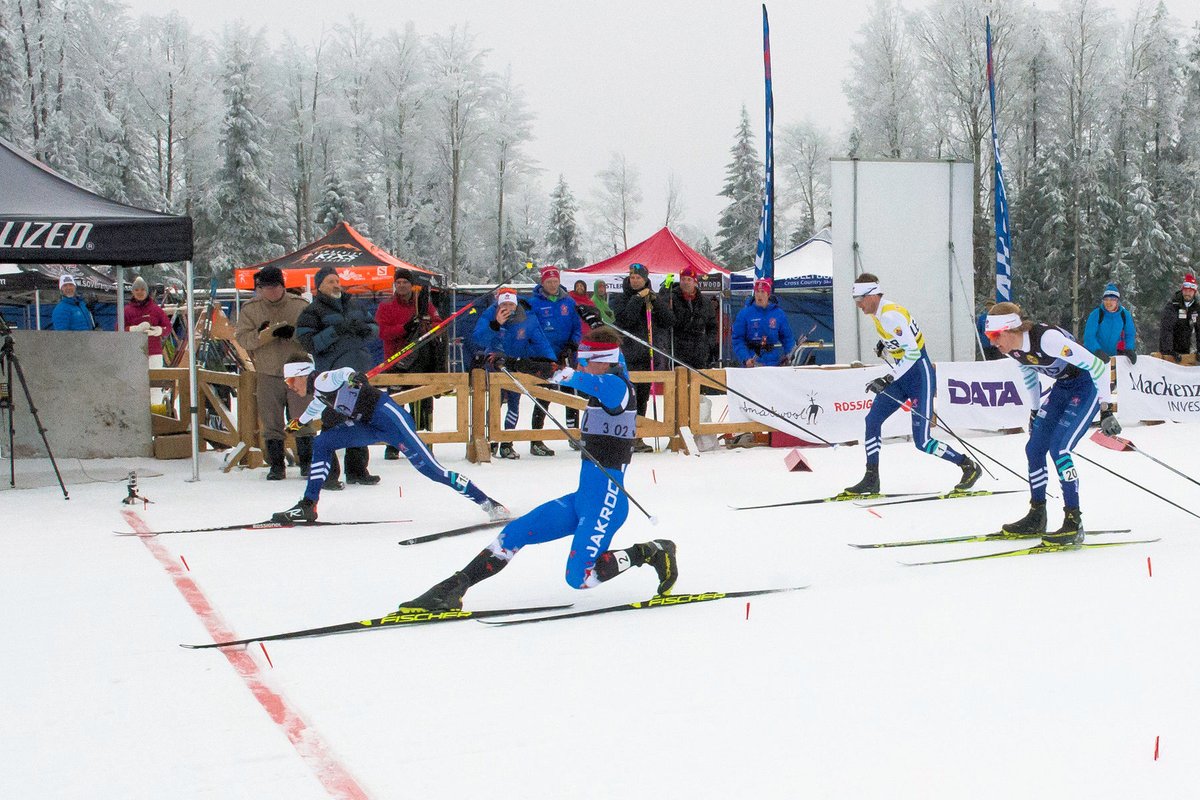
    The photo finish for first in the men’s skate sprint final on Saturday at the NorAm in Rossland, B.C., with Julien Locke (near) outstretching Evan Palmer-Charette for first, and Julian Smith (r) taking third third ahead of Bob Thompson (yellow NorAm leader’s bib). (Photo: CCC/Twitter)

    NorAm Mini Tour (Rossland, B.C.): Freestyle sprints

    On Day 2 of NorAm racing in Rossland, British Columbia, Julien Locke, of the Black Jack Ski Club and Canadian National U25 Team, won the men’s 1.4-kilometer freestyle sprint final on his home trails by just one-hundredth of a second over Evan Palmer-Charrette, of the National Team Development Centre (NTDC) Thunder Bay, in 2:38.13. NTDC Thunder Bay had two on the podium with Julian Smith in third, 0.4 seconds behind Locke.

    Locke started the day by qualifying second, just 0.06 seconds behind Bob Thompson (NTDC Thunder Bay), who won the qualifier in 2:39.49. Locke went on to finish second to Thompson in the first quarterfinal, then won the second semifinal while Thompson won the first semi.

    In the final, Locke tallied his first NorAm win of the season, while Thompson, last weekend’s classic-sprint winner at Sovereign Lake, placed fourth (+0.43), missing the podium by three-hundredths of a second. Andy Shields (Lappe Nordic) finished fifth (+1.78) and Sebastien Boehmler-Dandurand (Canmore Nordic/Stefan Kuhn HP Team) sixth (+5.21) in the men’s final.

    Also on Saturday, American Caitlin Gregg (Team Gregg/Loppet Nordic Racing) racked up her second-straight win in Rossland (after topping Friday’s 5 k classic), winning the women’s 1.4 k skate-sprint final in 3:03.36. Canada’s Andrea Dupont (Rocky Mountain Racers) finished 2.5 seconds later for second place and Zina Kocher (Foothills Nordic) scored her first podium of the season in third (+3.53).

    Dupont won the women’s qualifier in 3:07.68, and Gregg qualified second, 0.87 seconds back. Dupont went on to win the first quarterfinal and first semifinal, while Gregg won her quarterfinal and semifinal as well. (Gregg’s quarterfinal had four racers, compared to five in Dupont’s quarterfinal, as only 21 women competed in the senior women’s heats.)

    Also in the final, Laura Leclair, of the Centre National d’Excellence Pierre Harvey/Pierre-Harvey National Training Centre (CNEPH), finished fourth (+6.11), Maya MacIsaac-Jones (U25 Team) was fifth (+6.31) and Sophie Carrier-Laforte (Skinouk) sixth (+8.57).

    Results: Heats | Qualifier

    ***

    OPA Cup (St. Ulrich, Austria): 5/15 k classic

    On the second day of Alpen Cup (a.k.a. OPA Cup) racing in St. Ulrich, Ida Sargent of the U.S. Ski Team (USST) finished third in the women’s 5 k classic behind two Russians, Elena Soboleva and Natalia Matveeva, respectively.

    Soboleva took the win in the individual-start race in 14:25.8, and Matveeva was 12.5 seconds back for second place. Just like Matveeva, Sargent reached the podium for the second-straight race in third (+18.1), after placing third in the freestyle sprint on Friday (Matveeva finished second in the sprint).

    Germany’s Antonia Fräbel finished fourth (+21.0) and American Sophie Caldwell (USST), who won the sprint the day before, placed fifth (+22.7). The other USST member in the race, Julia Kern finished 15th (+53.5).

    The men raced a 15 k classic, with France’s Alexis Jeannerod taking the win in 38:45.6. Germany’s Thomas Wick was 4.7 seconds back in second, and Russia’s Gleb Retivykh placed third (+11.3). The lone American man racing, Andy Newell (USST) finished 36th (+2:07.1) out of 125 finishers.

    The three-day OPA Cup weekend in St. Ulrich wraps up Sunday with 10/15 k freestyle mass starts.

    Results: Women| Men

    https://www.instagram.com/p/Bcxx2GhlDfv/?taken-by=juliakernski

    ***

    IBU World Cup (Annecy, France): Women’s and men’s pursuits

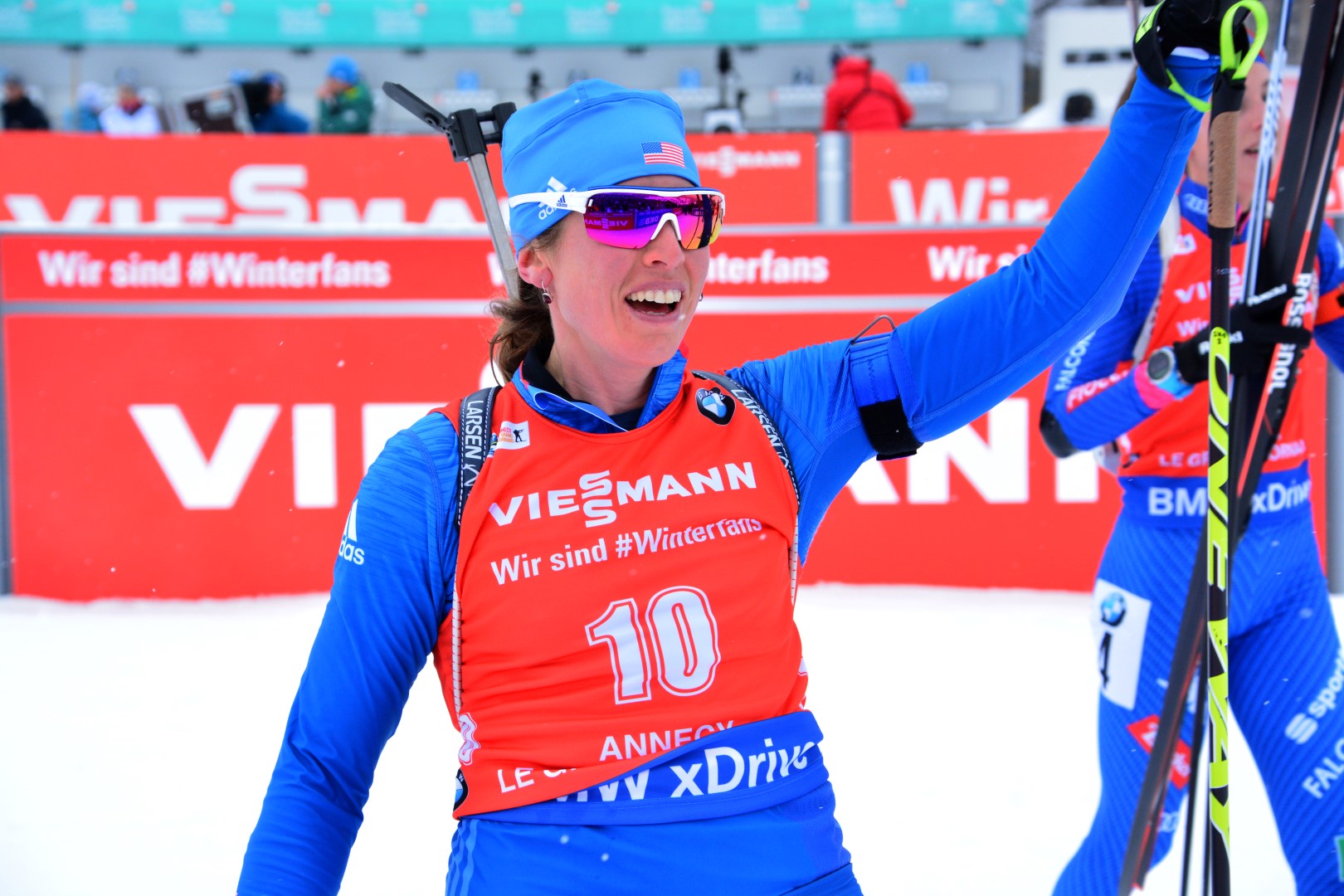
    Susan Dunklee (US Biathlon) after placing sixth and reaching the flower ceremony in the women’s 10 k pursuit at the IBU World Cup on Saturday in Annecy, France. After starting 10th, sixth stands as a season-best for Dunklee. (Photo: Glen Crawford)

    Women’s race report

    Men’s race report

    Germany’s Laura Dalhmeier captured her first win of the season, preventing Slovakia’s Anastasia Kuzmina from her third-straight win, and American Susan Dunklee raced to a season-best sixth in the women’s 10-kilometer pursuit on Saturday in Annecy-Le Grand Bornand, France.

    Canada’s Emma Lunder achieved a career-best 18th after starting 34th, and her teammate Julia Ransom placed 27th after starting 39th.

    In the men’s 12.5 k pursuit that followed, Norway’s Johannes Thingnes Bø started first, shot clean and fended off his competition to rack up his fourth-straight victory — winning by more than a minute.

    And for the second-straight race, France’s Martin Fourcade finished second, this time 1:01.4 minutes behind Bø, who crossed the line first in 32:52.1. Fourcade had to ski two penalty laps later in the race (0+0+1+1), while Russia’s Anton Shipulin, who started sixth and had a single miss (0+0+0+1), rose to third place (+1:10.5).

    American Lowell Bailey shot clean to race up to 14th (+2:13.9) after starting 35th. His US Biathlon teammate Tim Burke finished 26th (+3:03.1) with three penalties (1+0+1+1), after starting 10th.

    Canada’s Scott Gow finished a second later for 27th (+3:04.1) after starting 16th and skiing four penalty laps (1+0+1+2). His brother Christian Gow moved up one spot to 29th (+3:06.6) after starting 30th and shooting 19-for-20 (1+0+0+0).

    The U.S. had four men in the pursuit, with Sean Doherty placing 30th (+3:07.0) with three penalties after starting 17th.

    Leif Nordgren improved to 48th (+4:54.9), up from 56th, despite three misses.

    ***

    FIS Cross Country World Cup (Toblach, Italy): 10/15 k freestyle

    Women’s report

    Men’s report

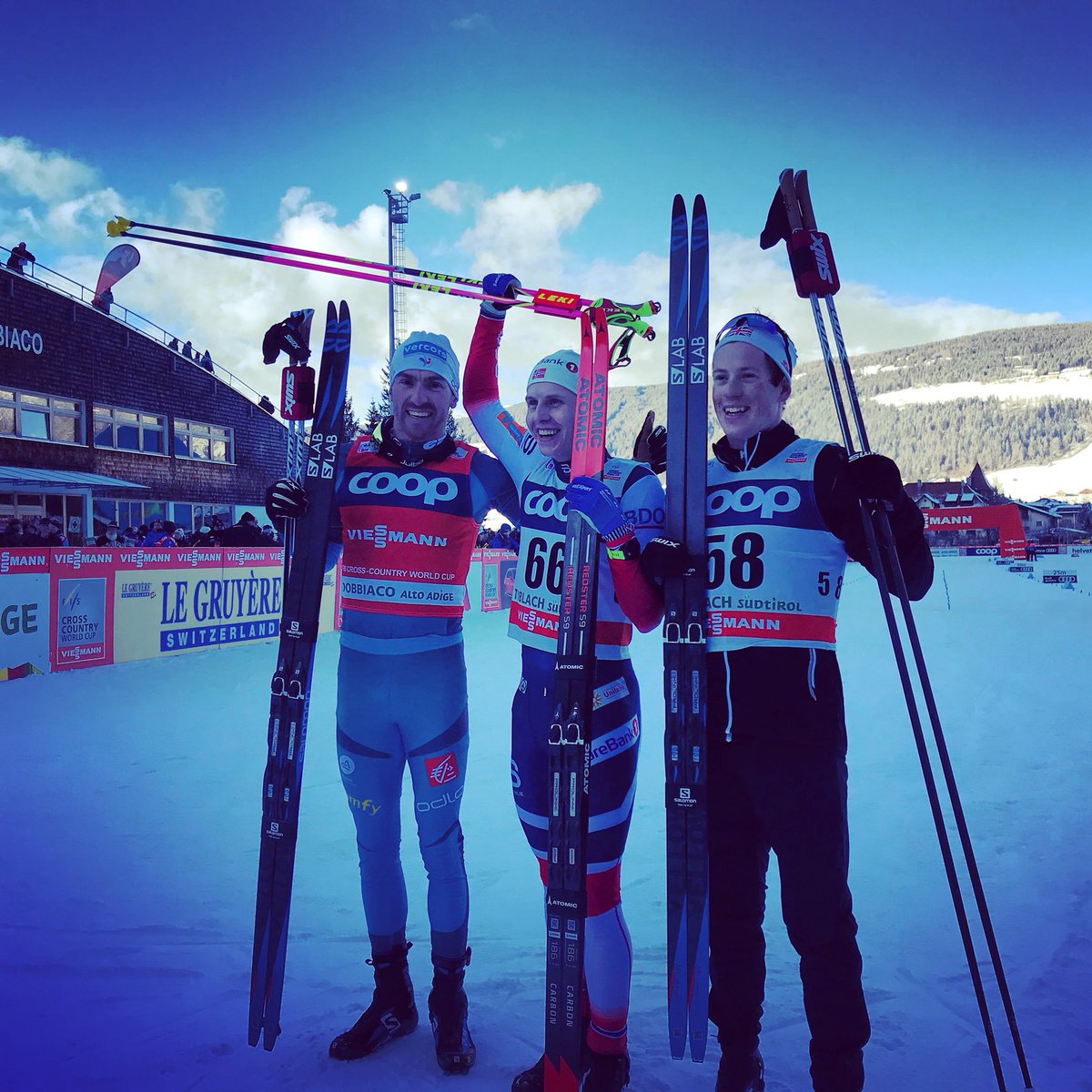
    The men’s 15 k freestyle podium at the Toblach World Cup in Italy, with Norway’s Simen Hegstad Krüger (c) scoring his first World Cup victory in first place, last weekend’s winner Maurice Manificat (l) of France in second, and Great Britain’s Andrew Musgrave (r) in third. (Photo: FIS Cross Country/Twitter)

    In the men’s 15 k freestyle on Saturday in Toblach, 24-year-old Simen Hegstad Krüger achieved his first individual World Cup victory in 29:58.8 minutes, and was joined on the podium by France’s Maurice Manificat in second (+10.6) and Great Britain’s Andrew Musgrave in third (+11.5).

    Canadian World Cup Team member Alex Harvey missed the podium by 2.5 seconds in fourth place (+14.0), tying his best result of the season after finishing Ruka Triple mini tour in fourth place late last month in Kuusamo, Finland.

    Russia’s Sergey Ustiugov followed in fifth, Norway’s Finn Hågen Krogh was sixth and Hans Christer Holund seventh, Finland’s Matti Heikkinen eighth, Switzerland’s Toni Livers ninth, and notably, Norway’s Johannes Høsflot Klæbo — who hasn’t lost a race all season (he sat out last weekend’s 15 k skate in Davos, Switzerland) — was 10th.

    Erik Bjornsen of the U.S. Ski Team (USST) was the lone American in the points (top 30) in 29th (+1:09.6), Noah Hoffman finished 40th (+1:24.5), Scott Patterson (USST) was 42nd (+1:29.4), and Paddy Caldwell (USST) 53rd (+1:50.0)

    For Canada, Devon Kershaw (World Cup Team) placed 38th (+1:22.1), Graeme Killick (World Cup Team) was 49th (+1:47.8), Russell Kennedy (Team R.A.D.) 60th (+2:13.2), and Knute Johnsgaard (World Cup Team) 85th (+3:28.3).

    The women’s 10 k freestyle podium on Saturday at the World Cup in Toblach, Italy, with Sweden’s Charlotte Kalla (c) in first, and Norway’s Ragnhild Haga (l) and Heidi Weng (r) in second and third, respectively. (Photo: FIS Cross Country/Twitter)

    In the women’s 10 k freestyle individual start in Toblach, Sweden’s Charlotte Kalla tallied her third win of the season in 22:40.1 minutes, ahead of five Norwegians and American Jessie Diggins.

    Norway’s Ragnhild Haga was 5.8 seconds shy of Kalla’s time for second place, and her teammate Heidi Weng was another 8 seconds back in third (+13.8).

    Norway occupied second through sixth place, with Astrid Uhrenholdt Jacobsen in fourth (+17.9), Marit Bjørgen in fifth (+22.6) and Ingvild Flugstad Østberg in sixth (+29.3). Diggins led the U.S. Ski Team (USST) in seventh (+40.5), with Finland’s Kerttu Niskanen close behind in eighth (+43.5) and the second U.S. woman in the top 10, Sadie Bjornsen, another 0.4 seconds back in ninth (+43.9).

    The USST had three in the top 20 with Rosie Brennan placing 19th (+1:15.2) for her second-straight top-20 result (following a 17th place in last weekend’s 10 k freestyle in Davos, Switzerland). Chelsea Holmes (Alaska Pacific University) finished 36th and Liz Stephen (USST) was 47th.

    Emily Nishikawa (Canadian World Cup Team) led her team in 51st, Cendrine Browne (Canadian U25 Team) followed in 55th, Dahria Beatty (World Cup Team) was 69th, and Katherine Stewart-Jones (U25 Team) 77th.

    Results: Women | Men

  • Friday Rundown: Annecy, St. Ulrich, Rossland (Updated)

    Friday Rundown: Annecy, St. Ulrich, Rossland (Updated)

    Tim Burke (US Biathlon) racing to 10th in the men’s 10 k sprint at the IBU World Cup on Friday in Annecy, France. (Photo: US Biathlon/NordicFocus)

    IBU World Cup (Annecy, France): Men’s 10 k sprint

    (Note: This rundown has been updated to include quotes from US Biathlon’s Tim Burke and Sean Doherty.)

    Norway’s Johannes Thingnes Bø racked up his third-straight individual win of the International Biathlon Union (IBU) World Cup season on Friday (and fourth non-relay win of 2017/2018), topping the men’s 10-kilometer sprint in Annecy, France. And he did so in head-turning fashion, beating French superstar Martin Fourcade, the race’s runner-up, by 21.1 seconds on Fourcade’s home turf.

    Norway’s Johannes Thingnes Bø racing to his third-straight win of the season on Friday in the IBU World Cup men’s sprint in Annecy, France. (Photo: IBU/biathlonworld)

    On a pristine day in Annecy, Bø started 24th and consistently clocked the fastest times throughout the race. He cleaned prone, then standing, and finished 41.8 seconds faster than Germany’s Simon Schempp, the race leader until that point who also shot clean (0+0).

    Fourcade started 31st and shot a flawless 10-for-10 as well, yet trailed Bø from start to finish. After prone, Fourcade was 8.3 seconds back in second. After standing, he was 14.7 seconds out of first with one loop to go. Bø skied the fastest course time on every loop to remain out of reach, and also shot faster than Fourcade, who clocked the second-fastest overall course time.

    Ultimately, the 24-year-old Bø crossed the finish line with the fastest time of 22:16.9 minutes, Fourcade was second and France’s 26-year-old Antonin Guigonnat achieved his first World Cup podium in third (+34.7) with clean shooting. In fact, the top-four finishers all shot clean, with Schempp in fourth and the third Frenchman in the top five, Simon Desthieux in fifth (+45.7).

    Guigonnat’s previous best World Cup result was 24th in a 20 k individual in 2015 in Oslo, Norway.

    France’s Antonin Guigonnat placed third in Friday’s IBU World Cup men’s 10 k sprint for his first podium and first top 20 of his World Cup career. (Photo: Glen Crawford)

    “It seems unreal to be here besides two monsters like these guys,” Guigonnat told the IBU, according to a press release. “After standing I was informed I had 7 seconds on Schempp and at that moment I trusted myself to hold that gap. I always trust in myself to be able to do something great like today.”

    Fourcade, who has either placed second or third behind Bø in three consecutive races, was not excited about second place.

    “Never cool, because I expected to win,” Fourcade said in an English interview with German broadcaster ZDF. “… But when you find someone better you just have to congratulate him and wait for the next chance. For now, with zero mistakes Johannes is not beatable. I will take the Christmas break to work on my shape, and expect to have a better shape in January to try and challenge him, because for now in the three last competitions I didn’t challenge him enough. I want to be faster, but he is good, he is really good.”

    “That’s good words from the World Cup leader,” Bø replied to ZDF in English. “… Every victory I had this season Martin has been right behind me, so I just have to continue being at 100 percent. I always have to think about myself, and then afterwards we will see if I am in front or second, but it has been a good start.”

    Only one man in the top 11 didn’t shoot clean: Russia’s Anton Shipulin in sixth (+54.9), who missed one in prone (1+0), but made up for it with the sixth-fastest overall course time and fifth-fastest overall shooting time.

    US Biathlon’s Tim Burke achieved his first top 10 in two seasons, placing 10th, 1:08.2 behind Bø with clean shooting.

    “I feel like I executed the perfect race for the shape I am in right now,” Burke wrote in an email to FasterSkier. “I know I am not in top form right now so this was about the best I could do considering that.

    “I have worked a ton on my shooting in the past year and I know that I’ve reached a higher level in training than ever before. It was nice to be able to show some of those improvements today,” he continued. “It feels great to be back in the top ten. Last season I was only racing in about half of the races and I had a top finish of 11th.  But I have to say that I am more pleased with how I executed the race today than the actual result.”

    In a US Biathlon press release, Burke noted that “perfect shooting conditions and a fast track” made for a tight race, as he had expected. “This was a good confidence boost for me heading into the holiday break,” he said.

    Sean Doherty (US Biathlon) racing to 17th for the second-straight individual IBU World Cup race on Friday in the men’s 10 k sprint in Annecy, France. (Photo: US Biathlon/NordicFocus)

    Also for US Biathlon, Sean Doherty placed 17th (+1:20.2), also with 10-for-10 shooting, for the second-straight individual race to tie his season best from last week’s pursuit in Hochfilzen, Austria.

    “I feel I executed a great race plan today,” Doherty wrote in an email. “The sprint is all attack right from the start, and this aggressive racing demands that you are on every transition from the first 100 meters. I carried this mentality through the range and the last lap.”

    After starting in bib 7 and cleaning the first shooting stage, Doherty took the race lead by 22 seconds.

    “Prone was solid and I was happy to execute my plan on the range, had no idea I was leading, just keep the pedal down for another lap,” he wrote. “Being an early bib you can’t look too hard at the place number on the split times. … Coming into standing I just reminded myself of the same focus points I have been working on since May. Focusing on those fundamentals really helps block out any extraneous thoughts that might want to sneak into your mind.”

    Scott Gow (Biathlon Canada) after placing 16th in the IBU World Cup men’s sprint on Friday in Annecy, France. (Photo: Glen Crawford)

    Biathlon Canada’s Scott Gow notched his second top 16 of the season to put himself at the top of the list for Olympic team selection, based on Biathlon Canada’s “Priority 2” criteria. Gow started near the back of the field in bib 99 and ended up 16th (+1:13.5) with clean shooting.

    “I’m very happy with another top 16,” Gow wrote in an email. “This result has solidified my priority 2 Olympic criteria which is a big relief. I’m also happy with my performances so far this early in the season. I’m normally a slow starter so it’s a good sign that I’m hitting good results before Christmas. I just hope I can make it last…”

    “Conditions were rock solid today,” Gow explained. “The fresh snow we got overnight mixed with the wet snow and created a very hard glaze. It was hard to hold a solid edge and the downhills were squirrelly. There was zero wind all day today, so range conditions were perfect.”

    His younger brother Christian Gow tallied Canada’s second-result in 30th (+1:44.2), also with clean shooting. He was one of 19 men (out of 103 finishers) that hit every target on Friday.

    A total of four Americans qualified for Saturday’s pursuit, with Lowell Bailey placing 35th (+1:49.5) with a prone penalty (1+0), and Leif Nordgren finishing 56th (+2:18.1) with one prone miss as well (1+0). Paul Schommer placed 85th (+3:19.3) to miss the top 60 required for the pursuit.

    “… It was a strong Nations Cup points day for the team as a whole,” Doherty noted.

    Canada’s Brendan Green and Nathan Smith did not qualify for the pursuit, after Green finished 86th (+3:21.0) with five penalties (3+2) and Smith was 91st (+3:36.4) with two misses (0+2).

    The women’s and men’s pursuits will be held Saturday in Annecy, with the women’s 10 k race starting at 5:45 a.m. Eastern Standard Time (EST) and the men’s 12.5 k at 8:45 a.m. EST.

    “It’s always chaotic with a lot of action during pursuits and I’ll try to filter all of that out,” Scott Gow wrote. “As for skiing, there’s a lot of transition areas where I think a lot of time can be made.”

    Results| Men’s pursuit start list

    ***

    OPA Cup (St. Ulrich, Austria): Freestyle sprints

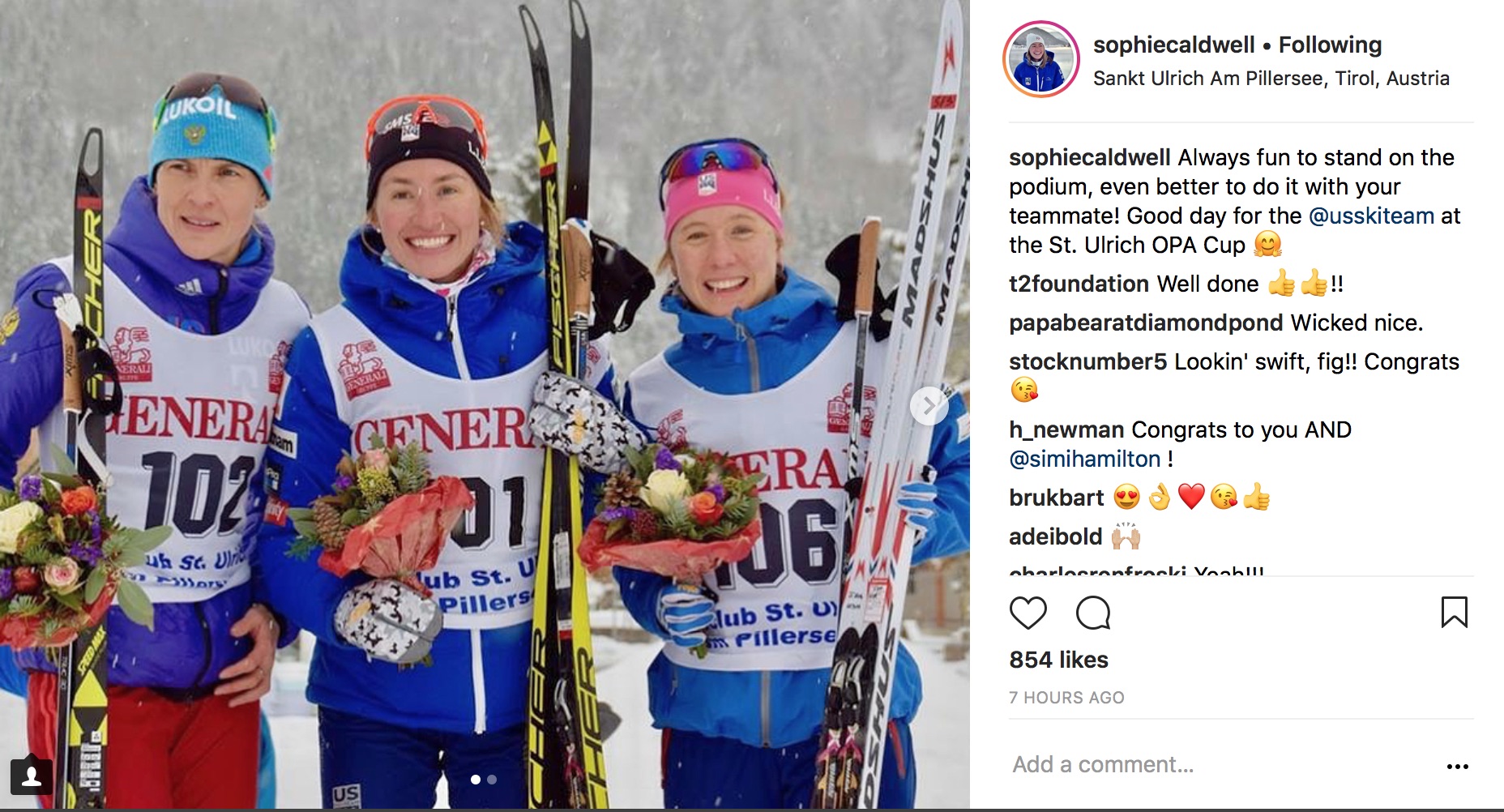
    The women’s 1.2 k freestyle sprint podium at Friday’s Alpen Cup in St. Ulrich, Austria, with two U.S. Ski Team members in the top three: Sophie Caldwell (c) in first, Ida Sargent (r) in third, and Russia’s Natalia Matveeva (l) in second. (Photo: Sophie Caldwell/Instagram)

    With this weekend’s World Cup races in Toblach, Italy, being solely distance events, five U.S. Ski Team (USST) sprinters ventured to St. Ulrich, Austria, to compete in the Alpen Cup (also known as OPA Cup) skate sprints on Friday.

    Longtime couple Sophie Caldwell and Simi Hamilton came away with wins, with Caldwell winning the women’s 1.2 k freestyle sprint final ahead of Russia’s Natalia Matveeva in second and Caldwell’s USST teammate Ida Sargent in third. Another World Cup regular, Switzerland’s Laurien van der Graaff placed fourth, while Germany’s U23 World Championships classic sprint silver medalist Antonia Fräbel finished fifth. Italy’s Greta Laurent was sixth, Germany’s Hanna Kolb seventh, Austria’s Lisa Unterweger eighth, and Julia Kern (USST) ninth.

    In the men’s 1.4 k, Hamilton took the win in a photo finish, just ahead of USST teammate Andy Newell in second and Switzerland’s Gianluca Cologna in third. France’s Jean Tiberghien placed fourth and Russia’s Gleb Retivykh finished fifth.

    “#OPA men’s sprint was a nail-biter,” U.S. Ski Team Women’s Coach Matt Whitcomb wrote on Instagram with a finish-line photo on Friday. “Super close race for @simihamilton, @andynewellskier and @gianlucacologna. Well-run race by the OC in St Ulrich…

    https://www.instagram.com/p/BcuedeHDyxy/?hl=en&taken-by=matt.d.whitcomb

    Earlier in the day, Caldwell won the qualifier by 2.82 seconds over Matveeva with a top time of 2:27.85. Sargent qualified sixth, 4.6 seconds behind Caldwell, and Kern qualified ninth (+5.54). Canadian-born Swiss skier Heidi Widmer qualified 11th (+6.66) and went on to place 14th overall.

    In the men’s qualifier, Newell clocked the fastest time in 2:47.93. Retivykh was 2.01 seconds back in second, and Hamilton qualified third (+3.26).

    Two more days of OPA Cup racing remain in St. Ulrich, with the 5/15 k classic individual starts on Saturday and 10/15 k freestyle pursuits on Sunday, according to the International Ski Federation (FIS) events calendar.

    Final results: Women | Men

    Women’s qualifier| Men’s qualifier

    ***

    NorAm Mini Tour (Rossland, B.C.): Classic Interval Start)

    Winner Brian Gregg (LNR/Team Gregg) flanked by second place Scott Hill (r, BXC) and Bob Thompson (l, NTDC TBay) (Photo: Kai Symington-Kruss)
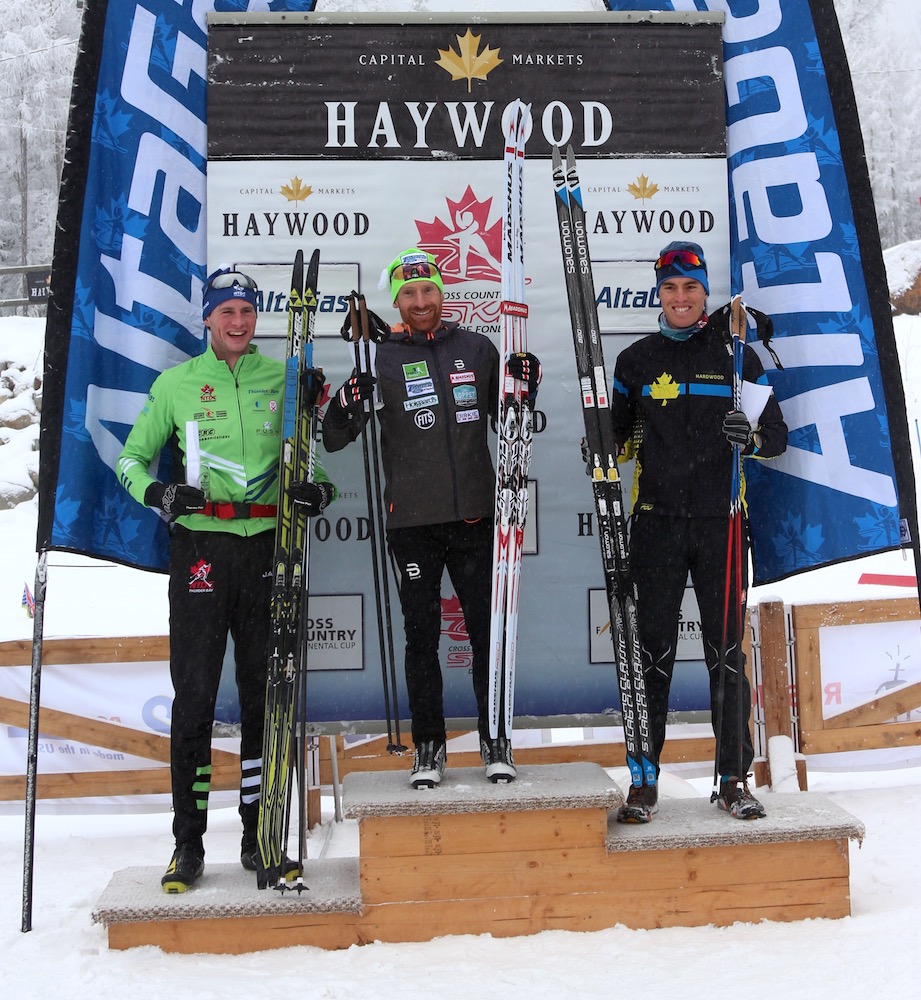
    The NorAm men’s 10 k classic podium on Friday in Rossland, B.C., with Brian Gregg (Team Gregg/Loppet Nordic Racing) in first, Scott Hill (r) of BXC in second  and Bob Thompson (l) of NTDC Thunder Bay in third. (Photo: Kai Symington-Kruss)

    The NorAm series continued this weekend with the Black Jack Ski Club hosting the first Canadian mini-tour of the season.

    Racing started Friday with classic interval start races, with 10 kilometres and two laps for the men, and 5 k and one lap for the women.

    Brian Gregg, representing Loppet Nordic Racing (LNR) and Team Gregg, dominated in 29:34.0 minutes, for his second win of the season after topping the 15 k classic mass start in West Yellowstone. Team BXC’s Scott Hill followed 28.2 seconds back in second. Last weekend’s sprint winner Bob Thompson, of the National Team Development Centre (NTDC) Thunder Bay, notched his second podium of the season in third (+39.4).

    Fresh off the World Cup, Canadian national team sprinters Jess Cockney (World Cup Team) and Julien Locke (U25 Team) finished seventh and 13th, respectively.

    Caitlin Gregg (Loppet Nordic Racing/Team Gregg) on her way to victory. (Photo: Kai Symington-Kruss)
    Caitlin Gregg (Team Gregg/Loppet Nordic Racing) on her way to a win in the NorAm women’s 5 k classic on Friday in Rossland, B.C. (Photo: Mark Richards)

    It was a big day for Team Gregg with Brian’s wife Caitlin Gregg winning the women’s 5 k in 16:08.0. Annika Hicks, of the Alberta World Cup Academy (AWCA), finished 46.8 seconds back in second, while Sophie Carrier-Laforte of the Centre National d’Excellence Pierre Harvey/Pierre-Harvey National Training Centre (CNEPH) narrowly edged out a group of women to take third (+1:16.1).

    The Rossland NorAm continues with freestyle sprints on Saturday, followed by 10/15 k freestyle pursuits on Sunday.

    Results

    CNEPH's Sophie Carrier-Laforte charging the downhill on her way to third place. (Photo: Kai Syminton-Kruss)
    Sophie Carrier-Laforte charging the downhill on her way to third place in the NorAm women’s 5 k classic on Friday in Rossland, B.C. (Photo: Mark Richards)
  • Saturday Rundown: Val di Fiemme, Oberhof, Soldier Hollow, Planica (Updated x3)

    Saturday Rundown: Val di Fiemme, Oberhof, Soldier Hollow, Planica (Updated x3)

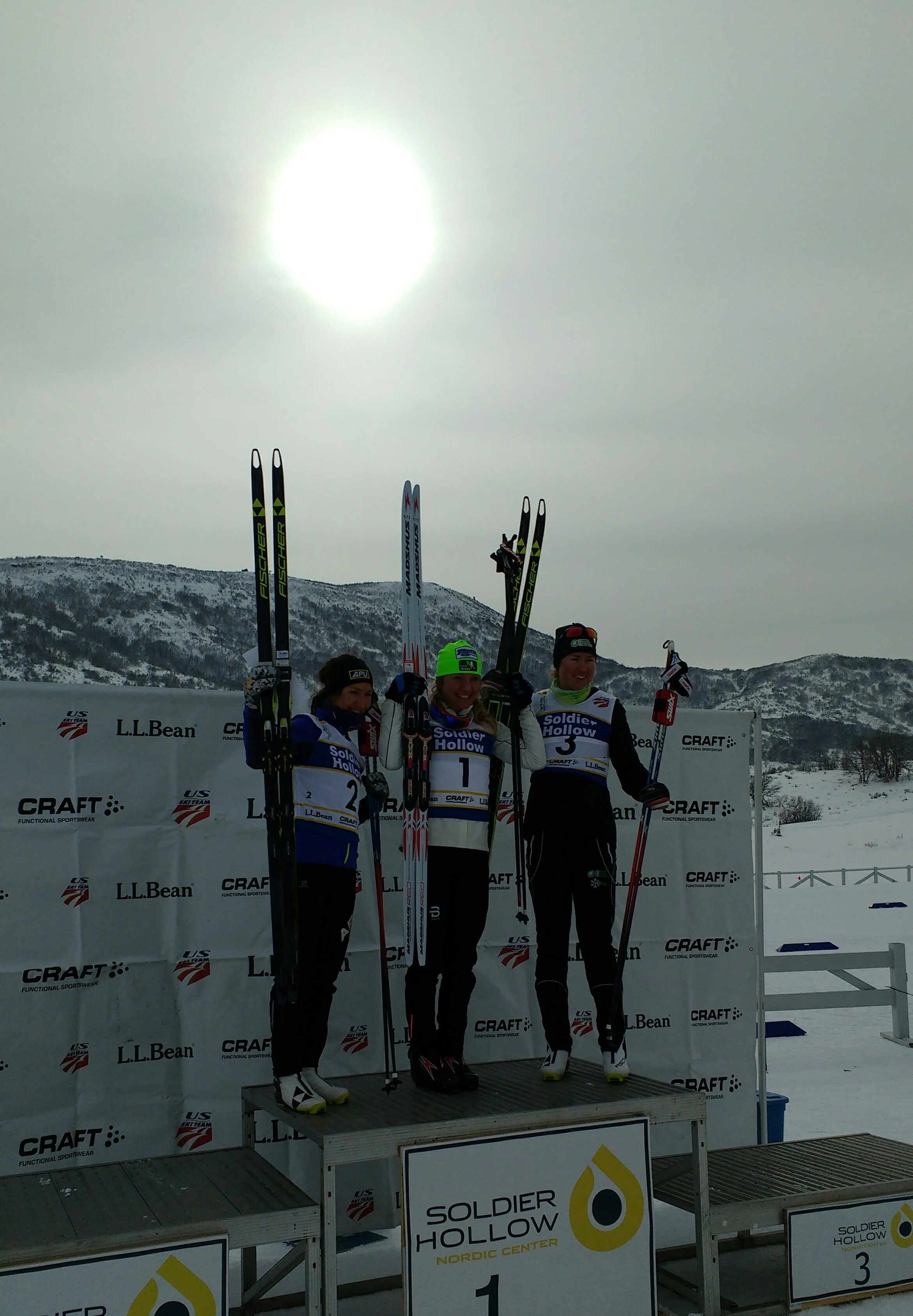
    Left to right: Chelsea Holmes, Caitlin Gregg, and Caitlin Patterson standing on top of the podium for the women's 10-kilometer freestyle event at the 2017 U.S. Cross Country Championships at Soldier Hollow in Midway, Utah.
    Left to right: Chelsea Holmes, Caitlin Gregg, and Caitlin Patterson standing on top of the podium for the women’s 10-kilometer freestyle event at the 2017 U.S. Cross Country Championships at Soldier Hollow in Midway, Utah.

    U.S. Cross Country Championships (Soldier Hollow): 10 k skate

    [UPDATED] Don’t bet against Caitlin Gregg (Team Gregg) in a distance skate event. The 36-year-old took another national title in the 10-kilometer freestyle individual start at Soldier Hollow in Midway, Utah, earlier today in the first event of the 2017 U.S. Cross Country Championships. Gregg’s winning time was 27:00.6 on a cold, slow-snow morning at SoHo.

    Chelsea Holmes (Alaska Pacific University) was second, 2.2 seconds back, with Caitlin Patterson (Craftsbury Green Racing Project) third (+14.5). Katharine Ogden (Stratton Mountain School, +20) was fourth, Becca Rorabaugh (APU, +58.4) fifth, and Rosie Frankowski (APU, +1:05) sixth to round out the extended podium.

    In the men’s 15-kilometer freestyle event, Central Cross Country Ski Association’s Kyle Bratrud took first in a time of 34:52.0. Second place wen tot Ski and Snowboard Club Vail’s Tad Elliott  finished in a time of 35:14.6, while University of Denver’s Mori Madelaner (+35:22.4) rounded out the podium in third. Patrick Caldwell of Stratton Mountain School was seven tenths of a second out of third place in fourth overall (the third American on the day) in a time of 35:23.1. Fifth went to Kris Freeman of Team Freebird in a time of 35:28.0. 

    Results: Women | Men

    ***

    IBU World Cup (Oberhof): 10/12.5 k pursuits

    [UPDATED] In the men’s 12.5 k pursuit on Saturday in Oberhof, Germany, France’s Martin Fourcade got back to his winning ways, shooting 19-for-20 (0+1+0+0) on a cold and gusting afternoon for a 1:09.9-minute victory in 36:45.7. He started eighth.

    Germany’s Arnd Peiffer started 15th and finished second with three penalties (0+0+1+2), and for the second-straight race, Italy’s Dominik Windisch placed third (+1:32.4), with five misses. Windisch was just 0.2 seconds ahead of Norway’s Emil Hegle Svendsen in fifth (+1:32.6), also with five penalties (1+1+2+1).

    Tim Burke (US Biathlon) raced to 26th (+3:18.9) after starting 35th, with four penalties, all in standing (0+0+2+2). Also for the U.S., Russell Currier placed 34th (+4:29.8), up from 46th at the start, with five penalties (2+0+1+2).

    Canada’s Scott Gow finished 45th (+5:45.7) with seven misses (1+1+2+3).

    No North American men are listed on the provisional start list for Sunday’s 15 k mass start.

    In the women’s 10 k pursuit that followed, France made it a double on the day with Marie Dorin Habert taking a 38.8-second victory in 34:33.3. She started third and had two penalties (1+0+0+1) en route to the win, ahead of Friday’s sprint winner Gabriela Koukalova of the Czech Republic in second, with two clean stages followed by three misses (0+0+1+2).

    Finland’s Kaisa Mäkäräinen started second and ended up third (+1:19.1) with four penalties (1+0+1+2) amid blustery conditions in Oberhof.

    Canada’s Rosanna Crawford finished 22nd (+3:47.9), one spot down from starting 21st, with four penalties (0+1+1+2).

    For the U.S., Susan Dunklee placed 44th (+6:20.4), up from starting 50th, despite nine misses (1+3+4+1). Clare Egan finished 49th (+7:25.6) after starting 52nd, with seven misses (4+0+0+3).

    Dunklee was listed as the lone North American starter in Sunday’s 12.5 k mass start, as she is currently ranked 17th overall in the IBU World Cup. Crawford is next in line on the “reserve standby athletes” lists by her event results of the week, should another qualified athlete have to cancel (e.g. due to illness).

    Results: Men | Women

    Mass start provisional start lists: Men | Women

    ***

    Alex Harvey (Canadian World Cup Team) en route to 19th in the men's 15 k classic mass start on Saturday, which puts him sixth overall in the Tour de Ski with one stage remaining in Val di Fiemme, Italy. (Photo: Salomon/Nordic Focus)
    Alex Harvey (Canadian World Cup Team) en route to 19th in the men’s 15 k classic mass start on Saturday, which puts him sixth overall in the Tour de Ski with one stage remaining in Val di Fiemme, Italy. (Photo: Salomon/Nordic Focus)

    FIS Cross-Country Tour de Ski Stage 6 (Val di Fiemme, Italy): 10/15 k classic

    Russian Sergey Ustiugov’s Tour de Ski winning streak came to an end on Saturday at the penultimate stage of the seven-stage Tour, with Norway’s Martin Johnsrud Sundby breaking away on the final 2.5 k lap to win the men’s 15-kilometer classic mass start at Stage 6 in Val di Fiemme, Italy.

    Ustiugov had to outlast a chase pack to settle for second, 2.2 seconds behind Sundby, who won in 40:40.0. Finland’s Matti Heikkinen reached the podium in third (+2.8), ahead of Italy’s Francesco de Fabiani in fourth (+3.2), Russia’s Andrey Larkov in fifth (+3.3), Norway’s Niklas Dyrhaug in sixth (+3.5), Switzerland’s Dario Cologna in seventh (+3.8), and Russia’s Alexander Bessmertnykh in eighth (+3.9). Behind Heikkinen, the fourth- through eighth-place finishers were all within 1.1 seconds of the stage podium.

    Canada’s Alex Harvey ended up 19th (+38.7) after losing seconds to the leaders on the second half of the course. He finished ahead of teammates Devon Kershaw in 27th (+1:12.1) and Graeme Killick in 32nd (+1:31.0).

    For the U.S., Noah Hoffman scored points for the second-straight day in 30th (+1:17.1). Erik Bjornsen crashed on an early downhill and dropped out of the race around the halfway point.

    Ustiugov previously built a more than 1 1/2 minute lead in the Tour, so he remains 1:11.9 minutes ahead of Sundby in the overall with one stage (the 9 k final climb) to go. Cologna remains in third (+2:04.1), Heikkinen is fourth (+2:32.9), France’s Maurice Manificat fifth (+2:34.6) after finishing 13th on Saturday, and Harvey slipped from fourth to sixth overall (+2:42.5), ahead of Sweden’s Marcus Hellner, who finished 10th for seventh overall (+2:54.5).

    Kershaw is 23rd overall (+7:19.1), Hoffman 30th (+9.42.7), and Killick 37th (+11:25.1) heading into the final stage.

    Stina Nilsson of Sweden (center) celebrates another win in the Tour de Ski, which puts her atop the overall standings; Anne Kylloenen of Finland (left) was second in the 10 k classic mass start and Charlotte Kalla of Sweden third.
    Stina Nilsson of Sweden (center) celebrates another win in the Tour de Ski, which puts her atop the overall standings; Anne Kyllönen of Finland (left) was second in the 10 k classic mass start and Charlotte Kalla of Sweden third.

    In the women’s 10 k classic mass start to start the day, Stina Nilsson of Sweden won her fourth stage of this year’s Tour, racing aggressively from start to finish and picking up extra bonus seconds along the way.

    Nilsson pushed the hills late and nobody from the already-fractured main pack could keep up. She notched a 3.0-second win over Anne Kyllönen of Finland, who collected her first individual podium of the season. Charlotte Kalla joined her Swedish teammate on the podium in third (+3.7), also her first podium of the year; she had been fourth in the 5 k freestyle the day before in Toblach, Italy.

    Krista Parmakoski of Finland was fourth, +9.4, Teresa Stadlober of Austria fifth, +10.1, and Yulia Tchekaleva of Russia sixth, +10.5.

    With the bonus seconds that Nilsson picked up along the way, she stole the overall Tour de Ski lead from Norway’s Heidi Weng, who finished seventh (+17.5). Ingvild Flugstad Østberg, also of Norway, had been in second place but slipped even farther. After leading at the start of the race, she slipped through the pack and then off the back, crossing the line 18th (+1:08.5). She is now fourth in the Tour de ski, behind Parmakoski.

    Jessie Diggins of the U.S. skied to eighth place (+19.5) and retained her fifth place overall Tour standing. Teammate Liz Stephen raced to 19th (+1:11.2), and moved into the top 20 of the Tour standings for the first time. Rosie Brennan scored points again in 28th (+2:06.1).

    Results: Men | Women

    Tour standings (through Stage 6): Men | Women

    ***

    FIS Cross-Country OPA Cup (Planica, Slovenia): 10 k classic

    [UPDATED] A quartet of American sprinters turned to distance classic skiing, placing as high as fifth, in 10-kilometer classic interval start races at the OPA Cup in Planica, Slovenia, earlier Saturday.

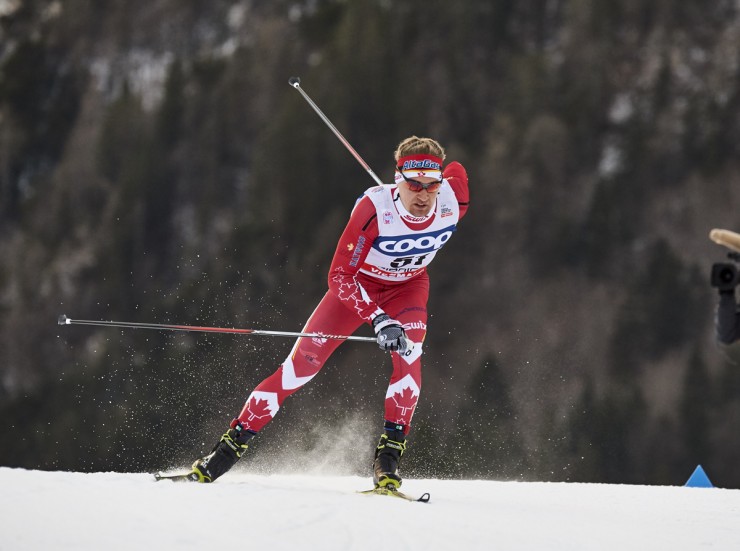
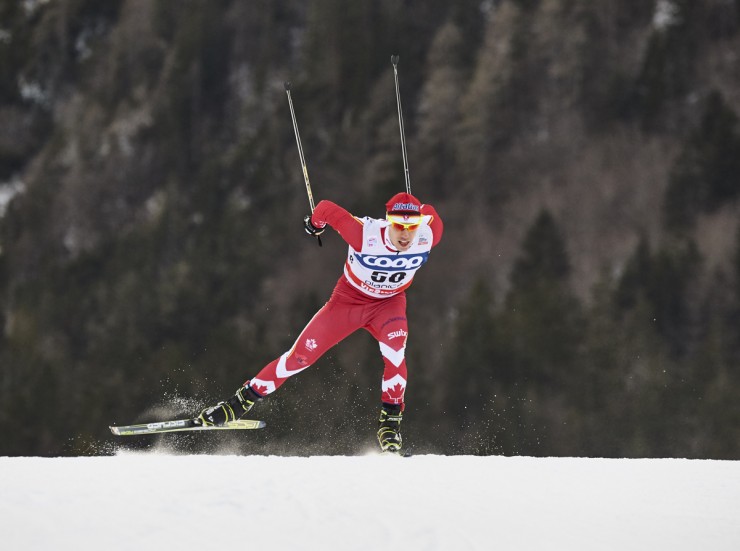
    U.S. Ski Team member Simi Hamilton posted the day’s best result for the Americans, finishing fifth in the men’s race, 13.8 seconds back from winner Jean Tiberghien of France. Hamilton, who started in the final third of the 110-skier field, worked his way into the race, placing 14th at the 3.8 k mark and seventh at 7.5 k before moving up into fifth by the finish. His teammate and the other American in the race, Andy Newell, placed 58th, 1:30.7 back, finishing strong after placing 67th at the 7.5 k time checkpoint.

    Mickael Philipot (+2.0) and Valentin Chauvin (+8.6) rounded out the all-Gallic podium.

    In the women’s race, Ida Sargent (USST) was the leading American in 17th. She finished 1:10 behind winner Sara Pellegrini of Italy. Sargent likewise worked her way into the race, placing 26th and 18th at intermediate checkpoints before moving up to 17th by the finish.

    Three places and less than ten seconds back, Sophie Caldwell (USST) finished 20th, 1:19.7 back of Pellegrini. Caldwell started out somewhat faster than the three other Americans who raced today, placing as high as seventh at the first checkpoint.

    The final podium, reminiscent of the 2006 World Cup soccer final, was Pellegrini in first, Italian Caterina Ganz in second (+7.6), and Delphine Claudel of France in third (+14.6).

    Conditions in Planica were clear and cold and just a few degrees above the FIS-legal cutoff, with race-time temperatures between 3° F and 5° F.

    Racing in Planica concludes tomorrow with interval start 10 and 15 k classic races, replacing the 7.5/15 k skiathlon that was originally scheduled.

    Results: men | women

  • Valjas 5/100ths of a Second from Qualifying; MacIsaac-Jones Also 31st, Beatty 32nd for Canada

    Valjas 5/100ths of a Second from Qualifying; MacIsaac-Jones Also 31st, Beatty 32nd for Canada

    Len Valjas (Canadian World Cup Team) racing to 31st for the third time this season in a World Cup freestyle sprint. He was 0.05 seconds outside of the top 30 needed to make the heats in Saturday's sprint in Planica, Slovenia. (Photo: Fischer/NordicFocus)
    Len Valjas (Canadian World Cup Team) racing to 31st for the third time this season in a World Cup freestyle sprint. He was 0.05 seconds outside of the top 30 needed to make the heats in Saturday’s sprint in Planica, Slovenia. (Photo: Fischer/NordicFocus)

    Hundredths of a second continue to haunt Len Valjas. For the third time this season, the Canadian World Cup Team skier missed out on the top 30 needed to qualify for the World Cup heats in Saturday’s 1.2-kilometer freestyle sprint in Planica, Slovenia.

    In three out of four skate sprints this season, Valjas, 27, has finished 31st. On Saturday, his qualifying time was 0.05 seconds behind 30th. At the last skate sprint in Lenzerheide, Switzerland, he was just 0.01 seconds out of qualifying, and in December in Davos, Switzerland, he was 0.04 seconds off the mark. Add all those times up and Valjas is left with one-tenth of a second separating him from World Cup points in a combined three races.

    “I’m pretty disappointed to finish 31st for the 3rd time this season in skate sprints,” Valjas wrote in an email on Saturday after finishing 5.64 seconds off the top qualifying time set by Federico Pellegrino of Italy. Pellegrino went on to win the men’s final.

    “There is nothing more frustrating because you know that you are in good shape and your day is being decided by a fraction of a second,” Valjas added.

    Len Valjas (Canadian World Cup Team) racing to 31st for the third time this season in a World Cup freestyle sprint. He was 0.05 seconds outside of the top 30 needed to make the heats in Saturday's sprint in Planica, Slovenia. (Photo: Fischer/NordicFocus)
    Len Valjas on his way to 31st in Saturday’s World Cup 1.2 k freestyle sprint qualifier in Planica, Slovenia. (Photo: Fischer/NordicFocus)

    Just over a week ago on Jan. 8, he raced in an OPA Cup skate sprint on the same course in Planica. He qualified in 19th and went on to place 10th.

    While the goal had been to preview the course in advance “and try to get into the rounds this week,” according to Canadian Head Coach Justin Wadsworth, “He did say last week that this just wan’t the course for him, not his style.”

    Wadsworth was reached by phone Saturday morning while in Vancouver, British Columbia. He said Valjas reported the course required a lot of grinding one skate, or V2, which didn’t necessarily suit his strengths. Regardless, they discussed how he needed to finish.

    “I tell him every time, ‘You need to throw the biggest lunge in at qualifying … that’s one-tenth of a second,’ ” Wadsworth said.

    After Saturday’s race, Valjas explained that he “felt really good,” he wrote. “I know I would have had some fun in the heats. I’ve missed out on valuable points and it’s not an awesome feeling.”

    MacIsaac-Jones, Beatty Close to Top 30

    In the women’s 1.2 k qualifier, Canada had two just outside the top 30 with Maya MacIsaac-Jones (Rocky Mountain Racers) in 31st (+0.31) and Dahria Beatty in 32nd (+0.84). For both MacIsaac-Jones, of Rocky Mountain Racers, and Beatty, 21, of the Alberta World Cup Academy (AWCA), Saturday marked their individual career bests in their first World Cup of the season.

    Canada's Maya MacIsaac-Jones (Rocky Mountain Racers) in her first international World Cup start on Saturday, racing to a career-best 31st in the women's 1.2 k freestyle sprint in Planica, Slovenia. (Photo: Cross Country Canada/NordicFocus)
    Canada’s Maya MacIsaac-Jones (Rocky Mountain Racers) in her first international World Cup start on Saturday, racing to a career-best 31st in the women’s 1.2 k freestyle sprint in Planica, Slovenia. (Photo: Cross Country Canada/NordicFocus)

    For MacIsaac-Jones, 20, it was her first international World Cup after competing in Canada’s World Cups in December 2012.

    “It felt great to be racing in a World Cup again,” MacIsaac-Jones wrote in an email. “This race felt different than the Canmore World Cup because in 2012, I was competing in World Cups purely to have fun and learn from the experience. While the same can be said, in a sense, about today’s race, I started today with much higher expectations of myself.”

    At the Planica OPA Cup sprint last week, she qualified in 28th and went on to place 20th. That race gave her confidence, she explained, “knowing that I could pace myself well and race the course efficiently. The snow today was a bit colder and more hard-packed than last weekend, which was great for me because it is the kind of snow I train on all the time in Canmore.”

    “I was both shocked and very excited to finish 31st!” MacIsaac-Jones added. “Although I would have loved to race in the heats, my result today gives me confidence and belief in myself that I am capable of top-30 results on the World Cup circuit. It was a strong day for Canadian women, and hopefully Cross Country Canada will continue to bring more women on the World Cup circuit so that we have the opportunity to chase down some World Cup points.”

    According to Wadsworth, all five women on the Canada’s current World Cup roster — MacIsaac-Jones, Beatty, Emily Nishikawa (who notched a sprint career best in 39th), Cendrine Browne (42nd), and Katherine Stewart-Jones (54th) — will continue onto the Nove Mesto World Cup in the Czech Republic next weekend. Valjas wrote that he will skip Nove Mesto to take “a short break” before the classic sprints in Drammen, Norway, and Stockholm, Sweden, in early February.

    “It’s a great start, it’s exciting and that’s why we have them over [there],” Wadsworth said of two Canadian women coming so close to the points. “Stepping up on your first [World Cup] in Europe and being so close to qualifying is really what our program needs right now.”

    For Beatty, a U23 Development Team member, this was her second European World Cup since placing 65th in the freestyle sprint last season in Lahti, Finland. At the OPA Cup last weekend, she qualified in 17th and placed 18th overall.

    “I felt like I was climbing well today, but I didn’t take the last downhill corner very well and stumbled a little over the final bump into the stadium,” Beatty wrote on Saturday. “Coming into the finish I knew it was a better qualifier than last weekend and was hoping it would put me in the top 40.

    “When I crossed the line in 31st and then later ended up 32nd I was extremely happy with the result but it was also a tiny bit bitter sweet,” she added. “When you are so close to the heats you always think about the little things that could have gotten me those 0.83 seconds. Overall it was a really good day and definitely my best qualifier of the year to date…”

    On Sunday, she’ll start the team sprint with MacIsaac-Jones. AWCA Head Coach Chris Jeffries is leading the team in Slovenia, and in an email, he explained how he selected Canada’s lineup for the freestyle team sprint.

    “To be honest, I kept it pretty simple with the team selections and based it completely on the results from the sprint today,” Jeffries wrote. “I kept the [OPA Cup] distance racing from last week in mind as well, but the results from today fell in line with the results at the OPA last weekend, so it made for a pretty easy decision without possible questions.”

    MacIsaac-Jones and Beatty will make up one women’s team (“Canada I”), and Browne and Nishikawa will make up the other (“Canada II”). Both teams will start in the second semifinal.

    “The only asterisk is Emily, since she is our female distance leader on the team and had the strongest results last week in all 3 races, despite being 3rd best today,” Jeffries continued. “But I’m really happy with Cendrine’s fitness right now, especially after her 9th place in the [OPA Cup] skate 10k last weekend. I feel as though both teams are quite even in strength, and after today’s results, am really excited to watch the girls fight it out heads up with the other teams.”

    Nishikawa’s Career-Best Sprint

    Emily Nishikawa (Canadian Senior Development Team) racing to a career-best World Cup sprint result of 39th in the 1.2 k freestyle sprint in Planica, Slovenia. (Photo: Fischer/NordicFocus)
    Emily Nishikawa (Canadian Senior Development Team) racing to a career-best World Cup sprint result of 39th in the 1.2 k freestyle sprint in Planica, Slovenia. (Photo: Fischer/NordicFocus)

    For Nishikawa, of Canada’s Senior Development Team, 39th was her best World Cup sprint result since placing 48th in the skate sprint at the Canmore World Cup in 2012. A week ago, she finished fourth in the OPA Cup sprint final — her first skate sprint of the season.

    “I was happy with my race, and it was nice to have my best ever world cup sprint result,” Nishikawa, 26, wrote Saturday. “I’m still trying to figure out sprint qualifying, but I’m happy with how my fitness, speed and power have come along in the past year. It was way harder and faster today than it was a week ago in the OPA race, but it was really fun racing today.  Especially exciting seeing some great results from my teammates Maya and Dahria.”

    Joining Valjas in the men’s sprint, Knute Johnsgaard (AWCA/U23+ Development Team) finished 54th, Andy Shields (Thunder Bay National Development Centre) was 56th, and Jess Cockney (Senior Development Team) was 61st on Saturday.

    For Johnsgaard and Shields, it was their first international World Cup. For Cockney, it was his fourth World Cup sprint of the season and fourth time outside the top 60.

    “I’ve been feeling slow this season and I’ve found it hard to dig into my fitness and really push through the race days and today was very similar to how I’ve felt all year,” Cockney wrote in an email. “My goals going into these races has been to find that ability to push again and I’m disappointed I haven’t made it happen yet.

    “In general I’ve been really unhappy with my sprinting,” he added. “I’ve worked hard all training season and prepared well in the winter and it’s for sure been the most disappointing season I’ve ever had.”

    On Tuesday, the 26-year-old Cockney will head home to Canmore, which he explained he was “thrilled about” since he hasn’t been home more than three weeks since early July.

    “I’ll focus on bringing my fitness back and try to get some volume training back home and doing some different types of intensities hoping to find that consistency that I’ve been missing,” he wrote. “I won’t compete in any world cups before the Ski Tour Canada but I don’t even think I have a spot in that tour with the level I’ve been skiing lately, hopefully I can show more fitness racing the NorAms in MSA [Mont Sainte-Anne] and Easterns.”

    On Sunday, Johnsgaard and Valjas will team up as Canada I, and Cockney and Shields as Canada II.

    “Len is our best sprinter, and Knute has had the strongest results in both sprint and distance, so that pairing was straightforward,” Jeffries explained.

    “I am fired up to race tomorrow in the team sprint,” Valjas wrote. “Hopefully get some payback for today’s disappointment!”

    Results: Women | Men


  • From the Yukon to Europe, Beatty Part of Canada’s U25 B-Tour

    From the Yukon to Europe, Beatty Part of Canada’s U25 B-Tour

    Dahria Beatty (AWCA/Canadian U23 Development Team) racing to her first NorAm victory of the season in Canmore, Alberta. (Photo: Buff Canada/Peter Collins)
    Dahria Beatty (AWCA/Canadian U23 Development Team) racing to her first NorAm victory of the season in Canmore, Alberta. (Photo: Buff Canada/Peter Collins)

    Subarctic temperatures. More than 85 kilometers of cross-country ski trails. Best of all, enough snow to cover the ground nearly year round. All this and more make up the capital and hometown of one of Canada’s top development skiers and current NorAm leader, Dahria Beatty, who was recently selected to Cross Country Canada’s U25 European B-Tour.

    Along with Beatty,  five other Canadians — Cendrine Browne, Katherine-Stewart Jones, Knute Johnsgaard, Maya MacIsaac-Jones, and Andy Shields — departed on Dec. 28  for the January OPA Cup and World Cup races in Planica, Slovenia, and Nove Mesto, Czech Republic.

    Women's Canmore NorAm classic sprint winner Dahria Beatty (AWCA/NST U23 Development Team) after her A-final victory. (Photo: CCC/Twitter)
    Women’s Canmore NorAm classic sprint winner Dahria Beatty (AWCA/NST U23 Development Team) after her A-final victory. (Photo: CCC/Twitter)

    While the 21-year-old Whitehorse native was excited to pack her bags earlier this week, Beatty also appreciates all the experiences that lead her to this point, including her time spent in the Yukon Territory’s capital.

    “Alain Masson was my coach growing up in Whitehorse. He’s an Olympian and created an amazing ski program in the Yukon, which has fostered a lot of great athletes,” Beatty, who now lives and trains with the Alberta World Cup Academy (AWCA) in Canmore, Alberta, said in a phone interview.

    Now, Beatty is another one of the athletes joining that list.

    “This season is really shaping up quite well for me. I was really happy with how I skied [in Canmore] before Christmas,” she said. “I’m hoping to keep that positive track.”

    Beatty’s positive start to the 2015/2016 race season included placing third in the SuperTour skate sprint in West Yellowstone, Mont., then proceeding to win two out of three of the opening NorAm races in Canmore, Alberta, as well as the distance race at the Sovereign Lake NorAm for the second-straight year. That put her on top of the overall NorAm standings, 110 points ahead of second-ranked Andrea Dupont of Rocky Mountain Racers.

    Beatty explained that her most recent accomplishments are also a product of moving to Canmore in 2012 and working with Chris Jeffries, the current head coach of the AWCA.

    “When I graduated high school in 2012, I decided to go to move to Canmore mainly because at that time, the Alberta World Cup Academy had eleven other women on the team,” Beatty explained.

    Despite Beatty’s close ties to her hometown, she had witnessed the benefits of leaving Whitehorse to train with the AWCA.

    “Growing up in the Yukon, I had a great program–one of the best programs–an amazing coach, and a great training group,” said Beatty, “Still, Emily [Nishikawa] and Janelle [Greer] had moved to Canmore and I had seen how well that had gone for them, so I wanted to follow them in that path and be closer to the national team.”

    Beatty’s smooth transition to skiing in Canmore with the AWCA was largely made possible by her coach Jeffries.

    “Having been overtrained the first year I got to [Canmore], he and I have worked really closely and we’ve both learned a lot together,” she said.

    Beatty in Brief:
    Name: Dahria Beatty
    Nickname: Dar
    Hometown: Whitehorse, Yukon
    Current Job: Student-Commerce at Athabasca University
    Interests/Hobbies: Baking, painting, Basketball
    Exotic Pet(s) of Choice: Tiger, polar bear, baby sheep, dog
    Desired Superpower: Flight
    Where I want to travel: I really want to travel to Chile and Argentina and trek through Patagonia

    Beatty’s close work with Jeffries will continue, as he is leading the B-Tour in Europe.

    “One of the main physiological things [Jeffries] and I have worked on is having me hold a pace for longer,” Beatty said. “I’ve learned a lot about how to figure out my body.”

    She said she also focused on improving her skate and double-pole technique throughout the offseason. And while ski-specific drills have been key, Beatty added that her experience in a profusion of physical activities has contributed to her skiing success.

    “Doing as many sports as you can when you’re young is the best way to go,” Beatty explained. “I figure skated, did gymnastics, and danced as a kid. I also played soccer, and then as I got older, I started playing basketball and volleyball as well.

    “I think having all those different sports as a kid makes you a better, well-rounded athlete,” she added. “It also made me realize how much I truly do love skiing because I had the opportunity to experience so many different sports, but was able to pick the one that was definitely my favorite.”

    Dahria Beatty (AWCA/Canadian U23 Development Team ) (l) with training partner and dad, Craig Beatty, during a spring ski in Whitehorse, Yukon. (Courtesy photo)
    Dahria Beatty (AWCA/Canadian U23 Development Team) with training partner and dad, Craig Beatty, during a spring ski in Whitehorse, Yukon. (Courtesy photo)

    Her parents made the juggling of extracurriculars possible: “I was really lucky that my parents didn’t limit what I could do,” she said. “My parents were extremely supportive. They signed me up for everything I wanted to do and drove me to all my practices.”

    Beatty’s father also took an active role in her love of all things nordic.

    “My dad loves skiing so much … he was always the one who took me out skiing and growing up having that shared passion with my Dad was great,” Beatty said. “Even still, every time I go home he’s my best training partner.”

    And while her decision to move to Canmore was mostly about finding more women to push her in training, this past year she found herself with fewer female training partners than ever.

    “It definitely was a bit more challenging this year; there were less women around to train with,” she explained.

    “I did a lot of my volume blocks in the summer on my own, which was just mentally challenging, mostly because you’re at that point of fatigue and don’t have anyone around you. It really taught me to toughen up and self-motivate,” she reflected.

    Of course, that’s not to say Beatty trains alone 24/7.

    “In the summer I train a lot with Emily Nishikawa,” she said of the Canada’s most experienced current World Cup skier, also from Whitehorse.

    “Emily is a great training partner and someone who I am always looking to chase,” she added.

    With her first World Cup starts of the season just around the corner, Nishikawa won’t be the only skier Beatty will try to chase down.

    “My ideal goal for this season would be able to crack the top 30 on the World Cup,” Beatty said. “That’s a big goal, so if not in these ski races in January, then I’ll try again [at the Canadian World Cups] in March.” 

    The Ski Tour Canada begins in eastern Canada with a sprint in Gatineau, Quebec, followed by a mass start in Montréal and a back-to-back series of races in Quebec City. After a three day break, racing resumes in western Canada, with a second series of races in Canmore, followed by a distance even in Lake Louise, Alberta.

    “I’m really excited about having the Tour in Canada. It’s going to be such a cool experience to have so many people there supporting you,” said Beatty of the Canadian World Cup competitions.

    “My sister and grandparents will be at the eastern portion and my Mom and Dad will be down for the Canmore half,” she added.

    With her family and coaches backing her along the way, Beatty’s goals for her second stage of racing go beyond just results.

  • Pros of Tomorrow: Two-Time NCAA Champion Gruber Aims to ‘Blow Them Away’

    Pros of Tomorrow: Two-Time NCAA Champion Gruber Aims to ‘Blow Them Away’

    Anja Gruber en route to an 11.1-second win in the 2013 NCAA Championships 5 k classic.
    Anja Gruber en route to an 11.1-second win in the 5 k classic at the 2013 NCAA Championships in Ripton, Vt.

    This ‘Pros of Tomorrow’ series, brought to you by the generous support of Fischer Sports, aims to highlight some of the most notable up-and-coming athletes around the world. If you have an idea for a top-notch skier you’d like to read more about, please email info@fasterskier.com with the subject line: Pros of Tomorrow. We’re also looking for stories about intriguing juniors, collegiate skiers, or lesser-known athletes; please email us with names — subject line: From the Pack.

    ***

    When Anja Gruber didn’t make the Junior World Championships during her last year of high school in Leutkirch, Germany, she knew that her heart was no longer in the sport and she was ready to move on. Her plan was to apply to school in Germany and see where a life without skiing took her — even after making the German junior national team in 2009.

    But then she received a call from Patrick Weaver, head nordic coach at the University of Vermont (UVM).

    Gruber knew of Germans who had gone to school and skied in the U.S., but many of them went to Alaska, which didn’t exactly appeal to her. She also wasn’t sure she wanted to continue with her higher education in the U.S.

    However, after talking with Weaver, or “Weav” as she now calls him, a move to the states sounded more and more tempting.

    “I had never really heard of Vermont before,” Gruber, 23, explained in a phone interview. “But somehow he made it sound really good. Then I decided I was going to come.”

    Gruber began school at the UVM in the spring of 2011, but was still not sold on college skiing in the U.S.

    The University of Vermont skier's Jorgen Grav, Anja Gruber, Linda Danvind Malm, and Scott Patterson won the collegiate category and placed ninth overall in the mixed relay at 2014 U.S. Distance Nationals in Anchorage, Alaska. (Photo: Chris Hodel)
    The University of Vermont’s Scott Patterson, Anja Gruber, Linda Danvind Malm, and Jorgen Grav (l-r) won the collegiate category and placed ninth overall in the mixed relay at 2014 U.S. Distance Nationals in Anchorage, Alaska. (Photo: Chris Hodel)

    “When I started at UVM I wasn’t super excited about skiing,” she said. “It was more of an opportunity for me to go to school without paying full tuition. I also had this misperception that college skiing wasn’t that great.”

    Her experiences in Vermont soon dispelled those notions, as she realized that her fellow competitors were strong skiers extremely committed to the sport. Her freshman year was filled with some ups and downs, but overall she described her skiing as mediocre.

    Reenergized and determined to rise to the level of the other women on the college circuit, Gruber went home to Germany and trained with more focus and intent.

    She returned her sophomore year to a team that was one of the strongest women’s nordic squads in UVM history. While she was unable to qualify for the 2012 NCAA Championships in Bozeman, Mont., she was inspired by her teammates’ 1-3-5 finish in the classic mass start.

    Whether it was her renewed training, team inspiration or a rekindling of a love for the sport, Gruber returned to the collegiate racing with a vengeance her junior and senior years. In 2013 and 2014, she won back-to-back NCAA titles in the 5 k classic and in 2014, she placed fourth in the U.S. nationals 10 k classic.

    Since graduating from UVM this spring, Gruber has nothing but appreciation and admiration of college skiing in America.

    “I just think college skiing is such a good way to develop as a skier,” she said. “It’s such a great opportunity; you get all the support you need with a little bit less pressure.”

    “I just think college skiing is such a good way to develop as a skier. … You get all the support you need with a little bit less pressure.” — Anja Gruber, 23, former UVM skier and two-time NCAA champion from Germany

    She explained the fun-natured environment of the college circuit taught her how to love the sport again.

    “I think college skiing is the best thing you can do,” she added. “I wish I could keep doing it.”

    Anja Gruber (University of Vermont) racing to fourth in Saturday's 10 k classic mass start at Soldier Hollow for her best U.S. nationals result by more than 20 places. (Photo: Bert Boyer/http://bertboyer.zenfolio.com/) All proceeds from photo sales will be directly donated to NNF.
    Anja Gruber racing to fourth in the 10 k classic mass start at Soldier Hollow for her best U.S. nationals result by more than 20 places. (Photo: Bert Boyer/http://bertboyer.zenfolio.com/) All proceeds from photo sales will be directly donated to NNF.

    Gruber was also successful in her endeavors in UVM’s classrooms. Upon graduating in 2014, she was named valedictorian of the UVM Business School.

    When asked how she was able to be both successful in school and skiing, Gruber pointed to her organized nature. She also said that the environment on the UVM ski team was one where academics were of the utmost importance.

    “It makes it so much easier to do a good job if your teammates are trying to do the same thing,” she said.

    After graduating UVM, Gruber had initially planned to stop racing because of her imminent return to Germany. However, she couldn’t imagine a life without the sport and started to look around the U.S. for an elite team to join.

    In the end she decided to join the Far West Elite Team. Gruber said her choice was an easy one, as she had spent several summers training in Truckee, Calif., in the later half of her college career and liked the coaching style of Martin Benes.

    As far as future goals, Gruber has a unique plan for the upcoming ski season.

    She will continue to train with Far West this summer, fall and early winter. After competing in the SuperTour in West Yellowstone, Mont., Gruber plans to travel home to Germany where she will compete in several OPA Cups.

    While Gruber has competed in several international races in her career, they have always been after a challenging finals schedule and draining travel. This year, she’s excited to see her results now that she can fully rest and avoid other outside stress.

    Gruber’s ultimate goal is to ski fast enough to earn a spot on the German World Cup Team. While she is not sure of the exact criteria, her best plan at the moment “to get really fast and then go to Europe and blow them away.”

  • Minor Leagues

    OPA Cup races (also known as Alpen Cup) and Scandinavian Cup races have acquired an informal reputation as a sort of “minor league” racing circuit, relative to the World Cup.  One question this leads me to ask is exactly how much movement is there between these two circuits?

    To answer this question I took data from skiers who had started in at least one World Cup and at least one OPA or Scandinavian Cup race since the 2004-2005 season.  This yielded 543 men and 352 women.  This is a rather wide net, since I’m including skiers who may have done one WC race in 2005 and then only OPA Cups, or vice versa.

    Here is a graph that shows the number of starts of each type for men and women:

    Each dot represents a different skier.  The number of starts is the total (distance and sprint) over 6 seasons (04-05 to 09-10) and the points have been plotted with some alpha blending since many are directly on top of each other.  Darker areas correspond to more points being plotted.

    As you can see, the overwhelming majority of skiers who have done both types of races have done fewer than 15 of each type.  Much of that racing is spread over 6 seasons.  The skiers who’ve done a ton of WC’s tend not to have done many OPA or Scandinavian Cups, which isn’t terribly surprising.

    As we move away from each axis, we get the skiers who’ve come the closest to splitting their time between these two racing circuits.  As you can see, they exist, but not in huge numbers.  Most of the OPA Cup skiers are probably getting their WC starts as part of Nation’s Group starts, rather than being rotated back and forth within or between seasons.

    Related posts:

    1. <OPA Cup vs Scandinavian Cup: Quality
    2. <Predicting FIS Points For World Cup Races
    3. <Predicting World Cup FIS Points (con’t)


  • Nishikawa Breaks Away to Finish Fifth in Scando Cup 30 k

    Nishikawa Breaks Away to Finish Fifth in Scando Cup 30 k

    Graham Nishikawa of the Alberta World Cup Academy races to the fastest time in the 15 k freestyle pursuit at the NorAm Western Canadian Championships in Canmore, Alberta, on Jan. 22. Photo courtesy of Angus Cockney.

    There’s something to be said about consistency. Canadians Graham Nishikawa and Michael Somppi might say it’s a little annoying.

    With repeat results, the two can’t be too upset with their performances in recent Alpen and Scandinavian Cup races. Both Senior Development Team skiers, Nishikawa and Somppi finished the same as they did in their previous races.

    At the Alpen Cup in Switzerland on Sunday, Nishikawa of the Alberta World Cup Academy was fifth in the 15 k freestyle pursuit. Somppi (National Development Centre-Thunder Bay) skipped the race because of illness, but finished 20th in the preceding Alpen Cup classic sprint.

    On Thursday, Nishikawa was fifth again in the 30 k freestyle mass start at the Scandinavian Cup in Madona, Latvia. Somppi was 20th for the second straight day after Wednesday’s freestyle sprints.

    “Well, another 20th place for me today. It seems to be my number,” Somppi wrote in an email after Thursday’s race. “I felt good on my skis today and am happy with the result. … I gave my best effort today and that’s all I can ask of myself.”

    Somppi noted he avoided several crashes and broken poles throughout the 30 k race by skiing relaxed and aware in a pack of more than 50 skiers. Before the race, he talked to Canadian Paralympian and Foothills skier Brian McKeever, who advised him “to chill out and not waste energy doing little bursts for position,” Somppi wrote.

    The course itself required a hefty amount of energy with 198-meters (650 feet) of climbing per 5 k lap.

    “Doing that 6 times really burned everyone’s legs,” Somppi wrote, commending Nishikawa for his fifth-place finish with an aggressive group of leaders.

    Somppi finished 2:26.67 behind Sweden’s Fredrik Karlsson, who won in 1:15.33.05.

    Nishikawa wrote in an email that the pace out of the mass start was actually pretty slow. That changed about 15 k later.

    “I tried to stay in the top 10 for most of the race – in order to stay out of trouble,” Nishikawa wrote. “[Five] of us got away on the last lap and it came down to a sprint. I could not get very good position on the final hill and came around the final corner in 5th and could not get around anyone – as there was no room.”

    Nishikawa finished fifth, 0.45 seconds behind Karlsson. Another Swede, Lars Nelson was second (+0.20), and Norway’s Kristian Tettli Rennemo and Anders Tettli Rennemo were third and fourth, respectively. Nishikawa was 0.05 seconds out of fourth.

    “It was a great race,” Nishikawa wrote. “I am in very good shape and could match any of the attacks. Losing the sprint is a bit tough to take as it would have been amazing to capitalize on this opportunity.”

    Mike Sinnott of the Sun Valley Ski Education Foundation Gold Team was 15th (+1:12.14) after skiing in fourth shortly after the start. On one of the first downhills, he wrote that he came too close to some other racers, causing him to crash hard when his skis slipped out.

    “I broke a pole and waited for everyone to pile into my rib cage, but somehow they all avoided me,” Sinnott wrote. “That pretty well changed my game plan from there. I found myself dead last and was forced to ski half a climb with one pole, before I grabbed one that was much too large. I traded it out later but wasted a lot of energy fighting through the stragglers – not reaching the lead pack for another 6km but still fighting in the yo yo until about 15km.”

    With about 10 k remaining, he was back in fourth. The eventual top five broke away around 22 k and Sinnott said he pushed a little too hard trying to stay with them.

    “Ten other guys had some patience and moved by me and regained the lead,” he wrote. “At that point it was damage control for me, and I feel I skied well to keep it fairly close. The leaders had some impressive finishing speed considering they were only 20 seconds up with 4km to go.”

    McKeever was 22nd, Peter Kling (Alaska Pacific University) placed 34th, Welly Ramsey (Maine Winter Sports Center) was 44th and Max Christman (Bend Endurance Academy) was 46th out of about 55 competitors.

    ***

    In the women’s 15 k mass start, Becca Rorabaugh of APU was 17th, 3:37.66 behind winner Martine Ek Hagen of Norway. Hagen beat Norwegian runner-up Marte Monrad-Hansen by nearly a minute and three seconds in 41:19.62. Three other Norwegians placed third through fifth.

    Alana Thomas of Nakkertok was the top Canadian in 20th (+3:50.14). In her second week of racing abroad in Europe, she wrote in an email that she expected the start to be faster. She felt comfortable with the pace, which could have been a result of the crowded mass start, and wrote that it picked up one kilometer later.

    “I was tremendously surprised to see how many fast euro girls were doing big ugly snowplows on the downhills,” Thomas wrote. “That’s one skill advantage we North Americans seem to have!”

    She followed her plan and went hard from the start, skiing with Rorabaugh and two Swedes for a lap before falling in the stadium.

    “My fault, quite embarrassing,” Thomas wrote.

    She attempted to catch back up and later tucked in with the group behind them. Feeling strong on the hills, Thomas tried to drop them on a large hill midway through the last lap.

    “Unfortunately the group came back to eat me up in the last k which was mostly downhill and flat,” she wrote. “I guess I needed an uphill finish today!”

    Zoe Roy, who races for Rocky Mountain Racers, StellaRacing and XC Oregon, was 25th. Emily Hannah (Steamboat Springs Winter Sports Club) was 26th of 30 women in her first career 15 k.

    ***

    The Scandinavian Cup continues this weekend in Albu, Estonia, with classic sprints on Saturday and 10- and 15-k classic races on Sunday.

    Men’s 30 k results

    Women’s 15 k results


  • Widmer, Sinnott Trail Norwegians in Scando Cup Final

    Widmer, Sinnott Trail Norwegians in Scando Cup Final

    Phil Widmer (Alberta World Cup Academy) at the NorAm Western Canadian Championships in Canmore, Alberta, on Jan. 22. Photo courtesy of Angus Cockney.

    Any high-level racer will tell you experience is key, but sometimes it’s just as important to take in the moment. Ask Mike Sinnott, a member of the Sun Valley Ski Education Foundation Gold Team who recently competed in a couple of World Cups.

    Six days after placing 37th in the Moscow freestyle sprints for his second-best individual World Cup result, Sinnott made his first Scandinavian Cup start this year on Wednesday in Madona, Latvia. There, the 27-year-old qualified for the freestyle sprint heats in 17th and went on to place sixth in the A-final.

    Mike Sinnott (SVSEF) racing in the NorAm opener at Sovereign Lake in Vernon, British Columbia, on Dec. 10, 2011. Photo by Jesse Winter/jessewinterphotography.com

    Canadian Phil Widmer (Alberta World Cup Academy) also made the Scando Cup final after qualifying in 12th, winning his quarterfinal and placing second in his semifinal. He finished fifth overall after four Norwegians. Kristian Tettli Rennemo won the A-final, Hans Petter Lykkja was second, Eirik Lorentsen placed third and Joergen Braathen was fourth.

    While both Widmer and Sinnott raced on similar European domestic circuits in the past, Sinnott wrote in an email that Wednesday’s races were invaluable as he looked forward to future World Cups.

    “I never qualified for the heats on the World Cup, and that is where I think the real experience was gained today,” he wrote. “I think this helps me better prepare and learn about what to expect in a World Cup race, rather than the other way around. It was a pretty impressive field today.”

    Carried by a little bit of luck and some sprint savvy, Sinnott made it through the rounds, advancing out of the quarterfinal after a crash bumped him from fifth to second. He dodged another pileup about 500 meters from the finish of his semifinal. His pole broke with about 100 meters to go, but he finished third to make the final.

    “There was chaos like I’ve not seen,” Sinnott wrote of the heats. “I think it’s fair to say that I did a better job than other people in avoiding the crashes and I kept myself in contention to take advantage.”

    As for the inevitable learning curve, Sinnott surmised he skied well in places and not so hot in others. He noted the course was windy and difficult to make moves on, particularly on the hills where he “felt great on the climbs but was frequently blocked out.”

    “I think I can climb with those top guys, but I need to work on weaseling through the tight spots and starting faster so I don’t have to,” Sinnott said.

    He also aimed to leave less in the tank and reflected that he should have gone harder in the qualifier, considering he was seeded sixth to start.

    “If this was a couple weeks ago, I would have been happy with how it went. I was racing based on my body from last month, but my February body seems to have more,” Sinnott wrote. “I can’t complain on the day as a whole, and I think it was a great learning experience against some fast skiers.”

    Widmer reported in an email that he felt good in the heats after recovering from stomach bug, which infected the Canadian team. He came down with the multiple-day sickness last Friday after the Alpen Cup classic sprint in Campra, Switzerland. There, he placed fifth after winner Dario Cologna, the defending Tour de Ski champion from Switzerland.

    After qualifying in first on Friday, Widmer said he had hoped for the podium and wasn’t intimidated by World Cup leaders, like Cologna.

    “It’s not my first time to the rodeo so to speak,” wrote Widmer, 28. “The guys over here are fast, but that being said the OPA isn’t light years ahead of the Nor-Am’s in Canada and the US. Obviously Dario is ridiculously fast so to get to ski with him is always something that’s motivating.”

    After placing fifth in his second-straight race since missing Saturday’s 10 k in Campra, Widmer was satisfied overall.

    “I was scrambling at some points and didn’t have as much ‘jam’ as I would have liked in the final,” he wrote. “There’s never a dull moment during these Scando Cups, so being ready for that helps.”

    After Widmer, Michael Somppi (National Development Centre-Thunder Bay) was the next top North American in 20th. He qualified in 29th and was fourth in Widmer’s quarterfinal. Last Friday in Campra, he also qualified in 29th and ended up 20th, which he called, “really odd.”

    “I guess I’m learning how to ski more tactically in heats and maybe able to push myself a little harder when others are setting the pace,” Somppi wrote in an email. “This has been my first time racing heats in international competition and I’m having fun with it.”

    One of several Canadians struck by sickness, Somppi wrote he finished Saturday’s 10 k “with very little energy and was immediately sick upon making it back to our accommodation.”

    Fortunately, the ailment passed and the team was healthy again, according to Somppi. He was looking forward to a challenging 30 k freestyle mass start on Thursday with 198-meters of climbing per 5 k loop.

    Rorabaugh Leads North American Women

    It might be her first Scando Cup race of the season, but Becca Rorabaugh (Alaska Pacific University) knew what to expect after racing in Madona last year. She was 14th in Wednesday’s quarterfinal, the top North American in the women’s freestyle sprints.

    At last year’s 1 k skate sprint in Latvia, Rorabaugh finished 15th. With the Swedish national team there this year, she wrote in an email that 14th was significantly better.

    “The race felt pretty darn good; I have been surprised by how good skiing has felt after the amount of travel that it took to get here,” Rorabaugh wrote after last racing in Alaska at the end of January. “It was really fun to get into a heat with these girls and mix it up a little. I felt like I was in contact the whole way, not really struggling or falling behind, and I was happy with that.”

    She placed third in her quarterfinal behind eventual winner Kjersti Boe (NOR) and Eva Svensson (SWE), who also made it to the A-final and finished fourth. Norwegians Kathrine Rolsted Harsem and Martine Ek Hagen took second and third, respectively. Also for Norway, Kari Vikhagen Gjeitnes was fifth and Maria Nysted Groenboll sixth.

    Rorabaugh recalled the top finishers from last year’s Madona Scando Cup sprint: Norway’s Heidi Weng was second and U.S. Ski Team members Ida Sargent and Jessie Diggins placed a respective fourth and fifth.

    “[They] are on the World Cup tearing it up now, so I know the field is pretty strong,” Rorabaugh wrote.

    Nakkertok racer Alana Thomas also made the quarterfinals, where she finished fifth in her heat and 23rd overall. She qualified in 26th.

    “Today’s sprint went well – definitely picked up a few tips and tricks from the fast Scandinavians,” Thomas wrote. “I had great energy and wasn’t quite able to crack into the top 20 so it was an eye-opening day to see just how fast girls move over here.”

    At the Alpen Cup last weekend, Thomas placed eighth in Sunday’s 10 k freestyle pursuit. She was sick earlier in the week and sat out Friday’s sprint. On Wednesday, Thomas was back at full strength and excited for the 15 k freestyle mass start.

    Emily Hannah (Steamboat Springs Winter Sports Club) qualified as well on Wednesday, placing 29th in her first race in Europe. Out of 39 competitors, she wrote that she was excited to squeeze into the heats after qualifying in 28th.

    “Right out of the start it [the quarterfinal] was the fastest heat I’ve ever been in,” the 17-year-old wrote. “I just couldn’t keep up. The announcer had said something about a Norwegian in my heat having had some World Cup starts – which I think is pretty cool.”

    Thursday’s race will be Hannah’s first career 15 k.

    “I’m just hoping to find someone to ski with, but I’m sure it’ll be fun no matter what,” she wrote.

    Complete results

  • Self-Described ‘Late Bloomer,’ Thomas Embarks on First OPA Trip

    Rossland NorAm
    Alana Thomas (Nakkertok) rounds a corner in a NorAm 1.4 k freestyle sprint in Rossland, British Columbia, on Dec. 17, 2011. She went on to place 10th overall. (Photo by Dan Roycroft/AWCA)

    When the phone rang and Alana Thomas answered to hear the voice of Tom Holland, Cross Country Canada’s high-performance director, she had a sense of what was coming.

    The 23-year-old Nakkertok racer, who lives and trains in Ottawa, had been waiting for a similar call since she started skiing competitively more than seven years ago.

    With a considerably better-than-average start to her season this year, Thomas knew this might be her best chance to earn a trip to Europe. She had passed the windows for the Junior World and U23 World championships and never belonged to one of the Canadian national team’s elite training centres, yet Thomas had a few results going for her.

    A week and a half ago at the NorAm mini tour in Canmore, Alberta, she placed second in a 5 k classic interval start. She was third in a preceding NorAm skiathlon in Whistler, British Columbia. By her estimations, that put her in the running for Canada’s OPA Tour/convergence trip Feb. 3-12.

    Holland’s news confirmed she was right as he invited her to join a select group of Canadians for the European Continental Cup circuit – the Scandinavian equivalent of NorAms.

    “I tried to play it cool, obviously,” Thomas said with a laugh on the phone Saturday before flying out on Sunday. “It was funny. He’s pretty understated so he was like, ‘You can go if you want,’ and I was like, ‘Yeah, OK, I really want to go,’ then I was like, ‘Uh, where does the trip actually go?’ ”

    Canadian OPA/Convergence Tour Schedule:

    Feb. 3-5: OPA Cup in Campra, Switzerland

    Feb. 8-9: Scandinavian Cup in Madonna, Latvia

    Feb. 11-12: Scandinavian Cup in Albu, Estonia

    For more on the trip and the team, click here. 

    Thomas said this will be her first time in Switzerland, Latvia and Estonia, and she never raced in Europe before. She’s mostly excited for the adventure of the whole experience.

    While packing Saturday night, Thomas said she was sorting out some necessities after her last shift at Fresh Air Experience, a ski and bike shop in Ottawa. She remembered to buy a hairdryer outlet adapter, but wasn’t sure what else she’d need.

    As a university student for most of her ski career, the Carleton University grad had been to northeastern China for the 2009 World University Games in Yabuli. The OPA Cup events in Campra, Switzerland, and Scandinavian Cup races in Madonna, Latvia, and Albu, Estonia, would likely be entirely different.

    Regardless, Thomas remained relaxed about the trip. Since flying home from Canmore on Monday, she had been home for six days and spent the early part of the week resting. She sat out the final pursuit race of the mini tour in anticipation of the OPA races she found out about just a day or two before. At the time, Thomas said she felt slightly run down, but was at full strength in a prologue with her Nakkertok teammates on Saturday.

    Alana Thomas racing at the Sovereign Lake NorAm (Photo: Jesse Winter Photography / jessewinterphotography.com)

    “For me, it’s huge. It’s so satisfying,” Thomas said of the trip. “It kind of makes me feel like, ‘Oh, I can do this,’ even if it doesn’t result in being on the national team or going to the Olympics.”

    After graduating high school in her hometown of Mississauga, Ontario, she explored her racing options and applied to several national development centres.

    “I always got turned down so I just sort of thought, ‘Well, I guess school’s the right place for me then,’ ” she said. “ ‘If I’m not good enough for that, I might as well go to school and keep skiing, have fun.’ ”

    She started at the University of Toronto and transferred to Carleton University two years later for better skiing opportunities. There, she joined Nakkertok, and in December 2010, graduated with an economics degree. While most of her competitors took the more common path in Canada and jumped into full-time training after high school, Thomas said the balance kept her going strong later.

    “It was at some points super-discouraging, feeling like, ‘Yeah, I really want to ski race, and I really want to be good at this, but I can’t go to a training centre,’ ” she said. “Maybe I’ll just try to tell myself I’m a late bloomer.”

    In her first season without studies on her mind, Thomas was happy with her decision to stay with the sport for at least another year. Despite holding two jobs, including a teaching-assistant position at Carleton, she devoted last fall to training and said it made the difference this season.

    “Usually I don’t really find my groove until January,” she said. “I tried to be on my game a little earlier in the season this year.”

    Of the seven athletes who will race on the European circuit, Thomas is one of the few without ties to a training centre. Zoe Roy races independently with the help of several teams, including the Rocky Mountain Racers, and Brian McKeever of the Foothills Nordic Ski Club is also a national team Paralympian.

    Three members of the Alberta World Cup Academy will also race in Europe: Alysson Marshall, Graham Nishikawa and Phil Widmer. Michael Somppi will represent the Thunder Bay’s National Development Centre on the team along with head coach Eric Bailey, the appointed team leader.

    Looking ahead, Thomas said she was especially excited for the 5 k classic in Switzerland and a 15 k freestyle mass start in Latvia. An outsider to the competition, she wasn’t sure what to expect, but said she would attack each race and with the intention of feeling good about every performance.

    “Hopefully the results are, well, I don’t know, they’ll be what they are,” Thomas said. “I kind of feel like I have my chance, like they’ve given me a chance to kind of prove myself or get a little more experience. I’m hoping to take this chance and run with it and go over there and be focused. … Hopefully it all goes well.”

  • OPA + Scandinavian Cup FIS Points Follow-Up

    I started writing an answer to a comment to Monday’s post, but it started getting long, so I thought I’d make it a short post, instead.

    Basically, the question was how can the points be so different between OPA and Scandinavian Cup races when the penalty calculation methods is exactly the same. Recall that these were the estimated point differences between the FIS points of top ten finishers at OPA and Scandinavian Cups and their FIS points in WCs.

    OPA Cups:

    EstimatedDifference StandardError
    Men Distance 27.04 2.23
    Men Sprint 16.73 3.10
    Women Distance 43.24 2.95
    Women Sprint 21.16 3.91

    Scandinavian Cups:

    EstimatedDifference StandardError
    Men Distance -6.03 2.25
    Men Sprint -6.67 2.40
    Women Distance 4.05 3.09
    Women Sprint -0.88 3.57

    So, the penalty calculation method doesn’t really have anything to do with this. Suppose that someone races in an OPA Cup and receives 20 FIS points. Supposedly, this should mean that they ought to get about the same result in a WC race. But in reality what we see is that they tend to do quite a bit worse than this. At least, as measured by FIS points.

    Conversely, if someone gets 20 FIS points in a Scandinavian Cup race, it’s much more likely that this is close to how they’ll perform in a WC race. Again, close as measured by FIS points.

    So what’s happening here is that the penalties at OPA Cups are likely artificially low, in that they are overestimating the field strength. Notice that the estimates for many of the Scandinavian Cup disciplines were actually negative, indicating that FIS points at these races are actually underestimating people’s performance in a WC race. How could this be? Well, remember that the penalty at these races can’t be any lower than 15, but Scandinavian Cups often have several Norwegian or Swedish national team members present, perhaps working their way back from an injury or something. This means that the penalty of 15 is likely too high.


    Related posts:

    1. <OPA Cup vs Scandinavian Cup: Quality
    2. <How To Win The SkiTrax FIS Fantasy World Cup Contest
    3. <Predicting FIS Points For World Cup Races


  • Accuracy of FIS Points In OPA Cups vs Scandinavian Cups

    Some comments on a recent post got me curious about the FIS points awarded at OPA Cup races. Similarly to my commenters, I’d noticed that oftentimes the top skiers at an OPA Cup race would receive very low (i.e. good) points for that race, and that this often wouldn’t seem to match up well with how they actually ski against a real World Cup field.

    Here’s what I’m interested in: are the FIS points of top skiers at OPA Cups a worse indicator of performance on the WC than the FIS points of top skiers in high-level Scandinavian races (i.e. Scandinavian Cups). I think we all would suspect that the answer is yes; but how big is the difference? Can we quantify it?

    Let’s take all the skiers who finished in the top ten in an OPA Cup race over the past five season and compare their OPA Cup FIS points with their WC/WSC/OWG/TdS FIS points. In the process, we obviously going to filter out some folks who didn’t participate in both types of races. Normally I just make a pretty graph, but I was feeling fancy, so here are some estimates of the difference in FIS points obtained via some simple linear modeling:

    EstimatedDifference StandardError
    Men Distance 27.04 2.23
    Men Sprint 16.73 3.10
    Women Distance 43.24 2.95
    Women Sprint 21.16 3.91

    These values all indicate significantly higher FIS points against actual WC fields for these skiers. (Note: these models were fairly crude, but did attempt to account for the number of races of each type a skier did as well as general performance changes over time.) Note that generally speaking, OPA Cup FIS points are a worse predictor of WC FIS points in distance races; for the women, they are very bad, on average.

    How about Scando races? Let’s do the exact same thing, but instead we’ll take the skiers who’ve finished in the top ten over the past five seasons in Scandinavian and even general FIS races held in Norway, Finland and Sweden. The estimates we get for this group of skiers are:

    EstimatedDifference StandardError
    Men Distance -6.03 2.25
    Men Sprint -6.67 2.40
    Women Distance 4.05 3.09
    Women Sprint -0.88 3.57

    Holy Cow. The negative values suggest that these skiers actually have a slight tendency to get better FIS points against a WC field. However, note that only the estimates for the men are “statistically significant”, and even those aren’t really that far from zero in a practical sense. (A difference of 5-6 FIS points, on average, is not very big given how variable people’s FIS points are to begin with.)

    Still, these values are definitely strong evidence that a top result in an OPA Cup isn’t nearly as meaningful as a top result in a competitive FIS race held in Scandinavia. Not a big surprise, but fun to quantify.

    Finally, I should point out that all the models I ran here “fit poorly” in some senses. By that I just mean that their R-squared values were fairly low (generally around 0.3 or so). Now, R-squared isn’t really a good indicator of model fit, but it’s safe to say that while the differences we just observed do exist on average, there is a lot of variation from athlete to athlete. The somewhat mythical ‘average’ OPA top ten skier will tend to do much worse on the WC circuit, but what you see in individual skiers will vary considerably.

    Related posts:

    1. <A New Sprint Points Method
    2. <OPA Cup vs Scandinavian Cup: Quality
    3. <FIS Points Development Guide


  • Predicting FIS Points For World Cup Races

    The title of this post has dramatically over-promised on the actual content.  Sorry.

    I’ve talked a little before about race penalties.  Since race penalties are specifically intended to adjust for the strength of the field, I thought it would interesting to think up some way to see how well they do that.

    Everything having to do with FIS points revolves around measuring people relative to the fastest skiers in the world (i.e. by definition, people who win World Cup races).  Someone racing in, say, a domestic collegiate race might wonder whether the FIS points they get that day actually reflect the FIS points they’d get if they had done a World Cup race instead.

    If FIS points work as advertised, this should generally be the case.  Of course, no system is perfect, but we should at least expect a reasonable correlation.  Is that what we get?  Let’s see…

    Since FIS points for sprinting are, well, kind of dumb, we’ll just look at distance events.  Let’s begin with the so called “minor league” races: OPA and Scandinavian Cups.  I looked for skiers who had done at least one “minor league” race and at least one World Cup race within the same season.

    It turns out that this happens fairly rarely, or at least less than you might think.  How often?  Well, generally we see around 20-25 women and 30-35 men each season.  But oftentimes, these skiers will have done only one World Cup, or conversely only one OPA/SC.  For the time being, I’m going to ignore this paucity of data and push forward.

    Then I took the median FIS points score in each category for each skier/season combination.  The idea being that these two values should (roughly) match up if FIS points are working as they should.  Let’s check the graph…

    An absolutely perfect relationship would lie exactly on the diagonal white line.  The blue lines are (non-linear) trend lines.

    We could go one of two ways in interpreting this graph:

    (a) There does appear to be a correlation that (roughly) tracks the hypothesized relationship, so maybe things aren’t all bad.

    (b) The variability in this relationship can swing as high as 50-100 points!  That’s so huge as to make any correlation we see essentially meaningless.  Additionally, the correlation for men appears noticeably less than one, and something hinky is going on with women who score low points in OPA and SC races.

    Like everything else in statistics that ends up being suitably ambiguous, I’d say both are accurate descriptions of reality.  There certainly is a correlation.  The fact that the points vary quite a lot above and below the blue trend lines is hardly surprising given the potential sources for error here: I’m taking medians of very small numbers of races, even just one sometimes!  Fast World Cup skiers might on occasion do an OPA Cup while recovering from illness or injury and not really be at full form.  I’m sure you can think of more…

    Still, I think the general message here is that the FIS points you get (at least in an OPA or SC race) are, on average<1, at least a reasonable indication of what you’d get in a World Cup race.

    1. The key, here, being “on average”.  What we’ll see for specific athletes in specific races can vary dramatically, as the graph clearly shows. <↩

    Related posts:

    1. <Variability In World Cup Ski Racers
    2. <How Well Prepared Are World Cup Rookies? (Part 1a: Distance)
    3. <OPA Cup vs Scandinavian Cup: Quality


  • McMurtry Misses World Champs, But Gains European Racing Experience

    There is no doubt that when Canadian Brent McMurtry trained this summer, he was motivated by the thought of standing on the start line in the stadium in Oslo, Norway, in February.

    But for McMurtry, a member of the Pierre Harvey National Development Center (CNEPH) and one of Canada’s most promising young skiers, had a self-described “disappointing” start to the season.

    During the first World Cup period, he fell flat, cracking the top 50 just once in nine individual starts. McMurtry then returned to Canada, and finished sixth in the 20 k pursuit and fourth in the 15 k freestyle during domestic World Championship trials at the NorAm event in Thunder Bay.

    His struggles, combined with the success of CNEPH team mates Len Valjas and Phil Widmer on the World Cup, left McMurtry on the outside of the battle for a World Championship spot.

    After failing to qualify for the Canadian World Championship team, McMurtry knew his season wasn’t over – but he did feel the need to find some races to fill out the calendar during February.

    Brent McMurtry leads Devon Kershaw during a workout at a CNST Camp at Mount Saint Anne, Quebec, this fall

    He could have easily chosen to compete on the NorAm circuit in Canada, but after missing the first two weekends of racing, McMurtry was out of the running for the overall title, and the World Cup starting spot that accompanies it. Instead, he looked to Europe to solve his racing dilemma.

    “I wanted to find the highest level of races I could,” McMurtry said in a recent e-mail to FasterSkier.

    He found three race weekends in Europe – Swiss National Championships, and two Alpen Cup weekends in Switzerland and Italy.

    At Swiss Nationals, McMurtry had some good results, finishing seventh in the 15 k freestyle, and then fifth in the 20 k pursuit.

    McMurtry chose the wrong pair of skis for the 15 k, and felt far better than his results indicated. He finished just over two minutes back of Swiss superstar Dario Cologna.

    In the pursuit, McMurtry came out firing.

    “I felt great in classic and was able to ski at the front easily and break the group apart,” he said. “I stretched the others in the lead pack.”

    He then struggled on the opening skate lap and lost the group, but managed to ski strongly to finish fifth.

    According to McMurtry, the most impressive part of Swiss National Championships was the overwhelming support the Swiss showed for their skiers – but mainly 2011 Tour de Ski Winner Cologna.

    “I am pretty sure there were well over a thousand fans each day. It was a great atmosphere,” McMurtry said.

    From Swiss Nationals, McMurtry traveled to Italy for an Alpen Cup, where he failed to qualify in the sprint, and then skied to 17th place in a 15 k classic event, finishing closely with several World Cup level athletes, including Italy’s Fabio Pasini.

    McMurtry then contested the mini-tour on the OPA Cup circuit in Campra, Switzerland, where he finished 18th in the three-day weekend.

    The trip was organized by CNEPH, who sent some younger races to get a taste of European racing. Led by Godefroy Bilodeau, coach of the CNEPH B-Team, the trip featured CNEPH athletes Etienne Richard, David Greer, and Phil Widmer, as well as Stephanie and Caroline Drolet.

    McMurtry has now returned to Canada, where he will contend Canadian National Championships in March, in his home town of Canmore, Alberta.

  • US OPA Trip Ends With a Bang

    Rogla, Slovenia – The Spring 2010 OPA Cup trip came to an end with the last race of the OPA Cup Finals on Sunday.  The US ended the European tour in fine form, posting excellent results in the three race mini-tour.
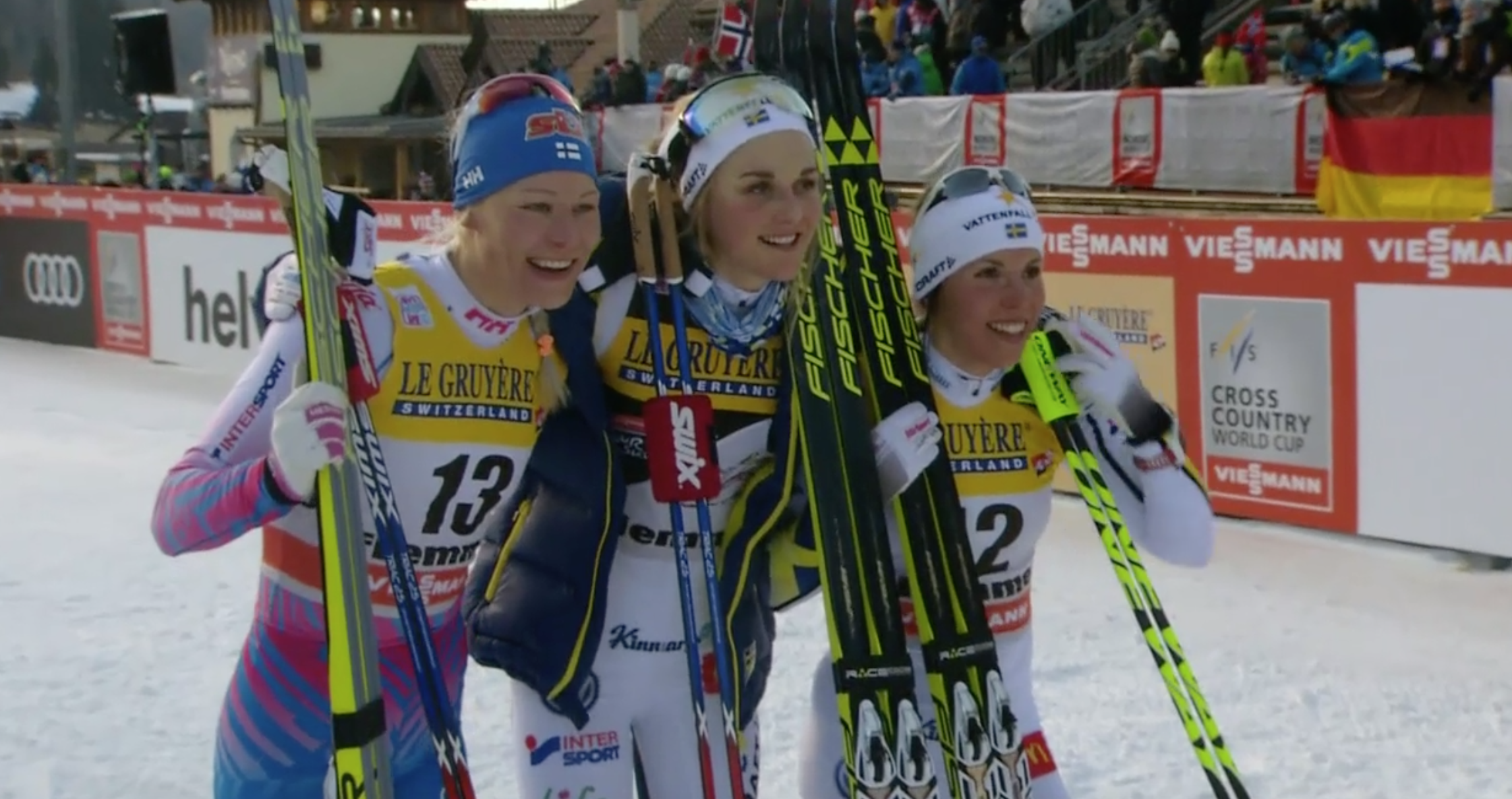
    The competition featured a 2.5/3.5km classic prologue on Friday, a mass start 5/10km classic on Saturday, and the final 10/15km handicap start on Sunday to determine the overall winners.

    Mike Sinnott led the way for the US, finishing 4th overall.  Sinnott started the day in 5th, 13 seconds behind leader Romain Vandel (FRA), and moved up a spot to finish just 7.3 seconds behind overall winner Fulvio Scola (ITA).  His time for the day was the 6th fastest giving him three individual results in the top-7.

    Noah Hoffman followed Sinnott in 13th.  Hoffman, who has struggled to find top form over the past two seasons, had a breakout performance.  He skied up from 19th, and had the 3rd fastest time over the 15km course.

    Overall nearly all the Americans moved up on the final day.  Sylvan Ellefson started 18th and finished 15th with his best single day performance since arriving in Europe.

    Brayton Osgood continued the trend moving from 25th to 20th.

    Peter Kling was the only male American not to improve.  He ended last in the 31-man field.

    For the second time on the trip, Sinnott set a personal best for FIS points – his 30 point performance on Sunday was significantly better than his 39 point performance in the prologue.

    Nicole DeYong led the US women, finsihing 10th in a field of 25.  DeYong started the day in 7th after a strong showing in the mass start where she was 6th.  She lost three places on Sunday despite posting the 8th fastest time.  Overall she finished the three race event just 59 seconds behind overall winner Elisa Brocard (ITA).

    Three of DeYong’s four OPA Cup races on the trip were 67 points are better.  Her previous best had been an 86 point effort this Winter at the Aspen SuperTour.

    Becca Rorabaugh was the second AMerican in 15th, moving up three places while posting the 14th best time of the day.

    Katie Ronsse, the final US starters, was 23rd after losing three spots.

    Overall, from the results and points perspective, the trip appears to have been a success for US athletes.  For more information on the trip and te reasons behind it, check out this recent FasterSkier article:

    How Do You Get 15 Skiers to Slovenia?

    Complete Results

  • How Do You Get 15 Skiers to Slovenia?

    How Do You Get 15 Skiers to Slovenia?

    Participants in the U.S. OPA Cup trip in France – Photo from TeamToday.org

    The IOC hasn’t yet decided on a location for the 2018 Winter Olympics. But it’s safe to say that the road to those Games travels through Slovenia, at least for some of America’s cross country skiers.

    Thanks to a $10,000 grant from the National Cross Country Ski Education Foundation (NCCSEF), and more funding from the U.S. Ski Team, a group of 15 athletes has set up shop in the resort town of Rogla. There, the skiers are contesting this weekend’s OPA Cup Finals—skiing’s equivalent of a minor league World Series.

    It’s the first time in recent memory that such a large contingent has traveled to race on the circuit overseas, and officials back home are hoping that the opportunity to mix it up with the Europeans will help make the Americans more competitive at an earlier age.
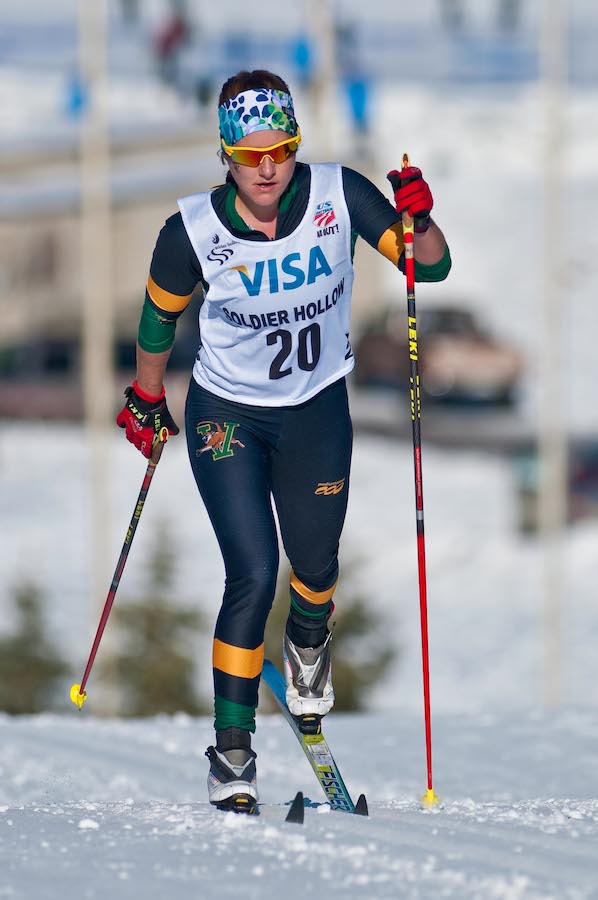
    “If someone is in the pipeline, and they want to be a part of the future of the sport…they need to get some European experience,” said John Farra, who directs the cross country program at the U.S. Ski and Snowboard Association (USSA). “That’s the right model.”

    USSA has funded small OPA Cup trips in the past, and another was planned for this year. But with the economic crisis hitting the organization hard, Farra said that the U.S. Ski Team (an arm of USSA) only had money in its budget for one coach, one wax tech, and two athletes—albeit with a few more spaces on the trip for skiers who could pay their own way.

    That was when NCCSEF stepped in. Created in 1995 by junior coaches Reid Lutter and Rick Kapala, the foundation has given travel grants to developing skiers since 1997—including, for example, one that helped future Olympian Kris Freeman attend his first World Junior Championships in 1998.

    For the OPA Cup trip, their $10,000 contribution went towards bringing additional coaches, as well helping to pay for lodging and vans for other, non USSA-funded athletes who wanted to go. While these skiers still had to pay their way to get to Europe, Farra said the NCCSEF funding reduced total trip costs by $400 to $500 per athlete.

    In addition to his role at USSA, Farra is also on the board of NCCSEF, and he said that the two groups had been in discussions since the summer about finding a way to send a bigger OPA Cup trip.

    “In the past, a couple of stragglers have kind of tagged along [on the U.S. Ski Team OPA trip],” Farra said. “This year, the concept was, ‘we need a trip.’”

    NCCSEF’s funding for the additional coaches allowed administrators to open the trip up to a much larger number of athletes than previously planned. There were no selection criteria—anyone who wanted to go could go.

    In order to make the trip more inviting, USSA didn’t schedule any big domestic races in early March. Basically, Farra said, the message for developing skiers was that “if you’re not in the Junior Olympics and you’re not in NCAA’s, then you’ve got to be doing OPA.”

    American athletes racing in La Feclaz, France – Photo from TeamToday.org

    The group started with two races last weekend in La Feclaz, France, and finishes with three more in Slovenia. The competition on the OPA Cup is fierce, including a number of athletes with World Cup experience—and that’s exactly what the American coaches want to see.

    “This group is looking for…experience outside of their comfort zones, knocking heads with some of the best developing racers in Europe,” said Matt Whitcomb, a U.S. Ski team coach on the trip, in an interview from La Feclaz.

    Along with deep fields, Whitcomb said that the OPA Cup races also offer good opportunities for the Americans to improve their FIS points, which should trickle back down into the U.S. once the group returns home.

    Indeed, the athletes on the trip have been popping solid points races left and right: Brian Gregg, Mike Sinnott, and Peter Kling all have posted career-bests on the trip.

    And for athletes who will be spending most of their winters competing outside the United States if they ever become World Cup regulars, even the simple (or sometimes not-so-simple) experience of traveling and dealing with logistics should help them down the road.

    While NCCSEF was almost defunct last year, chair Dave Knoop said that a new board and some big donations from key donors this year have given it new life. This year, the foundation also helped fund the U.S. teams at the U-23/World Junior and J-1 Scandinavian Championships, as well as the OPA Cup trip.

    The hope, Knoop said, is ultimately for NCCSEF to be able to provide even more money for those trips, as well as for other initiatives—even helping athletes travel to Junior Nationals, for example. With a handful of generous donors—and a large bequest from a master skier who recently passed away—the foundation has some lofty goals for the future.
    While NCCSEF isn’t capable of funding deeper down into the pipeline right now, Knoop says that “it’s a vision.”
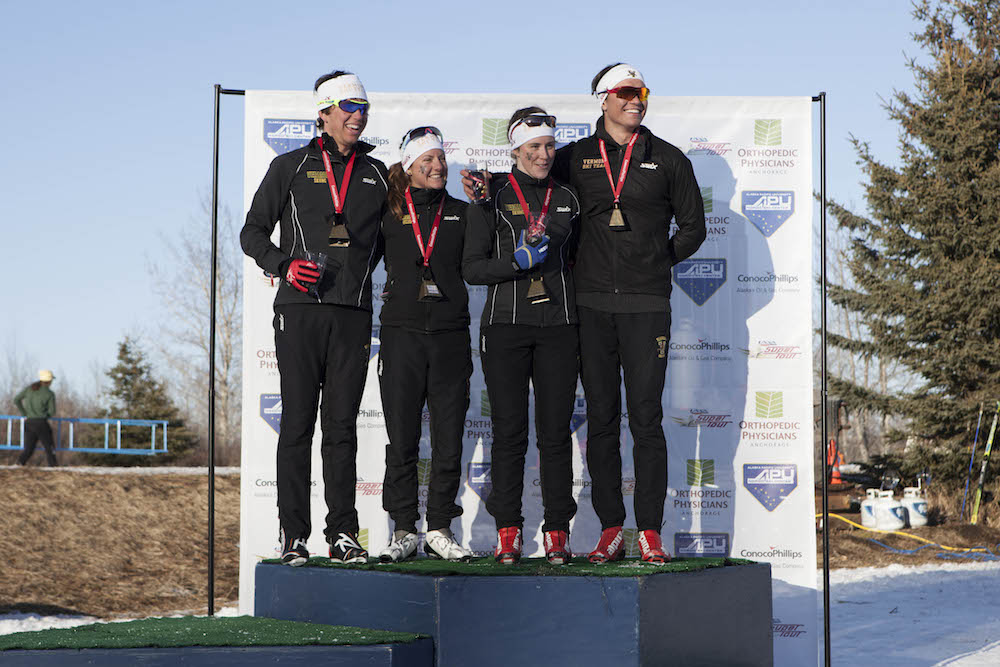
    “It will take a little bit more time and momentum to be able to hand out enough scholarships, if you will, to make a difference,” he said. “There’s certainly a greater picture that can be achieved.”

    For athletes’ perspectives on the trip, check out the numerous blog posts to the left of the main column and in our XCFeeds section, as well as this post from TeamToday.org. To learn more about NCCSEF, visit their web site.