Tag: Open European Championships

  • Nordgren Battles from 51st to 19th in Open European Champs Pursuit, Ready to Rejoin World Cup

    Nordgren Battles from 51st to 19th in Open European Champs Pursuit, Ready to Rejoin World Cup

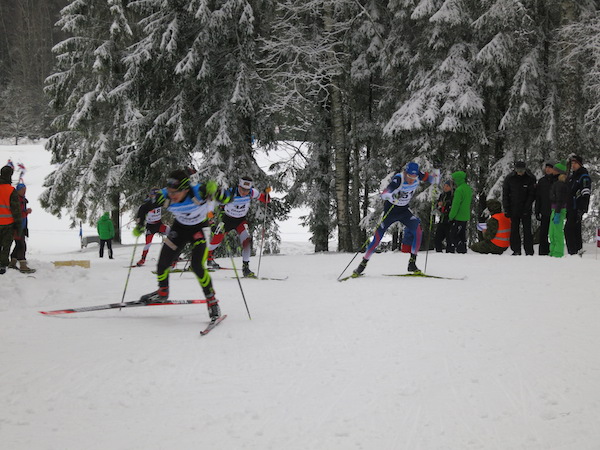
    Leif Nordgren racing to 19th place in the 12.5 k pursuit at Open European Championships. (Photo: US Biathlon)
    Leif Nordgren (USA, right) chasing down Baptiste Jouty of France en route to 19th place in the 12.5 k pursuit at Open European Championships. (Photo: US Biathlon)

    Leif Nordgren didn’t have the best start to 2015. He was so sick that he had to delay his travel from the United States back to the World Cup circuit in January, missing the Oberhof race weekend completely and joining the U.S. biathlon team in Ruhpolding.

    There, he competed in the relay to help his team out, but didn’t feel great. He sat out the next competition, a sprint. From Ruhpolding it was to Antholz, Italy, where Nordgren still didn’t feel thrilled with his performance. While the rest of the team took a break from the World Cup and traveled to Inzell, Germany, for a training block, Nordgren had another idea for how he could get his mojo back.

    “I floated the idea to my coaches just to get in more racing before I pick the World Cup back up,” he said in an interview from Otepää, Estonia, where he has been competing at Open European Championships. “It’s one thing to go to [Inzell] to train with the team but I wasn’t sure that the conditions were going to be like there and it’s nice to be racing in the winter. They liked the idea of me coming here. There wasn’t pressure or anything to perform here, it was just to get back into the swing of things.”

    After a disappointing sprint where he missed three shots and finished 51st, but still led the U.S. team, Nordgren made a plan for Sunday’s pursuit competition: shoot well and move up. He executed and jumped all the way up to 19th place after 20 shots and 12.5 k of skiing.

    It has been windy in Otepää all week, and Nordgren knew that if he could hit targets, he could pass his competitors.

    “I had a plan just to shoot pretty slow and shoot as secure as possible and get as many hits as possible,” he explained. “That worked out in prone. I had 10 for 10 in prone and I moved up a lot just in those two stages.”

    That moved Nordgren up to 19th. After three misses total in the standing stages, he dropped to the mid-20’s, but climbed back up again by the finish.

    “A couple of the misses in standing were just little gusts of wind that happened to hit me right as I took the shot,” he said. “It blew me right off target, so I was bummed about those. But yeah, I’m happy with the shooting. That’s what made the difference because it was such a nasty day.”

    Besides the wind, it had snowed until about noon at the venue; the women’s races in the morning had to deal with snow, but Nordgren said that the tracks were surprisingly firm by the time he was racing at 1 p.m.

    Only one man moved up more than Nordgren: Tomas Hasilla of Slovakia, who had just two penalties and moved from 59th up to 15th. Nordren lost only 50 seconds on race winner Alexey Slepov of Russia, who started in bib number one and cruised his way through to a 44-second victory over Krasimir Anev of Bulgaria.

    Both have been in the World Cup points multiple times this year. Open European Championships used to be limited to competitors under the age of 26, but at the International Biathlon Union Congress this summer it was voted to remove the age restriction. Coupled with the fact that the World Cup is currently on break, it made for a competitive field; other World Cup top ten finishers like Andrejs Rastorgujevs of Latvia and Christoph Stephan and Florian Graf of Germany were also competing.

    For Nordgren, who will soon rejoin the World Cup team in Nove Mesto, Czech Republic, where competitions start on Friday, it’s just a relief to be back on track. Earlier in the week, he hadn’t been so sure. He was forced to drop out of the individual race.

    “I had this nasty cough that I got on Sunday that was hanging around all week and that’s what made me pull out of the individual on Thursday,” he said. “I was coughing up a lung in the middle of it. It went away a little before Saturday and today was a little bit better. I was still coughing a little bit today but overall I think I’m getting better and better.”

    Nordgren is aiming for World Championships, and is getting closer to the form he wants to see there.

    “I was sick for a solid two weeks, and two weeks away from shooting can make a big impact,” he said. “I wasn’t really happy with the races in Ruhpolding or Antholz really. Finally this weekend getting back into the swing of things with shooting, is a good sign of the next couple weeks to come. I think the skiing is coming around too. It will be fun racing the next couple World Cups when I’ll be in a good place in skiing and shooting.

    Other North American Results

    In the men’s 12.5 k pursuit (results), Nordgren was the only member of the U.S. team to qualify based on the sprint. Macx Davies led Canada in 27th place, after starting 28th and racking up seven penalties. Scott Perras started and finished 48th, accruing eight penalties.

    “At this point in my career there is still room for firsts. Crashed in the penalty loop today,” Perras, a 2014 Olympian, tweeted after the race.

    In the junior men’s 12.5 k pursuit (results), Canada’s Matt Hudec went from 34th up to 25th with four penalties. Teammate Arthur Roots climbed from 55th to 45th despite eight penalties. Brian Halligan, the lone American, had five penalties and rose from 58th to 49th.

    In the women’s 10 k pursuit (results), Emma Lunder moved from 33rd to 28th. The Canadian had seven penalties, but shooting was poor across the field (21st-place Galina Nechkasova of Russia had ten penalties) and Lunder’s ski times kept her competitive. She finished 5:28.5 behind winner Ekaterina Shumilova of Russia.

    In the junior women’s 10 k pursuit (results), Canada’s Leilani Tam Von Burg slipped from 17th to 23rd with six penalties. Teammate Emily Dickson moved up one spot from 32nd to 31st. The pair were 6 ½ and 9 minutes, respectively, behind winner Anastasiya Merkushina of Ukraine.

    The United States qualified three junior women into the race: Mikaela Paluszek, who moved from 56th up to 45th with eight penalties; Siena Ellingson, who suffered through 13 penalties to place 13th; and Maddie Phaneuf, who opted not to start.

    Racing at the Championships concludes with relays at the beginning of the week.

  • Vaillancourt is Golden in Canada’s First Win at Open European Championships

    Vaillancourt is Golden in Canada’s First Win at Open European Championships

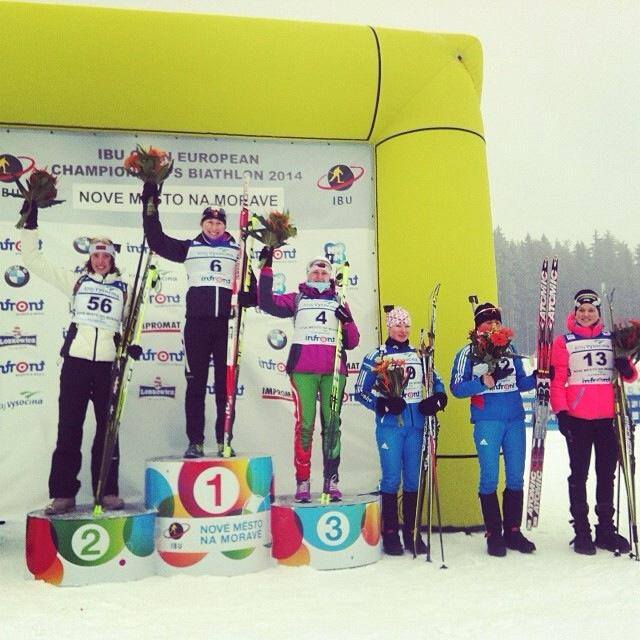
    Audrey Vaillancourt of Canada atop the Open European Championships podium in Nove Mesto, Czech Republic today. Photo: Emma Lunder/Eat Sleep Train.
    Audrey Vaillancourt of Canada atop the Open European Championships podium in Nove Mesto, Czech Republic today. Photo: Emma Lunder/Eat Sleep Train.

    Audrey Vaillancourt has had a pretty crazy season so far: two IBU Cup tours, a few appearances on the World Cup, and possibly more travel than anyone following just one of those circuits would expect. Heck, the Canadian made trips to both the IBU Cup and the World Cup in a single weekend in January.

    But all of the hustle paid off in Nove Mesto, Czech Republic, today, when Vaillancourt won gold in the Open European Championships 15 k individual race. With two penalties, the best shooting of the entire 58-woman field, Vaillancourt eked out a 2.1-second victory over Natassia Kalina of Belarus. It was the first time a Canadian has ever won gold at the event.

    On her blog, Vaillancourt wrote that individual races are the ones which most frequently have surprise winners, since missed shots carry a one-minute penalty, heftier than in other formats. That means that clean shooting can get many different athletes to the top.

    That creates pressure to shoot well, but Vaillancourt wasn’t feeling it.

    “Shooting conditions were really tough today, the wind was gusting and swirling, but I still felt quite confident on the start line,” she told FasterSkier. “After all, it’s the same conditions for everyone! I was really focused every time I entered the shooting range, but I didn’t want to overthink it either. I think individuals should be approached the same way as other races. Otherwise you put too much pressure on yourself to shoot well and the opposite happens in the end.”

    Vaillancourt started in bib six, so she didn’t have much information out on course.

    “I don’t really like starting this early, because you don’t get a lot of splits, but the others do!” she said.

    However, Iryna Kryuko of Belarus set a blistering pace early in bib four. When Vaillancourt left the final standing stage, she had a 26-second lead on Kryuko, and also some information about competitors who were earlier in their own races.

    “I had a good last lap, especially after one of our waxtechs told me I could be in top three,” she said. “I have to say I didn’t expect to win though!”

    As more and more racers trickled in, Vaillancourt’s time held up, as did Kryuko’s. Kalina was one of the latest starters in bib 56. She left the final standing stage in third place and was able to charge past her teammate Kryuko, but despite the information and splits wasn’t quite able to Vaillancourt.

    Another secret for the Canadian was shooting speed. She had consistently some of the fastest times on the range, which gained her more than 30 seconds on Kalina over the course of the race. That helped her fend off the competition, although she had only the 21st-fastest ski time.

    Vaillancourt said that the recent instability in her schedule had not affected her too negatively. At the second World Cup weekend after Christmas, she replaced Zina Kocher, who was at home racing Canadian ski team trials. The next weekend in Antholz, she was called up from the IBU Cup to fill a spot on the relay after a team member got sick, but the World Cup race was called off halfway through due to heavy fog obscuring the targets, so she ended up with no race start at all that day.

    “The instability did make my preparation harder, but at the same time I learned to adapt to these kind of situations, so it doesn’t bother me that much. I’d rather be the one who fills in the World Cup spots at the last minute then never go at all!”

    While European Championships is always a big event, functioning as the championships of the second-tier IBU Cup circuit, the field was particularly deep this year. The World Cup has been on break for over a week now, and won’t resume until after the Olympics are over. With teams unable to take their entire teams to Sochi due to limited starts, a number of World Cup athletes turned to European Championships to fill out their schedule.

    That included Galina Nechkasova of Russia, who is expected to fill Irina Starykh’s place in Sochi after the top-ranked Russian had a positive doping test. Kechkasova placed fourth. Other World Cup stalwarts included Fanny Welle-Strand Horn of Norway in seventh and Sophie Boilley of France in eighth.

    “I genuinely think the field is stronger this year,” Biathlon Canada High Performance Director Chris Lindsay told FasterSkier. “I suspect many of the names we are seeing will be making up 2018 Olympic teams… The location in Nove Mesto is helping this too. It is easier for “western” teams – France, Italy, Netherlands, USA, CAN, Germany, Austria, et cetera – to attend when it’s not held deep behind the old iron curtain.”

    It’s a good sign for Canada as the “A” team heads to Sochi. Vaillancourt was competitive to get World Cup starts this fall, where she could have worked towards Olympic qualification.

    “We are very happy with Audrey’s result,” Lindsay said. “She had a third place earlier this season in the IBU Cup so we know she is capable of podiums at that level. Certainly the ‘A’ team women at the Olympics take this as a positive sign: if our fifth-place female athlete is winning medals then they should feel confident in their abilities at Sochi.”

    And Lindsay fully expects Vaillancourt to be among those who will be named in 2018.

    “We are very excited to see Audrey continue to sharpen her racing skills on the IBU Cup this season in preparation for the 2015 Canmore IBU Cup, 2016 Canmore World Cup, and 2018 Olympics,” he said.

    As for Vaillancourt? After making her first World Championships appearance last year, not making the Olympics was a bit of a bummer. But she’s moving on. A gold medal just might help.

    “It was very disappointing not to make the Olympic team, but those who made it earned their spot, so there is nothing I can do about it now,” she said. “I am also still young!”

    * * *

    Also in the women’s 15 k, Vaillancourt’s teammates Emma Lunder and Emma Lodge placed 38th and 55th.

    In the men’s 20 k, Scott Gow represented Canada well with a ninth-place finish. With two penalties, he finished 2:50 behind Andrrejs Rastorguvevs of Latvia, who routinely has some of the fastest ski times on the World Cup and has earned his first top-ten results this season. Even more than the women’s race, the men’s race was packed with World Cup talent.

    Vincent Blais placed 63rd for Canada, Andrew Chisholm 69th, and Jasper Mackenzie 71st. For the United States, Casey Smith of the Maine Winter Sports Center led the way in 22nd with two penalties, and Wynn Roberts placed 68th.

    Results: women / men


  • Kubek Sixth in Opening Day of Open European Championships

    Kubek Sixth in Opening Day of Open European Championships

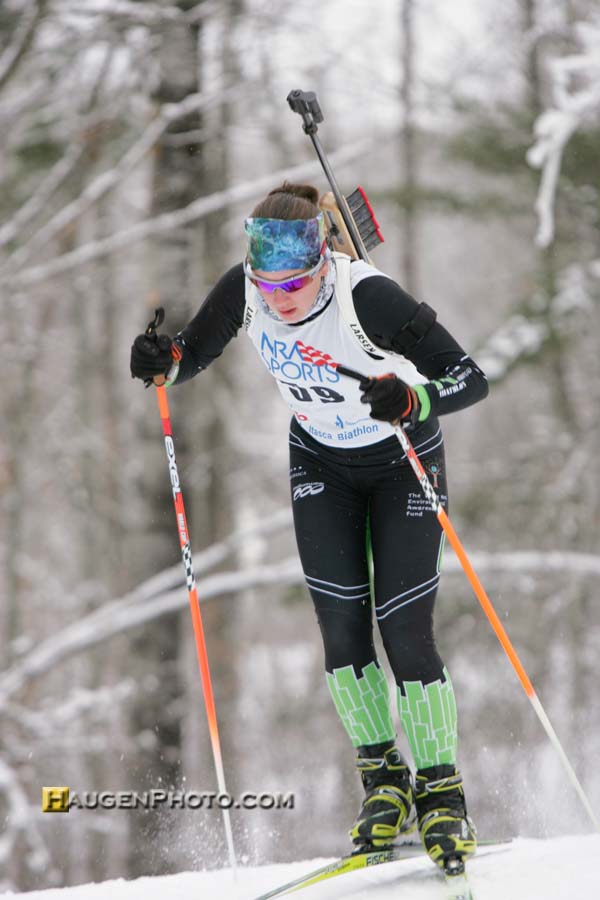
    Anna Kubek (Mount Itasca) racing in the United States last year. Photo: Gregory Haugen/HaugenPhoto.com.
    Anna Kubek (Mount Itasca) racing in the United States last year. Photo: Gregory Haugen/HaugenPhoto.com.

    It has been a busy few days for Anna Kubek and the rest of the American biathletes competing at Open European Championships. Ten days ago, they were still in the United States, getting ready for their first international tour of the year. Then they headed to Inzell, Germany, to train at the biathlon complex in Ruhpolding, which just hosted World Cup and then IBU Cup races.

    “I really enjoy being in Europe again,” Kubek, who has raced on World Junior Championships and European Championships tours before, wrote in an e-mail. “We were in Inzell, Germany, from Jan. 21 through Jan. 26 and training in Ruhpolding. The day before we left for the Czech Republic, we raced in British Champs. It was good training to prepare us for Open Euro Champs.”

    Two days ago, they moved to Nove Mesto, Czech Republic, and today Kubek and the other junior racers got their first starts. The senior (in this case, under-26) racers will start tomorrow.

    Kubek started off strong, accumulating only two penalties in the 12.5 k individual competition today, where each missed shot is penalized by a minute of added time. And those two misses could easily have been hits: U.S. coach Vlad Cervenka reported that they were both splits, where part of the bullet hit the edge of the target and part hit the surrounding background.

    As it was, Kubek placed sixth in the junior women’s race, just 14 seconds off the podium.

    The two misses came in the second of four stages, after Kubek had cleaned the first stage; she kept her focus and hit the next ten targets in a row.

    “The race today went great,” she wrote. “I stayed calm the whole race and after I missed two, I kept in mind that in biathlon, it’s not over until you cross the finish line. Shooting conditions were good with a slight wind.”

    Her last clean shooting stage moved her from the teens into fifth place. As she headed back out onto course, she knew that she could earn a medal.

    “I was told I was 5 or 6 seconds out of third,” she wrote. “It really motivated me and I don’t think I could have pushed much harder. The lactate in my legs burned and my heart rate was through the roof, but I knew I couldn’t stop fighting until I crossed the finish line.”

    Russia’s Anastasia Evsyunina was the only competitor to shoot clean through all four stages and won by a landslide, racking up 1:51 over second-place Anastasiya Merkushyna of Ukraine, who had two penalties. There was another big gap to third-place Lisa Vittozzi of Italy, who had three penalties and finished 3:52 behind Evyunina. Kubek was 14 seconds behind that.

    “Two split misses in the first standing cost her a medal,” U.S. coach Vlad Cervenka wrote in an e-mail. “But that is a biathlon. The level of competition in the junior category is very high and Anna skied well against older juniors – she is still youth. I’m excited to see how well Anna will do in sprint and pursuit this weekend.”

    Kelsey Dickinson, the other U.S. competitor, placed 50th, closely followed by Erin Yungblut of Canada.

    In the junior men’s 15 k, Christian Gow placed 23rd with five penalties. He was followed by teammates Brett Davie in 25th, Arthur Roots in 49th, and Matthew Hudec in 52nd.

    For the Americans, Jacob Ellingson placed 51st with eight penalties. Brian Halligan finished 57th and Paul Everett 65th.

    Results: junior men / women

  • Nordgren 16th in Final Senior Race at Under-26 Championships, Two More Americans Top-30

    Leif Nordgren anchoring the U.S. World Cup relay in Antholz, Italy last weekend. Photo: NordicFocus/USBA.

    Tuesday’s individual races in Osrblie, Slovakia, left the U.S. team at Under-26 Open European Championships one chance to grab the results they’d been hoping for all week.

    So could they do it?

    “The individual was another decent race, but not what I wanted,” Russell Currier told FasterSkier in an e-mail. “I’m a little disappointed, but there’s still plenty of room for hope left in the season.”

    Currier finished 21st in the 20 k, four-stage race, his best result of the week. But he was still left wanting more. It’s his third time competing at the European Championships, and Currier had set big goals for himself: a top-six finish.

    Given that a few weeks ago he placed that high on the World Cup race, it didn’t seem like an unattainable goal. But Currier said that his plan had actually come before his breakthrough race in Nove Mesto, Czech Republic, and that he hadn’t changed his attitude much since notching that top-ten.

    “My expectations were never any different after the World Cup in Nove Mesto,” he said. “That was just one very good race for me. The goal was a top six for [U26’s] this year. I didn’t make that goal, but I never had a melt down race either.”

    That attitude could pretty much sum up how the American team felt about their last day of senior competition (junior Casey Smith still has his individual race yet to come, on Wednesday). Even Leif Nordgren, who finished 16th in the individual, wasn’t thrilled.

    “The race went okay this morning, to be honest I was a little disappointed with that result,” he told FasterSkier. “Skiing wasn’t great today, and I had about one miss too many.”

    The top two finishers in the men’s race, Daniel Bohm of Germany and Artem Pryma of Ukraine, hit all twenty targets on Tuesday, a definite plus given that the format penalizes each missed shot with a minute of added time rather than a short penalty loop as in the other formats. Nordgren and Currier missed three and four shots, respectively. The consensus was that it wasn’t terrible shooting, but it wasn’t great either.

    In Currier’s case, he saw a four-penalty day as consistent with the improved, but still not stellar, shooting he has displayed in the last few weeks of European racing.

    “Overall my shooting this week was still a step in the right direction,” he said. “Unfortunately the level on the range was just too high this year. I need to keep upping the percentages and bring down [my] range times significantly.”

    But despite not meeting their goals, both men did find things to be positive about in Osrblie.

    “Ski speed is just fine and the good shape doesn’t seem to be going anywhere bad anytime soon,” said Currier, who had the third-fastest course time today.

    And for Nordgren, the gradual progression in results – 45th in the sprint, 21st in the pursuit, and 16th in the individual – might be a sign that he is finally coming out of a sickness-induced slump.

    “I feel a lot more confident now than I did coming into these races, especially in my shooting,” he said. “There’s still a little ways to go until I’m back on track, but I’m confident I can get there with no problem. Now it’s just to be patient and stay healthy!”

    The third American, Mark Johnson, did not start on Tuesday.

    Dreissigacker (in green) in a trials race in December. Photo: Roy Kjorlien.

    In the women’s 15 k individual, Hannah Dreissigacker cracked the top 30 for the first time in her second trip to these championships, placing 26th with four penalties. Her time put her six and a half minutes behind winner Anastasia Zagoruiko of Russia, who missed a single shot and won by almost a minute.

    Like the men, Dreissigacker saw positives in her performance along with a few disappointments. Her main frustration was with her skiing. While she said that she “could go hard,” it didn’t get her as far as she’d hoped – a strong skier on the U.S. circuit, she was aiming for more than the 25th-fastest ski time she produced on Tuesday.

    “I would have liked to have had a faster ski time today, but I know that I went hard,” she wrote in an e-mail. “The big hills definitely were getting to my legs.”

    Still, Dreissigacker was pleased with her performance on the range, especially given some disastrous shooting days in NorAm races this year.

    “Shooting is funny- it just has ups and downs,” she said. “And there’s a lot of factors that affect it, like confidence, so the ups and downs can be self-perpetuating too. In the ten or so days that I’ve been here, I’ve had basically my longest stretch of consecutive days shooting in the last year. It’s amazing how that helps.”

    In a sense, Dreissigacker felt like she was just getting started in the last race of the series.

    “With each of these races, I felt myself getting more confident with my ability to hit targets,” she wrote. “That’s a good feeling!”

    The occasional biathlete, occasional skier said that the trip had provided some motivation to work on shooting more consistently when she heads back to the U.S.

    “It does make me want to do more biathlon,” Dreissigacker said.

    Teammate Laura Spector had more trouble on the range, in an unusual reversal of their usual positions. Spector missed seven shots and placed 36th.

    Results: men / women

  • U.S. Has “Quiet Success” in U26 Sprint Races; Currier 27th

    U.S. Has “Quiet Success” in U26 Sprint Races; Currier 27th

    Russell Currier racing in last week's World Cup competitions in Antholz, Italy. Photo: NordicFocus/USBA.

    The U.S. biathlon team could be forgiven for having high expectations going into this year’s Under-26/Open European Championships in Osrblie, Slovakia.

    Last year, Leif Nordgren entered just one race at the event, and didn’t even finish. But a few weeks later, he notched three top-thirty finishes at senior World Championships.

    In that same U26 series in Ridnaun, Italy, Russell Currier repeatedly finished in the 20s and 30s. But just two weeks ago, he bettered those results on a higher stage when he sprinted to sixth place in a World Cup in Nove Mesto, Czech Republic.

    Both athletes have taken major steps since their last appearance at the U26 races, as has Laura Spector, whose top finish in 2010 was 34th, but who spent the entirety of last season on the World Cup.

    So this year, the team had every right to hope for better finishes. And while it didn’t happen on Saturday – Currier was the only American to crack the top 30 – coach Patrick Coffey didn’t consider the pair of sprint races to be a wash.

    “Today’s races were a quiet success I would say,” he told FasterSkier in an e-mail.

    Currier and Nordgren, who missed three shots to finish 45th in the 10 k sprint, were disappointed nonetheless.

    “Tough race this morning in Slovakia,” Nordgren tweeted after the race. “Tomorrow is another day though and I’m looking forward to it!”

    Currier, who said the race was “decent, but not up to expectations,” was undone mainly by his shooting. Not only did he miss three shots, but he lost over thirty seconds to his fastest competitors during the two shooting stages alone. There were bright spots, however: Currier’s seventh-fastest ski time of the day mitigated some of his other problems, and he finished 27th.

    “I actually didn’t feel that great on skis,” Currier told FasterSkier. “My transitions were a little sloppy in some parts. I was surprised to have the seventh fastest loop time.”

    Of his shooting, he said that he was also surprised to have missed two shots in standing.

    “I’m still kicking myself for that,” he said. “I really thought I could clean standing today.”

    His time placed him 1:45 behind Alexey Volkov of Russia, a World Cup regular who anchored the winning mixed relay in Hochfilzen, Austria this season and whose victory today surprised nobody.

    In fact, the presence of athletes like Volkov is one thing that makes this year’s U26 races unusual – and more competitive than in past editions. In 2010, the event was held directly after the Vancouver Olympics, and only a handful of athletes, generally from smaller countries, competed in both. In 2011, the Ridnaun races followed the World Cups held in Fort Kent, Maine, leading to a similar situation.

    But this year, the U26 Championships are being held during a World Cup off-week between Antholz, Italy and Oslo, Norway, making travel and jetlag less of an issue for athletes wanting to work the event into their World Cup schedule. Today’s field was almost 20 % bigger than last year’s.

    “It was a little more competitive than I thought it would be,” Currier said.

    While the results were disappointing and the races themselves less than exciting for the pair of men who had competed in Antholz – Currier said that the crowd “could not hold a candle to your average World Cup” – it was part of a cautious return by the third American man, Mark Johnson.

    A five-time World Junior Championships competitor, Johnson recently graduated from Williams College and hasn’t appeared in an major biathlon race in three years.

    “For me, this was a fun introduction back into international racing,” Johnson wrote in an e-mail. “After spending my last season focusing on collegiate cross-country racing, my confidence on the ski tracks has improved. That showed today. My skiing was on pace with much of the field.”

    Johnson missed two shots and finished 44th, just over a second in front of Nordgren, and said that he was “very satisfied with the result.”

    While he hasn’t made any international squads until now, Johnson had offered up a series of fairly dominating performances in domestic competition this season. He may have been happy with his result, but it didn’t mean that he wasn’t expecting more in the coming races, just like his teammates.

    “Overall, I think we performed solidly,” Johnson wrote. “There is room for improvement on the result list, and the hope is to realize that in the coming races.”

    The U.S. trio seemed enthusiastic for Sunday’s pursuit, which should feature large packs thanks to the many tight finishes in today’s sprint. Currier, for example, sits about 20 seconds out of the top 20, or one penalty loop; Nordgren will start in a pack of six skiers within ten seconds.

    “I’ll be starting with a large group, and right alongside my teammate Leif, which will definitely make for a thrilling environment to race in,” Johnson said.

    “And as a team, I believe we can make up some major ground on our competitors.”

    * * *

    In the women’s 7.5 k sprint, Spector and teammate Hannah Dreissigacker narrowly missed the top 30, placing 32nd and 33rd. Neither, however, seemed too disappointed.

    “In skiing I felt all right, nothing exceptional,” said Spector, who started this season on the World Cup circuit before being moved to the second-tier IBU Cup tour. Spector has so far been unable to find the form she showed last season, but said that her ski speed was coming back little by little; she had the 31st-fastest ski split today.

    “This is the first ‘World Cup’ course I’ve competed on since mid-December, which means that it’s more challenging than most courses used for IBU Cups,” Spector said of the skiing. “There are two really long, steep hills in the first half of the course, followed by a lot of downhill that still requires efficient skiing, where I lost the most time.”

    Spector missed two shots, both in the standing stage. Her prone shooting, however, was exceptional: not only did she clean, but she did it with the second-fastest time in the field.

    “I was surprised to see how fast my prone time was because the shots felt scattered,” she explained. “I jammed a shell in standing so it took a little time to clear that out, otherwise I would expect standing to be faster.

    “I have not been working on shooting speed this year, although I have noticed an improvement,” she continued. “I think it’s simply come from having a good number of years of shooting training behind me now, being able to calculate a good range approach, and being comfortable with shooting faster; it’s really been a natural process.”

    The same could not be said for Dreissigacker, who hasn’t contested an international biathlon race in two years and has only competed in two U.S. events this season. A successful skier for the Craftsbury Green Racing Project who made the top 20 in every race at 2012 U.S. Nationals in Rumford, Maine. Dreissigacker was surprised to be nominated to the team, and wasn’t sure what to expect.

    Once the racing began though, she was no longer as apprehensive.

    “I felt like I actually was a real biathlete,” Dreissigacker, who accrued three penalties, told FasterSkier. “I successfully accomplished my goals of going through all the equipment checks, shooting at the right targets, skiing the right number of penalty laps, skiing hard, and having fun!”

    Like Spector, Dreissigacker noted the difficulty of the course’s long climbs, and said she was looking forward to shorter loops with less vertical in Sunday’s pursuit. But despite the challenges, she said that the venue actually suited her well.

    “There’s about 1.5 k of flat rolling [terrain after the hills], which makes for an easy approach to the range,” she said. “That’s good for me – it means that I can ski pretty normally and then just back off a little bit on the gradual downhill into the range.”

    Coffey, the team’s coach for this trip, was impressed with both Dreissigacker and Johnson given their lack of recent big-race experience.

    “Both have been taking it all in stride,” he said. “There is an adjustment that needs to be made when jumping into the European racing circuit, but both looked relaxed today and will feel even more at home tomorrow in the pursuit race.”

    Canada’s Megan Heinicke finished 18th in the women’s sprint; she could not be reached for comment.

    Results: men / women

  • Casey Smith 31st in First Sprint of Open European Championships

    Casey Smith competing at U.S. National Championships last year. Photo: Gregory Haugen.

    Thursday night, the Slovakian town of Osrblie kicked off the 2012 Open European Championships of biathlon with an elaborate ceremony featuring athletes from 32 different countries. On Friday, racers flooded past on the trails and hundreds of shots were fired on the range, by the best field the venue has hosted since its last World Cup in 2005.

    What are the Open European Championships? The event, which lasts a week, actually serves several purposes. It’s designed for athletes under the age of 26, which in many ways makes it a championship of biathlon’s second-tier circuit, the IBU Cup. But because this year the races fall on an off-week for the World Cup, several racers from the very top of the biathlon hierarchy will be competing as well, including Valj and Vita Semerenko of Ukraine and Alexey Volkov of Russia, who have stood on the World Cup podium already in their young careers. For the U.S., Russell Currier and Leif Nordgren will be spending their “rest week” racing in Slovakia.

    Competitions opened on Friday with junior sprints. The first winner, Norway’s Vetle Sjastad Christiansen, had picked up five individual podium finishes in international competition as a youth, but was surprised to find that moving up an age class brought him his first win – by exactly one second over Alexandr Loginov of Russia.

    “Maybe it helped me that nobody was looking at me,” he said in a press conference.

    Christiansen’s big challenge was expected to come from fellow Norwegian Johannes Bø, younger brother of last year’s overall World Cup leader Tarjei Bø. But Bø missed four shots and even with one of the fastest ski times over the 10 k course finished over a minute behind Christiansen, who had missed only one shot.

    “Normally, Johannes is better than me, but he missed a few too many today,” Christiansen.

    He then faced a late challenge by Loginov, who started several bibs earlier and whose split had been 20 seconds back at the last shooting. Loginov said that he started slowly on purpose, and had saved his energy for the last lap; Christiansen, meanwhile, had attacked from the start. As he tired on his final 3.3 k loop, he began hearing the difference to Loginov shrink and shrink.

    “I thought I would lose this gold medal, but in the finish I won by one second,” Christiansen said.

    The pair will have just over a 30-second lead on third-place Maxim Tsvekov of Russia when they start Sunday’s pursuit.

    The lone North American athlete, Casey Smith, missed two shots and finished 31st, 2:46 behind Christiansen. Smith is two-time World Junior Championship competitor as a youth and spent part of last season competing around Europe, so experience isn’t something he’s lacking. But this was his first international race as a junior, and it was a step up.

    “I think that the field is fairly comparable to World Juniors,” he told FasterSkier in an e-mail. “Most of the big nations are here, like the Norwegians and the Russians. It feels pretty similar… it is defiantly a high caliber race. It’s pretty cool to be with all of the seniors knowing that some of them are racing on the World Cup.”

    Smith’s ski time was not among the fastest, but his shooting times were, something that surprised him.

    “For the past week or so I have really been working on my shooting, but not really speed, more mechanics,” he wrote. “Today I didn’t feel like I was shooing fast. I just came in to the range thinking about what I have been working on. After the race I found out… [it] was just a nice side effect of everything else that I have been working on.”

    With only six men in the 67-athlete field shooting clean, Smith’s marksmanship was definitely a strong point. His times tied him for tenth-best in the race; he was more than 20 seconds faster than Loginov, for example.

    In Sunday’s pursuit, Smith will start about two penalty loops out of the top twenty. And with four, instead of two, shooting stages, he may have a better chance to move up.

    The junior women’s 7.5 k sprint saw a fresher face take the win: 18-year-old Niya Dimitrova of Bulgaria. Despite still being a youth, Dimitrova is currently in her third season on the World Cup, where she is her team’s fastest woman. Usually, that doesn’t mean much; her top finish so far has been 46th. On Friday, however, she was afforded a rare chance to compete against her peers, and made the best of it, shooting clean for a 15-second win over Iryna Varvynets of Ukraine. Elisa Gasparin of Switzerland was third.

    Results: junior men / junior women