For someone who traditionally does not watch videos, I’ve been streaming my fair share lately: Some are mindless; some resonate. Of those that resonated, Coming Home – Ag Teacht Abhailewas a highlight. This trail running documentary follows Paddy O’Leary on his quest to complete the “self-navigated 115 kilometer Wicklow Round.”
One cool aspect of Ireland’s Wicklow Round is the reliance on old-school tech: A map and compass. Runners navigate up and over 26 Wicklow Mountain summits, climb roughly 20,000 feet over more than 62 miles of Irish burliness with no GPS crutch. Adding punch to the circuit, since it’s in Ireland, stalling for bluebird skies on your Wicklow Round attempt might be like waiting for an extra blue day in late March. During O’ Leary’s attempt at the FKT, many hours were spent immersed in low clouds and ground fog – line of sight travel became tricky.
For some of us during the last six or seven weeks, pouring over Google Earth or apps like TrailForks or CalTopo have provided some outdoor solace. With some mining, it’s possible to locate isolated forest roads or even old trails where social distancing is not a concern. You’ll likely be the only person around.
Even better, near cities like Bend, Ore. for example, with a bit of legwork, you can find places to run and bike in isolation. And east of Bend, where human settlements are rare between here and Boise, Idaho 320 miles away, linking together big running traverses on BLM and Forest Service land, with the occasional jaunt around private ranch land, remains possible.
Not all folks have big open country out the backdoor. It’s a luxury. But maybe in these times, we can all imagine our own version of the Wicklow Round. This brings basic map and compass navigation skills back into focus. Dreaming is one thing. Finding your way in the dreamscape is another. In other words, knowing how to reliably move from point A to B.
(Have kids at home? A map and compass can add some hands-on spiciness to the online school curriculum.)
With this in mind, we’re presenting some basics on navigating with a map and compass. Maybe keep the GPS capable smartphone handy just in case, but the tactile sensation of a map and compass coupled with overland travel might be just the remedy you’re looking for to feel out-there. (Remember, always tell someone about your intended route – every day is safety day.)
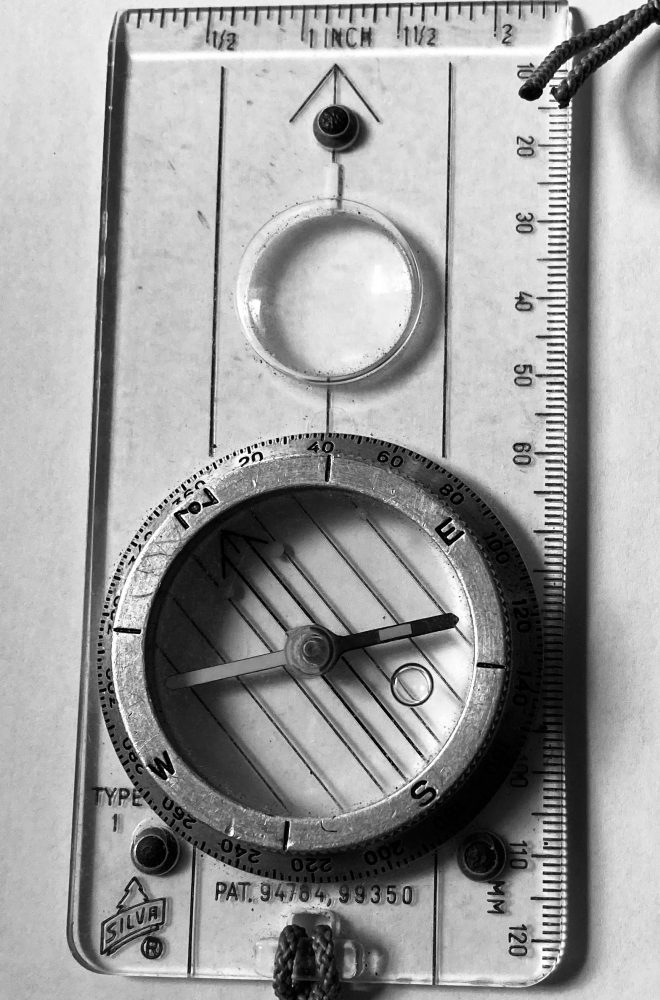
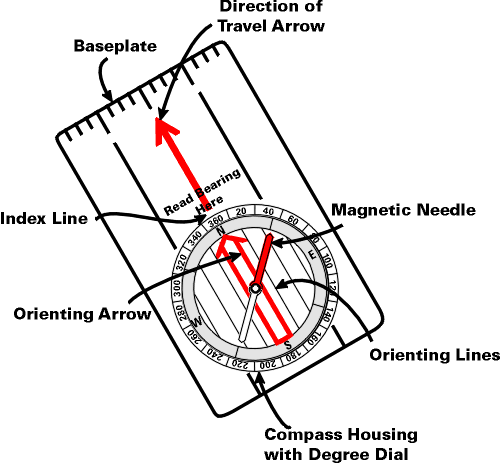
Parts of a compass.(Photo: ussartf.org)
Using and Map and Compass basics. After watching several how-tos, the first video posted below renders the basics into a few key points.
Figure out two points on the map: where you are and where you want to go.
Line the compass edge up with point A to point B. Spin compass dial to line up orienteering lines on the compass with the orienteering lines on the map.
Determine bearing on the top of the compass.
Hold the compass in front of you and turn slowly until the magnetic needle lines up with the orienteering arrow on the compass.
Pick an object in your direction of travel, and walk.
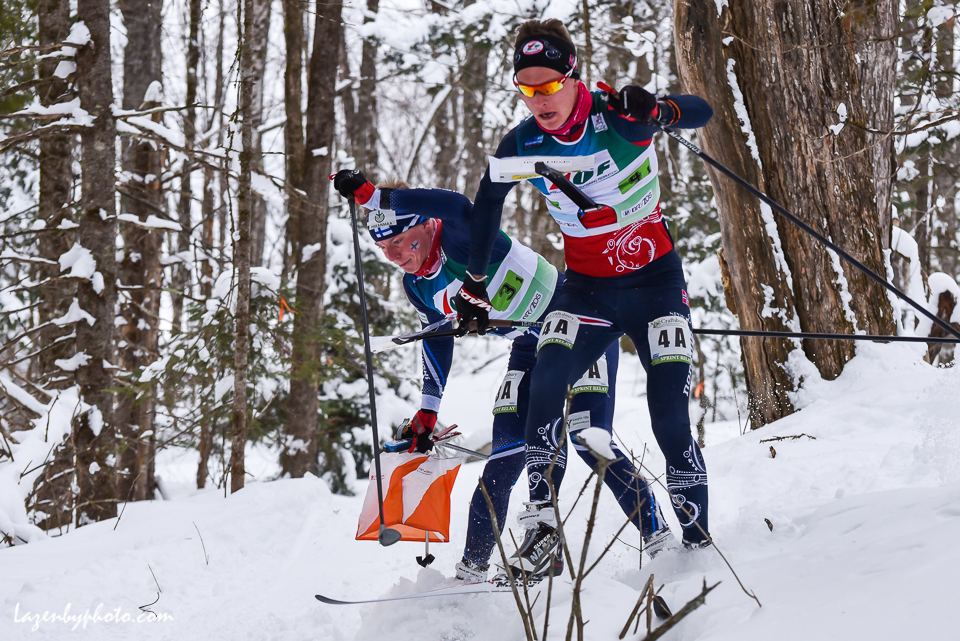
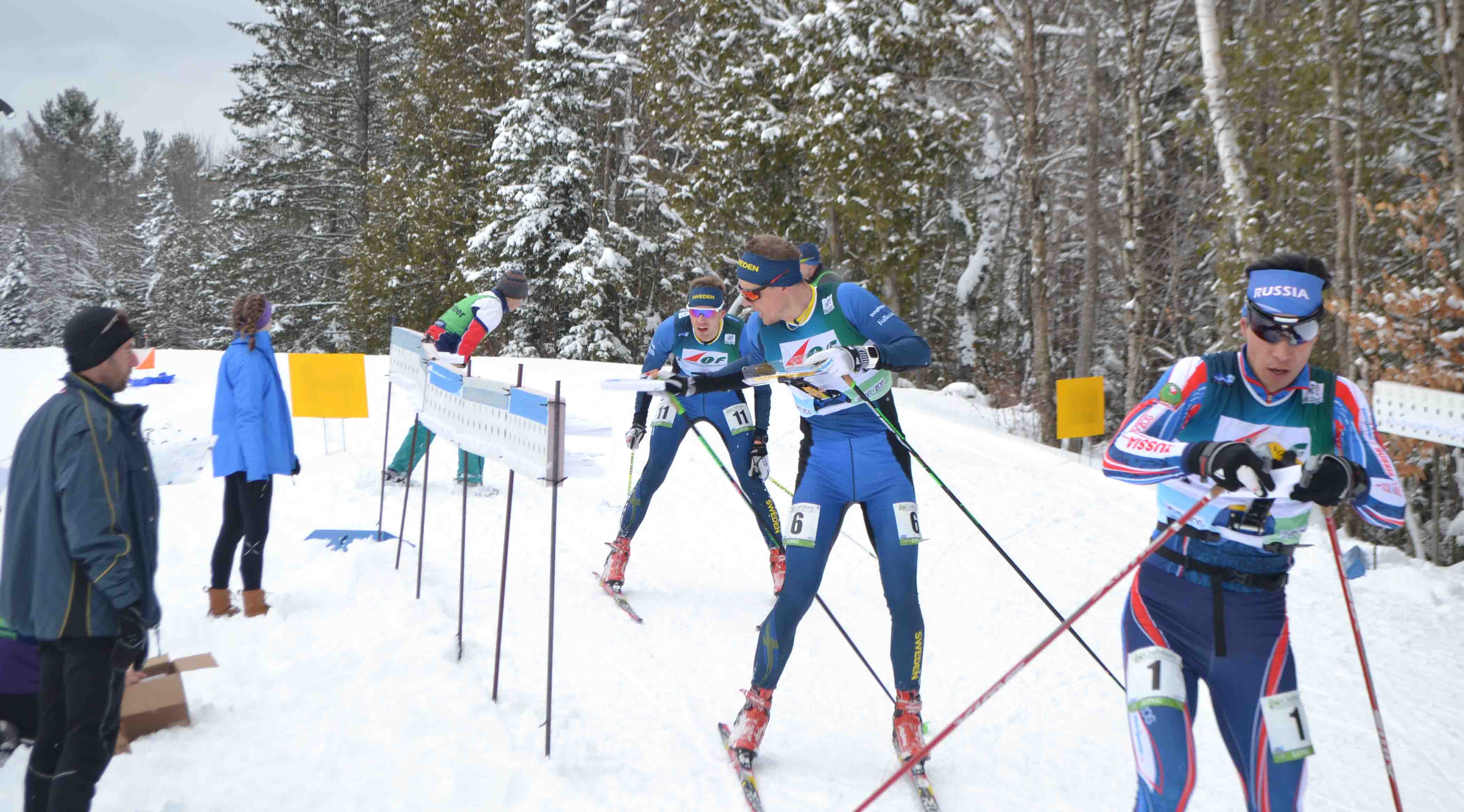
A near miss as competitors Tero Linnainmaa of Finland and Jorgen Madslien of Norway arrive at a checkpoint at the same time in the mixed relay at the International Orienteering Federation World Cup at Craftsbury Outdoor Center in Craftsbury, Vermont. (Photo: John Lazenby/Lazenbyphoto.com)
The following was submitted by Kevin Brooker, who attended the 2018 Ski Orienteering World Cup and Ski Orienteering World Masters Championships last week in Craftsbury, Vermont. Brooker, who wrote an introductory piece on ski orienteering, set out to explain how the event made its way to the small town in the Northeast Kingdom.
***
CRAFTSBURY, Vermont — Even within the tiny and tight-knit American world of nordic activities, ski orienteering is relatively unknown. Just like traditional cross country racing, the American devotees are rabid enthusiasts determined to have an impact on a sport dominated by Scandinavian athletes. Overseeing the sport is the International Orienteering Federation (IOF), whose mission is to promote the overall sport of orienteering and all of the subsets such as ski-o, mountain bike-o, and the largest segment: foot-o.
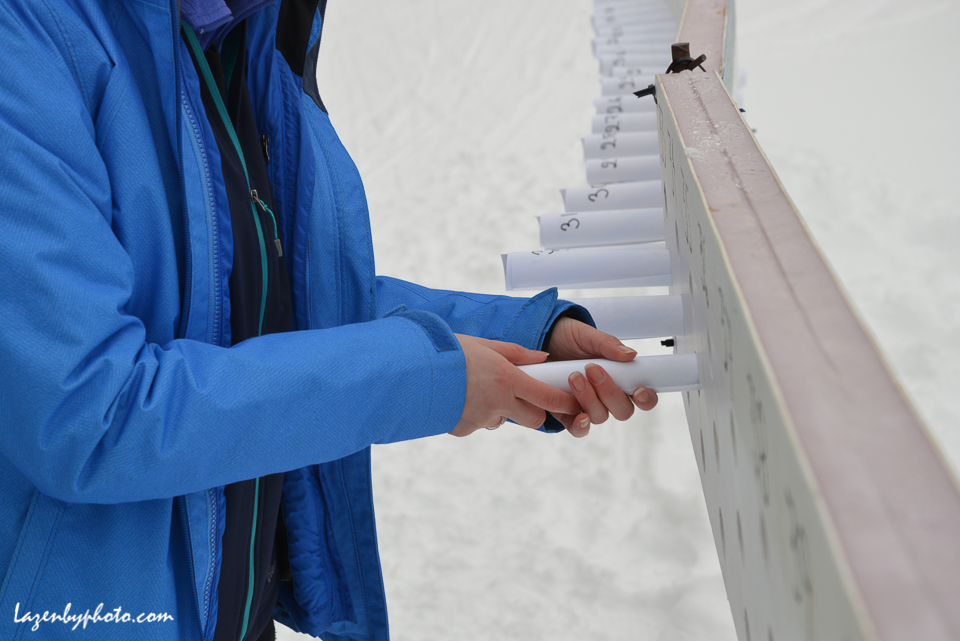
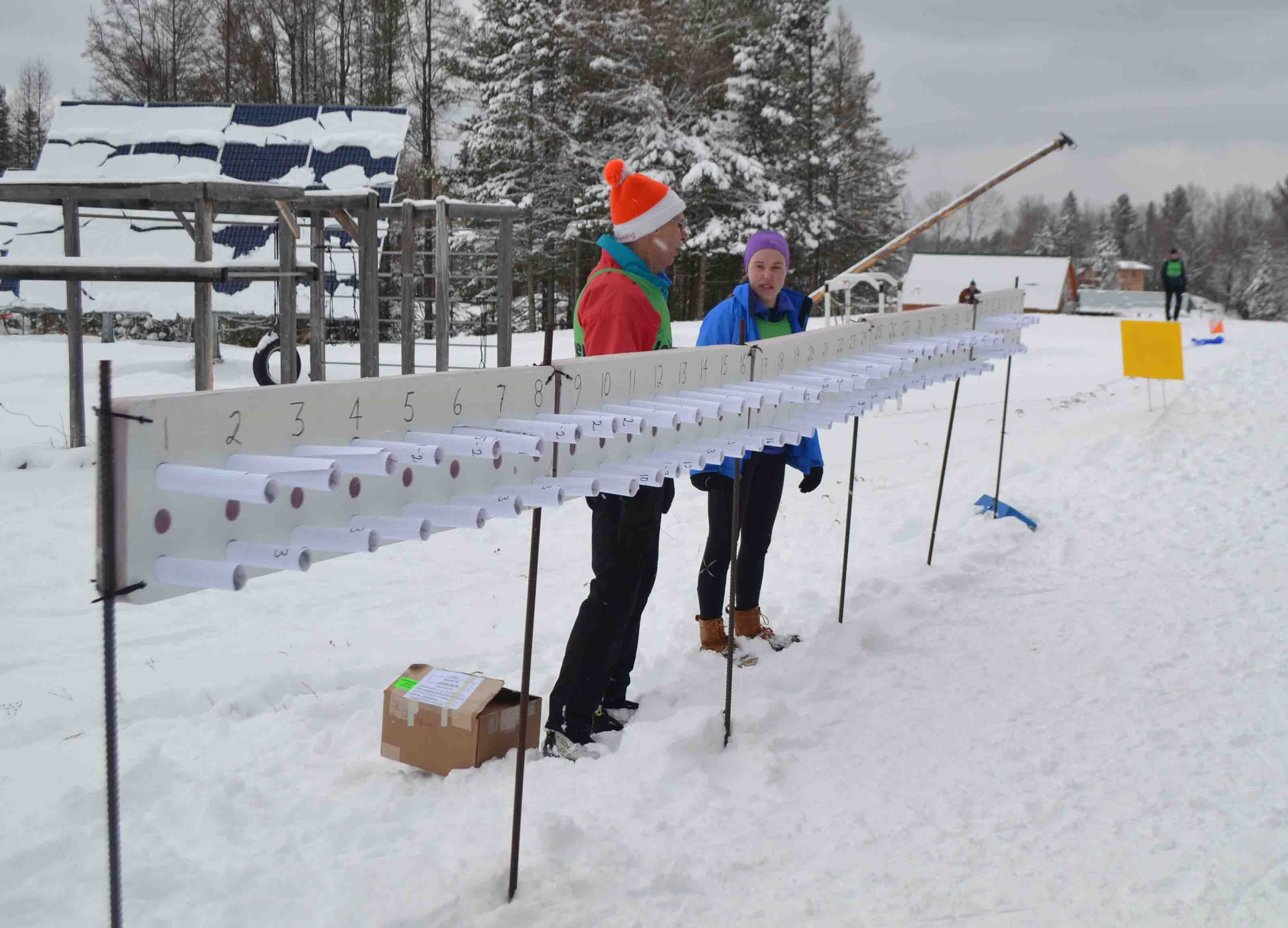
At the map exchange, athletes remove the used map, grab the next sequence and continue racing. Race volunteers collect the discarded maps and refill the board with fresh maps, as seen at the Ski Orienteering World Cup Finals in Craftsbury, Vt. (Photo: Kevin Brooker)
The IOF organizes a World Cup and World Championships for all segments and does its best to move these events around the globe. Like most international competitions, it takes several years to pull together an event. In addition to an appropriate venue, the organizing committee must have international experience, a lot of determination and grit.
Just how did the Ski-O World Cup Finals and Masters World Championships end up in Vermont and how did it go?
Ken Walker, event controller for this year’s championships in Craftsbury, explains the genesis of the event:
“I was approached several years ago while ski-0 masters racing in Europe about bringing World Cup ski-0 races back to North America. We held very successful races in Truckee, California, in 2012 and competitors wanted to return. I suggested doing it in the East and [Craftsbury Event Director] Adrian Owens was enthusiastic about holding them at Craftsbury. This was a natural choice, knowing the fine trail network and an organization welcoming competition events. My official job was national event controller. It basically means I check to ensure the races are fair, accurate and safe, and we follow the International IOF rules.”
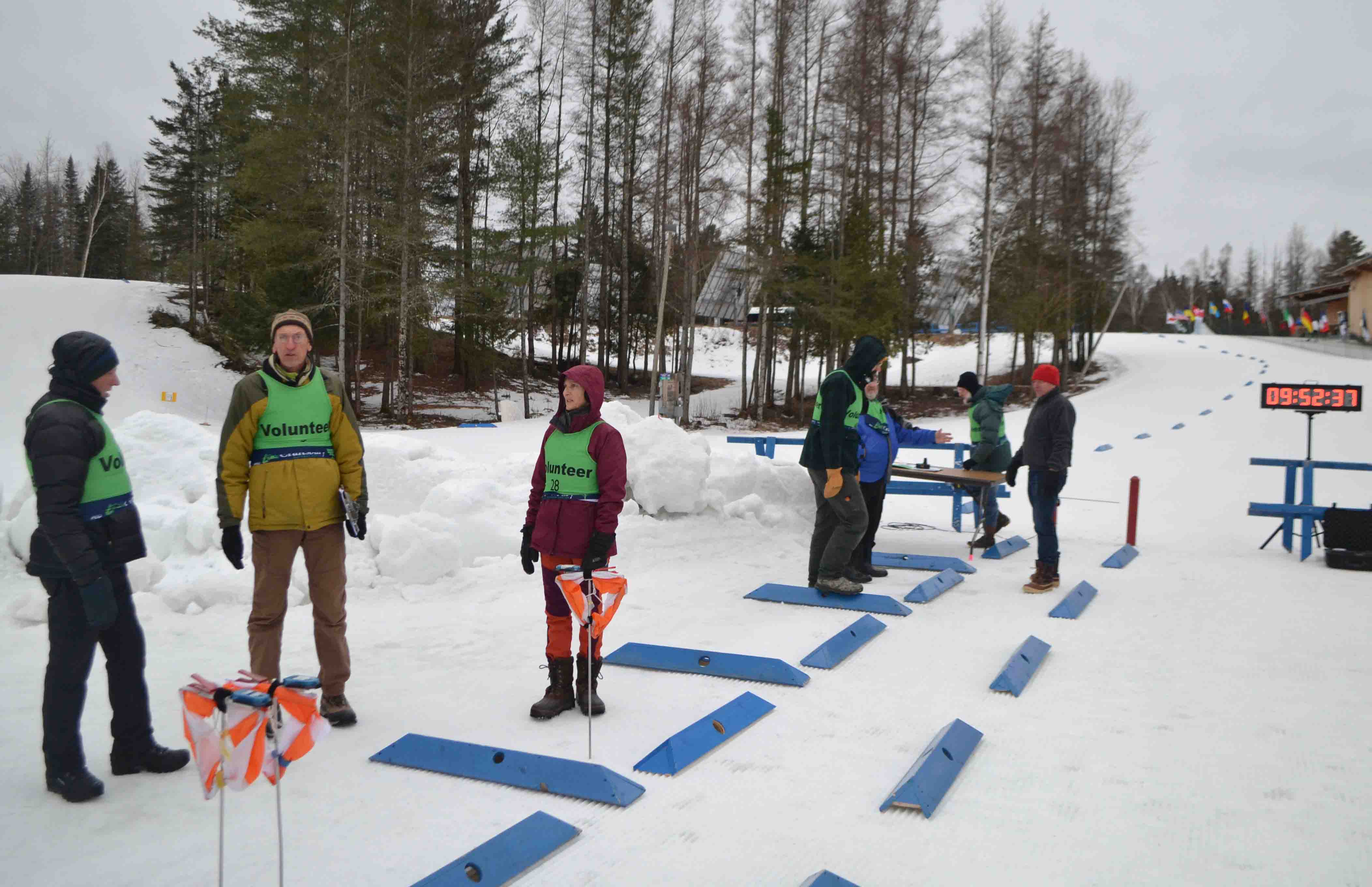
Preparing for racers to arrive at the map exchange in the distance race at the International Orienteering Federation (IOF) Ski Orienteering World Cup at the Craftsbury Outdoor Center in Craftsbury, Vermont. (Photo: John Lazenby/Lazenbyphoto.com)
With a well-formed idea, Walker and Owens approached Judy Geer, co-owner of the Craftsbury Outdoor Center (COC), about hosting the event.
“When Adrian Owens approached us about the idea of hosting this race, which he did well over a year ago, I was pretty quick to say, ‘Sure, sounds like fun!’ ” Geer explained. “It seemed like an opportunity to share our trail system in a new way and welcome an international group of nordic skiers to Craftsbury. At the same time, we had no idea how to host such a race so it was critical that there would be a knowledgeable organizing committee to really put it all together. Luckily, we had that. “
An East-Coast venue secured, Walker and Owens assembled an organizing committee (OC) to bring the event to Vermont. The committee had more to do than just run a race; they had to educate the Craftsbury staff and teach them about ski-o.
Craftsbury Outdoor Center coach Ollie Burruss had this to say about his ski-o learning curve:
“I would just add that the organizing committee has been incredibly helpful in educating those of us at the Outdoor Center without a background in ski orienteering – I think that would be almost all of us, actually. We are quite comfortable hosting high level cross country races, but this series added new elements to our race day preparation. Without the OC stepping up and providing input, suggestion, education, and the like, we would not have known where to start.”
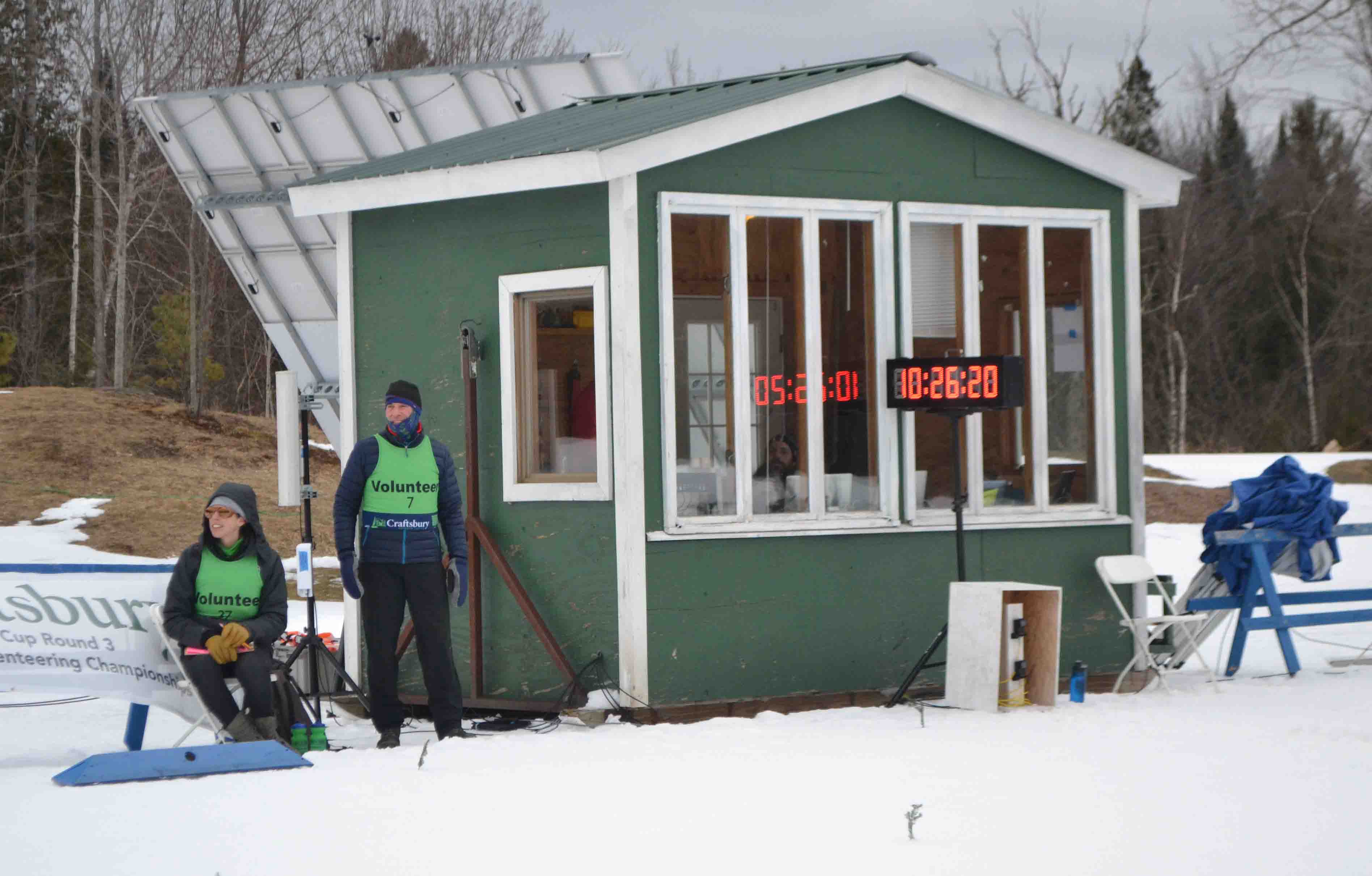
The finish crew getting ready to record race numbers to help verify the electronic finish order at the Ski Orienteering World Cup Finals and World Masters Championships in Craftsbury, Vt. (Photo: Kevin Brooker)
Much of a ski-o race shares a lot of similarities with a more traditional cross-country event. Both have individual starts and mass starts. With the exception of ski-o competitors wearing map holders, the starts and finishes look identical. Craftsbury was able to utilize their expertise and equipment setting up timing and start and finish areas. Where the Center needed some help was setting appropriate courses and the OC provided two expert competitors and course setters.
Alex Jospe and Andy Hall are two such experts.
“As course setter, my main task is to design an orienteering course that is appropriate for each class,” Jospe explained. “For the elite skiers, this involves very technical skiing and very technical navigation, with a mix of challenges from route choices to fine-scale navigation execution, all done at top speed. Ironically, those are the easiest courses to set, because the competitors can handle just about anything you throw at them. The tricky part is designing a course that will be navigationally challenging for the elder classes, without totally thrashing them on the ski trails.
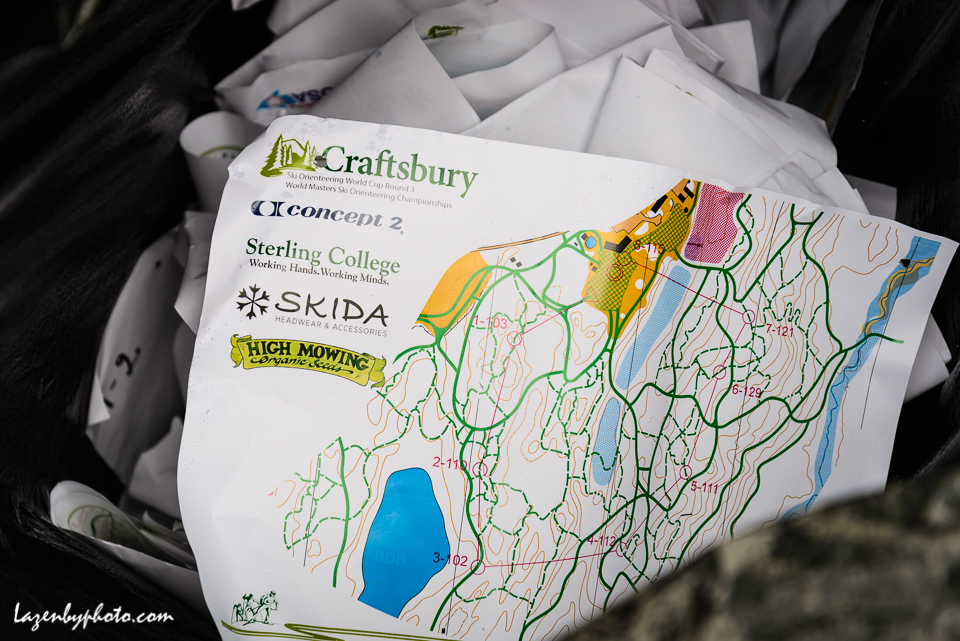
One of the maps at the 2018 Ski Orienteering World Cup / World Masters Ski Orienteering Championships. (Photo: John Lazenby/Lazenbyphoto.com)
“Setting a course entails laying everything out on paper, and then going out into the terrain to make sure that all the trails and tracks line up the way they are supposed to,” she continued. “I also spend a lot of time skiing various route choices, to get a sense of how long it will take for the skiers to complete the course. Then we print out the maps, and go out to set up the checkpoints, which are marked with an orange and white flag. Each of these flags (called ‘controls’) has an electronic timing unit on top, so that competitors can carry a timing chip and get splits instantaneously at the finish.”
With the event completed, how does the OC feel about the event?
“We’ve been on a steep learning curve about this sport, and it’s really been fun to finally get to watch the races this week!” Greer noted. “We hope the competitors are enjoying Craftsbury as much as we’re enjoying having them here.”
“Our expectations have been more than met, with terrific support from venue staff and the trail groomers,” Walker said. “It is fun to host nearly 200 European racers and introduce more Americans to ski-o.”
The start crew preparing for the World Cup long distance event at 2018 Ski Orienteering World Cup / World Masters Ski Orienteering Championships in Craftsbury, Vt. (Photo: Kevin Brooker)
With years of racing, coaching, and organizing races, Burruss had this to say: “I really appreciate the patience they [the organizers] have showed and I hope we have held up our end of the bargain. It is a cool event and I’m glad we were able to help bring this level of racing to the NEK [Northeast Kingdom].”
The experience of setting dozens of courses for many levels of skill and age, with snow cover ranging from gray ice to a foot of fresh snow, Jospe summed up her experience:
“Hosting this event at the Craftsbury Outdoor Center has been amazing. They are generous, interested, and enthusiastic — we couldn’t do this without such good support! It’s really cool to bring so many international competitors to this corner of Vermont, and everyone is appreciating the friendly vibes.”
For those of us fortunate enough to participate in this world-class event, the hard work and effort by the OC and huge staff of volunteers at the start, finish, registration, and out on the course is greatly appreciated. The trail grooming was exceptional and the rest of the COC staff was extremely professional. Everyone worked together to provide a fantastic racing experience to spectators and participants alike.
About the Author: Kevin began nordic skiing to keep in shape for bicycle racing at the dawn of the skating revolution. He lives in Vermont with his wife and two kids, who are fortunate enough to have great skiing right out the front door.
This ski-orienteering mass-start race had two exchanges. The top map is the first taken after the start. The maps were used in different orders to deter leaching (following). The intricacies of an orienteering mass start are worthy of their own article. The course setter mixes and matches the routes, and each athlete will cover the same legs but in a different order. After all this, there is often a finishing sprint for the victory. The exchange crew must be sure to put the correct map into the proper slot to insure a fair race. (Photo: Kevin Brooker)
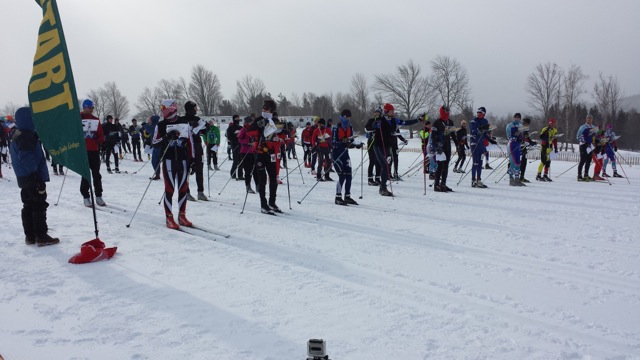
Long-distance mass start at 2014 U.S. Ski Orienteering National Championships March 14-16 at Trapp Family Lodge in Stowe, Vt. (Photo: Barbara Beall)
“This is the world of Ski Orienteering, one of the more obscure and mentally challenging Nordic ski racing disciplines.”
STOWE, Vt. — Imagine a Nordic ski race where you cannot preview the course, don’t know where you will be going, how long you will be skiing or how many hills you will have to climb. A race where you can go anywhere you want on skis, including down snowshoe trails or through uncharted glades. Where you can even take off your skies and run with them. This is the world of Ski Orienteering, one of the more obscure and mentally challenging Nordic ski racing disciplines.
The U.S. Ski Orienteering National Championships, a biennial event, were held this past weekend at the Trapp Family Lodge Ski Center in Stowe, Vt. Approximately 100 skiers, ranging in age from 10 to nearly 80 attended the three-day competition, featuring a Sprint and Middle Distance race (with individual starts) and a Long Distance race with a mass start. Different age classes are on different courses, with varying technical and physical difficulty.
Skiers received the map 15 seconds before the start, and were required to find the correct controls (those orange-and-white fabric markers you might see in the woods) in the right order, registering electronically at each one with a timing chip carried on their finger. At the end of the race, skiers download that information and are given their split times to each control.
Alexis Merka, 10, the youngest competitor at 2014 U.S. Ski Orienteering National Championships in Stowe, Vt. (Photo: Barbara Beall)
In the mass start, the courses were “forked,” meaning skiers ultimately skied the same distances and climbs, but not necessarily in the same order as their competitors, in order to prevent following. Race designers set up the courses to specifically challenge skiers on route choices, forcing them to decide, for example, whether it is faster to stay on a large trail or to follow a narrow trail only groomed by a snowmobile. The courses also challenge skiers to maintain contact with their maps, and to not become upset by climbing up and skiing down a hillside a couple of times.
Alexis Merka, age 10, was the youngest competitor at the event. She is from Maryland, and her mother and father are both orienteers. She competes in both ski-O and foot-O (which involves running rather than skiing). When asked what happens when she gets lost, she said “I say to myself, don’t panic, stay calm, look at the map.”
Larry Berman, who with his wife Sara Mae Berman started the Cambridge Sports Union and has been involved with ski orienteering since the early 1970s, said that he loves the challenge of finding that control right where it is suppose to be based on the map … and if the control is not there, clearly the map is wrong.
“I say to myself, don’t panic, stay calm, look at the map.” — Alexis Merka, 10, youngest racer at 2014 U.S. Ski Orienteering National Championships
For male and female skiers in the elite classes, the U.S. National Championships also identify those skiers who may be named to the USA National Ski Orienteering Team, qualifying them to go to World Events. The top U.S. female skiers were Alison Crocker (1st), Alexandra Jospe (2nd) and Anna Voegele (3rd). Top U.S. male skiers were Adrian Owens (1st), Greg Walker (2nd) and William Frielinghaus (3rd for Middle and Long Distance) and Ari Ofsevit (3rd Sprint). For full results go to: http://www.neskio.com/results/
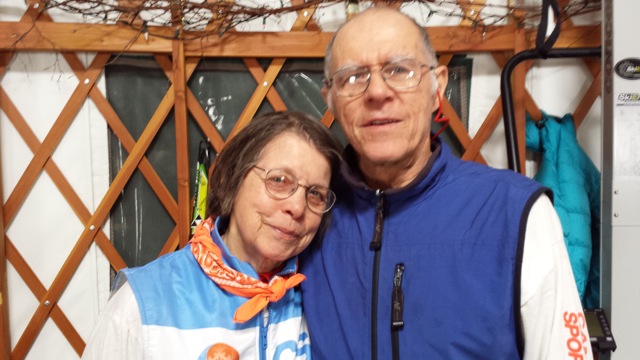
Larry and Sara Mae Berman, founders of the Cambridge Sports Union, at the 2014 U.S. Ski Orienteering National Championships in Stowe, Vt. (Photo: Barbara Beall)
Charlotte Kalla anchoring the Swedish women's relay team at 2011 World Championships.
With both Olympic and World Championships gold under her belt, Charlotte Kalla of Sweden was looking for a way to spice up her summer schedule.
Considering that she describes herself as someone who doesn’t “know how to use a map and compass very well,” her choice of orienteering definitely fit the bill for a challenge. In early July, Kalla announced that she could be competing in O-Ringen, a five-day orienteering festival, at the end of that month.
While not many Americans participate in orienteering races, it is one of the most popular sports in Sweden, the country where it originated in the late 1800’s. Racers run between “control points” which they must find using only a map and compass; the terrain is theoretically unfamiliar to all competitors. Orienteering races feature interval starts so that competitors are forced to navigate on their own, and races vary in length, number of points, and difficulty of terrain.
Kalla selected a big stage for her orienteering debut: O-Ringen is considered the second-most prestigious international event behind World Championships. Almost 13,000 people (including those from as far away as Australia) participated in this year’s O-Ringen in the Halsingland region of eastern Sweden, where the event completely took over and set up it’s own “town”. Soderhamn, where the races were held, is only two hours from Kalla’s home in Sundsvall, which made the event an easy weekend activity.
Both of Kalla’s O-Ringen starts were in the “challenge” division, described as being for people who are in good physical shape but don’t have much navigational experience.
While she had done some mountaineering, it didn’t prepare her for reading a map while running at full speed.
“I have butterflies in my stomach!” Kalla told the O-Ringen press before her opening race. “This is something completely new for me. I have run mountain orienteering before with Eva Svensson, but I’ll keep quiet about who actually orienteered… ”
In that first race, Kalla ran ten kilometers and found fourteen controls. She finished in an hour and two minutes, which was six minutes before the next woman and faster than all but eight of the men in the same class.
“It was really fun,” she told Aftonbladet, a Swedish newspaper. “It was a good day in the woods… We were a huge bunch in the forest and I tried to learn as much as I could.”
And in a conversation with the ski website langd.se, Kalla said that the race had been an excellent workout, and that she wasn’t used to having to think when her heart rate was so high.
Because the challenge class was for beginning orienteerers, Kalla’s first race was a mass start and she could observe her competitors. The next day, however, was interval start, and she was on her own for ten kilometers and another fourteen controls. Kalla said she was nervous before the race, but she didn’t need to be: she finished second, 46 seconds behind the day’s winner.
When asked whether orienteering would become a focus for her, Kalla suggested that she might continue to compete occasionally.
“Yes,” why not?” she asked in response to a question from the Uppsala Journal. “It’s possible to combine it with my other training, so it is conceivable.”
Kalla also thought that adding an orienteering component to her training made it more interesting.
“My preparation for O-ringen was to find 60 to 70 points in a passport I bought of Sundsvall,” she told SweSki.com. “Time flies when you have many milestones in your workout. It’s perfect for me now that I train so much.”
Kalla’s presence at the event drew a significant amount of attention, both from the media and the other competitors. She spent one evening signing autographs, and the a long line formed well before she arrived at the table.
“Wow, this was worse than during the ski season,” she joked.
Kalla (R) celebrating World Championship gold with team sprint teammate Ida Ingmarsdotter in Oslo.