From the FasterSkier archive — posts syndicated from athletes’ and coaches’ own blogs between 2004 and 2012, kept online as published. Current coverage is at fasterskier.com.
This coverage is made possible through the generous support of Marty and Kathy Hall and A Hall Mark of Excellence A Hall Mark of Excellence Award. To learn more about A Hall Mark of Excellence Award, or to learn how you can support FasterSkier’s coverage, please contact info@fasterskier.com.
Johannes Hoesflot Klaebo (NOR) continues his march on a most historic season in Falun, Sweden. (Photo: Authamayou/NordicFocus)
Six days after the Olympic flame dimmed in Italy, the World Cup caravan reassembled in Falun, Sweden, at the Lugnet cross-country ski center. The Mördarbacken — the famed “murder hill” — still looms over the stadium, waiting to torture the athletes tomorrow. The snow was fast, and the sport’s most dominant man arrived with something bordering on the unthinkable within reach.
Johannes Hoesflot Klaebo had already swept the Olympic program: six races, six gold medals. He had already conquered the Tour de Ski. He leads the sprint standings. He leads the distance standings. He leads the overall.
In Falun’s Freestyle Sprint, he resumed his campaign as if nothing had interrupted it.
And to no one’s surprise, Klaebo won again.
The victory — tactical, controlled, clinical — pushed his streak forward and kept alive the possibility of something the sport has never seen: a season in which one athlete claims the Olympic sweep, the Tour de Ski title, and all three FIS World Cup Crystal Globes.
“So interesting watching Klaebo,” FasterSkier’s John Teaford observed. “In the semi, he had Chanavat in front, so Klaebo went wide to force him into the lead. In the final, Chanavat was already there, so Klaebo took the inside to shut down Heggen. He’s racing, everyone else is just reacting.”
On a course where lane choice and downhill drafting often matter more than raw power, Klaebo once again skied as if he had solved the puzzle in advance.
Johannes Hoesflot Klaebo (NOR) gets his quarterfinal started. (Photo: Thibaut/NordicFocus)
The Course That Punishes Hesitation
Lugnet’s sprint track is deceptively compact — Klaebo won the qualification in 2:33.9 — but it rewards patience and punishes impatience. The downhill into the stadium is long enough to generate devastating draft effects; even if a skier has what seems like a wide enough margin out front, they often get swallowed up.
Lars Heggen, left off Norway’s Olympic team in favor of Oskar Opstad Vike, skied with visible urgency all afternoon. He had qualified 26th but surged through the rounds, eventually finishing second behind Klaebo in the final. Vike, the Olympic bronze medalist in the Classic Sprint, failed to advance to the finals.
In a Norwegian program that might be the deepest in skiing history, the margins remain ruthless, and the storyline between Vike and Heggen will continue throughout the rest of the season.
Gus Schumacher (USA) during qualification. (Photo: Thibaut/NordicFocus)
Schumacher: Six Olympic Races, Then a Movie Theater
If Klaebo’s season has been relentless, Gus Schumacher’s has seen both uncertainty and excellence. Schumacher was the only Olympic racer besides Klaebo to start all six events in Italy, culminating in the 50-kilometer classic last weekend.
His recovery plan for Falun?
“I was just chilling,” Schumacher said afterward. “I didn’t ski Sunday or Monday. Tuesday, I went skiing for a little bit, but I wasn’t too stressed about the training. The biggest thing was just not doing too much.”
He went to a movie theater on Tuesday night.
“Just kind of like doing sort of normal life things,” he said. “Helped with recovery for me.”
There was no urgency in his tone, no sense of chasing something lost. Instead, he described an emotional decompression that many Olympians quietly experience.
“All week it’s been a little low,” he admitted. “Today was just nice to go out and race.”
Schumacher advanced cleanly from his quarterfinal, but the semifinal unfolded differently. His start, he acknowledged, hasn’t been historically a strength.
“My start has never been that fast,” he said. “So for me to get into a top-four spot early on is hard. I was kind of relying on gaps to open up.”
But they didn’t.
“The pace was kind of too high, or it was too wide or both,” he said. “I really should have just pulled up a little bit, embrace sixth until the finish, and then gone fast there.”
He missed a lucky loser qualification by three-tenths of a second.
“I’m not super happy with it,” he said. “But the quarterfinal was nice.”
After the emotional volatility of the Games, including a crash in his opening race, a silver medal in the team sprint with Ben Ogden, Schumacher’s energy felt steadier in Falun.
“I wouldn’t say I’m digging deep,” he said. “I think I’m just enjoying the ride.”
After an Olympic training block, Jack Young (USA) is back racing on the World Cup in Falun, Sweden. (Photo: Thibaut/NordicFocus)
Young’s Gamble
Jack Young arrived in Sweden with a different story.
He made the Olympic team but did not earn one of the four U.S. sprint starts in Val di Fiemme. Rather than chase race sharpness, he chose volume.
“I trained very hard for the two weeks leading up to Falun,” Young wrote us in an email after the race. “The theory was that my speed was really good and I needed a fitness boost to finish out the season well.”
This may have been a bit of a risk, but one Young was willing to take.
“I’ve never trained even close to this much volume this close to a World Cup sprint,” he said. “But it seems to have paid off.”
He did not miss race intensity.
“In fact, the two weeks of training were some of my favorite weeks of the winter.”
Young benefited from Filip Skari’s disqualification after he received a second yellow card of the season in the quarterfinals, advancing to the semifinals. There, the course’s tactical nuance intervened.
“I wanted to ski the corner really well, exit with speed, and hopefully overtake Vike and Ersson right before the course kicks up again,” he said. “I had too much speed out of the corner and passed Vike too early and lost the draft.”
The mistake was microscopic, but the consequence decisive.
“Today was hectic but fun,” Young said. “Really cool sprint racing.”
If there was a change in him, it was mental.
“This was probably the most locked in I’ve been for a World Cup semifinal,” he said. “I was ready to really race with those guys and try to beat them.”
For a 23-year-old navigating the narrowest margins in sprint racing, that shift may matter as much as fitness.
Kevin Bolger, who narrowly missed Olympic selection, qualified for the heats but was eliminated in a stacked quarterfinal that included Klaebo. (Photo: Thibaut/NordicFocus)
Bolger’s Return
For Kevin Bolger, the weeks surrounding the Olympics were heavier. Bolger narrowly missed selection for Milan-Cortina, and the emotional toll was real.
“I mean — at the beginning, life sucked,” he said. “It feels like everything is against you and that I was wronged.”
He had been to the Olympics before — in Beijing — and that perspective helped, but it did not soften the blow.
“It still really sucked and hurt a lot,” he said.
Bolger’s response was simple: train.
“My motivation was training through that period and hopefully be able to attack these last World Cup weekends. And of course pour my energy into Maja and do what I could to help her get some medals.”
By the time Falun arrived and the World Cup season got restarted, Bolger felt ready. He knew his quarterfinal would be stacked — Johannes Klæbo among those in the heat — and expected the pace to be high.
“I was prepared for that,” he said. “I felt great and was mentally ready for the pace.”
But on a course like Falun — fast, tactical, draft-dependent — ski speed can decide everything.
“I don’t think I had the most competitive skis in my heat,” Bolger said. “So on a fast tactical course, it’s a bit of an uphill battle. I was hoping to catch the draft coming back to the stadium, but the skis didn’t seem to be running as I’d hoped. But that’s life, and we move on.”
Bolger did not struggle to keep pace with the athletes racing in Val di Fiemme.
“It’s not that hard,” he said. “I had a few weekends of racing to help keep the sharpness going and the shape. It always seems to get better when you can actually just get back into a good training routine. And right now I feel like I’m in a great place and just happy to be racing back in the heats.”
Johannes Hoesflot Klaebo (NOR) climbs one of the sprint course hills in front of the Swedish fans in Falun, Sweden. (Photo: Authamayou/NordicFocus)
The Stakes Beyond Saturday
Klaebo’s victory further tightened his grip on the sprint and overall standings.
The distance globe remains mathematically alive, though narrowing. The sprint globe appears close to decided, and the overall lead, barring collapse, is substantial.
What remains compelling is not merely whether Klaebo will win, but whether he will complete something approaching total seasonal dominance.
Johannes Hoesflot Klaebo (NOR) once again makes it look easy during his win in Falun, Sweden. (Photo: Authamayou/NordicFocus)
After the Olympics, and the understandable fatigue that would be a result of winning gold in all six races, you might expect Klaebo to take some time off from the World Cup… he did not.
Klaebo moves forward, and what awaits in Lake Placid, where fans will gather to celebrate the close of the season and Jessie Diggins’ final World Cup start, is the possibility of witnessing something the sport has never seen: a Tour de Ski title, an Olympic sweep, and three Crystal Globes claimed in a single winter.
In a season already defined by dominance, Klaebo is now skiing toward something that would endure long after the snow melts.
Feature stories like this one take time, access, and care to produce. If you value thoughtful storytelling and independent ski journalism, please consider becoming a Voluntary Subscriber. Your support directly fuels the work we do to cover the people, places, and moments that make our sport special.
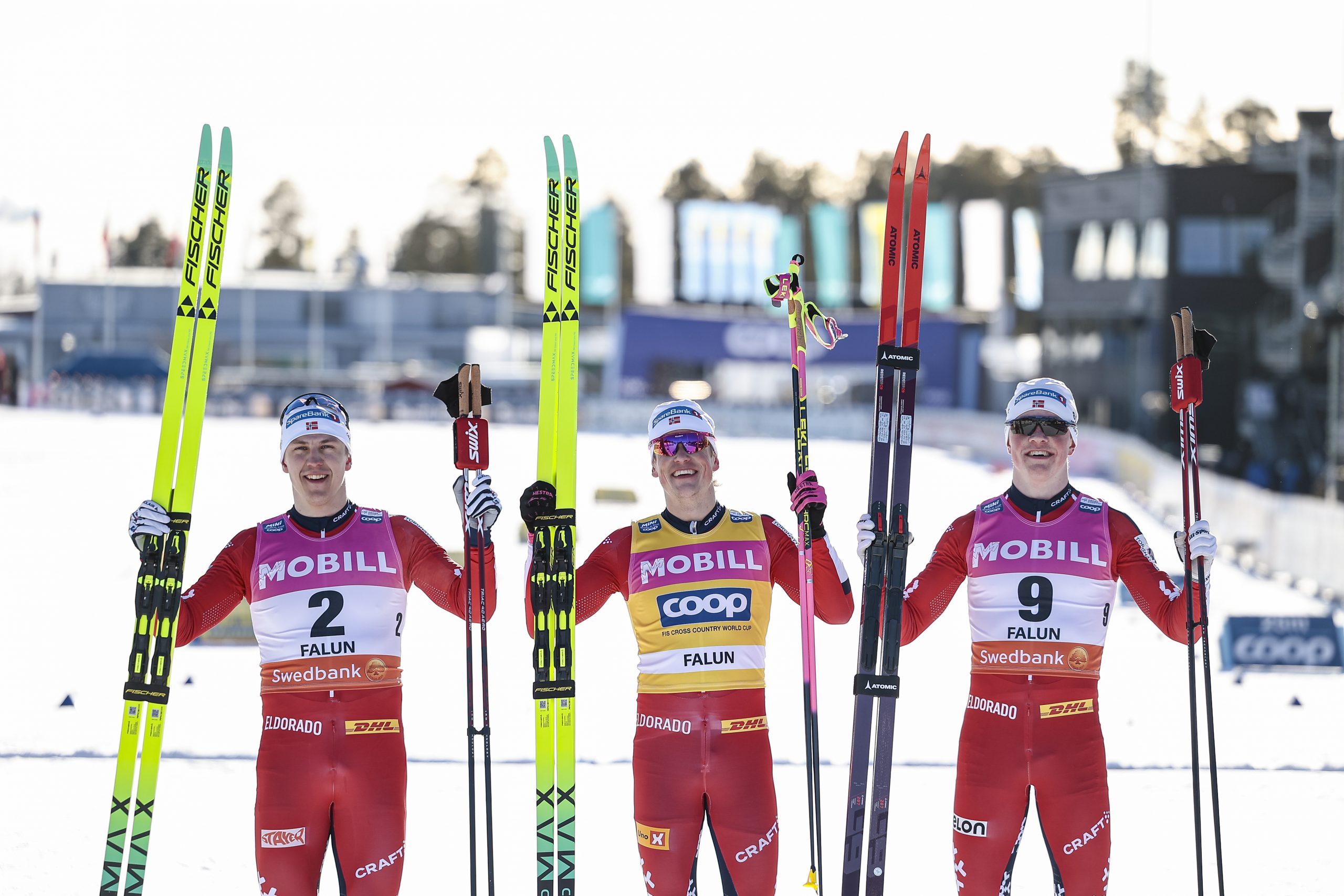
Lars Heggen (NOR), Johannes Hoesflot Klaebo (NOR), and Benjamin Moser (AUT), (l-r) share the Freestyle Sprint podium in Falun, Sweden. (Photo: Authamayou/NordicFocus)
Norway’s greatest competitive advantage in cross-country skiing has always been depth. In an Olympic selection season, that depth becomes a headache. When the federation gathered to finalize its 2026 team, the conversation was not about who belonged at the Games — those results and calculus had been logged. It was about which version of the team could survive illness, underperformance, and the cruel compression of Olympic schedules. For several skiers who have already proven themselves capable of standing on a World Cup podium — and perhaps even an Olympic one — the answer would be no. Not because they weren’t good enough. But because someone else fit the puzzle a fraction more cleanly.
Johannes Hoesflot Klaebo (NOR) leads a train of Norwegian men in Lahti (FIN) last March. (Photo: Thibaut/NordicFocus)
Eight Men, Eight Women — Complete
The Norwegian cross-country Olympic squad now includes eight men and eight women, a balance that reflects the depth of talent and strategic breadth of Norway’s cross-country program.
With these 16 names confirmed, Norway’s roster boasts a mix of seasoned champions and hungry young stars — from Klæbo’s Olympic pedigree to Vike’s breakthrough sprint talent.
Harald Oestberg Amundsen (NOR), Mattis Stenshagen (NOR), Johannes Hoesflot Klaebo (NOR), Emil Iversen (NOR), Jan Thomas Jenssen (NOR), Erik Valnes (NOR), and Martin Loewstroem Nyenget (NOR), (l-r) come up the final climb during the Skiathlon in Trondheim (NOR) in December. (Photo: Modica/NordicFocus)
The Final Pieces of a Puzzle: Iversen and Vike
For weeks, the most hotly debated part of Norway’s Olympic selection revolved around the last two men’s spots.
Emil Iversen, the veteran 34-year-old World Cup stalwart and World Champion team sprinter, secured one of the final berths — a decision that stirred both emotion and controversy. Iversen missed out on earlier national team standing but made a compelling case this season with solid World Cup performances, including in Tour de Ski events that carried significant weight in the selection criteria.
On the younger side, Oskar Opstad Vike earned the final spot. The 22-year-old sprinter’s rise — riding strong sprint results, including a World Cup top ten — gave the selectors a promising specialist to bolster Norway’s Olympic squad.
The decision to include one established distance racer (Iversen) and one sprint threat (Vike) over alternative combinations was no accident. It reflects not only this season’s results but also the complexity of Olympic event programming — multiple distance races, relays, and sprint competitions demand versatility and redundancy.
Emil Iversen (NOR) during the Skiathlon in Trondheim (NOR) earlier this season. (Photo: Modica/NordicFocus)
What Was on the Line
Norway’s selection strategy rested on ranked criteria that put top priority on World Cup results this season, followed by last season’s performances and past championship achievements. This emphasis on objective metrics aims to ensure that the athletes selected are not just popular choices, but the ones statistically most expected to deliver in Val di Fiemme.
It’s no surprise that Johannes Høsflot Klæbo leads the team — the multiple World Cup overall and sprint title holder is already one of the greatest of all time, and his results this season keep him in clear contention for medals across disciplines.
Meanwhile, Mattis Stenshagen has been one of the season’s breakout distance performers, boasting both World Cup podiums and a strong Tour de Ski showing that solidified his place on the team.
Erik Valnes (NOR), Johannes Hoesflot Klaebo (NOR), and Oskar Opstad Vike (NOR), (l-r) share the podium in Falun (SWE) in last season. (Photo: Modica/NordicFocus)
Notable Near-Misses and Debates
Not everyone who hoped for an Olympic ticket got one.
One of the most talked-about stories this season was Lars Heggen, the 20-year-old sprint phenom who has burst onto the scene with impressive results, including a World Cup sprint victory this past weekend. Many voices in ski media argued passionately for his inclusion, citing his explosive form and tactical range. But in the end, selectors opted for experience and proven Olympic relevance — a choice that sparked debate across Norway and beyond.
Another compelling case was Andreas Fjorden Ree, whose World Cup performances and near-victory finishes led many to forecast him as a certain medal contender. His exclusion — by mere fractions in selectors’ evaluations — was described as “brutal” by some commentators, underscoring just how competitive this national squad truly is.
Kristine Stavaas Skistad (NOR) leads Maja Dahlqvist (SWE) down the homestretch of the opening stage of the Tour de Ski in Toblach (ITA) in December. (Photo: Modica/NordicFocus)
Women’s Squad: Balance of Experience and Youth
While the men’s selection drama took center stage, the women’s squad also reflects a dynamic mix of talent:
Veterans like Heidi Weng bring Olympic experience and tactical acumen.
Sprinters and all-rounders like Kristine Stavås Skistad and Karoline Simpson-Larsen add valuable firepower.
Milla Grosberghaugen Andreassen and Ingrid Bergene Aabrekk represent the up-and-coming generation making their impression through World Cup and Norwegian Championship results.
Selectors reportedly evaluated performances not just from the World Cup and Tour de Ski, but also through the Norwegian National Championships — especially when managing variables like injury and form.
Heidi Weng (NOR) during the final climb of the Tour de Ski in Val di Fiemme (ITA) earlier this month. (Photo: Vanzetta/NordicFocus)
Looking Ahead — Milan-Cortina 2026
The Winter Olympics kick off on February 6, 2026, and cross-country skiing begins early with the women’s skiathlon on February 7. In Val di Fiemme — a venue steeped in Nordic history — Norway will arrive with one of the deepest teams in the field.
For a nation where cross-country skiing is practically a national pastime, these selections carry huge anticipation. Every name on this roster is now poised to chase Olympic gold, silver, or bronze — but behind them are stories of near-misses, fierce competition, and strategic choice-making that defined this winter’s most compelling selection drama.
Let the Games begin.
Love Stories Like This? Help Keep Them Coming.
Feature stories like this one take time, access, and care to produce. If you value thoughtful storytelling and independent ski journalism, please consider becoming a Voluntary Subscriber. Your support directly fuels the work we do to cover the people, places, and moments that make our sport special.
This coverage is made possible through the generous support of Marty and Kathy Hall and A Hall Mark of Excellence Award. To learn more about A Hall Mark of Excellence Award, or to learn how you can support FasterSkier’s coverage, please contact info@fasterskier.com.
The lights come on early in Davos, not because they are needed, but because Davos wants them on. By mid-afternoon, the valley is already sliding toward dusk, the alpine light thinning and flattening, and the sprint venue leans into the moment the way it always has: music turned up, cowbells ringing with a little extra insistence, flames licking the edges of the course like stage cues. The effect is deliberate. This is not cross-country skiing as a quiet endurance ritual in the woods; this is cross-country skiing as spectacle.
“Davos deliberately designs this event to feel like a rock concert,” U.S. head coach Matt Whitcomb said afterward. “They race at night, they bring in fire and lighting and music, and because it’s a two-lap course, you see the athletes twice as much. They invest in the experience, and it pays off.”
Jack Young (USA) on his way to a fast qualification in Davos (SUI). (Photo: Modica/NordicFocus)
On Saturday night, it paid off in a men’s freestyle sprint that delivered one of the most compelling American performances in years. Jack Young finished fourth, Ben Ogden fifth — the first time two American men had made a World Cup sprint final together in Davos — on a night when the script cracked open early and never fully resealed. Johannes Høsflot Klæbo was gone before the semifinals. A notoriously slick downhill corner became the day’s silent antagonist. And by the time Lucas Chanavat lunged across the line to win by three hundredths of a second, the story had already shifted: the U.S. men were no longer visitors to the sprint final. They were participants, with opinions about how it might have ended differently.
For Young, the fourth-place finish marked his first World Cup sprint final — a breakthrough that felt less like a surprise than a confirmation. “This result means so, so much,” he said. “It really feels like proof that I can make it to the top in this sport. If I’d told myself three years ago that I’d finish fourth in a World Cup sprint, I would have thought I was insane.”
Ben Ogden (USA) during qualification in Davos (SUI). (Photo: Modica/NordicFocus)
A course that punishes impatience
Davos is not a long sprint, but it is not a forgiving one. Two laps of just under 600 meters pack in a decisive climb, sustained skating tempo, and — this year especially — a downhill corner that demanded respect. The snow was entirely man-made, hard and fast, and as the temperature dropped through the evening, it glazed into ice. Athletes began to talk about the corner not as a feature, but as a test.
“That bottom corner was particularly dicey this year,” Whitcomb said. “Man-made snow turns to ice quickly, and that corner claimed a lot of people over the last couple of days.”
Ben Ogden felt it more than once. “That last corner was really the focus,” he said. “I fell there yesterday, JC fell there in practice, and I stumbled twice in the final and ended up against the boards. It was unfortunate, but every year you learn a little more about how the ice forms there.”
The corner changed the race’s outcome. The first time through, athletes skied it conservatively, prioritizing stability over speed. The second time, with fatigue setting in and the finish looming, choices became riskier — and more consequential.
Janik Riebli (SUI), Jack Young (USA), and Lars Heggen (NOR), (l-r) during the heats in Davos (SUI). (Photo: Vanzetta/NordicFocus)
Qualifying hints, early shocks
The qualifying round suggested a familiar hierarchy, but with enough irregularities to hint that Davos might misbehave. Lucas Chanavat of France was fastest, Ben Ogden second, Klæbo third. Jack Young qualified sixth — an excellent position that put him squarely in control of his bracket.
“That’s one of the best qualifying results we’ve ever had on the U.S. team,” Whitcomb said. “Qualifying in the top ten gives you options. It lets you race offensively instead of defensively.”
Klæbo’s day began to unravel in the quarterfinals. Boxed in and forced wide through the downhill, he finished fourth in his heat and failed to advance. His 16-race sprint win streak ended not with drama, but with traffic — a reminder that sprinting, for all its stars, is still governed by physics and positioning.
Ogden and Young both advanced cleanly. Ogden won his quarterfinal with authority. Young skied his with the composure of someone who knew exactly what he needed to do — no more, no less.
Ben Ogden (USA) and the US Ski Team had a lot to celebrate in Davos (SUI). (Photo: Modica/NordicFocus)
Semifinals: the Americans arrive together
By the semifinals, the noise in Davos had sharpened. Chanavat advanced. Ogden advanced. And then Young did, stepping into his first World Cup sprint final with the kind of quiet efficiency that suggested the moment had not surprised him.
“To be honest, the first thing that went through my mind standing on the start line was how tired I was,” Young said. “But I reminded myself that anything can happen in a sprint final. I don’t train just for qualifiers and quarters — I train for the full day. It was time to execute.”
For Ogden, the significance of sharing the moment wasn’t lost. “Racing with Jack today was awesome,” he said. “He has this infectious confidence, especially here in Davos. Last year we were in the semifinals together, and this year we were in the final together. That’s a big step.”
Whitcomb saw it as more than a statistical milestone. “To put two guys into the men’s final is a dream,” he said. “When athletes finish a race seeing the podium and knowing they can be on it, that’s when things start to get dangerous — in a good way.”
Jack Young (USA) had every right to be celebrated after his breakout race today in Davos (SUI). (Photo: Modica/NordicFocus)
The final: margins measured in inches
The men’s final unfolded at full speed. Chanavat and Federico Pellegrino established themselves early, both reading the race the way veterans do — not forcing it, but shaping it. Oskar Opstad Vike of Norway positioned himself patiently, waiting for the moment when commitment would matter.
Ogden and Young stayed connected. Coming into the final corner, Ogden had position. Young had momentum.
“I was really gunning for that podium,” Ogden said. “I felt like I was pretty close. With fewer stumbles and maybe a little better positioning, I think I could have made it happen.”
The corner had other plans. Ogden’s line took him over the ice and was forced wide, momentarily pinned against the boards. Young exited cleaner, carrying speed into the finishing straight.
Chanavat and Pellegrino lunged together at the line, Chanavat winning by three hundredths of a second. Vike took third. Young crossed fourth, Ogden fifth — separated from the podium by seconds, but not by belief.
“I finally feel like I can truly compete at the top,” Young said. “That’s a special feeling.”
Results — Men’s Sprint Freestyle, Davos
Lucas Chanavat (France)
Federico Pellegrino (Italy)
Oskar Opstad Vike (Norway)
Jack Young (USA)
Ben Ogden (USA)
Edvin Anger (Sweden)
Notables: Johannes Høsflot Klæbo (Norway), 17th, and JC Schoonmaker (USA), 27th.
It has been a tough trail back to the top step on the podium for Lucas Chanavat (FRA) so he was extremely excited to be standing on it today in Davos (SUI). (Photo: Vanzetta/NordicFocus)
What Davos leaves behind
Davos has always been good at revealing things. It reveals how athletes handle altitude, manage nerves, and respond when a race refuses to go according to plan. On Saturday night, it revealed something else: American depth at the sharp end of a sprint final.
Young talked about the atmosphere as something that lifts him. “With all the energy, it’s easy to trick yourself into thinking you’re walking into a big arena,” he said. Ogden talked about validation — not just from results, but from proximity. “My target in these races is the podium,” he said. “It feels good to know I’m getting closer.”
Whitcomb, standing back from it all, saw the longer arc. “We’re in a really good place with these guys,” he said. “There’s a lot more to come.”
The flames went out eventually. The music faded. Davos returned to being a quiet alpine town under an early winter night. But for the American men — and for two Vermonters who now know exactly what a World Cup sprint final feels like in tandem — something lingered.
Feature stories like this one take time, access, and care to produce. If you value thoughtful storytelling and independent ski journalism, please consider becoming a Voluntary Subscriber. Your support directly fuels the work we do to cover the people, places, and moments that make our sport special.
This coverage is made possible through the generous support of Marty and Kathy Hall and A Hall Mark of Excellence Award. To learn more about A Hall Mark of Excellence Award, or to learn how you can support FasterSkier’s coverage, please contact info@fasterskier.com.
Erik Valnes (NOR) and Johannes Hoesflot Klaebo (NOR), (l-r) crest the final climb before descending into the stadium during the World Cup Classic Sprint in Trondheim (NOR). (Photo: Modica/NordicFocus)
Johannes Høsflot Klaebo’s 100th World Cup win did not arrive with the roar he’d grown used to on this course.
Granåsen last March had been a cauldron—tens of thousands of fans in plastic ponchos, rain pouring sideways, the World Championships turning Trondheim into a temporary capital of the sport. Eight months later, on the first Friday of December, the same stadium felt smaller. The sky was already dim by early afternoon, the floodlights casting a clean, blue-white glare across sugary tracks. The weather had finally cooperated—no rain, firm snow, kick wax that actually bit—but the crowd was thin enough that you could hear individual cowbells and specific voices when the finalists swung into the stadium.
Still, the stakes were anything but small. Norway flooded the start list with a full Nations-Group, 12 men in red suits, all chasing the same thing: an Olympic ticket to Milano–Cortina. Russia’s return to the World Cup had been confirmed in principle earlier in the week, adding long-term uncertainty to an already cutthroat season, but there were no Russian suits on the start line in Trondheim.
And in the middle of it all, on the same course where he’d taken six gold medals at Worlds, Klaebo lined up for a classic sprint with 99 World Cup victories to his name and the chance to round the number off in his own backyard.
By the end of the afternoon, the number would be 100. The route there was messier—and more revealing—than the record book will show.
Ben Ogden (USA) on his way to posting the fastest qualification time. (Photo: Modica/NordicFocus)
A qualifier that flipped the script
The first jolt of the day came from the American side of the results sheet.
Ben Ogden, the 25-year-old Vermonter who has been quietly (and sometimes not so quietly) remaking the U.S. men’s sprint profile, didn’t just survive the qualification round—he beat the entire Norwegian armada on their home snow. Ogden set the fastest time of the morning, ahead of Johannes Hoesflot Klaebo in second and a 19-year-old Swede, Alvar Myhlback, in third.
For U.S. head coach Matt Whitcomb, the signal was as much about skis and process as it was about the scoreboard.
Norway had sent out its complete Nations-Group—extra men beyond the regular quota—12 in total, and every one of them qualified for the heats. To outski so many Norwegians in a Norwegian sprint, Whitcomb later pointed out, is not an accident. It takes real form and excellent skis.
Ogden’s own description of the qualifier sounded almost deliberately un-dramatic, as if he were trying to file the moment under “routine” before the day had even finished.
“They all feel the same for me, for the most part,” he said afterward. “I definitely knew I was having a good one, skiing pretty fast, but you never know till you cross the finish line. In the middle of the race, I don’t think about that too much—I just sort of think about the next hurdle… At the bottom of the hill, I think about getting to the top, at the top, I think about pushing hard into the downhill, and on the downhill, I think about skiing the corner at the bottom of the hill well. That’s kind of the way it goes mentally for me. I definitely felt good, felt strong. I just felt like I could push and push and push and still have some energy, so it’s a good feeling for sure.”
Behind him, the margins were tight everywhere. Gus Schumacher and Jack Young both hovered just outside the top 30; Kevin Bolger lurked not far behind.
JC Schoonmaker, representing APU and still the same powerful sprinter who has lived on the brink of significant breakthroughs for several seasons, slid into the heats in 24th.
If Ogden’s run lit the American side of the results board, Myhlback’s qualification told a different kind of story—a long-distance skier breaking into the sprint world by almost ignoring one of its foundational assumptions.
Alvar Myhlback (SWE) double poling the qualification (and heats) on skate skis in Trondheim (NOR). (Photo: Modica/NordicFocus)
The double-poling kid from Bjursås
On the face of it, a 1.4-kilometer classic sprint in Trondheim is not where you’d expect to see the aftershocks of Vasaloppet.
Myhlback, a 19-year-old Swede from Bjursås, arrived in Trondheim already something of a legend in a different corner of the sport. In March, he had become the youngest winner in the hundred-year history of the Vasaloppet, staving off the best of the Ski Classics field over 90 kilometers of classic racing and double-poling his way under the blue arch in Mora.
His recent résumé reads like a long-distance syllabus: victories at Vasaloppet, the Klarälvsloppet, Alliansloppet, and the Blink Classics roller-ski race, all in the three-hour-plus universe of Ski Classics racing.
Yet in Trondheim, he and the coaches around him made a choice that felt deeply rooted in that marathon background. While almost the entire field stuck to traditional classic setups—grip wax underfoot, long diagonal-stride climbs—Myhlback rolled to the start on skate skis, no kick wax, no plan to stride. His day would be decided on pure upper-body power and glide.
He stuck with that choice all afternoon. In qualification, he was third, just 0.24 seconds behind Klaebo and less than half a second behind Ogden, double-poling up the long climb where others were striding. In the heats, he doubled down, literally: double-poling on skate skis in a classic sprint, in a World Cup final, on a course where the kicks of Norwegian diagonal stride have defined the past decade.
That he advanced at all would have been a story. That he finished the day on his first World Cup podium, sandwiched between Oskar Opstad Vike (second place) and Lars Heggen (fourth place) in a final dominated by Norwegians, turned it into something else.
It also sharpened an old talking point: Norway’s legendary wax trucks versus a kid who effectively opted out of grip wax altogether, trusting that his marathon-honed double-poling engine could hang on a course built for diagonal stride.
Oskar Opstad Vike (NOR), JC Schoonmaker (USA), Amund August Korsaeth (NOR), Alvar Myhlback (SWE), (l-r) during their quarterfinal. (Photo: Modica/NordicFocus)
The corner that wouldn’t let go
If qualification belonged to Ogden and the chemistry of Norwegian wax trucks, the afternoon’s defining feature was a corner—and the way it kept finding Americans.
Granåsen’s men’s sprint course climbs from the start to a right-hand turn that looks elementary on a map and on television. It’s not an overtly decisive feature: no off-camber sweeping change of direction, no opportunities for bold attacks, just too early on the course to gain a significant advantage. Yet, over and over again, as head coach Matt Whitcomb later put it, “that corner“ has become a problem spot.
In the men’s quarterfinals, Schoonmaker arrived there in a good spot, charging with what Whitcomb described as “gas to burn.“
Then he tangled with Italy’s Simone Mocellini at the top of the climb, went down, and his day ended with a broken pole and a replay that U.S. coaches will be watching for years.
“Today was definitely a step in the right direction,“ Schoonmaker wrote afterward. “It builds some confidence for the next races and for the season. I feel good and feel like I’m skiing pretty well, but it’s just not quite coming together the way I would like. I’m happy with the spot I’m in at the moment.”
Italy’s Simone Mocellini and JC Schoonmaker (USA) crest the final climb before descending into the stadium, but they were out of contention to advance. (Photo: Modica/NordicFocus)
In an Olympic year, that kind of tempered optimism reads differently. Under the U.S. selection procedures for Milano–Cortina, an individual top-eight finish in one of the Olympic events—sprint classic, 10 k skate, 20 k skiathlon, 50 k classic—can lock in an athlete’s nomination through objective criteria. For sprinters like Schoonmaker and Ogden, these early-season classics are more than just race days; they’re auditions with permanent consequences.
Ogden’s quarterfinal, by contrast, looked like the blueprint for surviving that fraught middle of the course. He surged early, stretched his heat into a line, and controlled the race in a way that kept him clear of chaos. He won his quarter almost casually, looking like a man who had solved Granåsen’s puzzle.
Then the semifinal brought him back to the same corner.
Ogden selected quarterfinal five—the last men’s heat in the rotation, the one where recovery time before the semifinal is shortest. By the time he lined up again, he could feel the effort in his arms; the plan, he said, was to sit in the pack early and save his move for the big climb.
Instead, the day tightened around a single moment.
“In the semifinal, I was kind of feeling the quarterfinal in my arms a little bit,“ he said. “So I thought, all right, I’ll just sort of sit in the pack here and wait until that big climb and try and do what I do on that. But I kind of paid the price early on, getting tangled up in that corner. I don’t think Harald [Østberg Amundsen] obstructed me or anything of the sort—he just happened to step on my tip. And when that happens, people who have ski raced will know that your ski comes to a stop, and you can’t really move it. And then that kind of caused me to get spun around, and we both went down.”
Harald Oestberg Amundsen (NOR) and Ben Ogden (USA), (l-r) cross the line in their semifinal heat after the two tangled on the courses first corner. (Photo: Modica/NordicFocus)
“Definitely [a] frustrating way to end the day, especially when I was feeling so good. But these things happen. And there’s always tomorrow.”
Whitcomb, who has coached through more sprint generations than most of the field has been alive for, sounded almost exasperated with that stretch of trail.
“This is probably the most competitive sprint we’ll race all year, until Drammen,“ he said, noting that every team—not just Norway—is living with Olympic selection pressure this winter. “For us, that corner is not an important part of the race, but it keeps becoming one… It’s a place where you should be skiing stable, defending your space, not trying to drop into the stadium with maximum speed.“
The Americans, in other words, left Trondheim with film to study as much as with results to celebrate. Ogden’s ninth-place finish—best in the U.S. men’s camp and agonizingly close to that top-eight Olympic criterion—is both a milestone and a marker.
Alvar Myhlback (SWE), Lars Heggen (NOR), Johannes Hoesflot Klaebo (NOR), (l-r) battle down the finish stretch of the individual classic World Cup sprint final in Trondheim (NOR). (Photo: Modica/NordicFocus)
Five Norwegians, one Swede, and a milestone
By the time the men’s final lined up, the race had distilled into a different kind of pressure.
Norway had put five men into the last six: Klaebo, Oskar Opstad Vike, Erik Valnes, Lars Heggen, and Ansgar Evensen. The lone non-Norwegian was Myhlback, the kid on skate skis, bib 3 set alongside four pairs of Fischer classic boards and one more pair of Atomics.
On paper, the stakes were layered. For Klaebo, it was win number 100 and the chance to keep an almost absurd streak alive: seven straight wins in Granåsen sprints, counting Worlds.
For Vike and Evensen—both already rising up the sprint standings—a podium here, in the hardest sprint of the season and on home snow, would strengthen an Olympic case in front of national coaches who did not have unlimited roster spots to hand out. Under IOC rules, each nation can take a maximum of eight men and eight women in cross-country; FIS allows only four athletes per gender per event.
From the gun, it was clear this would not be one of Klaebo’s processions.
Vike drove the pace early, taking the field up the major climb and over the top with a small gap. Heggen, just 20 and already a three-time junior world champion, looked at home in the front half of the pack. Valnes hovered near Klaebo, doing what he has done for seasons now: protecting his status as Norway’s most consistently useful classic sprinter.
Klaebo, for once, did not look invincible on the climb. He came over the top under pressure, with Vike controlling the line, and Myhlback momentarily buried deeper in the pack.
Then, on the descent back into the stadium, the familiar pattern snapped back into place.
Whitcomb described what happened there with a kind of forensic appreciation: “Klaebo’s signature move, popping out of his tuck to give two short, almost invisible pushes, gaining just enough speed to own the entry into the turn.”
From there, the physics feels pre-written: better speed into the corner means better speed out of it, and better speed out of it means that when the straightaway arrives, the race belongs to him.
Vike held on for a second. Behind them, Myhlback produced one last, pulsing double-pole assault, hauling himself from sixth off the final corner past Heggen and Valnes to grab third—the lone white and blue Swedish suit in a sea of red, and his first World Cup podium.
The official result sheet will show a clean column of numbers: Klaebo first in 2:59.89, Vike +0.31, Myhlback +0.34, Heggen, Valnes, andEvensen rounding out the six. The messy part—the decisions that got them there—was already being replayed on screens in wax trucks and team vans before the snow had stopped squeaking.
Johannes Hoesflot Klaebo (NOR) celebrates his 100th World Cup victory in front of his home crowd in Trondheim (NOR). (Photo: Modica/NordicFocus)
“Number 100. I’m taking it here.”
When the stadium interviewer finally put a microphone in front of Johannes Hoesflot Klaebo, the question almost wrote itself: had he, as some had suggested, deliberately eased off in last weekend’s distance race in Ruka to engineer his 100th win on home snow?
Klaebo, grinning, swatted the idea away.
“Number 100. I’m taking it here,“ he said. “To take it and to also do it in a sprint—it’s special… I wish I could say that. But no, I didn’t. I just feel like it was a perfect place, and doing this at the start of the weekend is really good. Now we can really just enjoy the weekend and hopefully some more good racing the next couple of days.“
At 29, he is now the first man to reach 100 World Cup wins and only the second athlete overall, joining fellow Norwegian Marit Bjørgen, who finished her career with 114.
Whitcomb, who has been on the circuit for the entirety of Klaebo’s rise, sounded as if he were still trying to convince himself the story was real.
“It almost doesn’t seem like a true story,“ he said. “Given that he won every race at World Championships in his backyard, given that he won his 100th World Cup in his backyard… and yet he does it. And that’s, I guess, the point of this whole thing.“
Today’s win, he noted, was not a walkover. Klaebo was genuinely under pressure on the climb. He had to make the pass on the descent. For an athlete whose dominance can sometimes feel inevitable, that mattered—it turned the milestone into a race rather than a coronation.
Johannes Hoesflot Klaebo (NOR) jumps for joy after his 100th career World Cup victory. (Photo: Modica/NordicFocus)
Norway’s sprint cauldron—and everyone else inside it
For the Norwegian men’s team, Trondheim’s result sheet reads less like a celebration and more like a spreadsheet.
The host nation deployed its full quota: twelve athletes, all of whom qualified into the top 30.
Seven Norwegians made the semifinals. Five made the final. The internal competition for Olympic places—which Norwegian media routinely describe as more cutthroat than the Games themselves—tightened another notch.
Evensen, who podiumed in Ruka and again came close here, is building what looks suspiciously like a “you can’t leave me home“ dossier. Vike’s second place gives him a marker race in front of home coaches. Heggen, not long removed from the junior ranks, now has “World Cup final in Trondheim“ on his resumé. Valnes remains what he has been for several years: the quiet constant, who makes every relay debate harder.
All of it plays out under the exact challenging numbers that govern every other nation: eight men, eight women total; four start spots per event. In a year when Russia’s gradual reintroduction will eventually change World Cup standings, and when nations like Sweden are suddenly finding new men’s sprint stars in unlikely places, no Norwegian result feels expendable.
For the Americans, the lens is different but just as sharp. U.S. selection procedures put heavy weight on top-eight finishes in events that mirror the Olympic schedule; Ogden’s ninth today falls just outside that automatic tier but lands him firmly in the heart of the conversation as the season unfolds. Schoonmaker’s “step in the right direction,“ as he put it, is also a reminder that sometimes the key line on a selection sheet is not a single result but a trend—of qualification, of speed, of that “look in his eyes“ Whitcomb referenced.
And somewhere beyond the World Cup bubble, Myhlback’s coaches and sponsors in the Ski Classics universe are waking up to a fact they probably already suspected: the kid who won Vasaloppet isn’t only a marathoner. His decision to show up in Trondheim, on skate skis, for a classic sprint, and walk away with a podium is going to complicate every conversation about where he belongs.
Ben Ogden (USA) although a tangle during the first corner of the semifinals left him wondering what might have been there was a lot of positives today for Ogden in Trondheim (NOR). (Photo: Modica/NordicFocus)
A quieter Granåsen, and a long season ahead
As the stadium emptied on Friday evening, Granåsen sounded more like a training venue than a World Championships site: a few kids sliding around on the outrun, the soft hiss of sprinters cooling down, coaches trudging back to wax trucks under a sky already leaning toward night.
Inside those trucks and team rooms, the day’s big moments were already being analyzed into data points. For Klaebo, the milestone win will sit at the top of his personal mythology, another chapter in the story of a hometown kid who has somehow bent the sport around his own arc. For Norwegians like Vike, Evensen, Heggen, and Valnes, the Trondheim sprint will live on as Exhibit A, B, C, and D in Olympic selection debates that will stretch deep into January.
For Ogden and Schoonmaker, the corner that took them down will become homework—grainy replay clips, course maps, and, eventually, new lines in the U.S. sprint “playbook“ the team keeps for every World Cup venue.
And for Alvar Myhlback, who insists he is still a long-distance skier first, Trondheim may end up feeling like an interruption: a single day on a familiar course in Norway when he parked the marathon skis, rolled out on skate boards, and proved that his double-poling engine works just fine in the cramped, chaotic, oxygen-starved world of classic sprinting.
The World Cup moves on quickly—20k skiathlons on Saturday, 10k skate starts on Sunday, Davos and the Tour de Ski looming just ahead. But for one early-winter afternoon in Trondheim, on a course that is beginning to feel like the sport’s central stage, the story belonged to a corner, a kid on skate skis, and a 29-year-old Norwegian who somehow made history again in his own backyard.
Feature stories like this one take time, access, and care to produce. If you value thoughtful storytelling and independent ski journalism, please consider becoming a Voluntary Subscriber. Your support directly fuels the work we do to cover the people, places, and moments that make our sport special.
Oskar Opstad Vike (NOR), Johannes Hoesflot Klaebo (NOR), Alvar Myhlback (SWE), (l-r) take the individual classic sprint podium in Trondheim (NOR) – Klaebo’s 100th World Cup victory. (Photo: Modica/NordicFocus)
This coverage is made possible through the generous support of Marty and Kathy Hall and A Hall Mark of Excellence Award. To learn more about A Hall Mark of Excellence Award, or to learn how you can support FasterSkier’s coverage, please contact info@fasterskier.com.
Erik Valnes (NOR) continues to show up, continues to contend. In Falun, he finished a solid second behind his countryman, Johannes Hoesflot Klaebo. (Photo: Authamayou/NordicFocus)
Erik Valnes (NOR) might be the most durable skier of his generation: seemingly never sick, hardly ever injured, lined up at just about every World Cup event on every available weekend, and always in contention for the podium. It’s just Valnes’ misfortune to have been born into the same generation as Johannes Hoesflot Klaebo (NOR), perhaps the greatest technician and tactician the sport has ever known. Klaebo may not share Valnes durability—he’s often sidelined by illness—but Klaebo is a safe bet to win any Sprint competition he lines up for. Even so, Klaebo certainly remembers the very short list of names of those who have beaten him in head-to-head sprints . . . and Valnes is one of those few.
In Falun, Klaebo (1st) and Valnes (2nd) continued to represent the Norwegian cream that rises to the top of so many World Cup Nordic events. They were joined on the podium by their young teammate, Oskar Opstad Vike, claiming a podium position in only his 13th WorldCup start.
Murphy Kimball (USA) showed his speed with a 22nd place qualifying run, though he ran into an even hotter pace in his quarterfinal. He’s a young skier with more opportunities to learn the complex strategies of World Cup Sprinting. (Photo: Modica/NordicFocus)
Four Americans advanced out of qualifying in Falun: Zak Ketterson 11th, JC Schoonmaker 15th, Murphy Kimball 22nd, and Kevin Bolger 28th. Each of those Americans would see their days end in quarterfinal heats with Bolger 19th, Ketterson 22nd, Schoonmaker 23rd, and Kimball 28th. Among other Americans, Luke Jager qualified 41st and Zanden McMullen 52nd.
“The qualifier effort is a big toll on the body,” said Kimball, “But I think almost everyone in the field has to go all out to not only make heats but also to secure FIS points. One of the things I’m happy about is my consistency in qualification so far on World Cup. I’m usually around 8-9 seconds back from the leaders and today that was enough to get into heats.”
“In the heat today I noticed it was faster than a non-World Cup competition,” Kimball continued. “Especially when the heat starts pressing it’s another gear that I haven’t seen in most other competitions. This sprint heat was like all others, so I stay focused on the same things and tried not to let the more aggressive World Cup racing push me around too much!”
Xavier McKeever was the sole Canadian qualifier (30th). He would finish the day in 20th. Among other Canadians, Graham Ritchie would finish 47th, Pierre Grall-Johnson 51st, Antoine Cyr 55th, and Julian Smith 61st.
Falun Classic Sprint
Klaebo led out Quarterfinal 1, albeit slowly. So much so that Valnes found his path clogged with other skiers. Eventually, such a slow pace will push someone to the front; Bolger was the one to take the bait, surging to the front where he inadvertently offered Klaebo a healthy draft on the final downhill. Klaebo and Valnes advanced with ease.
Winner of the Classic Sprint in Les Rousses earlier this season (during Klaebo’s absence), Anger led Quarterfinal 2 in definitive fashion though with what seemed like a LOT of skate strokes over the tops of the hills. He’d win the heat ahead of Jules Chappaz (FRA). Kimball—the 22nd qualifier—discovered the difficulties and challenges of World Cup racing as he struggled with the technical nature of the winding downhill sections of Falun’s Sprint course. He would finish the day in 28th.
Chanavat appeared unprepared and clumsy out of the starting gate in Quarterfinal 3, but he would recover on the downhill sections of the course avoiding a costly tangle on a subsequent uphill that ended the day for Benjamin Moser (AUT) and George Ersson (SWE). Chanavat would qualify second behind Vike.
Ketterson rocketed off the front in Quarterfinal 4, only to be swallowed up by the faster skis of Even Northug (NOR), Joni Maki (FIN), and lucky loser Pellegrino. Ketterson would fade to fifth, ultimately finishing the day in 22nd.
Schoonmaker planted his pole on top of his own ski, taking himself out of contention in the day’s last quarterfinal. Jiri Tuz (CZE) would coast to the heat win, ahead of Miha Simenc (SLO).
In Falun’s World Cup Classic Sprint, Sweden’s Edvin Anger (background) played right into the hands of Team Norway as Johannes Hoesflot Klaebo and Erik Valnes advanced easily out of the semifinals. (Photo: Modica/NordicFocus)
Semifinal 1
The day’s headliners—and top three qualifiers—lined up for Semifinal 1. Klaebo , Valnes, and Anger continue to have scores to settle, though it’s definitely Klaebo with the most experience, the most solid tactics, and the reputation that can effectively bend the interplay of a semifinal heat to suit his will. Anger found himself at the front early on, and Klaebo maintained a position at his hip, though being unwilling to take the lead. On the final downhill, Anger found himself quite publicly de-pantsed by the superior tactics and faster skis of a host of Norwegians as Klaebo led Valnes and Vike across the line. In a final indignity, Anger was also outsprinted for fourth place (and the final lucky loser position) by France’s Jules Chappaz.
Lucas Chanavat (FRA) seemed to have his tactics in line, but he lacked the power and speed fans are accustomed to seeing in his World Cup Sprints. (Photo: Modica/NordicFocus)
Semifinal 2
Chanavat would start with greater intent in Semifinal 2, following Tuz and Even Northug (NOR) up the first steep pitch. But Chanavat’s tempo appeared flat down the homestretch. Not only did he fail to catch Tuz and Northug, he was also passed by Pellegrino and Joni Maki (FIN), though neither would be fast enough to claim a lucky loser position.
Oskar Opstad Vike (NOR)—at 21, a fresh-faced youngster climbing onto a Norway-dominated Sprint podium. Might he be the next big thing? (Photo: Modica/NordicFocus)
Sprint Final
Vike (the 21 year old Norwegian) and Tuz (the 20 year old Czech interloper) had both shown great speed all day. Unfortunately, that potentially set them up for harsh schoolings by seasoned veterans like Klaebo and Valnes (who would be only too happy to let spirited, young greyhounds set the pace in the final). Appearing a bit fatigued from his semifinal effort, Tuz never got the chance to lead as Klaebo (always one to mix up his tactics) powered convincingly to the front. All Klaebo needed was a willing patsy to fall for the trick—someone eager to take the lead at exactly the right/wrong moment. Enter the young and ambitious teammate, Oskar Opstad Vike who shot to the front at precisely the moment Klaebo needed him to. The schooling was about to begin . . .
Klaebo suffered a brief and uncharacteristic stumble on the course’s sweeping downhill, but recovered in time to maintain his position ahead of Valnes. Ultimately, Klaebo would employ his understanding of fast lines—and his own fast skis—to pass Vike on the final downhill, though only after another oddly clumsy step in his high-speed lane change (a missed Classic track and an inadvertent skate stroke that may cost him a yellow card). Valnes would see the opening that Klaebo’s misstep created, but Klaebo was not to be overcome in the final meters. Valnes would cross the line second ahead of Vike whose bold and impetuous tactics delivered him a third place finish.
Klaebo has been absent from World Cup activities for a while, but he seemed excited—and relieved—to be back. “Having eight days on the couch, so it’s good to be back racing again,” he said. “(Today’s win) helps, for sure . . . I feel like I needed this one.”
Erik Valnes (NOR), Johannes Hoesflot Klaebo (NOR), and OskarOpstad Vike (NOR): another All Red podium in the Men’s Classic Sprint in Falun, Sweden. (Photo: Modica/NordicFocus)


 This coverage is made possible through the generous support of Marty and Kathy Hall and A Hall Mark of Excellence A Hall Mark of Excellence Award. To learn more about A Hall Mark of Excellence Award, or to learn how you can support FasterSkier’s coverage, please contact info@fasterskier.com.