From the FasterSkier archive — posts syndicated from athletes’ and coaches’ own blogs between 2004 and 2012, kept online as published. Current coverage is at fasterskier.com.
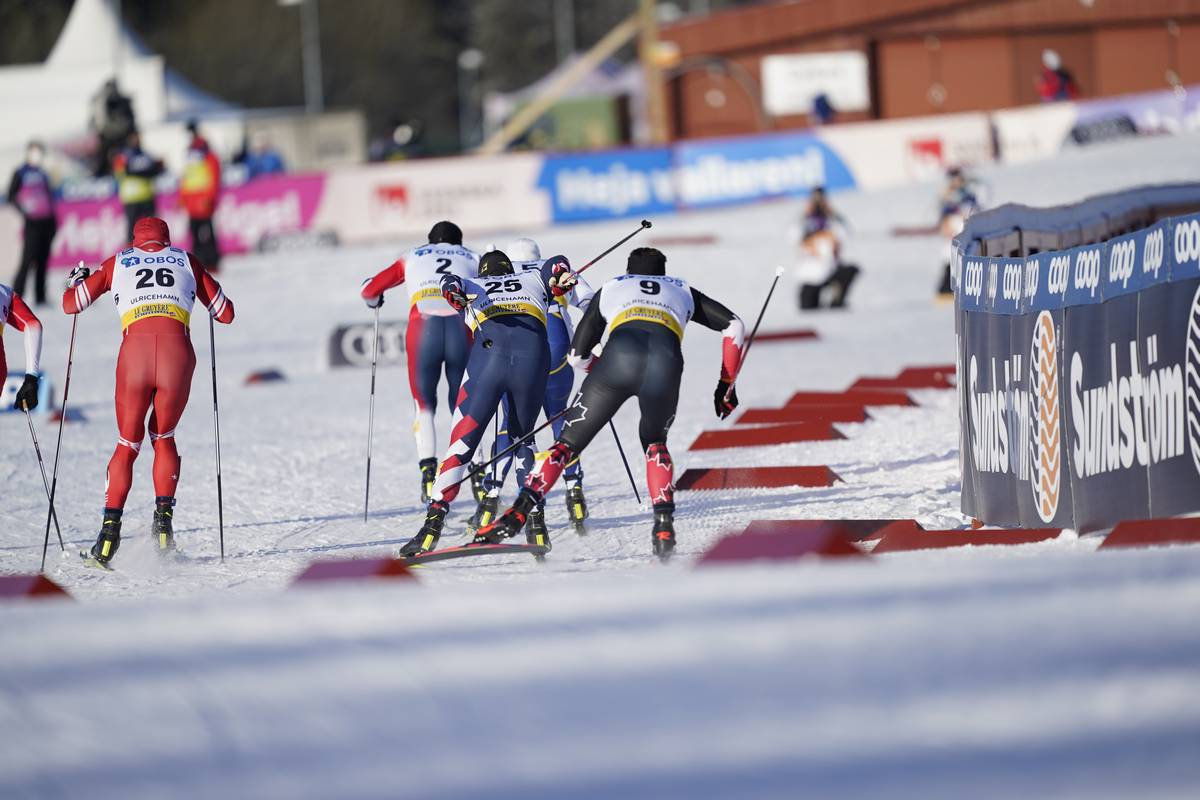
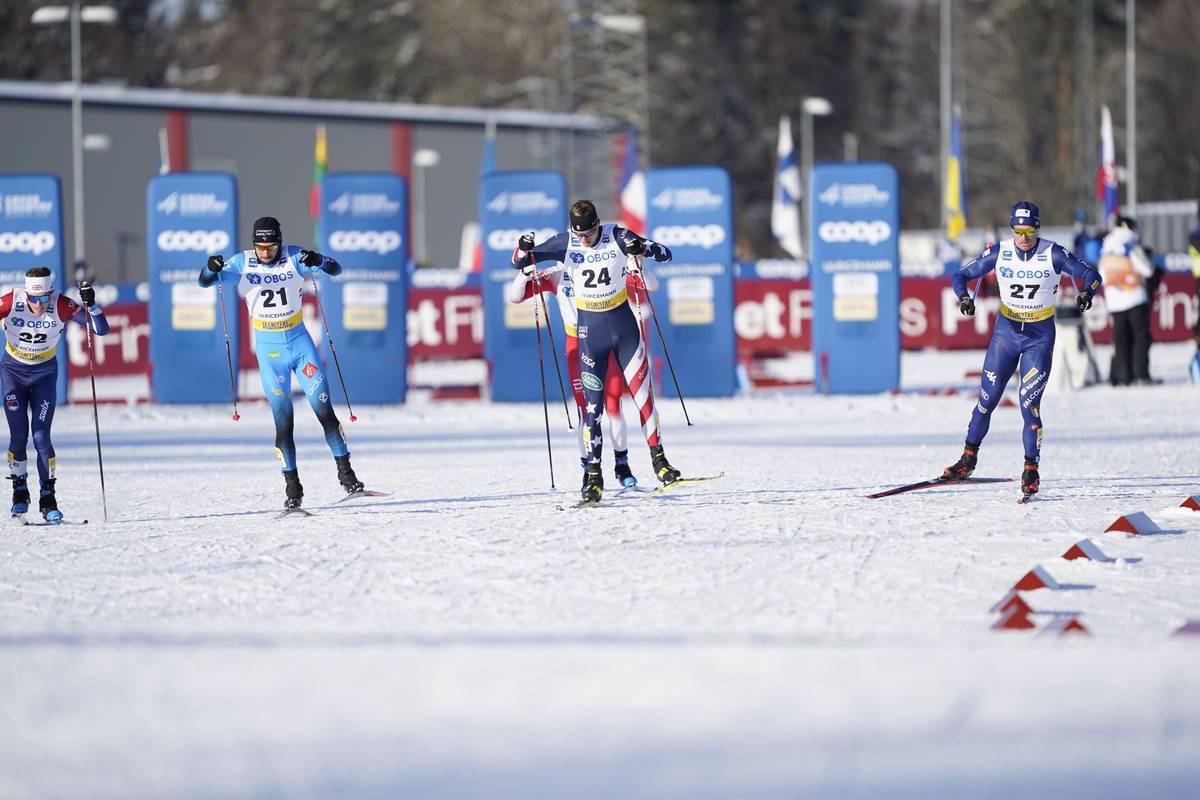
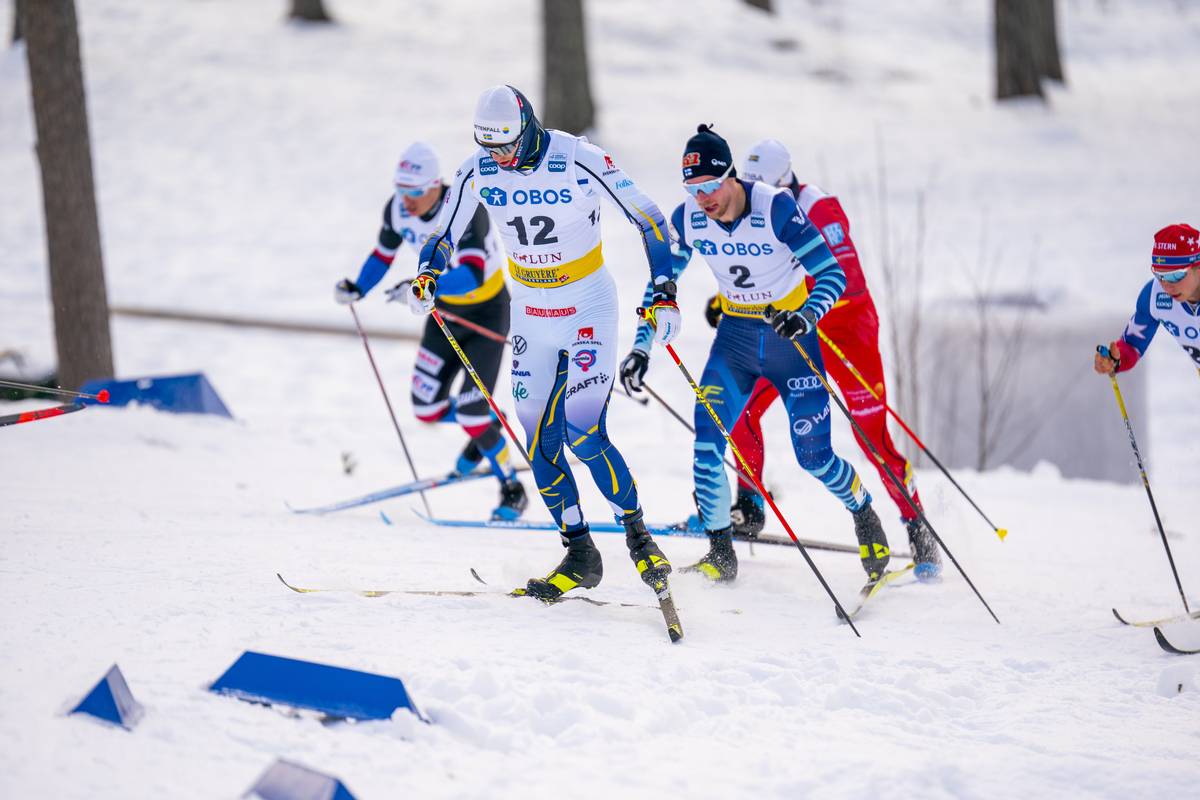
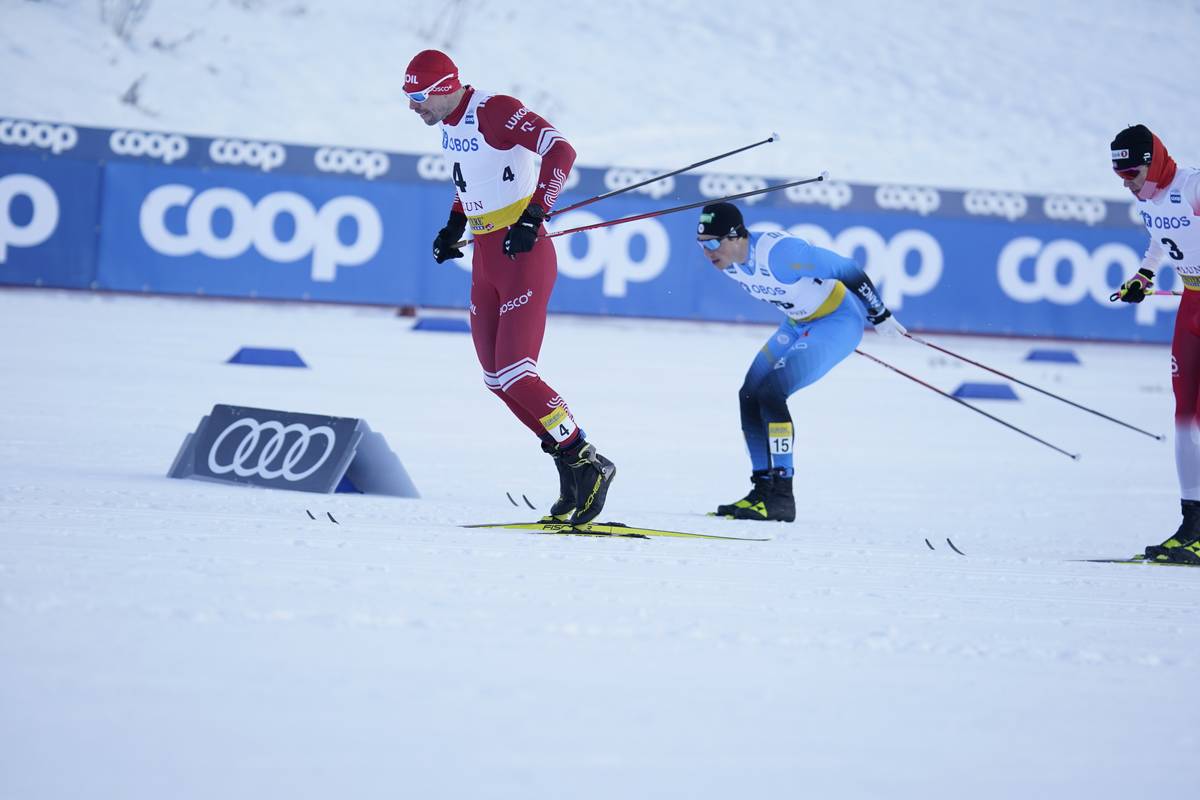
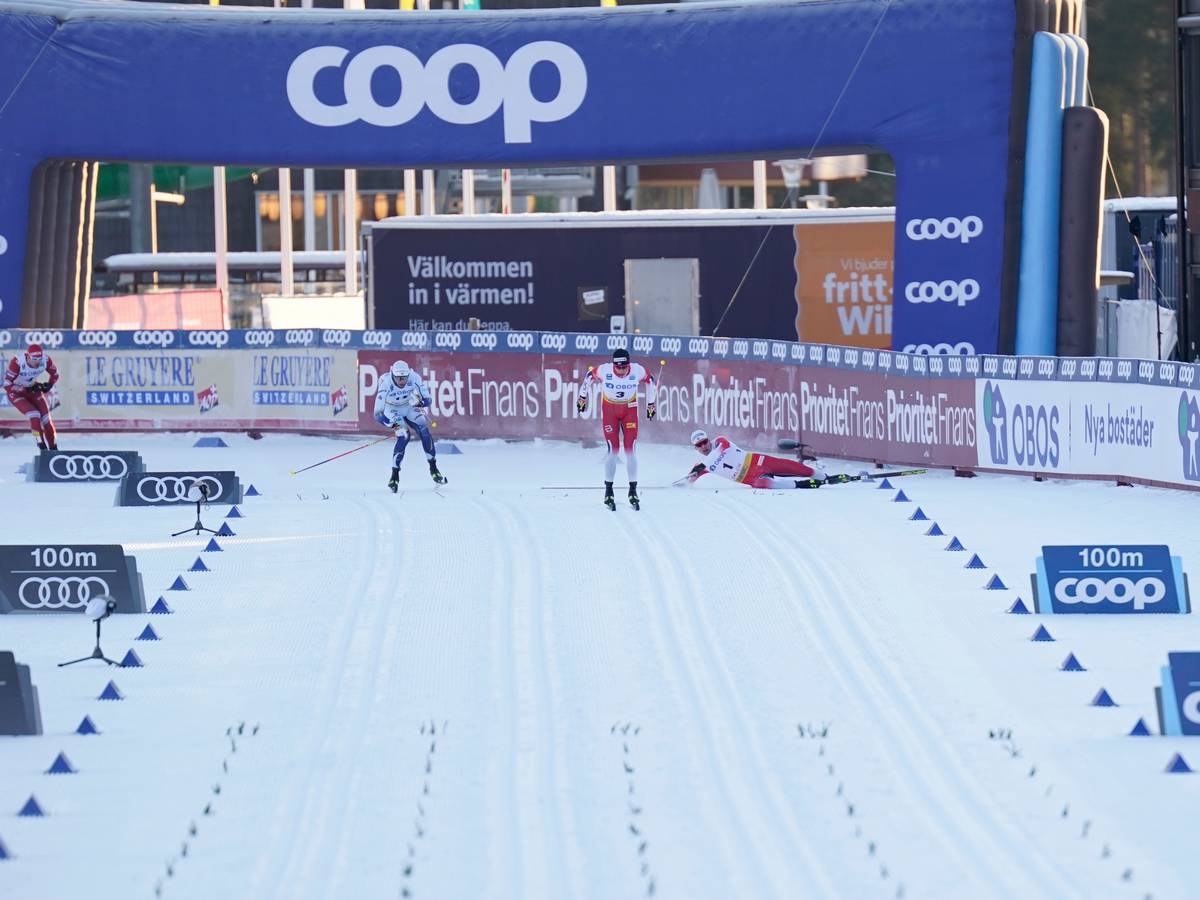
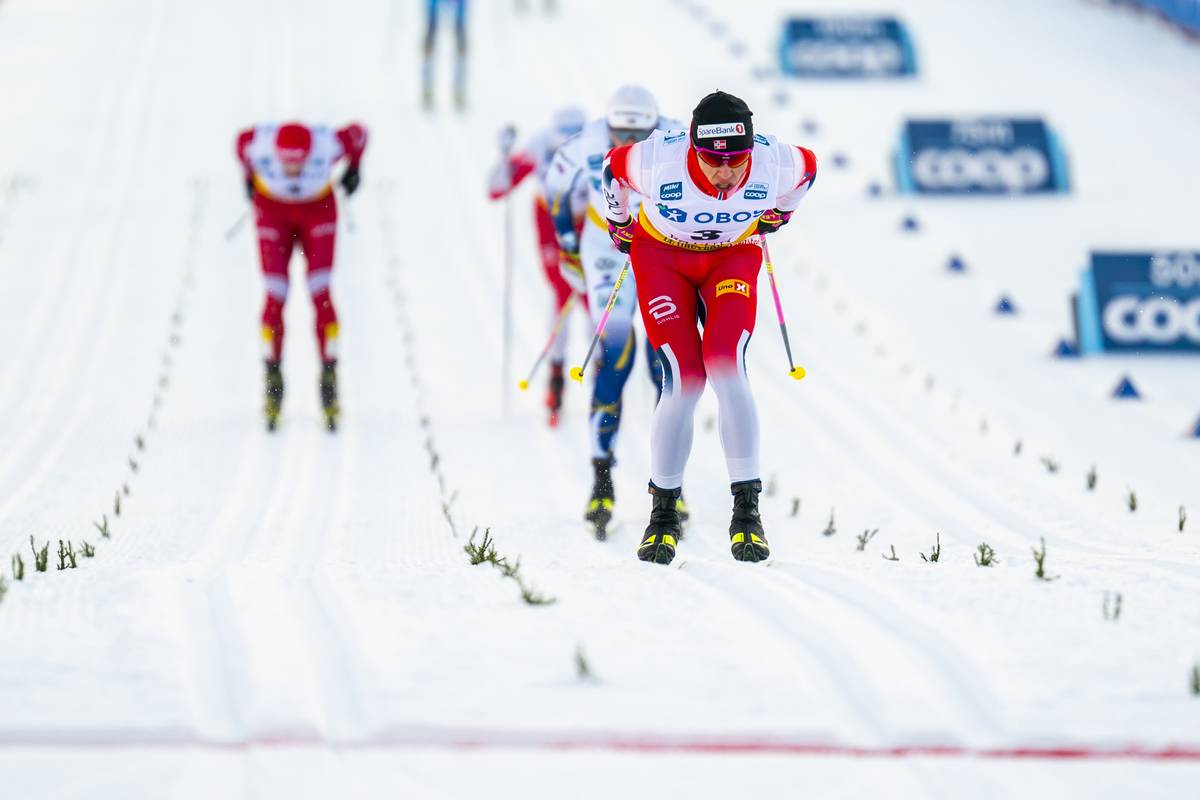
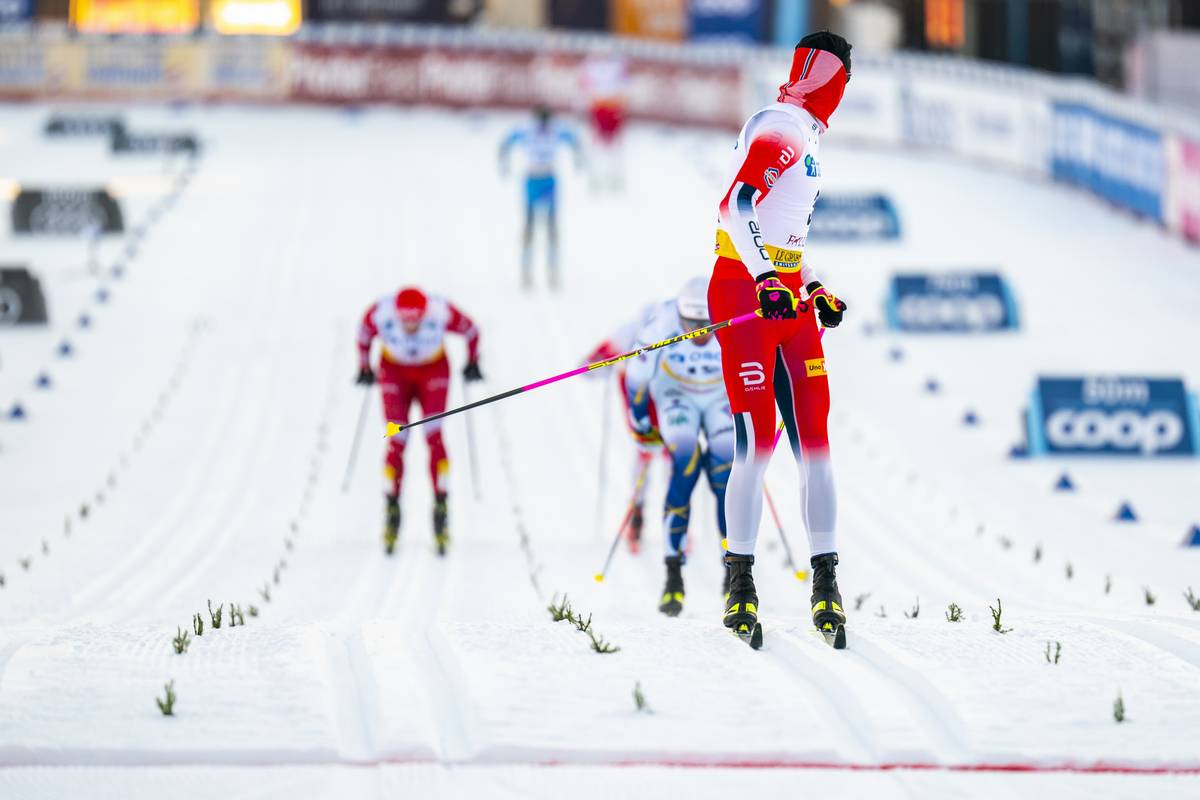
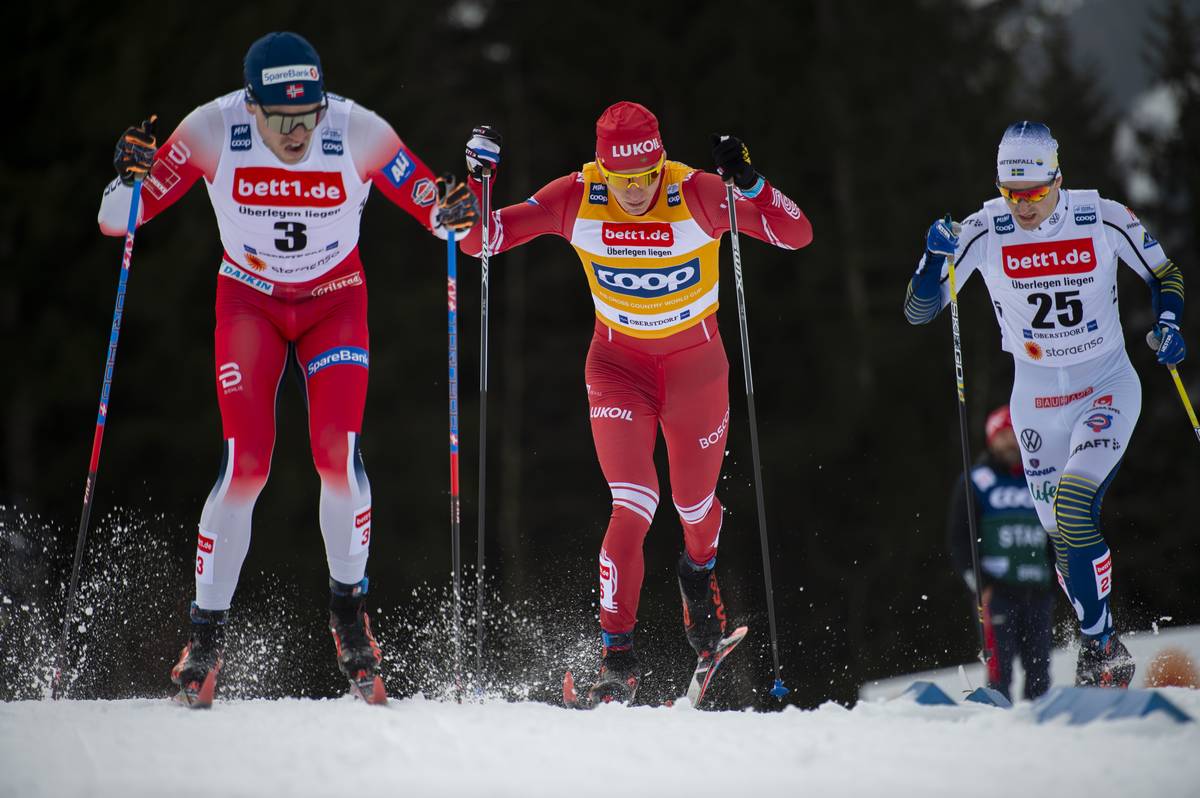
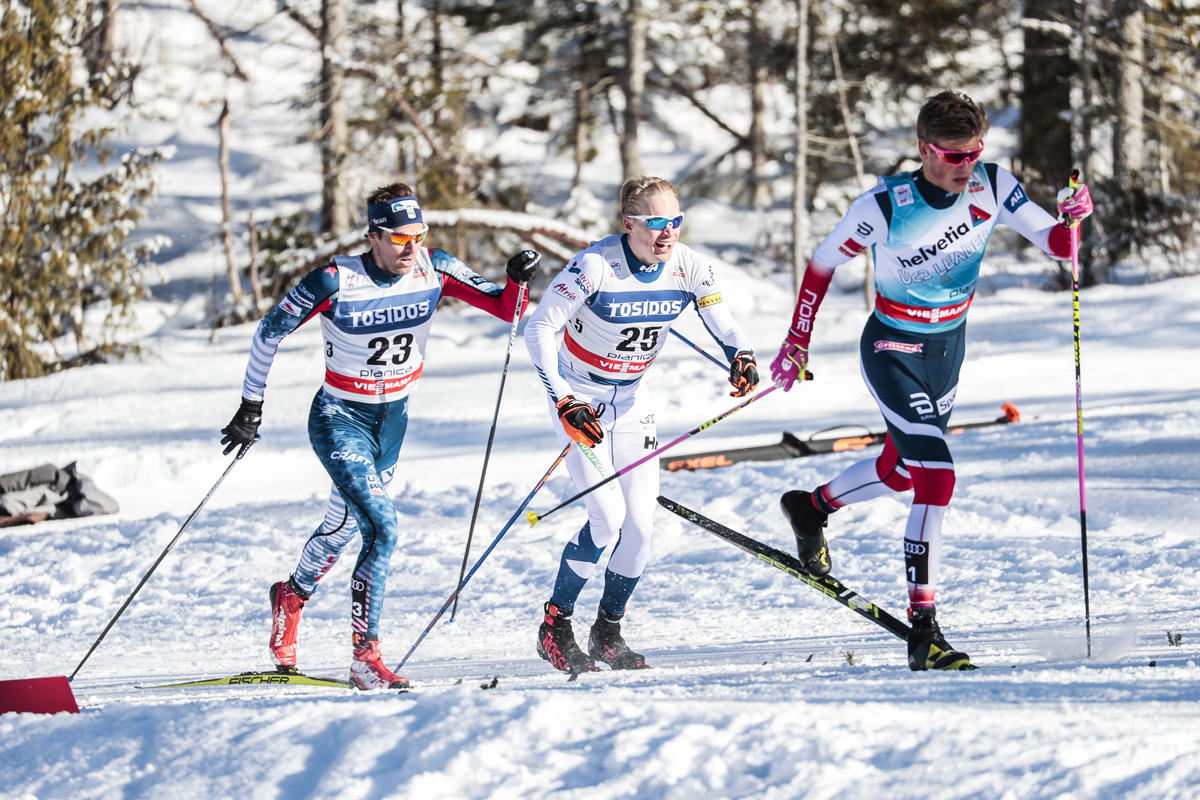
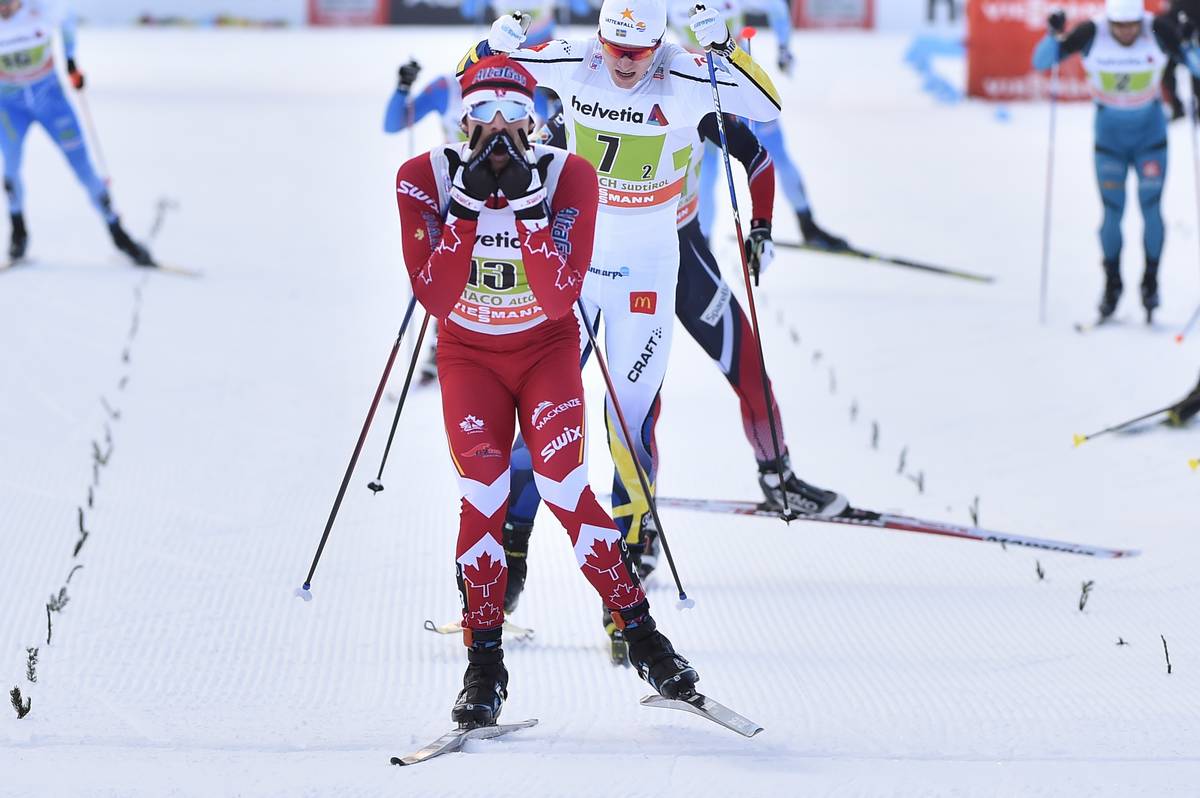
The day in Ulricehamn, Sweden (SWE) featured tight racing: Gleb Retivykh (RUS), Thomas Helland Larsen (NOR), Logan Hanneman (USA), Graham Ritchie (CAN), (l-r) (Photo: NordicFocus)
It was a sprint skier’s delight for nearly three-minutes on the 1.6-kilometer loop in Ulricehamn, Sweden on Saturday. In the uptick towards the hets on this working skier’s course an unusual name, as far as results go, topped the leaderboard after qualification.
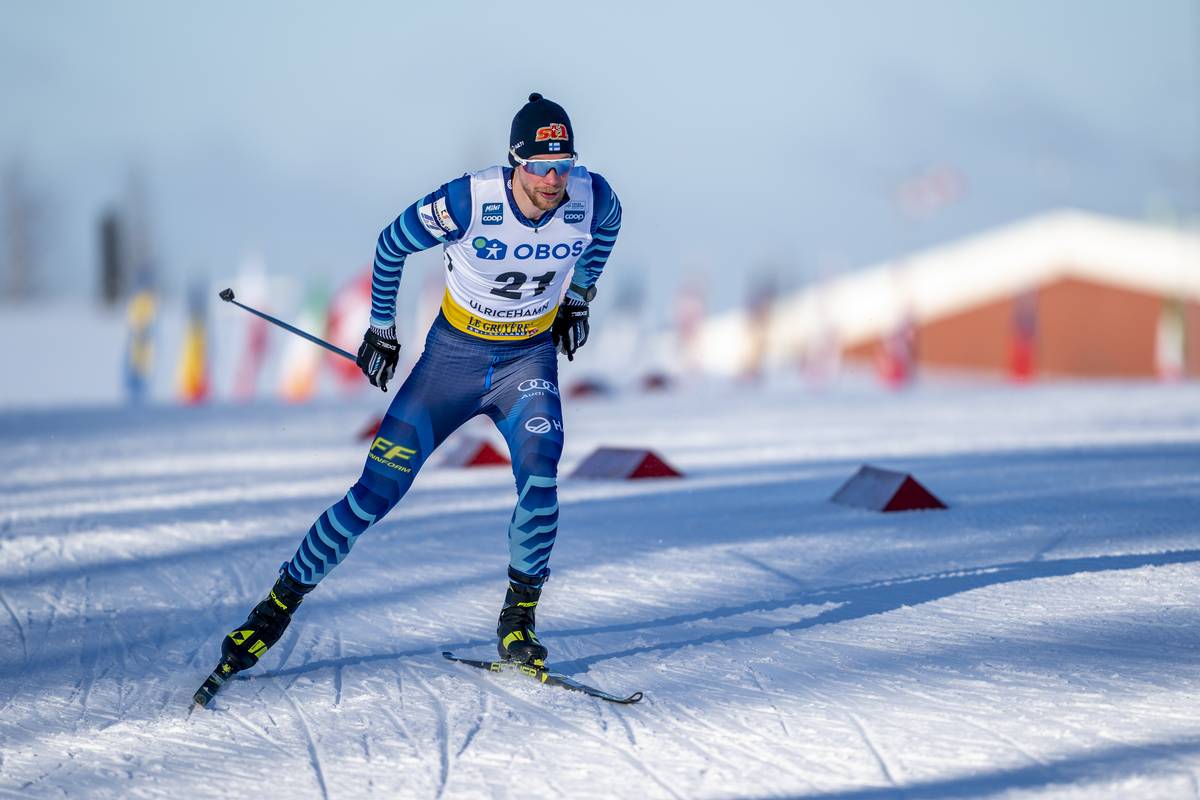
Finland’s Joni Mæki (26) was the fastest qualifier in 2:58.41. Before the last few weeks, Mæki had flown under our radar until he and Bolshunov captured cross-country headlines a few weeks back in Lahti. Before his notoriety, and before this weekend, Mæki had a single individual World Cup top-10, the seventh-best time in the 2020 Ruka 15 k pursuit.
Let’s just say his ability to stay with Russia’s Alexander Bolshunov on the final leg of the 4 x 7..5 k relay in Lahti may have opened his eyes. He was quick in qualification today.
The day’s fastest qualifier, Finland’s Joni Mæk. (Photo: NordicFocus)
Absent from the scene as he and his Norwegian A-Team mates prep for Worlds was Norwegian speedster Johannes Høsflot Klæbo. In fact, and we’ll note this in more detail later, no Norwegians advanced to the finals. (Which reminds us to explain that as we come closer to the start of the World Championships later this month, many of the cross-country skiers likely to medal there will take time away from the World Cup to dial in their World’s fitness.)
Graham Ritchie of Canada qualified in 9th. (Photo: NordicFocus)
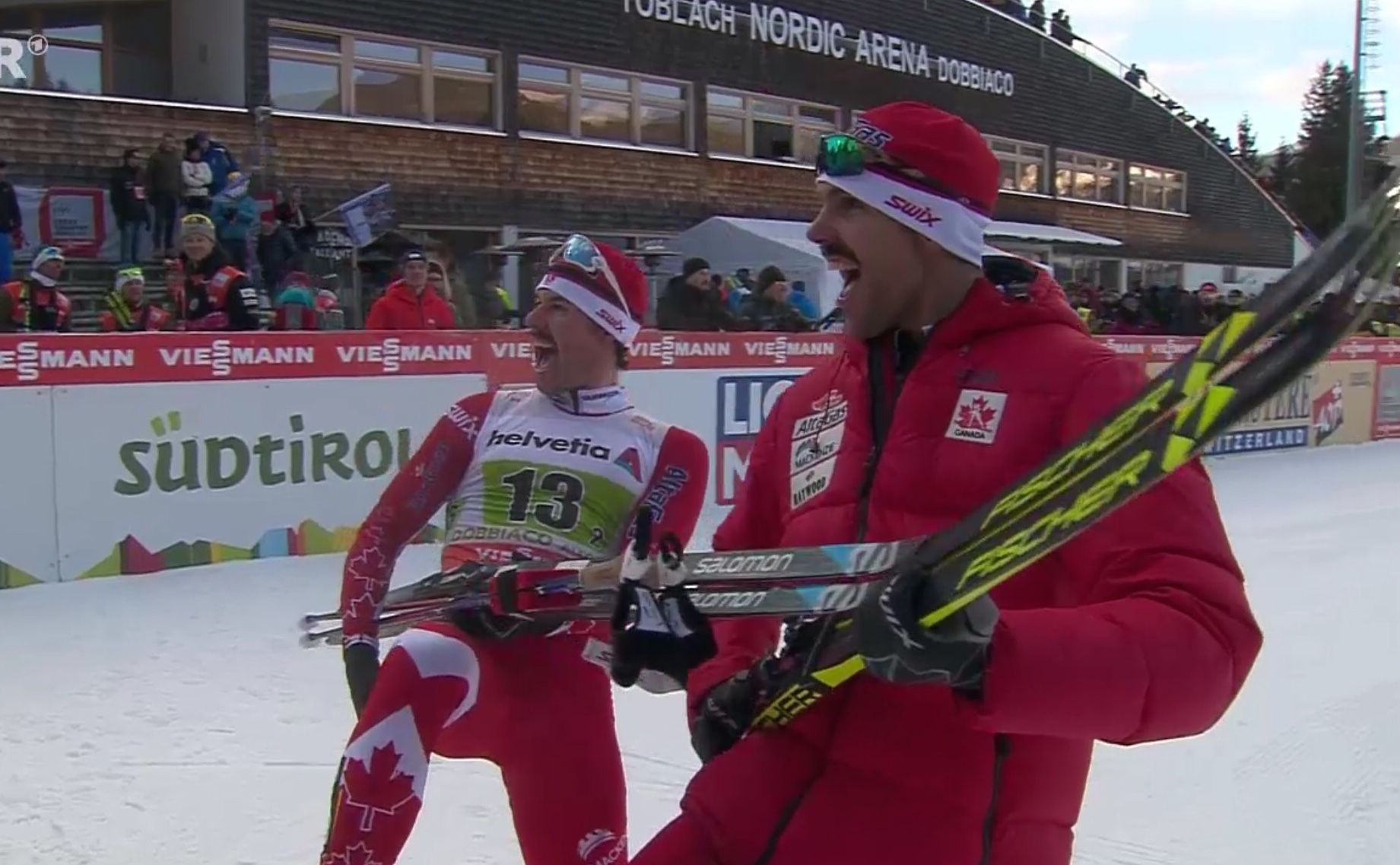
Otherwise, many of the usual suspects were in the skate sprint mix. However, the most notable qualifier from North America was Canada’s Graham Ritchie (22) in 9th (+4:06). According to FIS, this was the U-23 skier’s ninth World Cup start.
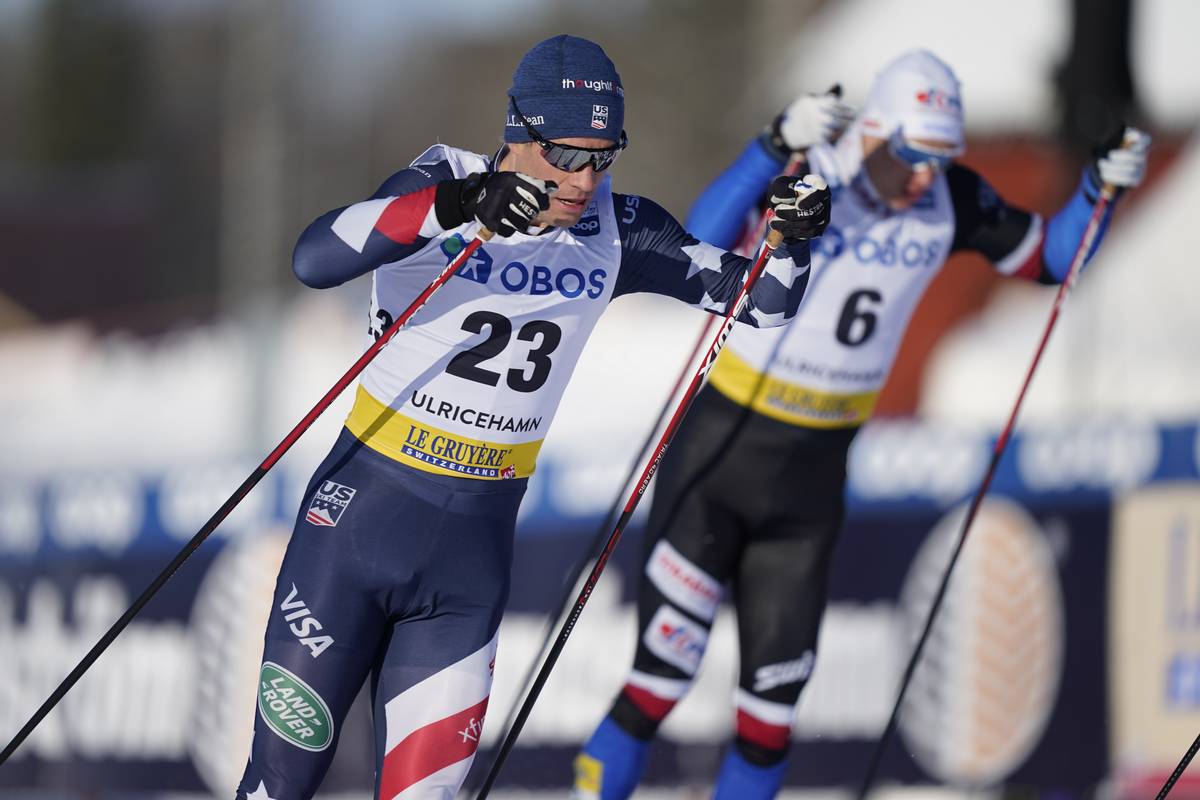
The Americans qualified three men for the heats. In order they were Simi Hamilton in 23rd (+6.95), Logan Hanneman 25th (+7.53), and Kevin Bolger 24th (+7.46).
We’ll get right to it – it was a frustrating day for the Americans. None advanced out of the quarterfinals with both Bolger and Hamilton stymied by incidents that scrubbed speed and took them out of the mix.
Simeon Hamilton (USA) during the quarterfinals on his way to 28th place. (Photo: NordicFocus)
Hamilton contested the first heat with some speedy company in the likes of Frenchman Lucas Chanavat, the day’s third-fastest qualifier, Russian Sergey Ustiugov, the fourth-fastest qualifier, and Michal Novak of the Czech Republic, sixth fastest.
Taking it out hot is Ustiugov’s bread and butter. And in this heat, he was able to keep it hot as he won in 2:56.45. Hamilton was in the mix coming around the final corner into the finish straight.
At 2:30, Ustiugov pulled upfront, with Chanavat and then Hamilton glued in second and third, respectively. Sweden’s Oskar Svensson, a name of note recently in sprinting, shimmied into a barely open window and moved in front of Hamilton. This is, after all, rock’em sock’em sprinting. And Hamilton let off the gas a smidge as Svensson steamrolled in. Around the downhill corner, Hamilton defied the Gs forcing a skier wide, and quick-stepped inside of Svensson, when he stumbled. With the lost speed, Hamilton’s opportunity was gone. He placed sixth in the heat to finish 28th. This was the fastest of the five quarterfinals and both lucky losers advanced from the heat.
Sergey Ustiugov (RUS) dictated the pace during each of his heats, he finished the day in 6th place. (Photo: NordicFocus)
Another bitter pill was swallowed by Bolger in the fourth heat. He too was in the mix late until he tangled with Italy’s Michael Hellweger at the 2:05 mark. Bolger was spun around, his chance for advancing snuffed out. Norway’s Finn Hågen Krogh pushed ahead and won the heat. Bolger finished in fifth to place 23rd overall.
Kevin Bolger (USA) at the start of the quarterfinal, he would finish the day in 23rd place. (Photo: NordcFocus)
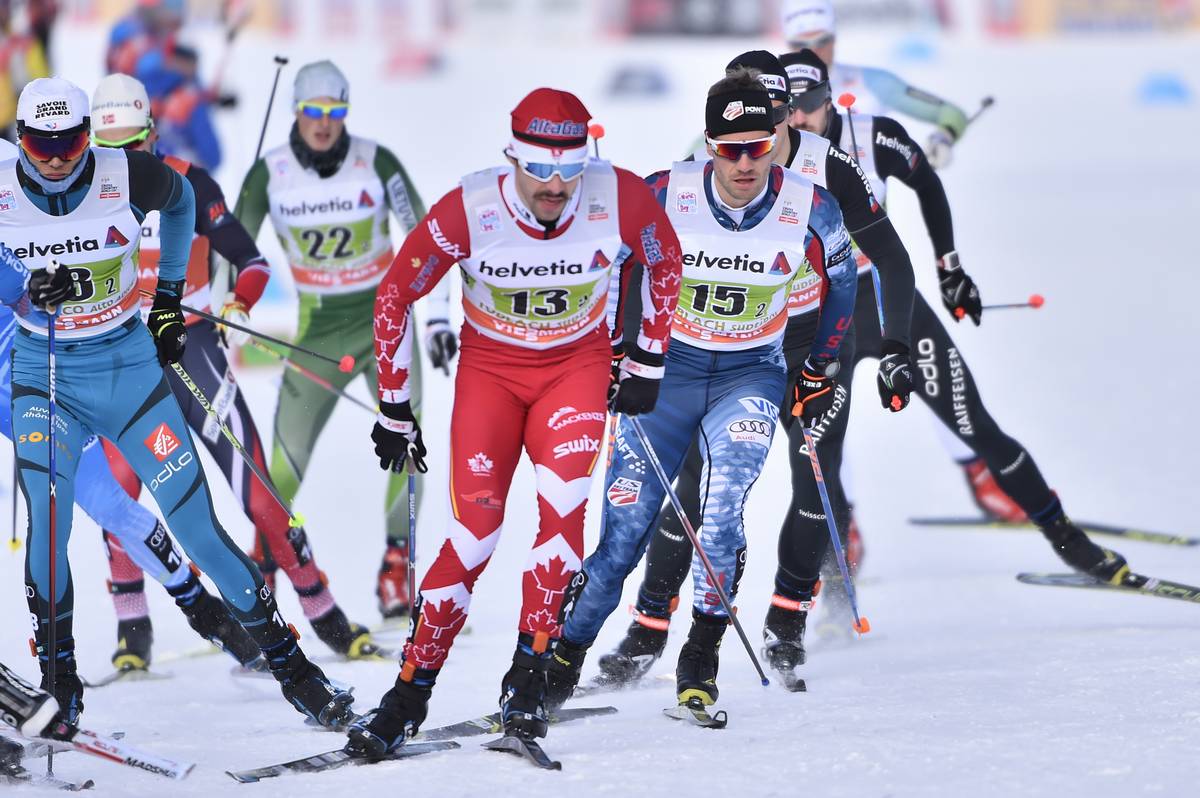
In between, Hanneman and Ritchie raced in the second heat. Ritchie held strong for much of the race, yet lost vital ground in the finish to place fourth (+0.53) and 17th overall for a career-best.
“I’m definitely proud of that qualifier. Not only was it a personal best but it was great to have that Canadian flag in the top-10 on the results sheet,” said Ritchie.
“I’m pretty excited with the performance today,” Ritchie told Nordiq Canada. “My skis were incredibly fast thanks to the wax techs. It was so much fun to race my first World Cup heats.
“I found myself close to the back quickly in the heat. I tried to pass people the entire way, but it just wasn’t working out,” added Ritchie. “I was able to get a good kick at the end and move up a couple of spots in the finishing stretch.”
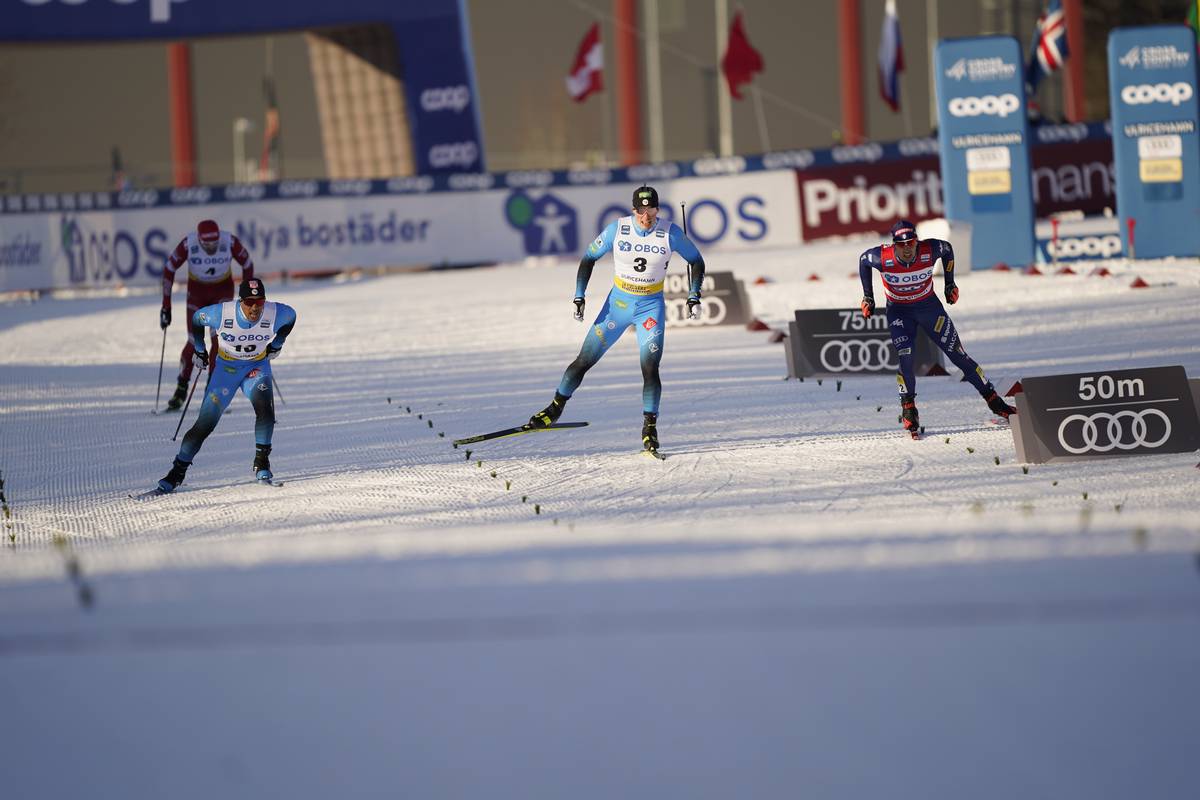
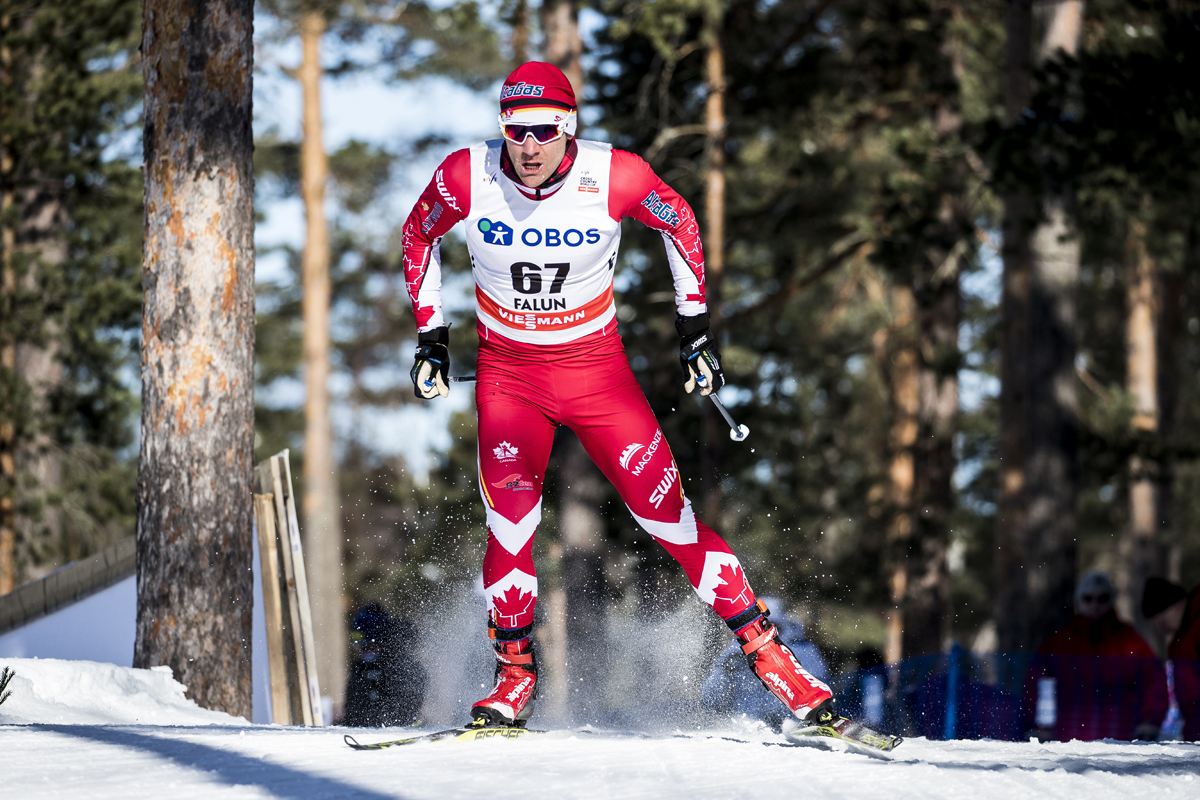
Graham Ritchie (bib 9) posted the 9th fastest time in the qualification and ended his day 17th overall. (Photo: NordicFocus)
Hanneman, who hails from Fairbanks, Alaska and trains with APU in Anchorage, finished sixth in the heat and 29th overall.
JC Schoonmaker, a young American skier of note, finished 35th, while Peter Holmes was 68th. U.S. skier Gus Schumacher is in Oberstdorf, Germany preparing for U-23 Worlds.
Post-race interview with U.S. Head Coach Matt Whitcomb
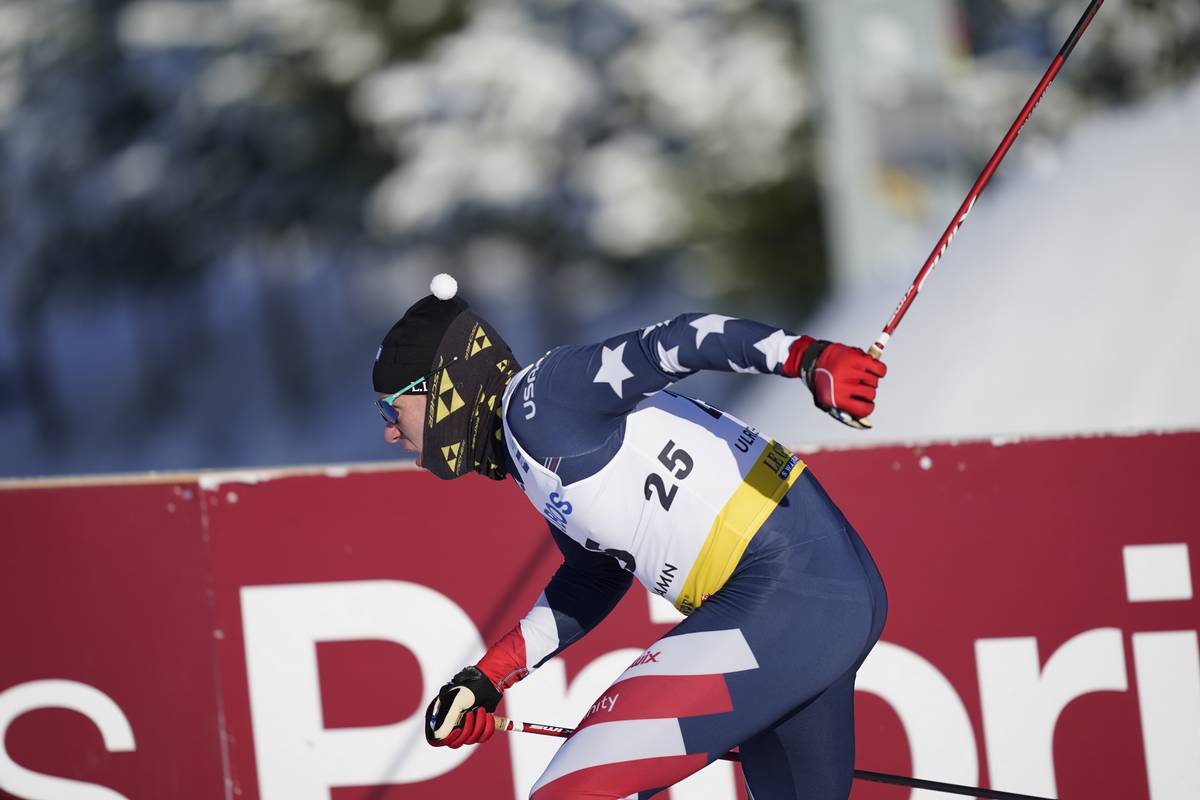
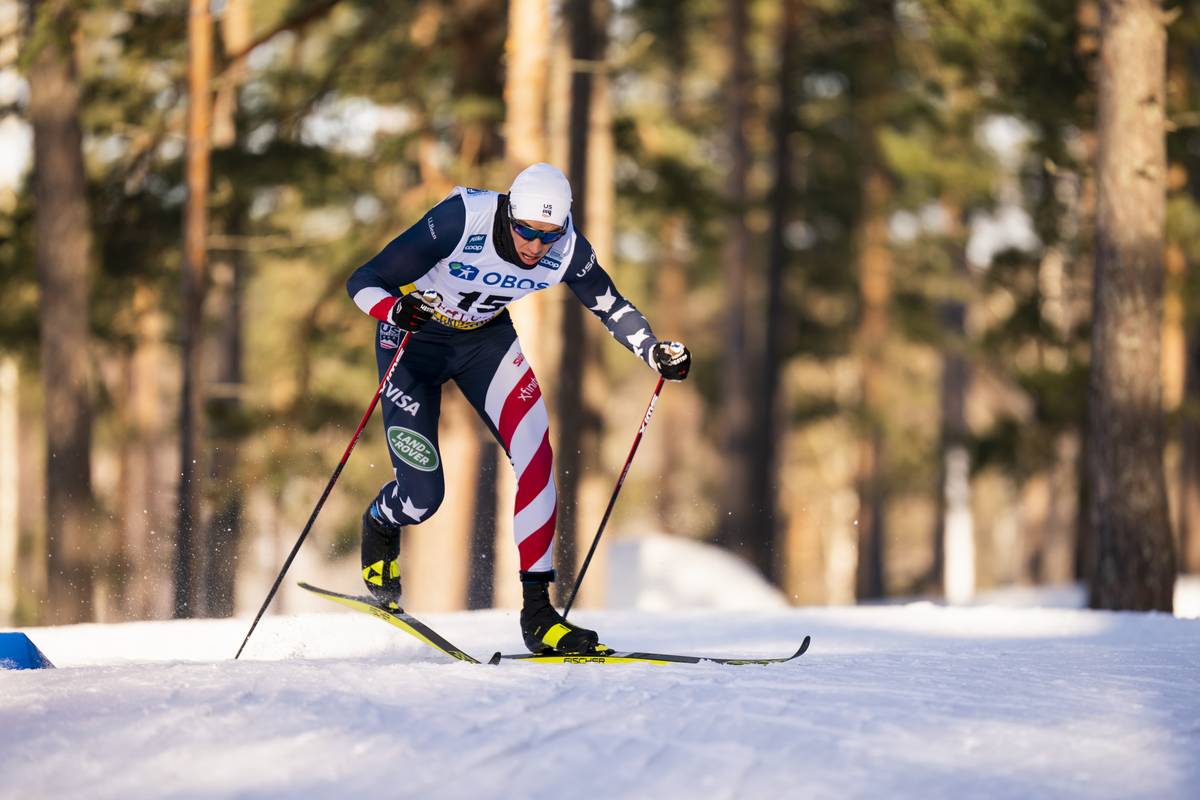
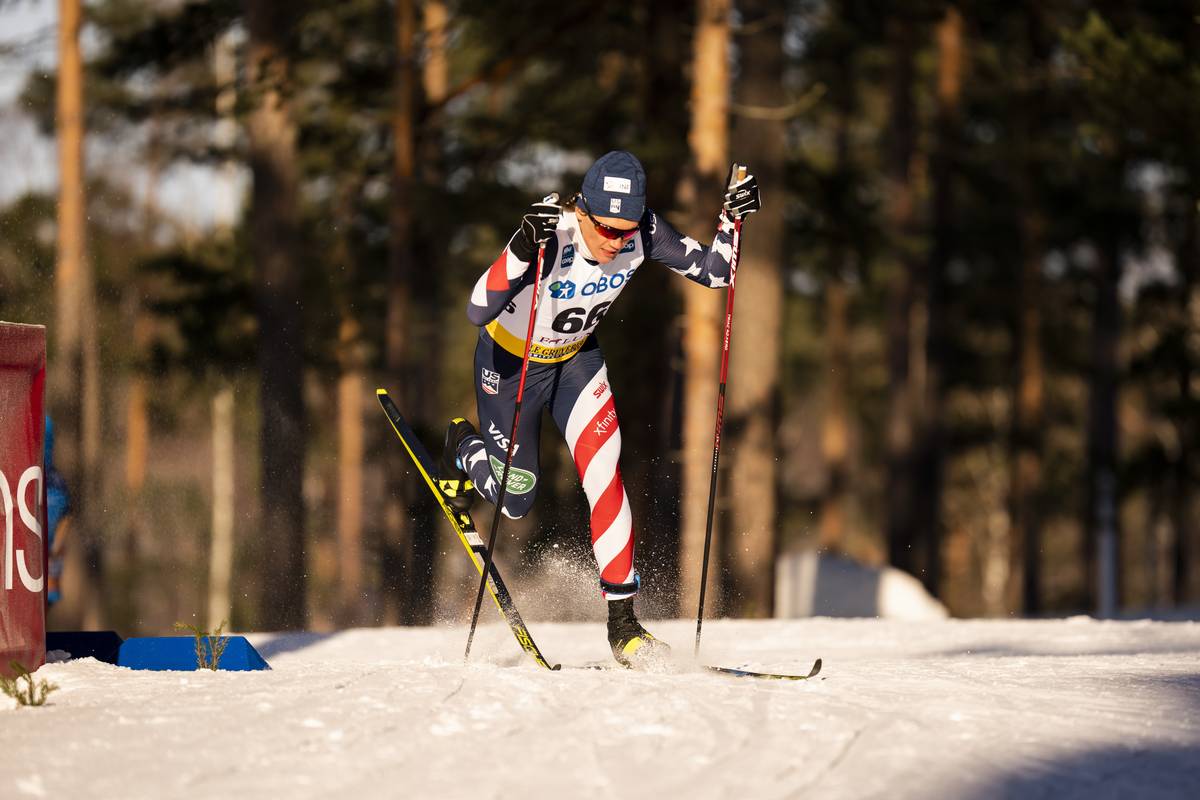
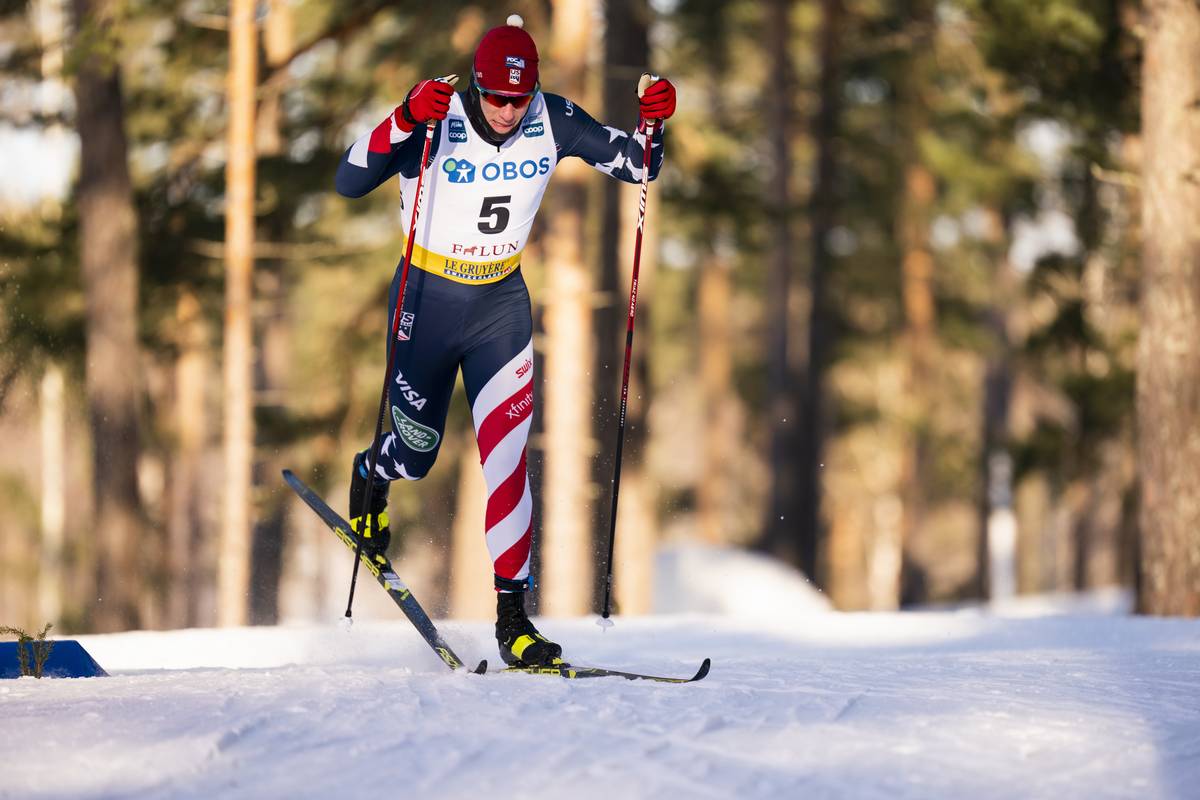
Logan Hanneman working the course in Ulricehamn, Sweden. (Photo: NordicFocus)
For Canada, Russell Kennedy finished 44th, Pierre Grall-Johnson 51st, and Antoine Cyr 60th.
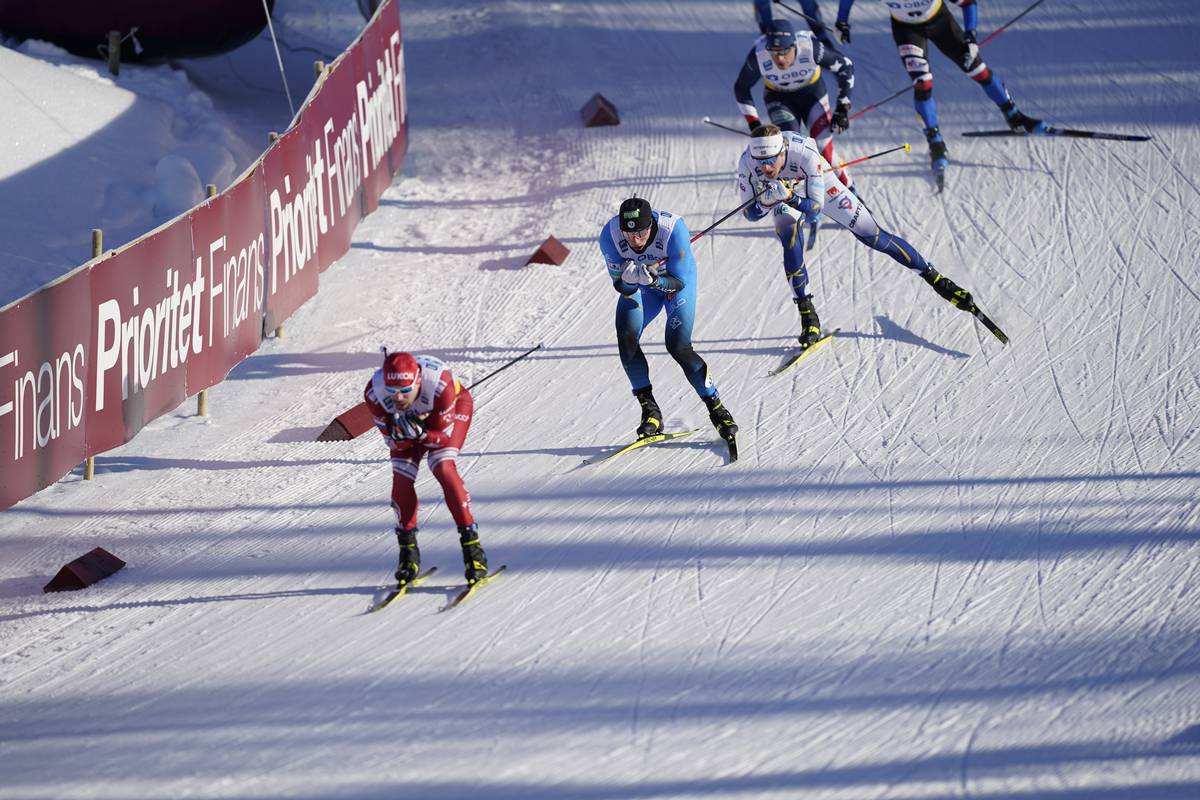
In the first semi, Ustiugov gunned again. At 30 seconds he moved to the front. He positioned himself well, yet the group remained tight on this tough-to-pass-on-course. France’s Richard Jouve won, with Ustiugov in second, and the two lucky losers, Russia’s Gleb Retivykh third, and Chanavat fourth.
Italy’s Federico Pellegrino won the second semi, with Svensson second by only 0.3 seconds.
Attention Chanavat, this Pellegrino requesting a flyby… Negative Pelligrino, the lane is full. (Photo: NordcFocus)
In the men’s final, there was no guessing the contents of the first chapter: Ustiugov flexed first. In the next to last chapter, the Russian folded, as he faded on fumes to place sixth, 6:06 seconds off the winning time. The five remaining skiers were tight-pack skiing for much of the race. Only Chanavat was taxed too much from the endurance sprint racing. Around the corner, and into the straight, it looked like any of the four contending skiers could take the win: Jouve, Pellegrino (one of the best historic skate sprint closers), Retivykh, or Svensson.
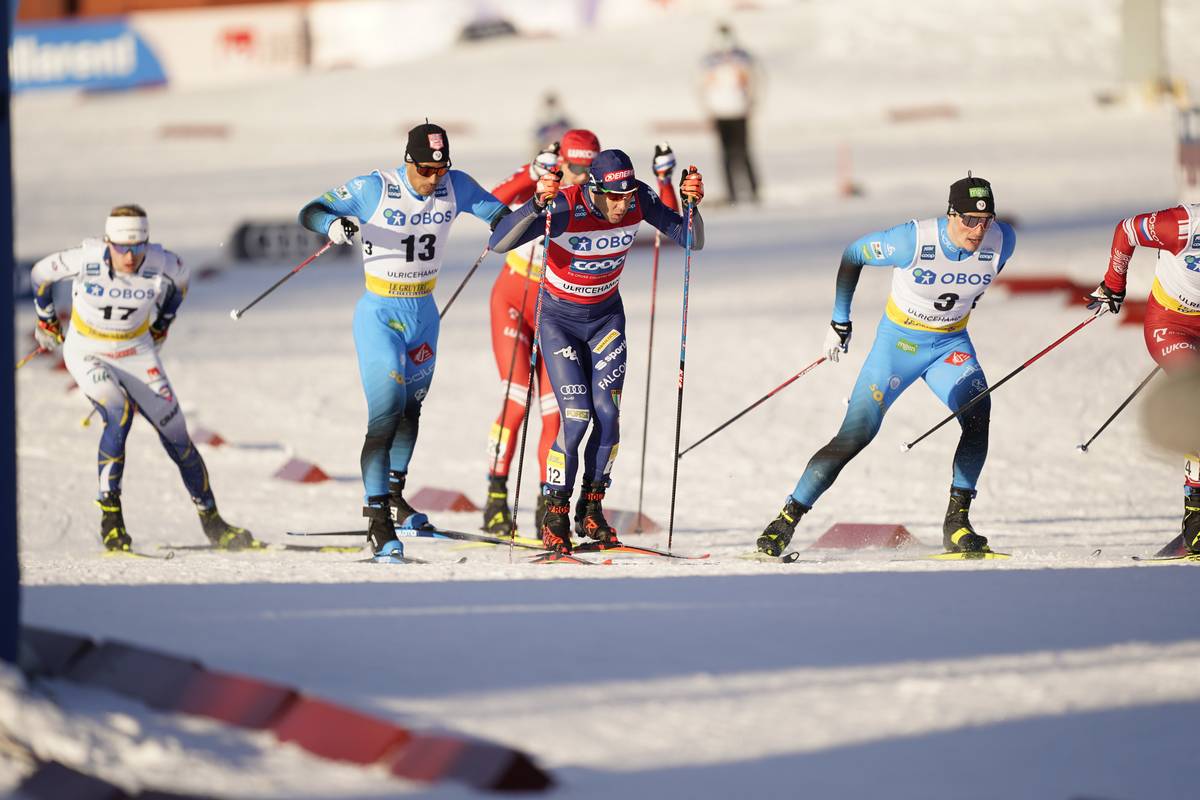
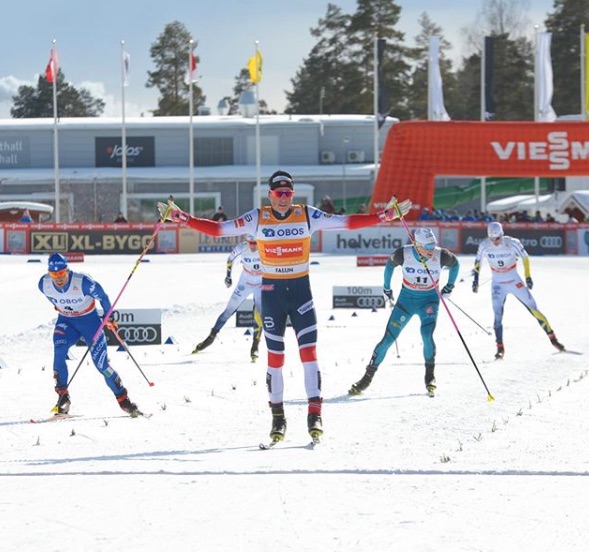
Oskar Svensson (SWE), Richard Jouve (FRA), Federico Pellegrino (ITA), Lucas Chanavat (FRA), (l-r) during the men’s final in Ulricehamn. (Photo: NordicFocus)Oskar Svensson (SWE), and Gleb Retivykh (RUS), (l-r) closing down on a tight finish. (Photo: NordicFocus)
The advantage went to Sweden’s Svensson as he toed the line first in 2:55.34 – which was the day’s fastest time for a heat; quarter or semi. Retivykh placed second, Pellegrino third, Jouve fourth, and Chanavat fifth.
Svensson (25) has had a breakout season. Until this year, he had never podiumed in an individual race on the World Cup. This season, he has won the classic sprint in Val di Fiemme, Italy, and placed second last weekend in Falun (both were classic sprints).
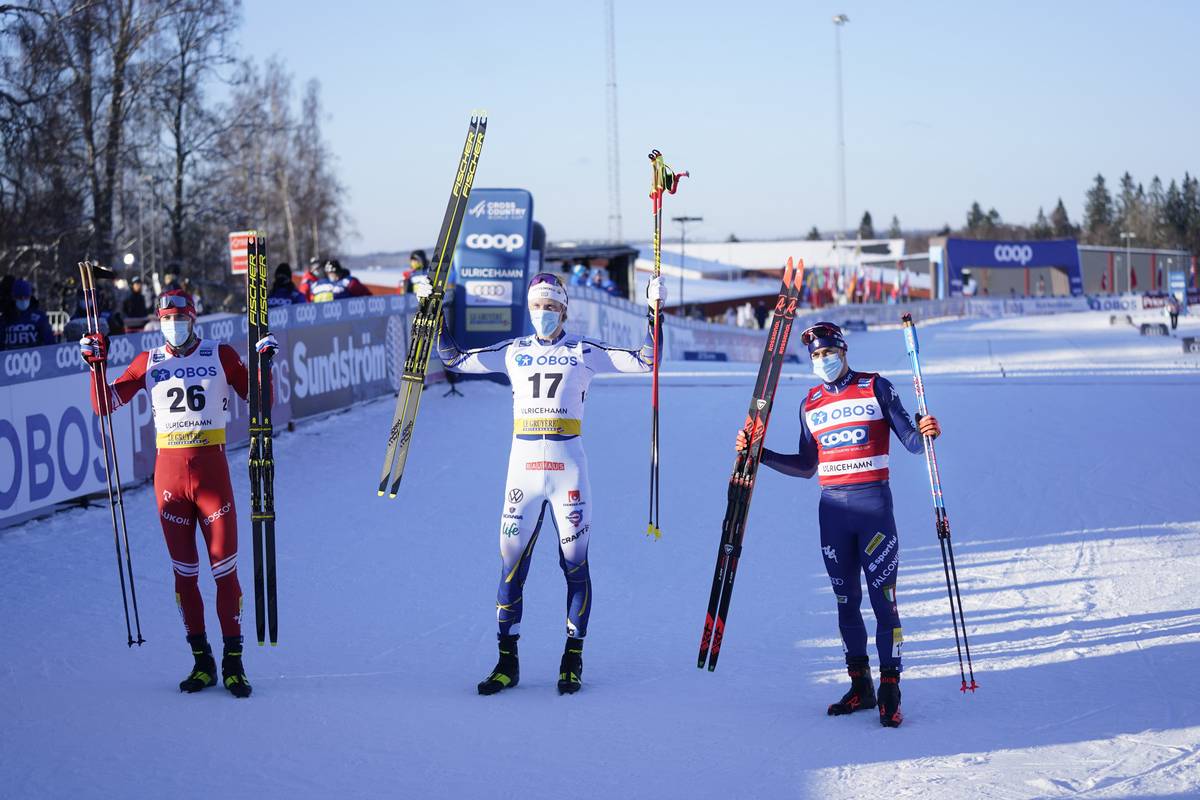
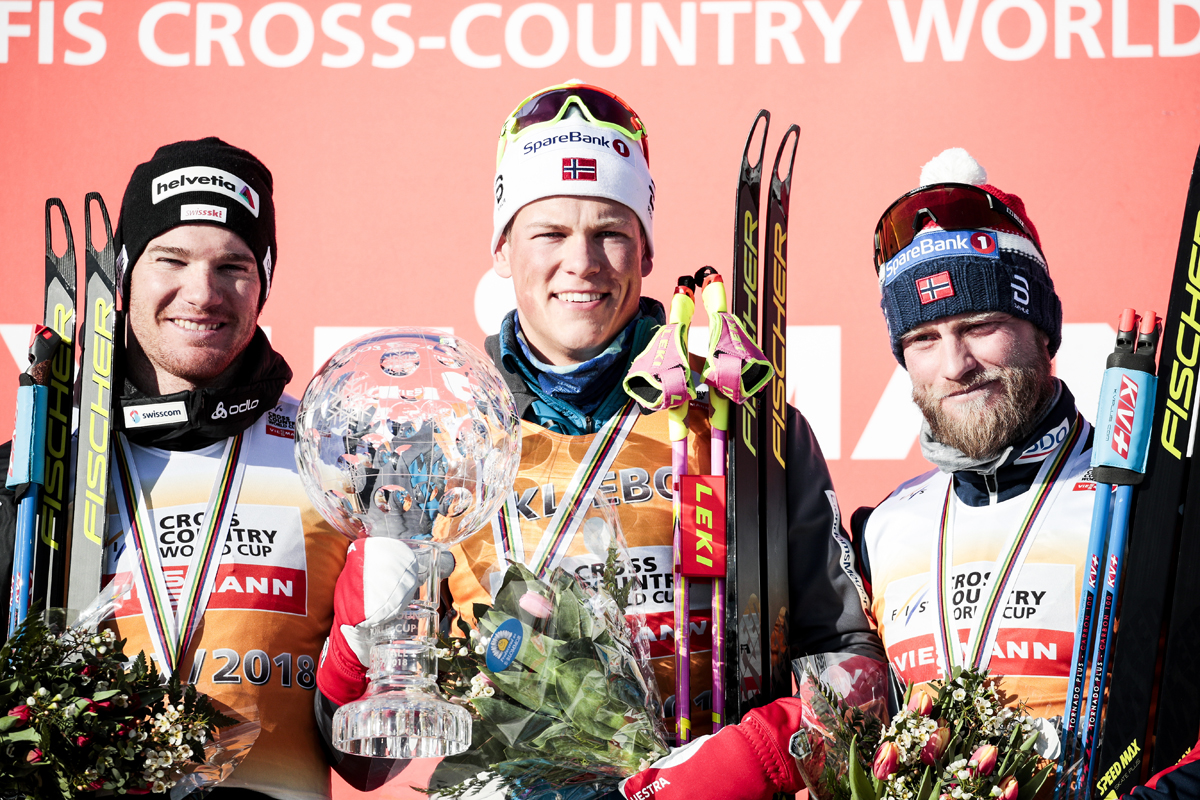
Gleb Retivykh (RUS), Oskar Svensson (SWE), and Federico Pellegrino (ITA) take the freestyle sprint podium in Ulricehamn, Sweden. (Photo: NordcFocus)
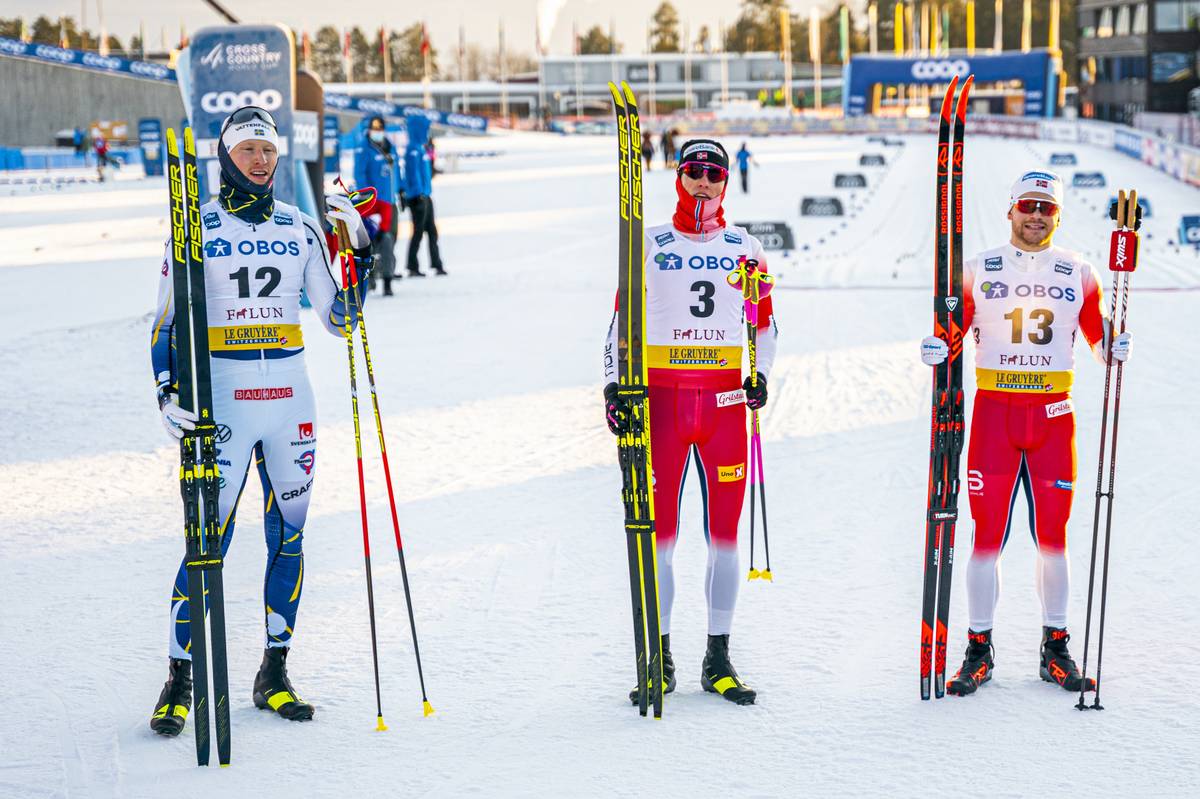
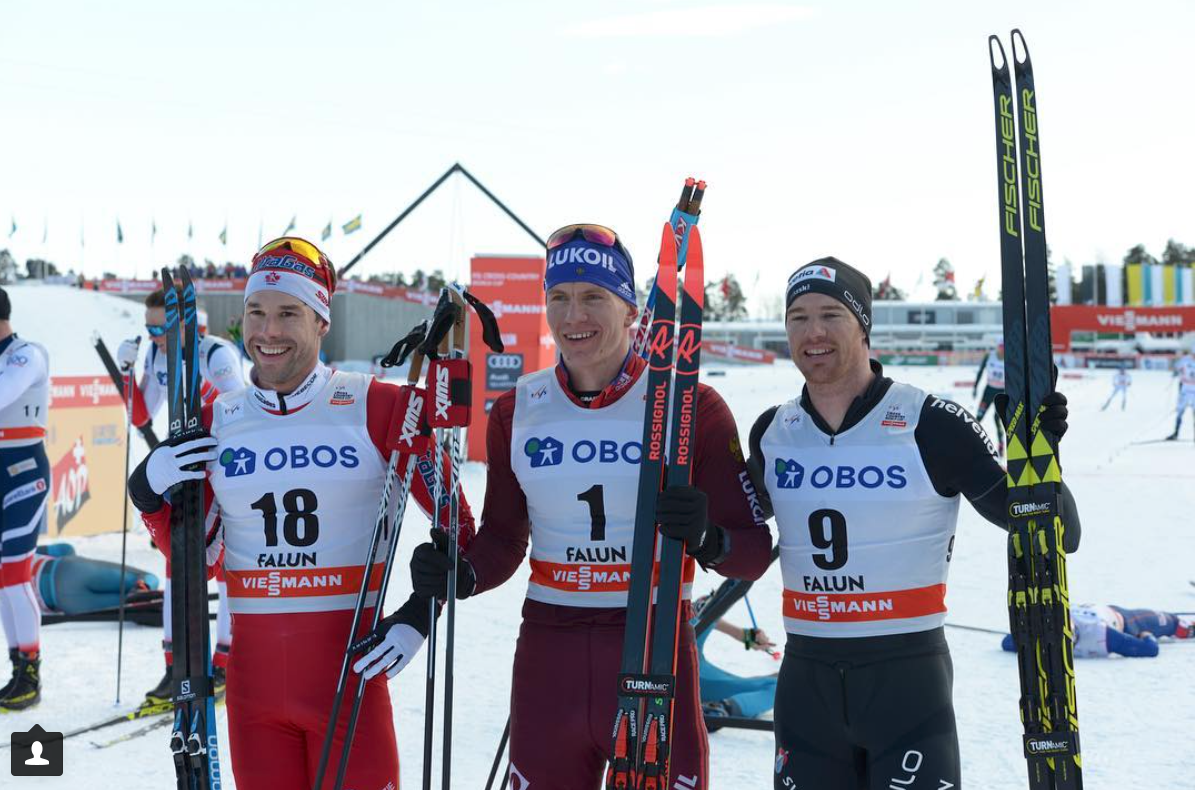
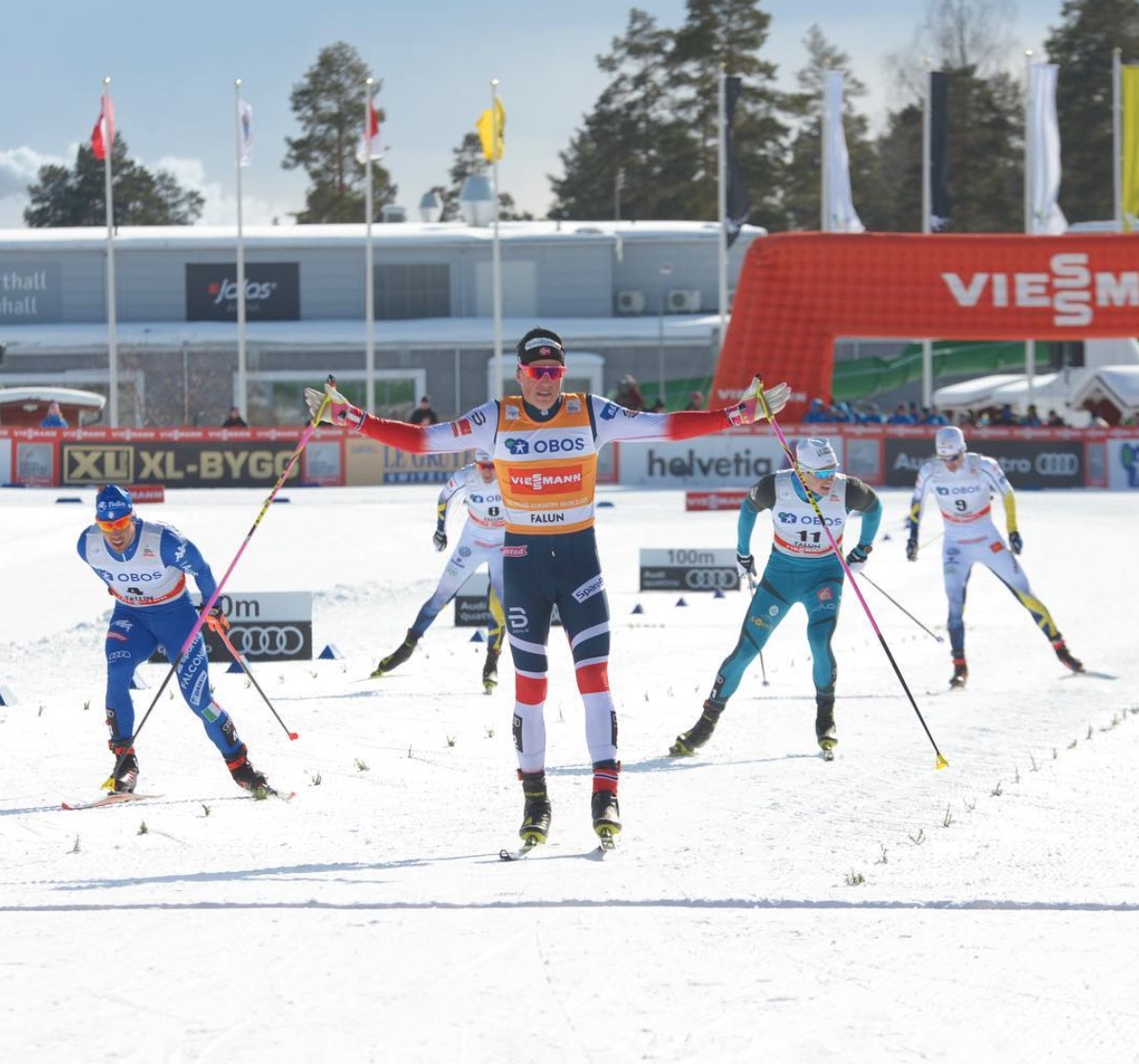
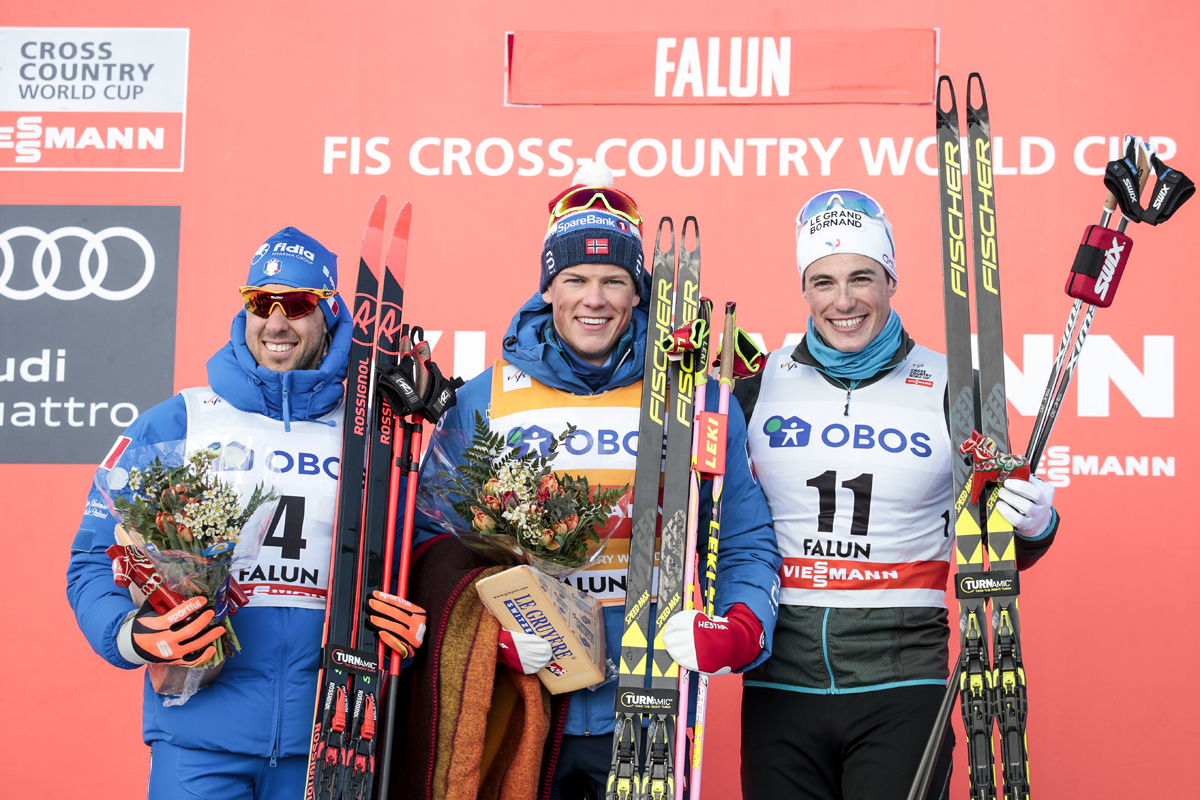
The men’s classic sprint podium in Falun, Sweden : Oskar Svensson (SWE) second, Johannes Høsflot Klæbo (NOR) first, and Håvard Solås Taugbøl (NOR) third, (l-r). (Photo: NordcFocus)
This World Cup coverage is made possible through the generous support of Marty and Kathy Hall and their A Hall Mark of Excellence Award. To learn more about A Hall Mark of Excellence Award or to learn how you can support FasterSkier’s coverage please contact info@fasterskier.com.
Squeaky snow, firm tracks and a fanless Falun was the backdrop for the men’s 1.4-kilometer classic sprint in Falun, Sweden on Sunday. The racing capped a three day series on the championship courses that hosted an individual start skate Friday and a mass start classic Saturday.
The qualifier and heats revealed the nature of the men’s sprint field – indeed a more challenging mix of skiers with Norway present. The Falun stop represents the second World Cup weekend since early December in which Norway arrived with a slate of skiers. We’ll get to this, but one-third of the 12 spots in the semis were earned by Norwegians.
Erik Valnes won the qualifier in 2:46.83 with pre-race favorite Johannes Høsflot Klæbo third (+2.23). And as if risen from the pandemic ashes after suffering a tough go with Covid-19, Russia’s Sergey Ustiugov, in his first weekend of racing this season, qualified fourth (+2.49).
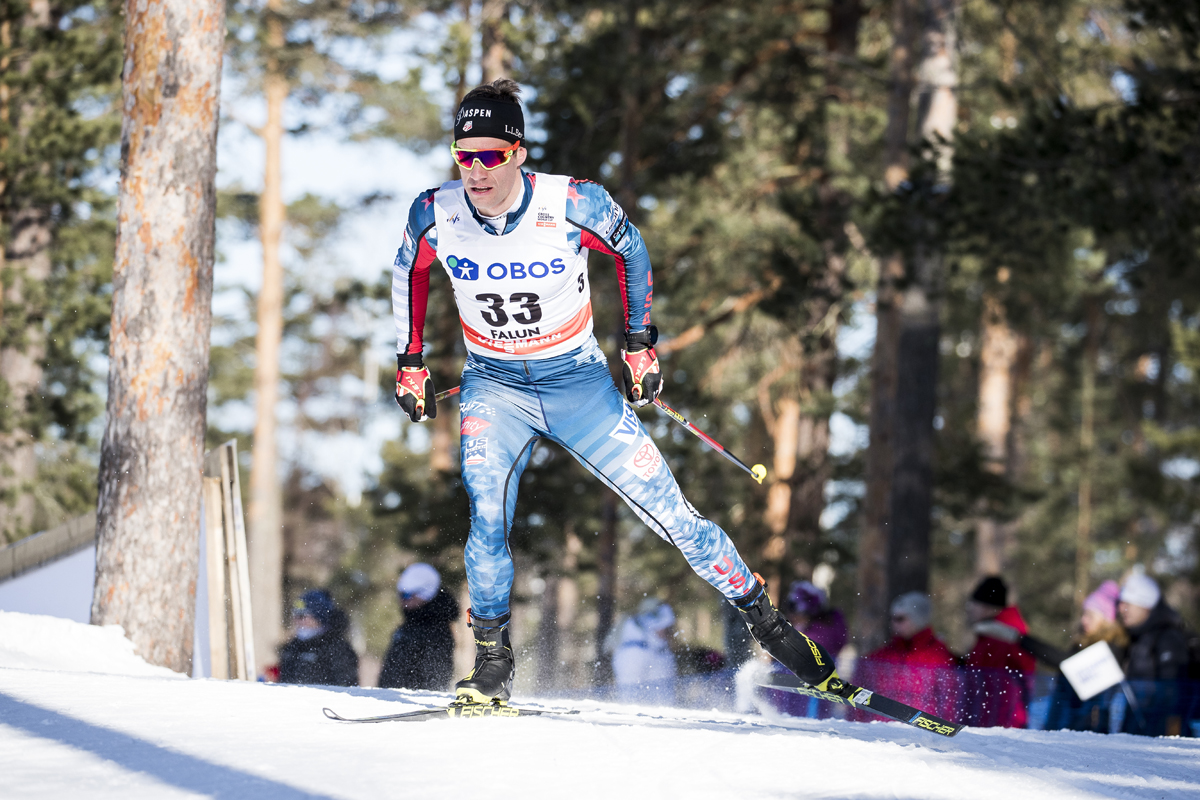
JC Schoonmaker (20) of the U.S. was the lone North American to advance into the heats after qualifying in 11th (+5:06). Schoonmaker placed 18th overall for his third World Cup top-20. His best result remains 14th place in the skate sprint in Dresden, Germany, earlier this season.
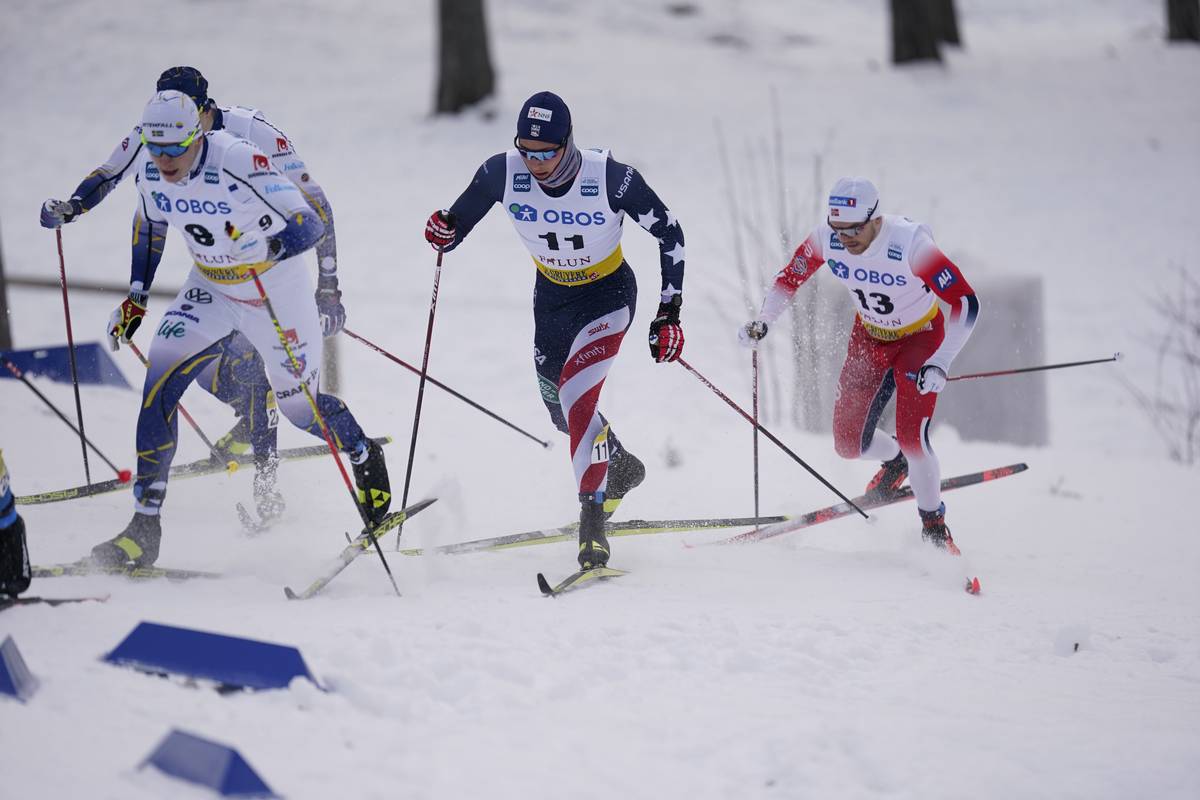
Marcus Grate (SWE), Haavard Solaas Taugboel (NOR), James Clinton Schoonmaker (USA), (l-r) during the quarterfinals. (Photo: NordicFocus)
Schoonmaker began the fourth heat and skied near the front a minute into the race. His prospects to advance began to fade slightly nearing the two minute mark as he slotted into fourth place cresting a punchy climb. The Tahoe, California native finished fourth (+0.88) as Finland’s Lauri Vuorinen won the heat in 2:52.36.
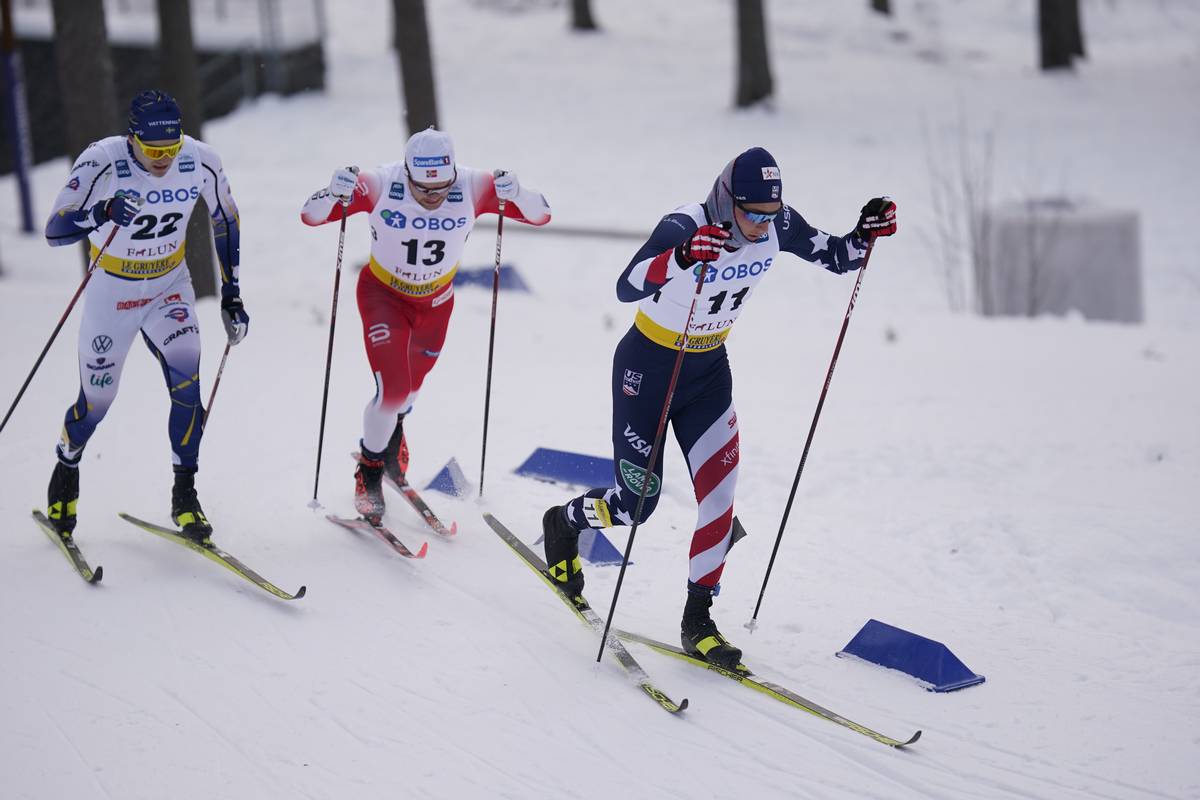
Anton Persson (SWE), James Clinton Schoonmaker (USA), Håvard Solås Taugbøl (NOR), (l-r) during the Falun, Sweden classic sprint quarter-finals. (Photo: NordicFocus)
“In my heat I wanted to try and stay relaxed and make sure I wasn’t leading on the last downhill into the stadium,” Schoonmaker explained. “I felt like I was exactly where I wanted to be on the second climb but ended up getting a little crowded in over the top and from there I was just barely too far back to move on. I feel like I’m skiing with more confidence in these world cup heats but I just need to gain more experience in the packs in order to break into those semis.”
Schoonmaker will be part of a loaded American team headed to World Juniors/U-23s beginning in Vuokatti, Finand on February 6th. “I feel really good heading into U-23s,” said Schoonmaker. “I think I’m skiing well and I know I have the speed that is needed to ski at a high level. The U-23 field is super competitive so I can’t wait to mix it up with those guys in Vuokatti and keep the momentum rolling.”
A trio of Americans just missed out on qualifying in Falun. (Their qualifying place also represents each athlete’s standing in the overall.) They were Kevin Bolger in 31st (+9.74), Luke Jager, in his first career World Cup start, 32nd (+9.79), and Logan Hanneman 33rd (+9.83). Also for the U.S., Simi Hamilton qualified 37th (+10.57), and Hunter Wonders 68th (+17.20).
Just missing the heats in 31st, Kevin Bolger racing in Falun. (Photo: NordicFocus)
Luke Jager in his first career World Cup start, qualified in 32nd. (Photo: NordicFocus)
Logan Hanneman qualified in 33rd. (Photo: NordicFocus)
Antoine Cyr was the top Canadian, finishing in 49th. He was followed by Russell Kennedy in 51st, Pierre Grall-Johnson 54th, and Graham Ritchie 62nd.
The Sharp End
On a course requiring mandatory sprint-speed and power-bursts, endurance, and drafting, the sharp end racing tactics in the men’s first semifinal lulled well into the race. Atop the course’s final serious climb, none of the skiers opted to lead into the sinuous descent back towards the stadium. That is until Oskar Svensson of Sweden took the opportunity and skedaddled over the top leading Valnes, Federico Pellegrino of Italy, Gleb Retivykh of Russia, and Klæbo into the s-turn’s maw. This was a similar tactic the Swede used to his advantage taking the overall win in Val di Fiemme earlier in the season.
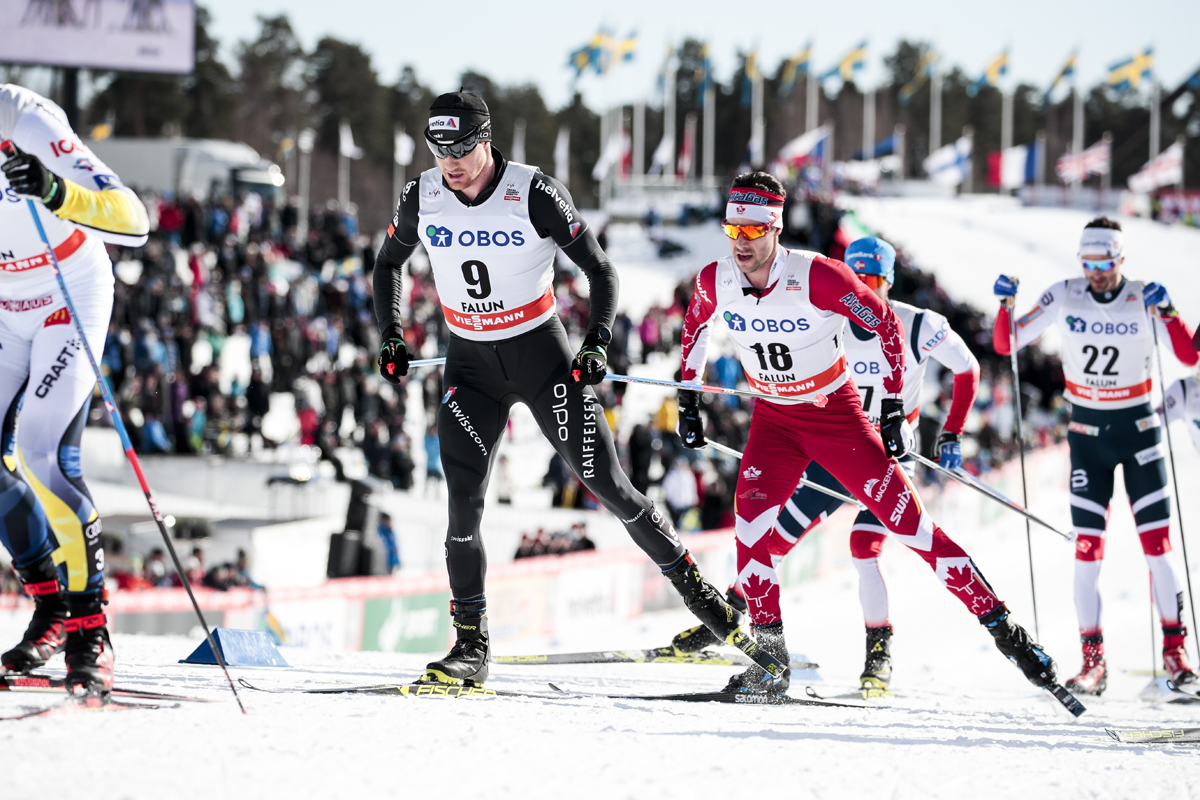
Sweden’s Oskar Svensson (bib 12), during the Falun, Sweden classic sprint. (Photo: NordicFocus)
As he does, Klæbo outpaced Svennson down the straight winning the first semi while Svensson placed second.
The second semi’s reveal was loud and clear at 1:00. Ustiugov powered up the first and longest of the climbs, gained roughly 10 meters on the five chasers, and never relented the lead. In fact, rather than cede ground, he looked to have a 15 to 20 meter lead gliding into the finish straight. He won in 2:51.06, 2.01 seconds ahead of second place Lucas Chanavat of France.
High hips and extended: Russia’s Sergey Ustiugov charging in Falun. (Photo: NordicFocus)
Contesting the final were, Klæbo, Svensson, Ustiugov, Chanvat, Valnes, and Norway’s Håvard Solås Taugbøl.
Ustiugov led out with pedal-down gusto to dictate this final’s narrative. The tactic, with a savvy crew of skier’s along for the ride, did not pay podium dividends for the Russian. Although dominating his semi, Ustiugov, who last won a World Cup sprint in December 2017, could not sustain his seminfinal’s moxy.
He was first around the 1:10 mark cresting over the longest climb, but the five skiers shadowing Ustiugov in the final were able to sit in his draft. Svensson shot around the Russian to lead into the second major climb. Svensson ran up the outside track, while Ustiugov ran up the inside. And Klæbo simply Klæboed. Again the Russian propelled himself into first up over the final climb. However, the group did not hesitate to determine who led into the downhill as Ustiugov was already zipping away in a tuck. Klæbo, Svensson, and Valnes all descended behind the Russian by a few meters.
Down through the S-turns and a sliver before the final roller, Klæbo, Svensson, and Valnes overtook Ustiugov. Klæbo slotted into the finish straight first, with Valnes tight behind. Yet as Valnes, taking the corner hot, tried to quick-step around, he lost his footing and slid out. Klæbo took the win 2:48.22, Svensson placed second (+1:45) and Taugbøl third (+2.80).
Sliding out of the tracks and off the podium, Erik Valnes of Norway had his hopes dashed in the Falun, Sweden classic sprint. (Photo: NordicFocus)
“It was a very hard race out there, but I was really glad when Ustiugov was heating up the pace, really high there,” Klæbo told FIS after the race. “My goal was to be second before the last downhill and in the quarterfinals, semi, I was number five, so I thought I would try to be in a better position. Yah, it worked quite good.”
Johannes Høsflot Klæbo poling towards the finish line in Falun. (Photo: NordicFocus)
Johannes Høsflot Klæbo with a glance behind to see the damage done. (Photo: NordicFocus)
According to Klæbo, he will not race again on the World Cup before this year’s World Championships in late February.
“This will be my last weekend before the World Championships so I am really glad I had the opportunity to go all the way to the final and have these four heats and everything,” he said. “It was a really nice to do it before the World Championships but Ustiugv was really strong and I am glad to see him back again.”
The day marked the 25th career World Cup sprint win for Klæbo, 11 of which are in classic technique. This is Klæbo’s first World Cup sprint appearance since the opening weekend in Ruka, Finland, also a classic race, in which he placed second to Valnes.
This was the third World Cup podium for Taugbøl and the second for Svensson. Rounding out the top-six, Ustiugov placed fourth (+2.97), Chanavat fifth (+11.18), and Valnes, who slowly strode down the straight after righting himself, sixth.
World Cup racing continues with an all-sprint weekend in Ulricehamn, Sweden. Saturday features a skate sprint, Sunday a skate team sprint.
Oskar Svensson of Sweden with his first career World Cup win. (Photo: NordicFocus)
This World Cup coverage is made possible through the generous support of Marty and Kathy Hall and their A Hall Mark of Excellence Award. To learn more about A Hall Mark of Excellence Award or to learn how you can support FasterSkier’s coverage please contact info@fasterskier.com.
In the men’s 1.5 kilometer classic sprint in Val di Fiemme, Italy – Stage 7 of the Tour de Ski – it was an overcast day for skiers with enough snap and stride remaining for a bit of podium glory.
Seven stages into the 2021 Tour de Ski and the exhaustion is palpable. The qualification began like it has many times before in sprinting, with Italy’s Federico Pellegrino, leader of the World Cup sprint globe, topping qualification in 3:14.48. Coming into Saturday’s stage, Pellegrino had won three straight sprints, which included Stage 1 of this year’s Tour, all of which were freestyle. Of his16 World Cup sprint wins, one is in classic technique. Drilling further, of his 32 World Cup podiums, two are in classic, one in 2013, the other in 2016.
We can hear Kershaw now, “the Norwegians reign supreme in the classic sprint.” That much is true. Of the last 14 World Cup classic sprints, 13 were won by Norwegians. The only exception in that run was Alexander Bolshunov’s win in Ruka in 2018. Yet, with the Norge kick and glide posse in Norway, the door was left open for Pellegrino to take a bow at the finish in Val di Fiemme.
Gleb Retivykh (RUS), Federico Pellegrino (ITA), Maurice Manificat (FRA), (l-r) during the third heat of the TdS Stage 7 classic sprint. (Photo: NordicFocus)
Atop the final hill on the 1.5 k sprint course, up to which Pellegrino had looked right in the hunt and the Tour’s yellow-bibbed overall leader, Russia’s Alexander Bolshunov, chest-puffing up front for most of the race, things nearly came to a standstill. The pace lulled. The overthink ensued.
Included in the six-skier final were Pellegrino, Sweden’s Oskar Svensson, Russia’s Artem Maltsev, Gleb Retivykh, Bolshunov, and France’s Valentin Chauvin.
Of the six, the twenty-five-year-old Svensson seized the moment when the pace became sleepy. He stepped to the inside of the left-hand corner and pushed with considerable speed over the hilltop and into the long glide-out downhill trending finish. Pellegrino was caught off guard, as were the Russians. Svennson gained enough momentum and meters to win in 3:19.83 for his first World Cup win.
Although next closest to Svennson’s tails entering the glide out, Pellegrino was swallowed up by Retivykh in second (+0.24), and Bolshunov in third (+0.32). Pellegrino, denied his fourth straight sprint win, was fourth (+0.70). Chauvin placed fifth (+0.76) for his first World Cup top-10, and Maltsev sixth (+3.15)
The men’s finals – Bolshunov in yellow, Svennson in bib 8 awaiting his moment. (Photo: NordicFocus)In front and in control: Oskar Svensson of Sweden during the Stage 7 sprint finals. (Photo: NordicFocus)Oskar Svensson (SWE), Alexander Bolshunov (RUS), (l-r) during heat 1 of the Tour de Ski’s Stage 7 classic sprint. (Photo: NordicFocus)
Svennson won the first quarterfinal over Bolshunov and the first semifinal on his way to clinching the finals. Pellegrino, as noted, not a classic specialist, but was a silver medalist in the 2018 Olympic classic sprint, did not win his quarter-final or semi, on his path to the finals. Bolshunov advanced out of the faster first semi as a lucky loser.
Stage 7 TdS podium: Gleb Retivykh (RUS) second, Oskar Svensson (SWE) first, and Alexander Bolshunov (RUS), (l-r). (Photo: NordicFocus)
Kevin Bolger for the U.S. was the top American qualifier in 20th (+9.76), with Gus Schumacher 24th (+10.79), and Scott Patterson 51st (+24.21). Simi Hamilton, a venerable U.S. sprinter, pulled out of the Tour earlier in the week.
Bolger, in the second heat, fell off the pace on the last hill to place fifth (+2.66) in a heat won by Russia’s Alexander Terentev. Bolger finished in 23rd.
Alexander Terentev (RUS) pacing the heat during Stage 7. Bolger, in bib 20, was the 20th fastest qualifier. (Photo: NordicFocus)
U.S. skier Kevin Bolger placed 23rd in Stage 7 as the top U.S. finisher. (Photo: NordicFocus)
“Its been a grind- Matt [Whitcomb] and I mapped out a pretty good plan in Toblach really trying to ski those stages hard- and then once we arrived here in Val Di Fiemme- not trying to load the distance race- ski the first few laps hard [in Stage 6] then settle in so I don’t drain the batteries any more than they are,” Bolger emailed. “But keeping up with the snappiness- throughout the last 1-2 years I’ve developed with the help of Matt and my strength coach Tschana a really good Neuromuscular type warm up- which really helps get things firing before big days like today and after the 5 15k load.”
The Tour traditionally is not a sprinter’s game. Some pure sprinters remain for the duration – most often the race schedulers load the sprints towards the beginning of the multi-stage grind, providing an easy opt-out once the low-hanging fruit of sprint points are gobbled up. Bolger has remained this year.
“All in all, up until now this tour has been a grind of 5 15ks in a row and this is no joke- The sprint stages were my focus but I wanted to be able to put together a distance race or two,” Bolger explained. “I was quite excited heading into today’s tour stage but am feeling unsatisfied with how things played out- I felt really good in my Quarterfinal today carrying a lot of momentum up the last climb but a Finnish skier made a pretty stupid move- stabbing my ski and tried to move in on me, which caused me to lose a lot of momentum. At the end of the day, that’s sprinting and the way this goes on the World cup- no room to take any shit. I’m excited to take what I’ve learned from this day and build on it as we move forward, and absorb this monster of a tour once we are done! The best part about it all though is seeing Gus just beast his way through this tour like a pro – big props to him and I’m excited for the whole men’s team to get back together in a few weeks!”
Schumacher, in the third heat, pulsed into the final straight carrying sufficient speed, but lost meters in the double pole section and ended his day fifth (+1.35) in the heat won by Russian speedster Retivykh. Schumacher was 24th overall. Schumacher’s efforts come a day after a career-best eighth place in the Stage 6 mass start 15 k classic.
Gus Schumacher, in 24th today, is 18th overall in the Tour. (Photo: NordicFocus)
For the overall, no shock here, Bolshunov is on pace to win back-to-back Tours. He comes into the Stage 8 hill climb with a 3:22 minute lead on the second-place skier France’s Maurice Manificat. Russia’s Ivan Yakimushkin, who placed 13th in the sprint, is third overall (+3:27). Russia controls six of the top-10 spots and seven of the top-12.
Swiss skier Dario Cologna is listed in seventh, despite pulling from today’s sprint after the qualification. The competition rules state that Cologna may start the final stage. He is listed as 30th in the standings despite not contesting the heats.
Schumacher is placed 18th overall and is pacing for a best-ever U.S. men’s overall result at the Tour de Ski.
Final finishing position for American men who have completed the Tour de Ski, through 2019/2020 season.
The 2021 Tour de Ski concludes tomorrow with the Stage 8 mass start Alpe Cermis hill climb.
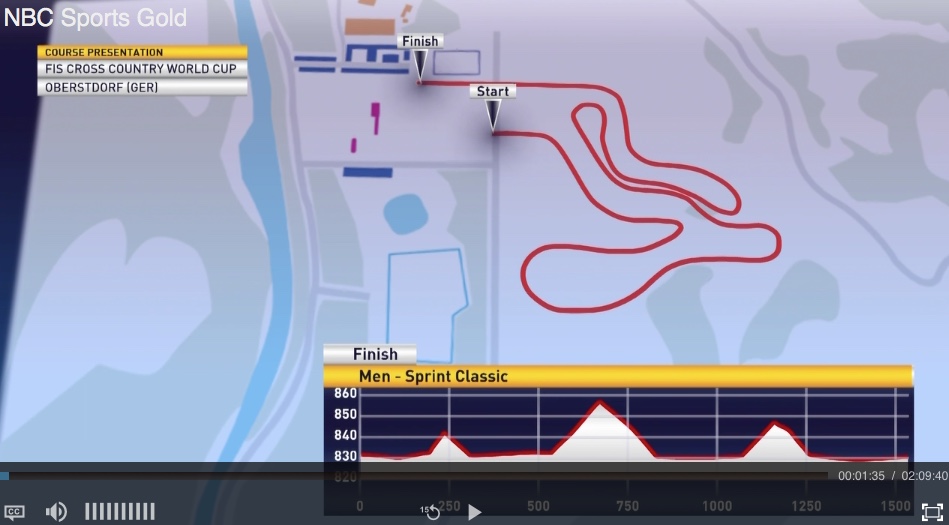
Sunday’s men’s 1.5-kilometer classic sprint course in Oberstdorf, Germany deserves some recognition. Site of the 2021 FIS Nordic Ski World Championships, racers were offered a glimpse into how the world’s foremost sprinter, Johannes Høsflot Klæbo of Norway, would navigate it’s kicker climbs, steep descents, and roughly three minute and thirty-second effort.
The sprint course offered three distinct climbs, one at 0.2 k, the largest at 0.52 k, and the third starting at 1.1 k. The descents mirrored the inclines of the ascents and offered little respite or recovery for skiers near their engine’s redline.
We are focusing on Klæbo, despite the other twenty-nine skiers in the heats, because he was simply a master of pacing, a master of conserving energy on the three-climb course, and freakish in his ability to run away from his five competitors in the final.
Klæbo qualified in first. The margin back to Erik Valnes of Norway in second was 2.72 seconds. Pål Golberg, the third-fastest qualifier was 5.03 seconds back. There were big-time gaps back to the field of qualifiers.
Johannes Høsflot Klæbo crushing the men’s sprint qualifier in Oberstdorf, Germany. (Photo: NordicFocus)
Valnes and Klæbo opted for the first quarterfinal. It was here that Klæbo played his tactical hand. He was in no hurry on this endurance sprint course to move to the front and pull others along in his wake. Klæbo sat in fourth on the second hill as Valnes was the heat’s workhorse. Klæbo appeared relaxed, not itching to move to the front. Klæbo moved to third around 2:00 minutes as they crested the course’s highpoint. The third hill, as most sprinters appeared on fumes, is where Valnes and Klæbo pulled ahead. Over the top, the duo glided into a 20-meter lead. Down the stretch, Valnes poled ahead for the quarterfinal win as Klæbo pulled up, stopped poling several meters before the finish — as if he were checking out for a lunch break.
The third hill would be Klæbo’s charm.
Along with Valnes in the first semifinal were Italy’s Federico Pellegrino (4th qualifier), Golberg, Håvard Solås Taugbøl also of Norway (5th qualifier), and Russia’s Sergey Ardashev. This would be the semifinal to watch.
Again, Klæbo played the conservation of energy tactic. Up the second climb, Golberg, Taugbøl, Valnes, and Pellegrino strode four across with Klæbo lurking a meter back. The second hill was in the rearview mirror around the two-minute mark. It’s approximately another twenty seconds of descent and working flat before the next decisive climb.
As the skiers approached the base at 2:26, Klæbo and Valnes ramped up – they pulled away as they ski-ran up and over the top. Klæbo had been sitting behind Valnes, sucking up in his draft into the final straight. There, Klæbo pulled around his teammate for the semifinal win.
Federico Pellegrino of Italy pushing over the top in the Oberstdorf, Germany classic sprint. (Photo: NordicFocus)
The final featured Klæbo, Valnes, Golberg, Pellegrino, and Oskar Svensson of Sweden and Russia’s Gleb Retivykh. Really, for Klæbo, this was essentially a rematch of his semi.
Again, Klæbo was cautious from the start. There was no real earnestness to shoot to the front. His show would come later. There was only patience from an athlete who knew he could pounce late in the game.
Pellegrino, on the second climb, began to accelerate. He ran outside the tracks in what looked less like a decisive move, and more a burst to position himself tactically in front over the top. For his part, Klæbo matched Pellegrino and strode up alongside the Italian.
At 2:35 at the base of the final climb, Klæbo unleashed. It was textbook Klæbo-running. He was gone with a near 20 meter gap over the top. By the finish line, Klæbo looked to put 10 more meters on his competition as he won in 3:29.46. Golberg was second (+1.99), Valnes third (+2.37), and Pellegrino fourth (+3:06).
In yesterday’s 30 k skiathlon, Klæbo registered a rare DNF (did not finish) as he pulled from the competition.
“I think the sprint was much better than the 30 k yesterday,” Klæbo told FIS after the race. “Yesterday was a really terrible day and today was a bit better. In the end, it was really cool to win here. Yah, I think my shape isn’t the best but I am really happy to find the win here and to have the Norwegian guys here.
“I think it was a really good decision yesterday to jump off after 15 k I think, it was really nice to fight for a win today. And for sure I am really looking for the World Championship here next year.”
Johannes Høsflot Klæbo of Norway cruising in for the Oberstdorf, Germany classic sprint win. (Photo: NordicFocus)
Hands up for the win: Johannes Høsflot Klæbo makes it 5 for 5 for sprints this season. (Photo: NordicFocus)
What was clear after today was that Klæbo had mastered the course. Anything can happen in a year. And anything can go down in a sprint – broken poles, clipped skis, or slide out on a corner. This much was true exiting Oberstdorf: it will be Klæbo’s race to lose at the 2021 World Championships.
It was a down day for the American men. No skiers qualified for the heats. Simi Hamilton placed 32nd overall and was +15.94 in qualification. Andy Newell was 41st (+17.48), Tyler Kornfield 55th (+20.88), and Noel Keeffe 64th (+25.33).
Simi Hamilton during the Oberstdorf, Germany classic sprint qualifier. (Photo: NordicFocus)
Andy Newell during the sprint qualifier in Oberstdorf, Germany. (Photo: NordicFocus)
For Canada, Bob Thompson placed 54th and was +20.14 in the qualifier, Paul Grall-Johnson was 58th (+21.74), and Graham Ritchie 61st (+22.92).
World Cup Standings Shakedown
Coming out of Oberstdorf on the men’s side, Russia’s Alexander Bolshunov remains in command. In first overall with 1457 points, Bolshunov has a 235 point lead on second place Klæbo for the overall lead. Sunday, Bolshunov earned 36 World Cup points after placing seventh overall, Klæbo earned 100 points for the sprint win. If you are keeping score at home, you will note 140 points for Bolshunov’s win in Saturday’s 30 k skiathlon. On yesterday’s course, racers had four opportunities to score bonus points – Bolshunov snatched up 40 of them during the race.
Alexander Bolshunov of Russia in the yellow bib. He leads the overall World Cup. He placed 7th on Sunday’s classic sprint in Oberstdorf, Germany. (Photo: NordicFocus)
Klæbo leads the sprint overall with 350 points. This was Klæbo’s fifth sprint win of the season. He has won every sprint entered thus far. He skipped the skate sprints in Planica, Slovenia and Dresden, Germany.
The World Cup takes a break next weekend and restarts in Falun, Sweden with a classic sprint on February 8.
All Norway in the men’s classic sprint podium in Oberstdorf, Germany: Pål Golberg in second, Johannes Hoesflot Klaebo first, and Erik Valnes third. (Photo: NordicFocus)
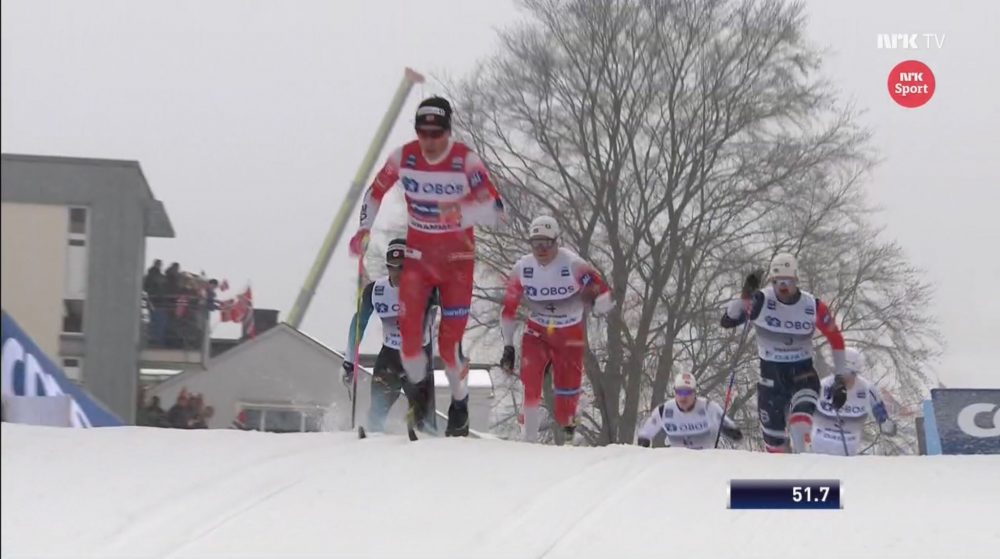
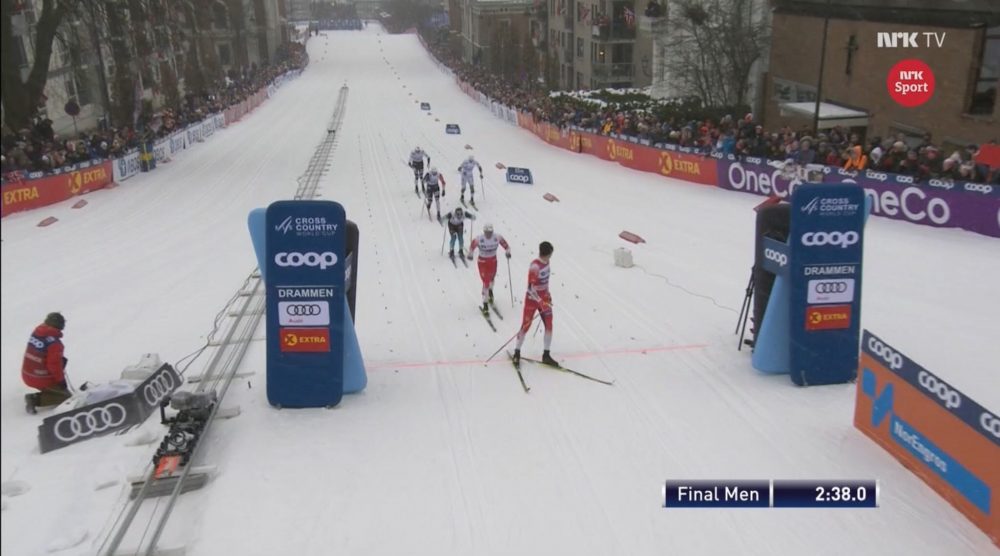
A classic run-stride from Johannes Høsflot Klæbo during the finals of the 2019 Drammen city sprint. (Photo: NRK screenshot)
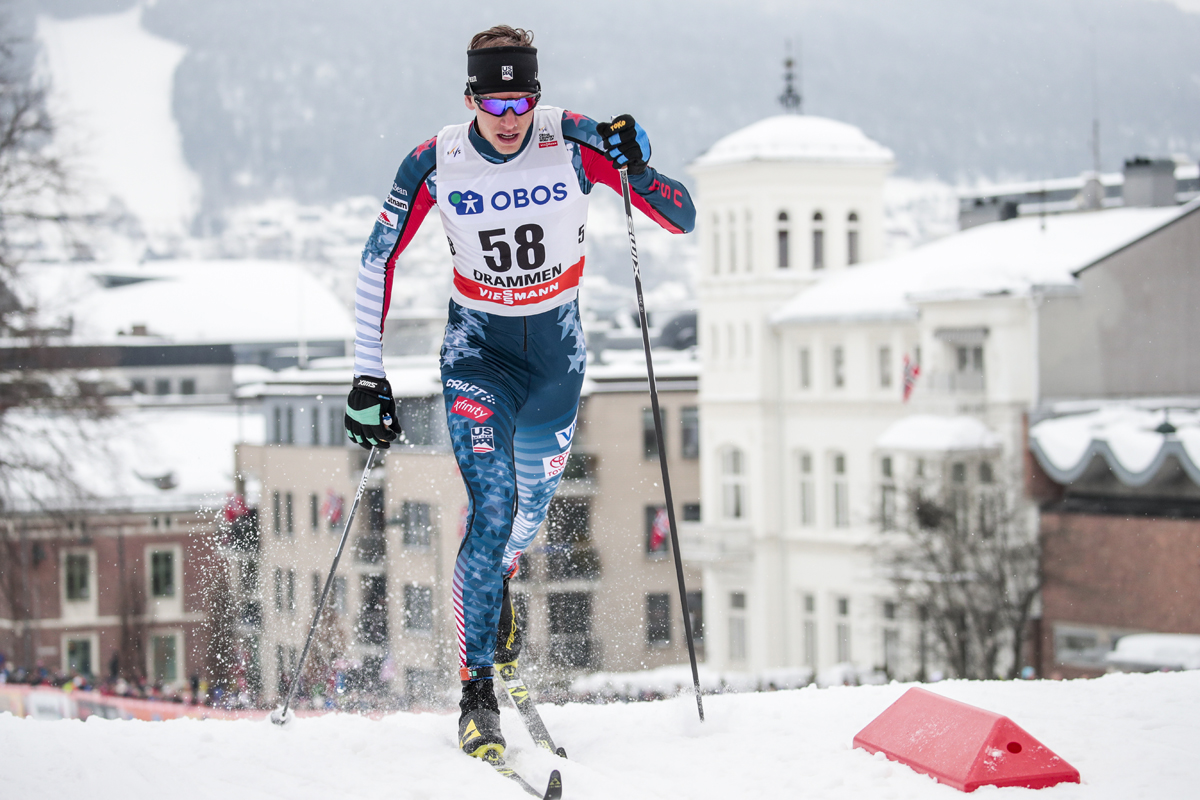
For the rare athlete the field of play is truly a stage. A place to perform in the moment and seemingly acknowledge the moment as it happens. Johannes Høsflot Klæbo appears to have many of these days. And as he crossed the line in today’s 1.2-kilometer classic sprint in Drammen, Norway, Klæbo may as well have taken a bow. It was again a virtuoso sprint performance.
In 2:37.90 minutes, Klæbo earned another win in Drammen — he took his first career win here last season.
With thirty skiers making the rounds, and each adding their own dimension to the heats, Klæbo brings a presence that often gives the impression it is a solo show. On Tuesday he won the qualifier in 2:25.60 minutes. To put things in perspective, Russia’s Alexander Bolshunov, the second fastest qualifier, clocked a time of 2:29.14.
A quick glance at the live timing brackets shows Klæbo making a clean sweep. Along with the qualifier, he won the first heat, the first semi, and indeed the final.
It’s easy to get swept up in the Klæbo narrative. But out in the finals with the twenty-two-year-old were Norway’s Eirik Brandsdal, Sondre Turvoll Fossli,and Pål Trøan Aune, Richard Jouve of France, and Sweden’s Oskar Svensson.
The other five skiers followed the lead of Klæbo’s dance in the finals. With an uptick in tempo fifty seconds into the race where Klæbo threw in his trademark run-stride, then a few cycles of double pole, and a quick transition into his run-stride he was off into the downhill with the others unable to catch his draft.
Through the curvy turns, into more downhill, and into the step-around-corner, Klæbo had a breath easy gap on the field heading into the uphill straight. But Klæbo kept the charge on. Able to look back twice at an approaching Brandsdal, Klæbo cruised across the line. Pending any fall on the technical descent, the race for first looked over as soon as he clicked into that untouchable gear way back at the 50 second mark.
Time to check the action behind, Johannes Høsflot Klæbo of Norway winning the 2019 Drammen city sprint. (Photo: NRK screenshot)
Brandsdal placed second (+0.89), Jouve third (+2.17), Fossli fourth (+3.34), Svensson fifth (+3.63), and Aune sixth (+4.01).
Klæbo leads the sprint globe overall competition by 145 points over Italy’s Federico Pellegrino. His lead in the overall World Cup is a mere 31 points over Bolshunov, who placed 13th in Drammen. With a sizable lead over third place skier Sjur Røthe, who tallies 802 points total in the overall standings (Bolshunov sits with 1250 points, Klæbo 1281), we should see a fight through the final weekend in Quebec to determine the World Cup winner.
For the U.S., Simi Hamilton was the only skier to break into the heats. He qualified in 30th, but bumped to 25th overall after placing fifth in the first quarterfinal heat won by Klæbo.
Three other Americans were entered. Logan Hanneman (APU) finished in 48th, Ben Saxton (SMS T2) 50th, and Kevin Bolger (USST) 51st. With a new crew of sprinters in Drammen, with the exception of Hamilton, U.S. Ski Team Head Coach had a plan in mind for future Drammen appearances.
“With the exception of Simi, the men’s group needs to gain more experience on this course,” Grover noted in an email. “This was the first Drammen World Cup Sprint for Ben and the second for Logan and Kevin. All our men need more work on their double-pole to be competitive here double-poling against the best and strongest.”
No Canadians were entered in Tuesday’s race. Racing continues on the World Cup this weekend with a skate sprint on Saturday and an interval start skate 10k/15k on Sunday.
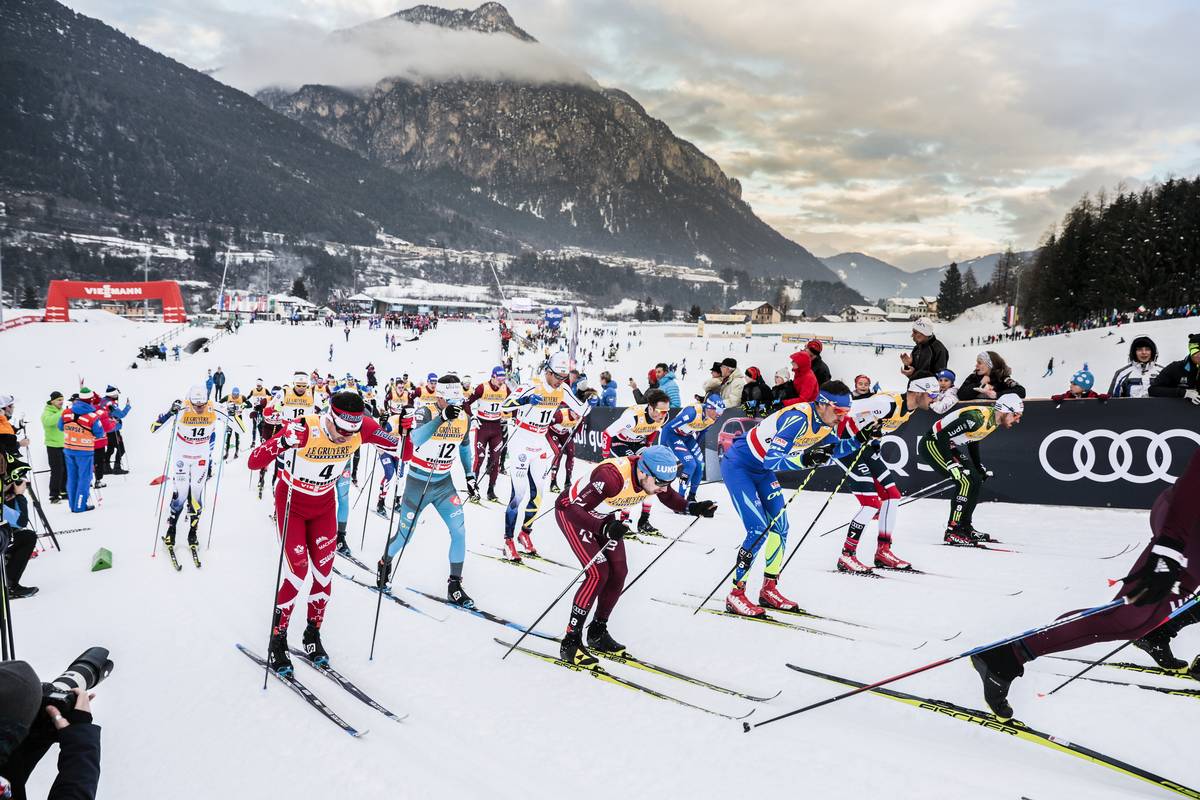
The start of the men’s 15 k classic mass start at Stage 6 of the 2018 Tour de Ski on Saturday in Val di Fiemme, Italy, with (front row, left to right) Canada’s Alex Harvey, Russia’s Sergey Ustiugov, Kazakhstan’s Alexey Poltoranin, Norway’s Martin Johnsrud Sundby, and Switzerland’s Dario Cologna. (Photo: Salomon/NordicFocus)
Beginning this Saturday in Toblach, Italy with a freestyle sprint is the 13th edition of the Tour de Ski (TdS). According to the International Ski Federation (FIS), over the course of seven stages the men will race 80.918 kilometers, the women 60.67 k.
The TdS has become both a staple and a spectacle of the annual World Cup calendar. With a jam-packed series of races primacy is placed on both the ability to recover well and wither less as the TdS transpires.
Prognostication can be tricky in a long-form template like the TdS. So much can go astray during seven races not to mention the travel and dicey germ-avoidance.
Last season’s winner on the women’s side, Heidi Weng of Norway, sits 18th overall in the World Cup standings (14th in distance). She has four top-20’s in the four distance events she’s contested with her best result an eighth in Lillehammer’s 10 k skate. Although featuring two sprints in the first three stages, the TdS remains a distance skier’s paradise.
Weng has skied solidly on the World Cup, but she has yet to show the form that made her a TdS overall winner in 2017 and 2018. Norway has won the last five iterations of the TdS: Marit Bjørgen won once in 2014/2015, Therese Johaug twice (2013/2014, 2015/2016), and Weng the last two years.
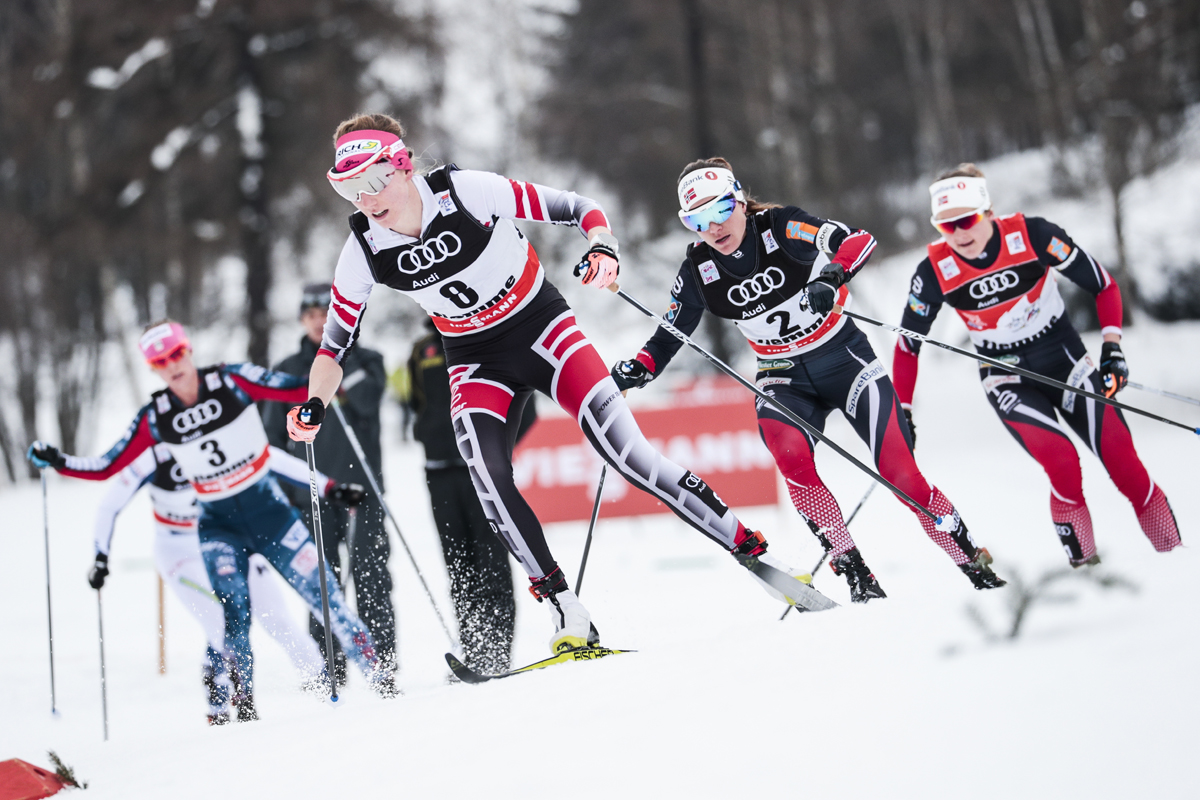
Austria’s Teresa Stadlober leads Norway’s Heidi Weng (2) and Ingvild Flugstad Østberg, American Jessie Diggins (3) and others around a downhill corner during the women’s 10 k classic mass start at Stage 6 of the 2018 Tour de Ski in Val di Fiemme, Italy. (Photo: Fischer/NordicFocus)
If Norway is to keep the streak alive, Ingvild Flugstad Østberg, last year’s TdS runner up, could be the heir apparent. She currently ranks second in the World Cup overall and 15th on the sprint list.
Johaug, having returned from an 18 month doping ban, has been on a distance race tear. She has won all five World Cup distance events this season. Johaug, however, will not be lining up for the TdS.
Only five different women have earned distance podiums this season — Johaug, Østberg, Sweden’s Charlotte Kalla and Ebba Andersson, and Finland’s Krista Pärmäkoski. Along with Johaug, Kalla and Andersson are skipping the TdS. (Andersson sits third overall on the World Cup, Kalla fifth.) With the TdS missing three of the five top ranked World Cup distance skiers, daily stages and the overall podium are up for grabs.
Last season’s third overall finisher, Jessie Diggins of the U.S. Ski Team (USST), often cites the TdS as a point in the season when her form trends towards podium performances. She sits eighth in the current distance standings and could very well have a stout TdS.
Russia’s Natalia Belorukova and Yulia Nepryaeva look strong as does Sadie Bjornsen (USST), and Austria’s Teresa Stadlober.
With less than predictable distance stage podiums for the women, it may simply come down to a drag race on the Alpe Cermis final climb Jan. 6.
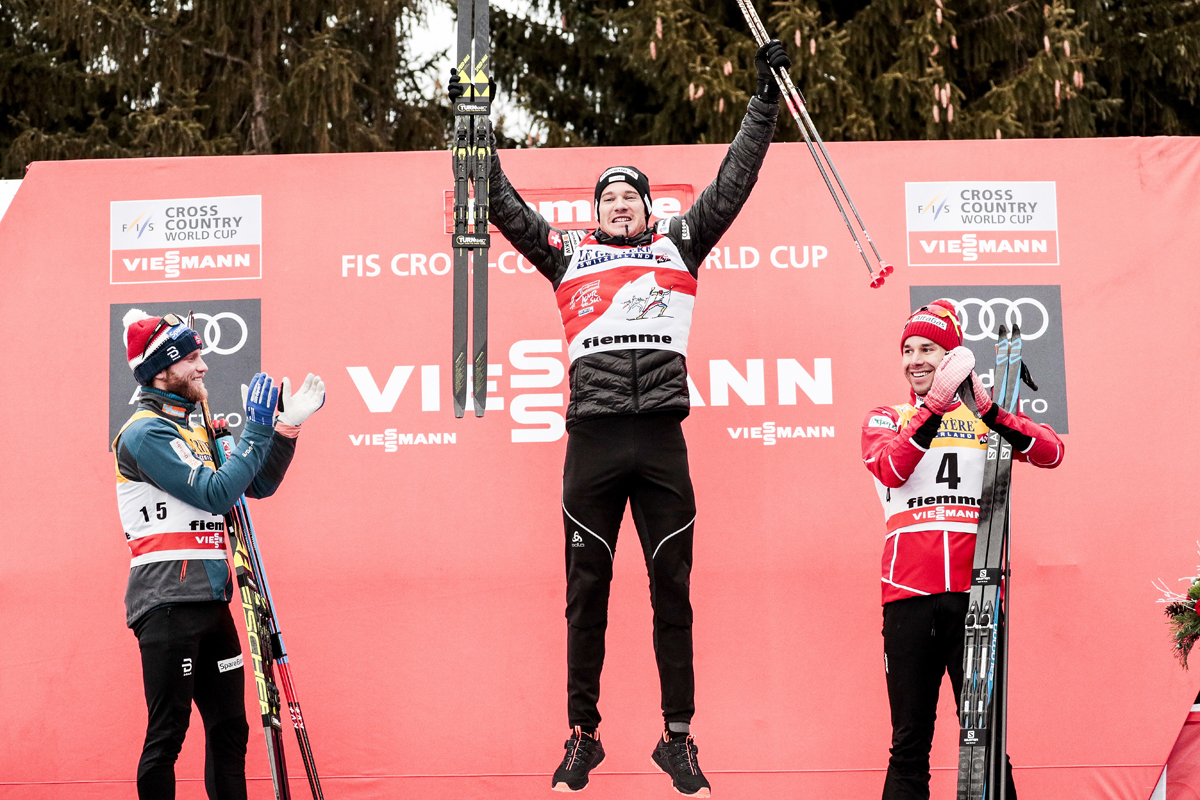
Switzerland’s Dario Cologna (c) celebrates his fourth Tour de Ski overall title. He was joined by Norway’s Martin Johnsrud Sundby (l) and Canada’s Alex Harvey (r) on the podium in second and third, respectively. (Photo: Fischer/NordicFocus)
The men’s scene is also open to interpretation. Last season’s TdS winner, Switzerland’s Dario Cologna, was in fact a surprise victor. Prior to Cologna’s stage two win in last year’s TdS, it had been nearly three years since the four time TdS overall winner had won a World Cup. Cologna sits 21st overall on the World Cup currently. Given last year’s resurgence, anything is possible for the Swiss skier.
Then there’s Martin Johnsrud Sundby form Norway. He finished on the TdS podium the last three years. At thirty-four-years-old, Sundby is ranked first on the distance list, with a second, a third, and a fourth place in distance races this season.
Sundby won the TdS on two occasions – in 2013/2014 and in 2016. His 2015 win was stripped after he tested positive for excessive levels of Salbutamol. He placed second in the past two Tours.
In a field rife with talent, Sundby’s ability to race and rebound and race and rebound will be tested. Sjur Røthe, Emil Iversen, and Didrik Tønseth— all from Norway— look in form. And there’s Norway’s Johannes Høsflot Klæbo. The winner of last season’s overall World Cup has had flashes of his past explosive self. He could be a TdS protagonist.
The men’s field is notably tight. Along with the Norwegians, several Russians could pop a podium, a stage win, and the overall. Russia comes with a loaded team ready to exploit. Alexander Bolshunov leads the overall World Cup – he’ll turn twenty two on Dec. 31st. He’s backed by teammates Evgeniy Belov, Andrey Melnichenko, and Denis Spitsov.
Canada’s Alex Harvey placed third overall last year and he looked stronger as the TdS progressed.
The Stages
Stage 1: Dec. 29, skate sprint in Toblach, Italy.
Stage 2: Dec. 30, 10 k/15 k skate in Toblach, Italy.
Stage 3: Jan. 1, skate sprint in Val Müstair, Switzerland.
Stage 4: Jan. 2, 10 k/15 k classic mass start in Oberstdorf, Germany.
Stage 5: Jan. 3, 10 k/15 k skate pursuit in Oberstdorf, Germany.
Stage 6: Jan. 5th, 10 k/15 k classic mass start in Val di Fiemme, Italy.
Stage 7: Jan 6th, 9 k final climb skate pursuit in Val di Fiemme, Italy.
Teams
United States
Women: Sophie Caldwell, Sadie Bjornsen, Jessie Diggins.
Men: Ben Lustgarten, Simi Hamilton, Erik Bjornsen, Kevin Bolger.
U.S. Ski Team Head Coach Chris Grover noted in a text that Caldwell, Hamilton, and Bolger will likely cease the TdS after the stage three sprint. Additionally, this is a small team for the U.S. at the TdS. Several athletes turned down TdS nominations including Scott Patterson (USST), Andy Newell (SMS T2/Salomon), Kyle Bratrud (SMS T2), Rosie Brennan (APU), Rosie Frankowski (APU), Caitlin Patterson (CGRP), and Julia Kern (SMS T2). These skiers plan on racing U.S. Nationals this January in Craftsbury, Vermont.
Canada
Women: Emily Nishikawa, Dahria Beatty
Men: Alex Harvey, Lenny Valjas, Bob Thompson
Norway
Women: Ingvild Flugstad Østberg, Maiken Caspersen Falla, Astrid Uhrenholdt Jacobsen, Kari Øyre Slind, Kathrine Rolsted Harsem, Heidi Weng, Lotta Udnes Weng, Tiril Udnes Weng Mari Eide, Anna Svendsen
Men: Martin Johnsrud Sundby, Hans Christer Holund, Emil Iversen, Didrik Tønseth, Simen Hegstad, Krüger, Sjur Røthe, Johannes Høsflot Klæbo, Martin Løwstrøm Nyenget, Eirik Brandsdal, Finn Hågen Krogh
Russia
Women: Yulia Belorukova, Lidia Durkina, Anna Zherebyateva, Mariya Istomina, Natalia Nepryaeva, Anna Nechaevskaya, Anastasia Sedova, Elena Soboleva
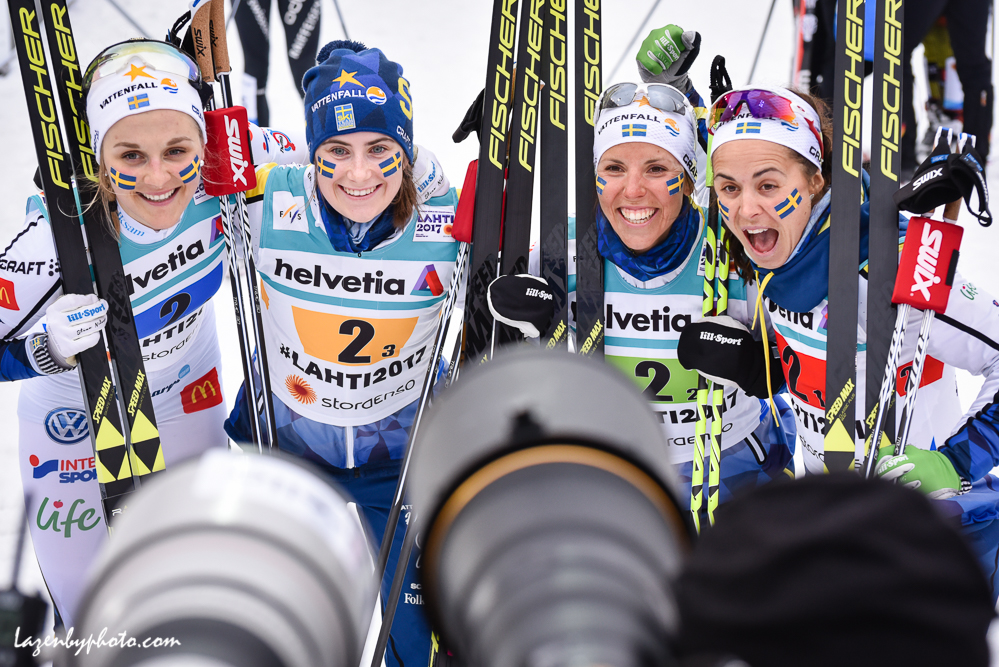
Sweden’s Stina Nilsson, Ebba Andersson, Charlotte Kalla and Anna Haag faced the cameras after winning the silver medal in the women’s relay at the 2017 Nordic World Championships in Lahti. (Photo: John Lazenby)
Welcome to FasterSkier’s World Cup Preview, where we check in with the top-10 teams from last year’s FIS Cross Country World Cup tour before the season starts. The World Cup begins with a classic sprint in Ruka, Finland on Nov. 24th
***
Sweden
Overall in Nations Cup Last Year: 2nd
Women’s Ranking 2017/2018: 2nd
Men’s Ranking 2017/2018: 5th
Swedes to Watch:She’s fast. She’s fierce. And she’s Swedish. While last spring gave rise to the retirement of many veteran cross-country ski names, 31-year-old Charlotte Kalla wasn’t one of them.
Kalla, who has been racing World Cups since 2006, is back for her 13th season on the circuit and not about to slow down. She finished last year, on a limited World Cup schedule, ranked seventh in the women’s overall, after securing five top three performances, two thirds of them victories.
Her singular focus remained peaking for the Games. She entered the 2018 season scorching fast, winning the the overall in the opening Ruka triple weekend. She won the following weekend’s 15-kilometer skiathlon in Lillehammer, Norway.
Kalla dialed back the racing in mid-December, did not race the Tour de Ski, and returned to World Cup racing on January 21, in Planica, Slovenia. She placed second in the 10 k classic.
Kalla returned from the Pyeongchang Olympic Winter Games with four medals, two for individual performances–most notably a gold in the women’s skiathlon.
Sweden’s Charlotte Kalla leads American Jessie Diggins and Norway’s Ragnhild Haga during the 2018 Holmenkollen women’s 30 k freestyle mass start at the World Cup in Oslo, Norway. (Photo: Fischer/NordicFocus)
When not name dropping Kalla, the Swedes have plenty to look to in the remainder of their women’s team. There’s the ever shining sprint star, Stina Nilsson, not to mention the up-and-comer Ebba Andersson. In between those two, with the retirement of Anna Haag, there’s sprint power houses,Hanna Falk and Ida Ingemarsdotter. Throw in Anna Dyvik and you’ve got your female Swedes for the season.
On the men’s side, despite the retirements of Emil Jönsson, Martin Johansson and Marcus Hellner, Calle Halfvarsson remains a name to watch out for on course. Halfvarsson ended last season ranked 13th in the overall, with six individual top-10 finishes, four of those on the podium.
Then there’s the 36 year old veteran, Daniel Rickardsson, as well as the 23-year-old Oskar Svensson, who both landed in last season’s World Cup top-30 more than once.
The men’s 15 k freestyle and 2018 World Cup Finals podium, with Russia’s Alexander Bolshunov (c) in first, Canada’s Alex Harvey (l) in second and Switzerland’s Dario Cologna (r) in third. (Photo: Svenska Skidspelen/Instagram)
It is a wrap.
The 2017/2018 World Cup season concluded Sunday in Falun, Sweden with the men’s 15-kilometer freestyle pursuit. The World Cup Finals featured a three-race mini tour with a skate sprint, 15 k class mass start and Sunday’s pursuit.
Russia’s Alexander Bolshunov, a spry 21 year old, began the pursuit with a 38-second lead over second starter, Johannes Høsflot Klæbo of Norway. Emboldened with confidence after winning his first-career World Cup on Saturday, Bolshunov set off on another sunny Sweden day in cruise control. His initial efforts looked smooth and powerful yet lacked the apparent stress of being chased by the likes of Norwegians Martin Johnsrud Sundby and Klæbo, Swiss skier Dario Cologna, and Swede Calle Halfvarsson.
In fact, for a little more than the first kilometer, his closest chase group resembled a nonchalant pack, as if they’d already agreed to let Bolshunov go. With Halfvarsson looking comfortable in front, and Bolshunov’s lead expanding, Sundby came around a little over three minutes into the race and began the hard work of actually preventing the second chase group, which included Canada’s Alex Harvey, from latching on. (Harvey started 18th, 1:16 minutes behind Bolshunov.)
The story up front, Bolshunov’s insurmountable lead, was dramaless. The emergent Russian’s time gaps spoke of hard bursts of speed and a settling chase group’s concern with a second and third place. Bolshunov led by 52.3 seconds at 5.2 k and 1:23.6 minutes at 11.25 k.
Bolshunov enjoyed a solo ski into the finish to win the day in 35:03.3 minutes for his second World Cup win and his first mini-tour victory. Along with his win, Bolshunov ends the season fifth overall in the World Cup standings.
“After trying all season for a win and getting it yesterday, I had a lot of confidence today and I felt strong,” Bolshunov told the International Ski Federation (FIS), according to a press release. “It’s great to win like this at the end of the season. It leaves me with positive feelings heading into the training season.”
The story behind Bolshunov unfolded with more complexity. The 5.2 k checkpoint was the last mark for a seven-skier chase group to stay away from skiers looking to link up from behind. As much as Swedes Halfvarsson and Oskar Svensson, Cologna, Sundby, Italians Francesco De Fabiani and Federico Pellegrino, and Klæbo (who looked gassed) tried in earnest to stay away, a near-constant throttling pace from Harvey brought the lead chase group within sight.
By 7.5 k, the first and second chase groups had merged, ballooning to a sixteen-skier pack. With half the race to go and Bolshunov uncatchable, several racers would test themselves, and the group, as they attempted to split the chasing posse. Sundby gave it a go. Cologna gave a try. Norway’s Hans Christer Holund looked fresh and strong upping the pace. But none could separate themselves or splinter the pack.
Switzerland’s Dario Cologna (9) leads Canada’s Alex Harvey (18) during the men’s 15 k freestyle pursuit at 2018 World Cup Finals in Falun, Sweden. Harvey went on to place second and Cologna third. (Photo: Fischer/NordicFocus)
Harvey was omnipresent — smooth on the climbs, unnerved by any attacks. On the last grind up the infamous Mördarbakken, Harvey pushed over the top to lead a six-skier group that included Cologna and Sundby.
Two minutes out, Cologna gave a burst of hop-skate in a failed break away attempt. Cologna’s effort, however, did stymie the followers enough to allow he and Harvey to accelerate over the top. It came down to the finishing straight to settle the 15 k pursuit score.
Harvey bested the others to place second (+47.1) and skied the fastest time of day in 34:34.3 minutes. Cologna followed just behind in third (+47.5), and Sundby placed fourth (+48.7).
Sunday’s result matches Harvey’s best 2017/2018 result and was his fourth podium of the season. He placed third in the sixth stage of the Tour de Ski (TdS), third overall in the TdS, and was second in the 15 k freestyle mass start in Seefeld, Austria.
“I like these end-of-season tours,” Harvey told FIS. “On the podium now two seasons in a row at World Cup Finals. They are hard though and I am tired. It took some effort to get up to the leaders but I still felt strong and knew I needed to go for it coming into the final kilometer.”
With the conclusion of the season, Harvey ended up fourth in the World Cup standings with 1179 points. The Canadian was 82 points behind Sundby in third overall, after Sundby amassed 1261 points.
The men’s 2017/2018 Overall World Cup podium, with Norway’s Johannes Høsflot Klæbo (c) in first, Switzerland’s Dario Cologna (l) in second, and Norway’s Martin Johnsrud Sundby (r) in third. (Photo: Fischer/NordicFocus)
Although Sunday’s Falun finale was a fade for Klæbo — he placed 25th in the pursuit (+1:45.8) — the season belonged to the 21-year-old Norwegian. He had already clinched his second-consecutive Sprint World Cup Crystal Globe several weeks ago. In Falun on Sunday, Klæbo earned his first Overall World Cup title after winning 11 individual World Cup races this season. He is the sixth Norwegian to win the overall Crystal Globe. He also becomes the youngest overall winner; Sweden’s Gunde Svan was 22 when he won the 1983/1984 season overall.
Cologna placed second in the Overall World Cup with 1290 points and won the Distance World Cup with 698 points (41 points over Sundby in second) and appeared satisfied after the race.
“I think it’s fun to win races,” Cologna said in a translated interview with Swiss broadcaster SRF. “Those are very nice emotions, which I was allowed to experience again this winter. Now I’m surely a bit tired and it’s natural to have a little break, a little holiday.”
It has been a revival year for Cologna: he won the TdS and a gold medal in the Olympic 15 k skate along with several other hallmark victories. On Sunday he was awarded the Distance Crystal Globe, his fourth Distance World Cup title — a new record. (Sundby has won three distance globes.)
“You could say it has been perfect with an Olympic victory, the Tour de Ski and now the small crystal globe,” Cologne reflected to SRF. “Also the win at Holmenkollen [50 k] was a very important and beautiful success. So after two years that have not been so easy to come back from and [when] the big successes were missing and then a couple of races I had to miss myself that was really… If someone had told me that before this season I would instantly have taken/accepted that. And until the end, I was in the fight for the Overall World Cup even if it had already been pretty much decided. But if someone had told me in December that it would be open until the end I wouldn’t have believed it. So it was a great season.
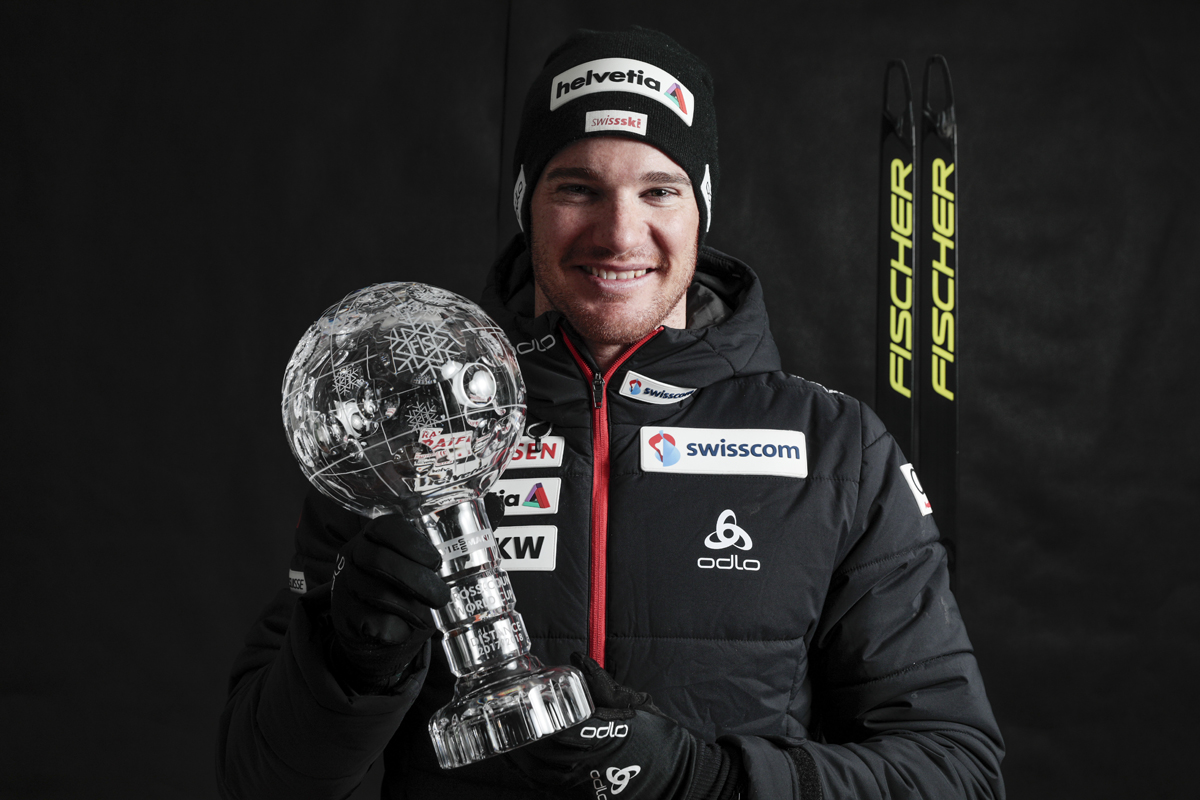
Switzerland’s Dario Cologna with his 2017/2018 Distance World Cup Crystal Globe. (Photo: Fischer/NordicFocus)
Yet the 32-year-old skier, despite solidifying his already storied legacy, told SRF he has no clear intention of retiring.
“The motivation is still there,” Cologna added. “I’ll have to see, next year is Seefeld and that’s almost a World Championship at home for us. That’s three hours from my home. So for that surely the motivation is there to be ready and fight for the medals.”
In the Distance World Cup, Norway’s Holund claimed third with 599 points, just 5 points ahead of Harvey in fourth. France’s Maurice Manificat had been third in the distance standings heading into Sunday, but finished the pursuit in 26th (+2:11.9) and dropped to fifth in the final rankings behind Holund (who moved up from fourth) and Harvey (who moved up from fifth).
Kershaw in the Points Again; Bjornsen with 22nd-Fastest Time
In the pursuit itself, Devon Kershaw was the next-best Canadian outside of Harvey’s podium as he finished in 28th place (+2:21.9).
“I felt pretty good again,” Kershaw said. “I’m not quite strong enough at the start there, so I wasn’t quite strong enough to get back to the group, which is too bad, because they were going slow for a while. But, no, I am satisfied. I mean, another race in the points, so it’s not a bad way to end the season. I was consistent.”
Canada’s Devon Kershaw racing to 74th in the freestyle-sprint qualifier at 2018 World Cup Finals in Falun, Sweden. He went on to finish the mini tour in 28th. (Photo: Fischer/Nordic Focus)
Kershaw still has yet to commit to another World Cup season, but he concludes the year with five consecutive top-30 finishes in distance races. Kershaw also noted he had been a consistent top-30 classic skier.
“I think every classic race except one that I competed in, distance, I was in the points,” Kershaw, 35, said. “I feel proud of that. And since the Olympic 50 k, I’ve been in the top 30 every race I did, so, that’s five or six races now, and it’s just consistent. But again, just lacking that last little bit. But the highlight I think was Alex coming second today from bib 18 so that was phenomenal.”
Also for Canada and in his final career World Cup start, Graeme Killick placed 56th (+4:33). Julian Locke did not start.
For the Americans, Erik Bjornsen moved up from 51st to place 38th (+3:10.4) and skied the 22nd-fastest time of day. Simi Hamilton was 49th (+4:07.8), Scott Patterson 58th (+4:41.5), Patrick Caldwell 59th (+4:41.6), Kevin Bolger 60th (+4:43.5), and David Norris 64th (+5:09.8).
“After yesterday, I was not hoping for much in the final. It was over for results for the Tour,” Bjornsen told FasterSkier on Sunday. “But I went out there it is sunny out it is a good day, so I was just trying to finish off the season with a hard push knowing that the result wasn’t going to be what I was hoping for. But still I just saw the time of day, and 22nd on time of day is a good one. I will see more points for the end of the season.”
Those points bumped Bjornsen into 38th in Distance World Cup list.
“I think it was a step in the right direction,” Bjornsen added. “I still need a few more steps like that before I can fight for podiums.
Bjornsen has made gains this year. And given a moment on Sunday to reflect on his progress, the 26-year-old U.S. Ski Team member recalled several notable examples of his World Cup progression.
“Finishing in the top 30 in most of the races, the majority of them, that was great,” Bjornsen said of his 2017/2018 season. “It makes it feel like you are more in the fight and it is a lot more fun to racing in the top 30. The top 10, I was really excited about that in Seefeld. And qualifying for, I think, five heats this year — all in all pretty happy with it. Still, it has always been my goal to stand on the podium some day. I still think I have a few more steps to get there if I can keep on improving like this last year, maybe there is still a chance.”
The PyeongChang Olympics were a ‘wow’ moment for Patterson. During Saturday’s mass start, Patterson was initially caught in an early race crash and then lost and retrieved a ski. Not the race the upstart skier had hoped for, but not spirit-breaking.
“Better than yesterday — got my skis on today,” Patterson joked after Sunday’s pursuit.
The mishaps from yesterday and Patterson’s ability to put them in context underscore his strong finish to his first full-time World Cup campaign. (Patterson did not contest the TdS as he returned stateside to compete in U.S. nationals.)
“I improved through the season,” Patterson, 26, said of his improved results starting in PyeongChang, where he placed 21st or better in three individual races, including 11th in the 50 k freestyle. “Obviously, Period 1 I didn’t score any points. I was a bit disappointed with that, but I could’ve. I came close a couple times, but I think I regrouped pretty well through nationals. Got sick there, but kind of cleared something out that I had from Period 1, a bit of bronchitis.
“Going into the Olympics, I didn’t really know how I was going to do,” he continued. “I had … first points of the season right before that. So, I think I was on a nice upswing. I had a great Olympics. I mean, could’ve asked for a medal, but I did a lot better than I was expecting, really. And then Holmenkollen was great, too. I feel like right now I’m kind of in 50 k shape instead of 15, but overall I think it was a great season, and got some things to work on for next year, and look forward to coming back and solidly being in the points every race I can.”
Norway’s Johannes Høsflot Klæbo calm and cool as he crosses the line for another sprint win. This time, he won the 1.4 k skate sprint in Falun, Sweden, the last sprint of the World Cup season. (Photo: Svenska Skidspelen/Instagram)
At 21 years old, Johannes Høsflot Klæbo of Norway had already locked up his second-consecutive Sprint World Cup Crystal Globe several weeks ago. A down-to-the-wire, season-ending finale for the sprint globe was out of the question. Klæbo has simply been that good. Out of 11 sprint races this season, Klæbo won the seven out of the nine sprints he contested. He placed second and third, respectively, in the other two. One word to describe it all: dominant.
Russia’s Alexander Bolshunov won Friday’s qualifier in 2:36.23. Klæbo placed second (+0.46). Clearly, the Norwegian’s form was still on after steamrolling since the opening World Cup weekend in Kuusamo, Finland, on Nov. 24.
Beyond settling for second in Friday’s qualifier, Klæbo won the first quarterfinal, the first semifinal and the final. In the final, as he faced off with Italy’s Federico Pellegrino, Sweden’s Oskar Svensson and Teodor Peterson, France’s Lucas Chanavat, and Finland’s Ristomatti Hakola, Klæbo’s tactics would initially appear timeworn but effective.
Here’s how the Norwegian’s earlier tactics played out and eventually caught the spellbound finalists off guard. In Klæbo’s quarterfinal, also featuring Pellegrino, the pack of six skiers kept tight until the course’s final V1 climb. At 1:40 into the race, American Simi Hamilton, who had qualified in 13th (+4.1), came around the pack, pushed over the top and led out the string of skiers. Klæbo sat in fifth place. At 2:02 minutes, Klæbo and the group closed on Hamilton. Pellegrino led around the top of the final corner heading into the finish straight, then it was Hamilton followed by Klæbo. Stepping around the corner, and gliding out, Pellegrino and Klæbo unleashed a fifth-gear free skate and separated themselves from Hamilton. Klæbo and Pellegrino finished first and second, respectively, and Hamilton third. That put Hamilton 14th overall on the day as his time was not fast enough to move on as a lucky loser.
Simi Hamilton (U.S. Ski Team) racing to 13th in the men’s freestyle sprint qualifier at 2018 World Cup Finals in Falun, Sweden. He went on to finish the day in 14th overall. (Photo: Fischer/NordicFocus)
“With Simi, we took an aggressive approach today,” U.S. Ski Team coach Matt Whitcomb told FasterSkier in person after. “We threw him in with Klæbo and Pellegrino in the quarters and thought that he could potentially beat one of those guys and advance, or potentially be a lucky loser.
“He just got too tactical over the top of the last hill, so the lucky losers came from heats down the road,” Whitcomb continued. “And, Simi, unfortunately, ended up going over the hill in first and almost was able to hold it off. It was really impressive that he was able to hang onto third, but not enough for today. When he gets tactical, it tends to not be your lucky loser heat.”
On to the semis. In the first semifinal, Klæbo again allowed others, primarily Bolshunov, to do the pacing work. Bolshunov shot off the start like a starved thoroughbred chasing its first meal. Knowing Klæbo can close, the Russian hammered with a high-turnover tempo no other skiers could match. Bolshunov couldn’t pull away, but he could control for much of the semifinal.
As much as Klæbo can hide, he stalked in the back. Again, on the small hill before the finish, while Bolshunov faded, the Norwegian went. Right on cue Klæbo nailed his finish, outdueling second-place skier Peterson (+0.21), third-place Pellegrino (+0.32), and Ristomatti in fourth (+0.59). Bolshunov finished fifth (+3.10).
Coming into the final, Pellegrino, Hakola, and Peterson had already been schooled in Klæbo’s Falun-sprint scheme during the semi. After watching Bolshunov burn up taking a flyer off the front, that race strategy seemed unwise. But allowing Klæbo to draft in the pack had also proved futile.
Study Klæbo all you want. There’s still much to learn.
Up and over the first indecisive climb during the final, Klæbo paced behind Sweden’s Svensson. Stepping around a corner and into the course’s second hill, only 48 seconds into the race, Klæbo sent it: hop-skate style.
Klæbo’s burst of speed scorched the skiers behind. Initially, the others were caught off guard and failing in their response. Cresting the course’s third hill, Klæbo kept up the furious pace. One minute and 50 seconds in, Klæbo had nearly a thirty-meter gap over a chasing Chanavat.
The win was never in doubt at this point. It was as if Klæbo wanted to include a new chapter in his young career’s book of dominance. On Friday, Klæbo proved he could win a sprint by accelerating with nearly a kilometer to go. There was no fade. There was no catching up from behind. (Klæbo did pull up before the line to celebrate as Pellegrino came flying toward the finish.)
The men’s freestyle sprint podium at 2018 World Cup Finals in Falun, Sweden, with Norway’s Johannes Høsflot Klæbo (c) in first, Italy’s Federico Pellegrino (l) in second and France’s Lucas Chanavat (r) in third. (Photo: Fischer/NordicFocus)
Klæbo won the final in 2:37.03 minutes. Pellegrino was second (+0.39), Chanavat third (+1.76), Ristomatti fourth (+3.26), Svensson fifth (+3.88), Peterson sixth (+6.17). Klæbo earned 50 World Cup points for the win. Heading into the two final World Cup races of the season, a 15 k classic mass start on Saturday and a 15 k skate pursuit Sunday, Klæbo leads the Overall World Cup standings by 272 points over fellow Norwegian Martin Johnsrud Sundby. The winner of the entire weekend will get 200 World Cup points, so it’s safe to say Klæbo has that overall Crystal Globe locked up as well.
“I learned after Lahti that I needed to be away from Pellegrino if there was a long downhill with a fast finish so I attacked on the first climb today in the finals to make sure that I was far enough ahead before the finish,” Klæbo told the International Ski Federation (FIS) after the race. “It’s just been an incredible season with my second sprint globe and the Olympics. But I am focused on also taking home the overall crystal globe and will fight the next two days to make sure I get it.”
Bolger Reaches Quarterfinals
Kevin Bolger (Sun Valley Ski Education Foundation) racing to 50th in the men’s classic sprint qualifier at last week’s World Cup in Drammen, Norway. (Photo: Fischer/NordicFocus)
Along with Hamilton, Kevin Bolger was the only other North American to move onto the heats. In his third-career World Cup sprint, the Sun Valley based skier qualified in 29th and placed 30th overall after finishing sixth in his quarterfinal, 2.21 seconds behind Peterson in first.
In his World Cup debut two weeks ago, Bolger previously placed 11th overall in Lahti’s skate sprint. He went on to finish 50th in Drammen’s classic sprint. Bolger also skied to 52nd in last weekend’s Holmenkollen 50 k skate race.
“Qualifying, I was super excited,” Bolger, 24, told FasterSkier in Falun. “Obviously, it’s super early in these World Cups for me, so just qualifying is insane. Super fired up when that happened and just tried to kind of repeat what I did in Lahti, and didn’t work out, but I felt a little bit tired, maybe shaken out by the 50 k a little bit still, from Holmenkollen.”
Bolger is a recent graduate of the University of Utah and is in his first season as a professional skier. He skis with the Sun Valley Ski Education Foundation in Utah.
“I just came to Sun Valley this year so my coach Chris Mallory changed my tactics coming into sprints,” Bolger said about his early season work on qualifying. “I definitely, mentally and physically, been doing a lot of things differently. And just kind of going in with these World Cups, it’s a lot of pressure to do well. But at the same time, there are no expectations, really, so you just gotta go in with an open mind and hopefully, you don’t want to expect too much. So you just go in and do what you can.”
Whitcomb seemed as stoked as Bolger at his early World Cup success.
“Thrilling to see Bolger qualify in his second skate sprint,” Whitcomb said. “Being two-for-two in skate sprinting this year, in just a short tour with us and so fun to watch his excitement as a rookie, getting in there and mixing it up. I think it’s a unique course and it’s also the end of the long season for him as well, and just didn’t quite have the gear over the last hill, is what it looked like. But he by no means is getting blown out and it’s really exciting for the future.”
Also for the U.S., Erik Bjornsen missed qualifying by five-hundredths of a second in 31st, Andy Newell placed 43rd, Paddy Caldwell was 60th, David Norris 84th, and Scott Patterson 87th.
For Canada, Julien Locke placed 32nd, just 0.06 seconds out of qualifying, Alex Harvey was 34th, Devon Kershaw 74th, and Graeme Killick 81st.
Racing continues Saturday at World Cup Finals with a 15 k classic mass start for the men.
Sweden’s Hanna Falk (r) smiles as she wins the fourth World Cup race of her career and first race in Falun, Sweden, with a victory in the women’s freestyle sprint at 2018 World Cup Finals on Friday. Her teammate Jonna Sundling (l) placed second while Norway’s Marit Bjørgen finished third. (Photo: Svenska Skidspelen/Instagram)
FIS Cross Country World Cup Finals (Falun, Sweden): Freestyle sprints
In the last sprint of the season and the first race of the three-day World Cup Finals in Falun, Sweden’s Hanna Falk and Norway’s Johannes Høsflot Klæbo won their respective 1.4-kilometer freestyle sprint finals, while Norway’s Maiken Caspersen Falla and Klæbo claimed the season-long Sprint Crystal Globes and Sophie Caldwell of the U.S. placed third in the Sprint World Cup.
Falk started Friday by topping the women’s qualifier on home turf in 2:59.88 minutes, 1.65 seconds ahead of American Jessie Diggins, who qualifiedin second. Russia’s Natalia Nepryaeva qualified third (+2.73), while American Sadie Bjornsen raced to the fourth-fastest qualifying time (+2.96), ahead of Norway’s Marit Bjørgen in fifth (+3.72).
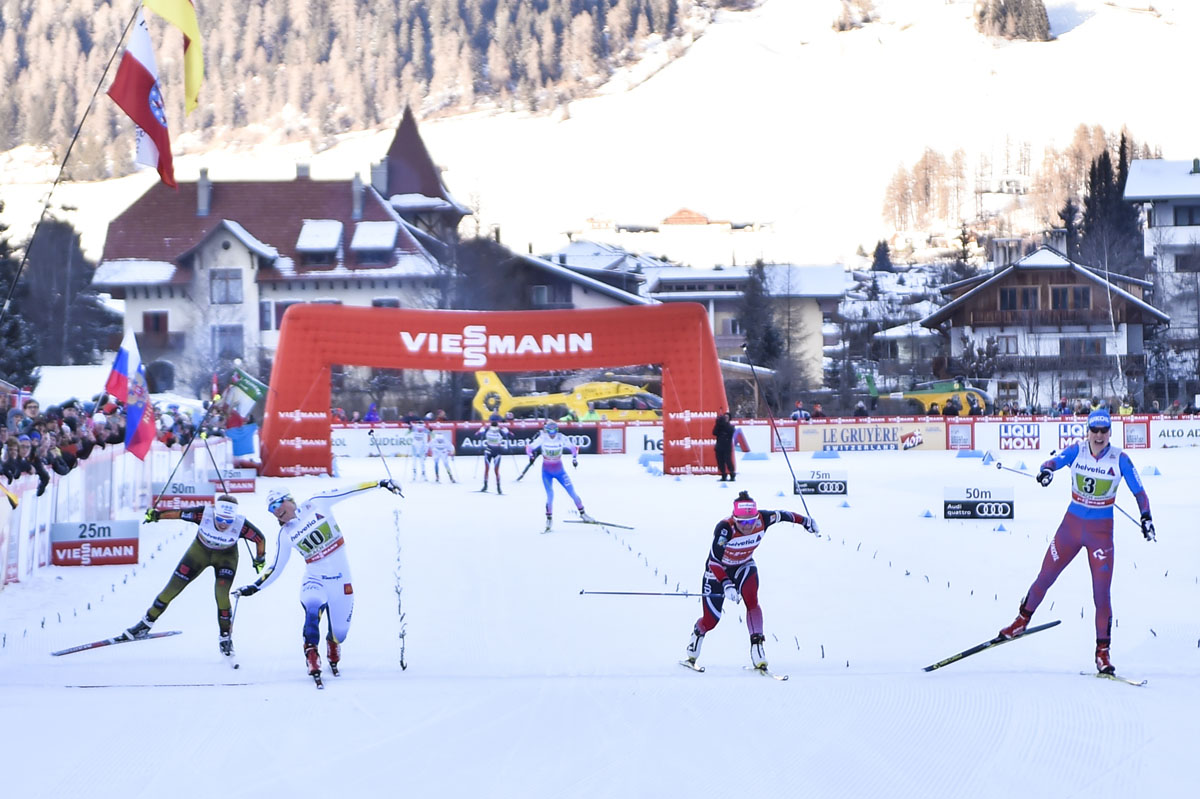
Falk then won the first quarterfinal and first semifinal before taking control and dusting the field in the women’s final. She essentially led the final from start to finish, but slowed her pace and the five women behind her as she ascended the last climb. As she reached the 180-degree turn at the top, Falk launched into high gear, leaving the rest of the field chasing. Bjørgen was closest to her in second, but still several meters back, as they descended down into the stadium, and Falk skated away from her pursuers for her fourth-career World Cup win (and first victory in Falun) in 3:08.25. Sweden’s 23-year-old Jonna Sundling came on strong in the finishing straight for her first World Cup podium in second (+0.53), Bjørgen took third, and Sweden had three in the top four with Anna Dyvik in fourth (+1.72).
Norway’s Silje Øyre Slind finished fifth (+4.3), andCaldwell, who had qualified for the heats in 16th then won her quarterfinal and advanced in third in the second semifinal, placed sixth overall (+6.99).
Four American women posted top-20 qualifying times, with Kikkan Randall advancing as well in 18th. Diggins placed seventh overall after finishing third in the first semifinal, 0.42 seconds behind Falk in first and just 0.08 seconds behind Sundling, who advanced to the final in second.
Bjornsen was ninth on the day after placing fifth in that semifinal, 0.85 seconds out of first. Randall finished 15th overall after placing third in her quarterfinal, 3.14 seconds behind Diggins, who won that heat.
Also for the U.S, Ida Sargent missed the top 30 needed to qualify in 36th, as did Rosie Brennan in 49th, Caitlin Patterson in 63rd, Liz Stephen in 66th, Kaitlynn Miller in 69th, and Rosie Frankowski in 75th.
Canada’s Emily Nishikawa placed 40th, Dahria Beatty was 48th, Cendrine Browne 60th, and Zina Kocher 71st.
Norway’s Johannes Høsflot Klæbo (yellow bib) celebrates his 11th World Cup victory of the season in the men’s freestyle sprint at 2018 World Cup Finals in Falun, Sweden, ahead of Italy’s Federico Pellegrino (l) in second and France’s Lucas Chanavat (11) in third. (Photo: Svenska Skidspelen/Instagram)
In the men’s race, Russia’s Alexander Bolshunov qualified first in 2:36.23, 0.46 seconds ahead of Klæbo in second. Klæbo then won the first quarterfinal, first semifinal, and you guessed it, the final as well, backing off before crossing the finish line for the last time in 2:37.03.
Italy’s Federico Pellegrino powered past France’s Lucas Chanavat in the finishing stretch of the final to claim second, 0.39 seconds behind Klæbo. Chanavat completed the podium in third (+1.76), Finland’s Ristomatti Hakola finished fourth (+3.26), and Sweden’s Oskar Svensson and Teodor Peterson placed fifth (+3.88) and sixth (+6.17), respectively.
Two American men qualified for the heats, with Simi Hamilton advancing in 13th and Kevin Bolger in 29th. Hamilton went on to place 14th on the day after finishing third in the first quarterfinal, 0.61 seconds behind Klæbo. In his second-career World Cup sprint, Bolger placed 30th overall after finishing sixth in his quarterfinal, 2.21 seconds behind Peterson in first.
In the overall Sprint World Cup, Klæbo took his second-straight title by a whopping 243 points over Pellegrino in second, while Falla won her third-straight Sprint Crystal Globe by 78 points over Sweden’s Stina Nilsson, who was out sick for Friday’s race. Nilsson joined her at the Sprint World Cup podium ceremony on Friday, as did Caldwell, who achieved her best overall sprint standing in third.
Falla placed eighth overall on the day after being eliminated in the semifinals (she finished fourth behind Falk, Sundling and Diggins, respectively).
For the U.S., Erik Bjornsen narrowly missed qualifying in 31st, Andy Newell placed 43rd, Paddy Caldwell was 60th, David Norris 84th, and Scott Patterson 87th.
For Canada, Julien Locke placed 32nd, Alex Harvey 34th, Devon Kershaw 74th, and Graeme Killick 81st.
Sweden’s Stina Nilsson (center) won gold in the classic sprint at the 2018 Olympics, with Norway’s Maiken Caspersen Falla (left) taking silver and Russia’s Yulia Belorukova bronze. (Photo: FlyingPointRoad)
After winning the sprint qualifier by 0.39 seconds over defending gold medalist Maiken Caspersen Falla and then besting the Norwegian by 0.03 seconds in her semifinal, Sweden’s Stina Nilsson captured Olympic gold in a dominating performance in the classic sprint final, ultimately besting Falla by 3.03 seconds.
Falla had to fight to even keep silver, as Olympic Athlete of Russia Yulia Belorukova pushed the pace on the final uphill and came close to outsprinting Falla in the finishing straight. However, the 23-year-old Russian couldn’t quite sneak past and settled for bronze, 0.34 seconds behind Falla.
Jessie Diggins of the United States after finishing sixth in the classic sprint in PyeongChang. (Photo: FlyingPointRoad)
Her teammate Natalia Nepryaeva finished fourth (+9.14 in the final), Sweden’s Hanna Falk fifth (+11.16), and the United States’ Jessie Diggins sixth (+11.23).
Diggins’s teammate Sophie Caldwell finished unlucky number eight, and based on time was the last woman not to make the final after finishing a close fourth behind Nilsson, Falla, and Falk in her semifinal. Both semifinal heats were fast, with one lucky loser coming from each, and Caldwell was 0.18 seconds off that time.
Also for the United States, Sadie Bjornsen finished third in her quarterfinal heat, 2.46 seconds behind Belorukova and also behind Norway’s Heidi Weng. That put her 14th on the day.
In the men’s final, it was a fight to the final uphill when 21-year-old Norwegian phenom Johannes Høsflot Klæbo ran away from the field over the top of the climb and sailed to the finish to become the youngest ever gold medalist in cross-country skiing at the Olympics. Alexander Bolshunov of Russia had matched Klæbo for most of the race but ran out of steam at the top, allowing Italy’s Federico Pellegrino to catch onto his tails before the downhill. While Klæbo widened his lead, Bolshunov and Pellegrino battled to the finish line and Pellegrino ultimately won in a photo finish, securing silver (+1.34) while Bolshunov took bronze (+1.36).
Johannes Høsflot Klæbo won the men’s Olympic sprint in dominating fashion while Federico Pellegrino just edged Alexander Bolshunov for silver. (Photo: FlyingPointRoad)
Norway’s Pål Golberg finished fourth (+3.81 in the final) and Sweden’s Oskar Svensson fifth (+7.73). Top qualifier Ristomatti Hakola of Finland didn’t have it in the final, finishing sixth (+20.72).
Canada’s Len Valjas finished third in his semifinal, but well off the pace (3.98 seconds behind Hakola) and did not advance as a lucky loser to the final. That put him seventh overall, Canada’s best result in two Olympic cycles.
Both American men, Erik Bjornsen and Simi Hamilton, were eliminated in the quarterfinals. Hamilton’s quarterfinal was marred by a crash involving nearly the entire group, and he ended up fourth with a slow time as a result, and landed 20th on the day. Bjornsen finished fifth in his heat, 1.63 seconds behind Klæbo in one of the tightest quarterfinals of the day, good for 25th overall.
Norway has now won both men’s gold medals in cross-country skiing, while Sweden has swept the women’s gold medals.
Sprint racing at the PyeongChang Olympics kicked off on Tuesday, with Sweden’s Stina Nilsson setting the pace in the women’s qualifier just 0.39 seconds ahead of defending Olympic champion Maiken Caspersen Falla of Norway.
The rest of the field couldn’t touch those two. Krista Parmakoski of Finland, the bronze medalist in the 30 k skiathlon, came closest, notching a time 3.56 seconds slower. Sweden’s Hanna Falk qualified fourth (+3.80), Slovenia’s KatjaVisnar fifth (+6.50), Olympic Athlete of Russia Natalia Nepryaeva sixth (+6.91), American Jessie Diggins seventh (+7.02), Sweden’s Ida Ingemarsdotter eighth (+7.32), American Sadie Bjornsen ninth (+7.38), and Norway’s Heidi Weng tenth (+7.54).
For the United States, Sophie Caldwell also qualified for the quarterfinals in 12th position (+8.32). Ida Sargent, who recently had surgery on her thumb, did not, notching the 33rd-best time of the day – 17.06 seconds off the pace and 1.78 seconds out of the heats.
For Canada, Emily Nishikawa led the team in 34th, 2.73 seconds out of quarterfinals. Dahria Beatty finished 42nd (+21.03) and Cendrine Browne 51st (+25.56).
CU student Petra Hyncicova of the Czech Republic finished 45th (+23.29). APU’s Jessica Yeaton, racing for Australia, finished 48th (+24.27), and Aussie teammate Casey Wright (University of Alaska Anchorage) 63rd (+41.06). Canada-based Mathilde Petitjean of Togo finished 59th (+37.19).
In the men’s sprint qualifier, Ristomatti Hakola of Finland turned heads by posting a time that last year’s Sprint Cup champion Johannes Høsflot Klæbo of Norway could not beat. The Norwegian posted a time 0.19 seconds slower than the Finn.
The men’s field was much closer than the women’s, with just 9.51 seconds separating the top 30 finishers who would move on to the quarterfinals. The third qualifier was young Olympic Athlete of Russia AlexanderBolshunov (+1.66), with Italy’s MaicolRastelli a surprise fourth-place finisher (+2.78). Sweden’s Teodor Peterson qualified fifth (+3.01), Olympic Athlete of Russia Alexander Panzhinsky sixth (+3.09), Sweden’s OskarSvensson and Viktor Thorn seventh (+3.48) and eighth (+3.65), and Italy’s FedericoPellegrino ninth +4.64. Calle Halfvarsson notched the tenth-best time (+4.73) and gave Sweden four qualifiers in the top ten, while Klæbo was the lone Norwegian in the top ten.
For the United States, Simi Hamilton and Erik Bjornsen made the quarterfinals, qualifying in 19th (+7.59) and 29th (+9.15) respectively. Bjornsen actually tied for 29th with France’s Richard Jouve, making him the last man to make the cut, so to speak. Canada’s Len Valjas will be the lone representative of his country in either the men’s or women’s heats after qualifying 26th (+8.57).
Alex Harvey just missed the quarterfinals in a tie for 32nd (+9.41), with Canadian teammate Jesse Cockney close behind in 35th (+10.00). Russell Kennedy rounded out the Canadian team in 54th (+14.83).
For the U.S., Andy Newell was also on the outside looking in, placing 37th in the qualifier (+10.82). So was Logan Hanneman in 42nd (+12.20).
Norway’s Johannes Høsflot Klæbo en route to another World Cup win in the men’s classic sprint on Saturday in Planica, Slovenia. (Photo: Fischer/NordicFocus)
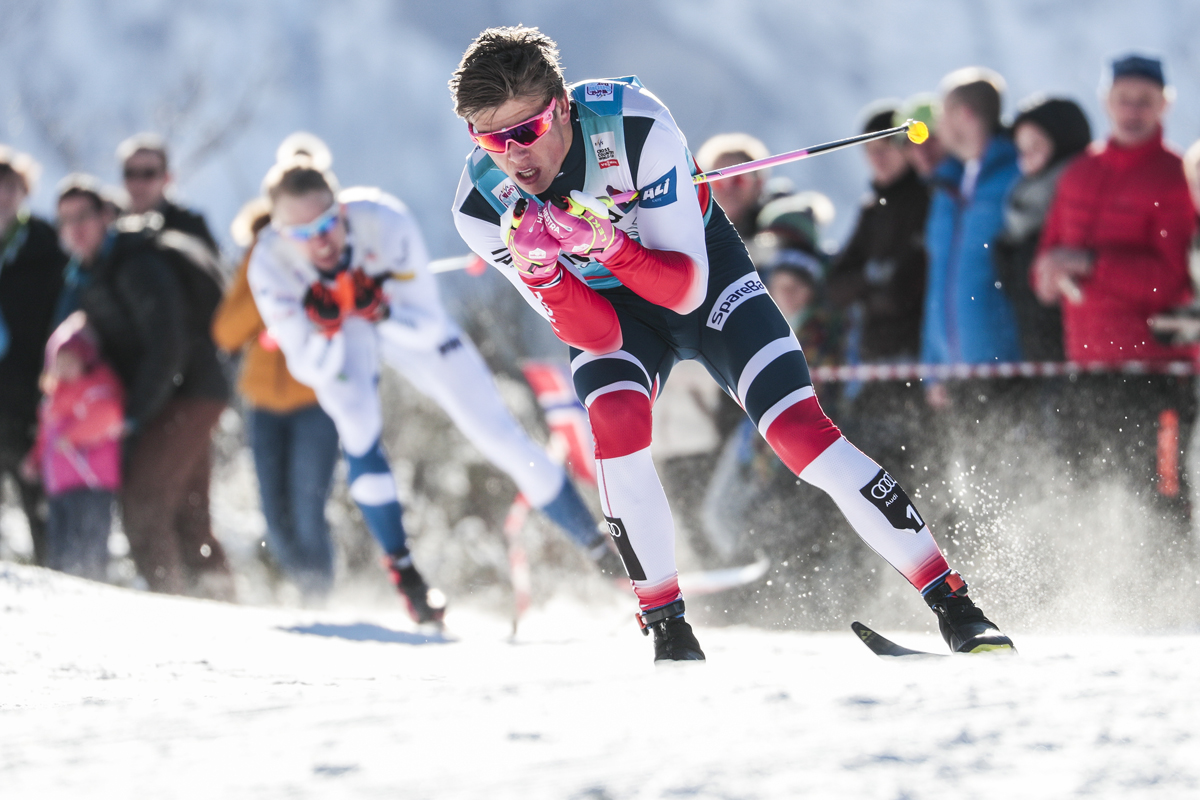
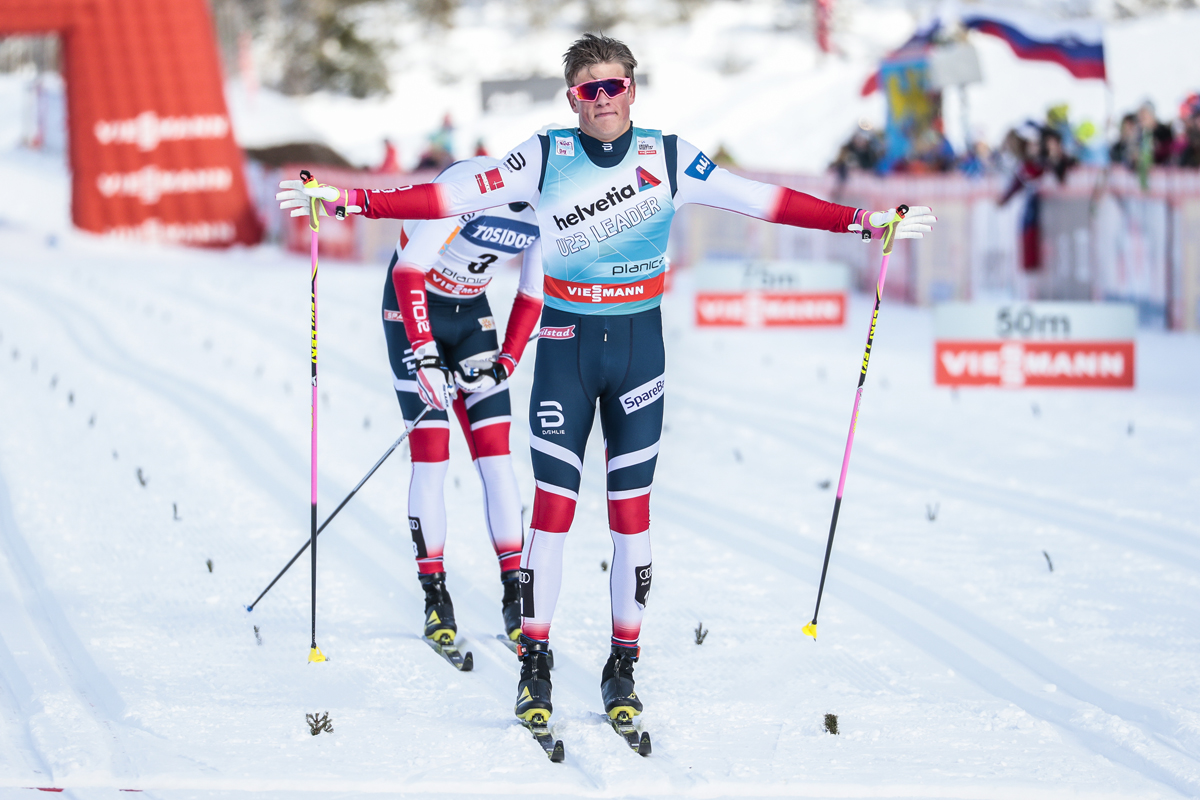
Sunny skies. Craggy Slovenian Alps. Fresh snow and firm classic tracks. The perfect backdrop for the coiffed hair and pink sunglasses. On Saturday in Planica, Slovenia, Norway’s Johannes Høsflot Klæbo again proved his form is on another level. Sometimes calm with tens of meters to spare, sometimes allowing others to draft momentarily on his ski tails, Klæbo won the World Cup men’s 1.6-kilometer classic sprint in 3:27.35 minutes.
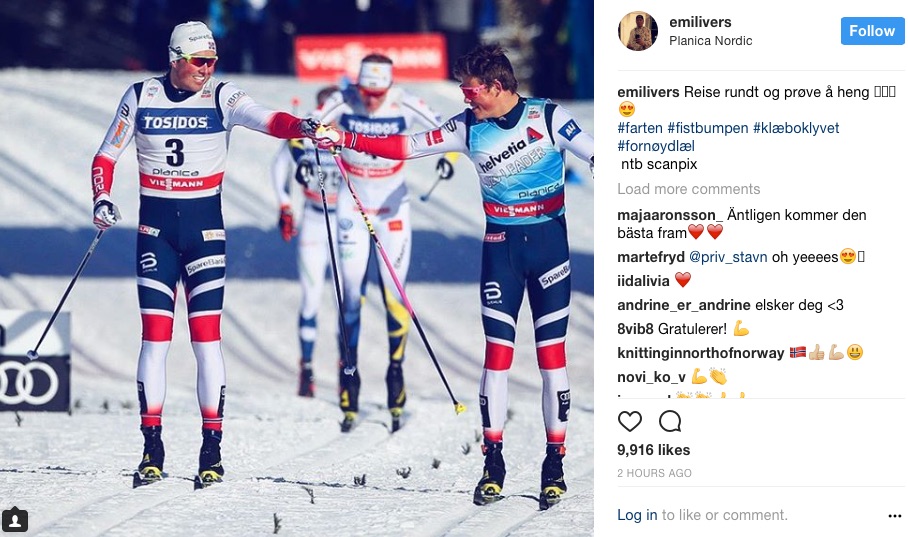
In a final that featured three Norwegians, two Swedes and a Russian, Norway’s Emil Iversen placed second (+0.62) and Sweden’s Teodor Peterson third (+8.14). Yes, that’s a big gap to third place, and the gaps only bulged to the rest of the men in the final. Sweden’s Oskar Svensson finished fourth (+11.80), Norway’s Eirik Brandsdal fifth (+19.77), and Russia’s Gleb Retivykh sixth (+27.08).
Norway’s Johannes Høsflot Klæbo winning the men’s classic sprint final at the World Cup on Saturday in Planica, Slovenia, by 0.62 seconds over his teammate Emil Iversen. (Photo: Fischer/NordicFocus)
“I had a lot of fun out there today,” Klæbo said, according to an International Ski Federation (FIS) press release. “It was great to see so many people along the course and the stadium. I really liked the course with the long uphill sections.”
To say Klæbo is on a roll is an understatement. The 21 year old, in fact, seems to be skiing in total control and on a different level — his swing from top-end efforts to dialing it back for the “show” seems like a quid pro quo to keep competitors from discouragement. Not that another Klæbo win was ever in doubt, but great World Cups are sporting theater after all, and drama heightens the tension.
Klæbo was the first-place qualifier, rounding the 1.6 k course that featured two small climbs and a larger one lasting for nearly half a kilometer in 3:26.8 minutes. Dissecting some of Klæbo’s strategy from the qualification time splits, he skied the first 0.65 k of the course a full three full seconds faster than Sweden’s second-place qualifier, Calle Halfvarsson, who finished in 3:29.5. Klæbo then skied the next 1.59 k of course, which featured the major climb, with the second-fastest split. Halfvarsson skied that sector the fastest by only 0.3 seconds over Klæbo, who had the second-fastest split time on that section. The point is this: Klæbo won the qualifier in the first 0.65 k, and could then control his speed the remaining distance and still win the qualifier by 2.75 seconds.
Effortless? Not exactly. But at moments it appeared that way.
Klæbo skied in the first quarterfinal, which also featured American Andy Newell. Like in his qualifier, Klæbo torched his heat from the start. Off the front at around fifty seconds, Klæbo looked around and realized he’d broken away, then he appeared to literally let off the double-pole gas. Perhaps it was a small tease as Newell chased behind in second. On the long climb, Klæbo set tempo as the other places began to fall into order. On the descent, Klæbo streamed away as if on double secret wax. Twenty to thirty meters before the finish, he began taking his poles off. He won the heat by 1.55 seconds over Finland’s Iivo Niskanen in second place (+1.55). Germany’s Sebastian Eisenlauer followed in third (+2.34) and Newell fourth (+2.59) to miss advancing to the semifinals. Overall, Newell ended the day in 20th.
Klæbo’s semifinal again found him in total control. By the long climb, Klæbo was in his groove with teammate Iversen pegging his efforts to remain 5 then 10 meters back. But Iversen hung in, and by the final stretch, after Klæbo pulled up and chilled, Iversen took Klæbo at the line in what appeared to be a nonchalant gift.
(Article continues below)
Norway’s Johannes Høsflot Klæbo (4) and teammate Emil Iversen knock knuckles as they cross the line in Planica, Slovenia, on Saturday in the men’s classic sprint. Klæbo won the race while Iversen placed second overall. (Photo: Emil Iversen/Instagram)
The final began with Klæbo storming into the major climb with such speed that for a moment he became unbalanced. But in an instant, Klæbo’s stride was back in form as he strung out Petersen, Iversen and Svensson. With a quick skate into another lane followed by a killer double pole, Klæbo was gone up and over the climb. Iversen also made his move late on the climb, but by then, Klæbo was away.
With a tidy bow across the line, it was curtains for Klæbo.
After Saturday’s sprint, Klæbo is positioned first in the World Cup overall standings, despite skipping the entire Tour de Ski. He’s started a total of 10 individual races and has won eight, including Saturday’s sprint. In the other two, he placed second in last weekend’s freestyle sprint in Dresden, Germany, and was 10th on Dec. 16 in a 15 k skate in Toblach, Italy. Klæbo has won all three classic sprints this season.
No real prognostication here, it is too early. Yet, Klæbo has won every classic sprint this season and the upcoming Olympic individual sprint next month in PyeongChang, South Korea, is classic technique.
Two U.S. Men in Top 20
For the U.S., Simi Hamilton qualified 16th and ended his day in 19th after finishing fourth in the fifth quarterfinal, 2.35 behind the winner, Pål Golberg of Norway.
Simi Hamilton (U.S. Ski Team) racing to 16th in the men’s classic sprint qualifier on Saturday at the World Cup in Planica, Slovenia. He went on to finish the day in 19th overall. (Photo: Fischer/NordicFocus)
“I feel like a classic sprint is always up in the air for me how it’s going to go,” Hamilton told FasterSkier in person after the race. “Especially this season, the only other classic sprint I have done is in Ruka, and I was kind of getting really sick there, so I kind of had no idea how my body would respond.”
After skipping most of the Tour de Ski, leaving after the second stage on Jan. 1, Hamilton contested the sprints in Dresden last weekend and finished 10th in the individual skate sprint and eighth in the team sprint with Erik Bjornsen.
“I know that I am fit right now, and I have been feeling great so I kind of had that going into the day,” Hamilton said. “I had a really good interval workout here a couple days ago so it was awesome just to see the course and get a feel for doing that. I felt great in my qualifier, I felt like I stayed really relaxed. Sometimes I think classic sprinting, classic skiing in general, I have a tendency to get a little bit tight and I felt like in my qualifier I just stayed really loose the whole time, which kind of let me get pretty good glide on that really long gradual climb.
“In the quarter I just kind of focused on the same thing,” he continued. “Just started kind of conservatively so I had some energy for the long climb … I felt like I skied the climb really well, tried to make a move at the top, and when I was in third and then just needed to really pin it those last 200 meters, I just ran out a little bit of juice. But I think we were in a little slower heat anyways, so I wouldn’t have gone as a lucky loser, but it’s great … I love skiing heats obviously, and I think any day I can ski heats in a classic sprint with a pretty strong field, I think that is kind of a successful day for me.”
Norway’s Johannes Høsflot Klæbo leads Finland’s Iivo Niskanen (25) and American Andy Newell (23) in the first men’s quarterfinal of the World Cup classic sprint in Planica, Slovenia. Klæbo went on to win that heat, ahead of Niskanen in second and Newell in fourth. (Photo: Fischer/NordicFocus)
Newell, who qualified in 23rd and finished the day in 20th, wrote in an email that he had been hoping for more.
“It was beautiful classic conditions out there and pretty straightforward waxing which made for really fun skiing,” he wrote. “The course had a little bit of a different feel because it basically just had one really long climb from the low point to the high point and, of course, some fast icy corners to keep things interesting. Especially in qualification, I felt semi out of control and scrubbed some speed. The courses actually skied a bit better in the heats I thought once they had less traffic.”
Matched with Klæbo in his quarterfinal, Newell clearly knew he’d have a speedster to chase.
“In the heats, I again chose heat one with the same strategy I’ve been using — choose the first heat and shoot for a final/podium rather than a top 15 etc.,” Newell added. “Not sure if that’s the right call … hard to tell sometimes. I skied the majority of the heat on the tails of Klæbo until the top of the climb he and Niskanen got a small gap. In the end, it wasn’t fast enough.”
Like Hamilton, Newell left the Tour de Ski early (after Stage 3) and contested last weekend’s skate sprints in Dresden. Needless to say, Newell is focused on PyeongChang.
“Although this wasn’t the pre-Olympic result I was looking for I still have a few weeks to fine tune classic skiing and fitness and think about what I need to do to have a top performance in PyeongChang,” Newell reflected.
A large contingent of U.S. men competed, with the Alaska Pacific University (APU) duo of Logan Hanneman and Tyler Kornfield narrowly missing the heats, finishing 35th (+13.55) and 38th (+13.96), respectively, in the qualifier. Teammate Reese Hanneman finished 51st in the qualifier (+17.99) and Ben Lustgarten of the Craftsbury Green Racing Project placed 59th (+19.41).
For both Logan Hanneman and Kornfield, this was their first career World Cup starts. Hanneman is 24 and Kornfield is 26.
Kornfield is coming off a stellar U.S. nationals in Anchorage, Alaska, where he won the 30 k classic mass start, and placed third overall in both the classic and skate sprints. Kornfield is slowly adjusting to Europe and said his body still feels the effects of his national 30 k win.
“I have had a little time, but ever since the 30 k, I haven’t slept past five hours,” Kornfield said on Saturday. “I’ve just been trying to calm the heart rate. The first night before the classic sprint [in Anchorage], I went to bed at 3 AM. I was in bed at 11 or 12, just laying there. Just trying to process that. I know I can be better, I am just super amped to be here.”
“I qualified for my first World Cup in 2010, but I decided not to go,” Kornfield said. “And ever since I have been just regretting that. But I think in the end, I’ve been working so much harder for this and it feels so much better. The harder you work the more struggle you go through, it’s feels so good.”
In an email exchange, Kornfield elaborated on his World Cup invitation decline back in 2010.
“After doing well in the 2010 US Nationals in Anchorage, I qualified for the sprint in Canmore, the final World Cups before the Vancouver Olympics,” Kornfield explained. “I went into US Nationals with the sole focus of making my first World Juniors. I hadn’t expected to do so well in the sprints and because I was a Freshman at UAF, I also wanted to make NCAAs.”
As for his turned-down 2010 World Cup starts in Canmore, those are “would haves” and “could haves”.
“I regretted not going for a long time because as I got older, I realized just how hard World Cup starts are to get and you cannot take them for granted,” Kornfield wrote. “When you are young and you get your first real breakthrough, you have so much confidence and belief that you are going to take over the world. It has been eight years and every now and then, that belief begins to wane. Eventually, I started to wonder if I would ever get that opportunity again. This is probably the first year in the last six years that my old confidence is starting to come back. I am also older and wiser and I know that the shape I am in now will not last forever, so I need to capitalize on this moment.”
The four Canadians that raced last weekend in Dresden also competed in Planica, with Julien Locke (Canadian National U25 Team) leading the way in 62nd on Saturday (+21.26), Dominique Moncion-Groulx (Alberta World Cup Academy) 65th (+22.70), Bob Thompson (NTDC Thunder Bay) 66th (+24.48), and Antoine Briand (Pierre-Harvey National Training Centre) 70th (+27.20).
Sweden’s Stina Nilsson at 2017 World Championships, after she finished 13th in the women’s 10 k classic on Feb. 28. On Sunday, she won her first sprint of the season at Sweden’s FIS season-opener in Gällivare.
For the third and final day of International Ski Federation (FIS) racing in Gällivare, the home crowd would not be let down. Both the men’s and women’s 1-kilometer classic sprints were won by Swedes, one of whom has established herself as one of the world’s best sprinters, ending last season second in the 2016/2017 Sprint World Cup at the age of 23.
Stina Nilsson, now 24 and entering her fifth year of racing on the World Cup, tallied her first win of the season in Sweden’s season-opening sprint on Sunday. So did Oskar Svensson, 22, who competed at his first World Championships last season.
The day started with 1 k qualifiers, which Nilsson’s teammate Hanna Falk won in 3:58.86 minutes. Nilsson followed in second, 1.9 seconds back, and the two advanced through their quarterfinals and semifinals (with Nilsson winning both) before meeting head to head in the final. Also advancing to the final were Russia’s Natalia Matveeva (who won the other semifinal), Yulia Belorukova and Evgeniya Shapovalova, as well as Switzerland’s Nadine Fähndrich.
In the final, Nilsson held off two Russians for the overall win, finishing first in 3:53.75. Matveeva finished 1.89 seconds later for second place, while Belorukova claimed third (+3.16). Falk placed fourth (+5.50), followed by Shapovalova in fifth (+6.09) and Fähndrich in sixth (+6.58).
Rounding out the top 10 were Sweden’s Ida Ingemarsdotter and Jonna Sundling in seventh and eighth, respectively, followed by Russia’s Elena Soboleva in ninth and Sweden’s Anna Haag in 10th.
The lone North American woman in Sunday’s sprint, Dahria Beatty qualified for the heats in 28th, 17.29 seconds out of first. She went on to finish fifth in her quarterfinal, 9.94 seconds behind Haag, who won that heat. Overall, Beatty ended the day in 23rd. She also raced the 5 k freestyle to start the long weekend in Gällivare and placed 56th in that race.
“There were parts of the course I felt I skied really well in my qualifier today and other parts that definitely need some work,” Beatty wrote in an email. “I was happy with how my striding and double pole felt and my body was moving a lot better today than on Friday in the 5k Skate. The snow was tricky today and I didn’t carry my speed very well through the transitions and up the double pitched herringbone/run section on the back of the course.”
Beatty, a 23-year-old member of Canada’s World Cup Team, flew to Sweden with most of her team on Nov. 11 to get some time on European snow and compete in some early FIS races before the start of the World Cup.
“I was really happy to be able to ski a heat and get that feeling of pushing head to head with others,” she continued. “It’s always good to see where you are losing time or keep up in the heats to figure out what needs to be worked on before the next weekend. I am hoping I can take what I learned today and make some improvements for the World Cup opener next weekend.”
Kikkan Randall of the U.S. Ski Team raced Friday’s 5 k skate and Saturday’s 10 k classic, but opted out of Sunday’s classic sprint. Sixty-seven women contested Sunday’s sprint qualifier.
Svensson Tops Men’s Sprint
Meanwhile, Svensson, a member of Sweden’s national A-team, topped a field of 114 in the men’s classic sprint. He started out by winning the qualifier by 0.76 seconds over Russia’s Anton Gafarov in 3:24.06.
In the first quarterfinal, Svensson placed second to Russia’s Andrey Parfenov, finishing 0.14 seconds behind him, and both advanced to the semifinals. There, Svensson won the first semifinal by just 0.01 seconds over fellow Swede Teodor Peterson. They advanced to the final, along with four Russians: Gafarov, Alexander Panzhinskiy, Nikita Kriukov, and Maxim Vylegzhanin.
Sweden’s Oskar Svensson leads Alex Harvey and others during their quarterfinal at the freestyle sprint at 2017 World Cup Finals in Quebec City last March. (Photo: John Lazenby/Lazenbyphoto.com)
In the finishing stretch of the final, Svensson and Peterson again lunged for the win, which Svensson took by 0.4 seconds in 3:21.63. Kriukov finished third, 2.12 seconds out of first, followed closely by Panzhinskiy in fourth (+2.18) and Vylegzhanin in fifth (+2.84). Gafarov ended the day in sixth (+22.99).
Also in the top 10, Sweden’s Calle Halfvarsson placed seventh, Parfenov was eighth, Russia’s Alexey Vitsenko finished ninth and Sweden’s Johan Haeggström was 10th.
Of the six Canadian men who raced on Sunday, World Cup Team member Len Valjas was the lone qualifier in 24th (+8.69). In the second quarterfinal, from which two lucky losers advanced to the semifinal, he finished sixth, 3.85 seconds behind the heat’s winner, Halfvarsson. That put Valjas 29th overall on the day.
Julien Locke (Canadian U25 Team) raced to 39th in the qualifier, 12.32 seconds out of first and 2.36 seconds out of the top 30, for his best result of the weekend. He finished 72nd in the 10 k freestyle on Friday.
“It was a long, twisty course with a fairly gentle profile with the exception of two very short, punchy steep sections,” Locke, who recently earned World Cup starts at Frozen Thunder trials, wrote in an email. “With all of the fresh snow the last couple days, the track was a soft on the corners and broken up on the climbs.
“I felt that I skied well in the qualifier but was lacking tempo and glide speed on the climbs,” he continued. “The shape feels good and I was able to have a high output throughout the qualifier. I would have liked to race the heats as they would have been excellent race prep for the first World Cup on Friday.”
Another Canadian, Knute Johnsgaard (World Cup Team) followed in 40th, 0.48 seconds behind Locke and 12.80 seconds out of first. Russell Kennedy, last year’s NorAm winner who trains in Canmore with Team R.A.D., raced to 43rd (+13.30). On Friday, he finished 48th in the 10 k skate.
“It is always a bit hard with sprints, but the goal was to close really well,” Kennedy wrote in an email. “I felt strong and was much more happy with this sprint than my Frozen Thunder qualifier.”
With firm tracks and good skis, Kennedy described his Gällivare qualifier as “super smooth.”
“There was one pretty icy corner I thought it was kinda fun since there was a big berm you could ride but there were definitely some falls around that area,” he wrote.
Not wanting to overburden his body before some of the other races he is targeting in the upcoming weeks, Kennedy opted out of Saturday’s 15 k classic.
“I am trying to build my fitness a bit through these races so racing Friday was really good for my fitness and I took off Saturday to get some rest as I have a lot of races coming up that I want to perform well at,” he explained.
Two other Canadians raced Sunday’s sprint qualifier, with Jess Cockney finishing in 48th (+14.05) and Jack Carlyle in 105th (+33.44).
The men’s World Cup 1.2 k classic sprint podium on Wednesday in Drammen, Norway, with Norway’s Eirik Brandsdal (c) in first and Johannes Høsflot Klæbo (l) in second, and Russia’s Sergey Ustiugov (r) in third. (Photo: FIS Cross-Country/Twitter)
FIS Cross-Country World Cup (Drammen, Norway): Classic sprints
Just three days after 2017 Nordic World Championships ended in Lahti, Finland, World Cup cross-country skiers were back to their regular-season grind with 1.2-kilometer classic sprints on Wednesday in Drammen, Norway.
In the men’s race, Norway stole the day with Eirik Brandsdal notching his first World Cup win since 2015 in Drammen, but Russia’s Sergey Ustiugov broke up the team’s total domination of the final with a third place, behind Brandsdal (who won it in 2:39.35 minutes) and Johannes Høsflot Klæbo in second (+2.55). Ustiguov placed third (+3.28) for his seventh consecutive podium coming off five medals in five races at World Championships, and three other Norwegians, Petter Northug, Pål Golberg and Sondre Turvoll Fossli finished behind him in fourth through sixth, respectively, in the final.
To start the day, Klæbo won the qualifier in 2:33.81, 3.62 seconds ahead of Brandsdal in second. Ustiugov qualified 10th (+6.21).
Canada’s Alex Harvey and Len Valjas qualified for the heats in 18th and 21st, respectively, and Andy Newell was the lone American to reach the quarterfinals after qualifying in 13th.
In the third quarterfinal, Newell finished third, 1.7 seconds behind Brandsdal, who won it. Sweden’s Oskar Svensson took second in that heat (+0.66).
Harvey won the fifth quarterfinal, and Canada originally took first and second with Valjas outlunging Alexander Bolshunov for second place. Valjas was ultimately relegated to last in the heat for his move around Bolshunov at the line, and the Russian was listed as second (+0.27) for an automatic spot in the semifinals.
While Klæbo won the first men’s semifinal by 0.46 seconds over Brandsdal, Ustiugov topped the second semi by 0.32 over Golberg. Harvey initially finished fifth in that second semi but moved up one spot to fourth (+4.41) after Norway’s Finn Hågen Krogh was disqualified (putting him in last, 67th overall). Harvey ended up eighth overall on the day.
Newell placed 18th overall and Valjas 27th.
Also for the North Americans, U.S. Ski Team members Simi Hamilton and Erik Bjornsen finished 40th and 44th, respectively, and Ben Lustgarten (Craftsbury Green Racing Project) was 62nd. Canada’s Russell Kennedy (Canmore Nordic/Team R.A.D.) finished 63rd.
In the women’s 1.2 k classic sprint, Stina Nilsson commanded the day and Sweden ended up with two on the podium, with Hanna Falk in third.
Nilsson started off by qualifying in fourth, 1.54 seconds behind Finland’s Krista Pärmäkoski, who topped the qualifier in 3:00.28. While Pärmäkoski went on to win her quarterfinal and place third in her semifinal (advancing as a lucky loser to the final), Nilsson won both her quarterfinal and semi, and ultimately took first in the final in 3:07.57. Pärmäkoski notched second (+0.42), and Falk third (+1.26) ahead of Norway’s Kathrine Rolsted Harsem in fourth (+3.27), Sweden’s Ida Ingemarsdotter in fifth (+4.86), and Slovenia’s Anamarija Lampič in sixth (+9.67).
Three U.S. women qualified for the heats, with Sadie Bjornsen in fifth, Jessie Diggins in sixth and Sophie Caldwell in 11th.
Bjornsen and Diggins were eliminated in the quarterfinals after placing fifth and sixth, respectively, while Caldwell finished third in the third quarterfinal (0.79 seconds behind Østberg, who won that heat) and advanced as a lucky loser to the semifinals with Finland’s Aino-Kaisa Saarinen, who was fourth in that heat (+0.95).
In the semifinals, Nilsson led her teammate Falk across the line by 0.14 seconds, and Lampic advanced as a lucky loser in third (+1.05).
Ingemarsdotter won the second semifinal by 0.22 seconds over Harsem, and Pärmäkoski made the cut for the final with a fast-enough time in third (+0.56). In that heat, Slovenia’s Katja Višnar (who had posted the second-fastest qualifying time) finished fourth (+0.83), and Caldwell fifth (+1.44).
That put Caldwell in ninth overall, while Bjornsen placed 21st and Diggins 26th. Also for the U.S., Rosie Brennan finished 37th in the qualifier, Ida Sargent was 42nd, and Kikkan Randall 52nd.
One day after her 23rd birthday, Canada’s Dahria Beatty finished 48th.
USSA Cross Country Junior Championships (Lake Placid, N.Y.): Classic sprints
The U20 women’s classic sprint podium at U.S. Junior Nationals on Wednesday in Lake Placid, N.Y., with Julia Kern (c) of the Stratton Mountain School in first, Canada’s Katherine Weaver (l) of Hollyburn XC Ski Club in second and Maddie Morgan (r) of the Wasatch Nordic Ski Academy in third. (Photo: XCJuniorNationals2017.com)
[UPDATED] On the second day of racing at 2017 U.S. Junior Nationals in Lake Placid, N.Y., Novie McCabe, Haydn Halvorsen, Gus Schumacher, and Julia Kern achieved their second national titles of the week in the classic sprints on Wednesday at the Olympic Jumping Complex.
Representing the Pacific Northwest division and Methow Valley Nordic Ski Educational Foundation, McCabe won the U16 girls’ A-final more than 5 seconds ahead of anyone else in 5:04.22 minutes. New England’s Anna Lehmann, of the Stratton Mountain School (SMS) followed in second (+5.14) and Intermountain’s Sydney Palmer-Leger notched her second-straight podium in third (+5.96). Also in the U16 girls’ final were Rocky Mountain’s Bridget Donovan (Ski & Snowboard Club Vail) and Waverly Gebhardt (Steamboat Springs Winter Sports Club), who placed fourth and fifth, respectively, and Intermountain’s Sarah Morgan, of the Wasatch Nordic Ski Academy (WNSA), in sixth.
In the U16 boys’ A-final, Halvorsen (Far West/Sugar Bowl Ski Team & Academy) won by 3.31 seconds in 4:28.29 minutes. New England’s Will Koch (SMS) placed second for his second podium in as many races, and Intermountain’s Lane Myshrall (Park City Nordic Ski Club) took third (+6:39). Also in the U16 boys’ final, Johnny Hagenbuch (Intermountain/SVSEF) placed fourth, George Cvancara (Alaska/Alaska Nordic Racing) fifth and Will Lange (Pacific Northwest/Mt. Bachelor Sports Education Foundation) sixth.
The U18 boys’ classic sprint podium at U.S. Junior Nationals on Wednesday in Lake Placid, N.Y., with Gus Schumacher (c) of Alaska Winter Stars in first, Scott Schulz (l) of the New York Ski Educational Foundation in second, and Adam Glueck (r) of Ford Sayre in third. (Photo: XCJuniorNationals2017.com)
Alaska’s Gus Schumacher (Alaska Winter Stars) topped the U18 boys’ A-final by 1.13 seconds in 4:35.95. Local Mid-Atlantic skier Scott Schulz (New York Ski Educational Foundation) took second, and New England’s Adam Glueck (Ford Sayre) placed third (+5:04). Alaska’s Canyon Tobin (APUNSC) followed in fourth, Far West’s JC Schoonmaker (Auburn Ski Club Associates Inc.) fifth, and New England’s Ben Ogden (SMS) reached the final but was disqualified.
The U18 girls’ classic sprint podium at U.S. Junior Nationals on Wednesday in Lake Placid, N.Y., with Marin Coletta (c) of the Bridger Ski Foundation in first, Rena Schwartz (l) of GMVS in second and Anna Gibson (r) of Jackson Hole Ski Club in third. (Photo: XCJuniorNationals2017.com)
In the U18 girls’ A-final, Marin Coletta, representing Intermountain and the Bridger Ski Foundation (BSF), took the win in 5:14.30, 4.4 seconds ahead of New England’s Rena Schwartz (Green Mountain Valley School). Intermountain’s Anna Gibson (Jackson Hole Ski Club) rounded out the podium in third (+6.26). Also reaching the final, Brooke Dunnagan (Intermountain/BBNT) finished fourth, Jenna DiFolco (Alaska/NSCF-FXC) fifth, and Callie Young (New England/Craftsbury Nordic) sixth.
U.S. Ski Team Development Team member Julia Kern picked up her second-straight win in the U20 women’s category, winning the A-final by a resounding 18.47 seconds. After Kern (New England/SMS) finished in 4:47.54, Canada’s Katherine Weaver (Hollyburn XC Ski Club) placed second for the second-straight race, and Intermountain’s Maddie Morgan (WNSA) took third (+33.38) in the most strung-out final of the day. Also in that final, Intermountain’s Leah Lange (University of Utah) finished fourth, Margie Freed (Midwest/Loppet Nordic Racing) fifth, and Canada’s Catherine Reed-Metayer (Skibec) sixth.
From left to right: Alexandra Lawson (New England/Craftsbury Nordic) and Maya Seckinger (Pacific Northwest/Bend Endurance Academy) go head to head during a U20 women’s classic sprint heat on Wednesday at 2017 U.S. Junior Nationals. Both reached the B-final, where they placed fourth and third, respectively. (Photo: XCJuniorNationals2017.com)
The U20 men’s classic sprint win went to Canada’s Reed Godfrey (Canmore Nordic/Team R.A.D.), who finished first in 4:33.64. Kam Husain (SMS) crossed 3.32 seconds later as the top American in second overall, and Canada’s Ryan Jackson (Team Hardwood) was the third man on the podium in third (+5.68). Rounding out the A-final, Finn O’Connell (New England/University of Vermont Ski team) placed fourth and Daniel Streinz (New England/Mountain Endurance) fifth, and Canada’s Étienne Hébert (Montériski) was disqualified.
Sweden’s Stina Nilsson celebrates her second-straight World Cup sprint victory on Saturday after winning the 1.4 k freestyle sprint at home in Falun, Sweden.
FIS Cross-Country World Cup (Falun, Sweden): Men’s & women’s freestyle sprints
[UPDATED] Kikkan Randall reached the final for the first time since March 2015 on Saturday in the women’s 1.4-kilometer freestyle sprint at the World Cup in Falun, Sweden. The American qualified 26th and went on to advance in second out of her quarterfinal and semifinal to reach the six-woman final, where she ended up fifth.
Sweden’s Stina Nilsson won the final by one-hundredth of a second over Norway’s Maiken Caspersen Falla, finishing in 3:00.24 minutes. Nilsson had started the day by qualifying in sixth, 2.52 seconds behind Norway’s Marit Bjørgen, who won the qualifier in 3:00.64. This is Nilsson’s second-straight World Cup sprint win after skipping the freestyle sprint in Toblach, Italy, following the Tour de Ski.
While Bjørgen went on to win her quarterfinal, she finished fifth in her semifinal to end up ninth on the day.
Norway had two on the women’s podium with Heidi Weng in third, 1.88 seconds behind Nilsson. Finland’s Krista Parmakoski placed fourth (+1.99), and Randall was fifth (+2.56) for her best result in two years (she took last season off to have a baby). Sweden’s Jonna Sundling reached the final as well and finished sixth (+8.02).
Five U.S. women qualified for the heats, with Jessie Diggins qualifying fifth and ultimately crashing in her semifinal, where she finished fifth. That put her 10th overall on the day. Sophie Caldwell qualified third and finished fourth in her quarterfinal for 16th on the day, Sadie Bjornsen qualified 17th and also finished fourth in her quarterfinal for 19th overall, and Ida Sargent made the top-30 qualifying cutoff in 30th, then placed fifth in her quarterfinal for 25th overall.
Bjørgen topped the freestyle sprint qualifier on Saturday morning, clocking the fastest time around the 1.4 k course by just 0.08 seconds over Hanna Falk of Sweden.Caldwell qualified third (+1.23),Digginsqualified fifth (+2.39),Bjornsen17th (+5.04),Randall26th (+6.64), andSargent 30th (+8.28). Rosie Brennan (U.S. Ski Team) missed the cut in 37th (+10.90) and Liz Guiney finished 56th (+32.87). The lone Canadian woman racing on Saturday, Cendrine Browne placed 46th (+14.02).
In the men’s 1.4 k freestyle sprint final, Italy’s Federico Pellegrino held off three Norwegians and two Swedes to win in 2:45.77. The defending Sprint World Cup champion qualified second and went on to win his quarterfinal and semifinal before taking the final by six-hundredths of a second.
Norway took the remaining spots on the podium with Emil Iversen in second (+0.06) and Sindre Bjørnestad Skar in third (+0.47). Sweden’s Oskar Svensson was three-hundredths of a second off the podium in fourth (+0.50). The fastest qualifier in 2:34.49, Norway’s Johannes Høsflot Klæbo reached the final and ultimately took fifth (+1.32), and Sweden’s Teodor Peterson placed sixth (+2.08).
Canada’s Len Valjas was the top North American in 10th. He qualified 20th, advanced in second from his quarterfinal and finished fifth in his semifinal.
American Andy Newell was 16th after qualifying in 25th and finishing third in his quarterfinal. U.S. teammate Simi Hamilton followed in 18th, after qualifying 13th and finishing fourth in his quarterfinal.
In the men’s qualifier, Klæbo was 1.05 seconds faster thanPellegrinoand another 0.02 seconds faster than Russia’s Sergey Ustiugov in third.
For the U.S., Hamiltonqualified 13th (+4.52) andNewell qualified 25th (+6.74). Erik Bjornsen placed 43rd (+9.30) and Matt Gelso 59th (+13.12).
Valjaswas the lone Canadian man to make the heats, qualifying 20th (+6.22). The only other starter, Alex Harvey, placed 46th (+9.71).
IBU Open European Championships (Duszniki-Zdrój, Poland): Men’s & women’s pursuits
The men’s pursuit podium at 2017 IBU Open European Championships on Saturday in Duszniki-Zdrój, Poland, with Russia’s Alexander Loginov (c) in first, Evgeniy Garanichev (l) in second, and Latvia’s Andrejs Rastorgujevs (r) in third. (Photo: IBU)
Russia’s Alexander Loginov racked up his second win of the 2017 International Biathlon Union (IBU) Open European Championships on Saturday in the mens’ 12.5-kilometer pursuit in Duszniki-Zdrój, Poland.
After starting second, 5 seconds behind Bulgaria’s Vladimir Iliev, who won Friday’s sprint, Loginov proceeded to clean three straight stages before missing one on his final standing to cross the line first in 31:46.2 minutes.
“It was not as easy as it seemed, because from the first loop Vladimir set a really good speed,” Loginov said, according to an IBU press release. “Today we had great sunny and windless weather again, so I managed to shoot well. Probably that is why it [looked] so easy.”
Russia took first and second place with Evgeniy Garanichev following 27.8 seconds later, after starting 17th (56 seconds out of first) and shooting 19-for-20 (0+0+1+0).
“After yesterday’s sprint, I managed to work well and to show good result in pursuit, so I’m sure glad to win the silver medal,” Garanichev said, according to the IBU.
Latvia’s Andrejs Rastorgujevs improved on his fourth place in the sprint to reach the pursuit podium in third (+59.5) despite four penalties (0+1+1+2).
“On the last loop I had the information about the guys who were behind me and in front of me,” Rastorgujevs said, according to the IBU. “I was just fighting and did all I could do to get to the podium.”
Bulgaria’s Krasimir Anev, who started third, slipped to fifth (+1:28.6) with two penalties (0+1+1+0), behind Russia’s third man in the top four, Alexey Volkov in fourth (+1:01.6). Iliev as the first starter ended up 11th (+1:41.7) with six penalties (2+2+0+2).
The two Americans who had qualified for the pursuit by placing in the top 60 of Friday’s sprint, Paul Schommer and Alex Howe improved to 48th (+5:07.1) and 51st (+5:42.3), respectively.
Schommer started 58th, just ahead of Howe in 59th, and missed five targets, all in his first two prone stages (3+2+0+0). Howe accumulated four penalties (1+2+1+0).
No Canadians qualified for the pursuit.
[UPDATED] In the women’s 10 k pursuit that followed, Russia’s Irina Starykh picked up her second win and third consecutive podium of the championships, with clean shooting en route to a 19.8-second victory in 30:04.4.
Starykh started third, 38 seconds behind Ukraine’s Juliya Dzhyma and 11 seconds after her Russian teammate Svetlana Sleptsova, respectively. Dzhima missed two on her last two standing stages (0+0+1+1) to slip to second, and Sleptsova dropped one place to third (+32.1) with one prone penalty (0+1+0+0).
Veronika Vítková of the Czech Republic improved from seventh to fourth (+47.8) with two penalties (0+1+1+0), and Russia’s Svetlana Mironova moved all the way up from 13th to fifth (+1:29.6) with three misses (0+1+1+1). Just 0.2 seconds behind her, Poland’s Monika Hojnisz improved from 16th at the start to sixth (+1:29.6) with one penalty (0+0+0+1).
No North Americans qualified for the pursuit.
Open European Championships conclude Sunday with the single mixed and mixed relay.
Canada’s Alex Harvey (l) and Len Valjas celebrate their World Cup freestyle team sprint win on Sunday in Toblach, Italy. It was the first team-sprint victory for Canada since 2011 World Championships. (Photo: Salomon/NordicFocus)
It’s been a year since the last World Cup freestyle team sprint. That event went down in Planica, Slovenia. Historically, the men’s skate team sprint has been a revolving door when it comes to the podium’s top step. According to the International Ski Federation (FIS), the last seven World Cup skate team sprints were won by seven different nations.
Add an eighth nation to that list: Canada.
On Sunday in Toblach, Italy, the Canadian duo of Alex Harvey and Len Valjas once again got an opportunity for some grandstanding air-guitar: a celebratory tradition it seems when the Canadians take the win. Harvey and Valjas won the 6 x 1.3-kilometer freestyle team sprint in 16:02.1 minutes. As the times back suggest, no team was able to pull away. Occasionally one nation shot off the front, trying to break the chain of drafting skiers, but that tactic proved fruitless. With Toblach’s undulating draft-friendly course, the chase pack would eventually glide up tight onto the skis of any athlete trying to make a break.
Here’s how the podium rounded out. Sweden I, comprised of Karl-Johan Westberg and Oskar Svensson, placed second (+0.53). Dietmar Nöckler and Federico Pellegrino of Italy I were third (+0.65).
As the times back to Harvey and Valjas suggest, it was a no-margin-for-error race; fourth through 11th place were separated by a little more than three seconds. So after five exchanges, where one skier tags the other for another two-lap 1.3 k leg, the U.S. team, with Simi Hamilton and Andy Newell, were in it: they finished sixth (+2.62).
Harvey + Valjas
Just one week ago, Harvey finished the Tour de Ski in seventh overall, a career best in the annual multi-stage event. And just days ago, Sunday’s win might have been off his radar.
“If you had asked me that two days ago, it’s surprising. I felt really good yesterday,” Harvey explained on the phone Sunday. “My qualification was my best qualification in two years.”
“I had a lot of speed, a lot of punch yesterday,” Harvey added. “Then I was like, ‘OK, maybe we can do something in the team sprint.’ ”
Canada’s Lenny Valjas (in red) en route to his first World Cup victory in the men’s freestyle team sprint in Toblach, Italy. (Photo: Fischer/NordicFocus)
Sunday’s win was the first World Cup victory for Valjas, Harvey’s teammate on the Canadian World Cup A-team. It was also the first win for Harvey and Valjas together in a team sprint. Harvey said the pair came into the day with little on-the-ground practice, but they had discussed their exchanges beforehand.
“We did not practice, actually, but we talked about it,” Harvey said. “Most of the time, after the pre-race meeting, it’s always the same; people say, ‘Don’t stress it. You can’t win the race with the exchange, but you can lose it, if it’s a bad one.’ So, we told each other, ‘Let’s not f- up, but if we can, let’s try and get position in the exchange.’ Like, why not? It’s part of the race.”
The Canadians executed their verbally mapped-out plan: they kept to the back and side of the exchange zone, and efficiently communicated when to accelerate once the tag was made.
“We made it clear what we wanted to do, and what we would say. Like, if I said your name and yell, ‘Go, go, go!’ that means you can go full gas, and I’ll still be able to touch you,” Harvey said of their exchange plan. “That’s half a second here, half a second there, and sometimes it’s two positions, and on a course that’s turny like this, two positions for free is a big difference.”
For Valjas, the victory marked his sixth-career podium on the World Cup. Four of those podiums, including Sunday’s win, came in sprints. His last podium came four years ago.
“This is unreal,” Valjas, 28, told the International Ski Federation (FIS) in a televised, post-race interview. “Honestly, we were hoping for a good result today, but I had no idea it was going to be this good.”
He described Sunday’s race as crowded. For this season, FIS expanded the team sprint finals from 10 to 15 teams.
“The final, there’s a lot of guys who go out,” Valjas explained on the phone. “[We] just kept ourselves out in the top half of the group in the top six or seven. Otherwise you just have so much traffic and it was on my last leg of my final, I got a little boxed in on the big climb, and I was making contact with people’s poles and skis and, instead of trying to make a move and potentially crashing, just doing everything I could to ski smart and to keep my skis off other people’s skis.”
That patience paid off. Other teams led throughout the race, including Sweden II, Norway II, Finland II, Norway I, and France I.
“The goal was to stay close to the front, but never in the lead because there was no point,” Harvey said of the team’s on-course strategy. “You could see the Norwegians on Lenny’s second leg in the final — the two guys gapped the field a little bit. But then it comes back in the downhill, and that surge, it takes it out of you because the recovery is so short in the team sprint, so it’s about positioning yourself in the best way possible while saving energy for the last lap.”
The fifth exchange, when Valjas tagged Harvey for the final leg, it was still early, but maybe time to tune the air guitars.
“I think it was around sixth place when I came around the corner … and out of the exchange. Alex had a great lane on the left, too,” Valjas recalled. He actually tagged off in eighth, but just 2.1 seconds out of first, it was close enough.
“[Alex] made a quick burst leaving the exchange and passed three guys right there and moved into a contending position,” Valjas said.
Respect the power of the mustache: Canadian Alex Harvey celebrates as he anchors his team to a World Cup freestyle team sprint win on Sunday in Toblach, Italy. (Photo: Salomon/NordicFocus)
Harvey was ready to capitalize. Having watched other nations take flyers off the front, he had reserves. Harvey skied the fastest final leg, moving into third at the base of the last climb then leading over the top. It was a risky move, staying in first from the final descent down into the stadium and all the way into the looping finishing stretch. Nobody on Sunday had won from that position before, having become victims of the draft, but Harvey didn’t let that stop him from leading.
“Look at those, look at those,” he said, pointing to his skis when FIS asked how he pulled off the win from that position. “The wax techs did a good job and we had good skis.”
While several teams scurried for the remaining spots on the podium behind him, the Canadian crossed the line looking relaxed and grooming his mustache for the cameras.
“I’m feeling good, but I had a really good teammate,” Harvey told FIS.
With 2017 World Championships beginning late next month, Harvey and Valjas are likely eyeing the classic team sprint there.
“Today was an amazing performance by those two, and I think it’s going to give them a really good boost for the world champs,” Canadian World Cup coach Ivan Babikov said from his home in Canmore, Alberta. “It’s a pretty stacked calendar [at World Championships] especially for Alex, who can be podium potential in every race. He wants to do everything, but sometimes you just have to be smart, and focus on the things he feels strongly about. Lot’s can change with the time, too. We’ll be looking forward to world champs, and try to plan it out perfectly, so enough energy through the whole World Championship.”
Hamilton, Newell in It Until the End
Canada’s Alex Harvey (13) leading American Simi Hamilton (15) among others in the men’s 6 x 1.3 k freestyle team sprint on Sunday at the World Cup in Toblach, Italy. (Photo: Salomon/NordicFocus)
For the U.S. men’s team, Sunday was also a day to unkink and de-rust the team sprint tactics and techniques. Hamilton and Newell combined for fifth in their semifinal, one place behind Valjas and Harvey in fourth in that heat.
Hamilton was coming off a second-place finish in Saturday’s skate sprint. He explained his initial sensations for the day were bland, as he spent over three hours after Saturday’s sprint navigating doping control in a cold, restricted area, absent equipment for a proper warmdown.
Despite feeling sharp in the semifinal, Newell crashed just before the tag zone for the first exchange in the final.
“It was unfortunate that I took an early, hard crash right before the tag zone on my first [leg],” Newell said on the phone. “I was kind of spun like a top and landed right on my butt. I was able to get up pretty fast, and sprint towards the tag zone, but we were still in last.”
Also on that first leg, Newell received a yellow card for obstruction. He explained that he stepped on another racer’s ski on a downhill section of course. The infraction did not cause a crash, but it did give Newell a written reprimand. Accumulating two yellow cards in a season leads to a disqualification (although, according to the FIS rulebook, “Written reprimands given during the season are not valid in the WSC [World Ski Championships] and OWG [Olympic Winter Games] periods. Written reprimands given during WSC or OWG are valid until the end of the season.”)
After that initial tag, Hamilton gunned it. He skied the fastest second leg, keeping the team from losing ground. Newell and Hamilton kept in the hunt, conserving energy, maybe losing a spot here, then gaining two there. Hamilton tagged Newell in 12th.
“My right glute took a hard hit, and it wasn’t a super-easy course to pass on either, so I think we spent some energy trying to get around people, but even still, we were right in it by the last lap,” Newell said.
Despite the spill or less-than-perfect exchanges, the U.S. was never out of it. Hamilton brought them into ninth and 4.2 seconds out of first after the fourth of six legs, and Newell slipped back slightly to 11th, just 4.5 seconds back. Finally, Hamilton’s second-fastest final leg time put them in sixth at the finish.
“We are both quick on our feet and we’re adaptable and we figure things out like that pretty quickly, but I think, for sure, we will spend some time just working on our tags to make them a little more crisp,” Hamilton said on the phone. “At the same time, you can’t dial in just one way you are planning on doing things in the future because things are constantly changing. You never know if the race is going to be at a pretty ‘pedestrian’ pace off the bat and you might be tagging in the very front of the pack, or if it is a really hot pace, you might be closer to the back. You just have to change things on the fly a little bit. I think that is something that we are both really good at, just being able to adapt to kind of a changing environment.”
The shifting nature of this race, when most teams at one point either seemed way out of it or right in it, was the type of changing environment Hamilton referred to.
The next team sprint prior to World Championships will take place Feb. 5 at the World Cup in PyeongChang, South Korea. Hamilton and Newell plan on contesting that event.
Russia’s Matveeva 2-2 in Toblach; U.S. Women 10th
On the women’s side, race organizers were most likely thankful for modern technology: after the teams of two raced their shares of the 6 x 1.3 k team-sprint pie, a hypersensitive camera was needed to determine the winner. It was a three-way photo finish.
Russia’s Natalia Matveeva (r) winning a three-way photo finish for first in the women’s freestyle team sprint on Sunday in Toblach, Italy, ahead of Sweden’s Hanna Falk (second from l, in white), who placed second (+0.04), and Norway’s Maiken Caspersen Falla (second from r), who ended up third (+0.11), respectively. Germany’s Sandra Ringwald (l) finished fourth. (Photo: Fischer/NordicFocus)
Team Russia I’s Yulia Belorukova and Natalia Matveeva won in a time of 18:00.96, after Matveeva repeated her tactics from Saturday’s individual sprint to come from behind in the finishing stretch.
Just like on Saturday, she followed Norway’s Maiken Caspersen Falla up the last climb and trailed her closely on the descent. Between them on Sunday, Sweden’s Hanna Falk drafted Falla while skiing in second on the downhill, then went wide on the curve to challenge her over the last 100 meters. Matveeva took the inside line around the turn and snuck up on the other side of Falla. Upon close review, the final results revealed that Matveeva captured the win — her second in two days — by 0.04 seconds over Falk in second, and Falla settled for third (+0.11).
“Today I was definitely not world-class level,” a disappointed Falla said, according to a FIS press release. “I have a strong competitive instinct so this loss really irritates me.”
For Matveeva, it was the beginning of a winning streak, and for her teammate Belorukova, a U23 skier, it was her first World Cup podium.
“It was an amazing weekend in Toblach,” the 30-year-old Matveeva said, according to FIS. “To leave with two wins is great. Yulia did a great job in her leg, and I had a lot of confidence from yesterday I could be again fast on the home stretch. To win with my teammate is really special.”
Falk teamed up with Ida Ingemarsdotter for Sweden I, while Falla combined with Astrid Uhrenholdt Jacobsen for third.
“It was a good day at work,” Ingemarsdotter said, according to FIS. “We raced well and this was a big step in the right direction for the upcoming competitions.”
Canada did not enter a women’s team, and the U.S. team of Sophie Caldwell and Kikkan Randall placed 10th (+20.63).
In an email, U.S. skier Caldwell mentioned it was a grind.
“While I always love the opportunity to do a team event, I think I was running on fumes today,” Caldwell wrote. “The semifinal went well, but I didn’t have too much left in me for the final, so was bleeding some time on pretty much all parts of the course.”
Russia’s Natalia Matveeva (l) and Yulia Belorukova celebrating Belorukova’s first World Cup victory and Matveeva’s second-straight win after Sunday’s freestyle team sprint in Toblach, Italy. (Photo: Fischer/NordicFocus)
According to the email, Caldwell went to the hospital last Monday with a “stomach bug”.
“I’m looking forward to getting in some solid training and focusing on eating back the energy I lost earlier this week from being sick. It’s a bummer to have a bad race, especially in a team event, but all I can do is look ahead and try to put this one behind me,” she wrote.
Caldwell placed 11th in Saturday’s sprint, following Randall in 10th.
In their semifinal, the duo raced to third to secure a spot in the final.
“With 15 teams in the final it was pretty busy those first few laps,” Randall wrote in an email. “I just tried to stay relaxed in the pack on my first round. On the second round I tried to move up but it was really hard to find space to get around. I was always able to make up a few places coming off the last turn before the tag zone. But the tag zone was always really chaotic. Matveeva almost took Sophie out on the 2nd tag.”
On her second leg, Randall skied the fastest split and was a handful of seconds back from the lead as she tagged Caldwell.
“We were still right with the lead group going into Sophie’s last lap,” Randall wrote. “Sophie laid it out there up the first climb, but I think the effort caught up with her and we lost touch with the leaders before the last tag. I was able to chase a few teams down to get us into the top 10.”
Like others, Randall is eyeing the World Championships team sprint.
“World Championships this year will be classic so it could play out a little differently than today,” Randall wrote when asked what the U.S. will be looking to improve on in the team sprint. “We just need more durability so we can stay in the fight all the way until the last round and then I think we have several finishers on this team that could be in the hunt for a podium.”
Canada’s Alex Harvey (l) and Len Valjas celebrate their World Cup freestyle team sprint win on Sunday in Toblach, Italy. (Photo: WDR/ARD broadcast screenshot)
FIS Cross-Country World Cup (Toblach, Italy): Freestyle team sprint
The Canadians pulled the upset on Sunday in the first team sprint of the season, coming from eighth place and 2.1 seconds back at the last exchange to take the win in the men’s 6 x 1.3-kilometer freestyle team sprint final in Toblach, Italy.
For Len Valjas, it was his first World Cup victory and first time back on the podium in four years. For Alex Harvey, the team’s anchor leg who secured the 0.5-second win over Sweden’s Oskar Svensson, it was a flashback to his team-sprint gold (with teammate Devon Kershaw) at 2011 World Championships. He hadn’t reached the podium in a team sprint since.
“This is unreal,” Valjas, a 28-year-old member of Canada’s World Cup A-team, told the International Ski Federation (FIS) in a televised interview. “Honestly, we were hoping for a good result today, but I had no idea it was going to be this good.”
Harvey did the unthinkable on Sunday, taking the lead on the last climb and into the downhill before the finish. In the preceding women’s team-sprint final and throughout the semifinals earlier in the day, no one had won the race by leading into that downhill. Harvey changed that, surging from third at the base to first by the top, ahead of Sweden’s Svensson and Italy’s Federico Pellegrino.
As he rounded the final lefthand corner into the finishing straight in first, Harvey unleashed one last push to distance himself from his competitors, crossing the line in 16:02.1. Svensson (who teamed up with Karl-Johan Westberg for Sweden I) followed him in second (+0.5), just ahead of Pellegrino (who teamed up with Dietmar Nöckler for Italy I) in third (+0.6).
“I’m feeling good, but I had a really good teammate,” Harvey told FIS. “We said we needed to stay near the front and try to have a good exchange. … People say, ‘Oh, you can’t win the race in the exchange, you can only mess up,’ but today we were moving really well in the exchange and that put me in a great position for the last lap.”
Despite leading for much of the six-leg, 12-lap race, Norway missed the podium with Norway II (Håvard Solås Taugbøl/Pål Golberg) in fourth (+1.1) and Norway I (Sindre Bjørnestad Skar/Johannes Høsflot Klæbo) in fifth (+1.9).
The U.S. men, Andy Newell and Simi Hamilton, placed sixth (+2.6), after Hamilton came on strong on his final lap to overtake both Russian teams and France, among others, after starting the last leg in 11th and 4.5 seconds out of first.
In the women’s 6 x 1.3 k freestyle-sprint final, Russia’s Natalia Matveeva notched her second-straight victory, beating Norway’s Maiken Caspersen Falla and Sweden’s Hanna Falk down the finishing stretch after Falla led up and over the final climb. Matveeva finished in 18:00.9 for Russia I, teaming up with Yulia Belorukova for the win after a three-way photo finish for first. Sweden I’s Falk (who teamed up with Ida Ingemarsdotter) edged Falla by seven-hundreths of a second for second place (+0.04), and Norway I (Falla and Astrid Uhrenholdt Jacobsen) placed third (+0.11).
The U.S. women’s team, Sophie Caldwell and Kikkan Randall, reached the final and ended up 10th (+20.6), with Randall moving up from 14th at the final exchange.
An exhausted-and-ecstatic Fredrik Riseth of Norway after winning his first Junior World Championships title on Tuesday in the 1.3 k classic sprint. (Photo: FIS)
Last year in his FIS Junior World Ski Championships debut, Thomas O’Harra placed 54th in the freestyle sprint in Val di Fiemme, Italy. Another year older and with another season of training under his belt, the 18-year-old Alaska Pacific University (APU) skier placed 14th on Tuesday in the opening race of 2015 Junior Worlds in Almaty, Kazakhstan: the 1.3-kilometer classic sprint.
APU’s Thomas O’Harra (13) leading his freestyle-sprint quarterfinal with Sun Valley’s Miles Havlick (3) and Kris Freeman (8) last month at 2015 U.S. senior nationals in Houghton, Mich. He went on to place 18th overall.
O’Harra qualified 18th and went on to place third in his quarterfinal, 2.92 seconds behind the winner of his heat, Ludek Seller of the Czech Republic, and 0.35 seconds behind Russia’s Alexander Bakanov, who also automatically advanced in second.
O’Harra’s quarterfinal was the slowest of the five, which prevented him from moving on to the semifinals as a lucky loser. But at the end of the day, 14th was still way better than 54th.
“I don’t know if I can say I was expecting it, but I definitely knew that if I had a good race, I could get into the top 30,” O’Harra wrote in an email on Tuesday. “Coming into the sprint, my goal was to qualify. Ultimately though, my goal was to get into the top 10. Once I had qualified, I focused more on trying to advance out of my quarterfinal.”
He reflected that his quarterfinal was “pretty hard right off the bat … everyone was jostling for position.” Knowing that he needed a top-two in his heat to guarantee a spot in the semifinal, O’Harra followed Bakanov in his track to the finish and lunged between the Russian’s legs as Bakanov let up near the line. And while it wasn’t quite enough, O’Harra was pleased to finish well within the top 30.
“Today was a much better experience than last year’s sprint!” he wrote. “Last year I tripped myself going up the first hill and ended up 54th — not exactly super-duper. I think that a year’s more experience helped a lot. I was definitely a lot more collected and calm this year, both going into the race and during the race.”
He was also optimistic about another top 30 in Wednesday’s 10 k freestyle.
“I think that I’m in a really good place right now, but I didn’t actually try to peak specifically for these races, mainly because there is still a lot of racing left this season,” he wrote.
“Last year I tripped myself going up the first hill and ended up 54th — not exactly super-duper. I think that a year’s more experience helped a lot.” — Thomas O’Harra, 14th in 2015 Junior World Championships 1.3 k classic sprint
O’Harra led the North Americans in the junior men’s sprint, which Norway’s Fredrik Riseth won outright in 3:01.25. The Norwegian qualified fifth behind Finland’s Lauri Vuorinen (the top men’s qualifier in 3:01.88), and Riseth went on to win his quarterfinal and his semifinal before beating Bakanov by 4.85 seconds in the final.
Norway’s Johannes Høsflot Klæbo made the podium as well in third, 8 seconds behind Riseth. Germany’s Marius Cebulla was fourth (+10.04), Sweden’s Oskar Svensson finished fifth (+10.11), and Vuorinen was sixth (+21.67).
Riseth’s father, Svein Riseth, told Langrenn that he was impressed with his son’s result. While he knew Fredrik was in great shape, Svein wasn’t sure he had enough left after dominating his quarterfinal and semifinal. The contender he was most concerned about was Fredrik’s Byåsen IL teammate, Høsflot Klæbo.
“Johannes is not only a good skier, but he is mentally and tactically strong,” Svein said, according to a translation. “It is outrageously fun two Byåsen runners entered the podium. Not just for the team but for [Trondheim] skiing.”
While no other North American men qualified in the top 30, Canada’s Julian Smith (Georgian Bay) placed 39th, 3.82 seconds from 30th. Americans Evan Weinman (Middlebury) and Peter Holmes (University of New Hampshire) were 46th and 48th, respectively, Canada’s Alexis Dumas (CNEPH/NST-Junior) ranked 53rd, Ricardo Izquierdo-Bernier (CNEPH/NST-Junior) was 56th, American Gavin Hess (UNH) 58th, and Canadian Philippe Boucher (CNEPH/NST-Junior) 59th.
Stewart-Jones Leads Three Canadian Women in the Heats
Canadian National Junior Team members Katherine Stewart-Jones (19) and Maya MacIsaac-Jones (29) chase Russia’s Natalia Nepryaeva (2) in the quarterfinal of the 1.3 k classic sprint on the opening day of 2015 Junior World Championships in Almaty, Kazakhstan. (Photo: Lisa Patterson/CCC)
In the women’s 1.3 k classic sprint, Katherine Stewart-Jones knew what was coming, or at least what to expect, in her third time qualifying for the Junior Worlds heats.
The 19-year-old Canadian National Junior Team member qualified in 19th, 13.61 seconds behind Russia’s Yulia Belorukova, the top qualifier in 3:29.24. Stewart-Jones then finished fourth in her quarterfinal, 9.77 seconds after another Russian, Natalia Nepryaeva, who won the heat. Their quarterfinal was the second slowest and Stewart-Jones did not advance, putting her in 19th overall.
“I am satisfied with my result,” Stewart-Jones, the top North American female junior of the day, wrote in an email. “I definitely had the goal to make it past the quarter-finals because last year I was extremely close. I can’t really be disappointed with how it turned out because I gave everything I had.”
“I definitely had the goal to make it past the quarter-finals because last year I was extremely close. I can’t really be disappointed with how it turned out because I gave everything I had.” — Katherine Stewart-Jones, 19th in 2015 Junior World Championships 1.3 k classic sprint
Last year at Junior World Championships, she placed 15th in the freestyle sprint, and the year before, she was 25th at the 2013 Junior Worlds in Liberec, Czech Republic.
But for the first time on Tuesday, she raced against one of her fellow national-junior team members in the heats: Maya MacIsaac-Jones of Rocky Mountain Racers (RMR).
“We both had a really good start so it was fun to ski at the front together for the first part of the race,” Stewart-Jones explained. “After the long downhill I was in third place but then I made a bit of a tactical mistake. At the start of the long uphill I went right behind a Russian but she slowed down. When I went to make the pass and change lanes I lost my momentum.”
MacIsaac-Jones, 19, made the top-30 qualifying cutoff in 29th and ended up fifth in her first time racing the heats at that level, 12.05 seconds behind the winner.
“Katherine and I have raced together for a long time, and since there are so many things at World Juniors that are different from racing in Canada, it was nice to have a familiar face beside me,” MacIsaac-Jones wrote in an email. “My ‘realistic’ goal for today was to qualify, and my ‘dream’ goal was to get a top-15 result. I am very happy to have qualified for the heats, especially to have qualified with two of my teammates, but I am disappointed that I wasn’t able to move on past the quarter final.”
Her previous best in her last Junior Worlds in 2013 was 36th in the classic sprint. On Tuesday, she placed 25th overall. The third Canadian woman to make the rounds, Sophie Carrier-Laforte (Skinouk/NST-Junior) qualified in 23rd and placed 22nd overall after finishing fifth in her quarterfinal, 12.21 seconds behind Austria’s Lisa Unterweger, who won the heat.
“It was a lot of fun to be racing with so many other Canadian girls in the heats today,” MacIsaac-Jones wrote. “We have all been training really hard for these championships, so it feels great to show the world what Canadian girls can do!
“This experience is definitely different from my experience in Liberec 2013,” she explained “I feel like I am in a lot better distance racing shape than I was in Liberec, and I should have a chance to race most or all of the distance races, which will be a lot of fun. This being my second Championships, I feel like I have a bit of a better idea of what to expect and how to prepare for racing on the international scene.”
Stewart-Jones was also looking forward to the distance races after placing 31st in the skiathlon in Val di Fiemme last year.
“I would like to make a top 15 in a distance race and I believe that I can,” she wrote.
Nakkertok Head Coach Kieran Jones wrote in an email that Stewart-Jones’ performance on Tuesday wasn’t a surprise.
“We have been targeting top 30’s at World Juniors since the start of the year. While I was pretty excited for the classic sprint, I would say that it’s definitely not her strongest event,” he noted. “It’s more of a good indicator that the fitness and speed is where we want it to be. Katherine is rock solid — once she gets rolling, she’s great at managing her energy, enthusiasm, and focus.”
He explained that she’s shooting for top-30 results in both Wednesday’s 5 k freestyle and Friday’s 10 k skiathlon.
“Personally, I think she has a shot at a top 10 in the 5 km if everything goes to plan,” Jones wrote. “She is also really looking forward to the relay — this year the Canadian women’s team is one of the strongest it has been in a long time, and she wants to help them have a strong finish.”
Germany’s Victoria Carl after notching her second Junior World Championships title and third podium in the first race of 2015 Junior Worlds in Almaty, Kazakhstan. (Photo: FIS)
Just 0.26 seconds from qualifying in the top 30, Julia Kern of the Cambridge Sports Union led the U.S. junior women in 31st. Vivian Hett (Northern Michigan University) placed 36th, 3.89 seconds from 30th, and Hailey Swirbul (Aspen Valley Ski & Snowboard Club) was 40th.
Canada’s Annah Hanthorn (Whitehorse) finished 45th, and American Kristen Bourne (NMU) placed 46th.
Germany’s Victoria Carl racked up her second Junior Worlds title since she last raced at the championships in 2013 (where she won the 5 k freestyle and placed second in the classic sprint). Carl, 19, qualified fourth and won her quarterfinal and semifinal before topping the final as well in 3:29.01, 1.64 seconds ahead of Belorukova in second.
Another one of the women in the Stewart-Jones/MacIsaac-Jones quarterfinal, Nepryaeva placed third in the final, 2.18 seconds back from the win. The Russian edged Norway’s Lotta Udnes Weng by 0.2 seconds for the podium, and Weng’s sister Tiril Udnes Weng placed fifth, 6.42 seconds after Carl. Germany’s Jenny Mann finished sixth in the final (+30.43).
First Impressions
The junior classic sprint was originally scheduled for Monday, then pushed back a day to allow more time to extend the 800-meter loop to 1.3 k. In addition to concerns about dirt and rocks on the trail, the air quality in Almaty continues to pose one of the biggest problems for athletes, with several U.S. athletes bringing ventilation masks to the championships.
“The air quality is certainly an issue, but we all share this challenge,” U.S. Ski Team Development Coach Bryan Fish wrote in an email. “Many of our athletes purchased filtering masks before arriving. The same ones used [at the Summer Games] in Beijing.
“They don’t wear them all the time — primarily when skiing,” he added. “The trails are uphill, so it depends how high the inversion is. Unfortunately there is no way to escape it in the city. All the teams are staying in the city except Russia is an hour away in the mountains.”
According to O’Harra, “Skiing here is… thin. When we arrived, there was only about 2.5k of trail, and that was full of rocks. The volunteers and organizers have done an amazing job, though! They have been blowing snow around the clock, and their hard work definitely shows,” he wrote. “The smog varies. It pretty much always sits down in the bottom of the valley, and most days it creeps up to where the trails are as we ski. It was definitely hazy today, but there have been worse days. I don’t think that it hindered my performance, but I still don’t like having it around.”
MacIsaac-Jones wrote that the skiing over the last week had not been ideal; the postponement of the first race “altered everyone’s race preparations, and we have been dealing with heavy smog all week.”
She added that there was adequate snow on the sprint course, “and there should be enough for the skate race tomorrow. The snow here is artificial, cold and hard-packed right now, which is great for me because it is similar to the snow I am used to training on in Canmore, Alberta,” she wrote.
“The skiing here is nothing like I have seen before,” Stewart-Jones explained. “The race site is built at the top of a huge sand hill in the middle of the city. All the trails weave around the hill and the snow is all man made. … The smog is definitely an issue; I have been coughing a lot more than usual.”
Through email exchanges, her coach Jones has been keeping tabs on the conditions.
“That stuff is out of our control,” he wrote. “That’s always been the message — control what you can, and don’t worry about anything else. … Kath is great at that, so I wasn’t worried.”