From the FasterSkier archive — posts syndicated from athletes’ and coaches’ own blogs between 2004 and 2012, kept online as published. Current coverage is at fasterskier.com.
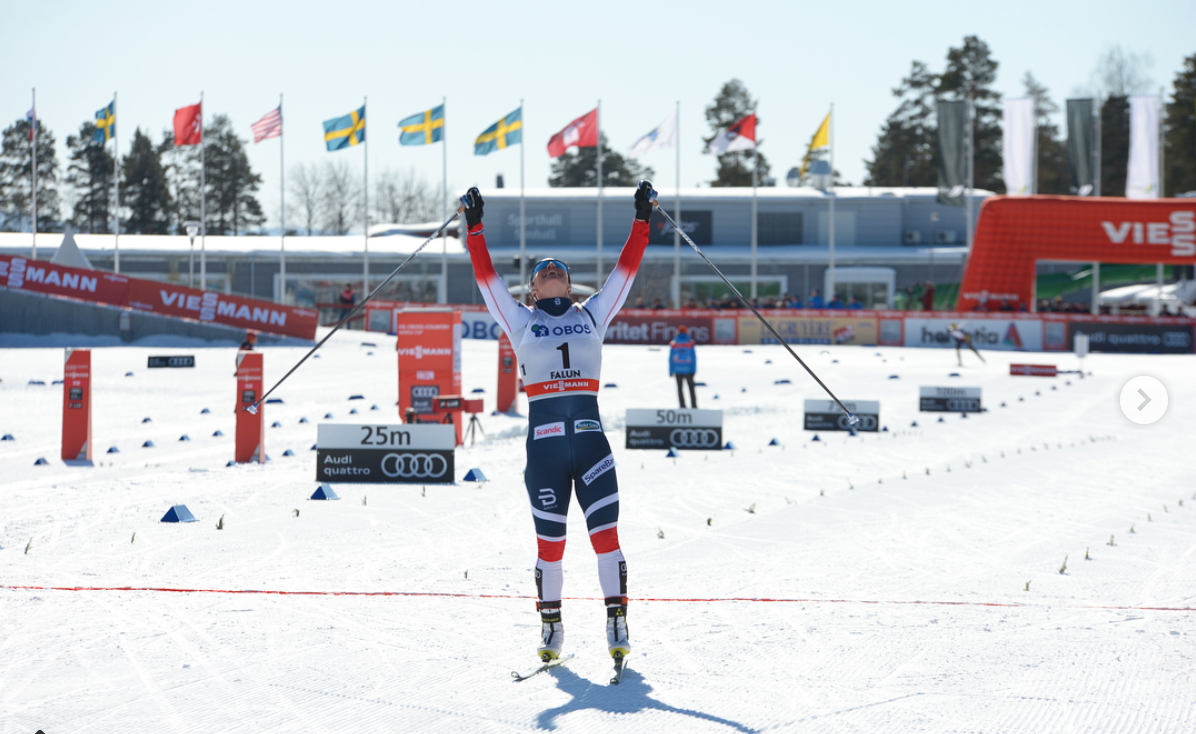
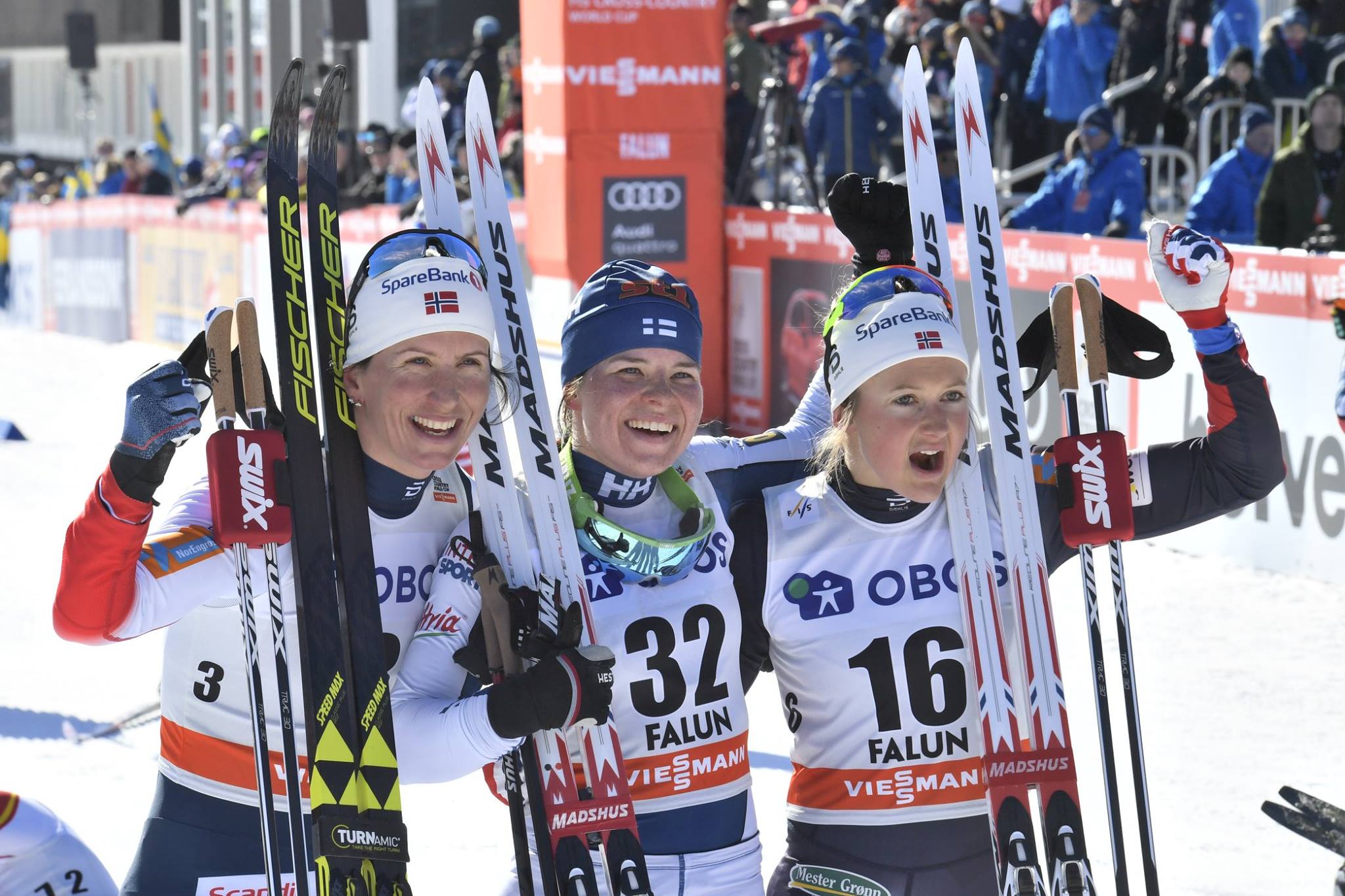
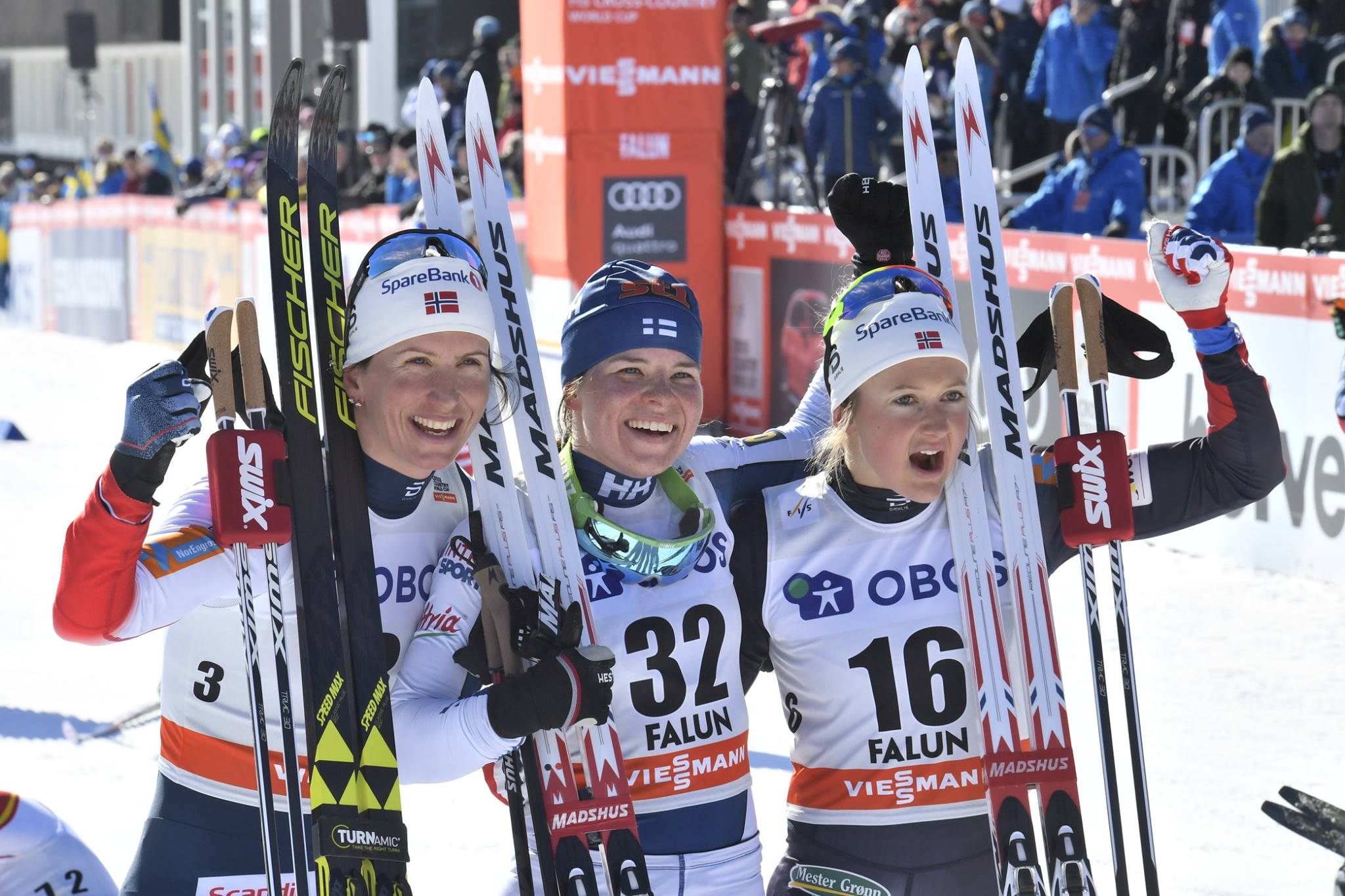
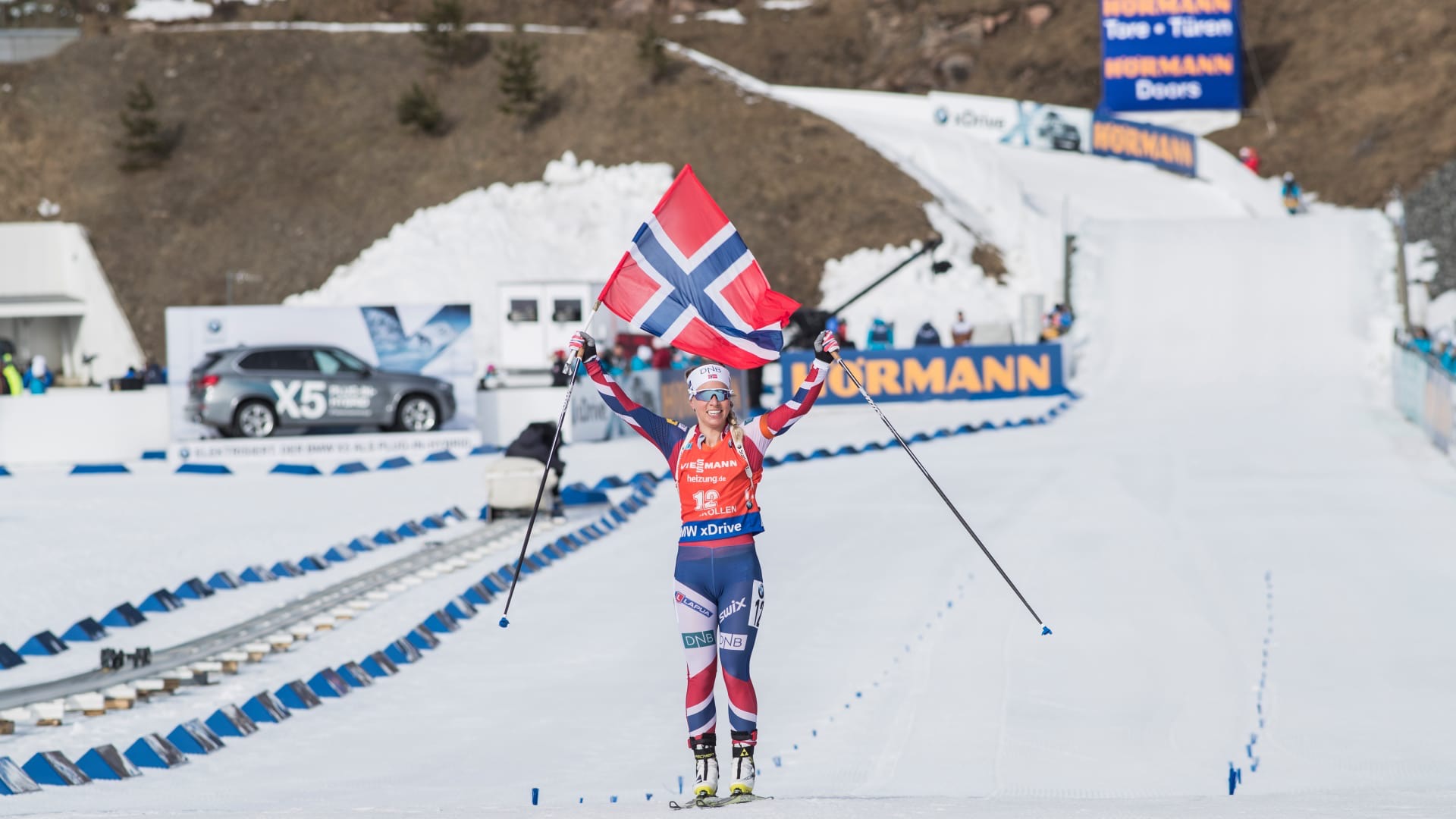
Norway’s Marit Bjørgen celebrates her overall win in the last race of 2018 World Cup Finals, the 10 k freestyle pursuit, on Sunday in Falun, Sweden. (Photo: Svenska Skidspelen/Instagram)
FIS Cross Country World Cup Finals (Falun, Sweden): 10/15 k freestyle pursuits
In the last women’s race of the World Cup season, U.S. Ski Team members Jessie Diggins and Sadie Bjornsen made it one they’ll remember for a long, long time as Diggins raced to second in the 10-kilometer freestyle pursuit and Bjornsen outlasted two Norwegians for third. The two finished the World Cup Finals mini tour in second and third, respectively, behind Norway’s Marit Bjørgen who won it in 24:18.9 minutes.
Bjørgen started with a 36-second cushion to her Norwegian teammate Ingvild Flugstad Østberg in second. Diggins started third, 41 seconds back, just ahead of Finland’s Krista Pärmäkoski in fourth (+43.0), based on their cumulative performances over the last two days of the mini tour (skate sprint and 10 k classic mass start).
While Østberg, Diggins and Pärmäkoski formed a chase pack, Diggins dropped them in pursuit of Bjørgen on the first lap. The American continued to push the pace throughout the three-lap race, coming within 16.7 seconds of Bjørgen at the finish.
Meanwhile, during the pursuit, a chase group of five, which included Bjornsen, caught Østberg and Pärmäkoski. The group of seven dwindled to three on the last two climbs, where Bjornsen and Norway’s Astrid Uhrenholdt Jacobsen and Ragnhild Haga broke away in a race for third.
The three were even entering the finishing stretch, where Bjornsen then beat them in a final 100-meter push to the line. Bjornsen claimed third (+1:11.5) for her fourth podium of the season and first in a distance skate race. Haga followed in fourth (+1:12.0) and Jacobsen fifth (+1:12.8), while Pärmäkoski placed sixth (+1:16.2), Sweden’s Charlotte Kalla seventh (+1:17.9), Østberg eighth (+1:19.0), Sweden’s Jonna Sundling ninth (+1:30.5) and Ebba Andersson 10th (+1:44.7).
Bjornsen now has five-career individual World Cup podiums to her name, and this is the first in a skate race longer than 5 k.
Diggins clocked the fastest time of day in 23:54.4, while Haga was second-fastest (+10.7) after starting the race in 17th. Bjørgen’s time ranked third, Jacobsen was fourth-fastest and Bjornsen fifth-fastest.
Diggins’s performance elevated her to second in the Overall World Cup standings, just 40 points behind Norway’s Heidi Weng (who placed 18th in the pursuit) in first for the second-straight year. Østberg slipped to third overall, 22 points behind Diggins. In the Distance World Cup, Weng took the title by 63 points over Østberg in second, while Diggins was another 32 points back in third.
Bjornsen ended up sixth in the Overall World Cup and 10th in the distance standings.
Also for the U.S., Caitlin Patterson raced from 46th at the start to 35th (+3:58.4) with the 22nd-fastest time of day, Sophie Caldwell placed 36th (+4:00.7), Kikkan Randall finished her last World Cup race in 43rd (+4:33.3) with the 29th-fastest time, Rosie Frankowski placed 46th (+4:41.3), Liz Stephen 50th (+4:57.2) in her final World Cup race, Kaitlynn Miller 56th (+6:13.8), and Ida Sargent 57th (+7:06.4).
For Canada, Cendrine Browne picked off 10 places to finish 39th (+4:14.4) with 27th-fastest time of day, Emily Nishikawa finished 48th (+4:43.7), Dahria Beatty 54th (+6:04.3), and Zina Kocher 60th (+9:28.4).
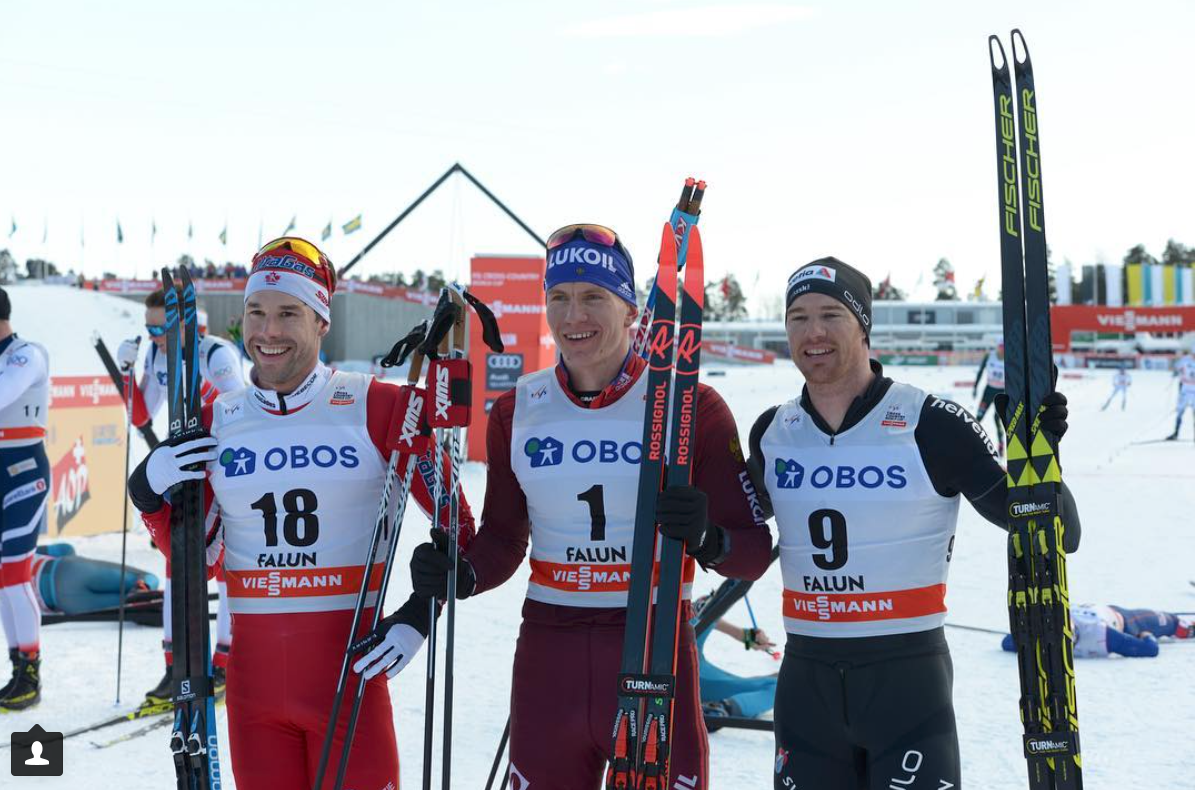
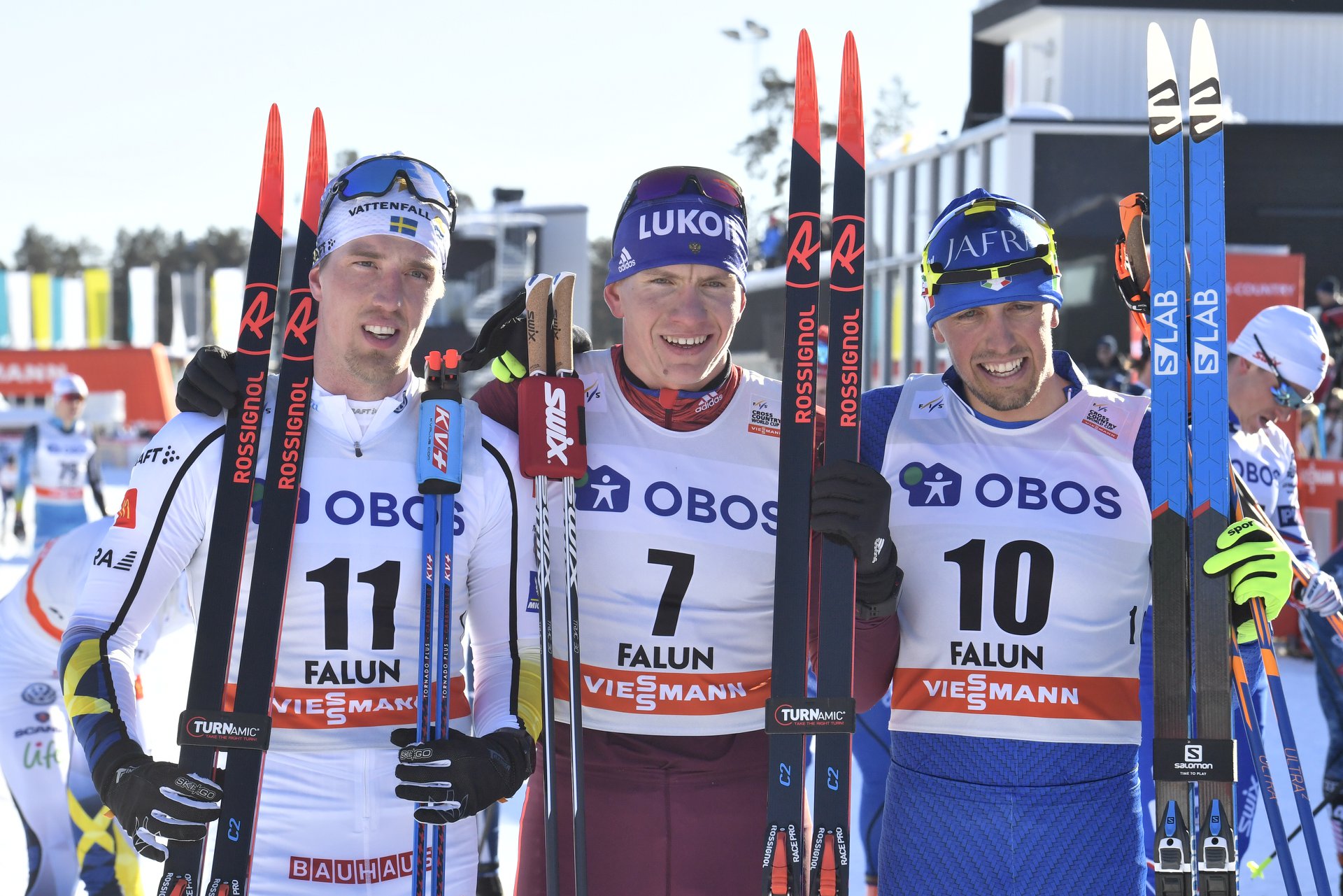
The men’s 15 k freestyle and 2018 World Cup Finals podium, with Russia’s Alexander Bolshunov (c) in first, Canada’s Alex Harvey (l) in second and Switzerland’s Dario Cologna (r) in third. (Photo: Svenska Skidspelen/Instagram)
In the men’s 15 k freestyle pursuit that followed, Russia’s Alexander Bolshunov started 38 seconds clear of Norway’s Johannes Høsflot Klæbo in second, and Sweden’s Calle Halfvarsson and Italy’s Federico Pellegrino headed out together another second later in third and fourth, respectively.
Norway’s Martin Johnsrud Sundby started the race in seventh (+53.0), and Switzerland’s Dario Cologna followed in ninth (+56.0), while Canada’s Alex Harvey started 1:16 back in 18th.
While Bolshunov skied the entire race on his own and won the weekend mini tour in 35:03.3, a number of racers battled for second, with Sundby moving into second in the chase pack, ahead of seven others, less than 2 k in. Several skiers found themselves at the front of that group, including Cologna, Halfvarsson, and even Harvey (with Harvey leading the chase at 9.3 k), while the time gap to Bolshunov grew.
With about 2 k to go, the group was down to six. Harvey attempted an attack, but Cologna matched him. Then, on one of the course’s final climbs, Cologna made his move to get a slight gap, but lost his balance slightly on the downhill, allowing Harvey to catch back up.
With one last uphill to go, Harvey was in the driver’s seat in second, Cologna in third and Sundby in fourth. That order held to the finish, with Harvey claiming second, 47.1 seconds behind Bolshunov, Cologna placing third (+47.5) and Sundby fourth (+48.7). Just behind them, Russia’s Maxim Vylegzhanin crossed in fifth (+50.3), ahead of Norway’s Hans Christer Holund in sixth (+51.7), Halfvarsson in seventh (+54.1), and Norway’s Sjur Røthe in eighth (+54.9). Nearly 10 seconds later, Norway’s Niklas Dyrhaug outlunged two Russians for ninth (+1:04.1): Denis Spitsov in 10th (+1:04.2) and Andrey Larkov in 11th (+1:04.3).
Harvey, who finished the season in fourth in both the Overall and Distance World Cup standings, won the time of day in 34:34.3. Holund had the second-fastest course time, 1 second off Harvey’s time, after starting the race in 22nd.
Harvey’s Canadian teammate Devon Kershaw tallied his fifth-straight distance top 30 in 28th (+2:21.9), after starting 27th, and Graeme Killick finished 56th (+4:33). Julien Locke did not start.
For the U.S., Erik Bjornsen clocked the 22nd-fastest time en route to 38th (+3:10.4), after he started 51st. Simi Hamilton improved 10 places to finish 49th (+4:07.8), Scott Patterson and Paddy Caldwell worked together to move up from 72nd and 73rd, respectively, to 58th (+4:41.5) and 59th (+4:41.6), respectively, at the finish. Kevin Bolger placed 60th (+4:43.5) and David Norris 64th (+5:09.8).
While Klæbo slipped from second to 25th in the pursuit (+1:45.8), the Norwegian still won his first Overall World Cup by 119 points over Cologna in second. Sundby placed third, 29 points out of second and 82 points ahead of Harvey.
Cologna claimed the Distance World Cup Crystal Globe by 41 points over Sundby, and Holund reached the Distance World Cup podium in third, 58 points out of second and just 5 points ahead of Harvey in third. France’s Maurice Manificat had been third heading into the final day of racing, but finished the pursuit in 26th (+2:11.9) and dropped to fifth in the final distance rankings.
In her last race of the season, Susan Dunklee returned to the podium. The American started fourth in Sunday’s 10-kilometer pursuit at the International Biathlon Union (IBU) World Cup in Oslo, then made her way into third by the final shooting stage. Dunklee shot 18-for-20 (1+0+1+0) and finished 29.5 seconds behind the winner, Darya Domracheva of Belarus, who missed two targets as well (1+0+1+0) and finished first in 30:37.4. Slovakia’s Anastasiya Kuzmina started the race in first (ahead of Domracheva in second) and ended up second (+9.2) with four penalties (0+2+2+0).
Canada’s Julia Ransom and Rosanna Crawford finished together in 51st and 52nd, respectively, both 4:52.4 out of first. Ransom had four penalties (0+1+1+2) while Crawford missed five (1+3+1+0). Emma Lunder did not finish.
In the men’s 4 x 7.5 k relay on Sunday, Norway’s team of Lars Helge Birkeland, Henrik L’Abee-Lund, Tarjei Bø, and Johannes Thingnes Bø used just three spare rounds to clean eight shooting stages and took the win in 1:13:13.7 hours. Austria finished 50.3 seconds back in second place, with Dominik Landertinger, Felix Leitner, Simon Eder, and Julian Eberhard, with a total of five spares. Russia’s Maxim Tsvetkov, Anton Babikov, DmitryMalyshko, and Anton Shipulin raced to third (+56.9) with just four total spares.
The U.S. men placed seventh (+2:01.5) with eighth spares, after Lowell Bailey put the team in seventh on the first leg. Sean Doherty skied them up to sixth on the second leg, Tim Burke slipped to 10th on the third leg, and Leif Nordgren posted the seventh-fastest anchor leg to put them in seventh at the finish.
Canada placed 16th (+5:42.4) with Christian Gow, Scott Gow, Brendan Green, and Macx Davies. The team had been in 19th at the final exchange, but Davies skied them up to 16th with the 14th-fastest anchor leg. In all, they used 10 spares.
As the kilometers and shooting stages ticked by, it looked possible that L’Abée-Lund would do it again, or at least come close. After two prone stages, one standing stage, one penalty lap, and 7.5 kilometers of skiing, L’Abée-Lund hit the trails together with the man who is always a pre-race favorite: Martin Fourcade of France.
Over the next 2.5 kilometers, Fourcade skied faster, but wasn’t able to put too much of a gap on the Norwegian. Fourcade came into the range with a 4.5-second lead and hit his first target before L’Abée-Lund started shooting.
Fourcade kept right on going, hitting all five targets for a score of 18/20 on the day, and cruised to victory.
When asked at the post-race press conference whether the win was easy, Fourcade replied, “It wasn’t, because the fight on the beginning was really tight. I had a lot of pressure on the standing shooting. So I must say I’m really satisfied about the win today. I heard it’s my 10th win in Holmenkollen and I’m the most-awarded biathlete in Holmenkollen. It’s probably my favorite place on the World Cup. I’m really happy I did that.”
L’Abée-Lund missed two and fell out of podium contention.
In his absence, Johannes Thingnes Bø – the more favored Norwegian – also missed a shot on the final stage. Italy’s Lukas Hofer cleaned and went past him into second, and that was the podium at the finish.
It was Fourcade’s seventh win in a season where he has never been off the podium in a World Cup race (although he was twice off the podium at the Olympics), and he now has a 49-point lead over Bø in the World Cup Total Score standings with three individual races to go.
“It’s really nice fight,” Fourcade said in a press conference. “I must say, I’m surprised [to say it], but I like it. Johannes is an amazing opponent. No matter what happens in Tyumen, I know that I will thank him for the fight we had. Even if he wins the World Cup, I don’t want that, but I will thank him. I really appreciate the good fight, the fair fight we had, and the good biathlon show we made for people.”
“I think I have maybe 10-percent chance to win this,” Bø said of the overall World Cup title. “So it’s not a big chance, but you know, many things can happen. I know for sure that Martin will probably on the podium every race next weekend. And then there is no chance for me to win the globe. So then I have to just do my best and then we see, but it has been a good season no matter what happens, and it’s a big step in my career.
Hofer finished 18.1 seconds back in second place with one penalty, and Bø 32.5 seconds back reached the podium despite four missed shots.
“I went out [from the last shooting stage] and my trainer told me, ‘It’s only a small gap, only four seconds,’ ” Hofer said, although he actually led Bø by nearly 15 seconds at that point. “I think they told me this so that I keep pushing on the last loop. I tried to keep some energy for the last 600 meters a the end. When I saw Johannes and that I had a bigger gap to him, I was really happy.”
“I knew that Hofer is one of the strongest guys on the last laps,” Bø said. “But I was feeling really good today, so I was thinking there was a chance [to catch him]. We had really good material and skis. And I had good shape today, but in the end of the last lap, I saw there was no chance. So then it was just to look behind and secure the third place. “
Fourth place went to Russia’s Maxim Tsvetkov (+42.7), who cleaned the whole race and moved up from bib 28. L’Abée-Lund finished fifth (+45.2).
US Biathlon’s Sean Doherty started the day in bib 14, and cleaned all his prone targets to stay in contention for a top 10. He missed a shot in each standing stage but still finished 17th on the day (+1:34.2), tying his second-best result of the season.
“I’m really happy with today,” Doherty said. “I really had a goal in mind to stay in my own lane, on the range there. Skiing with these top guys, the pace is really high, so stay focused on my [shooting], and I did that well. I’m happy with how I shot and how I executed this race. I obviously left two in standing there, but those were just my mistake … Standing is usually stronger for me, but I was kind of pushing the limit, which you have to do if you’re still trying to make up some time on the range. So I was just a little hasty at times, and that’s just kind of my nature.”
Doherty had the 23rd-fastest course time on the day.
“It’s been a pretty lousy season in a lot of ways,” he said. “There were some good moments before Christmas, and it’s good to finish on a really strong note with Finland and with these races here. So I’m really happy about that – it’s nice for the body to be picking up. But it’s a little bit of a bummer that we are not going to Russia, because I’m starting to ski better, and really feeling like I’m in good form for some more racing.”
Teammate Lowell Bailey started in 42nd and had two missed targets to move up to 28th (+2:07.2), thanks to the 19th-fastest course time of the day. For both him and Tim Burke, who finished 47th (+4:12.6) with four penalties, it was the last individual World Cup starts for long careers, as the U.S. is boycotting next weekend’s World Cup stage in Tyumen, Russia.
Leif Nordgren finished 40th (+3:07.5) with four penalties, three of which came in the second prone stage. He had the 27th-fastest course time.
“It was a really good race except for one stage,” Nordgren said. “That second prone stage set me back quite a bit. But I was really happy with my skiing today. [Ski speed] came just a couple weeks late after the Olympics unfortunately. I definitely feel a lot stronger now, and it’s too bad it’s the end of the season. But it’s nice to end on a high note. You don’t have to be pissed off all spring.”
For Canada, Scott Gow finished 51st (+4:59.7) and younger brother Christian Gow 54th (+5:07.4) with five and two penalties, respectively.
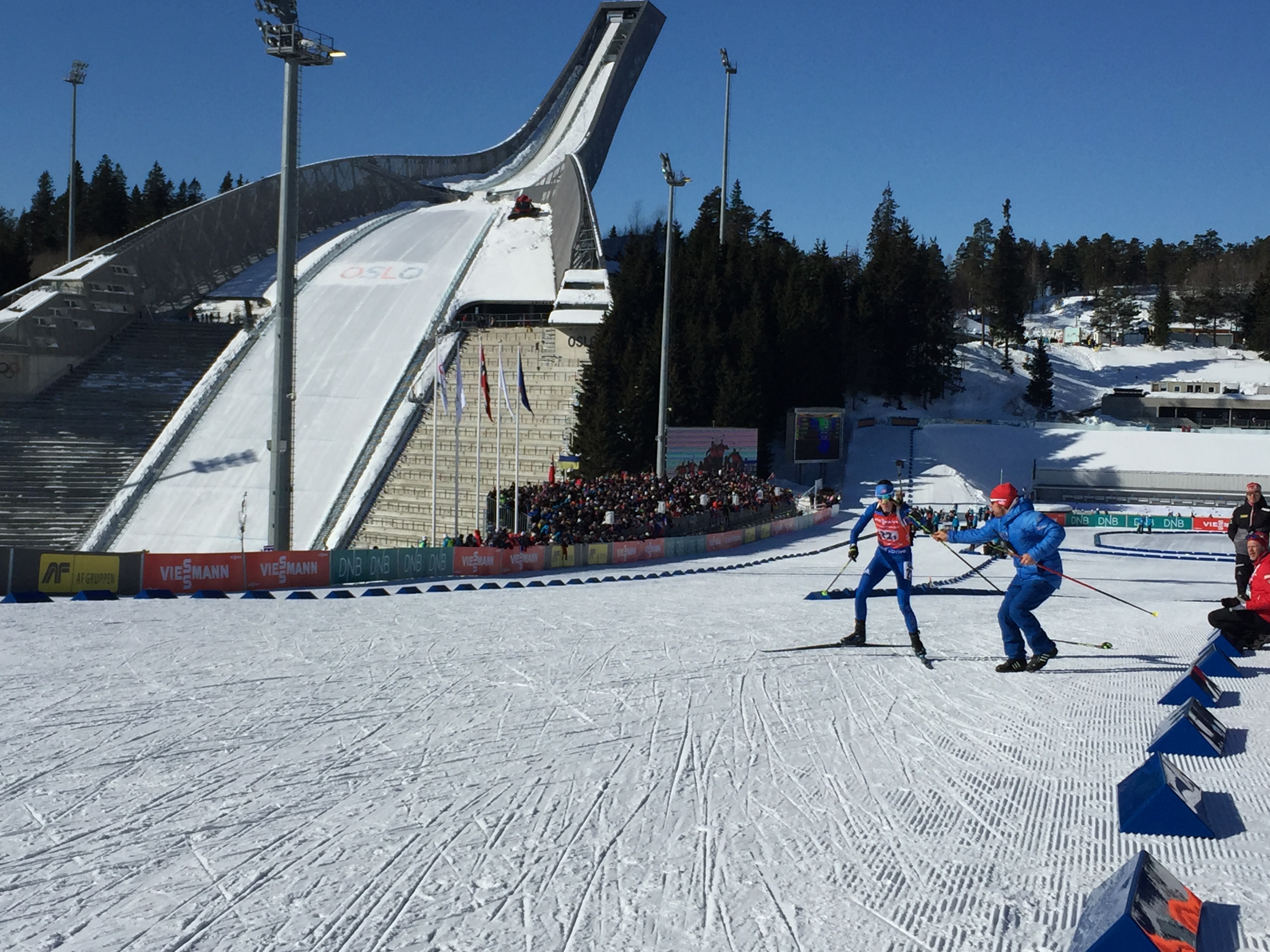
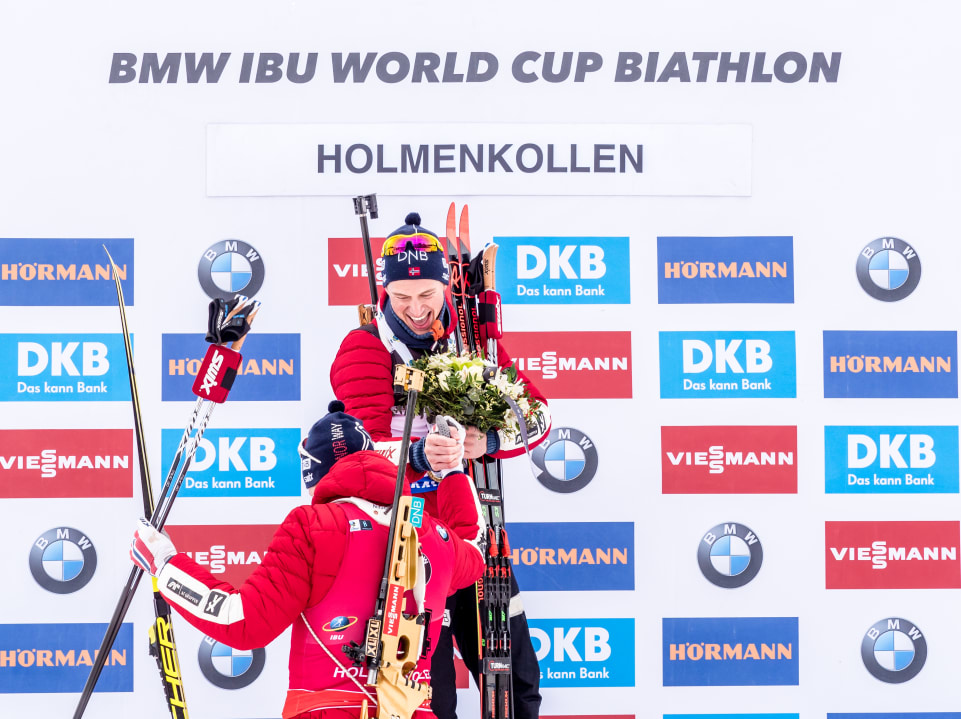
Clare Egan receives a pole from US Biathlon Chief of Sport Bernd Eisenbichler during the first leg of the women’s relay at Holmenkollen.
OSLO, Norway — In the last relay of French star Marie Dorin Habert’s career, she turned in a crucial performance to bring her team to the front. Anaïs Bescond extended the gap and France took the win in the women’s 4 x 6-kilometer relay here at Holmenkollen by 14.4 seconds over Germany.
Was she nervous going into the last team event she will ever race?
“I wasn’t really nervous,” Dorin Habert, 31, said in a press conference. “I think it’s a special thing to know that there is no more starts and no more relays for me, so I just wanted to fight and struggle hard like every relay. I think I did my best today.”
Dorin Habert won two gold medals, in the individual and the pursuit, here at World Championships two years ago. So Oslo is a special place.
“It’s so nice to end this way, to share it with all of the team, and the beautiful sun, and all the French people,” Dorin Habert said. “It’s a wonderful day for me. I would like to thank a lot, well, everyone, for being there in the biathlon family. I’m really happy to have this career, and I’m really happy for everything.
The Italian duo of Lisa Vittozzi and Dorothea Wierer put their team in first place at the halfway point, and it was their teammate Nicole Gontier whom Dorin Habert passed to pull France into first. Gontier stuck with her, and Italy was only 2.2 seconds back at the last exchange.
The German anchor, Laura Dahlmeier, charged past Italian skier Federica Sanfilippo. She was unable to catch Bescond, but Germany finished second with seven spare rounds to six by the French, and Italy placed third with eight spare rounds (+33.2).
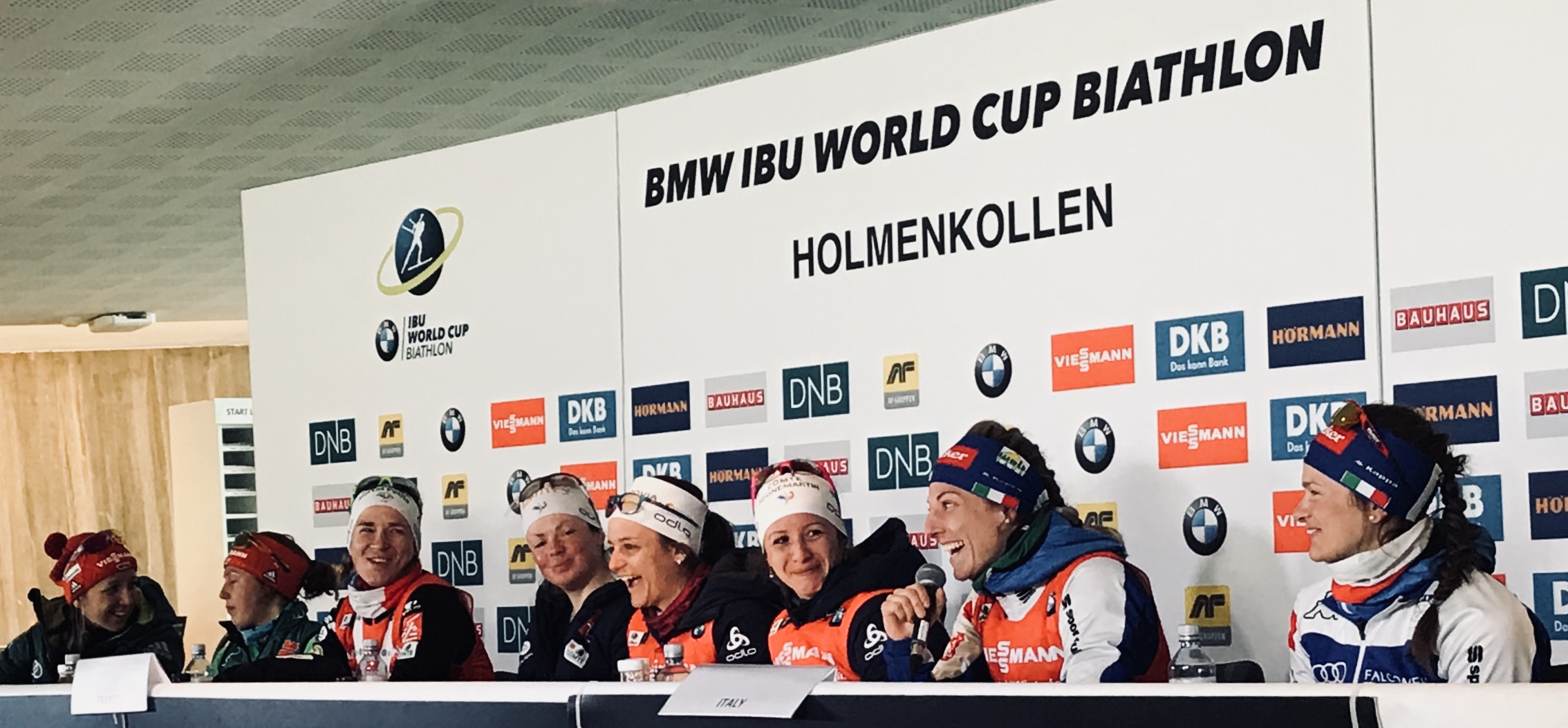
The Italian and French teams joking in the press conference.
Norway placed fourth with a penalty loop and 10 spares (+1:26.5), Switzerland fifth with eight spare rounds (+1:54.2), and Sweden sixth with a remarkable three spare rounds (+2:27.2).
The Canadian team skied an even race, with Sarah Beaudry leading off in 12th, Julia Ransom tagging in 14th, Emma Lunder in 15th, and then Rosanna Crawford bringing the team up to 11th.
“I love coming from behind and chasing girls down, and I just looked at it as practice for tomorrow,” said Crawford, who will start Sunday’s pursuit in bib 38. “I was within somewhat contact with the other women around me, so that was nice. People to chase, people to ski with.”
It wasn’t the result the team knew they were capable of, with 11 spare rounds. But it has been a long season.
“Of course everyone is tired, every team is tired,” Crawford said. “But our fast isn’t as fast as the fastest, so our slow is, well, a lot slower. I felt so good through Finland, and I really thought the ski speed was going to hold, but then it wasn’t there in the sprint. And also, today was slightly better, but not what I had last weekend. It’s so frustrating to be up and down.”
The U.S. team started off with a tough leg by Clare Egan, who used all of her spare rounds in both prone and standing and had two penalty laps. She tagged off at the first exchange in 21st and last place.
“This is I think the worst race of my career,” she said after the finish. “I’m really embarrassed. It is the worst possible thing to do it in a relay. I hate letting everyone down. It’s a really terrible feeling.”
Her teammates, though, were more circumspect.
“I never, ever, want to hear a teammate apologizing for tagging off far back like that,” said Susan Dunklee, who took the tag from Egan. “The only thing they can apologize for is if they didn’t try. And Clare was out there and trying her best. So I have nothing but respect for that.
“What I yelled at Clare, when she was at the top corner and I was warming up, I yelled, ‘We love you and we think you’re awesome!’ ” Dunklee continued. “She was in last place, and we still do love her. You just have to know that your teammates have all been there, they have all done the same thing in the relay, and they know exactly how you feel. Usually, there’s a piece of our relay that we can look at and get really excited about, so we will do that today.”
For Egan, though, it was a race that just came apart. The team started with bib 22, one of the last in the field, but she move up 10 places to 12th by the first shooting.
Then, spare rounds and penalty laps.
“I’ve never had a penalty loop in prone, in the World Cup [in a relay], but to do that in the first stage and immediately be like a minute behind everyone – no, I didn’t lose hope,” Egan said. “I knew that anything can happen in the standing. And I actually, I didn’t come into the range last. I had passed one person. But, you know, with another [penalty lap] in standing, I was just trying to get as fast as I could to the finish because … I just hoped that my teammates all would get a chance to do the race. If we get lapped then we get pulled. That’s it.”
She also lost part of a pole early on in the race, and the replacement process did not go smoothly.
“I just had to get a new one, but then the new one was shorter than my own pole,” Egan explained. “So when I went by a coach I meant to switch out the shorter pole for a spare that was the right height, and I gave him my own pole. So then I finished the race and I was like, ‘What the heck? I still have this stupid pole.’ ”
As the relay continued, Dunklee had the seventh-fastest second leg time, and Reid the eighth-fastest third leg time; by the third exchange, the U.S. was in 17th place.
“The shooting didn’t feel really sharp today,” said Dunklee, who used three spare rounds in total. “I don’t know what the times were but I don’t think they were very fast. I just felt sluggish and, a little out of it, really.”
Reid used only one spare round, a performance she was excited about.
“It’s always easier to start from behind and work your way up because there’s no pressure,” she said. “Whereas if you come into the range in first and have to shoot on point one, and everyone is staring at you, that’s really hard. Today was low-pressure shooting.”
Emily Dreissigacker anchored the team, and used four spare rounds to move up to 15th. She caught the team from Kazakhstan and held off a challenge from Korea in a three-way sprint finish, chasing Austria who finished jut 2.1 seconds ahead.
“I don’t know when the last time I actually had to sprint for the finish was, but it was great!” she said.
China and Slovenia were disqualified, and Bulgaria and Lithuania were lapped. But despite being the last team on the first leg, the U.S. women avoided that fate by a large margin.
“I definitely went out hard,” Dreissigacker said. “I knew we were sort of in the danger zone for getting lapped, but actually, the skiing felt really good the first two laps. I kind of died at the end, so I was glad I was able to come through at the finish.”
“I think we’ve all been through some ups and downs this season and struggling with that,” Dunklee said of Egan’s relay leg. “It’s important to remember that biathlon isn’t everything. There’s other stuff going on in our daily lives that is meaningful to us. It’s important to never lose sight of that.”
The women’s 10 k classic mass start podium at 2018 World Cup Finals in Falun, Sweden, with Finland’s Krista Pärmäkoski (c) in first, Norway’s Marit Bjørgen (l) in second and Ingvild Flugstad Østberg (r) in third. (Photo: FIS World Cup Svenska Skidspelen/Facebook)
FIS Cross Country World Cup Finals (Falun, Sweden): 10/15 k classic mass starts
Day 2 of World Cup Finals in Falun entailed 10- and 15-kilometer classic mass starts on Saturday, and in the first race of the day, Finland’s Krista Pärmäkoski pulled out a thrilling finishing-sprint victory over Norway’s Marit Bjørgen.
After American Jessie Diggins led early in the first 2.5 k loop, Bjørgen set the tone from the front for most of the race. With less than a kilometer to go, Norwegian powered up the final horseshoe-shaped climb in first, with Pärmäkoski and Bjørgen’s Norwegian teammate Ingvild Flugstad Østberg just behind her. The three had dropped the field while lapping through the stadium around the 7.5 k.
While Østberg fell off the pace on that final uphill, Bjørgen accelerated as she took a few quick strides over the top, gaining a few meters on Pärmäkoski as they headed into the descent. The finishing stretch is long in Falun, and Pärmäkoski was able to come on strong just before she and Bjørgen entered the final 100 meters before the finish. There, Pärmäkoski’s double-pole speed not only matched Bjørgen, but beat her, as Pärmäkoski passed her with several meters to go and took the win by 0.2 seconds in 26:00.5 minutes. It was Pärmäkoski’s second win of the season and fourth of her career (including time-of-day pursuit stage wins).
Just behind Pärmäkoski and Bjørgen, who congratulated each other immediately at the finish, Østberg finished 5.1 seconds back in third. Five women fought for fourth place, with Sweden’s Ebba Andersson taking it (+14.5) ahead of Japan’s Masako Ishida in fifth (+14.8), Sweden’s Charlotte Kalla in sixth (+15.2), Austria’s Teresa Stadlober in seventh (+15.4), and Diggins in eighth (+15.5).
Norway’s Astrid Uhrenholdt Jacobsen was the next finisher across the line in ninth (+24.8), then Finland’s Kerttu Niskanen in 10th (+26.2) and American Sadie Bjornsen in 11th (+26.3).
Canada’s Emily Nishikawa was the next North American in 36th (+1:31.1), and she led her teammates Cendrine Browne, who placed 50th (+2:05.7), Dahria Beatty in 61st (+2:46.6) and Zina Kocher in 69th (+6:12).
For the U.S., Sophie Caldwell finished 41st (+1:36.1), Rosie Frankowski 44th (+1:43.7), Caitlin Patterson 47th (+1:54.8), Ida Sargent 52nd (+2:10.2), Liz Stephen 54th (+2:20.0), Kikkan Randall 57th (+2:34.1), and Kaitlynn Miller 64th (+2:50.7). Rosie Brennan did not start.
The men’s 15 k classic mass start podium at 2018 World Cup Finals in Falun, Sweden, with Russia’s Alexander Bolshunov (c) in first, Sweden’s Calle Halfvarsson (l) in second, and Italy’s Francesco de Fabiani (r) in third. (Photo: : FIS World Cup Svenska Skidspelen/Facebook)
In the men’s 15 k classic mass start on Saturday afternoon, Russia’s 21-year-old Alexander Bolshunov notched his first-career World Cup win after reaching the podium seven other times this season (placing third in six of those seven races).
Bolshunov hung in the pack and took the lead at the start of the final lap at 11.25 k, ahead of four of his Russian teammates, Alexey Chervotkin in second, Evgeniy Belov in third, Andrey Larkov in fourth, and Maxim Vylegzhanin in fifth. Behind them, Switzerland’s Dario Cologna skied just ahead of Norway’s Martin Johnsrud Sundby and Canada’s Alex Harvey, who were among 29 skiers within four seconds of first.
While Sweden’s Calle Halfvarsson led the final climb before the stadium, Bolshunov caught him on the downhill and out-double-poled him in the finishing stretch, taking first by 1.3 seconds in 36:59.8. Halfvarsson finished second and Italy’s Francesco de Fabiani scored his second World Cup podium of the season in third (+3.1).
Kazakhstan’s Alexey Poltoranin missed the podium by 0.6 seconds in fourth (+3.7), Chervotkin followed in fifth (+5.2), ahead of Cologna in sixth (+5.6) and Italy’s Federico Pellegrino in seventh (+5.6), after they finished together. Sundby and his Norwegian teammate Niklas Dyrhaug also crossed the line at the same time in eighth (+6.3) and ninth (+6.3), respectively, just 0.1 seconds ahead of another one of their teammates, Sjur Røthe, in 10th (+6.4).
Less than five seconds later, Harvey finished 20th (+10.7), ahead of Norway’s Johannes Høsflot Klæbo in 22nd (+13.6). Klæbo slipped out of contention on the third of four laps, as he dropped from fourth to 22nd in less than two kilometers.
Canada’s Devon Kershaw finished 26th (+14.6) for his fourth-straight race in the top 30 (including his 26th-place finish in the Olympic 50 k classic mass start), Graeme Killick placed 41st (+1:13) and Julien Locke was 81st (+3:29).
Erik Bjornsen was the top American man in 52nd (+1:47.1), Simi Hamilton finished 62nd (+2:06.4), Kevin Bolger was 69th (+2:27.1), David Norris 70th (+2:31.2), Scott Patterson 71st (+2:40.6), Paddy Caldwell 75th (+2:52.7), and Andy Newell 86th (+4:47).
World Cup Finals conclude with 10/15 k freestyle pursuits on Sunday.
France won the International Biathlon Union (IBU) World Cup women’s 4 x 6 k relay to start the day at Holmenkollen, ahead of Germany and Italy, while the Canadian women’s team (Sarah Beaudry, Julia Ransom, Emma Lunder, and Rosanna Crawford) placed 11th and the U.S. (Clare Egan, Susan Dunklee, Joanne Reid, and Emily Dreissigacker) came back from 21st to finish 15th.
In the men’s 12.5 k pursuit that followed, France’s Martin Fourcade won his 10th race at Holmenkollen, putting himself 49 points ahead of Norway’s Johannes Thingnes Bø with three individual races in Tyumen, Russia, remaining. US Biathlon’s Sean Doherty tied his second-best result this season in 17th and his teammate Lowell Bailey raced up to 28th with the 19th-fastest time of day. Leif Nordgren placed 40th and Tim Burke was 47th, while Canada’s Scott Gow finished 51st and Christian Gow was 54th.
Susan Dunklee (US Biathlon) racing to fourth in the women’s 7.5 k sprint on Thursday at the IBU World Cup in Oslo, Norway. It was her best individual result of the season by two places. (Photo: USBA/NordicFocus)
Susan Dunklee had been looking for something all season, a sort of spark. And while the U.S. biathlete hadn’t necessarily found it on Thursday, she had still pulled off fourth place in the women’s 7.5-kilometer pursuit at the International Biathlon Union (IBU) World Cup in Oslo, Norway.
“I feel like right now I’m relying on good habits to carry me through the rest of the season,” Dunklee, 32, of US Biathlon, said in a phone interview on Thursday. “Normally you need more than just that, you need that spark.”
Last year in Oslo, Dunklee placed seventh in the sprint. They year before, she finished eighth in the 2016 Oslo World Championships sprint at the Holmenkollen biathlon venue.
The flower ceremony for the IBU World Cup women’s sprint on Thursday in Oslo, Norway, which American Susan Dunklee appeared in after placing fourth. (Photo: IBU/Biathlonworld)
On Thursday, she shot clean (hitting all 10 of her targets) and finished 35.7 seconds behind the winner, Slovakia’s Anastasiya Kuzmina, and 6.5 seconds out of third, which went to Ukraine’s Yuliia Dzhima.
The race was Dunklee’s last World Cup sprint of the season, since US Biathlon (along with several other teams) is boycotting next week’s final World Cup in Tyumen, Russia.
“I feel like that spark has been missing a little bit so I was really surprised to be able to put this one together,” she said. “But maybe there was too much spark, maybe I wanted things too much and now I’m finally kind of letting go a little bit and that’s what I needed to do all along.”
A two-time Olympian who raced at five World Championships, Dunklee has been competing internationally in biathlon for the last nine years after a relatively late start in the sport. The daughter of Stan Dunklee, a two-time Olympic cross-country skier, she started skiing at age 2 but didn’t learn to shoot until age 22 when she joined US Biathlon’s development program after graduating from Dartmouth College.
And despite currently being the veteran member of the US Biathlon women’s team, Dunklee said she still gains a great deal from her younger teammates. Clare Egan, 30, who switched from cross-country ski racing to biathlon five years ago, raced to a career-best 13th in last week’s sprint in Kontiolahti, Finland.
“I was definitely inspired by Clare’s race last week,” Dunklee said. “I’ve never seen her so composed and confident out mixing it up with the top ladies in the field and that got me excited for the team. … I often feed off of other people performing well.”
US Biathlon had another breakthrough on Thursday when Sean Doherty finished 14th in the men’s 10 k sprint later in the afternoon in Oslo. It was his season best as well and just one place short of tying his career-best individual World Cup result of 13th (which he achieved in a sprint during the 2015/2016 season in Presque Isle, Maine).
“Sean just had his best result of the season today, so the whole team’s kind of rounding into form just in time,” Dunklee said of the season’s end.
Slovakia’s Anastasiya Kuzmina racing to her fifth World Cup win of the season in the 7.5 k sprint in Oslo, Norway. (Photo: IBU/Biathlonworld)
Kuzmina, who won the women’s race in 21:31.8 minutes with one prone penalty (1+0), started the sprint a minute and a half behind Dunklee, who headed out of the gate in bib 10. Despite cleaning both stages, Dunklee knew she was in second on her final loop after hearing about the kind of race Kuzmina was having. The Slovakian posted the fastest overall course time to overcome her early penalty and beat Belarusian Darya Domracheva, who shot clean, by 8.9 seconds. Dzhima also shot 10-for-10 (as did the rest of the top-seven women) and finished 29.2 seconds off Kuzmina’s winning time.
While Dunklee initially finished first and was bumped to second by Kuzmina just under a minute later, she knew there were plenty of later starters capable of strong performances that could bump her off the podium. Considering that, Dunklee, who skied the 18th-fastest course time and had the 14th-fastest range time, said she was “very happy” to finish in the top six and earn flower-ceremony recognition.
Asked how she felt about the last races of the season, Dunklee said she was trying not to overthink it.
“I’m not looking at it like this is the last sprint, I’m looking at it like, well, just one more,” she said. “I’m going to try to put everything I can into doing the best I can this weekend because there’s nothing else to save it for.”
While Dunklee will start Sunday’s 10 k pursuit 36 seconds back in fourth based on her sprint result, her three teammates missed the sprint top 60 required to qualify for the pursuit. Egan finished 68th (+2:44.8) with three penalties (1+2), Joanne Reid was 75th (+3:02.2) with three misses (1+2) and Emily Dreissigacker placed 83rd (+3:24.8) with three penalties (2+1) as well.
Meanwhile, three Canadian women qualified for the pursuit. Rosanna Crawford placed 38th (+1:51.8) with one standing penalty (0+1), Julia Ransom was 46th (+2:10.1) with one miss (0+1) and Emma Lunder in 57th (+2:28.2) with one penalty (0+1) as well. Also for Canada, Sarah Beaudry finished 84th (+3:30.7) with three penalties (1+2).
Sean Doherty (US Biathlon) racing to 14th in Thursday’s 10 k sprint for a season-best individual result at the IBU World Cup in Oslo, Norway. (Photo: USBA/NordicFocus)
In the men’s sprint that followed, Doherty was one of nine in the top 14 that shot clean, and he finished 47.1 seconds out of first. Norway’s Henrik L’Abée-Lund won the race with perfect shooting for his first World Cup win with a time of 26:10.3.
Four years ago, Doherty made his World Cup debut in Oslo, where he finished 82nd in the sprint. He explained in an email that he has fond memories of the venue.
“The skiing on and off the race course is fantastic and it’s always a special atmosphere,” wrote Doherty, now 22.
He started in the middle of the field in bib 53 and kept himself competitive with the race leaders with flawless shooting and the 33rd-ranked course time. His overall range and shooting times ranked 24th and 26th fastest, respectively.
Norway’s Johannes Thingnes Bø, who started 30 seconds behind him in bib 54, went on to finish second, 6.1 seconds behind L’Abée-Lund. Bø led throughout the race even after skiing a penalty lap after his standing stage (0+1), but lost time to his teammate, L’Abée-Lund, on the last loop.
“That’s what you hate, being in the lead after the last shooting and not in the lead in the finish,” Bø told German broadcaster ARD after in an English interview. “It’s not the best feeling, but I fought with what I had, just wasn’t enough.”
“He was a great marker for me to chase,” Doherty said of Bø. “After cleaning heading out onto the [last] loop I knew I was having a good one.
“I felt strong skiing today, which in turn helps your confidence on the range,” Doherty continued. “As for the good shooting I have been working on some good things in the days leading up to today and I was able to execute my race plan on the range as I wanted. Which I am very happy about.”
He was pleased to put together a complete race in the last sprint of the season, especially considering how it sets him up for Saturday’s 12.5 k pursuit.
“It feels good to end the season on some good momentum and it is fun to be towards the top of a extremely competitive field,” Doherty said. “Now I am just looking forward to the possibilities of the pursuit.”
Henrik L’Abée-Lund (top) and his Norwegian teammate Johannes Thingnes Bø after they placed first and second, respectively, in the men’s 10 k sprint at the IBU World Cup in Oslo, Norway. (Photo: IBU/Biathlonworld)
In the pursuit, L’Abée-Lund will start six seconds ahead of Bø in second and seven seconds ahead of France’s Martin Fourcade in third. Fourcade placed third on Thursday, 6.9 seconds back, after shooting clean but falling and breaking a pole on a downhill.
“I just tried to push one more time in the downhill to get more speed and I pushed aside my ski, I fell, I broke my pole, and I lost seconds for the victory today,” Fourcade told ARD in English. “It’s a good place close to Johannes [for the pursuit], but today wasn’t my time.”
Austria’s Julian Eberhard, who placed fourth, just 0.2 second behind Fourcade, will start the pursuit at the same time as Fourcade.
With one race to go, Fourcade leads the overall World Cup Total Score standings by 37 points over Bø in second.
“It will be tough, it will be almost impossible,” Bø said of beating him. “Today I was ahead but I have to beat him in every race and actually make more points [than him].”
A total of four American men qualified for Saturday’s pursuit, with Lowell Bailey finishing 42nd (+1:41.1) with two penalties (0+2)), Leif Nordgren 43rd (+1:43.3) with one miss (0+1) and Tim Burke 57th (+2:12.8) with four penalties (2+2). In his second World Cup start, Alex Howe finished 89th (+3:39.5) with four misses (3+1).
For Canada, the Gow brothers qualified for the pursuit, with Scott Gow placing 49th (+2:02.1) with one penalty (0+1) and Christian finishing 56th (+2:12.3) with clean shooting. Brendan Green finished 71st (+2:31.3) with two penalties (1+1) and Macx Davies was 96th (+4:27.2) with four penalties (2+2).
“There is no special secret,” Kuzmina said of her five World Cup wins and Olympic gold (in the mass start) this winter. “It’s hard work before the season, good work together with my team, great support from my family and that is all.”
Born in Russia and the sister of Russian biathlete Anton Shipulin, she said she’s looking forward to the Tyumen World Cup.
“Tyumen is my home, where I was born, and I am really really excited for the time there and to see my family,” she said.
Racing in Oslo continues with the women’s relay and men’s pursuit on Saturday, followed by the women’s pursuit and men’s relay on Sunday.
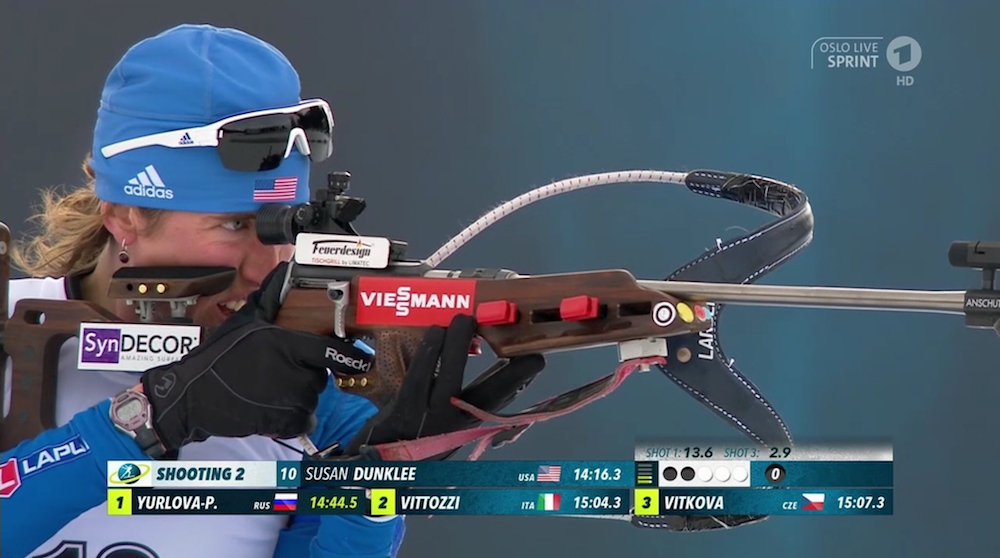
American Susan Dunklee cleaning her second-straight shooting stage of the women’s 7.5 k sprint on Thursday at the IBU World Cup in Oslo, Norway. (Screenshot: ARD broadcast)
IBU World Cup (Oslo, Norway): Women’s and men’s sprints
In her last International Biathlon Union (IBU) World Cup sprint of the season, Susan Dunklee (US Biathlon) raced to a season-best fourth place in the women’s 7.5-kilometer sprint on Thursday at Holmenkollen in Oslo. Dunklee shot clean and finished 35.7 seconds behind Slovakia’s Anastasiya Kuzmina, who had a single prone miss (1+0) but skied the fastest course time to win in 21:31.8 minutes.
Darya Domracheva of Belarus finished 8.9 seconds back for second place with perfect 10-for-10 shooting. The rest of the top-seven finishers also shot clean, with Ukraine’s Yulia Dzhima placing third, 29.2 seconds out of first and 6.5 seconds ahead of Dunklee.
Rosanna Crawford led Canada in 38th (+1:51.8) with one penalty (0+1), and two of her teammates also qualified for Sunday’s pursuit by finishing in the top 60: Julia Ransom in 46th (+2:10.1; one penalty) and Emma Lunder in 57th (+2:28.2; one penalty). Sarah Beaudry finished 84th (+3:30.7; three penalties).
Four Americans competed, with Clare Egan finishing 68th (+2:44.8; three penalties), Joanne Reid 75th (+3:02.2; three penalties) and Emily Dreissigacker 83rd (+3:24.8; three penalties).
Sean Doherty (US Biathlon) racing to 14th in Thursday’s 10 k sprint for a season-best individual result at the IBU World Cup in Oslo, Norway. (Photo: USBA/NordicFocus)
In the men’s 10 k sprint that followed, Sean Doherty (US Biathlon) raced to his best result of the season as well, and was one place away from tying his career best, placing 14th with clean shooting.
Doherty finished 47.1 seconds off the winning time set by Norway’s Henrik L’Abée-Lund, who notched his first World Cup win in 26:10.3. He also shot clean, while his teammate Johannes Thingnes Bø missed one in his standing stage to come 6.1 seconds short of winning at the finish. Bø finished second, while France’s Martin Fourcade placed third (+6.9) after shooting clean but falling on a downhill and losing valuable time.
Doherty posted the 24th-fastest overall range time, 26th-fastest shooting time and 33rd-ranked course time. The 22-year-old New Hampshire native was one of nine men in the top 14 that shot clean. His individual World Cup career best is 13th, which he notched during the 2015/2016 season in a sprint in Presque Isle, Maine. His 14th place on Thursday bested his 17th-place finishes in a sprint and a pursuit earlier this season.
Four out of five of the American men competing qualified for Saturday’s pursuit, with Lowell Bailey finishing 42nd (+1:41.1; two penalties), Leif Nordgren 43rd (+1:43.3; one penalty) and Tim Burke 57th (+2:12.8; four penalties). In his second World Cup start, Alex Howe finished 89th (+3:39.5; one penalty).
Canada’s Scott Gow and Christian Gow qualified for the pursuit, with Scott placing 49th in the sprint (+2:02.1; one penalty) and Christian finishing 56th (+2:12.3) with clean shooting. Brendan Green finished 71st (+2:31.3; two penalties) and Macx Davies was 96th (+4:27.2; four penalties).
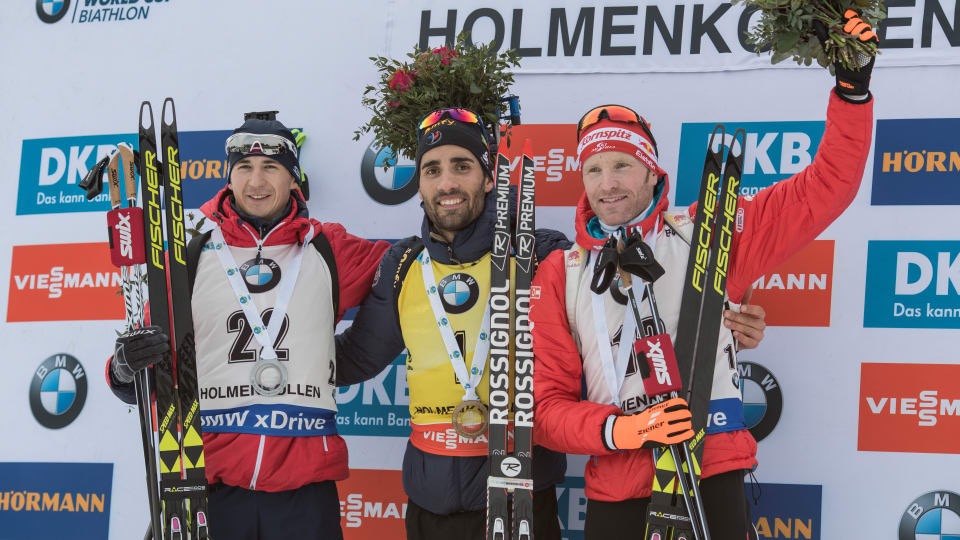
France’s Martin Fourcade (c) in first, Latvia’s Andrejs Rastorgujevs (l) in second and Austria’s Simon Eder (r) in third on the podium following the men’s 15 k mass start at the season-finale 2017 IBU World Cup in Oslo, Norway. (Photo: IBU)
Between breaking historic biathlon records and waiting for the imminent birth of his second child, France’s IBU World Cup dominator Martin Fourcade forgot one crucial detail of Biathlon 101 before Sunday’s final race of the season in the men’s 15-kilometer mass start: loading his ammunition clips.
Fourcade only realized he had started with four empty clips when he crouched down on the shooting mat for the first prone shooting, then signaled for help. His coach standing at the range reacted the fastest and threw him a full clip. Fourcade inserted it into his rifle and went on to hit all five shots, leaving the range in 18th position and 21 seconds behind the leaders, almost the time it takes to ski a penalty lap.
But what he and his coach had done strictly was not allowed: Fourcade would have had to wait and receive the spare clip from a race official, because the range is a “no-coaching zone”. While the race went on, Fourcade’s name was marked with an asterisk on the timing screens, and the race jury and technical delegate started discussing if Fourcade maybe should be disqualified or hit with a time penalty.
Fourcade later said he was aware the violation was under review, but decided to keep racing like normal. Before the second shooting he had compensated the gap passing the whole field to take the lead again, and received additional spare magazines this time from an official kneeling next to the first-lane shooting mat.
Seemingly undeterred by the problems, Fourcade went on to clean not only the second stage, but also the two standing stages to create a lead of almost 25 seconds, already celebrating as he left the famous Holmenkollen arena for the final loop. He was the only athlete in the field to shoot clean in all four stages, crossing the line in a time of 37:32.2 minutes under the huge applause of thousands of fans in the stands who had just witnessed a demonstration of his abilities. But would his victory stand?
“I am simply an idiot, because I forgot to reload my magazines before the start,” Fourcade explained during a press conference later. “Today I had a really good day in spite of this huge mistake. I succeeded getting back the time I lost, and then shot clean. I am really happy and proud of my competition. It was probably one of the best days in my career, but it was a competition full of stupidness.”
Behind him, Austria’s Simon Eder and Latvia’s Andrejs Rastorgujevs – usually known as a fast skier but shaky shooter – manged to also clean the final standing stage and went out on the last loop together. Rastorgujevs was faster there, overtaking and then distancing Eder to achieve the first World Cup podium of his career with two penalties in the race (0+1+1+0), 17.4 seconds behind Fourcade. Eder finished third (+32.4) with one penalty (0+0+1+0) to claim his third individual podium of the season (plus two in single mixed relays and two in men’s relays).
In his long career, Rastorgujevs, 28, had been on the podium at IBU European Championships, winning gold in 2014 and at Summer Biathlon World Championships on rollerskis, but never in a World Cup where he only had four fourth-place finishes to his name.
“The first podium in I think more than five years for me, after a lot of fourth, fifth, sixth, seventh, eigth, ninth, tenth places,” Rastorgujevs said during the press conference. “I am really happy, and I want to say a big thanks to my team and my service guys, who have worked very hard for this second place … I think today is a special day, and it’s also a big party for my team … Now I think this is opening the door for more podiums. We will see what happens next season.”
“Yesterday I joked about a podium [in an interview], I don’t know why I did that, but I am really happy I got this podium today,” Eder explained. “The third race in a row is always a problem for my body, I already know this. I prefer to have a rest day, so I knew it was gonna be hard today. I am happy I got the third place. I saw Andrejs behind me which made me happy, and tried to keep up with him as long as possible hoping for the third or maybe second place but he was too strong for me.”
Lowell Bailey (US Biathlon) shooting during a standing stage in the men’s 15 k mass start, the last race of the 2016/2017 IBU World Cup season, on Sunday in Oslo, Norway. He went on to finish 15th. (Photo: USBA/NordicFocus)
Halfway through the race, US Biathlon’s Lowell Bailey had been in the lead after two clean prone shooting performances, taking the first lane in the standing shooting. But he missed two targets in that stage and had to ski a penalty lap, and then missed another one in the final shooting.
“I think this was one of my best races of the season in terms of ski speed. I felt composed and focused in prone, and was happy with two cleans,” Bailey wrote in an email to FasterSkier. “In the first standing, I didn’t necessarily plan on shooting on point 1, but [Russia’s Anton] Shipulin did not want to lead in and I thought, if anything, it would be a bit of an advantage to be on point 1 if the wind came up. Those two misses set me back a fair amount, but I’m happy I stayed in the race mentally, only had one miss in the last standing, and was able to ski my way back into a top-fifteen.”
Bailey finished the race in 15th place with three penalties (0+0+2+1), 1:10.4 behind Fourcade. But had Fourcade actually won, or would he be disqualified or relegated back?
After the race, the competition jury could be seen on the TV broadcast deliberating the case for several minutes, and ultimately they decided to not take any actions against Fourcade.
“I knew after the first shooting I was under disqualification [review], because the way I got back my full magazine is not the way exactly to do it,” Fourcade said. “It was a possibility to be disqualified, so I wanted to show to everyone, to all the other athletes, to the audience, to the jury also, that it was my day. And if they decided to not give me the victory, I knew in my heart that I had it.”
“I think the jury was right,” Bailey wrote in his email. “I’ve been there. I know what it’s like to make a simple, costly mistake, and I think he definitely didn’t gain any advantage by NOT loading his clips.”
Aside from Rastorgujevs and Norway’s fourth-place finisher Emil Hegle Svendsen (+42.2 with two penalties), the athlete who would have stood to benefit the most from a punishment for Fourcade was Germany’s Simon Schempp, who had been in the lead in the mass-start score World Cup standings before the race. But just coming back from a lengthy illness after last month’s World Championships where he won the men’s mass start, Schempp only finished with a 20th place (+1:28.5 with three penalties) in the same discipline on Sunday, and thereby still lost that title to Fourcade.
“The hope was there, but with my current form it is very tough,” Schempp told ARD after the race. “I gave it everything I had. I am disappointed, but something like that can’t be fixed when you come here basically without any training. I lost a lot of points in the standings the last weeks, and I can still feel the illness in my bones. I can’t help it, it happens.”
But Schempp also did not want to get the award back “off the course” by a disqualification.
“I wanted to thank and to give all my respect to the team of Germany and to Simon Schempp, who decided to not ask for a protest,” Fourcade said in the press conference, unprompted. “That’s a big gesture. I really take my hat off to Simon Schempp. I must say how impressed I am by their class, they deserve much more than a crystal globe today.”
Bailey finished the season in eighth in the World Cup Total Score standings, a career best all the more impressive considering he skipped an entire week of races in Oberhof, Germany, for a longer rest and training break after Christmas. That paid off, with a gold medal in the men’s 20 k individual at World Championships in Hochfilzen, Austria, a second place in the sprint at the World Cup in PyeongChang, South Korea, and another second place in Kontiolahti, Finland, in the single mixed relay together with his teammate Susan Dunklee.
“This is, by far, the best season of my life,” Bailey wrote reflecting on his season. “At 35 years old, I can say that I’ve waited a long time for this season. I have so many people to thank, first among them, my wife Erika for believing in me through it all, and being by side every step of the way. It’s been so great to have her and my daughter on the tour for the majority of the season.”
Eckhoff Wins Final Mass Start at Home Despite ‘Squirrel Drama’
Norway’s Tiril Eckhoff crossing the finish line with the Norwegian flag to celebrate her victory in the women’s 12.5 k mass start at the 2017 IBU World Cup on Sunday in Oslo, Norway. (Photo: IBU)
“I hope I didn’t kill it,” was the first comment by Tiril Eckhoff after Sunday’s race to broadcaster NRK.
What the Norwegian was referring to was the only small thing that disturbed her victory in the women’s 12.5-kilometer mass start at her home venue in Oslo: a streaking squirrel crossed the course in a ditch before the longest climb seven kilometers into the race, right in front of a six-person lead group that included Eckhoff, France’s Justine Braisaz and American Susan Dunklee.
The little animal seemingly was confused which way it should try to escape, then jumped up when Braisaz tried to break, with Eckhoff almost running over it as well.
“That squirrel was my favorite part of the race,” Dunklee wrote in an email to FasterSkier. “It ran in front of me then I saw it collide with Justine. I couldn’t help but laugh!”
“Braisaz drove over the squirrel, so I just had to take my ski up and hope it goes well,” Eckhoff told NRK. “It’s good to see some wildlife in the forests of Norway.”
After the race she could have a good laugh about the incident, which her home country’s TV broadcaster dubbed “Eckhoff vs. ekhorn” and “ekhorndrama” by the Norwegian word for squirrel.
Reportedly the squirrel got away alive. And luckily it had not been Eckhoff vs. moose, another common dweller of the Norwegian forests.
Shooting 19-for-20 after she earlier in the season had never hit more than 16 shots in a four-stage race (0+0+1+0), Eckhoff took the lead after the final shooting ahead of Czech Republic’s Gabriela Koukalová, and pushed hard throughout the last loop to create a gap that allowed her to grab a Norwegian flag before the last ski bridge in the Holmenkollen arena, waving to the fans as she skied down the homestretch before crossing the line in a time of 34:23.1.
“I was very fed up with [always] going to the penalty loop,” Eckhoff said at the press conference. “So I just said to myself, ‘Now I’m gonna take those targets down,’ and I managed that, so now I’m really happy … because that has been my main issue.”
Eckhoff had won gold medals in the sprint and the women’s relay at last year’s World Championships at home in Oslo, where she grew up and still lives. But partly due to illnesses she struggled with this season, she didn’t return to form until after this year’s Hochfilzen World Championships. She went on to notch a second place in the sprint in PyeongChang, South Korea, and then a sprint win in Kontiolahti, Finland.
Behind Eckhoff, Koukalová finished Sunday’s race in second place (+22.6) with one penalty (0+1+0+0), thereby securing the World Cup title in the mass start discipline ahead of Germany’s Laura Dahlmeier, who finished ninth after shooting three misses (+54.2), not able to defend the small lead she held before the final but winning the overall World Cup Total Score title for the first time.
After the race, Sweden’s Hanna Öberg also received the IBU award for the “Rookie of the Year”.
“I was not under pressure today,” Koukalová said with a big smile at the press conference. “I had no expectations. I tried to imagine that I’m already somewhere else, at the athletes’ party this evening for example … It’s one of the best seasons of my life.”
“I am totally exhausted, and happy that there is no more race tomorrow,“ her rival Dahlmeier told German broadcaster ARD after the race. “The miss at the end ruined a better result today, and on the course it was also really tough for me. I have reached my limit now … I hope some energy comes back to celebrate the season tonight.”
Before the final shooting Dahlmeier’s teammate Franziska Hildebrand had been in the lead by almost 20 seconds thanks to three clean shooting performances, with her first individual podium of the season within her grasp. But she missed her very last shot, causing her coach to let out an audible swear, and she had to ski a penalty lap, which allowed the clean-shooting Eckhoff and Koukalová to pass her.
Coming back on the loop still in third place, Hildebrand was chased down by Finland’s Kaisa Mäkäräinen and Czech Republic’s Veronika Vitkova, who passed her shortly before the finish skiing down into the Holmenkollen arena. Mäkäräinen claimed the third place on the podium (+34.5) with two penalties (0+0+1+1), while Vitkova finished fourth (+36.1) and Hildebrand fifth (+39.0). Mäkäräinen’s teammate Mari Laukkanen, the winner of the preceding sprint and pursuit races in Oslo, finished sixth (+40.0) to round out the most successful weekend of her biathlon career.
“It has been some hard time the last two weeks,” Mäkäräinen said in the press conference, referring to the passing of Finnish shooting coach Asko Nuutinen. “I’m sure that has somehow affected my results in a negative way, and now yesterday and today I managed to get the power and do some better races. So I am happy with the result today. I just tried to focus on what I do, not thinking about the result that much.”
“It’s been a very special week with what happened to the Finnish girls, and I am very impressed with Kaisa and Mari,” Eckhoff said at the press conference.
Halfway through the women’s mass start, Dunklee had been in the lead after shooting clean in both of her prone stages, then held on with the top group on the course, mostly letting Eckhoff dictate the tempo.
But after also struggling on the range in Saturday’s pursuit race with ten penalties, Dunklee, who recently exhibited remarkably consistent shooting performances, started to miss and incurred three penalties in the first standing stage and another two in the last one (0+0+3+2).
“I am not entirely sure what has been off in standing this weekend,” Dunklee wrote in her email. “It’s frustrating. Maybe the biathlon gods thought it was time for a dose of humility. My ski form is the best it has been all year.“
In the end she came to the finish in 20th place, 1:43.8 behind the winner Eckhoff.
Still, Dunklee managed to retain the 10th position in the World Cup Total Score standings, another career best to end a season that included a silver medal in the mass start at the World Championships and another podium at the World Cup in Kontiolahti in the single mixed relay with Bailey.
“This is the sort of history making team that every athlete dreams of being part of during their lifetime,” Dunklee reflected on the season. “We have staff who have worked for decades believing this level is possible. Now the door has been opened. I don’t think they will have to wait decades for the next relay medals or World Championships podiums.”
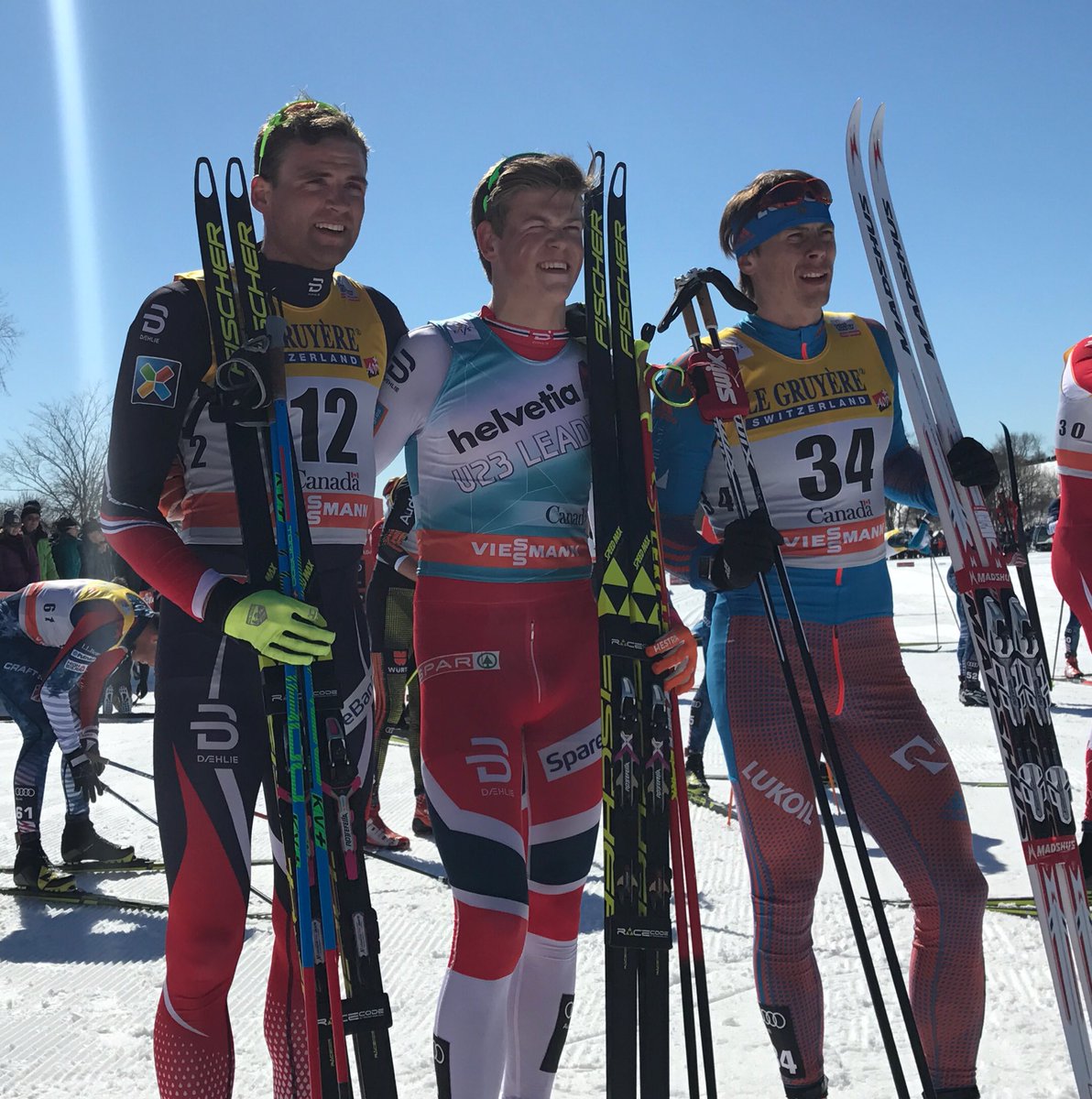
The men’s 15 k classic mass start podium on Saturday at World Cup Finals in Quebec City, with Norway’s Johannes Høsflot Klæbo (c) in first and Niklas Dyrhaug (l) in second, and Russia’s Alexander Bessmertnykh (r) in third. (Photo: FIS Cross-Country/Twitter)
FIS Cross-Country World Cup Finals (Quebec City): 10/15 k classic mass starts
During Saturday’s 15-kilometer classic mass start at World Cup Finals, Canada’s Alex Harvey was in it until the end. But so were Norway’s Johannes Høsflot Klæbo and Niklas Dyrhaug, and Russia’s Alexander Bessmertnykh, to name a few.
Sitting in second with a few hundred meters to go, Harvey was primed to make his move on Dyrhaug, who was leading at the time. But then came 20-year-old Klæbo, the season-long Sprint World Cup champion, who proved to have more left in the tank than anyone else and passed them both to lead into the finishing straight.
Klæbo took the victory — his first in a World Cup distance race — on a bluebird day under a beating sun in 35:23.7 minutes, 0.6 seconds ahead of Dyrhaug. Bessmertnykh followed another 0.2 seconds back in third (+0.8) just ahead of Harvey in fourth (+1.2).
Norway’s Sjur Røthe took fifth (+1.7), Switzerland’s Dario Cologna placed sixth (+1.9), and Norway’s Pål Golberg was seventh (+2.5), half a second ahead of another Norwegian Didrik Tønseth in eighth (+3.0). The top nine were within 3.7 seconds of first, with Russia’s Andrey Larkov in ninth.
Devon Kershaw was the second Canadian in the points on Saturday in 28th (+1:08.4), after breaking a pole and working his way back up from outside the top 60.
Erik Bjornsen led the U.S. men in 31st (+1:16.8), about a second ahead of Canada’s Graeme Killick in 32nd (+1:17.7).
Also for the U.S., Matt Gelso finished 37th, Andy Newell 45th, Scott Patterson 46th, Noah Hoffman 48th, Ben Lustgarten 49th, David Norris 50th, Simi Hamilton 54th, Paddy Caldwell 59th, Jack Hegman 62nd, Cole Morgan 64th, and Brian Gregg 69th.
For Canada, Bob Thompson finished 55th, Knute Johnsgaard 57th, Len Valjas 61st, Russell Kennedy 63rd, Evan Palmer-Charrette 65th, Andy Shields 66th, Jess Cockney 67th, Brian McKeever 68th, Joey Foster 70th, Gareth Williams 72nd, Ricardo Izquierdo-Bernier 74th, and Julien Locke 75th.
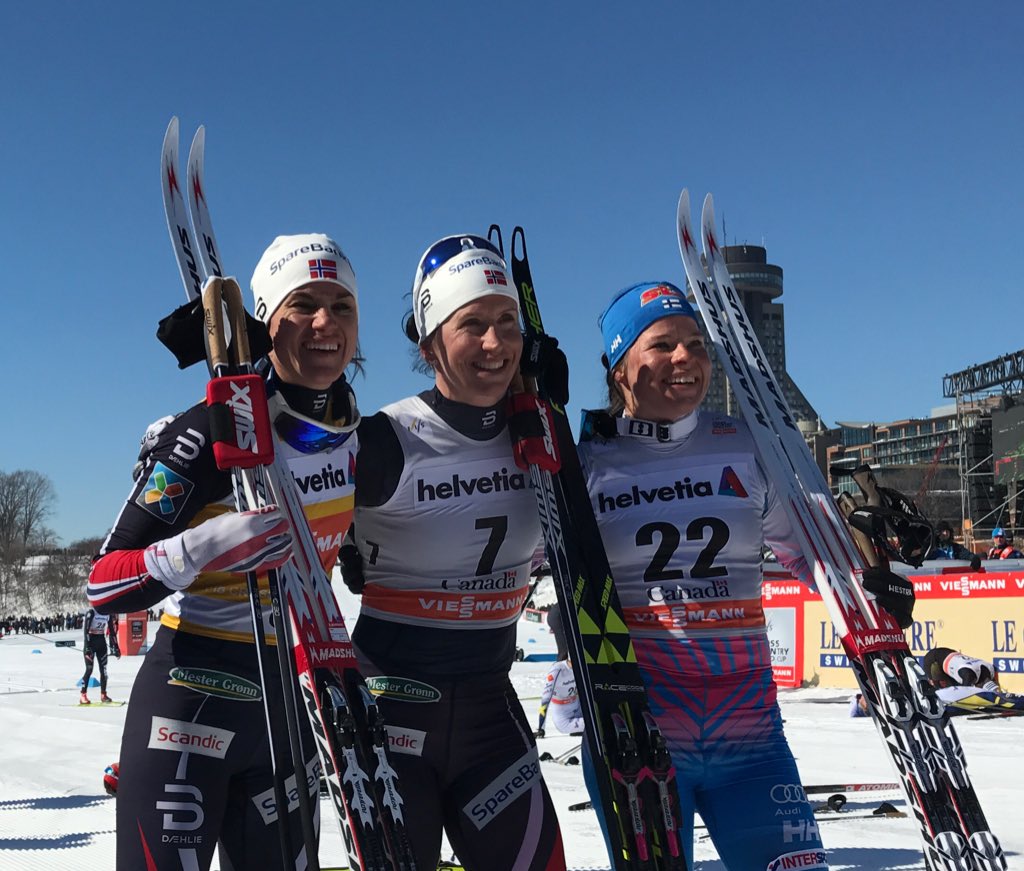
The women’s 10 k classic mass start podium on Saturday at World Cup Finals in Quebec City, with Norway’s Marit Bjørgen (c) in first, Norway’s Heidi Weng (l) in second and Finland’s Krista Parmakoski (r) in third. (Photo: FIS Cross-Country/Twitter)
In the women’s 10 k classic mass start earlier in the day, Norway’s Marit Bjørgen racked up her seventh victory of the season after leading a pack of two other Norwegians and Finland’s Krista Pärmäkoski and holding them off to the finish.
Bjørgen put a few meters into the foursome as she entered the finishing stretch and held her lead across the line in 24:23.6 minutes. Norway’s Heidi Weng finished 0.6 seconds back in second to lock up the Distance World Cup title, in addition to the Overall World Cup title she secured on Friday.
Pärmäkoski finished 2.9 seconds after Bjørgen in third, and Norway’s Ingvild Flugstad Østberg missed the podium in fourth (+7.8).
Behind them, Germany’s Nicole Fessel outlasted a large chase pack to place fifth (+18.6), just ahead of Sweden’s Charlotte Kalla in sixth (+19.9) and Anna Haag in seventh (+19.1).
Sadie Bjornsen of the U.S. Ski Team led the North American women in 15th (+29.9) after skiing at the back of that chase pack in the final stretches of the race. Also for the U.S., Jessie Diggins placed 27th (+1:06.9) and Sophie Caldwell 38th (+1:56.0).
Canada was led by Emily Nishikawa in 37th (+1:51.7). Behind her, Cendrine Browne finished 41st (+2:28.2), Dahria Beatty was 53rd, Annika Richardson 54th, Katherine Stewart-Jones 56th, Frederique Vezina 59th, Annika Hicks 60th, Sophie Carrier-Laforte 61st, Andrea Dupont 62nd, Katherine Weaver 63rd, Alannah MacLean 64th, Sadie White 66th, Lisle Compton 67th, Mia Serratore 68th, and Laura Leclair 69th.
For the U.S. Caitlin Patterson finished 44th, Liz Guiney 45th, Kaitlynn Miller 47th, Chelsea Holmes 48th, Rosie Brennan 50th, Julia Kern 52nd, Erika Flowers 55th, Becca Rorabaugh 57th, and Jennie Bender 58th.
One day left in the 2016/2017 World Cup season remains, with the women’s and men’s 10/15 k freestyle pursuits on Sunday in Quebec City.
World Cup Finals standings (Day 2 of 3): Men | Women
***
Finland’s Mari Laukkanen pointing to the sky in honor of her late shooting coach, after she won the women’s 10-kilometer pursuit on Saturday at the 2017 IBU World Cup in Oslo, Norway. (Photo: IBU)
IBU World Cup (Oslo, Norway): Women’s and men’s pursuits
Less than 24 hours after winning her first IBU World Cup on Friday in the women’s 7.5 k sprint, Finland’s Mari Laukkanen immediately capitalized on her ideal position with a start-to-finish victory in Saturday’s 10 k pursuit that was never in doubt, cleaning the first three shooting stages before incurring one penalty in her final standing shooting (0+0+0+1) to cross the line in a time of 29:33.3 minutes.
In addition to experiencing the most successful weekend of her biathlon career by far, it was an emotional day for the 29-year-old Finn due to a personal reason. Laukkanen spread her arms like wings skiing down the homestretch with a commanding lead, pointing repeatedly to the sky and a black ribbon she wore around her right upper arm, before kneeling in the snow in the finish for a few seconds. With those gestures, she reportedly wanted to commemorate her shooting coach Asko Nuutinen, who passed away Friday after suffering a heart attack during the World Cup in Kontiolahti, Finland, a week ago. He was 60 years old.
“It’s been a really emotional day for me. We have heard really really sad news that last night we lost our longtime shooting coach,” Laukkanen told reporters with a trembling voice in the press conference. “After this it was more or less only about working for him. Working as he has asked me to do for years and years. So I wasn’t thinking about losing or winning today, I was only thinking about him. And I feel really big pleasure that I was able to come to the finish like this, that I can own the victory for him.”
“I knew it will be difficult after the first victory in my career took me so long,” she added. “And to do it again immediately with good shooting. But as I said I didn’t think about winning or losing today, just doing my work.”
Finishing 26.5 seconds after her, the Czech Republic’s Gabriela Koukalová reached the finish, moving up from her fourth place starting position with a clean shooting performance (0+0+0+0).
“I wanted to miss all targets yesterday because I was so tired I didn’t even want to race,” Koukalová confided in the press conference. “It’s difficult to concentrate, three World Cups after the main goal of the season [the World Championships] is too much. Last year it was many times easier… I tried to catch her, but about one kilometer before the finish I saw her far away so I was happy I didn’t have to fight with anyone and was just enjoying the last meters.”
Despite four penalties (1+1+0+2), France’s Justine Braisaz defended the third place on the podium against a three-person chase group on the last loop (+1:01.4), falling back only one position after having finished the sprint in second.
“I did not expect such a good place today during the race,” Braisaz commented in the press conference. “Because in the last shooting I completely [failed]. I really wanted to have a clean shooting today, and I did not succeed. So I am happy and surprised, too.”
Her teammate Anais Bescond who had started the pursuit in third place fell back to 22nd position (+2:53.5) with seven penalties.
Slovenia’s Teja Gregorin finished fourth with one penalty (+1:08.2), Austria’s Lisa Theresa Hauser shot clean as the only athlete aside from Koukalova on her way to move up from 22nd to fifth place (+1:12.5), while Norway’s Marte Olsbu finished sixth like in the sprint despite three penalties (+1:15.9).
Unlike in Friday’s sprint race where Germany’s Laura Dahlmeier had still given up a seemingly commanding lead in the sprint World Cup discipline standings to Koukalova, she held onto her lead in the pursuit standings on Saturday, moving up from the 31st starting position to ninth place with a penalty in each of her standing shootings (0+0+1+1, +1:53.8). A 22nd place would have been sufficient to win the “small crystal globe” award in the pursuit. Laukkanen’s teammate Kaisa Mäkäräinen finished 8th with two penalties in the standing stages (+1:51.2), and thereby claimed the third place in the World Cup pursuit ranking.
“I knew that I didn’t need to have a perfect race today, just a good one, but that’s always easier said than done,” Dahlmeier told broadcaster ARD after the race. “I am incredibly happy that it worked out and that I could secure myself another small globe… It’s a bit of a weird feeling, standing at the start gate in the middle of the field and the clock ticks and ticks as one athlete after another skis out on the course. And you can only observe how far they have gone and have to wait and be patient, and not make a false start. But then the snow burns, then the chase begins!”
US Biathlon’s Susan Dunklee experienced an uncharacteristically problematic day on the shooting range and fell back to 37th place (+4:00.2), after starting seventh and less than a minute behind Laukkanen. Dunklee had three misses between two prone stages and seven more in her standing shootings (2+1+4+3) therefore having to ski more than an additional kilometer in the penalty lap.
“It is a testament to her fighting spirit that she notched the fourth-fastest ski time — one of her best ranks of the season — and never gave up despite suffering a biathlon blowout on the range,” teammate Clare Egan said of Dunklee, according to a US Biathlon press release. “Bad races happen to the best and Susan is no exception, but not everyone fights through till the end no matter what.”
Egan herself started the pursuit in 34th position and initally was able to make up ground, but then fell back slightly to 41st place (+4:13.9) with four penalties (0+2+0+2).
“I am satisfied with my race even though the result was not what I was hoping for, and that’s how I would summarize my entire season as well,” Egan said after the final race of her season. “I’ve made a good step forward but my competitors also work hard all summer and we seem to improve at a similar rate.”
Canada Biathlon’s Julia Ransom moved up to 47th place (+5:04.8) with three penalties (1+0+1+1), after starting in 52nd position.
[UPDATED] Later on Saturday in the last men’s 12.5 k pursuit of the season, the three best athletes of the season fought throughout the race exchanging in the lead, before they stood next to each other on the range for the final shooting to decide the winner.
Russia’s Anton Shipulin managed to shoot clean with his elaborate rifle stock in the design of a red dragon, proudly waving to the cameras as he left the arena while his two competitors had to ski into the penalty lap. France’s Martin Fourcade – who had already secured himself the overall World Cup Total Score title as well as the award for the pursuit discipline – was left to duke it out against Norway’s Johannes Thingnes Bø, the winner of Friday’s sprint.
On the last big climb before the Holmenkollen arena, Fourcade accelerated with a series of explosive jump-skate steps to decisively gap Bø. He even got fairly close to Shipulin on the finish stretch, who had slowed down a bit to grab a Russian flag before skiing over the line in a time of 32:11.9 minutes with one penalty (0+0+1+0), 5.7 seconds ahead of Fourcade who had incurred two penalties (1+0+0+1). While Fourcade shook hands with Shipulin, Bø came into the finish in third place, 21.6 seconds back and also with two penalties (1+0+0+1).
“It was a crazy race, but I am happy that I managed to finish first,” Shipulin said in the press conference through a translator. “Tough conditions on the shooting range, I had to really work to concentrate on my shooting. On the last loop I was all alone until I saw Martin chasing me, then I got a little bit scared but I managed to [keep him behind].”
It was Shipulin’s second win of the season, for which he credited his recently improved shooting performance.
“It was a really exciting competition with Johannes and Anton,” Fourcade agreed with his rival. “I expected to fight with them for the victory on the last loop, but then Anton was simply stronger in the last shooting. My strategy was to be focused on my technique and skills and not on the results, like I did too often in the past few weeks focusing on records and not the victory.”
Asked about his blazing attack on the final climb, Fourcade added: “Of course I train for that, but I think a lot of athletes do. I talked to Johannes, it was my revenge for the [2016] World Champs where he did exactly the same to me on the last uphill. But I know how it is, it can be different already tomorrow.”
“I am happy with a new podium of course,” Bø said in the press conference. “I was not at my best in the skiing today. But I still managed to shoot 18 out of 20. As Martin said it was [annoying] that we did not shoot zero [misses] and could not fight with Anton in the finish, but it was quite interesting and fun to stand there in the last shooting … I expected Martin’s attack the second he did it, but I had no energy to fight with him. That was quite strong.”
Sweden’s Fredrik Lindström placed fourth with no penalties (+44.7), and was the only man in the field who managed to shoot clean in all four stages.
“For the podium, I was never really close“, Lindström told the IBU in a post-race interview. “But it was a great day anyway. Four times zero [misses], and especially in the standing stages that makes you climb a lot in the standings. Super happy with my performance.”
US Biathlon’s Lowell Bailey, who had to start closer to the back of the field in 44th position, almost two minutes behind the leaders based on his sprint result, managed to move up 21 spots in the race despite three penalties (2+0+1+0).
“I’m happy with the race, considering it started out pretty rough with the first two misses,” Bailey told US Biathlon after placing 23rd (+2:23.3). “I just read the wind wrong and didn’t correct enough. After that, I tried to keep my head in the race and make the best of it. I was happy with my skiing and glad to clean the last stage; this brought me up nine spots and I was able to gain another in the last loop. Now, it’s just one race to go. I’m looking forward to tomorrow.”
Shooting quickly, Bailey recorded the ninth-ranked range time of the day and the ninth-fastest last loop.
His teammate Sean Doherty started 35th but fell back after having to ski six times through the penalty lap (1+3+1+1) to finish 46th (+4:05.6).
For Sunday’s mass starts as the final races of the 2016/2017 IBU World Cup season, the only qualified North American starters will be Dunklee (currently in 10th position in the World Cup Total Score standings) and Bailey (currently in eighth).
The women’s season award in the mass start discipline once more will be decided between Germany’s Dahlmeier and Czech Republic’s Koukalova, while Germany’s Simon Schempp will try to defend his narrow lead on Fourcade. But during Saturday’s final loop, the French star did consider saving energy for the final competition.
“No,” he simply quipped when asked about this in the press conference. “Of course the mass start is important tomorrow because it will decide about the [mass start] crystal globe. But I think today the pursuit was also really important, and you fight for victory and being one of the best athletes. You can’t be satisfied with only a third place when you can claim a second, and I think all athletes in my position would do the same.”
Norway’s Martin Johnsrud Sundby after winning the Norwegian 54 k classic Birkebeinerrennet, part of the Ski Classics series, on Saturday in Lillehammer, Norway. (Photo: Ski Classics)
54 k Birkebeinerrennet (Rena to Lillehammer, Norway): Part of the Ski Classics series
[UPDATED] Not even a snowmobile clipping him and sending him tumbling 20 k before the finish could keep Norway’s Martin Johnsrud Sundby from winning the Birkebeinerrennet on Saturday in Norway. Representing Team United Bakeries, Sundby set a high pace from the start and broke the group down to three by 9 k, with Petter Eliassen of Team LeasePlan and Simen Østensen of Team BN Bank sticking with him until about 30 k in the 54 k marathon.
With about 20 k to go, Sundby collided with a Ski Classics TV production crew snowmobile while trying to double pole in the snowmobile’s tracks. He was OK and went on to win by 48 seconds over Eliassen in second, and smiled about the incident after the finish.
“It came in with tremendous speed and mowed me down,” Sundby told NRK, according to a loose translation.
Ski Classics CEO David Nilsson told NRK he didn’t know exactly how that happened and emphasized that it was unacceptable.
“We always put safety first, but it is a difficult balancing act with the snowmobile at high speed to get TV pictures,” he said, according to a loose translation. “The skiers often ski in the [snowmobile] track and here it happened and somehow the driver missed it.”
While Sundby pulled out the win in 2:20:53.5 hours, Eliassen took second and Østensen followed another 3.5 seconds later for third place.
In the women’s race, Poland’s Justyna Kowalczyk (Team Santander) pulled out a 4 minute and 15 second win over Sweden’s Britta Johansson Norgren (Lager 157 Ski Team). Japan’s Masako Ishida (Team United Bakeries) was another 48.6 seconds back in third.
“I’m really happy to win this race,” Kowalczyk said, according to a Ski Classics press release. “Everything went well and the cheering on the course was amazing. I will do the rest of the races in Visma Ski Classics, but this victory was the most important for me. Of course, I want to win again in Årefjällsloppet like I did last year, but to win here in front of this audience means so much to me.”
Tord Asle Gjerdalen, who finished fourth in the men’s race, and Johansson Norgren continue to lead the overall Ski Classics standings with three races to go. The next stop is the Årefjällsloppet in Sweden on March 25.
“It was a great race and we kept a high tempo up all the way,” Sundby said, according to the press release. “I was able to use uphills for my advantage and get a gap. I had good skis, the conditions were perfect, and to win here was one of my goals for the season. I have the Norwegian Championships in two weeks, and I haven’t counted out the option of going to Finland for the Visma Ski Classics finale.”
Finland’s Mari Laukkanen celebrates her first IBU World Cup victory on Friday in the last women’s 7.5 k sprint of the season at Holmenkollen in Oslo, Norway. (Photo: IBU)
For races and ski jumpings at the famous Holmenkollen arena on a hillside above Oslo, a frequent visitor in the audience is the King Harald V of Norway, a passionate and knowledgeable fan of all nordic sports. And usually the winners of the competition get the honor of being invited up to the royal suite overlooking the arena.
On Friday in the women’s 7.5-kilometer sprint at the Interntional Biathlon Union (IBU) World Cup final in Oslo, American Susan Dunklee was on pace to maybe get that much-vaunted meeting with the king and his family, setting the best time after the prone shooting that no other athlete starting behind her could get close to anymore, with the next-best competitor more than 20 seconds behind at this point.
But perhaps she started out a little too fast, and high winds posed an additional challenge on the shooting range for all the athletes.
“Normally I am good at executing a smart controlled pacing plan but today I hammered straight out of the start and tried to hold on,” Dunklee wrote in an email to FasterSkier. “It made for a very painful second half of the race.”
“I felt like I had rammed into a wall during the final two loops,” she added, according to a US Biathlon press release.
In the end, a victory was no longer in the cards for Dunklee after she shot two misses in her standing stage, and the king instead got to meet Finland’s Mari Laukkanen after her first World Cup win in a time of 20:33.5 minutes, and later in the day with Norway’s Johannes Thingnes Bø, who won the men’s race and was one of his subjects he was already familiar with.
US Biathlon’s Susan Dunklee racing to seventh place in the women’s 7.5-kilometer sprint at the 2017 IBU World Cup in Oslo, Norway. (Photo: USBA/NordicFocus)
Dunklee initially finished sixth, before later being pushed down one more position to seventh place (+56.7). It was her sixth top-10 finish in her last seven individual races at the end of a remarkably consistent season.
“On a windy day, half the battle is deciding the best correction to take; the other half is feeling confident in whatever decision you make,” Dunklee said of shooting. “Today I felt confident in prone. During my standing stage the wind wasn’t that bad, I just made a couple bad shots … I love racing in Holmenkollen. The crowd has a positive energy and the stadium is steeped in so much tradition.”
Despite a tough end to her own race day, Dunklee was also happy about the first World Cup victory of Laukkanen.
“Mari has always been nice and easy to talk to,” she added. “During my first year on the World Cup she invited our team to her family’s cabin near Kontiolahti for sauna-ing. I am happy to see her win.”
On Friday, all three women on the podium shot clean in both stages despite the difficult conditions.
Laukkanen started early in the field with bib 7, and combined with the third-best course time of the day set a time in the finish that would not be matched by anyone in the field of 103 starters.
Starting just three bibs behind her, France’s Justine Braisaz came closest, leaving the range after the standing shooting just 14.4 seconds behind and continuously closing the gap on the final loop by skiing the fastest course time of the day, but it was not enough to catch up to Laukkanen anymore finishing 7.9 seconds behind.
Braisaz’s teammate Anais Bescond started in the second group with bib 41, and her clean shooting and solid performance on the course with the 15th-ranked course time were enough to grab the third position on the podium (+23.1).
“It feels good to shoot 0-0, the last time I shot that I was also on the podium, I should do it more often it seems,” a smiling Laukkenen said during the press conference. “I had a full crisis with myself yesterday, I was looking at my statistics and I could see that I am running stable and strong to make higher results, but I am constantly missing one or two too much. So it feels good today to make it.”
Asked about the conditions in her shooting stages, she added, “It was not an easy day for sure, and I didn’t expect it to happen. I was a little bit lucky on the standing stage. It hasn’t been easy (for me) to clean it even without wind. So I am just happy to do it, and that it was enough to win today.”
The 29-year-old Finn said she had to take a longer break after a disappointing last season, before she decided to continue with her athletic career. Earlier in the 2016/2017 season, Laukkanen had also taken time away from biathlon in order to qualify for and compete in the cross-country World Championships at home in Lahti, Finland, where she reached the semifinal in the women’s sprint. At the IBU World Championships in Hochfilzen, Austria, she narrowly missed a medal in the 15 k individual finishing fourth.
“I was a little bit nervous,” Laukkanen said about meeting the king on Friday. “For a Finn, it’s always special to win here in Holmenkollen. It’s a legendary place, mostly because of the cross-country history. It feels good.”
For Braisaz, it was the second podium of the season, and with the second place she tied her career-best.
“I really enjoy Oslo and Holmenkollen,” Braisaz said in the press conference. “I hoped to stay concentrated and to stay focused until the end of the season. But I was not very confident about my shooting. Especially in January and February, I was not very successful on the shooting range. So I decided to work for the future, for the next years, and to just enjoy it even though it was very windy today… I don’t think the conditions changed too much today (throughout the field), but some athletes probably were not fortunate and had no chance to clean.”
For her teammate Bescond, it was her third podium of the season. Despite her good form, she had only received one start in the individual race at the World Championships in Hochfilzen, and also was not nominated for France’s relay teams.
“I feel full of energy because I didn’t compete much in February,” Bescond stated in the press conference. “Now I feel good while a lot of girls here are probably tired now… It was my goal after Hochfilzen to be good in March. I am really happy with my result… My three medals from the (2016) World Championships in Oslo were a really good memory, and when I come back here I always have a lot of good things in my mind.”
Koukalová Takes Sprint Title
Gabriela Koukalova of the Czech Republic with her “crystal globe” after winning of the 2016/2017 sprint discipline award following the IBU World Cup women’s 7.5 k sprint on Friday in Oslo, Norway. (Photo: IBU)
Germany’s Laura Dahlmeier had gone into the last sprint race of the season with a 28-point lead over Gabriela Koukalová of the Czech Republic — a lead that looked fairly secure for the recently very consistent winner of the overall World Cup.
But in Friday’s race, Dahlmeier struggled with the tricky wind conditions, incurring three penalties in the prone shooting which set her back all the way to a 93rd place, before she could move up again with a clean standing shooting, but in the end her time in the finish was only sufficient for the 31st place this time.
That was not enough to match Koukalová, who only shot one penalty (0+1) and initially finished third, before Bescond bumped her to fourth (+37.4). Dahlmeier would have needed at least one more athlete to finish ahead of the Czech, who made up 33 points to finish ahead still claiming the “small globe” in that discipline.
“Today’s race somehow was jinxed,” a disappointed Dahlmeier later told German broadcaster ARD. “That started last night with the bib draw when I got unlucky with the last position in the first group, and I think I picked the wrong skis today, in terms of waxing we were not competitive with the very best, I didn’t feel so fit anymore, and then in prone a giant screw-up happened to me. There was quite some wind, I have to analyze it again but if I remember correctly I clicked in the wrong direction [adjusting the sights]. That moved the shots left, and then the race was all but over.“
“Of course life goes on, it was still a crazy season,” she added. “I only would have liked to show another good race in the fight for the sprint globe … Today I wouldn’t even have needed a perfect race, just a good one, that would have been sufficient.”
After the race, Dahlmeier still received her “crystal globe” for the season’s winner of the 15 k individual discipline as a consolation. Two days of racing remain on the schedule: Saturday’s pursuit and Sunday’s mass start.
Finland’s Kaisa Mäkäräinen placed third in the overall sprint ranking, after finishing 27th on Friday with four penalties (+1:44.6).
Three North Americans in Pursuit
Dunklee will be joined in Saturday’s 10 k pursuit by teammate Clare Egan, who finished 34th with one penalty (+2:03.7). The third American, Joanne Reid placed 80th with five penalties (4+1), 3:32.2 out of first.
One Canadian qualified as well, with Julia Ransom fininishing 52nd with two penalties in her standing stage (0+2), 2:28.9 back, after having been ranked as high as ninth after prone.
In her second World Cup weekend, Canada’s 19-year-old Megan Bankes finished 64th (+2:53.0) with two penalties (1+1), missing the qualification for the pursuit by 12 seconds.
Sarah Beaudry was 75th (+3:20.5) with three penalties (2+1), while the fourth Canadian Emma Lunder in 84th with the same shooting result (+3:46.7).
“We have an incredible team of ski service technicians and coaching staff who plan to give 110 percent until the last race is done,” Dunklee said, according to the press release. “I have two tremendous opportunities still in front of me with these last races and I don’t plan on wasting them.”
Dunklee will be in a very good position for the pursuit, starting 33 seconds behind the podium and less than a minute behind Laukkanen. Only reportedly the schedule of the King of Norway won’t permit him to attend the biathlon races on Saturday and Sunday, so there likely will be no meeting should she be successful there.
In the Women’s Nation Cup Score, which is its own World Cup award category but also determines the starter quota spots for the following season, Germany’s women’s team secured the victory and the crystal globe with 7951 points, ahead of France (7646) and Ukraine (6605).
The U.S. finished 14th with 4743 points (despite not starting a relay in Pokljuka, Slovenia, earlier this season), while Canada tied Finland for 15th with 4619 points. Both North American teams will retain the four guaranteed World Cup starter spots for sprints and individual races they already had this season, which enables them to travel the World Cup circuit with a full team.
***
Norway’s Johannes Thingnes Bø (c) after winning in the men’s 10-kilometer sprint at the 2017 IBU World Cup in Oslo, Norway, ahead of France’s Martin Fourcade in second (l) and Russia’s Anton Shipulin in third place. (Photo: IBU)
Bø Wins Men’s Sprint; U.S. Men 10th in Nation Cup
Later on Friday, Norway’s Johannes Thingnes Bø got to meet King Harald V after winning the men’s 10 k sprint, shooting clean in much calmer wind conditions than during the women’s race to finish in a time of 24:53.3.
“That’s always nice,” Bø said in the press conference when asked about meeting the king. “It’s my second time, and that’s the most memorable thing for this season I think.”
It was the second win of the season for the Norwegian and the 13th of his career. After starting early in bib 15, Bø had to wait a long time to see if anyone could still beat his time.
“Of course I was happy about my race, but since I lost some seconds on the last lap I was not sure if it would hold for the win,” Bø commented in the press conference. “It was a long wait, but in the end it was worth it and I am very happy to get a win here.”
“It’s quite nice to be back at Holmenkollen,” Bø added. “Today was quite hard conditions … I think a lot of athletes started hard but got really tired. We had very good skis today, that helped me a lot… In shooting when the people cheer for you between the shots, I feel that helps and makes it more easy to hit the next target. That is the biggest advantage, but of course there is also the pressure.”
France’s Martin Fourcade, the dominant male biathlete of the season who reached the podium in all but three individual races, finished second (+13.6) after missing a shot in his standing shooting and having to ski a penalty lap, and only being able to make up 10 seconds on the final loop.
“I am angry about my miss for sure,” Fourcade said at the press conference. “I think I had the power to clean it, but I am not angry about my competition. Johannes was really good today, he was at 100 percent and I can just congratulate him to his victory. I am really satisfied with my second place.”
Fourcade had already secured himself the “small crystal globe” title in the sprint discipline, and is anxiously awaiting the birth of his second child any day now.
“I think my biggest challenge was to be ready for this race in spite of the challenging preparation,” he explained. “I went back to France on Sunday, and then I had a long travel to Oslo again on Wednesday missing my connection. I had only one little training yesterday to be ready for this competition. So I am really satisfied about the job I did today, and my team helped me a lot to be ready.”
Starting very late in bib 106 out of 108 starters, Russia’s Anton Shipulin (+21.3) shot clean and bested Austria’s Dominik Landertinger, who had a penalty in standing, off the podium by just 0.2 seconds (+21.5).
“Of course I am satisfied to be on the podium, because the guys were very strong today and I fought until the end,” Shipulin said via a translator in the press conference. “I was very well informed (about my position) during the race. I am thankful to all the staff and the fans who kept me informed and motivated.”
“I think it was an advantage to start early today because the tracks were not that firm anymore in the end,” he added. “I had to move from left to right all the time especially in the downhills and it was quite challenging.”
“In principle I had a perfect race today,” Landertinger told Austrian broadcaster ORF after narrowly missing out on the podium. “If you want to be in the mix in front, you have to take some risk on the shooting range. Usually one miss is too much for a podium position in sprint, although of course it was damn close today.”
For the U.S, Sean Doherty was the top finisher in 35th with two penalties (0+2). He had been in 18th after the prone shooting stage, and after skiing 300 extra meters due to his penalties in standing he was still able to make up a few positions on the final loop with the 24th-ranked course time (29th-fastest overall). A week ago in the pursuit in Kontiolahti, Finland, Doherty achieved his best individual result of the season in 18th place after shooting clean in the four-stage race.
Lowell Bailey, who had a recent series of strong shooting performances on his road to a gold medal in the individual race at World Championships and two second-place finishes in the sprint in PyeongChang, South Korea, and the single mixed relay (with teammate Dunklee) in Kontiolahti, initially shot clean in prone on Friday and left the range in 11th position. In standing, he had three penalties, which set him back to 50th position and Bailey ultimately finished 44th (+1:51.6).
The three starters for Biathlon Canada missed qualifying in the top 60 for the pursuit.
Christian Gow shot clean, but skied the 91st-ranked course time to finish 61st (+2:25.8), just one position and less than two seconds behind Bulgaria’s Dimitar Gerdzhikov in 60th (+2:24.5). Brendan Green had a penalty in each stage (1+1) to finish 85th (+2:58.6), while Scott Gow was 95th (+3:25.1) with one penalty (0+1).
Also missing the pursuit were the final two American starters Paul Schommer in 98th (+3:41.9) and Leif Nordgren in 100th (+4:07.9), each with three penalties (2+1).
Despite not making many points in the final race of the season counting to the Nation Cup Score, the U.S. men finished in 10th place in those standings with 5290 points, thereby also securing an additional fifth quota spot for next season’s regular-season World Cups (the top five teams get six, sixth to 10th get five, 11th to 17th get four, and so on). Canada finished 13th with 4625 points, and will keep the four spots they had this season. Just like the women, Germany secured the World Cup win in this category with 7448 points, narrowly ahead of France with 7416 points, and Russia in third (7192) just ahead of Norway (7181).
“Germany has a great team, and they deserve this victory in the Nations Score,” Fourcade said during the press conference. “France never won it, so of course it was a really big goal and we are disappointed about not winning it. But that’s the game of sport, and we will try to win it next season.”