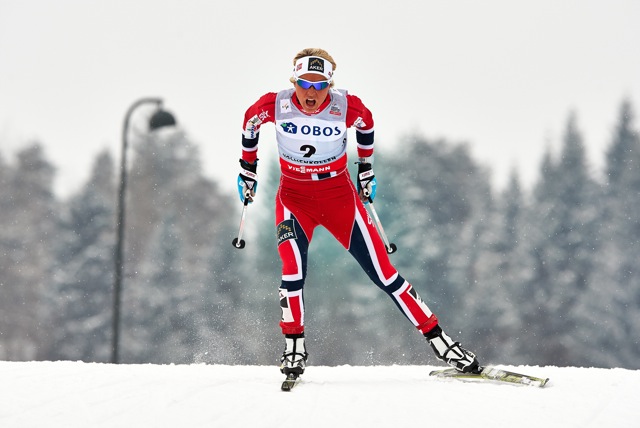
A return to semi-normal: Devon is back from World Juniors and better for it. It was a big week in Germany for North America. This episode is a return to our discussion of the World Cup. The famed Holmenkollen hosted the weekend’s 30 k / 50 k classic mass start races. Hindsight is 20/20, the Norwegian women should have swapped skis, and frankly, not much anybody can do about a steamrolling Bolshunov.
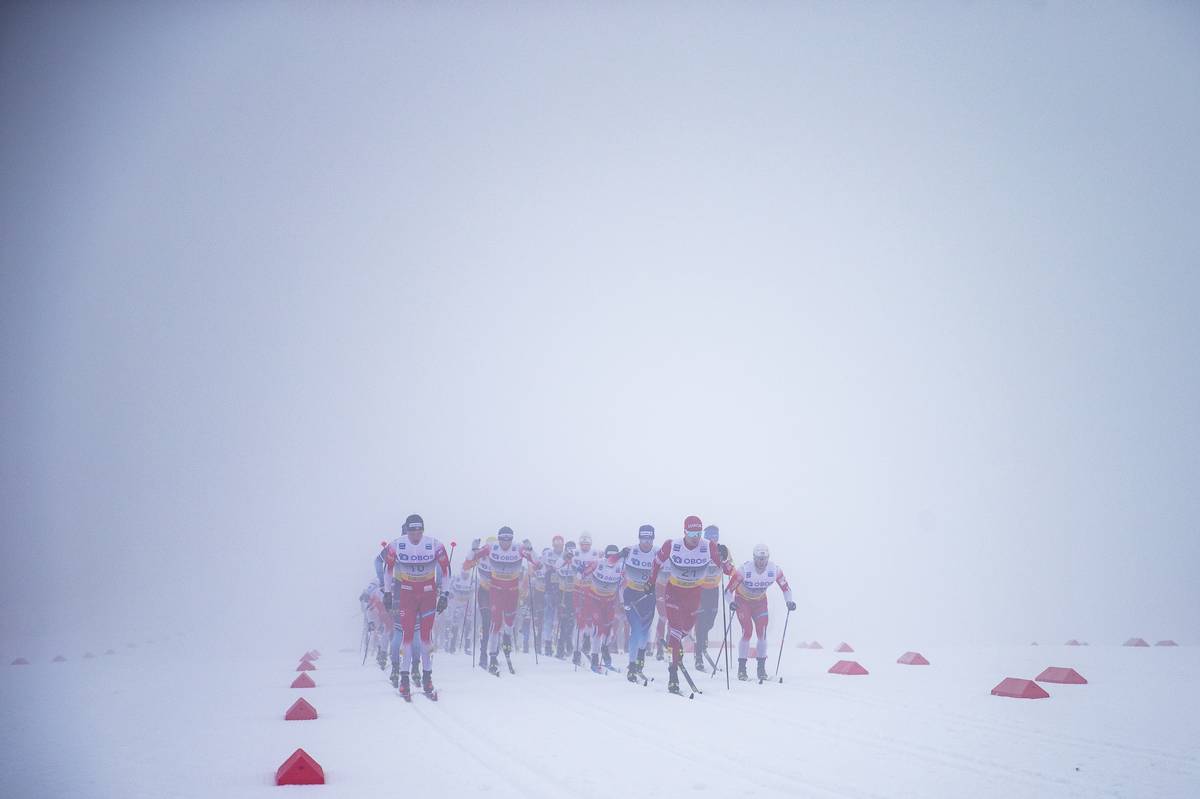
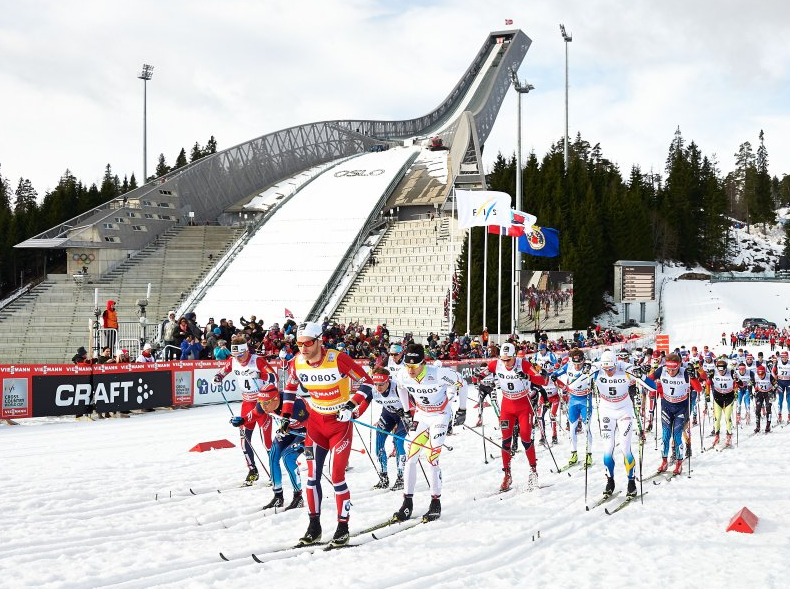
En mass: early in the Oslo 50 k classic. (Photo: NordicFocus)
This article has been updated with comments from race organizers regarding the three North American World Cup stops later this month, and with additional information from the Holmenkollen website.
* * *
A hundred thousand or so Norwegian ski fans will need to change their plans this weekend, after Oslo health and government officials decided Thursday to hold this weekend’s Holmenkollen races without fans due to the ongoing coronavirus outbreak.
A Thursday Instagram post to the official page of FIS Cross-Country stated, “The local authorities of Oslo … have decided that the Holmenkollen Skifest will take place without spectators. This safety precaution is taken due to the current global outbreak of the COVID-19 virus.”
An update to the Holmenkollen Skifest webpage later Thursday states that the main Holmenkollen arena “will be closed for spectators from Friday 6 March to Sunday 8 March,” and that spectators “will not be granted entry to the area.” Regarding spectating on trails outside the central stadium, race organizers wrote, “Will [I] be denied access to watch the event from the areas outside the arena? Spectators are encouraged not to watch the event from the areas outside the main arena.”
Switzerland’s Engadin Ski Marathon, scheduled for this Sunday, was previously cancelled, after the health ministry in this region of Switzerland had called for the cancellation of all public events. The 2020 Masters World Cup, to be held in Cogne, Italy, starting today, was quietly cancelled a few days ago. A statement on the Masters World Cup website dated February 28 reads, in full, “The Masters World Cup 2020 in Cogne/ITA, scheduled for March 5-14, 2020 is cancelled. More details will follow in the next days.” No additional information is currently available on the website.
This weekend’s races at Holmenkollen, which typically draw 100,000 spectators per day to the woods above Oslo, are the final European races of the 2019/2020 World Cup season. This season is currently scheduled to end in North America, with sprints in Québec City on March 14 and 15; a sprint in Minneapolis on March 17; and distance races plus a mixed relay in Canmore on March 20-22.
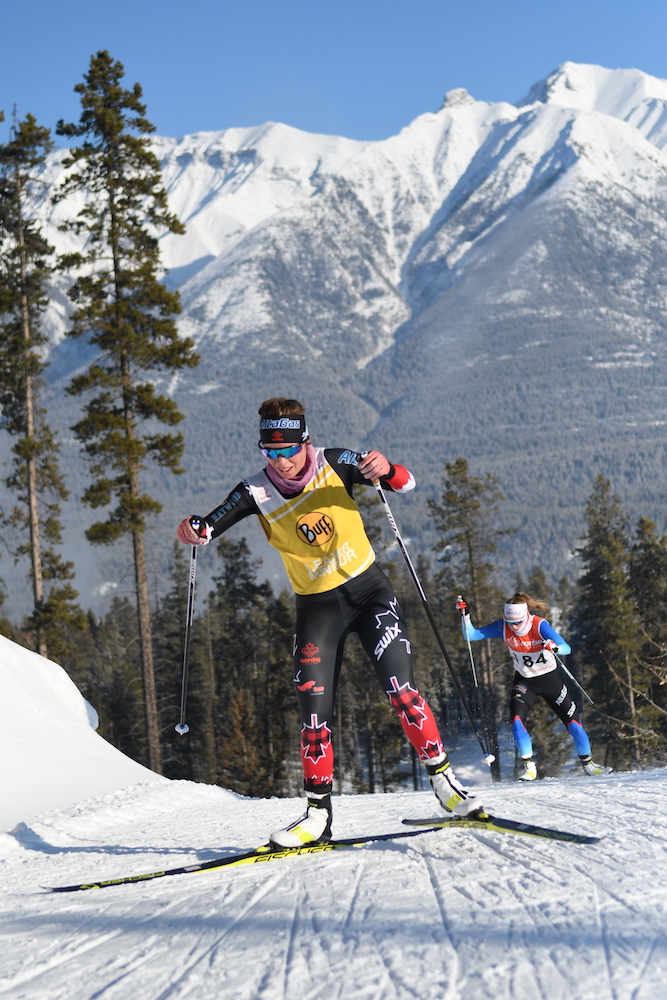
In this December 2019 shot from Canmore, Katherine Stewart-Jones tightened her hold on the NorAm leader’s bib, with a third consecutive top Canadian result. (Photo: Doug Stephen)
“The Minnesota World Cup Organizing Committee is monitoring the situation closely,” wrote Loppet Foundation Executive Director John Munger in a Thursday email to FasterSkier, “and consulting with FIS, US Ski & Snowboard, and public health authorities. We are taking precautions so that fans can fully enjoy this event, including installing hand sanitization stations and following the Centers for Disease Control and Prevention guidelines for large events. At this point, we are moving forward for the 2020 FIS Coop Cross Country World Cup in Minnesota.”
Officials with Canmore sounded similar themes. In an emailed statement to FasterSkier, the Canmore organizing committee wrote, “As host of the 2020 COOP FIS Cross-Country World Cup in Canmore, the safety of our spectators, volunteers, athletes, coaches and staff is our top priority. The Organizing Committee is monitoring the COVID-19 situation closely, and working in conjunction with Alberta Health Services to ensure precautions are taken to create a safe environment. We are also working with our International and national sport partners to review necessary countermeasures required for the event.”
Organizers added, “Currently, we are moving ahead with the 2020 COOP FIS Cross-Country World Cup Finals in Canmore. We look forward to staging a safe and great competition for the World’s best on March 20-22, 2020.”
Finally, organizers for the Québec City races, which start a week from tomorrow, provided the following statement (emphasis in original):
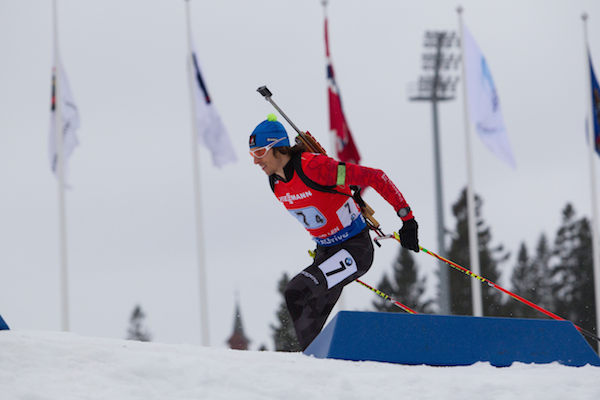
Scott Gow took the Canadians from ninth up to fifth place in the third leg of the World Cup men’s relay in Oslo, Norway, on Sunday. (Photo: Biathlon Canada/NordicFocus)
When Brendan Green crossed the finish line of Sunday’s 4 x 7.5-kilometer relay at Holmenkollen in Oslo, Norway, he was in fifth place.
It wasn’t simply a good day for Green, or a personal best. That fifth-place finish was the best men’s relay ever in Biathlon Canada’s history.
“It was a really good day for our team,” Green said in a phone interview. “Last night we had a team meeting and talked a little bit about the potential for our team. We talked about our specific start order and what we thought we could bring to the team on each leg. And today things definitely came together for us. Everyone had really solid legs for the relay.”
The Canadians finished a minute and 35 seconds behind the winning Russian team. The stellar result comes in a season which has seen substantial changes to the World Cup roster. Star Jean Philippe Le Guellec retired after the 2014 Olympics, and Scott Perras is back in Canada training.
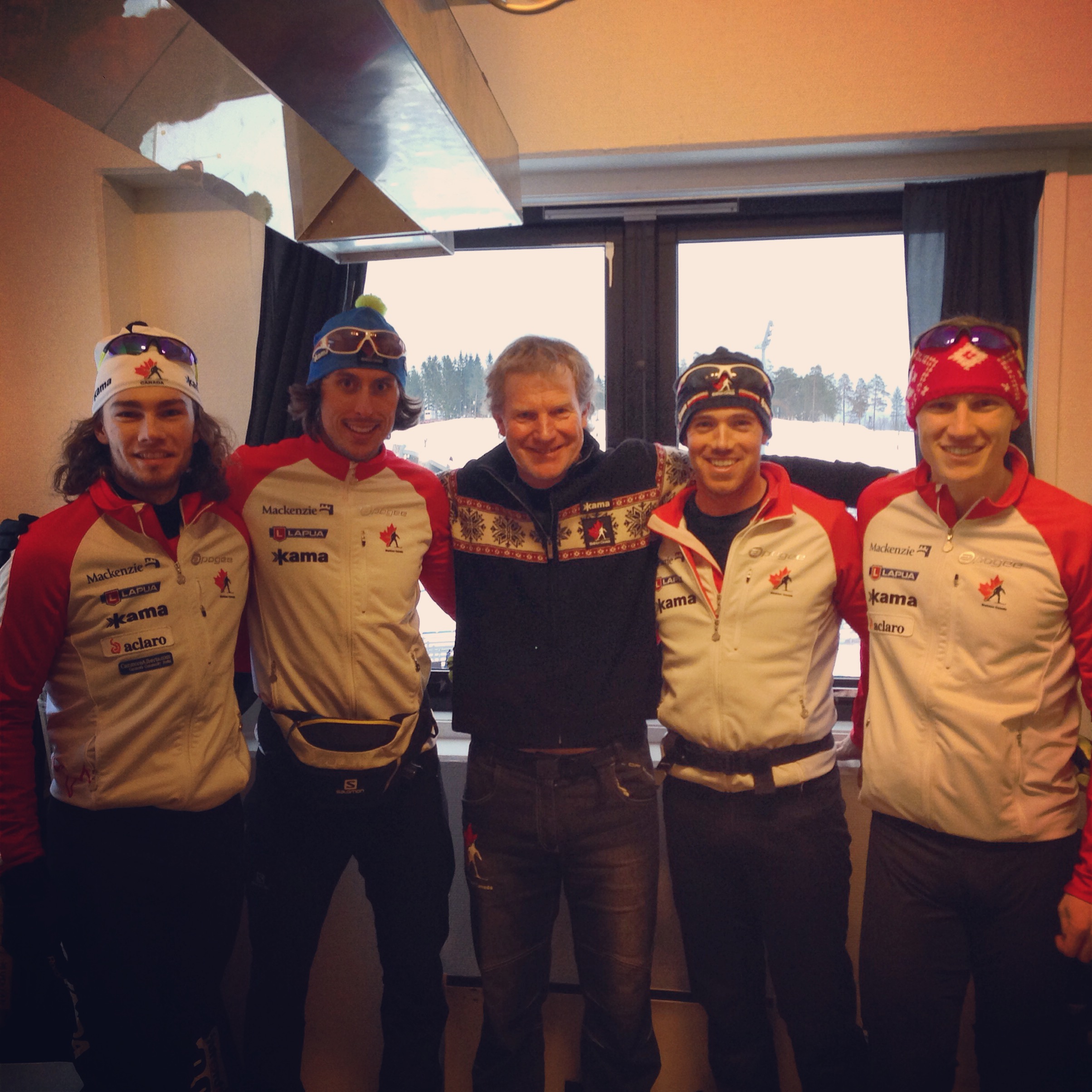
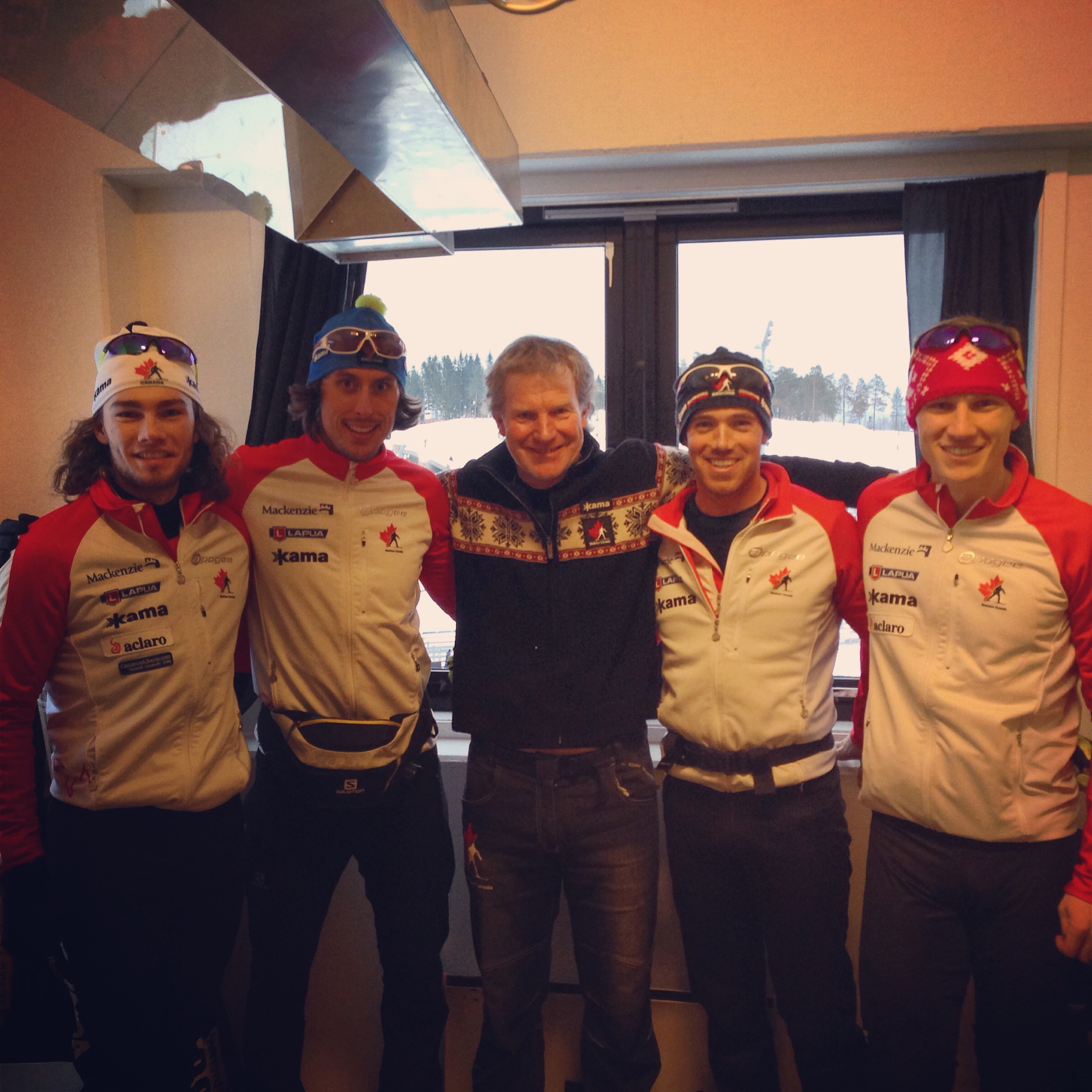
The Canadian men’s relay team of Christian Gow and Brendan Green (left) and Nathan Smith and Scott Gow (right) poses with head coach Matthias Ahrens in Oslo after placing fifth in the 4 x 7.5 k competition. (Photo: Rosanna Crawford)
Instead, since the first men’s relay this season in Oberhof, Germany, Canada’s relay team has included 21-year-old Christian Gow, who skied leadoff and is in his first season on the World Cup. Gow shot like a pro, cleaning all ten of his targets without touching his spare rounds and tagged off in 14th, 50.5 seconds behind Germany’s Erik Lesser.
“I was pretty confident that I would be able to clean the race today,” Gow wrote in an email. “I have been shooting really well all season and felt awesome in zero. You never know if everything will line up completely right for that 100%, but I was confident today and was happy to achieve it!”
Canadian Head Coach Matthias Ahrens wrote that Gow’s performance had never been a question mark in his mind.
“I believe Christian had proven some good relay qualities in previous relays in Oberhof and Antholz already with good shooting efficiency,” he explained.
Gow is learning to deal with the excitement and the pressure of the World Cup.
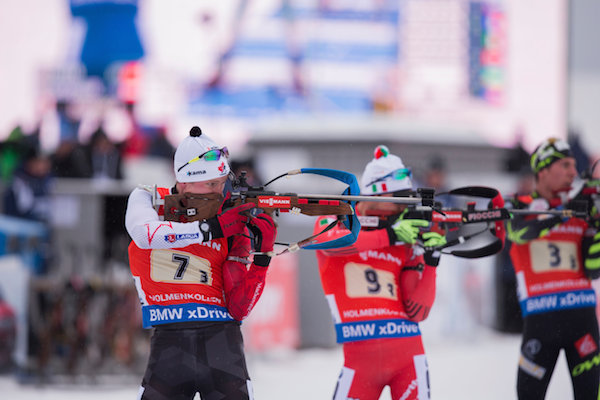
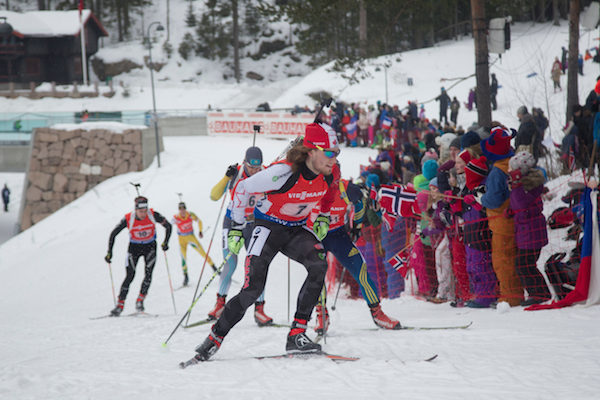
Christian Gow (foreground) gunning his way through the first leg of the World Cup men’s relay in Oslo, Norway. (Photo: Biathlon Canada/NordicFocus.com)
“The past several relays have all been a great learning experience for dealing with the more unique aspects of World Cup racing, such as the incredible noise from the stands, or racing next to one of your personal idols,” he wrote. “I honestly hardly thought about the crowd today, and I don’t think too much about the guys around me either. When I am in the range I am focused on what I am doing and I try not to think about anything else.”
That showed, and Gow’s work on the range upped the ante for his teammates – including his brother Scott, who was racing the third leg of the relay.
“Seeing Christian clean was one part inspiring and one part nerve-wracking,” Scott Gow wrote in an email. “It was awesome to see him shoot so well and set the tone, but at the same time it added pressure for me to do well too and build on his great opening leg. Overall I would say it was motivating but I was definitely nervous waiting for Nathan to tag me.”
Nathan Smith, the second-leg skier, turned in a strong performance of his own. He used a spare round in each shooting stage and moved the team up to ninth. But more importantly, by turning in the second-fastest ski time he cut ten seconds off of the team’s gap to the leaders.
“I had a lot of confidence in my shooting and knew that being the third race of a weekend, I would probably also have a really strong ski day,” Smith wrote in an email. “Shooting went pretty well, it was a little windy. The only disappointment was missing my last prone shot. I think I just got a little ahead of myself.”
“Christian [Gow] is a really good shooter, and he’s really fast, so he has always been reliable. That first leg is a great place for him and he gets the job done really well in that position.” — Brendan Green
For Scott Gow, who used two spare rounds and moved the team up to fifth, things just came together on Sunday.
“I felt the best on skis today since before Christmas,” he wrote. “I had a decent opening lap which is unusual for me, and I was able to maintain speed for the whole race with a nice kick at the end to pull into 5th. I lost some time in standing, but prone was solid and my skiing was good enough to keep the team in the mix.”
Green dropped the team to sixth, briefly, after using two spares in prone, but skied back up to fifth.
Brendan Green anchoring the Canadian relay in Oslo. (Photo: Biathlon Canada/NordicFocus)
“It was a little bit tricky wind in prone,” Green said. “It was a complete 180 from zeroing. I hit my first three shots but then missed the next two, so I sort of paused before I loaded my spares and made that extra correction.”
After cleaning standing, Green then turned in the second-fastest closing loop to hold onto it, despite fears of challengers from behind.
“I was able to leave the range just ahead of Italy and Ukraine,” Green said. “I knew they were close behind. So on that last loop I really tried to redline it and go as hard as I could. And I knew France was close – partway through my loop I could hear some cheering and I thought, oh man, Fourcade must be closing in. So then I tried to really go for it and not look back, and hold those guys off.”
For all the team’s members, the race was a culmination of the Oslo weekend. Smith had drawn on his confidence from finishing 12th in the 20 k individual; Scott Gow had focused on the lessons he learned in the earlier races of the weekend.
“My skiing wasn’t great in the individual and, despite shooting 85%, didn’t shoot well enough for a good result,” he wrote of finishing 60th in the 20 k. “After that race I wanted to refocus on skiing efficiently and being more deliberate in the range, and that’s exactly what I was able to accomplish on race day in the Sprint. My result in the sprint race gave me added confidence for today’s relay. I wanted to use today as an opportunity to build on my skiing and shooting and try to do better.”
And for Christian Gow, he acclimated back to Europe after heading home to Canada for a training break and then sitting out the 20 k due to jet lag.
“It was great to get back here on the World Cup again after my brief break back home,” he explained. “I think it was important for me that I took a break in order to feel ready to go for the next month of racing.”
The youngest team member is now looking forward to his first World Championships experience. And with the best-ever result in their back pocket, Canada is looking forward, too. Their relay there will have the same roster, likely in the same order.
“I think today’s result showed all of us the type of placing we can achieve,” Christian Gow wrote. “From that standpoint I think it will give us a bit more confidence, but also more drive to keep pushing for an even better result.”
“A result like today will definitely give us a little extra confidence and motivation heading into the two week break and World Championships,” Smith agreed. “Another top 6 is what we’re aiming for. Outside of the World Champs, Nations Cup points are especially important for us this year. Right now we’re sitting in 8th which means 5 start spots for next year. It would awesome to grab that extra spot for the Canmore World Cups in 2016.”
Start of the men’s 50 k freestyle mass start at Holmenkollen on Saturday in Oslo, Norway, with Alex Harvey (3) trailing overall World Cup leader Martin Johnsrud Sundby (yellow bib). (Photo: Fischer/Nordic Focus)
It would’ve been easy to just stop in Saturday’s 50-kilometer freestyle mass start — the ultimate distance race of the World Cup season.
Canada’s Alex Harvey wasn’t having the best go at it, with slick skis for the first two of six laps that put him back near 46th.
“I just couldn’t do anything on the climbs, and lost a lot of position and time,” Harvey said in a post-race interview.
If he could do it all over again, the 25-year-old Quebec native said he would have switched skis after the first lap — a move which would’ve cost him about 40 seconds and likely left him skiing alone. Trailing the pack at the end of the first lap, Harvey decided he didn’t want to risk it and continued with the group, bypassing the transition. He then had to tough it out for another 8.3 k until his next opportunity to change after the second lap.
From there, with a new pair, the race really began for Harvey and became somewhat of a personal test to see what he was capable of.
He picked off 32 places over the next 33 kilometers to place 14th, 3:56.2 behind Sweden’s Daniel Richardsson, who won in 2:07:29.5. The race strung out into a battle between the top three just over halfway through. Norway’s Martin Johnsrud Sundby solidified second, 8.2 seconds back, and Russia’s Alexander Legkov placed third, six seconds later.
While Sundby was trying to seal the deal for both the World Cup overall and distance titles, Harvey said the pace was pretty relentless throughout the 50 k, with Sundby and Legkov going for the sprint bonuses on every lap.
Harvey didn’t worry about those; he was more focused on finishing strong enough to maintain a prime position in the overall World Cup standings.
“It cost a lot when you go for [those bonuses],” Harvey said. “You saw it with Danny Richardson — he’s the one that went for the least amount of points between Legkov and Sundby. I think that is why Sundby ended up not winning is because of all of the points he got early on … I wasn’t planning on going for the points.”
Fourteenth was good enough to put the Canadian sixth in the overall World Cup standings, just nine points behind Sweden’s Calle Halfvarsson in fifth. Harvey is currently fifth in the distance rankings with three more races to go, one sprint and two distance races at World Cup Finals later this week.
“It was a good race for me” Harvey said of the 50 k. “Just unfortunate that I couldn’t be more in it from the beginning.”
Two other Canadians in the race did not finish: Devon Kershaw and Graeme Killick. According to a Cross Country Canada press release, Kershaw struggled with his skis, like Harvey, and dropped out after the second lap. Killick stayed in the race for 42 k, but “didn’t have the body to finish.”
Noah Hoffman led the American men in 29th, finishing seven minutes after Richardsson.
Relying on a different strategy than Harvey, Hoffman, who’s currently 30th in the World Cup distance standings and 33rd overall, aimed for bonus points more than anything. He was second at the first preem and sixth at the second one for a total of 17 points (points are awarded to the top 10 at a given sprint preem).
“There is no doubt that that is the easiest way to score World Cup points is to take those bonus points,” Hoffman said on Saturday. “I have had several people that have questioned that strategy and usually say, ‘You blew yourself up,’ which I clearly did blow myself up, but I scored more points than Alex did today and Alex finished 14th.”
The 24-year-old Colorado native started to feel the effects of his fast-and-furious efforts at the second preem.
“When I crossed the preem line at the second preem, I think I said to myself, ‘I’m not positive I can finish this race,’ ” he said. “I was worried that I was not going to be able to finish and therefore lose the points that I had earned. I knew I was in trouble.”
He changed skis after the first and second laps, like most of his competitors, but said the race was mostly decided by five men that started to go on the second lap, calling it one of the most-strung out World Cup race he’s ever seen.
“Over seven minutes to 30th, seven-minute spread to the points is incredible,” he said.
While his strategy kept him from sticking with the leaders, Hoffman stood by it.
“I feel like it was the right call given the circumstances, given how close I am to the Red Group and that Red Group is the standard for A-team for the U.S. Ski Team,” he said, looking ahead to next season. “I needed to go score as many points as possible and I think I did that.”
Three other Americans placed in the top 60, with Erik Bjornsen in 51st, Simi Hamilton in 54th and Reese Hanneman in 56th. Andy Newell and Sylvan Ellefson did not finish.
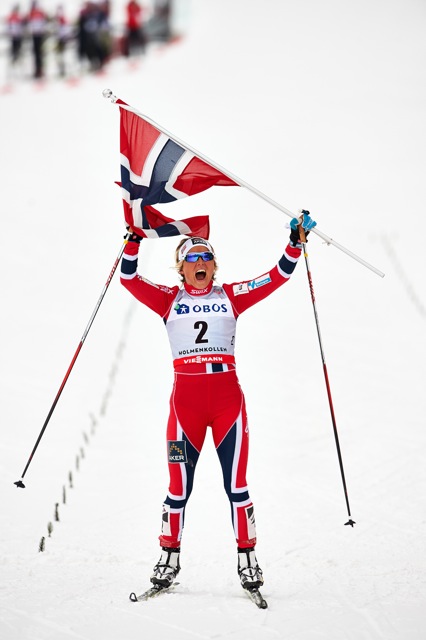
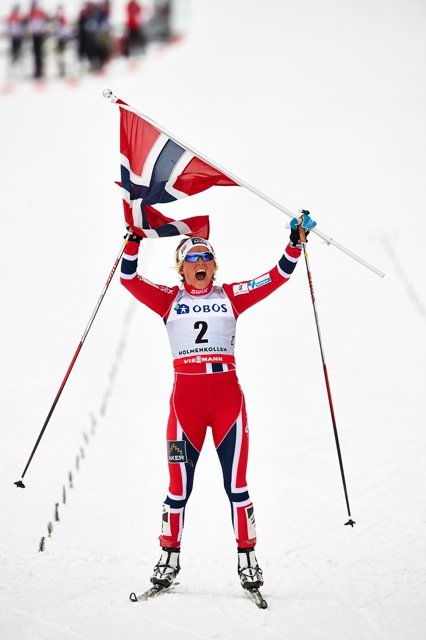
Norway’s Therese Johaug celebrates her victory in Sunday’s 30 k freestyle mass start at Holmenkollen at the World Cup in Oslo, Norway. She beat Poland’s Justyna Kowalczyk by 46.6 seconds to repeat her victory from the same race at the 2011 World Championships at the same venue. (Photo: Fischer/Nordic Focus)
Whether Therese Johaug could win Sunday’s 30-kilometer freestyle mass start in Oslo, Norway, was never really in question.
As the Eurosport announcers pointed out, the 24-year-old Norwegian was given 4/9 odds on the World Cup race at Holmenkollen, the premier distance event of the year outside of World Championships. If you bet four Euros on her to win, you’ll get nine back if she does.
Easy money, especially considering she won the race by 44 seconds two years ago. But what if Poland’s Justyna Kowalczyk is having a great day, or Norway’s reigning World Cup champion Marit Bjørgen is also in the mix?
With Bjørgen deciding relatively last-minute to skip the 30 k to heal a sore throat, Johaug’s race strategy suddenly became easier and more complicated at the same time. On one hand, she wouldn’t have to battle with Bjørgen to the finish, like she nearly did two weeks ago at the World Championships 30 k classic mass start in Val di Fiemme, Italy.
There, Johaug lost contact on the last hill and finished third after Bjørgen and Kowalczyk, respectively, and she didn’t forget it. Without Bjørgen to push or pace her, however, it could also be tricky to take Kowalczyk on alone.
And so Johaug made Saturday’s race at Holmenkollen her own, and she might have borrowed a tactic or two from Sweden’s Johan Olsson, who broke away early in the men’s World Championships 50 k and held it for nearly 30 kilometers for the win.
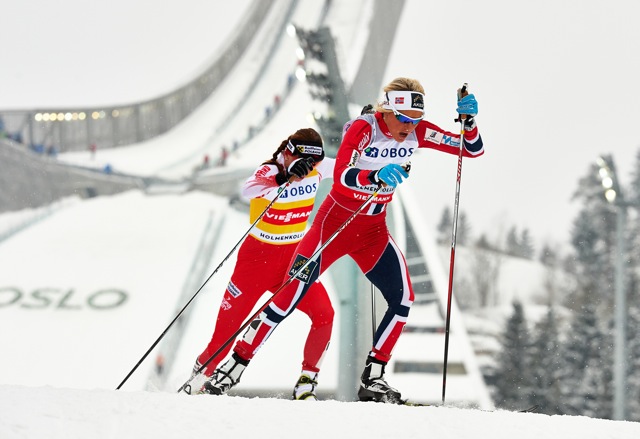
Norway’s Therese Johaug leads Justyna Kowalczyk of Poland early in Sunday’s 30 k freestyle mass start at Holmenkollen in Oslo, Norway. (Photo: Fischer/Nordic Focus)
Johaug led from the start as nearly 60 others stuck behind her. Kowalczyk remained on her tail, leaving less than a second between them for most of the first five kilometers. Around 7 k, Johaug made her move, gapping Kowalczyk by almost five seconds, then 15 seconds one kilometer later.
Most likely everyone nearest to Johaug at the time – Kowalczyk, Sweden’s Charlotte Kalla, Germany’s Nicole Fessel, Norwegians Heidi Weng and Kristin Størmer Steira, American Liz Stephen, Japan’s Masako Ishida – knew what Johaug was up to and capable of. But it was still risky.
From then on, Johaug made a point to charge forward and hardly ever, if ever, looked back. Always on the attack, she refused to let up and switched skis once out of three allotted times.
A new rule/addition to Holmenkollen this year, pit stops required skiers to cover extra ground, which took 25 to 30 seconds to complete. That was enough of a reason for Johaug to keep plugging; her 48-second lead near the end of the second lap was cut to 24 seconds after changing before the third.
Heading into the third of four laps, Stephen and Steira led the chase, but the last three laps were significantly longer than the first at 8.3 k apiece (the first was 5 k). If Johaug was feeling good, she’d be tough to catch, especially as the terrain eased up toward the tail end of the loop.
Just once on the last lap, after nabbing all four preems for a total of 60 points, did Johaug look a little weary. She pulled it together on the descent and grabbed a Norwegian flag with almost a ½ kilometer to go. It some ways, it was a bit preemptive, but Johaug also had more-than-a-minute cushion at 29 k.
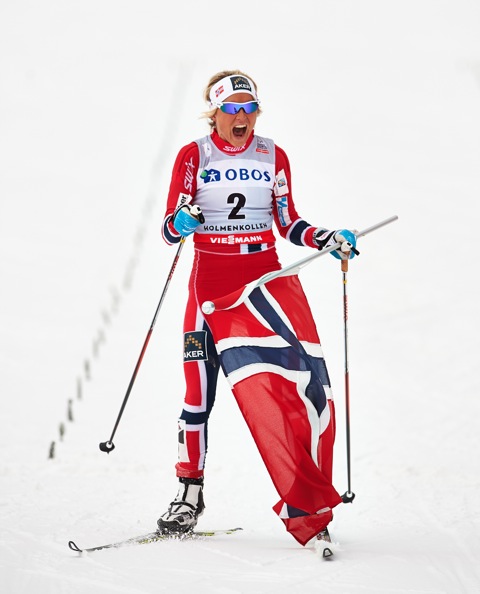
Therese Johaug screams after winning Sunday’s 30 k freestyle mass start at the Holmenkollen World Cup in Oslo, Norway. (Photo: Fischer/Nordic Focus)
She accepted the flag, large and cumbersome, skiing with one pole as she held it up. A little to heavy to do for 500 meters, she struggled as she ascended a bridge in the stadium and said she got a little nervous.
“When the acid was right up in my throat, I did not quite know how to get up the hill with the flag and one stick,” Johaug told NRK, according to a translation.
She didn’t consider tossing it, she said, but would have if Kowalczyk and the others closed on her. Fortunately for Johaug and her country, it didn’t come down to that as she won by 46.6 seconds in 1:21.17.1.
Kowalczyk was second after leaving the pack with three kilometers remaining, and Russia’s Yulia Tchekaleva finished third, 5.3 seconds later. It was her third bronze medal in the last four races, two of which came at World Championships (10 k freestyle and 4×5 k relay). Tchekaleva was 13th in the 30 k classic there.
At a press conference, Tchekaleva, who edged Weng in fourth by 1.7 seconds and Ishida in fifth by 1.9 seconds, said the race was especially hard, but the group tried to work together. At the start of the last lap, it was Tchekaleva, Weng, Steira, Stephen, Ishida, Kowalczyk, France’s Anouk Faivre Picon and Italy’s Debora Agreitar.
Fessel had to change her skis before the final 8.3 k, while the others pushed on as a unit. Kalla clawed her way back into contention after falling off the pace midrace to end up sixth (+1:13.1) ahead of Steira in seventh (+1:17), Norway’s Astrid Uhrenholdt Jacobsen in eighth (+1:18.9), Stephen in ninth (+1:23.9) and Fessel in 10th (+1:31.5).
“When Justyna went away in the last lap I tried to follow her, but I was tired,” Tchekaleva said.
She wasn’t alone. Johaug looked pretty well spent as she teetered across the finish, but flipped a switch and screamed with elation upon doing so. Johaug was ecstatic and who could blame her? She had skied almost 23 kilometers alone and won.
“It was a perfect day for me,” Johaug said. “I felt very strong. When you are in a good shape, you just ski and go away. … When I heard I was 90 seconds ahead, I thought something really would have to happen for me to lose the victory.”
Two years ago at World Championships, Johaug won the same race at Holmenkollen, beating runner-up Bjørgen by 44 seconds. Previously a classic specialist, Johaug said skating is becoming her new love.
“I hated skating; now it’s almost the opposite,” she told NRK. “I have taken major steps in skating over the last year. It showed when I was in Val di Fiemme when I won the 10 kilometer.”
Alternatively, Kowalczyk wasn’t quite as pleased with her skating.
“Free technique has been challenging for me this season after the injury and operation,” she said, referring to the knee arthroscopy she had last March.
“It is always difficult to win 30 km in Oslo,” Kowalczyk added. “Therese was stronger. … I am happy I finished second.”
Therese Johaug skating to a 46.6-second victory on Sunday at the Holmenkollen World Cup 30 k freestyle mass start in Oslo, Norway. (Photo: Fischer/Nordic Focus)