Tag: Östersund pursuit

  • Fourcade Leaves Östersund with a ‘W’; Bailey 17th; Christian Gow Gets Career-Best 21st

    Fourcade Leaves Östersund with a ‘W’; Bailey 17th; Christian Gow Gets Career-Best 21st

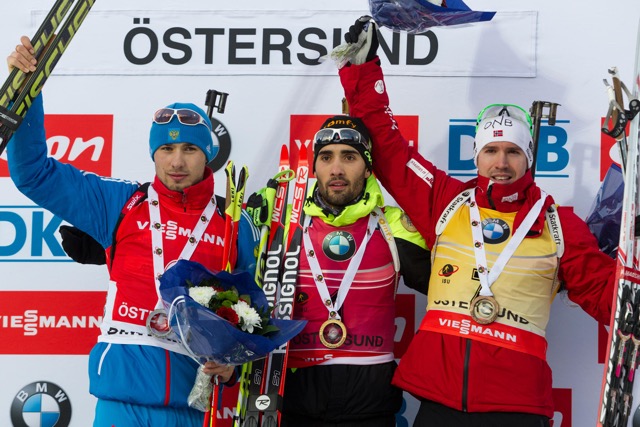
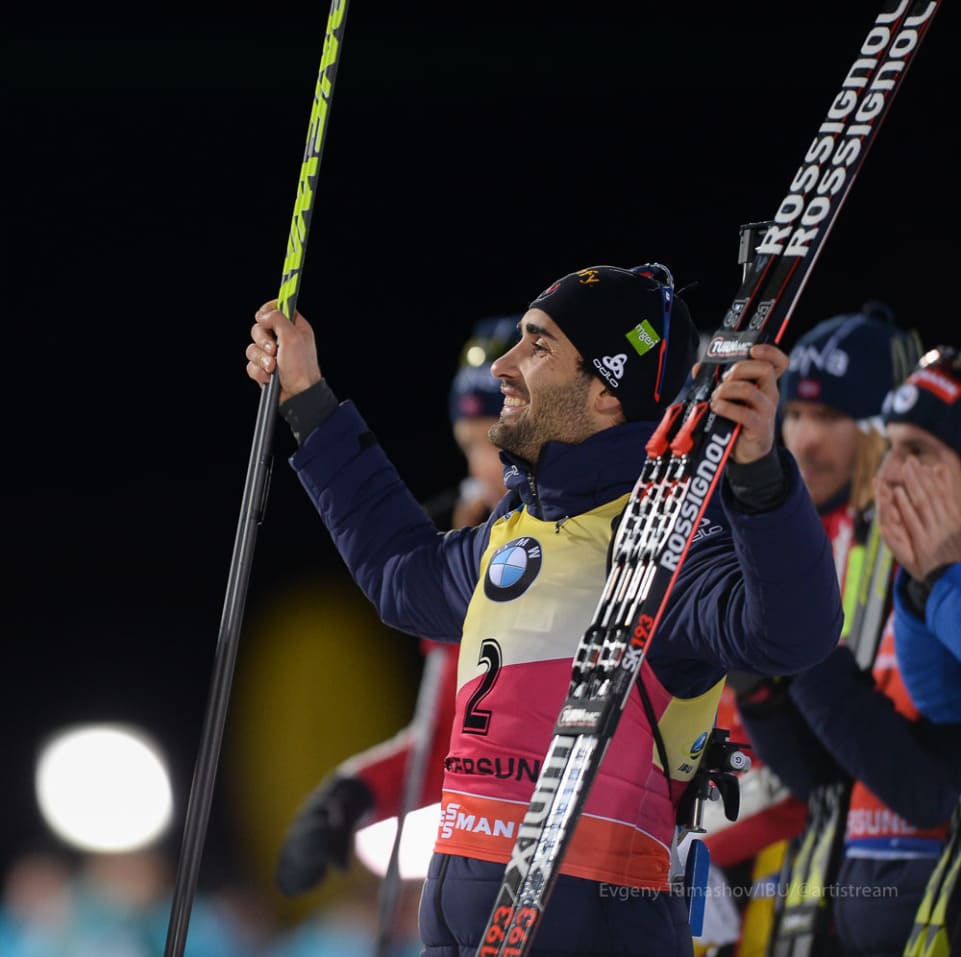
    France’s Martin Fourcade celebrating his first IBU World Cup win of the 2017/2018 season in the men’s 12.5 k pursuit on Sunday in Östersund, Sweden. (Photo: IBU/biathlonworld)

    If you were to ask France’s Martin Fourcade what’s wrong with a second and third place, and even two fourth place finishes in the first four races of the International Biathlon Union (IBU) World Cup season, he’d likely politely tell you nothing — it just wasn’t up to his usual standards.

    “Despite my two podiums here, I felt that if I had not won here, it would have been my worst season opener since, for seven years in a row, I won here,” the 29-year-old defending World Cup champion told the IBU after Sunday’s pursuit in Östersund, Sweden. “Now I can be very calm and relaxed for the next competitions.”

    He got down to business out of the start of the men’s 12.5-kilometer pursuit, starting second, just 1 second behind Norway’s Tarjei Bø, who won the sprint to start the pursuit first. Early in the first of five 2.5 k loops, Fourcade set the pace with Bø and Germany’s Erik Lesser in bib 3 slotting in behind him. Fourcade entered the range first to take Lane 1 for the first prone stage, where he and Bø both missed a shot to slip to fifth and sixth, respectively, after each skiing a penalty lap. Meanwhile, Lesser missed four to drop out of the top 30 and nearly a minute and 20 seconds out of first.

    While Fourcade left the range 10 seconds behind Norway’s Emil Hegle Svendsen, who had moved into first with clean shooting, he was back into first 2.5 k later. On the second prone, Fourcade and Bø both cleaned to leave the range just 3.8 seconds apart in first and second, respectively. Svendsen missed one to slip 18 seconds back to third.

    On Loop 3, Fourcade switched into high gear. Bø kept pace, but by the time they lined up together for the first standing stage, Fourcade had the edge. The Frenchmen once again cleaned while Bø missed three to fall to 18th and nearly a minute and a half out of contention by the time he finished his penalty laps.

    Game over. Fourcade spent the next two loops and final shooting going through the motions to secure his victory, cleaning the last standing stage with the 25th-fastest shooting time, then slowly turning to look up at the crowd. He appeared relaxed with his two closest challengers, his French teammate Quentin Fillon Maillet and Slovenia’s Jakov Fak, who started 2 seconds apart in 12th and 10th, respectively, and shot identically (1+0+0+1), skiing together more than a minute back in second and third.

    Fourcade’s final loop time ranked 51st out of 58 yet he still finished first, 40.8 seconds clear of Fak, who dropped Maillet on the final climbs before the stadium. Fourcade claimed his first win of the season in 30:12.2, Fak placed second for his first podium since 2015, and Fillon Maillet took third (+42.1).

    “I must say that I was very surprised because after the third shooting it was more a fight against myself,” Fourcade said. “I am very satisfied about the biathlon I showed.”

    “I think Quentin and I worked well together, half the loop each pushing to keep on the podium,” Fak told the IBU. “Both can be very satisfied about finishing on the podium and leaving Sweden with this result.”

    On a day with variable wind conditions and soft, slow snow, no one in the men’s race shot clean. Six hit 19 of 20 targets, including Fourcade and his brother Simon Fourcade (ninth place) and Norway’s Lars Helge Birkeland (sixth place) in the top 10.
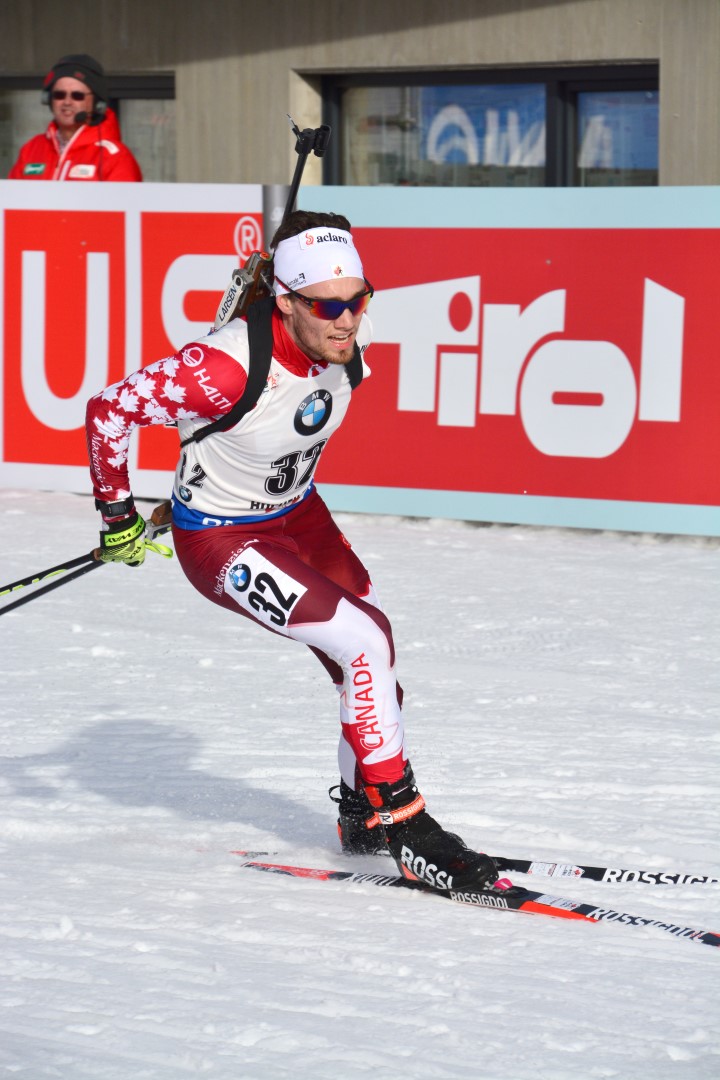
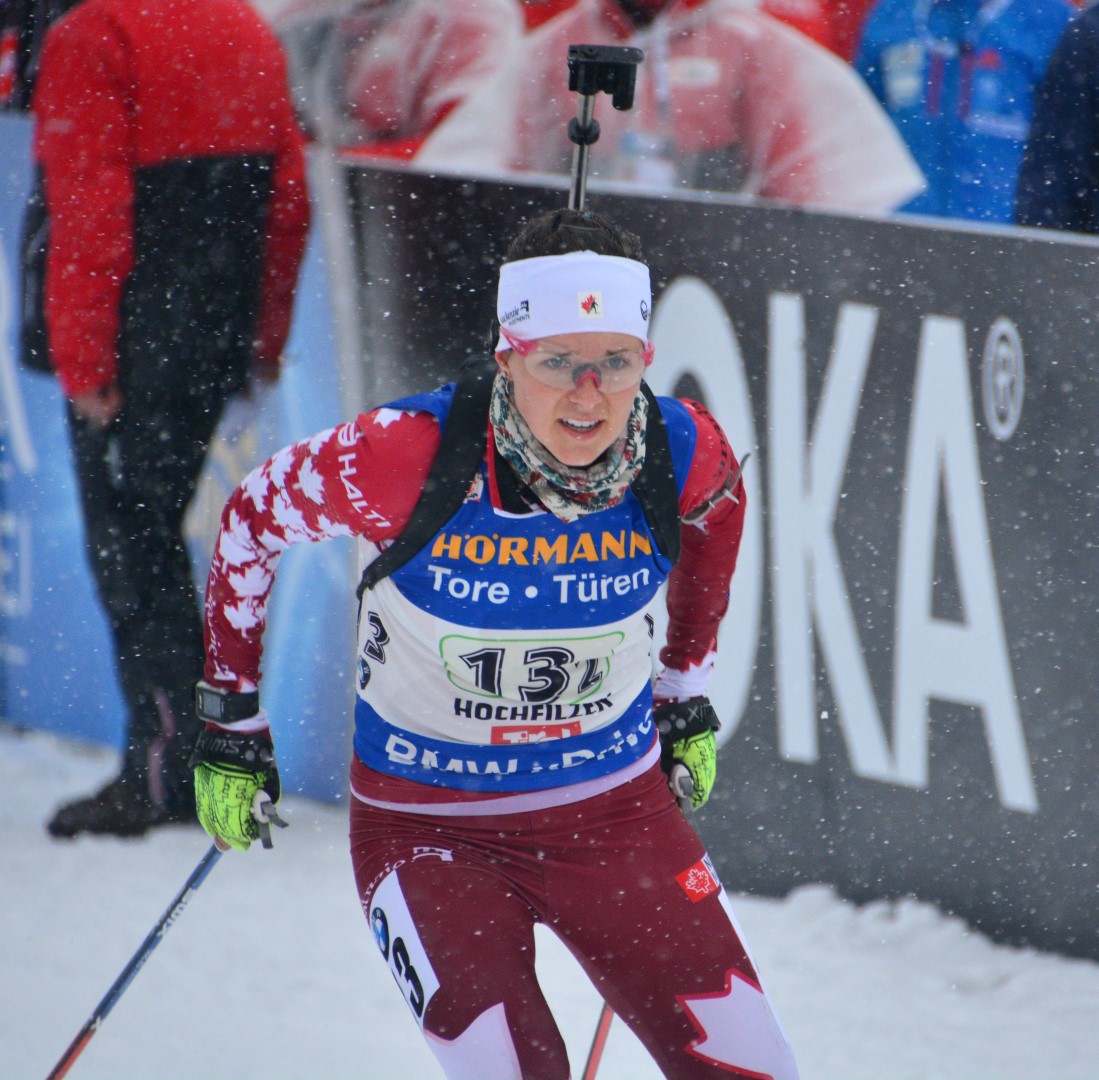
    Christian Gow (Biathlon Canada) racing to his previous career best of 23rd in the men’s 12.5 k pursuit at 2017 IBU World Championships in Hochfilzen, Austria. On Sunday, he placed 21st in the Östersund World Cup pursuit. (Photo: Glen Crawford)

    Biathlon Canada’s Christian Gow also finished with a single penalty (0+0+1+0) in 21st for his best World Cup result. Gow had started the pursuit 26th and 58 seconds back, and picked off five places to finish 2:04.6 behind Fourcade.

    “[Saturday] was my best sprint placing ever, so I knew I was in a good position for the pursuit,” Gow wrote in an email to FasterSkier. “I knew a top 20 was possible, and maybe more if my skiing was on form. Unfortunately, I had some shin issues skiing today so I wasn’t able to ski as well as I would have liked. But I did my job on the range and am happy with how the race turned out.”

    The shin pain he referred to wasn’t anything serious, “just bothered me today for some reason,” he elaborated. “I’m not too concerned though, I’m sure they’ll be fine in a couple days.”

    His shooting time ranked 22nd overall compared to his overall course time in 49th.

    “The shooting conditions were challenging today, but I knew that I could still shoot well if I stayed focused in the range,” Gow wrote. “I shot confidently today and I think that helped a lot.”

    He consistently left the range within striking distance of the top 20: first in 22nd, then in 21st, then 26th, and finally 20th.

    “The course was pretty soft today. That added an extra challenge skiing,” he continued. “I made up all of my time in the range today, but am quite happy with my last loop. I am proud of how hard I was able to push myself on that lap to keep my placing.”

    Leaving Östersund, where he and his older brother Scott Gow and another teammate Julia Ransom all achieved career bests to start their season, Gow said the team mood was positive.

    “Almost everyone had at least one result that they can be proud of and we really performed well as a team which boosts everyone’s confidence I think,” he wrote.

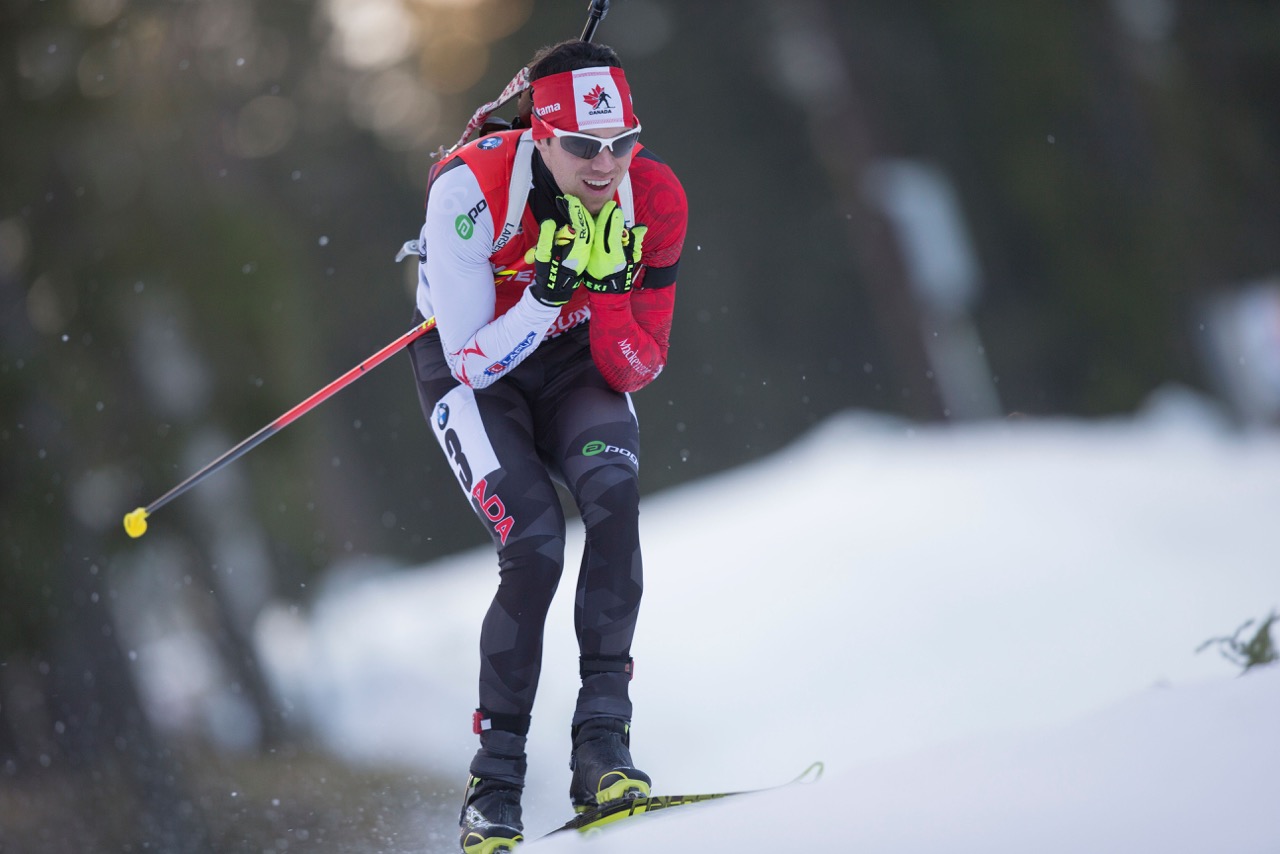
    Four Canadians qualified for the men’s pursuit, with Nathan Smith finishing 42nd (+3:19.2) after starting 24th and missing three shots (1+0+0+2). Scott Gow placed 50th (+4:10.9) after starting 16th and incurring six penalties (1+2+1+2), and Brendan Green followed in 51st (+4:18.6) with five penalties (0+2+2+1).

    Bailey Gets First Top 20 of Season
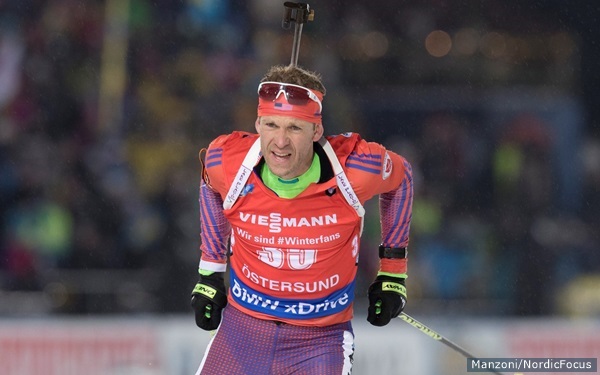
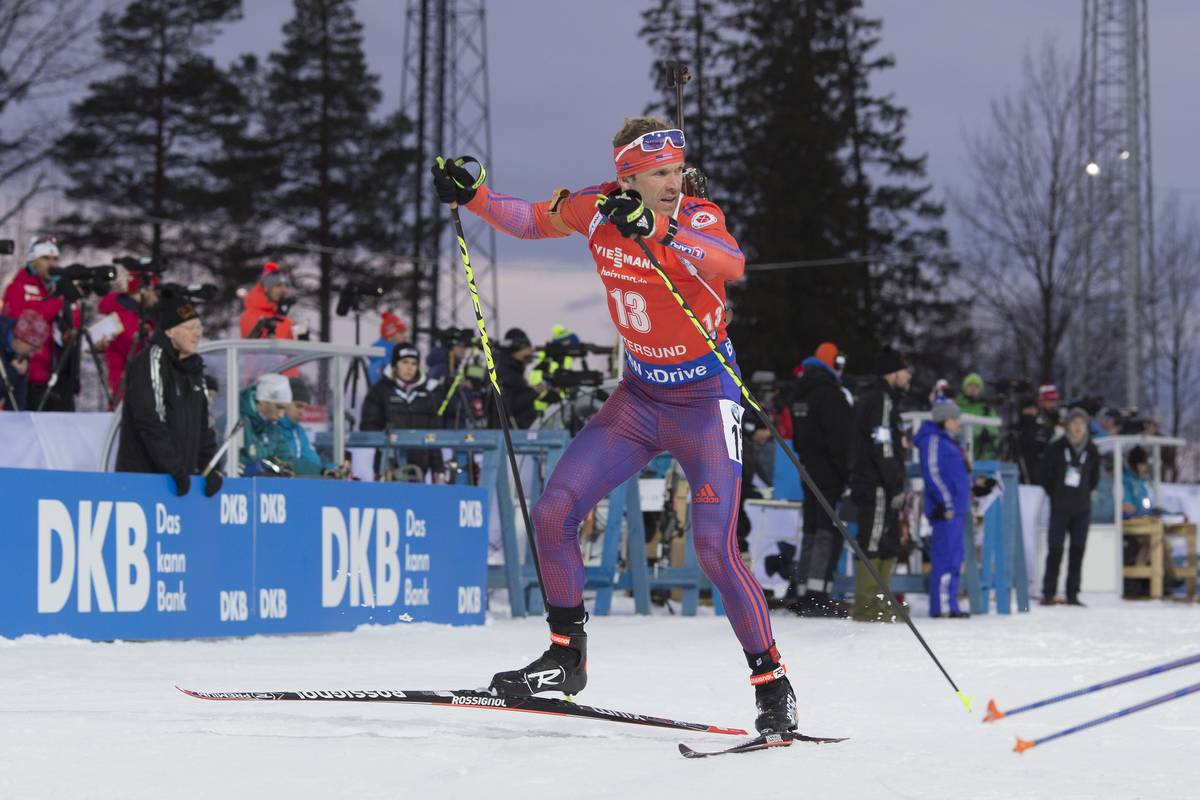
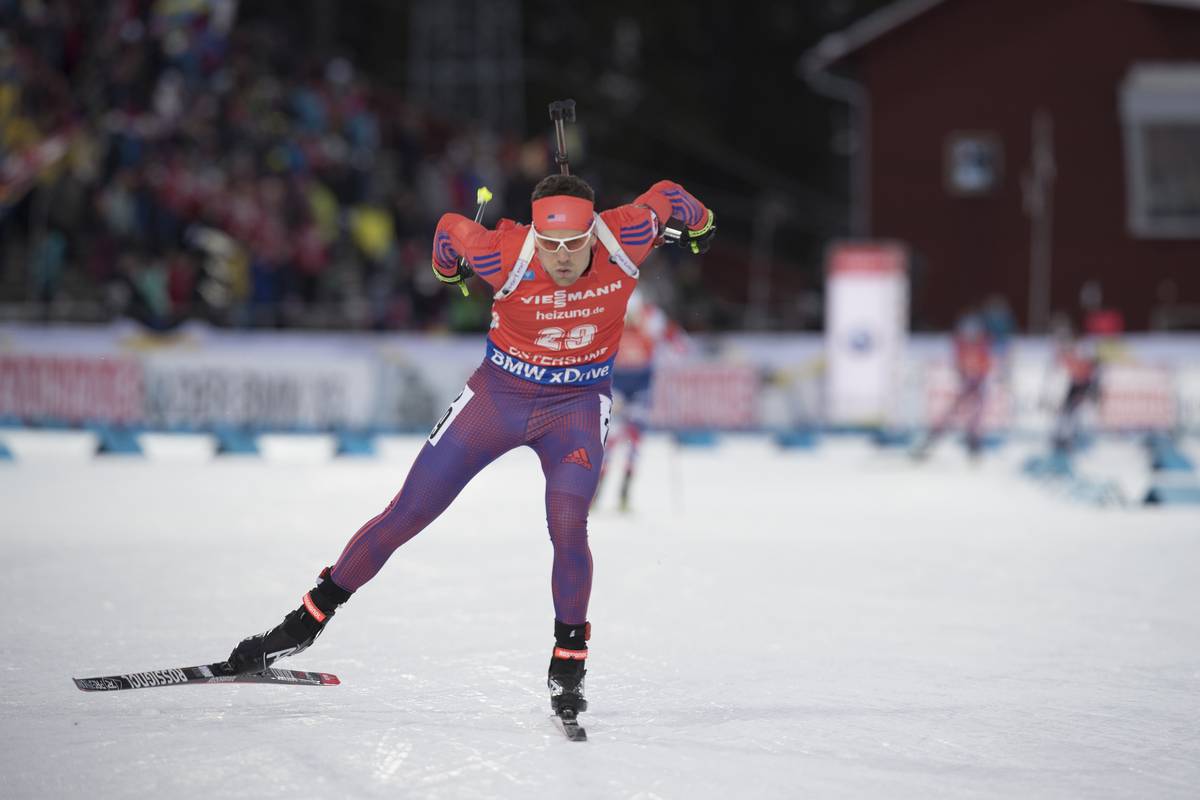
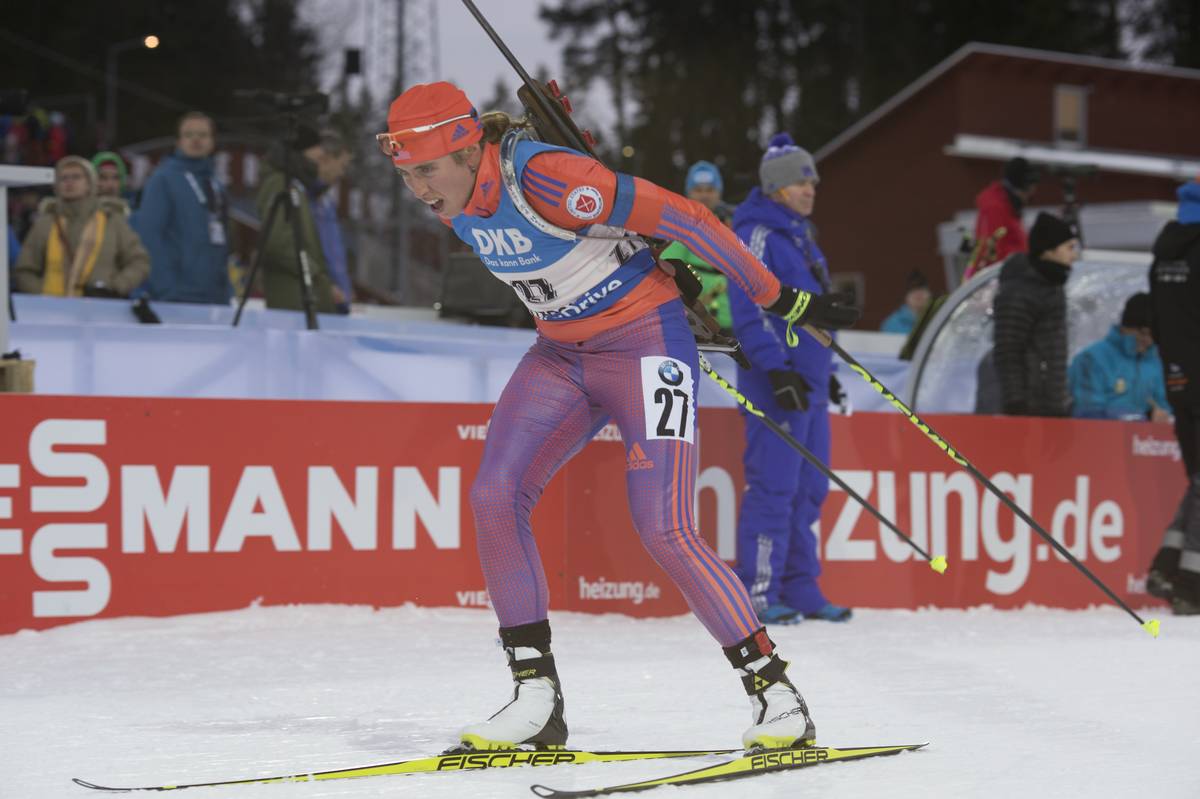
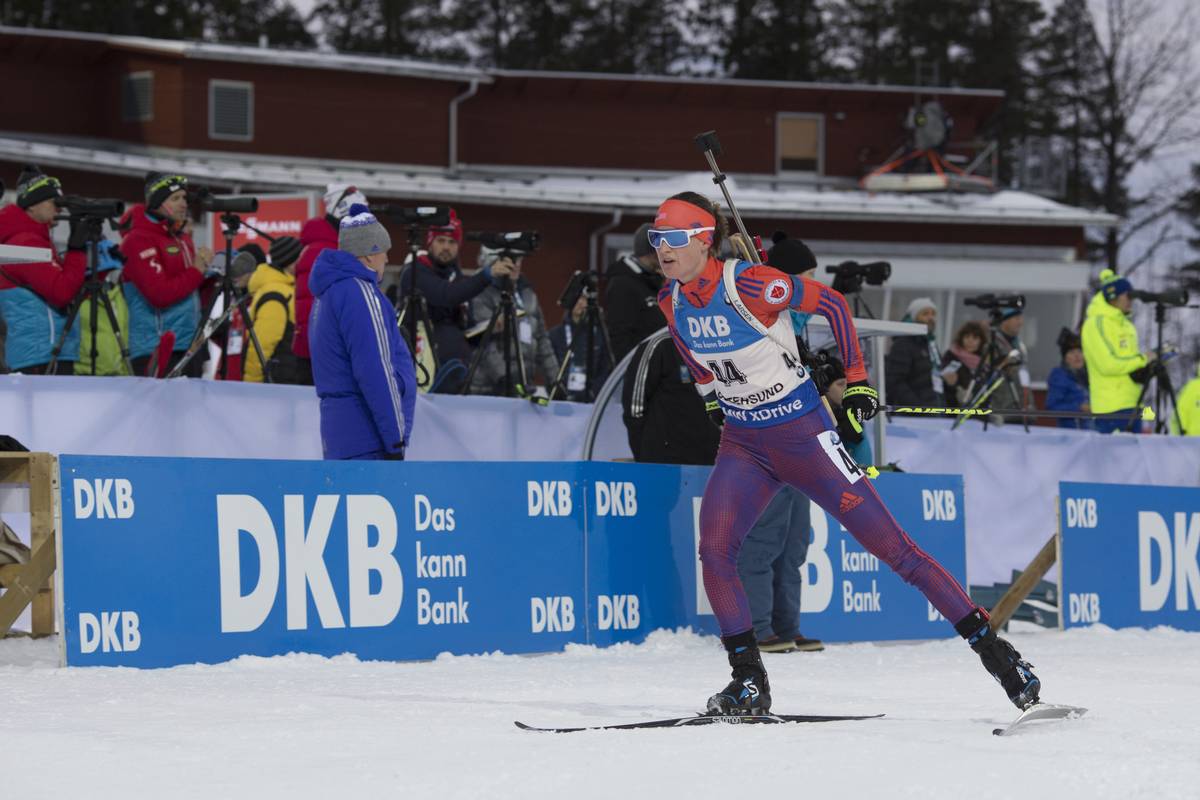
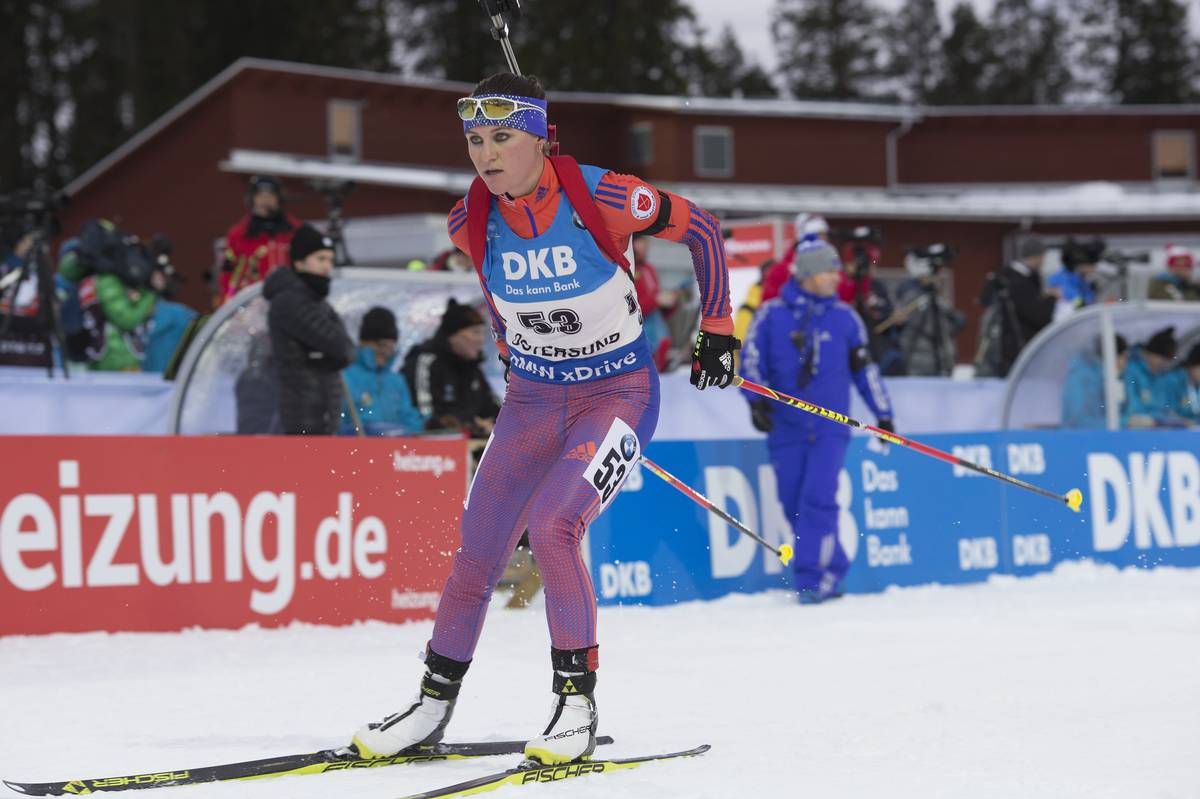
    Lowell Bailey (US Biathlon) racing to 17th in the IBU World Cup men’s 12.5 k pursuit on Sunday in Östersund, Sweden. (Photo: USBA/NordicFocus)

    Lowell Bailey led two Americans in the pursuit, starting 22nd and 50 seconds back and rising to 17th (+1:40.2) with two penalties (0+1+0+1). After cleaning the first prone stage, where several of the top competitors incurred penalties, Bailey moved up to 12th and 39 seconds out of first.

    One loop later, he found himself nearly a minute back in 19th after a penalty on his second prone. Bailey worked his way back to 11th after cleaning his third stage, but slipped to 15th with a miss in the final standing stage.

    “The range was tricky today. The wind was very shifty and constantly changing,” Bailey explained in an email. “I only tried to focus on the fundamental parts of my shooting (e.g. trigger squeeze, breathing, etc.) and make sure that I was taking good shots.  My groups did move around from one prone to the next, but fortunately, most of the shots stayed in the hit zone.

    “I’m happy with the shooting today,” he continued. “I tried to execute the type of shooting that I’ve worked on all summer.  Although I was happy with the shooting result in the Sprint, I know that I could have shot faster.  It’s a delicate balance; when to go for speed and when to hold back for accuracy.”

    His shooting time in the pursuit ranked third overall, while his course time was 42nd.

    “I definitely don’t feel in my best shape yet,” he wrote. “We deliberately approached the season conservatively, with the mindset that the Olympics are months away and I want to be in my best shape when I hit the tracks in Pyeongchang.”

    Leaving Östersund, where he finished 22nd in the sprint and 67th in the 20 k individual, Bailey wrote that he was satisfied with his first week of racing considering that he came down with a cold a week earlier.

    “All things considered, I feel very fortunate to have come away with some WC points in a field which seems to be one of the strongest international biathlon fields yet,” he wrote.

    Also for US Biathlon, Tim Burke finishing 48th (+3:52.7) after starting 52nd and missing four shots (2+0+1+1).

    With the conclusion of the first IBU World Cup in Östersund, the circuit moves to Hochfilzen, Austria, where racing kicks off again Friday, Dec. 8, with men’s and women’s sprints.

    Results

  • Herrmann Captures Second Win in Östersund; Ransom 23rd

    Herrmann Captures Second Win in Östersund; Ransom 23rd

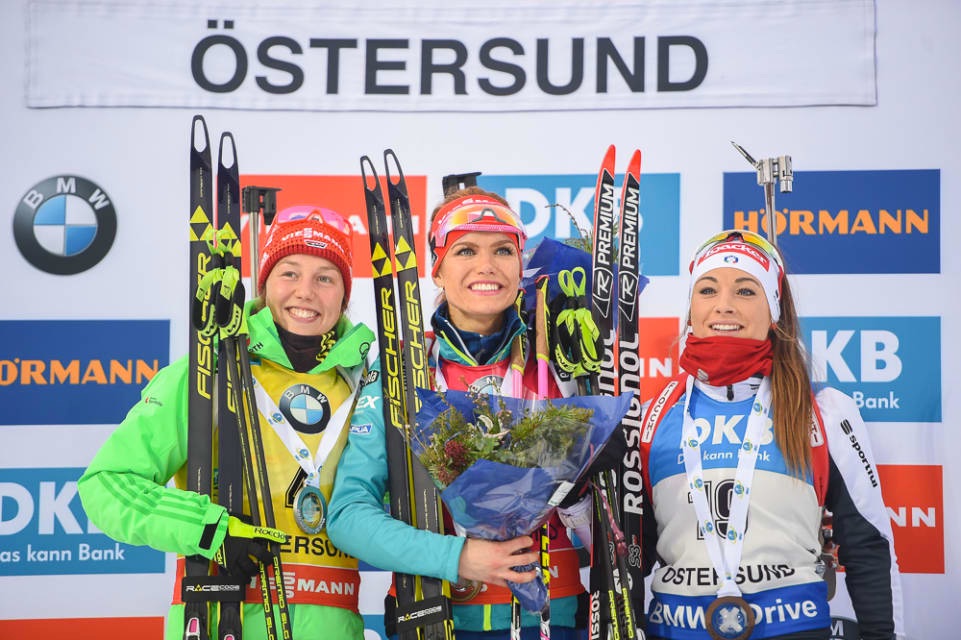
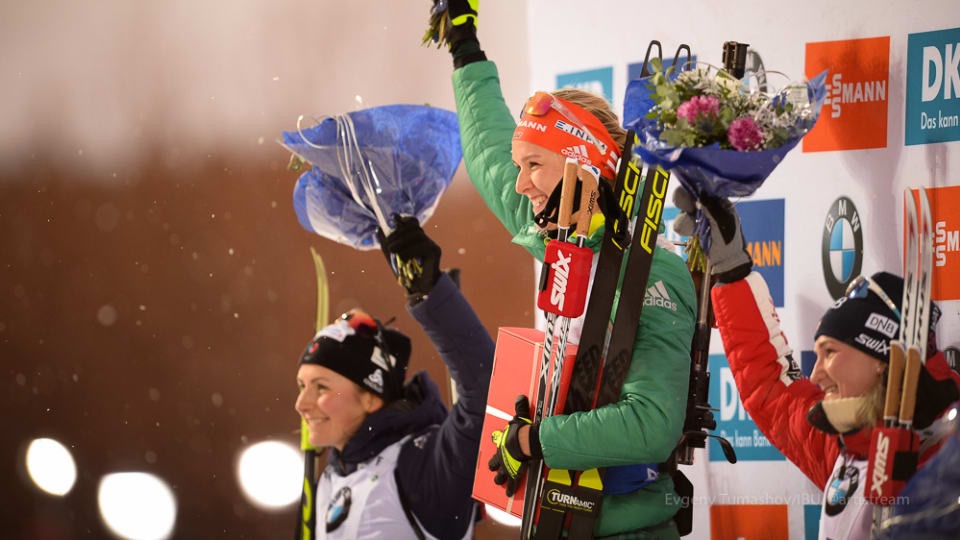
    France’s Justine Braisaz (left, second place), Germany’s Denise Herrmann (center, first place) and Norway’s Marte Olsbu (right, third place) celebrate during the flower ceremony of the women’s 10-kilometer pursuit at the 2017/2018 IBU World Cup in Östersund, Sweden. (Photo: IBU/biathlonworld)

    Twenty months ago, Germany’s Denise Herrmann was a cross-country skier, ending the Ski Tour Canada in 28th place in the 10-kilometer classic pursuit in Canmore, Alberta. And one with a very successful career, earning an Olympic bronze medal in the relay in Sochi in 2014 and narrowly missing out on another one with a fourth place in the team sprint.

    But her heart seemingly was no longer in the sport. A month after the 2015/2016 season had wrapped up, Herrmann publicly announced her intention to continue her athletic career with the goal of qualifying for the 2018 Olympics in PyeongChang, South Korea, yet no longer in cross-country skiing. Instead she dreamed about a second career in biathlon.

    Biathlon is highly popular as a spectator sport in Herrmann’s home country, arguably receiving more attention than cross-country skiing and thus providing a higher earning potential. But while a switch between the two disciplines has not been unprecedented, Germany’s senior national team is also one of the most successful and competitive ones, with no guarantee even for seasoned biathletes to make the World Cup roster. So critics wondered if that was a wise decision by Herrmann, or rather a case of giving up a bird in the hand for two in the bush.

    Herrmann had some initial success right out of the gate in her first season as a biathlete. She instantly qualified for the German team for the second-tier IBU Cup, and with the coaches trying to make use of her athletic talent she was allowed to start three World Cup races, and finished 18th in her first sprint in Pokljuka, Slovenia.

    Then ten months ago in January 2017, she might have had some second thoughts and tried a “mini-comeback” at a cross-country World Cup in Toblach, Italy, in what appeared to be an attempt to qualify for the 2017 Nordic World Championships in Lahti, Finland. Despite placing 13th in a freestyle sprint and fourth in a team sprint, but she was not nominated to Germany’s World Championships team. Instead she received more starts at the IBU World Cup test event in PyeongChang, where she won her first relay race.

    After another successful offseason of biathlon training, highlighted by winning national titles in three disciplines, she was put on the IBU Cup team again. That followed a sprint victory in Sjusjøen, Norway, after which she was ‘called up’ to the roster for this week of races in Östersund, Sweden.

    Breakthrough in Östersund

    Germany’s Denise Herrmann racing to her second career victory in the women’s 10-kilometer pursuit at the 2017/2018 IBU World Cup in Östersund, Sweden. (Photo: IBU/biathlonworld)

    This weekend, Herrmann achieved at least a big milestone on the road to her dream goal and secured her ticket for the German Olympics team for PyeongChang, fulfilling the team-internal qualification criteria (a top-eight result) with an exclamation mark by winning the sprint on Saturday.

    Now a day later she followed that up with another victory in the women’s 10 k pursuit in a time of 30:02.7 minutes with two penalties (0+0+2+0). Her transition to biathlon has come to fruition.

    While the sprint only required two shooting stages, for the pursuit she had to navigate four, an obstacle that typically weeds out inexperienced shooters, especially in the standing stages. But on Sunday, Herrmann demonstrated everything she has already learned about her new sport.

    Starting with a 15-second lead on France’s Justine Braisaz based on the sprint, Herrmann skied with a controlled pace on the first loop and went on to clean her first prone stage, returning to the course with an increased lead of 22 seconds. Then Herrmann reacted correctly to some changing wind influence by adjusting her sights to also clean the second prone stage and kept her distance to Braisaz and the next chase group.

    Herrmann later told German TV broadcaster ZDF she would not have expected to win “in a pursuit having to shoot four times and with a number of extremely good shooters breathing down my neck.”

    “To twice clean in prone made me extremely happy since that is the basis for a good pursuit,” she added. “It was good that I had a little lead so I was not under immediate pressure. With the wind on the shooting range you really had to focus today.”

    Then in the first standing stage she began with a good rhythm but narrowly missed her last two shots, hitting above the edge of the black target. Momentarily she fell back to the second place, with France’s Braisaz taking an 11-second lead after she managed to clean all of her targets.

    But Herrmann had already completed one penalty lap before any chasers had left the range, and after completing the second penalty she was able to regain her lost time on the course. For the final shooting, the two women stood side by side on the range, and both managed to clean their five targets.

    “In the third one I was shaky,” Herrmann told ZDF. “Then in the last one I tried to really give it everything I had and leave with a clean shooting. Easier said than done […] Though we practiced pressure situations like this in training with the coaches teasing us, and that helped me a bit in the last bout.”

    “When I came on the shooting range in the first position, it was the first time that happened to me, and I just had a thought, ‘Wow is it true, is that possible?’ ” Braisaz said at the IBU press conference. “It was a high difficulty today, it was tough, but I did it.”

    Braisaz started the final loop just 1.5 seconds ahead of Herrmann, who quickly passed Braisaz on a climb, then increased that lead into the finish. Braisaz crossed the line 25.8 seconds behind Herrmann, repeating her second place from the sprint and tying her career-best World Cup result for the fourth time. She was one of only three athletes to shoot clean on Sunday.

    “I was afraid,” Braisaz said in the press conference when questioned about Herrmann chasing behind her. “She just passed me on the uphill, I just tried to do my best even if it won’t work. … I am very happy, it was my main goal today to stay focused on what you have to do [on the shooting range], and I did it.”

    With a comfortable lead, Herrmann had enough time to waive to the about 3,000 spectators in the stands. “I already told [my roommate] it’s cool to win, but it must be even cooler to ski across the finish line in first and knowing you have won,” Herrmann told ZDF. “An incredible feeling. … With my tired legs I was happy that there was no battle until the finish line. Then you can really enjoy it, and I have never experienced that feeling [in cross-country], and it’s wonderful.”

    Norway’s Olsbu finished third, 48.0 seconds behind Herrmann with two penalties (0+1+0+1).

    “This means a lot to me, I felt that this week has been good for me, but it has just been almost [on the podium] so I am glad that today I got the podium,” Olsbu explained in the press conference. “I was OK on the track and my shooting was good, even though I am not so happy about my last shooting.”

    “She is really good, I am very impressed about what she is doing in the shooting,“ Olsbu said of Herrmann. “We trained in that for so many years, and she has trained for two years or something, so that is really impressing.”

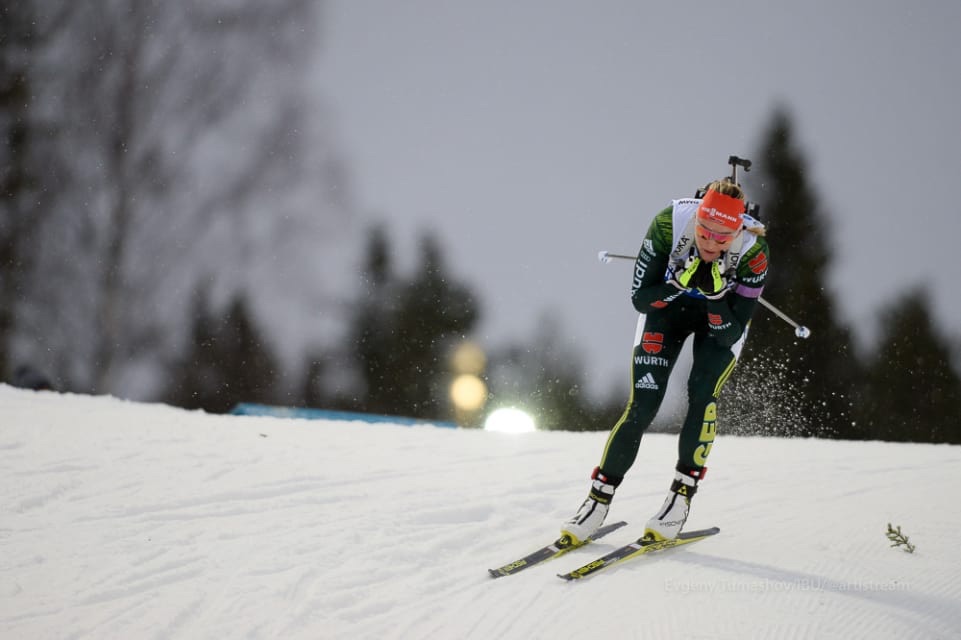
    Olsbu’s teammate Synnøve Solemdal started the race with the yellow bib of the World Cup Total Score leader, earned via a second place in the individual and a fourth place in the sprint. It was the first time in her career the 28-year-old Solemdal had achieved that distinction, and after she finished 19th on Sunday (+2:23.5 with four penalties), Braisaz took over the lead in the World Cup standings after the first week of races.

    Twenty seconds behind Olsbu, Italy’s Lisa Vittozzi finished fourth (+1:09.1 with one penalty). Herrmann’s teammates Maren Hammerschmidt in fifth (+1:16.8 with two penalties), moving up from starting 14th, and Vanessa Hinz in eighth (+1:29.1 with one penalty), up from 16th, also pre-qualified for the German Olympic team.

    “I got the [qualification norm] today, and that was very important for me,” Hammerschmidt told the IBU in an interview. “I never would have thought that I could already do it here in Östersund, I thought maybe in December was good, so I am very happy to go to Hochfilzen without this [pressure next week]. When I came to the finish line I realized Denise had won again, and I am so happy for her, it is incredible what she has done.”

    Team Germany is starting to take shape for the Olympics, with Herrmann a name on the roster few fans would have expected a year ago.

    “I think Laura is coming back next weekend…,” a laughing Herrmann cautioned at the press conference.

    Laura Dahlmeier, the dominant athlete of the 2017 World Championships in Hochfilzen, Austria, has not started a race this season yet, missing the Östersund World Cup because of illness. She plans to be back for the races later this week (Dec. 8-10) at the site of her biggest successes.

    Third-Best Career Result in a Pursuit for Ransom

    Julia Ransom (Biathlon Canada) racing the second leg of the women’s 4 x 6 k relay at 2017 IBU World Championships in Hochfilzen, Austria. (Photo: Glen Crawford)

    Starting in 29th and 1:17 out of first based on her sprint result, Biathlon Canada’s Julia Ransom started her pursuit without a slip, cleaning both her prone shooting stages. Since a number of athletes in front of her incurred penalties, she had moved up all the way to the 11th position as she returned to the course after her second shooting.

    “We get pretty consistent feedback on the course so I was aware I was 11th,” Ransom wrote in an email to FasterSkier. “The wind picked up today and made for some tricky shooting. On one end of the range, the wind can swirl off the building and push the bullets one way, while it blows the bullets another way on the opposite side of the range.”

    On the next round she skied in a pack with athletes, including Finland’s Kaisa Mäkäräinen and Ukraine’s Valj Semerenko (who also cleaned the first prone on Sunday).

    “My legs were a little fatigued but those fast girls definitely helped pull me around the course!” Ransom remembered regarding that loop.

    In her first standing bout, she again cleaned the first four targets before seeming to hesitate a bit and then missed the last target, having to ski a penalty loop. She came back on the course in 17th position.

    Then in the final stage she missed another target, leaving the range for the last time in 21st.

    At the finish Ransom was 23rd for her third-best result in a pursuit behind a tied 19th place in Nove Mesto, Czech Republic, last season as well as in Antholz, Italy, two seasons ago. She achieved her best career result in a ninth place in the 15 k individual earlier this week.

    “I really wished I could have kept my focus for those last standing shots because it would have made for a very exciting race,” Ransom concluded. “That is how it goes sometimes. I am thrilled with my race! You can always say ‘what if…?’ but I am stoked with how solid the start of the season has been. I am looking forward to next weekend, especially since my parents are coming out to watch.”

    Starting in 46th position and 1:42 minutes back according to her sprint result, her teammate Rosanna Crawford initially put herself in the mix, cleaning her first prone stage to move up to 38th, even making up a few seconds to Herrmann up front.

    But in her next prone shooting, Crawford incurred three penalties, falling back to 53rd and doubling her deficit. With three more penalties in the standing stages Crawford ultimately finished 52nd, 5:25.1 back with six penalties (0+3+1+2).

    Her World Cup start in Östersund was marred by a nasty crash in the single mixed relay last Sunday. On Wednesday, she placed 39th in the individual for her best result of the week.

    Megan Bankes as Biathlon Canada’s third woman snuck into the top 60 to qualify for her first World Cup pursuit as the 60th and final starter (actually, 59th, since French athlete Anaïs Chevalier withdrew on race day).

    But that meant the 2017 Junior World champion in the individual discipline had to begin the race 2:11 minutes after Herrmann started hers.

    “I was quite excited because pursuits are always fun races, and to be racing with the 60 best women in the world is pretty neat,” Bankes wrote in an email. “Conditions on the course were pretty fast, the uphills were a little chopped up, but not bad. There was more wind today than any other race day, and I found it hard to read on the range, especially in the far lanes (28, 29, 30), because it swirls due to the wall [of a utility building at the end of the range].”

    After missing three targets already in her first prone shooting bout, she lost more time coming back on the track and was 3:50 behind she started her second loop.

    “I did not read the wind properly or make a big enough correction when I came into my first prone, so that is why I missed 3,” Bankes explained.

    After incurring another penalty in the second prone shooting and one more in the following standing stage, Banks was almost 5:30 minutes back, and the top of the field approached quickly from behind on the short 2.5-kilometer lap.

    On her final lap Herrmann passed Bankes, ending the race for the Canadian.

    “I think the techs may have yelled at me that I might be lapped, but I don’t really remember,” Bankes wrote in her email. “I knew about the rule, and knew the top girls were real fast, so I was aware of the possibility that I could be lapped. I could also see them coming into the range as I was leaving the range [after the third shooting], so I knew I had to ski pretty fast if I wanted to get to the range again before they finished. That did not happen, but I got farther on my 4th lap than I thought I would. Overall, it was a good learning experience, and a reminder that you should hit your prone targets in a pursuit!”

    In Saturday’s sprint, US Biathlon’s Clare Egan, Susan Dunklee and Emily Dreissigacker, along with Canada’s Emma Lunder, missed qualifying in the top 60 for the pursuit.

    The IBU World Cup continues next Friday Dec. 8 in Hochfilzen, Austria, with another sprint for the women and men.

    Results

  • Third-Straight Top 15 for Bailey After Shot at 4th in Östersund

    Third-Straight Top 15 for Bailey After Shot at 4th in Östersund

    Lowell Bailey (US Biathlon) racing in the men's 12.5 k pursuit on Sunday at the IBU World Cup in Östersund, Sweden. He placed 15th after starting 13th, but skied in fourth for much of the race. (Photo: USBA/NordicFocus)
    Lowell Bailey (US Biathlon) racing in the men’s 12.5 k pursuit on Sunday at the IBU World Cup in Östersund, Sweden. He placed 15th after starting 13th, but skied in fourth for much of the race. (Photo: USBA/NordicFocus)

    Starting with just under a minute separating him from first place, Lowell Bailey made sure he didn’t get too caught up on what could be.

    A veteran member of US Biathlon’s national team, Bailey started the men’s 12.5-kilometer pursuit on Sunday in 13th, exactly 59 seconds behind the first man out of the gate, Martin Fourcade of France.

    Fourcade had won the sprint the day before (and every race so far this season) and started 42 seconds ahead anyone else in the pursuit in Östersund, Sweden, with sprint runner-up Fredrik Lindström of Sweden chasing in second.

    Could anyone catch Fourcade? Maybe — but it was going to take some shakeups with Fourcade making errors and others shooting perfectly under pressure.

    Bailey was among those given the opportunity to move up significantly in the field. He tried not to overthink it, nor the fact that has led the U.S. in every International Biathlon Union (IBU) World Cup race so far this season.

    “I’m trying to approach every race as an isolated event this year; trying to focus on what I can control that day,” Bailey explained in an email on Sunday.

    So far this season, he’s finished 13th in the 10 k sprint and 15th in the 20 k individual races held in Östersund, the first World Cup stop on the circuit. Sunday marked the final day of a weeklong race series.

    “I just went into today with the goal of executing all of the things I had worked on throughout the training year,” Bailey continued.

    On the first of five 2.5 k loops, Bailey found himself fighting for second.

    “The first loop was an incredibly fast pace,” he recalled. “The group I was in ended up catching 2nd place, so by the time we hit the range, there was a group of fifteen or so guys from 2nd to 17th. It made for an exciting start to the race.”

    Once on the range, Bailey cleaned the first prone stage and left the range in seventh. He moved into fourth with another clean prone, followed by a flawless standing — his third-straight stage without a miss. With two loops to go and one more shooting, Bailey remained in fourth, about 39 seconds behind the leader and five seconds behind third place.

    The wind was blowing throughout the race, even gusting at times, but it was “manageable,” according to Bailey.

    “I didn’t really think about the fourth place,” he said of his mindset during the race. “I just wanted to execute a quality shooting bout.”

    On that standing stage, which he entered in fourth place, Bailey missed his first two shots. He cleaned the remaining three, but had to ski two costly penalty laps.

    “There was definitely some wind, but I can’t blame those two misses on wind,” he wrote. “I lost my focus for those two shots and sent them outside the targets.”

    Without much left in the tank for the final 2.5 k, Bailey, who left the range in ninth, slipped to 15th at the finish, 1:21.8 seconds behind the winner.

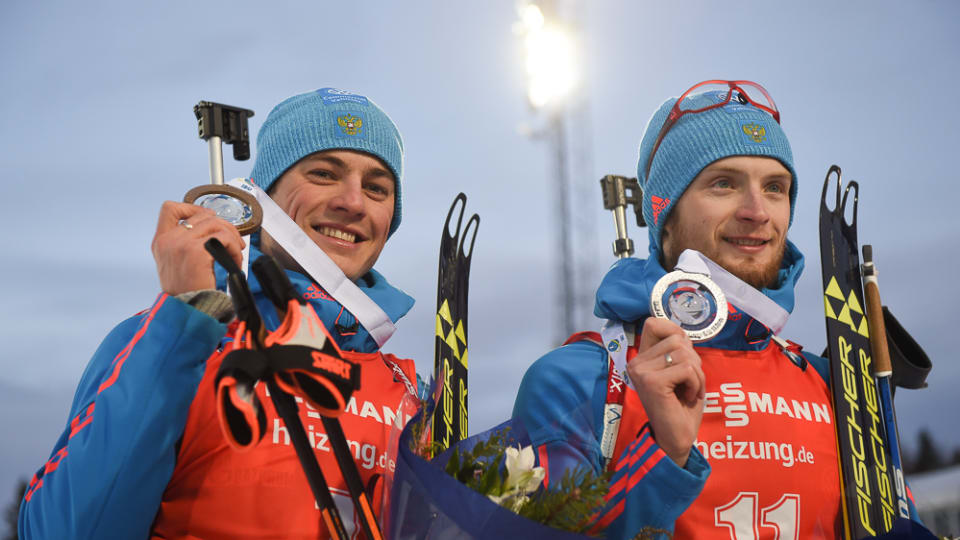
    Russia went 1-2 in the men's 15 k pursuit on Sunday at the IBU World Cup in Ostersund, Sweden, with Anton Babikov (l) winning his first World Cup and Maxim Tsvetkov (r) placing second. (Photo: IBU)
    Russia went 1-2 in the men’s 15 k pursuit on Sunday at the IBU World Cup in Ostersund, Sweden, with Anton Babikov (l) winning his first World Cup and Maxim Tsvetkov (r) placing second. (Photo: IBU)

    A 25-year-old Russian who spent most of last season on the IBU Cup, Anton Babikov won the pursuit with near-perfect shooting (0+0+1+0) for his first World Cup podium. He finished in 31:22.3, and his 24-year-old teammate Maxim Tsvetkov followed 10.5 seconds later in second, thanks to clean shooting, to tie his career best.

    (Babikov started seventh and skied the fourth-fastest overall course time, and Tsvetkov started 11th and was one of just two men to clean all four stages. Michal Krcmar of the Czech Republic was the other. He rocketed from 38th at the start to seventh at the finish.)

    Fourcade, the first starter, ended up third (+15.2) with an uncharacteristic four misses (2+0+0+2).

    “From the very beginning, I knew that everything could be possible,” Babikov told the IBU, according to a press release. “We were going very close. Before going to Östersund, I was a little worried, it’s always curious to see how well you are prepared for the season.”

    Tsvetkov skied in third for most of the race, concentrating on his shooting and capitalizing when Fourcade missed two on the final stage. There, Babikov took the lead for the first time from Fourcade, now 10 seconds back in third, and Tsvetkov left the range four seconds behind in second.

    “This is my first medal in pursuit,” Tsvetkov told the IBU. “It was very tough for me, I knew that Martin was very close, I knew that I have to work hard ’til the end.”

    “I had my chance today, and I didn’t take it,” said Fourcade, who had entertained the possibility of winning three individual races in a row. “At my last shoot I was a bit nervous, there was also some wind. My skis were also not perfect at the end of race.”

    While Bailey felt like he was missing some snap, especially on the last loop (which he attributed to a hard first loop), he was pleased with his start to the season and is ranked ninth overall on the World Cup.

    “I have been ranked this high in the past coming out of Ostersund, but I am definitely happy with the solid start to the season,” he told US Biathlon, according to a press release. “You train all season in a bit of a vacuum — just you and your teammates — and there is very little for you compare yourself to. Because of this, the start of the season can be a bit of an unknown. I’m happy to see that my ski times are competitive and that I’m able to reach the podium on a great day.”

    Of 59 finishers on Sunday, Bailey’s course time ranked 36th.

    “I hoped to have competitive ski speed and accurate, fast shooting,” he wrote to FasterSkier. “Mostly, I’m satisfied with my performances so far. As always, there’s plenty of things I need to improve, but I’m happy with this a solid start to the season.”

    Tim Burke (US Biathlon) racing to 35th in the men's 12.5 k pursuit on Sunday at the IBU World Cup in Östersund, Sweden. (Photo: USBA/NordicFocus)
    Tim Burke (US Biathlon) racing to 35th in the men’s 12.5 k pursuit on Sunday at the IBU World Cup in Östersund, Sweden. (Photo: USBA/NordicFocus)

    Two American men started the pursuit, with Bailey finishing 15th and Tim Burke placing 35th (+2:39.2). Despite a clean first prone, Burke, who started 29th, tallied four penalties (0+1+2+1), yet still finished in the top 40 required for points. His course time ranked 35th overall.

    Scott Gow was Canada’s top finisher in the pursuit in 47th (+3:34.8) and found himself up in 38th after hitting all 10 targets through the first two stages. He then missed two on the third stage and one more in the final standing (0+0+2+1), costing him time in penalty laps.

    About 11 seconds later, Brendan Green finished 50th (+3:45.5) with five penalties (2+1+0+2). His teammate Macx Davies finished 51st (+3:54.6). After two clean prone stages, Davies had skied in 35th, but two misses on each standing bout (0+0+2+2) brought him outside the top 50.

    Results | World Cup total score (overall standings)

  • Koukalová Nabs First Win of Season; Dunklee 22nd in Östersund Pursuit

    Koukalová Nabs First Win of Season; Dunklee 22nd in Östersund Pursuit

    The women’s 10 k pursuit at the IBU World Cup In Östersund, Sweden. From left to right: Germany’s Laura Dahlmeier in second, Czech Republic’s Gabriela Koukalová in first, and Italy’s Dorothea Wierer in third. (Photo: IBU)
    The women’s 10 k pursuit at the IBU World Cup In Östersund, Sweden. From left to right: Germany’s Laura Dahlmeier in second, Czech Republic’s Gabriela Koukalová in first, and Italy’s Dorothea Wierer in third. (Photo: IBU)

    Last year’s defending overall World Cup champion Gabriela Koukalová of the Czech Republic also had started out fairly well into the new season during the International Biathlon Union (IBU) World Cup opening week in Östersund, Sweden. But a victory was still missing.

    She corrected that on Sunday, moving up from the third starting position, based on her sprint result, to the top of the podium in the women’s 10-kilometer pursuit, in a time of 31:43.3 with only one penalty lap (0+0+1+0).

    Following strong gales in the individual and nearly no wind in the sprint races, for the pursuit the conditions were somewhere in between those extremes, manageable but still forcing a number of competitors into the penalty lap in each of the four shooting stages (in pursuit races the athletes are not allowed to use spare rounds).

    By the end of the first shooting stage, Koukalová took the lead and never gave it up. Based on course time, she was seventh fastest, but her direct pursuers incurred more penalty laps. Even so, they didn’t make it easy for her.

    “I didn’t expect that I can race with Kaisa [Mäkäräinen] so I just tried to concentrate for the last shooting,” Koukalová, formerly Soukalová, explained during the post-race press conference. “I didn’t feel so strong… It was like walking in hell, mainly the last two loops.”

    Asked if she looked back over her shoulder repeatedly on the final lap, she smiled broadly: “I don’t know, because I don’t remember nothing what happened there.”

    Germany’s Laura Dahlmeier managed to defend the “yellow bib” distinguishing the current World Cup leader for a third day, this time finishing in second place, just 8.4 seconds behind Koukalová. After incurring two penalties during the race (0+1+1+0), Dahlmeier made up about ten seconds on Koukalová on the final lap, but was not able to completely close the gap.

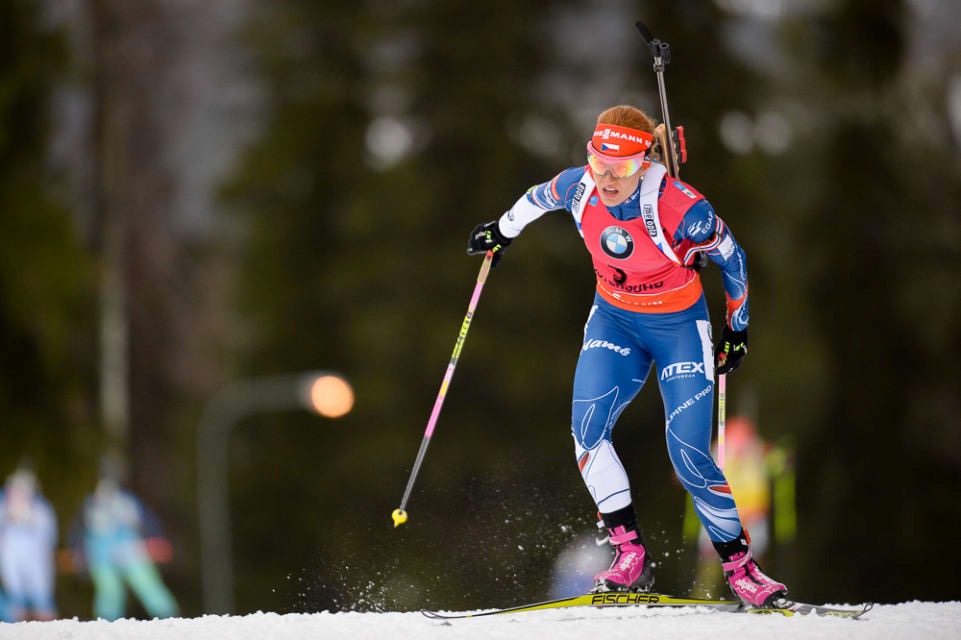
    Gabriela Koukalová (Czech Republic) on her way to winning the women’s 10 k pursuit on Sunday in Östersund, Sweden, the first pursuit of the 2016/2017 IBU World Cup season. (Photo: IBU)
    Gabriela Koukalová (Czech Republic) on her way to winning the women’s 10 k pursuit on Sunday in Östersund, Sweden, the first pursuit of the 2016/2017 IBU World Cup season. (Photo: IBU)

    “I got instructed by the coaches that I should try and catch up to Gabi, that she was not going as fast anymore,” Dahlmeier told German broadcaster ARD after the race. “I got close on the downhill. I tried everything, but the last loop is only 2 kilometers, maybe if it were 500 meters longer… But I am super-happy about the second place.”

    Asked in the press conference about competing for overall World Cup title this season, Dahlmeier explained, “My aim is to stay healthy and to have enough power for every race. I will try, but we will see how the season goes. Perhaps I have to miss one, but my aim is to compete in all races… We can talk about it in Oslo [the World Cup final in March 2017].”

    Also back on the podium was another familiar face with Italy’s Dorothea Wierer, third in the World Cup standings last year, who, by her standards, had experienced a slow start into the new season. Starting in 19th due to her sprint result, she quickly began to overtake athletes in front of her thanks to her trademark fast-and-accurate shooting. In the finish, her chase was rewarded with a third place, 21.4 seconds back (0+0+0+0). Still, Wierer was a bit surprised to have regained her form so quickly within the opening weekend.

    “Yesterday evening I just told my trainers that tomorrow I will make four times zero [misses], but I thought I was kidding,” the happy Italian remarked during the press conference. “But today it was like that … It was not so difficult [on the shooting range], but also yesterday it was not difficult but then I had two [misses] in the last shooting.”

    After her last standing stage in the pursuit, Wierer had gone back on the course in second place, but the faster skier Dahlmeier was just behind her and managed to pass her on the final lap.

    “That’s the fascination of biathlon … I saw she had shot clean and skied out of the range a bit ahead of me,” Dahlmeier told ARD. “I already noticed in the prior loops that we had top equipment today, and thought that I could catch her on the downhill. That worked faster than expected. Then I heard we should try to catch Gabi … also from the Italian coaches, and I started the flight ahead.“

    “My coach said ‘she is coming behind you, she is pushing hard’. I was losing Laura on the downhill, but I was also looking back,” Wierer explained.

    The true surprise of the race was the 21-year-old Lena Häcki of Switzerland, who had already achieved a strong result with a 12th place in the sprint, and on Sunday moved up even further with four clean stages, an achievement only matched by Wierer among the 60 starters. Häcki celebrated across the finish line, just 36.3 seconds behind the winner and 15 seconds off the podium. It was the best World Cup result of her career and her first individual result in the top 10.

    “Unbelievable, I had tears in my eyes,” Häcki told Swiss broadcaster SRF. “All the top stars congratulated me … I can only remember half of it. It’s like a movie with a happy end that is moving past me, and I can’t believe yet that this is my real life.”

    She credited her strong shooting performance to training with a mental coach.

    “I am simply overwhelmed, I never would have expected this result”, she added after her first World Cup flower ceremony, according to a Swiss Ski Federation press release.

    Fifth place went to the runner-up from the sprint race, Finland’s Kaisa Mäkäräinen (1+1+0+2, +52.7). For a large part of the race she had held a position on the podium. But two penalties in her final shooting dropped her back to sixth when all other athletes in her vicinity shot clean, and despite recording the best course time again the strong skier was only able to make up one more place on the last lap overtaking Austria’s Lisa Hauser who finished sixth (0+0+1+0, +1:15.5).

    The French sprint winner Marie Dorin Habert fell back to seventh place (+1:15.6), losing her lead with two misses in the first stage before incurring four more penalties (2+1+2+1).

    Dunklee Up to 22nd, Egan in 30th

    Susan Dunklee (US Biathlon) racing to 22nd in the women's 10 k pursuit on Sunday in Östersund, Sweden. (Photo: USBA/NordicFocus)
    Susan Dunklee (US Biathlon) racing to 22nd in the women’s 10 k pursuit on Sunday in Östersund, Sweden. (Photo: USBA/NordicFocus)

    Leading the North Americans, Susan Dunklee jockeyed with a Swiss athlete on her final lap, but instead of the young Häcki it was the more experienced Selina Gasparin. Dunklee’s race had not started off well; she fell back to 40th after two misses in each of the prone shooting stages.

    “I don’t think the wind was all that tricky; the mistakes are my own fault,” Dunklee wrote in an email to FasterSkier. “On one of my misses my trigger went off a little early but I’m not sure about the others.”

    She managed to catch up again, thanks to fast skiing (with the 17th-fastest overall course time) and a clean third shooting stage in standing, before incurring another penalty in her final shooting and finishing in 22nd place (+2:55.7, 2+2+0+1).

    “Throughout the race I had plenty of people to chase and that kept me motivated,” she wrote. “I did catch a ride for half a loop behind my teammate Clare. I had a close battle to finish with Selina Gasparin and she out-sprinted me today, but I look forward to challenging her again soon.”

    Teammate Clare Egan moved up to 30th place after starting in the 44th position from her sprint result. She began the race with two clean prone shootings advancing to the 23rd position, before falling back a few places again with three misses in the standing stages (0+0+1+2, +3:35.4).

    Clare Egan (US Biathlon) racing to 30th in the women's 10 k pursuit at the IBU World Cup in Östersund, Sweden. (Photo: USBA/NordicFocus)
    Clare Egan (US Biathlon) racing to 30th in the women’s 10 k pursuit at the IBU World Cup in Östersund, Sweden. (Photo: USBA/NordicFocus)

    In an email, Egan described the wind during the pursuit as “totally manageable”.

    “My prone execution has been really solid lately,” she wrote. “I’m able to work smart even when tired or under pressure. In standing, however, I am still working up to that point. Especially towards the end of a race when I am more fatigued and my mind isn’t as sharp, and perhaps I feel more pressure because I am aware of my result, it is easy to lose focus on the shooting process. I need more practice to find the right balance between thinking through my actions and overthinking them.”

    Combined with the 26th-best course time, this resulted in Egan’s second-best finish in a World Cup pursuit, after a 23rd place last season in Presque Isle, Maine.

    “I felt very depleted warming up today, after traveling and then doing 4 races in the last week,” Egan explained. “My wax crew did an excellent job today and definitely gave me an advantage – I was gliding past everyone on the downhills so I was able to pick up a few places just from having the fast skis… I was able to fight for top-30 on my last lap and won a sprint between 4 people in the finish. I’m proud of all my results from this week and looking forward to learning from these experiences and moving up throughout the season!”

    Joanne Reid (US Biathlon) racing to 47th in her first World Cup pursuit, the first pursuit of the 2016/2017 season in Östersund, Sweden. (Photo: USBA/NordicFocus)
    Joanne Reid (US Biathlon) racing to 47th in her first World Cup pursuit, the first pursuit of the 2016/2017 season in Östersund, Sweden. (Photo: USBA/NordicFocus)

    The third U.S. woman, Joanne Reid had qualified for her first World Cup pursuit with a 53rd place in the sprint, and after moving up slightly, she finished the day in 47th (+4:59.6) with a not flawless but consistent shooting performance (1+1+1+1).

    Julia Ransom, the lone Canadian to qualify for the women’s pursuit, started in 38th but lost ground quickly due to two penalties in the first stage. At the end of the day, Ransom is known for her secure shooting, had a whopping eight penalties (2+0+4+2). Only Germany’s Miriam Gössner had more with nine. Ransom finished her day down 20 positions in 58th (+6:36.8).

    The IBU World Cup resumes on Friday, Dec. 9, with sprint races in Pokljuka, Slovenia.

    Results

  • Fourcade on Fire with Back-to-Back Wins in Östersund; Smith Drops from 3rd to 16th

    Fourcade on Fire with Back-to-Back Wins in Östersund; Smith Drops from 3rd to 16th

    The men's 12.5 k pursuit podium in Östersund, Sweden, with France's winner Martin Fourcade (c), Russia's Anton Shipulin (l) in second and Norway's  Emil Hegle Svendsen in third. (Photo: Fischer/NordicFocus)
    The men’s 12.5 k pursuit podium in Östersund, Sweden, with France’s winner Martin Fourcade (c), Russia’s Anton Shipulin (l) in second and Norway’s Emil Hegle Svendsen in third. (Photo: Fischer/NordicFocus)

    Martin Fourcade treated shooting on Sunday like a means to an end. The faster he could get through it, the better off he’d be as the first starter in the men’s 12.5-kilometer pursuit on the last day of the IBU World Cup in Östersund, Sweden.

    With a 28.3-second sprint win on Saturday, the Frenchman started 28 seconds ahead of the sprint runner-up, Ondrej Moravec of the Czech Republic, on Sunday. Slovenia’s Jakov Fak was 29 seconds back in third, and another Czech Michal Slesingr left the start 10 seconds later in fourth.

    Conditions were slightly better on the final day of competition than what competitors weathered on Saturday: “They’re still pretty bad, but they were definitely better than yesterday,” Canada’s Nathan Smith said on the phone after starting ninth, skiing into the top three before the last shooting stage, then placing 16th in the pursuit.

    Smith noted the pursuit course had one fewer technical downhill than the sprint, but said organizers apparently scraped snow from the corners of the trail to beef up the middle.

    “On your last lap, you’re, like, ‘OK, I gotta stay on my feet,’ because you’re tired, but it wasn’t as scary as in the sprint,” he said.

    In the range, it was typical Östersund: a little windy as usual. Fourcade, for one, had trouble — or maybe he was just rushing to stay ahead.

    On the first prone, he missed his first two shots. Then he looked up.

    “I didn’t [understand] why, but I wasn’t surprised,” Fourcade told reporters in a press conference after the race. “I saw that it was not a good beginning so I tried to get some information from the big screen.”

    He learned he was aiming too far right, corrected it and hit the next three targets.

    But after the first stage, Fourcade was already playing catchup. Jak had cleaned and was 8.1 seconds ahead. Fourcade made up the lost time quickly on the following lap, coming within 1.7 seconds of him at 4.6 k before entering the range together.

    There on the second prone, Fourcade missed one for another penalty loop. Fak cleaned and so did Russia’s Evgeniy Garanichev, who started fifth and left the range in third. Then there was Norway’s Ole Einar Bjørndalen, who started eighth and cleaned the first two stages as well, and Russia’s Anton Shipulin —all four of which were ahead of him. Fourcade was 23 seconds out of the lead with three laps and two shooting stages to go.

    On the heels of Garanichev and Shipulin at 7.1 k, approaching the range for the first standing, Fourcade was up to fourth, 23.8 seconds behind Jak. He was the only man in the top six with any penalties whatsoever — and Smith was the sixth man, 38.1 seconds behind the leader.

    Canada's Nathan Smith racing to ninth in Saturday's IBU World Cup 10 k sprint in Östersund, Sweden. (Photo: Fischer/NordicFocus)
    Canada’s Nathan Smith racing to ninth in Saturday’s IBU World Cup 10 k sprint in Östersund, Sweden. (Photo: Fischer/NordicFocus)

    With the pressure on, Fourcade cleaned. Jak missed one, and Smith hit all his targets to head out on the course in third right behind Fourcade, who was 15 seconds behind the Slovenian.

    The experience of racing in the top three of a head-to-head race wasn’t totally unusual to the 28-year-old Canadian.

    “Last year in one race, I was second for one lap, but it was earlier in the race, so I’d say today I was definitely closer because it was down to the last shooting that decided it,” Smith reflected. “It’s pretty exciting, but also, I don’t know, you feel a bit out of your league. Hopefully I’ll get more experiences like this and I’ll get more used to it so I’ll feel more comfortable.”

    By 8.8 k, Fourcade passed him, and Smith was 19 seconds back in third. Just under a kilometer later, Norway’s Emil Hegle Svendsen overtook Smith and led him, Shipulin and two Germans — Simon Schempp and Andreas Birnbacher — into the range for the last time.

    Meanwhile, Fourcade was 20 seconds ahead with Fak. While Fourcade faltered in the second standing with one miss, he handled the pressure better than most: Fak missed two and Smith, who entered the stadium in fourth, missed three to tarnish his perfect shooting up to that point.

    “Basically every lap, I was shooting really well, cleaning, and I was shooting quickly so I was making time in the range every loop,” Smith said. “But I was still trying to ski my own race out on the course. I know I’m not as fast as Svendsen or Fourcade, but I was trying to make up the time I lost there in the range and it was working. But on the last shooting, I don’t know, maybe the nerves got the best of me and I missed my first three. I thought I was going to miss four, but thankfully I didn’t.”

    Smith dropped to 14th, 1:20.6 behind Fourcade in first. The 26-year-old, five-time world champion and two-time Olympic gold medalist left the range 10 seconds ahead of Shipulin, who cleaned the last stage to move to second.

    “The last loop was hard with him on my back,” Fourcade said. “I was quite confident, but I looked back, too.”

    “Leaving the shooting range, I had my mind set on catching him, but soon realized it was not possible,” Shipulin told reporters.

    The Russian had started sixth, 48 seconds behind Fourcade, and emerged as the best shooter in the eventual top four with a single penalty. Fourcade had four total, but when he crossed the line uncontested, 10 seconds ahead of Shipulin, all that mattered was he won.

    “The shooting conditions weren’t easy so I’m happy to succeed. Some guys did really well,” Fourcade said. “I had some mistakes, but it was good enough to win.”

    Svendsen, with two misses, ended up third (+26.3), and Fak, with three penalties, finished fourth, 0.4 seconds off the podium. One-tenth of a second later, Austria’s Dominik Landertinger placed fifth after starting 30th and rocketing toward the front with a single miss on the last standing. Sixth through eighth place had a single miss, with Schempp, Birnbacher and Norway’s Alexander Os finishing in that order. France’s Jean Guillaume Beatrix took ninth with two penalties, and Bjørndalen was 10th with three misses.

    The lone Canadian to qualify for the pursuit after placing ninth in Saturday’s sprint with clean shooting, Smith settled for 16th, 1:30.9 behind Fourcade.

    “After missing three, I definitely lost a bit of steam,” Smith said. “I was definitely tiring a bit on the fourth lap, though. I still fought hard on the last lap, but if it would’ve been for a podium, I’m sure I could’ve mustered a bit more.”

    He explained he tried to ski his own race throughout the five-lap pursuit, and focus on his strengths in fast shooting. That led to him lose about 10-seconds per lap on the leaders, but he ended up with the fifth-fastest range time. Fourcade’s range time ranked seventh overall, after posting the second-fastest time in the second bout and top range time in the last one.

    Smith’s final stage was his slowest all day by about four seconds.

    “That might’ve been a mistake — If you slow down sometimes you have more time to let thoughts creep in, distractions,” he said. “I mean, it was awesome shooting other than the last one. I’m still pretty happy with it.

    “It’s nice to know that the possibility’s there so hopefully I have some more chances this year,” he added. “In one of them, I’ll hit those last targets.”

    While Fourcade racked up back-to-back victories in Östersund, Svendsen remains the overall IBU World Cup leader by 44 points over Fourcade.

    After Sunday’s race, he said the yellow bib was a bit of a curse.

    “Now I have to defend it,” Svendsen said. “I will try to do that for as long as I can, but I know Martin will be there. If I lose it, then I will focus on the World Championships.”

    For Fourcade, the World Cup opener turned out to be a confidence booster.

    “The most important thing I am taking away from here is confidence,” he said. “I wanted some personal answers and now I have them.”

    Results