Tag: Östersund Sweden

  • International Biathlon Union (IBU) Joins UN’s Race to Zero Climate Campaign

    International Biathlon Union (IBU) Joins UN’s Race to Zero Climate Campaign

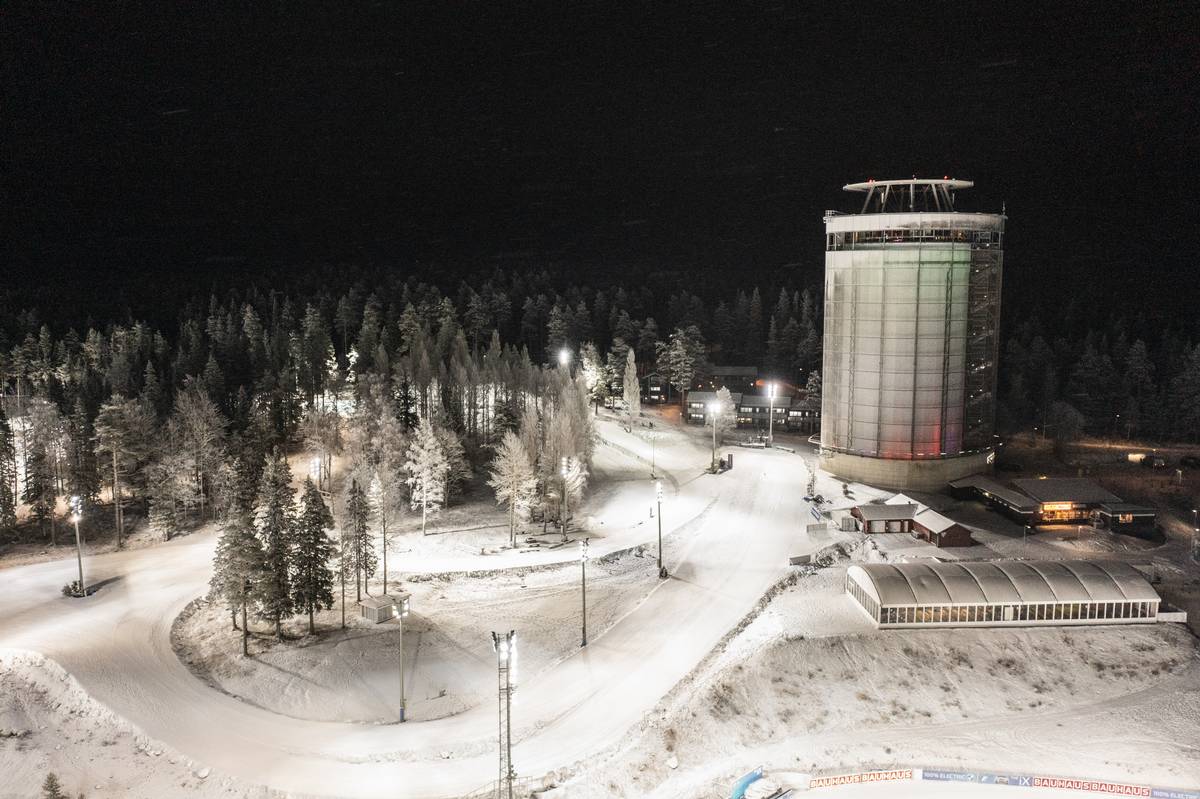
    Östersund, Sweden hosted the opening IBU World Cup weekend as it has on many occasions. (Photo: NordicFocus)

    The sport’s governing body joins a UN campaign to fight climate change, and save Biathlon too.

    ***

      Östersund, Sweden markets itself as Vinterstaden (The Winter City), a reputation it earned a century ago when the Nordic Games – the precursor to our modern Winter Olympics – were moved there from snowless Stockholm in 1905 and 1913. The International Biathlon Union (IBU) routinely puts Östersund at the very beginning of its world cup calendar, as it did this year (starting Nov. 26th).

    At a time when watching the world’s best compete on a ribbon of white against a backdrop of brown and green has become all-too-common, the IBU puts its faith in Östersund to have natural snow and have it early. Östersund this season, however, was covered in just a dusting in early November, with mixed precipitation in the forecast. Weather models predicted that the venue would probably have snow  when the World Cup came to town – probably.

    That qualifier is new for Östersund, and with attention already focused on the massive snowmaking operation required for next February’s Olympics in Beijing, the 2021-2022 Biathlon calendar is marked all the way through with a reality that the winter climate the sport relies upon is changing. And in response to that change, the IBU has decided to make a change too.

    On November 3rd, the IBU announced that it has joined the UN’s Race to Zero climate campaign. In doing so, it joined forty-six other signatories including the International Olympic Committee, and becomes the first international winter sports governing body to meet the UN’s strictest criteria for non-state actors to fight climate change.   

    The Race to Zero campaign is part of the UN’s strategy to meet the Paris Agreement’s goal to halve global emissions by 2030 and limit global warming to 1.5 degrees centigrade. The IBU’s commitment is part of the UN’s Sports for Climate Action program, which hopes to spur sports organizations to act as leaders in the “climate neutrality journey.” The list of signatories to the program’s non-binding pledge of sustainability is long, ranging from global brands such as the English Premier League to local races you may find outside your backdoor like Grandma’s Marathon in Duluth.

    To join the Race to Zero the IBU was required to develop a specific plan and reporting process to reach 50% reduction in Greenhouse gas (GHG) emissions by 2030, and eliminate GHG emissions by 2050 (defined as “Climate Positive”). This includes requirements to plan, meet certain time intervals to act on that plan, and report publicly.

    Joining the UN’s campaign builds upon the IBU’s pre-existing sustainability strategy – with the sport staking its very existence on limiting climate change. The strategy, adopted in 2019, calls for even faster action than the UN, looking “to become climate neutral by 2030, and climate positive by 2034,” beating the UN’s timeline by sixteen years.
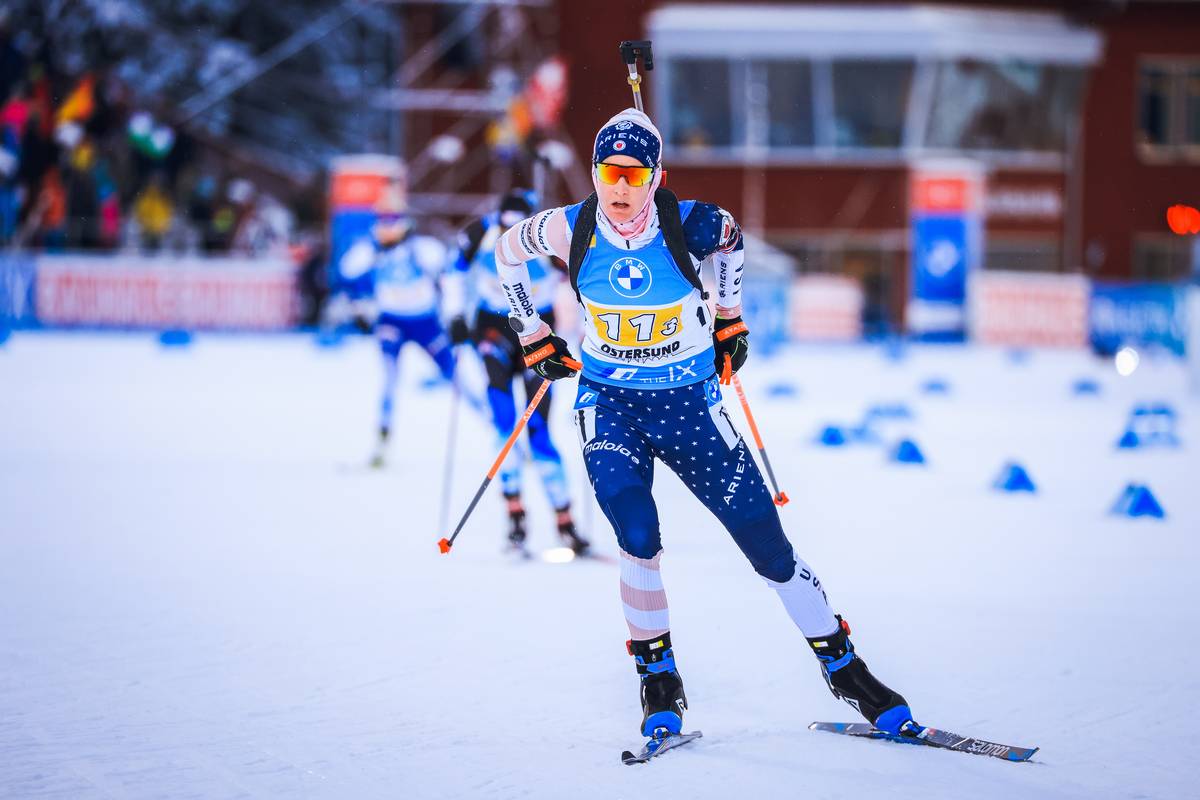
    Clare Egan (USA) competes in the IBU World Cup in Östersund, Sweden. (Photo: NordicFocus)

    So how does the IBU plan to get there? Their sustainability strategy addresses topics that have joined technique talk and tales of past racing glory as common water cooler talk for those of us in the Nordic community the last few years. Eliminating fluorocarbons, and the persistent PFAs they’re known to leech into the snow, is a top priority. The largest change comes from the largest source of GHG’s though – the emissions from travel and transport of an entire circuit of athletes, coaches, media, wax technicians, and fans – around Europe and the world.

    To address this, the IBU is implementing a carbon management program that pairs two points of emissions; 1) the IBU’s own infrastructure and 2) the venues the IBU uses for world cups.

    Starting this season, the IBU is starting to convert their fleet of vehicles to electric and partnering with world cup venues to make sure that their energy and waste disposal systems are not contributing GHG’s to the atmosphere. In the short-term the IBU is investing in carbon offsets for any venues that can’t immediately meet zero emissions requirements, but will need to convert outright by 2030 to meet the “no offsets” requirement of the Race to Zero.

    Biathlon is a sport born of innovation, its very existence the pairing of an ancient mode of transportation with the weaponry of an industrial age. To survive in a time of climate crisis, it’s staked itself on constructing a strategy with the same thoughtful action it takes to slow one’s heart in the flash of a moment. When it heads to the north of Sweden in a few weeks to begin a new season full of hope in a place that defines itself as a season – Vinterstaden – it will come armed not only with a .22 on the back of its athletes, but a plan to hit the targets that will allow it to exist as a sport in a world that’s sustainable for all – from Europe to Beijing, and back here in North America too.
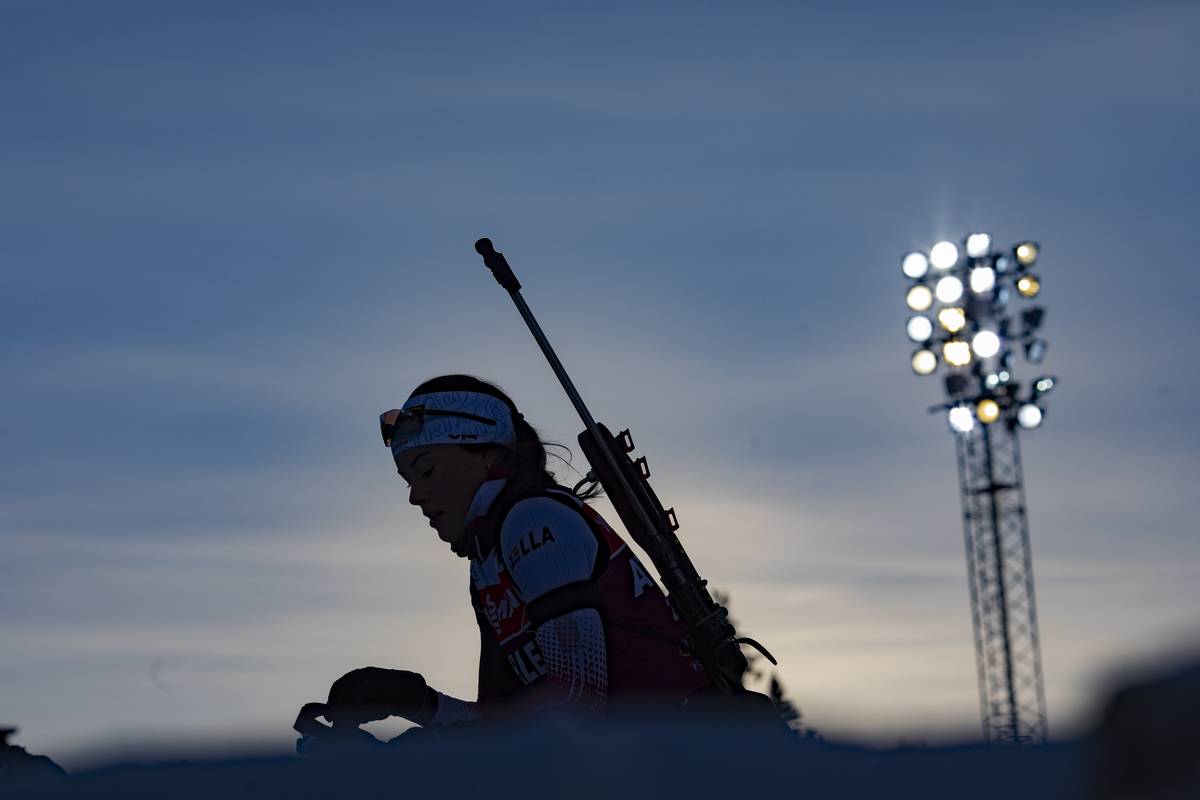
    A biathlete competes under the lights on the tracks of Östersund, Sweden. (Photo: NordicFocus)
  • Rise and Shine for Joanne Reid in Östersund, Sweden

    Rise and Shine for Joanne Reid in Östersund, Sweden

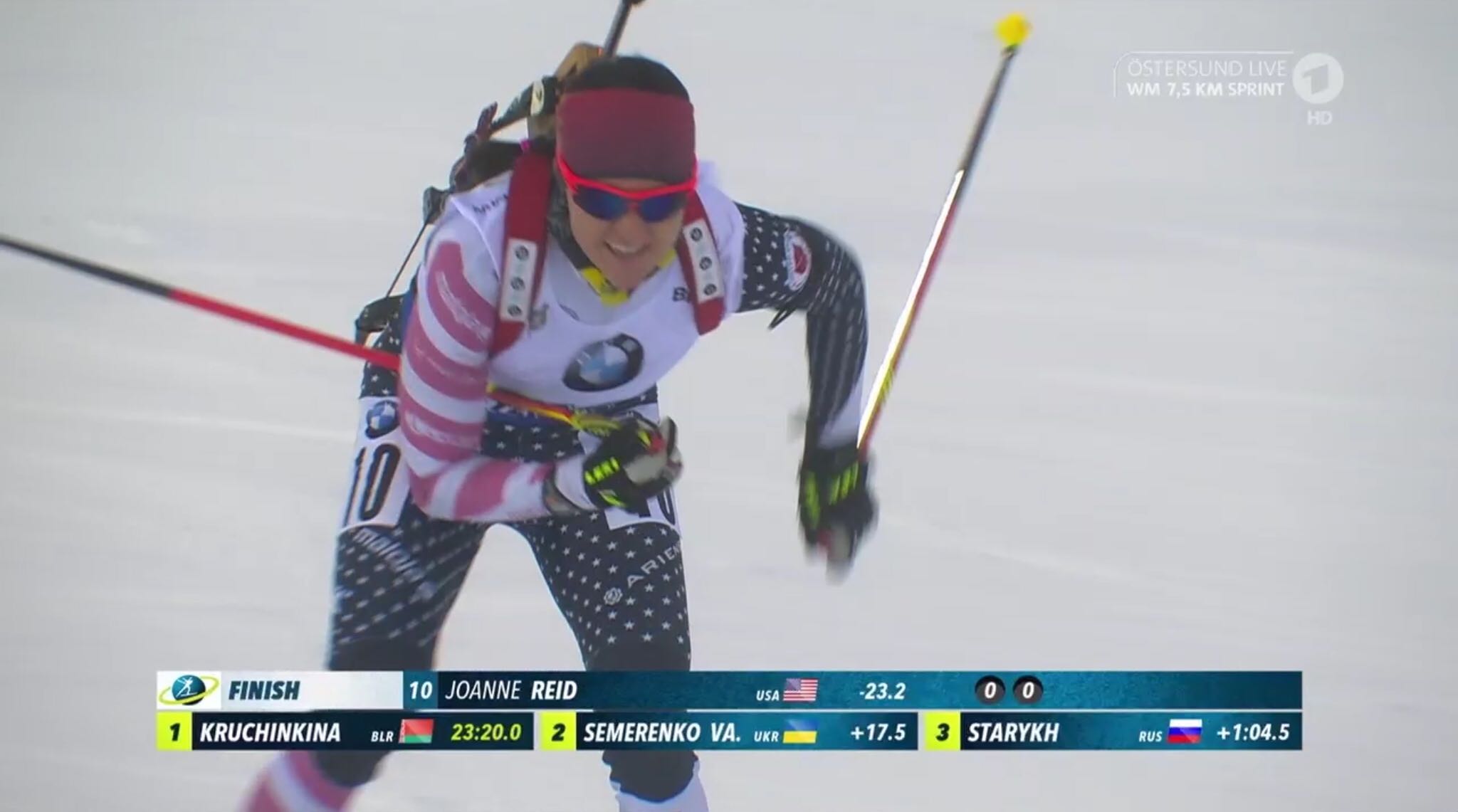
    Joanne Reid of the U.S. skiing to 15th overall in the 7.5 k sprint at the 2019 IBU World Championships. (Photo: ARD screenshot)

    A World Championship. A career-best result.

    For Joanne Reid of the US Biathlon team in Östersund, Sweden, the recently concluded IBU World Championships were a highlight. It was a fine series of races for the twenty-six year old last week — it was a great moment for her to rise and shine.

    Out of 93 starters, she placed 15th in the 7.5 k sprint. She followed that result several days later with a 10th overall in the 12.5 k mass start.

    Sandwiched inbetween was a stellar performance for the US women in the 4 x 6 k relay. For much of the race, the US team was well positioned for a medal. The combo of fast skiing and accurate shooting meshed. The team faded to place ninth overall – yet the positive energy from the collective effort did not immediately fade. The relay came the day prior to Reid’s mass start race.

    “I was on such a raging high from the day before where our relay team was in the lead for most of the race and every single one of us competed in a podium position through at least one shooting,” Reid said during a call on March 18. “That carried on into my mass start. No matter what happened, I was going to have a personal best because I had never done one before and no matter what happened I was going to get a top-30.”

    It was Reid’s first mass start at this level of IBU competition. She shot 1+1+1+1 during her four shooting bouts and skied fast enough to mark those faster skiers around her and not lose ground. Reid explained that during her third shooting bout, a big wind passed through which only impacted her first few shots, and she was able to capitalize.

    “That is where I ended up passing a whole bunch of people,” reflected Reid. “I was just trying to focus on sticking with the person I was with, and not letting them go. Working on the little pieces of the course that my coach had told me to work on — the transitions, downhills, these V2 sections. So when I came into the range and shot I was really thinking more about that and I wasn’t really thinking what place I was in. I had no real idea what the heck was going on, and I certainly had no idea what the heck was going on after I left.”

    As the race evolved, Reid heard her teammate Susan Dunklee, who had not qualified for the mass start, out on course providing critical race status data.

    “The person for me that was the most coherent was Susan [Dunklee],” Reid recalled when asked how she received information that she was in the hunt for a top-10. “She was out on course on one of the uphills. And I understood her the most clearly. She pointed at a Swedish girl and said, ‘that is ninth place, go get her now.’ So I did.”

    That was the rabbit to chase. It was a well-defined marker for pace setting and goal achieving. It helped cement her 10th place.

    These World Championships brought celebration worthy results for Reid. Yet the disparity between expectations and results, when they do not align, can be debilitating. Reid asserts she weathers the ups and downs of biathlon by relying on her own internal mechanisms and teammates to process disappointment. The lows and highs become what they are: simply a result in a ski race.

    “I actually don’t work with our sport psychologist really, although he is pretty awesome, but I have not worked with him extensively,” Reid said. “I think, for the most part, I tend to talk to my teammates and just see what they did because it is very unusual that every single one of us has an awful race on the same day. There are enough variables and enough people out there that that doesn’t usually happen. I can take from that that something good happened on that day and I don’t get too lost in my head about that sort of thing. I am pretty introverted so I don’t tend to interact with other people necessarily to make myself feel better. I kind of just internalize it for a while and forgive myself for sucking and them move on with it.”

    The massive upside of moving on in a fickle sport provides the opportunity for another new chance. Reid noted how she perceives her ability to keep steady — to remain present in the game and the training and not allow a past performance to dictate the path forward.

    allopurinol

    In Östersund, Reid raced to 32nd in the 10 k pursuit after her 15th in the sprint. (Time back on the pursuit is determined by the sprint results.) She skied six penalty laps in the pursuit, going 3+2+1+0 for her shooting.  

    “One of the nice things about missing eight or nine shots, just having the worst shooting day out there, is understanding very clearly how it could have gone better and how to fix that for your next race,” Reid said of how she moves past an unsolid day on the range. “Whereas if you don’t miss any targets and you still aren’t performing well, that is actually more frustrating because you feel like you cannot push through that wall and you certainly cannot push through that wall by tomorrow. But in biathlon, if it is your shooting side that is failing, you can look at that and be like, ‘alright well, that was seven minutes of penalties today in the individual, but tomorrow is the sprint race and I can go out there and I can clean it. It can be totally freaking different.”

    Reid has the engine. She has the temperament to make it “totally freaking different” during a different day on the range. That held true as she stormed towards Linn Persson, the Swede Dunklee matter of factly referred to when she told Reid ‘that is ninth place, go get her now.’”