From the FasterSkier archive — posts syndicated from athletes’ and coaches’ own blogs between 2004 and 2012, kept online as published. Current coverage is at fasterskier.com.
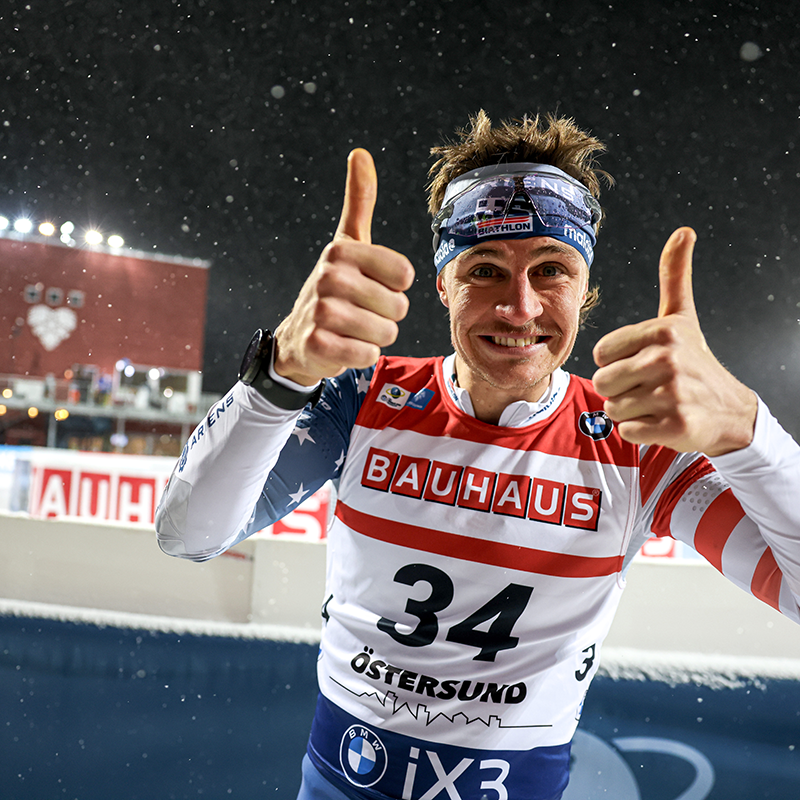
At the first biathlon World Cup races of the 2025/26 season, the biathlon stadium is perched above the small city of Östersund, which is set on a lake. Wind gusts off the lake, pulsing through the stadium. The races take place under the lights, at night – which isn’t saying much. Because in December in northern Sweden, ‘night’ begins at three in the afternoon, when what little sun there might’ve been throughout the day slips below the horizon. It’s in the evenings that the wind is usually at its strongest. The conditions the racers zero their rifles at before the race are rarely the same conditions they find when they come back to the range during the race. Athletes watch the small, red flags in the range, seeing which way they’re moving, deciding whether or not to shift their sights a few clicks, compensating for the changes that happened while the racers skied the course that serpentines up, down, around a 180-degree turn, and back into the stadium where the music plays and the home crowd cheers. Ayyy! As the Swedes hit their targets. A diluted Ney for each Swedish miss.
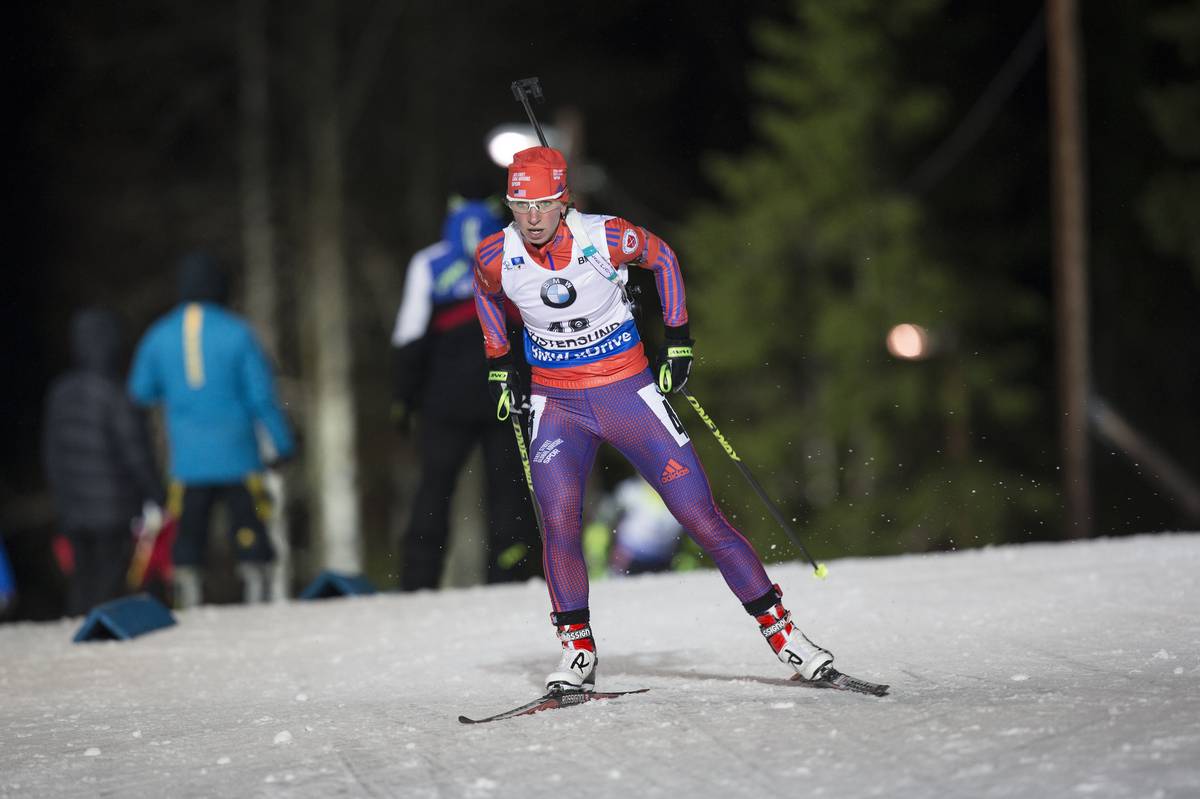
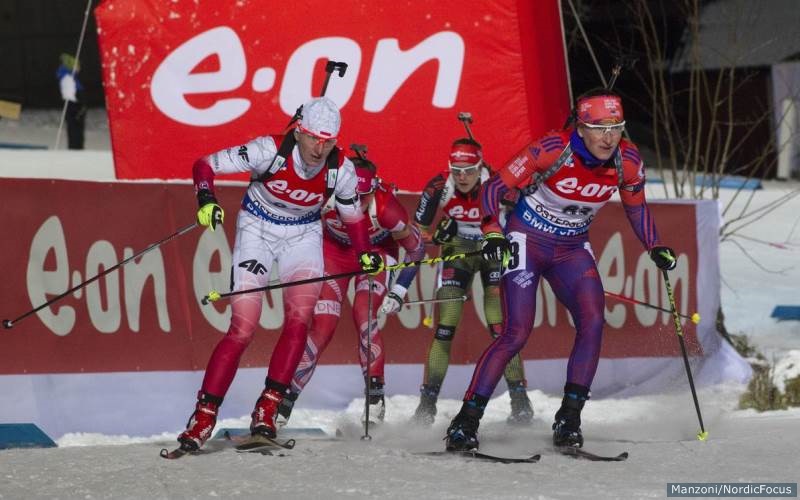
The mixed relay at the opening stop, Oestersund (SWE), of the 2025/26 IBU World Cup Biathlon season. (Photo: Manzoni/NordicFocus)
Over eight days, the best biathletes in the world raced 10 times. Maybe it was the arduous schedule, or the bit of sharpness that an Olympic year adds, but the Ostersund races didn’t feel like the first of the season. It felt like a break had never happened.
One question lingering from the off-season was answered quickly: What would Norwegian biathlon look like without the Boe Brothers? The dominant duo of Johannes Thingnes and Tarjei Boe – owners of eight Olympic medals – retired at the end of the 2024/25 season. Leaving what one would assume would be a major hole in the program. But when the Norwegian men came out and won the men’s 4 x 7.5km relay at Ostersund, the Norwegian’s roster depth became clear.
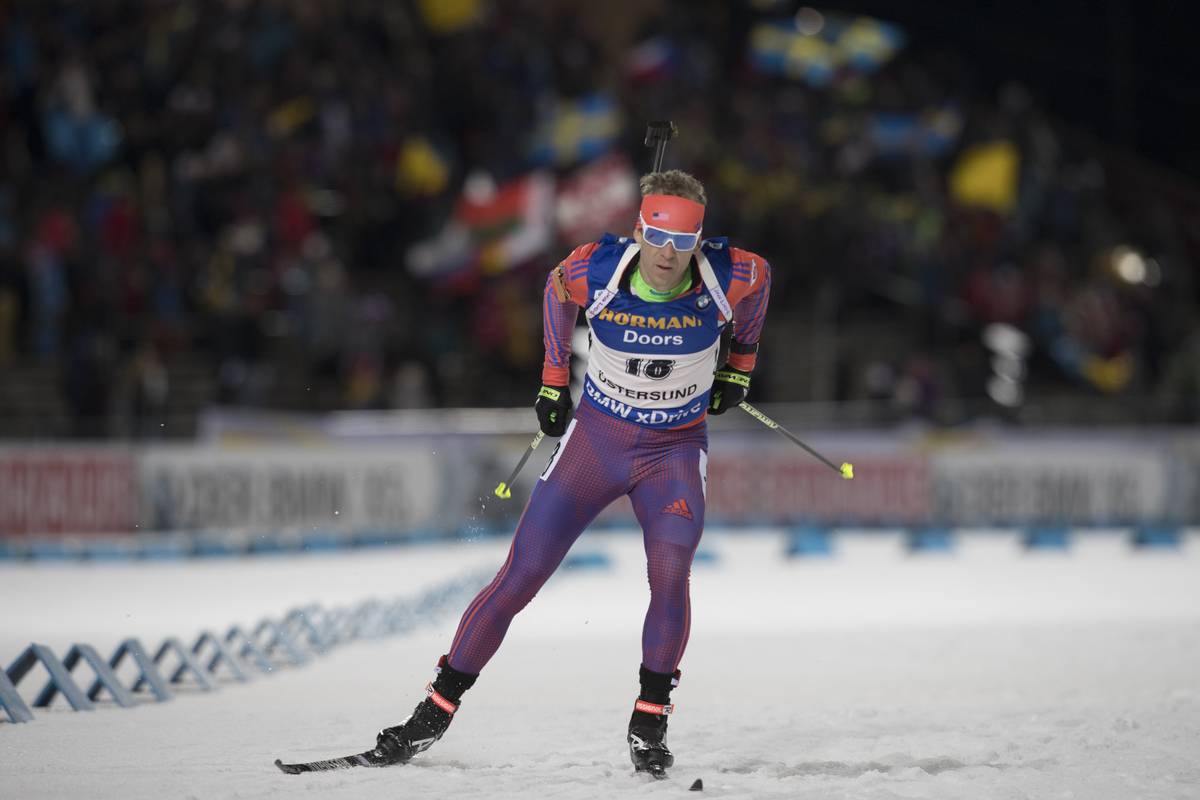
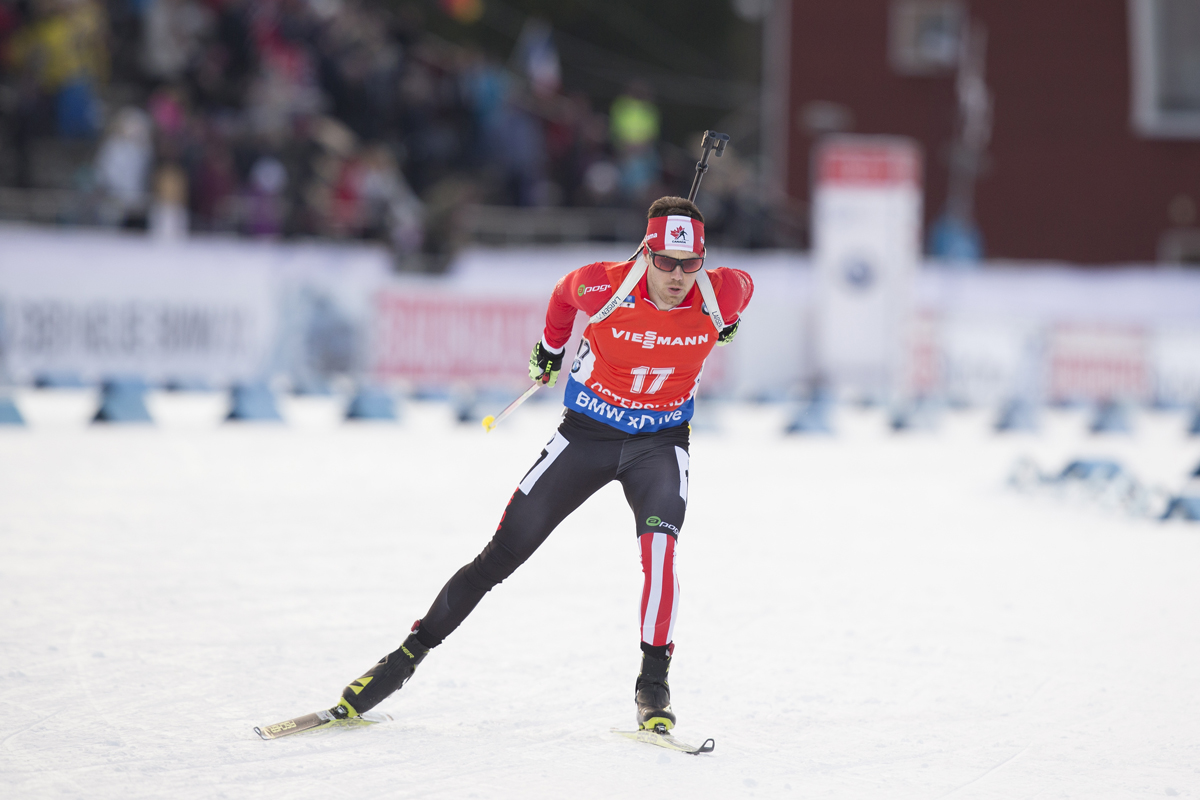
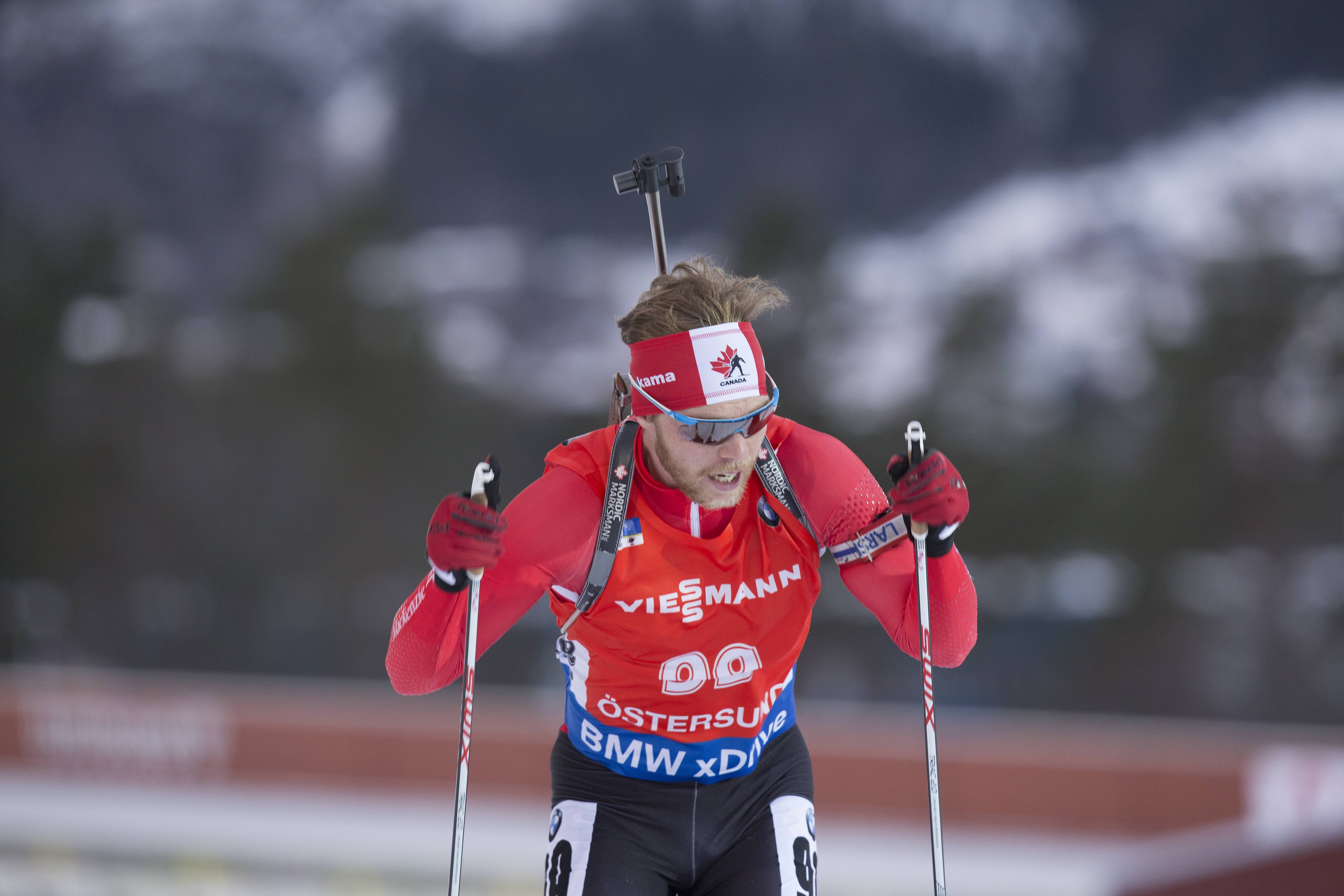
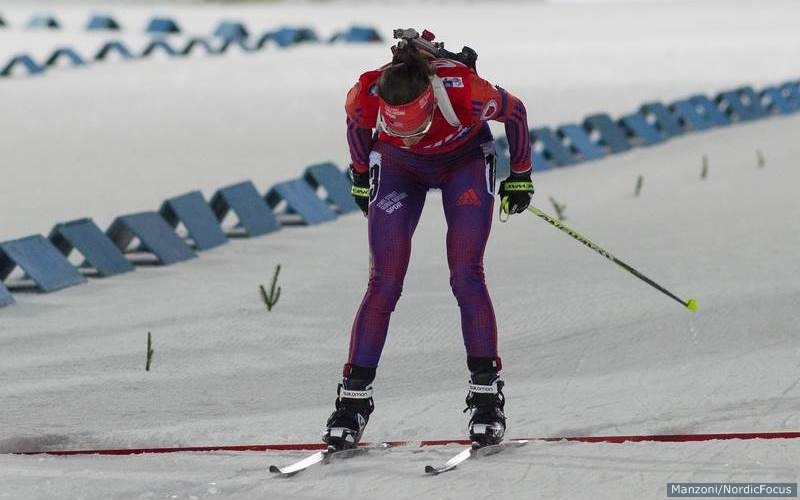
Campbell Wright (USA) during the IBU World Cup Biathlon Men’s Relay in Östersund (SWE). (Photo: Manzoni/NordicFocus)
The men’s relay saw a top result from the U.S. men, as well. Paul Schommer, Campbell Wright, Maxime Germain and Sean Doherty finished fifth, one of the best men’s relay finishes ever for Team USA. The next day, at the mixed relay, Germain, Wright, Chloe Levins and Deedra Irwin placed sixth – which is the best finish for a U.S. mixed relay since 2021.
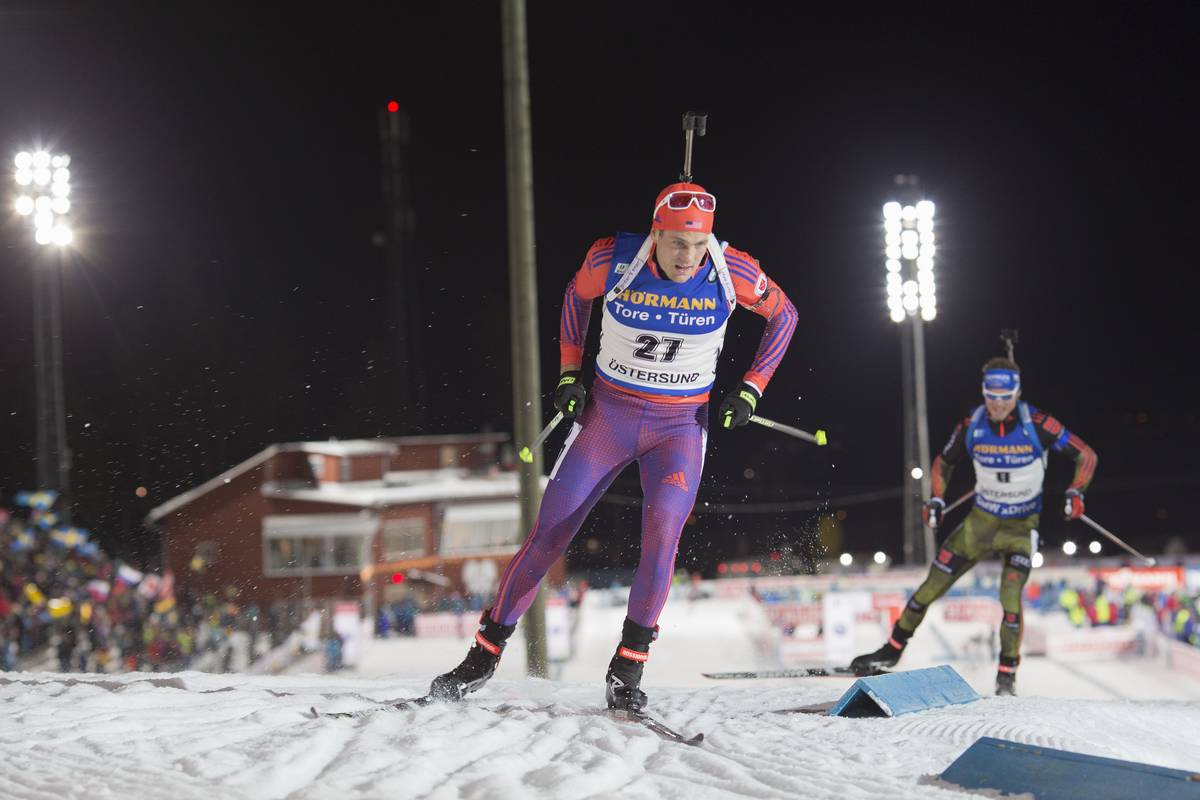
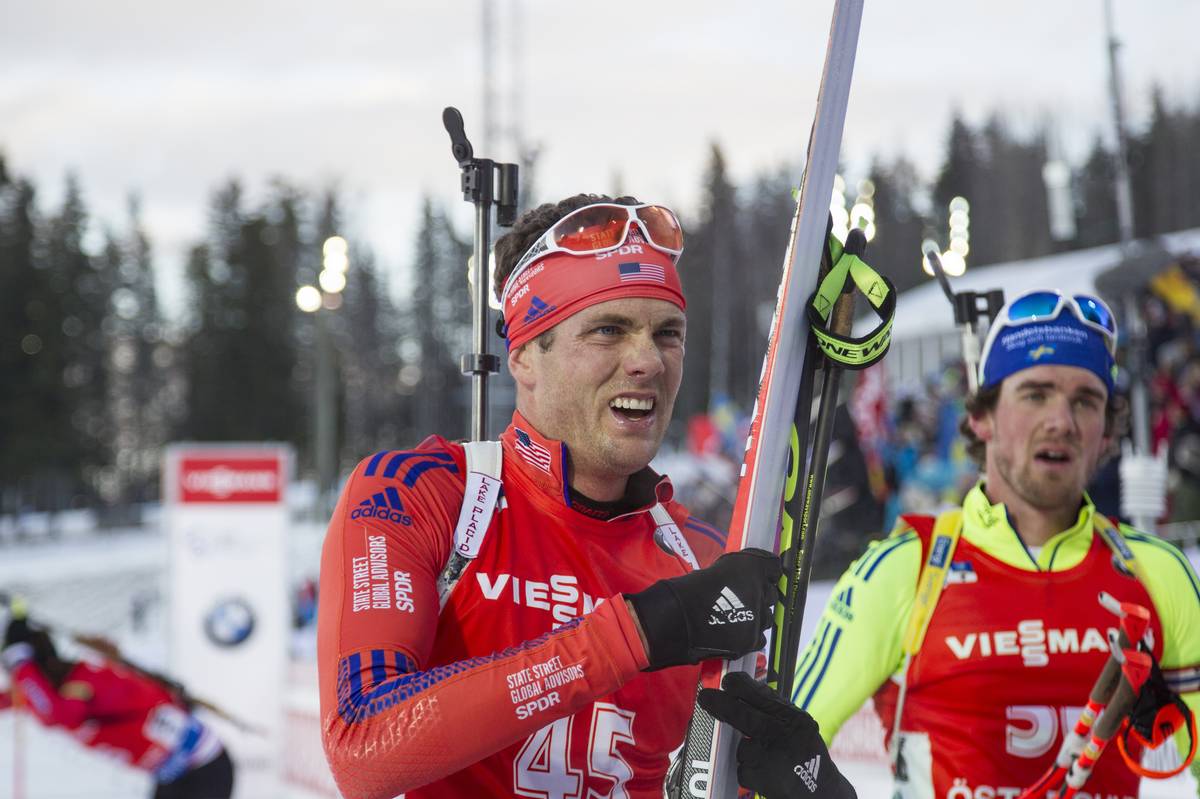
Artem Tyshchenko (UKR) and Paul Schommer (USA), (l-r) during the Men’s Relay in Oestersund (SWE). (Photo: Manzoni/NordicFocus)
Germain and Wright continued to build on their early-week momentum, with Germain placing 11th in the sprint. In the pursuit, Wright hit all 20 targets for the first time in his career and moved up from 18th to 6th. Wright is coming off a stellar 2024/25 season, where he podiumed twice at World Championships, becoming the first American to do so.
Throughout the week, there were highs: Suvi Minkkinen of Finland won her first World Cup sprint. The Norwegian men placed four in the top five in the 20km individual, solidifying their capabilities as a team sans-Boes. And as always in biathlon, some lows: Eric Perrot of France missed his final shot in the pursuit, a devastating moment that cost him the lead. He finished fifth.
Racing wrapped up in Sweden, and teams flew to Austria. In Hochfilzen, a less rigorous racing schedule awaits: sprint, pursuit, and then a men’s and a women’s relay. A few more hours of daylight await, too.
Lowell Bailey (US Biathlon) racing to 15th in the men’s first individual IBU World Cup race of the 2016/2017 season, the 20 k individual on Thursday in Östersund, Sweden. (Photo: USBA/NordicFocus)
Lowell Bailey is the dad of a six-month-old baby girl. Tim Burke celebrated his two-year anniversary earlier this fall. Both are US Biathlon team veterans, and at 35 and 34 years old, respectively, they’re still lighting up the International Biathlon Union (IBU) World Cup.
The teammates and training partners, based out of Lake Placid, N.Y., finished one place and 2.1 seconds apart on Thursday, with Bailey ending up 15th and Burke 16th in the first men’s individual World Cup race of the season: the 20-kilometer individual in Östersund, Sweden.
While Bailey accumulated four penalties in the four-stage race, he posted the 11th-fastest overall range and shooting times out of 103 finishers, and his course time ranked 25th overall.
“Your ski speed is always a little bit of an unknown going into the first race of the season,” Bailey said, according to a US Biathlon press release. “I’m happy to start off with decent ski speed and I hope I can build on this race going forward from here. I’ve worked throughout the training session on increasing the speed in the shooting setup (before any shots are fired) so I’m happy to see the overall range time where it is.”
It was another windy day in Östersund, without a single racer hitting all 20 targets. The 10th starter and reigning overall World Cup champion, Martin Fourcade of France, took the individual win in 51:33.8 with two misses (0+2+0+0). He held off Norway’s Johannes Thingnes Bø (the 15th starter) by 29.5 seconds. Bø cleaned three-straight stages, but two penalties on the last standing cost him the win (0+0+0+2) and he settled for second.
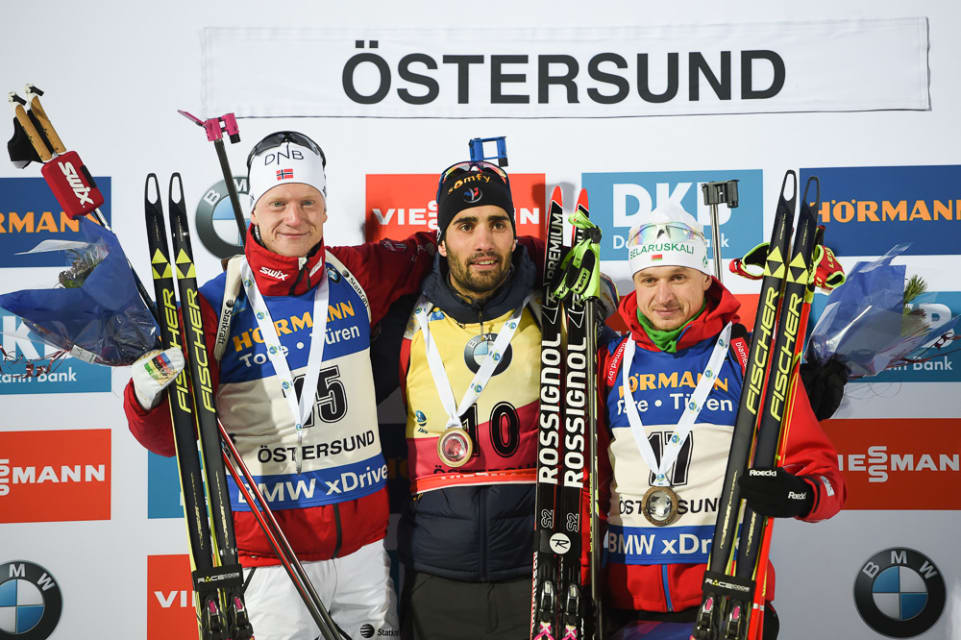
The men’s 20 k individual podium in the first IBU World Cup of the 2016/2017 season, with winner Martin Fourcade (c) of France, Norway’s Johannes Bø (l) in second and Vladimir Chepelin (r) of Belarus on the podium for the first time in third. (Photo: IBU/BiathlonWorld.com)
“I knew I had the chance with 15 hits after the first three stages, but there was so much wind,” Bø told German TV broadcaster ARD. “I just tried to fight hard. but not hard enough. Two misses and I lost the first place. That was not so good, but the three first [stages] and overall it was a good race.“
Meanwhile, Vladimir Chepelin of Belarus was one of three finishers with just one miss (1+0+0+0), and he finished third (1:24.3 behind Fourcade) for his first World Cup podium, despite clocking the 43rd-ranked course time.
Germany’s Florian Graf, who started 94th, was on track for a podium with three clean stages, but one miss on the last standing put him in eighth at the finish (+2:33.6).
“In our hotel room, we joked about skiing in the top ten and shooting clean,” Graf told ARD. “Of course I would not have expected that it works out so well today, but I am overjoyed to have such a debut.”
Norway had three finish in the top five with Lars Helge Birkeland in fourth (+2:10.5, three misses) and Ole Einar Bjørndalen in fifth (+2:16.7, three misses).
But the main story of the day was once again Fourcade, who, like Bailey, is also a dad.
Asked what was more important, his life with his 14-month-old daughter or winning the first individual race of the season, Fourcade replied, “If I say the victory my wife would probably kill me. Or my daughter would kill me in a few years, too. So yeah, you can’t compare. Biathlon is my passion, is my job, but my daughter is my life now. Nothing to compare,” he told ARD.
In terms of the race itself, he said he was pleased.
“It was a long preparation and this was a good answer about my shape after the test in Sjusjøen and the win in single mixed [relay],” Fourcade said after his second win in as many races this season, and 48th individual World Cup victory (50 including two Olympic golds in 2014). “There is a difference with being able to win and actually winning, so I am very happy.”
And then there was the question of whether his main goal is a sixth overall World Cup title.
“That is what I trained for, that is what I hope I will get,” Fourcade said. “But this is biathlon. Today I had a good form with challenging wind conditions, but you can also lose quickly. It’s just one race, and there are about 30 more coming. I am very happy about today. I will enjoy this victory, my 50th World Cup victory. That is something I wouldn’t have dreamed about and I will enjoy it today.”
In bib 18, Bailey started directly behind Chepelin, the third-place finisher, and cleaned both prone stages, but missed two on each standing bout.
“It was pretty gusty in the range and you really had to concentrate on making quality shots,” Bailey told US Biathlon. “I’m happy with the prone performance but definitely wish I could have a few of those standing shots back.”
US Biathlon’s Tim Burke (27) racing to 16th in the men’s first individual IBU World Cup race of the 2016/2017 season, the 20 k individual on Thursday in Östersund, Sweden. (Photo: USBA/NordicFocus)
Burke in bib 27 started off with a clean prone as well, followed by two standing misses then another clean prone. In the final stage, he had one more penalty for a total of three (0+2+0+1) and finished 2.1 seconds back from Bailey, 3:54.6 behind Fourcade, and 0.2 seconds ahead of 19th-place Ondrej Moravec of the Czech Republic.
Burke has tallied three podiums in Östersund, most recently in 2013/2014, when he placed third in a sprint. In 2009/2010, he finished second in an 20 k there and third in the sprint.
“I’m not really sure why Östersund has been a good venue for me,” he told US Biathlon. “Maybe it’s because of the tricky shooting conditions, which is something that I typically like. Unfortunately, I felt really flat on the course today. I should have been able to reach the top 10 today with that shooting, but I just did not have it on the tracks today. Hopefully my legs will rebound for Saturday’s sprint.”
On Thursday, he made a point to shoot slower than usual in the windy conditions. His range time ranked 31st overall.
“I decided to just take my time on the range and that worked out today,” Burke said.
Also for the U.S., Russell Currier, who qualified for World Cup starts less than a week ago in an IBU Cup sprint, finished 54th (+7:04.5) with six penalties (1+1+2+2).
Nathan Smith led the Canadians in 43rd (+5:36.8) with three penalties (1+0+1+1). Among his teammates, Scott Gow finished 60th (+7:30.4, five misses), Macx Davies was 62nd (+7:34.6, four misses), Brendan Green was 89th (+10:20.1, eight misses), and Christian Gow 99th (+12:52.8, eight misses).
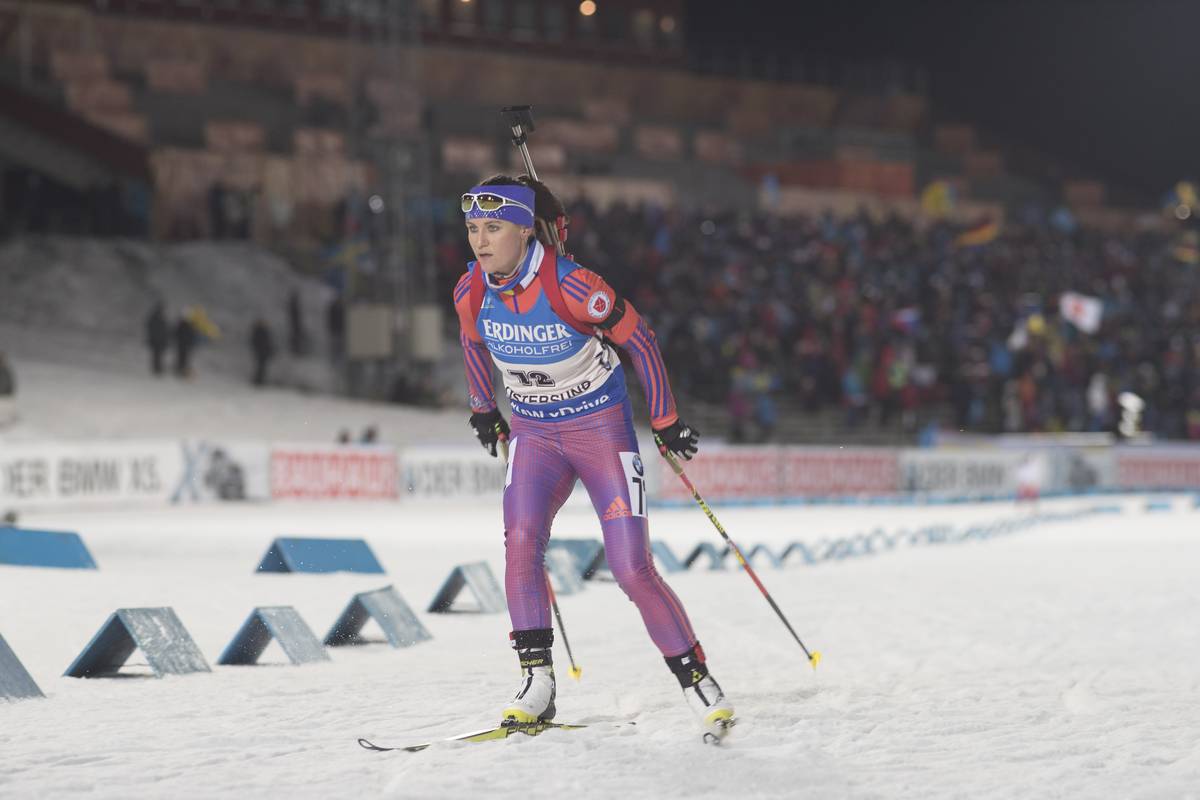
Joanne Reid (US Biathlon) racing to a career-best 29th in the IBU World Cup women’s 15 k individual on Wednesday in Östersund, Sweden. She led her team, with Clare Egan also finishing in the points in 40th. (Photo: USBA/NordicFocus)
Wind and Joanne Firesteel Reid — a dangerous combo that worked to the American’s favor on Wednesday.
In her fourth-ever individual World Cup race (as in, not counting relays), US Biathlon’s fastest-rising up-and-comer finished 29th for a career best in the first individual race of the 2016/2017 International Biathlon Union (IBU) World Cup season: the women’s 15-kilometer individual in Östersund, Sweden.
Considering that Reid, 24, picked up the sport a little over a year ago, it’s even more impressive that she recorded her first World Cup top 30 in the longest-format (four-stage) biathlon race on one of the windiest race days in recent memory.
“This was definitely my best result, probably more due to luck than anything else,” Reid wrote in an email on Wednesday night.
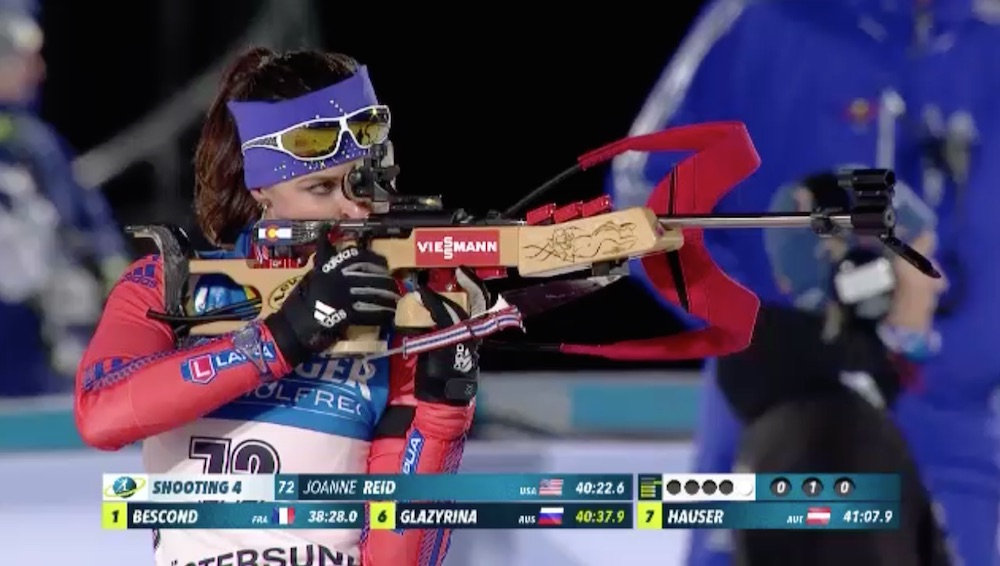
Of 99 finishers, only one woman hit all 20 targets: third-place finisher Darya Yurkevich of Belarus. Four racers hit 19 of 20, and Reid was among 10 with three penalties or less.
Joanne Reid (US Biathlon) during her final shooting stage of Wednesday’s 15 k individual IBU World Cup in Östersund, Sweden. Reid missed two in that stage (for a total of three penalties) and placed 29th for a career best.
A member of US Biathlon’s X-team, she ended up leading the U.S. women on Wednesday.
“Had I been the top American because I cleaned the whole race, and skied unbelievably fast, that would be a much different feeling than being the top American because I happened to wander into the range when the wind wasn’t quite as crazy,” Reid wrote. “You are no more your best race than you are your worst race, really. But an individual is a very strange race to ski, and I actively chose to not go out and ski like the ground was on fire, because I watched so many misses happening with all the early starters — a minute penalty per miss is a LOT, and a lot of skiing leeway time.”
Reid started 72nd, at the opposite end of the field of Germany’s Laura Dahlmeier, who wore bib 3 and won in 46:14 minutes. About 30 minutes into the individual-start race, the wind noticeably picked up.
“It was a relatively difficult race today,” Dahlmeier said in a post-race interview with German broadcaster ARD. “I had an early bib, and I didn’t get right into it from the start. My feeling was that I was a bit on the slower side, but apparently that feeling was deceiving.”
She ended up winning by 15.8 seconds over France’s Anais Bescond, who cleaned three-straight stages until missing on the final standing.
“I believe it was a difficult race for everyone,” Dahlmeier continued. “It was very icy, a lot of grainy snow. No easy conditions, and in addition there was the wind on the shooting range. During the last shooting, I stood there forever together with Doro [Wierer]. I think I’ve never experience a shooting stage where Doro stood that long on the range. I had to really fight, but in the end it now looks very very good. I would not have expected that.”
Known for her fast and accurate shooting, Wierer, of Italy, ended up 31st on the day, 5:11.5 minutes out of first with seven penalties (0+2+2+3). Reid was about 10 seconds faster in 29th (+5:01.8) with three misses (0+1+0+2).
“An individual is a very strange race to ski, and I actively chose to not go out and ski like the ground was on fire, because I watched so many misses happening with all the early starters.” — Joanne Reid, (US Biathlon) 29th for a career best on Wednesday
After the first three stages, Reid, whose previous best was 57th in a sprint last season, was skiing in 11th at one point. But she didn’t know it.
“I believe the whole staff was under strict instructions not to tell me [what place I was in],” Reid wrote. “It’s not always wise to tell a shooter something that will make them feel more pressure, especially one that’s as new as myself. So, I had absolutely no idea.”
Two more penalties on her final prone stage put her in 26th, but she held on for a top 30 — despite dropping a pole while leaving the range for the last time.
“Oh yeah, I dropped my pole. Not because the pole was defective, but mostly because I’m defective,” Reid wrote. “If you’re fast and skilled at it, you can slide the loop of the Leki strap right into the pole as you push off, but those are brand new poles (two days ago) and the system is just a touch different than my old pair, so I didn’t click in correctly, and I also didn’t realize. It was completely my fault, I shouldn’t have tried that with a brand new pole at speed mid-race. But hey, maybe I skied faster because I knew I had to make up seconds after I picked it up, who can really say?
“I did pause for a split second trying to figure out if I actually had to pick it up, or if I should keep skiing, or if the range rules require that I pick it up,” she added. “In the end, it’s my pole and I wanted it, so I went back for it. No pole left behind!”
Overall, her range and shooting times ranked in the middle of the pack in 64th and 54th, respectively. And she pointed out that her prone stages brought that shooting time down, with both of those range times ranking 84th or slower.
“Since I have very little experience shooting in wind, but I do a lot of shooting slow, I decided to take my time in the range and really focus,” she explained.
“When I arrived for the second prone stage the wind was blowing the other direction, so I moved three back to center and then three left, only when I looked up again it had died down, so I moved three back right (to center), and this ended up being so distracting to me (I’m still learning wind) that I forgot to actually load my next magazine into my rifle,” she recalled. “So I had to come back up, unhook the sling, load the magazine, and shoot. Pretty sure THAT helped the range time….”
Comparably, Dahlmeier took her time to shoot more accurately than most, with her overall range and shooting times ranking 60th and 69th. She skied her way to first place with the fastest overall course time.
“I never would have expected that my course time would be so good,” Dahlmeier said. “I was pretty satisfied in terms of skiing technique, but I had pretty heavy legs, so I thought I wasn’t quite as fast and that surely there would be faster ones. But I said to myself‚ ‘It’s all right,’ and to just focus on my shooting. The individual race has a strong emphasis on the shooting, so that’s what matters…”
The fastest shooter of the top three and the only competitor to clean, Yurkevich was the 22nd fastest on the range and the 29th fastest shooting overall. She ended up 1:17.3 behind Dahlmeier at the finish for third place.
Germany had three in the top 10 with Franziska Preuss in fourth (+1:37.9, three misses) and Vanessa Hinz in 10th (+3:32.0, three misses).
“I am really satisfied with [the race] today. That’s the best individual race performance I’ve had here [in Östersund],” Preuss told ARD. “Normally I remember this course as very tough, but today it went all right, and on the shooting range I am pretty satisfied with the three misses considering the difficult conditions.
“There were changing winds, and then you start to think, then the legs start shaking from standing around for so long,” she added.
Germany’s women’s coach Gerald Hönig was impressed with Dahlmeier and the women’s team in general.
“This is a great debut for Laura, she just picked up where she left off last year, and that is very successful,” German women’s coach Hönig told ARD afterward. “As a team, one can only wish for a debut like this. … And that shows the last weeks in training went very well, since we didn’t specifically prepare for the start of the season in Östersund because it is a long season, but we are already in pretty good shape. And that lets us look confidently into the future.”
Clare Egan finished 40th (+6:19.3) for the U.S. with five penalties (1+4+0+0), and Canada’s Julia Ransom was 42nd (+6:23.4), also with five misses (0+2+2+1).
Canada’s Megan Tandy placed 53rd (+7:33.0) with five penalties (1+1+0+3), American Susan Dunklee was 73rd (+8:53.6) with nine minutes worth of penalties (4+2+0+3), and Canada’s Rosanna Crawford was 80th (+10:06.2) with eight penalties (2+3+2+1).
“I had the misfortune of shooting during some big gusts for three of my four stages,” said Dunklee, who started 32nd, according to a US Biathlon press release. “The wind was consistent and manageable for my second prone. Four minutes is a disheartening amount of time to lose in the first stage. All I could focus on then was just putting one foot in front of the other.”
She described the snow as “sugary and deep with some ice patches beneath.”
” ‘Wallowing’ might be the right word to describe the uphill skiing,” Dunklee added. “We had two women in the World Cup points today, which is a great achievement. We lost two of our top women to retirement last spring, Hannah (Dreissigacker) and Annelies (Cook), so it is very hopeful to see Joanne and Clare performing so well.”
Nathan Smith of Canada racing to 10th in Sunday’s IBU World Cup 12.5 k pursuit in Ostersund, Sweden. (Photo: Fischer/NordicFocus)
The names of those chasing him change, but France’s Martin Fourcade remained on top on Sunday in the 12.5-kilometer pursuit at the International Biathlon Union (IBU) World Cup in Östersund, Sweden.
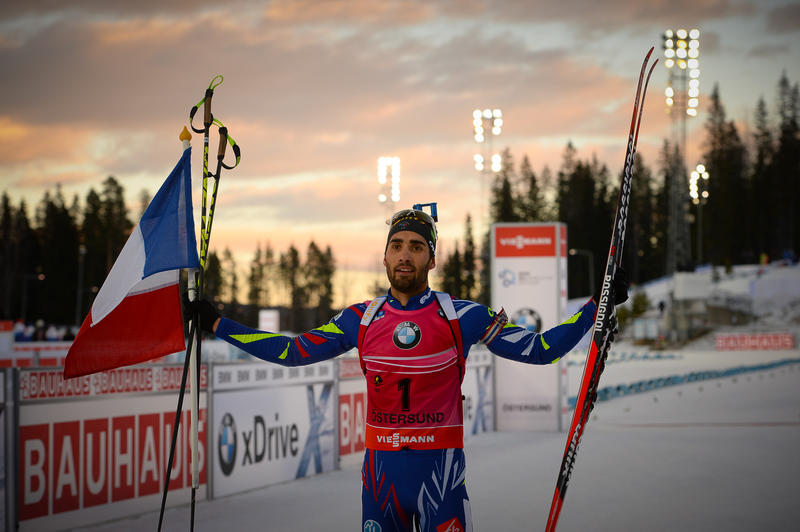
Martin Fourcade of France after winning Sunday’s pursuit for his second-consecutive win at the IBU World Cup in Ostersund, Sweden. (Photo: IBU/Evgeny Tumashov)
Fourcade took first in 31:22.4, with three penalties in four rounds of shooting (1+0+1+1). It was still good enough to finish 35.1 seconds ahead of second place, which went to Arnd Peiffer of Germany.
Peiffer shot nearly perfectly — he missed one in the second prone stage — which was enough to make up approximately 25 seconds on Fourcade after starting second, approximately 50 seconds back, but not enough to close the gap.
Fourcade’s teammate, Quentin Fillon Maillet moved up one spot to reach the podium in third with two penalties (+55.2).
For the second-straight day, the Canadian men reached the top 10, with Nathan Smith in 10th after starting ninth. He had three penalties (1+1+0+1) and finished 1:15.1 after Fourcade and less than 20 seconds out of third. The podium would have been Smith’s second of the week; he placed second in the single-mixed relay last Sunday with Rosanna Crawford.
“I knew going into the final standing shooting that I was fighting for a podium position,” Smith wrote in an email after the pursuit. “I ended up missing one and leaving the range with guys like [Norway’s] Tarjei Bø and [Germany’s Benedikt] Doll, with [Norway’s Emil Hegle] Svendsen just ahead. Tough company to fight on a last lap! I was a little fatigued from skiing most of the race by myself and just couldn’t hang on.
“It could’ve been even better,” Smith continued. “But that is how the sport works. It feels good to know that it doesn’t take a perfect race anymore to be top-10.”
Macx Davies of Canada racing to 10th in Saturday’s IBU World Cup 10 k sprint in Ostersund, Sweden. It was his career-best result by 30 places. (Photo: Biathlon Canada/NordicFocus)
Canada had two in the top 30 after Macx Davies, coming off 10th on Saturday in his fifth World Cup race, finished 30th (+2:48.8) with three penalties (1+0+1+1). Despite slipping 20 places from starting in 10th, for 22-year-old Davies, 30th stood as the second-best result of his career in his first-ever pursuit.
“Starting in 10th made me realize just how good yesterdays race was!” Davies wrote in an email. “When I got into the lanes and ahead of me is [Norway’s] Johannes Bø and beside him is Svendsen, Then Nathan was beside me. It was all a crazy experience!
“Still very excited with two top 30s in the first [World Cup]!” Davies continued. “And though I believe it more now, I am still a little in the clouds! It has just been an amazing weekend! And now I am looking forward to Hochfilzen next weekend!!! Can’t wait to try again!”
After starting 55th, Canada’s third man, Brendan Green improved to 38th (+3:21.4) with two penalties (0+1+1+0). Green was happy about the more amicable weather on Sunday, which helped him shoot well.
“It felt good to be able lay down on the shooting mat and just shoot without having to try and work through changing wind or getting hit with a gust,” Green wrote in an email. “I am very happy with my shooting today and satisfied with my overall performance. I’m disappointed with my ski performance here in Östersund and was hoping for a lot more, but hopefully that will turn around soon.”
Tim Burke (US Biathlon) after placing 39th in the IBU World Cup pursuit in Ostersund, Sweden. He started 45th, cleaned three out of four stages and finished with three penalties. (Photo: USBA/NordicFocus)
A half a second behind Green was the top American, Tim Burke, who finished 39th (+3:21.4). After starting 45th and cleaning three stages, he was happy with his race, calling it “decent” and “solidly executed.”
He accrued all three of his penalties in the first standing, writing in an email that he was “a little too cautious … and it ended up throwing off my timing. I recognized the mistake and adjusted for the last stage.” He shot clean in the last stage.
“I went into this week’s races with a training focus,” Burke continued. “I ended up getting sick shortly after arriving to Norway so I missed out on a lot of snow time and intensity training. I was definitely off of my normal ski form here, but I feel like these races will help get me back on track for [next week’s World Cup in Hochfilzen].”
The only other American in the pursuit was Sean Doherty, who opened the season with career-best results this week. He slipped 21 spots, from starting in 25th to finish 46th (+3:54.5) with seven penalties (1+2+2+2), but the 20-year-old still has a lot to be happy about.
The IBU World Cup will pick back up again on Friday, Dec. 11, in Hochfilzen, Austria, with men’s and women’s sprints.
Clare Egan (US Biathlon) racing to a career-best 16th in the women’s 7.5 k sprint on Saturday at the IBU World Cup in Östersund, Sweden. (Photo: USBA/NordicFocus)
Clare Egan had been hoping for a top 60 in the International Biathlon Union (IBU) World Cup sprint on Saturday. That’s what she needed to qualify for Sunday’s pursuit in Östersund, Sweden.
To meet that goal, she aimed to push herself out of her comfort zone in the 7.5 k sprint, she wrote in an email after the race. The newest member of U.S. women’s World Cup team, she also wanted to stay “calm and confident” while shooting. Two days ago, Egan shot 17-for-20 in a four-stage race to place 44th in the 15 k individual. That was her second-best finish on the World Cup.
Imagine how she felt after placing 16th for a career best on Saturday.
“I knew that with clean shooting I would do well,” Egan reflected.
It had been raining, hailing and snowing before their race, she explained, but all of that stopped before the first woman started. The men had to deal with more unfortunate elements in the earlier race, and just one of the 100-plus men in the field cleaned: 22-year-old Canadian Macx Davies.
“It was stable weather throughout [our] race, clear and light wind,” Egan wrote. “I think the track got a bit faster as it got skied-in so that was to my advantage as a late starter.”
She started 90th, giving her enough time to “chill out in the cafeteria and eat cookies,” she wrote. Once on course, she quickly found that she had “excellent skis,” as proven by a downhill approach to the stadium followed by a flat 300-meter stretch into the range.
“I coasted almost the entire way to the shooting point, which definitely helped my shooting,” she explained.
Clare Egan (US Biathlon) after Saturday’s 7.5 k sprint in Östersund, Sweden. She cleaned and ended up 16th for a career best. (Photo: USBA/NordicFocus)
Egan cleaned prone to put herself in 27th, then standing to rank 15th with one lap to go. She finished 15th and was ultimately bumped one place to 16th, 1:05.3 behind race winner Gabriela Soukalova of the Czech Republic and 0.1 second behind Sweden’s Elisabeth Högberg in 15th.
“I saw on the big screen that that I was around 10th leaving the range for the last lap, and then all of our staff members were out on the course screaming for me,” Egan wrote. “Unfortunately it was once of these situations where the first coach told me I was 2 seconds out of the top-10, the second coach told me I was 2 seconds out of 12th, then 2 seconds out of 14th, and so on, so I was just trying to get to the finish line as quickly as possible.
“I had the 40th-fastest ski time today, which is much better than my 59th rank from Thursday’s individual, and I hope to continue on that trajectory as I get into race shape,” she added.
Last January, Egan shot a perfect 10-for-10 in an IBU Cup sprint in Ridnaun, Italy, which qualified her for her first World Cup. While she was proud of that shooting result, she explained Saturday’s 16th was “sweet in a different way because this is a much higher level.”
She also had to consider the training she’s been through to get to the World Cup this season. Egan explained she “narrowly qualified” for the World Cup team this fall, “so I am relieved to be outperforming my summer self. I don’t want to get hung up on the meaning of one result, because biathlon is very volatile, but it gives me confidence that the work I am doing is good and that I am on the right track,” she wrote.
After performing well enough at two sets of team trials in August and October, Egan was named the World Cup team in early November. Asked what she had hoped for in terms of results her first season starting on the World Cup, she wrote, “Not these ones!!!”
“I want to use the head-to-head competition to push my ski speed, and then be really diligent about sticking to my own routine on the range,” Egan wrote of her goal for Sunday. “If I do those two things I will be happy with my race. And I want to enjoy the opportunity to ski with some extremely fast women.”
Annelies Cook (US Biathlon) racing to 25th in the 7.5 k sprint at the IBU World Cup in Östersund, Sweden. (Photo: USBA/NordicFocus)
Along with Egan, Annelies Cook qualified for the pursuit for the U.S. in 25th. She finished 1:23.6 behind the winner with a single standing miss for the fourth-best result of her career.
“It was super fun to perform in the way that I expect from myself,” Cook wrote in an email. “My goals today were to let go of the Individual race and not let that shooting haunt me.”
She placed 91st in the 15 k individual on Thursday, with nine one-minute penalties.
“I am just happier to be skiing better than I have in the last two years,” Cook wrote on Saturday. “And after I missed standing, I just wanted to be able to dig deep and allow myself to hurt and see where that would get me. I finished in 18th and I knew that I would most likely move back a bit, but I figured it might be good enough to be a top 30 at the end of the day.”
She’ll start 1:24 back in the pursuit with three others: Norway’s Marte Olsbu, who placed 26th on Saturday, Canada’s Zina Kocher in 27th, and France’s Coline Varcin in 28th.
Kocher and Canadian teammate Rosanna Crawford finished in the top 30, with Crawford leading the way in 22nd with two misses (1+1). Kocher cleaned prone and missed one standing.
“With 1 miss, I had hoped to be within the top 20 or better but I am still happy with the result because I gave everything I had today,” Kocher wrote. “It’s only the 1st week & it’s always been my pattern that I need a few races to pick up the speed. After what I went through last year, this start to the season feels amazing.”
On Thursday, she placed 98th in the 15 k with nine penalties.
“I’m stoked to be back on the World Cup,” Kocher wrote. “I’m feeling stronger & mentally in a way better head space that last year. … I am only focusing one day at a time and will find out on Sunday whether I continue to the WC2 [World Cup 2], or to the IBU Cup.”
Crawford placed 13th in the 15 k, and last year at the same venue, she was 12th in the sprint.
“I know the ski speed isn’t the same right now, so I was hoping to stay in the top 20,” Crawford wrote. “I am a bit disappointed with this result, I think more because I got to see how unlucky the men had it … So with our conditions I expected a lot more, but any day you have a top 30 is a pretty good day.
“It’s amazing to see how things have changed for me in the sport,” she added. “This is what you want, to keep striving for that perfect race and to always be challenging yourself.”
She noted that it was a tight sprint, with just 2 minutes and 20 seconds separating the top 60. Also qualifying for Canada was Julia Ransom in 32nd (+1:37.7), with one prone miss, and Megan Tandy in 46th (+2:00; 1+1).
“Skiing felt great!” Ransom wrote, after posting her career best by 20 places. “I love this course because you get the hard work done in the beginning and then get to play all the way back to the range.
“Making world cup points feels like a door has been opened to the top 30,” she added. “I would love to walk through that door tomorrow, but ultimately I just want to have a solid race to be proud of.”
American Susan Dunklee started early and led early on in the sprint after a clean prone, but missed four standing to end up 64th (+2:25.5). Hannah Dreissigacker placed 91st (+3:57) with five misses (3+2).
Rosanna Crawford (Biathlon Canada) racing at 2015 IBU World Championships in Kontiolahti, Finland. In the first individual race of the 2015/2016 season, Crawford, 27, placed 13th in the 15 k with 90-percent shooting.
If you were wondering whether a podium in the first race of the season took the pressure off Rosanna Crawford for the first individual women’s race on Thursday, the answer is no.
“I am very realistic that the single mixed relay isn’t like any other race we do and that it didn’t have most of the strongest women,” Crawford wrote in an email. “So I was quite nervous going into today’s race, wondering where I would land, to see if all my hard work over the summer had paid off.”
Crawford, a 27-year-old two-time Olympian and Biathlon Canada team veteran, had experienced success in Östersund, Sweden, well before last Sunday. At last season’s International Biathlon Union (IBU) World Cup opener there, she placed 12th in the sprint and 16th in the 15-kilometer individual distance race.
This year, she landed in between the two and placed 13th in Thursday’s 15 k individual, the longest format on the women’s circuit. It was her personal best in a 15 k, and it came right at the start of the season.
“It was a calm day on the range in terms of Ostersund, a little flutter of the flags, maybe a 2-3 click wind and it was quite consistent,” Crawford explained. “I knew a lot of girls would be shooting well, so I just made sure to stay focused on my self and my range routine.”
Italy’s Dorothea Wierer (l) smiles for cameras after her first-career IBU World Cup win on Thursday in Ostersund, Sweden. She won the 15 k by 14 seconds. (Photo: IBU/Evgeny Tumasov)
The 41st starter, she knocked down 18 of 20 targets, missing one on each of her standing stages to finish 2:41.6 behind Italy’s Dorothea Wierer, who shot clean to win her first-career World Cup in 42:17.
“I do not think the first win has hit me yet, but happy to win, not just for me but for our team,” Wierer, who started 46th, said in a post-race press conference. It was also her first time shooting 100 percent in a 15 k.
“I was a little sick last week so I was not so brilliant on the skis today, but it was okay,” Wierer added. “The shooting was good, though; I turned off the head and just shot like in training.”
Besides Wierer, three other women also cleaned and finished in the top 12: Ukraine’s Olena Pidhrushna, who placed third, and two Belarusians, Nadezhda Skardino in sixth and Nastassia Dubarezava in 12th. The second-place finisher, Marie Dorin Habert of France missed two on the second stage, but skied the fastest course time to reach the podium, 14.1 seconds behind Wierer. Pidhrushna finished 37.8 seconds back from the Italian in third.
Meanwhile, Crawford hung in the top 20 throughout the race, rising from 19th to 13th on her third of five loops. At the end of the day, her course time ranked a modest 35th, but her range time was notable: she was fourth fastest of 101 finishers.
“I really wanted to be control in the range. Last year I missed 2 in my last standing to hit 17/20, so I wanted to beat that,” Crawford recalled. “I learned a few things from the single mixed relay last Sunday. It reminded me not to stress too much in the range and to just remember that I am a good shooter.”
Her shooting time ranked sixth overall. After cleaning her second prone — the third of four stages — Crawford had a sense she was having a good race.
“Skiing felt strong and the targets were going down, so that just left my last standing!” she wrote. “On my last loop I knew the top 10 was close, but I just didn’t quite have enough gas in the tank to bring me closer!”
She started 13th and ended there, 8.2 seconds behind Dubarezava in 12th and about 22 seconds out of 10th. Previously, Crawford’s best finish in an individual race had been 16th last year in Östersund. At 2013 IBU World Championships in Nove Mesto, Czech Republic, she placed 17th in the 15 k individual with 95-percent shooting.
“I am happy with my result but know that skiing isn’t quite where I want it yet,” Crawford wrote on Thursday. She reflected that she started too hard and forgot to control her skiing.
“In the end I don’t think it changed things too much ski speed wise, but I did get a bit slower as the race went on,” she added. “Looking forward to Saturday’s shorter race!”
The women’s and men’s races continue in Östersund with the 7.5/10 k sprints on Saturday and 10/12.5 k pursuits on Sunday.
“I definitely want to consistently be in the top-15, with hitting the top-10 more than last year,” Crawford said in a Biathlon Canada press release. “My main goal is a podium in a non-team event. These first three World Cups [in Östersund, Hochfilzen and Pokljuka] are my favourite venues, so I know they will be my best chance to be on the podium.”
After Crawford, Canada’s Julia Ransom finished 52nd (+5:25.6) with three penalties (1+2+0+0), Megan Tandy (formerly Heinicke) placed 67th (+6:54.2) with five misses, and Zina Kocher was 98th (+11:30) with nine penalties. For each miss in an individual race, a minute penalty is added.
Clare Egan finishing 44th in Thursday’s 15 k individual for her best result at that distance at that level. (Photo: USBA/NordicFocus)
Leading the U.S. in her first year on the World Cup team, Clare Egan placed 44th (+4:52.9) with 17-for-20 shooting. She cleaned both prone stages and missed one on the first standing and two on the final standing.
It was her second-best finish at the World Cup level after placing 40th in the sprint at 2015 World Championships in Kontiolahti, Finland. She started racing internationally last season.
“The conditions were perfect tonight. Clear skies, fast track, little wind,” Egan, 28, wrote in an email.
She started last in bib 103 and saw her teammate Susan Dunklee finish before she started.
“It was actually relaxing to take my time and hang out for 40 minutes in the cafeteria eating cookies while I waited,” Egan said in a US Biathlon press release.
“I really did not know what to expect, because anything can happen in biathlon, but in the best case scenario I was hoping to hit all my prone targets and only miss a few in standing,” she wrote in the email. “That is exactly what happened so I am really pleased.”
The key to her success was “Fake it till you make it!!!” Egan explained. “It is crucial to be confident on the range, so I am doing my best to convince myself that I am a super solid shooter even when it doesn’t look like it through my sights, and sometimes it works.”
She felt like her racing had come around since Sunday, when she and Sean Doherty teamed up to place 15th in the single mixed relay, and explained her skis “were also incredibly fast today so that was a big advantage.”
American Hannah Dreissigacker (r) rounds a corner with Poland’s Magdalena Gwizdon (l), Germany’s Vanessa Hinz (second from r) and others at the IBU World Cup 15 k individual in Ostersund, Sweden. (Photo: USBA/NordicFocus)
After recording her best-ever shooting percentage at the World Cup level, Egan was excited about her chances to improve as she finds her race shape.
“I need to keep using every race opportunity to test out the things I work on in practice and fine tune the racing process so that it becomes second nature,” she wrote.
Her teammates, Hannah Dreissigacker, Dunklee and Annelies Cook placed 80th, 84th and 91st, respectively, in what appeared to be an off-day for the rest of the Americans. Dreissigacker missed five targets (0+1+3+1), and Dunklee and Cook each missed nine.
“Sometimes you just have a bad day on the range,” Egan wrote. “I missed all five standing targets in our pre-world cup season opener less than two weeks ago. You can also be really, really close to hitting the target but that doesn’t show on the results sheet. Our team is very strong and I learn from Hannah, Susan and Annelies every day. One of their most important lessons is about resilience. Having a rough day at the range is just part of this crazy sport.”
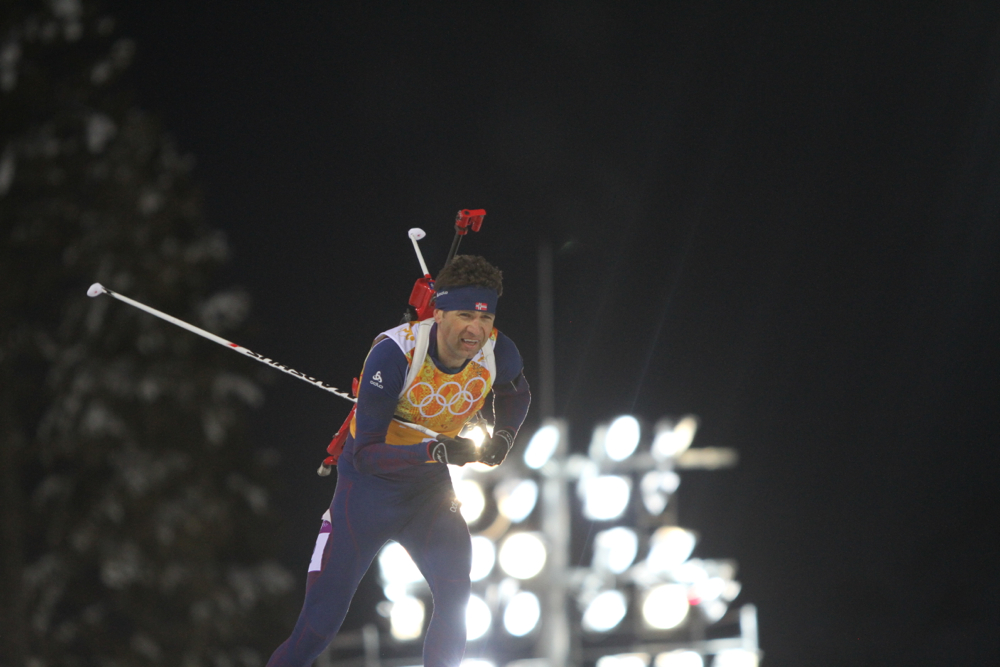
A 41-year-old Norwegian legend shot 20 perfect shots and skied faster than all but nine men on the biathlon World Cup circuit today. Ole Einar Bjørndalen claimed his 95th World Cup win.
Just hours before Wednesday’s 20-kilometer individual competition in Östersund, Sweden, Ole Einar Bjørndalen was expressing doubt about his season.
He wasn’t sure he would be selected for Norway’s World Championships team, he told Norwegian broadcaster NRK. The 41 year old lost six weeks of training this summer due to a respiratory infection.
But come race day – the first individual World Cup race of the season – the winningest Winter Olympian in history was back on his game.
Bjørndalen shot 20 for 20 and won the 20 k individual competition by 27.1 seconds over Simon Schempp of Germany, who had one penalty. Alexey Volkov of Russia was third, 38.2 seconds back, also with clean shooting.
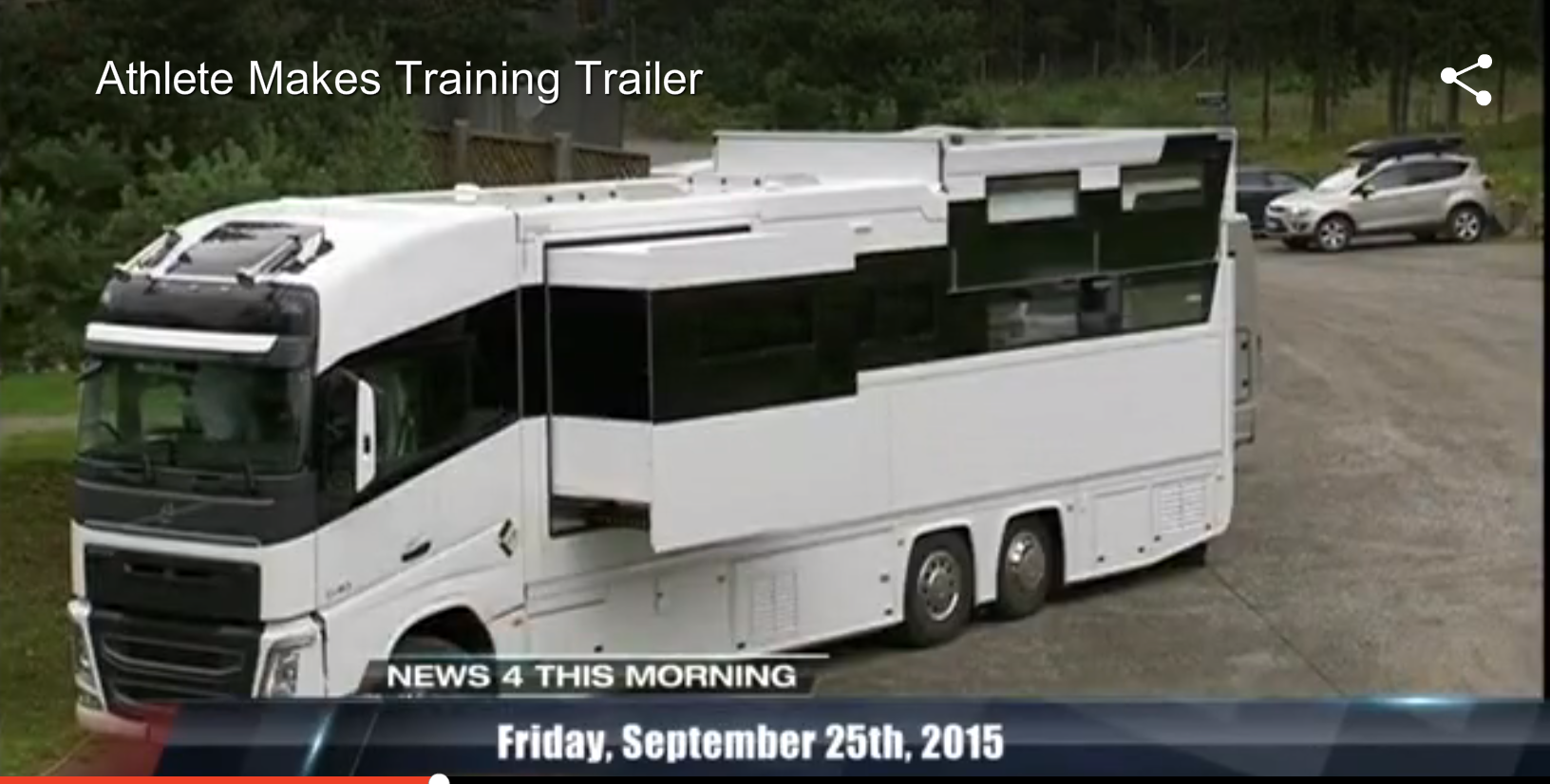
His roadside companion: Ole Einar Bjørndalen’s 20-ton RV, which includes a rollerski treadmill and enough room for a shooting range. Read more here. (Photo: WTVY screen shot)
It’s his 94th World Cup win in a notoriously up-and-down sport.
“It’s the best thing I could have done,” Bjørndalen told NRK after the race. “Everything works, so I’m very happy today.”
Inititial counts had taken this as his 95th victory. But the International Biathlon Union changed its rules prior to the 2014 Olympics so that Olympic gold medals are no longer counted as World Cup victories.
That means that Bjørndalen’s five individual Olympic gold medals from previous Games are counted in his tally, but his most recent one from Sochi is not.
“The [Olympics] are in many aspects, a different event than the typical World Cup event,” the IBU wrote in a press release explaining the situation. “The biggest difference is the number of athletes on the start. So called start quotas are not the same as in the World Cup circuit. For example: in biathlon, the top five nations in our sport (based on Nations Cup Score) are entitled to start up to 6 athletes but only 4 will get the right to start at the OWG… Bottom line: Bjørndalen has 94 official World Cup Biathlon victories.”
The veteran had a good race going, leading through three clean stages. He took his time on the final shooting stage, drawing a few deep breaths before taking the fourth shot. The King of Biathlon was cautious.
The fourth target was knocked down.
Another few deep breaths.
The fifth and last target fell.
Bjørndalen let out a shout of satisfaction before leaving the shooting range with a nearly 20-second lead on Volkov. While Schempp was able to move from third to second over the final four kilometer loop, Bjørndalen held his own and took the win comfortably.
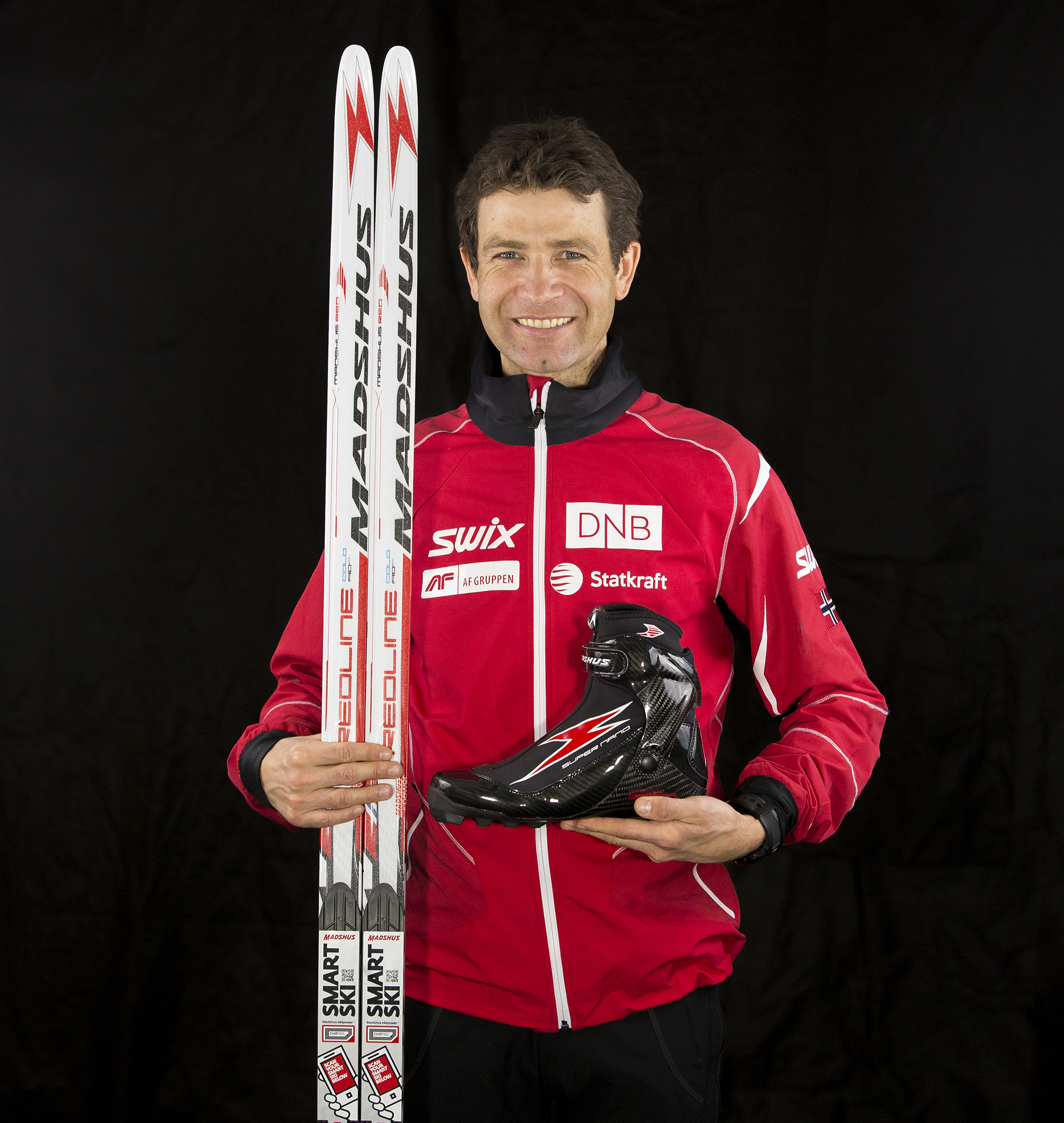
Ole Einar Bjørndalen: ready for another new season – and maybe more? (Photo: Madshus)
His ski time was the 10th-fastest on the day.
“I had not expected that I would do so well, but I know I’m in good shape,” Bjørndalen told NRK. “I don’t have too many secrets. I have strong motivation. Maybe that’s the secret.”
Bjørndalen pumped his fists and celebrated at the finish line, a more emotional display than he sometimes puts on.
He had started with a late bib, as had Volkov, which meant that when Schempp crossed the finish line it had been with a big lead – well over a minute. At the time, a victory for the German had seemed very possible.
He had bumped out Norway’s Emil Hegle Svendsen and France’s Quentin Fillon Maillet, who ended up tied in a dead heat for fourth, 1:44 back from Bjørndalen and both with two penalties.
Bjørndalen had announced that he would retire after World Championships this season, which will be held in Oslo.
He had been thinking of calling it quits after the 2014 Olympics in Sochi, Russia, where he won a gold medal in the sprint as well as in the mixed relay. But the home Championships were too tempting.
Ole Einar Bjørndalen out on the trails at the 2014 Olympics, where he trounced the decades-younger competition.
Now? His teammates think he could even go for one more Games.
“That’s impressive,” teammate Johannes Thingnes Bø, himself a World Champion, told Norway’s VG newspaper. “I cannot fathom him. It is unexpected that he wins, but in a way it’s not, either. He is Mr. Biathlon and is at home wherever he is in the world. I would not be surprised if he continues to 2018 either. Now he tastes the blood on his teeth.”
Bø’s older brother Tarjei agreed. Assumed to be the fittest and strongest Norwegian coming into Wednesday’s race, Bø instead finished 22nd and gave kudos to his older teammate.
“What is there to say?” he asked VG. “I am proud to be teammate Ole, with such a hard guy as he is. He comes back time and again. Today it is particularly impressive with the first races of the season, it’s challenging conditions and he has had a tough break in summer.”
Martin Fourcade of France says he’d believe anything.
“Before Sochi I said I didn’t think he could get gold anymore,” he told NRK. “I had to shut my mouth and apologize. So I won’t say anything anymore… To be honest, I think he’s going to continue until the Olympics in 2018. But he knows it’s not going to be every day that he wins races and gets the yellow bib. It must be a huge dilemma for him if he should continue or not.”
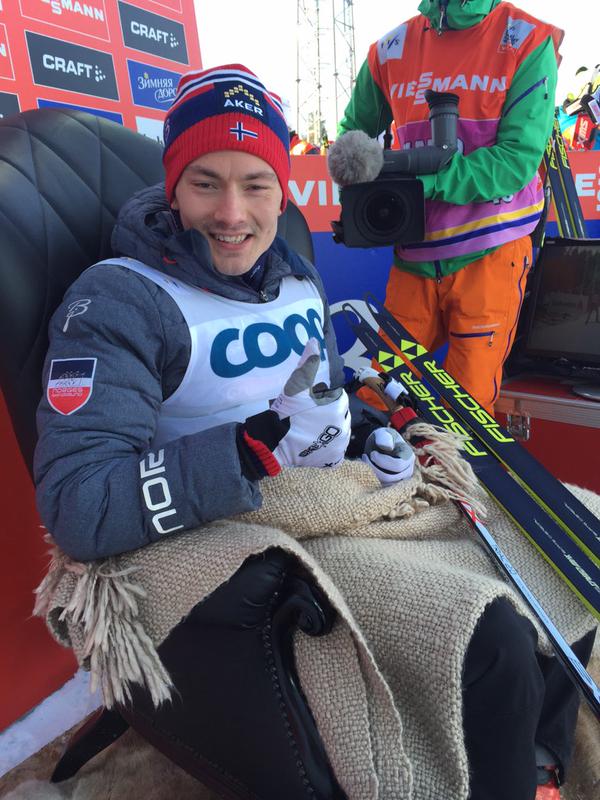
Norway’s Finn Hågen Krogh gives a thumbs up in the leader’s chair during the men’s World Cup 15 k freestyle on Sunday on Ostersund, Sweden. Krogh won by 13.5 seconds for his second-straight win of the weekend. (Photo: FIS Cross Country/Twitter)
Finn Hågen Krogh’s only 24 years old and he’s been on the World Cup circuit since 2011, yet he’s one of those names we’ve been hearing a lot of lately.
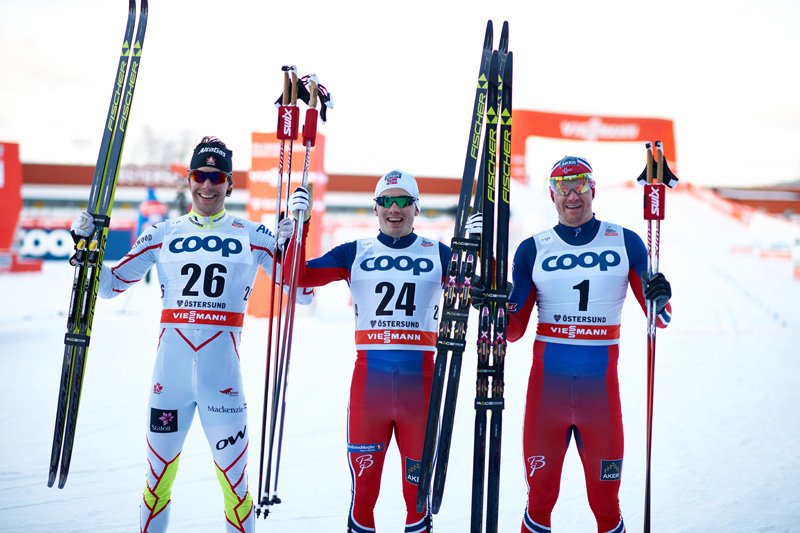
Finn Hågen Krogh (c) of Norway after winning his the World Cup classic sprint on Saturday in Ostersund, Sweden, ahead of Canada’s Alex Harvey (l) in second and fellow Norwegian Timo Andre Bakken (r) in third. Krogh went on to win Sunday’s 15 k skate as well. (Photo: Fischer/NordicFocus)
This weekend, the Norwegian made headlines twice at the Östersund World Cup, winning both individual races with the classic sprint on Saturday and the 15-kilometer freestyle on Sunday.
But perhaps the bigger news is that Krogh — the Sprint World Cup leader — isn’t really known as a distance guy, and Sunday marked his first World Cup distance win.
“He’s Norway’s strongest skier now,” Sweden’s Calle Halfvarsson said an interview with NRK, according to a translation. “I’ve been waiting for this and am not surprised. He has been good a long time, but now he has really turned [the corner].”
According to Krogh, who won a freestyle sprint in Davos, Switzerland, and made the podium in four individual World Cup races in December, this was all part of his plan. He skipped the Tour de Ski, then placed second in the freestyle team sprint his first weekend back racing in Otepää, Estonia, with teammate Anders Gløerssen.
Krogh then sat out the World Cup in Rybinsk, Russia, and just under a month later, he was back on top in the last World Cups before World Championships begin this week in Falun, Sweden.
“The plan has worked well so far,” Krogh told NRK.
“I’m in good shape and had little gunpowder in the end,” he added, referring to his second-straight World Cup win on Sunday.
On a hilly three-lap course in Östersund, Krogh made yet another calculated approach and started conservatively, posting the eventual 17th-ranked time through the 1.8 k checkpoint. However, by 8.3 k, he was where he needed to be, in second, 8.4 seconds behind Norway’s Hans Christer Holund, who led through those timing points.
Holund, 26, thrust himself into the spotlight with some of the fastest splits all day, overtaking Swede Johan Olsson’s time by 18.3 seconds at 8.3 k. Holund started 30th and Krogh went out 49th on a minus-4-degree Celsius afternoon (25 degrees Fahrenheit), and Krogh gradually picked away time at the gutsy Norwegian.
At 5 k, Krogh was up to third, 9.7 seconds behind Holund and France’s Robin Duvillard in bib 45, respectively.
Holund powered through the finish to take the lead by 48.4 seconds over Lukas Bauer of the Czech Republic, who had previously topped Sweden’s Martin Johansson. Seconds earlier, Johansson in bib 25 unseated Japan’s Keishin Yoshida in bib 24 before Yoshida had the chance to enjoy the leader’s chair.
Holund remained in the hot spot for some time, as Olsson came up 6.4 seconds short to initially finish second after him. Meanwhile, Krogh took control at 11.8 k, clocking through 3.2 seconds faster than Holund. At the final 13.3 k checkpoint, Krogh had increased his lead to 7.6 seconds over Holund.
He finished 19.7 seconds ahead to bump Holund to second. After starting 61st, Sweden’s Marcus Hellner came through with the second-fastest time, 18.9 seconds after Krogh and 0.8 seconds ahead of Holund. Then it was France’s Maurice Manificat who pushed hard in the last several kilometers for second, coming up 13.5 seconds short of Krogh but finishing second overall.
Hellner ended up third and Holund narrowly missed the podium in fourth.
“I didn’t expect that I could win today,” Krogh told FIS after the race. “I just focused on my race plan and tried to ski fast at the end of the race and it worked. … I felt a little tired from yesterday’s sprint but I was prepared to race both races this weekend so I could show how good my shape is.
“I hope it’s enough now for a start at the World Championships,” he added.
Manificat started 71st and was able to see both Krogh and Martin Johnsrud Sundby, the overall World Cup leader from Norway, at different parts of the race, which he explained helped.
“I knew I was having a great race,” he told FIS after achieving his first non-stage World Cup podium since December 2013.
At 1.8 k, Manificat’s time ranked seventh, and he was up to third, 3.5 seconds behind Krogh by 8.3 k. With just over three kilometers to go, he remained in third, 1.2 seconds behind Holund and 4.4 seconds back from Krogh, and he was up to second, 5 seconds back, by 13.3 k.
“I really like this course. The climbs are very natural and it feels like a real track in the forest,” he said. “The spectators were great along the course. I think I saw a jacuzzi.”
One of the local favorites, Hellner paced himself from the 10th-fastest split at 1.8 k to sixth fastest at 13.3 k. With a strong last kilometer and a half, he secured his first podium of the season.
“It’s always nice to race in Sweden,” he told FIS. “You can feel the energy from the crowd and it’s nice to be on the podium here. It is good for the confidence heading to Falun.”
Hellner added that he plans to race the skiathlon, 15 k freestyle and team relay at World Championships.
“I am not sure I will do any other races as I haven’t been able to race too much this season without getting tired,” the 29 year old said. “So I will focus on those.”
Two Swedes finished in the top five with Olsson in fifth (+26.1). Norway’s Didrik Tønseth and Niklas Dyrhaug finished sixth (+28.5) and seventh (+29.2), respectively, and Duvillard ended up eighth (+29.7) after fading to 17th at 8.3 k. Russia’s Alexander Legkov took ninth (+32.1), and Chris Andre Jespersen was the fifth Norwegian in the top 10 in 10th (+34.9).
Two other Norwegians finished just outside the top 10 with Gløerssen in 11th (+35.2) and Sundby in 12th (+39.3). Switzerland’s Dario Cologna placed 13th (+42.1), and early podium contender Andrey Larkov of Russia was 14th (+43.6). Great Britain’s Andrew Musgrave was 15th (+44.6), 0.3 seconds ahead of Norway’s Petter Northug in 16th.
Halfvarsson finished 21st (+1:00.3), Bauer 22nd (+1:08.1), Norway’s Sjur Røthe 23rd (+1:09.1), Johansson 24th (+1:09.7), and Yoshida 25th (+1:11.2).
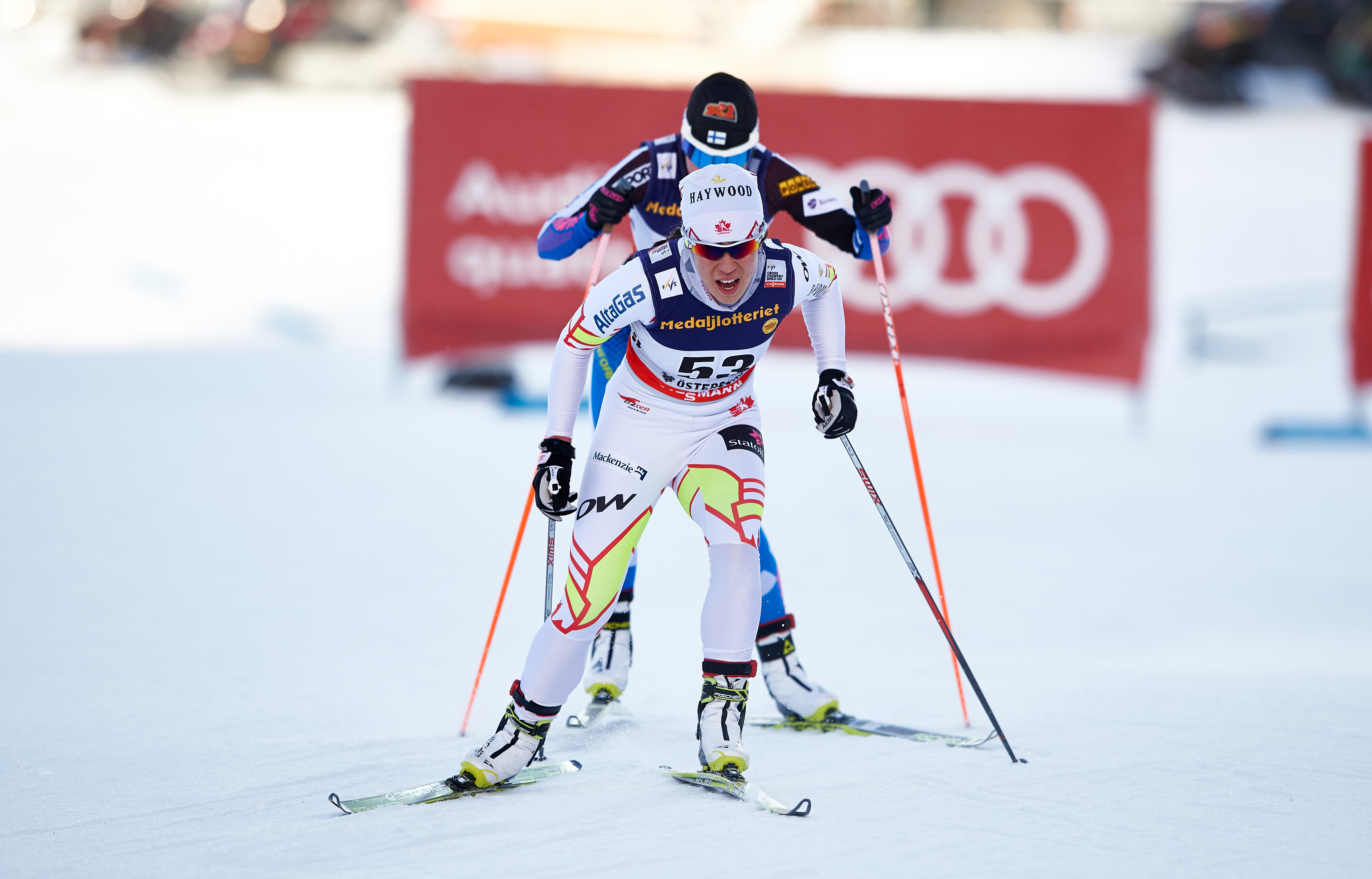
Canada’s Emily Nishikawa (AWCA/NST-Dev.) racing to 36th in Sunday’s World Cup 10 k freestyle in Ostersund, Sweden. (Photo: Fischer/NordicFocus)
It had been almost two months since Emily Nishikawa raced on the World Cup, yet the 25-year-old Canadian National Development Team skier picked up essentially where she left off, collecting her second-best result of the season on Sunday in the women’s 10-kilometer freestyle in Östersund, Sweden.
“It was great to get racing on the World Cup again today,” Nishikawa wrote in an email after placing 36th in Sunday’s race. “My goals for today were just to put a good race together, and focus on the process goals. I think I did that really well. I paced it fairly well, although maybe started a bit too conservatively.”
At 1.8 k, Nishikawa’s time ranked 55th of 70 finishers. She sped up to 39th by 6.8 k and 36th by 8.3 k before finishing 2:35.9 behind Swedish winner Charlotte Kalla.
“A Finnish skier caught me at 5km and I held on to her for the rest of the race,” Nishikawa explained. “I made up a lot of time in the 2nd lap, but I think I could have pushed a little harder in the last few km!”
Last Friday, she arrived in Falun, Sweden, where she’ll compete in her second World Championships over the coming weeks. Nishikawa explained she spent about five days there before traveling to Östersund last Tuesday.
“My teammates that raced yesterday are en route to Falun right now, and the rest of us that raced today will drive down tomorrow,” she wrote. “I had a really good ‘training camp’ at home in Canada in January. I got lots of racing in, but also got lots of time at home with good quality training.”
In Canada, Nishikawa won three-straight NorAm distance races between Eastern and Western Canadian Championships. In fact, she won every NorAm distance race while she was home for a total of six victories from early January to early February.
Canada’s Michael Somppi (AWCA/NST-Dev.) on his way to 69th in the men’s World Cup 15 k freestyle on Sunday in Ostersund, Sweden. (Photo: Fischer/NordicFocus)
On Sunday, she was the lone Canadian female to race the 10 k, while Ivan Babikov (Canadian World Cup Team) and her fellow Alberta World Cup Academy and national-development team member Michael Somppi competed in the men’s 15 k.
Like Nishikawa, Somppi arrived in Falun for a few days of training before driving to Östersund.
“It was good to have the opportunity to race the World Cup in Ostersund this weekend,” Somppi, the men’s NorAm leader, wrote in an email. “Training went well in the lead up to this weekend; feelings have been pretty good.”
He had been shooting for a top 30, which he knew would be difficult given “the size and quality of the field,” but he wanted to “just throw down everything I had and see where I stacked up,” Somppi wrote.
“Unfortunately my nerves got to me a little, making my body a little stiff, in particular my quads, right from the start,” he explained. “It’s not the first time nerves have affected me and I was hoping I would be able to work through it and loosen up as I got into the race but that never really materialized. With the stiffness in my body I wasn’t able to attack the course the way I wanted and ended up skiing the whole race comfortably hard. I wasn’t able to put myself into the hurt locker and you need to be able to do that if you want to a good result on the World Cup.”
Although listed as a scratch for Saturday’s sprint, Somppi explained he had planned all along to just race the distance race.
“The team put me on the start list just in case, but it was always the plan for me to focus on Sunday,” he wrote. “The transition from the NorAm to pre-World Champs World Cup is huge. I wasn’t ready for the speed these guys ski at today. I needed to be way more aggressive. It was a good wake up call for me.”
While Somppi did not make Canada’s selective nine-person World Championships team, he will be racing Scandinavian Cups on the Canadian B-Tour next weekend.
“I will definitely be focusing on bringing aggression and fight to my racing there,” he wrote.
Lowell Bailey en route to 19th place in the 20 k individual in Ostersund. (Photo: USBA/NordicFocus)
After Wednesday afternoon’s scheduled start to the women’s 15km individual race was postponed due to sudden sleet and high winds, conditions had improved enough by Thursday at 1:30 (CET) to allow the competition to proceed without a hitch on a day characterized by fast snow and gusty winds.
The competition went especially smoothly for winner, and four-time World Cup winner last season, Gabriela Soukalova of the Czech Republic, who skied her way to victory after two penalties in four stages and a time of 47:56. In second place, Anastasiya Kuzmina of Slovakia (whom FasterSkier recently interviewed) cleaned her first stage, received two penalties in her second stage, then cleaned the final two stages to briefly earn the lead before being edged by Soukalova by 1.2 seconds. Marie Laure Brunet, of France, had the most solid shooting of those to make the podium with only one miss on the final stage, 16.2 seconds behind Soukalova. Indeed, skiing seems to have won the day as the only athlete to clean all four stages was Kadri Lehtla of Estonia, who finished 15th.
It is difficult to fault today’s 20km men’s individual winner Martin Fourcade of France, who shot perfectly and skied fast to take first place in 50:10.9 and by a margin of over two minutes. It was also a good day for Austria with Simon Eder finishing in second place in 52:17 with just one penalty on the last stage and teammate Daniel Metotitsch finishing third in 52:31.1 with one penalty on the first stage. Canada’s JP Le Guellec had an exciting day with a fourth place finish 52:42.2 with one penalty, 2:31.3 behind first place Fourcade. Good conditions were reported on the course, in spite of some swirling winds shooters had to contend with.
The top woman from North America was Canada’s Rosanna Crawford in 48th place with a time of 53:07.6 and five penalties, 5:11 behind first place. The first American was Annelies Cook in 53:29.7, in 50th place with a total of five penalties. “On a day like today it’s hard to be happy with your shooting,” wrote Crawford in an email to FasterSkier, “but you need to keep it in perspective. It was a bit of a lottery if you would get calm or gusting winds.” Crawford noted that the average shooting for the field was well below normal.
Zina Kocher was the second Canadian in 70th with eight penalties; she had the 23rd-fastest ski time. The third Canadian, Megan Heinicke, who was 77th overall in 56:25.2 with nine penalties, said in an email that it was her worst shooting she could remember in the last 5 years, but noted that she was happy with her ski performance, which was the 32nd-fastest in the field. Teammate Megan Imrie placed 85th with nine penalties.
For the U.S., Susan Dunklee placed 58th with seven penalties, Hannah Dreissigacker finished 80th with eight penalties, and Sara Studebaker was 83rd with seven penalties.
Nathan Smith, also of Canada, was the second North American man coming in 16th with a time of 53:56.2 and three penalties. Lowell Bailey was the top American finishing 19th in 54:08.8 with 2 penalties. Bailey reported low expectations headed into the competition due to a significantly smaller amount of time training on snow compared to other countries, but was pleased to have gotten in a solid performance. “I’m happy to be in the mix,” he said.
Scott Perras was the final Canadian, placing 81st with seven penalties. For the U.S., Tim Burke was 60th with six penalties, Jeremy Teela 76th with five penalties, and Leif Nordgren 83rd with 6 penalties.
It has been a big weekend for Tim Burke, and he still has one race to go. Thursday’s second place followed by today’s third place finish at the Ostersund Biathlon World Cups combine to make Burke the only American to have captured 2 podium races at the same event. These were also the first (hopefully just the start!) podium finishes in Burke’s career. Burke admits that he is usually a better sprinter, but hopes that today’s successful distance race is an indication that he can be a more well-rounded racer.
Finishing close to “King of Biathlon” Ole Einer Bjorndallen, whose win today added to a total of 90 world cup victories, is no small feat. In a press conference Burke was humble in his accomplishment, telling reporters, “Today I’m thrilled to be on the podium with these two guys (Bjorndalen and Svendsen) – it’s a big honor for me.”
Burke is not about to let the hype reroute his race preparations, however. In a post-race interview Burke said he was “just taking it one race at a time” and “focusing on things we’re working on in practice.”
Tomorrow the third race of the weekend will commence in the late morning: a 4 x 7.5km relay
I read that it was windy – how did that affect the shooting?
Yes, we had very gusty wind on the range today and this made the shooting a bit more challenging. When I was shooting prone I had quite a bit of wind so I really had to take my time to hit each shot.
How were race and snow conditions?
The race conditions were once again very good. It warmed up quite a bit over the last two days so the the course was a bit harder and faster than on Thursday. Once again, our wax team did an awesome job and I had really good skis.
How were you able to process Thursday’s podium finish and deal with the press coverage, and keep a cool head going into today’s race? Did you feel any pressure?
I think I actually felt more relaxed. After my result on Thursday, it proved to me that anything is possible and this gave me a tremendous amount of confidence. I will say that I did not sleep so well Thursday night because I was so excited about the race. Going into today I was feeling pretty drained, but I was able to snap out of it once the race started. I don’t think I have really had enough time to process the last few days, but I hope to have that chance soon.
Will the U.S. have a team in the relay and will you compete in that event?
We will field a team with Lowell, Jay, Jeremy and myself.
What is your game plan after this weekend as far as resting, traveling, and preparing for the next races?
On Monday I will travel to Hochfilzen, Austria for the next World Cup. I hope to compete in three races there next week, so recovery will be super important for me between now and then!