|
|||||||
|
|
Tag: Östersund
-
Östersund Results Built Momentum for Team USA Heading to Hochfilzen
-
International Biathlon Union (IBU) Joins UN’s Race to Zero Climate Campaign
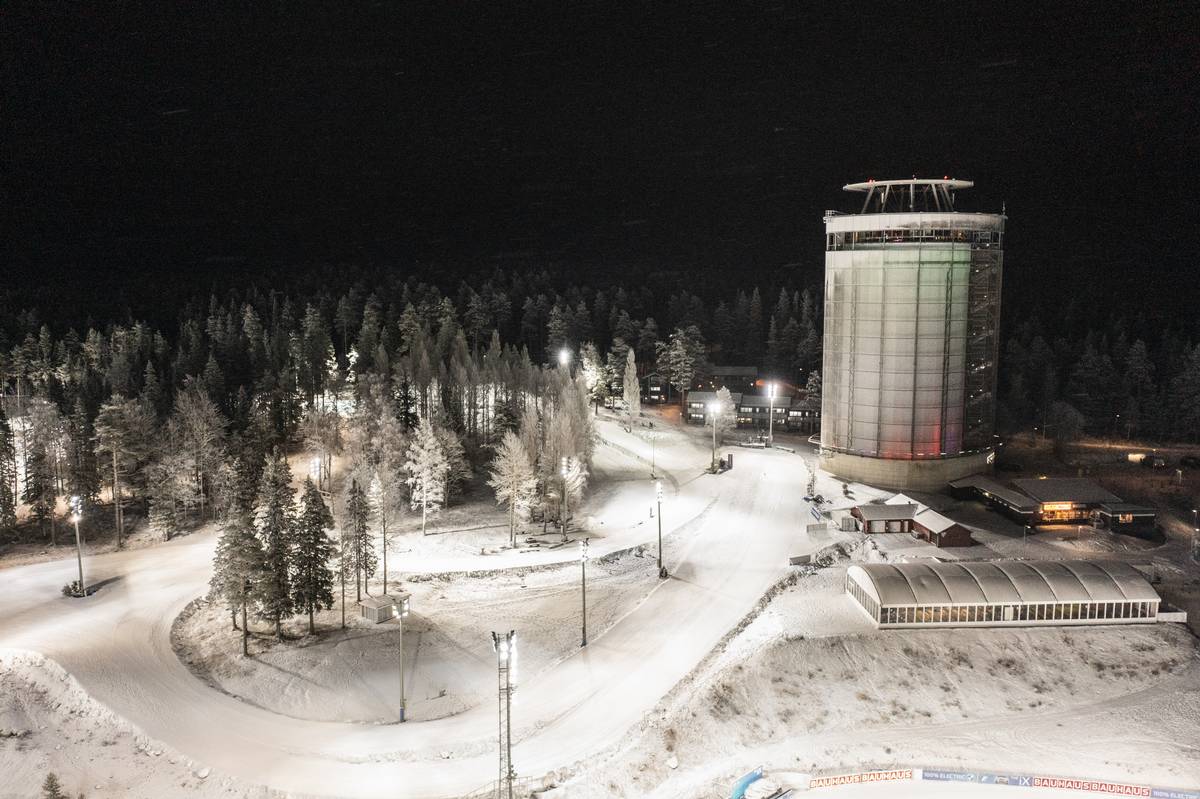
Östersund, Sweden hosted the opening IBU World Cup weekend as it has on many occasions. (Photo: NordicFocus) The sport’s governing body joins a UN campaign to fight climate change, and save Biathlon too.
***
Östersund, Sweden markets itself as Vinterstaden (The Winter City), a reputation it earned a century ago when the Nordic Games – the precursor to our modern Winter Olympics – were moved there from snowless Stockholm in 1905 and 1913. The International Biathlon Union (IBU) routinely puts Östersund at the very beginning of its world cup calendar, as it did this year (starting Nov. 26th).
At a time when watching the world’s best compete on a ribbon of white against a backdrop of brown and green has become all-too-common, the IBU puts its faith in Östersund to have natural snow and have it early. Östersund this season, however, was covered in just a dusting in early November, with mixed precipitation in the forecast. Weather models predicted that the venue would probably have snow when the World Cup came to town – probably.
That qualifier is new for Östersund, and with attention already focused on the massive snowmaking operation required for next February’s Olympics in Beijing, the 2021-2022 Biathlon calendar is marked all the way through with a reality that the winter climate the sport relies upon is changing. And in response to that change, the IBU has decided to make a change too.
On November 3rd, the IBU announced that it has joined the UN’s Race to Zero climate campaign. In doing so, it joined forty-six other signatories including the International Olympic Committee, and becomes the first international winter sports governing body to meet the UN’s strictest criteria for non-state actors to fight climate change.
The Race to Zero campaign is part of the UN’s strategy to meet the Paris Agreement’s goal to halve global emissions by 2030 and limit global warming to 1.5 degrees centigrade. The IBU’s commitment is part of the UN’s Sports for Climate Action program, which hopes to spur sports organizations to act as leaders in the “climate neutrality journey.” The list of signatories to the program’s non-binding pledge of sustainability is long, ranging from global brands such as the English Premier League to local races you may find outside your backdoor like Grandma’s Marathon in Duluth.
To join the Race to Zero the IBU was required to develop a specific plan and reporting process to reach 50% reduction in Greenhouse gas (GHG) emissions by 2030, and eliminate GHG emissions by 2050 (defined as “Climate Positive”). This includes requirements to plan, meet certain time intervals to act on that plan, and report publicly.
Joining the UN’s campaign builds upon the IBU’s pre-existing sustainability strategy – with the sport staking its very existence on limiting climate change. The strategy, adopted in 2019, calls for even faster action than the UN, looking “to become climate neutral by 2030, and climate positive by 2034,” beating the UN’s timeline by sixteen years.
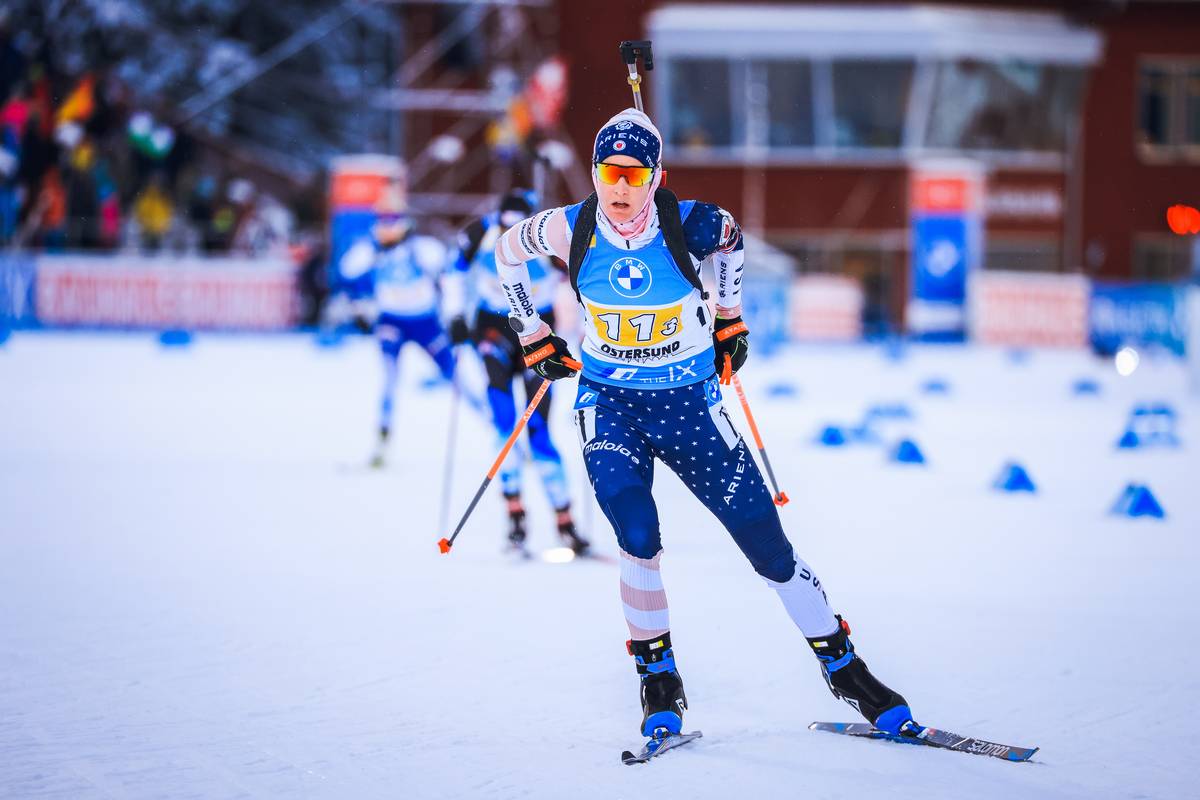
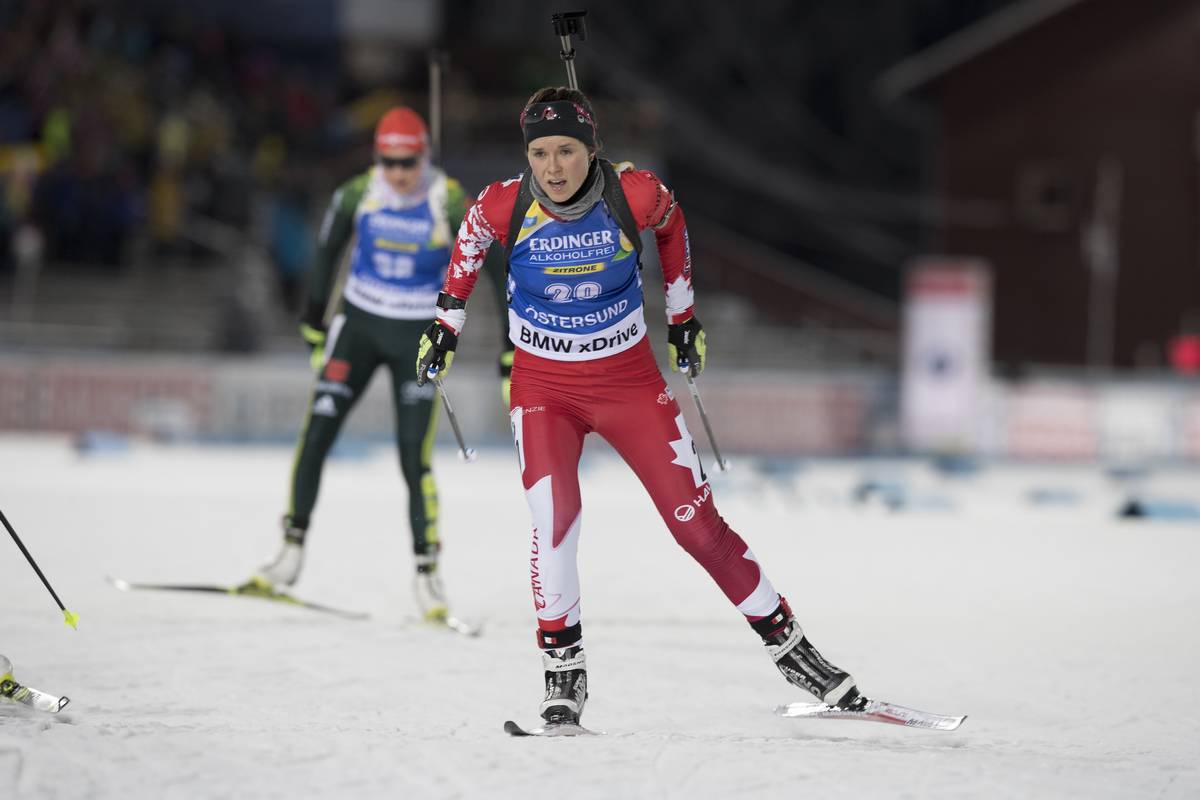
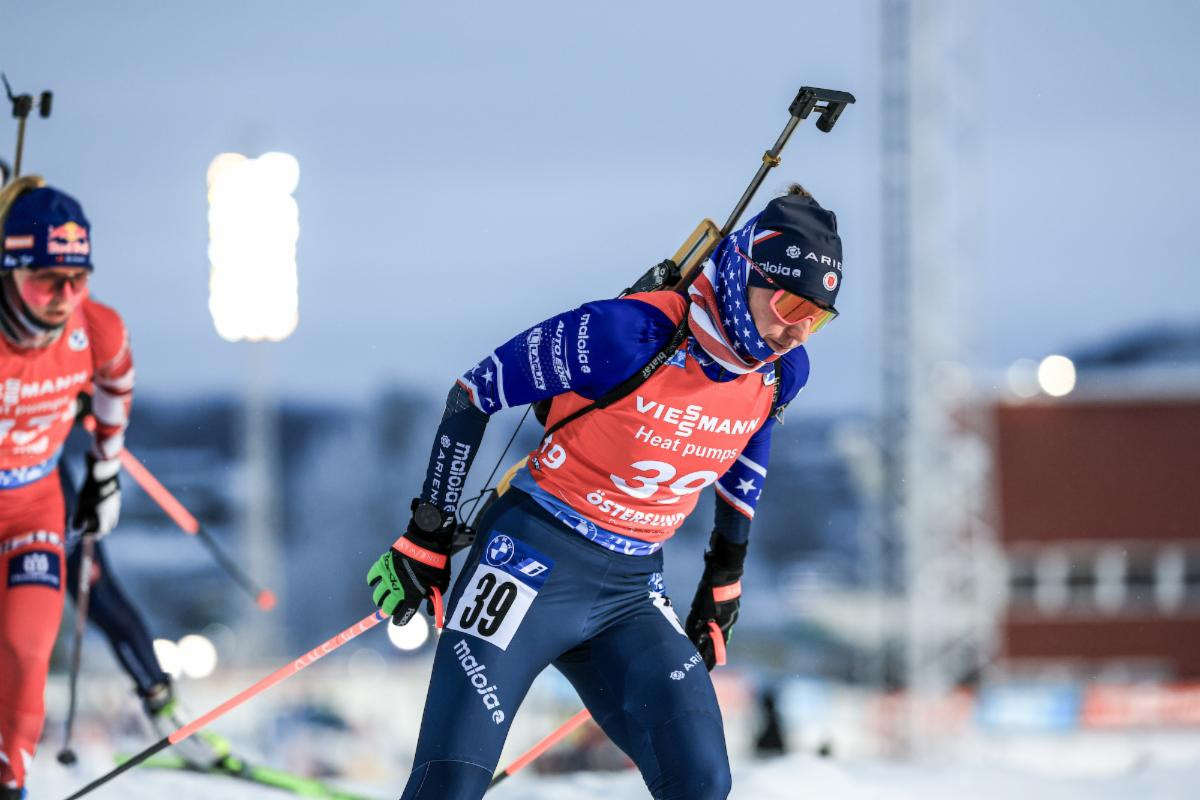
Clare Egan (USA) competes in the IBU World Cup in Östersund, Sweden. (Photo: NordicFocus) So how does the IBU plan to get there? Their sustainability strategy addresses topics that have joined technique talk and tales of past racing glory as common water cooler talk for those of us in the Nordic community the last few years. Eliminating fluorocarbons, and the persistent PFAs they’re known to leech into the snow, is a top priority. The largest change comes from the largest source of GHG’s though – the emissions from travel and transport of an entire circuit of athletes, coaches, media, wax technicians, and fans – around Europe and the world.
To address this, the IBU is implementing a carbon management program that pairs two points of emissions; 1) the IBU’s own infrastructure and 2) the venues the IBU uses for world cups.
Starting this season, the IBU is starting to convert their fleet of vehicles to electric and partnering with world cup venues to make sure that their energy and waste disposal systems are not contributing GHG’s to the atmosphere. In the short-term the IBU is investing in carbon offsets for any venues that can’t immediately meet zero emissions requirements, but will need to convert outright by 2030 to meet the “no offsets” requirement of the Race to Zero.
Biathlon is a sport born of innovation, its very existence the pairing of an ancient mode of transportation with the weaponry of an industrial age. To survive in a time of climate crisis, it’s staked itself on constructing a strategy with the same thoughtful action it takes to slow one’s heart in the flash of a moment. When it heads to the north of Sweden in a few weeks to begin a new season full of hope in a place that defines itself as a season – Vinterstaden – it will come armed not only with a .22 on the back of its athletes, but a plan to hit the targets that will allow it to exist as a sport in a world that’s sustainable for all – from Europe to Beijing, and back here in North America too.
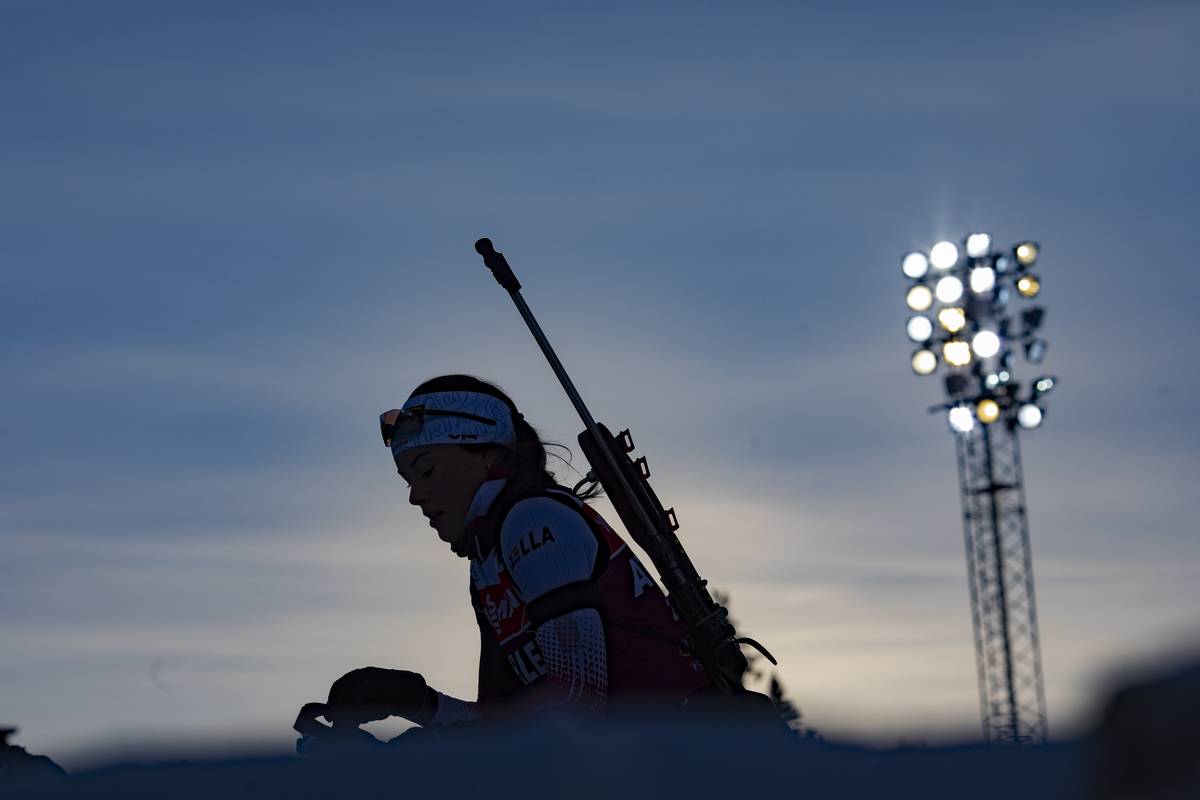
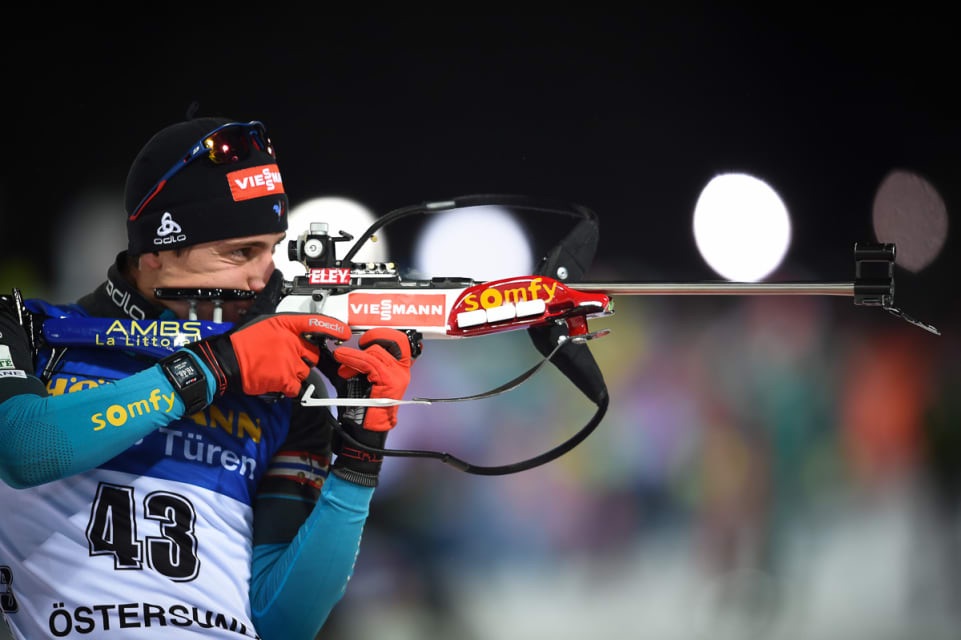
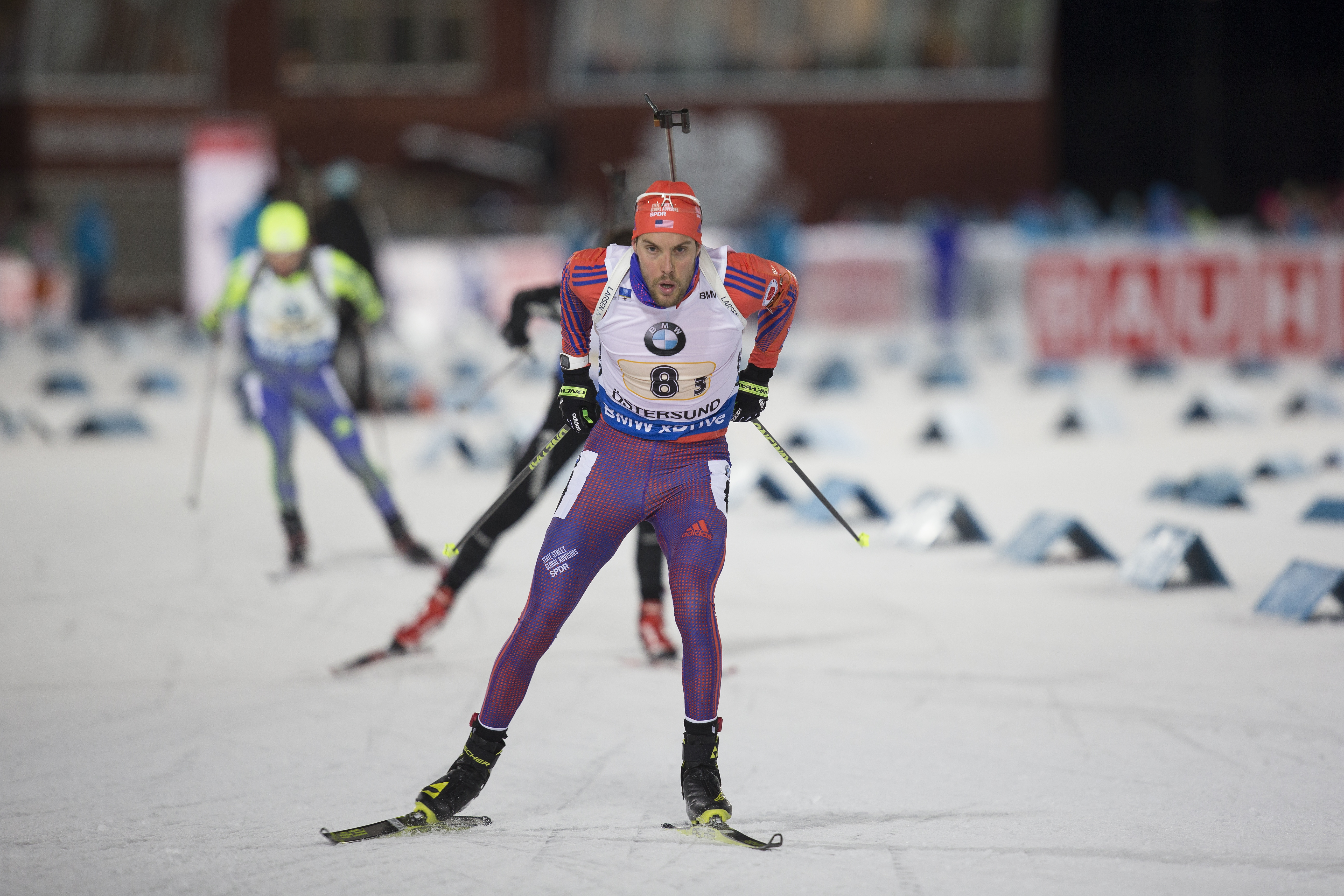
A biathlete competes under the lights on the tracks of Östersund, Sweden. (Photo: NordicFocus) -
Johaug Takes the Stage 2 Win: Brennan in 10th, Diggins 11th

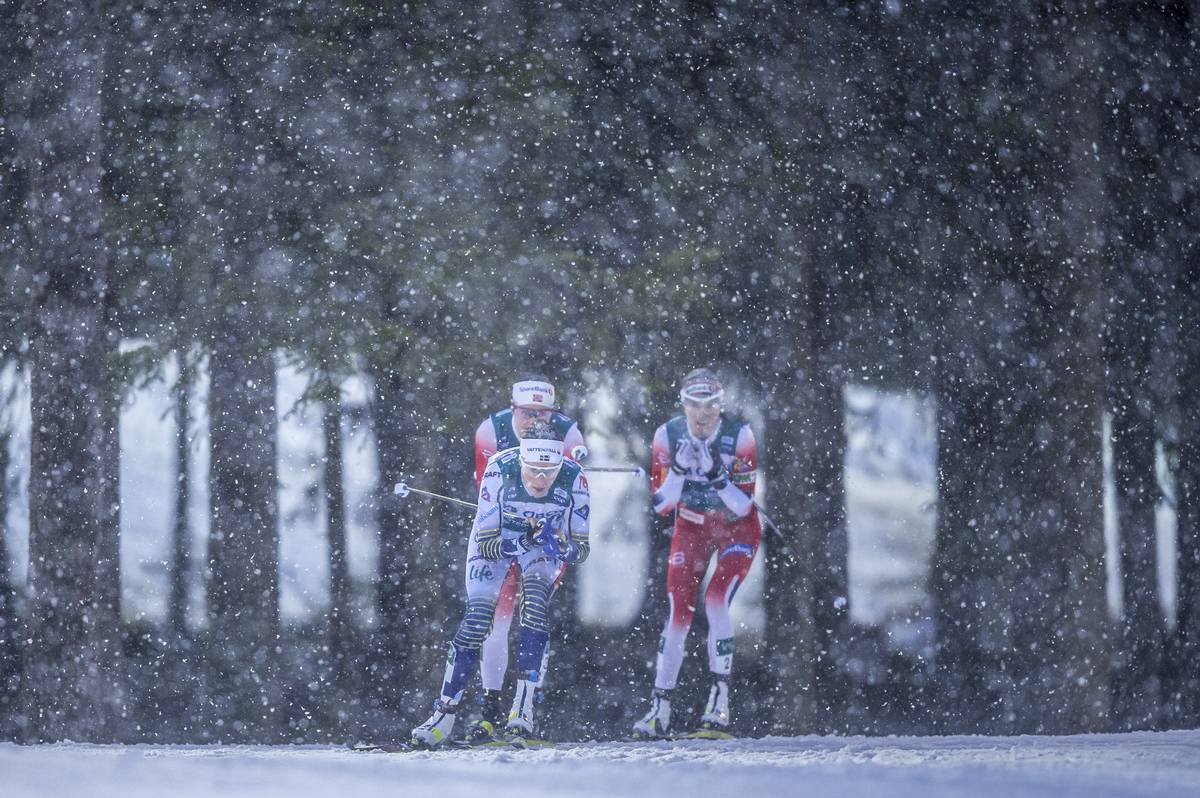
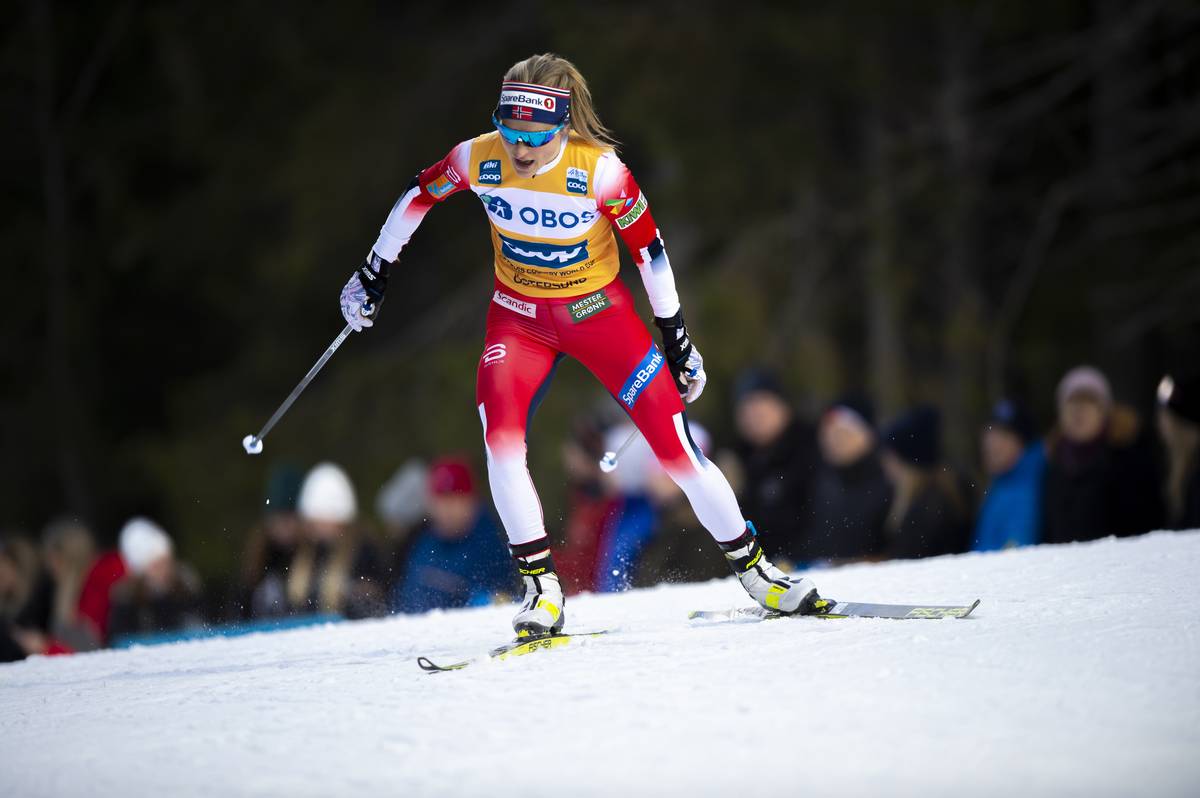
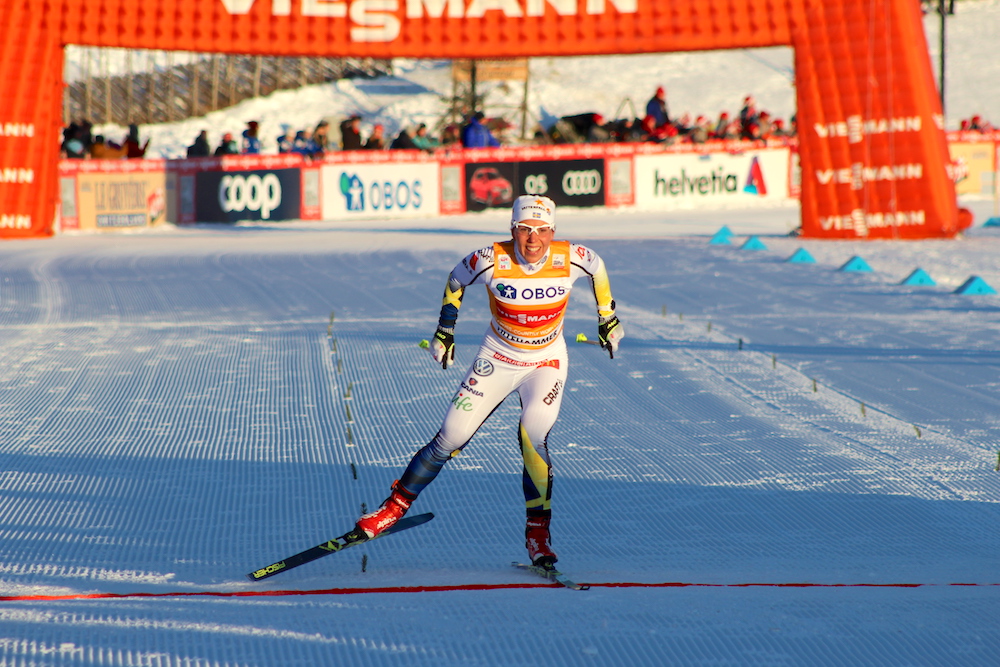
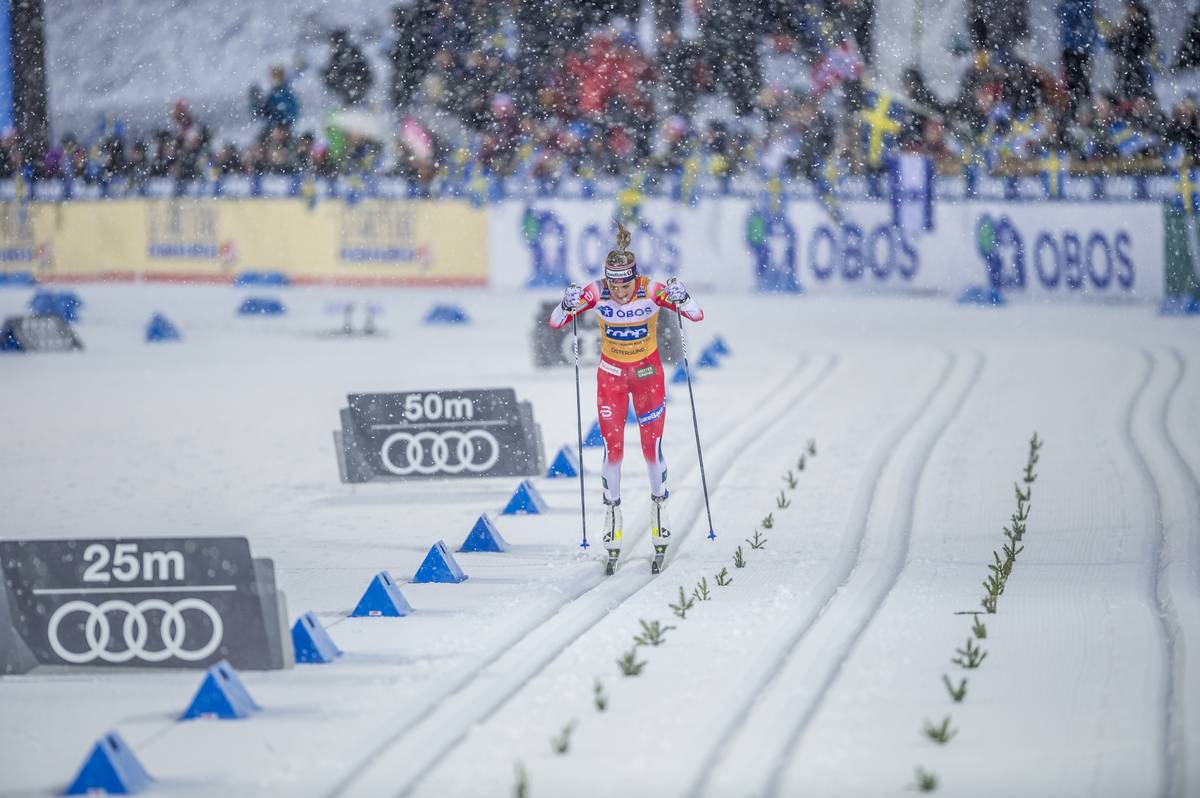
Therese Johaug (yellow bib) with enough time at the finish to gather skis and watch 2nd, 3rd, and 4th come across the line. (NordicFocus) The early evening show, under the lights of Östersund, Sweden’s ski stadium, Stage 2 of the Ski Tour 2020 – a 10-kilometer classic pursuit – got underway as the plentiful moisture falling from the sky transitioned from steady rain to big snowflakes.
This was a 10 k race with three discrete tales. First, the story with the least tension.
That would be Norway’s Therese Johuag’s 10 k effort. Which, despite the pursuit format, was a solo time trial affair. She set herself up for that narrative by winning Stage 1’s 10 k individual skate by 45.6 seconds. No skier on the World Cup could fathom closing that gap to a generational distance skier.
Johaug won in 27:29.0 minutes. Her effort gained her even more time in the Ski Tour overall as teammates Heidi Weng placed second (+57.4), and Ingvild Flugstad Østberg third (+57.8). Sweden’s Ebba Andersson lost out on third in the closing meters, as she placed fourth (+58.6).

Therese Johaug for a clean no-one-in-site win. (NordicFocus) This was Joahug’s 13th World Cup distance win of the season and according to FIS, this brings her closer to a hallowed record. Marit Bjørgen, a legend from Norway holds the World Cup distance win record with 62 victories. Sunday’s win brings Johaug’s total to 59.
Let’s be frank: with a 45.6 second lead on the second starter Weng, 47.3 seconds on Østberg in bib 3, and 53.1 ticks ahead of Andersson in bib 4, this was as much a sure thing as sunrise and sunset.

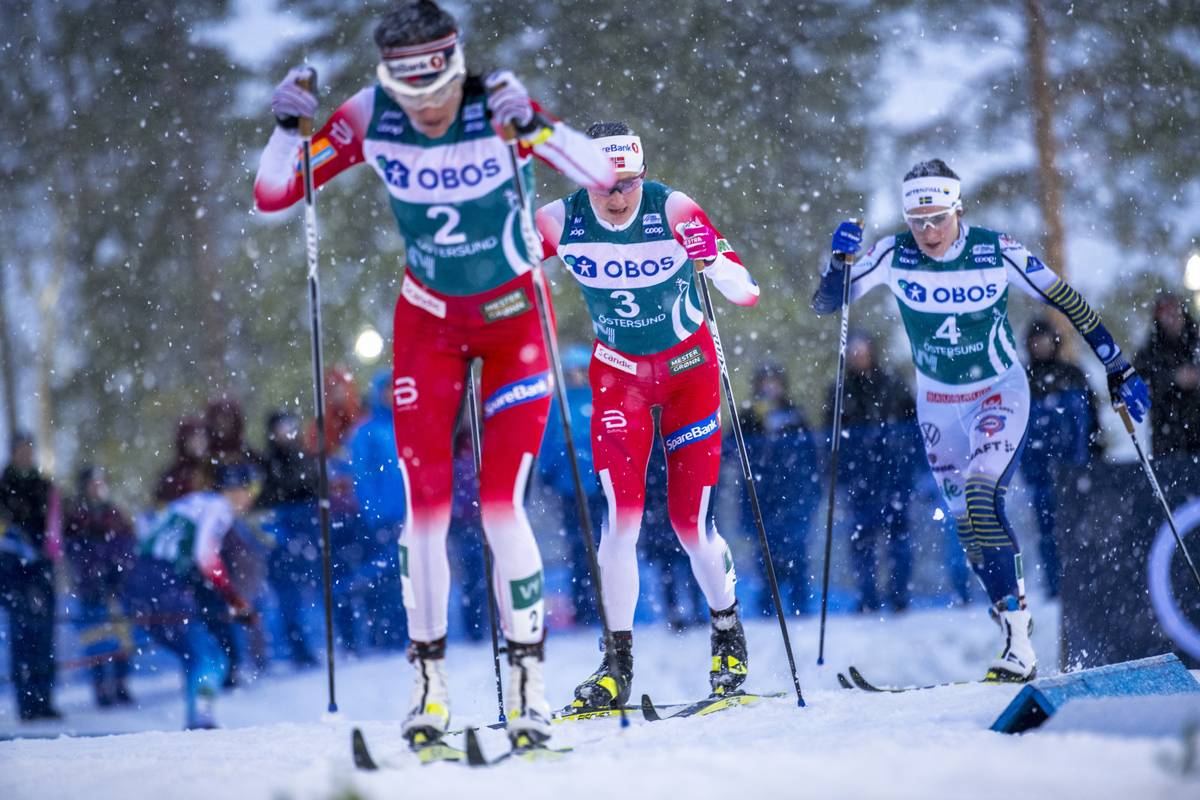
Ebba Andersson leads Heidi Weng and Ingvild Flugstad Østberg during the Stage 2 10 k classic pursuit. (Photo: NordicFocus) Behind Johaug, the tactic for the three closest chasers — Weng, Østberg, and Andersson was clear: cede no ground to the All-Star list of skiers starting roughly 20 seconds further back. For much of the race, the threesome kept a tidy buffer of 30 seconds on those in fifth to 16th place. At times Andersson took pulls up front, motivated by chants of “Ebba” from the home-nation fans. Østberg and Weng too remained motivated to secure a potential podium as they burned their matches prudently but with enough gusto to keep the masses at bay.

Taking her turn pacing the premier chase group, Heidi Weng (bib 2), followed by Ingvild Flugstad Østberg and Ebba Andersson. (Photo: NordicFocus) 
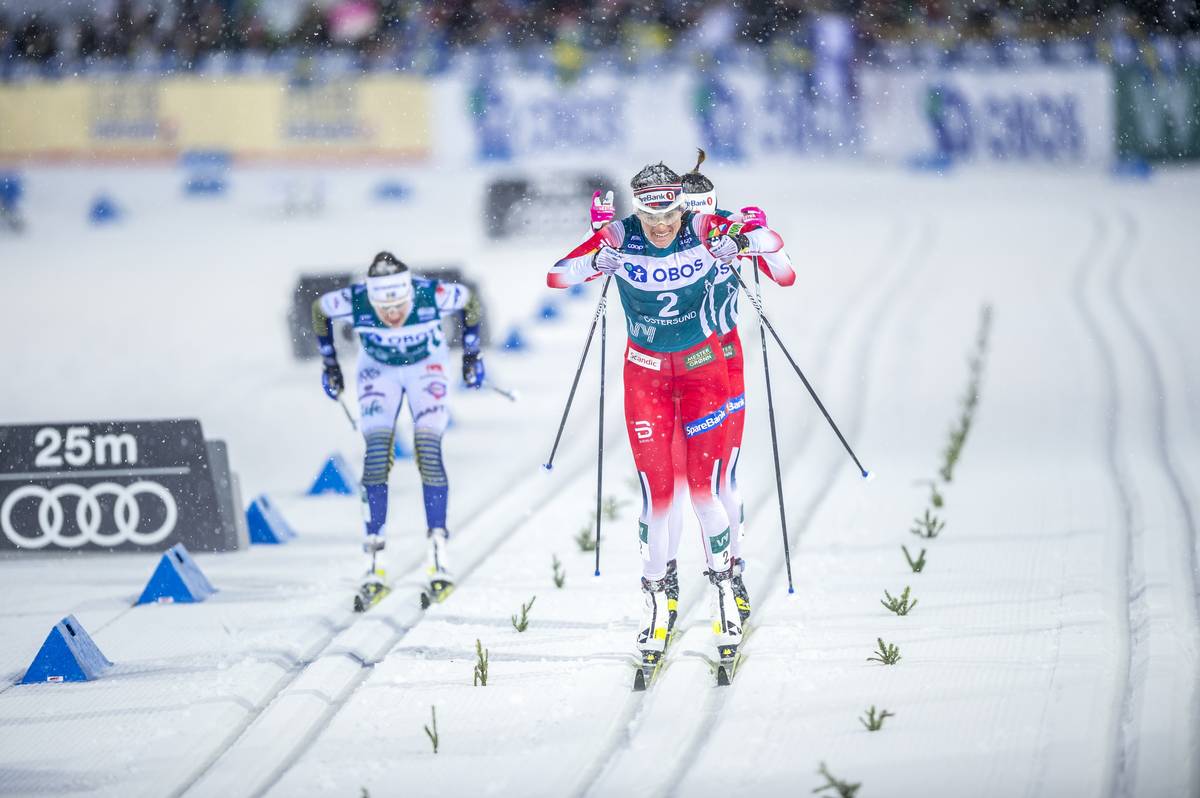
Heidi Weng (bib) taking second in Stage 2 of the Ski Tour 2020. (Photo: NordicFocus) Weng led the charge into the final straight. Østberg slotted in behind Weng using her as a double-poling pace machine. Weng and Østberg gained a precious few meters on Andersson to take second and third, respectively.
Johaug leads the Ski Tour 2020 after two stages with a total time of 49:18. Weng is second at 0:57, and Østberg is third overall with the same time back. Andersson sits one second further back in fourth overall.
The race behind the top-four had a different vibe. It was less about fending off a potential chase, and more about how a large group of skiers would coalesce, who would lead, and who would sit back and take advantage of the more skied in tracks.

Jessie Diggins skiing to 11th overall during the Ski Tour 2020 Stage 2 10 k classic pursuit. (Photo: NordicFocus) American Jessie Diggins, in bib 8, pulled the group through the 3.3 k mark 1:25.2 behind Johaug. In contact with Diggins, and coming through in this order were Astrid Uhrenholdt Jacobsen, Ragnhild Haga, Rosie Brennan, Krista Pärmäkoski, Frida Karlsson, and Natalia Nepryaeva. The group from fifth to Austria’s Therese Stadlober in 16th place was separated by 11 seconds.
Brennan took her turn up front though the 4.9 k mark, as did Karlsson later in the race. By the finish, the collective group did not gain time on those ahead, they ceded a few more seconds to the top four. But we would be remiss to make note of Brennan’s determination. You could see it in yesterday’s 10 k skate, and it was evident today; she’s got moxie and now the confidence to take pulls, as she did with Karlsson today, and try to break the pack. In a post-race interview (audio posted below), Brennan noted she had in fact been keen on making a move during the pursuit.

Grit: Rosie Brennan during Stage 2 of the Ski Tour 2020. (Photo: NordicFocus) Post-race interview with Rosie Brennan
Slovenia’s Anamarija Lampic ended up fifth overall (+1:38.7), as the first finisher of the third group out on course. Brennan ended her day in 10th (+1:43.3), and Diggins in 11th (+1:43.6).
“It was a pretty crazy day out there!” Diggins wrote. “I was actually super stoked about the rain while warming up because klister skiing in the rain is such amazing kick and really fun getting up all the hills on. The snow right before the start made it a really strange race because the one track became exponentially faster as it got skied in, which led to massive packs (for a girls race, anyway) forming. Huge thanks to the tech team because my skis stayed competitive and were kicking well even in the rapidly changing conditions!
“I’m excited for the rest of the tour – the next two races are formats we’ve never done before, so I’m ready to go give it my very best shot!”
Sadie Maubet Bjornsen, who began in bib 22, 1:51.4 behind the first starter Johaug, placed 19th (+2:12.5).
“After recovering from a mild tummy bug or a form of food poisoning that visited the night before the start of this tour, I am feeling thankful and hopeful after the second stage of the tour today,” Maubet Bjornsen emailed. “With a snow/rain downpour, I was feeling right at home strapping classic skis on my feet and heading out in the misery. I have spent plenty of days in this exact condition during summer training up on Eagle Glacier, so I was trying to channel every bit of internal strength I could find. The fact that I was able to work my way up to 19th today, and had encouraging feelings in a somewhat depleted version of myself is something I will take and run with!
“I am excited to have a day to recover and fill up my tank, and take on this tour in the same way I did the last. An imperfect start will just fuel me with the extra fight for the days to come!“Thanks to the tech team for putting wonderful skis together given the absolute craziness coming out of the sky!”In speaking to U.S. World Cup Head Coach Matt Whitcomb after the race, he explained that skiers in the back of the field were able to take advantage of the considerably faster skied in tracks. Again, heavy wet snow fell during the race.
Post-race interview with Matt Whitcomb
U.S. skier Hailey Swirbul in bib 36 moved into the points on Sunday to place 24th (+2:20.2). Her trajectory in the standings aligned with her 13th fastest time of day. Along those lines, Julia Kern of the U.S. Ski Team skied from 50th to finish 36th (+2:43.8). Her on course time was the sixth-fastest of the day.
Also for the U.S., Caitlin Patterson was 41st (+2:54.1), Sophie Caldwell 51st (+3:07.0), Alayna Sonnesyn 54th (+3:55.7), Katharine Ogden 55th (+4:03.8), and Rosie Frankowski 62nd (+4:59.7).
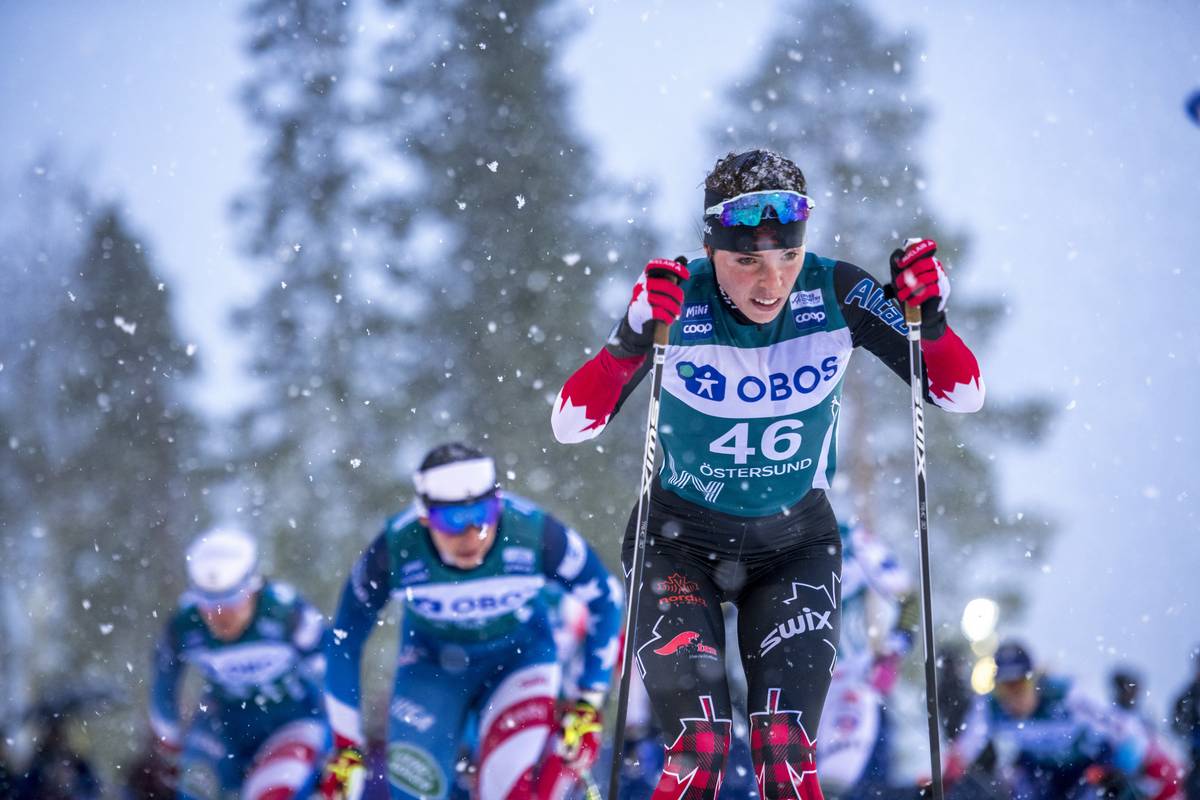
For Canada, Katherine Stewart-Jones placed 32nd (+2:37.5) and skied the ninth fastest time of day. Cendrine Browne was 39th (+2:45.9), and Emily Nishikawa 44th (+2:59.8).

Katherine Stewart-Jones (CAN) during Stage 2 of the Ski Tour 2020. (Photo: NordicFocus) As far as the overall standings and how times are calculated, time of day is used to determine a skier’s time for Stage 2.
Results | Overall Ski Tour Standings | Time of Day Results
-
Down to the Wire, Golberg Out Sprints Bolshunov for the Pursuit Win
Picking up where we left off in Östersund, Sweden: a pursuit start 15-kilometer classic. Unlike the women’s field where Therese Johaug “administered a beatdown”, creating a large time gap for herself, the margins for the men were much smaller.
A glance at the start list shows yesterday’s winner and Tour leader Sjur Røthe of Norway starting only two seconds ahead of his teammate, Simen Hegstad Krüger, and 17 seconds ahead of Finn Hågen Krogh and Martin Johnsrud Sundby.
This year’s Tour de Ski winner Alexander Bolshunov of Russia, whose winning streak was interrupted, would start with a 22 second time deficit in fifth. Tenth place Ivan Yakimushkin (RUS) was 33 seconds back and Jens Burman (SWE) in 20th just inside a minute.

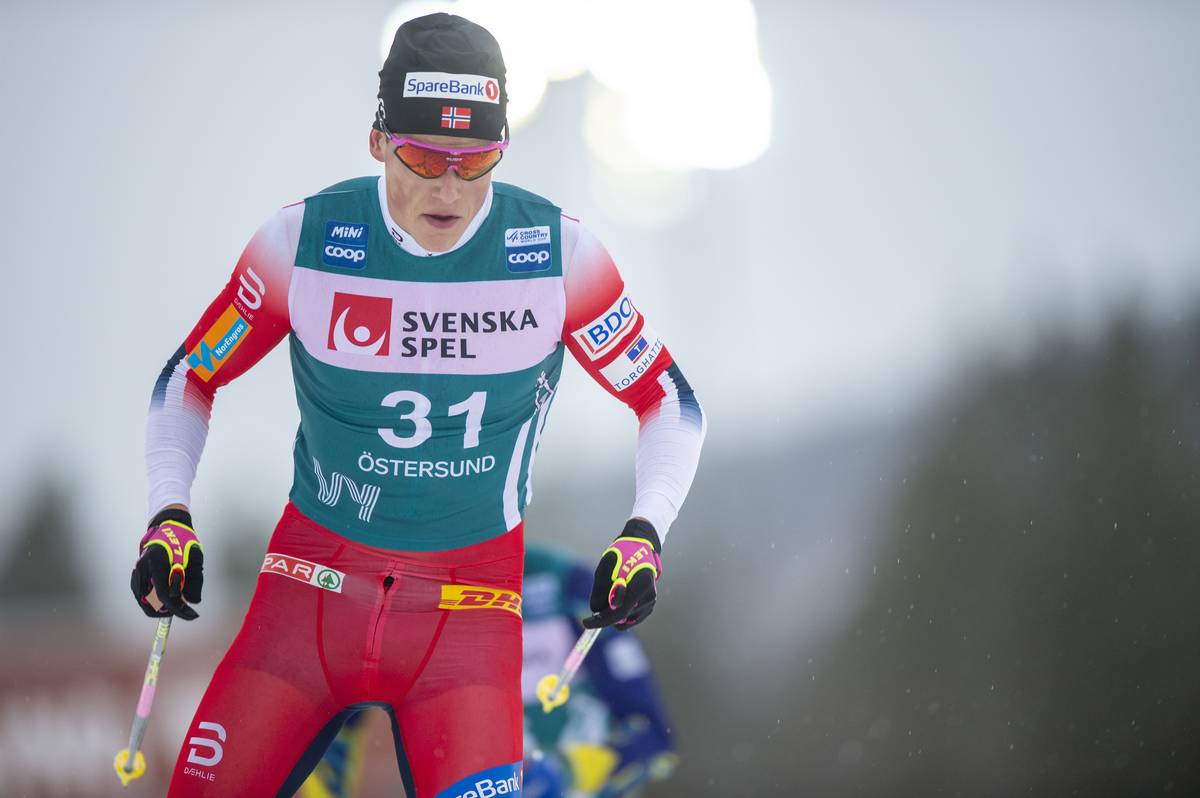
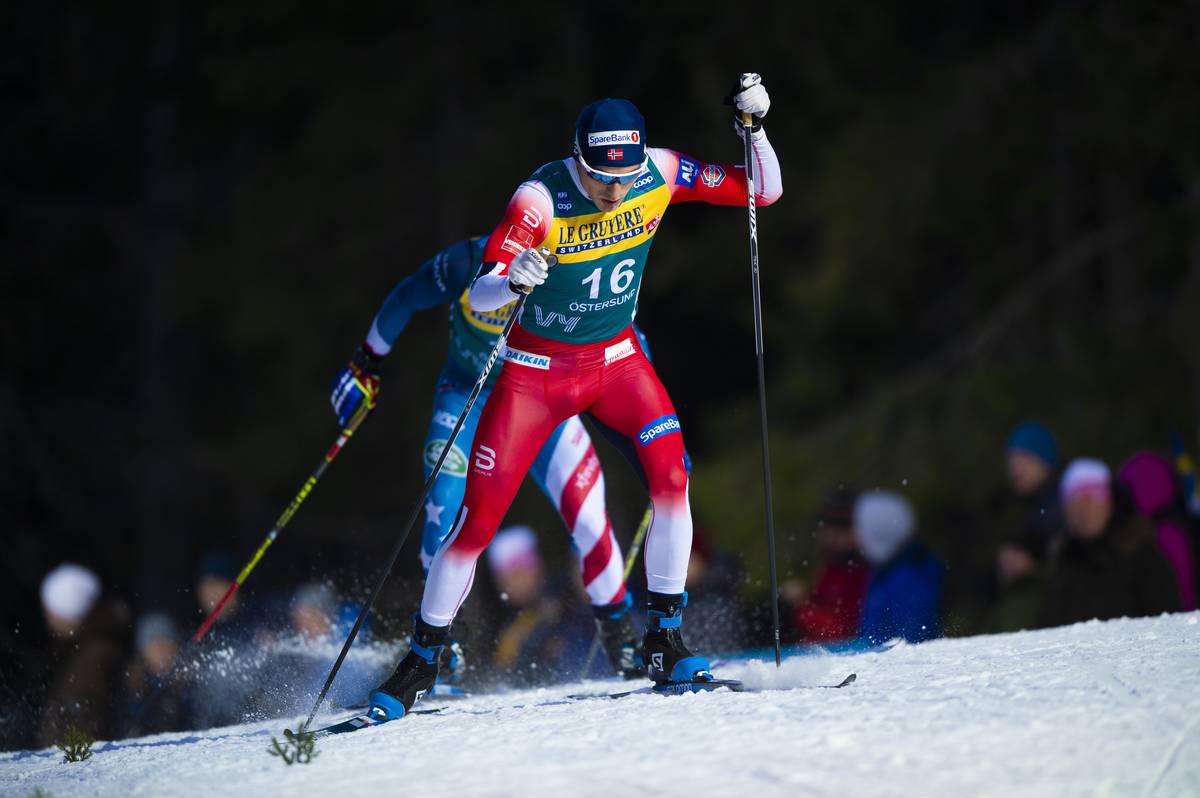
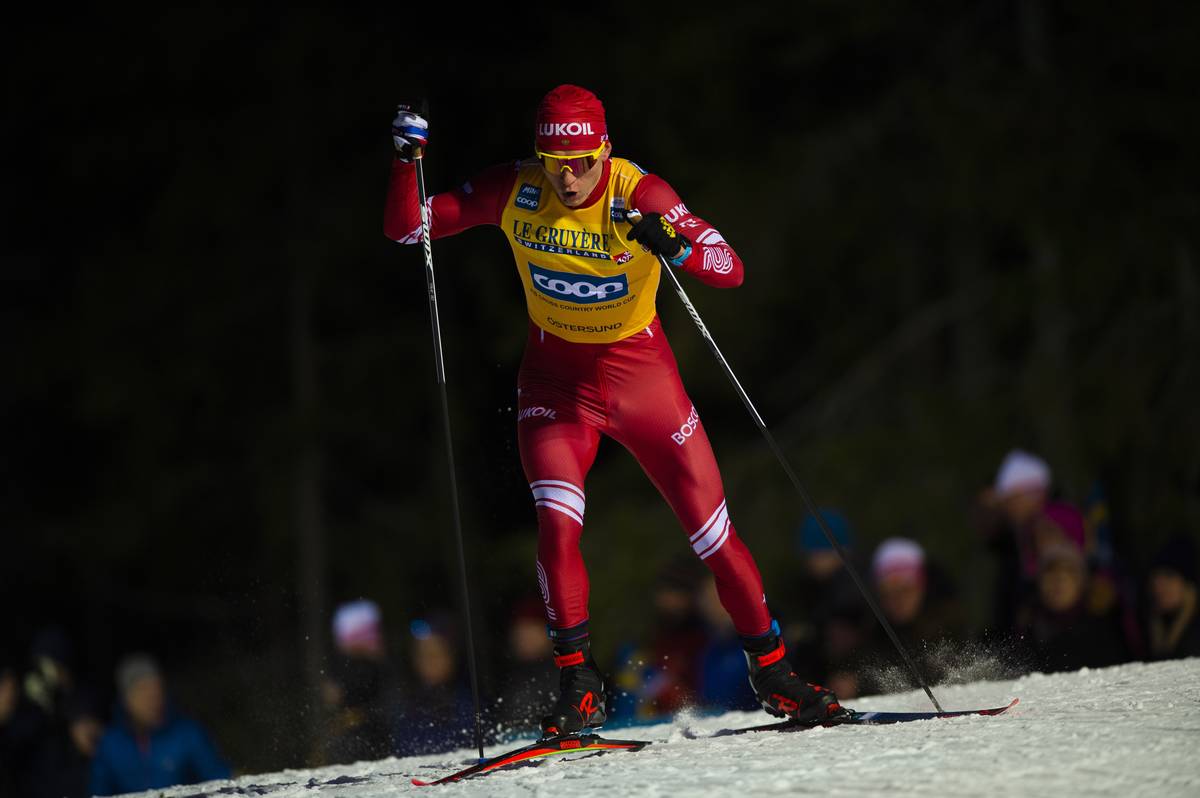
Alexander Bolshunov during Stage 2’s 15 k classic pursuit of the Ski Tour 2020. (Photo: NordicFocus) With four 3.75 k laps to cover, the deficits were manageable. Perhaps the only Tour victory hopeful who was kept up about the work that needed to be done was Johannes Høsflot Klæbo, who would start 1:23 behind the leader after finishing 31st the day before.
The caveat would be to stay upright while navigating the icy winding bends of the primarily man made track. With grey skies and above-freezing conditions, it was fast and dicey, made evident by numerous crashes.
During one particularly noteworthy four-person pileup, Kamil Bury of Poland was taken out by Italy’s Maicol Rastelli as the two navigated a treacherous right hand turn at the bottom of a steep descent. Though neither had full control, Rastelli slid off the left side of the course, taking Bury along with him. Bury lost a ski and became tangled in the netting.

Just before impact… (Photo: Screenshot NBC/FIS Broadcast) 
Mid-flip. Ouch. (Photo: Screenshot NBC/FIS Broadcast) As Rastelli stood up and worked to right his skis, which were pointing in opposing directions, a third skier, Lin Bao of China, essentially slide tackled Rastelli, sending him in a complete backflip back down to the snow.
A fourth skier, Tadevos Poghosyan of Armenia, also lost control and slid into the pile. Bao and Poghosyan were able to stand up relatively quickly and continue on their way, but cameras cut away before the resolution of whether Bury found his ski and Rastelli was able to recover from his forced aerials.
Holy carnage… back to the race.
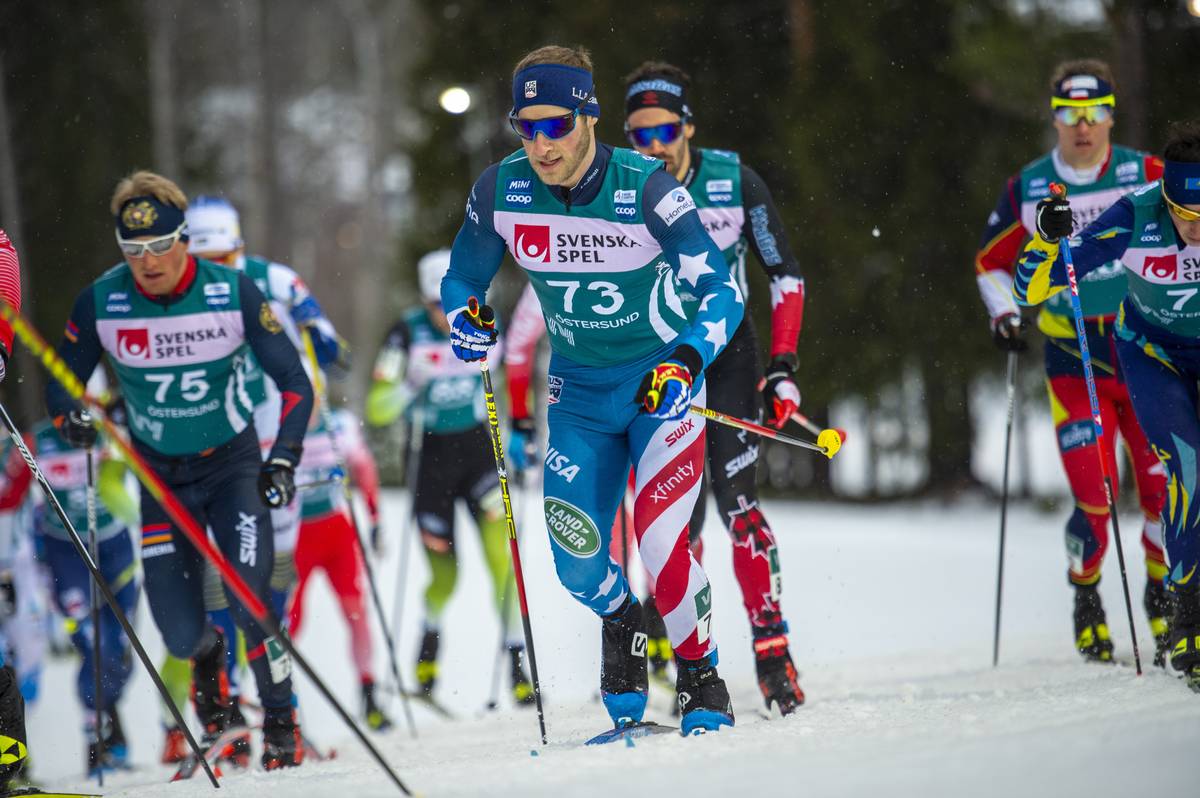
At the end of the first lap, it was as if the men were gifted ready-made groups. Røthe and Krüger matched stride for stride and double pole for double pole, while the remainder of the top five plus a handful of additional Norwegians, namely Pål Golberg, Hans Christer Holund, and Martin Løwstrøm Nyenget, chased from roughly six seconds back.

In bib 11, Martin Løwstrøm Nyenget (NOR) works his way towards the sharp end of the men’s 15 k classic pursuit. (Photo: NordicFocus) It looked as though Røthe and Krüger might run away from the field, but it was not so easy. By 4.4 k, the gap was closed and an eight-man train chugged along the tracks. As Yakimushkin had fallen off the pace, it became seven Norwegians and Bolshunov.
Over the final two laps, the front pack whittled down from eight to five, where it remained with one k to go. Holund, Golberg, Røthe, Bolshunov, and Nyenget. The Russian in the yellow bib was primed to make a move.
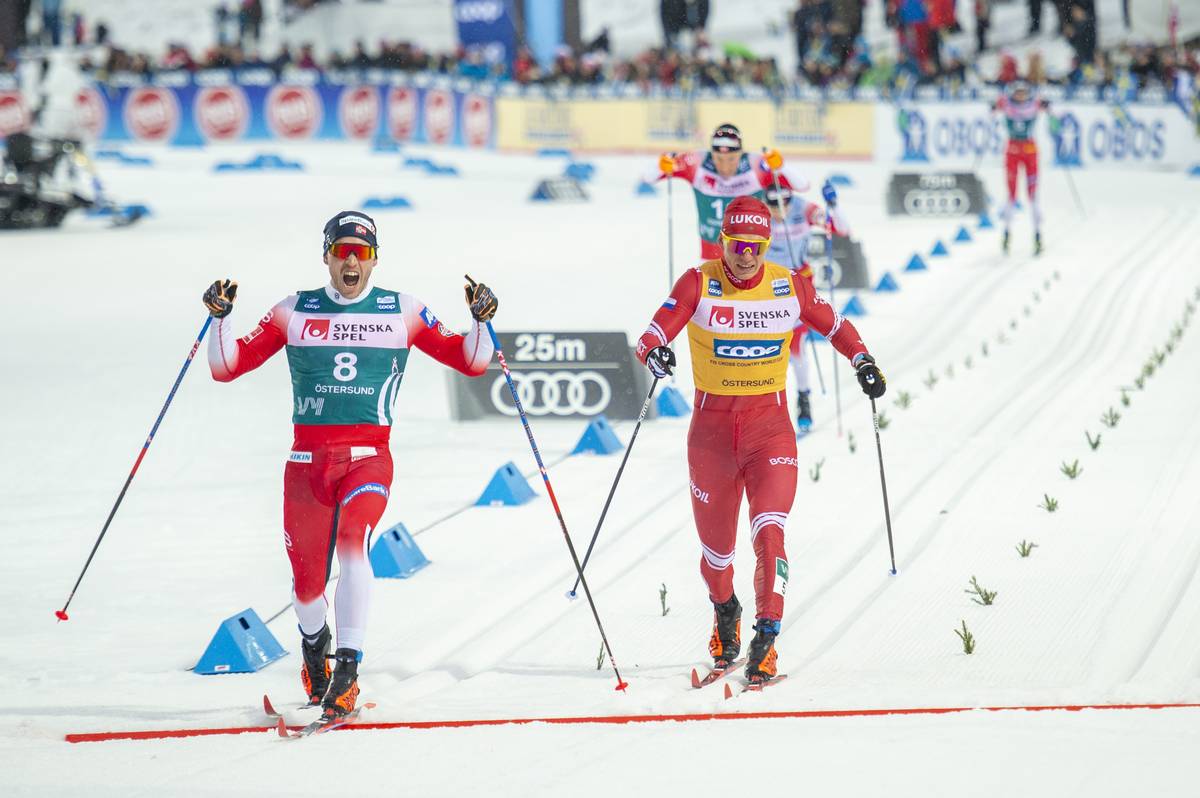
Bending, rolling, and swooping, they headed for the stadium. Up the final punchy climb, Golberg and Bolshunov were side by side, and Golberg started to slip. He recovered and powered out of the climb, running with Klæbo-like dominance over the crest of the hill and into a tuck to lead into the stadium.
Bolshunov had fast skis and caught a draft before whipping into second place as the men entered the final straight. The Russian was right behind Golberg and absolutely charging. But there was not enough real estate. He changed lanes to challenge the Norwegian and looked as though he would overtake him, but the final meters evaporated and Golberg threw his foot for a clear win.

A lane switch wasn’t enough for Alexander Bolshunov as Pål Golberg of Norway takes the win. (Photo: NordicFocus) 
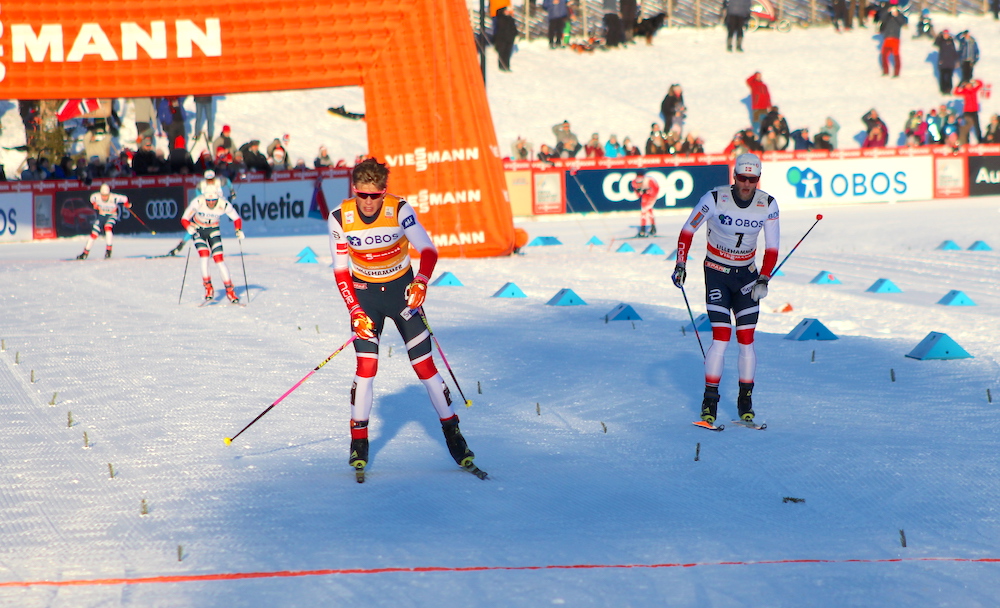
Pål Golberg about to toe – during the 15 k classic pursuit, Stage 2 of th Ski Tour 2020 in Östersund, Sweden. (Photo: NordicFocus) Golberg crossed the line in 34:50.8, with Bolshunov 0.3 seconds behind. Nyenget took third (+2.1) in a tight finish with Røthe (+2.5). Holund dropped off in the final sprint to round out the top five (+7.3).

Pål Golberg wins at the line over Alexander Bolshunov during the 15 k classic pursuit, Stage 2 of th Ski Tour 2020 in Östersund, Sweden. (Photo: NordicFocus) “Perfect klister conditions,” Golberg told FIS at the finish. “I managed to get the ski pair from last weekend, so I had good skis this weekend as well. It was a really, really good day.”
The interviewer noted that conditions were much different than the previous day.
“It was hard in the middle,” Golberg explained. “It was a bit drier, so a bit difficult with klister in the downhill. But the tracks were perfect, so I’m really happy.”

Not the start of the FIS Ski Tour 2020 desired by Johannes Høsflot Klæbo. (Photo: NordicFocus) Speaking of Klæbo, the Norwegian skied his way into 25th, but ceded an additional 52 seconds in the overall standings by finishing 2:15 back on the leaders.
FIS sent out a news brief shortly after the race with information regarding Klæbo’s injured finger. Here is the statement in full:
“Johannes Høsflot Klæbo (NOR) has to undergo an emergency check up for his broken finger. The check up has to take place with his doctor in Trondheim (NOR). As the rules of the FIS Ski Tour 2020 state no other transportation of athletes than by train, the jury gave permission to Johannes to travel by car to Trondheim and back to Åre for this special case. After the consultation, the jury will receive a report of the treating medical team in Trondheim.”

Leading again for the U.S., David Norris skis to 34th. (Photo: NordicFocus) 
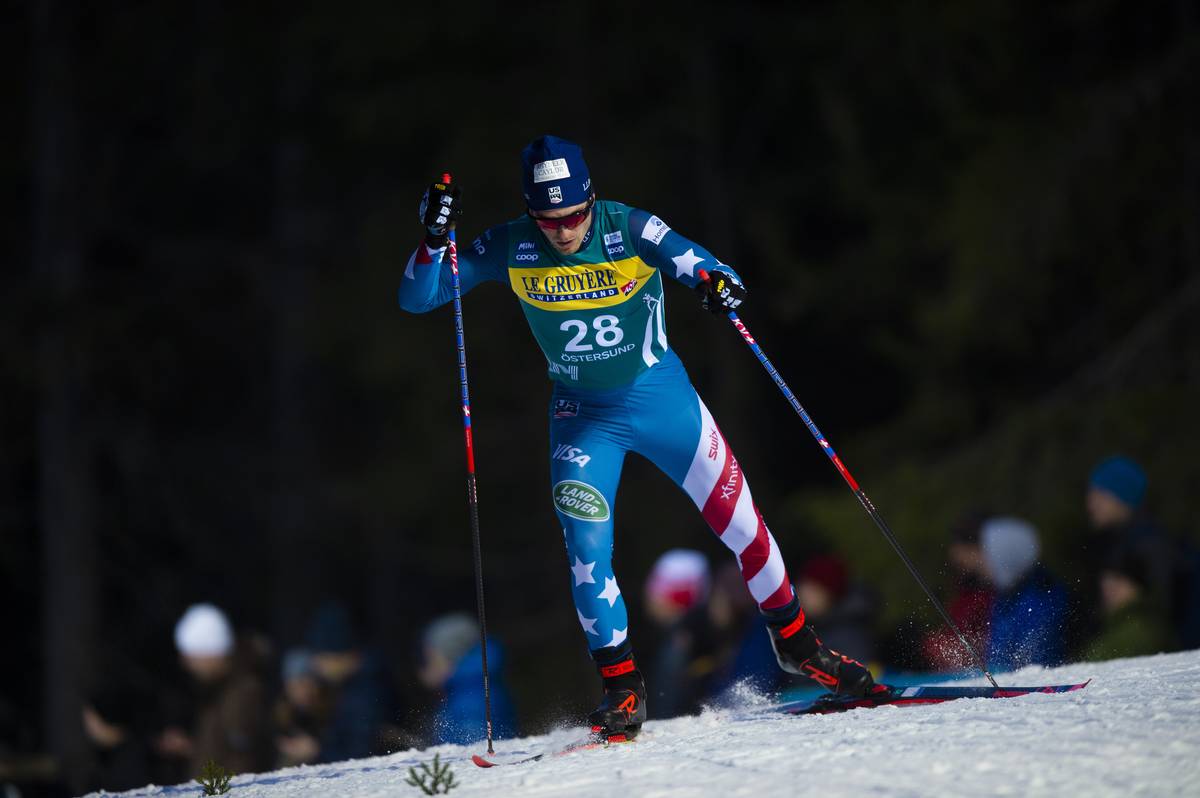
Stride and glide, Simi Hamilton climbs in Östersund, Sweden. (Photo: NordicFocus) The American men hovered near their positions in Stage 1 at the end of the pursuit. Still grinding, David Norris finished 34th (+3:05.0), followed by Simi Hamilton in 43rd (+3:47.8).
Ben Lustgarten was the next American in 68th (+6:01.4), followed by Kevin Bolger in 70th (+6:12.7), and Logan Hanneman in 85th (+10:00.2).

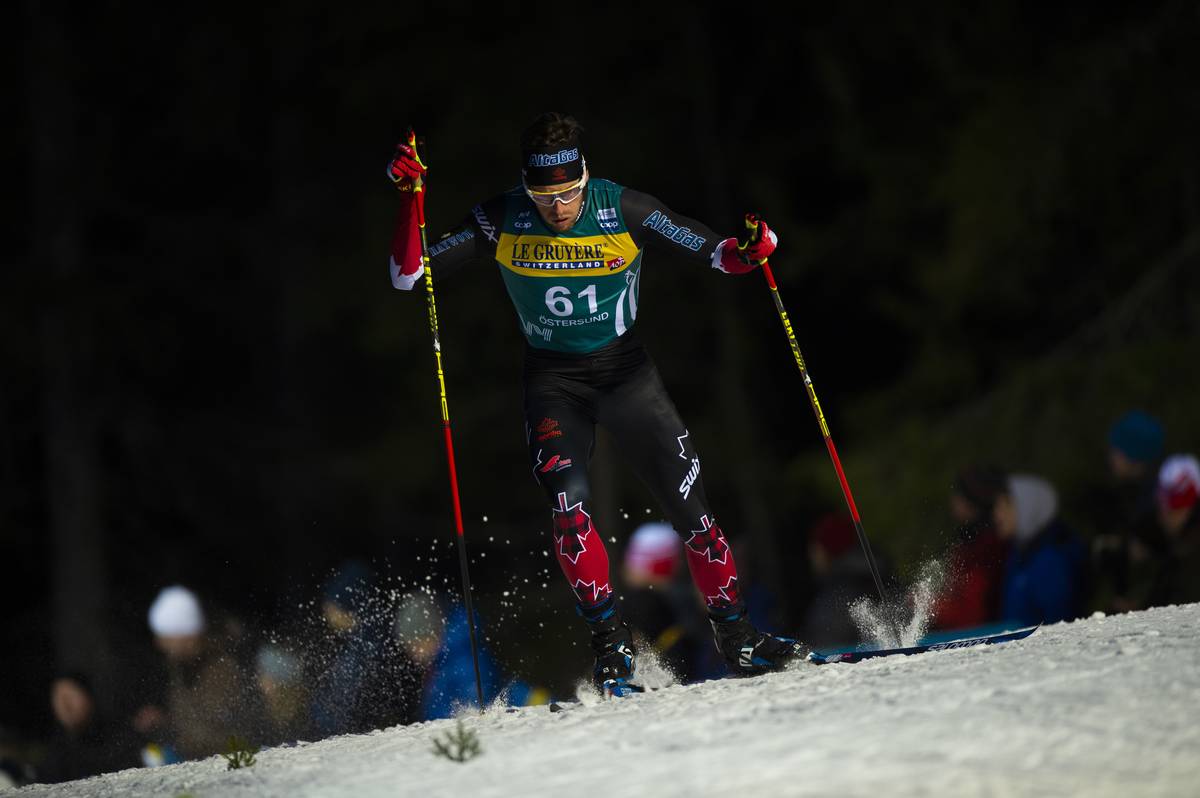
Ben Lustgarten in the mix during the classic pursuit in Östersund, Sweden. (Photo: NordicFocus) Racing for Canada, Russell Kennedy was again the top skier in 58th (+4:47.3). Next up was Alexis Dumas in 61st (+4:51.9), and Evan Palmer-Charette in 66th (+5:33.7).
Tomorrow is a rest day on the Ski Tour 2020, Stage 3, a skate sprint, will be held on Tuesday.
Final Results | Overall Tour Standings After Stage 2 | Time of Day Results

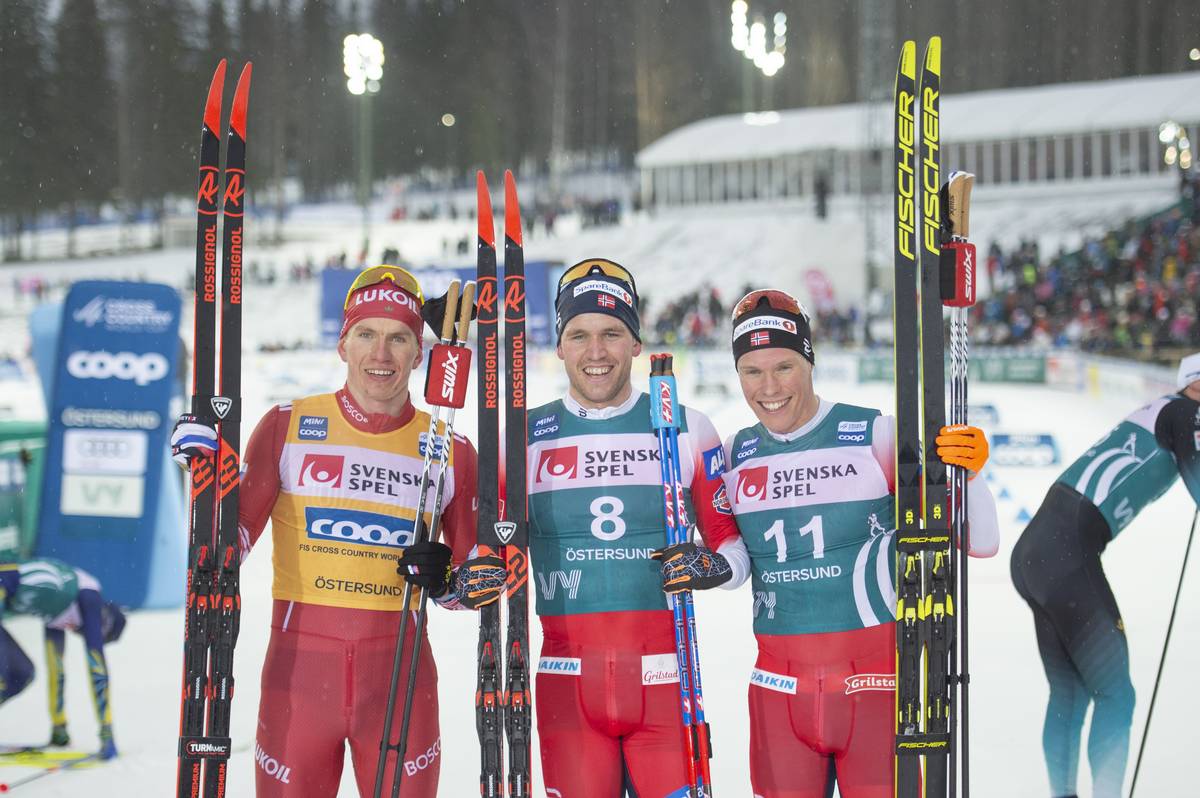
The men’s Stage 2 Ski Tour 2020 15 k classic pursuit podium:
Alexander Bolshunov (RUS) second, Pål Golberg (NOR) first, and Martin Løwstrøm Nyenget (NOR) third, (l-r). (Photo: NordicFocus) -

The Devon Kershaw Show: Ski Tour 2020 Stage 1

It was all Norway in both the men’s and women’s Stage 1 of the Ski Tour 2020 from Östersund, Sweden. Sjur Røthe on the men’s side was pacing perfection while Therese Johaug simply steamrolled. This was clear, Norway had the best skis, and perhaps by default, the fastest skiers almost across the top-10 board. Yet, it is a long week ahead, and we are one stage into a six-stage event.
Here’s the debrief from Devon: post 15 k/ 10 k interval start skate.
-
Perfect Pacing: Sjur Røthe Claims Ski Tour 2020 Stage 1 Win

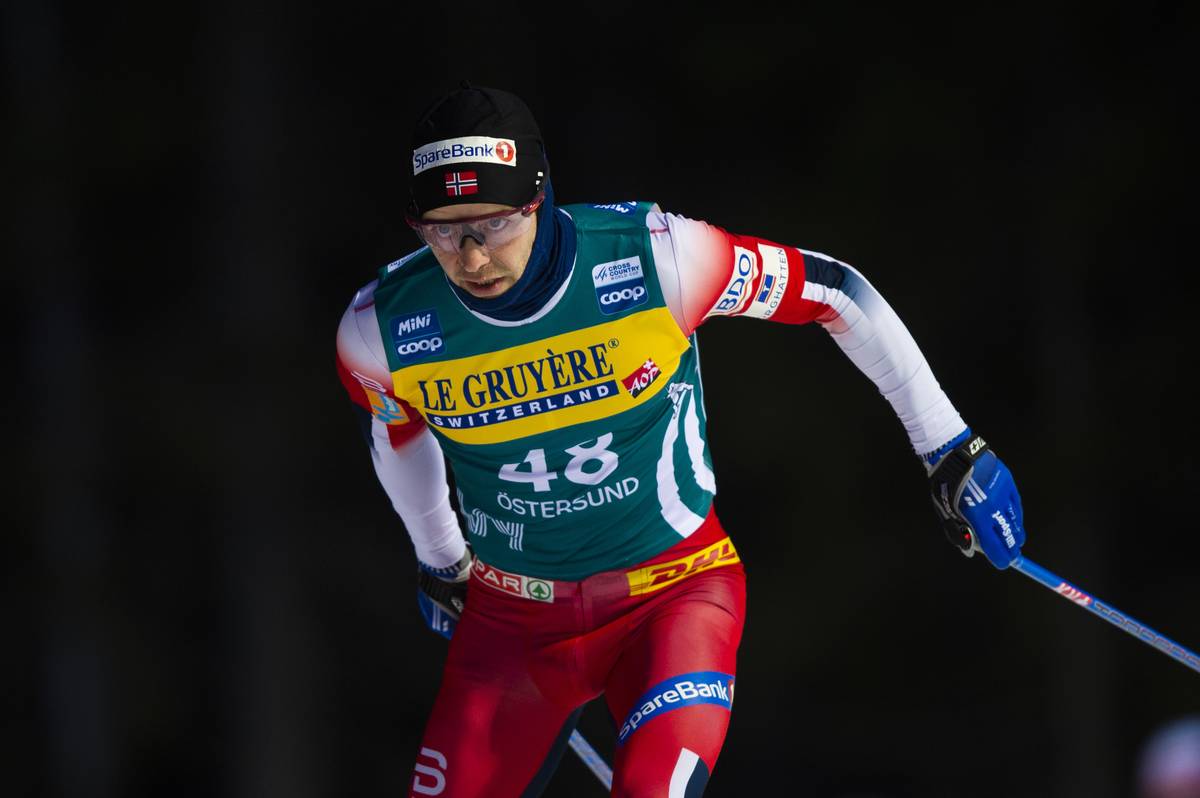
The pacing master of Stage 1 of the Ski Tour 2020: Sjur Røthe. (Photo: NordicFocus) The six-stage Ski Tour 2020, which runs from Sweden to Norway over the next week, began Saturday in Östersund, Sweden with the men’s 15-kilometer individual start skate. The race began with twilight immersing Östersund with the sky eventually morphing into black as the seeded group of skiers looped around on what FIS called a 4.71 k course. This much can be concluded after a single day of what will be a hotly contested tour: the Norwegians fired on Stage 1 as they captured the top four spots in the field of 90 skiers.
The other take away beyond the Norwegian team’s blistering skis – Sjur Røthe paced himself a masterful 15 k of skiing as he won the event in 30:41.5 minutes.
However, not all looked shiny for the Norwegian as he went on to win his first World Cup of the season. At the 5 k time check, Røthe came through in 19th place, 19.5 seconds behind Hans Christer Holund, also of Norway. At 7.6 k, the halfway mark for the race, Røthe had moved up to 10th overall but remained 20.3 seconds off the fastest split set by yet another Norwegian, Simen Hegstad Krüger.
Then the tides turned, and Røthe began chiseling away at the time deficit. As he lapped through at 10 k, he sat in fourth, 15.4 seconds behind the virtual leader, Krüger. The chisel became a jackhammer; at 12.6 k Røthe was within six seconds of Krüger.

Simen Hegstad Krüger hammering during the 15 k skate, Stage 1 of the Ski Tour 2020. (Photo: NordicFocus) The pacing proved perfect only when Krüger crossed the line: Krüger was a later starter than Røthe: Røthe began in bib 48, Krüger in bib 64. Røthe could, however, pace himself off the splits of Norway’s Finn Hågen Krogh who began in bib 16. Of the early starters, Krogh set the fastest marks at 5 k, 10 k, and the finish, respectively.

Finn Hågen Krogh (bib 16) an early starter during Stage 1 of the Ski Tour 2020, but fast through his 15 skate effort for third overall. (Photo: NoridcFocus) Røthe’s first-place time (30:41.5) was 1.7 seconds faster than Krüger’s who took second on the day. Krogh was third overall (+16.6), and the veritable senior citizen of the Norwegian team, Martin Johnsrud Sundby, placed fourth (+17.3).
Saturday’s victory was Røthe first win of the season – however, it was his sixth individual podium which includes a second-place time of day podium in Ruka’s 15 k skate pursuit back in December. Last week, he was second in Falun’s 15 k mass start skate.
“It was a great day for me and the Norwegian team,” Røthe told FIS after the race. “I think we need to give a big hug to the guys in the wax cabin today. They made brilliant skis for us today, and for sure I have done my preparations well, I am really satisfied with today. I am looking forward to [the Ski Tour], it has been one of my main goals this season so for sure I am prepared, but I need to go home and get a good rest because it is not many hours before we do the classic race here in Östersund as well.”
For those playing the long-term odds in the Ski Tour 2020, after one stage down, Russia’s overall World Cup leader, and 2019-2020 Tour de Ski winner, Alexander Bolshunov, placed fifth (+22.2).

Russia’s Alexander Bolshunov, the overall World Cup leader here during Stage 1 of the Ski Tour 2020. He placed 5th on the day. (Photo: NordicFocus) Along with capturing first through fourth places, Norway also claimed sixth (Hans Christer Holund), and eighth (Pål Golberg) place in the top-10. Norwegian Johannes Høsflot Klæbo was out of the points in 31st (+1:22.8). The Norwegian star returned after missing last weekend’s racing in Falun with a broken finger. Along with Bolshunov’s fifth place, Russia took ninth (Denis Spitsov) and 10th (Ivan Yakimushkin). The national team outlier in the top-10 was France’s Adrien Backscheider in seventh.
David Norris (APU), of the U.S., was the best-placed North American in 36th (+1:27.7). U.S. teammate Simi Hamilton (USST) placed 46th (+1:54.5). He returned to the World Cup racing after sitting out last weekend’s racing due to lingering neck pain. Kevin Bolger (USST) skied to 71st (+3:11.1), Ben Lustgarten (CGRP) 73rd (+3:12.2), and Logan Hanneman (APU) 86th (+4:35.6).
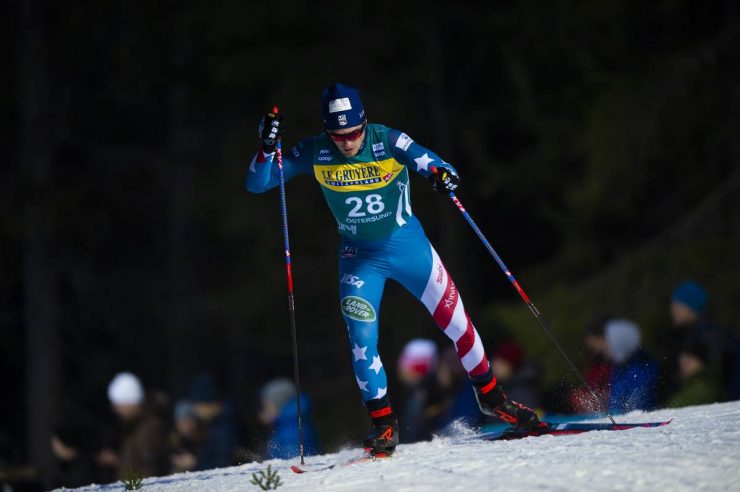
David Norris of the U.S. during the 15 k skate, Stage 1 of the Ski Tour 2020. (Photo: NordicFocus) Post-race comments from U.S. World Cup Coach Matt Whitcomb
For Canada, Russell Kennedy skied to 52nd (+2:02.5), Evan Palmer-Charrette 60th (+2:31.9), Alexis Dumas 64th (+2:39.4), and Ricardo Izquierdo-Bernier 80th (+4:10.7).

Russell Kennedy of Canada, during Stage 1 of the Ski Tour 2020. (Photo: NordicFocus) Racing continues in Östersund tomorrow with a 15 k classic pursuit for the men and a 10 k classic pursuit for the women.
(No time bonuses were on offer in today’s race.)
Results | Ski Tour 2020 Standings After Stage 1

Ski Tour 2020 Stage 1 podium: Simen Hegstad Krüger (NOR) second, Sjur Røthe (NOR) first, and Finn Hågen Krogh third. (Photo: NordicFocus) -
Johaug Tops an All-Norwegian Podium; Diggins 8th, Brennan 9th
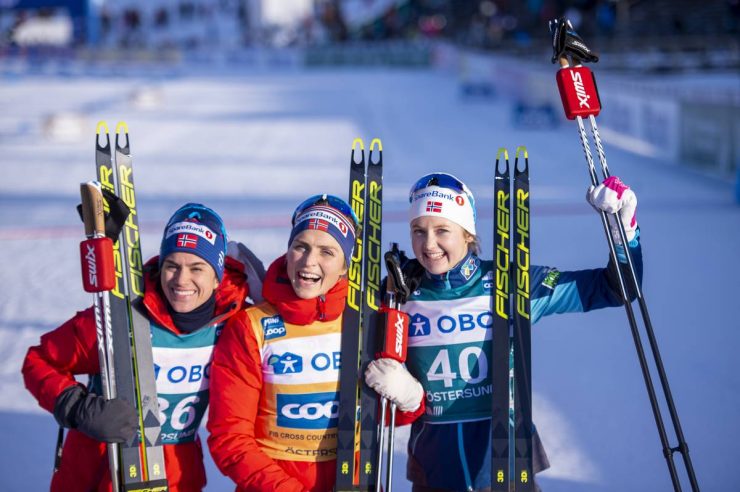
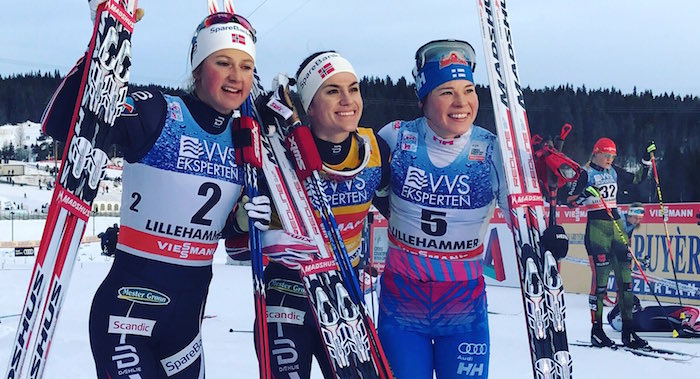
An all-Norwegian podium in Östersund, Sweden. Therese Johaug won the day ahead of Heidi Weng and Ingvold Flugstad Østberg. (Photo: NordicFocus) Here we go again. A new Scandinavian Ski Tour takes the spot of a World Championship or Olympic Games during this off-cycle year. Six stages working east from Östersund, Sweden to Trondheim, Norway, beginning with today’s 10-kilometer individual start freestyle event.
Under clear skies, light fading and shadows lengthening as the sunset looms just a few hours away, the women time trialed through the tall conifers to set the tone of the overall tour standings. Crowds arrived in droves to line the course and fill the stadium, a cacophony of cheers creating the soundtrack to the stage.
Today’s format suits the Tour favorite, Therese Johaug, who has expressed that mass start events do not suit her as well. This season, Johaug won the Tour de Ski and has taken the top spot in each of the last ten individual start distance skate events.
Her story today essentially wrote itself. In Devon Kershaw’s words: “Gun to tape annihilate.”
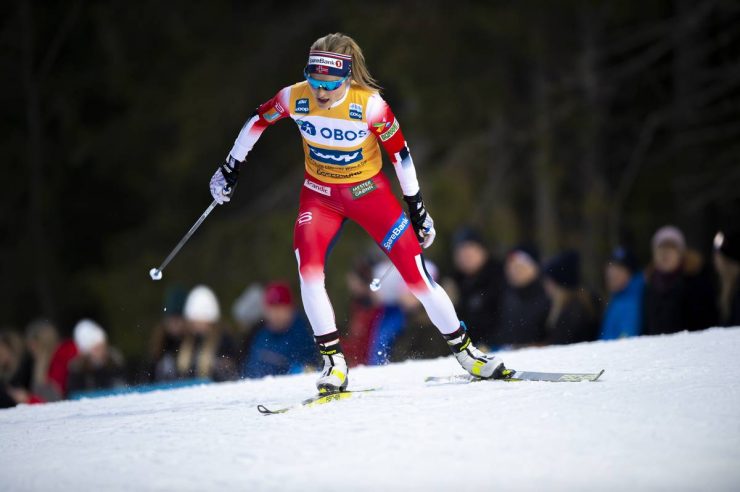
Therese Johaug (NOR) dominates the first stage of the FIS Ski Tour 2020. (Photo: NordicFocus) Johaug hammered out of the start gate and did not slow down until she crossed the line, her grimacing face making clear the unmatchable power and tempo she was forcing herself to maintain. Stopping the clock at 21:49.7 and raising her arms briefly in the air before collapsing over her poles, Johaug sealed the deal on best in show.
Her time gap on her competitors increased in an almost alarmingly linear fashion throughout the stage. 12.8 seconds at 2.6 k increased to 20 at the halfway mark, growing to 45.6 seconds at the finish.
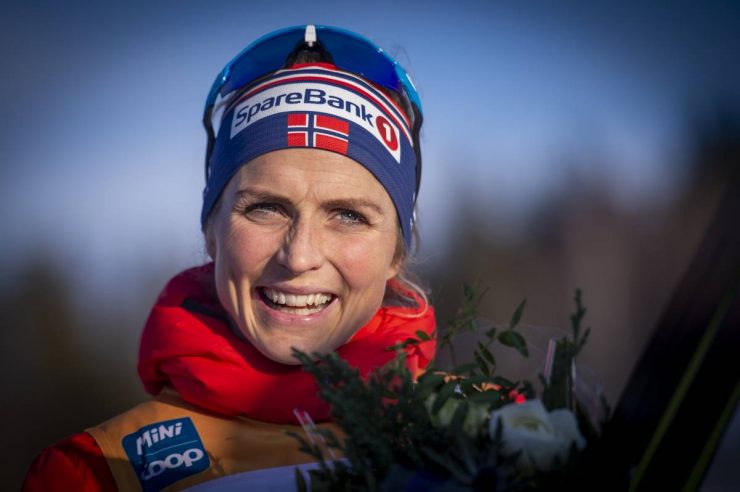
Victorious in Östersund, Therese Johaug has a strong start to the FIS Ski Tour 2020. (Photo: NordicFocus) “Oh yes, I could never get a better start than this,” a glowing Johaug told FIS at the finish. “I feel that it was my best skating distance in my career, so I am really happy with the skis and with the shape. It was an amazing race today… It’s good to start the Tour and I’m looking forward to the next races.”
Here’s what else went down.
Racing in bib 27 amongst the first wave of 30 skiers, Rosie Brennan set the bar high for the seeded group of top-ranked skiers who followed in bibs 32 – 60, posting some of the fastest time through each checkpoint. Although she faded into the results as the seeded group came through, it was still a noteworthy performance, placing her 9th for the day (+1:25.7) and second American.
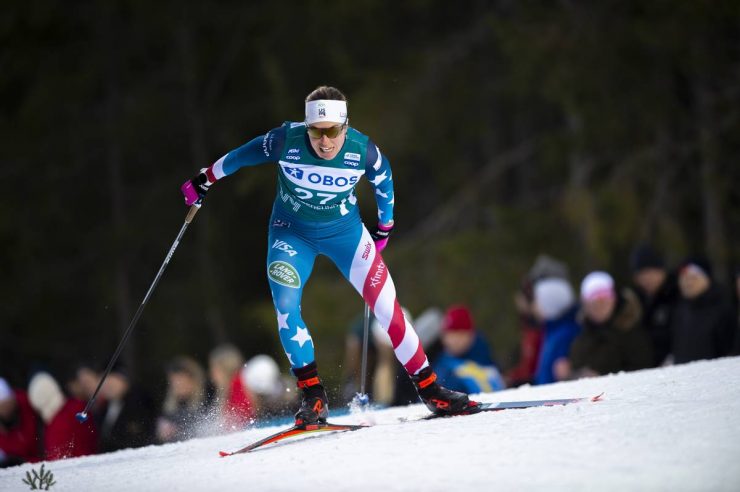
Rosie Brennan sets the bar, racing to 9th in the first stage of the FIS Ski Tour 2020. (Photo: NordicFocus) Of other skiers in her group, Brennan was only challenged by Norway’s Ragnhild Haga and Sweden’s Frida Karlsson, who was recently cleared to return to World Cup competition. Karlsson sat out the majority of the season after failing to meet team health standards for body composition and bone density.
Karlsson took the pace out hot, clearly gunning for the win, or at least for the bonus points available at the 2.6k checkpoint. She had the second fastest overall time there, then she attacked the steady climb with high tempo. But she was unable to hold the effort, fading back into the ranks as the race went on. She ended her day in 19th (+1:46.0).

After a fast start, Frida Karlsson falls to 19th in the 10 k skate. (Photo: NordicFocus) Among the first starters of the seeded group in bib 36, Heidi Weng (NOR) went hunting. From 4.2 k onward, she knocked down the previous best time, setting a new and short-lived time to beat, as Johaug chased from two bibs behind. Weng, the 2017 and 2018 Tour de Ski winner who is currently ranked third in the overall World Cup standings hung on to take the second podium spot.
Next over the line was Ingvild Flugstad Østberg in third (+47.3), who hovered a few seconds behind Weng at each checkpoint. The trio sealed the deal on an all-Norwegian podium.
Ebba Andersson of Sweden interrupted the string of Norwegians in fourth (+53.1), followed by Haga (+1:04.3) and Astrid Urenholdt Jacobsen (+1:05.0).
Leading the Tour for North America, Jessie Diggins skied to 8th (+1:18.1). Diggins currently sits 5th in both the distance and overall World Cup standings.
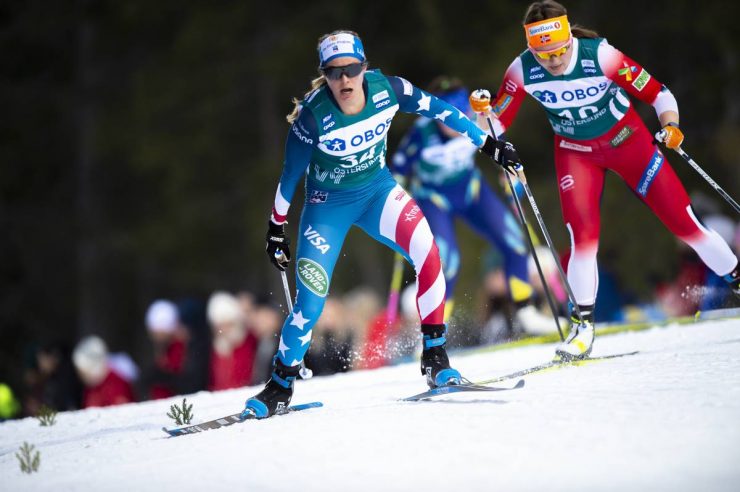
Jessie Diggins skates to 8th in the first stage of the FIS Ski Tour 2020. (Photo: NordicFocus) In a post-race call, Diggins described the track in Östersund as a “thinking course”, full of swooping turns that kept athletes focused and on their toes. Diggins explained that she has been experiencing an abnormal amount of fatigue over the last few weeks, but felt some encouraging sensations in today’s event and has a plan in place to optimize her recovery between stages so she can keep going hard.
She also shares insight about some of Tour’s sustainability initiatives to decrease the environmental impact of such an event, and weighs in on the energy generated from a large American team.
Post-race interview with Jessie Diggins.
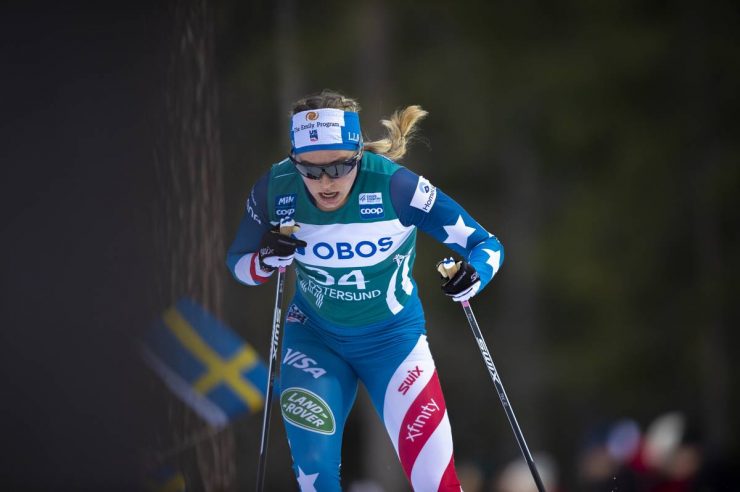
Jessie Diggins leads the way for Team USA after the first stage of the FIS Ski Tour 2020. (Photo: NordicFocus) Just behind Diggins, Brennan was the next American. It was the APU/USST athlete’s third top-10 result of the season. Her last two were also earned in stage events; she was 9th in the 10 k skate during the third stage of the Tour de Ski in Toblach, Italy and 6th in the 10 k classic in Ruka. She also skied the 7th fastest time of day up the Alpe Cermis in the final TdS stage.
“It was a good opening day of the Ski Tour 2020 for me,” Brennan wrote in an email to several news outlets. “After a frustrating weekend last week, I was ready to try to turn things around. The course here is hard and has lots of climbing so I felt it suited my strengths. It was fast conditions but there was also little rest so it was a tricky pacing game. I didn’t perfectly pace it and lost a little in the closing kilometers but I had much improved race feelings so I am very satisfied and hope I can continue this way throughout the tour.”

Sophie Caldwell on course in Östersund, Sweden. (Photo: NordicFocus) 
Back on the World Cup, Rosie Frankowski races the first stage of the FIS Ski Tour 2020. (Photo: NordicFocus) Sadie Maubet Bjornen was the next American in 22nd (+1:51.4), followed by her APU teammate Hailey Swirbul in 36th (+2:09.3). Caitlin Patterson was next for the U.S. in 40th (+2:19.1), Alayna Sonnesyn 43rd (+2:27.3), Julia Kern 50th (+2:38.0), Sophie Caldwell 51st (+2:39.3), Katherine Ogden 53rd (+2:48.0), and Rosie Frankowski 56th (+2:50.0).
In a post-race call, Matt Whitcomb sheds light on how the team is approaching the Tour in comparison to the Tour de Ski or a ski tour at the end of the season. Whitcomb explains that a major focus leading into the week was recovery and mental preparation.
“We didn’t focus to much on performance — that’s never a great way to go. We work on the process and getting people psyched by giving them the confidence to know that they’re recovered. Whether or not they’re sharp on the first day or two, they should be sharp by the end. Whether that ends up happening or not, we’ll see. But believing in it is the key.”
Whitcomb explains further how he gages how tired or recovered his athletes are and provides further insight into the women’s performance. Lastly, Whitcomb comments on Swirbul’s noteworthy rise in the ranks this year, attributing it to her fun but focused mental approach and the effect of the strong APU women’s training group.
Post-race interview with Matt Whitcomb.
On the Canadian side, Emily Nishikawa was the top finisher just outside the FIS points in 32nd (+2:05.0). She started one bib ahead of Sweden’s Charlotte Kalla, who she marked and followed to the finish once caught.

Emily Nishikawa leads the Canadian team in 32nd in Östersund, Sweden. (Photo: NordicFocus) Next up was Cendrine Browne in 35th (+2:09.0), followed by Katherine Stewart-Jones in 46th (+2:29.8).
The tour is young. Racing continues tomorrow with a 10 k pursuit start classic on the tracks in Östersund.
Final Results | Distance World Cup Standings
-

Fourcade Leaves Östersund with a ‘W’; Bailey 17th; Christian Gow Gets Career-Best 21st

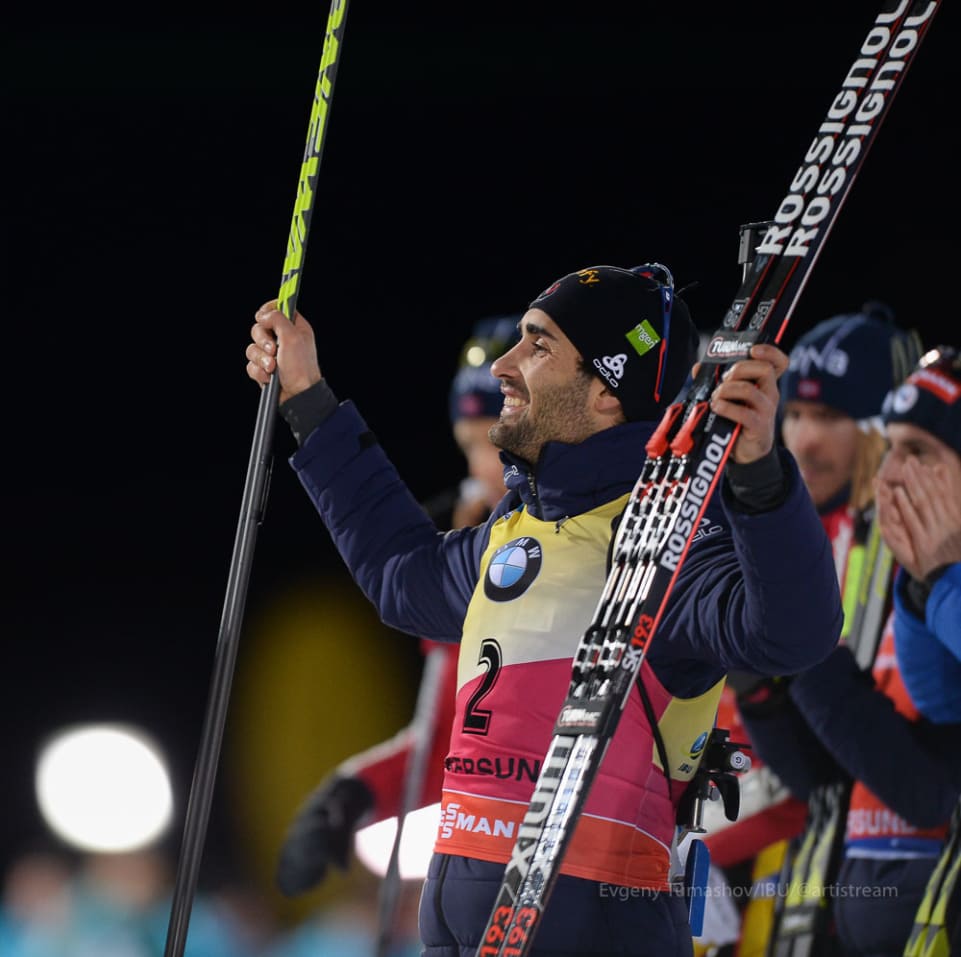
France’s Martin Fourcade celebrating his first IBU World Cup win of the 2017/2018 season in the men’s 12.5 k pursuit on Sunday in Östersund, Sweden. (Photo: IBU/biathlonworld) If you were to ask France’s Martin Fourcade what’s wrong with a second and third place, and even two fourth place finishes in the first four races of the International Biathlon Union (IBU) World Cup season, he’d likely politely tell you nothing — it just wasn’t up to his usual standards.
“Despite my two podiums here, I felt that if I had not won here, it would have been my worst season opener since, for seven years in a row, I won here,” the 29-year-old defending World Cup champion told the IBU after Sunday’s pursuit in Östersund, Sweden. “Now I can be very calm and relaxed for the next competitions.”
He got down to business out of the start of the men’s 12.5-kilometer pursuit, starting second, just 1 second behind Norway’s Tarjei Bø, who won the sprint to start the pursuit first. Early in the first of five 2.5 k loops, Fourcade set the pace with Bø and Germany’s Erik Lesser in bib 3 slotting in behind him. Fourcade entered the range first to take Lane 1 for the first prone stage, where he and Bø both missed a shot to slip to fifth and sixth, respectively, after each skiing a penalty lap. Meanwhile, Lesser missed four to drop out of the top 30 and nearly a minute and 20 seconds out of first.
While Fourcade left the range 10 seconds behind Norway’s Emil Hegle Svendsen, who had moved into first with clean shooting, he was back into first 2.5 k later. On the second prone, Fourcade and Bø both cleaned to leave the range just 3.8 seconds apart in first and second, respectively. Svendsen missed one to slip 18 seconds back to third.
On Loop 3, Fourcade switched into high gear. Bø kept pace, but by the time they lined up together for the first standing stage, Fourcade had the edge. The Frenchmen once again cleaned while Bø missed three to fall to 18th and nearly a minute and a half out of contention by the time he finished his penalty laps.
Game over. Fourcade spent the next two loops and final shooting going through the motions to secure his victory, cleaning the last standing stage with the 25th-fastest shooting time, then slowly turning to look up at the crowd. He appeared relaxed with his two closest challengers, his French teammate Quentin Fillon Maillet and Slovenia’s Jakov Fak, who started 2 seconds apart in 12th and 10th, respectively, and shot identically (1+0+0+1), skiing together more than a minute back in second and third.
Fourcade’s final loop time ranked 51st out of 58 yet he still finished first, 40.8 seconds clear of Fak, who dropped Maillet on the final climbs before the stadium. Fourcade claimed his first win of the season in 30:12.2, Fak placed second for his first podium since 2015, and Fillon Maillet took third (+42.1).
“I must say that I was very surprised because after the third shooting it was more a fight against myself,” Fourcade said. “I am very satisfied about the biathlon I showed.”
“I think Quentin and I worked well together, half the loop each pushing to keep on the podium,” Fak told the IBU. “Both can be very satisfied about finishing on the podium and leaving Sweden with this result.”
On a day with variable wind conditions and soft, slow snow, no one in the men’s race shot clean. Six hit 19 of 20 targets, including Fourcade and his brother Simon Fourcade (ninth place) and Norway’s Lars Helge Birkeland (sixth place) in the top 10.

Christian Gow (Biathlon Canada) racing to his previous career best of 23rd in the men’s 12.5 k pursuit at 2017 IBU World Championships in Hochfilzen, Austria. On Sunday, he placed 21st in the Östersund World Cup pursuit. (Photo: Glen Crawford) Biathlon Canada’s Christian Gow also finished with a single penalty (0+0+1+0) in 21st for his best World Cup result. Gow had started the pursuit 26th and 58 seconds back, and picked off five places to finish 2:04.6 behind Fourcade.
“[Saturday] was my best sprint placing ever, so I knew I was in a good position for the pursuit,” Gow wrote in an email to FasterSkier. “I knew a top 20 was possible, and maybe more if my skiing was on form. Unfortunately, I had some shin issues skiing today so I wasn’t able to ski as well as I would have liked. But I did my job on the range and am happy with how the race turned out.”
The shin pain he referred to wasn’t anything serious, “just bothered me today for some reason,” he elaborated. “I’m not too concerned though, I’m sure they’ll be fine in a couple days.”
His shooting time ranked 22nd overall compared to his overall course time in 49th.
“The shooting conditions were challenging today, but I knew that I could still shoot well if I stayed focused in the range,” Gow wrote. “I shot confidently today and I think that helped a lot.”
He consistently left the range within striking distance of the top 20: first in 22nd, then in 21st, then 26th, and finally 20th.
“The course was pretty soft today. That added an extra challenge skiing,” he continued. “I made up all of my time in the range today, but am quite happy with my last loop. I am proud of how hard I was able to push myself on that lap to keep my placing.”
Leaving Östersund, where he and his older brother Scott Gow and another teammate Julia Ransom all achieved career bests to start their season, Gow said the team mood was positive.
“Almost everyone had at least one result that they can be proud of and we really performed well as a team which boosts everyone’s confidence I think,” he wrote.
Four Canadians qualified for the men’s pursuit, with Nathan Smith finishing 42nd (+3:19.2) after starting 24th and missing three shots (1+0+0+2). Scott Gow placed 50th (+4:10.9) after starting 16th and incurring six penalties (1+2+1+2), and Brendan Green followed in 51st (+4:18.6) with five penalties (0+2+2+1).
Bailey Gets First Top 20 of Season

Lowell Bailey (US Biathlon) racing to 17th in the IBU World Cup men’s 12.5 k pursuit on Sunday in Östersund, Sweden. (Photo: USBA/NordicFocus) Lowell Bailey led two Americans in the pursuit, starting 22nd and 50 seconds back and rising to 17th (+1:40.2) with two penalties (0+1+0+1). After cleaning the first prone stage, where several of the top competitors incurred penalties, Bailey moved up to 12th and 39 seconds out of first.
One loop later, he found himself nearly a minute back in 19th after a penalty on his second prone. Bailey worked his way back to 11th after cleaning his third stage, but slipped to 15th with a miss in the final standing stage.
“The range was tricky today. The wind was very shifty and constantly changing,” Bailey explained in an email. “I only tried to focus on the fundamental parts of my shooting (e.g. trigger squeeze, breathing, etc.) and make sure that I was taking good shots. My groups did move around from one prone to the next, but fortunately, most of the shots stayed in the hit zone.
“I’m happy with the shooting today,” he continued. “I tried to execute the type of shooting that I’ve worked on all summer. Although I was happy with the shooting result in the Sprint, I know that I could have shot faster. It’s a delicate balance; when to go for speed and when to hold back for accuracy.”
His shooting time in the pursuit ranked third overall, while his course time was 42nd.
“I definitely don’t feel in my best shape yet,” he wrote. “We deliberately approached the season conservatively, with the mindset that the Olympics are months away and I want to be in my best shape when I hit the tracks in Pyeongchang.”
Leaving Östersund, where he finished 22nd in the sprint and 67th in the 20 k individual, Bailey wrote that he was satisfied with his first week of racing considering that he came down with a cold a week earlier.
“All things considered, I feel very fortunate to have come away with some WC points in a field which seems to be one of the strongest international biathlon fields yet,” he wrote.
Also for US Biathlon, Tim Burke finishing 48th (+3:52.7) after starting 52nd and missing four shots (2+0+1+1).
With the conclusion of the first IBU World Cup in Östersund, the circuit moves to Hochfilzen, Austria, where racing kicks off again Friday, Dec. 8, with men’s and women’s sprints.
-

Herrmann Captures Second Win in Östersund; Ransom 23rd

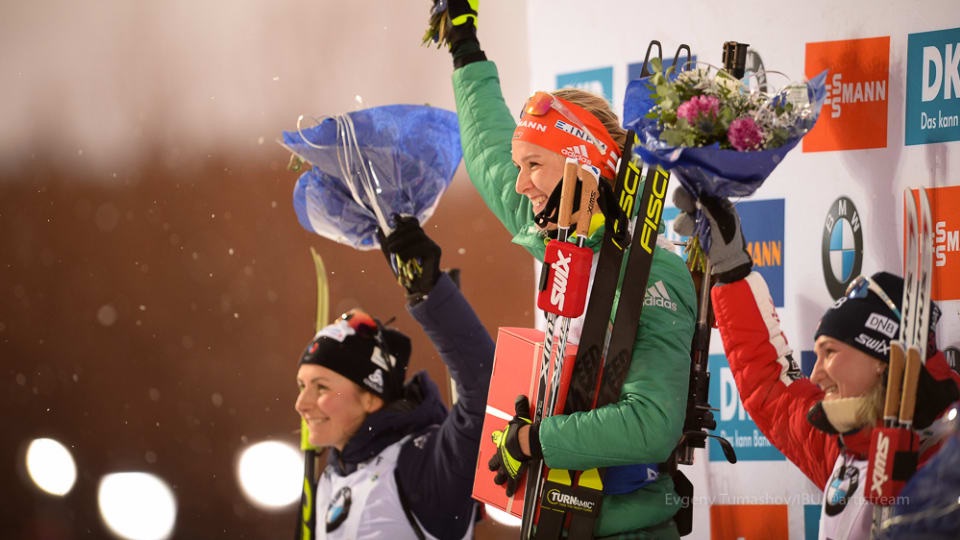
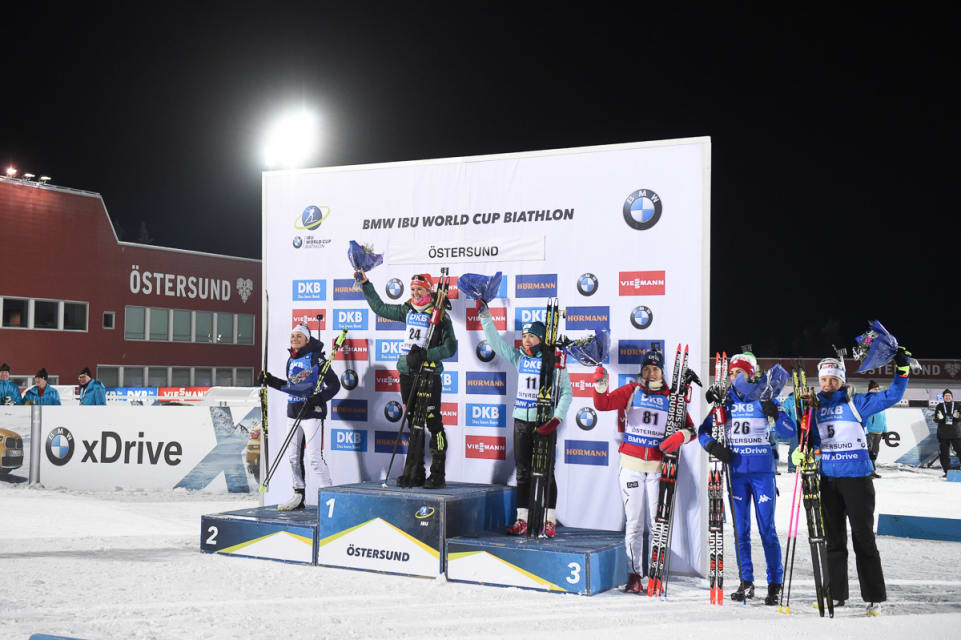
France’s Justine Braisaz (left, second place), Germany’s Denise Herrmann (center, first place) and Norway’s Marte Olsbu (right, third place) celebrate during the flower ceremony of the women’s 10-kilometer pursuit at the 2017/2018 IBU World Cup in Östersund, Sweden. (Photo: IBU/biathlonworld) Twenty months ago, Germany’s Denise Herrmann was a cross-country skier, ending the Ski Tour Canada in 28th place in the 10-kilometer classic pursuit in Canmore, Alberta. And one with a very successful career, earning an Olympic bronze medal in the relay in Sochi in 2014 and narrowly missing out on another one with a fourth place in the team sprint.
But her heart seemingly was no longer in the sport. A month after the 2015/2016 season had wrapped up, Herrmann publicly announced her intention to continue her athletic career with the goal of qualifying for the 2018 Olympics in PyeongChang, South Korea, yet no longer in cross-country skiing. Instead she dreamed about a second career in biathlon.
Biathlon is highly popular as a spectator sport in Herrmann’s home country, arguably receiving more attention than cross-country skiing and thus providing a higher earning potential. But while a switch between the two disciplines has not been unprecedented, Germany’s senior national team is also one of the most successful and competitive ones, with no guarantee even for seasoned biathletes to make the World Cup roster. So critics wondered if that was a wise decision by Herrmann, or rather a case of giving up a bird in the hand for two in the bush.
Herrmann had some initial success right out of the gate in her first season as a biathlete. She instantly qualified for the German team for the second-tier IBU Cup, and with the coaches trying to make use of her athletic talent she was allowed to start three World Cup races, and finished 18th in her first sprint in Pokljuka, Slovenia.
Then ten months ago in January 2017, she might have had some second thoughts and tried a “mini-comeback” at a cross-country World Cup in Toblach, Italy, in what appeared to be an attempt to qualify for the 2017 Nordic World Championships in Lahti, Finland. Despite placing 13th in a freestyle sprint and fourth in a team sprint, but she was not nominated to Germany’s World Championships team. Instead she received more starts at the IBU World Cup test event in PyeongChang, where she won her first relay race.
After another successful offseason of biathlon training, highlighted by winning national titles in three disciplines, she was put on the IBU Cup team again. That followed a sprint victory in Sjusjøen, Norway, after which she was ‘called up’ to the roster for this week of races in Östersund, Sweden.
Breakthrough in Östersund

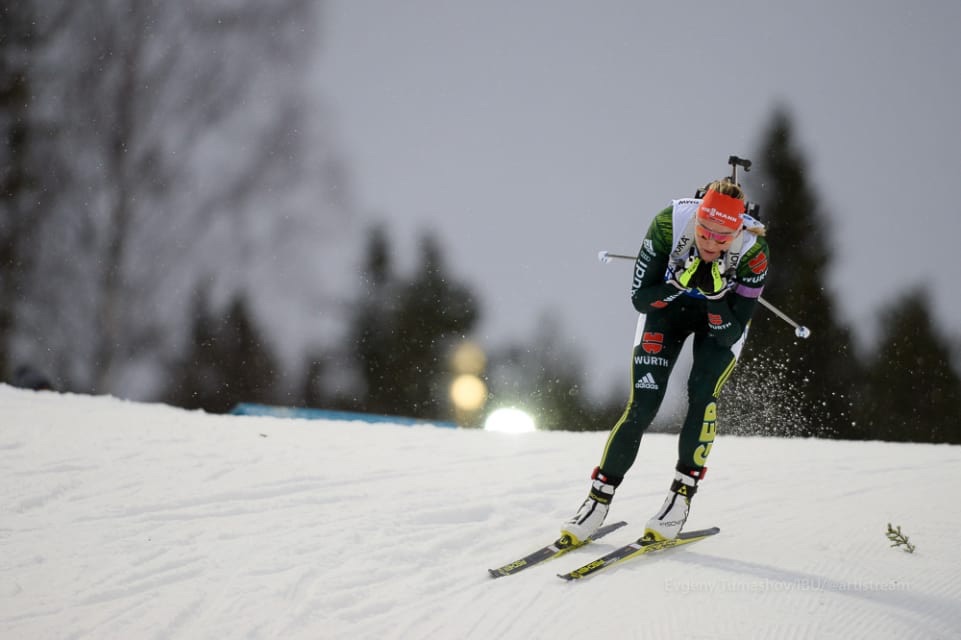
Germany’s Denise Herrmann racing to her second career victory in the women’s 10-kilometer pursuit at the 2017/2018 IBU World Cup in Östersund, Sweden. (Photo: IBU/biathlonworld) This weekend, Herrmann achieved at least a big milestone on the road to her dream goal and secured her ticket for the German Olympics team for PyeongChang, fulfilling the team-internal qualification criteria (a top-eight result) with an exclamation mark by winning the sprint on Saturday.
Now a day later she followed that up with another victory in the women’s 10 k pursuit in a time of 30:02.7 minutes with two penalties (0+0+2+0). Her transition to biathlon has come to fruition.
While the sprint only required two shooting stages, for the pursuit she had to navigate four, an obstacle that typically weeds out inexperienced shooters, especially in the standing stages. But on Sunday, Herrmann demonstrated everything she has already learned about her new sport.
Starting with a 15-second lead on France’s Justine Braisaz based on the sprint, Herrmann skied with a controlled pace on the first loop and went on to clean her first prone stage, returning to the course with an increased lead of 22 seconds. Then Herrmann reacted correctly to some changing wind influence by adjusting her sights to also clean the second prone stage and kept her distance to Braisaz and the next chase group.
Herrmann later told German TV broadcaster ZDF she would not have expected to win “in a pursuit having to shoot four times and with a number of extremely good shooters breathing down my neck.”
“To twice clean in prone made me extremely happy since that is the basis for a good pursuit,” she added. “It was good that I had a little lead so I was not under immediate pressure. With the wind on the shooting range you really had to focus today.”
Then in the first standing stage she began with a good rhythm but narrowly missed her last two shots, hitting above the edge of the black target. Momentarily she fell back to the second place, with France’s Braisaz taking an 11-second lead after she managed to clean all of her targets.
But Herrmann had already completed one penalty lap before any chasers had left the range, and after completing the second penalty she was able to regain her lost time on the course. For the final shooting, the two women stood side by side on the range, and both managed to clean their five targets.
“In the third one I was shaky,” Herrmann told ZDF. “Then in the last one I tried to really give it everything I had and leave with a clean shooting. Easier said than done […] Though we practiced pressure situations like this in training with the coaches teasing us, and that helped me a bit in the last bout.”
“When I came on the shooting range in the first position, it was the first time that happened to me, and I just had a thought, ‘Wow is it true, is that possible?’ ” Braisaz said at the IBU press conference. “It was a high difficulty today, it was tough, but I did it.”
Braisaz started the final loop just 1.5 seconds ahead of Herrmann, who quickly passed Braisaz on a climb, then increased that lead into the finish. Braisaz crossed the line 25.8 seconds behind Herrmann, repeating her second place from the sprint and tying her career-best World Cup result for the fourth time. She was one of only three athletes to shoot clean on Sunday.
“I was afraid,” Braisaz said in the press conference when questioned about Herrmann chasing behind her. “She just passed me on the uphill, I just tried to do my best even if it won’t work. … I am very happy, it was my main goal today to stay focused on what you have to do [on the shooting range], and I did it.”
With a comfortable lead, Herrmann had enough time to waive to the about 3,000 spectators in the stands. “I already told [my roommate] it’s cool to win, but it must be even cooler to ski across the finish line in first and knowing you have won,” Herrmann told ZDF. “An incredible feeling. … With my tired legs I was happy that there was no battle until the finish line. Then you can really enjoy it, and I have never experienced that feeling [in cross-country], and it’s wonderful.”
Norway’s Olsbu finished third, 48.0 seconds behind Herrmann with two penalties (0+1+0+1).
“This means a lot to me, I felt that this week has been good for me, but it has just been almost [on the podium] so I am glad that today I got the podium,” Olsbu explained in the press conference. “I was OK on the track and my shooting was good, even though I am not so happy about my last shooting.”
“She is really good, I am very impressed about what she is doing in the shooting,“ Olsbu said of Herrmann. “We trained in that for so many years, and she has trained for two years or something, so that is really impressing.”
Olsbu’s teammate Synnøve Solemdal started the race with the yellow bib of the World Cup Total Score leader, earned via a second place in the individual and a fourth place in the sprint. It was the first time in her career the 28-year-old Solemdal had achieved that distinction, and after she finished 19th on Sunday (+2:23.5 with four penalties), Braisaz took over the lead in the World Cup standings after the first week of races.
Twenty seconds behind Olsbu, Italy’s Lisa Vittozzi finished fourth (+1:09.1 with one penalty). Herrmann’s teammates Maren Hammerschmidt in fifth (+1:16.8 with two penalties), moving up from starting 14th, and Vanessa Hinz in eighth (+1:29.1 with one penalty), up from 16th, also pre-qualified for the German Olympic team.
“I got the [qualification norm] today, and that was very important for me,” Hammerschmidt told the IBU in an interview. “I never would have thought that I could already do it here in Östersund, I thought maybe in December was good, so I am very happy to go to Hochfilzen without this [pressure next week]. When I came to the finish line I realized Denise had won again, and I am so happy for her, it is incredible what she has done.”
Team Germany is starting to take shape for the Olympics, with Herrmann a name on the roster few fans would have expected a year ago.
“I think Laura is coming back next weekend…,” a laughing Herrmann cautioned at the press conference.
Laura Dahlmeier, the dominant athlete of the 2017 World Championships in Hochfilzen, Austria, has not started a race this season yet, missing the Östersund World Cup because of illness. She plans to be back for the races later this week (Dec. 8-10) at the site of her biggest successes.
Third-Best Career Result in a Pursuit for Ransom

Julia Ransom (Biathlon Canada) racing the second leg of the women’s 4 x 6 k relay at 2017 IBU World Championships in Hochfilzen, Austria. (Photo: Glen Crawford) Starting in 29th and 1:17 out of first based on her sprint result, Biathlon Canada’s Julia Ransom started her pursuit without a slip, cleaning both her prone shooting stages. Since a number of athletes in front of her incurred penalties, she had moved up all the way to the 11th position as she returned to the course after her second shooting.
“We get pretty consistent feedback on the course so I was aware I was 11th,” Ransom wrote in an email to FasterSkier. “The wind picked up today and made for some tricky shooting. On one end of the range, the wind can swirl off the building and push the bullets one way, while it blows the bullets another way on the opposite side of the range.”
On the next round she skied in a pack with athletes, including Finland’s Kaisa Mäkäräinen and Ukraine’s Valj Semerenko (who also cleaned the first prone on Sunday).
“My legs were a little fatigued but those fast girls definitely helped pull me around the course!” Ransom remembered regarding that loop.
In her first standing bout, she again cleaned the first four targets before seeming to hesitate a bit and then missed the last target, having to ski a penalty loop. She came back on the course in 17th position.
Then in the final stage she missed another target, leaving the range for the last time in 21st.
At the finish Ransom was 23rd for her third-best result in a pursuit behind a tied 19th place in Nove Mesto, Czech Republic, last season as well as in Antholz, Italy, two seasons ago. She achieved her best career result in a ninth place in the 15 k individual earlier this week.
“I really wished I could have kept my focus for those last standing shots because it would have made for a very exciting race,” Ransom concluded. “That is how it goes sometimes. I am thrilled with my race! You can always say ‘what if…?’ but I am stoked with how solid the start of the season has been. I am looking forward to next weekend, especially since my parents are coming out to watch.”
Starting in 46th position and 1:42 minutes back according to her sprint result, her teammate Rosanna Crawford initially put herself in the mix, cleaning her first prone stage to move up to 38th, even making up a few seconds to Herrmann up front.
But in her next prone shooting, Crawford incurred three penalties, falling back to 53rd and doubling her deficit. With three more penalties in the standing stages Crawford ultimately finished 52nd, 5:25.1 back with six penalties (0+3+1+2).
Her World Cup start in Östersund was marred by a nasty crash in the single mixed relay last Sunday. On Wednesday, she placed 39th in the individual for her best result of the week.
Megan Bankes as Biathlon Canada’s third woman snuck into the top 60 to qualify for her first World Cup pursuit as the 60th and final starter (actually, 59th, since French athlete Anaïs Chevalier withdrew on race day).
But that meant the 2017 Junior World champion in the individual discipline had to begin the race 2:11 minutes after Herrmann started hers.
“I was quite excited because pursuits are always fun races, and to be racing with the 60 best women in the world is pretty neat,” Bankes wrote in an email. “Conditions on the course were pretty fast, the uphills were a little chopped up, but not bad. There was more wind today than any other race day, and I found it hard to read on the range, especially in the far lanes (28, 29, 30), because it swirls due to the wall [of a utility building at the end of the range].”
After missing three targets already in her first prone shooting bout, she lost more time coming back on the track and was 3:50 behind she started her second loop.
“I did not read the wind properly or make a big enough correction when I came into my first prone, so that is why I missed 3,” Bankes explained.
After incurring another penalty in the second prone shooting and one more in the following standing stage, Banks was almost 5:30 minutes back, and the top of the field approached quickly from behind on the short 2.5-kilometer lap.
On her final lap Herrmann passed Bankes, ending the race for the Canadian.
“I think the techs may have yelled at me that I might be lapped, but I don’t really remember,” Bankes wrote in her email. “I knew about the rule, and knew the top girls were real fast, so I was aware of the possibility that I could be lapped. I could also see them coming into the range as I was leaving the range [after the third shooting], so I knew I had to ski pretty fast if I wanted to get to the range again before they finished. That did not happen, but I got farther on my 4th lap than I thought I would. Overall, it was a good learning experience, and a reminder that you should hit your prone targets in a pursuit!”
In Saturday’s sprint, US Biathlon’s Clare Egan, Susan Dunklee and Emily Dreissigacker, along with Canada’s Emma Lunder, missed qualifying in the top 60 for the pursuit.
The IBU World Cup continues next Friday Dec. 8 in Hochfilzen, Austria, with another sprint for the women and men.
-

Sunday Rundown: Lillehammer; Östersund; West Yellowstone (Updated)

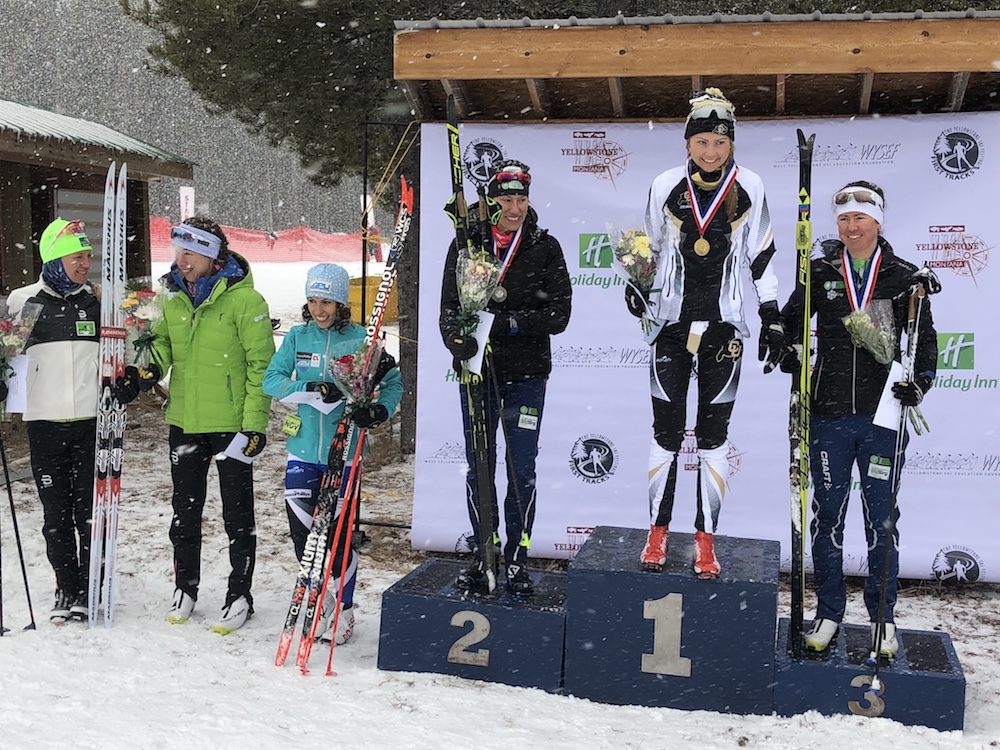
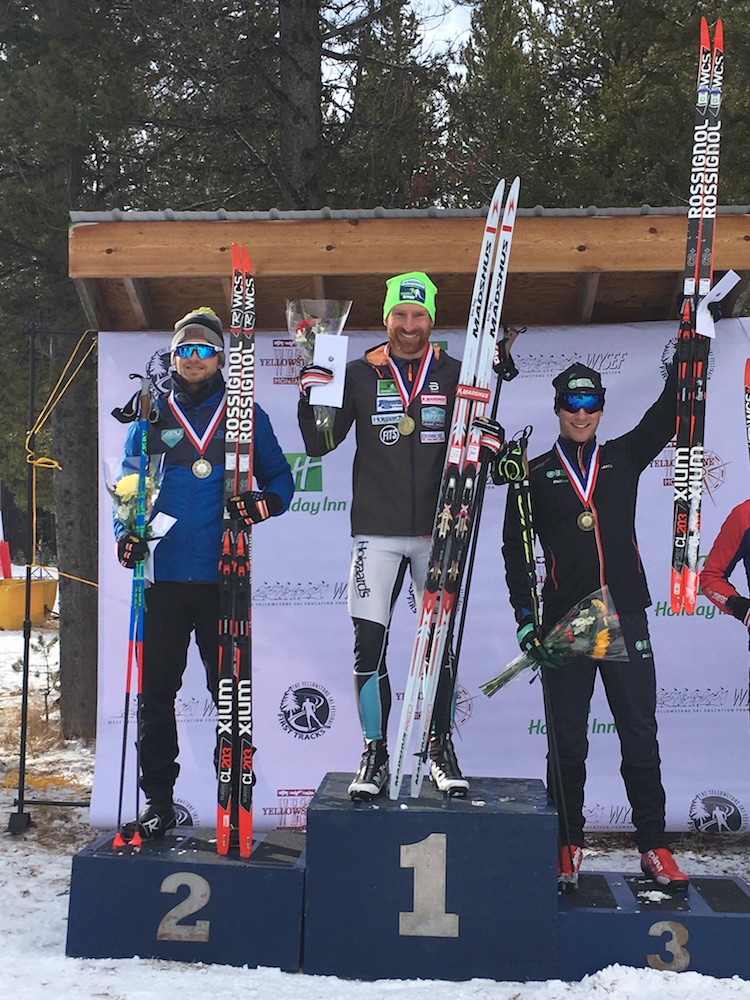
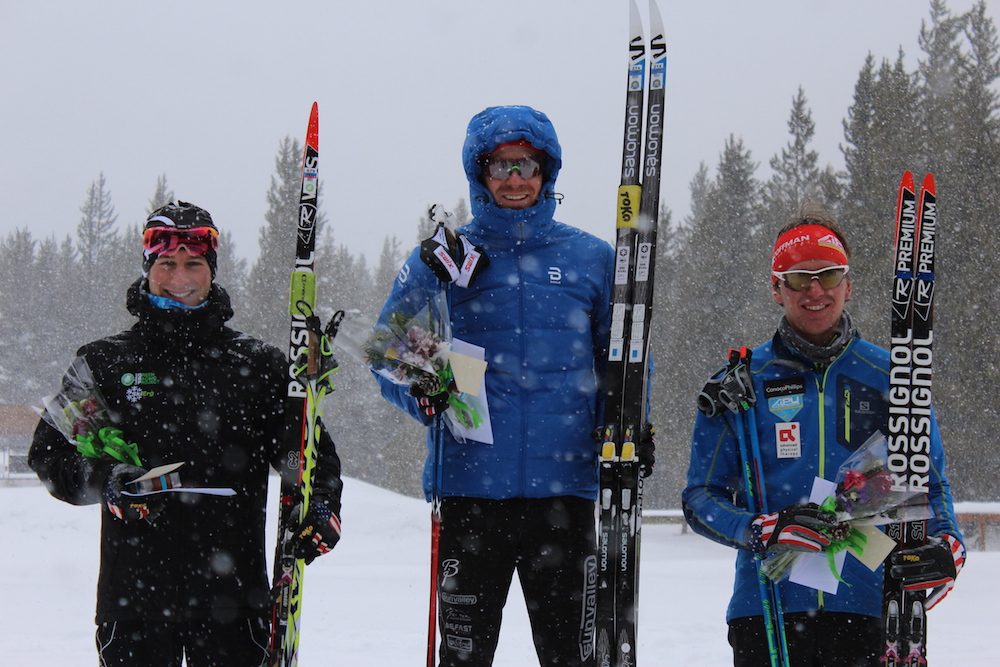
The SuperTour women’s 10 k classic mass start podium on Sunday in West Yellowstone, Montana, with Hedda Bångman (second from r) of the University of Colorado Boulder in first, and Craftsbury’s Kaitlynn Miller (third from r) and Caitlin Patterson (r) in second and third, respectively. From left: Caitlin Gregg in sixth, Katharine Ogden in fifth and Rosie Frankowski in fourth were also recognized at the flower ceremony. (Photo: FBD) US SuperTour (West Yellowstone, Montana): 10/15 k classic mass starts
The second day of SuperTour racing took place as originally planned at the Rendezvous Ski Trails in West Yellowstone, with 22-year-old Hedda Bångman, of the University of Colorado Boulder (CU), and 33-year-old Brian Gregg (Team Gregg) winning the women’s 10-kilometer and men’s 15 k classic mass starts, respectively, on Sunday.
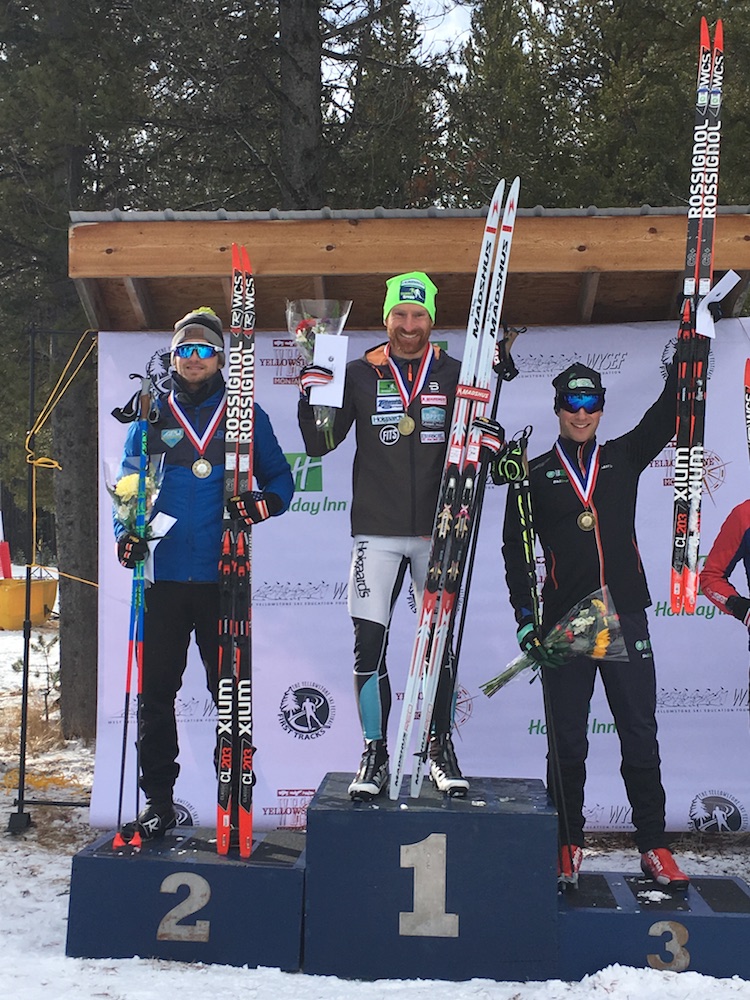
The men’s 15 k classic mass start SuperTour podium on Sunday in West Yellowstone, Montana,with Brian Gregg (c) of Team Gregg in first, David Norris (l) of APU in second, and Ben Lustgarten (CGRP) in third. (Photo: FBD) Bångman, a Swedish freshman on the CU Ski Team, won the women’s race in 30:24.8, just ahead of two Craftsbury Green Racing Project (CGRP) skiers Kaitlynn Miller and Caitlin Patterson. While Miller placed second (+1.3) and Patterson was third (+3.4),
Rosie Frankowski of Alaska Pacific University (APU) finished another 10 seconds later in fourth (+13.5), and Katharine Ogden of the Stratton Mountain School (SMS) was fifth (+17.2). Caitlin Gregg (Team Gregg) followed in sixth, Felicia Gesior (CXC Team) was seventh, Anne Siri Lervik (CU) eighth, Erika Flowers (SMS Elite Team) ninth, and Corey Stock of the Bridger Ski Foundation (BSF) 10th.
In the men’s race, Brian Gregg pulled out a 1.9-second win over David Norris (APU), crossing the line first in 41:30.3. Ben Lustgarten (CGRP) reached the podium for the second-straight day (after placing second in Saturday’s skate sprint) in third (+4.6). Kyle Bratrud (CXC Team) finished fourth (+10.9) and Kris Freeman (Caldwell Sport) was fifth (+12.6). Tad Elliott (Ski & Snowboard Club Vail) followed in sixth, Eric Packer (APU) seventh, Ian Torchia (Northern Michigan University/U.S. Ski Team D-Team) eighth, Hunter Wonders (APU) ninth, and Martin Bergström (University of Utah Ski) 10th.
Videos: Women’s finish | Men’s finish
- Hedda Bångman (1st) | Kaitlynn Miller (2nd) | Caitlin Patterson (3rd)
- Brian Gregg (1st) | David Norris (2nd) | Ben Lustgarten (3rd)
***
FIS Cross Country World Cup (Lillehammer, Norway): 15/30 k skiathlons

Sweden’s Charlotte Kalla winning the women’s 15 k skiathlon on Sunday at the Lillehammer World Cup in Norway. (Photo: Henrik Hunnes) Sweden’s Charlotte Kalla pulled out another dominant distance performance on Week 2 of the World Cup, racing to a 19.7-second win in the women’s 15-kilometer skiathlon on Sunday, ahead of three Norwegians and American Jessie Diggins.
Kalla led at the halfway point of the skiathlon when skiers transitioned from classic to skate, just ahead of Norway’s Heidi Weng in second. The two had broken away around 4 k into the classic leg and put more than 20 seconds into the rest of the field by the transition, when Diggins came through 21.6 seconds back in third, leading a large chase group with Finland’s Krista Parmakoski, Norway’s Marit Bjørgen, Austria’s Teresa Stadlober, Norway’s Kathrine Rolsted Harsem, Finland’s Kerttu Niskanen, Norway’s Ragnhild Haga, and Switzerland’s Nathalie von Siebenthal, respectively.
While Kalla and Weng continued to trade the lead over the next 5 1/2 kilometers or so, by the 13.65 k marker, Kalla had dropped Weng, with 12 seconds between the two, while the chasers remained 29 seconds behind Kalla.
Over the next 1.2 k, that time gap grew to 20 seconds and 46 seconds, respectively, and Kalla skied off to her second win of the season in 42:24.7 minutes.
Weng placed second, 19.7 seconds back, and Haga claimed third (+43.6), after skiing alone for the last 4 k of the race. Bjørgen finished just ahead of Diggins for fourth (+54.3) and fifth (+57.0), respectively, and Stadlober was sixth (+1:04.9), Parmakoski seventh (+1:07.8), Norway’s Ingvild Flugstad Østberg eighth, Russia’s Natalia Nepryaeva ninth (+1:27.8), and Sadie Bjornsen 10th (+1:32.6).
Four Americans finished scored points in the top 30, with Kikkan Randall placing 16th (+2:06.5) and Rosie Brennan 29th (+3:07.7). Liz Stephen finished 36th (+3:25.7), Chelsea Holmes was 38th (+3:39.6) and Ida Sargent 55th (+6:41.1).
Cendrine Browne of the Canadian National U25 Team led Canada in 45th (+4:37.3), and Emily Nishikawa followed in 49th (+5:00.1). Katherine Stewart-Jones did not finish.
Klæbo Outlasts Sundby; Harvey 6th

A gassed Johannes Høsflot Klæbo (yellow bib) holding off fellow Norwegian Martin Johnsrud Sundby (r) for the win on Sunday in the men’s 30 k skiathlon at the Lillehammer World Cup in Norway. (Photo: Henrik Hunnes) In the men’s 30 k skiathlon that followed, Norway’s Johannes Høsflot Klæbo made it a five-peat, proving himself once again unbeatable, this time in the first multi-discipline distance race of the season.
Klæbo outlasted [edit: rocketed past] teammate Martin Johnsrud Sundby to beat him by 1.3 seconds for his fifth-straight win in 1:16:47.1, and Norway swept the top four with Hans Christer Holund in third (+6.8) and Simen Hegstad Krüger in fourth (+10.9).
France’s Maurice Manificat followed closely in fifth (+11.3) and Canada’s Alex Harvey was next in sixth (+13.1), ahead of Finland’s Iivo Niskanen in seventh (+16.2), and Russia’s Alexey Chervotkin, Sergey Ustiugov and Alexander Bolshunov in eighth (+37.7), ninth (+42.2) and 10th (+59.6), respectively.
Klæbo skied patiently in the pack for essentially the entire race. For instance, at 11 k he sat back in 18th, just seven seconds from Canada’s Devon Kershaw in the lead.
One kilometer later, Klæbo remained 5 seconds back in 13th while Kershaw was 8 seconds back in 16th.
At the ski exchange at 15 k, Niskanen led Sundby and Italy’s Francesco de Fabiani and a total of 10 men within three seconds of first. Klæbo clocked through 5 seconds back in 13th, just ahead of Harvey in 14th (+5.3). Sixteen men remained within six seconds and striking distance of first. Kershaw in 18th had fallen off the pace and was 36 seconds back at the transition, just behind Russia’s Andrey Larkov.
While Harvey continued to ski around third place during the first 5 kilometers of the skate leg, Klæbo worked his way closer to the front and led at 22.5 k. By then, the lead group had dwindled to six within two seconds of first. Harvey remained in fourth.
Over the next 7.5 k, the lead changed several times, with Klæbo hovering near the tail end of the group. With about 200 meters to go, however, it was down to Sundby and Klæbo, with the former leading by 2 seconds (and Holund skiing seven seconds back in third). Klæbo ultimately had the most finishing kick to take the win by 1.3 seconds over Sundby, while Holund crossed 6.8 seconds later for third.
Canada had two in the top 20 with Kershaw in 19th (+2:59.7). Last year’s NorAm winner Russell Kennedy (Team R.A.D.) placed 53rd (+7:30.7), and Canadian World Cup Team members Graeme Killick and Knute Johnsgaard finished 54th (+7:41.3) and 60th (+9:49), respectively.
Two U.S. men landed in the points with Erik Bjornsen (U.S. Ski Team) in 20th (+2:59.9; just 0.2 seconds behind Kershaw) and Noah Hoffman in 28th (+3:37.8). Scott Patterson finished 36th (+4:56.1) and Paddy Caldwell was 56th (+7:43).
***
IBU World Cup (Östersund, Sweden): Men’s and women’s pursuits
Martin Fourcade @martinfkde alone pic.twitter.com/Wlfjrw9G0t
— International Biathlon Union (@biathlonworld) December 3, 2017
France’s Martin Fourcade overcame an early penalty and his No. 2 starting position to take the men’s 12.5 k pursuit win on Sunday, 40.8 seconds clear of anyone with 19-for-20 shooting (1+0+0+0).
Fourcade started 1 second behind Saturday’s sprint winner, Norway’s Tarjei Bø, and took control of the race after cleaning the second shooting stage. Bø missed one on the first prone stage then five more later in the race (1+0+3+2) to slip to 19th (+1:49.5) while Slovenia’s Jakov Fak raced up from 10th to second, 40.8 seconds behind Fourcade, with two penalties (1+0+0+1). Just behind him, France’s Quentin Fillon Maillet took third (+42.1) with identical shooting after Fillon Maillet started 12th and skied with Fak for most of the race.

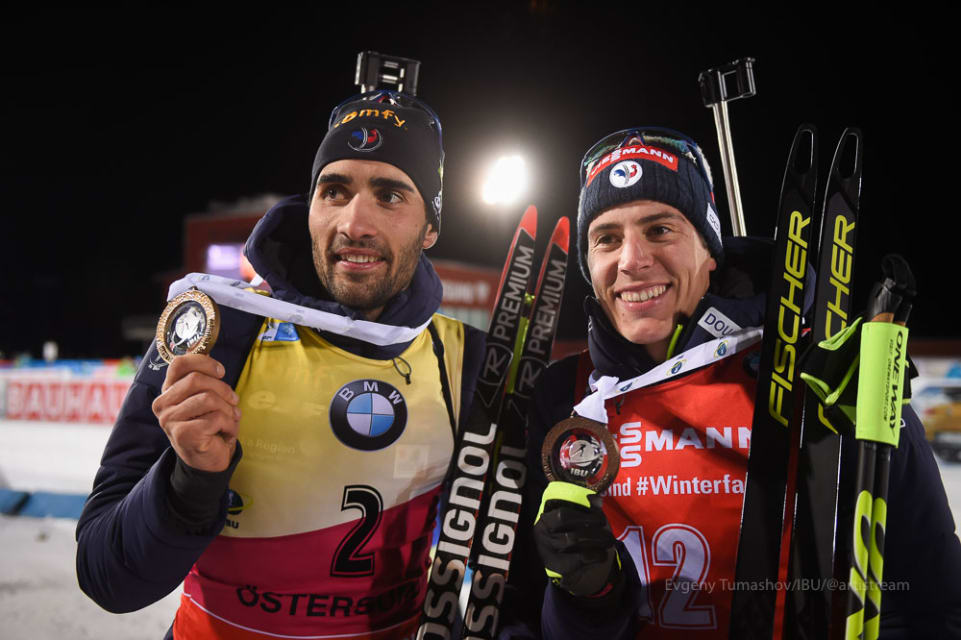
France’s Martin Fourcade (l) and Quentin Fillon Maillet after placing first and third, respectively, in the IBU World Cup men’s 12.5 k pursuit on Sunday in Lillehammer, Norway. (Photo: IBU/biathlonworld) None of the 58 finishers cleaned the four-stage race. American Lowell Bailey improved from 22nd to 17th (+1:40.2) with two misses (0+1+0+1). Canada’s Christian Gow achieved a career best in 21st (+2:04.6), up from starting 26th, after shooting 19-for-20 (0+0+1+0).
Also for Canada, Nathan Smith slipped from 24th at the start to 42nd (+3:19.2, three penalties), Scott Gow finished 50th (+4:10.9; six penalties) after starting 16th, and Brendan Green placed 51st (+4:18.6; five penalties).
One other American qualified in the sprint top 60 for the pursuit, with Tim Burke finishing 48th (+3:52.7; four misses).
In the women’s 10 k pursuit earlier in the day, Germany’s Denise Herrmann tallied her second-straight win (and the second win of her IBU World Cup career). She started first and successfully held of France’s Justine Braisaz, who started 15 seconds behind her in second place, by 25.8 seconds. While Herrmann missed two on her third shooting (0+0+2+0), Braisaz was one of three women in the field to clean (0+0+0+0).
Norway’s Marte Olsbu raced up from seventh to third place (+48.0) with two penalties (0+1+0+1).
Canada’s Julia Ransom placed 23rd (+2:48.1), up from 29th at the start, with two misses (0+0+1+1). Two of her teammates also qualified for the pursuit, with Rosanna Crawford finishing 52nd (+5:25.1) with six penalties (0+3+1+2). In her first World Cup pursuit, Megan Bankes completed three shooting stages before being lapped (3+1+1).
No American women qualified for the pursuit.
With the conclusion of the first IBU World Cup in Östersund, the circuit moves to Hochfilzen, Austria, where racing kicks off again Friday, Dec. 8, with men’s and women’s sprints.
-
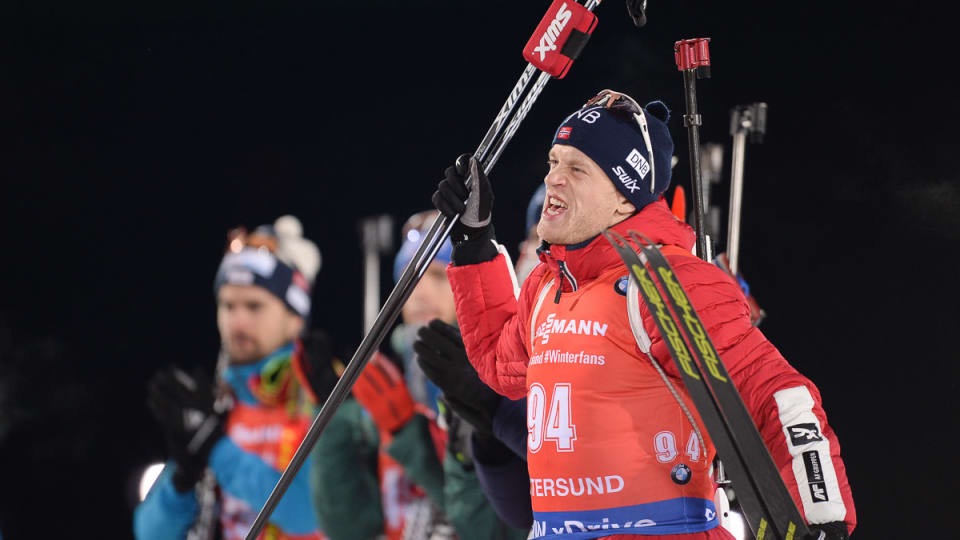
Tarjei Bø Wins First IBU World Cup Since 2013; Scott Gow Tallies Career-Best 16th
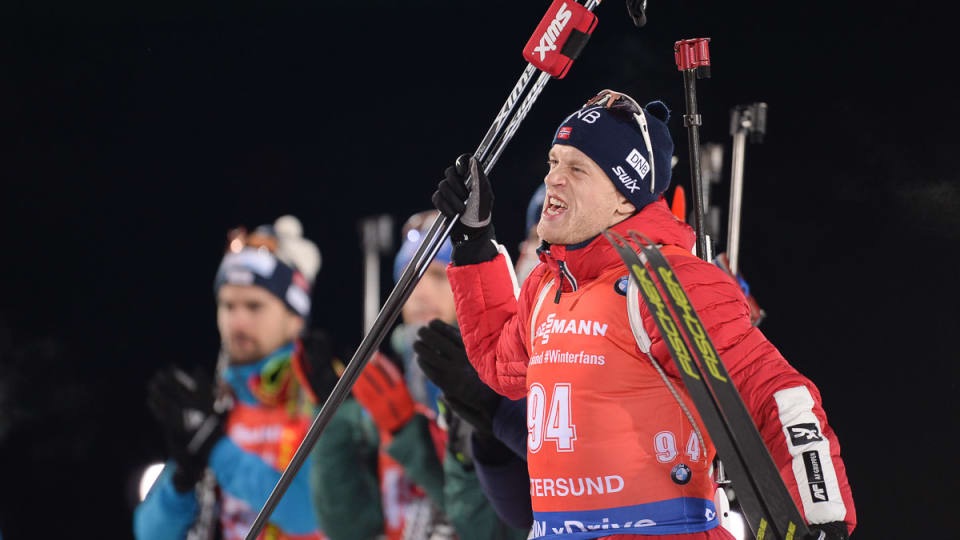
Norway’s Tarjei Bø celebrates his victory in the men’s 10 k sprint at the 2017/2018 IBU World Cup in Östersund, Sweden, his first win in four years. (Photo: IBU/Biathlonworld) Biathlon Canada’s World Cup Team at the International Biathlon Union (IBU) World Cup in Östersund, Sweden, had a number of things to be happy about on Saturday afternoon as the first men’s 10-kilometer sprint race of the new season wrapped up.
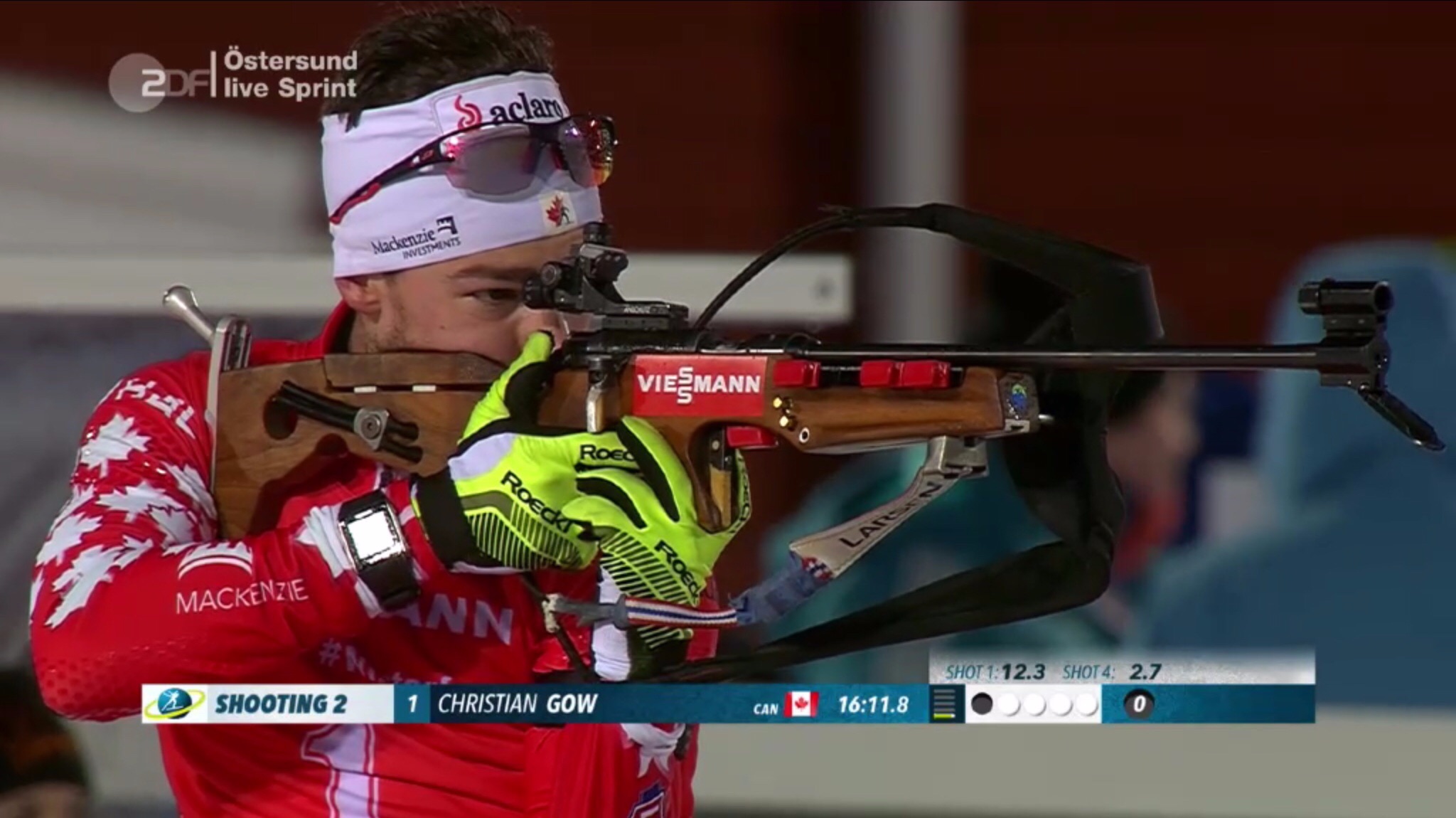
Christian Gow was already smiling at the cameras as he stood in the starting-gate booth. Beginning the sprint as the very first starter in a large field of 108 athletes from 30 nations, Gow soon would have every reason to smile, as all alone on the range he shot clean in both his prone and standing stages under the watchful eyes of the spectators and his coach Matthias Ahrens, who watched through the lens of his spyglass. Gow kept himself ahead of the field and was the first athlete across the line after avoiding being passed.
“I enjoyed starting with bib 1 more than I expected,” Gow wrote in an email to FasterSkier. “I found that there are some extra elements that you don’t really consider when you start in the middle of the pack. The biggest differences are not having any information on splits for the first loop and that shooting on the range with no other athletes is kind of eerie. It is normally such a busy place, so to have it all to yourself and the entire crowd focused solely on you can add extra pressure. I am really happy with how I managed that today.”

Biathlon Canada’s Christian Gow shooting clean in the standing stage of the men’s 10 k sprint at the 2017/2018 IBU World Cup in Östersund, Sweden, on his way to a career-best sprint result. (Screenshot: ZDF) He had to wait for a long time for the other starters to finish the race so he could know where his time stood. In the end, it was good enough for 26th place, 58.1 seconds back from the winner, Norway’s Tarjei Bø, in a very tight race at the top.
“I knew that the entire field was still to come, but that I had done my job so all I needed to do at that point was wait,” Gow wrote. “I am quite happy with my placing. With my time back from the leader being under one minute, I was hoping for a top 20, but am very satisfied anyways. Finishing in the top 30 is awesome, I have been on the cusp a half-dozen times, but only within it once before.”
Last season, in the World Championships pursuit in Hochfilzen, Austria, Gow finished 23rd.
Starting a few minutes behind him in bib 24, his older brother Scott also cleaned both stages and skied a little faster, initially crossing the line in fifth..
“It was almost frustrating having to wait so long to finally see the full results,” Scott Gow wrote in an email. “I knew I had a good day, but I also felt like a lot of skiers were finishing in front me as the race wore on.”
In the end, a few more athletes finished with better times, and he got pushed back to 16th. Even so, 16th was a personal-best World Cup result for Gow, improving on a 17th place in an individual race in Antholz, Italy, and an 18th place in a sprint in Nove Mesto, Czech Republic, both during the 2016/2017 season.
“Any finish in the top 30 and especially top 20 is very good for us,” Gow said of his team. “Today’s results helps increase my Olympic qualification which is a nice boost in confidence as the race season gets underway.”
With a top 16, Gow jumped a rank in Biathlon Canada’s Olympic criteria standards; he’s now halfway to Priority 2 (along with teammate Julia Ransom, who placed ninth earlier this week). Both need another top 16 to fulfill that second priority.
“It had rained a bit this afternoon and during our zero,” Scott Gow explained of Saturday’s conditions. “The rain made the track very fast and hard-packed, and the downhills were particularly tricky. The course also held up really well from start to finish so definitely fair conditions in that respect.”
Aside from the eventual winner, another athlete helped by that was teammate Nathan Smith. Starting very late in bib 103, he also managed to hit all 10 targets ultimately finished 24th (+54.3) between the Gow brothers.
While not close to his career-best results in the top five, most of which he achieved in 2014/2015, it was another step up for Smith, who placed 37th in the 20 k individual race on Thursday and missed most of the last season to illness.
“I expect to feel better this weekend in the sprint but will have to be realistic considering the cold and being ‘rusty’ after not racing last year, other than a few races,” he had predicted in an email after the individual on Thursday.
The fourth Canadian, Brendan Green finished 55th with two penalties (1+1), still also qualifying for the pursuit of the best 60 starters on Sunday.
Bailey Leads Five Americans in 22nd
US Biathlon’s Lowell Bailey also shot clean on Saturday, finishing 22nd and 49.8 seconds back from the winner, and six seconds ahead of Canada’s Smith.
”I’m happy with the race, especially after coming off of a cold this past week,” Bailey wrote in an email. “Our performance goals are to steadily progress with the season. I think this is a good step in the right direction.”
Last season, Bailey had achieved his career best in a sprint with a second place in the World Cup test event for the Olympic courses in PyeongChang, South Korea. Those races will be his main focus this season.
“The conditions on the track were MUCH faster than the Individual, which proved one of the slowest conditions I’ve encountered in my career!” Bailey explained. “The range was a bit tricky, with shifting winds, and I had at least one prone shot that was on the edge of the target.”
The other starters for US Biathlon struggled a bit more on the range today. Tim Burke placed 52nd, 1:42.3 back with three penalties (3+0), joining Bailey in the pursuit on Sunday.
“As seems to be the case in this race each year, the field is incredibly tight for tomorrow’s pursuit. It will be an exciting race,” Bailey stated in a US Biathlon press release.
Leif Nordgren finished 66th with two penalties (1+1), Sean Doherty was 82nd with three penalties (2+1), and Paul Schommer was 94th with four penalties (1+3).
While the three Canadians and Bailey shot clean, the men at the top of the field incurred at least one penalty and thus had to rely on their ski speed in this race.
Another Day, Another Bø Brother

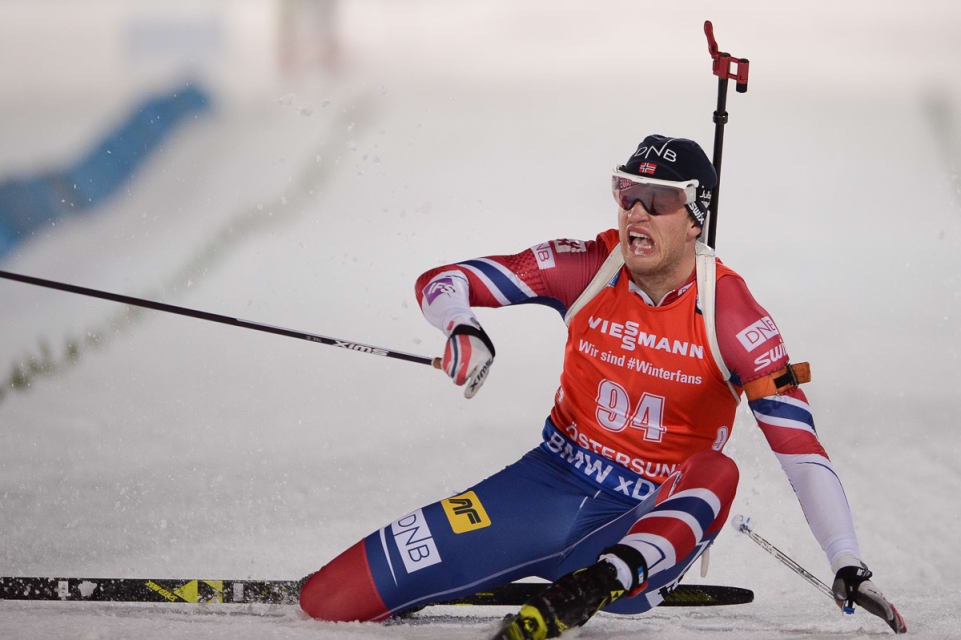
Norway’s Tarjei Bø lunges across the finish line in the men’s 10 k sprint at the 2017/2018 IBU World Cup in Östersund, Sweden, to claim the victory just 0.7 seconds ahead of France’s Martin Fourcade. (Photo: IBU/Biathlonworld.com) On Thursday in the men’s 20 k individual race, France’s Martin Fourcade was beaten by Norway’s Johannes Thingnes Bø, gapped by over two minutes in a dominating performance. On Saturday afternoon, Johannes missed too many targets to challenge Fourcade again, ultimately finishing 11th (+34.4 with three penalties).
But starting towards the back of the field in bib 94 when Fourcade had already ended his race, Bø’s older brother Tarjei snatched another victory away from Fourcade, who had already looked like the winner of the day after making up a deficit to two other athletes with one of his trademark furious final laps.
This time he was beaten by mere inches.
Still 7 seconds ahead of Fourcade when Bø left the range, after he also had to ski once through the penalty loop, Bø’s lead dwindled on the final lap. At the next split time, only a 3.1-second advantage remained, with 400 meters to go it was even down to 0.9 seconds heading into a downhill corkscrew into the arena.
“You can never trust those guys giving you the times,” Bø later joked about his coaches frantically yelling splits during the press conference. “Because they want to push you, so even if they say it’s one second you can also be behind.”
Pushing all out on the finish stretch, Bø lunged and crashed across the line in a time of 22:40.6 minutes, which was 0.7 seconds ahead of Fourcade’s time, causing the spectators in the ski arena of Östersund to erupt in a big roar.
“I was totally blacked out, to be honest,” Bø said at the press conference. “I had this incredible fight with Martin. Already when I warmed up I saw his last 500 meters, so I knew I had to just keep on pushing. It was such a relief after I woke up from the dead there, to see that I was number one… It’s always a mental game when you fight against such great athletes as Martin.”
It was Tarjei Bø’s first World Cup victory since the 2013 season, a sprint win at home in Oslo, Norway.
“It was a really tough time,” the 29-year-old Bø recounted the last few seasons of his career. “In 2016 I felt I sort of came back into the top. … I was going somewhere again. But then last season was a new punch in the face … I missed so much training. This season I tried not to push so hard in the summer to keep this flow in the training and not get stopped by all these sickness problems again. This win is definitely a relief after so many years with struggles.”
“It was quite a good biathlon competition until Tarjei came to the finish,” Fourcade said with a laugh at the press conference. “Of course I am a bit disappointed because I hoped for the victory for a long time … But that’s biathlon, and I am happy for him to be back on the top of the podium … I think I lost many times with less than one second, so I am used to that, but I am used to the opposite as well, so I will not cry.”
“Finally, I can say that I am equal with [my brother] Johannes again,” Bø added. “Fighting with Martin, who also has a brother [Simon Fourcade]… And when the younger brother becomes better than you, it’s so nice to beat them every once in a while.”
Germany’s Erik Lesser finished third, just 3.7 seconds back, after he also incurred one penalty lap in his standing stage, in his case with his last shot of the race. Lesser skied the 10th-ranked course time of the day, but was especially buoyed by his blazing-fast speed on the shooting range.
Lesser triggered the first shot in prone after only about eight seconds, almost twice as fast as some athletes use to take their position, and completed the stage roughly ten seconds faster than the two other podium finishers. His range time overall ranked as the best and shooting time as the second-best of the day, just 0.6 seconds behind Italy’s Dominik Windisch (however, Windisch also missed four targets to finish 62nd).
“Not 100% satisfied, I didn’t do my job on the final shot,” Lesser told German broadcaster ZDF while the race was still going on. “Though I’d rather miss the final than the first shot… But on the course it was top. In prone everything worked out, and I think the shooting time was again where I’d like it to be.”
“I am very happy that I won my first podium in a sprint competition, I never was on a podium [in that] before so right now I am very happy about this,” he later added at the press conference.
Norway’s Emil Hegle Svendsen had to settle for fourth place (+13.3), but could be seen walking out of the mixed zone smiling as Bø approached the finish to push him off the podium, and Lesser’s teammate Simon Schempp placed fifth (+15.0), both of which each had one standing penalty.
Switzerland’s Mario Dolder with a career-best sixth place (+16.0) and Sweden’s Fredrik Lindström in seventh position (+16.7) shot clean, but could not match the course times of the podium finishers on Saturday. Out of the entire field, nine athletes shot clean. Four of them were North Americans.
The race week in Östersund concludes on Sunday with pursuits for both the women and men.
“The level is incredible, I think 30 athletes within one minute,” Fourcade said in the press conference. “I don’t know if I have already seen that in a pursuit, so tomorrow will be a great fight.”
-
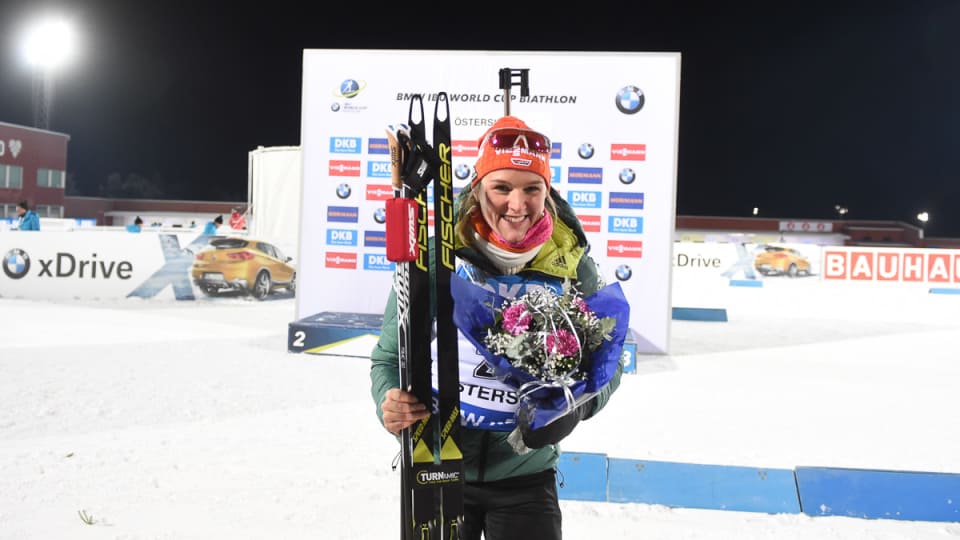
Herrmann Rises to First IBU World Cup Win; Ransom 29th in Östersund

Germany’s Denise Herrmann after winning the first IBU World Cup race of her career on Friday in the women’s 7.5 k sprint in Östersund, Sweden. (Photo: IBU/biathlonworld) Just over a year and half ago, Germany’s Denise Herrmann took a giant leap and diverged from her career as a World Cup cross-country skier to take up biathlon. She did so at the age of 27, after having been the second-ranked sprinter in the world at the end of 2013/2014 and earning a bronze medal in the women’s relay at the 2014 Olympics. She narrowly missed another Olympic medal, placing fourth in the classic team sprint with Stefanie Böhler. A year later, Herrmann was fourth again in the 2015 World Championships freestyle team sprint with a different teammate, Nicole Fessel.
After all that, she wanted something different, something new.
“I owe a lot to cross-country skiing, it was a great time with many highlights, but now I want to face new goals,” Herrmann stated at the time. “The switch to a new discipline will be a big challenge, I am aware of that, but I am confident that I can do it with diligence, courage, and determination!”
After bouncing between the International Biathlon Union (IBU) Cup and IBU World Cup last season, Herrmann started this season on the big stage at the first World Cup in Östersund, Sweden. And in her 12th World Cup start as a biathlete, she achieved her first individual win.
“It all begins with dreaming about it,” she told German broadcaster ZDF, according to a translation, when asked if she expected to win at this stage of her career. “But I knew I am currently in a good ski shape and when it works out in the shooting I could probably hang with the top. But to then execute that in competition, in the World Cup and on the big stage here, I was hoping for that, but that I was able to make that a reality makes me all the more happy.”

The women’s 7.5 k sprint podium on Friday in Östersund, Sweden, with Germany’s Denise Herrmann in first, France’s Justine Braisaz in second, and Ukraine’s Yuliia Dzhima in third. (Photo: IBU/biathlonworld) Herrmann, 28, won the women’s 7.5-kilometer sprint on Friday in 19:54.8 minutes after shooting 9-for-10 (0+1). She finished 15.2 seconds ahead of France’s Justine Braisaz in second and was 19.6 seconds clear of Ukraine’s Yuliia Dzhima in third.
Both Braisaz and Dzhima were among 22 women (out of 103 finishers) that cleaned the two-stage race on a cold, essentially windless evening. Norway’s Synnøve Solemdal, who finished fourth (+24.3) to claim the World Cup Total Score leader’s bib, also cleaned, as did Italy’s Lisa Vittozzi in fifth (+24.5).
Coming off a win in the IBU Cup sprint last week in Sjusjøen, Norway, Herrmann started 24th and was up to second place by the time she cleared all five targets in the first prone shooting stage. Her lone standing miss, which was just above the target, set her back to fifth place as she embarked on her final loop, but with the fastest last loop and fastest overall course time, Herrmann took the win from Braizaz, an early starter in bib 10. Dzhima started 11th.
“My goal was to start out with a clean prone stage, and then skiing into the standing stage I thought, ‘Oh, with bib 24 you could also go on lane position 24 on the range today. That might be a good omen,’ ” Herrmann reflected. “Of course you still try to leave no target black, but one was still left standing for me. That can be improved in the days to come.”
Earlier in the week, Herrmann started her season by placing 23rd in the women’s 15 k individual. Asked during an official training session what her chances were of making Germany’s Olympic team, she said she needed to focus on qualifying for the World Cup team first.
“One of my former coaches said, ‘Positions four and five are a cause for debate, but not one or two,’ ” she told ZDF on Friday. “So I said to myself, ‘Let’s lock this thing up today.’ That it already would work out like this today, I wasn’t expecting that. It’s incredible. I’m totally happy.”

Julia Ransom (Biathlon Canada) racing to a career-best ninth in the women’s 15 k individual on Wednesday at the IBU World Cup opener in Östersund, Sweden. (Photo: Biathlon Canada/NordicFocus) Of the 22 women that cleaned Friday’s race, Julia Ransom of Biathlon Canada was one of them. Ransom started the week with a career-best ninth place in the 15 k, after shooting 20-for-20, and finished 29th in the sprint, 1.16.9 minutes behind Herrmann. In two races, Ransom is 30-for-30 on the range without a miss.
“Wednesday’s result was of course motivating, but also hasn’t changed any way I approach racing,” Ransom explained in an email on Friday. “At the end of the day, I race because I love it and it’s fun to compete. That being said, it’s even more fun to find yourself a little higher on the results page. Today I was just hoping to keep relaxed and focused and enjoy the day, whatever result that translated to.”
Ransom’s overall shooting time ranked 36th, up from 53rd in Wednesday’s 15 k.
“My shooting times were perhaps a little more ‘normal’ today because there was less consequence for a miss,” she explained. “Getting into the groove of racing also helps relax into my normal pace.
“Overall I am really happy with my race. It was an incredibly fast field out there today and I am proud of how everything went,” she added. “I can’t wait to start the pursuit. Opportunity awaits!!”
Three Canadian women finished in the sprint’s top 60 to qualify for Sunday’s 10 k pursuit, with Rosanna Crawford placing 46th (+1:41.6) with a single prone penalty (1+0) and Megan Bankes in 60th (+2:10.9) with one standing miss (0+1).
For Bankes, 20, 60th marks her career best in her third World Cup start, and Sunday’s race will be her first World Cup pursuit. Last season, she won the 12.5 k individual race at IBU Junior World Championships. At Biathlon Canada’s team trials early last month, Bankes was one of two additional women selected to Canada’s World Cup team for the first trimester of racing.
“I was super stoked to have solid results at trials and make the world cup team, and then prepare for racing in Europe,” the 20-year-old Bankes wrote in an email. “We’ve been in Oestersund for a week now, and I feel like I’m on European time now. Now I’m working on getting back into the swing of full time racing, which for me has been the main goal of this week.
“It’s definitely hard to know what to expect coming into the first races of the season, but I’ve been really happy with my skiing and my shooting consistency, so I was just excited to come here and give it my best,” she continued. “I’m pleased with my race today, hitting 9/10 and I felt that I skied much better than the Individual. I just decided I would start hard and hold on, which worked pretty well. On the World Cup everyone is so fast, so perfect shooting is pretty much necessary, and skiing crazy fast yourself! I’m really excited for the pursuit, planning on just skiing fast, hitting targets, and enjoying the experience. If I make up some positions that would be fantastic!”
While Herrmann will start Sunday’s pursuit first with a 15-second head start on Braisaz in second, Ransom will head out 1:17 minutes back in 29th, Crawford 1:42 back in 46th, and Bankes 2:11 back in 60th.
Canada’s fourth woman in the sprint, Emma Lunder finished 93rd (+3:07.5) with three penalties (1+2). US Biathlon started three on Friday, with Clare Egan placing 75th (+2:32.2) with three misses (1+2), Susan Dunklee 79th with five penalties (2+3), and Emily Dreissigacker 89th (+3:01.2) with two misses (0+2).
Earlier this week, US Biathlon announced in a press release that its fourth woman, Kelsey Dickinson, would be returning to the U.S. to compete at the IBU Cup Team Trials at Mt. Itasca in Minnesota from Dec.15-19. Because she did not meet the IBU’s World Cup Qualification Point requirement at the first IBU Cup in Sjusjøen, she will need to qualify for US Biathlon’s IBU Cup team.
The men’s 10 k sprint starts Saturday at 8:45 a.m. EST.
-

Norway’s Bø Crushes Östersund 20 k; Three North Americans in the Points

Norway’s Johannes Thingnes Bø celebrates his more than 2-minute victory in the men’s 20 k individual race at the 2017/2018 IBU World Cup opening week in Östersund, Sweden. (Photo: IBU/Biathlonworld) Norway’s Johannes Thingnes Bø routinely races with a rifle completely coated from the stock to the barrel in a bright golden paint, and on Thursday, in the International Biathlon Union (IBU) World Cup men’s 20-kilometer individual race in Östersund, Sweden, that display of his ambitions to be the best biathlete in the world didn’t even seem ostentatious.
The 24-year-old, three-time world champion didn’t just win the race, he won by a huge margin distancing the rest of the field by over two minutes.
“This is a big day for me, first win in the individual, I have waited for it and it feels good to now have won every [discipline] in the World Cup,” Bø later said in the IBU press conference. “Today was clean shooting for me and the others made mistakes, and then you get a minute for every mistake and suddenly it’s two minutes.”
Martin Fourcade, the perennial World Cup Total Score leader and last season’s individual discipline World Cup champion, remained clean through three shooting stages and looked to be on his way to another victory, but then the usually dependable French athlete missed two targets in his final standing shooting to incur two penalty minutes (0+0+0+2). Starting a few bibs behind Fourcade, his opponent Bø hit all targets also in the final stage, and with the third-best course time of the day, raced the final lap to a convincing victory.
In the finish Bø had a 2:14.3-minute lead on Fourcade, who, thanks to his fast skiing, managed to claim the third place on the podium.
“Sometimes you can only congratulate the winner and be satisfied with what you get with two mistakes,” Fourcade said at the press conference.
“I think I went too much attack on the last shooting,” Fourcade said in an English interview with German broadcaster ZDF. “I was really concentrated on my first three shootings, I knew what I had to do and it was pretty easy to apply. But in the Iast one I started thinking about clean shooting and a lot of negative thoughts […]. It’s a good lesson for the following races. Anyway, Johannes shot faster than I did today, so I [would have] had no chance to be on the first place even with no mistakes. It was not the result I was expecting, but it’s a quite good start, an OK start.”
Regarding his decision to go all-out on the final lap even though he knew he had a huge lead, Bø explained at the press conference: “I didn’t want to slow down and suddenly there is one guy like Ole Einar [Bjørndalen] coming from behind to beat me, so I tried to race as hard as I could, and that was a good training for the races to come.”
Starting late in bib 80, the 43-year-old veteran Bjørndalen did not seriously challenge Bø in this race, finishing 18th (+3:43.7) with one penalty (1+0+0+0).
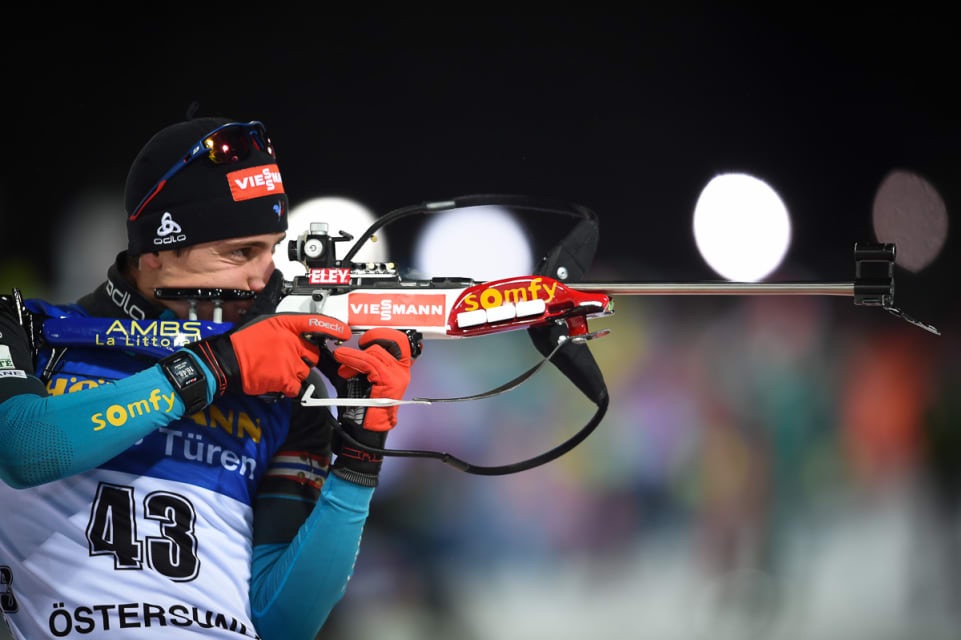
France’s Quentin Fillion Maillet shooting clean on his way to second place in the men’s 20 k individual race at the 2017/2018 IBU World Cup opening week in Östersund, Sweden. (Photo: IBU/Biathlonworld) Yet Fourcade was bested by his teammate Quentin Fillon Maillet, who placed second after starting a few positions behind him and shooting clean. But ultimately, Maillet had more than a two-minute gap to Bø, finishing 2:01.0 back with no penalties.
“Three yeas ago I had two fourth places and one podium here [in Östersund] so it’s a good place for me,” Fillon Maillet explained at the press conference. “Last year I had a lot of difficulties with my shooting, a lot of mistakes, a lot of penalty loops. So I am happy to start the season with a perfect shooting… I didn’t really change anything important with my shooting, just my head [laughs], something to think during the race. I work very hard to be better, so I am very happy to start with a good result.”
Austria’s Julian Eberhard finished fourth, just three seconds behind Fourcade with one penalty in his final shooting stage (+2:17.5; 0+0+0+1). Russia’s Anton Babikov in fifth (+2:34.1), Switzerland’s Benjamin Weger in seventh (+2:34.1) and Slovenia’s Jakov Fak in 12th place (+2:44.3) were the only other athletes besides Bø and Maillet to hit all 20 targets.
“I think Martin was on the podium in every race last year, so I should do the same to hold him behind me,” Bø joked at the press conference, when asked about wearing the yellow bib of the World Cup Total Score leader for the next race and his chances of winning the Overall World Cup this season.
“I am mostly focused on the Olympics,” Fourcade replied regarding this topic. “If I decide I need to skip some events I will, I already did that in 2014 [ahead of Sochi]. For now I am just focusing on the next competition… Many things to do before the Olympics… I am satisfied with the level I am at today.”
Also questioned by German broadcaster ZDF about recent revelations in the ongoing fight against doping and next week’s pending IOC decision on whether Russian athletes should be allowed to start at the upcoming Olympic Winter Games in PyeongChang or not, Fourcade had this to say:
“Regarding your question about the IOC, they will have a meeting soon and they will decide about the Russian issue. We [the biathletes] have no new information about it. But as an athlete I will keep the same position [as in the past]: I am mostly against collective sanctions, because I am sure there are really good Russian athletes who don’t use doping. Anyway, with what we heard about the Sochi Olympic Games, if it’s true – and the IOC should know that – it’s a big shame, and the ones who were involved need to be punished. You know, it’s strange because in a way I am against collective sanctions, but in another way with all the positive tests in the past year I lost faith. And I am really disappointed about that. You know, I am a big fan of sport, I dream of watching sport on TV. And I think when you lose faith it is not good for the sport. And as an athlete I sometimes lose it, so I can imagine the people on the other side of the TV also must have this feeling. So I know the IOC will take a good solution, but I have not, you know, only one solution, so it’s a pretty hard choice.”
Previously after Fourcade had just crossed the finish line, Russian biathlete Babikov immediately walked over to Fourcade to congratulate him on his race performance.
During last season’s IBU World Championships, there had been some harsh words between Fourcade — an outspoken critic of the use of performance-enhancing drugs and the way the IBU handled the situation following the release of the McLaren report — and some Russian athletes, especially past doping offender Alexander Loginov following the mixed relay race there. In Thursday’s World Cup race, Loginov placed ninth with one penalty (+2:38.1).
Burke 32nd, Doherty 38th for U.S.; Smith 37th for Canada

US Biathlon’s Tim Burke racing to 32nd in the men’s 20 k individual race at the 2017/2018 IBU World Cup opener in Östersund, Sweden. (Photo: US Biathlon/NordicFocus) For the first time in an individual race in several years, US Biathlon started five men, thanks to the men’s team’s strong performance to clinch 10th in last season’s Nation Cup score. (For the Olympics, even the best teams can only start four athletes for the sprint, the pursuit and the individual race, whereas in World Cups, the highest-ranked teams by this score can enter up to six.)
Starting in bib 44, Tim Burke incurred three penalties, all in the first two shooting stages (1+2+0+0), on his way to the 32nd place in his first race of the season, 5:24.2 minutes back to Bø and 3:10 to the podium positions.
“There was some light wind on the range today but we have seen much worse here in the past,” Burke explained in an email to FasterSkier. “The wind was up a little but it stayed pretty consistent from the time that we zeroed [target practice] before the race. I felt like I needed to get some of the rust off in the first two stages after not racing a World Cup since last February. I was simply a bit too conservative and controlling in the first two stages but was able to adjust and shoot more from reaction in the last two stages.”
Burke had the 37th-fastest course time of the day, while his shooting and range time ranked 14th and 13th, respectively.
“Considering everything, I think this was a solid start for me and I feel like I can build from this result,” he summed up his first race day. “After ending last season early due to illness, and taking a long time to get completely healthy again, I definitely had a lot of unknowns heading into this season. That combined with the fact that I have only been here one week and was unable to train on snow the previous 10 days at home, gives me confidence that things are headed in the right direction.”
Starting very early in bib 3, 2016 Junior World champion Sean Doherty placed 38th, 5:50.0 minutes back with two penalties (0+1+0+1).
The other three Americans all finished within 10 seconds of one another. In a field of 108 starters, Leif Nordgren was 63rd, 8:06.0 minutes back with three penalties (1+0+0+2). Lowell Bailey, the 2017 world champion in this discipline, placed 67th (+8:11.0) with four penalties (1+1+0+2) in his first race of the season after having to skip the mixed relay races last weekend due to an illness, and Paul Schommer was 69th (+8:12.3) with four penalties (1+2+0+1).
“Tough start,” Bailey commented on his race, according to a US biathlon press release. “I definitely felt a bit stale today, both on the ski course and in the shooting range. With the fresh snow that fell overnight, the conditions were really challenging and I definitely didn’t feel like I was at my best on the tracks. I’ll regroup tomorrow and start looking toward the next race on Saturday.”
“The first World Cups can be some of the most challenging for our team,” Burke explained in his email. “We have less snow time, less [offseason/pre-season] racing and jet lag to deal with [compared to many competitors], which can be a big hurdle to overcome at the beginning of the season. Luckily it’s a long season!”
The Canadian men couldn’t quite match the peak performance Julia Ransom had achieved a day earlier in the women’s 15 k individual, with a clean shooting performance on her way to a career-best ninth place.
Nathan Smith, who, similar to Bailey had missed last weekend’s mixed relay races with an illness, achieved Biathlon Canada’s best result in 37th place (+5:47.2), just ahead of Doherty. With a light wind blowing from the front or left, Smith cleared 18 of 20 targets and only incurred two penalties in his second shooting stage (0+2+0+0) while firing fast to post the 12th-ranked shooting time of the day.
“Conditions were fairly good by Östersund standards,” Smith wrote in an email to FasterSkier. “Not as perfect as the women’s race yesterday but still pretty good. I’m not sure what happened on my first standing. I felt pretty in control but the misses were quite far out. I think maybe it was a timing thing where I didn’t have a fast enough reaction when it was in the black.”
In contrast to his fast shooting, Smith’s skiing time ranked in the middle of the field of 108 starters, with the 61st-best course time of the day. Last weekend Smith had to cancel a planned start in the single mixed relay race with Rosanna Crawford. In that race, Christian Gow replaced Smith, and Crawford tumbled in a downhilll crash.
“It was nice to get back to racing but on the other hand disappointing to have come down with a cold a few days ago,” Smith explained. “I had been 100% healthy all training year. It didn’t turn into anything too severe thankfully but definitely didn’t help me out at all today. Skiing conditions were really slow (even the winning time). I expect to feel better this weekend in the sprint but will have to be realistic considering the cold and being ‘rusty’ after not racing last year, other than a few races.”
Teammate Christian Gow placed 45th on Thursday (+6:20.2) with one penalt in the final shooting stage (0+0+0+1). His brother Scott Gow placed 53rd (+7:16.1) with four penalties (1+2+0+1), and Brendan Green was 68th (+8:11.5) with five penalty minutes (1+2+0+2).
-
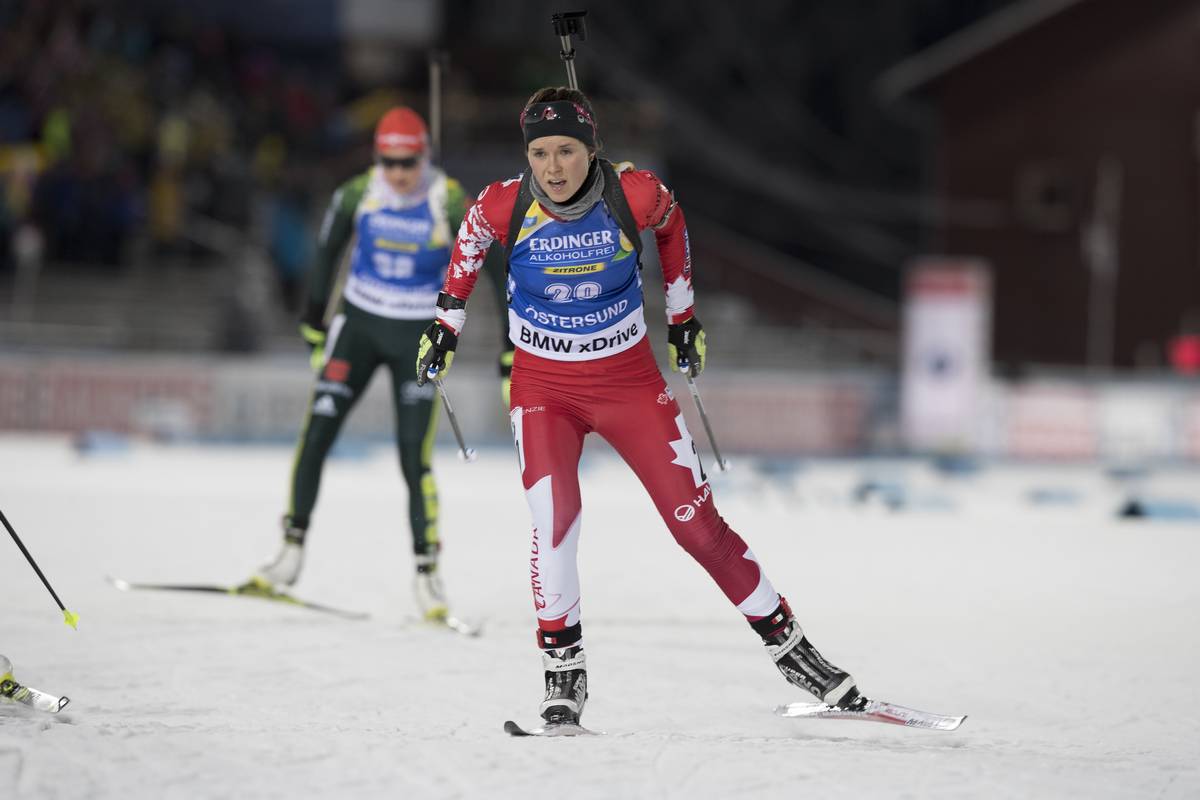
A New Season for Biathlon Canada: Ransom Rockets to Career-Best Ninth
Julia Ransom (Biathlon Canada) racing to ninth in the women’s 15 k individual on Wednesday at the IBU World Cup opener in Östersund, Sweden. In her first World Cup race of the season, it was Ransom’s career-best result and Biathlon Canada’s best individual result since 2015/2016. (Photo: Biathlon Canada/NordicFocus) Entering this season, members of Biathlon Canada had everything to gain and not a whole lot to lose. They had already had their funding reduced to zero by Own The Podium, save for a $50,000-dollar provision that paid for a coach, and its athletes were left to determine their offseason plan: stay home to train or self-fund training camps elsewhere. Many chose to spend most of their summer at the team’s base in Canmore, Alberta, and most started the season on the fly — without any preseason tuneup races in Europe — this week in Östersund, Sweden.
Julia Ransom was one of those athletes. After prequalifying for Canada’s International Biathlon Union (IBU) World Cup Team for the first trimester of racing, Ransom, 24, jumped into the 2017/2018 season with the Östersund mixed relay this past Sunday — three days after flying over from Canada.
There, she raced the second leg of the relay and tagged off in 15th, down two spots from where her teammate Emma Lunder tagged her in 13th. The team ultimately finished 15th, with teammates Scott Gow and Brendan Green.
“Today was a tough day for me. My legs were lead on the course,” Ransom wrote in a post-race email to FasterSkier on Sunday.
Three days later on Wednesday, it was another ballgame. With little to lose in the women’s 15-kilometer individual in Östersund, Ransom raced to a career-best ninth, which stood as her team’s best non-relay result in two seasons.
In the first individual race of the season, Ransom is well on her way to securing a spot on Biathlon Canada’s 2018 Olympic team, meeting half of the team’s “Priority 2” Olympic criteria standards. She needs another top 16 to fulfill that second-tier criteria. Priority 1 is one top-eight result in a World Cup (or World Championships, in a championships year like last season) or a top-three in a World Cup relay.
So far, she is the only one on her team who has cracked the top 16 in two seasons. Last winter, her best result (and her previous personal best) was 18th at 2017 World Championships in the 15 k individual. Canada’s best non-relay result in 2016/2017 was Scott Gow’s 17th place in a 20 k individual World Cup race.
And again, it’s the first race of the season.
“I am still in shock with how well today went,” Ransom, a Penticton, British Columbia, native in her fourth World Cup season, wrote in an email to FasterSkier on Wednesday.
“It is such a relief to start racing again,” she continued. “I wasn’t too nervous today; I had a race plan that I had confidence in and I was excited to give it a go. I also was looking for redemption after my painful relay leg on Sunday.”
Conditions were chilly, at -12 degrees Celsius (10 degrees Fahrenheit), but calm, accounting for clean shooting for seven out of the top-nine finishers. Ransom was one of them.
She started 20th (out of 102) and cleaned all four stages in the longest-format women’s race on the circuit. In individual races, shooting is weighed heavily; a minute is added to a competitor’s final time for each missed shot. Fortunately for Ransom, she hit all 20 targets.
“I was getting some pretty exciting splits during the whole race (top 5, second place, catching the leader etc) so I had an idea this was going to be a good day as long as I kept my shooting together,” she reflected. “I took a sigh of relief after the 20th target went down and just tried to ski as well as I could to the finish. I did take look at the big screen as I left the range, just to make sure I was hearing the techs right!”
Ransom initially crossed the finish line in third, 28.8 seconds behind Sweden’s Mona Brorsson in first and 9.8 seconds behind Eva Puskarčíková of the Czech Republic in second. Both Brorsson and Puskarčíková also shot clean.
The 55th starter, Nadezhda Skardino of Belarus, ultimately posted the best shooting and skiing performance of the day, racing to her first World Cup win (and first podium in three years) in 42:57.4 minutes with 20-for-20 shooting. Norway’s Synnøve Solemdal started 75th and shot clean but came up 2.9 seconds short at the finish to place second, bumping Ukraine’s Yuliia Dzhima to third (+12.0). The top-four women all cleaned with another Ukrainian, Valj Semerenko, placing fourth (+30.1).
Slovakia’s Paulina Fialková finished fifth (+32.2) with a single penalty (0+0+0+1), while Brorsson ultimately placed sixth (+49.6) and Puskarčíková seventh (+1:08.6).
Ransom ended up ninth for her best World Cup level performance by nine places, ahead of Norway’s Marte Olsbu in 10th and about eight seconds behind France’s Justine Braisaz in eighth.
“Starting off the season with a top ten has validated the hard work our team has put in and also given me a lot of confidence going forward. It’s a great building block to say the least,” Ransom wrote.
Asked what she thought made the difference with her training this year, she explained that she’d honed in on increasing her shooting speed.
“It’s still a work in progress but I am happy where I am so far,” she wrote. “I also did a ton of extra strength work and core stability and it has proven to make a big difference on the skis.”
On Wednesday, Ransom’s overall shooting and range times ranked in the middle of the pack, around 50th, while her overall course time was slightly faster in 42nd.
Biathlon Canada Head Coach Matthias Ahrens praised Ransom’s ability to perform under pressure.
“Especially as the tension mounted, with each clean bout, Julia was closer the podium and she managed the pressure very well,” he said, according to a team press release. “She didn’t get too excited or too nervous, executing clean shooting each time.”
Four Canadians started Wednesday’s 15 k, with Rosanna Crawford finishing 39th (+3:32.6) with three penalties (0+0+1+2), following her crash in Sunday’s single mixed relay.
“Rosanna, considering the crash of Sunday, had a really nice race,” Ahrens said in the press release. “It wasn’t certain if she’d race today, and we went in with a strategy not to risk any further injury. She managed a very good race, with a quite good ski time. Her rifle also required repairs from Sunday’s race. Overall, not knowing how she would hold up, particularly on one of the hardest Individual courses on the circuit, it was a nice result for her, in the World Cup points.”
Megan Bankes finished 75th (+6:28.9) with three misses (2+1+0+0) and Lunder was 83rd (+7:06.3) with five penalties (0+0+2+3).
US Biathlon started three women, with Susan Dunklee leading the team in 53rd (+4:12.7) with four penalties (1+0+1+2). Clare Egan finished 79th (+6:52.5) with five misses (0+2+1+2) and Emily Dreissigacker was 81st (+7:03.5) with three misses (0+0+1+2).
The men start their season with a 20 k individual on Thursday at 11:15 a.m. Eastern Standard Time.
-

Norway’s Mixed Relay Wins Again in Östersund; Canada 15th, U.S. 21st

(Left to right) Norwy’s Emil Hegle Svendsen, Johannes Thingnes Bø, Tiril Eckhoff and Ingrid Landmark Tandrevold show off their medals after winning the mixed relay on the opening day of the 2017/2018 IBU World Cup season in Östersund, Sweden. (Photo: IBU/biathlonworld) Even the most renowned athletes and national teams in the mixed relay on Sunday afternoon admitted they had not yet found their perfect groove in Östersund, Sweden, on the opening day of the 2017/2018 International Biathlon Union (IBU) World Cup season.
Nevertheless it still made for an exciting race, with four teams vying for the podium on the last lap. And in the finishing stretch, anchored by veteran Emil Hegle Svendsen, the same country prevailed as in the last two seasons in the same race and at the same place: Norway.
In a time of 1:11:31.7 hours, Svendsen held off a final push from Italy’s Lukas Hofer by 5.3 seconds. Norway required 13 spare rounds on the shooting range while Italy needed just six; however Hofer incurred a penalty lap in his prone stage, momentarily falling back 30 seconds and to fourth place before returning to the top three.
Germany, anchored by Arnd Peiffer, placed third, 6.4 seconds back with 10 spare rounds and no penalties, with Peiffer managing to overtake Slovakia’s Matej Kazar on the final lap. Slovakia narrowly finished off the podium after a strong team performance with its best World Cup result in a mixed relay in five seasons. The team finished 7.7 seconds out of first, with nine spares and no penalties.
“It was a really tough fight with Lukas just behind,” Svendsen recounted of the final lap during the post-race press conference. He had used all of his spares to clean his standing stage.
“I was happy to walk away with the win. I looked back, it’s impossible not to I think, but I felt quite strong…,” he continued. “I was unsure if I should just let him come to me and then we can finish in a sprint, but I looked behind and I had about a five-second gap so I just said to myself to just go and see what happens … Always a good feeling to start the season with a victory, good for the team, good for the spirit.”
“The last lap, when I went out from the stadium, I saw Emil in front of me and tried to close the gap as fast as possible,” Hofer said at the press conference. “But it was a bit too much because he also pushed so strong, and normally he is one of the best on the last loop. I was happy to finish like this… It was a really good start into the season.”
In the mixed relay format, with a 2 x 6 + 2 x 7.5-kilometer course length, two women followed by two men hand off to one another on the track, and each can use up to three spare rounds per shooting stage to avoid a penalty lap.
This time of the year, the sun sets early in Östersund in central Sweden. In a race under floodlights with mostly calm wind conditions, Norway, with Ingrid Landmark Tandrevold, Tiril Eckhoff, Johannes Thingnes Bø and Svendsen, combined for the best performance once again.
“I was really nervous, but I think everyone was, especially on the first loop,” Tandrevold said at the press conference, after she got the nod to start, replacing sick teammate Marte Olsbu. “The standing shooting was really hard, but I think the rest of my race was good. I was happy to be in front on the last downhill, because last year I fell [there] so I was a bit scared.”
“I was a bit rusty, I need some more races, then hopefully it will be a really good season,” added her teammate Eckhoff.
“Full speed from the start, that was the only plan I had,” Bø explained the tactics on his leg, where he required two spares in the prone shooting and all three in standing. “Of course I didn’t plan to use five extra [shots]. All in all I am satisfied, but there are still some things I need to improve on. A little bit faster skiing, a little bit better shooting.”
That prompted laughter from his teammates and his competitors on the podium.

Italy’s Dorothea Wierer tags Dominik Windisch at the halfway point of the mixed relay in Östersund, Sweden. The team went on to finish second on the day to open the 2017/2018 IBU World Cup season. (Photo: IBU/biathlonworld) Italy, with Lisa Vittozzi, Dorothea Wierer, Dominik Windisch and Hofer, narrowly missed out on its first victory in the mixed relay, tying its second place from two seasons ago in Canmore, Alberta.
“I was sure that Lukas would catch Emil!” Wierer said in the press conference with a laugh. “I think we can be satisfied. Of course we are not in perfect shape yet right now. I for sure didn’t have the best autumn, I was sick three times in two months. So it wasn’t perfect, but with some more races I can get in shape.”
The defending mixed relay world champion Germany, with Franziska Preuss, Maren Hammerschmidt, Benedikt Doll and Peiffer, was also happy with its outcome. Last season’s 2017 World Championships star Laura Dahlmeier will likely miss the whole opening weekend following an illness.
“It’s always a good feeling to start the season with a podium,” Hammerschmidt said at the press conference. “First race, I am always very nervous.”
“It was OK. In prone I could have hit my shot if I had taken a little more time,” Peiffer told German broadcaster ARD in an interview after the race, according to a translation. “It was a hard last lap, they really pushed the tempo right out of the shooting range and then I immediately had a small gap. I am glad that I was able to make up one more position and secure the podium … You are always nervous before a relay, with a big audience, and you have to race against all the good guys again who you didn’t see all year, so everyone is a bit excited.”
Slovakia, with Paulina Fialkova, Anastasiya Kuzmina, Tomas Hasilla and Kazar, had to settle for fourth place, but still the team was all smiles in an interview with the IBU.
“I am really surprised, but it was great,” Fialkova said. “It was close to the podium, but we hope maybe next time.”
“A good start to the season, and we will do it again and again,” Kuzmina added.
“I was really happy for the shooting and also running, a good result for the team today, good motivation,” their teammate Hasilla agreed.“Very happy from this competition,” Kazar said. “Very hard last lap, going from [second] place after the final shooting to fourth place in the finish. There were really good men [racing against me].”
The home team from Sweden, with Hanna Öberg, Anna Magnusson, Jesper Nelin and Fredrik Lindström, was fifth on the day (+34.5, with one penalty and five spares), delighting the fans in Östersund after Öberg tagged off in first place after the first leg.
Another surprise of the day was Finland, with Mari Laukkanen, Kaisa Mäkäräinen, Tero Seppälä and Tuomas Gronman, leading the race at the halfway point behind a strong performance from Mäkäräinen, who moved up from eighth to first place with the best first-leg course time.
“It was a hard race, especially with Kaisa Mäkäräinen, she was really fast today,” Eckhoff said during the press conference.
The two Finnish men could not quite hold on to that position, but still finished in eighth place, 1:32.4 back with one penalty and eight spares.
It was Finland’s best World Cup mixed relay performance since placing seventh during the 2011/2012 season and sixth at 2009 World Championships in PyeongChang, South Korea, host of the upcoming Olympics.
Also with Mäkäräinen and Laukkanen, Finland actually won the gold medal in the mixed relay at the 2016 summer biathlon world championships, a rollerski biathlon event typically skipped by a number of the world’s best athletes. Similarly three of Slovakia’s starters on Sunday had placed second in that event last summer, gaining some positive experiences for the upcoming season.
Canadians Satisfied with First Race, Despite ‘Race Jitters’
For Biathlon Canada, Emma Lunder, Julia Ransom, Scott Gow and Brendan Green formed the relay team on Sunday.
“Today was the second mixed relay I’ve ever done on the World Cup circuit, and I felt pretty calm going into the race,” the 26-year-old Lunder wrote in an email to FasterSkier. “My plan was to sit back on the first lap as I know it can get really frantic, and I didn’t want to get tangled up with anyone.”
She cleaned her prone stage, coming back on the course in 12th place just 13 seconds out of first.
“I’ve never raced in Östersund before and I’ve always heard that it’s notorious for tricky winds, but the flags were almost totally still during both my zero [target practice] and the race,” Lunder wrote. “I was really proud of my prone as I’ve been working hard to improve my accuracy and speed this summer.”
In the standing stage, she had to use all three spares to avoid skiing a penalty lap, but improved positions nonetheless as other teams struggled as well.
“I had a bit of a problem when I came into standing with my contact lens moving around leaving my eye blurry,” she explained. “I think I paid a little bit too much attention to that, and wasn’t as focused on the standing shooting as I would’ve liked.”
On the last loop, she was passed by three teams fighting for positions in a pack, but didn’t lose any more time to the top.
“We had amazing skis after a great performance from our wax team, so I was able to take advantage of that on the downhills and zip past people,” Lunder wrote. “It was pretty exciting for me to be skiing with a pack where I could actually see the leader of the race, and I felt strong for the most part. Overall I was happy with my race today.”
Lunder exchanged to Ransom in 13th position, still only 24.2 seconds out of first.
“I was very excited for Emma Lunder’s race,” Ransom wrote. “She handled the start leg calmly and confidently, tagging me off in a great position.”
Like Lunder, Ransom also shot clean in her prone stage, then needed two spares to also clear her standing targets.
“The shooting range was really calm, especially in comparison to past years I’ve raced here,” Ransom wrote. “I was happy that I kept my shooting somewhat together. That was a big improvement from last year’s mixed relay in Östersund.”
But on the course she had some trouble holding up with the pace set by the race leaders, losing more than 40 seconds to them on both her second and third loops.
“Today was a tough day for me. My legs were lead on the course, but I half expected that to be the case [on] day three after travel,” she wrote.
Ransom tagged Gow in 15th place, 1:46.2 back.
“It was nice to be back racing again,” Gow wrote in an email. “This was probably the most calm I have been for a season opener.”
The older brother of Christian Gow, who raced the single mixed relay with Rosanna Crawford earlier in the day, required all three spares in his prone stage and another two in standing.
“I was mostly happy with my race except for my shooting. The conditions can be very tricky here, but my problem was with my head, not the wind,” Scott Gow wrote. “I was so wrapped up in the race and trying to make as much time as possible that I think I was too excited going in to each shooting. I will try to be more relaxed for the upcoming races.”
He he tagged Green in 16th place, after losing more than another minute to the leaders (+3:03.9).
“Östersund can often provide some very tricky racing conditions, but today was actually almost perfect in terms of wind,” Green, Canada’s anchor, wrote in an email. “In my experience, it’s rare to see a day like this.”
He only needed one spare each in his prone and standing stages, and with the 15th-ranked course time improved again by one position to finish 15th, 3:28 minutes behind Norway, without any team penalties and a total of 12 spares.
“I always find the season opener quite tough,” Green explained. “Digging deep to find that extra gear always hurts at the beginning of the season, but hopefully it will get easier and start to feel better from here on out.”
The Canadians agreed that all in all, the race was a good building block to start off the new season.
“From chatting with the team I think we all had some good parts of our races, and a few things we’ll work on between now and the individual races,” Lunder concluded. “It was a good start today, and we can definitely build and improve from here!”
“After a few more days of adjustment I think our team is positioned for some great results this coming season,” Ransom wrote.
“I think I held us back a little bit with my shooting, but otherwise we did a decent job,” Gow wrote. “We got the race jitters out and now I think we will be ready to give it our all next week.”
“I think each of us were able to take away some positive aspects from todays race, but as a whole we are for sure expecting to improve upon today,” Green concluded. “It was good to get the first world cup race out of way, and we are looking forward to more racing this coming week.”
U.S. Still ‘Blowing Out The Cobwebs’

US Biathlon’s Paul Schommer racing the third leg of the mixed relay on the opening day of the 2017/2018 IBU World Cup season in Östersund, Sweden. (Photo: USBA/NordicFocus) US Biathlon’s original race lineup included 2017 World Championships gold medalist Lowell Bailey and silver medalist Susan Dunklee, Clare Egan, and former Junior World Champion Sean Doherty.
But on race day, teammate Paul Schommer had to take Bailey’s spot after he “woke up with congestion,” according to a US Biathlon press release.
“We had planned on racing Lowell for the third leg, he didn’t feel 100% today so Paul was subbed in,” Doherty explained in an email to Fasterskier. “Just no risk in pushing it with the hardest individual race of the year on Thursday.”
Dunklee started the team out well, taking the lead on the course to come into the first shooting stage and leaving in eighth position, just under 10 seconds back after needing one spare. She moved up with a pack out on course, but in the standing stage required all three spares after initially missing one target.
“I felt strong and relaxed skiing during the first two loops and I think my technique is already a notch above last year,” Dunklee wrote in an email. “The third loop was a bit painful as my legs flooded with lactic acid and I wasn’t quite able to reel in the pack ahead. I struggled in standing with the spare rounds despite favorable conditions but shooting can often improve with my better race fitness.”
Coming back on the course in 11th position and 26.1 seconds back, she still managed to cut the distance to the leaders in half on her final lap and tagged off in ninth place.
Egan got off to a strong start, both on the course and in her prone stage, where she cleaned without any spares and started her second loop in 11th. But with athletes like Mäkäräinen and Kuzmina setting a high pace up front, she explained she was struggling.
“This was my first race of the year and it was a rude awakening,” Egan wrote in an email to FasterSkier. “From the very beginning the pace seemed crazy and I was just trying to hold on. I am reminded now that the level is super high and I just need to go harder and faster all the time. I’ll get better as I race more but today was a bit of a shock.”
In the standing stage, she quickly ran out of spares and had to ski two penalty laps, which put her back to 20th (+2:27) when she returned to the course for her final loop.
“Conditions were perfect for me on the range today,” Egan wrote. “Last year in this race I did the exact same thing. I think the shock to the body makes it almost impossible to keep my mind where it needs to be for shooting. My prone is automatic — I am at the level of ‘unconscious competence’ — where I can do it right without thinking about it. But in standing I’m at the ‘conscious competence’ level. I really have to use my brain to execute all the steps.
“Today, I shot all 5 rounds from the clip plus 1 spare before suddenly having a moment of clarity and saying (out loud actually), ‘where have I even been aiming??’ …may or may not have included an expletive,” Egan continued. “Then, using my brain, I was able to easily hit my last two shots.”
She tagged Schommer in 21st, 2:51.5 minutes back.
Schommer lost more time on the course, but with a good shooting performance — needing just one spare in each of his stages and a range time ranked in the middle of the field — he avoided getting lapped and held the team in 21st, 4:29.5 seconds back.
It was only his second World Cup appearance in a mixed relay, following an eighth place last season in Kontiolahti, Finland.
From there, Doherty anchored the team to 21st place, also requiring just one spare round in each of his shooting stages.
“The conditions were uncharacteristically calm,” Doherty wrote in an email. “But I would not expect the conditions to stay calm for all the races so I forecast some challenging shooting on the [next] weekend.”
“It felt great to be back on the world stage,” he added. “It is a fantastic atmosphere. I enjoy competing on the world cup and I am always looking forward to the start of the season. The level of competition is just as high as I remember it last year and I am excited to see where I stack up after a great summer of training.”
“The good news was that I was never nervous, which is something I’ve struggled with in the past, and I shot fast today,” Egan reflected. “My shooting has been excellent in training since we got on snow, so I just need to transition into race mode. Today was what you might call ‘blowing out the cobwebs’!!!”
“The first race of the season is typically a tune up race for us and not one where we necessarily try to optimize our performance,” team veteran Dunklee concluded. “There are more nerves, there’s jet lag, and it often takes a few real races before the body starts to feel fully sharp again. We didn’t end up very high on the results list tonight, but I have no doubt that our best is yet to come.”
“I was impressed watching Emily [Dreissigacker] lead the first loop of the single mixed relay – she looked very comfortable in front of the pack,” Dunklee also commented on the performance of her teammates in Sunday’s single mixed relay. “Most rookies are terrified of trying something like that. You’ll see more of her in the future for sure.”
Racing will continue on Wednesday with the women’s 15 k individual, and the men compete on Thursday in the 20 k individual.
Next season, Östersund will host the 2019 IBU World Championships. Norway surely wouldn’t mind making it four wins in a row in Östersund in the mixed relay there.
-
Crawford’s Nasty Crash Derails Canada in Single Mixed Relay, Austria Shines
Simon Eder tags off to Lisa Theresa Hauser for Austria during the single mixed relay World Cup in Östersund, Sweden. The pair raced to a 16.5-second win. (Photo: IBU/biathlonworld) Two years ago, Nathan Smith and Rosanna Crawford were second in the first World Cup biathlon race of the season, a single mixed relay in Östersund, Sweden. It was the first relay medal ever for Canadian biathlon.
This year, same race, same place, Smith sat out because of a sore throat but Crawford and Christian Gow teamed up for Canada to take on the event again. Partway through the race they were in podium position before a serious crash took them more than out of medal contention; the team was lapped and finished 22nd.
“Pretty bummed,” Crawford said.
Through the first leg, she had used two spare rounds but still tagged off in third place, just 7.1 seconds out of the lead. Then Gow shot perfectly to hang onto fourth, 18.4 seconds out of the lead as the Austrian duo of Lisa Theresa Hauser and Simon Eder had taken control of the race and would never be out of the lead, eventually winning by 16.5 seconds.
Crawford chased hard and passed Italy’s Alexia Runggaldier.
“I thought, I’ll just tuck in behind the Italian, but then I thought, oh, she’s going too slow,” Crawford said. “That’s always an amazing feeling when you think, I feel stronger than you, I can pass you.”
After a tough season for much of the Canadian team last year, that feeling was particularly nice, she added.
Crawford was skiing in third just on the tails of Germany’s Vanessa Hinz when she hit ice on one of the last downhills of the loop and “did a few somersaults.” She stayed on the ground for several seconds and Canada’s hopes for another podium were dashed.
(Story continues below)
https://www.instagram.com/p/Bb9nzcRjtSY/?taken-by=rosannacrawford
“My head was fine,” Crawford said. “There were quite a few physiotherapists who ran over, so they were asking what’s my name, where am I, what date it was. I got all of that right. But when I went to go and push myself up, my shoulder was really sore.”
After at least a minute or two, Crawford headed back out onto the trail, but in a very different part of the race than she had been before. Then there was the issue of her rifle, which she said didn’t have any serious damage but at the time wasn’t working well.
“Just snow everywhere,” Crawford said. “I think the sights might be twisted a little bit, or something happened because then when I did take a shot I was, like, 10 cm above the standing target. Something was off.”
Even with spare rounds which are allowed in relay races, Crawford was left doing two penalty loops and in the meantime, the leaders lapped through. Canada’s day was over.
While Crawford doesn’t have any serious injuries, her shoulder was banged up.
“It is just bruised,” she explained. “The skin tore a little bit where the rifle must have hit it… I probably should have just stopped. Our physio here [later] said, yeah, you have quite a bit of adrenaline going through, so if something feels like it still hurts, then it means that it’s probably pretty bad.
“But it’s so hard, especially in relays,” Crawford said. “Christian is such an amazing shooter, he’s so fast and so accurate and he had done so well. I really didn’t want to let him down. And then I was also thinking about Nations Cup points. If I didn’t finish then we would get no points, whereas even if we were lapped at least we would get some points. So all of that was going through my head.”
Canada finished 22nd, and did get a few Nations Cup points.
Another lesson: stick with the plan.
“My race plan was to not take that inside corner,” Crawford said of the spot where she crashed. “I changed it halfway through the race bcause other people were taking it… On my second time down the hill, so after my first prone shooting, I was behind Hauser, and she took the inside line and I lost a little bit of a gap on her. So I thought, okay, next time I will take the inside line. So the third time going down the hill I was behind Hinz. She took the inside line and I was right behind her.
“In hindsight I probably should have just stuck with my race plan and taken it a little bit wide, because I have been here many, many years,” she concluded.
Austria Shines as France Falters
Meanwhile, the Austrian duo was extending their lead. France had come in as heavy favorites, with Martin Fourcade and Marie Dorin Habert having won the same race last season, Fourcade having won the overall World Cup, and Dorin Habert finishing fourth in the women’s World Cup Total Score last season.
Kazakhstan’s Maxim Braun celebrates third place ahead of Martin Fourcade of France, Sebastian Samuelsson of Sweden, and Dmytro Pidruchniy of Ukraine. (Photo: IBU/biathlonworld) But the duo put together a sloppy shooting race, using 10 spare rounds over 40 targets. The Austrians, on the other hand, were nearly perfect, using just two spare rounds and cleaning their targets quickly.
By the time Eder came in for the final shooting bout, he could have used at least two spare rounds and still left with the lead. Instead, he cleaned.
“First race, first victory – this is a dream,” Eder said in an Austrian Ski Federation press release. “It already paid off to toil for another year. I knew this would be one of the toughest single mixed competitions, because you always carry the exhaustion from the last climb to the shooting range. But I could pace myself well. I think tactically it was a strong performance, and that’s the most important thing in the single mixed. It’s not about always going full throttle, otherwise the shooting series won’t work out anymore. It was just perfect on the range today.”
Their win was not a surprise, as the pair had won the single mixed relay World Cup in Kontiolahti, Finland, last season. But it was still a relief, Hauser said.
“It’s just incredible to immediately be on the top of the podium in the first race,” she said in the same press release. “The first race is always something special, because you are extremely stressed.”
Behind them, an interesting race was unfolding. The German team used nine spare rounds and had only a single perfect shooting stage, and Hinz said that her legs were “not yet quite where I’d like them to be.” But teammate Erik Lesser was aggressive on the trails, having the third-fastest time on each of his relay legs, and he skied across the finish line in second place, well clear of the rest of the field.
And that’s where things got really crazy. A number of teams had left the range the final time quite close together: Kazakhstan with Maxim Braun, then Lesser (who immediately passed him), then Italy and Ukraine. Italy’s Thomas Bormolini charged hard and skied his way into third position.
But on one of the final downhills Bormolini fell, taking out Dmytro Pidruchnyi of Ukraine as well. That allowed Braun, who had been left behind, to sail past them. It also allowed Fourcade and Sebastian Samuelsson of Sweden, who had started the final loop many seconds back, to catch further up.
In the end it was Braun taking third place for Kazakhstan, France fourth, and Sweden fifth.
“I opened my eyes and I saw the athletes from Sweden and Ukraine just lying in the trail,” Braun said through a translator in the post-race press conference. “I would like to have watched the race myself to realize what was going on. I realized it was my chance and I grabbed it… this summer we worked really really hard, and this is a fantastic beginning of the season for us.”
While he acknowledged that he had “a little bit of luck,” it was also good biathlon: with just five spare rounds, Kazakhstan had the second-best shooting of the day.
Americans 19th After Fast Start
The single mixed relay was the first World Cup start of Emily Dreissigacker’s career. The Americans started in bib six and Dreissigacker soon found herself among the race leaders.

Emily Dreissigacker of the United States competing in the single mixed relay in Ostersund, Sweden. (Photo: USBA/NordicFocus) “My plan was to get in behind someone and try to pace myself and relax on the first lap, especially up the first hill,” Dreissigacker wrote in an email. “But it turns out I just have this instinct in a mass start to get to the front. At the time it felt easy and it was super fun to lead even if it was just for a hot sec. But of course once the adrenaline wore off I definitely paid for it.”
Dreissigacker got through the first shooting stage with perfect shooting, and headed out again. But the effort early on was indeed catching up with her.
“I think it’s important in a single mixed relay to pace yourself on the first leg, which is something I did not execute well today,” she wrote. “My legs flooded really badly and didn’t start to clear at all until my very last loop.”
She had to use all three spare rounds in standing, and tagged off to Leif Nordgren in 20th. Nordgren, though, used only one spare round total over his next prone and standing stages, and was able to bring the Americans into 12th.
Dreissigacker then took a penalty loop in both of her second-leg shooting stages, and then Americans ended up in 19th place after being lapped.
“Prone felt good but my group moved right and down,” Dreissigacker explained. “I’m not sure why, it could have been the wind, it could have been something slightly off in my position but I was happy to at least hit all of my spares… Overall I’m happy with [the race]. I have a lot to learn still and a lot I can improve upon, but you have to start somewhere.”
That’s a sentiment for Nordgren, too, who is hoping for better things later in the year.
“It’s a long season with the highlights being the Olympics so I didn’t really expect much from today,” Nordgren wrote. “That being said it’s always nice to get a chance to race, it’s a different type of stimulus for the the body then just a hard intervals session. Emily had a rough day on the skis. It’s a pretty brutal single mixed course here, so if you aren’t ready to go hard right from the start you’ll pay for it later. The snow was a little deep today as a result of the grooming so that makes it a little bit tougher on the legs too. It’s not the end of the world not getting to race the second leg – it was nice to get back in race mode even if just for a little bit.”
For Nordgren, just to be racing and feel good was an achievement compared to last year, when it was on this very day that he realized a toe injury sustained just before the start of the race season was actually a big problem. Nordgren ended up taking several weeks off of racing completely to heal.
“Last year it was a dark time for me!” he wrote. “It’s really nice to have not had any trouble like that heading into the season. Overall the preparation has been pretty good this year, so I’m excited to get into the individual races starting next week.”
-Harald Zimmer contributed
-
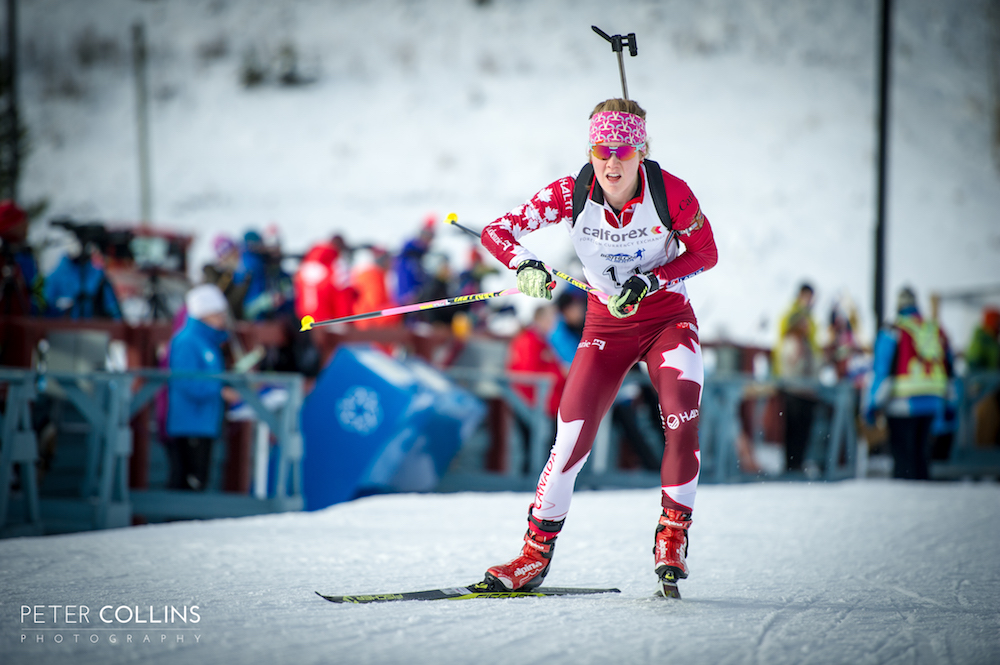
Biathlon Canada Finalize World Cup Team Following Trials (Updated)

Emma Lunder, of Biathlon Canada’s Senior National Team, racing to second in the women’s modified sprint on Friday, Nov. 10, the last day of Biathlon Canada’s team trials. After reaching the podium three times in three races, she was selected to the IBU World Cup team for the first trimester. (Photo: Peter Collins/petercollinsphoto.com) Note: This article has been updated to include comments and verification from Biathlon Canada High Performance Director Roddy Ward, and explain the modified shooting format used for Friday’s sprint.
***
Almost exactly two weeks before Biathlon Canada sends the rest of its World Cup team to Europe for the first trimeter of International Biathlon Union (IBU) World Cup racing, the national team held trials this past Tuesday through Friday on snow in Canmore, Alberta. Three sets of races in four days (all sprints*) determined which Canadian men and women will start the season at the World Cup opener in Östersund, Sweden, Nov. 26-Dec. 3.
The national-team trials, also known as the “Tour 1 Selection Trials”, ultimately boil down to what Biathlon Canada calls performance percentages, which measures an athlete’s finishing time in a given race against the average of of the top-three finishers’ times in that race. One bad race isn’t a deal-breaker; they consider the best two out of three. At the end of the trials, an athlete’s top-two results (specifically their performance percentages) are averaged for their overall ranking.
Going into the trials, two women and one man on Biathlon Canada’s senior team had prequalified for the first World Cup tour (World Cups 1, 2 & 3): Rosanna Crawford, Julia Ransom and Scott Gow, according to a national-team program dated Aug. 30, 2017.
According to the same document, two additional women’s spots and three men’s openings remained. Those went to the two highest-ranked women at the Nov. 7-10 trials — Megan Bankes and Emma Lunder, respectively — and the top-three ranked men — Nathan Smith, Brendan Green and Christian Gow, respectively.

Emma Lunder (r) with fellow Biathlon Canada national-team member Rosanna Crawford after the women’s modified sprint at Biathlon Canada’s team trials in Canmore, Alberta. Lunder placed second in that race to secure one of the last two spots on Canada’s IBU World Cup Team, while Crawford, who had been pre-selected for the team, placed sixth in that race. (Photo: Peter Collins/petercollinsphoto.com) All of the eight aforementioned athletes were nominated to Canada’s 11-member National Senior Team in June. The three remaining biathletes are Sarah Beaudry, who had the third-best overall women’s percentage at trials, Megan Tandy, who ranked fourth and was reportedly coming off an illness after traveling from Germany, and Macx Davies, who ranked seventh in the men’s final percentages after Matthew Hudec of the Biathlon Alberta Training Centre (BATC) in fourth, Carsen Campbell (BATC) in fifth, and Jules Burnotte (Biathlon Estrie) in sixth. (Scott Gow, Crawford and Ransom were not factored into the final percentages.)
The eight athletes that just missed the World Cup team will start the season on the IBU Cup. Four men and four women earned spots on Canada’s IBU Cup team as a direct result of their performances at trials: Hudec, Campbell, Burnotte, and Davies, and Beaudry, Tandy, Nadia Moser (BATC), and Leilani Tam von Burg (BATC).
Biathlon Canada’s High Performance Director Roddy Ward described the recent team selections as “straight-up trials”. Based on its published criteria, Biathlon Canada has the option to use discretion in choosing a fourth man and fourth woman for its IBU Cup team, but instead stuck to results, selecting the fifth- through eighth-ranked athletes at trials.
“We filled the team based on trials,” he explained on the phone on Sunday.
Ward said he was “feeling really good” about how the World Cup team shook out, with four of their top men returning to the circuit. He mentioned that Smith is healthy and back at full strength, and noted Green’s consistency at trials.
“On the women’s side, it’s just really good competition … with places changing every day,” he continued.
Most of the 16 athletes selected to Canada’s World Cup and IBU Cup teams spent much of the offseason together “time-trialling and integrating,” Ward said, which has brought up the level of training as well as made for closer competition among them.
“My hope is we go to the World Cup and do well and go to the IBU Cup and do well,” he said.
The Canmore trials began with sprints on Tuesday, which Beaudry and American Lowell Bailey (US Biathlon) won. The only woman to shoot clean, Beaudry topped the women’s 7.5-kilometer sprint by 8.9 seconds over Crawford with a finishing time of 21:57.7 minutes. Crawford missed one in each shooting stage (1+1) for second place and Lunder placed third, 21.1 seconds back, after a single standing miss (0+1). Tandy followed in fourth (+1:05.5) with two penalties (1+1), and Joanne Reid was the top American in fifth (+1:13.9) with one miss (0+1).
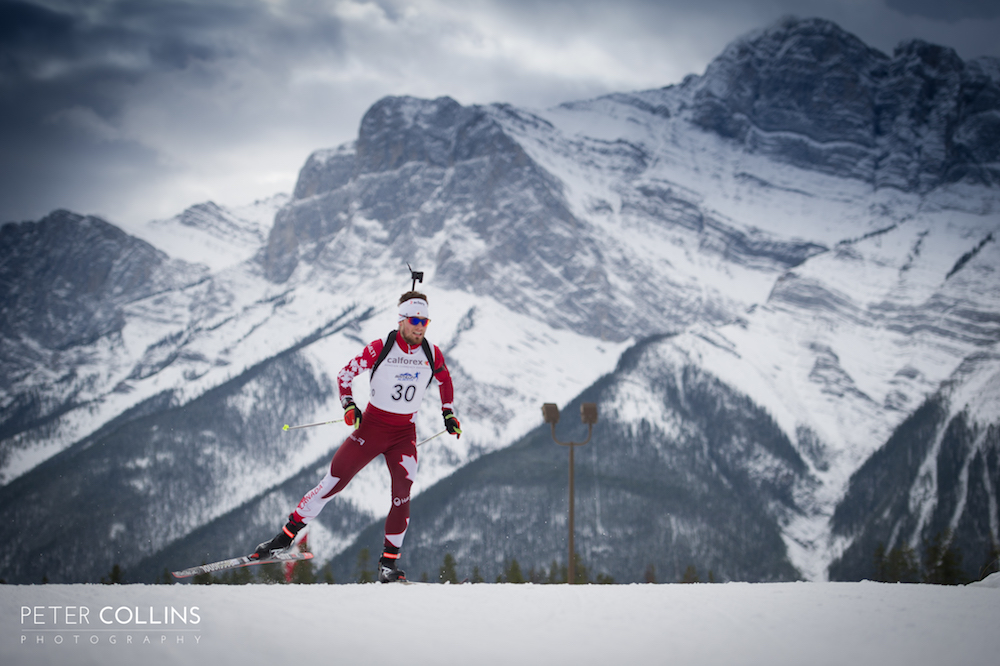
Christian Gow (Biathlon Canada Senior National Team) racing to ninth in the men’s modified sprint on the last day of Biathlon Canada’s team trials in Canmore, Alberta. With the third-best performance percentage of the trials, Gow was the fourth man named to Canada’s IBU World Cup team for the first trimester of racing. (Photo: Peter Collins/petercollinsphoto.com) In the men’s 10 k sprint, Bailey also cleaned to beat out Smith by 13.4 seconds with a finishing time of 25:02.5. Smith had to ski one penalty loop after a prone miss (1+0) and Green placed third (+14.5) after two prone penalties (2+0). Scott Gow and his younger brother Christian finished fourth (+29.4) and fifth (+38.8), respectively, and Tim Burke (US Biathlon) was the second American in sixth overall (+1:11.0).
On Thursday, Smith won the second sprint of the week outright with a 26.1-second victory in the men’s 10 k with perfect shooting and a finishing time of 24:25.3. Green once again followed in second with clean shooting as well, and Artem Prima of Ukraine took third (+1:09.3) with two misses (2+0). While the Americans didn’t compete on Day 2 of the trials, Team Ukraine did, accounting for nearly the same amount of competitors (40 in the men’s race, 20 in the women’s race, compared to 40 in the men’s race and 26 in the women’s race two days earlier).
Scott Gow finished fourth in the Day 2 sprint (+1:17.0), followed by Hudec in fifth (+1:29.4).
In the second women’s 7.5 k sprint, a new winner emerged, but second through fourth place were exact repeats from Day 1. Bankes claimed the win in 22:03.5 with clean shooting, while Crawford followed in second, 26 seconds back with two standing penalties (0+2), Lunder placed third (+1:02.8) with two prone misses (2+0), and Tandy was fourth (+1:16.2) with two prone penalties (2+0) as well. Beaudry placed fifth (+2:16.6) with three penalties (2+1).
After sitting out the first two days of trials, Ransom won Friday’s modified sprint (6.8 k for the women) by just a tenth of a second over Lunder. Ransom hit all of her targets and posted the win in 20:20.4, and Lunder was just off her mark in second place after “cleaning” as well. Per the modified format, each athlete could use up to three spare bullets per shooting bout, similar to a modified relay.
“We all know [sprints] are important races; they lead to pursuits they lead to mass starts,” Ward explained. “We want to make sure we’re picking good biathletes, but also favoring on the ski-speed side.”
In addition to giving an athlete more chances on the shooting range, the relay format showed who could excel in those types of races, Ward said.

Julia Ransom (6) racing to the win in the women’s modified sprint on the last day of Biathlon Canada’s team trials on Nov. 10 in Canmore, Alberta. (Photo: Peter Collins/petercollinsphoto.com) As a result of the modified-sprint format, the top-five women avoided the penalty loop. Bankes placed third, 6.7 seconds off Ransom’s time. Bankes’s BATC teammate Nadia Moser finished fourth (+8.6), ahead of American Susan Dunklee (US Biathlon) in fifth (+18.6). Crawford finished sixth (+48.0) with two penalties (2+0) and Tandy placed seventh (+1:13.9) with one miss (1+0).
In the men’s modified 7.5 k sprint on Friday, Smith emerged as the top Canadian for the third-straight race, winning in 18:42.0 with “clean” shooting. The top-eight men hit all their targets. Green finished second (+11.5) once again, and Scott Gow improved to third (+36.4).
Prima followed in fourth (+41.5), his Ukrainian teammate Sergey Semenov finished fifth (+1:05.9), Campbell and Burnotte tied for sixth (+1:08.2), and Davies placed eighth (+1:20.2). Christian Gow finished ninth (+1:40.9) with one penalty (1+0), Burke was the top American in 10th (+1:47.7), followed by Bailey in 11th (+1:47.9). Both Americans finished without any penalties.
Both the U.S. and Ukrainian teams raced two out of the three days of trials, contributing to the total field size of 45 men and 26 women on the last day. Ward emphasized that those teams’ presence made for “some really good competition”, and added that having Canadian juniors race alongside seniors (same distances, same races) showed them a clear path to reaching the World Cup level.
US Biathlon held the last of its own trials last month and planned to finalized its IBU World Cup team after its Canmore training camp.
For the Canadian World Cup team, Green and the Gow brothers planned to leave Sunday for Sjusjøen, Norway, where they’ll race at Norwegian biathlon trials. According to Ward, Lunder will depart on Thursday for Sjusjøen, where she’ll start her season with the first IBU Cup sprint on Nov. 23 before meeting the rest of the World Cup team in Östersund. Smith, Crawford, Ransom and Bankes planned to leave Canada on Nov. 22.
Most of the IBU Cup team will depart on Dec. 1, while Campbell and Beaudry will start their seasons earlier at the IBU Cup opener Nov. 23-26 in Sjusjøen.
***
Final ranking (performance percentages)
Results:
(*Why were all of these trials sprint races? When it comes to individual events, IBU Cup and IBU World Cup venues typically open with sprints to determine which athletes qualify for the remaining races of the week at each stop. For instance, the top 60 in the sprint qualify for the following pursuit race, and approximately the top 30 in the overall World Cup rankings qualify for mass starts.)
-

With Nordgren’s Freak Injury, U.S. Men’s Biathlon Team Down to Three
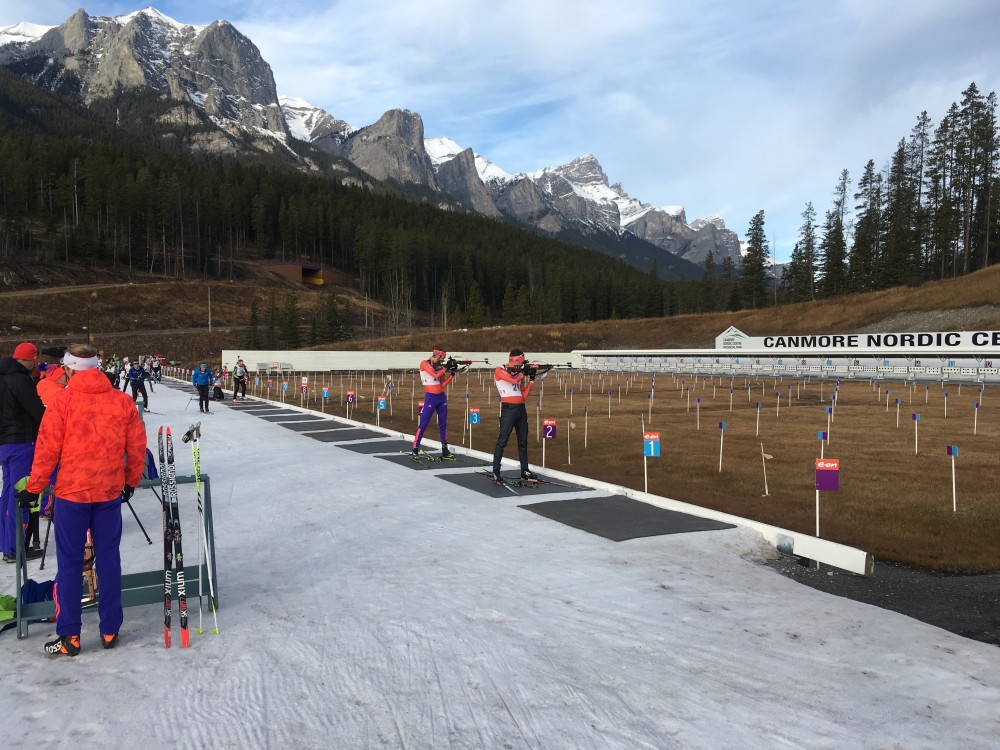
US Biathlon teammates Leif Nordgren (left) and Tim Burke zeroing their rifles prior to the start of the men’s 10 k sprint on Frozen Thunder in Canmore, Alberta, in November. Nordgren briefly joined Burke and his U.S. teammates on the World Cup before having to fly back to the United States for surgery on his toe. (Photo: Matthias Ahrens) The U.S. men’s biathlon team was already starting the World Cup season with a man down: Sean Doherty, the several-time World Youth and Junior Champion and 2014 Olympian, who had come down with mononucleosis.
But the team is now down to just three men after fellow 2014 Olympian Leif Nordgren had to have surgery on his toe after an incident with a treadmill.
Until January at least, that leaves just Lowell Bailey, Tim Burke and Russell Currier sporting the purple-and-orange suits of the United States on the sport’s biggest stage. It also leaves them without a relay team on Sunday in Pokljuka, Slovenia.
“It’s definitely disappointing to sit out a relay, but unfortunately, that is what we will have to do next weekend,” Bailey wrote in an email this past Sunday. “I think both of them will be back in force after the new year, so our whole focus now will be on the last half of the season, and a podium at World Champs… that’s what we are all aiming for!”
Paul Schommer, who was on the short list for a World Cup spot before Currier was selected, would have been the next logical man to add to the roster, but the team decided against it.
“We discussed the option to bring another man over, but we felt that the heavy travel and the race schedule as well at World Cups 2 and 3 did not justify getting someone out of the middle of a training block in Canmore,” U.S. Biathlon Chief of Sport Bernd Eisenbichler wrote in an email. “We only have one relay in the first trimester… We always try to look at individual best development options, as long as we are not missing more than one relay of course.”

Leif Nordgren leaving the range in last year’s mixed relay in Ostersund, Sweden (Photo: US Biathlon/NordicFocus) Nordgren’s injury actually happened just before he left the U.S. for the opening weekend of World Cup racing in Östersund, Sweden.
“The way it happened was kind of a freak accident,” he explained in an email. “I was doing intervals on the [rollerski] treadmill. After one interval I got off to take a lactate sample. The treadmill was still coming down from its incline though and squished my toe into the floor. Conveniently the treadmill turned off at that point and it took 30-45 seconds to turn it back on and raise it back up.”
Nordgren was initially told that he was fine to travel, train, and race, so he flew to Sweden, where he competed in the single mixed relay with Joanne Reid, finishing 19th.
“It definitely hurt pretty bad to train and race on it last week,” he admitted.
Afterwards, he went to the hospital in Sweden, where X-rays revealed that he had actually fractured the toe. Because it was an open fracture, surgery was needed. Nordgren opted to fly back to the U.S. for the procedure.
“The main reason to do the surgery was to make sure the fracture didn’t get infected,” he wrote. “When there is a fracture near an open wound (my toe was cut as it was squished) they call it an open fracture. If the fracture and bone get infected it can be very bad, as in amputate bad. Basically it was a better safe than sorry scenario.”
After the surgery, news came back that cultures taken from the fracture did show the presence of Staphylococcal bacteria, which can cause infection and major complications. Nordgren joked on his blog that if he hadn’t had surgery to clean out the wound and the infection had proceeded, he would probably be down to nine toes. He is now on a course of antibiotics which should prevent further problems.
“Now that they did find that staph bacteria I think everyone is happy we did the surgery,” Nordgren wrote in an email.
In terms of his prognosis, he does anticipate being back to the World Cup in January.
“I had surgery on Friday, everything went ok with that and now I am back in Lake Placid area recovering for the next few weeks,” he wrote on Monday. “Recovery is expected to be pretty short, hopefully in the 2 week range. I should be able to start doing some upper body training before then though, but as of now with the surgery still quite fresh I just have to stick to the couch with my foot up.”
https://www.instagram.com/p/BNsjftkgYpF/
As for Doherty, he raced in the NorAm mass start in Canmore, Alberta, on Sunday, placing seventh (+3:03.3 behind winner Paul Schommer) with four penalties.
“Sean did have a quite fast and real good recovery,” Eisenbichler wrote. “Our doctors and coaches did a great job to find the right plan for him. He will do the full camp in Canmore and then if all continues to go well, he will go to [IBU Cup] trials races in Minnesota (not for trials or qualification reason, but to get some racing in). We expect to have him back for World Cup 4 in Oberhof, but more can be said and known after completion of the Canmore Camp.”
— Alex Kochon contributed reporting -

Lillehammer, Östersund & West Notes & Quotes

After winning Saturday’s 5 k freestyle World Cup race, U.S. Ski Team member Jessie Diggins (l) high fives Minnesota youngster Greta Stange, atop the shoulders of Diggins’s teammate Liz Stephen, on Dec. 3 in Lillehammer, Norway. (Photo: Aleks Tangen) Three days of racing, more than a dozen North American skiers, and one FasterSkier on-site reporter was there to witness it all — including Jessie Diggins’s second-career win — in Lillehammer, Norway. We were also trailside at the first U.S. SuperTour races of the season in West Yellowstone, Mont., and provided remote coverage of the biathlon World Cup opener in Östersund, Sweden.
Here’s what we came out of last weekend with, in terms of what didn’t make it into the race reports.
XC World Cup/Lillehammer mini tour:
- Day 1 race reports (classic sprint): Women | Men
- Day 2 (5/10 k freestyle): Women | Men
- Day 3 (10/15 k classic pursuit): Women | Men
On Diggins:

Jessie Diggins (U.S. Ski Team) celebrating her second career World Cup victory after winning the women’s 5 k freestyle on Dec. 3 in Lillehammer, Norway. (Photo: Aleks Tangen) [Asked whether she might consider targeting a top finish in the Overall World Cup, in addition to World Championships]
“She has obviously doesn’t talk about that and we’re not really talking about that either, but I think it’s for sure a possibility. She is really rounding out her ability, whether it’s sprint, distance, classic, or skate, and I think with her we will see continued improvements as we get into the season, in every discipline. She is the kind of skier that can and will be, in the future, an all-around threat for an Overall World Cup title, and she’s been kind of chipping away at it for some time now obviously, with a big step forward last season. … Right now she is planning on being at most World Cups, she is planning on skipping the World Cup weekend that is after the Tour de Ski the sprint, the sprint weekend, which has been a real smart strategy for her in the past. Right now she is not planning on being in Korea for that World Cup. We will kind of just take it race by race and see, and see what happens and see where we are.”
- Chris Grover, head coach of the U.S. Ski Team (USST), after Diggins’s 5 k victory
“Jessica can be either in the front or in the back when it comes to classic. I thought that if she has a good day, then we and Marit can try to chase Heidi, and that would be a really nice group. Or that she would be like the performance she delivered today and the she kind of falls through. But I was prepared to do most of the work myself, and it also turned out to be more than I was prepared for since Marit did not have her best day on the job.”
- Ingvild Flugstad Østberg (Norway) after placing second in 10 k classic [Diggins placed eighth]
On progress:
“Today for me, I was maybe a little bit tired, and I was trying to ski with Ingvild [Flugstad Østberg] at the start… . So I know that there were a lot of things to improve on from today, but also some things to be proud of, like not totally losing it, because it was pretty stressful at the start.”
- Jessie Diggins (USST) after placing eighth in 10 k classic pursuit
“There’s a certain time of the year where you feel just absolutely reckless, like you can push above and beyond, I haven’t yet found that place yet, but I am definitely really stoked with how things are going. I feel like each race I start, I am feeling better and better so it was definitely an encouraging thing on skate skis today, skiing like that on such a hilly course.”
- Sadie Bjornsen (USST) after placing 14th in 5 k skate
“Today was better, it was a step in the right direction for sure. I got sick at the end of October and was sick for about 2 1/2 weeks, so I missed some of the hard intensity in preparation to get ready for the season and fortunately got healthy in time to come over here, but it’s just taking a couple of races for my body to come around. Today was the first time I felt like I was able to race and push hard, and it wasn’t perfect yet, but today was much better than I’ve felt so far.”
- Eric Packer (Alaska Pacific University) after placing 78th in 10 k skate
“I’m still getting used to being on snow. I didn’t get enough opportunity to be on snow before starting racing, so arches on my feet and quads are pretty blown out. Yeah, it was pretty rough out there…
“I was able to dig pretty deep, and I extracted as much as I could out of the body, but again it wasn’t much, so it’s pretty disappointing that the season is off to such a rough start so far.”
- Andy Shields (NTDC Thunder Bay) after placing 89th in 10 k skate
“A lot of lessons learned, but none of the races were quite what I wanted. But it was OK. It was a good first experience of a mini-tour.”
- Caitlin Patterson (Craftsbury Green Racing Project) after placing 42nd in 10 k classic pursuit
On placing 17th in three-straight races:
“I know the 17th curse, holy cow. That’s what I was like, I was on the phone with [my coach Erik] Flora yesterday I was like, ‘What? No, 17th again. Well, I mean, that’s not bad, I would like to get a little better than 17th at some point that would be nice.’ ”
- Sadie Bjornsen, after placing 14th in 5 k skate
On races beyond the race:
“I’ve been working on 5 k skate for the relay a lot this summer and the past years, so it was really nice to have a really hard and fun course to ski today and focus on the relay.”
- Liz Stephen (USST) after placing 26th in 5 k skate
On Lillhammer’s big climb:
“I live for the long climb. That’s my favorite part on any course, I think, so for me, I love the uphills. This one out of the stadium, it just doesn’t ski great. Everybody does their testing there so it’s always the most chewed up…”
- Stephen, after placing 26th in 5 k skate
On the conditions:
“The conditions were awesome, the corners were a little bit — you know, after all the boys went and stuff — they were a little icy, but nothing scary. Just had to have your feet under you.”
- Liz Stephen (U.S. Ski Team) after placing 26th in 5 k skate
“They’re good. I really like the rolling hills and over the bridges here. It’s kind of a cool venue, the hills just feel really big racing, but they’re over pretty quickly. The trail was getting a bit churned up in places and little bit deeper and sugar than maybe I like … but overall I think it was really great skiing.”
- Patterson, after placing 38th in 5 k skate
On having family there:
“Kristen came down on the last day to watch and her mom and her sister were there, too. It was fun to have some family cheering me on. Even the family dog came out. I didn’t hear her bark, she is really well trained, so it’s nice that that she could come watch, too.”
- Devon Kershaw (Canadian World Cup Team) after placing 27th in 15 k classic pursuit
Nordic Combined World Cup in Lillehammer:
On attacking the course:
“On this course, the work is done on the transitions. It’s a very tough course with lots of climbing and minimal rest so it really takes a lot of strong skiing to have a fast time. That is what allowed me to slowly move up through the race.”
- Bryan Fletcher (U.S. Nordic Combined) after placing ninth in the large hill/10 k individual
On the challenges of being a new working dad:
“With the wife and kid at home it’s a bit of a challenge. However I am managing by visiting when I can and with the help of family and friends we are able to make it work. She is working full time and caring for the baby so as you can imagine it’s challenging when I am not home. So it’s really helpful for me when I am performing well as it makes the trips more worthwhile in my mind. Certainly it would be easier if they could travel with me but that is not a realistic option. So as long as I have balance between training and family life, I am happy and the results will come.”
- Bryan Fletcher
IBU World Cup in Östersund:
On the challenges of being a new working dad:
“It’s been hard to be away from them for these last two weeks, but I will meet them in Munich tomorrow [Monday] morning and drive down to Slovenia with them. They will be with me on the road for the next two world cups before we fly back to the States.”- Lowell Bailey (US Biathlon) after placing 15th in Sunday’s 12.5 k pursuit
U.S. SuperTour opener in West Yellowstone:
On the races being moved from Bozeman to West Yellowstone, Mont.:
“I definitely have raced well in the past at Bohart, so I was kind of a little bummed [when the races were moved], but I was also excited to race [in West Yellowstone]… It’s definitely the best I’ve ever felt at west Yellowstone, usually it’s a bit of a struggle here.”
- Kaitlynn Miller (Craftsbury Green Racing Project) after placing 3rd in Sunday’s 15 k classic
“I typically don’t do very well in West Yellowstone and so this year was by far the best first race I have had…the curse is broken!”
- Annie Hart (Stratton Mountain School) after placing 3rd in Saturday’s 1.3 k freestyle sprint
On goals for the next month of racing:
“I am hoping for another few podiums in the next 2 races. It would be great to win if I feel good and have solid skis, but its a tough field with a lot of strong guys. We will see how it goes.”
- Ben Lustgarten (Craftsbury Green Racing Project) after placing 2nd in Sunday’s 15 k classic
-
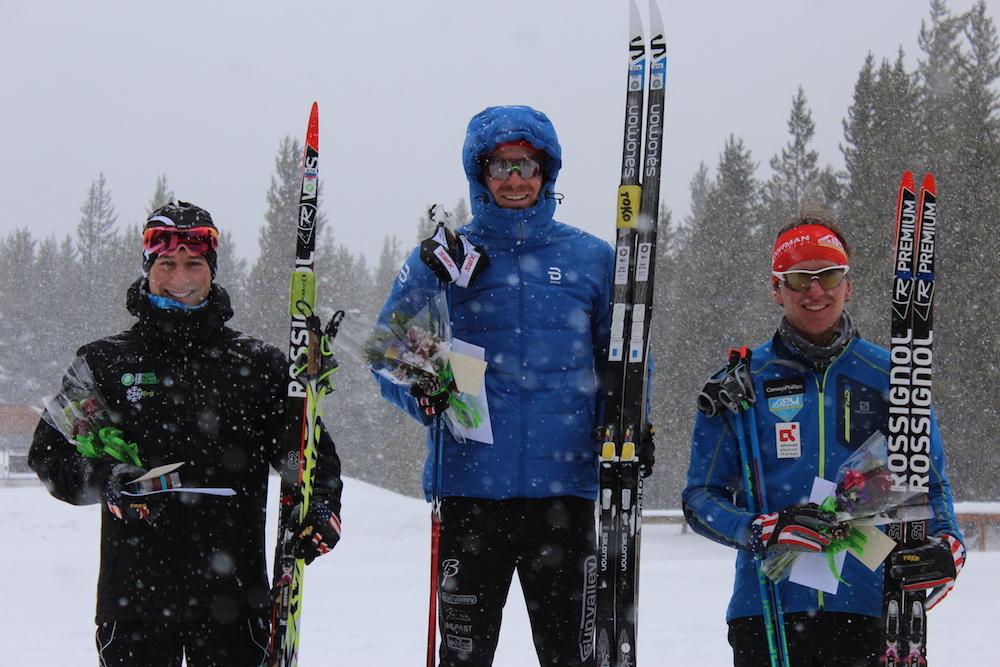
Sunday Rundown: Lillehammer, Östersund & West Yellowstone (Updated x6)

Matt Gelso (SVSEF) topping the SuperTour podium for the second-straight day in West Yellowstone, Mont. Joining him on Sunday’s 15 k classic podium: CGRP’s Ben Lustgarten (l) in second and APU’s Scott Patterson (r) in third. Welcome to The Rundown, your quick primer of need-to-know information about the day’s racing. We’ll be updating this digest as the day goes on with additional results, photos and quotes. The Rundown is NOT a race report; stay tuned for complete race reports later today with interviews from the day’s top racers.
(Note: This Rundown has been updated to include comments from U.S. Nordic Combined’s Bryan Fletcher, who placed ninth on Sunday at the World Cup in Lillehammer, Norway.)
***
U.S. SuperTour opener in West Yellowstone: 10/15 k classic
Matt Gelso made the case that he can win any discipline and format when it comes to cross-country skiing, topping the SuperTour podium for the second-straight day of the circuit’s opening weekend in West Yellowstone, Mont. Gelso, of the Sun Valley Ski Education Foundation (SVSEF) Gold Team, won the men’s 15-kilometer classic individual start in 42:57. He finished 32.2 seconds ahead of Ben Lustgarten of the Craftsbury Green Racing Project (CGRP) in second, and Scott Patterson, of Alaska Pacific University (APU), clocked in 1:16.8 back in third.
In the women’s 10 k classic, Liz Guiney (CGRP) tallied the distance victory in 33:52.8. Katharine Ogden, of the Stratton Mountain School (SMS) and U.S. Ski Team D-team, finished 7.7 seconds back in second place, while Craftsbury put two on the podium with Kaitlynn Miller in third (+28.4).
Nordic Combined World Cup in Lillehammer: Two individual comps and a relay

German winner Eric Frenzel (c) with teammate Björn Kircheisen (l) in second and Norway’s Jørgen Graabak (r) in third on Day 3 of the Nordic Combined World Cup in Lillehammer, Norway. (Photo: FIS Nordic Combined/Twitter) [UPDATE) Twenty-second in the jump. Ninth at the finish. That’s a bit more like it for U.S. Nordic Combined’s Bryan Fletcher. The American jumped to 22nd on Sunday on the large hill in Lillehammer, Norway, then raced to ninth in the 10 k Gundersen start cross-country race. He finished 1:22 minutes behind race winner Eric Frenzel, who notched his second-straight individual victory and third win (including Friday’s team event) of the Nordic Combined World Cup’s long weekend in 25:13.6.
“Going into the race on Sunday I was confident that with a good race I could move up quite well,” Fletcher wrote in an email. “So I just set out to ski my own race and right from the start I was moving up. Top 10 was the goal and I was happy to accomplish that.”
Germany went 1-2 with Björn Kircheisen in second (+10.8) and Jørgen Graabak of Norway finished third (+23.4) on Day 3 in Lillehammer. Fletcher’s younger brother Taylor Fletcher placed 26th (+2:21.1), moving way up from 48th in the jump (with the fastest overall course time). Also for the U.S., Ben Berend placed 49th (+4:30), and Ben Loomis was 52nd (+5:16).
The Nordic Combined World Cup is turning out to be all about Germany (most) all of the time, with Frenzel and Johannes Rydzek at the forefront, after Rydzek won both opening World Cup competitions last weekend.
On Friday, the German teammates started off the three-day series with a victory in the first 4 x 5 k team event of the season. They teamed up with Kircheisen and Fabian Riessle for first, beating Norway by 31.5 seconds with a winning time of 49:34.9.
Norway’s squad, with Mikko Kokslien, Espen Andersen, Håvard Klemetsen, and Graabak, finished second without anyone else in sight. Austria took third (+1:23.7) with David Pommer, Mario Seidl, Wilhelm Denifl, and Phillipp Orter.
Finland placed fourth, Japan was fifth, France sixth, the Czech Republic seventh, Italy eighth, and the U.S. ninth (+4:19.1), ahead of Russia in 10th.
The order for the U.S. team was Bryan Fletcher, Berend, Loomis, and Taylor Fletcher. They rose as high as sixth during Bryan’s first leg, but dropped to eighth and finally ninth.
On Saturday, in the individual normal hill/10 k competition, Frenzel overtook Rydzek for the win in 24:35. Rydzek started the day by winning the jump, and Frenzel ranked fourth heading into the 10 k Gundersen start. Frenzel overcame a 24-second deficit at the start to pass Rydzek and beat him by 15 seconds at the finish. Germany ended up sweeping the podium with Riessle in third (+25.8), after Riessle improved from 11th at the start with the second-fastest course time.
Also on Saturday, Taylor Fletcher led the Americans in 26th (+1:51.2) after jumping to 44th and starting 2:02 minutes back from Rydzek. Fletcher skied the ninth-fastest course time.
Bryan improved from 43rd at the start to 32nd (+2:32.9), Loomis ended up 43rd (+5:02.6) and Berend 44th (+5:33.4).
“Going into this weekend I was feeling good and had some solid jumps in training so I knew that I was capable of a decent performance,” Bryan wrote on Sunday. “However, I struggle to put all the pieces together through the weekend. The team event was a good performance on my part and it was fun to ski with our young guys too. In Saturday’s event, I was close but had a rather unusual race in which I just couldn’t get going and fell off the pace quickly. Sunday however it all came together with a decent jump and race to finish 9th. This is more indicative of my true level at the moment so I was happy to finally fall into form.
“This is definitely a result that I was hoping for in this period,” he continued. “I would like to finish in the top 10 consistently this year and it was a bit of a shaky start but I am starting to find the rhythm now. I hope to continue this momentum in Ramsau.”
Results: Friday’s relay | Saturday’s normal hill/10 k | Sunday’s large hill/10 k
***
IBU World Cup in Östersund: 10/12.5 k pursuits
Lowell Bailey came oh-so-close to fourth place on Sunday. Just two fewer misses and he could’ve been in the hunt, but that’s how biathlon goes.
US Biathlon’s top man so far this season, Bailey started 13th in the IBU World Cup 12.5 k pursuit on Sunday in Östersund, Sweden, and by the first prone stage, he was up to seventh with clean shooting. Two-and-a-half kilometers later, he was back in the range and shooting without a miss again. Bailey headed out on his third loop in fourth, and more or less held that position through the third shooting — cleaning yet again in standing.

Russia went 1-2 in the men’s 15 k pursuit on Sunday at the IBU World Cup in Ostersund, Sweden, with Anton Babikov (l) winning his first World Cup and Maxim Tsvetkov (r) placing second. (Photo: IBU) But two misses on the final standing dropped him to ninth, and on the final loop, Bailey slipped six spots to 15th at the finish. With two penalties (0+0+0+2), Bailey finished 1:21.8 behind the winner, Russia’s Anton Babikov, who hit 19-of-20 targets en route to his first World Cup victory and podium. Russia took second place as well with Maxim Tsvetkov shooting clean (0+0+0+0) and finishing 10.5 seconds behind his teammate, and France’s Martin Fourcade pushed through four penalties (2+0+0+2) to place third (+15.2).
Fourcade started the day in first, after winning Saturday’s sprint, and lost the lead on the final stage, with two misses sending him to the penalty lap. On that last shooting, Babikov (the seventh starter) took control, and Tsvetkov (who started 11th) moved up from skiing in third for most of the race to second place.
Also for the U.S., Tim Burke placed 35th (+2:39.2) after starting 29th, with four penalties (0+1+2+1).
Canada’s Scott Gow finished 47th (+3:34.8) with three misses (0+0+2+1), Brendan Green was 50th (+3:45.5) wit five misses (1+3+0+1), and Macx Davies 51st (+3:54.6) with four penalties (0+0+2+2).

Gabriela Koukalová of the Czech Republic with her first-place prize after winning Sunday’s 10 k pursuit at the IBU World Cup in Ostersund, Sweden. (Photo: IBU) In the women’s race, Gabriela Koukalová (formerly Soukalova, you’ll get used to it, we promise), took her third-place finish in Saturday’s sprint and catapulted herself into first on Sunday in the 10 k pursuit. Koukalova shot 19-for-20, missing just one on the first standing (0+0+1+0) to cross the finish line first, 8.4 seconds ahead of Germany’s Laura Dahlmeier.
While Koukalova, of the Czech Republic, took the win in 31:43.3, Dahlmeier placed second (after starting fourth) with two penalties (0+1+1+0). Italy’s Dorothea Wierer improved from 19th to third (+21.4) at the finish, with perfect shooting (0+0+0+0).
Switzerland’s Lena Häcki also cleaned for fourth (+36.3), after starting 12th.
The first out of the gate (the winner of Saturday’s sprint), France’s Marie Dorin Habert dropped to seventh, more than a minute and 15 seconds back, with six penalties (2+1+2+1).
American Susan Dunklee moved up to 22nd (+2:55.7) after starting 27th, despite five penalties (2+2+0+1).
Also for US Biathlon, Clare Egan improved to 30th (+3:35.4), up from 44th, with three misses (0+0+1+2).
Joanne Reid (US Biathlon) finished 47th (+4:59.6) with four misses (1+1+1+1), and Canada’s Julia Ransom finished 58th (+6:36.8) with eight misses (2+0+4+2).
***
FIS Cross-Country World Cup in Lillehammer: 10/15 k classic pursuits
Martin Johnsrud Sundby is the man to beat once again after winning the men’s 15-kilometer classic pursuit on Sunday in Lillehammer, Norway. The Norwegian started seventh and overcame a 50-second deficit to Sweden’s Calle Halfvarsson, the leader going into the final day of the mini tour. Halfvarsson dropped to fifth, while Sundby rose to first and brought another Norwegian Johannes Høsflot Klæbo to the top with him. Klæbo started sixth, 3 seconds ahead of Sundby, and placed second, 2.3 seconds behind him. Finland’s Matti Heikkinen took the final spot on the podium in third (+2.7), by 0.9 seconds over Norway’s Emil Iversen in fourth. Halfvarsson was 6.3 seconds back in fifth, his Swedish teammate Marcus Hellner sixth (+6.8), Norway’s Pål Golberg and Finn Hågen Krogh seventh (+9.9) and eighth (+15.0), respectively, and Canada’s Alex Harvey ninth (+16.2), ahead of Finland’s Iivo Niskanen in 10th (+52.0)
Canada had two in the points with Devon Kershaw rising from 43rd to 27th (+2:08.5). Len Valjas placed 48th (+3.44), Graeme Killick was 53rd (+3:53.9), Knute Johnsgaard 72nd (+6:20.3), Bob Thompson 81st (+8:16.3), Andy Shields 83rd (+9:57.3).
For the U.S., Noah Hoffman rose to 36th (+2:39.5) after starting 48th, Erik Bjornsen finished 57th (+4:33.3), and Eric Packer finished out his first overseas mini tour in 68th (+5:45.1).
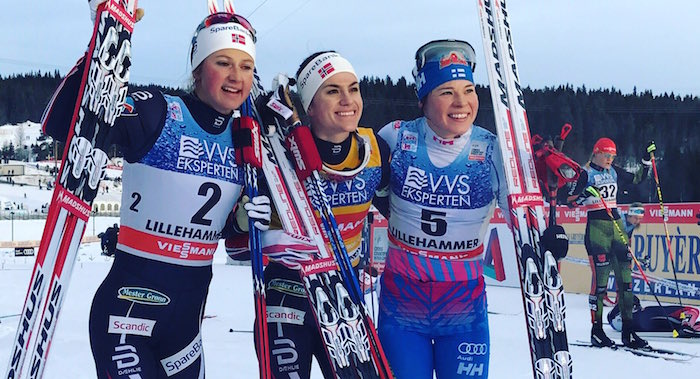
Heidi Weng (c) held onto her lead to win the Lillehammer mini-tour by 16.1 seconds over Norwegian teammate Ingvild Flugstad Østberg (l). Finland’s Krista Parmakoski was third after losing a shot at second thanks to a crash. (Photo: FIS Cross Country/Twitter) Heidi Weng of Norway started the 10 k pursuit in first place, and that’s where she finished it, 16.1 seconds ahead of teammate Ingvild Flugstad Østberg. Finland’s Krista Parmakoski rounded out the podium in third, after skiing up from a fifth place starting position and passing Østberg near the end of the race but then crashing on a downhill and losing valuable seconds. Nevertheless her effort gave Parmakoski the fastest ski time of the day.
Jessie Diggins, who started the race in third position after winning yesterday’s 5 k skate, made an early bid to ski with Østberg but ultimately lost ground, ending eighth, +1:39.4.
Instead it was Marit Bjørgen who took fourth, +57.5. Stina Nilsson of Sweden was one of the biggest movers of the day, skiing from 27th at the start all the way up to fifth, +1:26.1.
Following Diggins, Sadie Bjornsen finished 11th, +1:51.2. The American had started in a pack of skiers and stayed there for most of the race. Liz Stephen was 38th (+3:31.8), and Rosie Brennan and Caitlin Patterson 41st (+3:50.2) and 42nd (+3:56.8). Ida Sargent rounded out the U.S. results in 57th (+5:39.7).
Emily Nishikawa led the Canadians in 46th (+4:08.5), with Cendrine Browne and Dahria Beatty 52nd (+4:41.5) and 59th (+6:08.2).