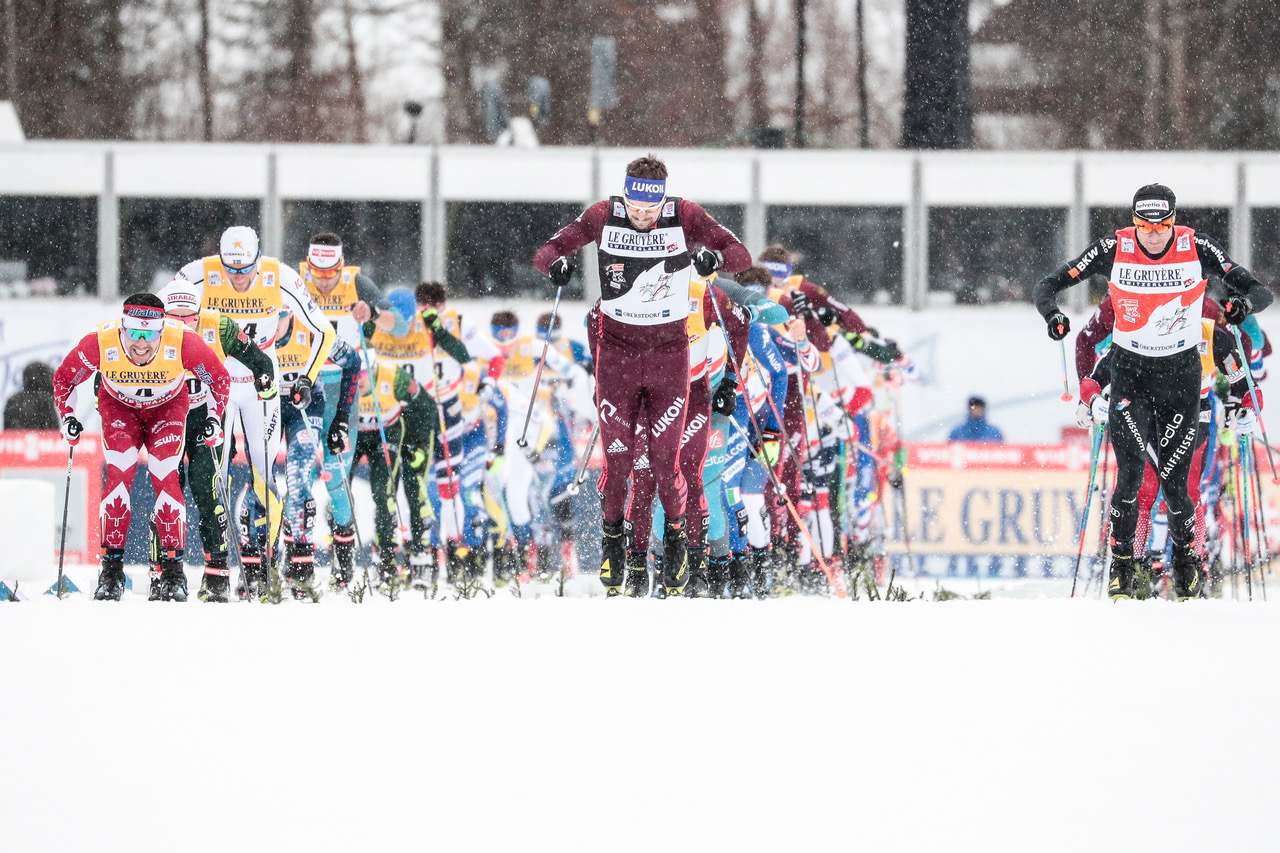
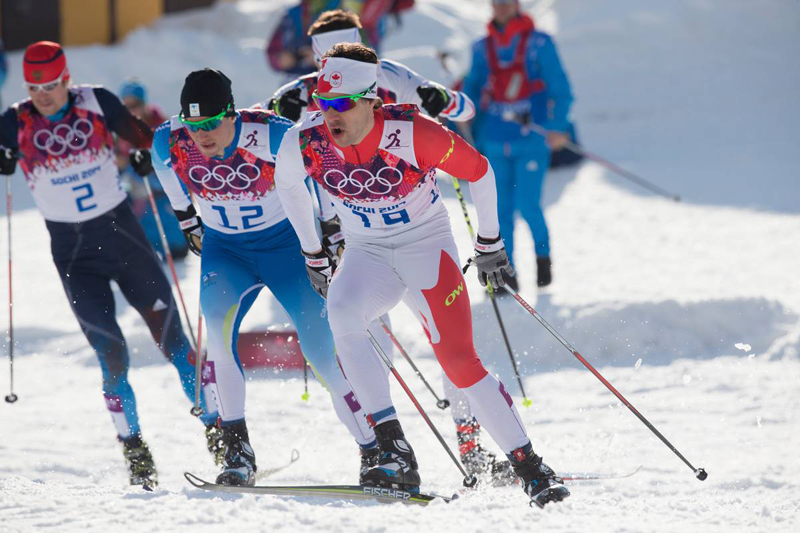
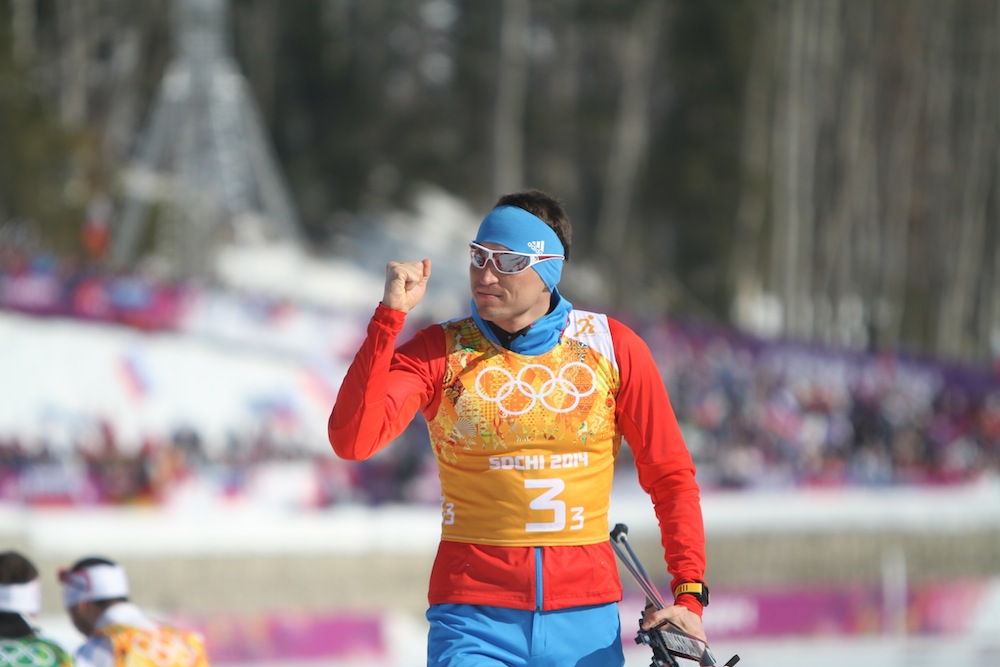
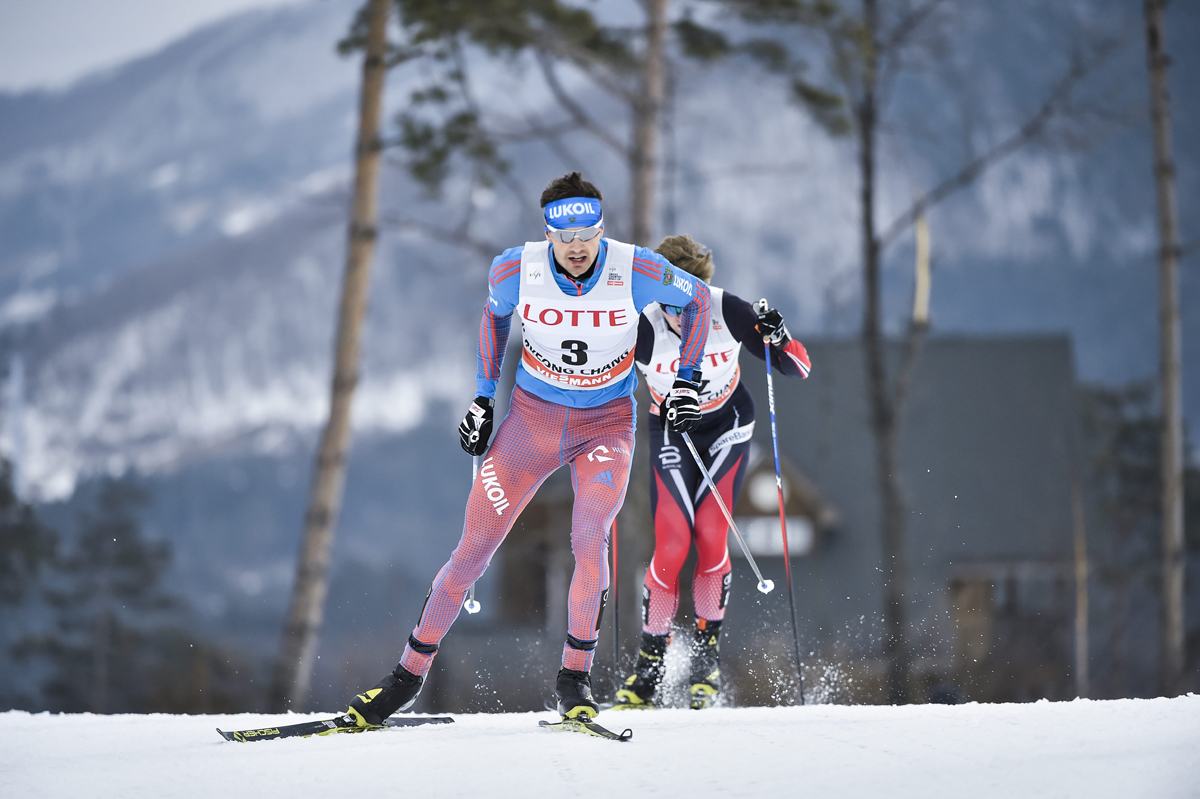
Sergey Ustiugov (c) leading out of the start of the men’s 15 k freestyle at Stage 5 of the 2018 Tour de Ski in Oberstdorf, Germany, alongside Canada’s Alex Harvey (4) and Switzerland’s Dario Cologna (red Tour leader’s bib). On Tuesday, it was confirmed that Ustiugov has been banned from the Olympics. (Photo: Fischer/NordicFocus)
Three notable Russian Winter Olympians, Sergey Ustiugov, Anton Shipulin and Viktor Ahn are the most recent to be banned from the upcoming 2018 Olympics, which start in just over two weeks in PyeongChang, South Korea, for their alleged involvement in systematic doping at the 2014 Winter Olympics in Sochi, Russia.
The International Olympic Committee (IOC) confirmed the decisions on Tuesday, Inside the Games reported.
Ahn, 32, a South Korean-born Russian speedskater (who joined the Russian team in 2011), is the most successful Olympic short-track speed skater of all time with six Olympic golds.
Ustiugov, 25, one of the world’s top male cross-country skiers, placed first or second in all five 2017 World Championships races he contested last year, winning the skiathlon and classic team sprint.
Shipulin, 30, is a two-time Olympic biathlete who helped the Russian men win gold in the relay at both the 2014 Sochi Olympics and 2017 IBU World Championships.
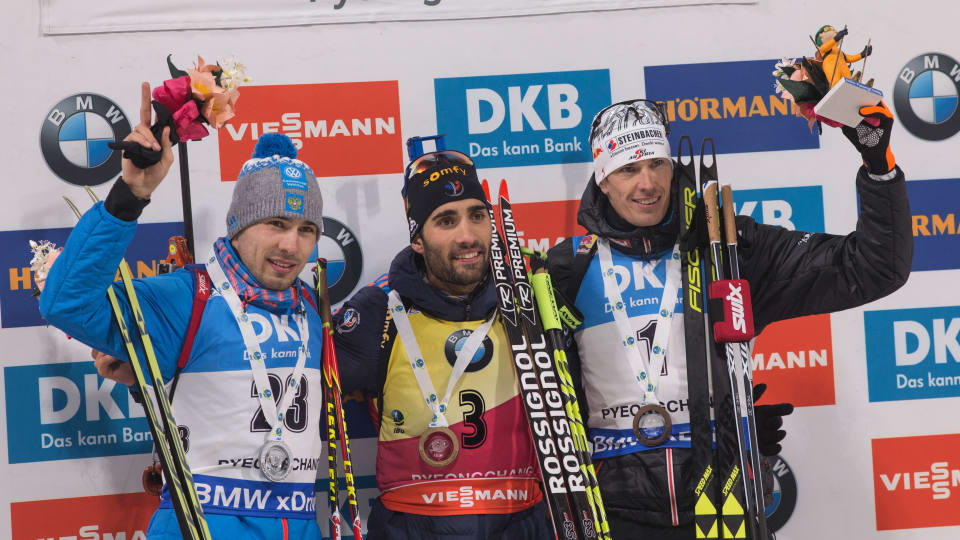
Russia’s Anton Shipulin (l) on the podium after placing second at an IBU World Cup last March in PyeongChang, South Korea, alongside France’s Martin Fourcade (c) in first and Austria’s Julian Eberhard (r) in third. (Photo: IBU)
“All three are reportedly among 111 athletes excluded by the IOC after the [Russian Olympic Committee] drew up a 500-athlete shortlist for consideration for Pyeongchang 2018 selection,” Inside the Games reported.
Le Monde reported that Ahn’s samples could have been among those manipulated at the 2014 Olympics in Sochi, Russia. The Russian Olympic Committee (ROC) has reportedly sent a letter to the IOC challenging the decisions, which it emphasized was “preliminary,” according to a Sputnik report.
“Athletes, such as Ahn, Shipulin or Ustiugov, were not involved in the proceedings within the framework of the Oswald Commission, they were also never involved in any doping scandals, and all the numerous tests they took during their career prove that they are ‘clean’ athletes,” the letter authored by ROC First Vice President Stanislav Pozdnyakov stated. “Nevertheless, their names are currently included in the list of potential participants of the Games. … As regards all the other items on the agenda of the talks related to technical and organisational issues, a lot of work has also been done, but now we focus, first of all, on the composition of our team.”
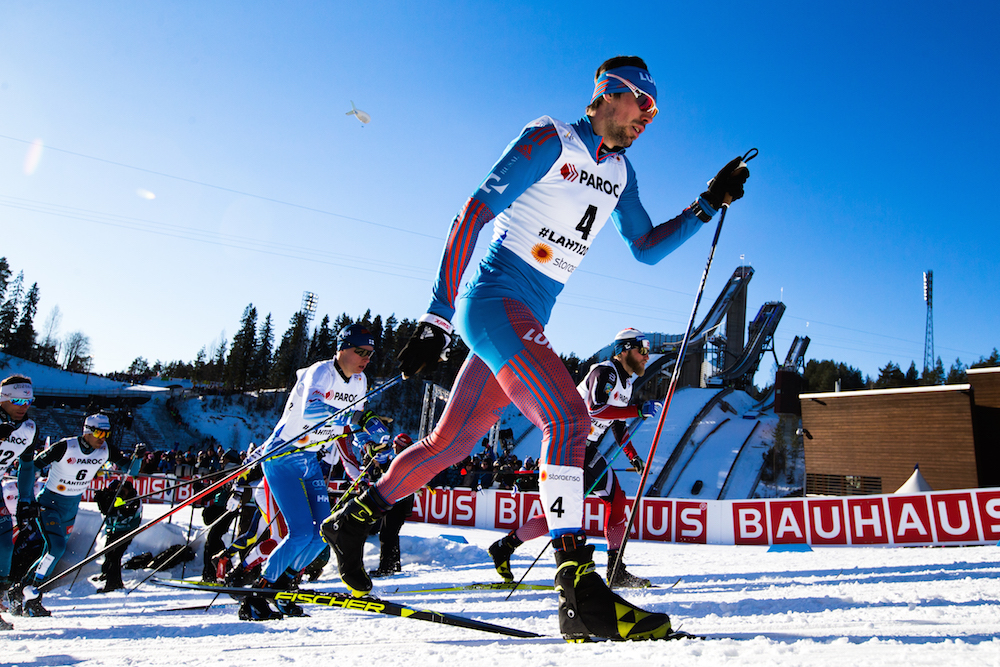
Russia’s Sergey Ustiugov (4) leading the pack in the men’s 30 k skiathlon on Feb. 25 at 2017 FIS Nordic World Ski Championships in Lahti, Finland. He won gold in that event. (Photo: John Lazenby/Lazenbyphoto.com)
If approved by the IOC, the Russian athletes being considered for their eligibility in PyeongChang would have to compete as neutral athletes. If they were to win an event, they would be awarded gold to the tune of the Olympic anthem, rather than the Russian national anthem.
Several Russian authorities have claimed these IOC decisions are aimed to provoke a Russian boycott.
“This is what they [the IOC] want from us,” Mikhail Degtyarev, head of the State Duma Committee on Sport,told Echo Moskvy. “The scenario is to present Russia as an evil, incompetent and isolated country.”
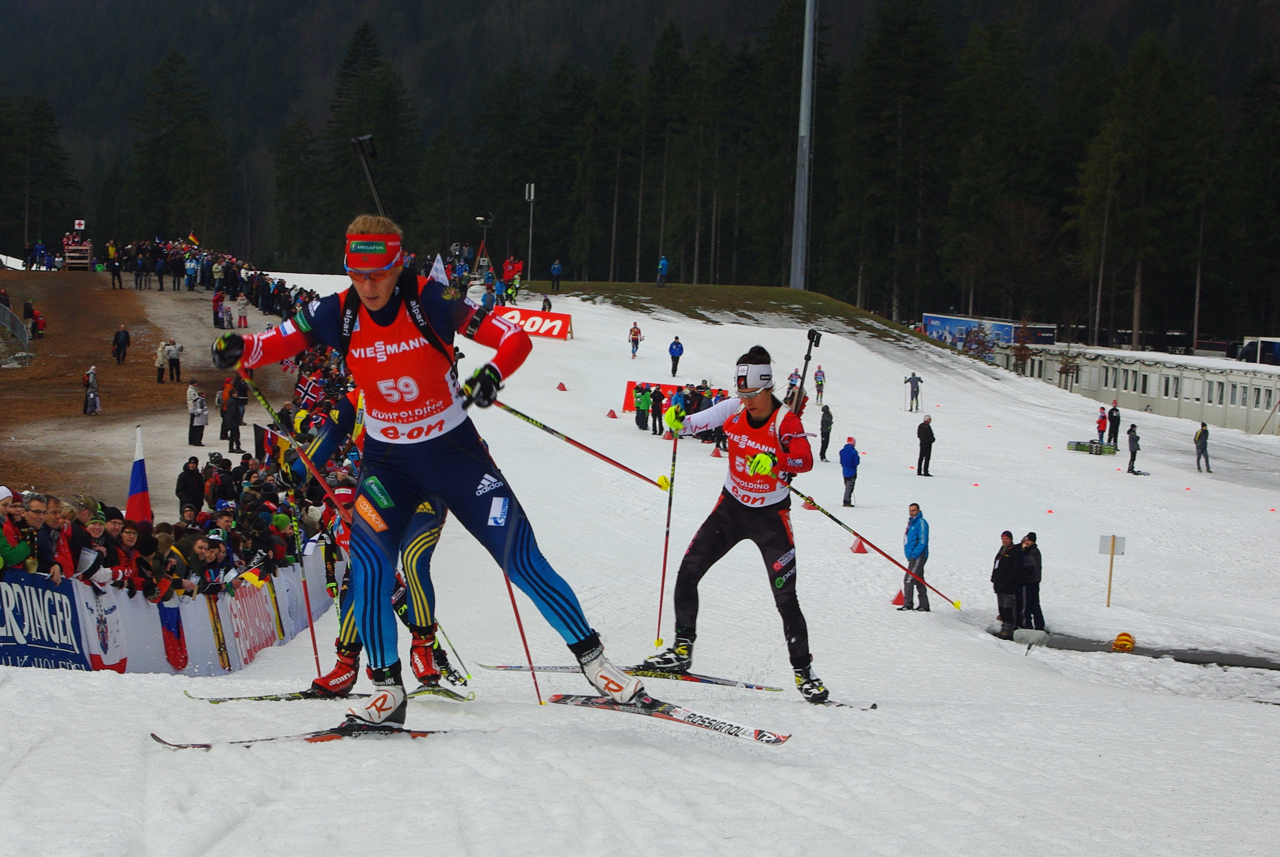
Russians Olga Zaitseva and Olga Vilukhina competing in the pursuit at 2013 World Championships. Both were disqualified from the 2014 Olympics by the International Olympic Committee, with a whistleblower stating that the biathlon team was doping in the years leading up to Sochi.
On Friday, the International Olympic Committee (IOC) posted the reasoned decision from its Disciplinary Commission, in which Russian biathlete Olga Zaitseva was disqualified from the 2014 Olympics in Sochi, Russia.
Zaitseva’s disqualification had been announced previously, but this is the first full-length decision presenting the evidence for the disqualification of any biathlete. Olga Vilukhina and Yana Romanova have also been suspended, but the Oswald Commission’s full decisions for their cases have not yet been released.
The reasoned decision not only contains details about Zaitseva, but also additional information which should put the whole biathlon world on notice.
“Dr. Rodchenkov further states that the entire Russian biathlon team, including the Athlete Zaytseva, has been using the Duchess Cocktail before the Olympic Winter Games Sochi 2014,” paragraph 359 of the decision reads. “He also provided an email sent April 2013, whereby he raised concerns about the high levels of haemoglobin for the biathlete team that was detected by his laboratory.”
The Duchess Cocktail refers to a combination of performance-enhancing drugs designed by Rodchenkov, the former director of the Moscow Anti-Doping Laboratory who assisted Russian teams in numerous sports to evade anti-doping rule violations before he became a whistleblower.
The Russian sports agency and the state security agency, FSB, developed a method to open anti-doping sample bottles. Using this method, they replaced the urine of athletes who had taken the Duchess Cocktail with previously-collected clean urine so that their doping would not be detected.
Thus, Rodchenkov is asserting that every Russian performance in the biathlon events at the 2014 Olympics was tainted by illegal performance-enhancing drugs.
This is notable because the men’s biathlon team, for instance, had not previously been implicated in doping scandal that has been raging for several years. Only the likely members of the women’s biathlon relay team – Vilukhina, Zaitseva, Romanova, and Irina Starykh (who was caught using the blood-doping drug EPO before the Olympics and suspended) – were on the “Duchess List,” a list of athletes presumed to have been given the drug cocktail. No male biathletes appeared.
However, it doesn’t seem surprising that they would, given that 14 cross-country skiers, virtually the entire Russian squad for Sochi, appeared on the list, as well as the female biathletes.
And that’s what Rodchenkov said, too.
“Dr. Rodchenkov… gives indications regarding the widespread use of Prohibited Subtances notably human growth hormones and EPO in the years preceding the Olympic Games,” another paragraph of the decision reads, referring to “members [of] the biathlon and cross-country skiing teams, for which the endurance is an absolutely critical elements.”
This raises the question of whether further action will be taken against more biathletes by the IOC, or by the International Biathlon Union (IBU).
The IBU has provisionally suspended the Russian Biathlon Union, but that actually has few consequences: Russia is still slated to host a World Cup weekend in March, Russian Victor Maygurov is still the First Vice President of the IBU, and all Russian athletes are still allowed to compete in the World Cup and the Olympics (Romanova, Vilukhina, and Zaitseva retired before they were suspended).
In the meantime, she has maintained her innocence. So has Wolfgang Pichler, the German coach who worked with the Russian women’s biathlon team in the four years leading up to the Sochi Olympics. For his troubles, he has been banned from attending the 2018 Olympics, where he would have coached the Swedish women’s team, which he now leads.
As the decision notes, Zaitseva and her legal team raised several objections to the case against her. She claimed that to suspend her was to pursue “collective justice” based on the widespread evidence of doping by Russia, rather than referring to any fault of her own. She also attacked Rodchenkov’s character, calling him an unreliable witness.
And finally, her team questioned the methods developed by Professor Champod at the University of Lausanne to detect whether anti-doping sample bottles had been tampered with.
That was wise, because the most damning evidence against Zaitseva comes from her sample bottles. Two of her sample bottles from Sochi had multiple marks on them consistent with tampering. In one of those bottles, the urine had such high amounts of salt that it is not possible that the concentration was produced by the human body. Together, these two pieces of evidence were used to argue that her samples had been tampered with.
According to logic used by the Disciplinary Commission in this and other cases, that tampering couldn’t have happened without Zaitseva’s knowledge. DNA testing showed that the urine in the samples was hers, which indicates that if the urine was replaced, it had to have been given by her at a different time. The Commission rejected the possibility that such a urine sample could have been collected without an athlete knowing its intended purpose.
But while two experts testifying on Zaitseva’s behalf criticized Champod’s methods as being incompletely described, they were unable to convincingly explain why their questions would absolve Zaitseva of blame.
“Neither Mr Alexei Bushin, nor Ms Evgeniya Burova did, in particular, offer any alternative explanations for the presence of marks consistent with the opening of the bottles with tools of the kind used by Prof. Champod,” the decision noted. “The IOC Disciplinary Commission finds this absence of alternative explanation even more significant in the case where one of the bottles not only bears marks strongly indicative of opening, but in addition contains urine with an abnormal salt content. Both elements support the conclusion that it was opened. The expertise of Prof. Champed convincingly demonstrates how this opening, which necessarily occurred, could be operated.”
This forensic evidence was used in the Commission’s decision that Zaitseva had violated the provision of the Anti-Doping Rules for the 2014 Winter Olympic Games which prohibits tampering with samples or with the integrity of the anti-doping process.
By doing so, they also found that she was complicit in a cover-up, thus breaking another provision of the Anti-Doping Rules.
In a strange aside, a urine sample belonging to Zaitseva but collected later, in October 2014, was analyzed in order to make a DNA comparison to the Sochi samples. What such a comparison actually revealed was that the October sample contained the urine of two different women mixed together, indicating that sample-swapping continued after the 2014 Olympics.
“This result does not concern the Olympic Games in Sochi and, as such does not fall within the scope of the application of the Rules,” the Commission wrote in its decision. “It however constitutes additional evidence that the Athlete was a protected elite athlete actively engaged in doping practices.”
The Commission also concluded that Zaitseva had used prohibited performance-enhancing drugs, on the basis of testimony from Rodchenkov.
“Use or Attempted Use of a Prohibited Substance can be established by any reliable means,” the Commission wrote. “This includes witness evidence.”
In an affidavit to the Disciplinary Commission hearing, Rodchenkov shared his own observations, many of which were based on detailed notes he had taken in a daily diary over the years. He also provided emails and documents related to Zaitseva and to the biathlon team.
“Dr Rodchenkov provides a list issued in October 2012 reflecting the clean urine bank existing at that time,” paragraph 358 reads. “The Athlete Zaytseva is mentioned on this list, with an indication that her urine was delivered to the Moscow Laboratory on 24 October 2012.”
“Dr Rodchenkov also recalled that in 2013 and early 2014 he had numerous conversations about the Athlete Zaytseva, as she was on a protected list,” another paragraph reads. “In autumn 2013, he took part to a discussion with the Athlete Zaytseva at the Ministry of Sports in Moscow. During this meeting the abnormal [Athlete Biological Passport’ data, due to her constant [performance-enhancing drugs] use, was discussed.”
And there was also evidence that Zaitseva was both doping, and also being tested more frequently than many other athletes, which is consistent with a previously-stated policy of the IBU to do “targeted testing” on athletes with suspicious biological passport profiles.
“Dr Rodchenkov specifically recalls swapping sessions of the Athlete’s numerous sample,” paragraph 361 reads. “Due to the intensity of the testing, Dr Rodchenkov underlines that they almost ran out of the Athlete’s clean urine. He remembers that the Athlete Zaytseva provided three plastic bottles of clean urine to freeze and store at the FSB and that additional urine had to be delivered.”
Zaitseva argued that Rodchenkov’s recollections and correspondence should not be used against her because of the illegal actions he had taken in the past. The Disciplinary Commission disagreed.
“Given the insistence of the Athlete’s attacks, the Disciplinary Commission will add the following,” the Commission wrote. “The Athlete refers to the past actions and behaviours of Dr Rodchenkov. In this respect, the Disciplinary Commission wants to be very clear in confirming that considering Dr Rodchenkov as a reliable witness is not in any way an approval of his past actions and his moral character. His actions, while being a director of the Moscow Laboratory, are despicable and inexcusable. This said, in a case of a conspirative scheme, the main evidence is often coming from participants, who accept to stand as witness.”
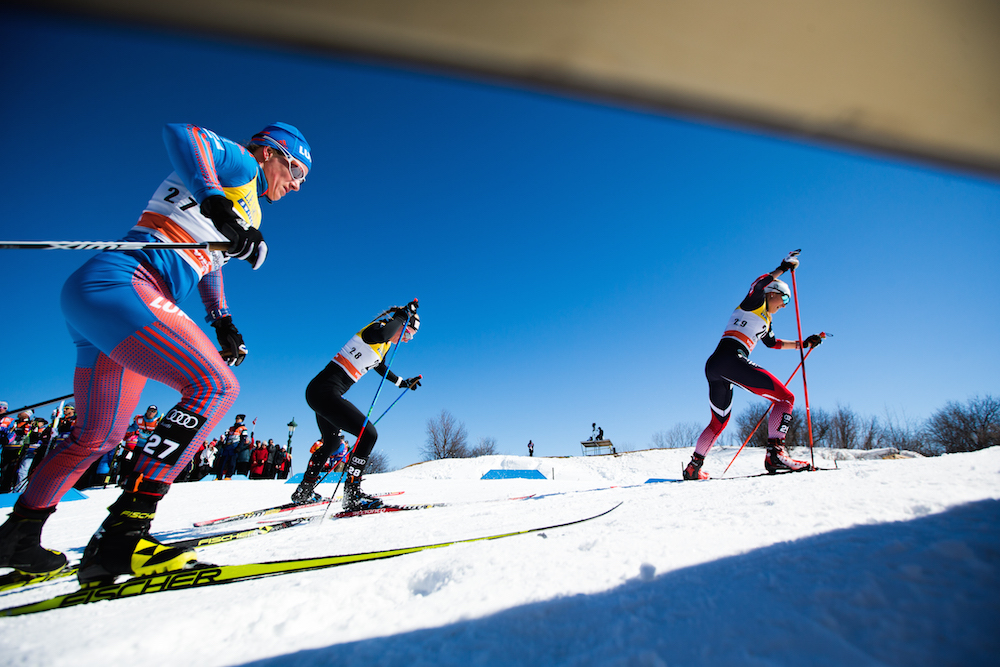
Russia’s Yulia Tchekaleva (27) chasing during the women’s 10 k freestyle pursuit last March at 2017 World Cup Finals in Quebec City. She finished 23rd and ended last season ranked 10th in the Distance World Cup and 11th in the Overall World Cup. On Friday, the International Olympic Committee decided on a lifetime ban for Tchekaleva and another Russian cross-country skier, Anastasia Dotsenko, as well as Russian biathlete Olga Zaytseva. (Photo: Dustin Satloff/dustinsatloff.com)
The International Olympic Committee (IOC) has handed down three more lifetime Olympic bans to two Russian cross-country skiers and a biathlete, all of which are women, based on the Oswald Commission hearings concerning Russia’s systematic doping at the 2014 Sochi Olympics.
Russia’s Olga Zaitseva leads Canada’s Megan Imre in a 2014 IBU World Cup pursuit.
Cross-country skiers Yulia Tchekaleva and Anastasia Dotsenko and biathlete Olga Zaitseva have been sanctioned, according to an IOC press release on Friday.
“More hearings concerning other athletes will be held over the next few weeks,” the release stated. “As of now, the number of cases opened by the Disciplinary Commission has reached 36 after additional findings from the re-analyses.”
So far, 25 Russian Winter Olympians have been sanctioned for violating anti-doping rules in Sochi.
“As some investigations are still ongoing (notably the forensic analysis of the bottles), it cannot be excluded that there might be new elements that would justify opening further new cases. Today 26 athletes have been heard and one case has been filled,” the release stated.
While neither Tchekaleva nor Dotsenko medaled at the 2014 Games*, Zaitseva did — taking silver in the women’s relay. That medal was stripped earlier this week when her teammate Olga Vilukhina was sanctioned on Wednesday. Zaitseva, who retired in 2015, is a two-time relay gold medalist from 2006 and 2010; those results are unaffected.
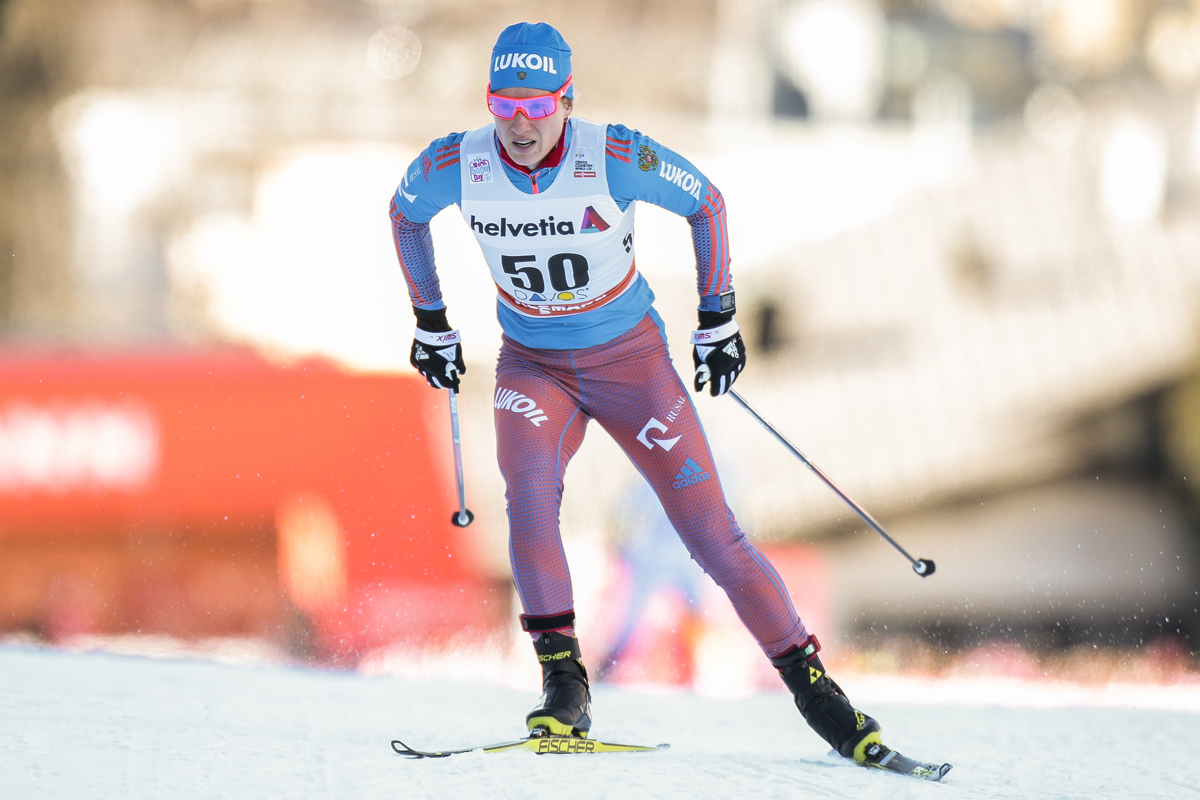
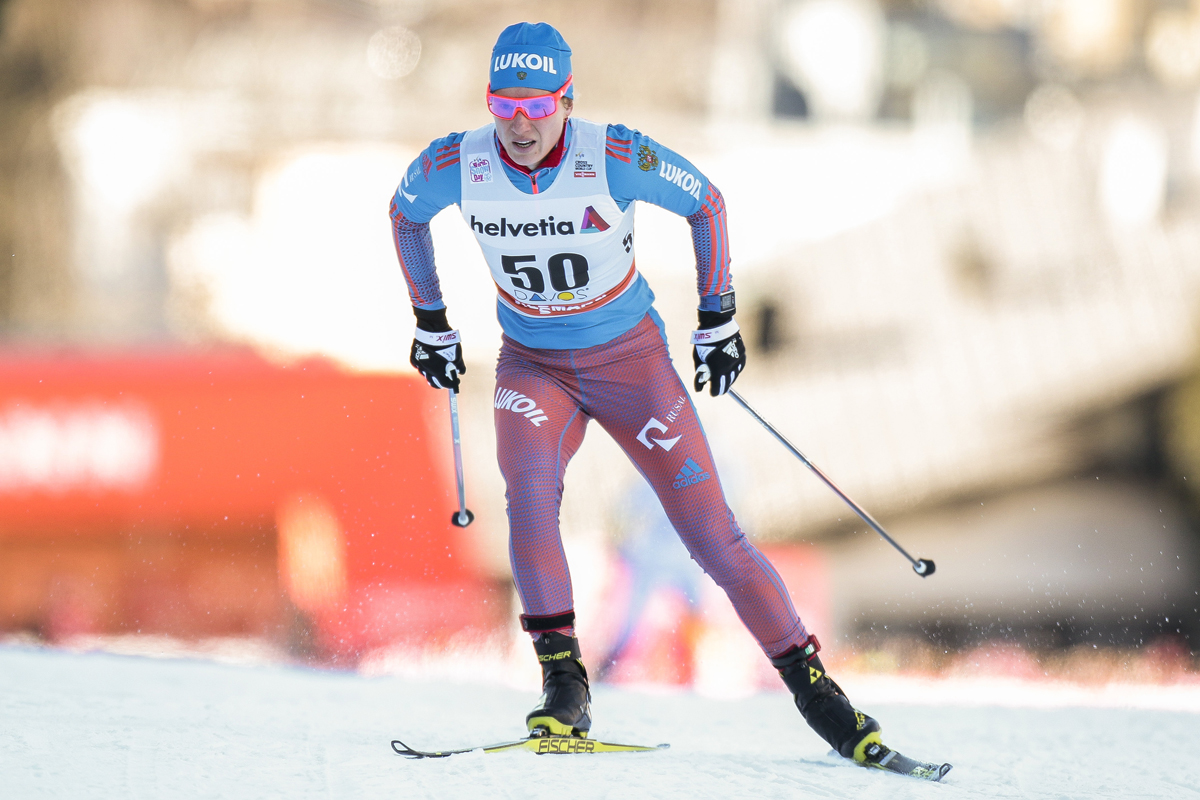
Russia’s Yulia Tchekaleva racing at last year’s Davos World Cup in Switzerland. (Photo: Fischer/NordicFocus)
Tchekaleva finished last season ranked 11th overall on the World Cup and 10th in the Distance World Cup. Now 33, she started this season a couple weekends ago at Sweden’s International Ski Federation (FIS) races in Gallivare, where she placed second in the 10 k classic and sixth in the 5 k freestyle. She hasn’t raced since.
Dotsenko, 31, hasn’t raced a World Cup since February 2016, but she also started this season in Gallivare (where her best result was 18th in the classic sprint), then raced another set of FIS races in Kontiolahti, Finland, last weekend, where she placed fourth and fifth place.
*At the 2014 Olympics, Tchekaleva and Dotsenko originally raced to sixth with two teammates in the 4 x 5 k relay, and the four team members received diplomas for that result, according to the IOC. Tchekaleva also placed 11th in the 10 k classic, 15th in the skiathlon, and 32nd in the 30 k freestyle mass start. Dotsenko finished 22nd in the classic sprint. All of those results have been erased.
Zaitseva notably competed in six Olympic events in Sochi: placing second in the women’s 4 x 6 k relay to take silver, and fourth in the mixed relay “for which she was awarded a diploma“. Individually, she finished 11th in the 10 k pursuit, 15th in the 15 k individual, 23rd in the 12.5 k mass start, 28th in the 7.5 k sprint. Those results are also voided.
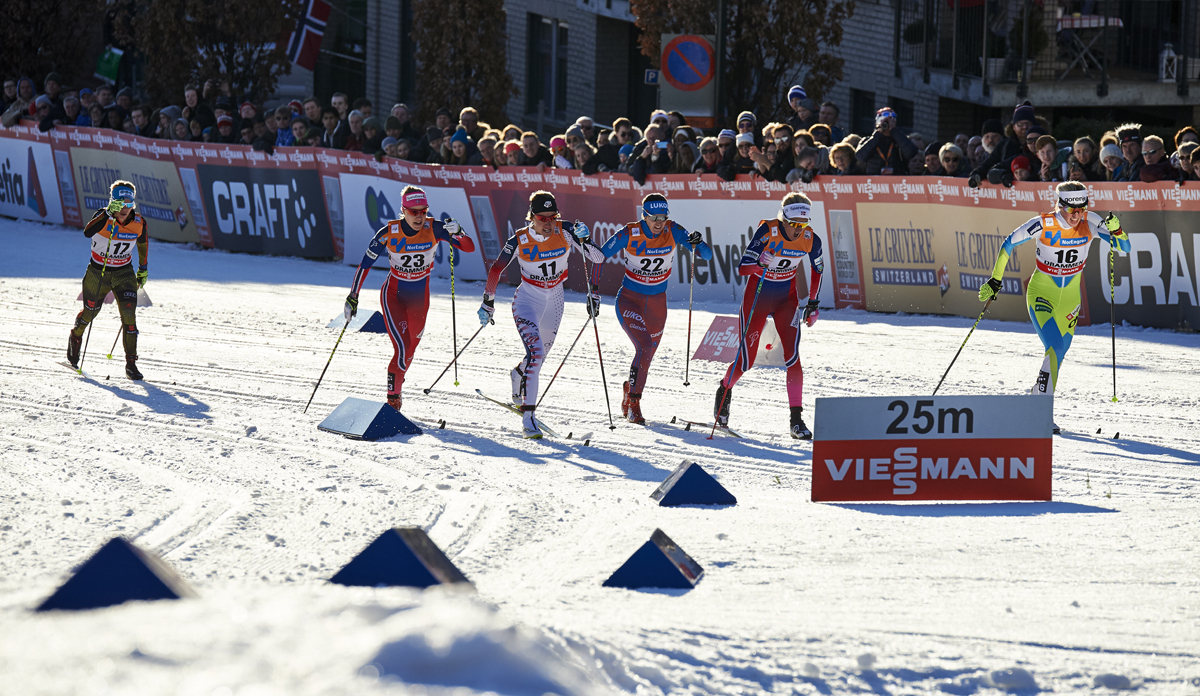
Russia’s Anastasia Dotsenko (22) racing with (from left to right) Germany’s Sandra Ringwald, Norway’s Ragnhild Haga, American Sophie Caldwell, Norway’s Kathrine Rolsted Harsem, and Slovenia’s Anamarija Lampic during a World Cup classic sprint in February 2016 in Drammen, Norway. (Photo: Fischer/NordicFocus)
Hours after this photo was taken and Alexander Legkov had won Olympic gold, Russian anti-doping head Grigory Rodchenov has said that he switched out Legkov’s anti-doping sample for a vial of clean urine collected previously. Legkov has been stripped of his gold medal and banned from all future Olympic Games.
In it: a description of how a second laboratory independently confirmed a finding from the McLaren Report that two of Legkov’s urine sample bottles from Sochi had been tampered with.
The decision also reveals that Grigory Rodchenkov, the former Moscow anti-doping laboratory director who in truth managed a covert doping program before turning whistleblower, personally tested Legkov’s urine as part of a “washout scheme” to see how quickly drugs disappeared from his body.
Rodchenkov also said that he swapped out the urine sample collected after Legkov won a gold medal in the 50 k for a previously-collected clean sample.
However, Vilukhina won silver in the 7.5 k sprint, and this finding means that Ukraine’s Vita Semerenko stands to be upgraded from bronze to silver and Karin Oberhofer of Italy would become the new bronze medalist.
Vilukhina also finished seventh in the 10 k pursuit, 21st in the 15 k mass start, and contributed to Russia’s silver medal in the women’s relay, along with Romanova. That means that the Norwegian team of Fanny Horn Birkeland, Tiril Eckhoff, Ann Kristin Flatland, and Tora Berger would move from bronze to silver, and the Czech Republic’s Eva Puskarcikova, Gabriela Koukalova, Jitka Landova, and Veronica Vitkova should earn bronze.
Legkov has been anything but out of the news. He was targeting a comeback for the 2018 Olympics after sitting out last year with a provisional doping suspension. Legkov and five other skiers had been cleared to return to competition by the International Ski Federation (FIS) despite their IOC bans, with FIS saying that they had to read the IOC decisions in full before taking any action.
During that time, Evgeniy Belov finished sixth in the 15 k classic at the World Cup in Ruka, Finland, on Saturday, and 12th overall in the weekend-long minitour; Maxim Vylegzhanin was 16th in the classic and 20th overall; and Evgenia Shapovalova finished seventh in the women’s sprint and 54th in the minitour overall.
Alexey Petukhov did not compete on the World Cup and the last of the six athletes, Julia Ivanova, has retired.
Legkov did not compete on the World Cup either. Coach Marcus Cramer told Norwegian media outlet VG that after having his gold medal from the Olympic 50 k stripped, Legkov has become depressed and lost five kilograms.
It remains to be seen what FIS will do with the Legkov decision, and when the IOC will publish decisions for the other Russian skiers. All or none of those athletes may be back on the starting line in when the World Cup moves to Lillehammer, Norway, this coming weekend.
In the meantime, here are some key parts of the decision, which you can read in full here.
What proof is needed:
The panel noted that before the 2016 Summer Olympics, the IOC did not ban all Russian athletes but instead shifted the burden onto the athletes to prove that they were clean: “…. the IOC considered that the revelations of Prof. McLaren were so serious and so far-reaching that it was justified to establish a presumption that all top-level Russian athletes had been part of that system and that only the athletes who could rebut such a presumption would be accepted at the Games.”
The IOC panel did not want to do this for winter sports athletes, instead considering individual cases. But they also noted that finding proof of doping would not require a positive drug test, because by nature this scandal is about covering up positive tests and thus that evidence would have been destroyed.
“The evidence of a cover-up is typically either witness evidence or circumstantial evidence from which the application of the process can be inferred,” they wrote. “For the purpose of anti-doping proceedings, CAS jurisprudence has defined a specific standard, defined as ‘comfortable satisfaction of the hearing panel bearing in mind the seriousness of the allegation which has been made’,” they wrote.
Further down in the document, the panel noted that the Court of Arbitration for Sport (CAS, mentioned above, and the Supreme Court equivalent in sports law) has already signaled that it would accept circumstantial evidence.
In another decision, CAS had written that “the combination and different type of facts provided by the Second [McLaren] IP report with respect to any individual athlete are circumstantial evidence that can be used to establish an [anti-doping rule violation.”
The Panel Trusts the McLaren Report, and Rodchenkov
While the panel did commission some of its own forensic analyses of urine sample bottles, it also relied on evidence gathered by Professor Richard McLaren for an Independent Person Report almost a year ago.
“The global evidence obtained by Prof. McLaren is very strong with regard to the existence of the scheme,” the panel wrote. “It allows a conclusion about the existence and implementation of the scheme in Sochi (and well beyond Sochi), which Prof. McLaren describes as ‘beyond reasonable doubt’. The Disciplinary Commission can only agree with that conclusion.”
“The relevance of the elements related to individual athletes has to be considered from a different perspective,” the panel wrote, before concluding that “Prof. McLaren’s credibility is unquestionable.” His evidence would be used as part of a case against athletes, although not the only evidence.
The panel also said that they trusted Grigory Rodchenkov, the former Moscow lab director who became a whistleblower. He has been the victim of character assassination by Russian interests, but the panel did not buy it.
“Dr. Rodchenkov was the main actor in the system and he is the best placed person to explain what it was,” they noted. “Dr. Rodchenkov is no longer in Russia and he is under the protection of the FBI. Therefore he is now free to speak openly…. His statements are very precise and clear. They are also very consistent and there are no contradictions between the various elements he describes… Every time other evidence has been available, the information provided by Dr. Rodchenkov has been systematically corroborated by such evidence.”
The Panel’s Own Forensic Analysis
The IOC commissioned a forensic analysis of urine sample bottles, to be done at the University of Lausanne. The McLaren Report had already done this task using a respected lab in London, but the panel called the Lausanne analysis “a more complete and thorough forensic analysis.”
It took Professor Christophe Champod, the leader of the analysis, two months to discover how sample bottles could be opened and closed. Like the London lab, he examined sample bottles for marks that would indicate that they had been opened using the method he had discovered – and he found bottles with these typical marks on them. Reportedly, examining each of the 232 sample bottles and 30 control bottles he was given took over an hour.
The panel was deliberate in emphasizing repeatedly how carefully Champod had done this work – perhaps because they had been criticized for allowing this aspect of the process to take so long and allow a situation where the provisional suspensions of Russian skiers were lifted by FIS.
“Prof. Champod appeared to be very knowledgeable and very cautious at the same time,” the panel wrote. “When not sure, he never hesitated to admit that he had no certainty. This gave a lot of credibility to the positions of which he claimed to be certain.”
As with the sample bottles the IOC also commissioned a “complete and thorough” investigation of salt levels in the sample bottles, another task which had also been done by the McLaren report. This analysis was done at the Lausanne University Hospital. The professor investigating the urine samples found that a number of samples had salt concentrations “definitively out of range and even out of renal physiological possibilities suggesting strongly a manipulation of the samples for example the addition of sodium chloride.”
Bad News About That
Overall, the panel had come to the conclusion that the sample manipulation and cover-up scheme existed, and that the only way for it to do so was for athletes to be involved. After all, the clean urine samples had to be obtained from somewhere.
“The Disciplinary Commission came to the conclusion that it was not possible that the athletes were not fully implicated… the scheme could not work without the personal implication of the athletes.”
Thus, if the athlete was mentioned in planning documents (called the “Duchess List” and the “Medals By Day List”), they more or less must have been in on the scheme, the panel wrote.
Legkov was on the Duchess List, and moreover, two of his sample bottles showed marks of being tampered with. These where the types of bottles that Prof. Champod was “certain” about.
Furthermore, in a written affidavit, Rodchenkov discussed Legkov specifically, saying that he had at some point checked urine samples provided by Legkov to make sure that the drugs had disappeared, or “washed out”. Washout tests are used to see how long drugs stay in an athlete’s body. This enables planned doping programs and ensures that athletes will not test positive if they are tested by a foreign antidoping agency. Such tests are prohibited by anti-doping rules.
Rodchenkov also said that he had discussed how Legkov was responding to the drugs he had been given – the answer was, he was responding well – and also that he had personally swapped the athletes urine samples in Sochi on the night after Legkov won his gold medal. The relevant sample, collected after that race, was one of the two sample bottles which showed marks consistent with tampering.
“Based on the above elements, the Disciplinary Commission has no hesitation to conclude that it is more than comfortably satisfied that the athlete was a participant in, and a beneficiary of, the cover up scheme implemented on the occasion of the Olympic Winter Games Sochi 2014.”
What Legkov Provided As Evidence
Legkov and his lawyer submitted affadavits from Elena Valbe, the president of the Russian Cross-Country Ski Federation, as well as from his coaches and team staff, stating that nobody knew he was providing clean urine for the sample-swapping scheme.
He also listed all of the anti-doping tests he had undergone, but the panel was not convinced.
“As regards the allegation that the athlete could not have used the Duchess Cocktail because of the intensity of testing he was subject to, the Disciplinary Commission remarks that the history of doping is full of highly controlled athletes, who never tested positive, until they finally had to admit that they had been doping over a long period of time,” the panel wrote.
And, Legkov pointed out contradictions and seeming errors in some of the McLaren Report evidence. Again, the panel did not agree with Legkov’s assertions.
“The Athlete has sought to challenge each individual piece of evidence, but when all the pieces match and comfort each other, no doubt is possible.”
A Bizarre Squabble Over DNA
Legkov and his lawyer wanted the samples assumed to be his, to be DNA tested to make sure that his urine was inside them. This was mistakenly assumed to have been done in the McLaren Report, but it turned out that only some of the Sochi samples had been analyzed in this way. Thus, late in the hearing process, Legkov requested that the IOC get a DNA sample from him, and see if the urine samples matched.
The implication was that if they did not match, then he would not have been the one providing the “clean urine” to swap out, and thus would not be implicated in the scheme.
This led, however, to a game of chicken. Legkov was training in Italy at the time. The IOC requested he come to Lausanne to have the DNA sample collected. Legkov insisted that the IOC come to Italy. The IOC offered to have a car sent to Italy to pick him up, bring him to Lausanne, and then return him, saying that it was necessary to come to Switzerland “for the collection of a reference sample under adequate conditions to avoid the risk of contamination by foreign DNA.”
In the end, no agreement could be reached, and Legkov’s DNA was never collected or matched to the urine in the sample bottles.
The IOC did not see this as a barrier to their conclusions: for the subset of samples which had been DNA-tested in the McLaren Report, all those belonging to athletes on the Duchess List turned out to match the DNA in the sample bottles.
For two female hockey players, DNA did not match. But the reasoning by the investigators was that these athletes were not on the Duchess List and had been added into the doping scheme at the last minute, so they took the drugs but had not provided clean urine and thus their samples had to be swapped out with someone else’s urine.
Russian team staff cheer on Maxim Vylegzhanin, the country’s anchor skier, in the 4 x 10 k relay at the 2014 Olympics in Sochi, Russia. Vylegzhanin has now become the second member of that silver-medal relay team to be disqualified for doping.
All four were identified in the McLaren Report, an independent investigation commissioned by the World Anti-Doping Agency to investigate reports from whistleblowers that Russia had systematically evaded the anti-doping process at the 2014 Olympics.
“The athletes have been disqualified for life from taking part in the Olympic Games,” Valbe said.
With Legkov’s disqualification, Russia had already lost a gold medal in the 50 k and a silver medal in the 4 x 10 k relay.
Vylegzhanin had finished second in the 50 k, but with him now disqualified as well, there could be a substantial medal re-allocation. Third-place Ilia Chernousov, also from Russia but not implicated the McLaren report, would stand to gain gold. Fourth-place Martin Johnsrud Sundby of Norway would take silver, and fifth-place Sergei Dolidovich of Belarus would earn bronze.
Vylegzhanin also won silver in the men’s team sprint with Nikita Kriukov. With that result invalidated, Sweden’s Emil Jönsson and Teodor Peterson will move from bronze to silver, and fourth-place Northug and Ola Vigen Hattestad would earn bronze.
Valbe said that the IOC Disciplinary Commission’s decision will be appealed to the Court of Arbitration for Sport, so such medal reallocations are not yet finalized.
“It’s hard to choose words, but I’ll fight to the end — it’s a violation of all human rights,” Petukhov said, according to a translation.
Petukhov finished eighth in the skate sprint in Sochi; Shapovalova finished 28th. Ivanova was part of the sixth-place women’s relay and team sprint teams, both of which stand to be disqualified, and finished 17th in the 10 k classic and 30th in the 30 k skate.
The Canadian team of Perianne Jones and Dasha Gaiazova missed qualifying for team sprint finals as “lucky losers” by one spot. The Russian pair of Ivanova and Anastasia Dotsenko, however, did advance as lucky losers – meaning that if they had not been in the race, the Canadians would have been next in line for a spot in the finals.
The silver-medal winning Russian men’s relay team at the 2014 Olympics. Alexander Legkov (right) was sanctioned by the International Olympic Committee for doping, and as a result the Russian team’s relay result will be invalidated.
The International Olympic Committee (IOC) has ruled that Russian cross-country skiers Alexander Legkov and Evgeniy Belov doped at the 2014 Olympics in Sochi, Russia.
As a result, Legkov’s gold medal in the 50-kilometer freestyle mass start, the Russian men’s silver medal in the 4 x 10 k relay, and Legkov’s 10th-place finish in the 30 k skiathlon are all invalidated, as are Belov’s 18th-place finish in the skiathlon and his 25th-place result in the 15 k classic.
The ruling states that Legkov must return his medals.
Significantly, the two athletes are also “declared ineligible to be accredited in any capacity for all editions of the Games of the Olympiad and the Olympic Winter Games subsequent to the Sochi Olympic Winter Games.” That means they won’t be able to compete in PyeongChang, South Korea, in February.
The Oswald Commission also left it up to the International Ski Federation (FIS) to “consider any further action within its own competence.”
The decision is partially a result of hearings held on Monday, where the athletes were present. Several other Russian skiers also had hearings on the same day, and the results of their cases have not yet been announced.
The decision released was a summary, and the detailed reasoning behind it is not yet available.
The athletes will have the option of appealing the ruling to the Court of Arbitration for Sport (CAS), and a statement from the athletes’ lawyer says that they will do so “at the latest tomorrow.”
(Update #1) It is unknown what evidence the Oswald Commission primarily relied on to make its decision, but CAS has signaled that it largely trusts evidence from the McLaren report, the investigation commissioned by the World Anti-Doping Agency, which back in 2016 revealed manipulation of the anti-doping process at the 2014 Olympics.
The Oswald Commission was intended to gather additional evidence. It also re-examined anti-doping sample bottles from Sochi. Professor Richard McLaren had sent the bottles to a forensic analysis lab in London, which determined that the bottles had been tampered with. The Oswald Commission asked a laboratory at the University of Lausanne to develop its own procedure to confirm this finding.
Grigory Rodchenkov, the former head of the Moscow anti-doping laboratory who turned whistleblower to The New York Times and whose testimony formed a large basis of the McLaren report, reportedly testified to the Oswald Commission on Saturday.
One aspect of the decision seems potentially vulnerable to appeal. In the past, CAS has ruled that lifetime Olympic bans are not allowed. In those cases, however, its reasoning was more concerned with putting athletes into double jeopardy than to an inherent problem with the concept of a lifetime ban.
In 2008, the IOC put into force what was deemed the “Osaka Rule”, stating that any athlete who had served a doping ban longer than six months could not compete in the next Olympics, even if their suspension was completed. An American athlete, LaShawn Merritt, appealed this to CAS, which found in his favor that the IOC could not, in effect, lengthen a suspension which had already been determined by a different organization.
The decision turned on considerations of double jeopardy, the principle that a person should not be punished a second time for an action which had already been adjudicated. CAS was concerned that an athlete in these circumstances would be punished twice for “the same behavior.” The Merritt decision does not seem to establish that a lifetime Olympic ban is per se impermissible, if reached for the correct procedural and substantive reasons.
Then, ahead of the 2012 Olympics, the British Olympic Association tried to insert a provision into their team qualification procedures that any athlete who had previously served a doping ban was ineligible for the Games, even if their suspension had been completed. CAS knocked this down, deeming the additional ban an illegal “extra sanction” that was not in compliance with the World Anti-Doping Code.
(Update #2) Elena Välbe, head of the Russian Ski Federation for cross-country skiing, did discuss the hearings in the Russian press to some extent. She indicated that the Lausanne lab had found problems with some of the sample bottles. “They found that … some of our athletes also had them, probably the biggest problem in this respect is with Alexander Legkov,” she told R-Sport on Monday, according to a translation, before adding, “but, in fact, there is no other evidence.”
Sources also indicated to R-Sport that the other four Russian skiers whose cases are being considered — Julia Ivanova, Evgenia Shapovalova, Alexey Petukhov and Maxim Vylezhanin — will likely get the same treatment that has been given to Legkov and Belov.
Indeed, Vylegzhanin – another member of the Russian relay team, and the silver medalist in the 50 k – told sports.ru that “If such a verdict is passed on them, then this can be expected for us.”
(Update #3) If both Legkov and Vylegzhanin are disqualified, there could be a substantial medal re-allocation in the men’s 50 k. Third-place Ilia Chernousov, also from Russia but not implicated the McLaren report, would stand to gain gold. Fourth-place Martin Johnsrud Sundby of Norway would take silver, and fifth-place Sergei Dolidovich of Belarus would earn bronze.
In the men’s relay, third-place France (Jean Marc Gaillard, Maurice Manificat, Robin Duvillard, and Ivan Perillat Boiteux) would earn silver, and fourth-place Norway (Eldar Rønning, Chris Andre Jespersen, Sundby, and Petter Northug) would earn bronze.
Vylegzhanin also won silver in the men’s team sprint with Nikita Kriukov. Were that result invalidated, Sweden’s Emil Jönsson and Teodor Peterson would move from bronze to silver, and fourth-place Northug and Ola Vigen Hattestad would earn bronze.
It would be a huge reversal for the Norwegian men’s cross-country team, which originally won only two medals in Sochi (gold by Hattestad in the sprint and bronze by Sundby in the 30 k skiathlon). This seeming underperformance was a source of disappointment to the team and the nation at the time.
“We do not know the details and only have information through the media, but this is a sad and disappointing day for international skiing,” Norwegian Ski Federation President Erik Røste said in a press release, according to a translation. “We are now awaiting a reason for the IOC’s decision, and many suggest that we will get more detailed information in the days to come… those involved have already stated that they will appeal the judgments, and we hope there will be a final decision as quickly as possible.”
“This is just sad for cross-country sports, no matter what the conclusions of the case are… If this ends with me receiving Olympic medals, I won’t enjoy them with this backdrop,” Sundby said in the same press release.
Were the medals to be reallocated in this way, several athletes would become first-time medalists. That includes Dolidovich, who never podiumed at the international level but was fourth in the 30 k skiathlon at the 2011 World Championships and fifth in the 50 k mass start at 2009 World Championships, as well as having eleven World Cup top-10’s.
It would also be the first time Norway’s Rønning or Jespersen received Olympic medals; Rønning had won four World Championships relay gold medals for Norway, as well as a sprint bronze of his own in 2009, but Jespersen was a first-time Olympian who had never before competed at a World Championships.
After anchoring Norway to fourth in the men’s 4 x 10-kilometer relay at the 2014 Olympics in Sochi, Russia, Petter Northug congratulates the Russian silver medalists, including anchor Maxim Vylegzhanin. As a result of the IOC’s decision to sanction two Russians that competed in Sochi, Russia is to return its relay medal; Norway will thus be awarded bronze and France silver.
This article has been updated to include comments from Canadian World Cup Team member Alex Harvey as told to Le Journal de Montrealon Wednesday.
“Hell yes, IOC. Finally starting to take some action,” U.S. Ski Team (USST) member Simi Hamilton wrote on Twitter. “I have a feeling pressure from us clean athletes has paid off!”
“Today marks a win for clean athletes,” USST Women’s Coach Matt Whitcomb tweeted. “Two cheats are out. It’s a start.”
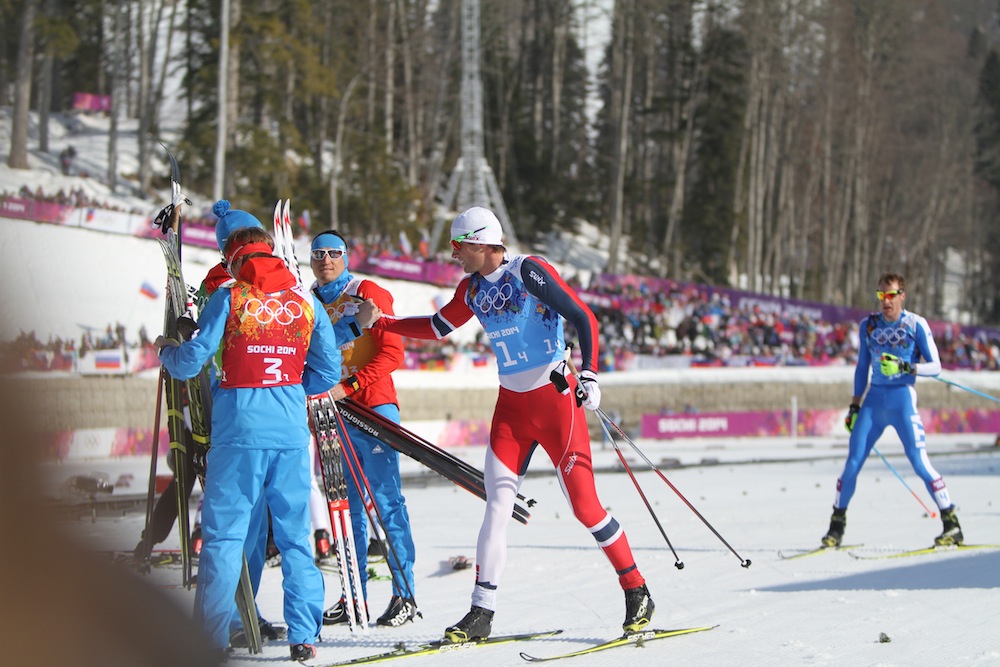
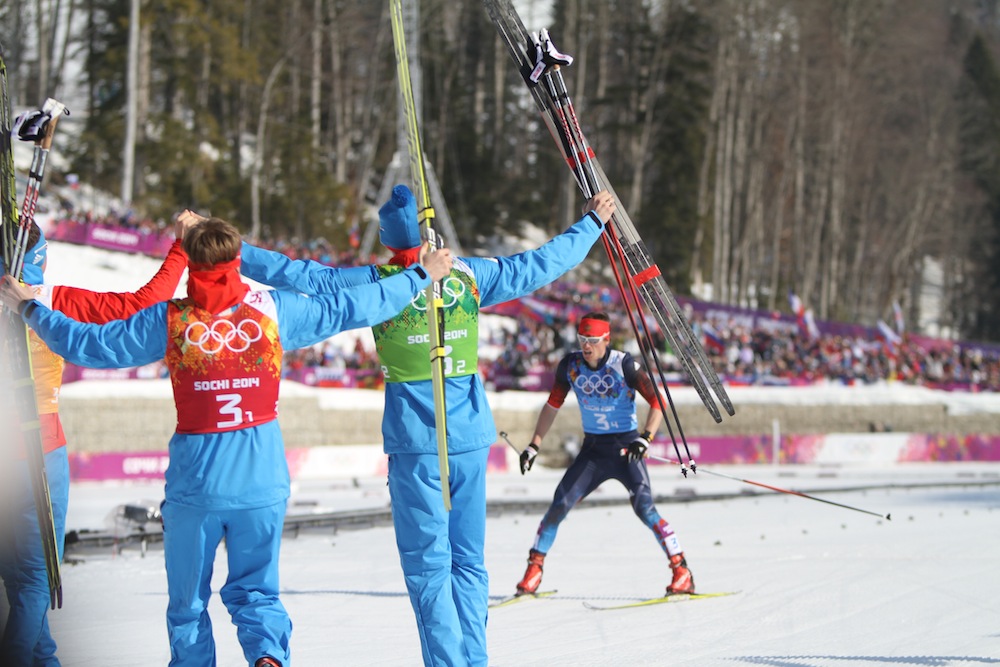
The Russian men’s relay team meets Maxim Vylegzhanin at the finish after he anchored them to silver in the 4 x 10 k at the Sochi Olympics. The IOC recently ruled that the Russian team’s relay result should be invalidated and they are to return their medals.
Norway’s Petter Northug posted a photo on Instagram of what looked like brunch in a tropical setting with the words: “Feire OL bronse!” (translates to “Celebrating Olympic bronze!”). Northug already has four Olympic medals to his name, two of which are gold (all from the 2010 Olympics), but the men’s 4 x 10-kilometer Olympic relay medal from 2014, which will be awarded retroactively to the Norwegian team (after they placed fourth behind Sweden in first, Russia in second and France in third) will be the first medal for Northug’s teammates Eldar Rønning and Chris Andre Jespersen.
Later on Wednesday, Northug posted a jocular meme on Instagram, picturing himself racing in the Sochi relay with the words: “You know you are the best anchor when you bring the medal home 4 years after the race.”
Legkov was part of Russia’s silver-medal relay in Sochi, and as a result of the IOC’s ruling, he must return the two medals he won there (relay silver and 50 k gold). Additionally, the 2014 Olympic results of Legkov and Belov are to be voided and both athletes are barred from competing at (or being granted credentials to) future Olympics. However, both are expected to appeal the ruling to the Court of Arbitration for Sport (CAS) by this Thursday at the latest.
“It is weird to get the medal in the mail. But if he gets convicted, of course I will take it,” Jespersen told Norway’s Nettavisen, according to a translation. “It’s my only Olympic medal. It is clear I will take it.”
In an interview with Le Journal de Montreal, Alex Harvey, the leading member of the Canadian World Cup Team who finished third in the overall World Cup and second in the distance standings last season, said he had his suspicions about Legkov — particularly after the 50 k freestyle mass start (in which Harvey placed 19th).
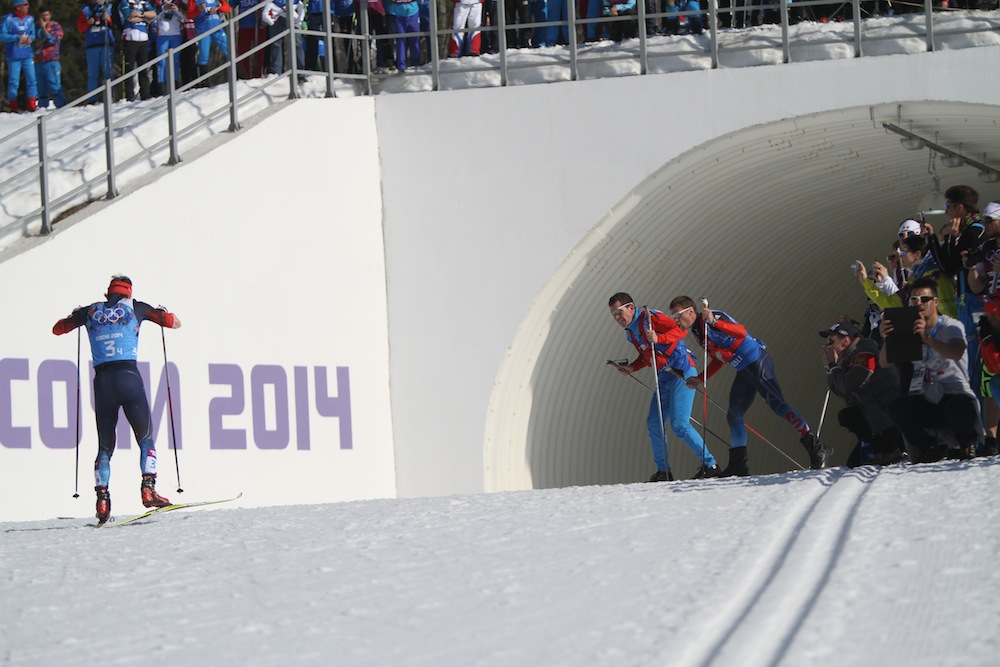
Canada’s Alex Harvey (front, bib 19) racing in the freestyle sprint at the 2014 Winter Olympics in Sochi, Russia. He finished 19th on the day. Also pictured: Russia’s Sergey Ustiugov (2) made it to the final and placed fifth. (Photo: Fischer/NordicFocus)
“On the climbs, we could see he was artificially stronger than the rest,” Harvey said, according to a translation. “In Sochi, the last two kilometers were filled with big climbs. It was a course made for Russians knowing that they were doping.”
He added that the end of each course in Sochi ended with a long, brutal uphill that was exceptionally “physically demanding”.
As for the recent doping bans involving professional cross-country skiers, Harvey said, “It’s a shame because our sport is now compared with cycling. It is in cross-country skiing and in biathlon that the largest number of dope cases occur.”
And while he was in favor of the IOC’s decision, he hoped the buck wouldn’t stop there.
“I’m happy that the IOC finally acted, but Russian skiers are still racing … and one in particular who wasn’t bad in Lahti,” he said, alluding to Sergey Ustiugov, who took gold or silver in all five races he competed in at Lahti World Championships.
“Ustiugov was young at the Sochi [Olympic Games], but he still reached the final in the sprint,” Harvey said. “Three of the top six men fell, but he was on his way to a podium that day. What the McLaren Report revealed was that the full team was involved in doping. But Ustiugov’s name never came out. And as long as his name doens’t come up, we can only have doubts.”
Meanwhile, the law firm representing Legkov and Belov is enraged, according to Nettavisen.
“The decision deserves the term scandal,” the Wieschemann firm stated in its press release on Wednesday. “[It] mocks the declaration of the President of the IOC, Dr. Thomas Bach, to decide only on the basis of secure evidence.”
While the IOC’s Disciplinary Commission (also referred to as the Oswald Commission) has yet to release its full decision and explain how it arrived at the final rulings, cases for 26 other Russian athletes (four of which are nordic skiers) who allegedly doped in Sochi are still pending, the CBC reported.
“The Oswald Commission has announced that all hearings for active athletes who could qualify for the Olympic Winter Games PyeongChang 2018 will be completed by the end of November,” the IOC stated.
As of Wednesday, exactly 100 days out from the 2018 Winter Olympics in PyeongChang, South Korea, it remained unclear whether the commission obtained further evidence concerning Legkov and Belov beyond what was already presented to the CAS.
Wieschemann claims the commission ruled “without further investigation and without further evidence…”
“Denis Oswald still stated at the last summit of the IOC that his investigations would go far beyond those of Prof. Richard McLaren,” the firm’s press release stated. “Well that’s actually not the case. The investigation has only been limited to obtaining a new forensic opinion…”
And while some of the most outspoken individuals in the XC world continue to speak out, others are weighing in on social media as well.
“… It’s disturbing to find out that some athletes in cross-country skiing have likely doped, and have gone so long unpunished,” Caitlin Patterson of the Craftsbury Green Racing Project wrote on Facebook. “But it reminds me that we must be vigilant, keep looking for ways to support anti-doping testing programs, put pressure on governing bodies to take a stand for clean sport, educate ourselves on progress and pitfalls of the cause, and speak up when we can.
“I haven’t spoken much on this politicized topic, but recent news such as this disqualification makes me distinctly aware of how much I value clean sport and all it stands for,” Patterson, who has started 27 World Cup races, continued. “Thank you IOC for taking this step towards preserving clean sport! Let’s keep it going, keep the pressure on, and fight to #CompeteClean and #PlayTrue!”
Former U.S. skier Sylvan Ellefson, who retired in 2014 after racing 23 World Cups, took to Instagram: “Thankful that our @usnordicskiteam contingency all get to move up a couple spots, but I mostly feel for those who have always been moral in their decision making. Those who train and race relentlessly, with their head down, just to find out their competition is taking the easy road. I could go on, but nothing lights me up more than cheaters.”
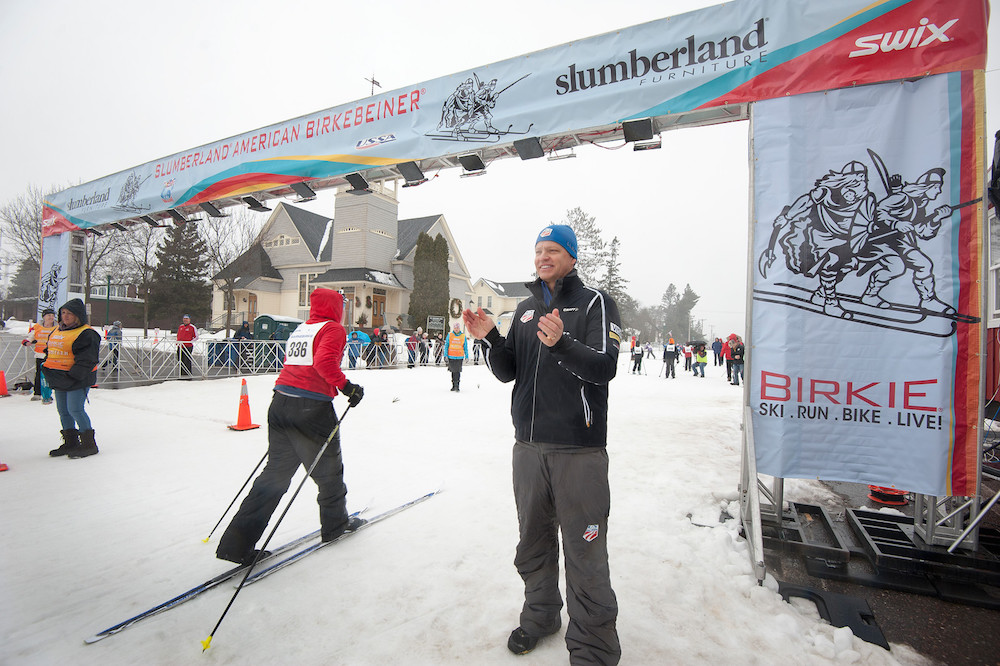
USSA President and CEO Tiger Shaw cheers on kids in the Barnebirkie race during the American Birkebeiner. (Photo: USSA/Tom Kelly)
ZURICH, Switzerland—Tucked at the top of U.S. Ski and Snowboard’s list of proposals for policy changes at the recent International Ski Federation (FIS) Technical Meetings here was this: “Independent Doping Panel.”
The idea was developed along with the Norwegians, who submitted an identical proposal. U.S. Ski and Snowboard President and CEO Tiger Shaw explained that at the moment, FIS decisions made on doping may be made by individuals who also serve other roles in the organization or internationally.
“The idea is just to have a more independent panel at FIS,” Shaw said in an interview before he headed to the FIS Alpine World Cup a few hours away in Sölden, Austria. “What if, for instance, it’s a Russian who is the head of the [doping panel], and we are talking about sanctioning Russia from the Olympics? You can imagine that there would be a sense of conflict of interest there.”
“You cannot let a country compete that has had more than 1,000 people overtly cheating for years, where that has been proven,” Shaw said. “What the hell are we doing? The athletes have to stand up and demand that. Throw the Russians out [as a country], and let their athletes compete if they are clean and they can prove it.”
Strong words. But Shaw’s feelings about the current “soap opera” surrounding Russian doping are symptomatic of broader governance changes that U.S. Ski and Snowboard is seeking in the sporting world.
“FIS is typical as compared to a lot of older European governance bodies,” he said. “The concept of conflicts of interest is somewhat new in the last couple of decades, and in the case of FIS there has been very little done [to address this].”
Indeed, the International Olympic Committee (IOC) only this month required all of its members to sign a commitment to “ethical principles” for the first time. Included in the document was a primer on the correct way to handle conflicts of interest, and it was almost entertainingly basic in the level of information presented.
“Globally, we want to really push a movement to remove the conflicts of interest between anti-doping and sports organizations around the world,” Shaw said. “The conflicts of interests there are rife and absolutely absurd.”
For instance: Gian Franco Kasper, the President of FIS, is also a member of the IOC Executive Board, and was a member of the World Anti-Doping Agency (WADA) Executive Board from 2003-2016. Are the best interests of all three of those organizations always served by the same decision, and it not, then what is one to do?
And so dealing with the Russia situation is task number one. But it’s part of a bigger picture – a picture U.S. Ski Team athletes and coaches have become noticeably more outspoken in interviews and on social media in the last year.
“There are a lot of Europeans within these establishments who are trying to protect the status quo,” he said. “They are not happy with us. We are the obvious ones to point to because we are becoming the loudest. And Trump doesn’t help… [He] makes it easy to say that we’re on a self-serving mission. No, we’re on a sport-saving mission. If other countries aren’t going to step up and be as loud as we are, then we will just get louder.”
Potential Doping Ban for Six Russian Skiers
The Court of Arbitration for Sport decided that there was a “reasonable possibility” that Alexander Legkov had doped at the 2014 Olympics. Here, he pumped his fist after Russia won silver in the 4 x 10 k relay, their nation’s first medal in cross-country at the Sochi Olympics.
Shaw believes that there is plenty of evidence in the McLaren Report to justify rule violations brought against the athletes, and questions why FIS hasn’t charged them already.
At the moment, FIS is waiting for the IOC to share information from a disciplinary commission which could add to the evidence in the skiers’ cases. But the delivery date on that information has been pushed back time and time again.
When asked this week whether FIS had received any information from the IOC commission regarding the six Russian athletes, FIS Secretary General Sarah Lewis replied:
“As outlined previously you will need to address this question to the IOC. We made sure the IOC is aware of the dates of the start of the FIS Cross-Country World Cup in late November and as far as we are informed the IOC is aiming to deal with the cases involving athletes under FIS authority before that.’”
When the Court of Arbitration for Sport (CAS) reviewed the provisional suspension of the athletes, and in particular 2014 Olympic gold medalist Alexander Legkov, it signaled that it largely believed the evidence in the McLaren Report and did not buy character assassination against the report’s main source, whistleblower Grigory Rodchenkov.
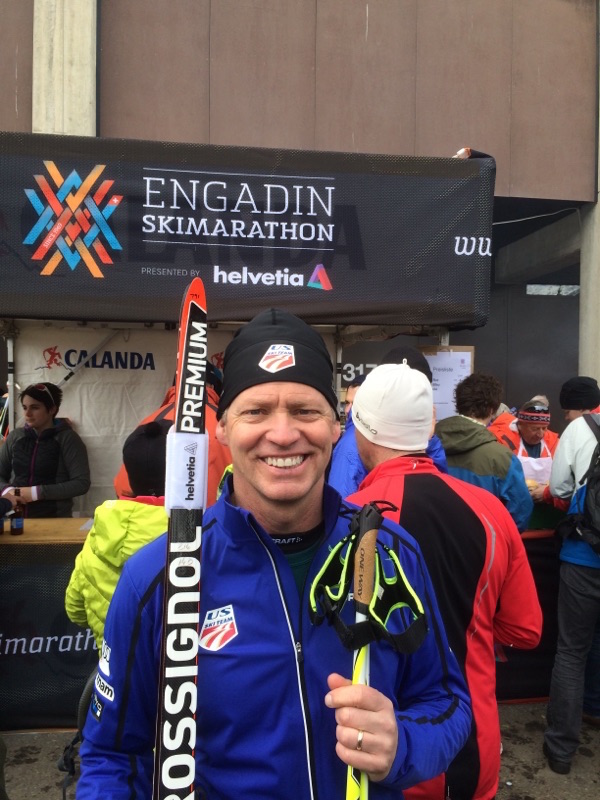
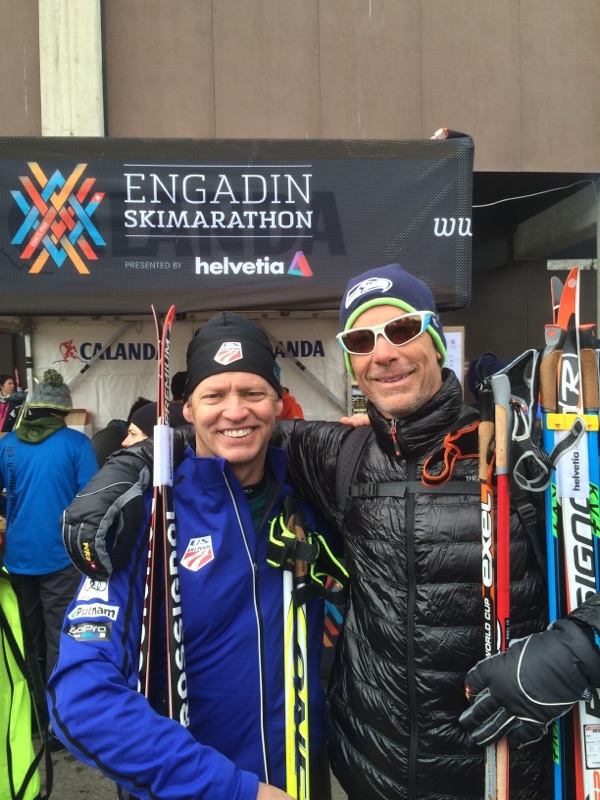
Tiger Shaw (l) and Tony Weiderkehr at the 2016 Engadin Ski Marathon. A former Olympic alpine skier, Shaw has become not only an enthusiastic supporter of U.S. Ski and Snowboard’s cross-country team but also a practitioner himself. (Photo: Fast Big Dog)
“I don’t understand the comment she made to you,” Shaw said of Lewis’s email. “FIS ultimately has to decide whether or not to charge the skiers. So far they have provisionally suspended them, presumably to gather more evidence. It’s logical that FIS is waiting to hear from the [IOC] commissions, because there will be additional evidence in there… [but] CAS, when they reviewed the provisional suspension, said essentially that the information and the evidence in the McLaren report is enough to convict. So you have the appellate body itself saying, we uphold your suspension. You have the evidence, but you have to make a decision.”
Current Investigations and a Broader Russian Ban
What is going on with the IOC commissions, which are taking so long?
The McLaren Report already contained evidence that Russian athletes had been involved in an elaborate sample-swapping scheme at the 2014 Olympics, and email evidence also showed evidence that doping violations were covered up in the years preceding 2014 as well.
Rather than act on that evidence, the IOC commissioned two more committees. One, headed by Denis Oswald, was tasked with looking at the guilt of individual athletes; another, headed by Samuel Schmid, was tasked with looking at the systematic nature of the doping in Russia. Schmid apparently said that he would have his work finished by December – after the winter sports season has already begun.
It has been months since the commissions began their work, and so far nothing has come out of it.
“Look at the Schmid and Oswald Commissions, which the IOC commissioned after the Independent Person report came out, that McLaren wrote,” Shaw said. “The IOC is commissioning more, to re-study what was already studied by an independent person report triggered by WADA, which is a child organization of the IOC. So it’s questioning itself. It has dragged this out for a year now.”
Against this backdrop and inaction, a number of organizations and individuals are nonetheless calling for Russia to be banned from the upcoming 2018 Olympics based on the McLaren Report. Among them are some spectators and athletes, but also 37 national anti-doping agencies (NADO’s), including USADA, the Canadian Centre for Ethics in Sport (CCES), and many others.
By comparison, only 14 NADO’s signed on to a similar statement urging Russia to be banned from the 2016 Olympics in Rio de Janeiro. Feelings on the issue have if anything become stronger since then as the IOC continues not to act.
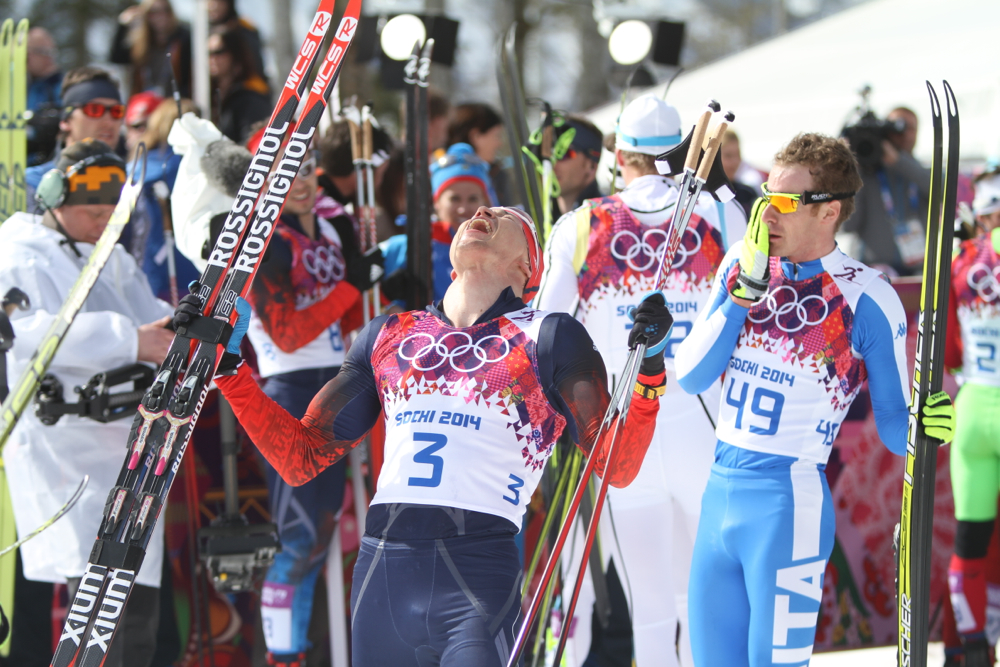
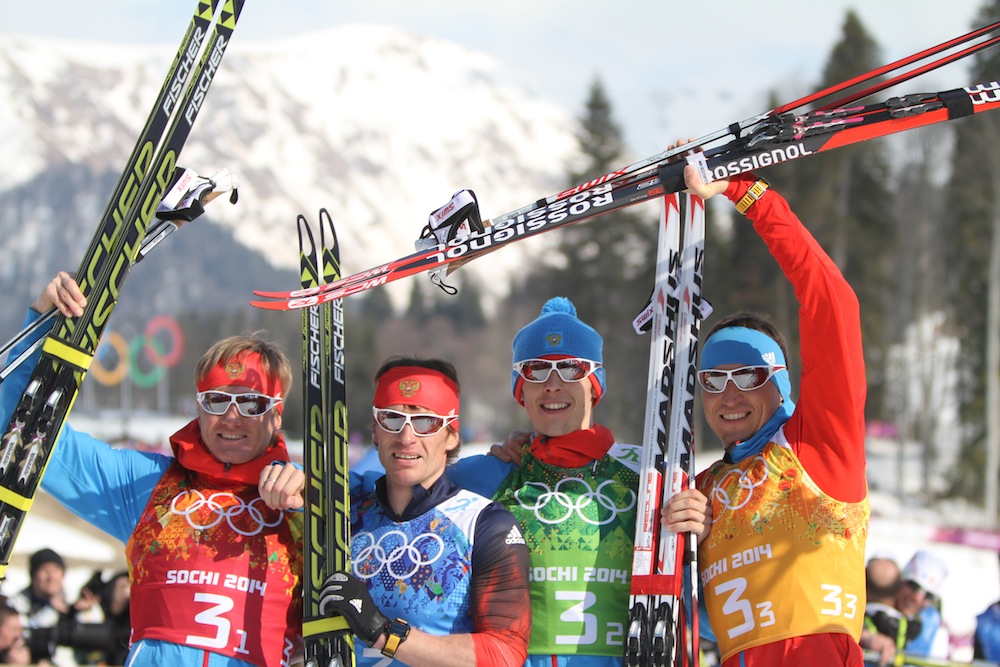
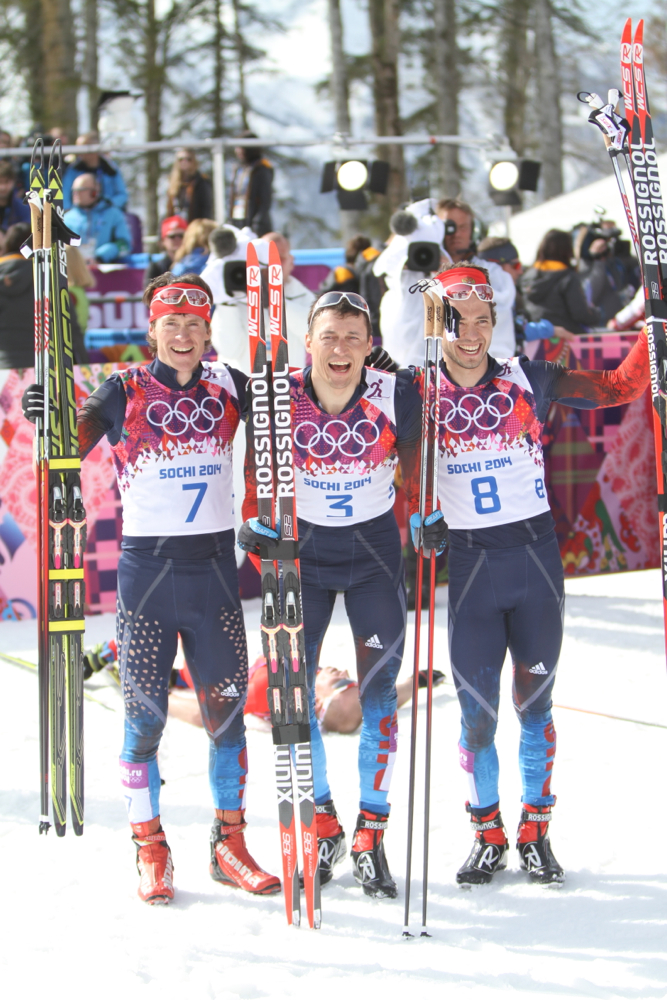
The Russian podium grinning ear-to-ear after Alexander Legkov (3) won gold, Maxim Vylegzhanin (7) earned his third silver in Sochi, and Ilia Chernousov took bronze in the 50 k freestyle mass start, the last race of the 2014 Winter Games. Both Legkov and Vylegzhanin were implicated in the McLaren Report.
Calling for a Russia ban is seen by some as a kneejerk reaction, and an unfair one, but Shaw says that it is grounded in the kinds of statutes his organization and others around the world agree to be bound by.
“They have violated tons of anti-doping rules and FIS statutes,” Shaw said of Russia. “The statutes call for suspending a member federation if they do that, as well as if there are more than four doping convictions in a single year. Well, FIS is heavily pursuing at the moment [six athletes]. All of it ends up in the logical conclusion of FIS sanctioning Russia and excluding them from the season, which also means the Olympics.”
As for potentially innocent athletes caught up in the middle of it, there is a solution.
“There is a compromise that’s possible,” he said. “Suspend Russia, but allow athletes that have been continuously tested outside of competition in the preparation for the Olympics. In cross-country that probably means all summer. If they tested clean, then let them compete under an independent flag.”
That compromise, though, may have expired. Summer is over; athletes have half a training year under their belts and this outside-of-Russia testing and surveillance was never put into place, because decisions were put off about how to deal with Russia.
“Of course because of the general foot-dragging of the IOC, there is no time left,” Shaw said. “Everybody’s backs are up against the wall, unnecessarily, unfortunately, but maybe by design.”
How The System Could Work
“By design” gets at some of those conflicts of interest. Shaw says that the responsibility for investigating, trying, and sanctioning athletes shouldn’t all be housed with FIS and the IOC anyway.
At the moment, there is a mixture of agencies responsible for testing athletes. Each country has (or should have) their own anti-doping agency; in the United States, that’s USADA. Each international sports federation, like FIS, also has to do testing and deal with cases. Then, at the Olympics, all of that responsibility is transferred to the IOC.
In each case, there are conflicts of interest, Shaw says. A country may want to hide positive tests by their star athlete. That’s certainly what Russia did, to a massive extent.
The same is true for international federations.
Russia’s Petr Sedov en route to his first non-stage World Cup, in the PyeongChang World Cup 30 k skiathlon in South Korea in 2017. Russia hopes to compete there again at the 2018 Olympics; many are calling for them not to. (Photo: Fischer/NordicFocus)
“What if you look at a smaller [international federation] that might have one super famous athlete,” Shaw said. “It’s going to have a huge economic impact on that federation’s worldwide image and brand [if that athlete fails a doping test]. That tiny federation might have 12 employees. How are they going to deal with this? It’s daunting.”
Then there is the IOC, which has plenty of money and resources, but at the moment is slow as molasses in dealing with its doping scandal.
“[IOC President] Thomas Bach obviously doesn’t want Usain Bolt to be disqualified right before the Rio Games,” Shaw said, using a hypothetical example. “It’s a major conflict of interest, a financial one as well as a moral and branding one. So there has to be a revamp of that whole thing.”
Instead, he asks, imagine how a criminal justice system works.
“You have an independent body that makes the rules – the laws,” he explained. “Then you have an independent agency that enforces them – that’s the cops. This is the ideal, not that it doesn’t get corrupted in the U.S. or anywhere else. Then you have another independent system – the courts. Even within that, you have independent systems where you have a jury of your peers and you have a judge. And then if anyone wants to challenge that you go to a higher court.”
Doping and sports governance is pretty far from that model, with the same organizations often making the rules, investigating cases, and handing out punishments.
“CAS does appear to be reasonably independent, thank God,” Shaw said of the highest court in sports. “But we need a single entity to run each of those other functional roles. We need a body to make anti-doping rules for the world of Olympic sports. Then we need enforcement. There could be multiple levels, but there has to be one body which is really controlling it all and enforcing independence across all of that… So the WADA-[national anti-doping agency] arrangement is not bad, but it’s politically screwed up. We need to fix that.”
Under such an arrangement, international sports federations could drop much of their anti-doping programs and focus merely on enforcing decisions made by other bodies. That would allow them make strategic plans for growth of their sports, something Shaw sees as sorely lacking in many international federations.
“Hopefully in the future, all the federations pay into a pool, and someone else takes care of it,” Shaw said. “And then you can focus on your sport and your brand. Hopefully that’s not a dream.”
Nuts and Bolts
So how does the dream become reality?
“You get excited about change and you think it can happen soon,” he said of U.S. Ski and Snowboard’s proposed reforms. “And then you run smack into political stalling. We see this happen at our level – you are trying to argue the merits of a position with one of our counterparts from another country. They say they agree but they aren’t going to do anything about it. It’s the most deflating thing you can run into.”
Regarding the situation with Russia, for instance, Shaw said that few other national ski federations are outspoken about the issues.
“They are confused and choosing not to study this closely, or do much about it,” he said. “And that’s simply because of the control exerted over them… You can’t have a council member of an international federation saying that they aren’t going to do anything about it because they are worried about re-election and angering the leadership. That is not leadership.”
Shaw is not alone in becoming a loud voice in the arguments over doping. Max Cobb, the President of the United States Biathlon Association and an Executive Board member at the International Biathlon Union, is also a vocal proponent of clean sport. Scott Blackmun, the CEO of the U.S. Olympic Committee, recently said that “at some point, justice delayed is justice denied, and we are fast approaching that point” regarding the Russia scandal. USADA CEO Travis Tygart has long been a vocal leader in the NADO community.
All of that means that the U.S. is sometimes framed as a bully on the issue, including in the ski world.
“There are a number of people and countries who love to say, the U.S. is trying to get Russia thrown out so they can win more medals,” Shaw said. “We want the [clean] athletes to be able to compete, but yes, we want Russia thrown out. So do 36 other countries. 36 other anti-doping organizations have called for this. What more of a majority do you need?”