From the FasterSkier archive — posts syndicated from athletes’ and coaches’ own blogs between 2004 and 2012, kept online as published. Current coverage is at fasterskier.com.

Tag: Otepää classic sprint

  • Norway’s Falla Leaves No Doubt with Otepää Win; Diggins in 12th

    Norway’s Falla Leaves No Doubt with Otepää Win; Diggins in 12th

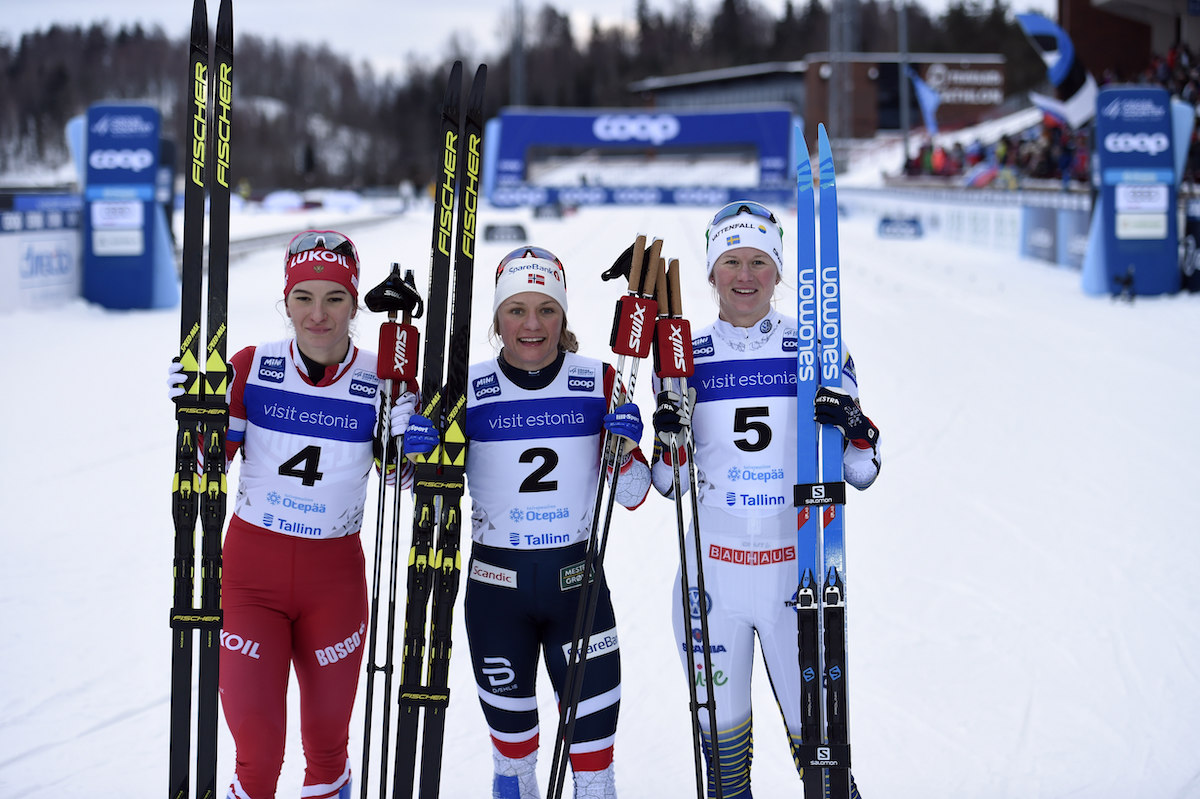
    The women’s 1.3 k classic sprint podium from Otepää, Estonia. From left to right, Russia’s Natalia Nepryaeva in second, Maiken Caspersen Falla of Norway in first, and Sweden’s Maja Dahlqvist third. (Photo: Fischer/Nordic Focus)

    Some proverbs hang in there. From situation to situation they simply capture, in the moment, how best to move forward.

    “Patience is a virtue,” has an etymology going way back. Yet the timeworn saying and it’s wait-wait-wait underpinnings helped dictate the outcome of Saturday’s World Cup 1.3-kilometer classic sprint in Otepää, Estonia. That is until Maiken Caspersen Falla broke up the final. But we’ll get to that in a moment.

    It was the modern course with its punchy ups and technical s-turn descents that kept patience in play. Fire too early on the demanding course and a fade would certainly follow. Temper the effort a bit, saving fuel for the later half of the effort, and good things might follow.

    Sweden’s Stina Nilsson laid down the day’s fastest qualifying time in 3:07.62 minutes. A time mark illustrating the race was no 2.5 minute blast. In other words, much of how the day played out on course would come down to the moments after the two minute mark.

    Two minutes into the race, the course kicked up with a 30-meter long herringbone section that often separated the pack. Athletes who conserved enough energy, positioned themselves near the front, kept a light yet robust herringbone, and pushed over the top were the ones most often positioned to advance in the heats.

    The descent from the herringbone-hill eventually took the sprinters into a swooping left hand corner and then into a 100-meter double pole straightaway parallel to the finishing straight.

    Those with the stamina to hammer out a double pole fared best in the closing 20 seconds of the sprint heats. 
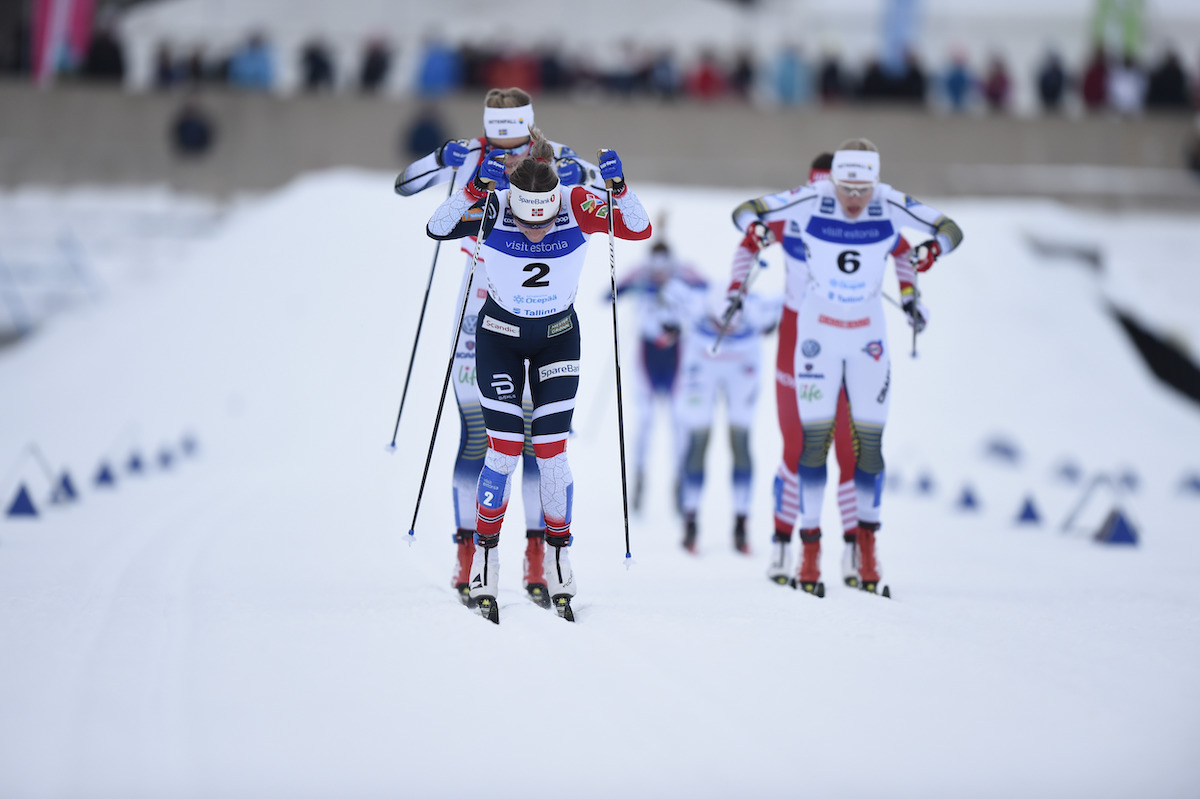
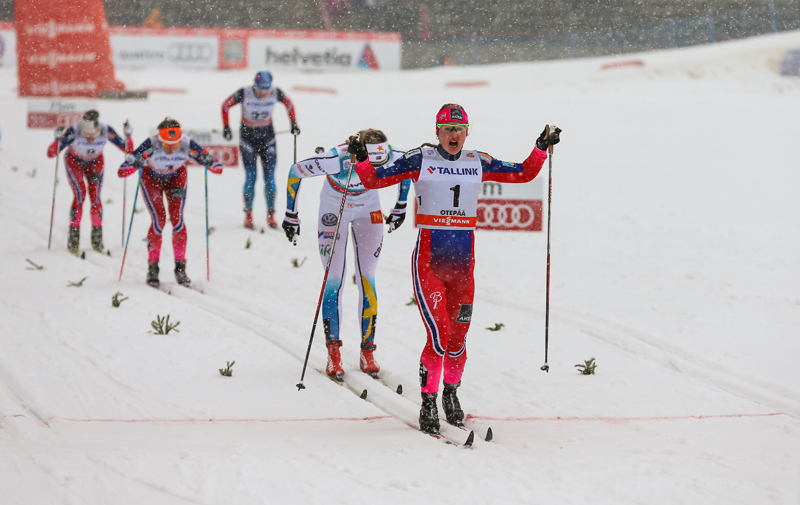
    Powering up: Norway’s Maiken Caspersen Falla (bib 2) during the 1.3 k classic sprint in Otepää, Estonia. (Photo: Fischer/Nordic Focus)

    In the women’s final Falla went up against Russia’s Natalia Nepryaeva, the Swedes Maja Dahlqvist and Jonna Sundling, and Slovenia’s Katja Visnar. The day’s fastest qualifier Nilsson, who advanced to the final as a lucky loser (there was a three-way photo-finish in her semi-final) did not start the final. According to the International Ski Federation (FIS) Nilsson fell after her lunge for the line and came up with a small yet unspecified injury. Out of precaution, she chose not to contest the final.

    Unlike many of the day’s heats which featured a cluster of skiers approaching the herringbone hill together, Falla and Nepryaeva began to separate as they threw down deep powerful strides on the course’s first major climb. At 45 seconds, the duo began forming a 10-meter gap on the remaining three finalists.

    Over the top of the hill, Sundling fought to stay within a breath of Nepryaeva’s draft — Falla glided down alone five meters ahead. The two skiers further behind, Dahlqvist and Visnar, were markedly off the pace.

    As the course pitched left on a step-around corner, Sundling tumbled. From then on it was a two-skier affair.
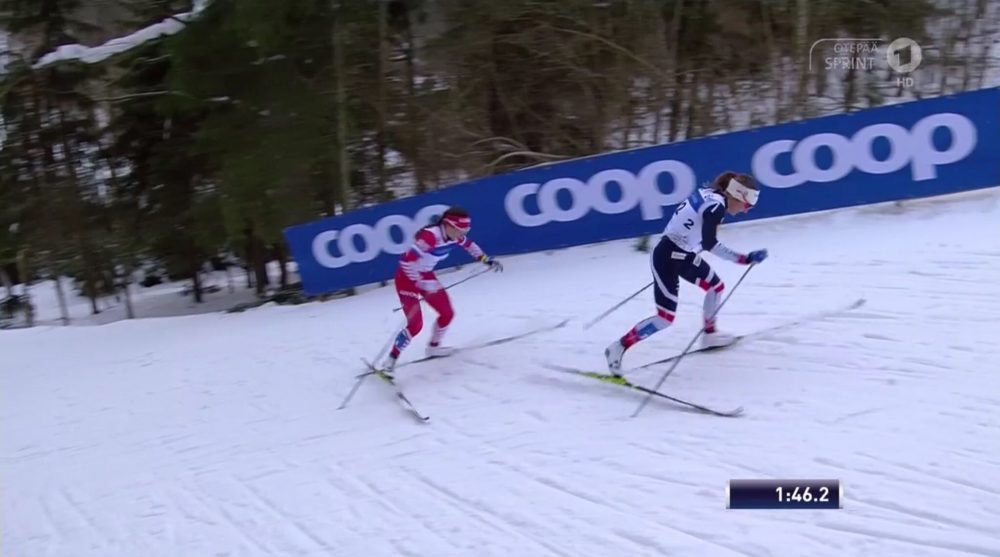
    Norway’s Maiken Caspersen Falla making her move on the herringbone hill to outdistance Russia’s Natalia Nepryaeva. (Photo: ZDF screenshot)

    Falla fired on the herringbone hill and gapped Nepryaeva enough to secure the win. Falla won in a time of 3:05:16 minutes with Nepryaeva 1.40 seconds back for the podium’s second step. Dahlqvist placed third (+5.78) with teammate Sundling recovering after her fall to nab fourth (+8.12). Visnar faded to finish fifth (+23.22).

    It was Falla’s second World Cup podium of the season. She currently sits third in the sprint cup standings behind Nilsson in first.

    With the final a symbolic outlier when it came to the patience game, the U.S. Ski Team’s (USST) Jessie Diggins played the wait and wait philosophy. Diggins qualified in 18th and moved onto the semis after placing second to Falla in the second quarterfinal.

    In her quarter, Diggins shadowed the pack until the the mandatory herringbone hill when she moved towards the front and ultimately scored a semi spot.

    In her semi, which needless to say was primed with top-tier talent, Diggins bowed to the high pace to finish sixth and place 12th overall.

    “Today was a lot of fun, and I was really happy with how I skied,” Diggins expressed in an email to FasterSkier. “I ran out of gas a little in the second half of my semifinal, but given how stacked semifinal one was, I’m taking a lot of confidence from today and in how my classic sprinting is coming along! We also had great skis in the heats today and I was psyched with how our team was able to keep changing things up on the fly to improve the speed. The steep herringbone technique has always been a challenge for me, and I still have some work to do, but I was happy with the progress I’ve made over the years in these conditions.”

    Ida Sargent (USST) had a season best result after qualifying in 27th. Sargent skied in the third heat where Sweden’s Ida Ingemarsdotter set the tempo. Sargent looked strong in the opening moments as she matched the striding pace. Into the herringbone hill she fended off the charge of Finland’s Krista Pärmäkoski.

    “I usually feel like striding was my strength,” Sargent emailed. “This course had all the striding in the beginning so I tried to take advantage of that and push the pace or ski near the front in the striding and do my best on the herringbone hill.”

    Pärmäkoski cleverly sucked into Sargent’s draft to eventually pass the U.S. skier and place second in the heat. Sargent finished in third and did not advance as a lucky loser. Sargent’s 15th overall was her best World Cup result of the season. 

    “My strategy was to ski near the front but maybe not lead, but I just lost contact with Ida [Ingemarsdotter] on the herringbone hill and lost her draft but had Pärmäkoski in my draft so she zoomed by me coming out of the downhill.  It was probably the best I felt sprinting all year so I’m excited to be moving in the right direction.”
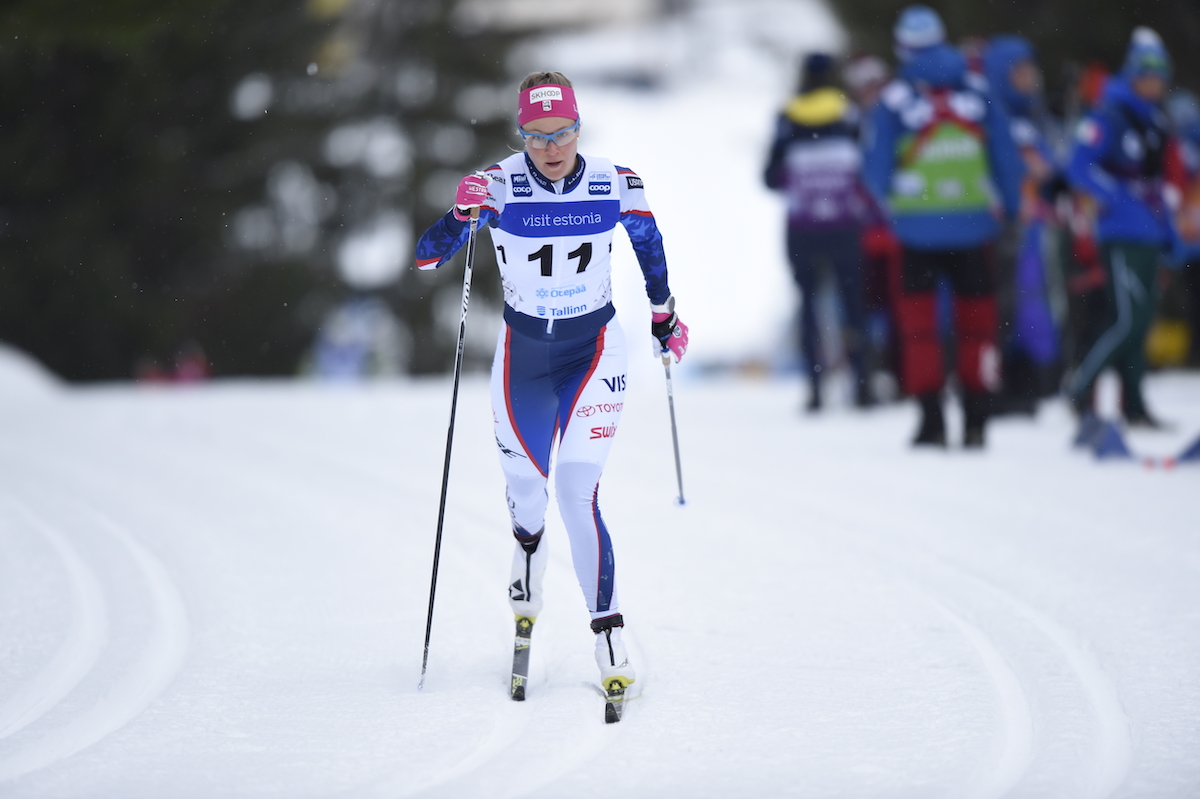
    The U.S. Ski Team’s Sadie Bjornsen during her qualifier in Otepää, Estonia’s 1.3 k classic sprint. (Photo: Fischer/Nordic Focus)

    Also for the U.S., Sadie Bjornsen advanced int0 the heats after qualifying in 20th (+5.71). Skiing in the fifth heat, Bjornsen was the epitome of patience, waiting until the final two double pole sections to make a move. With only the last right hand turn and the final straight to navigate, Bjornsen fell among a pack of skiers. She was given a yellow card for obstruction.

    “Bittersweet ‘day one’ of the classic weekend,” Bjornsen wrote in an email to several news outlets. “After a qualifier that seemed a bit off, I went into the heats excited to find a better place. I am thinking I maybe chose a little bit too much kick in the qualifier, but it is hard to tell.”

    Bjornsen was matter of fact when it came to her fall — knowing sprints are rife with close-quarters positioning.

    “For the heats, I tried to hang in a smart position through the whole heat,” she wrote. “I knew I was feeling really strong in the double pole, so my goal was to save some energy for a good final second half, and sit in a smart place for the first half. The plan played out well, and I pushed super hard over the top of the course allowing me to have a lot of speed into the bottom corner. As I came into the final corner of the course, the tails of my skis got a little clicked by the Slovenian, which caused me to lose balance and find myself on the ground…. not the way I had expected it. … Sprint racing is ‘sprint racing’. It doesn’t always go as you hope and dream. At the end of the day, I am really excited to feel some better form than the last couple of races, so I am looking forward to tomorrow!”
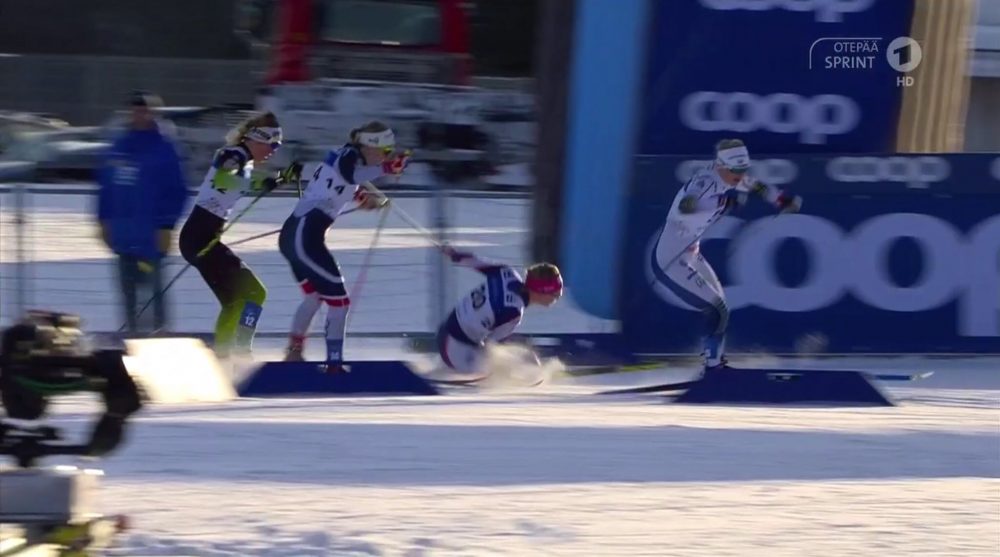
    Sadie Bjornsen of the U.S. Ski Team taking a fall in the last corner of her quarterfinal heat in Saturday’s 1.3 k classic sprint in Otepää, Estonia. (Photo: ZDF screenshot)

    The next opportunity comes for Bjornsen and the women’s World Cup field in tomorrow’s 10 k classic.

    Also for the U.S., Rosie Brennan (USST) finished 45th (+15.81).

    Dahria Beatty was the only Canadian entered. She placed 44th overall (+15.79)

    Results: Qualifier | Final

  • Saturday Race Rundown: Otepää Classic Sprints and Beyond (Updated 2x)

    Saturday Race Rundown: Otepää Classic Sprints and Beyond (Updated 2x)

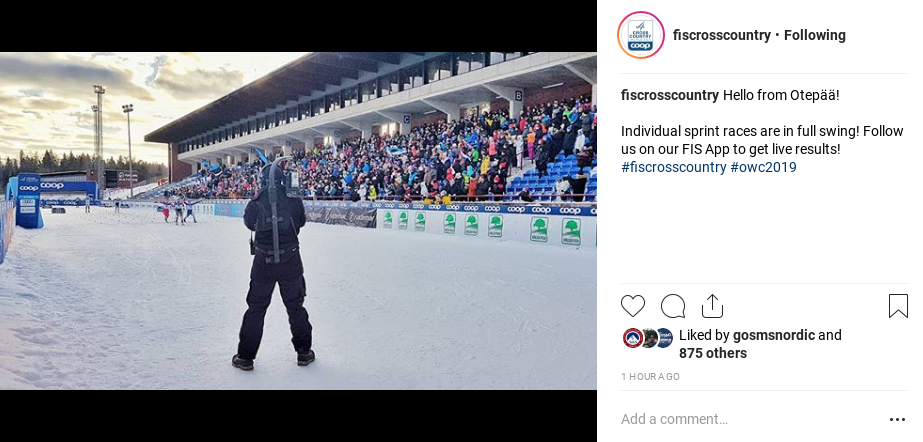
    It’s on and it’s over — the World Cup classic sprints in Otepää, Estonia. (Photo: @fiscrosscountry Instagram screenshot)

    FIS World Cup Otepää, Estonia 1.3 k / 1.6 Classic Sprint

    Starting the day’s performance benchmarks off was Stina Nilsson of Sweden with the fastest qualifier in the women’s 1.3-kilometer classic sprint in Otepää on Saturday. She stopped the clock in 3:07.62 minutes.

    The U.S. Ski Team’s (USST) Jessie Diggins was the top-qualifying North American in 18th (+5.37). Sadie Bjornsen (USST) qualified 20th (+5.71), and Ida Sargent 27th (+8.38).

    On a course rewarding patience and technical skiing know how, Norway’s Maiken Caspersen Falla won the overall in 3:05:16 minutes. Russia’s Natalia Nepryaeva placed second (+1.40), and Maja Dahlqvist of Sweden third (+5.78). Also from Sweden, Jonna Sundling, who fell at around the 1:30 mark in the final, placed fourth (+8.12), with Slovenia’s Katja Visnar fifth (+23.22).

    Nilsson placed second to Falla in the first semi-final, but did not start the final. Nilsson had won the last four World Cup sprints, all in skate, coming into Otepää.

    Bjornsen looked strong in the fifth heat, yet stepping around the right hand turn before the final straight she fell taking out several other skiers. Bjornsen was given a yellow card for obstruction. She ended up 22nd overall. 

    Diggins placed second to Falla in the second heat to advance to the first semi. She was eliminated after finishing in sixth (+3.68). Diggins placed 12th overall. 

    Sargent finished third in the third heat, to place 15th overall.

    U.S. athlete  Rosie Brennan (APU) finished 45th (+15.81).

    Dahria Beatty (CNST) was the only Canadian entered. She placed 44th overall (+15.79)
    Qualification Results | Results 

    Norway’s Johannes Høsflot Klæbo was the fastest qualifier for the men in the 1.6 k classic sprint with a time of 3:21.99 minutes.

    The young Norwegian seems on form as he swept his heat, semi, and final on his way to the win. Klæbo won the final in 3:20.05 minutes. Alexander Bolshunov of Russia, the only non-Norwegian in the final, was second (+1.51), and Pål Golberg third (+2.53). Rounding out the final three spots in the final were Eirik Brandsdal in fourth (+2.57), Mattis Stenshagen in fifth (+7.69), and Erik Valnes in sixth (+11.99).

    For the U.S., Erik Bjornsen (USST) was the fastest qualifying North American in 23rd (+8.2), Andy Newell (SMS T2) 26th (+8.75).

    Bjornsen was knocked out of the rounds after placing fifth in the second heat. He placed 24th overall. Newell ended up third in the first heat, 2.99 seconds in back of Klæbo. Newell, in his second World Cup sprint of the season, placed 15th in the final standings.

    Kevin Bolger (USST) finished in 41st (13.13), Ben Saxton (SMS T2) 44th (+14.16), and Ben Lustgarten (CGRP) 63rd (+23.04).

    For Canada, Lenny Valjas (CNST) was 43rd (+13.61), and Bob Thompson 51st (+15.96).

    Men’s Qualification Results | Men’ Results

    ***

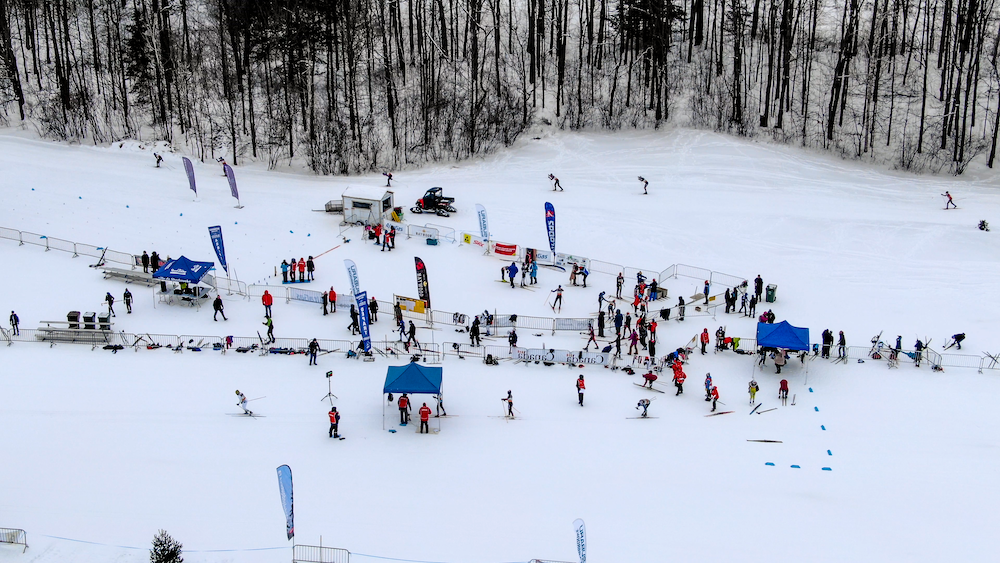
    The stadium setup for Saturday's interval start classic. (Photo: A. Ian Aitken)
    The stadium setup for Saturday’s interval start classic. (Photo: Ian Aitken)

    Worlds Selections/NorAms/Coupe Québec, Bishop’s University, Québec

    Day two of the NorAm weekend was interval start classic, with very cold conditions delaying the start and simplifying the ski preparations.

    Katherine Stewart-Jones (CNST) topped her Friday 2nd place with a clear win in the 10km, finishing in 28:51.6 with the fastest time on all three laps. Cendrine Browne (CNST) was second at 30.8 behind. Zoë Williams (Nakkertok) was third at 1:53.5, just pulling clear of Frédérique Vézina (CNEPH) by 3.1 seconds with a fast final lap.

    In the men’s 15km, Scott Hill (Hardwood) bounced back from a slow start to the season with a well-timed victory to join Stewart-Jones on the World Championships team. Hill was fastest on the last three of four 3.75km laps to win in 36:59.7, 9.0 seconds ahead of a fading Russell Kennedy (Team R.A.D.). Graham Nishikawa (CPNST), here training for his role as Brian McKeever‘s guide, held onto third at 38.0 seconds, just 3.2 seconds ahead of a fast finishing Dominique Moncion-Groulx (Nakkertok).

    There are two more automatic selections for World Championship available on Sunday in the mass start skate races (20km for women, 30km for men). With cold temperatures and heavy overnight snow predicted, it should be an exciting end to the weekend.

    Classic Results, Full Weekend (including live timing for Sunday)

    ***

    IBU World Cup Ruhpolding, Germany 4 x 6 k Relay

    The teams from France, Norway and Germany claimed the positions at the top of the podium on Saturday in the women’s 4 x 6-kilometer relay in Ruhpolding, Germany, cheered on by over avid 25,000 fans lining the course.

    France with Julia Simon, Anaïs Bescond, Justine Braisaz and Anaïs Chevalier stayed in the top group all race mainly due to the best shooting performance of the day, at times with a lead of over half a minute. On the anchor leg, Chevalier defended her narrow lead through three loops and two shooting stages to the finish line in a time of 1:09:27.7 hours, with no penalty and just four spares. According to an IBU press release, it was their first win since 1994 at this venue with a long tradition on the biathlon competition calendar, which has undergone a slight redesign for this season to add stands and make a downhill section less tricky.

    Behind the French women, Norway with a team comprised of the reactivated veteran Synnøve Solemdal, Ingrid Landmark Tandrevold, Tiril Eckhoff and anchor Marte Olsbu Røiseland was second, with Røiseland narrowing the gap to Chevalier on the final loop from 21 to seconds but not quite catching up to finish 11.5 seconds back (with no penalty and seven spare rounds). The home team from Germany with Vanessa Hinz, Laura Dahlmeier, Franziska Preuss and Denise Herrmann was third, after the fast Herrmann was unable to catch the leaders when she needed all three spares in the final shooting to clear her targets (+23.4, with no penalty and nine spares).

    Over a minute behind the podium finishers, the fourth team crossing the line were the 2018 PyeongChang Olympic relay silver medalists from Sweden around anchor Hanna Öberg (+1:29, with no penalty and nine spares).

    For the North American teams it was a race with many ups and downs.

    Canada began the race with Sarah Beaudry, who moved the team as high as sixth thanks to a clean shooting performance in her standing shooting stage after she had required two spares in prone. She then lost time to the top teams on the track to exchange in 13th position (+54.5 sec). Emma Lunder then managed to bring the team back up to sixth position but she also needed two spares in prone and followed that up with a clean standing stage, tagging off in seventh place right behind Sweden (individually her leg was the fifth-fastest). Megan Bankes kept up with the teams around her on the course and slightly improved to fifth position less than a minute back, but then missed two targets in her standing stage and could not clean with her spares. She skied a single penalty lap (0+1, 1+3). She tagged anchor Rosanna Crawford in 10th position (+2:14), who then herself added a penalty in her prone stage.

    At the site of her podium finish a year ago and coming off a 27th place in the sprint earlier this week, the Canadian team leader then needed two spares in the standing stage and ultimately came to the finish in 12th position (+3:01.6), with two penalties and 13 spare shots for the team.

    For US Biathlon, Clare Egan began the race and recorded a clean prone stage to move the team up all the way to third position coming into the standing shooting stage despite a broken pole. She then missed three targets and ran out of spares and skied two penalty laps.

    That set the team back quite far, exchanging in 19th position (+1:26.6). Susan Dunklee needed four spares in her shooting stages but avoided another penalty (0+1, 0+3) to exchange in 12th position (+1:47.3).

    Rounding out the team after being called back up to the World Cup from the second-tier IBU Cup following solid performances in Duszniki Zdroj, Poland, Joanne Reid only needed one spare in each of her shooting stages (0+1, 0+1) to tag off in 15th position. In her second time anchoring a relay this season, Deedra Irwin – who had recorded her first clean shooting performance in a race in Poland a week ago – then required all her spares to clear her targets in the prone shooting before achieving another clean standing shooting stage. She crossed the line in 16th position, 4:06.0 back, with two penalties and 12 spare shots for the team.

    Races in Ruhpolding conclude on Sunday with mass starts for the women and men. US Biathlon’s Sean Doherty is scheduled to be lone North American starter for the elite men’s field (though Canada’s Christian Gow would be the next one up from a reserve list in case of an illness), while Egan and Dunklee are qualified for the women.

    Results Women’s 4×6-kilometer Relay


  • Østberg Carries the Torch for Norway with First Classic Sprint Win in Otepää

    Østberg Carries the Torch for Norway with First Classic Sprint Win in Otepää

    (Photo: Fischer/NordicFocus)
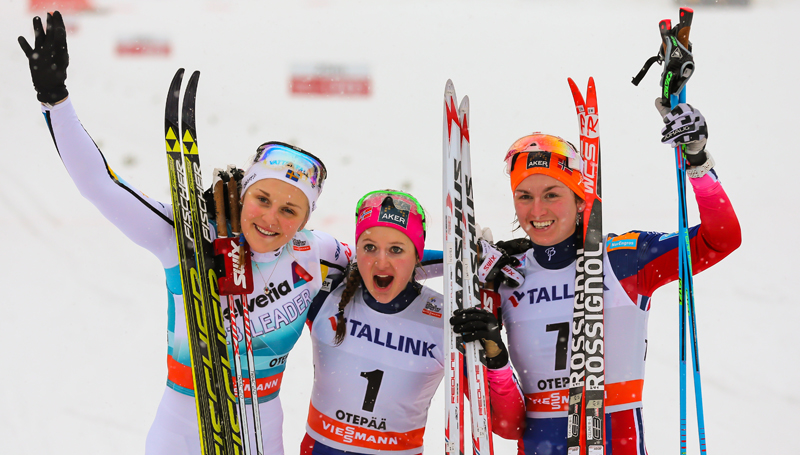
    A very happy Otepää podium, with Norway’s Ingvild Flugstad Østberg (c) in first, Swden’s Stina Nilsson (l) in second, and Norway’s Celine Brun-Lie in third. (Photo: Fischer/NordicFocus)

    With many of the top women using this weekend to recover from last week’s Tour de Ski competition, Saturday’s World Cup stage in Otepää, Estonia, was not short on fast, up-and-coming talent.

    The 1.2-kilometer classic course featured a flat start then into a tough 30-meter climb to the top of the only hill on the women’s course, then right back downhill to a tricky 180-degree turn. After the turn, the course still continued downhill to the finish line. Placing on the downhills was extremely important because as the races went on, the snow really started to get soft and tracks started to wash away. This made choosing the right wax extremely important. Too much wax and there would be no glide on the downhill, not enough wax and it was hard to get up the hill.

    The first of five quarterfinal heats featured Norway’s Ingvild Flugstad Østberg, the fastest qualifier in 2:52.93, Sweden’s Ida Ingemarsdotter, Kathrine Rolsted Harsem of Norway, Natalia Matveeva of Russia, Germany’s Denise Hermann, and Russia’s Elena Soboleva.

    Østberg showed that she didn’t lose any energy in the qualification round, taking the lead from the start and easily skiing away from the group to win her heat, crossing the line in 2:55.72. Ingemarsdotter was second (+1.62).

    The second quarterfinal heat featured Norway’s Celine Brun-Lie, Hanna Falk of Sweden, Slovenia’s Katja Visnar and Alenka Cebasek, Switzerland’s Laurien Van Der Graaff, and Germany’s Victoria Carl .

    Just like her teammate Østberg did in her heat, Brun-Lie took a very aggressive start into the hill and separated herself from the chase group. Falk was able to stay with her the entire time, but when qualification was certain, slowly eased up towards the finish to save energy. Brun-Lie won the heat in 2:58.32, and Falk took second (+0.86).

    The third heat featured German teammates Hanna Kolb and Sandra Ringwald, Jennie Öberg of Sweden, Anamarija Lampic of Slovenia, Mona-Lisa Malvalehto of Finland and Yulia Romanova of Russia.

    At the start, Malvalehto lead the group up the climb followed closely by Öberg. Leading into the downhill, Malvalehto was easily passed by Öberg and Lampic who were just waiting for an opportunity. The pair proceeded to separate themselves from the group and battle it out together for the win. It was a photo finish at the line between Öberg and Lampic. Öberg got the win crossing first in 3:00.77, and Lampic was 0.02 seconds behind in second.

    Quarterfinal 4 featured the second-fastest qualifier and overall U23 leader Stina Nilsson of Sweden, Maiken Caspersen Falla of Norway, Justyna Kowalczyk of Poland, Evgenia Shapovalova of Russia, Anne Kyllönen of Finland, and Lucia Anger of Germany.

    At the gun, Nilsson took command at the start and led the group up the climb followed by Falla. As the pack continued up the hill, Falla took an opportunity to pass Nilsson when a gap opened up. That was all she needed to win the heat in 2:56.05. Nilsson made a late pass and challenged Falla at the finish, but let up when second place was secured, crossing at 0.08 seconds back in second. Kowalczyk placed fourth, 2.22 second behind Falla and after Shapovalova in third, and did not advance to the semifinals.

    The fifth-and-final quarterfinal heat featured a pair of Swedish teammates, Magdalena Pajala and Evelina Settlin, American Sadie Bjornsen, Kari Vikhagen Gjeitnes from Norway, Anastasia Dotsenko from Russia and Krista Parmakoski from Finland.

    Bjornsen started fast but wasn’t able to get any separation at the start and was quickly caught by the chase group. Heading into the first climb, the group was still together but Bjornsen was slowly dropping back, but still remained close to the leaders. Settlin fell just after the 180 turn and really broke the pack into two fields. Gjeitnes, Pajala and Bjornsen were in the lead group. Gjeitnes was able to double pole away, 0.31 seconds ahead of Pajala in 3:02.6. Pajala edged Bjornsen in a photo finish, after Bjornsen closed quickly in the last five meters.

    The lucky losers were Harsem and Shapovalova. As the races went on, the times were getting slower as a result of the soft snow forcing many to change skis and wax. Heading into the first semifinal the question was: how much did the track soften up after the men’s quarterfinal heats?

    It was a duel between Sweden and Norway for the first semifinal; three from each country were in the field with  Østberg, Brun-Lie and Harsem from Norway, and Ingemarsdotter, Öberg and Falk from Sweden.

    At the start, all three Norwegians jumped out front and lead the group up the hill and then never looked back, easily separating themselves from the Swedish chase group. Crossing the line first out of the Norwegian trio was Østberg who showed she is the one to beat. Her time was 3:10.45; Brun-Lie was 1.75 behind in second.

    The second semifinal featured Nilsson, Falla, Shapovalova, Pajala, Gjeitnes and Lampic. Nilsson and Falla were determined to get to the final and challenge Østberg. The pair separated themselves at the start and easily skied away from the other skiers. Falla’s skis were really fast, pulling away on the final downhill to the finish. Nilsson challenged for first but when she realized she was easily going to qualify eased up and crossed second behind Falla. Falla crossed in 3:08.74, and Nilsson 1.40 seconds back in second.

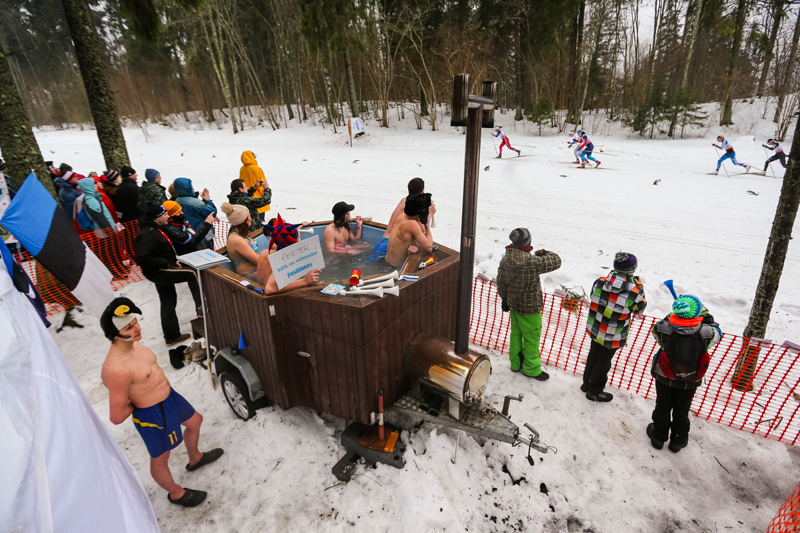
    Best seat in the house to watch Saturday's classic race (Photo: Fischer/NordicFocus)
    Best seat in the house to watch Saturday’s classic race (Photo: Fischer/NordicFocus)

    The second semifinal was a lot faster than the first, resulting in Shapovalova and Pajala earning lucky loser positions.

    To add more drama to the softening track, as the men were winding up their semifinal heats, the snow really started to fall. This caused many to change skis.

    “Before the final I had to make the decision if I go on zero skis or klister. I chose the second option,” Østberg told FIS afterward.

    Nilsson also told FIS after that she changed skis as well before the final, which gave her both good grip and good glide.

    The final was set, with three Norwegians (Falla, Brun-Lie and Østberg), two Swedes (Pajala and Nilsson), and Russia’s Shapovalova.

    The start was pretty even with Nilsson taking up the pace followed closely by Falla. Heading to the hill, Østberg passed her teammate Falla and closed the gap to Nilsson. As the climb continued, Østberg made her move and passed Falla at the summit. Falla then passed Nilsson making it a Norwegian in first and second. As the trio descended down to the finish, Nilsson was able to pass Falla, but lost a lot of energy in the process, letting Østberg pull away to win in 3:20.18. Nilsson finished in second (+0.60) and Brun-Lie took third (+2.29).

    Afterwards Østberg told FIS that the skis were the key to her win, which was her first-ever in a World Cup classic sprint, her second victory of the season and her fourth podium of the season.

    “The whole day I had perfect skis,” she said. “I felt good that nobody could keep up with me in the last 100 meters.”

    This now raises an interesting question: can Østberg beat her teammate Marit Bjørgen?

    “I’ve done it before and I can do it again. One must at least have faith that one can beat her,”said Østberg told NRK.

    The World Championship were definitely on all of the Norwegians’ minds after the race. Brun-Lie told FIS, “I have never been on the podium in the classic sprint. Today’s result is very important for the qualification for the World Championships.”

    As a result of her win, Østberg passes teammate Bjørgen in the Sprint World Cup standings to take first place. She has 385 points, and Bjørgen is 35 points behind with four sprints left. Bjørgen still leads the Overall World Cup by more than 400 points over teammate Therese Johaug. Neither Bjørgen, Johaug nor Heidi Weng raced on Saturday.

    Sunday’s race is a freestyle team sprint competition.

    Results

    Ingvild Flugstad Oestberg (NOR) takes the win.  (photo: Fischer/Nordic Focus)
    Ingvild Flugstad Oestberg (NOR) takes the win. (photo: Fischer/Nordic Focus)
  • Americans Go 15th, 16th, 17th with Bittersweet Feelings After Otepää Sprint

    Americans Go 15th, 16th, 17th with Bittersweet Feelings After Otepää Sprint

    Simi Hamilton (l) and Switzerland's Gianluca Cologna going head-to-head in the quarterfinal of the men's 1.5 k classic sprint on Saturday in Otepää, Estonia. Hamilton placed third in the heat, ahead of teammate Andy Newell in fourth (not shown) and Cologna in fifth. (Photo: Fischer/NordicFocus)
    American Simi Hamilton (l) and Switzerland’s Gianluca Cologna going head-to-head in the quarterfinal of the men’s 1.5 k classic sprint on Saturday in Otepää, Estonia. Hamilton placed third in the heat, ahead of teammate Andy Newell in fourth (not shown) and Cologna in fifth. (Photo: Fischer/NordicFocus)

    Three Americans made the heats on Saturday, and all of them felt basically “meh” about their races.

    “If at first you don’t succeed…try, try again,” Sadie Bjornsen wrote in an online message after placing 15th in the women’s 1.2-kilometer classic sprint in Otepää, Estonia.

    In some ways, she found a good deal of success: Bjornsen qualified in 18th, 6,76 seconds behind Norway’s Ingvild Flugstad Østberg, who won the qualifier and went on to win the women’s final. Then the 25-year-old Bjornsen, who was coming off some of her best results of the season in her first Tour de Ski 10 days earlier, nearly secured a spot in the semifinal.

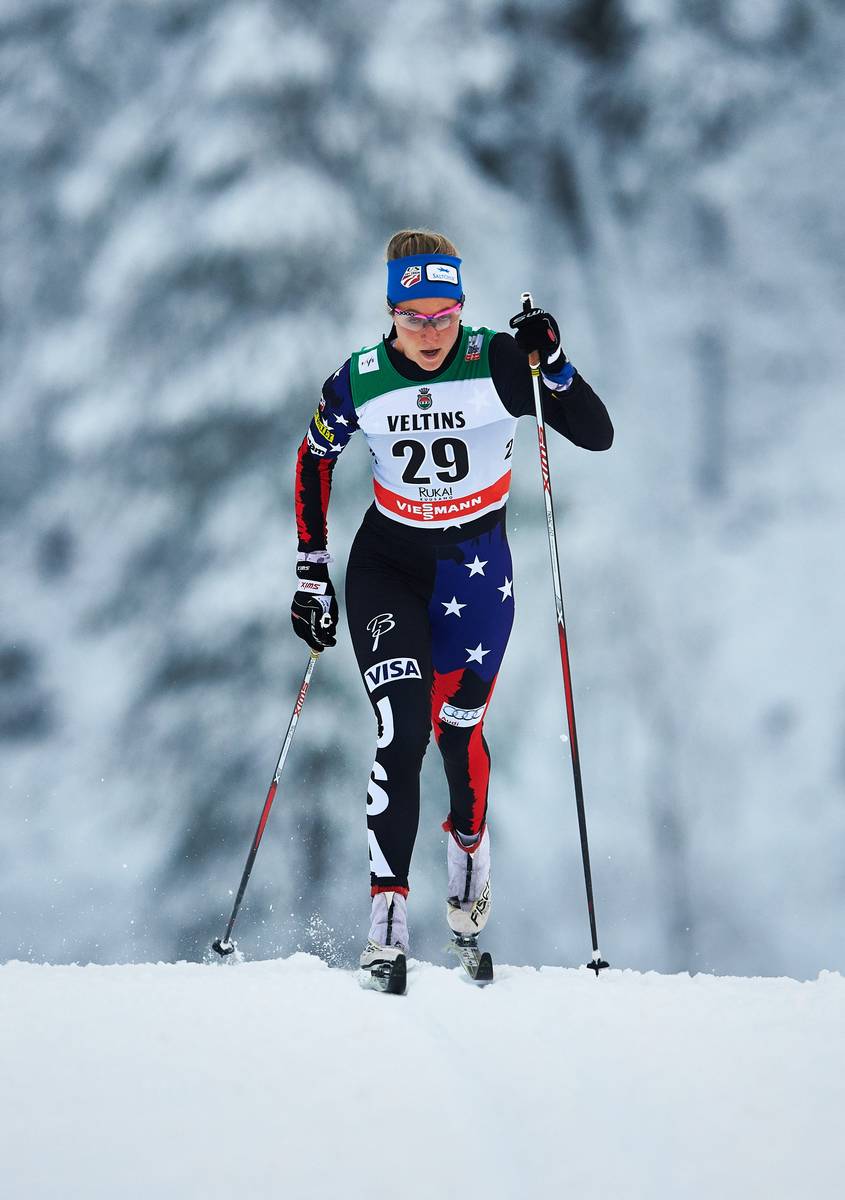
    Sadie Bjornsen (U.S. Ski Team) racing to 29th in the World Cup classic sprint on Saturday in Kuusamo, Finland. On Sunday, she placed 17th in the 10 k classic to lead the U.S. (Photo: Fischer/Nordic Focus)
    Sadie Bjornsen (U.S. Ski Team) racing to 29th in the World Cup classic sprint early this season in Kuusamo, Finland. (Photo: Fischer/Nordic Focus)

    But she was three-hundredths of a second short. In a photo finish for second in her quarterfinal, Bjornsen finished third to Sweden’s Magdalena Pajala, and was 0.34 seconds behind the heat’s winner of the heat, Kari Vikhagen Gjeitnes of Norway.

    According to U.S. Ski Team Head Coach Chris Grover, Bjornsen executed her tactics almost perfectly.

    “She skied great and of course she is not that happy with it because she has had a lot of qualifiers, but she has struggled to get through the quarterfinals this year,” he said on the phone Saturday. “She really wanted to get through there and man, did she come incredibly close.”

    In six sprints this season (two of which have been classic sprints), Bjornsen has made the quarterfinals in four of them, but yet to advance to the semifinals. Her best result this season has been 13th in the Tour de Ski freestyle sprint in Val Müstair, Switzerland.

    Out of the start, she challenged for the lead, but tucked behind Russia’s Anastasia Dotsenko after the two bumped slightly while vying for the same track. Pajala led the group out, with Gjeitnes coming up alongside the Swede at the base of the lone climb on the women’s course.

    Bjornsen skied hard to get directly behind Pajala, and with five women bunched together at the apex, she was fifth heading into the descent. Sweden’s Evelina Settlin went down moments later, slipping out of contention, and Bjornsen moved into fourth next to Gjeitnes.

    She rode her skis even with the Norwegian, tucking while Dotsenko had to stand up and double pole over the last rise, and Gjeitnes and Bjornsen caught Pajala rounding the corner into the finishing straight.

    While it looked to be a double-pole showdown for first between Bjornsen and Pajala, with Bjornsen slightly ahead early, Gjeitnes caught them both before the finish, and Pajala outlunged Bjornsen at the line.

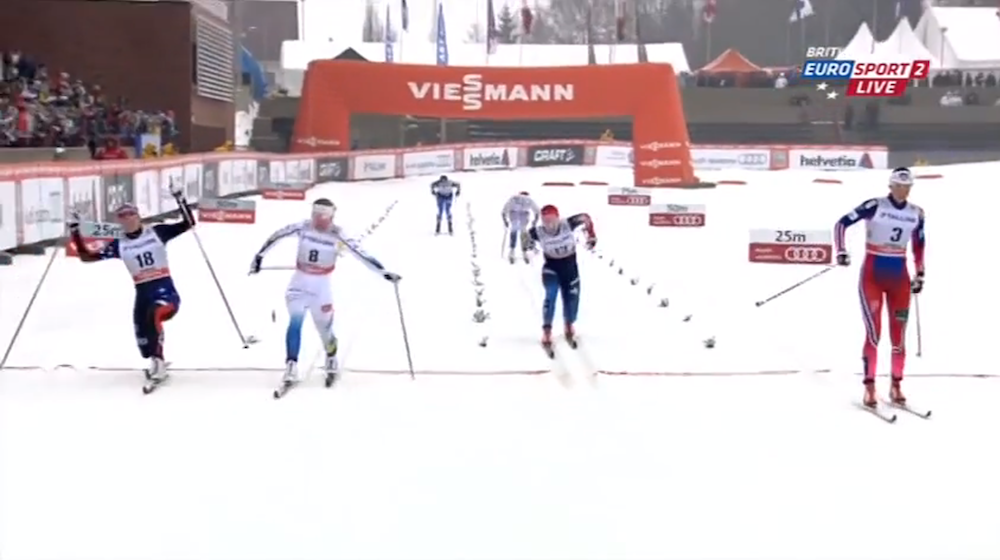
    Sweden's Magdalena Pajala (second from l) edges American Sadie Bjornsen (l) for second behind Norway's Kari Gjeitnes (r) in the quarterfinal of the women's 1.2 k classic sprint on Saturday in Otepää, Estonia. Russia's Anastasia Dotsenko (second from r) pushes for fourth.
    Sweden’s Magdalena Pajala (second from l) edges American Sadie Bjornsen (l) for second after Norway’s Kari Gjeitnes (r) in the quarterfinal of the women’s 1.2 k classic sprint in Otepää, Estonia. Russia’s Anastasia Dotsenko (second from r) pushes for fourth.

    “Sadie knew she wanted to be in the top two and she put herself in position with a few meters to go where she was actually second, but she just couldn’t hold off Pajala there at the end,” Grover said.

    If she could do it again, Bjornsen explained she would want more of a push at the end.

    “I was double poling against one of the finalists [Pajala, who ended up sixth]… so I think I was in there,” Bjornsen wrote. “It was one of those days where the weather was making each heat slower and slower, so maybe on a different day, it could have been a lucky loser position.”

    Her heat was the fifth-and-final quarterfinal before the men started. Temperatures hovered above freezing, but it started to rain lightly before the heats. Later on in the rounds, that turned to snow.

    Soon after Bjornsen’s heat, two other U.S. Ski Team members — Andy Newell and Simi Hamilton — started next to each other with four others in the first men’s quarterfinal on a 1.5 k course with a second, steeper climb.

    Newell pushed to get in front and lead up the first climb with Norway’s Pål Golberg, while Hamilton skied behind Newell at the back of the pack. Another Norwegian, Ola Vigen Hattestad worked to get in front of Newell at the base of the second hill, which required the not-so-pretty herringbone technique to get up in the softening conditions.

    Golberg stayed ahead over the top and Hattestad trailed him by a few meters in second, while Newell skied in third ahead of Hamilton and Switzerland’s Gianluca Cologna. None of the men were quite close enough to get a draft, leaving Newell and Hamilton to race the clock in third and fourth into the finish.

    “They [Hattestad and Golberg] had good skis today,” Hamilton said on the phone afterward. The two went on to place second and fourth in the final. “Not that we didn’t, but [the Norwegians] have the resources and the people to make great skis every day and that really showed. I was really psyched on my skis for sure, but having great skis, it’s hard to bridge that gap, especially with such a long hard downhill on the second part of the course.”

    In the finishing lanes, both Hamilton and Newell realized it was faster outside the track and skied alongside each other. Hamilton came from behind to finish 0.42 seconds ahead of Newell and 3.26 seconds behind Golberg, who won the quarterfinal, and Hattestad, who was 0.3 seconds back in second.

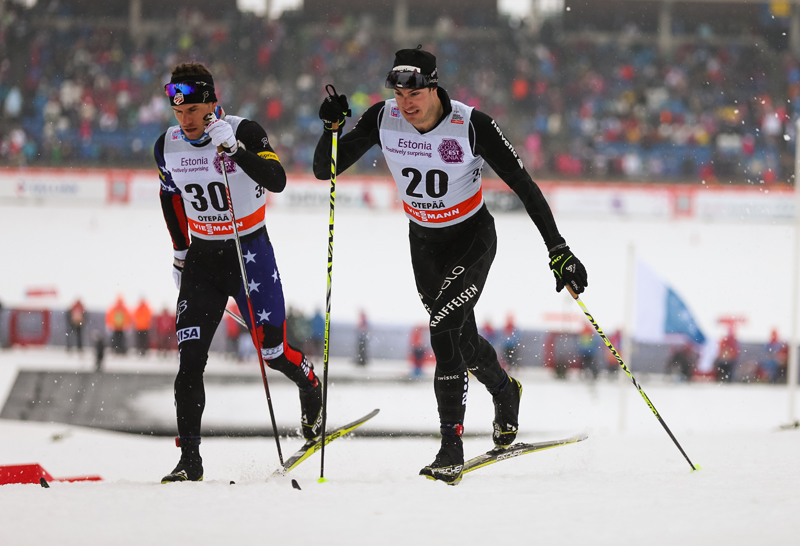
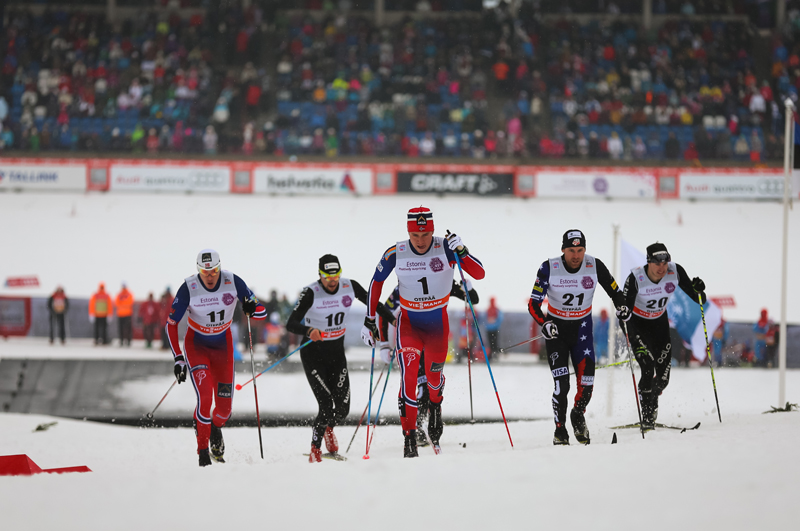
    Americans Andy Newell (21) and Simi Hamilton (30) chase Norway's Pal Golberg up the first of two climbs in the men's 1.5 k classic-sprint quarterfinal on Saturday in Otepää, Estonia. (Photo: Fischer/NordicFocus)
    Americans Andy Newell (21) and Simi Hamilton (behind Golberg in bib 1) chase Norway’s Pal Golberg up the first of two climbs in the men’s 1.5 k classic-sprint quarterfinal on Saturday in Otepää, Estonia. (Photo: Fischer/NordicFocus)

    Their quarterfinal was the third slowest, and neither Hamilton nor Newell advanced to the semifinals.

    While Hamilton, who narrowly qualified in 30th and went on to place 16th overall, hadn’t felt great in the qualifying round, he noted some improvement in the quarterfinals — and some of his weaknesses as well.

    “Up the gradual climb from 400 meters to a ‘k’ or so, I felt like I kind of lost some energy there and that’s something I need to work on for the future,” he said. “I wasn’t able to relax as much there.”

    However, he felt he regrouped on the second half of the course.

    “I was happy how I skied that,” he said, after putting in a surge up the last climb. “I knew that [Cologna and Ueli Schnider] were fading behind me and I wanted to put a gap on them so they couldn’t get a draft off me.”

    Hamilton was pleased with his double-pole finish and his ability to maintain good technique and a high tempo in that stretch, which he’s been working on. He also knew the conditions on Saturday didn’t suit him: “It was kind of soft and sloppy … I think it takes really good balance, something that I’m always working on, but I definitely like it when it’s super-icy and fast and firm.

    “I know there’s a lot more,” he added. “I still have some work to do before world champs, but that’s what this time of year is for — keep the train going and trust the coaches and know that in just a few weeks we’ll be at the top of our game.”

    “His fitness is there,” Grover commented. “He skied really relaxed during his quarterfinal on the back … but then just got stronger as the round went on and actually passed Andy in the final stretch. He had a great finish and double pole [which] he has been working on it a lot and it is really coming.”

    Newell, who qualified 21st and placed 17th overall, said on the phone Saturday that it was fun, but “weird” to be classic sprinting again after not having raced that format since the first World Cup of the season in Kuusamo, Finland.

    “This was the first time we had raced this [course], and I think if I’m feeling 100 percent, this is a really good course for me … one I hope to make the finals in,” he said. “But I’m still kind of working into things.”

    This season, Newell has been struggling to manage an allergic reaction that comes out in the form of hives and elevated heart rates, and seems to intensify with hard workouts. While his heart rate had normalized this week, Newell took it easy leading up to Saturday’s sprint, Grover explained.

    “We’ve been just trying to figure out what’s causing that by trying different diets and different medicines,” Newell explained. “It’s more like there’s something suppressing my system … in a way that’s making me hive up when I’m under stress.”

    This week, he started eating gluten-free, following the lead of teammate Liz Stephen, which he said he’d try for a couple weeks despite it being hard to do in Europe.

    “Until I figure out my allergic reaction, my racing’s not going to be at my potential,” Newell said. “I think if I felt 100 percent, it would’ve been a better day. I was in there and I knew Hattestad and Golberg would be tough in the finish. … I would’ve been happy trying to lead over that hill and gap them a little bit.”

    While he knew Golberg and Hattestad would be tough to beat and even more difficult to catch in the finishing stretch, he didn’t realize Hamilton was right behind him.

    “I think for both Simi and I, the race was finished at the top hill,” he said.

    In the final straightaway, Newell recalled feeling “draggy; a little fatigued for sure. You just have to try to get across the finish line quickly in hopes that you’re going to get a lucky loser spot,” he said.

    But after a long break from racing, he was ready to get back at it again.

    “I think my body and my energy are feeling good for sure. I don’t think the result showed that,” Newell said.

    On Sunday, Newell and Hamilton will team up in the freestyle team sprint, while Erik Bjornsen and SuperTour leader Matt Gelso (Sun Valley Ski Education Foundation) start on the second squad.

    On the women’s side, Sadie Bjornsen and Sophie Caldwell will team up, and Ida Sargent and SuperTour leader Rosie Brennan (Alaska Pacific University) will form the second team. Liz Stephen and Jessie Diggins are taking a break after the Tour and training in Seiser Alm, Italy.

    Caldwell started first on Saturday and placed 31st in the qualifier, 0.9 seconds out of the top 30 needed to make the quarterfinals in her first classic sprint of the season.

    “Even though the result wasn’t anything spectacular, I am not disappointed,” Caldwell wrote in an email. “I knew that classic sprinting was going to be more difficult for me because I’m naturally a better skate sprinter and it requires more upper body strength, which I’m still working on. The course was pretty broken down and the women’s course in particular had a lot of double poling. I don’t mind the soft conditions, but a gradual classic course is probably not my strength.”

    She felt like she had good skis — a sentiment echoed by her teammates — and Grover agreed.

    “I think our skis were actually pretty good for the day,” he said, explaining they used straight klister. “Norway had smoking-fast skis during qualification. I think probably they were probably just better than everybody else’s. I mean, they had ten guys make the rounds.”

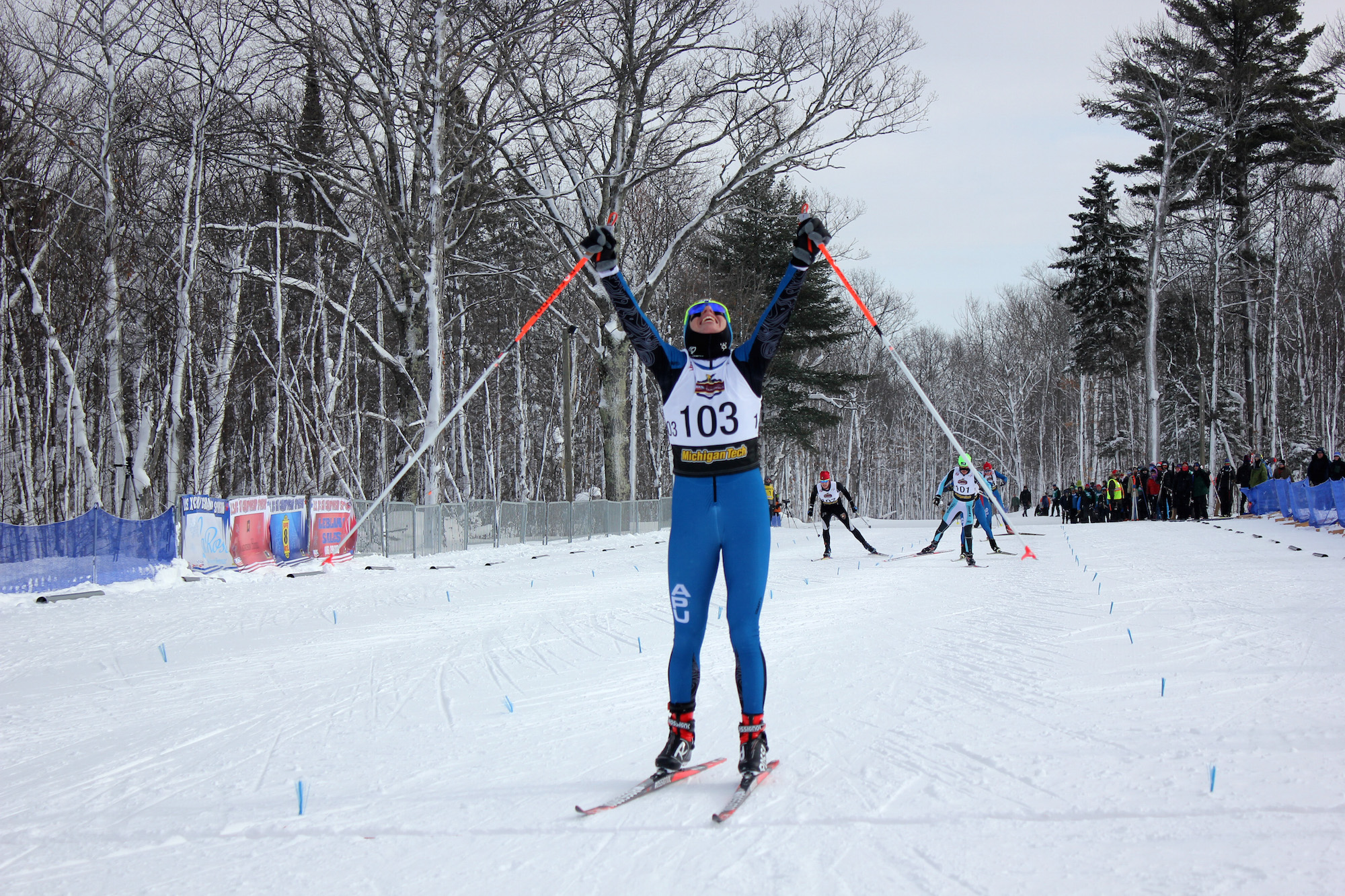
    Alaska Pacific University's Rosie Brennan completes the trifecta in the last race of U.S. Cross Country Championships with a skate-sprint victory in Houghton, Mich.
    Alaska Pacific University’s Rosie Brennan notching her third-straight win in the last race of U.S. Cross Country Championships with a skate-sprint victory in Houghton, Mich.

    Brennan placed 38th in her first World Cup of the season, 2.8 seconds from 30th. It was her first time back on the circuit since December 2013, and her best result since finishing 38th in the World Cup skiathlon two seasons ago in Canmore, Alberta.

    Straight off U.S. nationals in Houghton, Mich., seven time zones away, Brennan and Gelso arrived in Estonia on Wednesday night.

    “There is always some amount of jetlag and shaking the travel out, but I feel like I have been faring well all things considered,” Brennan wrote in an email. “It felt good to go hard again, but I feel I don’t have the turn over I would like after a long week of really slow snow in Houghton. I have to say, the course even felt really short after Houghton, which is not the usual reaction when coming from the U.S.”

    At nationals, Brennan won three out of four races.

    “I was hoping to just feel like I was skiing well today and I think I accomplished that,” she explained. “I have found from my previous experiences over here that putting some sort of results goal in front of you is often counterproductive and that you can’t beat yourself up over results here. It takes a lot of patience. Weaknesses are often inflated when you go against the best so I already have a good idea of what I need to work on to get the result I believe I am capable of. I’m happy to be here and trying to take each day on its own to make the best of my time here.”

    Sargent finished 43rd after falling in the qualifier on the downhill corner into the stadium.

    “It is kind of a high-speed corner and it was a little bit tricky … you kind of went from an icy track to loose snow,” Grover explained. “I think her klister just grabbed a little bit as she was going around the corner and the skis were on edge. … It was the worst place on the course to lose your momentum because it is absolutely the place where you are going the fastest. … She is obviously bummed out because it is basically the same thing that she did in Val Müstair.”

    “Another sprint another fall…Ugh!” Sargent tweeted afterward. “Practicing patience and getting psyched for the next one!”

    Erik Bjornsen finished 57th in the men’s qualifier, 15.19 seconds behind Golberg.

    In terms of the team on the whole and what they’re working on in the weeks leading up to World Championships next month, Grover said it breaks down on an individual basis.

    “Everybody’s got their thing that is holding them back a little,” he said. “For some it is perhaps fatigue, for some it is that they haven’t fine tuned their fitness, for some it is a double-pole finish, for some it is how they are herringboning compared to some of these others. … I think going into our two-week camp in Davos following Rybinsk [next weekend] everybody is going to have their list that needs to get accomplished if everybody is going to take a step forward.”

    — Matt Voisin contributed reporting

    Results: women | men

  • Marshall Top Canadian in 44th, Valjas 45th in Otepää Classic Sprint

    Marshall Top Canadian in 44th, Valjas 45th in Otepää Classic Sprint

    Lenny Valjas placed 45th in the men's 1.5 k classic sprint qualifier on Saturday in Otepää, Estonia. (Photo: Fischer/NordicFocus)
    Lenny Valjas placed 45th in the men’s 1.5 k classic sprint qualifier on Saturday in Otepää, Estonia. (Photo: Fischer/NordicFocus)

    In her first World Cup of the season and best result since the 2012 World Cup freestyle sprint at home in Canmore, Alberta, Alysson Marshall launched back into international-racing action on Saturday and placed 44th in the women’s 1.2-kilometer classic sprint in Otepää, Estonia.

    The NorAm, or Continental Cup, leader for Period 1, she was one of two Canadian women selected to this weekend’s Otepää World Cup. The other, Perianne Jones, opted to stay home and race at Western Canadian Championships in Lake Louise, Alberta.

    “It’s great to be back on the World Cup!” Marshall, 26, wrote in an email on Saturday after finishing 44th in the qualifier, 15.67 seconds back from the qualifier winner, Ingvild Flugstad Østberg of Norway, and 6.42 seconds out of the top 30 needed to advance to the heats.

    Marshall, a national development-team member, most recently placed fifth in a classic sprint at last weekend’s NorAm in Duntroon, Ontario. Last Saturday after the sprint, Alberta World Cup Academy teammates Marshall, Jess Cockney and the men’s NorAm leader Patrick Stewart-Jones flew to Estonia for a Sunday arrival.

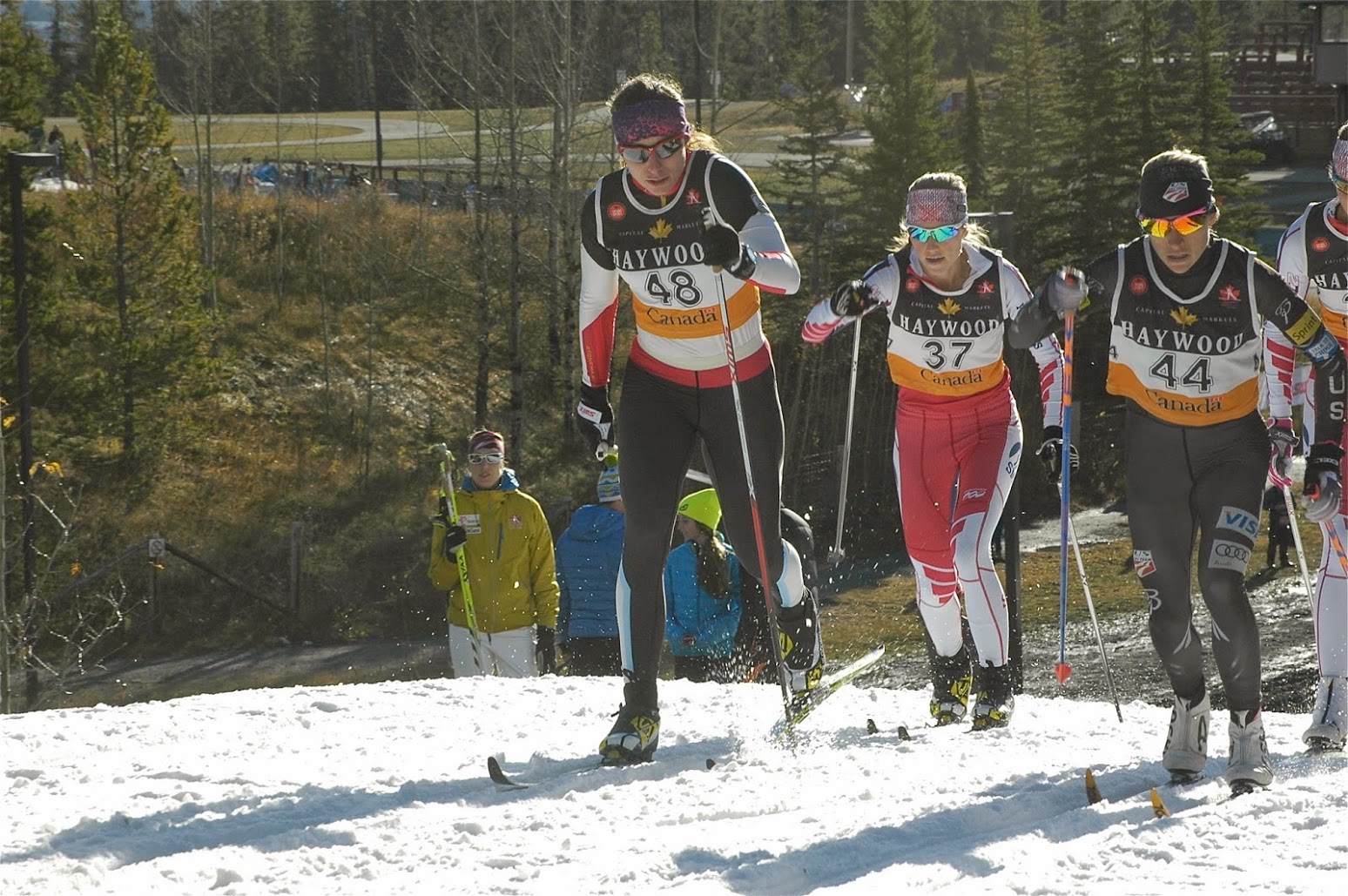
    Alysson Marshall at the Frozen Thunder classic sprint on Oct. 24 in Canmore, Alberta. (Photo: Angus Cockney)
    Alysson Marshall (48) racing alongside Americans Liz Stephen (44) and ahead of Erika Flowers (37) at the Frozen Thunder classic sprint on Oct. 24 in Canmore, Alberta. (Photo: Angus Cockney)

    “I’m just starting to feel like I have adjusted to the time change,” Marshall explained. “I am definitely disappointed with today, I started well but body wasn’t 100% and I couldn’t maintain the pace over the top of the course. Hopefully next weekend will go better!”

    Without another Canadian woman on the circuit, she won’t be racing Sunday’s freestyle team sprint. Marshall plans to next race the freestyle sprint on Saturday, Jan. 24 in Rybinsk, Russia.

    Canadian World Cup Team member Lenny Valjas finished 45th in the men’s 1.5 k classic sprint on Saturday, 12.1 seconds back from the top qualifying time set by Norway’s Pål Golberg, and 3.83 seconds out of the top 30.

    Jess Cockney placed 61st in the men's 1.5 k classic sprint qualifier on Saturday in Otepää, Estonia. (Photo: Fischer/NordicFocus)
    Jess Cockney placed 61st in the men’s 1.5 k classic sprint qualifier on Saturday in Otepää, Estonia. (Photo: Fischer/NordicFocus)

    Cockney, of the national development B-team, placed 61st in the qualifier after winning the NorAm classic sprint in Duntroon last week. Back in 2011 in Otepää, Cockney placed 61st in a classic sprint as well.

    Stewart-Jones, who was second in the Duntroon sprint, finished 62nd on Saturday in his first international World Cup, and first World Cup since 2012 in Canmore.

    According to Sunday’s start list, Cockney and Valjas will team up in the 6 x 1.5 k freestyle team sprint.

    Alex Harvey, Devon Kershaw, Ivan Babikov, and Graeme Killick are taking the weekend off to recover and train in Seefeld, Austria, before traveling to Rybinsk on Wednesday.

    Results: women | men

  • Tomas Northug Gets His, Wins First World Cup in Otepää Classic Sprint

    Tomas Northug Gets His, Wins First World Cup in Otepää Classic Sprint

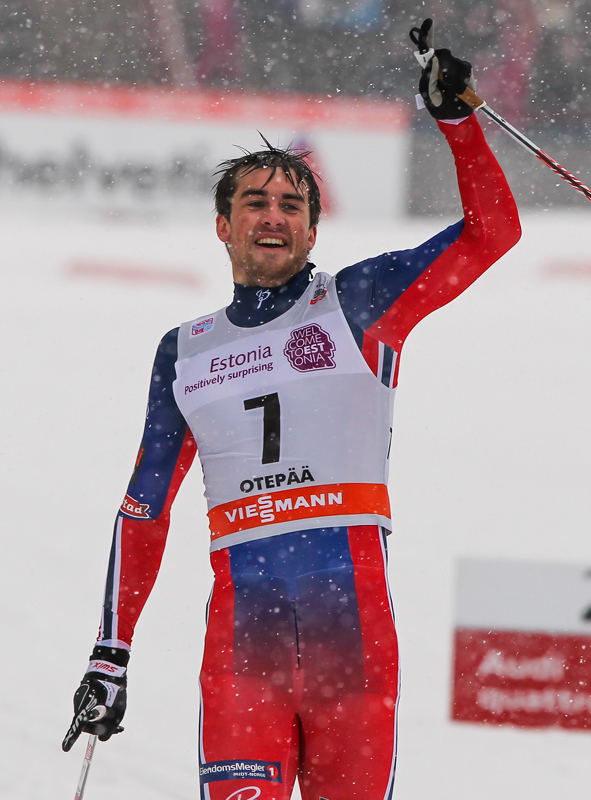
    Norway's Tomas Northug, 24, celebrates his first World Cup win on Saturday in the men's 1.5 k classic-sprint final in Otepää, Estonia. (Photo: Fischer/NordicFocus)
    Norway’s Tomas Northug, 24, celebrates his first World Cup win on Saturday in the men’s 1.5 k classic-sprint final in Otepää, Estonia. (Photo: Fischer/NordicFocus)

    If he hadn’t been a Northug, one might have wondered what that 24-year-old Norwegian was doing.

    Tomas Northug had already ditched his hat during the men’s 1.5-kilometer classic sprint on a snowy, just-above-freezing afternoon in Otepää, Estonia. And not long after the start of the final, he made it clear that he was going to drop everyone else if he could, too.

    Commentators remarked that his surge early on the first of two climbs on the 1,500-meter course had been very Northug-like, referring to the gutsy performances often churned out by his older brother Petter.

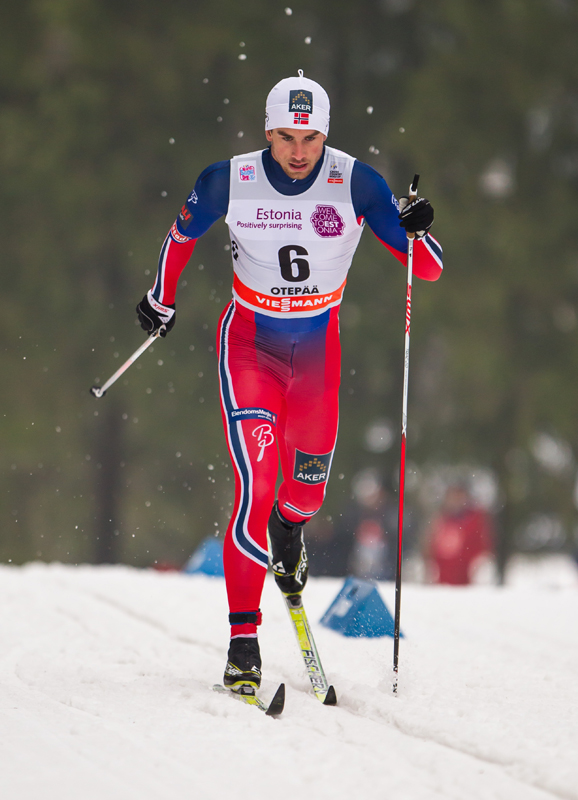
    Norway's Tomas Northug in Saturday's 1.5 k classic-sprint qualifier, in which he advanced in seventh and went on to win the final for his first World Cup win in Otepää, Estonia. (Photo: Fischer/NordicFocus)
    Norway’s Tomas Northug in Saturday’s 1.5 k classic-sprint qualifier, in which he advanced in seventh and went on to win the final for his first World Cup win in Otepää, Estonia. (Photo: Fischer/NordicFocus)

    But Petter wasn’t racing on Saturday — Tomas was — and he made his presence known after advancing from the semifinal in fourth as a lucky loser (who was luckily not taken out by Russian Sergey Ustiugov’s late, self-inflicted crash).

    Out of the start in the final, Northug positioned himself in second, sitting on the heels of Norwegian teammate Finn Hågen Krogh, the Sprint World Cup leader who opted to double pole on skate skis for the final, while staying ahead of the final’s other Norwegian double-poler, Pål Golberg, in third.

    At the base of the first climb, it became apparent that double poling was not the way to go in the slow-and-chewed-up snow, and Northug stepped right to get around Krogh and move to first. The double-polers hopped in behind him by the midway point of the climb, and from there, they started to lose Northug. He strode away while the three others on classic skis (Finland’s Toni Ketelae, and Norway’s Ola Vigen Hattestad and Sondre Turvoll Fossli) lost contact in a one-track train behind Krogh and Golberg.

    By the top, Northug heard he had a 50-meter gap from a Norwegian coach (arguably closer to 40 meters) and he took his word, refraining from looking back until several strides later as he began the tuck down the backside of the hill. Meanwhile, another up-and-comer seeing a World Cup breakthrough, Ketelae, 26, led the chase with Hattestad, both several seconds behind on the first descent.

    “I feel there was room and I came up the uphill and I think about the race Bjørgen did many years ago,” Northug said in a post-race interview with FIS in broken English. “The coach [on] the uphill say I had fifty [meters] and say to go so I do it.”

    In the second semifinal, Ketelae edged four Norwegians (Fossli, Eirik Brandsdal, Timo Andre Bakken, and Vegard Bjerkreim Nislen, respectively) and Russia’s Alexander Panzhinskiy for the win. With that confidence, he chased down Northug to the best of his ability in the final, but the young Norwegian was too far gone.

    Northug ran with a narrow herringbone up the steepest of the two hills, getting more encouragement from Norwegian coaches, and Ketelae and Hattestad skied together some six seconds behind on the following downhill.

    With 200 meters remaining, Northug double poled up and over the last rise, glanced back once more and realized the race was his. He nearly took himself out on the lefthand corner before the finishing straight, teetering for a moment on his inside ski in all his excitement, but picked the center lane and double poled like mad to the line. There, sealing the win in 3:50:59, he looked back, raised his arms to his chest and pumped them fiercely, gesturing that he, in fact, was the man.

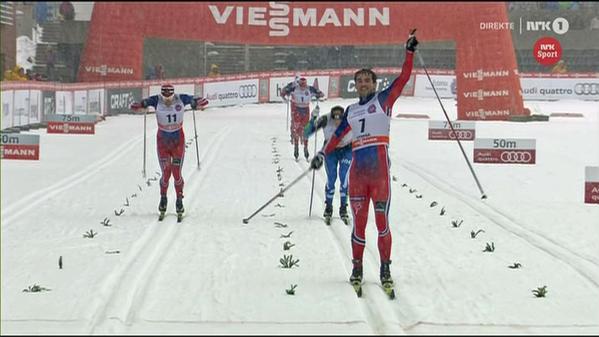
    Norway's Tomas Northug (7) celebrates his first World Cup victory and podium on Saturday in the men's classic sprint in Otepää, Estonia, while teammate Ola Vigen Hattestad (l) challenges Finland's Toni Ketelae (in blue behind Northug) for second.
    Norway’s Tomas Northug (7) celebrates his first World Cup victory and podium on Saturday in the men’s classic sprint in Otepää, Estonia, while teammate Ola Vigen Hattestad (l) challenges Finland’s Toni Ketelae (in blue behind Northug) for second.

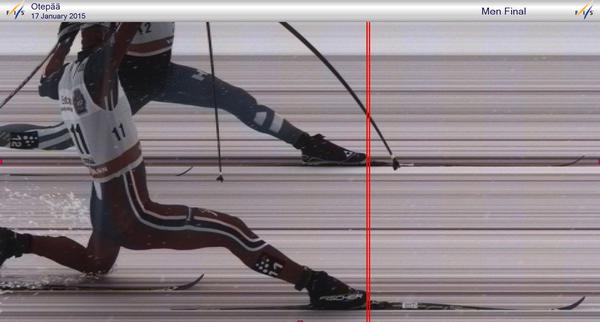
    Trailing Ketelae into the stadium, Hattestad jumped to a left lane to challenge the Finn for second. Hattestad outlunged Ketelae in such a close photo finish, time couldn’t even determine it, but a finish-line camera could. The two finished 1.57 seconds after Northug, with Ketelae placing third for his first World Cup top 10 and podium.

    After holding his own in fourth for much of the final, Golberg placed fourth, 6.28 behind Northug, and Krogh finished about a second ahead of Fossli, who struggled to keep pace early on and finished 9.23 seconds back.

    “It was not really plan to [go ahead] like that, but I felt very strong,” Northug told NRK, according to a translation.  “There are some feelings, it is clear there. I have put an enormous amount of work, but not quite achieved what I want. And then came here today.”

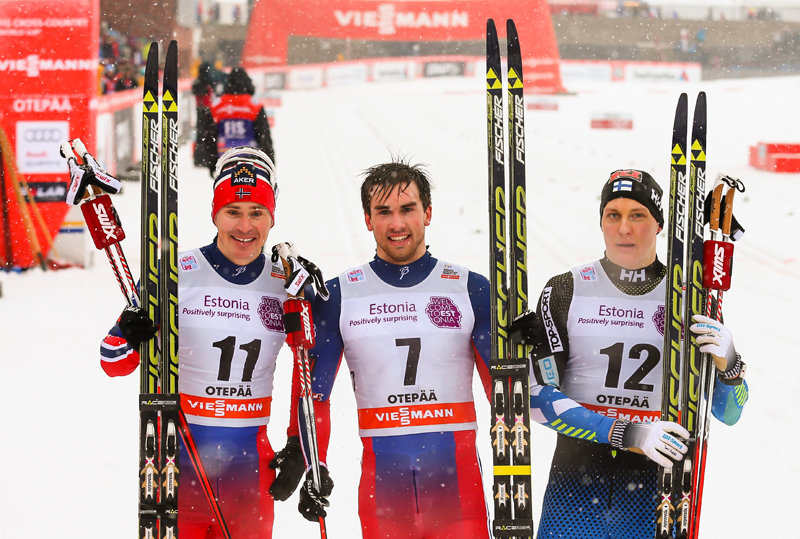
    The men's classic-sprint podium in Otepää, Estonia: with Norwegian winner Tomas Northug (c), Ola Vigen Hattestad (l) of Norway in second, and Finland's Toni Ketelae (r) in third. (Photo: Fischer/NordicFocus)
    The men’s classic-sprint podium in Otepää, Estonia: with Norwegian winner Tomas Northug (c), Ola Vigen Hattestad (l) of Norway in second, and Finland’s Toni Ketelae (r) in third. (Photo: Fischer/NordicFocus)

    Northug’s previous best was fifth in a classic-sprint final at 2013 World Cup Finals in Stockholm, Sweden. In the only other classic sprint before Saturday’s this season, he missed the final but placed eighth in Kuusamo, Finland, and was sixth in a freestyle sprint last month in Davos, Switzerland.

    He qualified for the heats on Saturday in seventh, 4.4 seconds behind Golberg, who set the fastest qualifying time in 3:17.61. Times were notably slower as the day wore on, with the track breaking down amid wet-and-heavy snowfall and with each passing round of men’s and women’s heats. Fossli qualified second, 1.68 seconds back, and Brandsdal, in the hunt for the Sprint World Cup title, ranked third (+2.74).

    The fourth-fastest qualifier, Sweden’s Emil Jönsson edged Northug in their quarterfinal by 0.06 seconds in 3:26.74, which ended up being the second-fastest men’s heat. The two advanced to the semifinals, where Northug got a boot out ahead of Jönsson, who was behind Ustiugov when the Russian poled between his legs and face planted in the finishing stretch. Ustiugov fell into Northug on his left, but Northug avoided escaped with a minor clip and strode a few steps toward the line with Jönsson charging on his right.

    The photo-finish picture from the men's sprint for second and third in the 1.5 k classic-sprint final in 1.5 k classic sprint in Otepää, Estonia, with Hattestad (bottom) edging Ketelae. (Photo: FIS Cross Country/Twitter)
    The photo-finish picture from the men’s sprint for second and third in the 1.5 k classic-sprint final in 1.5 k classic sprint in Otepää, Estonia, with Hattestad (bottom) edging Ketelae. (Photo: FIS Cross Country/Twitter)

    Northug nipped him by 0.16 seconds for the final lucky loser spot, despite finishing fourth in his heat (Jönsson was fifth and Ustiugov finished 14 seconds later in sixth).

    Ketelae qualified in 12th and went on to win his quarterfinal, half a second ahead of Fossli, and his semifinal as well, by six-hundredths of a second over Fossli and nine-hundredths of a second ahead of Brandsdal. Right then and there, the Finn had already achieved a career-best day.

    “It is amazing to finish third today,” Ketelae told FIS. “It was my first World Cup final and my first World Cup podium result. I felt very good since the prologue.”

    Hattestad noted that the final was a gamble when it came to selecting skis.

    “I was testing three pairs of skis before the final,” he told FIS. “I think it was the most crazy final I have ever skied. I did not catch Tomas, [he went] away and then the gap was too big.”

    Results