From the FasterSkier archive — posts syndicated from athletes’ and coaches’ own blogs between 2004 and 2012, kept online as published. Current coverage is at fasterskier.com.

Tag: Otepää freestyle sprint

  • Nilsson Cements Sprint-Favorite Status; Diggins 5th in Otepää Skate Sprint

    Nilsson Cements Sprint-Favorite Status; Diggins 5th in Otepää Skate Sprint

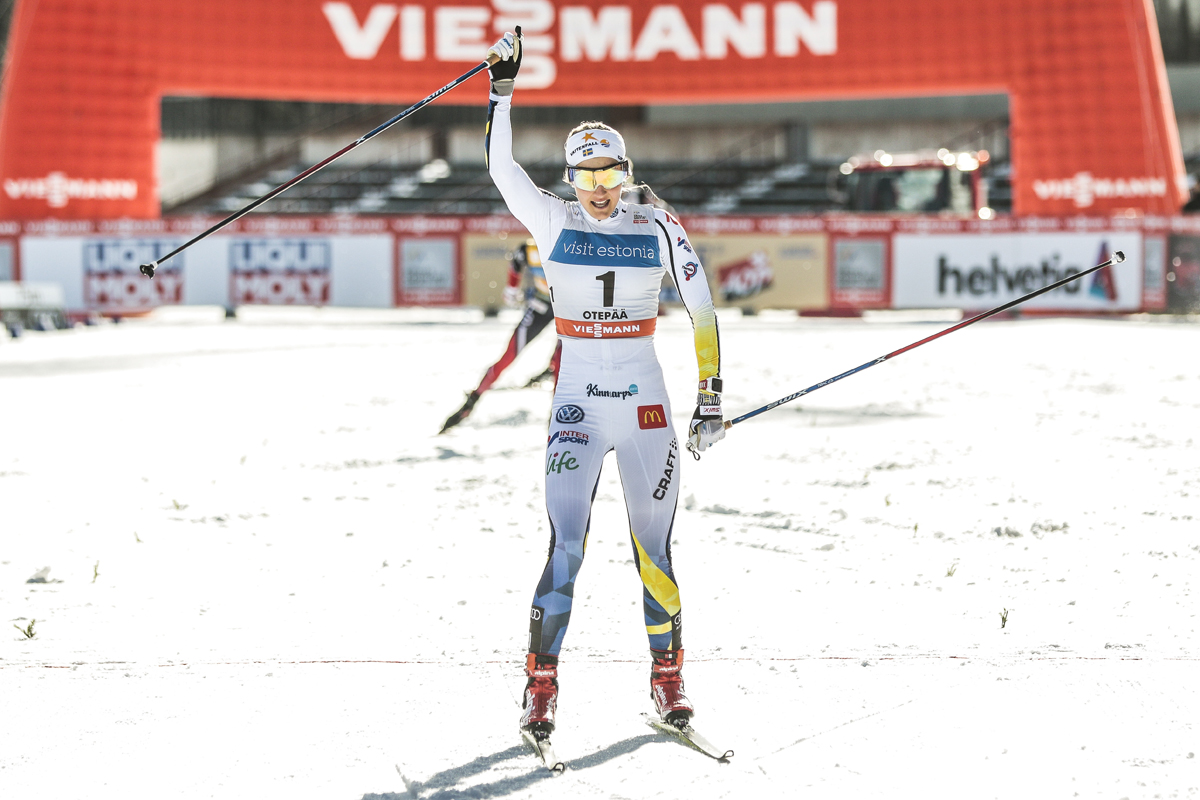
    Sweden’s Stina Nilsson celebrates her 10th World Cup victory in two seasons (and seventh one this year) in the women’s 1.3 k freestyle sprint on Saturday in Otepää, Estonia. (Photo: Fischer/NordicFocus)

    At 23, Sweden’s Stina Nilsson has nailed a business-like approach to World Cup starts. Standing 5-foot-9, she appears to tower over most of her competitors, and before her signature races (sprints) she appears deep in contemplation, definitely in the zone. During those races, she’s usually the one setting the pace, and afterward, she’s almost always celebrating at the finish.

    So far this season, Nilsson has won seven World Cup races — including today’s freestyle sprint in Otepää, Estonia. Four of those were sprints, three of them skate sprints. She also established herself as an all-around threat at last month’s Tour de Ski, winning the 10-kilometer skiathlon, 10 k freestyle pursuit and 10 k classic mass start — nearly half of the stages.

    And on Saturday at the pre-World Championships World Cup in Otepää, Nilsson proved she’ll be tough to stop in her quest for World Championships gold next week in Lahti, Finland. She previously racked up three silver medals at 2015 World Championships at home in Falun, Sweden. Two of those were in team events, one was in the classic sprint.

    This year’s World Championships begin in earnest on Thursday, Feb. 23, with a freestyle sprint. And considering Nilsson has won the last three World Cup skate sprints she’s competed in (and has a career total of six skate-sprint wins, putting her ahead of Norway’s Maiken Caspersen Falla with five), she couldn’t be more of a favorite.

    It didn’t come easy on Saturday, with temperatures in the mid-30’s Fahrenheit on a brand-new sprint course in Otepää.

    “Every year we go to Estonia we joke about what the course will look like,” U.S. Ski Team Women’s Coach Matt Whitcomb said on the phone Saturday. “It’s actually not making fun of them, it’s admiring how they are trying to adapt their terrain to the direction to sprinting has gone.”

    The men’s 1.6 k and women’s 1.3 k courses are harder, he explained, “and what they are trying to do is have something that will stand up to a classic sprint, even though today was skating with world champs coming up.”

    Pair that with increasingly mushy snow, and you have a day where the finals came down to a slog-fest.

    “There was no glide in the final in that [last] hill,” American Jessie Diggins, the lone North American to reach the final on Saturday, explained on the phone after. “It was like Alpe Cermis for me.” (Alpe Cermis is the final climb of the Tour de Ski.)
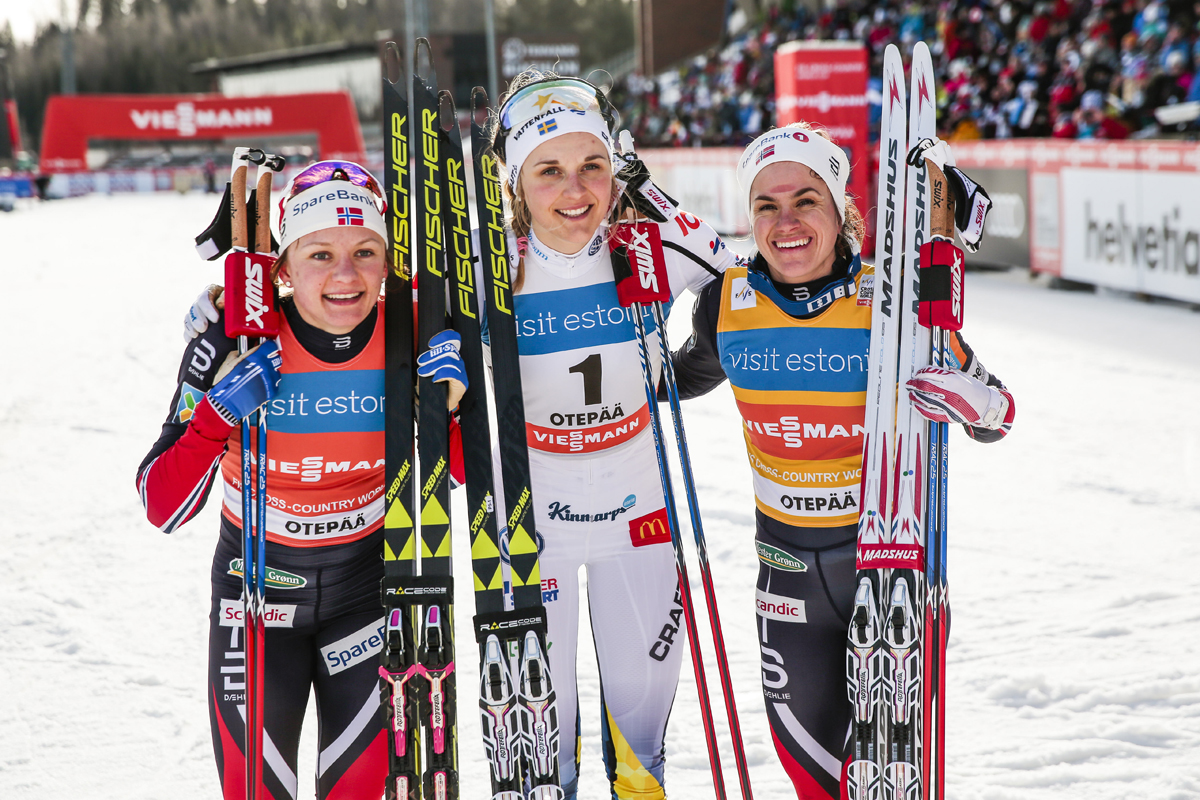
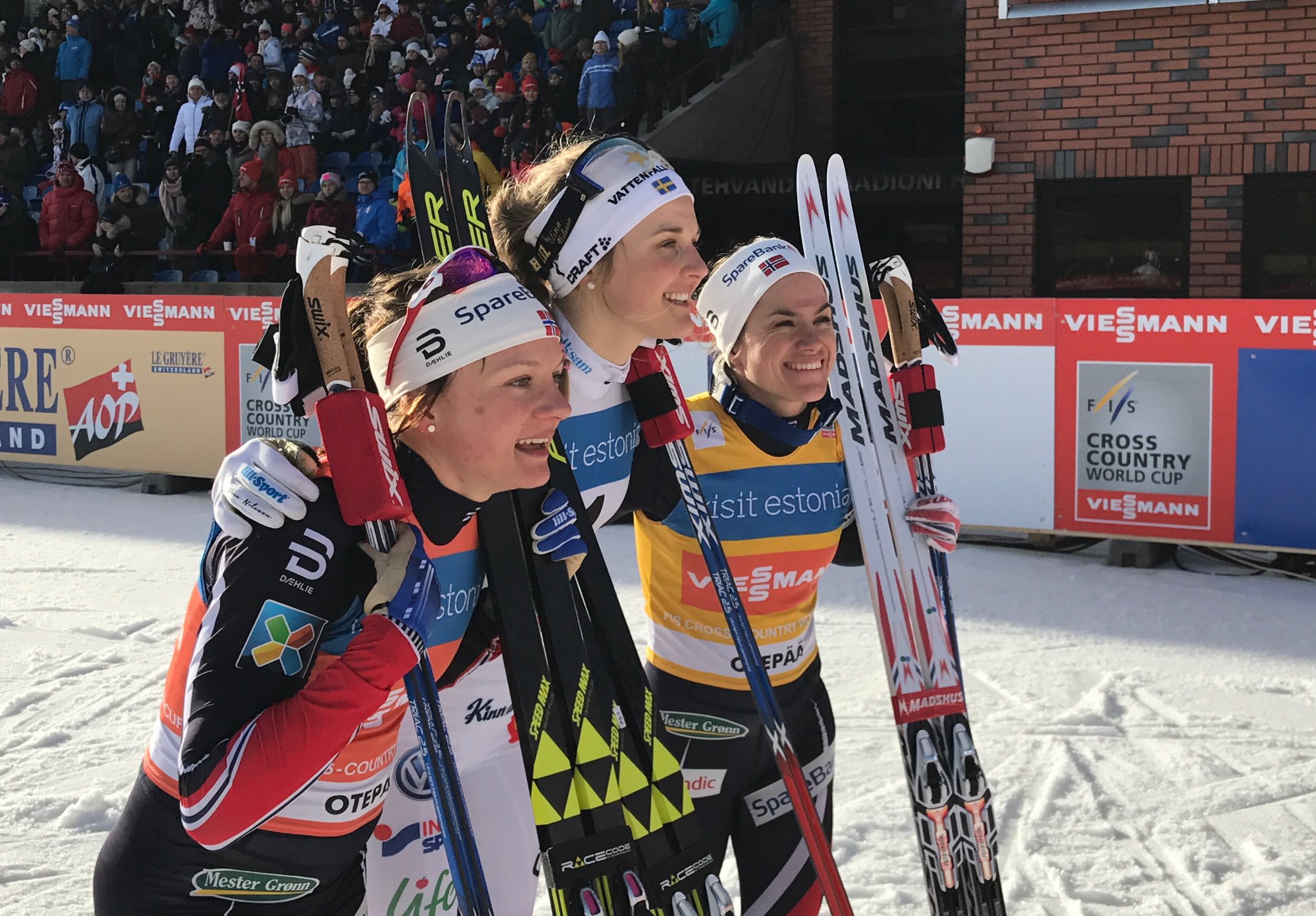
    The Otepää World Cup women’s freestyle sprint podium on Saturday in Estonia, with Swedish winner Stina Nilsson (c), Norway’s Maiken Caspersen Falla (l) in second and Heidi Weng (r) in third. (Photo: Fischer/NordicFocus)

    Nilsson, who had put herself in a position at the front or very close to it to win her quarterfinal, semifinal and ultimately the final, even said it was hard.

    “There were difficult snow conditions on the track and it was hard to beat Falla,” she said, according to an Otepää press release.

    In just about every World Cup sprint this season, Falla has been the other woman to beat. And in the last four skate sprints, including today, she’s been second. Before that, Falla won a skate sprint in Davos, Switzerland, where Nilsson missed qualifying in an uncharacteristic 31st. And in the two classic sprints at the start of the season, Falla finished second (behind Nilsson in the first race and her Norwegian teammate Heidi Weng in the other).

    Notably, the 5-foot-3 Falla has placed in the top two in 11 out of the last 12 World Cup skate sprints she’s contested. With seven individual podiums this season and all but one putting her on the second step, you can imagine how hungry Falla — the 2014 Olympic freestyle sprint gold medalist — is for another win.

    She won her quarterfinal on Saturday and placed second in her semifinal, 0.42 seconds behind Nilsson, before chasing Nilsson once again in the final. The two broke away on the final downhill, and Falla tried to make a move on the last tight corner to get around the Swede, but alas — another second place. Nilsson racked up her 10th individual World Cup victory in 2:49.96 minutes, and Falla was 0.27 seconds shy in second.

    “In the final I did not have as good start as I hoped,” Falla said, according to a FIS press release. “It was difficult to find a good position. On the last climb I could follow Stina. Today’s second place is a good sign that my shape is getting better.”

    Four U.S. Women Qualify in Top 12

    Nilsson started the day by qualifying in first on Otepää’s one-lap sprint course, 0.6 seconds ahead of Norway’s Weng in second and 2.55 seconds ahead of American Kikkan Randall in third. Four U.S. women qualified in the top 12, with Sophie Caldwell in fourth (+2.6), Ida Sargent 10th (+3.47) and Diggins 12th (+ 3.93). Falla qualified seventh (+3.21).
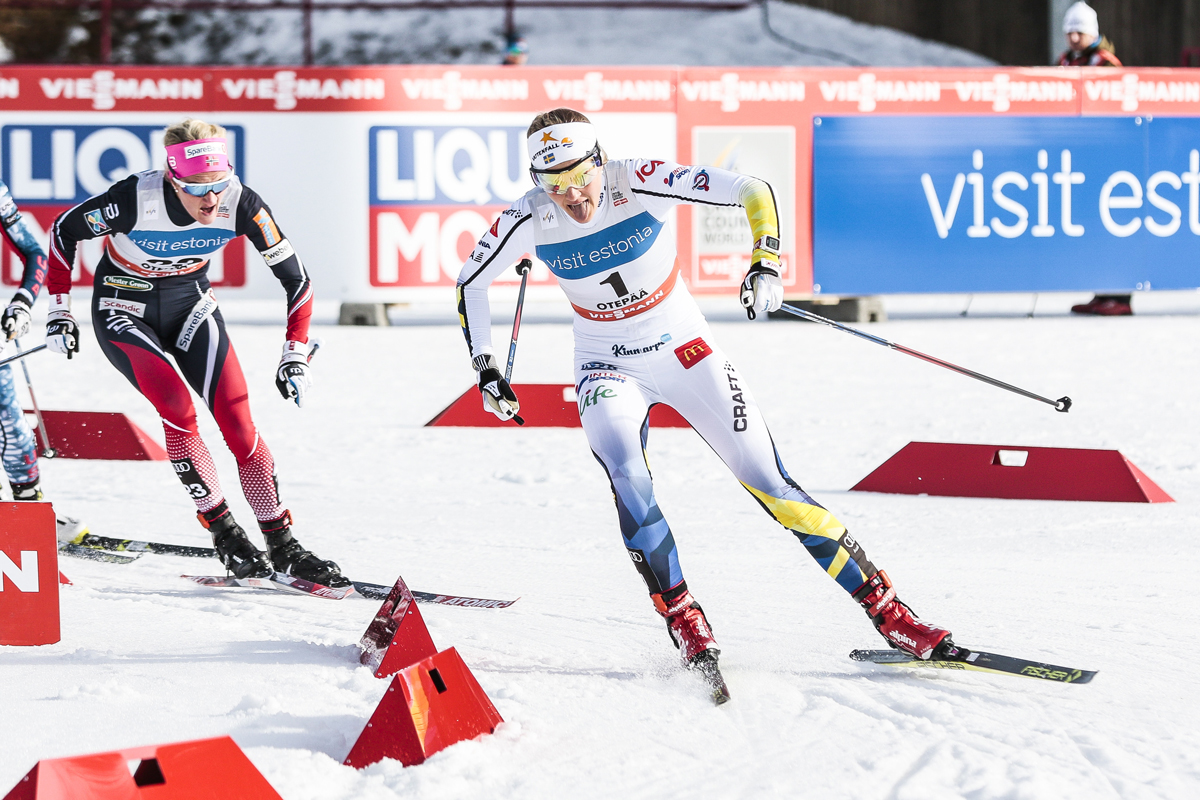
    Sweden’s Stina Nilsson (1) leads Norway’s Kathrine Rolsted Harsem and American Sophie Caldwell (far left, not shown) around a tight corner in the stadium of the women’s 1.3 k freestyle sprint at the Otepää World Cup in Estonia. (Photo: Fischer/NordicFocus)

    Wearing bib 1, Nilsson went on to win her quarterfinal by 0.62 seconds over Caldwell before doing more of the same in the first semifinal, where she beat Falla. Early in the first quarterfinal, Caldwell found herself in third behind Norway’s Kathrine Rolsted Harsem and Nilsson, which was exactly where she wanted to be.

    “I didn’t want to be leading in my quarter, but I wanted a clean start and then to settle into the front/middle part of the pack,” Caldwell explained in an email. “I tried to stay calm and conserve energy where I could to be able to have a strong finish. I wanted to hang as tight as possible to the leaders up the steep hill and over the top because I knew the draft could come into play. I think I executed my quarter just how I wanted to and my legs felt good enough to have a strong final stretch and finish 2nd.”

    Caldwell edged Harsem by 0.09 seconds in a photo finish for second, and both advanced to the semifinal when Harsem earned a lucky loser spot. Nilsson and Caldwell raced in the first semifinal, where Nilsson led into the first of the two major climbs. Once again skiing in the middle of the pack, Caldwell stumbled about halfway up and had to work to catch back up to the group.

    “I think I poled between my legs or on my ski or something and took myself out,” Caldwell wrote. “I recovered pretty quickly and was able to close the gap over the top of the first hill.”

    By the time they reached the second climb, Norway’s Astrid Uhrenholdt Jacobsen had moved into first. Nilsson followed her in second over the top while Falla hung close in third.
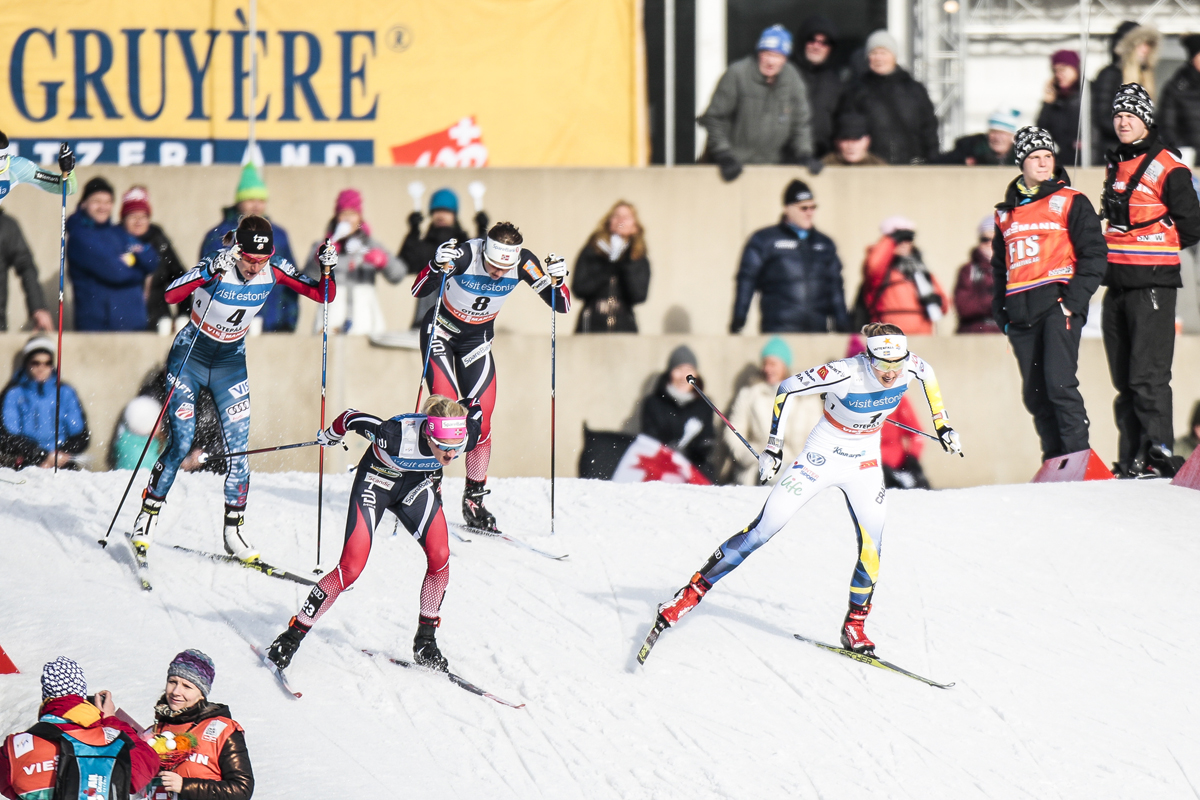
    American Sophie Caldwell (4) and Norway’s Ingvild Flugstad Østberg (8) chasing Norway’s Kathrine Rolsted Harsem (second from l) and Sweden’s Stina Nilsson (r) in the quarterfinal of the women’s World Cup freestyle sprint in Otepää, Estonia. Caldwell edged Harsem in a photo finish for second, behind Nilsson in first, and all four advanced to the semifinals. (Photo: Fischer/NordicFocus)

    “Going up the second hill, the top three opened up a little gap and I was behind Ingvild [Flugstad Østberg of Norway] and we were unfortunately just far enough back so that we didn’t benefit a ton from the draft,” Caldwell explained. “There are a few things I would do differently if I were to do it again (namely not to fall), but I was really encouraged by my energy out there today.”

    Caldwell finished fifth in that semifinal, 1.83 seconds behind Nilsson, who had reclaimed the lead at the bottom of the long downhill into the stadium. Falla automatically advanced to the final in second, and Jacobsen advanced as a lucky loser in third (+0.75). Østberg took fourth (+1.64), just ahead of Caldwell, and neither advanced to the final. That put Østberg in seventh and Caldwell 10th overall on the day.

    Diggins Wins Quarter + Semifinal

    Meanwhile, Diggins — the winner of her quarterfinal — won the second semifinal as well, beating out Weng by 1.21 seconds. Sweden’s Hanna Falk placed third (+2.52) behind Diggins, Sweden’s Ida Ingemarsdotter was fourth (+3.8), Randall fifth (+13.3) after a late crash, and Harsem sixth (+21.37) after face planting on the last downhill in a separate incident from Randall.

    Diggins automatically advanced to the final along with Weng, and Falk made it as a lucky loser.

    In the final, Nilsson again took charge out of the start, while Weng clung closely to her in second. Jacobsen once again took the lead, this time up the first climb, but Nilsson made her move back into first by the final steep uphill. Falla chased Nilsson over the top, followed by Weng, Jacobsen and Diggins — in that order — on the descent. Having dropped everyone else on the last hill, Nilsson and Falla raced toward the finish line as a unit. Nilsson stayed ahead, Falla took second, Weng third (+3.75), Jacobsen fourth (+4.91), Diggins fifth (+6.82), and Falk sixth (+21.73).

    “I could not have done it any better, so I’m very happy,” Nilsson told the Otepää organizers. “The course was very good and I would like to come back and race here again.”
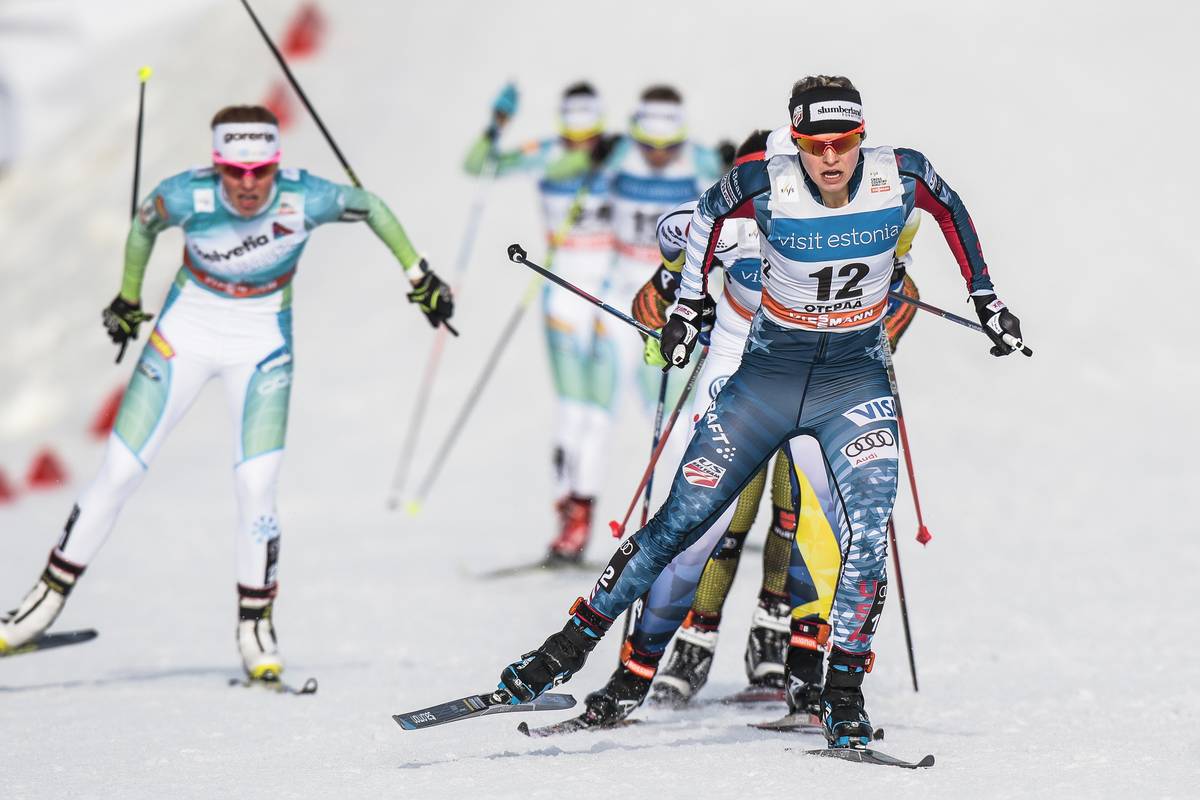
    Jessie Diggins (12) racing to first in her quarterfinal, ahead of Sweden’s Ida Ingemarsdotter (directly behind), who finished second in that heat, in the World Cup freestyle sprint in Otepää, Estonia. Slovenia’s U23 leader Anamarija Lampic (l) finished third in that heat. (Photo: Salomon/NordicFocus)

    While Nilsson and Falla had tested their tactics against one another in the semifinal, Diggins didn’t meet either of them until the final. The 25-year-old American had previously won her quarterfinal by leading from start to finish, then her semifinal by capitalizing on a slingshot draft on the last downhill.

    “In my quarter, I just wanted to stay out of trouble,” Diggins explained. “It’s a course where it’s hard to pass and with deep snow and icy spots, I saw a lot of potential for danger, so I wanted to stay way out anything that my happen. The best way to ensure that is to get way out in front. And it burns a lot of energy and I paid for it later in the final.”

    She added that the biggest hill — the last, steep one that Diggins called the “headwall” — proved especially challenging because it required a different technique, namely jump skating.

    In the semifinal, Diggins said she got stuck behind the wrong person on the way up that climband came out of it in fourth. Meanwhile, Randall had taken the lead by the top.

    “I was actually proud of myself for mentally not counting myself out,” Diggins said. “Just saying, ‘OK, I’ll use the slingshot, downhill’s a big strength of mine, so I’m just going to get back in it.’ ”

    That’s exactly what she did. Diggins shot wide around the last corner and surged into first, ahead of Randall, Weng, and Falk. Coming out of that corner and toward the finishing stretch, Randall lost her balance on the way up a small hill over a tunnel and fell out of contention.

    “Right after Jessie passed me I was taking the inside line into the corner and then lost my balance on an ice patch and my weight went out the back,” Randall wrote in an email. “Thought I almost saved it for a split second and then my skis came out from under me.  It was totally my fault but a real bummer. I was feeling strong and ready to be in the final.”

    Meanwhile, Diggins gained some confidence with her semifinal win.

    “It was a good moment for me realizing that I can execute good tactics. I don’t just have to put my head down,” she said.

    In the final, Diggins wasn’t sure of the best move on the final uphill.

    “I had this moment of hesitation at the bottom as to who do I follow? Do I follow her? It’s kind of like you are picking your security line at the airport, which line to I get in to go the fastest?” she said. “I think that moment of hesitation definitely cost me, but then when they went, it was really quick and I was not technically able to go. I was just like stepping as hard as I could, but I think I needed to be more like a hop skate in order to go. After that, I just worked on preserving my spot.”

    After being gapped, she said it was tough mentally to finish the race in a solid position.

    “I was just trying to work on pushing, I really need to practice for Lahti, so get in there,” she said.

    Diggins said she has a “pretty ambitious race schedule” planned for Lahti World Championships, and while she couldn’t say which races she’ll do, she intended to sit out Sunday’s 10 k classic individual start to rest up for next week.

    “To pull it off, I need to come into it quite rested,” Diggins, a 2013 freestyle team sprint champion and 2015 individual silver medalist, said of her World Championships goals.
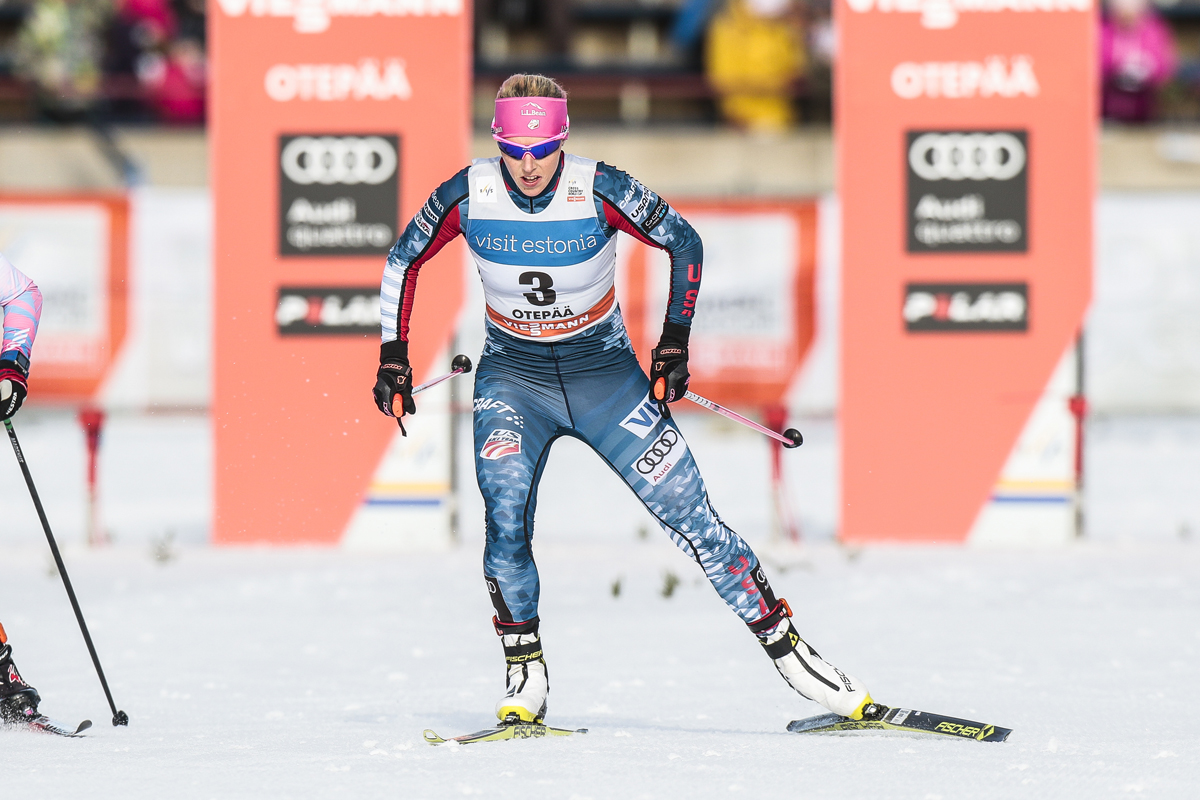
    Kikkan Randall (U.S. Ski Team) racing in the heats at the World Cup freestyle sprint in Otepää, Estonia. She reached the semifinals for ninth overall. (Photo: Fischer/NordicFocus)

    While Diggins ended up fifth overall and Caldwell 10th on Saturday, Randall had her second-best individual result of the season in ninth, and it all started with her being the third-fastest qualifier.

    “That qualification would have beat some of her performances from when she was at the top of her game,” Whitcomb said. “I can’t help to wonder if she is back at the top of her game.”

    “To be able to lay down a fast qualifier like that gives me confidence that I’ve made it one step closer to the kind of race form I had when I was contending for wins and podiums in every skate sprint,” Randall wrote.

    In her quarterfinal, Randall initially finished third, 0.3 seconds behind Jacobsen, who won that heat. Russia’s Natalia Matveeva finished second, but was relegated to last (and 30th overall) for obstructing Randall. According to Randall, she experienced two instances of obstruction in that heat.

    “Coming into the stadium I tried to make a move on the outside and Matveeva abruptly moved over in front of me as I came up alongside her,” she wrote.  “So I reset and tried to set myself up on the final turn. But then she cut across me again and I lost all my momentum.”

    Randall asked her coaches to file a protest. After reviewing the video, the jury deemed Matveeva’s first cut-off grounds for a penalty. Thus, Randall advanced to the semifinals in second place.

    In her semifinal, Randall resolved to be more aggressive to ensure better positioning.

    “Even after a not-so-great start again, I made a push to get up closer to the front,” she wrote. “I skied the downhill 180 corner pretty well and got my own lane up the steep climb and was able to make a move over the top.  Jessie followed me and came flying out of my draft as we came toward the stadium.

    “I was definitely bummed have missed out on the chance to test myself against the best in the final today but I am really encouraged with how I felt all day,’ she added. “I learned some good tactical lessons and I am really looking forward to another chance in a few days!”

    Randall was listed to start Sunday’s 10 k classic.

    Also listed for Sunday’s race are Sargent and Bjornsen (among other U.S. women), who placed 13th and 20th overall, respectively, on Saturday. After qualifying in 10th, Sargent looked poised to win her quarterfinal before she ultimately finished third (0.35 seconds behind Falla) and did not advance.

    “For the quarterfinal my strategy was to stay near the front and stay out of trouble and try to stay in contact going into the downhill,” Sargent wrote in an email, adding that she wanted to stick with Falla.

    But feeling especially excited and strong, she decided to go for it and take the lead soon after the start. On the last climb, Falla attacked over the top and led into the downhill. Sargent followed, taking a few extra skate steps to rein Falla back in.

    “Sometimes I don’t think I work the graduals enough so I made an effort to push a little longer going into the downhill and I think that gave me the power to pass Maiken on the downhill,” Sargent described. “I was proud of myself for holding my line and and skiing with confidence in the heat which is another thing that I’m working on  But then unfortunately my legs were really flooded in the finish stretch and I lost the crucial time there. So I feel I’m really close but just need to keep working to have that extra couple tenths of a second.”

    “10th in the qualifier is definitely one of my best if not my best qualifiers for a full World Cup field,” she acknowledged. “… We had insanely fast skis today so the techs did some magic work and that was a huge help making it such a great day for the team.”

    In the same quarterfinal as Randall, Bjornsen finished fourth, 2.82 seconds behind Jacobsen. In an email, Bjornsen wrote that her qualifier was slower than usual, “I think due to searching for my sprint gears and seemingly making the wrong ski selection.

    “I was looking forward to the heats, because I know my energy is feeling well, I just needed to find that speed,” she added. “I had a great start, and tried to stay light in those really deep snow conditions. As we rounded the far side of the course and headed back up the really steep climb there, I tripped over some snow, and really got bogged down. It was one of those ‘wall climbs’, and I seem to need some work on that particular grade. That is where I lost contact with the leaders, and then didn’t manage to find the steam to come back to them unfortunately.”

    Bjornsen explained that Saturday’s race was her team’s qualifier for the World Championships sprint, “and I unfortunately wasn’t able to make it,” she wrote. “I haven’t quite found my groove that I know I am capable of with sprinting yet this year, but I keep looking forward to it every time I try, because I think it is a small adjustment that I am on a search for. On the other hand, I still feel really good about my energy and fitness right now, so I am looking forward to tomorrow with great excitement. An individual classic 10k is a great race for me, and I can’t wait to take on this challenging course!”

    Canada’s Beatty 29th

    Canada’s Dahria Beatty nabbed the last qualifying spot in 30th and went on to finish sixth in her quarterfinal, 9 seconds behind Weng (who won that heat) for 29th overall. Beatty last competed at U23 World Championships in Utah, where she recorded three top-20 results. In the two weeks since, the 22-year-old Canadian U25 Team member has been in Canmore, Davos, and Otepää since Thursday. After this weekend, Beatty will travel with the team to Lahti to compete at senior World Championships.

    “The course was a really hard one, the snow was soft which made it even more challenging and the final climb is really steep,” she wrote of Saturday’s race. “I managed to survive the steep pitch in my qualification but in the heats it had softened a bunch and that’s where the pack really got away from me. Something else to add to the list of things to work on!

    “I was really happy to be back in the top-30 my first race back in Europe,” Beatty added. “My legs have been feeling a bit heavy the past week with all the travel but this was a really solid place to start the next period of racing and I think my body will be feeling all ready to go by next Thursday. I am confident in my fitness right now and I am really looking forward to experiencing my first World Championships!”

    Canada had two others in the women’s race, with Cendrine Browne placing 48th and Katherine Stewart-Jones 49th.

    The U.S. had a total of seven women compete on Saturday, with Chelsea Holmes and Rosie Brennan finishing 58th and 60th, respectively. Of those seven, four qualified in the top 12 and five finished the day in the top 20.

    “It is incredibly competitive out there…,” Whitcomb said. “I think it means that we have a team that is operating at peak form and is ready for the championships.”

    Results | 10 k classic start list

  • First World Cup Win for Klæbo; Hamilton 8th in Otepää, Misses Final by Inches

    First World Cup Win for Klæbo; Hamilton 8th in Otepää, Misses Final by Inches

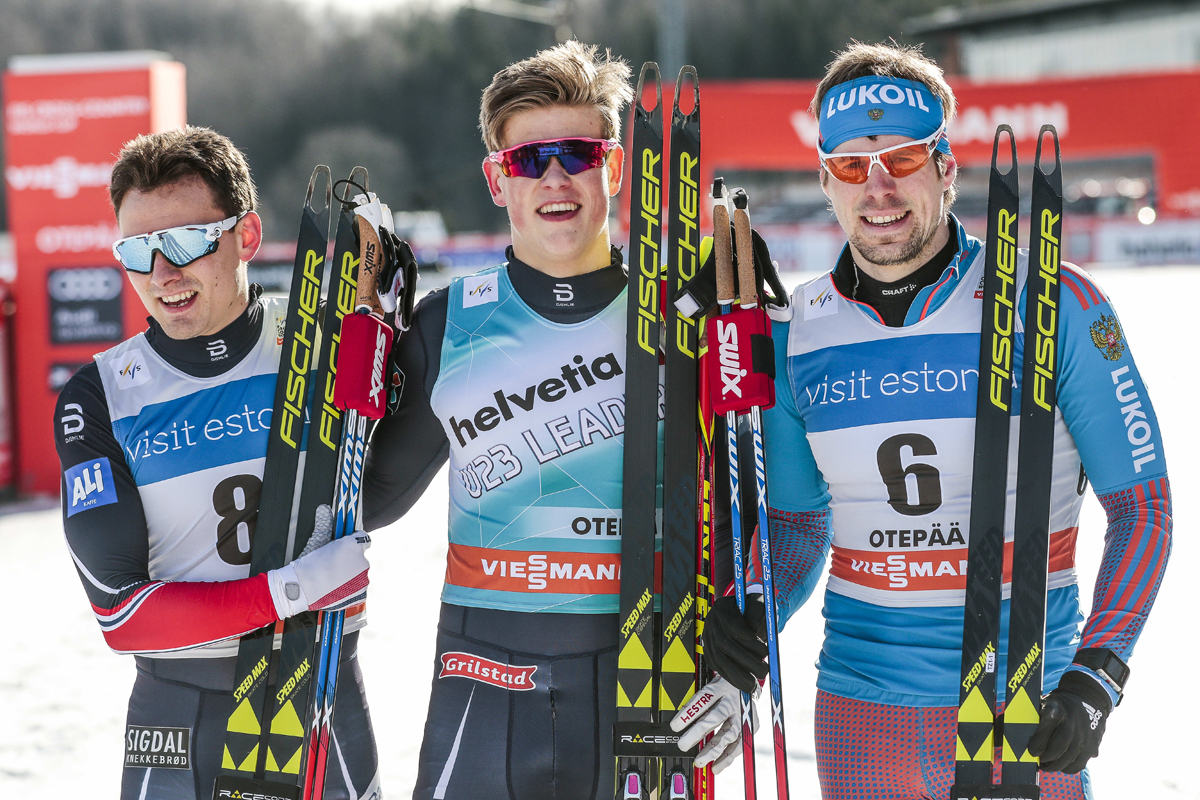
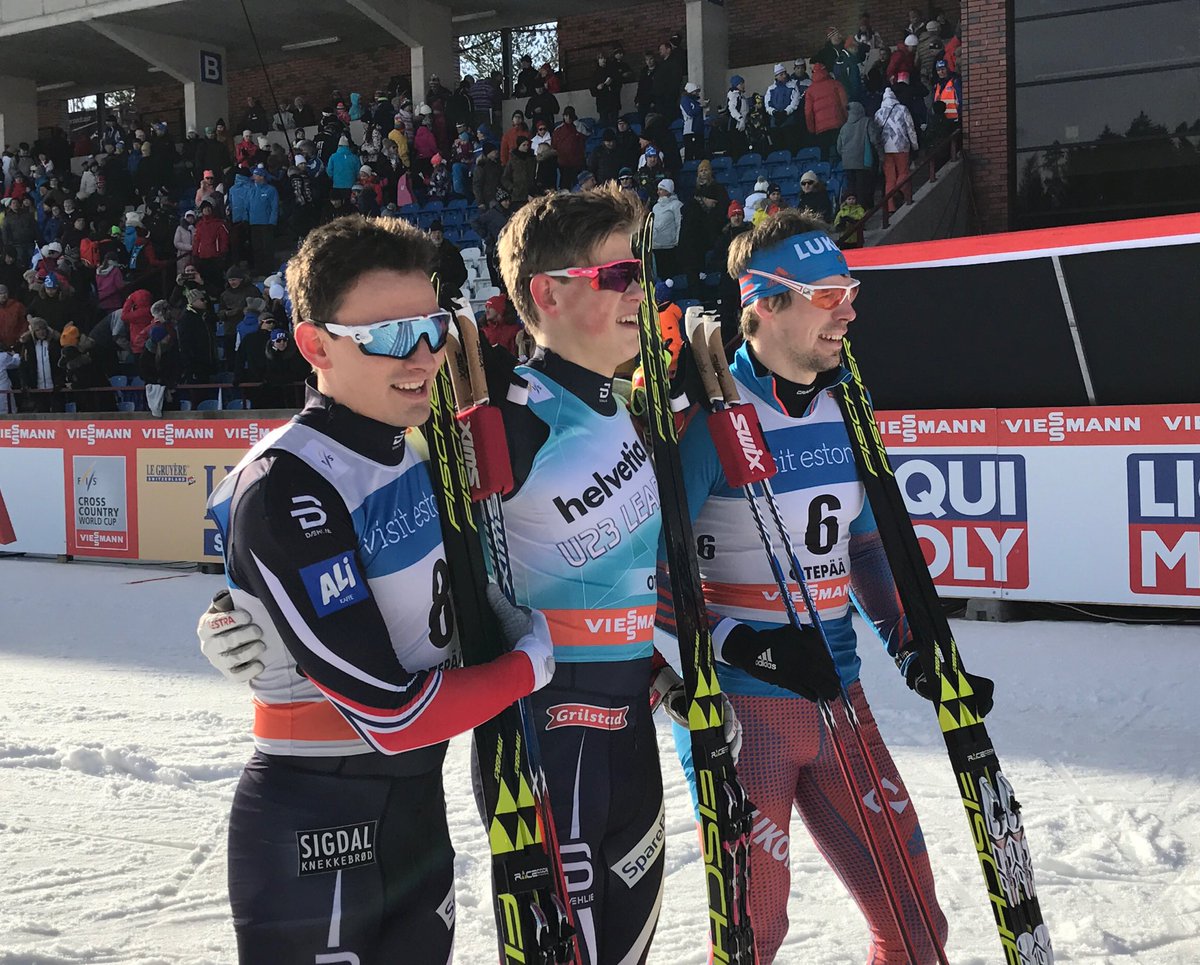
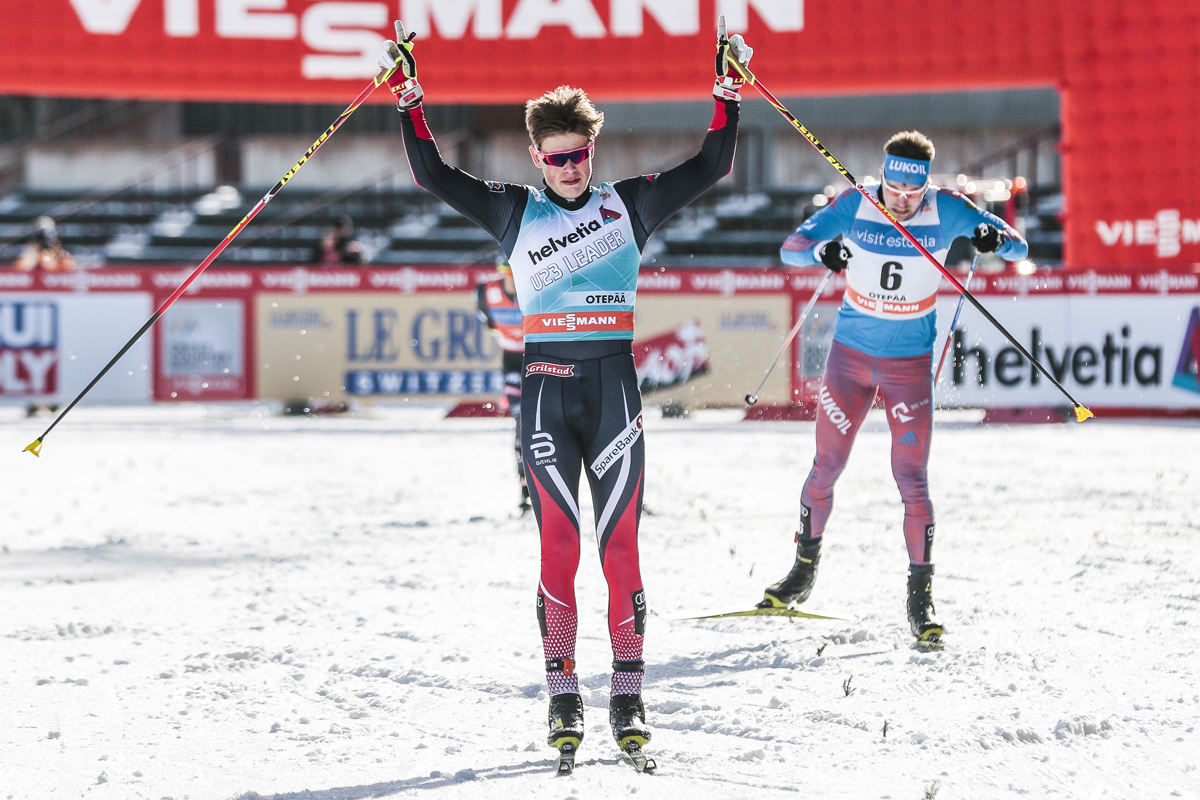
    Norway’s 20-year-old Johannes Høsflot Klæbo won his first World Cup on Saturday in the men’s 1.6 k freestyle sprint in Otepää, Estonia, while Russia’s Sergey Ustiugov (6) placed third. (Photo: Fischer/NordicFocus)

    Johannes Høsflot Klæbo is young enough that he could have started at the U23 World Championships in Soldier Hollow, Utah, earlier this month. And the 20-year-old Norwegian probably would have done well there.

    But the 2016 Junior World Champion in the freestyle sprint and 10-kilometer classic races held in Râsnov, Romania, already has his sights set much higher this season, targeting next week’s senior International Ski Federation (FIS) Nordic World Ski Championships in Lahti, Finland.

    And on his steep career ladder progression, he took another important rung on Saturday by stepping on the top of the podium for his first World Cup victory in the men’s 1.6 k freestyle sprint in Otepää, Estonia. In the final, Klæbo pushed hard right out of the start gate and never relinquished his lead, crossing the line first in convincing fashion in a time of 3:06.53. He also won the qualifier earlier in the morning, and advanced with relative ease through the rounds, winning his quarterfinal heat and placing second in his semifinal.

    “I felt strong today and knew that those who were in the final [with me] are strong in the finish stretch, so I thought my chance would be to just go for it and that worked,” Klæbo told Norwegian broadcaster NRK, adding with a smile that he might use the same tactic for the World Championships.

    The men’s freestyle sprint podium on Saturday at the World Cup in Otepää, Estonia, with Norway’s Johannes Høsflot Klæbo (c) taking his first World Cup win, Norway’s Finn Hågen Krogh (l) in second, and Russia’s Sergey Ustiugov (r) in third. (Photo: Fischer/NordicFocus)

    His teammate Finn Hågen Krogh — who had narrowly beaten Klæbo in the semifinal — placed second in the final (+0.60) after taking the inside lane in the last turn and staying far right in better groomed snow to push past Tour de Ski winner Sergey Ustiugov of Russia on the finishing stretch. Ustiugov ended up third (+1.0).

    “To win here, it’s unbelievable,” Klæbo told FIS in a finish-line interview. “I think I have learned a lot and it’s tough to be in the final because everyone is so good, but I am very satisfied with this race.”

    Norwegian media have already started to compare him to his star teammate Petter Northug Jr., a comparison Klæbo is not too fond of insisting that he is his own man. And at Norwegian national championships in Lygna a week ago, Klæbo was eager to prove that he is more than a sprint specialist, winning the freestyle sprint but also the silver medal in the 15-kilometer classic race, only behind Didrick Tønseth but ahead of overall World Cup leader Martin Johnsrud Sundby.

    At the start of this season, Klæbo placed second in the World Cup mini tour in Lillehammer, Norway, finishing behind Sundby in the 15 k classic pursuit. On Saturday, Sundby broke his pole right at the start of the sprint qualifier and quit the race skiing into the woods, while the young Klæbo left his more experienced national and international competitors no chance in the final.

    “This is huge,” Klæbo told NRK. “I’ve been in so many finals, and I feel that this was due. It’s kind of crazy to do this before the World Championship”

    “I was struggling in the quarterfinal, I did not feel that good,” Krogh told FIS, according to a press release. “I changed skis and then I felt better in every heat. In the final the lane I chose in the last corner was faster and I could carry on good speed in the homestretch.”

    “To finish third is nice,” Ustiugov told FIS. “I would be disappointed if I had not finished in top three today. Finn was very fast on the homestretch today.”

    Last season’s World Cup sprint winner Federico Pellegrino of Italy placed fourth (+4.77), ahead of two more Norwegians with Sindre Bjørnestad Skar in fifth (+15.53) and Håvard Solås Taugbøl in sixth place (+32.94). Klæbo now also sits in second place in the World Cup sprint standings behind Pellegrino.

    Narrow Misses for Best North Americans

    For the U.S., Simi Hamilton started his race day with a solid qualification in seventh position just 4.01 seconds behind the winner Klæbo; despite having to race on a newly modified course in Otepää that he believes doesn’t favor his strengths.

    “I definitely felt good in my qualifier,” Hamilton told FasterSkier on the phone after. “There are two really big climbs in this course, and I think they kind of suit the more distance-type skier a little bit better because both of them are just pretty long 30-45 second climbs, and the conditions were definitely getting pretty slippery out there even by the qualifier. So that’s kind of an environment I struggle in a little bit or at least have in the past.”

    “I was psyched with a seventh [place],” he commented on his qualifying result. “It’s a long course which I tend to struggle a little bit with, too, but being able to qualify in the top 10 on a course that is a little over 3:10 [minutes long], I think that’s a good time for where I am with my fitness right now especially leading to World Champs.”

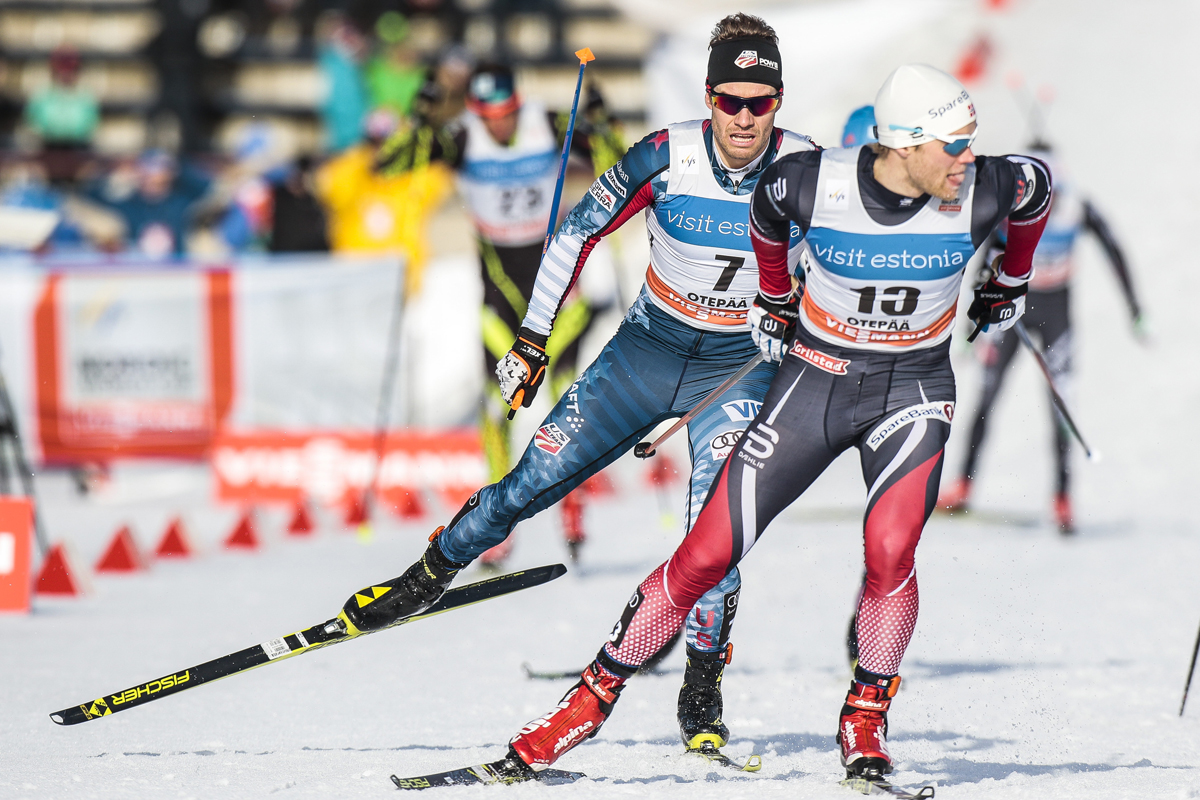
    American Simi Hamilton (7) chasing down Norway’s Eirik Brandsdal (13) in the quarterfinal. Brandsdal won the heat in a photo finish, two-hundredths of a second ahead of Hamilton in the World Cup freestyle sprint in Otepaa, Estonia. (Photo: Fischer/NordicFocus)

    In his quarterfinal, Hamilton faced Krogh, Norway’s Eirik Brandsdal and Russia’s Gleb Retivykh, the winner of last week’s sprint in PyeongChang, South Korea.

    “The tactic that I was focusing on the most all day was just trying to ski the first half of the course as efficiently as possible,” Hamilton explained. “I felt like I did that pretty well, slipped into second and felt really good about that position. I was able to take my own lane coming up that really long hill on the backside and I think that was tactically really good, because I could just ski that hill the way I wanted to and I wasn’t in danger of getting boxed out or anything.”

    Hamilton came onto the finish stretch behind Brandsdal, pushing next to him before lunging in a photo finish to narrowly place second (+0.02), and was able to keep Krogh just behind him in third (+0.22). Krogh still advanced as a “lucky loser” with his time, while Retivykh finished fourth (+1.14) and was out.

    “I felt good for the V1 part and just tried to punch it over the top and get a really good draft off of Brandsdal,” Hamilton said. “I just focused on getting in his stream and coming into the stadium, I still felt like I had some energy in my legs and was able to turn on a pretty decent finish stretch. I was psyched about that for sure.”

    In a stacked semifinal heat and in worsening snow conditions, Hamilton had to race against the dominant Tour de Ski winner Ustiugov, Skar, Taugbøl, and the two Finnish skiers: Ristomatti Hakola and Martti Jylhä.

    “In my semis, I toasted my legs a little bit on the first climb just trying to get through that really deep snow,” Hamilton explained. “Coming over the top, I think I was still in a good position. I think I was third there but I couldn’t get an open lane on the long climb coming up the backside, so I just kind of struggled behind I think Taugbøl … and I think Ustiugov was on my left coming up that and he did a really good job punching it up and over that V1 section and with really good speed into that long downhill.”

    Hamilton tucked down trying to conserve energy and momentum on the downhill section, and with only Jylhä and Hakola gapped a little had to go into a four-way finishing sprint.

    “I took a really good move coming into that last 180 into the finish stretch and Ustiugov was right in front of me, and then the Norwegians were in front of him, and they were all staying close to the V-boards on the right side because they were trying to ski that corner really narrow,” Hamilton recalled of the final turn. “I just took it a little bit wider and then cut narrow at the end of it, and I was able to basically get past Ustiugov a little bit … But that move spit me into the middle lane at the finish stretch, and that lane was getting pretty chewed up with so much traffic all day. It was definitely pretty soft in there and I think Ustigov’s lane on the left was staying pretty firm and icy all day. So I was bummed I couldn’t really throw down a better last 100 meters. I did what I could, but I was definitely getting a little caught up in that soft stuff and couldn’t really rely on my power to try to get down the home stretch.”

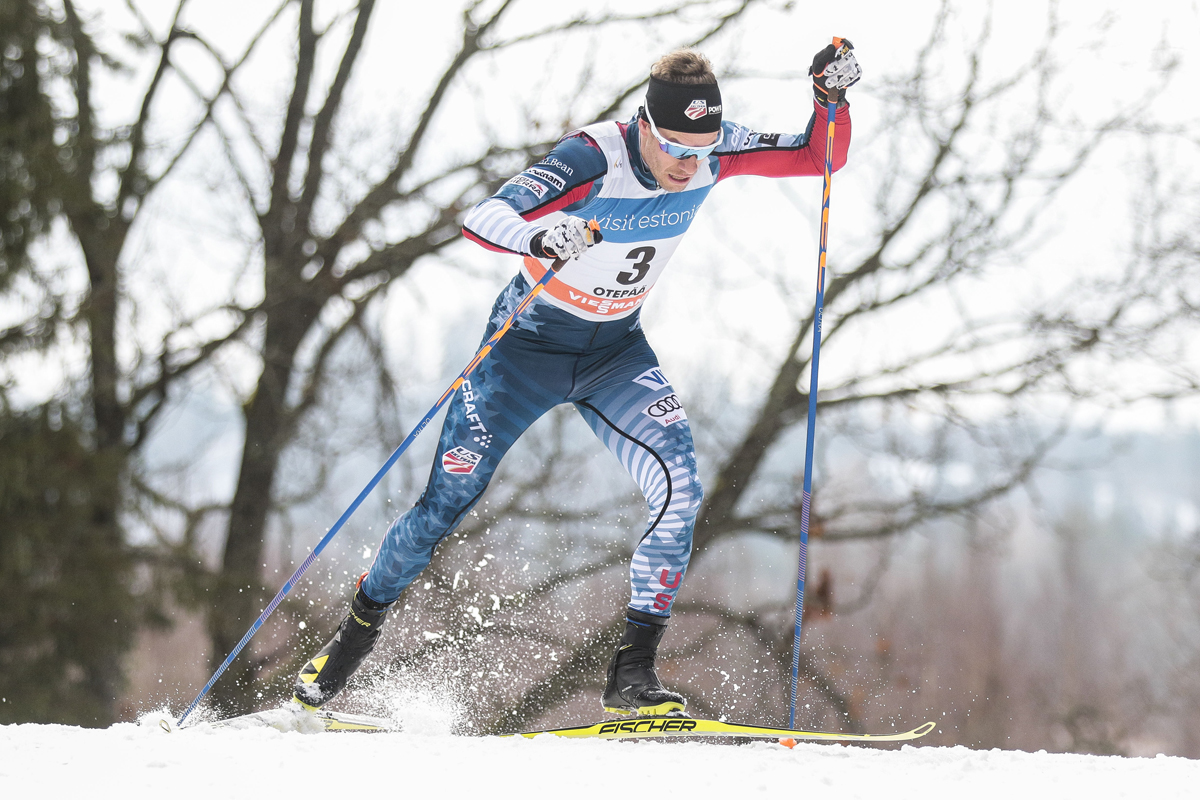
    Simi Hamilton (U.S. Ski Team) racing to seventh in the men’s 1.6 k freestyle sprint qualifier on Saturday at the World Cup in Otepaa, Estonia. (Photo: Fischer/NordicFocus)

    Skar won the semifinal ahead of Ustiugov (+0.15) to advance directly, with Hamilton (+0.33) ranked just behind Taugbøl (+0.29) as the outcome of the photo finish. Taugbøl’s time was enough to advance as a lucky loser. Hamilton ended up eighth overall on the day.

    “Regardless I was happy with the fourth [though I] obviously would have liked to advance into the finals,” Hamilton said. “And I feel good about where my fitness and speed is right now, and just kind of one or two things didn’t line up for me in that semi and you know it’s a bummer. But at the same time Thursday [the freestyle sprint in Lahti] is a big day and hopefully some more things will line up on that day and that is the main goal. So I feel good about where everything is going for World Champs right now.”

    Hamilton stated that he does not to plan to race on Sunday, training and then traveling in the evening to Finland a day earlier to be rested before the sprint at World Championships.

    Canadian World Cup Team member Alex Harvey, who had skipped the World Cup trip to Korea for a recovery and training block, snuck into the sprint heats in 29th place (+10.26) after a mishap, avoiding elimination by less than a second.

    “I felt good in the qualifier but right out of the start, in the first corner, I hit an icy patch and almost crashed, right at the base of the first uphill,” Harvey wrote in an email. “My ski hit my pole and I broke a basket. After that I had to get my momentum back and I think that I actually skied pretty decent but lost some time and speed there. So I guess you can say I got lucky to end up on the good side of the top 30!”

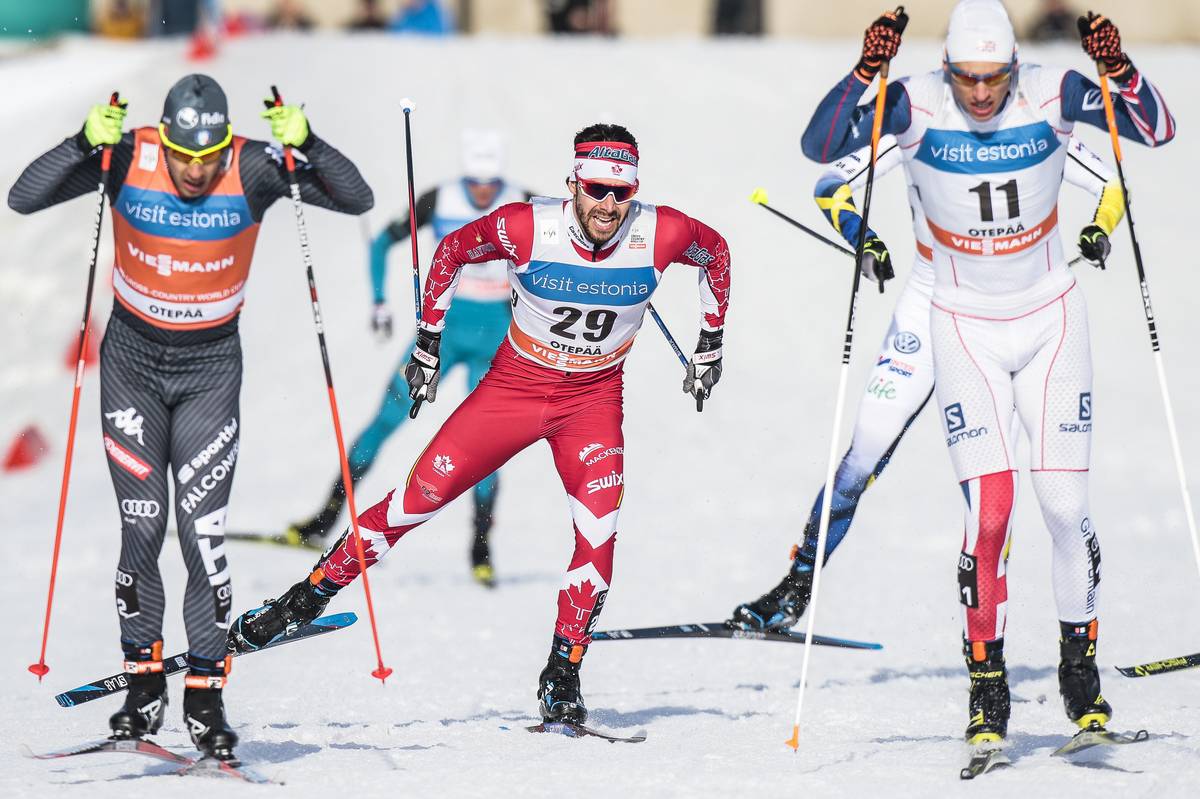
    Canada’s Alex Harvey (29) chasing Great Britain’s Andrew Young (11) and Italy’s Federico Pellegrino (l) in the quarterfinal of the men’s 1.6 k freestyle sprint at the World Cup in Otepaa, Estonia. Harvey finished third in the heat for 15th overall. (Photo: Salomon/NordicFocus)

    Harvey believed the redesigned course in Otepää suited him relatively well, though he was not too stoked about one modification:

    “I think the length of the course suits me well,” he wrote. “The only thing I didn’t like was a short finishing stretch…we are used to a really long one here so I was looking forward to that, but this year there was a 180-degree turn just before the finish so that made the opportunity to pass in the finish not as good.”

    In his quarterfinal, Harvey had to race against Pellegrino, Norway’s defending sprint world champion Northug (who’s been trying to round back into shape in time for this year’s championships), as well as Andrew Young of Great Britain.

    “My quarterfinal was super slow, from the start I knew I had to be top 2 to move on,” Harvey recalled. “Young kinda picked it up right at the top of the second climb (the steeper wall) so he tried to gap the field or at least stretch it for the long downhill into the stadium.”

    Pellegrino managed to pass Young on the final turn into the finish stretch and created a little gap gliding the last meters over the line in first, while Harvey had to sprint for second place against Young who lunged across the line falling down. After a photo finish, Harvey was determined to be 0.04 seconds behind Young to place third (+0.60), while Northug was fourth (+1:45). Harvey’s time was not fast enough for a lucky loser spot and he finished the day in 15th. Young went on to finish last in his semifinal for 12th overall.

    “I feel good about my finish, I was able to re-accelerate quite well after that 180 degree turn and almost got by Young in that short finish so that was a good sign for my finishing speed. Now I just gotta work on my lunging game…” Harvey wrote. “15th is not too good but I think the most important in a pre-worlds weekend like that is the feeling you have on the skis, and today it was very good.”

    Harvey wrote that he plans to race the 15 k classic individual start on Sunday in order to keep his strong position on the overall World Cup ranking, though he doesn’t intend to race this distance at World Championships.

    “I’m feeling good heading into Lahti,” Harvey concluded. “I did a very similar camp as I did before the 2013, 2014, 2015 championships and the 2016 Tour of Canada so I know it’s the right thing for me!”

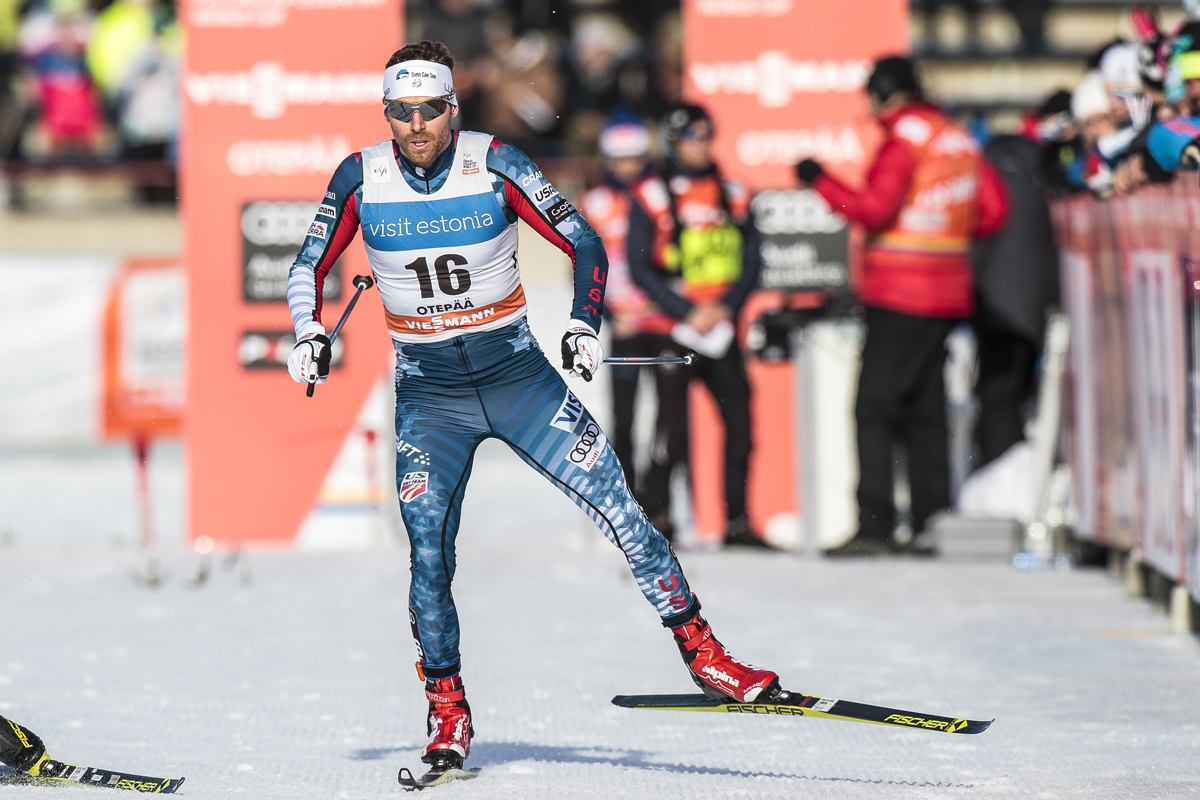
    Andy Newell (U.S. Ski Team) racing in the quarterfinals of the men’s 1.6 k freestyle sprint on Saturday at the World Cup in Otepaa, Estonia. He finished sixth in the heat for 27th on the day. (Photo: Fischer/NordicFocus)

    Hamilton’s teammate Andy Newell started the day by qualifying in 16th.

    “Qualifying today I felt decent,” Newell wrote in an email. “I think my legs are still recovering a little bit from last week [a training block in Valadalen, Sweden]. I was missing a little bit of that pop on the steep climb. That was a decisive part of the heats as well, so if I were a little stronger there it would have been a much better day.”

    In his quarterfinal with the finalist Skar as well as the semifinalists Jylhä and Hakola, Newell could not quite keep up in the finish sprint and placed sixth (+1.89), for 27th overall.

    “Positioning in the heat was tricky,” Newell wrote. “It’s always hard to pass in skate sprinting so I should have positioned myself better before the last S-turns.”

    “I’m feeling healthy and strong going into this weekend and into Worlds so I can’t complain,” he added. “I wish today would have gone better because its always great practice to race as many rounds as you can leading into the championships, but in general I’m in a pretty good place leading into Lahti.”

    Canada’s Len Valjas missed qualifying for the heats in 40th, as did his teammate Devon Kershaw in 50th.

    Erik Bjornsen of the USST was 53rd, Canada’s Jess Cockney was 54th and Knute Johnsgaard 56th, and the fourth U.S. starter Ben Lustgarten in his first World Cup finished the qualifier in 64th place.

    According to U.S. coach Matt Whitcomb, Bjornsen and Lustgarten planned to compete in the men’s 15 k classic race on Sunday. Fellow distance specialist Noah Hoffman originally had looked forward to that race as well, but decided to not make the trip to Otepää after an illness last week.

    For Canada, Harvey, Valjas, Kershaw, Cockney, Johnsgaard, and Graeme Killick were all listed to start Sunday.

    Results | 15 k classic start list

  • Saturday Rundown: Otepää and Hochfilzen (Updated)

    Saturday Rundown: Otepää and Hochfilzen (Updated)

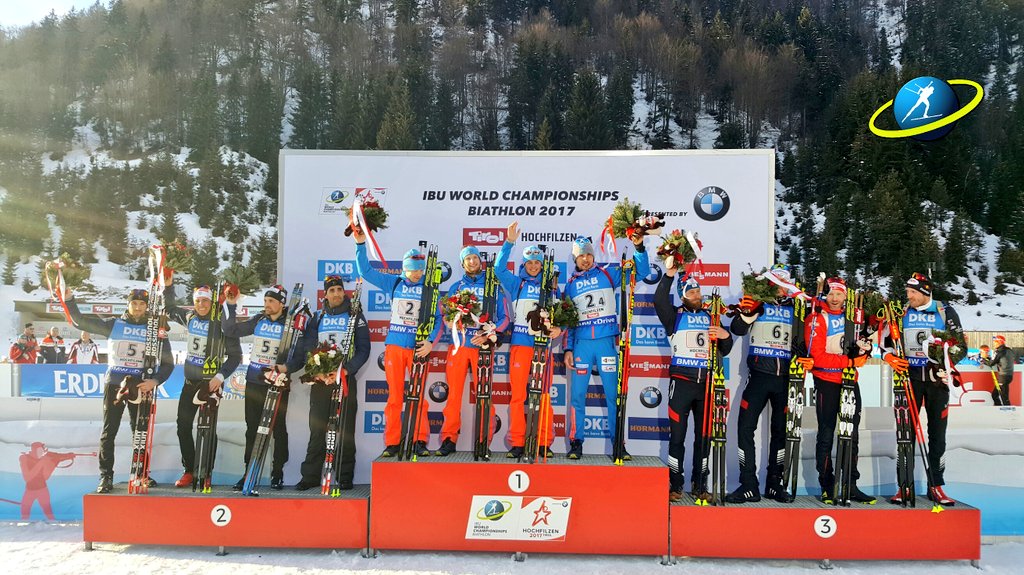
    The men’s 4 x 7.5 k relay podium at 2017 IBU World Championships on Saturday in Hochfilzen, Austria, with Russia (c) in first, France (l) in second, and Austria (r) in third. (Photo: IBU World Champs/Twitter)

    IBU World Championships (Hochfilzen, Austria): Men’s relay

    [UPDATED] Russia’s four-man relay team hit nearly every target on Saturday, using a total of just three spares to clean 40 targets, and stayed out of the penalty loop to capture gold in the men’s 4 x 7.5-kilometer relay at the International Biathlon Union (IBU) World Championships in Hochfilzen, Austria.

    It was the last team event and the second-to-last day of the championships, with the men’s and women’s elite mass starts remaining on Sunday. Anton Shipulin anchored the Russians to first, 5.8 seconds ahead of France’s Martin Fourcade, after Shipulin cleaned his prone stage and used one spare in standing to hold onto the lead his team built. Fourcade cleaned both stages to secure silver for his team, and Austria took bronze (+20.1) with anchor Dominik Landertinger.

    After Russia’s Alexey Volkov used one spare in each of his shooting stages and came through the exchange in seventh, Maxim Tsvetkov and Anton Babikov both cleaned without any spares to bring the team into fourth, then first, respectively.

    France’s first leg Jean-Guillaume Béatrix shot clean as well and tagged Quentin Fillon Maillet in second. Fillon Maillet then needed one spare in prone, but cleaned standing to take the lead, tagging Simon Desthieux in first. Desthieux used three spares in prone, but avoided the penalty lap before tagging Fourcade in third, 12 seconds behind Austria in second. Fourcade closed the gap and clinched second, and France combined for a total of just four spare rounds.

    Austria achieved bronze in front of a home crowd with Daniel Mesotitsch, Julian Eberhard, Simon Eder, and Landertinger combining for 10 spares and no penalties.

    Finishing 8.5 seconds after Austria, Germany placed fourth. Italy was a minute and a half out of first in fifth, Ukraine took sixth (+1:41.3), and the U.S. placed seventh (+1:50.5) with Lowell Bailey, Leif Nordgren, Tim Burke, and Sean Doherty. Bailey initially put the team in fourth at the first exchange, 12.4 seconds out of first, then Nordgren tagged Burke in sixth, 17 seconds behind. Burke used four spares to clean and tagged Doherty in seventh, about a minute back. The Americans used a total of eight spares but had no penalties.

    Canada finished 13th (+3:35.5) with Christian Gow, Scott Gow, Macx Davies, and Brendan Green. They were 39 seconds out of first and in 12th place after Christian Gow’s first leg, then slipped to 14th before Davies moved them back into 12th by the last exchange. Canada had a total of 10 spares and zero penalties.

    Results

    ***

    FIS Cross-Country World Cup (Otepää, Estonia): Freestyle sprint

    In the last World Cup before the upcoming 2017 International Ski Federation (FIS) Nordic Ski World Championships next week in Lahti, Finland, five U.S. women qualified in the top 12 of the women’s 1.3-kilometer freestyle sprint, and Jessie Diggins reached the final on Saturday in Otepää, Estonia.

    Diggins started the day by placing 12th in the qualifier, 3.93 seconds behind Sweden’s Stina Nilsson in first (and her U.S. teammates Kikkan Randall in third, Sophie Caldwell in fourth, and Ida Sargent in 10th) before winning her quarterfinal and semifinal. In the final, Diggins wad gapped by the leaders on the final climb and finished fifth (+6.82).

    The women’s freestyle sprint podium at the Otepaa World Cup on Saturday in Estonia, with Swedish winner Stina Nilsson (c), Norway’s Maiken Caspersen Falla (l) in second and Heidi Weng (r) in third. (Photo: FIS Cross Country/Twitter)

    Nilsson won the final in a time of 2:49.96 minutes, just ahead of Norway’s Maiken Caspersen Falla (+0.27) who lost her balance and her speed with it on the last corner. The two had broken away from third place and Nilsson led into the final straightaway and held Falla off for the win. Norway took second through fourth with Heidi Weng in third place (+3.75) and Astrid Uhrenholdt Jacobsen in fourth (+4.91).

    Randall initially finished her quarterfinal in third position and would have been out, but advanced when Russia’s Natalia Matveeva was relegated to last for obstruction. In the same semifinal as Diggins, Randall fell cresting a small hill over a tunnel and finished fifth (+13.30) for ninth overall on the day.

    Caldwell placed second in her quarterfinal heat behind the day’s winner Nilsson, then stumbled halfway up a climb early in her semifinal, but stuck with the pack to finish fifth (+1.83) for 10th overall.

    Sargent raced in the same quarterfinal as Falla and narrowly missed advancing to the semifinal in third place, fewer than 0.2 seconds behind Switzerland’s Laurien van der Graaff in second and 0.35 seconds behind Falla, who won that heat. Sargent placed 13th on the day.

    Sadie Bjornsen qualified 25th and finished fourth (+2.82) in the same quarterfinal as Randall for the 25th overall.

    Canada’s Dahria Beatty also qualified for the sprint heats in 30th place, and finished sixth in her quarterfinal for 29th overall.

    Also for Canada, Cendrine Browne finished the qualification in 48th place and Katherine Stewart-Jones was one position behind in 49th.

    Also for the U.S., distance specialists Chelsea Holmes and Rosie Brennan placed 58th and 60th, respectively.

    The men’s freestyle sprint podium on Saturday at the World Cup in Otepaa, Estonia, with Norway’s Johannes Høsflot Klæbo (c) taking his first World Cup win, Norway’s Finn Hågen Krogh (l) in second, and Russia’s Sergey Ustiugov (r) in third. (Photo: FIS Cross Country/Twitter)

    In the men’s 1.6-kilometer sprint, Norway’s Johannes Høsflot Klæbo achieved the first World Cup victory of his career in a time of 3:06.53 minutes, holding onto a lead he had created with an attack right out of the start gate in the final. His teammate Finn Hågen Krogh placed second (+0.60), taking the inside lane in the last turn to push reigning Tour de Ski winner Sergey Ustiugov of Russia to third (+1.0).

    For the North Americans, it was a day of narrow misses.

    For the U.S., Simi Hamilton started his race day by qualifying in seventh position, and placed second in his quarterfinal. He then closely missed out on the final after placing fourth in his semifinal in a four-way sprint photo finish (+0.33), just 0.04 seconds behind the third place and lucky loser time of Norway’s Håvard Solås Taugbøl, who advanced. Hamilton ended the day in  eighth overall.

    Canadian World Cup Team member Alex Harvey snuck into the sprint heats in 29th place in the qualifier, then just missed out on advancing from his quarterfinal in a photo finish for second with Great Britain’s Andrew Young, who took it by 0.04 seconds. Harvey finished third in that heat, 0.6 behind Italy’s Federico Pellegrino, for 15th for the day. Young went on to finish sixth in his semifinal for 12th overall, and Pellegrino advanced as a lucky loser from the same semifinal and was fourth in the final (+4.77).

    American Andy Newell qualified 16th and finished sixth (+1.89) in his quarterfinal for 27th overall.

    Canada’s Len Valjas missed qualifying for the heats in 40th place, as did his teammate Devon Kershaw in 50th.

    American Erik Bjornsen was 53rd, and for Canada, Jesse Cockney 54th and Knute Johnsgaard 56th. In his World Cup debut, Benjamin Lustgarten placed 64th in the qualifier.

    Results: Women | Men