From the FasterSkier archive — posts syndicated from athletes’ and coaches’ own blogs between 2004 and 2012, kept online as published. Current coverage is at fasterskier.com.
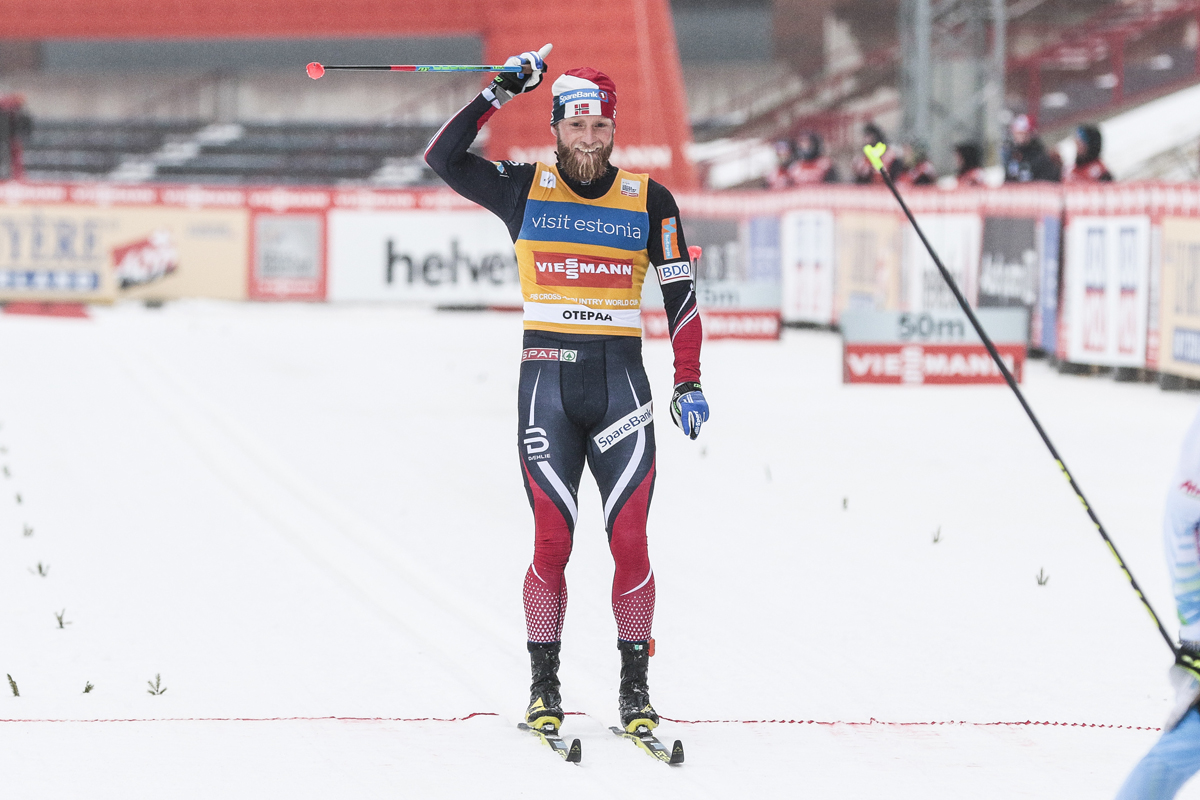
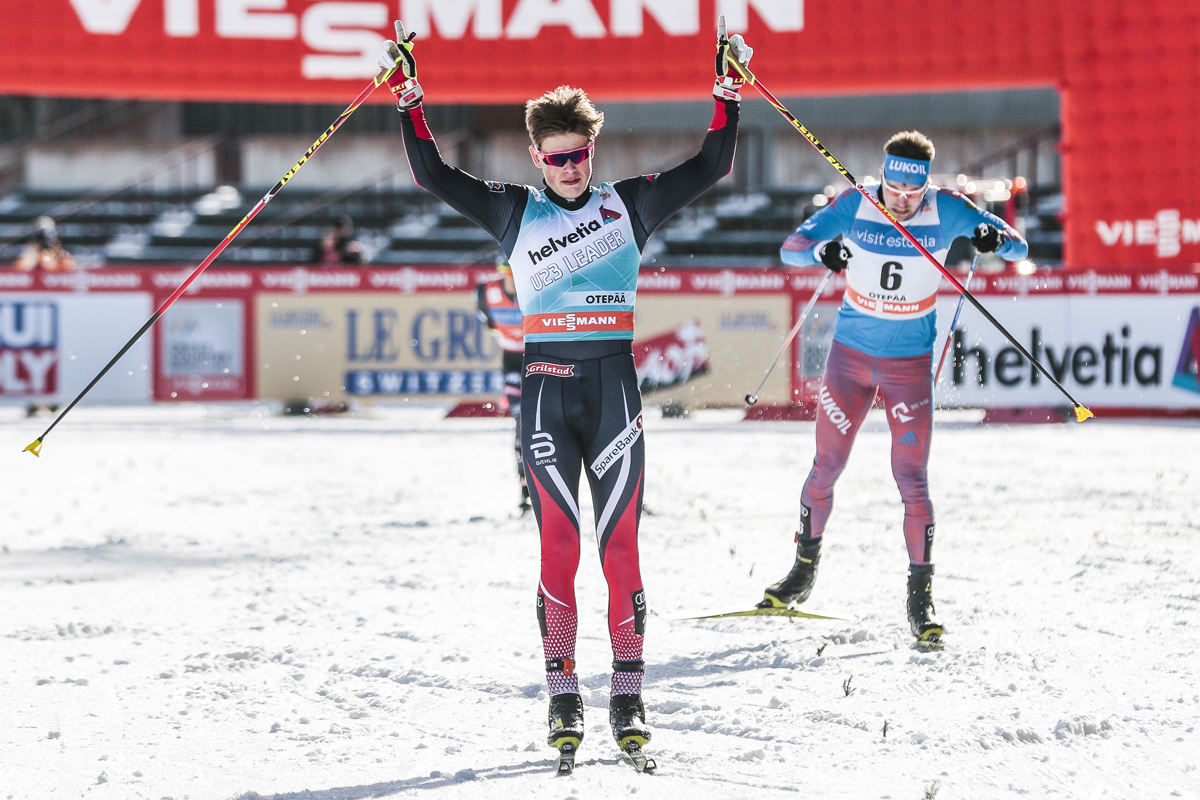
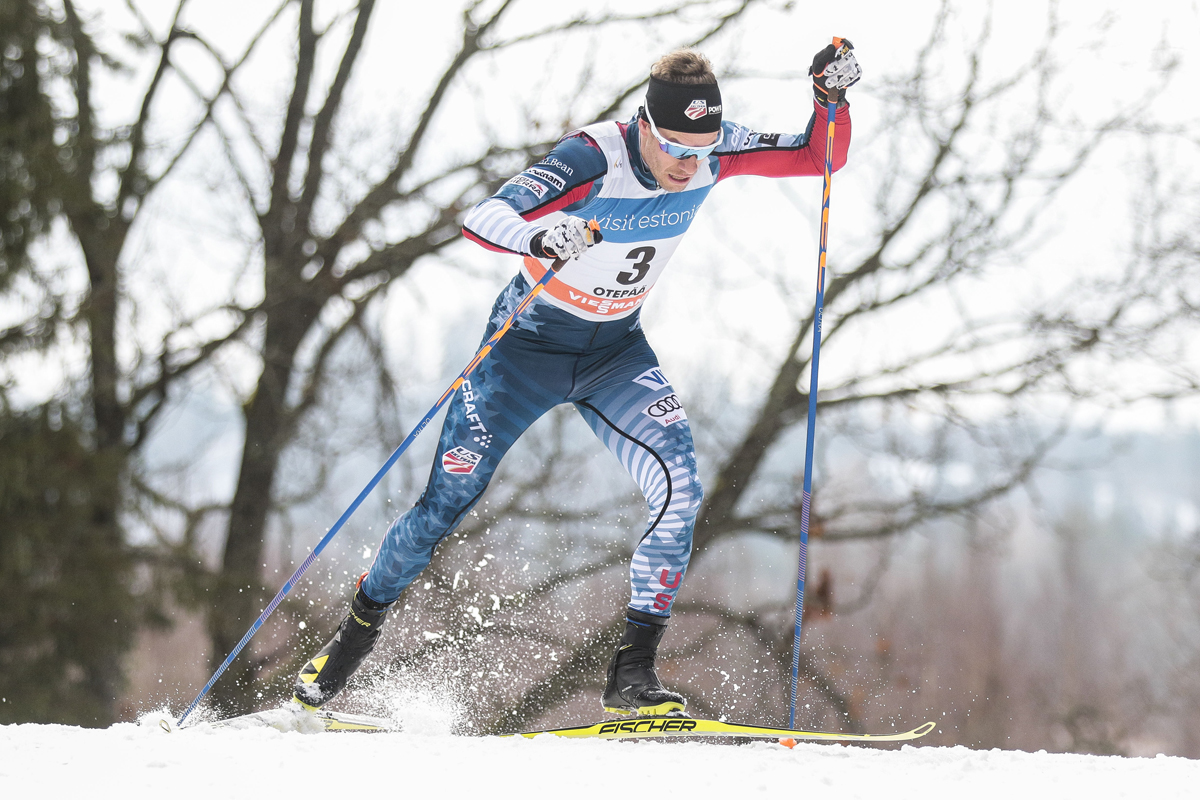
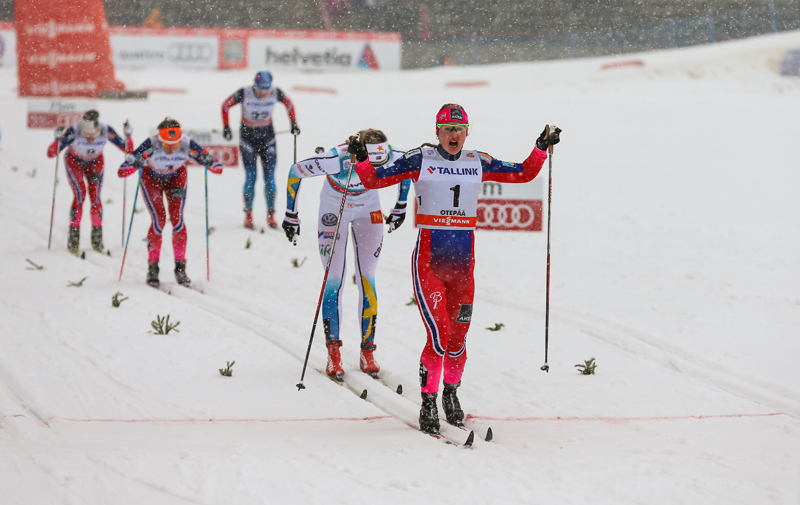
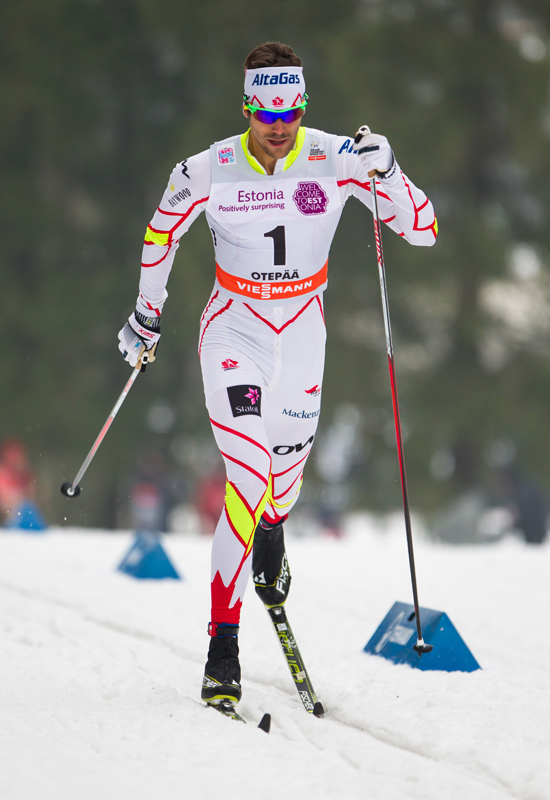
Norway’s Martin Johnsrud Sundby won his first individual race in a little over a month on Sunday with a 37.1-second victory in the men’s 15 k classic at the World Cup in Otepaa, Estonia. (Photo: Fischer/NordicFocus)
If the Otepää World Cup = a World Championships tune-up, consider Martin Johnsrud Sundby primed and ready. On Sunday, the 32-year-old Norwegian put together one of his best races ever from start to finish, by his own assessment, which resulted in at 37.1-second win in the men’s 15-kilometer classic individual start in Otepää.
For the last four years, Sundby (the 2014 and 2016 Overall and Distance World Cup winner, who was stripped of his 2015 overall title for violating asthma-medication rules) has been the man to beat in World Cups. Yet somehow, he hasn’t won a World Championships gold in an individual race (he won with the men’s relay at 2011 World Championships and earned silver in the 30 k skiathlon in 2013). But Sunday was a good sign, he said.
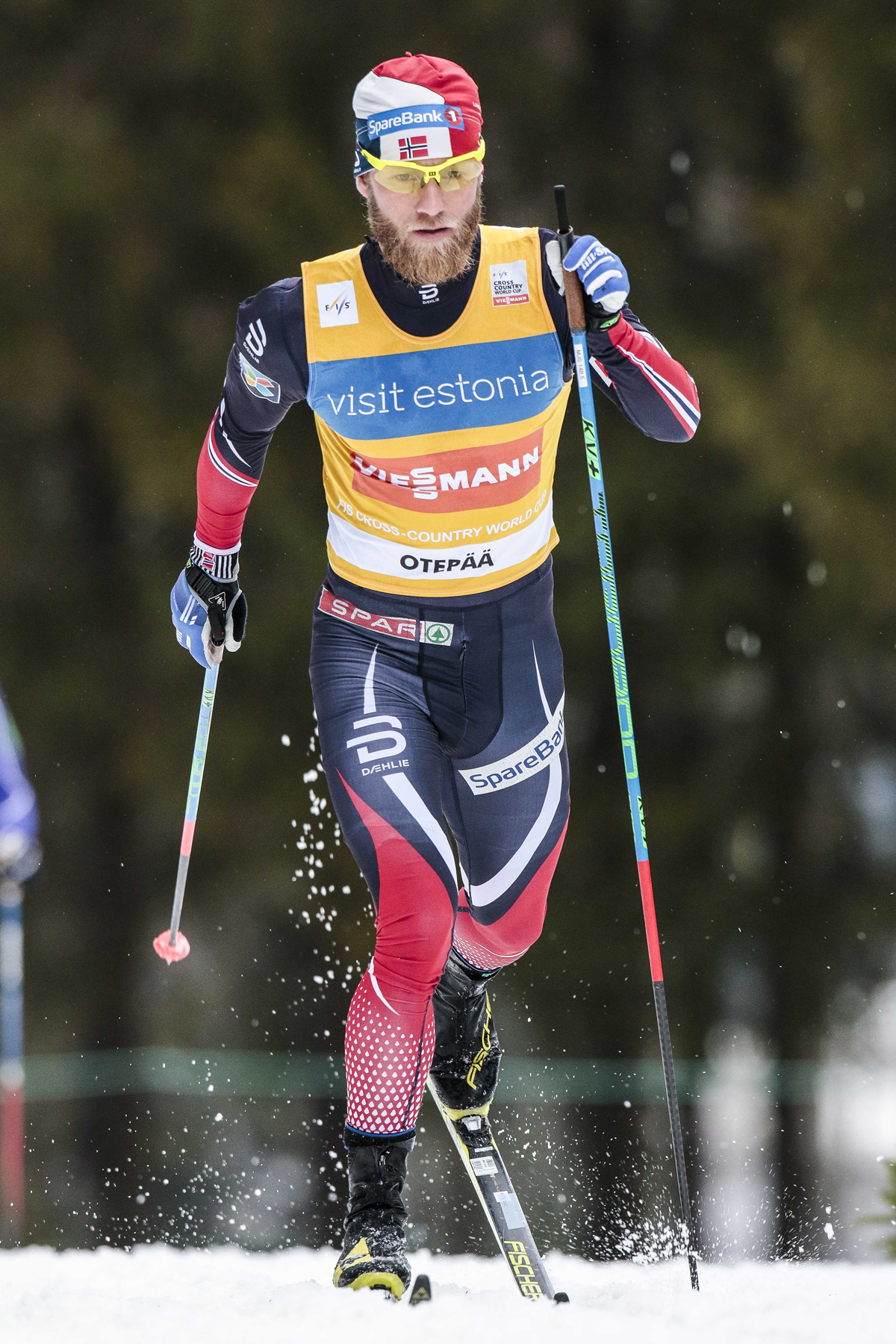
Norway’s Martin Johnsrud Sundby racing to a 37.1-second victory in the men’s 15 k classic on Sunday at the pre-World Championships World Cup in Otepaa, Estonia. (Photo: Fischer/NordicFocus)
It was the first time in years he felt really good and executed his plan for the entire duration of the race, Sundby told NRK.
“I have been in doubt this winter if I was going to get on the same level as last year,” he said, according to a loose translation. “I have not had the same feeling as I had occasionally had last winter. I’ve been looking for it, technically and physically, and today I am there.”
His first target race at World Championships in Lahti, Finland: the 30 k skiathlon on Saturday, Feb. 25.
With his first win in a month and fourth individual victory of the season (compared to 14 total wins last season), Sundby, the overall World Cup leader by 82 points over Russia’s Sergey Ustiugov, is feeling much better about his chances.
“Last month has been really good for me training,” Sundby said, according to an International Ski Federation (FIS) press release. “It was a difficult race. I had amazing skis. I had to look for high speed on the snow and constantly change positions. I was mentally prepared for an 18 k race.”
He started 70th out of 82 men in the 15 k. Through all eight checkpoints on FIS live timing, Sundby not only posted the fastest times, but was leaps and bounds ahead of anyone else on the rainy Otepää afternoon — with one exception.
Between 3.8 k and 5 k, Sundby appeared close to Finland’s Iivo Niskanen in second place, with a 5 k time that was just 0.5 seconds faster than Niskanen’s. But by 7.5 k, Sundby was more than 8 seconds clear of the 25-year-old Finn, who started 3 minutes ahead of him. At the finish, Niskanen, in bib 64, bumped Norway’s Niklas Dyrhaug (bib 56) out of the leader’s chair by 17.9 seconds. Another Norwegian, Hans Christer Holund (bib 66) came up 12 seconds short of Niskanen’s time after starting a minute ahead of him.
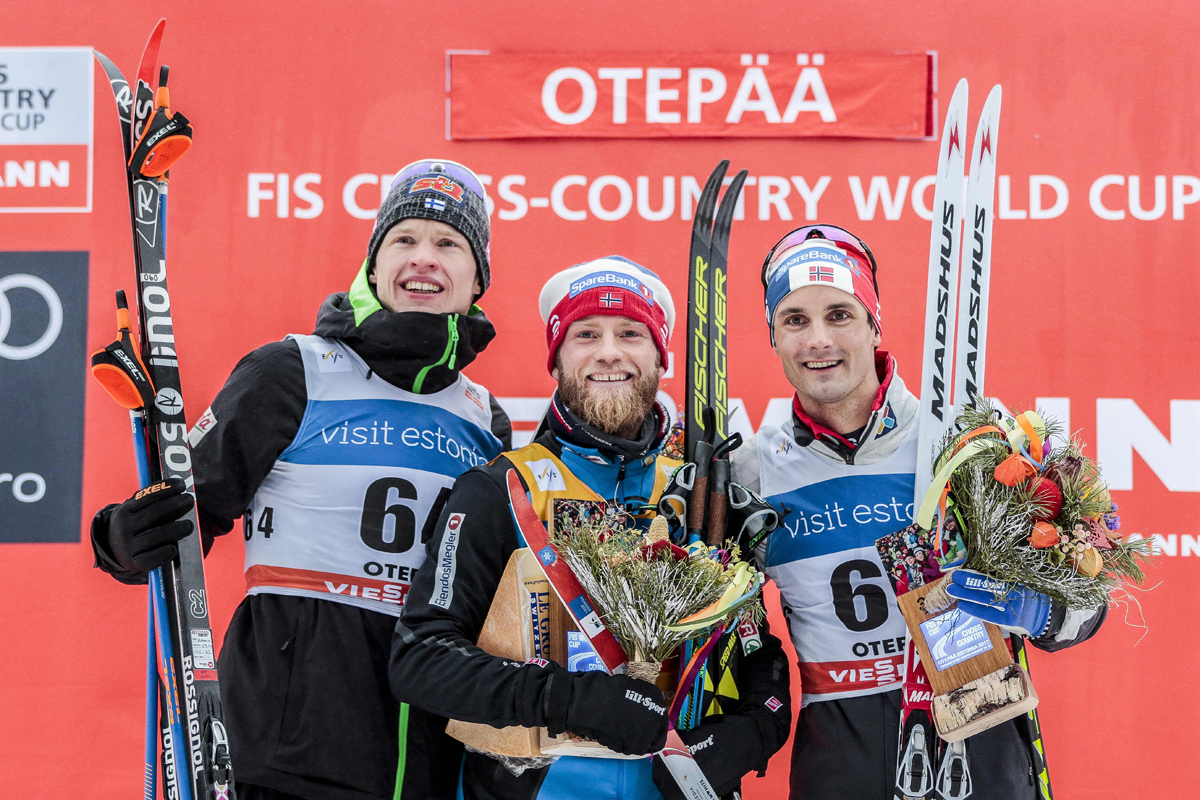
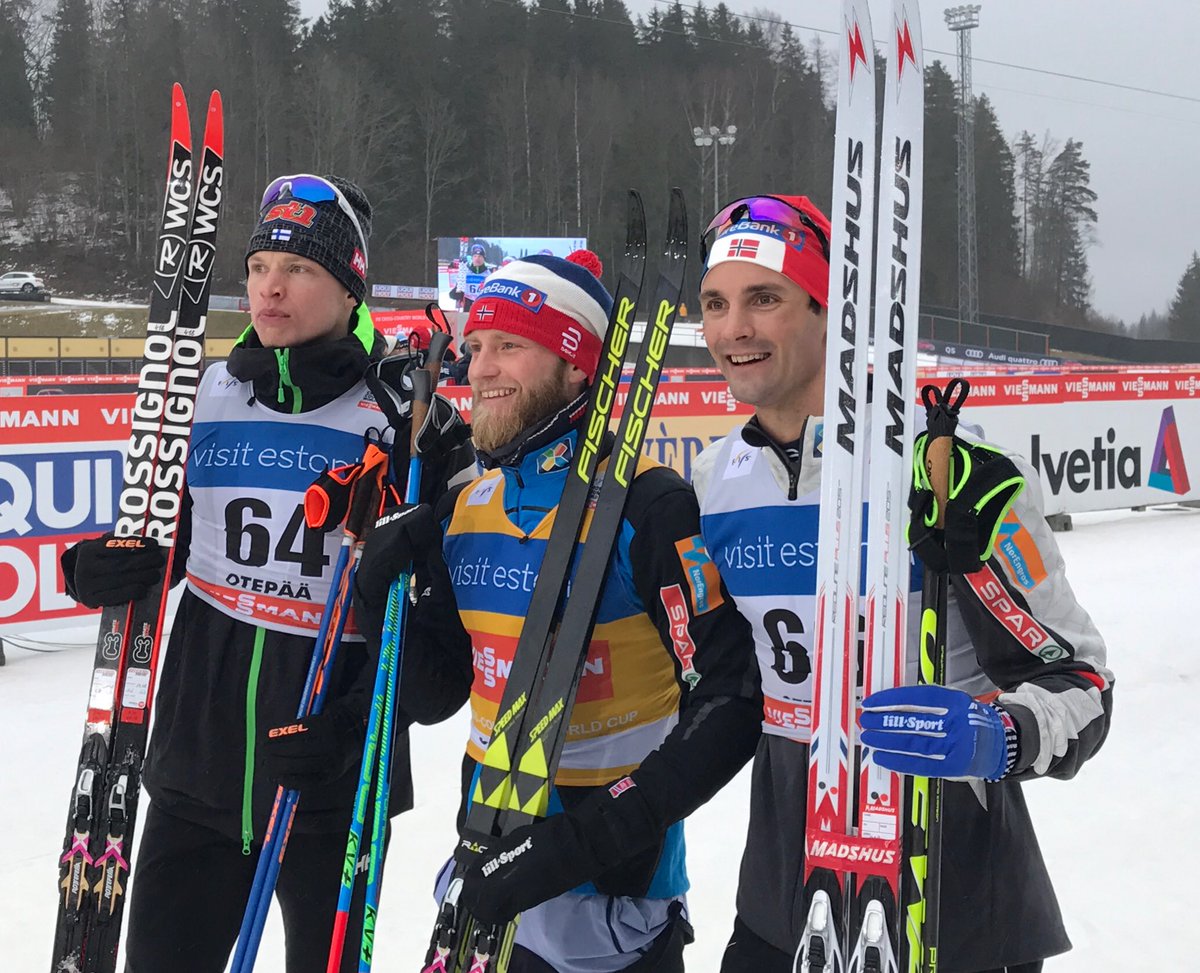
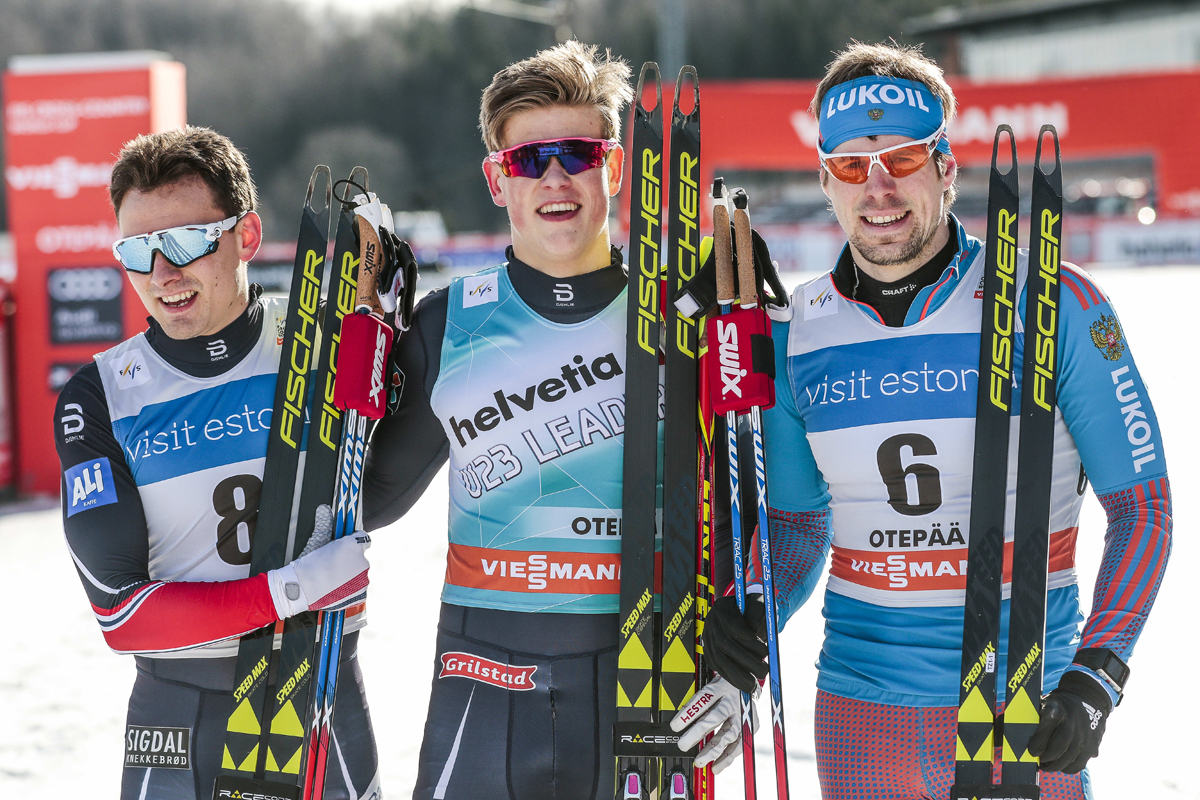
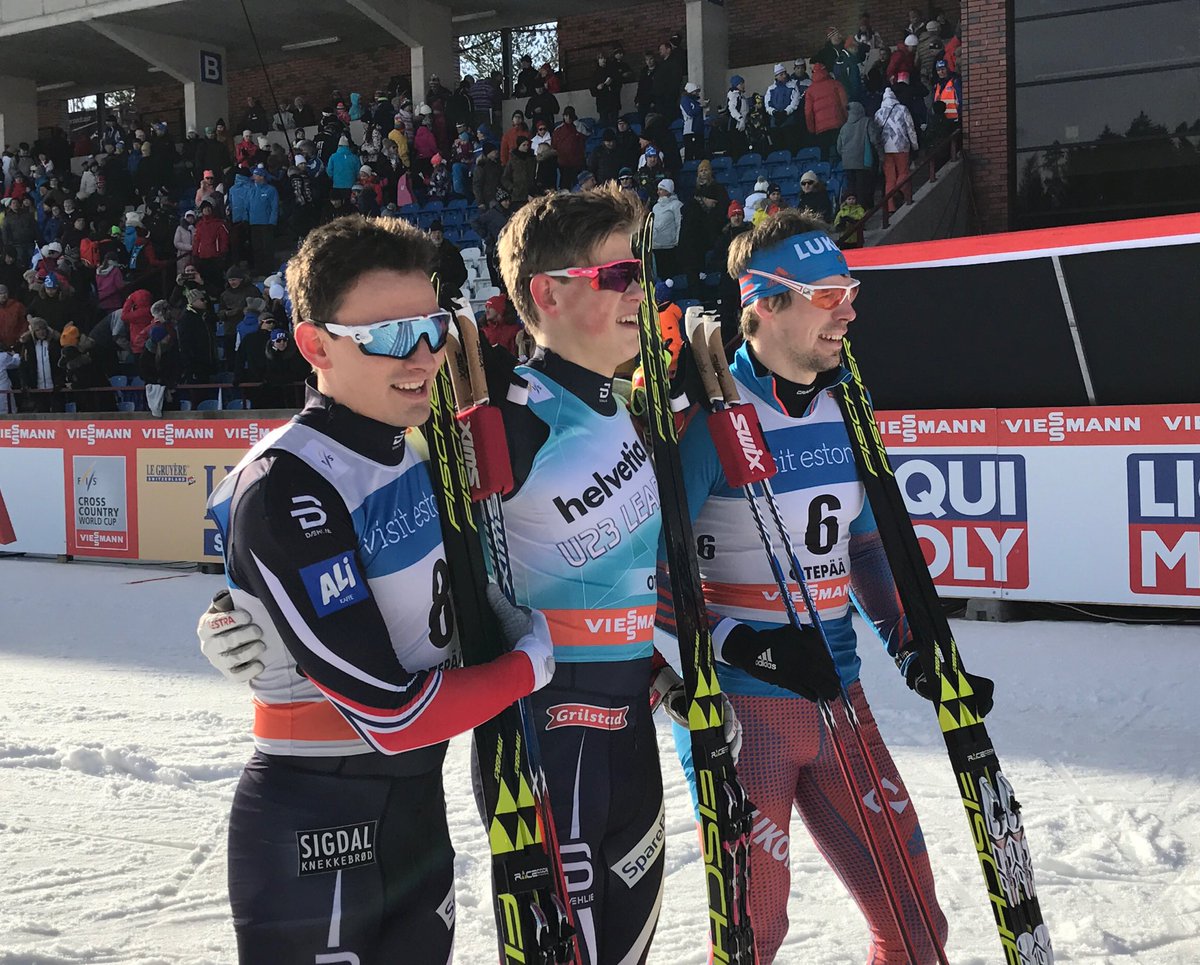
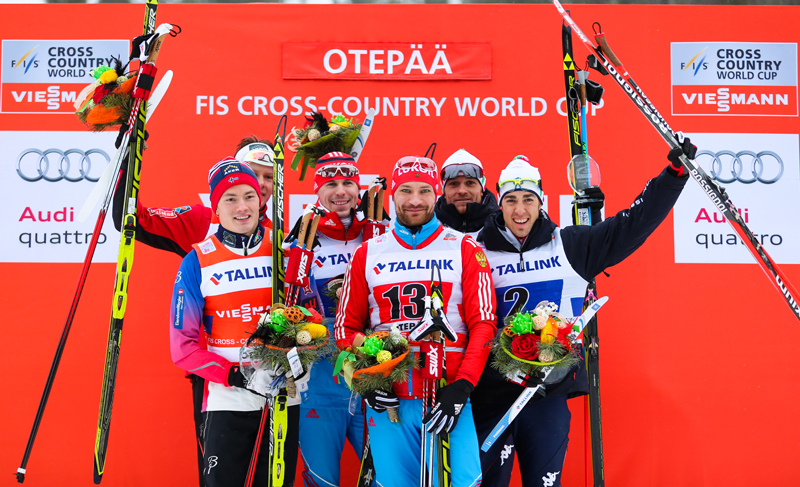
The men’s 15 k classic podium at the Otepaa World Cup in Estonia, with Norway’s Martin Johnsrud Sundby (c) in first, Finland’s Iivo Niskanen (l) in second, and Norway’s Hans Christer Holund (r) in in third. (Photo: Fischer/NordicFocus)
Dyrhaug had previously unseated Kazakhstan’s Alexey Poltoranin, who started 21st and held the lead for close to 20 minutes, before Dyrhaug finished 6 seconds faster.
Finland’s Matti Heikkinen, who started 68th, a minute ahead of Sundby and a minute behind Holund, snuck in the mix with a faster time than Poltoranin. Despite crossing the finish line just ahead of Sundby, Heikkinen was still 58.1 seconds off the Norwegian’s winning time of 40:38.2 minutes. Sundby’s time pushed Niskanen to second place (+37.1), Holund to third (+49.1), and Dyrhaug off the podium in fourth (+55.3). Heikkinen ended up fifth (+58.1), and Poltoranin sixth (+1:01.3)
“I still need to improve my level to be ready for the World Championships,” Niskanen said after, according to FIS. “First three kilometers were OK, then it was skiing like on a glue. It was a very tough 15 k.”
Holund, 27, was thrilled with third, which matched his individual career best from two previous World Cups last season.
“The third place means a lot for me,” Holund said, according to FIS. “I had a difficult last year with the injury. In the finish I could not believe I was third. It was probably the hardest 15 k I have ever skied. The course was hard and snow conditions made it even harder.”
Harvey 19th, Bjornsen 36th
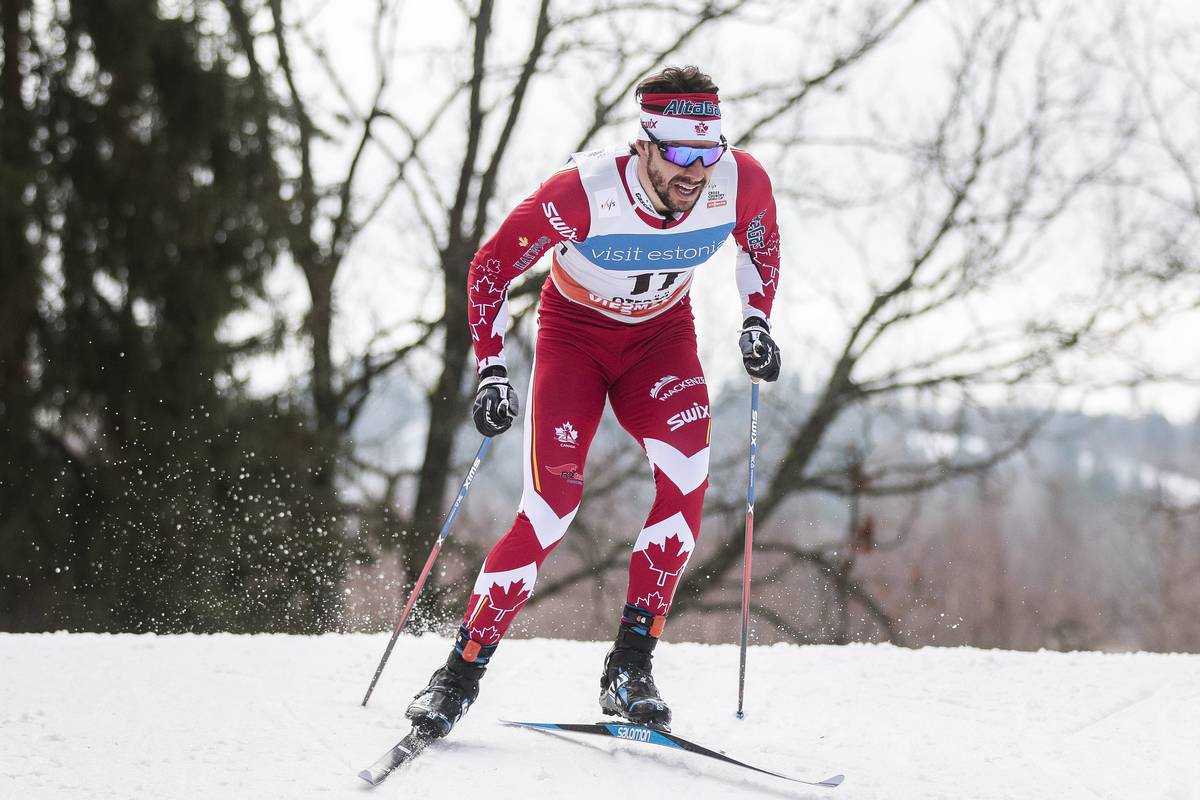
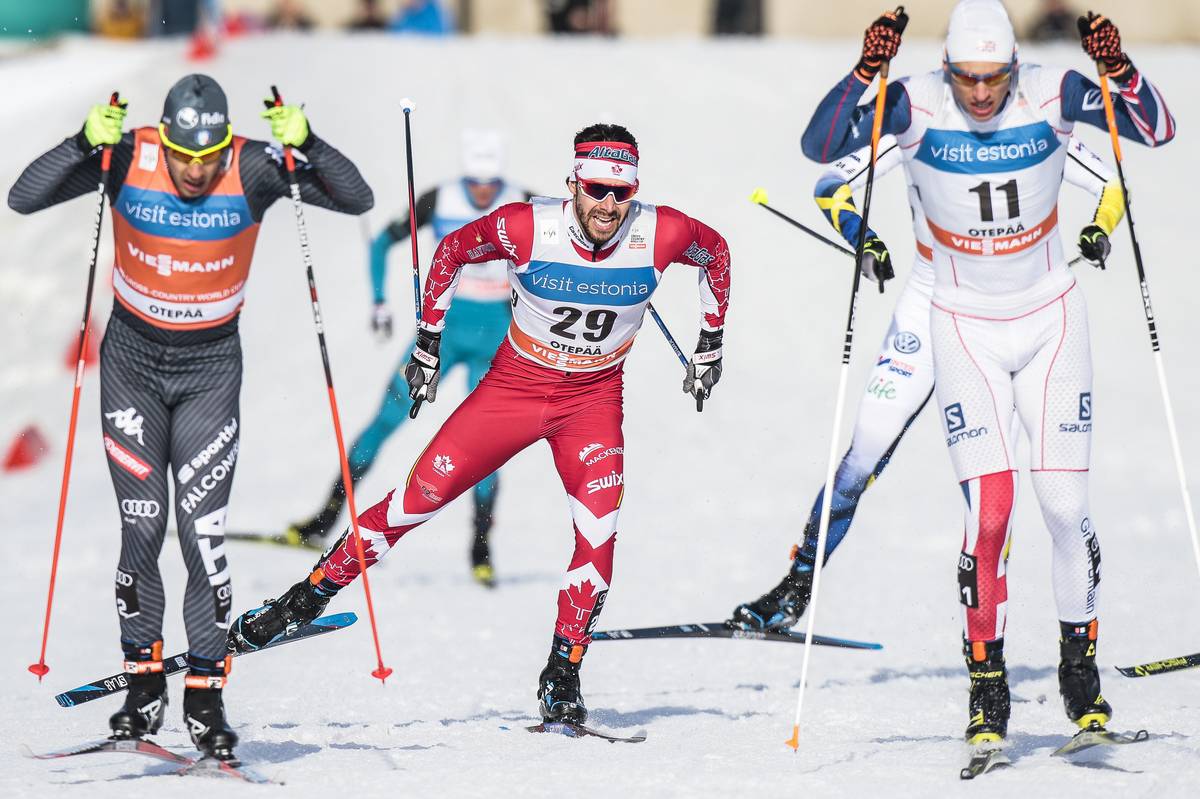
Canada’s Alex Harvey racing to 29th in the men’s freestyle sprint qualifier on Saturday at the World Cup in Otepaa, Estonia. He went on to place 15th overall on the day. (Photo: Salomon/NordicFocus)
Canada’s Alex Harvey led the North Americans in 19th, 1:50 behind Sundby. Harvey started 42nd and posted splits that ranked around the top 10 for the first half of the race.
“I felt like I was skiing within myself for the first 6km, then I got caught by Sundby who was starting his first lap,” Harvey wrote in an email to FasterSkier. “I followed him up the biggest hill of the course and it put me in the red, by 7.5km I had moved up from 11th to 5th in about 2km.”
There, Harvey’s time ended up being about 40 seconds slower than Sundby’s at 7.5 k, but within 10 seconds of fourth.
“Following Sundby like that who was on a crazy day and just starting his race proved to be too much for me, after that I blew up and just starting losing too much time,” Harvey wrote.
“I feel like if I played it a bit more conservative, i.e. not trying to get on Sundby, I could have held my position but I wanted a real hard session today since it’s the last one before Worlds so in that perspective it was a great day,” he added.
At World Championships later this week, Harvey, who’s currently fourth in the overall World Cup standings (97 points behind Heikkinen in third), will also be focusing on the skiathlon.
“My favorite race is the skiathlon,” Harvey wrote. “I’m excited for the two team events and of course the 50km. I will skip the 15km [classic].”
While Canada entered six men in Sunday’s race (including Len Valjas, who did not start), four finished outside the top 40, with Graeme Killick in 47th (+3:44.6), Devon Kershaw 49th (+3:51.3), Knute Johnsgaard 58th (+4:50.4), and Jess Cockney 72nd (+7:15).
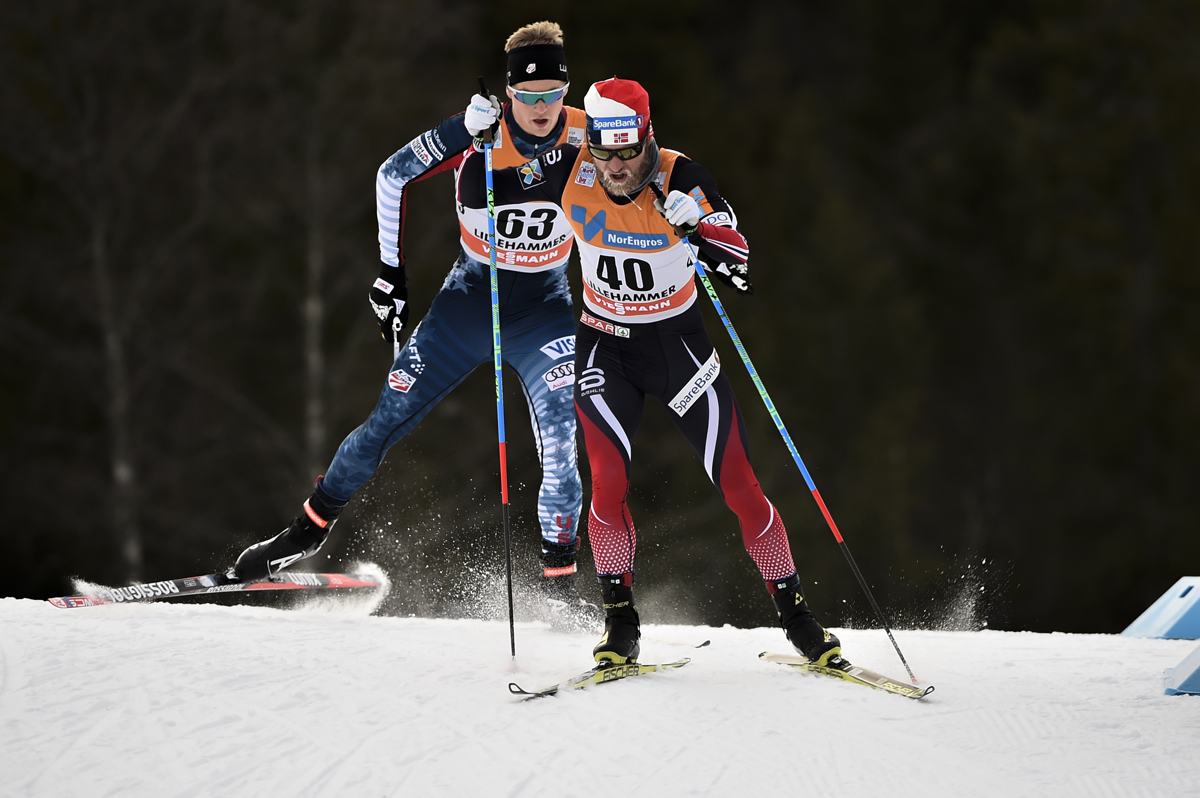
U.S. Ski Team member Erik Bjornsen chasing Norway’s Martin Johnsrud Sundby at a December 2016 World Cup in Lillehammer, Norway. Sundby went on to finish sixth in the men’s 10 k freestyle and Bjornsen was 45th. (Photo: Fischer/NordicFocus)
Two Americans competed, with Erik Bjornsen placing 36th (+3:12.1) and 24-year-old Ben Lustgarten finishing 66th (+5:34.1) in his second World Cup start.
“I was really hoping for a top 30 result today so when I fell short of that I was disappointed,” Bjornsen wrote in an email.
With split times that consistently ranked in the mid-30’s, his finishing time was about 45 seconds back from 30th place.
“I’m feeling close to being in form. Hopefully in a week it will come around,” Bjornsen continued. “I’m focused on the sprint and the distance races, hard to pick one out. I’ll skip the 50k this year but I’m looking forward to the rest!”
World Championships begin on Wednesday with 5/10 k classic qualifying races for athletes from “non-skiing” nations that don’t have enough FIS points to qualify outright for the championships. Regardless of their result on Wednesday (they need a top 10 to start the distance races in Lahti), every athlete can race the freestyle-sprint qualifier on Thursday — the first medal race of the championships. The women’s 15 k and men’s 30 k skiathlons will take place Saturday, followed by classic team sprints on Sunday, Feb. 26, before six more days of racing the following week.
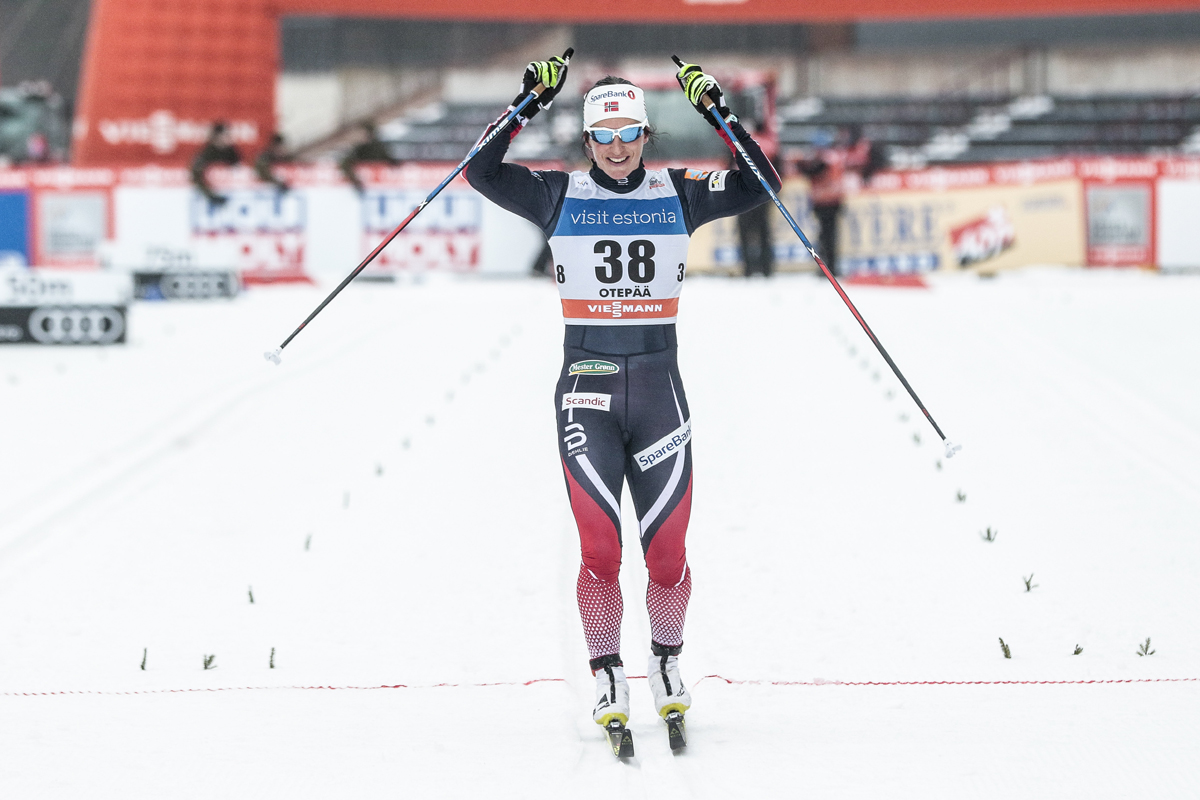
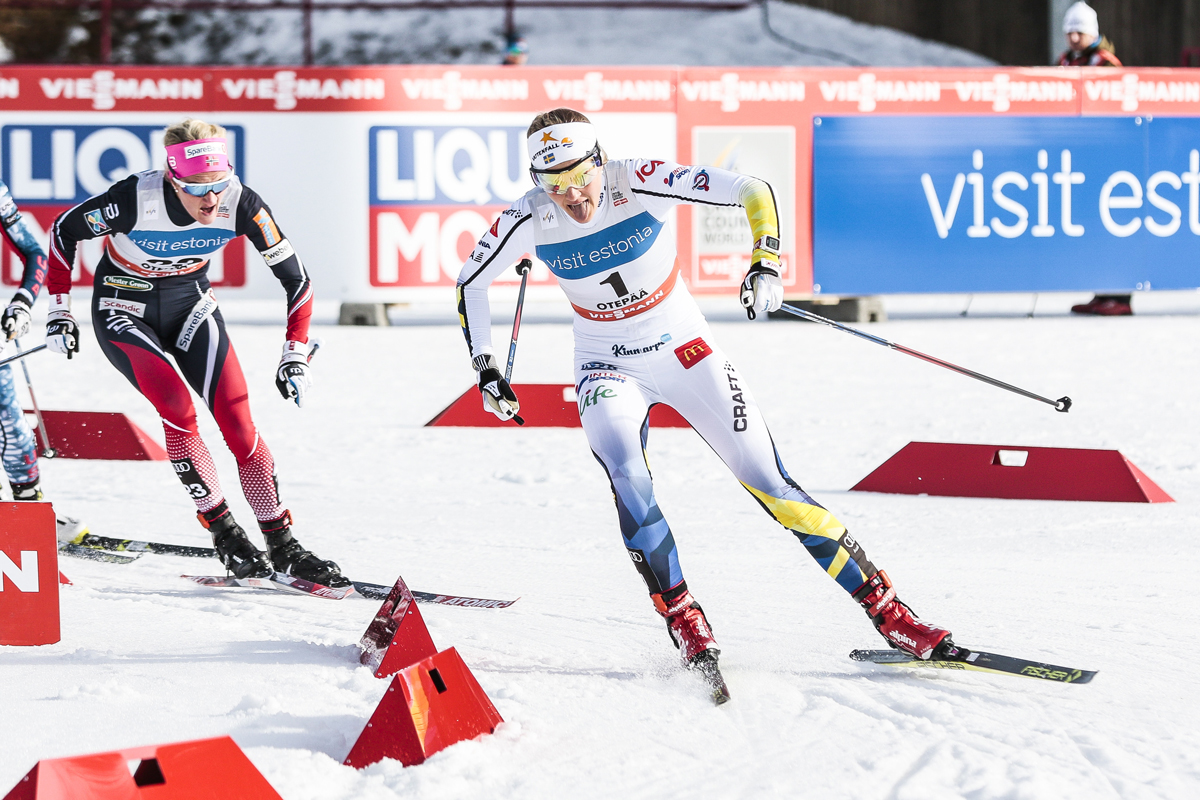
Norway’s Marit Bjørgen winning Sunday’s 10 k classic at the World Cup in Otepaa, Estonia. She beat runner-up Charlotte Kalla of Sweden by 26.5 seconds. (Photo: Fischer/NordicFocus)
“Visit Estonia,” it read on the bibs of all athletes in the women’s World Cup 10-kilometer classic individual start race, an advertisement by the tourist board of the Baltic country.
Unfortunately after experiencing beautiful weather for Saturday’s sprint, the town of Otepää — which on most days is indeed a paradise for all kinds of winter sports — was not able to present itself looking exactly like a picture out of a travel brochure on Sunday, with a misty sky and a steady drizzle thawing the snow around the venue.
Many of the cross-country skiers heading to the start gate in their warmup gear looked a bit despondent as they were signing the clear plastic board the International Ski Federation (FIS) usually presents to the hosts as a gift, while a staff member continuously tried to wipe big drops and puddles off the surface thereby probably erasing some hastily scribbled signatures.
Skiing two 5 k loops around the arena, the athletes began to look like wet grumpy cats, with the exhaustion further distorting faces as they conquered two steep climbs on the course, the longest ascending almost 60 meters.
Norway’s Marit Bjørgen racing to first in Sunday’s 10 k classic at the World Cup in Otepaa, Estonia. She won by 26.5 seconds. (Photo: Fischer/NordicFocus)
While it was not an easy race for anyone, some skiers struggled more than others. Starting in the middle of the field, Norway’s Marit Bjørgen used the rainy day to make it crystal clear who is still the queen of distance skiing. The currently suspended Therese Johaug might be the princess, and several young skiers can challenge the throne on a good day. But Bjørgen still, or rather again following her one-season maternity leave, rules them all.
Poland’s Justyna Kowalczyk — another veteran who managed to win the skiathlon in PyeongChang two weeks ago (though with a diminished starting field) and who won the 10 k classic distance in Otepää four times before — started strong, setting the best initial split times. Ultimately she would end the day in fifth (+1:19.7).
Then Norway’s current overall World Cup leader Heidi Weng set the best split times, and topped Kowalczyk’s finishing time by more than 20 seconds.
Next, the third Norwegian Ingvild Flugstad Østberg came to the finish (+1:17.4), significantly behind Weng but able to best Kowalczyk’s time by just over two seconds, pushing her to third for the time being. Østberg sped up along the course, and was 21.5 seconds behind Kowalczyk at the 7.5 k split before setting a blazing pace in the last section.
But when she had caught her breath crouching in the snow at the finish, Østberg could only look on and applaud as Bjørgen came into the finish with a huge lead, celebrating with her arms raised high when she crossed the line in a time of 29:59.0, and improving on Weng’s time by almost a minute.
“I had a good training in the last period,” Bjørgen later told FIS in an interview. “Already at the Norwegian nationals I knew I was in a good shape. Conditions were tricky today but the course was a good test before the World Championships.”
Her teammate Weng summed the day up succinctly in her interview with FIS, after Bjørgen had gapped her by 57.2 seconds: “Marit was amazing today. She was way too fast for me.”
And for everyone else.
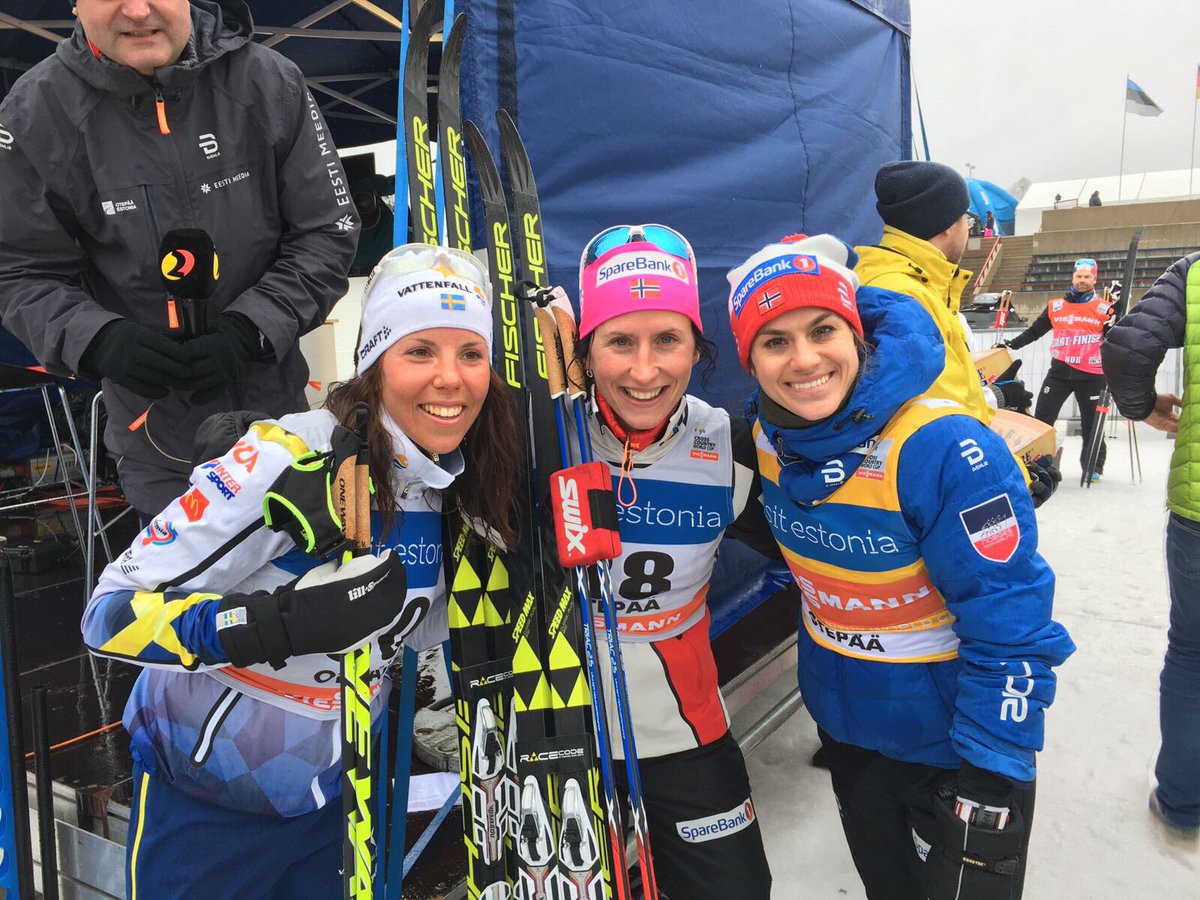
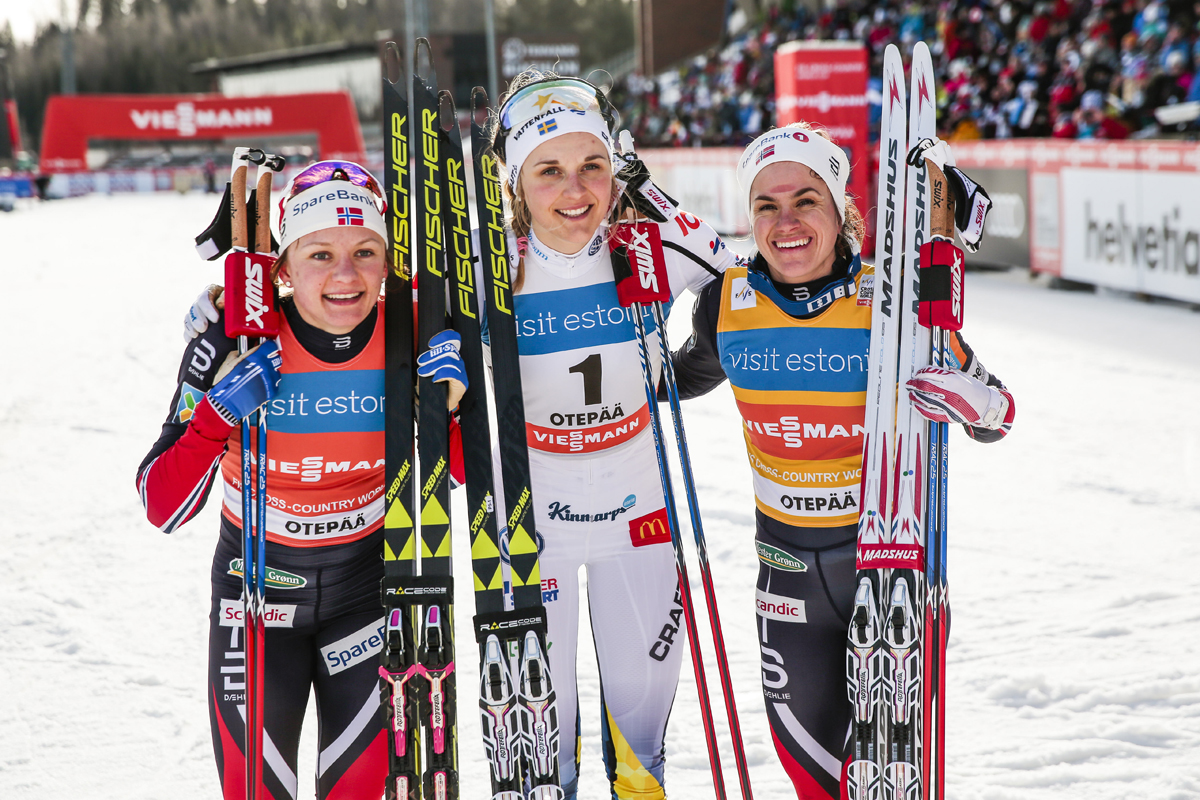
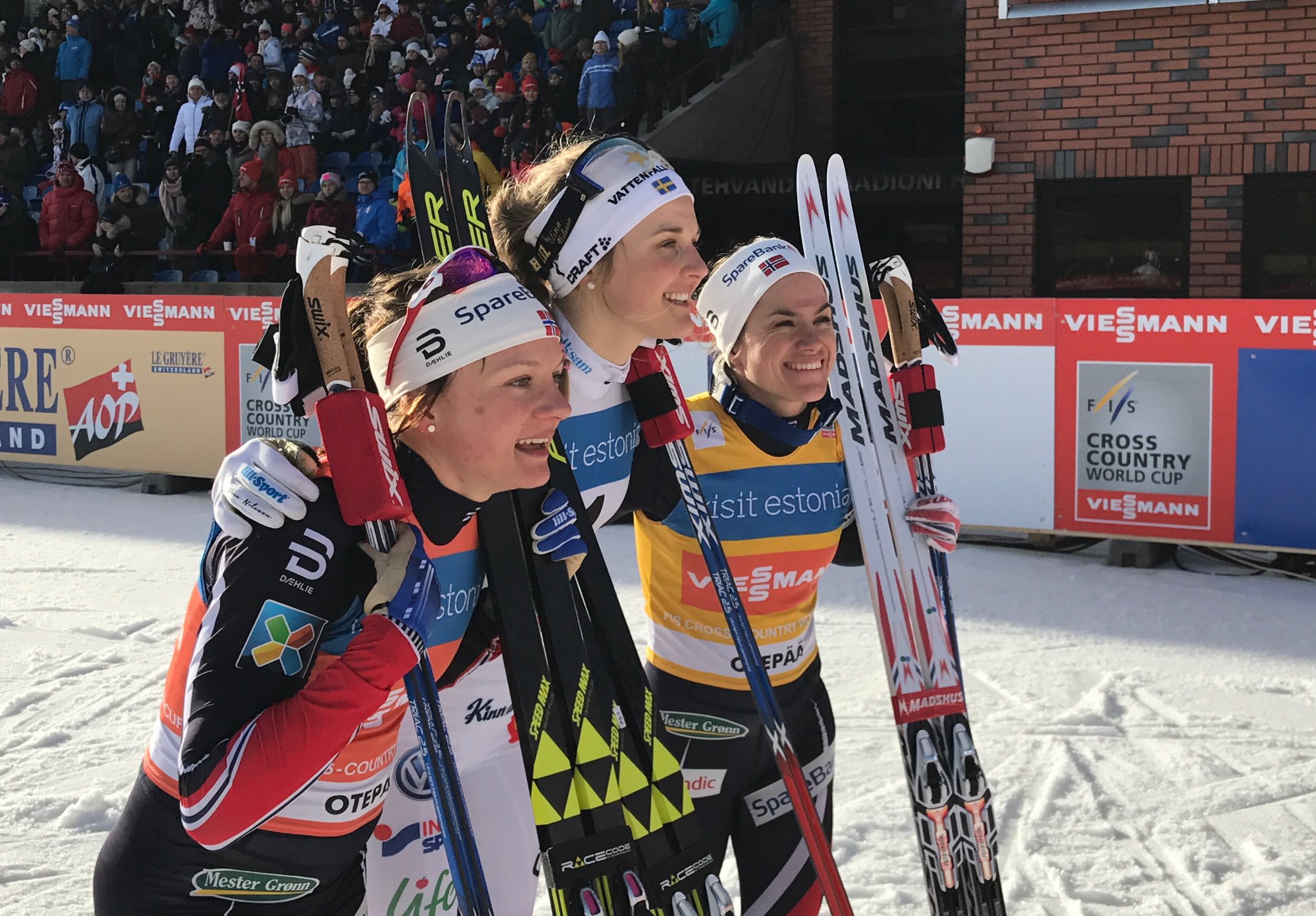
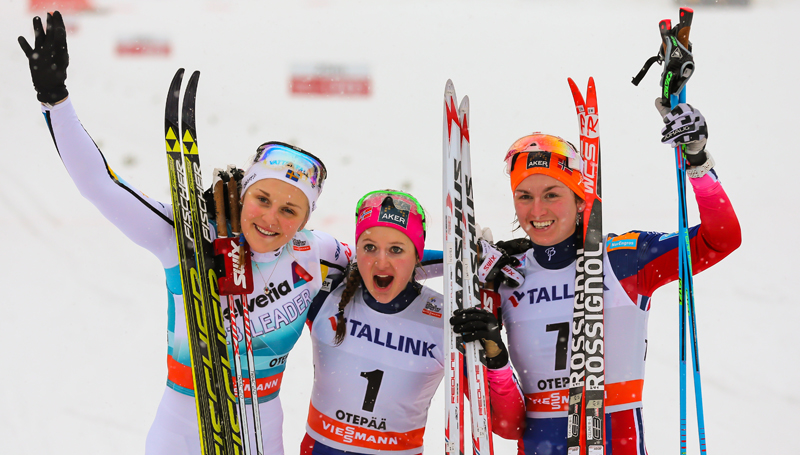
The women’s 10 k classic podium at the Otepaa World Cup on Sunday in Estonia, with Norwegian winner Marit Bjørgen (c), Sweden’s Charlotte Kalla (l) in second and Norway’s Heidi Weng (r) in third.(Photo: Fischer/NordicFocus)
Only Sweden’s Charlotte Kalla could prevent a Norwegian podium sweep at that point. Starting late in the field in bib 60, she improved on all the split times of Weng and Østberg. But she steadily lost time on Bjørgen, and with 2.5 kilometers to go was also already 26.6 seconds behind.
While Bjørgen watched the rest of the field from the comfort of the leader’s chair wearing a puffy blue coat with her legs covered by a blanket and munching on an energy bar, Kalla did not lose any more time on the last stretch into the stadium. She settled about halfway between the two Norwegian leaders to claim second place (+26.5), thereby pushing Østberg of the podium to fourth.
“I came to Otepää after a high-altitude training camp,” Kalla told FIS. “I felt very good today. I had amazing skis. The hills in Otepää are really tough.”
After Kalla struggled with health issues earlier this season, the 2015 world champion in the 10 k freestyle seems to be rounding back into shape just in time for the next World Championships in Lahti, Finland, which start Thursday. Finnish home-crowd favorite Krista Pärmäkoski was sixth on Sunday (+1:23.1), just behind Kowalczyk and Østberg.
But Bjørgen is the athlete to watch again in Lahti. While the mother of a 1 year old might not yet have her full sprint kick back, she certainly seems able to be at the top of the podium in distance races again.
And according to the statisticians at FIS, for the last seven World Championships, the winner of the final 10 k World Cup race before it also won that distance at the championships a few days later (although at the 2014 Olympics this trend was broken, with Bjørgen finishing fifth in Sochi).
“It was a very good feeling to take with me to the championships,” Bjørgen told Norwegian broadcaster NRK in a post-race interview. “I got the answers I was hoping for.”
She added that she feels more confident than for the championships in Falun two years ago, and when asked to rate her current confidence level on a scale of 1 to 10 heading to Finland, Bjørgen smiled: “This is enough for a nine. A little bit is still missing.”
Her opponents should still be worried.
Three Americans in the Points
On Sunday, U.S. Ski Team (USST) member Sadie Bjornsen had the best race of the North Americans, finishing in 19th (+2:30.5).
Sadie Bjornsen (U.S. Ski Team) racing to 19th in the women’s 10 k classic on Sunday in Otepaa, Estonia, the last World Cup before World Championships start this week. (Photo: Fischer/NordicFocus)
“It was a challenging day out there, but had some wonderful moments,” Bjornsen wrote in an email to FasterSkier.
She was excited that her game plan for the day had worked out well, skiing with Poland’s Kowalczyk who had started the race just one bib and 30 seconds behind her.
“I had a good start, and was expecting Justyna to catch me at some point during the race, because I know she is in really good form,” Bjornsen explained. “When she caught me I was determine to stay with her, and finish the race together.”
That happened somewhere between 3 and 4 k, but in this race Kowalczyk was a little bit too fast for her to stick with until the finish.
“Unfortunately, I had quite slow skis today, so wasn’t able to hold on as I was really hoping to,” Bjornsen wrote. “From there I tried to keep my head fighting, and do what I could. I feel confident heading into Championships, because I felt my form was there today. The result didn’t show it, but that is classic skiing. There are a heck of a lot of variables. If I get those parts dialed, I am really looking forward to some incredible opportunities to come!”
Unlike some other skiers who looked miserable in the wet conditions, Bjornsen’s teammate Rosie Brennan had no complaints.
“I actually enjoy classic skiing when it’s a bit sloppy as I think it plays to my strengths so I felt fine about the conditions,” Brennan wrote in an email. “The track held up fairly well all considering.”
Starting late in the field just ahead of Kalla, Brennan also took advantage of skiing with Kowalczyk at least for one loop, similar to the tactic Bjornsen had tried to use. And it might have worked even better for her.
“It was fantastic to start my race and realize Kowalczyk had just lapped through,” Brennan wrote. “I settled in behind her and enjoyed the ride and actually pulled away from her in the last kilometer of that lap.”
But when Kowalczyk skied into the finish, Brennan still had one more loop to go, and could only see her teammate Liz Stephen who had started 30 seconds ahead of her.
“The second loop was quite lonely and I had to keep mentally tough out there,” Brennan recalled. “I could see Liz ahead of me every now and then, but she never seemed to be getting closer so it was a challenging finish.”
Still, it was one of her best results of the season, finishing the race in 24th (+2:37.8). Brennan is now looking forward to her second senior World Championships with the U.S. Ski Team.
“I am satisfied with this race as it lets me know the training I did at home was good and I have good fitness,” Brennan concluded. “I still have one week until the distance races start at World Champs so I am excited to finish that preparation and hopefully get a little more pop in my body.”
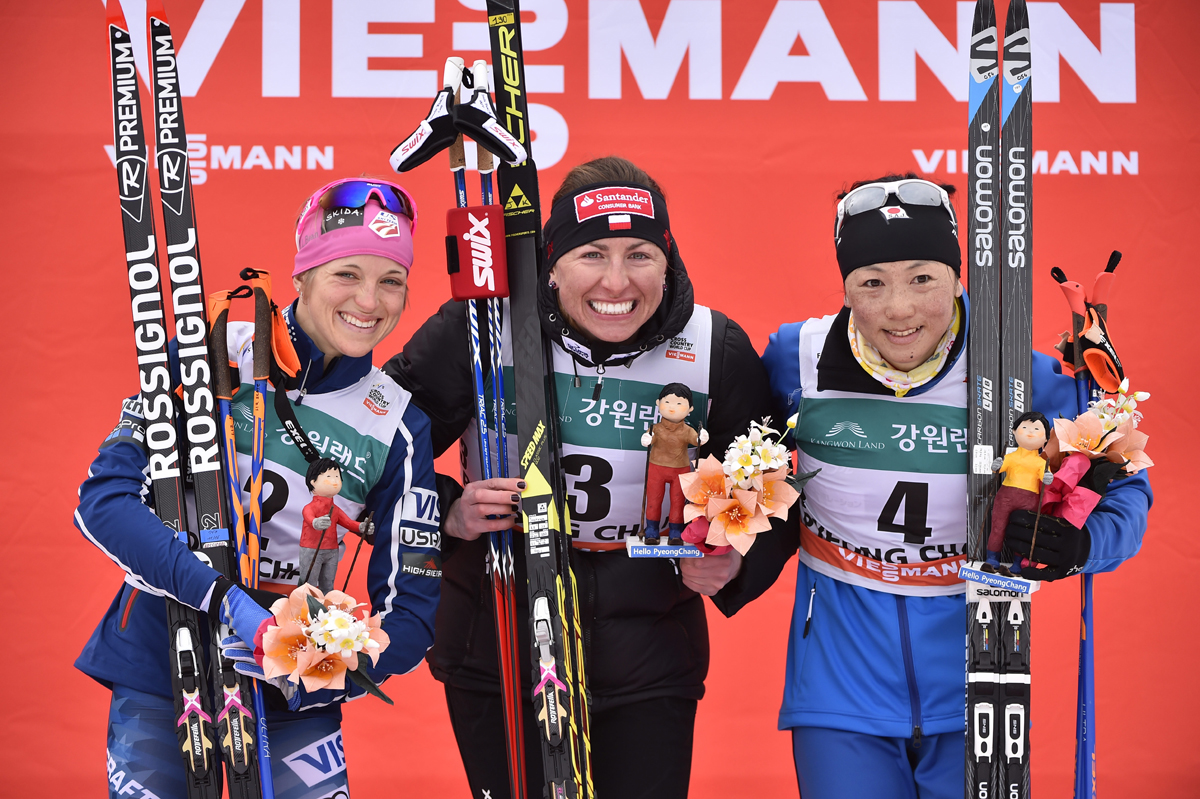
The women’s World Cup 15 k skiathlon podium on Feb. 4 in PyeongChang, South Korea, with Poland’s Justyna Kowalczyk (c) in first, American Liz Stephen (l) in second, and Japan’s Masako Ishida (r) in third. (Photo: Fischer/NordicFocus)
Maybe accepting the weather for what it is could be one of the secrets to a good classic race. Like Brennan, this is what the third USST member Stephen, who started in the last start group just one bib ahead of Brennan, also did.
“The conditions today were wet and a bit sloppy, but honestly, for the women’s race the tracks held up fairly well, so no complaints on my end!” Stephen wrote in an email. “I like klister skiing when it’s slushy and soft like this, so I like days like today!”
She explained that she mostly had to ski the race by herself.
“I was able to ski a tiny bit with (Germany’s) Steffi Boehler and Kalla passed me at the end of the first lap and I tried to hang, but she was really flying today,” Stephen remembered her race. “I didn’t realize Rosie was coming up on me until about 1k to go. I tend to look forward and not worry about who is coming up behind me, as there is enough to focus on ahead of me!”
Coming off a second-place finish in the PyeongChang skiathlon two weeks ago just behind Kowalczyk and now a top 30 in her less-beloved ski style in a stacked field, like her teammates Stephen is also looking forward to the next two weeks of racing.
“I am excited to head to Worlds,” Stephen concluded. “My big races are the 4x5k relay and the 30k skate, and with a good classic leg the skiathlon can go well too. Classic continues to be a weak point for me, so I will focus on skiing my best for that 7.5k in the skiathlon and then look forward to skating my way through the rest of the championships.”
“We have been watching biathlon worlds and alpine worlds and getting very inspired by our fellow teammates there, so we are all heading into the champs feeling great!” she added.
Also for the U.S., Kikkan Randall, Ida Sargent and Chelsea Holmes all started the race early getting some TV camera time, but then were not in the focus anymore for much of the race.
At the end of the day, Randall was only about 10 seconds out of the points in 34th (+3:04.7), while Sargent finished 42nd (+3:46.1), and Chelsea Holmes was 50th (+4:47.5).
Jessica Diggins, currently the highest-ranked American in the overall World Cup standings, would have started with bib 40 shortly behind Bjørgen, but she and her coaches opted for a rest day instead, due to her demanding program at World Championships.
Emily Nishikawa led the Canadian women in 40th place (+3:39), Dahria Beatty who started the race in bib 1 having to lead the way through the slush was 45th (+4:11.9), Cendrine Browne 54th (+5:09.2), and Katherine Stewart-Jones 57th (+5:37.1).
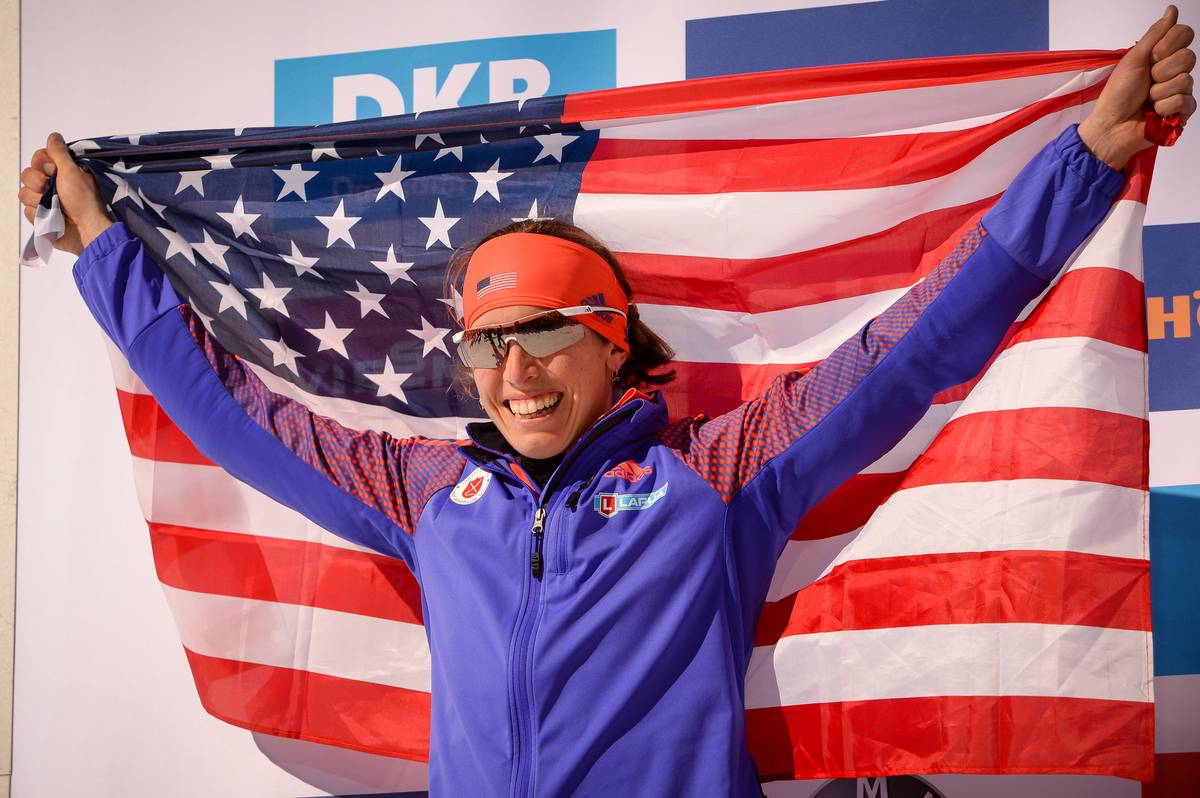
Susan Dunklee (US Biathlon) celebrating second place in the women’s 12.5 k mass start on the final day of 2017 IBU World Championships in Hochfilzen, Austria. It was her first World Championships medal. (Photo: US Biathlon/Twitter)
IBU World Championships (Hochfilzen, Austria): Women’s & men’s mass starts
Silver medal for Susan Dunklee. That’s the big news coming out of Hochfilzen, Austria, on the final day of the International Biathlon Union (IBU) World Championships after the American finished second, just 4.6 seconds out of first, in the women’s 12.5-kilometer mass start.
Dunklee started in bib 17 in the mass start and cleaned all 20 targets to put herself in the hunt for gold. She finished just behind Germany’s Laura Dahlmeier who took the win in 33:13.8 minutes, also with perfect shooting. Just three out of 30 women cleaned, with the other being Italy’s Alexia Runggaldier in ninth.
“I think my mistake a lot this season has been wanting the results too much,” Dunklee told FasterSkier after. “[I’ve been] slowly been coming to terms these last couple weeks, trying to focus more on the process and not worrying too much if the medal comes or not so that was a big trick today.”
Finland’s Kaisa Mäkäräinen reached the podium with a since miss in the first prone stage in third (+20.1). The U.S. had two women in the mass start, with Clare Egan finishing 24th (+3:04.1) with four penalties (1+0+1+2).
Lowell Bailey (US Biathlon) taking aim during the second prone stage of the men’s 15 k mass start on the last day of IBU World Championships in Hochfilzen, Austria. He cleaned all four stages to fight for the medals until the final loop, and ultimately finished sixth. (Photo: ARD broadcast screenshot)
[UPDATED] In the men’s 15 k mass start that followed, Lowell Bailey was in contention for a medal until the very end, after being one of three athletes to clean the four-stage race.
Bailey left the range for the last time in third, 16.8 seconds behind Austria’s Simon Eder in first and 14.5 seconds behind Germany’s Simon Schempp in second (both Eder and Schempp also cleaned every stage). Behind Bailey, Johannes Thingnes Bø had recovered quickly from a penalty on the last stage, and left the range in fourth, 8.4 seconds behind Bailey.
Early on the final loop, Bø caught Bailey to fight for a medal. Bø didn’t stop there, catching up to Eder as well after Schempp dropped the Austrian around 13.6 k. With about a kilometer remaining, Bø passed Eder and stayed ahead of him for silver, crossing 9 seconds after Schempp in first and 1.1 seconds ahead of Eder — who notched his first World Championships medal — in third.
Schempp hit all of his targets for his first individual World Championships gold in the final race of the championships, finishing in 35:38.3. Bø and Eder shared the podium with him, and Russia’s Anton Shipulin and France’s Martin Fourcade passed Bailey on the last loop for fifth (+25.3) and sixth (+31.3), respectively. Bailey finished sixth (+33.5) for his fourth top six (in as many individual races) at the championships, after notching a gold medal in the 20 k, fourth place in the sprint and sixth in the pursuit.
“I just told myself to hang as long as I could,” Bailey told FasterSkier after. “Unfortunately I only had four laps and the fifth was bru-tal as they say in Germany. But I’m so psyched with this whole world champs. I never cleaned a mass start and I never cleaned an individual and I just did both at world champs.
“I’m so happy for the team, for Susan,” he added. “Our whole team deserves this world champs. We haven’t shown what we’re capable of, there’s always been one setback or another … and the stars aligned for this one. We were waiting for this moment and everything clicked for the team and it’s so great to see, and god am I glad I stuck around to be here.”
FIS Cross-Country World Cup (Otepää, Estonia): 10/15 k classic
The women’s 10 k classic podium at the Otepaa World Cup on Sunday in Estonia, with Norwegian winner Marit Bjørgen (c), Sweden’s Charlotte Kalla (l) in second and Norway’s Heidi Weng (r) in third. (Photo: Gro Eide/FIS Cross Country Twitter)
Remember the days when Marit Bjørgen used to win by 30 seconds or more? Well, the Norwegian multiple-time world champion was nearly there again, racing to first in the women’s 10-kilometer classic individual start with a margin of 26.5 seconds to second on Sunday.
Bjørgen started in the middle of the pack, in bib 38, and bested the time of her teammate Heidi Weng by 57.2 seconds on the two-lap World Cup course in Otepää, Estonia.
That bumped Weng to second, and another Norwegian Ingvild Flugstad Østberg to third (+1:17.4), until Sweden’s late-starting Charlotte Kalla in bib 60 broke up the Norwegian sweep in second. Kalla finished 26.5 seconds shy of Bjørgen, but 30 seconds faster than Weng for the second spot on the podium. Weng ended up third for the second-straight day and Østberg fourth.
Also in the top 10, Poland’s Justyna Kowalczyk placed fifth (+1:19.7), Finland’s Krista Parmakoski was sixth (+1:23.1), Russia’s Anastasia Sedov seventh (+1:29.6), Sweden’s Anna Haag eighth (+1:50.7), Russia’s Yulia Tchekaleva ninth (+1:57.2), and Norway’s Astrid Uhrenholdt Jacobsen 10th (+1:57.8).
American Sadie Bjornsen finished in the top 20 in 19th (+2:30.5). Also in the points for the U.S., Rosie Brennan placed 24th (+2:37.8) and Liz Stephen 29th (+2:53.8). Kikkan Randall was about 10 seconds outside the top 30 in 34th (+3:04.7), Ida Sargent finished 42nd (+3:46.1), and Chelsea Holmes 50th (+4:47.5).
Emily Nishikawa led the Canadian women in 40th (+3:39), Dahria Beatty was 45th (+4:11.9), Cendrine Browne 54th (+5:09.2), and Katherine Stewart-Jones 57th (+5:37.1).
The men’s 15 k classic podium at the Otepaa World Cup on Sunday in Estonia, with Norway’s Martin Johnsrud Sundby (c) in first, Finland’s Iivo Niskanen (l) in second, and Norway’s Hans Christer Holund (r) in third. (Photo: FIS Cross Country/Twitter)
[UPDATED] Norway’s Martin Johnsrud Sundby dominated the men’s 15 k classic from start to finish on Sunday, starting near the back of the nearly 80-man field and clocking the fastest splits throughout the three-lap race.
He topped the previous best time set by Finland’s Iivo Niskanen by 37.1 seconds with a winning time of 40:38.2. Conditions weren’t easy on the rainy afternoon in Otepää, with tracks appearing shallow at best and visibly washed out in places.
Norway had two on the podium with Hans Christer Holund in third (+49.1). Niklas Dyrhaug was 6.2 seconds short of the podium in fourth, Finland’s Matti Heikkinen placed fifth (+58.1), Kazakhstan’s Alexey Poltoranin sixth (+1:01.3), Russia’s Alexander Bessmertnykh seventh (+1:02.5), Norway’s Sjur Røthe eighth (+1:03.5), Norway’s Didrik Tønseth ninth (+1:14.5), and France’s Maurice Manificat 10th (+1:21.3).
Canada’s Alex Harvey led the North Americans in 19th (+1:50). Graeme Killick finished 47th (+3:44.6), Devon Kershaw 49th (+3:51.3), Knute Johnsgaard 58th (+4:50.4), and Jess Cockney 72nd (+7:15).
Erik Bjornsen was the top American in 36th (+3:12.1) and Ben Lustgarten finished 66th (+5:34.1).
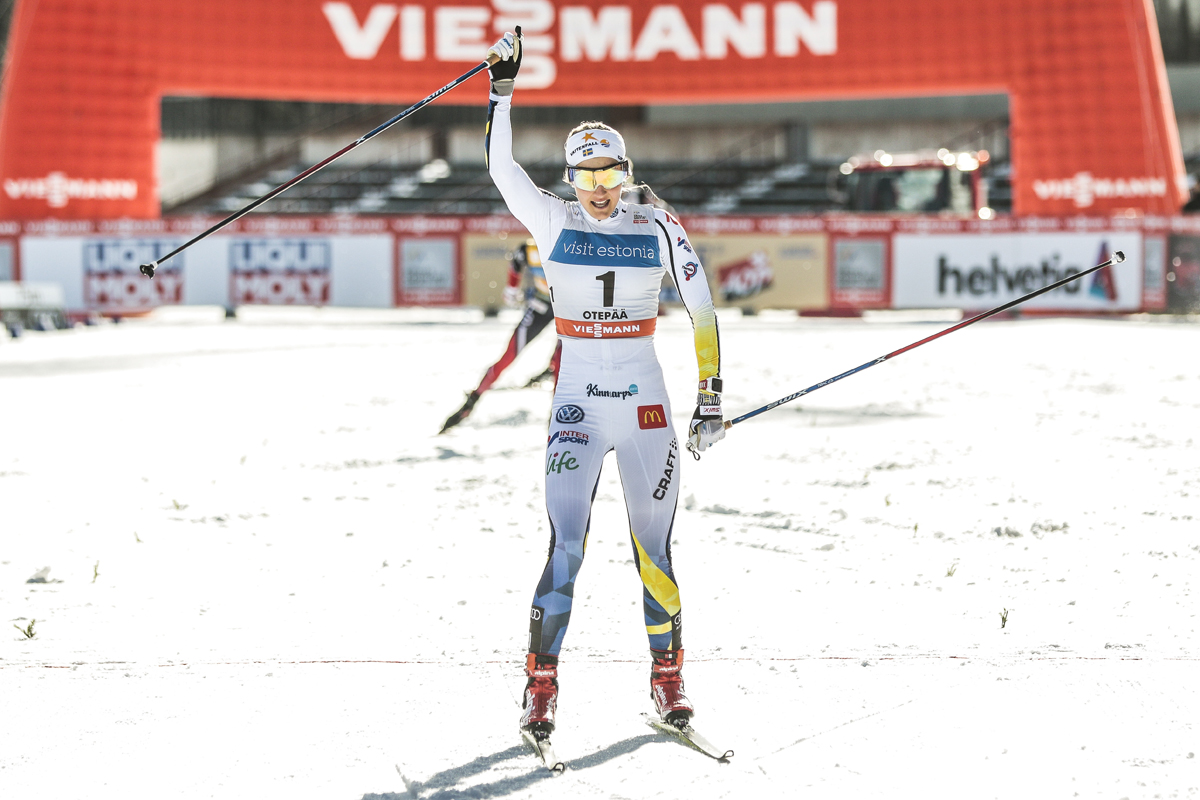
Sweden’s Stina Nilsson celebrates her 10th World Cup victory in two seasons (and seventh one this year) in the women’s 1.3 k freestyle sprint on Saturday in Otepää, Estonia. (Photo: Fischer/NordicFocus)
At 23, Sweden’s Stina Nilsson has nailed a business-like approach to World Cup starts. Standing 5-foot-9, she appears to tower over most of her competitors, and before her signature races (sprints) she appears deep in contemplation, definitely in the zone. During those races, she’s usually the one setting the pace, and afterward, she’s almost always celebrating at the finish.
So far this season, Nilsson has won seven World Cup races — including today’s freestyle sprint in Otepää, Estonia. Four of those were sprints, three of them skate sprints. She also established herself as an all-around threat at last month’s Tour de Ski, winning the 10-kilometer skiathlon, 10 k freestyle pursuit and 10 k classic mass start — nearly half of the stages.
And on Saturday at the pre-World Championships World Cup in Otepää, Nilsson proved she’ll be tough to stop in her quest for World Championships gold next week in Lahti, Finland. She previously racked up three silver medals at 2015 World Championships at home in Falun, Sweden. Two of those were in team events, one was in the classic sprint.
This year’s World Championships begin in earnest on Thursday, Feb. 23, with a freestyle sprint. And considering Nilsson has won the last three World Cup skate sprints she’s competed in (and has a career total of six skate-sprint wins, putting her ahead of Norway’s Maiken Caspersen Falla with five), she couldn’t be more of a favorite.
It didn’t come easy on Saturday, with temperatures in the mid-30’s Fahrenheit on a brand-new sprint course in Otepää.
“Every year we go to Estonia we joke about what the course will look like,” U.S. Ski Team Women’s Coach Matt Whitcomb said on the phone Saturday. “It’s actually not making fun of them, it’s admiring how they are trying to adapt their terrain to the direction to sprinting has gone.”
The men’s 1.6 k and women’s 1.3 k courses are harder, he explained, “and what they are trying to do is have something that will stand up to a classic sprint, even though today was skating with world champs coming up.”
Pair that with increasingly mushy snow, and you have a day where the finals came down to a slog-fest.
“There was no glide in the final in that [last] hill,” American Jessie Diggins, the lone North American to reach the final on Saturday, explained on the phone after. “It was like Alpe Cermis for me.” (Alpe Cermis is the final climb of the Tour de Ski.)
The Otepää World Cup women’s freestyle sprint podium on Saturday in Estonia, with Swedish winner Stina Nilsson (c), Norway’s Maiken Caspersen Falla (l) in second and Heidi Weng (r) in third. (Photo: Fischer/NordicFocus)
Nilsson, who had put herself in a position at the front or very close to it to win her quarterfinal, semifinal and ultimately the final, even said it was hard.
“There were difficult snow conditions on the track and it was hard to beat Falla,” she said, according to an Otepää press release.
In just about every World Cup sprint this season, Falla has been the other woman to beat. And in the last four skate sprints, including today, she’s been second. Before that, Falla won a skate sprint in Davos, Switzerland, where Nilsson missed qualifying in an uncharacteristic 31st. And in the two classic sprints at the start of the season, Falla finished second (behind Nilsson in the first race and her Norwegian teammate Heidi Weng in the other).
Notably, the 5-foot-3 Falla has placed in the top two in 11 out of the last 12 World Cup skate sprints she’s contested. With seven individual podiums this season and all but one putting her on the second step, you can imagine how hungry Falla — the 2014 Olympic freestyle sprint gold medalist — is for another win.
She won her quarterfinal on Saturday and placed second in her semifinal, 0.42 seconds behind Nilsson, before chasing Nilsson once again in the final. The two broke away on the final downhill, and Falla tried to make a move on the last tight corner to get around the Swede, but alas — another second place. Nilsson racked up her 10th individual World Cup victory in 2:49.96 minutes, and Falla was 0.27 seconds shy in second.
“In the final I did not have as good start as I hoped,” Falla said, according to a FIS press release. “It was difficult to find a good position. On the last climb I could follow Stina. Today’s second place is a good sign that my shape is getting better.”
Four U.S. Women Qualify in Top 12
Nilsson started the day by qualifying in first on Otepää’s one-lap sprint course, 0.6 seconds ahead of Norway’s Weng in second and 2.55 seconds ahead of American Kikkan Randall in third. Four U.S. women qualified in the top 12, with Sophie Caldwell in fourth (+2.6), Ida Sargent 10th (+3.47) and Diggins 12th (+ 3.93). Falla qualified seventh (+3.21).
Sweden’s Stina Nilsson (1) leads Norway’s Kathrine Rolsted Harsem and American Sophie Caldwell (far left, not shown) around a tight corner in the stadium of the women’s 1.3 k freestyle sprint at the Otepää World Cup in Estonia. (Photo: Fischer/NordicFocus)
Wearing bib 1, Nilsson went on to win her quarterfinal by 0.62 seconds over Caldwell before doing more of the same in the first semifinal, where she beat Falla. Early in the first quarterfinal, Caldwell found herself in third behind Norway’s Kathrine Rolsted Harsem and Nilsson, which was exactly where she wanted to be.
“I didn’t want to be leading in my quarter, but I wanted a clean start and then to settle into the front/middle part of the pack,” Caldwell explained in an email. “I tried to stay calm and conserve energy where I could to be able to have a strong finish. I wanted to hang as tight as possible to the leaders up the steep hill and over the top because I knew the draft could come into play. I think I executed my quarter just how I wanted to and my legs felt good enough to have a strong final stretch and finish 2nd.”
Caldwell edged Harsem by 0.09 seconds in a photo finish for second, and both advanced to the semifinal when Harsem earned a lucky loser spot. Nilsson and Caldwell raced in the first semifinal, where Nilsson led into the first of the two major climbs. Once again skiing in the middle of the pack, Caldwell stumbled about halfway up and had to work to catch back up to the group.
“I think I poled between my legs or on my ski or something and took myself out,” Caldwell wrote. “I recovered pretty quickly and was able to close the gap over the top of the first hill.”
By the time they reached the second climb, Norway’s Astrid Uhrenholdt Jacobsen had moved into first. Nilsson followed her in second over the top while Falla hung close in third.
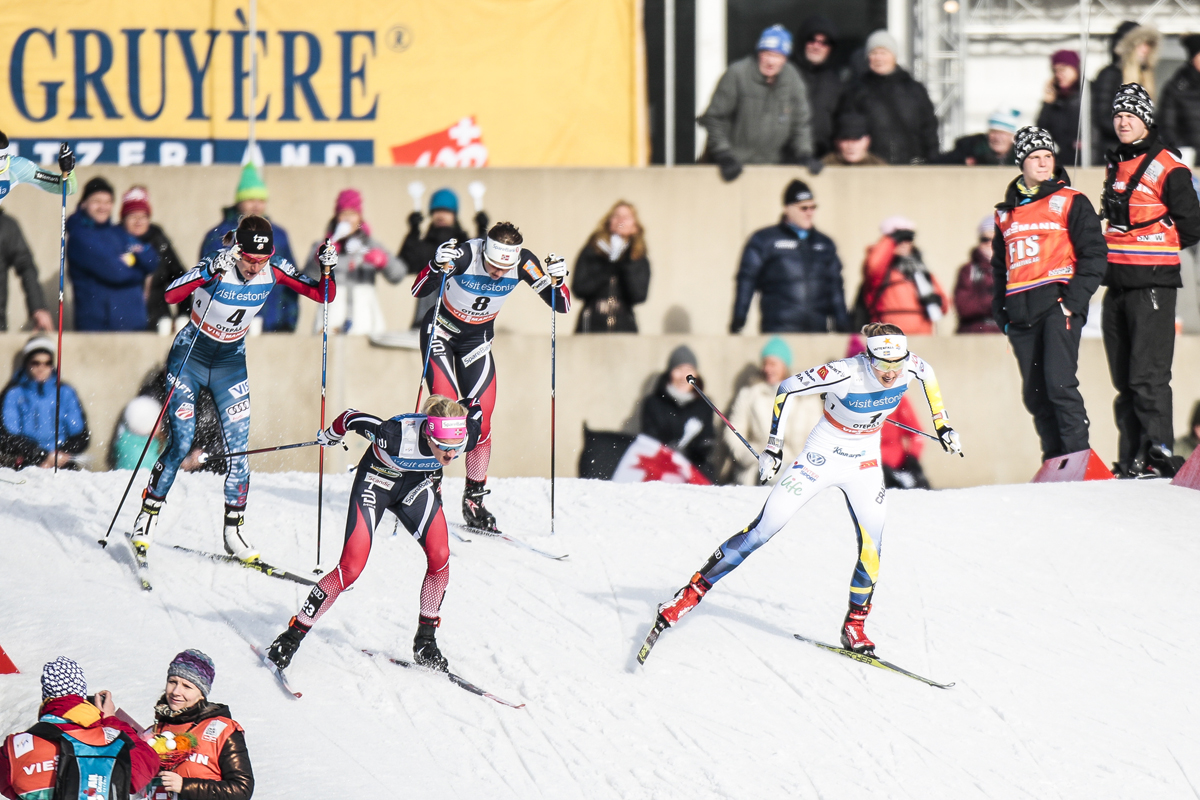
American Sophie Caldwell (4) and Norway’s Ingvild Flugstad Østberg (8) chasing Norway’s Kathrine Rolsted Harsem (second from l) and Sweden’s Stina Nilsson (r) in the quarterfinal of the women’s World Cup freestyle sprint in Otepää, Estonia. Caldwell edged Harsem in a photo finish for second, behind Nilsson in first, and all four advanced to the semifinals. (Photo: Fischer/NordicFocus)
“Going up the second hill, the top three opened up a little gap and I was behind Ingvild [Flugstad Østberg of Norway] and we were unfortunately just far enough back so that we didn’t benefit a ton from the draft,” Caldwell explained. “There are a few things I would do differently if I were to do it again (namely not to fall), but I was really encouraged by my energy out there today.”
Caldwell finished fifth in that semifinal, 1.83 seconds behind Nilsson, who had reclaimed the lead at the bottom of the long downhill into the stadium. Falla automatically advanced to the final in second, and Jacobsen advanced as a lucky loser in third (+0.75). Østberg took fourth (+1.64), just ahead of Caldwell, and neither advanced to the final. That put Østberg in seventh and Caldwell 10th overall on the day.
Diggins Wins Quarter + Semifinal
Meanwhile, Diggins — the winner of her quarterfinal — won the second semifinal as well, beating out Weng by 1.21 seconds. Sweden’s Hanna Falk placed third (+2.52) behind Diggins, Sweden’s Ida Ingemarsdotter was fourth (+3.8), Randall fifth (+13.3) after a late crash, and Harsem sixth (+21.37) after face planting on the last downhill in a separate incident from Randall.
Diggins automatically advanced to the final along with Weng, and Falk made it as a lucky loser.
In the final, Nilsson again took charge out of the start, while Weng clung closely to her in second. Jacobsen once again took the lead, this time up the first climb, but Nilsson made her move back into first by the final steep uphill. Falla chased Nilsson over the top, followed by Weng, Jacobsen and Diggins — in that order — on the descent. Having dropped everyone else on the last hill, Nilsson and Falla raced toward the finish line as a unit. Nilsson stayed ahead, Falla took second, Weng third (+3.75), Jacobsen fourth (+4.91), Diggins fifth (+6.82), and Falk sixth (+21.73).
“I could not have done it any better, so I’m very happy,” Nilsson told the Otepää organizers. “The course was very good and I would like to come back and race here again.”
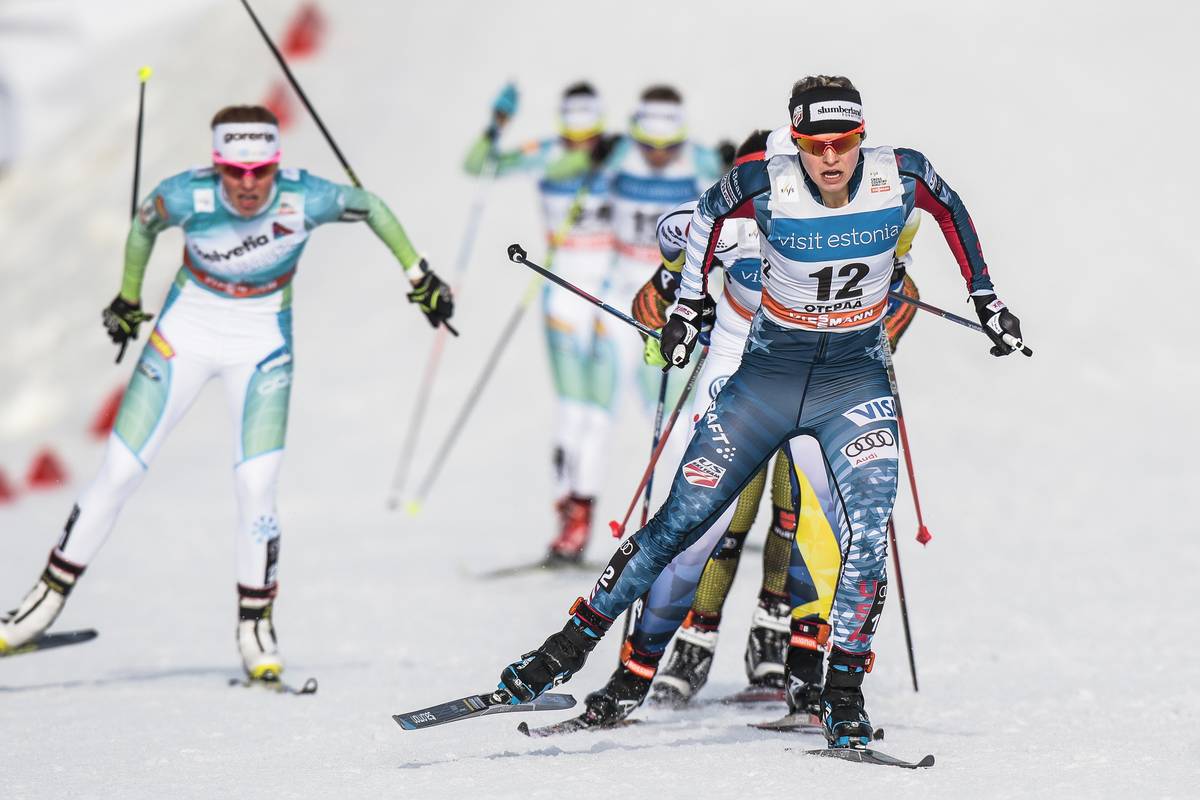
Jessie Diggins (12) racing to first in her quarterfinal, ahead of Sweden’s Ida Ingemarsdotter (directly behind), who finished second in that heat, in the World Cup freestyle sprint in Otepää, Estonia. Slovenia’s U23 leader Anamarija Lampic (l) finished third in that heat. (Photo: Salomon/NordicFocus)
While Nilsson and Falla had tested their tactics against one another in the semifinal, Diggins didn’t meet either of them until the final. The 25-year-old American had previously won her quarterfinal by leading from start to finish, then her semifinal by capitalizing on a slingshot draft on the last downhill.
“In my quarter, I just wanted to stay out of trouble,” Diggins explained. “It’s a course where it’s hard to pass and with deep snow and icy spots, I saw a lot of potential for danger, so I wanted to stay way out anything that my happen. The best way to ensure that is to get way out in front. And it burns a lot of energy and I paid for it later in the final.”
She added that the biggest hill — the last, steep one that Diggins called the “headwall” — proved especially challenging because it required a different technique, namely jump skating.
In the semifinal, Diggins said she got stuck behind the wrong person on the way up that climband came out of it in fourth. Meanwhile, Randall had taken the lead by the top.
“I was actually proud of myself for mentally not counting myself out,” Diggins said. “Just saying, ‘OK, I’ll use the slingshot, downhill’s a big strength of mine, so I’m just going to get back in it.’ ”
That’s exactly what she did. Diggins shot wide around the last corner and surged into first, ahead of Randall, Weng, and Falk. Coming out of that corner and toward the finishing stretch, Randall lost her balance on the way up a small hill over a tunnel and fell out of contention.
“Right after Jessie passed me I was taking the inside line into the corner and then lost my balance on an ice patch and my weight went out the back,” Randall wrote in an email. “Thought I almost saved it for a split second and then my skis came out from under me. It was totally my fault but a real bummer. I was feeling strong and ready to be in the final.”
Meanwhile, Diggins gained some confidence with her semifinal win.
“It was a good moment for me realizing that I can execute good tactics. I don’t just have to put my head down,” she said.
In the final, Diggins wasn’t sure of the best move on the final uphill.
“I had this moment of hesitation at the bottom as to who do I follow? Do I follow her? It’s kind of like you are picking your security line at the airport, which line to I get in to go the fastest?” she said. “I think that moment of hesitation definitely cost me, but then when they went, it was really quick and I was not technically able to go. I was just like stepping as hard as I could, but I think I needed to be more like a hop skate in order to go. After that, I just worked on preserving my spot.”
After being gapped, she said it was tough mentally to finish the race in a solid position.
“I was just trying to work on pushing, I really need to practice for Lahti, so get in there,” she said.
Diggins said she has a “pretty ambitious race schedule” planned for Lahti World Championships, and while she couldn’t say which races she’ll do, she intended to sit out Sunday’s 10 k classic individual start to rest up for next week.
“To pull it off, I need to come into it quite rested,” Diggins, a 2013 freestyle team sprint champion and 2015 individual silver medalist, said of her World Championships goals.
Kikkan Randall (U.S. Ski Team) racing in the heats at the World Cup freestyle sprint in Otepää, Estonia. She reached the semifinals for ninth overall. (Photo: Fischer/NordicFocus)
While Diggins ended up fifth overall and Caldwell 10th on Saturday, Randall had her second-best individual result of the season in ninth, and it all started with her being the third-fastest qualifier.
“That qualification would have beat some of her performances from when she was at the top of her game,” Whitcomb said. “I can’t help to wonder if she is back at the top of her game.”
“To be able to lay down a fast qualifier like that gives me confidence that I’ve made it one step closer to the kind of race form I had when I was contending for wins and podiums in every skate sprint,” Randall wrote.
In her quarterfinal, Randall initially finished third, 0.3 seconds behind Jacobsen, who won that heat. Russia’s Natalia Matveeva finished second, but was relegated to last (and 30th overall) for obstructing Randall. According to Randall, she experienced two instances of obstruction in that heat.
“Coming into the stadium I tried to make a move on the outside and Matveeva abruptly moved over in front of me as I came up alongside her,” she wrote. “So I reset and tried to set myself up on the final turn. But then she cut across me again and I lost all my momentum.”
Randall asked her coaches to file a protest. After reviewing the video, the jury deemed Matveeva’s first cut-off grounds for a penalty. Thus, Randall advanced to the semifinals in second place.
In her semifinal, Randall resolved to be more aggressive to ensure better positioning.
“Even after a not-so-great start again, I made a push to get up closer to the front,” she wrote. “I skied the downhill 180 corner pretty well and got my own lane up the steep climb and was able to make a move over the top. Jessie followed me and came flying out of my draft as we came toward the stadium.
“I was definitely bummed have missed out on the chance to test myself against the best in the final today but I am really encouraged with how I felt all day,’ she added. “I learned some good tactical lessons and I am really looking forward to another chance in a few days!”
Randall was listed to start Sunday’s 10 k classic.
Also listed for Sunday’s race are Sargent and Bjornsen (among other U.S. women), who placed 13th and 20th overall, respectively, on Saturday. After qualifying in 10th, Sargent looked poised to win her quarterfinal before she ultimately finished third (0.35 seconds behind Falla) and did not advance.
“For the quarterfinal my strategy was to stay near the front and stay out of trouble and try to stay in contact going into the downhill,” Sargent wrote in an email, adding that she wanted to stick with Falla.
But feeling especially excited and strong, she decided to go for it and take the lead soon after the start. On the last climb, Falla attacked over the top and led into the downhill. Sargent followed, taking a few extra skate steps to rein Falla back in.
“Sometimes I don’t think I work the graduals enough so I made an effort to push a little longer going into the downhill and I think that gave me the power to pass Maiken on the downhill,” Sargent described. “I was proud of myself for holding my line and and skiing with confidence in the heat which is another thing that I’m working on But then unfortunately my legs were really flooded in the finish stretch and I lost the crucial time there. So I feel I’m really close but just need to keep working to have that extra couple tenths of a second.”
“10th in the qualifier is definitely one of my best if not my best qualifiers for a full World Cup field,” she acknowledged. “… We had insanely fast skis today so the techs did some magic work and that was a huge help making it such a great day for the team.”
In the same quarterfinal as Randall, Bjornsen finished fourth, 2.82 seconds behind Jacobsen. In an email, Bjornsen wrote that her qualifier was slower than usual, “I think due to searching for my sprint gears and seemingly making the wrong ski selection.
“I was looking forward to the heats, because I know my energy is feeling well, I just needed to find that speed,” she added. “I had a great start, and tried to stay light in those really deep snow conditions. As we rounded the far side of the course and headed back up the really steep climb there, I tripped over some snow, and really got bogged down. It was one of those ‘wall climbs’, and I seem to need some work on that particular grade. That is where I lost contact with the leaders, and then didn’t manage to find the steam to come back to them unfortunately.”
Bjornsen explained that Saturday’s race was her team’s qualifier for the World Championships sprint, “and I unfortunately wasn’t able to make it,” she wrote. “I haven’t quite found my groove that I know I am capable of with sprinting yet this year, but I keep looking forward to it every time I try, because I think it is a small adjustment that I am on a search for. On the other hand, I still feel really good about my energy and fitness right now, so I am looking forward to tomorrow with great excitement. An individual classic 10k is a great race for me, and I can’t wait to take on this challenging course!”
Canada’s Beatty 29th
Canada’s Dahria Beatty nabbed the last qualifying spot in 30th and went on to finish sixth in her quarterfinal, 9 seconds behind Weng (who won that heat) for 29th overall. Beatty last competed at U23 World Championships in Utah, where she recorded three top-20 results. In the two weeks since, the 22-year-old Canadian U25 Team member has been in Canmore, Davos, and Otepää since Thursday. After this weekend, Beatty will travel with the team to Lahti to compete at senior World Championships.
“The course was a really hard one, the snow was soft which made it even more challenging and the final climb is really steep,” she wrote of Saturday’s race. “I managed to survive the steep pitch in my qualification but in the heats it had softened a bunch and that’s where the pack really got away from me. Something else to add to the list of things to work on!
“I was really happy to be back in the top-30 my first race back in Europe,” Beatty added. “My legs have been feeling a bit heavy the past week with all the travel but this was a really solid place to start the next period of racing and I think my body will be feeling all ready to go by next Thursday. I am confident in my fitness right now and I am really looking forward to experiencing my first World Championships!”
Canada had two others in the women’s race, with Cendrine Browne placing 48th and Katherine Stewart-Jones 49th.
The U.S. had a total of seven women compete on Saturday, with Chelsea Holmes and Rosie Brennan finishing 58th and 60th, respectively. Of those seven, four qualified in the top 12 and five finished the day in the top 20.
“It is incredibly competitive out there…,” Whitcomb said. “I think it means that we have a team that is operating at peak form and is ready for the championships.”
Norway’s 20-year-old Johannes Høsflot Klæbo won his first World Cup on Saturday in the men’s 1.6 k freestyle sprint in Otepää, Estonia, while Russia’s Sergey Ustiugov (6) placed third. (Photo: Fischer/NordicFocus)
Johannes Høsflot Klæbo is young enough that he could have started at the U23 World Championships in Soldier Hollow, Utah, earlier this month. And the 20-year-old Norwegian probably would have done well there.
But the 2016 Junior World Champion in the freestyle sprint and 10-kilometer classic races held in Râsnov, Romania, already has his sights set much higher this season, targeting next week’s senior International Ski Federation (FIS) Nordic World Ski Championships in Lahti, Finland.
And on his steep career ladder progression, he took another important rung on Saturday by stepping on the top of the podium for his first World Cup victory in the men’s 1.6 k freestyle sprint in Otepää, Estonia. In the final, Klæbo pushed hard right out of the start gate and never relinquished his lead, crossing the line first in convincing fashion in a time of 3:06.53. He also won the qualifier earlier in the morning, and advanced with relative ease through the rounds, winning his quarterfinal heat and placing second in his semifinal.
“I felt strong today and knew that those who were in the final [with me] are strong in the finish stretch, so I thought my chance would be to just go for it and that worked,” Klæbo told Norwegian broadcaster NRK, adding with a smile that he might use the same tactic for the World Championships.
The men’s freestyle sprint podium on Saturday at the World Cup in Otepää, Estonia, with Norway’s Johannes Høsflot Klæbo (c) taking his first World Cup win, Norway’s Finn Hågen Krogh (l) in second, and Russia’s Sergey Ustiugov (r) in third. (Photo: Fischer/NordicFocus)
His teammate Finn Hågen Krogh — who had narrowly beaten Klæbo in the semifinal — placed second in the final (+0.60) after taking the inside lane in the last turn and staying far right in better groomed snow to push past Tour de Ski winner Sergey Ustiugov of Russia on the finishing stretch. Ustiugov ended up third (+1.0).
“To win here, it’s unbelievable,” Klæbo told FIS in a finish-line interview. “I think I have learned a lot and it’s tough to be in the final because everyone is so good, but I am very satisfied with this race.”
Norwegian media have already started to compare him to his star teammate Petter Northug Jr., a comparison Klæbo is not too fond of insisting that he is his own man. And at Norwegian national championships in Lygna a week ago, Klæbo was eager to prove that he is more than a sprint specialist, winning the freestyle sprint but also the silver medal in the 15-kilometer classic race, only behind Didrick Tønseth but ahead of overall World Cup leader Martin Johnsrud Sundby.
At the start of this season, Klæbo placed second in the World Cup mini tour in Lillehammer, Norway, finishing behind Sundby in the 15 k classic pursuit. On Saturday, Sundby broke his pole right at the start of the sprint qualifier and quit the race skiing into the woods, while the young Klæbo left his more experienced national and international competitors no chance in the final.
“This is huge,” Klæbo told NRK. “I’ve been in so many finals, and I feel that this was due. It’s kind of crazy to do this before the World Championship”
“I was struggling in the quarterfinal, I did not feel that good,” Krogh told FIS, according to a press release. “I changed skis and then I felt better in every heat. In the final the lane I chose in the last corner was faster and I could carry on good speed in the homestretch.”
“To finish third is nice,” Ustiugov told FIS. “I would be disappointed if I had not finished in top three today. Finn was very fast on the homestretch today.”
Last season’s World Cup sprint winner Federico Pellegrino of Italy placed fourth (+4.77), ahead of two more Norwegians with Sindre Bjørnestad Skar in fifth (+15.53) and Håvard Solås Taugbøl in sixth place (+32.94). Klæbo now also sits in second place in the World Cup sprint standings behind Pellegrino.
Narrow Misses for Best North Americans
For the U.S., Simi Hamilton started his race day with a solid qualification in seventh position just 4.01 seconds behind the winner Klæbo; despite having to race on a newly modified course in Otepää that he believes doesn’t favor his strengths.
“I definitely felt good in my qualifier,” Hamilton told FasterSkier on the phone after. “There are two really big climbs in this course, and I think they kind of suit the more distance-type skier a little bit better because both of them are just pretty long 30-45 second climbs, and the conditions were definitely getting pretty slippery out there even by the qualifier. So that’s kind of an environment I struggle in a little bit or at least have in the past.”
“I was psyched with a seventh [place],” he commented on his qualifying result. “It’s a long course which I tend to struggle a little bit with, too, but being able to qualify in the top 10 on a course that is a little over 3:10 [minutes long], I think that’s a good time for where I am with my fitness right now especially leading to World Champs.”
American Simi Hamilton (7) chasing down Norway’s Eirik Brandsdal (13) in the quarterfinal. Brandsdal won the heat in a photo finish, two-hundredths of a second ahead of Hamilton in the World Cup freestyle sprint in Otepaa, Estonia. (Photo: Fischer/NordicFocus)
“The tactic that I was focusing on the most all day was just trying to ski the first half of the course as efficiently as possible,” Hamilton explained. “I felt like I did that pretty well, slipped into second and felt really good about that position. I was able to take my own lane coming up that really long hill on the backside and I think that was tactically really good, because I could just ski that hill the way I wanted to and I wasn’t in danger of getting boxed out or anything.”
Hamilton came onto the finish stretch behind Brandsdal, pushing next to him before lunging in a photo finish to narrowly place second (+0.02), and was able to keep Krogh just behind him in third (+0.22). Krogh still advanced as a “lucky loser” with his time, while Retivykh finished fourth (+1.14) and was out.
“I felt good for the V1 part and just tried to punch it over the top and get a really good draft off of Brandsdal,” Hamilton said. “I just focused on getting in his stream and coming into the stadium, I still felt like I had some energy in my legs and was able to turn on a pretty decent finish stretch. I was psyched about that for sure.”
In a stacked semifinal heat and in worsening snow conditions, Hamilton had to race against the dominant Tour de Ski winner Ustiugov, Skar, Taugbøl, and the two Finnish skiers: Ristomatti Hakola and Martti Jylhä.
“In my semis, I toasted my legs a little bit on the first climb just trying to get through that really deep snow,” Hamilton explained. “Coming over the top, I think I was still in a good position. I think I was third there but I couldn’t get an open lane on the long climb coming up the backside, so I just kind of struggled behind I think Taugbøl … and I think Ustiugov was on my left coming up that and he did a really good job punching it up and over that V1 section and with really good speed into that long downhill.”
Hamilton tucked down trying to conserve energy and momentum on the downhill section, and with only Jylhä and Hakola gapped a little had to go into a four-way finishing sprint.
“I took a really good move coming into that last 180 into the finish stretch and Ustiugov was right in front of me, and then the Norwegians were in front of him, and they were all staying close to the V-boards on the right side because they were trying to ski that corner really narrow,” Hamilton recalled of the final turn. “I just took it a little bit wider and then cut narrow at the end of it, and I was able to basically get past Ustiugov a little bit … But that move spit me into the middle lane at the finish stretch, and that lane was getting pretty chewed up with so much traffic all day. It was definitely pretty soft in there and I think Ustigov’s lane on the left was staying pretty firm and icy all day. So I was bummed I couldn’t really throw down a better last 100 meters. I did what I could, but I was definitely getting a little caught up in that soft stuff and couldn’t really rely on my power to try to get down the home stretch.”
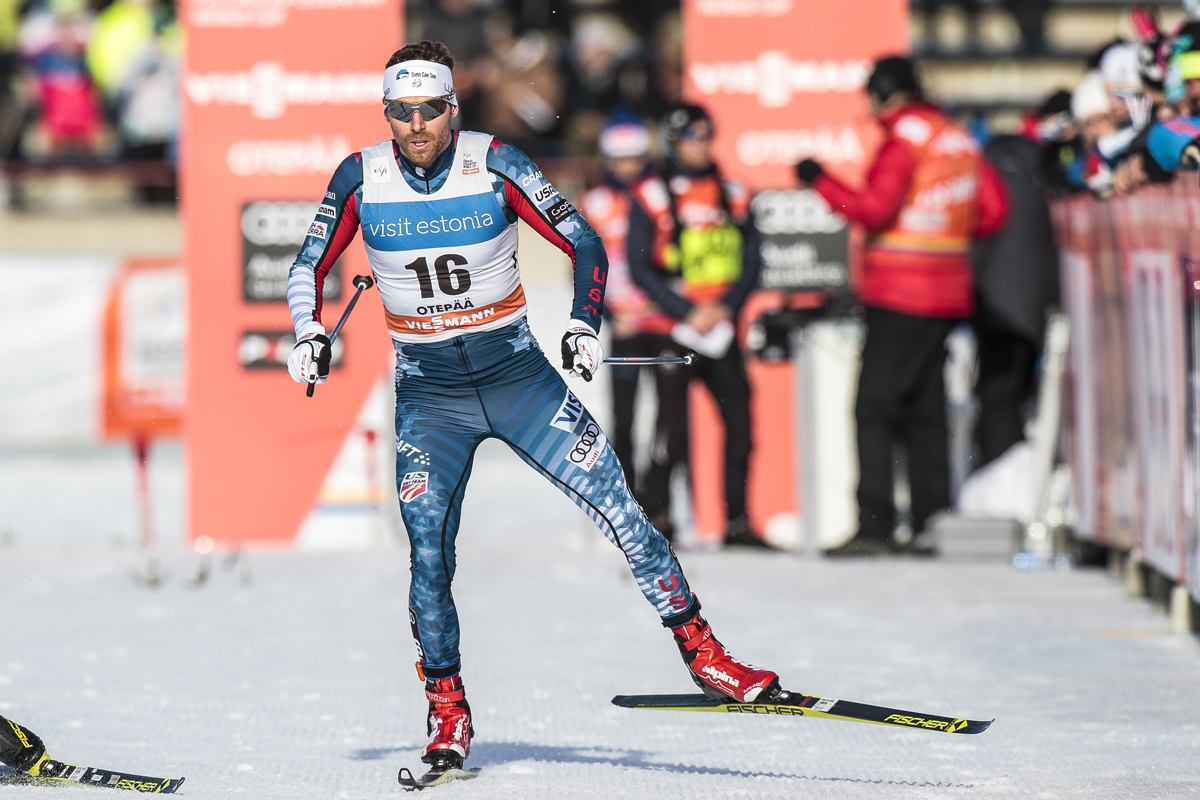
Simi Hamilton (U.S. Ski Team) racing to seventh in the men’s 1.6 k freestyle sprint qualifier on Saturday at the World Cup in Otepaa, Estonia. (Photo: Fischer/NordicFocus)
Skar won the semifinal ahead of Ustiugov (+0.15) to advance directly, with Hamilton (+0.33) ranked just behind Taugbøl (+0.29) as the outcome of the photo finish. Taugbøl’s time was enough to advance as a lucky loser. Hamilton ended up eighth overall on the day.
“Regardless I was happy with the fourth [though I] obviously would have liked to advance into the finals,” Hamilton said. “And I feel good about where my fitness and speed is right now, and just kind of one or two things didn’t line up for me in that semi and you know it’s a bummer. But at the same time Thursday [the freestyle sprint in Lahti] is a big day and hopefully some more things will line up on that day and that is the main goal. So I feel good about where everything is going for World Champs right now.”
Hamilton stated that he does not to plan to race on Sunday, training and then traveling in the evening to Finland a day earlier to be rested before the sprint at World Championships.
Canadian World Cup Team member Alex Harvey, who had skipped the World Cup trip to Korea for a recovery and training block, snuck into the sprint heats in 29th place (+10.26) after a mishap, avoiding elimination by less than a second.
“I felt good in the qualifier but right out of the start, in the first corner, I hit an icy patch and almost crashed, right at the base of the first uphill,” Harvey wrote in an email. “My ski hit my pole and I broke a basket. After that I had to get my momentum back and I think that I actually skied pretty decent but lost some time and speed there. So I guess you can say I got lucky to end up on the good side of the top 30!”
Canada’s Alex Harvey (29) chasing Great Britain’s Andrew Young (11) and Italy’s Federico Pellegrino (l) in the quarterfinal of the men’s 1.6 k freestyle sprint at the World Cup in Otepaa, Estonia. Harvey finished third in the heat for 15th overall. (Photo: Salomon/NordicFocus)
Harvey believed the redesigned course in Otepää suited him relatively well, though he was not too stoked about one modification:
“I think the length of the course suits me well,” he wrote. “The only thing I didn’t like was a short finishing stretch…we are used to a really long one here so I was looking forward to that, but this year there was a 180-degree turn just before the finish so that made the opportunity to pass in the finish not as good.”
In his quarterfinal, Harvey had to race against Pellegrino, Norway’s defending sprint world champion Northug (who’s been trying to round back into shape in time for this year’s championships), as well as Andrew Young of Great Britain.
“My quarterfinal was super slow, from the start I knew I had to be top 2 to move on,” Harvey recalled. “Young kinda picked it up right at the top of the second climb (the steeper wall) so he tried to gap the field or at least stretch it for the long downhill into the stadium.”
Pellegrino managed to pass Young on the final turn into the finish stretch and created a little gap gliding the last meters over the line in first, while Harvey had to sprint for second place against Young who lunged across the line falling down. After a photo finish, Harvey was determined to be 0.04 seconds behind Young to place third (+0.60), while Northug was fourth (+1:45). Harvey’s time was not fast enough for a lucky loser spot and he finished the day in 15th. Young went on to finish last in his semifinal for 12th overall.
“I feel good about my finish, I was able to re-accelerate quite well after that 180 degree turn and almost got by Young in that short finish so that was a good sign for my finishing speed. Now I just gotta work on my lunging game…” Harvey wrote. “15th is not too good but I think the most important in a pre-worlds weekend like that is the feeling you have on the skis, and today it was very good.”
Harvey wrote that he plans to race the 15 k classic individual start on Sunday in order to keep his strong position on the overall World Cup ranking, though he doesn’t intend to race this distance at World Championships.
“I’m feeling good heading into Lahti,” Harvey concluded. “I did a very similar camp as I did before the 2013, 2014, 2015 championships and the 2016 Tour of Canada so I know it’s the right thing for me!”
Andy Newell (U.S. Ski Team) racing in the quarterfinals of the men’s 1.6 k freestyle sprint on Saturday at the World Cup in Otepaa, Estonia. He finished sixth in the heat for 27th on the day. (Photo: Fischer/NordicFocus)
Hamilton’s teammate Andy Newell started the day by qualifying in 16th.
“Qualifying today I felt decent,” Newell wrote in an email. “I think my legs are still recovering a little bit from last week [a training block in Valadalen, Sweden]. I was missing a little bit of that pop on the steep climb. That was a decisive part of the heats as well, so if I were a little stronger there it would have been a much better day.”
In his quarterfinal with the finalist Skar as well as the semifinalists Jylhä and Hakola, Newell could not quite keep up in the finish sprint and placed sixth (+1.89), for 27th overall.
“Positioning in the heat was tricky,” Newell wrote. “It’s always hard to pass in skate sprinting so I should have positioned myself better before the last S-turns.”
“I’m feeling healthy and strong going into this weekend and into Worlds so I can’t complain,” he added. “I wish today would have gone better because its always great practice to race as many rounds as you can leading into the championships, but in general I’m in a pretty good place leading into Lahti.”
Canada’s Len Valjas missed qualifying for the heats in 40th, as did his teammate Devon Kershaw in 50th.
Erik Bjornsen of the USST was 53rd, Canada’s Jess Cockney was 54th and Knute Johnsgaard 56th, and the fourth U.S. starter Ben Lustgarten in his first World Cup finished the qualifier in 64th place.
According to U.S. coach Matt Whitcomb, Bjornsen and Lustgarten planned to compete in the men’s 15 k classic race on Sunday. Fellow distance specialist Noah Hoffman originally had looked forward to that race as well, but decided to not make the trip to Otepää after an illness last week.
For Canada, Harvey, Valjas, Kershaw, Cockney, Johnsgaard, and Graeme Killick were all listed to start Sunday.
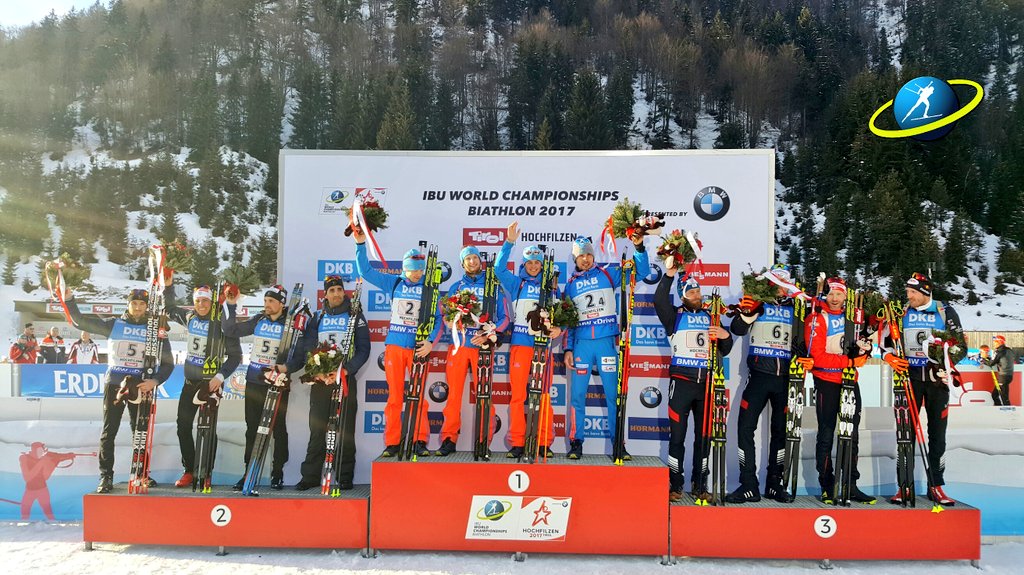
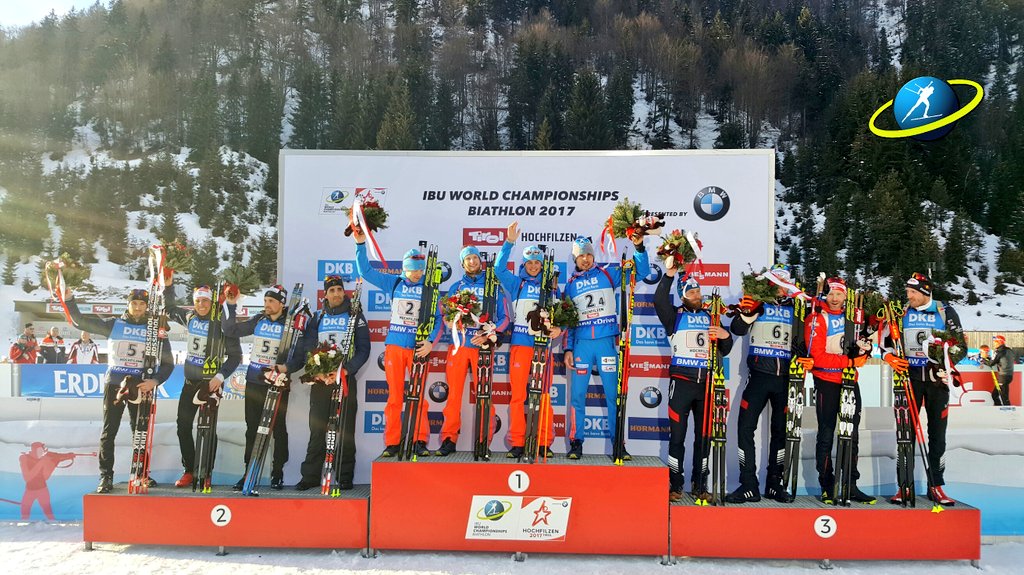
The men’s 4 x 7.5 k relay podium at 2017 IBU World Championships on Saturday in Hochfilzen, Austria, with Russia (c) in first, France (l) in second, and Austria (r) in third. (Photo: IBU World Champs/Twitter)
IBU World Championships (Hochfilzen, Austria): Men’s relay
[UPDATED] Russia’s four-man relay team hit nearly every target on Saturday, using a total of just three spares to clean 40 targets, and stayed out of the penalty loop to capture gold in the men’s 4 x 7.5-kilometer relay at the International Biathlon Union (IBU) World Championships in Hochfilzen, Austria.
It was the last team event and the second-to-last day of the championships, with the men’s and women’s elite mass starts remaining on Sunday. Anton Shipulin anchored the Russians to first, 5.8 seconds ahead of France’s Martin Fourcade, after Shipulin cleaned his prone stage and used one spare in standing to hold onto the lead his team built. Fourcade cleaned both stages to secure silver for his team, and Austria took bronze (+20.1) with anchor Dominik Landertinger.
After Russia’s Alexey Volkov used one spare in each of his shooting stages and came through the exchange in seventh, Maxim Tsvetkov and Anton Babikov both cleaned without any spares to bring the team into fourth, then first, respectively.
France’s first leg Jean-Guillaume Béatrix shot clean as well and tagged Quentin Fillon Maillet in second. Fillon Maillet then needed one spare in prone, but cleaned standing to take the lead, tagging Simon Desthieux in first. Desthieux used three spares in prone, but avoided the penalty lap before tagging Fourcade in third, 12 seconds behind Austria in second. Fourcade closed the gap and clinched second, and France combined for a total of just four spare rounds.
Austria achieved bronze in front of a home crowd with Daniel Mesotitsch, Julian Eberhard, Simon Eder, and Landertinger combining for 10 spares and no penalties.
Finishing 8.5 seconds after Austria, Germany placed fourth. Italy was a minute and a half out of first in fifth, Ukraine took sixth (+1:41.3), and the U.S. placed seventh (+1:50.5) with Lowell Bailey, Leif Nordgren, Tim Burke, and Sean Doherty. Bailey initially put the team in fourth at the first exchange, 12.4 seconds out of first, then Nordgren tagged Burke in sixth, 17 seconds behind. Burke used four spares to clean and tagged Doherty in seventh, about a minute back. The Americans used a total of eight spares but had no penalties.
Canada finished 13th (+3:35.5) with Christian Gow, Scott Gow, Macx Davies, and Brendan Green. They were 39 seconds out of first and in 12th place after Christian Gow’s first leg, then slipped to 14th before Davies moved them back into 12th by the last exchange. Canada had a total of 10 spares and zero penalties.
FIS Cross-Country World Cup (Otepää, Estonia): Freestyle sprint
In the last World Cup before the upcoming 2017 International Ski Federation (FIS) Nordic Ski World Championships next week in Lahti, Finland, five U.S. women qualified in the top 12 of the women’s 1.3-kilometer freestyle sprint, and Jessie Diggins reached the final on Saturday in Otepää, Estonia.
Diggins started the day by placing 12th in the qualifier, 3.93 seconds behind Sweden’s Stina Nilsson in first (and her U.S. teammates Kikkan Randall in third, Sophie Caldwell in fourth, and Ida Sargent in 10th) before winning her quarterfinal and semifinal. In the final, Diggins wad gapped by the leaders on the final climb and finished fifth (+6.82).
The women’s freestyle sprint podium at the Otepaa World Cup on Saturday in Estonia, with Swedish winner Stina Nilsson (c), Norway’s Maiken Caspersen Falla (l) in second and Heidi Weng (r) in third. (Photo: FIS Cross Country/Twitter)
Nilsson won the final in a time of 2:49.96 minutes, just ahead of Norway’s Maiken Caspersen Falla (+0.27) who lost her balance and her speed with it on the last corner. The two had broken away from third place and Nilsson led into the final straightaway and held Falla off for the win. Norway took second through fourth with Heidi Weng in third place (+3.75) and Astrid Uhrenholdt Jacobsen in fourth (+4.91).
Randall initially finished her quarterfinal in third position and would have been out, but advanced when Russia’s Natalia Matveeva was relegated to last for obstruction. In the same semifinal as Diggins, Randall fell cresting a small hill over a tunnel and finished fifth (+13.30) for ninth overall on the day.
Caldwellplaced second in her quarterfinal heat behind the day’s winner Nilsson, then stumbled halfway up a climb early in her semifinal, but stuck with the pack to finish fifth (+1.83) for 10th overall.
Sargent raced in the same quarterfinal as Falla and narrowly missed advancing to the semifinal in third place, fewer than 0.2 seconds behind Switzerland’s Laurien van der Graaff in second and 0.35 seconds behind Falla, who won that heat. Sargent placed 13th on the day.
Sadie Bjornsen qualified 25th and finished fourth (+2.82) in the same quarterfinal as Randall for the 25th overall.
Canada’s Dahria Beatty also qualified for the sprint heats in 30th place, and finished sixth in her quarterfinal for 29th overall.
Also for Canada, Cendrine Browne finished the qualification in 48th place and Katherine Stewart-Jones was one position behind in 49th.
Also for the U.S., distance specialists Chelsea Holmes and Rosie Brennan placed 58th and 60th, respectively.
The men’s freestyle sprint podium on Saturday at the World Cup in Otepaa, Estonia, with Norway’s Johannes Høsflot Klæbo (c) taking his first World Cup win, Norway’s Finn Hågen Krogh (l) in second, and Russia’s Sergey Ustiugov (r) in third. (Photo: FIS Cross Country/Twitter)
In the men’s 1.6-kilometer sprint, Norway’s Johannes Høsflot Klæbo achieved the first World Cup victory of his career in a time of 3:06.53 minutes, holding onto a lead he had created with an attack right out of the start gate in the final. His teammate Finn Hågen Krogh placed second (+0.60), taking the inside lane in the last turn to push reigning Tour de Ski winner Sergey Ustiugov of Russia to third (+1.0).
For the North Americans, it was a day of narrow misses.
For the U.S., Simi Hamilton started his race day by qualifying in seventh position, and placed second in his quarterfinal. He then closely missed out on the final after placing fourth in his semifinal in a four-way sprint photo finish (+0.33), just 0.04 seconds behind the third place and lucky loser time of Norway’s Håvard Solås Taugbøl, who advanced. Hamilton ended the day in eighth overall.
Canadian World Cup Team member Alex Harvey snuck into the sprint heats in 29th place in the qualifier, then just missed out on advancing from his quarterfinal in a photo finish for second with Great Britain’s Andrew Young, who took it by 0.04 seconds. Harvey finished third in that heat, 0.6 behind Italy’s Federico Pellegrino, for 15th for the day. Young went on to finish sixth in his semifinal for 12th overall, and Pellegrino advanced as a lucky loser from the same semifinal and was fourth in the final (+4.77).
American Andy Newell qualified 16th and finished sixth (+1.89) in his quarterfinal for 27th overall.
Canada’s Len Valjas missed qualifying for the heats in 40th place, as did his teammate Devon Kershaw in 50th.
American Erik Bjornsen was 53rd, and for Canada, Jesse Cockney 54th and Knute Johnsgaard 56th. In his World Cup debut, Benjamin Lustgarten placed 64th in the qualifier.
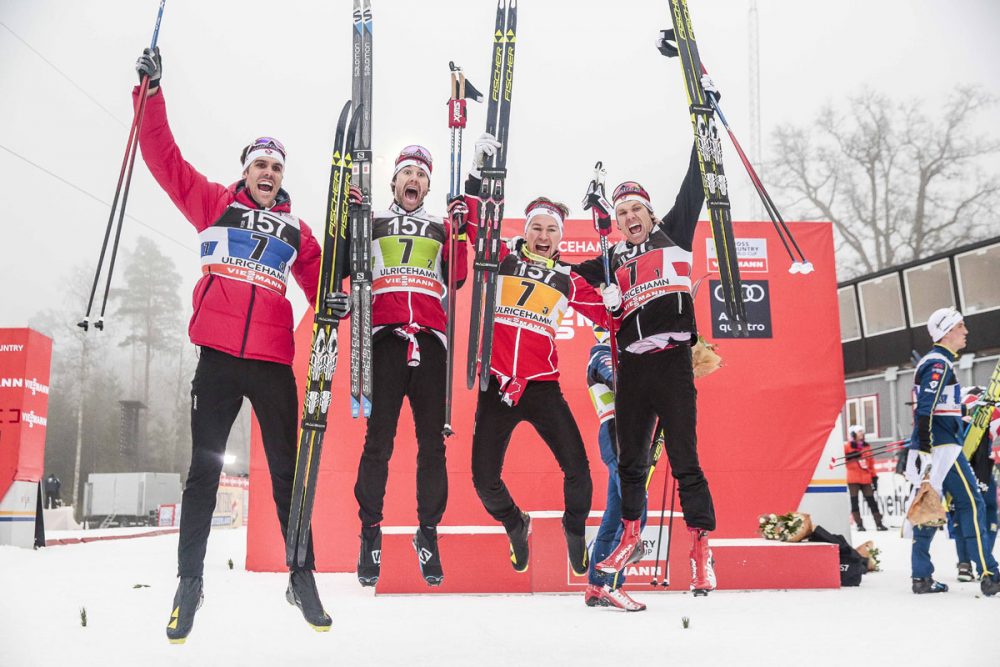
Left to right: Canada’s Len Valjas, Alex Harvey, Knute Johnsgaard, and Alex Harvey after their historic third place finish in the men’s 4 x 7.5-kilometer team relay last month in Ulricehamn, Sweden. All four were named to the 2017 World Championships team. (Photo: Fischer/Nordic Focus)
Earlier this week, Cross Country Canada announced its team for the upcoming 2017 World Championships in Lahti, Finland. The following athletes (six men and five women) were also selected to the Feb. 18-19 Otepää World Cup, the weekend before the championships.
Alex Harvey (CNEPH/World Cup A-team)
Devon Kershaw (World Cup A-team)
Len Valjas (World Cup A-team)
Jess Cockney (World Cup B-team)
Graeme Killick (World Cup B-team)
Knute Johnsgaard (AWCA/NST U25 Team)
Ida Sargent (U.S. Ski Team) racing earlier this month in the opening prologue of the 2015 Tour de Ski in Obertsdorf, Germany. (Photo: Marcel Hilger)
Suddenly, it dawned on her. Rosie Brennan of Alaska Pacific University (APU) hadn’t given the team sprint in Otepää, Estonia, much thought until she was on her way to Europe earlier this week and realized that she was going to be one of four U.S. women in Otepää, Estonia, this weekend.
A little quick math — the format required two-person teams — and she and APU coach Erik Flora determined that meant she’d probably get a chance to race the 6 x 1.2-kilometer freestyle team sprint on Sunday.
Brennan, a 26-year-old former U.S. Ski Team member and the current SuperTour leader, had done a team sprint just once before — back in 2009 at the pre-Olympic World Cup in Vancouver, British Columbia. There, she teamed up with Morgan Arritola to place 17th. Arritola and most of the other women in that race are no longer competing.
Alaska Pacific University (APU) Head Coach Erik Flora (l) runs to grab a new pole for Rosie Brennan after she broke her pole and was given an oversized in the 10 k freestyle individual start at 2015 Cross Country Championships two weeks ago in Houghton, Michigan. Brennan went on to place third, then won the remaining races at nationals.
At the time, the 2009 team sprint was only Brennan’s second World Cup race.
With nearly two dozen World Cup starts under her belt in the time since, Brennan returned to the international circuit this weekend for the first time since December 2013. Her expectations weren’t results-based, but she was definitely excited for the team sprint.
“Every time I watch [a team sprint], I always think, yikes, going out for the finals seriously seems like one of the hardest things in ski racing,” Brennan wrote in an email. “So, yes I was a little nervous and unsure how I would fare…”
Brennan and Ida Sargent formed the second-seeded U.S. team, and Sadie Bjornsen and Sophie Caldwell teamed up for the U.S. first team. Both teams were put in the second of two semifinals, on 35-degree Fahrenheit afternoon when racing earlier was definitely better.
“It was really warm out there … snowing, raining so the course was breaking down,” Sargent explained on the phone after Sunday’s race. “It was pretty soft in the morning when we were testing and then by the final it was shin-deep slush.”
Vying for a top-two finish to guarantee themselves a spot in the 10-team final, the two American squads came through the final exchange alongside each other in first and second. Bjornsen handed off to Caldwell for the last lap, and Sargent tagged Brennan.
Sargent explained she had been in second heading into the descent toward the stadium on her last semifinal loop, trailing Poland’s Justyna Kowalczyk closely to make sure she caught her draft. She passed Kowalczyk, and Bjornsen passed Sargent after following her in similar fashion.
“Sadie and I went into the exchange after our last lap in one and two, so that was pretty fun to be there together,” Sargent recalled.
Sophie Caldwell (U.S. Ski Team) racing Jan. 6 at the Tour de Ski freestyle sprint in Val Mustair, Switzerland, where she placed seventh. (Photo: Fischer/Nordic Focus)
After getting tagged in first, Caldwell explained that Germany’s Denise Herrmann and Poland’s Sylwia Jaśkowiec “took off” at the beginning of the final lap and left her struggling to keep up.
“They formed a little gap and I wasn’t close enough to take advantage of their draft on the [downhill],” Caldwell wrote in an email. “Unfortunately, I think I was leading a little train of my own, so people could hop into my draft.”
One of those people was Brennan, who shot past Caldwell to take third in the heat. Caldwell finished fourth, and the top three teams from their semifinal advanced to the final based on time. (The top-two teams in each automatically advance, then the next six-fastest times.) Seven of nine teams in the first semifinal made the final as well.
“Today was a tough day with the weather and snow conditions, with each lap getting slower than the one before,” Bjornsen explained in an email after her team placed 11th overall. “Since we were in the second heat, our strategy was to go as hard as we could, because we knew making lucky loser positions were going to be tough just the way conditions were working.”
One hundred meters out of the start in the semifinal, someone skied over Bjornsen’s ski.
“I found myself lying in the snow,” she recalled. “I worked hard to catch back up, but Soph had to finish closing the gap. From there we had two great laps in the mix. I tagged off in the front of the pack, and Soph did a great job holding on. … As we predicted, lucky loser time was tough to catch, so sadly, Soph and I weren’t able to catch the finals.”
Sargent, Brennan Sixth in Final
Meanwhile, Sargent and Brennan moved on, which both Caldwell and Bjornsen, Brennan’s APU teammate, were excited about.
“I have believed that Rosie is skiing at the same level as us [U.S. Ski Team women] since the start of the season,” Bjornsen wrote. “It was just so exciting and wonderful for her to feel and show that today! It brings tears to my eyes to see everything she has gotten through this year, and here she is on the World Cup, challenging the strongest skaters in the World.”
“We both skied our last laps with everything we had and it turned out to be just enough,” Brennan explained. “I had no expectations for this race so I psyched when we were finding it possible to easily ski in the front of the pack.”
In the final, she resolved to stick with the pack and see what happened toward the end of the race.
Sargent said she was pleasantly surprised to feel better during the final than the semifinal.
“I guess you’re always excited for another chance to race again,” Sargent said.
She expected to feel tired and “on flooded legs” by the last lap, but the goal was to keep pushing.
Out of the start, Sargent put the U.S. in fourth at the high point of the course, at the turnaround before the downhill. She came through the first exchange in fourth, half a second behind Sweden’s Ida Ingemarsdotter — the eventual winner (with teammate Stina Nilsson).
Brennan kept them within three seconds of Norway’s Ingvild Flugstad Østberg in first after her first lap, tagging Sargent in sixth. One lap later, the U.S. was back to fourth, 2.2 seconds from Poland in first and among the nine teams within 5 1/2 seconds of the lead.
“I tried to move up and ski towards the front of the pack more because in the beginning of the semifinal, I was in the back and felt like I was stuck in traffic for the first couple laps,” Sargent explained. “So I tried to get a little farther forward in the final and it was just really fun to be in the mix.”
On Brennan’s second lap, Østberg in first led Nilsson and Poland’s anchor, Jaśkowiec, as the three pulled away. By the tag, they were just over a second ahead of Germany in fourth, Finland’s first team (Anne Kyllönen and Krista Parmakoski) was 4.7 seconds back in fifth, Finland’s second team (Aino-Kaisa Saarinen and Riika Sarasoja-Lilja) was 5.3 seconds behind in sixth, and Brennan 5.9 seconds back in seventh.
“The second lap was the hardest for me,” Brennan said. “I think the pace turned up a bit and I started questioning how much my legs had in them.
“The final was definitely faster paced, there is a lot more on the line,” she added. “It was super slushy and there were trenches around every corner. I think in general, there wasn’t one section that was really good for me or really bad, it was more about putting together a good lap, skiing each section as best as possible and trying to lose as little as possible.”
When Sargent set out on her final lap, she focused on cutting down the gap ahead of her and catching the fourth-, fifth- and sixth-place teams.
Germany’s Hanna Kolb fell off the pace and into seventh, while Sargent moved into sixth, 8.4 seconds behind the leaders and 1.2 seconds behind Kyllönen in fifth.
On the last lap, Herrmann brought the Germans back into contention and led the pursuit of Sweden, Norway and Poland. While there was a three-way sprint for first, Germany finished 16.5 seconds back in fourth, Finland’s first team was another 1.1 seconds back in fifth, and Brennan anchored the U.S. to sixth, 18.1 seconds out of first and half a second behind Parmakoski.
Sargent said both she and Brennan were “really happy” with their result in the first-and-only team sprint before the freestyle team sprint at World Championships.
“[Rosie] just got over here and hasn’t raced a team sprint since 2009 … and she was just skiing really well all day and had some awesome finishes on both of the heats,” Sargent said. “So I was really impressed with her — first team sprint, first weekend on the World Cup this year and just to be right in there the whole time.”
“I was really impressed with her — first team sprint, first weekend on the World Cup this year and just to be right in there the whole time.” — Ida Sargent on teammate Rosie Brennan
“I surprised myself by having a little bit of finishing speed in both the semi and the final so I am happy I was able to pull together 3 solid laps each race even if none of them were outstanding,” Brennan wrote.
Finishing sixth, the two landed in the money, which Sargent said is always a goal. Moreover though, she wanted to make the final.
“We did that and after that, everything was just a bonus,” she said.
“Those guys skis great, actually all the U.S. athletes skied really good,” U.S. Ski Team Head Coach Chris Grover said on the phone. “Despite some crashes, everybody skied super well, so that was really exciting.”
Hamilton Crashes on Last Lap
Simi Hamilton crashed out of contention on the last lap of the men’s first semifinal, and he and Andy Newell, of the first-seeded U.S. men’s team, placed 10th in the heat for 19th overall. The top six teams from their semifinal advanced to the 6 x 1.5 k final.
“Simi and I did a good job of staying up front,” Newell, the team’s scramble leg, wrote in an email. He tagged Hamilton in fifth for the final lap.
“It’s our goal not to ski any harder than we have to until the last laps,” Newell added. “I felt I was able to pace well and did my best to chase down Russia on the last lap and tag Simi in a strong position.”
Positioning himself in the draft behind Nikolay Morilov of Russia’s second team and Canada’s Lenny Valjas on the final downhill, Hamilton went down in a pileup with France’s Baptiste Gros, who had been around third at that point.
According to Grover, Gros face planted on the last rise after the fast downhill into the stadium. Sweden’s Emil Jönsson clipped Gros and spun around, getting tangled with Hamilton, who was on his way down the hill as well.
“[Simi] face planted right into the bridge basically,” Grover said. “He is OK, but he is definitely sore.”
“He was in a good position to move on as [lucky loser] since our heat was a but faster,” Newell explained. “If it wasn’t for the crash I think we would have advanced for sure.”
While the bad luck and resulting missed opportunity to practice a final was disappointing, Newell wrote that they were looking forward to World Championships and putting together a competitive freestyle team sprint there.
“I was feeling pretty good today and think I have regained a bit of my strength and fitness that I was missing during the [Tour de Ski],” Newell added. “I think this is the best my skating has felt for a while and it was fun to be able to accelerate and ski with power.”
Bjornsen, Gelso Miss Top 10 in 11th
The second U.S. men’s team, with Erik Bjornsen and Matt Gelso, the SuperTour leader from the Sun Valley Ski Education Foundation, narrowly missed advancing to the final after placing fifth in the second semifinal. The top four moved on.
Bjornsen started them off in 11th of 12 teams, and Gelso skied up to ninth by the second exchange. One lap later, they were up to seventh, and Bjornsen came through the exchange in fourth on his last lap.
“Once the racing started it was super fun,” Gelso wrote in an email after his first World Cup race in Europe and second team sprint of his career, since racing one at Spring Series about six years ago.
“Erik and I both moved up some places on our second laps, then he moved really well on his third lap,” he added. “For much of the race it was a pack of guys so moving places within the group was more about position when the pace surged than it was about what place you would finish in.”
They had wanted to position themselves in fourth or fifth “as most times the top 4 qualifies for the final,” Gelso wrote. “We did not want to lead but we also didn’t want to sit on the back of the pack as once small gaps form in front of you it is really hard to close them down.”
After getting tagged in fourth just ahead of fifth place, Gelso set out to chase down three leaders. He stayed within a few seconds of them, but lost contact on the short, steep downhill before the wall-of-a-climb before the stadium.
“They really turned it on and put some more time into me and the fifth-place guy behind me [Italy’s Federico Pellegrino] passed me,” Gelso noted. “At this point I was fifth and got over the top of the wall and down into the finish as fast as I could for fifth in the heat.”
He explained that both he and Bjornsen were happy with their race and 11th overall.
“We both skied strong and smart and were able to mix it up with some of the best sprinters in the world,” Gelso wrote. “We would have liked to make the final but we still feel good about our result, that we had a good showing, and that we accomplished many of our goals for the day.”
Bjornsen was pleased that he posted the fastest time on the last lap, but wished he would have had more confidence to make a move earlier in the race.
“I think I could have brought us in at the front of the pack which would have really turned some of those Norwegians heads,” he wrote. “I’m very happy with the way my teammate Matt skied, he just got over here and he was in the mix. It’s a bummer we didn’t get to the finals. I was ready to make some more fast laps…next time!”
Bjornsen added that he’s starting to feel more confident in the event, one of the rarest World Cup formats.
“For some reason I always surprise myself in the team sprint discipline, I’m starting to wonder if it’s a race built for me,” he wrote.
According to Gelso, Bjornsen persuaded him to race the team sprint this weekend.
“I was actually planning to only ski the individual sprint here but once I got over here I talked to [Bjornsen] and he said how fun the team sprint was and how it was like a distance race,” Gelso wrote. “I also thought it would be a better prep race for next weekend in Russia.”
The Americans will head to Rybinsk, Russia, on Wednesday for the next World Cup races starting on Friday. There, they’ll meet up with Jessie Diggins and Liz Stephen, who took the weekend off to recover from the Tour de Ski and train in Seiser Alm, Italy.
At the end of the day and Otepää World Cup weekend, Grover summed it up as “some more tough days. … Of course, there were a lot of crashes out there so we weren’t the only ones that had a rough go of it,” he said.
“I was happy to see that everybody was putting together some good legs out there and some of our best team sprinters weren’t here,” Grover added. “Athletes like Kikkan [Randall] and Jessie on the women’s side. So when it comes time to [make] World Championships [selections], were are going to have some hard decisions to make, that is for sure. It is a good problem. It is nice to know that you have four or five women that could fill that spot and potentially at least three men and maybe more.”
“We have a really strong team,” Sargent said of the women’s team. “We have the defending world champions [Randall and Diggins] in the skate team sprint. We have a lot of girls that can be top 10 in a skate sprint or top 10 in a skate distance race so I think there’s a lot of awesome combinations on our team, and it’ll just depend on who’s skiing fast at that point.”
Russia’s Alexey Petukhov (r) tags Sergey Ustiugov during the men’s 6 x 1.5 k freestyle team sprint final on Sunday in Otepää, Estonia. The two went on to win by 0.4 seconds over Norway. (Photo: Fischer/NordicFocus)
If the preceding women’s team sprint proved anything on Sunday it was that Norway could be beaten. Russia’s Sergey Ustiugov had all the motivation he needed after breaking a pole in the individual classic-sprint semifinal the day before at the World Cup in Otepää, Estonia.
Sunday’s 1.5-kilometer course was the same course the used for the individual men’s classic race. It included two steep climbs that would be good places to attack if teams were looking to gain separation from the pack.
Ten teams advanced from the semifinals to the 6 x 1.5 k freestyle team sprint final: Noway I (Anders Gløersen/Finn Hågen Krogh), Norway II (Ola Vigen Hattestad/Pål Golberg), Russia I (Alexey Petukhov/Sergey Ustiugov), Russia II (Andrey Parfenov/Nikolay Morilov), Italy (Dieter Nöckeler/Federico Pellegrino), Switzerland II (Roman Schaad/Gianluca Cologna), Canada (Jess Cockney/Lenny Valjas), Finland I (Matias Strandvall/Risomatti Hakola), Poland (Maciej Kreczmer/Maciej Strega), and Estonia I- (Raido Rankel/Peeter Kummel).
Canada’s Jess Cockney (r) tags and Lenny Valjas during the men’s 6 x 1.5 k freestyle team sprint final on Sunday in Otepää, Estonia. (Photo: Fischer/NordicFocus)
At the start of the final, the first two laps went out at a relatively leisurely pace. There weren’t any real attacks; any attempts were quickly countered and a pack reformed.
The lead rotated between Russia’s Petukhov, Norway’s Gløersen, and Switzerland’s Schaad. At times, Poland’s Kreczmer was up front driving the pack, but Russia and Norway were always close behind. Canada’s Jess Cockney was near the back, but still in contact with the entire group.
On the third lap before the third exchange, Petukhov and Gløersen continued to lead the pack. Norway’s second team was close, with Hattestad sitting in third position. Midway through the second downhill, Petukhov picked up the pace and attempted a small attack off the front. Gløersen was able to respond and bridge up to the Russian, and two other teams caught up by the exchange.
There, at the halfway point, Gløersen tagged Krogh 0.3 seconds ahead of Norway II, and Russia was 0.6 seconds back in third. Russia’s second team was another 0.1 seconds behind in fourth, and Switzerland trailed by 1.2 seconds.
As the laps went by, it took the top skiers less time to complete them. Eventually a team was going to make an attack and it all depended on who could counter and when. The attack finally happened on the fifth lap. Petukhov initiated it and Gløersen immediately responded to match his pace. The attack opened up a sizable lead heading into the final exchange. Russia came through 0.6 seconds ahead in first, Norway was second, and Russia II as the next-closest team was 7.2 seconds back in third.
The Otepää World Cup men’s 6 x 1.5 k team sprint podium: (from left to right) Norway I’s Finn Hågen Krogh and Anders Gløersen in second, Russia I’s Sergey Ustiugov and Alexey Petukhov in first, and Italy’s Dietmar Nöckeler and Federico Pellegrino in third. (Photo: Fischer/NordicFocus)
As Russia and Norway skated away and battled for first and second place, the fight for third place was just as intense. Italy, Switzerland, Russia and Norway’s second team were all in position for the final podium spot. Italy had the biggest deficit to regain, coming through the exchange 12.2 seconds back in sixth.
After a clean exchange to start the final lap, Ustiugov and Krogh still remained squarely in the lead. Ustiugov had fresher legs as a result of crashing out of Saturday’s semifinal; Krogh reached the classic-sprint final and placed fifth.
The pair skied together, each taking a turn leading. At the start of the last climb, Ustiugov attacked and it proved to be the winning move. His surge created enough separation from Krogh to build a gap he carried to the finish line. Ustiugov took the win for Russia in 19:39.1, and Krogh finished 0.4 seconds later in second.
Russia’s Sergey Ustiugov (in blue) works to hold off Norway’s Finn Hågen Krogh (in red, behind) in the final meters of the men’s freestyle team sprint, while Russia’s Alexey Petukhov welcomes his teammate and the win in Otepää, Estonia.
Italy’s Pellegrino skated a strong last lap to close down almost a 12-second deficit at the start of the lap to outsprint Norway II, Russia II and Switzerland II for third place, 12.9 seconds after Ustiugov.
“It feels amazing to win in Otepää,” Petukhov told FIS after the race. “We like it here very much. The atmosphere was great both in the stadium and at the track. Sergey was very strong today. We were a great team.”
Pellegrino also was extremely happy after rising from sixth to third on the final lap. “It’s fantastic to be back on the podium,” he said. “It is incredible to share the podium with Dietmar. It is great for the Italian Cross-Country Skiing”
Cockney, Valjas Take Eighth
A tight group of competitors, including Canada (back left), round the final curving descent into the stadium during the World Cup freestyle team sprint in Otepää, Estonia. (Photo: Fischer/NordicFocus)
Canada finished eighth place, 22.8 seconds behind Russia. It was the first time Cockney and Valjas have raced together in a team sprint in Europe. They previously teamed up for a 10th-place finish at a World Cup in Quebec City two years ago. That was the last time Valjas made the final in a team sprint.
On Sunday, they qualified with the third-fastest time in the first semifinal to earn a spot in the final. Six teams from that heat advanced to the 10-team final.
“I was definitely eager to forget about yesterday’s race, and put up a good result this morning,” Cockney said in a Cross Country Canada press release, referring to his 61st place in the classic sprint. Valjas also missed qualifying in 45th on Saturday.
“Personally I felt like I skied calmly and made good decisions tactically to help us – especially in the semifinal,” Cockney added.
In the final, Cockney attempted to get closer to the leaders early on the first hill, but was stuck in seventh before the second climb. Regardless, he was within 1.8 seconds of the leaders at the first exchange, tagging Valjas in eighth.
Valjas maintained the time back on the second leg but slipped one position, handing off to Cockney in ninth and 1.9 seconds out of first. At that point, all 10 teams were within two seconds of the lead.
The Canadians found themselves in 10th at the third exchange, 3.9 seconds back, and had fallen nearly 10 seconds off the pace on the fourth lap.
Cockney skied them up to eighth on his final time around, 16 seconds out of first, and Valjas held their position to the finish with the fourth-fastest anchor leg, crossing the line 22.8 behind Ustiugov.
Neither Cockney nor Valjas could be reached by email for comment.
A very happy Otepää podium, with Norway’s Ingvild Flugstad Østberg (c) in first, Swden’s Stina Nilsson (l) in second, and Norway’s Celine Brun-Lie in third. (Photo: Fischer/NordicFocus)
With many of the top women using this weekend to recover from last week’s Tour de Ski competition, Saturday’s World Cup stage in Otepää, Estonia, was not short on fast, up-and-coming talent.
The 1.2-kilometer classic course featured a flat start then into a tough 30-meter climb to the top of the only hill on the women’s course, then right back downhill to a tricky 180-degree turn. After the turn, the course still continued downhill to the finish line. Placing on the downhills was extremely important because as the races went on, the snow really started to get soft and tracks started to wash away. This made choosing the right wax extremely important. Too much wax and there would be no glide on the downhill, not enough wax and it was hard to get up the hill.
The first of five quarterfinal heats featured Norway’s Ingvild Flugstad Østberg, the fastest qualifier in 2:52.93, Sweden’s Ida Ingemarsdotter, Kathrine Rolsted Harsem of Norway, Natalia Matveeva of Russia, Germany’s Denise Hermann, and Russia’s Elena Soboleva.
Østberg showed that she didn’t lose any energy in the qualification round, taking the lead from the start and easily skiing away from the group to win her heat, crossing the line in 2:55.72. Ingemarsdotter was second (+1.62).
The second quarterfinal heat featured Norway’s Celine Brun-Lie, Hanna Falk of Sweden, Slovenia’s Katja Visnar and Alenka Cebasek, Switzerland’s Laurien Van Der Graaff, and Germany’s Victoria Carl .
Just like her teammate Østberg did in her heat, Brun-Lie took a very aggressive start into the hill and separated herself from the chase group. Falk was able to stay with her the entire time, but when qualification was certain, slowly eased up towards the finish to save energy. Brun-Lie won the heat in 2:58.32, and Falk took second (+0.86).
The third heat featured German teammates Hanna Kolb and Sandra Ringwald, Jennie Öberg of Sweden, Anamarija Lampic of Slovenia, Mona-Lisa Malvalehto of Finland and Yulia Romanova of Russia.
At the start, Malvalehto lead the group up the climb followed closely by Öberg. Leading into the downhill, Malvalehto was easily passed by Öberg and Lampic who were just waiting for an opportunity. The pair proceeded to separate themselves from the group and battle it out together for the win. It was a photo finish at the line between Öberg and Lampic. Öberg got the win crossing first in 3:00.77, and Lampic was 0.02 seconds behind in second.
Quarterfinal 4 featured the second-fastest qualifier and overall U23 leader Stina Nilsson of Sweden, Maiken Caspersen Falla of Norway, Justyna Kowalczyk of Poland, Evgenia Shapovalova of Russia, Anne Kyllönen of Finland, and Lucia Anger of Germany.
At the gun, Nilsson took command at the start and led the group up the climb followed by Falla. As the pack continued up the hill, Falla took an opportunity to pass Nilsson when a gap opened up. That was all she needed to win the heat in 2:56.05. Nilsson made a late pass and challenged Falla at the finish, but let up when second place was secured, crossing at 0.08 seconds back in second. Kowalczyk placed fourth, 2.22 second behind Falla and after Shapovalova in third, and did not advance to the semifinals.
The fifth-and-final quarterfinal heat featured a pair of Swedish teammates, Magdalena Pajala and Evelina Settlin, American Sadie Bjornsen, Kari Vikhagen Gjeitnes from Norway, Anastasia Dotsenko from Russia and Krista Parmakoski from Finland.
Bjornsen started fast but wasn’t able to get any separation at the start and was quickly caught by the chase group. Heading into the first climb, the group was still together but Bjornsen was slowly dropping back, but still remained close to the leaders. Settlin fell just after the 180 turn and really broke the pack into two fields. Gjeitnes, Pajala and Bjornsen were in the lead group. Gjeitnes was able to double pole away, 0.31 seconds ahead of Pajala in 3:02.6. Pajala edged Bjornsen in a photo finish, after Bjornsen closed quickly in the last five meters.
The lucky losers were Harsem and Shapovalova. As the races went on, the times were getting slower as a result of the soft snow forcing many to change skis and wax. Heading into the first semifinal the question was: how much did the track soften up after the men’s quarterfinal heats?
It was a duel between Sweden and Norway for the first semifinal; three from each country were in the field with Østberg, Brun-Lie and Harsem from Norway, and Ingemarsdotter, Öberg and Falk from Sweden.
At the start, all three Norwegians jumped out front and lead the group up the hill and then never looked back, easily separating themselves from the Swedish chase group. Crossing the line first out of the Norwegian trio was Østberg who showed she is the one to beat. Her time was 3:10.45; Brun-Lie was 1.75 behind in second.
The second semifinal featured Nilsson, Falla, Shapovalova, Pajala, Gjeitnes and Lampic. Nilsson and Falla were determined to get to the final and challenge Østberg. The pair separated themselves at the start and easily skied away from the other skiers. Falla’s skis were really fast, pulling away on the final downhill to the finish. Nilsson challenged for first but when she realized she was easily going to qualify eased up and crossed second behind Falla. Falla crossed in 3:08.74, and Nilsson 1.40 seconds back in second.
Best seat in the house to watch Saturday’s classic race (Photo: Fischer/NordicFocus)
The second semifinal was a lot faster than the first, resulting in Shapovalova and Pajala earning lucky loser positions.
To add more drama to the softening track, as the men were winding up their semifinal heats, the snow really started to fall. This caused many to change skis.
“Before the final I had to make the decision if I go on zero skis or klister. I chose the second option,” Østberg told FIS afterward.
Nilsson also told FIS after that she changed skis as well before the final, which gave her both good grip and good glide.
The final was set, with three Norwegians (Falla, Brun-Lie and Østberg), two Swedes (Pajala and Nilsson), and Russia’s Shapovalova.
The start was pretty even with Nilsson taking up the pace followed closely by Falla. Heading to the hill, Østberg passed her teammate Falla and closed the gap to Nilsson. As the climb continued, Østberg made her move and passed Falla at the summit. Falla then passed Nilsson making it a Norwegian in first and second. As the trio descended down to the finish, Nilsson was able to pass Falla, but lost a lot of energy in the process, letting Østberg pull away to win in 3:20.18. Nilsson finished in second (+0.60) and Brun-Lie took third (+2.29).
Afterwards Østberg told FIS that the skis were the key to her win, which was her first-ever in a World Cup classic sprint, her second victory of the season and her fourth podium of the season.
“The whole day I had perfect skis,” she said. “I felt good that nobody could keep up with me in the last 100 meters.”
This now raises an interesting question: can Østberg beat her teammate Marit Bjørgen?
“I’ve done it before and I can do it again. One must at least have faith that one can beat her,”said Østberg told NRK.
The World Championship were definitely on all of the Norwegians’ minds after the race. Brun-Lie told FIS, “I have never been on the podium in the classic sprint. Today’s result is very important for the qualification for the World Championships.”
As a result of her win, Østberg passes teammate Bjørgen in the Sprint World Cup standings to take first place. She has 385 points, and Bjørgen is 35 points behind with four sprints left. Bjørgen still leads the Overall World Cup by more than 400 points over teammate Therese Johaug. Neither Bjørgen, Johaug nor Heidi Weng raced on Saturday.
Sunday’s race is a freestyle team sprint competition.
Lenny Valjas placed 45th in the men’s 1.5 k classic sprint qualifier on Saturday in Otepää, Estonia. (Photo: Fischer/NordicFocus)
In her first World Cup of the season and best result since the 2012 World Cup freestyle sprint at home in Canmore, Alberta, Alysson Marshall launched back into international-racing action on Saturday and placed 44th in the women’s 1.2-kilometer classic sprint in Otepää, Estonia.
The NorAm, or Continental Cup, leader for Period 1, she was one of two Canadian women selected to this weekend’s Otepää World Cup. The other, Perianne Jones, opted to stay home and race at Western Canadian Championships in Lake Louise, Alberta.
“It’s great to be back on the World Cup!” Marshall, 26, wrote in an email on Saturday after finishing 44th in the qualifier, 15.67 seconds back from the qualifier winner, Ingvild Flugstad Østberg of Norway, and 6.42 seconds out of the top 30 needed to advance to the heats.
Marshall, a national development-team member, most recently placed fifth in a classic sprint at last weekend’s NorAm in Duntroon, Ontario. Last Saturday after the sprint, Alberta World Cup Academy teammates Marshall, Jess Cockney and the men’s NorAm leader Patrick Stewart-Jones flew to Estonia for a Sunday arrival.
Alysson Marshall (48) racing alongside Americans Liz Stephen (44) and ahead of Erika Flowers (37) at the Frozen Thunder classic sprint on Oct. 24 in Canmore, Alberta. (Photo: Angus Cockney)
“I’m just starting to feel like I have adjusted to the time change,” Marshall explained. “I am definitely disappointed with today, I started well but body wasn’t 100% and I couldn’t maintain the pace over the top of the course. Hopefully next weekend will go better!”
Without another Canadian woman on the circuit, she won’t be racing Sunday’s freestyle team sprint. Marshall plans to next race the freestyle sprint on Saturday, Jan. 24 in Rybinsk, Russia.
Canadian World Cup Team member Lenny Valjas finished 45th in the men’s 1.5 k classic sprint on Saturday, 12.1 seconds back from the top qualifying time set by Norway’s Pål Golberg, and 3.83 seconds out of the top 30.
Jess Cockney placed 61st in the men’s 1.5 k classic sprint qualifier on Saturday in Otepää, Estonia. (Photo: Fischer/NordicFocus)
Cockney, of the national development B-team, placed 61st in the qualifier after winning the NorAm classic sprint in Duntroon last week. Back in 2011 in Otepää, Cockney placed 61st in a classic sprint as well.
Stewart-Jones, who was second in the Duntroon sprint, finished 62nd on Saturday in his first international World Cup, and first World Cup since 2012 in Canmore.
According to Sunday’s start list, Cockney and Valjas will team up in the 6 x 1.5 k freestyle team sprint.
Alex Harvey, Devon Kershaw, Ivan Babikov, and Graeme Killick are taking the weekend off to recover and train in Seefeld, Austria, before traveling to Rybinsk on Wednesday.
Devon Kershaw, striding during the Tour de Ski. He finished third in the 15 k on Sunday.
It was one heck of a weekend on the World Cup in Otepää, Estonia. Dario Cologna (SUI) and Justyna Kowalczyk (POL) each swept both the sprint and distance classic races. Devon Kershaw (CAN) came back from an unlucky equipment malfunction in the sprint to a gutsy third-place effort in the 15 k the next day. With the conclusion of Period 2 on the World Cup, Kikkan Randall (USA) still holds onto the sprint leader bib.
The past few days have been travel-heavy for the U.S. and Canadian ski teams, as the North Americans headed to Ramsau, Austria at the conclusion of racing to train before the next World Cup in Moscow, Russia. Email responses from athletes have slowly trickled in, so the Notes and Quotes this week are more robust than usual.
Otepää: The. Hardest. Course. Ever.
“It’s one of the hardest courses on the World Cup, in terms of total elevation change. But when you’re feeling decent, then a hard course feels good. The course didn’t matter, its about how your body reacts.” — Kris Freeman (22nd 15 k)
“The hills are retardedly—not even a word—steep!” — Alex Harvey (4th classic sprint, 19th 15 k)
“The race went really well yesterday, the second lap especially. If I could do it over I would go out a bit harder than I did. It was important to be a bit conservative on a hard course like [Sunday’s], but I was a bit too conservative. It was really fun to ski with Marthe Kristofferson (NOR) up the big hill the second lap and then try and keep her in sight for the rest of the lap. It really helps to see people out there.” — Liz Stephen (21st 10 k)
“Those hills are unrelenting… Our techs did an amazing job, we had perfect skis, great grip and great glide, so that made things easier out there, but it was tough trying to stay in the track on the steep parts for as long as possible.” — Perianne Jones (30th 10 k)
“The [15 k] course for the World Cup is unrecognizable from the course for U23s last year. Although it shares many of the same trails, the way it is laid out makes it far and away harder than last year. It is possibly the most challenging course I’ve ever skied. I am really excited to race on it!” — Noah Hoffman (26th 15 k)
“I honestly didn’t know how my race was going. I was just trying to stay ahead of Kikkan as long as I could without blowing up. I knew the course was going to be one of the hardest I had skied, so I just constantly reminded myself to hold the rhythm with constant work.” — Sadie Bjornsen (34th 10 k)
On finding The Zone
“All my best races have come when I’m in that—it sounds corny, but when you detach your mind from the pain, and not just say it, but to actually have it happen. So I’m really shocked to have been able to do that.” — Devon Kershaw (3rd 15 k)
On sprint strategy
“I was hopeful, excited and focused. I wanted to stay in a good position and ski relaxed and well in the group and focus real hard down the home stretch and make a semifinal in classic. I was really pumped to be there but Ida [Sargent] was even more enthusiastic, so the vibe was great. With Kikkan in there I was hoping to execute some amount of sticking on her but she was, unsurprisingly, a Kikkanimal out there and strong as ever, and I got gapped a bit halfway through the race.” — Chandra Crawford (22nd sprint)
“I tried to ski relaxed and more smoothly in the qualifier and I think that made a big difference. The sprint course wasn’t my favorite because it only has one uphill in it and a lot of double poling at the end. I would have preferred much more striding.
“In the quarterfinal I was in the outside lane and in the back after the start. I just stayed behind everyone on the uphill and it didn’t feel that fast to me. But then when we hit the flats and started double poling everyone took off and I started falling off the pace. I was able to catch back up on a short little climb later in the course but then it was a long double pole finish and everyone was really fast!” — Ida Sargent (29th sprint)
On turning things around mid-race
“[Diggins] started so spastically…Then on the huge hill on the first lap, she relaxed, took a deep breath, and did things a little bit more carefully… From there it was just: watch out.” — Matt Whitcomb, USST women’s coach
“It’s great to see [Diggins] lay it out there, she’s just got that raw energy in her stride.” — Kikkan Randall (9th sprint, 15th 10 k)
On Equipment: Picking skis, breaking poles, and destroying bases
“The conditions were actually perfect but the hills are just super steep, so if you didn’t have the right pair of skis, kicking can be tough. So, I think I made the wrong choice and didn’t have enough kick, and that’s something I for sure need to work on for distance races. One problem I’m having is that I ski with so much more power during sprint races, a lot of my skis are flexed a certain way. So I can kick them fine during accelerations warming up but once I start racing they’re slick when moving at a slower speed. So I’m learning and trying to improve that.” — Andy Newell (7th sprint, 49th 15 k)
“I had such a frustrating day all around yesterday, and in the sprint qualifier when my pole exploded in my hand, that really crushed me.” — Kershaw (40th sprint)
“Sometimes with carbon, things fatigue over time, and [Kershaw’s] pole just broke. Another fellow broke his pole on his first plant out of the gate. The guys are pretty powerful, sometimes the poles are at the end of their life, and you never know when that’s going to be.” — Eric de Nys, CNST coach
“Somehow that Russian next to me absolutely destroyed himself, and my skis… He literally destroyed my skis—poled all the way through one of them, and then scraped off a five-inch piece of base material.” — Newell
On building confidence
“It’s no longer intimidating as I step to the line. Instead I step to the line with a plan and another day of racing. I know these girls are fast, I know they are the real deal, and I know I have to work extra hard to get closer to them. For me, the confidence comes from each race, as well as my teammates that are all advancing as well. If they can do it, then we can all do it, I just know it.” — Bjornsen
“The confidence is good. Racing the Tour was extremely fun and I do my best when I am enjoying every aspect of the sport. I love being in Europe, love traveling and seeing new places, racing in new venues, and the best part is having such an awesome team to do it all with.” — Stephen
On setting a season — or personal — best
“The sprint was a lot of fun for sure and it does feel like I’ve turned some things around. The whole season I’ve been feeling fit and fast enough to make it to the finals but just couldn’t stay out of trouble. But I made it through a clean quarter and managed to make it to the end of the semi, before running into a mess… but I was feeling good and it was a lot of fun to get back into the classic sprinting.” — Newell
“I think it is a big deal for me to break the points “barrier.” It was a big goal of mine going into the season, and I’m happy to have accomplished it. I hope this is something I can build on and do more for the remainder of this season.” — Hoffman (26th 15 k)
“This being my first distance race on the World Cup, I had no expectations going into it. I wanted to just go out and ski the course the best I could, and get some experience in pacing along the way.” — Jessie Diggins (19th 10 k, 37th sprint)
On just missing the points—or the podium
“It’s like so close, time and time again! At least it’s consistent though, and when I finally start feeling back to good form, I hope I will be able to reach it. I know it’s possible, I just have to keep chipping!” — Bjornsen (34th 10 k, 32nd sprint)
“Fourth is awesome, but it is a little heartbreaking too. Devon was fourth at the Tour, and we’ve been fourth at the Olympics. It is a little tough to take, but I have to be happy today.” — Harvey
“For sure, it’s frustrating, but I’m psyched to be working on my weaknesses. I was kicking today. I felt like, skiing the course during the warm up, the hills are definitely pretty big hills, and I’ve never messed around with trying to double pole this course. In retrospect, maybe I would have tried to go on skate skis if I’d been able to see how fast Dario [Cologna] qualified. But it’s hard to really change your mindset in last few minutes there to totally switch it up. Now that I have that experience in my head, hopefully next year I can draw on it.” — Simi Hamilton (33rd sprint)
On the scene in Otepää
“[My grandparents] are from Estonia, so these races mean a lot to me… I can still speak the language, so it was fun doing interviews here.” — Valjas
“It’s so hard to stop smiling! The atmosphere is great and the fans around the course are so enthusiastic.” — Diggins
On double poling the classic sprint
“That was [Harvey’s] first time double poling the entire day, so that was a big step forward for him, it gave him a lot of confidence.” — de Nys
“It felt good today. We haven’t had a real classic sprint in a long time. This was the first real one with a full field since the beginning of the year, and I was looking forward to some striding. But it’s actually fun when it becomes a double pole [session] sometimes, and square of with those guys in the finishing stretch.” — Newell
“My arms totally died. I’ve never felt that way in a race before, I pushed it right to the limit. I’m much happier with my race here than last week, even though the result is worse. I felt like I skied it perfectly; last week I made a tactical error. So this week I’m more satisfied I did everything right. My arms were just not in that shape.” — Lenny Valjas (21st sprint)
On the disparity in ski selection between the men’s and women’s the classic sprint
“One woman from Australia, Esther Bottomley, just wanted to see what [double-poling] would be like. I think some women could, for sure. It’ll take one person to do it first, then others may follow suit. Who’s going to be the brave one, you know? I’m sure [Marit] Bjoergen and [Justyna] Kowalczyk could do it, it’s just a matter of it being faster for them. For the men, it was seven to eight seconds faster double poling than striding [on Friday]. Saturday was quite firm, maybe a little tighter than testing yesterday, but for those who made it to the rounds, 23 men choosing to double pole speaks for itself.” — de Nys
“I feel for the guys with this DP stuff—I sure love to watch some beautiful classic skiing from the best in the world, and it’s disappointing when we still can’t eradicate the use of skate skis in classic sprinting… come on! I’m glad that for the women, classic skiing is still where it’s at.” — Crawford
On having her club coach in Otepää
“It’s so nice! Yesterday I felt just horrible during race prep. Normally I would freak out with that feeling, but having your coach there is just great. [Erik Flora, APU coach] convinced me to ski a super hard race prep and try to ski the “bad feelings” out of my system. It’s just little things like that that help so much! It will be nice to have him for the training camp next week.” — Bjornsen
And finally, a break from racing
“I’m super happy I’ve held up so well this first half [of the season]. I’ve done a lot of racing so far, and I think it’s been really good. Now I’m looking forward to taking a break, get my feet back under me.” —Randall
Kershaw striding, ahead of Alexander Legkov (RUS), during the 2012 Tour de Ski. Kershaw was third in the Otepää 15 k classic on Sunday.
Devon Kershaw’s rebound from a disappointing classic sprint in Otepää to a third-place finish in the 15 k the next day certainly had the Canadian excited. He’d been gunning for gold, but the World Champion found it hard to be too upset with a podium finish on what many are referring to as the toughest course on the World Cup.
In a phone interview on Sunday, Kershaw was just as happy to learn that some of his teammates had skied to good results. Perianne Jones and Dasha Gaiazova, both stronger sprinters historically, were 30th and 35th, respectively.
The Canadian men barely had time to reflect on their races on Sunday before packing up and heading to the Tallinn airport. Results from the women’s 10 k, which started three and a half hours after the men’s race, hadn’t even reached their ears by the time they got in the shuttle. FasterSkier caught Kershaw on the phone while he was en route to the airport, and after rehashing his 15 k, he asked for an update on the women’s results.
As his teammates’ names were read off, Kershaw’s reactions were possibly more animated than the way in which he’d just described earning a bronze medal.
“Peri was 30th? Wow, that’s great for her!”
“Dasha in 35th! That’s awesome.”
Jones was just as excited with her result. In an email Sunday evening, she said was happy to have finally put together a solid distance race.
Perianne Jones in the Milan city sprints last weekend.
“I was hoping that it would come before Christmas, but it’s taken me a while to put a decent race together, so I was mostly just really happy to finally get in the points in distance,” she wrote.
With the new World Cup start order, which intersperses top Red Group athletes with the rest of the field, Jones was able to hitch a few rides, briefly, with the likes of Charlotte Kalla (SWE), Therese Johaug (NOR) and eventual winner Justyna Kowalczyk (POL). The fact that she could hang onto them for a few minutes let Jones know she was having a good race.
“[Johaug] caught up to me on the first major climb, and I managed to ski to the top with her, and had no trouble staying with her on the downhill!” Jones wrote.
“Her tempo was really hard to match on the uphill, she’s an incredible skier, and moves super fast.”
Gaiazova’s 35th is one of the better distance classic results of her World Cup career.
Of course, the women weren’t the only ones who had solid distance days. After Kershaw’s third, Alex Harvey was 19th. The result is subpar by Harvey’s own standards, but Len Valjas’s 31st place is an impressive showing for the 23-year-old sprint specialist.
Kershaw’s third-place finish was undoubtedly the highlight, especially since he’d shattered his pole in the qualifying round the classic sprint the day before.
“I just felt robbed yesterday; I had a lot of pent-up energy,” said Kershaw, who thought he could have been in the finals on Saturday had he not been unlucky.
Harvey striding in Oberstdorf during the Tour de Ski.
Harvey, who did make the sprint finals and finished fourth at the end of a day of all double-poling, was a little sore on Sunday.
“My arms weren’t too tired [on Saturday night], neither was my back or core,” Harvey wrote in an email.
“Then on Sunday morning it was a different story.”
On a relentless 15 k course, Harvey said he didn’t have the strength to be competitive on the “retardedly” steep climbs.
“Be strong on the climbs! It’s everything in Otepää! No flats and fast downhills! I didn’t achieve that so that’s why I was 19th,” he wrote.
Valjas, who returned to Otepää this weekend after placing seventh in a sprint there at U23 Championships last winter, said on Saturday that the 15 k would be the “hardest course I’ve ever skied.
“Having to ski up a ski jump landing will be pretty interesting,” Valjas said.
He finished just outside the points in 31st.
Competing in Otepää is particularly special for Valjas, whose grandparents are from Estonia.
“I can still speak the language, so it’s fun doing interviews here, and the people are really excited,” he said.
The Canadian National Ski Team, like the U.S., will be training in Ramsau, Austria for the two-week break in the World Cup before heading to Moscow, Russia.
Topher Sabot and Alex Matthews contributed reporting.
Noah Hoffman racing in Sjusjoen, Norway this season. He scored his first World Cup points on Sunday in Otepää. Photo: Flying Point Road.
Much has been said about the string of breakthrough performances by the U.S. women on the World Cup this season, but on Sunday, the entire team deserved the credit for putting together an historic day for the U.S. Led by Kikkan Randall in 15th, the U.S. placed a total of five athletes in the points in the 10 and 15 k classic races in Otepää, Estonia.
Jessie Diggins, in her first distance race on the World Cup of her career, was 12.4 seconds behind Randall in 18th. Liz Stephen finished just 11.5 seconds behind Diggins in 21st.
On the men’s side, World Cup veteran Kris Freeman put together a 22nd-place performance despite battling high blood sugar, and Noah Hoffman cracked the top-30 for the first time in his career in 26th, 16.9 seconds behind his teammate.
The last time the U.S. put more athletes in the top 30 at a European World Cup was in Sarajevo, Yugoslavia in 1983.
“You always want to have your best days on the hardest course, and today we did that,” said USST women’s coach Matt Whitcomb. More than one athlete remarked that the Otepää distance course was the hardest one on the World Cup, which features roughly 1300 feet of total climbing for the women’s 10 k and nearly 2000 feet in the men’s 15 k.
The Otepaa distance course profile.
“It was a pure test of fitness, but also a really good test of our waxing staff,” said Whitcomb. “The conditions were a little greasy, and the hills were enormous, so we had to find that right balance between plenty of kick and plenty of speed.”
For the most part, U.S. athletes picked skis that met that balance, but no amount of grip in the world would have made skiing up the bottom part of a jumping hill much easier.
“It wasn’t as bad as I think it looked on the warm up; it skis better at race pace,” said Randall.
Regardless, she added “it was definitely challenging.”
Randall’s plan from the start was to build into her race and come on strong in the second half. Looking at the splits, she did just that—at the first time check at 2.5 k, she sat in 21st, and steadily moved up to 15th at 7.5 k, holding the position to the finish.
Jessie Diggins skiing in West Yellowstone this November.
Diggins, in her first World Cup distance race, went out in what Whitcomb called a “spastic” fashion, but managed to settle into a more consistent and manageable pace to finish an impressive 18th.
From where he was standing with the coaches at the top of the jumping hill, Whitcomb thought it looked as though Diggins would be in the running for the reverse podium rather than a top 20.
“She skied a decent first kilometer and a half, then tried to do things differently when all she had to do was keep things the same,” said Whitcomb.
Despite going out “a little too hard,” Diggins rallied, and reeled in the few places she lost on the second lap. Her only objective on Sunday had been to play around with pacing, and her experience in Otepää undoubtedly taught her something.
“This being my first distance race on the World Cup, I had no expectations going into it,” Diggins wrote in an email. “I just wanted to go out and ski the course as best I could.”
Stephen’s performance, meanwhile, was enough to secure her spot in the World Cup Red Group for the next race period. Her 21st-placefinish was a one-place improvement over her best classic race of the season prior to Sunday.
On the men’s side, Freeman led the way in 22nd, which he qualified as “decent” in light of his struggle with high blood sugar all of Sunday.
“I was nervous, and nerves physiologically raise your blood-sugar,” said Freeman, who fought to keep his levels down all morning. “It’s impossible to qualify how much that hurts me.”
Though 22nd is one of the better results this season, it’s not where he wants to be finishing.
“I’m frustrated for what could have been, but I’ve got to be happy for one of my better races this year,” said Freeman.
Taking the past two weeks off of racing helped him on Sunday, and Freeman is hopeful that the break in the World Cup schedule coming up will again get him recharged and ready for Moscow, Russia in two weeks time.
Thrilled to be joining Freeman in the top 30 for the first time was Hoffman, who exercised unusual restraint early in the 15 k so that he would have the energy to turn it up at the end.
Hoffman in the 15 k skate at U.S. Nationals, where he faded after starting too fast. Lesson learned. Photo: Flying Point Road
In an email on Saturday, Hoffman described clearly his plan for Sunday: “I am very focused on executing and starting off under control. When I talk to you tomorrow, I won’t have to tell you I went out too hard! It’s just not going to happen!”
As his splits show, Hoffman was true to his word. At the first timing check-point, he clocked the 36th-fastest time. By 7.5 k, he’d moved up ten places.
Scoring his first World Cup points was “a big goal of mine,” wrote Hoffman on Sunday. “I hope this is something I can build on and do more for the remainder of this season.”
Whitcomb was complimentary of Hoffman’s breakthrough.
“He tried a new pacing strategy today, known as: pacing,” he said.
“It was exciting to see him ski relaxed and turn it up,” Whitcomb continued. “It was a little Freeman-esque, on Kris’s good days.”
Skiing just outside the top 30, but still in solidly good form, was Sadie Bjornsen in 34th, who for the second day in a row just missed out on the points.
After watching the entirety of U.S. Nationals from the sidelines due to illness, Bjornsen hadn’t been in a distance race since the Davos World Cup.
She picked quite the course to come back on, and admitted to being a little scared of it before she started.
“As I started to go though, I enjoyed how bad it hurt,” Bjornsen explained.
“When you sit on the sidelines like I did all through Nationals, you are almost desperate to get that feeling of hurt. It’s a funny thing, but every ski racer is the same in that manner.”
As for her recent streak of not-quite-top-30 finishes, she admitted to frustration, but knows to be patient.
“When I finally start feeling back to good form, I hope I will be able to reach it,” she wrote.
“Sometimes it’s hard…when your teammate are all doing top twenties, and so well, but then you have to step back and remember one foot in front of the next, even though I would rather be skipping.”
Ida Sargent finished in 40th, 26.0 seconds behind Bjornsen, which is roughly on par with her best classic distance World Cups earlier this season—38th in the Rogla 10 k mass start.
On the heels of his best sprint result this winter, Andy Newell didn’t fare quite as well in the 15 k, finishing 49th.
With the incredibly steep hills, Newell explained, picking just the right pair of skis was critical to making it efficiently around the course.
“I think I made the wrong choice and didn’t have enough kick, and that’s something I for sure need to work on for distance races,” said Newell.
Most of his classic skis are better suited for setting in the snow with the force he sprints with, Newell explained.
“One problem I’m having is that I ski with so much more power during sprint races that a lot of my skis are flexed a certain way. So I can kick them fine doing accelerations warming up but once I start racing they’re slick when moving at a slower speed. So I’m learning and trying to improve on that,” said Newell.
Mike Sinnott finished just behind Newell place-wise, but in a mark of just how strung out the field was in Otepää, the difference between 49th and 50th was 41.7 seconds.
The USST travels to Ramsau, Austria on Monday, where they will train for the two weeks they have off until the next World Cup in Moscow, Russia. Tad Elliott will join them on Thursday, along with Sylvan Ellefson, who earned the first World Cup start rights of his career by being the Period 2 SuperTour leader.
Topher Sabot contributed reporting.
Thanks to Joran Elias of Statistical Skier for confirming that Sunday was the first time the U.S. put as many as five athletes in the top 30 of a European World Cup post-1992, which is as far back as FIS results are digitized. An earlier version of this article neglected to qualify the statistic as applying to years since 1992; six U.S. men placed in the top 30 in a Sarajevo World Cup in 1983. We apologize for the mistake.
Cologna in early action during the 2012 Tour de Ski.
From the qualifier through to the A-final, recently crowned Tour de Ski champion Dario Cologna (SUI) skied a “perfect” sprint day by all accounts in Otepää, Estonia on Saturday.
The current overall World Cup points leader made a statement from the word get-go, posting the fastest qualifying time by an unbelievable 4.2 seconds in a 1.4 k classic. He then went on to decisively win his quarter, semi and final heats. Ola Vigen Hattestad (NOR) and Eirik Brandsdal (NOR), who finished second and third, both said that runner-up was the best they could hope for.
“It was a perfect day for me,” Cologna said in a press conference after the race. “I had a good qualification and I got self-confidence for the heats.”
Self-confidence may have been a factor in his victory, but the sheer force behind every plant of Cologna’s double pole was not to be messed with. If his tempo looked moderate, it was only because each stroke generated so much forward momentum.
“I did not have a chance against Dario,” Hattestad said.
Canada’s Alex Harvey lunged for the finish line in an effort for third, but crossed it just shy of the podium for fourth.
While the women’s race featured a high-profile showdown between the two of the biggest names in cross-country, the men’s became, quite literally, an arms race. The compact, slow snow made for finicky kick conditions, and prompted a large majority of the men’s field to swap their classic skis for slicker skate equipment.
If Cologna’s 4.2-second gap in the qualifier on skate skis didn’t prove that double poling was the way to go on Saturday, the first round of heats certainly did.
Ola Vigen Hattestad (NOR) in action during the Tour de Ski earlier this month. He was second on Saturday.
In the first quarterfinal, Cologna started off trailing Russia’s Anton Gafarov, but quickly closed the gap in the first few hundred meters. Several Russians decided to stride, and the mistake became apparent on the first uphill. Cologna gapped Gafarov with his double pole as the Russian’s kick faltered. Cologna’s strength may have been superior in any case, but throughout the heats, striders repeatedly lost time — on the uphills, no less — to those powering through with their upper bodies.
For those who knew their arm strength was lacking, however, the choice to go with skate skis was more of a gamble. The third quarterfinal, which included Harvey and teammate Lenny Valjas (CAN), exposed those who had the muscle to efficiently push through an entire sprint course more than once and those who had spent everything they had in the qualifier.
Peeter Kummel (EST) led Valjas up the first climb, with Harvey skiing just off their back. Going into the second hill, Harvey made up time on the front, and skied beside Kummel and Valjas. Down the other side, it looked as though fast skis might propel both Canadians onto the next round, but somewhere in the final straight, Valjas’s arms ran out of gas. Harvey double poled away to advance comfortably along with Kalle Lassila (FIN), while Valjas suffered through the finish on fumes in fourth, ending 21st overall.
“I’ve never felt that way in a race before,” Valjas said of the pain he’d just experienced.
The next quarterfinal featured the second-fastest qualifier, Gleb Retivykh (RUS) and Andy Newell (USA), who had the ninth-best qualifying time. Retivykh burst from the gate fast and led with a strong stride up the first hill with Igor Usachev (RUS) and Sami Jauhojaervi (FIN) in the chase. Newell skied off the back, but managed to gain ground steadily coming up the final hill, as striders lost ground to the double-polers. Retivykh developed an unbeatable gap down the other side, and Newell moved into third behind Johan Edin (SWE).
In the final 300-meter straightaway, Newell’s stronger finishing tempo moved him through to the semis, his first shot past the quarters this season.
“I’ve been feeling good all year, so it’s nice to have a clean quarterfinal,” Newell said.
The fifth quarterfinal was the closest yet — Oeystein Pettersen (NOR) led out of the gate, and all six skiers double poled for the whole heat. Nikita Kriukov (RUS) slowly edged up on Petterson, and it came down to a photo finish between the two, with Kriukov barely nosing by. Anders Gloeersen (NOR) failed to make up the gap in time and was 0.1-seconds off the pace in third.
As expected, racing got more furious in the semifinal round. Cologna continued to demonstrate his control, skiing from the front for most of the heat. Gafarov once again took the lead for a brief time, but Cologna led the takeover pack and put impressive distance between himself and the rest of the field on the second big climb. The real race was the one for second; Brandsdal eventually bested his teammate Hattestad.
Harvey during the final climb of the Tour de Ski. He just missed the podium in Otepää, finishing fourth.
Harvey, Pettersen, Kriukov, Newell, Alexander Panzhinskiy (RUS) and Gleb Retivykh (RUS) took to the line for the second semifinal — it was seemingly anyone’s race. Kriukov led the Russian trio out of the stadium, with Harvey just behind Petterson and Newell off the back.
Up the first climb, Harvey clearly wanted to move by, but couldn’t immediately find an opening. Petterson shifted and Harvey moved through the hole, and from then on out steadily gained on the striding Russians — his real advantage came on the final downhill, as his skis were clearly faster. Harvey and Petterson went 1-2 through the final straight, with Kriukov in a close third.
Behind them, Panzhinskiy and Retivykh tangled up and crashed right in front of Newell, who slipped by without falling, but not before getting his ski skewered by an errant pole. Momentum lost and base dragging, Newell crossed the line five seconds off the pace in fourth, but still finished a season-best seventh overall.
The A-final featured a stacked lineup: Cologna, Harvey, Pettersen, Brandsdal, Hattestad and Kriukov. All six men were on skate skis, and double-poled their way up, down and around the course. The group remained virtually as one pack, Cologna always in the front, until the second climb, when the top four put a gap on Kriukov and Petterson.
Cologna, Hattestad, Harvey and Brandsdal remained close down the final hill and into the stadium, drag racing out of the right-hand corner into the straightaway. All four turned on the backburners, and Cologna opened up just enough of a gap to comfortably raise his hands in triumph over the line. Harvey, who had been skiing even with Brandsdal and Hattestad, finished fourth despite a lunge for the finish.
Brandsdal, 3rd in Otepää, shown qualifying in Milan last weekend.
“It was a great day for me,” said Cologna of his execution. “I’ve been in good shape and recovered well from Tour de Ski.”
The runner-up, Hattestad was complimentary of his competitor. “Second place is the maximum what I could achieve today,” he said.
Harvey, though pleased with a top five, was disappointed to have just missed out on the podium.
“That was a close one today,” he said in a press release. “Fourth is awesome, but it is a little heartbreaking too. … Pure sprinters train a lot more for double poling than distance skiers so I was a little nervous today because it is a really hard course.”
Men’s competition resumes Sunday with a 15 k classic.
Alex Harvey (CAN) double poling the final climb of the Tour de Ski. Harvey led the way for North America in fourth in the Otepää classic sprint on Saturday.
After winning the Tour de Ski, Dario Cologna (SUI) took a much-needed break from racing and skipped last weekend’s city sprints in Milan, Italy. His return to the World Cup on Saturday in Otepää, Estonia, left little doubt that the overall points leader is on top of his game.
He owned the classic sprint from the qualifier to final. Cologna’s qualifying time was more than 4 seconds ahead of the next-fastest skiers, and he handily won the subsequent heats throughout the afternoon.
One of the most notable aspects of the men’s classic race on Saturday was the prevalence of double poling. The weekend features an unusual double header in the classic discipline, yet you wouldn’t have known it from the number of skate skis that took to the 1.4 k course.
With the collective decision that skate skis were the way to go, the strongest double polers controlled the day. Leading the way for the North American men was Alex Harvey (CAN) in fourth, who was edged out of the podium by Eirik Brandsdal (NOR) despite a lunge for the line.
Harvey skied a near-perfect day, winning his quarterfinal and semifinal with a run of smart racing. When it came time for the sprint to the finish for the final time, he just didn’t have the energy in him.
Though he said he was a little “heartbroken” to have missed a medal by such a slim margin, Harvey was happy to be feeling fast in his first race back since the end of the Tour de Ski. The Canuck is not a sprint specialist, and noted after his race that to hang with powerhouse skiers like Cologna for as long as he did was reason to be satisfied with his race.
“I skied in tact with the leaders and just fell out of the medals at the end,” Harvey said in a Cross Country Canada press release.
For the Canadian and American men, making the call on whether to go with skate gear was a mix of predetermined and last-minute decision making. The Canadian National Ski Team (CNST) exhaustively tested double poling against striding Friday before the race, and techs waxed both sets of skis for athletes to choose from on race day.
“The classic skis were ready, and skate too; we just saw what the majority of people went with,” said Canadian national team coach Eric de Nys.
He figured 23 out of the top 30 men went with skate skis for the heats. The Russian team were the notable outliers, and were struggling to kick all the way up the hills. De Nys described his athletes’ decision to follow suit as simply a choice to stay on the same playing field.
Andy Newell (USA) skied to seventh on Saturday.
Andy Newell led the way for the U.S. in seventh, his best finish of the winter thus far after a series of unlucky quarterfinal crashes. Had he not been held up by Gleb Retivykh (RUS) and Alexander Panzhinskiy (RUS) crashing in front of him in the final straightaway, Newell might have made it to the finals. He didn’t go down, but he lost significant time getting around them.
When he skied clear of the tangle, Newell realized a stray pole plant from one of the Russians had punched a hole clean through his ski, and he had a five-inch chunk of base material dragging through the snow.
“I thought for a minute my ski was broken, but it was just my base dragging,” said Newell afterwards. “I was kind of just in survival mode then for the last few hundred meters.”
Despite the bad luck, Newell said he was happy to have finally performed as well as he felt he could.
“It was nice to have a clean quarterfinal — nothing crazy happened,” he said. “I was able to move around in the pack well and put myself in a position for a strong finish.”
The final 300-meter straightaway came directly after a fast downhill leading into the stadium, which certainly played a factor in the skate-ski trend in the men’s field. Though he switched to skate skis for the heats, Newell was one of the few men lining up for the qualifier on classic gear.
“I decided to save my arms a little bit,” Newell said of his decision to go against the grain.
As he got ready for the qualifier and everyone around him was clipping into skate equipment, Newell said he was a bit nervous.
Ultimately, he qualified with the ninth-fastest time. “I knew I was going to be one of the few to stride the qualifier,” he said. “I decided to do it anyway because I knew I could do it either way.”
For Lenny Valjas (CAN), who made it to the quarterfinals and placed a 21st overall, the double poling was an added element to contend with, both mentally and physically. In the days leading up to Otepää, he expected to stride during the sprint.
Len Valjas (CAN), who finished 21st in the classic sprint.
“This whole year, I’ve been thinking this race is the one where I’d want to make it to the final,” said Valjas. “Everything was thrown into the trash when we had to double-pole it.”
Valjas put forth his best effort, but could feel that his triceps were fried before the heats even started. By the end of his quarterfinal, they were burning.
“My arms totally died,” he recalled. “It was almost comical for me, I was so tired. It was awesome to feel that kind of pain in the last stretch.”
Simi Hamilton, the next North American, finished just outside the top 30 in 33rd. He said he was frustrated with coming so close, but took it as a learning experience.
“Every time you get to race at this level, you learn a lot about what you need to work on, especially when you’re just outside the cusp there,” he said.
“With Oberstdorf, being barely out, then again today, you look at all the places you could have made up that second and it starts to make sense,” Hamilton continued.
Like Newell, Hamilton went with striding in the qualifier. In hindsight, he said he might have played with double poling on Saturday, something he’s never done on the Otepää course before.
“It’s really hard to change your mindset in the last few minutes there to totally switch it up,” Hamilton explained. “Now I have that experience in my head, hopefully next year I can draw on that.”
Devon Kershaw (CAN) ended his day in the qualifying round thanks to a shattered pole. He had to ski a good way without one before finding a replacement, said de Nys. Kershaw ended up in 40th; de Nys thought he could have qualified in the top five.
“He’s upset, but he’s also professional,” de Nys said. “He realizes it’s a part of racing.”
Mike Sinnott (USA), in his penultimate World Cup race before heading home, finished in 56th — a “moderate” result, he said.
Sinnott also went with striding after testing the alternative during his warm-up.
“It would have been a better decision to double-pole, but I didn’t want to … make a drastic switch, make a silly, hotheaded move, “ he explained.
Kris Freeman (USA) and Noah Hoffman (USA) completed the North American men’s lineup in 59th and 63rd, respectively.
Men’s competition resumes on Sunday in Otepää with a 15 k classic individual start.
Eldar Roenning (NOR) on his way to the win in Saturday's 15 k classic in Otepaa, Estonia.
Heading into Saturday’s 15 k classic race, it had been more than four years since Eldar Roenning won a World Cup distance race. But even before he left the starting gate in Otepaa, Estonia, the Norwegian knew that it was going to be a solid day.
“I had a good feeling—I was feeling that I was good enough for the podium,” he said.
Roenning wasn’t just good enough for the podium—he was good enough for the win. On an unyielding course in Otepaa, the classic specialist skied to a convincing 15-second victory over Sweden’s Daniel Rickardsson.
Estonia's Andrus Veerpalu.
Estonian legend Andrus Veerpalu did everything he could to please Otepaa’s rabid crowd with a fast final lap, but in the end, he finished fifth, with seven seconds separating him from the podium. Russia’s Maxim Vyleghzhanin was third, with Sweden’s Marcus Hellner in fourth.
While Veerpalu couldn’t deliver the goods, it certainly wasn’t due to a lack of support from the Estonian fans.
The blue-and-white-clad faithful had turned out for the women’s race in the morning, but not in nearly in as many numbers as for the men’s, which began at two o’clock in the afternoon.
Flying paper flags and plied with beer and samples of Jagermeister, the Estonians were especially boisterous for their countrymen, blowing airhorns and noisemakers for all 14 of them that started the men’s race. They also mustered their enthusiasm for the rest of the international field, lining some of the most distant uphills on the five-kilometer loop—some of which were as far as a 10-minute walk from the stadium.
There didn’t appear to be the 15,000 fans that organizers claimed would show up, but what they lacked in numbers, they made up in volume.
“They cheer pretty much for everybody,” said Norwegian Tord-Asle Gjerdalen, who finished 22nd. “The best is that they cheer you by name. They know your name, and they go for it—they go, ‘Gjerdalen, Gjerdalen!’”
The athletes needed all the help they could get on Otepaa’s five-kilometer loop, which included several big, steady climbs—some of which led into short ramps that seemed near-vertical. You know a course is tough when it forces the World Cup men into a herringbone, which happened in multiple places on Saturday.
Both Martin Johnsrud Sundby (NOR) and his teammate Petter Northug started quickly, setting the first- and second-fastest times,
Petter Northug (NOR) getting a split from Norwegian coach Roar Hjelmeset.
respectively, at the five-kilometer mark. But both saw their hopes swallowed up by Otepaa’s ascents, as Sundby lost 51 seconds and Northug lost 38 in the last 10 kilometers.
“I felt like I had it in my pocket, but I stiffened up,” Northug told NRK, the Norwegian broadcaster. “I paid for it.”
Roenning, though, was ready to step up where his teammates left off, moving up from third at the five-kilometer mark. Aside from Northug, he is the only Norwegian to win a distance race in the last two years, according to NRK.
Roenning is a much stronger classic skier—some three-quarters of his individual World Cup podiums have come in the discipline—but according to Gjerdalen, Roenning likes double-poling, not climbing. Nonetheless, Roenning’s striding skills were apparent, as he was one of few men who didn’t have to go to herringbone on one particularly steep section near Otepaa’s jumping hill.
Roenning may also have been helped by the fact that he was fresh, having skipped the 2011 edition of the Tour de Ski. Rickardsson and Hellner were the only men coming off the Tour to crack the top five; Veerpalu eschewed the eight-stage race,
Russia's Maxim Vylegzhanin.
while Vylegzhanin was forced to miss it when his pre-race hemoglobin levels tested too high.
Vylegzhanin had been “sad and upset” to be held out of the start of the Tour, but on Saturday, he said he was mainly curious to compare himself to the other men, since he hadn’t raced in an international field since competing in La Clusaz, France, in mid-December.
He just managed to eke out the final spot on the podium in Otepaa, topping Hellner by less than a second.
Rickardsson, in second, had been sick in the days following the Tour de Ski, spending the first five days of an altitude camp in Italy in bed. Saturday’s 15 k was his first race back, and he used deliberate pacing to move up from seventh after one lap to second at the finish.
Rickardsson said that the 15 k will likely be his best event at the 2011 World Championships in Oslo, but with a month still to go, the men weren’t taking anything for granted.
Roenning acknowledged that he’s among the contenders, but he also maintained that there were “10 or 15 skiers” who can challenge for the win in Norway.
“Today is a good test,” he said.
Roenning will start Sunday’s classic sprint, and he said in the press conference that it will serve as an important qualifier for the Norwegian team sprint team for Oslo.
With a victory in the same event in Otepaa in 2008, Roenning will certainly be a threat to win. But while the men’s distance field was missing favorites like Swiss World Cup leader Dario Cologna and Russian strongman Alexander Legkov, the start list for Sunday includes Emil Joensson (SWE), the current leader of the sprint standings. Northug will also be in attendance, along with his 20-year-old younger brother Tomas, the reigning world junior sprint champion.