From the FasterSkier archive — posts syndicated from athletes’ and coaches’ own blogs between 2004 and 2012, kept online as published. Current coverage is at fasterskier.com.
After winning Saturday’s qualifier in a time of 3:21.99, Klæbo went on to win both his quarter and semi. He eventually crossed the final first in a time of 3:20.05 to complete his sweep of the day’s rounds.
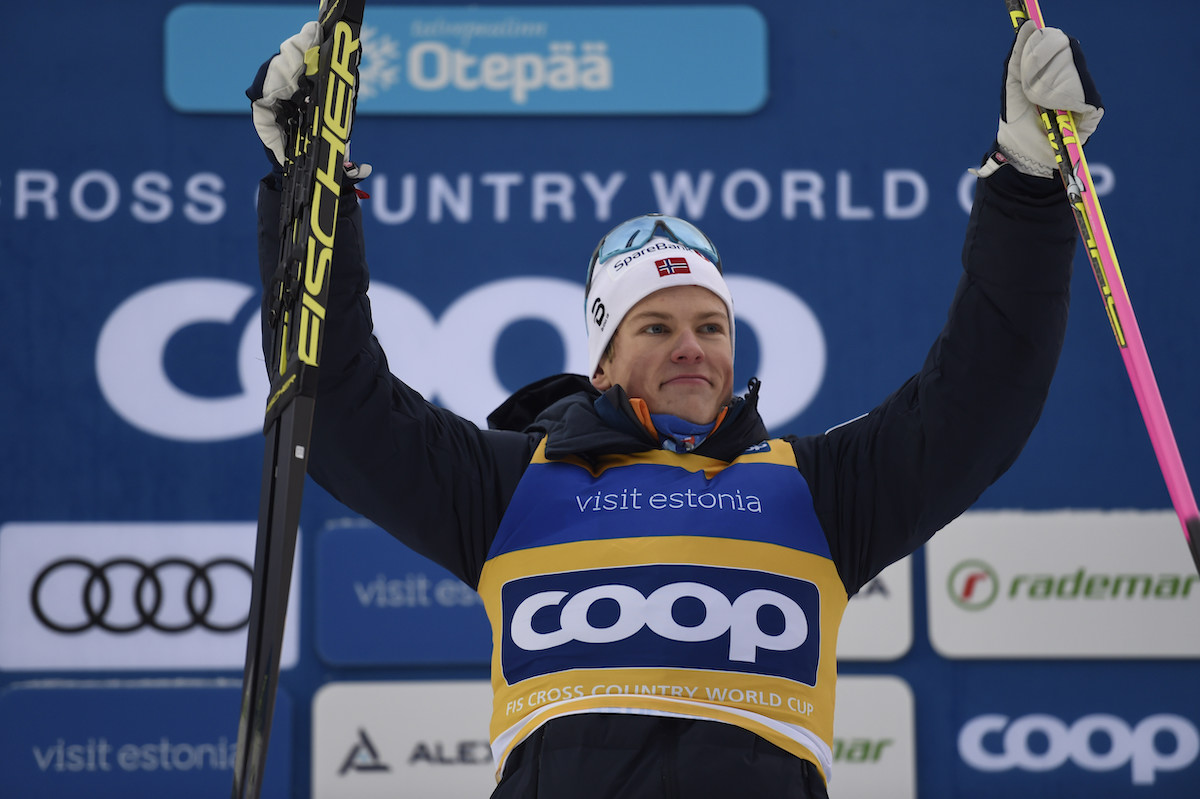
“It’s very cool to win here again,” Klæbo said during an interview with the International Ski Federation (FIS) after the race. “And I have a grandpa who is living here so that’s even better now, so I want to enjoy this.”
With the win, his 18th individual World Cup victory (12th in sprint), Klæbo could be on his way to his most winningest season yet. Last winter he departed the World Cup with 10 wins total. Thanks to a strong Tour de Ski and a few sprint races this year, Klæbo has already accumulated six individual victories in the 2018/2019 season.
The win this Saturday came in good company, as he raced the six man final with four other Norwegians: Pål Golberg, Eirik Brandsdal, Mattis Stenshagen and Erik Valnes. Alexander Bolshunov was the lone non-Norwegian to make the final.
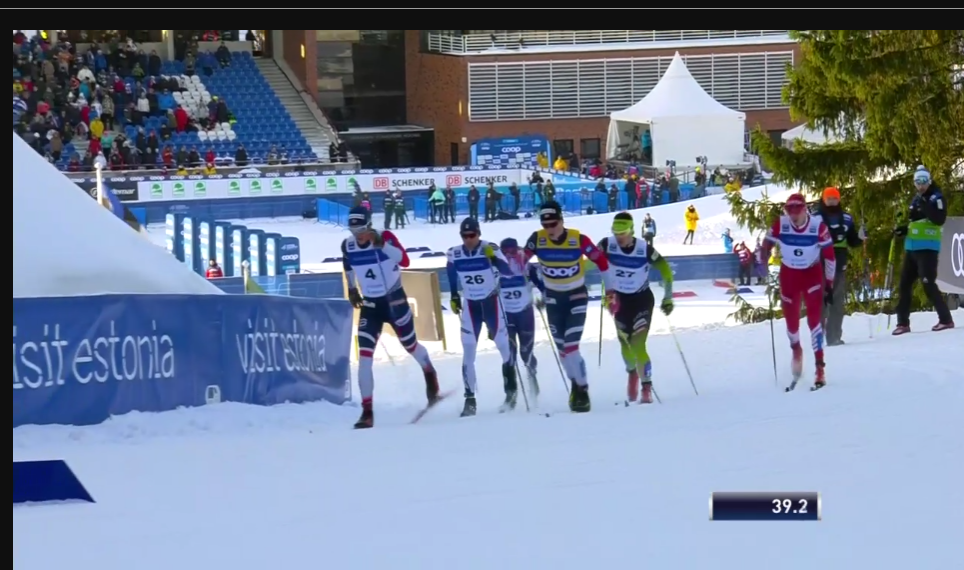
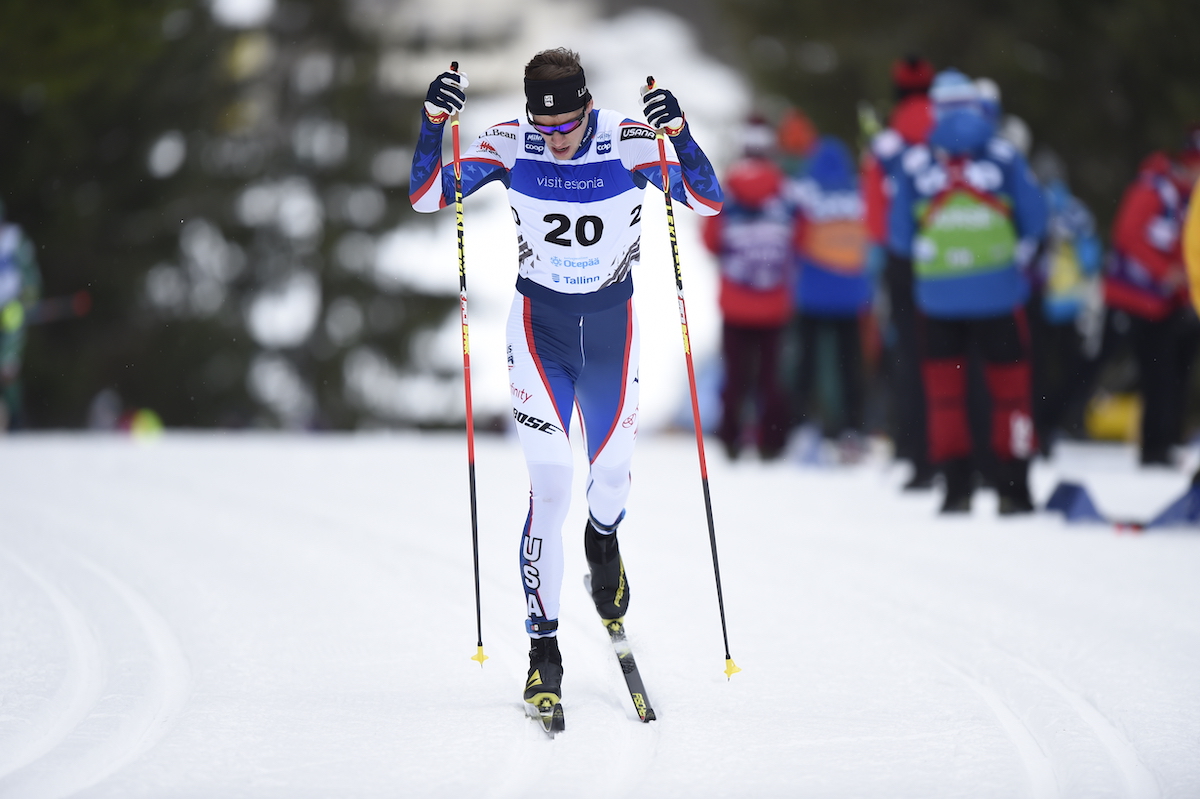
American Andy Newell (bib 26) racing the first quarterfinal of the the men’s 1.6-kilometer classic sprint final on Saturday in Otepää, Estonia. (Photo: NBC Gold screenshot)
Pitted against each other, Bolshunov appeared to be the only one in the final willing to challenge Klæbo. The two went head-to-head in the first major course climb, and by the following series of downhill S-turns, Bolshunov had positioned himself in the front. A brief double-pole section found Bolshunov and Klæbo side-by side once again, with Brandsdal and Stenshagen just behind.
As the six finalists geared up for the second major climb, a steep nearly vertical pitch that forced all racers to herringbone, Klæbo maneuvered to the outside right of Bolshunov. Using a quick, herringbone clip that almost made his skis look like a fish out of water, Klæbo passed Bolshunov by the top of the ascent.
After two double poles at the crest of the hill, Klæbo was tucked and descending back toward the stadium. His skis proved unmatchable by the Russian’s and by the bottom of the hill, he had put close to two meters on Bolshunov. Another meter behind Bolshunov was Golberg.
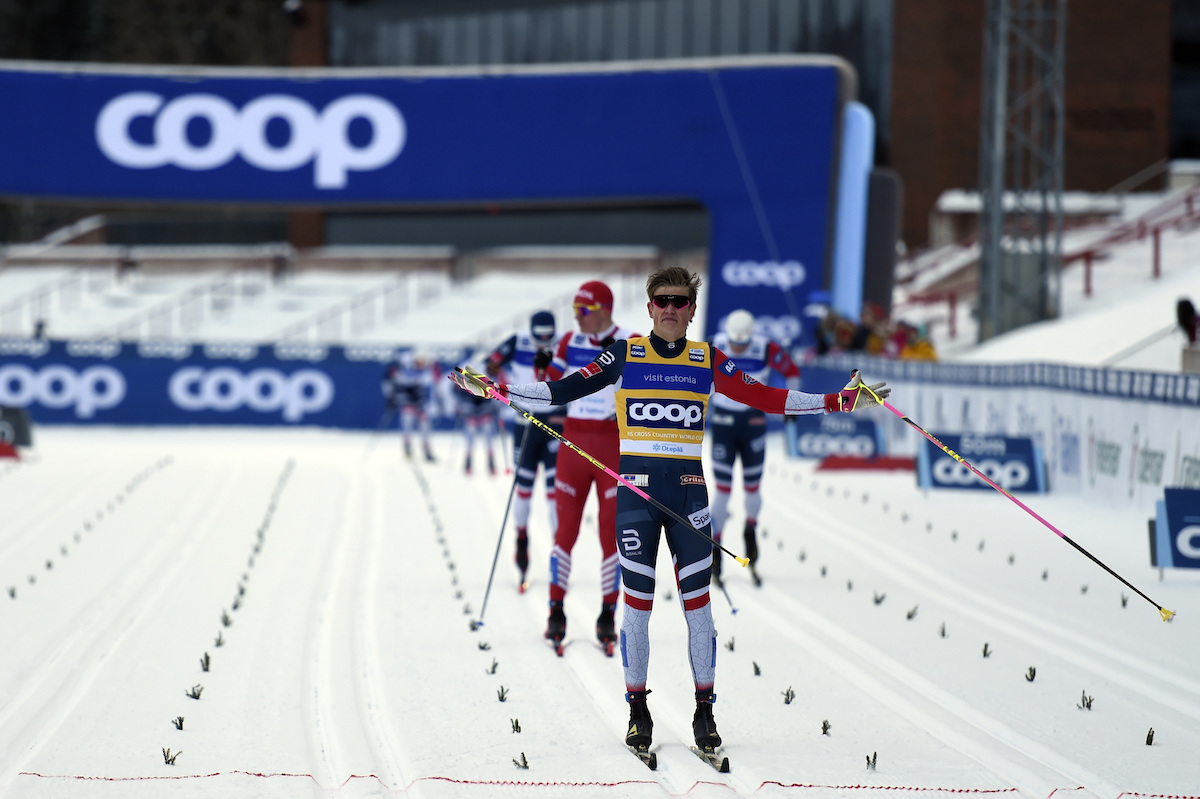
With no foreseeable challenge to the win, Klæbo double poled breezily to the finishing stretch and crossed first, arms outstretched in his signature celebratory gesture.
Norway’s Johannes Høsflot Klæbo (yellow bib) crossing first in the men’s 1.6-kilometer classic sprint final on Saturday in Otepää, Estonia. (Photo: Fischer/Nordic Focus)
Bolshunov crossed second (+1.51) for his seventh World Cup podium of the season.
In a lunge to the line, Golberg claimed third (+2.53) over Brandsdal in fourth (+2.57). Stenshagen crossed fifth (+7.69) and Valnes sixth (+11.99).
Rounding out the top ten was Norwegian Sindre Bjørnestad Skar in seventh, Sweden’s Viktor Thorn in eighth, Norway’s Sondre Turvoll Fossli in ninth and Italy’s Federico Pellegrino in tenth.
The U.S. had two men qualify, with Erik Bjornsen qualifying in 23rd (+8.20) and Andy Newell 26th (+8.75). Newell went on to race the first quarterfinal with Klæbo. Avoiding a crash from Russia’s Andrey Sobakarev in the herringbone hill, Newell crossed the quarterfinal in third to end the day in 15th overall.
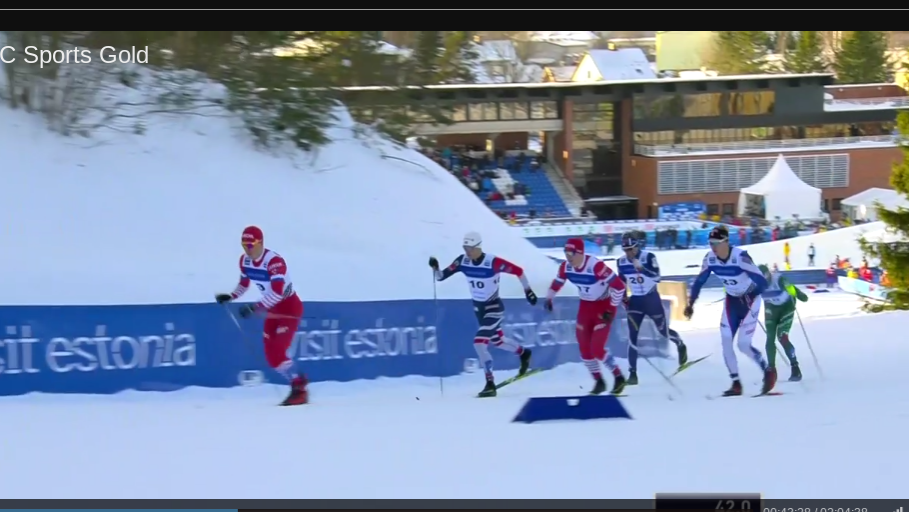
American Erik Bjornsen (bib 23) racing the first quarterfinal of the the men’s 1.6-kilometer classic sprint final on Saturday in Otepää, Estonia. (Photo: NBC Gold screenshot)
Bjornsen, who was slotted into the second quarterfinal, jockeyed for position throughout his heat, taking aggressive lines during the course’s sweeping S-turns to move from fifth to third. He dropped back once again in the herringbone hill and crossed his heat in fifth for 24th overall.
“I was happy to qualify well today,” Bjornsen wrote in an email. “This season hasn’t gone as well as I hoped but I think I can turn things around before world champs. Today was a step in the right direction. Positioning was quite important in the second half of the course. Unfortunately I wasn’t where I needed to be before the steep climb.”
The U.S. Ski Team’s Kevin Bolger during his qualifier on Saturday in in Otepää, Estonia. (Photo: Fischer/Nordic Focus)
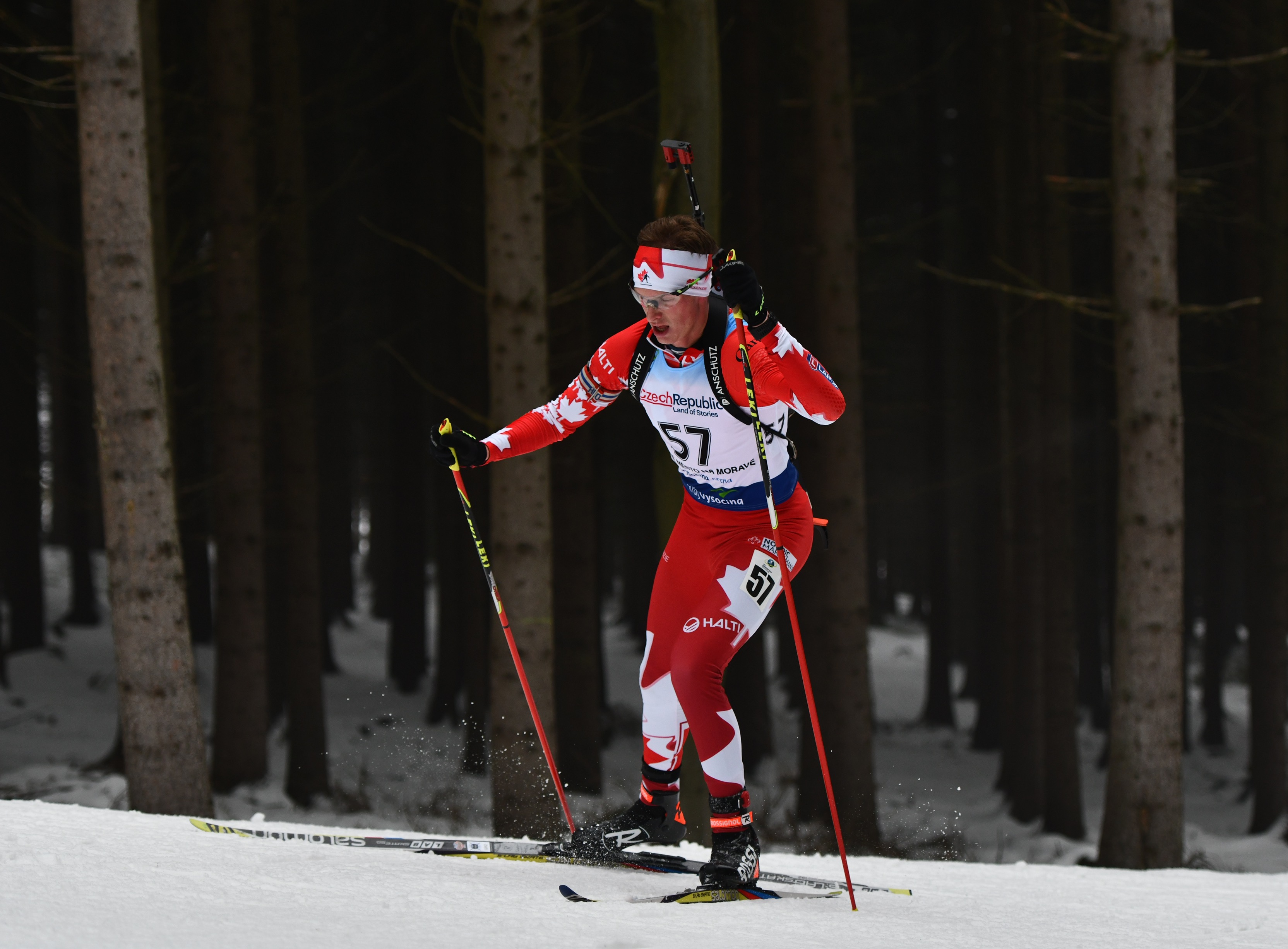
Also racing for the U.S., American Kevin Bolger finished in 41st (+13.13) and Ben Saxton in 44th (+14.16). Len Valjas racing for Canada finished in 43rd (+13.61) and Bob Thompson, also for Canada, placed 51st (+15.96).
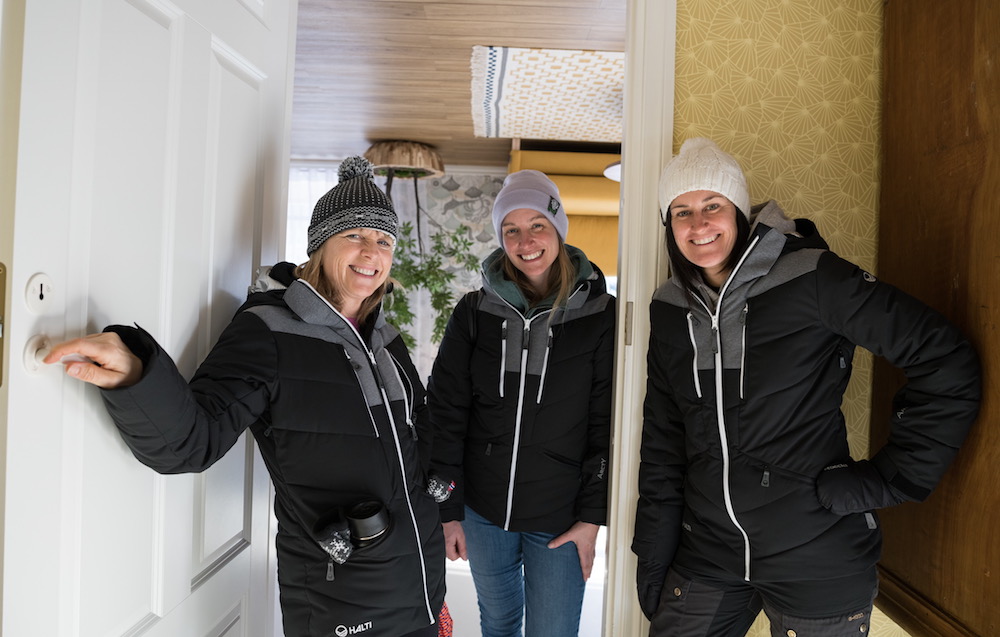
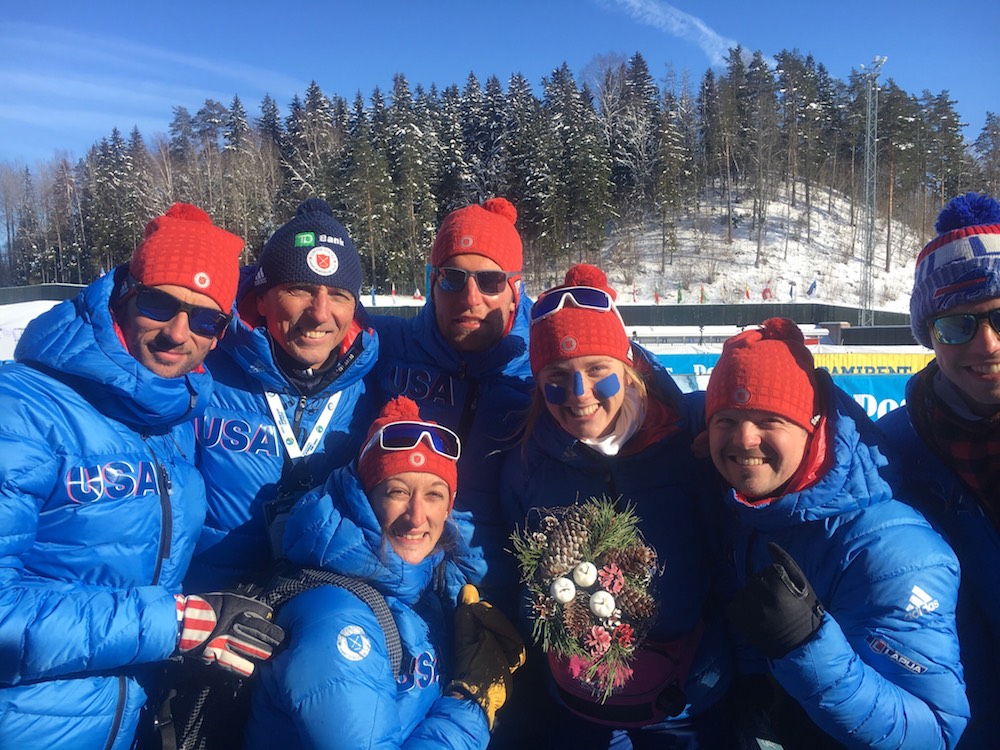
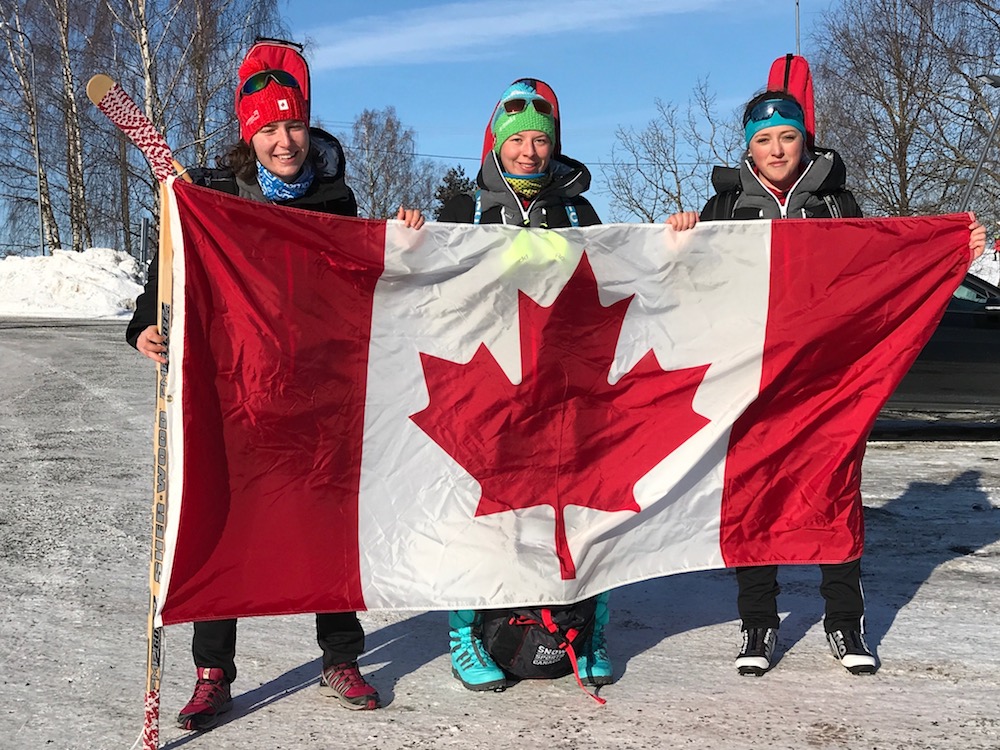
Biathlon Canada’s all-female coaching staff at 2018 IBU Youth/Junior World Championships in Otepää, Estonia. From left to right: Kathy Davies, Jessica Blenkarn and Jacqueline Akerman. (Photo: Emily Dickson)
Think about all of the exceptional female biathletes out there. Too many to count, right?
Now, if you watch biathlon at the World Cup level, think about how many women you’ve seen coaching there. None? One?
There are at least a couple, according to Biathlon Canada’s High Performance Director Roddy Ward, who’s been coaching biathlon internationally since 2011. The Slovakian women’s coach is one and the Austrian team also has a female coach, he wrote in an email to FasterSkier.
When it comes to wax techs, Ward wasn’t aware of any at the International Biathlon Union (IBU) World Cup level. The number of female race officials in that arena is similarly low.
Biathlon Canada is trying to change that. Not by consciously developing female wax techs or officials, but by presenting women with career opportunities after they retire as an athlete or if they show promise as a budding coach.
That emphasis on female leadership and coaching development is taking place in sports across Canada, Ward explained. Biathlon Canada is fully onboard with that movement and sent a clear message at this year’s IBU Youth/Junior World Championships — which took place last week from Feb. 26-March 4 — sending three female coaches to head up its team in Otepää, Estonia.
Last fall, Ward and Jacqueline Akerman, Biathlon Canada’s athlete and coach development manager, decided on their coaching staff for Otepää Youth/Junior World Championships. Akerman would be the head coach and trip leader, as she had for the previous two years, and joined by Kathy Davies, head coach of the Biathlon Alberta Training Center, and Jessica Blenkarn, who coaches at Sea to Sky Nordics.
The three women would make up the coaching staff and work with two male wax techs: head wax tech Andrew Chisholm and assistant tech David Bradley.
While the coaches were selected because of their qualifications (“we have these three great coaches who happened to be female,” Ward wrote), he also liked that female-to-male staffing ratio. It sent a message.
“Roddy and I went, ‘Oh, that would be cool, to be able to take an all-female staff,’ ” Akerman recalled of their conversation last fall. “… He said, ‘This is a really good thing for people to see, that we have three strong women coaching.’ ”
“It’s definitely important for us to have strong female leadership in our program,” Ward wrote to FasterSkier. “Truthfully, these are three great coaches who just showed up at my front door.”
Akerman had previously worked with Davies and Blenkarn on other international racing trips; Davies has been to several Youth/Junior Worlds and Blenkarn has coached at Open European Championships, the IBU Cup and IBU Junior Cup.
Asked if they’ve ever encountered an all-female or mostly female coaching staff in their sport, Akerman was quick to respond: “That’s an easier answer, two letters: NO.”
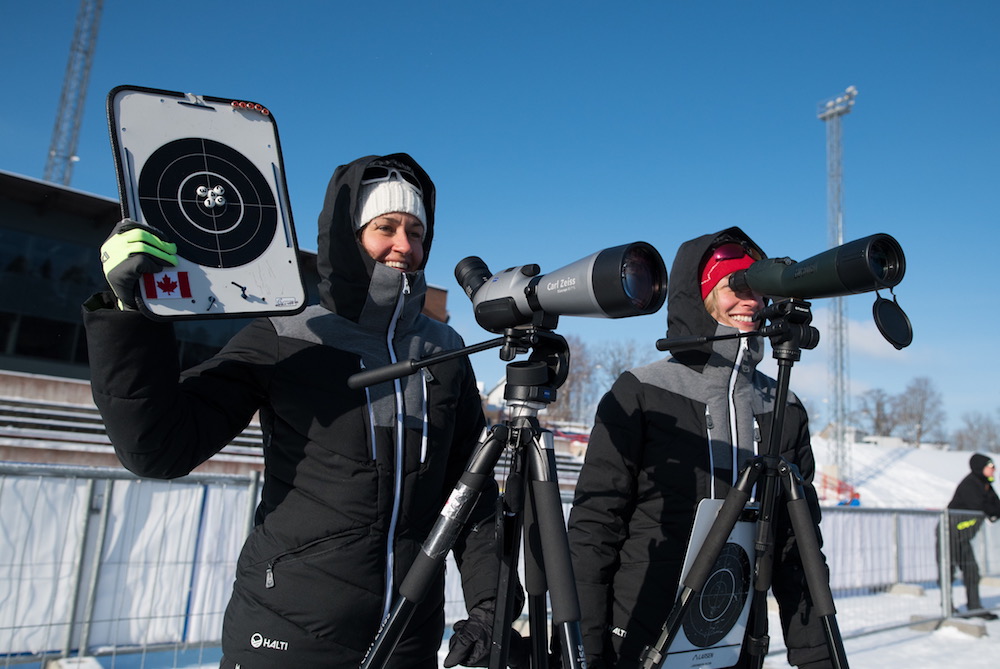
Jacqueline Akerman (l) and Jessica Blenkarn on the range at 2018 IBU Youth/Junior World Championships in Otepää, Estonia. (Photo: Emily Dickson)
At last year’s Open European Championships, Akerman and Blenkarn experienced some reaction from their peers when they were working together on the range.
“The amount of second glances that we got was incredible, and comments saying, ‘Oh, two female coaches! Two women coaches!’ ” Akerman said during a joint phone interview with Davies and Blenkarn in Otepää a few days before the championships began.
“We were a bit of a spectacle,” Blenkarn added.
“And we got lots of TV time,” Akerman continued. “The TV’s haven’t come out yet and not all the teams have arrived yet so we’re waiting to what kind of spectacle this will be with three of us.”
FasterSkier had yet to hear how the three coaches were received throughout the championships, but they stated they were off to a good start from an internal perspective.
“We’re all good communicators, and we’re all complimenting each other really well,” Akerman said. “For me, it seemed to just really flow nicely, maybe more so than other times.”
“I’ve been on a number of trips similar to this and it’s the first time I’ve have even another woman on a trip, except for athletes,” Davies said. “Those trips can be very, very isolated and very hard to sometimes fit in or even feel like part of the coaching staff when you’re the only female.
“It’s not a conscious thing on the men’s part necessarily, but it sometimes feels very isolating, so it’s just absolutely amazing to be with other women in the coaching position,” Davies continued. “What I love about it is it actually gives female athletes and idea that there’s more that they can do. It’s not just athletes, whereas most World Cup races, the women, that’s all they see is an athlete, because you see very few in the coaches’ world, you see next to none in the techs’ world and you also see a rare few in the officials’ realm as well, so it’s really nice to [show] women and athletes that there’s something else they can do as well.”
“I think we just support each other really well,” Blenkarn noted. “We have a good understanding of what female coaches go through and what kind of unique challenges they might face at an event like this so it’s nice to have other people around you to support you.”
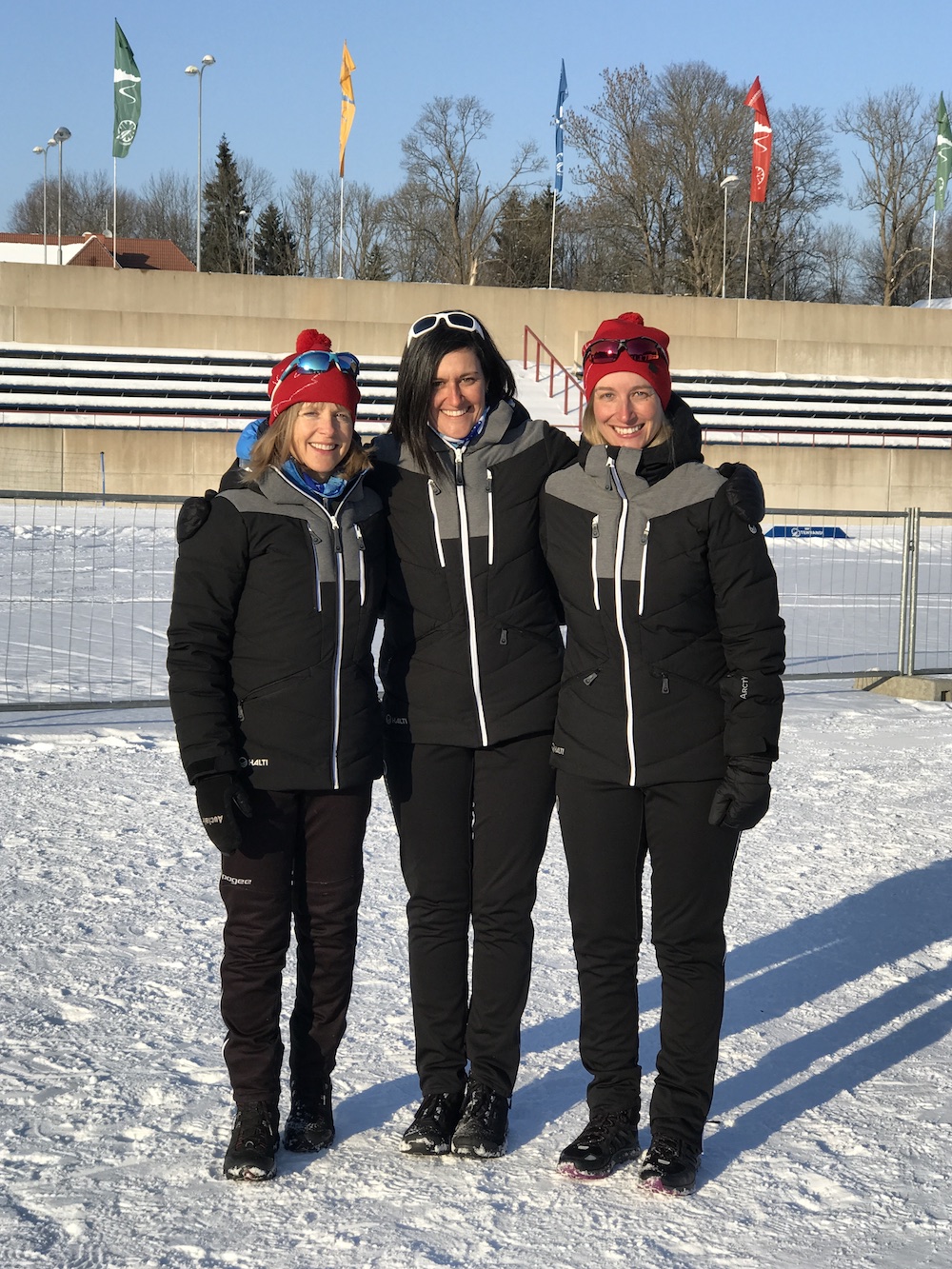
Biathlon Canada’s all-female coaching staff at 2018 IBU Youth/Junior World Championships in Otepää, Estonia. From left to right: Kathy Davies, Jacqueline Akerman and Jessica Blenkarn. (Photo: Terri Dickson)
Asked more specifically about those challenges, Akerman referred to the term Davies used: “isolating.”
“It’s really hard to find your space in the room,” Akerman said. “It’s really easy for me right now to find my confidence with these other two that are here and sharing and supporting. Just them physically being here I feel more confident. So I can find my voice better. There’s just more space for you.
“Your space can sometimes get beaten up in a male-dominated place, so I feel that we need to be encouraged … and open and invited,” she continued. “I met Jess about three years ago and I just saw her skill and her ability and I was like, OK, we need her to be invited into this because she’s excellent. … Someone has to be opening the doors and allowing that space to happen, otherwise it won’t happen for women. I think when we see potential and, not just potential, when we see people who are experienced and they’re very good at what they do, we have to open the door for them. For the men, it’s already open, they just walk through. We need top open it. … I think that’s partly what Roddy’s doing … some men get it and they open the doors, but I think as women we can do it even more because we can understand what it’s like.”
At the Olympic level, biathlon dates back to 1924 when it was known in its ancient form as “military patrol”. A more modern form of biathlon debuted at the 1960 Olympics, but women’s biathlon didn’t become an Olympic sport until 1992. The sport’s military background paired with the relatively recent participation of women has led to some inherent challenges for women in the sport’s leadership roles.
“I can find my voice better. There’s just more space…” — Jacqueline Akerman, Biathlon Canada’s head coach and trip leader for the last three Youth/Junior Worlds, on having two other women on her coaching staff in Otepää
“2003 was the first time I worked the World Cup for biathlon and that was on the range with one of our male coaches and I was the only woman there,” Akerman recalled. “And people looked at me like I was an alien. Slowly over the years you see a few women. On the IBU Cup last year, actually, there was a fair amount of female coaches. I mean, the percentage is still ridiculously low, but you do see them now, and on the Junior IBU Cup as well…”
So the trend is in the right direction, and Biathlon Canada is more than happy to be at the forefront of that progression.
“It’s important for female athletes to have good role models,” Ward wrote. “I have seen firsthand what a good female coach can do for a female athlete and I see that is important for three reasons.
“1) to help athletes navigate life/struggles to turn into healthy and successful adults.
“2) I want our athletes to kick butt internationally and I believe strong female leadership can help us achieve this goal.
“3) I believe female athletes are more likely to give back to the sport (coaching, waxing, officiating etc) if they had female role models through their career that had a positive impact on their life.”
Last week in Otepää, outside of relays, Canada notched five top-10 results, five top-20’s and seven top-30’s, which were achieved by five different women and three different men.
“We’re building, practicing, focusing, training to be a well-oiled machine as a large group and as individuals,” Akerman said before the races began. “And we’re very confident in our ability to utilize those skills and abilities to our potential.”
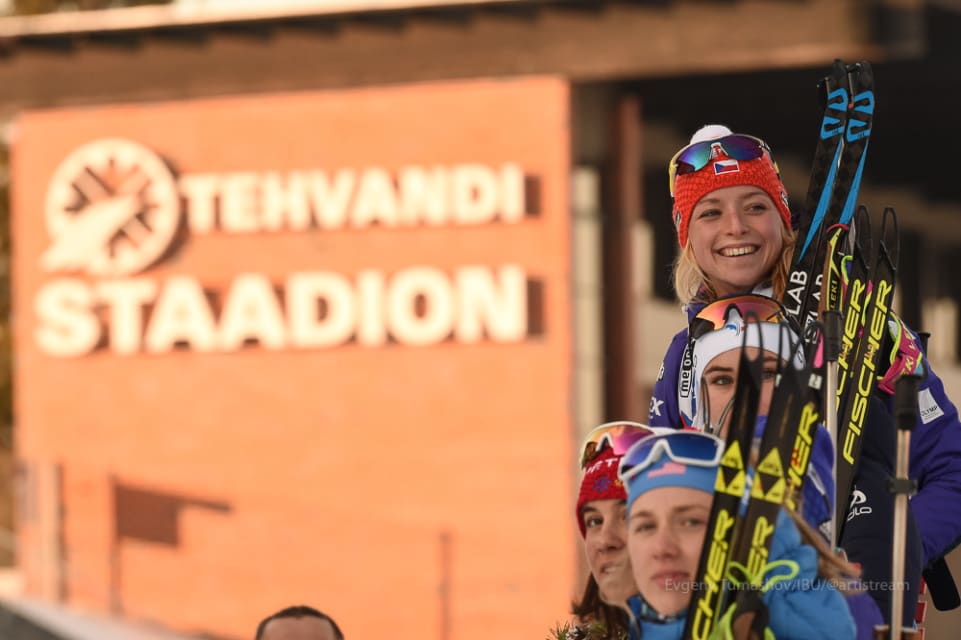
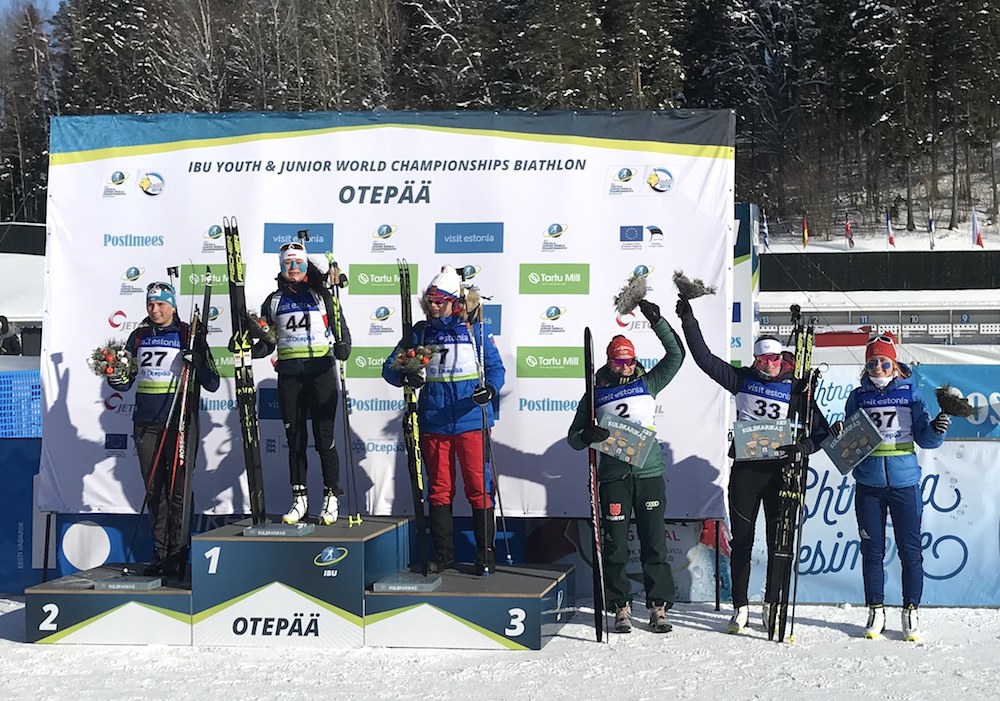
Some of the top-six finishers in the junior women’s 10 k pursuit at the post-race flower ceremony at 2018 IBU Junior World Championships in Otepää, Estonia, including the Czech Republic’s Markéta Davidová (top) and American Chloe Levins (bottom), who finished first and sixth, respectively. (Photo: IBU/Biathlonworld)
(Note: This article has been updated to include comments from Leo Grandbois.)
The 2018 International Biathlon Union (IBU) Youth/Junior World Championships went out with a bang on Sunday, with four pursuit races in Otepää, Estonia.
Several North Americans had banner days, with American Chloe Levins racing up one spot to sixth place in the junior women’s 10-kilometer pursuit and Canada’s Megan Bankes and Nadia Moser placing eighth and 11th, respectively, in that same race.
In the youth men’s 10 k pursuit, Canada’s Leo Grandbois had his best result of the week, placing 15th (up from 33rd) at the start.
Starting with the junior women’s pursuit:
Levins started the race 1:32 minutes back in seventh, based on her sprint result on Saturday. She went on to clean three-consecutive shooting stages, working her way up to fourth after leaving the range for the third time, then missed two targets on the final standing to end the race in sixth. Levins finished 1:51.4 behind the winner, Markéta Davidová of the Czech Republic, who finished first in 32:52.6 with four penalties (1+0+2+1).
Chloe Levins racing to seventh in the junior women’s 7.5 k sprint on Saturday at IBU Junior World Championships in Otepää, Estonia. (Courtesy photo)
“In pursuit races in the past, I’ve come from behind,” Levins, who placed fourth in last year’s Youth Worlds pursuit, wrote in an email to FasterSkier on Sunday. “Today, it was a new learning experience for me to be in the mix for the duration of the race. My plan was simple from the start: enjoy being in the mix and trust your preparation.
“I found the zone today, which is what you dream about,” she continued. “I don’t remember much about the last stage. All I know for sure is that I went for it today…and I have no regrets.”
Asked what she’ll remember most about these championships, Levins explained that the U.S. team’s “happy and dedicated staff” made for a fun week.
“We are always joking and laughing in the wax room which helps keep the mood light during potentially stressful races,” she wrote. “It was really special and important for me to have this experience with my coach, Algis Shalna, behind the scope. We’ve worked together for a long time. I will cherish the competitions we get to share forever.”
While the championships didn’t turn out exactly as she’d hoped, Levins explained that she had a lot of positive takeaways for her final biathlon races of the season.
“Now, it’s time to go back to school and start preparing for golf season at Middlebury!” she wrote. “… I can’t wait to start training again.”
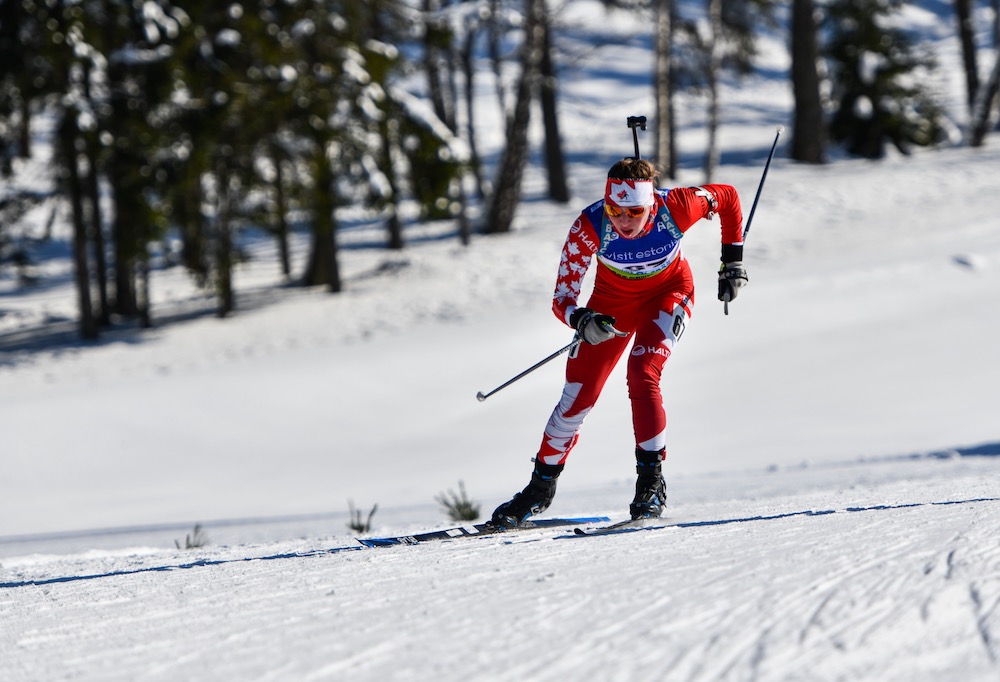
Megan Bankes racing to eighth in the junior women’s 10 k pursuit at IBU Junior World Championships on Sunday in Otepää, Estonia. (Photo: Bryan Dickson)
Bankes started ninth on Sunday and made up one place to finish eighth (+2:52.6) after placing ninth in three previous races at Junior Worlds. She had two penalties in both the first and the last shooting stages (2+0+0+2) and posted the ninth-fastest shooting time and ninth-fastest overall course time.
“Heading into today’s race, my goal was to try and shoot well and make up places. It was also my last international junior race so i wanted to try and have a good one!” Bankes, 20, wrote in an email. “To start, I knew that I could catch the Norwegian girl who started in front of me, and after I caught her, my goal was to make up time on everyone else in front of me.”
She described the wind on the range as “pretty strong” and variable.
“I was zeroed for a decent left to right wind, but when I came in for my first prone the wind had died and was blowing towards me for my first shot, and then it picked up again to be a little more than my zero wind, and I corrected back but didn’t correct enough for it,” Bankes wrote. “After cleaning the middle 2 bouts I really wanted to clean my last bout and there was definitely a little pressure going in with the Russian girl [Emma Timerbulatova, who was skiing just ahead of Bankes]. I actually thought that she had only missed one, so I was a little disappointed in myself when we went into the penalty loop, but when she didn’t leave after the first loop, I was determined to pass her and beat her to the finish.”
Like Bankes, Timerbulatova had two penalties in the last standing. She started the final loop just 0.1 seconds ahead of Bankes, and Bankes passed her to finish eighth.
“I’m overall super happy with my performance this week,” Bankes, a 2017 Youth Worlds gold medalist in the 10 k individual, concluded. “Definitely my most consistent European racing ever! I would have liked to have shot better overall this week though, I did give up some stupid shots, but I was super stoked with how I felt skiing. I’m also pleased that I was able to have consistently good races over the course of the week, which is something I definitely could not have done in the past.”
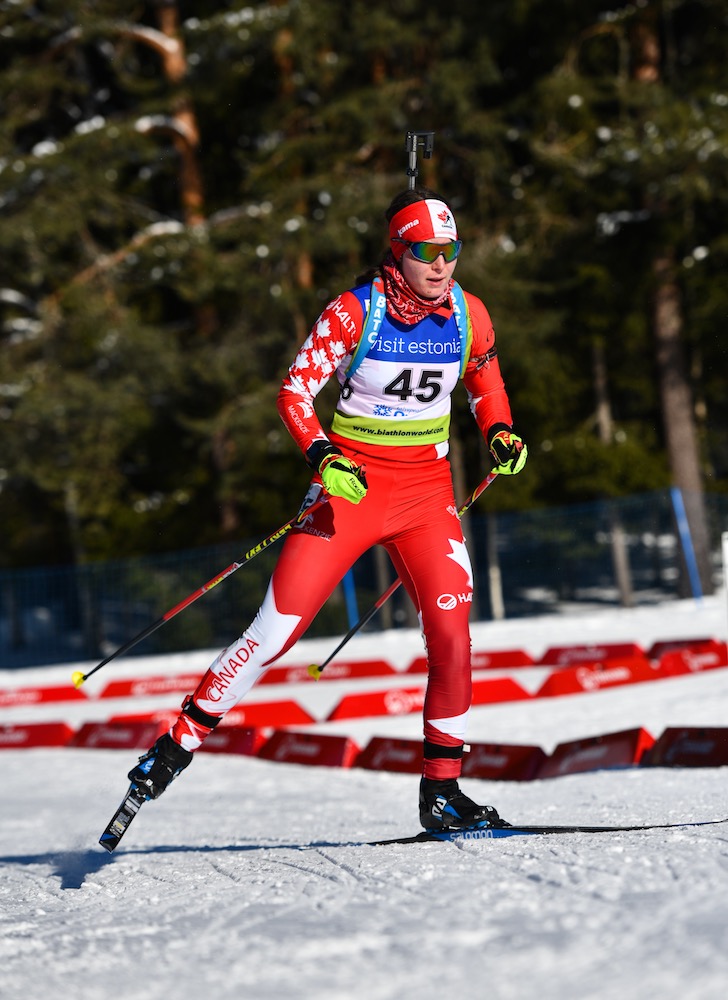
Nadia Moser racing to 11th in the junior women’s 10 k pursuit at IBU Junior World Championships on Sunday in Otepää, Estonia. (Photo: Bryan Dickson)
Moser picked off 10 places to finish 11th (+3:45.4). She started the pursuit in 21st and shot 18-for-20, cleaning the first two stages (0+0+1+1) and contending for the top 10 before finishing about 12 seconds out of 10th place. It was her second-best result of the week after placing eighth in the junior women’s 12.5 k individual.
“A top 10 finish was definitely the big goal for the pursuit, but I knew that was only possible if I shot really well and skiied well,” Moser wrote in an email. “Unfortunately, I missed my goal by one place.
“There were some pretty large time gaps in the starters today so it was a challenge to pick up places for me,” she continued. “For the most part I just tried to catch up with the people in front of me, or keep up with the people who passed me. I knew my best chance to move up was in the shooting range. … I was focused and trusting in my skills on the range today, and that is how I was able to hit most of my targets.”
She knew she was in 10th for her third shooting when she was shooting in lane 10.
“I was really happy that I had moved up as many places as I did, although slightly dissapointed that I was not able to reach the top ten,” Moser added. “I am satisfied with today’s pursuit. Moving up 10 positions is better than I’ve ever done before. Some things could have gone slightly better this week, but overall I am content with what I was able to achieve.”
Emily Dickson scored her first non-relay top 30 of the week in 26th (+5:31.6), up from 36th at the start, after missing just two targets (1+0+0+1). She had previously placed 36th in both the sprint and individual races, and ninth with Bankes and Moser in the 3 x 6 k relay.
After starting 26 seconds ahead of Davidová, Poland’s Kamila Żuk finished second in the pursuit, 28.1 seconds behind Davidová, after incurring six penalties (1+2+3+0). France’s Myrtille Begue placed third (+53.8) for the second-straight day after shooting 17-for-20 (0+1+1+1).
Onto the junior men’s 12.5 pursuit:
A day after placing third in the sprint, Norway’s Sverre Dahlen Aspenes shot clean in Sunday’s four-stage pursuit to take the win in 34:16.7. He finished 1:21.1 minutes ahead of France’s Martin Perrillat Bottonet, who placed second with one penalty (0+0+1+0). Norway’s Johannes Dale scored his first non-relay podium in third place (+1:46.4) with four misses (0+0+2+2).
Canada’s Adam Runnalls tallied his third individual top 30 of the week, placing 29th (+6:04.7) with six penalties (2+1+1+2). He had started the pursuit in 26th, based on his sprint result, and had previously finished 29th in the junior men’s 15 k individual.
His teammate Trevor Kiers started the pursuit in 16th and slipped to 34th (+6:44.4) with 10 penalties. Canada’s third man in the race, Teo Sanchez finished 57th (+10:32.5) with five misses (1+0+1+3) after starting 54th.
Cody Johnson was the lone U.S. skier in the junior men’s pursuit, racing to 48th (+7:40.0), after starting 37th, with five misses (2+0+2+1).
In the youth men’s 10 k pursuit:
Leo Grandbois racing to 15th in the youth men’s 10 k pursuit on Sunday at IBU Youth World Championships in Otepää, Estonia. (Photo: Terri Dickson)
Grandbois, a gold medalist at last year’s Youth Worlds in the 12.5 k individual, had his best race of the 2018 championships in 15th. After starting 33rd, he cleaned the first two stages to put himself in 16th halfway through the race, then missed two on each of the final two shooting bouts (0+0+2+2). But he didn’t lose much ground, leaving the range in 17th after the last shooting and passing two competitors to end up 15th (+3:37.2). Grandbois had previously raced to 24th in the 12.5 k individual this week and 16th with Canada’s youth men’s 3 x 7.5 k relay team.
“For the first bouts the wind was calm but for the second prone the wind picked up,” Grandbois explained in an email. “So I had to do some corrections that worked perfectly. I am really happy about it. First standing I came way too hard in the range and I could not manage to be precise. The last shooting was going well but the pressure to go faster made me miss again.
“I think that with a better standing shooting I could have done a top 10, but I was starting pretty far away so I am satisfied with my 15th,” he wrote.
“What I take back from those championships is that my ski speed is good but I will have to work hard next summer to keep it that way and to get it even better, for sure,” Grandbois added. “It wasn’t a good week for me in the range. I will have to work on my shooting speed and constancy. Those two things are my biggest weakness.”
Leading the U.S. men was Vasek Cervenka in 24th (+4:20.8). Cervenka had started the race in 24th and held his position despite six penalties (0+3+1+2) with the 19th-fastest course time. It was his third individual top 30 of the week after placing 27th in the 12.5 k (as well as ninth with his relay team).
Canada’s Rory Gilliland moved up 11 places to finish 41st (+6:12.2) with two penalties (0+0+1+1). His teammates Thomas Hulsman and Ryan Elden followed in 45th (+6:45.9) and 49th (+6:56.8) after starting 35th and 59th, respectively. Hulsman had six penalties while Elden had five (1+0+2+2).
For the U.S., Garrett Beckrich and Eli Nielsen finished 46th (+6:48.7) and 47th (+6:54.7), respectively. Beckrich had started 46th and incurred five penalties (1+1+1+2) while Nielsen slipped five places after starting 42nd and missing six targets.
After winning gold in the relay, Russia’s Andrei Viukhin notched his first individual podium and gold medal at his first Youth Worlds, winning the pursuit in 29:31.2. He had started seventh and missed four targets (1+1+1+1) yet led his teammates in a Russian podium sweep.
Viukhin handed his teammate Mikhail Pervushin his first loss of the week, as Pervushin settled for second, 16.8 seconds back, with four penalties as well (1+0+2+1). Aleksei Ogorelkov, who had not raced in Russia’s 3 x 7.5 k relay, finished third (+1:12.1) with two late penalties (0+0+0+2) for his first Youth Worlds podium.
Last but not least, the youth women’s 7.5 k pursuit:
Canada had three women finish in the top 40 of this race, with Benita Peiffer leading them in 30th (+4:28.2). She had started 51st and skied the 21st-fastest course time to pick off 21 places. Peiffer shot 17-for-20 (1+0+1+1).
Her teammate, Pascale Paradis slipped from 15th to 35th (+5:05.8) with eight penalties, while Jenna Sherrington improved from 46th to 39th (+5:28.1) with four misses (2+0+2+0).
For the U.S., Emma Stertz finished 48th (+5:58.0), up from 52nd at the start, with four penalties (1+0+2+1), and Grace Gilliland placed 57th (+7:21.0), after starting 55th, with four misses as well (1+1+1+1).
Russia’s Anastasiia Goreeva won her first individual gold at Youth Worlds, racing up from fourth at the start to cross the finish line first in 24:24.0 with three penalties (0+0+1+2). Germany’s Franziska Pfnür placed second for her first Youth Worlds podium, 17.5 seconds behind Goreeva, with just one penalty (0+1+0+0). In her second Youth Worlds, Switzerland’s Amy Baserga achieved her first podium as well, placing third (+29.0) with two penalties (0+0+1+1).
Canadian biathlete Thomas Hulsman training at the Canmore Nordic Centre in Canmore last season. (Photo: Britton Ledingham/iEvolve Photo Inc.)
In an effort to showcase the North Americans competing at this past week’s International Biathlon Union (IBU) 2018 Youth and Junior World Championships in Otepää, Estonia, we asked those qualifying athletes several questions about themselves — actually, we had them fill in the blanks. Here we have 18-year-old Thomas Hulsman, who represented Canada at his second World Youth Championships.
Over the last week, Hulsman placed 35th in the youth men’s 7.5 k sprint, 45th in the 10 k pursuit, 65th in the 12.5 k individual, and 16th in the 3 x 7.5 k relay.
***
“My full name is Thomas Gary Hulsman but you can call me Thomas.
I was born Calgary and raised in Airdire and I learned to ski at Foothills Nordic around the age of 12.
I spent the time between World Youth/Junior trials and Worlds on the Junior IBU tour and then in Norway for some training time.
My hardest workouts I did in the last training year to prepare for this was uphill intensity where we did a pyramid. That means we ran up, then back down, then ran a little bit further up, then back down, up then down, and up to the top.
One thing I’m working on this season to improve my biathlon is my sking.
This is my first time in Estonia and second time racing internationally, and so far it’s been a blast.
One difference I’ve noticed between Estonia and the Canada is the food.
Thomas Hulsman racing at the IBU Junior Cup in the Czech Republic earlier this season. (Courtesy photo)
One of the things I’m most excited about for World Youth/Junior Championships in Otepää is seeing the country.
One race I’m particularly targeting is the sprint, because it is the race I need to place in the top 60 to do the pursuit.
Watching the Olympics in the leadup to my own races was inspirational. One of my favourite moments of the Games was watching the races with the boys in my room. I want to be like Martin Fourcade because he is so consistent.
At Worlds, I really hope I can chat/make friends with as many people as possible.
My favourite thing at the breakfast where we are staying is all of the fruit and the omelettes.
Before this trip, if you said “Estonia”, the first thing I’d think of would have been “Where is that?”
Now that I’m here, I’m pretty sure something I’ll always remember will be how there is skiing everywhere.
If I had a totally free day here and didn’t have to worry about race fitness or training, I’d spend it seeing the country, probably in the capital and shopping for stuff.
Canada’s Ryan Elden racing in the youth men’s 7.5 k sprint at 2018 IBU Youth World Championships in Otepää, Estonia. (Photo: Bryan Dickson)
In an effort to showcase the North Americans competing at this past week’s International Biathlon Union (IBU) 2018 Youth and Junior World Championships in Otepää, Estonia, we asked those qualifying athletes several questions about themselves — actually, we had them fill in the blanks. Here we have 18-year-old Ryan Elden, who represented Canada at his first World Youth Championships.
Over the last week, Elden placed 49th in the youth men’s 10 k pursuit, 59th in the 7.5 k sprint and 81st in the 12.5 k individual.
***
“My full name is Ryan Alexander Elden, but I go by Ryan pretty much all the time.
I was born and raised in Quesnel, British Columbia, and I learned to ski at the age of 2.
Between Trials and Youth Worlds I spent my time competing in Europe on the 2nd international Biathlon tour. I competed in races in Nové Mesto, Czech Republic and Pokljuka, Slovenia. After racing I spent the last 2 weeks in France, at my coach Etienne’s hometown, doing our final bit of training before Worlds.
The hardest/most fun workout we did during the summer in Whistler with the Whistler Nordic Training Centre was pulling tires on our roller skis.
The biggest thing I’ve been working on this season is shooting. I’ve been a little inconsistent in the past so I’ve been doing a bit of extra work to improve in that area.
This is my first time in Estonia and my second time racing internationally. My first time were the races I did in Czech Rebublic and Slovenia three weeks ago. It’s been a huge learning experience and a ton of fun.
One difference I’ve noticed between Canada and Estonia are the older buildings. It has a really cool mix of very modern buildings and very old buildings.
At Worlds, I’m really excited to see how I size up against the other biathletes from all around the world.
One race I’m especially targeting is the pursuit because it is the most fun in my opinion.
Watching the Olympics before racing has been really inspiring. My favourite part of watching the Olympics is hearing the stories of the athletes and what they’ve gone through to get to where they are today. I get so excited every time medalists are tearing up with happiness on the podium after finally achieving their dreams. If I had to choose someone, I would like to be like Johannes Thingnes Bø. A great champion and amazing athlete, but also personable and humble.
Here at Worlds I want to meet as many different as I can and learn about the other countries.
My favourite thing at breakfast (not here specifically but also here) is eggs with cheese.
The first thing I thought of before coming here was cold.
Now that I’m here, I don’t think I will ever forget how flat it is. Our course is anything but flat, surprisingly, but the countryside we drove through was very flat. It has beautiful scenery though.
If I had a ton of spare time here I would spend it exploring the larger towns and checking out cool buildings.
American Lexie Madigan getting some air during summer training. (Courtesy photo)
In an effort to showcase the North Americans competing at this past week’s International Biathlon Union (IBU) 2018 Youth and Junior World Championships in Otepää, Estonia, we asked those qualifying athletes several questions about themselves — actually, we had them fill in the blanks. Here we have 16-year-old Lexie Madigan, who represented the United States at her first Youth World Championships.
Over the last week, Madigan placed 70th in the youth women’s 6 k sprint, 83rd in the 10 k individual and 18th with the 3 x 6 k relay.
***
My full name is Margaret Lexie Madigan but you can call me Margie.
I was born and raised in Nevada City, California, and I learned to ski at the Auburn Ski Club.
Lexie Madigan racing (Courtesy photo)I spent the time between World Youth/Junior trials and Worlds training at home in California and competing on the Junior IBU Cup circuit.
The funnest workout I did in the last training year to prepare for this was when I played speedball at the beach with the Sugar Bowl Nordic Ski Team.
One thing I’m working on this season to improve my biathlon is learning to shoot in the cold weather.
This is my first time in Estonia and seventh time racing internationally, and so far it’s been the greatest experience!
One difference I’ve noticed between Estonia and the United States is that it is a lot colder (at least colder than California).
One of the things I’m most excited about for World Youth/Junior Championships in Otepää is all of the fast skiers and hard competition!
One race I’m especially targeting there is the sprint.
Watching the Olympics in the leadup to my own races was inspiring. One of my favorite moments of the Games was when Jessie and Kikkan won the Cross Country Team Sprint. I want to be like Jessie Diggins, because she showed that the race isn’t over until you cross the finish line and never gives up.
At Worlds, I really hope I can chat/make friends with someone from France and ask them if they know Martin Fourcade’s secrets.
Eli Nielsen racing at 2018 IBU Youth World Championships in Otepää, Estonia. (Courtesy photo)
In an effort to showcase the North Americans competing at this past week’s International Biathlon Union (IBU) 2018 Youth and Junior World Championships in Otepää, Estonia, we asked those qualifying athletes several questions about themselves — actually, we had them fill in the blanks. Here we have 18-year-old Eli Nielsen, of Washington state, who represented the U.S. at his second Youth World Championships.
“My full name is Camren Eli Nielsen but you can call me Caspian.
I was born and raised in Stehekin, Washington, and I learned to ski with the Bob Scouts.
I spent the time between World Youth/Junior trials and Worlds racing biathlon in the Czech Republic and Slovenia and thinking about how I should probably be doing homework.
The funnest workout I did in the last training year to prepare for this was pretty much every workout with the Methow Team.
One thing I’m working on this season to improve my biathlon is hitting more targets faster.
This is my first time in Estonia and fourth time racing internationally, and so far it’s been absolutely amazing.
One difference I’ve noticed between Estonia and the United States is it only takes three hours to drive across the entire country.
One of the things I’m most excited about for World Youth/Junior Championships in Otepää is the relay. It’ll be fun to throw down with the boys in a head to head race.
One race I’m especially targeting there is the sprint. Less shooting is usually a good thing.
Watching the Olympics in the leadup to my own races was exciting. One of my favorite moments of the Games was Kikkan and Jessie’s gold in the team sprint. I want to be more like Erik Bjornsen because he’s such a bro.
At Worlds, I really hope I can make friends with someone from Norway and ask them if I can come live with them.
My favorite thing at the breakfast where we are staying is the cucumber water… jk Garrett’s the only one who can stand that stuff.
Before this trip, if you said “Estonia”, the first thing I’d think of would have been “North eastern Europe?”
Now that I’m here, I’m pretty sure something I’ll always remember will be doing homework… take note teachers.
If I had a totally free day here and didn’t have to worry about race fitness or training, I’d spend it in the sauna.
The best way to follow me on social media is on Instagram @eels_niels.”
Jenna Sherrington racing at Biathlon Canada’s Youth World Trials in Valcartier, Quebec. (Photo: Jenna Sherrington/Instagram)
In an effort to showcase the North Americans competing at this week’s International Biathlon Union (IBU) 2018 Youth and Junior World Championships in Otepää, Estonia, we asked those qualifying athletes several questions about themselves — actually, we had them fill in the blanks. Here we have 16-year-old Jenna Sherrington, of Calgary, who is representing Canada at her first Youth World Championships.
In her last race of Youth Worlds, the youth women’s 7.5 k pursuit, Sherrington placed 39th (+5:28.1 with four penalties). She also finished 40th in the 10 k individual on Monday and 46th in the 6 k sprint on Friday.
***
“My full name is Jenna Sherrington but you can call me Jenna.
I was born and raised in Calgary, Alberta, and I learned to ski at age 2.
Jenna Sherrington getting some sunny training in on the Haig glacier near Canmore, Alberta. (Courtesy photo)
I spent the time between World Youth/Junior trials and Worlds training, preparing, going to school and coaching cross-country skiing to 5 year olds.
The hardest and most fun workout I did in the last training year to prepare for this was bicycle 1100 kilometers from Quebec City to Charlottetown with my Dad.
One thing I’m working on this season to improve my biathlon is being able to completely focus during a race. Last year I had quite a bit of trouble getting out of my own head while racing so I’ve been trying to improve that.
This is my first time in Estonia and first time racing internationally, and so far it’s been an incredible learning opportunity and experience.
One difference I’ve noticed between Estonia and Canada is the language is very different and they eat lots of potatoes.
One of the things I’m most excited about for World Youth/Junior Championships in Otepää is travelling to a new country and competing against the best youth biathletes in the world.
One race I’m especially targeting there is the sprint.
Watching the Olympics in the lead up to my own races was really inspiring to see the best biathletes in the world race as hard as they could for their country. One of my favourite moments of the Olympics was when Martin Fourcade won in the 15km mass start with a photo finish against Simon Schempp. I want to be like Laura Dahlmeier because she always has a smile on her face and it looks like she has a genuine love for the sport of biathlon.
At Worlds, I really hope I can chat/make friends with someone from Norway and ask them what it’s like to live in Norway and what the Norwegian culture is like.
My favorite thing at the breakfast where we are staying is the fruit, there’s always oranges or grapes, which is fantastic.
Before this trip, if you said “Estonia”, the first thing I’d think of would have been “sorry, where?”.
Now that I’m here, I’m pretty sure something I’ll always remember will be the people I meet and how incredibly sparkly the snow is.
If I had a totally free day here and didn’t have to worry about race fitness or training, I’d spend it skiing around on the absolutely breath taking trails that intertwine and surround the town.
The best way to follow me on social media is on Instagram @jennasherrington.”
American Chloe Levins racing to seventh in the junior women’s 7.5 k sprint on Saturday at IBU Junior World Championships in Otepää, Estonia. (Photo: Terri Dickson)
“There’s almost nothing I love more than being in the hunt during a pursuit,” American Chloe Levins wrote in an email to FasterSkier on Saturday. “I’m prepared. I’m hungry.”
Two days after placing sixth in the junior women’s 12.5-kilometer individual on Thursday, Levins, 19, raced to seventh place in Saturday’s 7.5 k sprint, which will put her in seventh (and within 10 seconds of fourth place) for the start of Sunday’s 10 k pursuit at the International Biathlon Union (IBU) Junior World Championships in Otepää, Estonia.
On Saturday, Levins, a Middlebury College sophomore, started the 7.5 k sprint in 20th out of 70 women. She missed one of her prone targets, having to ski a penalty lap, and cleaned standing to cross the finish line in second place, just 1.5 seconds behind Russia’s Emma Timerbulatova in first. While both were ultimately bumped to sixth and seventh, respectively, by the time all 70 racers had finished, Levins’s course time still held up as the eighth fastest. Her shooting was among the best, too, with only five women cleaning the two-stage race.
“There’s been a consistent stream of wind on this range all week long,” Levins explained in the email. “It didn’t fail to show up today either. Ski conditions were perfect. The snow was cold but fast, and it got faster throughout the day.”
When asked about the course, she recalled a term her coach Algis Shalna used to describe it: “workhorse”.
“That’s exactly what it is,” she wrote. “It’s a traditional course with long hills and few transitions. I don’t really have a course profile preference, but working over the top of these hills pushes me past my limits every time.”
Levins described being able to handle the “steady and relatively calm” wind conditions without many technical adjustments. After hitting all five targets in her standing stage, all she could do was smile as she returned to the course, she wrote.
“It was a very rhythmic shooting that gave me some momentum leading into the last loop,” Levins recalled. “Our staff and even some of the youth athletes were everywhere on course today, which really helped me gain time on a Russian athlete who left the range 15sec ahead of me at the split.
“I had the biggest support system in the entire field today,” she added. “I hope they had as much fun during the competition as I did.”
At the finish, Levins tried to process any time she lost on the course and the time gap between her and first place at the time.
“My brain immediately went to analyzing the race in search of 1.5 lost seconds,” Levins wrote. “Since the temperatures have been so cold this week, they made all the races 20 second intervals. It was unfortunate that I had to maneuver my way around two groups of at least four competitors along the track on my last loop.”
In the end, she ended up seventh, 1:31.7 minutes behind Poland’s Kamila Żuk, who won in 22:32.5 with one standing penalty (0+1). Żuk also won Thursday’s 12.5 k individual.
On Sunday, Levins will start the pursuit 1:32 behind Żuk and just 10 seconds behind Russia’s Valeriia Vasnetcova in fourth place. Markéta Davidová of the Czech Republic will head out of the gate second, 26 seconds behind Żuk, and France’s Myrtille Begue will start third, 52 seconds back. While Davidová made up for two penalties in Saturday’s sprint with the second-fastest course time (behind Żuk in first), Begue shot clean and skied the fifth-fastest course time.
Canada’s Megan Bankes racing to ninth in the junior women’s 7.5 k sprint on Saturday at IBU Junior World Championships in Otepää, Estonia. (Photo: Terri Dickson)
Canada’s Megan Bankes placed ninth for her third-straight race of the championships, after finishing ninth in the junior women’s 3 x 6 k relay and ninth in the 12.5 k individual. On Saturday, she had two penalties, one in each stage (1+1), and finished 1:49.5 minutes out of first with the (you guessed it) ninth-fastest course time.
Bankes will start the pursuit 1:50 back and just 4 seconds behind Norway’s Marit Ishol Skogan in eighth.
Her teammate Nadia Moser finished 21st (+2:46.2), also with two penalties (0+2), Emily Dickson finished 36th (+3:50.5) with two penalties (1+1), and Canada’s fourth woman Zoë Pekos narrowly missed the pursuit cutoff in 66th (+6:22.4) with four misses (3+1).
In the junior men’s 10 k sprint that followed, Canada’s Trevor Kiers achieved his best result at his second Junior Worlds in 16th (+1:34.9) with two penalties (2+0). Kiers, 20, previously broke through in 10th and 11th this season in IBU Junior Cup sprints. Last year at Junior World Championships, his best non-relay result was 39th in the pursuit.
So far in Otepää, Kiers had finished 77th in the 15 k individual and 17th with his team in the 4 x 7.5 k relay.
“I found it really hard mentally after the relay and individual,” Kiers wrote in an email. “But after a ton of self-reflection, I realised that I put too much pressure on myself to shoot well and perform. I simply didn’t trust myself. After the individual, I had one training session to regain my confidence, and I was able to do just that. I took 60 very focused shots, and only missed 1 prone and 3 standing over the whole session, and the last 30 were clean! I came into today’s race feeling very confident in my shooting, and knew that I could perform, and not allow that pressure to reach me. To go out and have a fun time, and my instincts would kick in, and the shooting would fall into place.”
On the range, Kiers’s shooting and range times ranked 13th and 14th overall, respectively. As he entered his first prone shooting stage, he recalled that he consciously freed his mind of any expectations.
“After I shot off my first, the casing got stuck in my chamber and I feel it through off my relaxed sort of focus, but I know that my last two shots were just me being silly,” Kiers wrote. “I knew that the next bout would be good, I had convinced myself that standing would be a breeze, just let my body do what it knows how to do.”
His next time in the range, he cleaned his standing bout.
Canada’s Trevor Kiers racing in the junior men’s 15 k individual at 2018 IBU Junior World Championships in Otepää, Estonia. He placed 77th in that race and went on to finish 16th in the junior men’s 10 k sprint on Saturday. (Photo: Bryan Dickson)
“Not only did I clean it, but quickly too!” Kiers wrote. “I was one of the fastest shooters of the day, and can reflect back knowing that I didn’t rush, just that it felt good. Heading out on skis, I knew that I still had a shot at a good result, when I went up one of the first long climbs, out wax tech was yelling at me that I was definitely still in it, that I was still skiing on par, and that I could pull this back together! Having that near the beginning of the loop definitely set me up well mentally for the second loop, to keep the grind on, and that I wouldn’t give up any seconds.”
Based on his shooting, he was confident he could be in the top 20. As the 16th starter, Kiers crossed the finish line in sixth, but some 72 men were still on course. Ultimately, he finished 16th, 1:34.9 behind Russia’s Vasilii Tomshin, who shot clean to win in 25:01.8.
“When I heard that I got 16th I was super happy!” Kiers wrote. “From the previous races I’ve done this year, I knew that cleaning a race could land me in the top 10, and once I finished with 2 misses, I reckoned that it would probably be a top 25, maybe a top 20, but I apparently skied faster than I thought possible! … Today, I held my own on skis, and proved that I deserve to be up here with the big guns!”
Looking back on his progression in the sport, he described it as “insane”.
“… Before two years ago (May of 2016) I had never had a biathlon coach, and did all my training on my own in my backyard range that I built,” he explained. “But I was able to prove myself at the 2016 nationals that February and landed a spot on [Biathlon Alberta Training Center]. BATC has changed a lot about how I had gone about things before, and I think that last year was the time to get used to a full time training lifestyle, and this was the year to start performing, and showing what it has done for me.”
Kiers will start Sunday’s 12.5 k pursuit in 16th, 1:35 behind Tomshin and seven seconds behind Germany’s Tim Grotian in 15th. France’s Martin Perrillat Bottonet (who had one penalty in the sprint) will start second, 21 seconds back, and Norway’s Sverre Dahlen Aspenes (who missed two) will head out third, eight seconds later.
“I am super excited to see what I can do tomorrow, but to be truthful, I don’t have any expectations as far as results go,” Kiers wrote. “My expectations are to simply go out there, have some fun, dance to a few songs during warm-up, and see where that takes me. I am really looking forward to leaving everything I’ve got out on the track, being the last race of the championships, no holding back, have no regrets after I finish.”
Canada had two in the top 30 with Adam Runnalls in 26th (+2:08.3) with three penalties (1+2). Teo Sanchez also qualified for the pursuit by tying for 53rd (+3:19.2) with one penalty (1+0), while Angus Tweedie placed 69th (+4:41.3) with three misses (+4:41.3).
Cody Johnson shot clean to lead the Americans in 37th (+2:31.1). Tim Cunningham finished 71st (+5:13.5) with seven misses, Jacob Pearson was 79th (+6:24.2) with two penalties (1+1) and Cam Christiansen in 86th (+7:52.5) with three penalties (1+2).
Canada’s Trevor Kiers racing at the IBU Junior Cup in Nove Mesto, Czech Republic, earlier this season. (Courtesy photo)
In an effort to showcase the North Americans competing at this week’s International Biathlon Union (IBU) 2018 Youth and Junior World Championships in Otepää, Estonia, we asked those qualifying athletes several questions about themselves — actually, we had them fill in the blanks. Here we have 20-year-old Trevor Kiers, who is representing Canada at his second Junior World Championships.
“My full name is Trevor Kiers but you can call me anytime 😉.
I was born in Welland, Ontario, raised in Sprucedale, Ontario, and I learned to ski at Arrowhead Provincial Park.
I spent the time between World Youth/Junior trials and Worlds mainly racing on the junior circuit, and then spent the two weeks prior to WJCH in Sjusjoen, Norway.
The favourite workout I did in the last training year to prepare for this was riding the Ironman loop in Penticton, a 180km ride around the area with my teammates Carsen Campbell and Matt Hudec.
One thing I’m working on this season to improve my biathlon is confidence in the range.
This is my first time in Estonia and fourth time racing internationally, and so far it’s been amazing!
One difference I’ve noticed between Estonia and the Canada is that I’ve found that the history, and all that fun stuff is definitely super Euro, but I think that there is a mix of modern western culture thrown in there.
One of the things I’m most excited about for World Youth/Junior Championships in Otepää is watching all my teammates, from potential medalists, to first timers, and all my close friends!
One race I’m especially targeting there is the Sprint and pursuit combo.
Trevor Kiers racing at Canadian World Junior Trials in Whistler earlier this winter. (Courtesy photo)
Watching the Olympics in the lead up to my own races was inspiring and motivational. One of my favourite moments of the Games was when Seb Sameulsson overtook Beni Doll for the silver medal in the men’s pursuit. I want to be like J-T Boe, because he races his heart out, but also knows when to have fun, and after the individual, when to get emotional 🙂
At Worlds, I really hope I can chat/make friends with someone from Norway and ask them if they want to trade last year’s race suits!
My favorite thing at the breakfast where we are staying is that they have what could be considered an American selection, they have oatmeal, eggs and bacon, the food is also delicious.
Before this trip, if you said “Estonia”, the first thing I’d think of would have been Andrew (team wax tech), because I know that he has family here, and that he enjoys his time with his cousins.
Now that I’m here, I’m pretty sure something I’ll always remember will be the venue, it’s been beautiful so far, and the course here is pretty spectacular.
If I had a totally free day here and didn’t have to worry about race fitness or training, I’d spend it around the old town in Tallinn. I went there the first day (I had flown in earlier than the rest of the group) but I feel like I hadn’t seen it all in its best, also a lot of things were closed because it was winter.
The best way to follow me on social media is on FacebookTrevor Kiers – Biathlete or Instagram@trevor.kiers, will also return smoke signals or messages flown in by owl.“
Angus Tweedie of Canada racing at the IBU Junior Cup in Nove Mesto, Czech Republic, earlier this season. (Photo: Brian Dickson)
In an effort to showcase the North Americans competing at this week’s International Biathlon Union (IBU) 2018 Youth and Junior World Championships in Otepää, Estonia, we asked those qualifying athletes several questions about themselves — actually, we had them fill in the blanks. Here we have 20-year-old Angus Tweedie of British Columbia, who is representing Canada at his first Junior World Championships after several IBU Junior Cup and Junior Open European Championships trips.
“My full name is Angus Tweedie but you can call me Curtis.
I was born and raised in Smithers, BC, and I learned to ski at the Bulkley Valley Nordic Center.
I spent the time between World Youth/Junior trials and Worlds racing the last two Junior Cup races and training in France.
The most memorable workout I did in the last training year to prepare for this was roller skiing in an inch and a half of snow while it was raining with my teammates in the Whistler Nordic Development Center.
One thing I’m working on this season to improve my biathlon is spending less time in the circle of shame.
This is my first time in Estonia and second time racing internationally, and so far, it’s been brutally hot inside and incredibly cold outside.
One difference I’ve noticed between Estonia and the Canada is the buildings are way older here.
One of the things I’m most excited about for World Youth/Junior Championships in Otepää is racing at a completely new venue.
One race I’m especially targeting there is individual.
Watching the Olympics in the leadup to my own races was highly disappointing. One of my least favorite moments of the Games was losing to Germany in hockey and to USA in both hockey and curling (we lost the stereotypically Canadian sports). I want to be like Mark McMorris, because his recovery was nothing short of spectacular.
At Worlds, I really hope I can chat/make friends with someone from Brazil and ask them “How do you get started in biathlon where winter isn’t really a thing?”
My favorite thing at the breakfast where we are staying is the fine selection of Yeti meats.
Before this trip, if you said “Estonia”, the first thing I’d think of would have been a mental picture of where it is on a map.
Now that I’m here, I’m pretty sure something I’ll always remember will be how similar it is to home (minus the lack of mountains of course)
If I had a totally free day here and didn’t have to worry about race fitness or training, I’d spend it wandering around with camera in hand.
The best way to follow me on social media is on Instagram@angomcmango.”
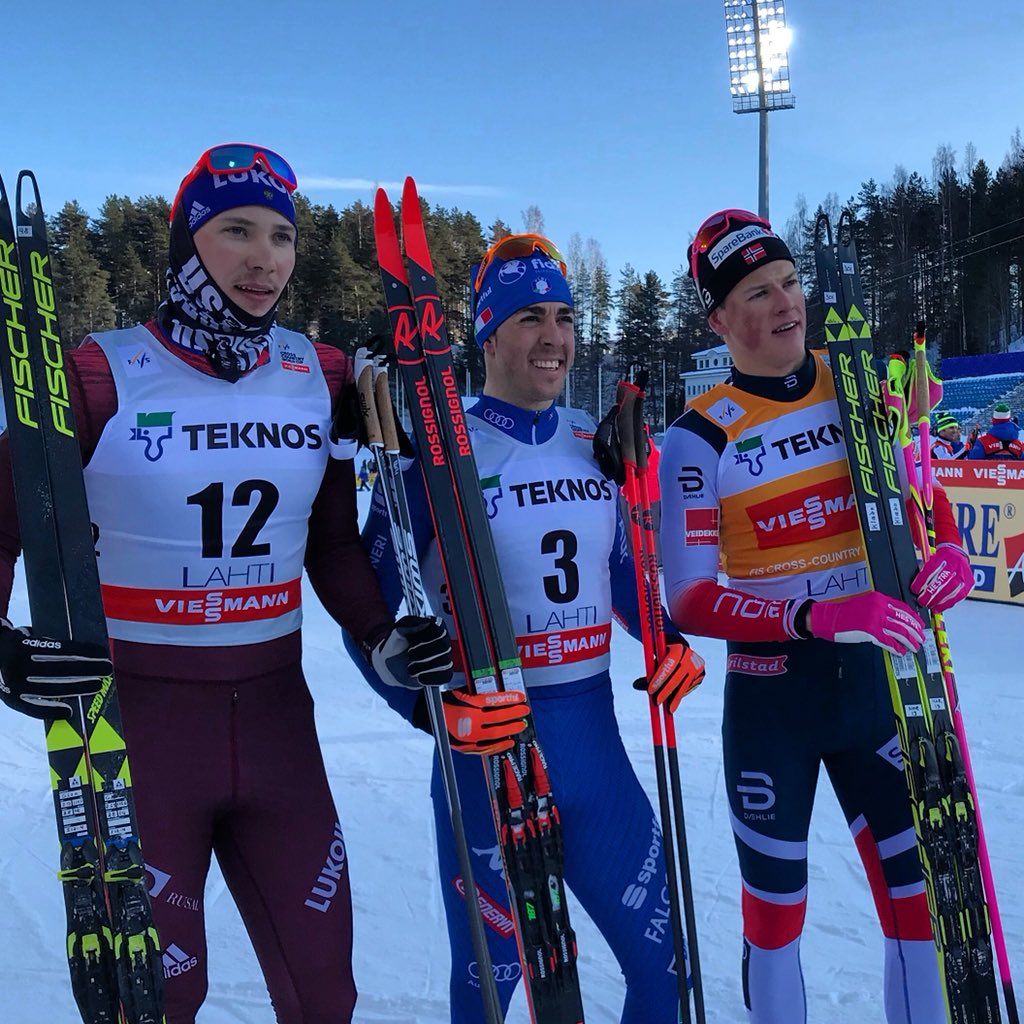
The men’s 1.6 k freestyle sprint podium at Saturday’s World Cup in Lahti, Finland, with Italy’s Federico Pellegrino (c) in first, Russia’s Gleb Retivykh (l) in second and Norway’s Johannes Høsflot Klæbo (r) in third. (Photo: FIS Cross Country/Twitter)
FIS Cross Country World Cup (Lahti, Finland): Men’s & women’s freestyle sprints
The defending world championships from the 2017 freestyle sprint prevailed again in Lahti on Saturday, with Norway’s Maiken Caspersen Falla winning the women’s 1.4-kilometer freestyle sprint final and Italy’s Federico Pellegrino coming out on top in the men’s 1.6 k final at last year’s World Championships venue.
Falla’s rise to the final started with her qualifying in 12th, 7.96 seconds off the fastest qualifying time set by Sweden’s Hanna Falk in 2:54.72. Russia’s Natalia Nepryaeva qualified second (+0.63) and Finland’s Krista Pärmäkoski third (+3.62), just ahead of Germany’s Victoria Carl in fourth (+3.88) and American Sadie Bjornsen in fourth (+3.88). Four American women qualified for the heats, with Sophie Caldwell in 17th, Ida Sargent in 21st and Rosie Brennan in 29th.
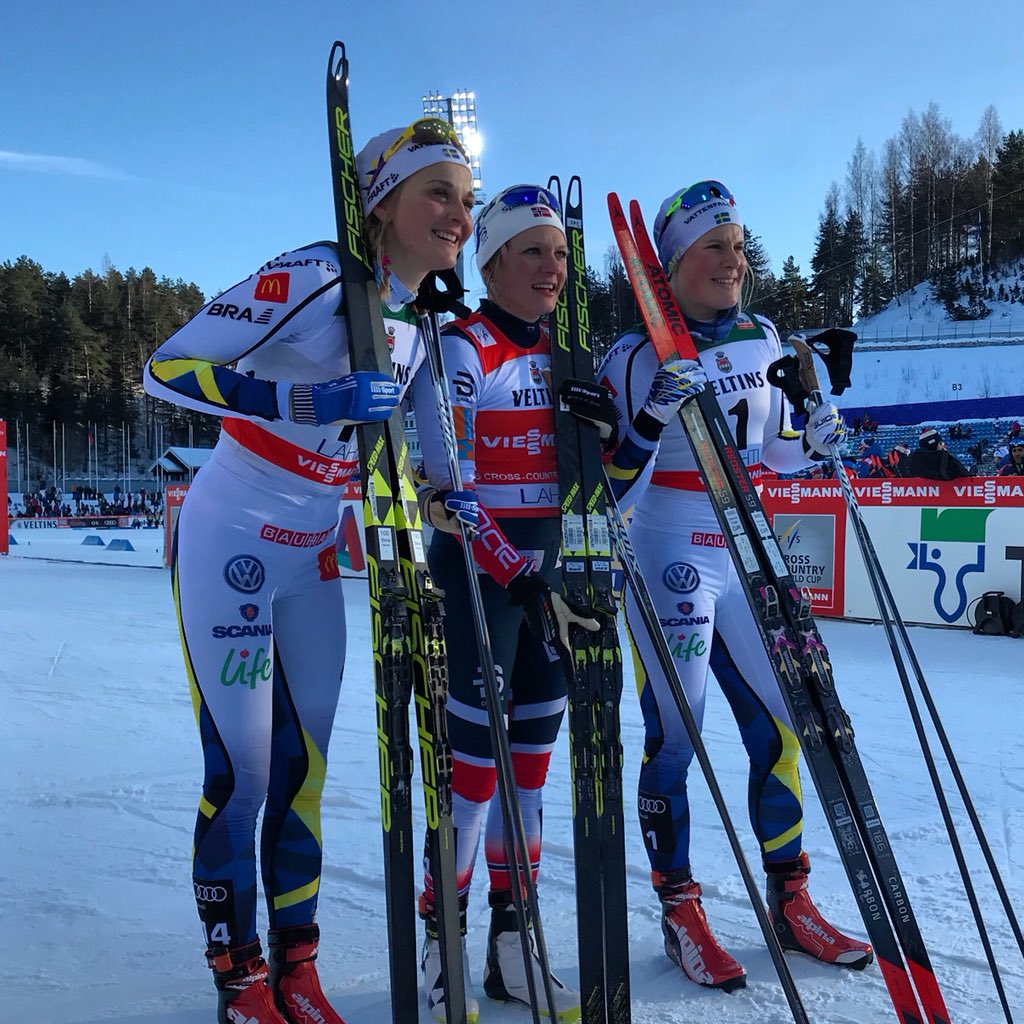
The women’s 1.4 k freestyle sprint podium at Saturday’s World Cup in Lahti, Finland, with Norway’s Maiken Caspersen Falla (c) in first, and Sweden’s Stina Nilsson (l) and Hanna Falk (r) in second and third, respectively. (Photo: FIS Cross Country/Twitter)
Falla went on to place second in the first quarterfinal, 0.71 seconds behind Sweden’s Stina Nilsson in first. According to the race jury’s ruling, Carl obstructed Pärmäkoski coming out of the last downhill before they entered the finishing straight and both crashed out of contention, with Pärmäkoski finishing fifth in the heat (+12.11) and Carl sixth (+49.5). Carl was relegated to last (30th place) for the obstruction.
Falla then won the first semifinal by just 0.04 seconds over Nilsson in second. The two other Swedes in that heat, Falk and Ida Ingemarsdotter, advanced to the final as well as lucky losers with fast-enough times.
In the final, Falla found herself at the front of the pack early then held her position to the finish, crossing the line in 2:54.83 and beating Nilsson by 0.36 seconds. Sweden had two on the podium with Falk in third (+0.78), Germany’s Sandra Ringwald placed fourth (+0.88), Ingemarsdotter was fifth (+1.83), and Switzerland’s Laurien van der Graaff placed sixth (+3.02).
Caldwell was the lone American woman to make it past the quarterfinals, as she placed second in her quarterfinal, 0.25 seconds behind Ringwald in first, then fourth in the second semifinal, 1.46 seconds behind Ringwald, who also won that heat. Overall, Caldwell finished the day in eighth.
Bjornsen placed 17th overall after finishing fourth in her quarterfinal, 2.84 seconds behind Falk in first. Sargent had been second in her quarterfinal until the final tight lefthand corner into the finishing straight, where she slipped to sixth and ultimately finished sixth, 1.07 seconds behind Sweden’s Anna Dyvik in first. Overall, Sargent finished the day in 27th, and Brennan placed 29th overall after finishing sixth in her quarterfinal, 4.91 seconds behind Ingemarsdotter in first.
Two American men advanced to the heats as well, with Kevin Bolger of the Sun Valley Ski Education Foundation (SVSEF) qualifying in 16th in his World Cup debut, 6.38 seconds behind Norway’s Johannes Høsflot Klæbo, who topped the qualifier in 2:59.06. Erik Bjornsen of the U.S. Ski Team qualified 29th, 8.29 seconds back.
Meanwhile, Pellegrino qualified for the heats in third (+1.9) behind France’s Baptiste Gros in second (+1.23).
There, Pellegrino won the first quarterfinal by 0.19 seconds over Klæbo, with the Norwegian visibly backing off before the finish — comfortable enough to automatically advance to the semifinals in second place. But Klæbo showed Pellegrino what he’s made of in the first semifinal and beat the Italian by nine-hundredths of a second.
Bolger also raced in that first semifinal after placing fourth in his quarterfinal, 0.73 seconds behind Russia’s Gleb Retivykh in first. Bolger’s time was good enough for one of two lucky loser spots in the semifinals, where he went on to finish sixth, 1.86 seconds after Klæbo. Overall Bolger finished the day in 11th.
Erik Bjornsen placed 20th on the day after finishing fourth in the first quarterfinal (with Pellegrino and Klæbo), 1.56 seconds out of first.
In the final, Klæbo set the tone, slowing the pace to almost a stop at one point, while he and Pellegrino stood side by side at the top of the course. On the way down, they accelerated, but Norway’s Sindre Bjørnestad Skar was the one who truly attacked. It might’ve been a bit too early, as Pellegrino caught him by the top of the final climb and took the lead on the following downhill into the stadium. Pellegrino held off his challengers, including Retivykh who came on strong out of the downhill, to take the win in 3:16.73, 0.77 seconds ahead of Retivykh in second and 0.9 seconds ahead of Klæbo in third. Skar settled for fourth (+1.3), Finland’s Ristomatti Hakola placed fifth (+1.44) and France’s Lucas Chanavat finished sixth (+7.55).
In the qualifier, Canada’s Dahria Beatty finished 34th, +13.39 and just 0.9 seconds from making the quarterfinals. She was the only Canadian woman competing.
American Kelsey Phinney (SVSEF) was also close to making the cut. In her first European World Cup, she placed 36th in the qualifier, +13.74. Caitlin Patterson and Kaitlynn Miller, both of the Craftsbury Green Racing Project, placed 56th (+20.12) and 61st (+21.70).
Mathilde Petitjean of Togo, a primarily Quebec-based skier, finished in 59th (+20.80).
In the men’s qualifier, Logan Hanneman (APU) placed 49th (+11.45). Paddy Caldwell (U.S. Ski Team/SMS T2) finished 59th (+13.55), and APU’s Reese Hanneman and David Norris placed 61st (+14.33) and 67th (+19.27).
Julien Locke led Canada in 42nd place (+9.78), and Andy Shields finished 60th (+14.29).
American Chloe Levins racing to seventh in the junior women’s 7.5 k sprint on Saturday at IBU Junior World Championships in Otepää, Estonia. (Photo: Terri Dickson)
Poland’s Kamila Zuk won her second race in a row, taking gold in the junior women’s 7.5 k sprint after also winning the individual at World Junior Championships. Zuk had one penalty to two by second-place Marketa Davidova of the Czech Republic, who finished 26.0 seconds back. Bronze went to Myrtille Begue of France, who shot clean to finish 52 seconds back.
The sole U.S. starter, Chloe Levins followed up her sixth-place finish in the individual with seventh place in the sprint. Levins had a single penalty and finished +1:31.7.
For Canada, Megan Bankes was close behind Levins in ninth, with two penalties and +1:49.5. Teammate Nadia Moser was 21st, also with two penalties, +2:46.2. Emily Dickson finished 36th, +3:50.5 with two penalties, and Zoe Pekos just missed the pursuit cutoff in 66th (+6:22.4) with four missed shots.
In the junior men’s 10 k sprint, Vasilii Tomshin of Russia took the gold with perfect shooting. France’s Martin Perillat Bottonet was second, less than a penalty-loop’s worth of time back at 20.5 seconds – and he did have one penalty. Norway’s Sverre Dahlen Aspenes took bronze (+29.4) with two missed shots.
Trevor Kiers led Canada in 16th, a breakthrough result; his previous World Juniors best was 39th in the pursuit last season. Kiers missed two shots, both in prone, and finished 1:34.9 behind the time set by Tomshin.
Adam Runnalls placed 26th for Canada (+2:08.3) with three missed shots. Teo Sanchez also qualified for the pursuit by placing 53rd (+3:19.2) with one penalty, and Angus Tweedie was left on the outside looking in with 69th place (+4:41.3) with three missed shots.
Cody Johnson led the Americans in 37th, with clean shooting, 2:31.1 back from Tomshin’s time. Tim Cunningham was the next finisher in 71st (+5:13.5) with seven missed shots, followed by Jacob Pearson in 79th (+6:24.2) with two penalties and Cam Christiansen in 86th (+7:52.5) with three penalties.
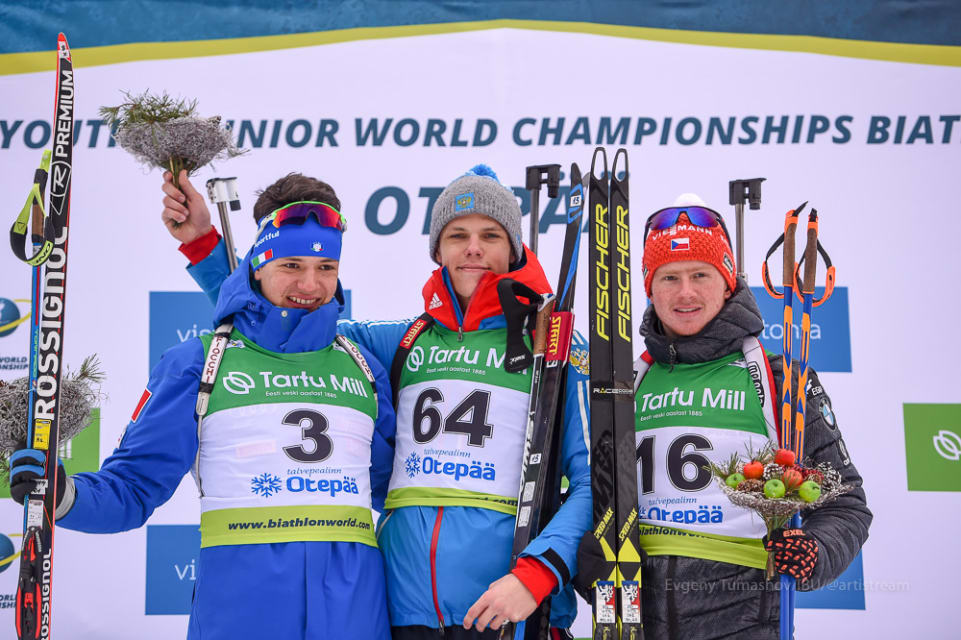
The youth men’s 7.5 k sprint podium at IBU Youth World Championships in Otepää, Estonia, with Russia’s Mikhail Pervushin (c) continuing his undefeated streak at the championships in first, Italy’s Tommaso Giacomel (l) in second, and the Czech Republic’s Vítězslav Hornig (r) in third. (Photo: IBU/Biathlonworld)
IBU Youth World Championships (Otepää, Estonia): Youth women’s and men’s sprints
Sweden’s Karin Elvira Öberg raced to her third-straight win of the week at the International Biathlon Union (IBU) Youth World Championships in Otepää, and Pascale Paradis led Canada in 15th in the youth women’s 6-kilometer sprint on Friday.
Paradis started 36th out of 92 women and shot 18-for-20, missing one on each stage (1+1), on a day when the top-two finishers had misses as well. With the ninth-fastest overall course time, Paradis, 15, finished 1:04.3 minutes off of Öberg’s winning time of 19:46.7.
Sweden’s Karin Elvira Öberg after winning her third-straight race at 2018 IBU Youth World Championships in Otepää, Estonia, with a win in the youth women’s 6 k sprint on Friday. (Photo: IBU/Biathlonworld)
Meanwhile, the 19-year-old Öberg started 65th and claimed the win with one penalty (0+1), continuing her undefeated streak at Youth Worlds after winning the 10 k individual and relay as well. She was joined on the podium by her teammate Amanda Lundström, who also raced to gold in the 3 x 6 k relay on Wednesday, and shot clean on Friday to finish 16.7 seconds back in third.
Between them, Finland’s Heidi Nikkinen placed second (+13.1), with one penalty (1+0).
In the first race of her first Youth World Championships, Paradis placed sixth to earn recognition at the post-race flower ceremony.
“After being shocked with the result I got for the individual it got me pretty excited,” Paradis recalled in an email on Friday. “But I knew that if I put too much pressure on myself I would get too nervous. But it really boosted my confidence to know that I had a chance to do well here!
“So I went into this race not expecting too much,” she continued. “This season I’ve been doing well in individuals so I was hoping for a good result but in sprints I haven’t been shooting great so I was super happy to see myself knock 8 targets down and I skied as fast as I possibly could, so overall I am super happy about my race!”
Pascale Paradis racing the first leg of Canada’s youth women’s 3 x 6 k relay team on Wednesday at IBU Youth World Championships in Otepää, Estonia. Her team finished 10th. (Photo: Bill Gilliland)
Paradis described the conditions as “perfect”, not too cold and with relatively calm winds.
“I was happy about my shooting just because it’s the best I’ve shot in a sprint race this year,” she wrote. “Skiing I felt really tired but my coach Andrew was on the hill cheering super loud and I dug deep and pushed myself to the max in this race and was extremely happy too see that I had skied one of my fastest races ever!”
In Sunday’s 7.5 k pursuit, the last day of the championships, she’ll start about 1 minute and 4 seconds back in 15th, just 2 or 3 seconds out of 12th place.
“I’m excited to be started really close to a few other girls right out of the gates for the pursuit,” Paradis wrote. “We don’t do many pursuits back home so this will be my second one ever and I’m super excited to see what it’s like on the international level. I really like doing pursuits even though they get me the most nervous, it’s just super fun to know where you are in the race the whole time and to just make up as many spots as you can during the course of the race.”
Two other Canadian women finished in the top 60 of the sprint to qualify for the pursuit, with Jenna Sherrington placing 46th (+2:25.3) with two penalties (1+1), and Benita Peiffer placing 51st (+2:40.4) with three misses (1+2). Shilo Rousseau missed the cutoff in 66th (+3:04.8) with four penalties (1+3).
Two American women qualified, with Emma Stertz in 52nd (+2:44.2) with two misses (1+1), and Grace Gilliland in 55th (+2:50.1) with one miss (0+1). Lexie Madigan finished 70th (+3:28.1) with four penalties (4+0) and Helen Wilson followed in 72nd (+3:28.9) with three misses (1+2).
In the youth men’s 7.5 k sprint on Friday afternoon, Russia’s Mikhail Pervushin won his third-straight race of the championships, shooting clean and finishing in 20:17.3. Italy’s Tommaso Giacomel also shot a perfect 10-for-10 to finish second (+21.9) for his first Youth Worlds medal. The Czech Republic’s Vítězslav Hornig rounded out the podium in third (+38.6) with one miss (0+1).
American Vasek Cervenka improved on his 27th place in the 12.5 k individual by finishing 24th on Friday (+1:59.2) with three penalties (1+2). He and two teammates qualified for Sunday’s 10 k pursuit, with Eli Nielsen placing 42nd (+2:51.2) with one miss (0+1), and Garrett Beckrich following in 46th (+3:01.3) with four penalties (1+3). Maxime Germain missed the top 60 in 74th (+4:33.9) with three misses (1+2).
Leo Grandbois led Canada in 33rd (+2:33.4) with three penalties (1+2). All four Canadian men qualified for the pursuit with Thomas Hulsman shooting clean for 35th (+2:35.3), Rory Gilliland finishing 52nd (+3:19.8) with one miss (0+1), and Ryan Elden placing 59th (+3:30.0) with one miss as well (1+0).
The junior women’s and men’s sprints are scheduled for Saturday, followed by the youth and junior pursuits on Sunday.
Leo Grandbois (second from l) with his support crew, including wax techs Andrew Chisholm (l) and Andrzej Lesnik (second from r) and Canada’s head coach Jacqueline Akerman (r), after Grandbois won gold last season in the 12.5 k individual, the first race of his first IBU Youth World Championships in Osrblie, Slovakia. (Photo: Airat Aitniakov)
In an effort to showcase the North Americans competing at this week’s International Biathlon Union (IBU) 2018 Youth and Junior World Championships in Otepää, Estonia, we asked those qualifying athletes several questions about themselves — actually, we had them fill in the blanks. Here we have 18-year-old Leo Grandbois, who is representing Canada at his second World Youth Championships. Last year in Osrblie, Slovakia, Grandbois won the 12.5 k individual at 2017 Youth Worlds.
“My full name is Leo Grandbois but you can call me The Terrible.
I was born in Munich, Germany, and raised in Lennoxville, Canada, and I learned to ski at 6.
I spent the time between World Youth/Junior trials and Worlds at my home doing my preparation for Worlds.
Canada’s Leo Grandbois (Biathlon Estrie) racing to gold in the 2017 IBU Youth World Championships 12.5 k individual race in Brezno-Osrblie, Slovakia. He hit all of his targets for the first time in a race to win by nearly a minute and 15 seconds. (Photo: IBU)
The hardest workout I did in the last training year to prepare for this was 6 times 6 minutes zone 4 in ski bounding with 2 minutes zone 1 between the intervals with Zach and Frank, my training partners back home.
One thing I’m working on this season to improve my biathlon is shooting time.
This is my first time in Estonia and third time racing internationally, and so far I’ve been Youth World Champion last year in Slovakia in the 12.5 k individual.
One difference I’ve noticed between Estonia and the Canada is the air humidity.
One of the things I’m most excited about for World Youth/Junior Championships in Otepää is racing.
One race I’m especially targeting there is the individual.
Watching the Olympics in the leadup to my own races was good for my own preparation. One of my least favourite moments of the Games was when Alex Harvey came 4th in the 50k, at 3 second from a medal. I want to be like Klaebo because he is dominant and relaxed.
At Worlds, I really hope I can chat/make friends with someone from Norway (a girl) and ask them their number.
My favorite thing at the breakfast where we are staying is the oatmeal.
Before this trip, if you said “Estonia”, the first thing I’d think of would have been Finland’s neighbours.
Now that I’m here, I’m pretty sure something I’ll always remember will be the steep hill in the race loop.
If I had a totally free day here and didn’t have to worry about race fitness or training, I’d spend it exploring around.
American biathlete Grace Gilliland away from biathlon. (Courtesy photo)
In an effort to showcase the North Americans competing at this week’s International Biathlon Union (IBU) 2018 Youth and Junior World Championships in Otepää, Estonia, we asked those qualifying athletes several questions about themselves — actually, we had them fill in the blanks. Here we have 18-year-old Grace Gilliland, who is representing the United States at her second World Youth Championships.
On Friday, Gilliland placed 55th in the youth women’s 6 k sprint, meeting her goal of qualifying for Sunday’s pursuit. She also finished 84th in Monday’s 10 k individual.
***
“My full name is Grace Gilliland, but you can call me Grace.
I was born and raised in Eagle River, Alaska, and I learned to ski at age 2.
I spent the time between World Youth/Junior trials and Worlds racing at the IBU Junior Cup and Junior Open European Champs.
The scariest workout I did in the last training year to prepare for this was doing hill bounding intervals on a loop where a Momma moose with two calves were, and the mom charged one of my teammates.
One thing I’m working on this season to improve my biathlon is shooting with more accuracy.
This is my first time in Estonia and 6th time racing internationally, and so far it’s been a lot of fun.
One difference I’ve noticed between Estonia and the United States is the houses in Estonia are a lot smaller than in the U.S.
Grace Gilliland on the shooting range. (Courtesy photo)
One of the things I’m most excited about for World Youth/Junior Championships in Otepää is getting to see the biathlon venue, and ski new trails.
One race I’m especially targeting there is the Sprint race, so that I can qualify for the Pursuit.
Watching the Olympics in the lead up to my own races was exciting. One of my favorite moments of the Games was watching Jessie and Kikkan win the team sprint. I want to be like Kikkan Randall, because she is very dedicated to her sport and passing on the love for her sport to the next generation.
At Worlds, I really hope I can chat/make friends with a girl from Greenland and ask her if she remembered my team from Alaska that raced at Arctic Winter Games with her.
My favorite thing at the breakfast where we are staying is muesli.
Before this trip, if you said “Estonia”, the first thing I’d think of would have been everything I was told about how amazing the venue was.
Now that I’m here, I’m pretty sure something I’ll always remember will be how long and steep the hill is leaving the biathlon range.
If I had a totally free day here and didn’t have to worry about race fitness or training, I’d spend it exploring the town and playing in the snow.
The best way to follow me on social media is on Instagram@grace_eva99.”
The top-six finishers at the junior women’s 12.5 k individual flower ceremony on Thursday at IBU Junior World Championships in Otepää, Estonia, with Poland’s Kamila Żuk (second from l) in first, Ukraines’s Anna Kryvonos (l) in second place, Russia’s Irina Kazakevich (third from l) in third, and American Chloe Levins (r) in sixth. (Photo: Erik Lewish)
IBU Junior World Championships (Otepää, Estonia): Junior women’s and men’s individual
Three North Americans in the top 10, top nine even. That’s what happened in a single race at the International Biathlon Union (IBU) Junior World Championships on Thursday in Otepää, with American Chloe Levins placing sixth, and Canada’s Nadia Moser and Megan Bankes claiming eighth and ninth, respectively, in junior women’s 12.5-kilometer individual.
According to the three racers, it was another beautiful day in Otepää with steady, sometimes even gusting, wind.
Levins was the earliest starter of the three, starting in the middle of the field in bib 37 (out of 70). Bankes headed out of the gate 45th and Moser started near last in 67th.
Canada’s Nadia Moser racing to eighth in the junior women’s 12.5 k individual at IBU Junior World Championships in Otepää, Estonia. (Photo: Bryan Dickson)
Despite the late start, Moser, 20 years old and in her second Junior Worlds, explained in an email that she wasn’t nervous. With temperatures rising to a high of -10 degrees Celsius (14 Fahrenheit) on Thursday morning, she almost preferred it.
“There were also 20 second start intervals which are shorter than the usual 30, so all of the competitors were out of the gate in a shorter amount of time than normal,” Moser wrote.
In neither Thursday’s women’s race nor the men’s 15 k individual that followed, nobody shot clean. In fact, only one woman shot 19-for-20: Slovakia’s Veronika Machyniakova, who ended up 11th. The top-two finishers in the women’s 12.5 k, Poland’s Kamila Żuk (who placed first in 41:36.1 minutes) and Ukraine’s Anna Kryvonos (who finished 3:04.7 minutes back in second place), both had two penalties. Russia’s Irina Kazakevich placed third (+3:20.0) with three misses — which added three minutes of penalties to her time.
“I found the wind in the range today to be fairly variable,” Bankes, the defending Junior Worlds champion in the event, wrote in an email. “It was gusting and then dying quiet significantly and also in the middle of shooting bouts which made things a little tricky.”
At last year’s Junior Worlds in Osrblie, Slovakia, Bankes shot a perfect 20-for-20 for the first time in her career and won gold in the junior women’s 12.5 k individual.
Thursday brought new challenges, and Bankes explained she was happy to clean her first prone. She went on to miss two in the next standing stage, then one in each of the following two stages (0+2+1+1) to finish the race with four penalties, which ultimately put her in ninth overall (+4:59.1).
Canada’s Megan Bankes racing to ninth in the junior women’s 12.5 k individual at IBU Junior World Championships in Otepää, Estonia. (Photo: Bryan Dickson)
“I’m not totally sure what happened in my first standing (when I missed 2) but when I came into my 2nd standing the wind was gusting quite a bit, and I was really happy with how I waited for my first 4 shots, but I was a little annoyed to have missed that last one,” she recalled. “Overall I think my shooting today was pretty good, but I could have been better.”
While Bankes figured the wind was giving most others trouble as well, she didn’t think that she’d make it into the top 10 with four misses.
“I don’t like getting splits until the last lap, so I heard Andrew [Chisholm] our wax tech tell me I was fighting for 10th when I passed him, so I really tried to give everything that last lap,” Bankes, 20, wrote. “I was super stoked to see I crossed the line in 7th, and knew I wouldn’t be bumped down too much because I started 3rd seed.
“Coming off of gold last year, I definitely had high expectations for myself,” she explained. “But I tried to use that as more positive belief in myself to know I can be in the top women, and know that I can shoot well, instead of just focusing on the result number. My main goal going into these championships was to have races that I’m happy with, and to ski and shoot to the best of my abilities.”
At the end of the day, Bankes wrote that she was “really happy” with her result.
“I felt like I really held myself together on skis, and kept my technique under control, while also pushing myself to the limit throughout the race,” she wrote. “I’m super stoked to see that the youth women are totally crushing it, and to be right behind Nadia today was also super exciting (also to see Chloe Levins in 6th was fantastic – 3 North Americans in the top 10!)”
From left to right: Megan Bankes, Nadia Moser and Emily Dickson after the junior women’s 12.5 k individual at IBU Junior World Championships in Otepää, Estonia. (Photo: Bill Gilliland)
One place ahead of her, Moser scored her first non-relay top 20 at Junior Worlds, leading Canada in eighth (+4:18.9) with three penalties (1+0+1+1). Two days earlier, Moser, Bankes and their teammate Emily Dickson placed ninth in the junior women’s 3 x 6 k relay.
“I knew I could get a top 10 finish if I could pull my shooting together,” Moser wrote after Thursday’s individual race. “After my third shooting I had missed 2 targets total and I thought then that my top 10 chances were over. On may last loop I had 3 misses and was not even thinking about top 10 anymore. I realized that I must be doing better than I initially thought when everyone who was cheering me sounded really excited. I definitely got lucky today because no one cleaned their shooting. I was extremely happy to have finished in the top 10, especially since I was sure that I had no chance after missing 3 targets.”
She was pleased to see all of her training over the last year validated on Thursday.
“I tried really hard to improve over the summer and fall because I really wanted good results this season,” Moser wrote. “I think that the best thing I did today was to stay calm, and take my time in the range. I shot really slowly but that paid off in the end.”
Chloe Levins (third from r) with the U.S. team staff (from l to r) wax tech Travis Voyer, coach Algis Shalna, assistant coach Danika Frisbie, wax tech Max Bergmann, wax tech Mattias Halquist, and head coach Erik Lewish, after Levins placed sixth in the junior women’s 12.5 k individual at IBU Junior World Championships in Otepää, Estonia. (Photo: Erik Lewish)
The lone American junior woman at this year’s IBU Youth/Junior Worlds, Levins, 19, finished sixth (+3:37.4) with three penalties (0+1+0+2). At last year’s Youth Worlds, Levins notched fourth place in the 7.5 k pursuit.
“There’s a big difference between youth and junior competition,” Levins wrote in an email. “A lot of juniors have IBU Cup experience, World Cup experience, and a handful even attended the Olympics. Fortunately, there’s also a big difference between the youth athlete I was last year and the junior I am now. I’ve been fortunate to compete in more winter biathlon races than ever this year, which has really helped me up my game. It’s a good feeling to see that I’m prepared to compete at this level.”
She explained that she had one goal on Thursday: “smile no matter what,” she wrote. “The hay is in the barn. Now it’s just time to get out of my own way and focus on one thing at a time.”
While Levins had experienced the rush of being near the front of the race in a pursuit, actually contending for a top result in an individual-start race was a new experience for her, she explained.
“As always, I tried not to let thoughts of my position distract me from thinking tactically about the course or my shooting process,” Levins noted. “Every lap, every corner, every shooting remained an opportunity for me until the finish line.
“A lot of my friends finished their races around me, so I did not even see my standing at the finish,” she continued. “When I finally looked at the board and saw that I was more than three minutes back of the leader, I thought that this result, with three penalties myself, was okay. I didn’t expect it to be good enough for sixth place.”
The race was Levins’s first of the week and she presumably has two more to go — as do Moser, Bankes and most of the other junior women — with a sprint on Saturday and, if they place in the top 60 of the sprint, a pursuit on Sunday.
As the only American junior woman in Otepää, Levins wrote that she was fortunate to have a significant amount of team support behind her on Thursday.
“My skis today were incredibly fast,” she emphasized. “Our wax guys made the fastest skis on the track today. … I can’t thank them enough.”
The U.S. team’s head coach and trip leader, Erik Lewish, pointed out that Levins had the seventh-fastest overall ski time and one of the best shooting performances of the day.
“It’s great to see that she is right in the mix with this very competitive field (2 of the starters today were competing in the Olympics),” Lewish wrote. “1 more hit and she would have finished in 2nd place today, this is very exciting looking forward to the Sprint and pursuit (sat and Sunday) where she will have another chance to get on the podium.”
“There are a lot of good things to take from this race and, as always, a lot of things to learn,” Levins concluded. “What’s my goal for the rest of the week? Keep learning. Keep smiling.”
According to Canada’s head coach and trip leader Jacqueline Akerman, the Canadian techs also nailed the wax.
“The techs hit the wax perfectly allowing for some of the top skis out there, when skiing form and wax meet it sets the scene for great results,” Akerman wrote. “The shooting was a bit tricky today with varying strength and switching winds, but both [Nadia and Megan] managed to keep misses to a minimum. They both hit enough to place in the top ten on a day when no one in the field shot clean and only one athlete managed one penalty. They are both happy with their performance, and the rest of us are too!”
Next on the results sheet for Canada was Dickson in 36th (+8:33.7) with five penalties (2+1+0+2), and Zoë Pekos in 63rd (+15:50.6) with eight misses.
Canada’s Adam Runnalls racing to 29th in the junior men’s 15 k individual at IBU Junior World Championships in Otepää, Estonia. (Photo: Bill Gilliland)
In the junior men’s 15 k, Canada’s Adam Runnalls led the North Americans in 29th (+4:26.4) with five penalties (0+0+3+2). Teo Sanchez followed in 58th (+7:25.2) with four misses (1+1+1+1), Angus Tweedie was 67th (+9:11.8) with six misses (2+0+2+2), and Trevor Kiers 77th (+12:44.3) with 13 penalties.
For the U.S., Tim Cunningham finished 53rd (+6:49.3) with six penalties (1+3+1+1), Cody Johnson was 60th (+8:01.7) with seven misses, Jacob Pearson 83rd (+16:39.6) with 13 misses, and Cameron Christiansen 84th (+16:53.6) with eight penalties.
Russia had two on the podium in the men’s race as well, with Igor Malinovskii scoring his second-straight win after racing to gold in the junior men’s 4 x 7.5 k relay on Tuesday. He has won the last four races he’s contested, including the sprint and the pursuit at IBU Junior Open European Championships before Junior Worlds. Malinovskii finished in 41:48.5 on Thursday with three penalties (1+1+1+0), besting Norway’s Sturla Holm Lægreid in second place by 19.4 seconds; Lægreid also had three penalties (1+0+1+1). Russia’s Said Karimulla Khalili added bronze (+23.0) to his medal collection, with two misses (0+1+1+0), after capturing gold with his relay team.
No one in the junior men’s individual had fewer than two misses.
Teo Sanchez on the range at an IBU Junior Cup in Obertilliach, Austria, earlier this season. (Courtesy photo)
In an effort to showcase the North Americans competing at this week’s International Biathlon Union (IBU) 2018 Youth and Junior World Championships in Otepää, Estonia, we asked those qualifying athletes several questions about themselves — actually, we had them fill in the blanks. Here we have 20-year-old Teo Sanchez, who is representing Canada at his first Junior World Championships after competing in World Youth Championships in 2016.
“My full name is Teo Sanchez but you can call me Ted.
I was born in Colorado and raised in Canada, and I learned to ski at age 3 or 4.
I spent the time between World Youth/Junior trials and Worlds, meticulously training to make sure my I peak perfectly for these races.
The best workouts I did in the last training year to prepare for this were all the high intensity hill intervals with Biatlon Alberta Training Center.
One thing I’m working on this season to improve my biathlon is my ski technique! My technique is probably my biggest setback.
Teo Sanchez in the NorAm pursuit in Valcartier, Quebec, last season. (Photo: Dan Guay)
This is my first time in Estonia and fourth time racing internationally, and so far it’s been fantastic! Estonia is probably my favorite international venue so far.
One difference I’ve noticed between Estonia and the Canada is the food. I’ve never had rice pudding and jam for breakfast before.
One of the things I’m most excited about for World Youth/Junior Championships in Otepää is the atmosphere that comes with high levels of competition. That atmosphere feeds me.
One race I’m especially targeting there is the relay, I think I’ll be able to put my team in a really good spot.
Watching the Olympics in the leadup to my own races was inspiring. One of my favorite moments of the Games was both the relays in biathlon. It was incredible how fast the changed. I want to be like any of the athletes who are at the Olympics and clean, because cheating is shameful.
My favorite thing at the breakfast where we are staying is the bacon.
Before this trip, if you said “Estonia”, the first thing I’d think of would have been a desolate, stereotypical Eastern European country.
Now that I’m here, I’m pretty sure something I’ll always remember will be sleeping 12 hours the first day and missing training.
If I had a totally free day here and didn’t have to worry about race fitness or training, I’d spend it sightseeing in the nearby areas. Which is what we’re doing tomorrow.
The best way to follow me on social media is on Facebook. You can find me as Teo Sanchez. I’m not very active on social media.”
Chloe Levins racing at the IBU Cup in Ridnaun, Italy, as part of the U.S. Biathlon Association’s Olympic trials series. (Photo: USBA/NordicFocus)
In an effort to showcase the North Americans competing at this week’s International Biathlon Union (IBU) 2018 Youth and Junior World Championships in Otepää, Estonia, we asked those qualifying athletes several questions about themselves — actually, we had them fill in the blanks. Here we have 19-year-old Chloe Levins, who is representing the United States at her first Junior World Championships. She previously represented the U.S. at Youth World Championships, including a fourth-place finish in the pursuit last season. Levins also made the short list of the U.S. Olympic Team and competed on the IBU Cup as part of Olympic Trials.
On Thursday, Levins placed sixth to lead her team in the junior women’s 12.5 k individual (+3:37.4 with three penalties).
***
“My full name is Chloe Levins but you can call me Chlo.
I was raised in Vermont, and I learned to ski by following my three older siblings.
I spent the time before Worlds in school at Middlebury College.
Chloe Levins racing in Ridnaun. (Courtesy photo)
The most memorable workout I did in the last training year to prepare for this was skiing with my coach. He doesn’t ski often, so it’s really special when he chooses to ski with me.
One thing I’m working on this season to improve my biathlon is (and probably always will be) my patience.
This is my first time in Estonia and fourth year racing internationally, and so far it’s been real winter with temperatures in the single digits (F) and falling snow.
One difference I’ve noticed between Estonia and the United States is the lack of fruit.
One of the things I’m most excited about for World Junior Championships in Otepää is experiencing a new world-class venue.
One race I’m especially targeting there is the next one.
Watching the Olympics in the leadup to my own races was hard to do at school. One of the most memorable moments of the Games was when Jessie Diggins overtook Stina Nilsson to earn US Women’s XC Skiing their first ever Olympic medal. I want to ski like Jessie, because she skis with more heart than anyone I’ve ever seen.
At Worlds, I really hope I can practice speaking German with my friends from Deutschland.
My favorite thing at the breakfast where we are staying is the lemon ginger tea.
Before this trip, if you said “Estonia”, the first thing I’d think of would have been the cold temperatures.
Now that I’m here, I’m pretty sure something I’ll always remember will be the cold temperatures.
If I had a totally free day here and didn’t have to worry about race fitness or training, I’d still spend it on skis.
The best way to follow me on social media is on Instagram@chlolevins or SnapChat @chlevins.”
Chloe Levins racing at IBU Cup Trials in Mount Itasca, Minnesota. (Courtesy photo)
Nadia Moser of Canada in her first World Cup start in Antholz, Italy, this season. (Courtesy photo)
In an effort to showcase the North Americans competing at this week’s International Biathlon Union (IBU) 2018 Youth and Junior World Championships in Otepää, Estonia, we asked those qualifying athletes several questions about themselves — actually, we had them fill in the blanks. Here we have 20-year-old Nadia Moser, who is representing Canada at her second Junior World Championships. Moser started her season with four weekends worth of IBU Cup racing, and also got her first World Cup start in Antholz, Italy, where she finished 85th in the 10 k sprint.
On Thursday, Moser placed eighth in the junior women’s 12.5 k individual (+4:18.9 with three penalties) for her first top 20 in a non-relay event at Junior Worlds.
***
“My full name is Nadia Moser but you can call me Nadia.
I was born in Edmonton, Alberta, and raised in Atlin, British Columbia and Whitehorse, Yukon, and I learned to ski at… I don’t know exactly the age but I was pretty little.
I spent the time before Worlds training in Canada and Europe.
The windiest workout I did in the last training year to prepare for this was hiking to the top of Grotto Mountain on my own.
One thing I’m working on this season to improve my biathlon is ski technique.
This is my second time in Estonia and third year racing internationally, and so far it’s been interesting.
Canada’s Nadia Moser competing in the pursuit race at 2017 Junior Open European Championships in Nove Mesto, Czech Republic. (Photo: Emily Dickson)
One difference I’ve noticed between Estonia and the Canada is the landscape here is much flatter than Canmore.
One of the things I’m most excited about for World Youth/Junior Championships in Otepää is all of the races! I can’t target just one!
Watching the Olympics in the leadup to my own races was super exciting and inspiring. One of my favourite moments of the Games was watching Simon Schempp and Martin Fourcade sprint for the gold in the mass start.
I want to be like any super speedy animal, maybe a cheetah, because it would really help to be fast on race day.
At Worlds, I really hope I can chat/make friends with someone from any other country and ask them how they like racing in Estonia.
My favorite thing at the breakfast where we are staying is oatmeal/granola.
Before this trip, if you said “Estonia”, the first thing I’d think of would have been fish jello, because last year there was fish jello at the hotel I stayed at here (in Otepää).
Now that I’m here, I’m pretty sure something I’ll always remember will be fish jello.
If I had a totally free day here and didn’t have to worry about race fitness or training, I’d spend it exploring the science centre in Tartu.
The best way to follow me on social media is on Instagram@nadihaamoser.”
Alaska’s Helen Wilson on the shooting range. (Photo: Jim Pasek)
In an effort to showcase the North Americans competing at this week’s International Biathlon Union (IBU) 2018 Youth and Junior World Championships in Otepää, Estonia, we asked those qualifying athletes several questions about themselves — actually, we had them fill in the blanks. Here we have 16-year-old Helen Wilson, who is representing the United States at her second Youth World Championships.
On Monday, Wilson finished 74th in the 10 k individual, and she placed 18th with the U.S. youth women’s relay team in Wednesday’s 3 x 6 k.
***
“My full name is Helen Wilson but you can call me lawyer.
I was born and raised in Eagle River, Alaska, and I learned to ski at Junior Nordic.
I spent the time between World Youth/Junior trials and Worlds adjusting to reasonable temperatures, aka not Minnesota, only to arrive here in Otepää to experience those atrocious temperatures again.
The most frightening workout I did in the last training year to prepare for this was classic skiing away from a momma moose.
Helen Wilson racing in the 10 k freestyle at U.S. National Championships in Anchorage, Alaska. (Photo: Pat Cooper)
One thing I’m working on this season to improve my biathlon skills is learning how to shoot with numb digits.
This is my first time in Estonia and sixth time racing internationally, and so far it’s been way better than staying at home.
One difference I’ve noticed between Estonia and the United States is the people here speak Estonian.
One of the things I’m most excited about for World Youth/Junior Championships in Otepää is getting to glide on Susan Dunklee’s old boards.
One race I’m especially targeting there is the warm up. The winner of the warmup is clearly the fastest skier.
Watching the Olympics in the leadup to my own races was exhausting because they starred in the wee hours of the morning. One of my most shocking moments of the Games was when Martin Fourcade didn’t land on the podium in the sprint. I want to be like Martin Sundby because having his beard would have kept me warm at trials in Minnesota.
At Worlds, I really hope I can chat/make friends with someone from Norway and ask if they want to trade race suits.
My favorite thing at the breakfast where we are staying is the warm milk, that is half a degree away from curdling.
Before this trip, if you said “Estonia”, the first thing I’d think of would have been Africa.
Now that I’m here, I’m pretty sure something I’ll always remember will be how I sat on my friends lap in a snowbank in between the merging of two roads because I was afraid there was dog pee under the snow while a car drove by.
If I had a totally free day here and didn’t have to worry about race fitness or training, I’d spend it watching people suffer going up the “wall”. Good times, good times…
The best way to follow me on social media is on snapchat @biathlete.”