From the FasterSkier archive — posts syndicated from athletes’ and coaches’ own blogs between 2004 and 2012, kept online as published. Current coverage is at fasterskier.com.

Tag: overtraining

  • Threshold Versus VO2max Training: Are We Asking the Right Question?

    Threshold Versus VO2max Training: Are We Asking the Right Question?

    This article was made possible through the generous support of our voluntary subscribers. If you value coverage like this, please support FasterSkier with a voluntary subscription.
    Kate Oldham in a U.S. team suit and yellow bib 59 skating toward the camera past a row of flags
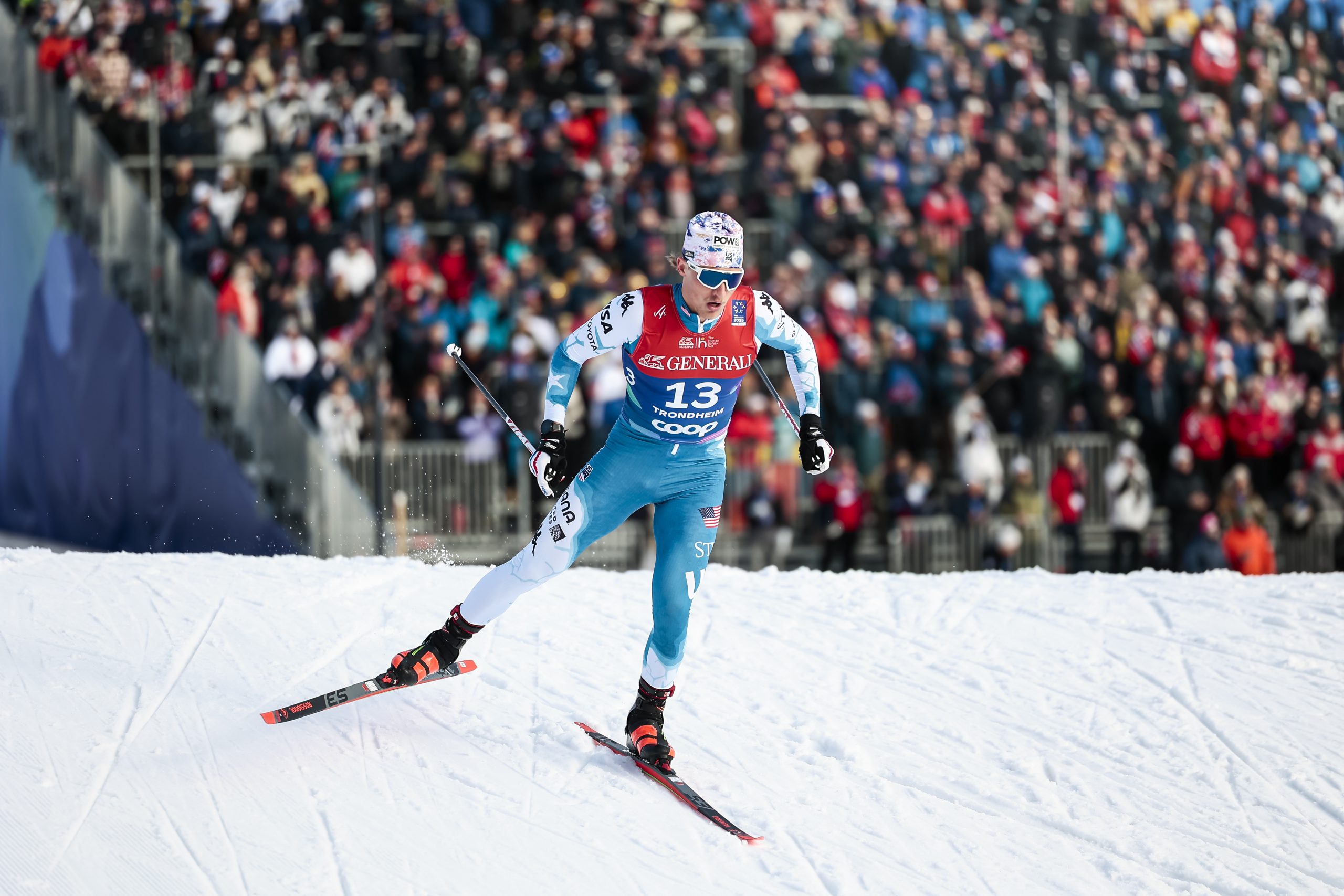
    Kate Oldham racing the 10 k freestyle at the Trondheim World Cup in December 2025. Races of 5 to 15 kilometers, Jim Galanes points out, are not raced at threshold. (Photo: Modica/NordicFocus)

    For the last couple of decades, the priority for high-intensity training has shifted from threshold, to VO2max, and now back to threshold again. Nowadays threshold training is increasingly presented as the ideal endurance training intensity. The suggestion is a high aerobic stimulus at a low recovery cost, repeatable and sustainable. VO2max is often portrayed as the opposite: a very high stimulus, high stress, very high fatigue, and something to be used carefully, if at all. Folks, we have seen this story before, in the threshold boom of the mid to late ’90s.

    From some perspectives this may be intuitively correct and perhaps logical. If we compare one minute of threshold work to one minute at VO2max intensity, the VO2max work is more demanding. That is a no-brainer. There is more carbohydrate use, higher oxygen demand, higher lactate production, greater perceived exertion and generally a greater physiological disturbance. But is that the way training really works? We build training plans around individual workouts and daily and weekly loads, not per minute of high-intensity training.

    For example, we might plan 5 x 4 minutes at VO2max intensity, or 20 minutes of total work. Or it might be 4 x 10 minutes at threshold, or 40 minutes of total work. When we look at the load of the whole session, things become far less clear. Both types of training produce similar adaptations, although the adaptive signal from the higher-intensity work is much stronger, and there is little evidence that a threshold session creates less recovery demand than an appropriately controlled VO2max session.

    This is really the point I want to make. We need to stop confusing intensity with training load, and, perhaps more important, we need to stop confusing training load with the recovery timeline. They are related, but they are not the same thing.

    As I have written before, threshold is a moving target, and defining it is problematic. There are perhaps a dozen or more methods used to determine threshold, and they can produce very different speeds, heart rates, power outputs and lactate values. Some athletes are working just above LT1 and calling it threshold. Others are working around 4 mmol, and others are using ventilatory threshold, critical power, some percentage of race pace, or simply an intensity that feels controlled and hard. So when people say “threshold training,” I am not sure we are even talking about the same thing. That alone should make us careful about assigning a fixed physiological cost or benefit to threshold training.

    The generally accepted training model is usually described like this: easy endurance training provides a relatively small stimulus at a relatively low cost, so we need a lot of it. Threshold gives us a much larger aerobic stimulus, still at a manageable recovery cost. VO2max gives us a very large stimulus, but at a very high recovery cost. Again, that makes intuitive sense, but is it true when we compare realistic sessions? I am not convinced it is. In fact, I am certain it is not.

    If we think of training load in simple terms, it is a combination of intensity and duration. Higher intensity produces greater load per minute, while longer duration produces more total load. A 3-hour easy workout, for example, produces a bigger training load than a 75-minute workout with 5 x 4 minutes of VO2max intervals. This is obvious, but somehow we often forget it when discussing threshold and VO2max training.

    Take a typical VO2max workout of five by four minutes, 20 minutes of work. Using Firstbeat’s TRIMP model, that might create about 55 to 60 TRIMP. Now take a threshold workout of four by ten minutes, 40 minutes of work. That might generate something in the 95 to 100 TRIMP range. With Firstbeat we can also look at EPOC as an estimate of the disturbance of homeostasis. Again, these are estimates and certainly not perfect measures, but 20 minutes at around 90 percent of VO2max might produce an EPOC of around 175 ml/kg, while 40 minutes at around 85 percent might produce an EPOC of 225 ml/kg. Once again the threshold workout produces a significantly higher stress load.

    I don’t want to get hung up on whether those exact Firstbeat numbers are accurate, because that is not really the point. The point is that it is entirely possible for the lower-intensity session to produce the larger total load, and that should not surprise anyone, because it is twice as long.

    The same thing happens if we use session RPE. Twenty minutes of VO2max work at an RPE of 9 gives us 180 AU (arbitrary units), while forty minutes of threshold at an RPE of 6 gives us 240 AU. Again, the threshold session creates the larger estimated training load. That does not prove threshold is more stressful or that it takes longer to recover from. TRIMP and session RPE are measures or estimates of training load, not measurements of recovery time.

    We have at least three different things being discussed as if they were the same: the intensity of the exercise, the total load of the workout, and how long it takes the athlete to recover. A VO2max interval clearly creates greater physiological disturbance per minute. A longer threshold session may create a greater total training load. Neither one, by itself, tells us which athlete will be better recovered 24 or 48 hours later.

    High cost per minute is not the same thing as high cost per session, and high session load is not necessarily the same thing as longer recovery.

    Four skiers rollerskiing in a line up a switchback road climbing out of a green alpine valley
    Otto Invenius, Campbell Wright, Maxime Germain and Adam Runnalls climbing the Stelvio Pass on rollerskis above Livigno, Italy, in July 2025. The adaptations from threshold and VO2max work overlap far more than the zone names suggest. (Photo: Manzoni/NordicFocus)

    What Are We Actually Trying to Adapt?

    The other issue is that we spend far too much time talking about training zones and not enough time talking about desired adaptations. What adaptations are we trying to create? That should come first.

    VO2max training provides a very strong aerobic stimulus at near-maximal oxidative capacity. It can increase maximal cardiac output, improve oxygen transport, create very high muscular oxygen demand and expose the athlete to speeds and power outputs similar to race demands. Threshold training lets us accumulate a large amount of work at a high aerobic fractional utilization. It can improve sustainable speed or power, oxidative capacity at that intensity, and the ability to maintain a high percentage of maximal aerobic power for a longer period of time.

    These adaptations overlap a great deal. I sometimes hear people talk as if threshold develops lactate clearance and the muscles’ ability to sustain work, while VO2max develops the central cardiovascular system. But VO2max training creates a large muscular stimulus as well. ATP turnover is very high, calcium flux is high, metabolic disturbance is high, and the signaling associated with mitochondrial biogenesis is substantial. VO2max training is not simply “central cardiovascular training.” It also provides a significant peripheral training stimulus.

    Threshold training obviously produces a similar but slightly smaller mitochondrial and muscular signal for adaptation. But I think its real advantage may be something much simpler. Because the intensity is lower, we can normally do considerably more of it. That allows us to accumulate a large amount of work at a high aerobic fractional utilization, with substantial muscular recruitment and a large amount of sport-specific work.

    That may be threshold training’s most important characteristic. Not that it creates some unique physiological adaptation unavailable at other intensities, but that it allows us to accumulate considerably more work while still creating a high oxidative demand.

    This can be particularly important for an athlete who already has a high VO2max and whose limitation is the fraction of that VO2max that can be sustained. If fractional utilization is relatively low, increasing sustainable aerobic power may be far more important than trying to push VO2max another few percent. For that athlete, a greater amount of threshold work may make very good sense.

    But that is an argument based on the needs of the athlete, not an argument that threshold is inherently a better training intensity or that we recover from it more quickly.

    Lactate clearance and resynthesis is another area where I think training discussions have become confused. We often hear that threshold training is necessary because the athlete needs to train to “clear lactate.” I have always had a problem with this explanation, because it is neither accurate nor scientifically valid. Remember, it is lactate we are talking about, not lactic acid, as many refer to it.

    Lactate is not a waste product that suddenly appears at threshold and then needs to be removed. It is being produced, transported and oxidized all the time, at all intensities, and it is an important fuel. Endurance training improves the ability to transport and oxidize lactate, but there is no reason to believe this only happens at threshold. High-intensity interval training also improves lactate transport and can move lactate threshold substantially.

    VO2max intervals also create very high lactate production and turnover. So if we are looking at the lactate shuttle, why would it only, or even preferentially, adapt when lactate is sitting around 2, 3 or 4 mmol? That doesn’t make much physiological sense to me. Producing higher levels of lactate will stimulate resynthesis.

    The same is true for mitochondrial biogenesis, oxidative enzymes and capillarization. We cannot neatly assign these adaptations to one training zone, because there is considerable overlap between endurance, threshold and high-intensity training.

    That doesn’t mean all intensities are the same. They clearly aren’t. It means we should be careful about inventing unique adaptations for a training zone simply because we have given that zone a name. Threshold training is not the only method, or even the optimal method, to improve lactate oxidation and resynthesis.

    A skier in a Vermont jacket and white helmet skating on rollerskis along a paved path lined with autumn trees
    A University of Vermont skier on rollerskis at Craftsbury Outdoor Center in October 2025. Autonomic, glycogen, muscular and mechanical recovery all run on different clocks. (Photo: Phillip Belena/EISA)

    What Is Recovery?

    Another problem in this discussion is recovery. People will say that threshold is easier to recover from. Maybe, but recover from what? Autonomic disturbance, glycogen depletion, neuromuscular fatigue, muscle damage, mechanical load, dehydration or psychological fatigue? These are not the same thing, and they do not necessarily recover at the same rate. A 2-hour run and a 2-hour rollerski at the same intensity, for example, carry very different mechanical loads to recover from.

    HRV may tell us something about autonomic recovery, which should also reflect other aspects of recovery but does not specifically measure them. Resting heart rate can tell us something, but again not everything. Blood lactate tells us something about what is happening during and immediately after the workout, but remarkably little about whether the athlete is going to train well 24 or 48 hours later. Creatine kinase may tell us something about muscle damage, but there is huge individual variation. So when we talk about recovery cost as if it were one number, I think we are being too simplistic.

    This is also why I don’t think we can simply use TRIMP, EPOC, duration, distance or session RPE to say one workout takes longer to recover from than another. They can give us useful information about internal load or physiological disturbance, but they are not recovery measurements. Ultimately, recovery must be considered in terms of which physiological systems were stressed and, more practically, what the athlete can do in the days immediately after a hard workout.

    Carbohydrate use is another good example. VO2max exercise clearly has a higher rate of carbohydrate use per minute than threshold exercise. But once again, the session matters more than the minute. Twenty minutes at VO2max intensity may have a very high glycogen cost per minute. Forty, fifty or sixty minutes at threshold has a somewhat lower rate, but it is sustained for two or three times as long. We cannot automatically assume that the shorter VO2max workout creates greater total glycogen depletion.

    This becomes particularly important when athletes are doing regular quality sessions. If glycogen restoration is an important part of recovery, a long threshold session may impose a very substantial recovery requirement despite producing lower lactate concentrations and feeling much more controlled. An athlete does not have to be lying on the ground after a workout for that workout to have been expensive to recover from.

    That is one of the problems I see with the idea that threshold can be repeated frequently simply because lactate is controlled. Low lactate does not necessarily mean low glycogen use, low muscular load or rapid recovery. If we keep extending the duration of the threshold work, at some point the additional work has a cost.

    Which brings us to what I think is probably the most meaningful recovery measure, and one that is surprisingly rarely studied: can the athlete perform the next important training session at the expected level?
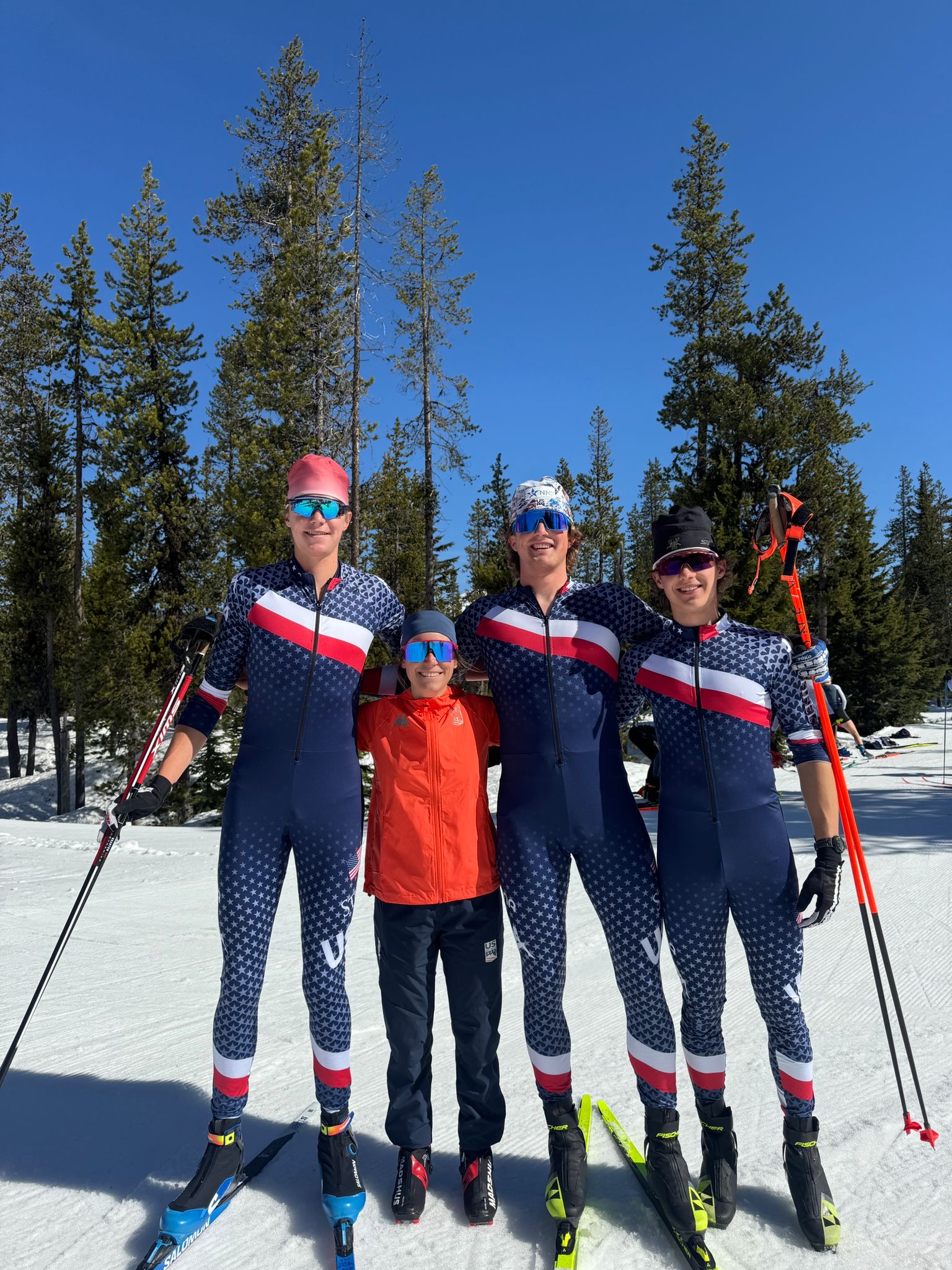
    Three skiers in U.S. team suits and one in an orange jacket standing together on snow among pine trees
    Lucas Wilmot, Kristen Bourne, Murphy Kimball and Tabor Greenberg after their first L3 intervals at a 2025 camp in Bend, Oregon. (Photo: Leann Bentley)

    An Interesting Study

    One of the more interesting comparisons was made by Seiler, Haugen and Kuffel with highly trained runners. On one occasion the athletes did a threshold session of around 30 minutes between the first and second ventilatory thresholds, and on another, six three-minute intervals at around 95 to 96 percent of VO2max. I would point out that 95 to 96 percent of VO2max is already hard, and above what I would normally call a controlled VO2max session.

    The differences between the workouts were substantial. Lactate during the threshold session was around 2.7 mmol, while during the VO2max intervals it was around 7.1. Perceived exertion was also much higher during the VO2max workout. By almost any acute measure the VO2max workout looked harder, so we might reasonably expect recovery to take longer. But HRV recovery following the two sessions was remarkably similar.

    Now, this study does not fully answer the question. The threshold work was only around 30 minutes, HRV measures one part of recovery, and there are all kinds of differences between athletes. But it does challenge an assumption that I think is important. Greater acute metabolic disturbance does not necessarily mean longer recovery, but the dose does.

    It also raises what I think is an even more interesting question. What would have happened if the threshold session had contained 40 or 50 minutes of work rather than 30? That would be much closer to the threshold sessions many trained endurance athletes are actually doing.

    Campbell Wright (USA) works with his US Biathlon Team coach, Armin Auchentaller (ITA) this summer in Livigno (ITA). (Photo: NordicFocus)
    U.S. Biathlon coach Armin Auchentaller with Campbell Wright during summer training in Livigno, Italy, in July 2025. A controlled VO2max session is about time at high oxygen uptake, not about producing as much lactate as possible. (Photo: Manzoni/NordicFocus)

    Control of VO2max Training

    There is another issue here that I think is important. A lot of people seem to think VO2max training means going as hard as possible. It doesn’t, at least not the way I see it and use it.

    If I give an athlete 5 x 4 minutes of VO2max work, I am not asking them to race every interval or see how much lactate they can produce. I am trying to get them to accumulate time at a very high oxygen uptake, typically around 90 to 95 percent of maximal heart rate and VO2max.

    If the objective is a cardiovascular and oxidative stimulus, we need sufficient intensity to drive oxygen consumption toward a very high fractional utilization of VO2max. For many athletes, something in the range of 90 to 95 percent of VO2max may be enough to accomplish that. Once we have produced the stimulus we are looking for, going harder does not necessarily make the workout better.

    This becomes important when we compare threshold and VO2max training. If someone compares a carefully controlled threshold session with a set of VO2max intervals performed as hard as possible, then of course the VO2max workout is going to look very stressful. But that may simply be a badly controlled VO2max workout.

    A well-controlled VO2max session and an all-out interval session are not the same workout, just as a controlled threshold session and a threshold session that slowly turns into a race are not the same workout. Anyone who has coached for very long has seen both.

    A skier in a green Vermont shirt and helmet skating on rollerskis down a paved path through autumn woods
    A University of Vermont skier on the rollerski track at Craftsbury in October 2025. Forty minutes at threshold is a lot of work, and so is fifty, and so is sixty. (Photo: Phillip Belena/EISA)

    What Is Threshold’s Real Advantage?

    In my view, the strongest argument for threshold training is not that it produces some special adaptation, but that athletes can accumulate a lot of high-quality aerobic work. Forty minutes at threshold is a lot of work. Fifty minutes is a lot of work. Sixty minutes is a lot of work. For an elite endurance athlete doing a very large total training volume, that may be exactly what is needed, provided the athlete can recover from the overall workload of the training period.

    Threshold gives us a way to accumulate a substantial amount of work at high oxidative fractional utilization, with considerable muscular recruitment and a lot of sport-specific work. For an athlete with a high VO2max who needs to improve fractional utilization or sustainable aerobic power, this can be valuable.

    I think this is where some of the current discussion around threshold becomes problematic. Because it is controlled, because lactate is relatively low, and because the athlete is not destroyed afterward, threshold starts to be treated almost like endurance training. It isn’t. It is still hard training, and if you do enough of it, it carries a substantial training load and potentially a substantial recovery cost.

    The question is not simply whether forty or fifty minutes at threshold creates more adaptation than twenty minutes of VO2max work. It probably creates more of some kinds of stimulus simply because we are doing so much more work. The more useful question is whether the additional adaptation we get from that extra work is worth the additional load and recovery cost.
    Kevin Bolger in a U.S. suit skating downhill in fog with other racers and trees behind
    Kevin Bolger in the fog at the Oslo World Cup mass start in March 2026. The first question is what adaptation an athlete needs. The second is the smallest dose that will produce it. (Photo: Authamayou/NordicFocus)

    Are We Asking the Wrong Question?

    The debate is usually framed as threshold versus VO2max. Which is better? I don’t think that is the right question. The first question should be what adaptation this athlete needs. The second, and I think this is more important, is what is the smallest dose capable of producing that adaptation? It isn’t necessarily 40, 50 or 60 minutes. The third is what effect that dose will have on the training the athlete can perform over the next several days.

    We tend to assume that if some training is good, more of it must create a greater adaptation. Up to a point that is probably true. But the objective of training is not to produce the largest possible stimulus in every workout. It is to produce enough stimulus to create the adaptation while still being able to absorb the rest of the training.

    If an athlete has a relatively low VO2max and that is limiting performance, perhaps 15 or 20 minutes of controlled VO2max training gives us exactly the stimulus needed. If that is enough to stimulate the adaptation, why do 50 minutes of threshold just because threshold is currently popular?

    On the other hand, if an athlete already has a very high VO2max but relatively poor fractional utilization, and cannot sustain a high percentage of it, then perhaps a larger volume of threshold work is exactly what is required. In that case the ability to accumulate 40 or 50 minutes at high aerobic flux may be the important stimulus.

    A large group of skiers in bright vests rollerskiing up a two-lane road beside a grassy bank
    NENSA athletes rollerskiing together in Craftsbury, Vermont. A workout can look great on paper and still be the wrong choice if it costs the next two days. (Photo: Chris City)

    The Training Week Matters More Than the Workout

    I also think we make a mistake when we look at workouts in isolation. A workout can look great on paper and still be a poor training choice, because the real issue is not simply what happened during those 60 or 90 minutes. It is what that workout allows us to do over the next several days.

    Suppose a threshold workout produces 10 percent less adaptive stimulus than a VO2max session but allows the athlete to train substantially better over the following two days. Threshold may clearly have the better stimulus-to-recovery ratio and therefore be the better choice.

    But reverse the situation. Suppose 20 minutes of well-controlled VO2max work produces the adaptation we want and the athlete is ready to train normally the next day, while 40 or 60 minutes of threshold creates substantial glycogen depletion and muscular fatigue. In that circumstance, the shorter VO2max workout may have the better stimulus-to-recovery ratio.

    We shouldn’t decide the answer beforehand simply because one workout carries the label “threshold” and the other “VO2max.” Threshold is not automatically low cost, and VO2max is not automatically high cost. The dose matters, the athlete matters, the training done before the session matters, what needs to be done after the session matters, and the total training week matters.

    Therese Johaug in a red suit skiing alone through classic tracks
    Therese Johaug racing the mass start at the Lahti World Cup in March 2025. Even races of up to 90 minutes, Galanes says, are often skied well above threshold. (Photo: Thibaut/NordicFocus)

    Dose, Adaptation and Recovery

    I am certainly not arguing against threshold training. Rather, I am arguing that the dose needs to be controlled relative to the individual athlete, and that the time to recover is not what is often suggested. I use threshold with athletes who need it, and it can be effective. But I do think we need to be more careful about how it is being presented. It is not automatically what every athlete needs.

    Threshold and VO2max training have different characteristics, but their physiological adaptations overlap substantially. VO2max training provides a very large physiological stimulus in a relatively short period of time and appears particularly useful when maximal aerobic capacity is what we are trying to improve. Threshold allows us to accumulate considerably more work at a high aerobic output and can be extremely effective when sustainable aerobic power or fractional utilization is the limitation.

    Both can be valuable, and both can be overdone.

    In my experience, especially over the last decade, I have seen far more athletes become flat, stale, overtrained or simply stagnant from doing too much threshold training than from doing properly controlled VO2max work. Usually it comes from doing too big a volume of threshold work, too often. That doesn’t mean threshold is bad. It means threshold must be appropriately prescribed and dosed.

    I also think the very large amounts of threshold work we sometimes see promoted are primarily appropriate for highly trained elite athletes who are also doing very large overall training volumes and have spent years developing that volume. I would be much more cautious applying the same model to younger athletes, developing athletes, masters athletes, or anyone doing a much smaller overall training volume.

    There is another point that seems to get lost. Athletes racing 5, 10 and 15-kilometer events are not racing those events at threshold. I have decades of data showing that even in races of up to 90 minutes, fractional utilization can be well above threshold. The shorter races are at a very high intensity, in what is defined as the VO2max zone. At some point we need to train that capacity directly. Doing more threshold work because it is supposedly lower cost does not eliminate the need to train at race-relevant intensity.

    In the end, I think we need to get away from ranking training zones as good, bad, safe or dangerous, and think more in terms of dose, desired adaptation and recovery. What are we trying to adapt, what dose is needed to produce that adaptation (often less than we think), and what does that dose cost us in terms of the training that follows?

    The most valuable workout is not necessarily the one that creates the greatest immediate physiological disturbance, nor is it necessarily the one that accumulates the most minutes around some predetermined lactate value. It is the workout that provides enough stimulus to produce the adaptation we are looking for while preserving the athlete’s ability to absorb the rest of the training program.

    In the end, that is the balance we are trying to find.


    Help Support Our Coverage!

    If you value the thoughtful work and access FasterSkier provides, please consider becoming a Voluntary Subscriber. Your support directly fuels our work to cover the people, places, and moments that make our sport special.

    Join the FasterSkier community!


  • Periodization Is About Emphasis, Not Elimination

    Periodization Is About Emphasis, Not Elimination

    This article was made possible through the generous support of our voluntary subscribers. If you value coverage like this, please support FasterSkier with a voluntary subscription.

    A University of Vermont skier rollerskiing on a paved road lined with fall foliage at Craftsbury, Vermont
    Wilmington, Vermont’s Luke Rizio rollerskiing with the University of Vermont at Craftsbury last fall. Jim Galanes argues that a training year should change the dose of each quality, never remove one of them entirely. (Photo: Phillip Belena/EISA)

    One of the biggest misconceptions in endurance training is that we should train one physiological capacity at a time. The traditional model usually follows the same progression. First build an aerobic base, lots of easy endurance training. Then add “threshold” training in the middle of the summer. Then, as we move into the pre-competition period, shift the emphasis toward VO2max and race specific intensity.

    The emphasis certainly should change throughout the season. But this approach often leads coaches and athletes to unintentionally neglect important physiological systems for weeks or even months. The problem is that the human body doesn’t work that way.

    Aerobic performance is not determined by one physiological system. It emerges from the interaction of multiple systems, each supporting the development of the others. When one begins to decline, it limits the effectiveness of the entire system.

    The goal of periodization is not to sequentially build individual physiological systems. It is to continually maintain every important system while changing the emphasis toward the adaptations that offer the greatest opportunity for improvement.

    Every Workout Sends a Different Signal

    Training isn’t simply stress. Every workout sends a unique physiological signal for adaptation.

    Long aerobic training stimulates mitochondrial biogenesis, capillary development, fat oxidation, plasma volume expansion, and cardiac remodeling.

    “Threshold” training improves the ability to sustain a high fraction of aerobic power by increasing oxidative capacity, metabolic stability, and lactate transport. It should be noted, in spite of the current buzz, that “threshold” training is not a magic solution. Some athletes may need a heavier focus on VO2max training. Usually “threshold” type training is best for those doing high volumes and with an already high fractional utilization.

    (Note: while I use the common term “threshold” here, there is ample evidence that no threshold actually exists and that it is a vastly misleading term. There is also no consensus on what this so-called threshold is. Depending on which of the many methods you use to define it, the speed or intensity at these various definitions can differ by 40 to 50 percent.)

    VO2max intervals place the greatest demand on oxygen delivery, stimulating central cardiovascular adaptations while also improving mitochondrial function, the oxidative capacity of Type II fibers, lactate transport, and the speed or power that can be sustained at VO2max.

    Sprint training recruits high-threshold motor units, preserves neuromuscular coordination, maintains the oxidative capacity of fast-twitch fibers, and develops the ability to rapidly produce force.

    Strength training increases maximal force production, improves movement economy, enhances tendon stiffness, and helps reduce injury risk.

    These are not interchangeable adaptations. Each contributes something different to developing aerobic fitness and performance.

    The Systems Support Each Other

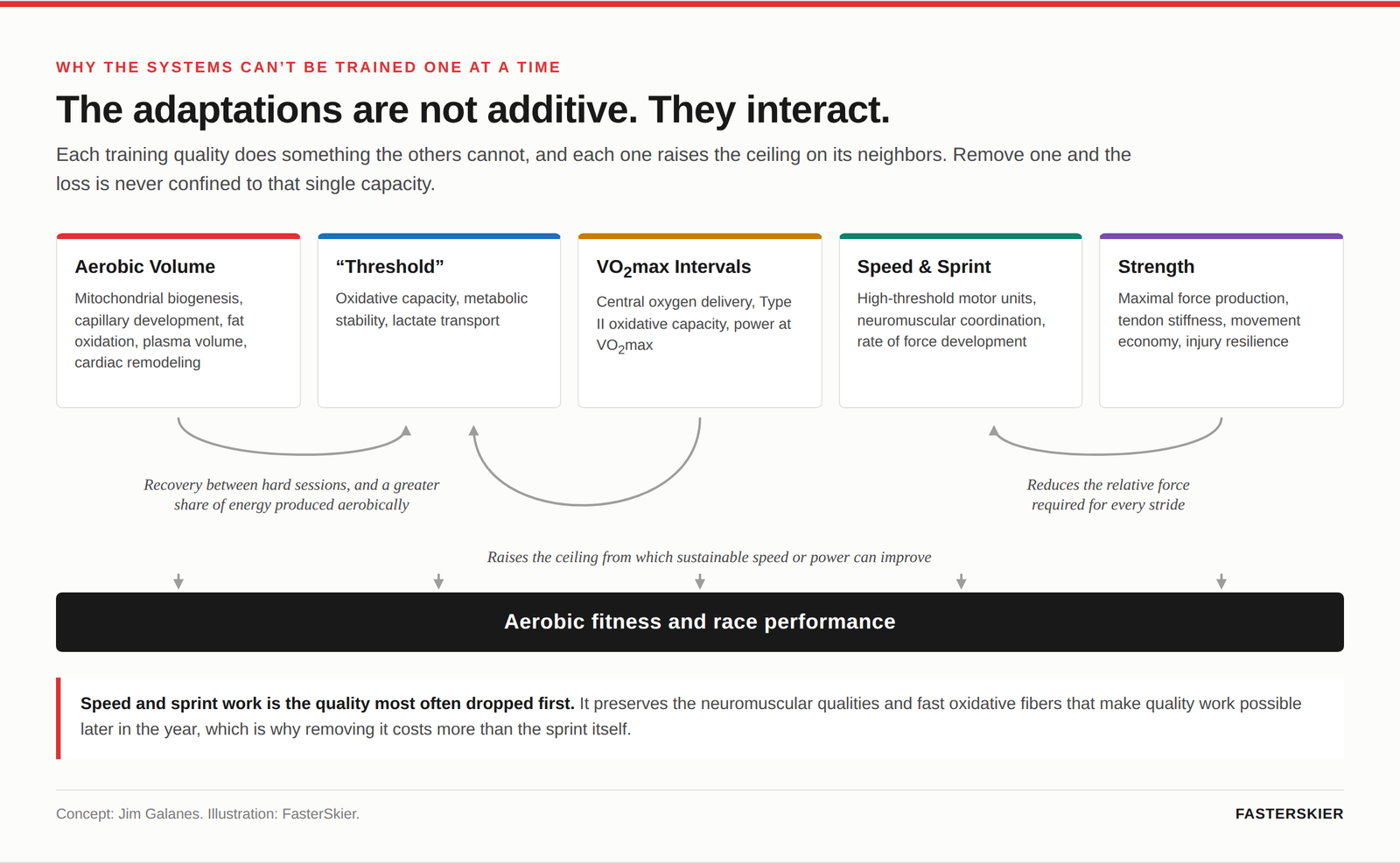
    These systems work synergistically. The mistake is assuming the adaptations are simply additive. They are not. They interact, and the combined effect on aerobic fitness is larger than the sum of the parts.

    A larger aerobic system allows the athlete to recover more quickly between hard sessions and to produce an increasing proportion of energy aerobically.

    Better “threshold” capacity allows more quality work to be performed with less fatigue. Greater maximal aerobic power raises the ceiling from which “threshold” speed or power can improve.

    Improved strength reduces the relative force required for every stride.

    Sprint training preserves the neuromuscular qualities that improve efficiency even during submaximal exercise. At every intensity, we can move faster and more efficiently.

    Diagram of five training qualities feeding into aerobic fitness and race performance
    Aerobic volume, “threshold” work, VO2max intervals, speed and strength each do something the others cannot, and each raises the ceiling on its neighbors. (Illustration: FasterSkier)

    What Happens When One System Is Ignored?

    Every physiological adaptation has a maintenance requirement. Remove the stimulus long enough and that adaptation begins to decline. An athlete who abandons speed training gradually loses neuromuscular recruitment and maximal power. An athlete who eliminates heavy strength training slowly loses force production and movement economy.

    When an athlete reduces aerobic endurance training, they don’t simply lose endurance. They lose the physiological foundation that supports every other adaptation.

    An athlete who removes VO2max work for extended periods may maintain excellent endurance while gradually losing the central cardiovascular adaptations that support maximal aerobic performance.

    These changes are rarely dramatic at first. What we see instead are the symptoms of overtraining. Performance in training declines. Interval sessions become harder. Race pace plateaus or drops.

    Many coaches respond by adding more volume or more intensity. Neither is the likely answer. The solution is to restore the balance between the physiological systems that support performance.

    Chart showing five training qualities across three season phases, with none dropping to zero
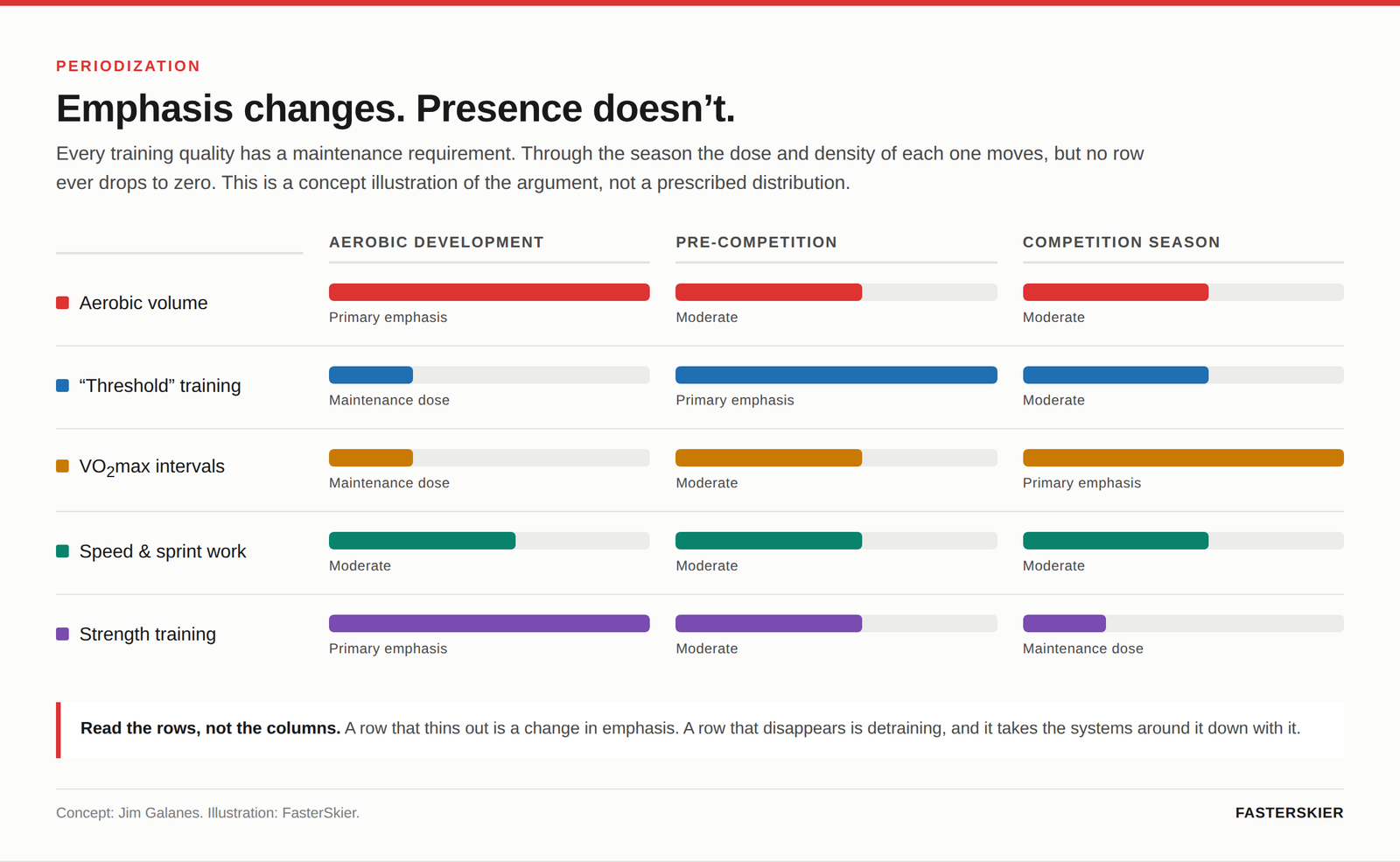
    Through the training year the dose and density of each quality moves, but no quality drops to zero. Concept illustration of Galanes’ argument, not a prescribed distribution. (Illustration: FasterSkier)
    Two skiers rollerskiing up a climb on a road through autumn woods
    University of Vermont skiers work up a climb during a fall dryland session at Craftsbury, Vermont. (Photo: Phillip Belena/EISA)

    Why High-Intensity Training Belongs in the Base Period

    One of the most common statements heard during base training is: “We shouldn’t do any hard training yet.”

    Current evidence suggests otherwise. High-intensity training during the base period is not about maximizing anaerobic fitness. It is about maintaining the physiological systems that complement the full development of aerobic capacity.

    Appropriately dosed high-intensity training helps preserve central cardiovascular function, maintains high-threshold motor unit recruitment, supports the oxidative capacity of fast-twitch muscle fibers, reinforces movement economy at higher speeds, and prepares the athlete for the demands of future training. Just as importantly, these adaptations support aerobic development rather than detract from it.

    A stronger cardiovascular system allows greater oxygen delivery during long aerobic sessions. Maintaining fast oxidative fibers improves the ability to perform “threshold” work later in the season. Preserving movement economy reduces the energy cost of every stride. Maintaining maximal aerobic capacity raises the ceiling from which “threshold” performance can continue to improve.

    High intensity doesn’t compete with aerobic development when it is properly dosed. It enhances it. This is why elite endurance athletes rarely eliminate intensity completely. They change the dose and the density. Not the presence.

    I often hear athletes say their first interval session or time trial in late July felt terribly slow, or metabolically challenged. Of course it did. That should come as no surprise. If high-intensity work has been absent for weeks or months, the physiological systems required to perform it have detrained. The athlete now has to rebuild those systems before meaningful race-specific adaptations can occur.

    Emphasis Is Not Elimination

    This doesn’t mean every quality deserves equal attention every week. Training emphasis should absolutely change throughout the year. An aerobic development phase should contain more aerobic volume. The pre-competition period should emphasize “threshold” and race-specific intensity. The competition season should prioritize race performance and recovery.

    But changing emphasis is very different from abandoning a physiological system. Even during an aerobic block, athletes should continue performing some high-intensity work, sprint training, and strength training.

    During race season, aerobic volume remains essential. While emphasizing VO2max development, “threshold” training still supports the ability to perform quality work.

    The dose and density change. The physiological adaptation remains.

    There Is No Optimal Intensity Distribution

    One of the most common questions in endurance sports is: “What is the optimal training intensity distribution?”

    The question assumes there is one correct percentage of easy, “threshold”, and hard training. There isn’t. The optimal distribution depends on the athlete’s training background and on which physiological system currently limits performance. Those limiting factors change throughout an athlete’s development.

    Early in a career, building aerobic capacity may deserve the greatest emphasis. Later, improving sustainable race pace may become the priority. Still later, improving neuromuscular power, force production, or movement economy may produce the greatest gains.

    As those priorities change, training distribution changes with them. Not because the principles change. Because the athlete changes.

    The coach’s responsibility is to continually adjust aerobic volume, “threshold” training, VO2max work, sprint training, and strength training so that each enhances the adaptations produced by the others while minimizing interference.

    There is no universal training formula. There is only the continual process of identifying the athlete’s current limiter, maintaining every important physiological system, and emphasizing the adaptations that will produce the greatest improvement.

    Great coaching is not about prescribing the perfect intensity distribution. It is about continually identifying the athlete’s current physiological limiter while maintaining every system that supports performance. As the athlete changes, the emphasis changes, but the physiology never disappears.

    Help Support Our Coverage!

    FasterSkier is independent, reader supported, and free to read. If coaching and training coverage like this is worth something to you, a voluntary subscription keeps it coming.

    Join the FasterSkier community!


    A ski coach in an olive fleece speaking with an athlete holding rollerski poles
    UVM coach Patrick Weaver talks with first year Hanna Koch of St. Paul, Minnesota, during a fall session at Craftsbury. Identifying an athlete’s current limiter, Galanes writes, is the coach’s central job. (Photo: Phillip Belena/EISA)
  • When a Falling Race Heart Rate Is a Warning, Not a Win

    When a Falling Race Heart Rate Is a Warning, Not a Win

    This article was made possible through the generous support of our voluntary subscribers. If you value coverage like this, please support FasterSkier with a voluntary subscription.

    This is a follow-up to my last article, Speed Creates the Load, Not Intensity. Before going further, it helps to define terms. Intensity is reflected in the heart rate response. Load is the physiological stress that drives adaptation. This piece takes a different angle, using high-intensity workouts and race heart rates to assess fitness and monitor for overtraining.

    Over the last two decades, much of my coaching has involved working with athletes who are underperforming, overtrained, or struggling to regain fitness. When the data is available, one of the first things I examine is the relationship between training intensity and speed across the season. I am looking for improvements in efficiency, but I am also paying close attention to what happens during races and hard workouts.

    Race data is almost always the most revealing.

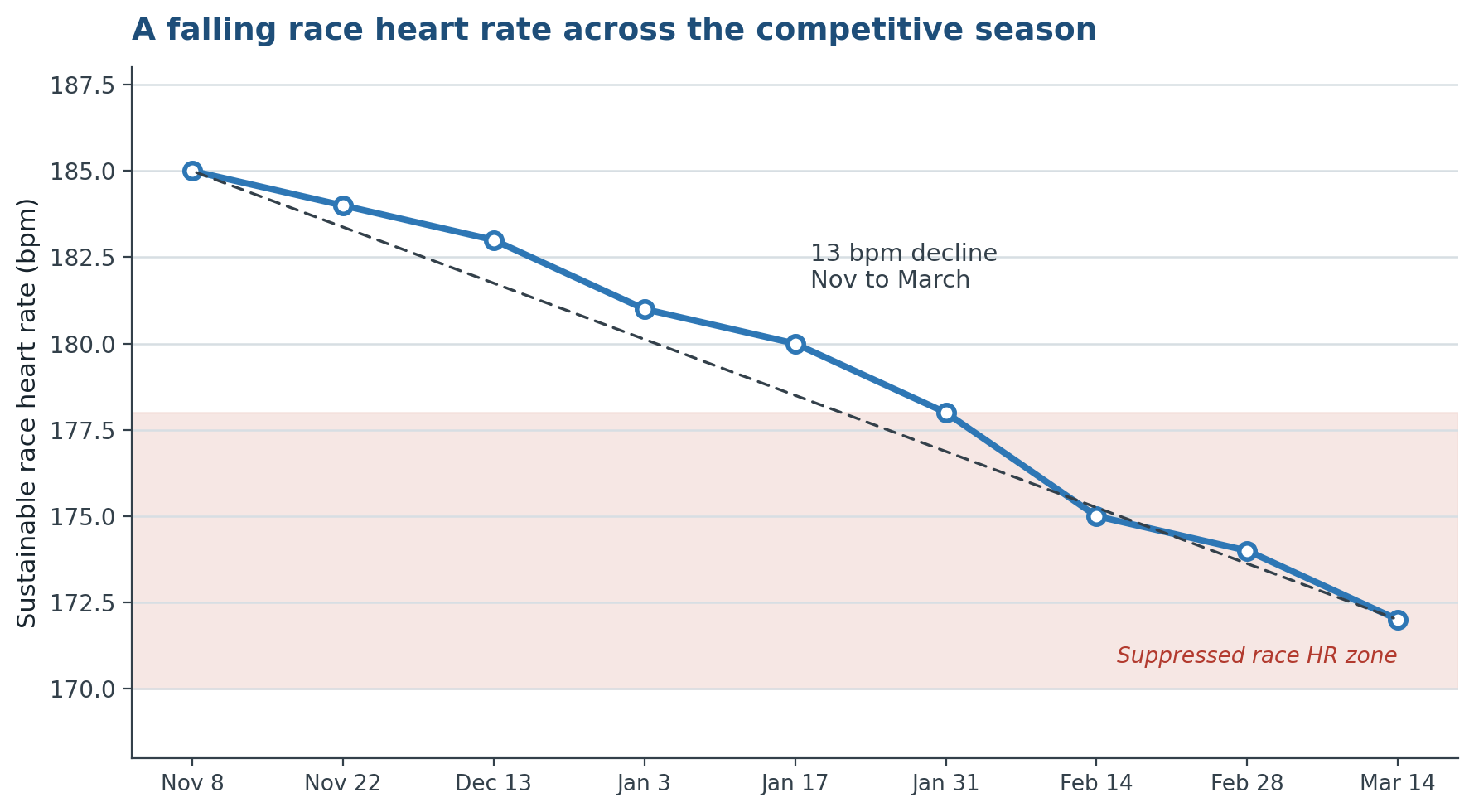
    I recently reviewed the training of a top domestic athlete whose sustainable race heart rate fell by roughly 10 to 15 beats per minute between November and March. Why? Given the time of year, that should immediately raise concerns. A substantial decline in sustainable race heart rate during the competitive season rarely points to improved fitness. More often, it is a warning sign that the athlete is carrying excessive fatigue, is no longer capable of producing the same muscular power, or has entered a state of overtraining.

    An illustrative competitive season. Sustainable race heart rate slides 13 bpm from November to March. With no gain in speed to explain it, that slide reads as a fatigue signal, not a fitness one. (Chart: FasterSkier)

    A reduced race heart rate means less cardiac output unless stroke volume increases enough to compensate. In well-trained athletes, that compensation is usually very small. The result is less oxygen delivered to the working muscles, reduced oxidative metabolism, slower lactate clearance, diminished phosphocreatine resynthesis between surges, and ultimately a reduced ability to sustain high race speeds. In simple terms, the athlete cannot create the same physiological demand because the muscles are no longer capable of producing the same amount of work.

    When a Lower Race Heart Rate Reflects Improved Fitness

    A declining race heart rate is often misunderstood. Some physiologists and coaches suggest it reflects improved cardiovascular function. That can be true, but only if performance has clearly improved.

    The critical question is simple: is the athlete racing faster?

    If an athlete is producing greater speed or power at a lower heart rate, several physiological adaptations have likely occurred:

    • Greater stroke volume. The heart pumps more blood with each beat, allowing similar cardiac output with fewer beats.
    • Improved movement economy. Better technique and neuromuscular coordination reduce the oxygen cost of movement.
    • Greater peripheral adaptations. Increased mitochondrial density, capillary density, and oxidative enzyme activity improve oxygen extraction and utilization.

    If these adaptations have occurred to a meaningful degree, performance should improve. The athlete should be racing faster while holding a similar physiological level, not racing at a lower heart rate.

    In my experience, I have never seen an athlete race at a substantially lower heart rate because they became fitter or more economical. The improvement almost always shows up as increased speed or power, not as a dramatically reduced race heart rate. If race performance is unchanged, or worse, declining, a lower heart rate is unlikely to be explained by improved fitness.

    This distinction matters because many coaches correctly recognize that heart rate decreases at submaximal workloads as fitness improves. That is exactly what we expect during aerobic training. Racing is different. At maximal or near-maximal effort, the goal is to maximize performance, and that rarely shows up as a lower heart rate.

    Is Stroke Volume Really the Explanation?

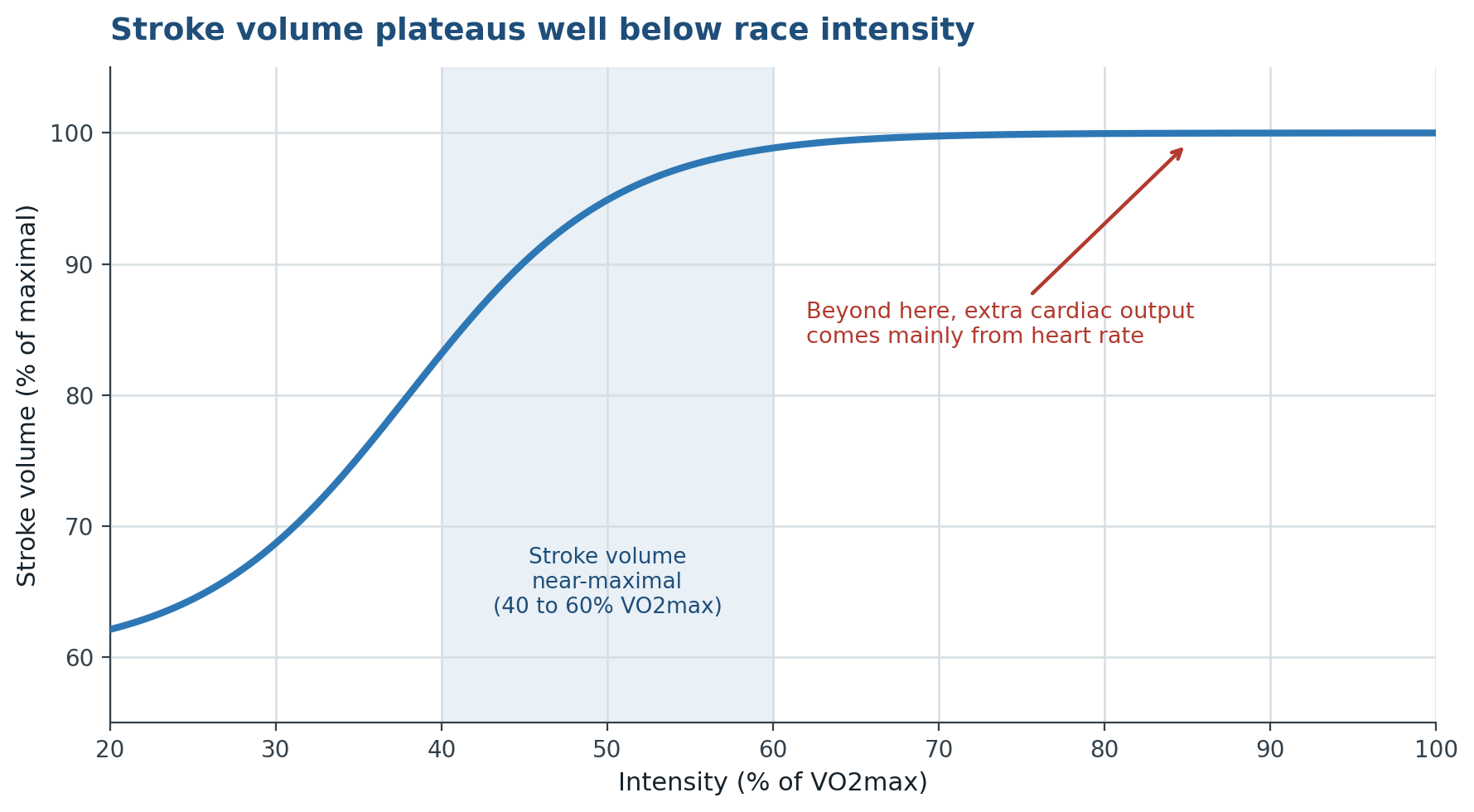
    Stroke volume is frequently cited as the reason trained athletes can race with lower heart rates. While that explanation sounds plausible, it probably accounts for only a negligible part of what we observe during maximal competition.

    In trained endurance athletes:

    • Stroke volume reaches near-maximal values at roughly 40 to 60 percent of VO2max.
    • Beyond that intensity, further increases in cardiac output come primarily from increases in heart rate.
    • Stroke volume changes relatively little in already well-trained athletes.
    Stroke volume reaches near-maximal values at roughly 40 to 60 percent of VO2max. At race intensity, it has little room left to climb, so a falling race heart rate is unlikely to be explained by rising stroke volume. (Chart: FasterSkier)

    So if an athlete’s sustainable race heart rate falls from 185 to 175, it is unlikely that stroke volume has increased enough to fully maintain cardiac output. The science does not support that explanation in most well-trained athletes. Something else is going on, and extended fatigue, maladaptive training, and long-term overload are the likely causes.

    The Muscles Drive the Heart

    One concept that is often overlooked in endurance physiology is that heart rate responds to muscular work. It does not create it. The muscles generate the metabolic demand and the cardiovascular system responds. If neuromuscular power production declines, metabolic demand falls. The heart no longer needs to pump as rapidly because the muscles are not asking for the same amount of oxygen. This aligns closely with a concept I first wrote about nearly twenty years ago and returned to in my previous article:

    Speed creates the load, not intensity.

    The muscles create the demand. The heart responds. When an athlete loses the ability to generate force, speed, and power, race heart rate falls as a consequence. The cardiovascular system may be functioning normally. It simply is not being driven to the same level because the neuromuscular system has become fatigued.

    When a Lower Race Heart Rate Is a Warning Sign

    A falling heart rate is one of the earliest objective signs that an athlete may be accumulating excessive fatigue. When athletes become excessively fatigued, they often lose the ability to recruit muscle fibers effectively and sustain race-specific power. Because muscular demand falls, heart rate falls with it.

    Rather than interpreting the lower heart rate as improved efficiency, coaches should ask whether the athlete is still capable of producing the same speed or power.

    Warning signs include:

    • Sustainable race heart rate declines progressively over a few weeks to months. Monitoring heart rate helps catch this early, so training can be adjusted before it becomes a bigger problem.
    • Race performance stagnates or deteriorates despite similar perceived effort.
    • Legs feel flat and heavy, as if they never really warm up.
    • The athlete cannot respond to the demands of uphills or changes in pace.
    • Heart rate remains well below normal race values even during maximal effort.
    • Recovery between hard sessions becomes progressively slower.
    • Easy training may still feel normal while racing and high-intensity training become increasingly difficult.

    This pattern is often described as parasympathetic overreaching, although terminology varies. Regardless of the label, suppression of maximal or sustainable race heart rate by 5 to 15 beats per minute over weeks should never be ignored. It frequently reflects excessive cumulative training load, inadequate recovery, or overtraining. Waiting until performance completely collapses is waiting too long. In many athletes, a declining race heart rate is one of the first objective indicators that recovery and adaptation to previous training were insufficient.

    Coaches sometimes celebrate lower lactate values as improved aerobic fitness. During excessive fatigue, however, reduced lactate production often reflects reduced muscle recruitment rather than improved metabolic efficiency. The athlete cannot produce enough power to generate high lactate concentrations.

    Chronically low glycogen availability, whether from excessive training or inadequate carbohydrate intake, can also suppress race heart rate and lactate. The athlete cannot generate the metabolic demand required to reach previous racing intensities.

    The heart is reactive, not proactive. It responds to the metabolic demand created by the working muscles. When the muscles cannot produce force because of fatigue, the cardiovascular system has less work to do. A lower heart rate is therefore often the consequence of reduced performance, not the cause.

    Why Elite Athletes Rarely Race at Maximal Heart Rate

    Elite endurance athletes rarely spend an entire race at maximal heart rate. As performance improves, limitations increasingly shift away from the cardiovascular system and toward the muscles’ ability to generate force repeatedly while resisting fatigue.

    Improvements in neuromuscular power, economy, and fatigue resistance allow athletes to sustain higher speeds without requiring proportionally higher heart rates.

    As athletes become capable of producing greater speed and power, they generate a larger physiological stimulus. The cardiovascular system responds to that demand, but it is the neuromuscular system that ultimately determines how much work can be produced.

    Practical Coaching Implications

    Heart rate should never be interpreted in isolation. Always evaluate it alongside speed, power, performance, and perceived effort.

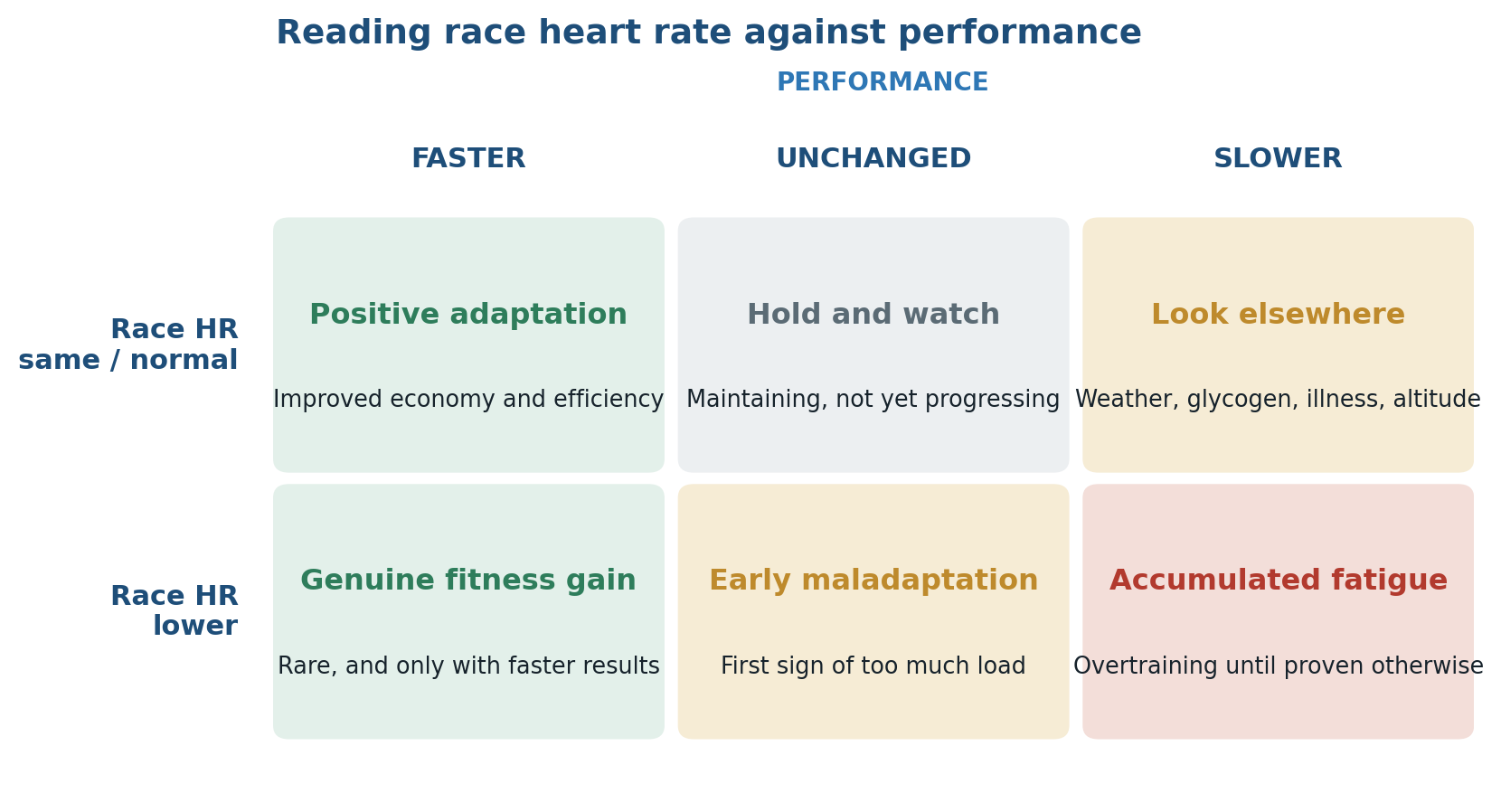
    Reading race heart rate against performance. Green is adaptation, amber is a flag to investigate, red is accumulated fatigue until proven otherwise. (Chart: FasterSkier)
    • Similar heart rate plus faster performance equals positive adaptation, improved economy, and greater efficiency.
    • Lower heart rate plus unchanged performance equals the early stage of maladaptation to training loads.
    • Lower heart rate plus slower performance equals a clear indication of accumulated fatigue, inadequate recovery, illness, low energy availability, or excessive training load.
    • Normal heart rate plus declining performance equals a reason to consider environmental conditions, glycogen availability, illness, altitude, or reduced movement economy.

    Over the course of a successful season, athletes should become capable of producing greater speed and power while maintaining similar race heart rates. When race heart rate falls substantially without a corresponding improvement in performance, assume fatigue before assuming fitness. That mindset will keep many coaches from overlooking one of the earliest objective signs of excessive training stress.

    A lower heart rate should never be viewed as evidence of improved fitness on its own. If an athlete is racing faster, producing more power, and performing better, a modest reduction in heart rate may simply reflect positive adaptation. But when race heart rate falls while performance stagnates or declines, resist the temptation to credit what may actually be the earliest objective sign of excessive fatigue. The goal is to catch a falling heart rate during hard efforts early and adjust training as soon as possible. Weeks or months of inaction will greatly increase recovery time and cost additional effective training time.


    Help Support Our Coverage!

    If you value the thoughtful work and access FasterSkier provides, please consider becoming a Voluntary Subscriber. Your support directly fuels our work to cover the people, places, and moments that make our sport special.

    Join the FasterSkier community!


  • Why “Training Volume Is the Biggest Predictor of Success” — and Why That’s Only Half True

    Why “Training Volume Is the Biggest Predictor of Success” — and Why That’s Only Half True

    Gus Schumacher (USA) has refined his own training program as a system of quality, consistency, and recovery. Stepping away from the headlong pursuit of training volume has made him a podium threat on the World Cup circuit. (Photo: Modica/NordicFocus)

    We read it again and again in studies, articles, and coaching posts: “Training volume is the best predictor of performance.” It’s one of the most consistent findings in exercise science, appearing across endurance sports for decades, and in national training systems.

    But the statement is often repeated without understanding what it really means, or more importantly what it doesn’t.

    One reason this line gets repeated so often is that “train more” is an easy message to sell. It fits neatly into data-driven platforms, social media posts, and even national team frameworks that favor measurable progress over nuanced development.

    Volume Dominates the Data, Not Necessarily the Adaptation

    The rise of Strava and similar platforms has given researchers massive data sets, for example, on marathon runners, where the only reliable metric is mileage. And sure enough, those logging the most miles perform the best.

    That finding isn’t wrong, but it’s incomplete. These platforms don’t accurately capture the content of training, intensity distribution, recovery, or technique work, only volume. So, when all you can measure is mileage, it’s no surprise the data says more is better.

    The truth is simpler: training volume shows up as the strongest predictor because it’s the largest part of most athletes’ training, not because it’s the most important. When 80% or more of total training time is endurance work, volume will naturally correlate with performance. That’s statistics, not physiology.

    Studies Measure What’s Easy, Not What’s Important

    Volume dominates literature because it’s easy to measure. Hours and distance are clean, consistent numbers, simple to record, compare, and analyze.

    What’s harder to quantify are the things that often matter more:

    • Movement economy and technical precision
    • Motor-unit recruitment and neuromuscular function
    • Density and Implementation of high intensity training and recovery between sessions
    • Psychological and hormonal readiness

    Because these are complex and often subjective, researchers default to what they can measure reliably: hours or mileage trained.

    That doesn’t make volume unimportant, it just means most studies are constrained by the available data and the methods, not revealing a deep truth about training.

    Sophia Laukli’s practice of competing in both winter and summer seasons has been a careful combination of quality and timing. She has managed to succeed in both sports by avoiding overdoing it in either discipline. (Photo: Golden Trail/World Series)
    Once Volume Is Similar, Quality and Organization Decide Outcomes

    It’s obvious that someone training 800–900 hours per year will outperform someone training 200. But that comparison tells us little about how performance differences emerge within similar training groups.

    Among national-level athletes logging roughly the same volume, success depends on:

    • Organization of training — how the year is structured, how load progresses, and how recovery is managed.
    • Quality of intensity training— the metabolic, neuromuscular, and technical precision of each session.
    • Adaptation capacity — recovery ability, nutrition, and environmental context.

    In cross-country skiing, we often hear that athletes must reach “X” number of hours by a certain age to be on track. There’s some truth to that, high volume is a prerequisite for success in endurance sports, but at the same time overemphasizing it at the wrong time can lead to burnout and stagnation.

    Think of two athletes training for 850 hours. Athlete A spends much of that time repeating familiar distance sessions, always a bit fatigued, never truly sharp. Athlete B structures training with clear intensity targets, technique feedback, and recovery monitoring and control. The total hours are identical, but the adaptation pathways, and the long-term outcomes are completely different.

    Volume Is Necessary, but Not Sufficient

    High training volume is essential for developing endurance capacity ,  building capillary density, mitochondrial biogenesis, and aerobic durability. But it’s not exclusive in doing so. High-intensity work also develops these same systems and complements volume by refining muscle fiber and motor unit recruitment, along with physiological functions of maximal oxygen delivery and energy production.

    Endurance volume defines how much quality training an athlete can sustain, not how fast they’ll improve. Beyond a certain point, adding more hours yields diminishing returns, or worse, leads to energy deficiency (REDS) and suppressed adaptation.

    Volume is the gateway to high performance, but not the differentiator among elites.

    Developmental Perspective: How Volume Evolves

    Mature athletes don’t keep increasing volume, at some point they can’t train more, they use stable volume to support adaptation to higher intensity and skill development. From a long-term athlete development standpoint, the critical demand isn’t accumulating hours it’s learning how to manage increasing load without maladaptive consequences. For juniors, especially, overemphasizing volume too early often replaces skill and capacity development with chronic fatigue. That doesn’t build champions; it builds survivors.

    The following chart represents about 17 years of Marit Bjorgen training in a published study by Guro Strøm Solli, Øyvind Sandbakk. Over the years her training volume moved from 500-950 hours. The average intensity distribution was 92% Low Intensity training, 3% moderate intensity and 5% High Intensity. It is often suggested that the high intensity training at 5% of the total volume is a low total volume. I would say that the load from that proportion is about 3 or more times greater than the similar volume of endurance work. The total high intensity workout are about 100-120 per year, so in my view  a big proportion.

    Bjoergen’s training volume increased by about 90% over 15 years, which illustrates training volume progress over years, a decade or more. But also, it is important to note there were years with different training implementation, for example where they tried block versus traditional implementation of high intensity training, where the volume did not increase. So, while some may see this increase in volume as the prime driver, I see relatively high loads of high intensity training, and in the long term we often see 2-3 and even as many as 5 years of pretty stable volumes yet performance was still improving.

    Capacity to Absorb and Adapt

    Ultimately, training volume acts as a proxy for something deeper: adaptive capacity. Athletes who can handle more total work, physically, mentally, and logistically, tend to reach higher levels.

    Not because more is better, but because their physiology, psychology, and environment allow them to sustain consistent, productive training year after year.

    That consistency, the compounding effect, of well-absorbed work,  is what predicts long-term success. The best athletes aren’t those who train the most, but those who train the most effectively, without breaking down.

    What Coaches and Athletes Should Take Away
    1. Volume matters — in context.
      It’s the framework that allows high-quality work to be absorbed, not the goal itself.
    2. Measure what truly matters.
      Hours are easy. Quality, precision of implementation, and recovery are what count.
    3. Recognize diminishing returns.
      The right dose is the one you can adapt to, not the one that looks impressive in a training log.
    4. Track quality, high intensity training  and recovery as seriously as quantity.
      Technique, economy, and consistency matter more than another 50 hours per year.
    5. Individualize the load.
      Two athletes can handle the same volume very differently depending on background, age, training background and level of performance.
    The Bottom Line

    When you read that “training volume is the biggest determinant of success,” interpret it as:

    “Successful athletes tend to train a lot because years of consistent training allow them to handle the work required for success.”

    But don’t mistake correlation for causation.

    Training volume dominates on paper because it’s the biggest piece of the training pie, not because it’s the most critical ingredient. What separates great athletes from good ones isn’t who logs the most hours, but who uses those hours most effectively. The challenge for coaches isn’t deciding whether volume matters, it does, it’s deciding how to integrate it intelligently. The best programs build athletes who can handle more because they’ve adapted to what they have done, mastered recovery, technique, and trained at a consistent manageable level, not because they’ve chased an arbitrary number.


  • Training: Is Continual Improvement Possible?

    Training: Is Continual Improvement Possible?

    This article was made possible through the generous support of our voluntary subscribers.  If you would like to see more articles like this one, please support FasterSkier with a voluntary subscription.  

    Mid-season rest and recovery allowed Gus Schumacher (USA) to correct a 2025 World Cup season that had begun to appear shaky. He returned to Europe from Alaska, and immediately began seeing positive results. (Photo: Modica/NordicFocus)

    Over the past three decades of coaching—monitoring dozens of athletes and using tools like Firstbeat analytics to track training load and recovery—I’ve developed my training theory that I call “continual improvement.” Some exercise physiologists, sport scientists, and coaches question whether this is even possible. Others are intrigued by the concept. I always encourage people to step back and really consider the training process; if the training load is appropriate, and skill development is in line with the athlete’s current capacity, shouldn’t we expect measurable, consistent improvement? If not, how long should we wait for improvement to appear.

    There are many training theories out there, but few are supported by peer-reviewed evidence or extensive field experience. Early in my career, I followed many of those traditional models. Eventually, through trial, error, and study I learned they simply didn’t work in a positive and predictable manner. We must remember many of those periodized models that came from systems with widespread doping. Recovery and adaptation weren’t natural; they were pharmaceutically enhanced recovery and adaptation to training. These old models promoted, building volume and/or intensity week after week, month after month, with occasional recovery weeks, followed by a magic taper before competition. These load patterns rarely work in isolation, at least not without assuring recovery and adaptation occur prior to increasing training loads.  Often no improvement occurs because the athlete is in a chronically suppressed state from training stress and absence of recovery. Without ongoing adaptation and recovery, you’re not building fitness; you’re digging a hole.

    The best model for each athlete is an individual program’s training loads that are known to be well tolerated and systematically developed from that point. That means we assess the loads, the dose and density of endurance and high intensity workouts, and build from that point. Consistency without setbacks is the key: doing enough to improve fitness, and not more.

    Improvement in fitness and performance should be observable within a specific phase, over a week, ten days, two weeks, or a three-week cycle. Day-to-day performance will naturally vary, but the overall trend should be upward. The training data should show it.

    This idea of continual improvement is especially true for junior athletes. Their natural growth, building muscle, maturing, and developing neuromuscular coordination, already contributes to improvement. When appropriate training is layered on top of that, performance should consistently progress. If you’re seeing flat or declining performance in a young athlete over a  few weeks or a month  of training, something is off. It’s a strong indicator that the balance between training load, recovery, and adaptation is broken.

    Some people claim I don’t believe in hard training or high volumes, or that I think you can “rest your way” to better performance. Full stop: that’s simply not true. Continual improvement requires doing enough, right now, to stimulate adaptation. And as fitness improves, the training load needs to increase, systematically, to continue improving. Yes, high-level athletes will need large volumes and high intensities to reach their goals. But there is no set number of hours that defines success. We can’t rely on charts or someone else’s model to determine how much training a given athlete needs at a certain age.

    This obsession with “X hours per year” misses the point. One hour of high-quality, well-targeted training can do more than several hours of junk.  By junk I mean training that is not implemented with purpose and to derive a specific adaptation. What matters most is how your training is implemented, controlling the proper intensity and recovery. As I’ve said in my prior piece on HRV, the key is balance: between stress and recovery, load and adaptation. Top athletes train a lot, yet performance isn’t caused by the volume alone. It’s caused by adaptation to training over time.

    Make no mistake: over a span of 6 to 10 years, athletes will need to accumulate a lot of training. But the driver of performance isn’t the hours it’s the ongoing process of load, recovery, and improved physiological function. Too much, and you risk overtraining with no gain. Too little, and you lose fitness.

    Sophia Laukli and Novie McCabe on a run last year in Alaska. (Photo: Novie McCabe)
    Stress and Recovery

    Training is built on two pillars: stress and recovery. Recovery is what leads to adaptation. Using Firstbeat HRV data, we can see how training suppresses the parasympathetic nervous system (PNS) and activates the sympathetic (SNS). Recovery flips that equation—PNS activity increases, SNS withdraws. With basic HR monitoring, we can see how the body responds to training and make better decisions.

    Training stress and recovery should lead to improved physiological function over short cycles. Ideally, you want to stress the system, recover within a few days, and then hit a new level of performance. If an athlete stays fatigued for too long, you start losing the benefit of that training. The clearest example is junior athletes who do a massive high-intensity workout or long session at a camp that far exceeds what they’re ready for. Recovery drags on, and they gain very little. The load was too much, the adaptation too slow, and the opportunity lost.

    Every training period should leave the athlete fitter, stronger, and better prepared. In my experience, if you don’t see measurable improvement in 2–3 weeks, something’s wrong. Recovery, adaptation, and performance should always be rising. If they’re not, increasing load won’t help—it will only lead to overtraining.

    Overtraining

    Let me be clear on how I define overtraining: it’s when the training load exceeds the athlete’s ability to recover and adapt. Whether or not clinical markers are present, if performance is flat or declining, the athlete is not adapting. That’s overtraining. The label doesn’t matter; the outcome does.

    Some question my use of the term “overtraining” because it lacks a strict clinical diagnosis. But in practical terms, it’s easy to see. With HRV, the maladaptive patterns are obvious. And in my experience, over the last 20+ years, most athletes I’ve coached or monitored have shown signs of chronic overtraining. In nearly every case, recovery, correct training, and a gradual rebuild of intensity in time restored their performance.

    We should approach training with the mindset that we are always building, always aiming for our next best. Each session, each week, should nudge us forward. Even the hardest workouts should be followed by recovery and a higher level of performance. Ideally, we’re never more than a week or ten days away from our current best level. From there, we build toward our major competitive goals.

    Key Takeaways
    1. Train only enough to stimulate improvement.
    2. Keep load, stress, and recovery in balance.
    3. Increase weekly loads only after measurable adaptation.
    4. Progressively increase both session duration and high-intensity load.
    5. Overtraining is real—especially from too much intensity or volume without adequate preparation.
    6. You should see measurable improvement in fitness and performance every 2–3 weeks, at minimum.
  • This Month in Journals: VO2Max is Stable, Heart Rate Isn’t, and How to Dope Your Brain

    This Month in Journals: VO2Max is Stable, Heart Rate Isn’t, and How to Dope Your Brain

    Welcome back to This Month in Journals, where we read the latest exercise and sports science and pull out some research that might be of interest to skiers.

    * Junior, college, and elite skiers often face test after test on a treadmill or double-poling machine, to measure physiological improvements and chase an increase in VO2Max, maximal oxygen uptake. But over the course of a training year, how much change can an athlete really expect to see?

    Curious, a team of researchers from the Norwegian School of Sport Sciences in Oslo tracked 13 elite male skiers for a year and asked them to perform five different 1,000-meter tests on a rollerski treadmill. The skiers – some of whom had top-15 World Cup finishes that season – otherwise followed their normal training programs, but made sure to come by for tests during summer and fall training, once during the season, and once the following June as training was just starting up again in earnest.

    Earlier hypotheses had suggested that VO2Max changes throughout the year, and the best skiers are the ones that can improve theirs the most by the time competition season rolls around, while the rest are stuck with the same capacity they had in summer training. But writing in the Journal of Strength and Conditioning Research, Thomas Losnegard and colleagues found that VO2Max did not change significantly over the course of a season.

    The authors conclude, in agreement with research in cycling, that the time when VO2Max can best be developed is during puberty and the teen years, and after a certain volume of training is reached, the capacity has been reached and will no longer expand. “In high-level athletes, V̇O2Max may have reached their maximal genetic potential after many yearsof training and further increase may be difficult or even impossible, despite the increase in [High Intensity Training] during the season,” they write.

    However, the results did not show a complete lack of physiological improvement. The actual times to complete the 1,000 meter test dropped, as did oxygen cost (the amount of energy used, roughly) and oxygen deficit (a measure of the anaerobic system). The takeaway? When looking at test results, athletes may be improving dramatically even if that seemingly-magic V̇O2Max number stays the same. Other parameters may be more useful in assessing athlete trajectories over the course of a season.

    * Writing in the journal Sports Medicine, Nick Davis of Bangor University in Britain reviews a new performance-enhancing technique which he deems “neurodoping.” While no drugs are involved, Davis concludes that brain stimulation may lead to improvements in performance just as large as chemically-induced ones, and wonders if this can be regulated.

    Currently, there are two main techniques for neurodoping. The first is transcranial magnetic stimulation (TMS), where magnetic pulses are sent towards the brain by a stimulating coil. Place the coil on the head and voila! The brain cells nearest to the center of the coil will fire.

    The second technique is transcranial current simulation (tCS), where a current is passed from a negative electrode to a positive electrode, spreading an electric field across the entire brain surface. (Editor’s note: both of these things sound terrifying.)

    In both cases, effects can last ten or thirty minutes or more after the stimulation ends, and subjects show better motor skills, response time, and take longer to fatigue during this time. Athletes could spend some their last few minutes before setting out of the start gate getting brain stimulation, and likely perform better. The techniques could also be used during training, as tCS has been shown to help subjects learn skills faster.

    Davis is unsure whether all of this would apply to elite athletes, who of course are quite different than the average, untrained study participants used by most researchers. There has been no research into what “doses” of stimulation would be ideal in different athletic situations. Furthermore, there is no way to detect whether someone has undergone one of these stimulation techniques.

    So should they be considered doping? Davis suggests that each sport consider whether the technique is in disagreement with its “ethos.”

    “There is clearly an important exchange between people who wish to improve skills in sport and those who wish to rehabilitate motor function after brain injury or physical trauma,” he writes. “I would urge researchers to be more explicit about this dialogue.”

    * But back to cross country skiers. The question of how to detect fatigue is a perplexing one for endurance athletes: if someone says they are tired, are they? How tired is too tired, depending on the period of training? Are they getting sick? Is this part of the plan and they must just push through?

    Morning heart rate has been considered a useful indicator of health and fatigue for years. If it suddenly goes up, then something is going on – the athlete is likely sick or tired. But that doesn’t solve the problem of how to distinguish regular, planned fatigue from overtraining.

    A large group of French scientists thought that a different aspect of the heart beat might be the answer: heart rate variability (HRV), or the amount of difference in timing between heartbeats over some period of time, say a minute or two. To examine their hunch, they enlisted 57 members of the French national teams in cross country, biathlon, and nordic combined, and followed them for four years, periodically performing HRV tests.

    When they did so, they would also give the athletes a questionnaire to determine how tired they were. If they said “yes” to more than 20 of the 54 items, then they were deemed to be in a “fatigue” state. Each athlete was fatigued for at least a few of the tests, and comparisons were made between that and a normal state for each athlete.

    Laurent Schmitt and the team reported in Plos One that not only were heart rates eight to ten beats higher both standing and lying down when athletes were fatigued, but HRV parameters were lower. There was large variation between and among athletes, suggesting multiple ways that the body is stressed and/or copes with exhaustion, but the authors still believed that HRV may be a useful way to detect fatigue. It is less invasive and time consuming than most biological methods, which rely on blood or urine tests to look at hormones or other chemicals in the body. However, they write that more research is necessary to determine whether HRV can help distinguish a high fatigue level from complete overtraining.

  • Northug Back on the WC Circuit

    DAVOS, Switzerland – Northug appeared calm when he met the press Friday for what will be his debut on the World Cup this season.

    “Easy training days at altitude have been good for me. I’m excited to race. It’s a little strange that this will be the first World Cup races of the season, but I won’t be disappointed if I finish a little ways down on the result list,” Northug said during his 20-minute press conference in Davos, Switzerland Friday afternoon. The amount of Norwegian and Swedish press that came out for the press conference was impressive. Northug didn’t offer anything huge, but claims to be fully in control for the rest of the season.

    “I only ask advice from myself. Everything else I just shut out,” Northug explained.

    Advice from experts and former champions is not interesting to him.

    Wants to crack the code

    Northug left the FIS season opener in Beitostoelen Norway knocked out. He sat out the World Cup opener in Gällivare, Sweden, and the following World Cup round in Kuusamo, Finland. Now, Northug wants to crack the Davos code. A lot of racers run into trouble when they have to race at 1500 meters altitude. That is also true for Northug, whose 21st place here last season is his career best for Davos. Former results include a 34th and 55th place. “Bad results have nothing to do with mental strength. I just haven’t found the flow here. This time, I’ll race fast. I need a good race here. If I finish 20th, I’ll be satisfied,” Northug said. “It might have been good for me to fall down the drain a little.”

    Could have raced in Kuusamo

    “It’s not ideal, but this season, the World Championships are my main goal. If I wasn’t aiming for Oslo later this season, I might have chosen to race in Kuusamo,” Northug said.

    While the rest of the racers stay in Davos, Northug has stayed 300 meters higher. “What I need in front of the World Cup races next weekend in La Clusaz (FRA) and in the Tour de Ski after that, is some really tough training events,” he explained.

    At the press conference, Northug said he had not been following the TV coverage of the World Cup so far. “At that point, I was out training, but I’ve looked at the results. It appears that the same old racers are back to fight for the podiums this season as last,” he concluded.

    Northug will go home over Christmas to celebrate the holidays with his family. All the media coverage has not affected Petter Northug. He’s just that much more intense in chasing the points.

    From Langrenn.com, December 10, 2010. Translation by Inge Scheve

  • Elofsson: Petter Must Get Back in the Track

    Northug at the Olympics. Photo: FasterSkier

    OSLO, Norway – Petter Northug had to sit out the World Cup opener in Gällivare (SWE) Nov 20-21, and it appears that it is taking longer for him to recover than what is expected from a normal cold. That could indicate that Northug has become overtrained in his intense preparation for the season.

    Destroyed from training

    Elofsson now works as an expert commentator for the Swedish television, and experienced having his career destroyed by too much training. Elofsson won the overall World Cup in 2001-02, and is a triple World Champion. In preparation for the 2004-05 season, he was completely sidelined, which also affected his attempt to come back for the 2006 Torino Winter Olympics. Seeing what was coming, Elofsson decided to retire in the fall of 2005.

    Elofsson has no problem identifying with the issues Northug might be experiencing at this point.

    “I don’t know Petter that closely, but what I’ve heard is that he has trained very hard this fall, which is necessary in cross-country racing, and he might have crossed over that fine line,” Elofsson said. “The critical thing is how long he has felt overtrained. If it’s only been a couple of weeks it might not be that big of a deal, but if he has felt tired and low on energy since this summer, it will take longer to recover,” he said.

    Susceptible to infections

    Former Norwegian national team coach Svein Tore Samdal refuses to believe that Petter Northug could be overtrained. He has never seen an athlete that has managed to train too much. Samdal thinks the overall load has become too much.

    “Petter trains no more than six hours per day, so the problem is what he does the rest of the day,” Samdal said to NRK.

    Elofsson has experienced overtraining first hand, and explains what happens. “Even to this day, the doctors can’t tell me exactly what happened to me. What we do know is that my body was overloaded, and that I had some sort of overtraining. Additionally, something had happened to my body which made it unable to absorb and tolerate the typical stresses that cross-country skiers put on their bodies. The intense training load is extremely hard on the muscular and nervous systems,” Elofsson said. “Muscles recover pretty quickly, but when you have trained very hard, it takes longer for the other activating systems to recover from overtraining. You catch infections more easily, and you constantly have sort of cold. You’re simply physically reduced,” Elofsson explained.

    Enormous expectations

    Elofsson was considered the savior for Swedish cross-country, and has experienced much of the stress that Northug is facing outside the track. Elofsson thinks these expectations could have contributed to sideline him at the start of the season.

    “Of course, there is an extreme mental load on one individual once you have a breakthrough and succeed. You have to consider the overall stress load on these athletes, not just the physical training load. Everything contributed to the overall load on the athlete,” Elofsson said.

    – Do you think the overall load on Northug has become too much?

    “I don’t know Petter that well personally, but no matter how thick skin you have, you do absorb the outside pressures. And you have to handle it as well as possible, protect yourself from the outside stress,” he said.

    Sad if Northug misses the World Championships

    Elofsson doesn’t want to predict how long it could take for Northug to get back to his old peak, but he hope that Northug finds the groove well ahead of the 2011 World Championships in  Holmenkollen. “It would be really sad if Northug didn’t come back in time for the Worlds. Everyone wants to see the top racers, and Petter is definitely one of them” Elofsson concluded.

    From NRK.no, Nov 23, 2010. Translation by Inge Scheve