From the FasterSkier archive — posts syndicated from athletes’ and coaches’ own blogs between 2004 and 2012, kept online as published. Current coverage is at fasterskier.com.
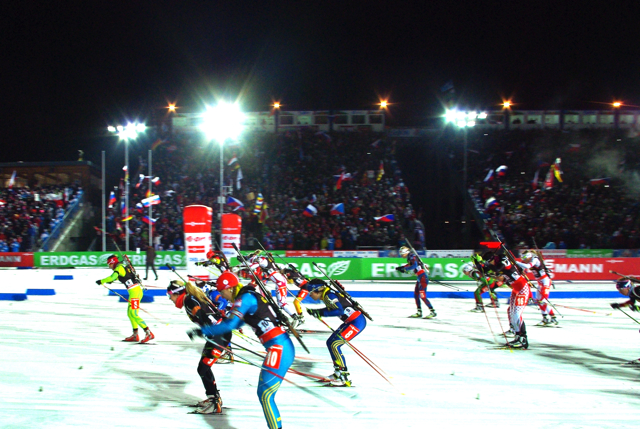
As Czech flags wave in the background, the mixed relay field sets off in pursuit of the first 2013 Biathlon World Championship title on Thursday in Nove Mesto, Czech Republic.
Think you can picture the scene at the International Biathlon Union (IBU) World Championships in Nové Město na Moravě, Czech Republic? Think again.
Veteran and newbies alike found themselves in awe of the stadium and 20,000-strong crowd. After the first few days of racing, many were still struggling to cope with the noise factor, but hey, they weren’t complaining.
Norway opened with its third-straight mixed relay victory, no surprise there, and the hometown fans celebrated its own team making the podium in third right behind France.
The U.S. notched its best mixed-relay result in eighth with Annelies Cook, Susan Dunklee, Lowell Bailey and Leif Nordgren. With Tim Burke out trying to get healthy, Nordgren filled in. Meanwhile, the Canadians were simply happy to get their feet wet at World Champs as Rosanna Crawford, Megan Heinicke, Jean Philippe Le Guellec and Scott Perras combined for 15th.
On Saturday, Norway’s former biathlon king, Emil Hegle Svendsen, made a point to get back on top and captured his second-straight gold medal of the week, beating French rival Martin Fourcade in the 10 k sprint. In the women’s 7.5 k sprint, Ukraine’s Olena Pidhrushna surprised with her first career win and teammate Vita Semerenko tallied her third World Championships bronze.
All four American men in the sprint raced well enough to qualify for Sunday’s 60-man pursuit. Burke was back in action in 28th, Bailey placed 32nd and Russell Currier and Nordgren also made the cut. Two Canadian men and two women qualified, led by Le Guellec in 36th and Scott Gow in his debut World Championship in 45th. In the women’s sprint, Cook also placed 45th and Heinicke narrowly qualified for the pursuit in 54th.
That brings us to Sunday when Svendsen continued his World Championships domination, outsprinting Fourcade by 2.4 centimeters for the pursuit victory. It didn’t come easy: he nearly stopped after getting tangled with Russia’s Anton Shipulin on the last climb.
Norway’s Tora Berger won her first individual gold of the week in the pursuit, rising to the occasion when two skiers in front of her, Russian Olga Zaitseva and Krystyna Palka of Poland, missed one apiece on the last shooting stage. Berger shot clean on the final stage and hammered home for the victory.
Meanwhile, Bailey and Le Guellec led the North Americans in 13th and 15th, respectively. Le Guellec made up 21 places – the second most of any man in the pursuit – and Bailey climbed 19 spots to get back in the mix.
While biathlon expert and FasterSkier editor-at-large extraordinaire Chelsea Little was on site in Nové Město, Audrey Mangan traveled to Aspen, Colo., for the SuperTour – making her first stop at the Vail Mountain Games.
There, the Central Cross Country (CXC) husband-and-wife duo, Brian and Caitlin Gregg topped the men’s and women’s field, respectively, in the 10 k freestyle mass start – a sort of warmup for the SuperTour weekend ahead.
On Saturday, big, wet snowflakes at 8,000 feet above sea level didn’t slow down skiers like Rosie Brennan of Alaska Pacific University (APU), who won both the 1 k classic prologue in the morning and the 5 k classic individual start in the afternoon. On the men’s side, Mike Sinnott of the Sun Valley Ski Education Foundation (SVSEF) won the prologue and teammate Patrick Johnson tallied his first career SuperTour victory in the 10 k.
Sunday’s coveted Owl Creek Chase involved a sprint showdown at the end of the 21 k point-to-point race. Brian Gregg edged Sylvan Ellefson (Ski & Snowboard Club Vail/Team HomeGrown) by eight seconds at the finish, showing all his speed work this summer paid off.
Part-time racer Nicole DeYong (SVSEF) skied away from the pack for a two-minute victory after winning the same race in 2010.
Sophie Caldwell (SMST2) racing to a second-place finish in Sunday’s Scando Cup 1.1 k freestyle sprint final in Pärnu, Estonia. She was just 0.14 seconds out of first for a career best. (Photo: Eric Packer)
Meanwhile, several other American domestic skiers put their skills to the test at the Scandinavian “Scando” Cup in Latvia and Estonia. Caitlin Patterson of the Craftsbury Green Racing Project led the group in Madona, Latvia, where she was ninth in Thursday’s 10 k freestyle mass start and 10th in the 5 k classic on Wednesday. Eric Packer of the Stratton Mountain School T2 Team (SMST2) broke through in 16th in the 20 k freestyle mass start.
A few days later, Sophie Caldwell (SMST2) made the podium in second in Sunday’s freestyle sprint in Pärnu, Estonia, one day after finishing 17th in the classic sprint. Jennie Bender (CXC) qualified as high as fourth in the classic sprint and went on to place 16th. The next day, she was 11th in the skate sprint.
Leif Zimmerman (BSF) coming down the home stretch at the Owl Creek Chase.
ASPEN, Colo. — The third time was the charm for Leif Zimmermann (BSF) at the Owl Creek Chase on Sunday. He had finished third in Aspen twice before, but for the 2012 edition he claimed the top spot in the 21 k mass start freestyle by 37.9 seconds over Matt Gelso (SVSEF). Pat O’Brien (CGRP) outsprinted Josh Smullin (Rossignol/SSCV) for third (+1:15.6).
After what Zimmermann said was a disappointing week at U.S. Nationals in January, he felt his legs were back in the shape they needed to be in for the rolling, hilly course that went from from Snowmass to Aspen.
“I felt like the legs came around, and feeling that at altitude is a good thing, otherwise it’s hard to race here,” said Zimmermann.
He focused on where he knew his strengths to be on the uphills. At around 6 k, he put distance between himself and the rest of the front men’s group.
“We took a feed and [Zimmermann] didn’t—he had a water bottle,” said Gelso.
At around 10 k Gelso said he reeled Zimmermann back in, but struggled to maintain contact.
“I yo-yoed with him a little…then at 5 k to the finish, he really pushed into the top of the course,” said Gelso.
Zimmermann skied as if the four skiers chasing him would be breathing down his neck at any moment.
“Usually [a four-man chase] is enough to catch back on,” he said. “But there was enough climbing—I was really trying to stay smooth and pull away if I could, and I knew that was more my strength than the flats.”
Zimmermann and women's winner Morgan Arritola with the Owl Creek Chase trophy.
Zimmermann had planned to take off on the second big climb of the final 5 k, and with a gap on the men skiing behind him already, he decided to go for it.
“It was a little bit of a gamble; Gelso caught up almost on the flats, but then we hit the hills. I think he had worked so hard to catch me, once I took off for the second time I was able to hold that.”
At that point, Gelso knew second place was pretty decided—he wasn’t going to catch Zimmermann from as far behind as he was, and also figured that third and fourth place weren’t going to bridge the gap to him. From that point, it was just a matter of surviving through the snow squall to the finish, which began swirling around the racers in the final leg of course.
“It got so slow and windy and cold—it was kind of brutal,” said Gelso.
Behind him, the chase group fought to catch back up.
“Leif and and Gelso were definitely in their own class—they pushed really hard and got away,” said O’Brien. “Nils [Koons] and I worked together for a little while, but it was tough to tell if we were closing the gap or not. Then at 5 k to go it started snowing, which made things tricky.”
As the finish line approached, the third spot on the podium came down to O’Brien and Smullin.
“I was pretty sure I could take third. It got a little tactical in the last couple kilometers, but I had a little bit more than Josh,” said O’Brien.
He edged Smullin in the finish chute by half a second.
“I actually felt really good climbing out there—a lot of V1,” he said. “The skis felt great.”
Behind Smullin, Koons (Rossignol) took fifth (+1:37.4) and Lars Flora (APU)—a day after completing a five hour-plus ski mountaineering race in Vail—finished sixth (+2:08.4).
Morgan Arritola (SVSEF), victorious at the Owl Creek Chase. Photo: Susan Jackson.
ASPEN, Colo. — Morgan Arritola (SVSEF) was officially back to full form on Sunday at the Owl Creek Chase. After appendicitis forced her to skip U.S. Nationals and subsequent SuperTours, she won the 21 k point-to-point mass start freestyle by nearly four minutes over Lenka Palanova (BNJRT). Chelsea Holmes (SVSEF) finished third (+4:48.6).
“This was my kind of course: hard, uphill,” said Arritola. “I just went out as hard as I could—that’s kind of how I race—and it worked out today.”
After taking about three weeks to ramp her training back up after surgery, Arritola returned to racing last weekend at the Boulder Mountain Tour in Sun Valley, Idaho, where she finished a close second to Rebecca Dussault.
Nothing held her back at in Aspen, where the race started on the Snowmass Club Golf Course and headed east towards the nordic center at the Aspen Valley Ski and Snowboard Club. Many of her competitors had done the classic races the day before, but Arritola was skiing fresh.
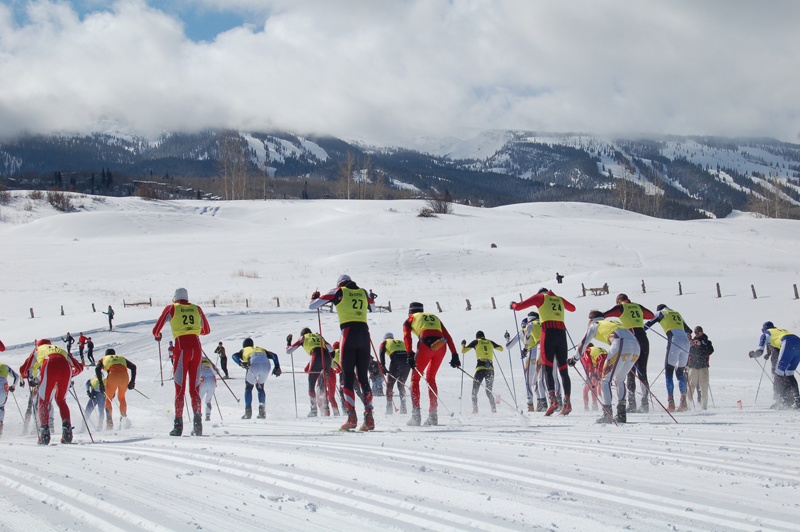
The women's leaders shorting after the start.
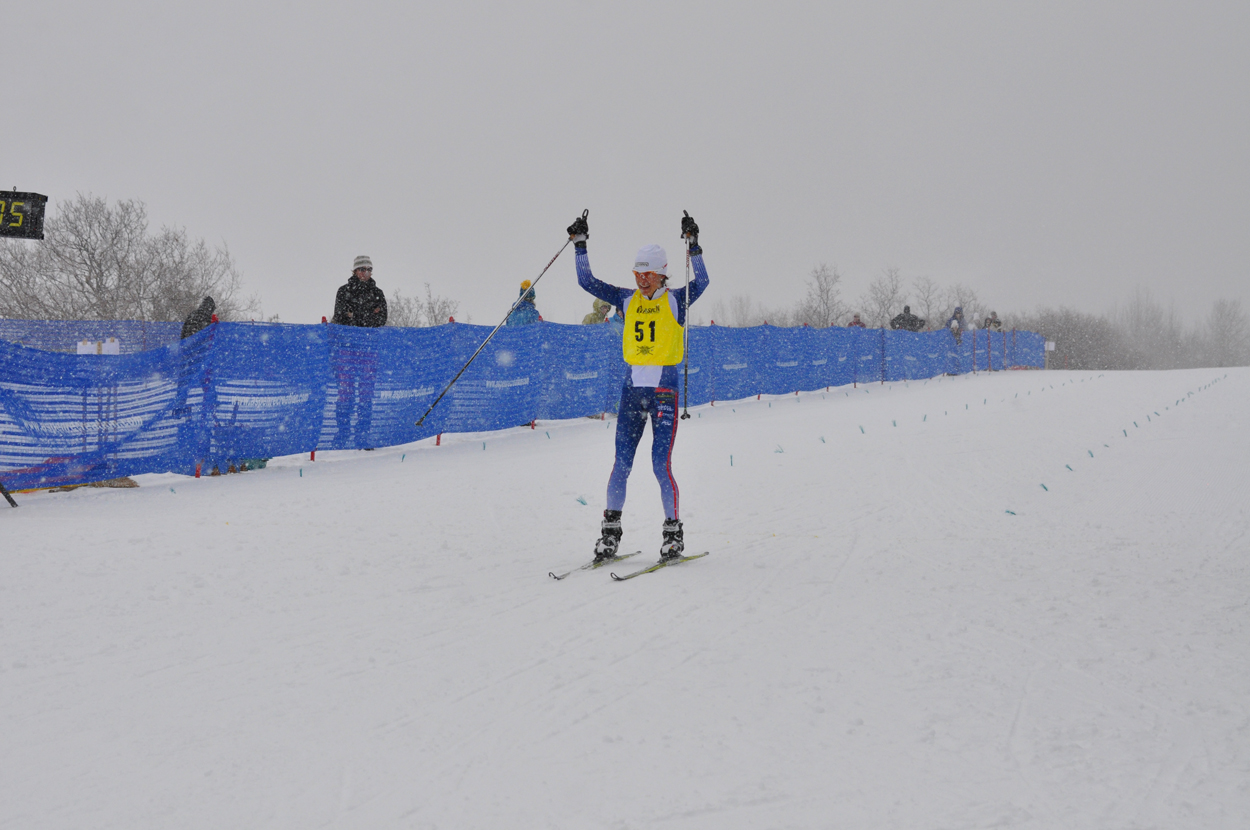
The sky remained cloudy throughout the women’s traverse over long and hilly terrain, across the Tiehack Bridge, and down a partial slope at Buttermilk. With only 5 k to go as they reached the Aspen trails, the sky opened up and heavy flakes began to fall.
Arritola didn’t let it bother her.
“At that point you’re just tired…whatever’s happening is happening,” she said. A comfortable four-minute lead certainly minimized the effects of a burst of snow on the outcome of the race, but made the tail end of an hour of hard skiing no more pleasant.
Arritola pulled from the front most of the way, and for the first few kilometers a group of five skiers stayed close on her tail. But the chase pack eventually dwindled to two: Palanova and Holmes.
“I was faster on the uphills, [Holmes] was way faster on the downhills, so it was back and forth,” said Palanova.
The former CU standout, now Boulder Nordic Junior Race Team coach, had skied the course once before in college, and knew what she was in for.
“It’s hard—not an easy course,” said Palanova.
The top three finishers: (from L to R) Holmes, Arritola and Palanova. Photo: Susan Jackson.
Palanova passed Holmes for good as they approached the nordic center to head into the final 5 k. Holmes had managed to put a big gap on Palanova on the descent across the Buttermilk trail, but caught back up and managed to maintain the lead.
Palanova thought the squall that started for the final minutes of the race slowed her skis, but wasn’t impossible.
“I think we finished early enough that it wasn’t too bad,” she said.
Like Arritola, she enjoyed the course’s varied terrain.
“It’s really cool—not that I would look around much [during the race],” she said.
“Even if you’re tired you have downhills to rest.”
The field was spread out for the final kilometers. Holmes finished 50.4 seconds behind Palanova, and Alexa Turzian (SVSEF) took fourth 1:49.5 behind Holmes. Tammy Jacques was fifth (+6:58.0) and Rosie Brennan (APU) crossed the line in sixth (+7:12.9).
Last year, the Owl Creek Chase also served as a collegiate race, but on Sunday most RMISA collegiate skiers were in Anchorage, Alaska for the Seawolf Invitational. As a result, the fields were noticeably smaller, but the skiers who made the trip were clearly happy to have the chance to ski on such good snow.
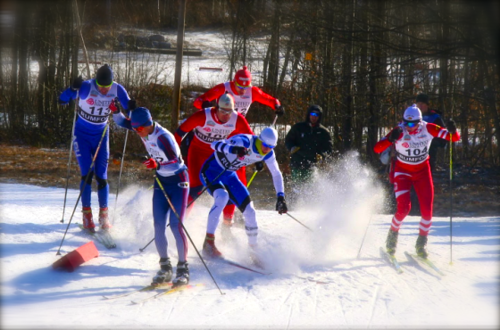
Athletes collide during sprint heats at U.S. Nationals in Rumford, Maine, 2012.
A sprint qualifier can be defined as the preliminary stage of a sprint race in nordic skiing. In a race against the clock, competitors leave the starting gate at intervals and go as hard as they can for anywhere between 1 and 1.8 kilometers. The top 30 in most internationally sanctioned competitions, and sometimes a lesser number in other events, move onto the quarterfinals to face off against five other athletes at a time for the right to advance to the next round.
Sprint races progress in this manner all over the world; on the World Cup, in Continental Cups, in the collegiate circuit, and sometimes at small-scale high school races.
In the winter of 2009, the term “sprint qualifier” took on another meaning. The U.S. Ski and Snowboard Association (USSA) introduced a sprint race to the SuperTour that was truncated at the qualifying round; medals were awarded to skiers who clocked the fastest qualifying times, and the athletes’ entire day was done in a matter of two to four minutes. No longer just a prologue, the qualifier became a race all its own.
At the time, the trial run was met with mixed reviews. Athletes felt robbed of the chance to develop head-to-head sprint skills. Coaches acknowledged the challenges the organizers faced in putting on full heats, but agreed that the format was not ideal. Canadians who occasionally dabbled in the SuperTour simply didn’t understand it.
Qualifier-only sprints started with a trial run in West Yellowstone, Mont. that first winter, but have since spread to three other stops on the SuperTour in 2012. What began as confusion is now ranting fury — some still fail to understand why the experimental format was deemed a success and allowed to proliferate.
To begin to answer that question, we start with that first time qualifier-only sprints were held in the U.S.
When the format was first conceived of prior to the 2009-2010 season, then-USSA Nordic Director John Farra intended for it to do two things. First and foremost, the decision to leave out the heats from the West Yellowstone sprint was a philosophical one. Farra believed it to be the right move for U.S. skiing at the time, and today stands by his decision.
“We still don’t have enough Americans, in my personal opinion, who can qualify, period,” said Farra, who has since left USSA to become the High Performance Director for Paralympic skiing, in a phone interview in December. “That’s a problem. For me, at this point in our development, there’s an argument for getting athletes in more races where they’re just throwing down… I think it works on a gear all Americans need to keep working on.”
Secondly, it put an additional sprint race back on the calendar in the first period of the SuperTour where, at the time, there was only one in Bozeman, MT. It would not be the first time sprint races were held in West Yellowstone. Regular sprints, complete with heats, were held on the Rendezvous trails up until 2007, but according to Farra, coaches complained that the trails were too narrow and the altitude too punishing for a full sprint day.
One of the jobs of the Nordic Director is to select skiers at the end of the Period 1 to send to the World Cup. With an additional sprint thrown into the mix, Farra’s theory was that the overall points leader would have to be a decent sprinter and distance skier to earn those coveted European start rights.
Rankings of the best distance skiers and sprinters on the domestic circuit are often very similar, however. For example, at the end of Period 1 this winter, the women’s SuperTour sprint leader, distance leader, and overall leader were all one person: Jessie Diggins (CXC/USST).
On the men’s side, overall leader Mike Sinnott (SVSEF) had two top-5 distance results along with his two sprint wins and one second.
The sprint qualifier has also been accused of having another motive. It was introduced in the season leading up to the 2010 Vancouver Olympics, and it’s been suggested that the qualifier, in squeezing another race into a short time frame, was a grab for better FIS points to boost the U.S. quota for the Games.
Farra said this was never the case. Points are always based off the qualifier, so heats would have no effect on FIS points either way. Additionally, as Farra pointed out, “you can only ‘boost’ the points if you have a quality field in the race.”
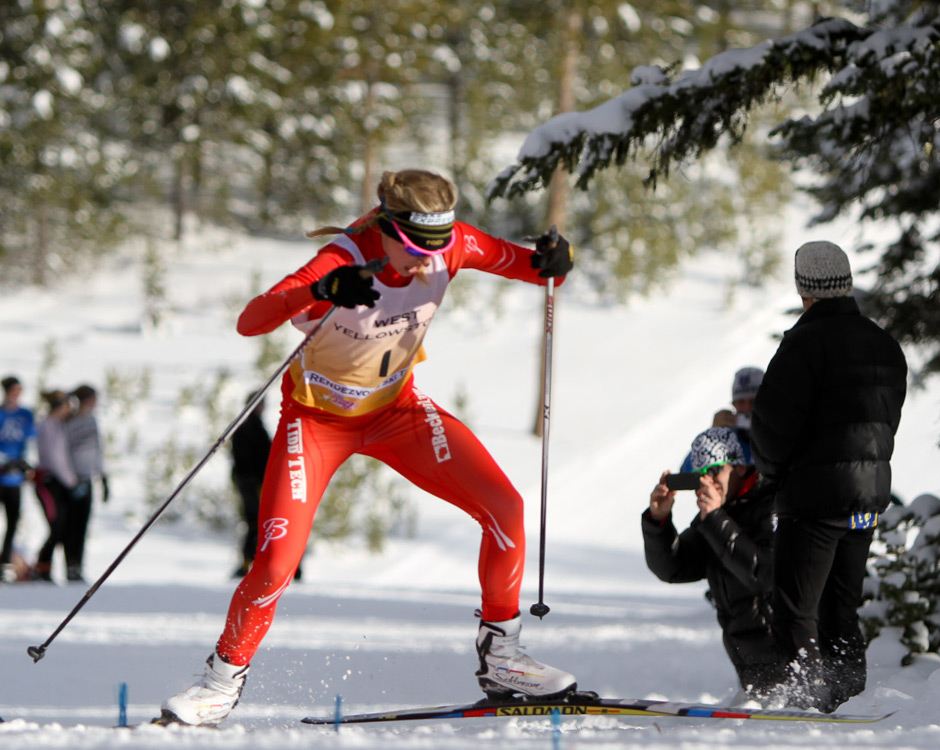
Jessie Diggins competing in the qualifier-only skate sprint in West Yellowstone, Mont., in November 2011.
With his idea for a modified sprint in mind, Farra went to the West Yellowstone Chief of Competition at the time, Sara Hoovler, with the proposal.
From the organizer’s perspective, the introduction of an additional race in West Yellowstone brought with it organizational and financial burdens, which became the main point of negotiation.
“As an organizing committee we were pretty maxed out,” said Hoovler, who is now a school teacher in the area. “We couldn’t put on another full-scale race.”
When Farra brought the proposal to the organizers, they agreed to try out the additional sprint as long as it didn’t come with a significant extra cost—specifically, as long as it didn’t require coming up with the additional prize money. At $3,900 per race, prize money is one of the single most expensive components of hosting a SuperTour.
“Purses for these races can sink the entire event,” said Dan Cantrell, Hoovler’s successor as the West Yellowstone race director.
He estimates that between all the major costs involved with putting on the SuperTour every year—notably prize money and gas for grooming—the event runs the Yellowstone Ski Festival around $20,000. When the weather is especially uncooperative, the number goes up as tents and space heaters are brought in, or the Pisten Bully has go over the course multiple times.
With the introduction of homologation standards this year, any argument for heats became moot—the venue simply doesn’t have the terrain to meet the standards on a traditional sprint loop. For the race to count as a SuperTour complete with FIS points, there needed to be a certain amount of total climbing.
The only sprint course West Yellowstone could come up with that met the standards is a point-to-point 1.5 k, which ruled out the possibility for heats. For timing and officiating purposes, heats have to start and end in the same stadium.
“We were able to FIS homologate West for a sprint qualifier only. That’s a big deal, otherwise we don’t sprint there,” said Farra.
The other option would be to hold the fall SuperTours at locations that could homologate a sprint loop, but choices are limited by the reliability of snow anywhere else in the country in late November, and the number of venues willing to take on a SuperTour.
With the advent of homologation standards looming for 2011, Cantrell also had to account for the cost of the trail work necessary to get the courses up to standard. In addition to sitting on National Forest land, the Rendezvous Ski Trails occupy endangered grizzly bear habitat. Every time the ski trails are modified, the Forest Service requires an environmental impact assessment.
“To put it in perspective, the improvements from this year, with the connectors and homologation, was about a three year process,” said Cantrell. “We had a bulldozer out there two weeks before Thanksgiving.”
With these demands on the race organizers in mind, Farra was loath to push West Yellowstone to take on significant extra cost in adding a sprint qualifier to the schedule.
“We weren’t prepared to make the organizer come up with the prize money,” said Farra.
Since USSA strategically thought it was important to hold a sprint in Yellowstone, the organizers were excused from the obligation to hand out the prize money for sprint qualifiers. The exception is laid out in the USSA Rulebook—none of the sprint qualifiers on the SuperTour schedule this year award the usual purses to the top six finishers.
Since 2009, Yellowstone’s sprint qualifier has become two. In the second and third years of its existence, the opening day of the SuperTour was a double-header. The “SuperTour Sprint Showdown” starts with a skate sprint qualifier, and ends one hour later with a classic sprint. Each of the two races is an opportunity to earn points, but the single winner of the Showdown and recipient of the $250 purse is calculated from the combined times.
The first running of the Showdown at West Yellowstone, on the whole, was a success in the eyes of the organizers and USSA. There were a few kinks to work out—the flow of athletes from the finish back to the start was congested, and cold weather made the trek an uncomfortable one for athletes still just in spandex—but overall, organizers felt good about the trial run.
For her part, Hoovler thought the number of participants in the sprint qualifiers as reason to look positively at the outcome.
“We saw a lot of junior skiers, just getting some race experience, and also master skiers that weren’t competing for FIS points but challenging themselves,” she said. “I was very shocked at the amount of racers that participated.”
When West Yellowstone still had sprint heats in 2007, 42 women and 51 men participated. In 2009, 61 women and 67 competed in the qualifier-only version. In 2011, more athletes competed in the freestyle sprint than the classic, but the totals in the freestyle qualifier were 60 women and 92 men.
Amongst elite skiers, the sprint qualifier was met with some complaints about the absence of heats. Despite this feedback during the season, Farra said the format wasn’t a major issue at the spring USSA meetings, and he saw no reason not to keep experimenting with it.
“This is not a new topic,” Farra emphasized. “There’s been at least two springs for people to say, ‘Hey, this is ridiculous.’ I don’t remember there being significant discussion about that.”
The release of the 2011-2012 SuperTour calendar saw the addition of sprint qualifiers to three new venues: in Bozeman, Mont. one week after West Yellowstone; in night-sprint form at the Tour de Twin Cities, which took place just two weeks ago in Minneapolis, Minn.; and as a prologue to the upcoming 5/10 k classic on day one of the Owl Creek Chase in Aspen, Colo.
In the negotiating phase of calendar planning prior this season, Farra proposed the addition of sprint qualifiers to each of the new hosts. As with West Yellowstone, at each location, the investment that new homologation standards required already had organizers strapped for cash and volunteer power.
Austin Weiss, the Race Director for the Aspen SuperTour and Owl Creek Chase, agreed to add the sprint qualifier to the schedule on February 11 in order to make the entire weekend a more attractive package to racers. Weiss said the Aspen organizing committee was never asked if they could hold a full sprint with heats. He indicated that it would be a challenge, as heats require a separate day of racing, but didn’t rule it out as a possibility in the future.
“Logistically, everything is possible,” said Weiss. “It’s biting off a bit much—it’s not out of the question, but it’s something that the organizing committee would have to consider.
“The other benefit of a sprint qualifier is that it doesn’t require that much more work on the part of organizers.”
The race director in Minneapolis had a similar view.
John Munger, the director of the City of Lakes foundation, which hosted the first three races of the Tour de Twin Cities, pointed to the challenge of putting on a number of high-profile events within a short timeframe.
“It takes a long time to do sprints and lots of volunteer power,” Munger said in a phone interview. “We’re doing the Mayor’s Challenge, the IPC Paralympic World Cup, and the City of Lakes Loppet all within about two weeks.”
This is the compromise Farra sought to strike as he set about adding more sprints to the SuperTour last spring: give skiers more opportunity to develop their sprinting ability without pushing organizers to the point where they wouldn’t hold sprints at all. Just as in West Yellowstone, he saw qualifiers as the best solution.
“It’s a fine dance between what athletes and coaches want, and what we think organizers can do,” said Farra.
The financial burden of the additional race was also lessened at the new sprint venues. As with the two independent sprints in West Yellowstone, none of the three new sprint qualifiers come with the normal win payout, which adds up to $3,900 between both men and women (1st – $750, 2nd – $500, 3rd – $250, 4th – $200, 5th – $150, 6th – $100).
“Imagine if you push Bozeman, and we say, ‘Come up with four grand,’ and they say, ‘Sorry, can’t do it.’”
According to Dragan Danevski, director of the Bridger Ski Foundation, the additional prize money would have been more than they could afford, and was a point of negotiation when Farra asked them to hold a sprint qualifier in the spring.
“It would be nice if we could have $100,000 in prize money, but I said, ‘Look, in this economy, in this situation, we are lucky to have SuperTour races even with [some] money,’ sad Danevski in December.
“I had to make the decision that we would no be able to do three races and have prize money for three.”
The financial compromise has not gone unnoticed by the athletes, particularly those who have repeatedly placed in the top six in the SuperTour sprints thus far.
“I don’t understand it,” said Mike Sinnott (SVSEF), who was first and second in the two sprints in West Yellowstone and won the freestyle sprint the next week in Bozeman.
“It’s unprofessional in my opinion.”
In Sinnott’s view, the $250 check he won as the Sprint Showdown champion in West Yellowstone should have been a bonus.
“I think it’s pretty clear in the rules that you get $750 for a win,” he said.
Caitlin Gregg (CXC) has similarly excelled in sprinting this winter. She began with a fourth and first in West Yellowstone, a second-place in Bozeman, and a third in Minneapolis. Like Sinnott, she believes the sprint qualifiers should have prize money.
“If any race requires a registration fee and awards points…there needs to be prize money,” Gregg wrote in an email in December. While she understands that qualifier-only sprints, as a format, are easier on race volunteers than full heats, she believes that leaving out their prize money altogether undermines sprinting development in the U.S.
“It seems as though there was once a push to hold more sprints and team sprints on the circuit and suddenly (ironically coinciding with some of the best results ever for U.S. skiing, which came from sprints and team sprints internationally), the U.S. has decided to reduce the opportunities domestically for sprinters to develop,” said Gregg.
“Without prize money, sprint specialists or those who are competitive in both distance and sprint races would be loosing a large percentage of potential earnings that could allow them to continue competing on the SuperTour domestic circuit.”
As a solution, she proposed getting a title sponsor to help fund the SuperTour purses in the future.
If USSA is adamant about adding more sprints to the SuperTour, and has found race committees unable to produce the extra prize money, would USSA ever contribute their own cash to the pot to make up for it?
Given the state of its budget, “No way would USSA pay,” said Farra. “The SuperTour has never been funded by USSA… Given the state of the union at USSA, it’s highly doubtful that any prize money will come from them.”
Farra empathizes with the opinion of the athletes, but notes that contesting the sprints are still worth something.
“While I agree—I would be disappointed not to benefit from that prize money— World Cup qualifying is still up for grabs,” he said.
But for many athletes on the SuperTour, not even that is enough. Without heats, some don’t feel sprint qualifiers to be a valuable format.
Pat O’Brien (CGRP), who placed second in the night sprint qualifier two weeks ago in Minneapolis, believes the heats are critical to developing competitive sprinters.
“While I agree that it is important for US skiers to be able to qualify well (and make the heats), the real test to me is how well an athlete skis rounds,” said O’Brien. “It doesn’t matter how fast you are in the qualifier if you can’t move out of the quarters. Skiing well in a group is a skill that you only can develop through practice.”
“Cutting full sprints out of the schedule and replacing them with just qualifiers undermines this development.”
His teammate Tim Reynolds (CGRP) suggested an alternative format for heats that would be less demanding on organizers, and in cases like Minneapolis where there were fewer numbers, make more sense.
“You don’t have to take 30 onto the heats… I think you can adapt the format to the field size,” said Reynolds, pointing to the Madison, Wisconsin SuperTour as an example. In the past, the Madison event has taken on eight skiers from the qualifier on to the heats, which reduces the number of rounds to two semis and one final.
“Heats are a valuable experience,” said Reynolds.
If dissatisfaction with sprint qualifiers is as widespread as the vocal skiers would make it seem, then Farra agrees that USSA should go back to the drawing board.
“It’s part of being progressive,” said Farra. “How we’ll be a better ski nation is being open-minded to trying different things.”
“My memory is that we are still testing this concept. Until coaches come back in the spring and say, ‘This doesn’t work, we need to stop’—until that happens, we’re still testing it.”
If athletes really want to see qualifiers scaled back next year, Farra encourages them to go to the USSA spring meetings, or make sure their views will be represented at them.
“The USSA Congress really does work,” he said. “It’s amazing how many coaches go out of their way in the spring and engage in dialogue when they don’t want to be thinking about skiing.
“Athletes need to be able to remind their coaches, ‘This is what we’d like to see; this is how the SuperTour could be improved… Everybody is working their butts off, but it’s only going to get better if people bring their ideas forward.”
ASPEN, CO – Fresh snow blankets the trails and anticipation builds for the annual festival of cross country skiing in the Roaring Fork Valley, The Aspen Nordic Festival featuring the Owl Creek Chase. Set for Feb. 11-12, the Aspen Nordic Festival features several events for aspiring Olympians as well as Colorado citizen skiers, but it’s Sunday’s grueling 21km freestyle event, the Owl Creek Chase, that is the highlight of the weekend.
“The Owl Creek Chase is one of the toughest races in the world.” said race announcer Mike Trecker. “But it’s also one of the most fun; it’s a true cross country race that starts in Snowmass and finishes in Aspen. The scenery is visually stunning and the flow of the race is enhanced by the challenges of the tough climbs and speedy downhills. There are usually packs of skiers racing together and the finish at the AVSC is one of the best in the sport, offering many prime viewing spots for spectators.”
Several new features highlight this year’s Aspen Nordic Festival, the first of which is a new classic sprint qualifier early on Saturday morning.
“This year’s festival will be the first on FIS sanctioned and standardized trails at the AVSC courses.” Trecker explained. “Holding one additional points race opportunity was something the national governing body wanted to add to the program since Sunday’s Owl Creek Chase is not FIS sanctioned. Rather than holding an additional event on a separate day, the organizers and the USSA decided to hold a short, sprint time trial on Saturday in addition to the standard 5/10k classic races.”
Sunday’s Owl Creek Chase will once again be a wave start and this year’s race will be the first edition to offer two separate wave starts for the citizen skiers. Wave 1 which starts at 11am will be the SuperTour and Elite Citizen Men’s wave. Skiers in this wave will have a FIS or USSA license and compete for USSA points and cash prizes but will also allow the fastest citizen men up to 50 racers total. Skiers in this wave need to be able to finish in 1:15 or less and seeding will be based on FIS/USSA points for the SuperTour racers and previous results for citizen racers. Wave 2 starts at 11:05am and will be the Women’s version of Wave 1. The recommended finish time for Wave 2 is 1:25 or better.
“The big college teams are not coming to Aspen this year due to a conflict in the schedule.” said Trecker “We wanted to encourage some of Colorado’s fastest citizen skiers to jump into the elite Waves 1 and 2 to make the competition a little deeper in the front and to give additional room for the citizen skiers back in waves 3 and 4. We’ve had some people wish there was more room in the start area and the hope is that these new waves will help with that.”
Wave 3 starts at 11:10 and will be open to citizen men and women who can finish in under 1:40 and who tend to be more competitive and aggressive in their skiing. Thus, Wave 3 is called “Competitive Citizens” and will be limited to a maximum of 75 skiers. Wave 4 starts at 11:15 and is dubbed “Recreational Citizens”.
Early Owl Creek Chase registration is now available for $40 through Jan. 21 with standard $50 registration closing on Feb. 8. There is no race day registration.
2012 Aspen Nordic Festival Schedule of Events
Sat. Feb. 11, 9am – AVSC USSA SuperTour Classic Sprint Qualifier, Active USSA/FIS license holders only
Sylvan Ellefsson (Vail, Colo.) continued his winning streak from last weekend’s Boulder Mountain Tour in Sun Valley, Idaho, winning the 10K classic race in 27 minutes and 13.8 seconds. Glenn Randall (BSF) was second, some eight seconds behind Ellefsson. Reid Pletcher (CU) was third.
“It’s nice to be racing back in Colorado, and it was such a picturesque day,” Ellefsson said to FasterSkier after the race, noting that the altitude made the already tough course profile particularly punishing.
“It’s pretty brutal, but that’s what I was born and raised on,” he said with a laugh.
Ellefsson believes prior exposure to altitude was a big benefit on the challenging course, and knowing how bodies respond to the thin air at 8,000 feet.
“Honestly, part of the winning trick was definitely to be safe and be a little conservative on the first lap. It’s hard to go all out on the first lap and hold it,” he said. “My strategy was to ski technically sound, big and strong. It was going well, so then I could go down harder on the second lap.”
With the confidence from last week’s Boulder Mountain Tour and today’s SuperTour victory, Ellofsson is looking forward to day two of the USSA SuperTour in Aspen: The 21-kilometer Owl Creek Chase.
“I’m really excited. I feel fast. It’s a brutal course and there will definitely be some head games and some cynical games out there, but I’m excited to get it going and see what happens,” Ellefsson said, noting that this will be his second attempt at the Owl Creek Chase.
“The take away from last year is that I need to find a group to ski with and not ski the course on my own,” Ellefsson said.
Junior wins women’s 5K
In the women’s race, Joanne Reid of Colorado University made a statement on her first visit to Aspen. Showing no respect for altitude or course profile, Reid charged right out of the gate and never slowed down. Still a junior, Reid beat everyone on the challenging course, despite setting out on the 5K course without a plan.
“I’m not going to lie, I totally had no strategy. I just tried to have good technique and pushed all the way. I felt terrible at the top of the long hill, but then there is a little downhill and I recovered a little. That helped me keep pushing even though it hurt a lot,” Reid explained, admitting that she forgot her coach’s advice about starting out conservatively.
“I was so friggin’ tired at the top because I didn’t listen to my coach. But there were all these people cheering along the course and I had really fast skis,” Reid said. “You know, racing is always a mix of luck and skis and everything,” she concluded.
“Aspen is so nice. There were a lot of people out today, and it’s so great to see what this is doing for our sport. They had a DJ out there, and it was the coolest thing. Then they had a barbeque on the deck and it was totally a party,” Reid said to FasterSkier after the race.
Terese Andersson of University of New Mexico was second, while Morgan Smyth of Alaska Pacific University Nordic Ski Club was third.
The importance of oxygen
Smyth, arriving at altitude Thursday night and with no time to acclimatize, felt like she pulled off a good race all things considered.
“It was exceedingly difficult. It’s definitely the highest I’ve ever raced,” Smyth said, noting that she certainly felt the altitude.
“I went out doing pretty well as we climbed up, then there’s a pretty good recovery at the top before the rolling section at the end,” Smyth explained.
“The second half was tough,” Smyth said, adding that Saturday’s effort was her first race in three weeks.
Now Smyth is looking forward to the Owl Creek Chase tomorrow.
“That’s a totally different race. I’ve never raced that far and it will be my first mass start skate race this year,” Smyth said, explaining that the 20K skate was her favorite distance in college.
“It will be an adventure. I have no expectations, but the goal is to maintain contact with the main group, that’s the big thing,” said Smyth, who is entirely new to the course.
With near perfect hard wax conditions, sunny skies and a course lined with cheering spectators, the stage was set for some fast and spectacular racing on the Aspen trails Saturday.
“It was nice to do a one-lap race after so many short-loop races this season,” Morgan Smyth said to FasterSkier.
Aspen, CO – Elite athletes from around the country make their way to Aspen to participate in Colorado’s premier cross-country ski race, the Owl Creek Chase. Part of the Aspen Nordic Festival, the Owl Creek Chase presents the very best that Colorado nordic skiing has to offer; tough climbs, scenic views, thrilling descents and excellent snow conditions.
The 21k race, held this year on February 13, was started as a means to showcase the outstanding trails in the Aspen/Snowmass area and the Owl Creek Trail is the crown jewel of over 90km of free skiing often referred to as Aspen’s 5th mountain.
Started in 1985, the Owl Creek Chase has a rich history of diverse participation. Bjorn Sateroy from Norway, a former collegiate racer from the University of Colorado was the first winner of the Owl Creek Chase. Canadian Olympian Pierre Harvey, winner in 1989, is probably the most notable of the early international champions of the Owl Creek Chase. And the Owl Creek has been a coronation for up and coming talents Noah Hoffman, Tad Elliott and Matt Gelso, perhaps the three most gifted young distance skiers in the country today. The Owl Creek Trail is always tough, but the field that assembles for the Owl Creek Chase makes it the ultimate.
The Owl Creek Chase also continues to work closely with such groups as the RMN and the RMISA to help ensure future participation in the Aspen Nordic Festival by the best skiers around including the up and coming juniors, collegians and national level elites.