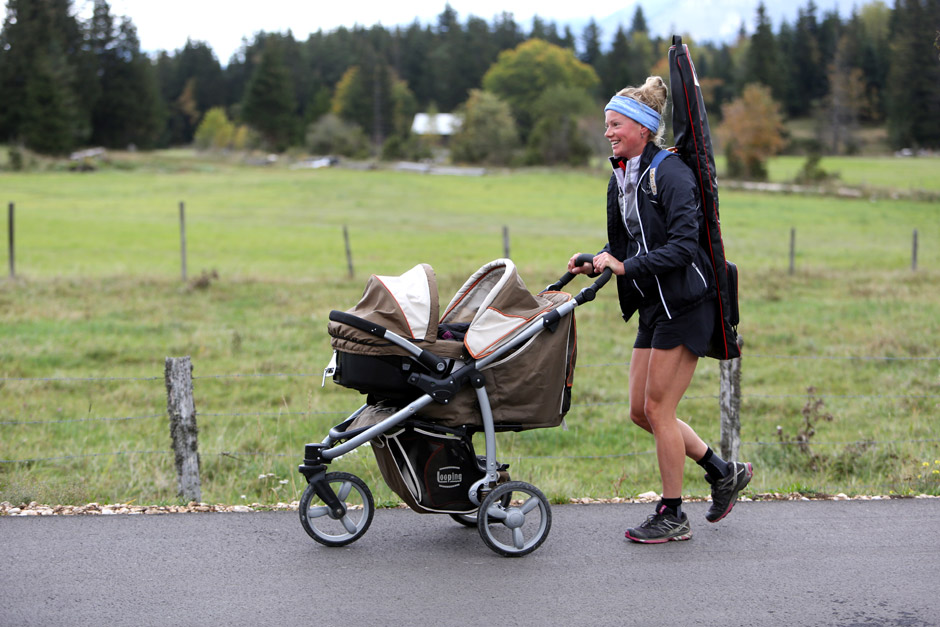
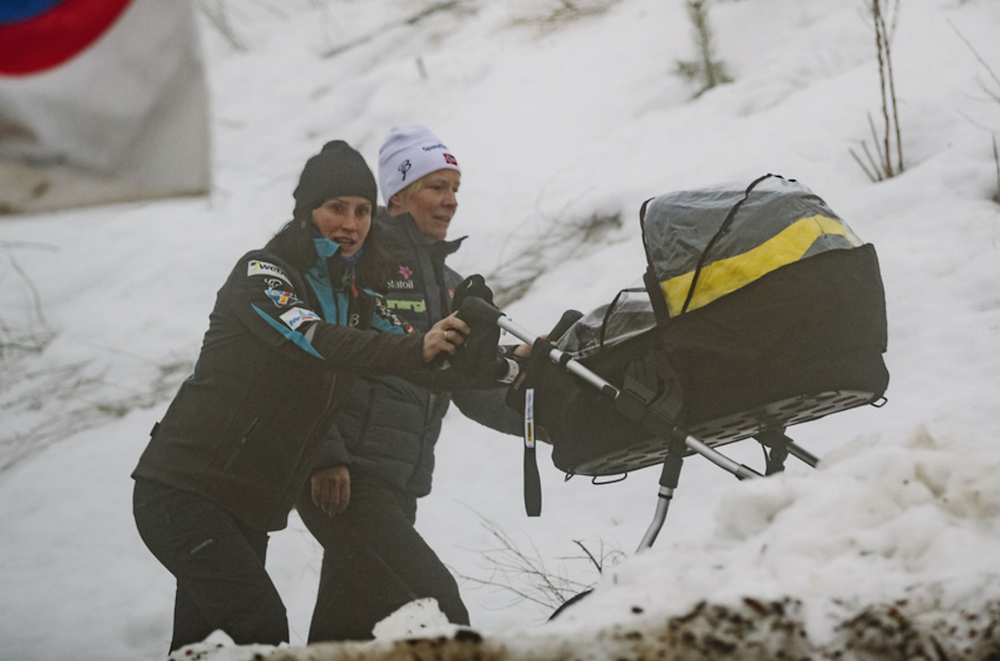
Marit Bjørgen of Norway (l) gets in some early season hill climbing with the stroller in preparation for the 2016 NYC Stroll-a-thon. (Photo: SportoweFakty)
Ready. Set. Stroll. When 7,000 contestants charging carriages hit the streets of New York City (NYC) this year at the 2016 NYC Stroll-a-thon, a few nordic names may find a new race niche that has nothing to do with snow. Especially if the U.S. Ski Team’s Kikkan Randall and Norway’s Marit Bjørgen steer a stroller the same way they ski.
After side-stepping the 2015/2016 World Cup season, Bjørgen and Randall will release nine months of curbed competitive edge at the debut marathon event — presented by the New York Road Runners organization — which promises competitors 26.2 miles of the steepest inclines and most tactical turns in stroller racing.
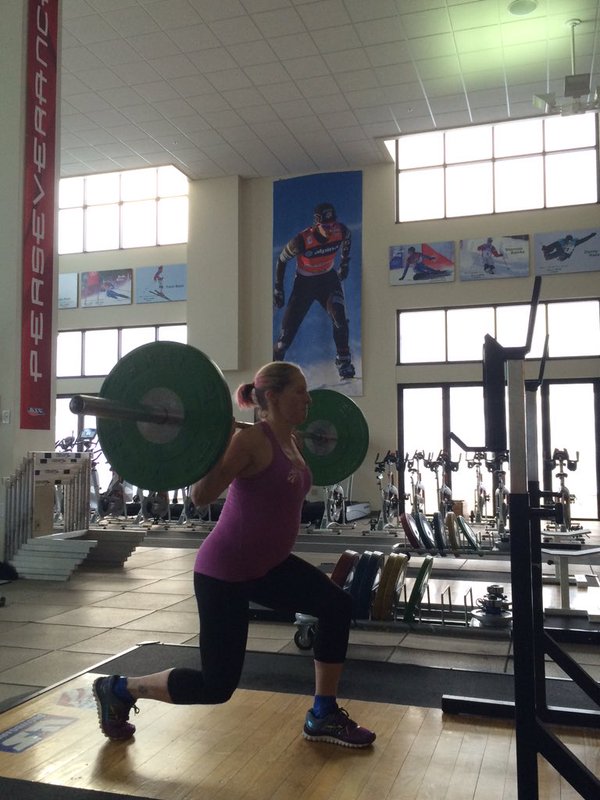
U.S. skier Kikkan Randall sets early season squats as preparation for the NYC Stroll-a-thon taking place this May. (Photo: Kikkan Randall/Twitter)
Open only to parents who can cover the course with their child in a carriage (*see more detailed rules and regulations below) the NYC Stroll-a-thon is scheduled to take place May 2, 2016 — though Randall admits her April due date will be cutting it close.
“I’m as strong as I’ve ever been,” Randall said in a phone interview.
“My main concern is switching to the spring training cycle, which for me includes a 50-percent increase in stroller hours and a sizable volume jump for Bean,” she explained, confirming recent rumors that she and husband Jeff Ellis have made the decision to name their child ‘El Bean’ — Bean for short — a decision primed by one of Randall’s sponsors, L.L. Bean, which offered to pay for the child’s college education if Randall and Ellis could find a way to christen the child after the company.
With a three-month head start of stroller steering on Randall, Bjørgen will no doubt prove a force to be reckoned with at this year’s NYC Stroll-a-thon.
But Bjørgen is not the only nordic skier who is well practiced in the art of carving the streets with their child and carriage.
Norwegian nordic superstar, Øystein Pettersen, better known as “The Sausage,” has also confirmed his entry in the event. He and his son, who was born this July 2015, have spent much of this winter ski season meditating their moves for the marathon course.
“It will be tough challenge, for sure” Pettersen wrote on Twitter. “But baby boy and I are ready to bring the burn.”
Also competing in the event is French biathlete Marie Dorin Habert, coming off two individual gold medals at 2016 IBU World Championships, and the U.S. Paralympics Nordic Development Coach, BethAnn Chamberlain.
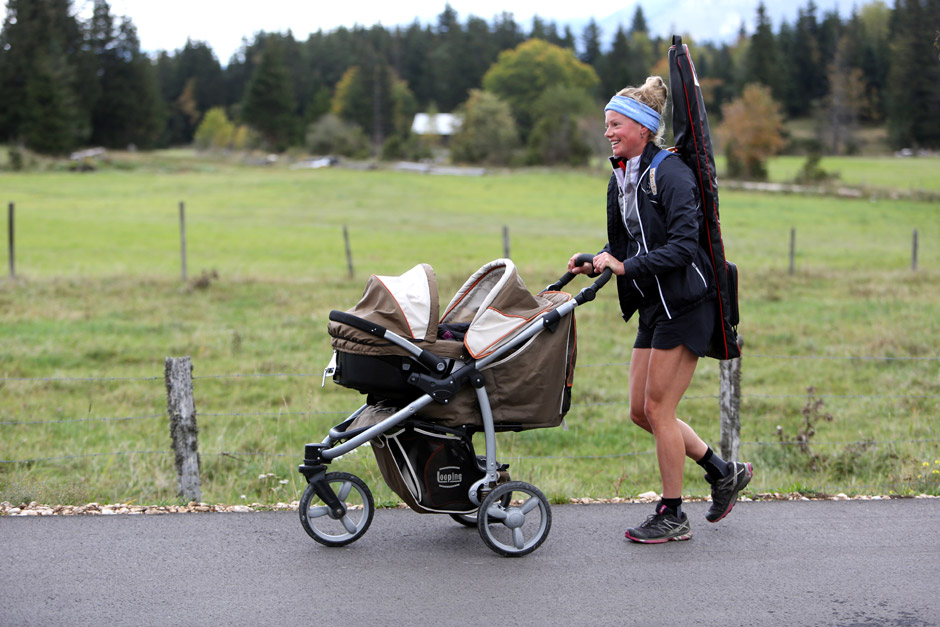
French biathlete Marie Dorin Habert getting training for the upcoming NYC Stroll-a-thon. (Photo: DauphieNordique)
Selecting the Right Stroller
The NYC Stroll-a-thon, which follows the same a point-to-point course for the NYC running marathon, tests racer’s stamina and steering skills, making savvy stroller selection critical for participants looking to win.
Bjørgen will sport the lightweight Kolcraft Cloud 2015 stroller, which features an adjustable canopy, shock absorbing front swivel wheels, and foam padded handles. Weighing in at only 11.4 pounds and earning an average rating of 4.3 stars, this model remains one of the best hill climbers in the industry.
However, the Cloud’s strongest selling point is also its weakness. Without much weight in the front, the Cloud makes wieldy turns, which heightens the chance of blowing a crucial course curve.
Yet, Bjørgen finds herself more well-suited for technical steering, preferring to gamble with race technique tactics than lost time on an incline.
Randall will run Bjørgen’s rival carriage, the BOB Sport Utility Stroller. The fixed front wheel and treaded tires necessitate more aggressive driving, but Randall prefers the stroller stability and top of the line suspension system for Bean.
Pettersen on the other hand will opt for the industry’s heaviest hitter, the ŠKODA stroller, an ATV-style stroller designed by a Czech automotive company. At two meters tall with complete high suspension and brake systems, it’s no surprise Pettersen will choose ŠKODA.
*Rules, Regulations and Registration:
A few of the most unique rules that apply to the 2016 NYC Stroll-a-thon are summarized below.
Children must be legitimate: competitors may not enter carriages carrying children that are not their own.
Contestant’s child must be in good health upon crossing the finish line; vitals will be checked.
Weight added to the stroller in order to enhance downhill speed is not permitted.
To register or learn more about the 2016 NYC Stroll-a-thon, click here
FasterSkier editor Alex Kochon is signed up for the inaugural event but she isn’t expecting to contend with the elites. “My 10-month-old puts me at a severe weight disadvantage, especially on the uphills,” Kochon said. “I love the little guy and all, but we can’t compete with those newborns.”
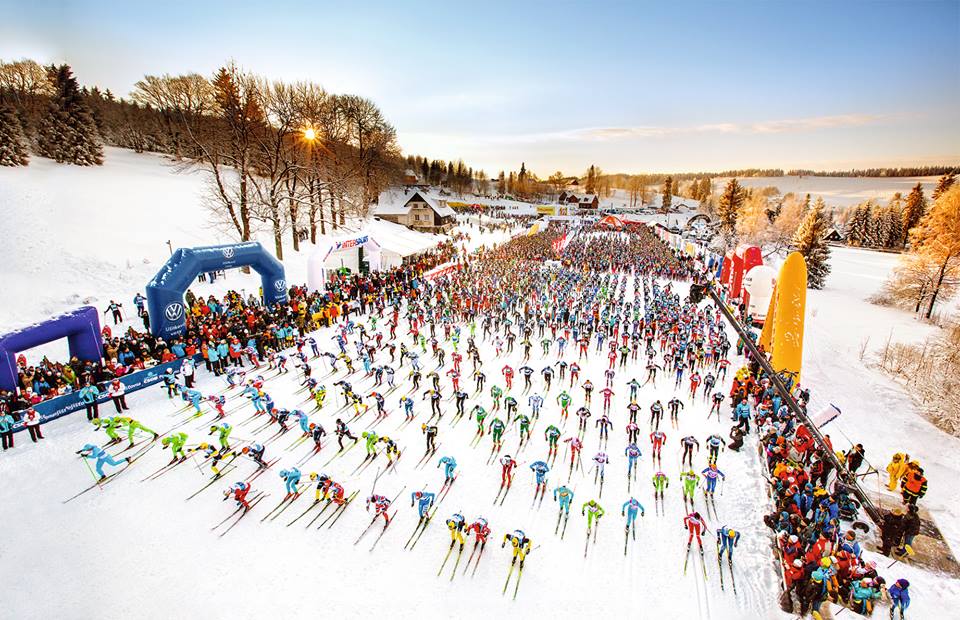
Start of the Jizerská Padesatka, a 50 k classic race near Liberec Czech, Republic. (Photo: Swix Ski Classics)
Sunday’s 50-kilometer classic race Jizerská Padesatka near Liberec, Czech Republic, is the next event in the 2015 Swix Ski Classics long-distance circuit and racers are eager to hit the tracks after a long break since the first races in Italy in mid-December.
Going into the third event in the Ski Classics (after the opening Pro Team Prologue and La Sgambeda), Norway’s Anders Aukland of Team Santander tops the overall ranking. Johan Kjølstad, who won the overall Ski Classics title last season, is second overall.
In the Ski Classics athlete ranking, 42-year-old Aukland tops the list in front of his younger brother Jørgen Aukland. Kjølstad, who races with Team United Bakeries, is in third place, three points ahead of Czech veteran Stanislav Rezac of Team Silvani Madshus, while Sweden’s Jörgen Brink of Team Lager 157 is fifth overall going into the Jizerská 50 k on Sunday.
In the overall sprint competition, Andreas Nygaard (Team Santander) is currently wearing the green points bib, while Team United Bakeries’ Øystein Pettersen is in second place, 10 points behind Nygaard.
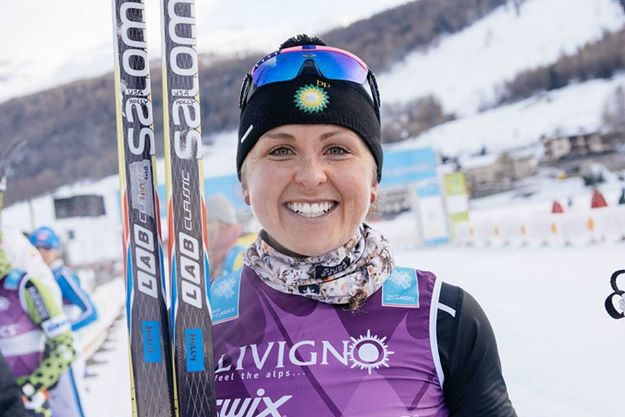
Holly Brooks at the Pro Team Tempo, which opened the Swix Ski Classics season in mid-December in Livigno, Italy. (Photo: Swix Ski Classics)
Brooks Skips the Jizerská
American Holly Brooks, who was picked up by the Aukland brothers’ Team Santander just a day prior to the start of the Ski Classics season, is in sixth place in the women’s overall competition. Seraina Boner of Switzerland, who races for Team Coop, tops both the overall standing as well as the athlete ranking.
However, Brooks is sitting out the Jizerská, returning to Europe for the Dolomitenlauf on Jan. 18, and joining her team for the Marcialonga a week later.
“I’m just trying to balance the FIS Marathon Cup, the Swix Ski Classics, and travel,” Brooks wrote in an email. “In years past I’ve done maybe three races 30K and longer spread out over a season, so I don’t know how my body is going to react and/or how the fatigue will build.
“My goal is to race as much as possible without a downgrade in performance,” she added. “I have a feeling I will be very, very tired by the end of the season.”
New Women Join Circuit
Prior to the Jizerská, the competition for the women’s overall Ski Classics title gets tougher. Three different Pro Teams have entered new female skiers into the long-distance series: Norway’s Hilde Landheim will race for Team Coop, Viktoria Melina joins the Russian Marathon Team, and Masako Ishida of Japan will race for Team United Bakeries.
In the Ski Classics, each professional team may enter a total of 10 skiers per season, male and female skiers included. Once entered, the teams may not unregister athletes, but they can enter additional athletes until they reach the maximum of 10 skiers.
Stellar Conditions
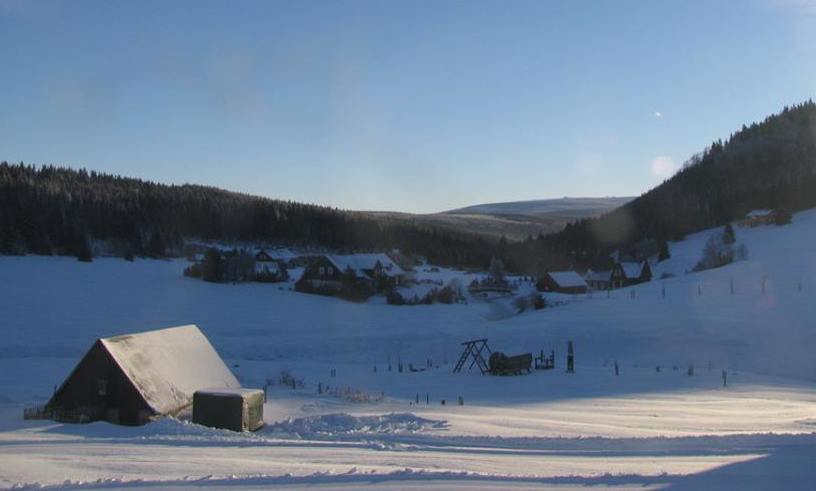
Czech Republich, home of the Jizerská 50, which will be held on Sunday, as pictured on Jan. 6.
Last year, the Jizerská races were canceled due to lack of snow, so event organizers are especially excited to put on the races this year and are proud to present stellar conditions on the race course. Promising weather forecasts, decent snowfall in the past week and cold weather have made it possible to produce enough artificial snow to cover the whole course, and the organizers are confident that they will be able to run the race as planned given the weather forecast, which predicted snow at the start and temperatures around freezing.
“We are happy to see that the weather has turned fine and the winter conditions have finally arrived,” Martin Koucky, a member of the Jizerská 50 Organizing Committee, said in a press release. “The whole Jizerská 50 track is now covered with snow while the race preparations continue to run along at full speed. There are some thirty centimeters of artificial and natural snow at potential critical points: at the Bedrichov stadium as
In addition to the 50 k Ski Classic on Sunday, the Jizerská race weekend opens with a 30 k skate race and a children’s race on Friday, and also offers a 25 k classic race as well as a corporate relay race on Saturday. New this year is a 1.5-kilometer double-pole sprint on Friday.
Six More Marathons on Tap
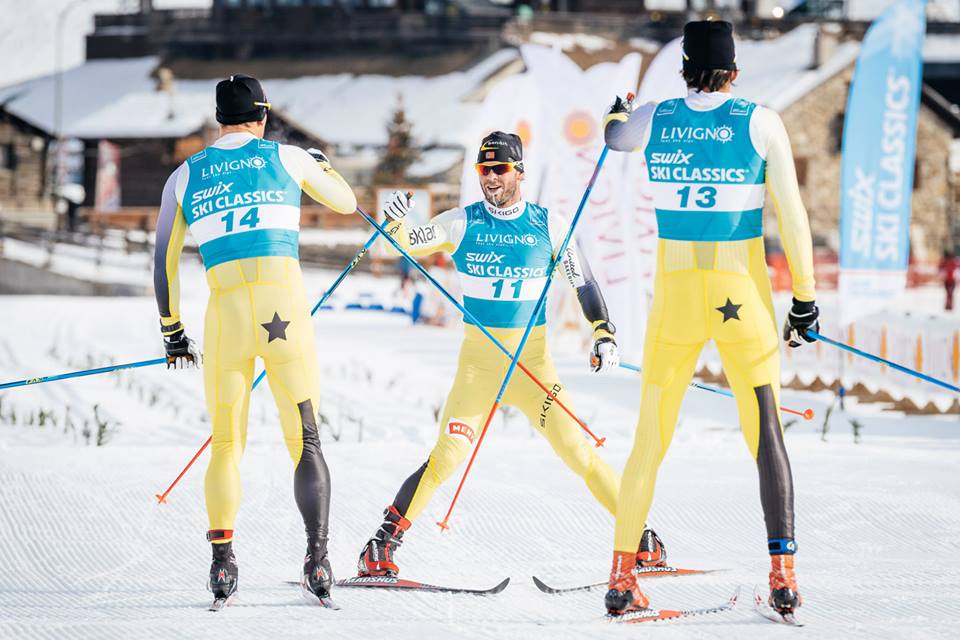
Team United Bakeries’ Pettersen (14), Berdal (11), and Kjølstad (13) at last month’s La Sgambeda in Livigno, Italy. (Photo Swix Ski Classics)
After the Jizerská 50 on Sunday, the Ski Classics moves to Switzerland for the brand-new La Diagonela on Jan. 17.
La Diagonela was introduced to the race series last winter as a replacement for the Jizerská 50, which was be canceled, but was such a success that the circuit included the race as a new, permanent installment on the Ski Classics calendar for the 2014/2015 season. This year, the 65-kilometer La Diagonela will be held on a picturesque new course through the villages of St. Moritz, Zuoz and Pontresina in the Engadin Valley.
After the stop in Switzerland, the Ski Classics moves to Italy for the Marcialonga in the valleys of Val di Fassa and Val di Fiemme on Jan. 25. The 70 k race is famous for its notorious final uphill climb, the Cascata, to the finish in Cavalese town square.
From Italy, the Pro Teams travel to Germany for the 50 k König Ludwig Lauf in Oberammergau, Bavaria, on Feb. 1.
After the König Ludwig Lauf, the athletes get a well-deserved break from competing until the legendary 90 k Vasaloppet from Saelen to Mora, Sweden, on March 8.
After Vasaloppet, the circuit moves on to Norway’s Birkebeinerrennet on March 21. The 54 k classic race starts in Rena, crosses to mountains to the finish line in Lillehammer, the host of the 1994 Winter Olympics.
The series once again ends with the season finale Årefjällsloppet in Sweden on March 28. The 75 k race offers stunning views from the in Vallbo to the finish line in Åre.
Øystein Pettersen (l), Kikkan Randall (second from l), Thomas Alsgaard (second from r) and Ella Gjomle pictured here in a rollerski file photo. Pettersen and Alsgaard were in a rollerski accident August 19 that sent three athletes to the hospital.
A group of 10 to 12 rollerskiers are counting their blessings after surviving a serious rollerski accident on Tuesday in Akershus, Norway.
According to Norwegian news outlet Dagbladet, acclaimed Norwegian skiers Øystein Pettersen and Thomas Alsgaard were amongst the group of skiers in the August 19 accident.
The rollerskiers were out for one of their scheduled workouts when they descended down a steep, unknown hill in a large group. Soon after, the majority of the skiers lost control and fell. No cars were involved.
Pettersen told Dagbladet that the group barely knew the terrain and that the descent had many tricky turns. At one corner, Pettersen said it became a choice to try and make the turn or crash into a ditch.
Øystein Pettersen
Pettersen said he chose the ditch.
After the crash, three unnamed skiers were sent to the local hospital. Two required stays in the emergency room.
Pettersen who was a stage winner in the recent Toppidrettsveka rollerski series, walked away with some large bruises on his shoulder and elbow in addition to a broken finger. According Dagbladet he will receive surgery on his broken finger in roughly four weeks.
Pettersen told the Norwegian news organization that he was lucky to have suffered so few injuries and is thankful that everyone in his group wore a helmet.
“We are all very shocked, and one must be glad it didn’t go even worse. It was idiotic to ski there… Such things should not happen. I grew up on the roller [skis], and the others in the group likewise. When I think of all you… who may not be as good and go without a helmet. We need your attention here to encourage people to wear helmets,” Pettersen said in a rough translation provided by Google Translate.
For all the international-racing junkies out there, the Swedish and Norwegian Ski Associations recently announced the nominations to their 2014/2015 national teams.
Sweden’s male and female teams both grew from eight to nine members apiece, according to the Swedish Ski Association, with the additions of Simon Persson, 22, and Jonna Sundling, 20, and to men’s and women’s A-teams, respectively.
Norway’s Cross-Country Committee nominated 25 athletes to its three national teams (women’s, men’s all-around, men’s sprint), according to Norges Skiforbundet. Kathrine Harsem, 25, and , 23, received the call up to the women’s elite team. On the men’s side, Simen Andreas Sveen, 25, and Didrik Tønseth, 22, are new to the all-around team, and Sondre Turvoll Fossli, 20, is the newest sprinter.
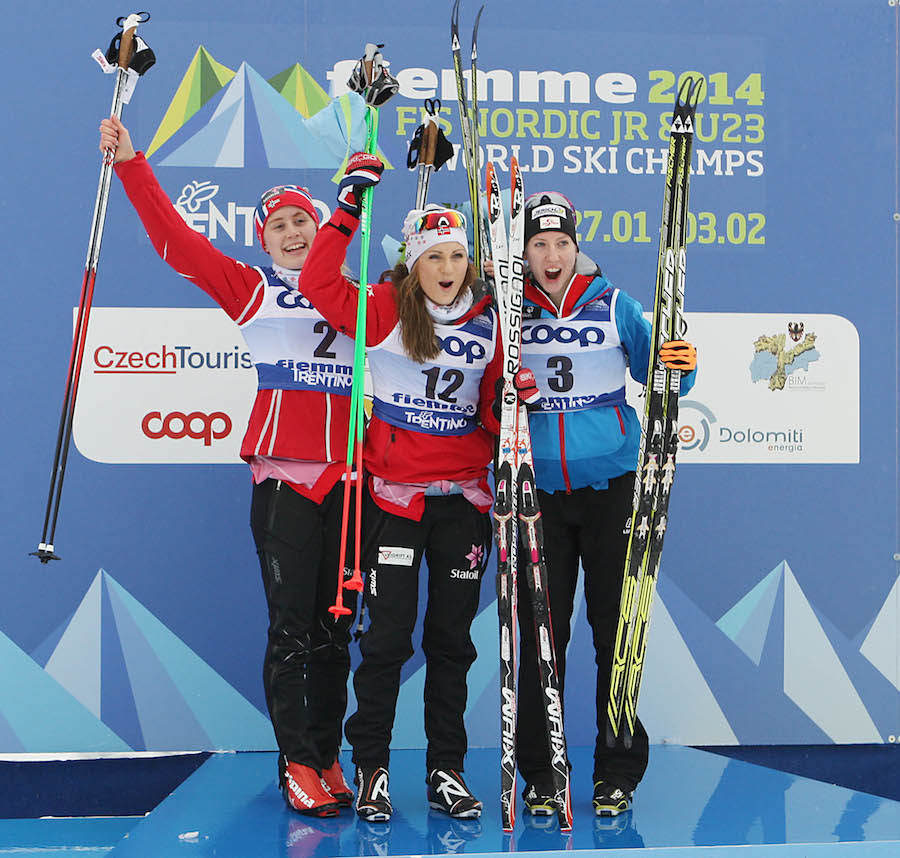
Martine Ek Hagen (c) after winning the women’s 15 k skiathlon at U23 World Championships last season in Val di Fiemme, Italy, with teammate and runner-up Ragnhild Haga (l), and Teresa Stadlober of Austria, who placed third (r). (Photo: Fiemme2014)
No longer with the Norwegian national team, Vibeke Skofterud, Øystein Pettersen, Petter Eliassen, Niklas Dyrhaug and Tord Asle Gjerdalen are pursuing different paths and interests.
A 2010 Olympic gold medalist in the team sprint, Pettersen, 31, whose nickname is “The Sausage,” recently told NRK that he plans to focus on distance races while skiing for Team United Bakeries.
“In recent years I trained hard to break into sprints but it did not happen,” he said, according to a translation. “Then I lost faith in myself in the sprint and I cannot continue another season training for something I have lost confidence in.”
He explained that the Vasaloppet and 2015 World Championships will be his main focuses for next season.
According to FIS, a few Norwegians are switching specialties: Pål Golberg from sprint to all-around, Finn Hågen Krogh from all-around to sprint. Simen Østensen returns to the all-around team along with Chris Jespersen, who’s now back on the elite national team.
Sweden
A Team
Ladies
Sofia Bleckur, IFK Mora SK
Hanna Erikson, Åsarna IK
Anna Haag, IFK Mora SK
Ida Ingemarsdotter, Åsarna IK
Charlotte Kalla, Piteå Elit
Sara Lindborg, Falun-Borlänge SK
Stina Nilsson, IFK Mora SK
Jonna Sundling, IFK Umeå
Emma Wikén, Åsarna IK
Men
Calle Halfvarsson, Falun-Borlänge SK
Marcus Hellner, Gellivare Skidallians
Emil Jönsson, IFK Mora SK
Anton Lindblad, Sollefteå Skidor IF
Lars Nelson, Åsarna IK
Johan Olsson, Åsarna IK
Daniel Richardsson, Hudiksvalls IF
Simon Persson, IFK Umeå
Teodor Peterson, Åsarna IK
Team 2015
Ladies
Anna Dyvik, Falun-Borlänge SK
Hanna Falk, Ulricehamns IF
Sofia Henriksson, Strömnäs GIF
Magdalena Pajala, Piteå Elit
Evelina Settlin, Hudiksvalls IF
Marika Sundin, Sollefteå Skidor IF
Julia Svan, Vansbro AIK
Jennie Öberg, Piteå Elit
Men
Simon Andersson, Falun-Borlänge SK
Martin Bergström, Piteå Elit
Jens Burman, Åsarna IK
Martin Johansson, IFK Mora SK
Simon Lageson, Åsarna IK
Jesper Modin, Piteå Elit
Carl Quicklund, Östersunds SK
Marcus Ruus, Gillberga SK
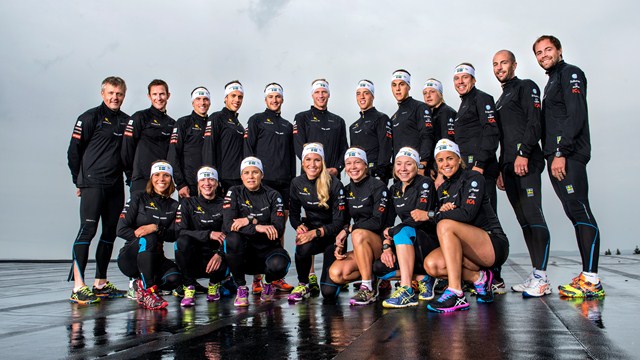
The Norwegian National Team last season on the World Cup circuit. (Photo: FIS/Nordic Focus)
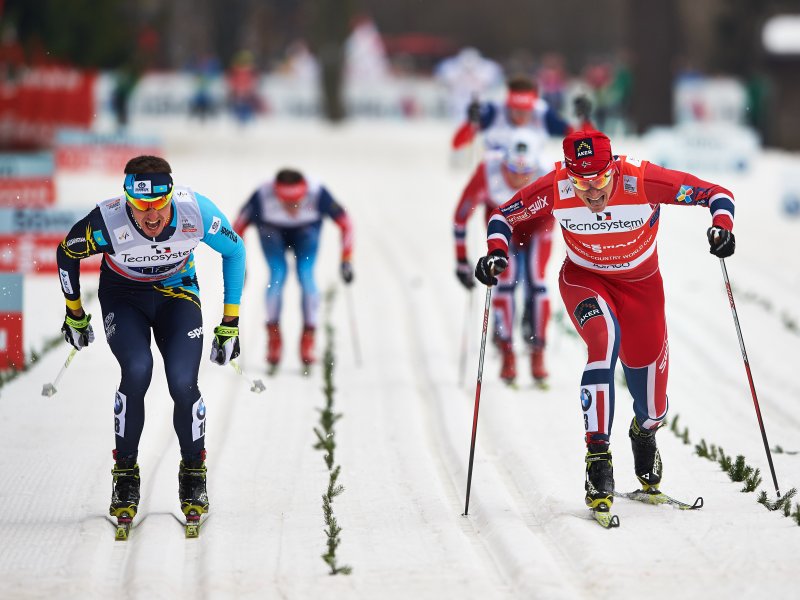
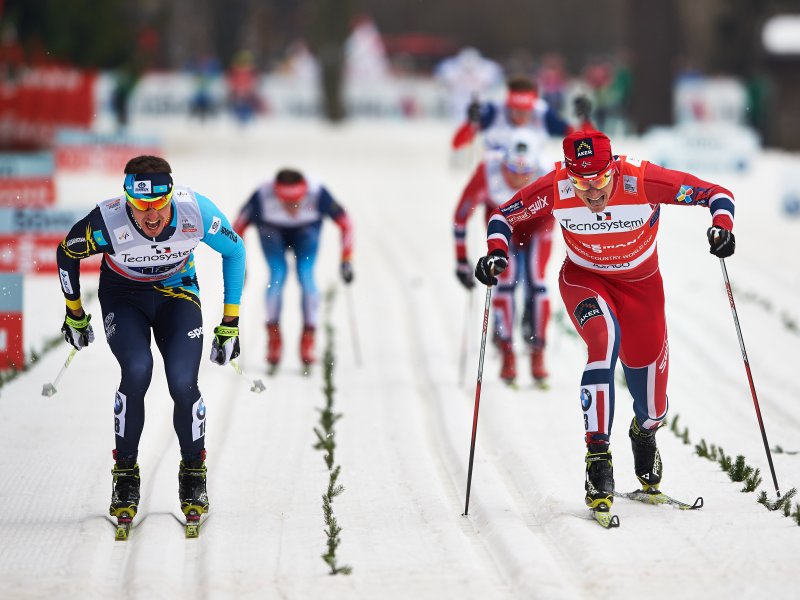
Look familiar? Kazahstan’s Alexey Poltoranin (l) placed second for the second-straight day at the Asiago World Cup in Italy, as Ola Vigen Hattestad (r) secured the Norwegian victory in the 6 x 1.65 k classic team sprint. (Photo: Fischer/Nordic Focus)
The way things were shaping up in the men’s 6 x 1.65-kilometer classic team sprint final at the World Cup in Asiago, Italy, it could’ve been anybody’s race.
Yes, Norway’s Eldar Rønning and Ola Vigen Hattestad were generally leading the 10-team pack on Sunday, and yes, the top-four combination was often something like Norway, Russia, Norway, Russia (with each nation having two teams in the final), but you couldn’t count teams like Sweden and Kazakhstan out.
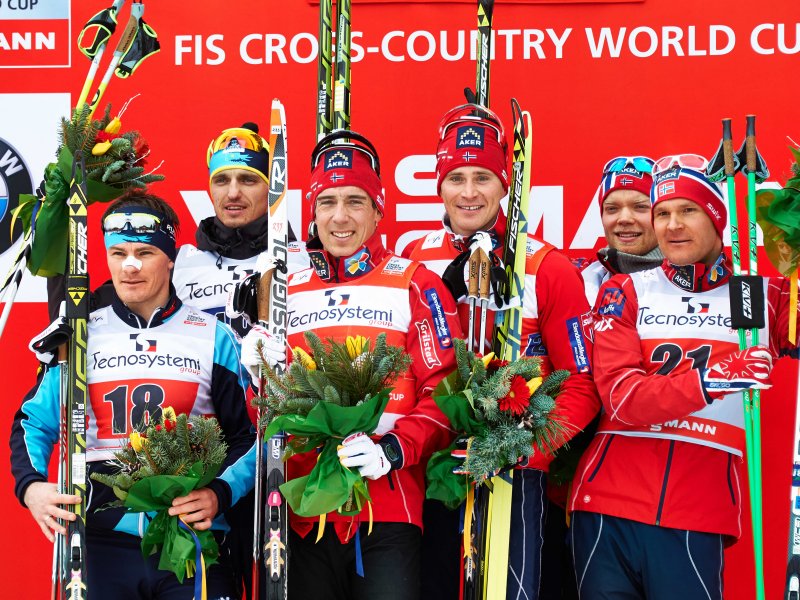
The men’s classic team sprint podium at the Asiago World Cup in Italy on Sunday: Norway I won with Eldar Rønning and Ola Vigen Hattestad (c), Kazakhstan’s Nikolay Chebotko and Alexey Poltoranin (l) placed second, and Norway II was third with Eirik Brandsdal and Øystein Pettersen. (Photo: Fischer/Nordic Focus)
While Sweden’s first starter, Teodor Peterson clocked the fastest leg in each of his rounds, his teammate Simon Persson repeatedly dropped several places after every exchange. Without their original starter in Emil Jönsson, who had to scratch because of a sore back on Sunday morning, Sweden slipped from first to sixth, second to sixth, and finally third to fifth.
They weren’t a threat to Norway’s first team of Rønning and Hattestad, which won the first semifinal over Russia’s Alexander Panzhinskiy and Nikita Kriukov, but the Kazakhs were.
Second in their semifinal after Norway II’s Øystein Pettersen and Eirik Brandsdal, Kazakhstan’s Nikolay Chebotko and Alexey Poltoranin sat patiently around fourth early in the final, then rose to second by the fourth of five exchanges.
Just 0.6 seconds behind Rønning at the start of his last lap, Chebotko held his position until planting his pole between his legs and toppling over. Kazakhstan dropped from second to sixth, and it seemed their hope for a podium was slipping as the rest of the leaders skied into the exchange zone.
Podium? The thought probably never crossed Poltoranin’s mind as he waited for the tag just a couple hundred meters later. He was going for the win. Norway’s Hattestad would have to try to stop him.
After getting the tag in fifth, Poltoranin made up nearly 5 seconds on the leaders, including Hattestad up front, followed by Kriukov, Persson and Brandsdal.
Maxim Vylegzhanin lifted Russia II into the top four, but he and teammate Dmitriy Japarov were later disqualified for a “violation of classical technique rules,” likely skating on the mostly double-pole course. At least half the men’s field raced on skate skis, including most of the top men’s finalists.
Coming out of a sharp corner on a long descent, Kriukov’s pole strap broke, but he quickly got a replacement and resumed his spot amongst the top five with Norway I, Russia II, Norway II, Russia I, and Kazakhstan.
With 800 meters remaining, Poltoranin took a shortcut to second, cutting in on the inside lane around a tight turn. Most everyone had to snowplow on the final corner to avoid crashing in the sugary, melting snow, but Poltoranin remained in position to challenge Hattestad – who was still leading – to the finish.
Hattestad didn’t have to look back. He needed to go hard the last 100 meters to the finish. Committed to a central lane, the Norwegian double poled like mad while Poltoranin jumped into the left lane behind him, which was considered one of the fastest in the homestretch.
It may have been faster as Poltoranin came within centimeters of Hattestad, but the Norwegian held him off, throwing his leg across the line and winning in a photo finish in 24:47.4.
“I did not know we had won until I saw Eldar come running towards me,” Hattestad told VG Nett, according to a translation.
“It’s fun to win with only five centimeters,” said Rønning, who initially put Norway I in third, just 0.7 seconds behind Russia II up front.
After the first tag, Hattestad brought the team to first, where they remained fractions of a second ahead of anyone else for the rest of the race.
Norway II finished third, 2.17 seconds after Kazakhstan in second, but dropped as far back as seventh during the second leg, when Japarov fell on one of the last downhills and took out Pettersen. Brandsdal lifted them back to third with the fastest-course time for that leg, and Pettersen tagged him in fourth for the final lap.
“Good day: back on the podium in WC, argue with a good Russian (became friends again), Christmas holidays and given away flowers to a little girl,” Pettersen tweeted after the race, according to a translation.
“It is the best result of the season and I am very happy for that,” Pettersen told FIS. “Luckily we could get back. Team sprints are never easy.”
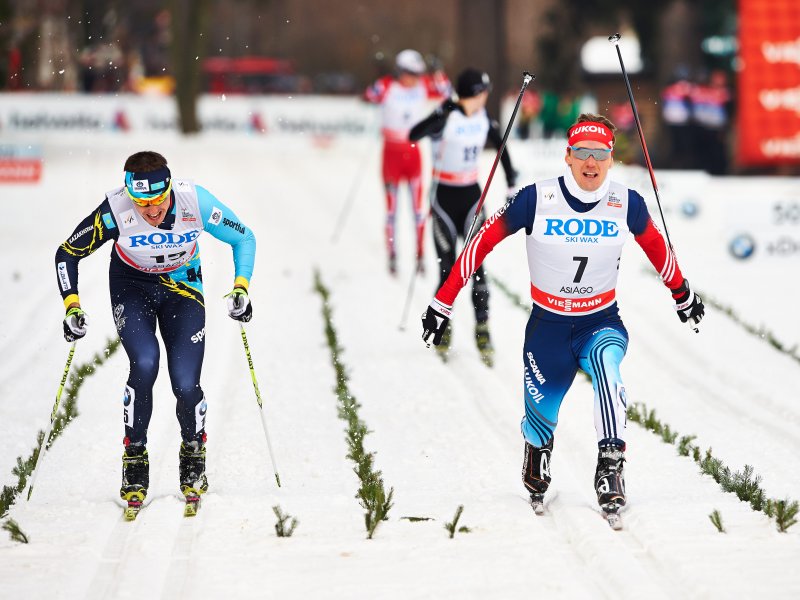
Russia’s Nikita Kriukov (r) edges Alexey Poltaranin (KAZ) for the individual classic sprint victory on Saturday in Asiago, Italy. (Photo: Fischer/Nordic Focus)
They are especially tough one day after an individual classic sprint on the same soupy course in similarly warm (41-degree) temperatures. Poltoranin, who was just short of a victory behind Kriukov on Saturday, said he recovered well with some physio work.
“Ola Vigen Hattestad is a very strong sprinter, but I think if we were not double poling in the finals, I would have had a chance to beat him,” said Poltoranin, who has placed second in his last three World Cup races.
While he sat out the Davos World Cup last weekend, Poltoranin was second to Norway’s Pål Golberg in the 15 k classic on Dec. 7 in Lillehammer, Norway.
Last season at the pre-Olympic World Cup classic sprint in Sochi, the Russians won on their home turf with Japarov and Vylegzhanin. Sweden’s Peterson and Jönsson placed second and Germany was third with Axel Teichmann and Tobias Angerer.
(Teichmann teamed up with Tim Tscharnke for Germany I on Saturday, placing fourth in their semi and narrowly missing the final for 10th overall. Germany II’s Angerer and Alexander Wolz finished 12th of 15 teams in the first semifinal.)
Russia’s No. 2 team of Alexey Petukov and Kriukov notched fourth last winter in Sochi, Norway’s Pettersen and Petter Northug placed fifth, and Kazakhstan’s Chebotko and Poltoranin finished sixth.
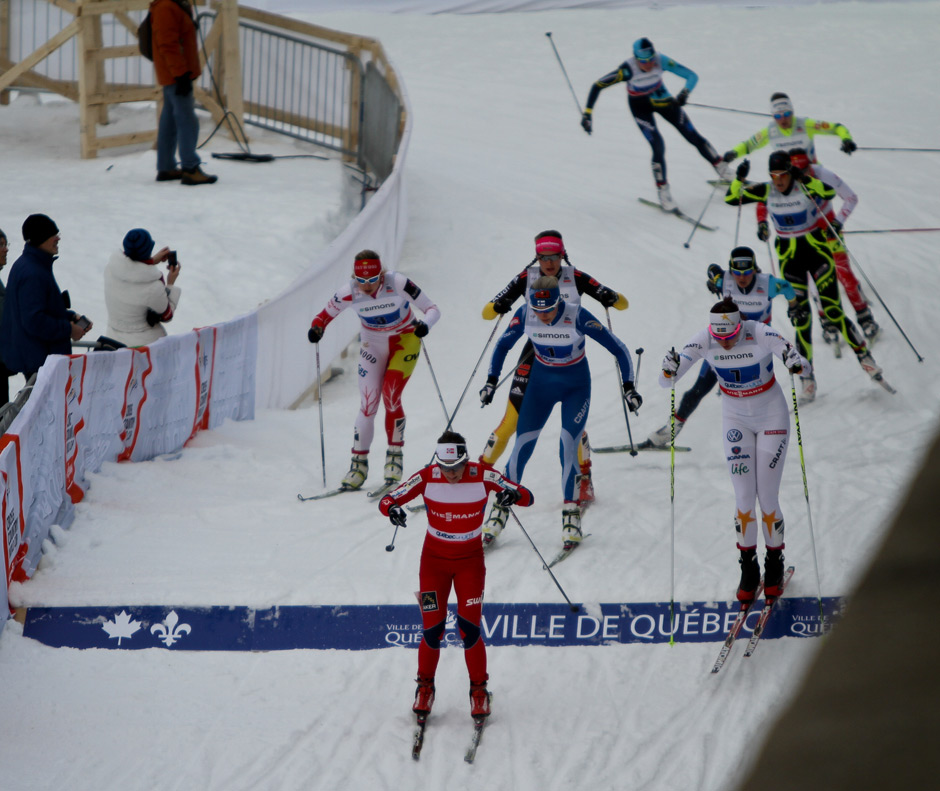
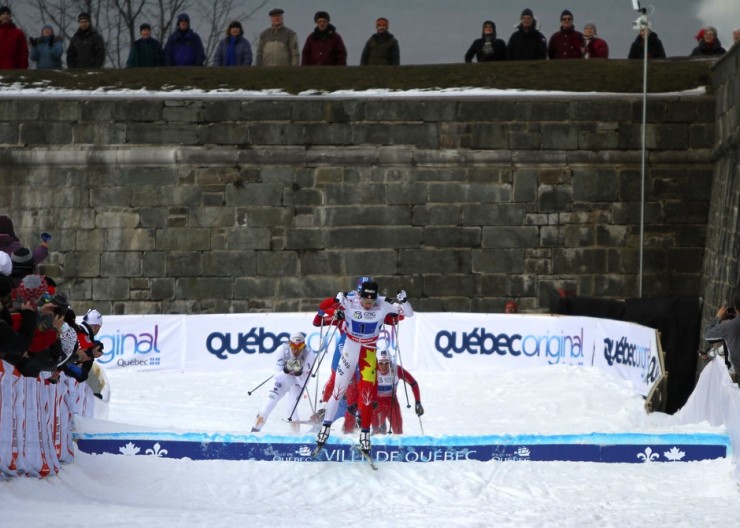
Canadian Alex Harvey leads racers over the step down/jump, which was used for the first time in a World Cup on Dec. 7 during the 1.6-kilometer team sprints in Quebec City.
QUÉBEC CITY— It was an unprecedented stop, an unknown to everyone who raced there. Even the Canadians weren’t entirely sure what to expect in Québec City last weekend for the province’s first World Cup city sprints.
Nobody did. Spectators came out by the thousands. Gestev president and chief organizer Patrice Drouin estimated 50,000 people visited the venue in front of the Parliament building throughout the two days, with team sprints on Friday and individual sprints on Saturday.
That was a pretty good turnout considering there was little to no snow elsewhere in Québec in the weeks and days leading up to the event. Nearly 140 athletes from 17 nations showed up as well without knowing how competitive the sprints would be. (Top skiers like Marit Bjørgen, Therese Johaug, Petter Northug and Dario Cologna skipped the trip to Canada to prepare for the Tour de Ski.)
Spectators got quite the World Cup experience Dec. 7-8 in Quebec City.
It didn’t really matter. There was enough else going on to keep people entertained and buzzing about the Québec World Cup.
For one, race organizers introduced a step down, or a jump, at the tail end of the 800-meter sprint course. It wasn’t huge, starting at a height of about 30 centimeters, but it did create enough space for a small “Ville de Québec” banner and a miniature ledge for racers to ski off.
The brainchild of Drouin, the step down was approved by the International Ski Federation (FIS) last spring to be used for the first time at the Québec World Cup. Coaches and racers had mixed oreactions – some said they didn’t see the point and others wanted it bigger – but in the end, few expressed strong feelings about it.
“It’s not a jump. It’s a bump,” said former Norwegian skier and Olympic champion Tor-Arne Hetland, a sprint coach for Switzerland.
“As long as it’s fair, then it’s good,” he added. “It shouldn’t be a problem, but it has to be well done.”
“It was too small. Bring us on a bigger one,” said Saturday’s individual sprint winner from Sweden, Emil Jönsson. “We don’t want to have a crash race. The strongest man should win, but it can be fun if we do it in a good way. Not a back flip, just a normal jump.”
The jump, bump, whatever you call it wasn’t really a game changer. A few athletes tumbled on or before it, but that generally happened when they were vying for position after the last downhill curve. Some people took more of an issue with the course’s curviness. Hetland suggested fewer curves and more straightaways, but said overall, “the track is good.”
The first semifinal of the Quebec World Cup women’s team sprint crests the step down, which was used for the first time in a cross-country World Cup on Dec. 7.
Norwegian sprint coach Ulf Morten Aune was slightly more animated about the obstacle, calling it an unnecessary spectacle.
“There are enough curves and other stuff,” he said. “You do not have to do stuff like that. … This is not a circus, it is cross-country.”
From the standpoint of someone who’s designed mountain-bike courses, Drouin was curious whether it would work in cross-country. Twenty years ago, mountain bike races didn’t incorporate jumps, and now they do. He decided to give it a try and proposed the step down to FIS Cross-Country Race Director Pierre Mignerey, who ran it by homologation experts.
“They didn’t say no, so that means yes,” Mignerey said. He garnered the approval of FIS and gave Drouin the go-ahead.
“I know it’s a big deal because the fact that Pierre got out of that commission meeting and just gave me a big slap in the back and said, ‘Your jump is approved,’ I was surprised,” Drouin said. “I didn’t even think it was a case for a commission as technical as cross-country. Before changing things you have to get approval from the whole family.”
Drouin said FIS Cross-Country requirements were stricter than other world-class sporting events he’s organized (i.e. snowboarding and mountain biking), but he’d do it again without hesitation.
He created the step down knowing FIS inspectors might shoot down the final product and make him dismantle it before the races. It was ultimately OKed, but Drouin made a few alterations before the races started Friday.
“Everybody said, ‘If you can take this little uphill out, then we are fine,’ ” he said after hearing from athletes and coaches on Thursday. But the jump wasn’t finished yet; training wasn’t supposed to open until Friday morning so the feedback was based on a work in progress.
“The jump is was not an issue for us; it was not a deal breaker,” Drouin said. “It was just an additional thing to open up options.”
Mignerey said also it wasn’t a big deal, just a first step in something that could be used more in the future. The improvements made after Thursday quelled most people’s complaints, and Mignerey was open to seeing more of these jumps perhaps between 40 and 50 centimeters tall. “Why not?” he said, adding that it fits with city sprints.
At the same time, this doesn’t need to be something FIS standardizes, he added.
“We already have enough rules,” Mignerey said.
Some people just don’t understand it. Russia’s Gleb Retivykh said it would be better if Québec didn’t use one again “because it’s not interesting.”
“He don’t like it,” said Russian wax tech Urmas Vyalbe, who served as Retivykh’s translator. “He asked many times, ‘What is this? Why?’ ”
Norway’s Maiken Caspersen Falla, who placed third in Saturday’s individual sprint, said she hardly noticed it.
“I was thinking about it during the warmup, but in the race I just forgot about it,” she said. “I don’t see the point in cross-country skiing to have a jump, but if the crowd and the TV watchers like to see a jump, maybe we should have it.”
From a revenue point of view, it adds an attractive advertizing space for sponsors.
“It’s fun,” Slovenian head coach Marko Gracer said. “I think it’s also for the TV promotion.”
The Big Picture
Overall, participants’ reactions to Québec’s first World Cup were less divided. Gracer said it was well organized and perfect for a city sprint despite the challenges organizers faced in keeping the snow in tact.
Hard-packed conditions on Thursday deteriorated to a softer, sugar-like base by the end of Friday’s races. Temperatures above freezing made it difficult for groomers to change the snow structure, which left racers struggling to stay quick and upright in on Saturday.
“The snow was perfect Thursday and then it dried up when [they] packed the snow over again,” Hetland said. “There was not enough, it was getting soft … so that was too bad.”
Regardless, he said the course was fair and he’d like to see the World Cup return to Québec or at least Canada every year. Right now, the circuit visits North America every three years.
“I think it was absolutely something for the future and they should keep on doing this,” Hetland said. “When you get good skiers in Canada and America you should definitely every year have races here. Let’s make the cross-country family big. The World Cup opening should be in Canmore and here and then we should go home and then Tour de Ski.”
He added that Canada deserves to host the world’s best skiers at home. Having North American World Cups at the beginning of the season would eliminate the timing conflict for those preparing for the Tour de Ski in late December. On the other hand, snow is usually scarce or non-existent in most parts of the U.S. and Canada in November. Just 10 days before the Québec event, organizers were unable to make much snow. One option is to hold the races at the end of the season in March.
Norwegian Pål Golberg said earlier races in Canada would make adjusting to the time difference easier: once back in Europe, they’d be there for good.
“I think this works for those who aren’t skiing the Tour de Ski, but if we had this two weekends in November, I think there would be even more skiers here,” Golberg said.
In his first experience racing in North America, the 22-year-old would like to come back.
“The crowd is really enthusiastic and I think that’s maybe one of the most important things for the cross-country sport,” Golberg said.
“This is the best place, this town,” said Vyalbe, who was also visiting Québec for the first time. “When my friend called to me and asked, ‘Where are you?’ I said, ‘I am in Québec [pronounced Koo-bec].’ He said, ‘Ohh, the best place.’ ”
With the next stop in Canmore, Norway’s Øystein Pettersen said it’ll be hard to leave after the races Dec. 13-16.
“I love Canada,” Pettersen said. “Canada reminds me of Norway only everything is a lot bigger, people are a lot more open-minded. In Norway we like to focus on ourself and don’t talk, don’t smile. In Canada everybody’s happy.”
Liza Goodwin competing at Bysprinten. Photo: Per Vikan, Helgeland Arbeiderblad.
The sixth annual Bysprinten took place over the weekend in the small town of Mosjøen, Norway. The town is home to less than 10,000 residents, yet the event manages to attract some of the biggest names in cross-country skiing every year from both Norway and elsewhere in Europe. This year, Petter Northug (NOR), Laurien Van der Graaff (SUI), Øystein Pettersen (NOR), Heidi Weng (NOR) and Ola Vigen Hattestad (NOR) were among the biggest draws of the weekend, in addition to a sizeable youth competition, live music, and the fact of a ski festival being held in the town streets at the end of April.
Keene Valley, New York native Liza Goodwin was among the small group of entrants. Goodwin has been living in Norway on and off since first spending a few post-graduate years with the Northern Norwegian Ski Gymnasium in Nordreisa. She came back and skied for Montana State University for the 2009-2010 season before deciding to go back to Norway. She currently lives in Tromsø, where she is studying physical therapy.
Skiing has recently taken the backseat to her studies, but Goodwin decided to enter the Bysprinten race for fun, much like the rest of her competitors. She ended up finishing 13th in the 1.5 k freestyle sprint. We sent her a few questions about what the experience was like.
FasterSkier: What was the scene like in Mosjøen? Is this event big deal there?
Liza Goodwin: The scene in Mosjøen was really awesome. The town has done an impressive job of making the event a big deal locally. They say that there were several thousand spectators there lining the entire course, which makes for a great atmosphere. Being a competitive skier is an identity that most Norwegians have a lot of respect for. The ski culture of Norway makes the best skiers huge celebrities, and people of all ages don’t want to miss out on the opportunity to see these famous people live.
There was also a kid’s race the evening before, and a youth race the morning of. Much of the event is to inspire kids to be skiers and the kids love being able to get autographs from all of the “big racers” (including myself!). The event might not be a big deal for Norway, because Mosjøen is a small town in Northern Norway, but it represents the passion Norwegians have for skiing and the role that elite racing has in Norwegian culture.
Tomas Northug (NOR) leading a train during the "brother's relay" that included the Northugs, Pasinis, and Rennemos. Photo: Bysprinten.
FS: Overall, how did you think the race went?
LG: I didn’t have big expectations going into the race. I have stopped competing at the national level here in Norway and haven’t been training very much. I’ve been missing my speed on skis for over a year now, and the Bysprint was no exception. I am just not as powerful as I used to be and feel pretty slow. The course was also pretty uneven and I struggled to find enough balance to get into a good rhythm. I made a graceful belly-flop in the “Losers Heat” that cost me one place. The racing as a whole was OK, but the main goal of the event for me personally, and for the other racers and organizers, was that the race was supposed to be fun!
A "graceful belly-flop." Photo: Per Vikan, Helgeland Arbeiderblad.
The 700 m prologue was one lap. There were then four to five people in each quarterfinal, semi and final. The heats used two laps, which included using the U-turn at the end of the course, also on the second lap. That meant that there was a 180-degree turn about 25 meters from the finish line!
Everyone who didn’t go to the finals was in a “Losers Heat”. This was just one lap and the winner got to join the others in the final.
During the prologue, the police used their radar gun to measure the speed of each racer during the first 100 meters. The top three men and women from the speed measurements then competed individually in a 100 meter timed race.
Petter Northug (NOR) leading the charge, followed by Fabio Pasini (ITA) and Kiristian Tettli Rennemo (NOR). Photo: Bysprinten.
FS: I know you were just having fun with it, but was lining up next to some big names intimidating?
LG: Of course it is intimidating lining up with Heidi Weng and other racers, but after racing in Norway for a few years, I’ve gotten used to that. I am used to competing against women who are the best in the world. My expectations are adjusted accordingly, but the actual racing isn’t that intimidating. I was more nervous about being in the whole group atmosphere and trying to consider myself as somewhat of an equal. The girls are really nice and it is pretty much the same atmosphere as being around any other skier girls at a race.
Heidi Weng (NOR) and Bettina Gruber (SUI). Photo: Bysprinten.
FS: Besides entering races with Norwegian national team members, what are you up to now?
LG: My first “PG years” were spent at the Northern Norwegian Ski Gymnasium in Nordreisa. After competing for Montana State for one year, I applied for the physical therapy program at the University in Tromsø. Last year I focused a lot more on skiing that school, but now that has changed. Skiing in now on the side of my studies. I am currently in the middle of a seven-week clinical period at the hospital in Mo I Rana. This is the reason I asked to be a part of the Bysprint, since Mosjøen is just a little over an hour away from here. Otherwise, I am living in Tromsø and enjoying life as best I can. The skiing and training (playing?) opportunities are endless.
Stupid, nonsensical, and “completely in the wrong.”
Those were the descriptions by elite cross-country skiers and coaches of German sprinter Josef Wenzl’s actions in the Dusseldorf team sprint on Sunday.
“Everyone knows that it makes no sense to pass on those final corners; it is simply too dangerous. I can’t understand what
Oystein Pettersen (R) gestures at German sprinter Josef Wenzl.
Wenzl was thinking,” wrote U.S. Ski Team Head Coach Chris Grover in an e-mail. “I feel bad for [Dahl’s team]. They deserved to be on the podium and receiving their prize money.”
Wenzl did not show any contrition afterwards—indeed, video from the finish pen showed him jawing with Dahl’s teammate Oystein Pettersen, even exchanging a few grabs and light pushes. But later in the day, Wenzl did apologize, according to Vidar Lofshus, the sports director for the Norwegian ski team.
“Wenzl showed great sportsmanship by taking all the blame for the incident, and has excused his behavior to Dahl,” Lofshus wrote in an e-mail to FasterSkier.
By Monday, tempers had cooled. Pettersen even told Norwegian media that he had lunch with Wenzl after the incident. But that didn’t change the result sheet—nor the fact that Dahl and Pettersen had missed out at a shot at the $12,000 check for the winning team.
The Norwegians saw the collision as a clear case of obstruction by Wenzl, Lofshus said. And indeed, International Ski Federation (FIS) rules state that it is the responsibility of a passing skier to avoid interference.
But according to the Norwegian newspaper Dagbladet, the race jury ruled that Dahl was equally at fault as Wenzl, because he took a step to the outside of the corner, towards the German. While the Norwegians disagreed, Lofshus said that “there will be no appeal or protest.”
Pierre Mignerey, a jury member and the assistant cross-country race director for FIS, declined to comment. The jury, though—which included two Germans out of five total members—was the only group willing to take any blame from Wenzl’s shoulders. In interviews and e-mails with four North American athletes and coaches, all took Wenzl’s actions to task.
“I don’t know what [Wenzl] was thinking. They had pulled away from the pack,” said U.S. sprinter Andy Newell in an interview
John Kristian Dahl (L) and Josef Wenzl collide in the final corner of Sunday's Dusseldorf team sprint.
Sunday. “They went two wide into that corner—you don’t ever want to do that at any time in a race, not to mention if you have the podium already wrapped up.”
Canadian sprinter Devon Kershaw also placed responsibility squarely on Wenzl, saying that Dahl had the best line heading into the final turn. But he also said that he recognized it can be tough for sprinters to think clearly at the end of a race. Instead, they’re “completely blasted, stressed out, and amped knowing they have a chance to win the whole thing.”
Kershaw is no stranger to full-contact racing himself—in a Tour de Ski city sprint in Prague in 2008, he made his own Wenzl-esque kamikaze attack against Swedish skier Marcus Hellner.
“I moved in on him, when there was absolutely no reason to—and we both went down,” Kershaw wrote in an e-mail on Monday. “I had qualified first, and was poised to perhaps slot into the top three in the overall tour had I moved through my quarterfinal. Instead, even though Hellner and I had a gap, I took him out fighting for the best line for no reason, and it was a disaster.”
As his own actions demonstrated, “stupid things happen in sprint racing,” Kershaw said.
“With so many dudes, so little space and really only one ‘direct line,’ it’s not really a surprise when things like this happen,” he added.
Especially on the tight and technical Dusseldorf course, where, according to U.S. sprinter Kikkan Randall, “it’s a tricky course to stay on your own feet anyway, let alone with a bunch of people around.”
Dahl and Wenzl in the snow as the podium finishers go by.
Add a home crowd and put thousands of dollars on the line, and you’ve got a potent mix for a 25-year-old German. Dusseldorf is Wenzl’s stomping grounds—it’s where he had his first and only victory, in 2007. But after he finished 46th in Saturday’s sprint and didn’t even make the heats, German Head Coach Jochen Behle ripped Wenzl publicly, telling the press that he “expected much more.”
So if there was any rational explanation for Wenzl’s actions on Sunday, it was that they were born out of desperation: over the last two seasons, he had only once finished on the podium in an individual sprint—and that was at a race in Whistler with a weak field.
And the crash notwithstanding, Wenzl still seemed to impress Behle with his performance in the team sprint, which left the Germans just one clean corner away from the podium. After the race, Behle told Die Welt newspaper that his men had skied well, “even if the results are not exactly what I wanted to see.”
Emil Joensson (SWE) reminded the ski world that despite recent strong distance results, he is still a sprinter first and foremost, outlunging Italian Fulvio Scola at the line to capture the victory in a frantic battle on the streets of Dusseldorf.
The 25-year-old defending Sprint Cup Champion added his seventh career World Cup victory, staging an impressive stretch run in the men’s final.
Joensson navigated the narrow twisty course with aplomb, not panicking as he rubbed elbows in the fight for position on the final lap.
Scola skied to the front early in the second lap, taking over from early leader Joensson. Trying to match the performance of teammate Arianna Follis, who just 10 minutes before, had won the women’s event, Scola led the pack down the final descent and into the finish stretch.
The World Cup sprint specialist had never finished on the podium, let alone climbed to the top spot. But with just 100 meters remaining, it was his race to lose.
Joensson held onto the second position, tight with eventual third-place finisher Oysten Pettersen (NOR) and Alexei Pethukov (RUS).
As the men charged toward the line, Joensson reeled in the Italian, and the only question would be whether there would be enough course left for him to take the win.
Both men drove a foot at the finish stripe, and despite his body remaining just behind Scola, Joensson had the reach by a mere four inches. Scola knew at once he wouldn’t be celebrating his first World Cup victory, raising his hands to his head in disappointment, before accepting congratulations from his coach and enjoying a still-groundbreaking day.
Seven years and nearly 40 individual World Cup starts later, he had his first podium, as well as a cool 10,000 Swiss Francs.
Joensson, who earned 15,000 Swiss Francs for his efforts, made his first finals appearance of the young season, despite having a sub-par qualification round.
For most people, placing 13th in qualification would be plenty good, but Joensson is often in the top spot, not seven seconds back.
“Qualification was really bad for me. In fact it was my worst qualifier ever,” Joensson said following the race. “But, then I felt better and better in every heat.”
He ultimately described the race as “pretty strange,” but was happy to walk away with the victory in just his second Dusseldorf city sprint.
Scola not only made the podium for the first time, he also was skiing in his first sprint final. Riding self-described “perfect” skis he did not worry about the likes of Joennson, Pettersen or Petuhkov, instead staying “focused only on myself.”
Pettersen staged a strong comeback in the final to take the third spot. Slow out of the start he was sitting toward the back of the pack for most of the first lap. Along with Petuhkov he clawed his way into contention and held of the Russian in the homestretch.
Scola, Pettersen and Petuhkov also matched up in the semis, with the Italian skiing the first half of the heat in last place. Sweden’s Jesper Modin led for two-thirds, closely followed by Renato Pasini (ITA).
Pettersen attacked into the second lap pulling Petuhkov with him, and the two overtook Modin while Scola snuck up on the inside of the lone climb.
“The Sausage,” as Pettersen is known, brought the race home with Petuhkov hot on his heels and Modin ran out of speed, but both he and Scola advanced as Lucky Losers.
Joensson beat out teammate Mats Larsson in the other semi, giving the Swedes half the A-final. John Kristian Dahl (NOR), the winner of the classic sprint in Kuusamo, finished his day just back of Larsson.
Andy Newell (USA), the lone North American qualifier in 3rd, drew an extremely tough assignment in the quarter finals, lining up with eventual winner Joensson, Olympic gold and silver medalists Nikita Kriukov and Alexander Panzhhinskiy of Russia, as well as former Sprint Cup Champion Ola Vigen Hattestad (NOR) and Mats Larsson (SWE).
According to US Ski Team Head Coach Chris Grover, Newell skied an excellent tactical race.
Newell concurred telling FasterSkier in an interview, “Tactically I skied well, and despite the long travel day yesterday, I felt good.”
He started strong, holding position in second, skiing relaxed on Larsson’s tails. Joensson dropped the American to 3rd at the end of the lap, and when Hattestad made a strong move on the outside of the one wide corner early in the second loop to take over the lead, Newell found himself back in 4th.
But he stayed calm and followed Larsson back to the front getting by Hattestad on the inside of the last corner.
Newell was in excellent position as the pack dropped toward the finish stretch, but he opted to go wide for the kick, avoiding the inside right lane.
“I was right on Mats Larsson’s heels going into the final stretch,” said Newell. “Some lanes are often faster in Dusseldorf and it seems like the right lane that hugs the fence is always really fast, but you run a risk of getting pinched against the fence there if anybody sees you shooting for that lane right away.”
He hung back and opted to swing wide to the left around Larsson, still in 2nd. But that gave Joensson the short line along the fence, an advantage Newell couldn’t overcome.
The US Team watched video of past Dusseldorf races to identify the critical areas of the course. Grover points to the final corner as the crux, noting that if a skier can enter the curve in first or second, it is very difficult for anyone to get by.
Newell was where he needed to be at that point, but couldn’t match the Swedes’ closing speed.
“In terms of his fitness, I think he is feeling pretty confident,” said Grover, but pointed out that due to travel issues Newell did not arrive in Dusseldorf until 10:00pm Friday night. While both Newell and Grover agreed that the long travel day, which included ten hours in an airport, did not break Newell’s day, Grover did say that “it certainly did not help.”
Most of the North Americans were also missing gear. Though race skis arrived via van, Newell and teammate Kikkan Randall both raced the qualifier on old sets of poles borrowed from the Swedes.
With the airline strikes in Finland, US coaches told athletes to pack boots and racing clothes in their carryon a move that paid off, when their luggage did not arrive in time for the start.
The men’s course had been extended somewhat from previous years, with an additional 150 meters tacked on to make it one of the longest courses on the circuit. This, combined with all the corners, made for a controlled pace early, with hard bursts at critical points as athletes battled for position.
Both Grover and Newell did not feel that the extra distance had much impact on how the course skied, and despite the lack of significant climbs, there is no real rest making it a tough event.
While the Canadian men did not qualify anyone for the heats in the absence of Devon Kershaw and Alex Harvey (both training in Italy), Stefan Kuhn and Len Valjas had solid days, just missing out on the heats in 33rd and 34th respectively.
For Valjas, this was his first World Cup skate sprint, and just his third start overall, while Kuhn had his best World Cup freestyle sprint finish outside the Tour de Ski, which prior to last year featured weaker sprint fields.
Phil Widmer (CAN), who has made the World Cup heats six times, did not have his best day placing 53rd. His teammate Brent McMurty rounded out the field for the Canadians in 56th.
Simi Hamilton was the second American in 51st.
According to Grover, Hamilton was not pleased with his result in his first Dusseldorf appearance. The US coach was sympathetic, but noted Hamilton’s lack of experience and is unconcerned.
“I know he wanted to a little bit better, but he is a young guy and he needs experience at this level,” Grover said. “This is just his second World Cup skate sprint…and people don’t usually do that great on these courses, against these fields the first time they ski them.”
Hamilton also missed several early races due to a strained knee, an injury that Grover says he is recovering from, but did leave him with some ground to make up.
Racing continue tomorrow in Dusseldorf with a team sprint. Hamilton will lead off for the first US team with Newell running second.
A US second team of Torin Koos and Chris Cook will also race. Both men did not ski well today, with Koos placing 63rd, and Cook 70th, avoiding last by .06 seconds.
Canada will also start two teams. Kuhn and Valjas will pair up for Canada I and Widmer and McMurtry represent as Canada II.
Petter Northug will more than likely sit out the second World Cup weekend, but the start lists could feature few Norwegians at all. According to Norwegian national team directer Aage Skinstad, if the temperatures drop below minus 18 Celcius, the Norwegians will not be competing. Frigid temperatures are quite likely on the courses in Rukantturi, north of Kuusamo. Some predict as low as 25 C to 29 C below, at which point there would be no races at all.
The “Tour de Opening” begins with a sprint on Friday, continues with a distance race on Saturday, and concludes with a pursuit on Sunday. The predicted cold can cause problems for the skiers, and Northug is no fan of cold temperatures.
”We won’t take any chances. Petter has to get entirely well before we let him race, and that can take some time,” said John Northug, Petter’s father and manager, to langd.se.
The Norwegian team headed to Kuusamo also includes Kristin Stormer Steira, who raced the World Cup opener in Gällivare (SWE). She has been fighting stubborn foot injuries all through the summer and dryland season, and is still not 100 percent recovered. She reports feeling the injury more when classic skiing than in skating. As for the men’s team, both of the Norwegian wild cards from Gällivare, Sjur Rohte and Chris Jespersen, will be given another chance to prove themselves in Kuusamo.
Norway’s team in Kuusamo:
Women – Kari Vikhagen Gjeitnes, Celine Brun-Lie, Ingvild Flugstad Ostberg, Maiken Caspersen Falla, Therese Johaug, Marthe Kristoffersen, Marit Bjorgen, Vibeke Skofterud and Astrid U. Jacobsen.
Men – Ola Vigen Hattestad, Johan Kjolstad, Oystein Pettersen, John Kristian Dahl, Martin Johnsrud Sundby, Simen Ostensen, Eldar Ronning, Kristian Tettli Rennemo, Chris Jespersen, Sjur Rothe and Petter Northug jr (grandfathered spot as reigning the World Cup champion).
From www.Langd.se, November 22, 2010. By Kjell-Erik Kristiansen, translation by Inge Scheve
The complete lack of Norwegian men’s distance skiers behind Petter Northug Jr.
Everyone knows Northug dominated the World Cup last year. The man can win everything – distance, sprint, skate, classic, individual mass start, under-water basket-weaving: you name it, he will win it. He’s got a love him or hate him type of personality, but you cannot deny that Northug has the skills to get it done.
The rest of the Norwegian distance men, however, proved that they cannot get it done, as their display of skills – or lack thereof – showed, during the Olympic relay as well as in the overall World Cup.
After Northug, the next best Norwegian male on the distance points list was Eldar Roenning. Roenning was 25th, which is respectable for most nations, but in Norway, it’s a bit of a disaster. To draw comparisons to a major North American sport, it’s as if the New York Yankees fielded a squad of Derek Jeter and eight Little Leaguers, or if the NHL’s Alexander Ovechkin scored only 10 goals all season, or if the NFL’s Brett Favre actually retired and stayed retired. It’s that unheard of.
And after Roenning, it doesn’t get much better. Martin Johnsrud Sundby, one of the most inconsistent skiers on the circuit, was 28th, while Tord Asle Gjerdalen (you may recognize him from his sunglasses) was 35th, and the fifth-highest ranked Norwegian male was Ronny Andre Hafsaas. In case you forget, Hafsaas was the biathlete who won the first race of the season last year in Beitostolen, Norway, then promptly dropped biathlon for cross-country and a spot on the Olympic team – only to compete in one race and do very poorly. For recording a win on the World Cup, you are awarded 100 points towards the overall standings. Can you guess how many Hafsaas finished with? That’s right – 100.
What You Should Know For This Season
While the distance boys are in for another rough season, the Norwegian sprinters are without a doubt the best in the world.
While Ola Vigen Hattestad struggled last year, sprinting is notoriously fickle, and it can be tough to be as dominant as Hattestad was in 2008 – 2009, when he won eight of the 10 sprint races he entered. No less than eight Norwegian sprint men pack the top 30 in the sprint rankings. In addition to Northug in second, Hattestad was fifth, John Kristian Dahl seventh, Anders Gloeersen ninth, Erik Brandsdal 11th, Oeystein Pettersen 14th, Roenning 17th and Simen Oestensen 29th.
Also, if you’re playing any ‘Pick the Podium’ style games with your friends, FasterSkier suggests avoiding Kristin Stoermer Steira. The woman is the best in the world – at finishing fourth. While it probably aggravates to no end, Stoermer Steira seems to almost always win the wooden medal, especially when it matters. Her tally of fourteen fourth place finishes on the World Cup level is heart-wrenching, especially when four of them come at the Olympic Games. Not that fourth is bad, but for a skier with the stats and skill of Stoermer Steira (sixth overall last year, with 892 World Cup points), a podium is not an unreasonable expectation.
The ongoing feud between Marit Bjoergen and Justyna Kowalczyk over the use of asthma medication will – whether you like it or not – be a storyline this season. If things get really heated, expect the two to butt heads on the course, as they have done before.
If you’re expecting Norwegian gossip, FasterSkier could write an entire post full of it, and most of it would be about Northug.
And with World Championships falling in Norway this year, there will be even more pressure on Northug to deliver – especially in the relay. You can bet that if this happens instead of this, Northug’s four Olympic medals from Vancouver won’t be enough to save him from the Norwegian public.
Who You Should Watch
Thomas Northug is a bit of a no-brainer here. At this point, his potential is huge, but so is the pressure being placed on him, especially after besting his older, Crystal-Globe owning brother twice last weekend. He seems to have Petter’s kick, and after a taste of World Cup action last season, Thomas will look for more whenever he can.
Petter Northug (NOR) and Oystein Pettersen (NOR) celebrate their Olympic gold after the team sprint.
The Colorado International Spring Series in 2004 and 2005 featured a leader's bib (pictured), a climber's bib, a sprinter's bib, and a fun leader's bib. Photo, Tim Carter
Before this year’s mini-tour in Fort Kent, and even before the inaugural Tour de Ski in 2007, there was the Colorado International Spring Series (CISS) in 2004 and 2005. CISS was a stage race much like those coming into vogue today, and it was one of the first of its kind—if not the very first. Nathan Schultz, now the owner of Boulder Nordic Sport, had the idea for the event, and FasterSkier caught up with him last week for a quick look back.
FasterSkier: So this being before the Tour de Ski, how did you come up for the idea for the race?
Nathan Schultz: We have great snow in the spring, and I was pretty much done with my ski racing—I was still racing, but mostly just for fun. So I thought, “well, we’ve got all these great places to ski, and wouldn’t it be fun to have a Spring Series here.” We’d been having Spring Series forever in Sun Valley. That was great, it was super, but Rick Kapala got really burnt out, because he was volunteering his time organizing it.
We did it in 2004 and had the worst March melt-out ever, and we were questioning whether we were going to be able to run the event. It was pretty rugged—at one point we had a snowmobile go into an under-snow river that had formed. So there were a lot of challenges, but it turned out to be really fun. The whole time, I wanted to do something different, because I felt like the sport had kind of been changing in the wrong way. They’d been trying to get spectators by trying these new things—it’s still kind of that way—new formats, change the distance of the sprints, change this, change that. I wanted to try to do something that was different but more fun.
I figured it would build more of a story. Nobody was paying attention to ski races in the spring anyways, but if you want to create a compelling story, you do it by having this long series of the events. It was for the athletes, but it was also to try to do something different for the sport. We did that in 2004, and tweaked it a bit in 2005.
I had come from bike racing, so I’d seen a lot of the fun things that had happened there. We had three jerseys for the skiing: We had the climber’s jersey, an overall leader, and then the points jersey, for the sprinter. And then we created another jersey, which was called the fun leader. That made it a lot of fun, and people were doing some pretty crazy things [to win the fun jersey]—it made the whole event just have a fun and relaxed atmosphere.
FS: Why didn’t you keep doing it?
NS: We had great success—the problem was just that we got really burnt out doing it. We weren’t able to raise enough money to have someone to be the race organizer, and it was too much work to be able to have someone do it as a volunteer.
FS: Any good stories from the competition for the fun jersey?
NS: There were some crazy things. We got some great athletes to come over from Europe for a couple of those years—Martin Koukal, Oystein Pettersen. One day we had a criterium at the Winter Park Resort, which was at the base of their ski mountain. It had a really sick climb up an alpine slope. We built a double jump, and it was way faster [to go over the jump] than the other way.
Oystein Pettersen was trying to get the fun leaders’ jersey, and he pulled a backflip off of it. The first time he did that, he crashed really hard and separated his thumb. He came skiing down, the doctor reset his thumb, and then he went back out did a few more laps, pulled another backflip and this time landed it. (Corey Smith somehow dug up video of that first flip, here!)
This last spring in Vancouver, I saw him out at one of the bars a couple days after he won his medal—he came up to me and gave me a big hug. We’ve stayed friends—that’s cool to have built that rapport.
The other fun leader story…there were a couple Norwegian guys—one of the Aucklands, might have been Frederick or Jorgen, one of the CU guys—they left the bar at like 2 a.m., and they had finals in Boulder that day. So they decided that they were going to run over the Continental Divide, and meet the CU alpine team at the top of the ski hill in Eldora at 6 a.m. and get a ride back down to Boulder. They took off at 2 a.m. and made it over and did their tests.
It would be awesome to see that kind of adventure come back to Spring Series. I know it’s a big race to put on, but it seemed like it’s just become another race. It used to be a big race. The first time I did it, as a kid, it was so much fun that it kept me wanting to ski race. Having fun like that and having high-quality racing in the U.S. is worthwhile.
FS: How did you convince all those Europeans to come over?
NS: That was one of the things that Rick Kapala had done really well. He had called people up and said, “look, you need to come over here and race. We’ll pay your way over here—it will be a blast, you’ll win prize money.” It lowered the FIS points dramatically, so we kept along with that.
At the time, Trond Nystad was the U.S. Ski Team head coach, and Knut [Trond’s brother] was working over there as well. We had connections with four or five people who were traveling on the World Cup. I called ‘em up and said, “find [some] athletes, and have them call me.” We put it in our budget to ship over a bunch of people—they came over.
The first year we kind of had to recruit people, and the second year, people were calling us.
Petter Northug and Oystein Pettersen celebrate the gold medal
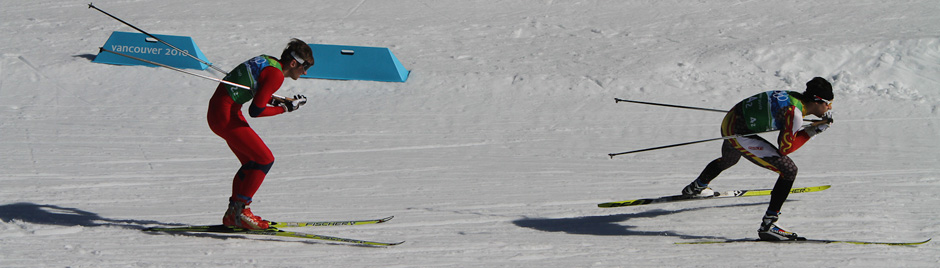
Whistler, British Columbia – He had to wait, but Petter Northug finally got to show off his dominating sprint finish against his perennial whipping boy Axel Teichmann. Northug and teammate Oystein Pettersen won the first gold by the Norwegian men’s cross-country ski team since 2002 in the team sprint competition at Whistler Olympic Park.
The high-pressure system that has brought unusually sunny weather to Whistler held out for one more day. Firm tracks in the morning for the semifinals gave way to softer corn snow as the day progressed and temperatures climbed into the 40s.
The semifinals featured a number of crashes, the most notable setting the Swedish team back, resulting in the major upset of the first round. Switzerland, led by the great Dario Cologna also failed to advance when Elgius Tambornino suffered a collapse of epic proportions.
All the other favorites successfully advanced to the finals, as well as both the United States and Canada.
If you think individual sprinting is exciting, try packing ten teams into the same 1.6km loop and have each athlete race the course three times – the interval championships of the world.
Even on the challenging Whistler course, it is always difficult to break away from the pack – especially in the strong and deep men’s field. After a quick double pole start, the race dropped to a relatively mellow pace.
Newell takes the tag from Koos and heads on course past Pettersen
“It is pretty relaxed on the first hill and then everyone hammers the second hill,” US anchor skier Andy Newell said. “That is the kind of the way this course skis. Everyone is trying to save their energy on the first hill and the second hill is so important to maintain a position.”
The teams continuously jockeyed for position, trying to stay out of trouble and set up for clean tags. The Canadian duo of Devon Kershaw and Alex Harvey were right in the mix, generally holding a good spot toward the front of the pack. Torin Koos, skiing the scramble leg for the US was also strong, especially on his second lap where he skied up to 4th place for the tag.
Considering the number of mishaps in the semifinals, the medal round was relatively clean, the only issue coming at the expense of the French team. Vincent Vittoz, out for blood after bad skis in the skate portion of the pursuit kept him from challenging for a medal, came in after his 2nd lap, leading the race. But teammate Cyril Miranda went down, relegating the team to the back of the pack. Vittoz continued to ski his brains out, posting the fastest time on his last lap – but the damage was irrevocably done.
Halfway through the race, France was the only team to lose contact, and the race was still wide open. Several team appeared to be hanging-on at the back – the Finns, Czechs and Italians, but they were just one major attack away from a medal.
So as expected it all came down to the final laps for each leg. The only question was who would it be? The favored Norwegians? The extremely strong Russians? Or the hometown Canadians?
At first it looked like the Canadians might do it. Devon Kershaw moved to the front midway through the loop as the crowd roared its approval. But halfway up the final large climb, it was German Tim Tscharnke throwing down a Northug-like move. His high tempo, powerful V1 quickly gapped the field as he charged up and over the crest of the hill. He remained strong into the stadium and around the hairpin to the tag zone.
Tscharnke making his move on the stadium video board
The 20-year-old Olympic rookie had given Axel Teichmann several seconds to work with, and put the team in position for the gold.
“My job was to work for Axel and to bring him a good position.”
Kershaw came through next, and the Canadian men’s cross-country team was just one and a half kilometers from their first Olympic medal ever.
But Teichmann and Alex Harvey, both strong skiers, had their work cut out for them. The chasers featured Alexey Petukhov (RUS), who along with partner Nikolay Morilov, had won both the World Cup team sprints this year, Alxey Poltaranin (KAZ), 5th in the individual sprint several days ago, and of course, Petter Northug, arguably the greatest finisher in the history of the sport.
A year ago at World Championships, Northug won three golds, two of them at the direct expense of Teichmann. The young Norwegian superstar blew the German off the trail in both the relay and the team sprint in the final 200 meters. Petukhov made the first move to bridge up, but it was hardly a surprise when he turned on the jets on the last climb, and rapidly closed the gap on the stoic Teicmann.
“Northug let me go ahead to chase the German, and then all of a sudden he was right behind me,” Pethukhov said. “When I did see him, I thought to stay with him.”
Devon Kershaw gunning for a medal
Impressively Petukhov hung on, and the two men dropped into the stadium just behind the German. Northug wasted no time, extending high on his powerful V2 and taking the lead into the final corner. At this point the only question was whether Teichmann could hold on for second.
As Northug powered across the line, no time for finish stretch celebrations, Petukhov stepped out from behind Teichmann for the final 20 meters. But the veteran German held on at the last, winning his first Olympic medal.
“Tim [Tscharnke] did a great job,” Teichamnn said of his young teammate. “He chased some guys and gave us some seconds. I got the opportunity…on the last lap, and I did everything I could. But Petter was too strong.”
Northug was greeted by a jubilant Pettersen, who until yesterday was not even scheduled to race this event. Coming off a disappointing classic sprint where he crashed in the finals, Pettersen was initially passed over in favor of World Cup sprint leader Ola Vigen Hattestad. But Hattestad came down mildly ill, and gave Pettersen his start spot, feeling that the Norwegian, affectionately known as “the Sausage,” would have a better shot of leading the team to victory.
“After the individual sprint I understood I would not make the team. Hattestad trained yesterday, but he did not feel that good…if he is not sick he could do as good a job as I did. But he felt that I could do a better job, so he gave the spot to me. I am very thankful, and Hattestad has shown he is a very good teammate.”
Harvey and Poltaranin had been unable to stick with Northug and Petukhov, staging their own battle for 4th. Harvey out-lunged the Kazakh in a photo finish, once again setting a new Olympic best for the Canadian men’s team.
“We knew today was a good shot for a medal, but it is so hard,” Harvey said in the finish area. “Those guys are all really fast sprinters, and I know I have endurance, but I didn’t have enough speed to match what those guys were putting on the track.”
And matching up head-to-head with Northug was too much for the 21-year-old too handle. “Northug went around me on the first climb to catch the German team. He is really fast!” Harvey continued. “I was going as fast as I could, and I was recovering well between each round. But I just didn’t have the speed that the top-3 had.”
Waiting for the tag
The US, in the mix for most of the race, faded on the last two laps. Koos getting the tag toward the back moved up on the first climb, but ran out of gas in the last 500 meters. Newell was in no position to make up ground at that point, and the team finished 9th out of 10 teams.
“We both hung in there right up until the last lap…we gave it our best shot,” said Newell.
Tscharnke became the youngest cross-country Olympic medalist ever. With just ten World Cup starts to his credit, he didn’t even make the Olympic team until his 9th in the diluted Rybinsk sprint exactly one month ago.
When asked how he felt the grinning Tscharnke could only reply “Very good!”
Teichmann did not crack a smile at the post-race press conference, and responded with anger to a question asking if he felt like he won silver or lost the gold. “What a stupid question,” he said. “For us, we have won the silver.” When asked about Northug breathing down his neck, he replied “I try to focus on my race and my technique, so I didn’t focus on him. You always have to keep your mind on your strength and do the best to the finish line.”
Northug passes Teichmann in the stadium with Petukhov in third
Despite his affect, he did make it clear he was very pleased with the day. “It’s amazing to win my first Olympic medal. For me it is a dream come true.”
The impressive move by Tscharnke was not a surprise to German men’s coach Cuno Schreyl, who also defended the decision to run the veteran in the anchor position. “Tscharnke is the youngest. Teichmann has more experience and so for us it is a better team to place him last.”
But he did admit that in the future we will likely see Tscharnke closing for the Germans, eliciting memories of the 1994 relay when Norway opted for experience over youth to anchor the team in the 4x10km relay, only to see Bjorn Daehlie lose the final sprint to Silvio Fauner. From then on, Daehlie skied 3rd and the young Thomas Alsgaard 4th.
“Tschanrke is very strong,” Schreyl concluded. “I hope he skis in the fourth position in the relay, but I don’t know. We’ll see.”
Despite the German youth’s strength, Norwegian coach Age Skinstad was not concerned that the gold was out of reach. In reply to the question asking if he had any doubt in Northug’s ability to close, he answered a simple “No.”
Northug’s partner, Pettersen, was not as confident as his coach.
“I know Peter is a good skier, but Axel is a good skier, and Petukhov has shown he is a good sprinter,” he said. “So I was maybe a little disappointed by own performance that I couldn’t give Petter a better position. But I gave it my best, and Petter was strong.”
Alex Harvey leads Petter Northug out of the stadium for the last lap
Northug did not rise to the bait, as several media members tried to get him to say something controversial. He was clearly relaxed and happy, and seemed to enjoy not giving the press what they wanted.
“After the pursuit, the motivation for this race was very high,” the usually brash Northug said. “I knew with Oystein that we would have a great team. When you race for Norway you hope to fight for a medal. To make it is just amazing – for me the biggest goal at the Olympics – to reach a gold medal.”
Morilov was extremely gracious as the bronze medalist, saying “It’s a beautiful day, beautiful sun, beautiful snow, and we are happy in our hearts. We would like to compliment our fine competitors.”
Added his teammate Petukhov, “It is not a trifle to win an Olympic medal…It is something I will remember for a lifetime.”