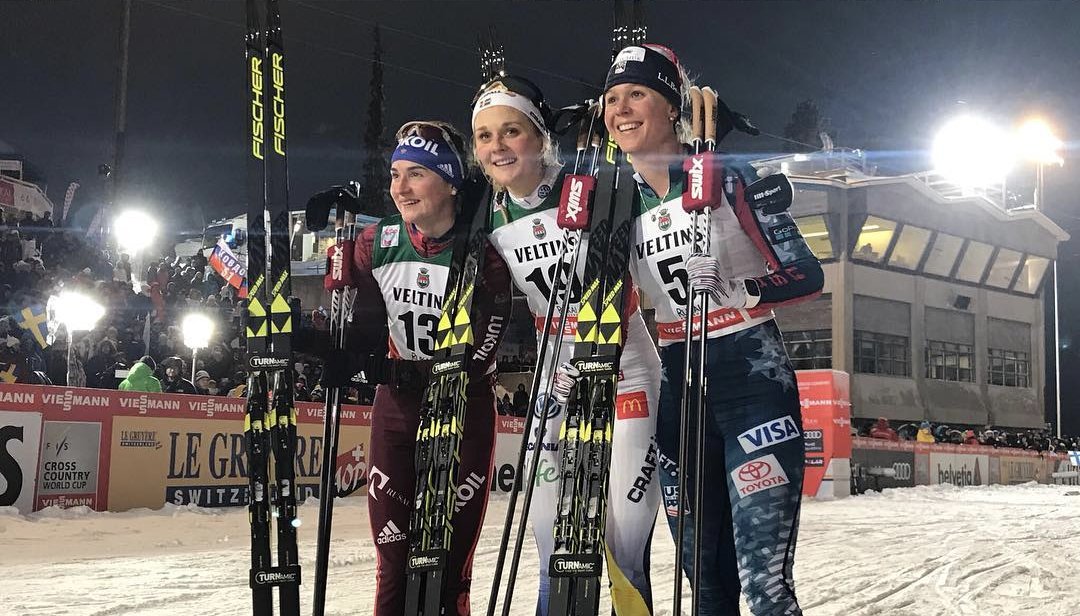
Tag: Paal Golberg

  • Schumacher Animates Falun Mass Start, Claims Second

    Schumacher Animates Falun Mass Start, Claims Second

    This coverage is made possible through the generous support of Marty and Kathy Hall and A Hall Mark of Excellence Award. To learn more about A Hall Mark of Excellence Award, or to learn how you can support FasterSkier’s coverage, please contact info@fasterskier.com.

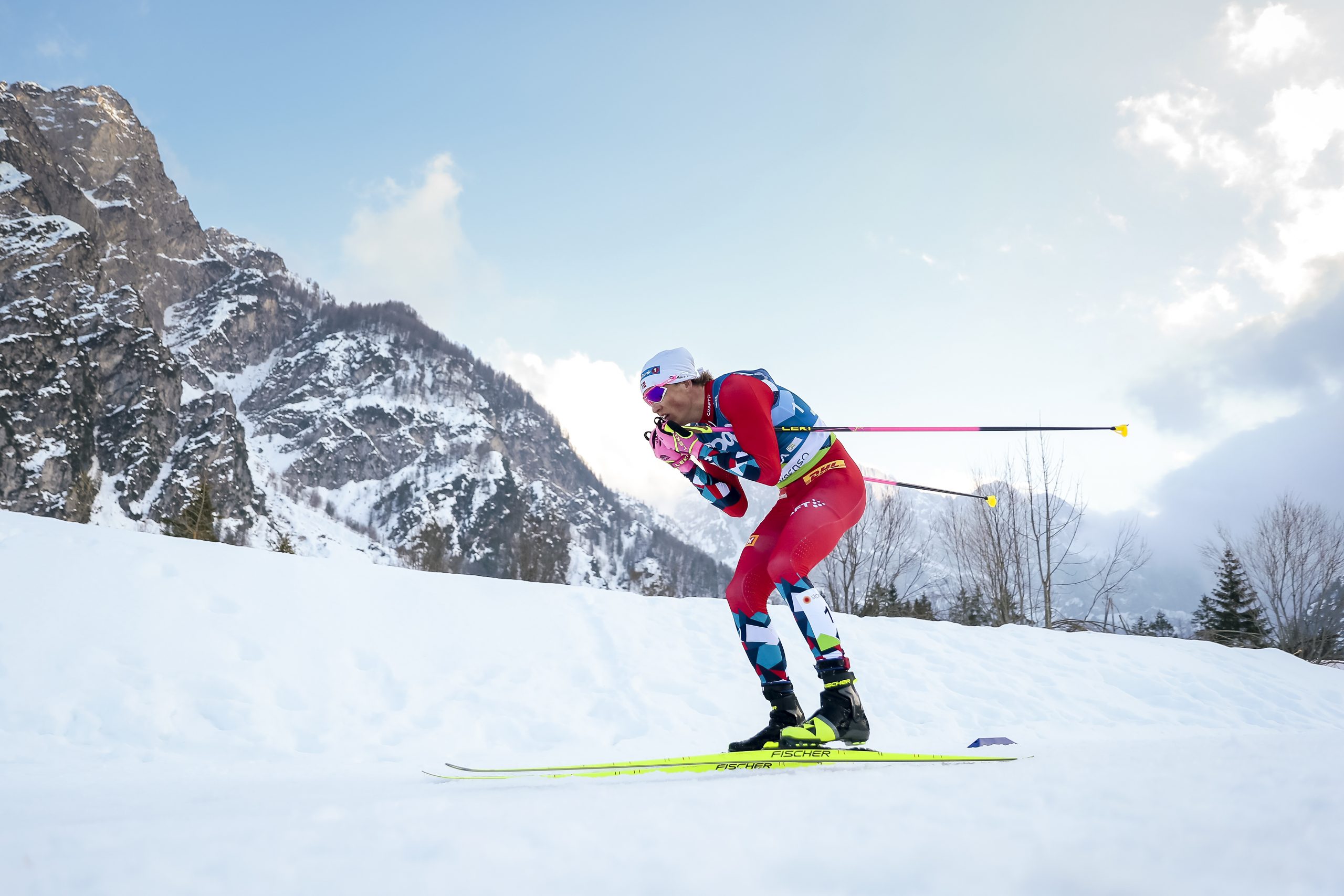
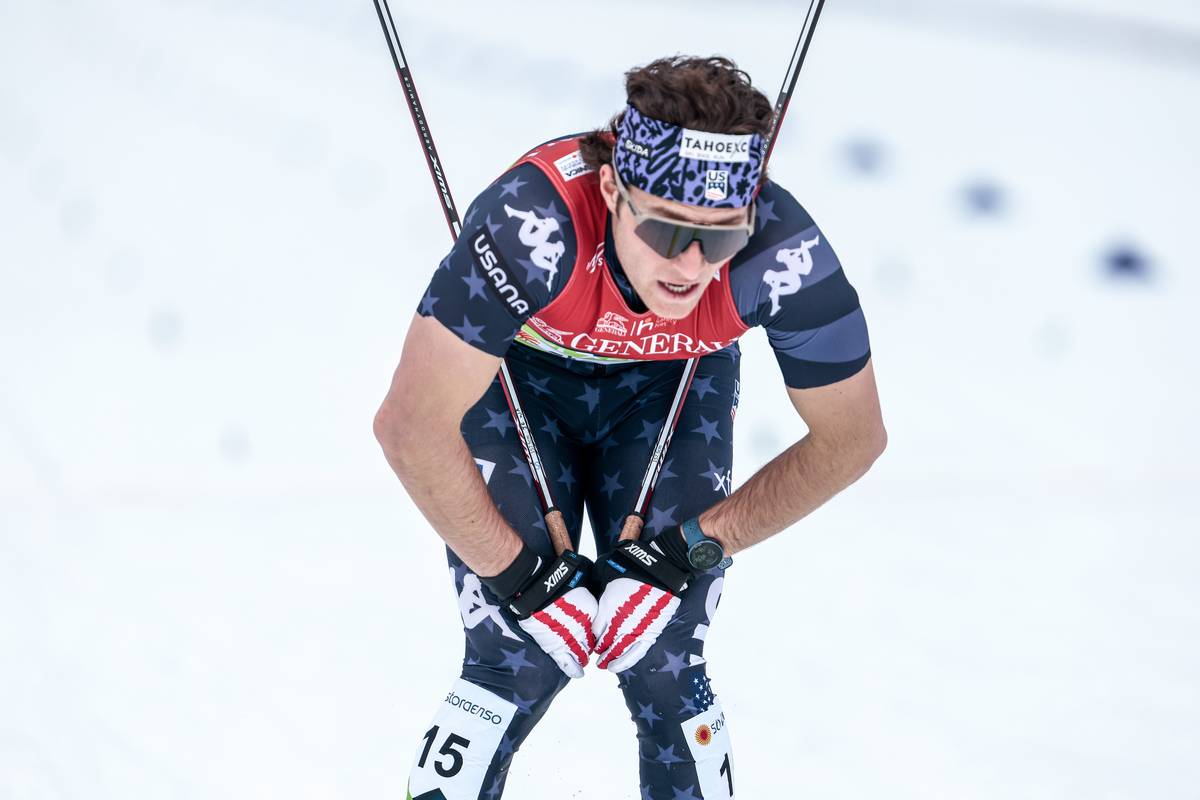
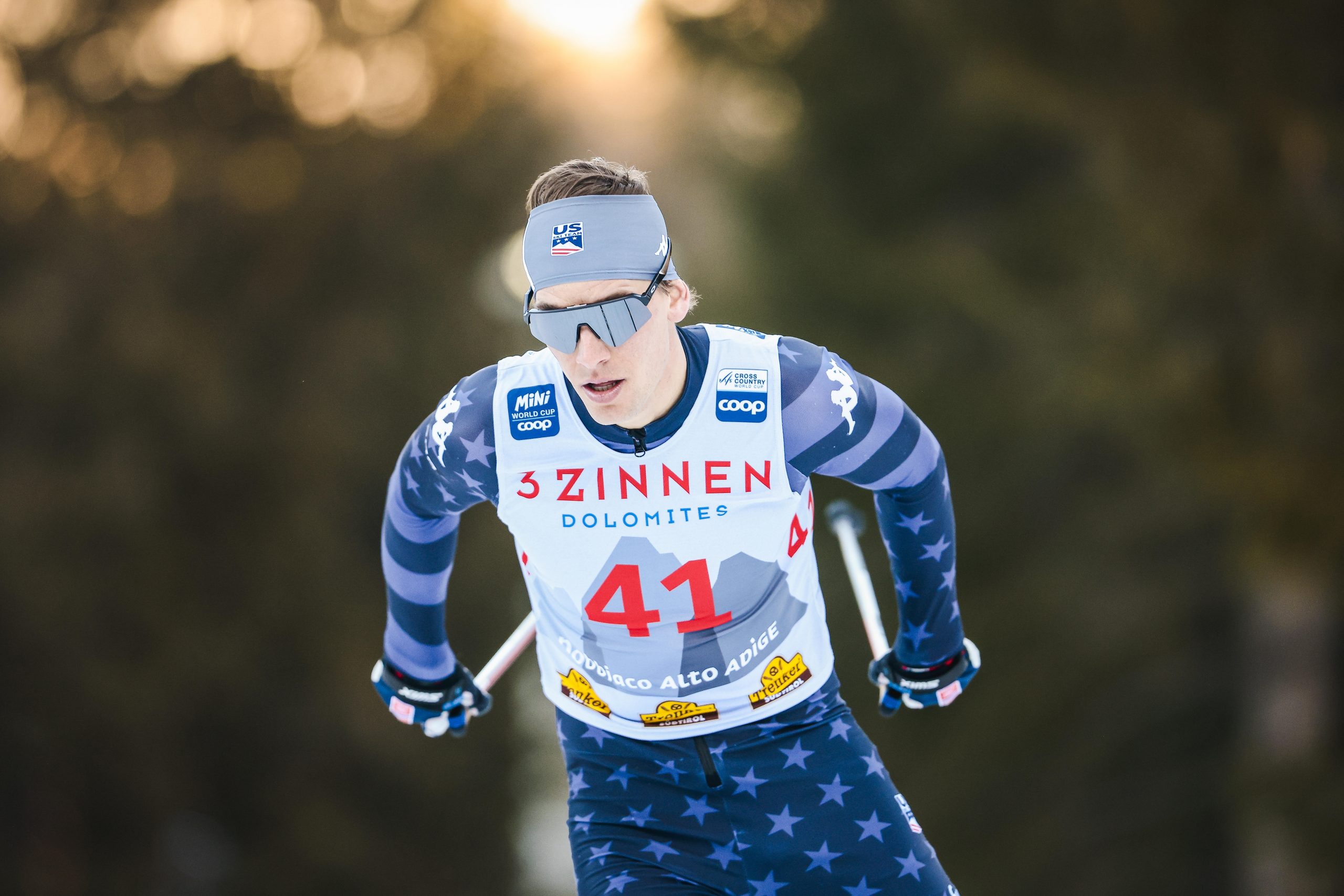
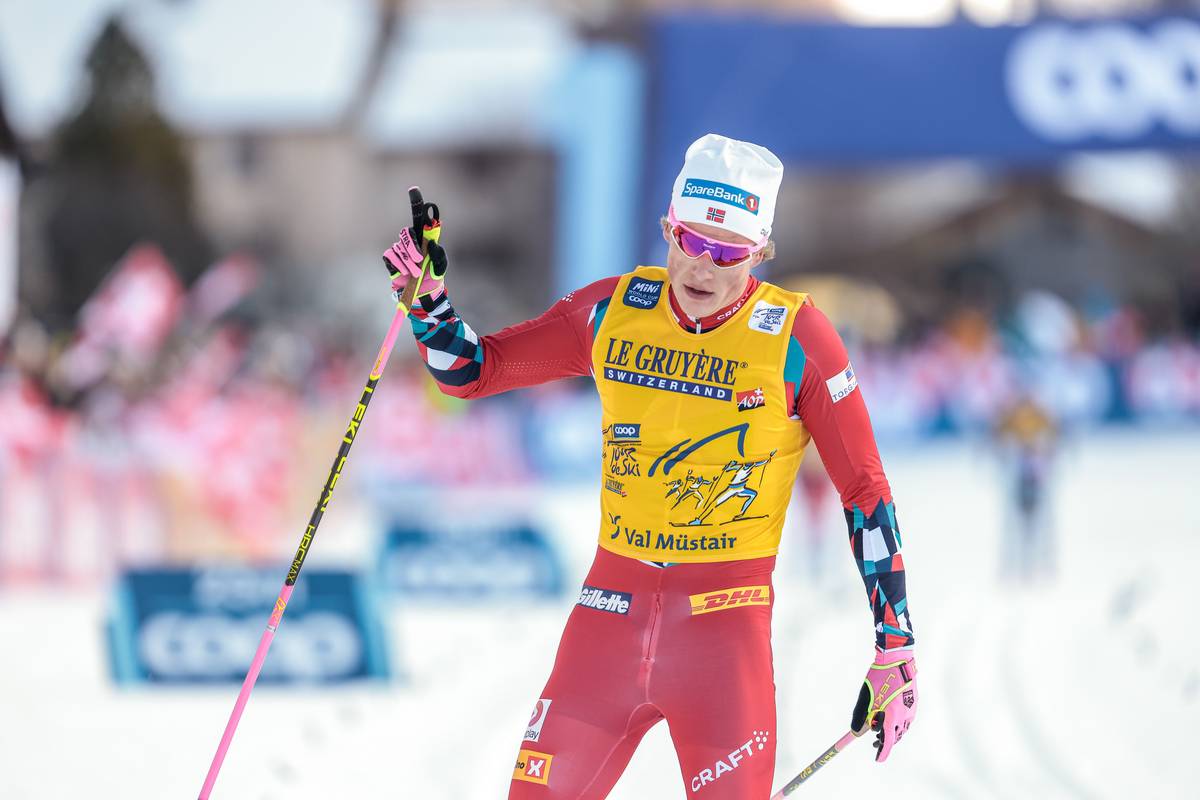
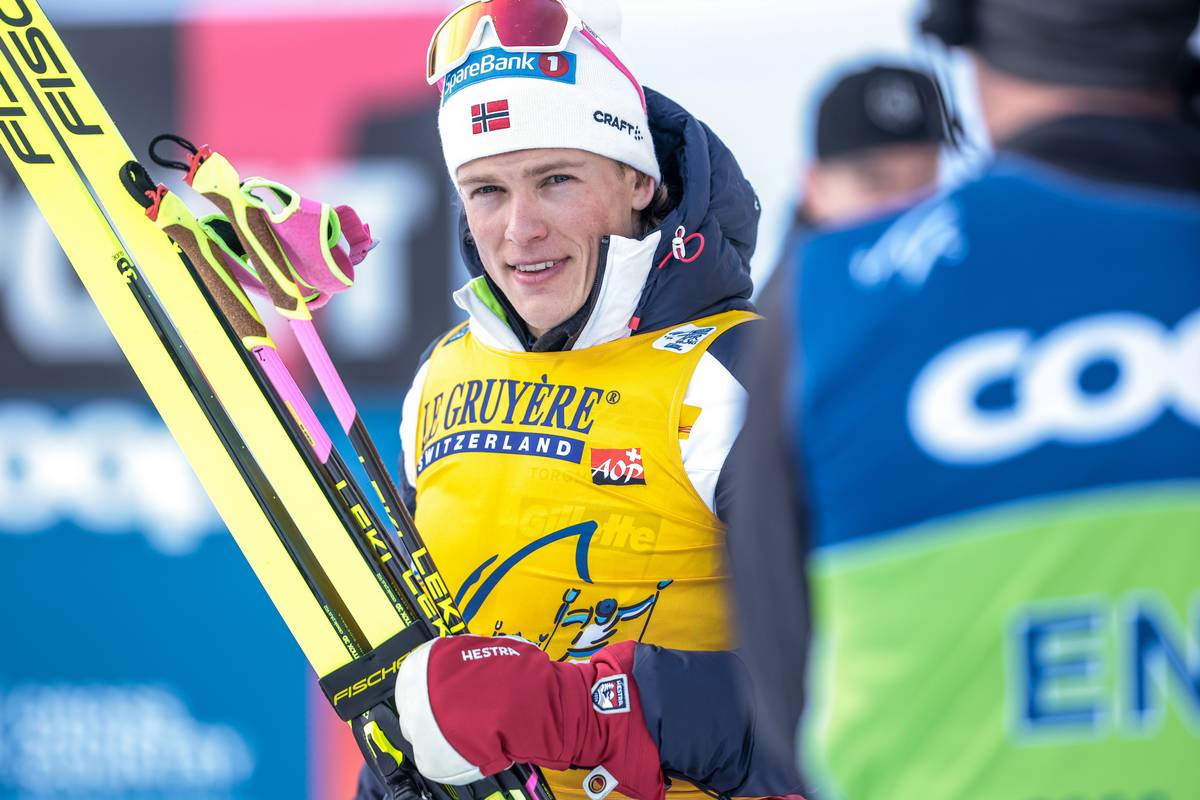
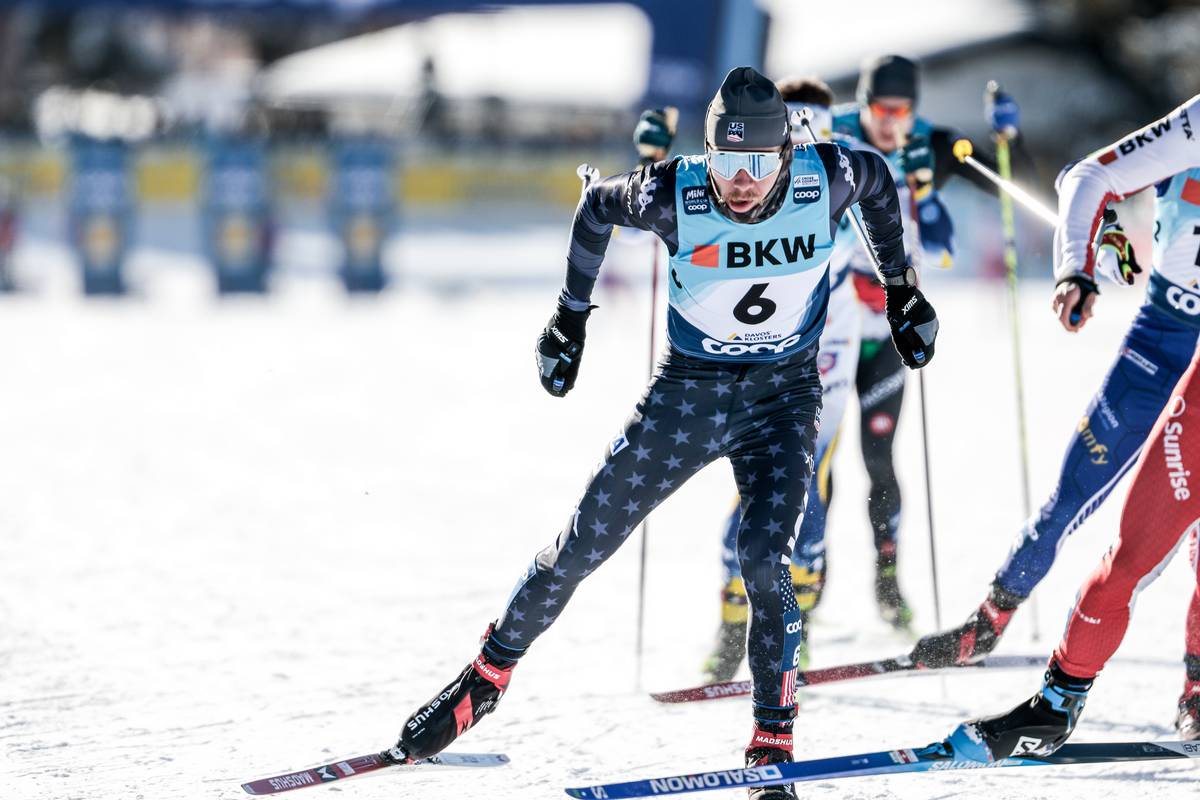
    Gus Schumacher (USA) earns his second career World Cup podium with a thrilling second place in Falun’s 20 k Mass Start. (Photo: NordicFocus)

    Perhaps more than any other season, the 2024-2025 World cup has been marked by the comings and goings of numerous contending skiers. Iivo Niskanen (FIN) got a late start to the season, but has finally begun to look strong of late (as proven with his dominant victory in yesterday’s 10 k Classic). Sprint and Overall World Cup leader, Johannes Hoesflot Klaebo (NOR), shows up and wins often enough to continue leading the Overall World Cup standings, then disappears for days “on the couch” at home in Trondheim. Norway’s Harald Oestberg Amundsen (the 2024 World Cup Overall champion) followed Klaebo to most starting lines early in the season, but eventually opted to skip races in favor of World Championship preparations. Former World Cup champion, Paal Golberg (NOR), has been left off Norway’s starting roster for many races this season, largely unable to prove himself in the selection process for Norway’s World Championship teams, even as the entire Norwegian squad was absent from the World Cup during their own National Championships. Ben Ogden (USA) has been sidelined by persistent illness for the past two weekends, And Ogden’s American teammate, Gus Schumacher, saw his season interrupted by illness, so much so that he traveled across the globe for a stint of rest and recovery at home in Anchorage.

    In training and competing at the World Cup level, the differences between champions and also-rans are alarmingly slim. Taking a break from time to time may seem like a good idea, but there’s always the risk of returning to competition only to find oneself flat. Klaebo opted to return home after his Sprint victory on Friday and second-place finish in yesterday’s 10 k Classic Interval Start. He’s one who seems able to always race in top form. For the rest of the field, question marks persist. So, at the beginning of today’s 20 k Mass Start in Falun—and in the absence of Klaebo and his countryman, Erik Valness—no one really knew what to expect.

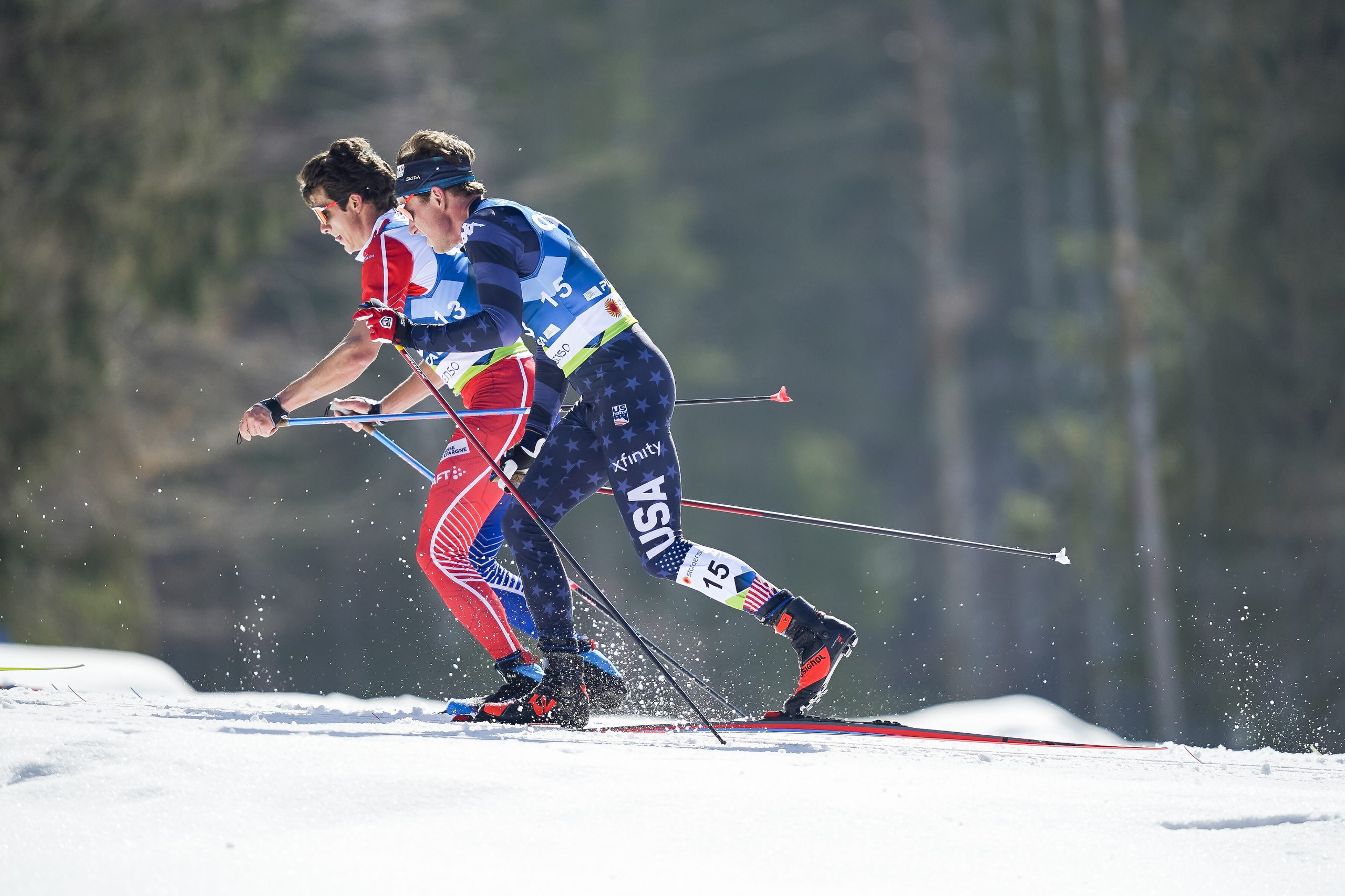
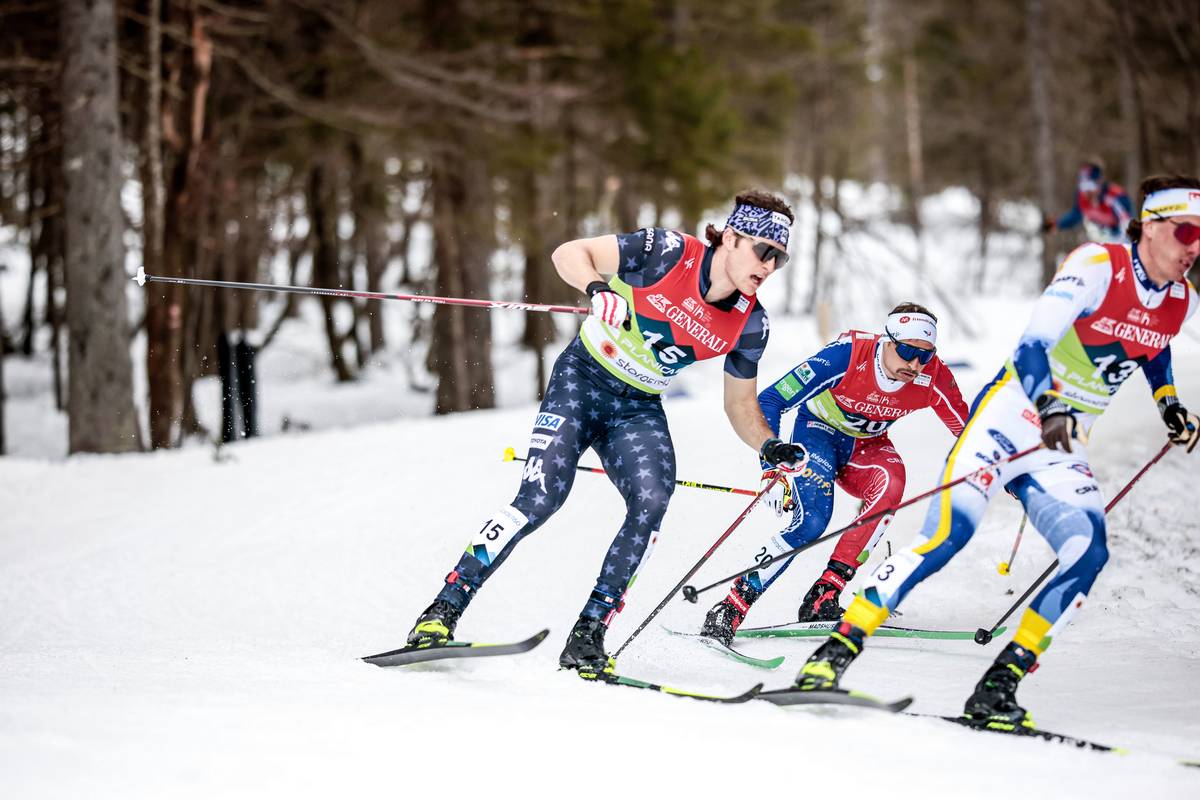
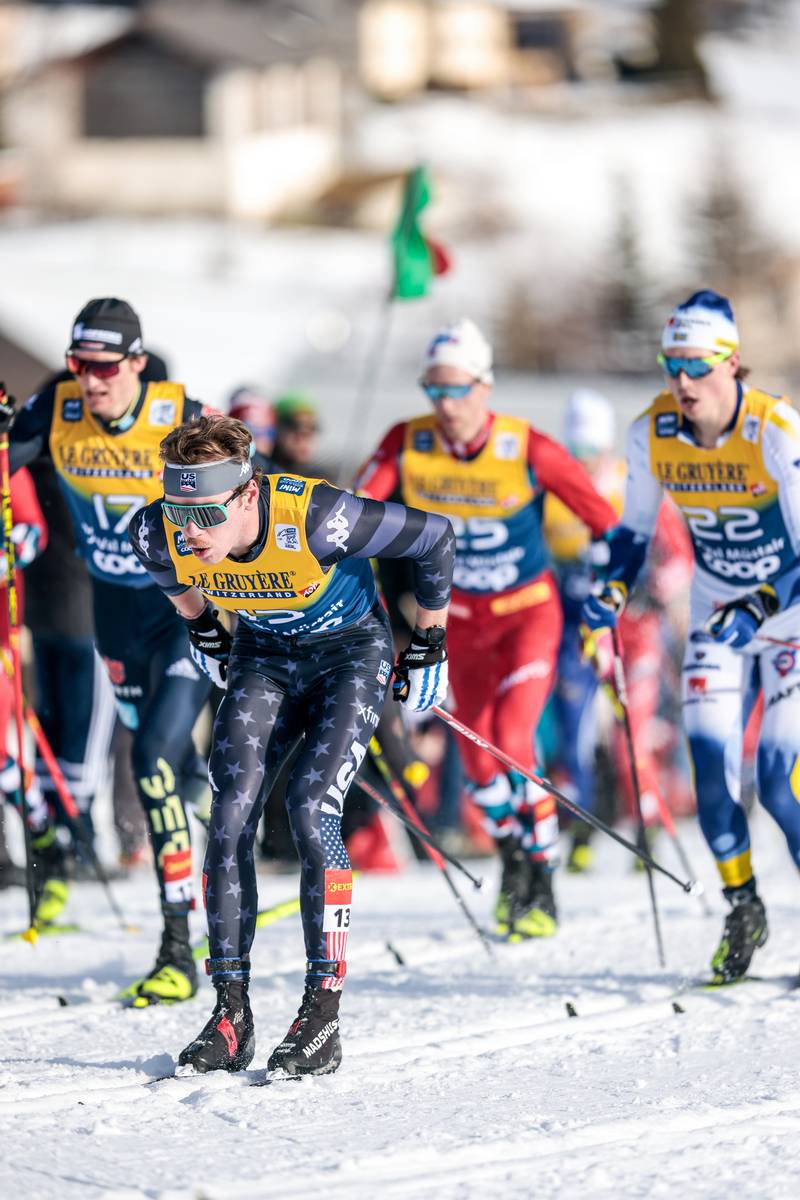
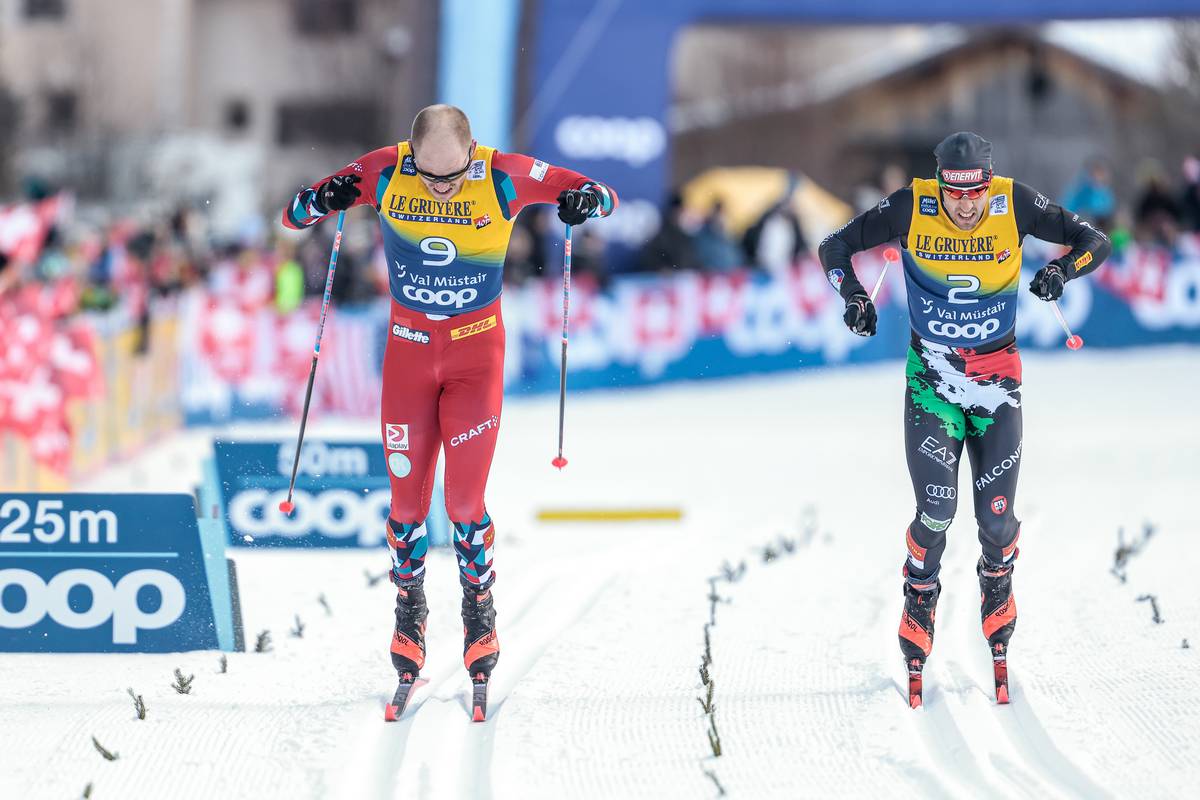
    USA’s Gus Schumacher (left) was the primary animator in the early kilometers of the World Cup 20 k Mass Start in Falun, Sweden. (Photo:  NordicFocus)

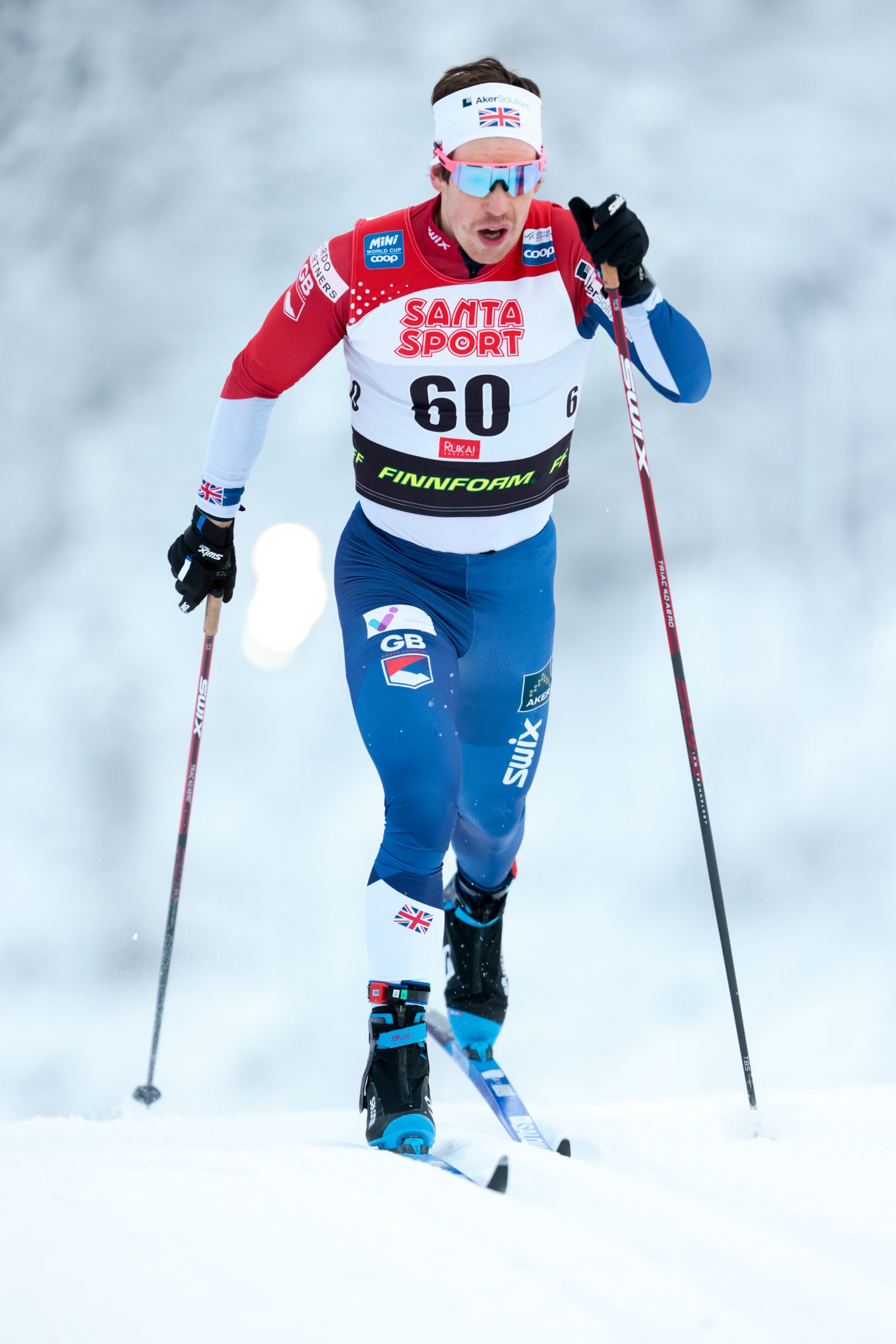
    Early in the race, answers began coming from Schumacher, who animated the pace for much of the race, ultimately sprinting to second place behind race winner, Golberg (himself only recently returned from time away from the World Cup).

    “My strategy was mostly to stay out of trouble and be there when moves happened,” said Schumacher. “Whenever you feel good it’s just easier to be at the front. It meant I could also drift back a bit on the big climb if I felt like it. It kinda depends on the nature of the race. For a dynamic one like this, I feel you don’t really need to be that far forward if you have a lot of energy and solid skis, but like I said before it’s always easier if you can get there.”

    Other American skiers delivered solid finishes, with Zanden McMullen 22nd, Kevin Bolger 23rd, Hunter Wonders 55th, Luke Jager 64th, Walker Hall 75th. Due to lingering illness, Ben Ogden continued to be absent from the field. Canadian finishers included Antoine Cyr 30th, Thomas Stephen 54th, Remi Drolet, Sasha Masson 44th, Pierre Grall-Johnson 73rd.

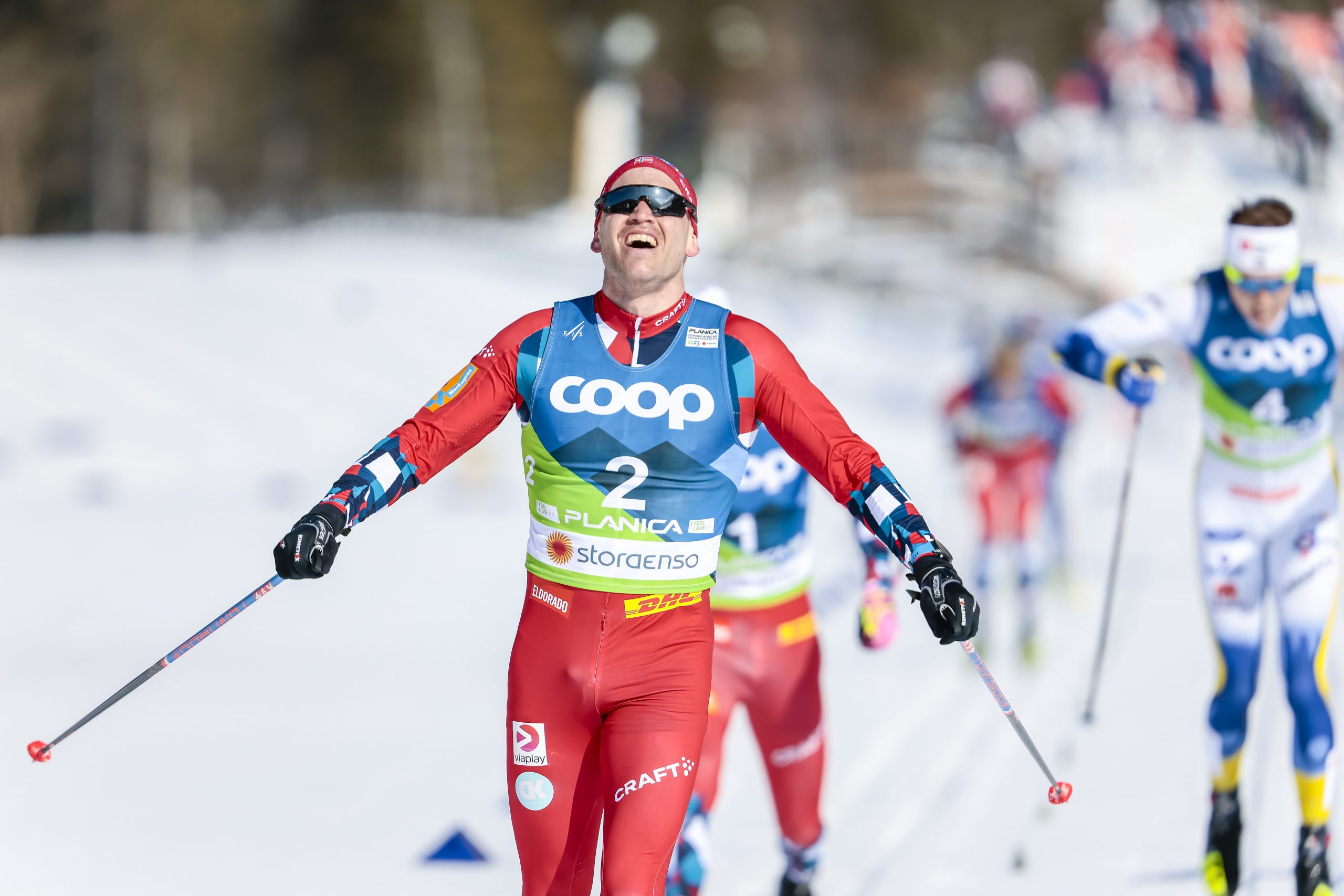
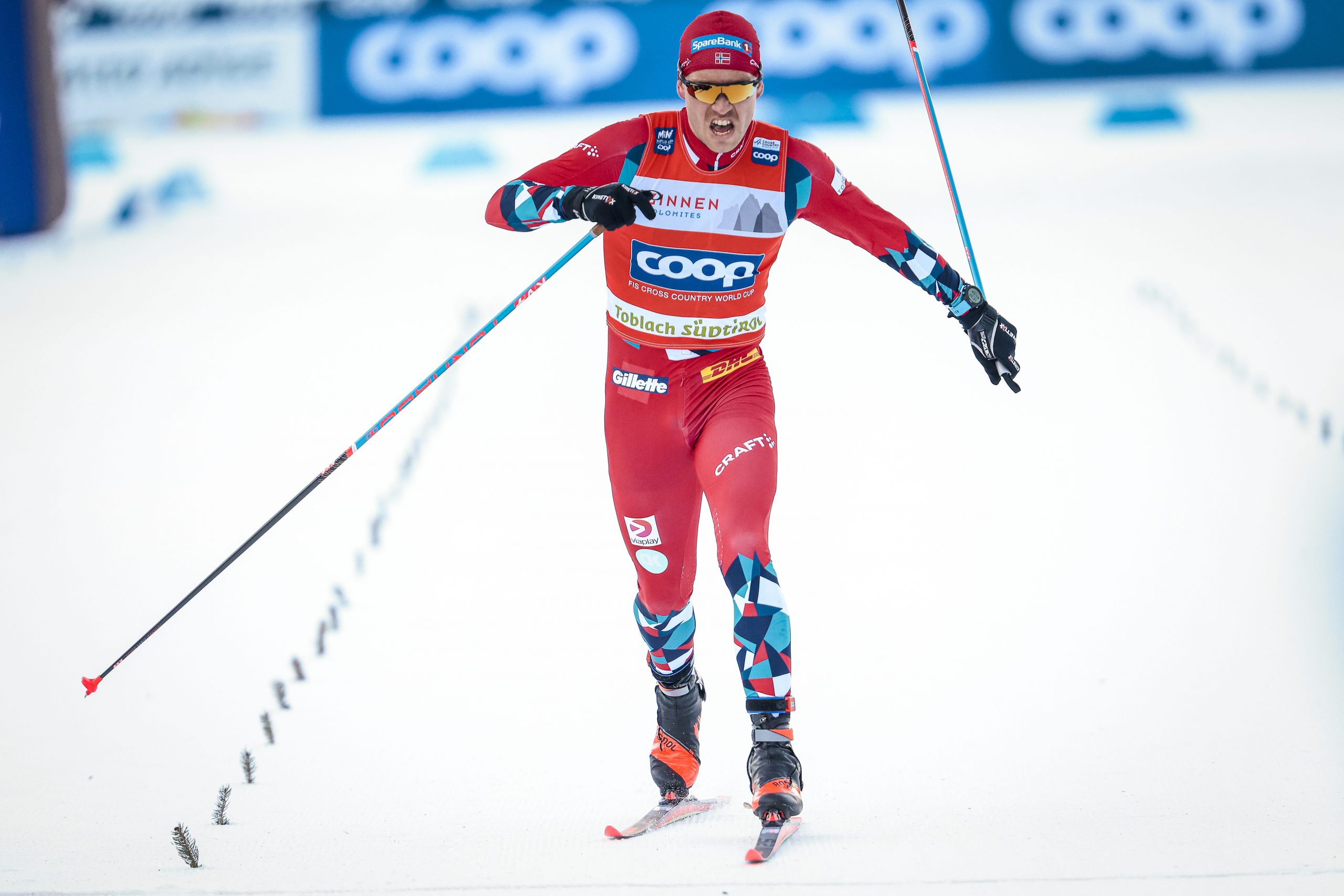
    Paal Golberg (NOR) returned to the top of the FIS World Cup podium, sprinting out of the lead group to claim the win in Falun’s 20 k Mass Start. (Photo: NordicFocus)
    Falun Mass Start Freestyle

    Falun’s 20 k would be contested over five laps of a four kilometer loop, featuring five ascents of Falun’s infamous Mordarbacken—a climb gaining 60 meters of elevation up a 15% grade—ascending the slope alongside the facility’s famous ski jumps. It would be a high-speed grind favoring good climbers on the uphills, and fast skis on the downhills.

    While Edvin Anger (SWE) jumped quickly to the front, it was Amundsen who set the early pace, followed by the leader of the FIS Distance standings, Simen Hegstad Krueger (NOR), Mika Vermeulen (AUT), and Hugo Lapalus (FRA). McMullen and Schumacher remained in the top ten where they were joined by Joe Davies (GBR) and Federico Pellegrino (ITA).

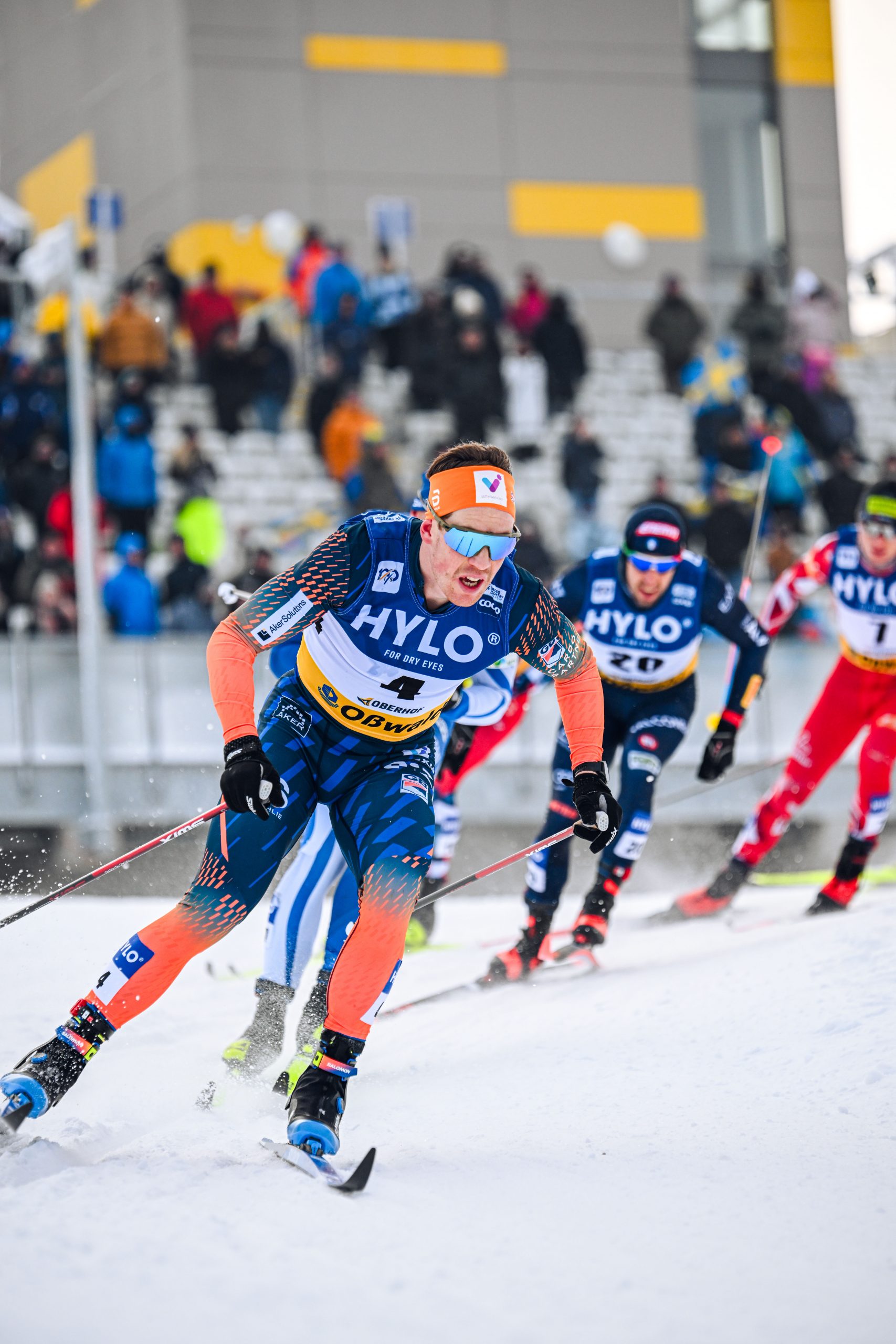
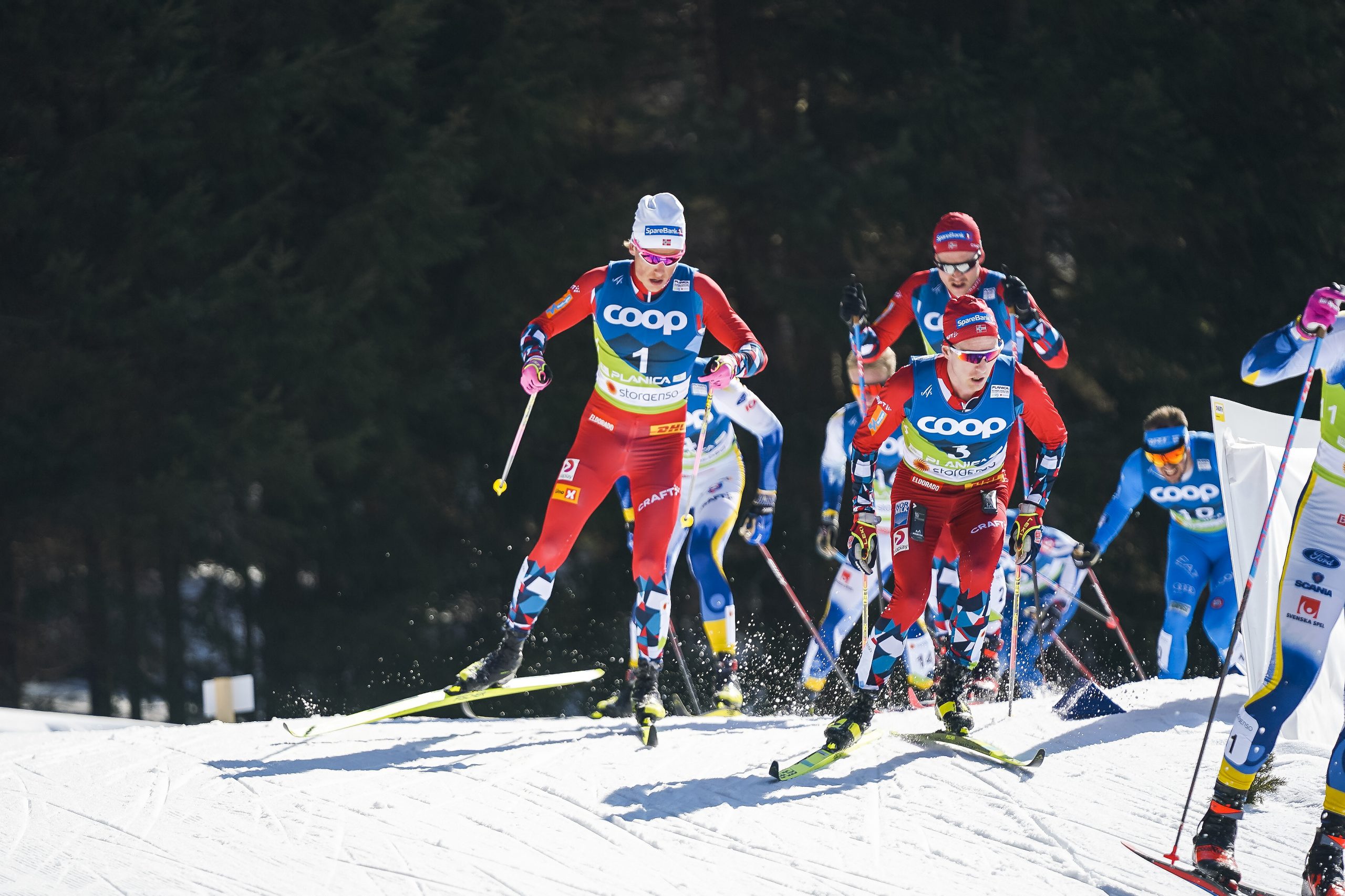
    Gus Schumacher (USA) had fast skis in Falun, allowing him to surge to the front on the course’s challenging and technical downhills. (Photo: NordicFocus)

    Just after the first ascent of the Mordarbacken climb, Schumachers’ fast skis allowed him to glide to the front where he continued to set the pace through many of the race’s early checkpoints.

    “(My skis) were running super well,” said Schumacher. “Big thanks to Chris Hecker, the whole wax truck, and Rossi!! I don’t really hear about the prep, but I know we’ve been doing a really thorough job testing pre-race. In the last couple weekends, actually since Cogne, we’ve been making sure we get at least one little glide out on course to confirm the feelings we’re having on our feet.”

    Anger continued to be the interesting question mark through the first 10 k.  Perhaps the biggest skier in the field, Anger would find himself gapped by pure climbers on the Mordarbacken, only to reappear near the front on subsequent downhills. Anger continued to yo-yo on the climbs, his tempo markedly slower than that employed by the pure climbers. The field continued to stretch and bunch, at times epitomized by a group of 6-7 at the front, at other times swelling to more than 20. Saturday’s 10 k Classic winner, Iivo Niskanen, clung tenaciously to the back of the lead group, along with the always-dangerous sprinter, Pellegrino.

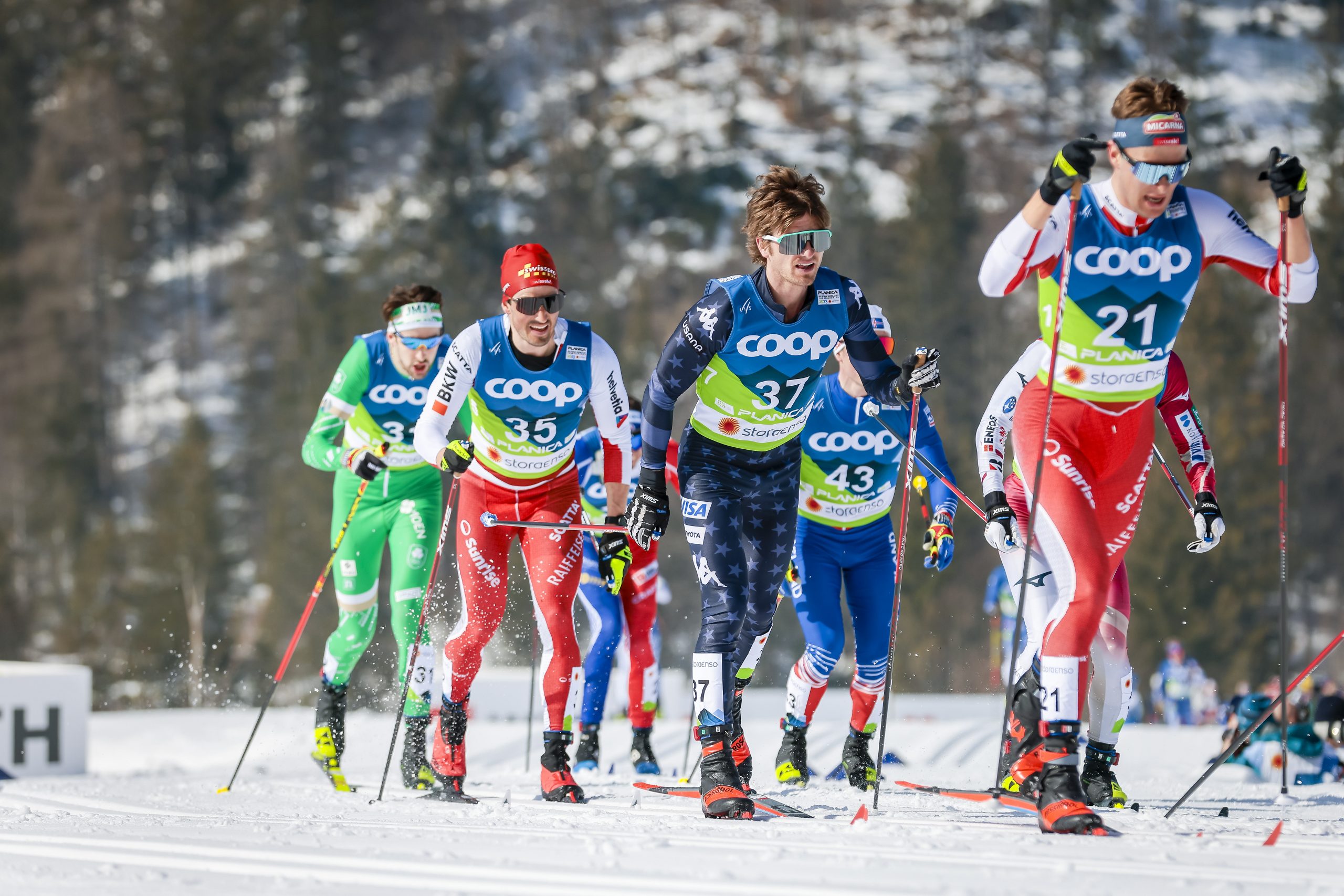
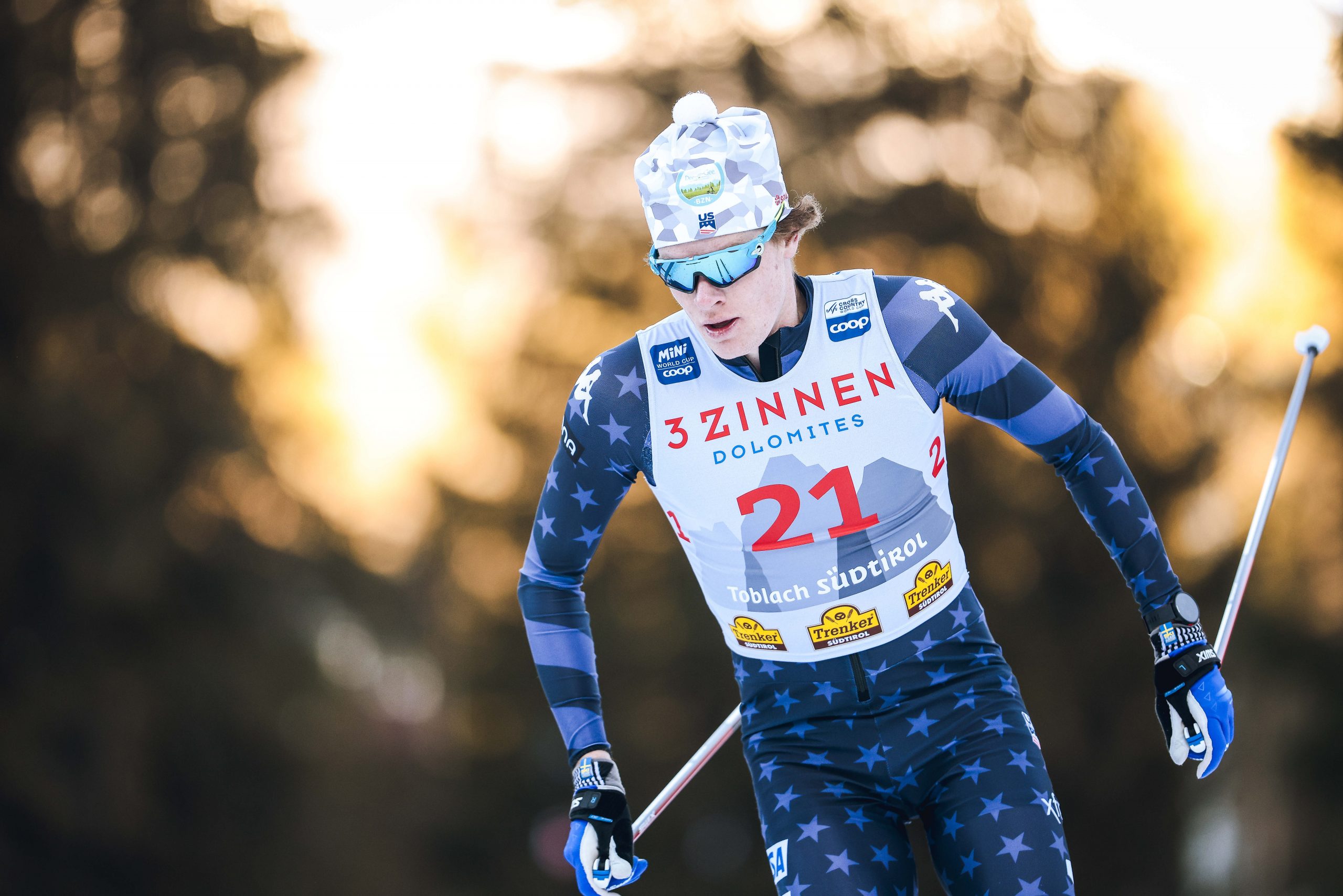
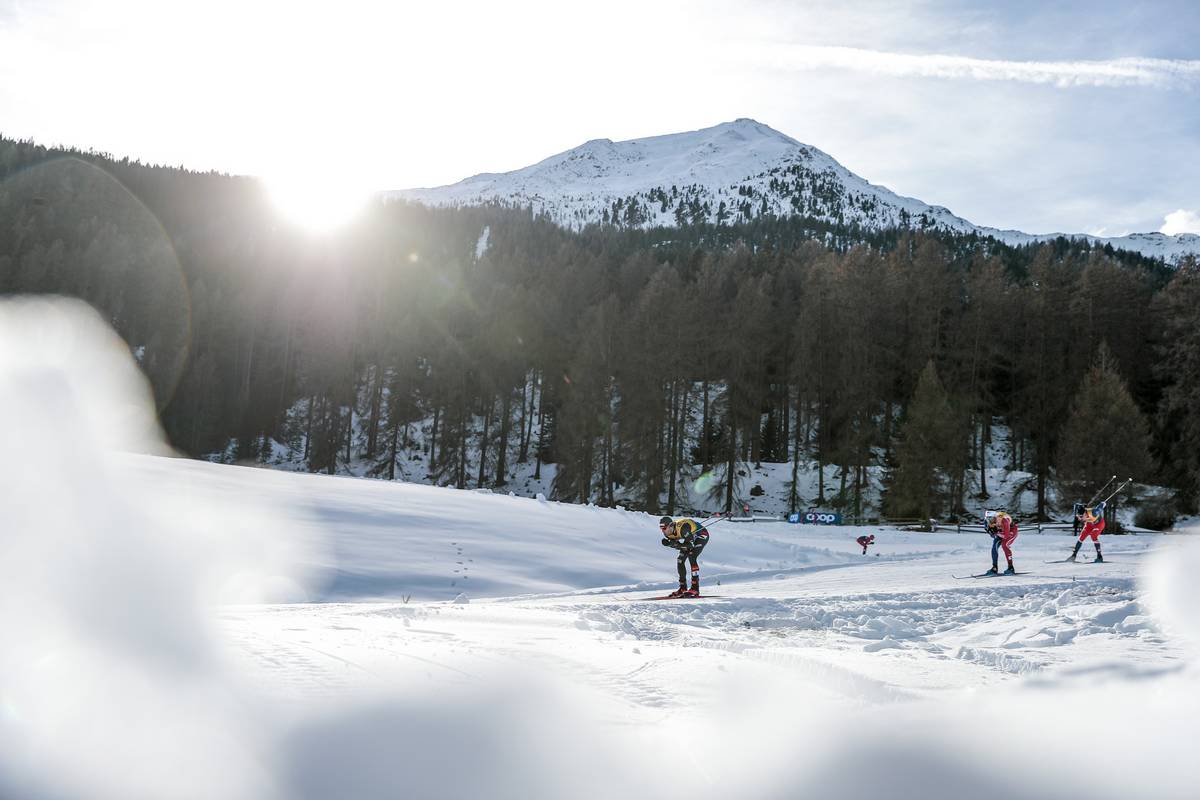
    Gus Schumacher (USA) charges up one of the hills on the sprint course at the base of the Mördarbacken during the 20 k Freestyle Mass Start in Falun, Sweden. (Photo: NordicFocus)

    In the final lap, Schumacher continued pressing the issue near the front as the field rolled through the stadium and onto the gentle rollers that followed. On the final climb of Mordarbacken, it was Andreas Fjorden Ree (NOR) who drove to the front, fully committed to dropping the rest. Schumacher remained clamped firmly to the tails of Vermeulen, the only other non-Norwegian left in the final selection.

    “I don’t follow skiers so much as body language when I’m skiing up front like that,” explained Schumacher. “Like if someone looks to be gaining momentum I’d maybe choose being behind them compared to someone that’s maybe slowing down or skiing passively. Definitely also good to follow established good distance skiers, but you kinda never know how people are feeling until you see them move.”

    In the rolling hills that lead to the finish, Schumacher executed a flashy pass that took him around Krueger and Golberg, closing the gap on Ree. Into the Sprint course downhill, Schumacher’s skis continued to glide well, but he was now the last non-Norwegian in contention, so the skis around him were equally as fast. Over the final bump, Golberg surged into the lead to claim the inside line on the final turn. Schumacher drifted outside, and began his sprint early, but Golberg was able to hold him off to the finish line. Golberg first, Schumacher a resounding second, Amundsen third, Ree in fourth.

    Harald Oestberg Amundsen (NOR), Paal Golberg (NOR), Andreas Fjorden Ree (NOR), and Gus Schumacher (USA) duked it out down the finishing straightaway. FIS jury would deliberate over bumping and line changes that occurred on the final curve, but would ultimately confirm the original finishing order. (Photo: Modica/NordicFocus)

    There were nervous moments following the race as the FIS awards ceremony was delayed to allow ongoing jury considerations. The American squad was understandably concerned, as there had been close maneuvering on the final corner involving Schumacher and Ree. Schuamcher had been solidly positioned in front of Ree at the moment in question, so it was unlikely that the jury would affect the finishing results. Nervous moments, indeed . . . but ultimately the jury did determine that the finishing results would stand.

    Schumacher’s season had already been interrupted by illness, necessitating his trip back to Anchorage to regroup. That sort of rest and recovery never insures that a skier will return to form. Obviously, it worked for Schumacher, and at just the right time. After today’s marvelous performance, he’ll line up as a serious contender in Trondheim nine days from now . . .

    Complete Falun Mass Start Freestyle RESULTS

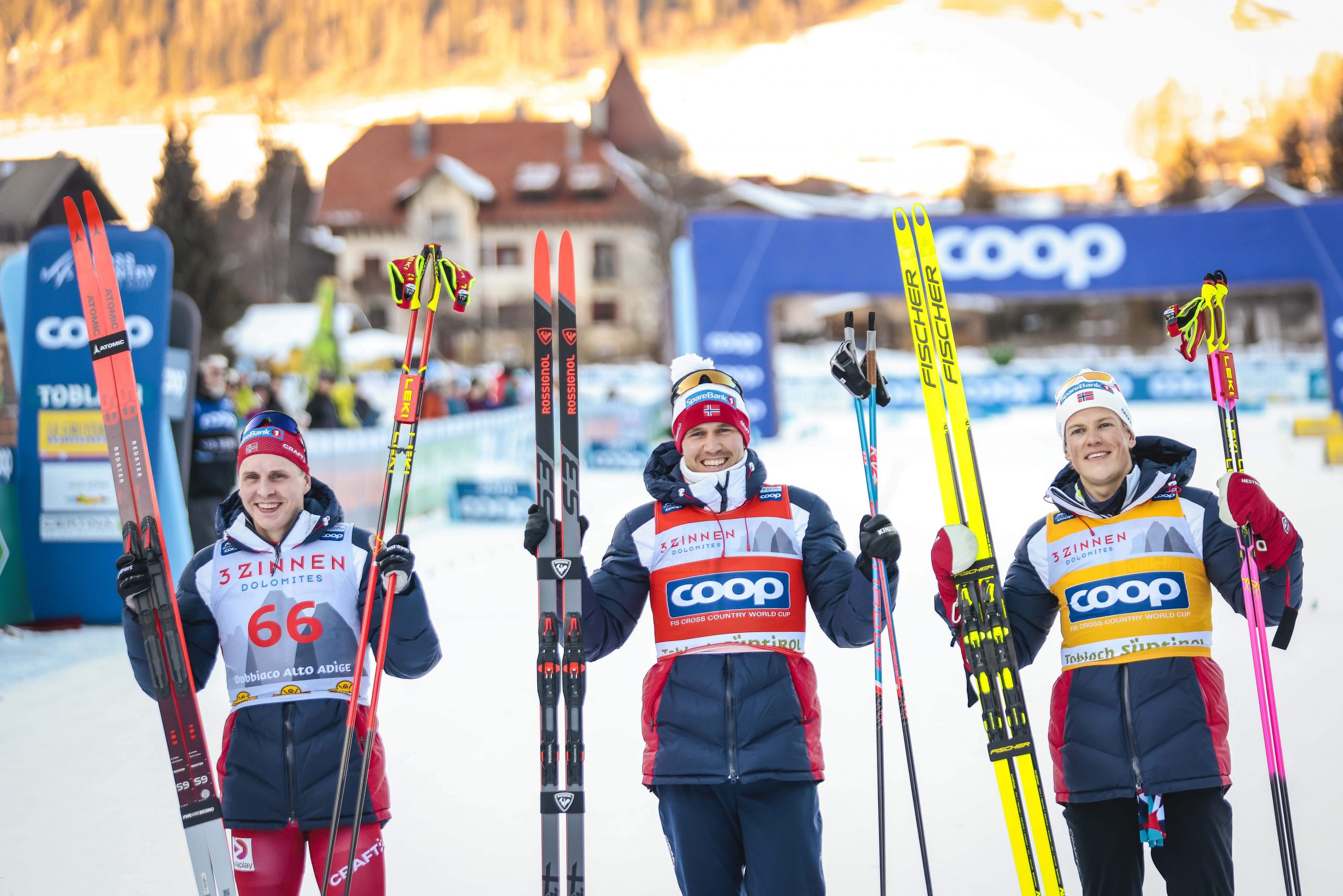
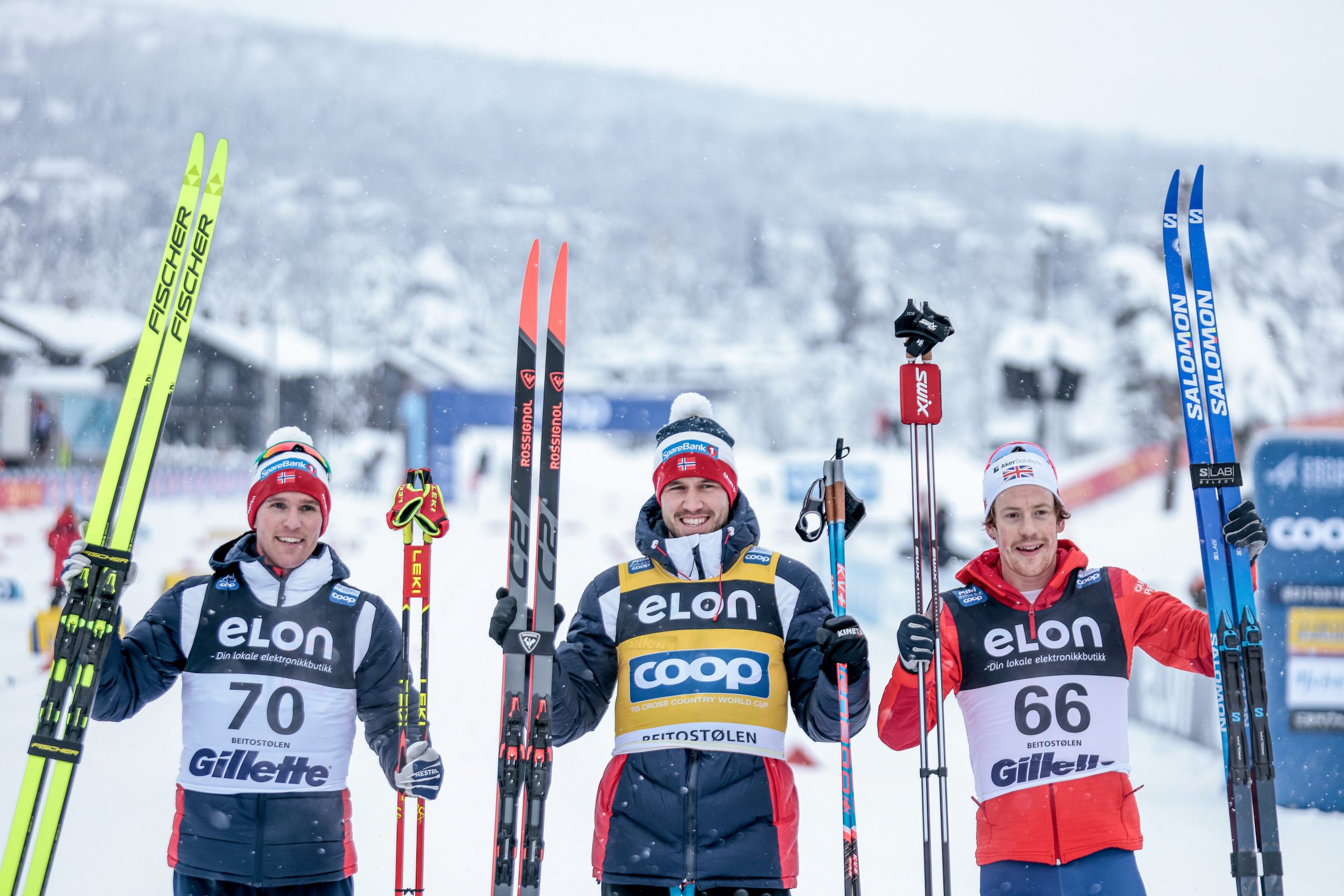
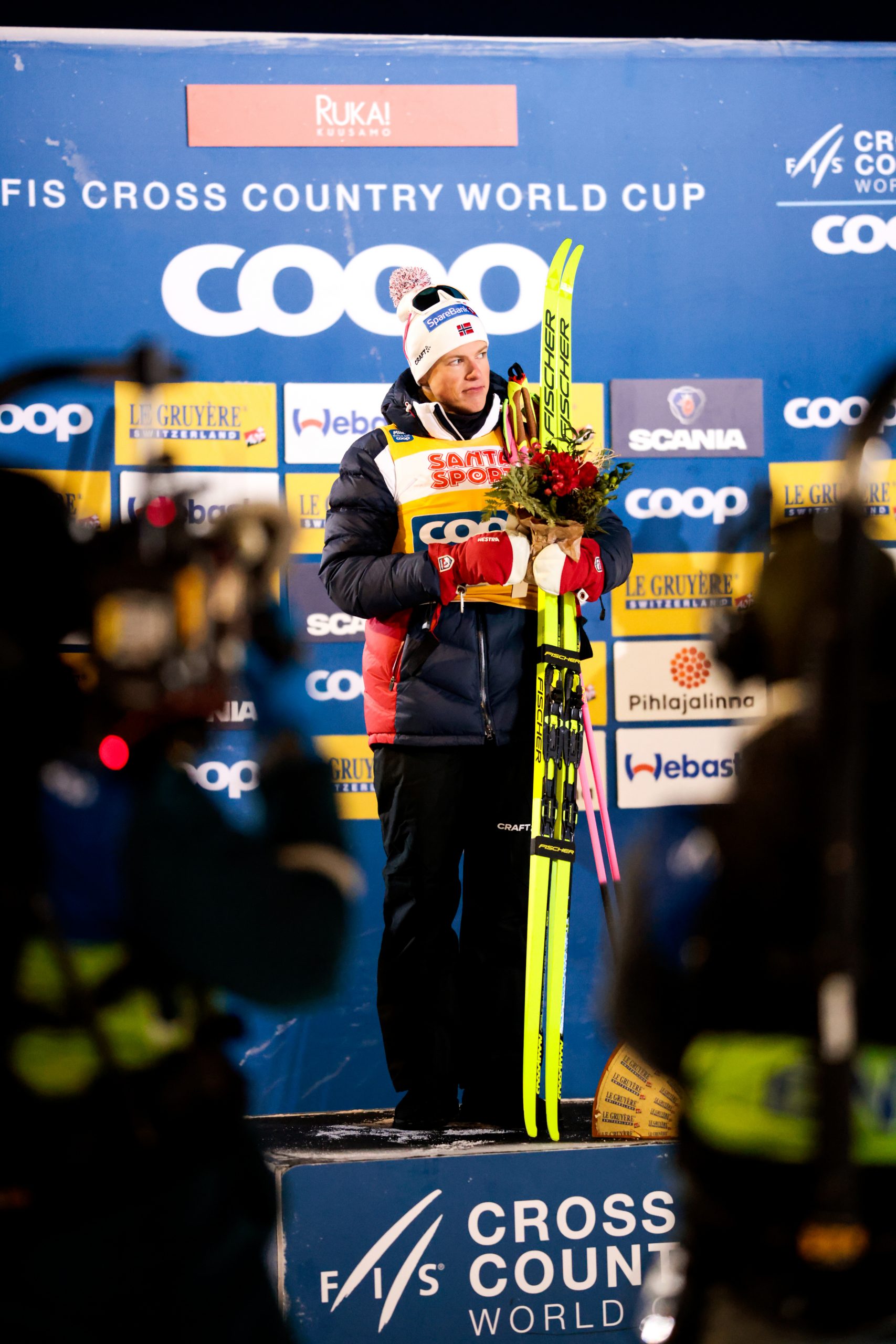
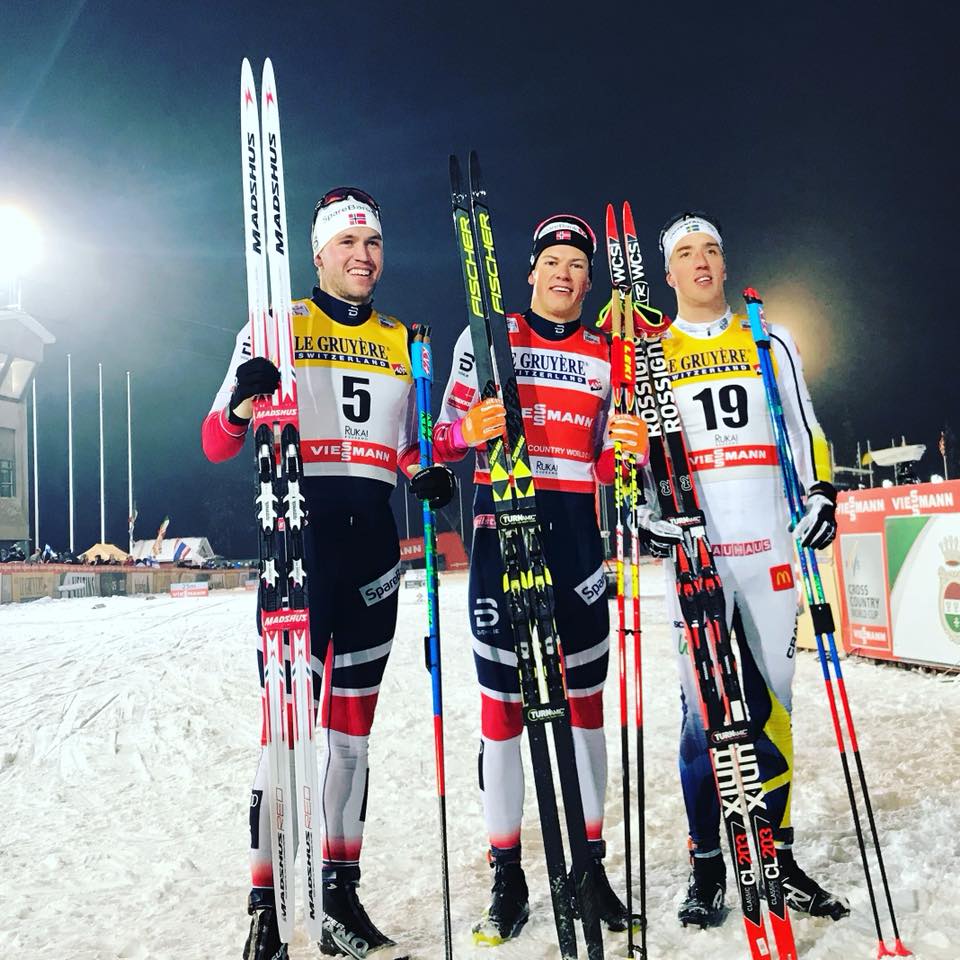
    Gus Schumacher (USA), Paal Golberg (NOR) and Harald Oestberg Amundsen (NOR), (l-r) share the podium of the 20 k Mass Start Freestyle in Falun (SWE). (Photo: NordicFocus)
    Gus Schumacher (USA) and the staff of Team USA on the podium in Falun, Sweden. (Photo: Modica/NordicFocus)
  • Golberg Outsprints Klaebo in 20 k Classic. Schumacher Top American in 20th

    Golberg Outsprints Klaebo in 20 k Classic. Schumacher Top American in 20th

    This coverage is made possible through the generous support of Marty and Kathy Hall and A Hall Mark of Excellence Award. To learn more about A Hall Mark of Excellence Award, or to learn how you can support FasterSkier’s coverage, please contact info@fasterskier.com.

    After yesterday’s Sprints in Canmore, skiers today had their first opportunity to test their Classic legs when the 20 k Mass Start Classic was contested. Harald Oestberg Amundsen (NOR) has a commanding lead in both the Overall World Cup standings and the Distance competition. While Amundsen sits on top of the standings, a familiar contender—Johannes Hoesflot Klaebo (NOR)—has been clawing his way back up in the Distance standings and going into today was in fourth place behind countryman Simen Hegstad Krueger. While the Norwegians were battling for the top distance spots, North Americans were facing a different set of challenges.

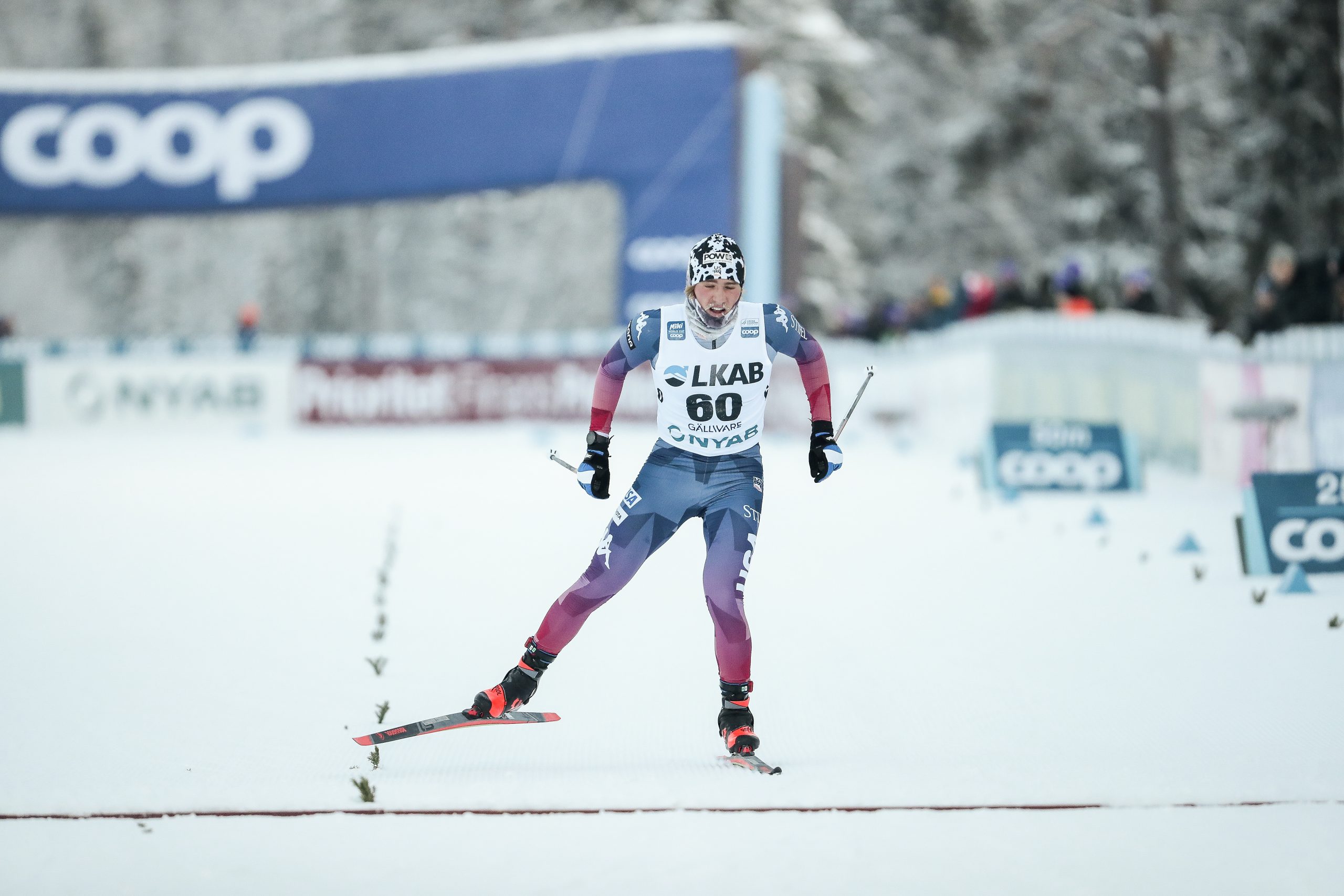
    Gus Schumacher (USA) (right) was the top American finisher. (Photo: NordicFocus)

    Today there were 12 Americans and 12 Canadians in the men’s field. Having such large teams is a new challenge for either country’s organizations. And while it’s been exciting for the veterans and rookies, managing such large numbers has been daunting. For the Americans, the challenge would include an extra layer of complexity. Not only would the team have to prepare skis for 12 racers for each race—first for the women, and then for the men—they would also have to dial in kick zones for the Classic race: all while integrating 27 staff members into the process. Also complicating things is that the team is working out of a wax trailer instead of their usual wax truck. It’s a lot to manage in a short amount of time. But the presence of so many new skiers is having an impact. After the race Gus Schumacher observed about all the newcomers that, “it’s so cool to have a big group here, to see these young guys have some success.”

    David Norris (USA) had to overcome an early fall to finish 33rd. (Photo: NordicFocus)

    Things were further complicated when Scott Patterson (USA) did not start. He told FasterSkier’s Nat Herz that he had an incident this morning when he fell and hit his head. He may have had a mild concussion, so he decided to scratch from the race. Ben Ogden also chose not to start. So, before the race even began, team USA was down two racers.

    In a race full of back-and-forth lead changes, it was Paal Golberg (NOR) outsprinting Klaebo at the finish to take the victory. Mattis Stenshagen (NOR) finished third for his first World Cup individual podium.

    Paal Golberg (NOR) in a shocking finish outsprinted Johannes Hoesflot Klaebo (NOR) to take the victory. (Photo: NordicFocus)

    Gus Schumacher ended up being the top American in 20th place. The next American finisher was David Norris in 33rd who fell early in the race to disrupt his performance. He was followed by Hunter Wonders 34th, Zanden McMullen 36th, Luke Jager 43rd, Michael Earnhart 44th, Peter Wolter 45th, Will Koch 46th, Michigan native Reid Goble 50th, Braden Becker 53rd, and Graham Houtsma 56th.

    The top Canadian finisher was Antoine Cyr finishing 16th. Behind him were Samuel Gary Hendry 21st, Oliver Leveille 37th, Remi Drolet 42nd, Xavier McKeever 49th, Scott James Hill 52nd, Aidan Kirkham 55th, Eamon Wilson 57th, Micah Steinberg 58th, and Adam Heale 59th. Leo Grandbois and Felix-Olivier Moreau did not finish.

    Men’s 20 k Mass Start Classic

    Early on, it was Klaebo at the front setting the pace along with Erik Valnes (NOR) and Stenshagen. Martin Loewstroem Nyenget (NOR) was also at the front early keeping the pace honest. However, 4.2 kilometers into the race, the pack was still largely intact.

    As the competitors began their second lap, Nyenget was still out front pushing the pace. While the tempo wasn’t blistering fast, it was still a very legitimate pace. At 7.5 kilometers skiers taking on nourishment at an aid station consolidated the group even more. But there was a bonus sprint at 9.3 kilometers that was about to string out the field. Golberg, Klaebo and Mika Vermeulen (SUI) formed a wall at the front and controlled the group.

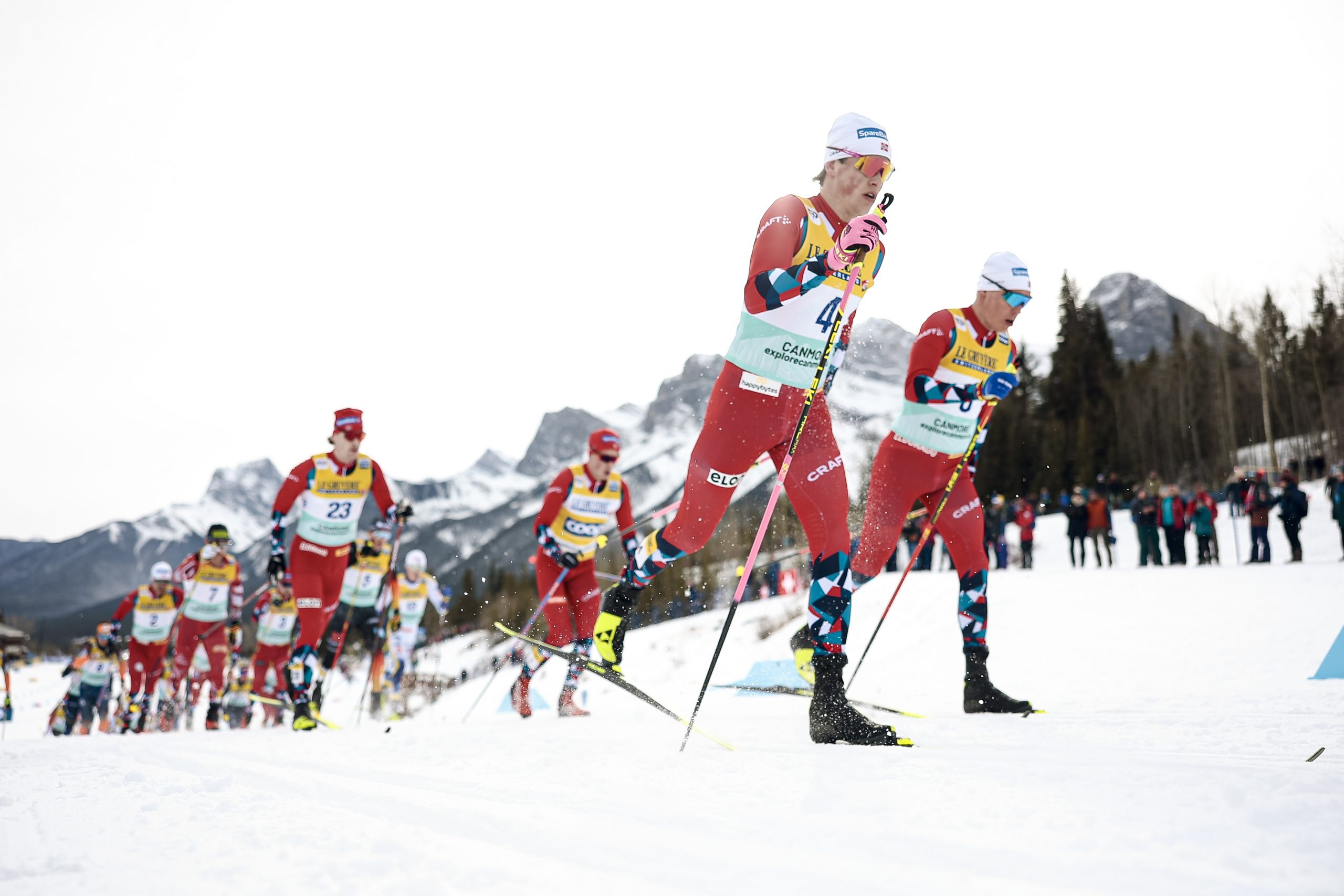
    A large nation’s quota provided a lot of fresh faces in Canmore for the USA and Canada. Scott James Hill (CAN), Reid Goble (USA), Niilo Moilanen (FIN), David Norris (USA), Will Koch (USA), Leo Grandbois (CAN), Florian Knopf (GER), (l-r) (Photo: NordicFocus)

    As the pack approached the bonus sprint, it was a mostly red Norwegian wave leading the charge when Klaebo shot to the front to take the most bonus points possible. But Amundsen and Valnes were right behind him, so Klaebo didn’t gain much ground on them in the Distance standings. The first non-Norwegian to take a bonus point was Thomas Maloney Westgaard of Ireland. After the sprint, Westgaard stayed with the leaders for a bit, but was unable to sustain the pace. The top American was Gus Schumacher in 27th, but he was only five seconds off the lead.

    With Johannes Hoesflot Klaebo (NOR) out front in the finishing stretch, the safe bet was that he would win. (Photo: NordicFocus)

    Then at 10.5 kilometers, Jens Burman (SWE) decided to make a solo break. Given the large hills, it was a bold move since good descenders could make up a lot of time on the downhills (as Jessie Diggins had proven decisively in the women’s race). With Golberg and Amundsen out front of the chase group, there was a question as to just how long they would let Burman venture out on his own.

    With seven kilometers to go, Burman was still skiing alone, but now only with a five second lead. With a full Norwegian platoon behind him, it seemed extremely unlikely that he would be able to maintain his solo break. Sure enough, in just a few seconds the Norwegian squad hauled him in; Burman’s energy expenditure had seemingly been wasted.

    The next bonus sprint less than two kilometers away; the pack began to position itself for the chase. To his credit, Burman had been able to stay at the front after the pack had captured him. His teammate, William Poromaa, then decided to push the pace and went to the front with Klaebo marking his every move.

    As they approached the bonus mark at 15.9 kilometers, the lead pack had been reduced to 18 skiers. The Norwegian leaders had seen enough, and the red wave shot to the front with Klaebo again taking the lead at the bonus section. After all the Swedish heroics, it was Norwegians taking the first six bonus spots.

    Andrew Musgrave (GBR) then took a pull at the front. It has been a tough journey to North America for the Briton, and he was now pushing all of his chips into the middle of the table. It looked like podium or bust for Musgrave.

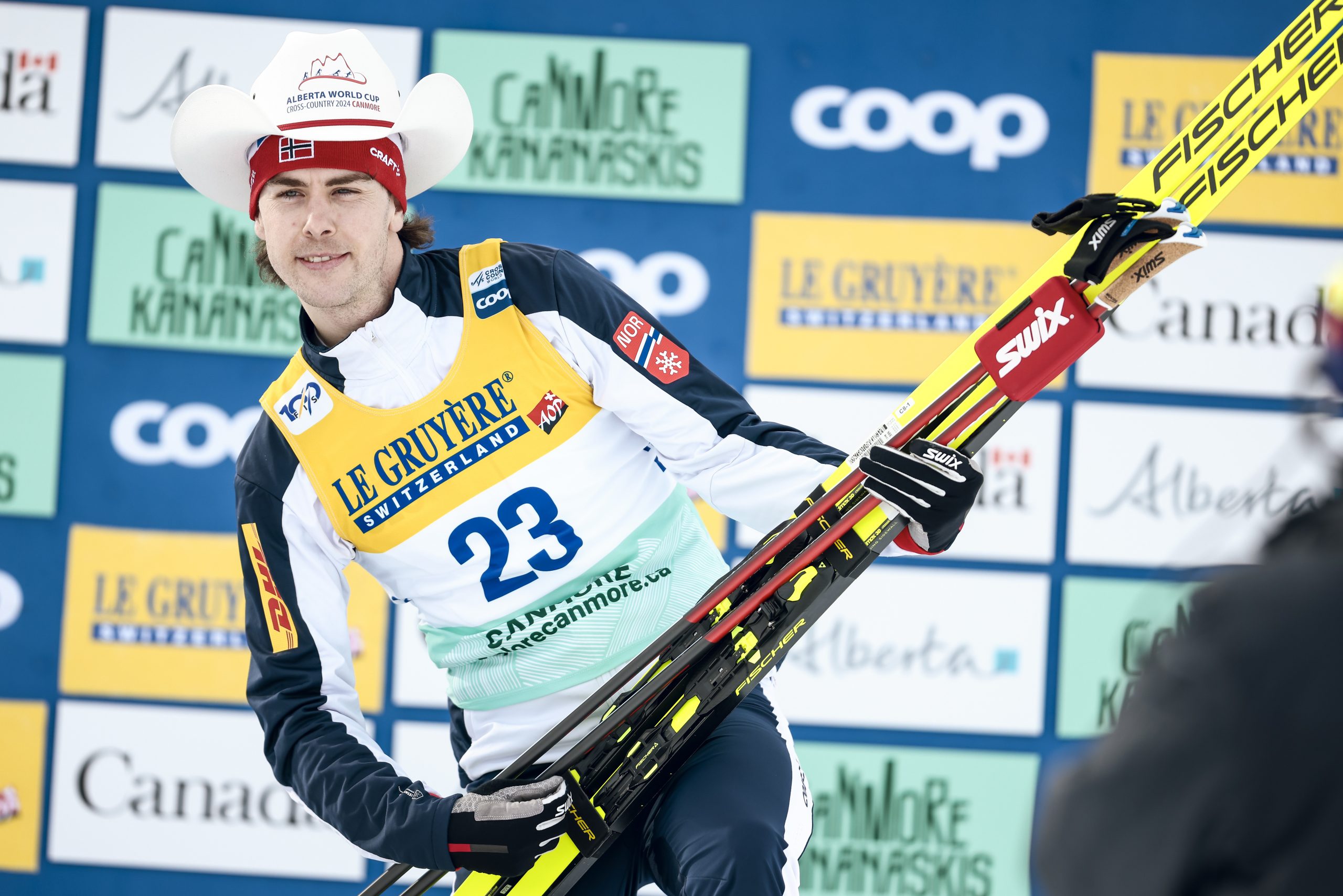
    27 year old Mattis Stenshagen (NOR) got into the cowboy spirit of celebrating after finishing third and getting his first individual World Cup podium. (Photo: NordicFocus)

    With only 2.5 kilometers to go, Krueger, Musgrave, Klaebo were at the front with Golberg and Amundsen joining them to dominate the pace. With the long straight finish looming, the odds were good that unless the other skiers were able to dispatch Klaebo soon, that he would outsprint them at the finish. Entering the final uphill leading into the stadium, Klaebo shot to the front but was unable to sprint away from the field. After Klaebo’s break failed, there was a giant pack going into the finish of 15 men. Klaebo again went to the front taking a very wide angle going into the stadium. Golberg and Klaebo were positioned in the front and quickly broke out into a double poling duel. The expectation was that in a sprint to the finish it would always be Klaebo taking the victory. But Golberg was able to find a gear that Klaebo could not match and shockingly Golberg was able to out double pole Klaebo to take the victory. Stenshagen held on for third. Musgrave’s gamble didn’t pay out as he finished eighth. Musgrave always seems to be a crowd favorite. When asked why he replied, “it’s very strange that a lot of people like me.” He continued that “I think it’s nice having someone from a non-skiing nation that can be up there.” When Gus Schumacher overheard the comment he laughingly interjected that, “you’re basically Norwegian!” To which Musgrave good naturedly responded “that’s such a lie!”

    It was an energetic race with a surprise finish that no one, other than perhaps Golberg, would have predicted.

    After the race, Golberg said his plan was to stay in front all the way. “I’m really looking forward to putting on the cowboy hat,” he said. It was another all-podium Norwegian finish with Norwegian men taking seven of the top ten spots.

    Men’s 20 k Mass Start Classic RESULTS

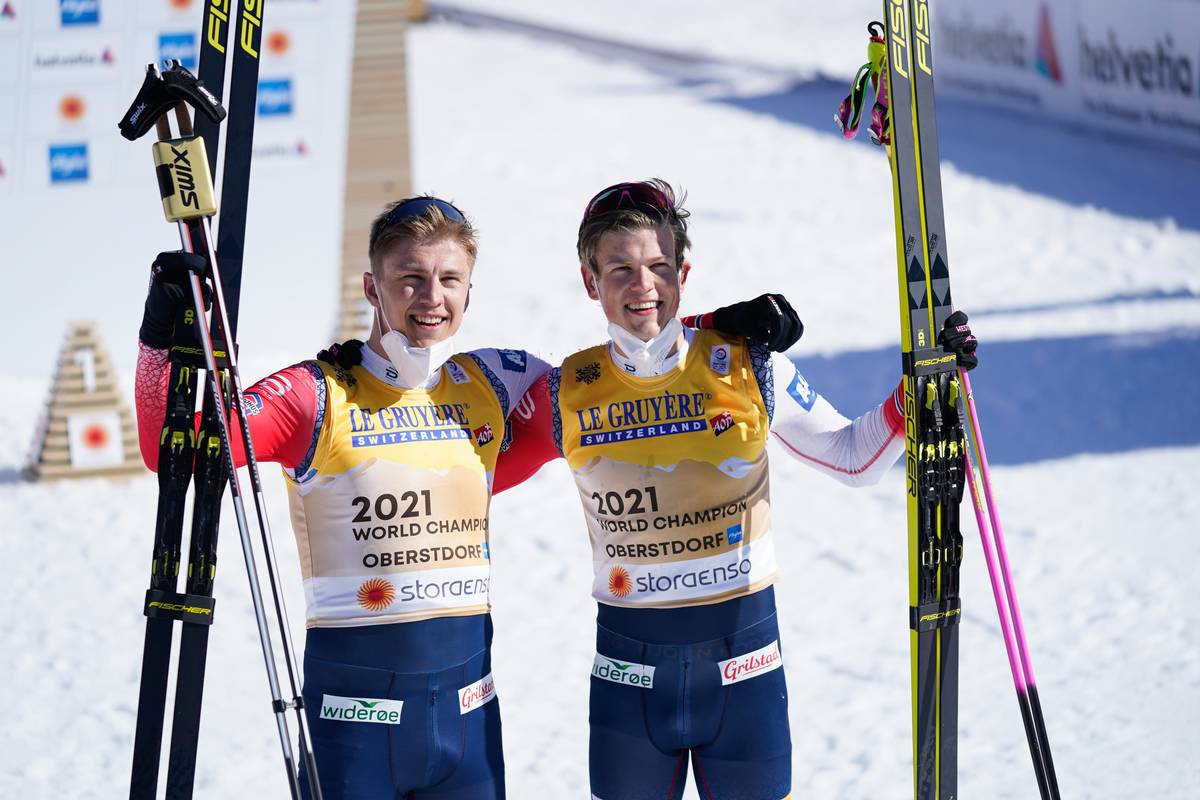
    Norwegians seem to really enjoy the cowboy hats. Johannes Hoesflot Klaebo (NOR), Paal Golberg (NOR), Mattis Stenshagen (NOR), (l-r) (Photo: NordicFocus)
  • Second Day in a Row—Valnes Emerges at the Front

    Second Day in a Row—Valnes Emerges at the Front


    This coverage is made possible through the generous support of Marty and Kathy Hall and A Hall Mark of Excellence Award. To learn more about A Hall Mark of Excellence Award, or to learn how you can support FasterSkier’s coverage, please contact info@fasterskier.com.

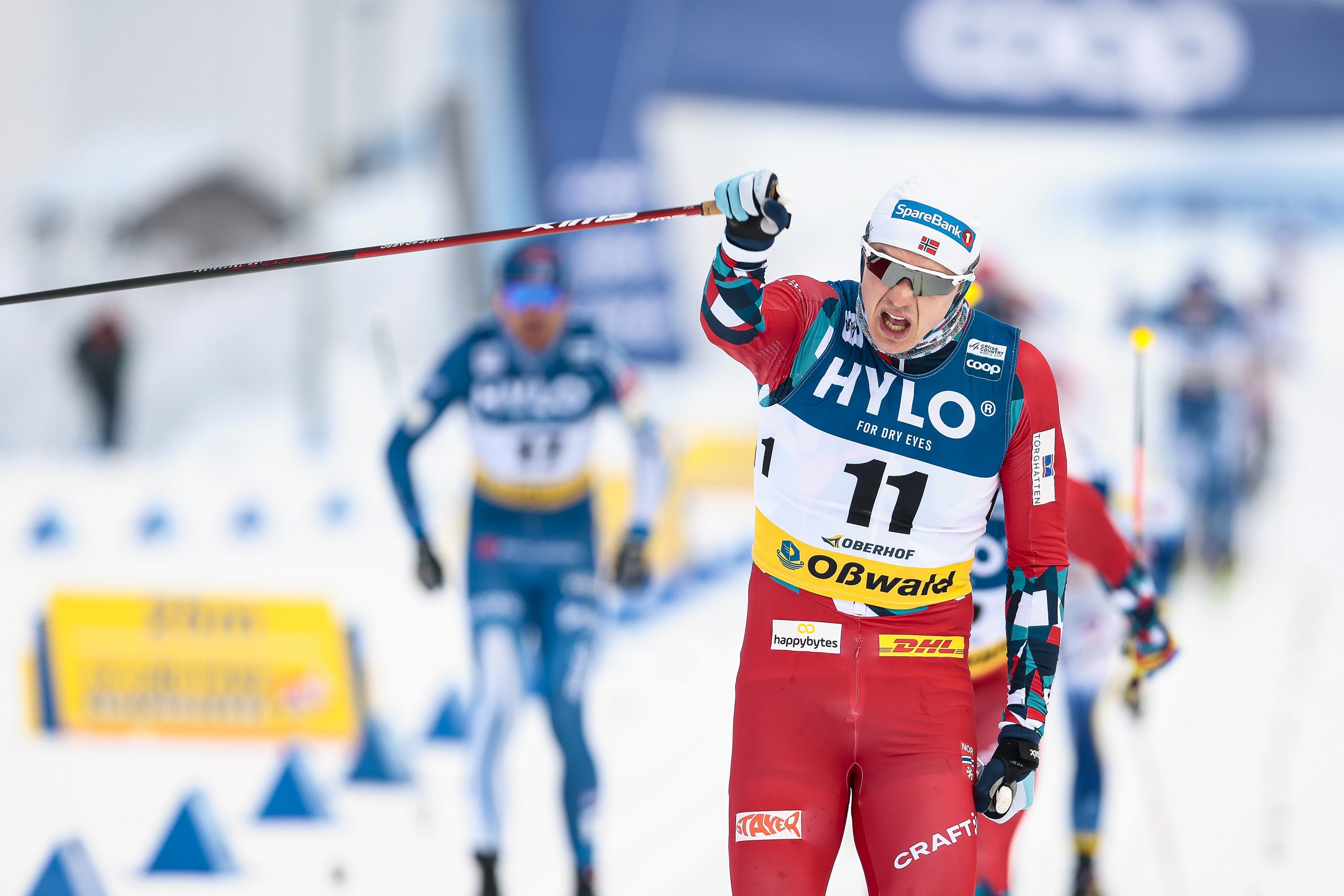
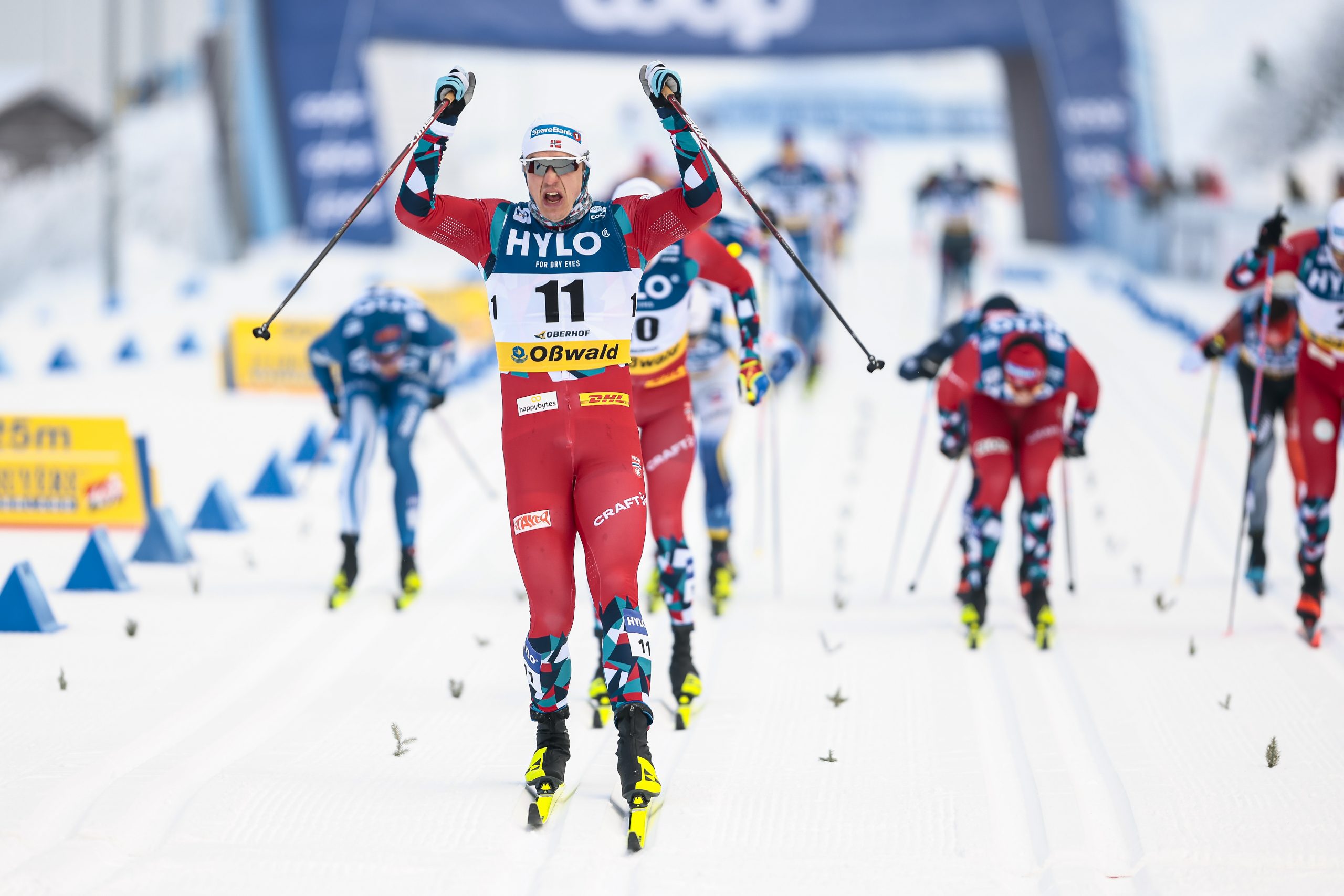
    Celebrating his second World Cup victory in as many days, Erik Valnes (NOR) punches through the finish line of the 20 k Classic Mass Start in Oberhof, Germany. (Photo: Modica/NordicFocus)

    For World Cup racers, mass start racing is always tense, nervous, high-risk, rough-and-tumble. Long skinny skis and long fragile poles make close-quarters racing—on courses seldom more than four tracks wide—a bit of a crap shoot. Contenders constantly press forward to secure spots near the front. Everyone wants to be near the leaders, out of trouble, in range of whatever breakaways may be attempted, but no one really wants to lead. Much can happen, opportunities can present themselves, disasters can occur. Just ask Scott Patterson (USA) who fell on one of the opening downhills and was forced to spend the rest of the day playing catch-up. On the other hand, on a day when the best skiers appeared to have well-matched skis (no apparent advantages in waxes, bases, or structure), and when the field is content to simply match pace and remain together, then mass start racing can seem a bit, well, boring.

    Fans hope for action, for dominance, for breakaways. for chases, for well-orchestrated sprints. So when we witness a ho-hum race, it’s relatively disappointing. Even comments made to reporters in the winner’s circle described tactics that served to make today’s racing less than exciting.

    “It was all about position, and staying in the top ten,” said race winner, Erik Valnes (NOR). “I was feeling very strong and just waiting for the finish.”

    “Staying in the top ten:” not exactly bumper-to-bumper NASCAR-style racing out there . . .

    While the pace was set by representatives of numerous nations—Finland, Italy, Sweden, Norway, Great Britain—the international field ultimately succumbed to Norwegian pressure in the closing meters. With his second victory in as many days, Valnes showed off the form that has propelled him to numerous wins this season. Behind him finished a string of his Norwegian teammates: Martin Loewstroem Nyenget, Paal Golberg, and Matti Stenshagen. Federico Pellegrino’s (ITA) fifth place finish was the first of the non-Norwegians, just ahead of Perttu Hyvarinen (FIN), William Poromaa (SWE), and Antoine Cyr (CAN).

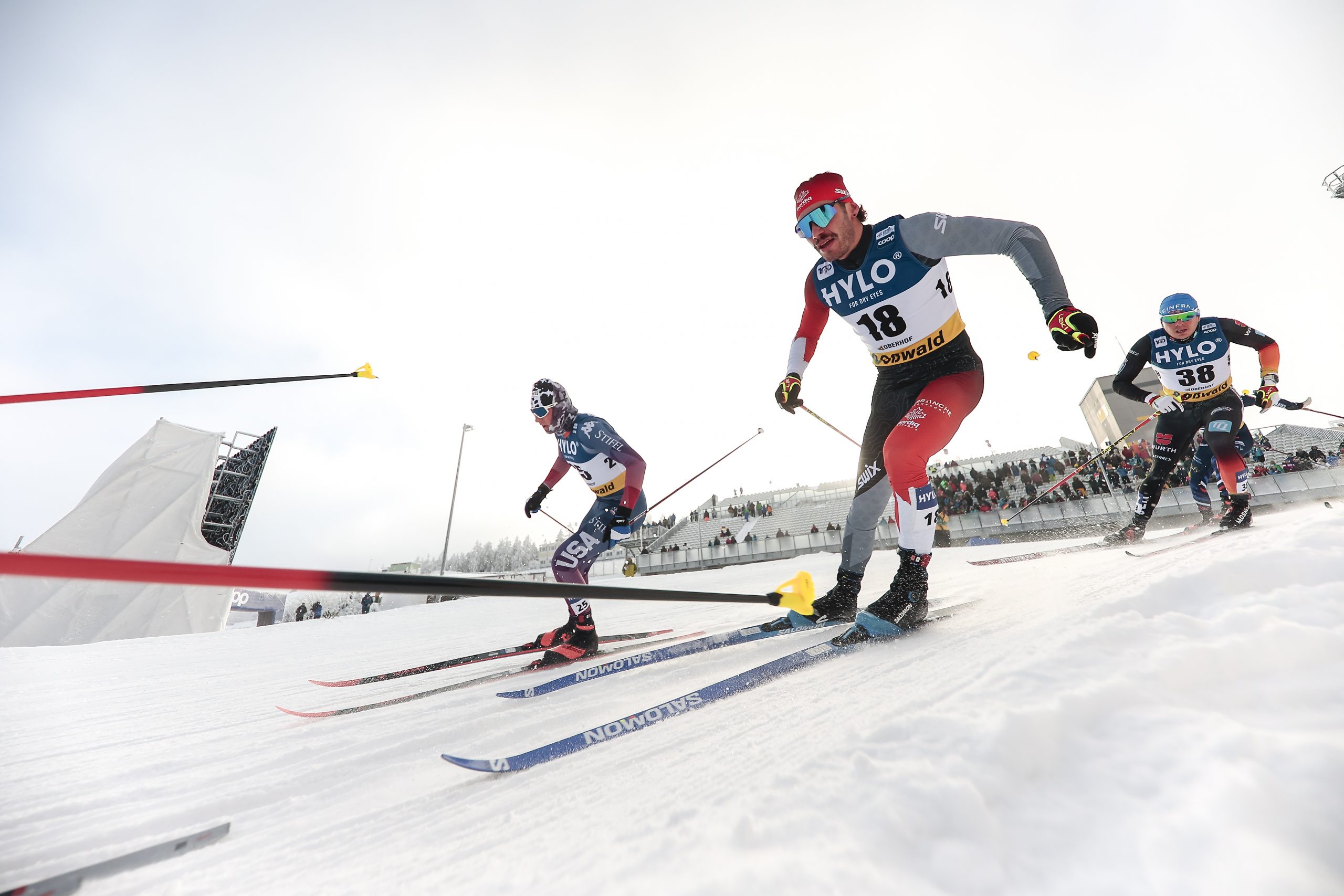
    Gus Schumacher (USA), Antoine Cyr (CAN), Lucas Boegl (GER), (l-r) navigate one of the many technical downhills on Oberhof’s 3.3 kilometer loop. (Photo: Modica/NordicFocus)

    North Americans were led by Cyr’s excellent eighth place finish, another top ten in his season of quality finishes. Other Canadian finishers included Olivier Leveille 33rd, Xavier McKeever 43rd, Max Hollman 49th, and Julien Locke 66th. American finishers included Zak Ketterson 40th, Gus Schumacher 44th, Scott Patterson 51st, Peter Wolter 55th, and JC Schoonmaker 60th. Perhaps recovering from his sixth place finish in Friday’s Classic Sprint, Ben Ogden chose not to start Saturday’s 20 k Classic Mass Start.

    Andrew Musgrave (GBR) was one of the contenders who consistently pushed the pace throughout the six laps of Oberhof’s 20 k Classic Mass Start. (Photo: Authamayou/NordicFocus)
    20 k Classic Mass Start

    Action in the 20 k Classic Mass Start was epitomized by conservative tactics and measured efforts, with different leaders setting the pace in each lap. After a season interrupted by illness, Iivo Niskanen (FIN) returned to the 20 k Class Mass Start, the race in which he is Olympic champion. He led much of Lap 1 ahead of a host of Norwegians who marked his pace. By the end of lap two, Niskanen had been absorbed by the group as Paal Golberg (NOR) led through the 6.6 kilometer checkpoint.

    Andrew Musgrave (GBR) led most of Lap 3, but the lead group was still a tightly assembled pack of 30+. The field came through the halfway point with Nyenget and Musgrave leading the way.

    During Johannes Hoesflot Klaebo’s (NOR) recent absence from World Cup racing, Erik Valnes (NOR) has begun to appear like the primary contender for World Cup race wins. The 20 k Classic Mass Start represented his second World Cup victory in as many days. (Photo: Modica/NordicFocus)

    Returning from illness that prevented his competing in the Tour de Ski, Johannes Hoesflot Klaebo (NOR) spent the day hovering in the middle of the lead pack. During Klaebo’s mid-season absence, Valnes—winner of Friday’s Sprint competition in Oberhof—has begun to appear like the man to beat in both sprint and distance events. Staying near the front throughout the day, Valnes led lap four while Niskanen also returned to the front of the field.

    Musgrave again pressed the issue in lap five, closely marked by Nyenget, Stenshagen, Valnes, and Klaebo. The field thinned to 20+; still, no significant breaks had occurred among contenders.

    Niskanen pressed forward to push the pace in the final lap. He knew he would need to shake off the sprinters if he had a chance of winning. The field did begin to string out, but Niskanen was marked closely by Valnes who showed no reluctance to trade leads at the front. In the end, Valnes simply pushed a pace that no one else could better. He extended his lead by a few meters as he crossed the finish line, his Norwegian teammates scrabbling for podium positions in his wake.

    20 k Classic Mass Start RESULTS

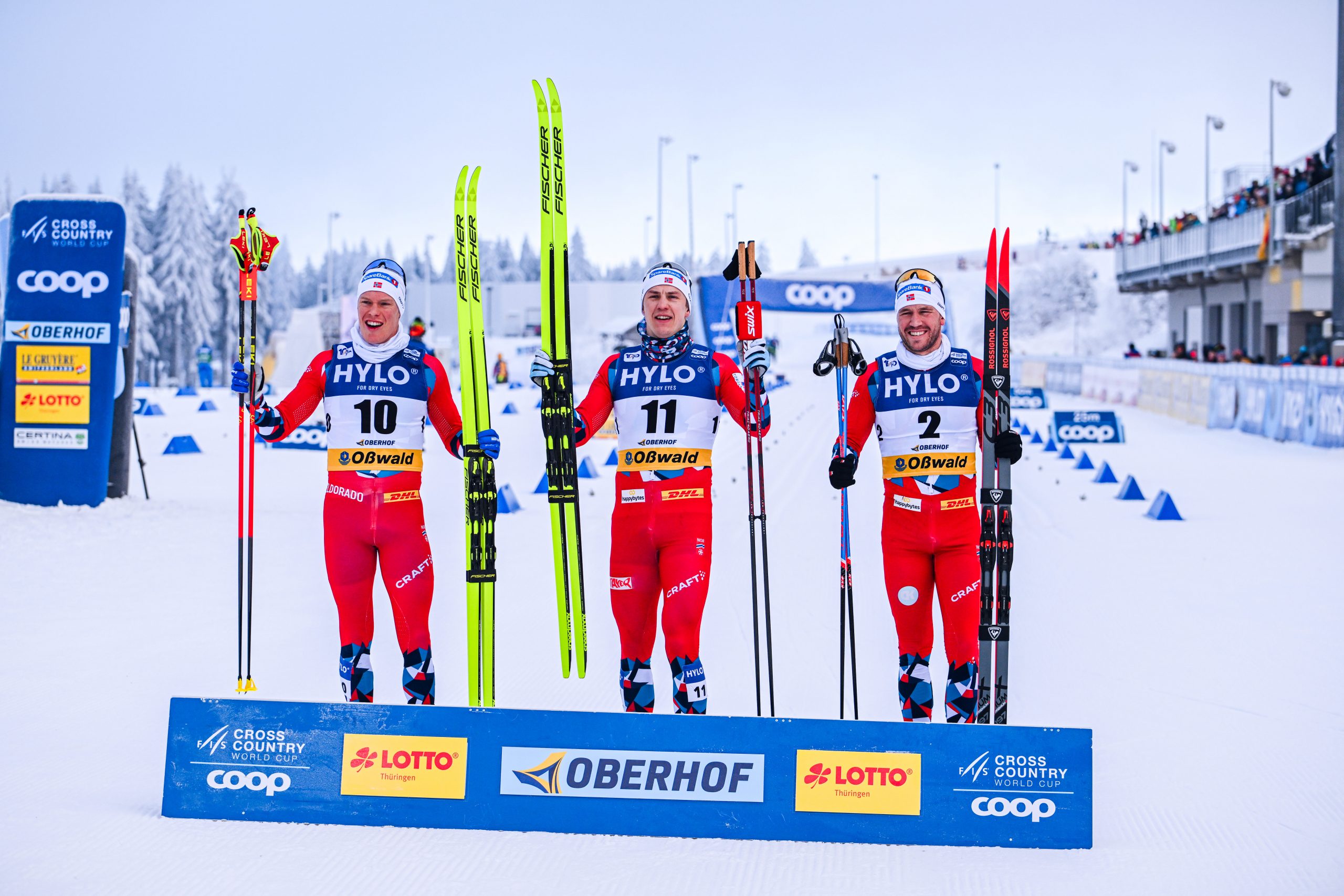
    Another all-Norwegian podium in Oberhoff, Germany. (L-R) Martin Loewstroem Nyenget (NOR) second, Erik Valnes (NOR) first, Paal Golberg (NOR) third in the World Cup 20 k Classic Mass Start. (Photo:  Authamayou/NordicFocus)
  • The Devon Kershaw Show: Recapping a frigid weekend in Gallivare

    The Devon Kershaw Show: Recapping a frigid weekend in Gallivare

    More smashing results from U.S. women, boring-on-paper but fun-to-watch racing from the Norwegian men’s distance team and some interlopers wearing similar colors, and a poorly-attended relay. Devon and Nat break it all down.

    Keep the feedback and questions coming: nat@fasterskier.com and devon@fasterskier.com. We’ll see you next week.


  • Schumacher 16th in World Cup 10 k as Norway Sweeps Podium

    Schumacher 16th in World Cup 10 k as Norway Sweeps Podium

    This coverage is made possible through the generous support of Marty and Kathy Hall and A Hall Mark of Excellence Award. To learn more about A Hall Mark of Excellence Award, or to learn how you can support FasterSkier’s coverage, please contact info@fasterskier.com.

    Paal Golberg (NOR) led Norway to a 10 k Freestyle podium sweep in the frigid Swedish weather. Golberg was able to master the pacing and the cold to outdistance his teammates. (Photo: NordicFocus)

    Today, the FIS World Cup moved to Gallivare, Sweden where a rolling course hosted the 10 kilometer interval start races. In the men’s race, the headline story was the absence of Johannes Hoesflot Klaebo who raced yesterday’s sprint in the Norwegian Cup series while he shakes off the effects of having contracted Covid. But Klaebo’s absence didn’t mean that team Norway was hurting for fire power. Evidence of Norway’s depth is the fact that Norwegian men have now won the last 21 individual men’s distance World Cup races, a streak going back to February of 2022 when Iivo Niskanen (FIN) was able to pierce the Norwegian armor. Going into Saturday’s race in Gallivare, Andrew Musgrave (GBR) held second place in the distance standings as he looked to continue his early season momentum. For the U.S., the conventional wisdom was that Gus Schumacher was team USA’s best shot at a top 20 finish.

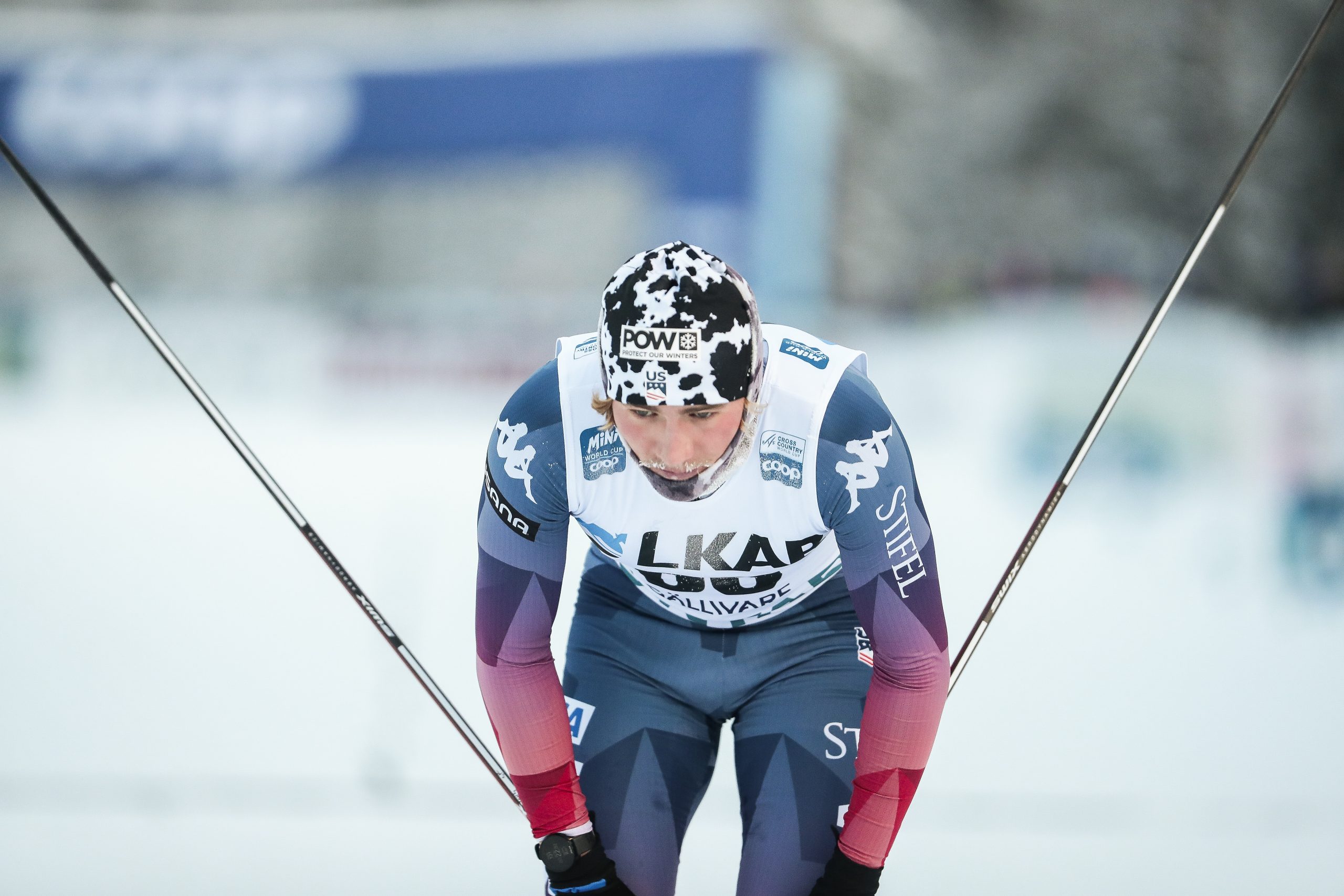
    Gus Schumacher (USA) led the Americans in the field: a 16th place finish for his second World Cup race in a row. (Photo: NordicFocus)

    When the racing concluded, it was all Norway (again) with Paal Golberg (NOR) finishing first, Harald Oestberg Amundsen (NOR) second, and Iver Tildheim Andersen(NOR) in third. Norway occupied six of the top seven spots. Only Musgrave—who almost counts as Norwegian as he lives and trains in Norway—was able to break up the Norwegian red wave. He finished the day in fifth.

    Gus Schumacher led all American finishers in 16th, followed by Ben Ogden 25th, Scott Patterson 35th, Zanden McMullen 36th, John Steel Hagenbuch 45th, Luke Jager 54th, and Zak Ketterson 58th.

    The top Canadian finisher was Antoine Cyr in 47th. Other Canadian finishers included Olivier Leveille 53rd, Graham Ritchie 56th, Xavier McKeever 57th, and Leo Grandbois 63rd.

    Gus Schumacher (USA) started out strong, but couldn’t put couldn’t quite keep up the pace for the second half of the race. He led all Americans, finishing 16th. (Photo: NordicFocus)

    It was another cold day for racers with a temperature of six degrees Fahrenheit at the start. The competition was tight for the entire race, though Golberg was able to manage the conditions best and did a masterful job pacing. At 3.9 kilometers, he was in seventh place, but gradually and consistently pushed his way into the lead at the 6.3 kilometer mark. Even then, he led by only the narrowest of margins: 0.8 seconds over teammate Didrik Toenseth. But once Golberg grabbed the lead, he kept the pedal down, fighting off a swarm of his teammates who were all only a few seconds behind him. In the final kilometer, he was able to muster a burst of acceleration that gave him a slight cushion. At the finish he was able to gap Amundsen by 4.2 seconds.

    After the race Golberg said that he felt good about doing so well in a freestyle race. “Today I felt really good … classic is usually my best technique.”

    The win propelled Golberg to the top of the World Cup distance standings, and second in overall ranking. Amundsen was able to keep the overall lead in the race for the Crystal Globe, and is in second place in the distance standings.

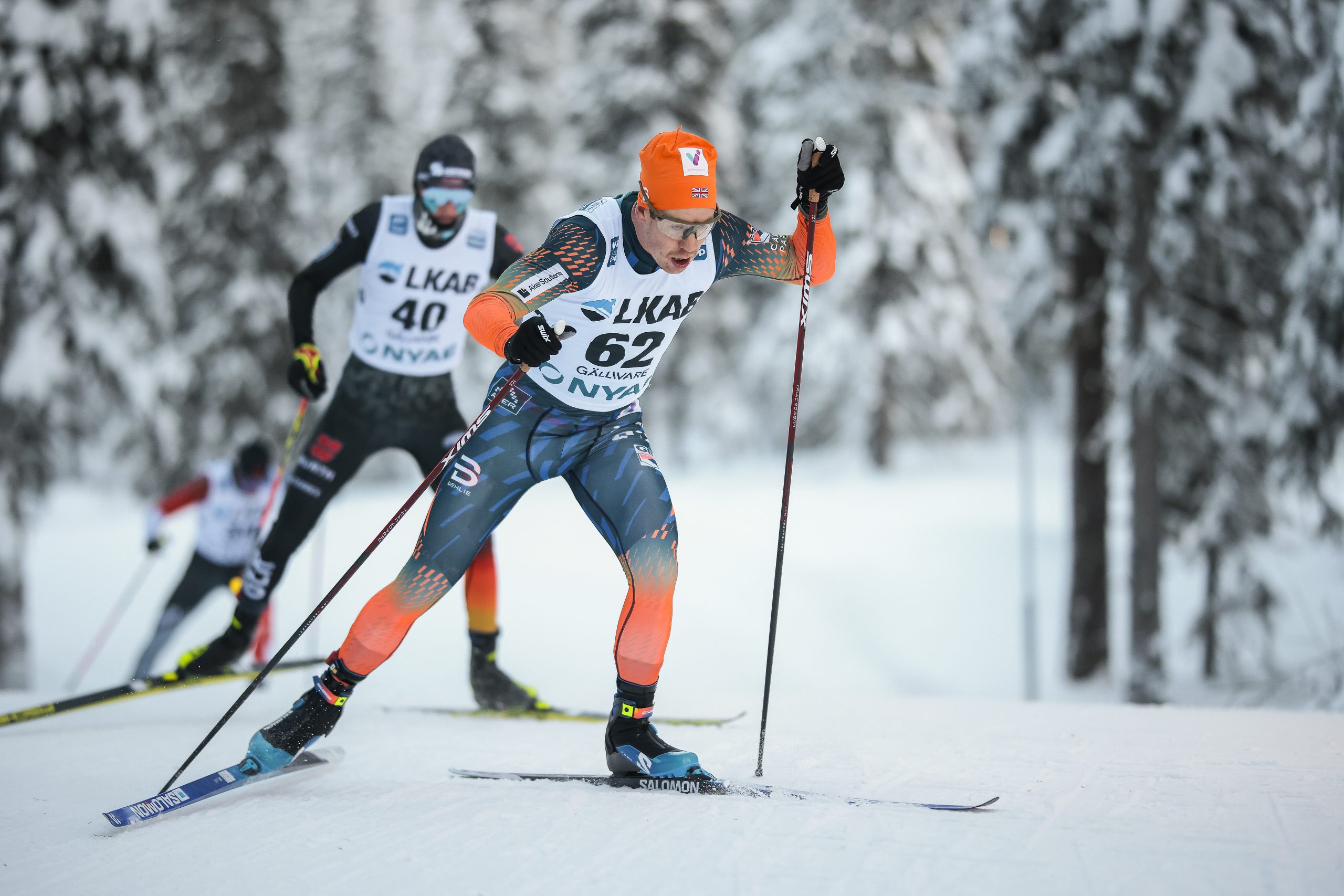
    Andrew Musgrave (GBR) gave his loyal followers a thrill, but missed the podium by a mere 1.3 seconds. He would finish the day in fifth. (Photo: NordicFocus)

    When the 33 year old Musgrave crossed the finish line, it looked like he might be able to give his fans a thrill, as he was in third place. But that standing could not be sustained as subsequent Norwegians pushed him off the podium. He would finish the day in fifth. Musgrave has been hovering around the podium this season finishing eighth and fifth last week in Ruka, but just missed breaking through again, this time by 1.3 seconds.

    Schumacher lived up to expectations with consistency being the name of the game, earning his second 16th place World Cup finish in a row. He went out fast: 12th at the first time check, only 4.3 seconds off the lead. By the halfway mark, he had dropped down to 14th, but was still only 10 seconds from the top. In the second half of the race, he began to slightly fade; at the 6.3 kilometer mark he had dropped to 19.5 seconds behind the leader. The gap continued to widen; ultimately, he finished 41 seconds from the top of the leader board.

    U.S. Coach, Matt Whitcomb, wasn’t concerned about Schumacher’s pace. “He was 9.9 seconds out of the lead after 5K. He bled another 30 seconds on the second lap,” Whitcomb said. “But it’s the start we were looking for. I do not consider it a missed pace race; I just think it was a pretty big swing. I’m always a big fan of aggressive pacing strategies. Some days, you just get through and it ends up being the race of a lifetime. He wasn’t floundering, he was still skiing very well and attacking, just not with the same freshness from lap one.”  Whitcomb added that everyone, including Schumacher, is pleased with his progress. “We were really excited to continue to see great performances out of Gus,” said Whitcomb. “This is the Gus Schumacher that we’ve been waiting for the last couple of years. He’s laying down some consistency and it’s great to see such hard work paying off.”

    It was a fine performance and established Schumacher as team USA’s most consistent performer in distance events. He sits 14th in the overall distance standings.

    Ben Ogden had his season-best distance race, finishing 25th. “He started conservatively, for Ben,” Whitcomb observed. “We all know the standard Ben Ogden pace which is to explode out of a cannon. Today he kept things under wraps, and just kept picking people off. I think 10k freestyle is low hanging fruit for races he can improve in.”

    Tomorrow, the men and women move on to 4 x 7.5km relays.

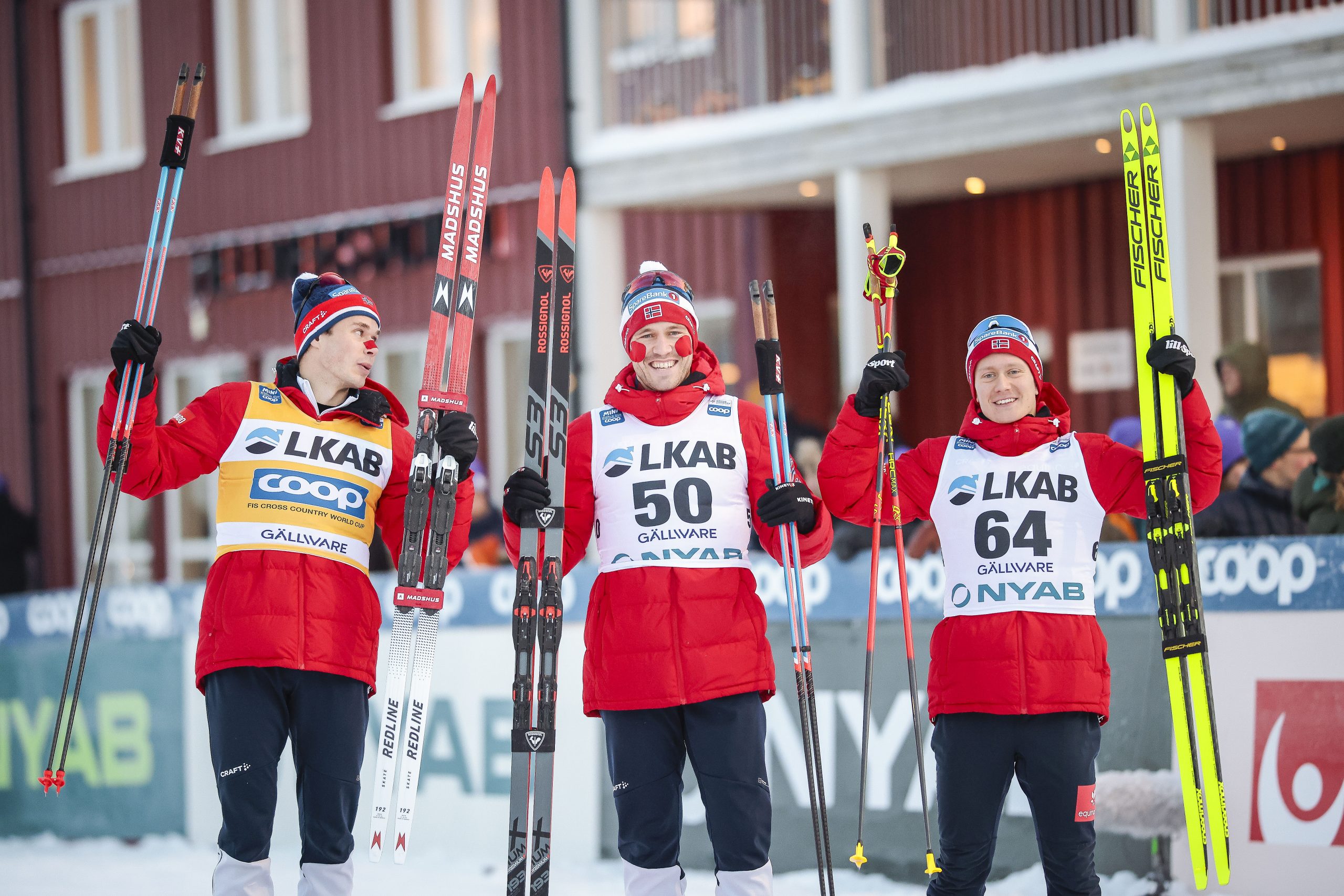
    Harald Oestberg Amundsen (NOR), Paal Golberg (NOR), Iver Tildheim Andersen (NOR), (l-r) swept the podium for Norway. (Photo: NordicFocus)

    Men’s 10 k Freestyle Interval Start RESULTS

  • Golberg Outsprints Klaebo to Claim Gold in Men’s 50 K, Patterson 16th

    Golberg Outsprints Klaebo to Claim Gold in Men’s 50 K, Patterson 16th

    This World Cup coverage is made possible through the generous support of Marty and Kathy Hall and A Hall Mark of Excellence Award. To learn more about A Hall Mark of Excellence Award, or to learn how you can support FasterSkier’s coverage, please contact info@fasterskier.com

    The long and winding road that is cross-country skiing’s World Championships came to an end today. The last stop: the men’s 50 kilometer Classic Mass Start. Throughout the men’s competitions, the story has been Norway; Johannes Klaebo’s domination, team Norway’s supremacy, and the competition amongst the Norwegian team members. Norway was expected to dominate again today, but there were many sub-plots within that expectation: one of the biggest was the performance of  Klaebo.  Touted by some as the greatest ever, but skeptics note that Klaebo hasn’t been nearly as impressive in distance events as other legendary skiers who came before. Klaebo has never been on the podium in a 50 kilometer race at a major event. To cement his name in conversations about G.O.A.T status, Klaebo would probably need to have a victory. He would also be trying to redeem himself after having been disqualified at the finish in the last World Championships 50 kilometer race when he interfered with Alexander Bolshunov (RUS).

    Standing in Klaebo’s way would be what appeared to be a busload of Norwegian men. Finnish Classic standout Iivo Niskanen—who always seems to perform well in major events—would also present a major roadblock, with his eyes firmly on the podium in a long Classic race: his forte. America would look to Scott Patterson to lead the way for team USA, with Patterson having previously placed in the top 10 at 50 k in the Olympics and World Championships.

    When the end of the World Championship Road was reached, it was Norway dominating again but with a somewhat surprising finishing order. Golberg finished first, out-sprinting Klaebo at the finish. William Poromaa (SWE) was third.

    Scott Patterson (USA) had another excellent distance race for team USA finishing 16th (Photo: NordicFocus)
    Men’s 50 kilometer Classic Mass Start

    In 40 degree weather (4.4 C), with slow wet conditions, it was apparent early that the seven lap course would make for a race of attrition. It was also clear that the single allowed ski change could play a critical role.

    As is typical in men’s distance racing, the skiers set out at an initially fast pace, then quickly settled down into the long grinding speed that would typify most of the race.

    Scott Patterson (USA), was able to hang with the leaders early on. (Photo: NordicFocus)

    At the 4.3 k mark, it looked good for team USA with Patterson at the front of the race. Also near the front was perennial crowd favorite, Andrew Musgrave (GBR).  But as the race ground on the favorites began to rise to the top, while the Americans and Musgrave drifted back.

    Much to everyone’s surprise, Johannes Hoesflot Klaebo (NOR) was out-sprinted at the finish. (Photo: NordicFocus)

    At 6.4 k, two Italians—Federico Pellegrino and Francesco De Fabiani—joined Golberg at the front to quicken the pace. Klaebo was 23rd, but only 5.2 seconds back. At this juncture, Klaebo’s strategy became clear. He would not lead. Instead, he would be content to mark the leaders the entire way and then rely upon his devastating sprinting ability to bring in the win. It was a sound strategy for the strongest sprinter in the field, but one that would not pan out today.

    With the abundant heat and sun, the nutrition hand-ups were frequent, giving skiers an opportunity to make a move when others were being handed food and drink. This is exactly what Niskanen did at the 13 k mark; taking five skiers with him. This was the first time in the race when the field truly began to string out. But, during the next feed, the front of the race regrouped. This elastic effect continued throughout the next several kilometers with surges and contractions geared around hills, corners, and feed zones.

    It was at about the halfway point when the hot grind of an hour’s racing began to take its toll and a true lead pack of about 13 skiers established a gap with Golberg and Nyenget still setting the pace. Golberg had now been out front for the last five kilometers.

    David Norris (USA) finished 22nd having won the American Birkebeiner Saturday, then flew to Europe to race in the World Championships. (Photo: NordicFocus)

    The North American contingent was led by Wonders, Patterson, Gus Schumacher (USA), David Norris (USA) and, Oliver Leveille (CAN). All were in a chase group 14 to 22 seconds off the lead. Fans were eager to see how Norris would perform. He won the American Birkebeiner last Saturday and made the unprecedented decision to fly to the World Championships to race the marathon. After the race, Norris told FasterSkier that he had arrived Tuesday morning and was satisfied with the way his body had adapted. He forced himself to stay up late every night to adjust to jetlag. “I don’t think jetlag was affecting the race at all.”

    At 28.4  kilometers Toenseth made a push to the front. Klaebo, who still had not led, was just a couple of seconds behind the leaders. The grinding race of attrition continued and it became clear that the winners would come out of the lead pack of 13 skiers. A surprise skier in the lead group was Snorri Einarsson of Iceland. Einarsson would go on to have one of his best finishes ever, finishing 15th.

    With two laps remaining, every one of the now 11 lead skiers opted to stop at the ski exchange. During the exchange, there was a crash involving Niskanen and Jens Burman (SWE),when Niskanen cut in front of the Swede on his way into the ski corral. The tangle knocked Burman to the ground but didn’t seem to harm his time in the exchange or affect Niskanen.

    David Norris (USA), Scott Patterson (USA), Gus Schumacher (USA), (l-r) were able to ski as a pack in the middle stage of the race. (Photo: NordicFocus)

    The biggest surprise in the lead group was the presence of 23 year old Frenchman, Theo Schely, who is somewhat of an unknown outside France. Schely does not have a top 20 finish in a World Cup distance race, but was seemingly undeterred by the pace. He ended up finishing ninth in what was unquestionably the second biggest surprise of the day.

    At about 43 kilometers the action livened up as Burman crashed in a corner, pushing him toward the back. At about the same time De Fabiani (ITA) broke a pole, and he was pushed out the back. With five kilometers left the race had boiled down to all the favorites with nine skiers lining up for finishing attacks. Toenseth dialed up the pace with Niskanen going along with him. Niskanen continued to push the pace—hard—but was unable to pull away from the chasers. But this reduced the field to only seven skiers, with Poromaa going with Niskanen at the front. Klaebo still sat in the middle of the pack, matching the leader’s moves but never leading.

    Paal Golberg (NOR) celebrates at the finish having just shocked everyone—himself included—by sprinting past Johannes Klaebo (NOR). (Photo: NordicFocus)

    At the two hour mark, with one kilometer to go, the race turned into an all out sprint with Golberg pushing to the front and Klaebo going with him in second place. It was here where the biggest surprise of the day took place. The pace was blistering with Klaebo charging up the final hill. Everyone watching expected Klaebo to turn on his famous sprint and pull away. But Golberg had a devastating sprint which Klaebo could not match.  Klaebo faded in the last 100 meters and Goldberg surged, pulling away from Klaebo, putting him in second place, with Poromaa hanging on to finish third. After the race Golberg admitted his surprise in beating Klaebo. “I had amazing skis,” he said. “I didn’t think I could take Johannes.”

    Regarding the race’s finish Norwegian, coach Eirik Nossum said that he was “really impressed by Paal [Golberg]. He’s had such a good season, today is icing on the cake. Every guy who beats Johannes in a finish is shocking, but it’s hard to have a sprint after 50k. You can’t just order it…it’s hard…even for Johannes.”

    William Poromaa (SWE) ended Sweden’s medal drought, finishing third. (Photo: NordicFocus)

    It was also a big day for Sweden. Head coach Anders Bystrom told FasterSkier that, “finally we got the medal, and it’s so important for the whole sport in Sweden. The women are so great, the men have been in the shadow of the women, so this is really important.” Calle Halfvarsson, who finished fourth reiterated to FasterSkier the medal’s importance to Sweden. “We, the men, don’t yet have any medals,” he said. “It was really good that we could take [a medal].” Halfvarsson also commented on Klaebo’s performance in distance events: “Today showed that Klaebo is human. “

    After the race, Patterson told FasterSkier that he had missed a couple of crucial feeds. He also expressed dissatisfaction with his race tactics. “I should have swapped [skis] earlier.”

    Schumacher told FasterSkier that “My energy definitely tailed off towards the end, but I felt like I skied well the whole time.”

    At the end of the World Championship Road, Norway was still supreme with only the finishing order being a shocker: Golberg outsprinting Klaebo at the finish, stunning the crowd and completing the World Championships on a surprising note.

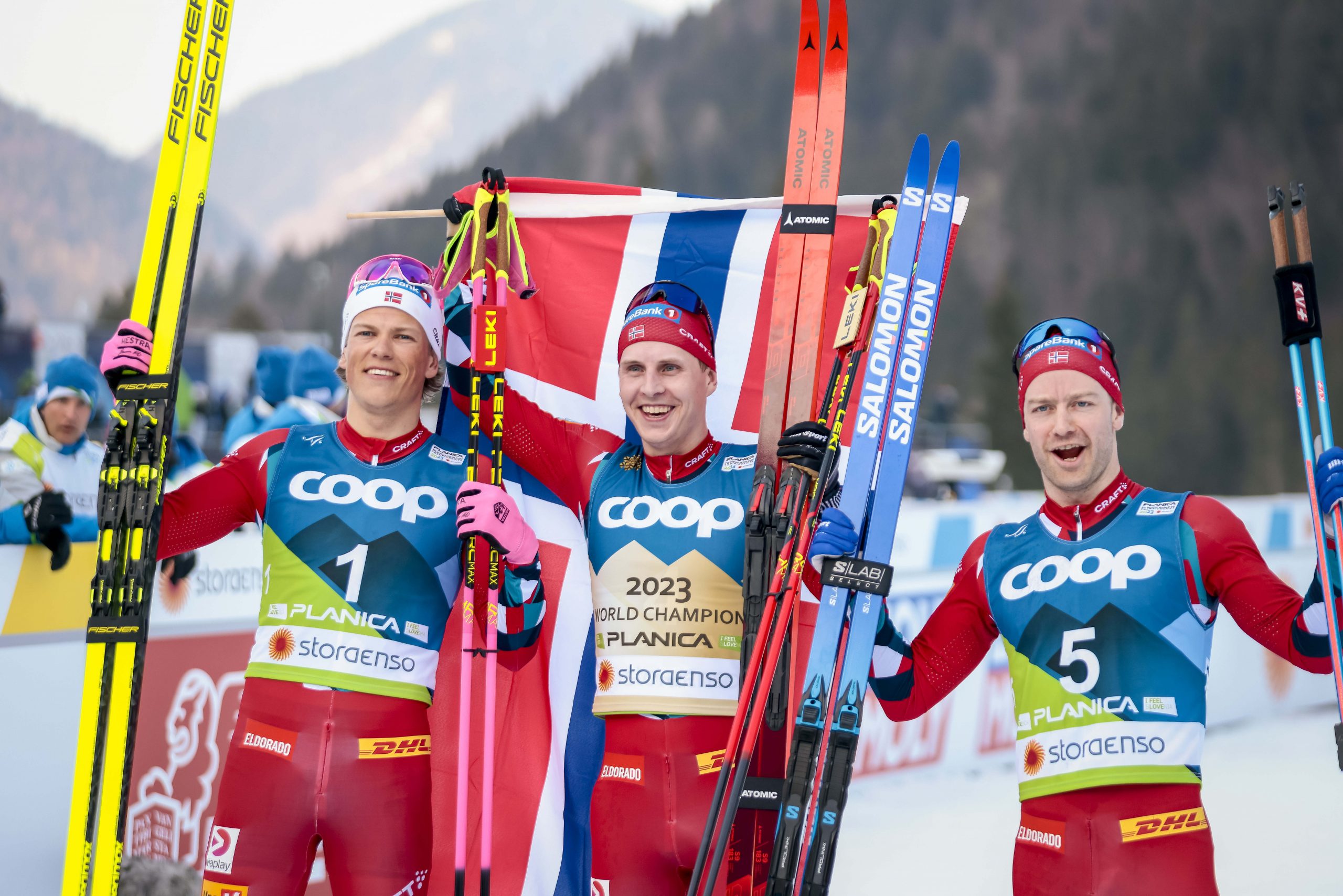
    Johannes Hoesflot Klaebo (NOR), Paal Golberg (NOR), William Poromaa (SWE) celebrate podium finishes to cap off the World Championships. (Photo: NordicFocus)

    World Championship Men’s 50 K Classic Mass Start RESULTS


  • Team Sprint: Klaebo Captures Third Medal, Canada Impresses in Fourth

    Team Sprint: Klaebo Captures Third Medal, Canada Impresses in Fourth

    This World Cup coverage is made possible through the generous support of Marty and Kathy Hall and A Hall Mark of Excellence Award. To learn more about A Hall Mark of Excellence Award, or to learn how you can support FasterSkier’s coverage, please contact info@fasterskier.com

    Johannes Hoesflot Klaebo (NOR) approaches the finish line ahead of Italy’s Federico Pellegrino. (Photo: Modica/NordicFocus)

    Three races: three medals. Johannes Hoesflot Klaebo (NOR) pursues the history that is available to him, but the history he pursues is likely to be marked with an Asterisk. He is one of the few skiers scheduled to compete in every event at these World Championships, and he is expected to medal in every event. Even so, Klaebo, himself, reminded reporters that Saturday’s silver medal in the 30 k Skiathlon was his first World Championship distance medal. He hasn’t always enjoyed this sort of dominance. And while many of the very finest skiers are here in Planica, many of the very finest are not. If Russian skiers were at these World Championships, Klaebo might still be collecting medals, but the racing would be quite different. As it is, the Russians languish at home, their exclusion from these championships (and from theWorld Cup tour) coming as a result of their government’s invasion of Ukraine. The championships go on without them, leaving predictable foregone conclusions: Norway the team to beat, Norway the favorite for victory, Norway on the podium, Norway with the gold. These are the World Championships of Cross Country Skiing . . . and Norway is the team to watch.

    Antoine Cyr (CAN), and Graham Ritchie (CAN) celebrate their fourth place finish in the Team Sprint at the FIS Cross Country World championships in Planica, Slovenia. (Photo:  Modica/NordicFocus)

    Team Norway—Klaebo and compatriot Paal Golberg—did not disappoint in the Team Sprint, holding off second place Federico Pellegrino and  Francesco de Fabiani of Italy, and third place Renaud Jay and Richard Jouve of France. Among North American teams, Canada was truly remarkable with Antoine Cyr and Graham Ritchie finishing fourth, while Ben Ogden and JC Schoonmaker of the United States finished tenth.

    Men’s Team Sprint

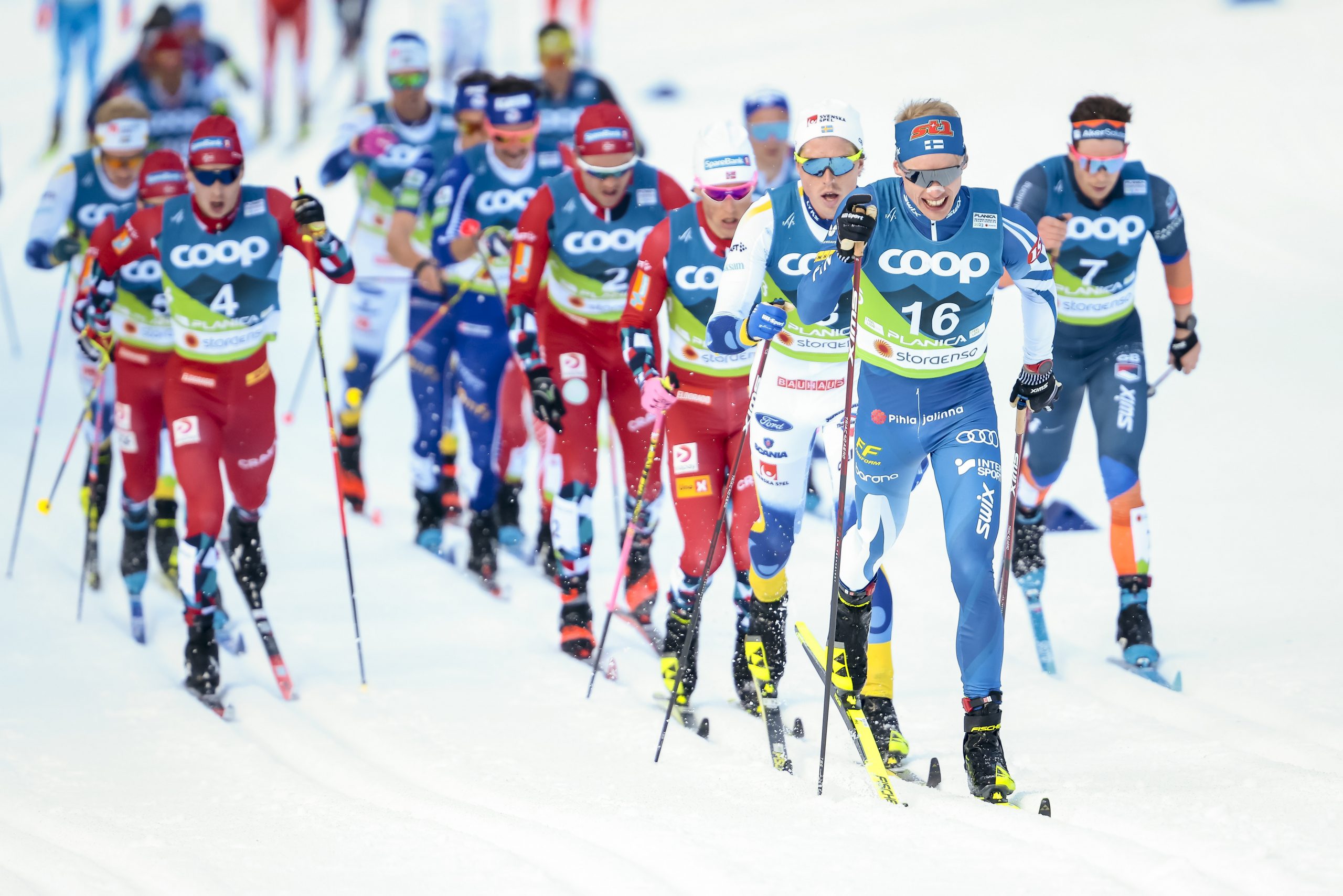
    Having watched the success of Julia Kern (USA) and Jessie Diggins (USA) in the earlier Women’s Team Sprint, it came as no surprise to see Schoonmaker following the example that had earned bronze for his teammates. Schoonmaker moved early to take the first position into the long rolling downhill at the beginning of the Planica course. Golberg and Jay were quick to counter the move, and Golberg went to the front of the pack on the climb with Jay in tow. Schoonmaker held third through the climb, but Golberg’s arrival at the front had subdued the field. Whereas the women’s race had gone full bore from the gun, the men’s race settled into a slightly more tactical affair. Schoonmaker handed off to Ogden in fifth place, with the pack tightly bunched.

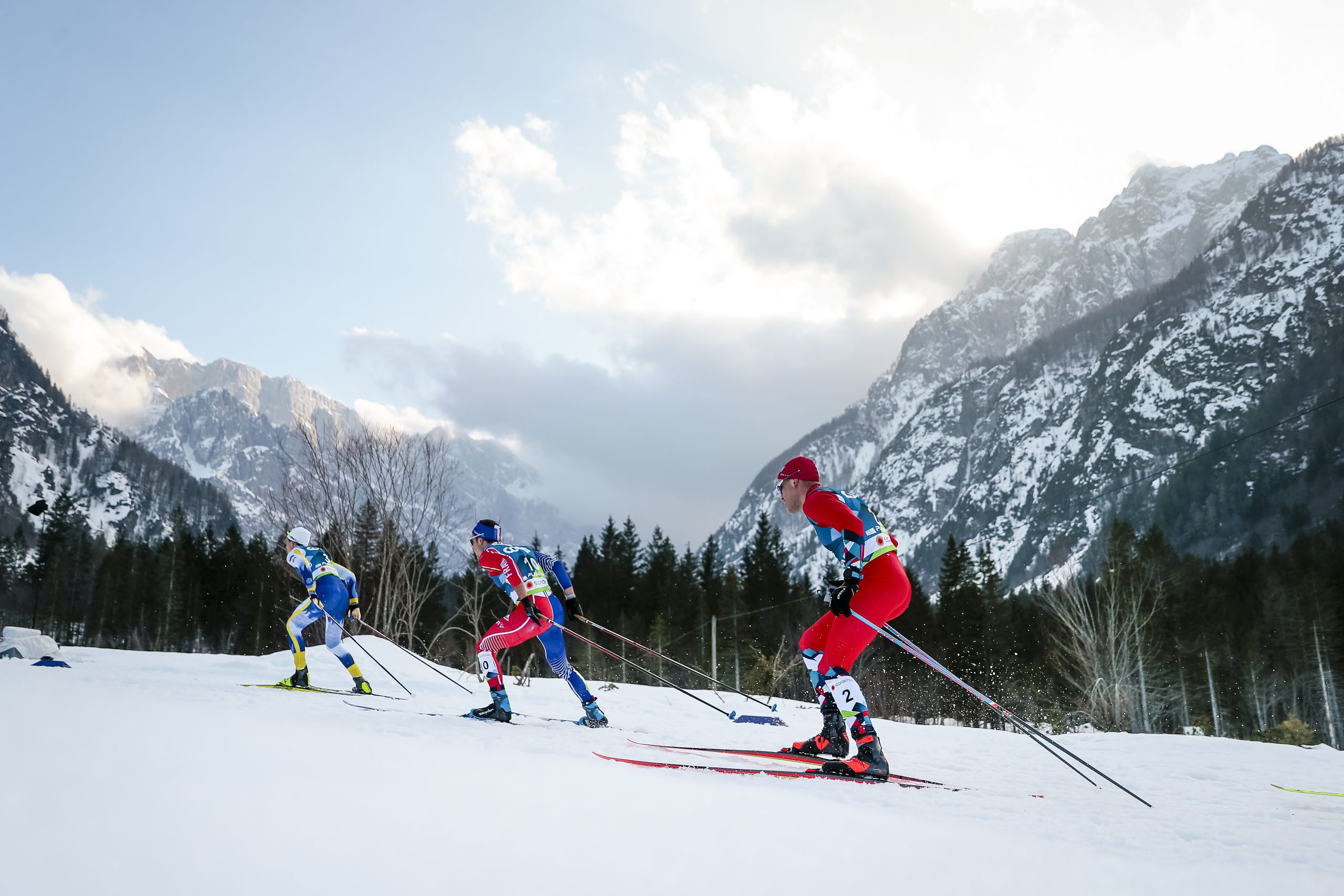
    For the next four exchanges, the Americans did their best to hang on, while the stars did battle at the front. Various accelerations, small attacks, defensive coverages, and tactical speedings and slowings led to the three fastest teams—Norway, Italy, France—pulling away from the field (pursued doggedly by Sweden and Canada). In the end, Pellegrino tried to impress his will on Klaebo in the final leg, but the Norwegian was simply too strong, too fast, too resilient. Into the final hill, Klaebo ignited the hint of promise that had been there all along, skiing away from Pellegrino in a final sprint.

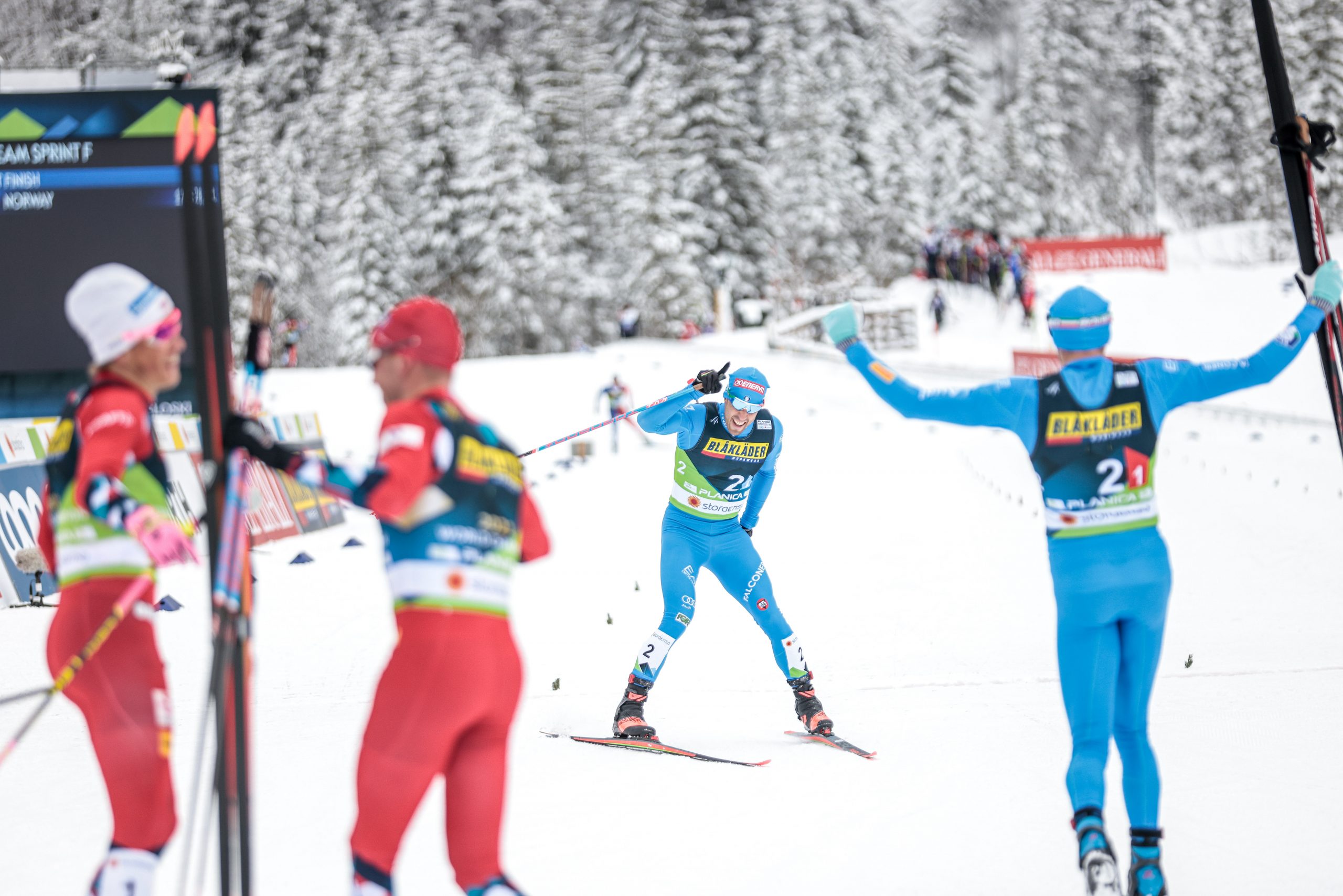
    Federico Pellegrino (ITA) skis into the embrace of his teammate, Francesco de Fabiani, earning silver in the World Championships Team Sprint. (Photo: Modica/NordicFocus)

    Pellegrino’s move on the final climb had landed the Italians second on the podium in definitive fashion. France was third, while Canada—on the back of a strong final closing move from Graham Ritchie—moved into fourth place on the day just ahead of Sweden. The United States moved down to 10th to finish inside the top ten.

    While much had been expected of Norway, it was Canada that exceeded expectations:

    “This was team sprint together, and we’ve set up a game plan that’s worked for us in the past,” said Ritchie. “We decided to not change anything today and see if we could knock off another position and it worked out for us.”

    “We have a good plan,” said Cyr. “Normally, I go in the first leg and move through the pack to get Ritchie in a good position so we push in the last lap. Today it really worked. Being out of the medal again is hard, but we will get there one day . . . It makes you feel like in a couple more years, we will get there.”

    Ritchie summed up the experience of the Canadians: “I had one guy to reel in on the last leg, and it was a good one. I had the whole lap to try and catch him, and was confident that I could . . . Seeing Jouve over the last bump gave me the motivation. We can see [the podium], it’s right there.”

    Men’s Team Sprint RESULTS

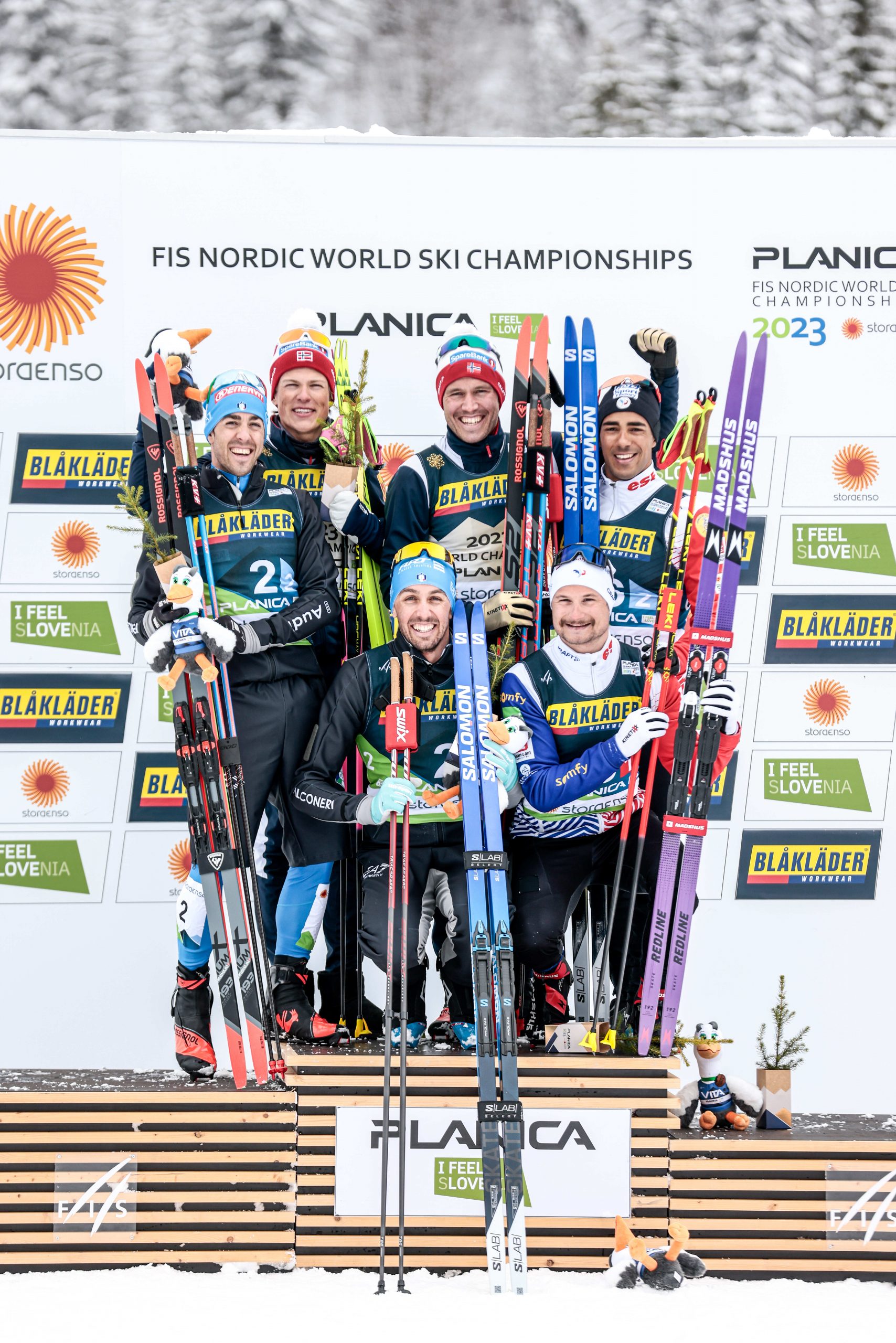
    Federico Pellegrino (ITA), Francesco De Fabiani (ITA), Johannes Hoesflot Klaebo (NOR), Paal Golberg (NOR), Richard Jouve (FRA), Renaud Jay (FRA), the Team Sprint podium at the FIS Cross Country World Championships in Planica, Slovenia. (Photo: Modica/NordicFocus
  • Only Norway—Krueger Leads Sweep of 30 k Skiathlon Ahead of Klaebo and Roethe

    Only Norway—Krueger Leads Sweep of 30 k Skiathlon Ahead of Klaebo and Roethe

    This World Cup coverage is made possible through the generous support of Marty and Kathy Hall and A Hall Mark of Excellence Award. To learn more about A Hall Mark of Excellence Award, or to learn how you can support FasterSkier’s coverage, please contact info@fasterskier.com

    Simen Hegstad Krueger (NOR) celebrates as he crosses the finish line as World Champion in the 30 k Skiathlon in Planica, Slovenia. (Photo: Modica/NordicFocus)

    Thirty kilometers is a long way to race. It’s the sort of distance that recreational skiers race as a “marathon,” the kind of overlong race effort from which mere mortals take weeks to recover. Coming so near the beginning of a 12-day World Championship schedule, a race of this length —one raced with such intensity and under such challenging and difficult conditions—is likely to have a profound effect on all the races to come. If the rest of the field could have peered into the future—could’ve seen what Simen Hegstad Krueger (NOR) was capable of in today’s Skiathlon—they might never have committed so much energy and passion to this race. Krueger—the reigning Olympic Champion in the event (and silver medalist from the last World Championships)—was never going to be denied. Not today . . .

    Simen Hegstad Krueger is sublimely glad he toed the starting line today: he claimed the victory with a dominating performance in the second half (the freestyle half) of the 30 k Skiathlon. Johannes Hoesflot Klaebo (NOR) and Sjur Roethe (NOR), the silver and bronze medalists, might also be relatively glad they raced today, though they may also have spent so much energy that their remaining races at the World Championships are likely to be affected. And everybody else? Those who earned no medals may be questioning whether racing this distance—at such an extraordinarily high measure of effort, through such challenging and difficult conditions—was really worth it.

    Iivo Niskanen (FIN) led William Poromaa (SWE) for much of the classic leg, only to find himself undone by the way the pace increased after the classic-to-freestyle transition. (Photo: Modica/NordicFocus)

    If he had advance knowledge of the way things would turn out, Iivo Niskanen (FIN) might never have surged to the front in the classic leg; William Poromaa (SWE) might never have pushed the pace; Calle Halfvarsson (SWE) might never have stuck his nose out into the wind; Andrew Musgrave (GBR) might never have worked so hard to be near the front; Paal Golberg (NOR) might have saved his energy for another day (or for another week in his season-long race with Klaebo the the World Cup Overall crystal globe). Even bronze medalist, Roethe might have hesitated before committing so much in a race for silver that he would ultimately lose to the world’s best sprinter.

    Even the North Americans might’ve raced differently if they knew what levels of exhaustion the race would bring. Scott Patterson raced hard, holding his position through much of the day. He would finish a respectable 19th, ahead of his American teammates Hunter Wonders (24th), and Gus Schumacher (38th). Patterson confided that while a top-20 at World Championships is good, he had hoped for more. “I finished up 19th, which was okay,” he said. “When I’ve been top 10, I definitely wanted a little more today.” Canadian finishers included Russell Kennedy (37th), Olivier Leveille (43rd) and Xavier McKeever (44th).

    Thirty kilometers is a long way to race; probably every competitor leaves this race shattered, exhausted, cramping (as even race winner, Krueger, admitted he was). The twelve days of the FIS Cross Country World Championships is a grind. Racing takes place almost every day . . . even after thirty grueling kilometers, there are still ten more days of World Championships still to ski.

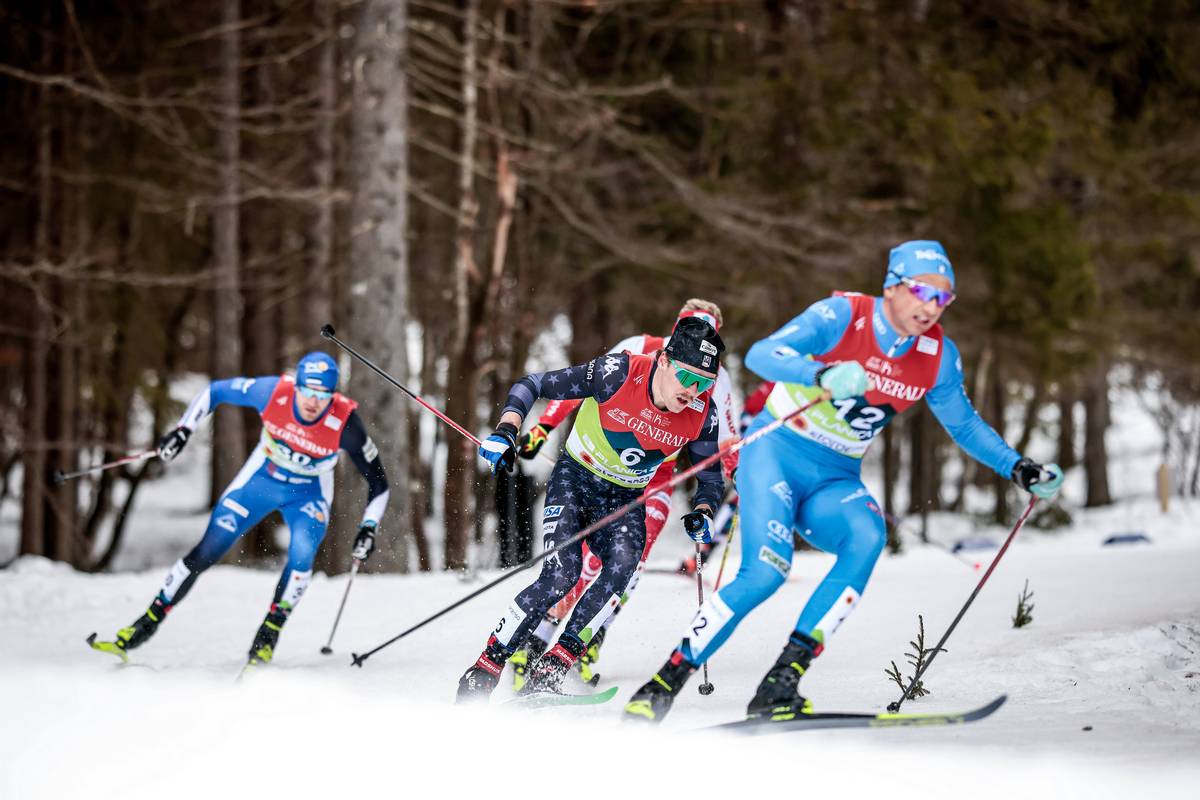
    William Poromaa (SWE), Jules Lapierre (FRA), Paal Golberg (NOR), (l-r) in the freestyle leg. The difficult conditions—and the hot pace set by eventual race winner, Simen Hegstad Krueger—exhausted even the most talented and qualified contenders. (Photo: Modica/NordicFocus)
    Men’s 30 k Skiathlon

    Planica, Slovenia occupies a beautiful corner of Europe’s mountain ranges, and the weather this week is a ski-vacationers dream. Ironic, then, that the very same weather is a wax technician’s nightmare. Sunny and warm, transitioning the snow between heats, changing the conditions even within the timeframe of an ongoing race. At the start of today’s skiathlon, race announcer, Kikkan Randall, mentioned, “You can already hear the snow . . . with a late-afternoon start, you can almost get a freezing effect. The snow can actually be pretty fast.”

    The classic half of the Skiathlon indeed started out fast. The course began as a steady downhill; Klaebo stayed at the front and out of trouble (shadowed by his teammates Golberg and Krueger, and the Swedish stars, Calle Halfvarsson and William Poromaa). The classic leg was simple:  Finland and Sweden kept the pace fast, contenders stay tucked in the field, and Klaebo picked up ground on every downhill. It looks like great fun to ski a mass start event the way Klaebo does, and certainly his wax technicians and ski suppliers have something to do with that. But that doesn’t mean he can just float along effortlessly. The other racers have a say in the pace, as well . . . and none of them wanted to make it easy for Klaebo.

    Niskanen moved to the front as the pace-maker at the end of Lap 1. By Lap 2, his efforts had begun to string out the field: Niskanen followed by Poromaa, Musgrave, and the entire kingdom of Norway. At the beginning of Lap 3 the field split, with Americans Patterson and Wonders being gapped. Klaebo continued using each downhill to adjust his position within the lead pack, gliding and stepping past the pace-makers, and forcing them to accelerate back to the front at the base of each uphill, particularly in Lap 3 as it appeared that many other racers’ skis were beginning to drag.

    At the beginning of Lap 4, everyone looked over their shoulders to check the field, a momentary pause in the action that allowed the remarkable efforts of lone chaser, Esteve Altimiras (AND) to catch back on to the back of the lead group. He’d been bravely chasing for two laps while Finns and Swedes pushed the pace at the front, and this Lap 4 truce allowed the lead pack to settle as a group of 15. The truce would not last for long.

    Johannes Hoesflot Klaebo (NOR) was forced to do his own work for most of the freestyle leg. His determined chase of teammate Sjur Roethe (NOR) earned him yet another World Championships medal, this one a silver. (Photo: Modica/NordicFocus)
    Classic to Skate Transition

    The mid-point of the Skiathlon (15 k) is where skiers switch from classic skis/poles to freestyle skis/poles, a transition that they practice in anticipation of these races. Take too long in transition, and a skier can find himself gapped . . . even the best skiers . . . even Klaebo. Klaebo flubbed the transition, exiting at the rear of the lead pack, but he seemed untroubled. If he’d known what kind of acceleration Krueger was about to throw in, Klaebo would have hurried the transition a bit.

    Roethe exited the transition first with a considerable lead, followed by Krueger, Jules Lapierre (FRA), Roethe, Krueger, and Poromaa. Klaebo followed Golberg who would drag them both back to the chase pack. Once Klaebo got there, his prospects appeared obvious: sit in and let others work, which would probably give him an easier day, and allow him to sprint for the bronze medal. As it turns out, bronze is not enough for Klaebo, and he seemed to quickly assess that none of his companions was willing to pull him back to the leaders. Poromaa wasn’t fast enough, Lapierre wasn’t fast enough, Golberg wasn’t fast enough. If Klaebo wanted to remain in contention for this Skiathlon gold medal, he’d be forced to chase the leaders down, himself. So, Klaebo set out on his own to catch the two leaders—his teammates Roethe and Krueger.

    Krueger began his surge in Lap 7, picking his way through strings of lapped skiers. He definitely appeared the sharpest, while Roethe began to visibly falter (along with Klaebo and everyone else). Even so, Roethe continued gamely working each uphill, while Klaebo drove, faded, recovered, and drove again. The top three showed their class, their fitness, and their courage. At the end of a 30 k Skiathlon, there really is no place to hide. Klaebo was really forced to work for silver, which he stole from the courageous Roethe in the final kilometer. The efforts committed by the medal winners in this race could conceivably change the whole championships. Today, under the sunny skies of Planica, Slovenia, each of these champions appeared willing to pay that price.

    Men’s 30 k Skiathlon RESULTS

    Only Norway on the podium: (l-r) Johannes Hoesflot Klaebo (NOR), Simen Hegstad Krueger (NOR), Sjur Roethe (NOR). (Photo: Modica/NordicFocus)
  • Klaebo Dominates Chaotic World Championship Sprint, Schoonmaker Scores Top Ten

    Klaebo Dominates Chaotic World Championship Sprint, Schoonmaker Scores Top Ten

    This World Cup coverage is made possible through the generous support of Marty and Kathy Hall and A Hall Mark of Excellence Award. To learn more about A Hall Mark of Excellence Award, or to learn how you can support FasterSkier’s coverage, please contact info@fasterskier.com.

    23.02.2023, Planica, Slovenia (SLO):
    Johannes Hoesflot Klaebo (NOR) – FIS nordic world ski championships cross-country, individual sprint, Planica (SLO). www.nordicfocus.com. © Modica/NordicFocus. Every downloaded picture is fee-liable.

    By the time the men’s final started, the procession had all but begun. Johannes Hoesflot Klaebo (NOR) went to the front, kept the rest of his competitors just out of reach, and used the final stretch to wave to the crowd as he claimed his seventh World Championship title. A whole season’s worth of results pointed to that conclusion, and it had finally come. It could almost have appeared unextraordinary but for the fact that the Planica, Slovenia race course seemed intent on writing the final few verses of this season-long story. On a day when racers routinely veered off course, Klaebo’s achievement of moving through all of it unscathed—making a World Championship look almost inevitable—was put into stark relief. Johannes Hoesflot Klaebo was a master craftsman at work in this, his chosen medium: sprint racing.

    Ultimately, the day—and the World Championship—was won by Klaebo, followed on the podium by World Cup Distance Leader, Paal Golberg (NOR) and the jubilant Frenchman, Jules Chappaz.

    “A Hard-A** Course”

    The real excitement at the World Championships today wasn’t in the final, but in the jostling it took to get there. Every quarterfinal heat seemed to apply another layer of complexity, as tough conditions and a winding Planica course combined to void most pre-race predictions. As US skier Ben Ogden would summarize in post-race comments to FasterSkier: “It was a hard-a** course, and slushy as well.”

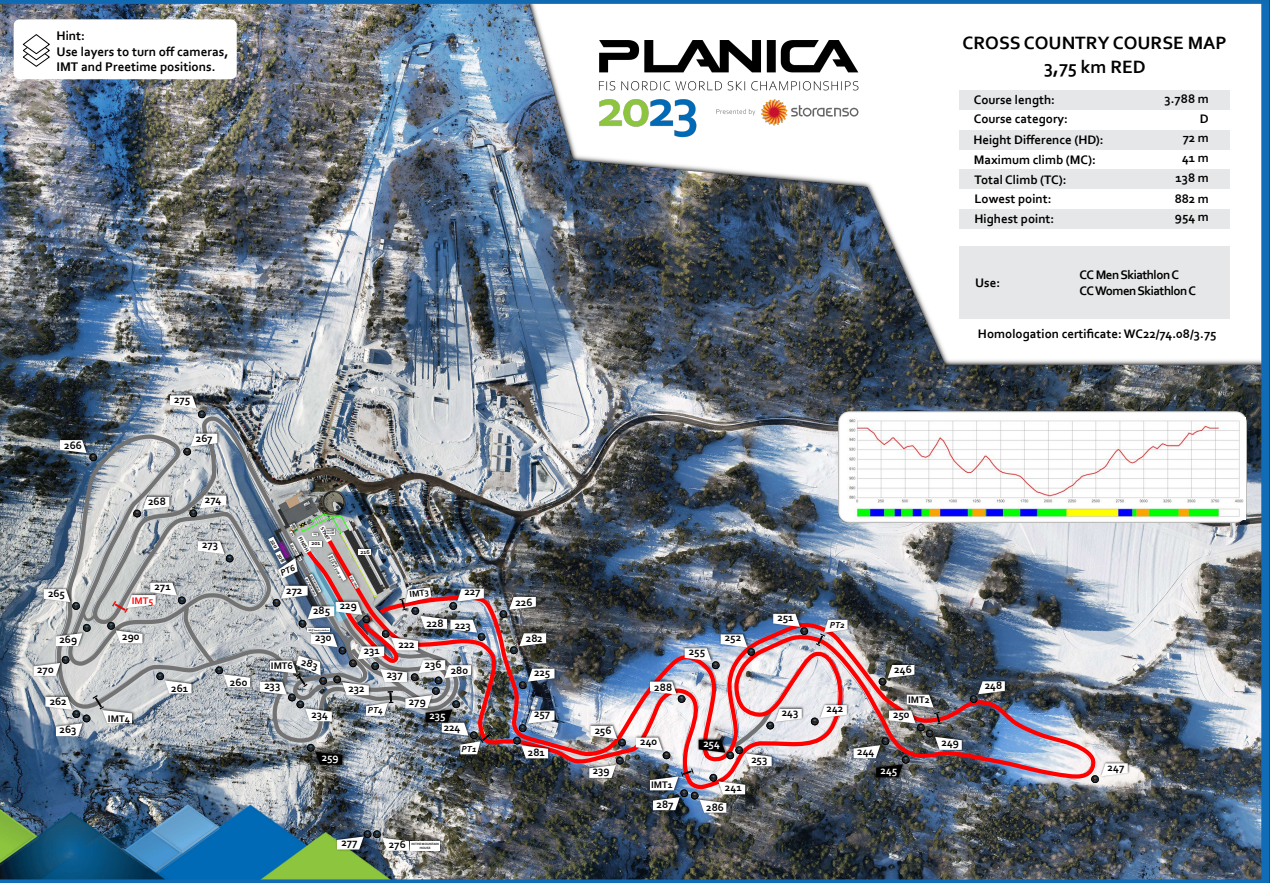
    The Planica, Slovenia sprint course. The A-climb in the middle wound and changed pitches, combining with soft snow conditions to make for plenty of tangle-ups. (Photo: FIS Nordic World Ski Championships – Planica)

    The second quarterfinal exemplified how conditions combined to re-write expectations in real time. Federico Pellegrino (ITA), the only skier in the field other than Klaebo with a sprint world title, and Richard Jouve (FRA), the only other skier besides Pellegrino and Klaebo to have won a sprint race this season, lined up as the marquee names set to challenge Klaebo. Alongside them, Even Northug (NOR) and Calle Halfvarsson (SWE) both looked to build off their own promising sprint results this season.

    Richard Jouve (FRA) leads out the second quarterfinal heat Thursday. Jouve, alongside Federico Pellegrino (ITA) were knocked out in the quarterfinal, shaking up pre-race predictions. (Photo: NordicFocus)

    That field jockeyed for position as they hit the long climb that defined the middle-part of the Planica course. Smack in the middle of the climb—where skiers emerged from under a bridge—was an uphill chicane where many skiers broke into a herringbone. As the heats went on, that spot got increasingly chewed up, the snow got softer, and the chicane became a crux in the course that claimed another victim. Jouve suffered a momentary stumble, allowing Pellegrino and Halfvarsson to begin chasing Northug. Jouve eventually would close the gap to Pellegrino, but the two pre-race favorites weren’t fighting for first or second, but rather third place. Halfvarsson overtook Northug on the final climb to win the heat. Jouve had recovered from his stumble but not quite enough, being edged out by Northug for the second spot. The only two skiers to have beaten Klaebo head-to-head this season—Jouve and Pellegrino—were out before the semifinals.

    The spot in the chicane that saw a little stumble for Jouve saw bigger accidents from others. In the first quarterfinal, Swedish skier Even Anger broke a pole and fell, causing a split in the field that allowed the Norwegian duo of Klaebo and Erik Valnes (NOR) to cruise to the semifinal. On the unlucky side of the fall in that heat was Canadian Graham Ritchie. In post-race comments to FasterSkier, Ritchie summed up his, and many other racers’ experience on the Plainca course: “That was a good learning race,” he said. “I was able to ski all right, but had a tumble. It was a sloppy hill, and if someone goes down next to you, it was pretty likely you’re going to end up in that mix.”

    Ultimately, Valnes—who had qualified first and avoided that first quarterfinal heat carnage—would also fall victim to the tricky chicane. In the first semifinal, he entered leading before breaking not a pole, but a ski. It was that kind of day.

    Ben Ogden (USA) skis in quarterfinal action after qualifying sixth place on Thursday. Ogden would be eliminated in the heat, finishing 26th on the day. (Photo: NordicFocus)
    Sprint Quarterfinals

    For the Americans—Ben Ogden, JC Schoonmaker, and Kevin Bolger—there was one place they looked to head: the Finals. “This time around at World Championships I’m more at liberty to set some goals,” Ogden said. “I’m really excited for the Classic Sprint—I have my heart set on getting into the Final.” For Ogden and Schoonmaker, a Sprint Final is the next logical step. Both have earned a pair of seventh place finishes in sprint races this year: Ogden in December at back-to-back weekends in Lillehammer and Beitostolen, Schoonmaker in November’s opener in Ruka and in the Tour de Ski at Val di Fiemme. The young Americans’ performances in qualifying seemed an auspicious sign: Ogden had qualified in sixth place, while Schoomaker had qualified in 15th. Ogden chose to a position in the third quarterfinal, where he matched up with other top-ten qualifiers Paal Golberg (NOR) and Lucas Chanavat (FRA). Ogden lingered in the mix through the early goings of the race, before launching into a hard stride that moved him up the pack at the base of the climb. For the young American, though, it was a move that couldn’t be carried to the finish-line. “I made a bunch of places up striding up the first hill,” Ogden said, “but just didn’t have it to push up and over the whole way.” Ogden finished sixth in the heat, saying post-race that “I was psyched with the qualifier, but it definitely took a little out of me.”

    Schoonmaker entered the fifth quarterfinal heat. That heats highest qualifier was Finnish skier Niilo Moilanen, who looked to get out in front to avoid any kind of melee in the early downhill section of the course. It looked like a smart move, as Czech skier Ondrej Cerny went down in the first turn. Things then settled down and the pack was together through the main climb. In an instant though, the settled nature of the field was undone as Moilanen and Swedish skier Johan Haeggstroem tangled. Haeggstroem broke a pole, and Schoonmaker and French skier Renaud Jay seized the opportunity. Jay exploded towards the top of the climb with Schoonmaker in tow; less forceful, but now with less reason to be so. Jay and Schoonmaker could control their efforts all the way to the finish line, the fall having cleared the field for them to advance to the semifinals.

    JC Schoonmaker (USA) in action Thursday. Schoonmaker scored his first World Championship top 10, with a ninth place finish after being eliminated in the semifinals. (Photo: NordicFocus)
    Sprint Semifinals and Finals

    Schoonmaker lined up in the second semifinal alongside Paal Golberg (NOR), Michal Novak (CZE), Renaud Jay (FRA), and Marcus Grate (SWE). That field stretched only slightly through the early part of the climb into the uphill chicane; it remained a close race. Then, all of a sudden, Schoonmaker dropped to the snow, the last skier on the day to get bitten by bad luck and hard conditions. He popped up and skied on, but his chance at the final had slipped away. Chappaz and Golberg went on to claim first and second in the heat.

    In the day’s final, Chappaz continued to prove fearless, even up against Klaebo who has dominated the World Cup season, and Golberg, the skier who has traded places with Klaebo for the World Cup Overall lead throughout the season. The 23 year old Frenchman’s would claim a World Championship bronze—out-lunged by Golberg by the narrowest of margins. Klaebo raced the final at the front, setting the pace wire to wire, apparently having decided to stay out of the troubling mix that had tripped up so me contenders on this chaotic day in Planica. 

    US “Pretty Satisfied” with Top 10 Results

    In post-race comments to FasterSkier, US Ski Team Head Coach Matt Whitcomb said the US camp was “feeling pretty satisfied after what is not historically a wheelhouse event for us.”

    JC Schoonmaker (USA) after his semifinal heat. Schoonmaker fell on the main climb in the heat, falling victim to the tricky conditions on the Planica course. (Photo: NordicFocus)

    JC Schoonmaker’s semifinal performance saw him earn ninth place, the first top 10 World Championship finish of his young career. Schoonmaker joined Julia Kern and Rosie Brennan from the women’s field to give the US three total top 10’s on the day. That, Whitcomb suggested, is an overall strong result which shines through a day with a lot of twists and turns. “We love to chase the podium, and there’s always a moment where you realize that you won’t be doing that [in a sprint race] that is kind of a let-down,” Wuitcomb said. “But then the team pulls back and goes ‘we’re good.’ It was a really good day with three in the top ten.”

    The US men’s team—and the entire World Championship field—now face the challenge of shifting disciplines to Friday’s 30 k Skiathlon. The shift in discipline will also mark a shift in focus for Klaebo who has now won the individual sprint race at World Championships or the Olympics in every season since Pyeongchang in 2018. His seventh World Championship title ties Gunde Svan (SWE) for the fourth most all-time. Klaebo is now in an historical peer group with only Sweden’s Sixten Jernberg (8), and Norway’s Bjorn Daehlie (9) and Petter Northug (13). The sprint was the relatively easy part for Klaebo, but he has yet to dominate a World Championships in the way that Northug did during the peak of his career, winning both distance, sprint, and team events in a single Championship. In Falun 2015, Northug won both the Individual Sprint and the 50 k, an accomplishment still unmatched by any other skier. Friday will offer an indicator of Klaebo’s abilities to deliver a similar performance, one of the few remaining historical precedents he still might be chasing.

    Full RESULTS Qualifying | Heats
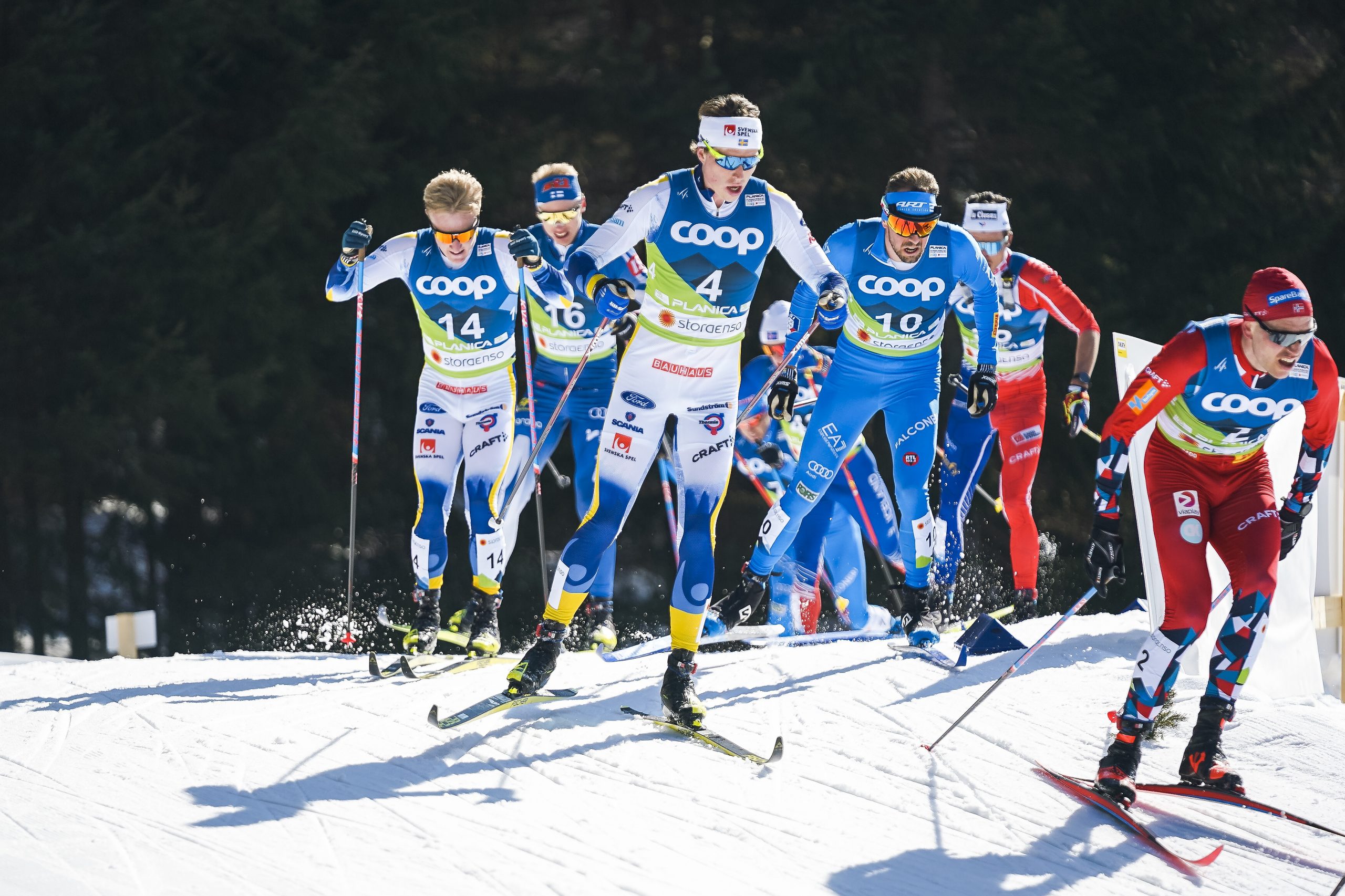
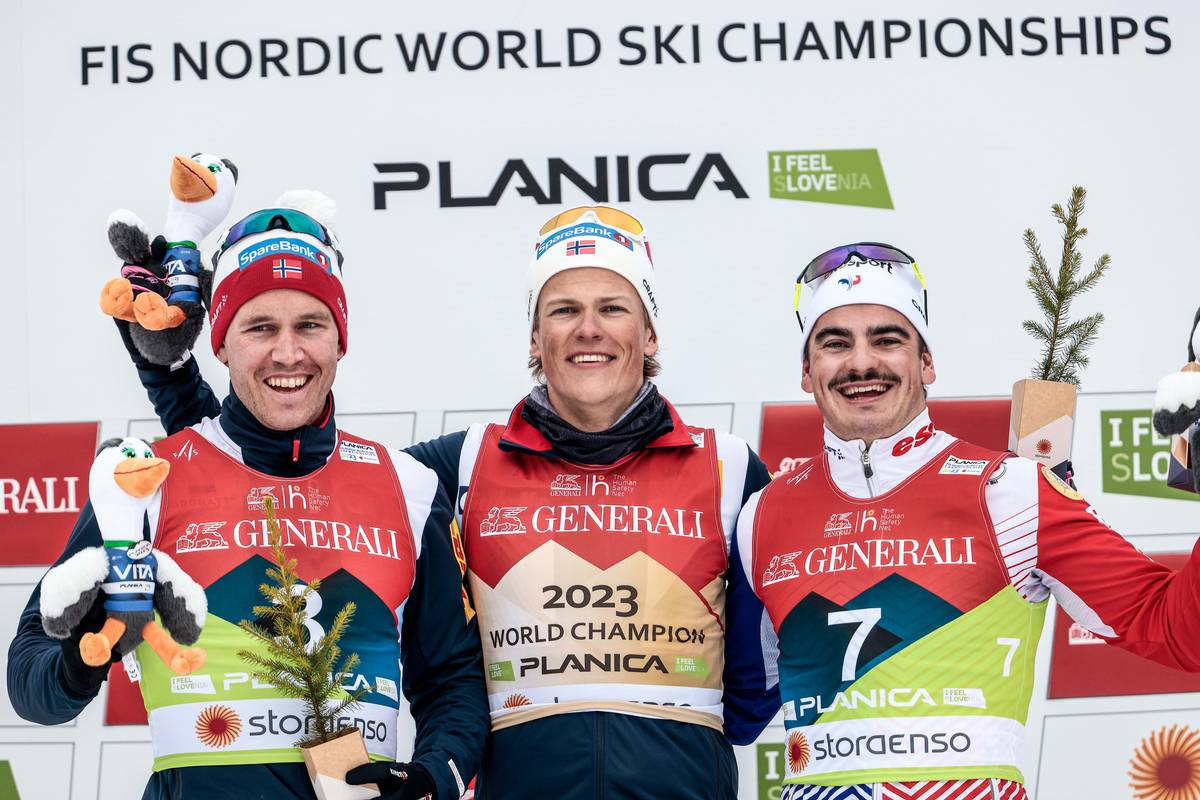
    Men’s World Championship Sprint podium: 1st) Johannes Hoesflot Klaebo (NOR), 2nd) Paal Golberg (NOR), 3rd) Jules Chappaz (FRA). (Photo: Nordic Focus)
  • Scott Patterson 14th in Toblach 10 k Freestyle, Norwegians Sweep the Podium

    Scott Patterson 14th in Toblach 10 k Freestyle, Norwegians Sweep the Podium

    This World Cup coverage is made possible through the generous support of Marty and Kathy Hall and A Hall Mark of Excellence Award. To learn more about A Hall Mark of Excellence Award, or to learn how you can support FasterSkier’s coverage, please contact info@fasterskier.com.

    Racing in Toblach, Italy continued today with the Men’s 10-kilometer freestyle. Coming into the race Johannes Hosflot Klaebo (NOR) had won 13 men’s events and was only one victory away from tying countryman Martin Sundby for the most individual victories in a World Cup season. If Klaebo’s winning ways continued, he could threaten Therese Johaug’s record of 20 wins in a season; a record which many thought was unbreakable. It’s been all Norway in men’s distance racing this year; they have won every individual distance event. The last time a non-Norwegian man won a distance race was in February, 2022, when Iivo Niskanen (FIN) won the 15-kilometer classic in Lahti, Finland.

    Klaebo leads the overall World Cup points standings over Paal Golberg (NOR) by 181 points. If Golberg wished to stay in the overall championship hunt, he would have to have a good performance today. Golberg is the overall distance points leader so he was definitely a threat to win or keep pace with Klaebo. Hans Christer Holund (NOR) sits second in the distance rankings; he would also be a threat to be at the top.

    It was warm for the start of the race, about 40 Fahrenheit. The warm temperatures didn’t negatively affect the racing, and at the end of the day Golberg was able to finish first, 0.3 seconds ahead of countryman Simen Krueger (NOR). Klaebo ended up third, 2.8 seconds back. Norway took the first seven positions.

    At the end of the day it was all Norway on the podium: Simen Hegstad Krueger (NOR), Paal Golberg (NOR), Johannes Hoesflot Klaebo. (NOR) (Photo: NordicFocus)

    American Scott Patterson had an excellent day, finishing 14th, only 34.5 seconds off the lead. Other American finishers were Finn O’Connell 41st, Kevin Bolger 54th, Hunter Wonders 55th, and Logan Diekmann 71st.  No Canadians raced today.

    Scott Patterson masterfully navigated ski choice and pacing to place 14th. (Photo: NordicFocus)
    The Race

    Today’s warm weather meant that ski choice would play a large factor. Clear bases were definitely in the mix. Toward the start of the race, the sun had moved off the course and the snow firmed providing fast and challenging conditions, especially for the later starters. This made for a tough ski choice. Scott Patterson told FasterSkier that, “Ski choice was definitely about thinking ahead for the refreeze. We tested skis in the stadium initially and recognized that the really warm skis that performed well in the stadium would probably be a risky choice by race time.” Patterson continued that, “Overnight we got a bit of rain and relatively high winds. This combined to deposit an ice layer on the ski track and some pine needles and sticks from the trees. As we were starting at 3 pm, part of the course had baked in the sun during the day and gotten quite slushy. However, by the start of the men’s race the whole course was refreezing and the sun was gone. This resulted in some fast firm sections that hadn’t seen sun as well as glazed rutted parts that were quite funky to ski in.”

    Finn O’Connell (USA) had a personal best World Cup day, finishing 41st. (Photo: NordicFocus)

    U.S. coach Kristen Bourne confirmed the tricky conditions. “The track was pretty ripping fast for the women and sort of the same for the men. All of the divots and ruts from the women’s race [froze] and started to become bumpy and firm for the men. It was a weird fluctuation but was super-fast.”

    As has been the pattern most of the season, today’s race would be a back-and-forth affair between the top Norwegians with Klaebo, Golberg and Simen Hegstad Krueger (NOR) trading punches and fighting for the lead all day.

    Klaebo was one of the earlier starters among the pre-race favorites. Golberg and Krueger started several spots behind Klaebo, so they would have the advantage of marking their teammate. At the 1.7-kilometer mark Klaebo had taken the lead and established the early time to beat. When Golberg and Krueger reached the 1.7-kilometer mark, they were already a couple of seconds behind Klaebo.

    Paal Golberg’s (NOR) finishing lunge put him on top of the podium. (Photo: NordicFocus)

    At  2.1 kilometers, Hugo Lapalus (FRA) decided he would take a shot at the lead and moved into first over all the skiers  who had already reached this mark. His pace would only be eclipsed later by Krueger who had a later start than Lapalus. But, Lapalus’ glory was short lived, at 3.0-kilometers he had dropped back to fourth. Klaebo and Krueger were virtually tied and had retaken the lead.  Golberg was now 3.2 seconds back.

    Between three and five kilometers, Klaebo put in a strong burst of speed to regain his lead outright at the five kilometer time checkpoint. Golberg and Krueger trailed Klaebo by about two seconds.

    As the raced played out and skiers hit the 7.1- kilometer mark, Krueger had surged into the lead with Golberg now 1.9 seconds back.  Klaebo had dropped off the pace considerably and was now 9.8 seconds off the lead. This trend held up over the next kilometer as Krueger increased his lead to 5.4 seconds over Golberg.  Klaebo was now a whopping 11.4 seconds off the lead.

    Johannes Hoesflot Klaebo (NOR) was in the hunt for the victory all day, but couldn’t overcome a mid-race deficit. (Photo: NordicFocus)

    Pacing on the course was difficult, and not just for Klaebo.  Patterson told FasterSkier that, “I had a few short opportunities to ski with people but mostly it was about finding my own pace and enduring through the muscular burn while keeping the tempo high.” He continued that, “It’s crucial to V2 almost all [of] the more gradual hills. Thus, I was focused on skiing smooth through the first 2km to build into the race a bit, then really turn it on and work the rest of the course as hard as I could.”

    The U.S. team received advice on pacing the five kilometer loop course from veteran Jessie Diggins (USA) at their team meeting the night before the race. Bourne said that Diggins advised her teammates to “Go out as hard as you can, because once you get to 3 k, it’s pretty much all downhill from there.”

    Kevin Bolger (USA) representing team USA in the Toblach 10 k. Bolger would finish 54th. (Photo: NordicFocus)

    Klaebo also made adjustments and was able to turn up the speed in the last two kilometers, and coming into the finish, he put in one of his patented sprints, crossing the finish first among the racers who had finished. At this point Klaebo was in the leader’s chair, 2.4 seconds over Harald Amundsen (NOR).

    But Golberg and Krueger were still lurking on the course, taking advantage of their later start. As he finished, Golberg was able to meet Klaebo’s finishing speed and went into first ahead of Klaebo by 2.8 seconds.

    The only question now was whether Krueger would be able to match his teammates speed over the last two-kilometers. As Krueger came into the finish he was moving very smoothly and put in a ferocious finishing sprint but fell short of Golberg by 0.3 seconds. As it turned out, Golberg’s lunge at the finish was the difference between first and second.

    Klaebo had put in an amazing final two-kilometers skiing it nine seconds faster than Krueger and three seconds faster than Golberg. But Klaebo’s slower speed in the middle of the race had given Golberg and Krueger the opening they needed to pull past him.

    At the end of the day, Norwegian domination in men’s distance racing continued, Sundby’s record was intact, for the time being, and a young American continued to show great promise.

    Men’s Freestyle 10-kilometer Individual RESULTS
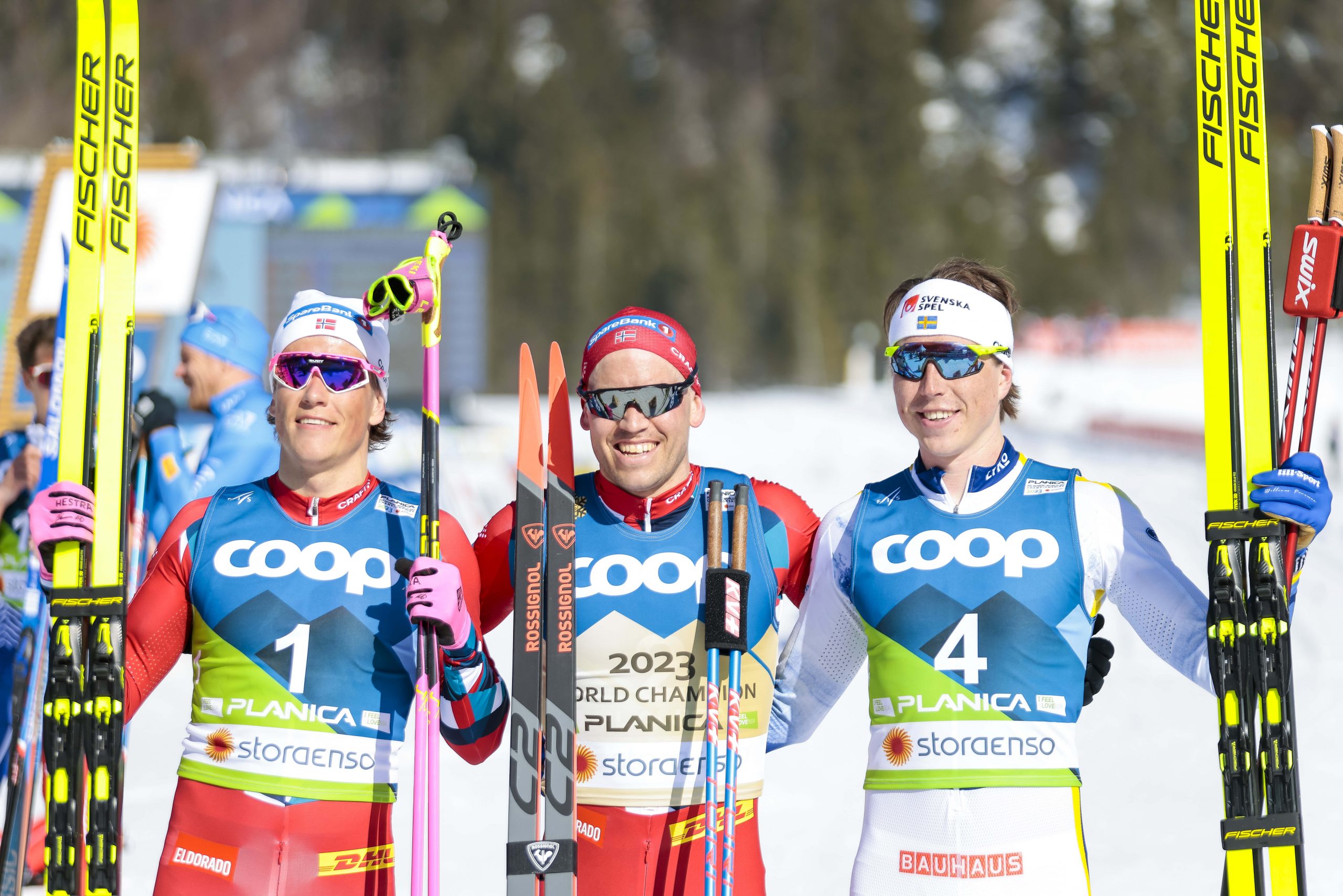
  • Incroyable! Richard Jouve Wins for France!

    Incroyable! Richard Jouve Wins for France!

    This World Cup coverage is made possible through the generous support of Marty and Kathy Hall and A Hall Mark of Excellence Award. To learn more about A Hall Mark of Excellence Award, or to learn how you can support FasterSkier’s coverage, please contact info@fasterskier.com.

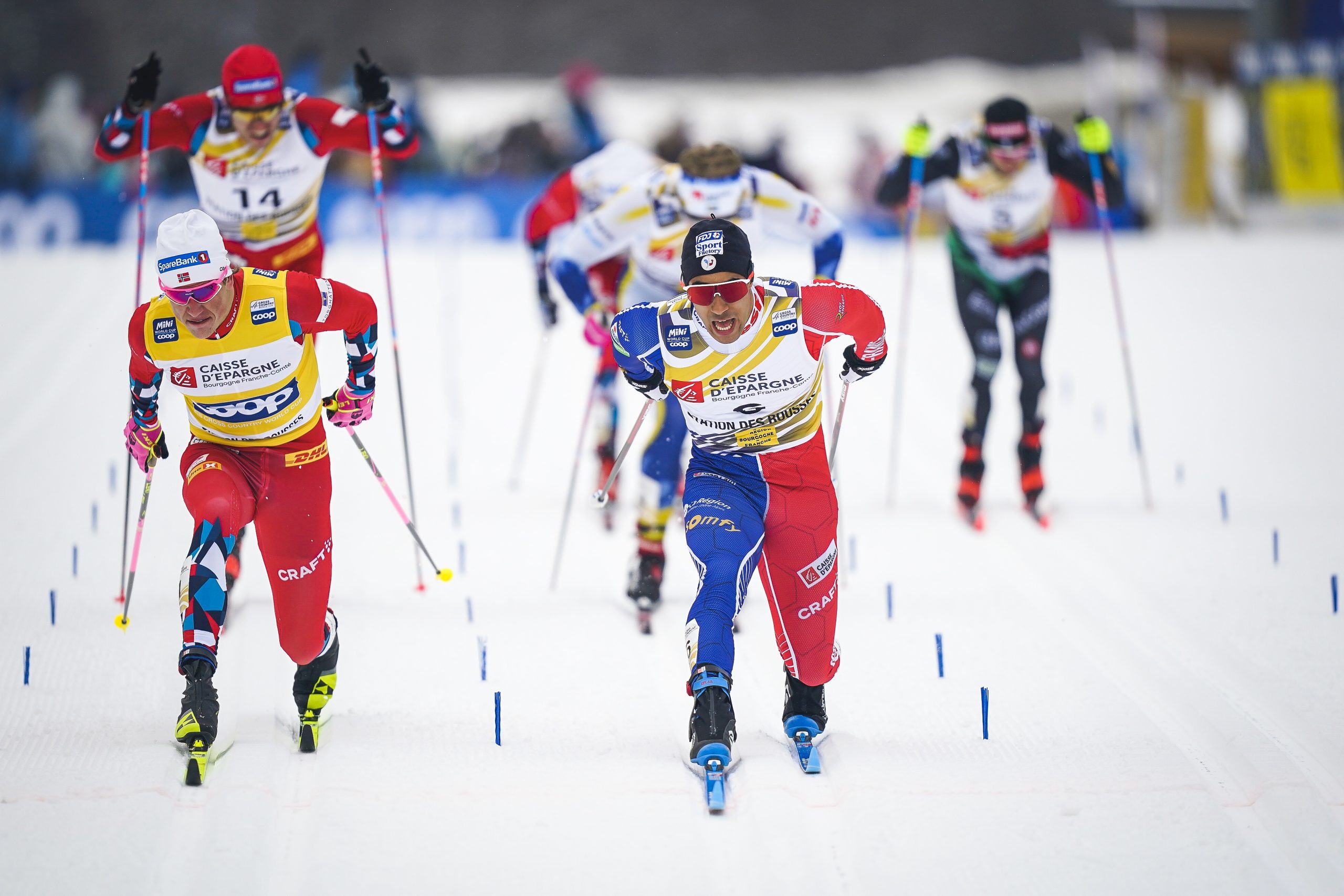
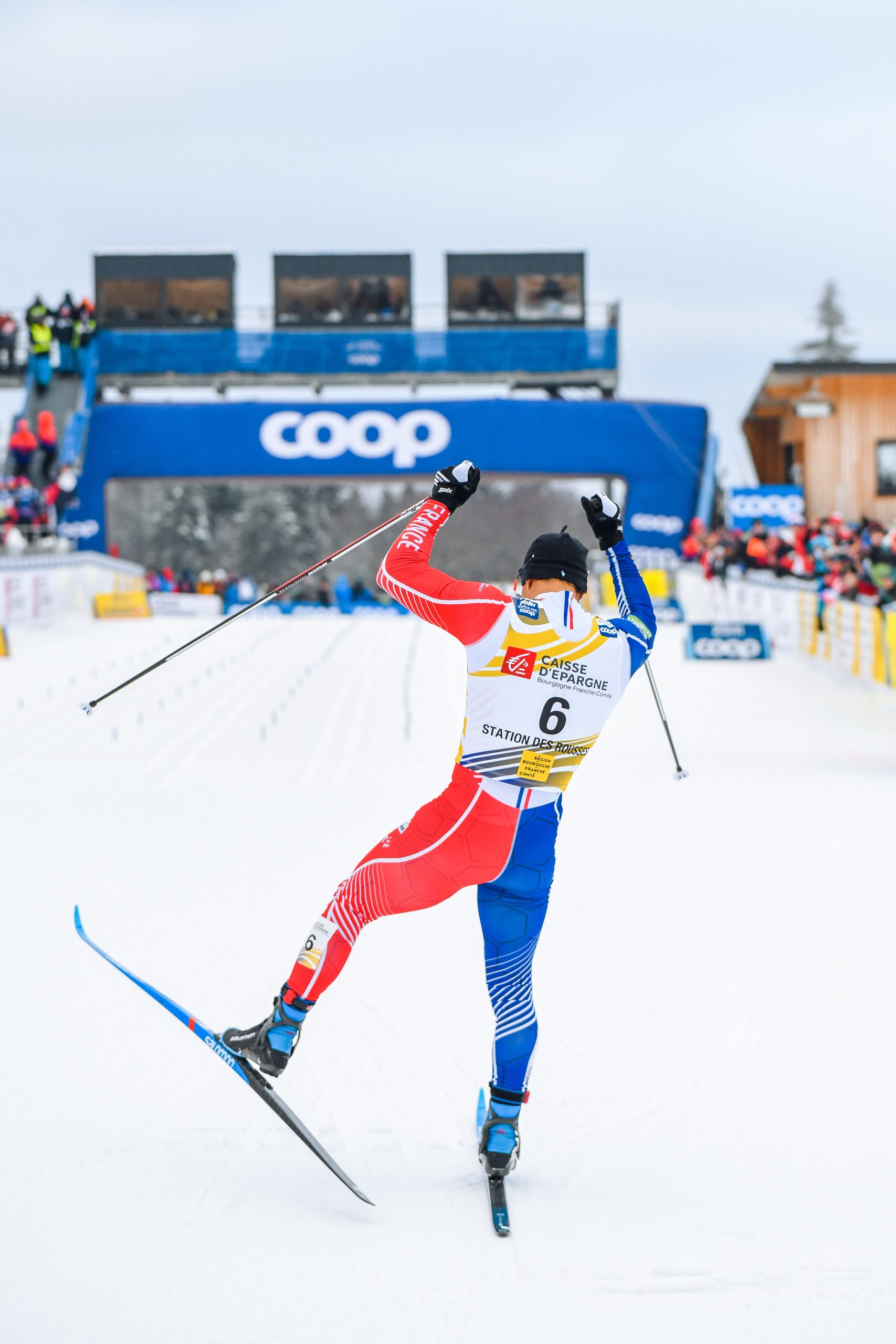
    Long and doggedly has Richard Jouve (FRA) pursued legendary sprint king, Johannes Hoesflot Klaebo (NOR). In Les Rousses—in front of cheering French fans—Jouve finally overtook him. (Photo: Thibault/NordicFocus)

    “Incroyable!” . . . Most Americans know, understand, or recognize at least a little bit of French. All those partly-understood French phrases and terms were on display today on the World Cup Sprint course in Les Rousses, France. Élan, panache, incroyable . . . accompanied by the sweet strains of la Marseillaise (the French national anthem) sung by a partisan crowd: these were the elements of of the long-awaited victory of Richard Jouve (FRA) over the sprint king, Johannes Hoesflot Klaebo (NOR).

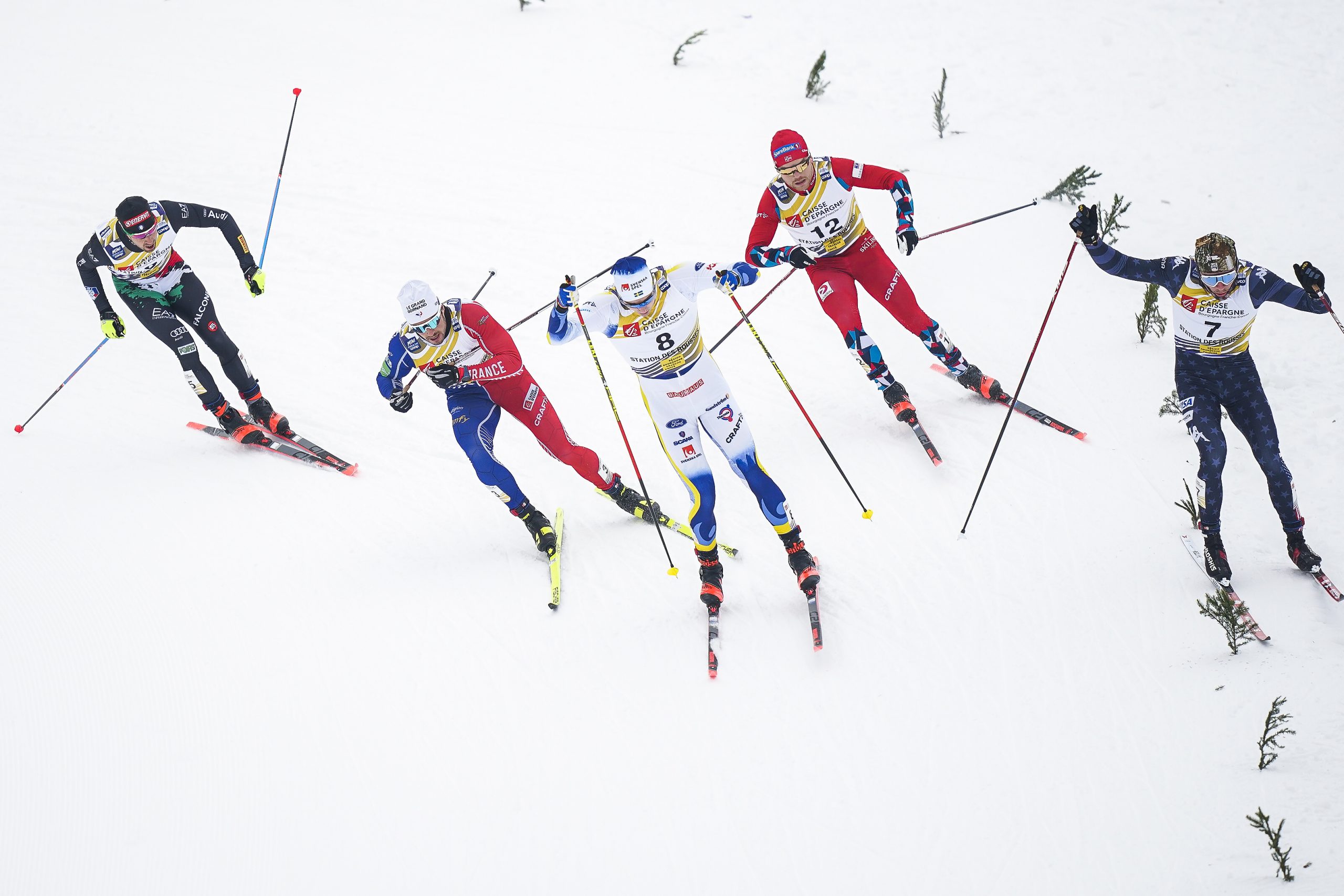
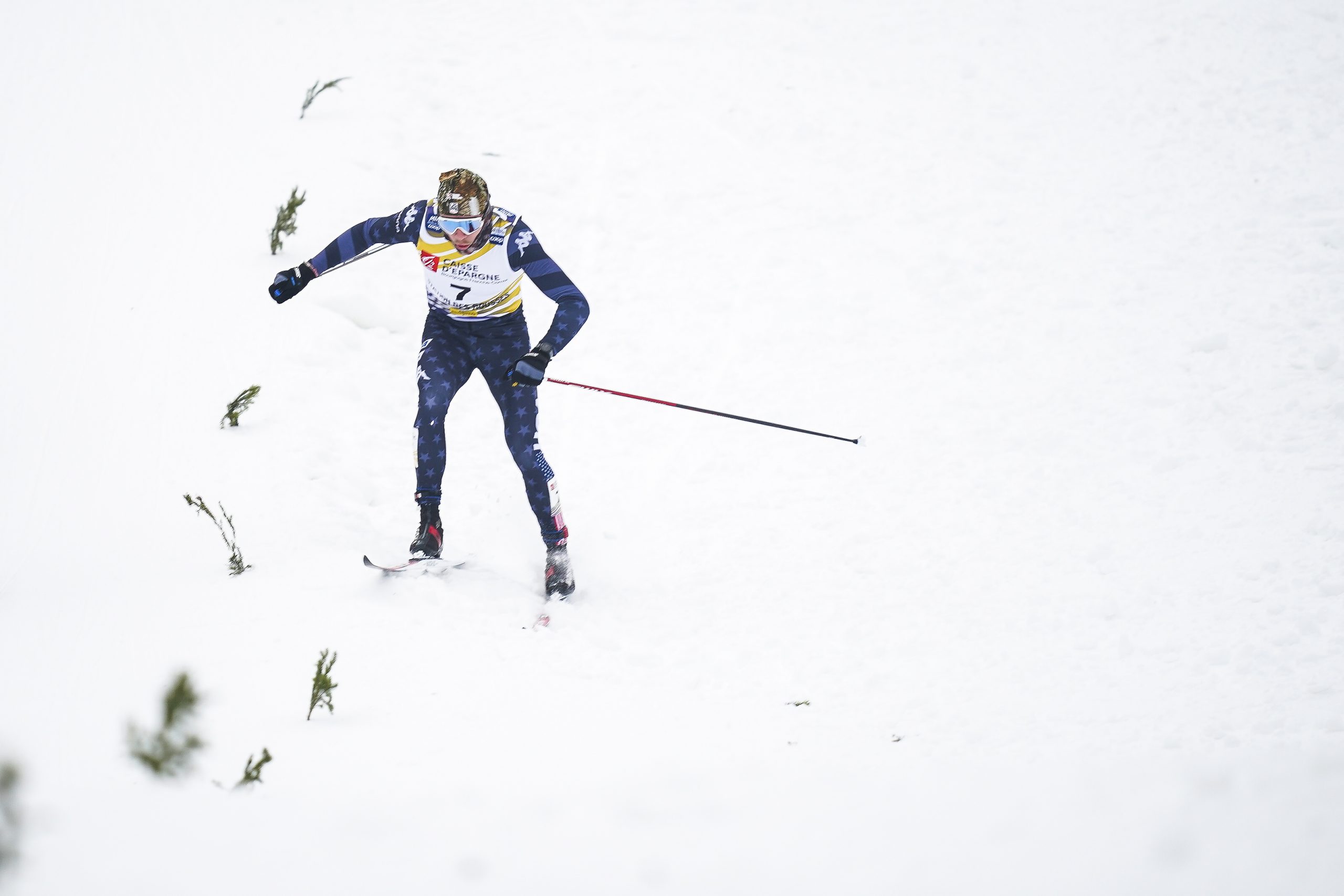
    North Americans had heroes to cheer as well, but those heroes had other forces to contend with. Antoine Cyr (the sole Canadian entry) qualified 21st, but tangles in his quarterfinal would see him finish the day in 22nd. Ben Ogden (USA) continued his pursuit of a World Cup sprint final, but saw his aspirations veer wildly off course in the semifinal. Having qualified seventh, he would finish the day in 11th (though with stories to tell). Other American finishers included Kevin Bolger 39th, Zak Ketterson 42nd, Will Koch 53rd.

    Men’s Classic Sprint

    Les Rousses, France is the World Cup site that has been forced to wait. An assigned stop on the FIS calendar through the last two years, Les Rousses has fallen victim to event cancellations during the Covid pandemic. The French crowd has waited a long time to cheer their skiing heroes in their homeland. Finally, the opportunity to do so had arrived . . . and the French athletes (both men and women) rose to the occasion. After Delphine Claudel’s (FRA) podium performance in Friday’s Women’s 10 k Skate, the eyes of France turned to the sprinters, and especially to Richard Jouve who claimed the World Cup Sprint title—in Klaebo’s absence—in 2022. Home turf, home crowd: time for Jouve to show what he can do.

    The sprint course at Les Rousses is new to World Cup racers, so tactics would emerge as the heats played out. A quick uphill challenges the racers just as they exit the stadium; the women’s racers were forced into a full herringbone stride just twenty seconds into the race, though most of the men’s field could half-stride. Thereafter, the course rises and falls, but with no significant on which Klaebo would typically unleash his high-tempo striding. This classic sprint would be a test of tactics as well as speed.

    The field in the second semifinal negotiates the consequential downhill turn: Ogden (USA) heads for the hinterlands . . . (Photo: Thibaut/NordicFocus)
    Semifinals

    While Klaebo and Jouve showed tactical brilliance in advancing through the first semifinal, it was the second semifinal that would provide the drama (for American ski fans, at least). The second semifinal was quite a bit more loaded than the first: Ogden would need to deal with perennial contenders Golberg, Haavard Solaas Taugboel (NOR), Federico Pellegrino (ITA), and Lucas Chanavat (FRA). The top sprinters are consistently the top sprinters: obviously, there’s something different about the way they do things, about the speed they possess, about their tactical acumen. Even so, each sprint final always seems to involve a couple of other racers who somehow managed to get in there. Ogden is hoping to become one of the top sprinters, but first he needs to find that little bit of luck that allows him to be one of the “other racers” who work their way into a final.

    Ogden is a native of tiny, idyllic, Landgrove Vermont just down the road from the Wild Wings Ski Touring Center where owners—Chuck, Tracy, and Ian Black—have always patiently allowed the building of jumps in the parking lot. On those jumps, kids growing up in West River Nordic ski club—including Katharine Ogden, Will Koch, Sophie Caldwell, and Ben Ogden—have developed into some of the most notable skiers in modern American skiing. They all grew up hitting those jumps, awaiting the day when those skills of deft and daring would come into play. For Ben Ogden, today was that day. He had won his quarterfinal ahead of Haavard Solaas Taugboel (NOR), but Ogden’s semifinal would prove to be the harder test.

    Still on his feet—and still at top racing speed—Ben Ogden (USA) steers back onto the race course in the semifinal of the Men’s Sprint at Les Rousses, France. (Photo:  Thibaut/NordicFocus)

    Ogden shot to the lead in his semifinal, looking as though he might be attempting the same tactic that got so much attention earlier in the season when he forced the pace from the gun in a Sprint at the Tour de Ski (causing trouble for—and inspiring humorous quotes from—Klaebo and Sweden’s Calle Halfvarsson); but, so soon after recent transatlantic travel and a stack of collegiate races, Ogden seemed to tire a bit mid-race. Ogden still led as the field powered through a downhill right-hand curve, where Marcus Grate (SWE) moved inside of Ogden’s line just before the apex. It appeared that Ogden drifted wide to avoid tangling with Grate when the soft snow began to give way beneath his feet. At top speed, Ogden’s momentum carried him through the course-lining pine bows and well down an off-camber slope of deep, soft snow. That he managed to stay on his feet was a miracle of sorts. That he managed to veer back onto the race course was a testament to those hours parking-lot-jumping back at Wild Wings. But the damage had been done, and Ogden would only make up one spot before the finish line which he crossed in fifth (11th on the day).

    As Ogden was exiting the course, Golberg was weaving his way invisibly through the pack. Golberg sneaked through to take the semifinal win ahead of Pellegrino who skipped nimbly through the final turn to steal the inside line from Chanavat and double-poled speedily across the line for the second automatic entry into the final.

    Richard Jouve (FRA) lunges across the line ahead of Johannes Hoesflot Klaebo (NOR). All of France cheered Jouve’s career-defining victory on the trails at Les Rousses. (Photo: Thibaut/NordicFocus)
    Men’s Sprint Final

    Pellegrino is always fast, always dangerous, always tactically adept. Jouve is always fast, always a problem, always able to take up space. Golberg remains something of an unknown in sprint finals (though he typically qualifies for those finals, and generally does well at the finish). In Les Rousses, Golberg had remained virtually invisible throughout the quarterfinal and semifinal rounds, only appearing at the finish line to take wins in his quarterfinal and semifinal heats. Klaebo had little to gain, little to lose: with the FIS points structure creating only minimal gaps between finishers, the race for the overall standings was unlikely to be greatly affected by the results of the sprint final.

    From the gun, Edvin Anger (SWE) sprinted to the lead followed by Jouve and Klaebo. Pellegrino—as he so often does—stepped in behind Klaebo. Predictably, Golberg stayed in the back, though his presence was not forgotten as Klaebo bothered to check his rearview mirror (purportedly for Golberg) before gliding forward to challenge Jouve at the curve leading into the final downhill. If Klaebo had overtaken Jouve at the curve, the final result may have been different. As it was, Jouve held the inside line on the turn, and his skis proved fast enough to maintain the lead. Klaebo was forced to undertake numerous lane changes approaching the finish as Jouve dominated the center track. In the end, Jouve’s double pole proved too strong for Klaebo to overtake, and Jouve earned a glorious victory on the course in his home country, and in front of wildly cheering French fans.

    Invisible as ever, Golberg sneaked through to pip Grate at the line for third.

    The day belonged to Richard Jouve who claimed his fourth career World Cup victory. Finally, he had met Klaebo face to face, and had vanquished him. And in front of a cheering partisan crowd, no less. It was an understandably emotional win for Jouve who pointedly conducted his post-race stadium-interview in his native French so that the gathered fans would understand his loyalty, and witness his pride. The crowd sang la Marseillaise, as Jouve shed tears of joy. “Incroyable . . .”

    Men’s Classic Sprint RESULTS

    To the sweet strains of Les Marseillais, Richard Jouve (FRA) celebrates his victory in the Classic Sprint at Les Rousses. (Photo: Authamayou/NordicFocus)
  • Tour de Ski Stage 2: Klaebo Poles Away From Them All, Golberg Moves to 2nd, and Ogden Holds Strong

    Tour de Ski Stage 2: Klaebo Poles Away From Them All, Golberg Moves to 2nd, and Ogden Holds Strong

    A_Hall_Mark_of_Excellence_Award-logo-300.png (300×244)This World Cup coverage is made possible through the generous support of Marty and Kathy Hall and A Hall Mark of Excellence Award.  To learn more about A Hall Mark of Excellence Award or to learn how you can support FasterSkier’s coverage please contact info@fasterskier.com.

    Johannes Hoesflot Klaebo (NOR) strides solitary at the front of Stage 2 of the Tour de Ski in Val Mulstair. (Photo: Nordic Focus).

    There’s Johannes Hoesflot Klaebo, and then there’s everyone else: that’s what was proven in Sunday’s 10 k Pursuit at the Tour de Ski in Val Mustair, Switzerland. 

    There were the usual darts, pushes, and pulls in the Men’s pursuit field that started in an order derived from yesterday’s individual skate sprint results. Eyes were on which Norwegians—Paal Golberg, Hans Christer Holund, Didrik Toenseth, and Sjur Roethe—would shoot through the pack after finishing down in yesterday’s rankings. Iivo Niskanen (FIN) was sure to do what he does best: classic ski. The American Ben Ogden would look to hold onto a strong position for the Americans.

    That all did happen, but it all happened in a different frame from that of the race leader. Johannes Hoesflot Klaebo started with a seven second gap on Federico Pellegrino, and then just kept it. There wasn’t any bunch sprint at the end, there wasn’t any jockeying on the race course, there was just Klaebo, putting pole plant after pole plant into the Swiss snow, eclipsing an entire field of the world’s best, gliding across the finish line with a 10 second gap, and then looking back. For a moment in the finishing pen, Klaebo just leaned on his poles. Skiers fought and threw themselves across the line to gain a place. They collapsed in heaps. They staggered through the back-pats and high-fives of post-race camaraderie. Klaebo was just there, the setting sun casting a shadow over his shoulder that may well have been an eclipse over the entire the field. He eventually made his rounds, shaking hands and offering congratulations. But there was a moment where it seemed that the athlete who’s spent his career charging towards skiing history—he tied Petter Northug for Tour de Ski stage wins with his 13th today—couldn’t help but sense the extraordinary place he occupies.

    With his win in Sunday’s Pursuit, Johannes Hoesflot Klaebo (NOR) tied Petter Northug (NOR) for the most Tour de Ski Stage Wins (13) . (Photo: Nordic Focus).
    Men’s 10 k Pursuit

    Golberg is still the Overall Leader of the World Cup this year after Klaebo’s absence through parts of Lillehammer and Beitostolen in Period I; if Klaebo is to re-take the overall lead, he will need to wrestle it away from Golberg’s top form. After an 8th place finish yesterday, Golberg started 20 seconds behind Klaebo, with the sprint specialists of yesterday placed between them. Through the early-goings of the 10 k pursuit, the main chase pack held firm with the top sprinters of yesterday. Most notable among them was Federico Pellegrino, who started in Bib 2 today and had a comparatively small seven second gap back from Klaebo at the start. Pellegrino never challenged Klaebo, but he did remain off the front of the chase group that included Richard Jouve (FRA), Michal Novak (CZE), and Sindre Bjornstad Skar (NOR) for much of the first half of the race.

    Ben Ogden (USA) in the main pack during Stage 2 of the Tour de Ski. Ogden finished 18th on the day. (Photo: Nordic Focus).

    Golberg, wearing bib 9, had started out in the front of what quickly coalesced into the main peloton of the race in the first couple of kilometers. This pack was where the main action that will set the Tour de Ski up for its latter stages took place. The skiers that will be looking forward to the 10 k/20 k combination of races in Oberstdorf for Stage 3 and Stage 4, and who can look behind at the Stage 1 Sprint wishing they had a bit more punch, weaved their way through in this main group to set themselves up for stronger starts in the racing to come. That included Simen Hegstad Krueger, who moved up from 18th to 4th place on Stage 2, Martin Loewstrom Nyenget who moved from 42nd to 6th, Hans Christer Holund from 48th to 9th, Didrik Toenseth from 25th to 10th, and Iivo Niskanen from 57th to 14th. Notably, some Americans were able to make similar jumps further down the pack, with Scott Patterson moving up from 94th to 59th and Hunter Wonders moving up from 80th to 53rd on the day. 

    At around the 4.5 k mark, Golberg started to make his move from this main group to the chase group containing the sprint specialists Jouve, Novak, and Pellegrino. No one followed the Norwegian, and Golberg’s joining the chase group seemed to transform it from a chase group to the Golberg group—with some of the best lead-out men in the World. Over the second half of the race, Golberg controlled the chase pack as he fought to reel in Klaebo. His pace-setting soon broke Jouve and Novak, but with the persistent and ever-inspiring grit that has defined his season so far, Federico Pellegrino stuck onto Golberg’s every move. As the kilometers stretched out, that little fact began to grow in its importance, as the two skiers closed in on the finishing sprint; back in Pellegrino’s realm.

    When Golberg and Pellegrino did enter the stadium for the final time, they were locked in next to each other. Everyone in the stadium, including the victorious Klaebo, could turn and be treated to a genuinely exciting sprint for 2nd where Pellegrino moved out from behind Golberg, put in a kick, and then saw the Norwegian somehow counter. A boot’s throw from both skiers initially looked as if Pellegrino had been successful, but upon review, Golberg was given the 2nd place nod, as Pellegrino hung on to claim a 3rd place podium finish in a distance race. Something that is worth italicizing for its novelty at this point in the sprinter’s career.

    Paal Golberg (NOR) and Federico Pellegrino (ITA) sprint for 2nd place. Golberg won the boot toss, and Pellegrino finished 3rd. (Photo: Nordic Focus).

    The Italians kept the finish line exciting from there as well, with Francesco De Fabiani soon coming into the stadium in battle with American Ben Ogden. Ogden started 13th place on the day, and had kept his position in the main pack well as the powerhouse distance skiers of the World Cup sought to move to the front of the field today. De Fabiani and Ogden came into the stadium looking for 17th place, and were willing to go all out for it right to the line. In the end, the Italian won this round of the boot throw, and Ogden came away from two days of racing in this year’s Tour in 18th place. “For many Americans the threshold for an average race is starting to change,” Ogden said. “That said, we are still hungry and place emphasis on the process rather than the result. That way through thick and thin we are still learning and getting better every day. Everyone here has long term goals well beyond the top 30 and I am really proud that many are making forward steps.”

    The Tour de Ski gets its first rest day tomorrow, as the circuit travels from the Swiss side of the Alps to the German side in Oberstdorf for Stage 3: 10 k Individual Start Classic. The sun has set on Val Mustair, the shadows cast on the skiers all clumped together and entangled but for one: the solitary figure of Johannes Hoesflot Klaebo, looming large.

    Tour de Ski Men’s 10 k Pursuit: Full Results

    Previous Coverage of this year’s Tour de Ski: Stage I

    Federico Pellegrino (ITA) leading the chase group mid-way through Stage 2 of this year’s Tour de Ski. The Tour de Ski finished in Val Mustair, and now heads to Germany for Stage 3 on Tuesday. (Photo: Nordic Focus).


  • World Cup:  Period I into Period II

    World Cup: Period I into Period II

    Editors note:  FasterSkier’s coverage of FIS Cross Country World Cup Period I has been a cooperative effort among three dedicated staff writers: Ben Theyerl, Ken Roth, and John Teaford. Many early mornings, many calls and texts, many quotes and comments, many unforgiving deadlines bring this reporting to FasterSkier’s readers. We hope their insights  have served to improve everyone’s enjoyment of the excellent racing witnessed in Period I, and that they can serve to prepare viewers for the excitement and intrigue of Period II, and beyond.

    Jessie Diggins’ (USA) recent World Cup win in Davos has her positioned as one of the favorites entering Period II’s Tour de Ski. (Photo: Nordic Focus)
    Ken Roth

    In the Women’s World Cup, Period I has been a tale of two halves. During the first two weeks, Sweden looked unbeatable. Then, a not-so-funny thing happened on the way to global domination: illness overtook team Sweden, and they only placed one skier on the podium in individual races each of the last two weekends. For most teams, those results would be pretty good; for the Swedish women it was disappointing.

    While Sweden was fading, the U.S. was surging. Jessie Diggins was transcendent in Davos, taking a first and a second. Rosie Brennan bounced back from illness to ski to third in a great 20-k freestyle race and showed unmatched grit. In retrospect, the single biggest factor of the first four weeks was the start list. I’m not throwing any shade on the Americans’ success, but many of the top skiers were absent the last two weeks, and a fair assessment must acknowledge that reality. The other reality is that you can only beat whoever shows up, and the American squad looked great doing just that.

    As the World Cup tour enters Period II, the Swedes may be anticipating a resurgence. Sweden’s Tour de Ski start list includes most of their superstars. The question is, will they remain healthy? The Swedes do themselves a real disservice when they fail to provide details about absences, as information vacuums often fill with speculation. This was especially evident with regard to Frida Karlsson whose absence from Davos raised questions about her health (which Team Sweden has identified as a concern in the past).

    Norway lists the three Wengs on its start list, so the competition will be stiff. Tiril Udnes Weng is skiing so balanced between distance and sprinting that, barring illness, she should be the Tour favorite. For the same reasons, you have to put Diggins into the mix.

    Another big question lingers around the U.S. squad:  will anyone emerge to supplement the 1-2 punch of Diggins-Brennan? Julia Kern has been right on the edge in sprints; my guess is she’ll be the next American to podium, while the women’s squad remains mostly unchanged for Period II. And FIS, your holiday present to the ski world can be to change the rules for mixed relays; and do it now. Allow teams to ski in any order they want and to submit their lineups just before the race starts (Full disclosure: I’m totally stealing this idea from the Devon Kershaw Show). Can you imagine an anchor leg with Jessie Diggins given a lead and trying to hold off Johannes Klaebo? I would pay real money to see that—and I suspect most of the cross-country fan world would too!

    Ben Ogden (USA) enters Period II with top North American finishes in both sprint and distance events. (Photo: Nordic Focus)
    Ben Theyerl

    In his comments to FasterSkier’s Nat Herz describing the Beijing Olympics 15 k Classic Individual Start, Ben Ogden said that when Johannes Hoesflot Klaebo passed him he “Wasn’t going at a totally inhuman pace. I think one day I’ll be able to ski a longer percentage of the race at that speed.” I don’t think we anticipated how close that hypothetical day might be. With Ogden coming within an inch of Sprint Finals in consecutive weeks in Lillehammer and Beitostolen (in both Classic and Skate, to boot), it’s clear the gap is shrinking. JC Schoonmaker in sprints, and Gus Schumacher in distance races, have both continued to show the potential of the “young Americans” who were introduced to ski fans with Junior World Championship medals in 2018, 2019, and 2020. As far as percentages go, they’re not quite 100% of the way to Klaebo-pace for an entire race, but they’re definitely getting closer. Are we at a point where we might see the return of an American male to the podium for the first time since Simi Hamilton in Toblach, 2017? Considering the auspicious steps taken by young American skiers so far this season, I wouldn’t rule that out in Period II.

    Finn O’Connell, Zak Ketterson, Hunter Wonders at the Tour de Ski: When I spoke to Finn O’Connell following his nomination to the US Ski Team last May, he said that one of his biggest successes last year was figuring out, “What [being] a professional skier looked like.” Along with teammates Zak Ketterson and Hunter Wonders, O’Connell is in the group who became professional skiers during the pandemic, and who have seen the early steps in their careers severely complicated by COVID’s impact. O’Connell, who had earned World Cup starts in 2020-2021, will step on to a World Cup start line for the first time at the Tour de Ski. Having the Tour de Ski be your first World Cup experience poses some unique, and demanding, challenges. O’Connell is likely to take cues from teammate Zak Ketterson who faced the same prospect just a year ago. When I spoke to him last May about hopping from the SuperTour to the World Cup for a week straight of racing, Ketterson said, “[The Tour de Ski is] overwhelming. Those first few races do feel different. It’s hard not to be super nervous, and you’re not really skiing like yourself.” That might sound daunting, but Ketterson also added that the Tour de Ski as an introduction to the World Cup, “Made the rest of races [on the World Cup last season] seem very chill by comparison.”

    That TDS-inspired confidence led to Ketterson being part of the American team that won the Team Relay in Falun last season, and has seen him settle into World Cup racing this season, highlighted by a 26th in the 10 k Classic in Lillehammer. He’ll now return to the Tour de Ski for a second time. Hunter Wonders and Finn O’Connell meanwhile, will start their first TDS with the same kind of trial that Ketterson had in his first Grand Tour-style race last year.

    Johannes Hoesflot Klaebo (NOR) crosses the finish-line in Ruka wearing the yellow Overall World Cup leader’s bib. He’ll hope that a winning effort at the Tour de Ski may allow him to be wearing that bib again at the end of the 2023 season. (Photo: Nordic Focus)
    John Teaford

    Two weeks ago, Johannes Hosfloet Klaebo claimed his pursuit of the overall World Cup crystal globe was over. It sounded as though he might just concentrate on World Cup sprint events and save his distance-skiing energy for this season’s FIS World Championships. Then the start list for the Tour de Ski came out:  Klaebo’s name is on the list. Game on . . .

    FasterSkier’s Ben Theryl recently wrote about changes to the World Cup point system, summing up the changes as, “A whole lot more points for a whole lot more skiers” resulting in top skiers needing to ski more races if they hope to do well in the race for the overall Crystal Globe. Exiting Period I, Klaebo and Paal Golberg are both on the Norwegian team for the Tour de Ski (TDS), and embroiled in a close, point-by-point battle for the Crystal Globe. If Klaebo succeeds in winning this year’s TDS, he could claw back the overall title, not by hundreds of points at a time, but by a grinding accumulation of points that could—to the FIS’ delight—make the battle for the Crystal Globe very exciting, indeed.


    American Team Selections for Period II (including the Tour de Ski) can be found in FasterSkier’s recent posting from US Ski and Snowboard.

  • What’s Up with World Cup Points this Season?

    What’s Up with World Cup Points this Season?

    The FIS instituted an overhaul of the points system used to determine the best individual skier in the World. We’re already seeing the consequences.

    Johannes Hoesflot Klaebo (NOR) crosses the finish line in Ruka, Finland while wearing the yellow Overall World Cup leaders bib. (Photo: NordicFocus).

    Johannes Hoesflot Klaebo had won all three races of the World Cup’s opening weekend races in Ruka. Any offseason doubts spurred by reports of his injuries or independent training practices went away. He was still the best skier in the world. Then, the following Friday in Lillehammer, illness forced Klaebo to sit out a 10 k skate race. His teammate Paal Golberg took over the World Cup overall lead with a 6th place finish. Klaebo returned the next day to handily win the sprint race:  usually, that would mean he would return to the top of the World Cup standings, and that he would start Sunday’s 20 k classic in the yellow overall leader’s bib (which he would likely continue wearing for weeks to come. Instead, Klaebo declared the season over. “I gave up the opportunity to win the World Cup overall when I did not start yesterday,” he remarked to Langrenn, in a statement that rightfully made headlines. When the next day’s race did come, Klaebo was nowhere to be found. Instead, the yellow leader’s bib went back to Golberg, where it remains.

    That Klaebo is the best male skier in the World is an easy conclusion to reach by watching any World Cup race in which he participates. Whether or not the World Cup points system is designed to objectively confirm that observation is a more complicated question, especially so since the International Ski Federation (FIS) instituted changes to its long-standing individual points system this season. Now three weeks into implementation, those systemic changes are resulting in more skiers earning more World Cup points. As a result, coaches and athletes are adjusting race plans, commentators are struggling to shake old habits, and the best skier in the world is apparently giving up on the whole thing. The rules of the game have changed, and it looks to be having an effect.

    Top 50 is the New Top 30: The Changes

    The start of the women’s 10 k Freestyle Mass Start during Stage 3 of the 2021/22 Tour de Ski in Oberstdorf, Germany. (Photo: NordicFocus)

    In remarks following the 10 k classic in Beitostolen—where Jessie Diggins finished 6th and Rosie Brennan finished 8th—US Ski Team Head Coach Matt Whitcomb’s reflections focused on one number: “It’s easy to forget that just 15 years ago it was often that we would have zero people in the top 30 in distance, so this is a natural progression and an important thing to remember.”

    For years, “top 30” meant earning World Cup points. That level of finishing result became a signifier for a specific kind of success—gaining a foothold on the World Cup stage—and that expanded to serve as that same signifier at every stage of international skiing progress. In the United States, every collegiate circuit uses a version of the World Cup points system to 30th place for NCAA Championship qualification. Some regions use a version of the “top 30” system to determine selection for US Junior Nationals. The “top 30” system etched itself into the sport’s evolution too. When the sprint became an integral part of skiing in the early 2000s, there was no set number of competitors who would move on from qualifiers to heats . . . until, that is, the FIS decided on the top 30.

    “Top 30 is good.” That’s what skiing has told us for a long time. So what happens when that single World Cup point gets pushed out to the skier in 50th place? 

    Well, it looks something like this:

    The NEW FIS World Cup points system:
    (Photo: “Rules for the FIS Cross-Country World Cup 2022-23.” 2022. “International Ski Federation.”)
    The OLD FIS World Cup points system:
    (Photo: “Rules for the FIS Cross-Country World Cup 2021-22.” 2021. “International Ski Federation.”)

    In the NEW system, the points stretch further down the results, and the steps down are much, much, smaller.

    Points stretching further down the results will primarily have consequences for skiers seeking selection to the World Cup, rather than  the World Cup Overall competition itself. With the points stretching to 50th place (just short of the size of a usual World Cup field) there is now a more quantifiable way to compare developing skiers and assign discretionary starts for national ski federations. Whereas under the top 30 system, skiers outside of the points were at the whims of the sometimes wonky FIS points system, there is now a better chance to judge a skier’s potential on the World Cup based on their performance on the World Cup. 

    Smaller steps in points from 1st place (100 points) down is where the World Cup Overall competition really changes. See Table 1. below with the points awarded for 1st-5th place in the NEW system, and Table 2. with the points awarded for 1st-5th place in the OLD system, and the equivalent place-points total under the NEW system.

    Table 1. Place-points total for 1st-5th place, NEW system

    NEW System Place NEW System Points
    1st 100
    2nd 95
    3rd 90
    4th 85
    5th 80

    Table 2. Place-points total for 1st-5th place, and equivalent place-points total in NEW system

    OLD System Place OLD System World Cup Points NEW System place-points equivalent.
    1st 100 1st
    2nd 80 5th
    3rd 60 11th
    4th 50 16th

    5th

    45

    19th


    When it comes to points earned, getting 1st place just doesn’t matter as much as it used to. That key change is amplified when considering that FIS has made very slight changes to the system surrounding the individual points matrix awarded for each race.

    Bonus Points System Remains the Same

    In a bid to introduce more dynamic racing a few years ago, FIS introduced a bonus point system in which checkpoint bonuses became incentives for World Cup points. That system remains unchanged and is found here:

    (Photo: “Rules for the FIS Cross-Country World Cup 2022-23.” 2022. “International Ski Federation.”)

    Based on the points classifications found in cycling’s Grand Tours (the “Green Jersey,” for Tour de France fans), the bonus system was intended to introduce a series of points that skiers would tactically approach as intermediate sprints. The dynamics of ski races are very different from the dynamics of a cycling race, however, and in practice, the sight of skiers shuffling for a sprint in the middle of a distance race has been rare.

    Why? Unlike cycling, ski racers exhibit less obvious discrepancies between who is a great sprinter and who is a great distance competitor. In mass start ski races, it’s rare to see a breakaway that is not comprised of skiers who would also excel at distance racing. The bonus points, in reality, have almost always gone to top contenders for the race itself.

    The NEW points system seems to retroactively fit the existing bonus points system into this skiing reality. The consequences: in the OLD system, the 15 points for being 1st place through an intermediate checkpoint could almost never displace the points total for finishing 1st versus 2nd, or 2nd versus 3rd. In the NEW system though, with five points separating each of the first five places, winning the intermediate sprints could theoretically displace the 1st place finisher for the most points won on the day for a skier in 3rd or 4th place.

    Example: In a 20 k mass start, the skier who will eventually finish 3rd place controls the front of the race for the first 10 k, earning 30 bonus points for winning two bonus point checkpoints (15 points each). The skier who will eventually finish 1st place is further down the pack through the early part of the race, but still in the top 10 through the checkpoints. They are 10th through each bonus point checkpoint, earning 2 total bonus points, before making a push to win the race. The 1st place skier’s total points for the race: 100 (1st place) + 2 (bonus points) = 102 total points. The 3rd place skier’s: 90 (3rd place) + 30 (bonus points) = 120 points total.

    That may be unlikely, but it is at least now in the realm of possibility. Again, a whole lot more points for a whole lot more skiers.

    Other Tweaks: Relays and Tour de Ski Bonus

    There are two other notable tweaks in the new FIS system that pertain to specific events:

    The first is that team events no longer are scored for individual points. That has already proven consequential in the way that the only team event so far this season has been raced. For instance, Matt Whitcomb identified the fact that no points were up for grabs as having directly influenced his decision that Jessie Diggins sat out the 4 x 5 km Team Relay in Beitostolen. Similarly, neither current World Cup overall leaders—Paal Golberg (NOR) for the men, nor Tiril Udnes Weng (NOR) for the women—raced the relay. 

    The second change is less drastic, but will be significant when the World Cup turns to the Tour de Ski (TDS) in a few weeks. FIS reduced the points bonus for winning the overall classification at the TDS from 400 points to 300 points, and adjusted the points bonuses for lower placings accordingly. The reduced emphasis in points—and subsequent reductions in prize money per placing—could result in the Tour de Ski becoming a less significant part of the World Cup calendar than it has been in recent years.

    What It All Means

    Johannes Høsflot Klæbo poses with his crystal globe after winning the 2019 Overall World Cup title. (Photo: Nordic Focus)

    So, is Johannes Hoesflot Klaebo justified in his World Cup fatalism? The answer just might be that the FIS wants him to be. By pushing more points onto competitors who so often come 2nd, 3rd, or 4th place to the young Norwegian, they have created a new dynamic in this year’s bid for the Overall Crystal Globe. Consider the top two skiers in the current classification:

    Top Two Places of Men’s Overall World Cup Points after Three weeks of racing, OLD system vs. NEW system:

    1. Paal Golberg (NOR) – NEW system 756 points, OLD system 575 points, Net Change: +181 points.
    2. Johannes Hoesflot Klaebo – NEW system 430 points, OLD system 430 points, Net Change: 0 points.

    Klaebo’s points have not changed because the benchmark for the FIS points system has not changed. He has won every race he has entered, and 1st place is still worth 100 points (with 15 points for winning sprint qualifiers). Golberg, though, has benefitted from starting more races, and getting more points for being top 10, not top 1. It is a simple comparison, but it is also the only one that really, really matters for evaluating the change that the FIS wanted to make to the World Cup adopting the NEW system. The eventual winner of the Crystal Globe will now be determined by an incentive to do well in the races you start, and to start more races. Those are just the rules of the game; once the rules are understood, then it’s possible to understand what the new rules are incentivizing. FIS has followed that all the way through with its NEW point system, assuring that the season-long champion will be the skier who is most consistent and who competes most often. 

    As for us—the fans—is this the system by which we want our skiers rewarded? Should the best skier also have to be the most consistent? Should the strongest skier in a mass start go off the front early, or show their strategic aptitude by controlling a pack? Should skiers specialize in sprinting or distance? Should they continue to have to do well in both? And, of course, is the “top 50” the new “top 30?”

    New points systems instituted by FIS has ski fans, ski coaches, and skiers talking;  that new system also has the game being played differently on the World Cup tour this season.


    Resources:

    2021-22 FIS Rulebook containing the OLD system.

    2022-23 FIS Rulebook containing the NEW system.

  • Beitostolen 10 k Classic: Golberg Dominates, Musgrave Podiums, Wonders and Ogden Top 20

    Beitostolen 10 k Classic: Golberg Dominates, Musgrave Podiums, Wonders and Ogden Top 20

    Norway in midwinter can take on the appearance of a snow globe: quaint little cabins covered in snow, drooping pines coated in layers of white, skiers trailing through the woods. That was the scene in Beitostolen, Norway for day two of the FIS Cross Country World Cup. Skiers awoke to withering cold with low temperatures creating squeaky snow on the race course. Waxing for kick would not be a problem, but enduring the cold for ten kilometers of classic ski racing was a daunting prospect, indeed. Buffs, heavy gloves or mittens, protective face tape: that was the fashion of the day inside the Beitostolen snow globe.

    Paal Golberg (NOR) drives toward the finish in his World Cup 10 k Classic victory in Beitostolen, Norway. (Photo: NordicFocus)

    While racing in such cold conditions would prove to be a challenge, Norwegian favorites Paal Golberg and Didrik Toenseth did not disappoint their loyal followers, finishing first and second on the day. Great Britain’s Andrew Musgrave—something of an adopted son for the Norwegian fans—also turned in a thrilling performance, finishing third.

    North American skiers also celebrated great racing success today: Hunter Wonders was 16th, Ben Ogden, 19th, Gus Schumacher, 30th, Scott Patterson, 32nd, and Zak Ketterson, 38th. Canadians were led by an impressive finish from Antoine Cyr in 20th, followed by Olivier Leveille in 32nd, and Graham Ritchie, 40th.

    Beitostolen 10 k Classic

    While the Beitostolen facility lacks a notable ski stadium, this is where Team Norway spends a good portion of its training time. Only a few hours from Oslo, Beitostolen is where the most reliable snow in southern Norway can be found.

    It’s especially difficult to earn high finishing places when racing in Norway: for this World Cup race in Beitostolen, the host nation was granted twelve starting positions, meaning that many non-Norwegian contenders were likely to be pushed even farther down the results. For Norwegians, themselves, just qualifying to enter a World Cup is a Herculean task. Even last week’s World Cup 10 k skate winner—Iver Tildheim Andersen (NOR)—was not granted a starting position in today’s 10 k classic event. With early-season World Cup favorite Johannes Hosfloet Klaebo (NOR) and classic skiing specialist Iivo Niskanen (FIN) both absent due to illness, Saturday’s Classic 10 k was marked as much by who is absent as by who is racing.

    Andrew Musgrave (GBR) shows the effort of earning a place on the World Cup 10 k Classic podium. (Photo: NordicFocus)

    Light snow began falling soon after the start. Pre-race favorite, Golberg, started 42nd with snow already beginning to accumulate lightly in the tracks. A lap into his race, Golberg found himself shadowed by the British veteran, Musgrave, who cagily slotted in behind Golberg, benefitting from both the draft and the effort of the skier ahead of him. Obviously, Golberg would’ve preferred to step in behind the later-starting, fresher Musgrave, even pointing out in post-race interviews that he was dreaded giving Musgrave an advantage. “[I was worried that I might] drag Musgrave to the victory,” Golberg said. “But in the end I was stronger than him.”

    Golberg voiced disappointment in yesterday’s fourth place finish in the sprints. “A really frustrating day yesterday,” he said. “But that’s a part of the game.” Golberg shed his glasses midway through the race, and drove on through the finish with the determination of man bent on revenge. In Klaebo’s absence, Golberg has been become the dominant force in men’s World Cup Cross Country, contending in sprints and distance races, alike. Today was no exception as he proved too tough and too fast for the field to challenge. “Today was another good day,” he said. “[I] tried to ski a steady pace, and I had some power at the end.”

    Hunter Wonders (USA) tucks the downhill in brutally cold conditions at Beitostolen, Norway. Wonders would finish the day as top American in 16th place. (Photo: NordicFocus)

    Ogden (USA) sat in the leader’s chair through the first fifteen finishers until supplanted by Janosch Brugger (GER) whose finishing time was positioned atop the standings for quite a while. Top American, Wonders, also skied to a terrific 16th place finish. Ultimately, Golberg topped them all, finishing in 23:55.6, 7.6 seconds ahead of Toenseth in 2nd, and 10.7 ahead of Musgrave in 3rd.

    With two Americans in the top 20, there was much to celebrate. “For many Americans the threshold for an average race is starting to change,” said Ogden. “That said, we are still hungry and place emphasis on the process rather than the result.”

    Ogden also spoke of his confidence in American skiers during tough days of racing like these in Beitostolen. “The US skiers are fighters,” he said. “We are accustomed to adversity and challenge so when the cards are down and the thermometer is hovering right around the legal limit you can expect to see some American flags a little higher up the list. ”

    Like Ogden, Wonders had much to say in praise of his teammates, and the American team system that encourages their success. “I’m beyond stoked with the race. And It’s a big confidence boost for the rest of the season,” he said. “The team dynamic has been great this season. Lots of support in all sorts of ways, and seeing your teammates crush gives you some encouragement each day.”

    British fans must be thrilled to see Musgrave’s efforts rewarded. Saturday’s announcers spoke of Musgrave as a breakthrough performer on the day, but he’s been steadily chipping away at the results for years, with his results often hovering near the podium. Racing buff-less, and in his signature headband, Musgrave seemed unaffected by the cold in Beitostolen. And his willingness to latch on to a speeding Golberg displayed a confidence that worked to his advantage in this ten kilometer test. Throughout his career, Musgrave has been known to race bravely—even rashly—but that is the sort of attitude that can pay off at 10k. It paid off for him today.

    World Cup Men’s Classic 10 k, RESULTS
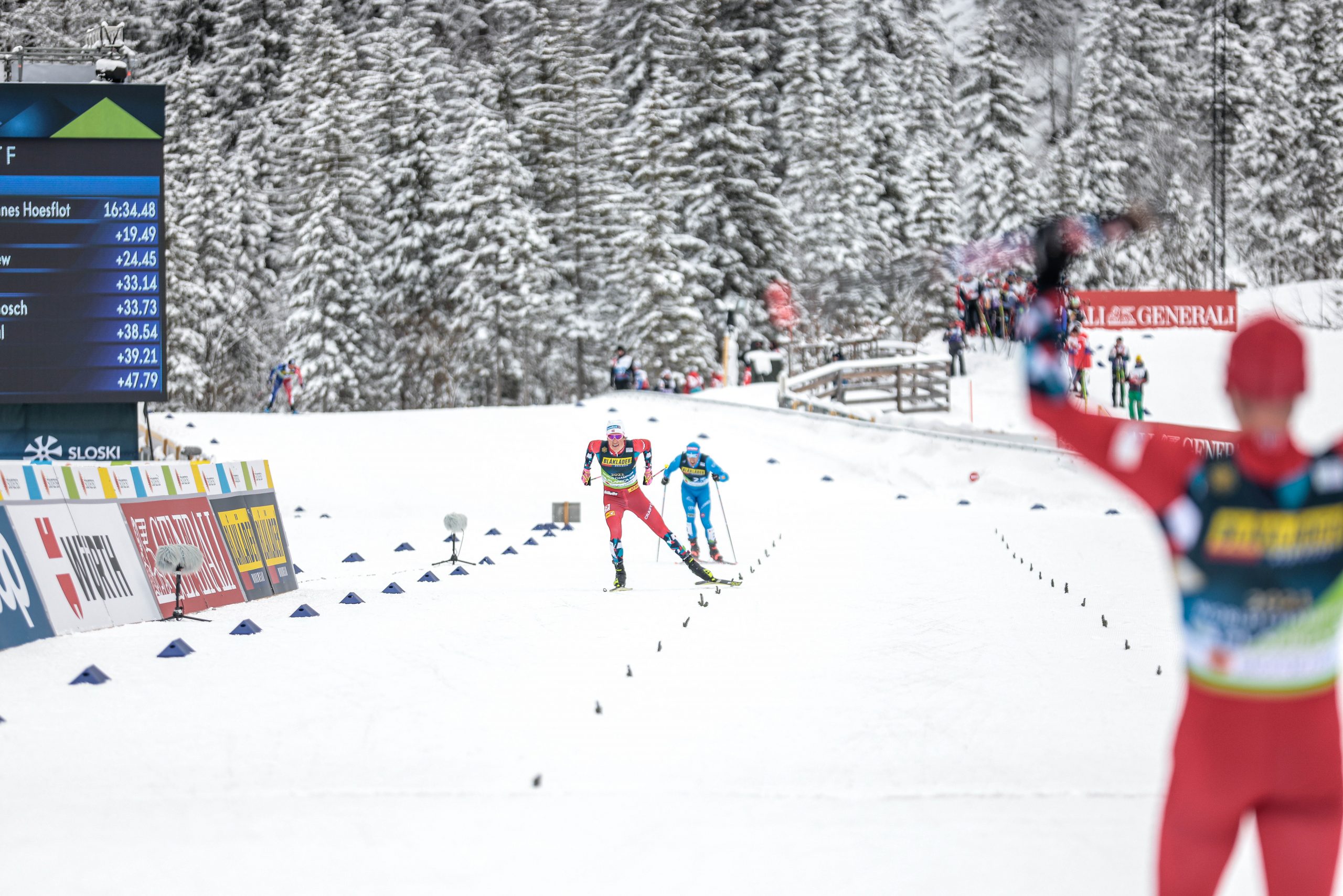
    Didrik Toenseth (NOR), Paal Golberg (NOR), Andrew Musgrave (GBR), (l-r) – FIS world cup cross-country, 10km, Beitostolen, Norway. (Photo: NordicFocus)


  • Ruka Men’s 10 Kilometer Classic Individual Start:  It’s all Team Norway.

    Ruka Men’s 10 Kilometer Classic Individual Start: It’s all Team Norway.

    A_Hall_Mark_of_Excellence_Award-logo-300.png (300×244)This World Cup coverage is made possible through the generous support of Marty and Kathy Hall and A Hall Mark of Excellence Award.  To learn more about A Hall Mark of Excellence Award or to learn how you can support FasterSkier’s coverage please contact info@fasterskier.com.


    Ruka Men’s 10K Classic Individual Start

    Ruka presented less challenging conditions this year compared to last year for the athletes.  Temperatures were in the high teens (-8.0 Centigrade) with racers running on green cold waxes. Humidity was 100 percent, which posed the possibility of tracks glazing during the race. The racers competed on a 5-kilometer course with 30 seconds between the start of each racer.

    Johannes Hoesflot Klæbo (NOR) on his way to victory in the 10k in Ruka (FIN). (Photo: Nordic Focus)

    Results:

    The Norwegians dominated the field.  Johannes Klæbo finished first, besting countrymen Paal Golberg by 20.5 seconds followed by Martin Nyenget who was 28 seconds behind Klæbo.  An outstanding performance was turned in by Andrew Musgrave of Great Britain, who finished in fifth, 40.3 seconds behind Klæbo. Norweigans took six of the top ten spots.

    The top American was Ben Ogden, finishing 28th, 1:23.9 back.  He was closely followed by Zak Ketterson who finished 31st, 1:24.6 out of first.  Rounding out the field for the Americans was Hunter Wonders, who is also a competitive canoe racer, finishing in 39th. 2020 Junior World Champion in the 10 kilometer, Gus Schumacher, finished 48th. Scott Patterson finished 54th.

    The top Canadian was Graham Ritchie, finishing 35th.  He was followed by Olivier Leveile who finished 44th.

    Hunter Wonders (USA) on his way to 39th place in the 10k classic. (Photo: Nordic Focus)

    The Race:

    The steep climbs of Ruka proved challenging for the men who consistently jumped out of the tracks early on climbs, preferring to run up the loose snow on the sides of the course.  Prior to the race there had been much discussion about Klæbo’s health.  Questions continued to swirl when he hit the one-kilometer split in 21st place and still trailed at the 3.1- kilometer split.

    Calle Halfvarsson (SWE) on his way to 4th place in the 10k in Ruka (FIN). (Photo: Nordic Focus)

    Calle Halfvarsson of Sweden gave many of the Swedish fans in the crowd a thrill as he led the race at the first three splits.  Ogden was in the hunt at the one-kilometer mark, only 12.5 seconds out of the lead, but by the 3.1 checkpoint, his trailing margin had widened to 22.4 seconds.

    Starting at about the six-kilometer mark, Klæbo removed any doubt about his nagging injury when he jumped into the lead establishing a six second advantage over countryman Halfvarsson.  Meanwhile, Musgrave had pulled himself from 23rd to sixth place, only seven seconds away from a podium spot.  Musgrave turned in the fastest time from the 3.1 to 5.0-kilometer split.


    Andrew Musgrave (GBR) – FIS world cup cross-country, having an outstanding weekend in Ruka. (Photo Credit: NordicFocus)

    However, because of the start order, Klæbo was never really able to relax since he had started the race ahead of Golberg.  When Klæbo finished he had a 28 second lead over the next best finisher.  But most of the contenders were still on course, so he was uncertain as to where he would finish.  However, the writing was on the wall as Golberg entered the stadium and it became apparent that he wouldn’t be able to catch Klæbo.

    The only remaining question was would Norway capture all of the podium positions?  The question was only partially answered when Halfvarsson crossed the eight-kilometer checkpoint in fourth but was only 0.2 seconds behind Nyenget.  At the finish it appeared that Halfvarsson was struggling mightily but was able to hang on for a fourth place finish.  The results; Norway 1-2-3.

    Complete Results

    Paal Golberg (NOR), Johannes Hoesflot Klaebo (NOR) and Martin Loewstroem Nyenget (NOR) share the 10k classic podium in Ruka (FIN). (Photo: NordicFocus)
  • Ruka Sprint Redemption for Johannes Høsflot Klæbo

    Ruka Sprint Redemption for Johannes Høsflot Klæbo

    A_Hall_Mark_of_Excellence_Award-logo-300.png (300×244)This World Cup coverage is made possible through the generous support of Marty and Kathy Hall and A Hall Mark of Excellence Award.  To learn more about A Hall Mark of Excellence Award or to learn how you can support FasterSkier’s coverage please contact info@fasterskier.com.


    Johannes Høsflot Klæbo displayed his dominance in this year’s FIS World Cup Sprint in Ruka, Finland. (Photo: NordicFocus)

    Ruka, Finland sits at a northern latitude similar to Fairbanks Alaska, similar to the northern end of Canada’s Hudson Bay. By early winter, the sun is a weakened glow on the horizon, and then for only a few precious minutes each day. By midday, skiers vying for the win in today’s FIS Cross-Country World Cup Sprint were racing under Ruka’s stadium lights.

    The first men’s events of the FIS World Cup Cross-Country season took place in cold conditions that left competitors wreathed in the steam of their own breath, and tested the skill of ski technicians charged with creating kick and glide. Johannes Høsflot Klæbo quickly dispelled any notion that he may be limited by a lingering hamstring injury: Klæbo qualified first, dominated all heats in a manner that appeared easy, even for him, and cruised to victory ahead of Norwegian countrymen, Even Northug and Paal Golberg.

    Ben Ogden and JC Schoonmaker were the only North American’s advancing to the heats in the men’s field—Ogden 13th  and Schoonmaker 19th—with a near-miss for Logan Diekmann who skied to 32nd place in qualifying. Luke Jager tied for 40th, and Kevin Bolger 46th.

    Canada entered two skiers in sprint qualifying, with Graham Ritchie placing 53rd and Oliver Leveille 56th.

    Ruka Men’s World Cup Sprint

    While Klæbo’s first win of this World Cup season appeared leisurely, it was not without emotion. Ruka is where Klæbo was famously pipped at the line by Alexander Bolshunov in 2018. Ruka is also where Klæbo lost a World Cup sprint to Erik Valnes in 2020, and where Alexander Terentev outskied him in the opening World Cup Sprint in 2021. If Johannes Høsflot Klæbo were ever motivated by a desire for redemption, it would be at Ruka.

    Norwegian teammates Erik Valnes and Johannes Høsflot Klæbo celebrated a team sprint victory in Oberstdorf. Valnes is one of the few sprinters to take a World Cup sprint victory from Klaebo, as he did last season in Ruka. (Photo: NordicFocus)

    QUARTERFINAL 1—Klaebo and Valnes dominate

    Norwegian skiers arrived for Quarterfinal 1 clad in truly confusing red racing uniforms (all but indistinguishable from what Russian team skiers have worn on the World Cup circuit for quite a few years).  Except for Klæbo, most Norwegian athletes even raced in very Russian-looking red hats. At least the Swedes (mostly white) Finns (blue) and Americans (in blue with red/white stripe accents) remained recognizable.

    Wearing the yellow bib of last year’s overall World Cup champion, Klæbo advanced easily by means of his now-familiar acceleration on Ruka’s signature hill, though he never needed to unleash the high tempo striding that has been his trademark in this event. His skis seemed to float along the finishing stretch, allowing him sufficient space in front of his rivals to stand up and remove his pole straps well before the line. Norwegian teammate, Erik Valnes, followed him across the line in second.

    QUARTERFINAL 2—Halfvarsson advances

    The day’s second heat saw American, Ben Ogden, joining Norwegian sprint specialist, Even Northug, and the rejuvenated Swede, Calle Halfvorsson. Finland’s Joni Maki displayed fast skis as he moved to the lead, with Ogden pressing forward on the course’s first uphill. Ultimately, Halfvarsson finished first in the heat ahead of Northug, with Maki advancing as a lucky loser. Ogden seemed to struggle with slow skis, ultimately finishing the heat in fifth.

    QUARTERFINAL 3—Chanavat fades

    Heat 3 was dominated by Norway’s Haavard Solaas Taugboel who sprinted the ultimate hill followed by an inspired Francesco De Fabiani. France’s perennial sprint contender, Lucas Chanavat, finished fourth without ever appearing sharp.

    QUARTERFINAL 4—Schoonmaker comes close

    Paal Golberg moved quickly to the front in Quarterfinal 4, with American JC Schoonmaker jumping in behind. France’s 2022 World Cup Sprint Champion, Richard Jouve, worked his way forward through the quarterfinal field to tuck in behind Goldberg. Schoonmaker raced cleverly through the final stretch with a smart move to the inside on the final curve, narrowly missing a lucky loser spot.

    QUATERFINAL 5—Pellegrino climbs to the win

    Beijing silver medalist, Federico Pellegrino wore Italy’s new black race suit, and advanced to the semifinal by moving efficiently through the quarterfinal field. Pellegrino went to diagonal striding early on the ultimate hill, allowing him to pull away from the field. The inspired Frenchman, Jules Chappaz, crossed the line second.

    A resurgent Calle Halfvarsson moved consistently through the field on his way to the final. (photo: Fischer/NordicFocus)

    SEMIFINAL 1—both the lucky losers

    Wearing a white hat that differentiated him from his Norwegian teammates, Klæbo moved easily to front of his semifinal field before abruptly easing up. Northug and Halfvarsson took over the pace-making: thereafter, the script was pure Klæbo: driving to the front on the hill before gliding unchallenged across the finish line. Halfvarsson, Valnes, and Northug all advanced to the final.

    SEMIFINAL 2—Chappaz arrives on the scene

    The 1.4 k Ruka sprint course incorporates a critical uphill groomed four lanes wide, continuing over the top and down the other side to a lefthand turn into a wide finishing straight. Commentators often become so focused on Klæbo’s quick-striding domination on Ruka’s signature hill that we may overlook the fact that many other skiers bide their time on the hill, using the finishing straight to pick off their rivals. Semifinal 2 looked to be competitive, with Goldberg, Pellegrino, Chappaz, Jouve, and De Fabiani seeming well matched. Early on, Jouve moved into the lead after a very tight move that cut off De Fabiani. Ultimately, Jouve faded badly on the uphill—as did Pellegrino—allowing Chappaz to storm ahead for the semifinal victory (though he may have used too much energy in achieving it). Golberg crossed the line second to advance to the final.


    Sprint Final

    Making only his 12th World Cup start, Jules Chappaz may have spent more energy than was necessary in winning his semifinal; he would not end up being a factor in the final. That left Sweden’s resurgent Calle Halfvarsson to face four Norwegians (Northug, Valnes, Golberg, and Klæbo). Golberg and Valnes maneuvered to the front after Klaebo had  slowed the opening pace. Lingering mid-pack, Klæbo accelerated on the course’s primary downhill, and moved into a leading position before the hill. Klæbo never appeared to need his top gear, easily distancing the field on the hill. By the top, he had established a considerable gap which he handily maintained through the finish for his 49th World Cup victory. Northug won last week’s tune-up sprint Beitostolen, and his good form and good strategy brought him to the finish line second followed by teammates Golberg in 3rd, and Valnes in 4th.

    Johannes Høsflot Klæbo of Norway takes the win in Ruka, Finland’s classic sprint, gaining redemption for two Ruka World Cup sprints when he suffered rare defeats. (Photo: NordicFocus)

    While Klaebo had shown his early season fitness last week in Beitostolen with wins in Classic and Freestyle 10 k’s, his sprint-condition had remained in question. It wasn’t known (even by Klæbo) whether or not he would have the speed, the power, and the pop to contend in a World Cup sprint.

    “I didn’t know how this should go,” Klaebo said in a post-race interview.” . . . [I’ve had] things to deal with the last three weeks (referring to his lingering hamstring injury). [But] I had a really good day today. It was a lot of fun.”

    If there were any lingering questions regarding Klæbo’s fitness—or about his recovery from his summer-long hamstring injury—those questions have now been answered.

    The World Cup Sprint podium ceremony was still fist bumps instead of handshakes, reminding viewers that Covid still threatens events such as these. That memory must be particularly poignant to Klæbo: in 2020, the Norwegian team was unable to compete in the final World Cup events, and in 2021 Klæbo, himself, succumbed to Covid in the final weeks of the year, allowing Richard Jouve to claim the crystal globe. Today, at least, Klæbo had achieved a level of redemption, finally exiting the Ruka stadium with the sprint win that we’ve all come to expect.


    Full Results

    RUKA MEN’S SPRINT:  QUALIFYING | RUKA MEN’S SPRINT:  FINAL RESULTS


  • Tuesday Olympic Rundown: Nilsson & Klæbo Win Sprint Gold; Diggins 6th, Valjas 7th, Caldwell 8th

    Sweden’s Stina Nilsson (center) won gold in the classic sprint at the 2018 Olympics, with Norway’s Maiken Caspersen Falla (left) taking silver and Russia’s Yulia Belorukova bronze. (Photo: FlyingPointRoad)

    FasterSkier would like to thank Fischer Sport USAMadshus USAConcept2Boulder Nordic Sport, and Swix Sport US for their generous support, which made this coverage possible.

    ***

    2018 Winter Olympics (PyeongChang, South Korea): Classic Sprints

    Women’s international report | American women’s report

    Men’s international report | North American men’s report 

    Post-qualifier notes & quotes

    After winning the sprint qualifier by 0.39 seconds over defending gold medalist Maiken Caspersen Falla and then besting the Norwegian by 0.03 seconds in her semifinal, Sweden’s Stina Nilsson captured Olympic gold in a dominating performance in the classic sprint final, ultimately besting Falla by 3.03 seconds.

    Falla had to fight to even keep silver, as Olympic Athlete of Russia Yulia Belorukova pushed the pace on the final uphill and came close to outsprinting Falla in the finishing straight. However, the 23-year-old Russian couldn’t quite sneak past and settled for bronze, 0.34 seconds behind Falla.

    Jessie Diggins of the United States after finishing sixth in the classic sprint in PyeongChang. (Photo: FlyingPointRoad)

    Her teammate Natalia Nepryaeva finished fourth (+9.14 in the final), Sweden’s Hanna Falk fifth (+11.16), and the United States’ Jessie Diggins sixth (+11.23).

    Diggins’s teammate Sophie Caldwell finished unlucky number eight, and based on time was the last woman not to make the final after finishing a close fourth behind Nilsson, Falla, and Falk in her semifinal. Both semifinal heats were fast, with one lucky loser coming from each, and Caldwell was 0.18 seconds off that time.

    Also for the United States, Sadie Bjornsen finished third in her quarterfinal heat, 2.46 seconds behind Belorukova and also behind Norway’s Heidi Weng. That put her 14th on the day.

    In the men’s final, it was a fight to the final uphill when 21-year-old Norwegian phenom Johannes Høsflot Klæbo ran away from the field over the top of the climb and sailed to the finish to become the youngest ever gold medalist in cross-country skiing at the Olympics. Alexander Bolshunov of Russia had matched Klæbo for most of the race but ran out of steam at the top, allowing Italy’s Federico Pellegrino to catch onto his tails before the downhill. While Klæbo widened his lead, Bolshunov and Pellegrino battled to the finish line and Pellegrino ultimately won in a photo finish, securing silver (+1.34) while Bolshunov took bronze (+1.36).

    Johannes Høsflot Klæbo won the men’s Olympic sprint in dominating fashion while Federico Pellegrino just edged Alexander Bolshunov for silver. (Photo: FlyingPointRoad)

    Norway’s Pål Golberg finished fourth (+3.81 in the final) and Sweden’s Oskar Svensson fifth (+7.73). Top qualifier Ristomatti Hakola of Finland didn’t have it in the final, finishing sixth (+20.72).

    Canada’s Len Valjas finished third in his semifinal, but well off the pace (3.98 seconds behind Hakola) and did not advance as a lucky loser to the final. That put him seventh overall, Canada’s best result in two Olympic cycles.

    Both American men, Erik Bjornsen and Simi Hamilton, were eliminated in the quarterfinals. Hamilton’s quarterfinal was marred by a crash involving nearly the entire group, and he ended up fourth with a slow time as a result, and landed 20th on the day. Bjornsen finished fifth in his heat, 1.63 seconds behind Klæbo in one of the tightest quarterfinals of the day, good for 25th overall.

    Norway has now won both men’s gold medals in cross-country skiing, while Sweden has swept the women’s gold medals.

    Women’s sprint final results / Men’s sprint final results

    2018 Winter Olympics (PyeongChang, South Korea): Cross-Country Skiing Men’s & Women’s Sprint Qualifiers

    Sprint racing at the PyeongChang Olympics kicked off on Tuesday, with Sweden’s Stina Nilsson setting the pace in the women’s qualifier just 0.39 seconds ahead of defending Olympic champion Maiken Caspersen Falla of Norway.

    The rest of the field couldn’t touch those two. Krista Parmakoski of Finland, the bronze medalist in the 30 k skiathlon, came closest, notching a time 3.56 seconds slower. Sweden’s Hanna Falk qualified fourth (+3.80), Slovenia’s Katja Visnar  fifth (+6.50), Olympic Athlete of Russia Natalia Nepryaeva sixth (+6.91), American Jessie Diggins seventh (+7.02), Sweden’s Ida Ingemarsdotter eighth (+7.32), American Sadie Bjornsen ninth (+7.38), and Norway’s Heidi Weng tenth (+7.54).

    For the United States, Sophie Caldwell also qualified for the quarterfinals in 12th position (+8.32). Ida Sargent, who recently had surgery on her thumb, did not, notching the 33rd-best time of the day – 17.06 seconds off the pace and 1.78 seconds out of the heats.

    For Canada, Emily Nishikawa led the team in 34th, 2.73 seconds out of quarterfinals. Dahria Beatty finished 42nd (+21.03) and Cendrine Browne 51st (+25.56).

    CU student Petra Hyncicova of the Czech Republic finished 45th (+23.29). APU’s Jessica Yeaton, racing for Australia, finished 48th (+24.27), and Aussie teammate Casey Wright (University of Alaska Anchorage) 63rd (+41.06). Canada-based Mathilde Petitjean of Togo finished 59th (+37.19).

    Women’s Qualifier Results

    In the men’s sprint qualifier, Ristomatti Hakola of Finland turned heads by posting a time that last year’s Sprint Cup champion Johannes Høsflot Klæbo of Norway could not beat. The Norwegian posted a time 0.19 seconds slower than the Finn.

    The men’s field was much closer than the women’s, with just 9.51 seconds separating the top 30 finishers who would move on to the quarterfinals. The third qualifier was young Olympic Athlete of Russia Alexander Bolshunov (+1.66), with Italy’s Maicol Rastelli a surprise fourth-place finisher (+2.78). Sweden’s Teodor Peterson qualified fifth (+3.01), Olympic Athlete of Russia Alexander Panzhinsky sixth (+3.09), Sweden’s Oskar Svensson and Viktor Thorn seventh (+3.48) and eighth (+3.65), and Italy’s Federico Pellegrino ninth +4.64. Calle Halfvarsson notched the tenth-best time (+4.73) and gave Sweden four qualifiers in the top ten, while Klæbo was the lone Norwegian in the top ten.

    For the United States, Simi Hamilton and Erik Bjornsen made the quarterfinals, qualifying in 19th (+7.59) and 29th (+9.15) respectively. Bjornsen actually tied for 29th with France’s Richard Jouve, making him the last man to make the cut, so to speak. Canada’s Len Valjas will be the lone representative of his country in either the men’s or women’s heats after qualifying 26th (+8.57).

    Alex Harvey just missed the quarterfinals in a tie for 32nd (+9.41), with Canadian teammate Jesse Cockney close behind in 35th (+10.00). Russell Kennedy rounded out the Canadian team in 54th (+14.83).

    For the U.S., Andy Newell was also on the outside looking in, placing 37th in the qualifier (+10.82). So was Logan Hanneman in 42nd (+12.20).

    Men’s qualifier results

  • Klæbo Commands Kuusamo Classic Sprint; Harvey 21st, Bjornsen 24th

    Klæbo Commands Kuusamo Classic Sprint; Harvey 21st, Bjornsen 24th

    Left to right: Norwegians Pål Golberg and Johannes Høsflot Klæbo and Sweden’s Calle Halfvarsson after placing third, first and second, respectively, in the men’s 1.4-kilometer classic sprint on Friday in Kuusamo, Finland. (Photo: FIS Cross Country/Facebook)

    There was no mistaking Norway’s Johannes Høsflot Klæbo in Friday’s 1.4-kilometer classic sprint, even with no natural light illuminating the course in Kuusamo, Finland, by the time the men’s final left the start line. The 21 year old’s distinct runner-like, high-tempo stride could be seen leading the five other men’s finalists on every climb, distinguishing him from the light fog and densely packed trees lining the course’s firmly packed tracks.

    Making his World Cup debut in the spring of 2016, Klæbo has since racked up four-regular season World Cup individual sprint podiums — of the eight World Cup sprints that he has entered — and ended last season as the men’s U23 World Cup champion as well as the overall Sprint World Cup winner, all at the age of 20.

    Last weekend at Norway’s first International Ski Federation (FIS) races of the season in Beitostølen,  Klæbo not only won the classic-sprint final, but he also topped the men’s qualifier, his quarterfinal and his semifinal.

    Klæbo repeated the feat this weekend in Kuusamo, starting first with the qualifier, clocking the fastest by 2.26 seconds over Finland’s Anssi Pentsinen in a time of 2:46.53 minutes. He then won his quarterfinal by 0.6 seconds over fellow Norwegian national-team member Pål Golberg. In his semifinal, Klæbo bested Sweden’s Calle Halfvarsson by 0.29 seconds and then, with a convincing gap on the rest of the field, crossed the finish line first in the final in 2:48.19, kick starting his 2017/2018 World Cup season with a win.

    It was not my plan to ski away so early but before the final hill I was told I had a five-minute lead so I went for it all the way to the finish,” Klæbo sai,d according to a FIS press release.

    Even before the course’s last climb, Klæbo had already set himself apart from the rest of the racers in the men’s final: Finland’s Ristomatti Hakola, Italy’s Federico Pellegrino, Sweden’s Calle Halfvarsson, and Norway’s Golberg and Sondre Turvoll Fossli. By the bottom of the first major climb he had double poled his way to a three-meter gap. 

    Klæbo already in his descent, Hakola, Golberg, Pellegrino, Fossli, and Halfvarsson crested the top of the climb in a pack and settled in for the chase. But Klæbo continued to hold them off into the second major climb, extending his gap by another two meters. As the others reached the second major climb, the race became one for second place between Halfvarsson and Goldberg. Hakola, Pellegrino and Fossli had all fallen back.

    Finishing with no one close enough to challenge him, Klæbo took the win in in 2:48.19. Goldberg crossed 1.35 seconds later for second place, while third went to Halfvarsson, 4.03 seconds after Klæbo.

    “I’m happy about the third place, but I was quite behind Klaebo,” Halfvarsson said according to a FIS press release. “I will try to catch up for the [Olympic] Games. He was impressive today.”

    Rounding out the top 10 was Finland’s Lauri Vuorinen in seventh, Russia’s Alexander Bolshunov in eighth, Switzerland’s Jovian Hediger in ninth, and Finland’s Martti Jylhä in 10th.

    Canada’s Alex Harvey advanced to the quarterfinals after qualifying in 13th (+6.13), the fastest North American in the preliminary round.

    The goal was to execute a solid day of racing since it’s the first time I put a bib on this year!” Harvey, of the Canadian World Cup Team, wrote in an email to FasterSkier. “I was pretty happy with my qualifier, it’s a short sprint here so 13th for me was a great start.”

    In his quarterfinal, Harvey went up against Finnish skiers Vuorinen, Iivo Niskanen, and Toni Ketelä as well as Estonia’s Marko Kilp, and Japan’s Hiroyuki Miyazawa. However, a loss in positioning before the major climb cost him a few seconds, and he finished his quarterfinal in fifth, 2.16 seconds behind Vuorinen, who won the heat in 2:47.40.

    “In the 1/4 final I did 1 or 2 mistakes that just cost me in term of positioning before the big hill,” Harvey wrote. “I felt great technically and actually pretty good physically too especially for the time of the year.”

    “Like normal the steep terrain is a bit of a weakness for me so again in the final wall I don’t think I was moving fast enough there,” Harvey continued. “The rest of the course I think I skied well.”

    The only other North American to qualify on Friday was Erik Bjornsen of the U.S. Ski Team (USST) in 26th (+8.71).  Racing in the same quarterfinal as Klæbo, Golberg, Finland’s Juho Mikkonen and Matias Strandvall, and Russia’s Gleb Retivykh, Bjornsen ultimately crossed in fifth, 5.12 seconds behind Klæbo.

    “We are really proud of [Erik] to qualify as strong as he did, in Scandinavia, in a classic sprint,” USST coach Matt Whitcomb said on the phone. “This is one of the hardest races of the year to do this, and it bodes really well.”

    “Talked to him between the qualification and the quarterfinals, and he was just exuding confidence and commented on how strong his double pole is feeling,” Whitcomb continued. “We saw him fire that jet in the finish stretch today. He had a really fast heat and it stressed him out a little bit, don’t know exactly what happened, but he was in the mix today and we are psyched.”

    Another USST member, Andy Newell missed qualifying by 0.38 seconds in 34th. He was 9.38 seconds off Klæbo’s top qualifying time.

    “It was frustrating to be so close and just on the outside of the qualification bubble,” Newell wrote in an email. “Just a few tenths of a second out of the top 25. I felt like I struggled today to get the right amount of glide vs kick… which is just as much on me as the tech. Grateful to be feeling healthy and looking forward to big races to come.”

    Julien Locke of Canada’s National U25 Team was the next-fastest Canadian, placing 59th (+12.07) in the qualifier. Locke finished 0.04 seconds ahead of the American Simi Hamilton (USST) in 60th (+12.13).

    “A little bit of an off day for Simi and Andy,” Whitcomb said. “For Andy on a course that is particularly good for him and he is in really good shape right now, I think he struggled with some glide.”

    Canadian World Cup Team member Len Valjas finished 63rd (+12.58). Before departing Gällivare, Sweden — where he and most of his teammate had been training and raced the opening FIS competitions — Valjas suffered a shoulder subluxation and was not “back to full health” by the time Friday’s sprint rolled around, he explained in an email.

    “I took the week really easy on the shoulder to let it recover, and gave it a try in today’s race,” Valjas wrote. “I didn’t have my normal strength in the double pole sections of today’s race. I just felt weak and couldn’t hold any speed on the flats.

    “I was happy that I was able to compete today, but I am definitely not skiing at 100%,” Valjas continued. “The shoulder is pretty sore and stiff from the qually this morning. Huge thanks to Pete Dickinson (USA physio) for taking care of me this week and helping me speed up my recovery.”

    Also competing for Canada was Knute Johnsgaard in 73rd (+12.58), Devon Kershaw in 74th (+14.01) Graeme Killick in 85th (+14.01), Jess Cockney in 95th (+18.83).

    Three additional Americans raced in the qualifier, with Scott Patterson (USST) finishing 84th (+16.14), Patrick Caldwell (USST) finishing 103rd (+21.43) and Noah Hoffman finishing in 105th (+21.85).

    Canada’s Continental Cup leader, Russell Kennedy (Team R.A.D.), who earned Period 1 World Cup start rights after ending winning last season’s overall NorAm title, did not start Friday’s sprint race.

    Results: Qualifier | Final | Ruka Triple standings (Day 1)

  • Friday Rundown: Sadie Bjornsen Opens with Career-Best Second in Ruka

    Friday Rundown: Sadie Bjornsen Opens with Career-Best Second in Ruka

    The women’s podium for the first race of the 2017/2018 World Cup season, the Ruka classic sprint in Kuusamo, Finland, with (from right to left) American Sadie Bjornsen in second, Sweden’s Stina Nilsson in first, and Russia’s Yulia Belorukova in third. (Photo: U.S. Ski Team/Twitter)

    FIS Cross Country World Cup (Kuusamo, Finland): Classic sprints

    Women’s race report

    Men’s race report

    In the first race of the 2017/2018 cross-country World Cup season, U.S. Ski Team (USST) member Sadie Bjornsen, who turned 28 on Tuesday, raced to the best result of her career, placing second to Sweden’s Stina Nilsson in Friday’s classic sprint in Kuusamo, Finland.

    Last season, Bjornsen notched her first World Cup podium in third place in the 5-kilometer freestyle in Toblach, Italy, and teamed up with USST teammate Jessie Diggins to take third in the 2017World Championships classic team sprint. Friday’s 1.4-kilometer classic sprint — the first race of the Ruka Triple mini tour to kick of the 2017/2018 World Cup season — was Bjornsen’s first race of the season. She did not participate in any preseason International Ski Federation (FIS) races.

    Bjornsen started out the day by clocking the fifth-fastest time in the qualifier, 1.98 seconds behind Sweden’s Ida Ingemarsdotter, who won the qualifier in 3:11.69 minutes. Bjornsen’s USST teammate Sophie Caldwell qualified third (+0.59) after another Swede, Hanna Falk in second (+0.19), and a total of four American women finished in the top 30 to qualify for the heats. Ida Sargent finished 22nd (+8.70) and Rosie Brennan was 26th (+9.51) to reach the quarterfinals.

    There, Bjornsen won her quarterfinal by 0.39 seconds over Russia’s Yulia Belorukova. Caldwell also advanced to the semifinals by placing second in her quarterfinal, 0.7 seconds behind Sweden’s Charlotte Kalla in first.

    Sargent finished third in her quarterfinal, 0.65 seconds behind the winner of that heat,  Sweden’s Anna Haag. Brennan placed sixth in her quarterfinal, 4.3 seconds behind Sweden’s Nilsson in first. Neither Sargent nor Brennan advanced to the semifinals.

    In the semifinals, Bjornsen again raced to first, and once again held off Belorukova — this time by just one-hundredth of a second. Caldwell followed in fourth in that semifinal, 0.5 seconds behind Bjornsen in first and 0.11 seconds behind Russia’s Evgenia Shapovalova in third (+0.39). Neither Caldwell nor Shapovalova advanced to the final.

    In the final, Nilsson took the overall win in 3:17.62 and Bjornsen captured a career best in second place, 0.24 seconds out of first. Belorukova rounded out the podium in third (+0.91), while Ingemarsdotter placed fourth (+2.72), Norway’s Kathrine Rolsted Harsem was fifth (+3.54), and Finland’s Krista Parmakoski sixth (+18.62).

    Overall, Caldwell placed eighth, Sargent 15th and Brennan 29th for the U.S. Diggins and Kikkan Randall missed out on qualifying in 34th and 36th, respectively. Julia Kern placed 57th, Liz Stephen 70th, and Chelsea Holmes 86th.

    None of the Canadian women qualified, with Dahria Beatty in 64th, Emily Nishikawa in 74th and Cendrine Browne in 87th.

    (Continues below)

    In the men’s 1.4 k classic sprint, Norway’s Johannes Høsflot Klæbo won out the day after winning the qualifier, quarterfinal and semifinal en route to another dominant performance in the final.

    Klæbo started off by winning the qualifying round by 2.26 seconds in 2:46.53. Finland’s Anssi Pentsinen qualified second and another Finn, Ristomatti Hakola, qualified third (+2.35), ahead of Italy’s Federico Pellegrino in fourth (+2.66).

    Cross Country Canada’s Alex Harvey was the top North American man in the qualifier, finishing 13th (+6.13), while Erik Bjornsen of the USST qualified in 26th (+8.71).

    Both Harvey and Bjornsen finished fifth in their quarterfinals and did not reach the semifinals. Harvey ended up 21st on the day, after finishing 2.16 behind the winner of his heat, Finland’s Lauri Vuorinen. Bjornsen was 24th overall after finishing 5.12 seconds behind Klæbo, who won the first men’s quarterfinal.

    Klæbo used the extra recovery time he had from racing an early quarterfinal to prime himself for another win in the semifinals, where he beat Sweden’s Calle Halfvarsson by 0.29 seconds. Another Norwegian, Pål Golberg, followed in third (+0.49), and Hakola placed fourth in that semi (+1.72). Both Golberg and Hakola had fast enough times to advance to the final, where they met Pellegrino — the winner of the second semifinal — and Norway’s Sondre Turvoll Fossli, who was second in the second semifinal (+0.1).

    In the final, Klæbo once again won convincingly, this time by 1.35 seconds with a finishing time of 2:48.19. Golberg took second place and Halfvarsson reached the podium in third (+4.03), while Hakola placed fourth (+5.65), Pellegrino fifth (+8.87), and Fossli sixth (+17.31).

    For the U.S., Andy Newell missed qualifying by 0.38 seconds in 34th and Simi Hamilton finished 60th. Scott Patterson was 84th, Paddy Caldwell was 103rd, and Noah Hoffman was 105th.

    For Canada, Julien Locke, of the national U25 Team, finished 59th, Len Valjas was 63rd, Knute Johnsgaard 73rd, Devon Kershaw 74th, Graeme Killick 85th, and Jesse Cockney 95th. Last year’s NorAm winner Russell Kennedy did not start.

    Results: 

    Women’s qualifier | Women’s final

    Men’s qualifier | Men’s final