From the FasterSkier archive — posts syndicated from athletes’ and coaches’ own blogs between 2004 and 2012, kept online as published. Current coverage is at fasterskier.com.
The 2019/2020 World Cup season is nearly upon us; Americans are preparing to cheer on those athletes currently wearing red, white, and blue for the U.S. Cross-Country Ski Team, or USST. But before you turn all your attention to this year’s national-team athletes, FasterSkier wanted to take a moment to remember those skiers no longer named to the USST.
Ogden’s update, and current career path, are interesting but perhaps not too surprising: After the application of age-graded national-team criteria left her 23 spots back from being re-named to the D-Team when she was ranked “only” 123rd in the world on the latest FIS Distance List, Ogden is happily continuing her collegiate ski career at Dartmouth, where she has been wreaking a path of destruction through the EISA carnival circuit.
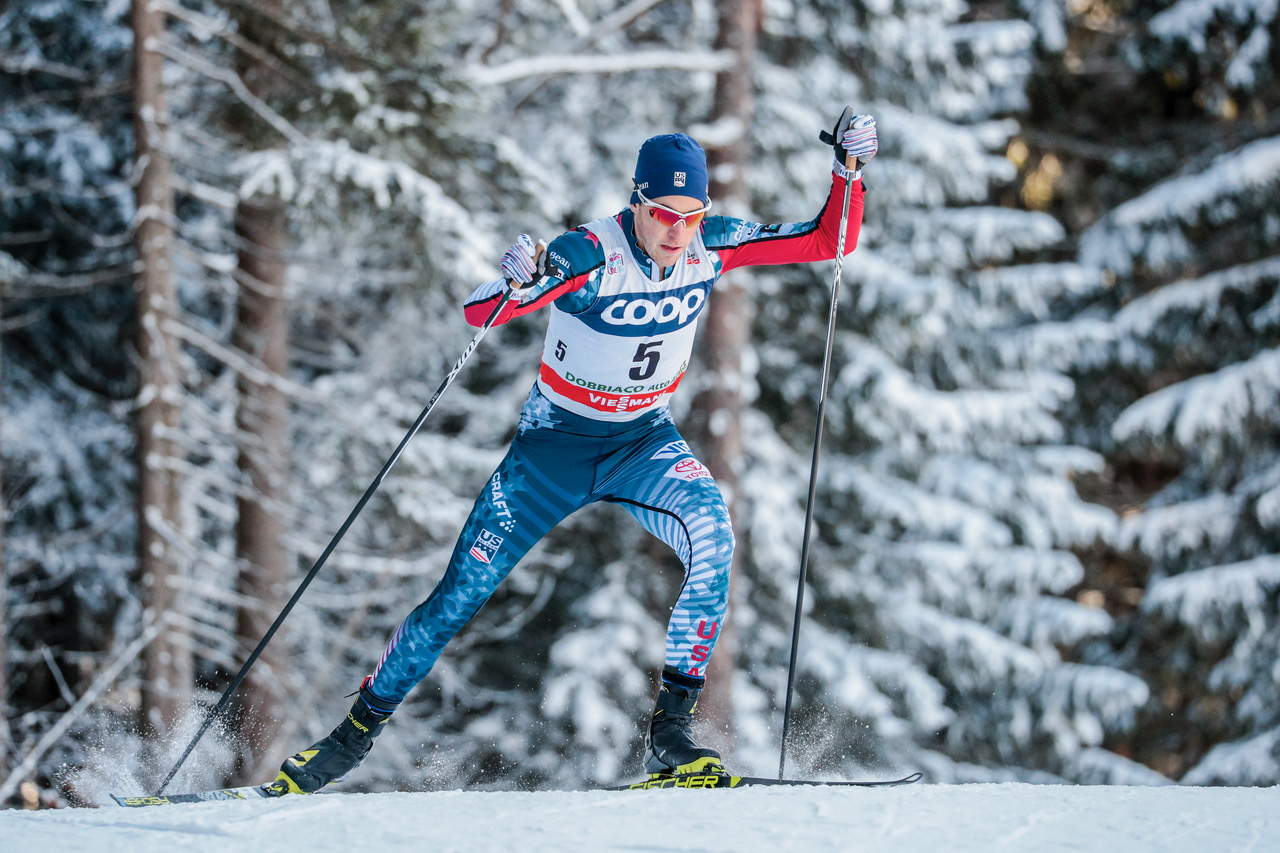
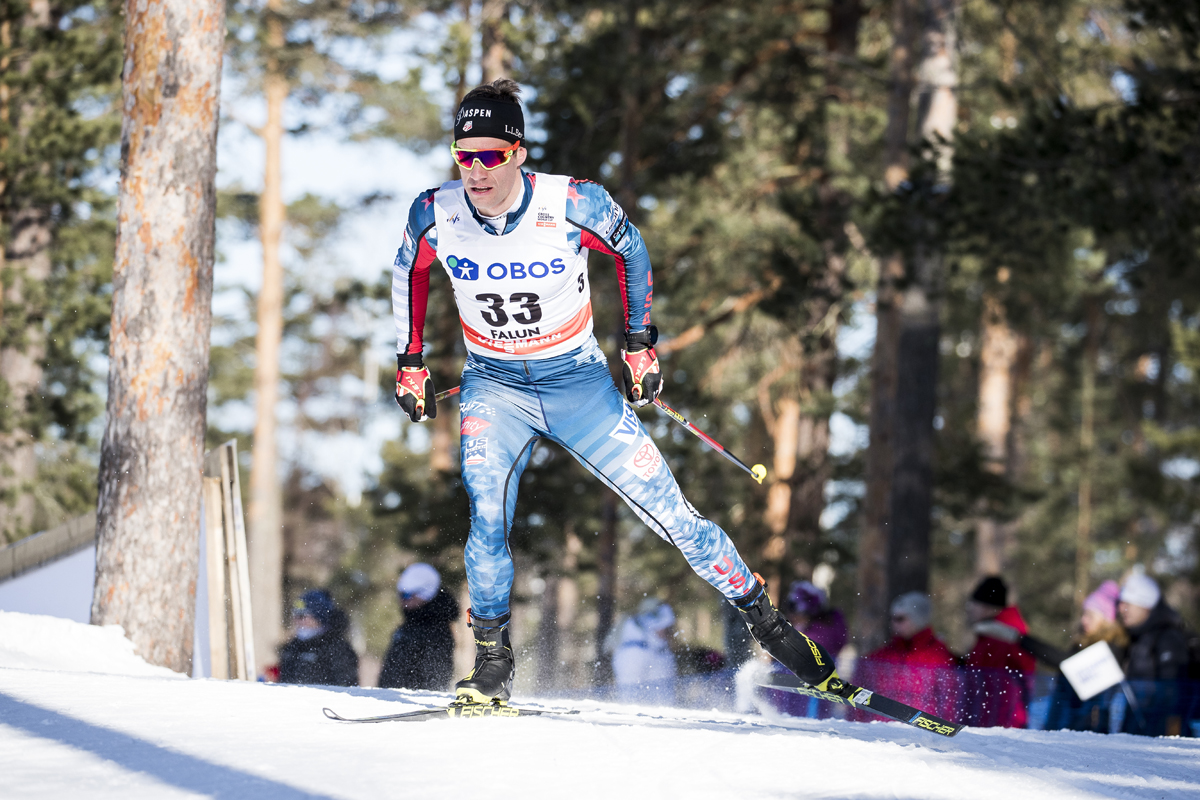
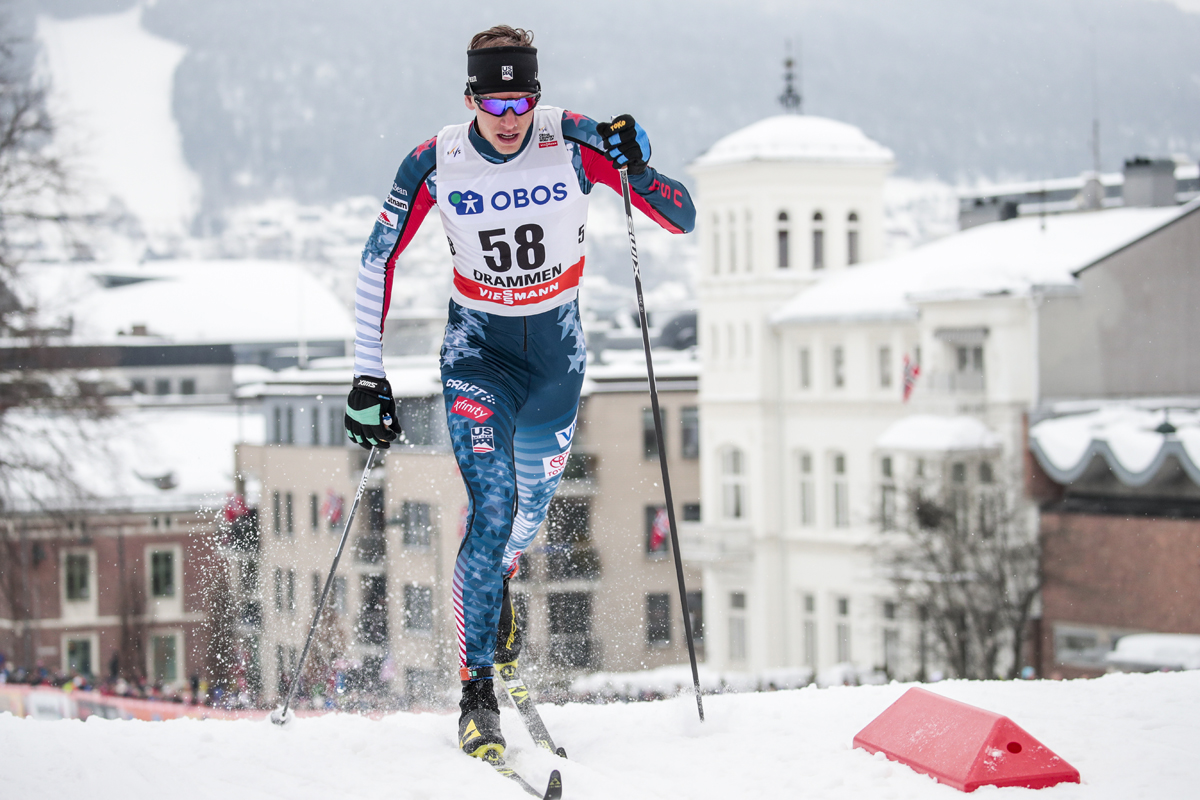
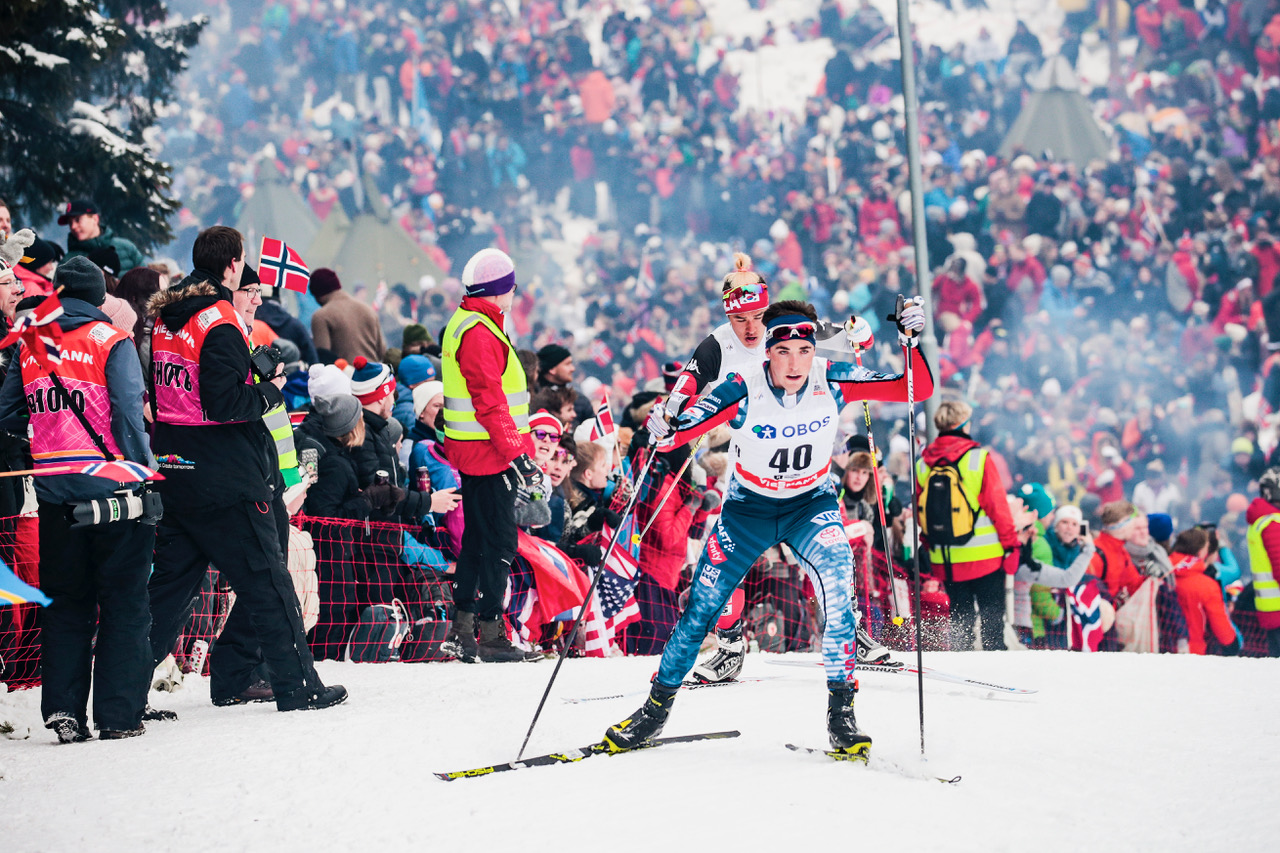
Paddy Caldwell racing to 53rd in the World Cup 15 k freestyle in December 2017 in Toblach, Italy. (Photo: Fischer/Nordic Focus)
Which is all well and good, but what happens when overtraining and an overuse injury run into the development pipeline? Life happens. And that’s the short version of explaining why Paddy Caldwell will be spending this ski season working in the renewable energy sector in Denver, and not pursuing full-time cross-country skiing for the first time in several years.
Caldwell, like Ogden, answered questions via email earlier this summer. His responses have been reprinted verbatim. FasterSkier’s questions have been paraphrased from what this reporter originally asked for the sake of narrative flow.
Caldwell is asked, in so many words, “What happened?” That is, and while acknowledging that every athlete is a real person who gets to lead his or her own life, the move from a steady trajectory and a rise up through the pipeline to retiring from high-level skiing at age 25 took many by surprise. Here’s Caldwell:
“This last season was a challenging one for me. Starting in August [2018] I have been dealing with an elbow overuse injury (medial epicondylitis or ‘golfer’s elbow’). This is still bugging me now [summer 2019] as I never gave it adequate time to heal. The larger – and related – issue was overtraining. I struggled with getting my heart rate up all year starting in mid-late summer. I made the mistake of putting my head down and grinding through it despite obvious signs of overtraining as well as deteriorating performance. Of course it is easy to see in hindsight but in the moment it felt like what I had to do to achieve my goals and to improve on the World Cup. The big mistake was not giving myself time to recover from either the injury or overtraining. Both issues just got worse and worse as the year went on.
Although I might not have achieved my ultimate result-based goals in skiing I have gotten so much from our sport and I have had so many positive experiences. Regrets? None! I am proud of what I have accomplished in our sport and am so grateful for all of the experiences, friendships and opportunities I have had. Wouldn’t change a thing.
“Starting the year [that is, the 2018/2019 World Cup season] I was not in a great place physically or mentally. I got sick twice in the first few weeks in Europe and eventually decided to fly home after getting sick again in Lillehammer. It was more of the same at nationals in Craftsbury [in January 2019]. After racing at Nationals I acknowledged that I was not going to recover in time for any of the races I wanted to participate in so I decided to take dedicated time off to rest and let my elbow heal. I had a procedure done on my elbow a week or two after nationals then took six weeks totally off from skiing.
“Finding the right balance in skiing has always been a challenge for me. I am someone that will always tend towards doing more rather than less and I set very high expectations for myself. I always performed best when I had other things going on like school or work.
“During my time off this winter I had time to reflect on skiing and realized that I was ready for new challenges. Although I might not have achieved my ultimate result-based goals in skiing I have gotten so much from our sport and I have had so many positive experiences. Regrets? None! I am proud of what I have accomplished in our sport and am so grateful for all of the experiences, friendships and opportunities I have had. Wouldn’t change a thing.
“I will always be a cross country skier. This sport has been my life and it will continue to be a defining part of who I am. Skiing is a family tradition that I cherish and hope to continue. I think it is safe to say that I am done with high level competition, though I certainly have more racing in me. I’ve been feeling the Birkie fever coming on recently… And I would love to do some running races sometime this summer. I’m still getting out the door to ‘train’ everyday and I don’t think that will change anytime soon.
“I am working for Invenergy LLC in Denver, CO. I am on the renewable energy development team. Our projects are focused on wind and solar energy as well as energy storage. I am really excited about this opportunity and I am loving the job so far. It has been a big change and a fun and exciting new challenge.
“And lastly I would like to thank everyone in the ski community – teammates, friends, competitors, coaches, fans, volunteers and supporters. I can’t thank you all enough and am so grateful to be part of such an amazing community.”
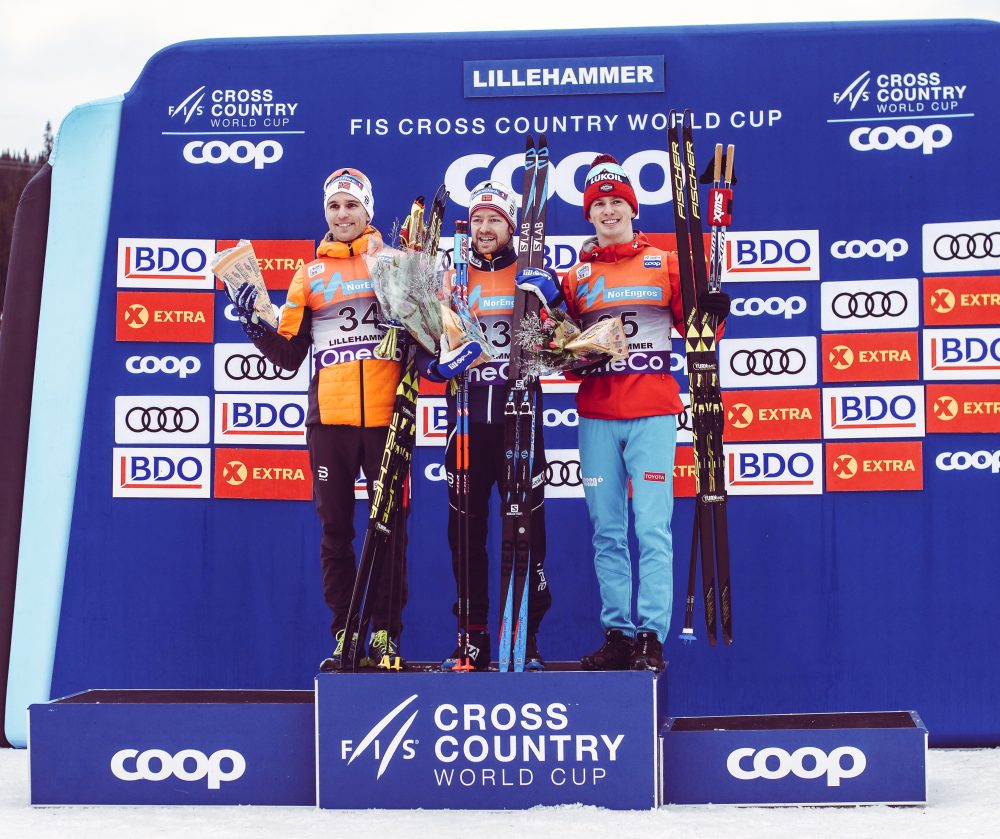
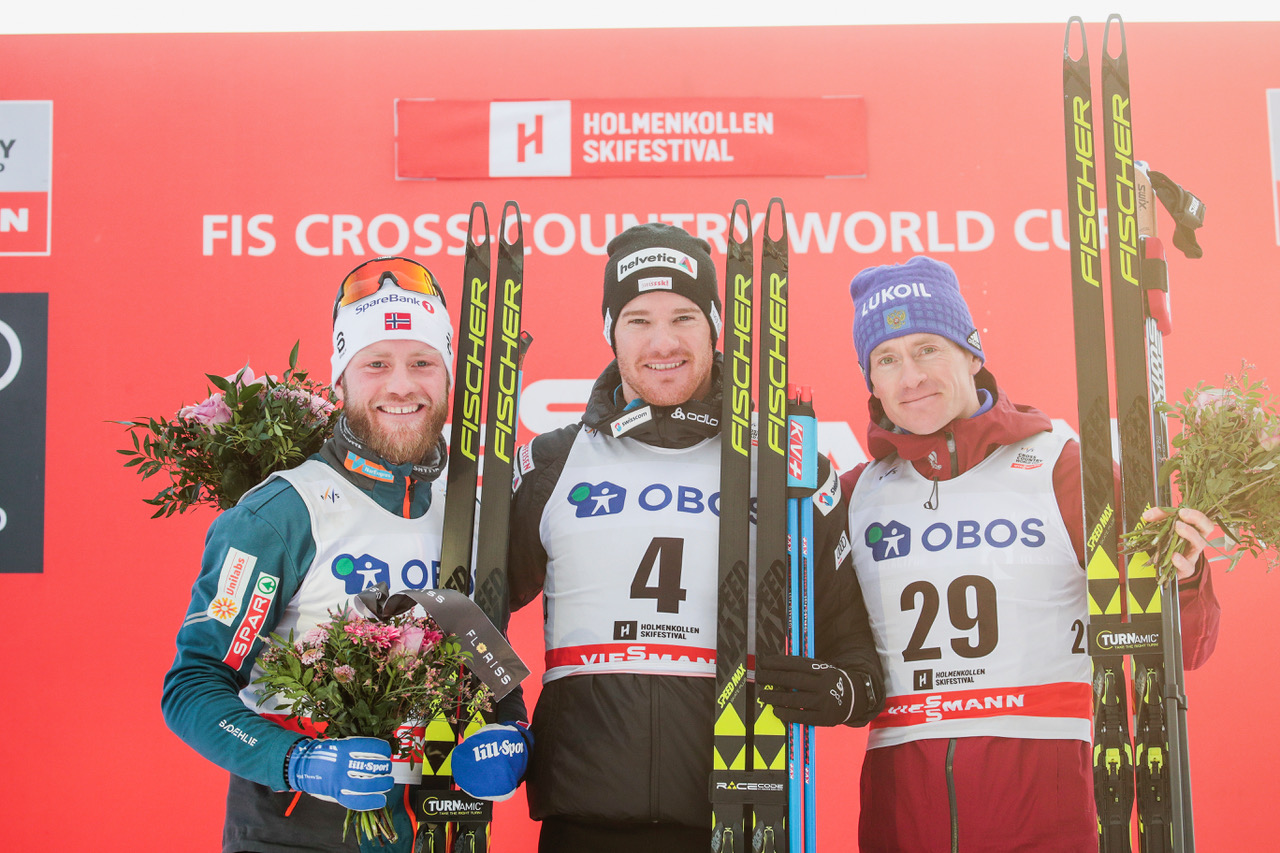
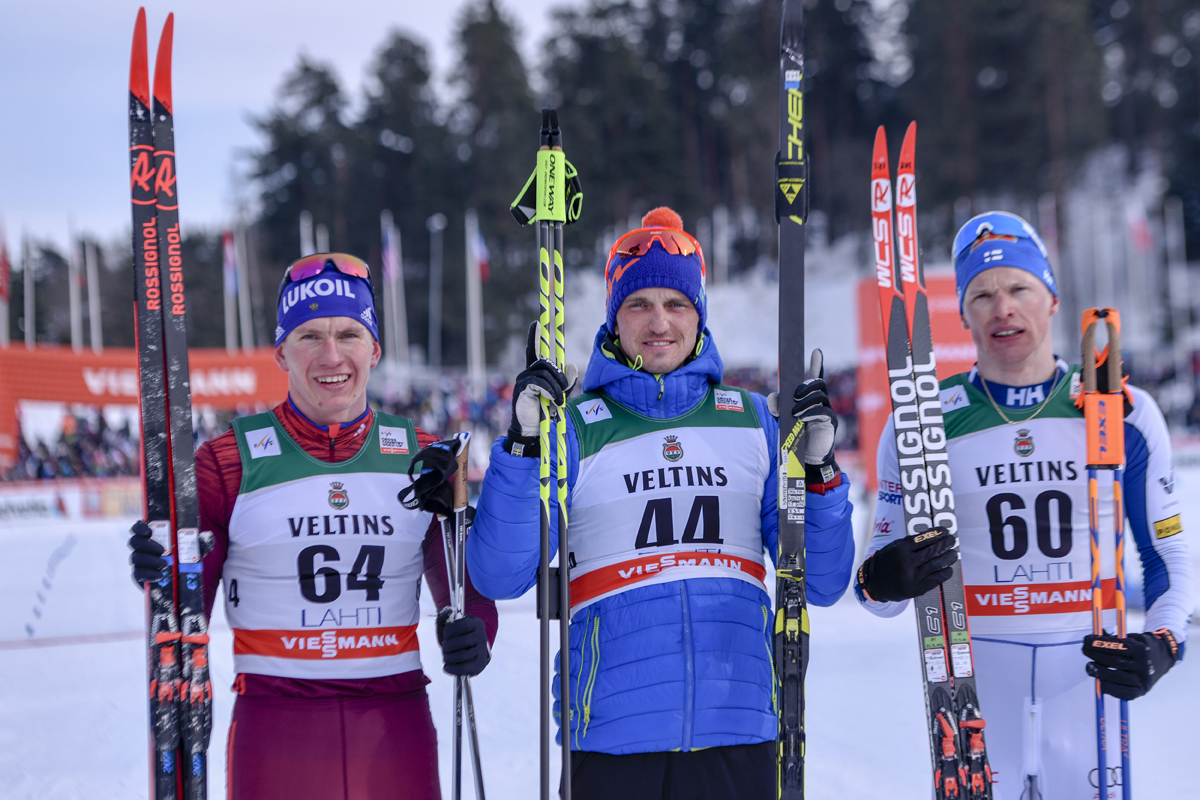
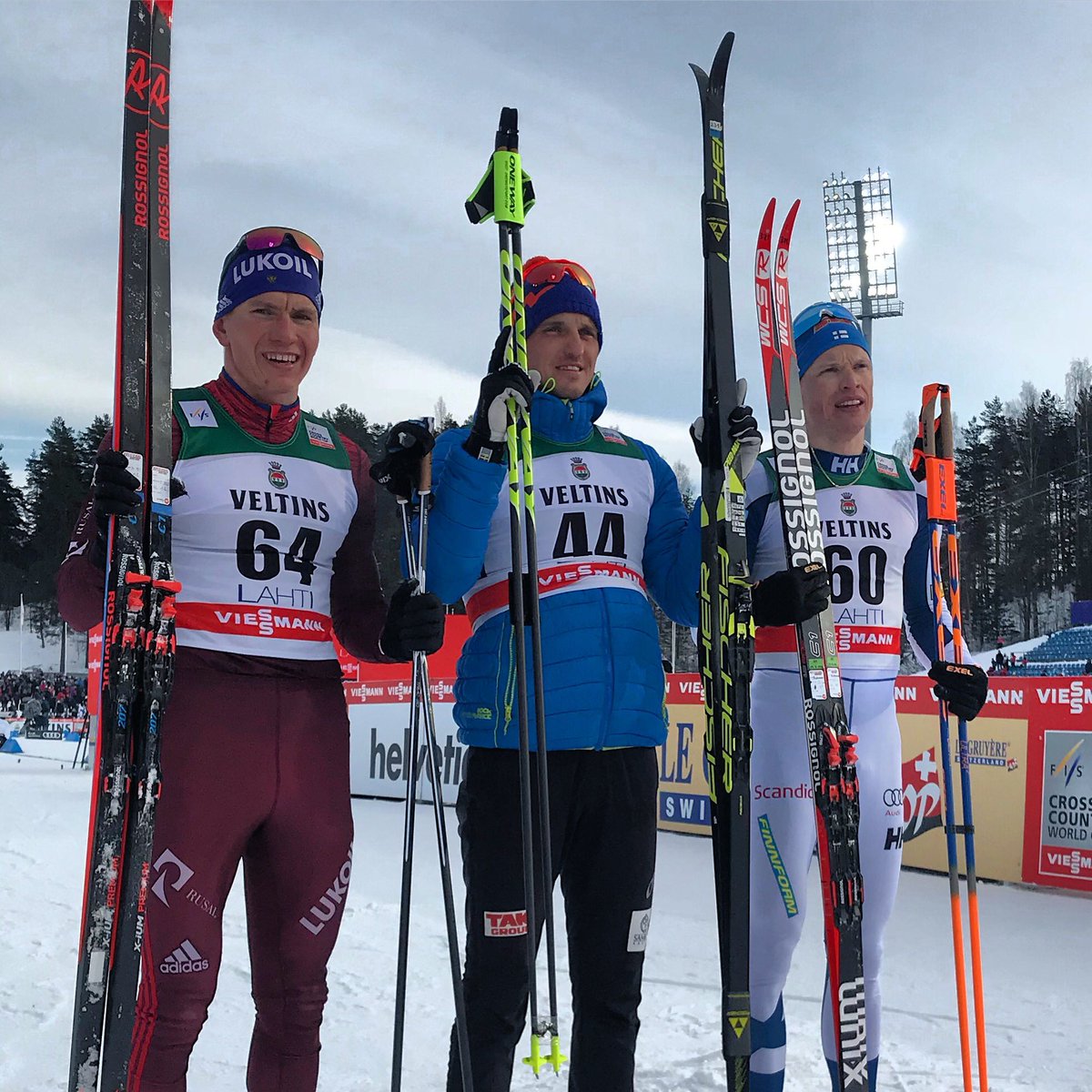
The men’s podim from the second day of World Cup racing in Lillehammer, Norway. In the 15 k freestyle, Norway’s Sjur Røthe (center) won, teammate Didrik Tønseth (left) placed second, and Russia’s Denis Spitsov (right) was third. (Photo: Henrik Hunnes)
Norway shined on their home course in Lillehammer, Norway with Sjur Røthe posting the fastest time of 36:3.0 minutes in the 15-kilometer individual start freestyle, followed closely by teammate Didrik Tønseth (+6.0). The Norwegians claimed six of the top-ten spots. Russia’s Denis Spitsov took the third podium position, finishing 28.6 seconds back.
In his first distance World Cup race of the season, Switzerland’s Dario Cologna placed fourth (+38.3).
“It feels amazing,” Røthe told the International Ski Federation (FIS) about his race. “I didn’t know that I was fighting for the victory, I just heard I was fighting with Didrik. I didn’t know it was for the victory until the last 5k. But I did everything I could and I kept a high speed the whole way, so I’m really satisfied.”
For North America, Alex Harvey was the best finisher in 17th (+1:20.5). His fellow Canadians Andy Shields took 61st (+3:08.4), and Russell Kennedy placed 64th (+3:17.0).
“I just had bad legs,” Harvey told FasterSkier in the mixed zone after the race. “I felt good in the warm-up, but racing I couldn’t climb.”
When asked whether his podium finish in yesterday’s sprint may have left him fatigued today, Harvey replied, “Probably, but it felt like in the warmup and in my morning jog, I didn’t feel that fatigued. I am missing something in distance right now, it was kind of the same in Kuusamo. So hopefully a couple races will help to bring the base level a bit higher.”
Harvey also noted that the course conditions played a role in his race day sensations. The weather and lack of natural snow added another layer of challenge. Rain and warm temperatures eroded the 5k manmade loop exposing wood chips, pebbles, and the ground below. While course officials worked to preserve the snow, they could not maintain the firm base that the course started with.
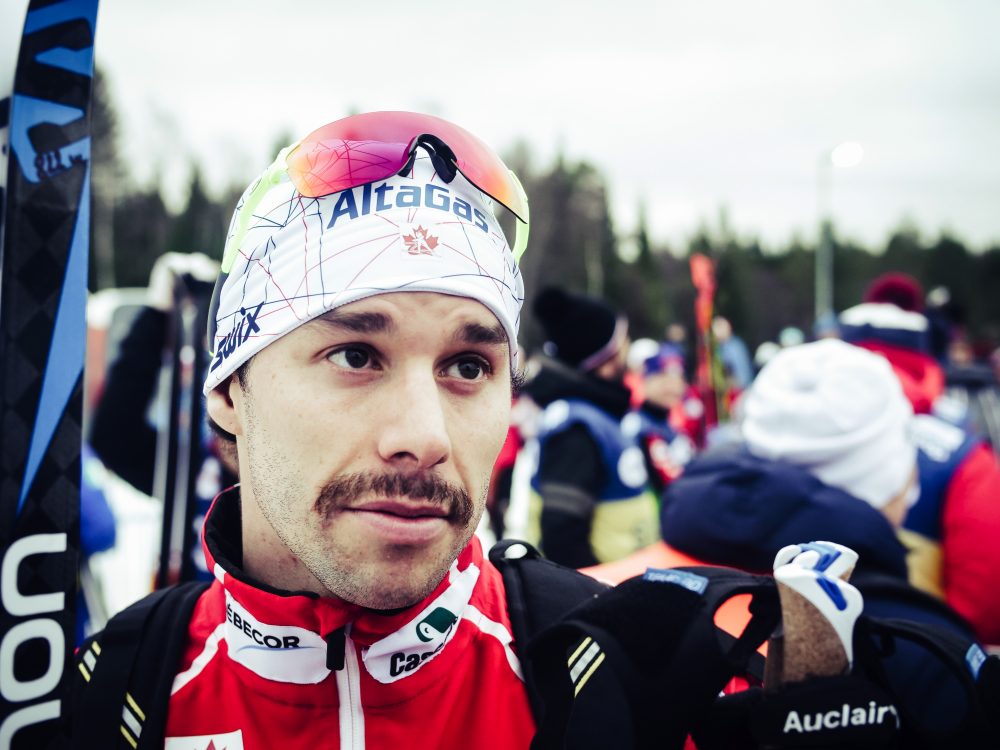
Alex Harvey of Canada in the mixed zone after the 2018 World Cup 15 k freestyle in Lillehammer, Norway. Harvey placed 17th. (Photo: Henrik Hunnes)
“It was really soft, the corners and everything,” said Harvey. “So it was hard to kind of rest the legs … you see on the results it was good for the lighter guys. Sjur, Didrik, and Spitsov are some of the lightest guys on the tour. So yeah, it was really sloppy skiing, for me it was really hard.”
He added, “That corner heading into the stadium, you can see the pavement at the bottom. So somebody must have hit the pavement.”
The Americans were well outside the points today; Erik Bjornsen of the U.S. Ski Team (USST) finished 43rd (+2:24.5).
Bjornsen, who was disappointed with his finish, commented, “I just wanted to go out there and push as hard as I can and try not to rush things. To find a good pace and be able to keep it. But 3-4k into the race, the legs were just kind of stiffening up. I’m not really feeling the snap and the energy that I’d like to and the climbs are feeling hard. Hopefully, I can figure it out in the next couple of weeks. It would be great to score some points before Christmas.”
David Norris (APU) in 54th (+2:44.5) was the next best U.S. skier. He was the day’s first men’s starter. Wearing bib number one can put an athlete in a lonely and frustrating position in an interval start as it means either skiing alone up front or being passed. But Norris saw it as an opportunity to ski with more experienced racers behind him.
“It was kind of nice to ski alone for a lap and a half,” Norris reflected. Then, different than in the past, some of the guys that were passing me I was able to ski with for a while rather than just trying to catch a ride and blowing up.”
Simi Hamilton (USST), who was the only American to qualify for the sprint heats yesterday, took his race in stride after placing 56th (+2:59.4). “I wasn’t expecting a ton,” Hamilton said. “At certain points in the season, I think I’m capable of putting together good distance skate races, but it’s still early. I’m not reading too much into it, but I thought my pace was okay and it was good beginner racing.
“Late November, early December, you want to be feeling good and racing fast. But, our goal for the season is racing fast in February for World Champs,” Hamilton added. “So I think any result you have this time of year you have to take with a grain of salt… I think it’s okay not to feel your best this time of year”
The course in Lillehammer is always taxing, as it features a four-minute climb, amongst other difficult hills.
“The course is just naturally really tough,” Hamilton shared. “You have that one decent recovery from the high point. But you’re still kind of working down that, doing some cornering. Pretty much everywhere else, you’re working the entire course. You’re either cornering, or it’s a long gradual climb, or a long steep climb, or a short steep climb.”
While today’s results may have been lackluster, the Americans are looking ahead to the races to come.
“I’m going to go out there and fight, but I’m not really sitting in a great position,” said Bjornsen. “I prefer the classic, so hopefully, I can just kind of move up and who knows. Tomorrow is a new day, so hopefully, I’ll be feeling good.”
While he hopes to see continued improvement, Bjornsen’s goals lie later in the season.
“I’m going to try to peak at World Champs,” he said. “And there are three team sprints on the schedule this year. Simi and I definitely want to, before we end our careers, get a podium together. So it’s definitely a goal … We’ve been fifth a few times and sixth, so we’re not that far off. I think on the right day it could for sure happen.”
Hamilton is looking forward to the road ahead as well. He added, “We go to Beitostolen on Monday. I’ll probably ski a relay there which I’m really psyched about. It’s just a 7.5 k in our relays now, so that’s a good skate distance for me. At the same time, I kind of get to use the next couple of weeks to really fine tune my speed for the sprint in Davos. I’ll definitely use the next 10 days to two weeks to get in some really sprint specific workouts.”
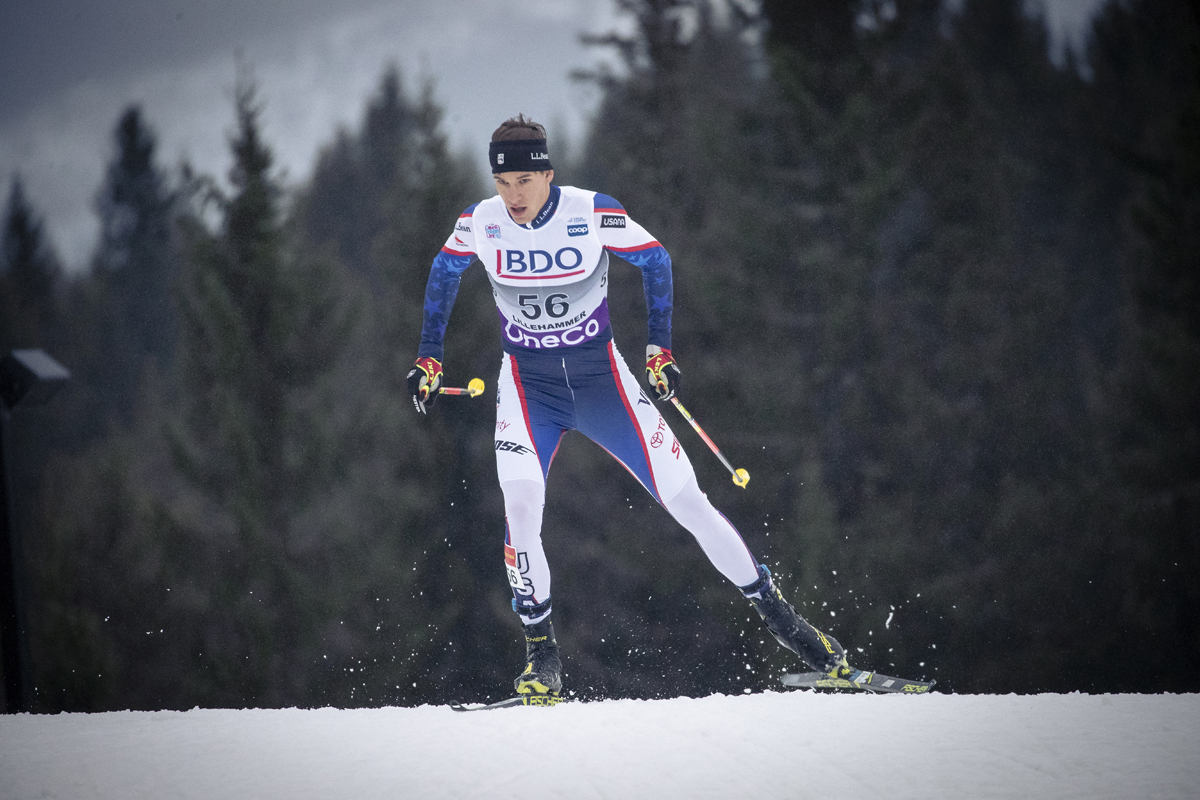
Kevin Bolger (USST) in a photo taken during Friday’s skate sprint qualifier in Lillehammer, Norway. (Photo: Fischer/Nordic Focus)
The remaining American finishers were Paddy Caldwell (USST) in 67th (+3:33.1), Kevin Bolger (USST) 68th (+3:38.7), Scott Patterson (USST) 73rd (+3:52.3), and Adam Martin (CGRP) 75th (+4:05.0)
In his first racing on the World Cup, prior to Kuusamo Martin had not contested a World Cup, Martin felt optimistic about today’s result.
“I’m really happy just to be here on the World Cup this fall and I’m trying to learn as much as I can,” Martin said. “These are incredibly good skiers and they’re in really good shape, so it’s a good learning experience.”
Not to be forgotten are the impressive results of Britain’s Andrew Musgrave. Norway is practically home now to Musgrave, an athlete feared on the World Cup but also at the annual gathering at the Norwegian National Championships.
He finished the day in sixth place, 45.1 seconds behind Røthe. It’s an impressive result as any considering the deep men’s field here in Lillehammer.
“The race today was good for me,” Musgrave emailed. “I had really good skis- the snow was pretty dirty after the warm weather we’ve been having the last few days, so most peoples skis were slowing down a lot every lap. Mine seemed to stay fast though.”
Historically, Musgrave peaks for the big events. He was barely off the podium in the Lahti Worlds 50 k skate. He has a penchant for arriving in form to maximize the win potential.
“I’ve been doing a lot of training the last few weeks, so haven’t been racing all that fast (my 65th place in the Norwegian Cup in Gålå last wasn’t exactly my strongest performance ever),” Musgrave explained. “It’s nice to see that I’m back to myself again now I’ve dropped my volume down again. Hopefully the extra training will pay off later in the winter though. That’s the plan anyway!”
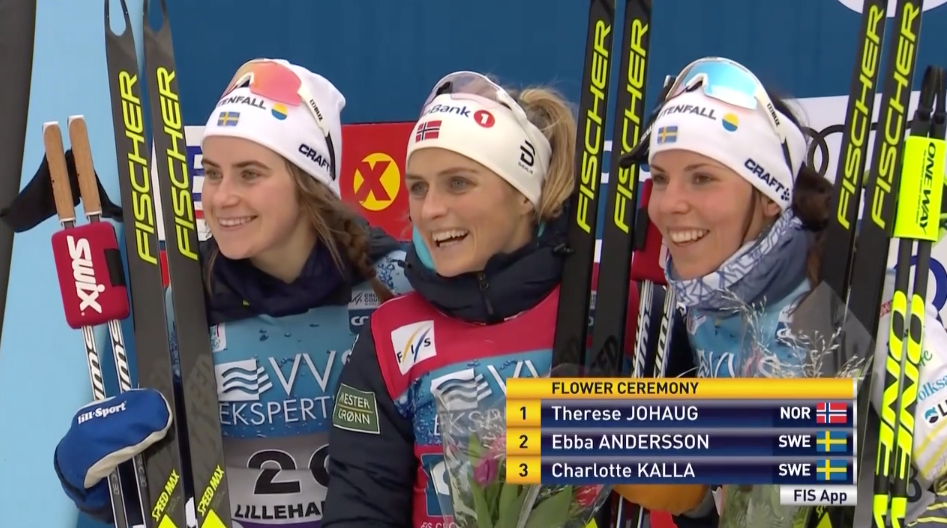
On Saturday, the second day of World Cup cross-country racing ensued in Lillehammer, Norway with a 10-kilometer freestyle individual start race for the women.
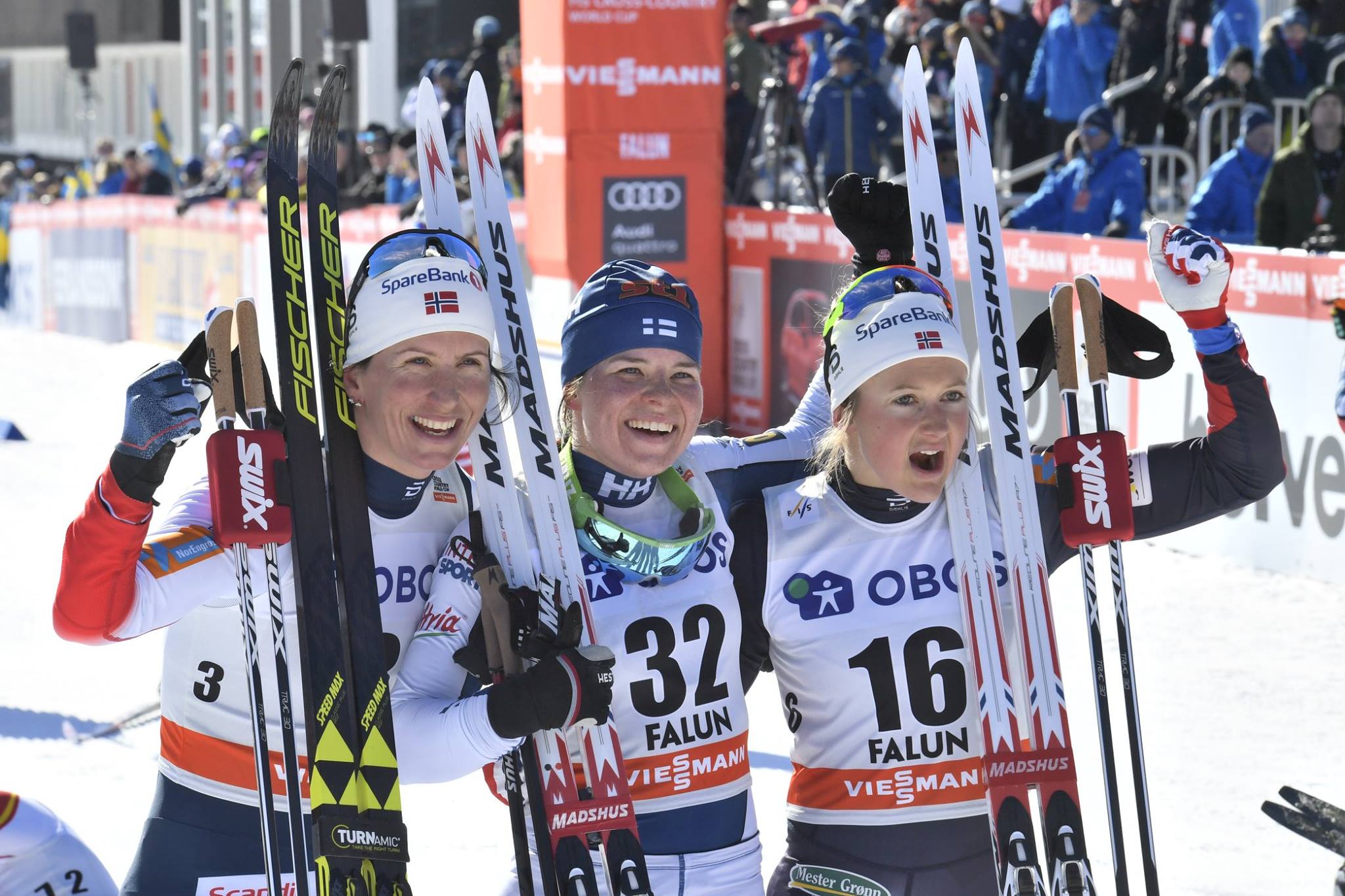
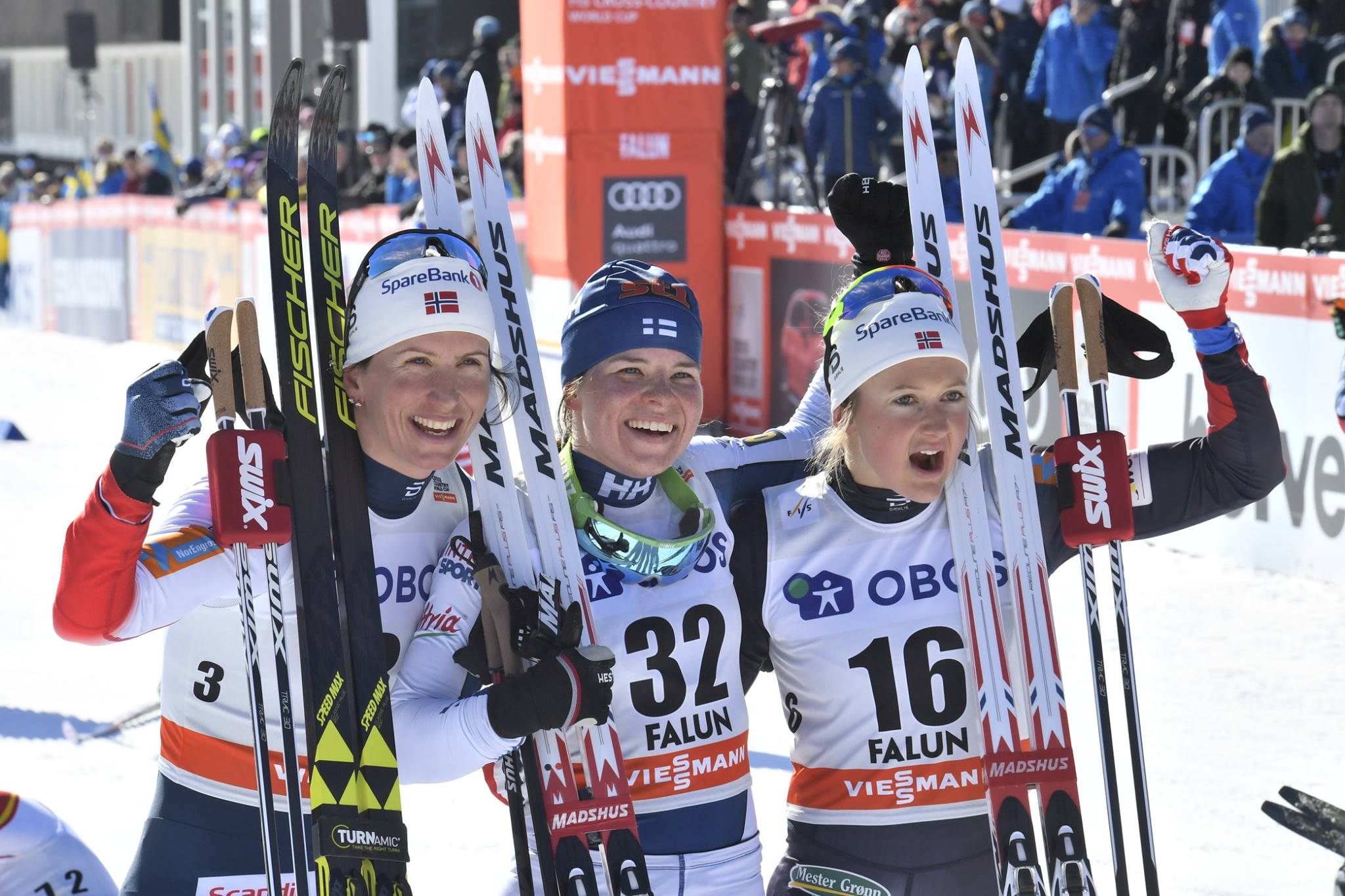
On a track of snow surrounded by green fir trees and a soggy landscape, the women skied two laps of 5 k course. Norway’s Therese Johaug was the fastest skier at every checkpoint to win in a time of 26:22.4 minutes. Ebba Andersson, the upstart Swede skied to second (+9.2), and teammate Charlotte Kalla was third (+15.7).
Collectively, it was a strong day for the U.S. women with four skiers in the top-30.
Sadie Bjornsen of the U.S. Ski Team (USST) finished in ninth (+1:17.0) after placing third in yesterday’s skate sprint. Rosie Brennan (APU) skied to 11th (+1:29.3), the USST’s Jessie Diggins 12th (+1:29.9), Caitlin Paterson (CGRP) 30th (+2:28.2), Kaitlynn Miller (CGRP) 60th (+4:10.4), and Ida Sargent of the USST 63rd (+4:18.4), and Kelsey Phinney (SMS T2) 65th (+4:22.5).
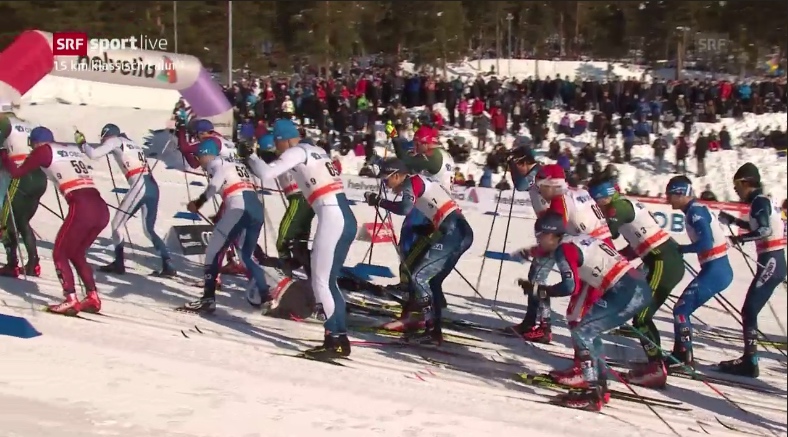
The men raced three times around the 5 k loop for 15 k total and three times up the course’s big climb. In this early season, many of the perceived pre-race favorites finished further back in the field.
Norway’s Sjur Røthe won in a time of 36:34.0 minutes. By the 8.3 k time check, Røthe took control of the race. Teammate Didrik Tønseth placed second (+6.0), while Russia’s Denis Spitsov was third (+28.6).
Canada’s Alex Harvey was the best placed North American in 17th (+1:20.5). Also for Canada, Andy Shields was 61st (+3:08.4), and Russell Kennedy (TEAM R.A.D.)64th (+3:17.0)
For the U.S., Erik Bjornsen of the U.S. Ski Team (USST) finished 43rd (+2:24.5), David Norris (APU) 54th (+2:44.5), Simi Hamilton (USST) 56th (+2:59.4), Paddy Caldwell (USST) 67th (+3:33.1), Kevin Bolger (USST) 68th (+3:38.7), Scott Patterson (USST) 73rd (+3:52.3), and Adam Martin (CGRP) 75th (+4:05.0).
SuperTour (West Yellowstone, Mont.): 1.3 k Freestyle sprints
The fastest qualifier for the men on Saturday in West Yellowstone was SMS T2 athlete Andy Newell. The Vermont native, now residing in Bozeman, Mont., won in a time of 2:35.53 minutes. His margin of victory was 7.26 seconds over second fastest qualifier, Alaska Pacific University (APU) skier Logan Hannenman. Newell’s teammate, Ben Saxton qualified in third (+7.79).
Newell advanced to the finals by winning the first heat and first semifinal.
In the finals, Newell controlled the pace and made clear that at thirty five years old, he can still light up the domestic ranks. Newell won in a time of 2:41.66 minutes. Craftsbury Green Racing Project’s Ben Lustgarten placed second in 2:43.55 minutes, and University of New Mexico skier Ricardo Izquierdo-Bernier was third in 2:45.66 minutes.
Adam Luban of the Sun Valley Ski Education Foundation Gold Team finished in fourth, Forrest Mahlen of Alaska Pacific University (APU) was fifth, and Ben Saxton (SMS T2) placed sixth in the men’s final.
Julia Kern, a member of the U.S. Ski Development Team (UUSDT) and SMS T2 , won the women’s qualifier in 3:08.58 minutes. Second in the qualifier, also from SS T2, was Erika Flowers who finished 2.5 seconds behind Kern. University of Utah skier, Julia Richter qualified in third (+3.22).
Like Newell, Kern won both her quarterfinal and semi to make the finals.
Kern won the women’s final in 3:09.85 minutes. APU’s RosieFrankowski, the day’s fourth fastest qualifier, was second in a time of 3:11.37 minutes. Teammate Hannah Halvorsen (APU/USSDT) placed third, stopping the clock in 3:12.51 minutes. Halvorsen placed sixth in the qualifier.
Flowers ended up fourth in the finals, while Richter and Utah teammate Karianne Moe, placed fifth and sixth, respectively.
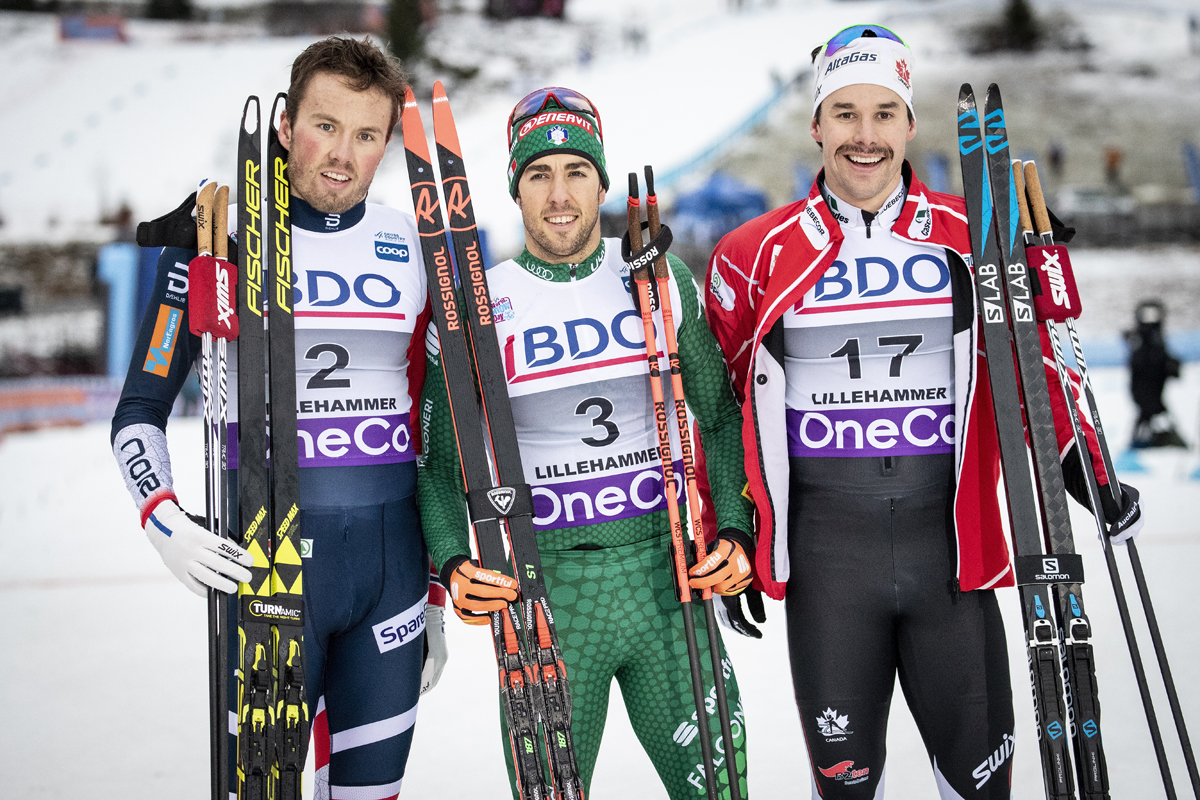
The men’s 1.6 k skate sprint podium from Lillehammer, Norway: the winner, Italy’s Federico Pellegrino (center), Norway’s Emil Iversen (left) second, and Canada’s Alex Harvey (right) third. (Photo: Fischer/Nordic Focus)
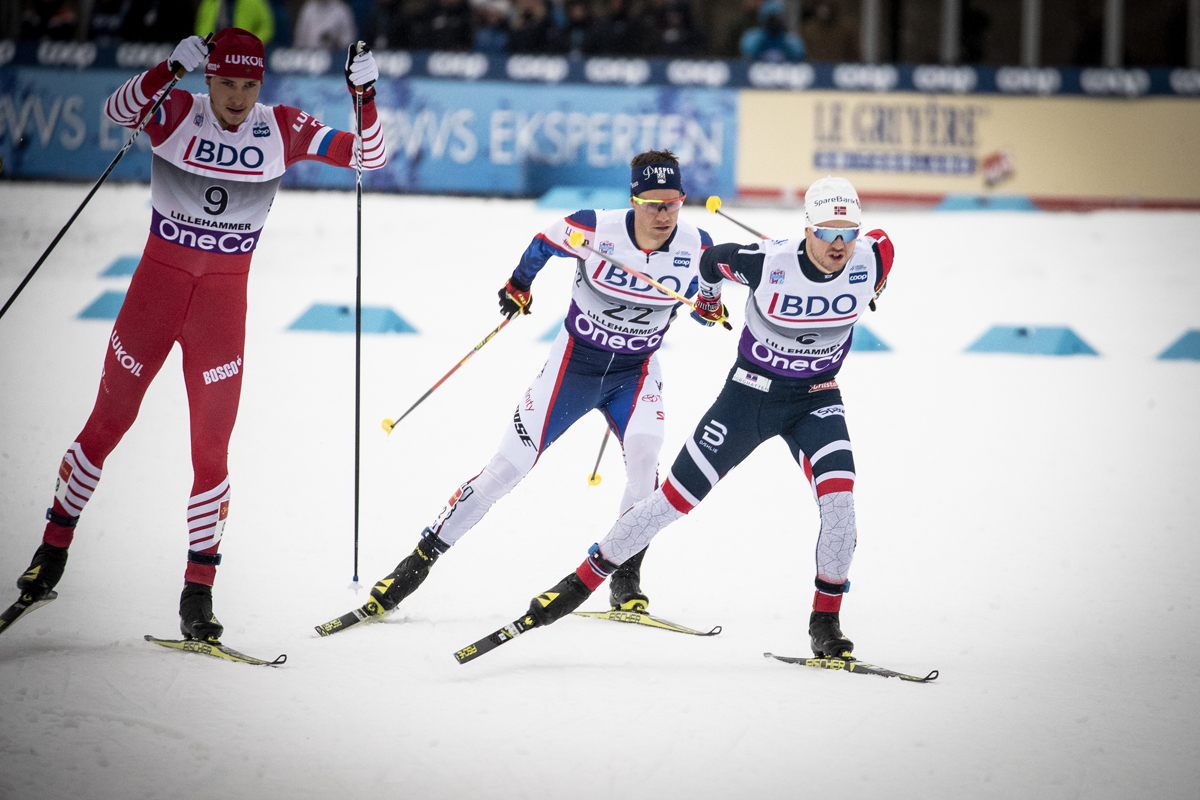
At two minutes into the men’s 1.6-kilometer freestyle sprint in Lillehammer, Norway on Friday, the six skiers in the final were strung in line — each milking a draft into the banked left turn before the final climb.
Norway’s Emil Iversen was in the lead — the workhorse pushing the pace for much of the race. Behind him were Italy’s Federico Pellegrino and Canada’s Alex Harvey zooming around the corner and stepping into the climb.
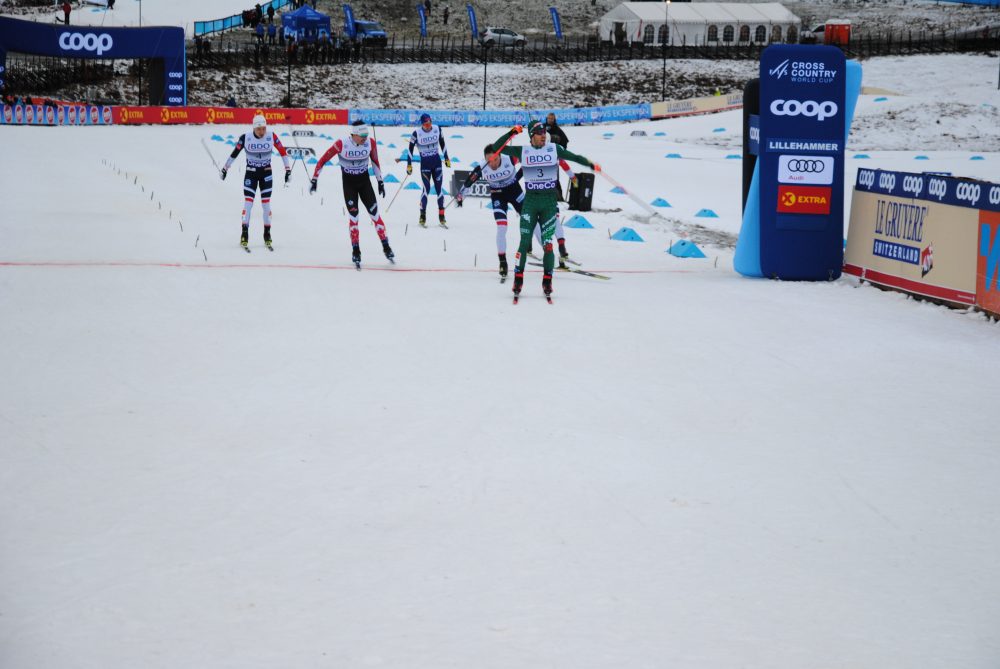
Halfway up the climb, a flip switched for Pellegrino – he was a flurry of V1 turnover as he built a five-meter, then a 10-meter gap — and a world of momentum — descending into the final straight.
Sporting Italy’s green lycra, Pellegrino never stopped accelerating towards the line to win in a time of 3:19.17 minutes. Iversen was second (+0.44), while Harvey hustled down the line to take third (+0.68).
Pellegrino crosses the finish line in the final of the men’s 1.6 k skate sprint in Lillehammer, Norway.
“I am really satisfied about today’s race,” Pellegrino told the International Ski Federation (FIS) after the race. “My goal was to get into the finals because I know in Norway it’s really tough at the beginning of the season. But the skis were good, the skis were good and even the mind was in a good shape.”
Pellegrino remains the record holder for World Cup skate sprint wins — today was his 11th victory in the discipline.
Lurking, but no stranger the to the upper tier of the World Cup is Harvey, sixth overall in the standings.
Harvey won the fifth heat to advance to the semi-finals on Friday. He was then the second lucky loser to advance to the finals. Harvey explained after the racing ended that speed-tactics had helped his hand.
“In the quarterfinal, I saw my skis were really good so was like ‘Okay maybe it can be a good day today,’” Harvey said. “The first semi was really slow. So then we talked, Emil or Sindre, if someone can make it to the front it would be good to make kind of a high speed. I think we were six seconds faster than the other [semi-final] so that’s why I was a lucky loser.”
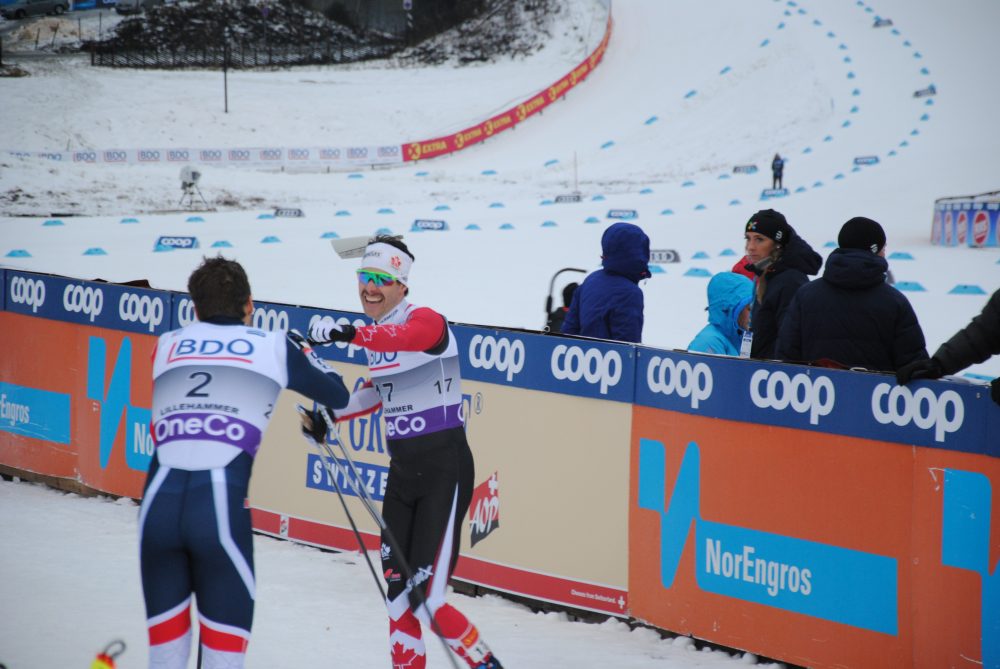
Canada’s Alex Harvey congratulating Norway’s Emil Iversen. Harvey placed third in the men’s 1.6 k skate sprint in Lillehammer, Norway. Iversen was second.
It was Harvey’s 27th World Cup podium and his first of the 2018/2019 season. Harvey often claims to begin his World Cup campaign with an element of caution when it comes to peaking. It’s true, his results tend to improve as the season progresses and the key races arrive. Last year, Harvey didn’t podium until January 6 during the 15 k classic in the Tour de Ski (TdS). In 2017, his first podium came on January 15th, in a team sprint. He went on that year to win the 50 k skate at the Lahti Worlds.
His primary objectives for this season remain further out — the Tour de Ski (TdS), the 50 k and skiathlon at Worlds, and the season finale in his home province of Quebec.
“I’ve had a good summer of training, I’ve been really happy,” Harvey said. “I was able to execute the plan basically to the dot, no injuries, nothing. So I’m really confident for the season. I worked on trying to find some speed again, like doing some speedwork a bit more often because I’m not getting any younger. So it’s something I need to work hard on. And I know that the baseline the fitness has been really good all summer so that I’m confident about. and I’m happy to see that the work that I’ve put in both in the gym and on roller skis for speed is kind of paying off for sprinting.”
The U.S. Ski Team’s (USST) Simi Hamilton, coming off a fall early in his Ruka qualifier last Saturday, rebounded to qualify 22nd (+8.72) in Lillehammer. Hamilton was eliminated in today’s fourth heat and placed 19th overall.
“Racing in Norway is always the toughest times of the year because the fields are so deep,” Hamilton said after his quarterfinal. “I’ve never had a good sprint here before. I’ve never even made the heats. So I think that you know, to have a decent qualifier today and to still have decent energy in the quarterfinal, I think that’s a really good sign just for my fitness this year. I got off to a rough start with falling in Ruka last weekend. But I’ve been healthy and I’m really psyched about that, It was not the best way to end the day but I’m really psyched for everything else coming up.”
Russia’s Gleb Retivykh (bib 9), the U.S.A.’s Simi Hamilton (bib 22), and Norway’s Sindre Bjørnstad Skar in the fourth heat of of the men’s 1.6 k skate sprint in Lillehammer, Norway. (Photo: Fischer/Nordic Focus)
Hamilton also told FasterSkier’s reporter in Norway he’s feeling sharp. Like many others, he’s focusing on the Seefeld, Austria Worlds as the main objective. Hamilton trends towards better results in skate sprints, which the World Cup schedule is heavy with this year.
“I’m really psyched for the rest of the year we have a lot more skate sprints coming up, which really suit me well,” Hamilton said. “I enjoy classic sprinting too but I tend to be a little better at skating, so it should be a really good season.”
As a three-race series, with an overall winner named after the classic pursuit on Sunday, many distance skiers were entered in the sprint.
Beyond Harvey and Hamilton, no other North American men qualified for the heats. The USST’s Kevin Bolger was the next best placed American in 61st (+14.63). Also for the USST, Erik Bjornsen was 63rd (+15.04), Paddy Caldwell 82nd (+19.34). David Norris (APU) placed 90th (+20.71), Scott Patterson of the USST finished in 92nd (+22.21), and Adam Martin (CGRP) 108th (+32.72).
For Canada, Andy Shields placed 60th (+14.59), Russell Kennedy (Team R.A.D.) 64th (+15.21), Julien Locke (CNST) did not start due to illness.
Racing continues Saturday for the men with a 15 k skate.
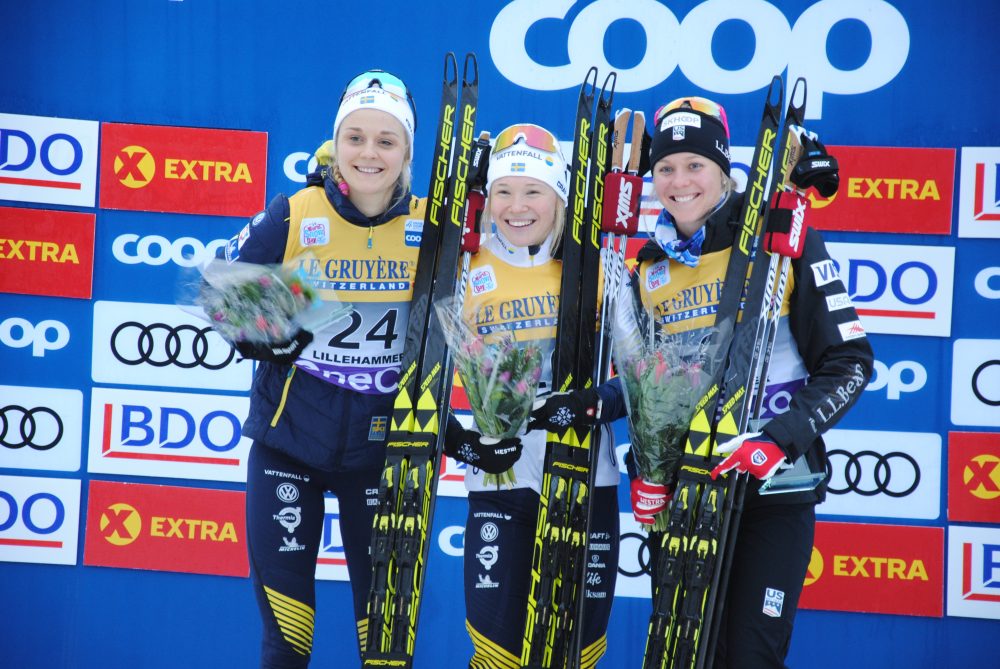
The women’s podium from the 2018 1.3 k World Cup freestyle sprint in Lillehammer, Norway. Sweden’s Jonna Sundling (center) won, teammate Stina Nilsson (left) was second, and U.S. skier Sadie Bjornsen (right) third.
FIS Cross-Country World Cup in Lillehammer Norway: Freestyle Sprint
In Friday’s women’s 1.3-kilometer freestyle sprint in Lillehammer, Norway, the first day of three successive days of World Cup racing, the women’s sprint final was stacked with Swedes, with four of six athletes sporting the yellow, blue, and white.
In the final, Jonna Sundling of Sweden passed teammate Stina Nilsson meters before the finish line to take the win in 2:52.74 minutes. It was Sundling’s first career individual World Cup win. Nilsson placed second (+.34), the U.S. Ski Team’s (USST) Sadie Bjornsen was third (+3.03).
Evelina Settlin, also of Sweden, placed fourth (+3.82), Kristine Stavås Skistad from Norway was fifth (+6.65), while the day’s fastest qualifier, Hannah Falk, finished sixth (+9.81).
American’s Jessie Diggins and Rosie Brennan were knocked out when they placed fourth and fifth respectively in the second heat. The top-four spots in the second heat were separated by 0.42 seconds. Diggins finished the day in 17th, Brennan in 21st.
Sweden’s Falk won the qualifier in 2:56.43 minutes.
The U.S. Ski Team’s (USST) Bjornsen was the fastest North American qualifier in sixth (+1.88). Brennan qualified in ninth (+3.11), Diggins 12th (+3.66).
Ida Sargent (USST) qualified 34th (+7.28), Kelsey Phinney (SMS T2) in 38th (+8.76), Caitlin Patterson (CGRP) 59th (+13.18), and Kaitlynn Miller (CGRP) 73rd (+20.78).
USST athlete Sophie Caldwell did not start as she is fighting a cold.
No Canadian women were entered
The men raced on a slightly longer 1.6 k course. Italy’s Federico Pellegrino, known for his skate sprint flash, won the men’s final in 3:19.17 minutes. On-form Norwegian Emil Iversen was second (+0.44), while Canada’s Alex Harvey, took third (+0.68).
Norway’s Sindre Bjørnestad Skar placed fourth overall (+0.91), with Finn Hågen Krogh racing to fifth (+1:07). Finland’s Ristomatti Juhani Hakola crossed the line in sixth (+2.43).
Norway’s Johannes Høsflot Klæbo won the qualifier in a time of 3:07.63. Klæbo placed sixth in the first semifinal finishing over thirty seconds back after breaking a pole.
Canada’s Alex Harvey and USST skier Simi Hamilton were the only North American men to qualify for the heats. Harvey qualified 17th (+7.59), Hamilton 22nd (+8.72). While Harvey eventually moved onto the final, placing third, Hamilton bowed out in the third heat. Hamilton placed fourth and was unable to advance as a lucky loser. Hamilton finished 19th overall in Friday’s sprint.
For Canada, Andy Shields placed 60th (+14.59), Russell Kennedy (Team R.A.D.) 64th (+15.21), Julien Locke (CNST) did not start.
The USST’s Kevin Bolger was the next best placed American in 61st (+14.63). Also for the USST, Erik Bjornsen was 63rd (+15.04), Paddy Caldwell 82nd (+19.34). David Norris (APU) placed 90th (+20.71), Scott Patterson of the USST finished in 92nd (+22.21), and Adam Martin (CGRP) 108th (+32.72).
Jessie Diggins (U.S. Ski Team) racing to 10th in the 2018 World Cup women’s 10 k classic in Planica, Slovenia. (Photo: Salomon/NordicFocus)
Welcome to FasterSkier’s World Cup Preview, where we check in with the top-10 teams from last year’s FIS Cross Country World Cup tour before the season starts. The World Cup begins with a classic sprint in Ruka, Finland on Nov. 24th.
***
United States
Overall in Nations Cup Last Year: 5th
Women’s Ranking 2017/2018:3rd
Men’s Ranking 2017/2018:11th
U.S. Skiers to Watch:
The high note last season was the gold medal team sprint performance by Jessie Diggins and Kikkan Randall. That pinnacle proved U.S. Ski Team (USST) coaches, wax techs, support staff, and of course athletes, could position themselves to succeed on the quadrennial winter sport prime-time stage. Time to exhale.
On both the men’s and women’s side, countless standout performances are vivid. Yet the collective success on the U.S. women’s team will remain a generational benchmark. It’s a good hunch, with the imminent 2018-2019 season, the women’s team has not hit it’s apogee.
This much is for certain: despite the retirements ofRandall and Liz Stephen, the U.S. women’s team remains loaded. Sophie Caldwell was the third ranked sprinter in the world last season. Sadie Bjornsen was top-10 in both the distance and sprint rankings, and sixth in the overall. Ida Sargent, despite breaking her thumb prior to the Olympics, finished 23rd in the sprint cup.
Although Rosie Brennan was not renamed to the 2018-2019 USST, she appears fully recovered from mono and will be starting the season on the World Cup as a discretionary selection.
Each World Cup weekend last year was time to check results and determine not if any of the women’s team had shined but who. The individual milestones were many.
Diggins’ season was a non-stop stream of highlights. In a post-Marit Bjørgen landscape, the Norwegian legend has retired, Diggins is poised to become even more of a force.
Not that anyone ever doubted Diggins, but watching Diggins charge and string out the field on January 28, during the 10-kilometer mass start freestyle in Seefeld, Austria was pure aerobic theater. She set the pace. She dictated the narrative. The move didn’t resemble an athlete taking a chance, but an athlete shifting into their top race gear and accelerating to the line. Pure confidence. For the remainder of Diggins’ season, there was no doubt.
Even with a skipped World Cup weekend in Lahti, Finland to manage media obligations back in the U.S. after the Olympic Gold, Diggins finished second overall on the World Cup.
Simi Hamilton (U.S. Ski Team) racing to 13th in the men’s freestyle sprint qualifier at 2018 World Cup Finals in Falun, Sweden. He went on to finish the day in 14th overall. (Photo: Fischer/NordicFocus)
On the U.S. men’s team, Andy Newellstepped down from full-time World Cup racing with a goal of making the 2019 World Championship team. Noah Hoffman retired and attends university. Simi Hamilton, the 17th ranked sprinter on the World Cup last season, is the veteran. Deep into his international career, Hamilton brings poise and power to the sprint roster. Paired with Erik Bjornsen, Hamilton co-leads a team sprint contender. After the duo placed sixth in the Olympic team sprint, Hamilton and Bjornsen are a possible breakthrough team for the Seefeld, World Championships.
Erik Bjornsen posted 13 top-30’s with an individual best of ninth place in the Seefeld 15 k mass start.
Scott Patterson comes off an Olympics and Holmenkollen 50 k where his ability to perform under pressure cemented him as a premier male long-distance skier. He placed 18th in the Olympic 30 k skiathlon and 11th in the marquee 50 k classic — a best U.S. men’s result since 1976. Patterson reinforced that performance with a 16th in the Holmenkollen 50 k skate.
New to the USST is Kevin Bolger. This season will be his first full-time European based campaign. Bolger more than impressed when he placed an astounding 11th overall in Lahti’s skate sprint last March. It was Bolger’s first career World Cup.
Paddy Caldwell will begin the season on the World Cup. He had several standout time of day performances in skate races last season.
Non-USST skiers starting on the World Cup will include overall SuperTour leaders David Norris and Kaitlynn Miller.
Caitlin Patterson (CGRP) and Kelsey Phinney (SMS T2) were discretioned as distance and sprint athletes respectively for early season World Cups. Adam Martin (CGRP) was a discretionary selection for the men’s distance races, his start rights begin in Lillehammer, Norway. Ben Saxton is scheduled to race only the classic sprint in Ruka, Finland.
News of Note from USST Head Coach Chris Grover:
On the men’s team: “The men have been in great shape this summer and fall,” Grover emailed FasterSkier. “Look for great results right away from Simi and Erik; both have had very productive preparation periods. Kevin Bolger has also had a great summer of training and looked very good in our October Park City camp. Scott Patterson had a broken toe to deal with for much of the summer but is doing well now. As you suggest, he’ll bring more experience to his WC campaign this season. You’ll see him in action first at the FIS opener in Beitostølen on Sunday, Nov. 18 (15 km F). Paddy Caldwell has been wrestling with occasional elbow tendonitis ever since New Zealand camp, so there is a decent chance that he has a slower start to the World Cup.”
Season goals: “The women’s team is a veteran squad that all now understand what it takes for them individually to be in top fitness in February. Our goal for Seefeld (women and men) is 3 medals and we have targeted 5-6 race days where we have good chances to win those medals. And I believe this World Cup season will be one of our best, if not the best. It’s going to be a great season to be a fan of USA cross country ski racing.”
On leadership: “Although we are missing Kikkan, Andy and Liz, and their strong leadership, we’ve had an excellent team atmosphere this preparation season, and we’ve had a lot of fun. Multiple athletes are stepping up to fill the leadership vacuum left by our retiring veterans. I’m really looking forward to getting on the road with this team (both USST and invited discretionary athletes) and watching this new squad in action.”
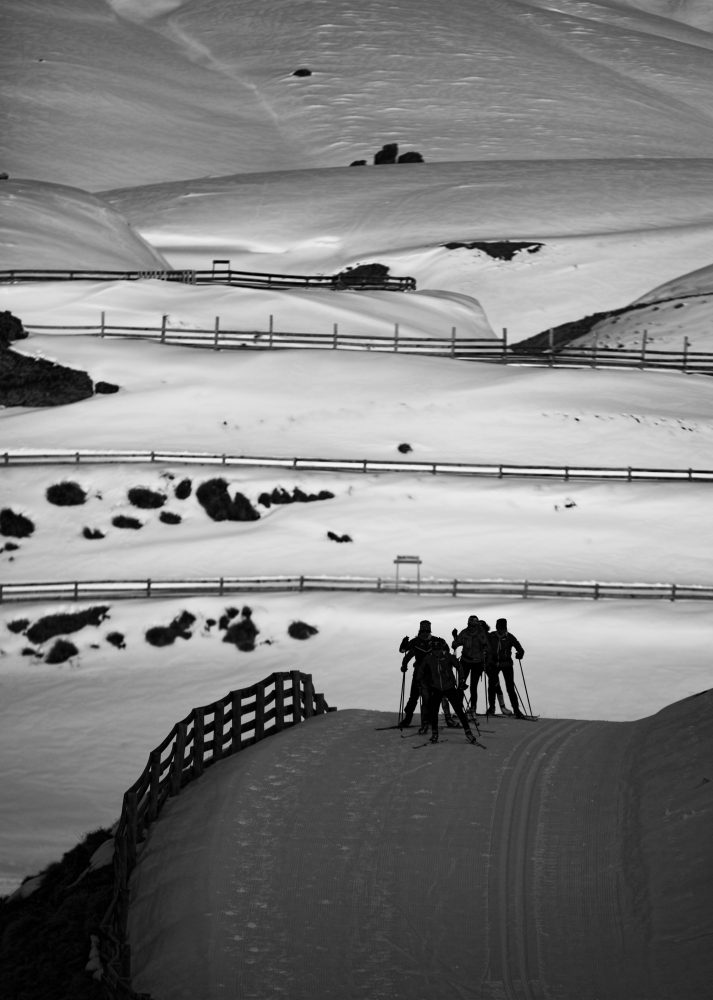
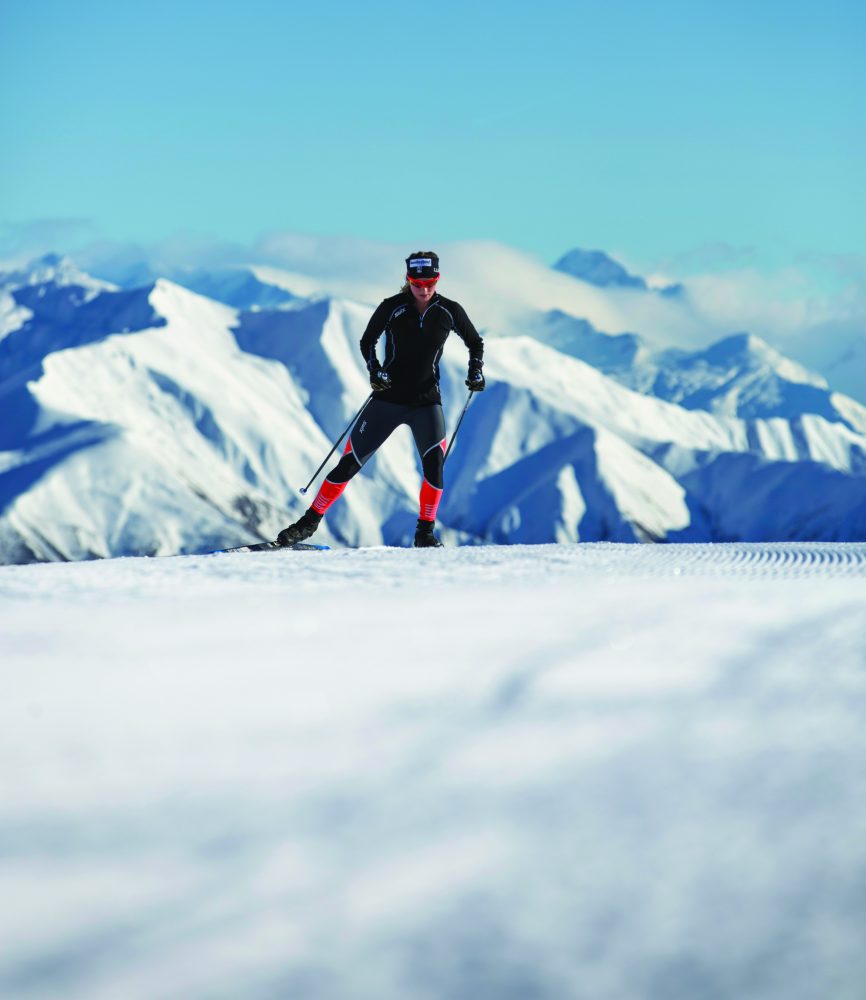
Terraces of groomed snow. The U.S. Ski Team trains at New Zealand’s Snow Farm, 2018. (Photo: Colin Witherill/ Warren Miller Entertainment)
Big and bold. Published on the latest press release from Warren Miller Entertainment are the rarefied featured athletes in the season’s cinematic siren call that winter is imminent: The Warren Miller ski film Face of Winter. Of course, there’s the icon of the Iron Cross, Jonny Moseley. Listed along with the gravity side of skiing royalty are U.S. Cross Country Ski Team (USST) members Kevin Bolger, Paddy Caldwell, Sophie Caldwell, Jessie Diggins, Simi Hamilton, and Ida Sargent.
What is cool anyway? In other words, cool is not a one-size-fits-all proposition. Furthermore, one person responsible for a sport’s coolness? Talk about a burden.
On October 12, in Portland, Oregon the 69th Warren Miller film premiered. And with it, the film crew and editors made their visual case for sustaining cross-country skiing’s coolness.
For six days this September, a Warren Miller production crew shadowed the USST during their on-snow camp at New Zealand’s Snow Farm. The images they captured do not disappoint. Drone shots of synchronized striding on perfect switchbacking corduroy are drool-worthy. There’s the obligatory mix of thumping tunes and up-tempo ski clips that are hallmark Warren Miller. The fellowship of skinny skis and lycra get the creative treatment they deserve.
Behind the scenes, the New Zealand shoot wasn’t a certainty.
“We spent considerable time and a lot of debate about whether or not we’d do this,” the film’s producer Josh Haskins emailed. “It was entirely too late in the season to add a shoot, our budget was tapped, but we appreciated the unique angle and felt this was the year to tell it, while the Olympic story was still fresh.”
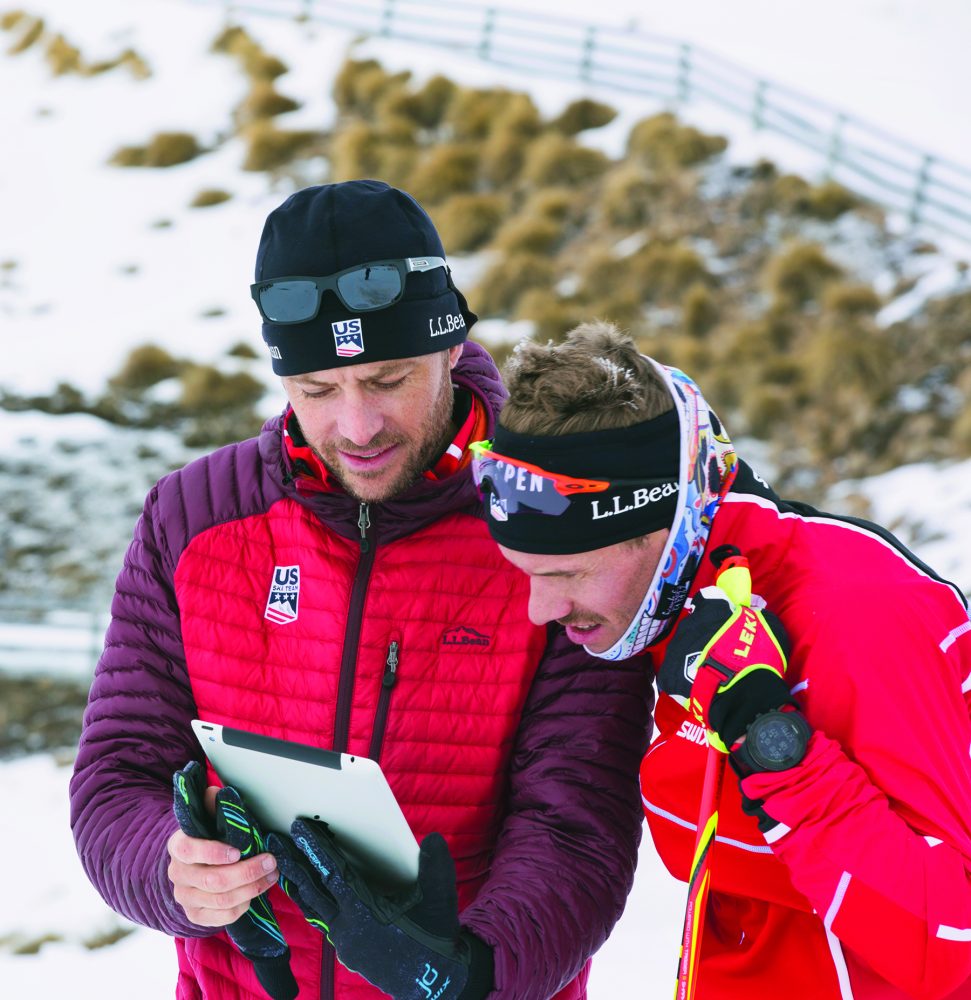
U.S. Ski Team member Simi Hamilton with coach Matt Whitcomb review technique footage at New Zealand’s Snow Farm, 2018.
Despite the obvious exposure the film’s segment could provide nordic sport, according to U.S. women’s coach Matt Whitcomb, the coaching staff was hesitant.
“We heard mumblings about it for a couple of years but nothing really came to fruition,” Whitcomb explained during a phone call. “We as coaches said we are not sure that we want to do this. What if we all end up sick because we are skiing back and forth trying to get a good shot with Warren’s crew? Then we are going to have spent a lot of money for nothing for this camp.”
At the Snow Farm, despite the potential for distraction, the ski team stuck to its rigid training schedule. The New Zealand camp remained focused on quality training — maximizing the investment in chasing the Southern Hemisphere’s winter.
“So not spending too much time talking to a coach, continuing to move and just having a lot of well-orchestrated sessions,” Whitcomb said of the team’s on-snow priorities. “And when you have a film shoot happening during that, you can see the chance for things to run off the rails. And so we played a little bit hard to get and those guys were great they stayed at it. I don’t know if we were really appreciating how large Warren Miller is and what a professional crew they have. Because it was almost easier than when you don’t have the film crew out there. They were just so good.”
Whitcomb noted any potential disruptions were mitigated by good communication. Coaches would explain the next day’s training beforehand, the producer, in turn, explained how they could optimize their cinematography. For example, an 8-kilometer loop with fewer opportunities to film athletes would become a 3 k circuit.
“If it were 3 k long, the skiers would come by two and half times as frequently,” Whitcomb said. “And then they would have a better shot at getting the footage they needed.”
The backroom transactional nature of the USST’s participation related to business opportunities. Both the U.S. Cross Country team and Boulder, Colorado-based Warren Miller Entertainment have sponsorship deals with L.L. Bean. From a marketing perspective, both entities understood the positive value of producing content during the ski team’s limited New Zealand window.
Jessie Diggins (USST) training at the Snow Farm in New Zealand, 2018. (Photo: ColinWitherill/Warren Miller Entertainment)
“We have an existing partnership with L.L. Bean, who is a partner of the team, and the IOC, USSA and U.S. Cross Country Team were all integral and extremely helpful in the planning and logistics, giving us the assistance and access we needed to properly tell the story,” Haskins explained. “In the end, we griped about the added stress, money and limited screen time in the movie but we all agreed it would make the movie better to include it. And it paid off, at our world premiere in Portland, OR. last Friday the segment received one of the loudest audience responses and applause of the night when Jessie crossed the finish line.”
Footage of the Diggins and Kikkan Randall Olympic gold stands as the narrative arc’s apogee for the cross-country ski segment. Those Olympic moments still strike a nerve.
Whitcomb relayed a personal story. By chance, a close friend happened to notice Face of Winter‘s world premiere would be showing as he left work recently in Portland. That former skier from St. Lawrence University eventually sat in a packed theater expecting the usual and iconic Warren Miller powder-lust ski shots.
“He had no idea that his favorite sport was being featured,” Whitcomb said. “Then halfway through the movie, when the cross-country segment ran, he was so happy that he just wanted to stand up and start cheering. That was good to hear from someone who was surprised by it all. He was just so proud.”
Once in a while, it’s ok to feel like the cool kid in the room.
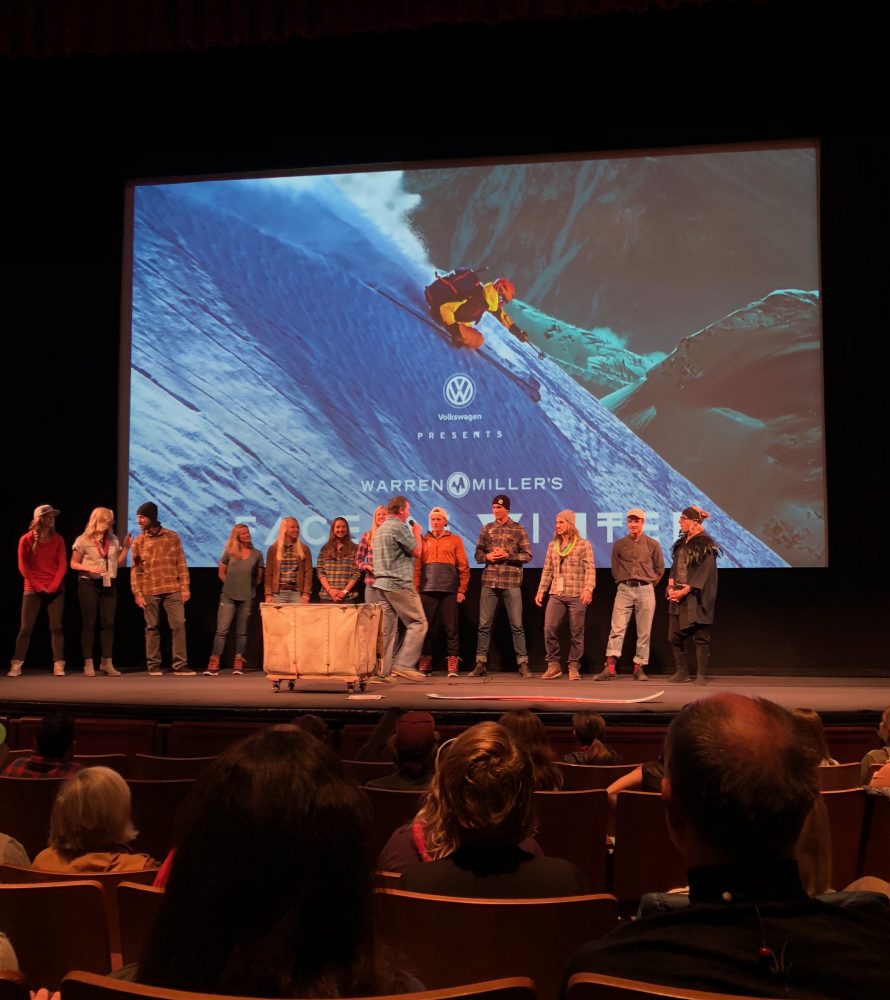
Taking a break during their Park City, Utah training camp, the U.S. Cross Country team was on hand and on stage Oct. 18, for the Salt Lake City opening of Warren Miller’s Face of Winter. (Photo: Justin Miller)
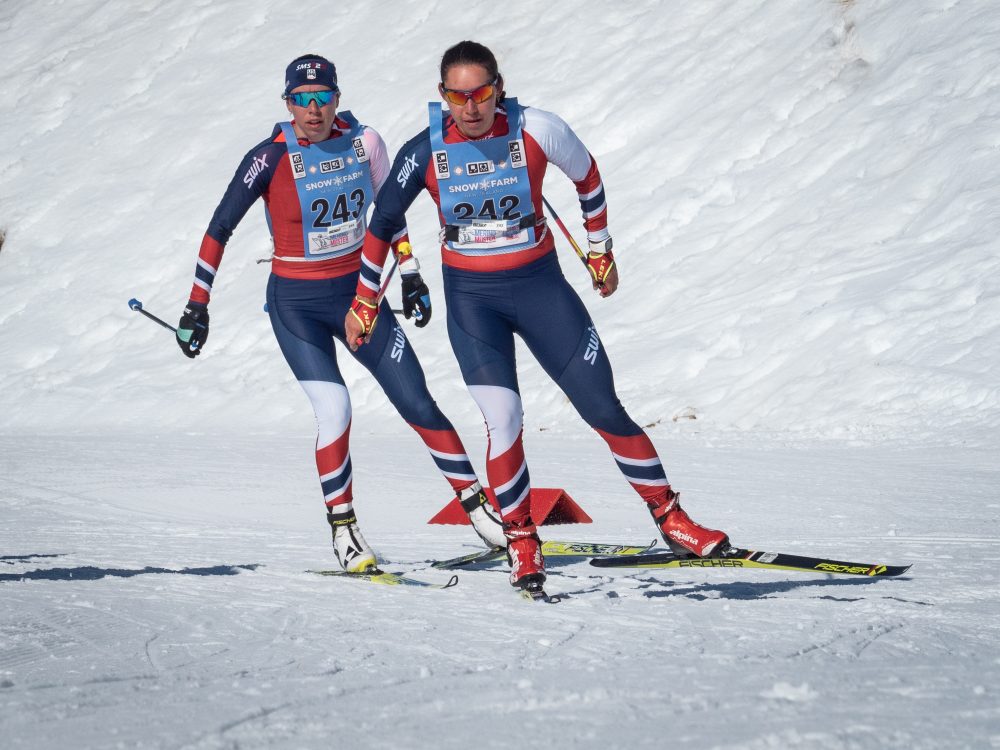
Julia Kern leads Katharine Ogden, her fellow Stratton Mountain School (SMS) and U.S. Ski Team development team member, during the Snow Farm’s 21 k Snow Rake at the 2018 Merino Muster in Wanaka, New Zealand. (Photo: Garrick Cameron)
Note: This article has been updated to include comments from Simi Hamilton of the U.S. Ski Team (USST) and Stratton Mountain School (SMS) T2 Team, and Kevin Bolger of the USST and Sun Valley Ski Education Foundation.
***
It’s that time of year again where several members of the U.S. Ski Team, along with top-level skiers from the Craftsbury Green Racing Project (CGRP) and Stratton Mountain School (SMS) T2 Team are training at the Snow Farm above the town of Wanaka, New Zealand.
The on-snow volume camp, which featured multiple days of racing, started Aug. 20 and continues through Sept. 10, and includes U.S. Ski Team (USST) athletes Jessie Diggins, Ida Sargent, Sophie Caldwell, Katharine Ogden, Julia Kern, Simi Hamilton, Kevin Bolger, and Paddy Caldwell, and coaches Matt Whitcomb, Jason Cork and Gus Kaeding.
According to Sophie Caldwell, conditions have been “amazing” for the duration of camp so far. “New Zealand had a great snow year and we’ve been lucky to have sunny days almost every day,” she wrote in an email to FasterSkier.
Japan’s Tomoka Satou (446) leads American Jessie Diggins (428) and others up a climb during the Merino Muster 42 k skate race on Sept. 1 at the Snow Farm in Wanaka, New Zealand. (Photo: Garrick Cameron)
Diggins called it the annual trip one of her “all-time favorite camps because the living at the Snow Farm is great, the food is outstanding, and you can step out the door right onto the 65+ km of trails!” she wrote in an email.
“I love having the chance to work on my on-snow technique for three solid weeks because that’s when I get to really see progress and make some changes in my striding,” Diggins wrote.
Apart from logging kilometers on snow and soaking up the vitamin D, the team has also spent time trail running in Wanaka.
“The highlight [of the camp] will probably be a crust cruise we go on in the next few days, but since we haven’t done that yet, some highlights so far are an awesome distance run down in Wanaka, and pretty much every day of bluebird skiing we’ve had up here!” Caldwell wrote.
The camp also coincided with the Merino Muster, a 42 k freestyle marathon that is part of the Worldloppet series, and the Winter Games NZ, which doubled as the Australia/New Zealand Cup FIS races and included three days of nordic racing this year at the Snow Farm: a 5/10 k freestyle individual start, a freestyle sprint, and a 10/15 k classic mass start..
Diggins finished a minute and 21 seconds faster than the second-place woman, Aurelie Dabudyk of France, while Hamilton edged Craftsbury skier Adam Martin by 3 seconds for the overall win.
“The day of the Merino Muster was gorgeous and sunny, with fast conditions,” Diggins wrote. “I loved getting the chance to race a long race, and starting with the men as one big field is really exciting! I hope to get to race the 42km race every year. Huge thanks to the volunteers and organizers for making it such a fun day.”
Crossing the finish line in 1:52:34 hours, Diggins placed sixth overall. Dabudyk was eighth overall and Alayna Sonnesyn (SMST2) was the third woman, 11th overall, 5:30 behind Diggins.
Meanwhile, Hamilton finished in 1:39:46, beating his time of 1:40:33 from last year’s race. Martin followed 3 seconds later, while Kyle Bratrud (SMST2) finished 24 seconds after from Hamilton in third, followed by Tomoka Satou of Japan in fourth (+45.0).
“The Merino Muster is always an awesome race,” Hamilton wrote in an email. “It actually lends itself to the type of intensity we are still mostly focused on in August/late September because the terrain and snow conditions usually make for a really good chance to get in about 1.5 hours of level 3 effort followed by a few minutes of really hard skiing in the last km before the finish. It’s a very rolling course and if you ski it in a pack with people switching leads it’s basically impossible to go much harder than level 3.”
Also on Saturday, Americans also took the top spots in the 21 k Snow Rake. Ben Saxton (SMST2) ran away with the overall win by more than 12 minutes in 47:48, while Paralympic sit skier Dan Cnossen placed second (+1:12:13) nine seconds ahead of Petr Sykora of the Czech Republic in third (+1:12:22).
Ogden was the fastest woman and second overall with a time of 50:29. Her SMS and USST teammate Kern finished 56 seconds later as the second woman, and Elizabeth Martin of the University of New Hampshire (UNH) followed in third, 7 minutes and 30 seconds behind Ogden.
With about 300 participants between three different races at the Merino Muster, Hamilton described the atmosphere as “super fun and light.”
“But the grooming always rocks and it’s just a really fun course to ski,” he added. “I think that in this day and age of social media being so huge and cross-country skiing gaining more attention in the US and world-wide, we’ll start to see more and more people showing up for the marathon. I feel like in the last few years alone their has been noticeably more attention and attendance each year. The quality of skiing is a small part of the race atmosphere here… New Zealand’s south island is one of the most beautiful parts of the world and the culture is so welcoming and comfortable.”
Many of the American skiers in New Zealand also competed in the Winter Games NZ races this week.
“The New Zealand Winter Games are also a huge opportunity to get back into racing mode and test out all the technique work we’ve been putting in so far!” Diggins wrote. “And if you know me, you know how much I adore 5km individual skate races, and we no longer get to do those on the World Cup. So I’m so grateful to the Snow Farm and race organizers for keeping such a fun and hard, fast race alive! I forgot how much it can hurt to go so hard for 5km, but it was fun to really get that lung burn back for the first time since last winter.”
Three days after her marathon win, Diggins won the 5 k skate at the Snow Farm in 15:02.6. The U.S. swept the top five with Sophie Caldwell finishing 10.5 seconds back in second place, Caitlin Patterson (CGRP) in third (+16.7), Sargent (USST/CGRP) in fourth (+1:02.6), and Kelsey Phinney (SMST2) in fifth (+1:16.6) out of eight women.
Kyle Bratrud (SMST2) gets a feed from U.S. Ski Team coach Jason Cork during the 2018 Merino Muster 42 k skate race at the Snow Farm in Wanaka, New Zealand. He finished third behind two other Americans. (Photo: Garrick Cameron)
In the men’s 10 k skate on Tuesday, Bratrud took the win in 27:48.1, 21 seconds clear of Kaichi Naruse of Japan in second, while Craftsbury’s Ben Lustgarten and Martin (CGRP) followed in fourth (+23.0) and fifth (+44.0), respectively. Eight men competed.
Wednesday featured 1.1 k skate sprints, which saw Sophie Caldwell take the win in a field of 10 women, ahead of Sargent in second and Phinney in third.
“The sprint was a short and tactical race that was awesome practice for what’s to come this winter,” Caldwell wrote. “It was really fun toeing the line with my USST and SMS training partners. On one hand, that final could have been any day of summer training, but it also could be a World Cup heat! It’s pretty cool to be pushed by so many strong training partners and friends and we were psyched to throw on a bib and put in a race effort.”
In the men’s final, Bolger landed the top spot on the podium, ahead of Saxton in second and Satou in third. Eleven men competed in the sprint.
“I really enjoy these early session races it gives us as races a chance to get in the mindset and practice real race strategy,” Bolger wrote in an email. “I wanted to go out there test myself, I approached every round like a final and attacked from the start getting out in front and leading into the finish, and was very happy to end the day on top, especially after a long camp down here with the US crew.
“… Coming down here and having a good result in the sprint is of course a huge confidence booster heading into the September/ October training months, but there is still a ton of preparation to be done,” he added.
On the final day of Winter Games NZ racing, Diggins continued her undefeated streak (after skipping the sprint), winning the 10 k classic mass start, while Patterson placed second and Sargent placed third. Saxton picked up his second win of the week, while Martin took second and Lustgarten third.
Complete results will be posted once they’re available.
“We have been incredibly lucky with weather and conditions this year,” Hamilton noted. “Usually, when you’re here at the Snow Farm for 3 weeks in the winter, you’re bound to get an extended period of really nasty weather and wind. But this year we’ve basically had sunshine and cold night time temps every single day, making for amazing skiing for pretty much 3 weeks straight. There is about 40-50 km of trails to ski when everything is groomed, so it’s essentially impossible to get bored. The highlight of our camp every year is a big crust ski up to and around Mt. Pisa. We are planning on getting out tomorrow [Friday, Sept. 7] because the crust hasn’t been great yet while we’ve been here, but conditions for tomorrow look promising. But even when we can’t get out for a huge adventure like that, it’s just one of the best and most fun places in the world to train.”
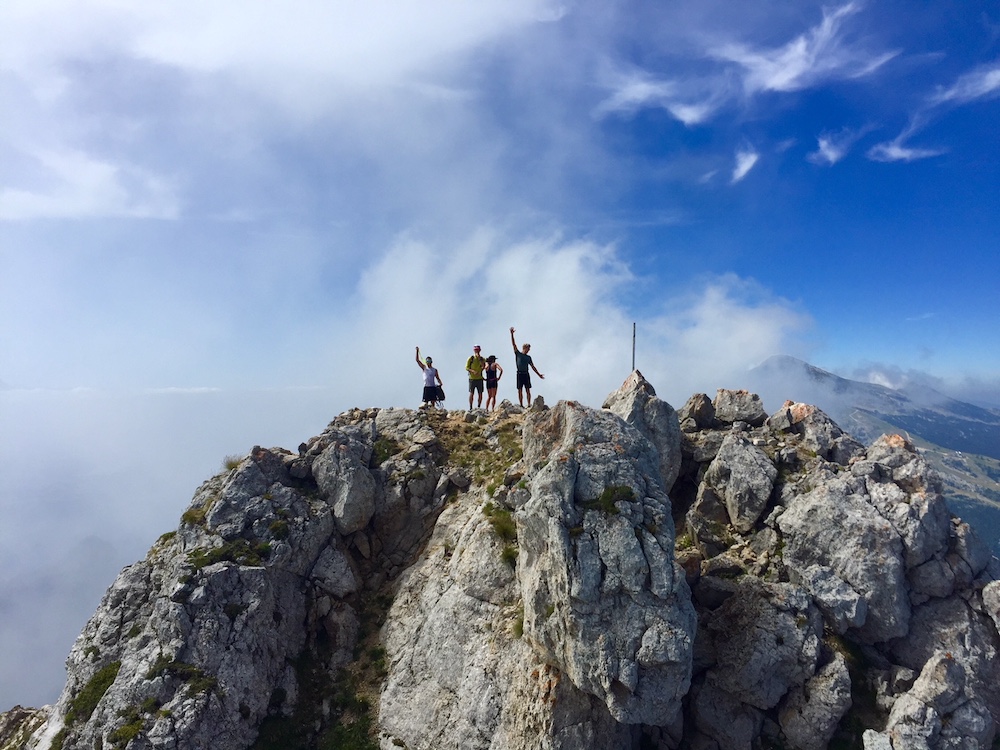
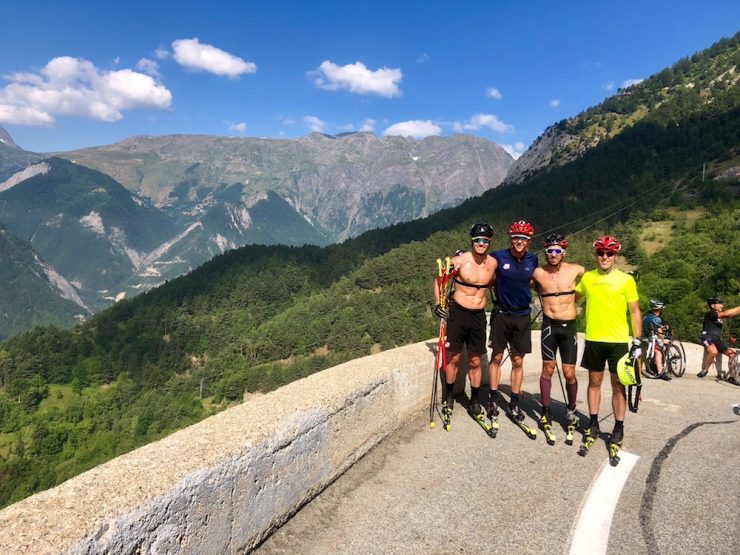
Members of the U.S. men’s ski team on a mid-overdistance run on top of the Roc Cornafion above Villard-de-Lans, France. (Photo: Chris Grover)
This month, the U.S. Cross Country Ski Team (USST) held dryland camps simultaneously, about 6,000 kilometers away from each other, in Lake Placid, N.Y., and Villard-de-Lans, France. Five of the eight women on the team attended the camp from July 11-20 in Lake Placid, which, up until a couple of years ago, was a September staple on the USST calendar. Meanwhile, four of the team’s men trained together in the picturesque, mountainous region of southeast France from July 9-18.
Who was where? In Lake Placid, USST A-team athletes Jessie Diggins, Sophie Caldwell and Ida Sargent worked out alongside development (‘D’) team members Julia Kern and Katharine Ogden, as well as several others from their respective clubs and Stefani Böhler of the German National Team. Outside of camps, the five USST women spend most of the offseason training with their respective Vermont-based programs; Diggins, Caldwell, Kern, and Ogden are all on the Stratton Mountain School (SMS) Elite Team, and Sargent trains with the Craftsbury Green Racing Project (CGRP).
The other three women on the national team — Sadie Bjornsen, Hannah Halvorsen and Hailey Swirbul — are based in Anchorage, Alaska, where they train with Alaska Pacific University (APU) and have multiple opportunities to ski on snow on nearby Eagle Glacier.
“Getting participation in a country as large as ours is always a challenge,” U.S. coach Matt Whitcomb told FasterSkier in Lake Placid. “… But the Alaskans have gone out of their way to give us adequate representation at these camps. They work really hard to, when they’re present, be very present.
“It’s not so much an APU or Alaska issue, it’s a distance issue,” he continued. “We can fight it as hard as we want, but we’re going to be running into a wall because it’s hard to get from upstate New York to Anchorage or Fairbanks; it’s a long ways. We do our best. We try to identify which camps the whole team will be present at, and while we’d love to be able to get together five or six times a year like the Norwegians do every four weeks for eight days, it’s not the reality for us. Our club system is the key for us, and APU is doing a great job with or without the Ski Team at a camp up there, and you have all these other clubs now running their programs like mini national teams. If we can have more of those, that’s how we’ll get better.”
In France, Erik Bjornsen (fresh off his wedding there), Simi Hamilton, Ian Torchia, and Paddy Caldwell trained under the guidance of head coach Chris Grover. Two of the team’s B-team members, Scott Patterson and Kevin Bolger, did not make the trip; Patterson has been rehabbing a fractured toe in Anchorage and Bolger is currently training in Norway.
From Aug. 20 to Sept. 10, half of the team plans to train on snow in New Zealand (Diggins, Sargent, Kern, Ogden, Hamilton, Bolger, and Sophie and Paddy Caldwell) with three coaches: Whitcomb, Jason Cork and Gus Kaeding. Then from Oct. 8-21, most of the 16-athlete squad will meet up for a final dryland camp in Park City, Utah, before revving up for another World Cup season.
Here are some photos from the two mid-summer camps, courtesy of the U.S. Ski Team:
Members of the U.S. men’s ski team on a mid-overdistance run on top of the Roc Cornafion above Villard-de-Lans, France. (Photo: Chris Grover)
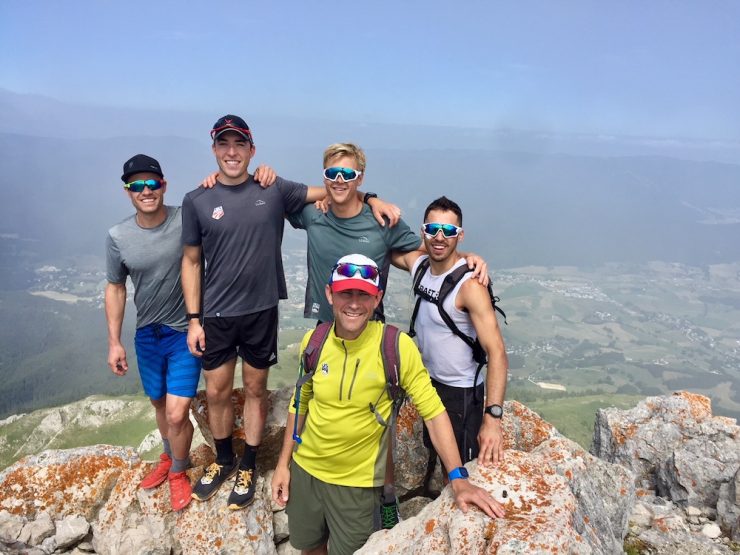
From left to right: Simi Hamilton, Paddy Caldwell, Erik Bjornsen, coach Chris Grover, and Ian Torchia of the U.S. Ski Team during a mid-overdistance run on top of the Roc Cornafion above Villard-de-Lans, France. (Photo: Chris Grover)
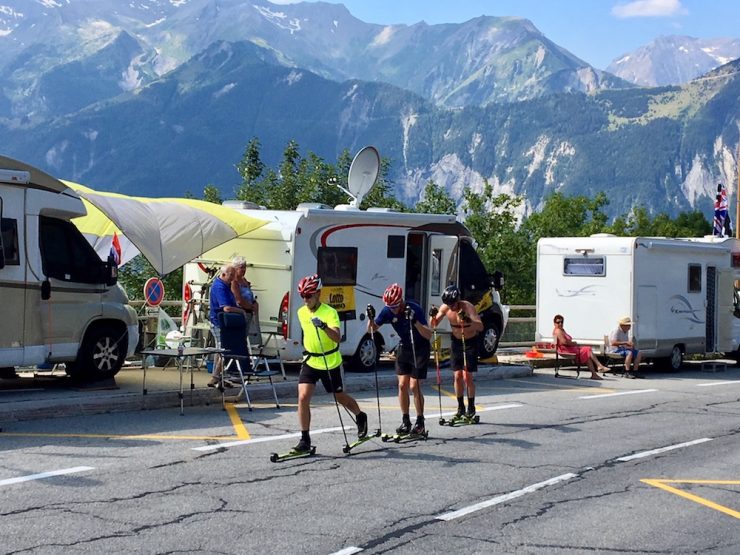
Members of the U.S. men’s ski team rollerskiing up l’Alpe d’Huez in France. (Photo: Chris Grover)
From l to r: Simi Hamilton, Erik Bjornsen, Ian Torchia, and Paddy Caldwell of the U.S. men’s team during a 2018 rollerski up l’Alpe d’Huez in France. (Photo: Chris Grover)
“The Villard-de-Lans camp was excellent, and the men came away from camp mentally charged for the next period of training, although certainly needing some physical rest,” Grover summarized in an email.
French national-team member Adrien Backscheider, who lives part time in the area, joined a few of their workouts. Grover explained their training included five “high-quality sessions” during the 10-day camp, all held on the rollerski loop in Corrençon-en-Vercors: a classic speed session, a skate speed session, a Level 3 classic workout, a Level 4 skate workout, and a classic team sprint simulation. The remaining sessions were either distance, over-distance or strength.
“We had 2 classic roll + run combo workouts in the mountains, including skiing up l’Alpe d’Huez two days prior to the Tour de France stage and then hiking/running up the mountain from the village to create a 4 hour/6000 vertical feet workout,” Grover wrote. “We are very grateful to all the people we met in the Villard-de-Lans area for welcoming, supporting, and taking care of us.”
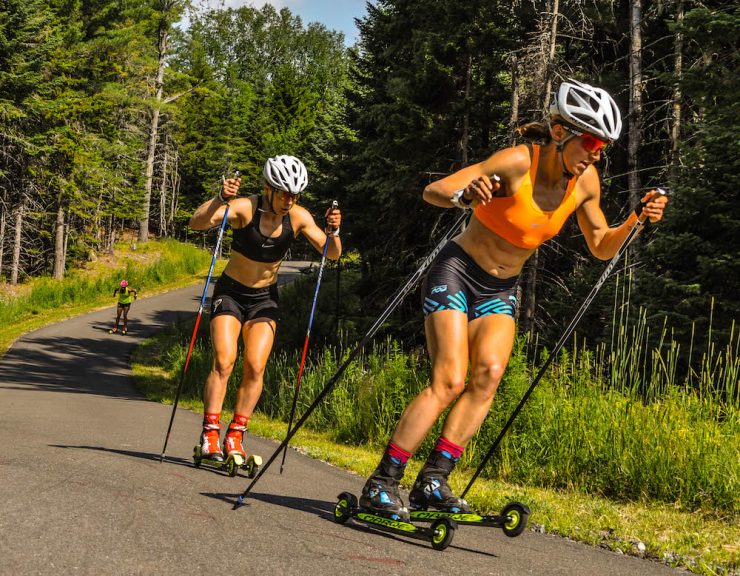
Sophie Caldwell (r) leads USST teammate Ida Sargent during a team-sprint training session at the Olympic Jumping Complex in Lake Placid, N.Y. (Photo: Matt Whitcomb)
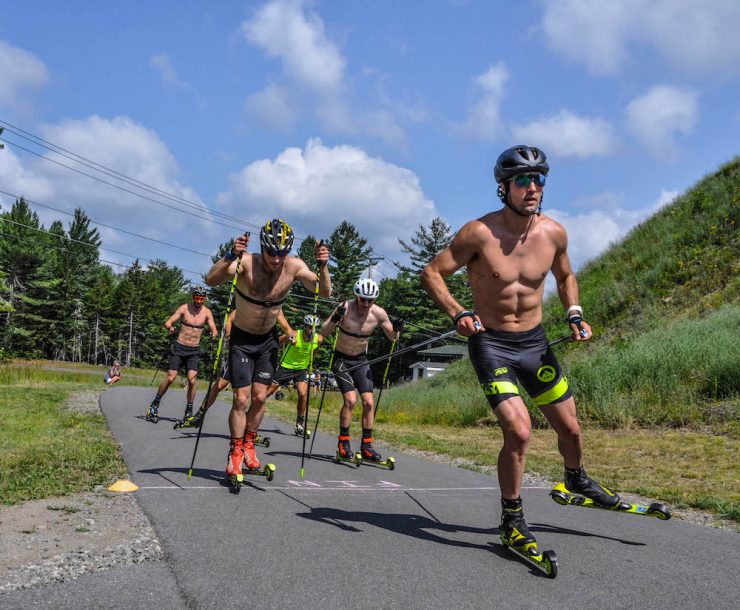
Ben Saxton of the SMS Elite Team leads a sprint interval session at the Olympic Jumping Complex in Lake Placid, N.Y. (Photo: Matt Whitcomb)
Stratton’s Ben Saxton (l) and Kyle Bratrud lead Craftsbury’s Ben Lustgarten (third from r) during a sprint session at the Olympic Jumping Complex in Lake Placid, N.Y. (Photo: Matt Whitcomb)
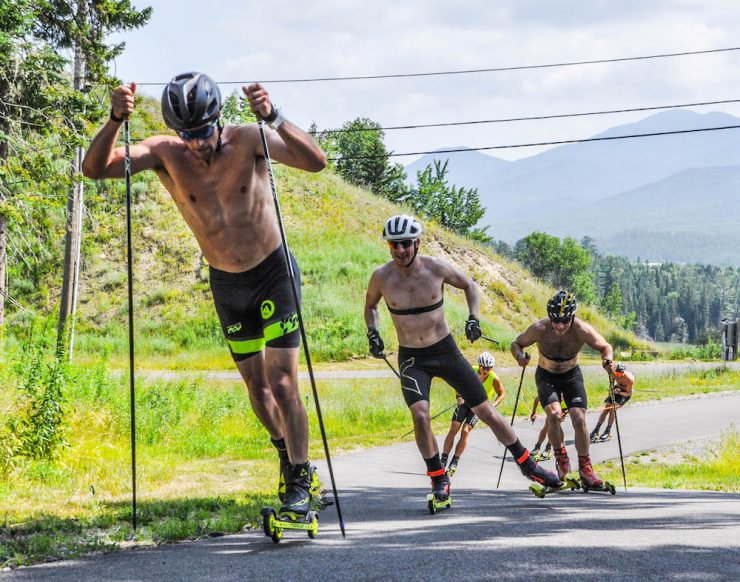
Ben Saxton (SMS Elite Team) during a rollerski sprint session at the Olympic Jumping Complex in Lake Placid, N.Y. (Photo: Matt Whitcomb)
Kyle Bratrud (SMS Elite Team) testing his skate-sprinting speed at a national-team camp in Lake Placid, N.Y. (Photo: Matt Whitcomb)
Kyle Bratrud leads Ben Saxton and Ben Lustgarten during a rollerski sprint session at the Olympic Jumping Complex in Lake Placid, N.Y. (Photo: Matt Whitcomb)
Sophie Caldwell (l) and Julia Kern round a corner during a team-sprint workout at the Olympic Jumping Complex in Lake Placid, N.Y. (Photo: Matt Whitcomb)
Stefani “Steffi” Böhler at the U.S. Ski Team women’s camp in Lake Placid, N.Y. (Photo: Matt Whitcomb)
Jessie Diggins with coach Jason Cork during a rollerski in Lake Placid, N.Y. (Photo: Matt Whitcomb)
Stratton teammates Sophie Caldwell (l) and Kelsey Phinney during a rollerski at the U.S. Ski Team women’s camp in Lake Placid, N.Y. (Photo: Matt Whitcomb)
Ben Saxton leads Ben Lustgarten and Kyle Bratrud during a rollerski in Lake Placid, N.Y. (Photo: Matt Whitcomb)
Julia Kern (Stratton Mountain School/U.S. Ski Team) rollerskiing in Lake Placid, N.Y. (Photo: Matt Whitcomb)
Ben Saxton (SMS Elite Team) rollerskiing in Lake Placid, N.Y. (Photo: Matt Whitcomb)
Ida Sargent leading the pack up a climb at the Olympic Jumping Complex in Lake Placid, N.Y. (Photo: Matt Whitcomb)
Germany’s Steffi Böhler during a rollerski workout at the Olympic Jumping Complex in Lake Placid, N.Y. (Photo: Matt Whitcomb)
Ida Sargent (Craftsbury Green Racing Project/USST) rounds a corner at the Olympic Jumping Complex in Lake Placid, N.Y. (Photo: Matt Whitcomb)
Sophie Caldwell (Stratton Mountain School/USST) rollerskiing at the Olympic Jumping Complex in Lake Placid, N.Y. (Photo: Matt Whitcomb)
Rollerskiing roadside at the U.S. Ski Team women’s camp in Lake Placid, N.Y. (Photo: Matt Whitcomb)
Rollerskiing roadside at the U.S. Ski Team women’s camp in Lake Placid, N.Y. (Photo: Matt Whitcomb)
U.S. Ski Team women’s camp rollerski route in Lake Placid, N.Y. (Photo: Matt Whitcomb)
U.S. Ski Team women’s camp / Lake Placid, N.Y. (Photo: Matt Whitcomb)
Group shot at the U.S. Ski Team’s July camp in Lake Placid, N.Y. (Photo: Matt Whitcomb)
“Being sea level, we can do more of an effective intensity camp, which this is a semi-intensity focused camp here,” Whitcomb said of the USST’s 2018 Lake Placid camp. “It’s only 2,000 feet here. The running is really great here and the mountains, you get these great Adirondack peaks all over 4,000 feet. The roads in upstate New York are hardly used and the pavement is fantastic. It’s really great rollerskiing out here.”
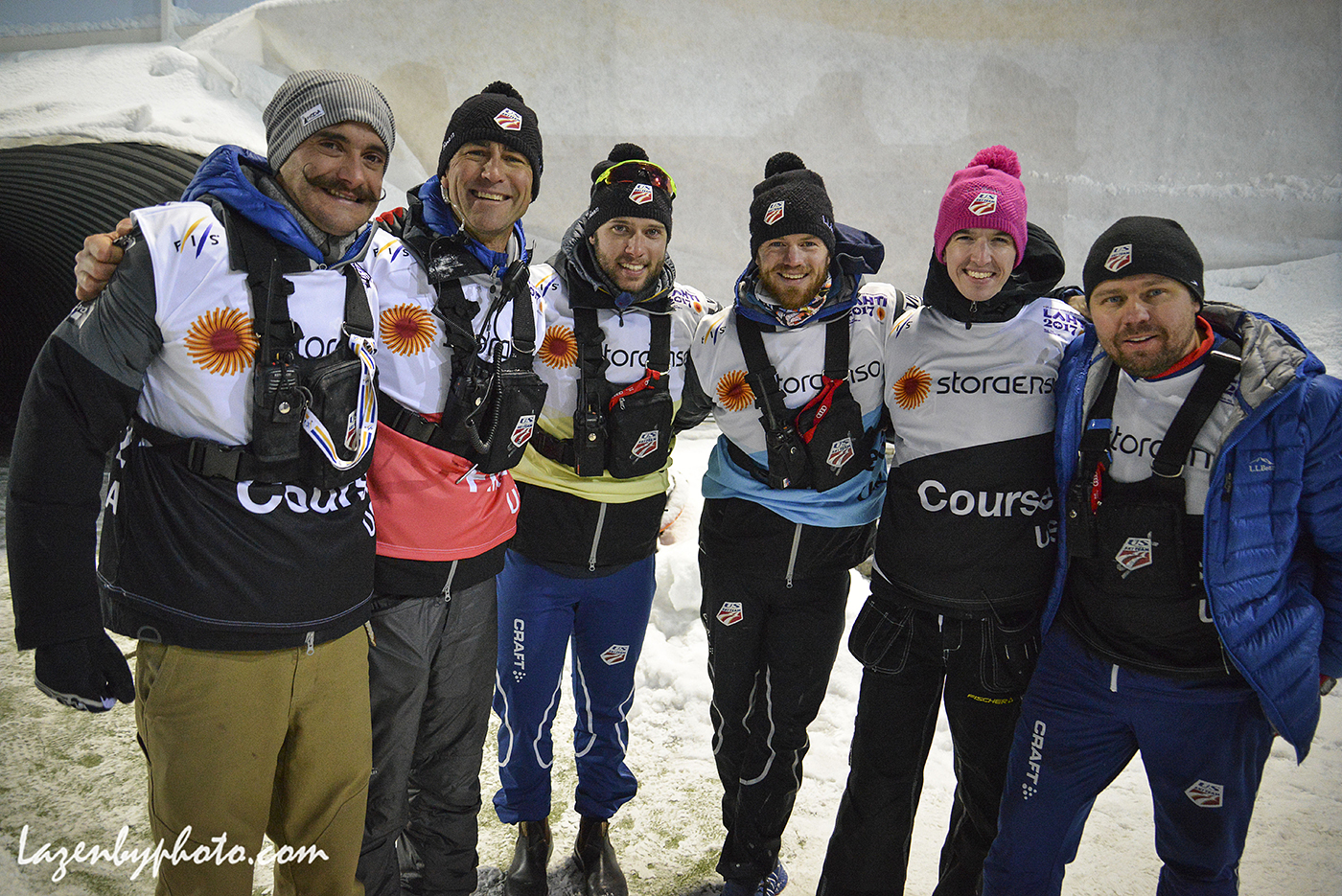
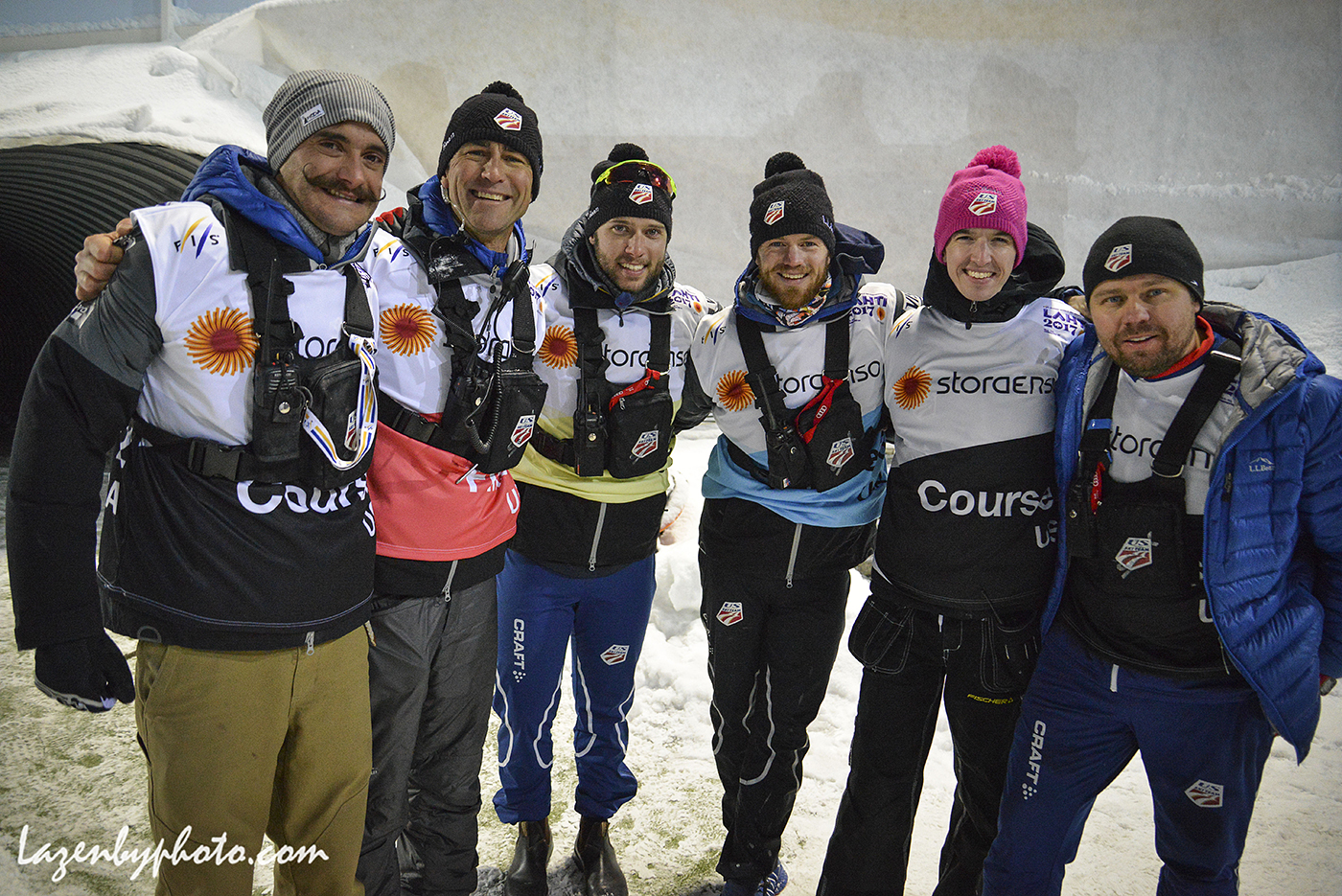
U.S. support staff after their team’s double podium in the women’s freestyle sprint at 2017 Nordic World Championships in Lahti, Finland. (From left to right) J.P. Laurin, Chris Grover, Tim Baucom, Andrew Morehouse, Patrick Moore, and Oleg Ragilo. (Photo: John Lazenby/Lazenbyphoto.com)
BEND, Oregon — Late last month, FasterSkier reached out to U.S. Ski Team (USST) Head Coach Chris Grover to discuss the team’s recent nominations.
The original range of topics was fairly narrow, the new iteration of the USST athletes and staff. Grover, however, ventured into the realm of how the USST will be modifying its criteria for team selection before the start of the 2018/2019 competition season. The criteria Grover discussed in the following Q & A, conducted over the phone on May 22, dealt with future USST nominations: not championship-team selection criteria. In other words, the rewritten criteria he discussed will have to do with the objective benchmarks an athlete must meet to be named to the USST D-team, B-team, and A-team, respectively. Beyond the objective criteria, Grover noted that coach’s discretion will remain an instrument of some future team nominations.
FasterSkier: OK, let’s jump in and discuss the U.S. Ski Team’s A-team roster.
Chris Grover: First of all, let me say one thing that we have been working on now for perhaps eight months, is trying to create new selection criteria to the U.S. Ski Team. And Gus Kaeding, who is a new staff member for us, someone that we just hired in the last few weeks, who came out of business school last year after coaching before that. He has actually been crunching the data for us. He took a bunch of statistics courses when he was in business school. So he kind of volunteered to come and start helping us try to figure out how to make a much more objective selection criteria. As you know, right now we have criteria where it is often about 50/50 in terms of athletes who make the objective criteria and athletes that are selected through discretion. And our goal is to create selection criteria for the 2019/2020 season that we put in place this summer, or at least before the ski season begins when the selection criteria would start. It is much more objective. It shows pathways not only at the very high end and not only in terms of a junior worlds medal but all along the different potential ages and potential athletes.
So that is coming together. We are still working on it. It will probably be tied to an athlete’s world rank at different ages, but our goal is to take a lot of the guesswork out of future selections. We couldn’t have put it in place this year because the selection criteria was already published as of last year and we cannot retroactively go back once the selection period is opened and apply new criteria. We can only apply it in years moving forward, but I am really excited to get to a point where the guesswork for athletes and coaches, for parents, is taken out of it. And ideally those people can look at criteria before a ski season and go, “If I do this, then I will be nominated to the U.S. Ski Team.” That said, I envision that there will always be discretionary picks that we make. There will always be people for whatever reason that come on late in the season.
Like, for example, their world ranks doesn’t mesh with what their current potential is. They have outstanding results that for whatever reason we didn’t see coming. So I envision that there will be discretionary selections going forward, but our goal is to make it so that there are many fewer discretionary selections and it is much more objective and clear-cut. I am excited to put something in place and something that we will be pushing out to the team hopefully later this summer or the very early fall at the latest.
A U.S. Ski Team selection is different than say a championship selection. It won’t go to, let’s say, a committee like our U.S. Ski and Snowboard cross-country committee. We will probably push it around to some athletes reps but it won’t go to a greater community. Because at the end of the day, this is the U.S. Ski Team and it is not necessarily the same as qualifying for World Juniors or the U23 or the World Cup or the World Championships. It is a little bit of a different deal. And the selection, basically, it needs to reflect the goals of the organization. And the goals of the organization are to win medals at the highest levels in the sport.
That didn’t answer your question. The question was something about the A-team.
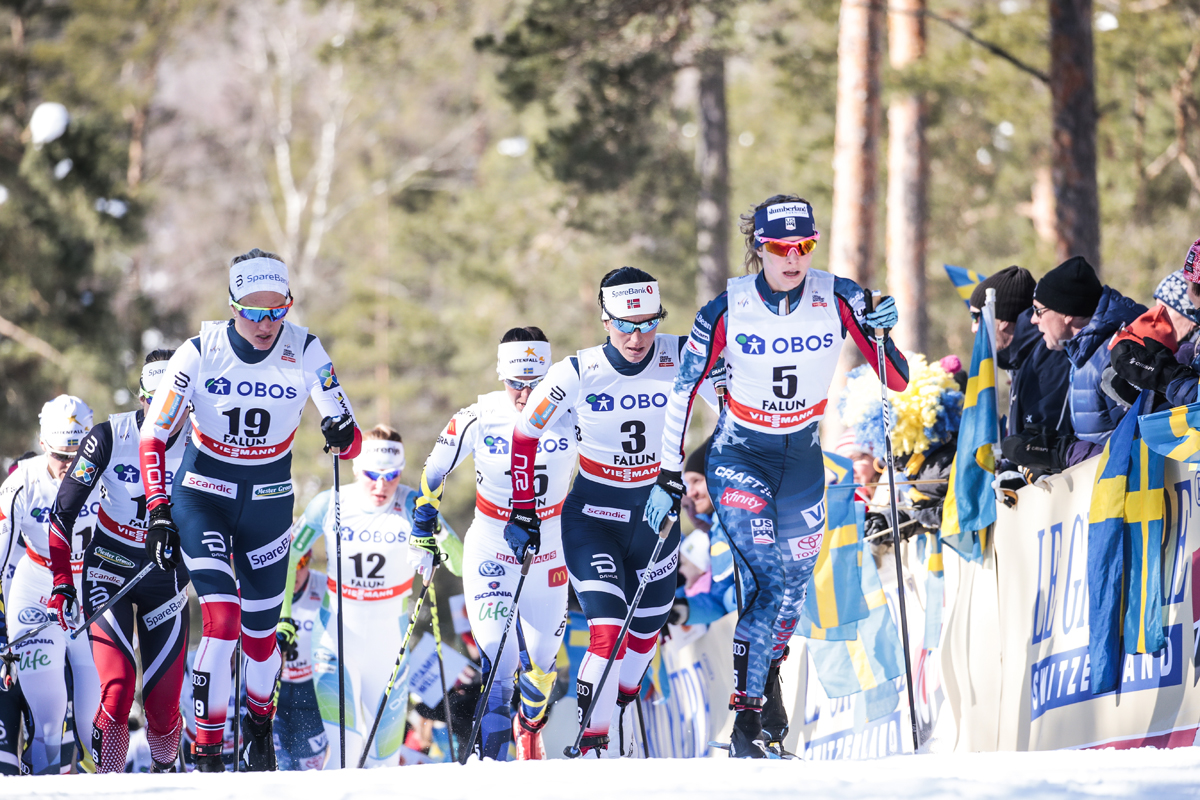
American Jessie Diggins (5) leading the pack up an early climb with Norway’s Kathrine Rolsted Harsem and Marit Bjørgen just behind during the women’s 10 k classic mass start at 2018 World Cup Finals in Falun, Sweden. (Photo: Fischer/NordicFocus)
FS: Back to the A-team. It’s quite impressive as it stands. An Olympic gold medalist in Jessie Diggins, third overall ranked World Cup women’s sprinter Sophie Caldwell, sixth-ranked overall skier Sadie Bjornsen, highly ranked sprinter Ida Sargent, and one dude, Simi Hamilton, who was 17th in the final World Cup sprint rankings.
CG: So the A-team athletes. That is objective. They make the team based on being top 30 in the world in either sprint or distance. They were all clear A-team selections based on the team nomination criteria. I am not quite sure yet if we will keep that exact standard going forward. We may. We also are really diving into this new data and seeing what we can find out. So, all those athletes qualify objectively. And then, the only other athlete that qualified objectively was Hailey Swirbul because she was an individual medalist two times over at World Junior Championships.
FS: Let’s jump to the D-team then. Some renominations. There’s Ian Torchia, Julia Kern, Hannah Halvorsen and Katharine Ogden. Then the newest members — Hailey Swirbul, Ben Ogden, and Gus Schumacher. Seven total. Is this the largest D-team you have had for awhile?
CG: For sure the largest D-team in at least in the past decade. And really, I mean, obviously, we are very excited because the results, just World Junior results alone, with this group of athletes has surpassed any group of athletes that we have ever had come through the ranks of the U.S. Ski Team.
These D-team results for many of these athletes are better than those of any of our A-teamers ever were able to accomplish at the World Junior Championships. And obviously, we have gone from 2016 at World Juniors having never had a medal at the World Junior Championships to now having five medals as a nation. So it is a super exciting step forward. We are really excited to have all these new faces as part of the team.
And this is why we have hired Gus Kaeding. He has been hired as a D-team coach specifically to help nurture and shepherd this group of athletes through the next few years of their development.
FS: Does Bryan Fish’s job change? Does the job description change as it relates to these specific athletes?
CG: Absolutely. The challenge that we had is that for Bryan, for one coach to effectively manage seven athletes at a high level is pretty daunting as it is. Bryan has so many other tasks already, including basically creating all the materials for our coaches education and then implementing the clinics and certification conferences as well as running all of our development summer camp opportunities REG, NEG, NTG … assisting at the U16 elite camp and then also trying to coordinate efforts between the NNF and what we are doing and the American Birkie Foundation, which is coming on as a supporter as well. And then winter trips and what he is doing to oversee the Super Tour, it was just too much. It was too much for one person to handle and we needed some help. And the greatest need with all these incoming younger athletes was certainly with the D-team squad.
FS: I believe this is Ian Torchia’s third year on the D-Team.
CG: That sounds right to me.
FS: Do you normally have a sort of “statute of limitations” on D-Team membership?
CG: Yeah, we really should. In Ian’s case, he had mono the year before last and then kind of was coming back this year and a little bit inconsistent with results. But I think that challenge that you just alluded to really speaks to why we need different selection criteria, why we need more objective selection criteria. Because athletes at some point should be moving. Either they are moving off the D-team or they are moving up to the B-team or moving up to the A-team. But they have to have movement after a few years. And the same goes for B-team athletes, but it is really unclear. I mean, right now, we don’t have any sort of clarity as to what those markers might be. And so that is why it is critical for us to figure a more concrete pathway for athletes so that they know the expectation. So you know, Ian, I would expect with his age he is probably going to have to be on the B-team next year if he is going to continue to be on the national team. So I am hoping with these new criteria that we create and define that pathway or at least define the expectations, I should say.
FS: So the new criteria, those expectations as they relate to the D-team, would have be to SuperTour-specific unless these athletes have start rights because they have earned them?
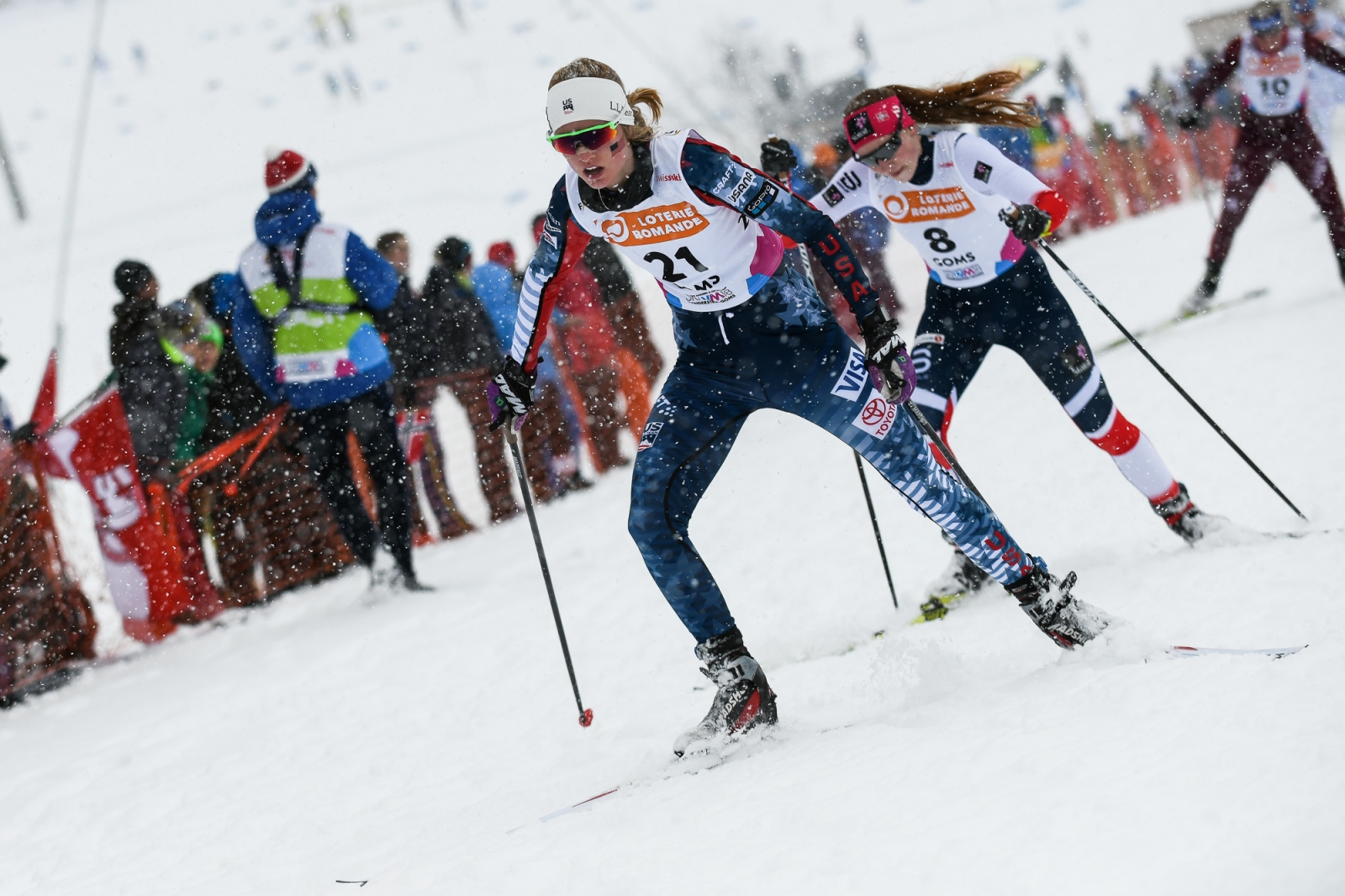
American Hailey Swirbul (University of Alaska Anchorage) leads Norway’s Lone Johansen up a climb during the second half of the women’s 10 k skiathlon at 2018 Junior World Championships in Goms, Switzerland. Swirbul placed third for her second individual podium of the championships. (Photo: JWSC2018.ch)
CG: I think that is why we are really looking at world rank for athletes. This is probably the most helpful thing as opposed to how they did on SuperTour, how they did on World Cup, how they did at the U23 World Championships, what happens at the NCAA Championships. That is the challenge for us, especially in North America being somewhat removed from where a lot of the racing is happening, a lot of the international racing obviously being in Europe. That is the challenge. World rank is going to help us identify that picture in a more meaningful way.
FS: Does that mean a reliance on FIS points?
CG: The difference is between using straight-up FIS points and world rank is that with FIS points, you can have very low FIS points but there could be one hundred people packed in there between you and zero FIS points. But with world rank, it gives us a finite amount of people that are below you or above you.
FS: So then as I am understanding the world ranking, this is then some sort of proprietary ranking that you will have?
CG: The way Gus has approached this, is that he is taking a look at every medalist at the Olympics and the World Championships in the past ten years. He has retraced the development path of those medalists. We are including not only those that have medaled in individual events but those who have medaled in team events. And then retracing kind of what their pathway is. And then perhaps we are going to give a plus-minus, a little 80th-percentile type adjustment to it, that allows for some leeway for an athlete. For example, coming from North America where maybe the pathway is slightly different than it is for European athletes. What we are basically trying to identify are the pathways for an athlete to win an Olympic medal or a World Championship medal and clarifying where you need to be. What are the markers at different ages? And that will help guide as to what the right world rank is for a given athlete to make the team.
And yes, there are always going to be a few outliers. That is why still need some discretion built in there. Once we have selection criteria in place then an athlete will be able to identify what their world ranking is and know how they fit into that selection or don’t fit into it.
FS: Anything more about the D-team that we should chat about?
CG: I don’t think any additional comments on the D-team. We are just excited to have such a talented group. There are lots of other athletes we have been looking very closely at who we anticipate as potential D-team members in the next year, but I wanted to see them basically make another small step forward before some sort of team nomination was implemented. That is where this new selection criteria is really going to help us out. Right now, it is selecting athletes via discretion and it is a judgment call on every one of these guys. That is not ideal from our perspective and it is not ideal from the athletes’ perspective.
FS: On to the B-team. Rosie Brennan was obviously not renominated. So it’s status quo with Erik Bjornsen, Paddy Caldwell, and Scott Patterson with the lone new addition of Kevin Bolger.
CG: With Rosie, we did not renominate her simply because she had been on that B-team position for awhile and hadn’t been making the step forward, hadn’t been making the objective criteria. That said, none of the guys made the objective criteria, either. But that is kind of normal of a B-team athlete, and that’s the challenge. That is where the main challenge is for us — to be able to identify those athletes especially when they are post-U23 athletes but they aren’t quite skiing consistent top-30 on World Cup — and be able to identify which athletes are still on the path to making forward progress. We named the others on discretion: Erik, Scott and Paddy because they were making forward progress on the World Cup. And then Kevin obviously had one of the best entrances to the World Cup of any U.S. athlete in history. So he really showed up and he did exactly what he needs to do to demonstrate that he absolutely has a ton of potential.
That was an easier call for us. The questions with the B-team and discretionary choices go back to why we need to create a new selection criteria.
FS: It’s within an athlete’s right to advocate for themselves. Did you get any pushback in terms of Rosie not meeting objective criteria?
CG: I’d say Rosie was very magnanimous about the decision and very professional about the decision. And for Rosie, and just like any of these athletes who kind of fall on the edge of making objective criteria, we absolutely still believe in them. They are invited to camps. We want to be able to work with them. They are going to be invited to competitions. We are going to be inviting many athletes to come and ski and fill World Cup start spots. So we want to be able to provide an opportunity for these athletes and Rosie is absolutely no exception. She is one of our best distance skiers in the country. We want to find opportunities to help her improve and make a step forward and we need to create an objective selection criteria that identifies that pathway and what the demands are better for athletes like her.
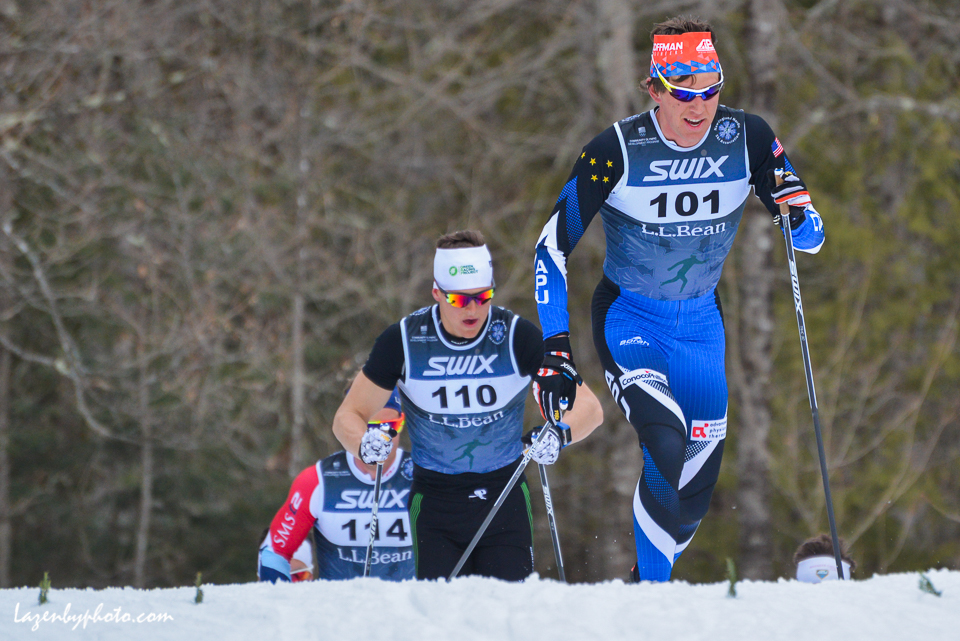
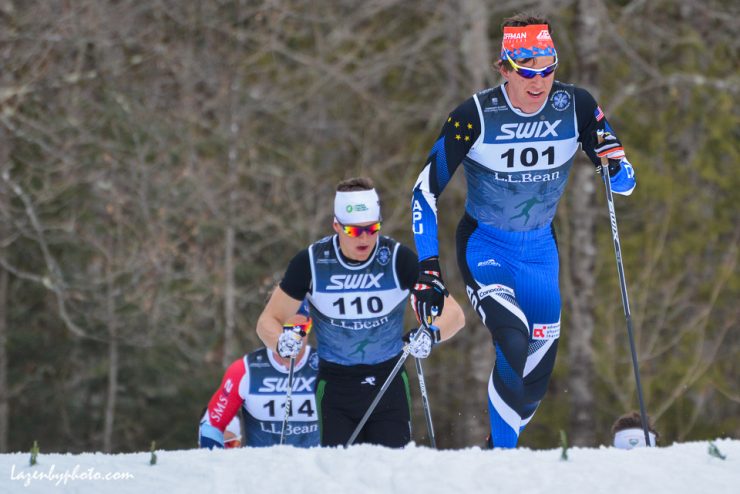
Scott Patterson (101) leads Adam Martin (110), Simi Hamilton (114) and others during the men’s 50 k classic mass start at 2018 U.S. Distance Nationals in Craftsbury, Vt. (Photo: John Lazenby/Lazenbyphoto.com)
FS: Looking at the athletes on the B-team, Scott Patterson obviously had a killer Olympics and a great Holmenkollen 50 k. Was that in the forefront of your mind with regards to his renomination to the B-team?
CG: Yeah, and he had a pretty rough start to the year. According to him, he had a pretty serious setback in the middle of the summer around an ultrarunning race that he was doing in Montana. And it really set him back and he struggled during World Cup Period 1. He seemed to come into his form during the Olympics. Scott actually skied quite well in the spring. Unfortunately, in the first distance race of the World Cup Finals, he and Erik both went down and they struggled to recover in a high-paced race in Falun. But I think Scott is definitely beginning to demonstrate what his potential was from the Olympics onward.
FS: Paddy Caldwell had some impressive time-of-day pursuit results early on in the season.
CG: He, unfortunately, got sick at one point during the Tour de Ski and he got sick during the Olympics. He definitely had some setbacks. But, overall, he skied quite well for a young athlete, the youngest of the group — being his first full year of World Cup. He would need to take a step forward this next year. Now he has a year under his belt. Now he is going to have to start scoring some points and those points are going to need to come from events that are beyond simply having a fast time of day split in a pursuit. But, that is going to be the step I am guessing in order to get whatever world rank he is going to need for this new selection criteria. That is what it is going to take.
FS: I believe Paddy is not here in Bend. That said, Paddy decided to remain in Europe and compete in and finish the Tour de Ski. Does it look like he would do the full complement of the Tour de Ski again?
CG: I am not sure. It is a real challenge around the Tour de Ski versus U.S. nationals. Because we have a selection criteria, although we have not implemented a new selection criteria, and we have not created the new selection criteria yet for the World Championships in Seefeld. But we have had a selection criteria for the last two years which has, obviously, two pathways: one being U.S. National Championships and SuperTour and the other being World Cup, including the Tour de Ski.
That makes it a real challenge. For those athletes that are on World Cup during Period 1, it makes it really hard to decide whether they should go back to U.S. nationals to qualify or whether they should go to the Tour de Ski. We are going to be encouraging probably anyone who is not really skiing well during World Cup Period 1, to go back to U.S. nationals and race at U.S. nationals and try to create a very robust selection process at U.S. nationals.
So you are right, Paddy is not here in Bend, he is doing finals at Dartmouth right now. So we have not had a chance to talk through those scenarios quite yet. One thing that for sure we are going to change about the selection criteria, and this is something to discuss with the community at the Cross Country Committee meetings in Park City, is that we are going to remove the final stage of the Tour de Ski from the championships selection period for distance athletes, and for sprinters as well. The distance period for selection will close on the day prior to the final climb. That has been a point of contention, as you know, within the community. Are we selecting the right athletes by having athletes who are racing uphill in skate? From my personal perspective, the athletes who have done well in that are the athletes that you want on a major championship team. They are aerobic engine skaters. But it is no problem from my perspective to remove that stage and hopefully remove some of the contentious feelings about that particular event.
So I don’t know exactly what [Paddy’s] plan will be yet. U.S. nationals versus a Tour de Ski. I think for a lot of these athletes, including him, we are going to see how people are skiing during Period 1 and whether it makes sense to ski the Tour de Ski or whether it makes sense to go back to U.S. nationals.
FS: Does that mean the USST will establish real concrete criteria as to whether or not someone would come back to U.S. nationals or remain on the World Cup?
CG: No. That is really challenging. If you create concrete criteria or something like that, then it probably needs to be blind to the athlete’s age and experience, but should it really be the same for an athlete who is 22 years old versus an athlete who is 34 years old? I don’t think it ever should. I think it is always important that there is some sort of coach’s discretion that is left that can contribute to making that decision because a younger athlete who might have ten or twelve years of World Cup ahead of them certainly can benefit perhaps from that experience more than an older athlete who might at the end of their career.
I think the heartache in the community comes when people think that we are looking at that decision as in prior to having qualified for the major championships instead of long-term development. And I can tell you from our staff perspective when we are making decisions like that, we are looking at two things. One: can the athlete contribute to outstanding results on World Cup? In this case, begin the Tour de Ski immediately? And second: is this athlete a U.S. athlete that we are trying to really develop for the future who would very much benefit from having this stage and experience and experience at these particular venues at this time?
CG: If he had raced the end of the Tour de Ski, had he raced those last couple of distances races, he may have made the B-team criteria. But one of his biggest goals for last season was to represent the U.S. in the team sprint in PyeongChang and to fight for a medal, so he was very focused on that. And that is why he stopped the Tour de Ski when he did, in order to get ready to race in Dresden. That was the one team sprint on the calendar last year. So he wanted to have the experience. Just from the aerobic as well as anaerobic and the tactical side of that as well. That was his real focus last year. And team sprint, for some of our key men, will continue to be one thing that we absolutely target and it probably remains one of our best chances at a medal.
FS: You are obviously still here. The assumption might have been that at the end of an Olympic cycle, a very successful cycle, that perhaps you would step down. Can you talk about your decision-making process to remain with the U.S. Ski Team?
CG: First of all. We are extremely lucky to have the staff that we have and one that has been as effective as they have been and as loyal as they have been. That goes not only for the coaching staff but also for our service team staff and also for so many of the volunteer providers that we utilize every year.
We have a handful of docs, PT’s, massage therapist — all of who we go back to year after year and ask for weeks and weeks of their time away from work, away from their paying work, away from family, and we ask them to volunteer their time and they keep coming back. We are incredibly lucky to have a staff that we have been able to retain. For Matt [Whitcomb], he came on in 2006, so I think he is going into his 13th year with the team. Jason [Cork] and Bryan [Fish] both came on the year right after 2010, I want to say 2011-2012, somewhere in that range. We have had a lot of longevity. Oleg Ragilo, who is our head technician, is back and he has been, I don’t know how many years he has been with the team, quite a few. He has been with us twice actually.
Also, Jean-Pascal Laurin, Tim Baucom, and Andrew Morehouse, all of those guys are returning. We do have one change on the service team. And that is that Marek Sander, who had been Kikkan [Randall’s] and Andy [Newell’s] tech, has decided to go back to Estonian biathlon which is where he came from when we hired him. Instead, we are hiring Eli Brown. Eli, people will know, he’s a former head coach of the University of Utah, but has been somebody that has been volunteering his time at least the last three major championships plus some World Cup racing for us as a technician.
And so we have just hired him to replace Marek as one of our technicians. So our staff is quite similar, obviously, we brought on Gus as well.
From left to right: Coach Matt Whitcomb with Sadie Bjornsen and Sophie Caldwell in Seefeld, Austria, last winter. (Photo: Garrott Kuzzy / LumiExperiences.com)
The other change that we are going to have, it’s a little bit of a job title change for Matt. Obviously, Matt has been our women’s coach. This year we have him in place to work with both men and women. So that Jason Cork, Matt and myself all basically work as a team with all of the World Cup athletes. We felt like we needed to change some of our setup in order to accommodate the needs of the team. We had some veterans that retired last year. When you have a smaller quote-unquote, “core”, at least the U.S. Ski Team on the World Cup level, we need to be more versatile in terms of helping and being able to help both men and women on a daily basis. And be more versatile with what our job requirements and our job titles are.
So we have some small changes there, but in general, we are really lucky to have everyone coming back. I think in terms of my own continued work with the national team, I will most likely continue until my family says stop and or until I don’t feel like the athletes are getting what they need out of my leadership. So, either one of those two things will be my cue to step down.
FS: For example, Jason Cork is out there testing skis with Jessie Diggins prior to races. I understand why she is a huge investment and the return on investment is important to the team, too. I understand why she might get a lot of resources. And it sounds like Matt is Simi’s coach and that has been going on for a year plus maybe. That said, as things might look from say Cork, Matt, and you redefining roles, how might that look different on the ground during race day?”
CG: It won’t look so different. Like you just alluded to, we are a smaller team. Well, I should say, we are starting to be a fairly big team. We are a smaller ski nation in terms of what our total imprint is on the World Cup and what our budget is perhaps, at least compared to our biggest competitors. Because our budget is so small compared to a Norway or a Russia, everybody, as you know, on our staff tends to do everything. And that is why job titles don’t always really make the most sense. We can give ourselves a title, but everybody ends up once in awhile cleaning some klister at the end of the day. That is just part of the nature of our program. So someone like Jason, he is spending a lot of time in the wax truck. Not only actually helping Jessie but as a key part of our service team as someone who helps Oleg with the overall organization of what we are doing on a daily basis. So someone like Jason is going to be in the wax truck quite a bit. And then also have coaching duties. Matt will be in the wax truck quite a bit less and have a lot more on the coaching duty side. I am going to have a lot of logistical work on a daily basis as well as a lot of staff management and athlete management type task, as well as some coaching duties.
But it is pretty hard to define those more specifically. They definitely change from day to day and week to week. The three of us are trying to basically cover all bases at that World Cup level.
On Thursday, U.S. Ski & Snowboard released its roster for its 2018/2019 national cross-country team nominations, and the list includes five returning A-team members (four women and one man), an all-male B-team, and seven athletes on the D (development) team.
Kevin Bolger (Sun Valley Ski Education Foundation) during his debut World Cup race weekend in Lahti, Finland, last March. There, he placed 11th in the freestyle sprint and 54th in the 15 k classic. (Photo: Fischer/NordicFocus)
Simi Hamilton leads the men’s team as its lone A-team member, while Sadie Bjornsen, Sophie Caldwell, Jessie Diggins, and Ida Sargent are all back on the A-team. The B-team includes three returners — Erik Bjornsen, Paddy Caldwell and Scott Patterson — as well as 25-year-old rookie Kevin Bolger, out of the Sun Valley Ski Education Foundation (SVSEF), who was named to the team after some breakthrough World Cup results last season.
All four of last year’s D-team were renominated, namely 2018 NCAA champions Katharine Ogden (who swept both races at the collegiate championships) and Ian Torchia, Julia Kern and Hannah Halvorsen. Joining them are three athletes who broke through at 2018 Junior World Championships: Hailey Swirbul, Ben Ogden and Gus Schumacher.
Seven of the 16 nominees train with the Stratton Mountain School (SMS) in Vermont. Six others are based out of Anchorage, Alaska; five train with Alaska Pacific University (APU) while the 17-year-old Schumacher hails from the Alaska Winter Stars. The Craftsbury Green Racing Project has one athlete on the team (Sargent), as does SVSEF (Bolger). Torchia is entering his senior season at Northern Michigan University.
Here’s the U.S. Cross Country Ski Team’s nomination list. The team will be officially named this fall.
U.S. Ski Team2018-19 Cross Country Nominations (Hometown; Club; Birthdate)
A TEAM Men
Simi Hamilton (Aspen, Colo.; Stratton Mountain School Elite Team; 5/14/87)
Women
Sadie Bjornsen (Winthrop, Wash.; Alaska Pacific University Nordic Center; 11/21/89)
Sophie Caldwell (Peru, Vt.; Stratton Mountain School Elite Team; 3/22/90)
Jessie Diggins (Afton, Minn.; Stratton Mountain School Elite Team; 8/26/91)
Ida Sargent (Orleans, Vt.; Craftsbury Green Racing Project; 1/25/88)
B TEAM Men
Erik Bjornsen (Winthrop, Wash.; Alaska Pacific University Nordic Center; 7/14/91)
Kevin Bolger (Minocqua, Wisc.; Sun Valley Ski Education Foundation; 4/11/93)
Patrick Caldwell (Lyme, N.H.; Stratton Mountain School Elite Team; 2/18/94)
Scott Patterson (Anchorage, Alaska; Alaska Pacific University Nordic Center; 1/28/92)
D TEAM Men
Ben Ogden (Landgrove, Vt.; Stratton Mountain School; 2/13/00)
Gus Schumacher (Anchorage, Alaska; Alaska Winter Stars; 7/25/00)
Ian Torchia (Rochester, Minn.; Northern Michigan University; 3/8/96)
Women
Hannah Halvorsen (Truckee, Calif.; Alaska Pacific University Nordic Center; 2/19/98)
Julia Kern (Waltham, Mass.; Stratton Mountain School Elite Team; 9/12/97)
Katharine Ogden (Landgrove, Vt.; Stratton Mountain School; 11/17/97)
Hailey Swirbul (Aspen, Colo.; Alaska Pacific University Nordic Center; 7/10/98)
Erik Bjornsen (102) of Alaska Pacific University and the U.S. Ski Team celebrates his win in the men’s 50 k classic mass start at 2018 U.S. Distance Nationals on Wednesday in Craftsbury, Vt., ahead of Adam Martin (110) of the Craftsbury Green Racing Project in second. (Photo: John Lazenby/Lazenbyphoto.com)
2018 U.S. SuperTour Finals (Craftsbury, Vermont): 50 k classic mass start
In the final race of the U.S. racing season, Erik Bjornsen of Alaska Pacific University (APU) and U.S. Ski Team (USST) won his second individual race of the week at 2018 SuperTour Finals in Craftsbury, with a victory in the men’s 50-kilometer classic mass start on Wednesday for the U.S. Distance Nationals title. He previously won the 15 k freestyle mass start on Saturday.
Erik Bjornsen (102) leads his APU and U.S. Ski Team teammate Scott Patterson (101) and Craftsbury’s Adam Martin (110) during the men’s 50 k classic mass start at 2018 U.S. Distance Nationals on Wednesday in Craftsbury, Vt. (Photo: John Lazenby/Lazenbyphoto.com)
Bjornsen beat out Adam Martin of the Craftsbury Green Racing Project (CGRP) in the finishing stretch to finish first in 2:24:51.4 hours, 1.5 seconds ahead of Martin in second place.
For the first 25 k of the race, about six skiers had been in contention while skiing together at the front of the field. By 35 k, that lead group had dwindled to three, with Bjornsen and his teammate Scott Patterson (APU/USST) leading Martin. Five kilometers later, Martin led the other two, and the three stuck together into the final 5 k lap.
Ultimately, Patterson finished 22.8 seconds back in third place, ahead of another APU teammate David Norris, who came on strong while skiing alone on the last lap to close the gap to third, in fourth (+36.5).
The rest of the field was strung out as they crossed the line, with Simi Hamilton of the Stratton Mountain School (SMS) T2 Team and USST placing fifth (+1:49.0), and his teammate Paddy Caldwell (SMST2/USST) following nearly three minutes later in sixth (+4:34.4). Kris Freeman (Caldwell Sport) finished seventh (+8:10.8), Tad Elliott (Ski Club Vail) placed eighth (+9:15.6), Ian Torchia of Northern Michigan University (NMU) and the USST Development Team was ninth (+10:26.3), and Canada’s Scott Hill (Team Hardwood) 10th (+11:00.2).
In the junior men’s 30 k race, Ben Ogden (SMS) took the win in 1:29:17.6, while Hunter Wonders (APU) followed 17.2 seconds back in second place. Wyatt Gebhardt (Steamboat Springs Winter Sports Club) placed third (+1:46.6).
Start of the men’s 50 k classic mass start at 2018 U.S. Distance Nationals in Craftsbury, Vt. (Photo: John Lazenby/Lazenbyphoto.com)
Start of the men’s 50 k classic mass start at 2018 U.S. Distance Nationals in Craftsbury, Vt. (Photo: John Lazenby/Lazenbyphoto.com)
The men’s 50 k classic mass start at 2018 U.S. Distance Nationals in Craftsbury, Vt. (Photo: John Lazenby/Lazenbyphoto.com)
Men’s 50 k classic mass start leaders, with Erik Bjornsen and David Norris of Alaska Pacific University up front, at 2018 U.S. Distance Nationals in Craftsbury, Vt. (Photo: John Lazenby/Lazenbyphoot.com)
Scott Patterson (101) leads Adam Martin (110), Simi Hamilton (114) and others during the men’s 50 k classic mass start at 2018 U.S. Distance Nationals in Craftsbury, Vt. (Photo: John Lazenby/Lazenbyphoto.com)
Adam Martin (Craftsbury Green Racing Project) during the men’s 50 k classic mass start at 2018 U.S. Distance Nationals in Craftsbury, Vt. (Photo: John Lazenby/Lazenbyphoot.com)
Craftsbury’s Adam Martin (110) and Erik Bjornsen (102) of APU and the U.S. Ski Team leading the men’s 50 k classic mass start at 2018 U.S. Distance Nationals on Wednesday in Craftsbury, Vt. (Photo: John Lazenby/Lazenbyphoto.com)
Erik Bjornsen (102) leading his APU and U.S. Ski Team teammate Scott Patterson (r) and Craftsbury’s Adam Martin (l) during the men’s 50 k classic mass start at 2018 U.S. Distance Nationals in Craftsbury, Vt. (Photo: John Lazenby/Lazenbyphoto.com)
APU Head Coach Erik Flora in the ski-exchange zone for the men’s 50 k classic mass start at 2018 U.S. Distance Nationals in Craftsbury, Vt. (Photo: John Lazenby/Lazenbyphoto.com)
The ski-exchange zone for the men’s 50 k classic mass start at 2018 U.S. Distance Nationals in Craftsbury, Vt. (Photo: John Lazenby/Lazenbyphoto.com)
The feed zone for the men’s 50 k classic mass start at 2018 U.S. Distance Nationals in Craftsbury, Vt. (Photo: John Lazenby/Lazenbyphoto.com)
Sophie Caldwell (Stratton Mountain School T2 Team) running to deliver a feed during the men’s 50 k classic mass start at 2018 U.S. Distance Nationals in Craftsbury, Vt. (Photo: John Lazenby/Lazenbyphoto.com)
Simi Hamilton (l) gets a feed from his Stratton teammate Jessie Diggins during the men’s 50 k classic mass start at 2018 U.S. Distance Nationals in Craftsbury, Vt. (Photo: John Lazenby/Lazenbyphoto.com)
Everett Sapp, of Sugar Bowl Academy, racing the junior men’s 30 k classic mass start at 2018 U.S. Distance Nationals in Craftsbury, Vt. (Photo: John Lazenby/Lazenbyphoto.com)
A Craftsbury volunteer removes the timing chip of a Northern Michigan University skier after the men’s 50 k classic mass start at 2018 U.S. Distance Nationals in Craftsbury, Vt. (Photo: John Lazenby/Lazenbyphoto.com)
Adam Martin (Craftsbury Green Racing Project) after finishing second in the men’s 50 k classic mass start at 2018 U.S. Distance Nationals in Craftsbury, Vt. (Photo: John Lazenby/Lazenbyphoto.com)
Logan (l) and his older brother Reese Hanneman of Alaska Pacific University after the men’s 50 k classic mass start at 2018 U.S. Distance Nationals in Craftsbury, Vt. (Photo: John Lazenby/Lazenbyphoto.com)
The men’s 50 k classic mass start podium at 2018 U.S. Distance Nationals in Craftsbury, Vt., with Erik Bjornsen (c) in first, Adam Martin (l) in second and Scott Patterson (r) in third. (Photo: John Lazenby/Lazenbyphoto.com)
Bibs on a fence at the men’s 50 k classic mass start at 2018 U.S. Distance Nationals in Craftsbury, Vt. (Photo: John Lazenby/Lazenbyphoto.com)
The mixed relay podium on Sunday at 2018 SuperTour Finals in Craftsbury, Vt., with Stratton (center: Simi Hamilton, Paddy Caldwell, Jessie Diggins, and Sophie Caldwell) in first, APU (left: Erik Bjornsen, Scott Patterson, Sadie Bjornsen, and Kikkan Randall) in second, and Craftsbury (right: Adam Martin, Alex Howe, Ida Sargent, and Caitlin Patterson) in third. (Photo: John Lazenby/Lazenbyphoto.com)
2018 U.S. SuperTour Finals (Craftsbury, Vermont): Mixed relays
For the second-straight year at the SuperTour’s season-ending Spring Series, the Stratton Mountain School (SMS) T2 Team won the mixed relay, with three of the four athletes who raced on last year’s 4 x 5-kilometer mixed relay squad.
Simi Hamilton, Sophie Caldwell, Paddy Caldwell, and Jessie Diggins combined for the win on Sunday in Craftsbury, tagging off in that order, with Diggins crossing the finish line first for the third-straight day. Diggins is undefeated in three races so far at Spring Series, after winning Friday’s classic sprint and Saturday’s 10 k freestyle mass start. The women’s 30 k classic mass start remains on Tuesday, followed by the men’s 50 k classic mass start on Wednesday.
Diggins and her Stratton teammates beat the Alaska Pacific University (APU) first team by 13.2 seconds at the line with a time of 53:43.2. The co-ed mixed relay has been held at SuperTour Finals for the last five years, and APU won the first three editions of the race from 2014 to 2016. Stratton won last year in Fairbanks, Alaska, with Ben Saxton, Hamilton, Caldwell, and Diggins.
APU led most of Sunday’s race, with Erik Bjornsen starting them off. He came through the first exchange in first place, just 0.2 seconds ahead of Hamilton in second. Behind them, Adam Martin of the Craftsbury Green Racing Project tagged in third, 0.8 seconds out of first.
Paddy Caldwell (302) tags his Stratton Mountain School (SMS) T2 Team teammate Jessie Diggins (402) in second, while Craftsbury’s Caitlin Patterson (430) looks on, at the final exchange of the mixed relay at 2018 SuperTour Finals in Craftsbury, Vt. Diggins went on to anchor Stratton to first place. (Photo: John Lazenby/Lazenbyphoto.com)
Sadie Bjornsen then extended APU’s lead to 7.3 seconds over Stratton’s Sophie Caldwell in second. Behind them, Craftsbury’s Ida Sargent came through the second exchange in 10.3 seconds back in third.
APU’s Scott Patterson went on to hold off Stratton’s Paddy Caldwell on the third leg, tagging 3.5 seconds ahead in first. Diggins came up big for Stratton on the anchor leg, passing APU’s Kikkan Randall to secure the win.
Craftsbury held its third-place position during the second half of the race with Alex Howe and Caitlin Patterson to finish third, 56.2 seconds behind Stratton. More than a minute later, APU 2 (Tyler Kornfield, Rosie Brennan, Logan Hanneman, and Rosie Frankowski) crossed in fourth (+2:04). Stratton’s second team (Saxton, Julia Kern, Andy Newell, and Erika Newell) placed fifth (+2:47.3), APU 3 (Reese Hanneman, Becca Rorabaugh, Eric Packer, Hannah Halvorsen) sixth, Dartmouth Ski Team (Luke Brown, Katharine Ogden, Gavin McEwen, Abigail Drach) seventh, Northern Michigan University (Zak Ketterson, Vivian Hett, Ian Torchia, Nicole Schneider) eighth, Middlebury College (Peter Wolter, Cate Brams, Adam Luban, Katie Feldman) ninth, and US Biathlon (Russell Currier, Clare Egan, Raleigh Goessling, Susan Dunklee) 10th.
Thirty-one “official” teams and eight “unofficial” teams competed, with NMU/CSS/NYSEF leading the unofficial teams with a time of 1:00:01.9 (which ranked 19th overall).
Racers have the day off Monday before the women’s 30 k and men’s 50 k classic mass starts (part of U.S. Distance Nationals) on Tuesday and Wednesday, starting at 9 a.m. EDT. Watch the races live on the SuperTour live stream.
Martin racing in Craftsbury’s Green and Black (R), leading in the mixed relay at 2018 Super Tour Finals, just ahead of APU’s Erik Bjornsen (L), in Craftsbury, Vt. (Photo: John Lazenby/Lazenbyphoto.com)
Sadie Bjornsen (l) tags APU teammate Scott Patterson in first at the second exchange of the mixed relay at 2018 SuperTour Finals in Craftsbury, Vt. (Photo: John Lazenby/Lazenbyphoto.com)
Sophie Caldwell (l) about to tag Stratton teammate Paddy Caldwell in second at the second exchange of the mixed relay at 2018 SuperTour Finals in Craftsbury, Vt. (Photo: John Lazenby/Lazenbyphoto.com)
Scott Patterson (301) tags his APU teammate Kikkan Randall (401) in first, while Stratton’s Jessie Diggins (l) waits to be tagged in second place, at the last exchange of mixed relay at 2018 SuperTour Finals in Craftsbury, Vt. (Photo: John Lazenby/Lazenbyphoto.com)
Alex Howe (r) tags his Craftsbury teammate Caitlin Patterson (l) in third at the final exchange of the mixed relay at 2018 SuperTour Finals in Craftsbury, Vt. (Photo: John Lazenby/Lazenbyphoto.com)
Jessie Diggins anchoring the SMST2 Team to the win in the mixed relay at 2018 SuperTour Finals in Craftsbury, Vt. (Photo: John Lazenby/Lazenbyphoto.com)
Jessie Diggins celebrates as she anchors the SMST2 Team to the mixed-relay win at 2018 SuperTour Finals in Craftsbury, Vt. (Photo: John Lazenby/Lazenbyphoto.com)
Jessie Diggins about to celebrate with teammates after anchoring the SMST2 Team to the mixed-relay win at 2018 SuperTour Finals in Craftsbury, Vt. (Photo: John Lazenby/Lazenbyphoto.com)
Caitlin Patterson anchoring the Craftsbury Green Racing Project team to third in the mixed relay at 2018 SuperTour Finals in Craftsbury, Vt. (Photo: John Lazenby/Lazenbyphoto.com)
Stratton Mountain School (SMS) T2 Team members and 2018 SuperTour Finals mixed-relay racers: (from left to right) Andy Newell, Annie Hart, Sophie Caldwell, Jessie Diggins, Erika Newell, Simi Hamilton, Ben Saxton, and Julia Kern. (Photo: John Lazenby/Lazenbyphoto.com)
A musically inclined Stratton Mountain School supporter at the mixed relay at 2018 SuperTour Finals in Craftsbury, Vt. (Photo: John Lazenby/Lazenbyphoto.com)
Bridger Ski Foundation teammates Andrew Meyer (r) and Corey Stock (l) during the final exchange of the mixed relay at 2018 SuperTour Finals in Craftsbury, Vt. Stock anchored the team to 17th. (Photo: John Lazenby/Lazenbyphoto.com)
Cambridge Sports Union skiers during an exchange at the mixed relay at 2018 SuperTour Finals in Craftsbury, Vt. (Photo: John Lazenby/Lazenbyphoto.com)
Retiring World Cup skier Liz Stephen raced the mixed relay with an unofficial team from her high school in East Montpelier, Vt., at 2018 SuperTour Finals in Craftsbury, Vt. They called themselves “U-32 High School”. (Photo: John Lazenby/Lazenbyphoto.com)
A team made up of NENSA, Onion River Nordic and Montpelier club athletes at the mixed relay at 2018 SuperTour Finals in Craftsbury, Vt. (Photo: John Lazenby/Lazenbyphoto.com)
Erik Bjornsen (2) of Alaska Pacific University and the U.S. Ski Team (USST) leads Simi Hamilton (13), of the Stratton Mountain School T2 Team and USST, and Tad Elliott (12), of Ski Club Vail toward the finish of the men’s 15 k freestyle mass start at 2018 SuperTour Finals in Craftsbury, Vt. (Photo: John Lazenby/Lazenbyphoto.com)
2018 U.S. SuperTour Finals (Craftsbury, Vermont): 10/15 k freestyle mass starts
Jessie Diggins won her second-straight race in as many days at 2018 SuperTour Finals and Erik Bjornsen pulled out a victory in the men’s 15-kilometer freestyle mass start on Saturday in Craftsbury.
Jessie Diggins (201) and Sadie Bjornsen (202) lead the women’s 10 k freestyle mass start at 2018 SuperTour Finals in Craftsbury, Vt. (Photo: John Lazenby/Lazenbyphoto.com)
Diggins, of the Stratton Mountain School (SMS) T2 Team and U.S. Ski Team (USST), won the women’s 10 k freestyle mass start in 25:56.0 minutes, just 1.2 seconds ahead of her USST teammate Sadie Bjornsen of Alaska Pacific University (APU) in second. The duo dropped the pack and battled to the line, while Kikkan Randall (APU/USST) skied on her own to third place, 12.6 seconds behind Diggins.
APU took three of the top four with Rosie Frankowski finishing 43.7 seconds back in fourth. Caitlin Patterson of the Craftsbury Green Racing Project (CGRP) followed in fifth (+1:02.2), and Sophie Caldwell (SMST2/USST) took sixth less than one-tenth of a second ahead of her Stratton teammate Katharine Ogden (Dartmouth College/SMS/USST Development Team) in seventh (+1:10.4). US Biathlon’s Susan Dunklee (CGRP) placed eighth (+1:19.4), Julia Kern (SMST2/USST D-team) finished ninth (+1:26.0), and Erika Flowers (SMST2), who competed at last weekend’s Norwegian Birkebeiner, placed 10th (+1:37.0).
In the men’s mass start, Bjornsen (APU/USST) and Simi Hamilton (SMST2/USST) went head to head down the finishing stretch for first, which Bjornsen took in 35:08.1. Hamilton finished 1.5 seconds back in second place, while Tad Elliott (Ski Club Vail) followed three seconds later in third (+4.6).
According to live timing, Paddy Caldwell (SMST2/USST) edged his fellow national-team member Scott Patterson (APU/USST) by less than one-tenth of a second for fourth place (+6.5). Brian Gregg of Central Cross Country (CXC), Team Gregg and Loppet Nordic Racing placed sixth (+30.4), David Norris (APU) finished seventh (+52.1), Jack Hegman of the Sun Valley Ski Education Foundation (SVSEF) eighth (+55.3), Adam Martin (CGRP) ninth (+56.2), and Eric Packer (APU) 10th (+59.8).
Spring Series continues Sunday with mixed relays at 9 a.m. EDT at the Craftsbury Outdoor Center.
Jessie Diggins (201) leads her U.S. Ski Team teammate Sadie Bjornsen and the rest of the women’s field in the 10 k freestyle mass start at 2018 SuperTour Finals in Craftsbury, Vt. (Photo: John Lazenby/Lazenbyphoto.com)
Jessie Diggins (SMST2/U.S. Ski Team) pushing to the line for the win in the women’s 10 k freestyle mass start at 2018 SuperTour Finals in Craftsbury, Vt. (Photo: John Lazenby/Lazenbyphoto.com)
Jessie Diggins (201) winning the women’s 10 k freestyle mass start, just ahead of Sadie Bjornsen (202) in second, at 2018 SuperTour Finals in Craftsbury, Vt. Kikkan Randall (background) placed third. (Photo: John Lazenby/Lazenbyphoto.com)
Kikkan Randall (APU/USST) racing to third in the 10 k freestyle mass start at 2018 SuperTour Finals in Craftsbury, Vt. (Photo: John Lazenby/Lazenbyphoto.com)
Kikkan Randall (l) and Jessie Diggins embrace after the finish of the women’s 10 k freestyle mass start on March 24 at 2018 SuperTour Finals in Craftsbury, Vt. Diggins won and Randall placed third. That was Randall’s second-to-last race before retiring from skiing. (Photo: John Lazenby/Lazenbyphoto.com)
Liz Stephen (U.S. Ski Team) racing to 12th in the women’s 10 k freestyle mass start at 2018 SuperTour Finals in Craftsbury, Vt. (Photo: John Lazenby/Lazenbyphoto.com)
Liz Stephen (U.S. Ski Team) having some fun at 2018 SuperTour Finals in Craftsbury, Vt. She finished 12th in the 10 k freestyle mass start. (Photo: John Lazenby/Lazenbyphoto.com)
U.S. Ski Team member Liz Stephen (yellow bib) during a photo opp at 2018 SuperTour Finals in Craftsbury, Vt. (Photo: John Lazenby/Lazenbyphoto.com)
Scott Patterson (1) leads his APU and U.S. Ski Team teammate Erik Bjornsen and the rest of the men’s field in Saturday’s 15 k freestyle mass start at 2018 SuperTour Finals in Craftsbury, Vt. (Photo: John Lazenby/Lazenbyphoto.com)
Scott Patterson (1) leads his APU and U.S. Ski Team teammate Erik Bjornsen and the rest of the men’s field in Saturday’s 15 k freestyle mass start at 2018 SuperTour Finals in Craftsbury, Vt. (Photo: John Lazenby/Lazenbyphoto.com)
The men’s 15 k freestyle mass start top six at 2018 SuperTour Finals in Craftsbury, Vt., with (from left to right) Brian Gregg in sixth, Paddy Caldwell in fourth, Simi Hamilton in second, Erik Bjornsen in first, Tad Elliott in third, and Scott Patterson in fifth. (Photo: John Lazenby/Lazenbyphoto.com)
Olympians Sadie Maubet Bjornsen, Jessie Diggins, and Kikkan Randall representing their club teams at the 2018 Super Tour Finals. (Photo: John Lazenby/Lazenbyphoto.com)
From left to right, Kikkan Randall, Bill Koch and Jessie Diggins, the U.S.A.’s three Olympic medalists in cross-country skiing at 2018 SuperTour Finals in Craftsbury, Vt. (Photo: John Lazenby/Lazenbyphoto.com)
Kikkan Randall (c) with young fans and her Olympic gold medal after the 10 k freestyle mass start at 2018 SuperTour Finals in Craftsbury, Vt. (Photo: John Lazenby/Lazenbyphoto.com)
Russian Alexander Bolshunov celebrates as he wins his first-career World Cup, a 15 k classic mass start, just ahead of Sweden’s Calle Halfvarsson (11) at 2018 World Cup Finals in Falun, Sweden. (Photo: Svenska Skidspelen/Instagram)
Saturday was the second day of World Cup Finals mini tour, held in Falun, Sweden, which conclude the 2017/2018 season. Friday’s first stage began with a skate sprint, while Saturday featured a 15-kilometer classic mass start for the men.
As the season is no longer young, the fitness for some athletes frayed, a mass start could offer the opportunity for some to hide in the pack and others to exploit. On a sunny and cold Saturday in Falun, the leading distance skiers on the World Cup were unable to separate. The terrain was World-Cup hilly, yet the pace was never decisive enough to shatter the field.
That field was 91-skiers full. 182 poles. 182 skis. Churning from the start, only those skiers in the front rows of the start pyramid could pole and stride away unscathed. As is the nature of 91 skiers fighting for classic-track scarcity — the lanes taper down in number — pile-ups are the norm. So while some skiers like U.S. Ski Team members Erik Bjornsen and Scott Patterson lost time in a starting-scrum spill, others were looking for brighter opportunities up front.
Russia’s Alexey Chervotkin (43) and Canada’s Alex Harvey (32) lead another Russian Maxim Vylegzhanin 59), Sweden’s Calle Halfvarsson (11) and Italy’s Francesco De Fabiani (10) up a climb during the men’s 15 k classic mass start at World Cup Finals in Falun, Sweden. (Photo: Fischer/NordicFocus)
From the start the pace was hot. There was Finland’s Iivo Niskanen, Sweden’s Emil Jönsson, Norway’s Johannes Høsflot Klæbo, Martin Johnsrud Sundby, Niklas Dyrhaug, Canada’s Alex Harvey, Kazakhstan’s Alexey Poltoranin, Russians Alexey Chervotkin and Alexander Bolshunov, and Swedes Calle Halfvarsson and Marcus Hellner, all in either a strung-out or condensed formation 3.75 k into the race. Skiers were slowly slipping off the back. But even with the surging up front, the tactics playing out appeared to place a premium on safety in numbers.
Bolshunov surged at 4.5 k to snag the highest-value time bonus. Otherwise, for much of the race, identifying specific skiers was a task in itself. Coming down the hills a third through the race, the top-50 skiers were a sinuous and continuous line separated by 17.7 seconds. At the bottom of climbs, the compressive part of the accordion effect was in play. Skiers in front could push, those behind became a more dense cluster of lycra-clad athletes.
Despite the prevalent pulsing of pace, skiers like Chervotkin and Harvey had their moments of pluckiness. Each paced a long line of skiers through the 9.3 k mark. But clear at this point was that the pattern of this race would be defined by the collective mass of skiers that began the mass start. Yes, time gaps would balloon a bit by the finish, but at 12 k (the second time bonus), a gap of 1.7 seconds separated first through 35th place.
The move that mattered in this race came from the birthday boy, Halfvarsson. According to FasterSkier’s reporter on the ground, the Swedish crowd serenaded Halfvarsson, 29, with a happy birthday rendition prior to the start. Maybe it was birthday stoke, maybe it was an acknowledgment that with age comes fewer opportunities to seize the win, but with one kilometer to go, Halfvarsson ran like Klæbo. Up and over the hill, the Swede forged a small gap on the 30-plus chasers.
Again on the last short incline before the speedy descent into the stadium, Halfvarsson performed a masterful high-step run. Only Bolshunov at this point could suck up near the Swede’s tails. For a moment, rounding into the final straight, it looked like Halfvarsson’s icing on his birthday cake would be a Falun stage win.
The men’s 15 k classic mass start podium at 2018 World Cup Finals in Falun, Sweden, with Russia’s Alexander Bolshunov (c) in first, Sweden’s Calle Halfvarsson (l) in second, and Italy’s Francesco De Fabiani (r) in third. (Photo: FIS World Cup Svenska Skidspelen/Facebook)
Halfvarsson came into the straight out of the tracks. As he zeroed in to begin the double-poling finish, the birthday boy stumbled slightly slotting into the nearest lane. Bolshunov flew by with a supreme double pole and took the win in 36:59.8. Halfvarsson placed second (+1.3), Italy’s Francesco De Fabianithird (+3.1), Poltoranin fourth (+3.7) and Chervotkin fifth (+5.2).
For the 21-year-old Bolshunov, it was his first-career World Cup win. Prior to Saturday’s win, Bolshunov had stood on the podium six times in his first full season on the World Cup. (Bolshunov’s only World Cup start last season was in Drammen, Norway, in March 2017.) Along with Klæbo, also 21, Bolshunov has risen into one of the sport’s top athletes. He claimed three silvers and a bronze medal in PyeongChang. His two individual Olympic medals were a second in the 50 k classic mass start and third in the classic sprint.
“I have had many second and third place finishes this season so I am very happy to finally have a win,” Bolshunov told the International Ski Federation (FIS) after the race. “This feels good. I will do what I can tomorrow for another good result but for now, I will enjoy this win.”
Sunday’s final men’s race of the season and last race of the three-stage mini-tour, will be a 15 k freestyle pursuit. Bolshunov leads the mini-tour standings in first with a total elapsed time of 38:37 minutes. Klæbo, who finished 22nd (+13.6) on Saturday, sits in second (+38.0), while Halfvarsson is third (+39.2).
The Swede took away the positives from the day’s near-win in front of the home crowd.
“I tried today to get a win but it was too much,” Halfvarson told FIS. “Off the final corner, I was really tired. I am still happy with second place. I have been on a podium a few times this season and always third. So at least second place is an improvement even if I didn’t manage the win.”
Canada’s Alex Harvey was the best placed North American in 20th place (+10.7). He’ll begin Sunday’s pursuit in 18th (+1:16.1).
Canada’s Graeme Killick (75) skiing with Sweden’s Jens Burman during the men’s 15 k classic mass start at World Cup Finals in Falun, Sweden. Killick went on to finish 41st. (Photo: Fischer/NordicFocus)
Teammate Devon Kershaw finished 26th (+14.6) for his fourth-straight race in the top 30 (including his 26th-place finish in the Olympic 50 k classic). Graeme Killick placed 41st (+1:13) and Julien Locke was 81st (+3:29) for Canada.
“I felt quite good today,” Kershaw said after the race. “I was a little disappointed with the last kilometer because I was kind of out of position a little bit after Mördarbakken and couldn’t quite get up through traffic, but it’s really close. And a little disappointed to be 26th again; it seems like that’s kind of where I’ve lived all year, but it was a good race for me.”
Kershaw, a 35-year-old staple of the Canadian team, has been seeking a return to top form.
“Just races like today where I feel good and can execute decently well,” Kershaw explained. “To be honest this year I am super motivated after the championship. I’ve [been] having major, major asthma issues at the Olympics and that really really affected me and it took a long time to get a little better, but I felt like by the time I got to Lahti I was feeling quite a bit better. So that really helps, I mean, I can breathe again and I’m feeling good.”
Kershaw is expected to mull over the prospects of continuing his ski career in the coming weeks.
“We’re not sure, I’ll talk to the wife next week [Norwegian former elite skier Kristin Størmer Steira],” Kershaw said of his future plans. “You know there’s a lot of issues right now in Canada so I’ll have to think about it. A lot of guys are saying that they’re gonna call it a day. And I’m not getting any younger, but I still feel quite good, and I mean a race like today shows that I can still compete with the best in the world so that’s motivating, but we’ll definitely have to take some weeks to think about it.”
Nowhere to go: U.S. skiers Erik Bjornsen (bib 57) and Scott Patterson (bib 67) stuck in a pile-up after the start of the men’s 15 k mass start classic at World Cup Finals in Falun, Sweden. (Screenshot: SRF Sport broadcast)
For the U.S., Erik Bjornsen finished 52nd (+1:47.1), Simi Hamilton 62nd (+2:06.4), Kevin Bolger 69th (+2:27.1), David Norris 70th (+2:31.2), Scott Patterson 71st (+2:40.6), Paddy Caldwell 75th (+2:52.7), and Andy Newell 86th (+4:47).
Patterson’s race did not go as planned.
“I was in a big pile-up right at the start,” Patterson told FasterSkier after. “I was the second-to-last one out of the stadium and then the first time up Mördarbakken, my ski fell off. So I skied halfway down, got my ski back on, just turned back around and then just like stupidly chasing the rest of the race. …
“I felt OK,” Patterson added. “[Without] those two stupid things it would have been a good race. But I was so far off and then it was really hard to get back to the pack and then it was like, ‘Well, I can’t get to the pack. I am here with those guys.’ ”
Lately, Patterson, 26, has been a highlight for the U.S. distance skiing prospects. The first-year U.S. Ski Team member notched three individual top-20 results at last month’s Olympics, including 11th in the 50 k classic. Last weekend in Oslo, Norway, Patterson proved that was no fluke, as he placed 16th in a traditionally deep field at the Holmenkollen 50 k skate.
World Cup Finals conclude with 10/15 k freestyle pursuits on Sunday.
— Gabby Naranja, Harald Zimmer and Alex Kochon contributed
The Italian men’s team after Saturday’s 15 k classic mass start at 2018 World Cup Finals in Falun, Sweden, with (from left to right) Federico Pellegrino, Giandomenico Salvadori, Francesco De Fabiani, Maicol Rastelli, and Dietmar Nöckler. (Photo: Fischer/NordicFocus)
The women’s 10 k classic mass start podium at 2018 World Cup Finals in Falun, Sweden, with Finland’s Krista Pärmäkoski (c) in first, Norway’s Marit Bjørgen (l) in second and Ingvild Flugstad Østberg (r) in third. (Photo: FIS World Cup Svenska Skidspelen/Facebook)
FIS Cross Country World Cup Finals (Falun, Sweden): 10/15 k classic mass starts
Day 2 of World Cup Finals in Falun entailed 10- and 15-kilometer classic mass starts on Saturday, and in the first race of the day, Finland’s Krista Pärmäkoski pulled out a thrilling finishing-sprint victory over Norway’s Marit Bjørgen.
After American Jessie Diggins led early in the first 2.5 k loop, Bjørgen set the tone from the front for most of the race. With less than a kilometer to go, Norwegian powered up the final horseshoe-shaped climb in first, with Pärmäkoski and Bjørgen’s Norwegian teammate Ingvild Flugstad Østberg just behind her. The three had dropped the field while lapping through the stadium around the 7.5 k.
While Østberg fell off the pace on that final uphill, Bjørgen accelerated as she took a few quick strides over the top, gaining a few meters on Pärmäkoski as they headed into the descent. The finishing stretch is long in Falun, and Pärmäkoski was able to come on strong just before she and Bjørgen entered the final 100 meters before the finish. There, Pärmäkoski’s double-pole speed not only matched Bjørgen, but beat her, as Pärmäkoski passed her with several meters to go and took the win by 0.2 seconds in 26:00.5 minutes. It was Pärmäkoski’s second win of the season and fourth of her career (including time-of-day pursuit stage wins).
Just behind Pärmäkoski and Bjørgen, who congratulated each other immediately at the finish, Østberg finished 5.1 seconds back in third. Five women fought for fourth place, with Sweden’s Ebba Andersson taking it (+14.5) ahead of Japan’s Masako Ishida in fifth (+14.8), Sweden’s Charlotte Kalla in sixth (+15.2), Austria’s Teresa Stadlober in seventh (+15.4), and Diggins in eighth (+15.5).
Norway’s Astrid Uhrenholdt Jacobsen was the next finisher across the line in ninth (+24.8), then Finland’s Kerttu Niskanen in 10th (+26.2) and American Sadie Bjornsen in 11th (+26.3).
Canada’s Emily Nishikawa was the next North American in 36th (+1:31.1), and she led her teammates Cendrine Browne, who placed 50th (+2:05.7), Dahria Beatty in 61st (+2:46.6) and Zina Kocher in 69th (+6:12).
For the U.S., Sophie Caldwell finished 41st (+1:36.1), Rosie Frankowski 44th (+1:43.7), Caitlin Patterson 47th (+1:54.8), Ida Sargent 52nd (+2:10.2), Liz Stephen 54th (+2:20.0), Kikkan Randall 57th (+2:34.1), and Kaitlynn Miller 64th (+2:50.7). Rosie Brennan did not start.
The men’s 15 k classic mass start podium at 2018 World Cup Finals in Falun, Sweden, with Russia’s Alexander Bolshunov (c) in first, Sweden’s Calle Halfvarsson (l) in second, and Italy’s Francesco de Fabiani (r) in third. (Photo: : FIS World Cup Svenska Skidspelen/Facebook)
In the men’s 15 k classic mass start on Saturday afternoon, Russia’s 21-year-old Alexander Bolshunov notched his first-career World Cup win after reaching the podium seven other times this season (placing third in six of those seven races).
Bolshunov hung in the pack and took the lead at the start of the final lap at 11.25 k, ahead of four of his Russian teammates, Alexey Chervotkin in second, Evgeniy Belov in third, Andrey Larkov in fourth, and Maxim Vylegzhanin in fifth. Behind them, Switzerland’s Dario Cologna skied just ahead of Norway’s Martin Johnsrud Sundby and Canada’s Alex Harvey, who were among 29 skiers within four seconds of first.
While Sweden’s Calle Halfvarsson led the final climb before the stadium, Bolshunov caught him on the downhill and out-double-poled him in the finishing stretch, taking first by 1.3 seconds in 36:59.8. Halfvarsson finished second and Italy’s Francesco de Fabiani scored his second World Cup podium of the season in third (+3.1).
Kazakhstan’s Alexey Poltoranin missed the podium by 0.6 seconds in fourth (+3.7), Chervotkin followed in fifth (+5.2), ahead of Cologna in sixth (+5.6) and Italy’s Federico Pellegrino in seventh (+5.6), after they finished together. Sundby and his Norwegian teammate Niklas Dyrhaug also crossed the line at the same time in eighth (+6.3) and ninth (+6.3), respectively, just 0.1 seconds ahead of another one of their teammates, Sjur Røthe, in 10th (+6.4).
Less than five seconds later, Harvey finished 20th (+10.7), ahead of Norway’s Johannes Høsflot Klæbo in 22nd (+13.6). Klæbo slipped out of contention on the third of four laps, as he dropped from fourth to 22nd in less than two kilometers.
Canada’s Devon Kershaw finished 26th (+14.6) for his fourth-straight race in the top 30 (including his 26th-place finish in the Olympic 50 k classic mass start), Graeme Killick placed 41st (+1:13) and Julien Locke was 81st (+3:29).
Erik Bjornsen was the top American man in 52nd (+1:47.1), Simi Hamilton finished 62nd (+2:06.4), Kevin Bolger was 69th (+2:27.1), David Norris 70th (+2:31.2), Scott Patterson 71st (+2:40.6), Paddy Caldwell 75th (+2:52.7), and Andy Newell 86th (+4:47).
World Cup Finals conclude with 10/15 k freestyle pursuits on Sunday.
France won the International Biathlon Union (IBU) World Cup women’s 4 x 6 k relay to start the day at Holmenkollen, ahead of Germany and Italy, while the Canadian women’s team (Sarah Beaudry, Julia Ransom, Emma Lunder, and Rosanna Crawford) placed 11th and the U.S. (Clare Egan, Susan Dunklee, Joanne Reid, and Emily Dreissigacker) came back from 21st to finish 15th.
In the men’s 12.5 k pursuit that followed, France’s Martin Fourcade won his 10th race at Holmenkollen, putting himself 49 points ahead of Norway’s Johannes Thingnes Bø with three individual races in Tyumen, Russia, remaining. US Biathlon’s Sean Doherty tied his second-best result this season in 17th and his teammate Lowell Bailey raced up to 28th with the 19th-fastest time of day. Leif Nordgren placed 40th and Tim Burke was 47th, while Canada’s Scott Gow finished 51st and Christian Gow was 54th.
Norway’s Johannes Høsflot Klæbo calm and cool as he crosses the line for another sprint win. This time, he won the 1.4 k skate sprint in Falun, Sweden, the last sprint of the World Cup season. (Photo: Svenska Skidspelen/Instagram)
At 21 years old, Johannes Høsflot Klæbo of Norway had already locked up his second-consecutive Sprint World Cup Crystal Globe several weeks ago. A down-to-the-wire, season-ending finale for the sprint globe was out of the question. Klæbo has simply been that good. Out of 11 sprint races this season, Klæbo won the seven out of the nine sprints he contested. He placed second and third, respectively, in the other two. One word to describe it all: dominant.
Russia’s Alexander Bolshunov won Friday’s qualifier in 2:36.23. Klæbo placed second (+0.46). Clearly, the Norwegian’s form was still on after steamrolling since the opening World Cup weekend in Kuusamo, Finland, on Nov. 24.
Beyond settling for second in Friday’s qualifier, Klæbo won the first quarterfinal, the first semifinal and the final. In the final, as he faced off with Italy’s Federico Pellegrino, Sweden’s Oskar Svensson and Teodor Peterson, France’s Lucas Chanavat, and Finland’s Ristomatti Hakola, Klæbo’s tactics would initially appear timeworn but effective.
Here’s how the Norwegian’s earlier tactics played out and eventually caught the spellbound finalists off guard. In Klæbo’s quarterfinal, also featuring Pellegrino, the pack of six skiers kept tight until the course’s final V1 climb. At 1:40 into the race, American Simi Hamilton, who had qualified in 13th (+4.1), came around the pack, pushed over the top and led out the string of skiers. Klæbo sat in fifth place. At 2:02 minutes, Klæbo and the group closed on Hamilton. Pellegrino led around the top of the final corner heading into the finish straight, then it was Hamilton followed by Klæbo. Stepping around the corner, and gliding out, Pellegrino and Klæbo unleashed a fifth-gear free skate and separated themselves from Hamilton. Klæbo and Pellegrino finished first and second, respectively, and Hamilton third. That put Hamilton 14th overall on the day as his time was not fast enough to move on as a lucky loser.
Simi Hamilton (U.S. Ski Team) racing to 13th in the men’s freestyle sprint qualifier at 2018 World Cup Finals in Falun, Sweden. He went on to finish the day in 14th overall. (Photo: Fischer/NordicFocus)
“With Simi, we took an aggressive approach today,” U.S. Ski Team coach Matt Whitcomb told FasterSkier in person after. “We threw him in with Klæbo and Pellegrino in the quarters and thought that he could potentially beat one of those guys and advance, or potentially be a lucky loser.
“He just got too tactical over the top of the last hill, so the lucky losers came from heats down the road,” Whitcomb continued. “And, Simi, unfortunately, ended up going over the hill in first and almost was able to hold it off. It was really impressive that he was able to hang onto third, but not enough for today. When he gets tactical, it tends to not be your lucky loser heat.”
On to the semis. In the first semifinal, Klæbo again allowed others, primarily Bolshunov, to do the pacing work. Bolshunov shot off the start like a starved thoroughbred chasing its first meal. Knowing Klæbo can close, the Russian hammered with a high-turnover tempo no other skiers could match. Bolshunov couldn’t pull away, but he could control for much of the semifinal.
As much as Klæbo can hide, he stalked in the back. Again, on the small hill before the finish, while Bolshunov faded, the Norwegian went. Right on cue Klæbo nailed his finish, outdueling second-place skier Peterson (+0.21), third-place Pellegrino (+0.32), and Ristomatti in fourth (+0.59). Bolshunov finished fifth (+3.10).
Coming into the final, Pellegrino, Hakola, and Peterson had already been schooled in Klæbo’s Falun-sprint scheme during the semi. After watching Bolshunov burn up taking a flyer off the front, that race strategy seemed unwise. But allowing Klæbo to draft in the pack had also proved futile.
Study Klæbo all you want. There’s still much to learn.
Up and over the first indecisive climb during the final, Klæbo paced behind Sweden’s Svensson. Stepping around a corner and into the course’s second hill, only 48 seconds into the race, Klæbo sent it: hop-skate style.
Klæbo’s burst of speed scorched the skiers behind. Initially, the others were caught off guard and failing in their response. Cresting the course’s third hill, Klæbo kept up the furious pace. One minute and 50 seconds in, Klæbo had nearly a thirty-meter gap over a chasing Chanavat.
The win was never in doubt at this point. It was as if Klæbo wanted to include a new chapter in his young career’s book of dominance. On Friday, Klæbo proved he could win a sprint by accelerating with nearly a kilometer to go. There was no fade. There was no catching up from behind. (Klæbo did pull up before the line to celebrate as Pellegrino came flying toward the finish.)
The men’s freestyle sprint podium at 2018 World Cup Finals in Falun, Sweden, with Norway’s Johannes Høsflot Klæbo (c) in first, Italy’s Federico Pellegrino (l) in second and France’s Lucas Chanavat (r) in third. (Photo: Fischer/NordicFocus)
Klæbo won the final in 2:37.03 minutes. Pellegrino was second (+0.39), Chanavat third (+1.76), Ristomatti fourth (+3.26), Svensson fifth (+3.88), Peterson sixth (+6.17). Klæbo earned 50 World Cup points for the win. Heading into the two final World Cup races of the season, a 15 k classic mass start on Saturday and a 15 k skate pursuit Sunday, Klæbo leads the Overall World Cup standings by 272 points over fellow Norwegian Martin Johnsrud Sundby. The winner of the entire weekend will get 200 World Cup points, so it’s safe to say Klæbo has that overall Crystal Globe locked up as well.
“I learned after Lahti that I needed to be away from Pellegrino if there was a long downhill with a fast finish so I attacked on the first climb today in the finals to make sure that I was far enough ahead before the finish,” Klæbo told the International Ski Federation (FIS) after the race. “It’s just been an incredible season with my second sprint globe and the Olympics. But I am focused on also taking home the overall crystal globe and will fight the next two days to make sure I get it.”
Bolger Reaches Quarterfinals
Kevin Bolger (Sun Valley Ski Education Foundation) racing to 50th in the men’s classic sprint qualifier at last week’s World Cup in Drammen, Norway. (Photo: Fischer/NordicFocus)
Along with Hamilton, Kevin Bolger was the only other North American to move onto the heats. In his third-career World Cup sprint, the Sun Valley based skier qualified in 29th and placed 30th overall after finishing sixth in his quarterfinal, 2.21 seconds behind Peterson in first.
In his World Cup debut two weeks ago, Bolger previously placed 11th overall in Lahti’s skate sprint. He went on to finish 50th in Drammen’s classic sprint. Bolger also skied to 52nd in last weekend’s Holmenkollen 50 k skate race.
“Qualifying, I was super excited,” Bolger, 24, told FasterSkier in Falun. “Obviously, it’s super early in these World Cups for me, so just qualifying is insane. Super fired up when that happened and just tried to kind of repeat what I did in Lahti, and didn’t work out, but I felt a little bit tired, maybe shaken out by the 50 k a little bit still, from Holmenkollen.”
Bolger is a recent graduate of the University of Utah and is in his first season as a professional skier. He skis with the Sun Valley Ski Education Foundation in Utah.
“I just came to Sun Valley this year so my coach Chris Mallory changed my tactics coming into sprints,” Bolger said about his early season work on qualifying. “I definitely, mentally and physically, been doing a lot of things differently. And just kind of going in with these World Cups, it’s a lot of pressure to do well. But at the same time, there are no expectations, really, so you just gotta go in with an open mind and hopefully, you don’t want to expect too much. So you just go in and do what you can.”
Whitcomb seemed as stoked as Bolger at his early World Cup success.
“Thrilling to see Bolger qualify in his second skate sprint,” Whitcomb said. “Being two-for-two in skate sprinting this year, in just a short tour with us and so fun to watch his excitement as a rookie, getting in there and mixing it up. I think it’s a unique course and it’s also the end of the long season for him as well, and just didn’t quite have the gear over the last hill, is what it looked like. But he by no means is getting blown out and it’s really exciting for the future.”
Also for the U.S., Erik Bjornsen missed qualifying by five-hundredths of a second in 31st, Andy Newell placed 43rd, Paddy Caldwell was 60th, David Norris 84th, and Scott Patterson 87th.
For Canada, Julien Locke placed 32nd, just 0.06 seconds out of qualifying, Alex Harvey was 34th, Devon Kershaw 74th, and Graeme Killick 81st.
Racing continues Saturday at World Cup Finals with a 15 k classic mass start for the men.
The start of the Holmenkollen World Cup men’s 50 k freestyle mass start on Saturday in Oslo, Norway. (Photo: Fischer/NordicFocus)
OSLO, Norway — Thumping house music. Thousands of raucous fans, who, if not waving Norway’s flag, had their faces painted in their national colors of red, blue and white. If the American Super Bowl translated to cross-country skiing and snow, the Norwegian Holmenkollen is as close as it gets.
Saturday saw the 116th edition of the annual 50-kilometer men’s event, a race that totals roughly6,574 feet of climbing for those who complete it in full. Camped along the course fence, spectators adorned in Mariusgenser sweaters, many withkoozied Carlsbergs in hand, were not crazy for having hauled coolers and chairs through the snowy trailside. All said and done, racers would pass by six times on their way around the famed 8.3-kilometer loop.
Leading through the first 8.3 k, Norwegians Didrik Tønseth and Niklas Dyrhaug set the pace, followed by two Frenchmen: Clement Parisse and the World Cup distance leader, Maurice Manificat. Alex Harvey of Canada, who won last year’s World Championships 50 k, skied 2.3 seconds off the lead pace in 17th.
Eight skiers ahead of Harvey, Switzerland’s Dario Cologna and Norway’s Martin Johnsrud Sundby skied side by side in ninth. With the past two Holmenkollen titles in his name, Sundby was certainly in search of another on Saturday.
Through the next lap, Norway and France continued to push from the front led by Sjur Røthe and Robin Duvillard, respectively. As they passed the 16.6 k mark, a pack of 51 skiers still remained within 21 seconds of one another.
France’s Adrien Backscheider leading the Holmenkollen 50-kilometer freestyle mass start on Saturday in Olso, Norway. (Photo: Logan Hanneman)
France was three-strong in the front on the third lap, with Jules Lapierre, Adrien Backscheider and Manificat taking charge. Sundby and Harvey skied 20 seconds off the Frenchmens’ pace in 17th and 18th, respectively. Seventeen seconds ahead of them was Cologna in 12th. Three laps down, three laps to go and just over an hour of racing complete.
In another lap, France had faded from the front, while Norway subsumed the the lead. At 33.3 k, six of the top ten skiers were Norwegian, with Hans Christer Holund at the helm. Less than a second behind Holund was Sundby in second.
Russia’s Maxim Vylegzhanin followed in third, then Harvey in fourth, Norway’s Simen Hegstad Krüger in fifth, Tønseth in sixth, Norway’s Daniel Stock in seventh, Dyrhaug eighth, American Scott Patterson in ninth, and Sweden’s Daniel Rickardsson in 10th. Only 10 seconds separated first from 17th.
At this point, anyone who had watched the dual-skier showdown in last year’s Holmenkollen — which had broken around the 22 k mark — began to wonder how much longer the 17 skiers in Saturday’s lead pack would stay together.
The answer came with about five kilometers to go. Patterson, who had been skiing in the top six through the fifth lap, locked up with Manificat. The Frenchman dropped off the pace, along with 10 others.
“I was skiing right behind Maurice Manificat and one of the steep sections he just died, and that was right when that lead group pulled away so I missed the move,” said Patterson, a U.S. Ski Team member. “I didn’t quite have a strong enough group to pull back up to the leaders.”
The lead group was reduced to seven by 46 k, with Great Britain’s Andrew Musgrave, Vylegzhanin, Sundby, Cologna, Russia’s Denis Spitsov, Holund, and Røthe all still in the hunt for the podium.
Harvey was in 11th, about 15 seconds behind the lead group and 10 seconds ahead of Patterson in 14th.
“I wanted to see how my skis were doing compared to the other guys,” Harvey reflected, “And then after that just try to see who is looking strong and try to think ahead and think of the last lap, whose going to be a good bet to follow when the moves are going down.”
Norway’s Martin Johnsrud Sundby (r) and Switzerland’s Dario Cologna (4) sprint to the finish of the Holmenkollen 50-kilometer freestyle mass start on Saturday in Olso, Norway. (Photo: Fischer/NordicFocus)
In the last half lap, Musgrave put in a surge to the front. But he was soon swallowed and spit back into seventh. Rounding into the stadium for the final time, all seven remained together, though Sundby and Cologna now skied in the front. The two cornered back toward the final 100 meters and a head-to-head distance sprint finish ensued.
In a photo finish, Cologna outlunged Sundby for the win, before a somewhat silent, predominantly Norwegian-filled stadium. Cologna didn’t seem to mind. The 31 year old tossed his poles to the side, all smiles as he accepted his first 50 k Holmenkollen victory — the ultimate distance race of a given season (outside of the Olympics or World Championships) — in a time of 2:01:48.1 hours.
“It was a suspenseful race, something was always happening even though a large group stayed together for a long time,” Cologna said in an interview with Swiss broadcaster SRF, according to a translation. “Around the bonus sprints there were the most Norwegians so I was a little afraid to get attacked, but I got back fairly quickly. And in the end I felt very well. Maybe I could have risked something already earlier on the long climb, but I trusted in my finish and knew that I would surely have a good opportunity. But I didn’t expect Sundby would be quite as strong, he made my life hard on the last kilometer and then it really became very close, but thankfully it went well.”
The Holmenkollen men’s 50 k freestyle mass start podium on Saturday at the World Cup in Oslo, Norway, with Switzerland’s Dario Cologna (c) in first, Norway’s Martin Johnsrud Sundby (l) in second, and Russia’s Maxim Vylegzhanin (r) in third. (Photo: Fischer/Nordic Focus)
Sundby finished second, one-hundredth of a second behind. The 33 year old has reached the podium in all but one of the Holmenkollen races he’s finished.
“I dreamt about the third in a row here for sure, but I think Dario has also been a few centimeters behind in this race a couple of times, and I think he deserved this one,” Sundby said at the press conference. “I wasn’t good enough in the sprint and Dario seemed to be the stronger one out there today. … I am not disappointed. I am on the podium here in the 50 for my seventh time in a row, so I think that’s OK.”
In his first World Cup race since November of last year, Russia’s 35-year-old Vylegzhanin took the final podium spot in third, 1.1 seconds back from Cologna.
Rounding out the top 10 was Røthe in fourth (+4.2), Spitsov in fifth (+4.4), Holund in sixth (+4.5), Musgrave in seventh (+15.1), Germany’s Florian Notz in eighth (+25.9), Harvey in ninth (+32.4) and Duvillard in 10th (+33.5).
France’s Maurice Manificat (r) leads American Scott Patterson (32) and Canada’s Alex Harvey (5), among others, during the 2018 Holmenkollen 50-kilometer freestyle mass start on Saturday in Olso, Norway. (Photo: Logan Hanneman)
“I felt good, I have been really sick in Lahti, I was on antibiotics up until Thursday, so I really didnt know what to expect heading into today,” Harvey said. “I started back with a very bad result in Drammen, very close to last. So yeah I did not know what to expect but it was good, just missed a little bit on the last 500 meters over the top… but overall it was a good race.”
Following Harvey, Patterson was the second North American across the line, finishing in 16th (+56.3). Saturday was his third time racing at Holmenkollen and first time racing its freestyle format.
“It’s all just about staying relaxed,” Patterson said. “Kind of felt like five pretty easy laps and then one real hard one out there. … Actually I struggled a little bit on the third lap, my skis slowed down quite a bit and was able to switch on the fourth [lap] and then really had some rockets out there.
“I had one quite interesting moment when I was trying to thread the needle and got taken out by a Russian and had a Sweden next to me just somersault over top of me,” Patterson added, referring to a tumble he took in his fourth lap. “But we were able to get up pretty quick and rejoin the group.”
Devon Kershaw leads his Canadian teammate Andy Shields during Saturday’s Holmenkollen 50 k freestyle mass start in Olso, Norway. (Photo: Fischer/NordicFocus)
Canada’s Devon Kershaw finished in 28th (+3:43.6). When the Holmenkollen race veteran was asked why he continued to return to the challenging course, Kershaw, who lives with his family near Oslo, was bare bones in his response.
“After the Olympic 50 k, I promised myself I wouldn’t do a skating 50 k. Two weeks later, here I am. Kershaw said. “But I think the biggest reason for that is that it’s such a magical place to race. And I feel really grateful and honored to be able to race such at such a fabled venue … there is no better place in the world to do a ski race.”
Two more Canadians competed on Saturday, with Graeme Killick placing 34th (+4:55.1) and Andy Shields finishing 47th (+8:13.6).
American Noah Hoffman with his dad after finishing the Holmenkollen 50 k freestyle on Saturday for the final race of his pro skiing career. (Black mask and photo courtesy of Liz Stephen)
Also racing on Saturday for the U.S. was David Norris in 37th (+6:19.7), Paddy Caldwell in 46th (+8:12.3), Noah Hoffman in 51st (+10:27.9), and Kevin Bolger in 52nd (+12:44.2). Simi Hamilton did not finish.
Before crossing the finish line in what would be his final Holmenkollen race, Hoffman pulled to the side of the course to give his father, who was present at Saturday’s race, a hug. Hoffman has been racing the Holmenkollen since 2011.
“The last one of my career so it’s a special one for sure,” Hoffman said of his last career race. “Pretty awesome to have my dad here and Zach [Caldwell] here. It was a little emotional on the last lap, but pretty fun.”
The men’s 15 k classic podium at the World Cup in Lahti, Finland, with Kazakhstan’s Alexey Poltoranin (c) in first, Russia’s Alexander Bolshunov (l) in second and Finland’s Iivo Niskanen (r) in third. (Photo: Fischer/NordicFocus)
You could call him a specialist. An all-around contender in classic distance races, Alexey Poltoranin of Kazakhstan has proven time and time again that he has the 15-kilometer classic individual start figured out.
On Sunday in Lahti, Finland, he set a new World Cup record by winning his eighth-career 15 k classic (including both individual and mass-start formats). He had previously tied Swedish legend Gunde Svan’s mark of seven with a win in the last 15 k classic contested in Planica, Slovenia.
Three of Poltoranin’s 15 k wins have come this season, and all of his 11 career World Cup victories have been in classic races. Two were of shorter distances: a 5 k classic stage race in 2013 and a classic sprint that same year.
But in the last men’s race of the 2018 Olympics last Saturday in PyeongChang, South Korea — the 50 k classic mass start — the 30-year-old Poltoranin only had about 30 k of full-tilt speed in him. For 29 valiant kilometers, he had stalked Finland’s Iivo Niskanen, who was leading the race.
But then, the wheels started to come off. In less than a kilometer, Poltoranin was passed by Russia’s Alexander Bolshunov and lost more than 10 seconds to Niskanen. By about 33 k, he was no longer able to keep up with Bolshunov as he continued the race in the dreaded position of no man’s land, skiing alone in third. The chase pack eventually caught him with 5 k to go, and he slipped to seventh. He ultimately finished 15th, more than 5 minutes behind Niskanen in first.
But that was over a week ago. By Sunday, Poltoranin was back in familiar territory at a venue he had raced at multiple times in the last 13 years, but never placed better than second at in Lahti.
He started 44th out of 71 in the men’s field and came through each timing point with some of the best, if not the best, splits over the three-lap course. But one man who started behind him was faster at every checkpoint — Bolshunov, wearing bib 64— and as Poltoranin sat in the leader’s seat at the finish, watching the rest of the race unfold, it was the Russian he was likely most nervous about.
Niskanen was looking strong, too, but as the Finnish Olympic champion skied in bib 60, a couple of minutes ahead of Bolshunov, his times were consistently about 5 seconds slower.
When Niskanen finished, he was 20.9 seconds shy of Poltoranin’s time. Then Bolshunov, who had led through the 11.1 k checkpoint where he was almost 7 seconds faster than Poltoranin, came into the stadium, yet ended up 9.1 seconds short of the win.
Poltoranin’s finishing time of 33:11.9 proved unbeatable on Sunday, and he pumped his fist as he realized the win was his.
“It’s great to win again,” Poltoranin told the International Ski Federation (FIS) after, according to a press release. “I won in Planica before the Olympics and this is a much better feeling than last weekend’s result in the Olympic 50 k.”
Bolshunov, who finished second to Niskanen in the Olympic 50 k, 18.7 seconds from the gold medal, placed second again on Sunday.
“I was disappointed after the Olympic 50 k and was a little bit tired but I am happy with how I skied today,” the 21-year-old Bolshunov, who won silver or bronze in all four races he competed in at his first Olympics, told FIS. “Thanks for the service team for great skis. Good to get another podium for Russia.”
Niskanen, 26, was a clear crowd favorite in Lahti, with several fans holding up gigantic cutout photos of his face. While he was an early race leader, Niskanen’s split times were second to Bolshunov from 3.7 k on.
“It was an OK race for me,” Niskanen told FIS. “I have had a busy and emotional week after the gold medal in PyeongChang. I think I have not fully recovered yet. I felt my muscles were quite stiff. It was a very hard race for me. I wanted to finish on the podium and it would have been nice to win in front of the home crowd.”
Note: Poltoranin is currently second in the Distance World Cup standings, 39 points behind France’s Maurice Manificat (who placed 21st on Sunday) in first. Norway’s Martin Johnsrud Sundby (who placed fifth behind teammate Emil Iversen in fourth on Sunday) is just 5 points behind Poltoranin in third in the distance rankings. Sundby is second in the Overall World Cup, 228 points behind his Norwegian teammate Johannes Høsflot Klæbo (who placed seventh on Sunday).
Kershaw in the Points in 25th
Devon Kershaw racing to 25th in the men’s 15 k classic at Sunday’s World Cup in Lahti, Finland. (Photo: Fischer/NordicFocus)
After placing 26th in the Olympic 50 k, Devon Kershaw led four Canadians in Sunday’s 15 k in 25th (+1:43.2). An early starter in bib 24, his split times were relatively consistent throughout the race, ranging from 20th at 1.1 k to 26th with about 4 k to go.
“I was actually really excited for this race,” Kershaw wrote in an email to FasterSkier. “15km classic is my favourite race we do. Also, Lahti was peaking. It was about -10, sunny (I know?! In Finland) and the track conditions were 10/10. When you love classic skiing like I do, the World Cup rarely offers conditions like we had here. I loved it. Motivation-wise, I have never really struggled too badly with that after championships if the calendar has races I enjoy and know I can be good in. With this 15km classic and then a mass start 15km classic in Falun, it makes it easier to keep motivated. Also, racing in the Nordic nations to end the year is always awesome. Good, knowledgeable fans and nice venues. I love it.”
After struggling with “major lung/breathing issues” at the Olympics, Kershaw explained that he felt much better leading into Lahti. He spent a few days after the Olympics at home Norway with his wife Kristin Størmer Steira and their 13-month-old daughter, whom he hadn’t seen in two months.
“I had some tough days for sure with that mentally,” he wrote of his time away from family before and during the Games. “But when I got home and the first time I saw my daughter in 2 months she crawled right up to me with a big smile on her face and knelt there putting her arms in the air (for me to pick her up) – that was the highlight of my winter right there. It has been great to see them again.”
While he was pleased with what he called “a solid race” on Sunday, Kershaw added that he was also disappointed that he didn’t have anyone to ski with and finished within 10 seconds of the top 20.
“But – I skied a very consistent race,” he wrote. “My pace felt like I was moving at the same speed at km 2 as I was at km 14. That’s a nice feeling. And what you strive for if you are alone in an individual start. I was missing that last gear to attack the last lap, but I didn’t die either, and was able to keep my speed, so I am satisfied. When you pace a race like I did – even if it leaves you wanting more – it shows you did do a good job managing your speed alone for 15km. And that feels good.”
Kershaw’s best result so far this season was 19th in the 30 k skiathlon in Lillehammer, Norway. At the Olympics, he competed in three events with a best result of 26th in the 50 k.
“I was massively disappointed with the Olympics,” he continued. “… 25th isn’t anything stellar or fireworks worthy, but it’s in the points and close to a season’s best for me – which is still something I’m looking to accomplish,” Kershaw added.“I have some more chances, mainly in Falun, but I’ll drag my ass around Holmenkollen this coming weekend because I have such a big respect for the race. I hope I can continue to feel good body-wise and have good energy like I feel now. I hope my lungs can continue to slowly get better and if they are better in Falun then they are now then that won’t hurt!”
Also for Canada, Graeme Killick placed 39th (+2:22.9), Julien Locke was 69th (+4:56.6) and Andy Shields 70th (+5:42.1).
Leading the U.S. men was Erik Bjornsen in 32nd (+2:06.6). After clocking the 53rd-ranked split at 1.1 k, Bjornsen sped up throughout the race to come within about eight seconds of the top 30.
Noah Hoffman finished 40th (+2:24.0), Paddy Caldwell was 45th (+2:40.5), Scott Patterson 50th (+2:58.7), Kevin Bolger 54th (+3:09.5), and David Norris 57th (+3:23.5).
With three World Cup stops remaining, the circuit continues in Drammen, Norway, this Wednesday with city classic sprints followed by the Holmenkollen 30/50 k freestyle mass starts next weekend. World Cup Finals will take place the following weekend, March 16-18, in Falun, Sweden.
Krista Pärmäkoski of Finland (center) won her second straight 10 k classic, to the delight of the crowd in Lahti. Natalia Nepryaeva of Russia (left) finished second and Marit Bjørgen of Norway third. (Photo: FIS Cross Country/Twitter)
FIS Cross Country World Cup (Lahti, Finland): 10/15 k classic
Racing at home in Finland, Krista Pärmäkoski picked a good time to collect the second World Cup victory of her career, and again in a 10 k classic. Pärmäkoski’s first win came in the 10 k classic in Planica, Slovenia, earlier this season.
In second was Russia’s Natalia Nepryaeva, who picked up her first World Cup podium. The current U23 standings leader, Nepryaeva’s time was 20.9 seconds slower than Parmakoski. Both she and Marit Bjørgen of Norway, who finished third (+26.7), used a steady pace to reach the podium. At the 5 k split, Heidi Weng of Norway – wearing the yellow bib of the overall World Cup leader – was in second at the halfway point but faded to finish fifth (+43.3), and Kerttu Niskanen of Finland was in third place but she dropped to fourth by the finish, +27.0. Austria’s Teresa Stadlober finished sixth (+52.4).
Sadie Bjornsen placed seventh (+57.6) to lead the American team. Caitlin Patterson was next, just missing the World Cup points in 32nd (+2:02.7). Ida Sargent and Sophie Caldwell finished 40th (+2:21.9) and 42nd (+2:24.2), respectively. Rosie Brennan finished 48th (+3:02.1) and SuperTour leader Kaitlynn Miller placed 51st (+3:09.1).
Liz Stephen of the U.S. Ski Team did not start due to illness.
Canada started only two women: Emily Nishikawa finished 41st (+2:22.2) and Dahria Beatty 44th (+2:40.7).
The men’s 15 k classic podium at the World Cup in Lahti, Finland, with Kazakhstan’s Alexey Poltoranin (c) in first, Russia’s Alexander Bolshunov (l) in second and Finland’s Iivo Niskanen (r) in third. (Photo: FIS Cross Country/Twitter)
In the men’s race that followed, Alexey Poltoranin of Kazakhstan got some redemption after a major bonk in the Olympics 50 k last weekend, winning the 15 k classic individual start in Lahti.
Starting in the middle of the field in bib 44 (out of 71), Poltoranin paced it perfectly, skiing a steady race with some of the top split times and then turning it up another notch over the last several kilometers to take the win in 33:11.9 minutes. His biggest threat was Russia’s Alexander Bolshunov, who started 64th and clocked faster splits at every timing point throughout the three-lap race except the one that mattered most — the finish. There, Bolshunov came up 9.1 seconds short of Poltoranin’s time to place second, and Finland’s Iivo Niskanen — the Olympic 50 k champ — placed third, 20.9 seconds out of first.
Norway took fourth through seventh, with Emil Iversen in fourth (+28.8), Martin Johnsrud Sundby in fifth (+39.9), Niklas Dyrhaug in sixth (+50.1), and Johannes Høsflot Klæbo in seventh (+1:00.3). Russia’s Alexey Chervotkin placed eighth (+1:08.3), Germany’s Thomas Bing was ninth (+1:08.5) and Sweden’s Daniel Rickardsson finished 10th (+1:09.2).
Canada’s Devon Kershaw led the North Americans in 25th (+1:43.2), and Erik Bjornsen was the top American in 32nd (+2:06.6).
Four Canadian men raced, with Graeme Killick placing 39th (+2:22.9), Julien Locke 69th (+4:56.6) and Andy Shields 70th (+5:42.1).
The U.S. was represented by six men, with Noah Hoffman placing 40th (+2:24.0), Paddy Caldwell 45th (+2:40.5), Scott Patterson 50th (+2:58.7), Kevin Bolger 54th (+3:09.5), and David Norris 57th (+3:23.5).
The World Cup picks back up again this Wednesday with classic sprints in downtown Drammen, Norway.