Tag: Pål Trøan Aune

  • Who’s cross-country skiing the most at the Olympics? It’s not the athletes.

    Who’s cross-country skiing the most at the Olympics? It’s not the athletes.

    Norwegian ski testers Pål Trøan Aune, left, and Mats Iversen carry bags back to the country’s service truck at the Olympic cross-country ski venue in Lago di Tesero, Italy. (Nathaniel Herz/FasterSkier)

    This article was made possible through the generous support of our voluntary subscribers who have helped put our Nat Herz on the ground at the Olympics. If you value coverage like this, please support FasterSkier with a voluntary subscription.

    LAGO DI TESERO, ITALY — A day before Norway’s Johannes Høsflot Klæbo won his fourth straight gold medal in cross-country skiing at the Winter Olympics, a strange sight was unfolding next to the race trails in Northern Italy.

    Two figures, dressed in Norwegian team suits, were skiing loop after loop on a tiny test track — in search of the most infinitesimal edge over rivals from France, Finland, Italy and America.

    Neither figure was Klæbo: The superstar was back at his hotel room playing video games and resting up for the next day’s race.

    Instead, the two men were retired ski racers hired by the Norwegian team for one of the strangest jobs of the Olympics: sprinting for miles over the same small patch of snow to help identify which waxes and other products can be applied to the surface of cross-country skis to make them faster.

    While Klæbo spent much of Saturday in bed, one of the testers, Mats Iversen, skied dozens of laps adding up to more than 15 miles. Earlier in the Games, Iversen was skiing even more: as far as 44 miles a day, and just over 200 miles in his first week in Northern Italy, according to numbers he logs on the Strava tracking app.

    Screenshots from the Strava workout tracking app that show a map of one of Mats Iversen’s testing days, and some of the times he skied on a test loop.

    There’s no question that Iversen is skiing “way more” than the athletes competing at the Olympics, Klæbo said at a news conference Wednesday after winning his fifth straight gold.

    Iversen’s one 44-mile day is “close to what I’ve done the whole week,” said Klæbo, whose race Wednesday totaled just over six kilometers, or some 3.5 miles.

    “They’re amazing, and they are doing an amazing job to help us have the best possible skis,” Klæbo said. Referring to the winners’ podium, he added: “None of us would be able to sit here if it wasn’t for them.”

    In a 45-minute interview after a 22-mile day last week, Iversen, his fellow tester, Pål Trøan Aune and their boss Tord Hegdahl offered a behind-the-scenes glimpse of the huge investment of equipment, technology and manpower that go into preparing the Norwegian team’s skis.

    Aune and Iversen relax on the top floor of Norway’s service truck. (Nathaniel Herz/FasterSkier)

    They spoke in a lounge area on the upper floor of an enormous, customized truck that houses hundreds of pairs of skis, along with work stations for staff members who prepare them for testing and racing. Iversen and Aune are, essentially, the engines of an intricate machine — with others operating the controls.

    “You don’t need a 200 IQ to be a ski tester,” Iversen said. Pointing to the lower floor, where the technicians work, he added: “The brains are in here.”

    ‘Dizzy’ from all the loops

    The Norwegian truck is parked in a big lot beside the competition trails in Italy where other nations like France, Sweden and the Czech Republic have their own vehicles and trailers. 

    The American team truck cost some $750,000 and is named Yolanda — a reference to a line from actor Samuel L. Jackson’s character in the cult classic film Pulp Fiction, according to NPR.

    Inside the trucks, teams of technicians work to identify the skis and products that will slide the fastest given a specific set of snow conditions.

    The work has several layers. Each athlete may have dozens of pairs of skis, and teams have to find the best ones for each day. Then, there’s what’s known as the “stone grind” — a pattern of tiny etchings that a machine can apply on the bottom side of a ski to help it move more easily over different types of snow crystals.

    Finally, there’s wax, which can be applied to the ski base to give athletes even more of an edge. Dozens of products and brands exist in block, powder and liquid form, which can be melted or rubbed into the skis with waxing irons or obscure tools like a rotating wool brush attached to a drill.

    A staff member prepares skis inside the Norwegian service truck. (Nathaniel Herz/FasterSkier)

    Testers like Iversen and Aune help identify which combinations of skis, wax and grind work best in a given set of circumstances.

    Every country does some level of testing. But Norway’s big budget for staff has afforded the team the luxury of an unusual level of specialization at the Olympics, with Iversen and Aune doing very little other than skiing — while other teams’ can mix testing in with other staff responsibilities, like waxing.

    “We are terrible waxers,” Iversen said. Addressing a reporter, he said: “I think you are probably better.” 

    The Americans, by contrast, sometimes lean on coaches to test waxes on the trails, freeing up their specialized technicians to focus on picking skis with the athletes.

    “If you take a look at our skis — we might have three bags and a couple of racks out before the race” for testing, said Matt Whitcomb, one of the U.S. coaches. “Norway will have two or three times that.”

    Australian technicians Leopold Hensler and Toni Escher take a break from testing on the Olympic trails in Italy. (Nathaniel Herz/FasterSkier)

    Canada’s team, meanwhile, employs two Italian “ski pilots” who, like Aune and Iversen, focus on testing at big events during the winter — often skiing upwards of 15 miles in a day. The rest of the year, one of them, Thea Schwingshakl, is a research biologist, while the other, Sara Hutter, markets Tyrolean apples.

    Like Aune and Iversen, they spend their days in the tiny testing area, where Schwingshakl joked that they get “a bit dizzy there, from all the loops.”

    But, she added: “It’s good for the whole team. We can just focus on skiing and testing, and they focus more on the product and on the wax and structures.”

    Canada’s ski pilots, Sara Hutter, left, and Thea Schwingshakl ski upwards of 15 miles a day. (Nathaniel Herz/FasterSkier)

    It’s not so much that the right skis, wax and grind will produce an Olympic medal — though they certainly help — as much as the wrong ones can put an athlete out of contention. After the men’s cross-country relay last weekend, American Johnny Hagenbuch suggested that his inability to keep up with rivals on the downhills had to do with his equipment.

    “I was with everyone at the top of the climb and then — yeah, no longer,” he said. “There was nothing I could do.”

    ‘Simple and boring’ work

    Iversen and Aune are part of a larger Norwegian project aimed at boosting numerous Olympic snow sports — not just cross-country skiing, but also Nordic combined and biathlon, said Hegdahl, their boss.

    The effort includes a stone grinding machine that Norway operates near the cross-country race trails; Iversen and Aune help test patterns that can be used across those sports. 

    Another staff member has the sole task during the Games of driving skis over the mountains to the biathlon venue, said Hegdahl, who leads the Norwegian cross-country service staff.

    One of the essential tasks that Aune and Iversen perform is the “paired glideout.” At the top of a small hill in the test track, the men stand side by side, then push themselves forward. As they start moving, Iversen equalizes their speed by grabbing ahold of a ski pole that Aune holds firm.

    A French team member stands in the testing track at the Olympic trails. (Nathaniel Herz/FasterSkier)

    Then, they let go without accelerating or jostling and see which of the different waxes or structures beneath their feet is faster. 

    Typically, they’re assessing sets of eight pairs of skis that — aside from the products underfoot — have been chosen because they’re perfectly matched. That, in turn, allows the technicians to more precisely measure the impact of the wax and grind patterns on speed.

    The testing is set up like a single-elimination tournament, with quarterfinals, semifinals and a final. Results are transmitted back to technicians in the truck via WhatsApp messages or a GPS watch.

    The matching of the eight pairs is so precise that, after the final test, Aune and Iversen take extra laps on the skis that are knocked out early to equalize them with the top pairs, to make sure the winning skis aren’t getting extra wear. Which also means that a mishap during a test lap requires three extras, to keep the six other pairs even.

    Teams leave skis alongside the race trails for testing. (Nathaniel Herz/FasterSkier)

    The whole process — from the unending right turns down to the bending over to take each pair of skis off and put the next set on — is hard on the body. They can ski 200 or more laps of the test track in a day.

    But Iversen and Aune are both fit, and capable of the workload, according to Hegdahl.

    “Testing is quite simple and boring. But we need guys to do the skiing who have the feeling of the skis,” Hegdahl said. “They’ve done a lot of skiing together with some of the best athletes, as well. So they know a bit.”

    Aune and Iversen have also been friendly for years, and enjoy the camaraderie and the chance to participate at a championship event that neither reached as an athlete.


    Mats Iversen’s brother Emil has had a standout season this winter. (Vianney Thibaut/NordicFocus)

    Iversen’s brother Emil is competing for Norway in Italy, and won a gold medal with the men’s team in the relay.

    “It’s very special — it’s our best friends who are racing,” said Aune. “I think they trust that we will do all we can.”

    The work can get boring, Iversen conceded. “But it’s nice to be with a friend,” he said. 

    They’re “better than most” with their team spirit, Iversen added. But Hegdahl, their boss, acknowledged that the testers might need a little time off after three weeks of rooming and working together through the Olympics, which conclude Feb. 22.

    “I’m not sure Pål will be at Mats’ place for a glass of wine on the 24th,” said Hegdahl. “But maybe the 28th.”

    Help Support Our Olympic Coverage!

    FasterSkier will have our own Nat Herz on the ground at the Olympics, which, to be honest, is a very big financial lift for us. If you value the thoughtful work and access FasterSkier provides at championships like this one, please consider becoming a Voluntary Subscriber. Your support directly fuels the work we do to cover the people, places, and moments that make our sport special.

    Join the FasterSkier community!


  • Chanavat Stays out of Trouble in Dresden with the Skate Sprint Win

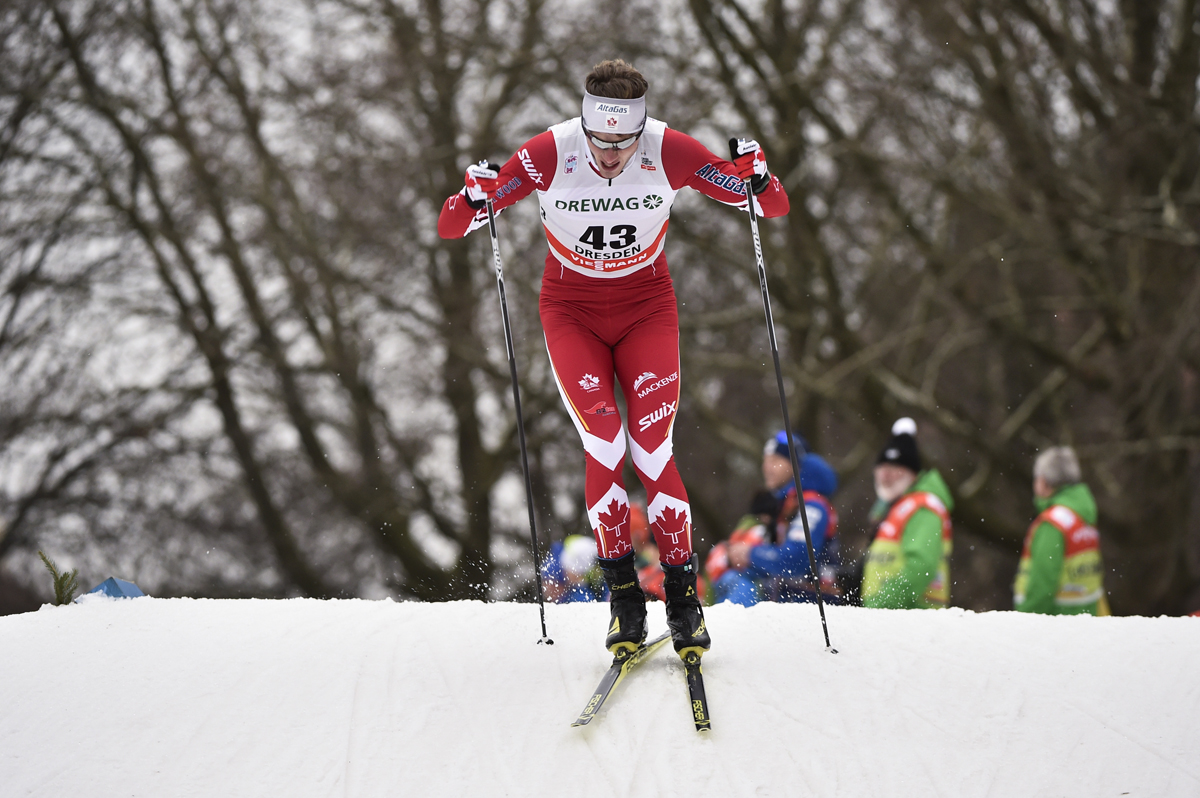
    Chanavat Stays out of Trouble in Dresden with the Skate Sprint Win

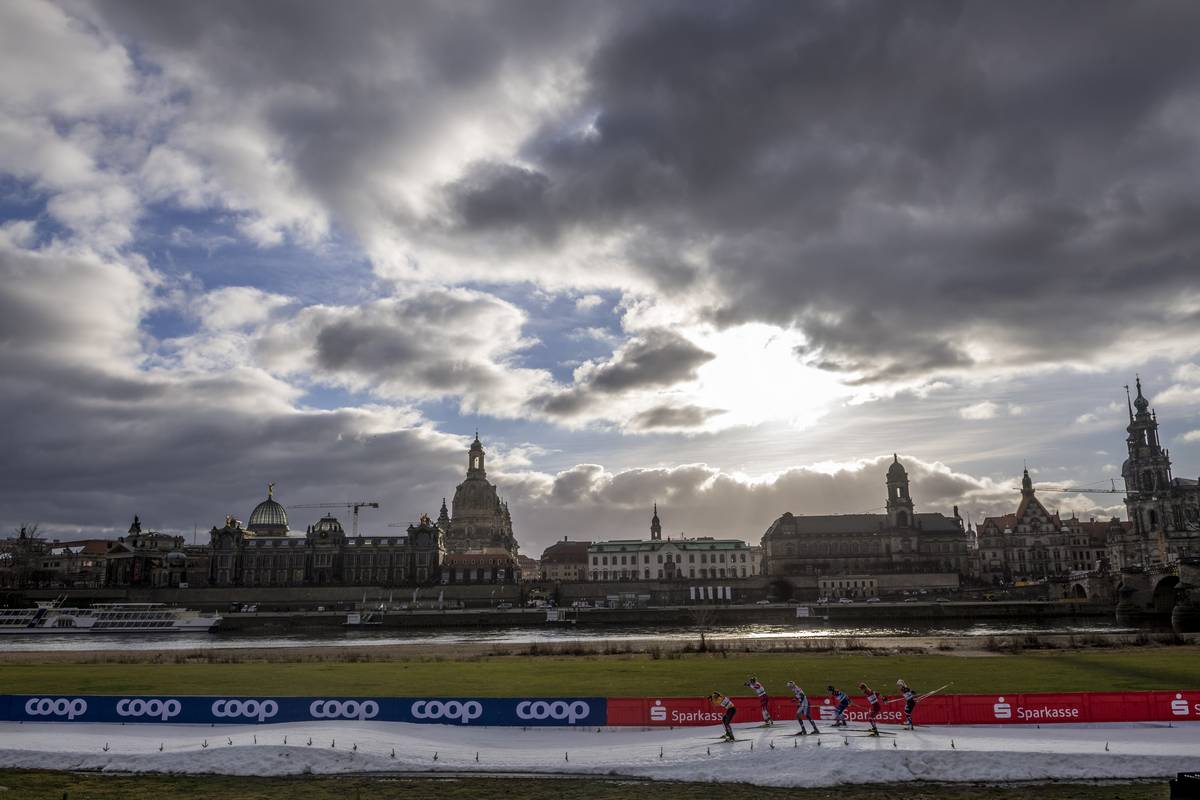
    Dresden cityscape. (Photo: NordicFocus)

    The metaphors are rife when describing the rough and tumble nature of the urban environment. Most often we think of pine forest, alps, and Hansel and Gretel valleys as the backdrop for the World Cup. To foster interest and in-fill a dense schedule of racing, city-sprints are nothing new when it comes to populating the World Cup calendar. Places like Dresden provide a contextual backdrop to a Europe steeped in history. The city is often a reminder of darker times, as it’s historic architecture was destroyed in World War II. 

    The city, since rebuilt to historical specs, is the place to be post Tour de Ski. 

    As a sprint specific weekend immediately following the Tour, the field is absent one notable name from Norway: Johannes Høsflot Klæbo. He placed third overall in the Tour and took the weekend to recover. 

    The World Cup show goes on. And perhaps one of the most stable and finest skate ski technicians out there took center stage. France’s Lucas Chanavat earned his third podium of the season and his second career World Cup victory with a win on Saturday in Dresden. Chanavat won the two-lap 1.3-kilometer qualifier in 2:14.72.

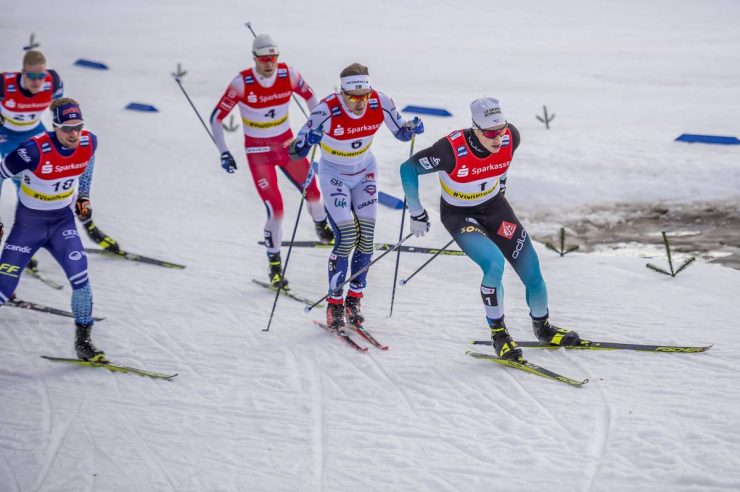
    Lucas Chanavat of France (bib 1), where he was all day, out front during the Dresden city sprints. (Photo: NordicFocus)

     In a tight qualifier in which the top-10 were separated by 1.75 seconds, three Americans qualified for the heats: Logan Hanneman in 21st (+3.65), nineteen-year-old junior skier JC Schoonmaker (in his debut World Cup) 24th (+3.80), and Kevin Bolger in 28th (+4.00). 

    Bolger finished 25th for the day after placing fifth in the second quarterfinal. Schoonmaker was 30th overall and in the points, as he slotted into sixth in that same quarterfinal heat. Hanneman ended up 29th overall, after skiing to sixth in the first quarterfinal. 

    For Canada, Bob Thompson placed 34th, Graham Ritchie 46th, Antoine Cyr 51st, and Pierre Grall-Johnson 66th.


    Post-race comments from Marine Dusser, Head Coach at University of Alaska Anchorage

    Stats aside, this was a tricky course for a basic two-lap oval sprint race. Crashes and slides were plentiful. Staying on your feet, an obvious must, was problematic for some. Most notable was a clash during the fourth quarter, where France’s Richard Jouve clipped the back of Italy’s Federico Pellegrino’s skis. It occurred on the lap corner where skiers seemed to be magnetically attracted to the tightest line up against the v-boards. 

    Not a bad tactic. But the high risk move didn’t always pay off. Pellegrino went down, as did Jouve, in a gnarly tumble. Pellegrino took a moment on course to disparage Jouve. Both skate sprint savants, Pellegrino placed an uncharacteristic 27th and Jouve 22nd.   

    The scene was a reminder that those who fired from the start, got out front, and remained there, set themselves up for success. With no true kicker hills on course, coupled with the high speed tracks, remaining in the front and out of trouble proved to be the recipe for success.  

    Chanavat played those tactics to perfection. He won his quarterfinal, semi-final (in a photo-finish with Norway’s Sindre Bjørnestad Skar), and the final by skiing boss-like out front in 2:14.81.

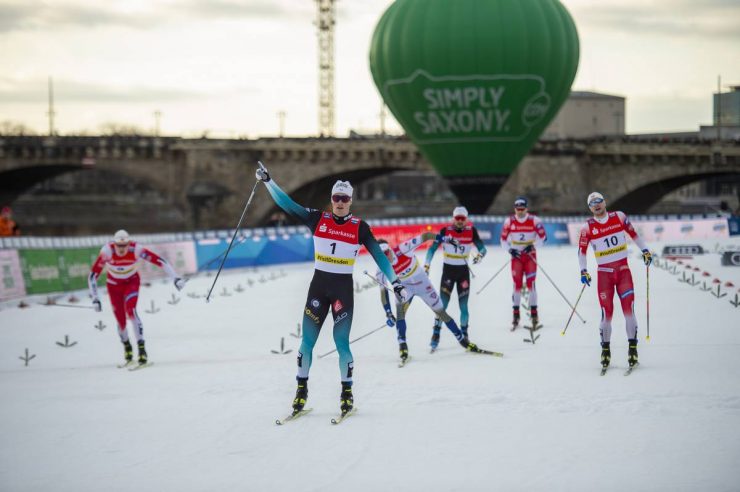
    Number one in the qualifier, number one in the final. Lucas Chanavat is the champion in Dresden. (Photo: NordicFocus)

    The only mishap in the final was for Håvard Solås Taugbøl of Norway, who snapped a pole early on the first lap. Skiing the remainder of the lap with a single pole, he ultimately placed sixth, only 1.86 seconds back. 

    “I felt good today, especially in the final stretch,” Chanavat told FIS after the race. “I saw the crazy falls because Richard Jouve is usually fighting there (in the 180° turn) during the final and he was unlucky today again but he will be back stronger soon. I was hoping for a World Cup victory this year but I was not expecting it to happen so fast.”

    Skar took second place (+0.61), Sweden’s Johan Haeggström third (0.96). Pål Trøan Aune of Norway placed fourth (+1.04), and Jay Renaud of France fifth. 

    Racing continues tomorrow with a team sprint.

    Qualification Results | Men’s Results

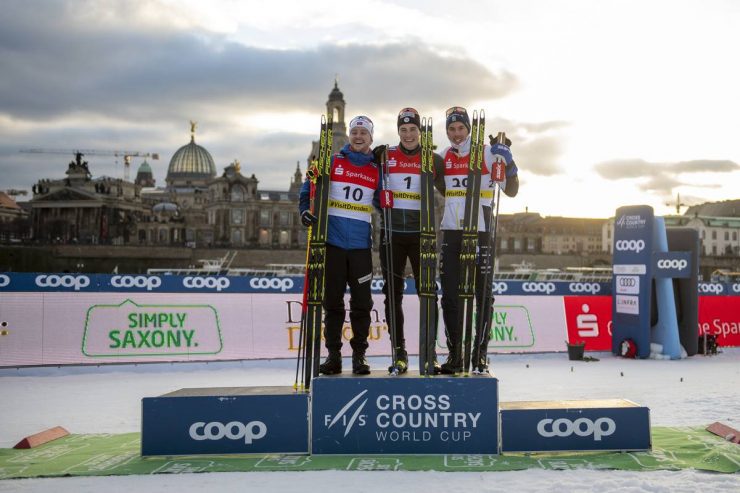
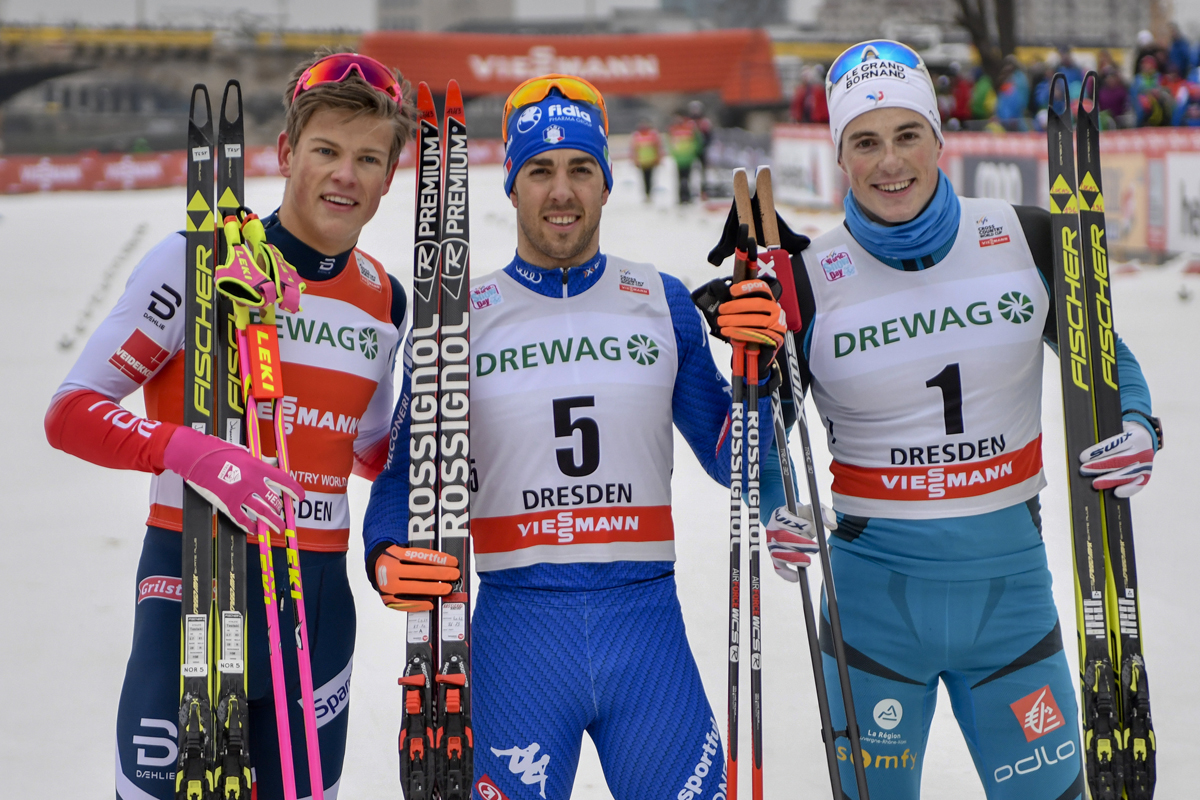
    The men’s podium on the streets of Dresden. Lucas Chanavat (FRA) takes the win ahead of Sindre Bjørnestad Skar (NOR) and Johan Haeggström (SWE). (Photo: NordicFocus)
  • Finding his Top Gear, Klæbo is Gone in Drammen

    Finding his Top Gear, Klæbo is Gone in Drammen

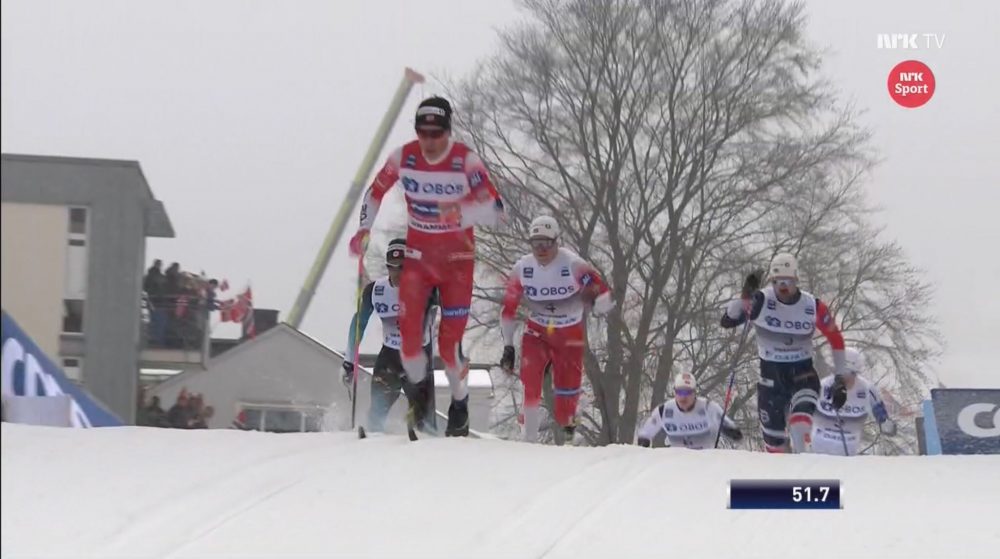
    A classic run-stride from Johannes Høsflot Klæbo during the finals of the 2019 Drammen city sprint. (Photo: NRK screenshot)

    For the rare athlete the field of play is truly a stage. A place to perform in the moment and seemingly acknowledge the moment as it happens. Johannes Høsflot Klæbo appears to have many of these days. And as he crossed the line in today’s 1.2-kilometer classic sprint in Drammen, Norway, Klæbo may as well have taken a bow. It was again a virtuoso sprint performance.

    In 2:37.90 minutes, Klæbo earned another win in Drammen — he took his first career win here last season.

    With thirty skiers making the rounds, and each adding their own dimension to the heats, Klæbo brings a presence that often gives the impression it is a solo show. On Tuesday he won the qualifier in 2:25.60 minutes. To put things in perspective, Russia’s Alexander Bolshunov, the second fastest qualifier, clocked a time of 2:29.14.

    A quick glance at the live timing brackets shows Klæbo making a clean sweep. Along with the qualifier, he won the first heat, the first semi, and indeed the final.

    It’s easy to get swept up in the Klæbo narrative. But out in the finals with the twenty-two-year-old were Norway’s Eirik Brandsdal, Sondre Turvoll Fossli,and Pål Trøan Aune, Richard Jouve of France, and Sweden’s Oskar Svensson.

    The other five skiers followed the lead of Klæbo’s dance in the finals. With an uptick in tempo fifty seconds into the race where Klæbo threw in his trademark run-stride, then a few cycles of double pole, and a quick transition into his run-stride he was off into the downhill with the others unable to catch his draft.

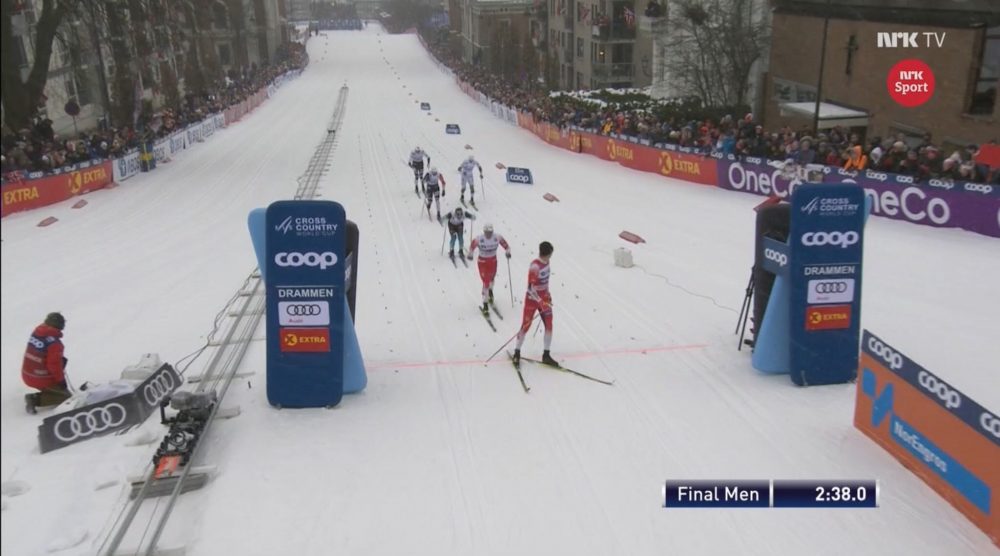
    Through the curvy turns, into more downhill, and into the step-around-corner, Klæbo had a breath easy gap on the field heading into the uphill straight. But Klæbo kept the charge on. Able to look back twice at an approaching Brandsdal, Klæbo cruised across the line. Pending any fall on the technical descent, the race for first looked over as soon as he clicked into that untouchable gear way back at the 50 second mark.

    Time to check the action behind, Johannes Høsflot Klæbo of Norway winning the 2019 Drammen city sprint. (Photo: NRK screenshot)

    Brandsdal placed second (+0.89), Jouve third (+2.17), Fossli fourth (+3.34), Svensson fifth (+3.63), and Aune sixth (+4.01).

    Klæbo leads the sprint globe overall competition by 145 points over Italy’s Federico Pellegrino. His lead in the overall World Cup is a mere 31 points over Bolshunov, who placed 13th in Drammen. With a sizable lead over third place skier Sjur Røthe, who tallies 802 points total in the overall standings (Bolshunov sits with 1250 points, Klæbo 1281), we should see a fight through the final weekend in Quebec to determine the World Cup winner.

    For the U.S., Simi Hamilton was the only skier to break into the heats. He qualified in 30th, but bumped to 25th overall after placing fifth in the first quarterfinal heat won by Klæbo.

    Three other Americans were entered. Logan Hanneman (APU) finished in 48th, Ben Saxton (SMS T2) 50th, and Kevin Bolger (USST) 51st. With a new crew of sprinters in Drammen, with the exception of Hamilton, U.S. Ski Team Head Coach had a plan in mind for future Drammen appearances.

    “With the exception of Simi, the men’s group needs to gain more experience on this course,” Grover noted in an email. “This was the first Drammen World Cup Sprint for Ben and the second for Logan and Kevin.  All our men need more work on their double-pole to be competitive here double-poling against the best and strongest.”

    No Canadians were entered in Tuesday’s race. Racing continues on the World Cup this weekend with a skate sprint on Saturday and an interval start skate 10k/15k on Sunday.

    Results

  • Big Results for Geraghty-Moats, Harvey at Summer GP, Toppidrettsveka

    Big Results for Geraghty-Moats, Harvey at Summer GP, Toppidrettsveka

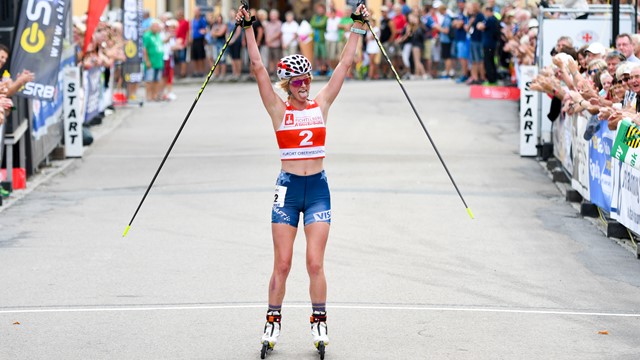
    Tara Geraghty-Moats winning Sunday’s normal hill/5 k Gundersen at the 2018 Women’s Nordic Combined Summer Grand Prix in Oberwiesenthal, Germany. (Photo: Romina Eggert/FIS)

    Two North Americans posted impressive results at nordic events in Germany and Norway over the last week, with Vermont native Tara Geraghty-Moats racing to first overall in the first-ever Women’s Nordic Combined Summer Grand Prix and Quebec’s Alex Harvey placing second, fifth and 10th in three races at the Toppidrettsveka rollerski series.

    Geraghty-Moats 1st and 2nd at Inaugural Women’s NoCo Grand Prix

    Brand new to nordic combined as well as the jump hill in Oberwiesenthal, Germany, Geraghty-Moats took the inaugural women’s Nordic Combined Summer Grand Prix by storm this past weekend, placing first and second in two competitions. That tied her for first place in the overall Grand Prix standings, alongside Russia’s Stefaniya Nadymova — the defending champion of last winter’s inaugural women’s Nordic Combined Continental Cup.

    On Sunday, Geraghty-Moats, 25, of USA Nordic and the New York Ski Education Foundation (NYSEF), handily beat Nadymova and the rest of the 10-woman field after starting the 5-kilometer Gundersen rollerski race in second, four seconds behind Germany’s Jenny Nowak. While Nowak had posted the best jump of 96 meters on Oberwiesenthal’s 106-meter “normal” hill, Geraghty-Moats tied for the second-best-scoring jump (94.5 meters), with Austria’s Lisa Hirner (95 meters). From there, Geraghty-Moats dropped Hirner, Nadymova and Nowak on the first of three laps in the rollerski race and went on to finish in 11:04.8. Nowak ultimately placed third, 1:29.2 behind Geraghty-Moats.

    ortho tri-cyclen, buy clomid online

    “I was really satisfied by how my first weekend of being a nordic combined-er went, and I think the patience of waiting to be a nordic combined-er really paid off,” Geraghty-Moats told the International Ski Federation (FIS) after. “I struggled with the jump a little bit the first couple days. I had never jumped this hill before, and I sort of figured it out today so I got to ski a little bit easier than yesterday, but I was also happy that yesterday I was able to have a good fight and ski fast to my potential and end up on the podium.”

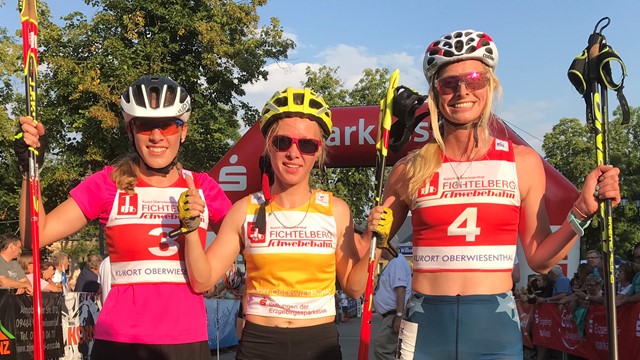
    The women’s individual normal hill/5 k Gundersen podium on Saturday at the 2018 Women’s Nordic Combined Summer Grand Prix, with Russia’s Russia’s Stefaniya Nadymova (c) in first, American Tara Geraghty-Moats (r) in second, and Germany’s Jenny Nowak (l) in third in Oberwiesenthal, Germany. (Photo: FIS/Silke Tegethof)

    On Saturday, the American (who started as a ski jumper, then raced cross-country before taking up biathlon, and finally returned to jumping) placed second to Nadymova, who won the individual 5 k Gundersen in 12:21.4. Geraghty-Moats finished just 3 seconds back after starting the race in fourth, 1:13 minutes behind Nadymova in first. Nowak placed third in that race as well, 50.3 seconds back.

    “It was a dream come true to finally be able to compete in women’s Nordic Combined on an international level,” Geraghty-Moats told FIS on Saturday. “I’m using this weekend to learn the level I have to be at to have success in Nordic Combined. I made some mistakes today and learned a lot but I came away with a good result and having had a huge amount of fun competing with small but strong field.”

    Eleven women competed in Saturday’s normal hill/5 k.

    Results:

    Day 1 (ski jumping | final

    Day 2 (ski jumping | final)

    Overall Grand Prix

    Harvey on Toppidrettsveka Podium

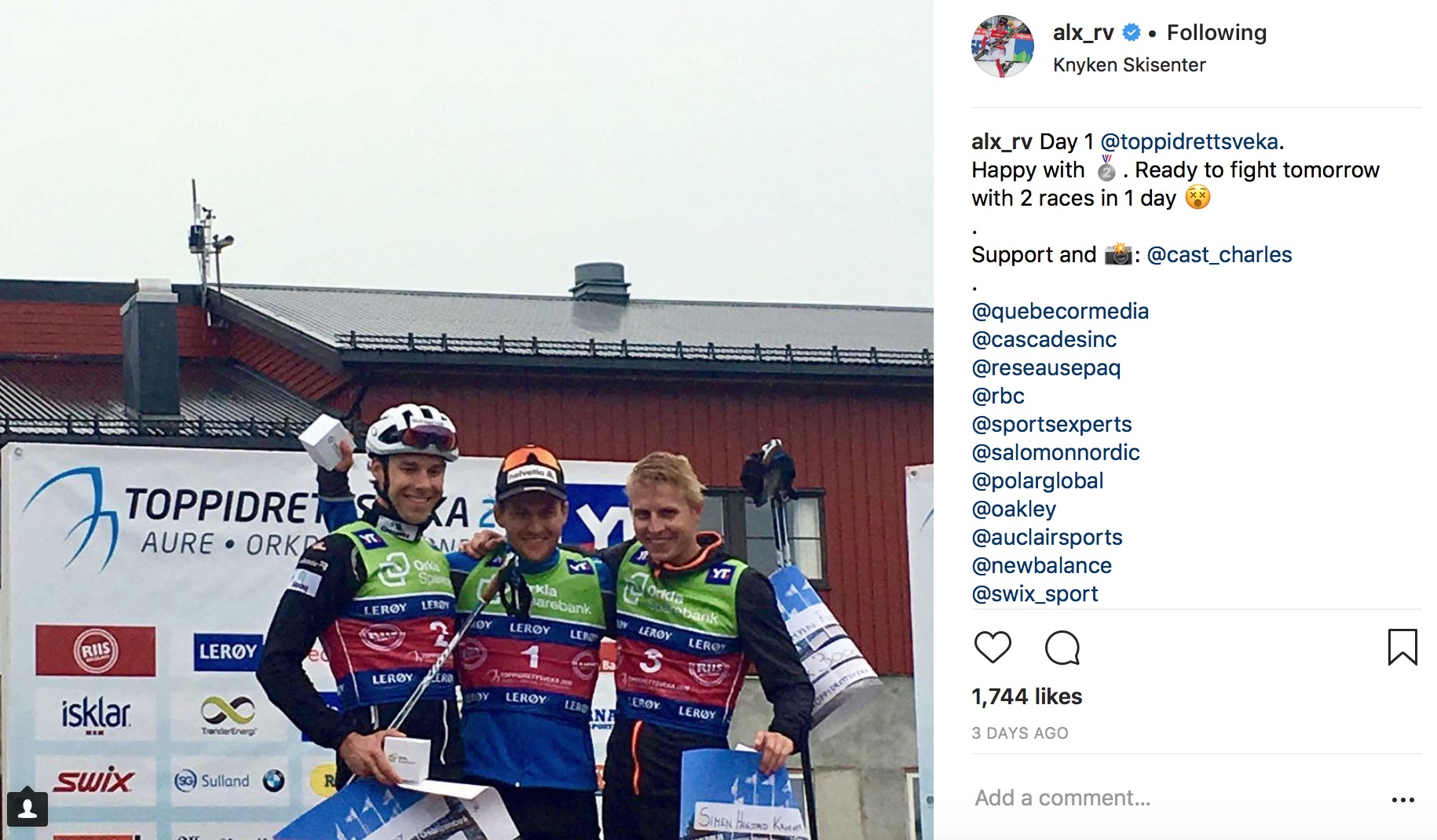
    Alex Harvey (l) on the podium with Roman Furger (c) and Simen Hegstad Krüger (r) at the 2018 Toppidrettsveka rollerski festival in Norway last Thursday, Aug. 16. (Photo: Alex Harvey/Instagram)

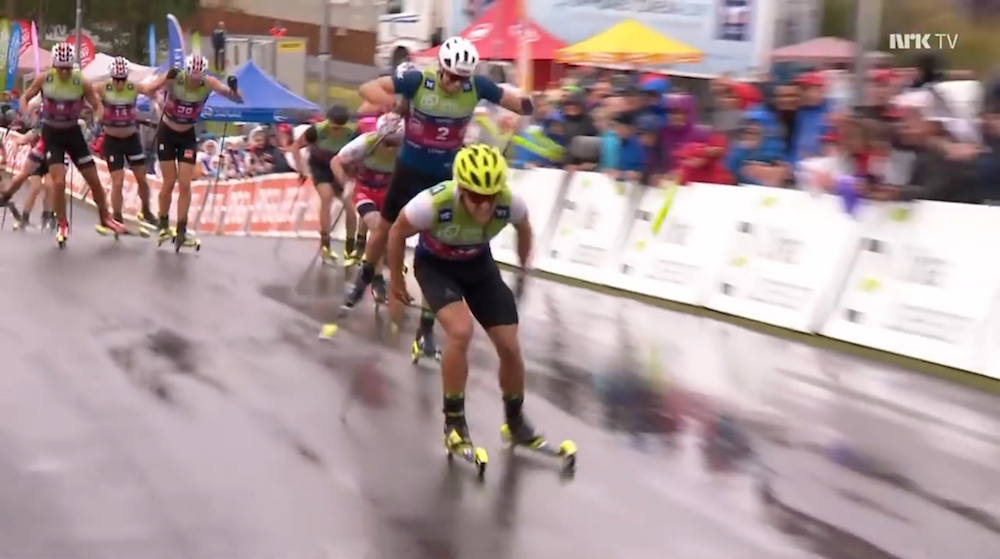
    At the Toppidrettsveka rollerski festival in Norway, Canada’s Alex Harvey raced to second in the 15 k skiathlon last Thursday in Orkdal, missing out on first by just 0.6 seconds to Switzerland’s Roman Furger, who won in 30:43.3. Norway’s Simen Hegstad Krüger, the reigning Olympic skiathlon champion, finished third, 1.5 seconds back. In a stacked international field of 125 men, Canada’s Evan Palmer-Charrette placed 75th in that race (+2:14.4), Bob Thompson was 84th (+2:32.7), and Scott Hill 89th (+2:52.5).

    Canada’s Alex Harvey (2) gunning for first in the men’s 15 k skiathlon on Aug. 16 at the Toppidrettsveka rollerski festival in Orkdal, Norway. (Screenshot: NRK broadcast)

    Heidi Weng beat her cousin Tiril Udnes Weng by 0.7 seconds in the women’s 10 k skiathlon that day, finishing in 22:52.1. Norway swept the top five of the women’s race, with Anne Kjersti Kalvå reaching the podium in third (+1.3), and national-team members Kathrine Harsem and Astrid Uhrenholdt Jacobsen placing fourth (+1.4) and fifth (+1.5), respectively, out of 43 women.

    In the men’s 24 k classic mass start around Aure/Brekka on Friday, Harvey finished fifth, 19 seconds after Krüger, who won in 59:57.5. Norway’s Hans Christer Holund placed second in that race (+2.6), Norway’s Magnus Stensås was third (+13.0), and Switzerland’s Dario Cologna fourth (+17.1). Also for Canada, Palmer-Charrette finished 61sth (+2:30.9), Hill 78th (+4:02.3), Thompson 86th (+5:40.3), and Maks Zechel 88th (+7:01.4) out of 125.

    Heidi Weng repeated in first in the women’s 24 k mass start, finishing in 1:10:02.4 hours, while Tiril Udnes Weng again placed second, 25.4 seconds back, and Jacobsen reached the podium in third (+27.7).

    Later on Friday in Aure, Norway’s Sondre Turvoll Fossli topped the men’s freestyle sprint final ahead of four other Norwegians, including Pål Trøan Aune in second and Jan Thomas Jenssen in third, and Switzerland’s Furger in fifth, while Harvey did not qualify for the heats and ended up 37th overall. Palmer-Charrette was once again 61st in qualification, Hill 107th and Thompson 109th out of 121.

    In the women’s sprint, Norway’s Mathilde Myhrvold won the final in 2:56.54, 1.05 seconds ahead of Slovenia’s Katja Visnar in second. Heidi Weng placed third in the final (+1.97), ahead of Tiril Weng (+2.64) in fourth, another Norwegian Anna Svendsen in fifth (+2.76), and another Slovenian Alenka Cebasek in sixth (+3.73). 

    In the final race of the series, the classic pursuit on Saturday, Harvey started second, 10 seconds behind Furger in first. The Canadian went on to place 10th, 4.2 seconds out of first, in the 15 k race, while Stensås took the win in 37:45.5 after starting seventh. (Furger slipped to 55th and 1:55.5 behind at the finish.) Norway’s Mikael Gunnulfsen rose from eighth to second (+0.7) and France’s Jean-Marc Gaillard made it all the way up to third (+1.7) after starting 15th. 

    Palmer-Charrette finished the pursuit in 59th (+2:04.2), Thompson placed 80th (+2:55.2), Hill 87th (+3:41.5), and Zechel 93rd (+3:48.9) out of 105. 

    Jacobsen ended the weekend as the women’s 12 k mass start winner, after the entire women’s field (of 33) started at the same time. She crossed the line first in 34:20.8, 0.4 seconds ahead of Heidi Weng in second and 1.2 seconds ahead of Kalvaa in third. 

    Results:

    Men’s skiathlon | Women’s skiathlon

    Men’s mass startWomen’s mass start

    Men’s sprintWomen’s sprint

    Men’s pursuitWomen’s mass start

  • The Grandkids Will Love This: Pellegrino Beats Klæbo in Dresden; Hamilton 10th, Locke 15th

    The Grandkids Will Love This: Pellegrino Beats Klæbo in Dresden; Hamilton 10th, Locke 15th

    Italy’s Federico Pellegrino (5) getting a ski tip ahead of Norway’s Johannes Høsflot Klæbo (l) for the men’s freestyle sprint final win on Saturday at the World Cup in Dresden, Germany. France’s Lucas Chanavat (1) placed third for the second-straight World Cup sprint, another Frenchman Richard Jouve (second from r) placed fourth, Sweden’s Emil Jönsson (second from l) was fifth, and Norway’s Even Northug (behind) took sixth after breaking a pole out of the start. (Photo: Fischer/Nordic Focus)

    How do you beat Norway’s Johannes Høsflot Klæbo at his competition-crushing game? Take him by surprise with minimal time to recover. Italy’s Federico Pellegrino did just that on the last uphill rise of the 1.2-kilometer sprint course on Saturday in Dresden, Germany.

    Dresden, a historic city in eastern Germany, debuted its brand-new course along the Elbe River on manmade snow amid damp conditions and temperatures above freezing throughout the day. Pellegrino had done what he needed to advance through the rounds, clocking the first-fastest time in the qualifier, 2.9 seconds behind France’s Lucas Chanavat in first, then placing second in his quarterfinal and third in the first semifinal. Klæbo won that semi by 0.16 seconds over Chanavat in second and 0.3 seconds ahead of Pellegrino in third. With a fast-enough time, Pellegrino moved on to the final, where he met the 21-year-old Klæbo again.

    “I knew that at the beginning of the race, I’m becoming a little bit old so the younger Klæbo and Chanavat were faster than me,” Pellegrino, 27, said of the final in a post-race interview with the International Ski Federation (FIS). “So I just had to wait, but I wanted to attack in the longer race to the finish line.”

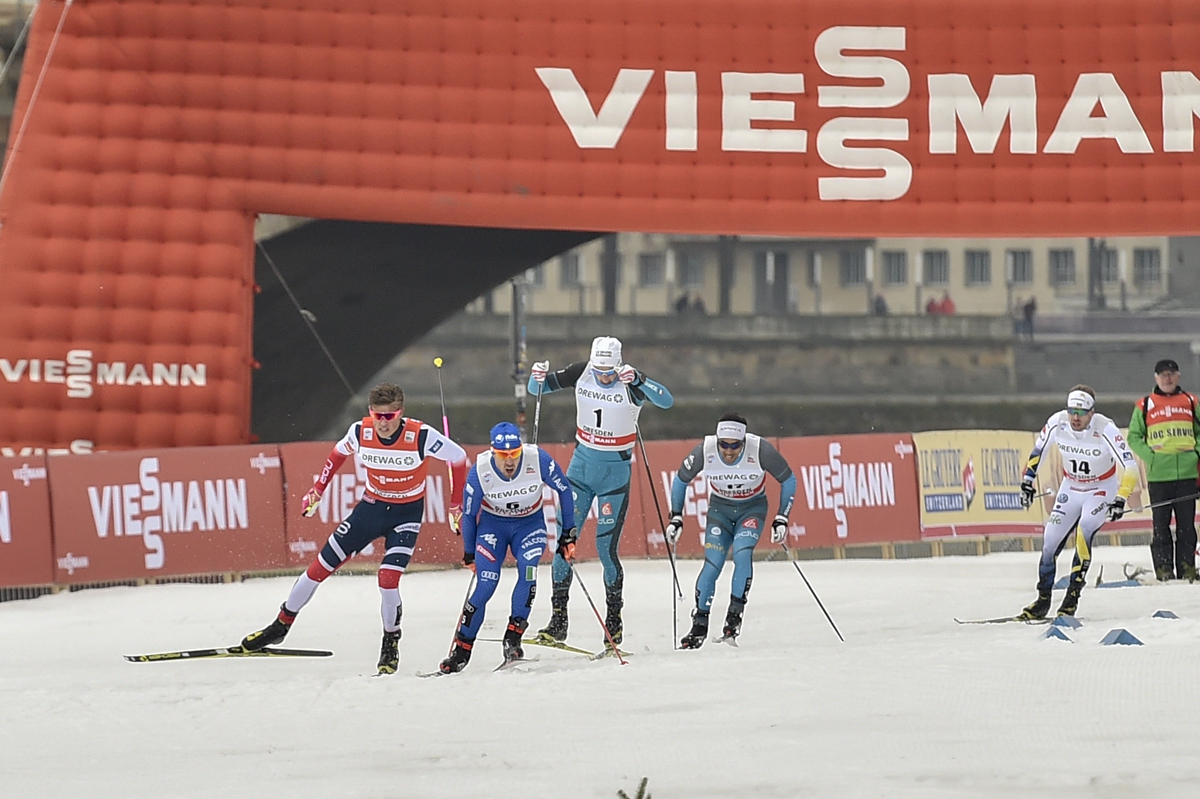
    The race from his point of attack might have seemed like an eternity, but in actuality, it was about 500 meters before the finish. Klæbo and Chanavat had burst out of the start at lightning speed, skiing “shoulder to shoulder,” as Chanavat later said in a press conference, and slightly gapping the four skiers behind them — one of which was Pellegrino.

    While Klæbo pushed the pace up front, Pellegrino kept the two leaders close, skiing just a couple strides back. France’s second man in the final, Richard Jouve slotted into fourth behind him and Sweden’s Emil Jönsson — in his first final in a year — followed in fifth. Behind them, Norway’s Even Northug (Petter Northug’s 22-year-old brother) worked to fasten a new pole after breaking his on the starting gate. That took him out of the race from the gun.

    Chanavat attempted to get ahead of Klæbo on a tight righthand corner, but Klæbo held the inside line and his position. Coming out of that corner, Pellegrino latched on to Chanavat and brought the rest of the group with him. Shadowing the two leaders’ every move, Pellegrino accelerated just before the final rise, taking just three V2 pushes to get to the top.

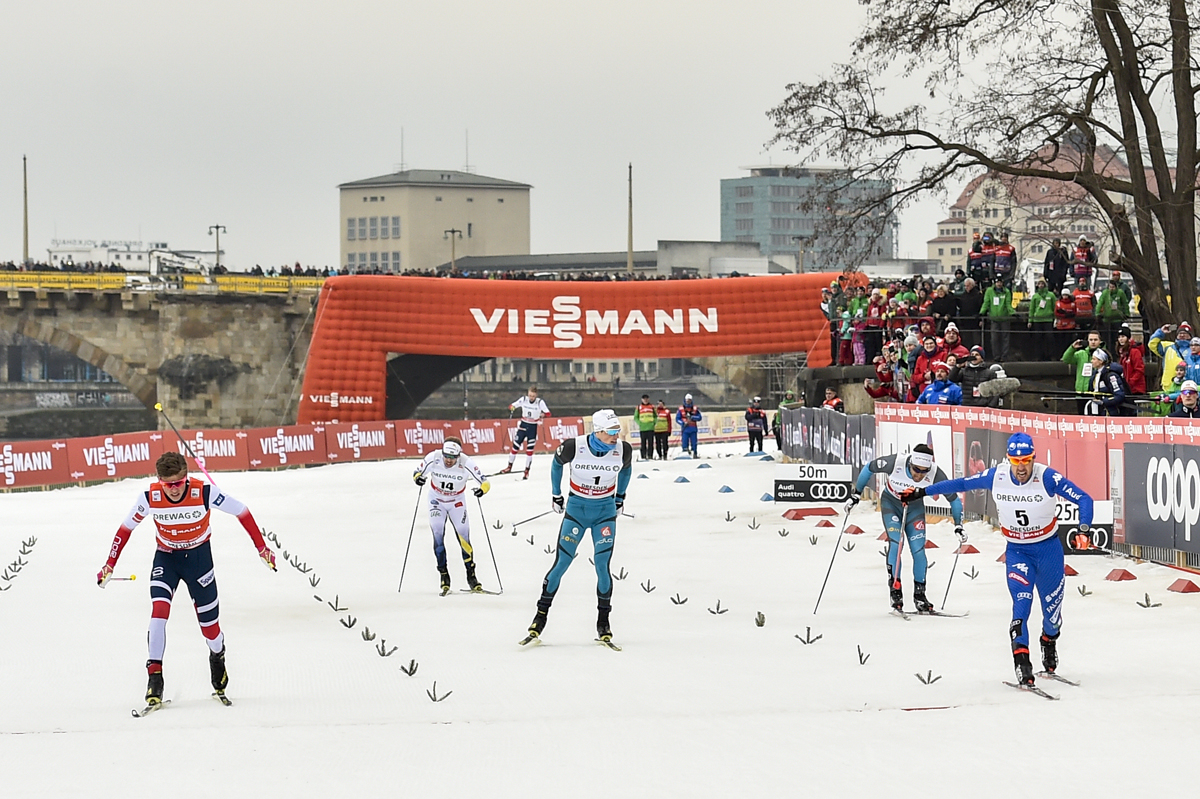
    Norway’s Johannes Høsflot Klæbo (l) and Italy’s Federico Pellegrino (second from l) jockey for position just before the finish of the men’s freestyle sprint final at the World Cup in Dresden, Germany, while France’s Lucas Chanavat (1) and Richard Jouve chase, followed by Sweden’s Emil Jönsson (14). (Photo: Fischer/NordicFocus)

    Even with Klæbo, the Italian took another push to move ahead and left Klæbo chasing. With about 75 meters to go, they began their all-out showdown to the finish, side by side, with Pellegrino staying just ahead to cross the line first in 1:52.77 minutes. Klæbo was just 0.18 seconds back in second and Chanavat 0.98 seconds behind in third.

    “When I will have grandchildren this will be the story I am going to tell them, that I beat Johannes,” Pellegrino said, according to a FIS press release.

    It was his first World Cup victory in nearly a year since winning a freestyle sprint in Falun, Sweden, late last January, and his 10th career individual World Cup win.

    “Klæbo is a really good guy because if he wanted to he could stop me,” Pellegrino told FIS. “… He tried to stay stay quiet to let me go … he’s really good to continue to win.”

    In the four sprints Klæbo’s contested this season, Saturday marked his first loss (he did not compete in the Tour de Ski, opting for a training block instead and racing at Norwegian nationals in Vang, Norway, where he won the classic sprint).

    “It was a tough one,” Klæbo said of Saturday’s final. “Me and Chanavat was trying to go pretty hard from the start of the final, and I think both of us went a little bit too hard. … I’m satisfied with second place here but I have to do something else to beat him next time.”

    Two seasons ago, Pellegrino was the overall Sprint World Cup champion. Last season, it was Klæbo as both the U23 and Sprint World Cup Champion.

    The men’s freestyle sprint podium on Saturday at the World Cup in Dresden, Germany, with Italy’s Federico Pellegrino (c) in first, Norway’s Johannes Høsflot Klæbo (l) in second, and France’s Lucas Chanavat (r) in third. (Photo: Fischer/NordicFocus)

    “I always try to do my best; if the best means the victory it’s great,” Pellegrino said, according to FIS. “It was a really good show. I prefer courses with more hills. Yesterday I changed the way I was thinking about the race.”

    “He was clever,” Klæbo said in an interview with NRK. “He skied like this in the semi and quarterfinal. Our strategies differed slightly.”

    While Pellegrino kept himself in contention in the heats by skiing from behind, Klæbo did as he usually does, by leading with a pace few, if anyone else, could match. Klæbo qualified second, 0.15 seconds off Chanavat’s top qualifying time of 1:50.42, then won his quarterfinal by a clear-cut margin of 0.6 seconds over Switzerland’s Roman Schaad. Chanavat won his quarterfinal by 0.12 seconds over Pellegrino, then hung with Klæbo once again in the semifinal.

    At the last World Cup sprint in Lenzerheide, Switzerland, the first stage of the Tour de Ski, Chanavat placed third in the skate sprint.

    “I did my best and I competed to try to get the victory today, but I was a lot focused on Johannes,” Chanavat, 23, said at the press conference. “So I was surprised when Pellegrino came pretty strong on the side in the race.”

    He added that the gap between him and Klæbo is getting closer. “So I’ll try to keep it shorter,” Chanavat said.

    Jouve finished 0.25 seconds off the podium in fourth, 0.98 seconds behind Pellegrino, Jönsson finished fifth (+2.36), and Northug sixth (+12.04).

    Hamilton 10th, Locke 15th

    American Simi Hamilton made it to the semifinals and finished the day in 10th overall after placing fifth in the second semi, 0.38 seconds behind Jönsson in first. That heat ended in a three-way photo finish for first, which Jönsson took ahead of Northug (+0.01) and Jouve (+0.04). Those three men advanced to the final, but Hamilton and Norway’s fourth-place finisher in that semifinal, Pål Trøan Aune (+0.23) did not.

    American Simi Hamilton (front) leads Germany’s Sebastian Eisenlauer during their quarterfinal of the men’s 1.2 k freestyle sprint at the World Cup in Dresden, Germany. (Photo: Fischer/NordicFocus)

    Before that, Hamilton had qualified in 15th and finished second to Norway’s Fredrik Riseth in his quarterfinal.

    “It was a really cool venue, great course,” Hamilton told FasterSkier in person after the race. “But it was really tight the whole way around so it was hard. My starts aren’t that good right now and so my quarter, I was basically trying to start as fast as I could and I still was second or third out of the blocks, so I wasn’t feeling super confident after that.”

    Going into the semifinals, he decided not to worry about his start and concentrate on moving up later in the course.

    “What ended up happening around that corner, I just couldn’t get around anyone,” Hamilton recalled. “Every time you get an opportunity to make a move, it gets shut down almost immediately, so that was really frustrating, but I was happy with how my body is feeling right now, and it’s fun to get into the heats.

    “I am always way more comfortable skiing towards the back of the pack and then making a definite move somewhere on the course, so unfortunately for me like this course doesn’t favor doing that too well,” he continued. “You can’t afford to ski at the back and then pass four five people, not enough room or time.”

    He added that he enjoyed how different the Dresden course was in comparison to other, much hillier World Cup terrain.

    “I think the only super-short flat course we race like this was in Milan [Italy] years ago, so its fun just doing something different,” he said. “The crowd is awesome here.”

    U.S. Ski Team Head Coach Chris Grover observed that Hamilton was at a disadvantage trying to move up from behind on Dresden’s course.

    “He made it work in the quarterfinal,” Grover told FasterSkier. “He’s so good when he gets that opening to go. I think we saw in the semifinal that he would be starting to go and then get blocked. And again after the corner, started to go, and got blocked. And under the bridge, started to go, and then got blocked. It’s nobody’s fault, nobody obstructed him or anything like that, it’s just not a course with many passing options. The guys are so well-matched, in a semifinal or final it becomes that much harder. So he’s a little bit frustrated, but I think he’s in good shape.”

    Andy Newell (U.S. Ski Team) racing to 18th in the men’s freestyle sprint qualifier at the World Cup in Dresden, Germany. He went on to finish sixth in his quarterfinal for 27th overall. (Photo: Fischer/NordicFocus)

    Two Americans qualified for the heats in the top 30, with Andy Newell finishing 18th in that preliminary round, but Grover noted the U.S. team’s qualifiers overall were “uncharacteristically poor”.

    “To have Erik Bjornsen just miss the qualification, to have Kikkan [Randall] just miss the qualification, to have the four athletes who did go in not have the best qualifications, something was a little bit missing,” he said.

    (Bjornsen placed 32nd and Randall 34th in their respective men’s and women’s qualifiers. Bjornsen was 0.23 seconds out of 30th.)

    Newell’s run ended in the quarterfinal, after he initially took the lead, ahead of Canada’s Julien Locke, but slipped to sixth on the second half of the course.

    “Andy didn’t have the best start, but he got himself to first and he was able to take the best line,” Grover reflected.

    He wasn’t sure why Newell then dropped to the back of the group, and Newell wrote in an email that he wasn’t sure what happened, either.

    “Felt like I was able to accelerate to the front well but then managed to get swarmed before the last little bump and then it was extremely tough to pass before the finish,” Newell wrote. “I should know better than to let myself get stuck in the middle… on narrow tracks like this if you get stuck in the middle with guys on either side you can’t get a full push and thats how you get swarmed, bad tactics on my part.”

    “Tomorrow should be fun, fast, and wild,” he added of Sunday’s freestyle team sprint. “Hopefully I’ll be able to be more aggressive tomorrow 🙂 Looking forward to it.”

    Julien Locke (Canadian U25 Team/Black Jack) racing to 16th in the men’s freestyle sprint qualifier at the World Cup in Dresden, Germany. He went on to place third in his quarterfinal for 15th overall, his best World Cup result. (Photo: Cross Country Canada/NordicFocus)

    He finished his quarterfinal in sixth, 1.54 seconds behind Northug in first, for 27th overall. Meanwhile Locke hung with Northug and Jouve up front and finished third, 0.62 seconds out of first and just 0.18 seconds out of second.

    While second place in that heat would have put him in the semifinals, 15th overall was still a career best for Locke, of the Canadian U25 Team and Black Jack Ski Club. Last March at World Cup Finals in Quebec, he placed 20th in the freestyle sprint. And just over a week ago at the NorAm Olympic trials in Mont Sainte-Anne (MSA), Quebec, Locke, 24, won the classic sprint final, but missed out on a potential Olympic spot by one place after qualifying second (the tiebreaker) behind Russell Kennedy (Team R.A.D.).

    The individual top 30 was the second of Locke’s career. Fresh off of competing in Canada, he arrived in Dresden a day and a half ago.

    “… A little bit of a tight schedule, but body feels great, and super-fun course out there with all these spectators,” Locke told FasterSkier after. “And yeah, short, very short. It was close to 1.1 [kilometers] and definitely the shortest sprint race I have ever done.”

    “I was prepared to hit it hard here and I was hoping for sure to get into the heats and then get into the rounds,” he added. “I don’t like getting knocked out, but I am content with how today went.”

    Bob Thompson (NTDC Thunder Bay) racing to 50th in the men’s freestyle sprint qualifier at the World Cup in Dresden, Germany. (Photo: Fischer/NordicFocus)

    Three other Canadian men met the Cross Country Canada (CCC) selection criteria for Dresden, where Bob Thompson (NTDC Thunder Bay) finished 50th in the qualifier (+8.67), Dominique Moncion-Groulx (Alberta World Cup Academy) 59th (+9.99) and Antoine Briand (Pierre-Harvey National Training Centre) 60th (+10.12).

    (Note: CCC High Performance Director Thomas Holland explained in an email that Briand was added as the fourth man, based on the U23 selection list, after Kennedy had to relinquish his starts in Dresden due to illness.)

    For the U.S., Period 2 SuperTour leader Ben Lustgarten (Craftsbury Green Racing Project) finished 49th (+8.64) out of 67 men.

    “I thought I skied well — usually this stuff is my weakness,” Lustgarten said after. “It’s like icy and slushy so usually when it’s like that skate skiing, I get off balance, but I was like trying really hard to stay focused and ski big. I only got bogged down a little bit on the big hill, but … I was only nine seconds out of first, so I think that is really good. I am really happy with that.”

    The U.S. and Canada each have two teams entered for Sunday’s freestyle team sprint on the same course in Dresden, with Bjornsen and Hamilton (United States I), Newell and Lustgarten (U.S. II), Thompson and Locke (Canada I), and Briand and Moncoin-Groulx (Canada II).

    “It’s going to be wild out there,” Lustgarten said. “[The Dresden organizers] pulled it off; they had to shorten the course a little bit because they didn’t have enough snow … but it was good. It’s the shortest sprint I have ever done in my life by far.”

    Results: Men’s qualifier | Men’s heats

  • Klæbo Wins Lillehammer Classic Sprint for Win No. 4 of the Season

    Klæbo Wins Lillehammer Classic Sprint for Win No. 4 of the Season

    Norway’s Johannes Høsflot Klæbo welcomes another World Cup win as he nears the finish line during the men’s 1.5 k classic sprint final on Saturday in Lillehammer, Norway. (Photo: Henrik Hunne)

    Smack dab in the heart of the nordic sport world in Lillehammer, Norway, the World Cup began its second weekend of the 2017/2018 season with a kick-and-glide bang on Saturday. The men contested a 1.5-kilometer classic sprint on a course featuring a flat run into and out of a three successive climb-descent combo.

    At 21 years old, Norway’s Johannes Høsflot Klæbo remains peerless.

    Is it the lungs? His up-tempo, high-output running style? For all the winning since his World Cup debut in 2016, Klæbo must be prematurely aging his rivals.  

    As last season’s overall Sprint World Cup winner and last weekend’s Ruka Triple dominator, 2017/2018 is starting off as a continuation of the nascent Klæbo era.

    Klæbo has four wins in four races this season as he out-toed Russia’s Sergey Ustiugov by 0.83 seconds to win Saturday’s sprint. Another Russian, Alexander Bolshunov, was third (+1:29). Calle Halfvarsson from Sweden placed fourth (+1.64), and off the back were Norwegians Emil Iversen in fifth (+8.20) and Sondre Turvoll Fossli in sixth (+17.30).

    Ustiugov’s exploits are well documented — he skied to five medals at 2017 World Championships, three silvers, and two golds. But like Klæbo, Bolshunov appears to be an authentic, albeit young challenger for future podiums and overalls on the World Cup. He’ll turn 21 on Dec. 31. Bolshunov won the 30 k skiathlon and 15 k freestyle and placed second in the classic sprint at last season’s U23 World Championships. After the Lillehammer sprint, Bolshunov is positioned second in the overall World Cup standings with 252 points — 22 points ahead of Norway’s Martin Johnsrud Sundby in third. (Sundby did not race in Saturday’s sprint.)

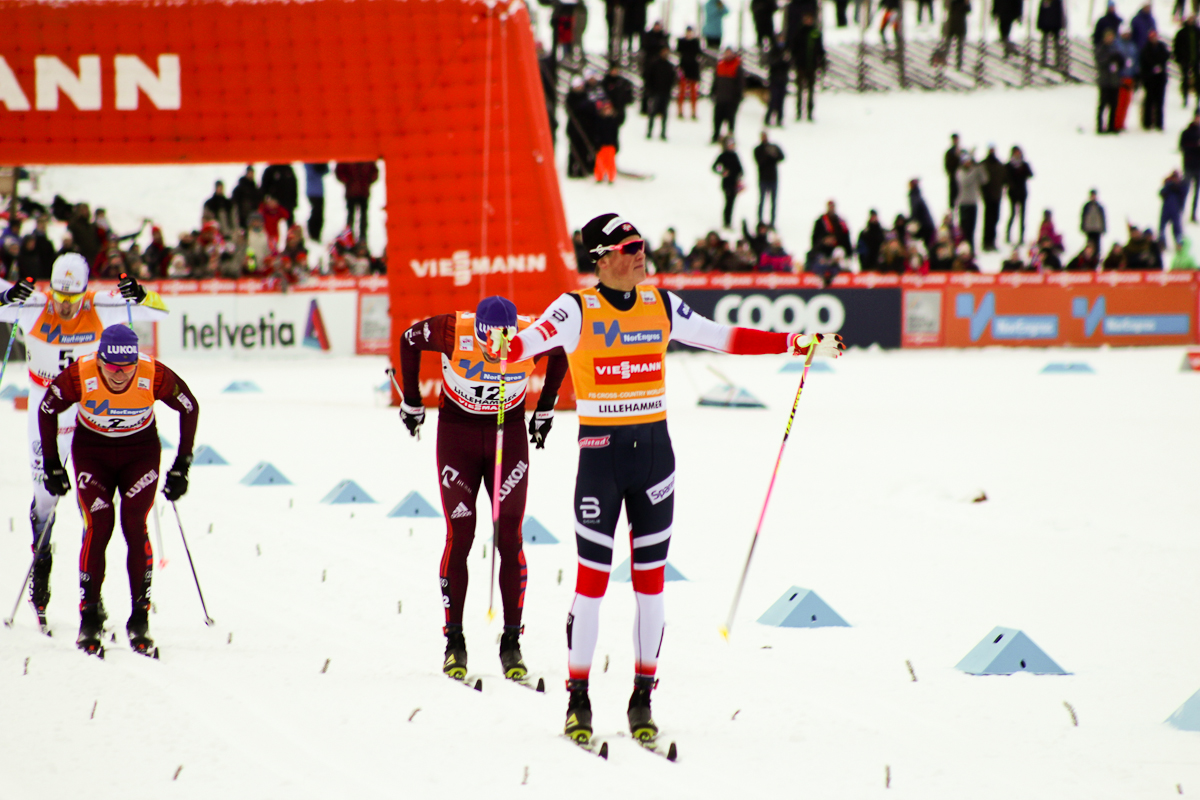
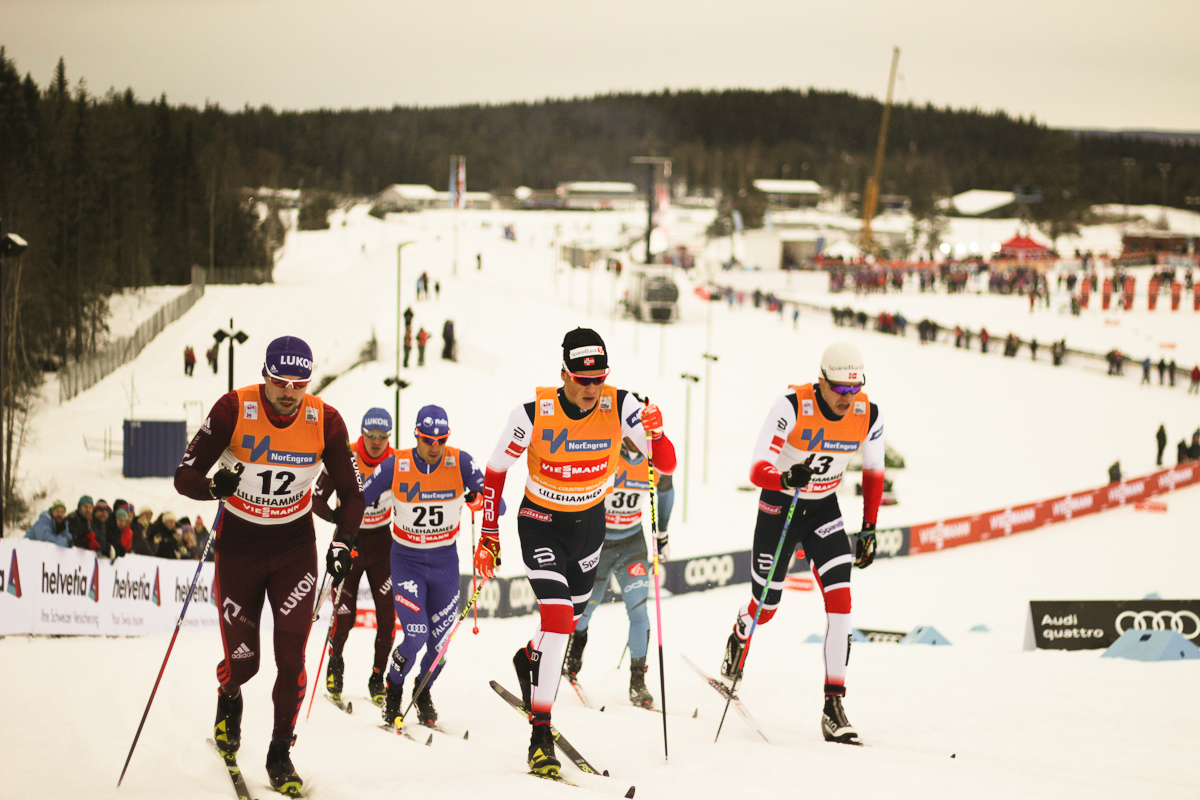
    Norway’s Johannes Høsflot Klæbo (center, in leader’s bib) leads his quarterfinal as Russia’s Sergey Ustiugov (12) keeps pace during Saturday’s classic sprint in Lillehammer, Norway. (Photo: Henrik Hunnes)

    But the narrative has been all Klæbo.

    With 400 points, Klæbo’s foundation for building an early season hold on the World Cup overall is strong.

    From the start on Saturday in Lillehammer, it was another stellar performance from the Norwegian in the qualifier: Klæbo won in 3:28.99 minutes with 4.31 seconds on Bolshunov, the next closest competitor.

    Klæbo’s winning margin was slimmer in the quarterfinals, but it only amounted to a tease. He bested Ustiugov in the first quarterfinal by 0.17 seconds. In semifinal 1, there was a flip-flop: Ustiugov won, besting Klæbo in second place by 0.25 seconds.

    Saturday’s conditions in Lillehammer featured fresh snow, which placed a premium on remaining in the skied-in tracks, maximizing glide without stepping into the slower snow. The final hill and descent into the finishing straight played a key part in Saturday’s winning tactics. Klæbo was mindful of the endurance aspect for Saturday’s sprint and tried tempering his effort until it mattered.

    “I changed the plans a little bit in the final and tried to be second in the last downhill,” Klæbo said during the post-race press conference. “And then Ustiugov came before the last uphill there and it was going pretty fast I was just trying to keep up with him and be second on the last uphill there and to push hard and finish.”

    With his latest win, Klæbo becomes only the second male skier to win the first two World Cup sprints of the season. In 2008/2009, Norway’s Ola Vigen Hattestad won the first three sprints that season. Klæbo remains the youngest World Cup sprint winner, according to the International Ski Federation (FIS).

    Alex Harvey was the lone North American to qualify in the top 30, placing 22nd, 11.89 seconds in back of Klæbo.

    Canada’s Alex Harvey finished 28th overall in Saturday’s classic sprint in Lillehammer, Norway. (Photo: Henrik Hunnes)

    At last weekend’s Ruka Triple in Kuusamo, Finland, Harvey finished just off the podium for fourth place in the pursuit and in the overall mini-tour standings. In the first of the three stages there, the classic sprint, Harvey placed 21st. After placing 28th overall in Saturday’s classic sprint in Lillehammer, Harvey stated he was unconcerned about his early season sprint speed.

    “I am not really tired, I just don’t have enough speed at that time of the year, but it’s like that every year,” Harvey said. “I am slow before Christmas. I have good endurance but not much speed so that’s what I had today … I feel good about going into tomorrow’s race, it is a totally different race, a 30 k [skiathlon]. In Kuusamo it was kind of the same in the sprint, I was kind of shaky, but then the distance races were good. I am looking forward to the 30 k.”

    Harvey’s day ended in the quarterfinals when he placed sixth in the fourth heat, 3.06 seconds behind Norway’s Pål Trøan Aune, who won that quarterfinal.

    For the U.S. Ski Team (USST), Erik Bjornsen skied to 35th, 13.61 seconds behind Klæbo in the qualifier and 1.06 seconds out of 30th. Andy Newell finished 38th (+13.89), and Scott Patterson finished 74th (+27.99).

    “Disappointing to not make it past the qualifier,” Bjornsen emailed. “The Norwegians were on one today, qualifying 12 guys in the heats, leaving only 18 spots for the rest of the world. Warming up I could feel I didn’t have the snap I needed. I’m excited for a mass start race tomorrow though. It will be great to go head to head in some distance racing.”

    Notably absent from Saturday’s sprint was USST sprinter Simi Hamilton.

    It was a disappointing day for the guys,” USST coach Matt Whitcomb said on the phone. “Andy and Erik were close. They were not flanked by Simi who has been battling GI issues since Kuusamo. He has had quite a bug. He skied 30 minutes yesterday and about an hour and a half just walking around on his skis today. We are trying to build him back to strength. But he knocked down very hard by a bug.”

    For Canada, those skiers outside the top 30 were Jesse Cockney (Canadian World Cup Team) in 57th (+17.59), Len Valjas (World Cup Team) in 59th (+18.24), Julian Locke (National U25 Team) in 61st (+19.99), and Russell Kennedy (Team R.A.D.) in 63rd (+20.98).

    Racing continues Sunday with a 30 k skiathlon for the men and a 15 k skiathlon for the women. 

    Results: Men’s final | Men’s qualifier

    — Aleks Tangen, Harald Zimmer and Gabby Naranja contributed  

  • Saturday Rundown: Lillehammer; Östersund; West Yellowstone (Updated)

    Saturday Rundown: Lillehammer; Östersund; West Yellowstone (Updated)

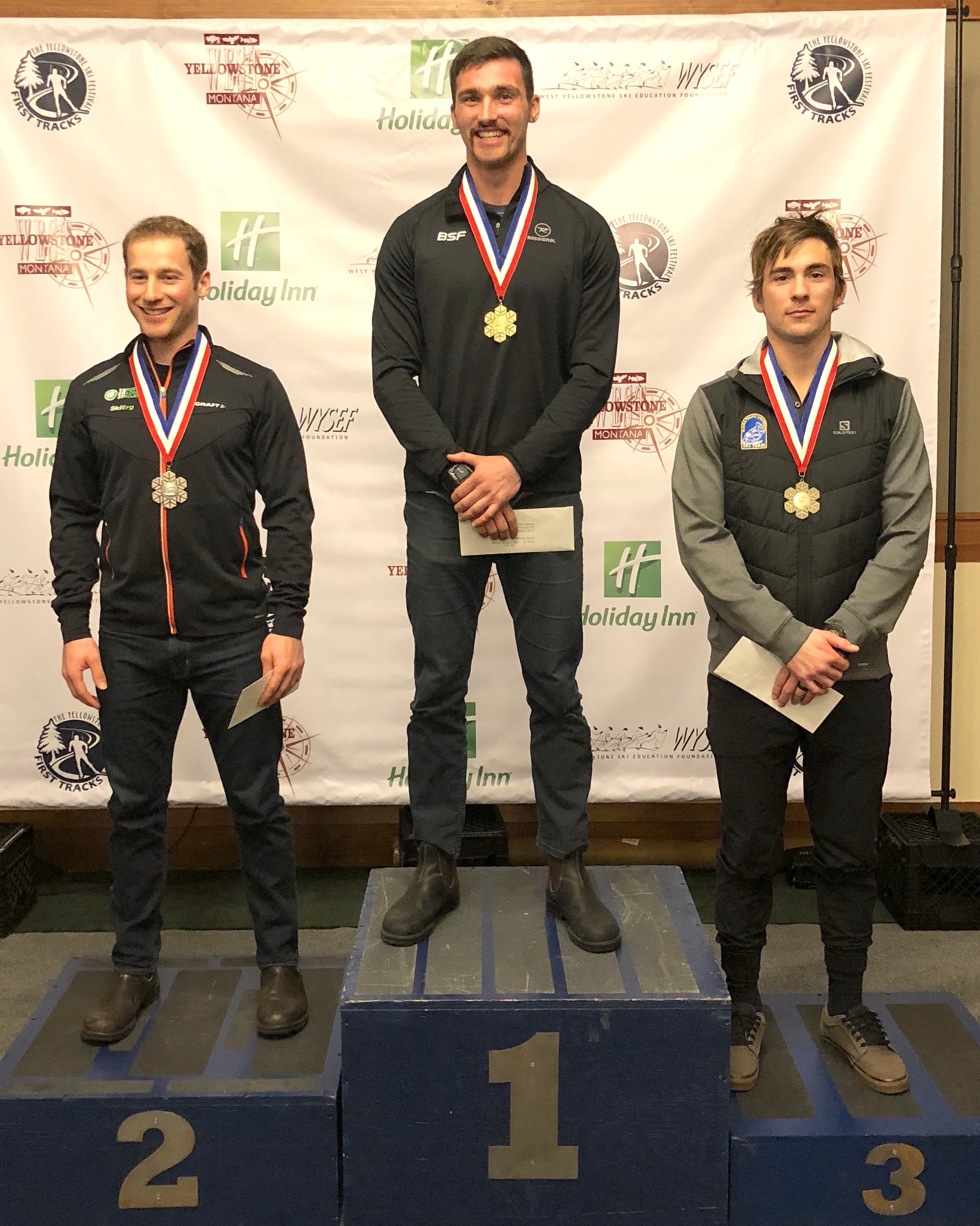
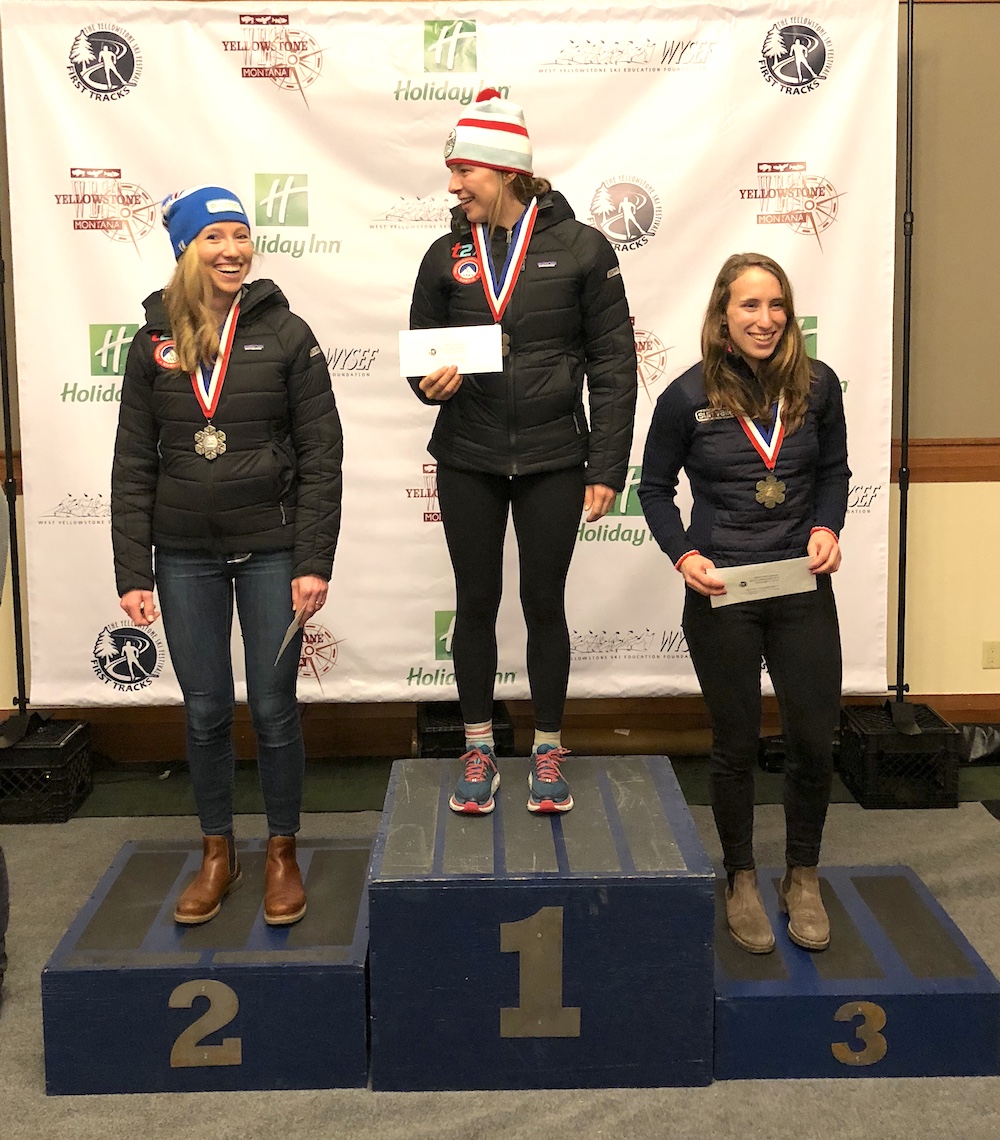
    The men’s skate sprint podium at the first race of the 2017/2018 SuperTour season, with Nick Michaud (c) in first, Ben Lustgarten (l) in second, and Reese Hanneman in third. (Photo: FBD)

    US SuperTour (West Yellowstone, Montana): Freestyle sprints

    The women’s skate sprint podium at the first race of the 2017/2018 SuperTour season, with the SMS Elite Team’s Anne Hart (c) in first and Erika Flowers (l) in second, and Sun Valley’s Kelsey Phinney in third. (Photo: FBD)

    Anne Hart and Nick Michaud were the big winners on opening day of the US SuperTour season at the Rendezvous Ski Trails on Saturday, taking individual victories in the women’s and men’s freestyle sprint finals, respectively.

    Hart led into the finishing straight to take the win in 2:52.49 minutes, 0.88 seconds ahead of Erika Flowers, her teammate on the Stratton Mountain School (SMS) Elite Team, who placed second, and Kelsey Phinney, of the Sun Valley Ski Education Foundation (SVSEF))in third (+0.92).

    Hannah Halvorsen, of Alaska Pacific University (APU) and the U.S. Ski Team D-team, finished fourth (+2.16), Caitlin Gregg (Team Gregg) was fifth (+6.99), and Caitlin Patterson, of the Craftsbury Green Racing Project (CGRP), sixth (+7.22).

    The win was Hart’s second on the circuit after winning a SuperTour 5 k skate two seasons ago. Last year in West Yellowstone, she placed third in the skate sprint (behind Jennie Bender, of the Bridger Ski Foundation, and Flowers, respectively).

    Michaud, of the Bridger Ski Foundation (BSF), won the men’s final in 2:30.69 for his first SuperTour podium, just 0.17 seconds ahead of Ben Lustgarten (CGRP) in second and Reese Hanneman (APU) in third (+0.84). Rounding out the final, Kevin Bolger (SVSEF) finished fourth (+2.11), Ben Saxton (SMS Elite Team) fifth (+2.86), and Cole Morgan (SVSEF) sixth (+3.42).

    On Sunday, the SuperTour continues with 10/15 k classic mass starts.

    Video interviews with the winners: Hart & Michaud

    Complete results (scroll to bottom for men’s and women’s final results)

    ***

    FIS Cross Country World Cup (Lillehammer, Norway): Classic sprints

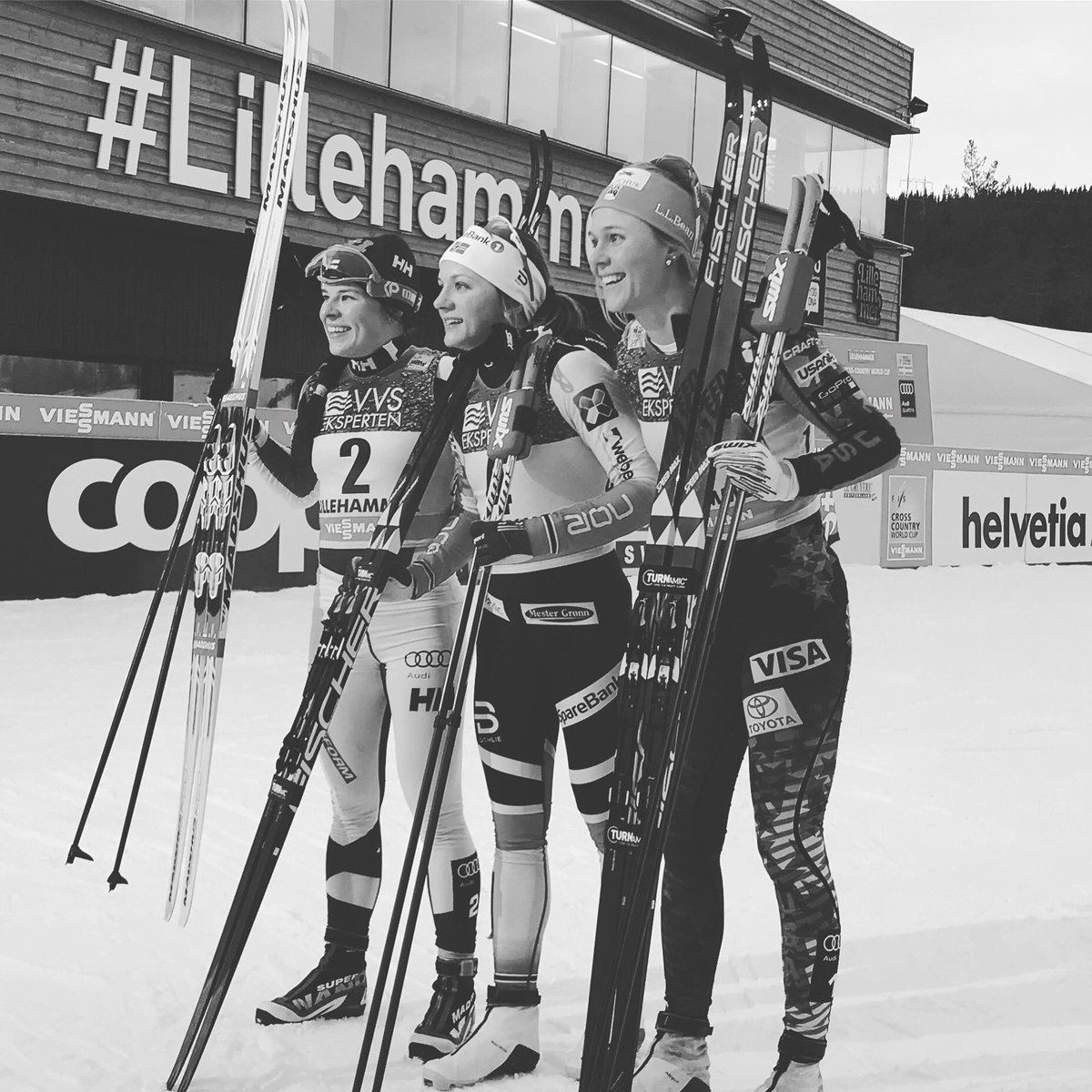
    From right to left: American Sadie Bjornsen, Norway’s Maiken Caspersen Falla and Finland’s Krista Parmakoski after placing third, first and second, respectively, in the women’ 1.3 k classic sprint at Friday’s World Cup in Lillehammer, Norway. (Photo: FIS Cross Country/Twitter)

    Women’s report

    Men’s report

    American Sadie Bjornsen returned to the World Cup podium for the second time in as many classic sprints this season on Saturday, placing third in the women’s 1.3-kilometer classic sprint behind Norway’s Maiken Caspersen Falla in first and Finland’s Krista Parmakoski in second.

    Bjornsen started the day by winning the qualifying round by one-hundredth of a second over Parmakoski and Russia’s Natalia Nepryaeva, which were listed as qualifying in second and third, respectively (despite having the same time).

    The U.S. Ski Team (USST) member who placed second in last week’s classic sprint in Kuusamo, Finland, Bjornsen won the qualifier in 3:22.45 minutes. She went on to advance in second out of her quarterfinal and then won her semifinal by 0.46 seconds over Sweden’s Stina Nilsson — who beat her in last week’s sprint.

    While Falla won Saturday’s final in 3:19.98 (after qualifying in fourth, then winning her quarterfinal and semifinal as well), Parmakoski followed in second overall (+2.07) and Bjornsen achieved her second podium of the season in third (+5.01). Norway’s Ingvild Flugstad Østberg was just behind in fourth (+5.28), Nilsson finished fifth (+6.09), and the second American in the final, Jessie Diggins was sixth (+7.81).

    Diggins previously qualified in seventh, finished second in her quarterfinal then advanced as a lucky loser in fourth place out of her semifinal (which Falla won).

    Three American women raced in the heats, with Sophie Caldwell qualifying in ninth and ultimately placing ninth overall. She advanced in second out of her quarterfinal then finished fifth in the semifinal behind Diggins.

    Also for the USST, Rosie Brennan finished 33rd in the qualifier, missing out on the top 30 needed to qualify by 0.26 seconds. Kikkan Randall finished 42nd, Ida Sargent was 44th, and Chelsea Holmes 64th.

    Canada started four women, with Emily Nishikawa placing 58th, Dahria Beatty 59th, Cendrine Browne 63rd, and Katherine Stewart-Jones 65th.

    Klæbo Still Undefeated, Ustiugov 2nd

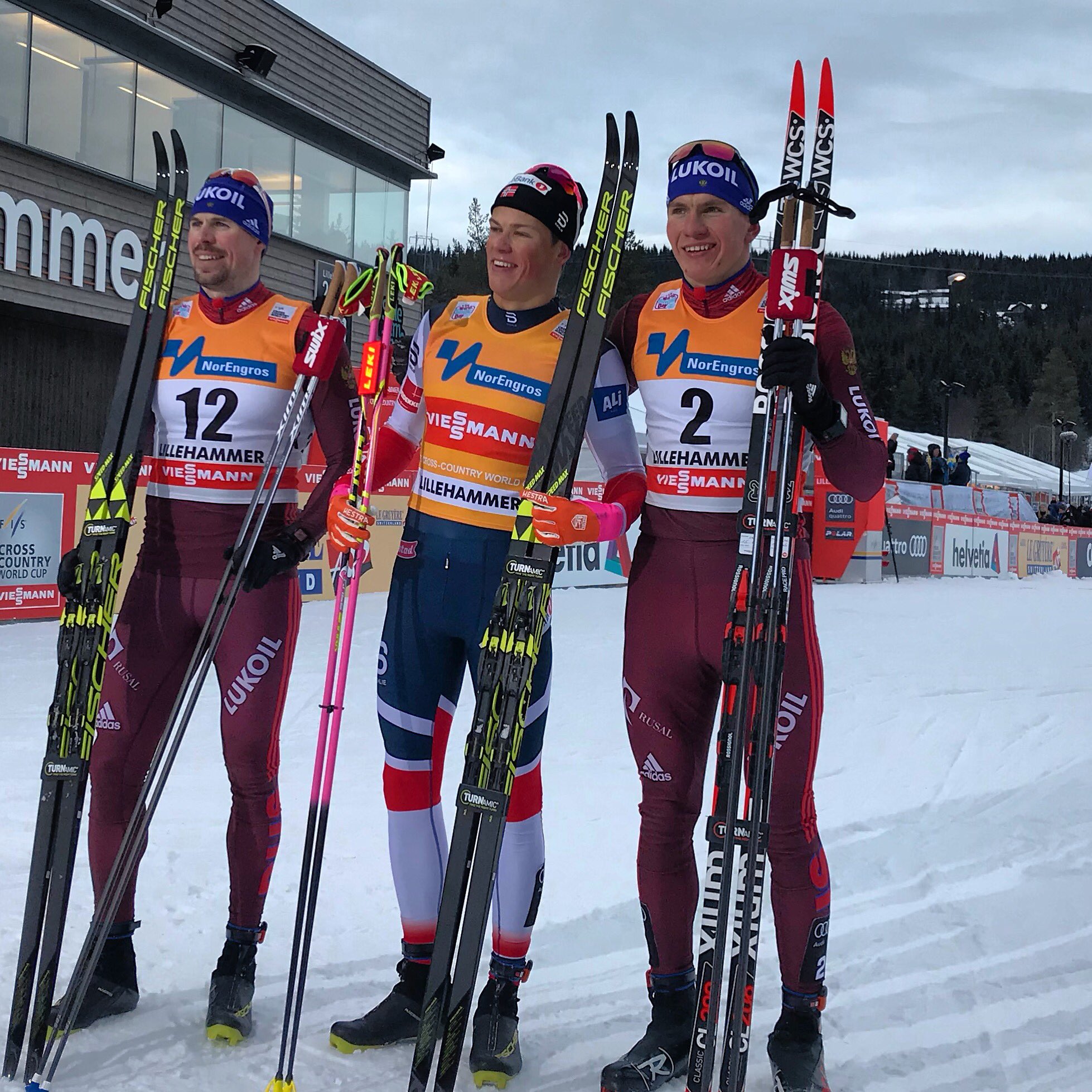
    The men’s 1.5 k classic sprint podium with Norway’s Johannes Høsflot Klæbo (c) in first, Russia’s Sergey Ustiugov (l) in second and Russia’s Alexander Bolshunov (r) in third. (Photo: FIS Cross Country/Twitter)

    In the men’s 1.5 k classic sprint, Norway’s Johannes Høsflot Klæbo continued his undefeated World Cup streak with his fourth win in as many races this season.

    He started off by winning the qualifier in 3:40.79, then his quarterfinal by 0.17 seconds over Russia’s Sergey Ustiugov. Klæbo and Ustiugov met again in the semifinals, where Ustiugov beat the Norwegian by 0.25 seconds, but in the final, where it really mattered, Klæbo again had the edge, winning in 3:33.88. Ustiugov finished 0.83 seconds back for second place, and Russia had two on the podium with Alexander Bolshunov in third (+1.29). Sweden’s Calle Halfvarsson finished fourth (+1.64), and Norway had two more in the final with Emil Iversen in fifth (+8.2) and Sondre Turvoll Fossli in sixth (+17.3).

    Canada’s Alex Harvey was the lone North American to qualify for the men’s heats after racing to 22nd in the qualifier, 11.89 seconds out of first. Harvey’s day ended in the quarterfinals, where he finished sixth, 3.06 seconds behind Norway’s Pål Trøan Aune in first. Norway’s Even Northug took second in that heat (+0.26), Finland’s Ristomatti Hakola was third (+0.36), Norway’s Håvard Solås Taugbøl fourth (+0.67) and France’s Maurice Manificat fifth (+1.72) in that heat. Overall, Harvey placed 28th on the day.

    Erik Bjornsen was the top American man in 35th and missed qualifying by 1.06 seconds. Andy Newell finished 38th and Scott Patterson was 74th for the U.S. Ski Team.

    Jess Cockney was the second Canadian man in 57th, Len Valjas followed in 59th, Julien Locke was 61st, Russell Kennedy 63rd, and Knute Johnsgaard 67th.

    Results:

    Women’s final | Women’s qualifier

    Men’s final | Men’s qualifier

    ***

    IBU World Cup (Östersund, Sweden): Men’s 10 k sprint

    Norway’s 29-year-old Tarjei Bø wins his first World Cup race in four years and three Canadians land in the top 26, led by Scott Gow with a career-best 16th that puts him one step closer to securing his place on Biathlon Canada’s Olympic team. Of the nine men that cleaned the two-stage race, four of them were North Americans (Gow, American Lowell Bailey in 22nd, and Canada’s Nathan Smith in 24th and Christian Gow in 26th).

    Race report