From the FasterSkier archive — posts syndicated from athletes’ and coaches’ own blogs between 2004 and 2012, kept online as published. Current coverage is at fasterskier.com.
Canada’s Evan Palmer-Charrette (NTDC Thunder Bay) racing to 34th in the 15 k freestyle at 2017 U23 World Championships on Thursday at Soldier Hollow in Midway, Utah. He was the top Canadian in the race. (Photo: FlyingPointRoad.com)
In an effort to showcase the North Americans competing at this week’s International Ski Federation (FIS) 2017 USANA Nordic Junior World Championships and U23 Cross Country World Championships at Soldier Hollow in Midway, Utah, we asked those qualifying athletes several questions about themselves — actually, we had them fill in the blanks. Here we have 22-year-old Evan Palmer-Charrette, of the National Team Development Centre (NTDC) Thunder Bay, representing Canada at his first U23 Worlds.
On Tuesday, Palmer-Charrette finished 33rd in the classic sprint. On Thursday, he led the Canadian team in 34th in the 15 k freestyle.
***
“My full name is Evan James Palmer-Charrette, but you can call me Evan. I was born in Thunder Bay, Ontario, raised in Thunder Bay, and one thing you should know about my hometown is we have the best pancakes in the world.
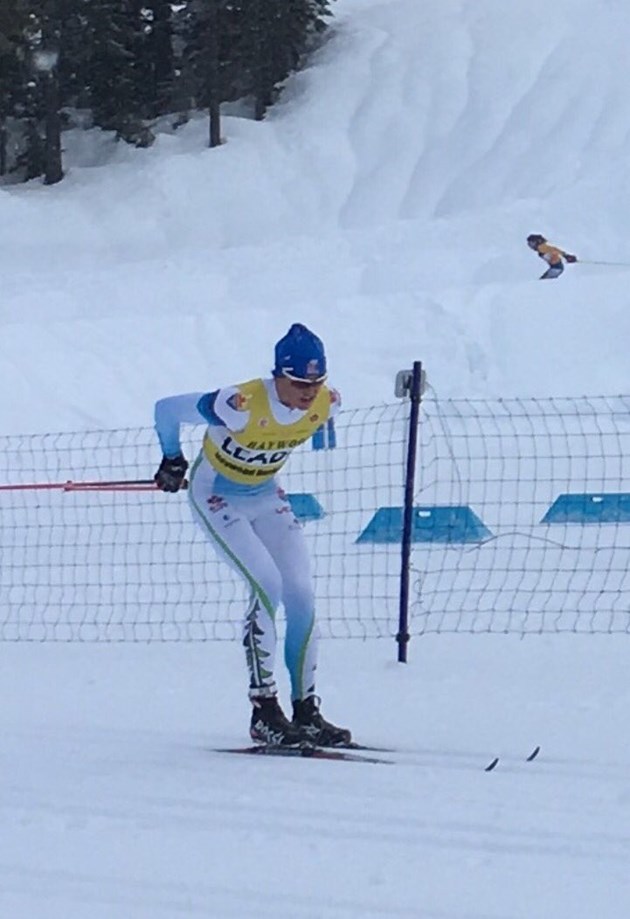
Evan Palmer-Charrette (NTDC Thunder Bay), in the NorAm leader’s bib, racing to third in the 15 k classic on Jan. 21 at Western Canadian Championships in Whistler, B.C. (Courtesy photo)
I started cross-country skiing when I was five, thanks to my parents. I currently train in Thunder Bay with NTDC Thunder Bay.
If I’m not skiing, you might find me working at Rollin’ Thunder. If I had to pick a favorite book, it would be ‘Three Day Road‘.
One of the things I’m most excited about for U23/Junior Worlds at Soldier Hollow is racing on trails I have previously raced on. One race I’m especially targeting there is the 15km skate.
The best advice anyone ever gave me about skiing or racing was to stay focused on the present.
One of the best race memories I have is racing the team relay at Canada Winter Games.
If I could meet one World Cup skier, it would be Bob Thompson.
If I don’t end up being a professional skier, I’ll probably be disappointed.
I’m missing zero days of school to be here, and my professors are probably thinking, ‘He’s never coming back.‘
“When you wake up in the morning, Pooh,” said Piglet at last, “what’s the first thing you say to yourself?”
“What’s for breakfast?” said Pooh. “What do you say, Piglet?”
“I say, I wonder what’s going to happen exciting today?” said Piglet.
Pooh nodded thoughtfully.
“It’s the same thing,” he said.
— A.A. Milne, Winnie-the-Pooh
Breakfast, as you learned in elementary school (or more recently from Ryan Gosling), is The Most Important Meal of the Day. That’s likely true for anyone. It is emphatically true for skiers. Whether you’re training once a day or three times a day, 100 hours a year or 1,000, it all starts with breakfast. If training is the foundation for racing, and proper nutrition is the foundation for proper training, then it logically follows that breakfast is the foundation for, well, everything.
Kikkan Randall in the kitchen “getting ready and fueled” in the fall of 2014. (Photo: Twitter)
Certain types of breakfast tend to get all the press. Pretty much everyone is a fan of second breakfast. J.R.R. Tolkien explains that hobbits eat second breakfast as the second of their six daily meals – after (first) breakfast and before elevenses. Thomas Mann, in The Magic Mountain, ups the ante, discussing not only second breakfast but also, remarkably, third breakfast. Robert McCloskey, in the seminal 1941 children’s book Make Way for Ducklings, underscores that second breakfast is best in the animal kingdom as well; his Mr. and Mrs. Mallard follow around the late-morning duck boat until they get “another breakfast, better than the first.” Everyone, it seems, is a fan of second breakfast.
There is no question that everyone is a fan of pancakes (and their close relative, the waffle). Turning from early-20th-century literature to the modern institution of the 21st-century skier blog, it is clear that there could not be a skier blog – or maybe even skiers – without pancakes or waffles.
And a generation earlier, before the term blog had even been invented, Luke Bodensteiner, at the time a struggling Olympic hopeful, wrote in Endless Winter: An Olympian’s Journal of downing 18 (!) “steaming hot buttermilk pancakes” one morning in September 1993, then crushing a 50-kilometer rollerski followed by a 12-mile run. Plus ça change.
This is not an article about second breakfast. Nor is it even an article about pancakes. This is an article about what athletes eat for real breakfast on real weekdays. Training day or rest day, at home or abroad, every elite athlete has a food that they’re comfortable with. And once they’ve found it, they tend to eat that food every. single. day. (Except for Lex Treinen, who wrote that he “never actually [has] the same breakfast every day,” but he’s an outlier among the athletes surveyed for this article.) If ski racing is, ultimately, about controlling the things you can control and trying to get a good outcome from the things you cannot, then breakfast becomes one more thing that can be effectively controlled.
Starting with Alaska, we asked skiers with the Alaska Pacific University Nordic Ski Center elite team to share an honest picture of their average breakfast for a weekday training day and describe what they eat. Here’s what they told us:
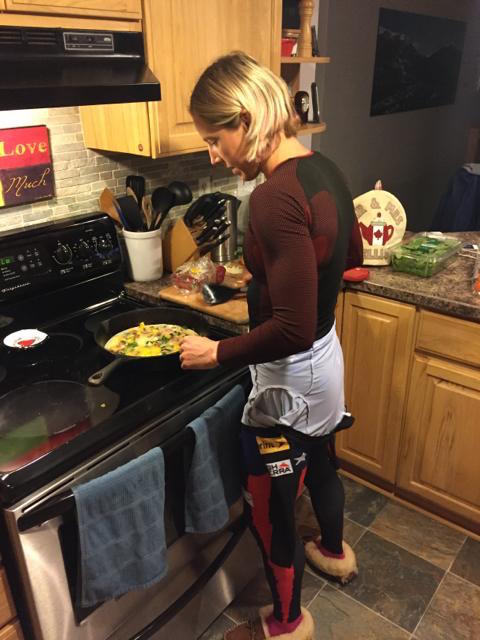
“My typical breakfast is a three-egg omelette with Canadian bacon, mushrooms, peppers, onions, spinach, and cheese and two pieces of wheat toast with cinnamon sugar. Together with an Americano.” (Note: Not Randall’s actual omelette/photo via Wikimedia Commons)
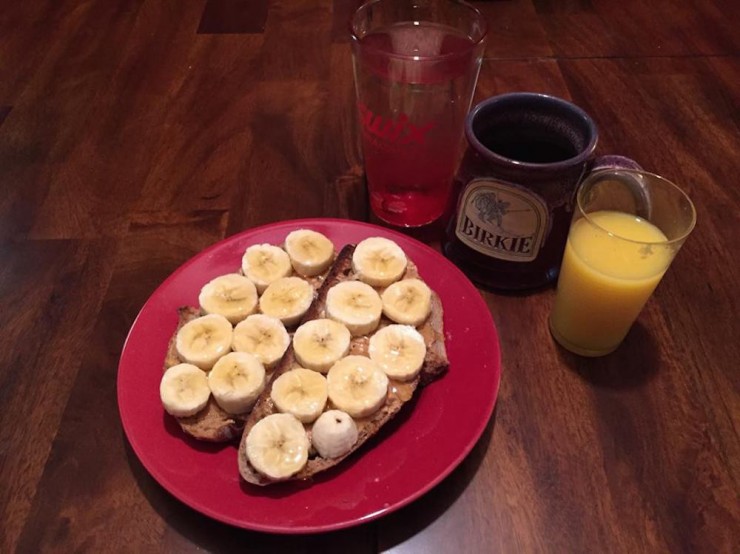
“I was out of eggs so normally one would be this concoction [pictured] – peanut butter, banana, and honey – and the other would be a poached egg on top of toast with jam. Just the right combo of carbs, protein and fat to keep me going and ensure that I don’t have a growling stomach 1 hour later……”
Honorable mention: On marathon race mornings, Holly makes “a big bowl of 50k oatmeal (peanut butter, banana, raisins, yogurt, salt, honey),” plus two cups of coffee.
“My normal breakfast is oatmeal, yogurt, almonds, fruit slices (apple, banana, berries), spoonful of peanut butter, honey. Sometimes I will substitute some sort of cereal throughout the week to break up the oatmeal. Today I used Pumpkin Flax Seed cereal.”
“Omelette and oatmeal with blueberries”
“Everything bagel with raspberry jam; 2 eggs over medium; coffee with foamed milk”
“Apple, organic peanut butter, and cookie dough; black coffee”
“Two eggs, rice, beans, shredded cabbage, and salsa”
“Everything bagel with raspberry jam and fried eggs on top; oatmeal with mixed berries; coffee, black.”