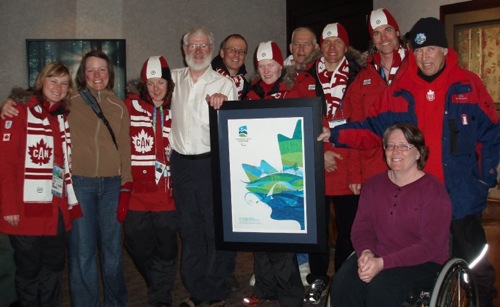
If you’d asked John Farra a few months ago what he’d be doing in 2014, he would have told you, “Going to Sochi and kicking some butt.”
He still plans on doing just that, but not with the team he would have expected. The U.S. Ski and Snowboard Association (USSA) announced Thursday that Farra is leaving his post of the past three years as the Nordic Program Director for a position as Director of the U.S. Paralympics Nordic Skiing High Performance for the U.S. Olympic Committee (USOC).
“It’s not what I originally had in mind for myself,” said Farra. “But every once in a while life throws you a curve ball, and it was too good an opportunity to pass up.”
He became the Nordic Director for USSA in the spring of 2008, having played roles in the ski community as an athlete, coach and administrator. A former Olympian and National Champion, Farra has held leadership positions for Lake Placid’s National Sports Academy and the Maine Winter Sports Center, where he was the Vice President and Programs Director.
During his term at USSA, Farra oversaw the ski jumping and Nordic combined teams win six World Championship and four Olympic medals.
His colleagues and athletes are all sorry to see him go. “It’s a bummer for us,” said Luke Bodensteiner, Vice President of USSA. “John has been great in that position.”
Chris Grover, head coach of the men’s USST, was equally complimentary. “Farra did a fantastic job, in my opinion. He had an incredible work ethic, he had the right knowledge base, and he brought a lot of passion to what he did—to seeing the Nordic athletes be successful. Those are big shoes to fill. We’re all going to sincerely miss him.”
“He did an amazing job,” said Kris Freeman, a veteran of the USST who has seen several program directors. “I’m sad to see him go.”
The hardest part about the departure for Farra will be leaving the people he’s worked with since taking up the post in the spring of 2008. “It’s one of the most unique experiences I’ve ever had,” he said. “I’ve gotten an amazing number of emails from people that were super positive and appreciative. I know I’ll be staying in touch with a lot of these folks, and we’ll keep crossing paths.”
The opportunity at the USOC came around almost two months ago, when the newly created job was posted and circulated around USSA. “I love what I do, so I passed along to people I knew who might be interested, and didn’t think about it again,” said Farra. “But the responses I got were, ‘Why aren’t you considering it?’ It’s my [current] job exactly, just for the Paralympics. So I talked with one of the USOC guys and got pretty interested in the project.”
The project, he explained, is to develop a stronger base for adaptive Nordic skiing in the U.S. “Here you have a sport that doesn’t have anywhere near as deep a pipeline as cross country. In order to reach the same level there will need to be thoughtful design of coach’s education and club program development. It’s a pretty big challenge, and that’s what got me so excited,” said Farra.
Though he will be missed, Farra is confident that USSA will be just fine without him. “Our athletes are on track and our coaches are sticking around. We’ve got such a great thing going right now; this is not a big hiccup, in my opinion. I truly believe that our athletes in all three disciplines are primed to do something special in Sochi. This is an opportunity for someone out there to take on something new and exciting.”
“The director is expendable; the coaches aren’t. The athletes will continue to do what they do. My work was more behind the scenes, and I feel really good about what I’ve done,” he said.
“The real story is, who’s next?”
Farra says he will help find a replacement, but has no idea who will throw their name in the hat. In the interim, USSA will lean on head coaches Chris Grover and Dave Jarrett for direction, just as they have in the past. Bodensteiner said he is taking the opportunity to take a critical look at the position, determine what the needs are in the ski community, and redefine the role if needed.
“I think this is an excellent time to come in,” said Farra. “The spirit of collaboration, you can just feel it. Since I’ve been around, I’ve seen people start to really believe we can win and do well. I see less and less in-fighting and frustrations, and instead people talk about how we’re doing this right.”
Farra’s last day at USSA is July 13, and he starts up at the USOC on the first of August. For now he will remain in Park City with his family and commute to Colorado Springs as needed.
Asked if he is at all nervous about the task ahead of him, Farra says he feels well-prepared. “Sure, there’s always anxiety once you start something new. But I know a lot of the athletes already and I understand the challenge.”