From the FasterSkier archive — posts syndicated from athletes’ and coaches’ own blogs between 2004 and 2012, kept online as published. Current coverage is at fasterskier.com.
The April 4 event pairs a live global broadcast with on-snow programming at Tahoe XC.
The inaugural Tahoe Nordic Expo will take place April 4, 2026, bringing together some of the most accomplished names in Nordic sport for a live, global virtual panel focused on the past season, the Olympic year, and the future of the sport.
Designed as a hybrid event, the Expo centers around a live virtual panel featuring Olympic, Paralympic, and World Cup athletes across multiple Nordic disciplines, including cross-country skiing, biathlon, Nordic combined, and telemark.
Julia Kern (USA) racing the World Cup cross-country mass start in Ruka (FIN). (Photo: Modica/NordicFocus)
The panel lineup includes:
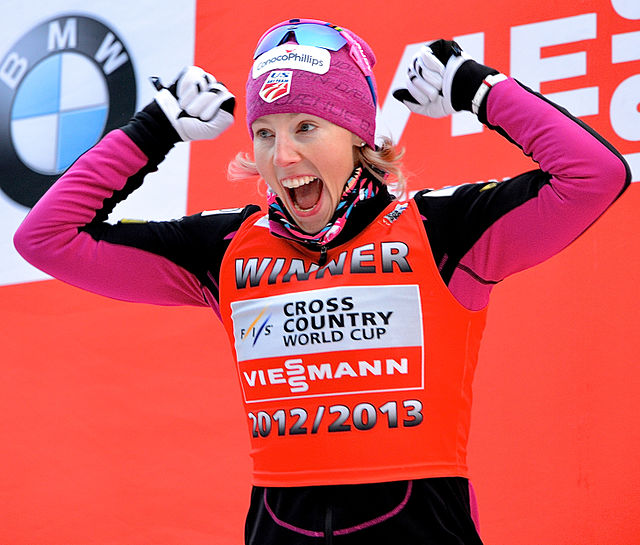
Kikkan Randall, Olympic gold medalist and one of the most decorated U.S. cross-country skiers in history
Oksana Masters, 24-time Paralympic medalist in Nordic skiing and multiple sports
JC Schoonmaker, Tahoe native and two-time Olympian
Julia Kern, World Cup medalist and Olympian
Annika Malacinski, national champion and leading voice in women’s Nordic Combined
Jaz Taylor, multiple-time World Cup champion
The discussion will be moderated by Andy Newell, a four-time Olympian and prominent voice in the sport.
The 90-minute panel will serve as a live season recap, covering the 2025–26 World Cup circuit and the Milano Cortina Olympic and Paralympic Games, while offering audiences a rare opportunity to hear directly from athletes about training, competition, and the evolving culture of Nordic sport. Virtual attendees can submit questions in advance, while in-person participants will engage in a live Q&A.
Coach Andy Newell all smiles at the 2023 BMT. (Photo: BMT)
Founder Elyse Sara created the Expo to fill a gap in the Nordic landscape – one that emphasizes connection, storytelling, and access to athletes across disciplines and levels. The event brings together voices from across the global Nordic community, from Olympic medalists to emerging leaders shaping the future of the sport.
The event also includes a limited in-person component at Tahoe XC featuring clinics, demos, a laser biathlon relay, live viewing of the virtual panel, and other community events.
In addition to its focus on sport and storytelling, the Expo also supports inclusion in athletics. Ten percent of all proceeds will benefit Move United, a national leader in adaptive sports programming.
The Tahoe Nordic Expo aims to establish a new kind of gathering within the sport – one that reflects, connects, and looks ahead.
JC Schoonmaker (USA) onhis way to finish the individual sprint in 15th place at the World Championships in Trondheim (NOR) in 2025. (Photo: NordicFocus)
ZHANGJIAKOU, China — Considering that March is Women’s History Month, U.S. Paralympic Nordic skiers Oksana Masters and Kendall Gretsch are certainly making their fair share of contributions to the history books.
Masters and Gretsch picked up gold and silver medals, respectively, on Friday at the Paralympic Winter Games Beijing 2022, with Masters winning the women’s individual sitting biathlon in 42:17.9 and Gretsch finishing second in 42:23.7.
It was the third time within a week the pair, who train together in Bozeman, Montana, podiumed at the Zhangjiakou National Biathlon Centre. Combined, they have eight medals at these Paralympics, more than half of Team USA’s total medal haul.
Masters is now a 15-time Paralympic medalist — tying her with John Morgan for the fifth most Paralympic medals by a U.S. athlete — and a six-time Paralympic champion. Already at these Games she had won a gold in the sprint biathlon, and silvers in the middle-distance biathlon, long-distance cross-country and sprint cross-country events.
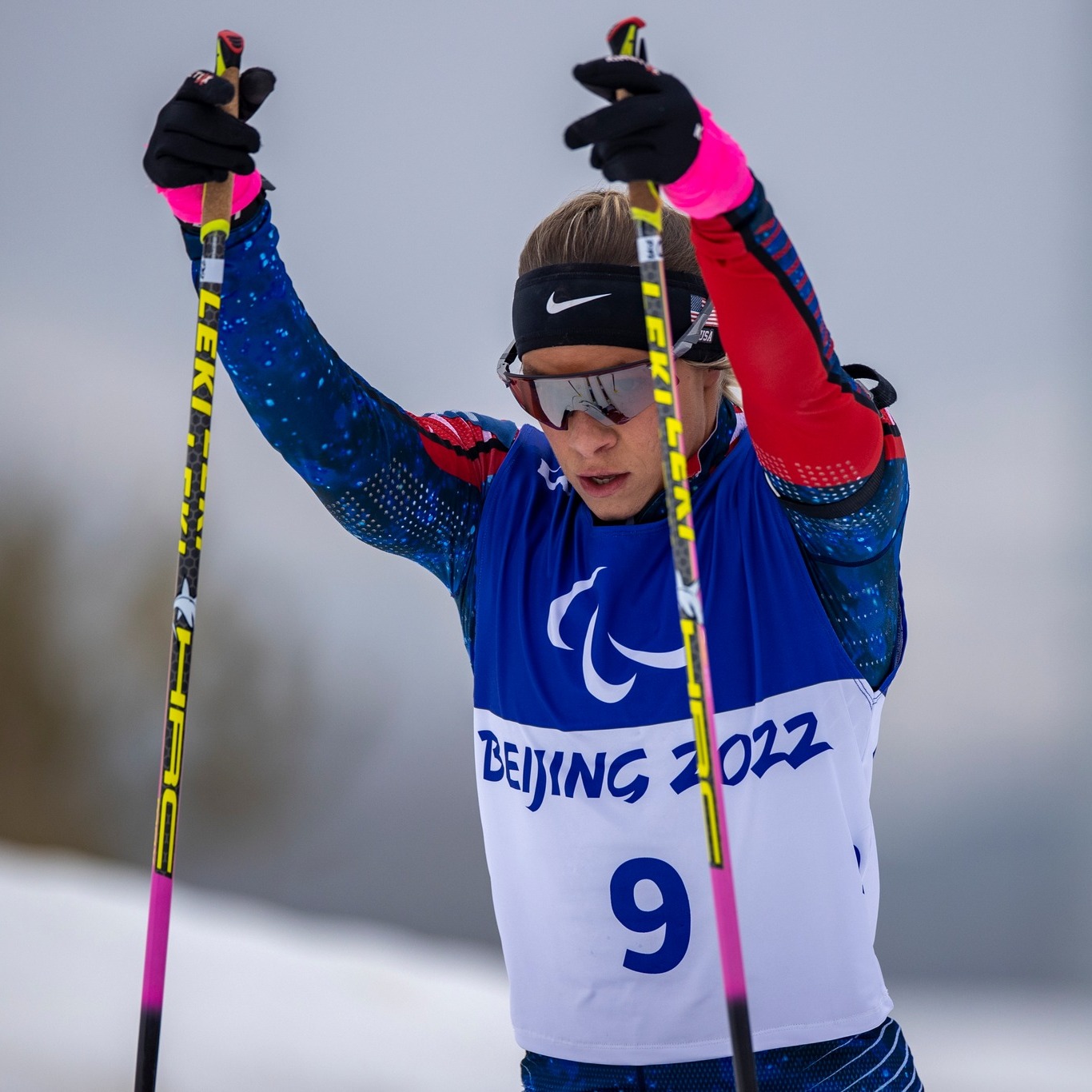
Oksana Masters races to gold in the women’s individual biathlon during the 2022 Beijing Paralympic Winter Games. (Photo: Chloe Knott for OIS / TeamUSA)
Following her first biathlon gold, she posted on Instagram: “Some feelings can’t be put into words. I am beyond proud to stand on the podium representing the heart, fight, love, resiliency, and pure joy for two countries,” referring to the U.S. and Ukraine, the latter being her birth country.
“I not only finally got to hold my dream, but I also am sharing parts of it with my home country of Ukraine especially for the young kids with disabilities. I want to make every start line mean something, make it really count for more than a result. That’s why I will be donating proceeds of my prize money from the Paralympics here to No Child Forgotten managed by Global Giving and Bridge Kids Charity, supporting children living with physical disabilities in Ukraine – many of them with single moms.”
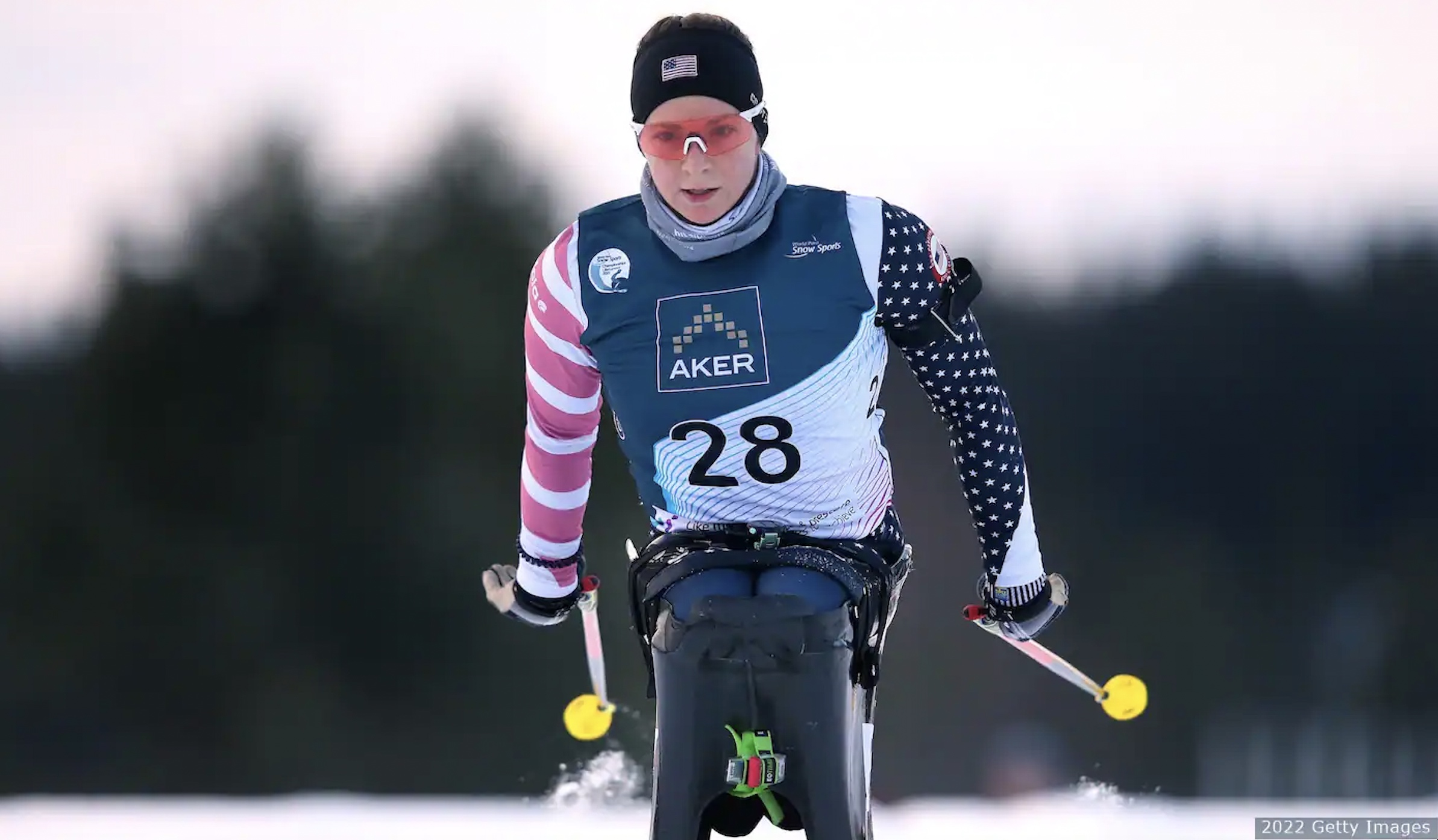
Kendall Gretsch skis for silver in the women’s sitting individual biathlon event during the 2022 Paralympic Winter Games. (Photo: Chloe Knott for OIS / TeamUSA)
Gretsch, who is still the reigning world champion in the individual biathlon, is now a six-time Paralympic medalist. This marked her first career silver medal, and she now has the entire collection of colors from Beijing 2022, having already won gold in the middle-distance biathlon and bronze in the sprint biathlon.“Today was an awesome day,” Gretsch said. “For me and the U.S. team it’s always fun to go one-two. We’re both shooting and skiing well, and so it was a fun race today.”
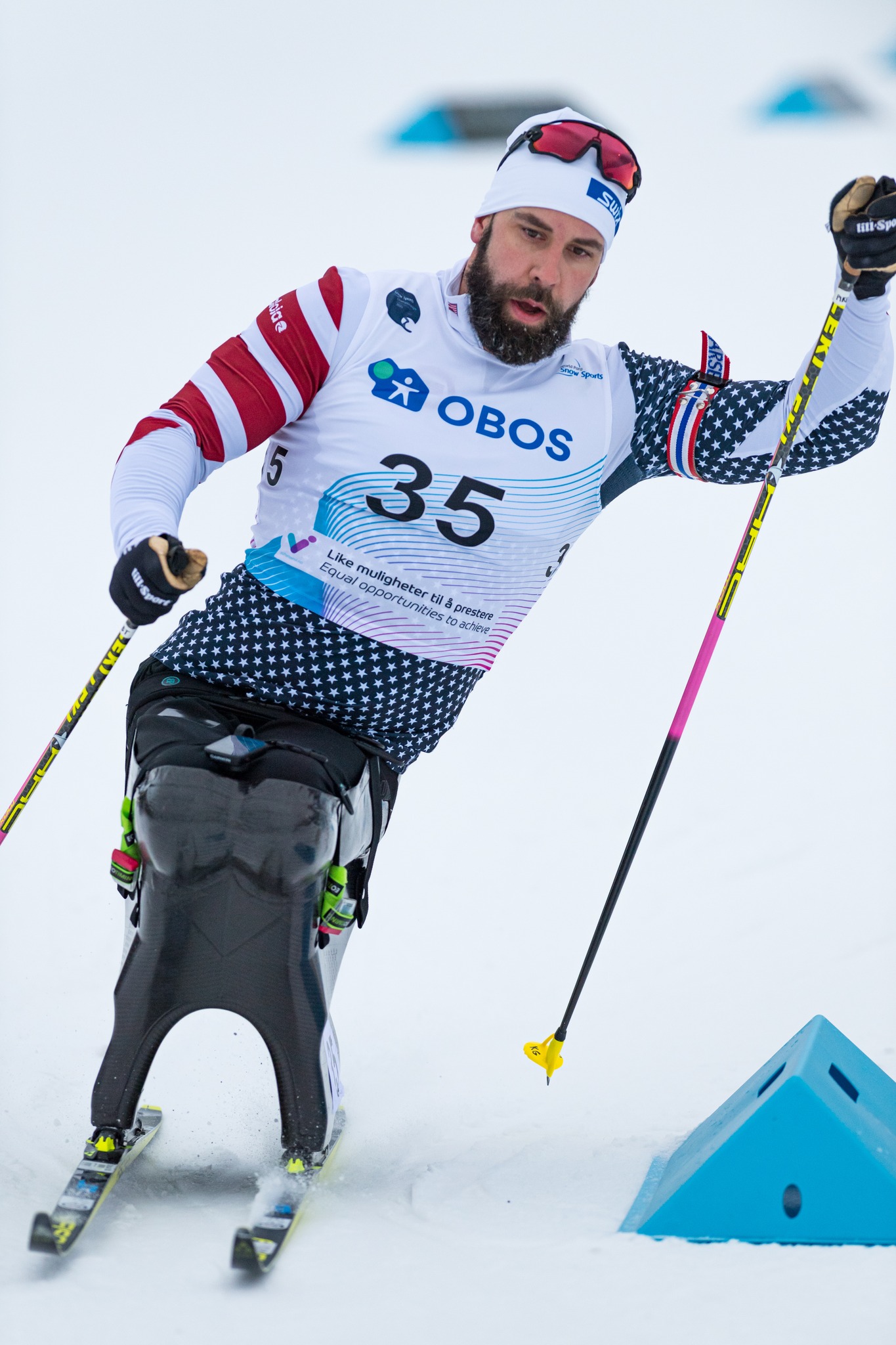
In the men’s individual sitting biathlon, six-time Paralympic medalist and former U.S. Navy SEAL Dan Cnossen was the top American finisher, taking seventh in 42:46.9. Six-time Paralympian Aaron Pike was ninth in 43:19.0. It was the third top-10 finish for both Cnossen and Pike at these Paralympics.
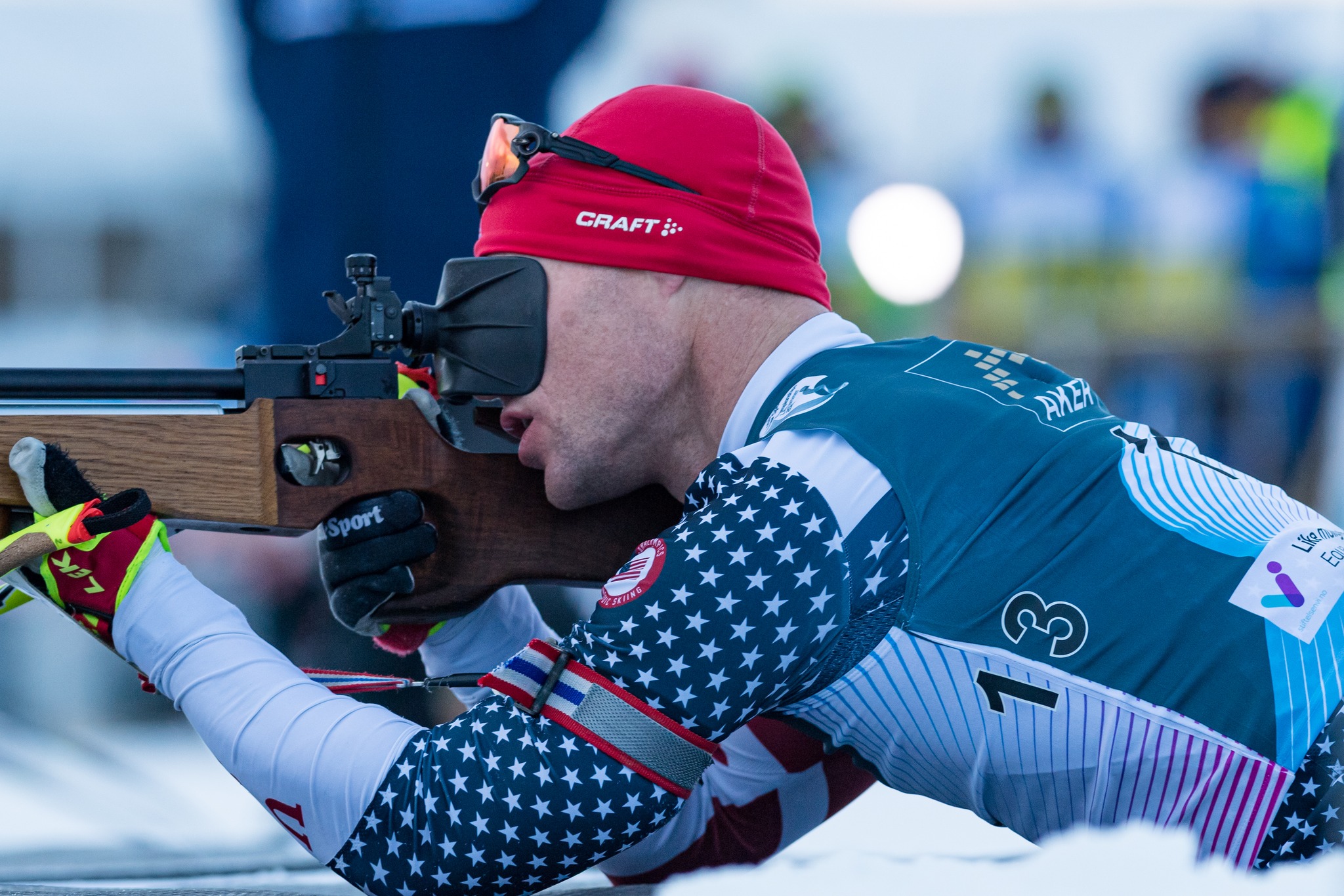
Dan Cnossen hits the range during the men’s individual sitting biathlon race in Zhangjiakou, where he finished seventh. (Photo: Chloe Knott for OIS / TeamUSA)
The U.S. Para Nordic skiers will return to the National Biathlon Centre on Saturday for the cross-country middle distance races.
Want to follow Team USA athletes during the Paralympic Winter Games Beijing 2022? Visit TeamUSA.org/Beijing-2022-Paralympic-Games to view the competition schedule, medal table and results.
***
Author Bio:
Stuart Lieberman has covered Paralympic sports for more than 10 years, including for the International Paralympic Committee at the London 2012, Sochi 2014 and PyeongChang 2018 Games. He is a freelance contributor to TeamUSA.org on behalf of Red Line Editorial, Inc.
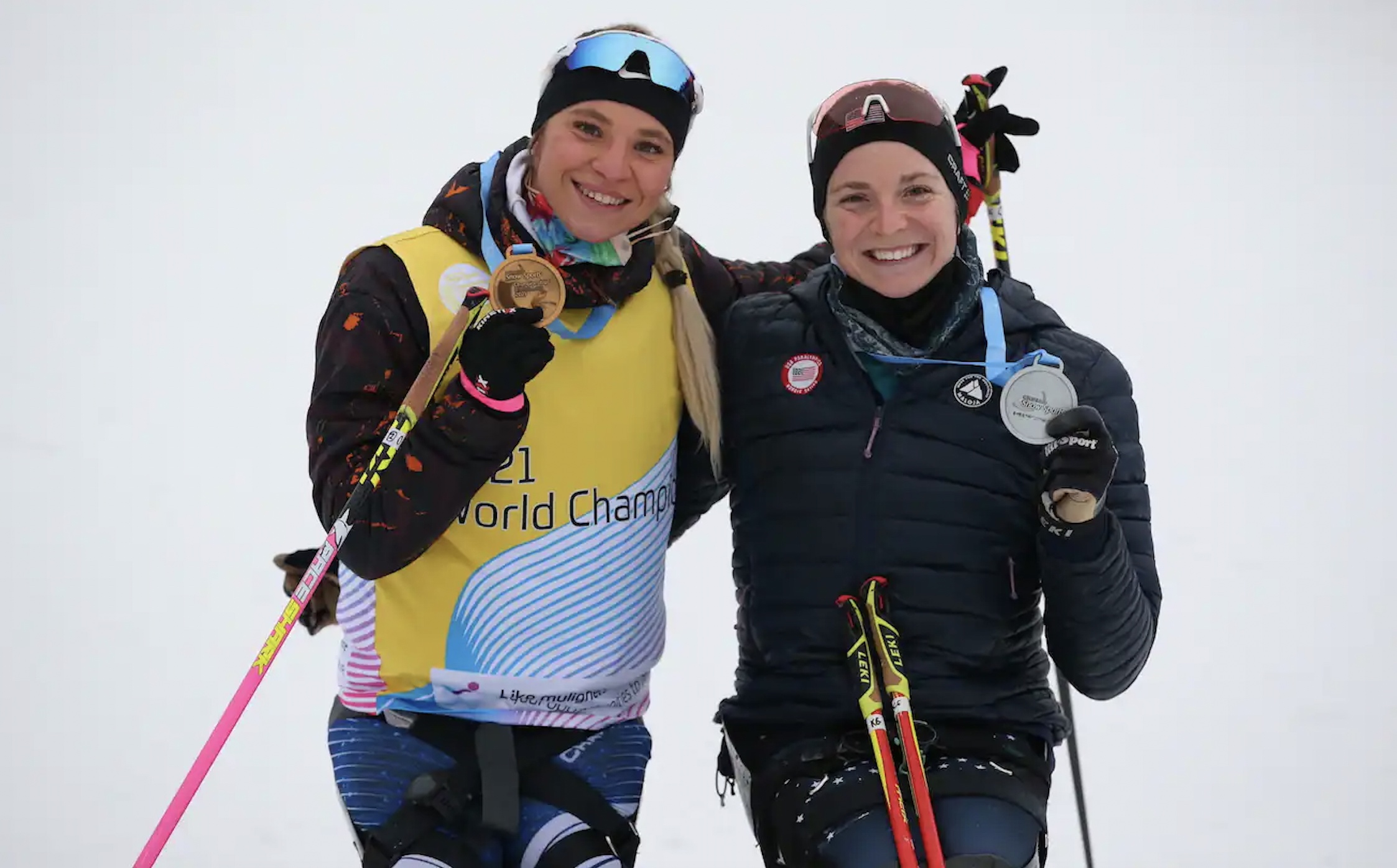
Oksana Masters (left) and Kendall Gretstch (right) go 1-2 in the women’s 15k sitting long distance cross country race. (Photo: Alex Livesey/Getty Images)
It’s late January and we’re deep into the race season. As the Olympics and Paralympics draw nearer, we’ve simultaneously just wrapped up the Tour de Ski, the U.S. Cross Country Championships, and another wave of SuperTour races. Never a dull moment in the racing world, the Para World Championships are currently well underway, running January 13-23rd in Lillehammer, Norway.
Normally occurring on odd years, the World Championships were postponed from last February due to the pandemic. Nevertheless, the event was called the Lillehammer 2021 World Para Snow Sports Championships. It was a hallmark event, as it is the first time that all snow sports have competed together in one location over the same dates.
Led by well-decorated veterans like Oksana Masters, Kendall Gretsch, and Dan Cnossen, the U.S. Para Nordic Team has put together a string of outstanding results at World thus far. Events have ranged from biathlon springs to cross country distance races, with athletes competing – and cleaning up – across all disciplines and distances.
Kicking off the series of events, Sun Valley’s Jake Adicoff took home his career first World Championship medal by winning the men’s visually impaired 10-kilometer middle distance race.
“It feels great,” Adicoff said of his performance, according to the Team USA Press Release. “Lillehammer has been skiing really well so far, I’ve been having a lot of fun here. It feels great to go and get that first podium, and hopefully we can go out and get some more here.”
Jake Adicoff and his guide Sam Wood put together a gold medal performance on the opening day of racing at the Para World Championships in Lillehammer, NOR. (Photo: Alex Livesey/Getty Images)
Adicoff retired in 2018 after earning a silver medal in the 10k and taking 4th in the sprint, however, he is making his return with a bang in this 2021/22 season.
Building momentum throughout the first day, 19-year-old Sydney Peterson earned a silver medal in the women’s standing middle distance race, with Gretsch earning the second gold medal for team USA in the women’s sitting 7.5k middle distance event. That’s three medals, two gold and one silver, on the first day of racing, along with an additional two athletes, Cnossen and Dani Aravich, earning top-10 finishes.
Dan Cnossen hits the range during the individual sitting biathlon event at the Para World Championships in Lillehammer, NOR. (Photo: Alex Livesey/Getty Images)
Joining the team in Lillehammer late after testing positive for COVID-19 on New Year’s Eve, Masters made a smooth return to competition, taking second place in her first race at Worlds, the sitting biathlon sprint on January 15th. The next day, the American women took first and third in the sitting biathlon middle distance race, with Gretsch earning her second gold medal of the week and Masters adding an 18th World Championship medal to her ever-expanding collection.
On point, a perfect shooting performance contributed to Gretsch’s gold, while Masters skied her way out of a significant deficit. Experiencing challenges on the range, Master’s racked up seven penalties, but made up her shooting with her skiing. In the men’s sitting race, Master’s partner, Aaron Pike, skied his way into the Top-10, a rank he has achieved in each of his World Cup races this season, leaving him primed for a medal.
Two days later on the 18th, Masters and Gretch again took the spotlight, going 1-2 in the women’s sitting 15k long distance cross-country race. Now reaching 19 total, this marked Masters’ 10th career World Championship gold medal.
“It’s absolutely incredible,” Masters said in the Team USA press release that day. “It feels like yesterday where I was that new athlete, never thinking that I would be a world championship athlete. So, to have 10 now … is incredible and it’s a testament to our team’s hard work. It’s not just me, it’s the whole team.”
Already an historic day for the U.S., Peterson and Adicoff continued the medal streak in the long-distance cross country races, with each athlete earning a bronze medal in the standing and visually impaired divisions, respectively. Four Americans competed that day, and four medals were won. How’s that for success?
Aaron Pike races the individual sitting middle distance biathlon event at the Para World Championships in Lillehammer, Norway. (Photo: Alex Livesey/Getty Images)
As the final days of World Championship racing kicked off, Pike’s consistency paid off with a silver medal in the men’s sitting individual biathlon event. Missing just one target, matching the best result of the event, Pike finished 24 seconds back on the winner, Pavlo Bal of the Ukraine. This result is both a World Championship and overall World Cup career best for Pike, who is an accomplished wheelchair racer during the summer season.
“It was a tough day to be shooting out there, everybody’s missing so I was happy to come away with just missing one shot,” said Pike in today’s recap. “This is probably the windiest race we’ve had in three years. Every chance you get to put a bib on and race in a biathlon race is experience.”
Racing in the women’s sitting individual biathlon, Gretsch and Masters continued to dominate the field, taking first and third, respectively, to keep their medal streak alive and well.
Again performing well on the range, Gretsch missed just one target in four rounds of shooting and skied the second fastest time on course for a finish time of 52:25.0. While Masters skied the fastest time of day, she again faced challenges in her shooting, incurring five penalties, leaving her 3:00.7 behind Gretsch in the final results. In the women’s standing class, Aravich earned another top-10 finish in eighth.
With excellent shooting records, Kendall Gretsch puts together back-to-back gold medal performances in biathlon events. (Photo: Alex Livesey/Getty Images)
After a day of rest, the Para athletes have two final days of racing in Lillehammer on the 22nd and 23rd, which feature a sprint for the standing and visually impaired categories on Saturday and a Mixed Relay on Sunday. Based on the week’s results, it’s clear that they are primed for another medal run in the upcoming 2022 Beijing Paralympic Games, which begin March 4th.
Livestreams of past and upcoming events, along with links to results can be found on the U.S. Paralympics Nordic Facebook page, or you can check out the remainder of snowsport events happening this week in Lillehammer by following along here.
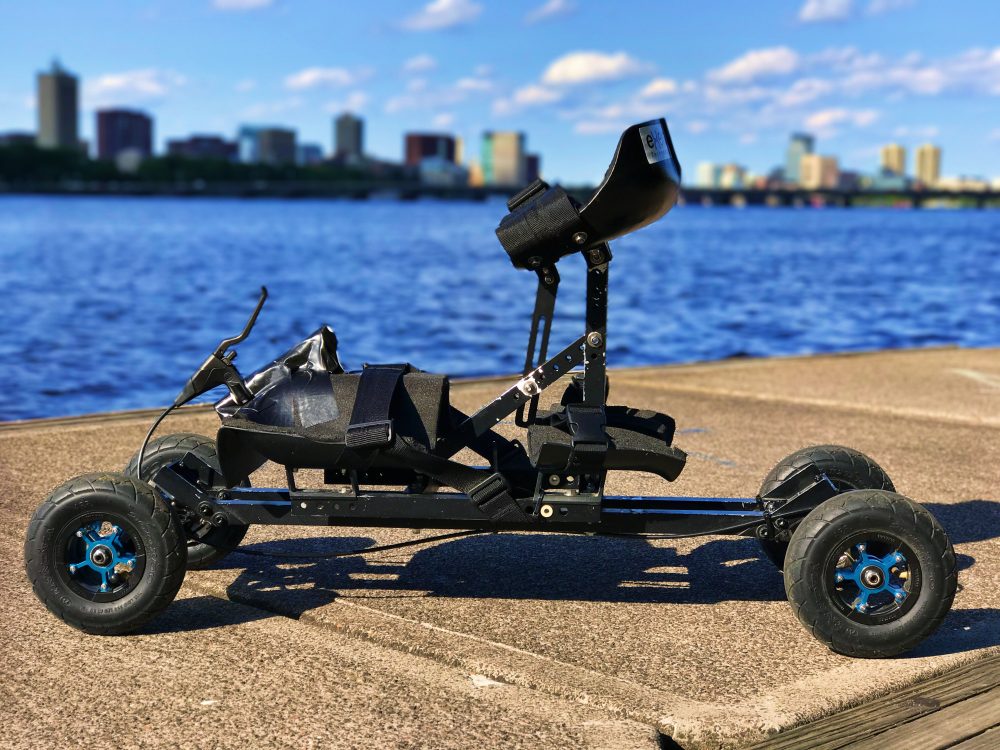
A group of five Norwegian students updated the dryland sit ski: on display is the Exero Spike prototype. (Photo: Exero Technologies)
There are ah-ha moments when an idea comes — poof — out of thin air. Then there are blunt-force type ideas, when reworking, redirecting and reconfiguring brings about the desired outcome. For five students from Norway who recently formed a start-up called Exero Technologies, there’s been a mix of ah-ha and continual reconfiguring.
The group of five Norwegians, all studying at NTNU in Trondheim, includes mechanical engineers and a civil engineer with a business background, are developing a new dryland specific sit-ski. NTNU’s Business School is part of the Norway Entrepreneurship Program (NEP), which is based at the University of Oslo. A unique aspect of the program sends approximately 150 NEP students to the United States for 10 weeks during the summer.
That’s how Nicoline Bergh, Bendik Fon and Solveig Christensen, three of the five founders of Exero Technologies, found themselves on their 10-week immersion at the Boston University (BU) Questrom School of Business. Bergh described BU as ideal for refining the group’s pitch and exposing their product to new user groups.
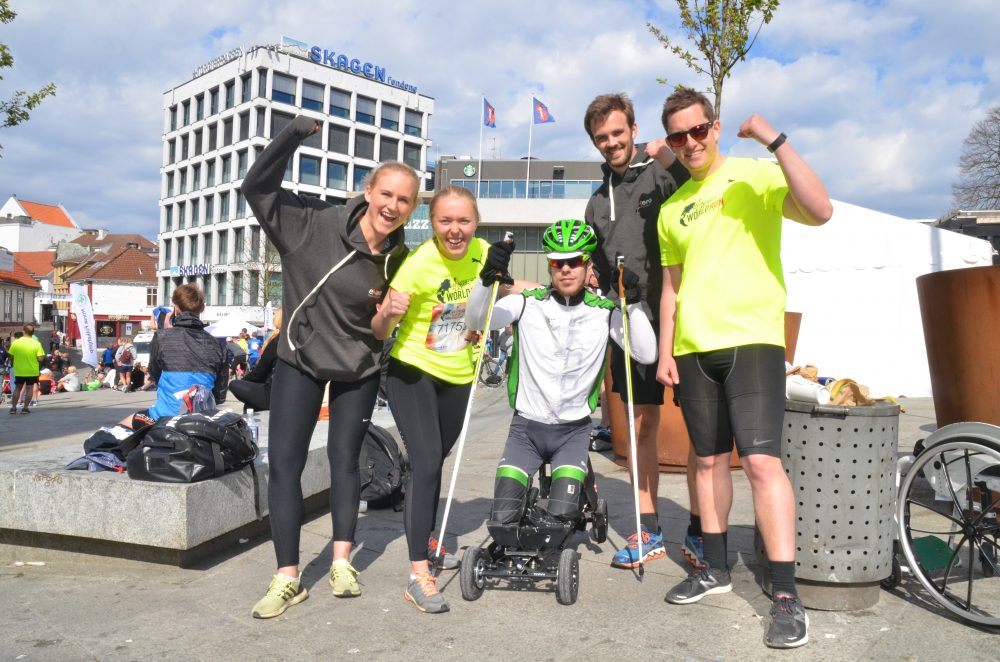
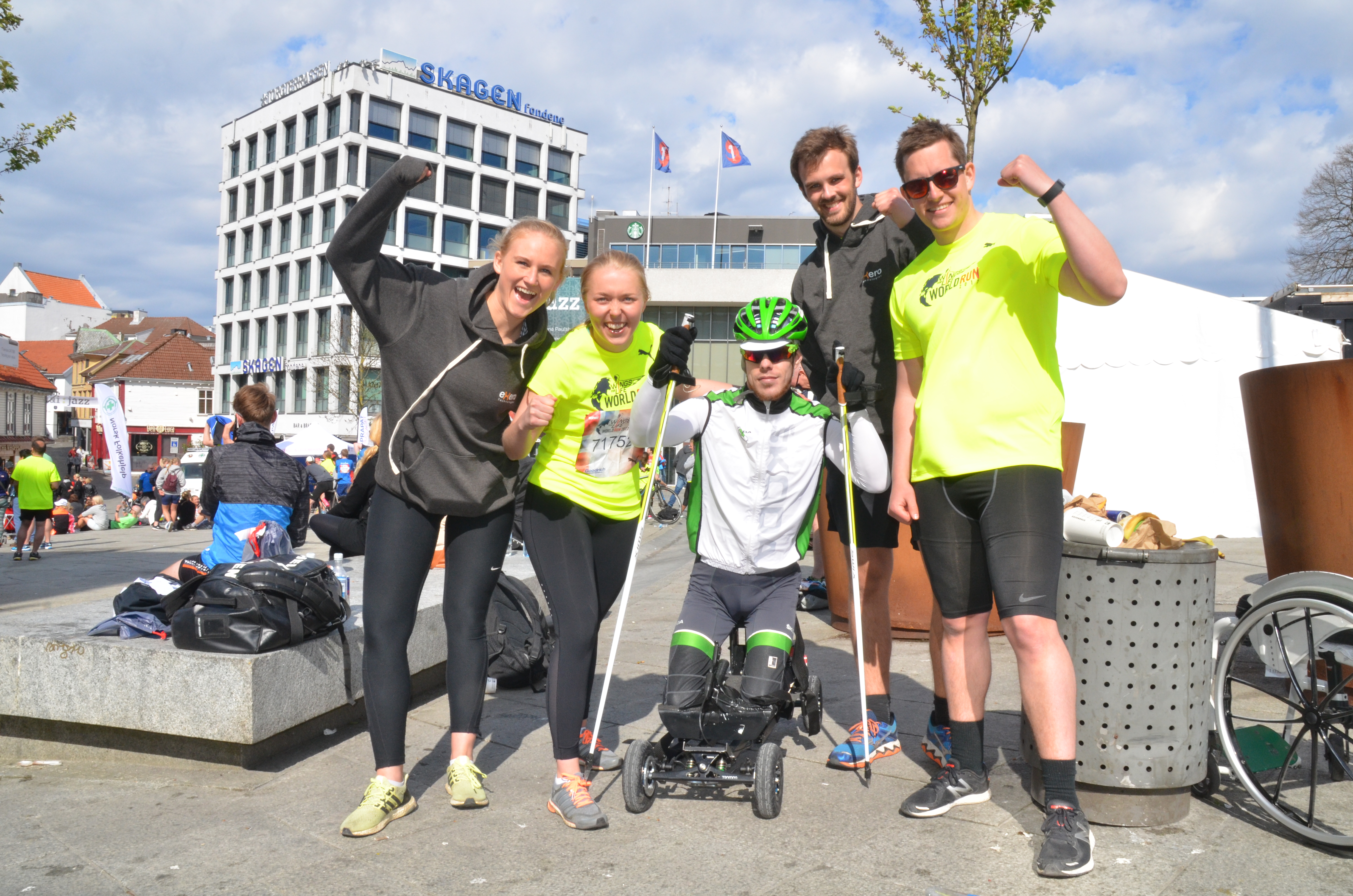
From left to right: Solveig Christensen, Nicoline Bergh, Espen Aksnes, Mathias Berg, and Bendik Fon after the Wings for Life Run in Stavanger, Norway on May 7, 2017. (Photo: Exero Technologies)
As part of NTNU’s course requirements, students must start a business.
“This project started one year ago when the three guys on our team, they studied mechanical engineering, and they began production,” Bergh said. “Initially, the mechanical engineers in the group were given a problem that was looking for new solutions: how to win more medals in the Paralympics. They were looking for new solutions to improve athlete performance … the problem was to make a new solution for the cross-country sit-ski.”
The on-snow XC sit-ski is simple yet functional. Most often the frame is aluminum or a composite with a pair of skate skis attached to the base. The athlete sits in an affixed molded seat. Forward movement is strictly a double-poling affair. Basic, light and minimalist — on-snow sit-skis have no steering or braking mechanism. In the racing scene, they are built for speed.
Like their able-bodied counterparts, para athletes train in the offseason. That requires specialized equipment. Mountain boards, a wider and longer version of their skateboard park cousins, have been the go-to platform for dryland sit-skiing.
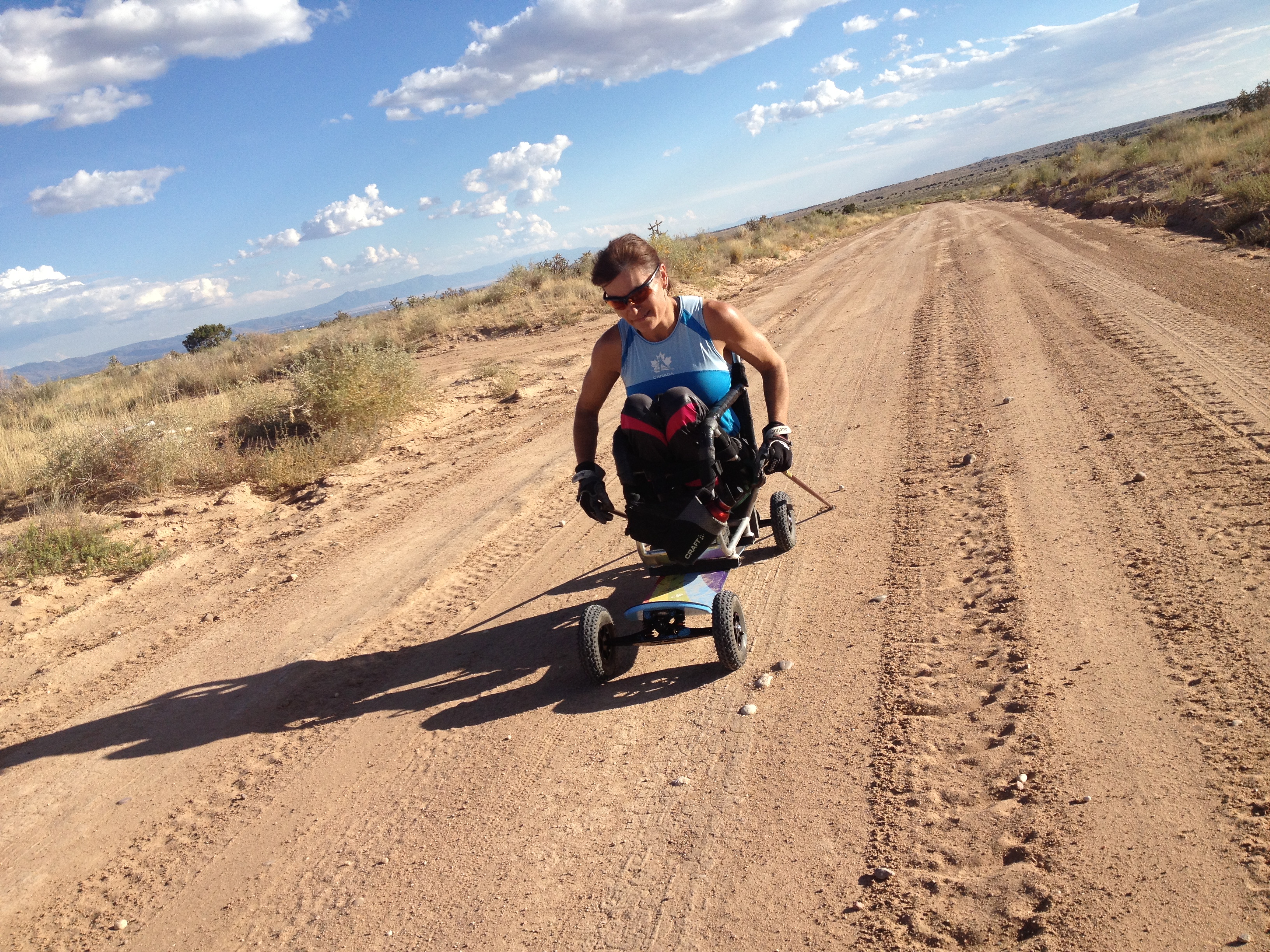
Colette Bourgonje doing some mountain-board sit-skiing during a Canadian Para-Nordic Team training camp in Arizona in 2012. (Photo: Robin McKeever)
Mountain boards feature pneumatic tires, beefier and stiffer trucks, and in some cases a hand-operated caliper brake. A molded seat is bolted to the board. And because of the single pivots on the front and rear trucks, athletes can steer by leaning their torso.
Those modified mountain boards are a manifestation of making the best with what’s available off the shelf.
That’s where Bergh says her team’s product, the Exero Spike, will make a difference. Bergh calls the Exero Spike the “total solution”. In other words, adaptive athletes will have more steering control, comfort, off- and on-road functionality, and hand-operated front-wheel disc brakes. All that amounts to better stability and possibly a potentially bigger user group, she asserted.
Beyond the one-off mountain boards made for adaptive athletes, Bergh explained that none of the comparable products in the marketplace are best serving those adaptive athletes wanting a more fluid exercise experience.
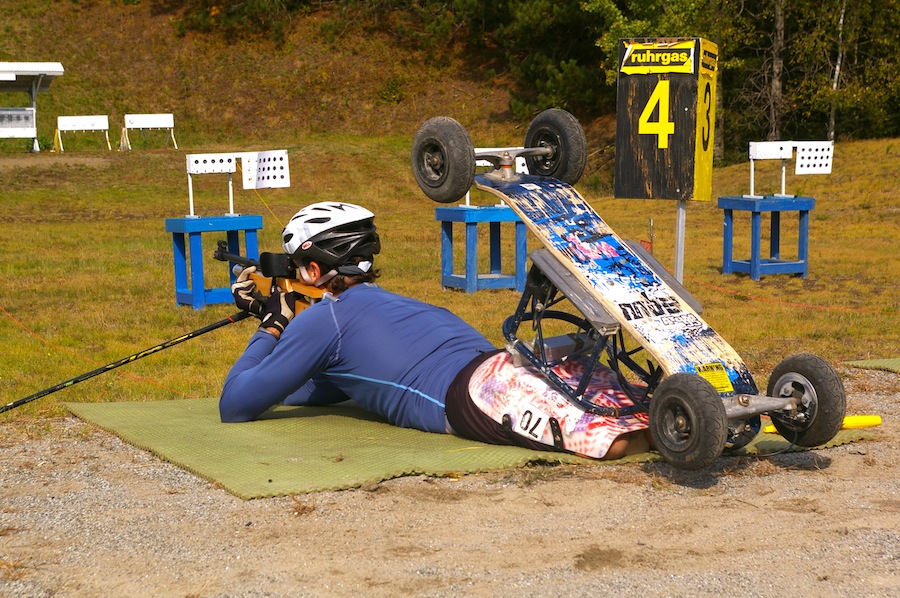
U.S. Paralympics Nordic national-team member Andy Soule works on shooting at the Mt. Van Hoevenberg biathlon range during time-trial intervals on sit-ski mountain boards in September 2012.
“Products used today are mostly hand bikes and 3 wheel wheelchairs,” Bergh wrote in an email. “The handbike is both big and heavy and often difficult to manage on your own. With a 3 wheel chair, it is difficult to both steer and make progress at the same time, as you have to use a steering wheel to change direction, forcing you to stop making forward movement at the same time.”
Bergh envisions a market for the Exero Spike well beyond adaptive snow and dryland sit-skiers.
“So far, we have looked at people with spinal-cord injuries, amputees, cerebral palsy, polio, or other muscle diseases as our primary segment,” Berg emailed. “These also the segments that we are focusing on and see as the potential users. But, as we are developing a summer sports equipment, we see that the sled we are developing can be used for more than just cross country summer training. We’ve been testing with sledge hockey players and rowers, and we’ve got the impression that the movements they’re used to are quite similar to the sled we are developing.”
Bergh and her partners foresee approximately 50,000 potential users in Scandinavia (12,000 of whom reside in Norway), and two million potential users in the U.S.
Perhaps those numbers look inflated. As medical costs increase, in cases where more exercise correlates with smaller health bills in the long term, tools like the Spike, making outdoor exercise more accessible, may make sense. According to The Centers for Disease Control and Prevention estimates, 2.2 million people in the U.S. depend on wheelchairs for mobility. Another 6.5 million require a cane, walker or crutches.
“We want to make a product, that is both fun to use, beneficial in terms of health and that looks cool,” Bergh wrote. “We want to make a product for people with disabilities that don’t have the same options to do exercising as you and me. Also, focusing on design and making a cool product, it will differ from many of the alternatives today.”
Exero Technologies remains in start-up mode. Bergh said the group has no firm price set for their initial model, which they plan to release in a year.
“The longtime goal is to make several products, making a portfolio,” Bergh wrote. “By now, we’re starting out with the current product and will develop a sled for those who need their legs straight out. I think we will wait for the users’ feedback on the first product, and then decide whether we should experiment with different materials.”
On Sept. 7, Norway’s Spare Bank 1 announced Exero Technologies had won its business innovation competition: Exero Technologies was awarded 250,000 Norwegian Krone (almost $32,000 U.S. dollars).
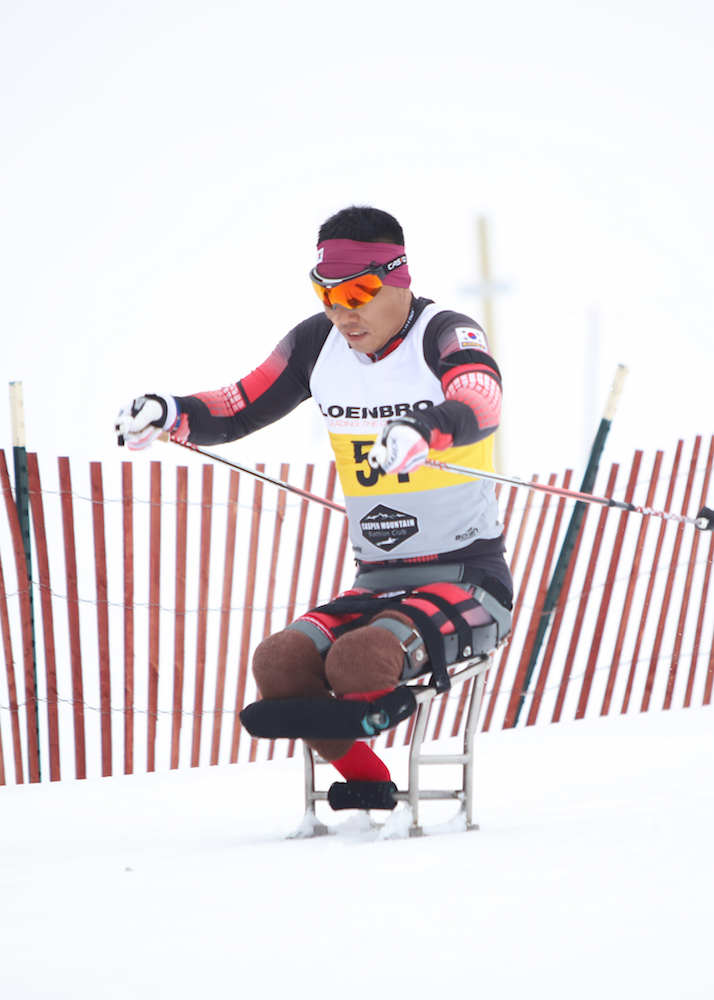
South Korea’s Eui Hyun Sin won both biathlon races at 2017 U.S. Paralympics nationals and placed third in the cross-country sprint and short-distance races in Casper, Wyo. (Photo: Pearson Photography)
For a few days at the end of January, a sea of stringed kites fills the skies of many cities in South Korea. The normally crowded streets of downtown Seoul — the country’s capital — empty and become almost devoid of people. Many of the residents are indoors with their families, or en route to the hometowns of relatives, all in order to celebrate Seollal, one of the nation’s greatest Korean holidays.
Generally spanning a period of three to five days, Seollal is observed by many citizens as a time to feast, be with family, and pay tribute to ancestral figures. Shops and businesses close, and work is waitlisted until after the festivities’ culmination.
While many enjoyed the extra days of leisure this year, one South Korean skier was itching to get back to work: Paralympian Eui Hyun Sin.
Born in Gongju, South Korea, Sin became accustomed to the savory meats and spare time that are part of the holiday’s tradition. But now, Seollal — and many of the other Korean holidays he continues to observe — are as much a celebration as they are a symbol of something he must sacrifice: time spent training.
As many of his competitors maintained a fairly consistent training plan in their preparation for this year’s 2017 World Para Nordic Skiing Championships, which took place Feb. 10-19 in Finsterau, Germany, Sin’s schedule forced him to skip a few training sessions. But that did not prevent him from medaling at the championships.
Sin, a 37-year-old sit skier who lost both his legs following a car incident, raced to a bronze in the men’s 12.5-kilometer sitting biathlon race and a silver in the men’s 15 k sitting cross-country race in Finsterau (in the LW12 category). In doing so at his first World Championships, he became the most successful in para-nordic skier in South Korea’s history.
“I was very happy, but I feel regretful at the same time, because I could not train enough because of the Korean holidays,” Sin wrote in an email, according to a team translator. “However, it means so much for me, because it was the first time for the history of Para Nordic ski of Korea.”
Along with becoming the first South Korean to medal at World Championships, Sin also won three International Paralympic Committee (IPC) World Cup races, two in Ukraine and also in the 15 k cross-country race at home in PyeongChang, South Korea, where the 2018 Winter Olympics and Paralympics will be held.
Nordic skiing is not the only realm of athletics in which Sin has made his mark. Prior to joining the Korean para-nordic ski team in 2015, he played internationally for the Korean para ice-hockey team and also competed in wheelchair basketball and para cycling at the national level. His involvement in these sports, as well as encouragement from friends, led him to turn to skiing for the past two years.
“When I was playing Hockey and Cycling constantly, one of my friends suggested me to join the Para nordic ski club,” Sin wrote.
He struggled with the decision as he had a solid job and needed to provide for his family.
“However, I thought that I am not that young and it is very special chance to participate in the Paralympics held in my own country. So, I decided to start the nordic ski,” he wrote.
He made the decision with a home Paralympics weighing heavily on his mind. And as he gears up for PyeongChang next March, he’s one of his nation’s best chances for a medal.
“The 2016/17 was the season which made me confident for the Paralympic medal,” Sin wrote. “Since there will be Paralympic Games in this season, I want to win the gold medal by training hard.”
Much of that training so far has taken place abroad. Following the last races of the season in April in Casper, Wyo., the South Korean para-nordic team planned to continue training in the U.S. until May 30.
Then Sin and the crew will make their way to PyeongChang for the month of June, followed by travel to Finland in July.
“This year, we are training with the new head coach Kaspar Wirz who is from Canada,” Sin wrote. “He has much experience and knowledge to teach, so the training is very fun. I am focusing on the skiing positions and shooting for the biathlon.”
With a full season ahead of him and a full one behind — he finished the 2016/2017 season ranked second in the overall cross-country IPC World Cup rankings — Sin is both excited about the opportunity to represent his country at home and the accomplishments he has already given to Korea.
“The highlights were the moment I won the gold medals in cross country 7.5 K and 15 K in the World Cup held in Ukraine,” Sin wrote. “The win was a big moment for me.”
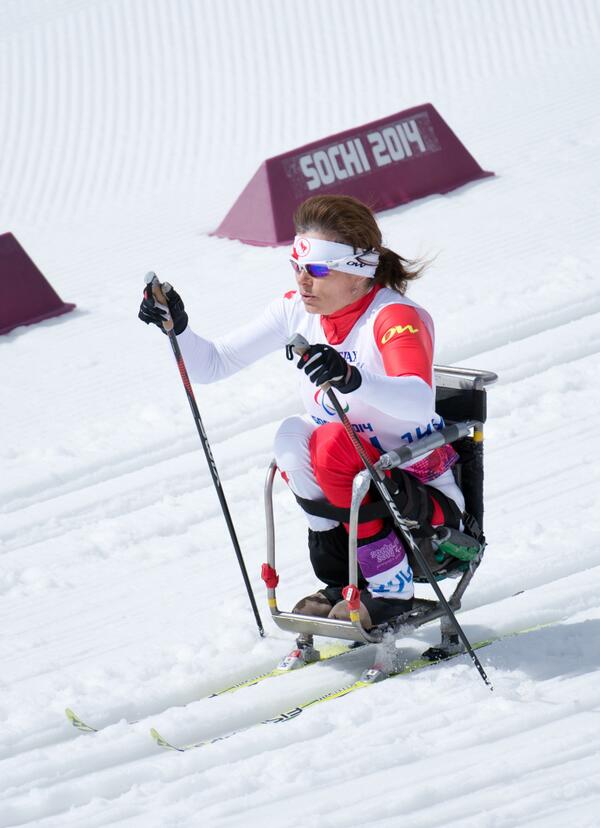
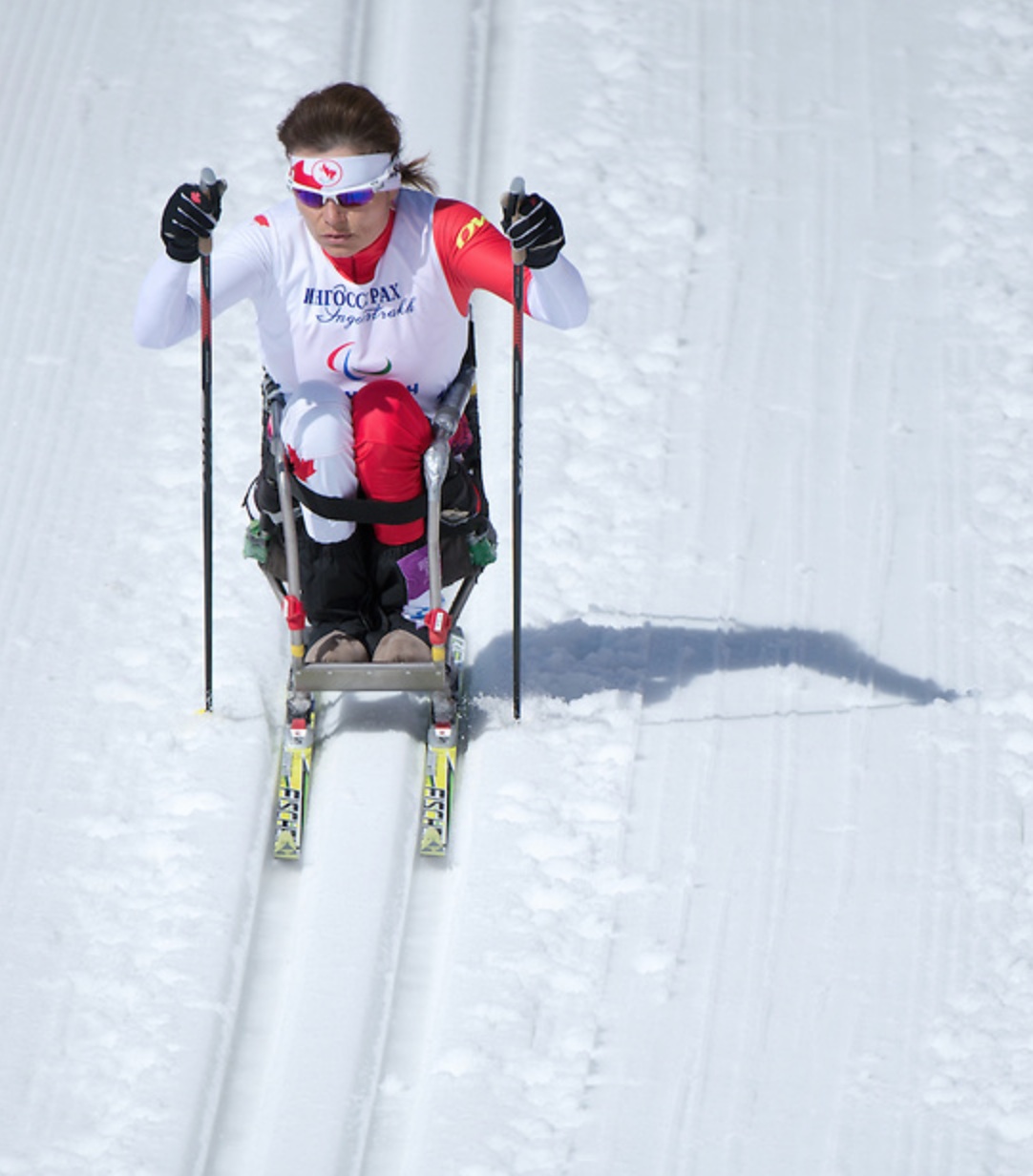
Colette Bourgonje racing at her 10th Paralympics in March, the 2014 Winter Games in Sochi, Russia. (Photo: Cross Country Canada)
Twenty-two years ago, Colette Bourgonje was a grade-school teacher with a ticket to the Albertville Paralympics in France. A Saskatchewan native, she had learned how to nordic sit ski a year earlier — all while teaching physical education in Saskatoon.
But the school wasn’t about to let her take off to compete at her first Paralympics. At the time, Bourgonje was paying her own way to do so, and since landing a temporary teaching contract in 1989, she was trying to secure more job stability.
Yet passing up the Paralympics wasn’t an option, she told herself. Bourgonje quit her job and resolved to find another one when she returned.
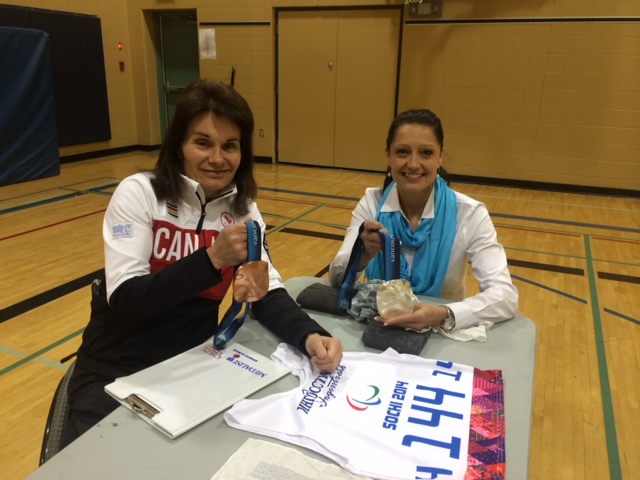
Ten-time Paralympian Colette Bourgonje (l) with Melanie Florizione, vice principal of a school in Regina, Saskatchewan, during an appearance after the Sochi Paralympics. (Courtesy photo)
A national-level cross-country runner as a teenager, Bourgonje was in a car accident her senior year, leaving her paralyzed from the waist down. Four years later in 1984, she took up wheelchair racing and became the first to graduate the University of Saskatchewan’s physical-education department in a wheelchair.
With the competitive bug back in her system, she tried sit skiing for the first time in 1991 and immediately fell in love. More similar to cross-country running than wheelchair racing, she began to work at improving in that sport as well.
After competing in Albertville in the winter of ’92, Bourgonje qualified for the Barcelona Olympics that summer. There, she won two bronze medals in wheelchair racing, and went on to claim two more bronze medals at the 1996 Atlanta Summer Games. She also raced at the 2000 Summer Olympics.
Not one to take a breather, Bourgonje became the only athlete in the world to compete in all seven Paralympic Winter Games from 1992 to 2014. She tallied six Winter Paralympic medals — three silver and three bronze — between the 1998, 2006 and 2010 Games, and went down in history as the first Canadian to win a Paralympic medal at home in Vancouver (she earned silver in the 10 k sit ski).
On the phone from her home in Prince Albert, Saskatchewan’s third largest city along the North Saskatchewan River, Bourgonje reflected on some of her career highlights in the last 24 years. At 52, she announced her retirement from the Canadian Para-Nordic Team late last month.
“Carrying the flags out in Nagano and Torino, carrying the Canadian flag out was absolutely fantastic,” she said of her flag-bearing honors. “Getting the first medal in Canada was an amazing experience. Being on the podium in that 10 k was just like, whoa. I was so happy.”
At Vancouver’s closing ceremony in 2010, she received the Whang Youn Dai Achievement Award, given to an individual at each Paralympics who has shown to conquer adversities through sporting excellence.
In her third nomination for Saskatchewan’s Female Athlete of the Year award, she won it in 2010. She remembered writing the acceptance speech, which she never expected to deliver, before a friend attended the awards ceremony for her in Saskatoon.
“I just whipped it off in five minutes really thinking I would never get that award,” she recalled. “We were in Russia and I think the other thing that happened that same week … I finally got a [World Cup] medal in Russia that was the only gold I ever won. I was just like, I cant believe this is happening! That’s why I would’ve been satisfied to say this was a great career.”
After finding success in Russia, Bourgonje decided to commit to another season through 2011 World Championships in Russia. There, she racked up another gold medal to add to her growing list, which included two overall International Paralympic Committee (IPC) World Cup victories in 1998 and 2005.
“After 2010, I did say that was going to be my last Paralympics,” she recalled.
Around that time, she asked one of her coaches, Peter Eriksson, the Athletics Canada Olympic and Paralympic head coach, how you know when you’re ready to be done. “He said you’ll know,” Bourgonje said. “And I did.”
Colette Bourgonje competes in the 5 k sitting at the 2014 Paralympic Winter Games in Sochi, Russia. (Photo: Matthew Murnaghan/Canadian Paralympic Committee)
The courses in Sochi simply weren’t for her. “It’s a great course for double amputees,” she said, with massive climbs and descents, not the kind of flowing course she favored. She had raced well at the December World Cup in Canmore, Alberta, placing fourth and fifth, but suffered from low iron and vitamin B12 levels in Sochi.
“I knew I did everything I could to be physically ready to race,” she said.
But she was tired. In three races, Bourgonje placed 13th twice (5 k and 12 k) and 16th in the sprint.
“It’s all good; it was fun,” she added.
Perhaps one of her greatest sports successes was Brittany Hudak, Bourgonje explained. Two years ago, she met Hudak, now 20, working at a local Canadian Tire in Prince Albert and persuaded her to try nordic skiing. Not exactly sure how to coach an arm amputee at the time, Bourgonje quickly became her mentor.
This past season, Hudak made her World Cup debut and qualified for the Sochi Paralympics.
“This year traveling and training with Brittany was great — it was great to see a different kind of success,” Bourgonje said. “She’s just having the time of her life.”
Without Bourgonje on the team this coming season, she said three men remain on Canada’s Para-Nordic World Cup squad and Hudak is the lone development-team member.
“She has a lot of people willing to help her,” Bourgonje explained. “I’ve been her mentor and the person she’ll come to asking questions, but she definitely has it all together and will get what she needs … I would like to see her racing in Korea [in 2018]. That would be pretty awesome.”
One of Bourgonje’s early coaches (along with Para-Nordic Head Coach Robin McKeever), Bruce Craven will continue to work with Hudak on her training plans.
“[Craven] has been providing me with programs since July of last year and still continues to write them but we are in the process of trying to get me on a yearly training plan which is different from what I did last year,” Hudak wrote in an email.
“Colette has had a huge impact on me in the sense that she was first an inspiration and a role model for me. Then she became a mentor for me which really helped me become a better skier in a short period of time.
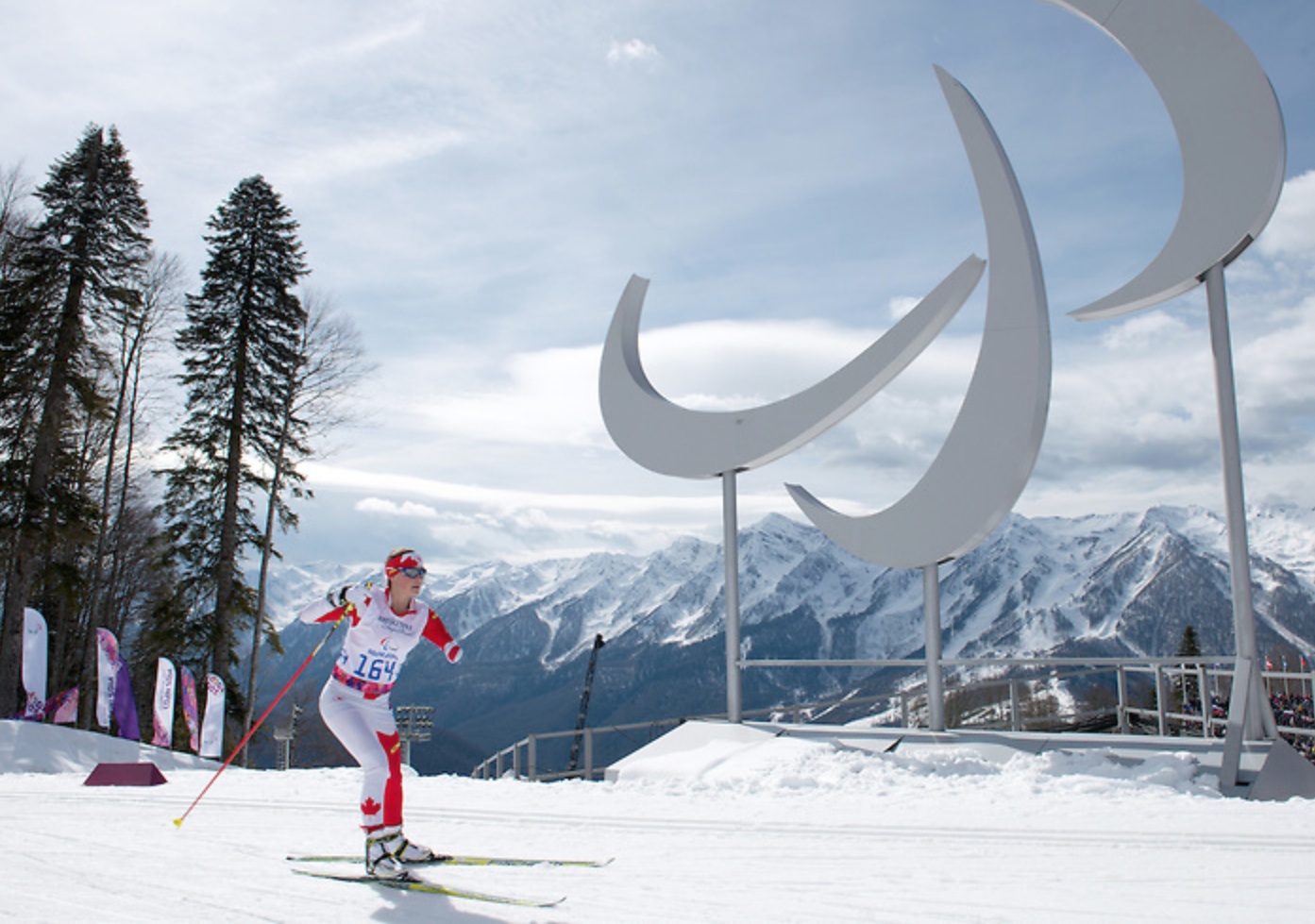
Brittany Hudak competes in the 5 k standing at the 2014 Paralympic Winter Games in Sochi, Russia. (Photo: Matthew Murnaghan/Canadian Paralympic Committee)
“Since I was new to the sport I didn’t know who I could contact to learn more about getting started in the sport so Colette helped me out a lot with the resources that were available to me and informed me of what steps I needed to take in order to get to a high performance level of sport,” she added. “Colette was also willing to chat with me at any time if I ever had questions and wanted some advice so I think she was very good with being a friend and a mentor.”
As for what Bourgonje’s up to now, she recently returned from an Olympic/Paralympic tour at schools around the province and will continue to do similar speaking appearances throughout the summer.
“The Paralympics have not really been in the forefront — every speaking opportunity I get, I say it’s a parallel event to the Olympics…” she said. “It’s picking up, but it’s not yet at an equal … [or] seen as a parallel movement yet.
“When you medal at the Paralympics, you don’t come home to $20,000 dollars for medaling,” she added. “It’s a great movement, but it’s not well known.”
Between traveling around the Canada to deliver her message, Bourgonje also wants to return to teaching. While she’s taught everything from phys ed to health, math, and science, it’s the energy of the students she’s missed. Substitute teaching could be a good remedy for that, she said.
During her full-time racing days, Bourgonje taught part time until 2008, largely paying out of pocket to compete until 2005, when Team Visa started sponsoring her. She met Canada’s carding (government-funding) criteria for wheelchair racing at the Atlanta marathon in 1996, then received assistance from Cross Country Canada for nordic in 1998 leading up to the Nagano Olympics.
“You can be carded in one sport and they give you [$]1,500 a month at that time (that was the highest funding at the time),” she explained in an email. “Carding has now increased to [$]1,800 a month to live and train on.”
Eighteen months before the 2010 Olympics, she quit her Saskatoon elementary school job and moved to Canmore for what she thought was one final push.
After the ’92 Winter and Summer Paralympics, she landed a job in Saskatoon’s recreation department. In 1994, the Burnsville school district hired her.
“I do feel that teaching part-time kept me grounded and very appreciative of what I received,” she told FasterSkier. “You know what they say whatever doesn’t kill you makes you stronger. I also loved my job and was only stressed out when I had to apply for leaves in the winter to go to compete.”
Colette Bourgonje doing some mountain-board work during a Canadian Para-Nordic Team training camp in Arizona two years ago. (Photo: Robin McKeever)
In the last couple months Bourgonje has backed off full-time training to enjoy more recreational outings — like kayaking — and said she’s looking forward to skiing in the Nisbet Provincial Forest with her partner George, who grooms the trails right out of their backyard.
“I’m really wanting to enjoy and not feel stiff and tired — no more four-hour skiing for me,” she said. “A couple hours to enjoy wherever we are absolutely [doing] … or skiing with kids.”
Last year, she met an 8-year-old boy named Tyrese, who’s missing part of his arm, while shopping for batteries for her heart-rate monitor.
“He was getting into a little red car they have set up at the mall, I asked him if he liked skiing he said he did so I asked him where his parents were,” Bourgonje recalled.
She talked to his mother, gave her a card with her contact info and asked where Tyrese went to school — just in case they forgot to get back to her. After a training camp last October, Bourgonje went to his school to see if he was still interested.
“We set him up with skis/poles but he had no boots. While we were in Canmore, the school bought boots for him,” she explained.
Later, Bourgonje brought him to ski on the trails near her house. When she returned from Russia in March, she took Tyrese and a sit-skier out on less-than-ideal conditions. But they stuck with it.
“Right now we have another 12 year old with no arms, Tyrese, Kristen, a girl in the hospital, a six year old, and a girl I am [bringing] a racing chair to today…” she wrote on Friday. “So setting up something for all of them to be active seems to be the way to go.
“[Tyrese is] a reason to stay in shape and go skiing with him and see the smile on his face,” she said. “Exercise is a lifestyle and you can’t just stop.”
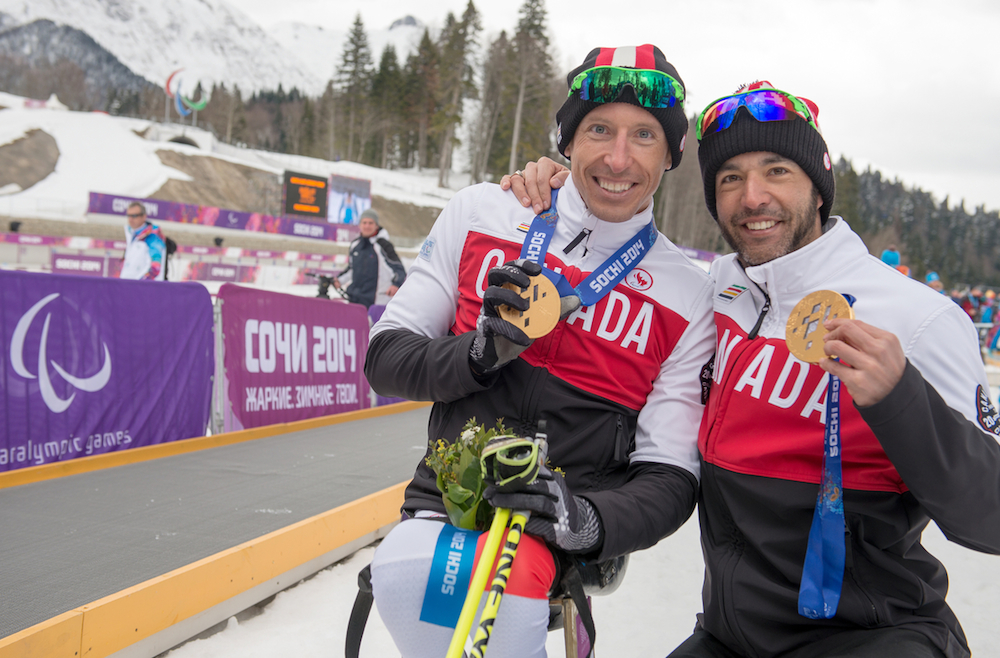
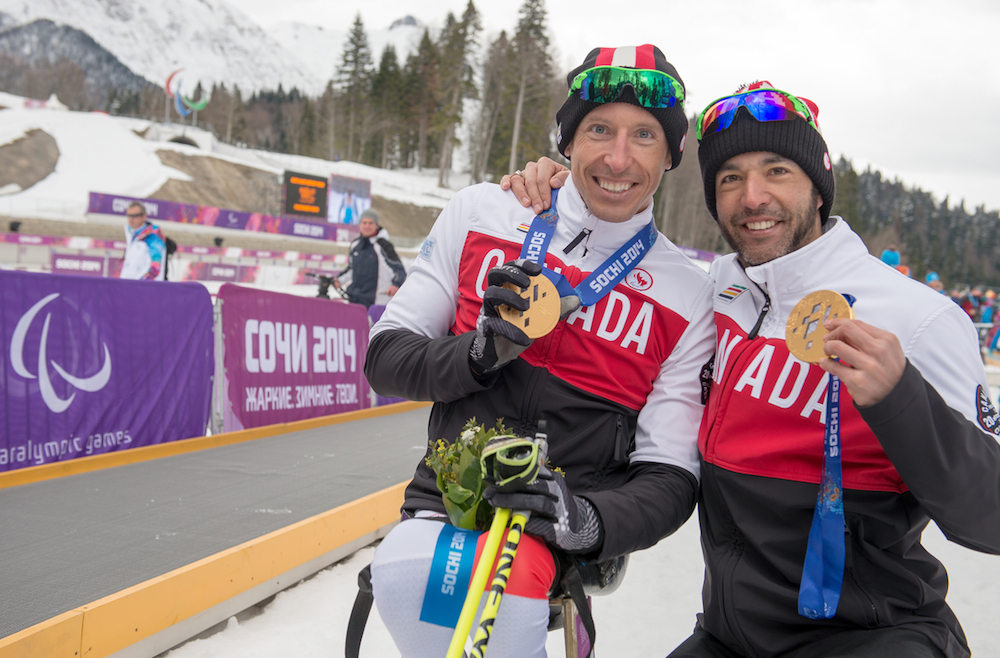
Chris Klebl (l) with his gold medal from the men’s 10 k sit ski and Brian McKeever (r) with his third gold of the week, which he won in Sunday’s 15 k visually impaired freestyle visually at the 2014 Paralympic Winter Games in Sochi, Russia. (Photo: Matthew Murnaghan/Canadian Paralympic Committee)
Canada’s Para-Nordic Ski Team wrapped up the 2014 Paralympic Winter Games in thrilling fashion with a double-gold performance in cross-country skiing on Sunday.
In two of the most challenging classifications, Chris Klebl, of Canmore, Alta., shocked the world to win the men’s 10-kilometre sit-ski race, while Brian McKeever won his third gold medal of the week in the visually impaired category.
The 42-year-old Klebl put down the performance of the Games when it counted most to win Canada its final gold medal, and secure the country its goal of finishing in the top-three in the overall medal count. Klebl clocked a time of 30 minutes, 52.0 seconds (30:52.0).
“It feels pretty good for sure,” said Klebl. “I have exceptional skis for wet, sloppy conditions and today we got exactly those conditions. It just feels good. We prepare for this over and over and over again to try and get things to line up, and today it did.”
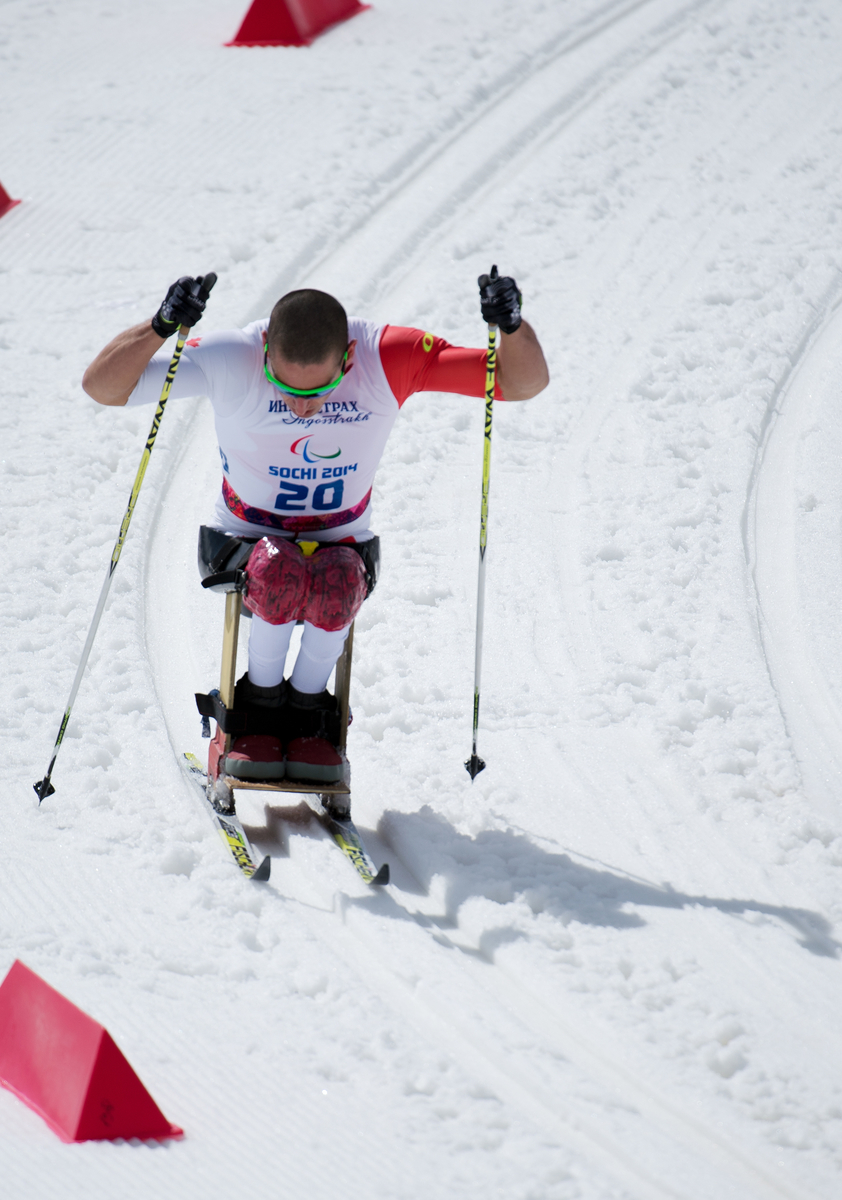
Canada’s Chris Klebl racing to gold in the last race of his third Paralympics on Sunday in the cross-country 10 k sit-ski at the 2014 Paralympic Winter Games in Sochi, Russia. (Photo: Matthew Murnaghan/Canadian Paralympic Committee)
A three-time Paralympian, Klebl moved to Canmore, Alta. to join the Canucks from the United States following the 2010 Games. He first made history as a member of the Canadian Team in 2011 by winning the World Championships in the sit-ski distance race.
Klebl, who grew up in Austria where he skied and snowboarded, became paralyzed from the waist down in 1995 in a snowboarding accident.
Sunday’s victory was particularly important as Canada was in a fight for third spot in the overall Paralympic gold medal count with the Ukraines with the final sit-ski race remaining.
Klebl held off the Ukraine’s Maksym Yarovyi, who finished second at 31:06.5. Russia’s Grigory Murygin skied to the bronze at 31:18.2.
“It means a tonne to me to contribute to Canada’s medal count,” said Klebl. “Four years ago I made a major decision to move to Canada, and Cross Country Canada and the Own the Podium program have backed me since. I just wanted to pay them back.”
While Klebl grabbed Canada’s final gold medal at the 2014 Games, it was Brian McKeever who secured the nation its first. On Sunday the legendary Paralympian was at it again.
Battling race fatigue and strong headwinds, the 34-year-old McKeever utilized a two-guide strategy with Erik Carleton and Graham Nishikawa, for the second time this week to gut out an impressive come-from-behind victory. Team McKeever posted a time of 23 minutes, 18.1 seconds in the men’s 10-kilometre skate-ski visually impaired category.
“That one was tough. It hurt,” said McKeever. “I woke up this morning and didn’t feel great. It was all on the guides again today. They did such a good job with the headwind. I was able to tuck in behind them and save a lot of energy. By the time we got to the last lap there was still a little gas left to get us by today.”
Outside of sprint racing, it was the smallest margin of victory at a Paralympic Winter Games for McKeever, winning by just eight seconds.
Russia’s Stanislav Chokhlaev skied to the silver at 23:25.1, while Thomas Clarion, of France, rounded out the podium in third with a time of 24:14.9.
The Canadians leveraged a two-guide race strategy to pull McKeever to the top of the podium.
The 36-year-old Carleton, of Canmore, Alta., led the way around the first 6.5-kilometres before coach Robin McKeever called in Graham Nishikawa, of Whitehorse, to pull him into the winner’s circle. McKeever was behind 12 seconds at the five-kilometre mark in the race.
“Having guided for 10 years I know how incredibly hard it is to do this job in the wind,” said Robin McKeever, head coach, Canadian Para-Nordic Ski Team, who led his brother to 10 Paralympic podiums. “It is like a tow truck pulling a Ferrari out there in the wind.
“For the guide, it is like doing a one-kilometre sprint race just to stay ahead of Brian. But the problem is you have to keep that pace for nine more kilometres. It is so difficult.”
“Having guided for 10 years I know how incredibly hard it is to do this job in the wind. It is like a tow truck pulling a Ferrari out there in the wind.” — Robin McKeever, Canadian Para-Nordic Ski Team Head Coach and former guide for his brother, Brian McKeever
Consummate team players, Carleton and Nishikawa shared the workload and trips to the podium this week to help McKeever accomplish his goal of a golden hat-trick.
“It is so tough out there and I’m thankful Graham was here to help us out and get the job done,” said Carleton. “I went hard off the start and just tried to hang on.”
“Brian is just such an incredible athlete so it is very difficult to stay ahead of him,” added Nishikawa. “This whole week has been such an awesome experience. I’ve been so impressed with everything, and of course I’d love to be back again.”
The victories bring McKeever’s Paralympic gold medal count to 10, making him the only winter Paralympian to reach double digits. He has a total of 13 Paralympic medals.
“The medals this week were very special,” said McKeever. “The way we did it was such a team effort. Both guides gave me a solid draft all week, which made a huge difference in the conditions. We orchestrated a great team effort and that makes it so special to me.”
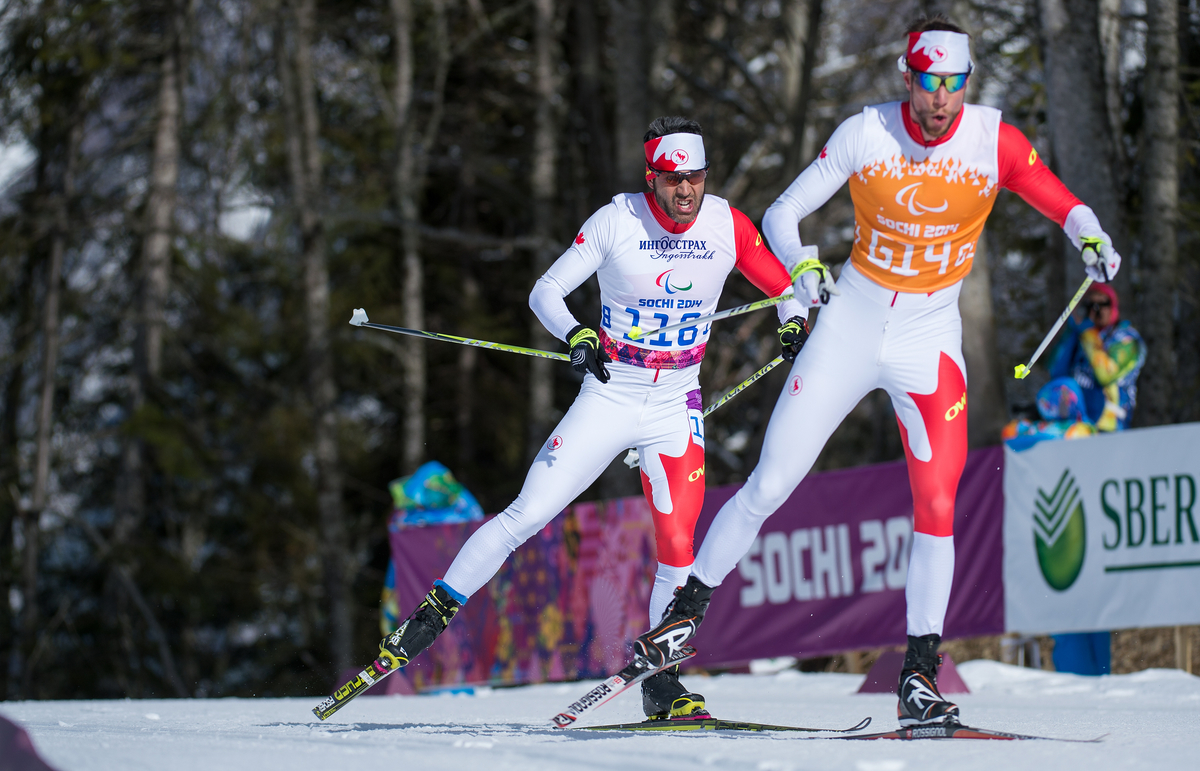
Brian McKeever and his guide Erik Carleton race to McKeever’s third gold of the week, and Carleton’s second, in Sunday’s cross-country 10 k visually impaired freestyle race on the last day of the 2014 Paralympic Winter Games in Sochi, Russia. (Photo: Matthew Murnaghan/Canadian Paralympic Committee)
Other Canadian results on Sunday included: Mark Arendz (Hartsville, P.E.I.) in 11th at 25:16.4; and Louis Fortin (Fredericton, N.B) 36th at 32:58.8 in the men’s 10-kilometre standing race. Brittany Hudak, of Prince Albert, Sask., was 12th at 15:35.0, and Ottawa’s Caroline Bisson 16th at 16:55.2 in the women’s five-kilometre standing category.
Robbi Weldon (Thuder Bay, Ont,) and her guide Phil Wood (Canmore, Alta.) were seventh at 15:32.5, while Ottawa’s Margarita Gourbonova and her guide of Regina’s Andrea Bundon were eighth at 15:42.2 in the women’s five-kilometre visually impaired race. Saskatoon’s Colette Bourgonje was 13th in women’s five-kilometre sit-skiing at 18:13.0. Yves Bourque, of Becancour, Que., was 24th at 39:11.5, and Quebec City’s Sebastien Fortier was 26th (40:03.4) in the men’s 10-kilometre sit-ski race.
In addition to McKeever and Klebl’s four golds, Canada’s Para-Nordic squad will leave Sochi with six medals. Mark Arendz also won a silver and one bronze in biathlon racing.
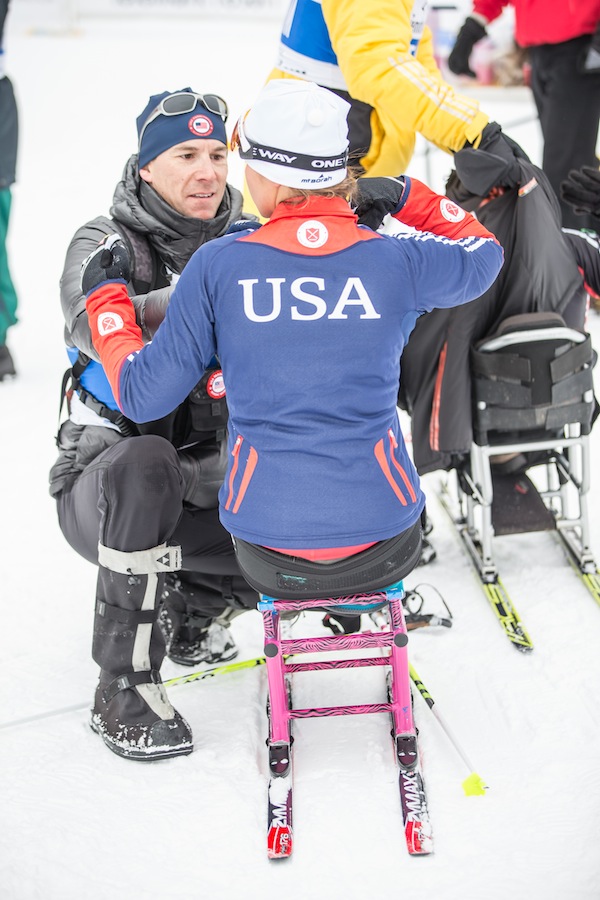
John Farra, high-performance director of the U.S. Paralympics Nordic Program, helps one of his athletes at last year’s IPC World Cup in Cable, Wis. (Photo: U.S. Paralympics/James Netz)
At the 2010 Winter Paralympic Games in Vancouver, B.C., the U.S. finished fifth in the overall medal count. A dominant performance by the U.S. alpine team resulted 11 medals, three of them gold.
Meanwhile, the U.S. Olympic nordic team, including biathlon, consisted of just six athletes and a handful of coaches and support staff. Albeit small, the team was not without success. Andy Soule, an Afghanistan war veteran and double above-the-knee amputee, made history by becoming the first American to medal in biathlon in either Paralympic or Olympic competition.
At the 2014 Paralympics in Sochi, Russia, nordic skiing and biathlon will account more that half of the available medals. To improve overall team results, the U.S. Olympic Committee realized that the U.S. needed more focus on these sports.
In 2011, John Farra, an Olympic cross-country skier and then-U.S. Ski and Snowboard Association (USSA) nordic director, was the man selected as the first high-performance director of the U.S. Paralympics Nordic Program. Today, he leads a team of coaches and staff responsible for building a world-class program.
U.S. Paralympics national-team member Dan Cnossen at the 2013 IPC World Cup in Cable, Wis. (Photo: U.S Paralympics/James Netz)
In a recent phone interview, Farra cited growth in the sport as evidence that the U.S. is on its way to that goal. At the Sochi Paralympics in March, Farra will field a team of 19 athletes, four coaches and 13 support staff. The Russians will max out at the allotted team size of 30 athletes, a goal that Farra has set for his team size for 2018 Winter Games in Pyeongchang, South Korea.
Assessing the team’s prospects for Sochi, Farra said, “On the men’s side, we have three guys who, on any given day, can be somewhere in the top six in the world.”
In a test event in Sochi last March, Dan Cnossen, Soule and Sean Halsted finished fourth, fifth and sixth, respectively. One of the newest and most promising men on the national team, Farra described Cnossen as “a really tough guy who trains unbelievably professionally and really puts everything towards it.”
“While we are not expected to win any medals, when we are that close we are spending a lot of time and effort to find that extra half percent or 1 percent,” Farra said. “That gets them into the top three to steal a medal from the Russians or the Ukrainians.”
On the women’s side, Farra saw potential when he spoke with Tatyana McFadden a year and a half ago. A world-class wheelchair racer with nine gold medals between several Paralympics and World Championships, McFadden expressed interest in competitive nordic skiing. On Nov. 3, the 24-year-old University of Illinois student completed an unprecedented marathon “Grand Slam,” winning the Boston, Chicago, London, and New York road marathons in a single year.
A multiple ESPY Award (ESPN) nominee, McFadden’s celebrity status is steadily rising, and she was twice featured on the NBC Nightly News for her New York City win. Her sponsor, British Petroleum featured her in its TV promotional spots, and in other positive news, NBC announced it will provide a landmark 100 hours of television coverage for the Winter Paralympics.
“Next year when the Games are on you’ll be seeing national TV spots featuring Tatyana McFadden sit skiing and Olympian Kikkan Randall skiing,” Farra said.
Adding to McFadden’s media appeal is her storyline of returning to Russia to where she was born with spina bifida, a birth defect in which bones fails to form properly around the spinal cord. Abandoned in a Russian orphanage, she was adopted by Deborah McFadden and brought to the U.S. at age 6. Since 2012, Tatyana has actively advocated against a Russian law that prevents Americans from adopting Russian children.
“We hope she continues to have a good experience [with skiing] and that will drive some interest to our sport,” Farra said. “She has more fans than we’ll ever have, but our job is to not let it become a distraction and to prepare her with the technical skills to get around the course. She’s a good gal and it’s really fun to have her on the team.”
On McFadden’s chances for a medal in Sochi, Farra said, “Who knows? She is super strong and unbelievably fit. She has the most important part of nordic skiing down which is the fitness, and that’s impossible to fake. Technical skills will be an issue for her because her racing wheelchair doesn’t slide around corners and have the potential of going off the course and crashing into trees. It would be a huge challenge for anyone to go from newbie to Paralympic athlete in such a short period of time.”
McFadden first demonstrated her potential by winning the sprint race at last year’s U.S. Adaptive Cross Country Championships at Soldier Hollow last year in a borrowed and somewhat ill-fitting sit ski. After, Farra contacted a Japanese company that makes sit skis designed to accommodate McFadden’s more forward-leaning position in wheelchair racing.
“As soon as she slipped in there, and I mean slipped in there because it’s a tight fit, she got this big smile on her face,” he said. “We’ll see how it works out because her first race in it will be at the IPC [International Paralympic Committee] World Cup races in Canmore in December.”
Wheelchair-racing superstar Tatyana McFadden at her first IPC World Cup races in Cable, Wis., last season. (Photo: U.S. Paralympics/James Netz)
In addition to finalizing the team at World Cup and National Championship races this season, Farra’s strategy is to use these races to get his staff ready for Sochi.
“We plan to bring a large team and the entire Sochi staff to Canmore [in December] because we’ve had a huge transition from being a country that shows up with only a few athletes,” he said of the early season World Cups. “We need to make sure we protect the chances of our top athletes to steal a medal and give the appropriate level of service to those developing athletes who are experiencing their first Paralympics. We’re looking forward to getting all those things dialed in.”
Nationals are held alongside the able-bodied U.S. Cross Country Championships at Soldier Hollow in January, followed by World Cup races in Oberstdorf, Germany.
In October, national-team coach James Upham accompanied four sit-skiers – Cnossen, Soule, Halsted, and Oksana Masters – at a U.S. Paralympics Nordic camp in Oberhof, Germany. It was the team’s first training camp in the ski tunnel there.
According to Farra, they’ll take six or seven athletes to Oberstdorf for the World Cup races from January 16-19.
“We’re going to bring a small elite group … who we feel need to be there to dial in their chances of winning medals in Sochi,” Farra said. “After Germany the team will hole up in Winter Park Colorado which will be good in terms of an altitude strategy. After that, we’ll head to Italy a week before the games and stay at a beautiful five-star resort on the top of a mountain with ski in ski out and a biathlon range, to relax a bit and get used to the time change before flying to Sochi.
“And that’s it,” he added. “We’ll be there and then we’ll be back here in March after we win a bunch of medals. Then we’ll come home and hang them up and enjoy them!”
***
About the Author:
FasterSkier’s Para-Nordic contributor, Mark Vosburgh lives in Missoula, Mont., where he works as a Wildfire Scientist for the US Forest Service. In addition to being a chemical engineer, Mark is a cross -country and backcountry skier, bluegrass musician, and biker. He’s also a freelance writer for numerous publications, including 48 Degrees North and MakeitMissoula.com.
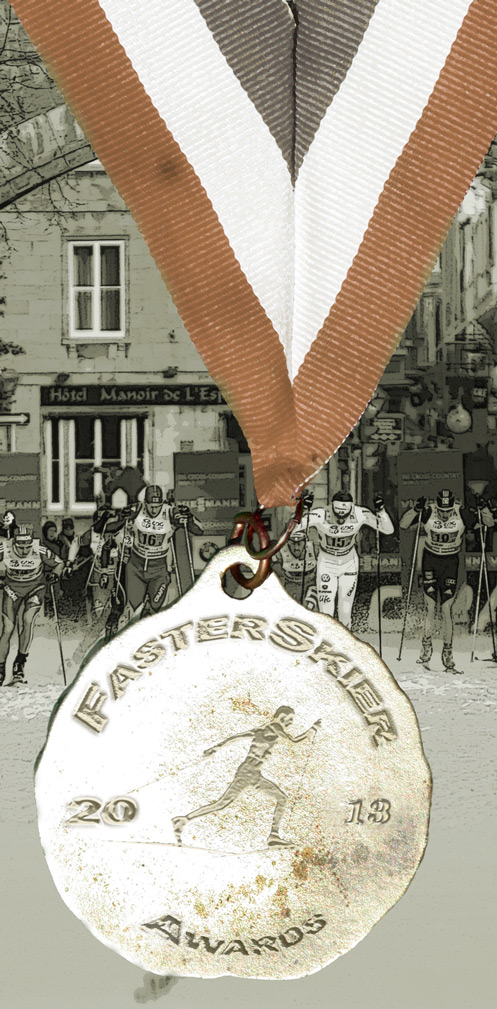
Canadian Para-Nordic World Cup skiers Colette Bourgonje and Brian McKeever are FasterSkier’s Adaptive Skiers of the Year. (Photos: James Netz/CCC & Gerry Furseth)
Brian McKeever is one of those guys that seem to keep getting better with time. At 33, Canada’s Para-Nordic World Cup visually impaired skier once again dominated the International Paralympic Committee (IPC) World Cup scene last season, winning every IPC cross-country event he participated in.
With guide Erik Carleton, McKeever tallied two golds at 2013 World Championships in Solleftea, Sweden, and two more at World Cup Finals in Sochi, Russia.
“I don’t think the guides get nearly as much recognition as they should,” McKeever told Cross Country Canada in February. “It is tough being the guide because you are out front and not skiing your own race. … When I need him to hold off he has to, and when I need him to increase the pace he needs to do that as well.”
McKeever (r) and guide Erik Carleton celebrate their 2011 World Championships gold. (Photo: IPC)
Childhood friends from Calgary, the duo didn’t waste any time getting from their last World Cup Finals race in Sochi to Whistler, British Columbia. There, McKeever captured his first national title in the 10-kilometer freestyle on March 24, just four days after racing in Russia.
“You never really know how you are going to feel after getting off the plane from Russia,” McKeever told FasterSkier after arriving two days earlier. “First national championship win in my career, I am really happy about that.”
To start the season, both McKeever and Carleton individually qualified for the able-bodied World Cup races in Canmore, Alberta. They decided to skip the opening IPC World Cups to compete in Canmore, where McKeever notched a career-best 38th in the skiathlon in mid-December.
In February, the 10-time Paralympic medalist double poled the entire Canadian Birkebeiner 55 k classic in Edmonton, Alberta, and won by nearly three minutes. Carleton, 35, placed second.
McKeever took on the Vasaloppet 90 k classic in early March for the second-straight year, finishing 45th overall – a vast improvement from 83rd in 2012.
Another 10-time Paralympic medalist, Canada’s veteran sit-skier Colette Bourgonje, 51, isn’t showing signs of slowing down before the 2014 Winter Games (which will be her seventh Paralympics). In January, she raced to silver and bronze at the IPC World Cup in Cable, Wis., and went on to place eighth at World Championships and sixth at World Cup Finals. Bourgonje landed fifth overall in the IPC World Cup.
Honorable Mention:
Canadian Para-Nordic World Cup member Mark Arendz (c) tops the podium for the first time at 2013 IPC Biathlon World Championships in Solleftea, Sweden. (Photo: CCC)
Further proving the depth of Canada’s Para-Nordic team, 22-year-old Mark Arendz won his first IPC Biathlon World Championships gold in February in the 7.5 k sprint. Also in Solleftea, Arendz claimed bronze in the 12.5 and 15 k distance races and finished eighth overall in the World Cup.
After trying out sit skiing for the first time at U.S. Nationals in January, Tatyana McFadden went on to represent the U.S. at the IPC World Cup in Cable, where she finished right behind Bourgonje in two races in fourth and fifth, respectively. Her results were hardly a surprise; the 24-year-old University of Illinois student has 10 Paralympic medals in wheelchair racing and at least six marathon titles (including one in Boston and other in London this month). Despite a late start, she ranked 14th in the overall World Cup.
Sean Halsted trails Dan Cnossen in the 12 k sit ski at 2012 U.S. Nationals in Rumford, Maine.
With the 2012 Paralympics starting in London in roughly a month, adaptive athletes who compete in summer sports are putting the finishing touches on their trainings. And winter athletes, too, are hard at work, training just as intensely as their able-bodied counterparts, if a little bit differently.
This spring in Bend, Oregon, FasterSkier chatted with Sean Halsted, a veteran member of the U.S. national team who finished seventh, ninth, and tenth in the sit-ski races at the Vancouver Paralympics. A college rower at Washington State who went on to join the Air Force, Halsted fell from a helicopter in 1998 and was paralyzed from the waist down. He started skiing in 2001 and is now one of he team’s stalwarts.
It’s no secret that sit skiers need an efficient and powerful double pole to get around a race course – and then best move very, very fast (in 2011, FasterSkier posted a video of Halsted starting U.S. Nationals). But besides adapting technique to best accommodate the different angle with which they plant their poles, adaptive athletes are also challenged by coming up with a training plan that prepares them physiologically without wearing out a few key sets of muscles.
The following is an edited excerpt from a longer interview.
FasterSkier: Do you do the same kind of periodization that the able-bodied skiers do throughout the year?
Sean Halsted: Yes. And the interesting part is trying to mirror that on the adaptive side, with how much volume is good volume is good volume, how much strength is good strength. For example, we’re talking about doing a great workout, but then you need to do an alternate workout [in the afternoon] using the same muscles? You can’t go for a run. You can’t switch it up to do the lower body. It’s all upper body.
FS: What’s a typical workout for you guys in the spring here in Bend?
SH: Out here, we try to get on snow and maximize that snow time. There’s a lot of that technique that you have to get down, and a lot of us just don’t have it. It’s not so much – I’d like to say that standing on skis is a lot harder than a sit ski, but there’s things about that sit ski that are harder than standing. And I think part of what that comes down to is the frustration level, in that you see a hill, and my hill is nowhere near what a standup skier thinks of as a hill. Turns, a standup skier doesn’t even think of it as a turn, but I think of it as a challenge. So you have to be comfortable with how that ski works on a downhill, on an uphill, what does the pole plant mean, you have to have a much more efficient double pole than a standup skier could get by with.
FS: So you’re just trying to get as many hours on snow as you can?
SH: Pretty much. You’re trying to maximize that with your strength workouts and your endurance workouts. You’re trying to do it on snow, and then saying, okay, you just did a strength workout, do you have enough strength in your arms to do something in the gym?
FS: If you’re skiing a lot in the mornings, what do you do in the afternoons?
SH: It’s been nice because the Athletic Club of Bend has opened their doors for us, and they have also been very accommodating. You basically go in and they ask what you want, and they try to make it happen, which is really cool. We’ve been at places before where the place wants to be accommodating, but how? They don’t know what you need, so they just wait for you to ask, and you don’t know what they have to offer. Maybe it’s a hotel and they say they have a weight room, but their weights are ten pounds and the room is the size of a closet.
So having the gym in town, they have a big weight room, they have cardio stuff that we can use, they have a SkiErg. It just gives you so many opportunities. They have tennis courts, even. Not that we’d play tennis, but it’s a big flat surface that you can use, and that you can’t really replicate anywhere else. They have a pool, which is what I’ve found is one of the best cross-training things. I’ve really fallen in love with swimming.
FS: So is it just based on how you feel each afternoon, you have to figure out what your body is capable of doing?
SH: They give us a schedule, and then you do a little bit of, “what can I do?” Yesterday was an alternate workout, just an easy workout, something. So I went in and went swimming. And then I meandered and saw what was available, and did some stretching.
FS: It sounds like the coaches aren’t always telling you exactly what to do – like you have to make some of those decisions yourself.
SH: Since I started [with the national team] in 2006, we have gone through three different coaching staffs, so each time they have to be introduced to what adaptive sport is. You think you can just take a coach from anywhere, and it doesn’t always work that way. There’s a lot of figuring out that goes along with this and what is expected of you is very vague. As an athlete you get vague feedback, and you’ve got to be able to find a way to stay in a positive place, not just a positive attitude but positive towards success, towards exertion and all this, so that you are doing the right thing at the right time, and not overexerting yourself or underexerting yourself.
FS: Do you feel like doing it since 2006 is long enough that you can do that for yourself?
SH: It’s still a challenge. You find enough that you now know that you don’t know anything, whereas before you were just basically ignorant, but you didn’t know it. But I think I do have a pretty good handle on a lot of stuff and what needs to be done. Having said that, there have been people on the team who just have that brain for the physiology that just puts me to shame. So I don’t want to say that I have bested them by any stretch of the imagination.
FS: What was your athletic background before you picked up adaptive skiing?
SH: In high school, I joined the cross country team to get myself in shape for soccer, and that’s what I ended up focusing on, cross country and track. And in college, I was a lightweight rower. When I joined the Air Force I went into a career field where we had to be selected. So it’s interesting to go from the performances with cross country where it’s still exertion, but it’s for a finite amount of time, and rowing the same sort of thing, to the Air Force where you have to extend that exertion over a much longer period of time, so you cannot do a max effort, but there’s no water breaks…. it’s a different kind of exertion.
FS: Does that help you mentally in skiing?
SH: Yes. Oh yes. And I’ve seen that in some of the athletes that we’ve tried to recruit, where they’re like, “oh, I gave it my all,” and, no, not so much. But it’s not their fault. They grew up differently. Some of the kids who have grown up with a disability have never been challenged because they have never been given the opportunity to be challenged. They don’t have any equals.
So I do think I have a good concept for it, and obviously there are people who have a stronger sense of competition and always have to be first. There were a couple guys on the team who retired in the last two years who were like that, they had to be first for everything. I wasn’t like that. But I loved being with them, and I liked being on their coattails, and pushing them and having them push me.
FS: Can you use a rowing ergometer?
SH: We can, depending on our level of injury. Most of us can, but we’re doing arms-only. For me, it’s very frustrating as a rower. It’s one of the reasons that I’m not rowing. People keep asking me, well why didn’t you go into adaptive rowing? It’s because I know what I can do, and I can’t do that anymore. But it’s still an alternative workout, so you’re using other muscles.
You wish – people are on bikes, and you want to jump in with them, but you can’t. You want to go play basketball, and you can, but it’s totally different in the chair. One guy on the team wanted to play ultimate Frisbee, and it seemed awesome, but you can’t use a chair in the grass. We could play on the tennis courts, but the other thing we have to watch out for is that our everyday chairs are not designed for sport. So we can have some very big spills. We could be dumping ourselves out of our chairs, and the last thing you want to do is break your chair.
FS: Coming from being a lightweight rower, you must have had to bulk up a lot to do this, huh?
SH: Actually no. But I am allowed to eat, which is different! It’s kind of a similar body mass. The difference is that we did a lot more squats, and now it’s all upper body.
FS: Do you do weights?
SH: Yeah. We try to do as much as we can. And that depends on what equipment is available that allows you to do those things. Can your chair fit into that frame or rack or apparatus? And then for a lot of us, it has to do with the ability to transfer [in and out of the chair] or not. It limits some people – they might have an athletic mind, but because their body makes it so hard to get around, they can’t attain the level that they could be.
We try to work a lot on the lats and that pulling motion, without overdoing the muscle on one side. Dips are a good example. You can’t just go to a dip bar because a lot of us can’t stand, so how do you get up to a dip bar? And then you’re up there, but you’re maxing out, so finding those machines that allow you to do those things is important. It’s fun… you don’t want to be the guy who’s saying “I can’t do that.” You’ve got to have an open mind about how to do as close to an exercise as possible. That’s what having coaches helps you with – you can easily shut yourself down, or go on the wrong track because you’re sure that something is great for you, even when really it’s not. They can help with finding the things that will work, and then are you doing them correctly. So finding something that mimics a pull up, or working on curls to counteract all of those triceps and the pulling down and a way motions. Plus we try to focus on the core.
FS: Yes, I assume that would be really important.
SH: For some of us, it’s really easy to say, okay, well I don’t have any core so I can’t use it. And that’s true, but, you have something. What we need to do is to get your brain to stop thinking and just start reacting. So all these balance things, like the balance ball and stuff like that are actually pretty good because it makes you do stuff that you don’t think you can do. Or you’re firing a muscle that you don’t think will help, like one that’s way up high on your stomach, and it can be doing the job of the one down below that you don’t have.
FS: So you’re creating new ways to achieve the same thing.
SH: It’s amazing – that’s one of the things that blew my mind. You’re watching guys that have a higher level injury, so theyir function is a lot less, maybe where they’re neurologically functional is right below the chest line, so they have no abs whatsoever, but they’re on their ski doing stuff that you never thought you could do, and you have abs.
A really good exercise for us is kayaking, actually. It teaches you about the core, and you’re going, I have to stay up because I don’t want to get wet, so you’ll do whatever it takes to stay up. And then next thing you know you’re firing muscles that you didn’t know about.
FS: That’s a cool idea for motivation.
SH: You can throw a ball at somebody, and they’ll say, well, I’m just not going to catch it. It will bounce off the wall. But in a kayak, they can’t just say no.
FS: It seems like a lot of the training is very individual for each of you. Is that a challenge?
SH: It is. It’s a total challenge, because we want to go off what is tried and true, but what is tried and true works for the standup athletes. There’s all kinds of literature about it, and we don’t have that. We have to come up with something that mimics that without doing it wrong. There are so many things that we could do that wouldn’t be right because we would overwork something. And then as well you have to play around with the level of injury and what is possible for this person. So there’s a lot of the coach coming up with an idea of what needs to happen, that he knows from his experience and research, and then okay, how does that apply to Sean, how does that apply to Jeremy, how does that apply to Dan. There’s a lot of flexibility. Which opens the door for somebody to either be complacent, or go too hard. It’s a balancing act all around.
New Gloucester, ME – U.S. Paralympics, a division of the U.S. Olympic Committee, and New England Nordic Ski Association (NENSA) have partnered to create Paralympic Sport – Northeast.
Paralympic Sport – Northeast is a community-based sports club developed to involve youth and adults, including active duty service members and veterans, with physical and visual disabilities in ongoing sports and physical activity, regardless of skill level. All programs and activities will be based in the Northeast and run by NENSA.
“U.S. Paralympics is dedicated to creating opportunities for individuals with physical and visual disabilities to be physically active in their own communities. Participation in physical activity enhances not only self-esteem and peer relationships, but also results in greater achievement, better overall health and higher quality of life,” said Mike Mushett, U.S. Paralympics Director of Community Programs.
With 21 million Americans living with a physical or visual disability, including thousands of military personnel who’ve been severely injured while on active duty, this is an important community need.
NENSA’s Adaptive Program started in the winter of 2011 and seeks to increase access to adaptive Nordic programs, events, equipment and education throughout the Northeast. In addition to coordinating with regional adaptive organizations and ski clubs and teams, the NENSA Adaptive Program offers instructor training courses and runs programs for veterans and service people throughout the region.
“We are excited and proud to be a Paralympic Sport Club, a designation that reflects hard work and support of many participants, volunteers, and ski clubs throughout the region ” said NENSA Adaptive Programs Director, Eileen Carey, “the partnership will help us to improve our programming and increase access to our sport in the Northeast.”
“With several individuals and groups throughout the northeast doing great work in adaptive Nordic skiing, this designation as a Paralympic Sport Club recognizes NENSA’s aim to serve as a unifying resource supporting access, education, and programming across the region,” said NENSA Executive Director, Zach Stegeman.
Paralympic Sport Clubs will soon be located in all 50 states in the U.S. and the network continues to grow.
For more information about NENSA’s Adaptive Program, please contact Eileen Carey at eileen@nensa.net or (207) 514-3230. For more information about U.S. Paralympics, please contact Beth Bourgeois at (719) 866-2039 or beth.bourgeois@usoc.org.
About U.S. Paralympics:
U.S. Paralympics, a division of the U.S. Olympic Committee, is dedicated to becoming the world leader in the Paralympic sports movement and to promoting excellence in the lives of persons with physical disabilities. Visit the U.S. Paralympics website at www.usparalympics.org.
About New England Nordic Ski Association:
It is the mission of the New England Nordic Ski Association to implement educational, recreational, and competitive programs at all levels of cross-country skiing. NENSA works to sustain a vital and active skiing community in New England, and to provide the support structure necessary to bring cross-country skiers to their highest potential at regional, national, and international events. Visit the NENSA website at www.nensa.net.
American Bob Balk competes in the men's 5 k sit-ski nordic event in Soldier Hollow, Utah, at the 2002 Paralympics. He placed sixth and soon after notch a historic silver in the men's relay in Salt Lake. Photo courtesy Bob Balk.
Driving his uncooperative truck about 30 miles per hour on a highway shoulder, Bob Balk kept his spirits up. Sure, he had just spent about $900 to fix the vehicle, only to have the mechanics return it scratching their heads. Maybe it was bad gas; they couldn’t tell.
But the seven-time Paralympian was used to challenges, so driving three hours roundtrip from his hometown in Moravia, N.Y., to Rochester didn’t phase him. Balk could empty the tank and meet his mother for lunch before returning home.
The next day on Dec. 1, he flew to Beijing for the International Paralympic Committee (IPC) General Assembly. The Athletes’ Council chairperson, Balk would be there for about 10 days.
Before that, he had only been home for about two weeks since returning from Guadalajara, Mexico. There, he competed as a U.S. ParaCanoe athlete at the Parapan American Games. In August, he won silver at the ICF Sprint World Championships, a multidiscipline canoe and kayak event, in Szeged, Hungary.
In January, Balk will be overseas again in Innsbruck, Austria, for the 2012 Youth Olympic Games. While the 45-year-old won’t be competing, he will be one of several Athlete Role Models at the first winter event, which takes place Jan. 13-22.
“It’s a great opportunity and it’s a lot of fun,” Balk said, after being an ambassador at the 2010 Summer Youth Olympic Games in Singapore. “It’s certainly not work.”
While he missed spending time with his 5-year-old triplets, Balk said in a phone interview that this was a busy time of year. As a member of the International Olympic Committee (IOC) Athlete Commission and the U.S. Olympic Committee (USOC) Athletes’ Council as well, Balk, who was paralyzed below the waist, never really stopped moving.
Unsure of his exact itinerary for the Youth Olympics, he expected to watch some events and talk about Olympic values with athletes and locals alike.
Balk competing in the discus-portion of the pentathlon at the 1996 Atlanta Summer Paralympics. Photo courtesy Bob Balk.
In Singapore, organizers set up several booths with athletes from different countries to share their cultures. Balk said he was there to interact with athletes as a role model. While every IOC Athlete Commission member will be an Athlete Role Model in Innsbruck, Balk said he was honored to be highlighted as one in a press release with Ukrainian Olympian Sergey Bubka, who holds the pole-vault world record.
Balk said the recognition showed the IOC’s support of adaptive sports. While they weren’t part of the Youth Olympics, his inclusion was a positive step for disabled athletes.
“I love meeting with the athletes, whether they’re Paralympic athletes or Olympic athletes,” Balk said. “I don’t see much of a difference except for some missing limbs or wheelchairs.”
Part of the reason he attends the games is to help others realize the same.
“I’m like the only guy in the wheelchair there,” Balk said. “I think it takes some of the athletes off guard. They’re like, ‘Why are you here?’ and we start talking and I think they understand.”
He helps them find common ground through talking about their sport. With a cross-country skiing athlete, for example, he might ask them about their equipment, training or technique.
“They would forget the fact that the guy they’re talking to is in a wheelchair,” Balk said.
He especially liked the format of the Youth Olympic Games (YOG) in that it facilitated discussions of Olympic values and what mattered beyond competition.
“It’s more than just beating the other guy,” Balk said. “It’s about sharing and friendship and peace. When you’re watching the Olympic games, it doesn’t always come to the forefront.”
After several years of coaching cross-country skiers, he said it was important for new athletes to speak with seasoned ones about challenges and how to overcome them.
“You just see on their face how inspired they are to keep doing it,” Balk said. “(It’s) a lot of work, not a lot of notoriety … particularly for a sport like cross-country skiing in the U.S. It’s not a limelight sport, you just kind of do it because you love it.
“Certainly I’m a cross-country skier, but I have a great appreciation for all athletes in their sport,” he added.
Balk has his share of sports experiences. Born in Milwaukee, he mostly grew up in Rochester and played rugby while at the University of Buffalo. In college in 1988, he fell off a roof and broke his back, but recovered and started playing wheelchair basketball and road racing.
Balk races in the 1,500 m en route to a silver medal in the pentathlon at the 1996 Atlanta Summer Paralympics. He also won silver in the javelin. Photo courtesy Bob Balk.
In 1993, he called up the U.S. Adaptive Cross Country Ski Team coach and started learning nordic. A year later, Balk competed at the ’94 Winter Paralympics and went on to win a bronze medal in the 10 k at the 1998 Games. At the 2000 World Championships, he won gold in the 15 k, and won silver at the 2002 Paralympics in Salt Lake.
There, he recalled one of the most memorable moments of his athletic career. The first leg on the three-man relay, Balk had battled through wet and snowy conditions on his sit ski to hand off in first place. With Willie Stewart and Steve Cook, the team ultimately finished second for the first relay medal in U.S. nordic skiing history.
Balk remembered Stewart making his usual quirky predictions in the wax room before the race.
“He’s always got some theories on who’s going to win,” Balk said. “Willy was like, ‘I think we’re going to win.’ ”
When asked why he thought that, Stewart replied: “ ‘It’s miserable out there. We suffer the best.’ ”
Coming into the last straightaway before the finish, Cook as the final leg trailed the Russian leader by about five feet.
“If the race was 100 meters longer we would’ve won,” Balk said. “We had a great performance as a team and it felt great to be a part of that.”
Balk also competed as a pentathlete in three Paralympic Summer Games, bringing his Paralympic-medal total to six. He retired from nordic in 2009 and became the IPC chairperson of athletes.
A former venture-capital investor and manager for The Boeing Company, Balk described himself as “gainfully unemployed” with a small farm and three active children, Robert, Jack and Bede, to look after in Moravia.
In his free time, Balk said he enjoys hunting as a member of The Physically Challenged Bowhunters of America “just because I don’t have enough things to do.” He also liked getting into new sports with his kids.
“Young athletes should be motivated to try different stuff and just get involved with sports and try new things,” he said.
Personally, Balk can’t get enough of athletic activities. Since ParaCanoe was added to the World Championships last summer, he decided to try it. With bobsled and skeleton looking like they’ll be introduced to the Paralympic program as well, he already tried skeleton in Lake Placid, N.Y., last winter. He would get more instruction at a sliding camp in January.
“I like to play,” Balk said. “I hate spectating. Watching people play is absolutely tedious for me. … I never, ever, ever, would sit in front of a TV by myself and watch a pro sports team — bores me to tears. I would watch the Olympics by myself because it’s so different. I’ll play any sport.”