From the FasterSkier archive — posts syndicated from athletes’ and coaches’ own blogs between 2004 and 2012, kept online as published. Current coverage is at fasterskier.com.
We’re happy to welcome Patrick O’Brien back to the ranks of the Craftsbury Ski Club, this time as the Assistant GRP Ski Coach. Pat, a native of Putney, VT, raced collegiately for Dartmouth before his stint as a professional ski racer with the Green Racing Project from 2010-2014.
While on the GRP, Pat competed in multiple World Cups and also became known to the Craftsbury community as a hardworking jack-of-all-trades with a deep love of skiing and the outdoors. Pat moved on from racing to become the head coach of the SMS T2 team from 2014-2022. Although he coached multiple athletes to international success, he’s most proud of the role he played in building a program that brought together athletes of all ages and rooted the team in its local community.
In recent years, Pat has supported various junior, college, and elite teams as a service technician, all while juggling a job as a builder and wrangling a growing young family. When not up to his eyeballs in ski wax or construction detritus, Pat can often be found outdoors with his wife Ida, who also has deep ties to Craftsbury, and their two kids. Welcome back, Pat!
After eight years at the helm of the Stratton Mountain School (SMS) T2 team, head coach Pat O’Brien is in the process of taking a few steps back, passing the reins to Perry Thomas, who has spent the last five years as the assistant coach at the University of Vermont.
Perhaps highlighting this transition and the sharing of responsibilities the two are in the process of navigating, FasterSkier connected with Thomas in mid-May while he was in his second week of supporting the SMS T2 athletes who had joined the U.S. Ski Team for their spring training camp in Bend, OR, and with O’Brien who was back in Stratton, having recently wrapped up with his participation in U.S. Ski & Snowboard spring congress sessions.
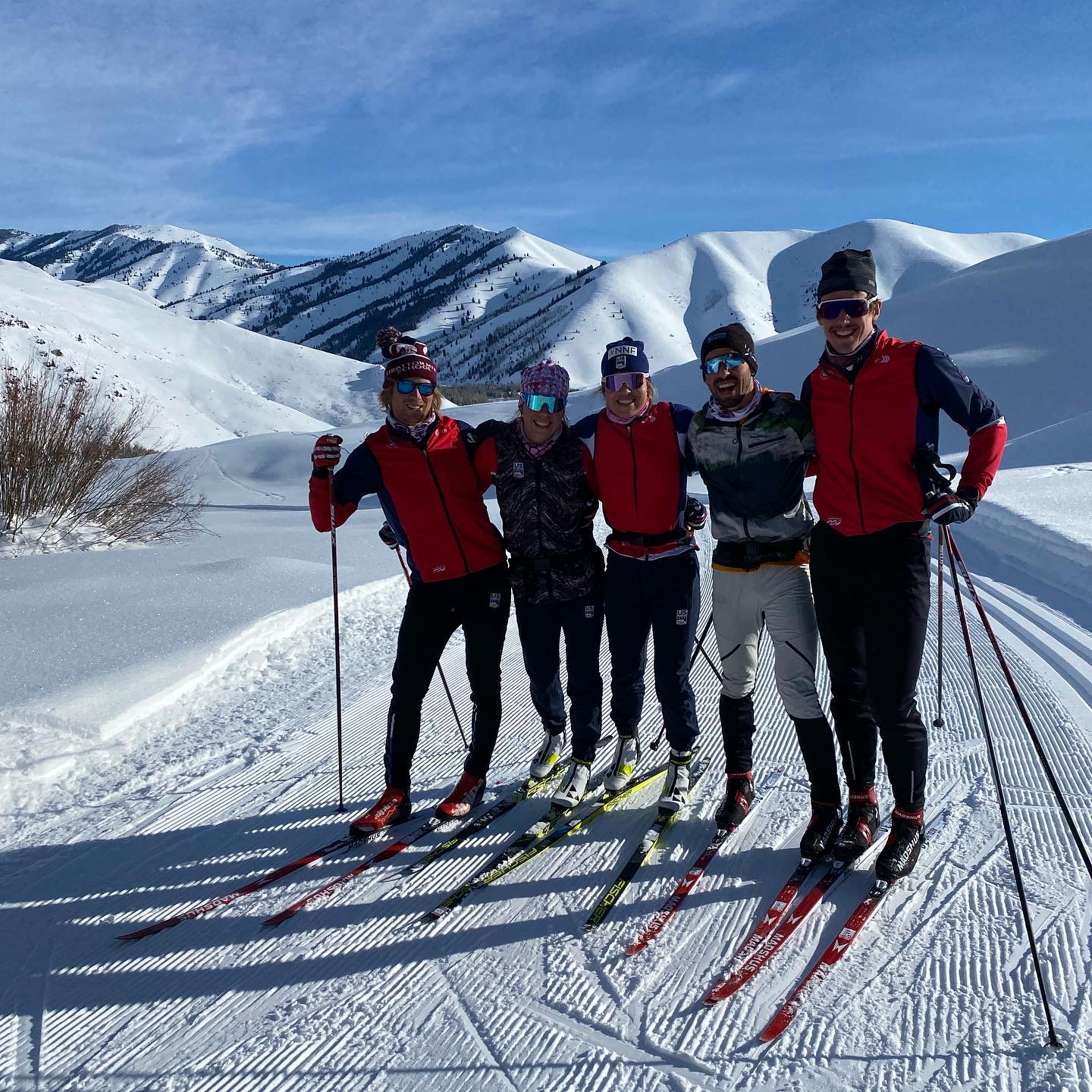
Pat O’Brien supports some of the SMS T2 athletes during a 2022 SuperTour weekend in Sun Valley, ID. (Photo: SMS T2)
A 2006 graduate of SMS himself, O’Brien raced collegiately for Dartmouth College, then spent four years training and racing professionally with the Craftsbury Green Racing Project. His move from Craftsbury back to Stratton was timed with his retirement following the 2014 Sochi Olympic Quad. Given his age and the proximity to his racing career at that time, many of the athletes on the T2 team were among what he called his “peer group”, having overlapped with many of them during either high school, college, on the race course, or all of the above. Jessie Diggins and Sophie Caldwell Hamilton were quickly becoming rising World Cup stars on the women’s team, while Andy Newell and Simi Hamilton headlined the men’s roster, and a young Julia Kern and Katharine Ogden were spending a PG year training with the T2 team.
Eager to stay connected with the sport after retirement, O’Brien seized the opportunity to take over in Stratton, stepping in as his predecessor Gus Kaeding departed.
“Ski coaching is the one thing that I’ve always known that I wanted to do, it was just kind of a natural progression for me. I knew that I was done with my athletic career – I didn’t really want to ski race anymore – but I knew that I still wanted to ski, I still wanted to be involved and to give back to the sport. I felt like, to some extent, when you spend basically your entire life skiing, you get pretty good at understanding the sport. But we never know as much as we think we do, and we always need to be students of the sport and have an open mind and learn.”
As he began his coaching career, he quickly realized that writing training plans and facilitating training was only a small subset of the responsibilities of an elite club coach.
“Good coaching is being comfortable wearing a bunch of different hats. And I mean, I joke, but the actual coaching is such a small part of it. The nitty gritty of pulling an athlete on the side of the trail and looking at video and all of that is important, but you’re there as a friend, a drill sergeant at times, and as someone that is just really trying to be supportive.
“And that’s all-encompassing. So for me, it has been a pretty fun experience to see people figure stuff out and be there to support them when they needed a little extra help and to do it in a pretty collaborative, dynamic way.”
He described his experience transitioning to coaching primarily as a mindset shift from the inevitable self-centric focus required of professional athletes toward selflessness; but the work required and pace of life remained equally taxing.
“When you coach at a club level – all coaching is a demanding job. I do think that you have to – I don’t want to use the word ‘sacrifice’, but when you transition from being an athlete yourself to being a coach, your job as an athlete is to be a little selfish. You’re trying to maximize your athletic performance. You need to have balance… but at the end of the day, you need to make sure that you’re training well and with purpose, you’re recovering well, you have goals and you’re going about achieving them. It shouldn’t be simply looked at as like what you have to give up to do that, but to be the most professional athletes and succeed against people who are trying to do the exact same thing, you just have to do a really, really good job with it. And coaching is the same thing. You have to be willing to approach everything that you do with the same degree of drive and focus that you would as an athlete…
“Basically, I just threw myself into it with the same approach that I had as an athlete which is, I’m just going to work, and work, and work, and learn all along the way. And then give it my best push and know that if I get to the point where that balance starts becoming harder and harder, or I can’t really do the job that I want, to be supportive of the athletes [to the level I want to be], that’s when you’ve got to know that you either double down and keep pushing or make a transition.”
While O’Brien is no less dedicated to the SMS T2 program or its athletes, a new endeavor has begun which will make achieving the balance he described significantly harder: he’s about to become a father. His wife, two-time Olympian and long-time U.S. Ski Team member Ida Sargent, is due in mid-August.
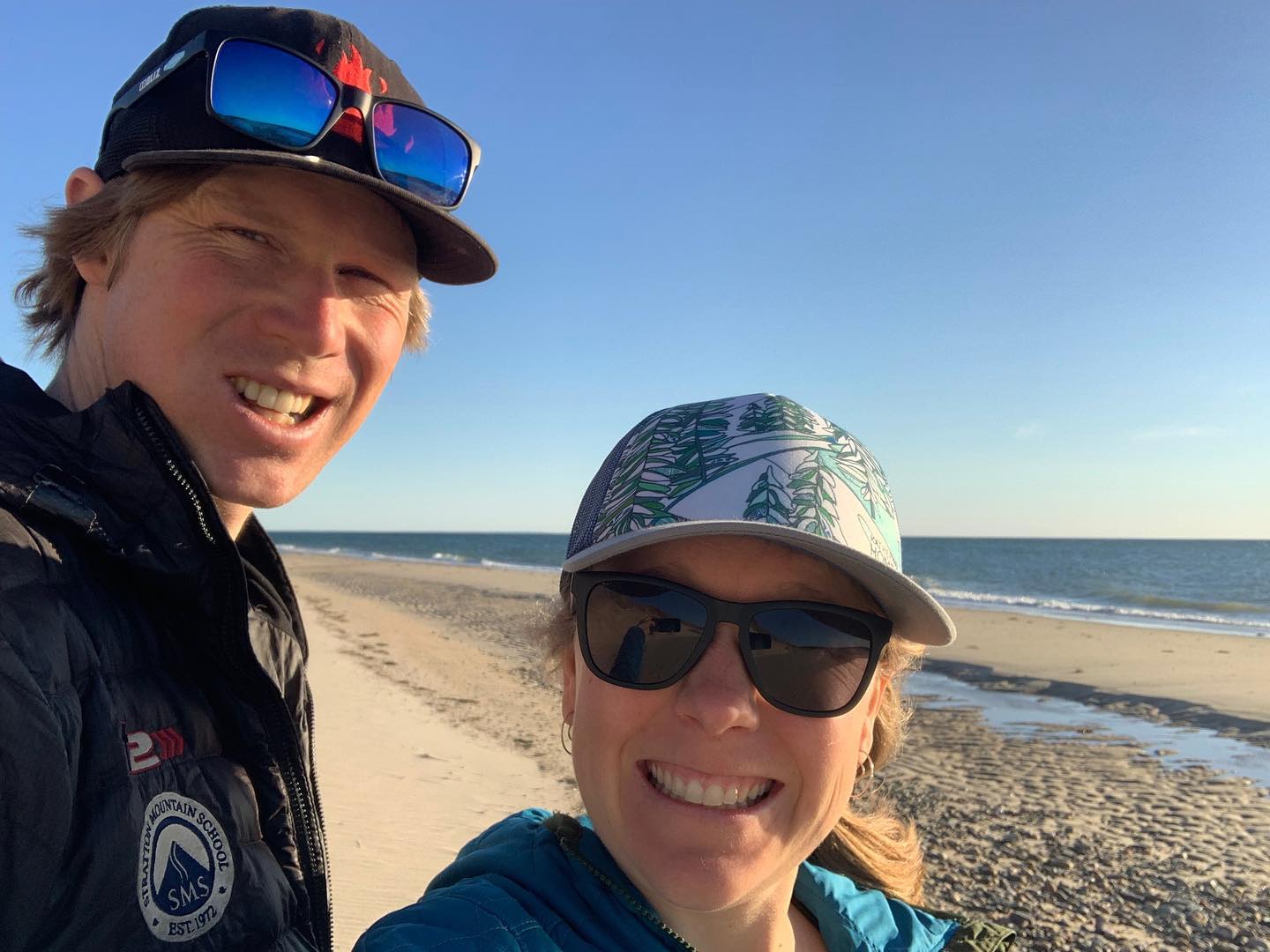
After eight years as head coach of the SMS T2 team, Pat O’Brien takes a step back as he and his wife, Ida Sargent, begin their family. (Photo: SMS T2)
Since retirement, Sargent has been working for her high school alma mater, Burke Mountain Academy, in Northern Vermont, and is currently the Academic Director for the school while also teaching STEM classes. O’Brien has been splitting his time between Burke and Stratton, which lies roughly 150 miles southeast in the opposite corner of the state. His usual coaching schedule pulled him around the country for weeks at a time to support athletes at U.S. Nationals and SuperTour events, and sometimes around the globe for World Cup, U23s, and other international camps and races.
While he acknowledged that there are many examples of coaches at all levels who have successfully juggled a demanding work and travel schedule with raising a family, what felt like the best fit given his and Ida’s vision and priorities for their own growing family was for O’Brien to decrease his level of responsibility with the T2 program, allowing greater flexibility and more time at home.
“I just felt like there’s part of me that was like, ‘I’m not seeing a pathway that I feel like I can still commit [to coaching] at the level that I want and know that you need to in order to to do the best job with your job, while simultaneously trying to start a family.’ I felt like it was my time to reevaluate and maybe step back or be completely done with ski coaching, because I certainly didn’t want Ida to have to put her growing career on hold to be the [primary] caregiver…
“Eight years is a long time to do something and I am very proud of what the team has accomplished in that time… it’s really cool having spent this time seeing athletes grow, not just not just athletically and within their their ski careers, but as individuals from high schoolers to finishing up college to full blown ‘this is my job.’”
While his role will be smaller, O’Brien is certainly not stepping away from the T2 team altogether. “Starting a family does not necessarily mean that it means the end of being involved in the sport,” he said. “It just means trying to figure out what the right relationship is with it.”
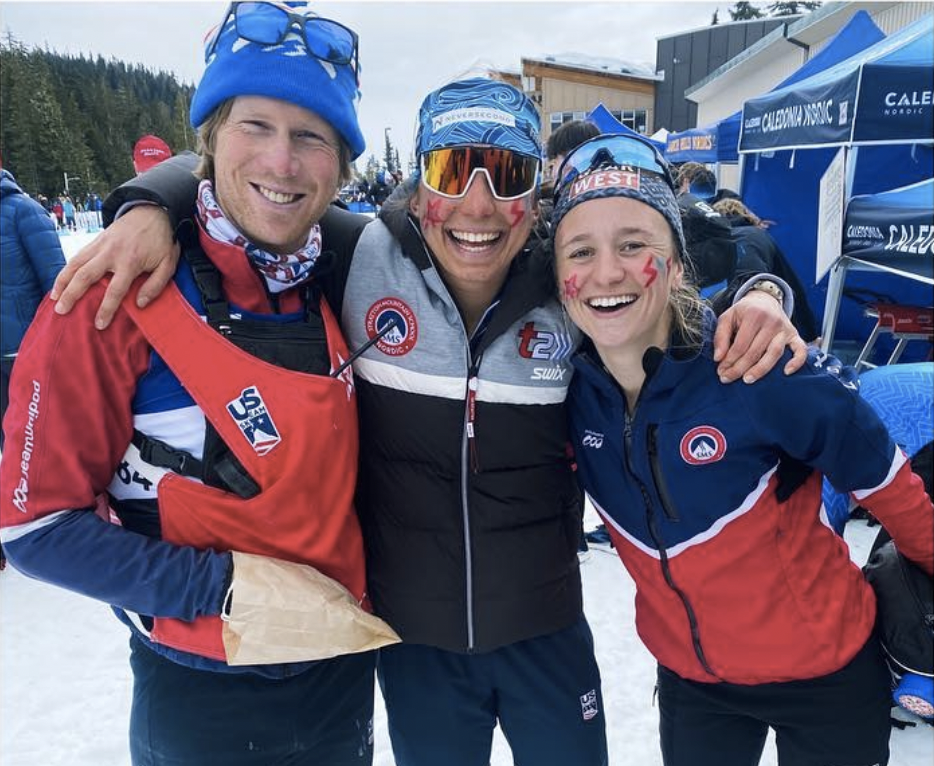
Pat O’Brien supports SMS T2 skiers Julia Kern and Alayna Sonnesyn at the 2022 U.S. SuperTour Finals in Whistler. (Photo: SMS T2 Blog)
The exact balance and distribution of responsibilities remains a work in progress as Thomas moves into the head coach role and the new season of training begins, and both O’Brien and Thomas are excited to collaborate and support one another throughout the year.
Explaining his philosophy as “under-commit so I can open perform”, O’Brien anticipates taking on many of the behind the scenes tasks that support the team, from collaboratively blocking out the season calendar, to managing travel logistics for camps and SuperTour races. As he put it, the little details of deciding “which flights to take to get from Canmore to Sun Valley” and where to stay are often made easier with several years of trial and error under your belt.
While Thomas will spend more time with ski boots on the ground, both in Stratton during the summer and at races and camps throughout the year, O’Brien anticipates he’ll still be plugging in a fair amount too. Though his stay might be shortened to the period immediately surrounding races, he plans, at minimum, to be in Houghton, MI for U.S. Nationals in January, and also the SuperTour finals in Craftsbury in late March.
He’s also excited to reconnect with the team in Stratton early in the summer before Ida gets close to her due date, but also to take off a few of his usual coaching hats while doing so.
“I think it’ll be really fun for me to actually be able to flow in and out get to see people, connect with them, but also not be like ‘Okay, now I don’t have to worry about making sure that the van’s filled up with gas, or water jugs have been filled, or that I’ve ordered all the lactate strips in advance so that we don’t run out.’”
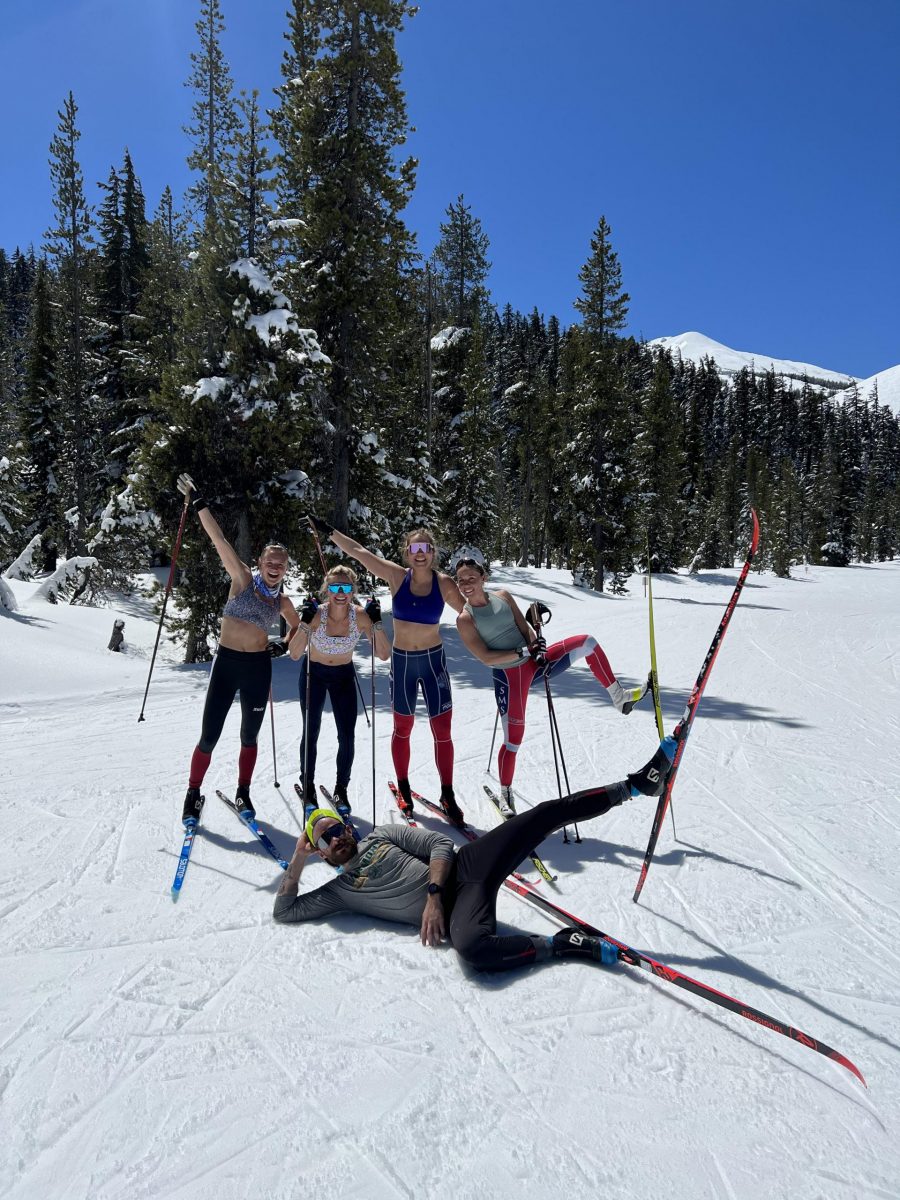
Perry Thomas out for a crust ski with the SMS T2 athletes who joined the national team training camp in Bend, OR this spring. (Courtesy photo)
As Thomas gets his feet under him in Stratton, he explained that he feels “very fortunate that Pat will still be involved.”
“As much as I can have him in the mix, the better,” Thomas said. “His knowledge with skis and wax is just unreal, so tapping into that resource is huge for me, for sure.”
***
UVM assistant coach Perry Thomas in action during the 2022 U.S. Cross Country Skiing Championships in Soldier Hollow. (Photo: Instagram @oneswellperry)
Prior to joining the UVM program, Thomas spent five years as the assistant coach at the University of Vermont, working alongside head coach Patrick Weaver. During his own collegiate racing career, Thomas spent four years racing for the University of New Hampshire, where he served as team captain during his senior year in ‘12-13. Departing briefly from the cross-country ski world, he spent a year teaching high school science to underprivileged youth in the Oakland area of California, before returning to the Northeast to begin his coaching career as the assistant coach at Williams College in Massachusetts.
“Working at UVM was unreal – a great experience,” Thomas said emphatically. “I really loved working with Patrick Weaver and the athletes there and it seems like almost a seamless transition, in many ways. Four of the skiers on the T2 team I actually coached at UVM. So knowing a lot of athletes here already – what they’re working on with technique, and racing, and goals and all that – has been very seamless, and that’s been great.”
The UVM graduates who now ski for SMS T2 include Alayna Sonnesyn (‘18), Bill Harmeyer (‘20), Lina Sutro (‘21), and Ben Ogden (‘22).
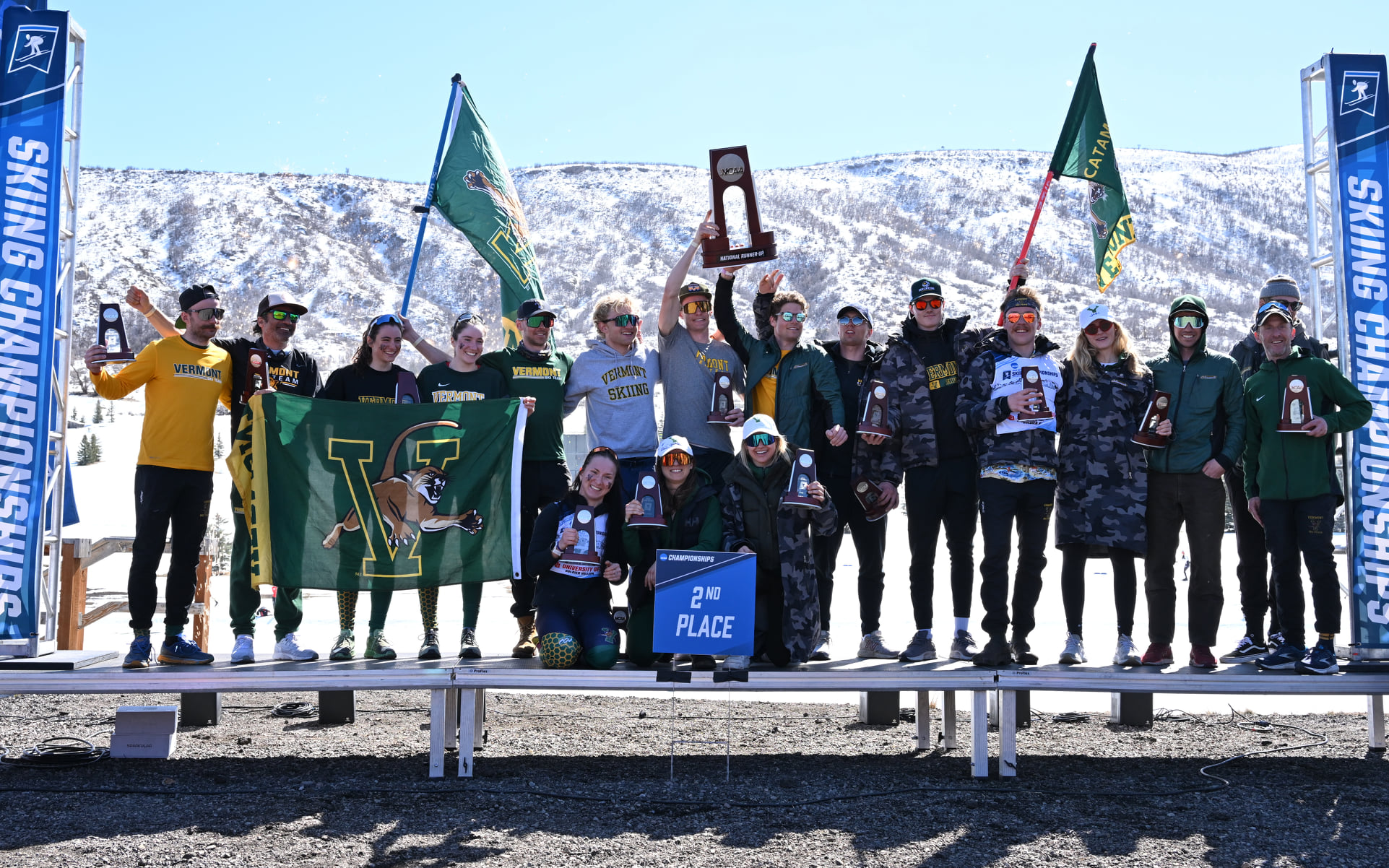
The UVM ski team celebrates a successful 2022 NCAA Championship. Assistant coach Perry Thomas is at the far left. (Photo: UVM Skiing)
Given the caliber of these athletes and the success of the UVM team as a whole during his tenure, Thomas credits his time with the program to the acceleration of his development as a coach, preparing him to take his next steps forward with SMS T2.
“Patrick Weaver definitely gave me a lot of opportunities and ownership over different facets of coaching that team and I think that’s been instrumental in me being here now with T2. I was able to go to World Cup Finals with Ben Ogden in Quebec his first year in school [in 2019], and I was just able to do trips like that on my own with athletes. That was huge for my development as a coach and for my experience of waxing, ski testing, and [other responsibilities at that level of racing]. So working at UVM was a lot of fun – I’m gonna miss it for sure – but it set me up very well for this transition.”
Ben Ogden gets a congratulatory fist bump as he heads to the podium during his sweep of the 2022 NCAA Championships. (Photo: Tobias Albrigtsen / @untraceableg)
A theme of both Thomas and O’Brien’s comments on the difference between collegiate and elite club coaching is small in terms of the training and technique coaching itself, but vastly different in terms of the opportunities elite club coaches have to support their athletes.
“I think the big differences are what we can and can’t do throughout the year from collegiate [racing] to the elite team,” Thomas explained. “Like, I wouldn’t be here [in Bend] and been doing an on-snow training camp if I were at a college team. And obviously the racing schedule is super different.
“The college schedule is pretty efficient, whereas the SuperTour calendar is quite a bit more spread out. And then, in addition to that, you have an athlete’s like Jesse Diggins, and Ben Ogden, and Julia Kern that are going to be on the World Cup, as well as athletes that are trying to make it to the World Cup. And at UVM, we had crazy talented athletes – Ben Ogden is one of them – so working with with high caliber athletes is nothing entirely new, but dealing with athletes where some are on the World Cup and some of them on the SuperTour is an interesting dynamic that you don’t often get with the college teams.”
In terms of what Thomas adds to the program as he steps in as head coach, he described his coaching philosophy and the environment he seeks to create within the training group, which keeps athletes motivated and happy through the arduous and long-term development process.
“[Cross-country] skiing is such a hard sport – it’s so much time that that we’re putting in, and so many sacrifices that we’re making, that I wholeheartedly believe in making that time that we’re together training and working hard fun and enjoyable,” Thomas said. “I think that’s a big part of what we do – and it has to be a big part of what we do – because like I said, it’s a hard sport. So I think making things light and having fun with all that is super important. And that’s definitely something I bring to the table in that regard.”
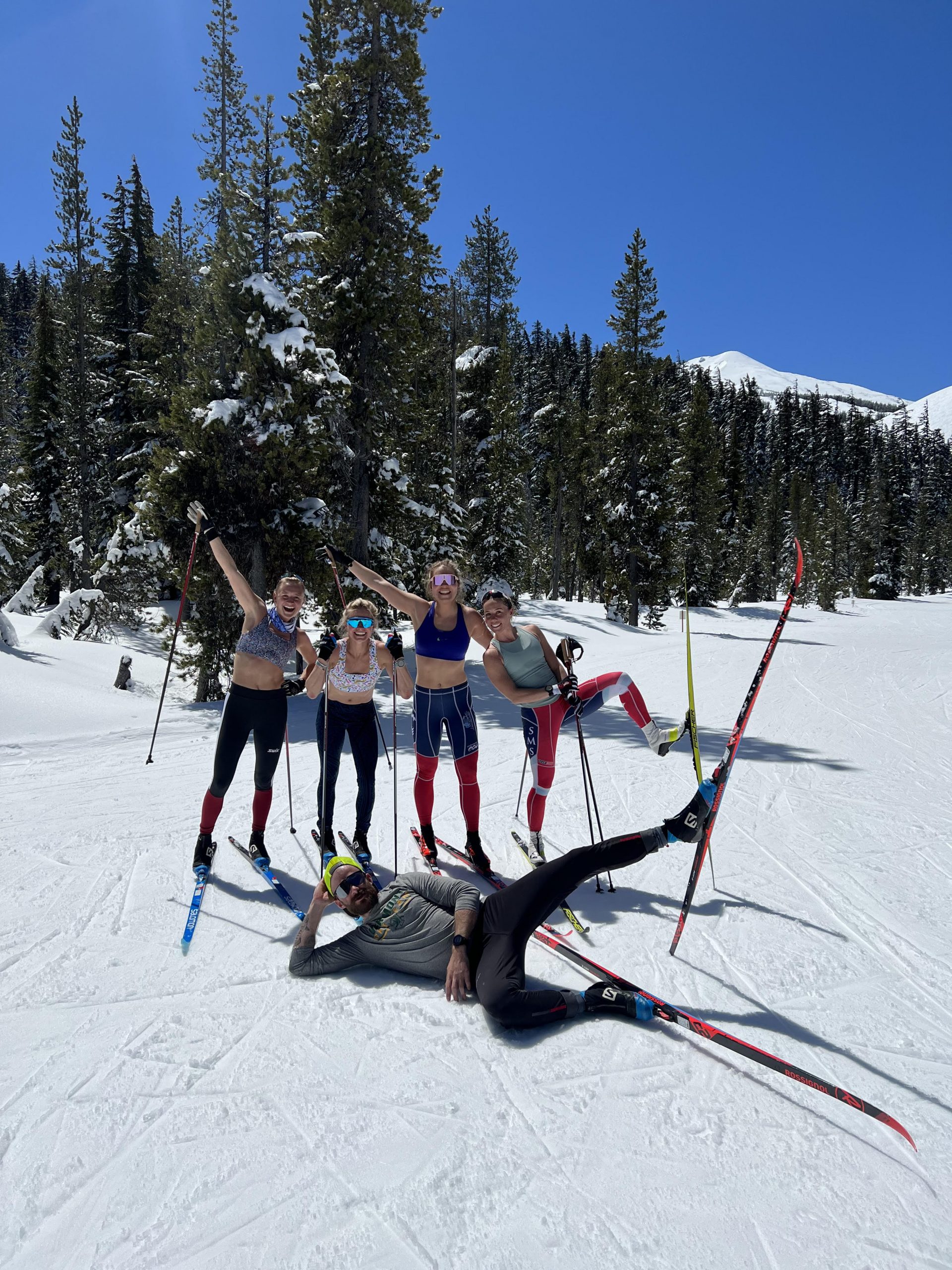
The SMS T2 team enjoys spring skiing at the Mt. Bachelor Nordic Center. From left to right, Alayna Sonnesyn, Jessie Diggins, Lina Sutro, and Lauren Jortberg, with head coach Perry Thomas. (Photo courtesy Alayna Sonnesyn)
But Thomas will add more than just fun to the T2 program. While he may be, as phrased by his new colleague, “almost too humble”, O’Brien was quick to highlight Thomas’s preparedness to prescribe training, coach technique, and otherwise lead an elite team stacked with some of the nation’s best athletes.
“If you have been at a D1 college program where you’re dealing with 15-20 athletes and that dynamic environment where student athletes are constantly balancing all these different commitments and time constraints… And really, what you learn there as an athlete and what you learn there as a coach is that working with a club – it just isn’t that different.”
O’Brien added that the shift to an elite club from college may, in fact, be easier than going in the other direction. When athletes no longer have to miss key workouts to take an exam or rush off to class halfway through a team meeting, barriers to consistent communication and training are removed, and consequently a coach has a greater capacity to build relationships with the athletes as they stack together the bricks of the training program.
“You get an opportunity to really work one-on-one with the athletes and to really be there to facilitate and support their training and their racing. In that sense, I think coming from a college background – especially given his ties with many of the current athletes that are on the team – you’re just working with the same people and you’re doing the same stuff.
“I mean, there’s no magic formula,” O’Brien continued. “Someone can claim that they can write the best training plan in the world. And that’s all fine and dandy – there are definitely people who do an amazing job with it and they really enjoy that aspect of that aspect of the sport. But at the end of the day, it’s just really just working with people. You don’t need to make it more complicated than it is. The best athlete is not a robot. The best athlete is someone that is self aware, that can think critically, learn from mistakes, recognize when things go well, and the coach is there to support them along the way.”
New SMS T2 head coach Perry Thomas working with his athletes during a 2022 spring training camp at the Mt. Bachelor Nordic Center. (Photo: Lauren Jortberg)
Thomas identified building upon his relationships and experience with his former athletes, who account for half of the team’s eight athletes, as something he’s looking forward to in joining T2.
“I am very appreciative of the continuity and being able to work with some athletes I’ve worked with in the past,” said Thomas. “I love all of them – they’re incredible people, incredibly hard workers. So to be able to continue working with them is just awesome. With that, too, it’s like – I have been working with Ben for the last four years, I worked with Lina Sutro for four years, I worked with Alayna for a little bit. It’s just a matter of knowing how they operate and how they train and knowing what they’ve been working on too. It’s easy for me in training, [even] this morning, to see some of them and be like, ‘okay, like this is something we’ve been working on for the last however many years’ or maybe, ‘a couple years ago, this was something we’re working on’. So let’s continue this, let’s continue these cues that we’re working on, and have that continuity there.
“It’s been awesome to be able to continue that work with them. It’s nice to see the progress – to see what they were doing in college a few years ago, and then to see where they are now, and then also to be able to help them through the transition to professional skiing.”
Simultaneously, these UVM-T2 athletes are excited to be working with their former UVM coach again. In an email to FasterSkier, Alayna Sonnesyn reflected on her time as a professional skier guided by O’Brien, while crediting Thomas’s contributions at UVM for her reaching the professional level in the first place.
“Stepping into the professional ski world four years ago and onto the SMS T2 team was super intimidating to me,” wrote Sonnesyn. “The team has been home to some of the fastest skiers in the world and I was clueless when it came to racing at that high of a level. Pat O’Brien helped steer me in the right direction as I made this adjustment and took huge jumps in my skiing ability. He taught me when to train for fun and when it was time to buckle down and get serious. When Pat says it’s go time, you go! He helped develop me from a reasonable distance skier to a strong and powerful distance AND sprinter, a trait I never thought I would be capable of. Pat’s knowledge of the sport and ski waxing, as well as the mental and emotional obstacles that come along with it, is unparalleled. He was a coach that believed in me as a junior skier and saw potential. The only thing that can make a good ski race even better is when Pat gives you a proud hug at the finish line. Although I will miss these hugs and his direct coaching, I know that he will use these skills to care for his growing family and I am excited to see where life takes him next.
Perry Thomas works with a few of the SMS T2 ladies in Bend. (Photo: Alayna Sonnesyn)
“Back when Pat was just seeing the potential in my college skiing, I was working with Perry Thomas when he was the assistant coach at UVM. I feel like my athletic career has come full circle as I get to transition back to a coach who helped put me in a place where I first believed skiing professionally was an option. Although I only had the pleasure of working with Perry for one year at UVM, it was a very special season! I instantly trusted him with my skis and could feel his enthusiasm for the sport radiate on the ski trails. I’ve witnessed just how hard Perry has worked over the years and how well-prepared he is to take over the position as head coach of the SMS team. Just in the first month of working with Perry again, I already know the team is heading down a path to continue its mission; local inspiration, international excellence.”
Likewise, Lina Sutro shared she is looking forward to the transition, applauding Thomas’s dedication to his athletes.
“I am truly so excited to be working with Perry again,” she wrote. “He is one of the most hard working and committed coaches I have worked with. He has a strong work ethic that I am excited for the Stratton community to experience. Pat and Perry both give so much back to the ski community and their athletes, I am excited to see the two of them work together.”
The 2021/2022 SMS T2 Team. Back row (l – r): Ian Torchia, Ben Ogden, Bill Harmeyer, and Will Koch; front row: Alayna Sonnesyn, Julia Kern, head coach Pat O’Brien, Lina Sutro, Katharine Ogden, and Jessie Diggins. (Photo: SMS T2 Blog)
As for the broader questions of “what’s new?” and “what lies ahead for the SMS T2 team this summer?” Following Katharine Ogden’s retirement in March, Lauren Jortberg will join the team as the fifth athlete on the women’s side – five and five is what the team identifies as the sweet spot for numbers. Jortberg joins Jessie Diggins, Julia Kern, Alayna Sonnesyn, and Lina Sutro. The men’s team is light this season, as Ian Torchia moved on this spring also, leaving behind a three-man roster of Bill Harmeyer, Will Koch (who also competes for University of Colorado), and Ben Ogden.
After Bend camp, the team will part ways with many attending “a big event in the Midwest” which happened over Memorial Day Weekend. The SMS T2 team will finally reconvene as a whole in Stratton in early June. Though regional and international camps are planned, particularly for athletes named to the national team, Thomas anticipates ample quality training based in Vermont and the surrounding region.
“We’ll be in the Stratton area for the majority of this summer,” he explained. “I think one of the cool things that we’re doing is: Sverre, and Pat and I have started working on doing a summer [training] program, so we have some awesome athletes joining our crew this summer.”
This list includes University of Utah and U.S. Ski Team skiers Sydney Palmer-Leger, Novie McCabe, and former SMS junior athletes Adam Witowski and Zander Martin, who now ski for Michigan Tech and Bates College, respectively. JC Schoonmaker and Gus Schumacher also plan to join the T2 team for some training in Vermont throughout the summer.
“So a really stacked crew, for sure,” said Thomas. “It’s gonna be a really exciting summer to say the least.”
Last year, in an effort to create a standardized workout that could be easily replicated and repeated, national team coaches presented the concept of the “U.S. Pace Project.” The concept is straightforward: a shift away from time-based intervals to distance-based, centered around repeated laps of a 5-kilometer course.
This familiar distance is key. In a call in July, Matt Whitcomb, U.S. Ski Team Head Coach, and one of the creators of the project explained that: “5k is essentially the building block of just about every race we ever do. It’s a very tangible distance that everybody knows right from childhood.”
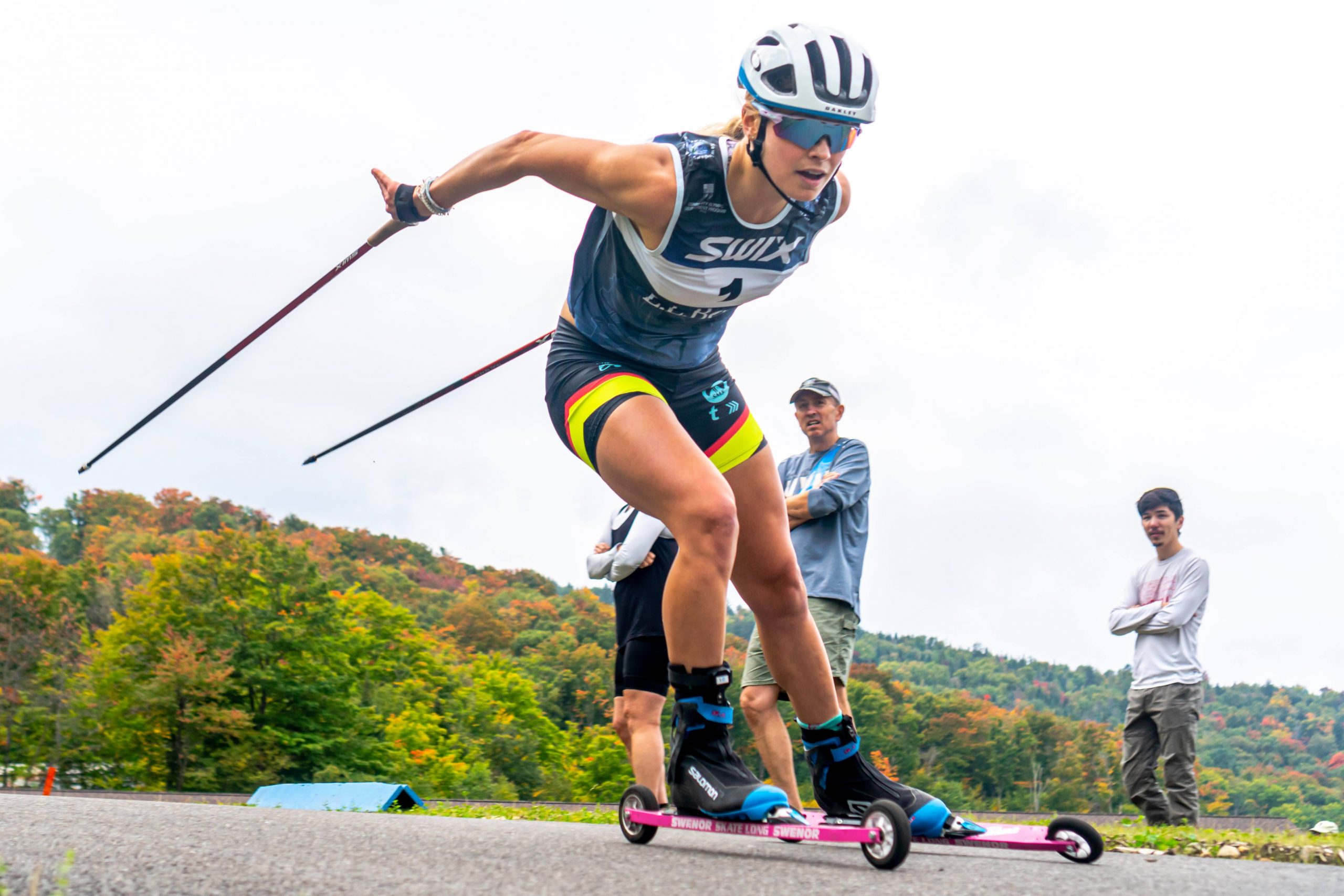
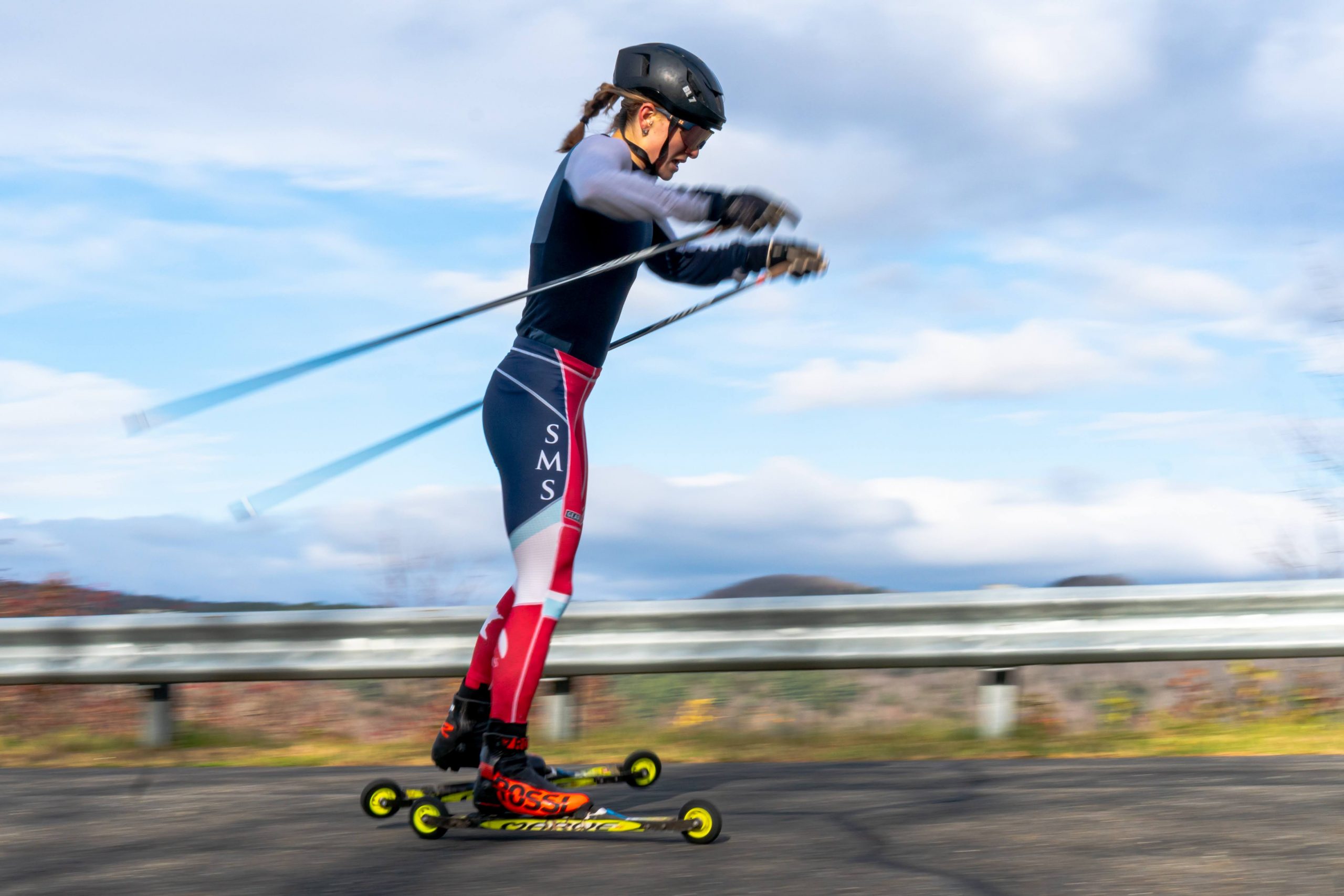
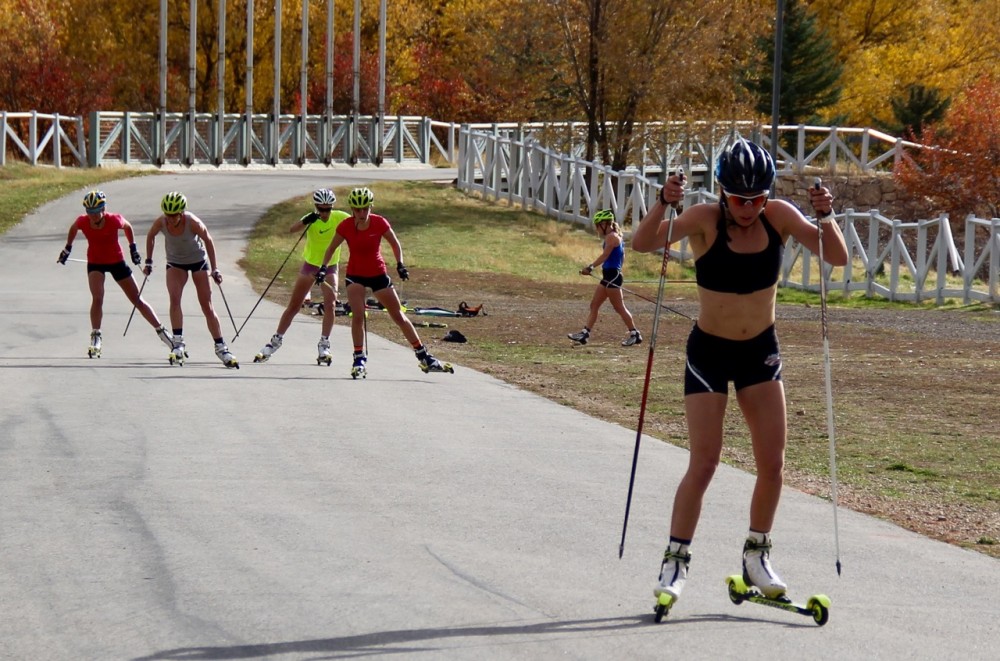
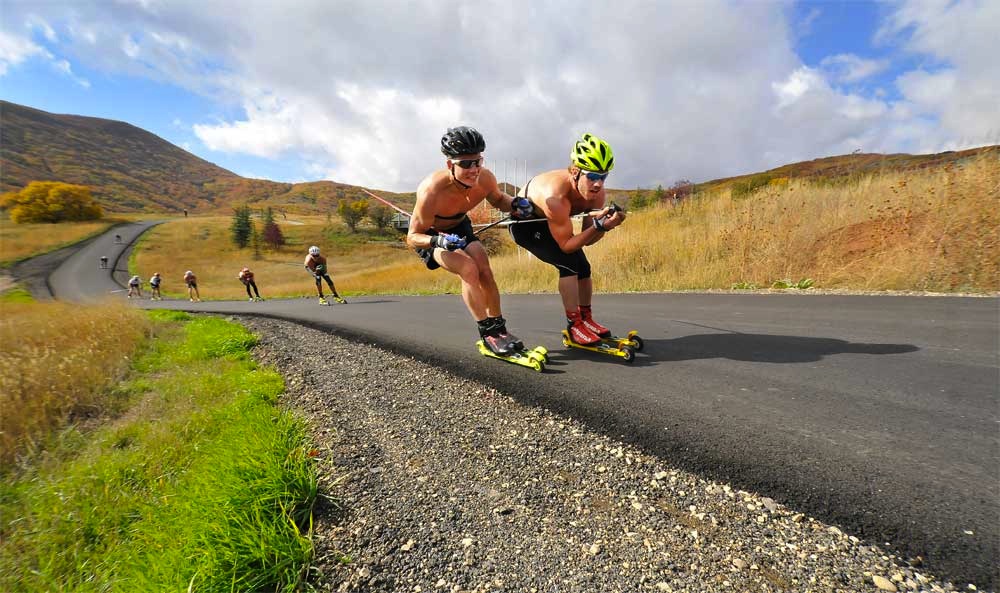
Jessie Diggins races the Keys to the Castle Rollerski Race in Lake Placid. (Photo: Matt Whitcomb)
Whitcomb continued that while the session itself is not revolutionary, it has provided a shared pathway for clubs to explore pacing during intensity sessions. Usually athletes will complete three rounds of the same 5k course, and repeat the workout intermittently throughout the training season to track overall progress or fine-tune pacing strategy. Given the ease of implementation, clubs of all levels nationwide can adopt the concept.
“Clubs are encouraged to find a 5 kilometer stretch of rolling road, something that can replicate race terrain as best and as safely as they can,” Whitcomb explained. “If it’s on a rollerski track, that’s even better.”
As the training year progresses, so does the nature of the Pace Project. “This is a workout that is meant to build in intensity throughout the year, but also in creativity,” Whitcomb stated.
Creativity, in this context, is an ongoing experiment with pacing, fueling, technique, and effort, followed by a discussion of individual outcomes amongst the group. Essentially, the U.S. Pace Project is a personal study for athletes to find their own fastest and most efficient approach to racing.
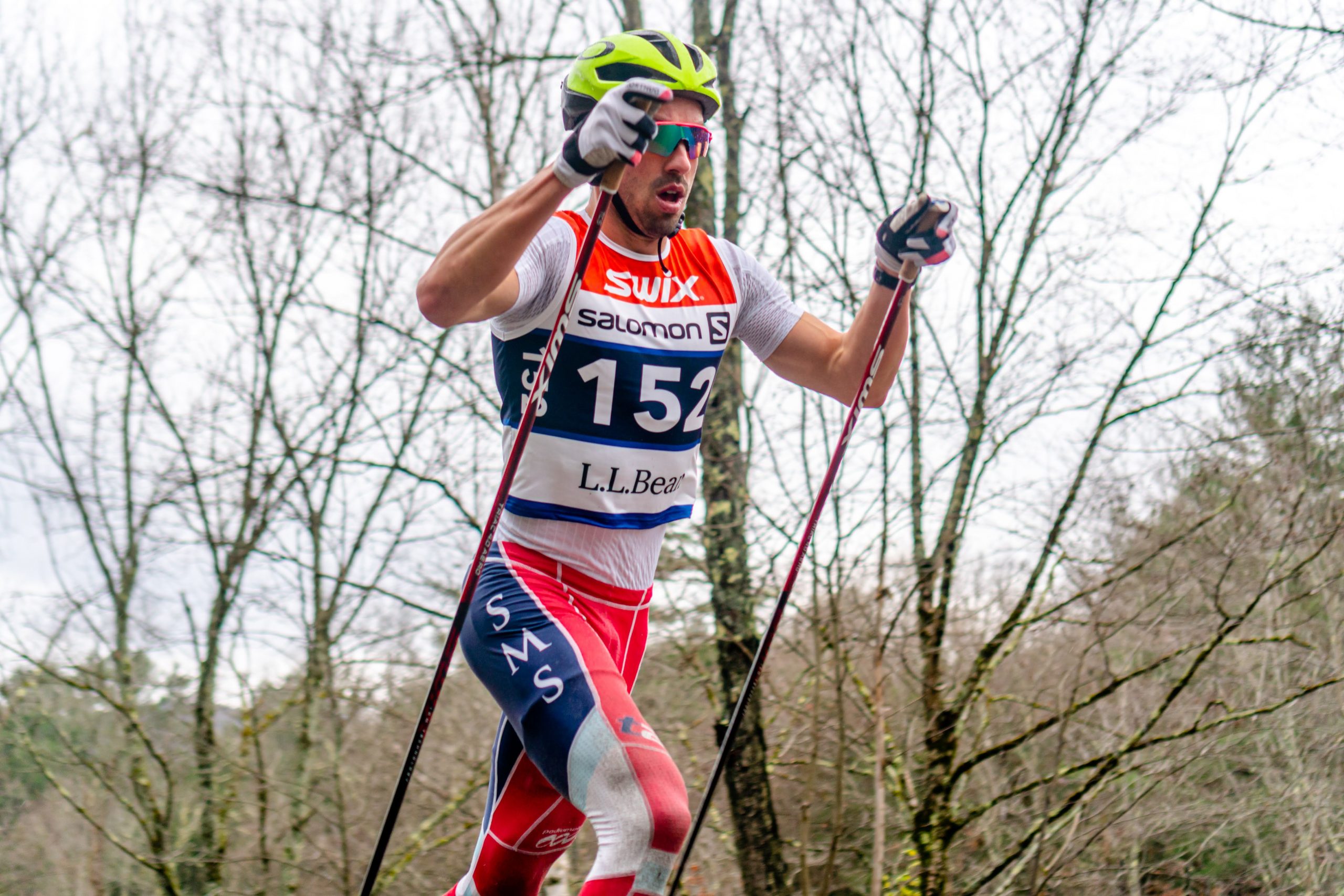
Ian Torchia races NENSA’s Trapp Invitational Rollerski race in November, 2021. (Photo: George Forbes/SMS)
Another motive behind the project, according to Whitcomb, is to promote the sharing of insights between athletes and coaches nation-wide as they incorporate and discuss the takeaways from the Pace Project format. He explained that time-based intervals offer less concrete information to learn from, as there is more room for variation in training venue and conditions.
“[The sport] is challenged with regards to metrics,” Whitcomb said. “So this is meant to catalyze more objective feedback and learning.”
As many national team members train in Stratton, VT in the summer, SMS T2 head coach Pat O’Brien provided a look into his experience facilitating the workout with his athletes and his current takeaways.
“If you give the athletes a set distance workout, they are going to learn how to manage their energy over that distance,” O’Brien said, citing supporting research by Norwegian based Sports Science Professor Steven Seiler.
“The whole point,” O’Brien continued, “is in a training type environment, go out and play around with different [approaches]. It might not all work. It might fail. But it’s better to learn those lessons in a training environment than in a race.”
Ben Ogden (bib 13) races the Keys to the Castle Rollerski Race in Lake Placid. (Photo: Matt Whitcomb)
While a nationally shared workout is new, the project itself grew out of conversations with previous American athletes who incorporated similar workouts as a fitness benchmark.
“I think the most notable one is Kris Freeman,” O’Brien explained. “He was truly one of the best in the world at the 15k distance. He would do a repeated workout of 3x5k, and he knew if he could sustain three repeats on [a particular] 5k stretch of road, he was in good shape.”
O’Brien said that inspiration had also come from one of his mentors, Sverre Caldwell, former Nordic Director at SMS.
“Back in the early 2000s, the Stratton program had a string of successes with high schoolers going on to these great sprint results when sprinting had just started coming out,” he said. “What was interesting talking to [Caldwell] was they didn’t go out seeking to pace sprints. He wanted to make his athletes stronger and tougher, so he devised a double pole test.”
The test involved double poling up a specific hill, which happened to take high schoolers like Andy Newell about three minutes. “It was not intentional, but they got good at figuring out how to go up that hill as best they could for about three minutes, which happened to be about how long a sprint was. They didn’t go out with the intention of being great sprinters, but if you give the athletes a set distance workout, they are going to learn how to manage their energy over [that distance].”
These ideas have fused into the Pace Project. Still in its infancy, it remains an elastic concept meant to help American skiing in a number of ways. Part nationally shared workout, part personal experimentation project, part data gathering opportunity, there are many objectives at play.
“The pacing project is an idea where if we subject ourselves to all these different stimuli, we can be more flexible,” O’Brien said. “The point is, we’re always going between environments, and we’re always trying to get athletes better at finding what their red line is, so to speak.”
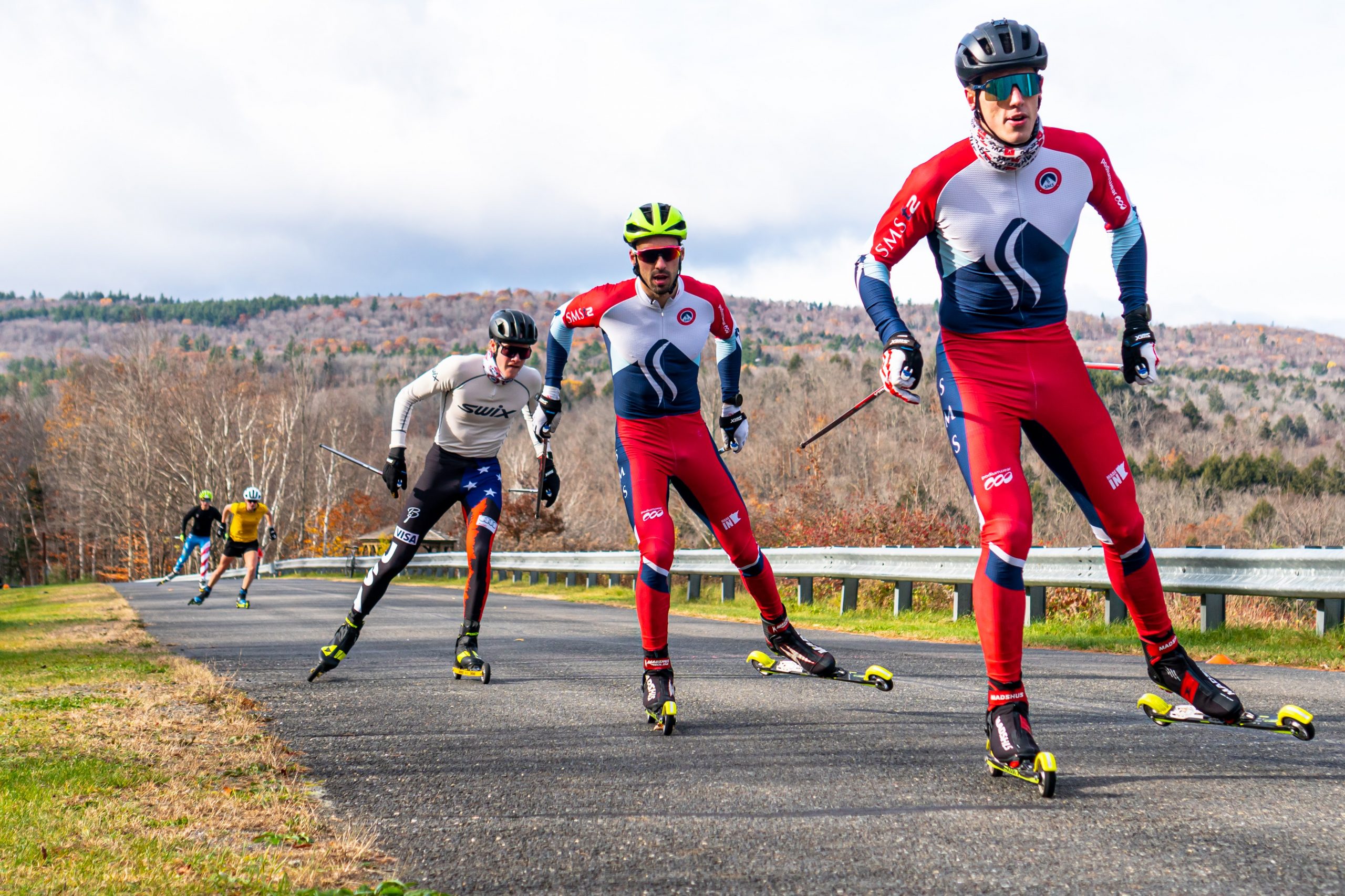
Bill Harmeyer and Ian Torchia lead the charge during a fall training session. (Photo: George Forbes/SMS)
O’Brien explained that coaches had been seeking a way to reap the benefits of racing without the physiological toll they require.
“How can we construct workouts that challenge you in a similar way to what you experience in a race without the same cost?” he asked rhetorically.
The Pace Project seems to be filling this gap, by offering athletes a chance to experiment with novel pacing strategies outside of a race environment.
“I don’t care if someone goes into it too hard and blows up,” said O’Brien. “We’re not looking for an objective time, It’s about how athletes pace themselves.”
O’Brien stressed that the key to the pace project lies in athletes figuring out what works best for them, both in what technique they use on specific sections of the course, and for overall pacing.
“Every athlete has a style,” he said, “a way they want to move. [It’s] not ‘you should do this because it works for you.’ I think that’s how we unlock our athletes’ best potential.”
The Pace Project has received favorable reviews from athletes and coaches beyond the SMS T2 team. The SVSEF Gold team in Sun Valley, Idaho use their 1.2k rollerski trail for pace sessions according to Head Coach Chris Mallory.
“This workout basically brings a little more focus to threshold workouts,” wrote Mallory in an email. “Athletes can play around with different pacing strategies, whether it’s starting more conservatively, using different techniques, or skiing different parts of terrain harder or easier to see what works best for them… It’s nice to have something that’s repeatable, where you can measure progress.”
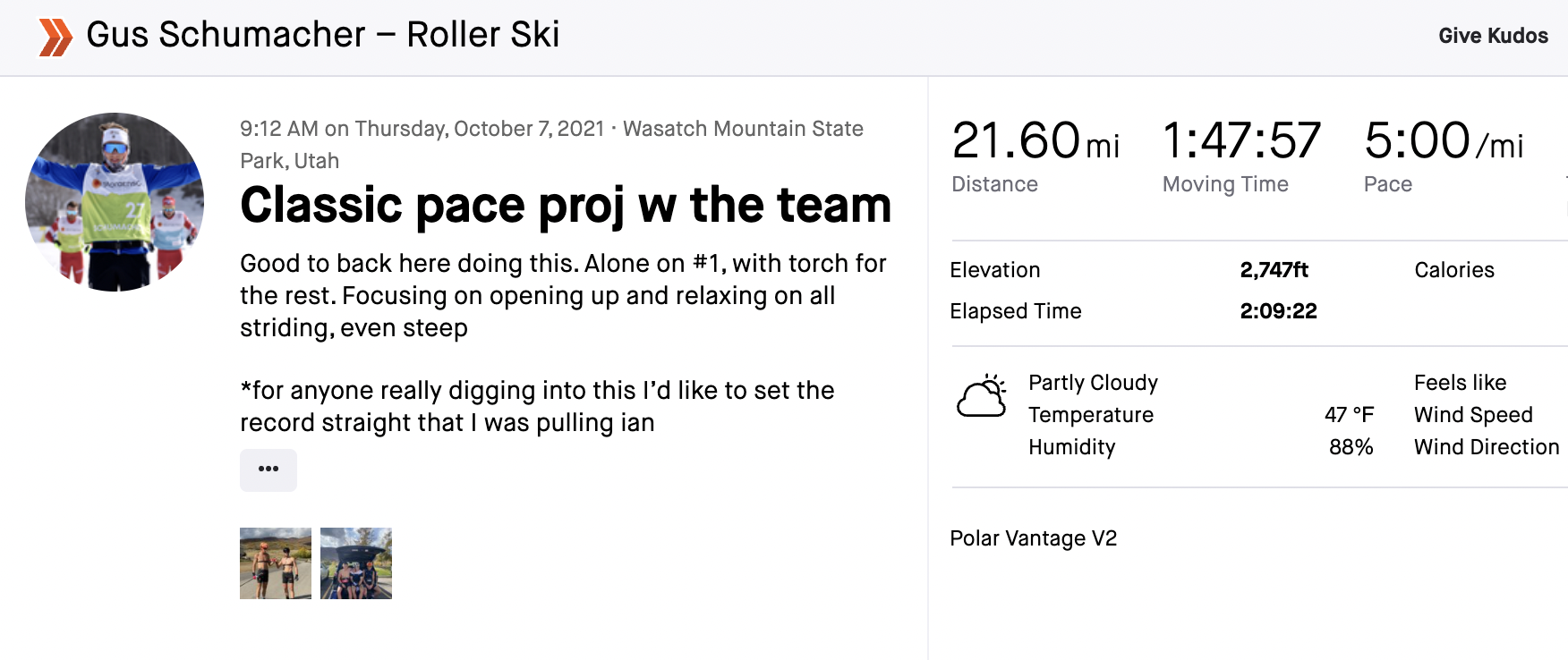
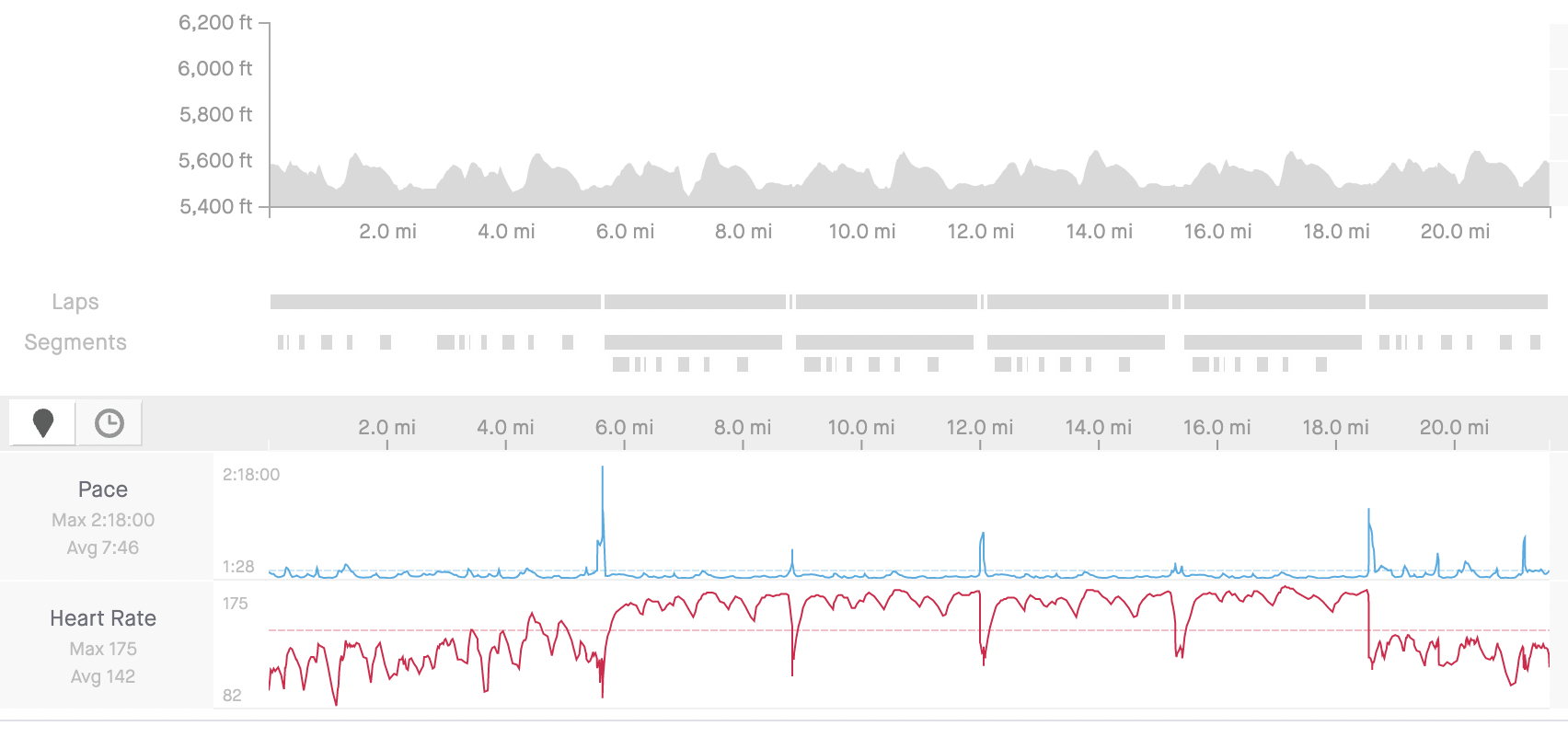
Strava users who follow some of the top domestic skiers may have seen some of them completing these workouts, like this example of Gus Schumacher’s October iteration. Schumacher explained in an email the role the workout has played in his summer training this season:
“[The Pace Project] is a cool format because it allows for a lot of different strategies, similar to racing. Usually in the earlier summer we’ll use it as a way to get L3 while lapping a track with similar features to a race course. Later however, like at our camp in Park City, it was fun to use it as almost a race simulation.”
Gus Schumacher completes a 4 x 5k pace project session during a fall training camp in Soldier Hollow. (Photo: Strava)
Schumacher described one of his sessions in October: “I started the first 2 minutes hard like I would in a mass start,” he wrote. “After that I eased back to a sustainable pace, then in the last one I finished hard. This made it feel a lot like a race without the same cost (because of 3 minute rest between each interval). Breaking it up into segments also allows us to change our strategy more from lap to lap, which can help with testing new pacing strategies, especially at altitude.”
Reflecting on the outcomes for coaches, Whitcomb said that he was pleased with how the Pace Project sessions had increased the conversations between athletes.
“What we’ve observed is that there’s more interesting discussion before and after these sessions, than there is for just your standard threshold interval workouts.”
Over the summer, Whitcomb stopped by Stratton during a SMS T2 pace session and remarked on the depth, variety, and value of the subsequent conversations.
“Of the ten athletes that were there that day, there were ten different approaches to this workout, because Bill Harmeyer is setting his sights on one specific goal on that day, and Jessie Diggins on perhaps another goal, and everybody’s learning and discussing and crowdsourcing ideas effectively.”
Alayna Sonnesyn pushes the pace in a fall training session. (Photo: George Forbes/SMS)
While the value of the project lies in its idiosyncratic freedom, the aim is competitiveness.
“Hopefully,” Sun Valley’s Mallory suggested, “it helps our nation to continue to make progress in distance racing.”
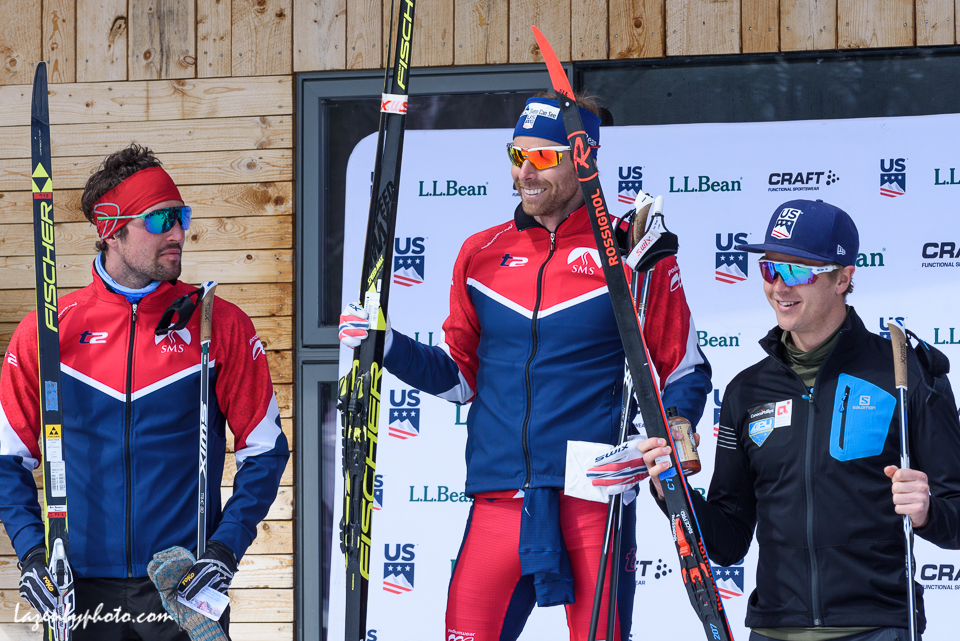
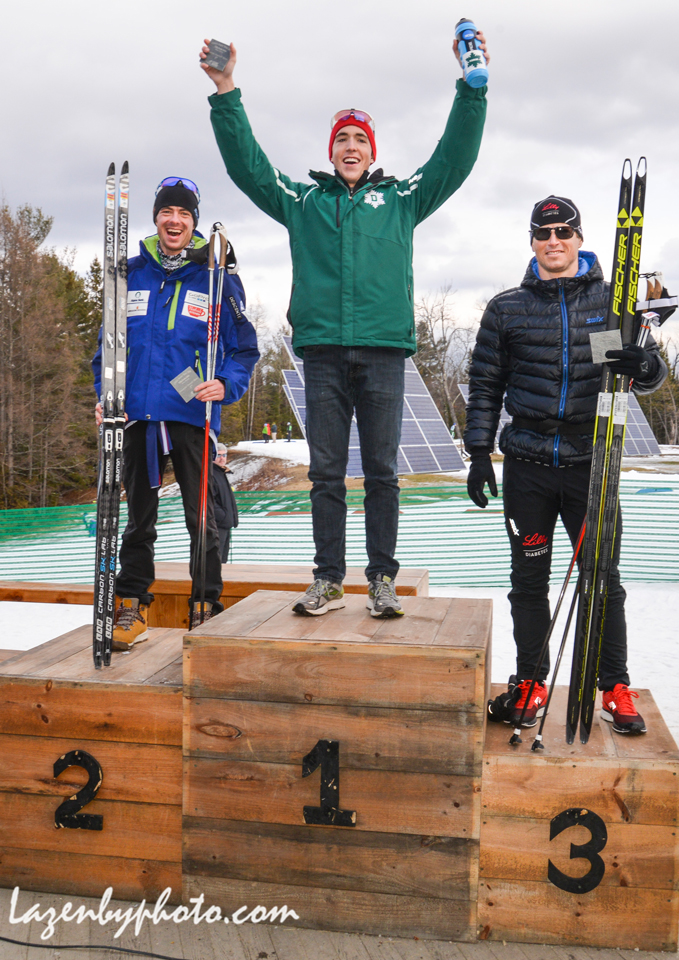
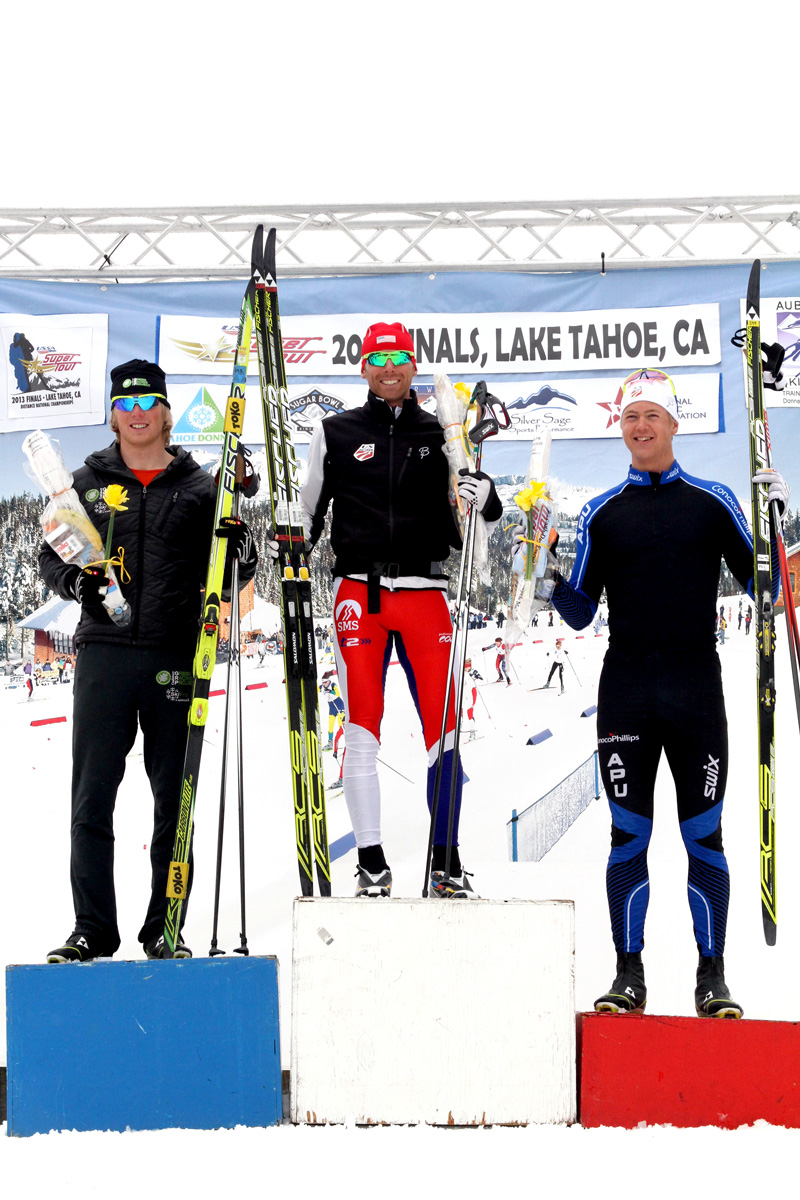
Andy Newell (c) of the U.S. Ski Team (USST) and Stratton Mountain School T2 Team after winning the men’s classic sprint at 2018 SuperTour Finals on March 24 in Craftsbury, Vt. His Stratton teammate Ben Saxton (l) placed second and Erik Bjornsen (r), of the USST and Alaska Pacific University, placed third. (Photo: John Lazenby/Lazenbyphoto.com)
When Andy Newell took to social media about a week and a half ago to announce that he was parting ways with the U.S. Ski Team (USST) after 16 years, some people might have assumed that he was leaving the sport. They would be wrong.
Newell, a 34-year-old Shaftsbury, Vermont, native and USST A-team member for the last 12 seasons, was quick to clarify that he’s not retiring from racing. After four Olympics and 16 years on the team, he’s just ready to be his own boss and set his own schedule.
“I guess in the back of my mind I always knew once the [2018] Olympics were over I would most definitely take a step back from being a full-time international ski racer and definitely take a step back from being a U.S. Ski Team national-team racer,” Newell said in a phone interview earlier this week. “Because that way, it allows me much more flexibility with my schedule even in the summer as far as training camps go and obviously a ton more flexibility in the winter as far as how much time I need to spend away from home racing World Cups.”
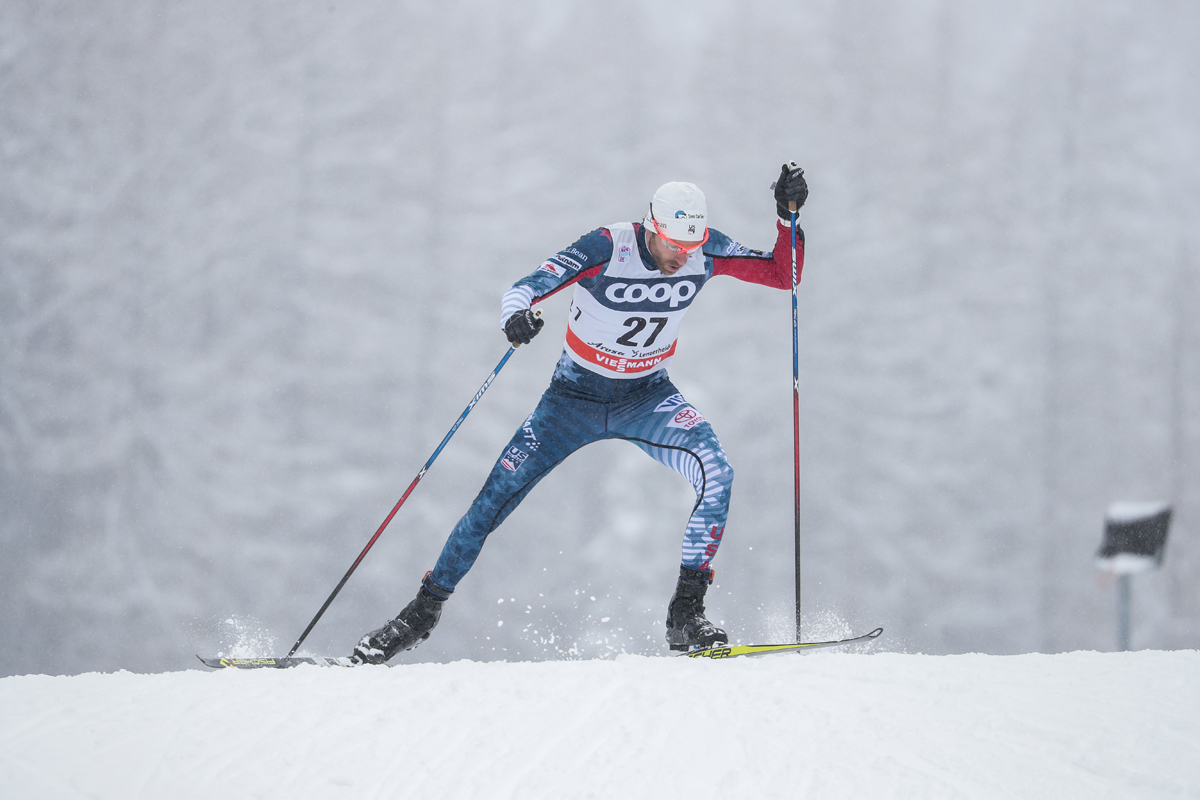
American Andy Newell racing the men’s 1.5 k freestyle-sprint qualifier at Stage 1 of the 2017/2018 Tour de Ski on Dec. 30 in Lenzerheide, Switzerland. He qualified 20th and went on to finish 19th on the day. (Photo: Fischer/Nordic Focus)
Newell spent all of last season — from Oct. 29 until mid-March — on the World Cup circuit in Europe (except for when he was at the Olympics in PyeongChang, South Korea, for the month of February). He rarely saw his wife, Erika Flowers, whom he married last June. The two arranged quick trips to see each other when they could, but as full-time ski racers on different circuits, it was a challenge.
“Five, six, seven, or ten years ago, I was making many of these decisions as an individual, and now that I’m married, I definitely have a lot more to consider than just myself when I make decisions when it comes to planning and scheduling,” Newell said.
While he was hesitant to elaborate on his plans moving forward, Newell emphasized that he’ll continue to race in the near future.
“Right now, I guess my plan would be to get back to a simpler schedule where I am still training at a high level but not focused really at all on World Cup racing,” he said. “So I might target a few races that I’ve always really wanted to do, for example some of the Ski Classics possibly over in Europe like the [Norwegian] Birkebeiner, possibly the American Birkebeiner. I think there’s so many great ski experiences that we have out there other than racing World Cups every weekend.”
And at this point, he’s not completely ruling out another run at World Championships.
“If I’m feeling like a complete champion by doing some of these different races, then you might see me trying to take a stab at something like World Championships,” Newell said. “But I’m not really putting any pressure or expectations on that, I’m more just looking to get back to a more simple training and racing routine where I can come up with my own schedule and plans and just remember what it’s like to really enjoy ski racing and doing the ski races that I want to do.”
Growing Up on the Ski Team
Andy Newell with some hardware after placing fourth in the season-long Sprint World Cup for the 2009/2010 season. (Photo: Kikkan Randall)
Newell first landed a spot on the U.S. Ski Team as a high-school senior at the Stratton Mountain School (SMS) in Stratton, Vermont. He was initially selected to the development team, which came with invitations to national-team training camps — like the present-day development “D” team — as well as summer housing at the USST base in Park City, Utah.
That season, in 2002/2003, Newell raced at World Championships in Val di Fiemme, Italy, and nearly qualified for the heats in the skate sprint (placing 31st). Just 19 years old at the time, he also competed at Junior World Championships in Sollefteå, Sweden, where he placed second in the qualifier and seventh overall in the freestyle sprint.
He competed in his first World Cup in 2004 and made the leap to the USST A-team in 2005. Newell then began his 12-season streak on the A-team, which entailed the team’s highest level of financial support. He reached the World Cup podium three times as an individual — first in 2006 in Changchun, China, where he placed third in a freestyle sprint. In doing so, Newell became the first American to medal in a World Cup race since Bill Koch did the same 23 years prior.
While Koch was a distance racer — like every international nordic racer of his era — Newell earned his chops as a sprinter and came onto the World Cup scene when short-distance sprint races were in full swing (the format was introduced at 1999 World Championships and 2002 Winter Olympics).
“I think back on those years, and they were so cool,” Newell said of his early days on the team. “To be, like, 20 years old and beginning to race World Cups. … I remember in ’05, I got a top 15 in a World Cup, and that was the first time that had happened for the U.S. in the last however many years, and because of things like that, every weekend something new and exciting was happening.
“I started doing better in some of the sprints and winning the qualification and getting a top 10 here, and the next year I was on the podium after that in ’06,” he continued. “And so it was a very quick trajectory to becoming one of the best sprinters in the world at that time.”
He raced at eight World Championships with his best result coming in 2007 in Sapporo, Japan, where he placed fifth in a classic sprint.
“I won the qualification in the sprint and ended up finishing fifth, but I remember being pretty disappointed,” Newell reflected. “I thought I totally could’ve been on the podium there.”
Andy Newell racing in late 2009. (Photo: Fischer/NordicFocus)
His other two World Cup podiums came when he placed second in a 2008 skate sprint in Lahti, Finland, and third in a 2010 classic sprint in Drammen, Norway. In four Olympics, Newell achieved two individual top 20s in skate sprints (16th in 2006 and 18th in 2014), and ninth in the freestyle team sprint at the 2010 Olympics in Vancouver, B.C.
In PyeongChang this past February, he raced to 37th in the classic sprint and 14th with the men’s 4 x 10-kilometer relay. Reflecting on those Olympics, Newell said he was personally disappointed with his results, but thrilled to be a part of history with his team.
“I felt like I had put in the time, time and effort and preparation to race better than I did,” he said. “But at the same time, we created such a great, tight unit and team throughout the last four years that for me, it was just so great to be there, to be there on the day that Jessie [Diggins] and Kikkan [Randall] won a gold medal. … Even though I didn’t ski my best, it was still, to me, in a lot of ways a success to be there; it’s been a successful year in that respect.”
‘A Little Bit of a Guinea Pig’
Asked how the sport, specifically sprinting, has changed over the years, he said it’s been gradual but noticeable. Moreover, his ability and willingness to adapt is what has kept him in it this long.
“If you were to look back on a World Cup sprint from 2005, the technique would look a lot different than it does now,” he said. “Many of the courses are the same, some are a little longer now than maybe what you would see back in the early 2000s for sprinting, but I think, in order to be competitive then, and also still competitive now, I’ve had to try to adapt as best as I can, and always be willing to learn new things.
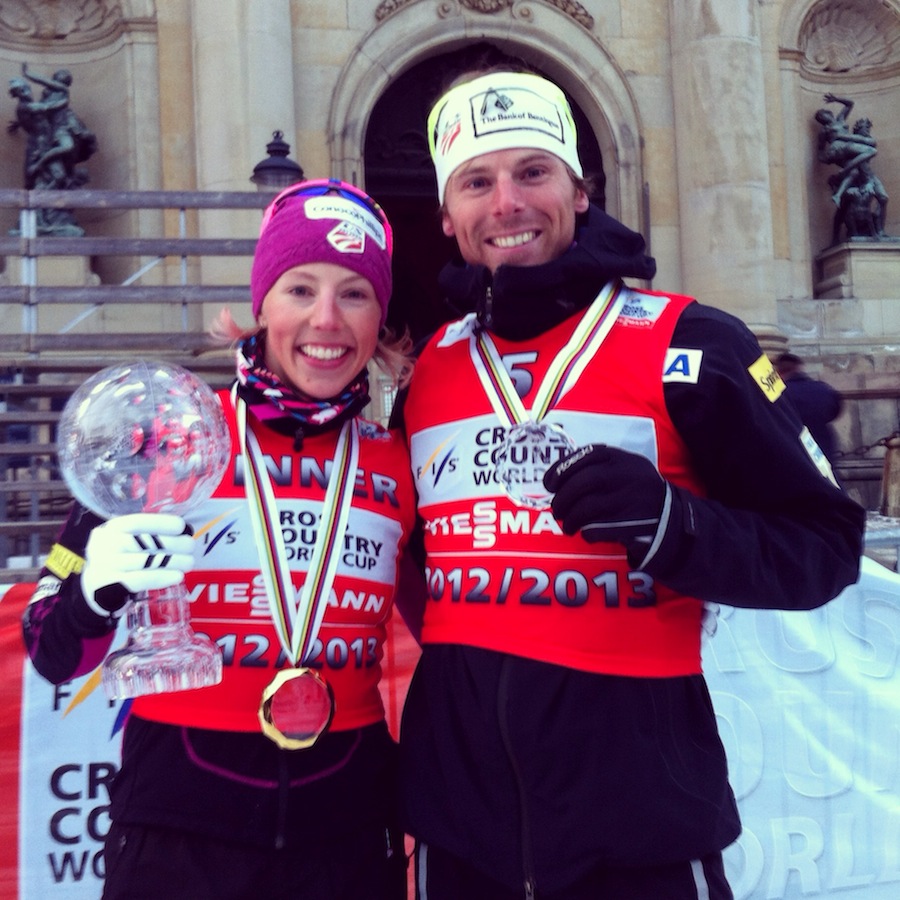
Fifth in the 2012/2013 Sprint World Cup, Andy Newell (r) with women’s Sprint World Cup winner and fellow U.S. Ski Team member Kikkan Randall at 2013 World Cup Finals in Drammen, Norway. (Courtesy photo)
“I think if I would have assumed I was doing everything right or couldn’t improve, then I would have definitely been left behind I think years and years and years ago,” Newell continued. “I think people like Kikkan have done a really good job of that, and something that I’ve really tried to do, too, over the years, is always being willing to learn something new and not really have an ego about your shortcomings as an athlete.”
He explained that a consistent theme of his career was his willingness to venture into unchartered waters when it came to training.
“I’ve been a little bit of a guinea pig for the U.S. Ski Team in a lot of ways,” Newell said with a laugh. “I was probably the first athlete to go over and race an entire World Cup season. They hadn’t done that before we started scoring those kind of World Cup points in the mid-2000s, so it was like, how do we create a training plan that’s going to allow us to be successful at World Championships but also still race an entire World Cup season? So it’s been a great learning process for me and also I think the coaches over the last 20 years.”
Over the last two decades, Newell said he’s mainly worked with Chris Grover, the current U.S. Ski Team head coach, and more recently, USST Assistant Coach Jason Cork.
“Chris Grover wrote my training plans for probably the majority of my career,” Newell explained. “In the last four years or so, I started to work more with Jason Cork and also myself, I do a lot of the writing myself.
“I think I’m someone who likes to be a student of the craft of what I’m working on; I think I’ve always been like that,” he continued. “When a coach tells you to do something, you’re always kind of like, OK, but I would always want to ask why we do a certain workout the way we do and how it builds … I’ve just liked to learn about training principles over the years, and so as I’ve gotten older, I’ve gotten more involved in writing, going over training plans myself, and incorporating ideas and workouts that I want to do. And I’ve done a lot of dumb, crazy stuff over the years, too.”
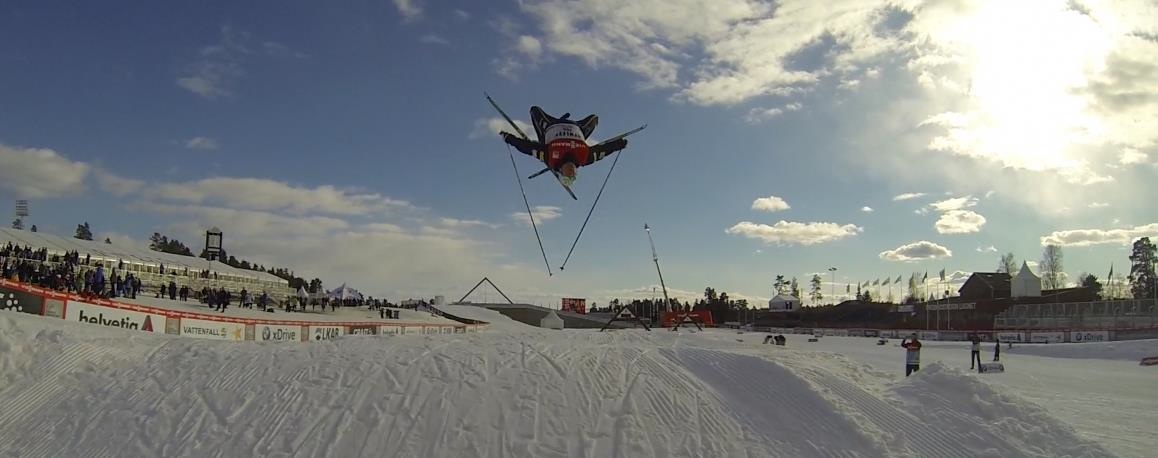
Andy Newell celebrating the end of the 2012/2013 season with some acrobatics in Falun, Sweden. (Photo: Adam Alexander Johansson, XHC)
Newell may be best remembered for his extreme stunts on ‘X Ski Films’, a filmmaking company he owned and starred in for several years, which included backflips and other airborne tricks on cross-country skis.
He’s also spent the last two decades training out of Stratton with three main coaches: Sverre Caldwell, Gus Kaeding, and most recently, Pat O’Brien, head coach of the SMS T2 Team. Newell met Flowers on that team, and while he won’t be a full-fledged member of SMS T2 this year, Newell said he’s looking to maintain a strong relationships with both Stratton and the U.S. Ski Team.
“In some ways I don’t think it feels like I’m retiring because I’ve kind of always had such a passion for pushing the level of skiing forward in this country,” he said. “And for me as an athlete, that was the best way I could do that, and I know as I transition into different roles in the skiing community, my goal [is] to continue hoping to improve the level of skiing in this country and improve the professionalism of skiing in this country and inspiring the youth skiing movement in this country — all those goals that I had as a ski racer — I will continue to have as a coach or a team leader or whatever my next role is going to be.
“I’d like to work with development as far as helping some younger kids out, so I’m going to try to look for opportunities where I can do that,” he added. “I think it’s kind of a natural transition from athlete to coach in a lot of ways, but I’m still very much going to be an athlete at least in the near future.”
Looking back on his years with the national team, he likened it to the pride one would have in a college or university they graduated from.
“I’m just really proud of my time that I’ve spent with the team and so grateful for all of the opportunities that the U.S. Ski Team has given me over the past two decades,” he said. “It’s probably the same way that people who go to universities and so forth feel about having that kind of pride for their alma mater. I never went to college so it’s like the U.S. Ski Team kind of scooped me up at 16, 17 years old. Everything that has built me up into the kind of person that I am now, that has molded me into my character, everything has more or less has come through the U.S. Ski Team.”
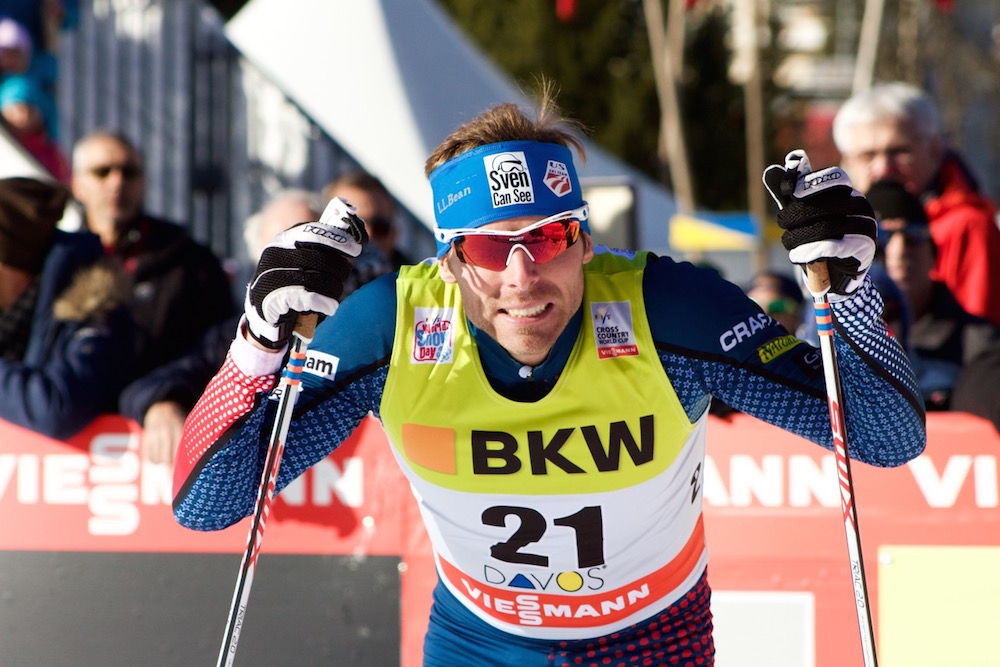
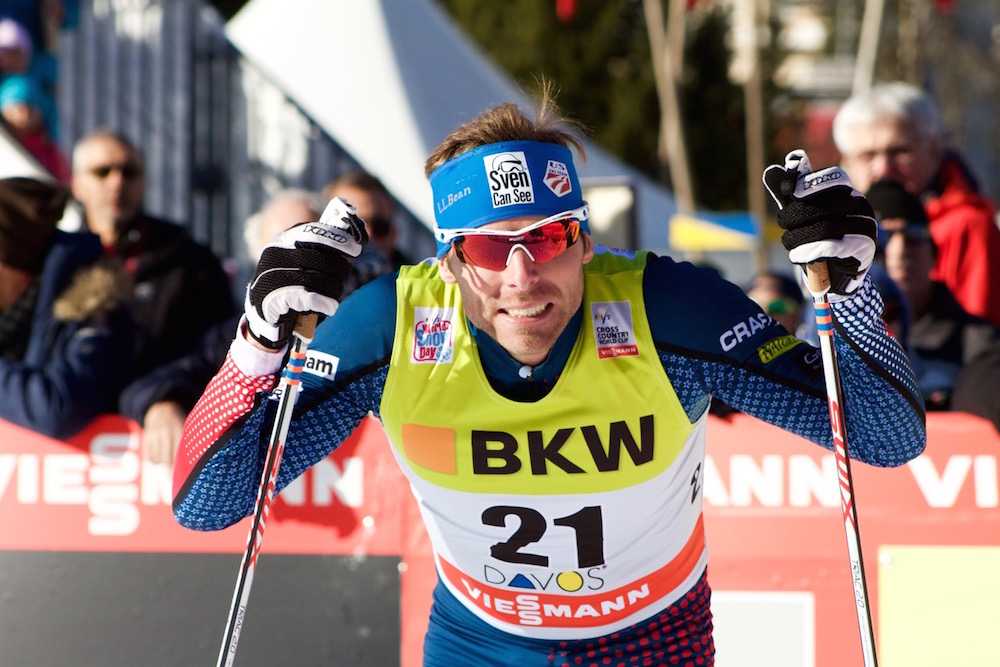
Andy Newell (U.S. Ski Team) after his quarterfinal at a 2015 World Cup freestyle sprint in Davos, Switzerland. (Photo: JoJo Baldus)
Is he nervous about going out on his own? Newell said it’s been a long time coming, and he’s more excited than anything.
“The spring’s always a funny time because you’re pretty exhausted from the season,” he said. “In a lot of ways, kind of the last thing you want to think about is skiing, but for me, I’ve always been one of those people that in the springtime gets super excited about all the opportunities. … By April 1, I [would be] already thinking, ‘Oh, what can I do for training next year?’ … and I start throwing around all these crazy ideas. I think that’s one of the things that’s kept me in the sport for so long, is having that excitement around training and preparation.
“I think it will be exciting in a lot of ways to try to be my own boss and do some of the training camps I want to do and partner up and train with some of the athletes that I want to train with,” he said of this spring and summer. “Not that I was ever held back by the U.S. Ski Team, but you definitely had to adhere to a certain schedule so I think it will be exciting to do some different things.”
From Sprints to Marathons?
In late January 2016, shortly before Newell spoke with FasterSkier about mulling retirement, or at least taking a step back from full-time ski racing, he double poled his way to second place in the 42-kilometer Dolomitenlauf classic marathon (part of the FIS Marathon Cup series) in Lienz, Austria. Never one to like being labeled a “sprint specialist”, Newell is looking forward to trying more marathon races like that.
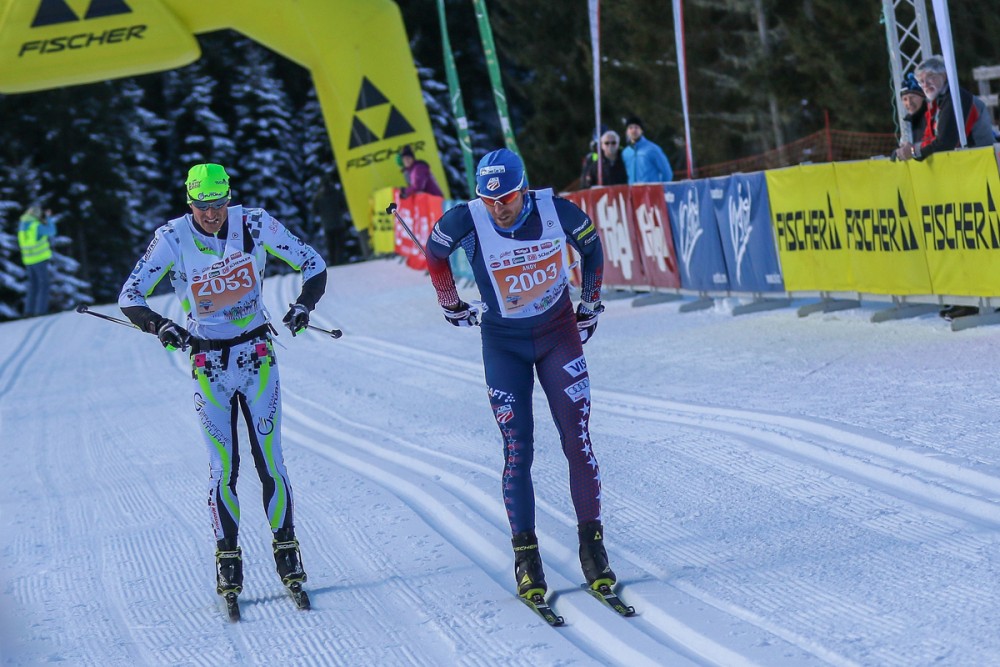
American Andy Newell (r) outsprints Italy’s Mauro Brigadoi, for second place in the 2016 Dolomitenlauf 42 k classic race in Lienz, Austria. (Photo: Fischer/NordicFocus)
“I have a lot of great friends who train for the Ski Classics [marathon series] and a lot of my Norwegian buddies who I have raced World Cups with over the years have gone that route after their World Cup racing career,” he said. “It’s a cool idea because those races are super fun, there’s great prize money, there’s a lot of excitement over them, and I think it’s really impressive when you see somebody just crush 90 k’s of double poling like they do in the Vasaloppet.
“So I’m definitely inspired by those guys and I, as an athlete, really like classic skiing,” he continued. “I love traditional-style classic skiing and I like double poling, so I think maybe in the future I will try to get into a few of those races, but it’s hard to do those and not be committed 100 percent because those guys that do those, they’re training to crush double pole like nobody’s business, so it’s hard to just show up on a weekend and race one of those races.”
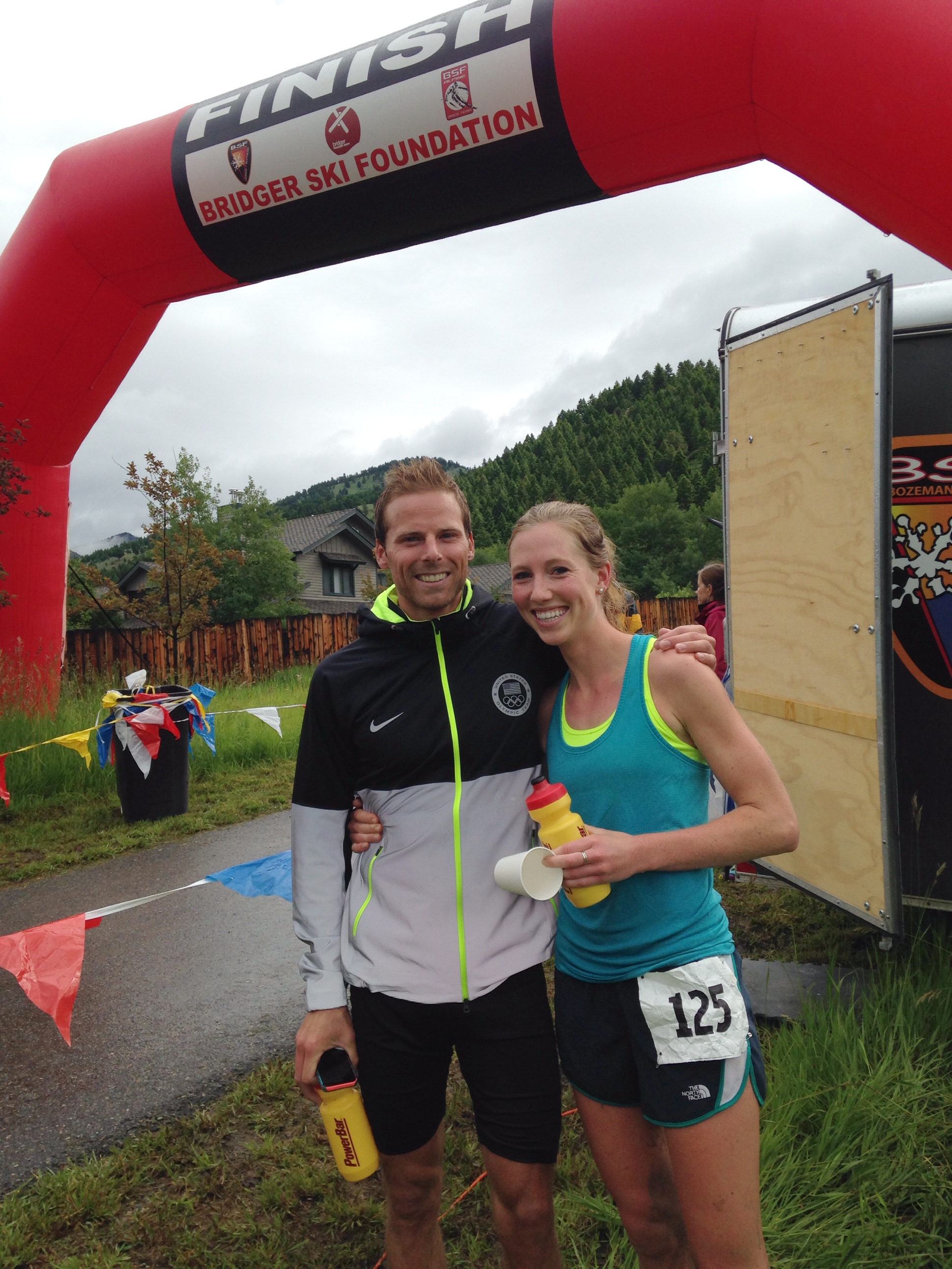
Andy Newell and Erika Flowers, both of the Stratton Mountain T2 Elite Team, after both won the 2014 Jim Bridger Trail Run in Bozeman, Montana.
Aside from the fitness required to double pole an entire marathon, the logistics of these races — many of which start in one town and end in another — is particularly challenging without a full-support crew or team.
“I’d really like to do the [Norwegian] Birkebeiner and I think it will take a few times to be able to consider yourself a threat to the podium in a race like that,” Newell said. “I would be foolish to think I could just jump into a Ski Classics race and crush it, but it’s definitely a goal of mine to maybe do some of those over the next years because I think they’re such legendary, badass ski races.”
In the near future, Newell and Flowers are headed out on a three-week “surf trip” to Australia and Indonesia.
After that, “it’s yet to be seen how everything will fit in,” Newell said in regards to his future plans, both living, training, racing, and otherwise. “There will be more to say later as far as what I have going on for next year as far as what my goals will be.”
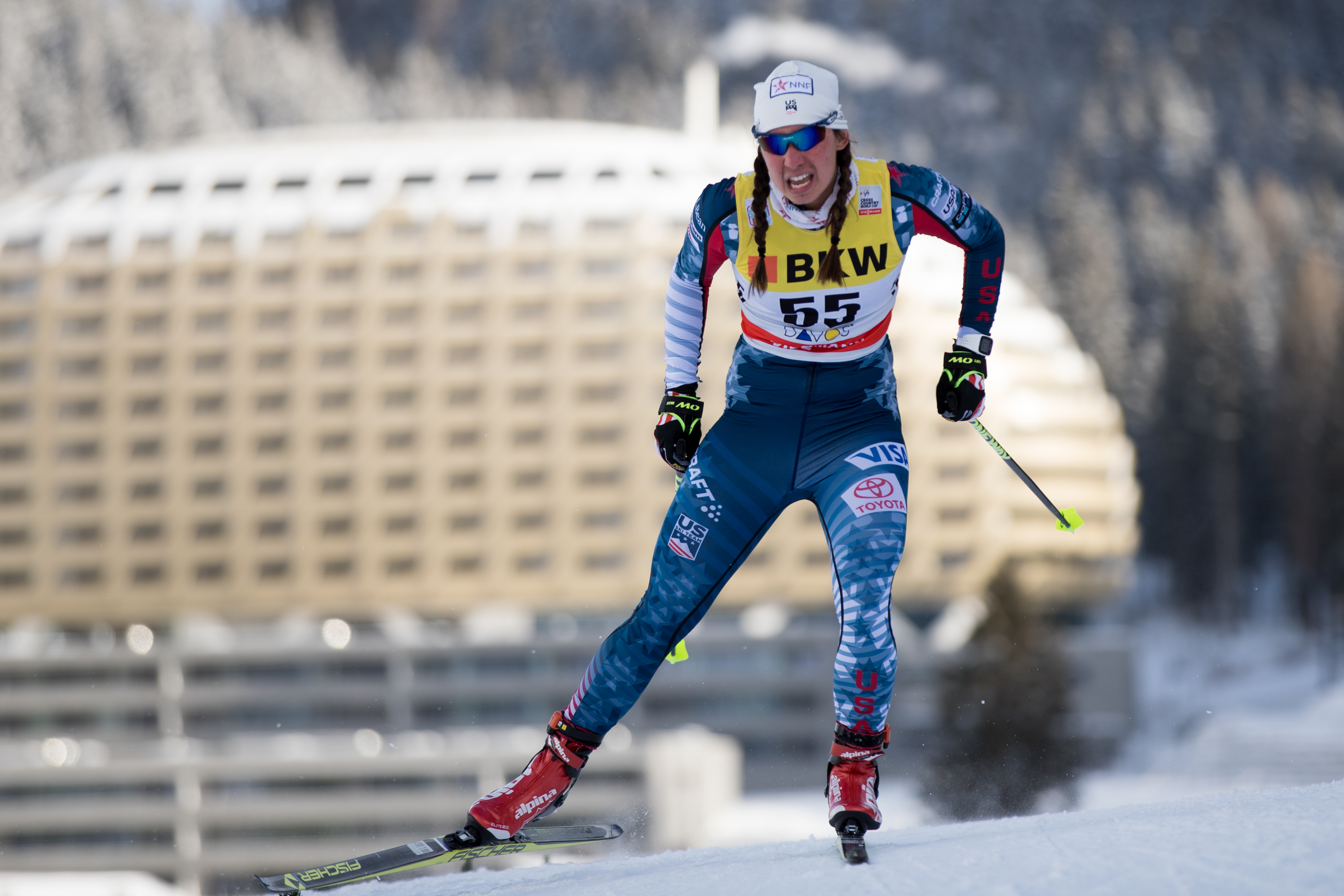
Julia Kern (U.S. Ski Team/SMS Elite/Dartmouth College) racing to 57th in the World Cup freestyle sprint last weekend in Davos, Switzerland. (Photo: Reese Brown/U.S. Ski & Snowboard)
After scoring World Cup points in her first try as part of the U.S. Nations Group roster in Canada last season, Julia Kern is getting a crack at the European World Cup scene this winter.
The 20-year-old Stratton Mountain School (SMS) Elite Team member, Dartmouth College student, and U.S. Ski Team D-teamer has been finding her place, surrounded by teammates who have racked up three sprint podiums so far this season.
“The early season World Cups are definitely really hard, especially in an Olympic year,” Kern said last Saturday after finishing 57th in the skate sprint qualifier in Davos, Switzerland. “Everyone is trying to make the Olympic team. The fields are incredibly deep. Even though Canada was a pretty big field [last year] it’s not quite the same. And early season is a lot different than late season.”
Unlike many of the women she is competing against, Kern is not trying to make her country’s Olympic team. She is a first-year Under-23, and U23 World Championships in Goms, Switzerland, is a logical focus for the year. But there are plenty of other racing opportunities as well from NCAA racing to the Continental Cup.
“Olympics were not really my mindset this season,” she said. “The sprinting team is really strong and I’m really young, and I think my goal is just to keep developing as a skier.”
To that end, she is on the World Cup to learn for later.
“This Period 1 was exactly the purpose of that — to gain experience, and focus on just getting faster and learning,” she said. “My biggest goal was really to learn from the older girls, and experience the World Cup, and learn the courses. Obviously, I wanted to break into the top 30 and that didn’t happen, but hopefully down the road that will. I got to see what it’s like to go on the road with the team.”
Kern also raced in Kuusamo, Finland, in the first week of the World Cup season, scoring an identical result in the classic sprint before placing 74th in the 10 k classic and 73rd in the overall minitour after a 10 k skate pursuit.
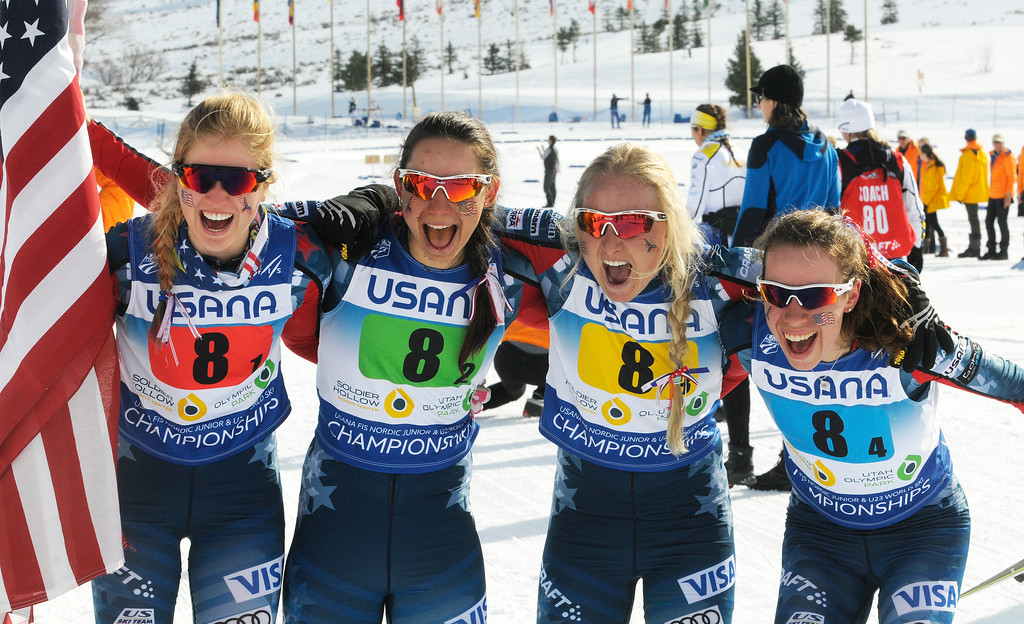
The U.S. women’s relay after taking a historic third in the 4 x 3.3 k relay at 2017 Junior World Championships at Soldier Hollow in Midway Utah, with (from left to right) Hailey Swirbul, Julia Kern, Hannah Halvorsen, and Katharine Ogden. (Photo: U.S. Ski Team/Tom Kelly)
“Yes, Julia scored points in Canada last year,” SMS Elite Team Head Coach Pat O’Brien wrote in an email. “Those were deep fields of athletes, but compared to period one it is a different game. I was never expecting [her] to blow it out of the park.”
Kern is the youngest athlete on the U.S. Ski Team’s World Cup roster this year, and one of the youngest in a few years. That inevitably brings up discussions of whether such young athletes should be sent to skiing’s highest-level competitions.
According to O’Brien, such familiarization is exactly what is needed if Kern is going to be a successful World Cup racer in the future.
“The simple reality is that Supertour does not properly prepare an athlete for World Cup racing,” he explained. “A four-minute effort on slow natural snow at 7,000 feet doesn’t get us a sprint qualifier in Davos or Kuusamo. So part of the game is figuring out the venues, figuring out what is required to do well there. I would rather have a younger athletes start hard and blow up than figure out how to nurse their way around a long slow course and never be able to qualify at the top level of our sport. It’s a little tricky because it’s too quick and easy to draw assumptions and conclusions in this sport.”
Kern is definitely learning the speed that is required for World Cup sprint success.
“In a big field to start off the season, it’s a good way to get in the mind of, ‘you’ve gotta give it your all’,” she said. “There’s no 99 percent out there.”
After some injuries this summer, she doesn’t feel like her upper body strength is 100 percent. But O’Brien said that Kern’s fitness is actually excellent.
Julia Kern (U.S. Ski Team D-team/SMS) racing to 29th in the women’s 1.5 k freestyle sprint qualifier at World Cup Finals in Quebec City in March. In her first World Cup race, Kern ended up 24th on the day. (Photo: John Lazenby/Lazenbyphoto.com)
“Obviously everyone has personal struggles in the sport, and for her, staying healthy and injury free is a big one,” he wrote. “She made a tremendous step forward in her fitness BECAUSE of an injury this summer. It was a lot of lower body exercises and running, but she was smart balancing her training so that it wouldn’t put her over the edge… The goal from the start has been to bring her into the season with less injuries and better baseline capacity than other years, and to continue to improve on stability year to year.”
Starting the season on the World Cup actually helps with that in some ways, he believed.
“One of the other nice things about World Cup is better accessibility of physiotherapy and body care, as well as reliable snow access and ski service,” he wrote. “All of these are really important things that tend to be lacking while following the SuperTour.”
Still, it can be a mental challenge to go up against the best in the world on their home turf.
“You know, last season, every race I got a little better,” Kern said. “Usually I probably peak in the last weekend, which means, awesome, but frustrating. So I think when I’m in the US, I usually didn’t try to peak for the early races. This year, I was hoping to be in a little better shape early season, but given injuries, it just didn’t happen.”
For now, Kern is done with her World Cup tour and will be racing at Continental Cups in Austria.
“A lot of the sprinters [will be there], so that’ll be fun — to take a little step down, even though its quite competitive as well,” she said. “My whole family is coming to watch because we spend Christmas in Germany. So it will be nice to do the weekend racing at a little bit of a lower level. To be a little more comfortable.”
Jessie Diggins (SMS Elite) leads fellow U.S. Ski Team member Kikkan Randall (APU) to the finish of the women’s freestyle sprint final on Wednesday at SuperTour Finals in Fairbanks, Alaska. (Photo: Max Kaufman)
U.S. SuperTour Finals (Fairbanks, Alaska): Freestyle sprints
On Wednesday the 2017 U.S. SuperTour Finals, also referred to as Spring Series, the last of the year’s elite level sprints went down in Fairbanks, Alaska.
The women raced a 1.5-kilometer course while the men skied a slightly longer 1.6 k course, both run at the Birch Hill Recreation Area in Fairbanks.
Earlier in the week, Jessie Diggins of the Stratton Mountain School (SMS) Elite Team and U.S. Ski Team (USST) showed why she’s one of the World Cup’s top overall skiers as she dominated the SuperTour Finals skiathlon.
Once again, and early on, Wednesday’s sprint had the appearance of another race to lose for Diggins. She qualified first, completing the course in 3:34.09 minutes. Her nearest competitor in qualification was Kikkan Randall of Alaska Pacific University (APU) and the USST, 6.72 seconds back.
As the heats progressed the looks of a Diggins-Randall show was in the makes. Both skiers were convincing in their trajectory to the finals as they placed first in their respective quarters and semis. And in the finals it became a two-skier race with the pair skiing decisively off the front.
Diggins scorched the finals, toeing the line in 3:30.39 minutes, nearly four seconds faster than her qualifying time. Randall, who skied in a tight race with Diggins until the closing stretch, placed second (+2.39).
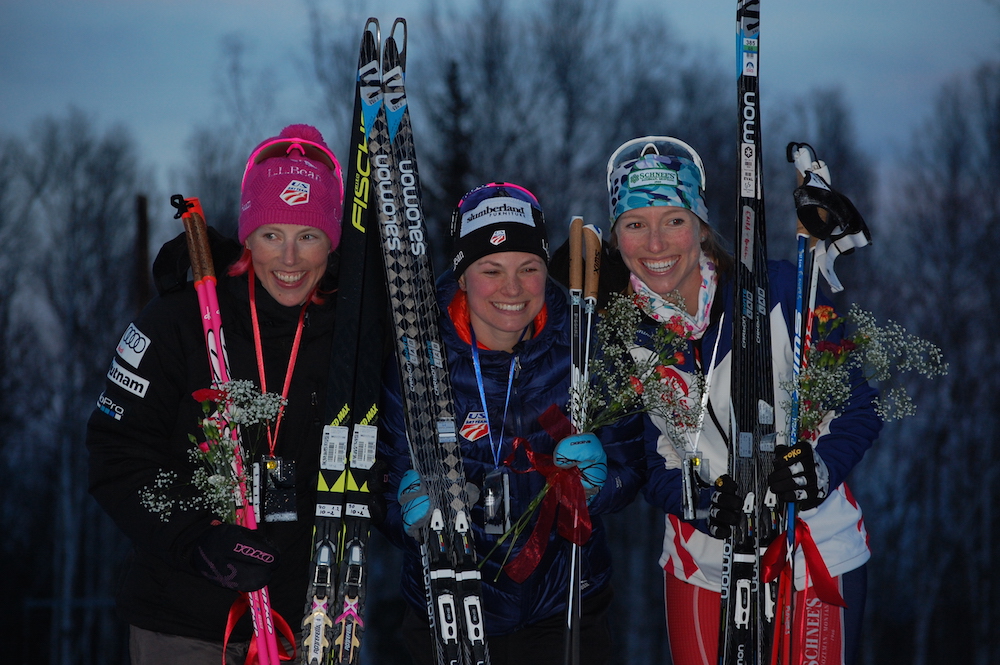
The women’s freestyle sprint podium at SuperTour Finals on Wednesday night in Fairbanks, Alaska, with Jessie Diggins (c) in first, Kikkan Randall (l) in second and Erika Flowers (r) in third. (Photo: Max Kaufman)
Erika Flowers (SMS Elite Team) reached the podium in third (+15.65), ahead of her teammate Sophie Caldwell (SMS Elite Team/USST) in fourth (+19.03), Kelsey Phinney (Sun Valley Ski Education Foundation) in fifth (+23.06), and Ida Sargent (Craftsbury Green Racing Project/USST) sixth (+27.77).
“I thought it was normal, given I set the pace, so I did it to myself,” Diggins said on the phone, recalling the final. “I thought it felt like a pretty normal, brutal World Cup final. I was going out hard, playing for keeps, that is what you do when it comes to Spring Series, you still have fun but you race hard.”
Asked is she felt any added pressure to perform well racing stateside, Diggins noted she attempts to keep things in perspective.
“There is some pressure and at the same time there’s not,” Diggins added. “Because my goals for the year focused around World Championships and the Tour de Ski, that is where I am aiming to be fast and those are the targets I am intending to hit. So coming here, you are always wanting to ski fast … I feel like there is not an incredible amount of pressure because it is the end of the season and everybody is in a totally different place and mentally I am super excited for that place flight to Hawaii I am going to be on the day after the races. I think everyone is in very different places and I think it’s not fair for us to put pressure on ourselves. I think we just go out and have fun and race hard. This isn’t how you qualify for the Olympics and there is good reason for that.”
SMS Elite Team Head Coach Pat O’Brien provided some insight into the large time gaps in the women’s final.
“Coarse was pretty long and hard, I think it plays to people with some more muscular endurance and less fast twitch, especially this late in the season when people are tired,” O’Brien wrote in an email. “This isn’t a 3 min sprint on manmade that prioritizes finishing speed like a European World Cup. It was just straight tough out there! … No falls, just a bunch of tired ladies slugging it out at 8PM at night near the arctic circle. Hard work by all!”
Local skier Logan Hanneman (APU), who grew up and attended college in Fairbanks, made the hometown proud. He eventually pulled out the win in the men’s final.
Hanneman qualified fourth (+6.27) behind Simi Hamilton (SMS Elite Team/USST) who topped the qualifier in 3:11.35 minutes. (After the qualifier Hamilton pulled from the competition).
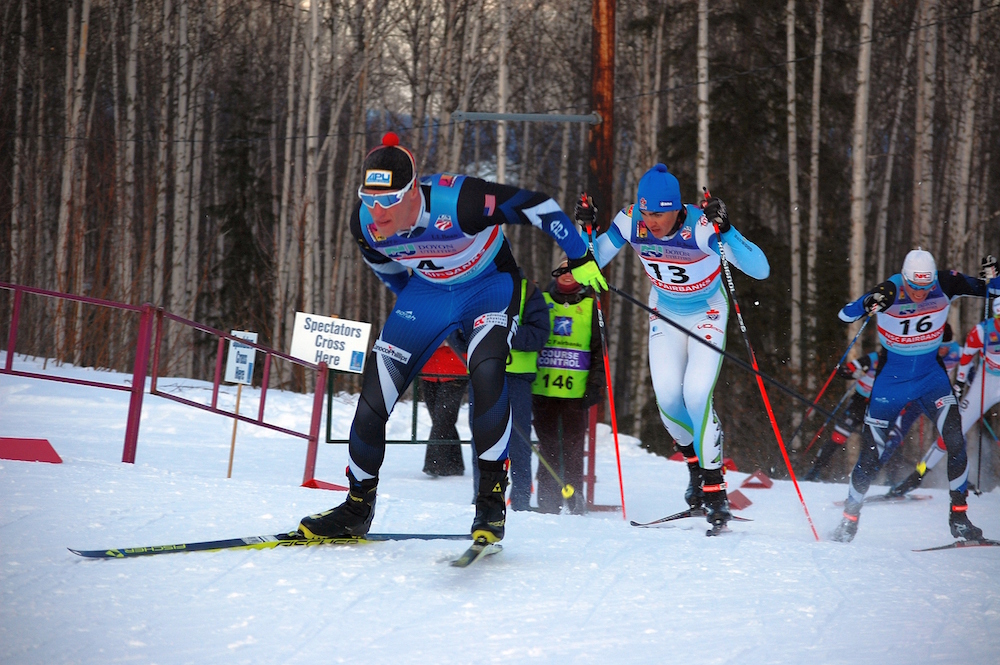
Logan Hanneman (APU) leads Canada’s Evan Palmer-Charrette (13) of NTDC Thunder Bay and Tyler Kornfield (16), his APU teammate, in the men’s freestyle sprint final on Wednesday at SuperTour Finals in Fairbanks, Alaska. (Photo: Max Kaufman)
In the men’s final, several skiers appeared to be in play for the win. Hanneman placed first in his quarter and semi. Canadian skier Evan Palmer-Charrette (NTDC Thunder Bay), also looked like a threat as he proved a knock-out type closer. Another guest skier, Norway’s Haakon Hjelstuen, a former Michigan Tech skier, skied heady and strong.
Also appearing in the men’s finals were two skiers who are known to pounce when opportunity knocks: Tyler Kornfield (APU) and Dakota Blackhorse-von Jess (Bend Endurance Academy). Tad Elliott (Ski & Snowboard Club Vail) completed the six-skier final.
Heading into the last technical descent on course Hanneman was third behind Kornfield and then Palmer-Charrette. A few tight corners remained with a climb back up to the finish.
“I ended up taking the last sweeping left corner very wide and accelerated as I moved right,” Hanneman explained in an email. “Then we were able to hit the bottom of the climb basically 3 abreast. Once I saw that I had a lane open I just opened it up and went for it!”
Here’s how the final played out: Hanneman placed first in 3:16.77 minutes, Palmer-Charrette was second (+1.08), Kornfield third (+3.84), Hjelstuen fourth (+3.98), Blackhorse-von Jess fifth (+6.38), and Elliott sixth (+7.17).
It appears Hanneman was able to channel his nervous energy into positive forward momentum.
“I definitely put a lot of pressure on myself to win this race,” Hanneman wrote of performing in front of his hometown crowd. “To have these races in my hometown is one thing, but then knowing that I could do well in the sprint added a lot of nerves to the equation. I definitely really wanted to perform well for the volunteers, the crowd, etc. they have supported me through all of the skiing programs here in Fairbanks for years and I really wanted to ski my best for them. I am so very happy that this is how it turned out!”
Hunter Wonders (APU) won the junior men’s sprint in 3:32.76 (he was also the winner of Monday’s 11.25 k classic) with a hard-charging final push, Max Donaldson (University of Alaska Fairbanks) placed second (+0.40) and Logan Mowry (Nordic Ski Club of Fairbanks/FXC) was third (+4.76).
For the junior women, Hannah Rudd (University of Alaska Anchorage) took the lead on the final climb and secured the win in 4:08.46, Dottie Anderson (Loppet Nordic Racing) placed second (+1.96) and Jenna Difolco (Nordic Ski Club of Fairbanks/FXC) was third (+7.64).
Racing continues Friday with a mixed gender/mixed technique relay.
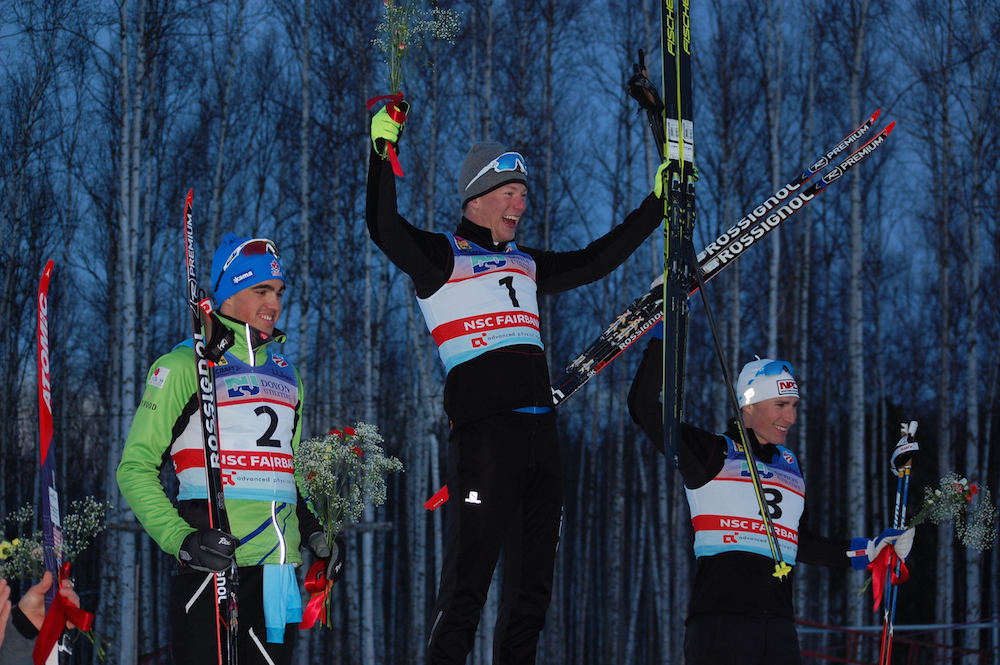
The men’s freestyle sprint podium on Wednesday night at SuperTour Finals in Fairbanks, Alaska, with Fairbanks native Logan Hanneman (c) in first, Canada’s Evan Palmer-Charrette (l) in second and Tyler Kornfield (r) in third. (Photo: Max Kaufman)
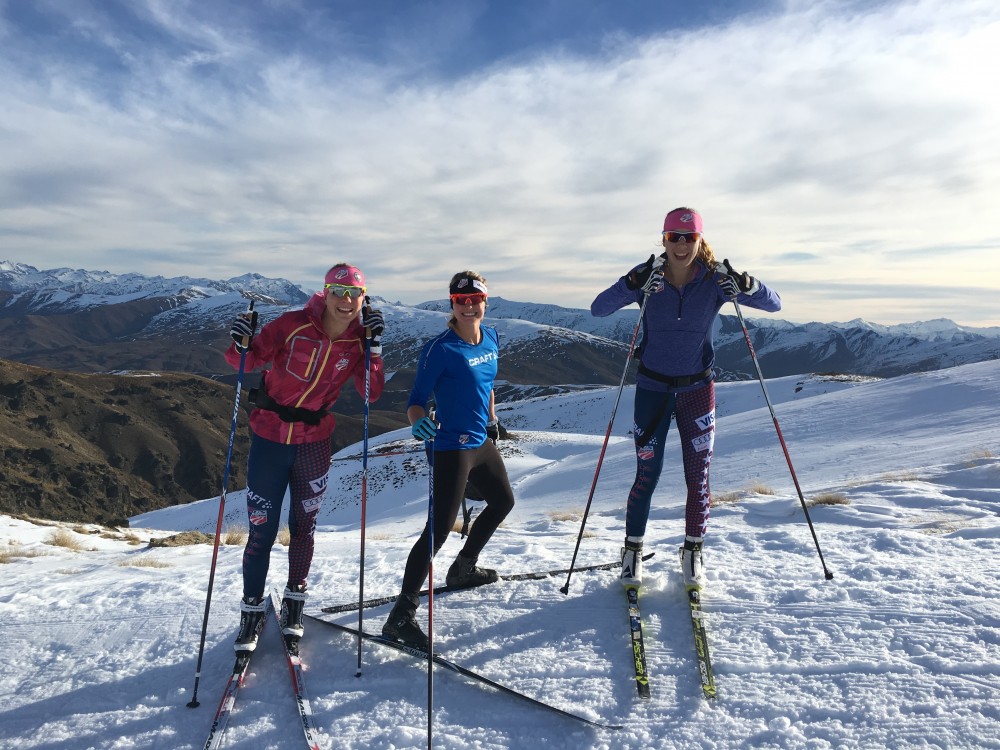
Katharine Ogden (left) training with U.S. Ski Team teammates (r-l) Jessie Diggins, Liz Stephen, and Sophie Caldwell in New Zealand this summer. (Courtesy photo)
Welcome to “17 Questions for 2017″, where we are catching up with American and Canadian national-team members before the beginning of the winter season.
***
Katharine Ogden of the Stratton Mountain School kicked off last season by winning the SuperTour 10 k skate in West Yellowstone, Montana – then picked up a fourth-place finish at U.S. National Championships, two top-20’s at World Junior Championships, and finished the season off with her first World Cup starts in the Ski Tour Canada.
Ogden just turned 19 years old. The U.S. Ski Team “D” teamer placed fourth in both the sprint and 10 k classic at New Zealand Championships this summer and has spent serious time training with the women’s national team.
1. Biggest change in your life in the last five or so months since the ski season ended?
Biggest change in my life since the past season was graduating high school. So far I’m loving being able to just ski without having school work to worry about.
2. Biggest change in your training?
Since I’m not in school I’ve upped my training hours considerably since last year. I also started on a new strength plan.
3. Major areas of improvement you’ve seen so far?
The biggest improvement I’ve seen so far has been in my double poling. I’ve worked really hard for years now to correct my back position in that technique and it is finally starting to come along.
4. Whom you’ve been working closest with this offseason (coaches or training partners)?
During the summer I’ve been training predominantly with the SMS Elite Team girls and coach Pat O’Brien.
5. Best trip in the last five months (and why)?
Left to right: Ida Sargent, Sophie Caldwell, Katharine Ogden, Liz Stephen, and Jessie Diggins racing at New Zealand National Championships at Snow Farm, New Zealand. (Photo: Matt Whitcomb)
My favorite trip this summer was definitely New Zealand in September. It was totally awesome to get on snow then and it was also an extremely productive camp for me. I also just loved everything about the place the people and the food there. Honestly might have been one of my favorite camps of all time.
6. Favorite cross-training?My favorite cross training is mountain biking.
I just got a new bike and I’m loving it so much.
7. Favorite non-athletic activity or pastime this summer?
My favorite non-athletic pass time this summer was eating a big yummy brunch on off days.
8. Song that was your jam this summer?
I don’t really have a favorite song. I mostly listen to audiobooks. My favorite is The Night Circus by Erin Morgenstern.
9. All time favorite race moment?
My all time favorite race memory is from my first ever Junior Nationals at Soldier Hollow in Utah. I was just barely picked as the third member of New England’s “A” relay team for U16 girls, my teammates were Zoe Snow and Julia Kern. Our team and the Alaskan team were super close the whole race and Julia was out anchor leg. My favorite moment was when the three of us found out that Julia had out lunged the Alaskans at the line to win the race!
10. First thing you pack in your bag when you leave for Europe?
First thing in the bag when I pack to go to Europe is oatmeal and peanut butter. You new know with the food in a new place so I always pack the essentials.
11. Venue/event you’re most excited to visit this season?
U.S. Ski Team D-team skier Katharine Ogden (r) during a sprint time trial at the USST’s annual training camp in Park City, Utah, which ran this year from Oct. 17 until Oct. 31. (Photo: Bryan Fish)
The event I’m most looking forward to this year is the SuperTour races in Silver Star BC. I’ve never been to Silver Star but it’s so many people’s favorite place so I’m really excited.
12. Who will win the World Cup title this year?
Jessie Diggins. duh.
13. Biggest sacrifice you feel you’ve made choosing this career path?
I think choosing to pursue skiing as a career has caused me to give up some things but they really arent worth considering because this lifestyle gives back much more than it takes. I wouldn’t give up the opportunities to travel, make new friends and learn about myself for anything.
14. If you could change one thing about your sport, what would it be?
If I could change one thing about the sport I would make it snow more. I guess that’s not specifically about the sport but the one bummer about being a skier is when you want to ski but there isn’t enough snow.
15. What did you have for breakfast this morning?
For breakfast today I had french toast but I usually have peanut butter banana oatmeal.
16. In 5 years, I’ll be ____?
Hopefully racing on the World Cup, living the dream.
17. In 50 years, I’ll be ____?
Living in Vermont and I’ll hopefully have cute grandkids that I can ski around with.
Left to right: U.S. teammates Ida Sargent, Jessie Diggins and Katharine Ogden during their first ski of the camp at Snow Farm in Wanaka, New Zealand. (Photo: Erika Flowers)
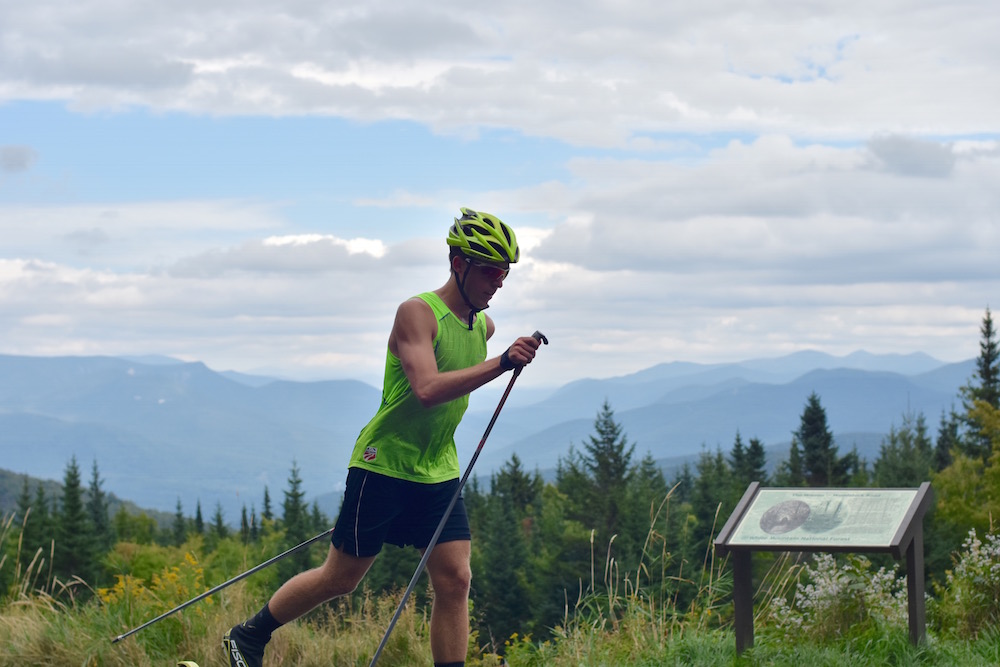
Paddy Caldwell rollerskiing around Mount Moosilauke in New Hampshire this fall. (Photo: Pat O’Brien)
Welcome to “17 Questions for 2017″, where we are catching up with American and Canadian national-team members before the beginning of the winter season.
***
U.S. Ski Team D-teamer Patrick “Paddy” Caldwell was all over the place last year: taking classes and training at Dartmouth College, racing in the west, winning a SuperTour and college carnival in Vermont, traveling to Romania for U23 World Championships, and then back to Vermont, where he finished third in the 15 k skate at SuperTour Finals.
This season will be his last as a U23, and he’s looking forward to concluding that part of his career on home soil in Soldier Hollow, Utah.
1. Biggest change in your life in the last five or so months since the ski season ended?
No major changes since last winter. I was in Hanover this summer taking classes at Dartmouth, now I am back in Stratton with the SMS Elite Team.
2. Biggest change in your training?
Paddy Caldwell trail running in Park City, Utah. (Photo: Simi Hamilton)
This summer I focused more on speed/power than I have in the past.
3. Major areas of improvement you’ve seen so far?
I think my top-end speed has improved since last year.
4. Whom you’ve been working closest with this offseason (coaches or training partners)?
Pat O’Brien, the SMS Elite Team coach.
5. Best trip in the last five months (and why)?
I had an amazing trip out to Colorado and Utah last month first visiting my girlfriend’s family in Loveland, Colorado, then heading to Park City for the annual USST training camp. I love being out west and exploring new places to run and hike.
6. Favorite cross-training?
Trail running.
7. Favorite non-athletic activity or pastime this summer?
Hanging out at the cabin and paddling around the lake.
8. Song that was your jam this summer?
Hamilton.
9. All time favorite race moment?
Nordic/Biathlon team relay at the Youth Olympic Games in Seefeld, Austria.
10. First thing you pack in your bag when you leave for Europe?
An excited Paddy Caldwell (Dartmouth College/SMST2/USST) (center), Tad Elliott (SSCV) (l), and Kris Freeman (Team Freebird) during the podium ceremony for the SuperTour men’s 10 k freestyle on Feb. 6 in Craftsbury, Vt. (Photo: John Lazenby/Lazenbyphoto.com)
Starbucks VIA and a cribbage board.
11. Venue/event you’re most excited to visit this season?
Soldier Hollow for the U23 World Championships. Its awesome that such a big event is happening in the US and it will be amazing to see all the different teams racing on a home course.
12. Who will win the World Cup title this year?
Harvey and Diggins.
13. Biggest sacrifice you feel you’ve made choosing this career path?
I love the skier lifestyle and am so thankful for the opportunity to pursue ski racing. The biggest sacrifice for me is not being able to see friends and family on the road.
14. If you could change one thing about your sport, what would it be?
I would make skiing 100% doping free.
15. What did you have for breakfast this morning?
Coffee. Cereal, yogurt, peanut butter, banana and blueberries.
16. In 5 years, I’ll be ____?
27 and, with any luck, I’ll be happy, healthy and chasing snow.
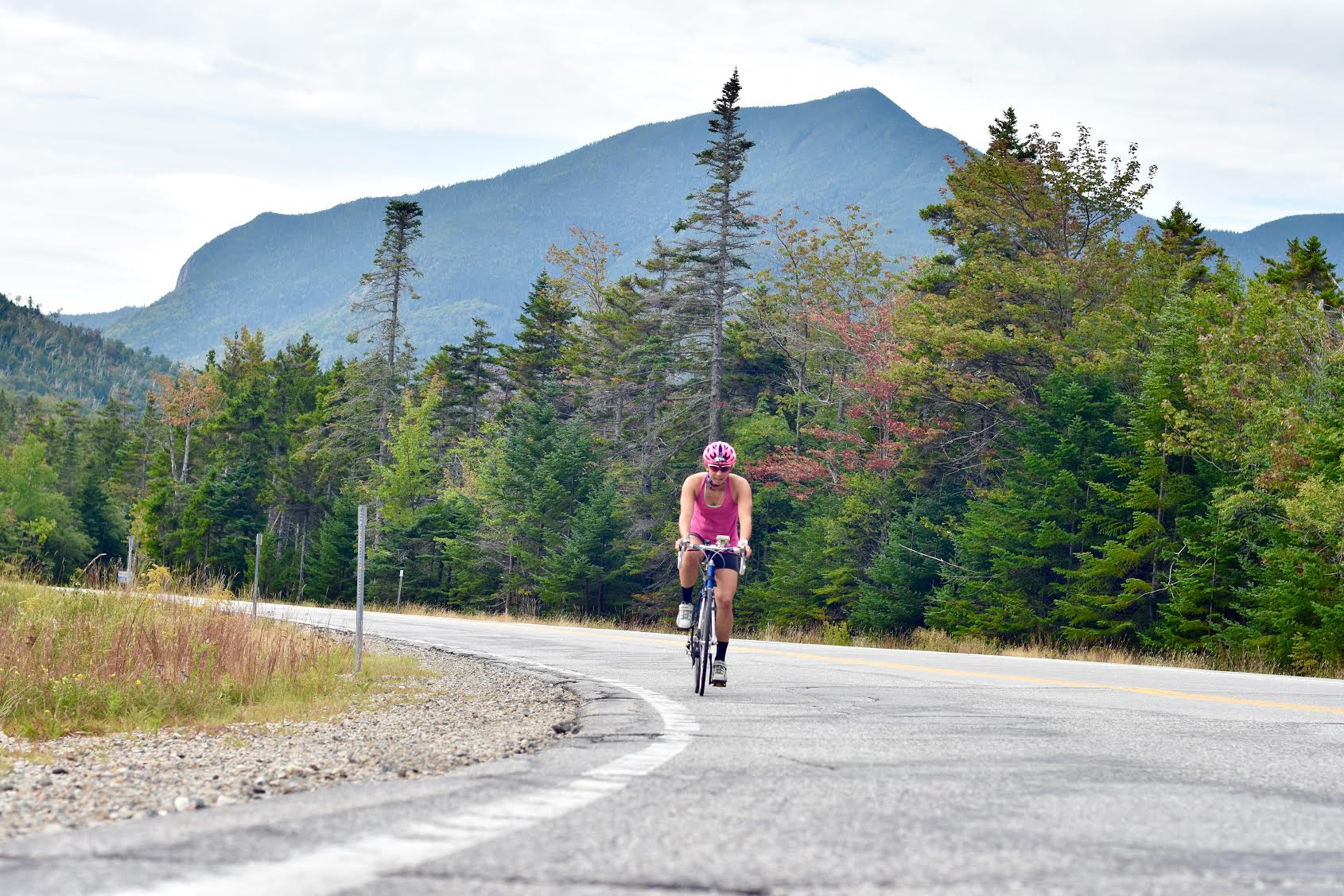
Julia Kern biking up New Hampshire’s Kancamagus Highway at a recent training camp. (Courtesy photo)
Welcome to “17 Questions for 2017″, where we are catching up with American and Canadian national-team members before the beginning of the winter season.
***
19-year-old Julia Kern had quite a diverse year last season, her first on the U.S. Ski Team: a SuperTour podium, a trip to World Juniors, two individual podiums in the junior races at OPA Cup finals in Italy, and two podiums in the junior races at U.S. National Championships (long and short distance).
Having joined the Stratton Mountain School SMST2 Elite Team this year as well as enrolling at Dartmouth College, Kern has made some changes and is looking forward to another big year.
1. Biggest change in your life in the last five or so months since the ski season ended?
My biggest change in the past 5 months has been starting college at Dartmouth. The day after the season ended, I headed straight to Dartmouth to start my first term in the spring and I am currently half way through my second term this fall.
2. Biggest change in your training?
I have finally been able to train without modifying my plan due to injuries and illness so I would say my biggest change is that I am back to a normal training plan! Wahoo!
3. Major areas of improvement you’ve seen so far?
I think there isn’t one specific area where I have seen improvement over the past few months, but actually in every area. I feel like I have generally improved in all areas.
4. Whom you’ve been working closest with this offseason (coaches or training partners)?
Julia Kern happily healthy and rollerskiing. (Courtesy photo)
Since I have joined the SMS Elite team this year, Pat O’Brien became my coach so I have been working closely with him in conjunction with Cami at Dartmouth. In the spring and fall, I have been trained with Dartmouth Ski Team and in the summer I trained with the SMS Elite team. It is fun to mix up training partners!
5. Best trip in the last five months (and why)?
I have only traveled once in the past five months. I went to Park City, UT for a training camp to kick off the summer and it was one of the most effective camps I have been to. I always love coming back to Park City because it is starting to feel like another home to me and the area is just so incredible!
6. Favorite cross-training?
This is a hard one! I really enjoy playing basketball in my free time, but if we are considering cross cross training to be a little more ski specific, I would have to say swimming.
7. Favorite non-athletic activity or pastime this summer?
Camping and hanging out on the beach may be considered an athletic activity with my family, but I was always enjoy my family’s annual vacation camping on Cape Cod every summer.
8. Song that was your jam this summer?
I would say my go-to jam this summer was “Good Day” by Nappy Roots. Definitely not a new song, but it is a good way to start a good day!
9. All time favorite race moment?
American Julia Kern (SMS/USST) racing to a career-best 16th in the 2016 Junior World Championships freestyle sprint in Rasnov, Romania. (Photo: Pete Leonard)
My all time favorite race moment was definitely this past winter during my last race at OPA Cup finals. It was a pursuit start and the girl who started in front of me and behind and I all caught up to one another and skied most of the race together. My tactics worked out really well and I finally nailed the “shake and bake” tactic right in the end to beat out the two girls I was racing head to head with.
10. First thing you pack in your bag when you leave for Europe?
Underwear…but that is a given essential. I pack my camera because I love taking photos and videos on the road, capturing the different cultures and landscapes around.
11. Venue/event you’re most excited to visit this season?
I am most excited for Soldier Hollow! I think it will be an incredible opportunity to have our qualification for World Juniors at the same venue and on the same race courses as World Juniors.
12. Who will win the World Cup title this year?
For the men, Petter Northug. For women, Marit Bjoergen.
13. Biggest sacrifice you feel you’ve made choosing this career path?
The biggest sacrifice I think so far has been giving up on a normal social life. I have found it is hard to maintain a close friend group outside of the ski community when I hardly stay in the same place longer than a month at a time. I am very fortunate to have my closest friends be in the skiing community though, and probably for a good reason!
14. If you could change one thing about your sport, what would it be?
I wish we had some world cups in the U.S. Having World Juniors in Utah this year is going to be really incredible and I wish that people in the U.S. got more exposure to what cross country skiing is and make it easier for athletes’ families come and watch.
15. What did you have for breakfast this morning?
I had two slices of fresh sourdough dough bread with avocado, topped with one over-easy egg on each. Yumm 🙂
16. In 5 years, I’ll be ____?
I will hopefully be racing on the World Cup circuit.
17. In 50 years, I’ll be ____?
I’ll be like my grandmother; active, happy, and a life filled with wonderful grandchildren.
Ben Saxton (SMS T2) leads Norwegian Sondre Fossli in a quarterfinal of the 1.3 k classic sprint at the U23 World Championships. Saxton finished sixth in the race after falling victim to a crash in the final. (Photo: Bryan Fish/USSA)
Instead of interrogating them with the usual “tell us how you’re feeling,” we decided to pose the following 10 questions to each of the North Americans headed to their first World Championships from Feb. 18-March 1 in Falun, Sweden.
***
When the U.S. Ski Team announced 16 skiers to its World Championship team, Ben Saxton’s name wasn’t on the list. However, USST Head Coach stressed that there was still a possibility for additions to the team with strong performances at the U23/Junior World Championships in Almaty, Kazakhstan .
“Somebody needs to have a standout performance to demonstrate that they would ski faster than somebody who is already on the World Championship team,” Grover said to FasterSkier after the initial team announcement.
Saxton had the standout performance that Grover was looking for with a sixth place in the U23 classic sprint. Just days later he was named to the team. At the age of 21, the Stratton Mountain T2 skier enters the year’s most anticipated races as the youngest U.S. competitor.
After U23s in Almaty, Ben competed in the Slavic Cup freestyle sprint in Nove Mesto, Czech Republic, which he handily won. He is now in Falun, Sweden preparing for his first race of Worlds.
Ben Saxton (l) and the men’s 1.5 k classic sprint at the 2015 U.S. Cross Country Championships in Houghton, Mich.
1. What was the first thing you did when you found out you were named to the World Championships team?
“Email Pat [O’Brien], and fist-bump my tech Tim Baucom.”
2. What’s been the biggest performance of your career so far? Which race stands out the most and why?
“I’d have to say U23s this year. It’s the first really competitive race I’ve had against World Cup level competition, and it resulted in me being named to the WC team which is a dream come true.”
3. What are you most looking forward to at World Championships?
“Competing with the absolute best in the world. I’ve been watching guys like Emil [Jönsson] and [Ola] Hattestad for years, and now I’m starting the same race as them! I’m definitely hoping I get a chance to go head to head with them in heats.”
4. What’s your biggest motivation while racing?
“I just love going fast. There are few things that can match the primal joy that comes from racing as fast as possible and beating someone. I definitely don’t always beat people, but that feeling is worth chasing again and again.”
5. Which race(s) do you hope or plan to compete in?
“I’m slated to do the classic sprint, and that’s all. You never know what could happen in regards to the team sprint, but we have an incredibly strong group of sprinters coming over for World Cups and I believe that the older men will probably start the team sprint.”
Ben Saxton (SMST2) skiing to second place in the freestyle sprint at the 2014 U.S. Cross Country Championships. (Photo: http://bertboyer.zenfolio.com) All proceeds from photo sales will be directly donated to NNF.
6. If you could race the team sprint with anyone in the world, who would it be?
“Ooh that’s a tough one. My friend Lenny Valjas and I have always joked about doing a combo team sprint, I think that would be pretty awesome. Of course it would just be one of the coolest things ever to do a team sprint with Andy or Simi, since they’ve done so much to help me reach this point.”
7. Which World Cup skier would you least like to meet a “dark alley” (or the final 100 meters of a race)?
“I have nothing but respect for everyone in that field, but I’m not scared of anyone…more like excited.”
8. What will be your key to success in Falun?
“Staying relaxed, and taking care of the little things like I did all throughout U23s.”
9. Finish this sentence: If I made the podium at World Champs, I would ___________.
Did you ever see what Oystein Petterson did when he made his first podium?
10. Name someone who’s had a major influence on your skiing career.
“There are so many people that should be on this list, but first and foremost are my folks Paul and Julie who have given me every opportunity they could afford to throughout my skiing career. Without them there’s no way I ever could’ve started on this skiing career.”
Simi Hamilton celebrates his first victory and podium in the third stage of the Tour de Ski on Dec. 31 in Lenzerheide, Switzerland. In the 1.5 k freestyle sprint final, Hamilton edged Canada’s Alex Harvey and Norway’s Martin Johnsrud Sundby, who placed second and third, respectively. (Photo: Fischer/Nordic Focus)
Simi Hamilton had never made a World Cup final, let alone won a stage World Cup. That all changed Dec. 31, 2013 with his momentous victory in the third stage of the 2014 Tour de Ski.
Hailed around the U.S. as part of a major shift towards improved American results, his win was the first by an American male since Bill Koch in 1983.
However, even after such a significant win, Hamilton said there hasn’t been much change to the 27-year-old’s training routine. Other than searching for potential sponsors to line his racing hats and headbands, Hamilton’s only adjustments for the 2014/2015 season come in the form of several small but effective “gear shifts.”
To understand these shifts it’s important to take a look back at Hamilton’s 2013/2014 season, which he considers his best to date. However, even a successful season can have its pitfalls.
“[The season] was still a little more inconsistent than I really would have liked it to be. With the Olympics it didn’t really pan out like I hoped they would and there was some funky stuff with conditions and breaking my pole. I felt like I could have skied better there,” Hamilton told FasterSkier.
Simi Hamilton after anchoring the U.S. men to 11th in the 4 x 10 relay at the Sochi Olympics.
Heading into the post-Olympic year, Hamilton said that he doesn’t need to alter much in his training routine in order to maintain his results. He explained that past training plans had prepared him well for the racing season and said that he knew he was “doing the right stuff.”
“I’m really not changing too much around. In general my fitness on a year-to-year basis has improved. I’m confident that next year it will be even better and that I will be able to string together more consistent results,” he said.
Despite the consistency in his training routine, Hamilton has been working on building several key aspects of his skiing that aided him in achieving last year’s strong results.
One of the main focuses of his summer training has been to make a conscious effort to analyze the terrain of each course and make adjustments accordingly.
“Nothing is the same, so you are never going to keep the same V2 from a flat stretch into a climb. As I’ve been training this summer I’ve been trying to focus on that – all these little gear changes. Whether they are subtle or major, you are constantly having to adjust your tempo, stride, and power to match what the terrain does,” he explained.
The Aspen, Colo. native said that many of his best results came when he was focused on the terrain and its transitions. He pointed the Tour’s third stage, saying that his ability change tempo, power application, and glide throughout the varying course played a central role in his victory.
Now the goal is to apply that mentality and focus to every race – especially when it comes to classic skiing.
FasterSkier caught up with Hamilton as the U.S. Ski Team was wrapping up its Lake Placid camp in September. While Hamilton entered with ambitions of a consistent and productive camp, he was hindered with an ankle injury during an Aug. 28 run in the Adirondacks.
The World Cup stage winner, who has a history of ankle-related problems, said the injury was not serious. However, he was unable to fully participate in most of the camp’s trainings and double poled the 2014 Climb to the Castle to ease any pressure on his ankle.
Hamilton explained he wasn’t sure when he would be completely healed, but was confident that he would be back to full training in a couple weeks.
U.S. Ski Team member Simi Hamilton (r) works on corning during training at Soldier Hollow in Midway, Utah, during a 2013 U.S. Ski Team fall training camp. (Photo: Tom Kelly/USSA)
The 27-year-old is currently in his second year of training with the Stratton Mountain T2 team. A transplant from the Sun Valley Ski Education Foundation and alumnus of nearby Middlebury College, he said the team environment at Stratton has aided in his improvements and training throughout the year.
While Hamilton earned his World Cup stage win under the guidance of former Stratton coach Gus Kaeding, he said that the team’s new coach, Patrick O’Brien, has been a perfect fit for both him and his teammates.
“Pat O’Brien has been a great asset to the team this year. He really understands – having just come from the Craftsbury team – the whole infrastructure right now,” Hamilton said.
With the racing season drawing closer, Hamilton is both excited and hungry to be back on the familiar glide of snow and take his place alongside the his fellow competitors. For now, however, Hamilton is working with O’Brien and his USST coaches to make small adjustments to his skiing as he enters the intensity of the fall.
“It feels like the season is close – and it is – but you still have to remember that there are two full months before we are going to be in Europe. I think if you spend that time well it can be a really valuable time to gain what you need to gain and get your body ready for a winter of racing.”
Olympian Liz Stephen challenges Patrick O’Brien of the Craftsbury Green Team during the 6th Annual Race To The Top of Vermont on Aug. 25. (Photo: Race To The Top Of Vermont)
Editor’s note: This story has been updated to include the overall women’s course record, set by mountain biker Lea Davidson last year.
Before last Sunday, Liz Stephen isn’t sure if she had ever been to the top of Mount Mansfield’s Toll Road, which winds for 4.3 miles up 2,564 vertical feet in Stowe, Vt. Didn’t matter.
The 6th Annual Race To The Top Of Vermont was another hill climb, and the 26-year-old affectionately known as “spider monkey” on the U.S. Ski Team had a goal of winning, setting the run course record and beating mountain bikers in the process.
“My goal was to try and get both the record for the women’s run, but also knew there was an overall bike and run record as well that was worth a bit of money,” Stephen wrote in an email earlier this week. “So I was shooting for that as well.”
The runnning time to beat was 39:17.7 minutes, set in 2011 by defending champ Kasie Enman of Huntington, Vt. (the overall women’s course record was 37:18.7, set by m0untain biker Lea Davidson of Jericho last year). Stephen, who hails from East Montpelier, shattered the run record by nearly two minutes in 37:22 (and missed the overall record by about 3 seconds). She beat the first female mountain biker, Marilyn Ruseckas of Warren, by almost seven minutes.
Runner-up Ida Sargent, another Vermont native and Stephen’s teammate on the national team, explained she never saw much of Stephen in her third consecutive Race To The Top. Last year, Sargent placed third behind Enman, who was third on Sunday. Enman had a baby this spring and ran slightly behind Sargent for the entire race, but Sargent explained she could hear people cheering for Enman for much of it.
“[Liz] was gone when the gun went off so I was running my own race,” Sargent, 25, wrote in an email. “But there were lots of guys around me to run with. Liz was absolutely amazing and it was really cool to see her run that fast. She’s a speedy mountain goat!”
Add that to the list of nicknames for the World Cup phenom, who placed fifth at World Championships last season in the 10-kilometer freestyle individual start on a grueling course at 4, 700-feet above sea level in Val di Fiemme, Italy.
The toll road peaked at 4,393 feet atop Vermont’s highest peak.
“It’s true that I like to go ahead early when I can, but it doesn’t always work out,” Stephen explained. “With these types of races, it is pretty hard not to just go as hard as you possibly can. The goal for me was to pace it well so I could run as fast as I could.”
The fruits of her effort paid off and indicated her fitness was on track three months before winter racing resumes in Europe.
“However, I am a cross country skier and that is about fitness, power, strength, mental toughness, and technique, among other factors, so I will just keep training the way I have been training and preparing for the winter races,” she wrote.
Stephen also used the race as a fundraiser, publicizing her participation on a website to raise money for Vermont skiers gearing up for the 2014 Olympics in Sochi, Russia. As of Friday, she’d raised $2,450 dollars. Sargent (Craftsbury Green Racing Project) was also included in the fundraiser.
“The fundraising effort has gone great, so far,” Stephen explained. “We will leave the fund up until the day the Olympics begin, so it will give people a good amount of time if they would like to contribute at some point between now and then. The response is always great in this area when you ask for help and support of one sort or another. We have such incredible communities that care about one another and want to be involved here in Vermont.”
Sargent has been recovering from Achilles tendinitis and hadn’t originally planned to race, fearing the consistent uphill grade could do a number on her.
“So I just went to the race planning to run and hike up and cheer for my teammates but then I got the race itch and couldn’t help not putting on a bib,” she wrote. “I was really excited to be able to race and mostly not have my Achilles bother at all. And I was a minute faster than last year which is a very promising sign about my fitness.”
Sargent explained she hasn’t been running as much this summer as past years and didn’t think too highly of her running shape going into Sunday’s race.
“It’s a really hard race but it was a beautiful day on top and awesome to see so many people out there running, biking, and hiking up the mountain,” she wrote. “The local support was incredible. It’s very inspiring and I’m very thankful!”
Stephen placed 10th overall and Sargent was 31st behind men’s winner Eric Blake of West Hartford, Conn, who broke the men’s course record by a minute and 2 seconds in 32:51.3. A 2006 Olympic nordic skier, Justin Freeman of New Hampton, N.H., was second in his debut Race To The Top in 34:42.3. Craftsbury GRP skiers Gordon Vermeer was fifth (36:14.6), Pat O’Brien was ninth (37:20.5) and Andrew Dougherty was 19th (39:57).
The top mountain biker, Gered Dunne won in 32:58.2, but Freeman edged second-place biker Jake Hollenbach by nearly 19 seconds. In an email, Freeman, 36 explained Blake started conservatively before making a small move about a half-mile in. Third-place finisher Josh Ferenc followed, and Freeman fell a few seconds behind.
“Around the mile mark Blake made a bigger move, dropping Ferenc, who faded hard,” he explained. “I ran with him for less than a minute and then started to gap him. I didn’t look back, but I could tell from listening to people cheer that I built a lead of between 20 and 30 seconds by about a mile to go. From there Ferenc was slowly gaining but not enough to catch me.”
Freeman beat Ferenc by 11.7 seconds.
“I was disappointed not to go under the old record, but I am actually pretty happy to be only two minutes behind Blake,” he wrote. “Josh Ferenc has defeated me handily the two previous times I have raced him this summer, so it was nice to come in ahead of me (I agreed with him that I am now a runner/skier, so he need not suffer the stigma of having been beat by someone who is just a skier). I will probably go back next year, and I think I have it in me to run about a minute faster.”
In terms of hill climbs, Freeman stated that this was like most others.
“It’s an uphill run, so it requires going really hard, but in terms of racing tactics it is pretty straightforward,” he wrote. “You go as fast as you can without building too much lactate. The grade varies a lot more than Mt. Washington, which gives some chances for something resembling recovery, but in the end it is like any other 35-minute hill climb.”
As for what’s next, Stephen and Sargent are due to meet up with the U.S. Ski Team in Lake Placid, N.Y., next week. The annual fall camp ends with the Climb to the Castle on Sept. 15 – a rollerski race which the multiple-time defending champion Stephen essentially owns.
“The Climb to the Castle is a great test of fitness as well as just a good, hard effort, both mentally and physically,” Stephen wrote. “I look at it as a good way to practice race prep routines and race day nerves, as this race makes me so dang nervous every year!”
The Craftsbury Green Racing Project is excited to welcome a new crop of skiers to the team this year. With a strong pool of applicants, and limited slots, the decisions were tough.
At the full Green Racing Project level, we’ll be joined by Liz Guiney, Andrew Dougherty and Pete Hegman.
Liz spent her junior years skiing for the Utah Nordic Alliance and Park City Nordic Ski Club; raced at numerous Junior Nationals, and was part of the 2009 US J1 Scando trip team. She then did her college racing for UNH, qualifying for NCAA’s in the past three years. She represented the US at U23 World Championships this past winter.
Vermonter Pete Hegman came up through the Mansfield Nordic program and Mt. Mansfield Union High School, where he had a couple of state championship titles. He was on the NE team for Junior Nationals, and then raced all four years for UVM.
Andrew Dougherty grew up ski racing in Alaska, including many years on the Alaska Junior Natonal team, and then did his college racing for Denver University. He represented the US at the 2011 World Junior Championships and has since been a two time NCAA All-American. Along with Liz, in 2009, he was a member of the US J1 Scando Trip team.
Returning GRP skiers are Alex Howe, Gordon Vermeer and Patrick O’Brien on the men’s side, and Clare Egan, Ida Sargent, Caitlin Patterson, Hannah Dreissigacker and Susan Dunklee for the women. Clare will be focusing on Biathlon this year. Ida has been named to the USST A Team; while Hannah and Susan have been named to the USBA A Team.
This year’s training group will also include several former Craftsbury skiers and biathletes who are returning to the club after finishing college. They will join GRP as Provisional members. This includes Jake Barton and Alex Schulz for Nordic, and Michael Gibson and Ethan Dreissigacker for Biathlon. Jake had a strong collegiate career with the Colby Mules until a thumb injury sidelined him for the latter part of this past season. Alex has had a number of top finishes in the sprints at Junior Nationals, and did his college skiing for Dartmouth. Mike, a UVM grad, has had several national podiums in Biathlon. And Ethan was a 5-time member of the US Jr Biathlon Team.
Congratulations and welcome aboard to all the GRP athletes!
As always, you can follow the exploits of the ski team (and their rowing counterparts) via the team website, greenracingproject.com, Facebook page (CraftsburyGreenRacingProject) or Twitter feed (@craftsburygreen).
The Green Racing Project is a venture of the Craftsbury Outdoor Center made possible through the generous support of Concept2, Ibex, Rudy Project, Podium Wear, Sauce Headwear, and Brighter Planet.
Andy Newell (c) fighting Pat O’Brien (r) up the last climb in the classic sprint final on Saturday at SuperTour Finals. Newell won the race, and O’Brien took second. (Photo: Mark Nadell/MacBeth Graphics)
FasterSkier’s coverage of SuperTour Finals and U.S. Distance Nationals is brought to you by the generous support of Concept2, the leading manufacturer of indoor rowers, racing oars, and the SkiErg.
SODA SPRINGS, Calif. — When Andy Newell (SMS T2/U.S. Ski Team) shows up to a sprint in the U.S., his name carries a certain cache with it. As the fifth-ranked sprinter on the World Cup this season and the only man in the world to qualify for the heats in every sprint he started, he is undoubtedly the standard-bearer in short distances whenever he returns to the domestic circuit. His name precedes him; Newell’s younger competitors grew up with posters of him on their walls, and when they meet him in an A-final they plan their entire strategies around him.
“I remember my first Andy Newell poster I got in, like, elementary school,” says Erik Bjornsen (Alaska Pacific University/USST), a teammate of Newell’s on the national team. “I remember my friends and I talking about him in school, like, ‘That guy’s such a badass!’”
There may come a day when one of the upstart generation of American sprinters upsets him, but Saturday was not that day. Four rounds of the sprint course later and Newell lived up to his reputation, winning the third stage of SuperTour Finals in commanding fashion against Pat O’Brien (Craftsbury Green Racing Project), Bjornsen, Tim Reynolds (CGRP), Rune Ødegård (University of Colorado) and Mike Sinnott (Sun Valley Ski Education Foundation) in the A-final.
It’s been two years since Newell last entered a sprint race in the U.S., as he was sick for spring series a year ago, but he picked up right where he left off in Sun Valley, Idaho, in 2011. Based on his track record, the casual observer might conclude that Newell’s win was a sure thing at the Auburn Ski Club; that nobody in the domestic field could hope to touch someone who has been competing on the World Cup since he was 20 years old and has since proven himself to be one of the most consistent sprinters in the world.
But Newell has been around long enough to know that losing is always a possibility, no matter what the field. His finish in the prologue in variable conditions put him nearly a minute out of the lead and limited his chances at winning the four-race tour on day one. Forced to shift focus from the SuperTour Finals title to individual races, Newell showed up for the sprint aware that nothing is ever a sure thing, particularly against a rabid domestic group of skiers.
“There’s a lot of good sprinters in the U.S.,” Newell said. “Obviously qualification isn’t quite as competitive as the World Cup, but when you’re racing heats against these people it’s like, anybody can win. It’s sprint racing; so much can happen out on the snow. A lot of these guys are really fast. So I wouldn’t say I expect to win, but I definitely go into a sprint in the U.S. hoping to win.”
The men’s podium: 1. Andy Newell, 2. Pat O’Brien, 3. Erik Bjornsen. (Photo: Mark Nadell/MacBeth Graphics)
From word ‘go’ in the qualifying round through to the A-final, Newell made his supremacy known. He was one of a small set of athletes with the confidence to start the preliminary round on skate skis in conditions that were changing and softening in steadily falling snow, and on a course with two serious climbs to boot. Newell’s double-pole is unparalleled in this field, however, and it was clearly the right choice for him — he won a three-minute qualifier by five seconds over CU’s Gustav Nordstroem to start the day.
In the heats, Newell played a more tactical game. Back on classic skis, he took second behind O’Brien in each round and never used more energy than he needed to advance.
For the final, both Newell and O’Brien went in with a good idea of what the other would do. O’Brien was riding the high of an unanticipated late-season resurgence and “really good” skis, and led each of the early heats from start to finish. He left the start line knowing he wanted to get out fast enough to pick his own lane again after the scrub zone, as a difference in track speed developed as the day wore on.
Newell, for his part, guessed O’Brien would go to the front early again, and planned to tuck in behind him down the descent out of the stadium and take control on the climbs.
“I was thinking I wanted to conserve as much energy as possible, but that didn’t really happen,” O’Brien said. “I don’t know; it was just kind of racehorse instincts. I wanted to try to take it pretty easy, but it was also pretty easy to ski from the front there and be able to choose your own lines.”
With O’Brien out front, Newell was able to decide when to ramp up his own power output. He made his move on the first climb and O’Brien was unable to respond; nor was Reynolds, Bjornsen, Ødegård or Sinnott in line behind them. When Newell emerged from the woods and climbed the hill back into the stadium, he had an even bigger lead than he had expected.
“I was able to choose my own line and was able to get my own track on the uphill, which is what I wanted to do,” Newell said. “I just put my head down and went, and I didn’t know I had such a big lead because I was hammering into the first part of the stadium. I looked back and I couldn’t see anybody. So I guess it worked out.”
O’Brien expected the move when it came, but was to gassed to respond.
Newell raising a triumphant but tired arm across the finish line. (Photo: Mark Nadell/MacBeth Graphics)
“He opened up a little bit over the top and I just couldn’t quite close him,” O’Brien said. “I knew that’s how he’d been skiing the quarter and semis, so I knew he was going to go there and I expected it, I just couldn’t really match it.”
O’Brien hung on long enough to hold onto second, and behind him Bjornsen passed Reynolds and Ødegård in the final straight to claw his way onto the podium. Reynolds skied across the line in fourth for his best result of the year, Ødegård held on to fifth and Sinnott took sixth.
Finishing second to someone like Newell left O’Brien extremely pleased with the way the end of his season has been going.
“It’s a really good feeling,” O’Brien said. “It’s been a tough winter and I haven’t really felt myself. So to come out here to altitude, where I normally struggle, and feel good on the last three races…I’m super happy with today.”
Bjornsen, winner of the prologue and runner-up in the 15 k, was ecstatic with third. Slow skis left him far off the pace in fifth at the furthest point on the course, at which point he nearly gave up on the idea of a top-three. He had asked for more kick before the start of the A-final, and the extra wax slowed him down on the flats.
“I really had to work on the double-pole section, and I actually got to the far end of the course and I was like, ‘I think my day is over,’” Bjornsen said. “But no, I started gaining back on the first hill and coming down into the next one I could see people were dying a little bit, and I saw third place up there and that really fired me up, so I just went for it.”
Reynolds said he had nothing left in the finish stretch when Bjornsen caught him from behind.
“I thought I closed pretty well on the uphill, and then just kind of died in the finish stretch,” Reynolds said. “Bjornsen blew by me.”
Though Reynolds just missed out on the podium, fourth is “easily” his best result of the season.
“I mean, it doesn’t really erase the 20-odd bad races I’ve had…but obviously it’s nice to feel a little more like yourself and ski a little faster,” he said. “I’d actually felt pretty good this week, so I was hoping to have a good race. And we had great skis and my body felt good.”
Ødegård, the 2013 NCAA champion in the 10 k classic, repeated his result from a week ago at Canadian Nationals in taking fifth.
Behind Ødegård, Sinnott conceded that sixth was as much as he could muster at the end of a sprint day. He delaminated a ski in his quarterfinal, and though he managed to advance second in the heat anyway, he had to scramble to find a good replacement for the next round.
“I didn’t really notice it until we went up to rewax some top sauce, and was like, ‘Oh, this isn’t going to work,’” Sinnott said.
He advanced as a lucky loser in his semifinal, and in the final he was “pretty exhausted.”
“I was tired and just couldn’t keep up,” he said. “I kind of slipped a couple times on the climb and just blew my arms out and didn’t have much for the finish. But so it goes.”
The bonus seconds available in the sprint were substantial. With only the hill climb left to go in the tour, Bjornsen now sits in the lead just over 40 seconds ahead of Newell and Freeman in the overall standings. The trio will be separated by this margin in the pursuit-style start of the hill climb on Monday, and whoever makes it to the top of Sugar Bowl will win SuperTour Finals.
“I’m feeling pretty good,” Newell said. “I thought I’d be hurting more, but this late in the season your body’s so used to racing you don’t even really get sore any more, you’re just kind of tired. Hopefully the sun will come out tomorrow and we can hang out more and do more California-style things, because I’m kind of over winter at this point.”
— Kris Freeman (Maine Winter Sports Center/USST), who led the tour after winning the second stage on Friday, finished outside of qualifying in 39th. MWSC head coach Will Sweester took responsibility for the wrong ski call — he brought skate skis to Freeman at the last second after observing the success Newell and others had with double-poling and being convinced it would be the right call for Freeman, too.
“We’ve had a steep learning curve, him and me, and all the skis he has,” Sweester said. “Today I sprinted up at the start with skate skis at the last minute and it was definitely the wrong call on my part. We had good classic skis but the snow made me nervous.”
— Torin Koos (Bridger Ski Foundation/Rossignol), in his first race of the tour after being ill for the prologue and 15 k, did not advance to the final after tangling with another competitor and falling in his semifinal. He qualified in sixth position on skate skis in the preliminary round, eight seconds behind Newell. A coach approached the jury with “grumblings” about Koos’ lane crossing technique in the qualifier, but no official protests were filed. According to Technical Delegate Al Serrano, three jury members reviewed the relevant video footage of the qualifier and determined that Koos did not skate when changing lanes at the point in question.
— Sylvan Ellefson (Ski & Snowboard Club Vail Team HomeGrown) collided with a spectator in his quarterfinal a few hundred meters from the finish, which resulted in his automatic advancement to the semifinals. The spectator stood in the tracks with her back turned when Ellefson, double-poling with his head down, clipped her with his shoulder and “from what I heard, I knocked her over,” he said.
Ellefson was in fifth at the time of the collision and finished fifth in the quarter. As the fourth qualifier he wore the lowest bib number of his heat and only needed to finish third in order to advance to the next round. Unable to say whether the spectator prevented Ellefson from advancing, the jury decided to put him through anyways as a seventh man at no prompting from Ellefson or his coaches.
“I don’t know if I was in striking distance or not,” Ellefson said. “It’s their fault I guess for not having the v-boards up.”
Serrano said there is no rule in the FIS rulebook that covers interference with a bystander, and the jury decided to advance Ellefson as if it he had instead been the victim of obstruction from a competitor.
“There’s a specific rule for what happens if someone is taken out and the person that takes them out is disqualified,” Serrano said. “If another competitor takes them out, then they advance. Basically [that’s] the way we ended up advancing Sylvan, as the seventh person in the heat, starting two meters back.”
Erik Bjornsen (APU/USST) en route to a 14.5-second victory in Thursday’s 3.3 k freestyle prologue, which kicked off 2013 SuperTour Finals at Auburn Ski Club near Truckee, Calif. (Photo: Mark Nadell/MacBeth Graphics)
FasterSkier’s coverage of SuperTour Finals and U.S. Distance Nationals is brought to you by the generous support of Concept2, the leading manufacturer of indoor rowers, racing oars, and the SkiErg.
SODA SPRINGS, Calif. – Lifting his fogged glasses at the finish of the men’s SuperTour Finals opening prologue, Erik Bjornsen turned to look behind him.
Soaking wet in near-freezing temperatures on Donner Summit, the Alaska Pacific University (APU) and the U.S. Ski Team (USST) member stood there, counting silently until he reached 40 seconds, he later told Sun Valley’s Mike Sinnott.
With no sign of Sinnott, who started 30 seconds behind him in the 3.3-kilometer freestyle race, Bjornsen moved on and out of the finish pen to get warm.
One day after sunny skies and 60-degree temperatures blanketed the region, some 175 competitors at Auburn Ski Club withstood a damp and windy morning on Thursday. Rain turned to wet snow for the women’s race, and that snow intensified into variable squalls throughout the men’s competition.
Fortunately, all anyone had to do was complete one 3.3 k lap, the same for both men and women, but that in itself was a challenge. Filling in as Tahoe Donner’s backup host for SuperTour Finals, Auburn organizers constructed a new hill, which some racers, like Sinnott, referred to as the “wall.”
In an all-out prologue, that kind of terrain is tough to tackle, especially at more than 7,000 feet above sea level. Add to that the issue of poor visibility with foggy or no eyewear and you’re in for an interesting race.
APU and US Ski Team member Erik Bjornsen (second from left) celebrates his first career SuperTour victory at 2013 SuperTour Finals after winning Thursday’s 3.3 k freestyle prologue at Auburn Ski Club in Soda Springs, Calif. Canadian Knute Johnsgaard (Yukon Elite Squad) was second), and Mark Iverson (APU) and Mike Sinnott (Sun Valley) tied for third. (Photo: Mark Nadell/MacBeth Graphics)
Bjornsen, who posted the fastest time of the day in 7:47, said he couldn’t see much of anything for the last half kilometer.
“I was really unbalanced and kind of sloppy, but coach said I looked good at the finish,” he recalled. “I heard the time a little bit after and couldn’t believe it.”
For Bjornsen, who won his first national title earlier this year at the age of 21, it was the first SuperTour win of his career and set him up nicely for the remaining four races at SuperTour Finals. With a 15 k classic mass start on Friday, Bjornsen will lead the standings by at least 14.5 seconds, the amount of time he beat Canadian runner-up Knute Johnsgaard by on Thursday.
“It’s super exciting … and pretty unexpected,” Bjornsen said. “Coming into these races, I didn’t have a lot of pressure on myself. Now I see I might be in good form so I’m pretty excited for the rest of the races, and I hope I can go for the overall podium.”
A year ago at SuperTour Finals in Craftsbury, Vt., Bjornsen tied Noah Hoffman for third in the 3.3 k freestyle prologue. Simi Hamilton of the Sun Valley Ski Education Foundation (SVSEF) and USST won in 5:59.4, and Sylvan Ellefson (Ski & Snowboard Club Vail/Team HomeGrown) was second.
Bjornsen went on to finish third overall and was 12th in the U.S. Distance Nationals 50 k.
This year, two men again tied for third, with Sinnott (SVSEF) and Mark Iverson (APU) finishing 15.7 seconds behind Bjornsen.
Mike Sinnott (SVSEF) starting out Thursday’s 2013 SuperTour Finals freestyle prologue at Auburn Ski Club in Soda Springs, Calif. He tied Mark Iverson (APU) for third.
“Man, that kid was flying,” Sinnott said of Bjornsen. “I started right behind him and I was on the steep wall with him and then I never saw him again.”
With huge flakes swirling about the start slowing the course below, Sinnott made a mental note to copy Bjornsen’s strategy of starting easy then push up the big climb.
“After the climb, there was still a ton of work and I hammered hard after that,” Bjornsen said.
Sinnott did the same, fearing he’d lose ground on the backside into the stadium.
“That’s what I wanted to do but just didn’t have it as much as him,” Sinnott said. “Hats off, that guy skied a really strong and smart race.”
The tenth starter in the randomized A-seed of FIS points, Bjornsen was the only early racer besides Craftsbury’s Pat O’Brien (who finished fifth) to crack the top 10. Contenders who started before him, like Andy Newell (Stratton Mountain School T2/USST), Ellefson, and NCAA champions Miles Havlik and Rune Ødegård, did not make the top 20.
Havlik started first and placed 28th, Newell went out fourth and ended up 35th, Ellefson placed 24th, and Ødegårdwas 47th. Bjornsen was also the only man to beat Kikkan Randall, who won the women’s race in 7:57.9.
“It’s kind of hard to gauge sensations out here,” said O’Brien, of the Craftsbury Green Racing Project (CGRP). “Coming from sea level, everything feels really slow, a huge difference in ski speed. Right as we were heading out a big snow squall came in and was kind of like wet, heavy snow and I was skiing and didn’t have glasses or anything, kind of lost track where I was out on the course.
“I’m super happy with how things went,” he added. “It’s a great way to start out the series. … [I’ve] been feeling kind of junky the last few days but I think in a short-enough race like this, you can kind of push through it.”
Newell said he felt awful afterward, but that was normal for prologues. The conditions weren’t.
“My skis were so slow; I’m hoping the other people’s felt that slow, too,” he said. “I almost fell over on the downhills, they were so sticky. It just started snowing so hard just before the start.”
Knute Johnsgaard (Yukon Elite Squad) racing to second in Thursday’s 2013 SuperTour Finals 3.3 k freestyle prologue at Auburn Ski Club in Soda Springs, Calif. (Photo: Mark Nadell/MacBeth Graphics)
Part of the newly formed Yukon Elite Squad, Johnsgaard started in the second half of the 100-man pack and rose to second despite not feeling great, either.
“I felt really terrible actually,” the 20-year-old Whitehorse native said. “I felt slow with heavy legs. … I got a couple splits at the finish, but I didn’t really believe them because I felt so bad.”
Coming off five races at Canadian Nationals in Whistler, B.C., which wrapped up last Saturday, Johnsgaard decided to change his plane ticket on a whim and finish his season in California in an effort to boost his FIS points.
“I’m finally kind of getting to where I wanted to be all year so now I gotta make the most of it,” he said.
Iverson, 30, hadn’t raced in two months since finishing second in the Boulder Mountain Tour in early February. He suffered a muscle injury in his back in a non-skiing-related incident afterward, “doing something stupid,” Iverson explained.
He took 2 ½ weeks off completely and went on to take bronze in his first race back on Thursday.
“My only experience in prologues at altitude was two years ago at Sun Valley and I had an epic, epic, just-came-to-pieces,” Iverson said of placing 85th in the 3.5 k at 2011 SuperTour Finals. “I just tried to go out and not panic and try to ski loose and try to maintain a lightness to the glide and kick.”
It worked, as Iverson tallied another personal best this season. In January, he won his first SuperTour in Minneapolis and placed second overall in the Tour de Twin Cities.
In terms of pacing this one, Iverson kept himself in check. During training on Wednesday, he did a Level 3-4 workout around the course with his APU teammates.
Mark Iverson (APU) in Thursday’s 2013 SuperTour Finals prologue at Auburn Ski Club in Soda Springs, Calif. Iverson tied Mike Sinnott (SVSEF) for third. (Photo: Mark Nadell/MacBeth Graphics)
“We were all just gassed at the end,” he said, making a point not to go much harder on Thursday.
While the prologue at altitude was undeniably tough, Iverson said he was enjoying his visit so far.
“It could’ve been better weather, but it’s not much worse than Eagle Glacier in the summertime some days,” he said of APU’s summer training mecca near Anchorage.
“When it’s beautiful, it’s absolutely amazing; you’re on top of a mountain in Alaska,” Bjornsen explained. “But when it’s raining, it’s way foggier and it’s way windier. You get rain like this, and it’s usually a lot softer than this. Snow doesn’t freeze … so I’ve actually gotten really good practice skiing in sloppy snow.
“You kind of have to have a lighter touch,” Bjornsen added. “I’ve just learned a lot about that the last three years. I was just such a pure sprinter, I was hammering each of my strokes. My coach said I looked really smooth today and I think that’s part of it paying off on Eagle Glacier.”
Rounding out the top 10, University of Colorado freshman Gustav Nordstom placed sixth, Brent Knight (APU) was seventh, Nils Koons (CGRP) was eighth, Brian Gregg of Central Cross Country (CXC) took ninth, and Tim Reynolds (CGRP) was 10th.
As the rest of the women’s field waits for a full minute for their chance to start, SMS T2’s Sophie Caldwell sets out en route to the tour title in Craftsbury on Sunday. Photo: Judy Geer.
The best skiers in the East are getting ready to head to California for Spring Series, but first, they had some business to clear up: namely, the final pursuit of the Craftsbury Spring Tour in northern Vermont.
In Sophie Caldwell’s, it was mostly a formality. After dominating both the prologue and the sprint, she started the 10 k classic pursuit with more than a minute of time on the next skier, Elizabeth Guiney of the University of New Hampshire.
Still, she tried her best, eager to have the opportunity for a distance race.
“I hadn’t done a distance race against any of the other girls in a long time and thought I might be plowing a little slow snow the first lap of the course so I didn’t want to start too relaxed!” she wrote in an e-mail to FasterSkier. “I think I was able to pace it well and was psyched with the win because I really had no idea how close behind me people were.”
As it turned out, not very close. Both Guiney and University of Vermont’s Stephanie Kirk faltered, losing well over another minute to the Stratton Mountain School T2 skier. Instead, it was Craftsbury’s own Hannah Dreissigacker and UVM’s Anja Gruber who gave chase. But while they passed Guiney and Kirk, there was no catching Caldwell, who crossed the line with two minutes and six seconds to spare.
Caldwell on course. Photo: Judy Geer.
“I was definitely excited to do a distance race, and I was definitely feeling a little fatigue building up from the previous couple days of racing,” she wrote. “But overall it felt good.”
Dreissigacker, a national team biathlete who competed in her first World Championships this year, showed her chops by beating Gruber to the line. After starting three seconds behind this year’s NCAA champion, Dreissigacker secured second place by a margin of four seconds. Guiney finished the tour in fourth and UVM’s Linda Danvind-Malm was fifth.
The men’s race was much closer, and much more eventful. Craftsbury’s Pat O’Brien started the day with a 12-second lead on Stratton’s Eric Packer and UVM’s Scott Patterson, and he knew immediately that he’d see them out on the trails.
“I knew that with only a 15 second lead Scott and Eric would ski up to me at some point on the first lap,” he told FasterSkier. “I planned to start conservative and bleed that time away over the first few kilometers then try to stay with the pack and either wait till the sprint finish or attack on the start of the last climb if my body was feeling good. The three of us skied together part way through the second lap when we hit the big climb right as the sun came out and everybody lost their kick.”
Weather be damned: Packer and O’Brien soldiered on, although Patterson was a casualty. The two former Dartmouth teammates didn’t pull any punches as they tried to beat each other to the line. What’s worse, Stratton’s PG Paddy Caldwell was closing in on them; O’Brien said that the younger skier still seemed to have kick, so he and Packer were trying not to get caught.
“At that point it was a matter of double poling, herringboning, and trying to make slick skis work,” he said. “I knew the last time up the big climb that I was able to work my skis a little bit better than Eric and get some kick out of them, so I just kept throwing in accelerations to take something out of his double pole and not let it come down to a drag race of a finish. We kept fighting it out all the way to the end and I was happy to take the win at home and have those two SMS boys to push me the whole way.”
Packer (left) and O’Brien fighting it out. Photo: Judy Geer.
Packer, who won the sprint, had no complaints with how things turned out: O’Brien ahead at the finish by just 1.9 seconds.
“On the second lap Pat and I dropped Scott, and it was a two-way battle for the rest of the race,” he told FasterSkier. “I was really happy with the race today, and it was awesome to duke it out with Pat. He was just a bit stronger in the end today. Pat’s a good friend and ex-teammate from Dartmouth, and I was stoked that he skied so well.”
Caldwell collected his second podium of the weekend, 19 seconds behind O’Brien, while Patterson slipped back to fourth place, a minute out. Justin Freeman skied his way from 17th up to fifth over the course of the 15 kilometers.
All in all, it was a good way for many of the skiers to get back into the swing of racing on U.S. soil. Caldwell and Packer, for instance, had been in Europe for weeks. And even for those skiers who had more or less stayed home, it had been a slow month.
Men’s podium for the Tour: Pat O’Brien, Eric Packer, and Paddy Calwell. Photo: Judy Geer.
“It was nice to have these races as a good tune up before heading west,” O’Brien said. “There hasn’t been much on the FIS calender domestically for March, and its a little weird having Spring Series even later in the year, but fortunately the snow here has been great and its been nice to have some time to train at home after being on the road since racing started in West Yellowstone.”
As did nearly everyone else, O’Brien, who has seen plenty of Craftsbury in the last few years, drew the inevitable contrast with one season ago when the staff was frantically working to pull off Spring Series as the snow disappeared. These races were low key, but in some ways, he said, even tougher.
“It was very nice to finally race on our homologated 5 k course,” he said. “Despite all the time I have spent doing trail work, hauling snow, and training on that course, I hadn’t raced on it until this year… there’s lots of striding and stair-stepping uphills that you have to work the whole way though. The rest mostly comes at the beginning of the course, which means from 2 k on its pretty much constant work. Looking back to last year, the men’s 50k race would have had a very different feel if we had to do 10 laps of that course!”
Also on Sunday, Craftsbury hosted their 15 and 30 k Spring Fling mass starts. The 30 k races were won by Middlebury’s Ben Lustgarten and Craftsbury’s Hannah Miller; the 15 k titles went to Saint Lawrence’s Adam Terko and Colby’s Alice Hotopp.
Now this is something you don’t see too often: finish line officials look up at the start of the Spring Tour prologue atop “Mount Craftsbury.” Racers started out by descending the pile of manmade, saved snow. Photo: Judy Geer.
What a difference a year makes.
At this time last season, the Craftsbury race crew were shoveling snow like crazy in an attempt to host spring series and the national championship marathon. This year? It’s not spring series, but rather the venue’s Spring Tour, a three-day mini-tour. And there’s plenty of snow, meaning that they can use some tough courses instead of the loop that racers were so used to last season.
“As tends to be the case (curse) of hosting national-level events, we were of course virtually snow-less last year and have been inundated with beautiful late-season powder this year,” Craftsbury GRP racer Clare Egan, who is also heading up communications for the event, told FasterSkier. “On Tuesday we received 12 to 14 inches of snow and have been getting an extra several inches every day since then. All of our trails, even Grand Tour, are open.”
So this is a little bit more like what Craftsbury had in mind a few years ago when they originally floated the idea of Spring Tour; the first was canceled completely due to lack of snow.
And so, too, is the competition. Stratton Mountain School T2’s Sophie Caldwell has dominated the women’s competitions so far, but there’s plenty of depth in the field, with NCAA qualifiers, U23 and World Juniors racers, and a national team biathlete toeing the line with her. For the men, there’s a U.S. Ski Teamer, a former Olympian, plus the same collection of college and senior racers, a few of whom have just returned from Europe.
Craftsbury GRP member and national team biathlete Hannah Dreissigacker hammers it home in the prologue. She sits sixth going into Sunday’s pursuit. Photo: Judy Geer.
“The courses we’ve been racing here are very hard and could probably be World Cup courses because they’re so hilly, so the racing isn’t too different in that sense,” said Caldwell, who is back in Vermont after a long stint in Europe that included World Cup, FIS, and World Championships racing. “There aren’t many people here but it’s a fast group and there are a lot of college skiers, and then Stratton and Green Team skiers. So it’s been good competition and really fun to see everyone after being gone all winter.”
Caldwell picked up a 34-second win in the 3.6 k classic prologue after University of Vermont skier Stephanie Kirk and University of New Hampshire’s Elizabeth Guiney. After winning Saturday’s skate sprint going away, Caldwell goes into the final pursuit on Sunday with a more than one-minute lead over Guiney, who sits in second.
“The prologue and sprint both went well and I’m excited to do a distance race tomorrow because I’ve been primarily sprinting the second half of the season,” Caldwell told FasterSkier. “I haven’t seen a start list and don’t know what my lead will be but I’m looking forward to it!”
Caldwell won the sprint qualifier by ten seconds over Caitlin Patterson of Craftbury, showing why she was picked for World Championships and how she finished 20th in the sprint there.
“Ten seconds is actually in my normal range for how far back I am from Sophie in qualifiers,” Patterson said in an interview that Egan posted on the Craftsbury website. “It just shows how she’s a head above the rest of the field. I was definitely happy I got second and happy to be racing after feeling a little funny recently.”
Things were complicated in the heats as fresh snow, which had begun falling in the morning, began to accumulate. Craftsbury has made this mini-tour “LF only”, so the skiers didn’t have any help from their skis. With both slow skis and heavy powder, it was easy to bog down; Patterson said she was “lurching in the fresh powder” and only made it through the quarterfinals as a lucky loser.
After that, though, things came together for the Alaskan and just as in the qualifier, she finished second to Caldwell in the A Final.
“I was still in fourth coming into the last hill and for whatever reason that last hill was really good for me, so in both the semi and final I made a big move there,” Patterson said. “In the A final I moved from fourth to second on the last hill and finished comfortably in second. I am happy with the day.”
Linda David-Malm and Anja Gruber of UVM finished third and fourth, with Guiney and NH teammate Elizabeth Izzo rounding out the final.
In the men’s race, prologue winner Patrick O’Brien of Craftsbury was unable to do what Caldwell had made look easy: repeating his win in the sprint. And second-place prologue finisher Paddy Caldwell of the Stratton Mountain School didn’t make the final.
Rather than calling it a bad day for these guys, chalk it up to some great competition.
In the end O’Brien was third, and the sprint came down to a drag race between SMST2 teammates Eric Packer and Skyler Davis. Packer prevailed.
“My strategy was to conserve some energy throughout the heats for the final, but it ended up being really tough to save anything with the slow skiing,” Packer told FasterSkier. “The skiing was definitely slower than normal with the new wet snow and the LF only wax restriction. With the fresh snow it was important to stay light on your feet and not bog in the soft sections.”
Davis said that despite Stratton’s good day – three podium finishers in two races – it’s not like their team had figured out something special with the LF. Instead, it was just about strategy and adjusting to the conditions.
“The conditions were pretty brutal,” he told FasterSkier. “It pretty much a blizzard for the entire day with snow piling up throughout the rounds, it for sure made the track softer and slower. It was all about staying in the best line throughout the heats because once you got into that powder, all momentum halted. The race was run very well though and it was a fun day.”
Davis, who is also a member of the U.S. Ski Team’s D Team, said that he had a plan for the final, and followed it perfectly. He had no regrets about his racing, it just turned out that his teammate was a little faster.
“My big goal was the prelim and to feel strong throughout the heats, and I think I accomplished both,” he said. “The final was exactly how I wanted it to play out, I hammered from the get go. Packer managed to stay on me and make a move in the final stretch, but yeah, very happy with the day.”
He and Packer have been on very different trajectories in the last few weeks. Davis hasn’t done any FIS racing since U23 World Championships in Liberec, Czech Republic, two months ago. In fact, he hasn’t done much racing at all, skipping the domestic race circuit as well.
“I haven’t raced in a long time,” he said. “I took some time to refocus and train hard… the end of the season has been good for me, good training, lots of fun and excited to get a couple more races in!”
In contrast, Packer stayed in Europe that whole time and has just returned after ten weeks.
“Racing in Europe is pretty unforgiving,” he said of the experience. “At races like U23’s and Scando cups, the fields are stacked with national team skiers. With a great race, you can be in the mix, but if not you end up at the back of the field in a hurry. The last few weeks in Europe were pretty rough for me, so it was awesome to bounce back from that and have a good one today.”
Besides the results, what’s it like to be back in the States?
“It’s definitely nice to be home!” Packer said. “The conditions here in Craftsbury have been incredible, with tons of snow and great grooming.”
For Caldwell, too, the weekend has been a nice way to feel at home before Spring Series kicks off out in California.
“I had a relaxing week at home and enjoyed the nice skiing around, but this time a year I’m not worrying too much about training and mostly just focusing on racing and resting,” Caldwell said. “The Spring Tour has been great so far. Conditions are perfect and the snow is still coming down. It definitely doesn’t seem like late March!”
The Quebec City sprint course is practically designed to make competitors feel like rock stars this Friday and Saturday during the much-anticipated World Cups. Photo: Ryan Scott.
A rare opportunity presented itself this season for a higher than usual number of American athletes to compete in the two World Cups in Canada this December. For many of the best domestic-level athletes in the country, it was the chance to break into the next level and compete for the U.S. on the biggest stage there is in cross-country skiing. Earning one of those start rights became the focal point of the season for SuperTour athletes who thought they had a shot at making it.
For American athletes in Quebec City about to compete in their first World Cup, that dream became a reality last week in Bozeman, Mont. Two hard-fought sprints later and just like that: they’re here. Hello, World Cup.
“It was certainly stressful having such important races right off the bat this season,” said Alaska Pacific University’s Kate Fitzgerald “Had a few restless nights wondering how things were going to turn out.”
Athletes learned they had made it in fittingly dramatic fashion: while lining up for the final race in Bozeman last weekend. U.S. Ski Team Head Coach Chris Grover emailed successful qualifiers the morning after the classic sprint, but at the remote, service-less Bohart Ranch the day of the mass start event, some athletes didn’t see it before departing for the venue.
“When I heard…I was absolutely floored,” said Crafsbury Green Racing Project’s Pat O’Brien. “I got the news from some of the other athletes that had made the team right before the distance race. Needless to say it was a huge relief going into the last race in Bozeman!”
The APU contingent found out from a teammate at about the same time.
“Brent Knight came running up to us ten minutes before the 10 k classic and told us the list,” said APU’s Becca Rorabaugh. “It was a great boost to hear about it before we started; it certainly took the pressure off!”
“I started yelling and whooping and giving all the girls high fives,” Fitzgerald said. “I was so excited! I knew it was going to be close so it was all the more exciting when I found out that I made it.”
The cold, hard math of the selection criteria made the last few available spots heart-breakingly close. A single SuperTour point separated the last female who qualified from the first one that didn’t. Two points made that difference in the men’s field.
“I was ecstatic upon hearing that I had officially made the World Cup team,” said Ryan Scott (SSCV Team HomeGrown). “I had such a disappointing classic sprint race in Bozeman that I thought for sure that I had lost my only opportunity to qualify with that one poor performance.”
Now that they’ve made it, however, the real work begins. Simply wearing a World Cup bib is not enough; these athletes want to compete. In the words of Reid Pletcher, “TIME TO THROW DOWN!”
Presenting the Americans who fought tooth-and-nail to make their first Eurosport appearance this Friday and Saturday — their hopes, dreams and aspirations. (For the full list of Americans competing in Quebec this weekend, look over here.)
Get your cowbells ready.
__________
Erik Bjornsen (APU)
The Methow Valley native has been on the U.S. Ski Team development squad for over a year, but this will be his first World Cup appearance. With a second and third-place showing in the Bozeman sprints, he was pretty clearly going to be on the Quebec roster. Still, Bjornsen said it was satisfying to officially meeting the season-long goal.
“I was so excited to be named,” Bjornsen said. “It has been my goal since the beginning of the summer.”
The 21-year-old turned down World Cup start spots last season because he didn’t think he was quite ready. “Now I think I should have a pretty good shot of mixing it up with some guys and I hope that in a couple years I will be a full time World Cup athlete,” he said.
Bjornsen is approaching the Quebec races like he would any other.
“I’m doing my usual training leading up to the races,” he said. “I’m sure I will start getting more nervous tomorrow but for now I’m just really excited to be here experiencing it. Quebec City seems really cool and it’s nice to be back with some of the USST crew.”
__________
Reid Pletcher (Sun Valley Ski Education Foundation)
This is his first year out of college, but the Hailey, Idaho, native has already skied twice on the World Cup before: first in Canmore in 2008 at the age of 19 and again in Whistler in 2009. Quebec won’t be his first rodeo, but Pletcher is just as excited about the prospect of racing there as anybody else.
“I would say I am most excited for the crowds and cheering,” he said. “There is nothing like hitting the last 100 meters and you can’t even focus because the noise is so overwhelming.”
Pletcher was 35th and 37th, respectively, in Canmore and Whistler. He skied to his best SuperTour sprint result in Bozeman last weekend, and coming off the confidence of the win he wants to see action in the rounds in both Quebec and Canmore these next two weekends.
“My goals for the next two weeks are to qualify for the heats and be in the mix of things,” he said. “My goals this season were to prove to myself and my competition that I have what it takes to be very competitive in professional skiing. Last week I had my best SuperTour result ever, and the World Cup makes it even more amazing.”
__________
Reese Hanneman (APU)
With his classic sprint victory on Saturday, Hanneman all but guaranteed himself a ticket to Canada. It won’t be his first time on the World Cup stage, having competed in Canmore in 2010, but that didn’t make the moment he realized he was going any less meaningful.
“When I actually saw my name on the list, it was a mix of excitement and calm,” Hanneman said. “It’s something that I had as a goal for such a long time, and I have spent so much time and energy trying to actually do it, and so to complete that objective gives you a sense of completion.”
Like Bjornsen and Pletcher, Hanneman has moved past the initial excitement and says he’s ready for World Cup action — “Now I’m just so amped up!”
In Canmore in 2010, where he was 70th, Hanneman was “inevitably nervous and star-struck,” he said. “Now I feel like I will be in a much better place mentally, having a lot more international racing experience and just more high level racing. My goal is to be able to just keep myself calm and go about business like its just another race, albeit an important one.”
__________
Skyler Davis (SMS T2/USST)
Davis’ World Cup debut in 2011 didn’t go as planned thanks to mono, but it’s a different year and different season now: with a new coach and new team, Davis is feeling good about where he’s at.
A slight cold held him back in Bozeman, but now Davis says he’s back to feeling 100% headed into the big show, and has a top-30 in his sights.
“My biggest goal is to make it into the rounds,” Davis said. “I believe I’m capable, just have to put it together.”
__________
Pat O’Brien (CGRP)
Craftsbury went to more training camps this summer in order to push its intensity with people from around the country, and for Pat O’Brien, the work paid off.
“Obviously being my first World Cup, I am simply excited for the experience,” he said. Other than a few FIS races in Europe this will also O’Brien’s first significantly international race.
“So much of ski racing is seeing that higher level and figuring out how to get there. The US girls have shown this year that there is no reason the American skiers can’t succeed on the big stage. It’s just a matter of hard work and believing in it.”
He has performance goals, but believes the World Cup exposure will be more valuable than anything. The atmosphere will probably be pretty cool, too.
“You know that everyone will be showing up and cheering like mad, especially for Alex Harvey. If he had a helicopter following him at Canadian nationals, imagine how nuts it’s going to be for a World Cup city sprint! I think this is great for the sport, to show Europeans that yes, skiing may not be the biggest sport here in the US or Canada, but it is a sport on the rise and something people care hugely about.”
__________
Ryan Scott (SSCV Team HomeGrown)
The Boulder, Colorado, native spent a lot of time working on his skate sprinting this summer specifically for the purpose of competing in Quebec. “My emphasis all fall was to develop true speed for flat terrain,” he said.
A few man-made bumps represent the only climbing on the city street course, which suits Scott just fine. “I do think this course…suits my skiing skyle and so I know that I will be prepared for a good performance. The first SuperTour races of the season were a great warm-up for these races.”
Like his countrymen, Scott has high expectations — merely qualifying is not enough, he’s looking for a top-20.
“Racing at such a large venue as in Quebec will be unparalleled to anything I have experienced in the U.S.,” he added. “The crowds provide great motivation so that will be something that I look forward to most. The team sprint will be an excellent chance to test my fitness and stay competitive with the rest of the field.”
Blackhorse-von Jess found out a little bit after everyone else that he would be going to Canada, as a new spot became available when Torin Koos declined the trip. He and coach Ben Husaby thought for a moment whether they’d be able to make it work, but realized “there aren’t any drawbacks to going and this is living the dream the way we all envision it,” Blackhorse-von Jess said.
The Bend native has been to the big show before. In the Whistler World Cup in 2009, he was 34th in the classic sprint. As the last name on the qualifying list this year he has just the individual race to turn in the performance he wants: a top-30. In 2009 he says he let the whole production get to him; this time he knows what to expect.
“I’m here to compete. You don’t get a lot of opportunities (they are few and far between with a lot of talented athletes competing for them) so when you get a chance like this, you have to do everything with it you can,” Blackhorse-von Jess said.
“From watching Simi [Hamilton]’s career as a World Cup skier, it’s pretty clear that being off even a little can end a day early, but also that there is a completely reasonable expectation for success, even with little or no World Cup experience. So the plan is to go out there and qualify as fast as I can. It’s time to quit being a little conservative during qualifying and push deeper. Find that extra bit I’d normally save and push it as far as I can. This field isn’t looking like the normal weakened North American field of the last few years, so every hundredth could make the difference.”
__________
Sophie Caldwell (SMS T2)
With numerous Junior World Championship trips under her belt, Caldwell is no stranger to high-profile international skiing. But this is the big-leagues, and as it will be the first World Cup of her career, she was thrilled when she heard she’d made her biggest early-season goal.
Now that she’s here Caldwell is not sure where she’ll stack up, but is looking forward to turning in the best race she can.
“I’m really looking forward to racing in the city,” she said. “Sadie [Bjornsen] told me the city sprint is the most I’ll ever feel like a celebrity in my life! I have a lot of family and friends coming up so it will be fun to see everyone and hopefully I’ll have some good races.”
__________
Lauren Fritz (APU)
Fritz has seen Alpen Cup and OPA Cup-level skiing before, but this will be her first World Cup experience.
“I’m pretty psyched to be here,” she said. “It took a while to process that I actually made the cut, but it was exciting to get the news with my teammates who also made it. There were a lot of high fives.”
Once she takes to the snow in front of the Parliament building, Fritz says she’s going to go out and ski the best race she can.
“Hopefully the results will be good. I have a tendency to do pretty well when I have no real expectations because I’m just psyched to be skiing and I’m more relaxed,” she said.
“I think Quebec is going to be awesome because there are going to be a lot of fans here cheering for the Americans — family, friends from the East coast driving up, etc — and i’ve never done a race that is packed with fans the entire way.”
__________
Corey Stock (Dartmouth/Cambridge Sports Union)
The 18-year-old from Massachusettes has done it again, and skied much faster than where her experience level would have predicted. It must be time to get used to it.
The Dartmouth freshman focused her training this summer, spending time with APU on Eagle Glacier to give herself competitive training partners and quality on-snow time. Based on her third-place finish in the Bozeman classic sprint, which was thisclose to being a place or two higher, Stock clearly knew what she was doing. Now she’s in Quebec for her first World Cup races.
Stock is a fierce competitor, but once the bib comes off after a race she’s all happy excitement, and makes a point of soaking in every part of her experience. It’s just a hunch, but we’ve a feeling the World Cup scene will be a commonplace one for her down the road.
__________
Becca Rorabaugh (APU)
The Alaskan competed in the Canmore World Cup in 2009, where she was 59th in the classic sprint. Though she says she’s been a bit more tired than usual this fall, she’s worked more recovery into her preparation to be ready for Quebec. Rorabaugh certainly has a handful of international races under her belt, so she knows what she’s in for.
“I was really relieved to hear that I was going. I knew I must have been close,” she said. “I really hope to improve on my last sprint place in Canmore, and I am so excited to be around a city sprint atmosphere!”
__________
Kate Fitzgerald (APU)
It’s always thrilling to watch Ftizgerald race because every time she puts on a bib, she pushes herself just a bit further over the edge than those around her. Her reaction to finding out she’d made the Quebec team demonstrates why: it means that much.
Now that she’s in Canada for her World Cup debut, Fitzgerald is taking in every part of the event.
“The whole experience is so new to me so I do not really have many expectations,” she said. “My plan is to enjoy this incredible experience, soak it all in and see what it is like to be a World Cup skier! And on race day I plan to approach it like I do any other race- work hard and try my best. Only in these races I get the unique opportunity to see where I stack up with the best skiers in the world!”
__________
Caitlin Gregg (CXC)
Unlike the rest of the Quebec qualifiers from the SuperTour, Gregg has seen her fair share of World Cup, World Championship, and Olympic-caliber racing. She was on her way to making the switch to post-skiing life this summer when she realized, after taking four months off of training to go to school, that she missed the sport too much to leave it quite yet.
“With such a short amount of time to prepare I feel very fortunate to have skied as well as I did in Montana and to be heading to the World Cup,” she said.
Her goals now are simple: to ski the best she can.
“The US women are so strong right now on the World Cup and that excitement and enthusiasm is contagious,” she said. “I fell like I am racing in the company of celebrities and they are from the USA! The atmosphere of the City will bring an amazing amount of energy to the races.”
Reese Hanneman (APU) skied cleanly away from the men’s field to take the Bozeman classic sprint on Saturday.
BOZEMAN, Mont. — When the stakes are high, breakout performances are inevitable. Knowing it could be his last chance to earn a trip to the biggest stage of his life, Reese Hanneman (Alaska Pacific University) pulled out his first career SuperTour win at Bohart Ranch on Saturday in the classic sprint, skiing a step ahead of the field to beat Nils Koos (Craftsbury Green Racing Project) and teammate Erik Bjornsen.
“I was confident I was capable of that,” Hanneman said. “Knowing that was probably my only shot [at the World Cup], the only thing I was thinking was, ‘You don’t want to finish and wish you’d done anything else, you just have to turn yourself inside out to try to get there first.’”
It may not be until Monday that Hanneman finds out if he’s made that team, but on Saturday he at least knew he couldn’t have done anything better. When the men’s final came out of the woods and entered the defining last 400 meters, he was already in the lead and gapping the field.
Congratulations and exhaustion in the finish area.
“I didn’t even feel like I surged, I just gave it everything I had and just slowly started to build a gap,” Hanneman said. “I mean, of course you’re super nervous in your head the whole way, you’re sure someone’s going to pass you. It’s just throttling it all the way in.”
But nobody could touch him, and as Hanneman neared the finish he turned to realize that the race was his.
“It was just sweet to see I had a little gap and it’s amazing to turn around and have a day like that,” he concluded.
Hanneman’s position at the front, at a point so far from the finish, surprised even his coach.
“It’s exceptional,” APU head coach Erik Flora said. “Both [Hanneman and Bjornsen] came out of the woods together in the lead. I kind of expected them to be mid pack but in the end they came out in front, and so to see them do that was really exciting.”
Eric Packer (SMS T2), who finished sixth, was impressed with Hanneman’s skiing.
“It was awesome to see Reese crush it today. He’s a really strong skier technically; I think we’ll see big things from him.”
Hanneman began the day in an unassuming fifth qualifying spot. He won his quarterfinal and slipped through in third in the semis. Dakota Blackhorse-von Jess drew first blood in the finals, taking the lead out of the stadium to stay out of trouble.
Blackhorse-von Jess mistiming his lunge.
“The plan was to do as little work as possible,” Blackhorse-von Jess said. “It sort of worked. I was more in front than I wanted to be.”
He, Hanneman and Bjornsen came around the final turn together and things looked pretty even. When Blackhorse-von Jess was forced to swing into the far open finishing lane, he lost ground.
“Being in the best line is where you wanted to be, and I was not there and I just ran out of gas,” he said. “I think I was skiing a lot better than that, but I also very badly mistimed a lunge and ended up on my back instead. So that’s a podium to fifth place, which is too bad.”
Koons and Bjornsen hung on to make the podium in the lunge for second place.
“My goal was to push the pace on the back side and I didn’t get up to the front as early as I did in the quarters and semis. But I finally got to the front right before the dip, I just didn’t have it left in the last little stretch,” Bjornsen said.
The conditions on Saturday made for an interesting day of “classic” sprinting. With only one significant climb on a course that was moved up from a rain-soaked stadium, almost everyone in the men’s field chose to double-pole on skate skis in the qualifying round and through the heats. Koons, traditionally a stronger distance skier, double-poled to an impressive second place at the end of the day. Even though he got off to a slow start in the final, he said the weird course was forgiving to someone of his skiing style and allowed him to successfully come from behind.
“These sprinters, you know, they really go hard and blow up,” Koons said. “I can’t really do that.”
Where most people got tired after the final 180-degree turn, Koons found he was still gathering speed. He got in an open lane and went from sixth to second. That final 400 meters was the defining moment of the race for the six men on course. Hanneman made his gap, Koons gathered speed while everyone else tired, and third through sixth place scrambled to show they were the least exhausted of the rest of the field.
Bjornsen pushed the pace all day so that by the end, he didn’t have the energy to match Hanneman or Koons.
The mens’ classic sprint podium.
“It caught up to me in the final, I just didn’t have anything left,” Bjornsen said.
Thought he may not have finished like he wanted, out of all the men in the final he was the only one who had been there before on Thursday, and seems an obvious top choice for the Quebec City team.
The rest of decision will be a tougher one, as there was no other overlap in who made the finals between the days to create clear leaders in the rankings. By the rules, ties go to the athlete with the lowest FIS points.
Pat O’Brien, who finished fourth overall in the lunge behind Hanneman, was uncertain as to how selection would play out.
“I definitely hope things go my way,” he said. “It’s definitely interesting. You have Reid [Pletcher] who won the skate sprint but didn’t make the final today. Ryan [Scott] didn’t even qualify today, so it’s going to be kind of a jumble… But the people who skied the best deserve to go, and I was happy to do better today.”
Of Note:
— Like the women, the men seemed to think the course was fair given the conditions.
“You couldn’t win from the start, so there was a lot of tactics, but that’s sprint racing,” O’Brien said.
“I think they did a great job with what they had and it’s the same course for everybody, so it was fair,” Bjornsen added. “I think the conditions were pretty good, considering.”
— With a few exceptions, the entire field’s collective decision to ski on skate equipment was cemented once coaches saw most of the top men leaving the gate to double pole up the hill. A few athletes, like Bjornsen, wanted to prove everyone wrong by striding, but on Saturday the coach’s word was law.
“A minute before my start [Flora] handed me the skate skis,” Bjornsen said. “I saw everybody with skate skis and I kind of wanted to just go with the classic and prove some people wrong, but he was like, “Go with the skate skis, everybody else is doing it.’”
For Packer, it was more of an obvious choice.
“After racing in Canmore, where we did the Frozen Thunder race, [Andy] Newell showed that on a course with much bigger hills than this double poling was much faster. When we came here this morning, conditions weren’t firm enough on the hill and there was no way classic skiing was going to be competitive,” Packer said. “I think most guys realized that off the bat and decided to double pole.”
Hanneman double-poling the first hill in qualifying.
The major focal points for the SuperTour field this year are qualifying for the Canadian World Cups in December and World Championships in February. Photo: Flying Point Road.
Ready or not, the 2013 SuperTour season is fast approaching. Here’s what you need to know about the domestic race scene this year.
At this point, we’ve pretty much said everything we can about the twelve senior ski programs in the U.S. We ran a series throughout the summer highlighting each team’s past accomplishments and goals for the future. Read back through ‘em for comprehensive rosters and standalone previews (scroll down for links). Now that it’s November, it’s time to discuss who stands a shot at beating whom.
First, there are a few unusual things about the race schedule to understand, as domestic results have an important role to play in qualifying athletes for bigger things this season. The U.S. can enter more athletes than usual in each World Cup race in Canada and can have eight athletes of each gender on its World Champs team, meaning that U.S. Ski Team (USST) members have a shot at top-end international competition this winter (those on the USST are not guaranteed World Championship slots, either).
Not surprisingly, the big focus is a combination of Canadian World Cup starts and World Championships. The overall, sprint and distance SuperTour leader(s) at the end of each competition period get World Cup start rights no matter what year it is, but being consistently fast enough to be in one of those positions is hard.
The five extra Nation’s Group spots afforded to the U.S. for each of the Quebec and Canmore World Cup races will be partially filled based on the SuperTour standings after the Bozeman races. With selection criteria theoretically reaching further into the field and requiring just two weekends of top results, the international stage suddenly seems much closer and more attainable. Who cares if SuperDario Cologna won’t be there, it’s still the World Cup!
World Championship criteria are a slightly different story, but early SuperTour races could still help decide who gets to go. The U.S. will bring up to eight men and eight women, with the first spots going to athletes who reach a certain World Cup ranking by January 14. After that, USSA goes down the National Ranking List, which is created off of competitors’ best four USSA-scored races from the twelve months prior to the selection date.
The road to Val di Fiemme, then, has already begun. The beginning of the current SuperTour and the week’s worth of racing at U.S. Nationals are further opportunities for athletes to turn in one of their four-best results and move up the ranking list.
Consequently, there’s a lot potentially riding on the SuperTour this year, despite the continued absence of leader bonuses at the end of the season. It’s not that everyone wasn’t trying hard before, but with a handful of top-level start rights on the line that only come around every so often, things could get feisty. Dreams will come true and hearts will be broken.
Now, the players: last year’s overall SuperTour leaders, Sylvan Ellefson (SSCV Team HomeGrown) and Jessie Diggins (SMS T2/USST), are already in Europe and out of the domestic picture for the next two weekends. Even so, the potential lineups for West Yellowstone and Bozeman are impressive.
The Rookies
Eric Packer (DAR). Photo: Flying Point Road.
For the purposes of this preview, athletes can pretty much be divided into two groups: knowns and unknowns. Every spring a handful of top-tier college skiers graduate and the domestic circuit gets an injection of new blood. Most graduates have competed in SuperTours before, but not when it’s actually been their job to ski fast.
So while the rookies aren’t joining the circuit as complete unknowns, their changed training circumstances can make the first results of the year a bit of a surprise. The 2012-2013 freshman class has generally never trained without academic demands competing for their time, and given the results they’ve been able to churn out even during school, count on them disrupting the status quo on the SuperTour this year.
Take Eric Packer, who joins the SMS T2 team from Dartmouth College and already has a handful of SuperTour and national podiums to his name. Packer was probably the most consistent college performer, sprinting and distance-wise, on the circuit last year, and could be ready for a significant step forward in his transition to full-time racing.
Reid Pletcher (CU) winning the skate sprint qualifier at West Yellowstone, 2011.
There’s also Reid Pletcher, who has been described as a “sprint fiend” and returns to skiing for Sun Valley this winter after graduating from CU. Remember how he won the skate sprint in West Yellowstone last year, just six months after a climbing accident landed him in the ICU? Yeah, that was ridiculous. Imagine what he might do this winter with a strong summer of training behind him.
Ryan Scott will be another sprinter to watch for. Regardless of the whole obstruction controversy, he was still in the classic finals at U.S. Nationals. At U23s he was the top American performer in the freestyle sprint. He didn’t race a whole lot after that, but his coaches at Ski & Snowboard Club Vail think he’s looking mighty fast in the run-up to the first race of the year.
In the women’s field, newcomer Sophie Caldwell (SMS T2) presents the greatest threat to the usual SuperTour standbys. Amy Glen (Craftsbury Green Racing Project) did beat her by a toe-length at the biggest college race of 2012, but the name Caldwell regularly shows up at or near the top of the results sheet week after week — whether it’s Sophie or one of her equally fast relatives.
The Upperclassmen
Though they represent relatively known quantities, the more seasoned SuperTour athletes are no less intimidating for it. They’ve been around the block and they know what it takes to be at the top of the domestic field.
Jennie Bender (CXC) was the second-ranked woman on the SuperTour last year, and stands a good chance at leading it in winter with Jessie Diggins now in Europe. Photo: Flying Point Road.
Central Cross Country (CXC) was indisputably the best all-around team last year, and won the National Nordic Foundation’s team trophy in a landslide to prove it. The Midwest squad has lost a few athletes and coaches to other programs since last spring, but still claims four athletes ranked in the top five on the SuperTour in 2012: Jennie Bender, Karl Nygren and Caitlin and Brian Gregg. Look out for their fire engine-red spandex when the gun goes off.
The next team to mention is undoubtedly Alaska Pacific University (APU). Sadie and Erik Bjornsen (APU/USST) are both racing stateside this November, and present a formidable threat when united with the rest of their teammates. Kate Fitzgerald, Becca Rorabough, Rosie Brennan, Reese Hanneman, Peter Kling — the Alaskans have a lot of returning talent. Thanks to Eagle Glacier, they’ll also be stepping onto their skis with more on-snow hours under their belts than anyone else.
From the Bridger Ski Foundation, Torin Koos and Leif Zimmerman present solid all-around threats. Zimmerman has traditionally pulled off a distance win at West Yellowstone every year, and Koos will no doubt be looking for redemption for getting erased from the results the last time he raced in the U.S. When we spoke with him in June, Koos said that every day he thinks about the Canadian World Cups more than anything else.
He’s probably not the only one. Mikey Sinnott (SVSEF), after finally earning his first World Cup starts in March, will be raring to get back. With two real, actual, sprints on the schedule in the first two weeks, Sinnott should be in contention to go to Canada. His teammate Matt Gelso is another name to watch in both sprint and distance. Representing Sun Valley’s women, Chelsea Holmes is coming off a strong finish to her 2012 season, where she was fifth in the 30 k at distance nationals.
Matt Liebsch (Team Strong Heart/Team Birkie) skiing to the finish. Photo: Flying Point Road.
Racing for Team StrongHeart/Team Birkie, Matt Liebsch is a perennial distance challenger. He took second in the 15 k freestyle at nationals and usually puts up solid distance results at the opening races. This year he’s been training in West Yellowstone longer than anyone getting ready to hit the ground running on November 23.
In the east, the CGRP has another impressive lineup. Tim Reynolds and Pat O’Brien both finished the season strong at distance nationals and will want to continue the trajectory in 2013. To the north, Maine Winter Sports Center’s Welly Ramsey has been logging the hours with Kris Freeman and apparently been able to keep up at times, which can only be good for his skiing. Skyler Davis will be on the domestic circuit for the first period, at least, and could be a sprint contender for SMS T2 if he’s in full form.
From Oregon, Dakota Blackhorse-von Jess (Bend Endurance Academy) proved last year he is not to be overlooked on a sprint day. And with more of those legitimately on the SuperTour schedule this year he’ll have plenty of opportunity to contend in the heats. XC Oregon added Santi and Carolyn Ocariz to its roster this year, and returning skiers Matt Briggs and Ollie Burruss will be looking to top their career-best SuperTour finishes from last season.
That’s a lot of skiers entering the starting gate this week, and this list doesn’t even include everyone. At some level, each athlete is trying to do the same thing: ski better than they ever have before and hope that it’s enough to break through to the next level. The trouble is, they’ll have to get around each other first.
* * *
For more in-depth discussion of each team and its athletes, read FasterSkier’s features from this summer: