From the FasterSkier archive — posts syndicated from athletes’ and coaches’ own blogs between 2004 and 2012, kept online as published. Current coverage is at fasterskier.com.
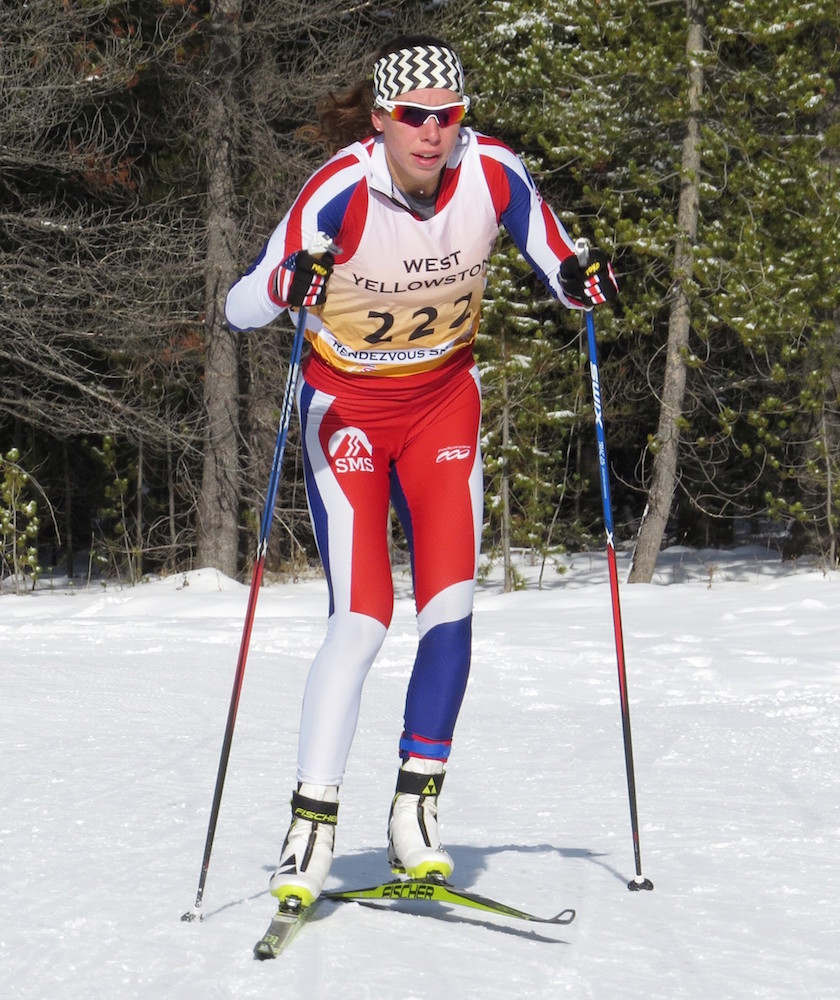
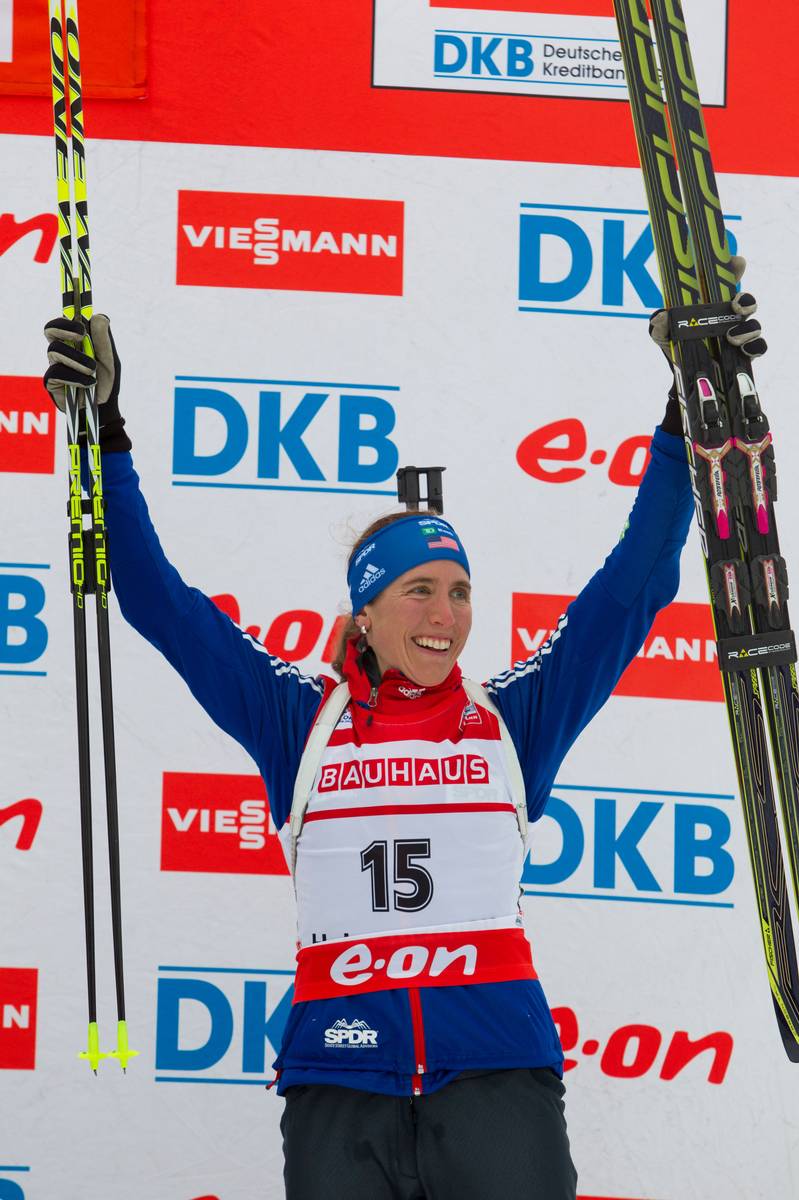
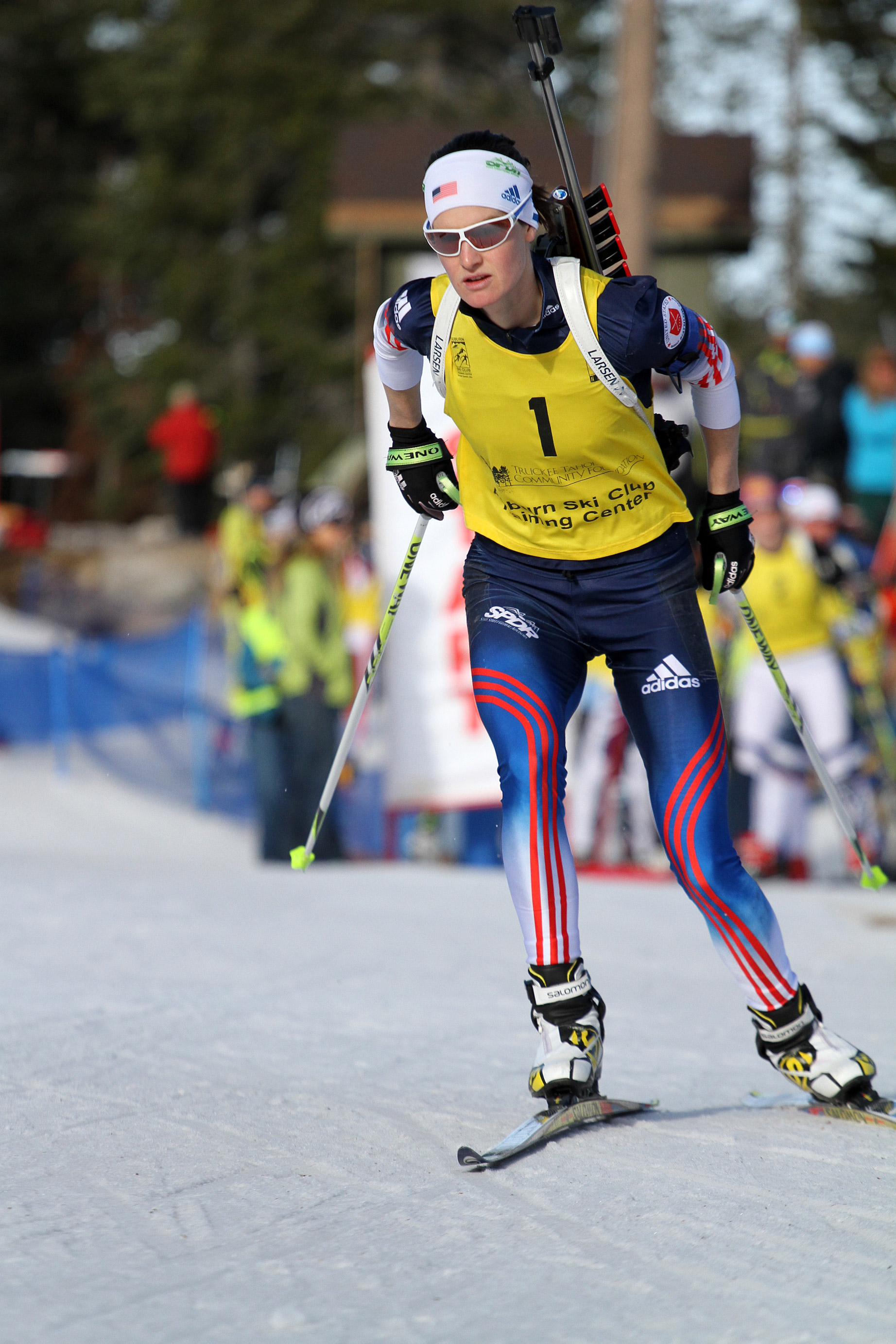
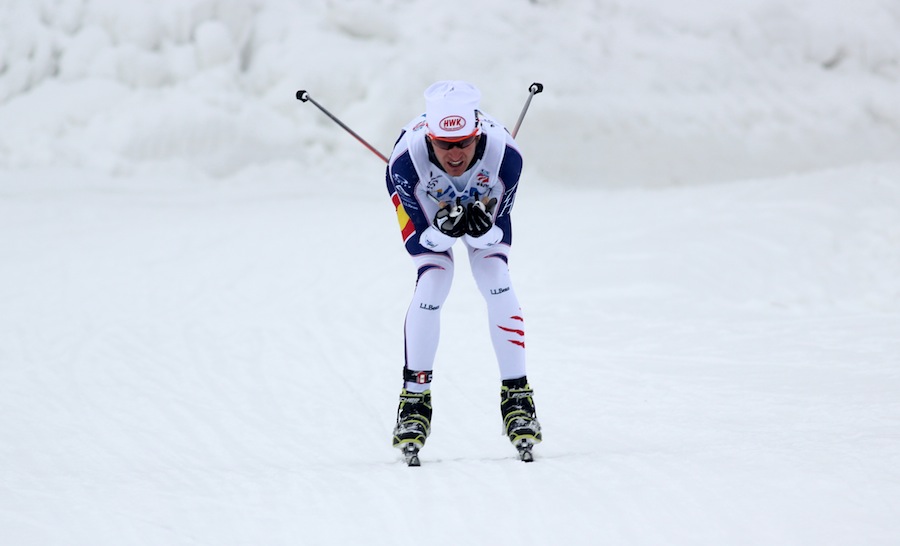
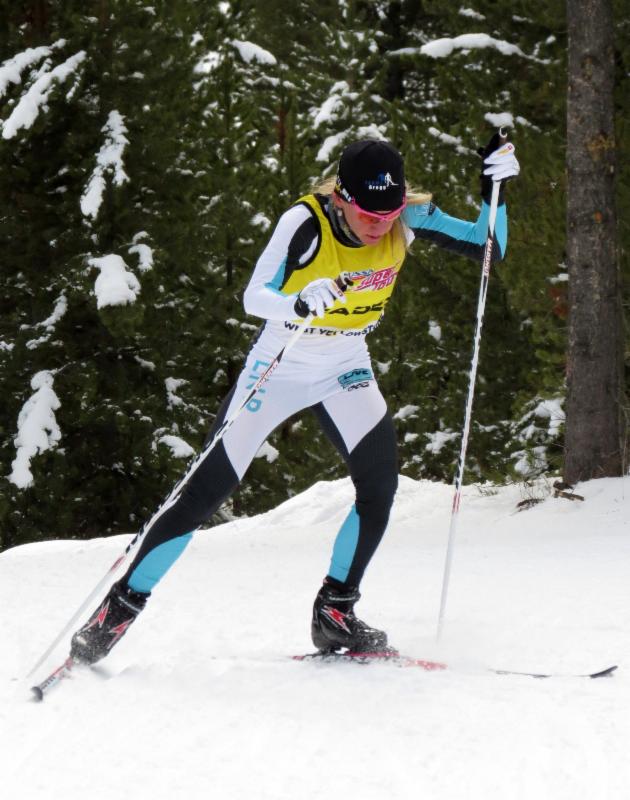
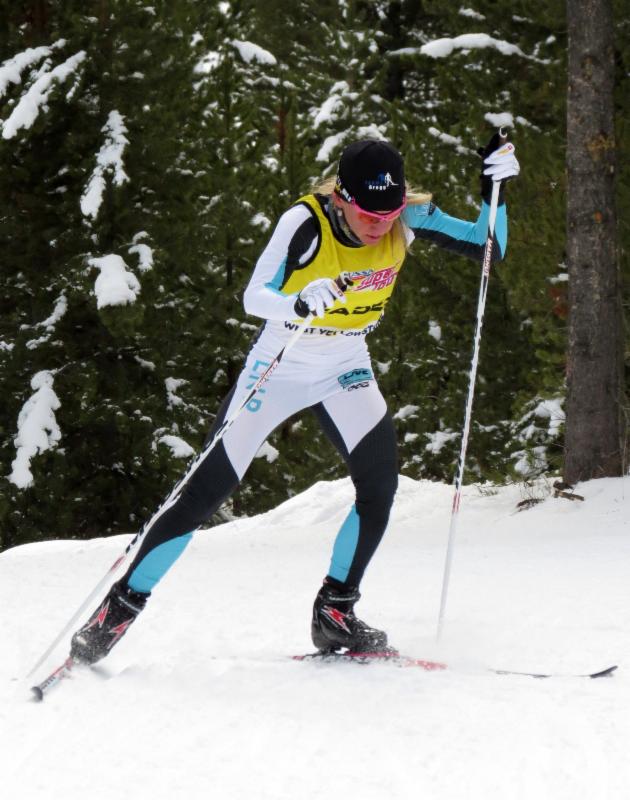
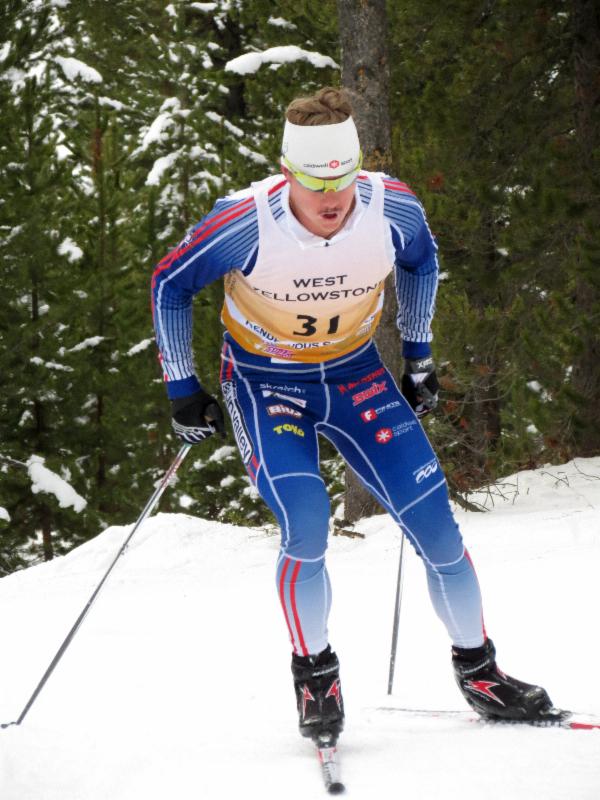
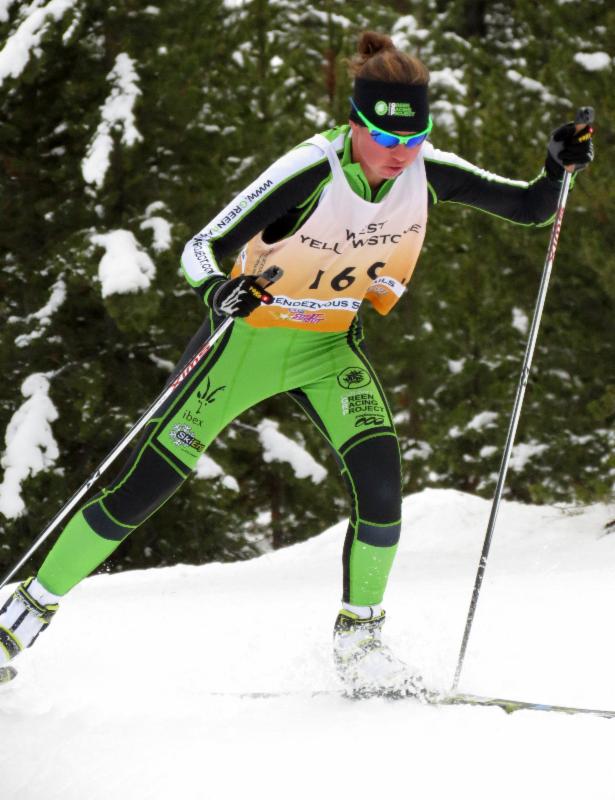
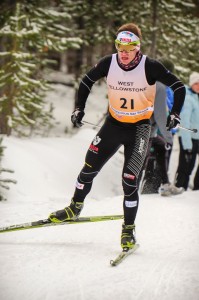
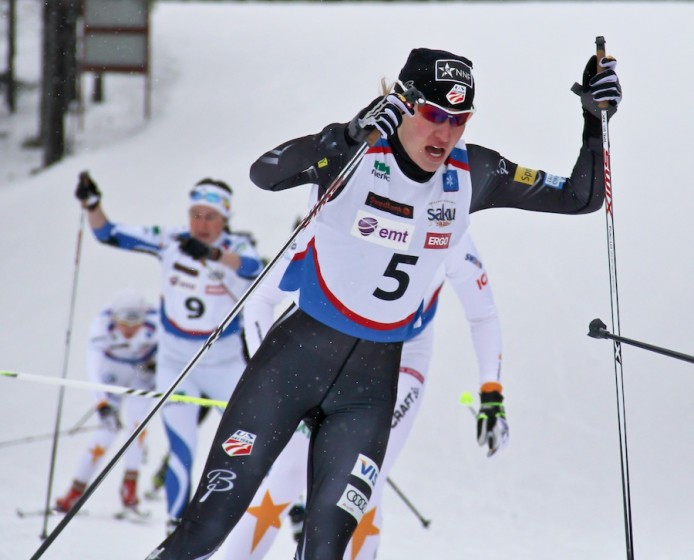
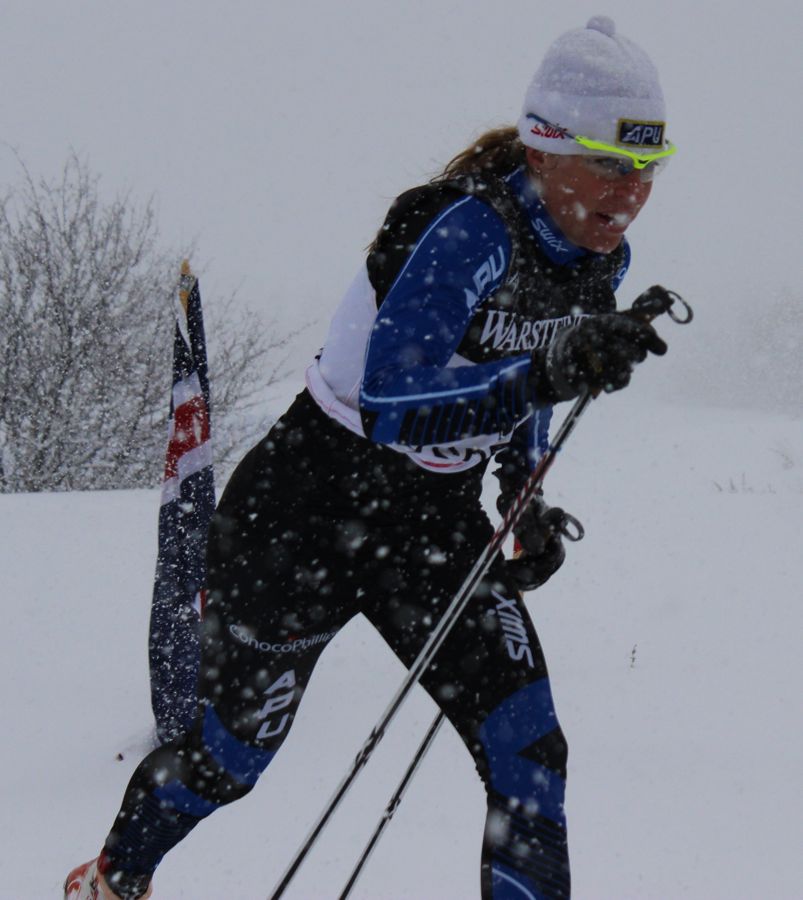
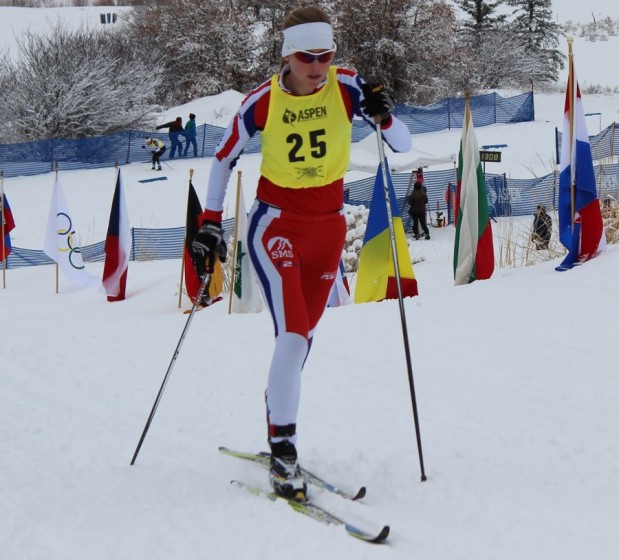
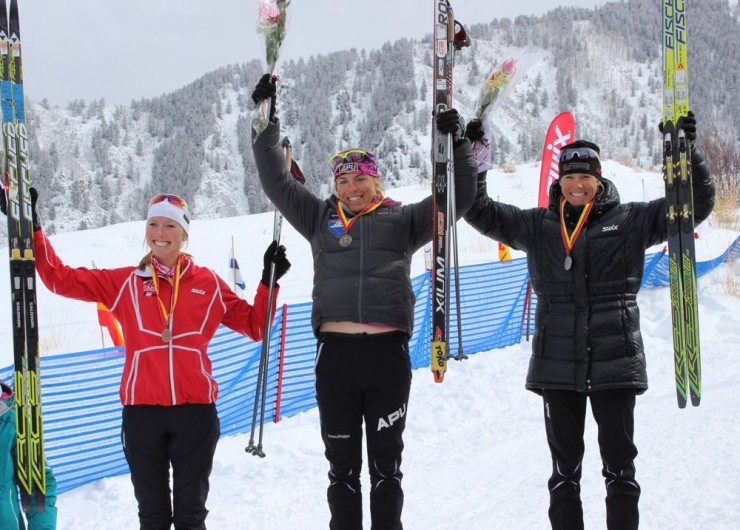
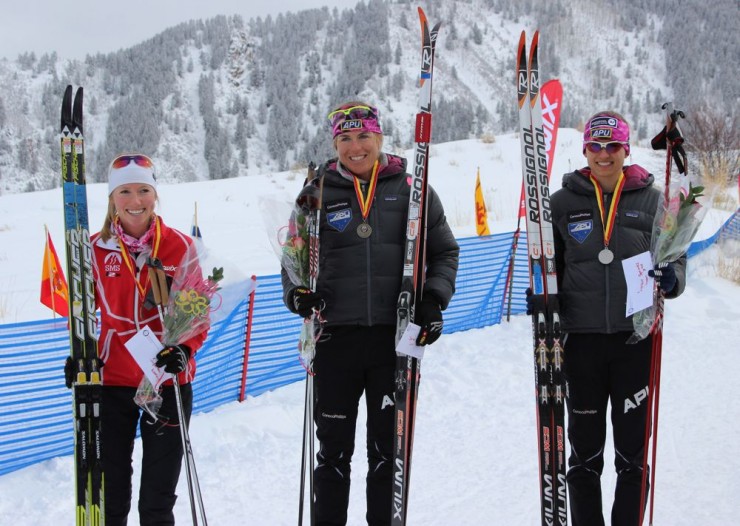
Katharine Ogden (SMS/USST) racing to an 11-second win in the women’s 5 k freestyle FIS race on Friday in West Yellowstone, Mont. (Photo: Ian Harvey/Toko)
The first official cross-country ski races of the season in the Lower 48 were held Friday in West Yellowstone, Mont., and for the first time in a long time, they weren’t U.S. SuperTour races.
But they were International Ski Federation (FIS) sanctioned and once again a big part of the West Yellowstone Ski Festival, which has been known to attract 3,500 skiers and has been an early season tradition for more than 30 years.
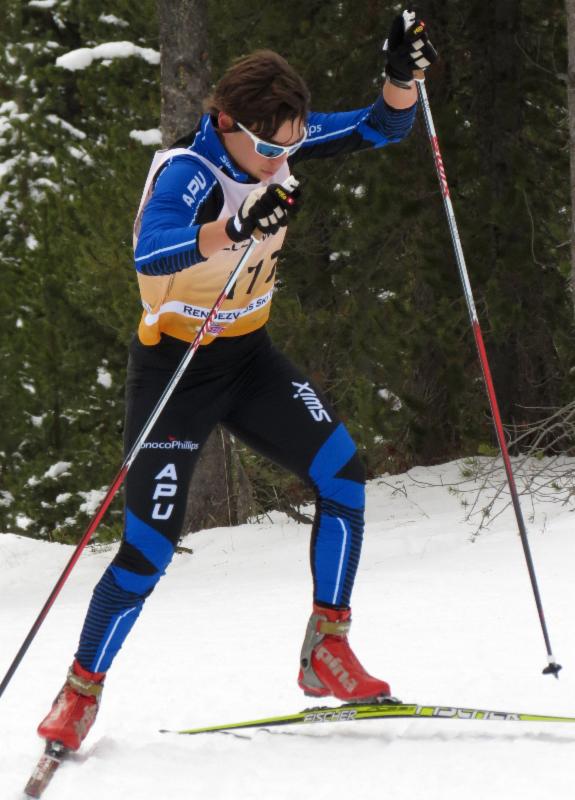
Paddy Caldwell, of the U.S. Ski Team’s D-team, Dartmouth College and the Stratton Mountain School (SMS) T2 Team, won the men’s 10-kilometer freestyle on Friday at the Rendezvous Ski Trails. He bested nearly 90 in the men’s race, putting down the fastest time in 20:32.4 minutes, which was 26.7 seconds ahead of runner-up Rogan Brown, of the Sun Valley Ski Education Foundation (SVSEF). Mads Strøm, a Norwegian-born University of Colorado-Boulder (CU) senior and two-time NCAA champion, placed third, 31.1 seconds behind Caldwell.
Just 0.2 seconds off the podium, Sun Valley’s Jack Hegman placed fourth (+31.3), and Ben Lustgarten, of theCraftsbury Green Racing Project (CGRP), was close behind in fifth (+32.4), as was Silas Talbot, of the Bridger Ski Foundation (BSF) Elite Team, in fifth (+37.4).
Rounding out the top 10, Karsten Hokanson (Montana State University) placed seventh (+53.6), Patrick Johnson (Far West) was eighth (+56.7), and Norway’s Petter Reistad (CU) and Welly Ramsey (Farmington Ski Club) tied for ninth (+57.6). Oscar Ivars (University of Utah) took the next spot in 11th (+1:01.5).
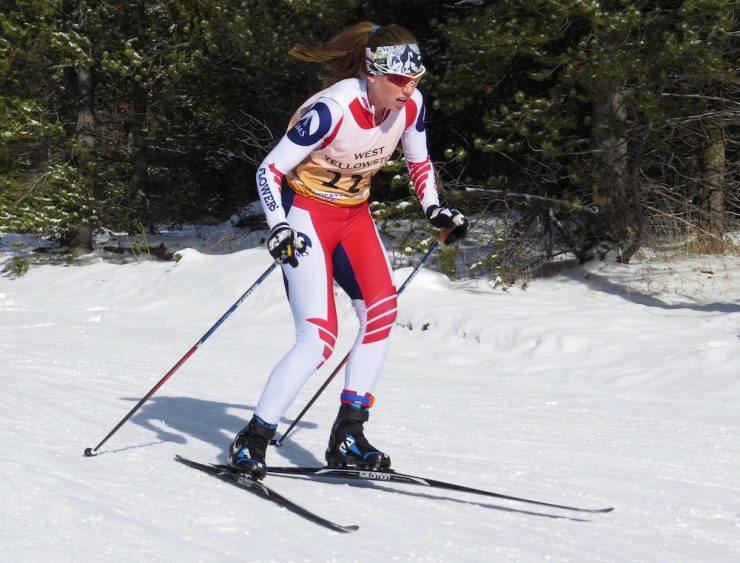
In the women’s 5 k freestyle, Katharine Ogden, another U.S. Ski Team (USST) D-team member who trains with SMS, took the win. She beat out CU’s Petra Hyncicova, originally from the Czech Republic, by 11.8 seconds with a winning time of 11:45. One of Ogden’s training partners, Erika Flowers (SMST2) placed third (+13.3).
Craftsbury’s Liz Guiney took fourth (+19.4), Jennie Bender (BSF) was fifth (+22.4), Mary Rose (SVSEF) sixth (+27.0), Anne Hart (SMST2) seventh (+32.8), Christina Rolandsen (CU) eighth (+34.7), Kaitlynn Miller (CGRP) ninth (+36.5), and Hannah Halvorsen (Sugar Bowl Elite Team/USST D-team) 10th (+36.8) in a tighter women’s field, which included 76 finishers.
FIS racing continues at the Rendezvous Trails on Saturday, with 5/10 k classic races scheduled.
In related news, the first SuperTour races of the season — which were supposed to take place next weekend, Dec. 3-4 — were canceled. At the top of the Bridger Ski Foundation’s SuperTour event page, it now reads: “Bozeman SuperTour Cancelled: Due to lack of snowfall the races are not able to be run.” The SuperTour opener doubled as the first races of the Canadian NorAm season as well.
Just like in the U.S., Cross Country Canada (CCC) intended to use Bozeman as part of its selection races for 2017 World Championships and the Continental Cup leader (COC) World Cup spots. Now instead of considering an athlete’s best three results out of seven race days, CCC will consider three out of five.
“Bozeman was part of our NorAm COC series selection process; however now that Bozeman is cancelled it’s not in the picture,” CCC High Performance Director Thomas Holland wrote in an email to FasterSkier on Friday night.
“Are you ready for some more West Yellowstone fun? ‘Cuz we’re hosting the SuperTour next weekend December 3 & 4,” the post read. “Saturday Freestyle Sprints, Sunday 15k/10k Classic; 5k U16 Classic. Registration site is in progress but will be on ysfraces.athlete360.com. And can you volunteer? Send us a message at info@skirunbikemt.com to give us your info. Thanks!”
“The altitude at West Yellowstone is too high to use it as a selection race for the Canadian team – will not count for the FIS COC series,” Holland wrote.
We’ll post more information as it becomes available.
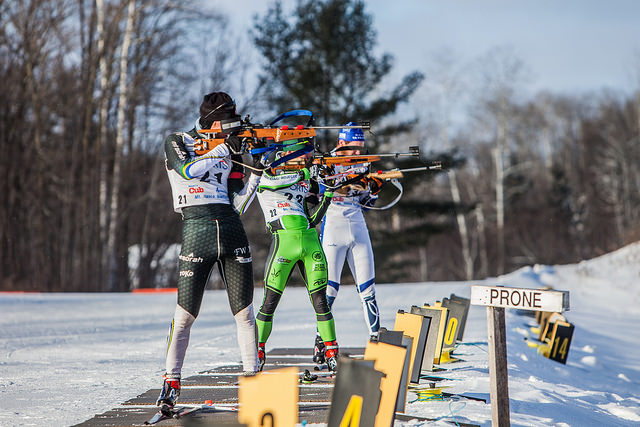
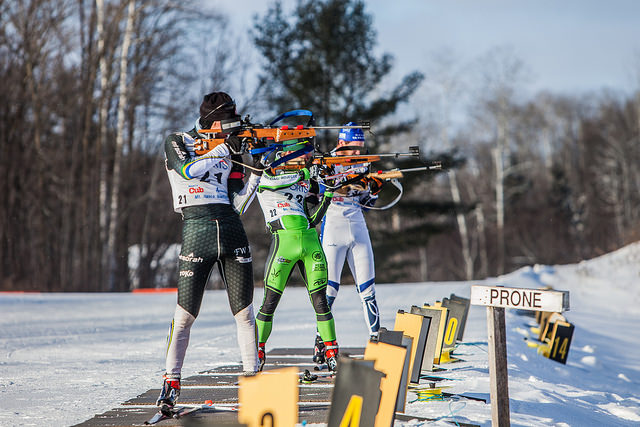
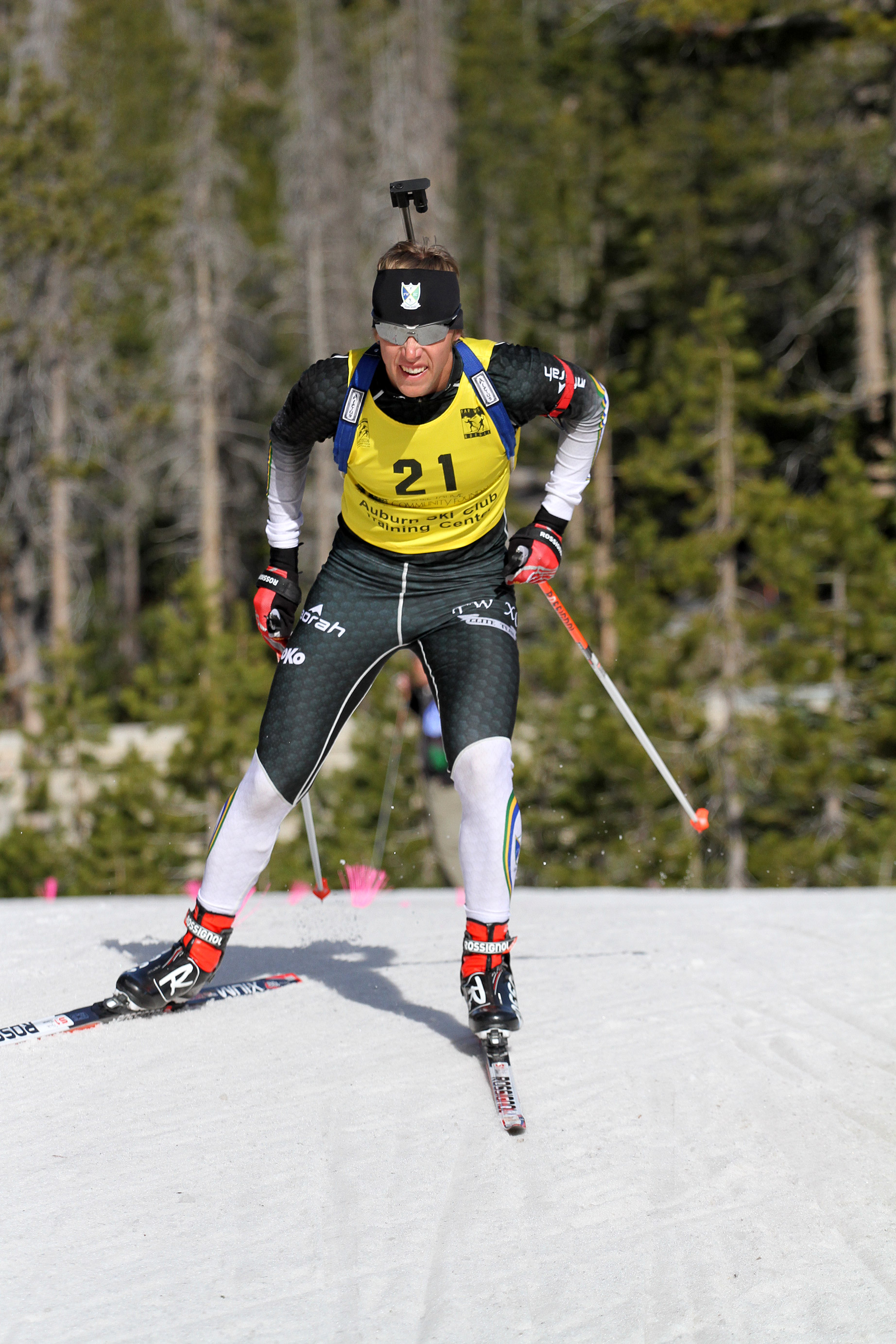
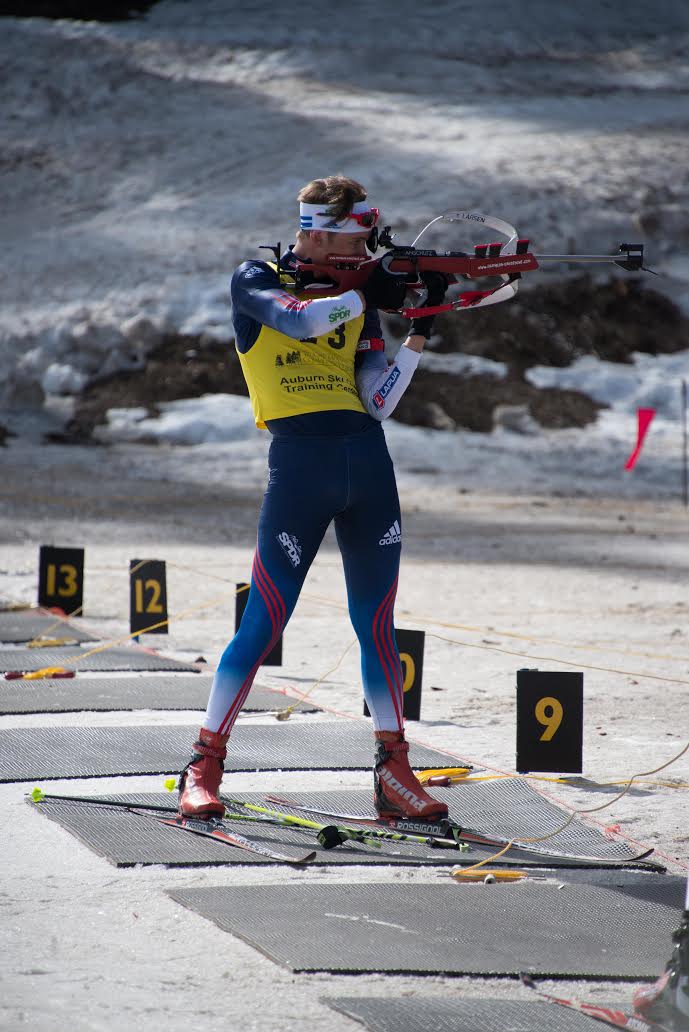
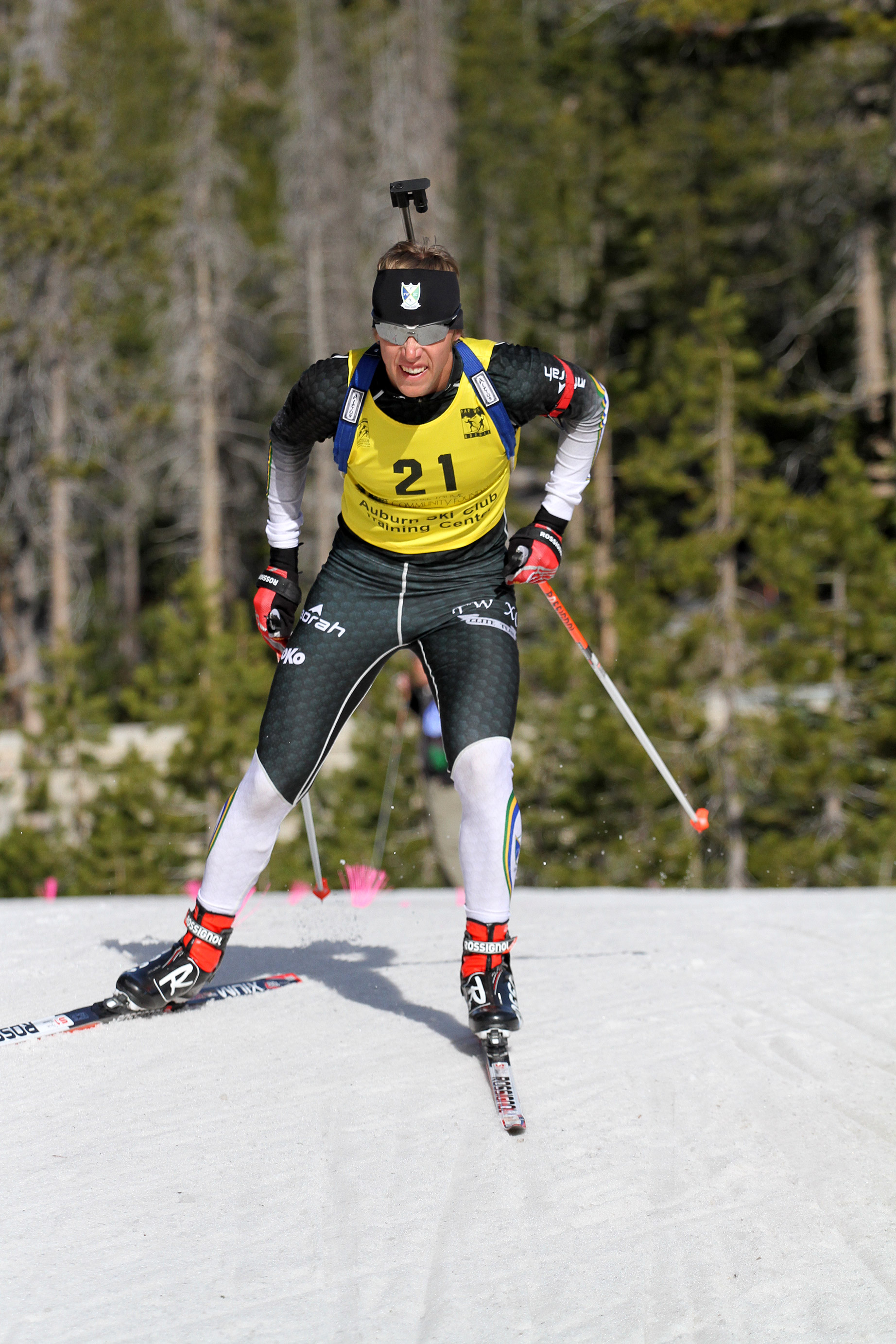
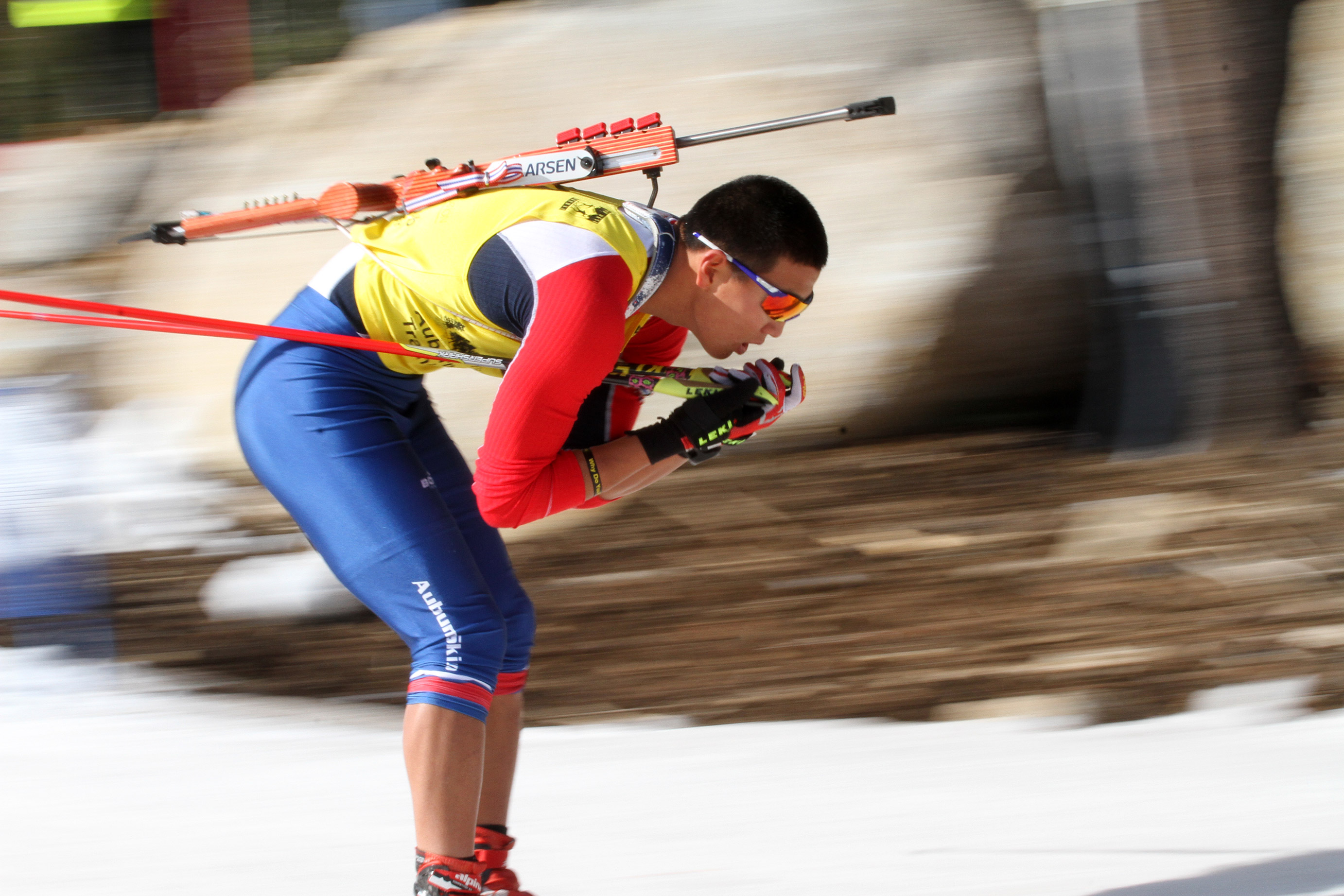
Patrick Johnson of the Auburn Ski Club (foreground) shooting at IBU Cup Trials in Mount Itasca, Minnesota, in December. (Photo: Jake Ellingson/flickr)
After the 2014 Olympics, the U.S. Biathlon Association (USBA) decided to sink some of its budget back into the development pipeline, which had taken a hit to bolster high performance in the run-up to the Games.
The juiced-up development program had multiple tenets, but one was a return to a strategy that had worked once before: recruiting high-level senior skiers, and turning them into biathletes.
Last summer, USBA hosted its first Talent ID Camp, including 11 ski racers from Stratton Mountain School in Vermont to Alaska Pacific University and everywhere in between. Some ended up focusing on biathlon in the subsequent season; others didn’t.
Only two of the recruits snagged repeat nominations to the U.S. National Team this spring. Max Durtschi, a former professional cyclist from Sun Valley, Idaho, got nominated a second time to the “X” team, a residential development program based at the Olympic Training Center in Lake Placid which allows full access to USBA coaches and resources. And Patrick Johnson of the Auburn Ski Club in California was promoted from the National Development Group, which offered only periodic exposure to national team coaches, to the “X” Team.
Sun Valley’s Max Durtschi was off the bike and back on skis this winter, here competing at IBU Cup Trials for biathlon in Mount Itasca, Minnesota. (Photo: Jake Ellingson/flickr)
Both men spent considerable time on the NorAm circuit last season and represented the United States at IBU Cup competitions in Canmore, Alberta – the level just below the World Cup, where 18 different countries sent teams.
“I think it was for both of them really overwhelming I guess,” USBA Chief of Sport Bernd Eisenbichler said of the Canmore experience, where Durtschi finished last in one of the races. “But the goal from our side was to give them as many racing opportunities as possible… They need these experiences internationally too, to see where the level is and I think it will make them work really hard.”
And Durtschi may have had it hard at the IBU Cup, but he bounced back, placing third in the sprint and second in the pursuit at U.S. National Championships; Johnson won both races.
Several years ago, USBA ran a larger program to recruit college skiing talent to biathlon. That yielded Olympians Sara Studebaker and Susan Dunklee, as well as several others who got IBU Cup experience. More recently, Craftsbury Green Racing Project cross-country skier Clare Egan shifted her focus to biathlon. Last season, her second with any degree of biathlon focus, she moved from the IBU Cup to the World Cup to a top-40 finish at World Championships and was recently named to the “A” team.
So it’s clear that, with the right skier, the strategy can be a success.
“That she would make the World Cup team, that was kind of forseen as we don’t have so many women right now in the United States fighting for these spots,” Eisenbichler said of Egan. “But for the ‘A’ team you have to have a remarkable result. It’s not that we just fill up the team by numbers… she made this 40th place at World Champs, and that’s a remarkable result for your first year on the World Cup.”
Susan Dunklee, a standout skier who was recruited to biathlon in 2008, celebrating the first World Cup podium of her career in Oslo in March 2014. USBA is hoping they can replicate her story. (Photo: USBA/NordicFocus)
Johnson has said before that his goal is to compete in biathlon at the 2018 Olympic Games. A winning collegiate skier for Middlebury College and a World Junior Championships competitor for the U.S., Johnson picked up shooting quickly, according to Auburn Ski Club coach Glenn Jobe, himself an Olympic biathlete from the 1980 Games. Johnson’s season culminated in two national championship titles, including clean shooting in the sprint.
“It is extremely unusual to see the type of success Patrick had in his first year of biathlon, however with his work ethic and motivation to improve it did not surprise me,” Jobe wrote in an email. “He’s got the ‘right head’ for biathlon and approaches the sport with a calm and steady demeanor. It takes someone who mentally can turn it ‘on/off’ or ‘switch gears quickly’, to succeed in this sport.”
Jobe noted that Johnson had to deal with some changes to his rifle throughout the last year, but finally got comfortable with a good configuration. USBA Head Development Coach Jean Paquet watched those changes in real time, and took note.
“We worked together in October at a camp in Salt Lake,” Paquet wrote in an email. “At the time it seemed to be difficult for him to get the right [shooting] position and get the shots in the target. The following first snow camp in Canmore I did notice a nice improvement in his shooting ability, as he was able to do 5 for 5. I was impressed as he was able to do some clean shooting bouts and a perfect score at the National sprint in Truckee.”
The timing of having some breaks to go back to the drawing board in between bouts with the national team coaches proved to be a good strategy, said Johnson, who made making the “X” team one of his season goals.
Patrick Johnson of the Auburn Ski Club won two 2015 National Championships titles on home turf in Truckee, California. (Photo: Mark Nadell/Macbeth Graphics)
He worked hard to get to as many races as possible, which can be challenging given the miniscule domestic biathlon scene in the U.S. He also won a NorAm mass start in Lake Placid by over a minute over “B” team member Casey Smith, and another biathlon race in Soldier Hollow, Utah.
“I got 16 biathlon races in last year, which I think was a good number for my first year in the sport,” Johnson wrote in an email. “My racing last season came mostly in two blocks, one at the beginning of the year at the Canmore NorAms and IBU Cup Trials and one at the end of the season at the Canmore IBU Cups and at US Nationals. This actually worked out really well since it gave me a period in the middle of the season where I could spend some time back in Truckee training and incorporating what I learned from my first racing experiences with the sport.”
As part of the “X” team from the beginning, Durtschi spent more time in Lake Placid working closely with Paquet. Durtschi had skied at a high level as a junior, but then turned his attention to professional cycling. As such, he had to not only master shooting but also hone his ski technique to a greater extent than Johnson.
“Max coming from a cycling background, we have been working on biathlon training periodization,” Paquet explained. “Mainly learning how to shoot and combining the two. It is a process that usually takes two years before the athlete begins to be in control and start being more consistent. Max is a hard worker and learns pretty quickly, but he has to go through a full year of training in order to get the stability and the technique needed to ski fast.”
But if he had a lot to learn, Durtschi, who moved to Lake Placid in November, says that he was given the full resources needed to do so.
Max Durtschi competing at U.S. National Championships in Truckee, California, where he placed third in the sprint and second in the pursuit. (Courtesy photo)
“I have been provided everything an athlete could ever ask for: remarkable coaches, outstanding facilities, and motivating teammates,” he wrote in an email. “I did have a chance to train with my teammates throughout the fall and winter, which was great. I learned a lot from them, and they were very generous with their knowledge of the sport… [and] this past fall Jean would often take his off-day and work with me; that really motivated me to train even harder.”
Another motivation? Durtschi was given the rifle that formerly belonged to Willie Neal, a biathlete who died after being hit by a car while rollerskiing in northern Maine. Durtschi now represents the Willie Neal Environmental Awareness Fund, and said that holding the rifle day in and day out “means the world to me.” Biathlon rifles are typically an investment that costs thousands of dollars, and can be a setback to athletes looking to join the sport.
Both Paquet and Eisenbichler noted that Durtschi had the highest testing numbers at the Talent ID Camp last summer, which meant that he was their top recruit. Although Johnson seemed to be making faster progress, Eisenbichler had little doubt that Durtschi was also on the right track.
“For us it’s clear that an ‘X’ Team nomination is not meant for three months and then you take it away again,” Eisenbichler said. “It needs a period of time like 16 or 17 months where you have a really good chance to learn biathlon. Max is one example for sure – we have to see some indicators for a complex biathlon performance where we say, okay, it was worth the investment. Max has a super physical capacity.”
So what comes next? It’s clear to both athletes and coaches that much hard work remains to be done for them to be World Cup ready.
“It will be interesting for Patrick and Max to do a full training season starting in May to see how can they improve,” Paquet wrote.
After the IBU Cup experience, Johnson has some tangible goals for what to improve on.
“A goal for next year is definitely to have some success on the IBU Cup, and to do that I’ll need to keep improving my skiing and shooting,” Johnson wrote. “I still have the biggest gains to be made in shooting, and the progress I made in this first year is definitely motivation to keep working hard at it. I think the effort I put into picking up shooting conflicted with my ski training at times over the past year, and though I was still skiing well, I don’t think my speed was quite at the level it had been in my most recent seasons. But I still had a few promising ski times on the IBU Cup, so with the increased support I’ll be getting from USBA and the training base I already have, I’ll be looking to take a big step up in ski speed this next year.”
Eisenbichler is also hoping to partner more closely with regional clubs to provide better development opportunities for athletes already in the sport.
“We also have to go out to the clubs and be present there as much as we can with the small staff that we have,” Eisenbichler said. “That’s what we will try to do this year,to come up with a concerted camp schedule for all different regions and to do some testing there to also find the young talents early. I also had the idea to have a USBA development summit in Lake Placid in September, and invite the best talents that we find from each region in these regional development camps.”
In that sense, Johnson’s example seemed to perfectly marry the different strands of development opportunity. And for Jobe, whose ASC Biathlon Training Center is in just its third year of existence, seeing Johnson leave for Lake Placid will be sad, but also an affirmation and advertisement of his mission.
“We are definitely sorry to see Patrick move to Lake Placid, however I feel that we’re doing our job well when we’ve provided any athlete that’s come through any of the ASC ski programs with the skills and opportunity to move on to the next level,” he wrote. “We are primarily a grass roots biathlon program, supported by volunteers and donations, so all of us are super excited to see the success Patrick is having.”
Patrick Johnson of the Auburn Ski Club won two biathlon national titles on home turf in Truckee, California, last week. (Photo: Mark Nadell/Macbeth Graphics)
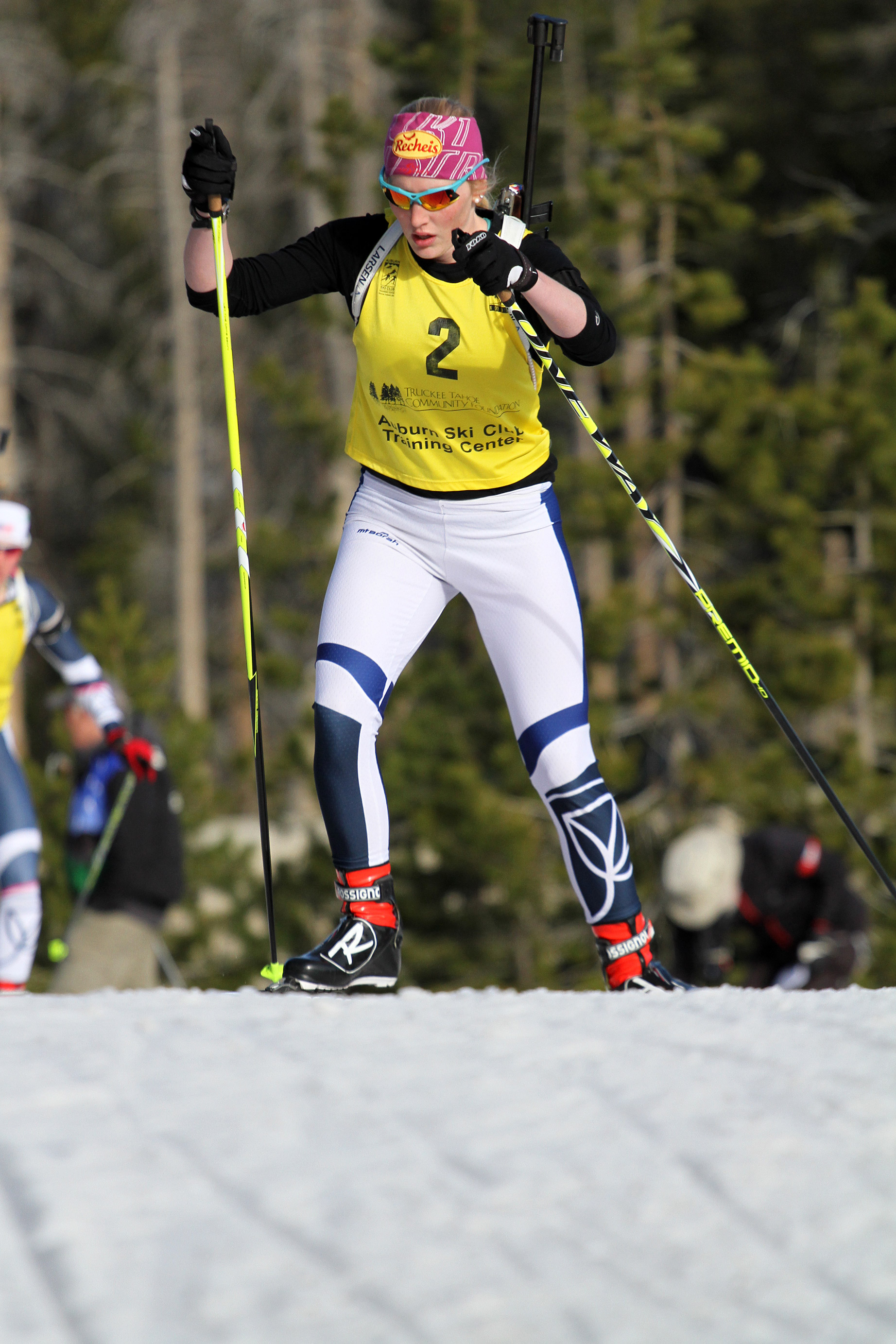
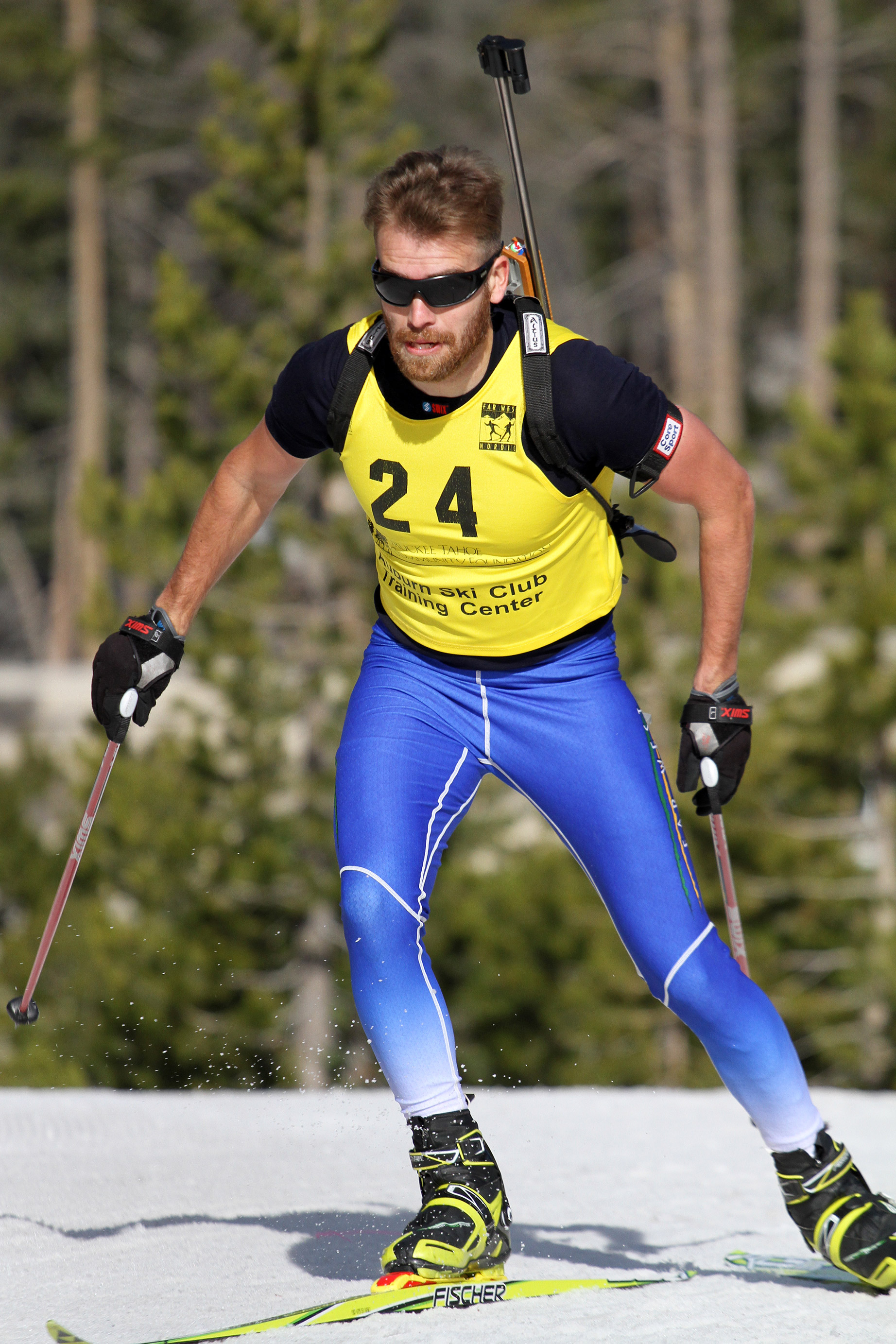
In spite of the extremely low snow conditions in California for the US Biathlon Championships March 20th-22nd, the Auburn Ski Club Training Center was able to host three successful championship races. Due to the limited snow cover and warm temperatures, all the races had to be run on a groomed 1.5 km loop. The week following hosting the Junior XC Nationals, held at ASC March 7th-14t,h, all nearby and remaining snow was stock piled along the 1.5 km loop and distributed after each biathlon race to maintain the loop through the three races.
Although the loop was limited in length it had plenty of undulating terrain with an uphill approach followed by a short flat section prior to the shooting range. The uphill approach to the range combined with the 7200 foot elevation provided the participants with some challenging shooting (read, breathing) conditions.
Clare Egan (Craftsbury Green Racing Project/U.S. National Team) racing to a big win in the 7.5 k sprint. (Photo: Mark Nadell/MacBeth Graphics)
In the sprint race on Friday, Patrick Johnson from the Auburn Ski Club won the senior men’s division with clean shooting. A recent convert to biathlon, Johnson was named to the U.S. Biathlon Association’s Development Team in October. He notched a minute and a half win on home turf in the 10 k sprint over Mike Gibson of the Craftsbury Green Racing project, who had five penalties. Third place went to Max Durtschi, a former professional cyclist who was named to USBA’s X Team this fall. Durtschi had six penalties and finished three minutes and 14 seconds behind Johnson.
In the women’s 7.5 k sprint Clare Egan of the Craftsbury Green Racing Project won with only three misses out of 10 shots. Egan had hopped a plane home from Europe after a successful World Championships stint, where in her first appearance on the sport’s biggest stage she finished 40th in the sprint. In Truckee, that equated to a one minute, 49 second win over Kelsey Dickinson of the Maine Winter Sports Center, who also had three penalties. Katrina Howe, also of the MWSC, finished third.
On Saturday, Patrick Johnson and Clare Egan again won their respective 12.5 and 10 k pursuit races, becoming two-time National Champions. Johnson picked up eight penalties in 20 shots, but still cruised to a one minute, 50 second win over Durtschi, who had seven penalties of his own. Gibson placed third, 37 seconds behind Durtschi with nine penalties.
Egan accrued seven penalties in the pursuit, but finished 32 seconds ahead of Dickinson. Maddie Phaneuf, racing up from the junior division, had a strong race until the last bout, shooting clean for the first three stages. In the last standing stage, however, the Maine Winter Sports Center athlete picked up four penalties and ultimately finished third, 33 seconds behind Dickinson.
On Sunday the race series ended with a mixed relay. The teams were made up by the organizers based on results from the previous races in an effort to make the teams as evenly balanced and competitive as possible. It turned out to be an exciting and fun race to end the nationals on. The mixed team of Phil Violett (Senior Men, Auburn Ski Club), Phaneuf, and Scott Waichler (Master Men, Methow Valley) won this mixed relay.
The top shooter award sponsored by Altius Handcrafted Firearms in West Yellowstone, MT, went to Maddie Phaneuf from Old Forge, NY, with 5 misses out of 30 shots over the first 2 days of racing.
Peter Carroll racing to a win in the youth men’s sprint. (Photo: Mark Nadell/MacBeth Graphics)Maddie Phaneuf (Maine Winter Sports Center/USBA “X” Team) won the junior women’s sprint, earned bronze in the senior women’s pursuit, and raced the second leg of the winning mixed relay. She was also the most accurate shooter of the series. (Photo: Mark Nadell/MacBeth Graphics)Auburn Ski Club’s own Phil Violett was part of the winning mixed relay team at U.S. National Championships. (Photo: Mark Nadell/MacBeth Graphics)
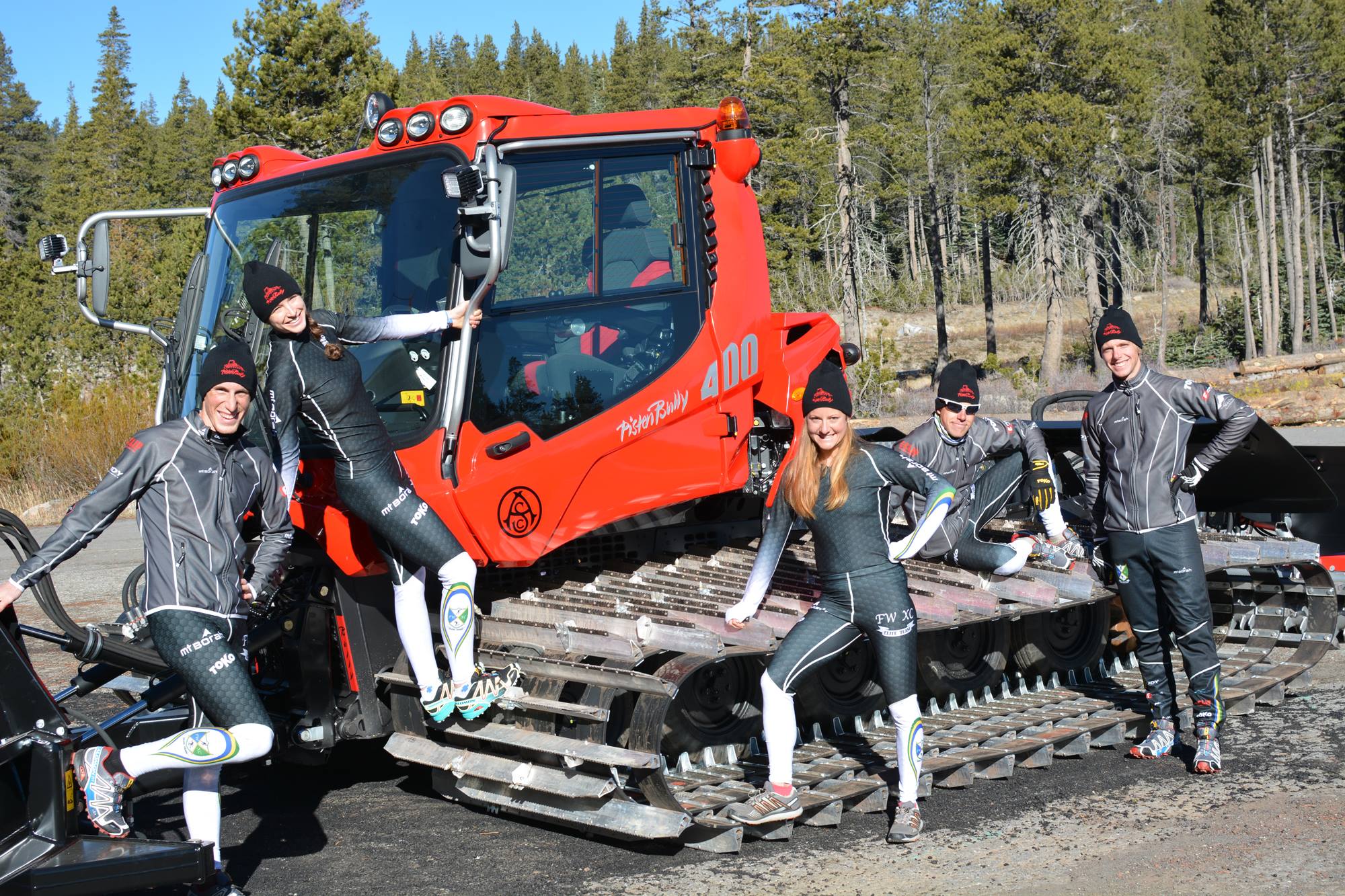
The 2014/2015 Far West Elite Team (Photo: Auburn Ski Club/Facebook)
When the University of Nevada-Reno (UNR) announced that its ski team would be dismantled in 2010, the nordic-ski community in the greater Tahoe region realized it was in trouble.
Although the region, also known as Far West, was competitive at the junior level, it was lagging behind the rest of the country in terms of development post-high school. A relatively small number of juniors extended their skiing careers once they graduated while the majority looked for opportunities outside of the ski community.
UNR had been a clear representation of the path young athletes could take upon the completion of their junior years. However, with the loss of the program, the ski community needed to take action.
That’s when Ben Grasseschi stepped in and created the Far West Farm Team. With the help of August Teague and Martin Benes, Grasseschi looked to create a program that rivaled the best elite teams in the country. There was also the hope that the addition of an elite team would create a strong foundation for youth skiers and beyond.
“[What happened at UNR] was an indication that we needed to do more in this area, and we didn’t want to see that happen to other programs,” Benes said in an interview. “Obviously it was a huge loss … but it made us realize that we needed to do something.”
Even though the program found success with several skiers, such as current APU athlete Chelsea Holmes, the Farm Team never gained a foothold in domestic elite racing. However, its creation helped encourage the further development of nordic skiing in the Sierra Nevada.
A major part of that development can be attributed to Benes.
Benes, a native of the Tahoe area, returned to Truckee, Calif., in 2011 after coaching for both the Dartmouth and Bates College Ski Teams. He became head nordic coach of the local Sugar Bowl Academy and worked with the Farm Team when he could.
While he gained valuable coaching experience on the eastern collegiate circuit, one of the biggest assets Benes brought with him to Truckee was his ability to recruit.
He used his connections to recruit numerous college skiers who were looking for a summer training program. While its beginnings were small, the summer program grew at a steady rate as skiers from Bates, Bowdoin, Dartmouth, Middlebury, Colby, the University of New Hampshire and University of Vermont journeyed across the country to take advantage of what Far West had to offer.
With copious amounts of skiers coming to Truckee each summer, the elite program began to attract more interest.
As a result, the 2013/2014 season marked a new beginning for the program. It had a new look and a new name – the Far West Elite Team.
The team had no official coach (Grasseschi and Teague had left the program to pursue other endeavors), so Benes took on the duty of creating training plans and taking care of each skier’s athletic needs. He also recruited Patrick Johnson, a former NCAA standout at Middlebury, who skied for both the Sun Valley Ski Education Foundation and Alaska Pacific University.
While the team’s most notable moment of the season was Johnson’s aggressive start to the men’s 30-kilometer mass start at 2014 U.S. nationals in Midway, Utah, the addition of high-achieving athletes and a new professional look caught the eye of many on the national circuit.
Spencer Eusden (l) and Patrick Johnson (r) racing at the Auburn Ski Club in 2013. (Photo: Mark Nadell/MacBeth Graphics)
Soon, it became apparent that the combination of the summer program and the increased visibility of the team meant that further development was inevitable for the 2014/2015 season.
To speed up the process, the Far West Elite Team hired Reno, Nev., resident and Toko sales representative Roger Chaney to fill the newly created position of team manager. As team manager, Chaney takes care of the logistical needs of the Far West Elite Team athletes and aids them in their fundraising efforts.
“There has to be accountability for the athletes in terms of fundraising. That became the bigger beast than originally was expected … and there’s definitely a value in making sure that everybody’s expectations are being acknowledged and met,” Chaney explained of his position.
Benes agreed, stating that, because the team had no official director or coach, it lacked a necessary organizational component that Chaney now fulfills. Additionally, he said that due to his status as the head coach of Sugarbowl Academy it is valuable to have Chaney organize the logistics of training with other local clubs in the region.
“Because I’m affiliated with a club, it’s nice to have someone who is not affiliated with a club to take that on,” he said.
For the 2014/2015 season, the Far West Nordic Elite Team consists of six athletes: Johnson, Spencer Eusden, Wyatt Fereday, Anja Gruber, Emily Blackmer, and Sabra Davison.
Anja Gruber in the 2014 Donner Turkey Trot. (Photo: Mark Nadell/MacBeth Graphics)
Gruber, a German standout from UVM and 2013 NCAA Champion, will start her season on the SuperTour and later travel to Europe for the OPA Cup series with the goal of earning a spot on the German National Team.
Benes explained the strength of the team demonstrates how far both the program and the region have come since UNR cut its ski team.
“Four years ago, the majority of our athletes were based here for the winter, maybe one would go to U.S. nationals, but now we’re looking at a group where five if not all six will be headed there. We’re getting people who are committed to elite racing and elite results,” he said.
As the program develops, both Benes and Chaney are looking beyond season goals to future developments of the club.
“We’re looking at a vision that goes beyond one season. Ultimately we need to continue to develop that foundational presence,” Chaney said.
While there are still a few obstacles in the way, like the lack of a full-time coach, their main hope is that the Far West Elite Team will one day be a program that inspires local skiers to continue their athletic pursuits long after their junior years.
Clare Egan competing at Ethan Allen in Jericho, Vt., earlier this summer. The Craftsbury Green Racing Project athlete received a promotion from the U.S. Biathlon Association’s Development Team to its X Team.
After a summer of training and competition, the U.S. Biathlon Association (USBA) has announced updates to its national team roster.
In the spring, USBA had named a Development Team for the first time in several years, as well as a new “X Team” squad of more advanced development athletes.
“Back in spring when we started the new USBA team structure philosophy for the development side with the X-Team and the Development Group we clearly stated that these two teams are ‘open’ teams,” USBA Chief of Sport Bernd Eisenbichler wrote in an e-mail. “‘Open’ for talents we might find through the Talent ID Camp, and for our youth and junior biathletes and ‘young’ biathletes (time in the sport) who were close to getting named to a team already back in April, and showing good development and professional attitude through out the summer training.”
The Craftsbury Green Racing Project’s Clare Egan was initially named to the Development Team, but has now been promoted to the X Team. Egan placed third in the sprint at North American Rollerski Biathlon Championships this summer, an impressive result after learning to shoot only recently in her nordic career.
What’s the difference with Egan’s new nomination?
“The X Team is the ‘A’ team of the Development side, and the Development Group is the ‘B’ team,” Eisenbichler explained. “X team gives you a resident bed in Lake Placid and other benefits, but this season we want to really work very intensively with both teams to give them most time possible with biathlon training. So also the Development Group got a good amount of camp days in Lake Placid and/or Utah, so all the athletes have a good chance to develop as quickly and as far as possible in a short amount of time.”
Also promoted to the X Team is Max Durtschi, a Dartmouth College student who tried out biathlon only earlier this summer as part of USBA’s Talent ID Camp. A former professional cyclist who also had great success as a junior in cross country skiing, Durtschi has picked up the sport quickly.
Four other athletes have been named to the Development Team, most of whom also participated in the Talent ID Camp and have continued working on biathlon this summer. Headlining the group is Patrick Johnson, a former collegiate and SuperTour-winning cross country skier. He is joined by Kelsey Dickinson (College of St. Scholastica) and Jakob Ellingson (Loppet Nordic Racing), both of whom competed in 2014 World Youth and Junior Championships. Another St. Scholastica skier Paul Schommer was also named to the Development Team.
“To name them in addition now at the end of the summer is a great sign for what is possible in our new structure, if an athlete is willing to put in the work and develop through out the training period,” Eisenbichler wrote. “All athletes in the X-Team and Development Group will be invited to an on-snow camp in Canmore, Canada, at the end of November and to the IBU Cup Trials races in Minnesota right after. The camp will be lead by our Head Coach Development Jean Paquet.”
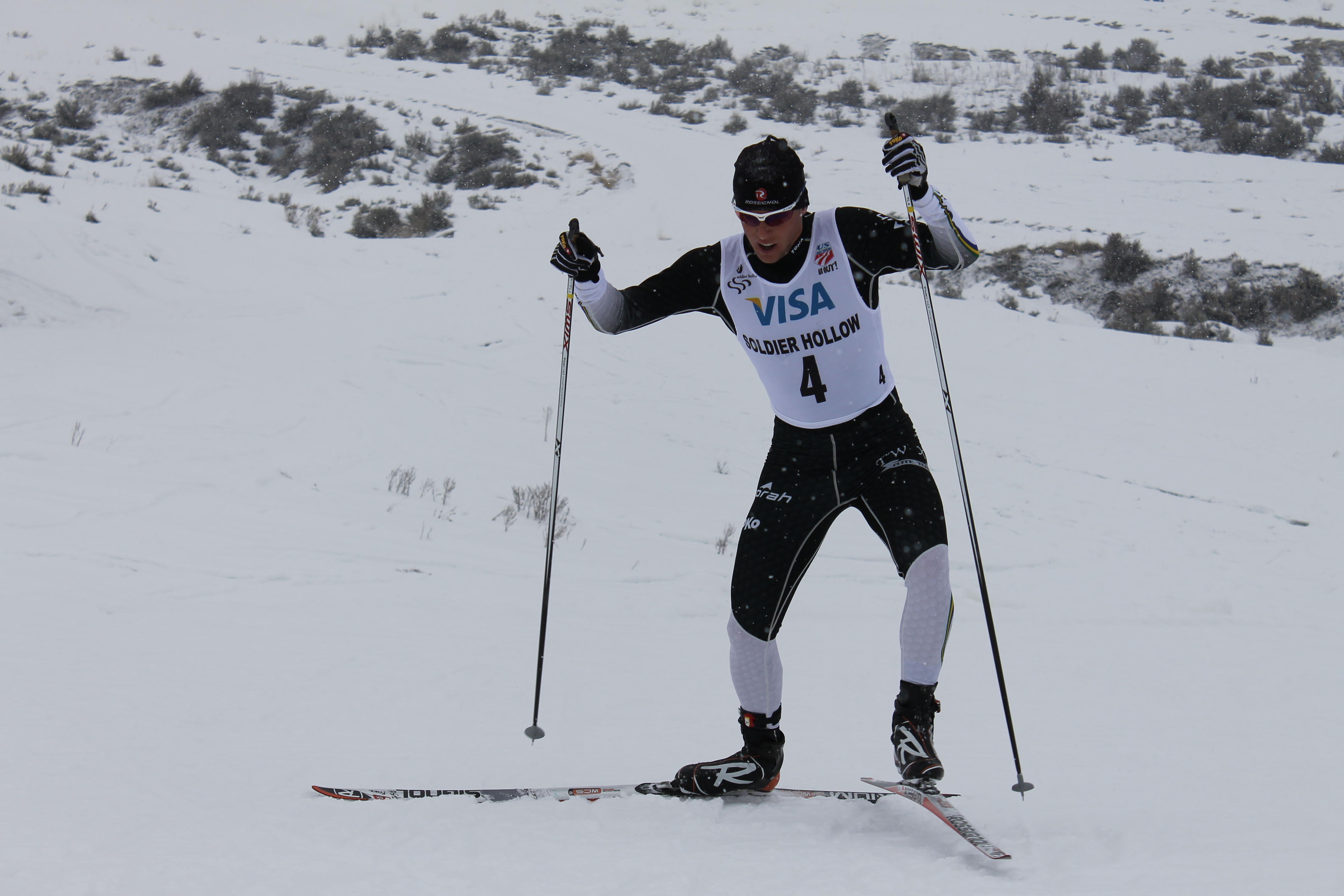
Patrick Johnson of the Far West Elite Team rollerskiing at the Auburn Ski Club in June. Johnson recently switched his focus to biathlon. (Photo: Mark Nadell/MacBeth Graphics)
Patrick Johnson has seen success at a lot of different levels of Nordic sport: from representing the U.S. at Junior World Championships to winning collegiate races for Middlebury College and then SuperTours for Sun Valley.
Last year, his quest for nordic success saw him move to Truckee, Calif., to join the Far West Elite Team, and now he’s tackling an additional new challenge by taking on the sport of biathlon.
“I had wanted to give biathlon a serious try for several years,” the 25-year-old Alaska native explained in an email. “When I was 9 I tried a couple novice races, but I never really received any coaching on shooting, so most of my memories from those races were of skiing penalty loops and being cold … midway through college I started thinking it would be a really fun sport to compete in. Of course, at that point, I was busy with school and didn’t have a range nearby, so it wasn’t really an option.”
When he left Middlebury, the U.S. Biathlon Association (USBA) had curtailed their development programs in order to focus on high performance for the next Olympic cycles. But now, USBA is reinstating the development program and has started to look for talent to recruit from elsewhere in the nordic world.
Johnson working on his shooting. Courtesy photo.
So while Johnson was interested in biathlon before USBA announced their Talent ID Camp this summer – he had started working on shooting already in the winter – it provided a perfect opportunity for him. He’s been working on shooting for months now and last week, he was officially named to USBA’s Development Team.
“The Talent ID camp in June was a great experience!” he wrote. “It was a pretty special opportunity to be able to get coaching from the whole national team staff, along with Tim Burke and Andrea Henkel, only a few weeks into my biathlon training. What was especially great about that camp is that you could tell that this new development program was really being bought into by the whole coaching staff and national team athletes of USBA.”
Since then, he has attended the recently-finished national team camp in Park City, Utah, and will join the team for an on-snow camp in Canmore, Alberta, in December.
The rest of the time, he trains at home in Truckee with the Far West squad. It’s a small but elite group of cross-country skiers, which Johnson says is perfect for his athletic style.
“I’m definitely someone who likes to have a little bit of independence and self-direction in figuring out my training plan,” he explained. “I’ve worked with a lot of great coaches over my time skiing, and learned a lot from them, and I have a decent idea of what works well for me in nordic training. The Far West Elite Team is a good fit for me because I have a lot of flexibility in designing my individual training plan, but I also have plenty of resources to help me out on the task.”
And the variety of potential training activities in California was a big part of what drew him to the area.
Johnson leading the mass start race at U.S. Nationals in January.
“I was just looking to mix things up and find a new place to live and train,” he wrote about the move from Sun Valley to Truckee. “I really love mountains, lakes and sunshine, so naturally Truckee/Tahoe was a place to consider! I am really happy to be out here. There’s so much great running, road biking, mountain biking and rollerskiing, and it’s a place where it’s really easy to get outside and be active. Most days training just feels like getting out and doing what you’d naturally want to be doing even if you weren’t striving towards some race-oriented goal for the upcoming season.”
While there’s no official USBA presence in the area, Johnson has been able to rely on help from Glenn Jobe, an Olympic biathlete from the 1980 Games who now drives development of the sport in California. The Auburn Ski Club now has a growing biathlon base.
“I’m fortunate to have great support for biathlon through Auburn Ski Club and through my shooting coach, Glenn Jobe,” he wrote. “Obviously without ASC I wouldn’t have had the opportunity to try the sport out this past winter and train for it over the summer. ASC’s biathlon program is only a few years old, but it is growing quickly and there’s a lot of enthusiasm for the sport in Far West … Glenn has been a great resource for me as I’ve learned the sport, and he’s the type of coach that works just as hard, if not harder, than the athletes he coaches. And as an athlete, having that type of coach supporting you can really inspire you to work your hardest and bring your best to every practice.”
Up next? Johnson hopes to make the U.S. squad to IBU Cup races in Europe this season. Although he’s had plenty of success in skiing and may compete in a SuperTour here and there to fill gaps in his race schedule, he’s completely invested in making his way in biathlon at this point.
“Though this first season primary goal is learning and gaining experience with the sport, I’m already looking down the road towards 2018 and beyond, which is something that is possible because of the support structure behind me,” he wrote.
(Photo: Mark Nadell/MacBeth Graphics)
(Photo: Mark Nadell/MacBeth Graphics)
(Photo: Mark Nadell/MacBeth Graphics)
(Photo: Mark Nadell/MacBeth Graphics)
(Photo: Mark Nadell/MacBeth Graphics)
Spencer Eusden (l) and Patrick Johnson (r) racing at the Auburn Ski Club in 2013. (Photo: Mark Nadell/MacBeth Graphics)
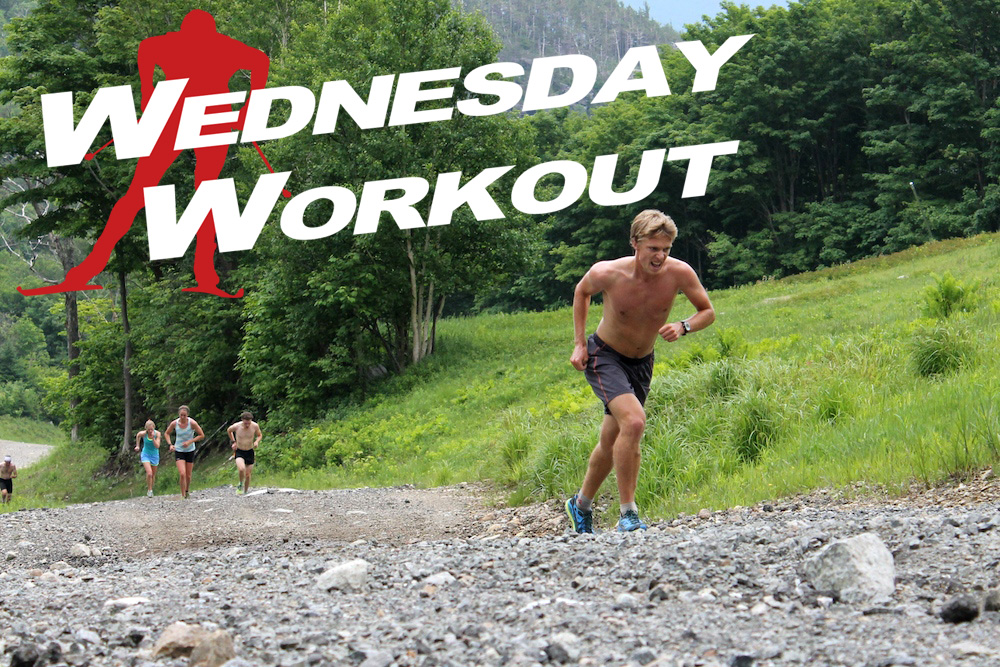
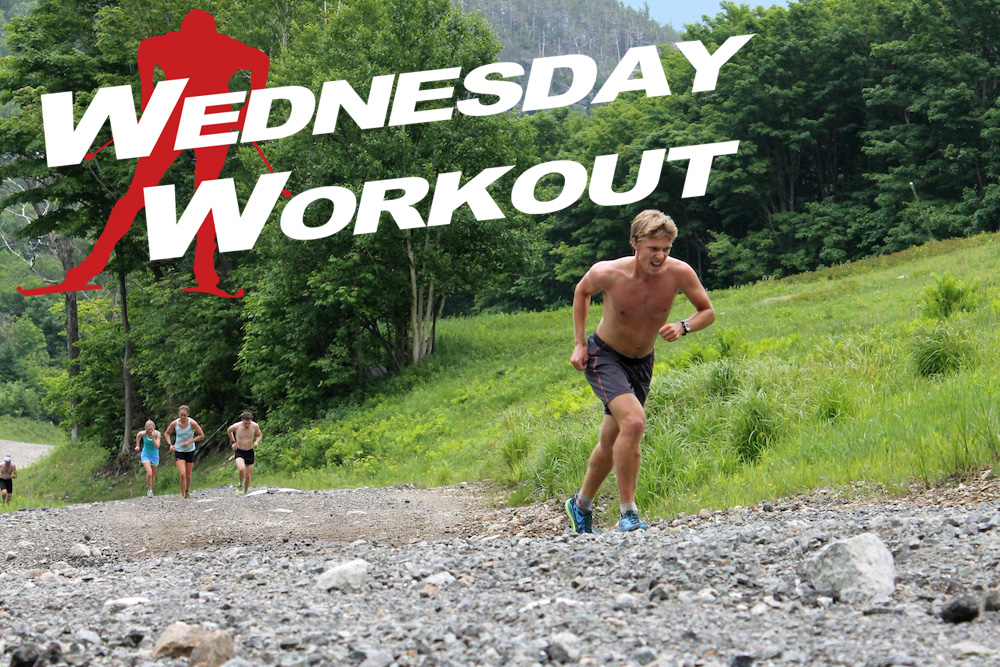
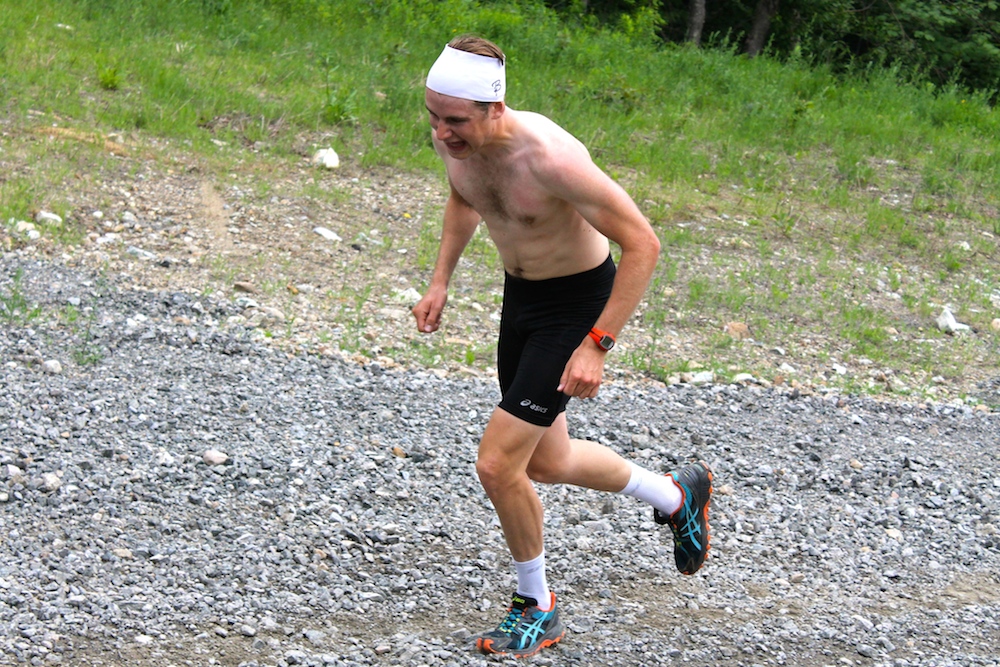
Patrick Johnson (Far West) was second fastest in the Tim Burke Uphill Run Test, held Tuesday at Whiteface Mountain in Wilmington, N.Y. He was just a second behind winner Max Durtschi.
WILMINGTON, N.Y. — Go out and find a hill, a mountain even — something with a steep, sustained pitch that goes on about 2 1/2 kilometers. Those were the instructions Bernd Eisenbichler, U.S. Biathlon chief of sport, more or less gave to team veteran Tim Burke, who grew up in nearby Paul Smiths, N.Y., just a short drive away from Whiteface Mountain.
While Burke mostly cut his teeth on the local cross-country terrain around Lake Placid, rather than the alpine slopes of Whiteface, he knew one dirt road that followed a couple ski trails backwards up the mountain. And it wan’t easy.
Legend has it that Burke, 32, ascended the climb — from the beginner-run Kids Kampus up to Easy Street and Easy Way — in 17 minutes at Level 3 (not quite race pace). The hill climb ended just above the Whiteface’s Face Lift, halfway up the 4,867-foot mountain.
Erika Flowers racing to the fastest women’s time in the inaugural Tim Burke Uphill Run Test at Whiteface Mountain.
Trail names aside, the route was settled. It would become the new standard for the U.S. Biathlon Association (USBA) in its dryland camps throughout the summer. Eisenbichler dubbed it “The Tim Burke Uphill Run Test” and sent 11 athletes up it for the first time at race pace on Tuesday, the second day of the USBA Talent ID Recruiting Camp. Max Durtschi (Dartmouth) and Erika Flowers (Stratton Mountain School T2 Team) posted the fastest male and female times of 13:56 and 17:54, respectively. So much for Burke’s record.
Eisenbichler was quick to explain that Burke hadn’t actually raced it yet.
“He for sure would be faster to be honest, but they did a really good job, too, today,” Eisenbichler said.
“We were really happy to see the tempos on the men’s and women’s side,” he added. “We call it Tim Burke because I asked him to scope a good uphill, gave him the time frame and the kilometer frame and I think he did a great job finding this track. From now on this will be our testing track.
“In Germany we have fixed times from 30 years ago,” said Eisenbichler, who lives in Munich. “It’s just fun, you know, when you were growing up an athlete and you can see the times from Peter [Angerer], an Olympic champion in ’84, and Mark Kirchner, an Olympic champion in ’92, and try to beat them or try to get challenged by them.”
So try it yourself — either by following the orange spray-paint arrows up Whiteface’s winding trail — or pick a mountain or large hill of your own that takes about 30 minutes to hike. Shoot for steep enough terrain that’s going to require 13-23 minutes of running, depending on the athlete.
With the help of new men’s national-team coach Jonas Johansson and Erik Lewish, assistant coach at the Lake Placid high-performance center, Eisenbichler started the athletes off in 30-second intervals. Johansson gave splits at roughly halfway and Lewish logged the finishing times.
Durtschi, a former professional cyclist (for three different teams, including Garmin-Cervelo and Leopard-Trek) and member of the U.S. national cycling team, set a new Whiteface standard in just under 14 minutes, just a second ahead of Far West skier Patrick Johnson. Durtschi started off nordic skiing, and like 10 other athletes at the USBA tryout camp, he’s now considering a career in biathlon.
“It hurt,” said Durtschi, a Dartmouth junior from Ketchum, Idaho. “I haven’t run much at all in the last five years because I’ve been cycling and you’re not even supposed to really walk in cycling. It was really humid, which I’m not quite used to from the high desert, but it was a nice effort and it feels good to blow out the legs and lungs sometimes.”
Dartmouth neuroscience major Max Durtschi on his way to winning the inaugural Tim Burke Uphill Run Test at Whiteface Mountain.
Eisenbichler explained that the 11 athletes were selected from 28 applicants, and that an undetermined number of them will be invited back for Lake Placid for a follow-up Talent Group Camp from August 24-31. From there, those athletes will be named to either USBA’s development or X teams.
“It’s not about the shooting part so much … it’s introducing to biathlon,” he said of the four-day camp, which includes everything from a 30-meter run to a SkiErg 7-8 minute test as well as interviews to gauge each athlete’s attitude toward the sport.
“What we for sure look at, the uphill run is important, is endurance,” he added. “We have a shuttle run tomorrow, that gives you a little bit of an idea about the engine, then for sure we look a lot at technique. Coaches will be out skiing with different athletes and see how they are on skis … and then it’s a combination of things, looking at the flexibility and strengths.”
And if an athlete doesn’t make the cut, they’re not going to be sent home empty handed.
“They all will get recommendations for their training, they will get all their tests analyzed … I think everybody, even if they’re not willing to change to biathlon, should get something out of this week,” Eisenbichler said. “They have the chance to come back next year for the same thing and it’s not that if we don’t select them for this next camp that we lose sight of them. If they want to change to biathlon we will try to help them connect with a club, connect with a coach and supervise them too, because there should be sustainability about it.”
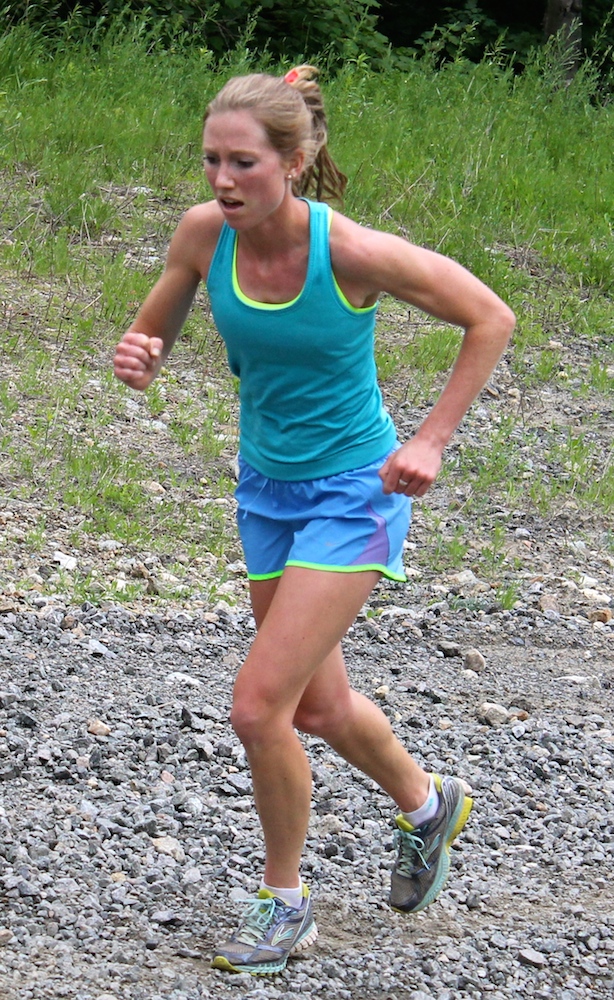
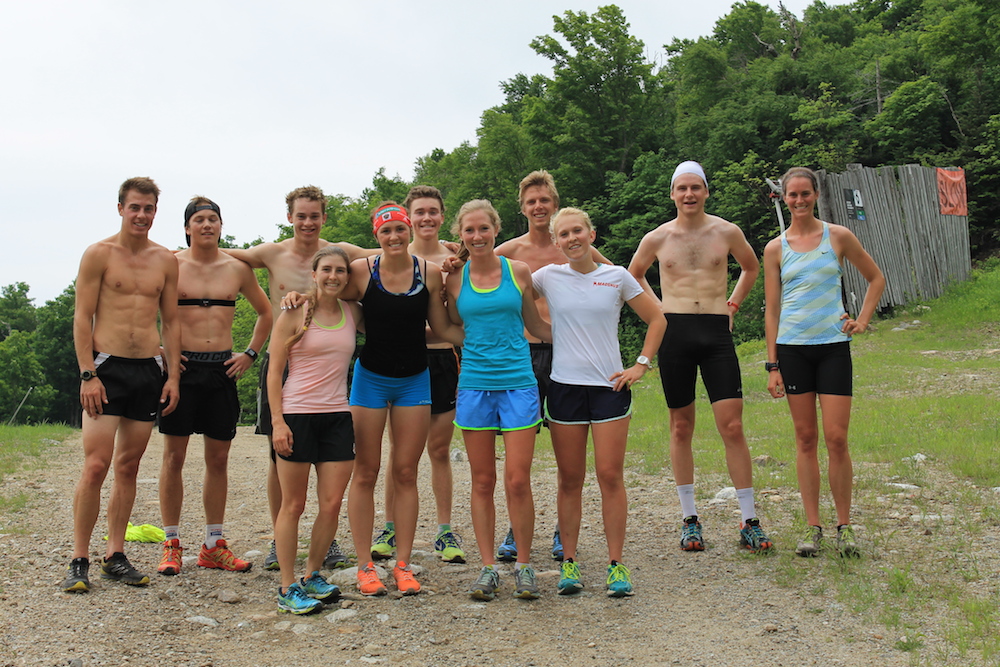
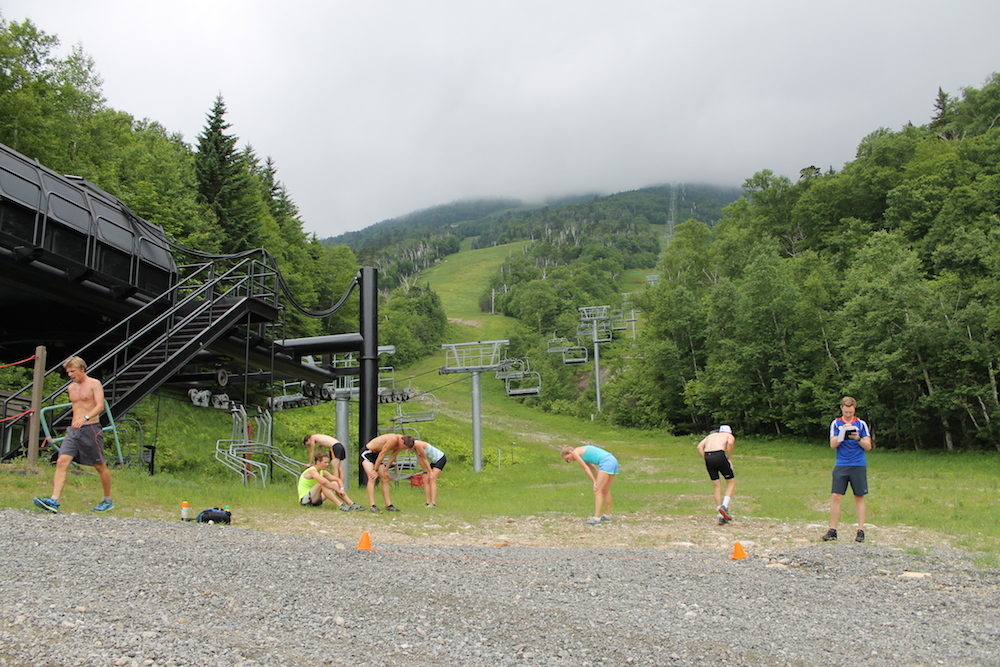
The faces of the U.S. Biathlon Talent ID Recruiting Camp together on Whiteface Mountain after completing a 2.5 k Uphill Run Test named after Tim Burke (not pictured), who mapped the course. From left to right: (back row) Paul Schommer, Casey Shannon, Paul Everett, Luke Brown, Patrick Johnson, Max Durtschi, Elizabeth Guiney, (front) Elizabeth Izzo, Greta Anderson, Erika Flowers, and Kelsey Dickinson.End of the Tim Burke Uphill Run Test at the US Biathlon Talent ID Recruiting Camp in Lake Placid.
Noah Hoffman (SSCV/Team HomeGrown/USST) racing to a 10.9-second win in Saturday’s 15 k freestyle at SuperTour Finals at Kincaid Park in Anchorage, Alaska. (Photo: Rob Whitney)
ANCHORAGE, Alaska — Separated by 30 seconds at the start, nearly 70 men in Saturday’s 15.9-kilometer freestyle raced around Kincaid Park individually on Saturday in the SuperTour Finals opener.
One by one, they ascended massive hills, like Elliott’s Climb at the end of each 5.3 k lap, and descended a winding section of the course known as S Turns. They made their way back to the stadium World Cup start area via trails named Burky’s Climb and Roller Coaster.
Some made up ground on their competitors; others lost it.
With one lap to go, it was pretty obvious which side of that Noah Hoffman of the U.S. Ski Team (USST), Ski & Snowboard Club Vail and Team HomeGrown was on.
University of Vermont senior Scott Patterson racing to second in Saturday’s 15 k freestyle at SuperTour Finals in Anchorage, Alaska. (Photo: Rob Whitney)
Watching him climb Elliott’s the second time around 10 k was unlike anyone else. Scott Patterson of the University of Vermont (UVM) led Hoffman by half a second after the first 5 k loop, then fell behind by 4.6 seconds by the end of the second.
“There’s no recovery out there,” Hoffman said after the race. “You’ve got to work the whole thing. The downhills are turny, really require you to work, but for the most part it’s just rolling terrain and no big uphills, no big downhills, quite different than anything I’ve raced [overseas] all year. It was fun.”
With about 5 k to go, Hoffman, 25, put the hammer down on the hills he knew were his strength. The lone skier at Spring Series from his Colorado club, Hoffman stood out in white — and in his ability to attack when most were visibly slowing.
“My strategy was try just to ski really high energy but keep it relaxed, knowing that I couldn’t really go over the line because there was no place to recover,” Hoffman said. “There were limited opportunities out there to attack on the uphills so I had to really focus when I did have that opportunity.”
Hoffman continued to gap Patterson, a UVM senior from Anchorage, on the final lap and ultimately beat him by 10.9 seconds for a victory in his first SuperTour Finals since 2012.
“I knew I was close to Scott,” Hoffman said. “I was getting word out there, ‘Tied! Up by two, down by two,’ so I knew it was a close race and you’ve just got to work for every second out there and see what happens.”
While Patterson gave Hoffman a run, nobody else came too close. Erik Bjornsen of Alaska Pacific University (APU) and the USST was in a three-way fight for third with Patrick Johnson (Far West Elite Team) and David Norris (Montana State University) with one lap to go.
Erik Bjornsen (APU/USST) racing out of the World Cup start area to third place in Saturday’s 15 k freestyle at SuperTour Finals in Anchorage, Alaska. (Photo: Rob Whitney)
Bjornsen ended up third, 59.3 seconds behind Hoffman and 3.1 second ahead of Norris in fourth, and said he lost time on the second loop and didn’t have the finishing punch he’s used to.
“I really didn’t find that top gear in the last lap that I was looking for, so that was a little disappointing,” Bjornsen said.
But a podium is a podium at a race series that ranks right up there with U.S. nationals prestige (on March 28, the 30 and 50 k classic mass starts will serve as U.S. Distance Nationals).
“It’s been cool this year going to the Olympics,” Bjornsen said. “I think Anchorage has started to notice my name. Just a ton of fans out there. It was so fun.
“I thought I was fourth,” he continued. “I’m happy with [third]. … It’s a tough race. You’ve just got to keep working the whole time and keep moving. As soon as you kind of rest or chill for a little bit I think you lose a lot of time.”
“I think Anchorage has started to notice my name. Just a ton of fans out there. It was so fun.” — Erik Bjornsen (APU/USST), third in SuperTour Finals 15 k freestyle
Patterson didn’t let off the brakes, especially with Anchorage spectators lining the course, but thought he came undone a little bit on the final climb. At the halfway point, he recalled being two seconds ahead of Hoffman in the lead — an accomplishment for any non-USST member, let alone a college racer.
Noah Hoffman on his way to winning his first SuperTour Finals race in two years. He did not compete in Truckee, Calif., last season. (Photo: Rob Whitney)
“It seemed like every person was giving me splits, every volunteer was cheering for me so it was pretty cool. Definitely had a good crowd out there that knew me well,” he said.
“Scott’s a great skier, I’ve known that for a long time,” Hoffman said. “It was never a guarantee I’m going to win this race. I’m just glad to edge it out. I hope to ski Scott at the World Cup level sometime soon.”
If Patterson, the younger of the two siblings at the Finals (Caitlin of the Craftsbury Green Racing Project is the other), has his way, that’s exactly how his career will go down. The first step is not being intimidated by a USST athlete. The second: learn how to deal with limited splits on when you start ahead of the person you’re trying to chase down.
“It was hard to kind of know — up, down, going back and forth — so I tried to push it in, but I was a little slow on the last hill,” Patterson said. “He definitely picked it up towards the end.”
For Hoffman, the attack made all the difference. Besides Patterson and Bjornsen on the podium, Hoffman beat everyone else by more than a minute. Norris was fourth (+1:02.4), Lex Treinen (APU) fifth (+1:06.2). Johnson placed sixth, Matt Gelso (Sun Valley Ski Education Foundation) took seventh, Reese Hanneman (APU) was eighth, Brian Gregg (Team Gregg/Madshus) ninth, and the former APU skier Mark Iverson (Rossignol) 10th.
Hoffman and Bjornsen were among four in the top eight getting wax help from APU this week, including Norris and Hanneman.
“I don’t really know how my fitness is at the moment; it was a lot of travel,” Hoffman said after flying from Sweden to Anchorage earlier this week. “I’ve been sleeping pretty well for the most part this week, but it’s a hard transition, it’s also just been a long season.”
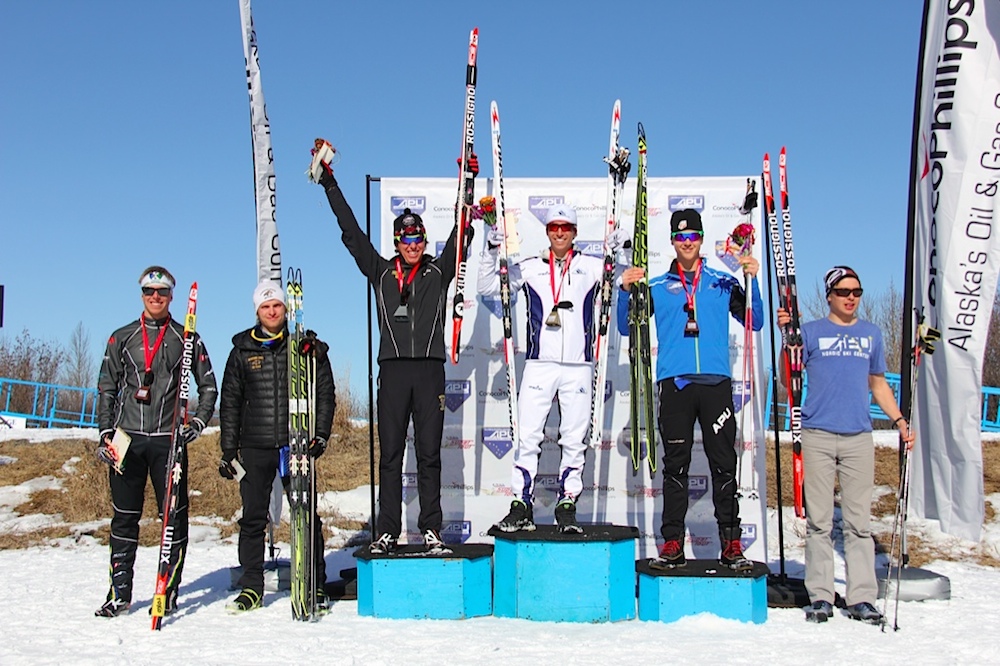
The men’s 15 k freestyle individual start podium at SuperTour Finals in Anchorage, with winner Noah Hoffman (c), runner-up Scott Patterson (third from l) and Erik Bjornsen (second from r) in third.(Photo: Rob Whitney)
Sylvan Ellefson (SSCV/Team HomeGrown) gaining some speed with 1 1/2 laps remaining out of six in the men’s 30 k freestyle mass start at 2014 U.S. Cross Country Championships at Soldier Hollow in Midway, Utah. Ellefson won by 2.8 seconds for his first national title.
FasterSkier’s coverage of the 2014 U.S. Cross Country Championships is brought to you through the generous support of The Memory Clinic in Bennington, Vt.
***
Note: This article has been updated to include Sylvan Ellefson’s tribute to Vail native, Tony Seibert, who died in an avalanche on Tuesday.
MIDWAY, Utah – Ninety percent of people holding homemade signs and placards along the trails at Soldier Hollow on Wednesday at the U.S. Cross Country Championships were for one person: Sylvan Ellefson.
And it wasn’t just all of Vail, Colo., out there supporting him. Ellefson, 26, had fans, friends and family from Alaska, Wyoming and Minnesota in bunches along the 5-kilometer Olympic course, all screaming his name throughout the 30 k freestyle mass start.
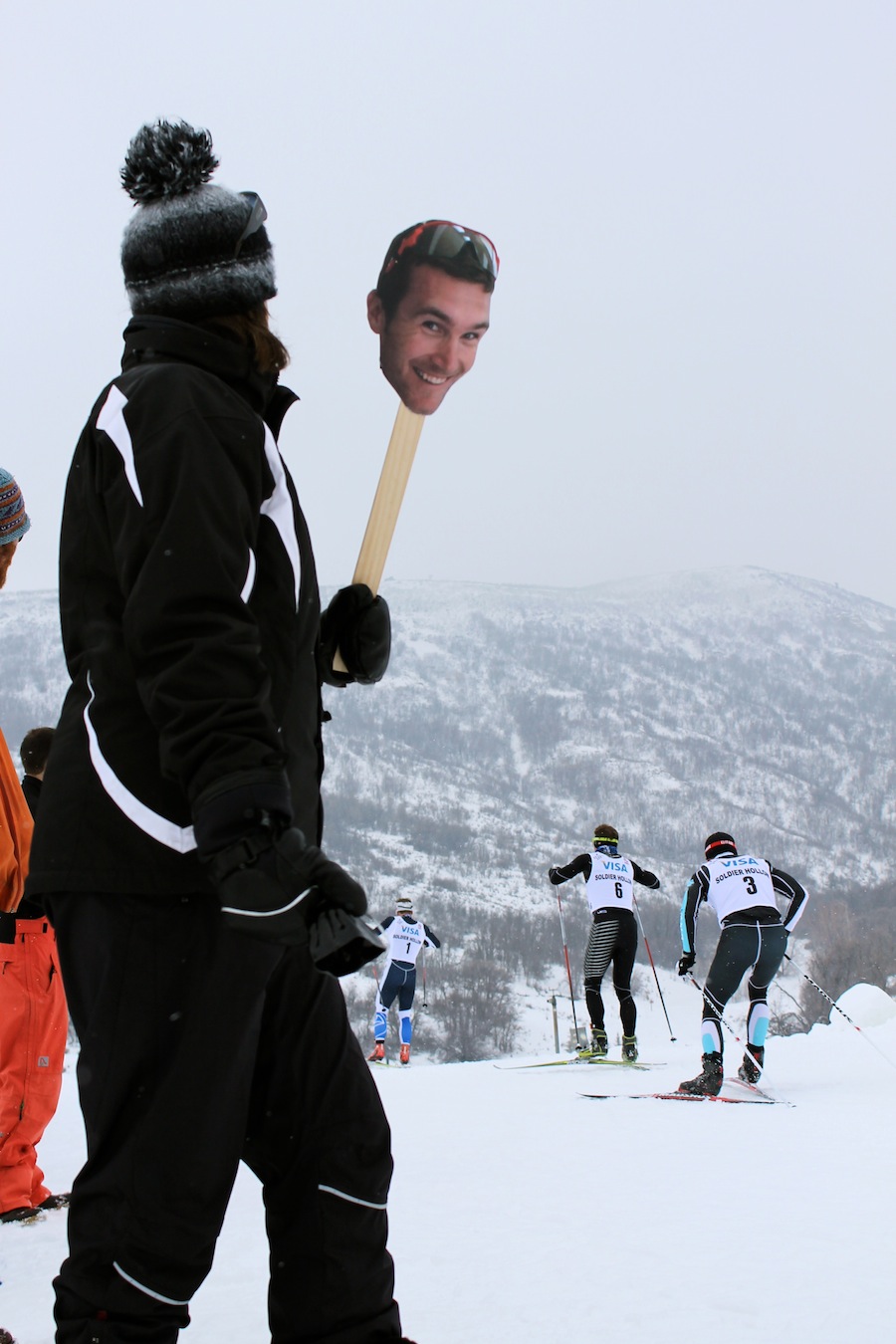
Sylvan Ellefson’s mother-in-law holding one of many “Sylvan on a Stick” cardboard cutouts while cheering Ellefson on during the men’s 30 k freestyle mass start at U.S. nationals on Wednesday in Midway, Utah.
A Ski & Snowboard Club Vail (SSCV)/Team HomeGrown staple, Ellefson figured he had about 40 to 50 supporters cheering him on, but it could’ve easily been more. Many of his fans held “Sylvan on a Stick” cardboard cutouts of his face in hand, including his mother-in-law who excitedly awaited him (along with his grandmother and other family members) at the finish.
With two laps remaining, Ellefson kicked it into high gear on the first of several significant climbs on a snowy morning. Distancing himself from Miles Havlick of the Sun Valley Ski Education Foundation (SVSEF) and Ben Lustgarten (Middlebury), he tried to close the gap on renegade Scott Patterson of the University of Vermont (UVM).
“I knew that if I wanted to win today I had to pull a ballsy move and I was feeling pretty good chasing Scott,” Ellefson said. “I decided that I’d see what the field was gonna do and just go for it. I went for it and not everyone responded the way I thought, so I just kept going for it.”
On the second of six times up the unforgiving Hermod’s Hill in condensing powder, Patterson and Lukas Ebner (University of Alaska-Anchorage) took advantage of the pack’s moderate pace and put some time between them and the rest of the field.
“Next time up the hill [Ebner] faded a little bit so then all of a sudden I was up there on my own,” said Patterson, an Anchorage native. “I figured I’d try to ski it, try to stay relaxed, but out there being off the front I definitely probably pushed a little too hard early.”
After skiing 1 ½ laps alone out front with as much as a 30-second margin, the UVM junior started the fifth lap hanging onto whatever energy he had left. He made it up the first two climbs out of the stadium to the backside of the course, where Ellefson reeled him in – cutting the deficit from 15 seconds to zero within a kilometer.
“I was hurting pretty bad,” Patterson said. “The steep hills really got me and I was almost walking up them. Sylvan came flying by me and I had nothing really left at that point, so I was kind of struggling in the last 10 k.”
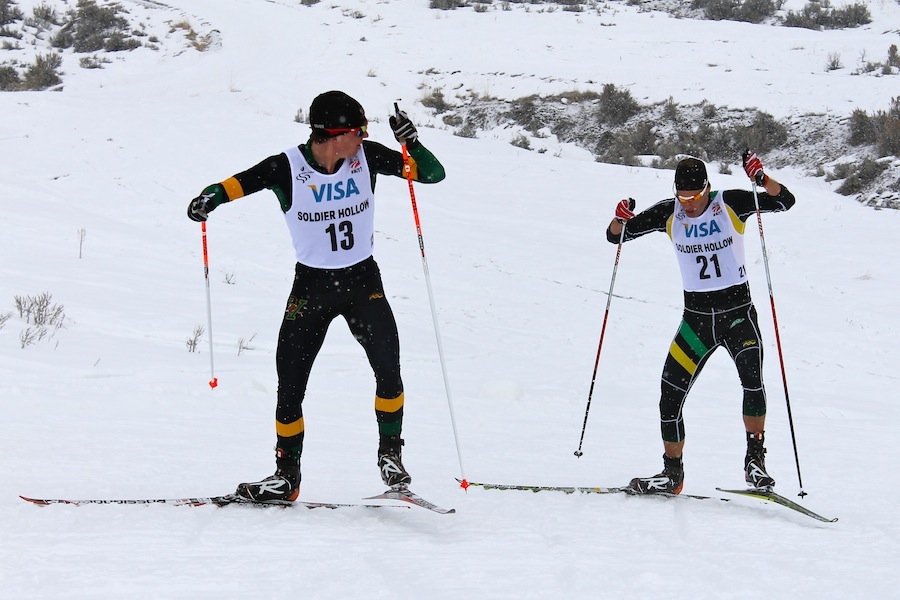
University of Vermont junior Scott Patterson (l) glances back at Lukas Ebner (University of Alaska-Anchorage) while leading early in the third of six laps in the men’s 30 k freestyle mass start at U.S. nationals at Soldier Hollow.
Ellefson not only passed him, but he dropped the pack in the process and created a gap of his own with 7.5 k remaining. A 10-second lead down the long downhill known as Whale’s Tale grew to 12 seconds on the final hill of the lap, and Ellefson came through the stadium 11.6 seconds ahead with 5 k to go.
Hearing things weren’t going so well for Kris Freeman of the Maine Winter Sports Center in second (“Something was going on with his ski, his binding,” Ellefson said), he decided to go for it with one lap remaining.
“I haven’t really tried to pull a ballsy move in a long time and I figured why not?” he said. “My skis today were also unbelievable.”
He ended up extended his lead to 23 seconds across the top of the course before heading up Hermod’s one last time. Ten to 20 seconds later on the same hill, Brian Gregg (Team Gregg/Madshus) challenged Freeman for second and gave Ellefson a scare in first.
“I was coming completely undone up Hermod’s the last time, completely,” Ellefson said. “My coach was telling me I had about 10 seconds coming up Hermod’s and I was like, ‘Oh my God, somebody give me a break,’ but when you have this good a field you just have to be the fastest on that day.”
Sylvan Ellefson (SSCV/Team HomeGrown) pushes off the front with just over 5 k remaining in the men’s 30 k freestyle mass start at U.S. nationals at Soldier Hollow in Midway, Utah.
He was – outlasting Gregg, who came on strong over the last two climbs, to win his first national title in 1:19.11.3. Gregg finished 2.8 seconds back in second for his first national podium, and Freeman pulled through in third, 16.5 seconds after Ellefson.
“Everything was so blurry,” Ellefson recalled of the last few hundred meters to the finish. “I knew Gregg was coming, but I didn’t know how far behind he was and I knew I just had to hammer. I can’t tell you how many times Brian Gregg and I have had a sprint to the finish. Last year, he got me every single time so I was happy to get him this time.”
In last year’s national 30 k classic, Ellefson placed seventh, 35 seconds behind winner Torin Koos (Bridger Ski Foundation), who did not finish after pulling out in 42nd halfway through the race. Another DNF, Tad Elliott (SSCV/Team HomeGrown) led early in his first race back while recovering from mono. He was in the mix and near the front for three laps, but called it a day after the fourth time around despite being in 16th.
Almost exactly a year ago, Gregg was 22nd in the 30 k classic mass start, also at Soldier Hollow. On Wednesday, he was out to perform in what he considered his focus event of this year’s nationals – and the one with the deepest implications for making the Olympics next month in Sochi, Russia.
Brian Gregg of Team Gregg/Madshus (3) followed by Erik Bjornsen (2) of APU/U.S. Ski Team and Kris Freeman of the Maine Winter Sports Center (behind Bjornsen) in the pack up Hermod’s for the first of six times on the men’s 30 k freestyle mass start at U.S. nationals at Soldier Hollow in Midway, Utah.
“On Hermod’s, I was getting a little bit of a gap on Kris and I was like, ‘I’ve just got to finish as hard as I can,’ ” said Gregg, 29, who sat patiently in the pack in 24th through the halfway point.
A lap later, he was up to 12th, and after the fifth of six laps, Gregg was fourth behind Ellefson, Freeman, and his good friend Matt Liebsch (XC United/Team StrongHeart).
“It was kind of nice to have that rabbit up there because I kept gaining time on Sylvan,” Gregg said of chasing Ellefson the last kilometer to the finish. “But I was really tired and it felt kind of like a slow-motion sprint.”
Regardless, second place and just 2.3 seconds out of first was almost as good as a victory for Gregg, who’s been hunting to improve his International Ski Federation (FIS) point profile since the beginning of the season.
In the following women’s 20 k mass start, his wife Caitlin Gregg won by more than 3 ½ minutes. Less than four hours later, they two were scheduled to fly from Salt Lake City to Prague.
“The last two days have been crazy,” Gregg said. “Packing things up making sure we’re as dialed as we can be for this race. … We’re not really sure how long we’ll be over in Europe; we have a ticket back on [January] 21st, but maybe with today we get named [to the U.S. Olympic team] or whatever, so we’ll see how it works.”
The men’s and women’s SuperTour leaders, the couple earned World Cup starts for the next two weekends of racing before the Olympics, which start Feb. 8.
“Very, very excited,” Gregg said. “This has been a focus race all season. … It’s great to see Sylvan up top. He’s been real consistent all season.”
Racing for Tony:
A day after his friend and Vail native, Tony Seibert, 24, died in an avalanche, Sylvan Ellefson dedicated Wednesday’s U.S. nationals 30 k freestyle race to him.Ellefson wrote on Facebook on Tuesday: “Having a tough time swallowing this one. I’ll be skiing for you tomorrow Tony! The Vail community won’t be the same without you. I’ll celebrate your life by attempting a 360 off of Lovers Leap. Doubtful I’ll land, but at least I’ll be smiling when Ski Patrol takes me off the mountain I’ll miss you man!”
“Whether they pick me for the Olympics this year or not, I’m just happy to have a national championship under my belt,” Ellefson said. “It’s literally the only thing I’ve ever wanted in my skiing career, and two years ago when I was third [in the 2012 national 15 k freestyle], that was the closest. So for me to get it today, I can’t tell you how happy I am.”
Moments before he stepped up onto the podium for the medal ceremony, he embraced his wife, Sarah.
“To have this support crew here is unbelievable,” Ellefson said. “That’s really what got me up the hills today.”
Almost 14 seconds after Gregg finished, Freeman, 33, came through in third.
“I did what I had to do, right?” Freeman said to his coach, Zach Caldwell, almost immediately after.
While he declined to comment, Freeman later wrote on his blog that he was seeking lower than 30 FIS points in both distance races at nationals, which meant making the podium in both. He was third in the 15 k classic last Saturday.
“I just managed a 29.5 FIS race in the 15k classic and I scored a 27 point race in the 30k skate today,” he wrote. “I have not been feeling good this week so I am relieved to have moved up into such a strong position. As far as I know there are no more FIS races in the US that could affect the Olympic qualification for distance races.”
A Type-1 diabetic, his blood sugar dropped dangerously low to 38 the night after the 15 k. He overcompensated and his glucose level rose as he slept, waking him up four times with a peak of 280 at 4 a.m.
“At this point I took yet another bolus and forced myself to get out of bed and do 200 jumping jacks in order to make my muscles more receptive to the insulin I was giving myself,” Freeman wrote. “The physical stimulus worked and I slept until 8:00 AM when my low alarm set off at 78. For me, seventy eight is a healthy level but below 70 is not. So I got out of bed, ate breakfast, and everything stabilized. This was not the ideal recovery for a race and I started feeling very down.”
Freeman leading Bjornsen across the top of the Olympic 5 k course at Soldier Hollow during the fifth of six laps in the men’s 30 k freestyle mass start at U.S. nationals on Wednesday. Freeman finished third and Bjornsen was fifth.
He called his sport psychologist, who “helped me to let go of the unquantifiable fatigue that the poor sugars caused and to focus on what had to be done in the next race. I have a tendency to be very obsessive so that was easier said than done,” Freeman wrote. “I have to thank my family and girlfriend who also got to listen to me whine about not feeling like myself the last few days. [Their] love and encouragement really helped me to get the most out of a less than ideal time and get the points I needed to pursue my Olympic dream in Sochi. I am very confident that with a little downtime at home that my best Olympic results are in front of me.”
While he and several others signed eligibility papers for Sochi, the team won’t be officially named until around Jan. 21-22, according to the U.S. Ski Team.
Forty-two and a half seconds off the podium, Mikey Sinnott (SVSEF) came on strong the last lap to finish fourth. Unable to keep up with Gregg through the stadium at the start of the last lap, he caught a ride from Erik Bjornsen and Lex Treinen, both of Alaska Pacific University. He conserved behind them and passed them both before the infamous climb, where he also took on Liebsch.
Bjornsen finished another six seconds back in fifth, 1:05 behind Ellefson. Treinen was sixth (+1:07.3) and Liebsch took seventh (+1:12.5).
“I kind of got lucky that I didn’t have to sprint too hard; this was a pretty tough finish for me,” Sinnott said. “Last hundred meters with my legs gone, I was lucky to be alone.”
Mikey Sinnott of the Sun Valley Gold Team (l) leads Oscar Ivars (University of Utah) up an early climb in the fourth of six laps on Wednesday. Third in the 30 k freestyle mass start at the time, Sinnott placed fourth.
Right behind Ellefson when he popped early in the fourth lap, Sinnott rose as high as third, but generally hovered in the top 10.
“I haven’t really skied well at all this year so I knew that maybe my form wasn’t the top notch, but I know I probably have some better base than a lot of these youngsters out there,” Sinnott said. “I wanted to ski smart and hope for the best. I think that’s what I did well, stay near the front out of the chaos.”
It worked to his advantage, he said, because, “This is one of the slowest 30 k’s I’ve been in. The first 20 k we were doddling. I’m sure Caitlin went a lot faster than us. I just kind of sat there patiently and waited for it to start blowing apart.”
While Patrick Johnson (Far West) was the first to go off the front with a breakaway on the first lap, Sinnott said he wasn’t too concerned.
“It was kind of like, ‘That was dumb,’ ” Sinnott said. “Maybe if we were pushing and working hard and not reeling him in, but you could tell he was just strung out there working hard and we were taking it really easy. … Patterson did the same thing and I think the coaches started to panic because he was a little farther and a little bit longer out there, but … when the race finally started we reeled him in a k.
“When you’ve got Freeman in the pack you know he’s not gonna let anyone get out of hand that’s really a threat,” he added.
After opening up a 15-second lead early in the first lap, Johnson resumed his place in the pack about halfway through the second loop and finished 12th, 1:34.6 behind Ellefson. Patterson ended up 19th (+2:20.6).
“I gave it my best. Put in a good effort,” Patterson said.
Bjornsen was disappointed with fifth, explaining he was looking for more after feeling “pretty nervous” at the start.
“I should’ve gone with those guys on the last lap, but I guess I just didn’t quite have it in me,” he said of Ellefson, who made the break with about 7.5 k to go, and Freeman, Liebsch and Gregg that followed in pursuit.
Liebsch said he felt good for five of the six laps, but couldn’t quite stay with Gregg when he attacked on the last lap.
“I just didn’t have it right then,” Liebsch said, who had snow jam under his boot for the entire last lap, causing some discomfort with his binding.
“We’ll have to see how the points play out, if I’m still in it for Sochi or not,” he added. “I was right in the mix for making the world champs last year … and seeing [how] the last Olympic team I was right there, so hopefully get the nod this time.”
Thinking about his Midwest supporters, Liebsch thanked his wife, Marybeth. “I love her and thanks to everyone back home for the support,” he said.
Caitlin Gregg (2) leads the women’s SuperTour 10 k classic mass start on Sunday in Bozeman, Mont. She went on to place third behind Chelsea Holmes (7), who won by 43.4 seconds, and Caitlin Patterson (3), who placed second. (Photo: Anya Caldwell Bean)
To say Sunday’s 10- and 15-kilometer classic mass start races in Bozeman, Mont., were cold would be an understatement. With the temperature hovering just above the legal racing limit of -4 degrees Fahrenheit, racers adorned their warmest gear, wore breathing masks, and covered their faces with tape in order to protect themselves from the frigid conditions.
In addition to braving subzero temperatures, racers had to ski an extremely difficult and technical course at Bohart Ranch.
“The course is tough,” said Dragan Danevski, race organizer and Bridger Ski Foundation (BSF) Head Coach, said in a press release. “But we expect athletes to prove their preparation for competing in the Olympics.”
Chelsea Holmes with a significant lead on the last lap of the women’s 10k (Photo: Anya Caldwell Bean)
Many did just that. In the women’s 10 k, Chelsea Holmes of the Sun Valley Ski Education Foundation Gold Team (SVSEF) won by a commanding 43 seconds in 34:23.5. Caitlin Patterson of the Craftsbury Green Racing Project (CGRP) placed second and Caitlin Gregg (Team Gregg/Madshus) followed in third (+1:08.1).
Rounding out the top six were Kate Fitzgerald of Alaska Pacific University (APU) in fourth, Bozeman native Erika Flowers of the Stratton Mountain School T2 Team (SMST2) in fifth, and Becca Rorabaugh (APU) in sixth.
An Alaska native, Holmes had fun despite the temperatures and tried to prevent the weather from distracting her from the race.
“No one’s psyched to be so cold, but I just try to put it out of my mind and focus on what’s at hand,” she wrote in an email. “Really, it’s the coaches, techs and volunteers that bear the brunt of the cold with all that standing around!”
Sunday’s SuperTour race came after Saturday’s classic sprint was first delayed, then canceled due to temperatures between -10 and -20 Fahrenheit. Organizers decided to push Sunday’s distance races back by three hours and were prepared to shorten them in case of even colder temperatures. Fortunately, Mother Nature complied.
Best known as a distance skier, Holmes wrote that she had looked forward to the classic sprint and was disappointed that it had been canceled. However, with a SuperTour win under her belt, she’s off to a good start this season.
Gordon Vermeer makes his way up the first climb in the men’s 15k mass start (Photo: Anya Caldwell Bean)
The men’s 15 k was much tighter, with Russian Dmitriy Ozerskiy of Central Cross Country (CXC) edging out Miles Havlick (SVSEF) by 1.5 seconds for the win in 44:47.7.
lacing third through sixth were Patrick Johnson (Far West), Matt Liebsch (XC United/Team StrongHeart), Brian Gregg (Team Gregg/Madshus), and Reese Hanneman (APU), respectively.
Gregg and Liebsch competed in the Bozeman SuperTour after going 1-2 in the Canadian NorAm at Sovereign Lake, B.C., on Saturday. They were able to make it to Bozeman via chartered plane that was funded by donations.
In an email, Hanneman wrote that BSF did an “incredible job” with Sunday’s races and was impressed with the high quality of the tracks and course. He felt the weather was bearable, but “probably on the lower limit of what was reasonable.”
For some, the racing in the cold wasn’t worth the risk. Annie Pokorny (SMST2) decided to sit forgo the race after having trouble breathing earlier in the week.
“During my warmup, I decided to save my lungs for the next few weeks of training,” she wrote. “Even at a legal temperature, it wasn’t safe for me, so I’m happy with that decision.” She wasn’t the only one, as roughly 20 racers opted not to start. Seventeen senior women completed the 10 k, and 33 senior men raced the 15 k. US Ski Team member Erik Bjornsen (APU) did not start.
The next round of SuperTour races will be at Solder Hollow in Midway, Utah, as part of the U.S. Cross Country Championships from Jan. 4 through 10.
Photos from the second set of SuperTour races at Bohart Ranch in Bozeman, Mont., with 10/15 k classic mass starts taking place in temperatures just above the legal limit of -4 degrees Fahrenheit last Sunday. All photos by Anya Caldwell Bean.
Caitlin Gregg (2) leads the women’s SuperTour 10 k classic mass start on Sunday in Bozeman, Mont. She went on to place third behind Chelsea Holmes (7), who won by 43.4 seconds, and Caitlin Patterson (3), who placed second.
Women’s 10 k classic mass start
Chelsea Holmes (SVSEF) leads Caitlin Patterson (CGRP) in the SuperTour 10 k classic mass start at Bohart Ranch. Holmes went on to win it in 34:23.5, nearly 44 seconds ahead of Patterson.
Holmes, Patterson and Gregg.
Chelsea Holmes with a significant lead in the women’s 10 k.
Caitlin Patterson (CGRP), racing to second 43.4 seconds behind winner Chelsea Holmes (not shown)
Erika Flowers (SMST2), racing to fifth,
Gordon Vermeer (47) and a packed men’s field in the 15 k classic mass start
Gordon Vermeer (47) and a packed men’s field in the 15 k classic mass start
Patrick Johnson (Far West) leads Brian Gregg in the 15 k classic mass start on Dec. 8 in Bozeman, Montana. (Photo: Anya Caldwell Bean)
SuperTour Distance Skate Photos on TokoUS Facebook Page
A photo album with selected photos from today’s SuperTour Distance Skate can be found on the TokoUS fb page (please “like” so you can follow such postings in the future). Please visit to see lots of great photos including run away winner Caitlin Gregg. The photo album can be found here. All athletes shown affiliated with Toko Wax/Tools and/or Toko Gloves.
Caitlin Gregg won the 5k by over 1:02! She was in a class of her own.
Note: This is the 12th preview in our U.S. elite-team series, the “The 12.” We asked coaches to tell us what’s new and whom to look out for this season. We will be publishing Canadian training-centre profiles in the coming weeks.
Team: Far West Elite Team
Coaches: Martin Benes, August Teague
Roster: Franz Bernstein, Spencer Eusden, Wyatt Fereday, Patrick Johnson; Holly Whitney
Who’s new: Bernstein heads west after a standout career at the University of Vermont, where he was an NCAA champion in 2010. Bernstein remained in Vermont after graduating, as he pursued his MBA from UVM. With Masters degree in hand, the former member of the German Junior National Team will race in Far West colors for the first time 2012-14.
Eusden on the run this summer (Photo: Mark Nadell)
Joining Bernstein as a Far West rookie is Johnson, who wrapped up four impressive years at Middlebury College in 2012, before stepping right on to the professional circuit with the Sun Valley Gold Team. Johnson won his first SuperTour last season, and will join the Far West squad this fall after spending the summer at home in Anchorage, Alaska.
Who’s missing: Beth Taylor; Noah Brautigam, Phill Violett, Gus Johnson
All four of the above have moved on from competitive ski racing. Johnson and Brautigam are coaching, in California and Utah respectively, while Violett has shifted his focus to summer biathlon. Taylor, following a breakout season, has opted not to train full time or travel this year.
Back for more: Both Eusden and Whitney started with the Far West EliteTeam as part of the summer college training program. Obviously they found the mountains of California to their liking, and returned for more.
They attended East Coast colleges, Bowdoin and Williams respectively, and are heading into their second seasons with Far West.
The longest tenured member of the squad, Wyatt Fereday, just completed his master’s thesis at the University of Nevada, Reno, and is looking to build on strong results his third year racing out of California.
Whitney and Fereday after claiming victory on Valentines Day. (Photo: Mark Nadell)
Top results last season: Fereday placed an impressive 16th in the SuperTour Finals Hill Climb and 49th at the American Birkebeiner while consistently placing at the top in local events.
Eusden took 2nd at the Great Ski Race, 11th at the Aspen SuperTour in the 10k classic, 22nd at the Boulder Mountain Tour, and 21st in the SuperTour Finals Prologue.
The final returning member of the team, Whitney, won the local Tahoe Rim Tour and just missed the podium in the Great Ski Race, placing 4th.
Johnson did not race for Far West last season, but his results are impressive nonetheless, earning the victory at the Aspen SuperTour in the 10k classic, along with a 5th at US Nationals in the 15k freestyle, and 8th in the American Birkebeiner, where he was the top American finisher.
Bernstein, for his part, placed 8th in the Craftsbury Marathon.
Coach’s Comment: Benes is looking forward to the 2013-14 season with new faces joining the solid returning cast.
“This year’s edition of the team is definitely one of our strongest,” Benes said. “On the men’s side, adding Patrick Johnson and Franz Bernstein will be a big boost not only in training, but also by increasing the size of our travel squad.”
Both Bernstein and Fereday will be more focussed on local racing, though Fereday does plan to hit West Yellowstone, the American Birkebeiner and the Boulder Mountain Tour.
Benes expects Eusden to build off some strong results from last year, and should reap the benefits of some tough training.
“We had a big planned jump in terms of training volume last year, which combined with a move to altitude left him feeling pretty tired at times during the race season,” Benes explained. “This was to be expected, and he ended up with some big fitness gains. This year, we have leveled off his training a little and we should see payoff come winter.”
Like Fereday and Bernstein, Whitney will mainly race locally as she will also be coaching part-time after spending the summer in New England.
Johnson should be battling for top spots on the domestic circuit, and the team looks forward to his imminent arrival.
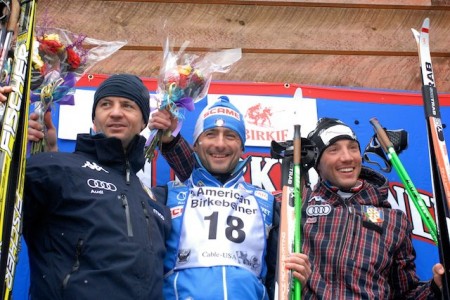
Fabio Santus (right, in blue), leads the men’s 2013 American Birkebeiner field to the finish line in Hayward, Wisconsin. Santus was second; his teammate Sergio Bonaldi (far left in blue) won the race. Photo, Darlene Prois/American Birkebeiner Ski Foundation
There’s a lot of reasons to want to win the American Birkebeiner, the 50 kilometer point-to-point ski marathon from Cable to Hayward, Wisconsin.
There’s the satisfaction of beating one of the best-assembled U.S. distance fields: racers with marathon credentials will fly in from Alaska, the Pacific Northwest, or New England, plus there’s always the rabid Midwest contingent.
There’s also the glory that goes along with winning the Birkie. In one part of the country, the title arguably carries more weight than winning a national championship.
And finally, there’s the money. The Birkie doles out a whopping $7,500 for the winner, scaling down to $1,000 for sixth place. In American ski terms, that’s a fortune, enough to bankroll an entire season of racing, or to turn the pursuit from a wallet-draining hobby to something that approaches a real career. That kind of money just doesn’t happen.
So every year, Americans line up in Cable, eager to capture those three things that come with a Birkie title. Because the Birkie is part of an international marathon circuit, some European racers always show up – and are always in the mix for a win. But in 2012 Tad Elliott led a U.S. podium sweep, turning the tide after two years of European victories.
At the start this year, it was clear that the Americans would have to fight for the title.
“I did know,” said Bryan Cook, who races for Craftsbury. “[Fabio] Santus won a couple of years ago, so I knew him and I knew he raced with a couple of the other Italians… I recognized the Czech, Martin Koukal as well – he has a pretty distinctive style.”
By the time the lead pack of 15 skiers turned on to the finish stretch in Hayward, the teamwork and tactics of the Europeans had overwhelmed the Americans in the group.
A four-strong squad of Italians swept the top four places, led by Sergio Bonaldi, a 34-year old from the
Sergio Bonaldi (center), with his Italian teammates on the podium. Photo, Darlene Prois/American Birkebeiner Ski Foundation.
northern city of Bergamo, with Fabio Santus and Alan Martinelli rounding out the top three. Two Czech skiers claimed fifth and sixth, consigning Matt Liebsch, the first U.S. finisher, to seventh—just out of the money.
Were the Americans frustrated that they hadn’t hit the podium? Heck yes.
Were they bitter, though? Not too much. In a race that many described as “fun”, the top six finishers were within a second of each other, and the top twelve within five seconds of the winning time, 2 hours, nine minutes, and 18.1 seconds, attributed to both Bonaldi and Santus on the results sheet.
“It’s good to be mixing it up with them,” Liebsch said. “I like that they come over and it raises the level of the race–if it was just Americans out there, all of a sudden that would have been my responsibility or somebody else’s…it was kind of nice to play defensively.”
But, he more or less added: “Ideally, they would have come over, and we could have kicked their behinds.”
Give an Italian a Hand
As the race left Cable on a base of freshly packed new snow, a group of four Italians moved to the front and began to take long, hard pulls that left much of the field hanging on, but unable to respond.
“It was pretty clear right from the beginning how strong the Italians were,” Cook said. “For the most part, we were just at the back. There wasn’t much we could do to help each other.”
The pace wasn’t consistent; Cook said that the leaders would push up and over the tops of the hills, and then sometimes slow down—ratcheting up their speed to drop other skiers off the back of the pack, then allowing things to come together again.
“The idea was to keep the speed high, not to have too many on the final sprint,” Bonaldi told FasterSkier through a translator.
Bonaldi had been sick last week, and tried to stay in the draft behind his teammates for the first part of the race. The Italian, who currently sits fourth in the world marathon standings, was keeping an eye on Frenchman Benoit Chauvet—his closest competition on the circuit.
Bonaldi said that the Italians didn’t have a coordinated strategy. “Everyone’s competing for himself, but if they can, they give an Italian a hand.”
But the Americans saw things differently—the Italians’ grip on the front of the race, Liebsch said, was tight, as one of the Russian competitors in the front group learned.
“He tried to get around the Italians and he ended up breaking his pole,” Liebsch said. “They were pretty
Matt Liebsch racing earlier this year.
protective of the front of the lead the whole race. When I was up there and near the front, I was getting my stuff stepped on, so I chilled out and just skied pretty defensively.”
So, coming across the lake towards Hayward, with 49 kilometers down and one to go, there was still a sizeable pack at the front. Of fifteen men, just five were American. Liebsch and Cook–who described himself at that point as “hurting pretty good”–were joined by Patrick Johnson of Idaho’s Sun Valley team, Johnson’s coach Colin Rogers, and Brian Gregg of Wisconsin’s own CXC squad.
At that point, even more than before, Liebsch said he knew he had his work cut out for him.
“We brought a lot of fast sprinters to the line,” he said. “I think I could have pushed hard to try to get up in that mix a little bit and a better spot, but I was nervous about breaking a pole. And I definitely didn’t want to break a pole.”
As the field hit the finishing lanes, the Italians spread out four abreast and dueled each other to the finish, sweeping the first four places. The rest of the men had to simply battle behind them, unable to pass. One of the two Russian skiers tried to get into a position where he could have spread to an open lane.
“If he could have had a free shot, I think he could have lit everybody up,” Liebsch said.
He couldn’t, though – and neither could anyone else. Koukal and Czech teammate Petr Novak edged Liebsch, Chauvet, and Johnson just behind the Italians, with four others all crossing the line within five seconds.
The finish was so close that Bonaldi, who had been overtaking his teammates, didn’t learn he had won the race until 20 minutes after his boot crossed the line, when a race official informed him that he’d edged out Santus.
Swept Out
Liebsch was acutely aware that a fraction of a second could have put him in the top six and earned him $1,000–and that two seconds could have earned him the full $7,500.
“The Birkie is, like, the biggest payout race,” Liebsch said. “For domestic U.S. racers, this is our one shot to make a little bit of income off of ski racing, so to get swept out of that and have all six spots go to Euros, that’s definitely tough.”
Liebsch and others noted, though, that the Europeans put more of a premium on long races than most American athletes, who typically tailor their training for shorter distances.
Bonaldi, for example, had already won one marathon this year before the Birkie, and placed fourth in another.
“That’s why they’re here—they do all these long marathons,” said Pepa Miloucheva, the coach of the Craftsbury team. “For us, it’s just one of the races.”
The Italian group clearly arrived in Wisconsin with a plan. According to Scott Wilson, who hosted the team at his lakeside resort in Hayward, the squad had a special system for ski testing, and they also arranged for apartment-style accommodations so that they could cook their own food.
The real secret to their success, though? Wilson seemed to think it was wine (and beer), which he observed the Italians imbibing with meals.
“That seemed to be a part of their routine,” he said. “And we could probably learn from them.”
As Czech flags wave in the background, the mixed relay field sets off in pursuit of the first 2013 Biathlon World Championship title on Thursday in Nove Mesto, Czech Republic.
Think you can picture the scene at the International Biathlon Union (IBU) World Championships in Nové Město na Moravě, Czech Republic? Think again.
Veteran and newbies alike found themselves in awe of the stadium and 20,000-strong crowd. After the first few days of racing, many were still struggling to cope with the noise factor, but hey, they weren’t complaining.
Norway opened with its third-straight mixed relay victory, no surprise there, and the hometown fans celebrated its own team making the podium in third right behind France.
The U.S. notched its best mixed-relay result in eighth with Annelies Cook, Susan Dunklee, Lowell Bailey and Leif Nordgren. With Tim Burke out trying to get healthy, Nordgren filled in. Meanwhile, the Canadians were simply happy to get their feet wet at World Champs as Rosanna Crawford, Megan Heinicke, Jean Philippe Le Guellec and Scott Perras combined for 15th.
On Saturday, Norway’s former biathlon king, Emil Hegle Svendsen, made a point to get back on top and captured his second-straight gold medal of the week, beating French rival Martin Fourcade in the 10 k sprint. In the women’s 7.5 k sprint, Ukraine’s Olena Pidhrushna surprised with her first career win and teammate Vita Semerenko tallied her third World Championships bronze.
All four American men in the sprint raced well enough to qualify for Sunday’s 60-man pursuit. Burke was back in action in 28th, Bailey placed 32nd and Russell Currier and Nordgren also made the cut. Two Canadian men and two women qualified, led by Le Guellec in 36th and Scott Gow in his debut World Championship in 45th. In the women’s sprint, Cook also placed 45th and Heinicke narrowly qualified for the pursuit in 54th.
That brings us to Sunday when Svendsen continued his World Championships domination, outsprinting Fourcade by 2.4 centimeters for the pursuit victory. It didn’t come easy: he nearly stopped after getting tangled with Russia’s Anton Shipulin on the last climb.
Norway’s Tora Berger won her first individual gold of the week in the pursuit, rising to the occasion when two skiers in front of her, Russian Olga Zaitseva and Krystyna Palka of Poland, missed one apiece on the last shooting stage. Berger shot clean on the final stage and hammered home for the victory.
Meanwhile, Bailey and Le Guellec led the North Americans in 13th and 15th, respectively. Le Guellec made up 21 places – the second most of any man in the pursuit – and Bailey climbed 19 spots to get back in the mix.
While biathlon expert and FasterSkier editor-at-large extraordinaire Chelsea Little was on site in Nové Město, Audrey Mangan traveled to Aspen, Colo., for the SuperTour – making her first stop at the Vail Mountain Games.
There, the Central Cross Country (CXC) husband-and-wife duo, Brian and Caitlin Gregg topped the men’s and women’s field, respectively, in the 10 k freestyle mass start – a sort of warmup for the SuperTour weekend ahead.
On Saturday, big, wet snowflakes at 8,000 feet above sea level didn’t slow down skiers like Rosie Brennan of Alaska Pacific University (APU), who won both the 1 k classic prologue in the morning and the 5 k classic individual start in the afternoon. On the men’s side, Mike Sinnott of the Sun Valley Ski Education Foundation (SVSEF) won the prologue and teammate Patrick Johnson tallied his first career SuperTour victory in the 10 k.
Sunday’s coveted Owl Creek Chase involved a sprint showdown at the end of the 21 k point-to-point race. Brian Gregg edged Sylvan Ellefson (Ski & Snowboard Club Vail/Team HomeGrown) by eight seconds at the finish, showing all his speed work this summer paid off.
Part-time racer Nicole DeYong (SVSEF) skied away from the pack for a two-minute victory after winning the same race in 2010.
Sophie Caldwell (SMST2) racing to a second-place finish in Sunday’s Scando Cup 1.1 k freestyle sprint final in Pärnu, Estonia. She was just 0.14 seconds out of first for a career best. (Photo: Eric Packer)
Meanwhile, several other American domestic skiers put their skills to the test at the Scandinavian “Scando” Cup in Latvia and Estonia. Caitlin Patterson of the Craftsbury Green Racing Project led the group in Madona, Latvia, where she was ninth in Thursday’s 10 k freestyle mass start and 10th in the 5 k classic on Wednesday. Eric Packer of the Stratton Mountain School T2 Team (SMST2) broke through in 16th in the 20 k freestyle mass start.
A few days later, Sophie Caldwell (SMST2) made the podium in second in Sunday’s freestyle sprint in Pärnu, Estonia, one day after finishing 17th in the classic sprint. Jennie Bender (CXC) qualified as high as fourth in the classic sprint and went on to place 16th. The next day, she was 11th in the skate sprint.
Patrick Johnson (SVSEF) en route to winning the 10 k classic at the Aspen, Colo., SuperTour on Saturday.
ASPEN, Colo. — As Nemo shook the East with buckets of snow, the winter gods smiled upon the Rockies, too, with inches of heavy flakes on Saturday morning as the Aspen SuperTour got underway. The powder was a blessing for a state that’s had a mediocre winter, but for the handful of nordic skiers that braved the storm in spandex and a race bib it was a daunting environment in which to line up for one classic race, let alone the two in one day.
Rosie Brennan (APU) skiing to a sprint prologue win in dense snowfall.
“This morning was rough,” said Alaska Pacific University’s Rosie Brennan. “You couldn’t see anything. The tracks were washed out and my skis weren’t kicking very well, so it was sort of a struggle.”
It was a sparse field that braved the conditions for the classic sprint qualifier, which preceded the individual distance event, but the adaptable skiers prevailed. Brennan won the 1 k prologue in 4:26, 13 seconds ahead of teammate Lauren Fritz (APU). Erika Flowers (SMS T2) finished third (+0:20) and five elite women finished the race in total as inches of snow piled up in the tracks.
The men’s race was equally vicious. “It was very slow,” said Mike Sinnott (Sun Valley Ski Education Foundation). “I think I came to a stop a couple times. It was a brutal, painful sprint, and I don’t think anyone felt like the were sprinting.”
Sinnott took the prologue win in 3:40, seven seconds ahead of Sylvan Ellefson (Ski & Snowboard Club Vail Team HomeGrown). Peter Kling (APU) took third (+0:14).
After toughing it trough a kilometer of powder at 8,000 feet skiers had two hours to gear up for round two, a 5/10 k individual start classic. A Pisten Bully smoothed out the course in between events, and right on cue the skies ceased cleared as starters began to line up again.
Thanks to high elevation, a hilly course and slightly soft tracks, the second event of the day belonged to the mentally tough. Patrick Johnson (SVSEF), still in his first season out of college, landed his first career SuperTour podium and gold medal all at once, taking the men’s 10 k by six seconds over Ellefson.
Johnson laps through the field.
“I think today it was slow conditions and you just had to ski smoothly, and I’m not really much of a sprinter so it was more of a distance skier’s course,” Johnson said. “I think that’s what helped make it a good day for me.”
The Middlebury College alum has been generally happy with his racing this season — he was fifth in the 15 k at US Nationals — but has skied just shy of breaking through to top of the results.
“It’s always been just sort of waiting to get that few extra seconds that can move you up on the list,” Johnson said. “It came through today.”
He had never raced in Aspen before Saturday, but now that he’s collected his first win at the nordic center Johnson feels pretty good about the venue.
“I really like it, obviously,” he said.
While Johnson was having the race of his life, Ellefson salvaged a painful race to finish just six seconds out of first. The Vail native had raced a 10 k and the prologue in the 24 hours preceding the classic event and started to pay the price.
Sylvan Ellefson (SSCV) climbing.
“I was pretty tired from the sprint,” he said. “Just because all of the snow we got, the sprint felt like I was going 10 k pace, so it was a little bit confusing out there.”
Ellefson knew he wasn’t skiing spectacularly as he moved around the hilly course, but minimized the damage by reminding himself he was in good shape.
“I had an internal battle with myself at the 5 k mark,” he said. “I was like, ‘Man, I’m locking up everywhere, I’m not feeling super great, but I know my fitness is good right now so I just have to work with what I have.’”
Over the remaining 5 k Ellefson brought himself back to a “good mental state” and closed a 15-second deficit on Johnson to finish just six seconds behind him. At relatively relaxed race where teams help each other with wax support, Ellefson was impressed with the victor’s effort.
“I’m really excited for Patrick Johnson,” Ellefson said, nodding in his direction. “It’s his first podium and first SuperTour win.”
Brent Knight (APU) continued a strong run of recent SuperTours to finish third, 41 seconds off Johnson’s mark. In a season he characterizes as consistent, he was pleased to put together a strong classic result the day after a punishing 10 k skate in Vail on Friday.
“I’m super happy with the result,” Knight said. “I raced about as smart as I could. I’ve been in and out of altitude all season and…I think it’s really made a difference, learning how to ski more consistently and learning how to race smart up here.”
Brent Knight.
Though there have been many SuperTours at elevation this season, Knight considers 8,000 feet to be a world away from a place like Sun Valley, Idaho, which is a few thousand feet lower.
“In Aspen and Vail it’s a whole other beast,” he said. “When you’re racing up here if you cross the red line, you’re toast. So up here it’s more just playing with that fine line. The guy who can sit right under that red line the whole time is the guy that’s going to win, generally.”
***
In the women’s 5 k Brennan followed up her prologue victory with a seven-second victory over Nicole DeYong (SVSEF), and Flowers repeated as the bronze-medalist (+1:01).
Brennan taking her second SuperTour win in two hours.
For those who are counting, Brennan has now racked up five wins this season. Though the Park City, Utah, native spent the past week at home she noted how difficult racing is at Aspen’s elevation.
“Even though I grew up at altitude I’ve found that 8,000 feet is the tipping point where I no longer have the comfort that I do a 6,000 feet,” she said. “So I was definitely hurting a lot out there… Doing three races in a row [here] takes it all out of you and I’m just focused on recovery and making sure it doesn’t crush me for later on.”
Though the field was only 29 women strong — “Am I racing right now?” Brennan recalled thinking — it was fairly strong at the top end. On what was a slow 5 k course, DeYoung came within striking distance of the win.
“I actually like this course and I’ve raced it quite a few times,” DeYoung said. “I’ve learned from racing here before to pace yourself and just to ski smooth and relaxed and I felt like I was able to maintain it the whole way and finish strong. That’s what I was hoping for.”
DeYong no longer considers herself a racer as most of her time is spent coaching the Sun Valley competition team, but she stays active enough to enjoy herself and do well at a race most of the field considers daunting. Her last race appearance was at the season opener in West Yellowstone, Mont.
Nicole DeYong, 2nd.
“Someone asked me if I was coming back into racing and I was like, the problem with that is if I do that I have expectations, mostly on myself, and then it seems to go downhill,” DeYong said. “So I’m just here for fun, just because I enjoy skiing.”
Flowers, who took third having never before raced in Colorado, was on board with DeYong’s thoughts on Aspen.
“I liked it, except that it’s really hard,” Flowers said. “You’re breathing hard from your first kick…but it’s fun, it’s so nice here. When we were skiing the [Owl Creek] course easy the other day it was so sunny.”
The 21 k Owl Creek Chase, the weekend’s main event, starts on Sunday at 11:00 a.m. MT.
5/10 k classic results not yet posted; check back here.
Mike Sinnott (SVSEF) winning the sprint prologue.
Formerly of the Bridger Ski Foundation and U.S. Ski Team, Leif Zimmermann finishes fourth for a season-best SuperTour result in the 10 k classic in Aspen, Colo., in early February.
Erika Flowers (SMS T2).
Hailey Swirbul (Aspen), a J2, taking fourth overall in the women’s 5 k.
The men’s 10 k podium: 1. Johnson 2. Ellefson 3. Knight.
The men’s sprint podium: 1. Sinnott 2. Ellefson 3. Kling
The women’s 5 k podium: 1. Brennan 2. DeYoung 3. Flowers.
The women’s sprint podium: 1. Brennan 2. Fritz 3. Flowers.
Sun Valley Ski Education Foundation 2012/2013 Gold Team (SVSEF photo)
Note: This is the eighth preview in a quick-and-dirty series on U.S. elite teams. We asked coaches to send their 2012/2013 rosters and tell us what’s new for the coming season. We will be publishing additional reports over the next few weeks. Teams are presented in no particular order.
Team: Sun Valley Ski Education Foundation (SVSEF) Gold Team
Coaches: Colin Rodgers (head coach), Clarke Sullivan (service tech)
Roster: Simi Hamilton (U.S. Ski Team), Mike Sinnott, Matt Gelso, Reid Pletcher, Patrick Johnson;
Chelsea Holmes, Alexia Turzian, Mali Noyes, Lucy Garrec
Who’s new: Patrick Johnson (2012 Middlebury grad); Lucy Garrec (University of Vermont grad, spent previous summers training in Sun Valley); Mali Noyes (moving up from junior squad, University of Utah grad)
Who’s missing: Morgan Arritola (2010 Olympian, former USST member)
Top results last season: A regular on the World Cup circuit, Hamilton landed in the Red Group and earned a spot on the USST A-team this spring. He notched a career best of seventh in March at a classic sprint in Drammen, Norway. Before that, he finished 10th in December at a World Cup skate sprint in Rogla, Slovenia.
Mikey Sinnott (left) working on his sit-ups during a recent workout with the Lucy Garrec and the rest of the Sun Valley Gold Team in Idaho. (Photo courtesy of Colin Rodgers/SVSEF)
Sinnott started several World Cup races this year and cracked the top 50 twice, finishing with a season-best 37th in a skate sprint in Moscow. Holmes made the podium at SuperTour Finals, finishing third in the hill climb in Jay, Vt. She was fifth in the 30 k freestyle mass start two days later.
About six months after suffering serious head injuries in a rock-climbing accident, Pletcher won a SuperTour skate sprint at West Yellowstone last November. After graduating the University of Colorado at Boulder (CU) this spring, the 2011 NCAA champion is back home in Idaho, and SVSEF program director Rick Kapala thinks he’s ready for life as a full-time racer.
“You can’t help but love his enthusiasm and effort,” Kapala wrote in an email. “I think Reid will be a force on the circuit right away … and that’s good not just for us but for skiing.”
Another former NCAA champ, Gelso won a SuperTour 10 k in February in Aspen, Colo., and was sixth at U.S. nationals in both the 15 k skate and 30 k classic.
Turzian worked hard to graduate CU last fall and was back into racing form by the end of the season, placing ninth in the 30 k skate at U.S. Distance Nationals in March. Kapala wrote they were “psyched to have her for a full season” this year.
Gold Team rookie Patrick Johnson climbing Snowyside Peak near Ketchum, Idaho. (Photo courtesy of Colin Rodgers/SVSEF)
As a Middlebury senior, Johnson won several NCAA races and EISA titles, and placed ninth at U.S. nationals in the 15 k skate. Kapala explained that Johnson’s distance strengths were important for Sun Valley, which has been “a little sprint heavy on [the] guys team for a couple of years.”
Garrec had similar success at the college level, tallying numerous carnival victories and helping UVM win the 2012 NCAA championship with third- and fourth-place finishes. In past summers, she trained with Sun Valley as a guest.
“Adding her was a very easy decision,” Kapala wrote. “She also seems to have a lot of confidence in her approach and we really value that sort of direct, no-bs approach to training.”
Previously a Sun Valley junior, Noyes posted several strong results – including two SuperTour top 20’s – in her post-grad year. Kapala considers the junior-nationals champ an all-around skier, which is good for the distance-heavy women’s squad.
From the program director: While Sun Valley will miss it’s longtime racer and former USST member Morgan Arritola, who retired this spring, Kapala wrote they were looking forward to maintaining the strength of both their women’s and men’s teams. Rodgers, an accomplished skier who still competes, enters his second years as head coach, and Kapala said the athletes value his attitude, work ethic and knowledge.
The Gold Team has a new wax tech in Clarke, a former U.S. Nordic Combined staff member who also worked for Madshus and the Bridger Ski Foundation (and skier Torin Koos).
“We had to take a step forward on the service side of things. It is just too much to ask someone to coach 8-10 athletes AND manage ski services,” Kapala wrote. “Clarke has been in the game quite awhile and worked for us last year. … He’s really into the process of helping the skiers in every way he can.”
“Every season poses new challenges,” Kapala continued. “We are establishing our team personality, our ‘QUAN’ if you will. Those other programs out there are very solid and for sure we can expect that our guys and gals will need to give it their all for us to meet our team goals and for them to meet their own goals. But that’s sport. That’s what is fun and rewarding about being involved with sport at any level. It’s a blending of the human, the method and the spirit.
‘”We are very fortunate to be able to promote skiing in our community and across the US through the efforts of our Sun Valley program and while we are still months from the first big races at the World Cup and at the Super Tour, it also seems like we’ll be there tomorrow. Every day, every workout is precious. Today we GET to be cross-country skiers.”
Coach’s comment: The entire Gold Team is currently training in Sun Valley for the week of July 4th, according to Rodgers.
“We are doing some dry-land training and preparing for our on snow camp in [Alaska],” he wrote. “ We head up to Anchorage to train with APU on the 10th. The plan includes 5 days of sea level training with sme speed and intensity followed by 7 days on-snow on Eagle Glacier. Everyone is looking forward to some great training.”
Caitlin Patterson (UVM) leads Ida Sargent in the 10km skate race (photo: Lincoln Benedict)
Light snowfall and intermittent gusts of winds combined with cold temperatures to make for less-than friendly spectating, but that did not stop the crowds from clustering at trail junctions to cheer on the more than 400 racers that participated in the second day of racing for the combined UVM college carnival and Eastern Cup weekend at Trapps Family Lodge in Stowe, Vermont.
Both men’s and women’s races were run with two rounds of the same 5km loop, a course whose long steady climbs and rolling downhills were well-designed by Morton Trail Systems to test the mettle of any well-trained athlete.
Rosie Brennan (DAR)
The women’s 10km skate race was the first event, and the podium – though in slightly different order – held the same three women as the day before. It was Caitlin Patterson of UVM who stepped up for the performance of the race. Having the luck to start right behind Dartmouth’s Ida Sargent, whom she had taken second place to in the classic race, Patterson had a target in sight off the start. Patterson caught Sargent in the first lap and the two skied together for most of the race. Rosie Brennan (DAR), skiing alone, stepped up one place from the day before to finish in second, 15 seconds behind Patterson. Sargent ended up 24 seconds back.
Patterson returned home last Monday from the U23 Championships in Germany and said she is still “reacclimating to the time zone and school” after a heavy travel and racing schedule. She said she has tried to “take every day as it comes”, and that after starting slow and feeling a bit sluggish in yesterday’s classic, she tried a different approach to the skate race.
“I think my warm-up was really well-organized and good today, so that really helped me feel well during the race,” said Patterson. It also allowed her to start at a quicker pace and quickly eliminate the 15 second deficit she had on Sargent.
“I started out strong,” said Patterson, “ I caught up to Ida in front of me and that was really fun to ski with her and see right where I was relative to some of my fast competitors.”
If not for Patterson, the Dartmouth women would have completely claimed the day. After Sargent and Brennan, 4th-6th places were taken by teammates Sophie Caldwell, Erika Flowers, and Katie Bono. With Patterson’s win and her teammate Jennie Bender in 9th, UVM finished behind Dartmouth for the top women’s team scores.
UVM's Franz Bernstein gives the home crowd something to cheer about by taking the podium twice over the weekend.
The men also raced 10 kilometers, and UVM’s Franz Bernstein again had a great day on his home course by making it back onto the podium with his 2nd place finish. It was Patrick Johnson of Middlebury who had the winning time of 26:46, ten seconds up on Bernstein. Johnson led his teammates Graham Egan (7th) and Dylan Grald (16th) to take the top men’s team score of the day.
Dylan McGuffin from UNH continued his strong season by jumping back onto the podium in third, 21.5 seconds back.
Patrick Johnson (MID) winning the 10km skate (photo: Lincoln Benedict)
Johnson said that pacing and skiing relaxed helped him toward his top result today.
“I took it out pretty conservatively, skied it smoothly. It’s a nice course just to ski efficiently and glide a lot and I just took it easy on the first lap and then put the hammer down on the second lap.”
When asked why his team was so much stronger now, Johnson said it was more a matter of sickness and bad luck during the first couple races of this year that the team was not where they are now.
“We’ve been training really hard this season,”said Johnson,”so I think we knew that what we did this weekend was possible for the whole season.”
Men's Podium: Franz Bernstein (UVM), Patrick Johnson (MID), Dylan McGuffin (UNH)Women's Podium: Rosie Brennan (DAR), Caitlin Patterson (UVM), Ida Sargent (DAR)Kevin Rose, UNH: "Best Mohawk" in EISA keeps upping his style