From the FasterSkier archive — posts syndicated from athletes’ and coaches’ own blogs between 2004 and 2012, kept online as published. Current coverage is at fasterskier.com.
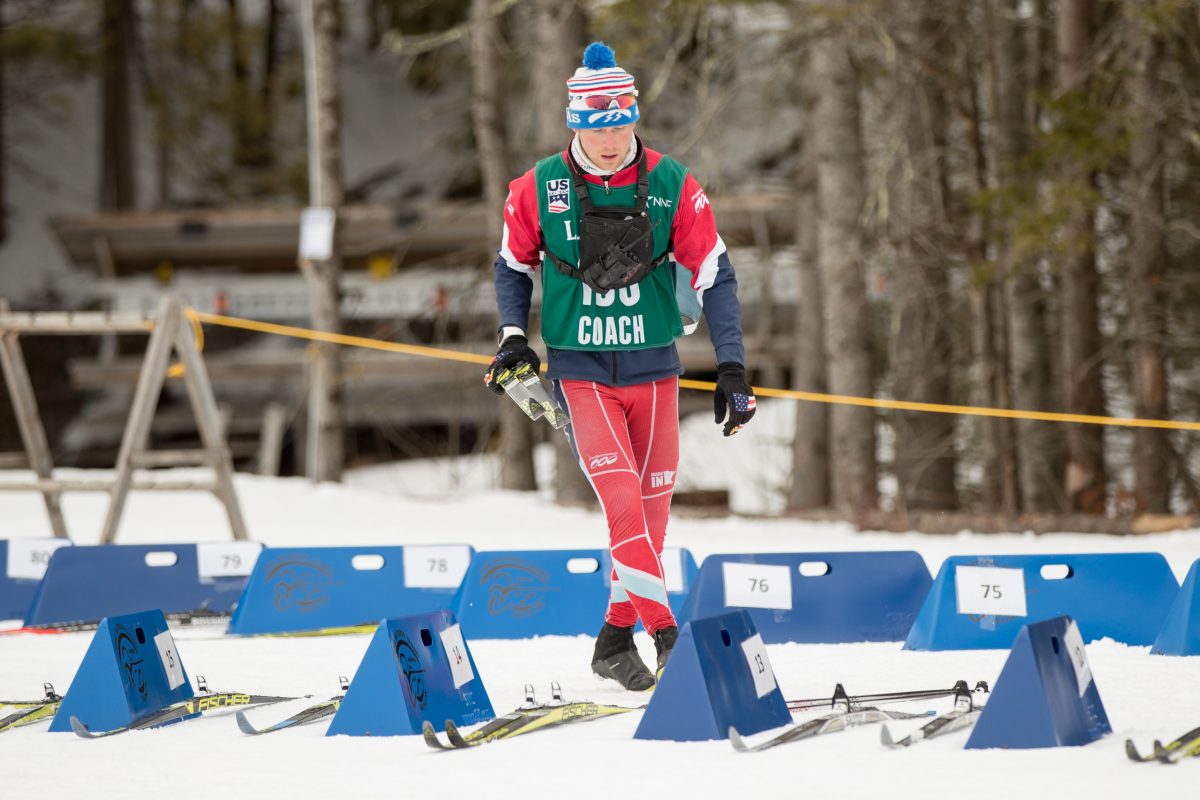
We’re happy to welcome Patrick O’Brien back to the ranks of the Craftsbury Ski Club, this time as the Assistant GRP Ski Coach. Pat, a native of Putney, VT, raced collegiately for Dartmouth before his stint as a professional ski racer with the Green Racing Project from 2010-2014.
While on the GRP, Pat competed in multiple World Cups and also became known to the Craftsbury community as a hardworking jack-of-all-trades with a deep love of skiing and the outdoors. Pat moved on from racing to become the head coach of the SMS T2 team from 2014-2022. Although he coached multiple athletes to international success, he’s most proud of the role he played in building a program that brought together athletes of all ages and rooted the team in its local community.
In recent years, Pat has supported various junior, college, and elite teams as a service technician, all while juggling a job as a builder and wrangling a growing young family. When not up to his eyeballs in ski wax or construction detritus, Pat can often be found outdoors with his wife Ida, who also has deep ties to Craftsbury, and their two kids. Welcome back, Pat!
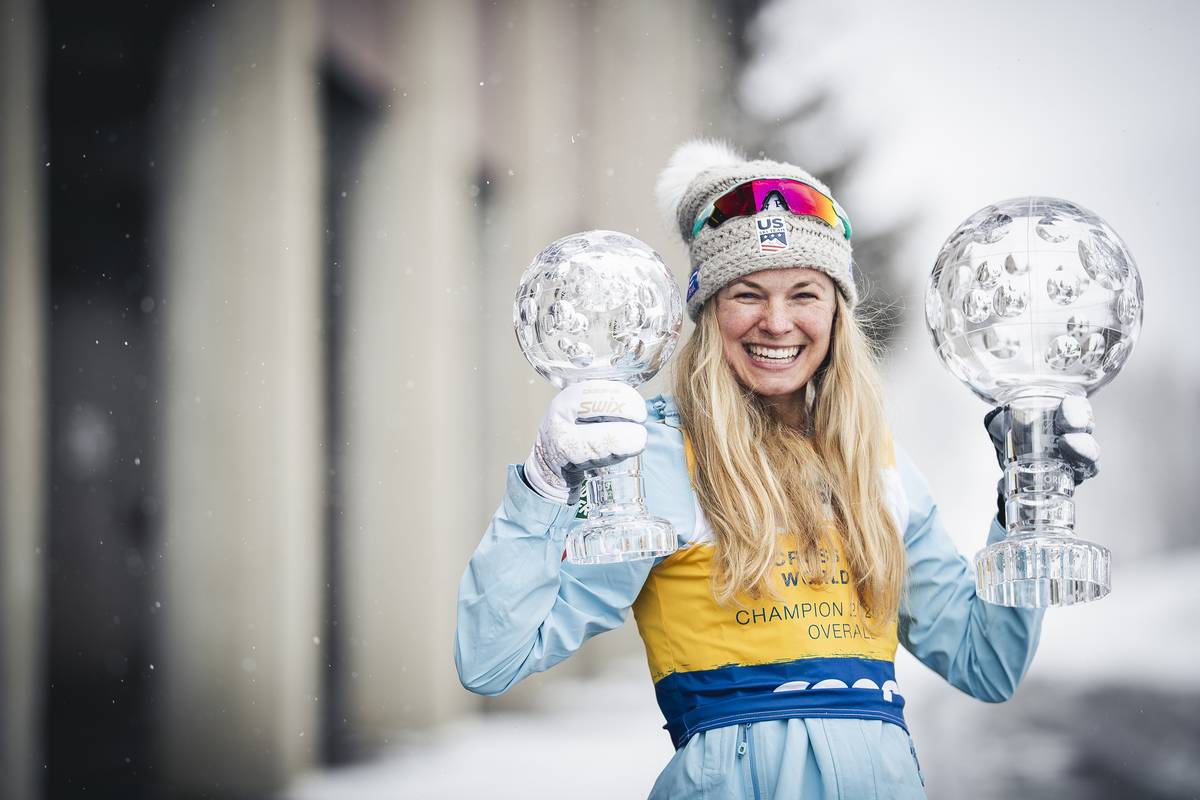
Jessie Diggins brought home a couple of small trophies last season. *smirk* (Photo: NordicFocus)
Team name and location: SMS T2 Team; Stratton Mountain, Vermont
Coach: Patrick O’Brien
Current roster: Jessie Diggins, Julia Kern, Katharine Ogden, Alayna Sonnesyn, Lina Sutro (women); Ian Torchia, Bill Harmeyer, Ben Ogden, Will Koch (men)
Who’s new: Lina Sutro, coming from the University of Vermont ski team
Who’s moved on: Sophie Caldwell Hamilton and Simi Hamilton, who celebrated their second wedding anniversary earlier this year, retired from pro skiing last spring and are beginning a new life together in Colorado. Ben Saxton also retired.
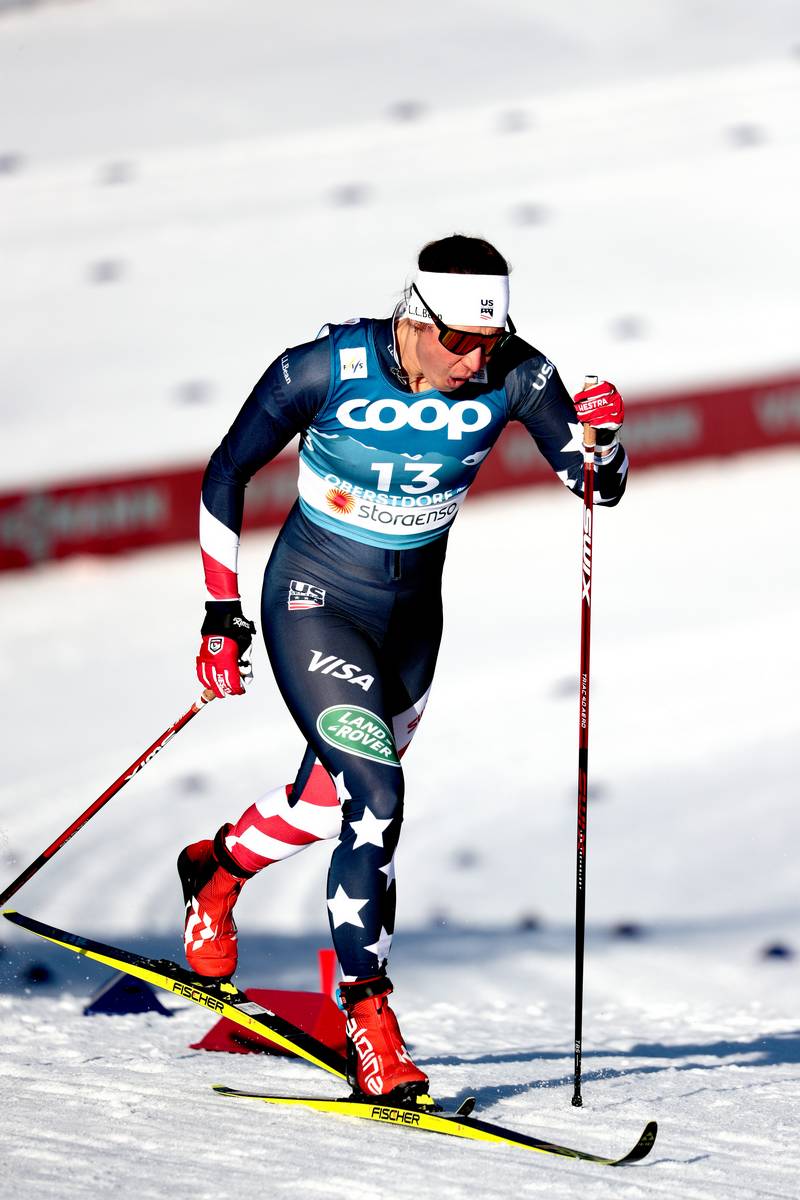
Julia Kern races in classic sprint qualification in Oberstdorf. (Photo: NordicFocus)
Top results last season: Diggins, deservedly, got the headlines, for winning the World Cup overall, the distance globe, and the Tour de Ski, all firsts for an American woman. (Bill Koch won the inaugural World Cup overall title in 1981/1982 to provide her only American competition here, though if you want to split hairs about it Koch’s World Cup season looked a little shorter than Diggins’s.)
After Diggins, Kern had a down season, by her lofty standards, but still notched an 11th and 12th in World Cup sprint finals. Ben Ogden was the top American man in the World Championships sprint, qualifying 11th and finishing 17th overall, and qualified 3rd at World U23s en route to an 11th-place finish. Katharine Ogden raced a full season of distance races on the World Cup, highlighted by 23rd overall in the Tour de Ski, and finished 38th in the distance standings for the year.
Domestically, Rochester, Minn., native Ian Torchia won the skate American Birkebeiner, then gave an all-time classic finish-line interview while slumped exhausted in the snow, interrupting his gasps to drink some chocolate milk handed to him by a concerned onlooker. Not to be outdone, Plymouth, Minn., native Sonnesyn won the skate Birkie, and was second in the classic Birkie.
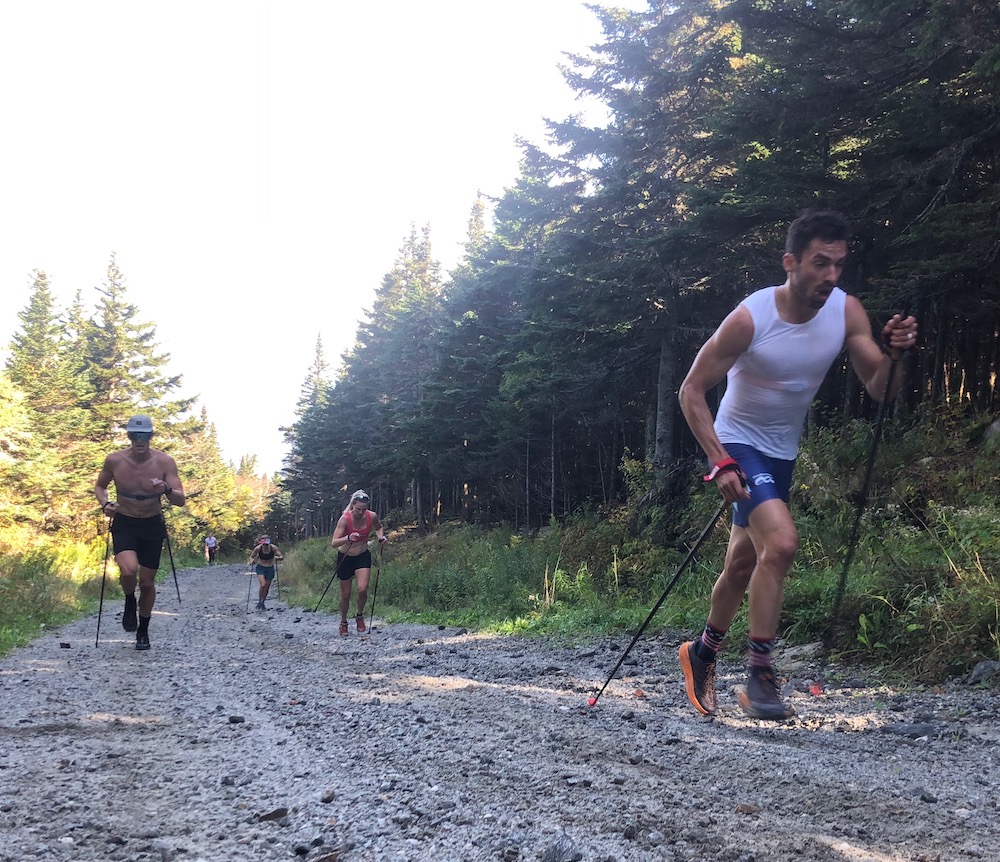
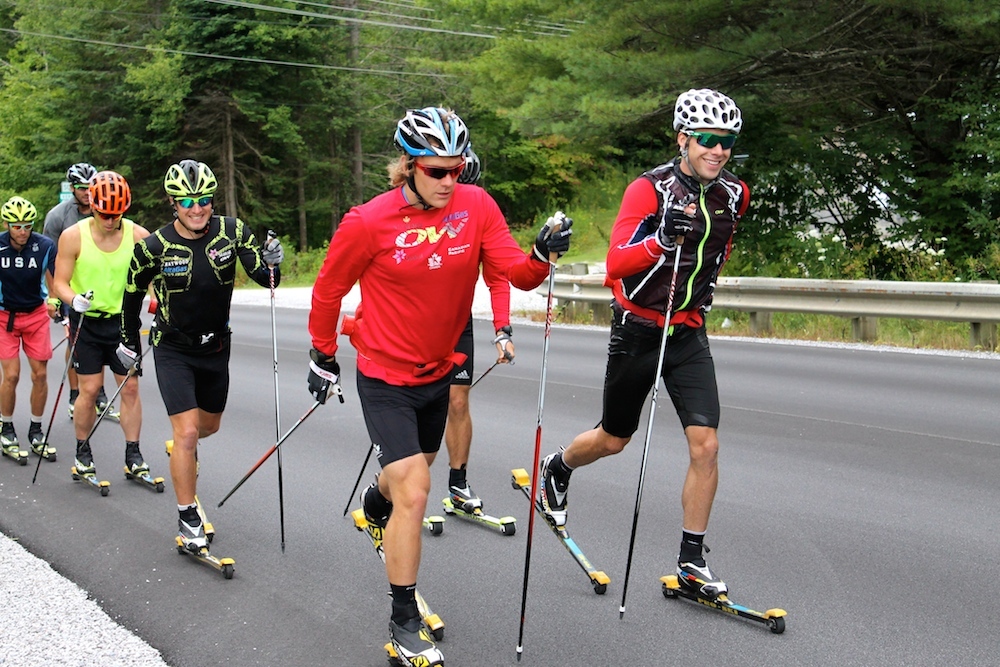
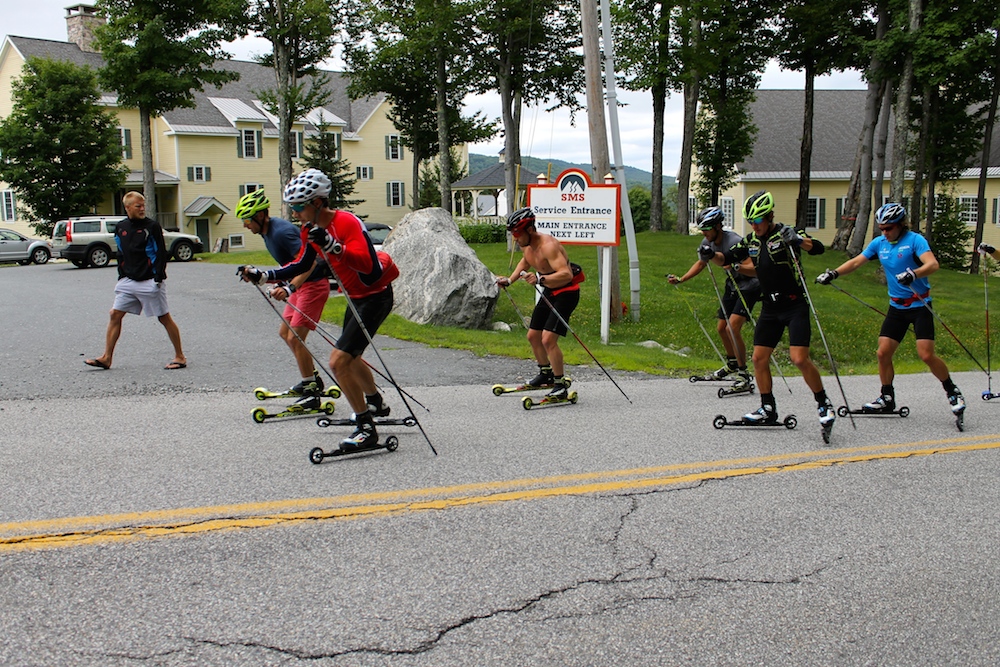
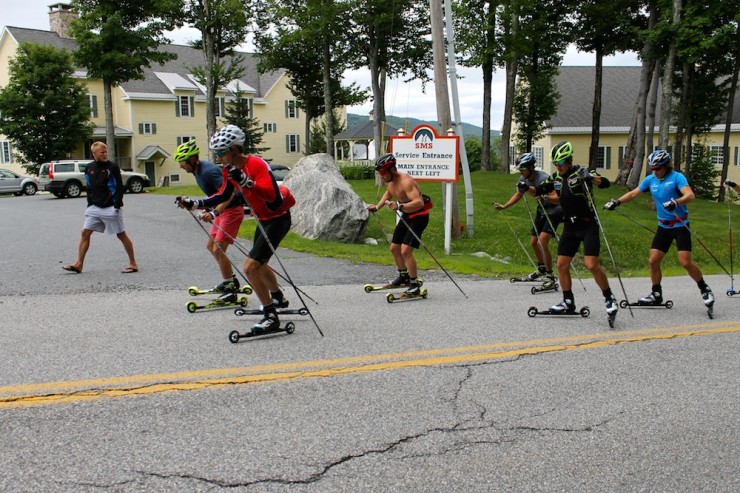
Ian Torchia, far right, leads bounding intervals up Stratton Mountain in summer 2021. (photo: courtesy SMS)
Coach’s comments: Coach Pat wrote as follows:
“The dryland season has gone very well for our group. It’s hard to imagine just a few short months ago we were doing hot sweaty hill bounding and rollerski intervals in Stratton, but fall is certainly here and the winter season feels just around the corner. The air is cool and crisp, the leaves are mostly down and soon we will be seeing our first glimpse of snow at the higher elevations in the Green Mountains.
“We had a productive and steady dryland season. We kicked off the training year back in May with many athletes out in Bend, Oregon, for our startup on snow and dryland camp. From June till August we were primarily based out of Vermont with some small ‘mini camps’ and fun adventures but no major travel or camps afar. One thing we learned overall as a program from the pandemic and travel restrictions in place in Vermont last year is that while variety is the spice of life, skiers are made in the summer, and time spent traveling is time that impacts recovery and training opportunities, so with the cancelation of a July glacier camp in Alaska and the wildfire/smoke situation in the greater American West, we just put our heads down and focused on high quality but training in the Green Mountain state for June-August. Fortunately for us, aside from the ever present rain and humidity that Vermont is known for, we have incredible roller skiing, running, biking, and strength and conditioning facilities in Stratton and the greater area so we never need to go far to find high quality dryland training.
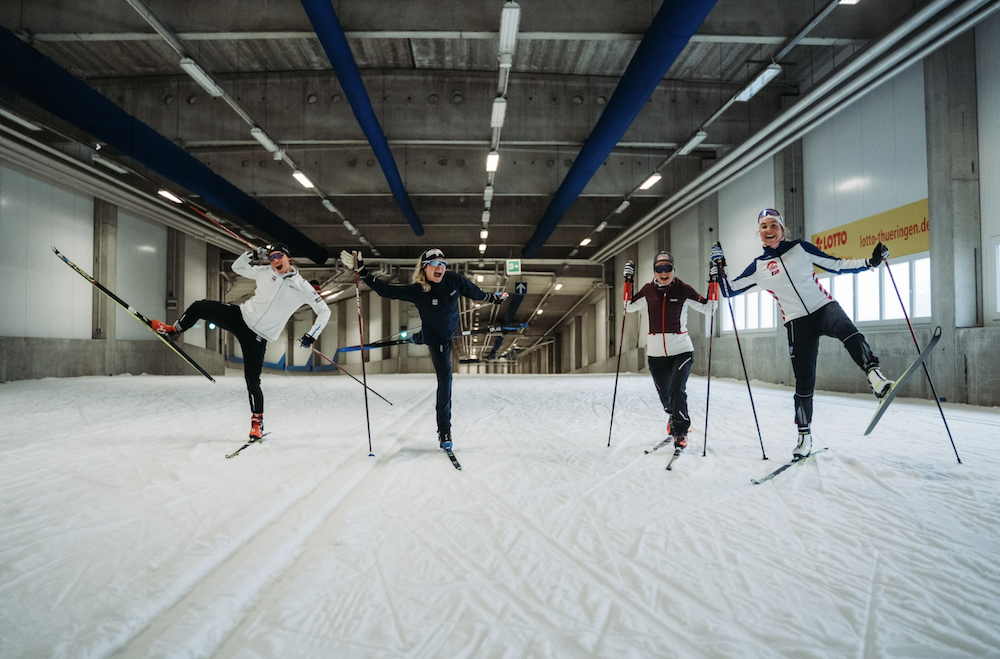
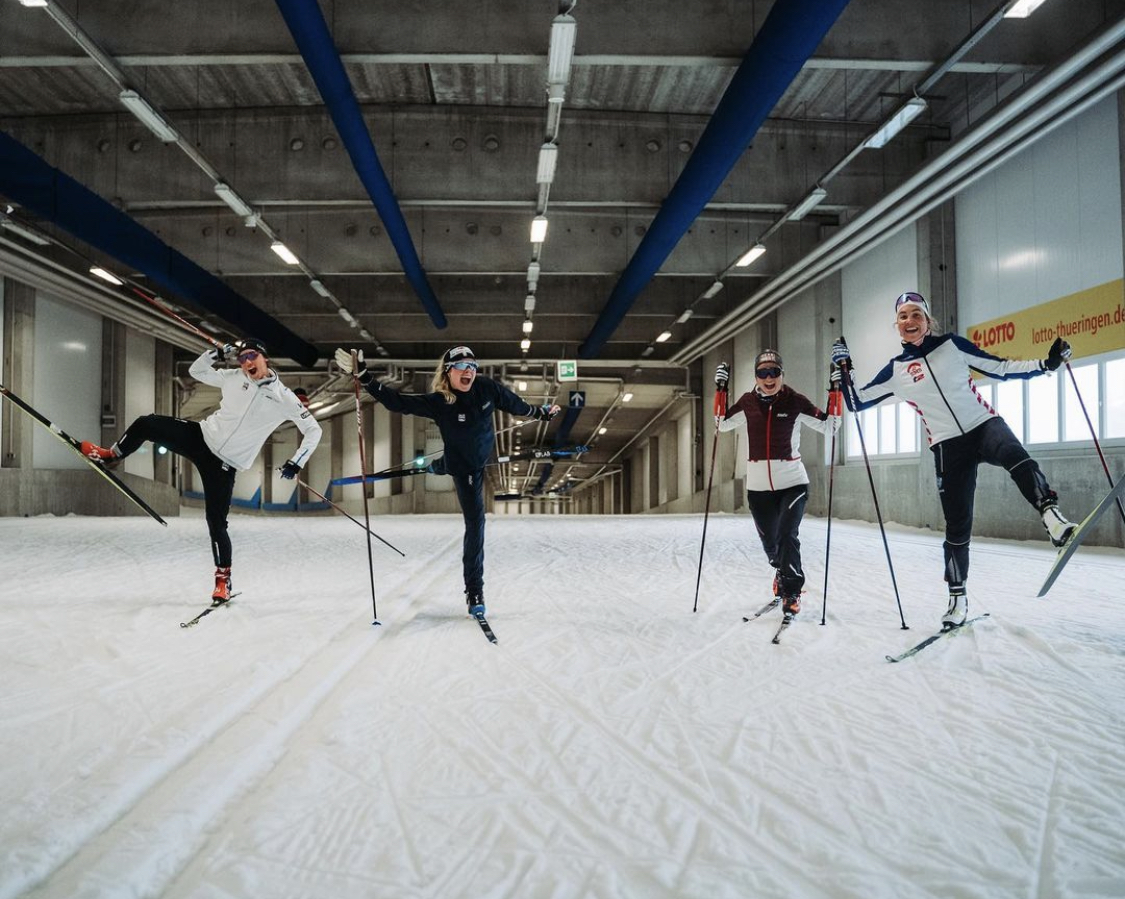
SMS athletes in the ski tunnel (from left: Julia Kern, Jessie Diggins, Alayna Sonnesyn, Lina Sutro), Oberhof, Germany, September 2021. (photo: courtesy SMS)
“The two areas that we did make a conscious decision to target this year in addition to stable dryland blocks, were on snow time and training at altitude. Traditionally we travel to New Zealand for 2-3 weeks at the end of August and the start of September. The skiing (being wintertime in the southern hemisphere) is high quality and representative of actual ski conditions unlike glacier snow that can often be rotten, slow, and located at high altitudes. While we weren’t able to get on snow as a program last year due to the pandemic and Vermont travel restrictions, many athletes still achieved standout results last winter but we did recognize it put our athletes at a competitive disadvantage in the early season where athletes were getting their ski legs under them so we sought to find on snow training options this year. We were hoping to have New Zealand as an option but with their tight quarantine policies and lack of widespread vaccinations it became clear by July that was unlikely to change. Instead we traveled to the ski tunnel in Oberhof, Germany, to grab 10 days of high quality on snow training which turned out to be a great replacement camp. Being three months removed from skiing should make the transition to snow in Kuusamo a little easier and faster than being six months without contacting snow as we did last year. As an East Coast based team traveling to and from Europe was also a helpful reminder for the time change and travel athletes will be undergoing again shortly in a few weeks.
“The final area we did want to focus on was getting in some time and harder efforts at altitude. With the Olympic venue being at around 5500 feet we were able to practice skiing at a similar elevation out in Bend, Oregon, back in May and recently finished a great dryland camp in Park City complete with many harder efforts and time trials at Soldier Hollow which is nearly the same elevation as the Olympic venue and equally demanding terrain as what we should see this coming February.
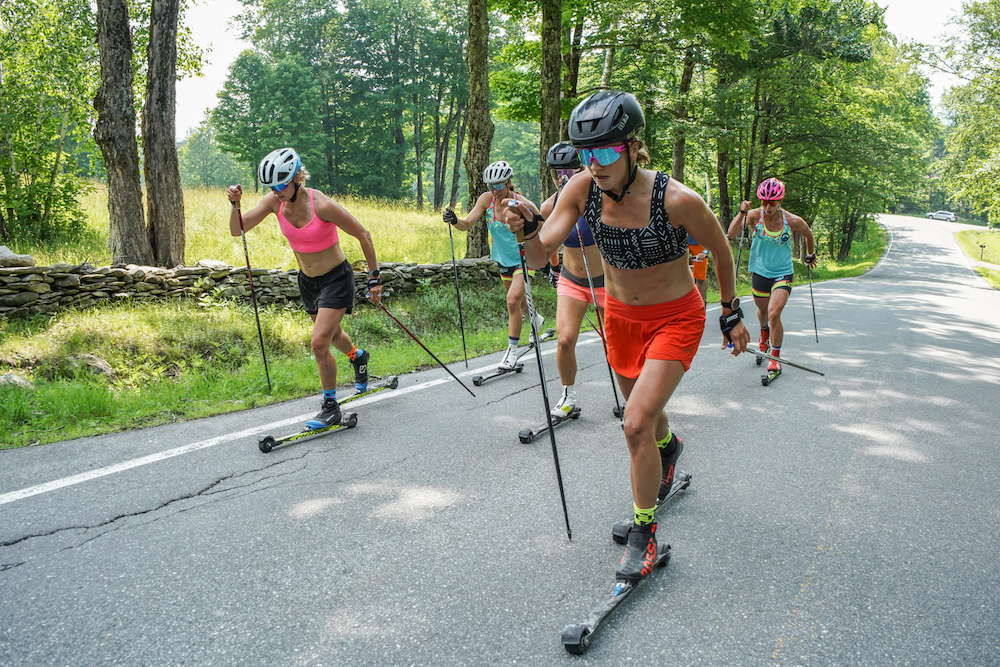
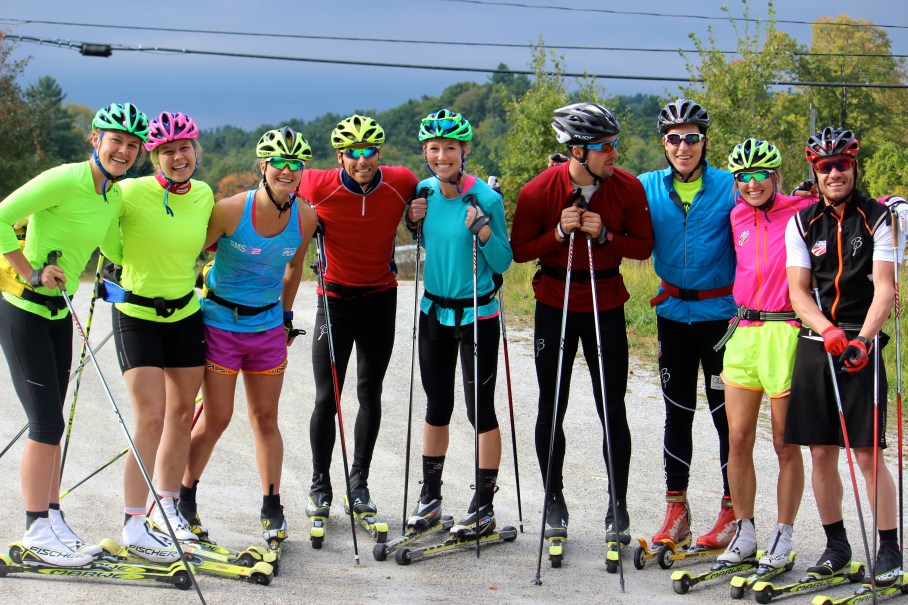
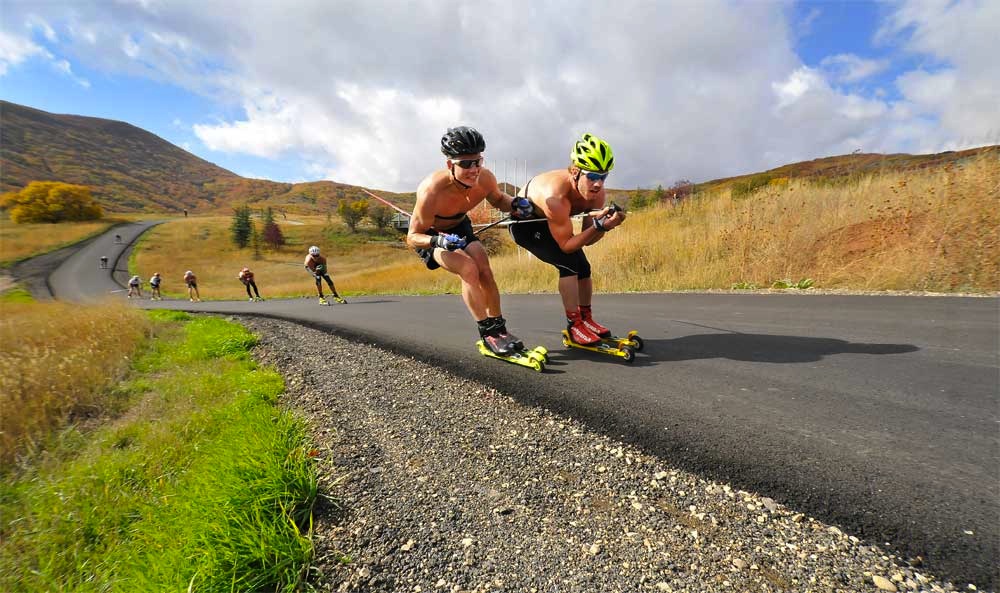
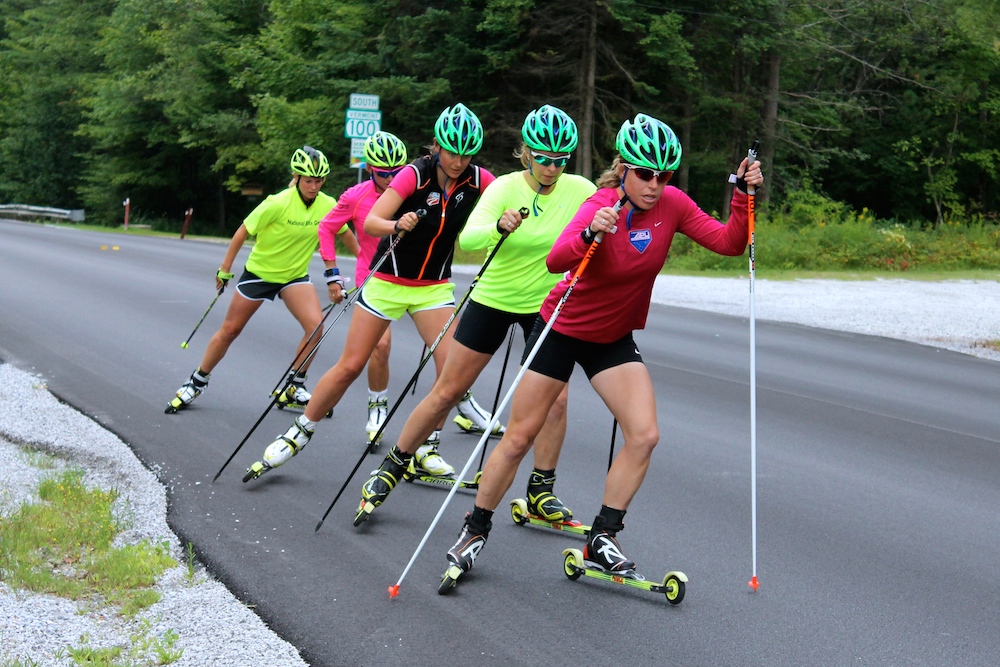
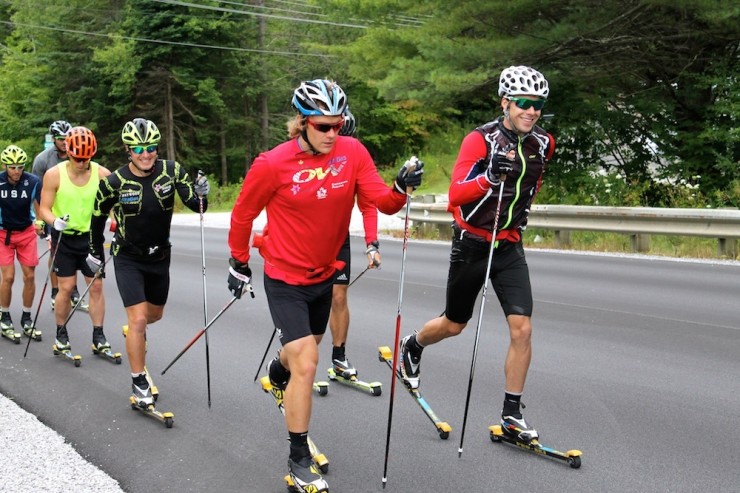
From left, Jessie Diggins, Katharine Ogden, Lina Sutro (partially obscured), Alayna Sonnesyn, and Julie Kern rollerskiing in Vermont in summer 2021. (photo: courtesy SMS)
“Our athletes are looking forward to the coming race season because it is shaping up to be a ‘return towards normal.’ Both the limited options for domestic racing and the strict restrictions needed for safe racing on the international level were very difficult for elite athletes last year.Certainly there will still be safety protocols in place, disruptions, and some uncertainty as we continue to navigate our way out of this pandemic, but the prospect for a complete race season both on World Cup and at a national level is very encouraging. We have all been vaccinated and many of our group have already received their booster shots so some of the uncertainty and apprehension of travel has been reduced. We can now focus on what we all love to do; ski racing with a robust national and international calendar!”
Inside the tunnel: Julia Kern focused on the track ahead (Photo: Bill Harmeyer)
With temperatures dropping steadily each day and the first signs of winter visible on distant mountaintops, the mind of a skier inevitably turns towards thoughts of snow. For the professionals this goes one step further: how and when can they get on snow before the season starts? In the US, pre-season snow time is limited. Once the snow disappears on Mount Bachelor, the Eagle Glacier in Alaska is typically the only domestic pre-season skiing available, although this year even this venue was off the table due to renovations.
Internationally, the skiing options are numerous and varied in their scope, distance, and travel feasibility. However, COVID restrictions and rules still play a major part in travel abroad, and the decision of where to go becomes even harder.
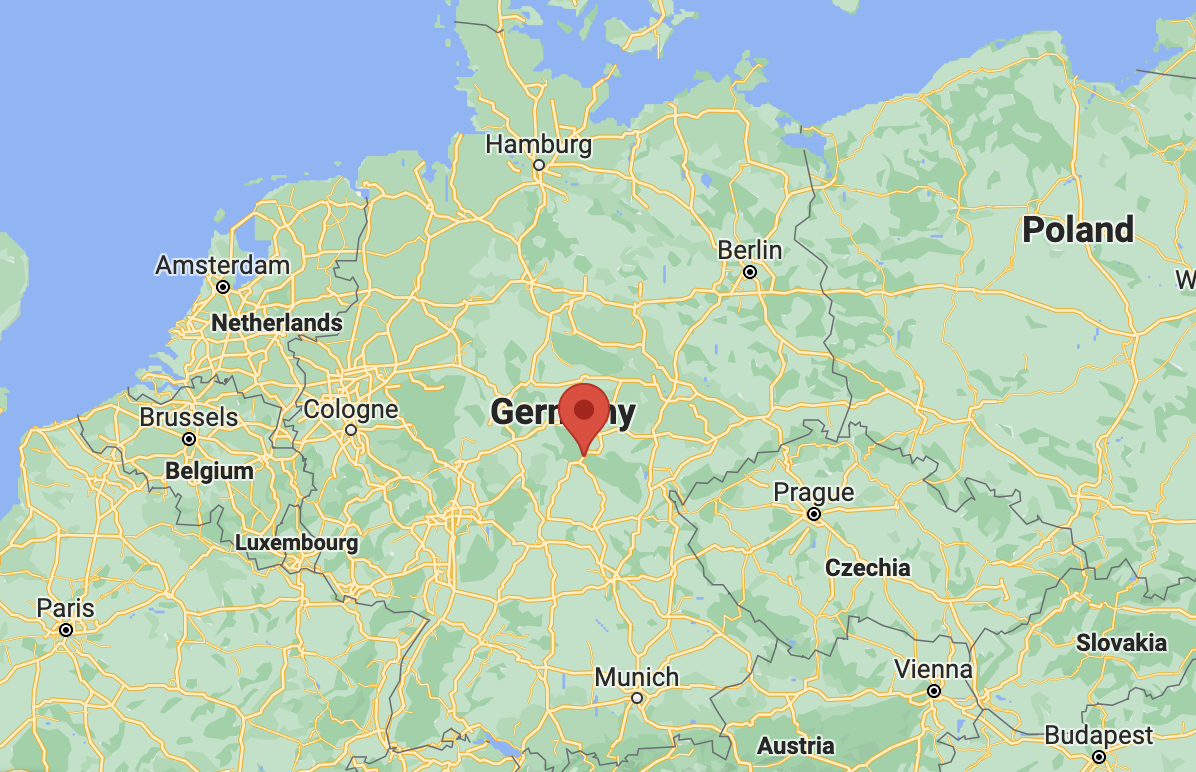
Having carefully considered all of these factors, the SMS T2 team took flight at the beginning of September, searching for the goods. Their chosen destination was a ski tunnel in Oberhof, Germany, specifically, the LOTTO Thüringen Skisport-HALLE. Oberhof is located in central Germany and hosted a stage World Cup in 2013 (Jessie Diggins placed 5th in the 3k skate prologue). The Craftsbury Green Racing Project and USA ParaNordic will also be taking advantage of this venue.
Oberhof Germany, site of the LOTTO Thüringen Skisport-HALLE (photo: Google Maps).
This year, SMS T2 is composed of nine skiers, seven of whom made the trip to Germany. Patrick O’Brien, who has now been the team’s head coach for four years, shared his insight on the decision to go to Oberhof.
“Certainly on-snow time was a focal point of the trip for us,” said O’Brien. “Last year with Covid it made for a pretty clear cut decision. We couldn’t leave Vermont or jump on a plane without a lengthy quarantine period upon return, making any major camps or travel difficult to justify in the middle of a worsening and unknown pandemic. It was actually great in some ways because we just trained well and made the most of our fantastic roller skiing, running, and biking that we have out the door in the Green Mountain State. And with less travel we were still able to get out and follow the travel guidelines we had in Vermont and explore some trails and locations closer to home that normally we wouldn’t have time for with lots of camp and travel commitments.
“The one team camp that we did was a three-day mini camp to Green Woodlands across the river in Lyme, NH, which was amazing but gives you an idea of how restricted travel was for us. These measures kept case numbers very low in VT and were the right thing to do at the time… Having our entire team vaccinated and the state of emergency lifted this spring when we hit 80% of VT vaccinated made our options for camps and travel much more open this prep period.”
This year the team was looking to return to a venue with snow for some quality pre-season hours, particularly for those team members who will be racing Period 1 of the World Cup.
“It’s already a long race season for people that leave for the entire year, and going over earlier to a place like Munio or Rovaniemi, might help with the initial transition to snow, but certainly can extract a heavy toll mid season when you are away from family and friends for that much longer,” explained O’Brien. “So getting a focused block of on-snow time late summer/early fall should help make the transition from dryland to on-snow right before Ruka a little easier and faster to keep people with the best energy and fitness for February at the target races.”
Julia Kern, Jessie Diggins, Alayna Sonnesyn and Lina Sutro are stoked to be getting ski time in the tunnel (Photo: Bill Harmeyer).
Another goal of the camp was to simulate a bit of the World Cup travel experience and re-remember what international travel and being away from home is like.
“A very real goal of the camp was to bring our whole team to a new and unique environment, and to collaborate with other nations (the German team),” said O’Brien. “Again, getting used to that sort of time change and environment for a ten-day focused camp makes the travel in the later fall and winter following the World Cup circuit around that much easier and manageable.”
Traditionally, the SMS T2 team, and the US Ski Team, have traveled to New Zealand for several weeks of skiing in late August or early September. The snow farm in New Zealand offers, “midwinter conditions, low altitude, stable weather, gorgeous scenery and amazing people,” said O’Brien. However, New Zealand is still under tight travel restrictions and wasn’t a feasible option this year. Additionally, some of the SMS T2 athletes were hoping to head to Alaska for a camp on Eagle Glacier in mid-July, “when that got scrapped we were caught off guard and scrambled at the last minute to see what alternatives were out there,” explained O’Brien.
“Oftentimes, glacier skiing is super high, involves taking a tram up (Ramsau), the weather can be very variable (to the point you really shouldn’t be skiing), and the snow is pretty slow and rotten.”
Enter the Oberhof tunnel. O’Brien listed the reasons why this ended up being the best fit, “The facility is really impressive, unlike a normal tunnel which often is simply a loop, this one has a variety of different terrain, a large central area for drills and speeds, and two out and back fingers as well so you have some ability to put together different courses for easy skiing or intensity. In 1.7K you have everything from good hills for V1/Striding, steep hills for ski running/jump skate, to a big stadium area where you can have multiple people practicing starts/finishes head to head. Additionally you know the training is stable and high quality. They warm the tunnel on Sunday afternoon by opening the doors to bring it up to freezing, then groom it with one of their two Pisten Bully’s (PB100+400) and close everything up and crank the AC units and close the track until Monday afternoon, at which point its set up and stable at -4C for the rest of the week. By not over-grooming or working the snowpack they preserve its integrity by limiting grooming cycles. For snow that is three years old, it’s in very good condition and means each day you go out to train you know you will have high quality training. You don’t lose a day in a ten-day camp to a weather closure or poor conditions.”
Crucially for the SMS T2 team, the town is just over 200 miles (330 km) north of the airport in Munich, making logistics simpler. Coming from Stratton Vermont, this made travel for the team to Oberhof roughly the same time-wise as getting to Bend, OR, where they typically kick off the training season in May.
“For us, we are three hours from the Boston airport and an overnight flight to Munich, Germany,” said O’Brien, “So while the travel is still substantial, getting to Central Europe for us is a long overnight flight and 3 hours of driving on the front and back ends. A place like Voukatti (FIN) is a much more exhaustive journey with many connections for us coming from the US.”
Compared to New Zealand, entering Europe COVID-wise is relatively straightforward. Since the team is entirely vaccinated, they weren’t required to quarantine upon arrival but did need to fill out paperwork in advance for their whereabouts and, O’Brien added, “we did test our entire group before departure in VT out of an abundance of caution.”
Bill Harmeyer happy to be on snow (Photo: Julia Kern).
Once they were in Germany, they were tested twice again during the camp just for surveillance purposes.
“The rates of COVID in Germany are quite low and there is near universal compliance with masking indoors and straightforward and effective COVID protocols over there,” said O’Brien. “They have different time slots for training in the tunnel and limit the numbers in the tunnel at any one time. It’s a pretty large amount of airspace that is continually cycled over, so while we were entering and exiting the tunnel everyone was required to be masked, but when skiing masks weren’t expected which was great for doing intensity and harder training sessions. Overall while we were cognizant of still being in a pandemic, the fact that our entire group was vaccinated, getting tested, and following existing protocols really made for a safe and comfortable environment to have a training camp”
Furthermore, the team was able to integrate some training sessions with the German ski team who O’Brien said were “absolutely fantastic to work with.” Not only in regards to training but, “ they helped with all sorts of logistics, getting us extra waxing gear, lodging, getting set up at the tunnel, administering Covid tests during our camp, and running combined sessions with their athletes that live locally (Victoria Karl and Antonia Frabel).”
“I cannot say enough how cool it was to collaborate with them during the camp and how open and engaging the sharing of information was,” emphasized O’Brien, “I think that is something that kind of was lost last year (for obvious reasons with COVID). Out of necessity we had to form our ‘pod’ and keep our circle tight with all the testing and possible quarantine that could derail a race weekend. Simply being able to exchange ideas, information, and training with others was a huge benefit for both of our groups.”
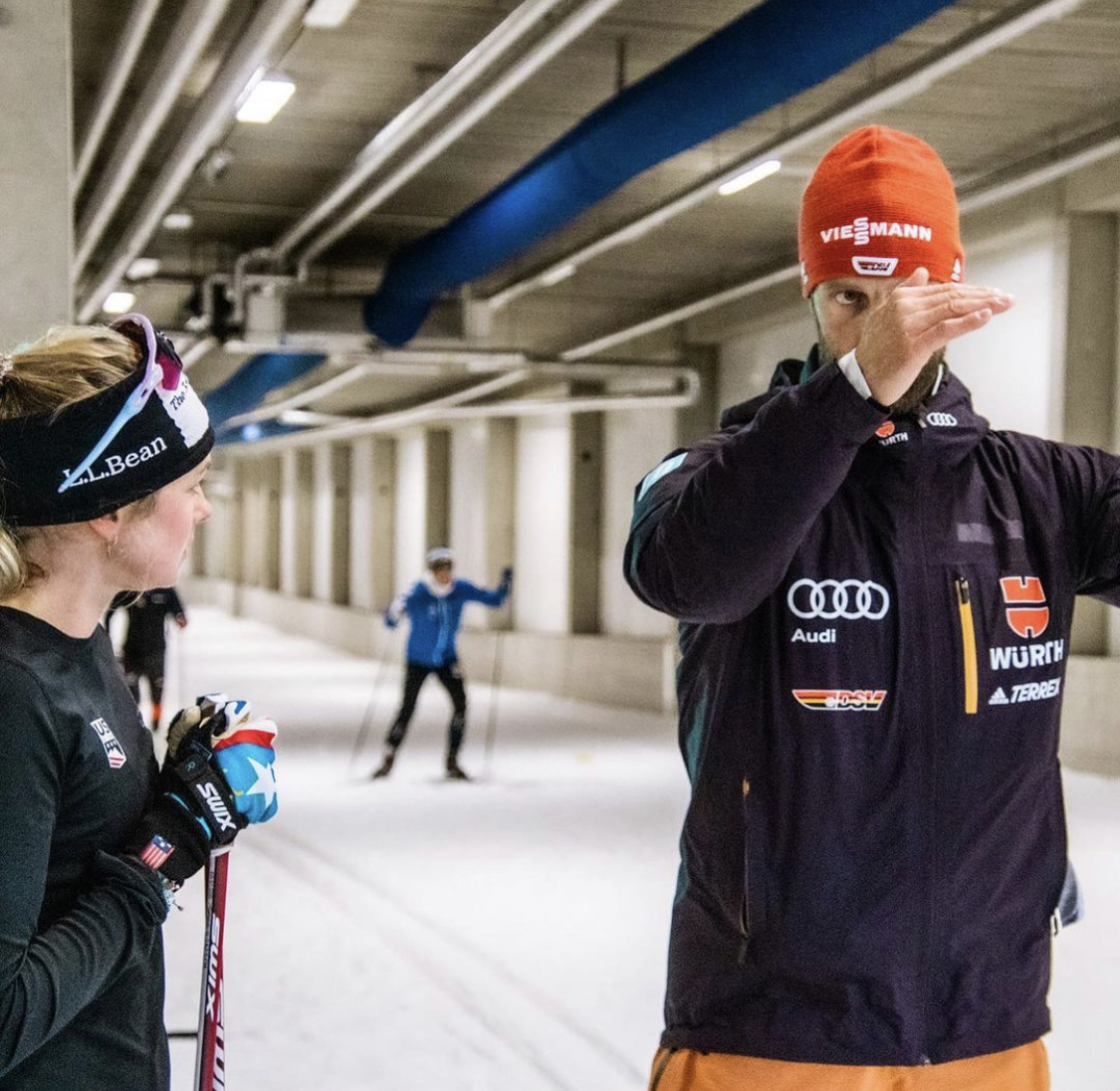
Jessie Diggins talks with German coach and former racer, Axel Teichmann (Photo: Ronny Knoll).
For SMS T2 athlete, Ian Torchia, his personal goals for the trip were focused on really “dialing in my on-snow technique from the adaptations I have made from roller skiing this summer, as well as executing some high-quality intensity and speed sessions to zero in on that unique snow feeling.”
Making the most of the trip, the team squeezed in a 45 minute ski the first day they arrived, making for a total of ten-days on-snow.
“The first day was the worst day on snow for me as I was super jet lagged and half asleep,” said Torchia, “other than that, the entire team was vibing with the snow tunnel and I honestly never got sick of the many many loops we skied. There is always something to focus on with your technique that the monotony of the loops doesn’t really take much affect. Getting on snow in the summer was super valuable and I am so grateful for the opportunity.”
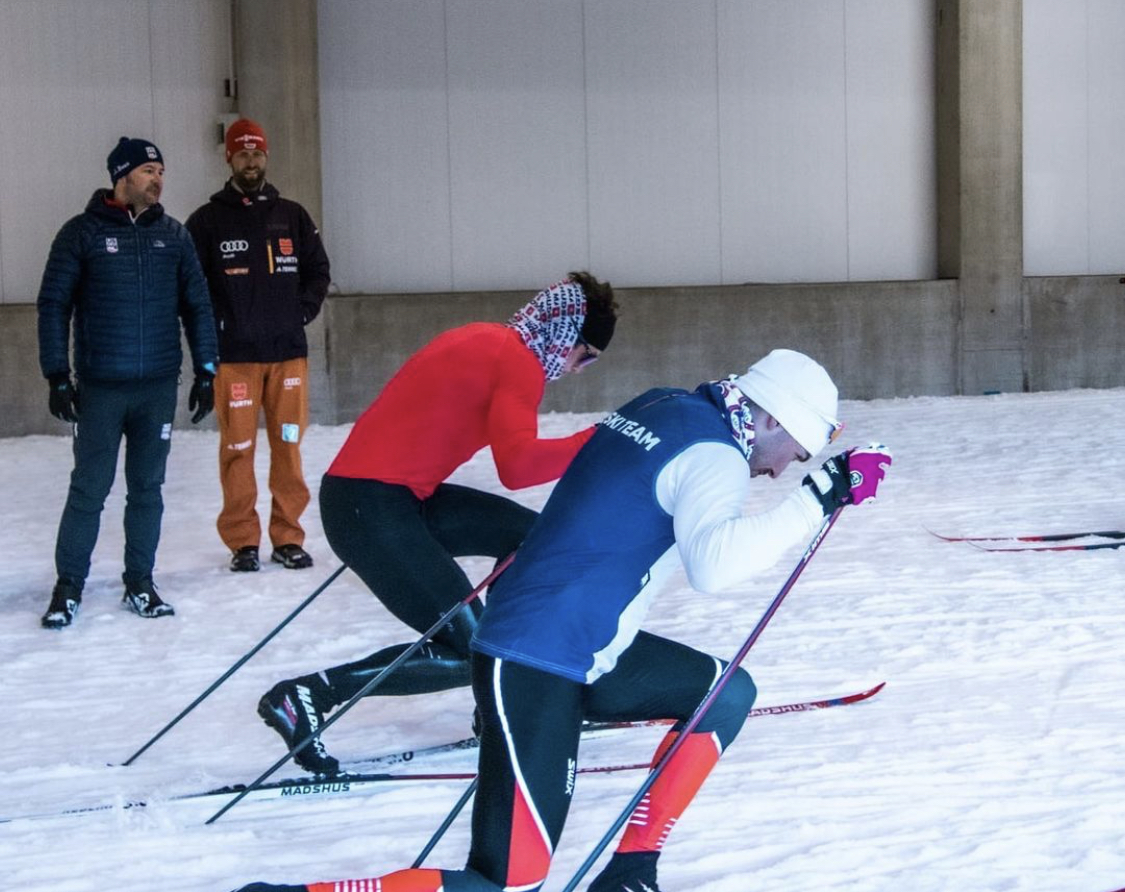
Bill Harmeyer (left) and Ian Torchia (right) line up for a sprint start (Photo: Ronny Knoll).
Looking forward, Torchia said “I am super amped for (hopefully) a normal season of racing and for a shot to make the Olympic team. Right now, my roommate Bill Harmeyer is the only other guy in Stratton (along with the girls on the team) and we have been working super well together in training, pushing each other on our weaknesses and dialing in technique. Let the snow fly!”
When the race season begins in a few short months, many SMS T2 members will be heading back to Europe to start the World Cup, while others will stay in the US to race in the Super Tour and other North American competitions. As usual, the World Cup kicks off in Ruka Finland at the end of November where SMS T2 athletes Jessie Diggins, Julia Kern, Katharine Ogden and Ben Ogden will be competing. Alayna Sonnesyn has also been named as an alternate. The US Super Tour circuit starts in Cable, Wisconsin this year with races December 10-12th.
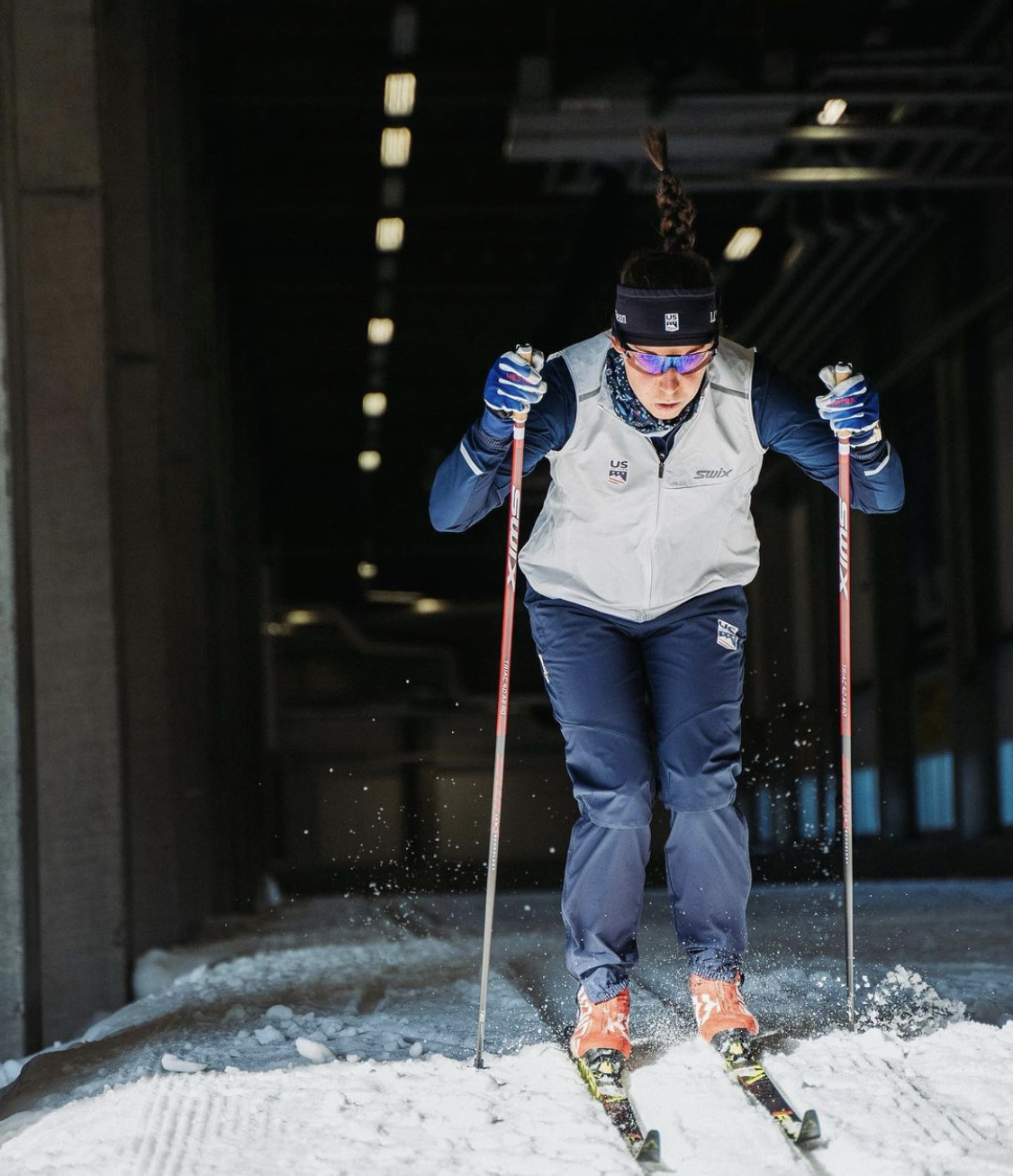
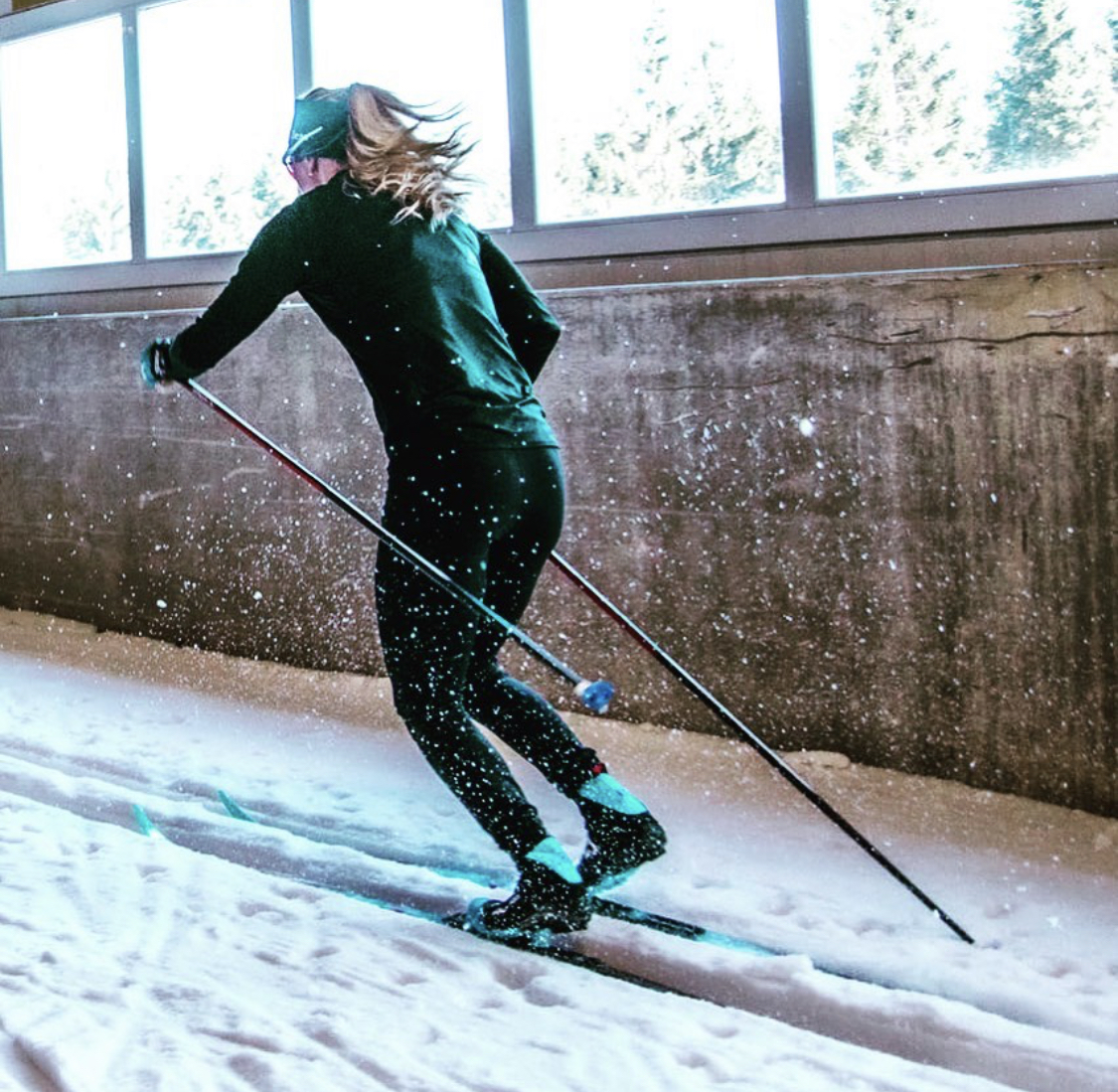
Jessie Diggins kicking up spray during a speed session in the tunnel (Photo: Ronny Knoll).
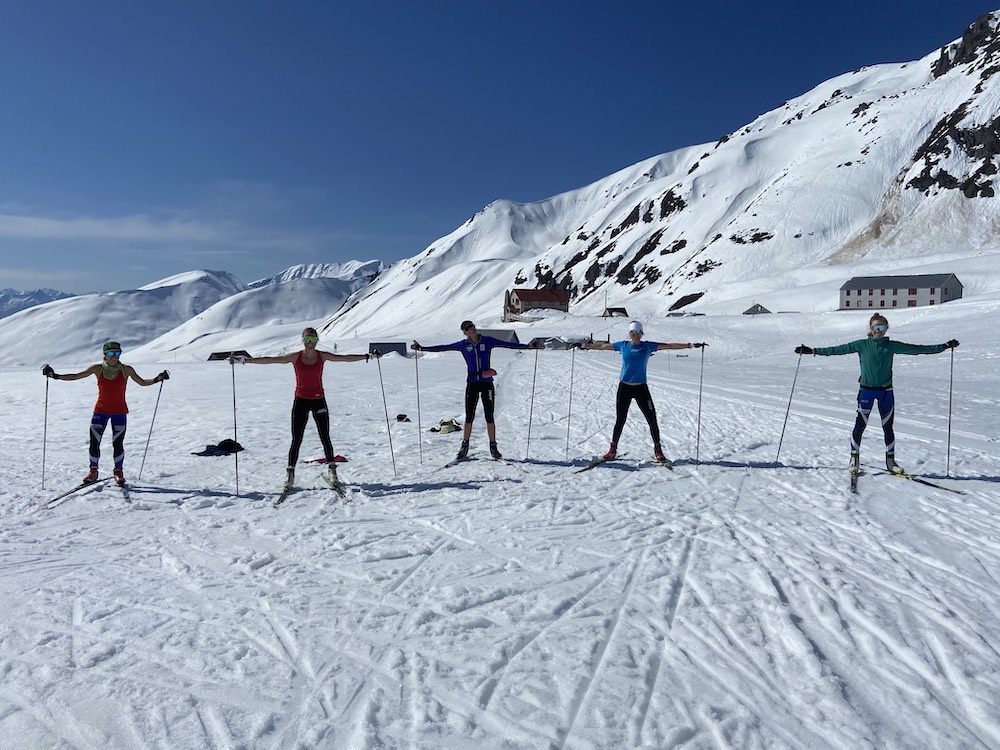
From left, APU athletes Rosie Frankowski, Sadie Bjornsen, Hailey Swirbul, Becca Rorabaugh, and Caroline Brisbois demonstrate a healthy distance while skiing at Hatcher Pass on May 13, 2020. (Photo: Courtesy Sadie Bjornsen)
Although the training cycle has officially begun, it decidedly has a different vibe and look. Adding some complexity to our short-term new normal are a crosshatch of state, county, and city regulations as it relates to mitigating the community spread of Covid-19. The core question elite cross-country ski programs are asking is this: How can we most responsibly promote safe and effective training for their athletes?
(The United States Olympic & Paralympic Committee (USOPC) has released a document titled Return to Training Considerations Post-COVID-19 This document provides useful information for organizations reopening.)
FasterSkier reached out to four programs in the U.S. — the Craftsbury Green Racing Project (CGRP), Stratton Mountain School’s SMS T2 team, SVSEF’s Gold Team, and Alaska Pacific University Nordic Ski Center’s Elite Team to gauge how athletes can train within the context of their regional social distancing guidelines. The answers are complex. And as each respondent stated, no one single person or group has all the right answers other than to stay informed and err on the side of safety.
Craftsbury Green Racing Project
Head CGRP coach Pepa Miloucheva responded to our query. Craftsbury’s team is located in Northeastern Vermont, a rural and isolated region. When Miloucheva responded on May 8, the Craftsbury Outdoor Center remained closed to the public. Along with key staff, those GRP athletes and coaches that live on campus year-round continued to be in residence. This group includes coaches and athletes from the ski, biathlon, and rowing teams.
“Most of us that didn’t go anywhere this spring have been in strict isolation since March — no store trips or anywhere else. Skiers and biathletes live in the same house, their food is ordered through the center, athletes cook in the house and do train together, but still try not to be in more than 2-3 people groups,” explained Miloucheva.
Several athletes were home with their families. Among them were Akeo Maifled-Carucci and Caitlin Patterson — both had been with their respective families in Bozeman, Montana. They returned to Craftsbury in mid-May. Miloucheva wrote that returning athletes will be quarantined for two weeks before they are allowed to move into team housing and join group practices.
“We do not share any buildings use with the rest of the center staff and if any work-related interactions are only by keeping a safe distance, wearing masks, and following all safety rules and regulations. This said, honestly we don’t have much of those really, we pretty much just interact between ourselves right now.”
According to Chris Mallory, Gold Team head coach, his core unit of skiers have not had group training sessions for the past two months. However, with the canceled racing in March, Mallory said several of his athletes extended their on-snow training north of their home base in town. Like many adapting to the modified season, high volume was the trend for March and April training.
“It was unfortunate the race season got cut short, but it allowed for two months of big volume to finish out the season,” Mallory emailed. “So we’re starting up training a little later than normal this year and for now, coaches are directing workouts remotely. We’re looking to get programming going closer to normal in June, but some things will be structured differently.”
Mallory explained that training group size will be kept below 10 athletes and the norm of committing in a team van will be held off for the near future.
“So we won’t have big cross-team training sessions for a while, unfortunately. We’ll also pick training locations such as Trailheads which are off the beaten path or sections of the bike path which see less traffic for rollerskiing, so physical distancing can be easier to achieve. We might have a partner gym opening up in a week which will allow for some strength training to occur for our Gold Team, but we’re also putting some effort into creating an outdoor strength area outside the Lake Creek ski hut as well.”
SMST2
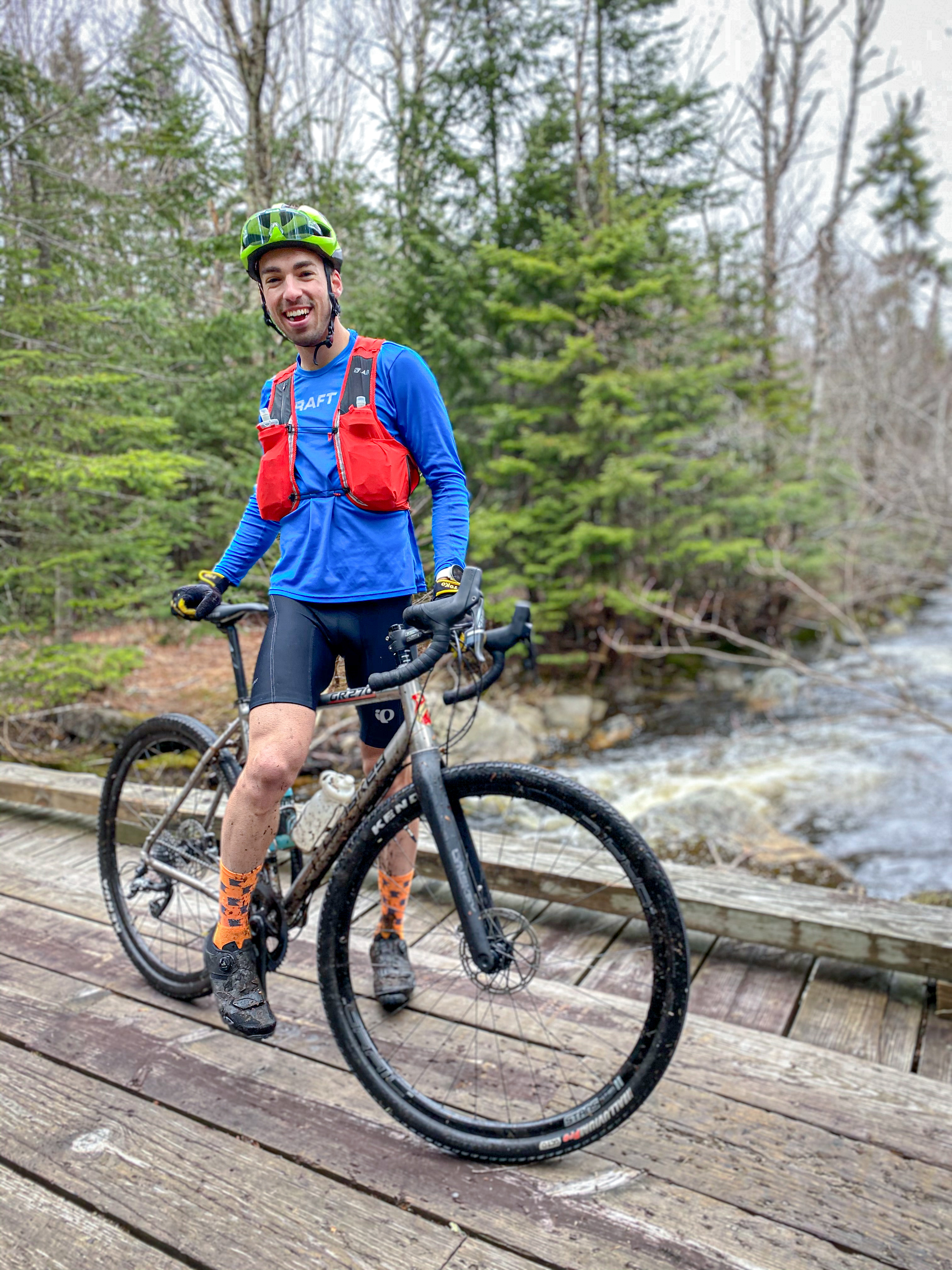
SMST2 skier Ian Torchia on a recent VT. ride. (Photo: Courtesy Ian Torchia)
Nestled in southern Vermont, the Stratton Mountain School offers an idyllic campus for the SMST2 team. This spring, as the pandemic and its accompanying restrictions unfolded, the state-mandated that both residents and non-residents traveling into Vermont must self-quarantine for 14 days. That rule was recently extended until June 15.
Some SMST2 athletes are currently out of state, while others, like Ian Torchia, have remained in the Stratton area since the end of the season. Ben Ogden and new SMST2 skier Bill Harmeyer returned to their Vermont homes to remotely finish out the academic year at the University of Vermont.
“Initially we were thinking where do you want to be for a two-week self-quarantine,” Patrick O’Brien, SMST2’s head coach said in a call. “Thankfully we also thought about where do people want to be for an extended period of time this spring. And many people already had plans in place — knowing we may be in this for a longer period of time than we were thinking at the beginning of March.”
As June approaches, O’Brien explained that he too has begun defining how training will look, and how to best integrate athletes into specific training groups.
“First and foremost in my mind is what can we legally do, what can we responsibly do, and what are the creative solutions that we can come up with? And understanding again that no one here has a crystal ball; we can look at models, we can look at forecasts, we can monitor the situation but it is going to be a moving target,” said O’Brien. “So really what we are trying to do is find a balance. We are trying to be fully compliant and very safe and cautious and also monitor the situation locally.”
Harmeyer, who had been self-quarantined in Burlington, drove to Stratton recently to begin his full-time training. Due to his limited exposure while in Burlington, he was allowed to integrate with a small training group. Ben Saxton, on the other hand, recently flew back to Vermont from the Midwest. According to O’Brien, he is self-quarantining for the required 14 day period.
For the time being, O’Brien envisions training groups organized around pods – another word he used interchangeably for families. Athletes living together will be considered training pods where they are able to be in close proximity to one another. O’Brien acknowledged this arrangement will be closely monitored and reassessed.
“We need to track and see what seems responsible for group training, but again we want to make sure people are safe and healthy and if we operate in these small groups, and everyone in that group is a ‘family member’, then we know that they are OK to go out and do stuff together. What we want to do is be creative in our approach to these challenges, but really we want to be reasonable.”
Although Vermont’s shelter-in-place order was extended to June 15, it currently allows for outdoor exercise.
“Every challenge presents an opportunity,” O’Brien said. “We are not going to jump on a plane and go to a bunch of different training camps. That doesn’t prevent us from having high-quality training locally. It presents an opportunity. And reaffirms a model of working together and training together.”
Alaska Pacific University Nordic Ski Center
Anchorage is typically a very good place to be a cross-country skier. While so much else has changed in the world this spring, this fact has remained a reassuring constant for the athletes of the Alaska Pacific University Nordic Ski Center (APUNSC) Elite Team, as well as the greater Anchorage ski community. There was seasonal weather, both snow and cold, in the second half of this winter, leading to a sea-level snowpack that lingered well into April. Trail grooming is performed by a nonprofit group, Nordic Skiing Association of Anchorage, that relies on voluntary donations rather than mandatory trail passes while grooming on public land, so grooming continued unabated through March and into late April. And public health-wise, Alaska’s isolation, coupled with a relatively aggressive early response, has led to, so far, consistently low COVID-19 numbers throughout the state, currently the lowest gross numbers of any state and the third-lowest per-capita infection rate behind Hawaii and Montana.
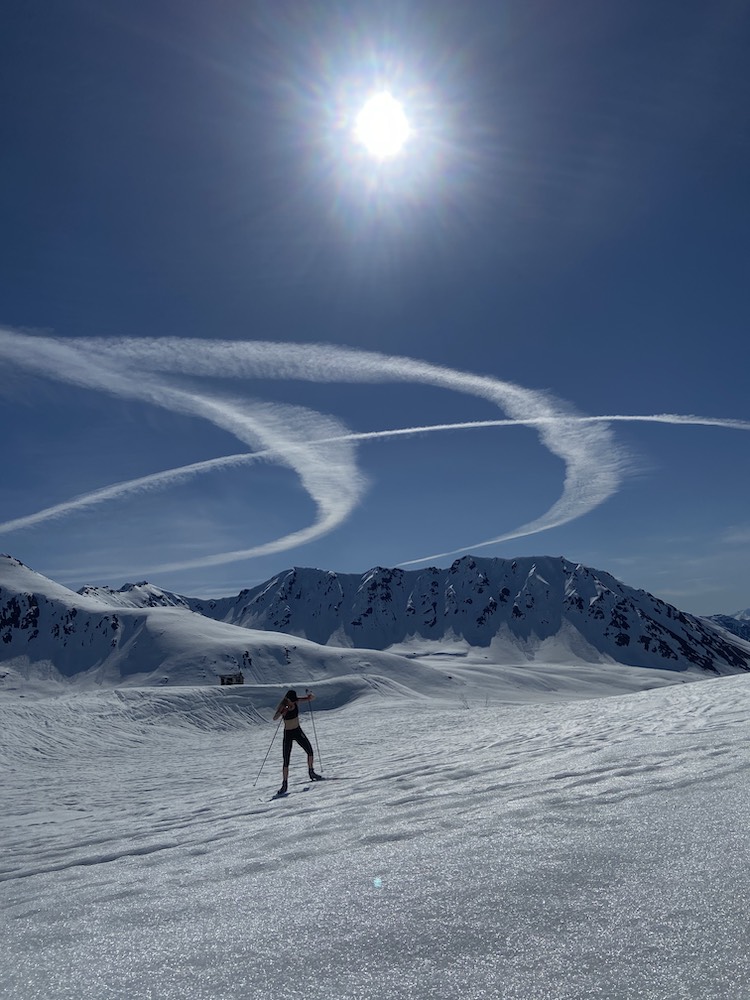
Hailey Swirbul (APU/USST) skis at Hatcher Pass on May 13, 2020. (photo credit: Sadie Bjornsen)
Put it all together, and APU athletes were enjoying groomed skiing at sea level through April 23, with world-class crust skiing coming on line around the time the in-town ski season was winding to a close. (Any April training happened unofficially and in smaller groups, in deference to both the overall training schedule and health mandates in effect at that time. Although a group of four APU athletes did hunker down together in the APU Ski House starting in mid-March, forming a de facto family unit and training group in which half the people were a member of the U.S. Ski Team.) A 75-minute drive away, fellow nonprofit Mat-Su Ski Club has been grooming the trails at Independence Mine, in the Hatcher Pass area, since last October 5… and with a snowpack that currently measures around four feet, is still going. It’s hard to prove a negative, but APU skiers currently enjoy ready access to what are likely the only groomed nordic trails on the entire continent right now.
We have learned that the logistics of keeping our athletes safe while following COVID-19 state mandates has been at the forefront of the APUNSC program. Our core is based around health and wellness, and the safety of our program members is our top priority at all times, similar to other ski communities. APUNSC has had an advantage of having trails and snow on the mountains minutes from our doors to continue training, even in times of quarantine.
“Nordic Ski Center Elite training program began on May 1. We were fortunate that State of Alaska quarantine and social distancing mandates began to lessen at the beginning of May, allowing the Elite Team to be able to begin training in smaller groups outside in the mountains. The Elite team wore face mask or buffs and kept the mandated 6-10 ft separation while outdoors.
“At first, groups of 20 were allowed to hit the trails with a mandated 6-10 feet of separation for active workout sessions. We wore masks when training and avoided crowded parking lots and trailheads where we could.
“Once phase 2 [of state health mandates] hit a week ago, it allowed now the entire Elite Team to be able to head into the mountains to train and ski. Hatcher Pass has been an area where Crust Skiing is at its best with longer days and blazing sunshine. The grooming has been incredible thanks to the work of Nordic Ski Club of Anchorage and the Mat-Su Ski club. The Elite athletes still uphold the 6-10 ft separation when training. The athletes are happy to be together as a team again, and with that comes the responsibility to treat allowances with respect and not take it for granted. We are living and training as athletes in a time where our community could fall back to strict quarantine.
“We’ve stayed away from indoor training as a team in gyms, as not only is the safety of our team top priority, but the team has excelled in their own in-home conditioning and in getting outside to hit the trails. Only if necessary, for some athletes rehabbing, will we recommend using an indoor gym for conditioning and training.
“APU Nordic Ski Center typically runs 3 elite training camps [each summer] on Eagle Glacier at the Thomas Training Facility outside of Girdwood, Alaska. We will revisit whether Glacier camps will resume based on the climate of COVID-19 Adjustments.”
(For any Outside readers salivating over the prospect of May skiing and thinking of booking a cheap plane ticket north, please note that a 14-day quarantine requirement remains in effect for anyone traveling into Alaska from out of state, and that Alaska State Parks is likely to plow the road up to Independence Mine in early June.)
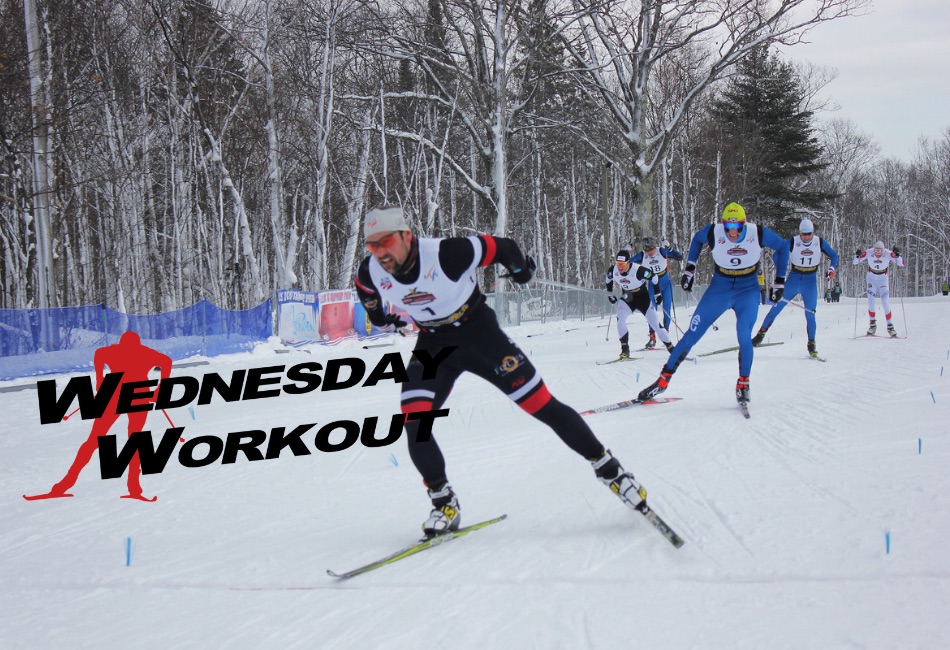
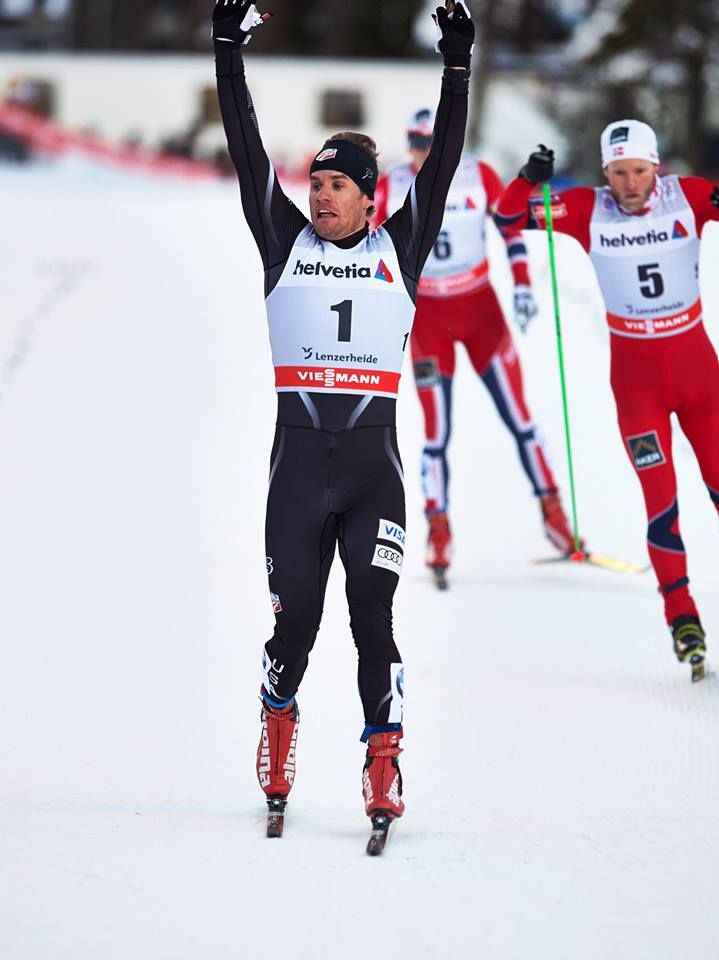
Now retired from competition, Dakota Blackhorse-von Jess (bib 1) skates away as he earned his second national title at the 2015 U.S. Cross Country Championships 1.5 k freestyle sprint in Houghton, Mich. You don’t need to look too closely to see Blackhorse-von Jess is a skier with flood-proof quads in the sprints.
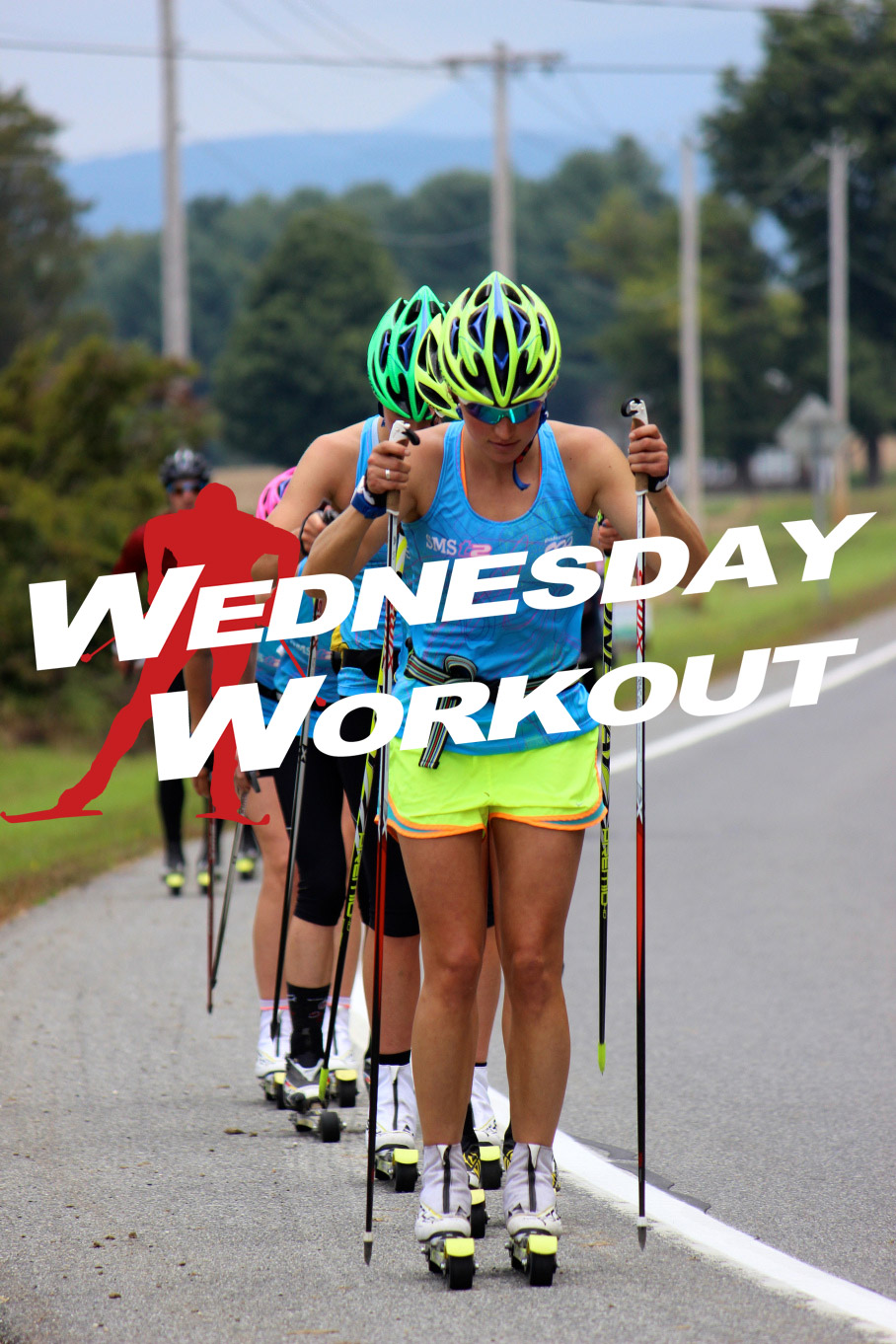
2014 is when a relatively green Patrick O’Brien took charge of the Stratton Mountain School’s elite team, otherwise known as SMS T2. In a relatively short time, by way of juggling athletes, wax-teching, training plan writing, and life-living O’Brien has become a problem-solving resource. Jack of many trades, and very much an emerging master of elite level coaching, FasterSkier tossed a general question out to O’Brien for our Wednesday Workout series: what are some workouts for an athlete experiencing “flooding” in their legs when laying down big efforts?
Here’s O’Brien’s response:
So if I understand the question correctly, the goal here is to do some workouts that will help an athlete keep from “flooding out” during a skate race, correct? Not sure if we are talking distance or sprint so I will answer both to the best of my ability.
I think we are all aware of what the sensation of “flooding” feels like. The workload is high, we are pushing along fine in a race until finally we feel toxic and the motions break down, velocity drops and we either have to slow down or worse still, totally lock up. This has probably happened to just about everyone at some point in their racing career. At the surface, the issue and solution are relatively simple. Blood lactate is rising and being produced from anaerobic energy pathways faster than it can be cleared and turned back into fuel by the body and working muscles. Skiing is by nature a power endurance based sport. We rely upon both aerobic and anaerobic energy pathways to fuel the motions in a ski race. Depending on the race distance, course profile, elevation, athlete physiology, that balance is always shifting. The longer the duration of work and race distance, the more we rely on aerobic energy pathways, the shorter the duration of exercise and more intense, the more we are relying on anaerobic energy pathways.
So at a very simple level, we are utilizing aerobic energy production more in marathons and 50km races and anaerobic pathways for shorter events such as sprint events. Now the caveat is we are always using both, and we need to tune up both systems to execute good race efforts. We need a big aerobic base to carry our fitness for distance races but also need to be able to recruit anaerobic power when punching it over hills, through transitions, and in the finishing stretches of a race. You need to be able to produce lactate and tolerate and clear it quickly both for distance and sprint races,
Sadie Bjornsen of the U.S. Ski Team during her quarterfinal of Stage 3 of the 2018/2019 Tour de Ski. (Photo: Fischer/Nordic Focus)
Kevin Bolger (USST) in a photo taken during Friday’s skate sprint qualifier in Lillehammer, Norway. (Photo: Fischer/Nordic Focus)
Everyone naturally has different physiologies. Different size “motors” (call it V02 Max, but basically how big of an engine they have). Different ratios of fast twitch to slow twitch muscle fibers (are they a natural sprinter or more inclined to distance), different size frames and builds. Additionally, everyone has different technical skills and proficiency in skiing that are tied in with all of this. Our goal in training is to raise all of these capacities up, and ideally do so in a balanced fashion. You need a big aerobic base to support an anaerobic system and power and the ability to apply force correctly to maximize velocity and do it efficiently.
Now let’s circle the wagon back around to the original problematic scenario: someone struggling with sensations of “flooding out” in racing. It could be caused by an imbalance in any of these capacities, or. simply because of an athlete’s natural physiology.
Someone with a naturally strong anaerobic system, good strength, and technique solid enough to produce this power is going to “flood” more easily than someone who is more aerobic and cannot produce the same amount of power.
For someone like this they still need to train and refine their strengths (they sound like they could be a good sprint racer!) but they also probably need to train their weakness. They need to build enough of an aerobic base so the body can support these other energy systemsEasiersy aerobic training and well-paced L-3 threshold training during the preparation and competition season will help them make their hard training harder and more repeatable. We do a fair amount of threshold intervals because it allows athletes to rely almost exclusively on aerobic energy pathways while still ingraining good technical motions and allowing them to become more efficient at this speed.
You can structure threshold intervals many different ways but for those without access to either a Heart Rate or blood lactate monitor, I tend to find longer intervals allow athletes you to find your natural “threshold”. It should be medium-hard, breathing well but not building an O2 debt or hanging on your poles at the finish. 4-5 x 10 minutes on time with 3 minutes recovery is a good starting place. You should be controlled enough during the interval that you should feel ready to begin again before the end of the recovery period. You should get tired and fatigued from the duration of the work, not the absolute intensity of it.
Now, the flip side to this could be an athlete that has a very well developed aerobic system but lacks either the anaerobic system to tolerate and clear lactate, lacks the muscular endurance for sustaining a full race effort, or has a technical weakness that is magnified during these race efforts. Basically, they start a race, and at some point, they can not maintain the workload and velocity to continue at this pace — they have to slow down.
For an athlete like this, doing some anaerobic power work is a great place to improve their racing. Here’s a classic: 30-30 intervals. We format them a number of different ways but the idea is as follows: 30 seconds of skiing at or above race velocity followed by 30 seconds of easy recover skiing. Vary your “on time” depending on fitness and energy level and repeat as long as the motions and workload allow. We typically start conservatively, doing 2-3 sets of 8-10 minutes of on time. As athletes build fitness and capacity they can either increase the ground speed and intensity of the on time or increase the duration of the interval.
This workout is so effective because it trains a number of different systems. It taxes the neuromuscular system by challenging them to ski a pace close to, or faster than race pace. In this way, they become more technically proficient and comfortable moving fast. It recruits anaerobic pathways by demanding high power output and subsequently the production of lactate while also allowing them to tolerate and clear this lactate while building in recovery time to keep the overall cost of the session manageable. Workouts like these should help athletes feel like they can repeatedly “redline” their tachometer while not blowing their car engine.
So my long convoluted answer is that it is difficult to prescribe one workout or even a progression of workouts to fix an athlete who tends to “flood” during races because there are so many possible causes. They should evaluate their strengths and weaknesses as an athlete and racer and see if there is an imbalance and try to execute workouts that will help with this. You need to train your weaknesses as much as your strengths. If they can go really fast but tend to blow up, my recommendation would be to try to prop up the aerobic system by adding some sustainability to their racing.
Start your workouts nice and controlled so that carries over to your racing. More easy distance and threshold intervals will help with this. If an athlete feels like they have good fitness but they go over the line once in a race and blow up or lock up, doing more anaerobic power work could be a good solution to making those big digs in a race environment more sustainable and repeatable. You need to be able to recruit the anaerobic system, build lactate, tolerate it, and on the recovery sections of the course clear it quickly so you can repeat again on the next working section. Incorporating some 30-30 intensity sessions could be a good starting place.
So many variables — this is what makes the sport an evolving puzzle!
Puzzle master Patrick O’Brien at the 2018 SuperTour Finals in Craftsbury, Vermont. (Photo: Matt Whitcomb)
He’s another skier who bleeds maple syrup. Raised in Putney, Vermont. Skied at the Statton Mountain School (SMS), Dartmouth, and post-collegiately with the Craftsbury Green Racing Project — take a breath — and yes, still in Vermont as the SMS T2 Team head coach is Pat O’Brien. Thirty years old this summer, O’Brien has been at the helm of one of the dominant elite level programs in the U.S. since 2014. As he begins his fifth year leading the program, he has had the unique opportunity of guiding emerging athletes, like new SMS T2 skier Alayna Sonnesyn, along with a newly minted Olympic gold medalist, Jessie Diggins.
Aviators? Check. Hi-vis attire? Check. Five o’clock shadow from a gruelling dryland camp? Check. SMS T2 coach Patrick O’Brien on the last day of this year’s Lake Placid summer training camp. (Photo: Matt Whitcomb)
In this episode, we spoke with O’Brien on Aug. 15, shortly before his departure for an on-snow camp in New Zealand. He discussed how he entered the coaching game and how he navigates working with skiers who have found success on the World Cup to those just breaking into the world of SuperTours and post-collegiate skiing. Bonus info from the interview, O’Brien claims to have once beaten Simi Hamilton at something.
Patrick O’Brien at the 2018 SuperTour Finals in Craftsbury, Vermont. (Photo: Reese Brown/ U.S. Ski and Snowboard)
American Paddy Caldwell (SMS/USST) on his way to qualifying 20th in the men’s classic sprint at U23 World Championships at Soldier Hollow in Midway, Utah. He went on to place fourth in his quarterfinal and 18th overall for his best sprint result at U23 Worlds. (Photo: FlyingPointRoad.com)
Back in December of 2010, 15-year-old Patrick “Paddy” Caldwell was racing amongst grown men. He finished 17th in an International Ski Federation (FIS) classic sprint held in Craftsbury, Vt. Today, at 23, Caldwell skis for the Stratton Mountain School (SMS) Elite Team and is a newly minted U.S. Ski Team (USST) B-team member. To put things in perspective, during that 2010 Craftsbury sprint, Patrick O’Brien, Caldwell’s current primary coach and head of the SMS Elite Team, was nearly 23 at the time and placed fourth in the race.
The USST has a well-established development pipeline. Here’s the basic philosophy: have skiers find success at each rung of the ladder before exposing themselves to deeper competition as they progress towards more rarefied races. From local and regional events to junior nationals, OPA Cup trips, NCAAs, senior nationals, to Junior and U23 World Championships, Caldwell has paid his dues, notched benchmark performances, and maintained the grind to find success at each incremental step.
It wouldn’t be a stretch to say Caldwell embodies the spirit of a USST development model where skiers can remain in school, meet conflicting demands, and with a big dose of hard work and a smidge of luck, make progress as a skier.
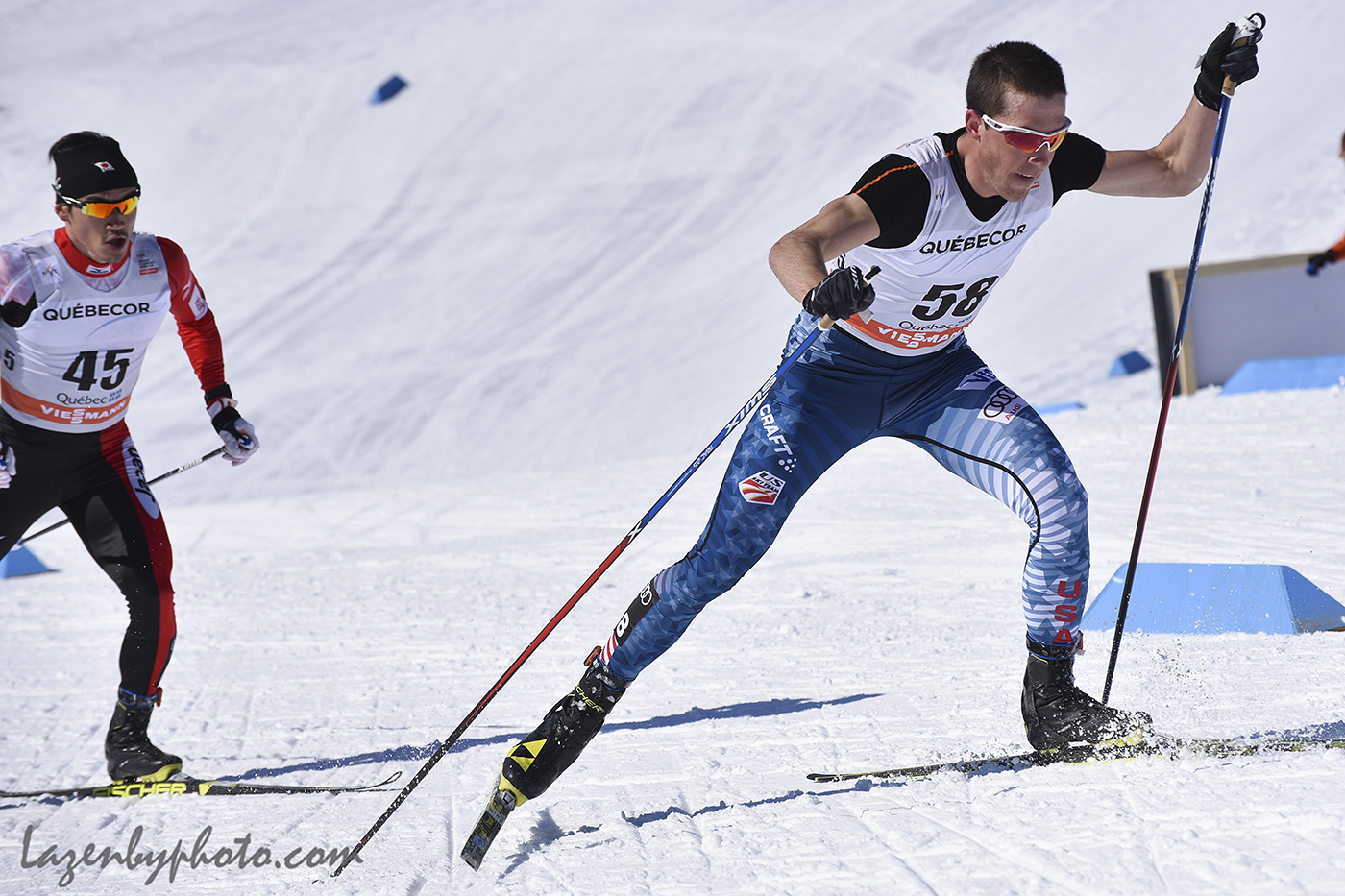
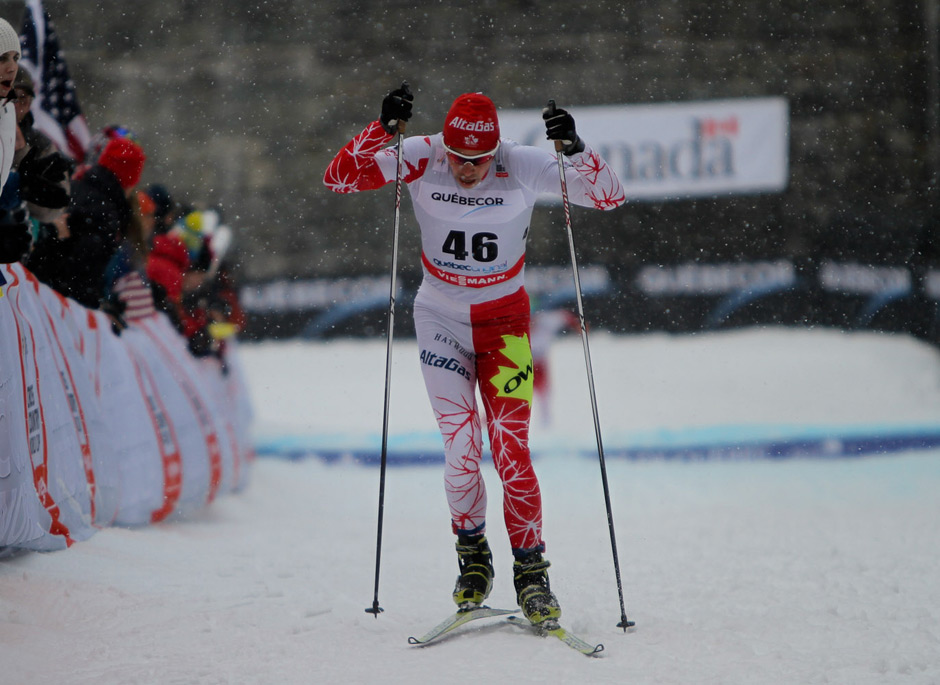
Paddy Caldwell (U.S. Ski Team D-team/SMS) racing to 46th overall and 25th for time of day in the men’s 15 k freestyle pursuit at World Cup Finals in Quebec City. (Photo: John Lazenby/Lazenbyphoto.com)
In a phone interview two weeks ago, the Lyme, N.H., native explained that making the jump to the B-team wasn’t an explicit goal.
“I don’t think I officially wrote that down in a goal section or something like that in the beginning of the year,” Caldwell said while finishing up spring classes at Dartmouth College in Hanover, N.H. “By looking at it as sort of progression, it definitely has been a goal of mine. My goal was to be a competitive World Cup skier and that is a step that needs to happen.”
Caldwell’s 2016/2017 objectives highlighted U23 World Championships at Soldier Hollow outside Midway, Utah.
“I was really focused trying to peak for those events and put up the best results that I could in that field,” he explained.
At U23 worlds, he earned two top 10s, placing ninth in both the 15-kilometer skate and 30 k skiathlon.
Caldwell was granted starts for the World Cup’s closing weekend, a three-race mini tour in Quebec City. He placed 46th overall at World Cup Finals, but turned heads with a 25th-best time of day on the final-stage 15 k skate pursuit.
In the near term, despite his promotion, it’s life as usual for Caldwell. There’s school to finish up and training hours to log. (Caldwell returned recently to Hanover from the USST’s first on-snow camp of the year in Bend, Ore.)
“I think that is very much in the air,” Caldwell said when asked if he’d be racing a full World Cup schedule. “And it depends on a lot of things — foremost if I am skiing well. And those are plans I am still working out. I don’t know exactly what opportunities will be there. Those are things, discussions we’ll have later in the year.”
Caldwell will remain under the guidance of O’Brien at SMS. And from a funding standpoint, Caldwell said he won’t see a bump in USST funding.
“Not in terms of support from the U.S. Ski Team,” Caldwell said when asked if his B-team status came with greater financial support. “The last few years I have been really fortunate to be successful fundraising through the local community here in the Upper Valley in New Hampshire and Vermont. So I am really thankful for the support from local people in both the ski community and outside the skiing community. I think absolutely if I end up racing in Europe more, it will be a bigger expense, and those are things I am not completely dialed on yet.”
Caldwell is officially a senior at Dartmouth, having earned 32 of 35 credits for his bachelor’s degree while studying geography and economics. In 2015, he won the 10 k skate at NCAA Skiing Championships.
Paddy Caldwell (13) chases Kris Freeman in the 50 k freestyle mass start at 2015 U.S. Distance Nationals in Sun Valley, Idaho.
“I feel really fortunate to go to Dartmouth College and be able to balance skiing and education,” he said. “One of my goals, I’ve always been aimed at finishing an undergraduate degree in a timely manner. I’m really thankful to be at Dartmouth where there is a flexible quarter system. I’ve taken off most fall terms since I have started at Dartmouth as well as winter and been able to go in the spring and summer fairly consistently.”
As a discretionary pick for the USST, Caldwell has jumped a significant pipeline-hurdle. Domestically, his peers have been skiing in a tight pack — on this year’s SuperTour, the men’s side had several different standout performances.
“I think there is an aspect of added pressure,” Caldwell said of his new B-team status. “But I also think that that is an inherent part of our sport. At the end of the day, it comes down to racing fast. That pressure is going to be there no matter what team you are on. It is something that I try not to focus on and just see it as an opportunity to keep growing as a skier and not as a target on my back, because I think it is easy to see it that way. Absolutely there will be some pressure from that, it’s also not something that I am unfamiliar with. I think it’s part of the sport. You have to, at least for me, just focus on trying to achieve results for my own growth as a skier and not focusing on the stuff going on around me.”
Bernie Nelson (l), U.S. U23 Worlds coach, and Patrick O’Brien (r), U.S. Junior Worlds coach, get settled in Utah with their athletes prior to the start of the U23 & Junior World Championships, which start Monday, Jan. 30, at Soldier Hollow in Midway, Utah. (Photo: Bryan Fish)
The world is coming to Soldier Hollow in Midway, Utah. From Jan. 30-Feb. 5, the Olympic venue known as “SoHo” will host 2017 Junior and U23 World Championships. Throughout the last week, skiers from approximately 40 nations have descended on rural Utah and the race venue tucked up on the Eastern flanks of the Wasatch.
From the outset, athletes, coaches and wax techs will be busy. It’s the usual hustle and bustle and last-second scramble of any ski race weekend — the early morning ski tests, athlete meals, handing out bibs, and delivering just-in-time prepped skis to a racer waiting at the line. No glamour. It’s long before any potential podiums — it’s when any coffee is good coffee.
This environment with higher-stake races at SoHo isn’t simply a means of exposing emerging international skiers to the world’s best. It’s also fertile ground for coach development where they are exposed to the inherent stressors of international-level ski racing. This year, U.S. Ski Team Development Coach Bryan Fish will lead the cadre of 12 junior skiers and 10 under-23 (U23) skiers gathering in Utah, with the help of Stratton Mountain School (SMS) Elite Team Head Coach Patrick O’Brien and Bend Endurance Academy (BEA) Nordic Director Bernie Nelson.
O’Brien, a 26-year-old Vermont native and former Craftsbury Green Racing Project skier, will lead the U.S. Junior Worlds team. He’s coming off an eventful U.S. nationals, also held at SoHo, where his level of tolerance and preparedness for the whimsical Heber Valley weather gods was tested.
“It was one of those situations when it’s a waxers nightmare and you just have to try and figure your best to have options and keep your head on a swivel and see how conditions are changing,” O’Brien said on the phone from Truckee, Calif., site of last weekend’s SuperTour races, as he reflected on the all-hands-on-deck conditions during nationals.
“We ran the full array for what we saw for weather,” O’Brien added. “Temperatures that were so cold that they were causing the diesel generators in the wax areas to gel and shut everything down to some really heavy rain that was putting the courses in jeopardy as well as our ability to get there and set up. We were digging drainage ditches and sandbagging to move water around the wax area to some pretty heavy snowfall for the last day sprint qualifier.”
That experience will help O’Brien keep his calm. In the event of an all-conditions SoHo morass during World Juniors, he’s already helped his SME Elite techs and athletes make quick decisions there.
“The thing is, you just have to be prepared for everything, you never know what you are going to wake up to, at SoHo especially,” O’Brien said.
His return visit to the 2002 Olympic venue, only weeks after U.S. nationals, comes with an emphasis on ensuring the athletes are prepared, and less pressure on prepping skis — he’ll leave that job to the team’s wax techs.
“The role that I am best suited in is trying to see the forest through the trees and provide the clearest information in terms of what I see going on out there,” O’Brien clarified. “So the best thing that I can do is be outside the wax room.”
“I am a facilitator,” Nelson, also 26, said of how she defines her role when traveling as an international coach. “These athletes come with training plans, they come knowing what they are going to do. I am the person in the starting pen that is like, ‘Hey, you’ve got this, the work is done. Go out there and have fun. Have a good race.’ ”
The coaching duo return to Utah with past international coaching experience on their resumes. It’s O’Brien’s third year as the SMS Elite Team head coach, where he supports his athletes with training plans and wax-tech support at SuperTours, including U.S. nationals. He’s also teched and coached at a spring OPA cup trip and at last year’s season-ending World Cup series, the Ski Tour Canada.
Nelson, the U.S. U23 team coach, served the dual tech-coach role at 2015 World Championships for Australian national-team member Paul Kovacs. At the time, Nelson was also Kovacs’s coach at the Bridger Ski Foundation (BSF). She also teched at last year’s Juniors Worlds and U23 Worlds in Romania. Like O’Brien, Nelson gained experience working the Ski Tour Canada.
Both coaches enter a situation demanding flexibility and a willingness to embrace unknowns. For Nelson, the U23 athletes are ones she may not work with on a daily basis, but she’s begun to develop relationships with.
“Kelsey Phinney came and spent a summer with me when I was at BSF,” Nelson explained. “Bill Harmeyer is a former BEA postgraduate and I spent this past summer with him. Logan Diekmann is a former post-grad, Alayna Sonnesyn also spent the summer at BEA. I feel really connected to a lot of the athletes. For the ones that I don’t, it goes hand in hand. It’s my job as a coach to reach out to them and let them know I am someone they can trust.”
Nelson said she’ll only be responsible for waxing skis when asked by a technician. Her primary tasks will focus on athlete preparedness, and include big-picture items, like allowing athletes to decompress away from the competition venue, and small-picture, businesslike tasks of handing out bibs and communicating accurate start times, which aren’t exactly glamorous, but essential.
“I also feel responsible for making sure the techs have what they need to succeed — coffee, a chair, or whatever,” Nelson added.
Nelson said she believes the U.S. sends competitive teams to Junior & U23 World Championships. Although this year, with U.S. athletes enjoying home-field advantage, Nelson stated she’ll emphasize not adding any undue pressure to perform.
“It is important for the athletes to not feel that pressure, but to understand that they belong there and they have been brought to this event for a reason,” she said.
One reason these athletes are brought to events like Worlds is for the opportunity for a race performance on the international stage representative of their current form and to learn. These events are stepping stones.
Rolling into the SoHo infield where a world of flags will snap in the Wasatch downdraft may also remind these two young coaches that they are enhancing their knowledge base to help foster a stronger ski community.
“I am still learning,” Nelson willfully admitted. “Every time I go on a trip my eyes are wide open. I think there are always opportunities to make split-second decisions and I think a lot of the learning happens after the fact, because you get to another situation and you’ll have the tools to make an informed decision that you didn’t really realize that you had. They compound and build on each other.”
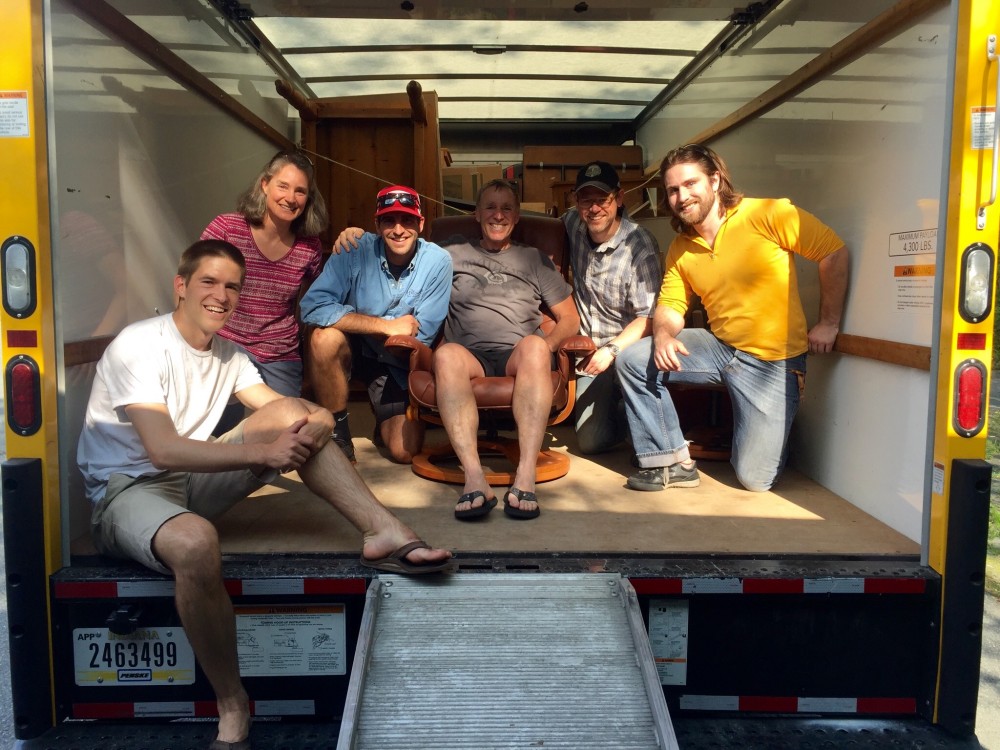
(From left to right) Austin Caldwell ’14, Scottie Eliassen ’90, Sam Tarling ’13, Ruff Patterson, Erik McEwen, and Leif Johnson ’13 in the back of Patterson’s U-Haul last Tuesday, May 24, prior to Patterson’s departure west. (Photo: Sam Tarling)
In late March, Ruff Patterson, 61, announced he was stepping down as head coach of the men’s nordic team at Dartmouth. This is a story of his impact and legacy as a coach, first as a U.S. Ski Team assistant and later at Dartmouth in Hanover, N.H.
“There were no non-heroes out there today.” — Ruff Patterson, after a four-hour rainy run with the Dartmouth men’s nordic team, circa 2007
***
Twenty-seven years ago, a group of men convened in the basement of Robinson Hall, home of the Dartmouth Big Green ski team. Veteran faces intermingled with those of eager newcomers — including the likes of current U.S. Ski Team Head Coach Chris Grover.
Wisecracks and an accompanying chorus of chortles percolated amongst those assembled, drifting up into the stairwell. A few shuffled their feet as they awaited their coach’s arrival for the first fall practice of the ski season.
However, the figure that eventually greeted the gang beneath the building’s floorboards was not that of John Morton — the coach who recruited Grover the prior spring and whom Grover expected to work with during his four years of undergraduate study at Dartmouth.
That autumn afternoon, September 1989, the individual who approached the group was as novel to the Dartmouth ski team as any of Grover’s fellow freshman teammates. With time, however, he would become synonymous with the school’s ski program.
“This was all happening pre-internet, pre-email, pre-mobile telephones,” Grover on the phone of his recruiting process to Dartmouth. “There was never any sort of news release or anything that went from Hanover to where I grew up in Anchorage, that would’ve said, ‘Hey, by the way, John Morton quit and there’s a new coach named Ruff Patterson and he’s going to be taking that coaching place.’ So here I was that following September, expecting to see John Morton show up for practice, when Ruff Patterson rolls in … That was an interesting transition. We were all getting to know somebody new on the first day.”
The Patterson Siblings, Sun Valley and the USST
“You gotta love it!” — Ruff Patterson on skiing, racing and training with the Dartmouth men’s nordic ski team, circa 2013
Situated nearly 6,000 feet above sea level, the city of Sun Valley, Idaho, holds a unique history as one of the first destination ski resort areas in America. Famed names such as Dick Durrance, Ernest Hemingway and Picabo Street have carved the region’s mountainside slopes and the locals’ love for skiing, particularly alpine, goes almost unparalleled.
Ruff Patterson coaching with the U.S. Ski Team in the 1980s. (Photo: Gordon Vermeer and Eric Packer)
This held especially true for Susie, Pete, Barbie and Matt Patterson, Ruff Patterson’s four younger siblings. Surrounded by Idaho’s Sawtooth Mountain Range, and with support from their parents Joannie and Jim Patterson, all five developed a deep devotion to skiing. To many in the community, they became known as Sun Valley’s “First Family” of skiing.
In a way, however, Ruff was the ‘black sheep’ of the household. Susie became a two-time national champion alpine skier, Pete qualified for the Winter Olympics in downhill skiing twice, and both Barbie and Matt established themselves as adept alpine skiers. Meanwhile, Ruff chose a slightly different ski path than his siblings. He chose cross-country.
“[In] high school, I had a brother and sister who were both traveling, very young, for the national alpine team and I was kind of the guy in the background helping them get through school and fixing skis and stuff like that,” Ruff said in a phone interview in April, shortly after he announced his retirement from Dartmouth. “Contact with people, having to deal with traveling and and competing started really young for me, but [ski coaching] was not something I planned on doing after college.”
As a student enrolled at the University of Colorado Boulder (CU), Ruff originally intended to become a doctor. He placed himself on the pre-med track and graduated with a degree distributed in the fields of biology, chemistry and psychology. Ruff also competed for the Buffs’ ski team. During his undergraduate years, CU won four NCAA Championship titles — though in his senior year the title, ironically, ended in a two-way tie with Dartmouth.
Despite his initial plan, post-grad life did not leave Ruff pouring over MCAT entrance exams or medical-school applications. Instead, he found himself back in his beloved hometown, ski coaching with Rob Kiesel, the founder of the Sun Valley Ski Education Foundation (SVSEF) nordic program.
The first few years of coaching for Ruff were far from glamorous. He spent most of his time supporting the SVSEF junior racing team and acting as a professional porter and nordic roadie for the U.S. Ski Team (USST).
“Rob hired me as the national team coach, and you know when you start out, you’re carrying a lot of ski bags and traveling a lot,” Ruff said. “Those first years I was traveling internationally with the team and just doing a lot of the groundwork. I don’t think a lot of the groundwork has changed for those poor guys. They earn every cent.”
Kiesel, the man who hired Ruff, influenced Ruff’s path into coaching. As Ruff put it, Kiesel was more than just a family friend. Kiesel was Patteron’s role model and mentor.
“I wouldn’t be coaching today, nor begun coaching if it weren’t for Rob,” Ruff previously wrote in an email after Kiesel passed away in 2011. “Both my sister Susie and brother Pete wouldn’t have had the Alpine skiing careers they had if it weren’t for Rob. My brother Pete wouldn’t be guiding in Greenland or Nepal if it weren’t for Rob. More importantly, Rob was an integral part of our family.”
As Patterson’s grip on the nordic race world grew, he began to move up in position and expertise. For 10 years, he worked for the USST, a better part of those alongside Mike Gallagher. While co-coaching with Gallagher, Ruff assumed the role of “primary assistant” coach to the USST, often working with the women.
Rob Kiesel, Patterson’s coach, showing off his downhill skills at Winter Park in 1964 (Photo: Harald Bjerke)
“[Mike Gallagher] and I would worked really closely together and I was sort of his primary assistant as the year grew on,” Ruff said. “When we’d split up, I would end up taking the women and there were a few years where I was actually labeled the women’s coach. But for the most part, he and I were more of a team and I was more of his assistant during my primary coaching year.”
Ruff’s stint with the USST brought him to the Olympics, alongside Kiesel at the 1980 Winter Olympics in Lake Placid, N.Y., and with Gallagher at the 1984 and 1988 Games in Sarajevo, Yugoslavia and Calgary, Alberta, respectively. He mentioned working alongside U.S. Ski Team coaches Torbjørn Karlsen and Peter Ashley as major influencers in his career as well.
His work for the USST helped women like current Methow Valley Nordic Team head coach, Leslie Hall –the sister of Patterson’s future Dartmouth College co-coach, Cami Thompson-Graves — to the Olympics.
“He was one of the main coaches at the 1988 Olympics, my first Olympic experience and the main memories that stick with me are his smile, laugh and bad jokes!” Hall wrote in an email. “My relationship with Ruff has evolved so much over time, from being an admiring junior who wanted his attention and help, to being a friend on mountain biking trips to Moab, to being the sister of his co-coach at Dartmouth.”
He also helped current Middlebury College assistant coach and University of New Hampshire alum Patty Ross, and Bates College alum Nancy Fiddler to Olympic levels of racing.
“Ruff was always there with a joke or someway to diffuse a tense situation,” Fiddler said on the phone. “Everybody gets so caught up in [skiing] and if you were feeling kind of involved in a way that wasn’t healthy, he just brought you back and reminded you that, ‘Hey it’s ski racing it’s supposed to be fun, and if you’re not having fun, what the hell are we doing.”
Changes To Hold Onto: Skating and the Mental Breakthrough
“Weight shift, weight shift, that’s the key.” — Ruff Patterson during a skating technique workout with the Dartmouth men’s nordic ski team, circa 1989
Little did Bill Koch know that when he entered Sweden’s 1980 Worldloppet marathon, he would rock the ski world forever. During that winter’s fated 50-kilometer ski race, Koch witnessed what has since become a staple in cross country skiing: the skating technique.
After Koch began to implement skate skiing into his own national and international races, the sport changed forever — a change Patterson perceived first-hand.
U.S. cross-country legend Bill Koch pioneering the skating/freestyle technique in the ’80s. (Photo: Peter Ashley)
“I was incredibly fortunate to live through the skating revolution,” Patterson said. “To see the live world change, everybody else’s world change and how people react to that, that whole thing was, man, something to live through.”
“You can sort of compare it to — right now there’s this big double poling thing,” he added. “Skating was very much the same thing. It was a complete unknown. So for everybody, including sports staff like myself, it was like, ‘What’s going to happen here?’ ”
What happened was rattling to some and rectifying for others. Patterson pointed out that he saw many attempt to prevent the change, but the skating technique, ultimately was here to stay.
“You know, they were trying to do everything possible to make it less possible to skate,” Patterson said. “A lot of the controls they tried were almost laughable now.”
As Patterson sees it, there are certain circumstances when evolution of the sport is inevitable. Occasionally, adaptation outweighs resistance.
“What I’ve discovered during those periods is … if you’re here to play the game, you have to figure out a way to go with it,” he said.
Skating and double poling aren’t the only areas Patterson says he has seen development in skiing. To Patterson, the mentality of American ski racers is what has changed the most. Especially for the U.S. women.
“When Kikkan [Randall] opened the door, the barrier, for Americans to do well in Europe, I think the whole mental game changed,” Patterson said. “I’m hoping that this mindset moves into the boys’ group [in the U.S.], that mentality of just, ‘Hey, we can compete and win against the big boys and the big girls.’ That’s probably one of the most significant changes I’ve seen since I’ve started coaching.”
Dartmouth Dudes and Loving What You Do
“Boys, I want medals!!” — Patterson to the Dartmouth men’s nordic ski team, circa 2012
Freezing rain. Mosquitoes. Heavy, humid heat. The Northeast Coast makes many westerners go weak in the knees. Patterson was one of them. Located in the heart of Hanover, N.H., a move to Dartmouth promised Patterson the very bipolar weather, bug bites,and Vitamin-D deficiency he dreaded the most.
Ruff Patterson discovered that the eastern biking may make up for his dislike of East Coast climate. (Photo: Dartmouth Ski Team Facebook)
“When I first took the job I was a western guy and I thought, if I lasted three or four years I’m going to be lucky,” Patterson said. “I was terrified of bugs and humidity and once I got here the bugs and humidity were terrible, but then I realized that the road biking and other stuff in the East were just incredibly great. But I never planned on being here as long as I did.”
Patterson’s original estimated three-to-four-year window turned into seven, soon 11, and eventually 27. Overcoming his fear for East Coast climate was only part of it. His deepening devotion to the Dartmouth men’s team also drew him to stay.
“I just kept saying over and over again ‘I love what I do,’” he said. “Just absolutely love what I do and I just felt that it stayed like that all the way through.”
Patterson’s philosophy to love what you do and see it through transferred to his athletes. During his 27 years at Dartmouth, he coached three men to individual NCAA Championship titles — Glen Randall in 2008, Sam Tarling in 2011, and Patrick Caldwell in 2015 — and he also helped Dartmouth to an NCAA team title in 2007, with All-American athletes Mike Sinnott and Ben True.
“When I came in as a freshman, I was very hesitant to fully buy into his philosophy of training,” Tarling, a 2013 grad, wrote in an email. “After my first year working with Ruff, our relationship strengthened and I decided to stay in Hanover for the summer and work with him. I discovered that some of the silly things we did in training had the most influence on my performance, and that what seemed like random workouts and drills had a purpose. I ended up staying every summer after that to work with Ruff.”
Tarling was not the only athlete who at times questioned some of Patterson’s practices. Both Grover and Carl Swenson, a 1992 graduate and three-time Olympian, recalled recovery runs with Patterson as conclusively easy, in spite of athletes’ attempts to do otherwise. Patterson wanted his skiers to be fast when they needed to be and to step back and enjoy training the rest of the time.
“We’d go out for a ‘Ruff Waddle’ recovery run,” Swenson said. “Ruff would make us run behind him. It was to teach us to go easy … because all we wanted to do was race every workout.
“He was just the right coach at the right time for me,” Swenson added. “He kept me at it, really. I think it’s a period where a lot of people get interested in other things and, as everybody knows it takes some time to develop as a distance athlete, and he really kept me on track as best as anybody could have in a period when I was not on track by any means.”
Gaining credence with athletes like Tarling and Swenson and witnessing their progress, for Patterson, was another piece of what made college coaching worthwhile.
Just a few of “the kids” as Ruff Patterson (not shown) calls them (left to right): Nils Koons, Sam Tarling, and Eric Packer (Photo: Ruff Patterson)
“Winning over athletes and gaining their trust, I can’t tell you the rewards behind something like that,” Patterson said. “That’s just another piece of this overall puzzle, but sort of everything. Once again, it’s the people and stories behind them that have made it for me.”
Though Tarling, who is now working as a software engineer in Denver, Colo., indicated he’s “happily enjoying being a recreational athlete for a change,” he still feels indebted to Patterson for all that he’s helped him achieve.
“Our relationship began with many conversations about how we could best work together to help me achieve my goals in ski racing, but progressed to the point where Ruff was much more than my ski coach,” Tarling wrote. “He was – and is still – my mentor, my confidant, my hero, my friend.”
Patterson was much more than a coach to many of his athletes. He was a pillar, the adviser and ally searched for not only on the trails, but off them as well. He did not force his athletes to grow. He fostered them to take the steps on their own. As numerous athletes indicated, his door was always open to whoever happened his way.
“Ruff impacted my life on so many different levels beyond skiing,” Patrick O’Brien, current head coach for Stratton Mountain School T2 Team and 2010 graduate, wrote in an email. “He wanted you to grow as an athlete and an individual. He was always there for support when you needed him but understood many decisions or choices had to be yours alone to make. He asked for, and brought out the best people had to offer.”
Patterson did bring out the best people had to offer, but in ways beyond just results. He saw value in every athlete, carnival circuit caliber ski racer or not.
“The guy who never makes it, the ones who just make these incredible strides … the really talented guys,” Patterson said, “All athletes are rewarding.”
Ruff Patterson on Mt. Moosilauke in New Hampshire’s White Mountains with the Dartmouth team (Photo: Gordon Vermeer and Eric Packer)
Patterson’s ability to work with athletes of all kinds, stems from his coaching style. Passionate, patient, perceptive, he held the unique capacity to turn the complexities of cross country skiing into common sense.
“Ruff has that elusive quality you see only in the very best of coaches — he makes skiing seem simple,” Packer, who graduated in 2012 and is now racing for Alaska Pacific University (APU), wrote in an email. “He has the ability to use just a single suggestion to make really dramatic improvements in your skiing.
“Hand in hand with that, Ruff really believes in the importance of building a quality training group, and holds that at the core of his coaching philosophy,” Packer added. “You learn from the group, push the group, and rely on the group. In an atmosphere like that, when everyone is working together, pushing each other in a competitive but also fun atmosphere, everyone improves.”
Humor and having fun was also a training philosophy greatly prized by Patterson.
“I call them the kids.The gang. The team. I’ve been so lucky to be able to work with these guys. Even the ones that have been nightmares, looking back that’s what’s kept me here. The people, for sure.” — Patterson on his 27 years as the Dartmouth men’s nordic head coach
“One of my favorite memories started about midway through my time at school when he would finish every pre-race meeting with a story from his previous coaching experiences,” O’Brien wrote. “All would have you rolling over laughing and reminding you that although the sport may change over the years, the spirit of it never did. It made you feel connected the people who have come before you, understanding the challenges they faced were the same as the ones in front of you now.”
However, Patterson’s impact on the nordic community cannot be pinned solely to skiers he worked with directly. As Sinnott pointed out, numerous of individuals have been influenced by the former Dartmouth head coach, whether he realizes or not.
Ruff Patterson
In two words or less… “A Mentor” — Thompson-Graves “Unassuming” –– Tarling “Wise” — Tarling “Passionate”— O’Brien “Remarkable”— Sinnott “Solid”— Grover “Supportive”— Grover “An Icon”— Packer
“You go through his office and he’s got handwritten thank you notes from John Nystad from when John Nystad was skiing for UVM [University of Vermont],” Sinnott said on the phone. “Ruff had these powerful impacts on skiers that he wasn’t even mentoring or that weren’t in his program.”
With the women too, Patterson was — and still is — a hit.
“Ruff used to get more Valentine’s Day cards than anyone else on the team,” Sinnott reflected, referring to the Dartmouth Carnival tradition of ‘Carni Crush.’ “Everyone on the circuit felt the warmth and the magnitude of Ruff. And that’s the cool thing. It’s not just the people that are obvious on a piece of paper, but it’s everyone else that might have glossed by him.”
While many of Patterson’s athletes cite him as the reason they are where they are today, Patterson is adamant that his athletes are the ones who’ve kept him in the game.
“I call them the kids,” Patterson said. “The gang. The team. I’ve been so lucky to be able to work with these guys. Even the ones that have been nightmares, looking back that’s what’s kept me here. The people. For sure.”
Dartmouth’s Dynamic Duo: Patterson and Cami Thompson-Graves
“Are we having fun yet?” — Patterson to the Dartmouth men’s nordic ski team, circa 2010
Bonnie and Clyde. Ernie and Bert. Starsky and Hutch. Cami and Ruff. While not many modern day duos find themselves in competition with the infamy of the previous pairs, Cami Thompson-Graves and Patterson are two that do.
In a coaching partnership that’s lasted longer than some marriages, the two have carried each other through the numerous highs and lows of coaching a Division I college ski program.
“We’ve been together longer than most people have been married,” Patterson said. “We’ve definitely had our ups and downs, but because of it, the two of us have become incredibly close.”
Though the two admit they’ve spat like siblings at times, they also agree that what they have gained out of their 27 years together is irreplaceable.
“She’d be the first one to tell you, it’s not like it was all wine and roses the whole time,” Patterson said. “ It’s just we’ve been through a lot together.”
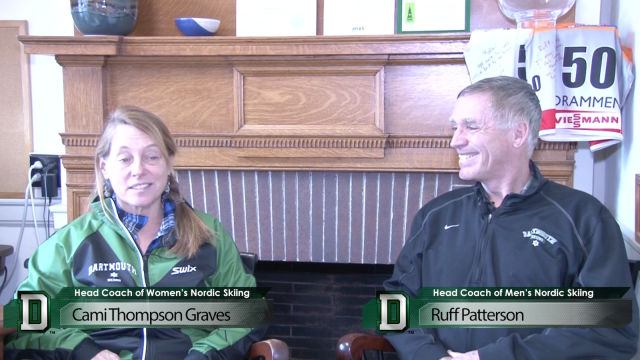
Dartmouth’s longtime duo Cami Thompson-Graves (l) and Ruff Patterson during a 2015 interview .(Photo: DartmouthSports.com)
The two have also supported each other — and their teams — through the loss of Dartmouth athlete, teammate and friend, Torin Tucker. Tucker, who died of a heart anomaly while competing at the Craftsbury Marathon two years ago, was also from Sun Valley and described by many as having a similarly contagious smile.
A rare verve to come across, no loss the magnitude of Tucker’s is easy. For Patterson, learning to live in the memories and moments of Tucker as the epic adventuring, intellectually curious and compassionate mountain town-er he was, no matter the time it took to get there, helped he and the Dartmouth community move forward with Tucker in their hearts.
“There’s no way you can tell somebody to get over stuff,” Patterson said. “You just have to deal one day at a time, one minute at a time.”
The support and history between Thompson-Graves and Patterson, therefore, goes far beyond just van rides, wax benches, and debates over who’s who.
“We had some great moments, talked about skiing endlessly and also fought and bickered like siblings at times,” Thompson-Graves wrote in an email. “But, along the way, there were many fun race days where we worked hard, shared our nerves, and when things had to come together, they did!”
More than anything during their time together, Thompson-Graves was a firsthand witness to the dedication Patterson put towards his athletes and coaching.
“Ruff loved his guys, they meant everything to him,” Thompson-Graves wrote. “He was there, day in and day out and knew them all well. Some of them might have driven him crazy but, even with the frustrations, he loved the times when it all came together for them.”
All in all, it takes a special circumstance for two individuals to work together toward a common goal for that length of time.
“When you sum it up, I wouldn’t have traded that for anything,” Patterson said. “Because being able to figure out a way for two quite different people to work together and do as well as we have done together … boy, that doesn’t happen very often in life.”
What’s Next?
“Don’t overthink it.” –Ruff Patterson to the Dartmouth men’s nordic ski team, circa 2006.
Forty years ago, Patterson — clad in a black graduation cap and gown — strolled across the CU stage to receive his diploma. Like many of the student athletes he would eventually coach, he had post-college plans that would inevitably change, a passionate fervor for cross country skiing, and an anything but linear trajectory ahead.
Forty years later, with his final cohort of college senior skiers before him, not much has changed. As Patterson departs Dartmouth, there is a piece of him that feels as if he is once again striding across the graduation stage, leaving school behind to discover what’s next.
“It wasn’t until the day before I resigned that I actually knew I was going to do it,” Patterson said. “I didn’t sleep that night, I can tell you that much.”
“It sort of feels like I jumped off a cliff doing this,” Patterson said of his resignation. “I was in a little bit of a shock for a few days, but I’m going to sell my place here, pack up a U-Haul and return west, which I’ve been wanting to do forever. And then stir the pot up a little bit and try to find something else to do. I have no idea what that’s going to be. I feel like a college kid again.”
2015 NCAA Champion Patrick ‘Paddy’ Caldwell (l) with coach Ruff Patterson. (Photo: Dartmouth Ski Team Facebook)
Even if Patterson is now physically distanced from Dartmouth — he headed west last week Tuesday — his legendary role and presence is not. His impact extends beyond Dartmouth, into the lives of past, present and future mentees — some of which he will never meet in person. Many he will have infiltrated with his coaching philosophy alone.
“Ruff was really responsible for creating that atmosphere with the [Dartmouth men’s] team, in terms of camaraderie he created in the group,” Grover said. “And certainly, as you know, that’s a big thing for us these days with the USST. The team and the athletes are quite successful on an individual basis because we tend to try to build a family atmosphere around the team. Ruff really did the same.”
Patterson’s stamp survives in the USST, the skiers who are now software engineers, lawyers, coaches, writers and more.
“You know, I came into a great group early on,” Patterson said of his first few years coaching at Dartmouth. “It took a while to establish my own style. It doesn’t mean that the style that Mortie [John Morton] had way back when was, there’s no way you could say it was bad or good … I absolutely know that the next person that’s going to come in in my place is going to be exactly the same; have their own style … I got to put my stamp on things and the next person here is going to put their stamp on things.”
Semi-uncertain of what his future holds beyond bike trails, mountain towns, and some RV roaming, Patterson is certain that Dartmouth has green grass ahead and he, a wanderlust for western blue skies.
“I know they’ll find somebody good,” Patterson had said of prospective coaches for the Dartmouth head coaching position, prior to the hiring of Brayton Osgood in May. “And I know that the school will always support skiing … My personal opinion is that they’re going to just keep going and there’s nothing wrong with that … Field of dreams.”
Annie Pokorny racing to 33rd in the 10 k classic at the 2014 U23 World Championships in Val di Fiemme, Italy. (Photo: Flyingpointroad.com/NNF)
This week, the top collegiate cross-country skiers in the U.S. converged in Steamboat Springs, Colo., to wrap up the season at the NCAA Skiing Championships, which begin Thursday with the 5/10-kilometer freestyle individual starts and wrap up Saturday with the 15/20 k classic mass starts. One Middlebury skier has the unique opportunity to be reimmersed in the collegiate circuit after a glimpse at post-collegiate skiing and will race for the NCAA podium with a different appreciation for collegiate competition.
Annie Pokorny, 23, returned to the collegiate racing circuit this season after a two-year hiatus while training and racing with the Stratton Mountain School T2 Team. Although this is a rare progression, it was a path that has allowed her a different depth of experience in the sport.
Skiing for Middlebury College, Pokorny had a breakthrough season in 2013 as a sophomore where she netted two top-10 finishes at U.S. nationals in Midway, Utah, and finished in the top 30 twice at U23 World Championships in Liberec, Czech Republic. The season reflected a huge improvement over the previous year where she finished 47th in the 10 k freestyle at U.S. nationals.
Although most collegiate skiers who continue onto the professional level exhaust their eligibility before moving on, Pokorny wanted take the sport to the next level sooner rather than later. In the spring of 2013, the Spokane, Wash., native made the difficult-but-measured decision to join the SMST2 team based out of Stratton, Vt. Pokorny was excited to be a part of the culture of success SMST2 built and join World Cup-level skiers such as Jessie Diggins and Sophie Caldwell. She also knew the opportunity might not present itself in another two years after she graduated and wanted to capitalize on her momentum by training and racing full time.
Annie Pokorny (SMST2) at the top of the coach’s climb during a training day before the December 2015 SuperTour in Sun Valley, Idaho.
While training and racing with SMST2, Pokorny continued to take classes at Middlebury and balanced coursework with an international race schedule. She would take the fall semester off when training volume was high and take classes full time in the spring.
“The logistics have certainly been complicated, coordinating with professors to miss multiple weeks or months of class by Skyping into lectures (an idea inspired by Sadie Bjornsen), writing additional essays and navigating the black hole that is European village internet,” Pokorny wrote in an email. “However, I got to take advantage of the international racing available to me; finding balance never felt like a sacrifice.”
While Pokorny has posted solid results the past two seasons with SMST2, another breakthrough season proved elusive. With both her skiing and academic goals in mind, Pokorny made another pivitol decision — to return to college racing.
“I decided to return to college racing because it gave me the chance to have six weeks of consistent, competitive, comped racing while also allowing me the structure to take a full course load and graduate in the spring,” she explained.
However, the process of returning to collegiate racing required more than just agreement from her coaches. Because collegiate cross-country skiing is an NCAA sport, athletes must abide by the NCAA amateurism rules and in the eyes of the NCAA, Pokorny was considered a professional athlete while skiing for SMST2.
However, since Pokorny could prove she never made money from racing at SMST2, she was eligible to return to the collegiate circuit after being reinstated as a Middlebury athlete as a senior with junior eligibility. To ensure everything was in order before she put on a Middlebury suit, Pokorny sat out the first two carnival races.
Annie Pokorny (l) with several Stratton Mountain School (SMS) T2 teammates in 2014. (Photo: SMST2 Blog)
Although it was a process, Pokorny said she felt supported in her decision from Middlebury, SMST2 and the ski community.
“Patrick O’Brien and Sverre Caldwell at SMST2 showed an immense amount of support for me returning to collegiate racing, which I’m glad I had before starting the process of returning,” she wrote. “When we knew I had eligibility, the Middlebury program communicated that to the rest of the Eastern Intercollegiate Ski Association (EISA) circuit and I received nothing but support from every coach and competitor.”
Pokorny describes her transition back as “nearly seamless.” In addition to being welcomed back to the team and collegiate racing, being on campus and attending lectures eliminated the stress of remote coursework.
She has also returned as a force on the EISA circuit, winning the 5 k classic pursuit at the Williams Carnival, the 5 k freestyle at Middlebury Carnival, taking second in the 10 k classic at University of Vermont Carnival and earning a berth to NCAA Championships.
“On the skiing side, I think one of the valuable lessons of skiing internationally is that it teaches you a certain flexibility and ability to navigate with new waxing, coaching and racing situations, so everything leading up to the races felt completely normal to me,” she wrote. “The Midd coaches, Andrew Johnson and Patty Ross, have worked to make sure that I felt supported on training and race days while the entire Midd team embraced my return like I was coming home.”
The transition also illuminated the unique and constructive culture of collegiate racing and how it can pave the way for international racing.
“I suppose one way my perspective has changed is that as an older, more experienced racer, I can appreciate the details that make racing NCAA a standout experience,” she explained. “In addition to the team culture and glitter and pride in representing your school, I can better see how what we learn on this circuit can transfer to international racing. The practice in mass starts, for one, and scoring points for and representing something greater than yourself, for another, are two things that will contribute to my racing after I graduate.”
Although it is easy to think that skier development is a linear process, this is rarely, if ever, the case. Pokorny’s grounded thoughts on her journey illustrate this phenomenon. There are lessons that can be taken from every race, from every experience despite if an athlete is aware and open to growth.
“I never considered returning to college racing a step back, but rather a step sideways, onto another incredibly competitive circuit that would contribute to my growth as a skier,” she wrote. “In the past three seasons, I have had some incredible experiences and feel that I have grown as a skier in so many different ways. I would never choose a different path, circuitous as it was.”
Anne Hart of the Stratton Mountain School (SMS) T2 Team (c) in first, teammate Erika Flowers in third (r) and APU runner-up Chelsea Holmes (l) during the podium ceremony for the women’s SuperTour 5 k freestyle on Feb. 6 in Craftsbury, Vt. (Photo: John Lazenby/Lazenbyphoto.com)
Graduate from Dartmouth as a five-time NCAA All-American? Check. Crush Crossfit? Check. Become a professional nordic skier? Check. Stand at top of a SuperTour race podium? Check.
While American Anne Hart, the winner of the SuperTour women’s 5-kilometer freestyle individual start last Saturday in Craftsbury, Vt., has already notched plenty of athletic and academic achievements, her first SuperTour win was no different.
“It feels great! It was my first ever SuperTour win, so it’s nice to cross that off the list,” Hart, who races for Stratton Mountain School (SMS) T2 Team and won the event with a time of 11:36.2, wrote in an email after the race.
Anne Hart (SMST2) racing to first place in the women’s SuperTour 5 k individual start on Feb. 6 in Craftsbury, Vt. (Photo: John Lazenby/Lazenbyphoto.com)
“I am a pretty strong V2er, and I love skiing that isn’t tempo based but instead relies on a good push and a long glide,” wrote Hart, a 23-year-old native of Stillwater, Minn.
“This kind of course rewarded big, relaxed, and powerful skiing. It challenged me because pacing has historically been my Achilles heel, and there were no opportunities to let off the gas and recover on a long downhill,” she added.
After assessing the profile of the 2 x 2.5 lap course— each loop found to be predominantly flat, with a few gradual uphills and downhills — Hart and her SMST2 coach, Patrick O’Brien, decided to Hart should ski the first lap at threshold and make her move with 1.5 k to go.
“For me the biggest take away from the race is pacing is a thing for a reason — it doesn’t mean go slowly the first lap, it just means save something in the tank so you can push all the way THROUGH the line instead of just struggling TO the line,” Hart wrote.
Crossing the line just 2.8 seconds off Hart’s time in second place was Alaska Pacific University (APU) racer, Chelsea Holmes.
While some might argue the fast, flat course was not well-suited for Holmes’ skiing style, the 29-year-old Alaskan’s performance refuted that.
“While I might not be a power skier suited for flat courses, I can free skate pretty well and that course was all about using your leg strength and skiing the transitions well,” Holmes wrote in an email.
She put her focus on the transitions and working the whole course — including, at one point, a chase back to the front.
Anne Hart (SMST2) (l) hugs teammate Erika Flowers after their first- and third-place finishes respectively in the SuperTour women’s 5 k freestyle on Feb. 6 in Craftsbury, Vt. (Photo: John Lazenby/Lazenbyphoto.com)
“I actually fell on an icy patch on the last downhill from the upper stadium to the lower before you loop around to finish,” she wrote. “In retrospect I wish I had been a bit more careful as it cost me some valuable time in a tight race.”
Despite the short course and fast times, by the time she toed the finish line, Holmes had pushed her way back towards the top.
“It was a super fun race and I have to congratulate the girls on the podium, 5km is tough!” Holmes added after her second-consecutive SuperTour podium and placing third in the 10 k classic in Lake Placid the weekend before.
In her third skate distance race of the year, Erika Flowers (SMST2) snagged the final podium spot in third, 10.5 seconds back from teammate Hart.
“With no huge uphills or downhills, the course required constant output which played to my strengths,” Flowers wrote in an email. “I also love fast conditions where I can ski big with lots of glide. I’ve always liked racing in Craftsbury because the courses flow really well.”
Originally from Bozeman, Mont., Flowers’ four years as a ski racer for Dartmouth College on New England snow, as well as her current East Coast training at Stratton in southern Vermont, prepared her Craftsbury’s conditions during Saturday’s 5 k event.
“The biggest challenge for me was finding a balance between tempo and power knowing that you can waste a lot of energy skiing frantically in icy conditions but if you take your foot off the gas for a second you immediately start losing time,” she wrote. “I think I skied smoothly and was able to carry momentum throughout the course and pick off some places on the second lap.”
Flowers lunged for the line in the end, just barely edging APU’s Jessica Yeaton out of third place by 0.1 seconds.
“I also never forget to lunge!” Flowers added. “It was very tight between Jessica Yeaton and I for 3rd place so every second really does count.”
Caldwell Cranks to the Top of the Men’s Field
Paddy Caldwell (Dartmouth College/SMST2/USST) racing to a first-place finish during the SuperTour men’s 10 k freestyle on Feb. 6 in Craftsbury, Vt. (Photo: John Lazenby/Lazenbyphoto.com)
There are times when ski racing is simply a grind. Then there are times when a skier puts the grind into their racing. Paddy Caldwell (Dartmouth College/SMST2/U.S. Ski Team), the winner of the SuperTour men’s 10 k freestyle individual start SuperTour race on Saturday in Craftsbury, Vt., proved he’s one for the latter.
“I felt great during the race. That was definitely the best I have felt all year and I am hoping to keep bringing good energy into the rest of the season,” Caldwell wrote in an email.
“The course was a total grind, not much rest but no major climbs. I was focused on hitting the transitions hard and trying to keep momentum everywhere on course,” he added.
Caldwell did keep his momentum — and then some. He won the 10 k freestyle in 20:42.9, leading the second-place finisher Tad Elliott (Ski and Snowboard Club Vail) by 37.9 seconds.
Tad Elliott (SSCV) races to second place in the SuperTour men’s 10 k freestyle individual start on Feb. 6 in Craftsbury, Vt. (Photo: NENSA/Amber Dodge)
“Paddy Caldwell crushed us,” Elliott, a former U.S. Ski Team member, wrote in an email. “It was a fantastic race from him. I don’t think I could have done anything different to go faster. For him to ski like that was just impressive and awesome. I look forward to seeing his races later this season.”
Though he spends his summers training at Stratton, Caldwell is currently studying and racing at Dartmouth College for the winter term, furthering his studies in geography and economics.
“I am planning on racing this weekend and next weekend for Dartmouth to compete in the carnivals before U23s!” he wrote.
Pumped for Caldwell, Elliott was also pleased by his own performance.
“My skate skiing has been feeling really good lately and I have felt fantastic on my feet skiing,” wrote Elliott, a national champion in this year’s 30 k freestyle mass start. I knew the course suited me well with all the gliding. I skied to win!” he wrote in an email.
Despite missing out on the victory, Elliott wrote, “I was really proud of how I skied.”
He finished 1.1 seconds ahead of Kris Freeman (Team Freebird), who placed third, 39 seconds behind Caldwell.
“The course had not that many big hills on it and was one of the flattest races I have done,” Freeman wrote in an email. “Ironically this made the race very hard. No uphills meant no downhills so I was working hard the entire time.”
While the course was made more difficult by the constant expenditure of energy, Freeman also noted the fast conditions made the 10 k go by quickly.
“The race felt like a 20-minute skate sprint qualifier,” he wrote, noting that, despite having higher result-based goals, his body “energy was better than it has been” on Saturday.
With limited snow in Stowe, Vt., organizers moved the SuperTour races from Trapp Family Lodge to the Craftsbury Outdoor Center, and most racers were grateful for the course challenge, as opposed to no course at all.
“I’m so impressed with the skiing at Craftsbury, big thanks to everyone here for making this weekend happen,” Caldwell wrote.
An excited Paddy Caldwell (Dartmouth College/SMST2/USST) (center) Tad Elliott (SSCV) (l), and Kris Freeman (Team Freebird) during the podium ceremony for the SuperTour men’s 10 k freestyle on Feb. 6 in Craftsbury, Vt. (Photo: John Lazenby/Lazenbyphoto.com)
Annie Pokorny (SMST2) at the top of the coach’s climb for the SuperTour 1.3 k classic race course in Sun Valley, Idaho.
SUN VALLEY, Idaho — Armed with plenty of shovels and smiles, the Sun Valley Ski Education Foundation crew has been moving snow to make the next stop on the SuperTour circuit happen at the Lake Creek venue in Sun Valley, Idaho.
“We’re cautiously optimistic that we’ll be able to do both races [at Lake Creek], with the sprint race happening here for sure,” Sun Valley Ski Education Foundation (SVSEF) Nordic Director Rick Kapala said on Wednesday afternoon.
With close to six inches of snow currently covering the trails, according to Sun Valley’s assistant nordic program director Kelly Sinnott, local volunteers and coaches are putting their shovels to work to increase that numerical amount by the work hour.
The SuperTour races are scheduled for Saturday and Sunday, with a classic sprint followed by 10- and 15-kilometer classic individual starts. On Thursday morning, temperatures were below freezing, around 28 degrees Fahrenheit in Sun Valley.
“We spent hours [on Tuesday] shoveling the course and there’s a crew out there today as well,” Sinnott said on Wednesday.
While a decent snow storm might be the preferred way of covering the race course, many of the volunteers don’t seem to mind scooping snow for the sake of this weekend’s SuperTour races.
“I was out here yesterday, I would say three-plus hours,” said Mel Dyke, of Hailey, Idaho, a snow-shoveling volunteer, and webmaster for 5B Nordic News.
(Left to right): Mel Dyke (volunteer), Kate Barton (Burke Mountain Academy coach) and Colin Rogers (SVSEF Gold Team head coach) push a sled full of snow on Wednesday afternoon to dump onto the SuperTour 10/15 k classic distance race course in Sun Valley, Idaho.
“There were three crews of 15-20 people yesterday,” he said. “I’m just doing it because it’s fun.”
While pushing snow piles is not everyone’s idea of “fun,” the dedicated group of individuals working out on the trails for free will make the Sun Valley SuperTour races possible.
“We’ve got a community of people that just jump in and do it. And we’ve had a few low snow years so we’ve had to do a lot of this,” said Bob Rosso, another volunteer and owners of Elephant’s Perch sports speciality shop in Ketchum.
“We’re die hard cross-country skiers,” Rosso added. “When the race coordinators call out for help, people show up.”
Still, even with a soldiery of willing snow-shovelers, why not use host trails with enough coverage nearby?
Kapala points to the quality of the race course at Lake Creek as motivation for making it the preferred race site.
“One of the biggest concerns that the coaching community has with regards to the early SuperTours is that we’re able to have appropriately difficult courses,” Kapala said.
“We could go to Galena, and we could make the races work there … but putting the work in here gives the athletes an opportunity to test themselves appropriately on the kinds of courses that they need to be prepared to ski on,” he said. “These are homologated, FIS [International Ski Federation-standard] courses, they have A-climbs and that’s important.”
On top of the promise of challenging racers, the Lake Creek venue offers coaches, spectators and skiers a perspective like no other.
“One of the unique things about the Lake Creek venue, is it’s really open,” said Kapala. “You can stand in one spot and watch the entire race happen.”
Kids ski around the SuperTour 1.3 k classic sprint course, while athletes and coaches convene in the Lake Creek stadium center in Sun Valley, Idaho.
Alex Howe (CGRP) (r) leads Caitlin Patterson (CGRP) Wednesday morning before the last downhill of the SuperTour 1.3 k classic sprint course in Sun Valley, Idaho.
Paddy Caldwell (SMST2) rounds a turn while teammates stride up the coaches’ climb in the the background during a Wednesday morning ski on the SuperTour 1.3 k classic sprint course in Sun Valley, Idaho.
Heather Mooney (CGRP) smiles and strides into the final turn before the las downhill on the SuperTour 1.3 k classic sprint course in Sun Valley, Idaho.
Wednesday morning, skiers from Stratton Mountain School and the Craftsbury Green Racing Project practice striding up the coach’s climb of the SuperTour 1.3 k classic sprint course in Sun Valley, Idaho.
Bob Rosso, with shovel in hand and plenty to spare, is ready to help scoop snow Wednesday afternoon onto the SuperTour 10/15 k classic distance race course in Sun Valley, Idaho.
Comp coach Tom Smith (SVSEF) (r) pulls Gold Team head coach, Colin Rogers (SVSEF) out to shovel snow onto the SuperTour 10/15 k classic distance race course in Sun Valley, Idaho.
Left to right: Sam East, Mel Dyke, and Grace Dyke get ready to hit the trails with their shovels and smiles.
Volunteers (left to right) Grace Dyke, Mel Dyke, Sam East, and Gary Storey trek across the Lake Creek trail bridge on Wednesday afternoon to shovel snow onto the SuperTour 10/15 k classic distance race course in Sun Valley, Idaho.
Head coach for SMST2 Patrick O’Brien and Mike Sinnott pushing piles of snow Wednesday afternoon onto the SuperTour 10/15 k classic distance race course in Sun Valley, Idaho.
Bob Rosso, Mike Sinnott, Gary Storey, Kate Barton, Kelly McClowskey, and Colin Rogers shovel snow onto the SuperTour 10/15 k classic distance race course in Sun Valley, Idaho, in 2015.
“When the race coordinators call out for help, people show up,” says Rosso while shoveling snow Wednesday afternoon onto the SuperTour 10/15 k classic distance race course in Sun Valley, Idaho.
Alysson Marshall (AWCA/NST) in bib 4 and Heidi Widmer (AWCA/NST) in bib 1 lead (from l-r) Rosie Brennan (APU), Eva Severrus (UNM), Chelsea Holmes (APU) and Jennie Bender (BSF) in the women’s A-final of the 2014 West Yellowstone SuperTour freestyle sprint. Marshall won the event with Widmer and Bender finishing second and third.
WEST YELLOWSTONE, Mont. — Alysson Marshall had plenty of opportunities to practice her finishing lunge in Friday’s SuperTour freestyle sprint in West Yellowstone.
The Canadian National Development Team member, who skis for the Alberta World Cup Academy (ACWA) in Canmore, Alberta, barely earned an automatic qualifying spot in her quarterfinal after outlunging Stratton Mountain School (SMS) T2 skier Erika Flowers for second place in the heat.
Alysson Marshall (AWACA/NST) racing to a fourth place finish in the qualification round of Friday’s SuperTour freestyle sprint in West Yellowstone, Mont. Marshall went on to win the event.
In the semifinal, Marshall was neck-and-neck with University of New Mexico’s Eva Severrus, but was able to eke out a position in the A-final despite finishing in fourth behind her competitor. Both Severrus and Marshall earned the lucky loser positions as their times were faster than the second semifinal’s third-place finisher, Becca Rorabaugh of Alaska Pacific University (APU).
When it came to the last heat of the day, Marshall positioned herself in third for most of the A-final. When she reached the finishing stretch into the stadium, however, she surged past APU’s Chelsea Holmes to go head-to-head with fellow AWCA and Canadian national team member Heidi Widmer. As the two approached the finish, Marshall did what she had been doing all day and lunged for the win.
Her practice paid off as she edged Widmer by 0.28 seconds.
“In sprint races, I tend to get stronger as it goes on, so I felt good in the final and had enough in the final kick,” Marshall said.
Marshall, who has competed in both the Canadian and international World Cup circuits, said that the result was an indication that she was on the right track for her season goals. While she considered Friday’s sprint a warmup and acknowledged that anyone in the A-final could have nabbed the top spot, she said that her win was a confidence boost that would serve her well in future races.
Just a boot length behind Marshall, Widmer lost steam in the finishing stretch of the 1.5-kilometer race.
“I felt really strong but I’m a little disappointed that I lost in that little finishing stretch there… It’s nice to have it under the belt and get into the rhythm of ski racing,” the 2014 Olympian said after finishing the A-final.
Heidi Widmer (AWCA/NST) racing to a first place finish in Friday’s SuperTour freestyle sprint qualification round. She finished second in the A-final behind teammate Alysson Marshall.
Widmer started the day with a strong finish in the qualification round, where she placed first ahead of Annie Pokorny (SMST2) and Rosie Brennan (APU), who were second and third, respectively.
The qualification result propelled Widmer throughout the heats as she won both her quarterfinal and semifinal by healthy margins.
Like Marshall, Widmer said that the result added to her confidence but had no concrete significance regarding her season goals – racing on the World Cup and skiing at the 2015 World Championships in Falun, Sweden.
Despite the significance of the race, Widmer said the American competition was refreshing, as Canadian sprint heats are often only competitive in the final.
“It is always good to practice skiing in the heats… getting used to that kind of stuff, especially when we can come down to the states and ski in more competitive heats,” she said. “In Canada we have great skiers, but often it won’t really come together until the final, so we won’t have a competitive heat until the final.”
Two-time U.S. National sprint champion Jennie Bender (Bridger Ski Foundation), agreed, saying that the competition, especially in the A-final, was “stacked.”
Bender, who finished in third position as the top American, fought back after 17th in qualification to handily win her quarterfinal and semifinal.
Once in the A-final, Bender said that it was one most competitive heats she has ever raced, with all six women jostling for a strategic position the entire 1.5 k.
“It was fun and awesome, but scary because you’re in self-preservation mode and you’re trying to hold your line,” she explained. “That was one of the closest finals I’ve had in a long time — just five of us right there.”
Bender, who was in fifth as the skiers crested the final hill into the stadium, looked to find an opening in which she could make her move.
All that was open between the five skiers was a gap to her far right. Although she had to use precious time to place herself into the opening, Bender explained that she believed it was better than the alternative of sitting in behind another athlete.
“You pick [an opening] and you go for it, there’s no time to really jump in behind anyone in my opinion,” she said.
Jennie Bender (BSF) was the first American in Friday’s SuperTour freestyle sprint in West Yellowstone, Mont. She finished the day 3rd overall. (Photo: Toko)
Bender was happy with her third-place finish, but acknowledged that she needed to improve if she wanted to accomplish her season goal of making World Championships.
“I have high expectations for myself, and this is what I wanted to do,” she said. “So, a podium’s good – it’s okay, but it’s not first.”
Just five-hundredths of a second behind Bender was Holmes, positioned in second before Marshall and Bender passed her in the finishing stretch.
Holmes, who qualified in seventh and is traditionally a stronger distance skier, said she was excited to perform well in sprinting and explained that it was a testament to the work she has put into her training the past year.
She said that what set her apart from much of Friday’s field was her ability to climb the final hill into the stadium.
Her teammate, Brennan was also in the hunt for a position on the podium. The 2014 national champion in the classic sprint was a favorite for the top spot and skied both a strong quarterfinal and semifinal to make her way into the A-final.
Brennan said that she was happy with her fifth-place finish and explained it was a victory in itself that she was racing Friday because of the many difficulties she has dealt with in the previous months.
Rounding out the A-final was Severrus, a Slovenian who skis for University of New Mexico. She finished sixth, 1.8 seconds behind Marshall.
Despite the high spirits of the SuperTour racers, there were several organizational issues that caused the day to be longer than planned.
As skiers prepared for their second round of heats, several coaches, including Sun Valley’s Rick Kapala and Stratton’s Patrick O’Brien noticed that the semifinal lists were incorrectly ordered. While the issue was eventually fixed, racing was postponed, leaving skiers in the cold wind while they waited for their start order.
The incorrect order of the men’s semifinal would soon become the least of the organizers’ worries as it was soon discovered that they had incorrectly placed Hailey Swirbul (Aspen Valley Ski Club) into one of the women’s semifinals.
Swirbul had placed fourth in the quarterfinal, 3.03 seconds behind Flowers, but the results read that Swirbul had instead finished ahead of Flowers.
Flowers and several other members of SMST2 alerted organizers of the mishap, but it wasn’t until Swirbul herself came forward that the timers reversed the placement and gave Flowers a position in the semifinal.
When all was said and done, the schedule was delayed by more than 40 minutes.
Flowers said she understood that mistakes happen and explained that the best ski racers are the ones who can work past such setbacks.
“There are a million things that can affect you on race day and that’s just something you have to be prepared for,” Flowers said after placing fifth in the B-final for 11th overall. “The best racers are the ones who can roll with it and that’s always something I can work on so this was good practice of that. It’s frustrating but everyone’s trying to make the best outcome. I think ultimately it worked out even if it added some delays.”
Other athletes were equally as graceful, with Marshall joking that the delays had made her “ready for lunch.” She explained that her key to staying warm and snappy during such a long waiting period was to do a signature running shuffle — a move that often draws the laughter of her teammates.
The SuperTour women will continue competition Saturday with a 10 k freestyle individual start.
We are down to three months away from the next Eastern Cup, NENSA’s signature race series, and it is time to get prepped for all the excitement to come! In case any of you have been keeping up with the Farmer’s Almanac, this year is supposed to be a winter to remember, so lets get excited!
I personally am very excited for this winter, because we have a new venue, Rikert Nordic Center! For those of you who have not skied there before, I can assure you, it is a wonderful place to ski and a beautiful woodland area, perfect for this year’s Eastern Cup Opener. Rikert is equipped with snow-making guns, and will be properly prepared for the races byDecember 20th.
Keith Wilkerson from the Frost Mountain Nordic ski club, co-director of the races with Mike Hussey of Rikert Nordic Center are putting together an exciting weekend of races. Says Keith Wilkerson, ”We’ve partnered with the Better Middlebury Partnership, our local business development group, and the Addison County Chamber of Commerce, to engage the larger community in hosting this event. Middlebury Inn has agreed to be our host hotel and we’re fine tuning the details for a special Saturday evening reception for skiers and fans in town. We’re also really excited about having Eastern Cup racing on Rikert’s homologated course. Our goal is to put on a marquee event.” Looking forward to it, Keith!
After Rikert’s event, we have weekend number two, at Black Mountain in Rumford Maine! The first day of this weekend, January 17th, is also the Bates College Carnival which looks to be very promising, and according to Becky Woods, “Bates is thrilled to be hosting at Black Mountain and working with the Chisholm Ski Club. The planning is in full swing – it should be a great event. We are excited to have one race day that is a combined Carnival and Eastern Cup!” Thanks Becky, sounds like it’s going to be a great weekend!
The next in line will be race weekend number three, at the Craftsbury Outdoor Center, in Craftsbury Common, Vermont. This is going to be an exciting weekend because on February 6th-8th, Craftsbury is hosting a USSA SuperTour, the Dartmouth Carnival on February 6th and 7th, and the NENSA Eastern Cup on February 7th and 8th.
Everything will be super busy, and my advice to you would be to make sure your skis are labeled! Liz Guiney, from the Craftsbury Green Racing Project says that everyone at Craftsbury is “really excited about this event for a few reasons. The first is that the Outdoor Center will be hosting in our new Activity Center, which is spacious and directly on the nordic trails. The skiers will have plenty of room to change, spread out between races, and get warm next to the fireplace. The other exciting aspect of the race weekend is that it is a combination Eastern Cup, carnival, and a USSA SuperTour. This means that the best college racers, juniors, and professional skiers will all be competing together, which will raise the level for everyone involved. It’s going to be a great event and an awesome time to ski at Craftsbury!” Hope to see you all there!
The final weekend of the Eastern Cup series will be held in both Oak Hill, Hanover, New Hampshire, and the Holderness School, in Holderness New Hampshire. Day one, February 14th, will be held by the folks at Oak Hill, who say, “race committees have met several times and energy is running high! The excellent snow ‘in town’ through the latter half of last year’s xc season left all of us energized about getting outside on skis, and the Eastern Cup is a community-building way of celebrating Nordic skiing and racing.” Day two will be put on by the Holderness School, and it is also the Cheri Walsh Memorial Eastern Cup race. From the race organizers at Holderness: “As always, we hope to use the traditional Cheri Walsh course which we believe showcases fun agile classic skiing in it’s purest form. The best part about hosting the race is that it brings the best skiers in the region to our home club, and allows our ski community to come together and experience ski culture at it’s best. We always hope that a young Bill Koch skier will see the best Eastern Cup skiers and say to themselves, ‘I can do that’.”
Eastern Cups are open to skiers from all levels, and even draws some of the nation’s finest talent. Katharine Ogden, one of last year’s Gallagher Cup winners says “I am really excited for this new season of racing and can’t wait to race against a new batch of skiers for my fourth year in the Eastern Cup race circuit!”
Says Patrick O’Brien, also a winner of last year’s Gallagher Cup, “the Eastern Cup circuit is a valuable development tool for skiing in New England because it allows citizen, high school, and senior racers to come together and compete against each other. Skiing is normally a pretty small sport in the US so any time you can get those often separate groups to all compete on the same course you are going to increase participation and make for a higher level competition. A high school freshman can see where they stand agains a World Cup starter or USST member. The Eastern Cup circuit is also critical development path for our junior racers to practice higher level starts before heading to Junior Nationals come March. Having a unified race circuit throughout the winter is one of the reasons New England has historically been one of the strongest regions at Junior Nationals!”
We are excited to see you all out there, ready to race for the first weekend, December 20th and 21st!
Sophie Caldwell leads a train of SMST2 skiers during the team’s 100 k rollerski fundraiser. (Photo: SMST2 Blog)
Anne Hart had many thoughts running through her mind last Saturday. At one point all she could think about was barbecue chicken, asparagus and freshly baked bread with butter.
Contrary to what you might think, Hart wasn’t participating in one of her many culinary projects. Instead, she was rollerskiing 100 kilometers.
The SMS T2 men partake in 100 k Ski-A-Thon on Sept. 20, 2014. The event serves both as a fundraiser and an over-distance workout. (Photo: SMST2 Blog)
Hart was joined by her Stratton Mountain School (SMS) T2 teammates in the third-annual 100 k Ski-A-Thon on Sept. 20. A clever mix between a fundraiser and an over-distance workout, the event is a way for the team to reap both physical and financial benefits over the course of 62.1 miles.
“We always welcome donations, but it’s easier to ask people for money if it is paired with an event,” Hart explained in an email. “We wanted something that is out of our normal training regimen, and also demonstrates our commitment to skiing. The 100 K was the perfect event for both of those goals.”
The 100 k Ski-A-Thon has proven to be one of the team’s biggest individual fundraisers of the year and especially helps non-U.S. Ski Team athletes pay for unfunded racing and travel.
“Our 100 k ski is very important to us because it allows our athletes to get to the races that they need to go to. It doesn’t cover everything, but it does make a huge dent in things and it allows them to be in a good place where they don’t have to make tough decisions,” SMST2 Head Coach Patrick O’Brien said in a phone interview.
The Ski-A-Thon wasn’t always a fundraiser. Andy Newell, who has been with SMS since his high-school days, remembers skiing 100 k with the program’s then-head coach Sverre Caldwell (now program director) when he was younger.
“Sverre liked to do things like that just to ‘show us we could’ and it was always pretty inspiring to do that as a high school kid,” Newell wrote in an email. “Nowadays 100k is still long but easily doable without any real preparation, we all do normal training the day before I still had a double session 4 hour day leading into it.”
The Inside Scoop:
According to SMS T2 coach Patrick O’Brien, a 100 k rollerski is basically an extended workout that requires extra planning and support.“Everything you’re going to get from a three-hour ski, you’re going to see that over a six-hour workout as well. The recovery time is going to be longer,” he said.O’Brien explained that it’s important to make sure that a 100 k ski doesn’t come as a shock to an athletes training plan. He said that both sufficient rollerski fitness and planned rest before and after the workout ensured that his athletes gained the most from the workout and weren’t overly exhausted or “bonk-ing.”According to Hart, nutrition before and during such a long workout is key.
“Ideally I would have eaten quite a bit more the day before, and also brought some non-power bar food. Staying fueled is definitely the hardest part of the day. According to my watch we burned just over 3,700 calories.”
She said another important factor for a successful 100 k ski is the athlete’s mindset.
“For me, and I think for a lot of us, the battle isn’t so much physical as mental. 6 hours is a long time to be doing anything, and the hardest part is wrapping your head around that,” she explained.
Other than individual preparation, O’Brien said that it is also important to choose a route that will have minimal traffic and relatively smooth pavement. He also said that this year’s Ski-A-Thon was held in September because of the cooler weather and often busy schedule of the summer.
While the 100 k workouts of Newell’s high school days were without much fanfare, the 2014 Ski-A-Thon attracted the most attention to-date. A full team SMS T2 athletes participated in the event including Newell, Hart, Ben Saxton, Simi Hamilton, Paddy Caldwell, Sophie Caldwell, Erika Flowers, Annie Hart, Annie Pokorny, and Jessie Diggins.
Hamilton, who is still suffering from the lasting effects of an August ankle injury, was able to rollerski the entire 100 k. He said that while he is still unable to run, he was happy to participate in the “great adventure.”
The athletes were joined by U.S. Ski Team men’s coach, Jason Cork, Sverre Caldwell, and a mix of parents, relatives and friends who attended the event to help with logistics and encourage the athletes as they skied over the New England pavement.
This year’s course started in Vermont but mostly traversed the back roads of New York. Unfortunately for the athletes, a strong headwind for most of the ski made progress slow. However, the men were able to finish around the five hour and 45 minute mark while the women were roughly half and hour behind.
For Hart, the most challenging part of the Ski-A-Thon was pushing through the “dark periods” where she felt the length of 100 k start to take it’s toll.
“I would be lying if the thought of sitting down on the side of the road and just waiting for a van didn’t cross my mind at least once,” she joked. “But then we would have a little break, eat some sugar and espresso and get back rolling.”
A SMS T2 skier’s watch reads 100 k, marking the end of 2014 the Ski-A-Thon. (Photo: SMST2 Blog)
Newell said that the Ski-A-Thon is not only a great opportunity to build both funds and fitness, but that it was also an important team building exercise.
“One of the coolest things about the 100 k is that it really feels like a team challenge,” he said. “We cheer each other on during the ski and will loop back to the girls.”
During the event, the team participated in what Newell called a “secret skier” gift exchange in which members would surprise a fellow teammate with a treat at some point in the day. Newell was Hart’s “secret skier” and presented her with ice-cold seltzer water at the finish.
O’Brien, who biked over half the Ski-A-Thon to break the strong winds and encourage his athletes, said that while there’s nothing “magical” about the number 100, there’s something to be said about participating in a six-hour workout.
“It is a really, really big OD (over distance workout),” he said, pointing to the fact that his athletes would need some extra rest in the coming days.
Despite the length of the Ski-A-Thon, no one from the Stratton team was overly exhausted at its conclusion. The only true challenge of the day was when the team’s van suffered a flat tire 15 minutes away from its return to Stratton.
The team made a quick tire change and returned to their small Vermont town, both tired and content. Now that the Ski-A-Thon is finished, the Stratton skiers will partake in some well-deserved rest before they enter the next block of fall training.
“We really do have the greatest team, and I am so happy I get to spend painful days and not so painful days with them,” Hart said. “But now it’s on to the next block of training.”
The SMS T2 team at the 2014 100 k Ski-A-Thon. From left to right: Annie Pokorny, Annie Hart, Jessie Diggins, Andy Newell, Erika Flowers, Ben Saxton, Paddy Caldwell, Sophie Caldwell, and Simi Hamilton. (Photo: SMST2 Blog)
Simi Hamilton celebrates his first victory and podium in the third stage of the Tour de Ski on Dec. 31 in Lenzerheide, Switzerland. In the 1.5 k freestyle sprint final, Hamilton edged Canada’s Alex Harvey and Norway’s Martin Johnsrud Sundby, who placed second and third, respectively. (Photo: Fischer/Nordic Focus)
Simi Hamilton had never made a World Cup final, let alone won a stage World Cup. That all changed Dec. 31, 2013 with his momentous victory in the third stage of the 2014 Tour de Ski.
Hailed around the U.S. as part of a major shift towards improved American results, his win was the first by an American male since Bill Koch in 1983.
However, even after such a significant win, Hamilton said there hasn’t been much change to the 27-year-old’s training routine. Other than searching for potential sponsors to line his racing hats and headbands, Hamilton’s only adjustments for the 2014/2015 season come in the form of several small but effective “gear shifts.”
To understand these shifts it’s important to take a look back at Hamilton’s 2013/2014 season, which he considers his best to date. However, even a successful season can have its pitfalls.
“[The season] was still a little more inconsistent than I really would have liked it to be. With the Olympics it didn’t really pan out like I hoped they would and there was some funky stuff with conditions and breaking my pole. I felt like I could have skied better there,” Hamilton told FasterSkier.
Simi Hamilton after anchoring the U.S. men to 11th in the 4 x 10 relay at the Sochi Olympics.
Heading into the post-Olympic year, Hamilton said that he doesn’t need to alter much in his training routine in order to maintain his results. He explained that past training plans had prepared him well for the racing season and said that he knew he was “doing the right stuff.”
“I’m really not changing too much around. In general my fitness on a year-to-year basis has improved. I’m confident that next year it will be even better and that I will be able to string together more consistent results,” he said.
Despite the consistency in his training routine, Hamilton has been working on building several key aspects of his skiing that aided him in achieving last year’s strong results.
One of the main focuses of his summer training has been to make a conscious effort to analyze the terrain of each course and make adjustments accordingly.
“Nothing is the same, so you are never going to keep the same V2 from a flat stretch into a climb. As I’ve been training this summer I’ve been trying to focus on that – all these little gear changes. Whether they are subtle or major, you are constantly having to adjust your tempo, stride, and power to match what the terrain does,” he explained.
The Aspen, Colo. native said that many of his best results came when he was focused on the terrain and its transitions. He pointed the Tour’s third stage, saying that his ability change tempo, power application, and glide throughout the varying course played a central role in his victory.
Now the goal is to apply that mentality and focus to every race – especially when it comes to classic skiing.
FasterSkier caught up with Hamilton as the U.S. Ski Team was wrapping up its Lake Placid camp in September. While Hamilton entered with ambitions of a consistent and productive camp, he was hindered with an ankle injury during an Aug. 28 run in the Adirondacks.
The World Cup stage winner, who has a history of ankle-related problems, said the injury was not serious. However, he was unable to fully participate in most of the camp’s trainings and double poled the 2014 Climb to the Castle to ease any pressure on his ankle.
Hamilton explained he wasn’t sure when he would be completely healed, but was confident that he would be back to full training in a couple weeks.
U.S. Ski Team member Simi Hamilton (r) works on corning during training at Soldier Hollow in Midway, Utah, during a 2013 U.S. Ski Team fall training camp. (Photo: Tom Kelly/USSA)
The 27-year-old is currently in his second year of training with the Stratton Mountain T2 team. A transplant from the Sun Valley Ski Education Foundation and alumnus of nearby Middlebury College, he said the team environment at Stratton has aided in his improvements and training throughout the year.
While Hamilton earned his World Cup stage win under the guidance of former Stratton coach Gus Kaeding, he said that the team’s new coach, Patrick O’Brien, has been a perfect fit for both him and his teammates.
“Pat O’Brien has been a great asset to the team this year. He really understands – having just come from the Craftsbury team – the whole infrastructure right now,” Hamilton said.
With the racing season drawing closer, Hamilton is both excited and hungry to be back on the familiar glide of snow and take his place alongside the his fellow competitors. For now, however, Hamilton is working with O’Brien and his USST coaches to make small adjustments to his skiing as he enters the intensity of the fall.
“It feels like the season is close – and it is – but you still have to remember that there are two full months before we are going to be in Europe. I think if you spend that time well it can be a really valuable time to gain what you need to gain and get your body ready for a winter of racing.”
Canadians Alex Harvey (r), Devon Kershaw (front left) lead six others, including Ivan Babikov (third from l), Kris Freeman (second from l) and Andy Newell (l), during a combo over-distance rollerski on Aug. 15 near Stratton, Vt.
STRATTON, Vt. — When Tor-Arne Hetland thought of the U.S., his mind went to places he had been before, like New York City and Park City, Utah.
Stratton — a small town in southern Vermont with roughly 200 year-round residents (not including the private ski school near the height of the land) — was a surprise, but Hetland figured if Andy Newell grew up training there, it had to be worth visiting.
Canada’s newest World Cup coach and his four-man team of Ivan Babikov, Devon Kershaw, Alex Harvey, and Lenny Valjas ventured to the land unknown in early August for a sea-level, dryland intensity camp with the Stratton Mountain School (SMS) T2 Team. They rented a house in Stratton and brought a physical therapist along, and let Newell, an SMST2 skier and longtime U.S. Ski Team (USST) member, show them around.
Newell, of nearby Shaftsbury, Vt., picked the rollerski routes and joined the Canadians for about half of their workouts during their two-week stay, as did fellow USST and SMST2 skier Simi Hamilton.
APU’s Rosie Brennan leads Stratton skiers Anne Hart (second from r), Annie Pokorny (c), Sophie Caldwell (second from l), and Jessie Diggins (l), during a combo over-distance rollerski in Stratton, Vt.
Stratton’s new head coach in his third month with the team, Patrick O’Brien said the Canadians were a welcome addition while most of his team was training together, two weeks before the USST training camp in Lake Placid, N.Y.
Hetland and Canada’s World Cup assistant coach Louis Bouchard, who drove five hours down from Quebec City, came with two vans — making logistics somewhat easier for supporting eight men during a given workout. On Aug. 15, they did a three-hour, combo over-distance rollerski (mimicking a skiathlon), looping around hilly backroads.
“It’s been really cool working with Tor-Arne and Louis,” O’Brien said. “As a young coach, I’ve been picking their brains … They’ve been really accommodating.”
Not all the workouts lined up. The Canadians, with a fifth athlete in Raphaël Couturier of the Pierre-Harvey Training Centre (where Bouchard is head coach), generally focused on high-intensity (Level 4-5) rollerskiing during the camp. The amount of hours they wanted to put in didn’t always match those of Newell, Hamilton and Ben Saxton on the T2 Team, O’Brien explained.
“Kind of our go-to is threshold and speeds with some L4,” O’Brien said.
Newell had been scaling back the amount of L4 workouts this summer and doing longer workouts to increase volume, he added. Plus, Newell and Hamilton recently returned from the USST camp in Alaska.
During the Canadians’ camp in Stratton, O’Brien also had five female athletes to coordinate workouts for: Jessie Diggins, Sophie Caldwell, Erika Flowers, Anne Hart, and Annie Pokorny.
The crew from north of the border originally wanted to hold their own camp in Lake Placid at the recommendation of U.S. head coach Chris Grover. When they couldn’t find a house to rent in August, they turned their attention to Vermont at the suggestion of Grover and Justin Wadsworth, Canada’s other World Cup and National Team head coach.
Canadian World Cup Team coach Tor-Arne Hetland (r) talks with the SMST2 Team during a water stop on an over-distance rollerski session on Aug. 15 near Stratton, Vt.
“Londonderry, Brattleboro,” Hetland read out loud from street signs along the rollerski route. Not much imagination those English settlers had, he chuckled.
No, not in New England, but weren’t these 18th-century buildings neat? More like cute by his standards, considering Norway was 900 years older.
Regardless, Stratton had something he wanted to see in person.
“I was thinking, Andy Newell can train here for many years so … that’s the reason we are here,” said Hetland, an Olympic gold medalist who coached the Swiss national team with his wife from 2010-2014. He and his wife, Guri Hetland, currently live in Davos, Switzerland.
Another plus: Stratton’s near-sea-level altitude with a low point around 1,900 feet (580 meters). The Canadians wanted to train a lot and test their limits, so recovery times needed to be shorter, Hetland explained. In mid-October, they’ll head to Park City for their annual altitude camp with less intensity, and they previously got together as a group in Canmore, Alberta, and also in Bend, Ore.
Back when they were planning their late-summer camp, they ruled a few locations out. Their regular stop in New Zealand for actual skiing at the Snow Farm couldn’t happen because of Cross Country Canada’s budget cuts. Whistler, British Columbia, was a possibility, but it wasn’t great for rollerskiing, Hetland said. Then they couldn’t find a place to stay in Lake Placid.
But Newell, Hamilton and their SMST2 teammates: “We can use [them],” Hetland said.
“The U.S. and Canada have great skiers, but they’re alone,” he explained. “[That’s the] biggest difference to Russia and Norway.”
“Anytime you can make the group larger without sacrificing quality, it’s great,” O’Brien began, noting the high-caliber of the Canadians. “These guys are really fast.”
An hour and 30 minutes in, eight men — Newell, Hamilton, Babikov, Kershaw, Harvey, Valjas, Couturier, and Kris Freeman of Waterville, N.H. — clicked out of their bindings and switched from classic to skate. Hetland and Bouchard had parked their two vans on the side of the road and carefully laid out each athletes’ equipment a few minutes before.
Four months into his new role with the team, Hetland was still getting to know them. He remembers his parents’ first impression of the Canadians, having only seen them on TV.
“My parents, who never met them, said that will be good,” Hetland said.
Simply put, they seemed like they liked each other, and having worked with them for the last few months, Hetland could attest to that.
The key to their chemistry over the years hasn’t been a fluke: consistency in training partners and coaches has been a major factor, Hetland said. For instance, he linked Harvey’s success to his longtime coach, Bouchard.
As for the changes he’s instilled within the team, Hetland said there’s no one secret.
“The work over a long time is important, and also for the athletes to hear the same ideas about technique,” he said. “I’m saying it a different way … something old, but in a new way.”
Andy Newell (second from l) and Alex Harvey (r) lead an over-distance rollerski past the Stratton Mountain School while Canadian coach Tor-Arne Hetland (l) checks in.
Just a few minutes earlier, five women — Alaska Pacific University’s Rosie Brennan in place of Flowers — transitioned from skate to classic (Flowers helped at the Stratton junior camp that morning). Three of them — Caldwell, Hart and Pokorny — logged three hours for their longest rollerski of the season.
After picking their way through the woods to bypass a culvert-construction site on their go-to rollerski road, appropriately called Mountain Road, they ended in Stratton’s town center, a quiet intersection with a couple municipal buildings.
“26.25 miles,” Caldwell read off her GPS watch. “We just rollerskied a marathon!”
Later this month, after the USST camp in Lake Placid, the SMST2 Team plans to do its annual 100-kilometer (62-mile) rollerski to raise money for travel expenses for the upcoming season.
“I really enjoy watching and supporting these guys in training sessions,” said O’Brien, a Stratton alumnus who raced for the Craftsbury Green Racing Project until this spring.
Now he’s writing training plans for Hart, Pokorny, Flowers, and Saxton. The rest of the T2 skiers are on the USST, and O’Brien collaborates with their coaches to make sure they’re on target.
“I’m as much a facilitator as I am a club coach,” O’Brien said. “It’s kind of like putting pieces of a puzzle together.”
Early morning at the Stratton Mountain School on Aug. 15
One of the new buildings at the Stratton Mountain School in southern Vermont
SMST2 Team preps for its over-distance combi workout
SMST2 Head Coach Patrick O’Brien talks to his women’s team before their three-hour combi rollerski on Aug. 15 in Stratton, Vt.
The Canadian men’s team gets ready in the same parking lot in Stratton
Start of a 3+ hour workout
Canadians Alex Harvey (r), Devon Kershaw (front left) lead six others, including Ivan Babikov (third from l), Kris Freeman (second from l) and Andy Newell (l), during a combi over-distance rollerski near Stratton, Vt.
Kris Freeman (r) and Andy Newell during a rollerski workout in Stratton, Vt.
Kris Freeman (r) leads Andy Newell (c) during a rollerski workout in lAugust in Stratton, Vt. There, he trained with the Stratton Mountain School T2 Team as well as the Canadian World Cup Team (not shown).
Rosie Brennan leads Stratton skiers during a over-distance, combi rollerski in Stratton, Vt.
Rosie Brennan leads Stratton skiers during a over-distance, combi rollerski in Stratton, Vt.
Sophie Caldwell (r) and Jessie Diggins
The women chase the men up a climb
Canadian World Cup Team coach Tor-Arne Hetland (r) talks with the SMST2 Team during a water stop on its over-distance rollerski session on Aug. 15 near Stratton, Vt.
Devon Kershaw (front), Andy Newell (l), Alex Harvey, and Ivan Babikov (r) slow for a water break
Turkey crossing on Winhall Hollow Road in South Londonderry.
Alex Harvey (front r), Andy Newell (front left), Lenny Valjas, and Devon Kershaw (r)
Andy Newell (l) and Alex Harvey (r) lead an over-distance rollerski past the Stratton Mountain School on Aug. 15 in Stratton, Vt.
Andy Newell (l) and Alex Harvey (r) lead an over-distance rollerski past the Stratton Mountain School while Canadian coach Tor-Arne Hetland (l) checks in.
The SMST2 women venture around a construction site to avoid a hole in the road where a new culvert is being installed on Mountain Road in Stratton, Vt.
The SMST2 women venture around a construction site to avoid a hole in the road where a new culvert is being installed on Mountain Road in Stratton, Vt.
Patrick O’Brien racing to third for the Craftsbury Green Racing Project in the 10 k skate at the University of Vermont Carnival at Trapp Family Lodge in Stowe, Vt., this past winter. After four years on the pro circuit, O’Brien, 26, is entering a new chapter of his ski career as head coach of the Stratton Mountain School T2 Team.
Patrick O’Brien was hired last Sunday and started on Monday. That’s the kind of turnover Sverre Caldwell, nordic director of the Stratton Mountain School (SMS) in southern Vermont, was looking for when he first sought a replacement for SMST2 Head Coach Gus Kaeding.
The transition from professional skier to coach happened quickly for O’Brien, who wasn’t sure what his future held — or what he wanted to do next — five weeks earlier. At the end of his 2013/2014 racing season in late March, the 26-year-old Vermont native packed up his skis and flew from Alaska to Moab, Utah, for some quality time in the desert with friends. He spent the next week mountain biking, regenerating and thinking about anything but skiing. Pretty sure he was ready to end his competitive career, O’Brien wasn’t set on leaving the sport.
A Dartmouth grad who majored in environmental studies, O’Brien had spent the last four years with the Craftsbury Green Racing Project, which he described as both rewarding and fun. When he wasn’t training as a professional nordic racer, he was fulfilling his obligations to the Craftsbury Outdoor Center in northern Vermont, working on sustainability and trail-maintenance projects.
Contemplating retirement, he wondered how he’d stay involved in the sport. Perhaps through the ski industry? Maybe even coaching? The latter evolved into a very real possibility when he applied for the position of head coach of the T2 Team about two weeks ago. Caldwell invited him over to talk more about the position.
Rewind about 10 years to when Caldwell coached O’Brien at Stratton (along with assistant coach Amy Caldwell, the wife of Sverre’s cousin). An avid Bill Koch League skier from his youngest days of racing, O’Brien started seriously pursuing the sport in high school. Growing up 45 minutes from Stratton in Putney, Vt., he enrolled as a junior and spent the next two years commuting to the ski academy and learning from the Caldwells.
A Stratton graduate, he went on to captain the Dartmouth nordic team. There, O’Brien became an NCAA All-American as a junior in 2009, two-time first-team All-East skier, and two-time Academic All-American.
He graduated Dartmouth in 2010 and dove into professional skiing with Craftsbury. In 2012, O’Brien qualified for his first World Cups in Quebec and Canmore, Canada, which he ranked high on his list of achievements. He spent two seasons, including this year, on the European OPA Cup circuit in March, and notched domestic SuperTour podiums over several seasons.
According to O’Brien, who spoke on the phone Wednesday while helping his dad, an arborist, in Putney, he gave skiing a four-year commitment. At the end of this winter, he was ready for a change.
“I just felt like last year was tough and I didn’t achieve my goals for the year,” he said.
He first spoke with his coach, Pepa Miloucheva, about his plans for next winter before leaving to race in Europe a few months ago.
“She, of course, offered me the option to come back and ski in Craftsbury again,” O’Brien recalled. “But we had a very honest conversation and the conclusion we came to is, I was ready to be done, ready to have a different stimulus … moving into coaching or the ski industry or anything else. I was gonna have to look or figure out where I wanted to go from there.”
“I decided that this position at Stratton was something I really wanted to do,” he said.
Kaeding, the man whom O’Brien was ultimately hired to replace, was completely behind him. Caldwell pointed out that he had a similar start to his coaching career. Kaeding was an athlete skiing for Central Cross Country (CXC) when the team’s coaches at the time, Jason Cork and Bryan Fish (now USST coaches) encouraged him to become an assistant coach.
“He did that for one year at CXC then he came here and no one questioned anything,” Caldwell said.
Kaeding was in Miami and Costa Rica during much of the interview process last month, but said O’Brien had been his “number-one choice right from the start.”
“When he told me he wasn’t going to ski next year we were in a bunker in Slovenia,” Kaeding recalled. “I emailed Sverre and said, how about this guy for next year?”
On Wednesday, Caldwell confirmed the decision, which he had made Saturday night. He called O’Brien, O’Brien accepted on Sunday, and Caldwell notified his athletes later that day.
“I wanted someone who would be there to coordinate things and be totally enthusiastic and organized,” Caldwell said, adding that he chose O’Brien out of about five top applicants. “He knew more about the program and the area and the [racing] circuit and he could start right away to work with Gus. He hadn’t coached, but in a way that was not a detriment because he was going to be totally open minded.”
Caldwell said he didn’t recruit anyone for the job. “I didn’t want to be kind of casing someone who’s already in a different program. If they come to me that’s fine. It’s a small community, but that’s weird,” he said with a laugh.
“Most of the responses were really early … so then I had to send out [more information] to people who had expressed interest who looked viable,” he explained. “… We were not able to pay a ton so that cut out some people.”
Craftsbury’s Patrick O’Brien (l) and Stratton’s Andy Newell (r) lead a pack in the mixed relay at U.S. Distance Nationals in Anchorage, Alaska. (Photo: Charlie Renfro)
For O’Brien, it was an enticing opportunity — even if he was inexperienced.
“I’m younger than Andy and Simi and I’m not gonna pretend that I have a whole bunch of coaching experience, but I think maybe it’s a good thing that I have skied with or been on trips with many of those athletes,” he said. “It’s not like somebody totally foreign coming in and trying to bring their own training philosophy. I feel that having worked with Sverre as a high school coach, I have a pretty good understanding where he’s at. I think Sverre, Gus and I are all on a very similar page.”
He was most apprehensive about being the make-or-break factor for his athletes when it came to waxing skis.
“The fear as a coach, who also would be a service-staff person, is the last thing I want to do is have athletes show up, do their training well, be rested and ready to go and then screw their race over,” he said with a laugh. “That’s something that an athlete thinks about as well. I think Gus did a good job keeping things low stress and making safe, sound decisions. If the athletes show up and if they have fair skis, they’re going to be the ones showing off their hard work … they don’t need anything magic.”
O’Brien will also have the assistance of other Stratton coaches, who will travel to many of the same domestic races as him. Nearly half of the SMST2 roster is on the national team, so he won’t have to worry about those athletes for early season races; they’ll be in Europe.
As head coach, O’Brien will be the one leading and overseeing the execution of workouts, not necessarily writing them. Stratton’s four U.S. Ski Team members — Andy Newell, Simi Hamilton, Jessie Diggins, and Sophie Caldwell — remain in touch with national-team coaches about their training. Newell works with USST head coach Chris Grover, Hamilton and Diggins receive plans from Cork, and Sophie Caldwell will continue to work with USST women’s coach Matt Whitcomb and Kaeding, even while he pursues a masters in business, according to Kaeding.
The other members of the SMST2 Team — Erika Flowers, Annie Pokorny, Annie Hart, Ben Saxton, and training partner Paddy Caldwell — have already started their yearly training plans, which Kaeding mostly wrote.
Gus Kaeding (third from l) with the original SMS T2 Team, including (from l to r) Erika Flowers, Eric Packer, Andy Newell, Skyler Davis, and Sophie Caldwell. (SMS courtesy photo)
(Eric Packer left the team to join Alaska Pacific University in his hometown of Anchorage. “This spring, I realized how much I like living and skiing in Alaska,” Packer wrote in an email. “That was the driving force behind the change. I do think I made a lot of gains while at Stratton – the opportunity to train with guys like Newell and Simi on a daily basis was really awesome — but for whatever reason I struggled to transfer those gains into results.” Caldwell recognized this and said he fully supported Packer’s decision to join APU at home.
A former USST D-team member, Skyler Davis left Stratton’s T2 Team in January to pursue a college degree, according to Caldwell. “That was a good move,” Caldwell said.)
This week, O’Brien planned to join four training sessions — Monday, Tuesday, Thursday, and Friday — to observe and shadow Kaeding, who will be in Stratton for another week.
Next Wednesday, Kaeding will leave for Park City, Utah, to represent Stratton at the U.S. Ski and Snowboard Association’s Spring Congress. After the weekend, he’ll return to Stratton and fly out again on May 30 for a family trip to Sweden: his dad and brother are running the Stockholm Marathon. Kaeding will return June 8 and leave for a GMAT study course in Salt Lake City on June 15.
He’ll be in Utah for at least a month, assisting Sophie Caldwell and other Stratton athletes from a strategic location a short drive from the USST headquarters in Park City. Should he stay in Salt Lake through October, Kaeding will be able to check in on certain athletes during the USST training camp there that month.
And if he passes the exam, Kaeding hopes to be accepted at a graduate school in Boston or California — somewhere in sharp contrast from a typical ski town or rural Vermont.
Caldwell said the short time frame in which Kaeding will be in Stratton made hiring O’Brien as soon as possible essential.
“We had this window where he could really work with Gus and it will hopefully be a seamless transition,” he said, adding that O’Brien will visit three or four days a week to observe and start learning more about each athlete on the team.
“He knows the athletes, but [we’ll] go over each athlete that he’ll be more responsible with for their training,” Caldwell said. “It’s gonna be just a natural progression.”
According to Caldwell, O’Brien will start in earnest July 1, when his one-year contract begins. A big part of the job will be communicating with USST coaches and making sure the national-team workouts line up with the rest of the T2 Team’s.
“He needs to set up the workouts [and eventually write] good solid training plans, which he’s going to get plenty of help with,” Caldwell said. “He’s doing well; he’s just taking it all in. … It’s good for him to throw it in the fire and then come back and digest everything.”
“It’s logistics, coordination, it’s planning, all that stuff,” O’Brien observed. “I see that as a real challenge and something to put all my energy [toward].”
“He’s definitely kind of the shell I was picturing,” Kaeding said. “He’s a really good skier, especially good technician who has grown up around skiing. He’s good at waxing; I’ve seen him have to take care of himself. As far as the coaching goes, he doesn’t know a whole lot and that’s kind of what we were after. We do things here a little bit differently than some programs, so I was hoping we’d find someone that could come carry that on, come observe and fill in the cracks with what the team needed.”
The athletes were onboard, too, Caldwell said.
As for whether it will be hard to drive the van, supply the feeds, and shoot video from the sidelines while his athletes — his peers — continue training, O’Brien said he’s ready.
He brought his rollerskis to his first day in Stratton on Monday. He had planned to ski with Flowers while Kaeding drove the van. He ended up in the passenger’s seat.
“It was a cold, rainy day and I was more than content to sit in the van,” O’Brien said. “You can often learn more from the coaching perspective [that way].”
It’s an amiable atmosphere at Spring Series in Anchorage, Alaska, as seen here after Sunday’s classic-sprint final. Teams will compete for a national title on Tuesday in Kincaid Park in the coed 4 x 5 k, the first race of U.S. Distance Nationals. From left to right: Andy Newell (SMST2/USST), Reese Hanneman (APU/USST), Ben Saxton (SMS), Pat O’Brien (CGRP), Dakota Blackhorse-von Jess (BEA), and Tyler Kornfield (APU). (Photo: Rob Whitney)
When the U.S. Ski and Snowboard Association (USSA) met last spring, they decided it was time for a bit of a change at the season-ending SuperTour Finals and U.S. Distance Nationals. Instead of a hill climb, they opted for a team relay at the races in Anchorage, Alaska, scheduled for the following March 22-28.
According to the event’s race director James Southam, a two-time Olympian from Anchorage, athletes brought up the idea of a team event last year. An opening in the schedule made the 4 x 5-kilometer relay possible for 2014.
But unlike most four-person relays, the one going off Tuesday at 5 p.m. Alaska time will be coed with a male scramble classic leg tagging to a female classic skier, then male freestyle skier, and finally, a female freestyle anchor.
“I think it’s gonna be fun,” Southam said. “The last distance relay I remember doing was I think in Bend [Ore.] in 1998 or something like that for nationals. I think having the coed is going to be cool. … You don’t need four good guys or four good girls; I think it makes it a little more competitive.”
Eighteen official teams (including two junior squads), each made up of two males and two females from the same USSA club, will compete for a national title — and $750 dollars in prize money to split four ways. The second-place team will receive $500, and third gets $300.
It’s the second-to-last competition before Friday’s 30 and 50 k classic mass starts, which will be held at a different venue than the rest of the races at Kincaid Park, at the Hillside Trail System on the east side of town.
Teams to watch include Alaska Pacific University’s first team, with Reese Hanneman, Sadie Bjornsen, Erik Bjornsen, and Kikkan Randall, in that order. The top team from Stratton Mountain School T2, Andy Newell, Sophie Caldwell, Simi Hamilton, and Jessie Diggins will also contend for the title, along with Craftsbury’s Patrick O’Brien, Ida Sargent, Gordon Vermeer, and Caitlin Patterson, and Sun Valley’s Mikey Sinnott, Mary Rose, Matt Gelso, and Chelsea Holmes.
Several college teams, such as the University of Vermont, Northern Michigan, New Mexico, and the University of Alaska-Anchorage will also be vying with the best of them.
There are also few unofficial teams with skiers from different clubs that have a shot at winning for glory rather than cash. Fastest of the Fast Twitch includes Brian Gregg (Team Gregg/Madshus), Liz Stephen of the U.S. Ski Team (USST), Noah Hoffman (SSCV/Team HomeGrown/USST), and Caitlin Gregg (Team Gregg/Madshus). The Vagabonds are Karl Nygren (Podiumwear), Jennie Bender (Bridger Ski Foundation), Mark Iverson (Rossignol), and Cambria McDermott (independent).
Each competitor will ski two laps of either a roughly 3.3 k classic loop (for 6.6 k total) or a 2.6 k skate loop (for approximately 5.2 k).
As for the 5 p.m. start? It’s all about getting the best bang for the buck in terms of participation, volunteers and spectators.
“We want as many of the kids from around town to be able to race in it as well and to come out and watch it,” Southam said. “When you have midweek races at 11 o’clock it’s hard to get the kids out to watch. One of the big reasons we wanted to host these races is, after the Olympics people have been paying attention to skiing all winter long and it’s pretty powerful for kids coming up to be able to watch Olympians and world champions.”
Of the 26 teams entered in Tuesday’s relay, the two official junior squads are from APU. One unofficial team includes three men and a woman, another has four junior males, and one has three males, which will complete three legs and then call it a race.
The Bates College cheering section on Saturday during the Quebec World Cup 1.6 k men’s and women’s skate sprints.
QUEBEC CITY – There were a lot of North Americans milling around the downtown World Cup sprint venue this weekend, but the ones inside of the fence were doing the most work.
That’s not to say cheering doesn’t take energy, too. It just taxes different muscles.
Either way, many racers found the support of thousands of spectators invaluable during the 1.6-kilometer individual sprint on Saturday – even if they didn’t make the top 30 to qualify.
“It was a tunnel of noise,” said Patrick O’Brien of Vermont’s Craftsbury Green Racing Project (CGRP) after placing 53rd in the prelim. “The closest thing I can think of for me was Dartmouth Carnival at home times one hundred. Everywhere out there people were screaming your name and that was just awesome to have everyone come out. It is good for nordic skiing in general. I think everyone would say that this event was a huge success.”
That positive feeling was echoed by most competitors regardless of their results.
“I can’t get over how awesome the crowd is,” said Sylvan Ellefson (Ski & Snowboard Club Vail/Team HomeGrown), after placing 57th. “The Bates [College] crew being out here again, my alma mater, that was just so loud so powerful going through there. We are in Canada, I’m from the United States, but it still feels like we are on home territory.”
Eighteen-year-old Corey Stock of the Cambridge Sports Union, who placed 47th in her first World Cup, had a feeling a lot of people would come out for the event, but she had no idea what it would be like.
“I just feel so lucky to have this be my first World Cup, a city sprint in Quebec with all these Americans cheering,” Stock said. “It was just really cool. My parents are here, my brother is here and the whole Dartmouth Ski Team is here so it is so awesome hearing them cheer on the side of the course. … I couldn’t have asked for a more exciting atmosphere.”
As for the snow conditions, many North Americans used words like “sugary,” “soft,” and “mushy” to describe them – at least for the qualifier (organizers firmed it up for the heats).
Jesse Cockney (AWCA) en route to placing 32nd in the Quebec World Cup individual sprint qualifier, 0.25 seconds outside the top 30.
“Your tips were just cutting through mounds of sugar on all the turns so you tried to keep [them] up on top,” said Reese Hanneman of Alaska Pacific University (APU), who was 61st. “You were trying to hammer, but you’re also doing preventative damage control.”
“I’m a bigger guy, but I’m a really bigger guy,” said Skyler Davis of the Stratton Mountain School T2 Team (SMS) and U.S. Ski Team (USST) after ranking 69th. “A big guy is like 180, and 25 pounds more … With this stuff, any little movement your legs die a little bit, it was just so squirrelly.”
Any experience on similar conditions mattered. Thomsen D’Hont of the Yellowknife Ski Club placed 65th in his first World Cup because of that.
“I train in these conditions all the time in Whistler [British Columbia] so like the harder the conditions are, the better I am,” he said. “It was hard, but for sure, pretty fun … You can’t just focus on going hard, you have to focus on skiing well.”
“I definitely went harder than I ever have before,” said APU skier Lauren Fritz, who was 55th in the qualifier. “My feet and shins were pretty tense, which I don’t think helped. … But the energy, oh my God, it’s so exciting. It’s easy to go harder.”
“It was really tough; I just tried to ski as smooth as possible,” Canadian National Team member Perianne Jones said after placing 38th in her first race since tying her personal-best of 12th in a World Cup sprint in Kuusamo, Finland.
“I know the course really well, but it’s never been as mushy as this,” she said.
In his first individual World Cup, Russell Kennedy of the Alberta World Cup Academy (AWCA) placed 45th.
“I like harder conditions,” he said. “I’m a bit bigger of a guy and the soft isn’t usually good for me, but I thought I skied it good all things considered. I don’t know, it was super fun.”
Ryan Scott (SSCV/Team HomeGrown) wasn’t so comfortable on the course.
“Just because we’ve been rollerskiing so much I haven’t had a lot of on-snow time, especially soft snow, not my thing so I’ll definitely be looking for a harder track in Canmore,” Scott said.
Several skiers would remember the highlights of their weekend, which ranged.
“I was really excited to race the team sprint,” said Andrea Dupont (Rocky Mountain Racers), who ranked 48th in the individual race after placing 20th in the team sprint with Kate Brennan (AWCA).
“I hadn’t had an opportunity to do that before on a World Cup so that was really a positive experience,” Dupont added. “The weekend before we got to race with some of the Swiss girls in Canmore and they were actually the team right in front of us and we got to play cat-and-mouse with them which was a lot of fun.”
While the two hail from different teams, Dupont and Brennan were really looking forward to the Canmore World Cup at home later this week.
“There’s a lot of tactics on it and I am itching,” Dupont said. “I really, really want to make the top 30 there. This is super fun though. This is an amazing atmosphere and I hope it does something good for North American and Canadian skiing.”
“I learned a lot just skiing in the different conditions,” said Brennan, who was 54th on Saturday. “Canmore’s been rock-solid this year so we haven’t had a chance to work in slush like this or just the deep pellets. It was cool, Quebec City put on quite a show.”
“There’s a lot to take away from it,” said Jesse Cockney (AWCA), who just missed qualifying in 32nd. “I mean, just being ready for everything and just being able to go with the flow. The events are so big that things go wrong with them and you’ve got to just roll with the punches and just be relaxed, that’s the big thing.”
He’s noticed how Canada’s top national-team racers Devon Kershaw and Alex Harvey usually adjust and tried to mimic them.
“They’re pros at adjusting to jet lag, traveling long days, eating weird food, sleeping in weird rooms,” Cockney said. “I’m getting to the at point but I’m not quite a professional yet. Training with them in the summer helped a lot to see how they live every day. Training is above and beyond everything else for them.”
That raises the question: what does it take to get to the next level? Holly Brooks (APU/USST), who was 36th said she didn’t have it.
“It was hard to push it so I was really hoping to come in with a better qualification than that,” Brooks said.
Ida Sargent (CGRP/USST) charges ahead in bib 1 to start things off in the 1.6 k Quebec World Cup individual freestyle sprints on Saturday. She was 44th in the qualifier. (Photo: FlyingPointRoad.com)
Ida Sargent (CGRP/USST) placed 44th after being the first starter out on the course and wasn’t satisfied, either.
“I just was, like, frantic, never found any flow out there and was just really rushed,” Sargent said. “It was tricky conditions. I couldn’t really go hard and get it going. I was struggling out there and I think skiing first I couldn’t focus. I felt like I was just being chased down.”
Simi Hamilton (Sun Valley Ski Education Foundation) was another USST member who finished short of his expectations in failing to make the rounds. He placed 33rd.
“I didn’t feel very good, but I just tried to stay light on my feet and just tried to stay upright,” he said after the qualifier. “It’s still early in the season and I never historically skied that fast early on. I was able to qualify in Kuusamo last weekend which is a good sign and hopefully I’ll just keep climbing throughout the whole season.”
Phil Widmer (AWCA), who was 55th, said he felt like he skied the qualifier “reasonably well,” yet he had to reflect back and figure out where he lost time.
“I’m not sure if my body was a little bit off or I didn’t technically execute,” Widmer said. “I might have been missing a little snap, but I need to be able to ski through those sorts of efforts. You train all year for it.”
Dakota Blackhorse-von Jess (Bend Endurance Academy), who ranked 38th, felt much differently with positive feelings throughout the day.
“This is the first time I felt good this season,” he said. “I’m a big up-and-down guy. When I’m high, I’m really jacked up. [Saturday] morning I wanted to race so everything was perfect. If I was the best in the world, that’s how I think I would feel. It just wasn’t enough today, I guess.”
Caitlin Gregg of Central Cross Country (CXC), who was 49th, reflected on her race and tried to pick up tips from others.
“It was tough to decide whether or not it was a high-tempo or a high-power day,” Gregg said. “I think somehow giving good powerful strokes, but obviously not bogging down, it’s a finessing of the ski. I could definitely tell some girls were pretty good at that.”
One of her highlights was watching Kikkan Randall, whom she placed sixth with in a team sprint at the 2010 Olympics, win the team sprint in Quebec City.
“That team is destined for big things,” she said. “That was sweet to watch.”
Personally, she said the experience was great and an affirmation that her training was working.
“This is why we do it weekend after weekend in the states to earn our berths over here,” she said. “Every time I come to these I’m reenergized for the next training or the next race cycle or whatnot. This is what you think back to when you’re training in the summer time and in the nasty fall weather. This is the best.”
“Oh my God, it’s like a dream,” said APU skier Kate Fitzgerald, who was 52nd. “Especially to watch Jessie and Kikkan win. I was like, ‘I just watched history and I got to be here in person, too.’ ”
“I went to bed last night and I was like, ‘Wow this is incredible what I’m getting to do,’ ” Kennedy said. “Especially downtown Quebec with all the spectators and stuff, it’s the first time I’ve been to a nordic race and felt like it’s a real sporting event, almost like a football game or something. It’s an unbelievable experience.”