From the FasterSkier archive — posts syndicated from athletes’ and coaches’ own blogs between 2004 and 2012, kept online as published. Current coverage is at fasterskier.com.
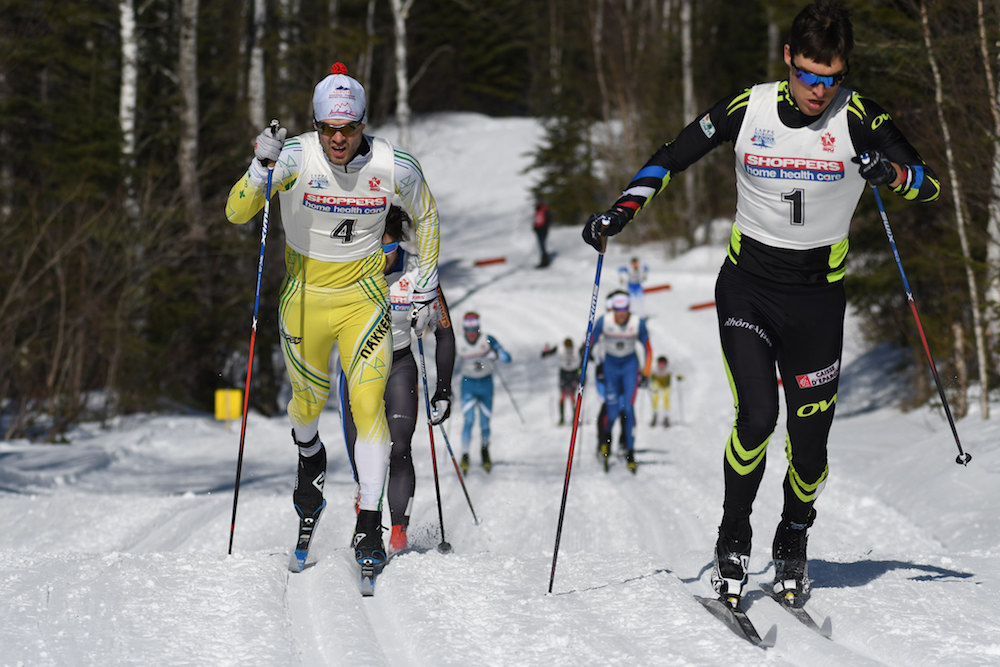
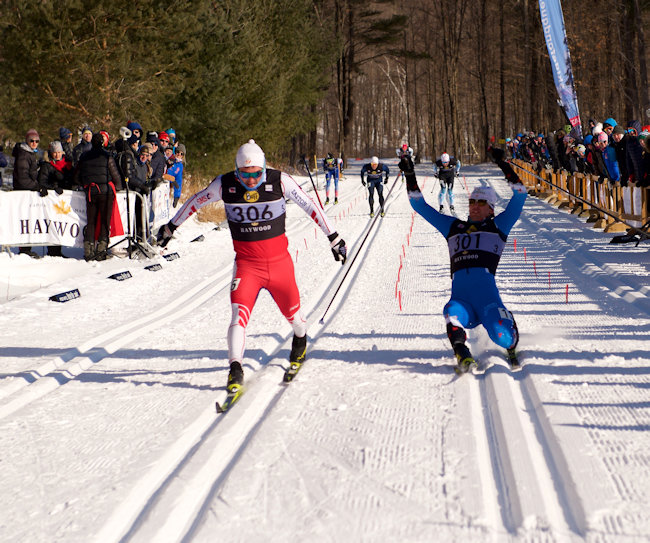
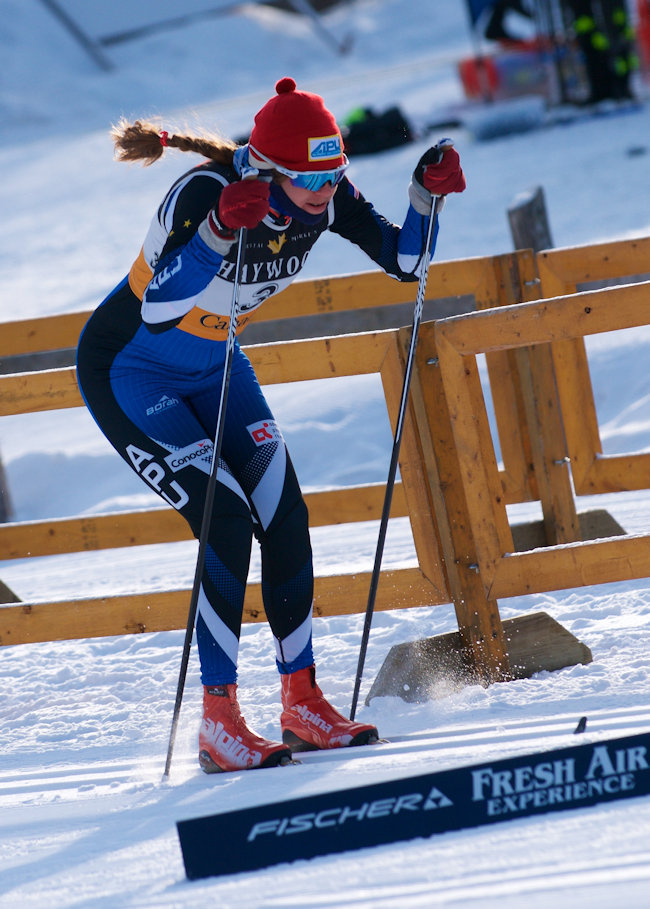
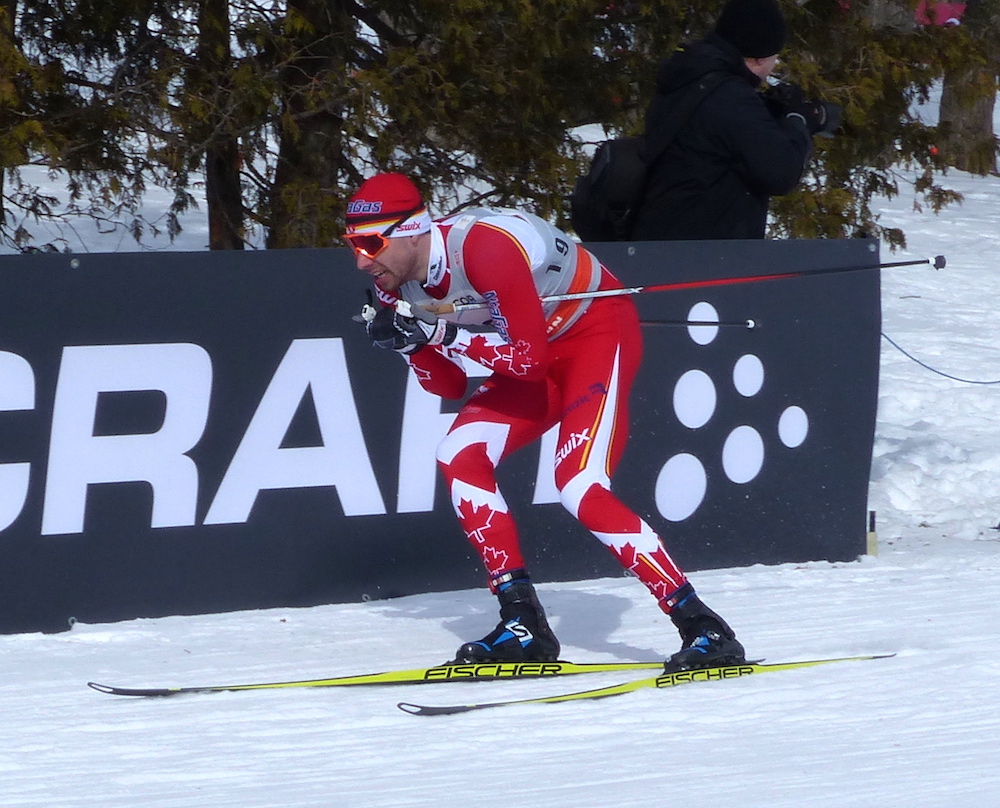
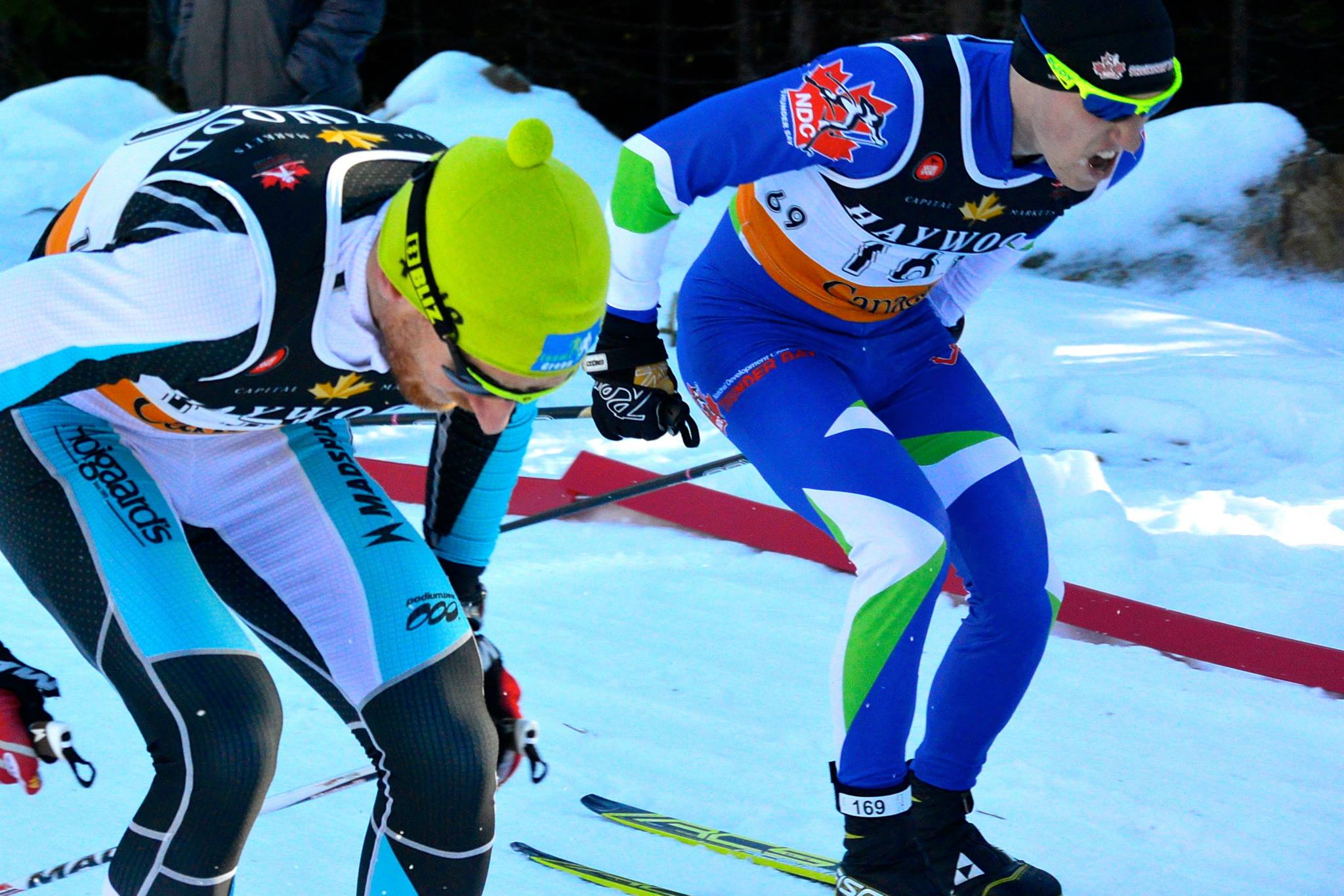
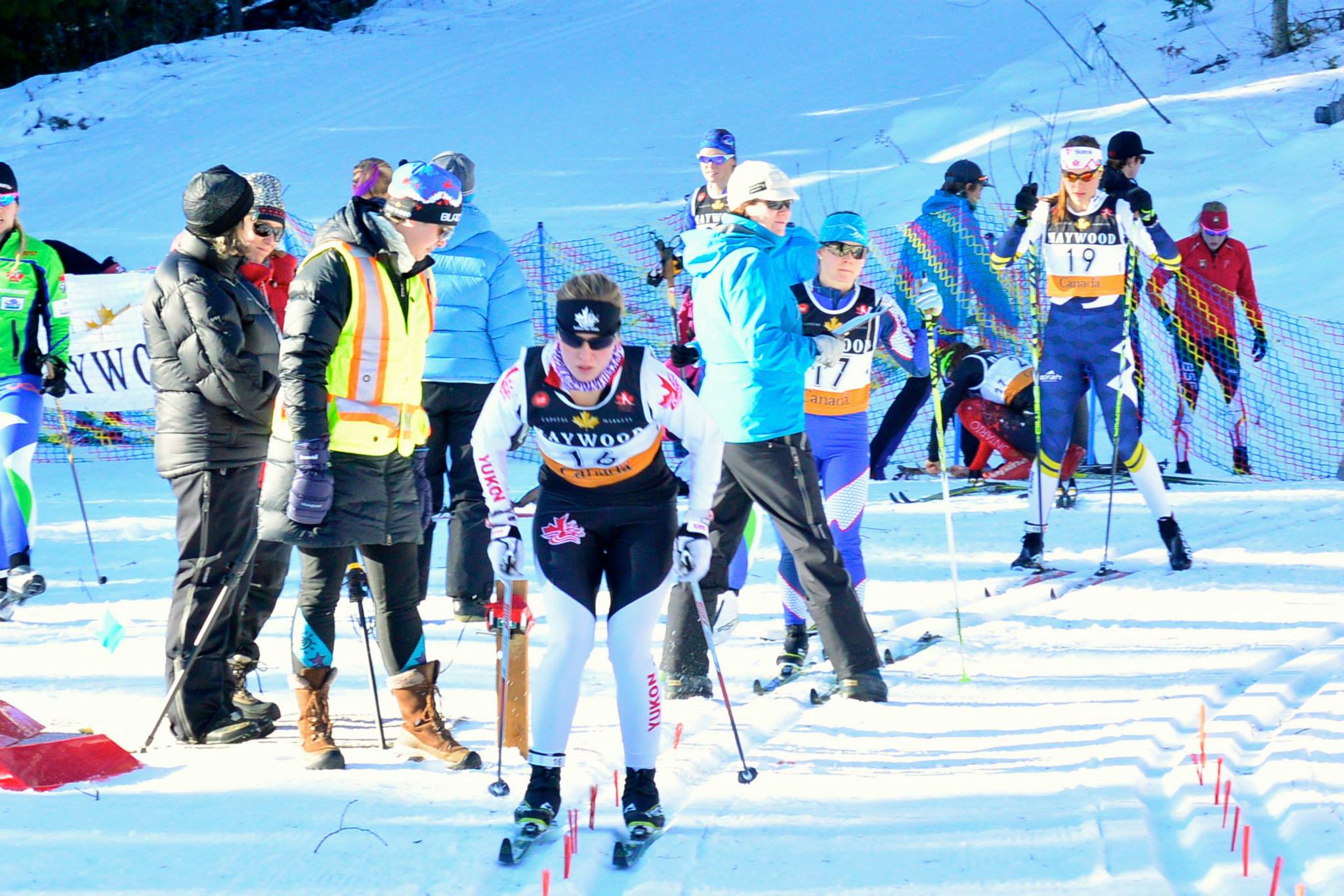
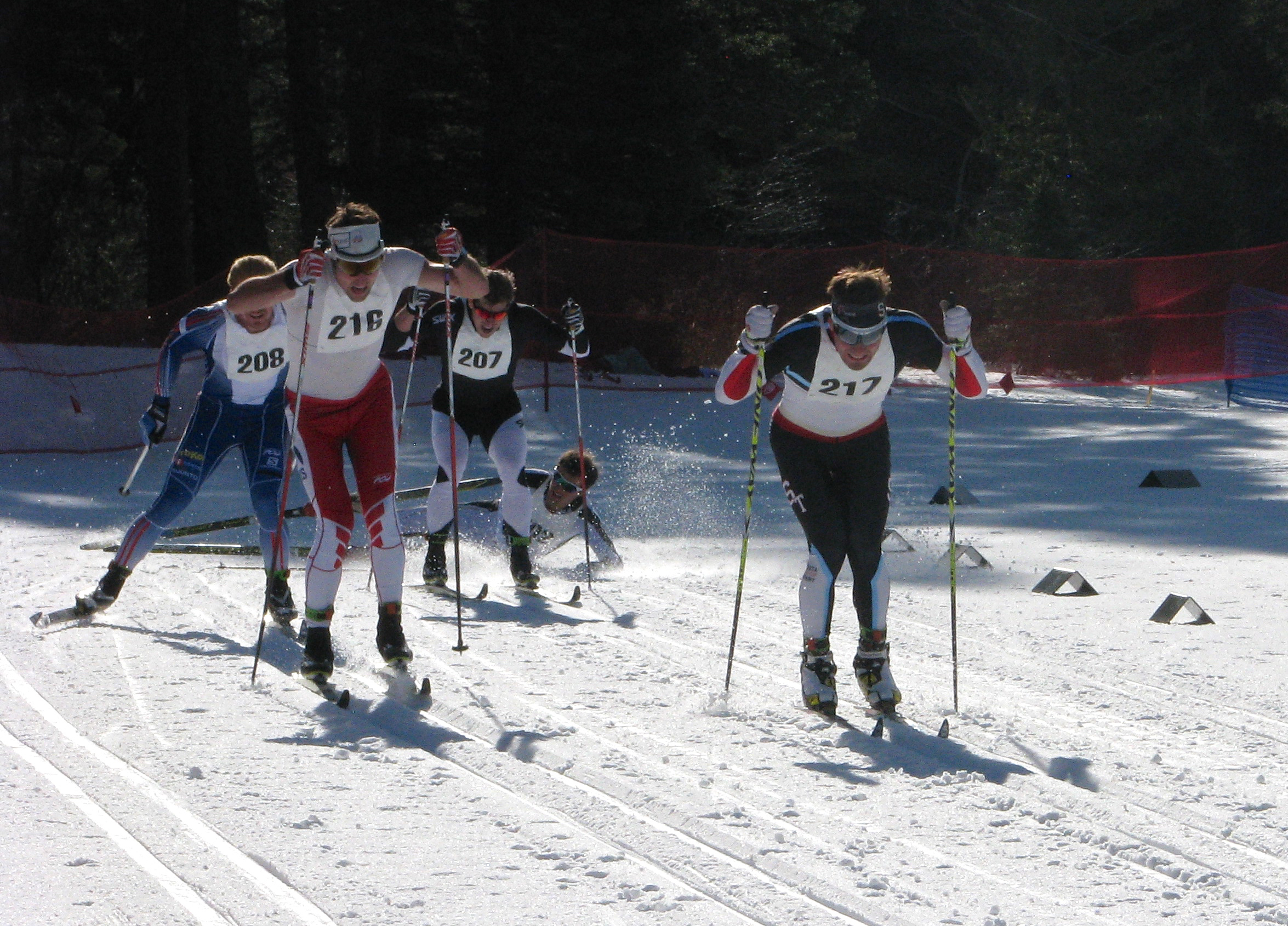
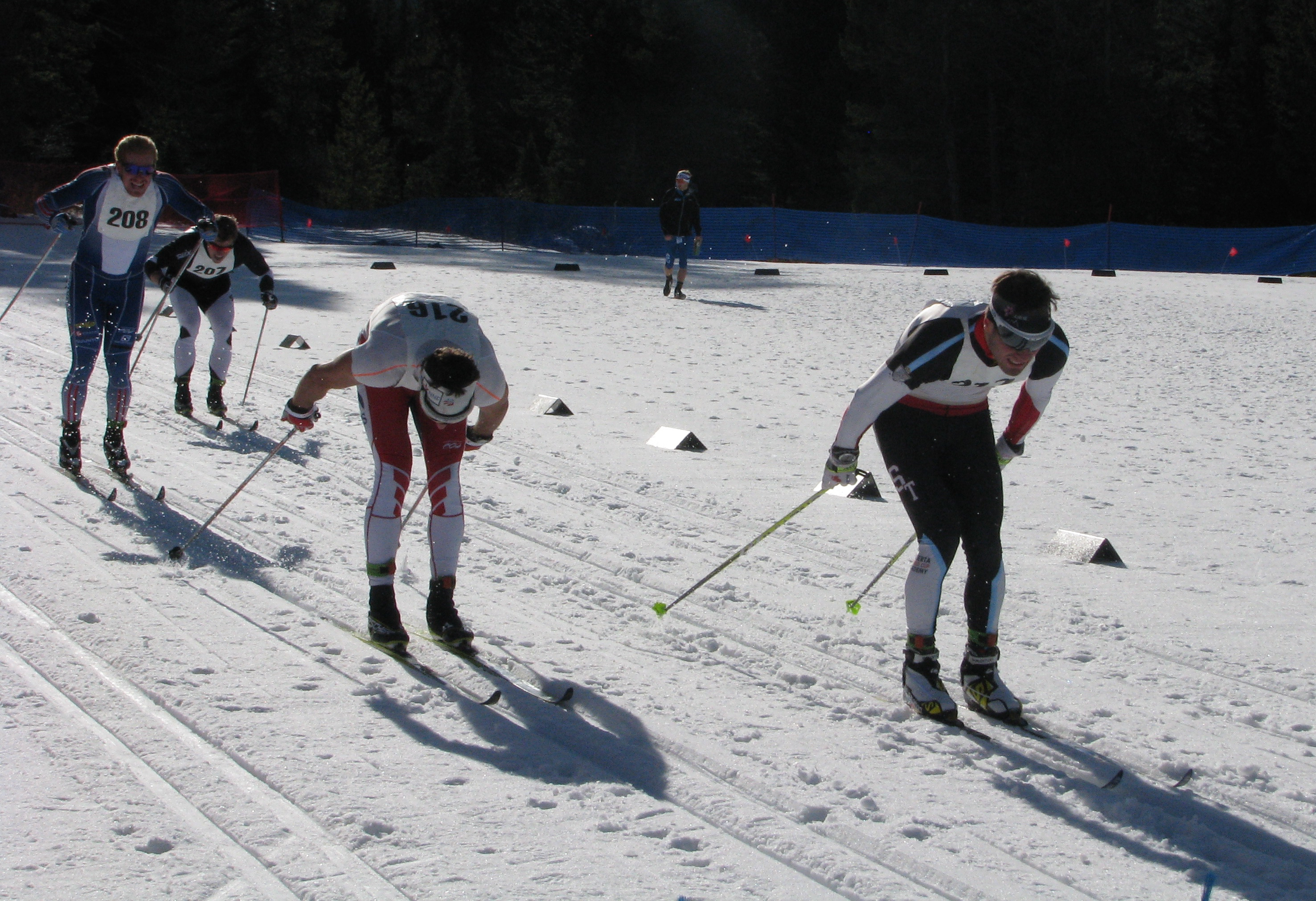
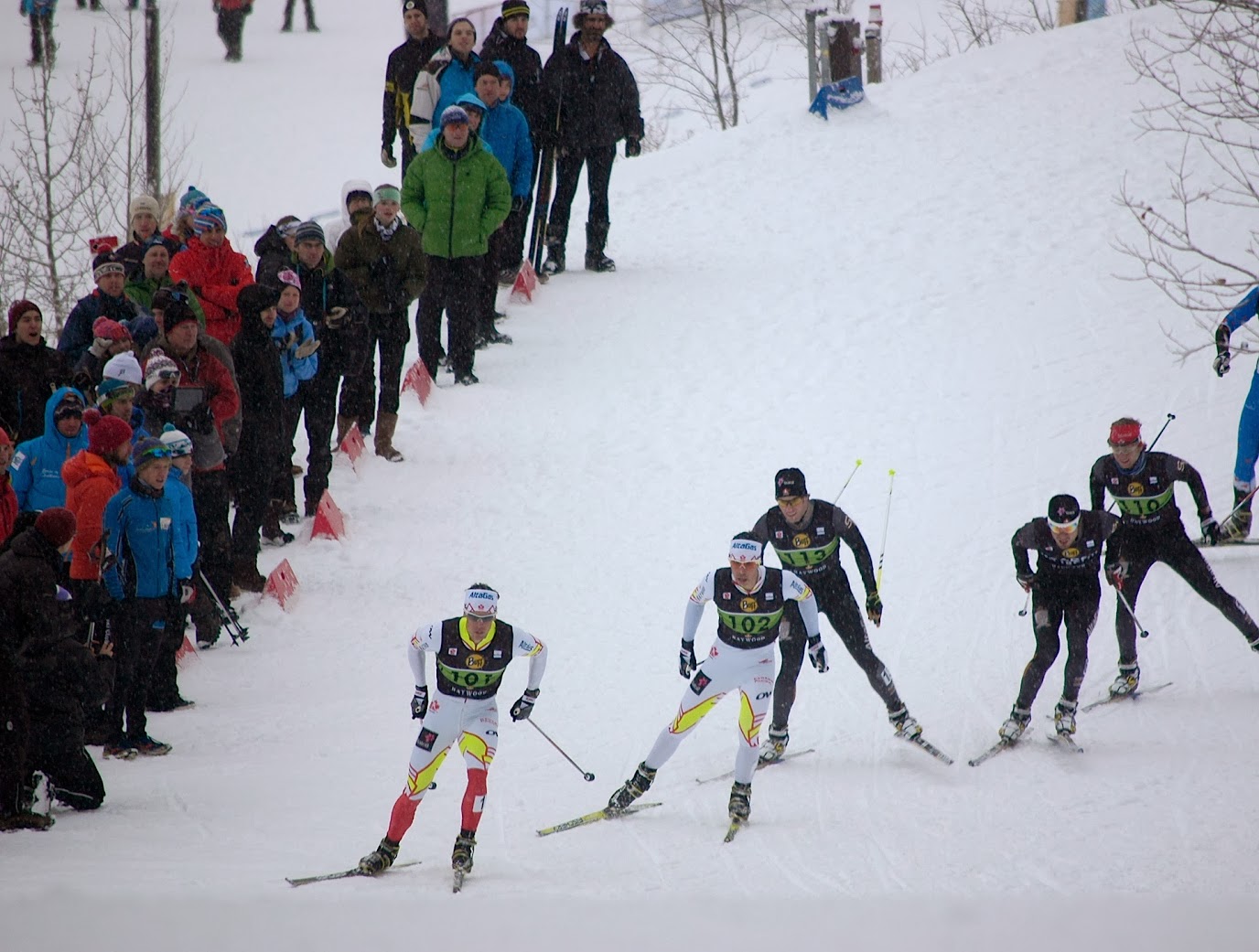
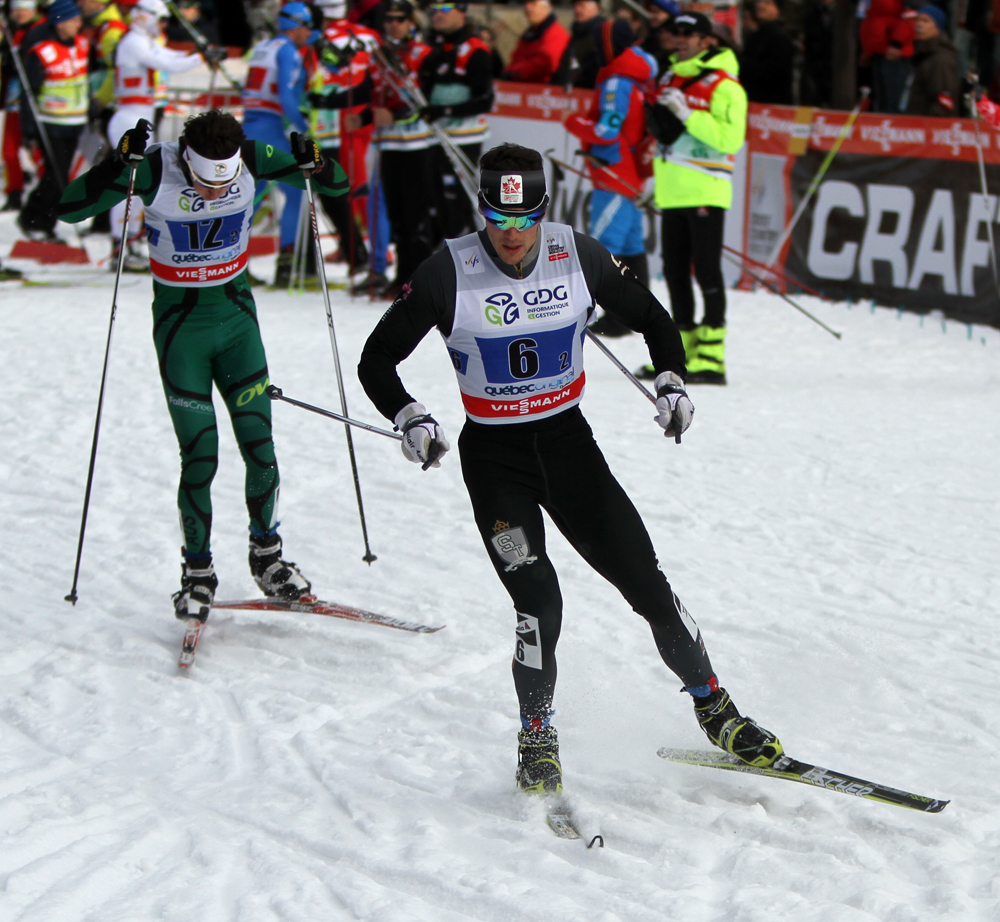
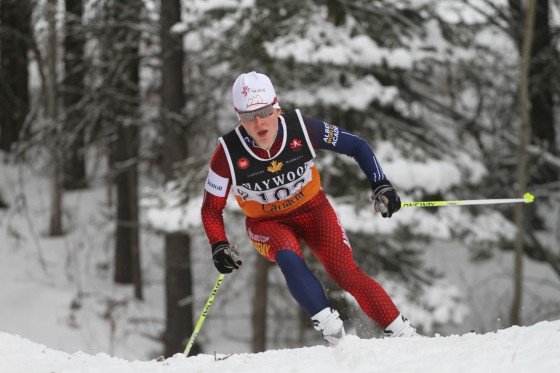
Patrick Stewart-Jones (l), skiing for his club team Nakkertok, and Scott Hill (r) of Barrie Cross Country (BXC) going head to head in the men’s classic team sprint on Saturday at Canadian Ski Nationals in Thunder Bay, Ontario. Nakkertok won and BXC placed second. (Photo: Doug Stephen)
Canadian Ski Nationals (Thunder Bay, Ontario): Team sprints + 5/10 k classic
Canada’s 2018 Ski Nationals opened this past weekend at Lappe Nordic in Thunder Bay, Ontario, with classic team sprints on Saturday followed by 5- and 10-kilometer classic interval starts on Sunday.
Nakkertok topped the podium in both the open men’s and women’s team sprints. In the men’s final, Nakkertok’s Dominique Moncion-Groulx and Patrick Stewart-Jones won by 1.95 seconds over Barrie Cross Country (BXC) in 14:50.79. BXC’s Ryan Jackson and Scott Hill teamed up for second place, and Skibec’s Alexis Morin and Antoine Brand raced to third (+2.57).
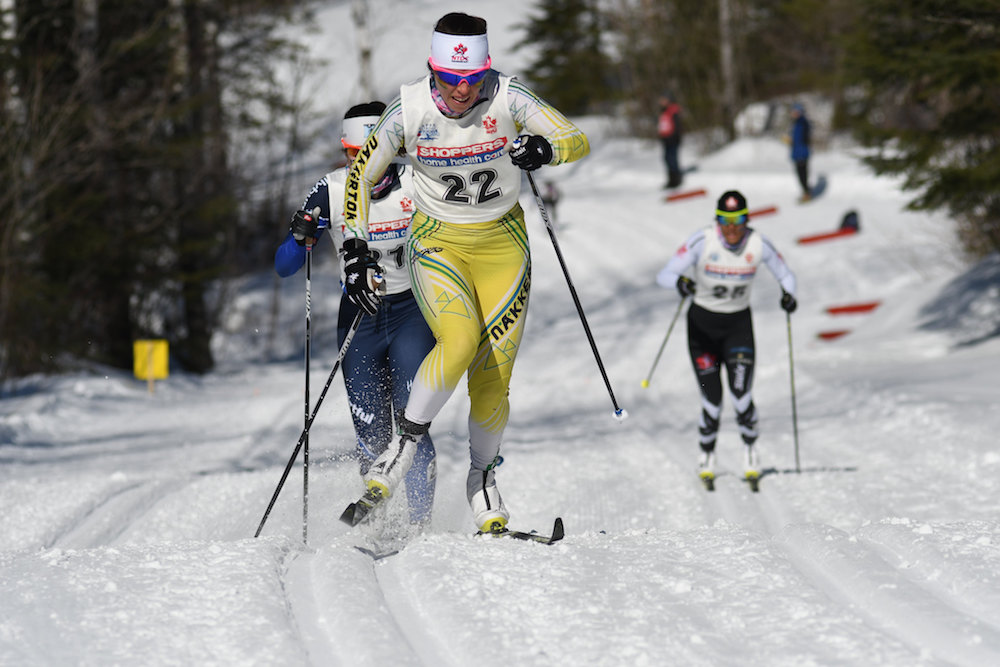
Katherine Stewart-Jones (22), skiing for her club team Nakkertok, while leading Annika Richardson (Hollyburn Ski Club) and Mathilde Petitjean (r) of C.N.M.S.A. during the women’s classic team sprint at 2018 Canadian Ski Nationals in Thunder Bay, Ontario. (Photo: Doug Stephen)
The Stewart-Jones family was also a big winner on Saturday, with Nakkertok’s Zoë Williams and Katherine Stewart-Jones (Patrick’s sister) racing to first in the women’s final in 13:04.72. They finished 2.37 seconds ahead of Katie Weaver and Annika Richardson of the Hollyburn Ski Club in second place, and Marie Corriveau and Mathilde Petitjean of Club Nordique Mont-Sainte-Anne (C.N.M.S.A.) raced to third (+7.42).
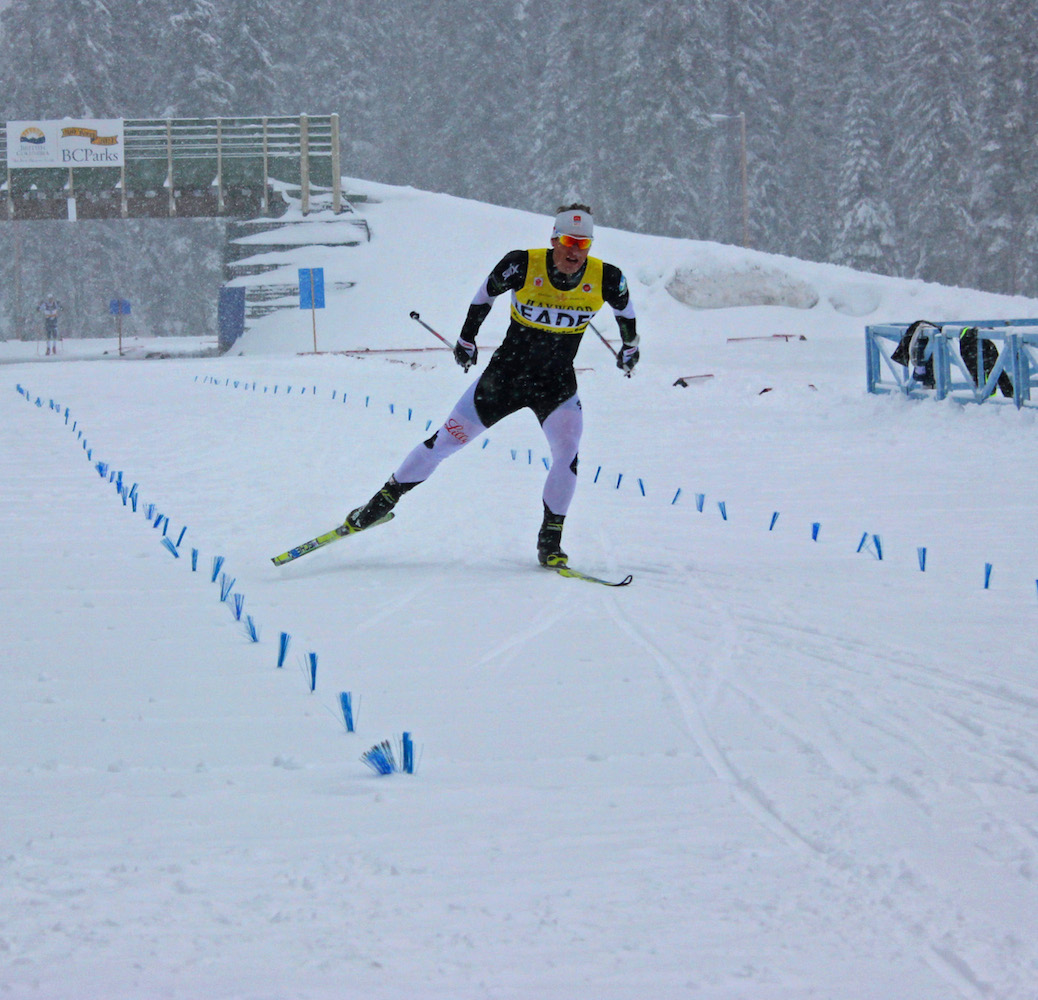
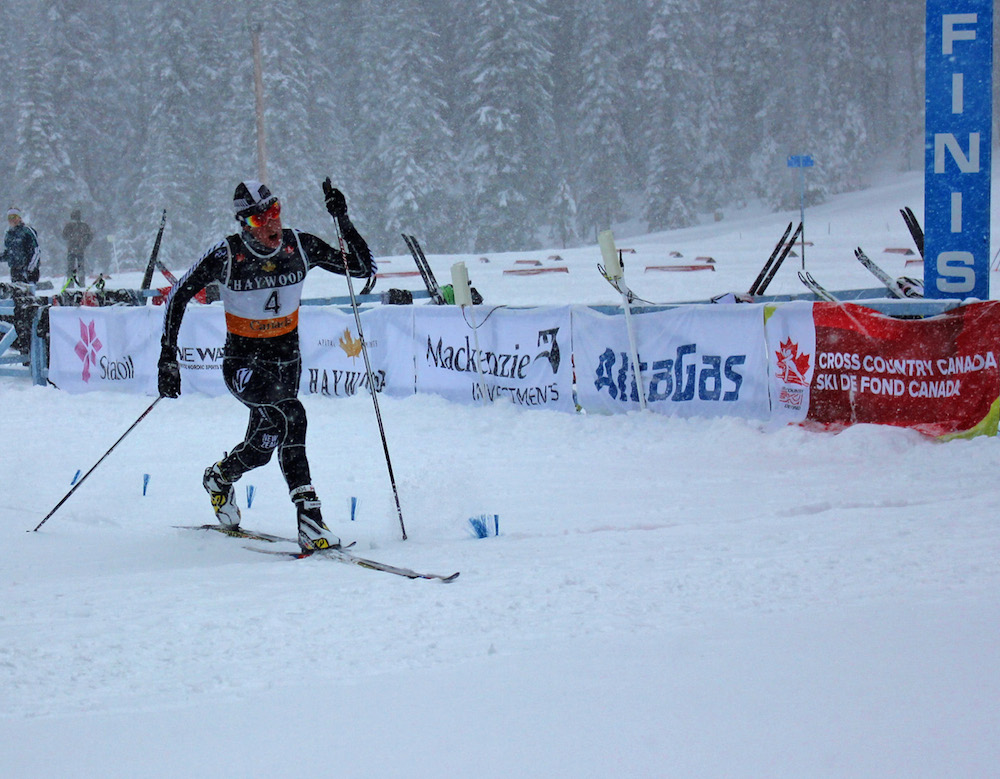
On Day 2 and the first official day of Canadian Ski Nationals, Hill (BXC) took his second-straight win of the weekend, topping the men’s 10 k classic with a time of 26:45.1 for his first senior national title. He finished 7.2 seconds faster than Alexis Dumas, of the Pierre-Harvey National Training Centre (CNEPH) in second, and an early race leader, Knute Johnsgaard of the Canadian World Cup Team, placed third (+12.0)
Johnsgaard clocked the fastest split at the race’s halfway point, while Hill’s 5 k time was almost 10 seconds slower. But over the final 5 k, Hill’s lap time was nearly 22 seconds faster than Johnsgaard’s. Dumas skied a consistent race, with the fourth-fastest first lap and second-fastest second lap.
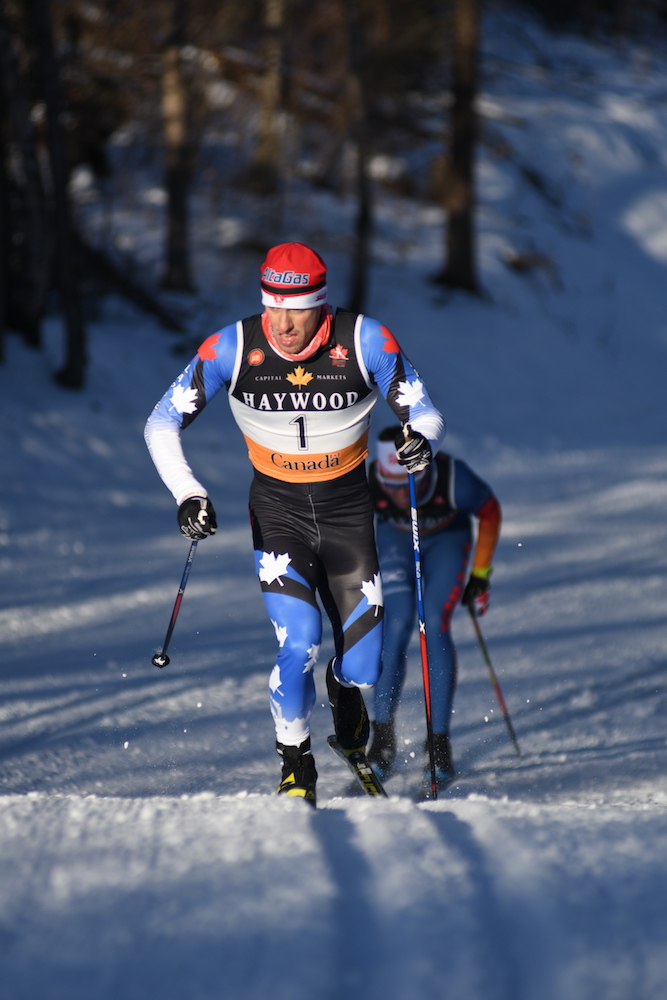
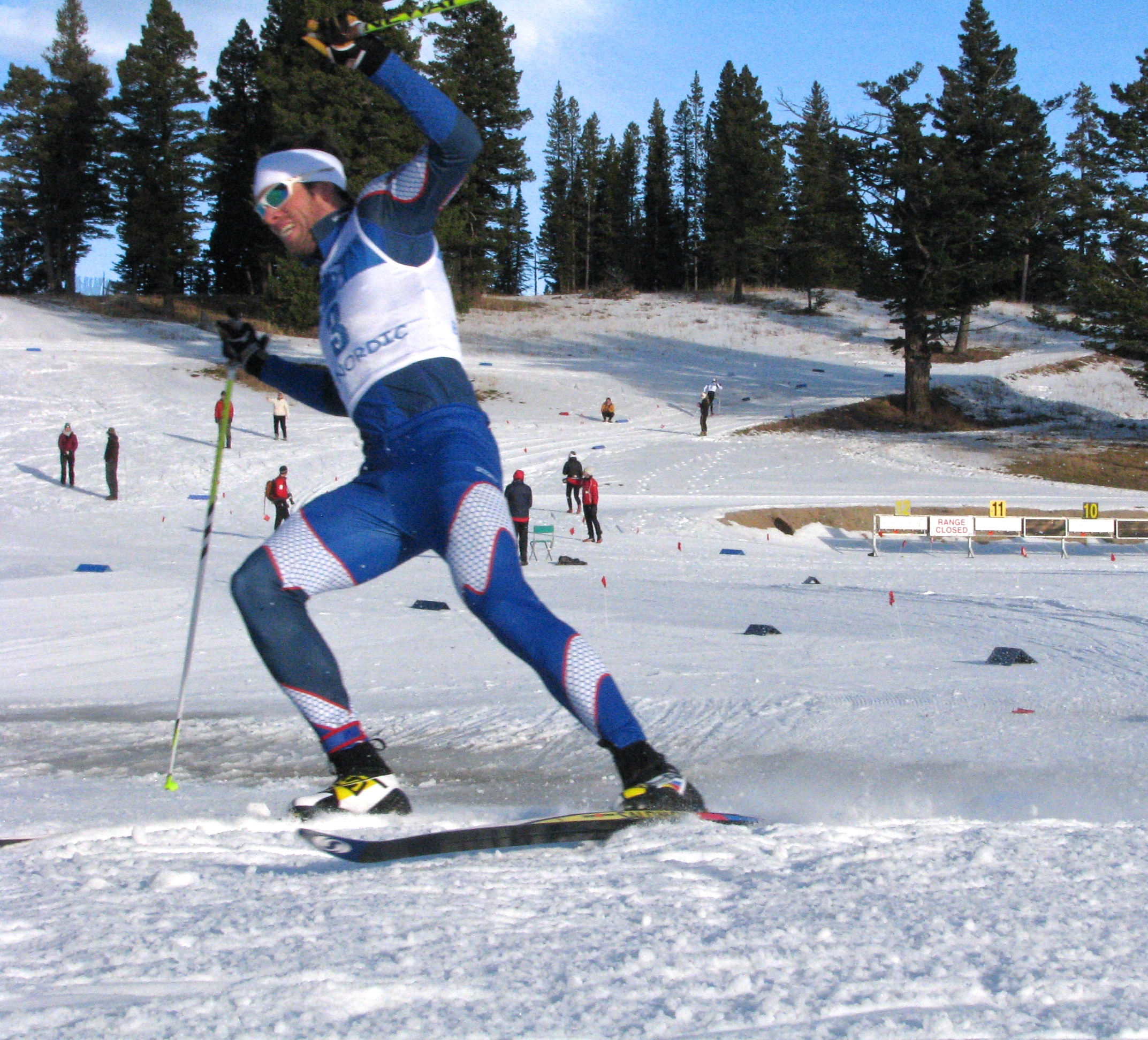
Knute Johnsgaard (Canadian World Cup Team) racing to third in the men’s 10 k classic on Sunday at Canadian Ski Nationals in Thunder Bay, Ontario. (Photo: Doug Stephen)
Jackson (BXC) finished fourth (+14.7), and Jess Cockney of the Alberta World Cup Academy (AWCA) and Canadian World Cup Team placed fifth (+22.2). Leading the National Team Development Centre (NTDC) Thunder Bay on its home trails was Evan Palmer-Charrette in sixth (+24.8), and Lappe Nordic’s Michael Somppi (AWCA) placed seventh (+29.1). Gareth Williams of Telemark Nordic and the Canadian U25 Team finished eighth (+39.5), American Brian Gregg (CXC/Team Gregg/Loppet Nordic Racing) was ninth (+44.7), and Jack Carlyle (AWCA) 10th (+49.5).
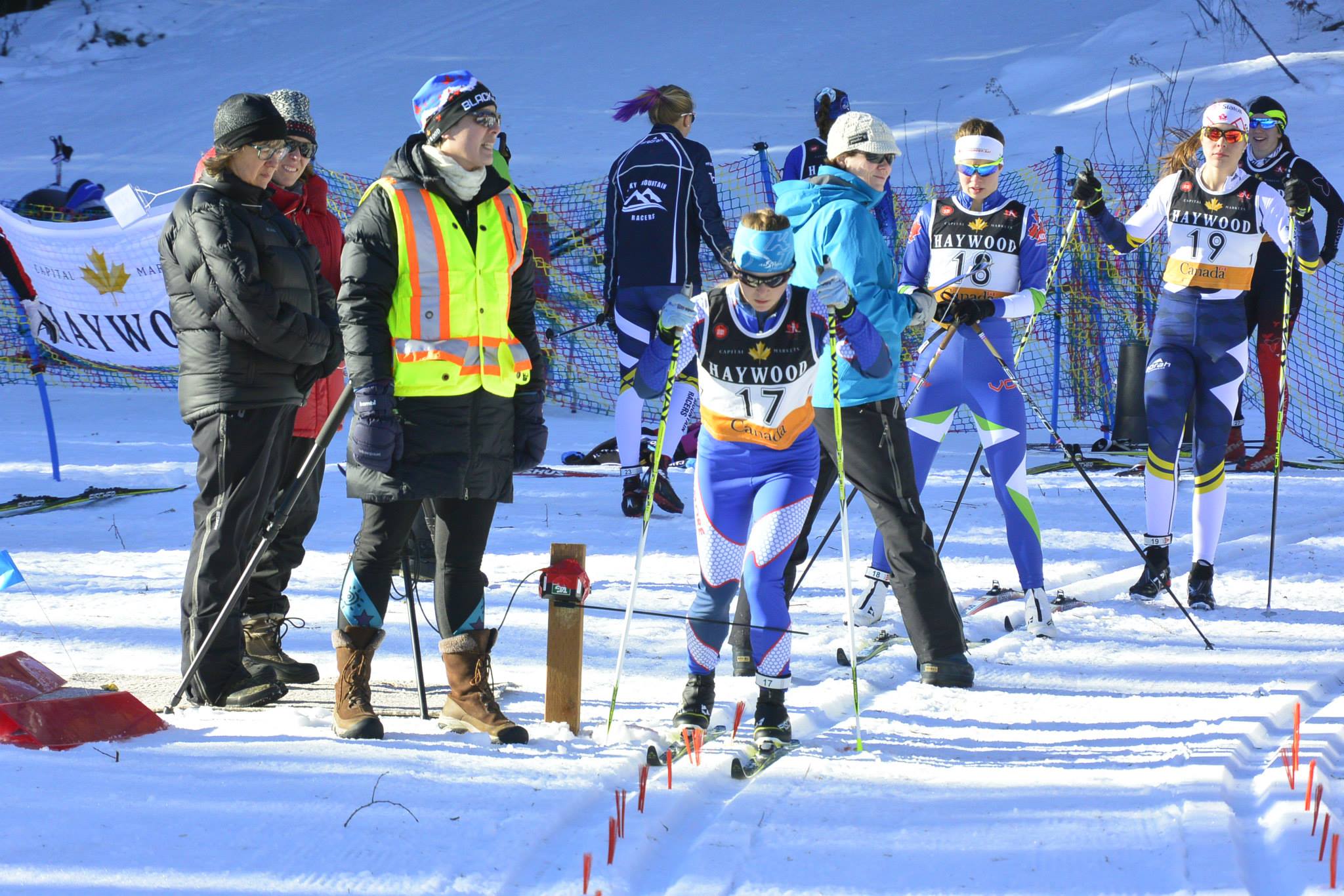
Olivia Bouffard-Nesbitt of Rocky Mountain Racers (RMR) collected her first senior national title with a 13.3-second victory in the women’s 5 k classic. She finished in 15:07.5, ahead of American Caitlin Gregg (CXC/Team Gregg/LNR) in second, while Katherine Stewart-Jones (NTDC Thunder Bay) was the second Canadian and third overall (+17.9).
NTDC Thunder Bay had two in the top four with Alannah Maclean in fourth (+19.8). Annika Hicks (AWCA) followed in fifth (+22.2), Frédérique Vézina (CNEPH) was sixth (+30.8), Sophie Carrier-Laforte (Skinouk) seventh (+33.0), Maya MacIsaac-Jones (RMR/Canadian U25 Team) eighth (+37.4), Laura Leclair (CNEPH) ninth (+58.1), and Williams (Nakkertok) 10th (+1:07.2).
Nationals continue Tuesday with 10/15 k freestyle pursuits, followed by skate sprints on Wednesday and 30/50 k classic mass starts on Saturday.
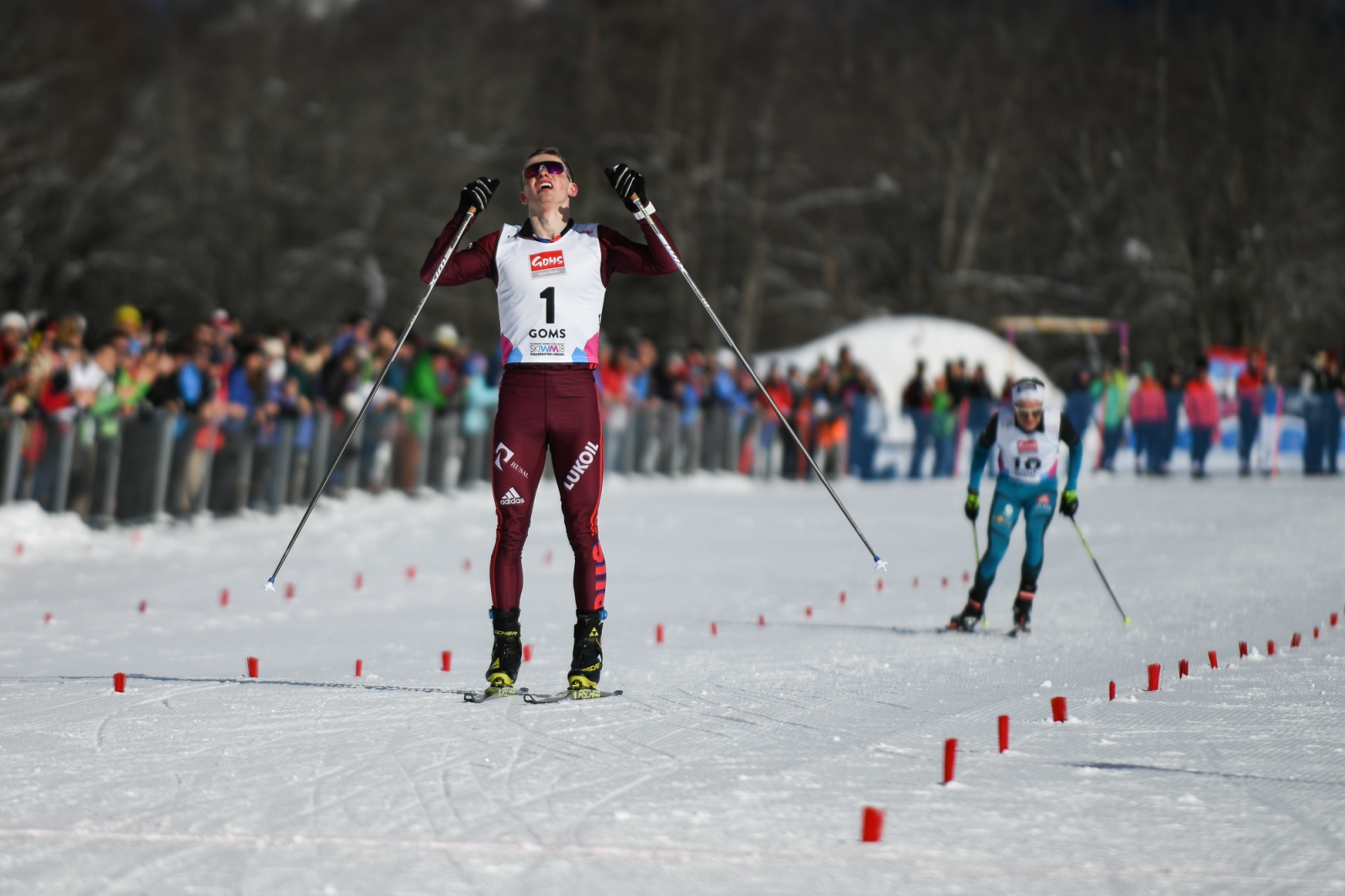
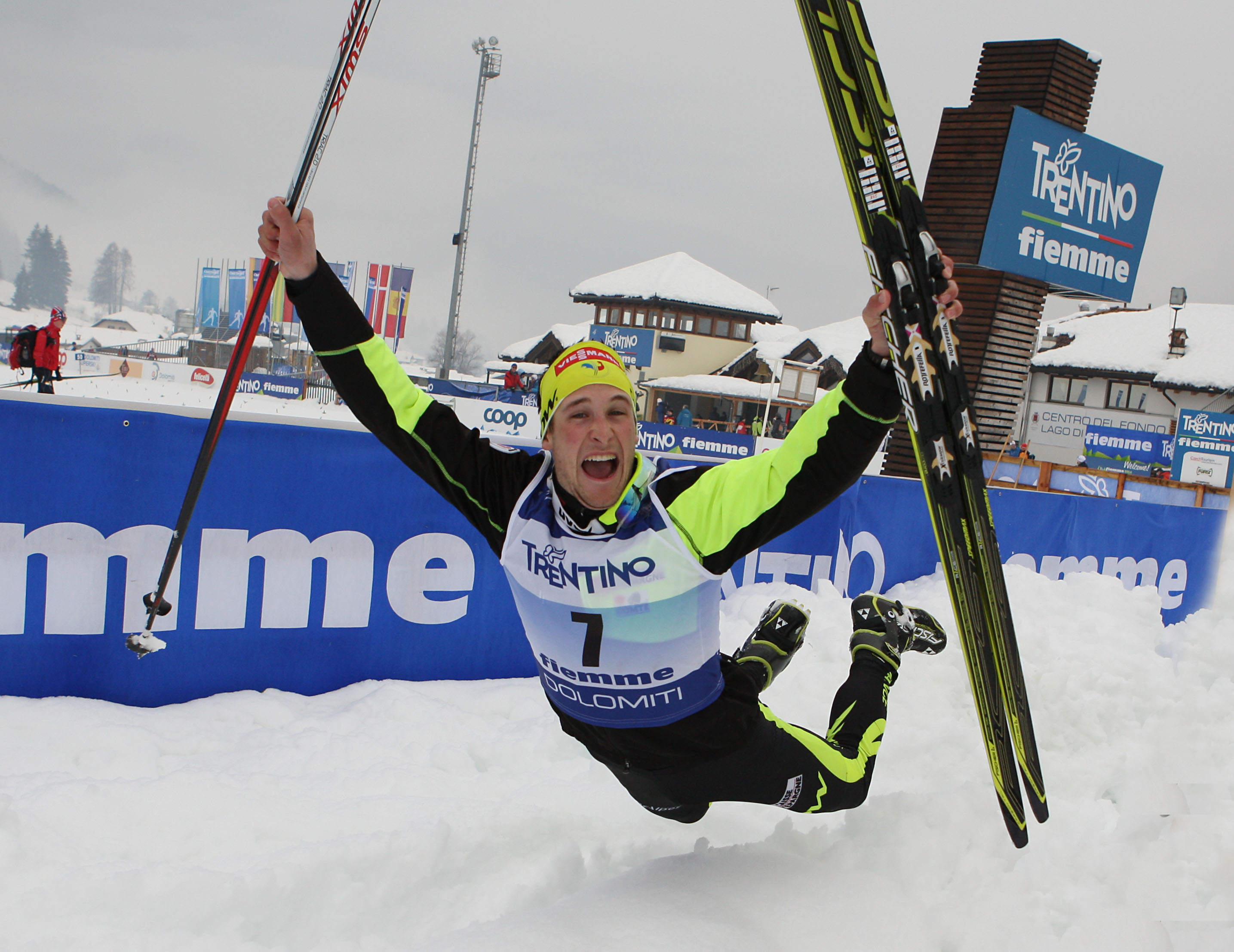
Russia’s Denis Spitsov celebrates his first U23 World Championships gold on Friday ahead of France’s Jules Lapierre in the men’s 30 k skiathlon in Goms, Switzerland. (Photo: JWSC2018.ch)
(Note: This article has been updated to include comments from Americans Lauren Jortberg and Ian Torchia.)
U23 World Championships (Goms, Switzerland): 15/30 k skiathlons
On the final day of U23 World Championships racing in Goms, Russia stole the show in the women’s and men’s skiathlons.
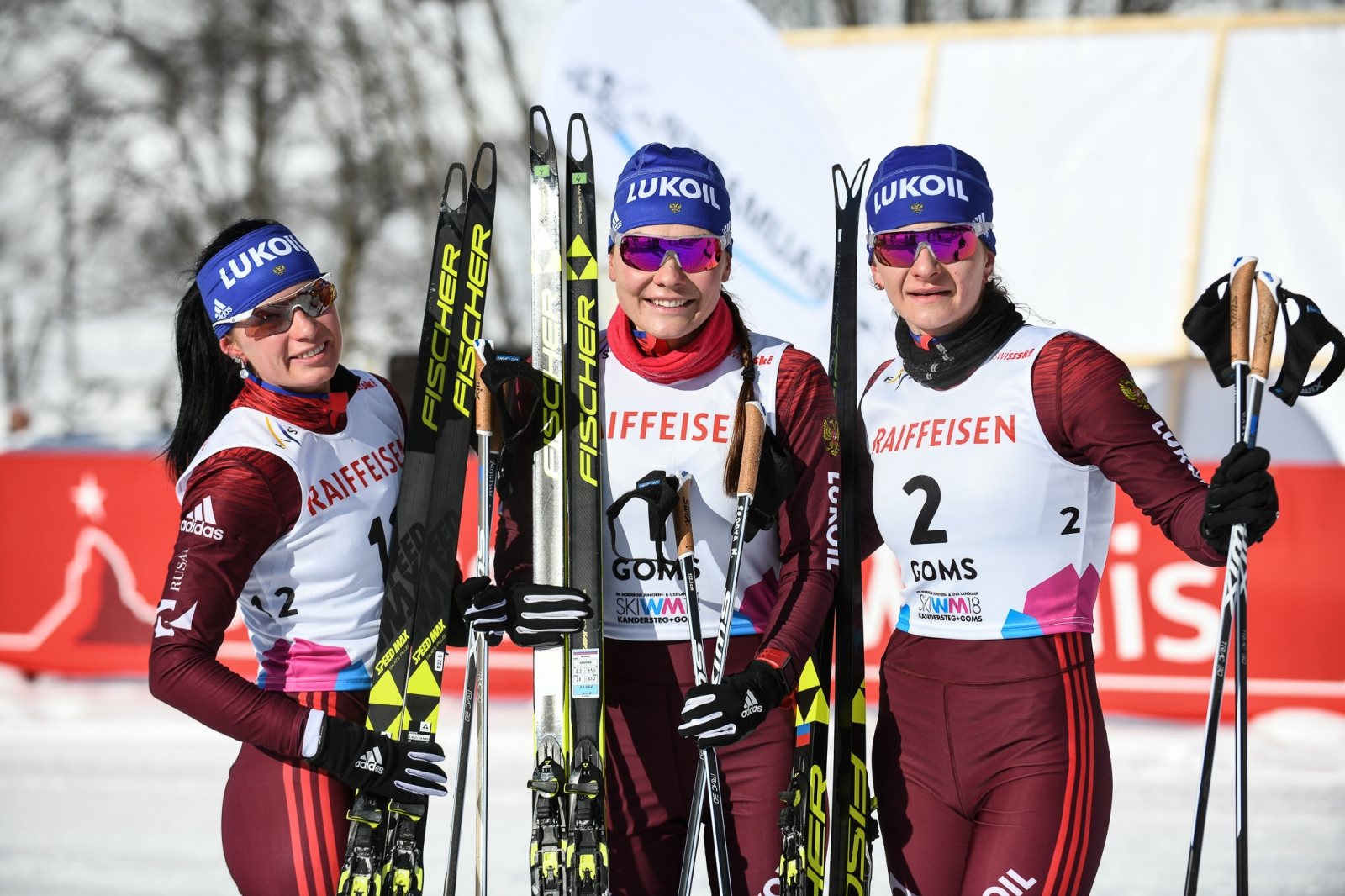
The all-Russian women’s 15 k skiathlon podium at U23 World Championships on Friday in Goms, Switzerland, with Anastasia Sedova (c) in first, Natalia Nepryaeva (l) in second and Yulia Belorukova (r) in third. (Photo: JWSC2018.ch)
Anastasia Sedova led them in the first race of the day on Friday, the women’s 15-kilometer skiathlon, which she won in 44:03.6 minutes. Russia swept the podium and had four in the top five with Natalia Nepryaeva in second (+10.7) and Yana Kirpichenko in third (+37.2), and Yulia Belorukova in fourth (+1:58.0). Germany’s Pia Fink placed fourth (+1:33.5).
The race was the first of the week for the 22-year-old Sedova, a World Cup regular, and it was her second individual gold medal at her second U23 World Championships (she won the 10 k classic in 2016).
“Good preparation for the Olympic Games,” Sedova said during an in-arena interview after the race. “I am very lucky today. Good atmosphere, good weather today.”
Kirpichenko won the 10 k classic earlier this week and Nepryaeva placed third in the freestyle sprint in Goms.
“It’s hard to say how to describe the race, but Anastasia is a really good skier,” Nepryaeva said after. “She was really good today. So for me it was hard to support her during the race. Today she was much better than me.”
American Lauren Jortberg (Dartmouth Ski Team) led the North Americans in 29th (+5:29.9) for her best distance result at the Junior/U23 World Championships level.
“Early in the race I was right over 30th place, and I was trying to maintain contact with the big group ahead of me,” Jortberg, a Dartmouth sophomore from Boulder, Colorado, wrote in an email. “The pace of the classic leg was really fast. A couple of the girls in the race are heading to the Olympics in a few days so it was a really hot start!”
She came through the transition at the race’s halfway point in 31st, about 3:47 behind the leaders.
“I am a much better skater so I felt like I really put the hammer down on the skate leg and moved up a lot,” Jortberg wrote. “The skate course was much easier than the classic course, but I feel like I skied the massive climbs better than the girls around me. I focused on having a really high tempo over the hills and skiing the downhills technically well because there was no rest on the course.
“I’m pleased with my performance today, and I’m excited about my results this week as a whole,” she added. “I’m definitely leaving here hungry for more because I don’t think it was my best week, but I think it was really solid. This is the most competitive field I’ve ever raced against so it feels really good to know that I’m not too far off their level!”
Also for the U.S., Lydia Blanchet placed 38th (+7:11.1) and Nicole Schneider was 40th (+8:04.3). Julia Kern did not finish.
Canada’s Katherine Stewart-Jones (Canadian National U25 Team/NTDC Thunder Bay) placed 31st (+5:39.0) and Maya MacIsaac-Jones was 42nd (+8:08.8), while Laura Leclair and Sophie Carrier-Laforte were lapped.
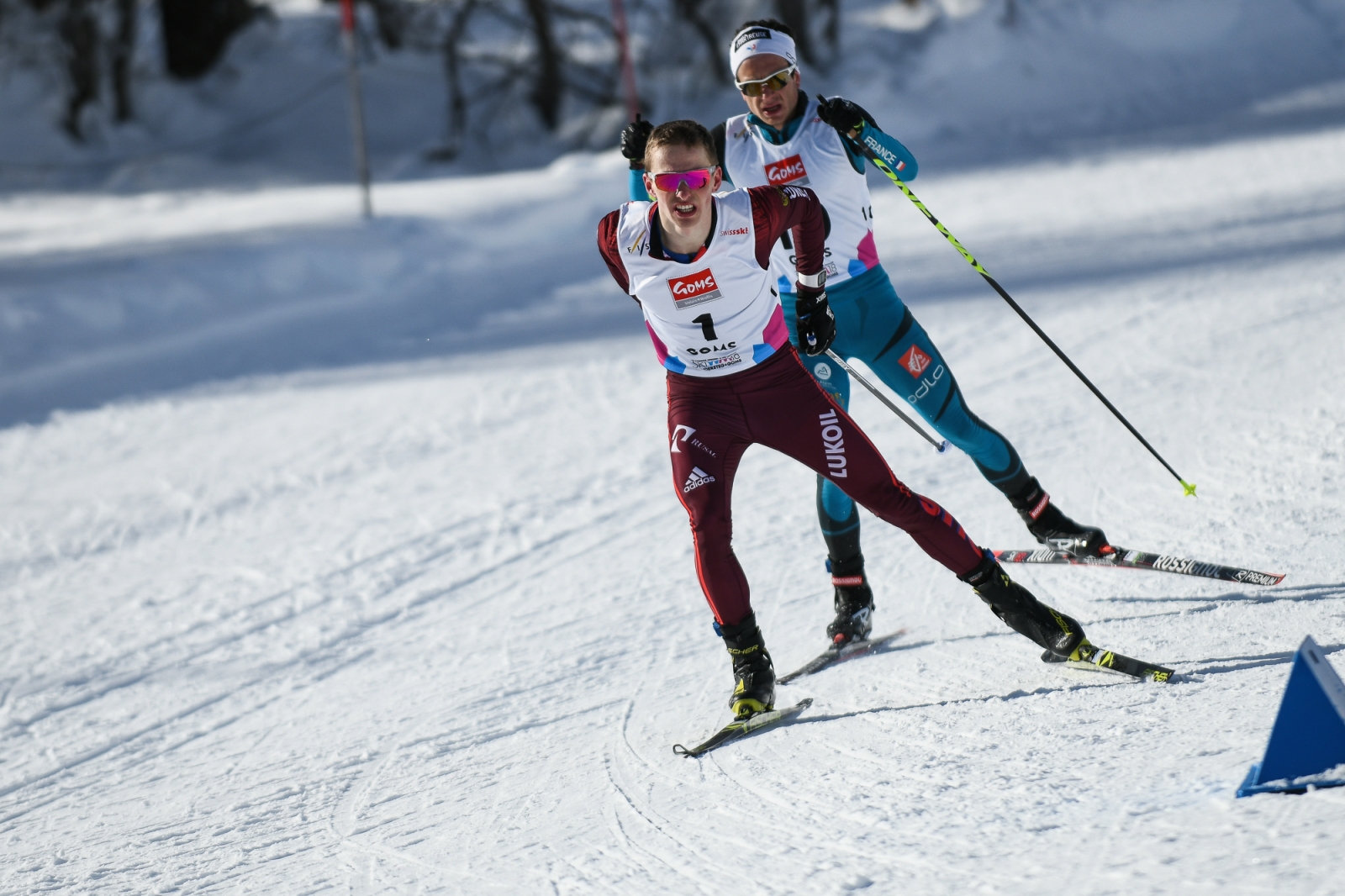
Russia’s Denis Spitsov leads France’s Jules Lapierre during the men’s 30 k skiathlon on Friday at 2018 U23 World Championships in Goms, Switzerland. Spitsov went on to win by 2.9 seconds over Lapierre. (Photo: JWSC2018.ch)
In the men’s 30 k, Russia’s Denis Spitsov took the win in 1:18:14.9 hours, just 2.9 seconds ahead of France’s Jules Lapierre. Norway’s Ole Jørgen Bruvoll placed third (+21.5), ahead of Russia’s Ivan Yakimushkin in fourth (+23.2), and Andorra’s Irineu Esteve Altimiras in fifth (+36.4).
The gold was the first for Spitsov, 21, who previously placed second in the 15 k classic earlier this week. He has two individual bronze medals from last year’s U23 Worlds (in the 30 k skiathlon and 15 k freestyle).
American Ian Torchia (U.S. Ski Team/Northern Michigan University) placed 27th on Friday (+6:05.7). Only 33 men finished, and he was the only North American that didn’t get lapped.
“Between the 3700 feet of climbing, a 2.5km loop, and the top dogs having World Cup podiums…half the field got lapped,” Torchia wrote in an email. “Definitely added some motivation in the final 2 laps to see Spitsov and Lapierre slowly catching up.
“I felt I skied technically better in skate and struggled on the classic leg,” Torchia explained. “Took a hard tumble halfway through the classic leg and had to take half a lap to recover from that. Found a hole in my suit close to my groin afterward which was a little unnerving!”
At the end of the week, he noted that he felt “more fired up than coming in. Funny how being 6 minutes back can do that,” he wrote. “It was an eye-opening experience to get back on the international stage after 2 years and I will take these lessons of racing to the rest of the season in the Ishpemimg Super Tour, Steamboat NCAA’s, and Craftsbury Spring Series. Also already thinking of ideas on how to change and optimize my training to make the jump to the top level.”
Americans Andrew Egger, Zak Ketterson and Thomas O’Harra also competed, as did Canada’s Alexis Dumas, Gareth Williams, Philippe Boucher, and Ricardo Izquierdo-Bernier.
Stratton’s Ben Saxton (l) edging Julien Locke (r) by eight-hundredths of a second for the win in the men’s 1.4 k classic sprint A-final on Friday at Eastern Canadian Championships in Gatineau, Quebec. (Photo: Becca Rorabaugh (APU) on her way to winning the women’s 1.3 k classic sprint qualifier on Friday at 2018 Eastern Canadian Championships in Gatineau, Quebec. (Photo: Rob Smith/CCC)
NorAm Eastern Canadian Championships (Gatineau, Quebec): Classic sprints
Eastern Canadian Championships opened in Gatineau on Friday with classic sprinting, and Americans Becca Rorabaugh and Ben Saxton ended the day with wins in the women’s and men’s A-finals, respectively.
Becca Rorabaugh (APU) on her way to winning the women’s 1.3 k classic sprint qualifier on Friday at 2018 Eastern Canadian Championships in Gatineau, Quebec. (Photo: Rob Smith/CCC)
For Rorabaugh, the win is her second straight after the Alaska Pacific University (APU) skier won the women’s 5-kilometer freestyle at last weekend’s SuperTour in Craftsbury, Vermont. She edged last weekend’s classic-sprint winner, Kaitlynn Miller, of the Craftsbury Green Racing Project (CGRP), by 0.41 seconds for the win in 3:23.15 minutes in Friday’s 1.3 k classic sprint final. It was an all-American podium (and all-American final) with Erika Flowers, of the Stratton Mountain School (SMS) T2 Team, just another three-hundredths of a second back in third (+0.44). Liz Guiney (CGRP) followed in fourth (+2.51), Rosie Frankowski (APU) was fifth (+3.88), and Corey Stock (Bridger Ski Foundation) placed sixth (+6.1).
Rorabaugh had started the day by qualifying first in 3:26.95, then won both her quarterfinal and semifinal. Miller qualified third and won her quarterfinal and semifinal as well.
In the men’s 1.4 k classic sprint, Saxton (SMST2) nipped Julien Locke (Canadian U25 Team/Black Jack) at the line by 0.08 seconds for the win in 3:04.54. Patrick Stewart-Jones (Alberta World Cup Academy) placed third (+5.53), Kris Freeman (Caldwell Sport) was fourth (+5.94), Kevin Bolger (Sun Valley Ski Education Foundation) fifth (+7.42), and Julian Smith (NTDC Thunder Bay) sixth (+11.63).
Locke initially won the qualifier in 3:08.37, then won the first quarterfinal and first semifinal as well. Saxton qualified sixth, then advanced in second in his quarterfinal about a second behind Smith, and Saxton won the second semifinal.
Easterns continue Saturday with 10/15 k freestyle races and conclude Sunday with 10/15 k classic pursuits.
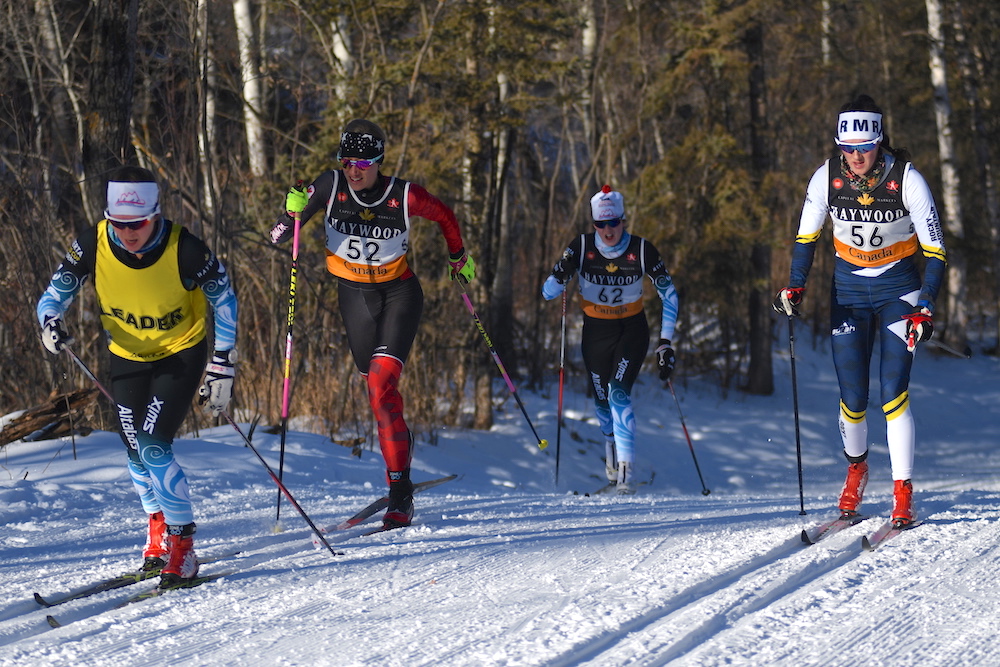
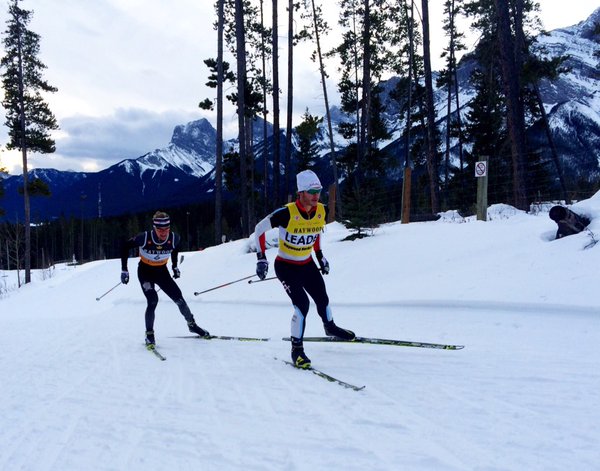
Annika Hicks in the yellow NorAm leader’s bib leads Zina Kocher (52), Olivia Bouffard-Nesbitt (56) and Laurence Dumais (62) in the women’s 10 k classic mass start at Western Canadian Championships on Saturday in Red Deer, Alberta. Hicks went on to win by 2.5 seconds over Bouffard-Nesbitt. (Photo: Doug Stephen)
Western Canadian Championships (Red Deer, Alberta): 10/15 k classic mass starts
On Day 2 of the NorAm Western Canadian Championships in Red Deer, Andy Shields of Lappe Nordic won the men’s 15-kilometer classic mass start and Annika Hicks of the Alberta World Cup Academy (AWCA) topped the women’s 10 k classic mass start.
Andy Shields (1) leads Russell Kennedy during the men’s 15 k classic mass start at Western Canadian Championships on Saturday in Red Deer, Alberta. Shields went on to win by 9 seconds over Kennedy. (Photo: Doug Stephen)
Shields won the open men’s race by 9.4 seconds in 40:14.4, while Russell Kennedy (Team R.A.D.) placed second for the second-straight day. Scott Hill, of Barrie Cross Country (BXC), reached the podium in third, 14 seconds out of first.
Friday’s freestyle sprint winner, Jess Cockney (Canadian World Cup Team) placed fourth (+48.5), Michael Somppi (AWCA) followed in fifth (+49.4), and Jack Carlyle (AWCA) was sixth (+52.4). Just 0.1 seconds after Carlyle, Remi Drolet (Black Jack) was the top junior in seventh overall (+52.5), Sam Hendry (Team R.A.D.) was the second junior in eighth (+52.9), Patrick Stewart-Jones (AWCA) finished ninth (+55.0), and Antoine Hebert (AWCA) 10th (+55.2).
The open women’s race was closer in the race for first place, with Hicks capturing her first NorAm win in 28:51.0, 2.5 seconds ahead of Olivia Bouffard-Nesbitt (Rocky Mountain Racers) in second. All three women that reached the podium in Friday’s sprint returned to it on Saturday, with Zina Kocher (Foothills Nordic) placing third (+23.8). (On Friday, Bouffard-Nesbitt won ahead of Kocher in second and Hicks in third.)
Laurence Dumais (AWCA) finished fourth on Saturday (+58.4), Kaia Andal (Caledonia Nordic) was the top junior in fifth overall (+1:07.6), Molly Miller (Black Jack) finished sixth (+1:08), Alana Brittin (Revelstoke Nordic) seventh (+1:24.4), Amanda Thompson (Whitehorse Ski Club) eighth (+1:26.6), Paiga Latta (Sovereign Lake Nordic) ninth (+1:48.6), and Beth Granstrom (Revelstoke Nordic) 10th (+1:50.3).
Western Canadian Championships conclude Sunday with freestyle relays (women’s 3 x 3.75 k and men’s 3 x 5 k).
FIS Cross-Country World Cup (Planica, Slovenia): Classic Sprints
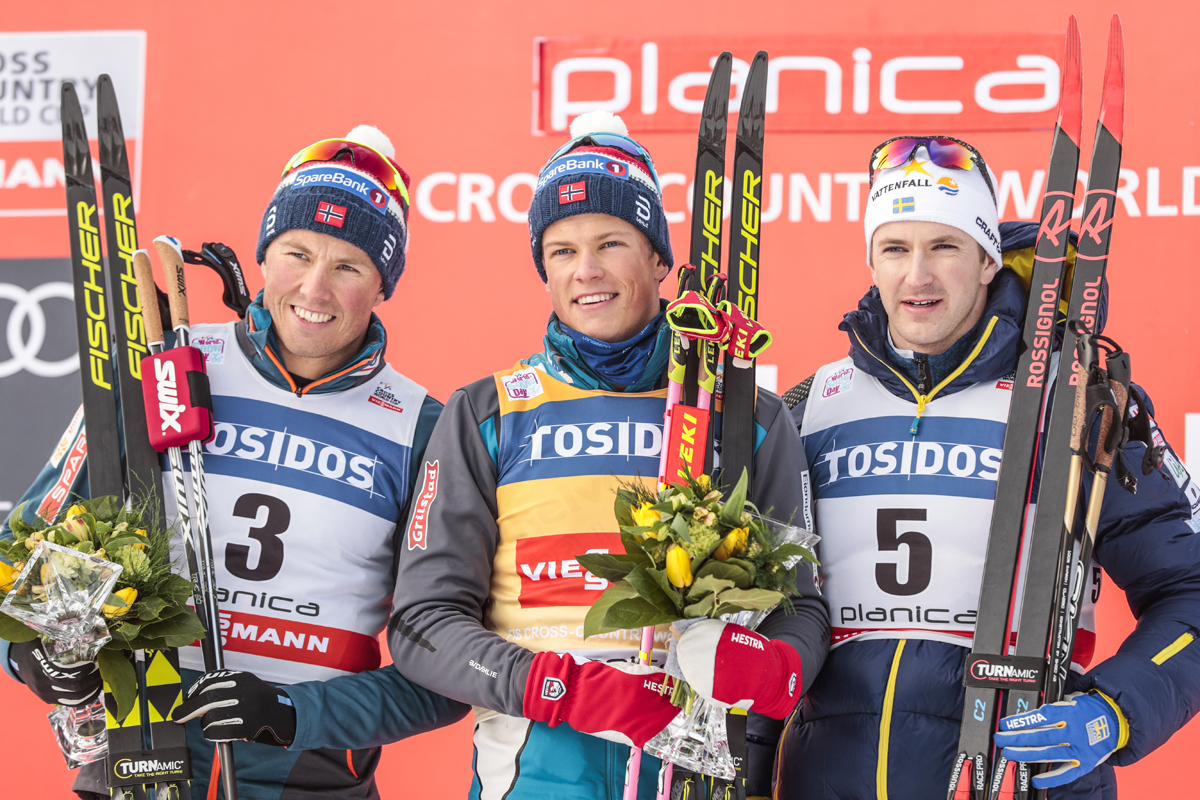
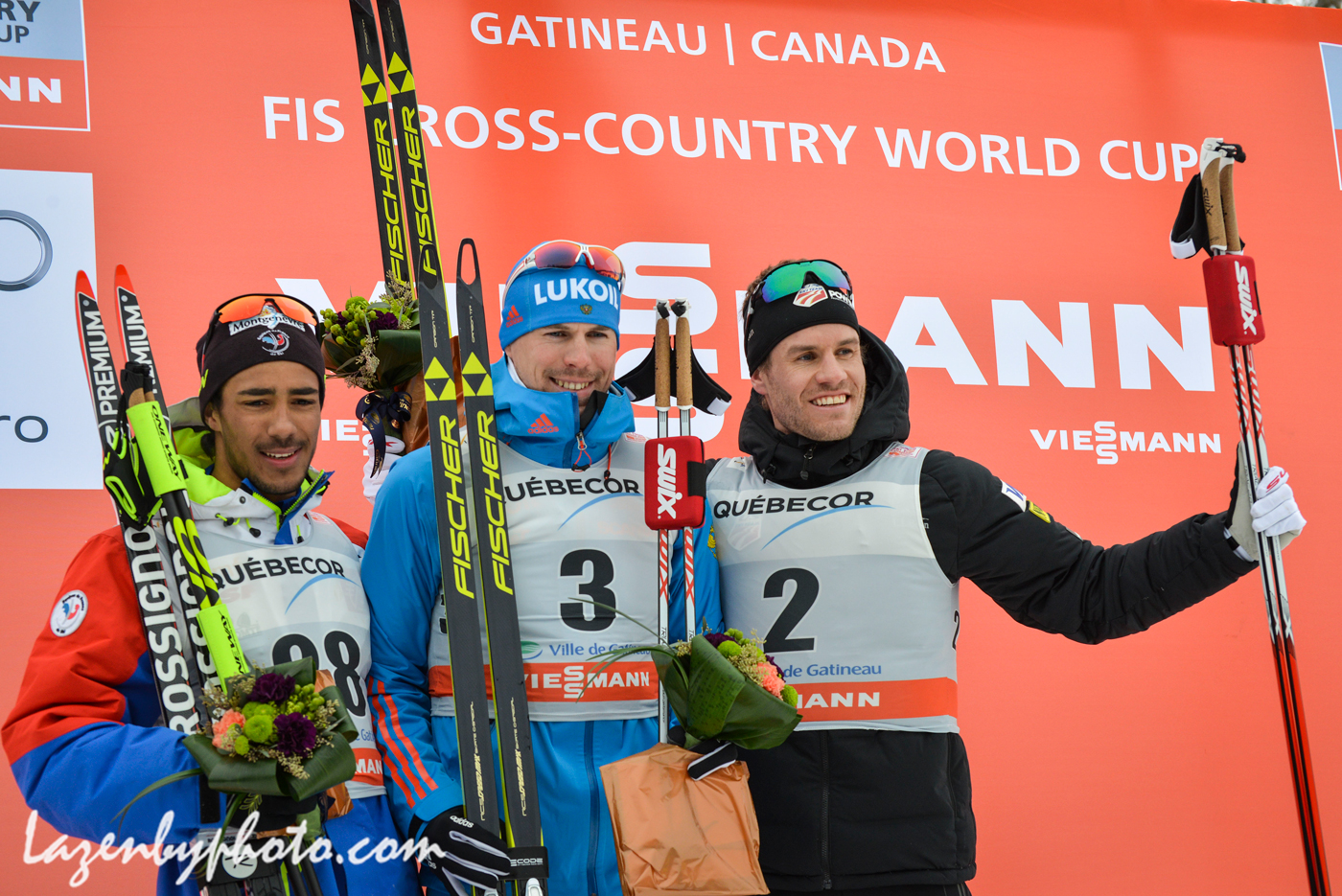
The men’s classic sprint podium at the World Cup in Planica, Slovenia, on Saturday, with Norway’s Johannes Høsflot Klaebo (c) in first and his teammate Emil Iversen (l) in second and Sweden’s Teodor Peterson (r) in third. (Photo: Fischer/NordicFocus)
Stina Nilsson and Johannes Høsflot Klæbo won the classic sprints against the backdrop o the Julian Alps in Planica, Slovenia, retaining leadership of their respective Sprint Cup standings.
In the women’s race, Nilsson outgunned Maiken Caspersen Falla of Norway in the final uphill, and then pulled away in the finishing straight. Kathrine Harsem of Norway, who had won the qualifier, also pulled past Falla, claiming second place and the first individual World Cup podium of her career. Harsem crossed the line 1.27 seconds behind Nilsson, and Falla another 0.54 seconds back. After skiing near the front at the beginning of the final the U.S. Ski Team’s Jessie Diggins placed fourth, +3.81. Sweden’s Anna Dyvik was fifth, +4.45, and Norway’s Heidi Weng sixth.
U.S. sprinter Sophie Caldwell finished the day in ninth after placing fifth in her semifinal heat. Teammates Ida Sargent and Sadie Bjornsen didn’t make it out of the quarterfinals; Bjornsen was caught up when Germany’s Sandra Ringwald crashed, and as a result finished a distant fifth in her heat for 21st overall. Sargent finished 23rd.
Julia Kern qualified in 43rd (+14.28), Rosie Brennan 49th (+15.87), and Caitlin Patterson 53rd (+17.56). No Canadian women raced.
In the men’s final, Klæbo simply pulled away from the field, as he had done in most heats all day since winning the qualifier by 2.75 seconds. Emil Iversen was the closest to staying with him; after Klæbo eased up at the finish, his Norwegian teammate crossed the line just 0.64 seconds back. Sweden’s Teodor Peterson claimed third, +8.14, teammate Oskar Svensson fourth, +11.8, Norway’s Eirik Brandsdal fifth, +19.77, and Russia’s Gleb Retivykh sixth, +27.08.
For the U.S. both Simi Hamilton and Andy Newell placed fourth in their quarterfinals, after qualifying 16th and 23rd, respectively. They ended the day in 19th and 20th.
A large contingent of U.S. men competed, with the Alaska Pacific University duo of Logan Hanneman and Tyler Kornfieldnarrowly missed advancing to the heats, finishing 35th (+13.55) and 38th (+13.96), respectively. Teammate Reese Hanneman was 51st in the qualifier (+17.99) and Craftsbury GRP’s Ben Lustgarten 59th (+19.41).
A Canadian delegation also raced, with Julien Locke leading the way in 62nd (+21.26), Dominique Moncion-Groulx 65th (+22.70), Bob Thompson 66th (+24.48), and Antoine Briand 70th (+27.20).
QUEBEC CITY — With the first half of the Ski Tour Canada in the rearview, we wanted to recognize the dozens of North American athletes that didn’t make it into the main reports from the third and fourth stages in Quebec City. Check out our assortment of images above from the pursuit race on Friday, March 5, as well as additional post-race comments below.
Cendrine Browne after placing 49th (up from 51st) as the second-best Canadian in the women’s 10 k freestyle pursuit at Stage 4 of the Ski Tour Canada in Quebec City on March 5. (Photo: John Lazenby/Lazenbyphoto.com)
“The wave start I was in was pretty quick, so I was able to get in the front group with them, and they pulled me along to a really good time on the day. Pretty happy that I’m able to manage that pace.” – Andy Shields, 65th in Stage 4 freestyle pursuit with 30th fastest time of day (scoring points in his second distance World Cup and eighth-career World Cup start)
“The first couple k, my legs were pretty shot and the pace was pretty high. I was thinking, ‘Well, this could be a rough one,’ but once it broke up a bit and once I got warmed up and got into the race, my legs started to feel better and actually I ended up enjoying it. It was a super nice day and tons of people watching, so it was a lot of fun.” – Patrick Stewart-Jones (AWCA), after placing 66th in the Stage 4 freestyle pursuit
“It hasn’t been the start that I had hoped for. The first three [races] were all solid. If today had been better I would have been pretty happy going to Canmore, but yeah, just wasn’t able to capitalize on the skate today, which is my stronger discipline.” – Michael Somppi (NDC Thunder Bay) after placing 67th in the freestyle pursuit
“I’d say [I’ve had] the most positive experiences from all the races so far, and I’ve definitely got a bunch of things to take away to learn and try to do better. But overall it’s been really great so far.” – Bob Thompson (NDC Thunder Bay) after placing 74th in pursuit
“It’s just amazing to race here. The crowds were just so loud, especially on those climbs. It was really fun, and just so many people cheering my name. It’s such a great atmosphere here. It’s just awesome.” – Emily Nishikawa (Canadian Senior Development Team), after placing 45th in pursuit
“The pace was really hard off the start because everyone was a little worried about getting lapped. … I don’t like starting in packs so I stayed at the back at the start and was able to have a little more energy for the third lap … I am pretty pumped that I made it through to this point. I am excited for the races in Canmore.” – Katherine Stewart-Jones (NDC Thunder Bay) after placing 58th in pursuit
“I went into the race with the mindset of trying as hard as I could for the first two laps to make sure that I didn’t get lapped out, and then just hanging on. So that’s what I did, and then on the last lap I died a bit, but I still managed to come in pretty well placed within the Canadians, so, happy with that.” – Maya MacIsaac Jones (Rocky Mountain Racers) after placing 60th in pursuit
“It’s been a tough time since coming back from [Junior] World Champs so far. … I think trying to take it on was all reasonable until my health took a turn for the worse, and that’s kind of what has piled onto itself and made things are a lot more challenging. Opportunities are becoming just more, step by step. Trying to learn and take the positives from each one of them.” – Jenn Jackson (NDC Thunder Bay) after placing 63rd in pursuit
“If I take in consideration my condition right now, it’s the end of the Tour for me. I have a problem with [coughing]. I take this race for fun and just gave everything for my friends, my family. … I gave everything and I’m happy for that.” – Marie Corriveau (CNEPH/National Junior Team), after placing 63rd in Stage 3 freestyle sprint (she did not start the freestyle pursuit the next day)
Norway’s 24-year-old Emil Iversen after winning his third-career World Cup race, and first distance race, at the second stage of the Ski Tour Canada on Wednesday: the 17.5 k classic mass start. (Photo:Flyingpointroad.com/NNF)
(Note: This article has been updated to include details about a crash involving Norway’s Martin Johnsrud Sundby early in the men’s classic mass start.)
Certainly it’s too soon for Norway’s Emil Iversen to tell his elders to move over. One of those elders is Norwegian teammate Martin Johnsrud Sundby, current overall World Cup leader. The other, Petter Northug Jr. is … Northug.
But at the second stage of the Ski Tour Canada (STC) on Wednesday, a 17.5-kilometer classic mass start in Montreal, Quebec, Norway’s 24-year old Iversen, strided, herringboned, and double poled to the win.
Exactly 45:05.4 minutes after the start, Iversen crossed the wind-swept finish line first, 5.3 seconds ahead of Northug. The overall leader of the STC and winner of Tuesday’s sprint, Russian Sergey Ustiugov, placed third (+14.5).
The start of the men’s 17.5 k classic mass start on the second day of the Ski Tour Canada in Montreal, Quebec. (Photo: Flyingpointroad.com/NNF)
At 23 years old, it was Ustiugov who first showed his fearlessness. Establishing a tempo and drive that 3.5 k in showed he was going to be the pace-setter — Ustiugov went on to dictate the pace for most of the race.
But at that 3.5 k mark it still could have been a number of skiers’ race to control. Strung out behind Ustiugov in a line were Norwegians Iversen, Sundby, Northug, Finn Hågen Krogh, Canada’s Alex Harvey, Norway’s Ola Vigen Hattestad, and Kazakhstan’s classic specialist, Alexey Poltoranin.
It must have been something subtle. Maybe an extra effort herringboning up the steep, sugary hills, or double poling with his burly core, but only a kilometer later, Ustiugov played for keeps. Only Iversen and Northug could hang on.
Sundby later told reporters that he had crashed early on an icy and curving descent.
“I went on my face,” he told NRK, according to a translation.
Slowly but surely, a gap back to Sundby grew. And as the moisture on Sundby’s beard began to freeze, so did his chances of bridging up to the leaders. At the 4.6 k mark, Sundby was 13 seconds behind.
“I lost a lot of time and then it was [over],” he said. “I’m not sure what to say. We are trying to showcase our sport, but today I am unsure what we were doing. Was it cross-country…?
“It was unusual conditions,” he added. “Fortunately, it was the same for all.”
As the moisture on Sundby’s beard began to freeze, so did his chances of bridging up to the leaders.
By 12.5 k, Sundby chasing in fourth was 18.2 seconds behind the trio of Ustiugov, Iversen and Northug. It remained a long day of trying to play catch up for Sundby, who toiled in no man’s land, chasing solo for the remainder of the race. Sundby finished fourth, 39.8 seconds behind the upstart Iversen.
It’s Northug’s signature tactic to let others set the pace until he marks the race with an exclamation point across the line. But Wednesday, Iversen, having grown up watching Northug’s bait-and-switch prowess over the years, left nothing for chance. With 1.5 k to go, Iversen began to stretch the rubberband back to Northug inch by inch. He had a 3.6-second lead on Northug, but even that small margin never vanished.
Norway’s Emil Iversen (l) and Russia’s Sergey Ustiugov (red leader’s bib) lead the men’s 17.5 k classic mass start at the second stage of the Ski Tour Canada in Montreal, Quebec, while Norway’s Petter Northug trails in third. Iversen went on to win, Northug placed second and Ustiugov took third. (Photo: John Lazenby/Lazenbyphoto.com)
When Iversen made his decisive move, he simply upped the pace and never looked back.
“In the fourth lap I saw Ustiugov was little bit tired,” Iversen said in the post-race press conference. “I decided to try and went for it 100 percent. I hoped I could get a gap and gain some seconds. My goal before the Ski Tour Canada was to have a good start. I’m sitting in second place. Now I have to take stage by stage and we see what happens.”
With his win on Wednesday, Iversen took his first ever distance World Cup victory and the third of his career. Iversen’s other two World Cup victories, both of which were sprints, also came this season.
Northug spoke about the trio out front and pushing an unrelenting pace.
“The plan was to stay in front of the field,” Northug said during the press conference. “After one lap it was only three or four guys in the lead. The pace was very high. We had to fight hard against the wind and snow. Ustiugov did a lot of work in the lead. He was the strongest today. We can thank him for the high speed.”
Ustiugov also acknowledged that he had taxed himself with the workload.
“It was a very tough race,” Ustiugov said at the press conference, through a translator. “I knew the guys behind me were fresher than me as I did all the work in the front, but I am satisfied with third place and be in the lead of the Ski Tour.”
With two consecutive podiums in as many stages so far, Ustiugov remains in first in the Tour standings, 6.1 seconds ahead of Iversen in second. Northug is third, 11 seconds back, and Sundby is nearly 1:40 minutes out of first in fourth overall.
Harvey in the Hunt
After two days of racing, both of which took place in his home province of Quebec, Harvey ranks sixth overall, 1:58.3 out of first, after placing ninth in Wednesday’s mass start (+1:16.4).
While racing the five laps of Montreal’s 3.5 k loop, Harvey appeared to be one of the few who could match the front runners’ pace. At 5.5 k, the Canadian skied in sixth, 14.5 seconds back.
Canadian World Cup Team member Alex Harvey (10) racing to ninth at the second stage of the Ski Tour Canada, the 17.5 k classic mass start in Montreal, Quebec. (Photo: flyingpointroad.com/NNF)
Again and again, it seemed Harvey would cover the breakaway. In an in-person interview afterward, Harvey said those efforts were exhasting.
“It was a drop in my energy.” Harvey said. “I tried closing the gap with the first three, but I exploded in trying to do so. I fought for the podium but the three guys at the front were out of reach. Ustiugov was really strong the first two laps. I paid at the end for my efforts.”
Harvey did ski wisely. He was close enough to the front to fight for the two mid-race time bonuses. Harvey took an 8-second time bonus at 4.6 k and a 2-second time bonus at 11.6 k.
Thinking more of the long-term than a one off race performance, Harvey said he is staying true to his STC plan.
“My fitness level is good and stable, which is important because you can’t win the Tour in one day, but you can lose it in one day,” he said. “The goal is to not loose the Tour on any day.”
The second best North American result came from fellow Canadian World Cup Team member Devon Kershaw, who began the day near the back of the pack in bib 50. Kershaw moved forward incrementally and by 5 k was skiing in 22nd place. He eventually skied across the finish in 17th (+1:38.9).
“It was a challenging day,” Kershaw said afterward. “Really soft snow, different conditions.”
Despite the less-than-ideal fresh snow and blustery wind, Kershaw appreciated the opportunity to ski in a city some of his family calls home.
“To race in front of friends and family here on the Island of Montreal is a pretty neat feeling,” he said. “It’s just so nice to have the home crowd behind you. My aunt and uncle live here, my mom and my brother live here as well. So I have a lot of family in the city. I heard their voices. It was pretty neat.”
In the points, and moving up on a day with tricky snow and biting wind, Kershaw remained positive.
“Seventeenth isn’t something we are going to be lighting fireworks off, calling everybody that I know,” he said. “But at the same time it’s a step in the right direction. I was pretty disappointed after yesterday so its better.”
Kershaw placed 50th on Tuesday’s freestyle sprint and now sits 17th overall.
A third Canadian World Cup Team skier in the points was Ivan Babikov in 29th (+2:32.1). Unlike Harvey, who started the day in bib 10 (meaning he had a good starting position heading into the courses steeply pitched and punchy climbs), Babikov wore bib 78. As a result, Babikov started near the rear in the field of 85 skiers.
When the day’s sinuous track kicked up on lap one, skiers had to herringbone some of the soft headwalls.
“There was actually a few places, mostly the first and second lap was the worst,” Babikov said on the phone after the race. “The course was just really interesting. I’ve never see something like that before.”
Babikov described quick downhills that pitched up into mandatory herringbone sections. Those sections created bottlenecks since the herringboning forced skiers to keep their skis wide.
“Oh yeah, like people crashing and tangling up all over the place,” Babikov said of the scene. “It also was really soft for the skis, so it created really like barely any track on the uphill where you could have strided … It was just a mess, broken poles, people falling down.”
Babikov explained that maybe the first five, 10 or 15 skiers could ski cleanly through, but not the main pack. On his first lap, Babikov said he felt like he waited thirty seconds for the mess of skiers to clear before pushing ahead.
When he finally did push ahead, he pushed hard. Of his jump from 78th to 29th place at the finish, Babikov said skiing conservatively wasn’t part of the plan.
“You have to take a risk today,” Babikov said. “Like, at times to pass people on the downhills. My body felt pretty good. I tried to pass people whenever I could.”
All that passing moved Babikov up in the overall standings. He now sits 33rd overall.
Canadian Head Coach Justin Wadsworth was pleased with the day’s result.
“It was actually a pretty solid day for us, three guys in the top 30, Alex in ninth, Devon in 17th and Ivan 29,” he said.
Wadsworth also spoke about the benefits of World Cup racing for a future generation of Canadian skiers.
“Today was an experience…,” he said. “For the younger athletes, it was a real eye opener. It was very hard conditions, with the wind and the snow and the course. I think our younger athletes, also arriving just last night … usually you get some time on the course ahead of time and there’s a ski warmup area and a testing area, and none of that happens here. Boom, you show up and you get ready to race on a race course your’ve never raced on at the highest level.”
Also for Canada, Graeme Killick (CNST) placed 50th, Kevin Sandau (Alberta World Cup Academy) was 53rd, Len Valjas (CNST) 63rd, Patrick Stewart-Jones (AWCA) 64th, Jess Cockney (CNST) 66th, Michael Somppi (NDC Thunder Bay) 68th, Knute Johnsgaard (AWCA/CNST) 69th, Bob Thompson (NDC Thunder Bay) 73rd, Russell Kennedy (Canmore Nordic) 74th, Andy Shields (NDC Thunder Bay) 76th, and Simon LaPointe (Skinouk) 82nd.
Bjornsen leads the U.S.
Erik Bjornsen (Alaska Pacific University/U.S. Ski Team) was the top American in 31st, just 0.4 seconds outside the top 30 and 2:37.3 behind the winner. In a post-race phone call, Bjornsen said he is feeling good after two STC stages.
Erik Bjornsen (USA) on his way to 31st place in the men’s 17.5 k classic mass start at Stage 2 of the Ski Tour Canada in Montreal, Quebec.. (Photo: Flyingpointroad.com/NNF)
“Coming into today I knew that I have been feeling pretty good lately, so I was hoping for a good result,” he said.
Bjornsen also noted the difficult herringboning and the likelihood for bottlenecks to develop.
“It went out at a pretty hot pace just knowing things were going to get strung out having such a narrow course like that,” Bjornsen said. “But I felt like I went out all right. I struggled a bit with the herringboning and felt strong on the double pole. I was not happy with being so close to the top-thirty. Definitely hoping for a little more in the next few stages.”
The STC is the second World Cup Tour for Bjornsen.
“In the last Tour I was right outside the top 40,” Bjornsen said. “It’s my goal this time to be closer to the thirties, but I think if I finish in the top 30 I would be very happy with my overall result. We will see how it goes, there is definitely a couple of good races for me coming up. If I could pop into the top 20 in one race that would be absolutely awesome.”
U.S. head coach Chris Grover discussed how the front-end racers escaped from the main group so quickly. Bottlenecks were a recurring theme.
“It was a pretty narrow course overall,” Grover said on the phone. “And in particular, the big longer herringbone hill was really only about one skier width … The packs got super strung out because the nature of the course but also because of the tough conditions. Once people got away from those that were trying to herringbone in the soft stuff, they really got away.”
Grover said those rough-an- tumble patches took a toll on both the U.S. men and women.
“We had a lot of broken equipment today,” he explained. “Just amongst our team, Ida Sargent broke a ski in a crash tangle-up right away. Brian Gregg broke a ski by having a binding rip off a ski. So it was definitely a challenging day.”
American Matt Liebsch (Gear West) waits for his good friend and training partner Brian Gregg (Team Gregg) to finish the men’s 17.5 k classic mass start at Stage 2 of the Ski Tour Canada in Montreal, Quebec. Gregg crashed and his binding ripped off his ski. (Photo: Flyingpointroad.com/NNF)
Gregg ultimately finished 81st.
“I had one pretty solid crash out there, which was certainly very frustrating but that’s part of racing,” Gregg said after.
Noah Hoffman (Ski & Snowboard Club Vail/USST) placed 42nd. He reiterated the tough course.
“It’s a really challenging course,” Hoffman said. “We were just standing still on the first lap, so often. It was so narrow, there’s so much herringbone. It was a challenge from way back off of yesterday’s finish.”
Also for the U.S., Scott Patterson (APU) finished 55th, Simi Hamilton (SMST2/USST) was 58th, Eric Packer (APU) 67th, Reese Hanneman (APU) 70th, Andy Newell (SMST2/USST) 71st, Dakota Blackhorse-von Jess (Bend Endurance Academy) 77th, Matt Liebsch (Gear West) 79th, Tad Elliott (SSCV) 80th, and Gregg (Team Gregg) 81st.
American Simi Hamilton during his “victory lap” after finishing in the top three of the men’s freestyle sprint at the Ski Tour Canada World Cup stage in Gatineau, Quebec. (Photo: John Lazenby/Lazenbyphoto.com)
For the men’s opening stage of the Ski Tour Canada on Tuesday, a 1.7-kilometer freestyle sprint, the end is the best place to start.
Adjacent a frozen Ottawa River in Gatineau, Quebec, those who withstood the -5 degree Celsius (23 Fahrenheit) cold, the tight corners, and the scrum-like jostling at the front of the pack went on to stand on the podium.
Russia’s Sergey Ustiugov won the speedy and tightly contested final in 3:09.36 minutes, proving it’s not over until it’s over — but more on that in a bit. Richard Jouve from France placed second, just 0.08 seconds back. But the big news for North America, U.S. Ski Team sprinter Simi Hamilton took third in a photo finish with both Ustiugov and Jouve. Hamilton was only 0.09 seconds behind Ustiugov and 0.01 seconds out of second place.
Hamilton: Waiting, Waiting, Then Pouncing
For the Aspen, Colo., native, Canada is as close to home-racing soil as he’ll get on this year’s World Cup. Considering he spends most of the offseason training with Vermont’s Stratton Mountain School (SMS) T2 Team, a long drive south, Hamilton came prepared for what he hoped would be a solid day in front of family and friends. And he didn’t disappoint.
In an in-person interview after the race, Hamilton, 28, explained the local support kept the stoke high.
“You always kind of want to play it cool and stay engaged and focused, but it’s so awesome when you run to the start or even when you are racing and you hear, ‘USA,’ and ‘Simi,’ ” Hamilton said. “I have a lot of friends and family out here. It’s just super cool to race so close to home and people are fired up. I think we are bringing a lot of good energy to cross-country ski racing on this continent, and it’s fun to be part of that movement.”
Simi Hamilton (U.S. Ski Team) racing to second in the men’s 1.7 k freestyle sprint qualifier on Tuesday at Stage 1 of the Ski Tour Canada in Gatineau, Quebec. Hamilton went on to place third in the final for his second podium of the season. (Photo: John Lazenby/Lazenbyphoto.com)
Hamilton’s effort in the qualifier made a statement. He wore bib 2 throughout the heats as a result of his second-place qualifying time. Fastest qualifier, Norway’s Petter Northug set the best mark in 3:12.99. Hamilton was a bit more than an eyeblink behind, finishing only 0.45 seconds back.
Quarterfinal 3, Hamilton’s heat, featured Norway’s Emil Iversenas a main threat — Iversen qualified fourth (+1.40). And in Lahti, Finland, the site of the last World Cup sprint, Iversen won out the day.
Clearly in good form again on Tuesday, Iversen led Hamilton’s heat like a greyhound chasing the unreachable rabbit — just go, go, go. Hamilton remained in the back, shifting from third to fourth and back to third. On a portion of the course where two small straights are linked by a horseshoe-shaped bend, Hamilton said he began to learn how the course could be exploited.
“Today I kind of figured out in my quarterfinal that it’s good to conserve energy in the middle of the pack or close to the back of the pack,” Hamilton said in the post-race press conference. “And then I knew that I was skiing that horseshoe climb really well all day today. So I knew that I could put a move on there and I knew that a lot of other people were kind of letting off the gas a little bit on that climb and around the corner.”
That’s where Hamilton began to move up and position himself for the final straight. Iversen took the heat win in 3:13.73, but Hamilton, who finished second (+0.35), took the best how-to-race notes.
Hamilton moved onto the second semifinal where Northug, Jouve, and Norwegian Ola Vigen Hattestad awaited.
With the flat light dulling the course, the star of the show appeared to be Northug. Sporting retro-looking mirrored sunglasses, Northug seemed ready for prime time. Having won his quarterfinal in iconic Northug fashion — never seeming to exert real effort yet moving faster than the others — he won out again in 3:13.38.
In that semi, Hamilton played the same hand as he did in the quarters, with slightly less stellar results. He remained in the pack. He conserved energy. He navigated a pushy and tightly packed group of skiers, but he left his chances up to a nail-biter sprint down the home stretch. But the semi proved to be the faster of the two semifinals, by just under a second. Hamilton placed third, 0.42 seconds back, but his time was fast enough for a spot in the finals.
Remember, Hamilton’s wore bib 2 for the day — a reminder to those around him how fast he had skied previously to reach the final. Lining up with Hamilton was a burly set of skiers, any one of which could take the day. There was third-fastest qualifier Ustiugov, the first semifinal winner Finn Hågen Krogh of Norway, his teammate Hattestad, France’s Jouve, and the ubiquitous Northug.
For the first two thirds of the final, it appeared Hamilton had given his best shot. Never in the front, and at times seemingly at risk of dropping off, the group seemed too congested for any skier to move up from the back. Nearly two minutes into the final, Hamilton remained in sixth place.
But Hamilton was playing it cool, knowing that his peers were used to shorter sprint courses over in Europe.
“I knew that if I played my cards right, I could throw some moves kind of in that horseshoe climb,” Hamilton said in the press conference. “It was going well all day and I just kind of banked on having that in my quiver for the final. So I focused on conserving my energy until then. And then tried to lay down as big a move as possible coming over that hill.”
Hamilton did make a move. But rather than appear decisive, it appeared to get him into a mix of skiers so closely clustered, all of them could end up a World Cup yard sale. Yet his positioning and timing worked.
“It was a long course today. It’s something that we don’t see too much on the World Cup these days,” Hamilton said. “Most of our sprints this year have been about 2:30, so to have a sprint over three minutes was really cool. I think you have to think about some different tactics that you can play. So I figured out that that was kind of one my main strengths on the course today, and I really just relied on that in the final, to be able to put a move in and get ahead of some people there [on the horseshoe].”
Russia’s Sergey Ustiugov (3) celebrates his win by mere hundredths of a second over France’s Richard Jouve (not shown) and American Simi Hamilton (2), who lunged across the line and placed third for his second podium of the season. Norway’s Finn Hågen Krogh placed fourth and Ola Vigen Hattestad (17) finished fifth, while Petter Northug was sixth. (Photo: John Lazenby/Lazenbyphoto.com)
Into the home straight, Hamilton came charging up along the fence to challenge Ustiugov in the lead.
The only thing clear at the finish was that the athlete with the biggest stretch would finish best. The race ended in a six-way photo finish with all six finalists within 0.72 seconds of Ustiugov.
Hamilton’s lunge at the line? That was good enough for third behind Ustiugov and Jouve, and ahead of three Norwegians.
“It’s great seeing the Norwegians win,” Hamilton reflected in the press conference. “They are incredible skiers, they come from an amazing skiing culture, but it’s pretty cool to be on the podium with people like Richard and Sergey. I think we are showing the rest of the world that this sport can be won by people other than the Norwegians and it’s fun to be able to be a part of that.”
Tuesday was Hamilton’s second podium of the season and third-career sprint podium.
“I think we are showing the rest of the world that this sport can be won by people other than the Norwegians and it’s fun to be able to be a part of that.” — Simi Hamilton, second in the freestyle sprint at the Ski Tour Canada in Gatineau, Quebec
Ustiugov’s Day
A word or two about Ustiugov is well worth a mention. Like Hamilton, the 23-year-old Russian played his tactics well, qualifying in third then winning his fast quarterfinal in a three-way photo finish. (His quarterfinal time bested the fastest qualifying time by almost two seconds.)
In his semifinal, Ustiugov broke a pole just after the start. Cooly, he power skated along until a Russian coach was able to hand him a new pole. On the longer-than-usual course, Ustiugov was able to eventually bridge back up to the leaders.
It also seemed like an aha moment. It was as if the pole break taught Ustiugov something that Hamilton had learned: conserving energy early pays dividends in the end.
By 1:49 into the semifinal, Ustiugov took the lead, despite his long-forgotten broken pole. He ended up second to Krogh in a photo finish.
In the final, Ustiugov hovered in the back of the pack, looking like an afterthought until late in the race.
“It was my tactical goal today,” Ustiugov said, according to a translation at the press conference. “In the quarterfinal, I also started very slowly. In the semifinal, I made a really fast start, and in the final again the same start like in the quarterfinal. So that was my tactic play today.”
The men’s freestyle sprint podium at the first stage of the Ski Tour Canada with Russian winner Sergey Ustiugov (c), France’s Richard Jouve (l) in second and American Simi Hamilton (r) in third. (Photo: John Lazenby/Lazenbyphoto.com)
Gatineau marked Ustiugov’s first sprint victory since Nove Mesto, Czech Republic, where he won his first World Cup (a freestyle sprint) in January 2014. Last month, he won the 15 k freestyle mass start in Falun, Sweden for his second individual World Cup win.
And on Tuesday, he outlasted five skiers in a photo finish for his third victory, with first through fourth being separated by just 0.13 seconds.
Just a toe behind the Russian winner was Jouve. His plan, unlike Ustiugov’s building pace, was to hang on for as long as possible.
“We had a good race tactic, from the quarterfinals all the way to the final,” Jouve said in the press conference. “We tried to stay at the front of the pack as long as we could.”
Asked about lining up with Northug in the final, Jouve said he convinced himself he belonged.
“It really impressed me being in the final, but I had to tell myself I was as good as any of the other finalists,” he said. “The French-speaking public was great and I want to thank all who cheered for me.”
Including the team sprint in Planica, Slovenia, this was Jouve’s third podium of the season.
The U.S.
U.S. Ski Team member Erik Bjornsen was the next-best American in 25th overall. He qualified for his first sprint of the season in 27th, 7.3 seconds behind Northug’s top qualifying time.
“It was fun to jump into the heats and mix it up a little bit,” Bjornsen told FasterSkier after his quarterfinal.
Initially, at the start of his quarterfinal (the fourth of five), Bjornsen led the pack.
“I was just feeling comfortable and I knew it was important to get a good spot and maybe I got a bit too comfortable out there,” he reflected. “And also I let one or two guys go thinking, ‘It’s going to be fine.’ ”
Bjornsen was knocked out of the competition when he finished fifth in his quarterfinal, 2.17 seconds behind Northug as the winner of that heat.
Bjornsen said he’s looking forward to the distance days to come, starting with a 20 k classic mass start on Wednesday in Montreal.
“Tomorrow and then Canmore, both those classic distance races I’m pretty excited for,” he said.
No other Americans qualified for the heats. Bjornsen’s Alaska Pacific University (APU) teammate Reese Hanneman placed 35th, Andy Newell (SMST2/USST) finished 42nd, Dakota Blackhorse-von Jess (Bend Endurance Academy) was 54th, Eric Packer (APU) 72nd, Noah Hoffman (SSCV/USST) 74th, Scott Patterson (APU) 75th, Tad Elliott (SSCV) 81st, Matt Liebsch (Gear West) 82nd, and Brian Gregg (Team Gregg) 83rd.
The U.S. notched a never-before-seen double podium with both an American man (Hamilton) and woman (Jessie Diggins) on the podium, as Diggins placed third in the women’s final.
“We are so proud of all the USA athletes today,” U.S. Head Coach Chris Grover said in a USSA press release. “It was really exciting to see Erik Bjornsen take his first sprint points of the season and finish 25th. … Once the heats began, both Jessie and Simi were masterful when it came to making space in which to pass their competitors. They made gaps open for themselves and timed their podium bids perfectly.”
It’s Good to be Home
Canadian World Cup Team member Alex Harvey, of St-Férréol-les-Neiges, Quebec, took advantage of the home field right from the go. He qualified 15th (+4.18) for his first time making the heats in a World Cup freestyle sprint this season.
Alex Harvey (Canadian World Cup Team) racing to 15th in the 1.7 k freestyle sprint qualifier at the first stage of the Ski Tour Canada on Tuesday in Gatineau, Quebec. Harvey went on to reach the semifinals for 11th overall. (Photo: Peggy Hung)
“It was a great start to the Tour. I felt really good out there as the day went on,” Harvey said in a Cross Country Canada press release. “I haven’t had much success this year qualifying in the sprint races so to be 15th was a good sign.”
In his quarterfinal, the first of five, it didn’t appear Harvey would advance until the final stretch.
“We had three of the fastest men pushing the pace in the quarterfinals,” Harvey said in a press release. “We get to pick our heats that we want to race in and I wanted that one because I knew it would be fast and a good chance to have a lucky loser spot.”
In a four-way photo finish, Harvey finished fourth, 0.29 seconds behind Ustiugov, the winner of the heat. Krogh automatically advanced in second (+0.01), while Hattestad in third (+0.27) and Harvey two-hundredths of a second behind him reached the semifinals as lucky losers.
Harvey did not advance beyond the semifinals, finishing sixth in the first semi (1.44 behind Ustiugov in first), and placed 11th overall. It was his second-best sprint of the season after placing seventh in a classic sprint last month in Stockholm, Sweden.
“I was better positioned in the semis, but I almost crashed in that final corner and it scrubbed my speed. That was it for me,” Harvey said on Tuesday. “I felt really good as the day went on. The crowd was awesome today and really loud so it was a great start.”
That great start was not Harvey’s alone. Canadian National Development Team athlete Knute Johnsgaard, in his second World Cup sprint, qualified 29th (+7.80). He ended the day 30th overall for his first World Cup points.
Johnsgaard told FasterSkier he tried to relax compared to his recent starts in Europe.
“I think I maybe waited a little better,” Johnsgaard said. “The last rounds I did in Europe would have been the OPA Cup in Planica, the week before the World Cup weekend. And I was … getting a bit too excited off the start that time. So I was just trying to relax this time until the second lap, and maybe make a move on the second lap. But unfortunately everyone is so strong … I don’t think it was much about tactics today, just the strongest skiers went through.”
Canadian World Cup Team member Len Valjas finished 37th, Andy Shields (Thunder Bay National Development Centre) placed 48th, Devon Kershaw (CNST) was 50th, Bob Thompson (NDC Thunder Bay) 52nd, Jesse Cockney (CNST) 53rd, Russell Kennedy (Canmore) 59th, Kevin Sandau (AWCA) 70th, Gatineau’s own Simon Lapointe (Skinouk) 71st, Graeme Killick (CNST) 76th, Ivan Babikov (CNST) 78th, and Patrick Stewart-Jones (AWCA) 84th.
The Ski Tour Canada continues Wednesday in Montreal with the Stage 2 men’s 20 k classic mass start, and a 13 k women’s classic mass start on an approximately 3 k loop.
— Gerry Furseth, Alex Slobodian, François Léger Dionne, and Harald Zimmer contributed reporting
Simi Hamilton with his mom, Ruth, after Hamilton placed third in the men’s skate sprint at Stage 1 of the Ski Tour Canada in Gatineau, Quebec. (Photo: John Lazenby/Lazenbyphoto.com)
Simi Hamilton (U.S. Ski Team) racing to second in the skate sprint qualifier at the Gatineau stage of the Ski Tour Canada. He went on to place third in the final. (Photo: John Lazenby/Lazenbyphoto.com)
Kevin Sandau in the NorAm leader’s bib sets the pace from the front of the pack in the men’s 16.5 k freestyle mass start on the second day of the NorAm opener in Canmore, Alberta. His Alberta World Cup Academy teammate, Knute Johnsgaard, chases him down. (Photo: Alberta World Cup Academy/Twitter)
You’ve seen it on the World Cup, and now it’s happening at the domestic level: double poling a classic distance race, as seen at Canada’s NorAm opener in Canmore, Alberta.
The top men went without kick wax for the 10-kilometer classic interval start on Saturday, Dec. 5, double poling around a 2.5 k biathlon loop.
Kevin Sandau of the Alberta World Cup Academy powered to the win in 24:42.9 minutes, edging his AWCA teammate Knute Johnsgaard (National U23+ Development Team) by 2.9 seconds. Ian Murray (Capital Region Training Group) skied the fastest last lap to edge Brian McKeever of Canada’s Para Nordic Ski Team by 3.5 seconds for third, 9.5 seconds back from Sandau.
In an email, Sandau, 27, explained that double poling was essentially a no-brainer on the Canmore Nordic Centre’s biathlon trails — flatter than the usual race course with shorter climbs.
“Off the start I knew I needed to be aggressive as it was going to be a fast race,” he wrote. “Just gunned it off the start and trusted my body could clear the lactate from my arms on the downhills. Felt pretty solid throughout so wasn’t a bad plan.”
Johnsgaard explained he would have preferred striding over double pole, so considering that, he was happy with second place.
“Of course I would have liked to be 3 seconds faster! I was being extra careful not to do any skate or step turns, perhaps too careful,” Johnsgaard wrote in an email. “I just tried to pace things right and find the fastest part of the track. I was outside the track almost the whole race.”
For Murray, third stood as his NorAm career best.
“At the age of 37 I guess you could say I am coming into my groove,” Murray wrote. “I was 22nd on the first lap which was a bit slower than I hoped to start. Kevin Sandau passed me when I was on my second lap and that kicked me into gear. I have been focusing on ski marathon racing the last couple of years so I’m still figuring out the pacing for the 10 and 15km races.”
McKeever explained that he tried to build into the race, but was missing a few gears. “[I] was overly cautious about not skating, and consequently was not aggressive enough,” he wrote in an email.
In his first time double poling a distance race, Colin Abbott (Yukon Ski Team) in seventh (behind CNEPH’s Alex Dumas in sixth) observed that the pacing is different.
“You don’t max out aerobically as easily so the concern for pacing is trying not to burn your arms too soon in the race,” Abbott wrote. “I went out maybe a bit faster than was ideal, and definitely slowed on the last lap but don’t think the end result would have changed much if I started slower.”
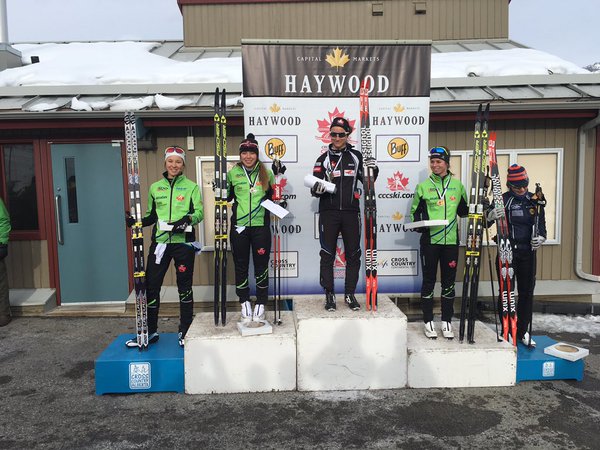
NDC Thunder Bay athletes (in green) took second, third and fourth in the women’s NorAm 5 k classic interval start, behind Sophie Carrier-Laforte (c) of the Pierre Harvey National Training Centre in first. Katharine Stewart-Jones (second from l) placed second, Alannah Maclean (second from r) with third, and Jenn Jackson (l) was fourth. Rocky Mountain Racers’ Andrea Dupont (r) placed sixth. (Photo: NDC Thunder Bay/Twitter)
In the women’s 5 k classic race, Sophie Carrier-Laforte of the Pierre Harvey National Training Centre (CNEPH) won the two-lap race in 14:31.5, followed by U23 Development Team member Katherine Stewart-Jones (NDC Thunder Bay), 10.3 seconds back.
Thunder Bay had two on the podium with Alannah Maclean in third, 17.9 seconds behind Carrier-Laforte, and another athlete in fourth: Jenn Jackson (+30.8)
“I was aiming for a podium this week but didn’t expect to get it today,” Stewart-Jones wrote in an email. “It’s a very short race so I planned on going out really hard and just try to hold on to the same pace. On the first lap, I focused on skiing efficiently and then just went as hard as I possibly could on the second [lap].”
She added that her double-pole work this summer appears to have paid off.
While Stewart-Jones’s first lap ranked fourth and second lap was second-fastest among the women, Carrier-Laforte skied the fastest last lap. Andrea Dupont (Rocky Mountain Racers) was fastest on Lap 1, but faded on Lap 2 to place fifth (+36.0). Maclean posted the second-fastest opening lap.
Kevin Sandau (c) and his Alberta World Cup Academy teammates Knute Johnsgaard (l) and Patrick Stewart-Jones (r) placed first, second and fourth, respectively in the men’s NorAm 16.5 k freestyle mass start on Dec. 6 in Canmore, Alberta. (Photo: Alberta World Cup Academy/Twitter)
On Sunday, Dec. 6, Sandau repeated with a win in the second race of the season: the men’s 16.5 k freestyle mass start. The races were once again held on Canmore’s biathlon trails, this time on a 3.3 k loop.
Sandau won it in 38:59.9, again ahead of Johnsgaard, who finished 36.6 seconds back in second. About a minute and 3 seconds behind Sandau, McKeever placed third, four-tenths of a second ahead of fourth-place finisher Patrick Stewart-Jones (AWCA).
For Sandau, the race and the victory were even better than the day before.
“The 15km skate played out a lot more to my strengths and really let me test out my fitness,” he wrote. “I knew before the start I just wanted to go full throttle right from the gun. It was a mass start, and there was a crazy westerly wind, so I knew this race was going to be easier to bunch up and make it harder to break away.”
He strategized his pace changes for the bottom of the five-lap course, where there were two “decent climbs,” he explained. His fourth time around, he broke away from Johnsgaard and skied the rest of the race alone.
“I knew once I could break away from anyone, I could really start to put some time in because they had to fight the wind just as much as I did at that point on,” Sandau wrote.
Johnsgaard anticipated that Sandau would be the man to beat, “so the two of us started hard right out of the gate to try and lose the field as soon as possible,” Johnsgaard wrote.
They broke away around 5 k, and while Sandau’s pace felt fast, Johnsgaard explained holding on until the last 3.3 k lap.
“By that time I was hurting pretty bad and lost a lot of time on my last lap,” he wrote. “I thought everyone would catch back up to me but luckily we had opened up a big enough gap earlier on.”
McKeever noted the superior shape of Sandau and Johnsgaard compared to him and the rest of the field. “It went as well as it could have,” McKeever wrote. “I played the tactics right and made the most of the day.”
Dahria Beatty of the U23 Development Team and AWCA charged hard on the last lap of the women’s 10 k freestyle mass start to win by 8.8 seconds in in 27:07.5. Frédérique Vézina placed second and her CNEPH teammate Cendrine Browne (NST U23 Development Team) took the final podium step in third, 13.7 seconds behind Beatty. Another CNEPH skier Jaqueline Mourao, originally from Brazil, was 1.4 seconds off the podium in fourth. Mourao turns 40 later this month.
“It’s always amazing to be able to win a race!” 21-year-old Beatty wrote in an email after her second senior NorAm victory. “I ended up leading most of the race. My original plan had been to sit back for the first lap in the pack and then if I felt strong push the long climb that was on both the second and third lap.”
As she approached the climb on the second of three laps, she explained she tried to keep the pace high to “string out the pack.”
“On the final lap on the same long climb I had a ski lengths gap coming off the downhill so I took advantage of that small gap and just skied as hard as I could without looking back,” Beatty wrote. “I didn’t let off at all until the final 500 meters when I finally checked to confirm the gap my coaches had been telling me I had.”
Vézina wrote that, while she made a race plan and executed it well, mass starts are a toss up.
“You can expect some things but at the end you can really make intelligent decisions once you are in the race,” Vézina wrote. “I’m happy with the way I managed my race.”
Despite a broken pole at the beginning of the race and losing contact with the leaders, Browne was pleased to see where she stacked up at the start of the season.
“You always ask yourself if you are in shape or not compared to the other skiers,” Browne wrote. “The tactics didn’t play out as planned … I was planning on leading with Dahria but it didn’t really work out because I had to make my way back to the front.”
Sunday’s 10/16.5 k freestyle mass start results:Men | Women
Women’s Canmore NorAm classic sprint winner Dahria Beatty (AWCA/NST U23 Development Team) after her A-final victory. (Photo: CCC/Twitter)
On Tuesday, the final day of NorAm racing in Canmore, Beatty went on to win the women’s 1.5 k classic sprint final by 2.51 seconds over Browne. Earlier in the day, Browne topped the qualifier in 4:36.2, and Beatty was 6.8 seconds off the pace to qualify in fifth.
Browne and Beatty both won their quarterfinals before facing off in the semifinal, where Browne took first by 1.62 seconds over Beatty in second. In the final, Beatty explained that for the first time in a race, she screamed in elation as she crossed the finish. It was her first senior sprint victory.
“Going into this race I wanted to ski in the top two in all heats to avoid being stuck at the back of an accordion-effect after the herringbone climb. In all my heats I was able to do that,” she wrote. “Everyone’s skis were icing after this climb so it was easy to lose time kicking it off at the top. For the final I asked my coach to put a less sticky wax on so I would ice less and I think that made a big difference. I was still able to make it up the hills but more importantly I was able to crest the hill super aggressively on both laps, thus carrying more speed into the downhill.”
With two big climbs separated by two downhills, Beatty explained that it made sense to push hard each time up. That made pacing simple; she simply wanted to be in front.
“When I came down the last hill in the lead I went into sprint mode and didn’t look back,” she wrote. “I had to look at the results afterwards to realize how far behind the others were.
Another great thing about today was the rain waited until the women’s race was over, bonus.”
Dahria Beatty (l) and Jenn Jackson after Tuesday’s NorAm classic sprint in Canmore, Alberta. Beatty won the race for her second-straight victory of the weekend, and Jackson placed third behind Cendrine Browne (not shown). (Photo: CCC/Twitter)
Browne was pleased to win a sprint qualifier for the first time in her career and did so by four seconds over Jenn Jackson. Later in the final, she edged Jackson by 0.25 seconds for second place. Jackson was third, ahead of Andrea Dupont in fourth, Vézina in fifth, and Marie Corriveau (CNEPH/National Junior Team) in sixth.
For Browne, 22, it was her second podium in a senior sprint.
“In the semi final, my plan was to climb the last hill faster then Dahria so I would have more speed than her in the downhill. I had the same plan in the A final but it didn’t work out as well,” she explained. “I had a pretty high level of energy today but I still tried to manage it in the quarter final and in the semi final. … My skis were great. I had great kick and my skis were fast, and that helped me a lot.”
Bob Thompson (Thunder Bay NDC) made the top 30 to qualify for the heats in the 1.5 k men’s sprint, but was more than 17 seconds off the pace in 20th. Johnsgaard set the time to beat in the qualifier in 3:51.05.
In the quarterfinals, Thompson placed second to Julien Locke (Black Jack), but came back to beat Locke in the semifinal by 0.15 seconds. Thompson went on to win the men’s final by 1.24 seconds over Patrick Stewart-Jones.
Cendrine Browne (CNEPH) edges Jenn Jackson (NDC Thunder Bay) for second in the women’s NorAm classic sprint final. (Photo: CCC/Twitter)
“Definitely great to finish the day and the weekend with a win, seems I’m becoming notorious for coming off a poor qualifier and then figuring things out in the heats,” Thompson wrote in an email.
After the quarterfinal, he switched from grip skis to zeros/rub skis, he wrote, “and they made a huge difference.
“I definitely let my skis do a bit of work so I tried to keep the first lap in control and just keep a solid position in second or third and then just make sure to stay close over the top into the downhill to get the draft,” he added. “Tough day to try and lead into the downhill and finish.”
“Bob was really strong in the finish today and I have to accept that,” Stewart-Jones wrote. “The final was a little bizarre because the pace started out fast, but then on the top of the climb on the second lap it slowed right down because it was so narrow and no one could get by the leader. The pack bunched right up and from there on it was pretty much a 6 way drag race to the finish.”
Andy Shields (NDC Thunder Bay) placed third, 1.35 behind Thompson. Sandau was fourth, Locke fifth and Johnsgaard sixth.
“The classic sprint was a big turnaround from how I was skiing on the weekend,” Shields wrote. “Distance skiing so far this year has felt terrible. Luckily my sprinting pep is still strong. I went on wax for the quarter and it was unbelievably fast.”
With wet snow and rain before his semifinal, Shields switched to zeros, “which had crazy grip but lacked a bit in glide,” he wrote. “The techs were able to tune my zeros for the final. … Happy with now having NorAm podiums in both skate and classic sprinting, as well as podiums in both skate and classic distance.”
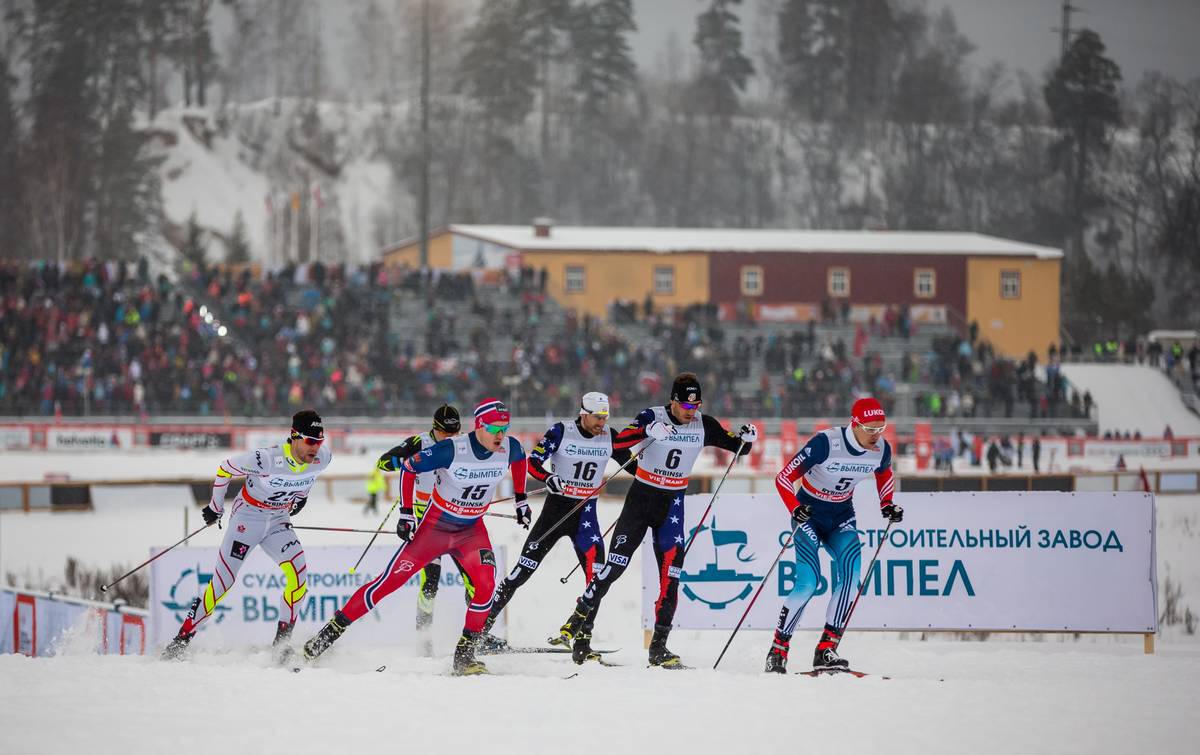
Simi Hamilton (6), Andy Newell (16), Alex harvey (25) compete in a quarterfinal of the 1.3 k freestyle sprint at the World Cup in Rybinsk, Russia. (Photo: Fischer/Nordic Focus)
As Italy’s Federico Pellegrino and a contingent of Russian skiers shined in the 1.3 k freestyle sprint in Rybinsk, Russia, the North American skiers attempted to keep. While three Americans and Canadian Alex Harvey qualified for the heats, no North American skiers made it into the semifinals.
American Simi Hamilton had a strong qualifier, qualifying in sixth and finishing 5.29 seconds behind top qualifier Sergey Ustiugov of Russia (2:41.10).
Hamilton – who placed eighth in the Tour de Ski freestyle sprint in Val Mustair earlier this month – said in a phone interview that he was pleased with how the qualifier went and that the sixth-place result was encouraging.
“It was one of those days where the snow was super soft, and I think in the past I haven’t been able to ski in conditions like that too well … but I think I’m definitely getting better at skiing in those softer snowy conditions,” Hamilton said.
U.S. Ski Team Head Coach Chris Grover said in a phone interview that it had snowed “quite a bit” the night before and the morning of the race. Even though the snow tapered off before the competition began, it made for challenging conditions.
“They re-groomed the course an hour before the competition but it was a really dry snow so and didn’t really bond. It was pretty soft for qualification,” Grover said.
Simi Hamilton competes in the qualifier of Saturday’s 1.3 k freestyle sprint in Rybinsk, Russia. He qualified sixth but ended his day in 17th. (Photo: Fischer/Nordic Focus)
American Andy Newell qualified in 16th (+7.59) and said in a phone interview that he felt decent during the qualifier. However, he was hampered by a neck injury that developed during the World Cup races in Otepää, Estonia, where he finished 17th overall in the classic sprint.
“My neck was all jacked up and I was racing with hot packs taped on there to loosen it up, but it still wasn’t feeling great, and especially across the flats it was hurting a decent amount,” the 32 year old said.
The highlight for the Americans on Saturday was Erik Bjornsen posting his best sprint result ever on the World Cup, taking 20th (+8.64) and reaching the heats for the first time.
The 23 year old wrote in an email that he believed his fitness allowed him to push hard from the start and maintain a consistent pace throughout the race.
“The track was soft so I didn’t feel like I was Superman, but I kept the tempo up and tried to keep it light. It seemed to really work! I was pretty close to some guys I’m usually several seconds behind,” Bjornsen wrote.
Grover was also excited for Bjornsen, saying he beat several sprinter specialists to get into the quarterfinals.
“He looked great in qualifications. People were really struggling but he was really powering so that was really cool. He was stoked, and it’s exciting to get another skier in the men’s sprint points besides Simi and Andy,” Grover explained.
Bjornsen landed in the first quarterfinal heat, and found himself up against eventual finalists Ustiugov, who would take second overall, and Norway’s Emil Iversen.
Bjornsen was never competitive in the heat, writing that he was “a bit of a spectator from the back of the pack.” Iversen won the heat in 2:40.36, with Bjornsen finishing 2.30 seconds behind in fifth. He was 24th overall.
“I see that you have to be … aggressive in the World Cup heats. Not a surprise but something that I will learn from experience,” Bjornsen wrote. “Next time I will be a little less shocked to be there and a little more hungry for a semifinal spot!”
Canada’s Alex Harvey competes in the qualifier of Saturday’s 1.3 k freestyle sprint in Rybinsk, Russia. He qualified 25th and ultimately finished 28th. (Photo: Fischer/Nordic Focus)
Three other Canadians also raced, but failed to qualify. Lenny Valjas was 42nd (+13.00), 1.89 seconds behind the final qualifier, while Jesse Cockney was 47th (+15.57) and Patrick Stewart-Jones was 52nd (+21.29) out of 53 finishers.
Newell, Hamilton, and Harvey all raced in the same quarterfinal, in addition to eventual finalist Nikita Kriukov of Russia.
Hamilton said he felt like he had a great start to the heat, skiing just behind Kriukov. However, he said that he was not aggressive enough on the long flats before the steep climb and let other skiers pass him on both sides.
“Once that happened, I knew that to stay in contention I had to get back by a couple people before the steep climb,” Hamilton explained, adding that he tried to pass France’s Paul Goalabre on the right but was prevented by the soft, powdery snow.
At the start of the climb, Hamilton said that Goalabre accidentally knocked his left ski, causing him to fall on his knees. He got up quickly, but was not able to catch up with the leaders, especially on the fast downhill going into the finish.
Kriukov won the heat in a time of 2:43.77, and Hamilton finished fourth (+1:39), ending up 17th overall.
“I kept my effort up all the way through the finish … but it’s a tough finish, just super soft all the way through the finish lanes which makes for an interesting last 20 or 30 seconds. You ski as hard as you can but you still feel like you’re skiing a 30 k or 50 k because you’re not moving that fast,” Hamilton said.
Grover said Hamilton’s slip was unfortunate, as he was forced to play catch-up and “wasn’t able to demonstrate really where he is.”
Canada’s Len Valjas skied to 42nd in the qualifier of the 1.3 k freestyle sprint in Rybinsk, Russia. (Photo: Fischer/Nordic Focus)
Meanwhile, Newell took fifth in the heat (+2.12) to take 22nd overall.
Newell said that he tried to put himself in a good position while ascending the hill, and was in third at the top. He tried to get in position right behind Kriukov but was unable to secure his position.
“I just got gassed a little bit over the top … I don’t have much power with the way I’m skiing right now,” Newell explained.
He also said his injured neck played a factor in the quarterfinal heat.
“I don’t like to make excuses but I’m not 100 percent when it comes to racing right now … it’s hard to heal and it’s just getting worse some days; sprints and stuff make it worse. So I need to try and heal it up so I can get some hard training in,” Newell said.
Harvey finished just behind Newell to take sixth in the heat (+2.24) and ended up 28th overall.
“It was not a good sprint for me today. I wasn’t in the greatest spot before the climb and got stuck behind a fall. I am now focusing on tomorrow’s 30 kilometer,” Harvey told Cross Country Canada.
As for Sunday’s skiathlon, Bjornsen wrote that it is the race he was most excited for going into this weekend.
“I’m definitely a little tired from the last two races and intervals in the cold on Thursday, but I have nothing to lose out there! Tomorrow is just another opportunity to ski with the fastest guys in the world,” Bjornsen wrote.
However, Newell is planning to sit out the race in order to heal his neck, and Hamilton said his status depends on the conditions.
He said if the recent snowfall sets up before the race and the snow becomes firmer and faster, there is a chance that he will race, but if the snow remains soft and slow he will probably opt out of the race.
After leaving Rybinsk, the American team will have a training camp in Davos, Switzerland, then head to World Cup races in Oestersund, Sweden, before World Championships begin in Falun on Feb. 18.
Lenny Valjas placed 45th in the men’s 1.5 k classic sprint qualifier on Saturday in Otepää, Estonia. (Photo: Fischer/NordicFocus)
In her first World Cup of the season and best result since the 2012 World Cup freestyle sprint at home in Canmore, Alberta, Alysson Marshall launched back into international-racing action on Saturday and placed 44th in the women’s 1.2-kilometer classic sprint in Otepää, Estonia.
The NorAm, or Continental Cup, leader for Period 1, she was one of two Canadian women selected to this weekend’s Otepää World Cup. The other, Perianne Jones, opted to stay home and race at Western Canadian Championships in Lake Louise, Alberta.
“It’s great to be back on the World Cup!” Marshall, 26, wrote in an email on Saturday after finishing 44th in the qualifier, 15.67 seconds back from the qualifier winner, Ingvild Flugstad Østberg of Norway, and 6.42 seconds out of the top 30 needed to advance to the heats.
Marshall, a national development-team member, most recently placed fifth in a classic sprint at last weekend’s NorAm in Duntroon, Ontario. Last Saturday after the sprint, Alberta World Cup Academy teammates Marshall, Jess Cockney and the men’s NorAm leader Patrick Stewart-Jones flew to Estonia for a Sunday arrival.
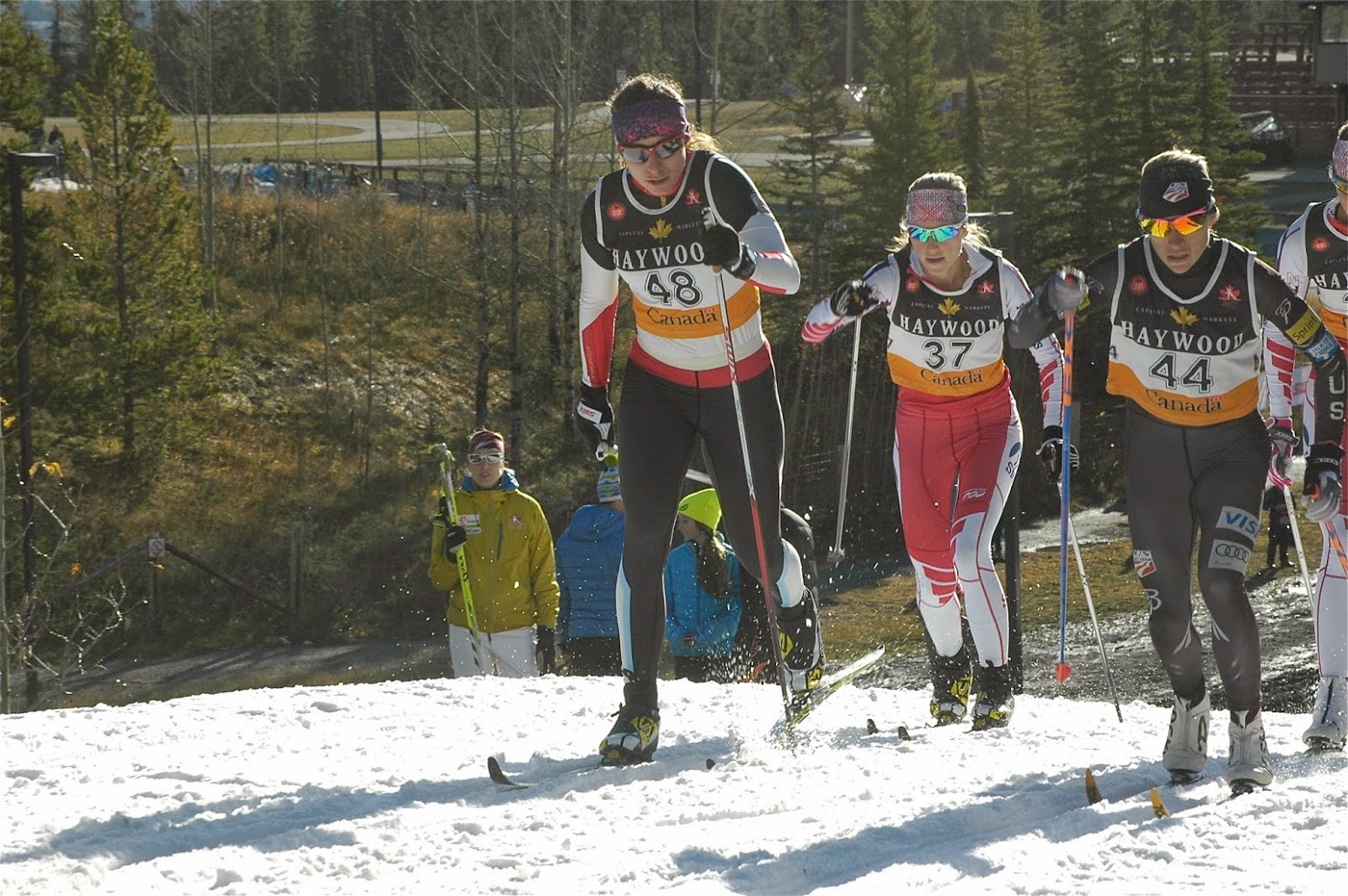
Alysson Marshall (48) racing alongside Americans Liz Stephen (44) and ahead of Erika Flowers (37) at the Frozen Thunder classic sprint on Oct. 24 in Canmore, Alberta. (Photo: Angus Cockney)
“I’m just starting to feel like I have adjusted to the time change,” Marshall explained. “I am definitely disappointed with today, I started well but body wasn’t 100% and I couldn’t maintain the pace over the top of the course. Hopefully next weekend will go better!”
Without another Canadian woman on the circuit, she won’t be racing Sunday’s freestyle team sprint. Marshall plans to next race the freestyle sprint on Saturday, Jan. 24 in Rybinsk, Russia.
Canadian World Cup Team member Lenny Valjas finished 45th in the men’s 1.5 k classic sprint on Saturday, 12.1 seconds back from the top qualifying time set by Norway’s Pål Golberg, and 3.83 seconds out of the top 30.
Jess Cockney placed 61st in the men’s 1.5 k classic sprint qualifier on Saturday in Otepää, Estonia. (Photo: Fischer/NordicFocus)
Cockney, of the national development B-team, placed 61st in the qualifier after winning the NorAm classic sprint in Duntroon last week. Back in 2011 in Otepää, Cockney placed 61st in a classic sprint as well.
Stewart-Jones, who was second in the Duntroon sprint, finished 62nd on Saturday in his first international World Cup, and first World Cup since 2012 in Canmore.
According to Sunday’s start list, Cockney and Valjas will team up in the 6 x 1.5 k freestyle team sprint.
Alex Harvey, Devon Kershaw, Ivan Babikov, and Graeme Killick are taking the weekend off to recover and train in Seefeld, Austria, before traveling to Rybinsk on Wednesday.
Kris Freeman on his way to winning the 30 k freestyle interval start by more than a minute and a half on Dec. 20 at the Sovereign Lake NorAm in Vernon, B.C. (Photo: Frances Weeks)
Canada’s NorAm circuit is what the International Ski Federation (FIS) calls a Continental Cup series, similar to the U.S. SuperTour. The name NorAm is short for North American, a hold-over from when Canada and the U.S. had a combined race series. These races are critical to the elite racers, with guaranteed World Cup starts, national-team positions, and trips to Junior/U23 World Championships in Almaty, Kazakhstan, on the line.
Or to put it another way, it would take a major event to cancel a NorAm race — like perhaps a record-breaking storm in a unusually snowless early season.
As organizing committees secured the final details for the first two NorAm weekends, a major storm was expected to bring heavy rain to most of southern British Columbia.
By the end of the four-day storm, a Vancouver suburb had declared a state of emergency, heavy rain at 12-degree Celsius (54 Fahrenheit) had closed numerous ski resorts across B.C. (including Whistler Blackcomb). Seattle set weather records, and 220,000 people were without power in California.
While all this was going on, organizers in La Clusaz, France, canceled their World Cup and later moved it to Davos, Switzerland, a venue which had previously avoided canceling its original race weekend because of a huge snow-moving effort largely funded by a retired alpine skier.
The first NorAm weekend this year was scheduled for Dec. 13-14, hosted by the Black Jack Ski Club in Rossland, B.C. Outside the province, Black Jack is best known as the club that produced George Grey (top-10 finisher at the 2010 Olympics) and the current home of long-time national team coach Dave Wood.
When low snow, warm weather and predicted rain made the club’s homologated courses unsuitable for skiing, the club decided to move the opening races up to the biathlon trails, more than 200 meters (650 feet) higher in elevation. As the four-day storm progressed, the freezing level was up to 2,000 meters (6,500 feet) in the area, well above the 1400-meter(4,590-foot) elevation of the biathlon trails.
When rain made the sprint loop unskiable two days before the race, the organizing committee didn’t give up. Club members, neighbours and team coaches spent hours shoveling snow onto the course. When another wave of rain destroyed the sprint course overnight, the organizing committee switched to two individual-start classic distance races and volunteers headed out again to shovel more snow onto the distance course.
After four days of rain and a move to a higher venue without electricity or a timing building, the races were held. Generators provided power, live results were available on the internet and the event was generally agreed to be up to the Continental Cup standard. Some 140 official volunteers plus an unknown number of shovelers made this possible.
“We estimate we did about 130 man-hours of shovelling this week,” Chief of Competition Ian Sibbald wrote in an email.
Unsolicited athlete quotes from the Black Jack NorAm
“The volunteer base is incredible. That is an astounding number [of volunteers] since only 3,500 people live in Rossland. Given the lack of snow, the conditions were great.” — Kris Freeman (Team Freebird)
“Conditions were good! A few twigs poking through here and there, but tracks were fast and hard. Big thanks to the volunteers and organizing committee for working hard to run these races!” — Michael Somppi (Alberta World Cup Academy/Canadian Development Team)
“Conditions were remarkable, especially considering the challenging weather the Black Jack Ski Club has been dealt. One would hardly know that though skiing the course, unless you look closely and notice all the shoveling marks on the side of the trail.” — Brian Gregg (Team Gregg/Madshus)
“Conditions were much better than I expected, the organizers and groomers did an amazing job making the race happen with tough conditions and the tracks today were great!” — Alysson Marshall (AWCA/National Development Team)
“Conditions today were amazing considering the weather … The race organizers and many volunteers from the town have worked hard to get a good track to make these races happen.” — Andrea Dupont (Rocky Mountain Racers)
“The crew at Black Jack did an amazing job on the course, it was close to perfect considering what they had to work with. The tracks were great, I was very impressed.” — Dahria Beatty (AWCA/National U23 Team)
“The course held together exceptionally well, due to the work of the volunteers and the slightly colder weather that appeared day of.” — Jennie Bender (Bridger Ski Foundation)
Callaghan Valley Cross-Country
Callaghan Valley Cross-Country (CVXC), the host of the second NorAm weekend, isn’t so much a ski club as it is a consortium of four clubs based in the Vancouver/Whistler area: Nordic Racers, Whistler Nordics, Hollyburn Jackrabbits, and Spud Valley Nordic. Squamish Nordic contributes, as do a number of other clubs from the province. For higher-level events, volunteers from other clubs commonly join in, either to add expertise to help the host club earn the event, or gain experience and knowledge so their own club can host similar events in the future.
Scheduled the weekend before the holiday break, CVXC was on track with 85 volunteers with two weeks to go. Snow is rarely a problem at Whistler Olympic Park. In 2010, no provision for snow making was made and the Olympics were held on natural snow despite a seven-week block of rain that ended a week before the Olympics started.
With very little snow and the forecast of the storm earlier this month, the organizing committee had to make a decision to commit, cancel or move the NorAm races with 12 days to go. On decision day, 100 millimetres (4 inches) of rain was forecast for the race venue.
At this point, much of the sponsorship money had been spent, hundreds of volunteer hours had been invested, and teams had booked lodging and flights well in advance.
With heavy rain falling at the venue, few people were surprised when organizers announced they were moving the races to Sovereign Lake in Vernon, B.C.
Once the decision was made, the logistical headache began. The new venue is more than 400-kilometers away, which meant the existing volunteers wouldn’t be sleeping at home. Many of the teams had booked flights leaving Vancouver on Sunday night. With two mountain passes and six-driving hours separating Sovereign from the airport, there wouldn’t be time to hold the planned events on Sunday. Moving the races to Friday and Saturday solved the travel problem, but made the volunteer issue more difficult.
At this level of competition, there are strict rules about roles and responsibilities. The assistant technical delegate, Sharon Clarke, was no longer eligible, as the new host was her home club. Clarke and the chief of competition, Sherryl Yeager, swapped roles before tackling the rest of the changes.
“Having to change the event at such a late date due to weather is heartbreaking,” Yeager, also the CVXC vice chair, explained in an email. “All the work that went into planning, arranging sponsors, maps, courses, setting up run sheets, the race notice, registration, accommodation, food, the website and more is largely of no use.”
Andrew Pohl of the New Zealand Ski Team crossing the line in 15th in the men’s NorAm 30 k freestyle interval start on Dec. 20 at Sovereign Lake, B.C. (Photo: Frances Weeks)
Sovereign Lake Nordic Club
Sovereign Lake is a perennial NorAm host, using trails built for a World Cup event in 2005. The trail system is interconnected with Silver Star Mountain Resort, which leaves most visitors a bit confused. In recent years, the division is simple: race at Sovereign, sleep at Silver Star, ski at both.
Sovereign was hosting a CPL race (one level below Continental Cup) when the possibility of moving the NorAm was raised. With 80 volunteers on site, it was easy for the organizers to quickly find out how many might be available for a potential NorAm and make the commitment to offer the venue.
The shift from Saturday/Sunday to Friday/Saturday was essential for the teams, but difficult for the organizers. More of the CVXC volunteers were unable to help and many of the Sovereign volunteers were unable to get a day off work at short notice.
Without a sprint in the first NorAm weekend of racing, Sovereign’s first day became a classic sprint, requiring another rewrite of the race notice. Ultimately, the merged organizing committee was able to get about 100 volunteers over the two days, including some from neighboring clubs.
Several racers generally viewed the event as a typical NorAm, with more comments on the challenges of heavily falling snow than the logistical obstacles of the event move.
While athletes, coaches, families, and race-day volunteers have moved on, the two organizing committees are sorting out how to share the entry fees and sponsorship money to cover their extra expenses.
The Result
After two weekends and four races, more individuals volunteered than raced. Athletes got crucial early season race time into their legs. Several athletes have positioned themselves to race in Europe later this season.
Was it all worth it? Dahria Beatty, Raphaël Couturier, Annah Hanthorn, and Philippe Boucher pre-qualified for Junior/U23 World Championships in early February in Almaty, and based on his NorAm results, Patrick Stewart-Jones earned his spot at the World Cup sprint in Otepää, Estonia, from Jan. 17-18.
American Brian Gregg (l) and Canadian Andy Shields of the Thunder Bay National Development Centre ski alongside each other in the 11 k classic individual start last weekend at the NorAm opener in Rossland, B.C. Gregg went on to place fifth and Shields was 12th. (Photo: FRESH cafe & apres/Facebook)
While the opening weekend of the U.S. Super Tour marked the start of the North American race season in late November, Canada’s NorAm circuit kicked off last weekend in Rossland with two classic distance races, held despite challenging conditions and a lack of snow.
The second stop of the NorAm circuit was originally scheduled for Whistler this Friday and Saturday, but once again, warm weather and insufficient snow led the races to be moved further inland to Sovereign Lake in Vernon, British Columbia, better known as Silver Star.
This season, the NorAm will visit six venues, wrapping up at the Lappe Nordic Centre in Thunder Bay, Ontario, for Canadian Ski Nationals. The circuit attracts many of the most competitive Canadian and American domestic cross-country skiers, juniors and seniors alike, all trying to earn their stripes and log top results in an effort to get to Europe.
Canadians Alysson Marshall and Heidi Widmer, teammates at the Alberta World Cup Academy (AWCA) in Canmore, Alberta, and on the national development team — also based in Canmore, started the winter off with strong results at the SuperTour opener in West Yellowstone, Mont. Marshall won the first sprint of the season, and Widmer placed second.
In the 10 k freestyle the next day, Widmer again broke into the top 10 with a ninth-place finish, and Marshall finished 17th.
Patrick Stewart-Jones (AWCA), Bob Thompson (Thunder Bay NDC), Michael Somppi (AWCA/NST D-team), and Andy Shields (AWCA) were among several Canadians racing in West Yellowstone. There, Shields made the sprint A-final, but finished sixth after breaking a pole. In the 15 k, Stewart-Jones led the Canadians in 17th.
One week later, Stewart-Jones emerged as the winner of the classic sprint in Bozeman — the second SuperTour stop in Montana. Marshall placed fifth in the women’s A-final, and the next day in the 10 k classic mass start, she finished 14th, just ahead teammate Dahria Beatty (AWCA/NST U23) in 15th. In the men’s 15 k classic mass start, Somppi was the top Canadian man 13th.
Rossland’s opening NorAm races challenged organizers with difficult conditions, but quality racing still took place thanks to the hard work of the staff and volunteers. Warm weather and rain previously wreaked havoc on the snow, but below-freezing temperatures last weekend made for hard-packed, icy conditions for the two distance races. Leading up to the races, organizers ruled the course unsafe for a sprint and added another classic distance race to the schedule instead.
Yukon’s Annah Hanthorn racing to third on the opening day of the 2014/2015 NorAm season, in the women’s 7.5 k classic in Rossland, B.C. (Photo: FRESH cafe & apres/Facebook)
Marshall swept both races, as did American Kris Freeman. Somppi hit the podium in third in last Saturday’s 11 k classic, and was again the top Canadian in fourth in the following 15 k classic. Andrea Dupont (Rocky Mountain Racers) placed second to Marshall in the 7.5 k sprint on Day 1, and junior Annah Hanthorn (Yukon Territory Ski Team) placed third, then second in the women’s 11 k on Day 2.
Following an Olympic year, there have been some shifts in the key Canadian players: Dasha Gaiazova, Amanda Ammar and Zoe Roy were three of the nation’s top women last season and retired this spring. Graham Nishikawa, the reigning overall men’s NorAm leader, has re-committed his focus to guiding Canadian Para-Nordic teammate Brian McKeever at International Paralympic Committee (IPC) World Cups and 2015 World Championships.
Many of the top athletes are aiming for top results in order to qualify for later World Cups, U23 and Junior World Championships, and potentially senior World Championships in Falun, Sweden.
“Making the transition from domestic to World Cup racing is what everyone on the development team is trying to achieve, me included,” Somppi wrote in an email. “Experience is certainly helpful. The more international racing you do, the more comfortable you get with it and the better you perform.”
Women to Watch
Alysson Marshall at the last season’s Canadian Eastern Championships in Cantley, Quebec. (Photo: Canadian Eastern Championships)
Heidi Widmer (AWCA/NST D-team) – With last year’s overall NorAm cup winner Emily Nishikawa starting her season in Europe on the World Cup, Widmer is one favorite in the running for an overall NorAm title this season.
The 23-year-old Sochi Olympian already has a podium under her belt from West Yellowstone, where she also posted the fastest women’s qualifying time in the sprint. In late October before the season officially started, she qualified fourth in the Frozen Thunder classic sprint among U.S. Ski Team members and other top Canadians, and then edged Nishikawa in the distance skate to finish ninth.
Alysson Marshall(AWCA/NST D-team) — In six races so far this season, Marshall, 26, has won half of them. Marshall and Widmer have already been battling back and forth; neither has beaten the other in consecutive races this season (although Widmer did not race in Bozeman or Rossland). Marshall, 26, has been consistent in distance and sprinting, a critical asset in the run the overall NorAm title. Last season, she finished third in the NorAm standings behind Nishikawa and Widmer, respectively.
Dahria Beatty (AWCA/NST U23 team) – One of the youngest threats on the circuit, Beatty, 20, is a first-year senior who proved as early as the Frozen Thunder classic sprint that she’s able to ski with the best. There in October in Canmore, she qualified second behind former Olympian Perianne Jones.
Andrea Dupont (Rocky Mountain Racers) – After finishing fifth overall in the 2013/2014 NorAm (behind Ammar in fourth), this 34-year-old distance veteran is looking to lift herself to World Cup starts.
A sprint specialist, Dupont stressed in an email the importance of dominant qualifiers, while adding that racing well in the heats and advancing throughout each round is important as well. But more than anything else, she wants better qualifiers than last season.
“It isn’t enough to just get into the heats in Canada; you have to win the qualifier here if you want to have a chance of qualifying in Europe,” she explained.
Despite her sprinting preference and sickness early in the season, Dupont claimed second place in Rossland’s 7.5 k classic race.
Cendrine Brown (CNEPH/U23) – This 21-year-old member of the Pierre-Harvey Training Centre (CNEPH) in Quebec, made the junior-national team last season and competed at U23 World Championships in Val di Fiemme, Italy.
This year, after focusing on speed to improve her sprinting, Brown has already recorded fourth- and sixth-place finishes in Rossland, and will continue to shoot for another U23 World Championships in Almaty, Kazakhstan. The first three NorAm weekends serve as trials for Canada’s U23 and World Junior teams.
Brittany Webster(AWCA) — A two-time Olympian and veteran to high-level racing, Webster, 27, started her season off in 15th in the Bozeman classic sprint. She didn’t race in Rossland, but Webster has been busy this offseason; competing in her first off-road triathlon World Championships, where she won the amateur division.
Also this fall, she launched a pursu.it crowd-funding campaign in September and has raised over $19,500 to help cover the cost of what she anticipates to be an expensive international race season.
Men to Watch
Michael Somppi (AWCA/NST D-team) racing in the Frozen Thunder classic sprint on Oct. 24. (Photo: Angus Cockney)
Michael Somppi (AWCA/NST D-team) – Third overall in the NorAm last season; Somppi, 26, is eager to build on his past performances. For now, he’s focused on superb racing before the end of December.
“At this point in my ski career, I’m 26 and if I want a shot at being a World Cup competitor I need to be able to podium at home,” Somppi wrote in an email. “So every time I step on the start line I’m looking to finish on the podium.”
He was the top Canadian in both classic distance races in Rossland last weekend, claiming a bronze medal in the 11 k classic and finishing fourth in the 15 k.
Raphaël Couturier (CNEPH/U23) – In August, Couturier, 21, was the only Canadian not part of the World Cup Team invited to come down from Quebec to train with the team at a dryland camp in Stratton, Vt. He ranked fifth overall in the NorAm last year, and has started the season in seventh and 10th in Rossland.
Patrick Stewart-Jones (AWCA) – Wrapping up the 2013/2014 NorAm season in sixth overall, Stewart-Jones, 23, will be looking to improve his placing. Last winter, he posted some of his best results of the season at Canadian Olympic Team trials in Janaury (where he was third in the freestyle sprint and sixth in the 15 k classic), and was able to race at U23 World Championships as well as Scandinavian Cups in Latvia and Estonia.
In six races, he has two top 10’s: one win and an eighth-place finish in the 11 k classic last weekend.
Knute Johnsgaard(Independent) – Likely one of the biggest dark horses at the beginning of this season, Johnsgaard spends most of his training hours without company in the Yukon.
Despite his training partner leaving for school, having limited time with his coach, and developing his own training plan with the help of Graham Nishikawa, Johnsgaard is confident in his training, the work he has done and how it will translate on the tracks.
“I’m always really focused and motived to just get out and go by myself,” he explained. “It’s a little lonely sometimes but I don’t need anybody to ‘push’ me.”
Johnsgaard, 22, added he likes being off the radar and not having anyone knowing how his training is going. To that end, he joked that he’s won every single time trial he’s done this year. He’s hoping to continue this streak and claim victories at NorAm races.
Andy Shields (Thunder Bay NDC) – Last season, Shields finished ninth overall on the NorAm, yet his early season results indicate he’s had a successful summer of training that could put him closer to the top overall this time around. So far, the 23 year old has posted two sixth-place results: first in the West Yellowstone sprint and also in the 15 k classic last weekend.
Wild Cards
World Cup Academy teammates Kevin Sandau (NST D-team), Jesse Cockney (B-team), and Graeme Killick (B-team) were among the most competitive on the NorAm circuit last season, finishing second, fourth and seventh overall, respectively. Cockney and Killick earned Olympic spots for Sochi based on the mid-season NorAm races and all three have started their seasons on the World Cup in Europe.
In an email, Sandau described his excitement to race on the World Cup and some of his expectations: “Davos is a very unique race and I think it plays well with my strengths with it being a longer distance and a course with longer climbs than most other world cups,” the 26 year old wrote. After some tuneup FIS races in Switzerland earlier this month, he placed 70th in the 15 k classic last weekend in Davos.
“At the end of the day it really is the final result that counts, but more than anything I want to cross that line and just have that feeling of it being the perfect race,” he wrote.
Multiple-time Paralympic gold medalist, Brian McKeever races to 13th in the Rossland NorAm 11 k classic on Dec. 13. (Photo: FRESH cafe & apres/Facebook)
Last year’s overall NorAm leader, Graham Nishikawa is backing away from domestic racing to fulfill his commitments to the Para-Nordic Tea, although he confirmed he would take part in one or two NorAms to prepare for IPC World Cups. Despite the races not being his focus, Nishikawa, 31, is a potential treat if he makes it to the start line.
His younger sister Emily matched him as the women’s overall NorAm winner last season. She is currently racing on the World Cup, where she posted a career-best 29th last weekend in Davos.
“The major difference between racing on the World Cup and domestically is the depth of the field,” Emily Nishikawa explained in an email. “If you lose a few seconds, you will lose a few places as well. This probably won’t happen when racing domestically because the field is just that much smaller.”
Annah Hanthorn and Maya MacIsaac-Jones, both 19-year-old juniors, finished third and fifth respectively in last weekend’s 7.5 k classic (and Hanthorn was second in the following 11 k classic). Then there’s always Perianne Jones, a perennial World Cup staple, who could make NorAm waves should she return to Canada.
Already, it’s shaping up to be another exciting year of racing. Some athletes are most competitive in distance races, others sprinting, and a myriad of possible contenders can take the victory on any given day. Stay tuned for NorAm updates via the Continental Cup blog: http://blogs.fasterskier.com/continentalcup
Canada’s Patrick Stewart-Jones (r) holds a narrow lead over Ben Saxton (second from l), Matt Gelso (l), Kris Freeman (third from l) while charging to the finish in the men’s SuperTour classic sprint final in Bozeman, Mont. Ødegård fell while rounding the final curve.
BOZEMAN, Mont. —In a race that was undecided until the final seconds, Canadian Patrick Stewart-Jones of the Alberta World Cup Academy (AWCA) narrowly outlunged Ben Saxton of the Stratton Mountain School (SMS) T2 Team and U.S. Ski Team to win the 1.5-kilometer men’s SuperTour sprint-classic final at Bohart Ranch on Saturday.
With the sun out and temperatures rising to 45-degrees Fahrenheit for the afternoon rounds, Stewart-Jones conquered the soft, slushy course in 3:26.22 minutes. Just 0.11 seconds later, Saxton took second after racing alongside the Canadian to the finish.
Matt Gelso, of the Sun Valley Ski Education Foundation (SVSEF) Gold Team, followed last weekend’s SuperTour distance win in West Yellowstone, Mont., by landing on the podium again, finishing a close third, 1.37 seconds behind Stewart-Jones.
Four-time Olympian Kris Freeman (Team Freebird) placed fourth (+2.58), while the West Yellowstone skate-sprint winner, Dakota Blackhorse-von Jess (Bend Endurance Academy), finished fifth (+7.26). Rune Malo Ødegård (University of Colorado) rounded out the final in sixth (+23.11).
Russell Kennedy (Canmore Nordic Ski Club) managed to stay upright on this icy curve, though others were not so lucky during the men’s SuperTour sprint classic at Bohart Ranch near Bozeman, Mont. Kennedy placed 19th overall.
After the race, the 23-year-old Stewart-Jones said he was “ecstatic” about his first SuperTour win. In the West Yellowstone skate sprint on Nov. 28, he placed 27th.
“Qualifiers didn’t go so great this morning. I probably used the wrong pair of skis, and maybe wasn’t quite ready to go,” he explained.“I just had to fight every round in the heats. But any day you win is a really good day.”
Eric Packer of Alaska Pacific University (APU) won the qualifier in 3:13.76. Stewart-Jones ranked 17th, 10.6 seconds behind Packer, before finishing second in both his quarterfinal and semifinal behind Blackhorse-von Jess and Saxton, respectively.
“Every race today I felt better and better,”Stewart-Jones said.
The final was tight throughout, with the top four skiers — Stewart-Jones, Saxton, Gelso and Freeman — staying close together on the large climb halfway through the course. Stewart-Jones was in no rush to take the lead, later explaining he looked for “the easiest ways to get by people without having to fight too much for it.”
Upon reaching the horseshoe curve about a hundred meters before the finish line, Stewart-Jones and Saxton were shoulder-to-shoulder and lunged for first, with Gelso just a ski length behind.
Saxton said was happy with his “tactical skiing” throughout the day – he qualified in 16th (+10.48) and won both his quarterfinal and semifinal.
“I opted to tuck behind instead of push it and swing wide, and that ended up costing me more than swinging wide would have,” Saxton said. “He ended up getting me by just a boot.”
Patrick Stewart-Jones edges out Ben Saxton (third from l), while Kris Freeman (second from l) and Matt Gelso (l) challenge for third near the finish of the men’s SuperTour classic sprint final in Bozeman, Mont.
Regardless, the 21-year-old explained he was “psyched” with a second-place finish and was happy for the quality racing.
“Everybody had good skis, good effort, good tactics and there were no mix-ups,” he said.
Gelso had not been in a sprint final since winning the Bozeman SuperTour skate sprint two years ago (he was 10th last weekend in West Yellowstone), and said he was “super happy” with his “solid sprint result” — especially as usually excels more in distance racing.
In the final, the 26-year-old stayed in the back of the pack until the approach to the stadium, when he pushed his way into third while double-poling up the final hill. However, he said he “didn’t ski the last corner tactically very well,” and fell behind Stewart-Jones and Saxton during the final stretch to the finish line.
“That was my bad,” Gelso said. “But all in all, it was a pretty good day.”
Gelso also mentioned the difficult conditions, saying they produced a number of crashes, particularly on a treacherous corner that came after a steep downhill halfway through the course.
“People get knocked off balance for a second or two … and they don’t move on,” he said.
That is what happened to fellow Sun Valley Gold Team skier Miles Havlick, Gelso said. After qualifying in third and winning his quarterfinal, Havlick fell on the corner during the second semifinal and could not recover, finishing fifth, 13 seconds behind Freeman.
Then, in the final, Ødegård fell while rounding the final curve and trying to challenge the leaders.
“There was just punchy, squirrelly skiing,” Gelso said.
Though he was happy with his win, Stewart-Jones is looking for bigger things in the future. Racing well here, he explained, means a better shot at racing at a World Cup in Europe.
“When you do well like this, it always bodes well for trying to get those [national-team] spots to go overseas,” he said. “Hopefully that’ll happen.”
The Bozeman SuperTour continues Sunday with 10 and 15 k classic races at Bohart Ranch.
Adrien Backscheider of France celebrates his first title at U23 World Championships after winning Saturday’s 30 k skiathlon in Val di Fiemme, Italy. (Photo: Fiemme2014)
(Note: This article has been updated to include Annika Taylor, originally from Truckee, Calif., who competed at U23 World Championships for Great Britain. Comments from Ben Saxton also follow.)
For most skiers, skiathlons are somewhat of a rarity, something you might compete a couple times, or even the first time, in your career.
When you’re under 23, chances are you’ve had even less experience with the half-classic-half freestyle distance format — which makes it all the more fun.
France and Norway perhaps had the best time of anyone on Saturday at U23 World Championships, with Adrien Backscheider and Damien Tarantola of France going 1-2 in the men’s 30-kilometer skiathlon, and Martine Ek Hagen and Ragnhild Haga placing first and second in the women’s 15 k.
The women’s 15 k skiathlon podium at U23 World Championships on Saturday, with Norwegian winner Martine Ek Hagen (c), her teammate and runner-up Ragnhild Haga (l), and Teresa Stadlober of Austria in third (r). (Photo: Fiemme2014)
The best part about Saturday’s men’s race was that Backscheider and Tarantola pushed each other to the line, with Backscheider getting the 0.1-second edge for his first U23 title in 1:24:27.9. Norway’s Daniel Stock rounded out the podium in third, 6.4 seconds after Backscheider.
“Today we proved that France has a great team and really good equipment,” Backscheider, 21, told FIS on Saturday. “I am satisfied with my performance throughout the competition and I had very good skis. We have been training a lot for these championships and we showed what we are capable of. In addition to these two medals, we have to add the one won in the cross-country sprint. I think that bringing home these three medals for cross-country skiing is really amazing.”
Tarantola said that silver was “simply amazing, both for me and the whole French team. The weather conditions were pretty bad and the race got harder and harder due to the rain. Nevertheless, I never gave up and I did my best … I’m really proud of our achievements.”
According to a press release, the men’s 15/15 k proved to be tactical, with Armenian Sergey Mikayelyan attacking on the final climb of the penultimate of 12 laps. Seven skiers went with him: Russia’s Kiril Vichuzhanin, Norway’s Martin Loewstroem Nyenget, Sindre Bjørnestad Skar, Mathias Rundgreen, Tarantola, Backscheider, and Stock.
On the second climb of the last lap, the group dwindled to five when Nyenget attacked and Vichuzhanin, Tarantola, Backscheider, and Stock followed. Right before the last hill, Nyenget lost his balance and fell as Backscheider made a move. Vichuzhanin stuck with the leaders over the top but crashed on the downhill into the stadium. Norway ended up taking third through sixth with Stock, Rundgreen, Skar, and Nyenget, respectively.
In the women’s 7.5/7.5 k, the 22-year-old Hagen led for much of the first half of the race, holding off attacks from Italy’s Francesca Baudin and Debora Agreiter, who looked to have superior skis on the wet tracks.
All together heading into the skate portion, Hagen picked up the pace and Haga, Austria’s Teresa Stadlober and Agreiter initially kept her in sight. Hagen went on to ski the remaining 7.5 k on her own, winning by 22.4 seconds in 44:37.5.
“I’m so glad for the gold medal, of course, it means so much for me,” Hagen said to FIS about her second-straight win at this year’s U23 championships, and her third total. “These competitions are much harder than what you may think, and on top of that, the rain didn’t stop falling today, making the snow wet and heavy. These weather conditions didn’t help us today and made the race even tougher. Today’s a very special day for our team, Ragnhild won the silver medal and I’m really happy for her, too.”
“I understood I wouldn’t be able to catch up to first place even though I was hoping for the gold for more than one lap, but Martine was very strong,” Haga said. “I dedicate this silver medal to my family. We hoped for the double victory, it turned out really well and it is great fun to be on the podium with another Norwegian.”
Stadlober placed third, 42.2 seconds after Hagen,and Agreiter was another 13.1 seconds back in third.
Patterson Repeats in 18th for U.S.
In his second race of his first U23 championships, University of Vermont (UVM) senior Scott Patterson placed 18th — again. He notched 18th two days earlier in the 15 k classic individual start.
Team USA, with female juniors, U23s and ski jumpers at the 2014 Junior/U23 World Championships opening ceremonies. (Annie Pokorny courtesy photo)
Rosie Frankowski, a senior at Northern Michigan University, finished 26th in the women’s race for a career best at her first U23’s after placing 38th in the 10 k classic on Jan. 30.
Annie Pokorny (Stratton Mountain School T2 Team) finished 31st for her second-best result in her second U23’s after she placed 29th in two events last year.
“I really wanted to keep my cool and ski a nice, relaxed race,” Pokorny wrote in an email. “I knew that the pace would be hot off the start, so I wanted to be warmed up, but also wanted to conserve as much energy as I could through all 15 k’s.”
By the time she got to the venue, Pokorny explained it had already started raining. That turned to downpour for the women’s race, but the tracks held up throughout their three classic laps.
Pokorny did her best to stay in the main pack out of the start. “The accordion factor was pretty serious through the end of our first lap and I had trouble skiing in the lanes, so I dropped pretty far off the top 30 and started working my way up from there,” she wrote.
“When I came through the transition, I was fighting for 35th place. The minute I stepped onto them, I knew I had amazing skis, and was able to work the transitions to my advantage all around the course. When I caught girls, it was mostly on the flats after uphills, where my skis allowed me to carry speed over the top.”
Heading into the last lap with a top-30 within reach, Pokorny explained she improved from 32nd to 30th at the top of the course before getting passed on the last climb into the stadium.
Jessie Diggins of the U.S. Ski Team (l) on the podium after winning silver in the first race of U23 World Championships, the freestyle sprint on Nov. 29 in Val di Fiemme, Italy. (Liz Guiney courtesy photo)
“I knew that I still had a chance so I pushed as hard as I could down the finishing stretch, no-pole skiing and chanting ‘Jessie, Jessie, Jessie’ hoping to channel my teammate [Jessie Diggins],” she wrote. “I got close to the 30th place spot, but she just edged me out at the finish. It was really exciting for me, and even though I didn’t make the top 30, I was proud of how I skied.”
While she felt short of her goals, Pokorny focused on the fact that she was having fun.
“This championship has been a blast. The Olympic year has changed the competition, there’s no avoiding its influence, and being a part of these races has been challenging and exciting.”
Another American in the top 35, Ben Lustgarten, a Middlebury College senior, finished 34th in the men’s race. In the preceding 15 k classic, he placed 30th. His goal was to beat that.
After getting off to a strong start, Lustgarten explained in an email he tried to ski relaxed in a good position at the back of the lead pack while avoiding tangles and broken poles.
“The pace was fast but I was expecting that, I’m glad I could hang on for the whole classic portion,” he wrote. “The skate leg turned out pretty miserably and I lost a lot there. I crashed early on really hard and hit my head (turned out to be a minor concussion) which made me a bit dizzy. I was also pretty tired and losing that much momentum was not ideal. Then I broke a pole going up a hill and by that point I just wanted to finish the race, I knew I could not make up any ground and I was pretty beat physically and emotionally.”
The 2014 U.S. Junior/U23 World Championships team (Ben Lustgarten courtesy photo)
He finished and that’s what mattered most to him.
“I am not super happy with my result today due to the fall and breaking a pole, but I am very happy with my classic portion of today’s race,” he wrote on Saturday. “The world championships experience has been amazing! I was not racing at my full potential this week but I had some good parts of races and it is an excellent learning experience. The trip itself has been extremely fun and very valuable as a whole to understand how travel and racing in Europe really feels like.”
Annika Taylor, a junior captain at the University of New Hampshire, raced for Great Britain, where her dad was born and she technically has citizenship. According to Far West junior trip coordinator Mark Nadell, she contacted the British team’s nordic coach and inquired about racing for them.
Before competing at her first world championships for Great Britain, Taylor raced at Swiss nationals and tallied two top 10’s. On Saturday, she was 35th — her first top-40 in Val di Fiemme.
Mary Rose (Sun Valley Ski Education Foundation) finished 38th, after placing 34th in the 10 k classic on Jan. 30.
“My goal was to ski in the top 25 and hang on for dear life. That didn’t happen at all today,” Rose, 22, wrote in an email. “I had a pretty good start and made my way into the top 15, I think. That only lasted for about 1k and then I am not sure what happened. I was off the back and skiing with Annie Pokorny and Elizabeth Guiney.”
She and Guiney, of the Craftsbury Green Racing Project, stayed together for the rest of the classic leg, and Guiney ultimately finished 14.6 behind Rose in 41st.
“For the skate, I had a much better race,” Rose wrote. “I felt like I could actually ski and made up a lot of time on the girls in front of me. I was going pretty hard on the last lap trying to catch the 2 or 3 girls in front of me. I was in a sprint at the finish and lost to a foot throw with Olivia [Bouffard-Nesbitt] on the Canadian team!”
Bouffard-Nesbitt (Rocky Mountain Racers) led the Canadians in 37th, beating Rose by 0.1 seconds. She wrote that she felt strongest in the classic leg, but had “just enough juice at the end” to outsprint Rose.
“I absolutely love any opportunity I am given to race mass starts because it gives me the chance to ski with the pack and test myself head to head with the other skiers,” Bouffard-Nesbitt wrote. “I like to try to just hang on to the lead pack as long as I can because as that’s as fun as racing gets for me … The price to pay for that race tactic is that you fatigue really quickly, and in my case I just slowed down from that point on and struggled to stay with the girls that were passing me. I lost a lot of positions, but I don’t regret going out too fast because it’s very rare that we get the opportunity to race with the best in the world, and I think it’s really valuable to ski up there with them.”
Cendrine Browne (Pierre-Harvey Training Centre/Canadian Senior Development Team) racing to 31st in the 10 k classic on Jan. 30 at U23 World Championships. She placed 39th after crashing early in Saturday’s 15 k skiathlon. (Photo: FlyingPointRoad.com/All proceeds go to the National Nordic Foundation)
Also for Canada, Cendrine Browne of the Pierre-Harvey Training Centre placed 39th.
“Today my goal was to do the top 20, but I had no luck at the start,” Browne wrote. “After the first 500 meters, I was part of a tangle up. A girl stepped on my ski and pole and I fell on her. Then, the hole pack went by me by the time we got untangled. I was far from the rest of the pack.
“At first, I thought I could catch up, but it was impossible,” she continued. “On top of that, my classic skis weren’t that great. I didn’t have much grip compared to the other skiers. For a moment, I thought: what is the most embarrassing between quitting or being last at World’s … My answer to myself was: I’ve never quit a race and I won’t start doing that today. So I fought, alone, trying to catch girls in front of me.”
Disappointed with her result, Browne, a 20-year-old member of Canada’s Senior Development Team, explained she’s proud of placing 31st in the 10 k classic — a discipline that isn’t usually her best.
“I find it kind of sad that there are no relays for U-23… Relays were so fun when I was in the junior category!” she added.
Guiney wrote that she didn’t have many expectations for her first international skiathlon. “I was hoping for a top 30 if everything went well,” she wrote.
“The pace off the gun was incredibly fast. I actually got an outside track with not many girls in front of me so the first hill went well, but after that people started to pull away,” Guiney continued. “After the classic leg I was pretty much by myself, not really in danger of being caught but also pretty far from the people in front of me. So that was a little tough, just convincing myself to keep up the pace and keep pushing.”
Overall, she explained her U23 experience has been great.
“It’s funny coming to Italy because you expect sunshine and great tracks, but we’ve had some of the most challenging weather conditions I’ve raced in all year during our races. I felt a lot more prepared than last year, but the level of competition here is so high that I keep realizing how much farther I have to go and how much work I have to do to reach the top.”
Patrick Stewart-Jones (Alberta World Cup Academy) led the Canadian men in 41st, and American Ben Saxton (SMS) finished 14.3 seconds later in 42nd.
“I basically just missed out on the lead pack at the end of the classic race, which was frustrating,” Saxton wrote in an email on Sunday. “However I was in a good group for the skate leg, when I took a tumble coming down from Brink hill. I took the inside line and due to the conditions, my entire ski went under the snow and I got whipped into the ground. I was ok, but from that point on I was in kind of a no mans land, trying to bridge the gap back to my group and to other skiers.
“The American team had a killer week, and it’s hard not to be feeling the positivity from Jessie’s podium, Paddy [Caldwell’s] top 10 [in the Junior skiathlon], and the numerous top 30’s we’ve accrued over the week,” Saxton added. “On a personal note I’m definitely not satisfied with how my racing went this week. It was a big step up from the Junior level, and I think the results reflected that, but it’s huge motivation for me moving forward. I’m ready to get back out and ski with these guys next year.”
Four North American men were lapped: Knute Johnsgaard (Yukon Elite Squad) in 48th, Tyler Kornfield (Alaska Pacific University) in 49th, Sebastien Townsend (AWCA) in 52nd, and Andy Shields (NDC Thunder Bay) in 53rd.
The skiathlon concluded the U23 championships, with junior races continuing with 5/10 k classic individual starts on Sunday and relays on Monday.
The start of the men’s 30 k skiathlon at the Canmore Nordic Centre on Sunday. (Photo: Pavlina Sudrich)
CANMORE, Alberta — Four racers made claims to berths on Canada’s Olympic team this weekend in the freestyle sprints and 15- and 30-kilometer skiathlon on the last two days of Olympic Trials at the Canmore Nordic Centre.
Heidi Widmer of the Alberta World Cup Academy (AWCA) and Canadian National Team (NST), and Jesse Cockney (AWCA/NST) took top honors in Saturday’s freestyle sprint, while Graeme Killick (AWCA/NST) and Amanda Ammar (Team Ninja) won Sunday’s skiathlon.
Cross Country Canada (CCC) intends to name one sprinter and one distance racer per gender to the Olympic team based on this past week’s races at the Canmore Nordic Centre. The team will be announced Tuesday morning in Calgary.
“I didn’t want to be one of those Olympiczillas getting caught up in it all. … This is a dream come true, but I have only completed part one. Now the real journey and work begins.” — Heidi Widmer, 2014 Canadian Olympic Trials skate-sprint winner
Heidi Widmer of the Alberta World Cup Academy and Canadian Senior Development Team, en route to a victory in the 2014 Canadian Olympic Trials skate sprint on Jan. 11. (Photo: Angus Cockney)
Heidi Widmer all but guaranteed her selection to the Olympic team on Saturday with a win in the 1.3 k freestyle sprint. This backs up her second-place finish in Wednesday’s freestyle sprint to Chandra Crawford (Team Ninja/NST), who is already prequalified for the Olympics. Although Crawford did not race on Saturday, Widmer wrote in an email that she used the lessons she had learned from racing Crawford to help her take the win on Saturday.
“I have raced these trails and trained on them so many times, but this just feels so surreal,” Widmer told CCC. “I was on a mission for this. I didn’t want to be one of those Olympiczillas getting caught up in it all. There are so many ups and downs. I just wanted to stay focused on the process and not look back or ahead of myself. This is a dream come true, but I have only completed part one. Now the real journey and work begins.”
Behind her, the women’s field showed remarkable consistency from Wednesday’s freestyle sprint. In the absence of Crawford, the women’s top-four finishers from Wednesday simply became Saturday’s top three.
Biathlete Zina Kocher showed that her third place on Wednesday (in her first-ever sprint) was no fluke by finishing second in the trials on Saturday. Despite her strong finishes, she has no intention of switching over to cross country. Kocher is proud, however, of representing biathletes well.
“I know biathletes get a rep for not being as fast [and] strong as xc skiers, but I hope I have started to prove otherwise!” Kocher wrote in an email. “But I’m not going to make a complete switch [to cross country]. Biathlon has another element to it that I love [and] that makes it incredibly exciting and it would be hard to give that up!”
Andrea Dupont of Rocky Mountain Racers rounded out the podium in third.
Phil Widmer (AWCA/NST) leads teammate Jesse Cockney (second from l) and the rest of the men’s final at the 2014 Canadian Olympic Trials on Jan. 11 in Canmore, Alberta. (Photo: Angus Cockney)
For the men, Jesse Cockney moved up to top spot on the podium after finishing second on Wednesday and, along with Widmer, will almost certainly be named to the Olympic team.
Skiing tactically within the pack until the finishing stretch, Cockney moved alongside Phil Widmer (NST) in the finishing stretch and threw the hammer down to win the 1.7 k skate-sprint final by two seconds.
Widmer finished second and young-gun Patrick Stewart-Jones (AWCA) followed in third. Cockney described his finishing strategy to CCC:
“I just kept telling myself to get to the line. … Phil has been so strong, and I took that outside lane for the finish. I didn’t know what else to do, but I just wanted to get to the line. It has been years of hard work. I don’t know if it is official. I did all that I can do and I just want to enjoy this moment.”
15/30 k Skiathlon
With the qualification wrapped up for the sprint racers, the last chance for the distance racers was Sunday’s skiathlon.
Killick, who finished second to Brian McKeever (Canadian Para-Nordic World Cup Team) in the 15 k classic on Thursday, was a strong favorite heading into the men’s race and he delivered.
“My initial strategy was to try and break with someone in the classic and work together to hold off the group,” Killick wrote in an email. “I tried a few times to go the classic but was pulled in on the downhill and never really got away with anyone. On the last lap I was finally able to respond to an attack by Graham Nishikawa and keep pushing past to get a little gap on the field. Jess [Cockney] bridged to me and we were able to work together into the first lap of the skate.”
Graeme Killick (AWCA/NST) soaring to a 30 k skiathlon victory at 2014 Canadian Olympic Trials on Jan. 12 in Canmore, Alberta. (Photo: Angus Cockney)
After that, Killick, who had not raced the previous day’s sprint race, started to pull away.
“I just tried to keep a good pace going and managed to stay strong through the last couple laps,” he explained.
By the end of the race, Killick had extended his lead to just under a minute to take the win. He joins Cockney and Heidi Widmer as another almost shoe-in for the Olympic team.
Cockney faded somewhat towards the end of the race and was caught by the rest of the pack, but he regrouped to win a sprint finish with Michael Somppi (AWCA/NST) for second place. Already having secured a vital win during the week’s trials, Cockney entered the day with a relaxed attitude.
“The day was really fun,” he wrote in an email. “Tactically I just wanted to conserve energy and ski near the front for a podium. I’m happy with the result and thrilled with the week of racing.”
Somppi wrote in an email that he was happy with the day, but overall unsatisfied with his fitness thus far this season. Though the Olympic team is likely out of his reach for this season, he wrote:
“I still don’t feel I am racing at my best, but today was a good step forward. I will take some much needed rest and recovery now and hopefully I can find my top racing form for the second half of the season.”
McKeever, winner of Thursday’s distance race, ended up in eighth and is likely out of the running for Olympic qualification — but the visually impaired skier is a gold-medal favorite at the Paralympics in early March.
Amanda Ammar (Team Ninja) leads Brittany Webster in the 15 k skiathlon on Jan. 12 at 2014 Canadian Olympic Trials in Canmore, Alberta. (Photo: Angus Cockney)
On the women’s side, Ammar gritted out a huge win for herself after finishing sixth on Thursday. Although she wrote in an email that she didn’t feel great energy-wise on the day, she tried to simply “hold on” for as long as possible. Her strategy worked, as the pack was whittled down to three skiers, two of whom Ammar thought she could out-sprint in the end (the other being herself).
However coming into the last few kilometres, she decided to start her sprint with 1 k remaining in the race, and it was all over for the other racers.
Ammar crossed the finish line in 49:16, with Brittany Webster (Mito Canada) five seconds back and junior Anne-Marie Comeau (Pierre-Harvey National Training Centre) at 30 seconds back. All three were over a minute ahead of the fourth-place finisher.
Ammar, while thrilled with her result, is circumspect.
“No matter what happens with the Olympic decision, I will now know that I am just as fast and as fit as the girls going, and I’m at that top level. It’s been a long hard journey for us, and I’m just so proud.”
Webster is equally happy with the week of racing, although disappointed to have finished second on both days of distance racing. She wrote in an email to Fasterskier that,
“I feel great about my [two] efforts, and I know that the way I have trained this year, it should only keep getting better. Of course I am bummed I didn’t have what it took to win on either day, but hey that is racing, and I am really looking forward to working on it for the rest of the season.”
According to a Cross Country Canada press-release, the 2014 Olympic Team selections will be announced Tuesday morning in Calgary, Alberta.
(L-R) Emily Nishikawa, Alysson Marshall, and Andrea Dupont head into the finishing stretch of Sunday’s classic sprint at the NorAm opening weekend at Sovereign Lake in Vernon, B.C. (Photo: Peggy Hung)
A day of cold and windy sprinting — with temperatures around -17 degrees Celsius — wrapped up this weekend’s NorAm races at Sovereign Lake. After all was said and done, Andrea Dupont (Rocky Mountain Racers) and Patrick Stewart-Jones of the Alberta World Cup Academy (AWCA) emerged as victors in the classic sprint.
In the women’s race, Andrea Dupont skied a tactical-and-controlled race to win the A-final after squeaking through the semifinals as a lucky loser. Alysson Marshall of the AWCA and Canada’s Senior Development Team (NST) and Emily Nishikawa (AWCA/NST) were close behind in second and third, respectively. Rounding out the A-final was Heidi Widmer (AWCA/NST) and Ninja teammates Amanda Ammar and Zoe Roy.
Dupont leading Marshall (c) in the finishing stretch of the Sovereign Lake NorAm sprint. Dupont won, Marshall was second and Emily Nishikawa placed third. (Photo: Peggy Hung)
After sitting out Saturday’s 10 k freestyle as a precaution to protect her lungs from temperatures around -18 degrees Celsius, Dupont explained in an email that Sunday morning “was a bit of a shock to the system racing in the cold.”
That said, she was happy with her final and her ability to “relax and work tactics (something that is not always my strength),” she wrote. “We had really great skis from our club parent volunteers, and I was able to use that extra bit of glide heading into the final climb, which was the defining point for the course.”
With most of the pack together until the final hill, Dupont explained her skis helped her feel “super fresh” heading up it.
“I came out of the climb first and it gives you a huge advantage heading into the finishing straight,” she wrote.
Marshall was also pleased with her runner-up result, and concurred that the race was quite exciting.
“The A-final was tight for most of the race,” she wrote in an email. “There are lots of corners and transitions so a fair amount of contact and lane switching going on but luckily no crashes. Andrea and I got into the lead on the final climb and Andrea lead into the finish. I was gaining on her but couldn’t quite catch her before the line.”
On the men’s side, Stewart-Jones captured his first NorAm victory, which he wrote in an email he was “pretty excited about.”
“I came close to winning a few times last year but never pulled it off,” he added.
Phil Widmer (AWCA/NST) and Graeme Killick (AWCA/NST) placed second and third, and Knute Johnsgaard (Yukon Elite), Raphaël Couturier of Pierre Harvey National Training Centre and NST, and Simon LaPointe (Skinouk) rounded out the rest of the A-final.
Patrick Stewart-Jones (AWCA) racing in the Sunday’s classic sprint qualifier at the Sovereign Lake NorAm. (Photo: Peggy Hung)
Qualifying in fifth, Stewart-Jones explained that he felt the effects of Saturday’s 15 k freestyle, in which he placed fourth.
“My plan for the heats was to ski as efficiently as possible to try and get to the final using the least energy possible,” he wrote. “I knew my finish was strong so I was just trying to get to the last few hundred metres in a position where I could challenge for the win.”
Widmer (AWCA/NST) complimented Stewart-Jones on his race. “It was a cold, slow day of racing and I have to say I’m satisfied with the result,” Widmer wrote. “Patrick was very strong in the final and I wasn’t able to make up any ground on him in the finishing straight.”
Next weekend’s NorAm, hosted by the Black Jack Ski Club in Rossland, B.C. will feature a freestyle sprint and 10/15 k individual starts. The fields will be much larger due to the addition of many stateside Americans heading up north to race, without a SuperTour next weekend.
Marshall, for one, is looking forward to the challenge. “It will be fun to have some Americans at the races next weekend!” she wrote. “I’m really focusing on sprinting this year and it’s always nice to sprint against different skiers since we get used to the strengths and weaknesses of the girls we race against all the time.”
“[The Americans] were fast last time we raced on Frozen Thunder and deeper fields are always more fun to compete in!” Widmer wrote.
Additionally, Widmer is looking for some redemption next weekend. During his last race there, Widmer explained he “fell and came as close as I ever have to seriously hurting myself in a race. I was taken out and flew into a log jam at the side of the trail. It could have ended up much worse than it did as I walked away with only a broken pole and some scratches. Needless to say I’ll be looking for a much better result this time around!”
VERNON, B.C. — Photos from the season-opening NorAm at the Sovereign Lake Nordic Centre, with 10/15 k freestyle followed by classic-sprint races in temperatures near -18 degrees Celsius on Saturday and Sunday, respectively. All photos by Gerry Furseth and Peggy Hung.
Dec. 7: Women’s 10 k and men’s 15 k freestyle individual starts (Race report | results)
Heidi Widmer (AWCA/NST) en route to winning the women’s 10 k freestyle individual start in 33:14.7, 26.3 seconds ahead of Amanda Ammar (not shown) in second.
Emily Nishikawa (AWCA/NST) halfway through her 10 k freestyle race on Dec. 7, in which she placed fifth in the NorAm opener at Sovereign Lake, B.C.
Brian Gregg (Team Gregg/Madshus) on his way to winning the 15 k freestyle individual start, in the Sovereign Lake NorAm races last month.
Matt Liebsch (XC United/Team StrongHeart) racing to second in the Sovereign Lake NorAm 15 k freestyle on Saturday. He finished 3.3 seconds behind winner and friend Brian Gregg (Madshus/Team Gregg).
Kevin Sandau (AWCA/NST) early on in his 15 k freestyle race, in which he placed fifth.
Sandau at the end of his second lap.
Heidi Widmer finishing with the fastest 10 k freestyle time by more than 26 seconds in 33:14.7.
Emily Nishikawa (AWCA/NST) and Anne-Marie Comeau of the Pierre-Harvey Training Centre (c) at the finish.
Graham Nishikawa (CNST) was the top Canadian in third.
Kevin Sandau (AWCA/NST) after finishing 15 k freestyle at the Sovereign Lake NorAm, which started in temperatures around 18 C on Saturday afternoon.
Happy Ninjas, teammates Amanda Ammar (l) and Zoe Roy, after placing second and third, respectively.
A “unicorn” Ninja makes her way to the podium.
Heidi Widmer (AWCA/NST) after winning Saturday’s 10 k freestyle individual start at the opening NorAm at Sovereign Lake, B.C. Two Team Ninja skiers, Amanda Ammar (l) and Zoe Roy (r) placed second and third, respectively.
Top three Canadian men in the Sovereign Lake NorAm 15 k freestyle individual start on Saturday: Graham Nishikawa (c) was third overall, Patrick Stewart-Jones (l) placed fourth, and Kevin Sandau was fifth.
Dec. 8: Women’s 1.2 k and men’s 1.4 k classic sprints (Race report | results)
Early morning at the Sovereign Lake Nordic Centre on Dec. 8, before the men’s and women’s NorAm classic sprints.
Amanda Ammar (Team Ninja) racing to the fastest 1.2 k classic qualifying time of 3:06.4 at the Sovereign Lake NorAm on Dec. 8.
Andrea Dupont (Rocky Mountain Racers) qualifying in second, 2.2 seconds behind Amanda Ammar (not shown), who was fastest in the NorAm 1.2 k classic sprint qualifier at Sovereign Lake, B.C.
Emily Nishikawa (AWCA/NST) qualifying in third, 5.8 seconds out of first at the NorAm 1.2 k classic sprint qualifier at Sovereign Lake, B.C., on Dec. 8.
Heidi Widmer (AWCA/NST) qualifying in fourth, 8.2 seconds out of first at the NorAm 1.2 k classic sprint qualifier at Sovereign Lake, B.C., on Dec. 8.
Alysson Marshall (AWCA/NST) qualifying in fifth, 9.7 seconds behind Amanda Ammar (not shown), who was fastest in the NorAm 1.2 k classic sprint qualifier at Sovereign Lake, B.C.
Raphaël Couturier (CNEPH/NST) putting down the fastest qualifying time of 3:28.6 in the men’s 1.4 k classic sprint the Sovereign Lake NorAm on Dec. 8.
Knute Johnsgaard (AWCA/NST) qualifying in third, 3.6 seconds behind Raphael Couturier (not shown), who was the fastest qualifier in 3:28.6 in the men’s 1.4 k classic sprint the Sovereign Lake NorAm on Dec. 8.
Patrick Stewart-Jones (AWCA) qualifying in 13th in the men’s 1.4 k classic sprint the Sovereign Lake NorAm on Dec. 8
Graeme Killick (AWCA/NST) qualifying in seventh in the men’s 1.4 k classic sprint the Sovereign Lake NorAm on Dec. 8
Julien Locke (Black Jack) qualifying in 13th in the men’s 1.4 k classic sprint the Sovereign Lake NorAm on Dec. 8
Women’s quarterfinals
Andrea Dupont (l) and Brittany Webster (second from l) trail two Canadian Senior Development Team skiers in their semifinal of the NorAm 1.2 k classic sprint at Sovereign Lake on Dec. 8. Dupont qualified in third as a lucky loser, and went on to win the final.
The women’s A-final cruises down a hill along the 1.2 k classic sprint course at the Sovereign Lake Nordic Centre in Vernon, B.C. Andrea Dupont (RMR) won it ahead of Alysson Marshall and Emily Nishikawa.
Dupont leading Marshall (c) in the finishing stretch
(L-R) Emily Nishikawa, Alysson Marshall, and Andrea Dupont head into the finishing stretch of Sunday’s classic sprint at the NorAm opening weekend at Sovereign Lake in Vernon, B.C.
Heidi Widmer (AWCA/NST) after winning Saturday’s 10 k freestyle individual start at the opening NorAm at Sovereign Lake, B.C. Two Team Ninja skiers, Amanda Ammar (third from l) and Zoe Roy (r) placed second and third, respectively. Brittany Webster (second from l) placed fourth, and Emily Nishikawa (l) was fifth.
VERNON, B.C. — Another cold one at Sovereign Lake kept the organizers and athletes scrambling in temperatures around -20 degrees Celsius, but the end result was an exciting day of racing at the first NorAm of the season.
In the men’s 15-kilometre freestyle individual start on Saturday, American Brian Gregg (Madshus/Team Gregg) rose to the top in 41:03.3 minutes, edging out compatriot and friend Matt Liebsch (XC United/Team StrongHeart) by 3.3 seconds, and Canadian Senior Development Team (NST) member Graham Nishikawa in third (+4.5).
Matt Liebsch (XC United/Team StrongHeart) racing to second in the Sovereign Lake NorAm 15 k freestyle on Saturday. He finished 3.3 seconds behind winner and friend Brian Gregg (Madshus/Team Gregg) and Graham Nishikawa (CNST) was the top Canadian in third.
Coming off a SuperTour podium in West Yellowstone, Mont., last weekend, Gregg said he was very happy with his pacing plan that allowed him to move up from third his last time around the 5 k loop.
“I tried to stay really controlled, and focussed on making each lap maybe a little bit faster,” Gregg said. “Each lap got a lot harder. It was a good strategy.”
Gregg did a solo time trial on the same course two weeks earlier, and said that experience translated to success on Saturday. After the race, he and Liebsch planned to fly back to Montana to race the second SuperTour distance race of the season — a 15 k classic — in Bozeman on Sunday.
Liebsch was pleased with his result, racking it up as another step towards his season goals.
“There is a 30 k skate [at U.S. nationals] that I want to ski very well and prove that I should be on the Olympic squad and start that 50 k skate in Sochi,” he said.
Nishikawa was satisfied with his day, explaining: “The name of the game today was just staying warm and getting through it alive.”
Asked about his expectations for the weekend, Nishikawa said, “I am just here to race and get into top race shape.” After training with the Canadian Para-Nordic Team throughout the offseason as a potential guide for the Paralympics, his target is on both the Olympics and Paralympics in Sochi, Russia.
Top three Canadian men in the Sovereign Lake NorAm 15 k freestyle individual start on Saturday: AWCA teammates Graham Nishikawa (c), who was third overall, Patrick Stewart-Jones (l) in fourth, and Kevin Sandau in fifth.
Patrick Stewart-Jones of the Alberta World Cup Academy (AWCA) took fourth to lead the U23’s, ahead of Kevin Sandau (AWCA/NST) in fifth.
Heidi Widmer (AWCA/NST) led the way for the women, winning the 10 k in 33:14.7.
“Today was a great start to the season,” she wrote in an email. “Even though the weather wasn’t the warmest, it was such a beautiful day on the trails.”
A couple of Ninjas infiltrated the podium, led by Team Ninja’s founding member Amanda Ammar in second (+26.3). One of Ammar’s teammates and training partners in Canmore, Alberta, Zoe Roy place third another 13.2 seconds back. Racing in their ninja suits, Ammar and Roy snuck ahead of perennial favorites Brittany Webster (Highlands) in fourth and Emily Nishikawa (AWCA/NST) in fifth.
“[Usually] I struggle with skating,” Ammar said. “I think that is one of my best skate results in a NorAm.”
Roy was pleased with third, describing her result as “a step in the right direction.”
The unusually cold weather created challenges for race organizers. The jury announced on Friday that the start would be delayed to 11 a.m. PST. When the volunteer crew finished setting up the stadium and course at 9 a.m., the temperature was still -22 Celsius. The jury then decided to cancel the races for younger groups and start the open categories at noon, which resulted in a race at -18 C.
The younger racers’ distance races were rescheduled for Sunday, between the open sprint qualifiers and heats. Sunday’s start was delayed to 10 a.m.
Many of the racers were not fazed by the cold, but others were visibly affected. What do skiers like the Nishikawas and Graeme Killick have in common, besides a certain resemblance to popsicles at the finish line? All were born in cold communities (i.e. the Yukon, northern Alberta), but have lived in more termperate areas for a number of years.
Kevin Sandau (AWCA/NST) after finishing fifth overall in the 15 k freestyle at the Sovereign Lake NorAm, which started in temperatures around 18 C on Saturday afternoon.
Alysson Marshall (AWCA/NST) racing at the 2012 World Cup finals in Falun, Sweden, last March.
Alysson Marshall could feel it coming, and she couldn’t believe it was happening.
Burdened with a cold the night before the Eastern Canadian Championships, she thought back to all the other times she hadn’t felt well this season. She started the season in Europe and had to sit out the first races over there because of a cold.
Upon returning back to Canada, jet lag took a major toll on the Alberta World Cup Academy (AWCA) and Senior Development Team skier. Last year’s NorAm winner, Marshall couldn’t find those good vibes at the Canadian World Cups and struggled to get back on top of the NorAm podium.
Friday morning, she wasn’t even sure she was going to race the 1.6-kilometer NorAm classic sprint at Nakkertok Ski Club in Cantley, Quebec. She decided to see how she felt warming up and proceeded to try her luck in the qualifiers. There, Marshall was second to teammate Kate Brennan by 1 ½ seconds. Not bad, she thought.
Marshall, 24, went on to win her quarterfinal and semifinal, refining her tactic of dropping her competitors on the course’s two major climbs. In the final, she did more of the same, tucking behind Brennan out of the flat start then finding an open lane up the first hill. She created a gap and kept pushing, lengthening her lead for a comfortable victory – her first of the NorAm season.
“It wasn’t a full-on sprint to the finish,” Marshall said on the phone Friday. “I knew I had it a little ways out.”
Three of her AWCA teammates raced for second, with Rebecca Reid slipping by on the downhill ahead of Brennan in third and Emily Nishikawa in fourth, respectively. Amanda Ammar (Canmore) was fifth and Alannah MacLean (NDC-Thunder Bay) placed sixth in the final.
“Twenty-four hours ago I was pretty upset and not very impressed with how things were going so I was really happy to get a good result in,” Marshall said. “I’ve had some bad luck and just tired, just haven’t had a break yet this season, so today was really nice.”
Second in the Thunder Bay classic sprint and third in the same race in Duntroon, Ontario, at Canada’s World Championships trials last month, Marshall narrowly missed a trip to Val di Fiemme, Italy. Team selections were announced earlier this week, and Marshall resolved to move on and learn from her experiences.
“I don’t really have any opportunities to go to Europe now so I’m going to focus, restart, figure out what I need to do to be fast the rest of the season,” she said. “Figure out what I need to work on, what’s going on and try to have a good [Western Championships] and nationals. … I’m going to do some training, figure out my weaknesses and hopefully finish off the season better than it started.”
Thinking about ways she could improve as well, Reid, 20, placed second for her best NorAm result and second career podium, which she sought at the World Championships trials last weekend.
“I got inched out of a podium last weekend in Duntroon where I was fourth in the classic sprint and I really wanted to build on that result this weekend,” Reid wrote in an email.
After qualifying in seventh, she was happy with her position but continued to strive higher. Reid went on to win her quarterfinal and finished second to Brennan in the semifinal.
“I was ranked fourth going into the final and it went smoothly for me. I was feeling confident and I knew I had wicked fast skis on my feet so I was patient and came through in the finishing straight,” she wrote. “I was pretty excited that it wasn’t just a good day for me, having the Academy girls take the top-4 spots in the final made for a really fun day!”
AWCA racing director Mike Cavaliere was pretty impressed.
“Rebecca has been skiing stronger and stronger,” he wrote in an email. “I think she is starting to settle into life as a senior and getting more comfortable and aggressive.”
Brennan and Nishikawa sprinted to the finish for the third podium spot, which Brennan narrowly took. After sitting out last Sunday’s NorAm distance race in Duntroon, Nishikawa wrote that she was still recovering from a cold.
“I’m still not 100% but all things considering I was happy with how things went today,” she said, describing the final as fast to start with the four Academy women skiing together before Marshall gapped the field. “Feeling better everyday, so I’m looking forward to tomorrow!”
Saturday features 10 and 15 k freestyle interval starts on the second of the three-day Eastern Championships. Racing ends Sunday with 15 and 30 k classic pursuits.
Friday’s 1.6 k men’s sprint results looked similar to the women’s with the AWCA sweeping the top four. Phil Widmer led the group in first with his second victory in the last three NorAm classic sprints.
Phil Widmer (AWCA) at the Québec City World Cup freestyle team sprint on Dec. 7. He and teammate Brent McMurtry placed 20th.
Widmer crossed the line first last weekend in the Duntroon final as well, but was relegated to sixth for an infraction before the finish. Without the penalty, he would’ve swept the last three NorAm sprints. Regardless, he had won the qualifier in both sprint trials to secure a trip to the upcoming World Championships.
However on Friday, Widmer wasn’t first, at least not initially. The 29-year-old was third in the qualifier behind Academy teammates Brent McMurtry and Patrick Stewart-Jones. That didn’t sit well with Widmer, and he resolved to do better in the heats.
He did, winning his quarterfinal and placing second to Stewart-Jones in the semi. In the final, the two dueled to the finish, where Widmer outlunged Stewart-Jones in a photo finish. McMurtry was third after leading early.
“Neither Patrick or I were sure who won,” Widmer said. “After we crossed the line, the announcer thought Patrick won, but I guess after reviewing the photo, I got it.”
Widmer opted to follow McMurtry and Stewart-Jones up the herringbone climbs, conserving energy on the steeper terrain.
“I knew my strength was in the finish with the double pole,” he said. “My climbing on that steep stuff isn’t amazing. I was just trying to hang with the stronger guys like Brent and Patrick and hope that I could out-doublepole them.”
The three broke away from the pack when Jess Cockney (AWCA) and Colin Abbott (Yukon Elite Squad) fell about halfway through the final. With Abbott’s teammate, Knute Johnsgaard, the three finished behind the leaders with Cockney in fourth, Abbott in fifth and Johnsgaard in sixth.
For Abbott, it was a career-best finish in his first NorAm final just a few days after flying back from the Junior World Championships in Liberec, Czech Republic.
“I didn’t know what to expect,” Abbott wrote in an email. “I was back in Canada two days ago and I only got one real ski in before racing today. I felt like today was my best day of racing all year which was a nice surprise.”
Incident-free up front, Stewart-Jones explained that he made a point to lead early and keep the pace high.
“I was leading coming into the end but ran out of juice in the last 15 meters and Phil got me on the lunge,” the Chelsea, Quebec, native and Nakkertok club member wrote. “I’m happy with second and very happy with my qualifier yet a part of me is disappointed I didn’t pull off the win on my home course.”
McMurtry, who won the qualifier by 2.7 seconds over Stewart-Jones, knew he was off to a good start in what isn’t always his signature event. “I haven’t won many qualifiers in my career so I was pretty happy with how that went,” he wrote in an email.
He went on to win both his quarterfinal and semi, and tried to lead the final as well.
“I didn’t have the energy that I was hoping to,” McMurtry wrote. “I was able to stay at the front but just didn’t have the power for the double pole sprint to the line. Climbing was definitely a strength of mine today so I think it was a bit of a disadvantage for me that it was all herringbone.”
Behind him in fourth, Cockney described his crash as a “small tangle” shortly after catching up to the three leaders.
“There was a full 180 corner and I got tangled with Colin Abbott and we both fell,” Cockney wrote. “I lost contact with Phil, Patrick and Brent and never caught them again. I felt great in the final and it was a real waste of good shape but on to the next one.”
Coming into Easterns, Cockney explained that he struggled with some disappointing news.
“I’ve been down mentally after the decision to not bring me to World Champs,” he wrote a few days after being named the sprint alternate. “I was really hoping to make today a day that I could make the selection committee regret not taking me but it was pretty far from that.”
Outlined in the decision, Cockney was granted some World Cups starts in March.
“I really can’t wait to get back to Canmore and start a small training block for the spring World Cups,” he wrote. “It’s a great opportunity to race the World again even if it’s not on the World Championship stage.”
Even for someone like Widmer, who qualified for worlds, being mindful now is more important than ever.
“My goal is always to try to win but it’s also about finding ways to improve, which for me today was in the qualifying round,” Widmer said. “Plan is for me [to race] tomorrow and not do the 30 k just because we don’t have a ton of time at home in Canmore.
“I think we’ve only got five or six days of training before I fly to Europe so I would rather, instead of doing a 30 k race, channel that energy into some good training, stay healthy and head to Europe with good energy.”
Annika Hicks (AWCA) racing last December; today, she led the Canadian team at U23 World Championships by placing 32nd in the 15 k skiathlon. (Photo by Dan Roycroft/AWCA)
As an ending to the U23 World Championships in Liberec, Czech Republic, the Canadian team had hoped for more for the 15/30 k skiathlons. While the juniors get one last crack at the competition on Sunday, in relays, the older racers had to leave it all out on the course on Saturday.
Yet it was also the first start for Thunder Bay racer Andy Shields, his lone chance to make a mark on a Championships where he came down with a stomach bug that left his body without much fuel.
“The classic leg was rough because it marked my first race effort in more than a week,” Shields, who sat out both the sprint and 15 k, told FasterSkier. “I definitely had trouble finding my normal power and lactate flushing during the first part of the classic and had a general feeling of being stale.”
Stale could describe the whole team’s feelings; Russell Kennedy, for instance, flew to Liberec but never even got to compete. But even those who had been racing all week were less than thrilled with how things turned out.
In the men’s 15 + 15 k skiathlon, the best Canadian finish came from Patrick Stewart-Jones of Nakkertok, who placed 47th, 5:21 behind the Russian 1-2 punch of Sergey Ustiugov and Evgeniy Belov. Stewart-Jones was in contact with the top 30 at the transition, but faded in the skate portion. He wasn’t satisfied and said the race was typical of the whole week for him.
“I have been having a bit of a rough time over here in Liberec,” he wrote in an e-mail. “My distance racing has not been great since Christmas and today was a definite step in the right direction. The result is ok sure it’s nothing amazing but after the 15 k I’ll take it.”
After trying to stay relaxed in the classic leg, Stewart-Jones said that the fourth lap of the skate leg began to exhaust him.
“In the end it was probably 5 k further than my body could handle,” he explained.
Nevertheless, he said that the skiathlon was probably the highlight of the trip for him, after finishing 39th in the sprint and 71st in the 15 k skate. Well, that and one other thing.
“Also seeing my sister [Katherine] finish 25th in her first World Juniors race (the sprint) was pretty cool,” he said.
While Stewart-Jones wishes his race had been better, he knew he was lucky compared to his teammates who were sick. Besides not feeling their best, Shields and Colin Abbott were lapped and pulled from the race.
“I was incredibly frustrated with my result,” Abbott wrote in an e-mail. “Getting lapped and not being able to finish a race is not a good experience. For most of the skate portion of the race I could see the top two Russians gaining ground on me. Once it became apparent that they would lap me it became a fight for every kilometer before they passed me. It was some consolation knowing I was one of a number of people that got lapped and couldn’t finish today.”
Abbott had previously placed 47th in the sprint and 63rd in the 15 k, and was looking to improve on those results. But he knew from the start that things wouldn’t change drastically.
“I felt pretty similar today to how I’ve felt all week – not a lot of snap in my legs and some trouble settling into and maintaining a race pace I’m happy with,” he wrote. “I felt like today I asked more out of my body than it was willing to give and I paid for it. I couldn’t recover that well on easier sections of the course and generally felt fatigued.”
After struggling in the classic portion, Shields felt like he was getting back into things on skate skis. Unfortunately, he was left with the same feeling as Abbott.
“The skate was going quite well and I was making up some good time but then I got lapped and had to abandon,” he explained. “I’m pretty disappointed I wasn’t allowed to finish today, and I’m pretty unhappy with how this trip went for me as a whole. These races were the first races I missed because of sickness since my Juvenile days, so to have that happen at World Champs is really unfortunate… I thought a top 30 was achievable if I had a great race but having exceptional races in Europe are hard to come by even if you’re good shape.”
Annika Hicks led the Canadian women by placing 32nd, 3:40 behind Ragnhild Haga of Norway. Heidi Widmer placed 39th, another minute back, then Marlis Kromm and Andrea Lee finished 43rd and 46th.
“My classic skiing felt really strong and thought I would have a better chance to pick girls off in the skate, but unfortunately I was doing more surviving than attacking,” Widmer wrote in an email. “The actually number result, 39th, may not be the best looking one on the board but I’m proud of where I have come with my distance racing compared to last year in Turkey where I was lapped out! I have made a lot of progress and will keep this positive momentum moving forward.”
The Canadian junior women’s team at the U23/Junior World Championships in Liberec, Czech Republic. From left to right: Annika Hicks, Katherine Stewart-Jones, Marlis Kromm, Cendrine Brown, Frederique Vezina, Heidi Widmer, Anne-Marie Comeau, Maya MacIsaac-Jones, and Andrea Lee. (Courtesy photo)
Once again, the women led the way for the Canadian team in Liberec, Czech Republic, this time in the U23 freestyle individual-start distance races in fresh, falling snow on Thursday.
Heidi Widmer (Alberta World Cup Academy) rebounded from what she considered a disappointing result in Tuesday’s sprint to place 28th in Thursday’s 10 k.
“I am really happy for a top 30 in a distance race,” she wrote in an email after placing 34th on Tuesday. “It is a personal best for me and really encouraging.”
Widmer was 3 minutes and 5 seconds behind race winner Ragnhild Haga of Norway, who won in 27:50.4. Last season, Haga placed third in the 10 k freestyle at Canadian Nationals, well ahead of the other U23-eligible skiers present.
Widmer was a little surprised by her good day. “I had pretty low energy yesterday but after a good warmup this morning I tried to shake it all off and just focus on the moment and having the best race possible for the day,” she explained.
Widmer felt the course was in good condition, adding “there was sun in the forecast for today which I was super excited about but we got some nice fluffy snowflakes and clouds instead.”
“My skis felt really good,” she wrote. “The Canadian wax techs here are really experienced with these conditions and [with] the Liberec site so we are very lucky.”
Annika Hicks (AWCA) was the second Canadian in 37th (+3:29.3).
“I’m not too happy with my result because I know I’m capable of more,” Hicks wrote. “Unfortunately, I started feeling strong a little too late in the race, but hopefully that means good things for [Saturday’s] pursuit!”
Hicks was also pleased with the course and her skis. “There was a little bit of fresh snow accumulating on the track, and we thought it’d be sunny,” she wrote. “The main race line was pretty skied in, but if you were off that you were skiing through about an inch of powder. My skis were really fast! I was passing people on the downhills (which doesn’t happen very often … I’m pretty small!). The course was great, it suits me really well. Lots of tough climbs and fast downhills.”
Andrea Lee (NDC-Thunder Bay) finished 40th (+3:45.4), nine seconds ahead of Marlis Kromm (AWCA) in 43rd.
“Today was a so-so day for me,” Kromm wrote. “I was really thinking about skiing smooth and relaxed, and skiing my own race, but felt like I was missing that top gear.”
Kromm was also happy with the work of the support team. “The conditions were good and we had awesome skis today,” she wrote. And she’s also looking forward to the pursuit. “I like the mass start races, they’re exciting and you can really get in there and fight.”
As for the Canadian men, two of the team’s stronger skate skiers – Russell Kennedy (AWCA) and Andy Shields (NDC-Thunder Bay) were unable to race because of illness, which also kept them out of the sprint. That left just two men to represent Canada on Thursday. Colin Abbott (Yukon Elite Squad) was 63rd, 4:31.4 back from Russia’s Sergey Ustiugov, who won in 35:44.1. Patrick Stewart-Jones (AWCA) was 71st (+5:16.6).
Abbott described his experience of U23 World Championships best. “It was a pretty average day for me,” he wrote, “And that just isn’t good enough against the best in the world.”
“While I wasn’t happy with how my body felt today I was happy with how I raced mentally,” he added. “I skied smart and efficient and did what I could with what my body gave me today. I’m still confident I can put together a good race for the skiathlon on Saturday.”
He echoed what other Canadians said about the venue and the skis. “The course is a challenging one with steep climbs, fast downhills and deceptively hard gradual climbs,” Abbott wrote. “Joel and Graham (the Canadian wax techs) nailed the skis today.”