From the FasterSkier archive — posts syndicated from athletes’ and coaches’ own blogs between 2004 and 2012, kept online as published. Current coverage is at fasterskier.com.
Kikkan Randall leading the 2017 Alaska Run for Women with a smile on June 10. (Photo: Scott Broadwell)A little U.S.-based news to get your Tuesday going:
— Watch out, World Cup, Kikkan Randall is feeling good. The longtime U.S. Ski Team (USST) and Alaska Pacific University (APU) skier took first place in the 25th annual Alaska Run for Women road race, held over Anchorage streets and bike trails this past Saturday. Randall led the field of several thousand women to the finish in 28:41, a pace of 5:44 per mile for the 5-mile, largely flat-road course.
Mid-5:40s for five miles (in June) is nothing to sneeze at on its own, but let’s let the 34-year-old Randall put it in context: “I’m in the best shape of my life now,” she told the Alaska Dispatch News. This is so even though Randall was a few seconds per mile off her previous best on this course, a 28:18 that she clocked while winning this race in 2012. That winter, she went on to win her second of three consecutive Sprint Crystal Globes.
“I’m in the best shape of my life now.” — Kikkan Randall in a recent interview with the Alaska Dispatch News
Finishing just over a minute back for second place on Saturday was recent local high-school graduate and multi-time state track champ Briahna Gerlach, who will race Division I track and cross-country running this fall in the Lower 48. “I didn’t even know it was Kikkan Randall,” Gerlach told the Dispatch News of her competition over the first mile before Randall pulled away. “When I found out I said, ‘OK, she can go.’ She’s crazy. She didn’t even look tired.”
Other skiers in the top 10 included Mandy Vincent-Lang (formerly University of New Hampshire) in third, Becca Rorabaugh (APU) in fourth, and Lauren Fritz (APU) in 10th.
https://www.instagram.com/p/BVLNwkqDp3i/
— If it’s summer, the rest of the APU Elite Team must be running up mountains. APU skiers took nearly every race in the seven-stage Alaska Mountain Runners Grand Prix last summer, highlighted by David Norrissetting the course record at Mt. Marathon, the insanely steep climb and descent outside the harbor town of Seward, Alaska, that was first run as an organized race in 1915 and is believed to be the oldest mountain race in the country. (Norris took the record back from Kilian Jornet, a man widely acclaimed as the world’s best mountain runner.)
This summer, they’re at it again. On the evening of Thursday, May 25, Norris took first place in Kal’s Knoya Ridge Run, ascending an uphill-only course in the Chugach foothills on the eastern edge of Anchorage. (Runners had to descend under their own power, but the clock stopped when they crossed the finish line.) Norris weathered an early-summer snowstorm to cover 8.5 kilometers, and 4,500 vertical feet of elevation gain, in 58:08 for a substantial margin of victory. First place among the women went to Jessica Yeaton (APU/Australian National Team).
In a shorter version of the race (5.6 k and 2,900′ of climbing), APU skier Forrest Mahlen was the first across the line. Marine Dusser (formerly University of Alaska Anchorage (UAA), currently affianced to USST skier Erik Bjornsen) was the first woman, less than 90 seconds behind him. Other top-10 skiers included APU junior Maggie Meeds in third, APU junior Aubrey LeClair in fourth, and Jaime Bronga (formerly UAA) in seventh. In the long race, Kate Fitzgerald (formerly APU) was fourth among the women, while Kenny Brewer (formerly University of Alaska Fairbanks) was third and Mark Iverson (formerly APU) was sixth.
— Nine days later, on the morning of Saturday, June 3, it was newly minted U.S. Ski Team memberScott Patterson edging out his APU teammate Erik Bjornsen (also of the USST) by the slimmest of margins, 0.3 seconds, after slightly more than 42 minutes of racing up 3 miles and 3,500′ of elevation gain in the uphill-only Government Peak Hill Climb outside of Palmer, Alaska. “I led the whole thing till maybe a minute to go, then we duked it out as I tried to come up with a little bit of a sprint,” Patterson told the Alaska Dispatch News after the race. “With three feet to go, Erik would have won. Even with two feet to go. He seemed to stumble a little when it was down to one step and I got him.”
APU junior Hamish Wolfe was 8th.
Dusser once again took the victory in the women’s division, in a time that would have placed her 12th among the 105 men in the field.
— So who’s still skiing? More people than you might think, thanks to an epic winter in the western U.S. that brought dozens of feet of snow to the High Sierra and has the Squaw Valley alpine area making noises about running at least one chairlift all summer long. For example, here’s fresh grooming (!) on the Auburn Ski Club trails on June 6 (!!):
https://www.instagram.com/p/BVBZo3GAt-A/
Here’s Paul Kovacs (Australian National Team) on the ASC trails on the morning of June 7:
Here’s FasterSkier contributor Jon Schafer with a Steamboat Springs Winter Sports Club junior camp, driving up to the nordic trails at Mt. Bachelor in Bend, Ore., in a June 10 snowstorm:
https://www.instagram.com/p/BVKdwcMhDYL/
Finally, farther north, the APU Elite Team arrived at Eagle Glacier earlier this week for their first Glacier Camp of the summer:
https://www.instagram.com/p/BVQYFY1lGOo/
– And earlier this month in Albuquerque, N.M., the University of New Mexico (UNM) announced that athletic director Paul Krebs will retire on June 30. The university’s press release did not indicate a reason for his departure, but the news came two days after the state auditor informed UNM Interim President Chaouki Abdallah that its athletic department would be the focus of a special audit, according to Deadspin.com. The Office of the State Auditor reportedly “received information raising concerns related to athletic fundraising activities and expenses of the University of New Mexico.” Krebs, who was UNM’s athletic director for 11 years, was criticized for spending nearly $65,000 dollars in taxpayer money on a 2015 golf trip to Scotland and was at the heart of the heated proposed discontinuation of the UNM ski team.
* * *
This article has been updated to reflect the correct historical status of the Mt. Marathon Race as believed to be the oldest mountain race in the country, not as “the second-oldest footrace in the country behind the Boston Marathon.”
University of New Mexico’s Carlisle Gym as seen in 2010. The UNM athletics department is under scrutiny for using public funds to pay for a 2015 golfing trip to Scotland. (Photo: Wikimedia Commons)
The finances of the University of New Mexico (UNM) athletic department are back in the news once more, this time with allegations of spending nearly $65,000 in public funds to pay for a 2015 golfing trip to Scotland and then actively hiding the trip and its participants, on top of a recent history of money-losing sports programs and expensive coaching buyouts.
As FasterSkier previously explained, citing reporting originally from the Albuquerque Journal, the UNM athletics department recorded a deficit of $1.54 million for the fiscal year that ended in June 2016, against an overall athletic department budget of roughly $30 million total. FasterSkier also noted the timing of the men’s basketball coach receiving a $1 million buyout on March 31, and the ski team being cut to save funds less than two weeks later.
(For their part, UNM officials disclaimed any connection between the two developments, and pointed to a mitigation clause written into the quondam coach’s contract that means UNM will be out less than $1 million over the next two years if the coach gains employment elsewhere.)
Finally, FasterSkier analyzed data that the university submitted to the federal government under the Equity in Athletics Disclosure Act to suggest that football at UNM cost nearly as much in allocated expenses last fiscal year as 19 other sports combined, and that as many as 21 of UNM’s 22 varsity sports programs – all save men’s basketball – lost money last year.
Against this financial background, the Albuquerque Journal reported on May 1 that the UNM athletics department had spent $39,000 on a fundraising golf trip to Scotland in summer 2015 (the start of the fiscal year in which the athletic department lost $1.54 million) for athletics-department personnel and supporters. UNM Acting President Chaouki Abdallah said at the time, “The purpose of the trip makes clear that the [private] UNM Foundation should have covered the expenses paid by UNM, which included air fare, six nights lodging and five rounds of golf for athletic director Paul Krebs, golf and lodging for then-men’s basketball coach Craig Neal and golf and lodging for Lobo Club director Kole McKamey,” the Journal reported.
Also in 2015, Krebs “signed a four-year contract with the school worth over $300,000 in base salary, with $70,000 more in potential performance bonuses,” Deadspin noted on Tuesday afternoon.
The athletics-department expenditure came to light following a public records request by local newspaper the Albuquerque Journal. Expenses for the Scottish golf sojourn were listed as the deposit for a men’s basketball tournament in Ireland in the records that were provided to the newspaper. Extensive portions of the rest of the records were redacted completely, as shown in this screenshot of some of the records provided to the Journal.
Earlier this month, after the Journal and other local news media had reported on the allegation that the university had paid for three athletics department employees to go golfing in Scotland on the public’s dime, Krebs remembered something he had previously forgotten to disclose.
“VP Krebs came to me and told me that he wanted to tell me something that he had forgotten or did not tell me before,” local television station KRQE quotes Acting President Abdallah as saying in a story published earlier this week.
Krebs now mentioned that three private donors had also gone on the golf trip, and also had their expenses covered by the university. The three private boosters, businessmen Darin Davis, Raleigh Gardenhire and Paul Gibson, are not state employees.
The failure to previously mention the presence of the three private citizens was a “serious” omission, Abdallah told KRQE. But Abdallah added that he had worked with Krebs for some time, “and I think he is an honorable man,” he said. “Even honorable men sometimes make a mistake.”
The revelation that UNM paid for three boosters to go golf in Scotland at a time of athletic department deficits is not only poor optics, it also raises issues of criminal exposure and constitutional violations. On the criminal side, a spokesman for the state Attorney General’s office told the Journal that the office “is always concerned about public funds being spent appropriately,” but could “neither confirm nor deny an existence of an investigation” into any specific case.
On the constitutional side, article IX, section 14 of the New Mexico Constitution contains what is known as the anti-donation clause, which bars the state from “mak[ing] any donation to or in aid of any person, association or public or private corporation . . . .” For the University of New Mexico, a state actor, to make a gift to private citizens in the form of three Scottish golf trips at roughly $8,000 apiece is facially a violation of this provision.
Additional information about the anti-donation clause and its interpretation may be found at this instructive site, a subsite of the University’s main Unrestricted Accounting page. This branch of UNM’s Financial Services Division “review[s] all purchase requisitions [and] travel reimbursements” submitted to the school, the Unrestricted Accounting page explains. “We approve the transactions based on compliance with University policy.”
University of New Mexico Ski Team Head Coach Fredrik Landstedt carries a Lobos flag on March 8 at 2017 NCAA Skiing Championships at Cannon Mountain in Franconia, N.H. (Photo: Flyingpointroad.com)
This article has been updated with additional comments from UNM student-athlete Brenna Egan.
* * *
Skiing at the University of New Mexico (UNM) is officially alive again, at least for one more year, while the university and the ski team pursue viable long-term funding sources, school officials announced earlier on Thursday.
Speaking at a regularly scheduled meeting of the UNM Board of Regents Thursday afternoon, Acting President Chaouki T. Abdallah told the board that “several months ago” he had directed Paul Krebs, UNM vice president for athletics, to pursue cost-saving measures for the athletics department.
Krebs received “relentless and in my opinion undeserved criticism for this decision,” Abdallah told the Board of Regents, according to FasterSkier’s transcription of his remarks from a video recording from the board meeting, “even though he was following University direction. This is actually unfortunate.”
Brenna Egan of the University of New Mexico racing at 2017 NCAA Skiing Championships on March 9 at the Jackson Ski Touring Center in Jackson, N.H. (Photo: Flyingpointroad.com)
But, Abdallah continued, “Substantial good has come from this decision, as those who care about this sport have pledged financial assistance for next year, which will allow us to explore long-term financial commitments. So today I am announcing that we will reinstate skiing for the next year while we seek those solutions. So I want to thank everybody who came together to help the university and to making sure that, at least for the coming year, we will have skiing, and we’re going to work together to try to put it on a long-term financial scale.”
Current UNM student-athletes are understandably pleased. “It just feels really awesome to see that my fellow teammates can focus on their athletic goals again,” senior skier Patrick Brachner wrote to FasterSkier earlier on Thursday. “Personally,” he continued, in response to the volume of community support, “I am very happy that the community has the ultimate power to overturn unjust decisions.”
Sophomore Brenna Egan echoed Brachner’s gratitude at the support their program had received. “We are so thankful for everything that has been done for our team,” Egan wrote to FasterSkier. “The show of support was astounding, from both our many supporters in New Mexico and the ski community. It has been really eye opening to realize how important skiing is to people, even in a community like Albuquerque. Honestly, we could not have done this alone.”
A press release from the students on the ski team contained slightly more detail about what happens next: “Effective immediately, the ski team will be reinstated for the 2017/2018 season. Donations from ski team supporters will supplement a somewhat-reduced Athletic Department budget for the ski team. Team coaches and supporters will be able to use the next year to establish a long-term funding mechanism to keep the team in place thereafter.”
UNM sports information director Frank Mercogliano was contacted a week ago today for comment on what long-term funding solutions for the ski team might entail. Mercogliano did not respond to this request for comment.
While the official UNM ski team website still leads with, “Lobos to discontinue men’s and women’s skiing,” ski team supporters have been more responsive. “REINSTATED!” read the main page at www.saveunmskiteam.com effective Thursday afternoon.
“We will be able to accept donations shortly,” supporters continue on this site. “Pledge your support now!”
A man associated with the University of New Mexico carries a Lobos flag in support of its ski team on March 8 at the 2017 NCAA Skiing Championships at Cannon Mountain in Franconia, N.H. (Photo: Flyingpointroad.com)
The slogan’s cheerful inclusivity seems merited these days, in light of the support flowing toward Albuquerque from some of the biggest names in American alpine and nordic skiing.
Here’s what Mikaela Shiffrin – Olympic gold medalist, four-time FIS Alpine World Ski Championships gold medalist and reigning overall World Cup champion, among other accolades – posted on Instagram earlier this month soon after the news broke:
Screenshot from Mikaela Shiffrin’s Instagram account.
And here’s four-time Nordic World Championships medalist Jessie Diggins on Facebook last week, taking time out from her Hawaiian vacation to talk about the importance of collegiate skiing:
Screenshot from Jessie Diggins’s Facebook page
(The reference to the ski team at UAA, or University of Alaska Anchorage, involves the outpouring of community support directed to the University of Alaska Board of Regents urging it not to cut skiing within the University of Alaska system, culminating in what ski team supporters said was one email to the Board of Regents “every two minutes.”)
And finally, here’s former UNM skier Kristina Strandberg. A Swedish native, Strandberg was not heavily recruited to the university, but ended up winning the 2000 NCAA Championships 15 k classic her freshman year. Strandberg would ultimately leave Albuquerque as a four-year All-American and four-year Academic All-American. She went on to spend several more years in the U.S. training and racing, racking up myriad SuperTour victories and at least one first-place finish in a U.S. national championship race while spending a total of 12 years living and racing in America.
“What I thought would be one year’s adventure turned out to be a life changing experience,” Strandberg wrote to FasterSkier in a recent email.
She added:
“When I was recruited to the UNM Ski Team I was a mediocre skier by Swedish standards,” she added. “I was right out of a few years retirement and I was looking for a situation where I could develop my skiing while traveling and seeing other parts of the world before ‘growing up and getting a job’. With my short list of results there were not many coaches interested in me. I was waitlisted at Utah without any hope for a spot to open when the Utah coach suggested I’d contact Fredrik [Landstedt]. I did, and since he needed more girls on his roster he offered me a scholarship. …
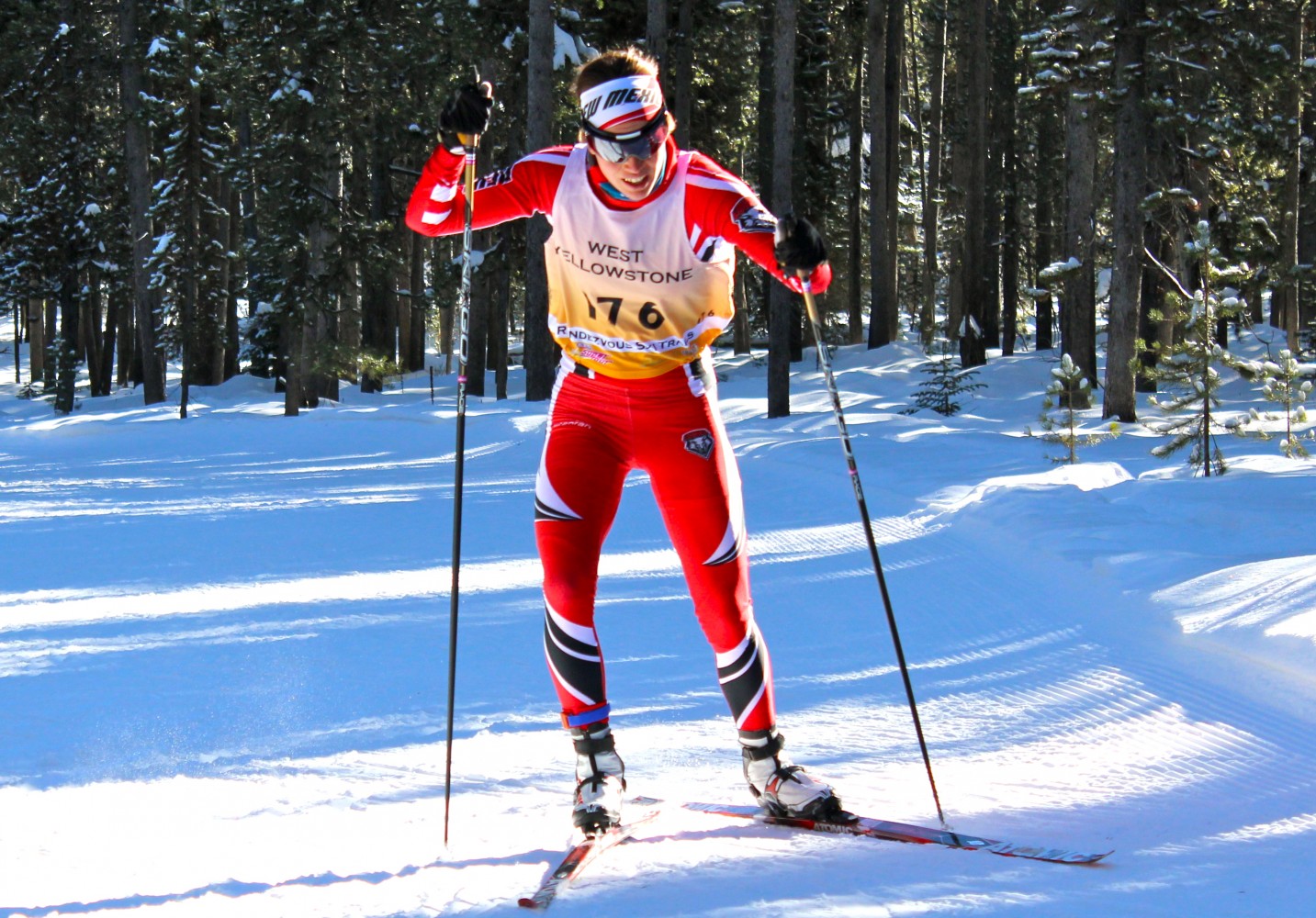
Kristina Strandberg (then racing for XC Oregon) racing in West Yellowstone in 2010.
I spent a total of 12 years living and ski racing in the US and I’ve come to think of Fredrik as one of the best coaches in the nation,” she continued. “He is a skier through and through, with a solid understanding of the sport and an unparalleled interest in the development of technique and equipment. He understands the commitment it takes to be a college athlete and he knows how to offer the support that is needed to succeed. When I was out of college and raced on the Supertour he was still there for moral support. I truly believe that I would not have become the skier I was, in college or afterwards, if it wasn’t for Fredrik and I still consider him one of my best friends.
I can only echo what others have said before me regarding the Ski Team’s impact on the local ski community. Our coaches always made a point of us reaching out to local skiers and to participate in local events. I’ve skied all over NM, in places like Abq, Red River, Santa Fe, Los Alamos and Chama. People have always been very happy to see their “local” university team in action. I also enjoyed weekend camps in Durango, CO, where we interacted with kids and coaches in the ski club.
One aspect that is often overlooked is that we were given fantastic opportunity to explore the Southwest. The Ski Team went on several training trips a year, all around NM and the surrounding states. With no other support needed than a van for transport, we biked in Moab, hiked Wheeler Peak and ran in White Sands. Fredrik made a point of showing us as much more of the country as he could. He’s really proud of his adopted home grounds and I am too!
Strandberg also gained a post-graduate scholarship for additional study at UNM. She ultimately graduated with a Masters of Science degree, which, she added, “I’m putting to good use now at my job as a methodologist at Statistics Sweden.”
Back in Albuquerque, the current members of the ski team continue to hit the books. At the 2017 Lobo Scholar-Athlete Banquet on Monday evening, “the Athletic Director’s Cup for the top academic program went to women’s skiing for the second straight year,” according to a UNM press release. Additionally, three of the nine senior student-athletes who were honored for graduating with a 4.0 GPA hailed from the ski team.
UNM senior Sydney Staples racing at 2017 NCAA Skiing Championships on March 10 at Mittersill at Cannon Mountain in Franconia, N.H. (Photo: flyingpointroad.com)
Alpine skier Sydney Staples, a senior from Bountiful, Utah, who is one of the three skiers about to graduate with a perfect GPA, was named the women’s Lobo Club Student-Athlete of the Year. In an emotional speech captured on video, Staples unsuccessfully fought back tears as she acknowledged the elephant in the room when it came to celebrating the accomplishments of the UNM ski team at this particular time:
“My team just barely received an award for [highest] cumulative GPA for the women’s team, and there are three of us skiers up here,” Staples said. “And there are a lot of skiers in this room right now that are going to go on to compete at the highest level of the World Cup or go to the Olympics, and some will stay here and pursue careers. And I’m so proud of all that they’ve accomplished, all that we’ve accomplished. And at the same time, I’m devastated that they won’t get the opportunity to stand where I’m standing today.
“And for the kids that we ski with each year in Santa Fe, and … Taos, and Colorado, all over the states, who tell us that they want to be just like us when they grow up – I’m sad that they won’t get that opportunity either,” Staples continued. “And so I want to encourage you, everyone here, to keep working hard, in your sport and in your classroom, and to keep taking advantage of all the incredible opportunities that are given to you at this school. Because you never know if that opportunity is going to be taken away from you.”
Staples subsequently left the podium to a standing ovation.
University of New Mexico (UNM) Ski Team supporters assemble outside the UNM Board of Regents meeting in Albuquerque, N.M., on April 18. (Photo: saveunmskiteam.com)
Football at the University of New Mexico (UNM) cost nearly as much in allocated expenses last fiscal year as 19 other sports combined, according to a new analysis of data provided to the federal government by the UNM athletic department. The financial context comes amid continuing suggestions by ski-team advocates that cutting skiing will provide substantially less than the $600,000 dollars in annual savings previously announced by the school.
The University of New Mexico, like all American co-educational colleges or universities that receive federal financial aid and sponsor intercollegiate sports, is required to submit certain information annually to the U.S. Department of Education under the Equity in Athletics Disclosure Act, or EADA. While the announced purpose of this data collection, visible at the EADA reporting site, is to help support gender equity in college sports, the data also permit an approximation of a school’s overall athletic department budget.
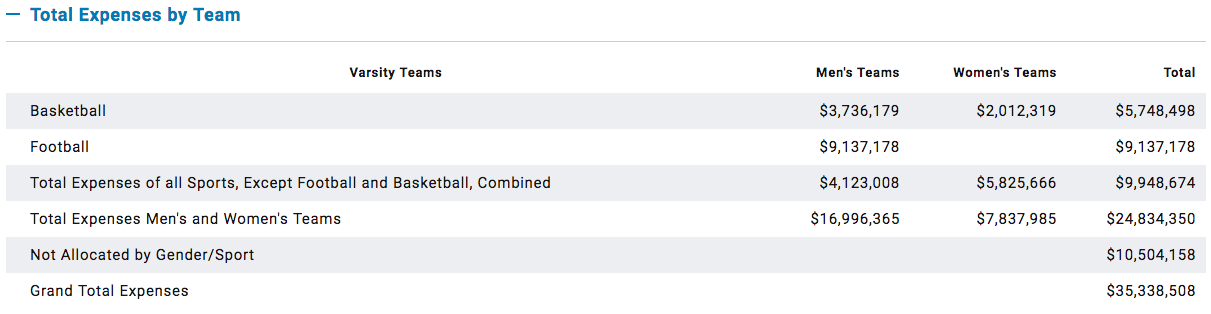
And the data show that, at UNM as elsewhere, football is king. The school reported total expenses for football, in the 2015 fiscal year (July 2015 – June 2016), of, in round numbers, $9.1 million. Men’s basketball cost $3.7 million, and women’s basketball $2.0 million, for a combined total of $5.7 million. The 19 other varsity sports at UNM had expenses of $9.9 million combined, or approximately $521,000 per sport. (This counts men’s and women’s teams as separate sports, as is standard for NCAA reporting and Title IX purposes even though skiing is, uniquely, scored on a coed basis. This also suggests that each of men’s and women’s skiing, at approximately $300,000 per sport given a total cost of $600,000, is cheaper than the average sport at UNM.)
Total expenses for UNM’s 22 varsity sports in fiscal year 2015. (Screenshot from ope.ed.gov/athletics)
The University of New Mexico currently sponsors 22 NCAA Division I varsity sports. In addition to football, men’s basketball, and women’s basketball, the other 19 sports are: men’s baseball, men’s cross-country running, men’s golf, men’s skiing, men’s soccer, men’s tennis, men’s indoor track and field, men’s outdoor track and field, women’s beach volleyball, women’s cross-country running, women’s golf, women’s skiing, women’s soccer, women’s softball, women’s swimming and diving, women’s tennis, women’s indoor track and field, women’s outdoor track and field, and women’s volleyball.
A man associated with the University of New Mexico carries a Lobos flag in support of its ski team on March 8 at 2017 NCAA Skiing Championships at Cannon Mountain in Franconia, N.H. (Photo: flyingpointroad.com)
Two UNM sports teams have won an NCAA championship in any of those 22 sports: skiing in 2004, and women’s cross-country running in 2015.
There are some reasons for caution regarding the expense data. Nearly every single revenue and expense figure matches up, dollar for dollar, within the report. That is, football apparently had expenses of $9,137,178 last fiscal year, but had revenue of precisely $9,137,178 as well.
Another weakness with these numbers is the gap between sport-specific and unallocated expenses. The EADA site lists an additional $10.5 million in expenses “Not Allocated by Gender/Sport” (the penultimate line in the screenshot above). So while roughly $25 million in athletic department expenses are broken down by sport and gender, an additional $10 million more is not attributable to any given sport. That’s nearly 30 percent of the listed total athletic department budget.
Finally, the bottom-line figure of the EADA document shows the UNM athletic department as reporting total revenue for the 2015 fiscal year of $35,338,508 and total expenses of precisely the same amount, suggesting that it neither made nor lost money last year. This suggestion clashes with both external reporting by the Albuquerque Journal and an internal financial memo sent to the UNM Board of Regents (see pages 243-248) by then-UNM President Bob Frank, both of which suggested that the UNM athletics department had a budget deficit of $1.54 million in fiscal year 2015. (Off revenue of $31.8 million and expenses of $33.3 million, both of which are less than the $35.3 million figure reported through EADA.)
The $1.54 million deficit figure is correct, UNM assistant athletic director Frank Mercogliano clarified in an email to FasterSkier. “There are certain numbers that go into the EADA report that are different than what we refer to here as the ‘actual budget,’ ” Mercogliano wrote to FasterSkier Tuesday. “The ‘actual budget’ numbers are the ones that the Journal reported on… the one with the deficit.”
Mercogliano added, “I personally have never seen the EADA report but I have been told that is why there are always differences in the numbers.”
Paul Krebs, UNM vice president for athletics, “didn’t have specific sport-by-sport figures,” the Albuquerque Journal reported last summer. But he acknowledged that “football, despite a winning season and a bowl game appearance, lost money and men’s basketball, despite a downturn in ticket sales, made the largest profit in the department.”
Men’s basketball marks the only portion of the EADA report listing different numbers for revenue and expenses. The figures given there suggest that men’s basketball earned $2,225,538 in profit for the athletic department last fiscal year.
A pair of ski team supporters outside the UNM Board of Regents meeting in Albuquerque, N.M., on April 18. (Photo: saveunmskiteam.com)
If the UNM football team indeed lost money, it has ample company. The Washington Post reported in November 2015 that 28 of the 48 “Power Five” schools (those schools in the ACC, Big Ten, Big 12, Pac-12, and SEC, the five wealthiest college athletic conferences) saw their athletic department operate at a loss in 2014. And that included schools like Wisconsin, Auburn and Michigan State, whose annual athletic department revenues of $104 to $123 million dwarfed the $32 million figure for UNM last year.
The Washington Post article did not consider UNM, nor any other school outside the Power Five conferences. All 48 Power Five conference schools had substantially more revenue in 2014 than UNM.
And finally, back to the ski team. The UNM athletic department initially announced that “The decision [to cut skiing] will save the department approximately $600,000 per year in operating budget, scholarships and salaries.” Ski team supporters have since countered that “The Ski Team’s annual budget is actually only about $285,000 for the university as a whole, not the $600,000 figure the Athletic Department claims it will save by cutting the team.” The explanation given is, “This is mostly because the largest line item in the Ski Team budget is scholarships paid out of the Athletic Department budget, but paid TO the university’s main campus.”
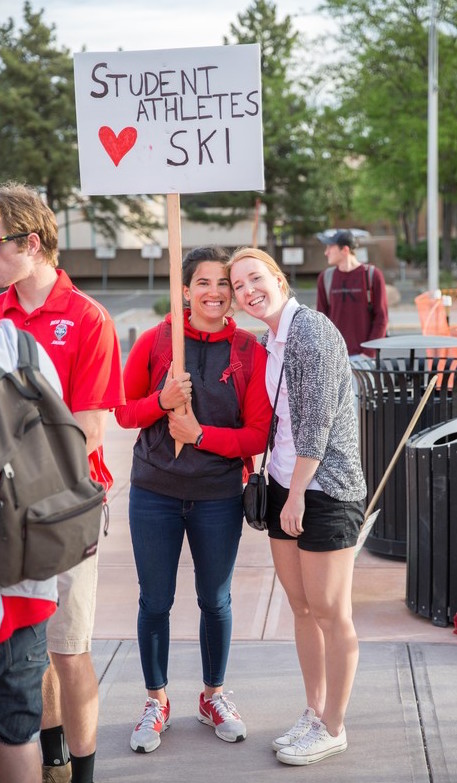
On Tuesday, the UNM Board of Regents met in Albuquerque. It was greeted outside by sign-waving attendees showing their support for the ski team. A video from inside the meeting shows multiple people speaking in support of the ski team.
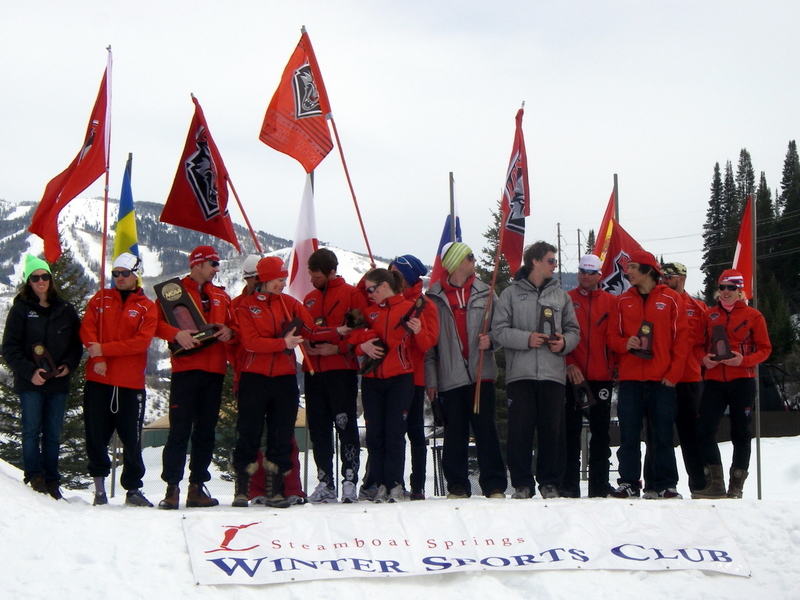
The University of New Mexico ski team (alpine and nordic) celebrates its podium finish at the 2010 NCAA Championships.
The men’s and women’s nordic and alpine ski teams at the University of New Mexico (UNM) will be defunded and cease to exist by the end of June, university administrators announced Thursday afternoon. While the death of the ski team is being presented as a fait accompli by the UNM athletic department, ski team advocates are nonetheless rallying support and preparing to make their case for continued funding to the Board of Regents. The threatened cut to another western ski program comes six months after UNM’s neighbor far to the north, the University of Alaska, had to rely on a groundswell of community support to reverse an announced ax to its ski program.
Budget background
Last month the local paper, the Albuquerque Journal, reported that legislators were running into the final days of the session in their attempt to balance the state’s budget “amid a fiscal crisis.” On Monday of this week it reported on New Mexico Governor Susana Martinez’s symbolic move to veto all funding for public colleges and universities for the next fiscal year. On Thursday, the Associated Press reported that state legislators were preparing to sue the governor over this action, “amid an unrelenting standoff … over how to shore up state finances.”
Also Thursday, UNM officials announced that the school would no longer sponsor men’s and women’s skiing. “The decision will save the department approximately $600,000 per year in operating budget, scholarships and salaries,” the school wrote in a press release.
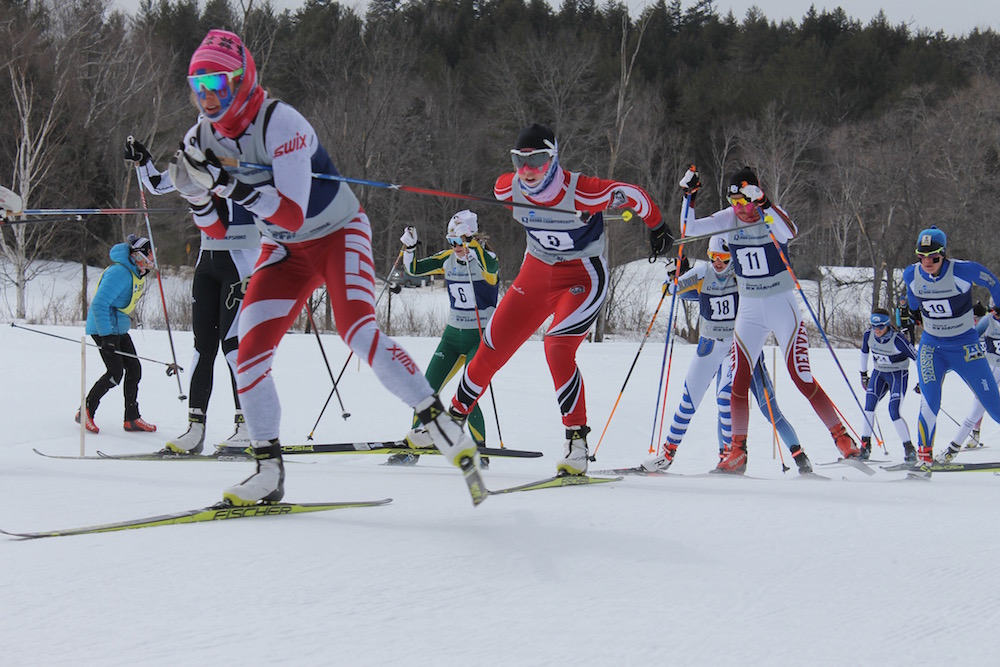
UNM’s Krista Niiranen (c) racing out of the stadium while following Utah’s Merete Myrseth (l) and skiing ahead of Denver’s Taeler McCrerey (11) and NMU’s Kristen Bourne (6) in the women’s 15 k freestyle mass start at 2017 NCAA Championships in Jackson, N.H.
In round numbers, the budget for the UNM athletic department was roughly $32 million in the previous fiscal year.
The UNM athletic department recorded a deficit of $1.54 million for the fiscal year that ended in June 2016, the Albuquerque Journal reported last summer. “According to a report to University regents,” the Journal wrote, “UNM fell short of ticket revenue projections by $975,000 and missed fundraising goals by $200,000.”
In the summer 2016 article, Vice President for Athletics Paul Krebs “made it clear it doesn’t mean there are bills not being paid or sports being cut.”
At that time, UNM Regent Marron Lee told the Journal that she was adamant that sports would not be cut in response to the budget deficit.
“No. We do not have too many sports,” the Journal article quotes her as saying. “We do a really good job with athletics at the University of New Mexico and I can’t think of one sport where I’d say, ‘Well, you have to be on the chopping block because we have a deficit.’”
So why was skiing the only sport cut now after all? Here’s what an FAQ sheet from the UNM athletic department has to say:
“Why skiing as opposed to a different sport? There are now less than 35 ski programs in the country that compete in the NCAA, and several of those do not compete full squads. There are just six other NCAA programs in the West, and when you look at the costs associated with skiing such as travel, insurance for international student-athletes, equipment and the fact that we practice three hours away, skiing made the most fiscal sense for our department.”
The ski team’s perspective
Head Coach Fredrik Landstedt is unconvinced. “They’re justifying it partly because of the budget,” Landstedt told FasterSkier in a Thursday phone call, “because skiing has fewer schools [sponsoring it], 34 sponsored institutions right now with skiing; there’s a few more if you count men’s and women’s. … But in my opinion, it doesn’t really matter how many schools that sponsor your sport, if you want to be on the top. I wouldn’t really care if there were 200 more ski teams out there that had crappy teams; it wouldn’t hurt me any. I don’t even understand the justification based on the number of sports. I mean, we’re competing right at the top.”
(UNM sports information director Frank Mercogliano told the Albuquerque Journal that no one from the ski team “immediately felt up to discussing the decision with media.” Landstedt was more than willing to speak when cold-called on Thursday afternoon.)
Finland’s Aku Nikander (r) of the University of New Mexico leads Noah Hoffman of the U.S. Ski Team around a corner on the Spencer Loop during the final lap of the men’s 50 k classic race at the U.S. Distance Nationals at Hillside in Anchorage, Alaska, in 2014.
Landstedt is objectively correct that the UNM ski team operates at a high level within American collegiate skiing. The team won a national championship in 2004, the school’s first NCAA team title in any sport. They were seventh at NCAA Championships this year – “but that’s one of our worst places,” Landstedt said of a program that consistently places even higher than that.
Alluding to the threatened cut to the University of Alaska Anchorage (UAA) ski team last fall, Landstedt said, of a team that has enjoyed solid results but that has historically lagged behind UNM at the top of the results sheet, “This will definitely hurt collegiate skiing. Because now, you know, Alaska Anchorage is one of the top programs, but they haven’t been even close to as successful as we’ve been as far as being up on the podium. And now you’re cutting one of the top programs in the country … and that means, what program is safe out there? ADs everywhere can point to the fact that they cut us – we were national champions.”
For UAA head nordic coach Andrew Kastning, “the pain from our recent struggle [over being defunded] is still fresh,” he wrote to FasterSkier. “So I know what they’re feeling and hurt for them as well.”
Kastning continued, looking back on his experience at UAA, “One of the reasons we got saved is because we got a lot of vocal support from [the] ski community which recognizes the importance and uniqueness of US college skiing and how it can raise the level of competition for every skiing region. It’s too early to tell what this means for college skiing, but it’s not good, and we all need to stand together and fight for the Lobos just as hard as we yelled and screamed for the Seawolves.”
(Current actions to support the UNM ski team are discussed at the end of this article.)
Back in Albuquerque, Landstedt is justifiably proud of his program. He cites the current 3.92 GPA of the women’s ski team, and 3.6 GPA for the men, as evidence for his claim that skiing has “always been the top academic program” at UNM.
Plus “We’ve always been the top athletic program,” Landstedt adds. “We have 13 NCAA trophies; there are only three more at UNM, total, for all the other sports. And we have 17 individual NCAA champions. So athletically we have traditionally by far been the best program [at UNM].”
Landstedt continues, “And on top of that, the ski team has always covered its budget here, so we never put anything to the deficit. We don’t have facilities that they have to pay for at UNM. The only cost as far as facilities is that the State of New Mexico has provided us with two vans, that’s it for 30 years. … So you’re showing poor judgment when you’re cutting the program that really typifies the excellence of being a student-athlete, a top student-athlete at the top level.”
The skiers’ perspective
One such student-athlete is Patrick Brachner, a senior alpine skier from Austria. Brachner spoke candidly with FasterSkier about how the athletes found out the news and the current mood of the team.
“For us, this decision came absolutely out of nowhere,” Brachner wrote to FasterSkier earlier today. “We knew that the Athletic Department was reporting a deficit, but it was always communicated that no teams will be dropped. Also, the Ski Team has not increased its spending since 2003 and we raised about $50,000 every year from supporters to support our budget. If there is a certain amount allocated from the Athletic Department for skiing, and our coaches never exceeded this budget, why would there be any reason to cut this program, although other programs have continuously exceeded their spending.”
Emilie Cedervaern (University of New Mexico) during the first lap of the women’s SuperTour 10 k freestyle race in West Yellowstone, Mont., in Nov. 2015.
“It was a total shock” to learn yesterday that the program was being cut, Brachner continued. “Most of my teammates declared majors, signed up for classes the day before, I was talking to new recruits about their living situation for next year only hours before we got dropped.”
The mood within the team “wasn’t great” on Thursday, Brachner noted. But he added that, “if anything, this has just put us closer together and sparked our fighting spirit. It is amazing to see all the support of other UNM Alumns, and even Alumns of other colleges with a skiing program. People have to understand how great of a job the UNM Ski Team does in shaping people for the rest of their lives.”
Finally, Brachner provided a dose of realism regarding the options for current athletes. While UNM pledged either to honor current scholarships through graduation or to help skiers transfer to another institution, Brachner wrote that “It’s too late to transfer to other ski teams; spots are taken.”
(Frank Mercogliano, an assistant athletic director of communications at UNM, had a far less pessimistic view of current athletes’ options. “I don’t think that’s correct” that it’s already too late to transfer somewhere else, Mercogliano told FasterSkier in a Friday phone call. “Because we’ve got other schools that have basically had us on speed-dial, calling, asking about kids. … There’s room; kids will be able to transfer and go to schools, and be able to get scholarships. I mean, they’re going to make room. We have some kids that are – we have a lot of podium kids coming back here, both in Nordic and in Alpine. There’s room – trust me, they’ll find – the Utahs, and the Colorados, and the Denvers, and even the New Hampshires and the Vermonts and the Montana States and the Alaska Anchorages of the world – they’ll find room. They’re going to find room for kids that can win podiums on the circuit. They’ll do that.”)
And as for those students who wish to remain at UNM, on scholarship and without skiing? “In order to keep their scholarships here,” the senior Brachner wrote of his current teammates potentially still in Albuquerque next year, “they would need to work 10h for free per week for the Athletic Department, the institution that kicked them out.”
Funding issues and the men’s basketball coach
Hanging over any current discussion of funding for the UNM athletic department is the prominent and public fact that the school recently paid one million dollars to buy out the contract of men’s basketball head coach Craig Neal, a decision that occurred on March 31. (Neal would have been owed an additional $300,000 if he had been fired during the current contract year, which began on April 1.)
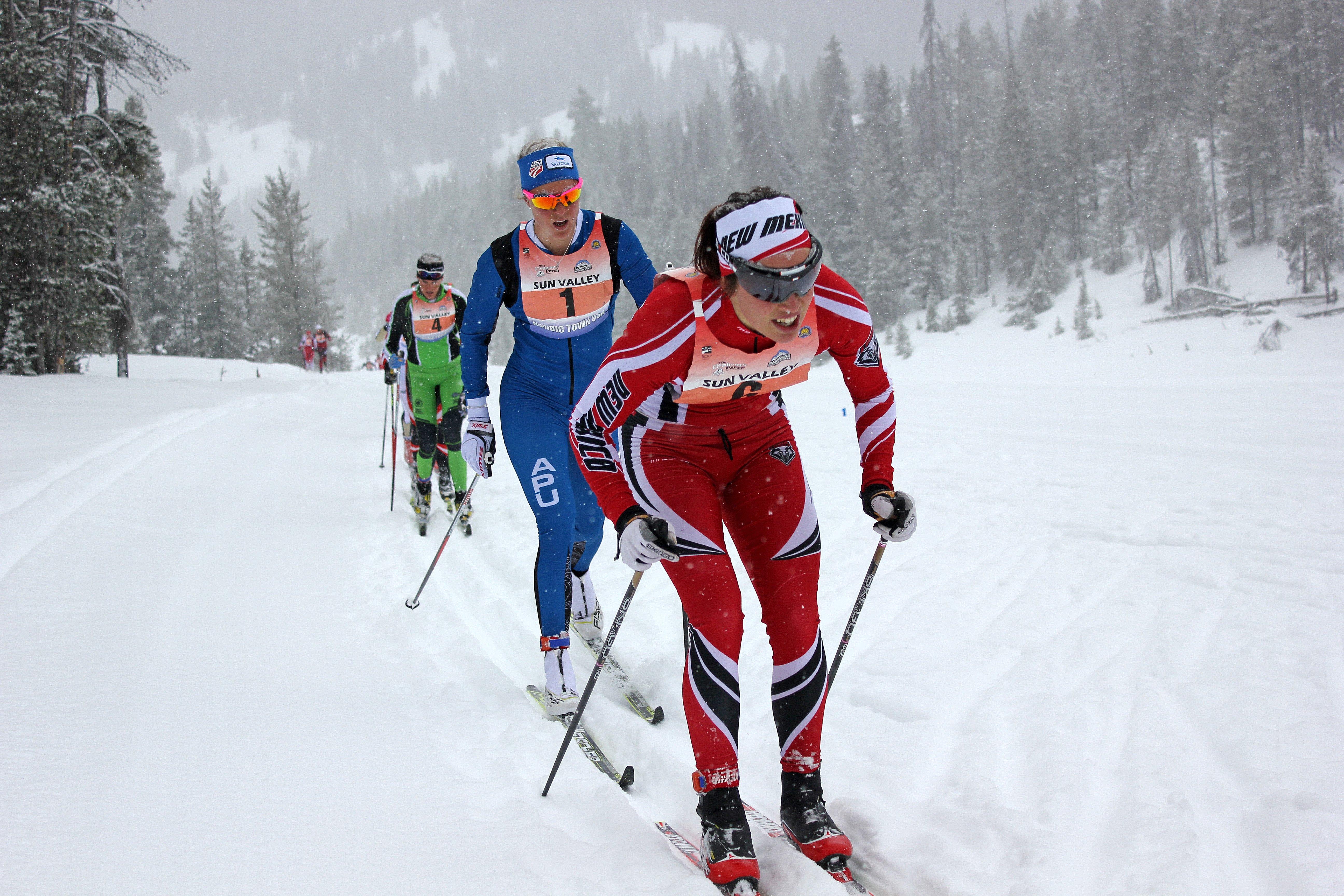
Emilie Cedervaern (New Mexico) leads Sadie Bjornsen on the final climb of the first leg at the 2015 SuperTour Finals 4 x 5 k mixed relay in Sun Valley, Idaho.
At best, it may be said to be bad optics for the athletic department to pay out a $1 million buyout on March 31, then announce on April 13 that a sport is being eliminated due to lack of funding and the need to save $600,000. (Although Landstedt suggests that the actual savings to UNM would be closer to $450,000.) At worst, ski-team members are beyond skeptical.
“The economy in New Mexico is poor,” Landstedt acknowledged. “They’re still trying to work out the state budget, the university has said it has a budget deficit, and the athletic department has a budget deficit. But the athletic department’s deficit is in big part because they signed very poor contracts with the basketball coach and have to pay them million-dollar buyouts, and so forth.”
He continued, “The economy is tough, tough decisions have to be made, but I believe there are other ways to cut or to increase your budget than by cutting our program out. That said, I believe it’s not the main reason for the predicament UNM Athletics are in; it’s because of the management or the current leadership of athletics.”
Brachner, the current alpine skier, similarly pulled no punches in contrasting the Neal buyout with the recent news about defunding the ski program.
In the introduction to an online petition in support of the ski team, Brachner wrote, “After firing UNM’s basketball coach earlier this month, UNM’s Athletic Director Paul Krebs has decided to discontinue the Women’s and Men’s Skiing program, a program that has deep roots not only within the University, but throughout the entire state. To put things in perspective, only the replacement of UNM’s basketball coach during his existing contract will cost the athletic department far more than the yearly budget of Women’s and Men’s skiing combined. This example is only the tip of the iceberg of ongoing financial mismanagement at the expense of student-athletes.”
For its part, the UNM athletic department disavows any connection between the buyout and this recent announcement. Its FAQ document addresses this claim: “Are there any ties between this announcement and the recent search for a men’s basketball coach and the buyout for Craig Neal?”
The answer given is: “No, discussions about ways to help our bottom-line regarding our budget have been ongoing for several months among the department’s budget committee. That committee made a recommendation to [vice president of athletics] Paul Krebs and he made the recommendation to the University administration. Regardless of the buyout for men’s basketball coach Craig Neal, this decision would have been made.”
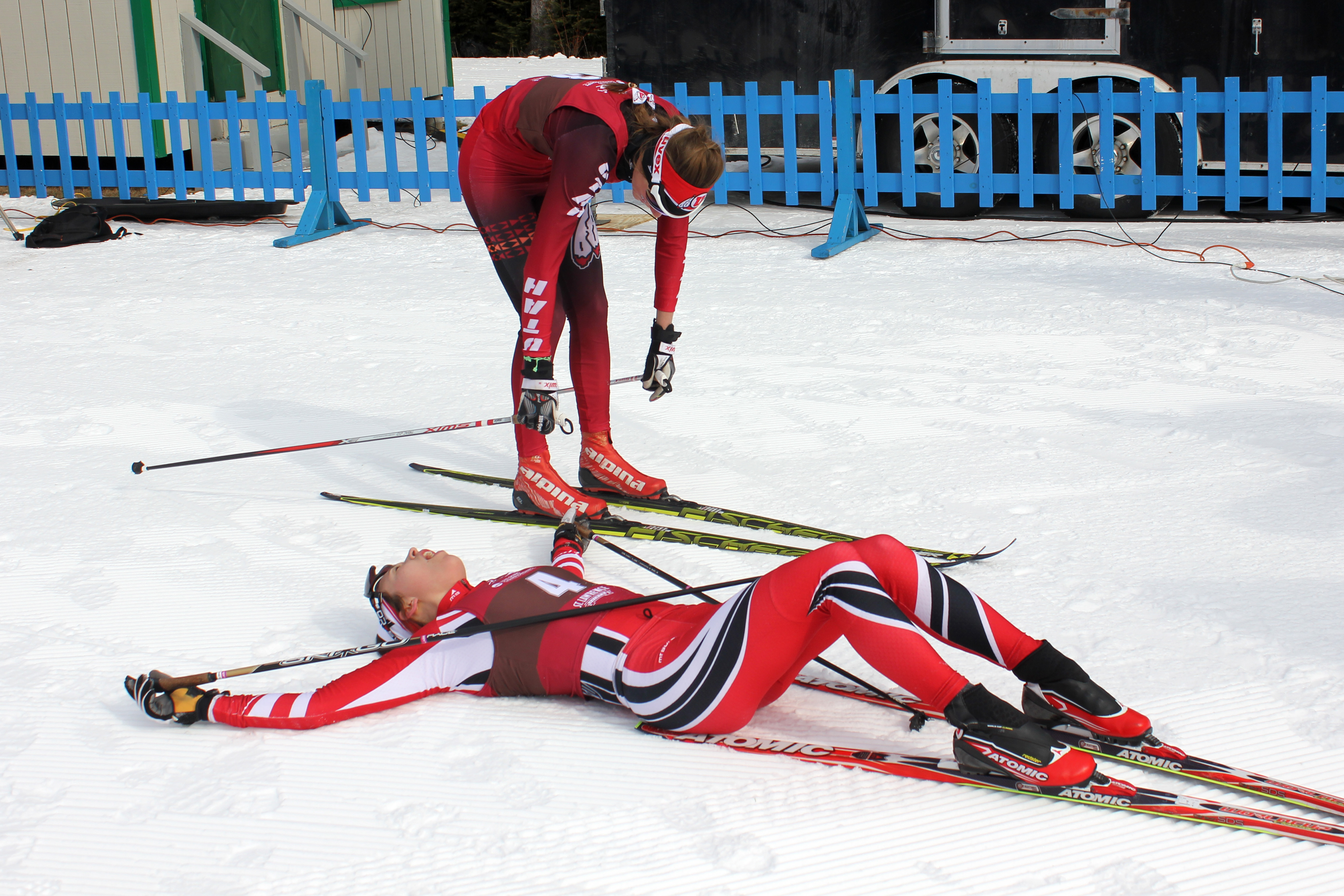
New Mexico’s Emilie Cedervaern on the ground after winning the 15 k classic mass start at the 2015 NCAA Championships in Lake Placid.
Mercogliano, the athletics department spokesman, also provided a more nuanced view of the contract language of the Neal buyout. Mercogliano mentioned a mitigation clause in the contract, by which any money Neal earns over the next two years reduces UNM’s financial obligations to its former coach by an equal amount.
That is, Neal is presumptively owed $500,000 in each of the next two years, payable in 24 monthly installments, as a “salary” for not coaching the UNM basketball team in that time. But if he made $100,000 per year for two years, then UNM would owe him only $400,000 per year for two years, or $800,000 total. If he made $250,000 per year, then UNM would owe him $500,000 over the next two years. And so on.
“We’re assuming he’s going to get a job,” Mercogliano said of Neal; “that’s not much of a question at this point. Whatever salary he then gets gets mitigated off of what we owe him.”
Mercogliano also characterized the budget analysis as, “It’s not, ‘Skiing was cut, we’ve got this $600,000, how now are we going to spend it.’ It’s money that we just don’t have any more, because of state budget cuts, rising costs, cost of scholarships,” and other expenses.
What happens next
Skiing has been a varsity sport at the University of New Mexico since 1970 (it began as a club sport two years before that). Despite that venerable heritage, UNM is now preparing for a future without skiing. “Is there a possibility skiing could be reinstated?” its FAQ sheet notes.
“One would never say never,” was the answer, “but in our current climate, it is not a part of the future vision of Lobo Athletics. We are moving forward with skiing off the table.”
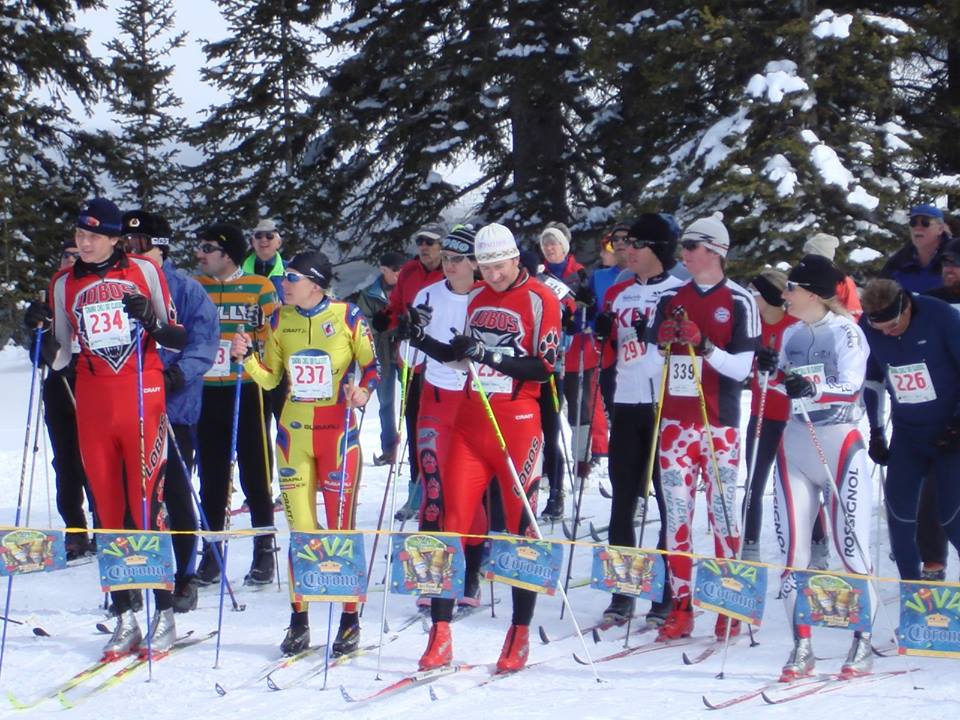
University of New Mexico athletes toe the line alongside citizen skiers at the Chama Chile Ski Classic in Chama, N.M. (Photo: Southwest Nordic Ski Club)
Despite that official statement, Landstedt is preparing to advocate for his program. “We’re going to fight this decision. We’re working out a strategy right now,” he told FasterSkier late Thursday afternoon. “Because we were told at the meeting at 1 o’clock [today] – the AD told us they would discontinue the ski program. They read us a letter stating that by June 30 we’re out of there, we’re fired. And then 10 minutes later the press release went out, and then right after that they told the student-athletes. So we didn’t find out anything until right then. It was very poorly handled by the department in the first place.”
Brachner wrote, “UNM’s Board of Regents has their next meeting on Tuesday and we need to gather as many troops as possible in favor of the team, athletes, teachers, supporters, friends, etc. to show that we are important to the community and it is valuable for UNM to have a Ski Team.”
One representative of the local ski community is Clay Moseley. The president of Southwest Nordic Ski Club, based in Los Alamos, is active in supporting what he calls “a small, but very vibrant Nordic community in New Mexico, with a rapidly expanding group of kids in both Albuquerque and Northern New Mexico.” Moseley wrote to FasterSkier that “Our access to the team is a critical part of the motivation for the kids. They marvel at the team and the team members are always so supportive and friendly to our kids. We are SO isolated here, so having that little bit of contact to some ski ‘heroes’ is vital.”
As of Friday, a petition titled, “Save the NMU Ski Team,” had more than 3,000 supporters. Its goal is 5,000.
The Board of Regents may be reached by email at regents [at] unm.edu, or by phone at 505-277-7639. Contact information for Board of Regents President Robert M. Doughty III is available through his law firm website. Board of Regents Vice President Marron Lee lists her email address as marronresipsa [at] gmail.com in the publicly available New Mexico Bar Association Directory.