From the FasterSkier archive — posts syndicated from athletes’ and coaches’ own blogs between 2004 and 2012, kept online as published. Current coverage is at fasterskier.com.
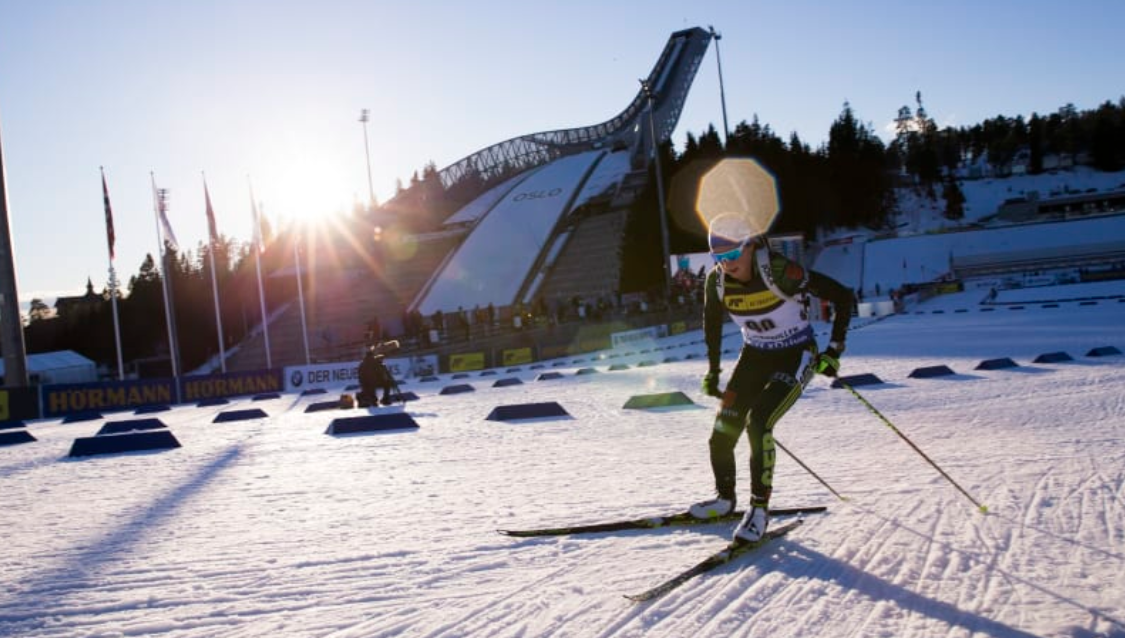
Sunny skies at the 2019 IBU World Cup women’s 7.5 k sprint in Oslo, Norway. (Photo: biathlonworld.com screenshot)
The IBU World Cup resides in Oslo this week. The women began the racing with the 7.5-kilometer sprint on Thursday.
The podium rundown goes like this: Slovakia’s Kuzmina Anastasiya shot 1+0 to win in 19:56.2, Germany’s Franziska Preuss placed second (+21.2, 0+0), with Paulina Fialkova of Slovakia in third (+25.1, 0+0).
This was Kuzmina’s fifth win at Holmenkollen and secured her the IBU sprint overall title.
Canada’s Emma Lunder was the top North American in ninth place. Lunder clean both shooting bouts and was 49.0 seconds behind the winning time. This was a career best individual result for Lunder on the IBU World Cup.
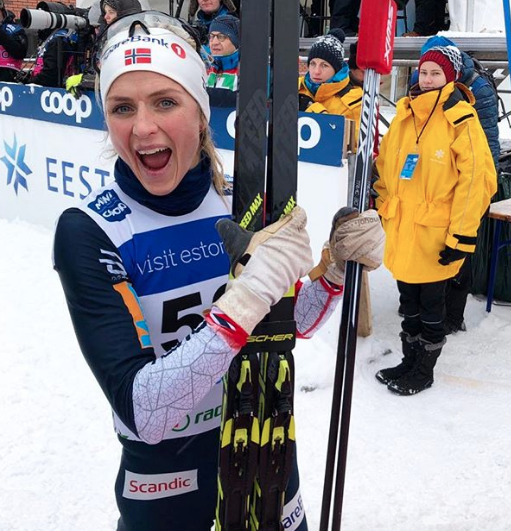
World Cup cross-country action returned to the Otepää race venue on Sunday, with athletes reconvening after Saturday’s classic sprints for the weekend’s distance classic event. In the women’s 10-kilometer individual start classic race, Norway’s Therese Johaug finished first in a time of 29:53.7 for the win. Sweden’s Ebba Andersson finished second (+48.4) while Russia’s Natalia Nepryaeva claimed third (+56.7).
Skiing for the U.S. Ski Team (USST), Jessie Diggins was the top North American woman on Sunday, placing 13th (+2:26.0). Two more Americans skied into the Top 30, with Rosie Brennan finishing 27th (+3:09.9) and Sadie Bjornsen 29th (+3:11.3).
Also skiing for the U.S. on Sunday, Caitlin Patterson and Ida Sargent finished in 39th (+3:50.9) and 41st (+4:17.2), respectively. Dahria Beatty was the lone Canadian to enter the race, placing 43rd (+4:42.5).
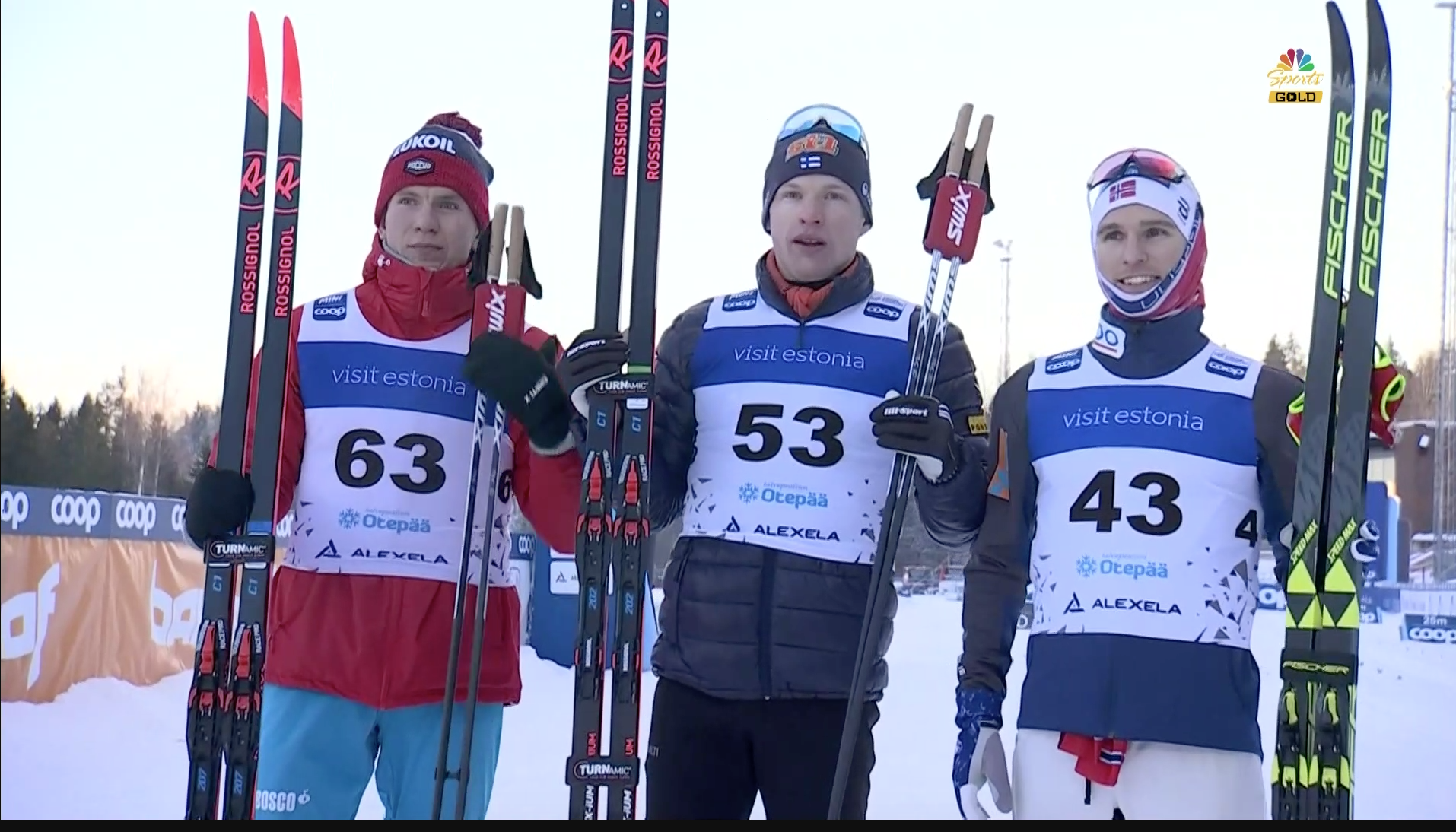
The men’s 15-kilometer classic podium on Sunday in Otepää, Estonia with Russia’s Alexander Bolshunov (left) in second, Iivo Niskanen of Finland (center) in first and Norwegian Didrik Tønseth (right) in third. (FIS screenshot)
In the men’s 15 k, Finland’s Iivo Niskanen took first, completing the course in a time of 40:07.1. Russia’s Alexander Bolshunov finished in second place (+15.9) and Norway’s Didrik Tønseth in third (+46.4).
The USST’s Erik Bjornsen led the charge for the Americans, placing 30th (+2:35.7). Scott Patterson placed 36th (+3:01.0), while Ben Lustgarten finished in 53rd (+4:41.1). Kevin Bolger placed 56th (+4:57.3) and Andy Newell did not start.
Racing for Canada, Len Valjas placed 43rd (+3:56.9) and Bob Thompson 52nd (+4:24.0).
The NorAm weekend wrapped up with mass start free technique on shortened courses. The predicted extreme cold and extreme snow didn’t materialize with a relatively balmy -13C recorded by the jury.
Katherine Stewart-Jones (CNST) continued her dominance with a win in 48:25.5, gapping Cendrine Browne (CNST) on the third and final lap for a 8.4 second separation. That is two wins and a second for Stewart-Jones. Zoë Williams (Nakkertokk) was third again, 1:38.2 behind. The shortened course was 14.3km, with one 4.3km lap and two 5km laps.
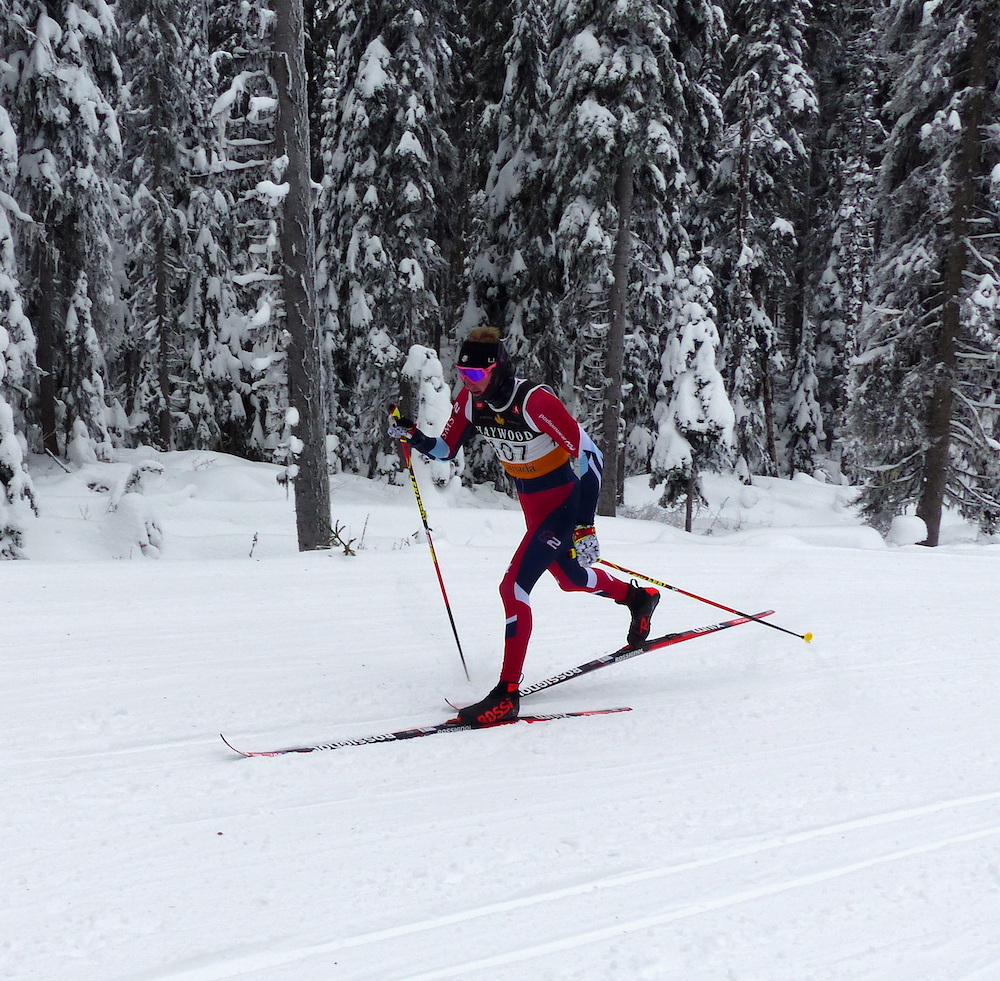
Russell Kennedy (Team R.A.D.) collected his first win of the weekend to earn his trip to World Championships, finishing alone at 57:12.6 on the four lap 19.3km race. Scott Hill (Hardwood) was second at 23.4 seconds behind. Evan Palmer-Charrette out-sprinted the remains of the original six leaders to complete the podium at 1:07.0.
IBU World Cup Ruhpolding, Germany 15 k / 12.5 k Mass Start
Career-best days are good days. That’s the main narrative from US Biathlon’s Sean Doherty 15-kilometer mass start in Ruhpolding, Germany on Sunday.
Doherty’s previous best in the mass start was a 24th place. In the 30-athlete field, Doherty began in bib-30. In his first two shooting stages, both prone, he skied a single penalty lap in each. As he found his ski-speed groove for his second two laps, marking the third fastest ski split for lap three and the fifth fastest split for lap four, Doherty also made his mark on the shooting range as he shot clean for for both his standing stages.
Doherty finished in 13th overall which matched his individual career best on the IBU World Cup. Johannes Thingnes Bø of Norway won the mass start in a time of 36:43.8 minutes while shooting clean for his first three stages and skiing one penalty lap on his fourth. Doherty’s finishing time was 42.2 seconds behind Bø’s.
Canada’s Christian Gow also posted a career best IBU World Cup results with an 11th place. Gow skied a single penalty lap after missing a target on his second prone stage. Otherwise, he shot clean to finish 34.3 seconds behind Bø.
Austria’s Julian Eberhard placed second (+0.6, 0+1+0+1), and France’s Quentin Fillon Maillet was third (+2.8, 0+1+0+0). Teammate Martin Fourcade skied to fourth (+8.6, 0+0+0+1).
Bø’s win on Sunday marked his 10th win (including relays) this season on the IBU World Cup. He leads the overall points series.
It was time for a first in the women’s 12.5 k mass start. Franziska Preuss of Germany won the race – an IBU World Cup career first for her — in a time of 32:34 minutes. Preuss shot clean on her way to the win.
Norway’s Ingrid Landmark Tandrevoldplaced second (+0.2, 0+0+0+0). For Tandrevold it was a her first IBU World Cup podium. Paulina Fialkova of Slovakia was third (+15.1, 0+0+0+0).
US Biathlon’s Clare Egan placed 24th (+1:59.7, 0+0+3+2), teammate Susan Dunklee 25th (+2:12.5 2+1+1+0).
No other North American women qualified for the mass start.
Marte Olsbu Røiseland of Norway celebrating her victory after Friday’s IBU World Cup sprint in Nové Město. (Photo: biathlonworld.com)
IBU World Cup Nové Město, Czech Republic Women’s 7.5 k Sprint
On Friday in Nové Město, the women contested a 7.5-kilometer sprint. Norway’s Marte OlsbuRøiseland won the day in 19:44.6 minutes for her first IBU World Cup victory. Røiseland shot clean on the day. It was her second top five result this season after placing fifth in Pokljuka, Slovenia’s pursuit.
Germany’s Laura Dahlmeier finished in second 4.5 seconds back after missing one target for her only penalty. Third place went to Paulina Fialkova of Slovakia. Fialkova was 6.2 seconds behind at the finish after shooting clean.
Canada had two athletes in the top-20. Sarah Beaudry placed 12th (+42.7, 0+0) for her best career individual IBU World Cup result. Emma Lunder finished 17th (+57.9, 1+0), which also was a career best individual result. Rosanna Crawford was 54th (+1:59.9, 2+1), and Megan Tandy 81st (+2:50.9, 1+2).
For the US Biathlon Team, Clare Egan placed 26th (+1:11.1, 1+1), Susan Dunklee 39th (+1:32.4, 1+1), Joanne Reid 52nd (+1:57.2, 1+1).
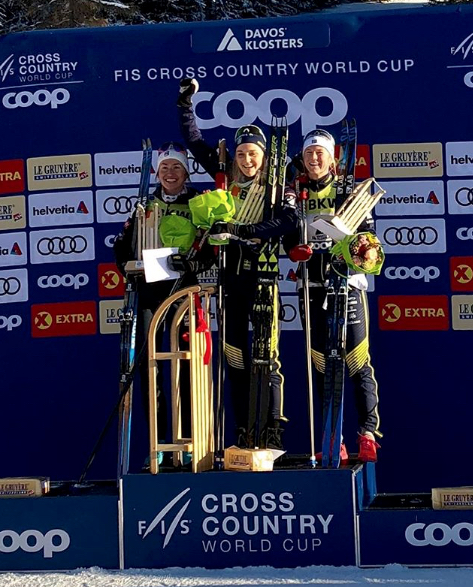
2018 Davos, Switzerland women’s sprint podium. Sweden’s Stina Nilsson (center) placed first, Sophie Caldwell (left) of the U.S. was second, and Maja Dahlqvist (right) also of Sweden was third. (Photo: screenshot @matt.d.whitcomb)
FIS World Cup Davos, Switzerland 1.5 k Freestyle Sprint
On a lovely Davos, Switzerland day, Sophie Caldwell of the U.S. Ski Team (USST) was the day’s fastest qualifier for the women, stopping the clock in 2:46.28 minutes. Caldwell looked cool and in-form on her way to place second overall on the day for her first podium of the season.
The win went to Sweden’s Stina Nilsson after placing third (+2.03) in qualification. Third place went to another Swede, Maja Dahlqvist. It was the twenty-four-year-old Dahlqvist’s second podium of the year after she placed second in the Ruka, Finland classic sprint. Dahlqvist was the day’s second-fastest qualifier, finishing 0.62 seconds behind Caldwell.
Four other Amercian’s advanced to the heats. Sadie Bjornsen qualified in 10th (+4.28). She looked strong in her heat, leading the first lap and skiing in second place down the final stretch. She was passed by a surging Natalia Nepryaeva from Russia. After placing third, Bjornsen did not advance. Bjornsen ended up 14th on the day.
Ida Sargent (USST) qualified in 14th (+5.41) but did not advance out to the heats after placing fifth in the first quarterfinal. Sargent was 21st overall.
Jessie Diggins (USST) was 15th (+5.50) in qualification. In the fourth quarterfinal, Diggins tripped over Russian skier’s Natalia Matveeva’s pole and fell to her knees in the heat’s opening moments. She was unable to regain the lost ground and placed sixth in a photo finish with Matveeva. Diggins placed 26th overall.
No Canadians were entered in the women’s race.
Rosie Brennan (APU)qualified in 28th (+8.83) and was eventually eliminated in the third quarterfinal where she placed sixth. Brennan was 29th on the day. Also for the U.S., Kelsey Phinney (SMS T2) placed 38th, after placing 38th (+12.10) in the qualifier.
For the men, although still young twenty-two-years-old, Johannes Høsflot Klæbo looked like the old Klæbo on his way to his first World Cup win of the season. The Norwegian was the World Cup’s overall winner last season and first in the sprint cup.
Klæbo placed first in the qualifier with a time of 2:22.39 minutes. He advanced to the finals by winning the first heat and the first semi. Klæbo won the final in 2:20.44 minutes. Italy’s Federico Pellegrino was second overall, finishing 0.39 seconds back. Baptiste Gros of France was third (+1.40) to take the last podium step.
Simi Hamilton (USST) was the best placed North American male. Hamilton qualified in 17th (+4.76) and placed 12th overall. He placed second in the fifth heat a fraction behind Finland’s Joni Maeki. In the second semi-final, won by Norway’s Eirik Brandsdal, Hamilton placed sixth (+6.90).
Kevin Bolger (USST) just missed the heats after qualifying in 31st (+6.63). After not advancing, Bolger was 31st overall. No other Americans were entered.
Alex Harvey was the best placed Canadian, placing 37th overall. Lenny Valjas in his first World Cup of the season was 53rd. Andy Shields finished in 60th. No other Canadians were entered.
IBU World Cup Hochfilzen, Austria 10 k/12.5 k pursuit
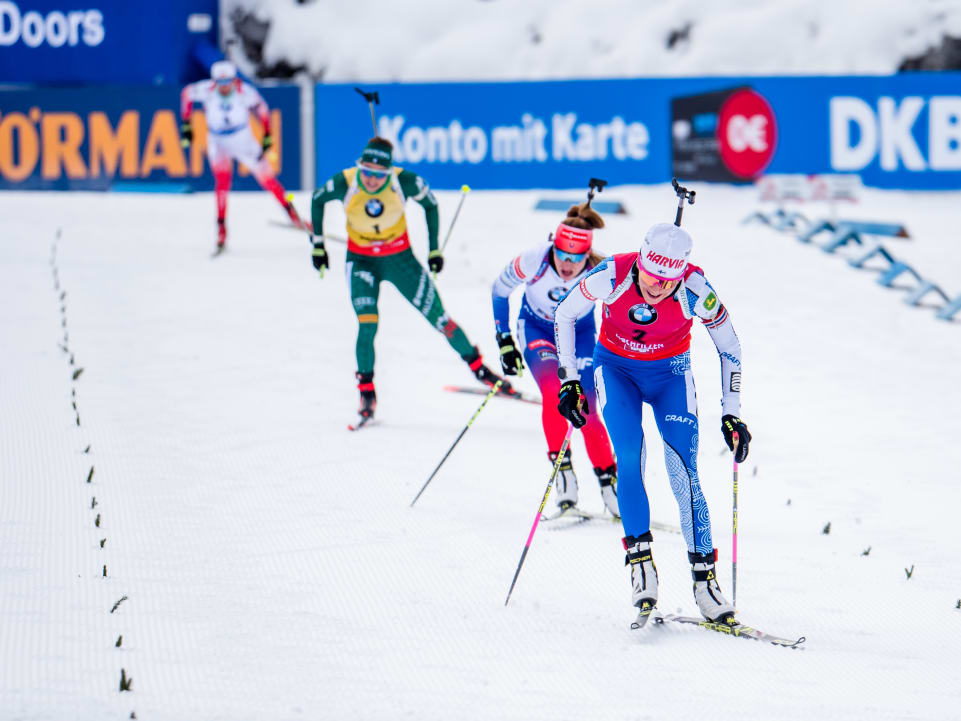
On Saturday in Hochfilzen, Austria the women’s 10-kilometer pursuit was won by Finland’s Kaisa Mäkäräinen in a time of 30:53.8 minutes. It was Mäkäräinen’s third win of the season. The Finn had a tough time on the shooting range, despite surging for the win in the final meters, she suffered three penalties on the shooting range (1+0+1+1).
Kaisa Mäkäräinen of Finland down the final stretch in Hochfilzen, Austria during the IBU World Cup 10k pursuit. Paulina Fialkova of Slovenia was second, Italy’s Dorothea Wierer was third. (Photo: biathlonworld.com)
Paulina Fialkova of Slovenia was second (+1.5, 0+0+1+1) after skiing two penalty loops. Italy’s Dorothea Wierer was third in a close fight for all three podium spots finishing 2.8 seconds behind Mäkäräinen. Wierer had three penalties during the race (2+0+1+1).
Susan Dunklee of the U.S. was the best placed North American, improving on her 34th start spot to place 28th (+2:06.1, 0+1+1+0). Teammate Joanne Reid was 31st (+2:17.1, 0+0+0+1) after missing only a single target. Clare Egan did not qualify for the pursuit.
Rosanna Crawford was the lone Canadian to qualify for Saturday’s pursuit. She placed 44th (+3:24.8, 1+1+0+1).
Martin Fourcade of France, in a return to shooting and skiing form, took the win in the men’s 12.5 k pursuit. Fourcade won in a time of 32:22.3 minutes while shooting clean through his four shooting rounds.
Germany’s Arnd Peiffer was second (+13.7, 1+0+0+0), skiing a single penalty lap. Norway’s Vetle Sjåstad Christiansen was third (+16.1) after shooting clean for the race.
First place starter after winning yesterday’s sprint, Norwegian Johannes Thingnes Bø, fell back in the standings after missing six targets. He placed ninth (+1:00.0, 0+3+1+2) overall.
Sean Doherty for the U.S. was 31st (+2:37.3, 0+1+0+1). U.S. teammate Leif Nordgren was 42nd (+3:21.5, 1+0+1+3).
Scott Gow was the only Canadian to qualify for the pursuit. He finished in 51st (+4:36.3, 1+0+0+3).
NorAm and U23/JW World Championships Qualification, Canmore, Alberta
Day two of the Noram and U23/JW trials in Canmore, Alberta, featured freestyle individual interval races; the men raced 15km followed by the women’s 10km
Russell Kennedy (Team R.A.D.), fresh back from Europe led the way with a 30:18.5 minute clocking for the 15km. His teammate Evan Palmer-Charrette was second, 30.7 seconds behind. Alexis Dumas (CNEPH) snatched third, 1.6 seconds behind Palmer-Charrette and 0.9 seconds ahead of Jack Carlyle (AWCA). Seb Boehmler-Dandurand (AWCA) was 4.3 seconds back from Carlyle and 48.5 seconds behind the winner.
Gareth Williams (CNST) was sixth and the top U23 athlete at 1:02.9 back, with CNEPH U23 teammates Philippe Boucher and Antoine Cyr taking 7th and 8th, 8.2 and 8.8 seconds behind Williams.
Samuel Hendry (Team R.A.D.) won the junior men’s 10km in 23:09.7 to earn a spot on the U23 team in Lahti next month, with his second NorAm interval start win in two tries. Remi Drolet (Black Jack) followed up two sprint NorAm sprint wins with a second place, 33.6 seconds behind. Tom Stephen (Team ULLR) was third at 45.8 seconds.
In the open women’s 10km free, Dahria Beatty (CNST) continued her hot streak with another win, finishing in 26:05.1. Last weekend’s winner, Katherine Stewart-Jones (CNST) was second at 35.0 seconds. Frédérique Vézina (CNEPH) took third, 1:01.9 behind.
Sadie White (TBay) was top U23 in 4th, 1:10 behind the winner.
All results, including live timing for the rest of the weekend.
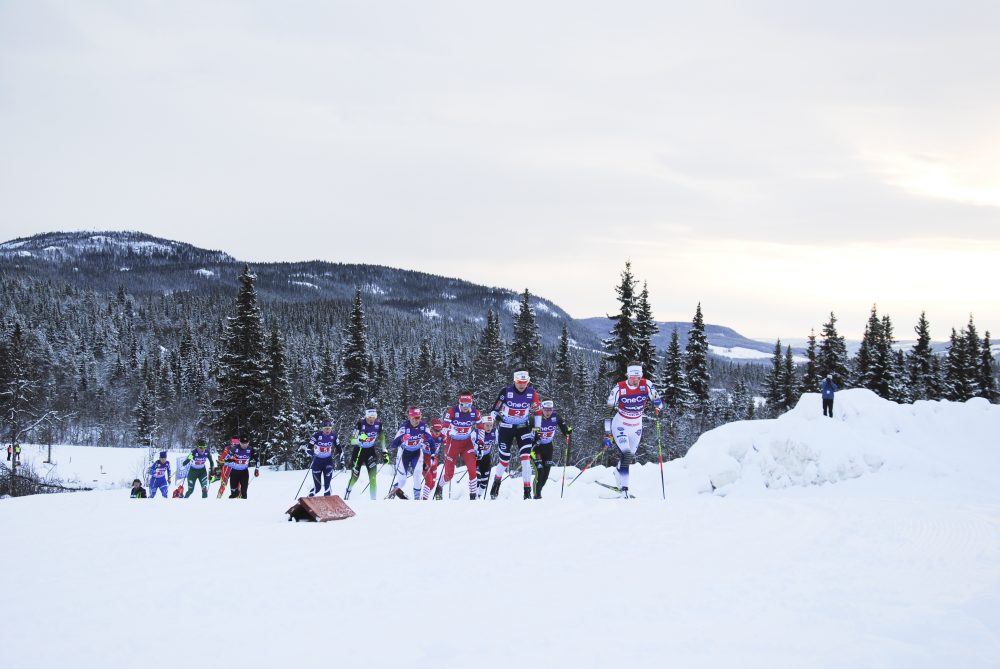
The women’s field cresting a hill during the scramble leg of the World Cup 4 x 5 k relay in Beitostølen, Norway.
FIS World Cup Beitostølen, Norway 4 x 5 k / 4 x 7.5 k Relay
Sunday in Beitostølen, Norway the women raced a 4 x 5-kilometer relay on firm tracks and under partly cloudy skies — Saturday’s races featured fresh snowfall.
Norway I took the win in a total time of 57:23.6 minutes. In order of relay legs, Heidi Weng, Therese Johaug, Ragnhild Haga, and Ingvild Flugstad Østberg comprised the team that raced at the sharp end of the race for all but the first leg.
Weng, the first leg skier for Norway, tagged Johaug in fourth, 7.3 seconds behind Russia’s Yulia Belorukova who scrambled for Russia I. From then on, Norway I set the speed benchmark.
Despite Russia I’s star power, it was Russia II that took second place Sunday. Lidia Durkina, Anna Zherebyateva, Mariya Istomina, and Elena Soboleva, having been gapped by Norway I, could pack-ski until the final stretch to slot over the line .5 seconds ahead of third place Finland I. (Russia II finished 37.3 seconds behind Norway I.)
Russia I’s anchor, Anna Nechaevskaya, fell in the final downhill turn losing several places for her team.
Finland I, the third-place team on the day, featured Johanna Matintalo, Krista Pärmäkoski, Ritta-Liisa Roponen, and Eveliina Piippo. Finland I finished 37.8 seconds behind winner Norway I.
The U.S. I team placed fifth (+48.0) in a performance that saw them out dual Sweden and Norway II in the closing moments of the race. Sadie Bjornsen, Rosie Brennan, Caitlin Patterson, and Jessie Diggins skied for the U.S. on a roster absent some names that were longtime staples of the U.S. team’s relay quartet — both Kikkan Randall and Liz Stephen retired from racing last season.
The U.S. had planned on fielding a second team featuring the U.S. Ski Team’s (USST) Sophie Caldwell (USST), Ida Sargent (USST), Kelsey Phinney (SMS T2), and Kaitlynn Miller (CGRP), however, they did not start.
Norway I held on for the win in the men’s 4 x 7.5 k relay today in Beitostølen in a time of 57:23.6 minutes. This was head-to-head racing at its finest. After 30 k of racing, the final standings came down to a lunge at the finish between Norway I and Russia I. Russia I placed second (+0.7).
Emil Iversen, Martin JohnsrudSundby,Sjur Røthe, and Finn Hågen Krogh formed the Norway I team. The Russia I team included Evgeniy Belov, Alexander Bolshunov, Denis Spitsov, and Andrey Melnichenko.
Norway II’s Didrik Tønseth, Hans Christer Holund, Magne Haga, and Simen Hegstad Krueger placed third (+53.4).
The U.S. team of Erik Bjornsen, Kevin Bolger, Scott Patterson, and Simi Hamilton placed 12th (+3:22.7).
IBU World Cup, Pokljuka, Slovenia 7.5 k / 12.5 k Pursuit
Looking smooth across the finish line, Norway’s Johannes Thingnes Bø, won the men’s 12.5 k pursuit in Pokljuka, Slovenia in a time of 30:20.4 minutes. That smoothness was matched in a photo finish with France’s Quentin Fillon Maillet who placed second, 0.1 seconds behindBø. Maillet cleaned his four shooting stages.
Bø looked in control for the last portions of the race. His strong skiing gave him a 50-second lead as he began his final shooting stage. There, the Norwegian missed two targets, allowing the chasers to latch back on during the final lap. In total, Bø missed three targets, one during his first prone stage, and two during his second standing stage.
Russia’s Alexander Loginov was third in the sprint, finishing 1.9 seconds back. Loginov missed one target in his first standing bout, otherwise, he shot clean.
Canada’s Christian Gow placed 14th (+1:09.1) while shooting clean. No other Canadians qualified for the pursuit.
For the U.S., Leif Nordgren was the best placed American in 33rd (+2:39.1, 0+2+1+0). Sean Doherty was 39th (+3:07.9, 0+0+2+2),
Kaisa Mäkäräinen of Finland won the women’s 10 k sprint in a time of 29:16.9 minutes. Mäkäräinen shot clean during the competition. Italy’s Dorothea Wierer was second, finishing 41.3 seconds behind while also shooting clean during all four shooting bouts.
Third place went to Paulina Fialkova of Slovenia. Fialkova finished 59.2 seconds back and shot clean for the day.
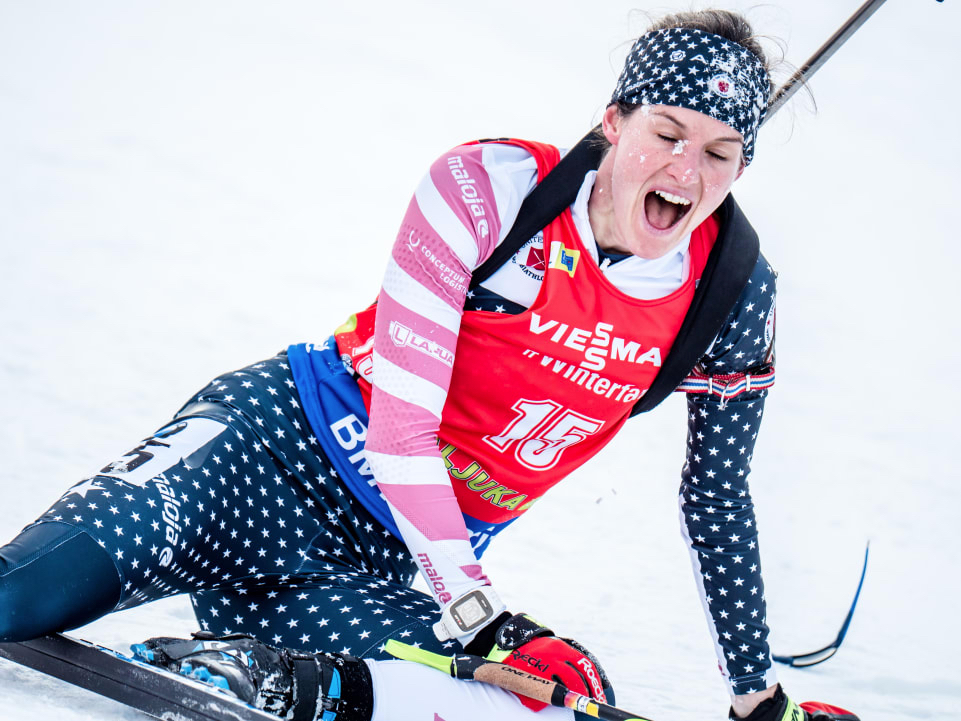
Clare Egan after placing sixth in the IBU World Cup’s 10 k pursuit in Pokljuka, Slovenia. (Photo: Biathlonworld.com)
For the U.S., Clare Egan placed a career-best sixth (+1:22.4, 0+0+1+0). Egan missed a single target during the race.
“I knew the pieces were there,” Egan told IBU TV after the race. “I had clean shooting in a [preseason] race at the Austrian trials before the World Cup. And then I had just awesome ski times this week, so I knew it was coming. I just had really good focus today, and I love competing head to head, so pursuit is a great race for me. I thought I was… I wasn’t sure if I was in fifth or sixth, and this Norwegian skier [Marte Olsbu Røiseland], really good, just got me at the finish. So I was so happy when I looked up and saw that I was in sixth in the flower ceremony.”
Also for the U.S., Susan Dunklee placed 39th (+3:36.3 0+1+0+1), and Joanne Reid 43rd (+3:51., 0+0+1+0).
CNST teammates Dahria Beatty (l) and Katherine Stewart-Jones charge the last hill of the 10km on their way to 6th and 1st respectively. (Photo: Peggy Hung)
Sovereign Lake NorAm/SuperTour 5k/10k Classic
The Sovereign Lake weekend wrapped up with individual start classic distance races and a more neighbourly distribution of results.
Katherine Stewart-Jones (CNST) won the women’s 10km in 31:48.4, hanging on in the last lap to finish ahead of APU’s Becca Rorabaugh (+7.1) and SMS’ Julia Kern (+7.8). APU’s Hailey Swirlbul snatched 4th at 10.9 seconds with Dahria Beatty (CNST) in 5th, 26.7 seconds back.
Kyle Bratrud on his way to victory in the 15km (Photo: Peggy Hung)
Kyle Bratrud (SMS T2) won the battle in the men’s 15km in 41:59.3, 3.8 seconds ahead of Ben Lustgarten (CGRP) and 34.7 seconds ahead of Ricardo Izquierdo-Bernier (NMU/CNEPH). Sam Hendry (CJNST) edged out Andy Newell (SMS T2) for fifth.
Individual start results are here with the full weekend here. Photos and interviews are coming in the Noram/SuperTour wrap-up.
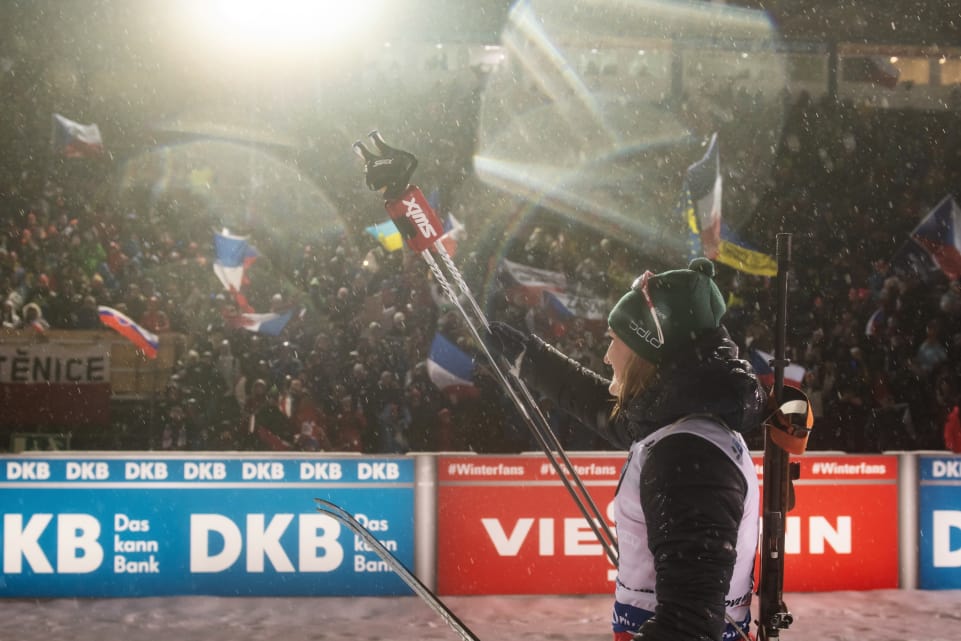
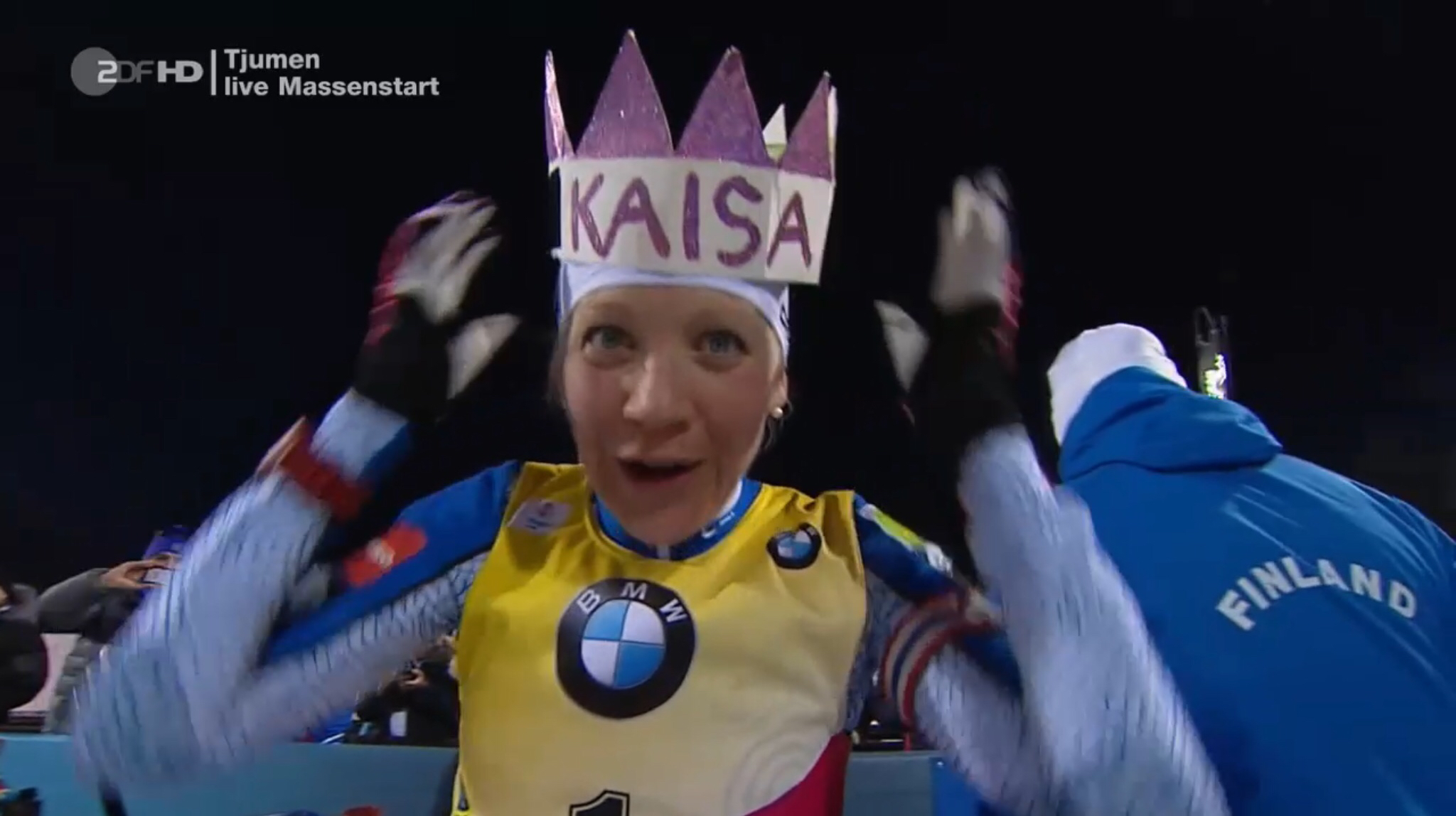
Kaisa Makarainen celebrates her third overall World Cup title after securing it with a sixth-place finish in the last race of the season, a mass start in Tyumen, Russia. (ZDF screencap)
Martin Fourcade didn’t have to do much at the final IBU World Cup weekend in Tyumen, Russia, in order to lock up the overall crystal globe. But the French biathlete came in guns blazing, so to speak, winning Thursday’s sprint by 33.2 seconds and claiming the Total Score title.
His only close(ish) challenger in the overall score, Johannes Thingnes Bø of Norway, had finished just 14th in the sprint. He raced up to second in the pursuit, but by then it was too late to take the globe from Fourcade.
It is the Frenchman’s seventh overall title; the last time anyone else won one was in 2010-2011.
“I am really satisfied with what I did today,” Fourcade told the IBU on Thursday. “It was mentally challenging all these days fighting with Johannes for the Crystal Globe. It seems easy watching on TV, but I can confirm that it is not. I must admit that it was not my main goal back [at the first World Cup weekend] in Östersund; it was the Olympics. But as the season went on, the globe became the most important aim for both of us.”
After that, Fourcade could relax a little.
“You know, before the race I planned to act like usual, be calm on the shooting range and being strategic,” Fourcade told German broadcaster ZDF after winning the pursuit, this time by 47.9 seconds. “But when I came to the zeroing [target practice] I told my coach ‘today I will play a little’. I don’t have many races to enjoy my biathlon [without pressure], to do what I would like to do. I told him ‘do not think (worry?) I will go full attack’, but I wanted to show that the strategy I had all year long is [just] a strategy not a need to shoot slow.”
On Saturday it worked; then came Sunday’s mass start. Fourcade had his worst race of the season, with four penalties and skiing to 19th place, over a minute behind winner Maxim Tsvetkov of Russia. But it didn’t matter – the globe was already decided, and Fourcade had already found his satisfaction.
The fight for the women’s crystal globe had much more drama. Coming into the weekend, Slovakia’s Anastasiya Kuzmina led by 41 points over Finland’s Kaisa Makarainen. But it was Belarus’s Darya Domracheva, in third in the standings, who won Friday’s sprint, by just 1.2 seconds over Makarainen; Kuzmina was 12th.
“Before today’s race I tried to focus only on this race, not think about the overall World Cup so much because I know that I am really [far] behind,” Makarainen told ZDF after the sprint. “But I know that everything is possible. I think that’s also the best tactic for tomorrow: not think about the others or the Total Score, just focus on a good race and enjoy that.”
Makarainen saw her chance and went for the win in the pursuit, edging France’s Anais Bescond by an even smaller margin – 0.2 seconds.
With Domracheva winning the mass start, Makarainen rallying for sixth despite three missed shots, and Kuzmina 11th with the same tally, the title went to the Finn. She edged out Kuzmina by just three points, while Domracheva was only another 15 points back.
Makarainen jumped up and down when she saw the score announced, and her teammates rushed her and placed a pink paper crown on her head. It is her third overall title; she also won in 2011 and in the 2013-2014 season, when she likewise secured the crystal globe in the very last race of the season.
The fields were somewhat reduced in size and depth as the Canadian, U.S., Czech, and Ukrainian teams all skipped the event due to Russia still remaining out of compliance with the World Anti-Doping Code. Other individual athletes skipped the races as well.
Other Notes:
Simon Desthieux of France got his first career World Cup podium, finishing second in the sprint behind teammate Fourcade.
Maxim Tsvetkov of Russia claimed his first career win in the mass start, edging Norway’s Erlend Bjøntegaard by 2.7 seconds as each shot 20-for-20.
In the men’s mass start, Slovakia’s Paulina Fialkova got her first World Cup podium, finishing second, just 1.8 seconds behind Domracheva as each had a single penalty.
The top ranked North American biathletes in the Total Score are Susan Dunklee in 34th in the women’s standings, and Tim Burke in 32nd in the men’s standings, both from the United States. The U.S.’s Lowell Bailey and Sean Doherty ranked 35th and 36th. No Canadians were ranked in the top 40.
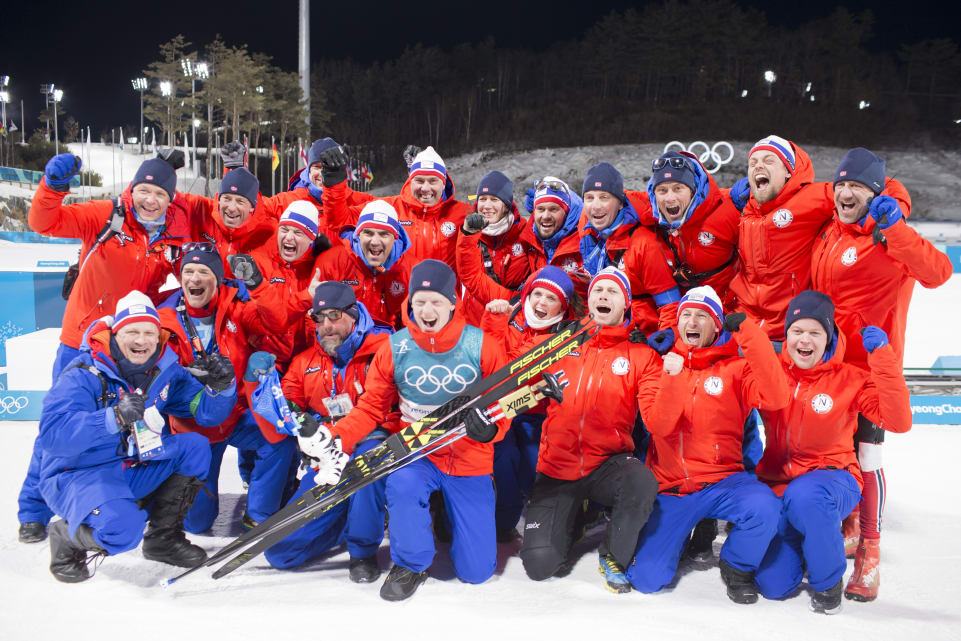
It was a disappointing opening to the Olympics for Johannes Thingnes Bø of Norway, who despite winning eight World Cup races this season started the Games with finishes of 31st and 21st in the sprint and pursuit. But on Thursday he showed why he was a medal favorite and won the 20 k individual race – only by 5.5 seconds, but that margin becomes impressive when you consider that he had two penalties, and thus two minutes of penalty time, while silver and bronze medalists Jakov Fak of Slovenia and Dominik Landertinger of Austria (+14.2) shot clean.
Johannes Thinges Bø celebrates with Norwegian team staff after winning Olympic gold in the 20 k individual despite two missed shots. (Photo: IBU/Biathlonworld.com)
Sweden’s Sebastian Samuelsson followed up a silver medal in the pursuit with fourth place in the individual, missing one shot and notching a time 29.1 seconds behind Bø. France’s Martin Fourcade, gold medalist in the pursuit, missed two shots like Bø but finished in fifth (+42.4). Switzerland’s Benjamin Weger placed sixth (+48.6) with one penalty.
It was a good day for Canada on the back of strong shooting: Scott Gow placed 14th (+2:02.5) with one penalty for a career-best result result; he had previously had two 16th-place finishes on the World Cup this season. With the same shooting, Brendan Green placed 22nd (+2:26.6). Christian Gow had two penalties to finish 26th (+2:57.2). Canada’s fourth man, Nathan Smith, missed five shots and placed 81st (+8:11.9).
For the United States, shooting was not as successful and Tim Burke led the way in 41st (+4:01.9) with four penalties. With one less penalty Sean Doherty was close behind in 44th (+4:21.8). Lowell Bailey placed 51st with four penalties (+4:53.0) and Leif Nordgren missed five shots to finish 66th (+6:27.3).
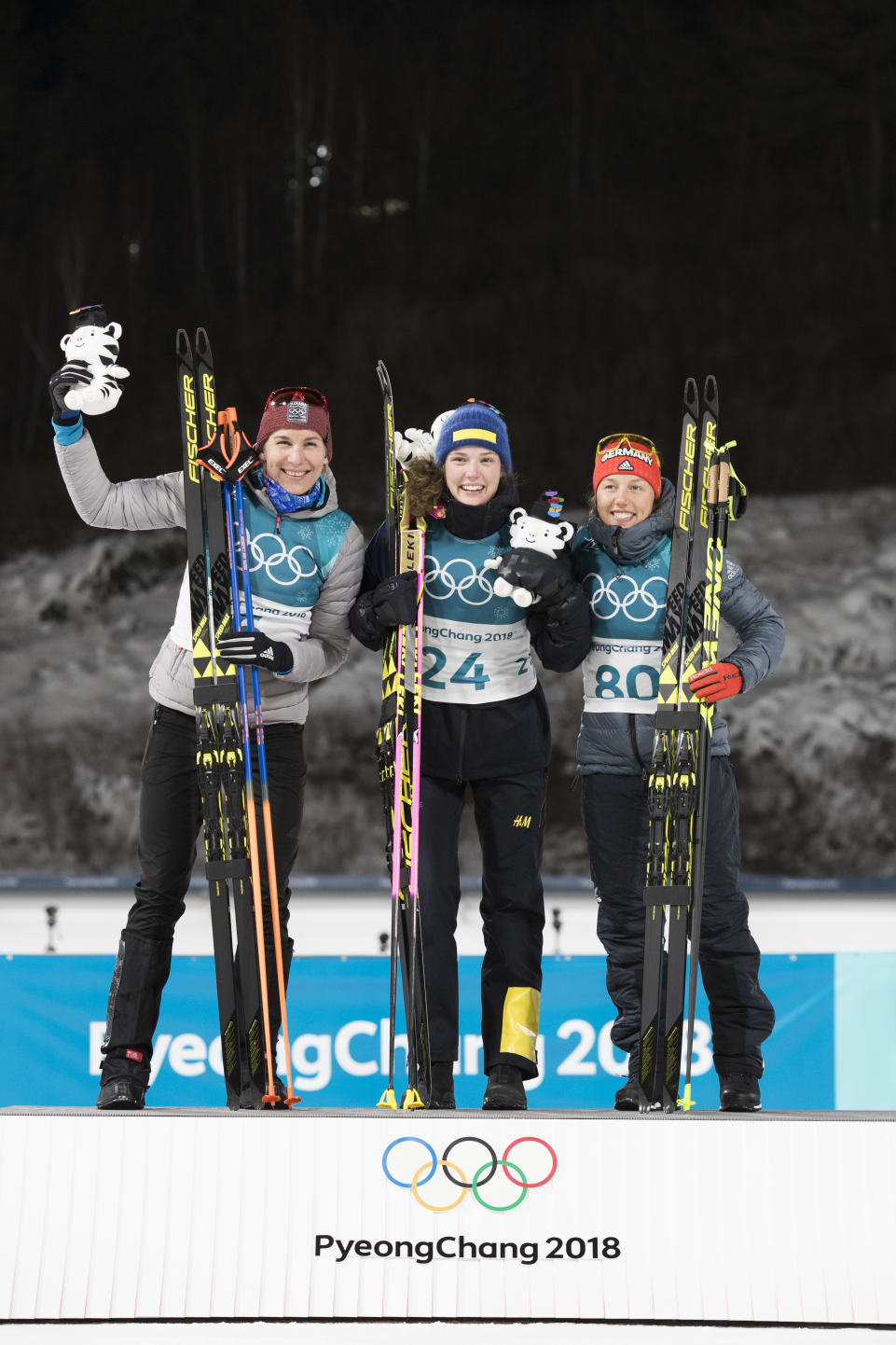
Sweden’s Hanna Oeberg (center) won gold in the biathlon women’s 15 k pursuit, followed by Slovakia’s Anastasiya Kuzmina (left) in silver and Germany’s Laura Dahlmeier in bronze. (Photo: IBU/Biathlonworld.com)
A few days after teammate Samuelson scored a career-best result to earn silver in the pursuit, Hanna Öberg of Sweden used perfect 20-for-20 shooting to capture gold in the women’s 15 k individual. The 22-year-old’s previous best results were fifth place in both Monday’s pursuit, and in a World Cup race last season.
She bested the two pre-race favorites: Anastasiya Kuzmina of Slovakia had two penalties but still managed a silver medal, her second of the games, finishing +24.7. And double gold medalist Laura Dahlmeier of Germany had one penalty and earned bronze (+41.2).
It was a good day for both of those teams as Franziska Preuss of Germany finished fourth, +59.0 with clean shooting, and Paulina Fialkova of Slovakia placed sixth (+1:02.3) with one missed shot. Poland’s Monika Hojnicz finished sixth (+1:54.8) with one missed shot as well.
The United States was led by Susan Dunklee in 19th, with two penalties (+3:26.3). Her teammate Joanne Reid finished 22nd (+3:34.1), her best-ever result in top-level international competition, with just one missed shot. Clare Egan finished 62nd (+6:53.6) and Emily Dreissigacker 67th (+7:09.2) with four penalties apiece.
For Canada, Rosanna Crawford led the way in 26th (+3:48.7) with two penalties and Sarah Beaudry was close behind in 29th (+3:58.4) with one missed shot. Emma Lunder finished 54th (+5:49.4) with three penalties and Julia Ransom was 74th (+8:31.4) with five missed shots.
Montana State University student Johanna Talihärm of Estonia finished 50th (+5:36.8) with three penalties.
Thursday afternoon saw more of the same for the women’s cross-country ski events at this year’s Winter Olympics: Scandinavia filling up the podium, with American Jessie Diggins tantalizingly close to that breakthrough American podium in fifth. This time it was Norwegian Ragnhild Haga in first in the 10 kilometer freestyle individual start, Charlotte Kalla of Sweden in second (+20.3), and Finland’s Krista Pärmäkoski and Norway’s Marit Bjørgen tied for third (+31.9).
The bronze is Bjørgen’s 12th lifetime Olympic medal, moving her into a tie with fellow Norwegian Bjørn Dæhlie for the most Olympic medals won by a cross-country skier. Countryman Ole Einar Bjørndalen, a biathlete, holds the overall Winter Olympics record with 13.
Diggins was 35.2 seconds back of Haga in fifth. She was in seventh place through 1.6 k, up to fifth at 5 k, up to third at 6.2 k, and still in third at the 8.4-k time checkpoint, 1.9 seconds up on Bjørgen and five seconds up on Pärmäkoski. But her form seemed to break down over the final uphill, and Diggins lost just enough time on Bjørgen and Pärmäkoski over the final 1.6 k to slip off the podium.
Between a 4.6-second deficit to third in Saturday’s skiathlon and a 3.3-second gap here, Diggins has now missed two bronze medals by a combined 7.9 seconds over 25 kilometers of racing.
Jessie Diggins pushing to the finish in the Olympic 10 k skate. The American finished fifth. (Photo: FlyingPointRoad)
Sixth place went to Swiss skier Nathalie von Siebenthal (+49.8), who slowed slightly after a fast start that saw her with the second-ranked time through 1.6 k. Ingvild Flugstad Østberg (+1:05.5), in seventh, was the third Norwegian in the top seven.
Olympic Athlete from Russia Anastasia Sedova (+1:07.3), Austrian Teresa Stadlober (+1:15.6), and Olympic Athlete from Russia Anna Nechaevskaya (+1:24.3) rounded out the top ten.
Sadie Bjornsen (+1:42.1) in 15th and Kikkan Randall (+1:49.9) in 16th were the next two Americans. Randall started relatively early with bib number 23, and was the leader in the clubhouse when she crossed the finish line. Liz Stephen (+2:35.4) was 30th.
For the Canadians, Emily Nishikawa (+2:41.) led the way in 32nd. Dahria Beatty (+2:48.4) was 37th, Cendrine Brown (+3:11.9) 43rd, and Anne-Marie Comeau (+4:10.8) 62nd.
Also of note, Australia’s Jessica Yeaton, who lives and trains in Anchorage with Alaska Pacific University, recorded an Olympics personal best finish of 41st (+3:09.1). University of Alaska Anchorage student Casey Wright, also competing for Australia, finished 81st (+6:55.8).
University of Colorado skier and NCAA champion Petra Hyncicova of the Czech Republic finished 60th (+4:09.4). University of New Hampshire alum Annika Taylor of Great Britain finished 75th (+5:52.4).
And Jaqueline Mourau of Brazil, who lives and trains in Quebec, was 74th (+5:49.8).
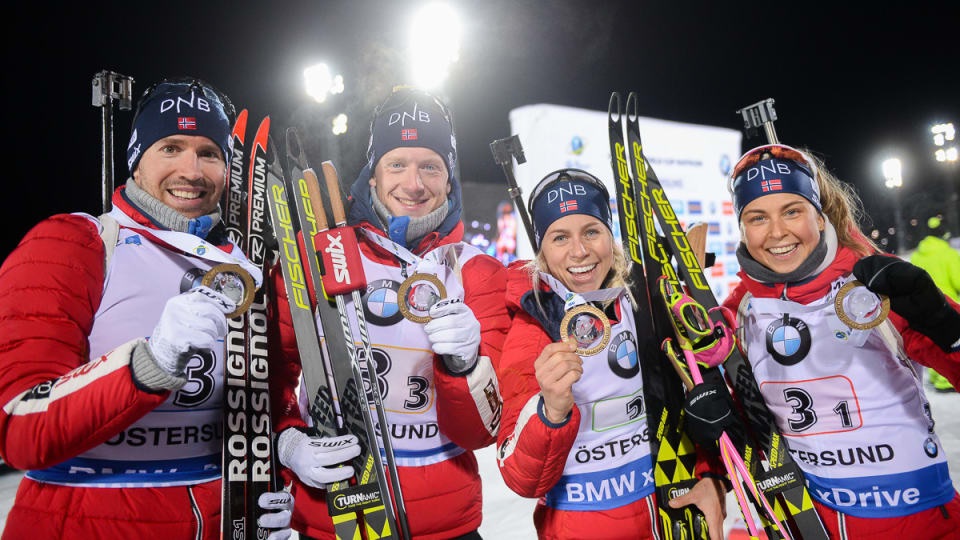
(Left to right) Norwy’s Emil Hegle Svendsen, Johannes Thingnes Bø, Tiril Eckhoff and Ingrid Landmark Tandrevold show off their medals after winning the mixed relay on the opening day of the 2017/2018 IBU World Cup season in Östersund, Sweden. (Photo: IBU/biathlonworld)
Even the most renowned athletes and national teams in the mixed relay on Sunday afternoon admitted they had not yet found their perfect groove in Östersund, Sweden, on the opening day of the 2017/2018 International Biathlon Union (IBU) World Cup season.
Nevertheless it still made for an exciting race, with four teams vying for the podium on the last lap. And in the finishing stretch, anchored by veteran Emil Hegle Svendsen, the same country prevailed as in the last two seasons in the same race and at the same place: Norway.
In a time of 1:11:31.7 hours, Svendsen held off a final push from Italy’s Lukas Hofer by 5.3 seconds. Norway required 13 spare rounds on the shooting range while Italy needed just six; however Hofer incurred a penalty lap in his prone stage, momentarily falling back 30 seconds and to fourth place before returning to the top three.
Germany, anchored by Arnd Peiffer, placed third, 6.4 seconds back with 10 spare rounds and no penalties, with Peiffer managing to overtake Slovakia’s Matej Kazar on the final lap. Slovakia narrowly finished off the podium after a strong team performance with its best World Cup result in a mixed relay in five seasons. The team finished 7.7 seconds out of first, with nine spares and no penalties.
“It was a really tough fight with Lukas just behind,” Svendsen recounted of the final lap during the post-race press conference. He had used all of his spares to clean his standing stage.
“I was happy to walk away with the win. I looked back, it’s impossible not to I think, but I felt quite strong…,” he continued. “I was unsure if I should just let him come to me and then we can finish in a sprint, but I looked behind and I had about a five-second gap so I just said to myself to just go and see what happens … Always a good feeling to start the season with a victory, good for the team, good for the spirit.”
“The last lap, when I went out from the stadium, I saw Emil in front of me and tried to close the gap as fast as possible,” Hofer said at the press conference. “But it was a bit too much because he also pushed so strong, and normally he is one of the best on the last loop. I was happy to finish like this… It was a really good start into the season.”
In the mixed relay format, with a 2 x 6 + 2 x 7.5-kilometer course length, two women followed by two men hand off to one another on the track, and each can use up to three spare rounds per shooting stage to avoid a penalty lap.
This time of the year, the sun sets early in Östersund in central Sweden. In a race under floodlights with mostly calm wind conditions, Norway, with Ingrid Landmark Tandrevold, Tiril Eckhoff, Johannes Thingnes Bø and Svendsen, combined for the best performance once again.
“I was really nervous, but I think everyone was, especially on the first loop,” Tandrevold said at the press conference, after she got the nod to start, replacing sick teammate Marte Olsbu. “The standing shooting was really hard, but I think the rest of my race was good. I was happy to be in front on the last downhill, because last year I fell [there] so I was a bit scared.”
“I was a bit rusty, I need some more races, then hopefully it will be a really good season,” added her teammate Eckhoff.
“Full speed from the start, that was the only plan I had,” Bø explained the tactics on his leg, where he required two spares in the prone shooting and all three in standing. “Of course I didn’t plan to use five extra [shots]. All in all I am satisfied, but there are still some things I need to improve on. A little bit faster skiing, a little bit better shooting.”
That prompted laughter from his teammates and his competitors on the podium.
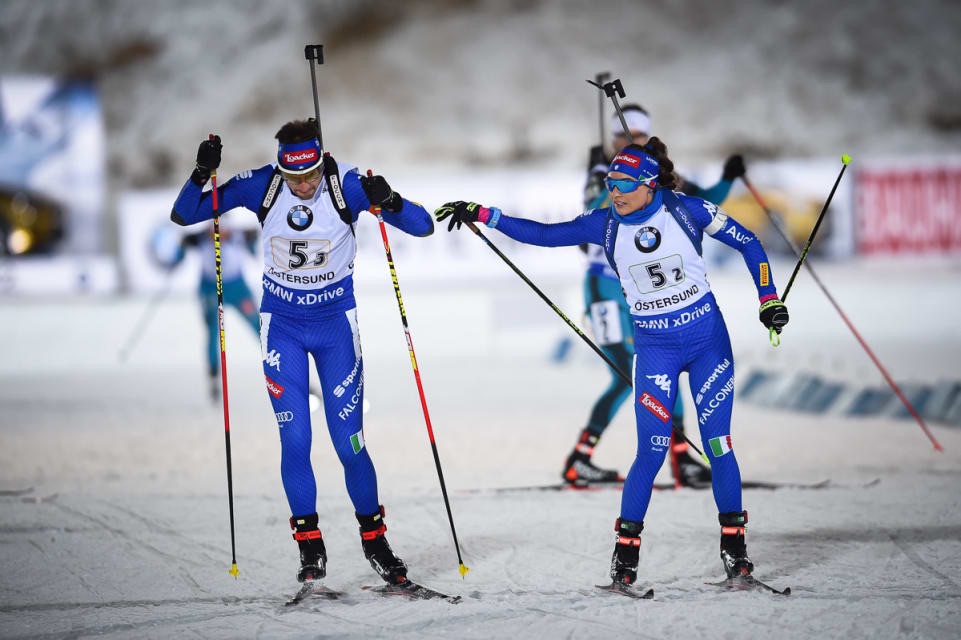
Italy’s Dorothea Wierer tags Dominik Windisch at the halfway point of the mixed relay in Östersund, Sweden. The team went on to finish second on the day to open the 2017/2018 IBU World Cup season. (Photo: IBU/biathlonworld)
Italy, with Lisa Vittozzi, Dorothea Wierer, Dominik Windisch and Hofer, narrowly missed out on its first victory in the mixed relay, tying its second place from two seasons ago in Canmore, Alberta.
“I was sure that Lukas would catch Emil!” Wierer said in the press conference with a laugh. “I think we can be satisfied. Of course we are not in perfect shape yet right now. I for sure didn’t have the best autumn, I was sick three times in two months. So it wasn’t perfect, but with some more races I can get in shape.”
The defending mixed relay world champion Germany, with Franziska Preuss, Maren Hammerschmidt, Benedikt Doll and Peiffer, was also happy with its outcome. Last season’s 2017 World Championships star Laura Dahlmeier will likely miss the whole opening weekend following an illness.
“It’s always a good feeling to start the season with a podium,” Hammerschmidt said at the press conference. “First race, I am always very nervous.”
“It was OK. In prone I could have hit my shot if I had taken a little more time,” Peiffer told German broadcaster ARD in an interview after the race, according to a translation. “It was a hard last lap, they really pushed the tempo right out of the shooting range and then I immediately had a small gap. I am glad that I was able to make up one more position and secure the podium … You are always nervous before a relay, with a big audience, and you have to race against all the good guys again who you didn’t see all year, so everyone is a bit excited.”
Slovakia, with Paulina Fialkova, Anastasiya Kuzmina, Tomas Hasilla and Kazar, had to settle for fourth place, but still the team was all smiles in an interview with the IBU.
“I am really surprised, but it was great,” Fialkova said. “It was close to the podium, but we hope maybe next time.”
“A good start to the season, and we will do it again and again,” Kuzmina added.
“I was really happy for the shooting and also running, a good result for the team today, good motivation,” their teammate Hasilla agreed.
“Very happy from this competition,” Kazar said. “Very hard last lap, going from [second] place after the final shooting to fourth place in the finish. There were really good men [racing against me].”
The home team from Sweden, with Hanna Öberg, Anna Magnusson, Jesper Nelin and Fredrik Lindström, was fifth on the day (+34.5, with one penalty and five spares), delighting the fans in Östersund after Öberg tagged off in first place after the first leg.
Another surprise of the day was Finland, with Mari Laukkanen, Kaisa Mäkäräinen, Tero Seppälä and Tuomas Gronman, leading the race at the halfway point behind a strong performance from Mäkäräinen, who moved up from eighth to first place with the best first-leg course time.
“It was a hard race, especially with Kaisa Mäkäräinen, she was really fast today,” Eckhoff said during the press conference.
The two Finnish men could not quite hold on to that position, but still finished in eighth place, 1:32.4 back with one penalty and eight spares.
It was Finland’s best World Cup mixed relay performance since placing seventh during the 2011/2012 season and sixth at 2009 World Championships in PyeongChang, South Korea, host of the upcoming Olympics.
Also with Mäkäräinen and Laukkanen, Finland actually won the gold medal in the mixed relay at the 2016 summer biathlon world championships, a rollerski biathlon event typically skipped by a number of the world’s best athletes. Similarly three of Slovakia’s starters on Sunday had placed second in that event last summer, gaining some positive experiences for the upcoming season.
Canadians Satisfied with First Race, Despite ‘Race Jitters’
For Biathlon Canada, Emma Lunder, Julia Ransom, Scott Gow and Brendan Green formed the relay team on Sunday.
“Today was the second mixed relay I’ve ever done on the World Cup circuit, and I felt pretty calm going into the race,” the 26-year-old Lunder wrote in an email to FasterSkier. “My plan was to sit back on the first lap as I know it can get really frantic, and I didn’t want to get tangled up with anyone.”
She cleaned her prone stage, coming back on the course in 12th place just 13 seconds out of first.
“I’ve never raced in Östersund before and I’ve always heard that it’s notorious for tricky winds, but the flags were almost totally still during both my zero [target practice] and the race,” Lunder wrote. “I was really proud of my prone as I’ve been working hard to improve my accuracy and speed this summer.”
In the standing stage, she had to use all three spares to avoid skiing a penalty lap, but improved positions nonetheless as other teams struggled as well.
“I had a bit of a problem when I came into standing with my contact lens moving around leaving my eye blurry,” she explained. “I think I paid a little bit too much attention to that, and wasn’t as focused on the standing shooting as I would’ve liked.”
On the last loop, she was passed by three teams fighting for positions in a pack, but didn’t lose any more time to the top.
“We had amazing skis after a great performance from our wax team, so I was able to take advantage of that on the downhills and zip past people,” Lunder wrote. “It was pretty exciting for me to be skiing with a pack where I could actually see the leader of the race, and I felt strong for the most part. Overall I was happy with my race today.”
Lunder exchanged to Ransom in 13th position, still only 24.2 seconds out of first.
“I was very excited for Emma Lunder’s race,” Ransom wrote. “She handled the start leg calmly and confidently, tagging me off in a great position.”
Like Lunder, Ransom also shot clean in her prone stage, then needed two spares to also clear her standing targets.
“The shooting range was really calm, especially in comparison to past years I’ve raced here,” Ransom wrote. “I was happy that I kept my shooting somewhat together. That was a big improvement from last year’s mixed relay in Östersund.”
But on the course she had some trouble holding up with the pace set by the race leaders, losing more than 40 seconds to them on both her second and third loops.
“Today was a tough day for me. My legs were lead on the course, but I half expected that to be the case [on] day three after travel,” she wrote.
Ransom tagged Gow in 15th place, 1:46.2 back.
“It was nice to be back racing again,” Gow wrote in an email. “This was probably the most calm I have been for a season opener.”
The older brother of Christian Gow, who raced the single mixed relay with Rosanna Crawford earlier in the day, required all three spares in his prone stage and another two in standing.
“I was mostly happy with my race except for my shooting. The conditions can be very tricky here, but my problem was with my head, not the wind,” Scott Gow wrote. “I was so wrapped up in the race and trying to make as much time as possible that I think I was too excited going in to each shooting. I will try to be more relaxed for the upcoming races.”
He he tagged Green in 16th place, after losing more than another minute to the leaders (+3:03.9).
“Östersund can often provide some very tricky racing conditions, but today was actually almost perfect in terms of wind,” Green, Canada’s anchor, wrote in an email. “In my experience, it’s rare to see a day like this.”
He only needed one spare each in his prone and standing stages, and with the 15th-ranked course time improved again by one position to finish 15th, 3:28 minutes behind Norway, without any team penalties and a total of 12 spares.
“I always find the season opener quite tough,” Green explained. “Digging deep to find that extra gear always hurts at the beginning of the season, but hopefully it will get easier and start to feel better from here on out.”
The Canadians agreed that all in all, the race was a good building block to start off the new season.
“From chatting with the team I think we all had some good parts of our races, and a few things we’ll work on between now and the individual races,” Lunder concluded. “It was a good start today, and we can definitely build and improve from here!”
“After a few more days of adjustment I think our team is positioned for some great results this coming season,” Ransom wrote.
“I think I held us back a little bit with my shooting, but otherwise we did a decent job,” Gow wrote. “We got the race jitters out and now I think we will be ready to give it our all next week.”
“I think each of us were able to take away some positive aspects from todays race, but as a whole we are for sure expecting to improve upon today,” Green concluded. “It was good to get the first world cup race out of way, and we are looking forward to more racing this coming week.”
U.S. Still ‘Blowing Out The Cobwebs’
US Biathlon’s Paul Schommer racing the third leg of the mixed relay on the opening day of the 2017/2018 IBU World Cup season in Östersund, Sweden. (Photo: USBA/NordicFocus)
US Biathlon’s original race lineup included 2017 World Championships gold medalist Lowell Bailey and silver medalist Susan Dunklee, Clare Egan, and former Junior World Champion Sean Doherty.
But on race day, teammate Paul Schommer had to take Bailey’s spot after he “woke up with congestion,” according to a US Biathlon press release.
“We had planned on racing Lowell for the third leg, he didn’t feel 100% today so Paul was subbed in,” Doherty explained in an email to Fasterskier. “Just no risk in pushing it with the hardest individual race of the year on Thursday.”
Dunklee started the team out well, taking the lead on the course to come into the first shooting stage and leaving in eighth position, just under 10 seconds back after needing one spare. She moved up with a pack out on course, but in the standing stage required all three spares after initially missing one target.
“I felt strong and relaxed skiing during the first two loops and I think my technique is already a notch above last year,” Dunklee wrote in an email. “The third loop was a bit painful as my legs flooded with lactic acid and I wasn’t quite able to reel in the pack ahead. I struggled in standing with the spare rounds despite favorable conditions but shooting can often improve with my better race fitness.”
Coming back on the course in 11th position and 26.1 seconds back, she still managed to cut the distance to the leaders in half on her final lap and tagged off in ninth place.
Egan got off to a strong start, both on the course and in her prone stage, where she cleaned without any spares and started her second loop in 11th. But with athletes like Mäkäräinen and Kuzmina setting a high pace up front, she explained she was struggling.
“This was my first race of the year and it was a rude awakening,” Egan wrote in an email to FasterSkier. “From the very beginning the pace seemed crazy and I was just trying to hold on. I am reminded now that the level is super high and I just need to go harder and faster all the time. I’ll get better as I race more but today was a bit of a shock.”
In the standing stage, she quickly ran out of spares and had to ski two penalty laps, which put her back to 20th (+2:27) when she returned to the course for her final loop.
“Conditions were perfect for me on the range today,” Egan wrote. “Last year in this race I did the exact same thing. I think the shock to the body makes it almost impossible to keep my mind where it needs to be for shooting. My prone is automatic — I am at the level of ‘unconscious competence’ — where I can do it right without thinking about it. But in standing I’m at the ‘conscious competence’ level. I really have to use my brain to execute all the steps.
“Today, I shot all 5 rounds from the clip plus 1 spare before suddenly having a moment of clarity and saying (out loud actually), ‘where have I even been aiming??’ …may or may not have included an expletive,” Egan continued. “Then, using my brain, I was able to easily hit my last two shots.”
She tagged Schommer in 21st, 2:51.5 minutes back.
Schommer lost more time on the course, but with a good shooting performance — needing just one spare in each of his stages and a range time ranked in the middle of the field — he avoided getting lapped and held the team in 21st, 4:29.5 seconds back.
It was only his second World Cup appearance in a mixed relay, following an eighth place last season in Kontiolahti, Finland.
From there, Doherty anchored the team to 21st place, also requiring just one spare round in each of his shooting stages.
“The conditions were uncharacteristically calm,” Doherty wrote in an email. “But I would not expect the conditions to stay calm for all the races so I forecast some challenging shooting on the [next] weekend.”
“It felt great to be back on the world stage,” he added. “It is a fantastic atmosphere. I enjoy competing on the world cup and I am always looking forward to the start of the season. The level of competition is just as high as I remember it last year and I am excited to see where I stack up after a great summer of training.”
“The good news was that I was never nervous, which is something I’ve struggled with in the past, and I shot fast today,” Egan reflected. “My shooting has been excellent in training since we got on snow, so I just need to transition into race mode. Today was what you might call ‘blowing out the cobwebs’!!!”
“The first race of the season is typically a tune up race for us and not one where we necessarily try to optimize our performance,” team veteran Dunklee concluded. “There are more nerves, there’s jet lag, and it often takes a few real races before the body starts to feel fully sharp again. We didn’t end up very high on the results list tonight, but I have no doubt that our best is yet to come.”
“I was impressed watching Emily [Dreissigacker] lead the first loop of the single mixed relay – she looked very comfortable in front of the pack,” Dunklee also commented on the performance of her teammates in Sunday’s single mixed relay. “Most rookies are terrified of trying something like that. You’ll see more of her in the future for sure.”
Racing will continue on Wednesday with the women’s 15 k individual, and the men compete on Thursday in the 20 k individual.
Next season, Östersund will host the 2019 IBU World Championships. Norway surely wouldn’t mind making it four wins in a row in Östersund in the mixed relay there.
Germany’s Franziska (1) leads Gabriela Soukalova of the Czech Republic (2) and German teammate Laura Dahlmeier in the women’s 10 k pursuit at the IBU World Cup in Ruhpolding, Germany. Dahlmeier started fourth and finished first, 7.3 seconds ahead of Soukalova. (Photo: IBU/Eberhard Thonfeld)
It was a pursuit race, but it must have felt more like a mass start.
The first four women all started within the first three seconds of one another in Saturday’s 10-kilometer pursuit at the IBU World Cup in Ruhpolding, Germany. Franziska Hildebrand of Germany started first, followed by Gabriela Soukalova of the Czech Republic, Finland’s Kaisa Mäkäräinen, and another German, Laura Dahlmeier in fourth.
Hildebrand and Mäkäräinen didn’t hold on to their top spots, each accruing too many penalties in such a tight field to remain competitive for a spot on the podium. After an initial miss in the first prone shooting took her out, Hildebrand ended up ninth and 1:24.3 behind the eventual winner with four penalties (1+0+1+2). Behind her, Mäkäräinen took 13th (+1:52.1) after skiing five penalty laps (0+1+2+2).
But Dahlmeier and Soukalova stayed neck-and-neck at the front of the race, each earning one penalty — Dahlmeier on the second-to-last stage, Soukalova on the final standing stage. Dahlmeier passed Soukalova on the last lap, much to the delight of the German crowd, holding on to win by 7.3 seconds in 32:35.9.
Ruhpolding’s already-sloppy course got worse, along with the weather, as the race went on. Light rain ensured mushy conditions, a factor that Soukalova cited in losing her lead to Dahlmeier. “Traditionally, I am not very strong on the last loop,” the runner-up said in a post-race press conference. “Besides, I am not very light for this kind of snow.”
Italy’s Dorothea Wierer moved up from sixth to claim the final podium spot in third (+53.6) despite two penalties (0+1+0+1). She led a tight pack into the finish, including Norway’s Tiril Eckhoff in fourth (+57.3), France’s Marie Dorin Habert in fifth (+57.5), and Slovakia’s Paulina Fialkova in sixth (+1:01).
Susan Dunklee (US Biathlon) racing to 15th in the IBU World Cup women’s 10 k pursuit on Saturday in Ruhpolding, Germany. (Photo: USBA/NordicFocus)
American Susan Dunklee started 11th and finished 15th (+2:04.1) in a sprint to the line with Karin Oberhofer, edging the Italian by 0.1 seconds.
Over the four-stage race, Dunklee accrued three penalties, all of which came in the last two standing stages (0+0+2+1).
“It was one of those days when it is difficult to apply any sort of power effectively without simply wasting energy,” Dunklee explained in an email. “The race started great. … I moved up as far as 6th.”
However, she experienced some technical difficulties, and lost a clip while putting her rifle back on after the second prone stage. She got a new one, but “I didn’t do a perfect job of regaining control of my focus before beginning shooting,” she explained. She missed two shots in next shooting stage.
Julia Ransom was Canada’s top finisher, gaining four spots to finish 45th (+4:19.6), with two misses (0+0+1+1), followed by teammate Sarah Beaudry, who improved one place to 54th (+6:12.4) with three penalties (0+1+0+2). American Annelies Cook started 43rd and finished 58th (+7:50.6) with eight penalties (1+2+3+2).
“I had an exciting sprint battle with Karin Oberhofer of Italy for 15th place,” Dunklee wrote. “Inspired from watching the Tour de Ski all week, I thought it was the perfect opportunity to use a finishing lunge. The good news: I outlunged Karin. The bad news: I broke my rifle stock when I crashed after the line.”
Was it worth it?
“Worth it, I think. The stock will be fixed by tomorrow.”
Dunklee will start Sunday’s 12.5 k mass start in bib 23 (of 30). Race starts at 8:45 a.m. Eastern time. Watch here.