Tag: peaking

  • How Do You Make a Top-10 Biathlete a Medalist? Find 12 Seconds, Somewhere

    How Do You Make a Top-10 Biathlete a Medalist? Find 12 Seconds, Somewhere

    OK, so you’re not Martin Fourcade. But, given how variable performances are in biathlon, how much would you have to improve in order to be a reliable medal pick? (Photo: Glen Crawford)

    Biathlon is a notoriously variable sport: besides skiing, there’s the shooting aspect which can ruin a race in a matter of seconds. Sometimes an athlete like Lowell Bailey wins a World Championship for the first time after 15 seasons competing; sometimes the most reliable guy in the sport, Martin Fourcade, finishes 46th. It’s a wild world.

    Norwegian PhD student Øyvind Skattebo set out to quantify just how variable the sport is, and what amount of improvement is needed to make the signal of better performance come through that noise and lead to more medals.

    “The trend is for more athletes on the podium in biathlon compared with cross-country skiing,” Skattebo, who recently published one of his studies with Thomas Losnegard at the Norwegian School of Sports Science in the International Journal of Sports Physiology and Performance, wrote in an email. (The paper is available for free/open-access here.)

    “The reason for this is not that it’s a ‘tougher’ field than in cross-country skiing,” he explained. “If anything, there is less spread between the best athletes in cross-country skiing than in biathlon. However, the biathletes vary more in performance from race to race due to the combination of several components: skiing, shooting time, and shooting result.”

    Skattebo reviewed data from World Cup sprint competitions from 2005 to 2015, making up 109 races for women and 110 races for men. That represented more than 10,000 performance observations, and more than 1,000 observations of athletes who were ranked in the top 10 during a World Cup season.

    Looking at the variability of performance within and between individual athletes, he could find some interesting patterns. For instance, men were no more consistent than women, but the top athletes were better matched in terms of ski speed.

    Another finding was that while shooting times are highly variable between athletes, in terms of statistical significance, the magnitude of this variation didn’t have much effect on the final result of a sprint competition. Athletes spend much more time skiing than shooting, and missing a shot has a greater effect than simply shooting slower than the next athlete on the range.

    “There has been a great development in shooting time the last 10-15 years, and I believe a further reduction in shooting time (for the best athletes in the field) is more or less a waste of training time,” Skattebo asserted. “They have more to gain by getting more accurate or skiing faster. Understand me right, there are still a lot of senior competitors out there that can improve performance by reducing shooting time, but I think more or less that the best athletes don’t have anything to gain.”

    It’s possible that shooting speed would have a bigger effect on total race time in head-to-head competitions like pursuits and mass starts, but Skattebo didn’t look at these results because sprints are much more straightforward to analyze – and there are more of them on the World Cup schedule, too.

    “Maybe if we had looked at the last shooting in mass start or pursuit, where a quick shooting with several competitors entering the shooting range at the same time can definitely give an advantage on the last lap, [there would have been something],” he wrote.

    Meanwhile, in terms of total race time, there was more variability in athletes’ overall performance than in either skiing or shooting separately.

    “The shooting and skiing performance varies moderately and accumulates into a large variability in overall performance,” Skattebo explained.

    Strategies to try to make teams and athletes more competitive should, at an organizational level, take this into account. In biathlon, having a solid, but not star, athlete — one ranked between 10th and 20th, for example — can lead to medals, but not reliably.

    “The annual top ten cross-country skiers vary 1.8% in performance from race to race (in a 15 k skate race), compared with 2.5% for the same standard of biathletes,” Skattebo wrote. “Therefore, at one biathlon event the apparently best athlete can miss the top-10, and if several of the best performers fail a normally ~15th-ranked athlete can win. The biathletes are generally less reliable in performance than athletes in several other endurance sports and, therefore, it is less easy to predict the winner.”

    In some ways, that’s a selling point of biathlon: the excitement of a race, the anything-could-happen feeling in a mass start, the lead changes and penalty loops.

    “This makes it more exciting to watch,” Skattebo wrote. “Of course, [I’m being] completely objective since this is coming from a former biathlete.”

    To get reliable medals instead of waiting for a chance for that 15th-ranked athlete to seize the day requires a targeted approach to improvement. Skattebo applied a calculation used in other sports to try to find the minimal “worthwhile improvement” needed for an top-10 athlete to get one more medal out of every ten sprint starts.

    The strategy is to take the variability in performance of the top-10 athletes – and in this case, take the standard deviation as the measure of variability – and multiply it by 0.3.

    “Previous statistical analysis of performance times and data simulations have shown that a performance improvement of 0.3-0.4 times an athlete’s SD will lead to about one more podium placement per ten competitions, for an elite athlete normally finishing among top 10,” Skattebo explained. “These analyses and simulations were originally conducted in track and field, but the derived thresholds have later been checked and used for other sports, such as rowing, swimming, orienteering, cycling, and cross-country skiing.”

    For a biathlon sprint, that measure corresponds to about 12 seconds for both men and women if the athlete is already in the top 10.

    In other words, that variability in performance will always be there for each athlete. But if one of them improves their performance on average by 12 seconds – skiing 1.2 seconds faster per kilometer for me, or hitting one more shot every other race, perhaps – then the best end of that variability will be medal-worthy 10% more of the time.

    For athletes ranked further down the standings, bigger gains would need to be made.

    “An improvement corresponding to 0.3 x an athlete’s SD that normally finishes 30th place would not get him/her to the podium,” Skattebo wrote. “This since the 30th-place male on average finishes ~96 seconds behind the winner, and an improvement of 12 seconds would ‘only’ get him to 24th place, on average. An improvement of six ranks is substantial, and would of course be meaningful for the athlete. But not enough to aim for the medals. So, even though the thresholds are calculated to evaluate how much a top-10 athlete need to improve to be at the podium more often, an athlete in the middle of the field would definitely benefit from a similar improvement.”

    But for a top-10 athlete where 12 seconds will make a big difference, the next question is where those 12 seconds will come from.

    One interesting result that Skattebo saw was that simply targeting greater resources for championship events — where medals matter the most — might not cut it. Although such a strategy might raise the performance of a team’s athletes, performance actually improves substantially across the board, so it might not be enough.

    And showing up at the Olympics and turning in simply an average performance from the rest of the season will not lead to impressive results.

    “It looks like all the athletes (on average) improve 2-3% towards championships compared to their mean performance at the World Cup,” Skattebo said. “So, to even finish equally as [they would at] World Cup they need to improve. And to improve their rank they need to improve their performance even more.”

    To take a top-10 World Cup athlete and make an improvement worthy of an Olympic medal, then, Skattebo suggested that a 3-percent improvement would be needed — more like 45 seconds compared to the athlete’s standard previous World Cup time.

    A number of strategies are possible to try to get to such a level, and probably they should all be pursued.

    “I believe it is not a single explanation, but a combination of … better prepared skis and physiological peaking by the athletes,” Skattebo wrote.


  • Wednesday Workout: The ‘Death Blow’ with Chad Salmela

    Wednesday Workout: The ‘Death Blow’ with Chad Salmela

    Former St. Scholastica skiers doing coach Chad Salmela's "Death Blow" workout, running then bounding uphill without poles at the Saints 2010 Scandinavian summer camp in Torsby, Sweden. (Courtesy photo)
    Former St. Scholastica skiers doing a version of coach Chad Salmela’s “Death Blow” workout, running then bounding uphill without poles at their 2010 Scandinavian summer camp in Torsby, Sweden. (Courtesy photo)

    This week’s workout comes to us from Chad Salmela, head coach of The College of St. Scholastica in Duluth, Minn. Last month, Central Collegiate Ski Association (CCSA) coaches voted Salmela Women’s Coach of the Year. While the collegiate season is on hiatus, this “Death Blow” maximal-anaerobic-output-capacity workout remains one of Salmela’s favorites.

    ***

    The concept is an old Finnish “peaking” workout I used to do as an athlete to bring on my best performances.  I believe my old coach, John Underwood, fed me the parameters of this workout when I was a junior athlete.  I did this kind of workout a lot at home over Christmas before going to world team/Olympic trials events when we used to pick international teams that way.

    What I love about this workout is the raw intensity and guts required while doing it.  It is very challenging done right, and the psychological challenge is superb for competitive toughness while having clear physical adaptation goals.  Most of all, it’s low tech with great built-in monitoring requiring no gadgets, so technology isn’t necessary for effective feedback as a coach.

    As I came to understand the workout and cause-and-effect of training, I have used and continue to use this workout, adjusting it within approaches to individual athletes in my current coaching practice. Really what it does is it spurs on anaerobic power when the adaptation clearly isn’t developed to the point it needs to be for top performance.  It probably isn’t applicable as much to modern elite ski racers’ models of training, but it might be in some cases.

    Background:

    St. Scholastica's Paul Schommer and Joe Dubay digging deep up Spirit Mountain in the fall of 2014 in Duluth, Minn. (Photo: Chad Salmela)
    St. Scholastica’s Paul Schommer and Joe Dubay digging deep up Spirit Mountain in the fall of 2014 in Duluth, Minn. (Photo: Chad Salmela)

    The name stems from when I coached the Marshall School High School cross-country running team in Duluth in the early 2000s, coupled with my love and frequent watching of Seinfeld at the time.  In one episode, Jerry and Kramer were getting fired up to go see a movie called Death Blow. Speaking in movie trailer schtick, Kramer says, “Death Blow!  Not because of who you are, but for different reasons entirely!” or something absurd like that.

    I wanted this workout to be our Excalibur—our weapon.  I wanted this workout to have a life and culture of its own, and eventually with my running teams, it did.  It became and remains the Death Blow — in how it felt, and how it effectively crept up on our competitors at the end of the season.

    Marshall was not a running powerhouse, but the kids were awesome and fun.  They would come in to the first practice late summer in all sorts of physical disarray save one or two fired up kids.  These were not “athletes” by and large, though what kid in a singlet and shorts with their school’s name on them isn’t an “athlete” at that age?

    I spent the first half of the 12 weeks I had with them, building aerobic efficiency, using every ounce of their limited physical energy just to be able to move some oxygen through their bodies at an effort that wasn’t herculean so that later, the herculean effort were wicked fast by comparison to Week 1 ability.  With this approach, we would really get slaughtered in the first few races of the year, but the Death Blow took care of all that later.

    Racing and an increase in controlled Level 3 (L3) intervals on a standard loop, would slowly bring the athletes to better running performances as the season progressed.  But when we’d get close to the section meet to try to qualify for the state championship, we went to a cycle of death blows, and the kids would improve in two weeks so profoundly I almost never had so much fun as a coach.  Almost.

    If we qualified for state, it was a shocker to everyone in our section and almost to me.  Almost.  But with this approach, we were definitely as ready for a state meet as we’d be with any other should we surprise and qualify.  The momentum worked perfectly.

    Today, I use it with my skiers, who have a much more thorough training trajectories, aerobic development, and have much more comprehensive systems of bringing on their anaerobic power, primarily for athletes who have raced a bunch but still haven’t seemed to reach into their anaerobic bag of tricks fully.

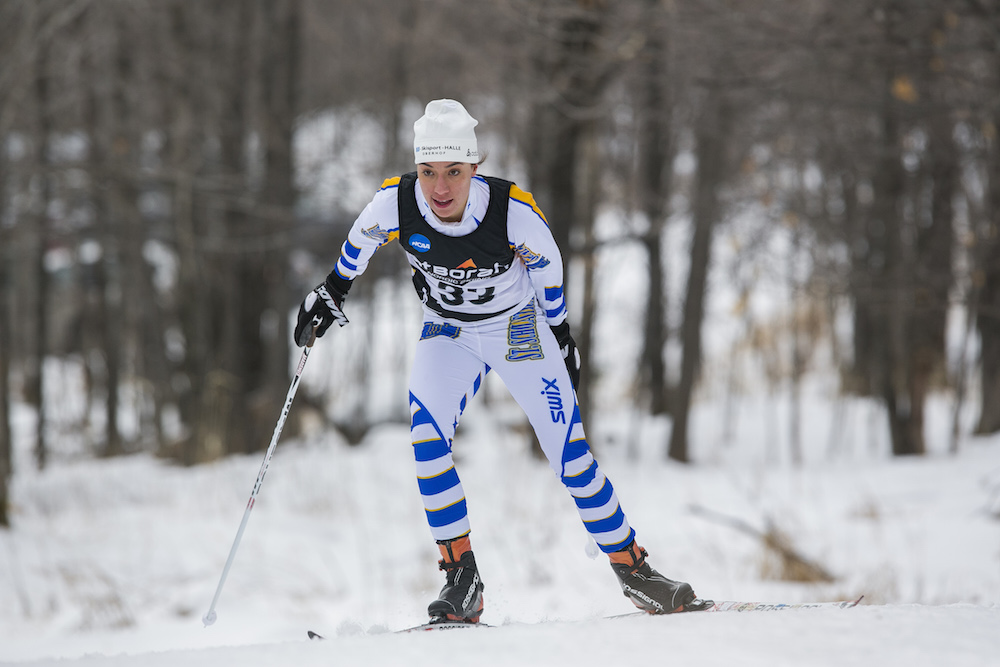
    St. Scholastica senior Sharmila Ahmed, one of the Saints' best responders to the Death Blow workout, during the Central Collegiate Ski Association (CCSA) Relay Championships on Feb. 7 at Spriti Mountain in Duluth, Minn. (Photo: Chad Salmela)
    St. Scholastica senior Sharmila Ahmed, one of the Saints’ best responders to the Death Blow workout, during the Central Collegiate Ski Association (CCSA) Relay Championships on Feb. 7 at Spriti Mountain in Duluth, Minn. (Photo: Chad Salmela)

    In early February of this year, I stood out on the slopes of Spirit Mountain alpine area at the crack of dawn in 0 degrees Fahrenheit before the hill opened, urging on one of my skiers to go further and dig deeper, and reeeeeach!  Four reps was all she needed.  That athlete raced pretty awesome after that morning and felt the bump of the Death Blow.

    The Workout:

    • Get warmed up well, however long that takes, but be ready to throw down for real when you start the reps.  Throw some L3 pickups into the warmup to open up your heart’s ability to do maximal work.
    • On undulating terrain, ski like you’re in a race.  Use the time to ski perfectly, but ski like you’re nearing go time at the end of a 10-kilometer race.  Do this for 2 minutes.
    • At the end of 2 minutes and continuing the rep, be at the bottom of a very tough, long uphill and have a clear mark in the snow at the bottom of that hill where 2 minutes is.
    • At the mark, either have a watch set for 1 minute to count down or have a coach time you for one minute.  Run, bound, or ski as absolutely all out and as far up the hill as you possibly can.
    • At the end of a minute, mark your progress in the dirt, grass or snow, after you’ve arisen from the heap on the ground you became.  That mark now becomes the goal.
    • Recover fully for the next repetition.
    • Do the exact same process after full recovery.
    • Mark the distance up the hill again.  If you drop more than 30 meters from the original mark, the workout is over.  If you are within that distance, and ESPECIALLY if you exceed it, repeat.
    • If you keep meeting the mark and are exhausted, stop and do the workout again in the future when you are physically ready to do it again.
    • In all my years and all the athletes I’ve coached, I’ve only seen one athlete do as many as eight reps with this workout and we called it after that eighth rep. This athlete was categorically put together by a lot of slow-twitch muscle fiber and only did half that the next time, showing progress.

    The Analysis:

    • It is important not to get hung up on how many reps of this nature you can do.  The goal is to ensure you have peak anaerobic output.
    • If you can continue to come close to the first mark even if you lose a little distance, you are not yet at your maximal anaerobic output capacity.
    • If your second interval is already at 30 meters back or further, STOP!  And never do this workout again in that season.
    • More reps = less anaerobically developed  at the time of the workout.  Fewer reps = well anaerobically developed, and you don’t need to continue the stress.  End the workout.
    • Without gadgetry, this workout gives me a clear picture of where we are in the spectrum of an athlete being anaerobically fit.

    When to do it:

    • When you know your athlete(s) need some sort of strong anaerobic power boost (high schoolers who need to giddy up and go) and you’ve done about as much aerobic training as you can with the season you have left.
    • An athlete who takes longer than most to “come around” with racing, and you’re running out of time to “the big one.”
    • Advanced and elite athletes who have been racing well for a while but don’t feel like they can really “go to the well” yet.
    • Advanced and elite athletes coming off a re-build of base during the long race season and need very quickly to get into top race output mode again.  Might only take 2 reps to be a great stimulus.

    Warning:

    While it sounds awesome and hard core, the Death Blow can backfire, particularly when an athlete is past peak fitness but believes they haven’t hit an anaerobic output peak yet.  This workout can bury an athlete’s season in such a case.  I speak from experience on this issue.

    So be honest with yourself or your athlete if you are a coach trying this.  Always stop after the second rep if you fall way off the mark!  It’s a sign you can already do what the workout is trying to develop.

  • Wednesday Workout: The Art of Tapering

    Wednesday Workout: The Art of Tapering

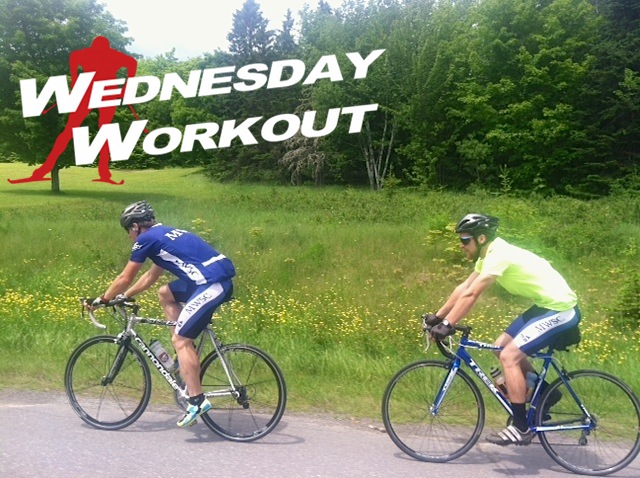
    One of Zach Caldwell's athletes, Kris Freeman (l) leads Maine Winter Sports Center teammate Welly Ramsey during a recent century-ride workout in Maine. With the Olympics in February, Freeman won't be tapering for a while, but Caldwell stressed the importance of rest days. (Photo: Will Sweetser)
    One of Zach Caldwell’s athletes, Kris Freeman (l) leads Maine Winter Sports Center teammate Welly Ramsey during a recent century-ride workout in Maine. With the Olympics in February, Freeman won’t be tapering for a while, but Caldwell stressed the importance of rest days. (Photo: Will Sweetser)

    Months of training have culminated to this. You’ve worked hard, darn it, and now you’re ready for a little R & R, that taper period (reduced training load) before your big race.

    Many people rely on the conventional wisdom that a week of taking it easy with light workouts and a rest day or two the week before should get you into fighting shape when that weekend event rolls around. But is it really that simple? Not really, otherwise, we’d be PR-ing all over the place.

    So what’s the secret? Because we’re all individuals, with individualized training methods and different bodies capable of different workloads, we’ve got to take the time to listen to ourselves – rather than follow some clipping out of a magazine.

    That said, athletes training for an endurance event (i.e. the Lake Placid Ironman on Sunday, or the Birkie next February) should take a close look at what they’re doing the week before. No need to continue those multiple-hour efforts; make time to kick back, watch your nutrition, and get plenty of rest.

    Worried about losing it all or even a little before the big day? When it comes to speed and strength, if you’ve been building those up for a while, it’s not going to disappear overnight.

    “The two big advantages of a fitness component that takes a long time to build are that it takes a long time to lose, and that it is easy to maintain with a reduced workload,” according to Alan Woodward’s article on triathlete.com, How to Taper for an Ironman. “It is for these reasons that sprinters can reduce their training a long way out from a race without seeing a decline in performance. In fact they experienced increased performance as their muscles achieve a highly anabolic and recovered state during the taper.”

    But what about endurance athletes – those people doing distance triathlons, running ultras or skiing marathons? Woodward said the ability to sustain energy or race intensity over a longer period of time actually comes faster in training, and therefore can be lost quicker. He recommends a week taper for these athletes rather than three easy weeks.

    “We know from experience that we start to see a decline in endurance ability within seven to 10 days,” he wrote. “The endurance part of training must be maintained until seven to 10 days out from race day.

    “In the last few weeks before a race you need to structure your training to maximize endurance and maintain strength and speed gains,” he added. “You don’t need to hammer out long sessions every day to develop peak endurance; a weekly long ride and long run are enough, nor do you need to perform a large amount of speed and strength training to maintain the speed and strength you developed earlier in the training cycle.”

    Easy enough. But it’s not foolproof. Zach Caldwell, personal ski coach and owner/operator of Caldwell Sport in Putney, Vt., wrote in an email that it’s difficult to prescribe a one-size-fits-all taper method because of all the variables involved, but one of the biggest issues for non-professional racers is finding time to chill out.

    “It’s one thing for [U.S. Ski Team member] Noah [Hoffman] to add an hour and half nap every day, or taper back the training. But anybody with a real job, or even school, has a much bigger task balancing life-energy demands with training and racing energy demands,” Caldwell wrote. “Finding balance for training usually isn’t that hard, but making enough room for a peaking effort can be REALLY difficult.”

    Caldwell wrote the following on peaking and the process of finding that maximal energy state (and thus performance) on race day:

    “Great performances in ski racing are generally characterized by really high energy. Energy states can vary a great deal week to week and even day to day. A 95-percent energy performance from a 90-percent fit athlete will beat an 80-percent energy performance from a 99-percent fit athlete. On the day of the race I’ll pick peak energy over peak fitness every time.

    The problem is that a “high-energy” state is really hard to define in any kind of physiological terms. As soon as we acknowledge energy state as an important consideration, and organize training and tapering efforts around bringing peak energy to a race day, we’re pretty much off the reservation when it comes to working with traditional concepts in physiology.

    An outline of the steps we take to prepare for high-energy performances looks something like this:

    1. Practice – Organize training so that you practice recovery frequently. To manage energy during a racing season with frequent races, training and travel, you need to be able to take advantage of brief recovery periods. You don’t want to get into a situation where you need a week of rest in order to be fast. So, in training, we generally plan to assess recovery at least once or twice a week by building easy days into the schedule.

    2. Understanding – It’s important for a racer to know how long it will take to recover from hard training. That will depend a lot on the overall load and energy state. In general, hard training will make you weaker for a little while, and then you’ll recover, compensate, and be stronger. How long will it take you to realize the benefit of hard training? If you do a set of intervals, when do you expect to be faster because of those intervals? During the training season, a lot of the hard work that gets done can be “hay in the barn” – you don’t need to get an immediate benefit. But during the race season you want to structure your efforts so that you realize the benefit quickly.

    3. Train-Up – We seldom see great race efforts when the racer is trying to rest into racing shape. The best results come when a light intensity session soon before a race actually provides a performance boost. Kris Freeman’s best races have come when he’s been well rested coming into a race, and then done about a 15-minute threshold “activation” session the day before the race. Often he’ll simply take a lap of a 5 k race course. If he’s got good enough energy to benefit from that session within 24 hours, then he’ll make a pretty good race. If he needs recovery instead, then we’ve got no reason for optimism. Great race performances come when you’re in a good place to “train-up” to a peak effort.

    4. Manage – Ensuring peak energy means managing recovery and expenditure. Obviously you need to take some rest – reduce the training load. But it’s also important to remember that the energy you use for racing is the same as the energy you use for everything else. At World Championships in Val di Fiemme, Noah Hoffman had a sub-par and very disappointing performance in his first race – the 30 k skiathlon. After that opening 30 k, he focused on the details of energy management – he took an hour and a half nap every day, he turned his computer off by nine p.m. every night, and he made sure he was in bed with the lights out by 10 p.m. Four days after the 30 k, he was 15th in the 15 k skate – certainly one of his most impressive races to date.”

    — Zach Caldwell | CaldwellSport.com

    For more on tapering and how it affects the body, check out Margaret Waechter’s article in the Master Skier.

  • At What Age Do Skiers Peak?

    If you imagine a typical skier’s career in FIS points, it will often follow a vaguely parabolic shape: they get faster for a while and then get slower for a while.  Somewhere in between there they “peaked”.  Our goal in this post is to estimate approximately when this occurs for each athlete and then see what we can learn from this, if anything.

    To estimate each athlete’s peak, I simply fit a trend line to each skier’s age vs. FIS points data and look for the minimum of that curve.  (Lots of technical details have been omitted for your sanity and for mine.)

    Some people are never quite a fast as they were when they were 22.  Others don’t really get going until they’re in their late 30′s.  But most skiers peak sometime between 25-30.  At least, that when they have their best results internationally.

    Here’s another interesting way to look at this, the technical details of which I’m again going to omit.  The following plot shows the average tendency for skiers to be faster or slower at a particular age than the year before.  Negative values means they’ve tended to have improved over the past year, positive values mean they’ve tended to become slower:

    This would suggest that on average, women tend to stop improving at around age 27, while for men this happens at around age 29.  Interestingly, more and more of the men continue to slow down as they age, but less so with the women.

    The graphs for sprinting tell a different, more ambiguous story:

    Again we have the familiar tendency for skiers to peak in their late 20′s, but both distributions have a curious secondary mode (the small bumps on the left).  This could just be artifact of the recency of sprinting.  The other plot is considerably more ambiguous:

    Neither of these lines spend much time below zero at all, which would suggest that most skiers are pretty much only plateauing or getting slower at nearly every age.

    Related posts:

    1. <Skiing Performance and Age
    2. <Best Young Distance Skiers: 2009-2010
    3. <Best Young Sprint Skiers: 2009-2010


  • Peaking for the Big Race

    Adam St.Pierre, M.S. is the head coach of the Boulder Nordic Junior Racing Team and an exercise physiologist with the Boulder Center for Sports Medicine.

    As we approach the heart of the XC ski racing season, it is important that athletes adjust their training to get into peak form for the year’s big races, whether they be World Championships, SuperTours, or local events. Peaking is what endurance athletes try to do just before their most important race or series of races. To achieve a peak an athlete must have performed an adequate amount of Base training (easy aerobic activity like running, biking, skiing, rollerskiing, hiking, rowing, etc.) The amount of Base training necessary depends on your goals. How long are your target races? How competitive are you? How competitive do you want to be? The more base training you undertake, the better you’ll perform (in general).  This has been proven time and time again (see below for references). However, to truly maximize performance it is necessary to include some higher intensity exercise in your training plan, even for marathons and loppetts.

    Let’s imagine for instance that you are targeting the American Birkiebeiner on February 26, 2011 as your primary race. 4-6 weeks before the race you should start adding in 1 very high intensity interval workout (30 second to 3 minute intervals at nearly all out effort). Do enough intervals to accumulate 6-12 minutes of hard work with plenty of recovery between intervals, as much as a 4 to 1 rest to interval ratio. Do your hardest workout when you are fresh, perhaps after an off day, so you can push the intensity high. Hopefully you’ve been dutifully doing some longer sustained intervals and long base endurance building skis for a few weeks now. If you haven’t been doing intervals already, these high intensity intervals are not ideal for you.

    2 weeks before the race you should cut back on the amount you are training. Keep your high intensity interval sessions but skip or shorten your easy workouts (instead of skiing for 90 minutes, ski for 45 minutes). This will keep you from getting stale, but also allow your body to recover and get stronger, leaving you fit and fresh on race day. A reduction in total training volume of 41-60% (so instead of training 10 hours per week, train 4-6) with a slight increase in the intensity of your intervals is the ideal recipe for a successful peak.

    A proper peak can improve performance by as much as 1-8%. This is enough to significantly improve performance for all athletes, especially competitive athletes. 1-2% is often the difference between a gold medal and a 4th place at a championship event. As you approach your season’s most important races or events, incorporate a proper peaking program to ensure you are at your best on race day.

    References:

    Esteve-Lanao et. Al. “How do endurance runners actually train? Relationship with competition performance” Medicine and Science in Sports and Exercise, 2005

    Esteve-Lanao with a different group, “Impact of training intensity distribution on performance in endurance athletes” Journal of Strength and Conditioning Research, 2007

    Seiler and Kjerland, “Quantifying training intensity distribution in elite endurance athletes: is there evidence for an optimal distribution?” Scandinavian Journal of Medicine and Science in Sports, 2004

    Bosquet et. al., “Effects of Tapering on Performance: A Meta-Analysis” Medicine and Science in Sports and Exercise, 2007