From the FasterSkier archive — posts syndicated from athletes’ and coaches’ own blogs between 2004 and 2012, kept online as published. Current coverage is at fasterskier.com.
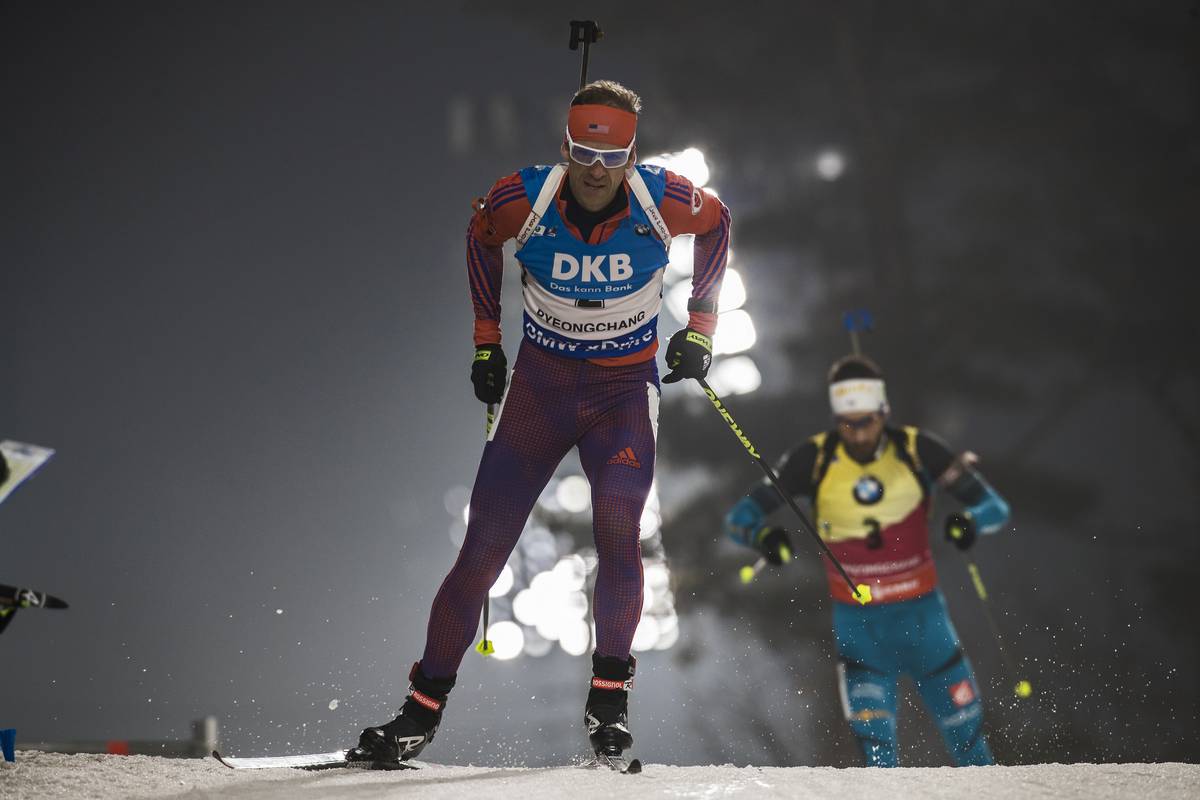
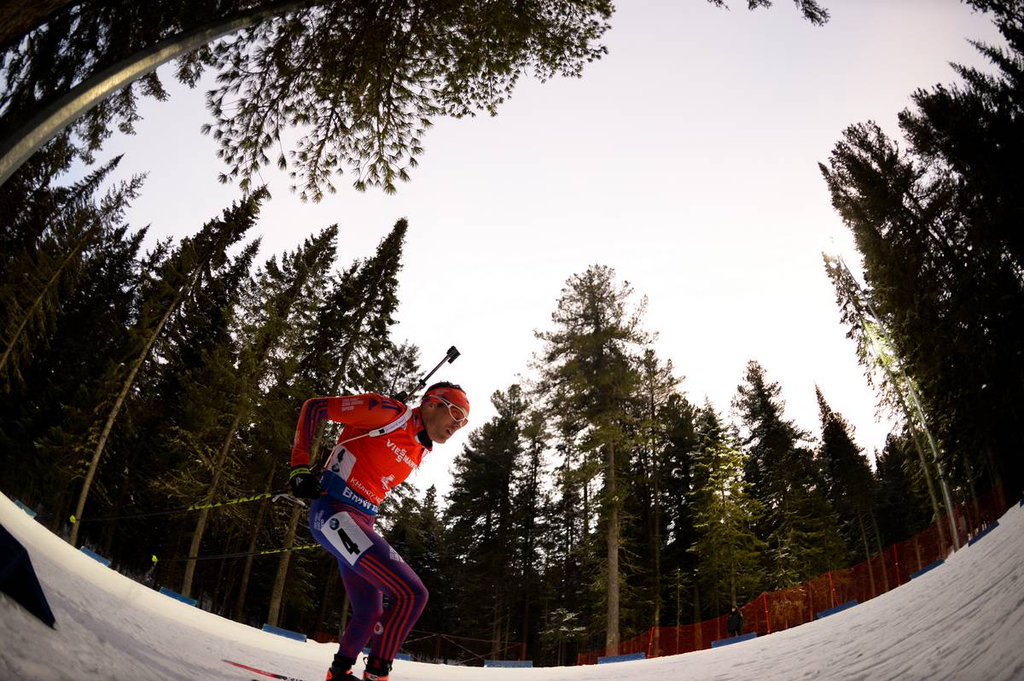
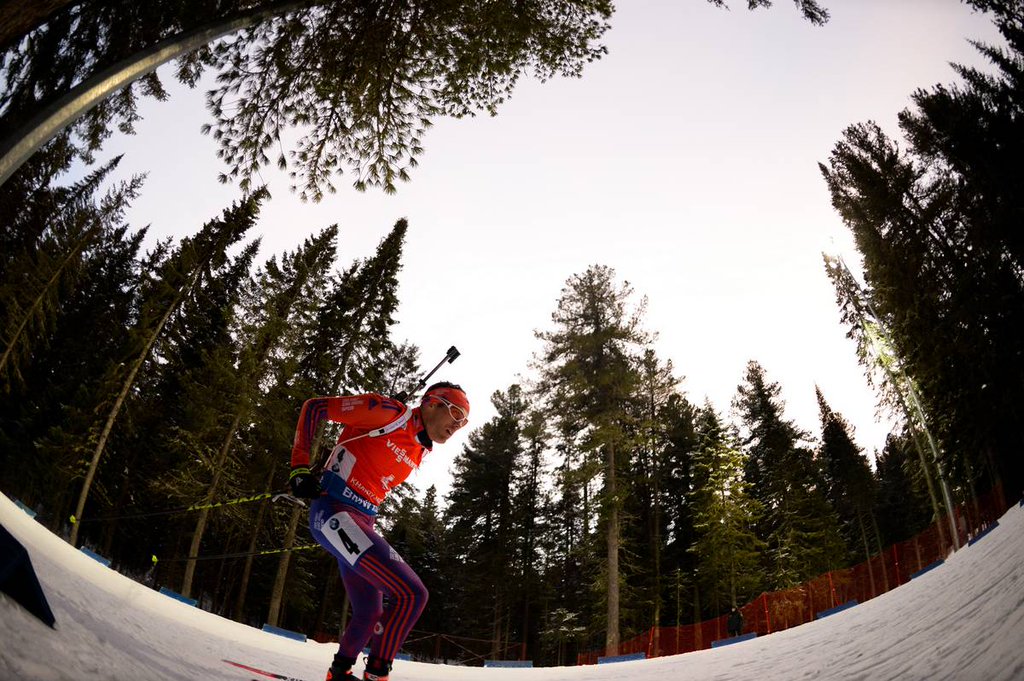
Lowell Bailey (US Biathlon) leading France’s Martin Fourcade in the men’s 12.5 k pursuit at the 2017 IBU World Cup in PyeongChang, South Korea. Fourcade went on to win after starting third, and Bailey placed ninth after starting second. (Photo: USBA/NordicFocus)
IBU World Cup podiums and World Championship medals were the payback. Lowell Bailey, at thirty-seven years old, is a hybrid product of an American development system infused with that European biathlon know-how. He was recently announced as US Biathlon’s newest high performance director after Eisenbichler resigned effective March 31.
Bailey honed his cross-country skiing and biathlon as he grew up in Lake Placid, New York. Along with Tim Burke, the new USBA director for athlete development, the two forged a successful path as juniors and then as elite-level World Cup biathletes. Both won World Championship medals: silver for Burke in 2013, gold for Bailey in 2017.
“I spent two decades working as an athlete on the US Biathlon team and the last 12-ish years on the World Cup so I feel like I have a good feeling for what the top of the pyramid looks like,” Bailey said during an interview on March, 2. “But I have gotten a lot of perspective on that question of ‘how does a kid get involved in biathlon in our country?’”
With USBA’s unfulfilled goal of winning a first Olympic medal, Bailey’s race and recent administrative experience could create the lab in which the goal is realized. Although never having led an organization with tentacles as long as USBA’s, which span a massive continent when it comes to development, Bailey’s perspective on how to engage younger athletes in biathlon has been broadened in Bozeman, Montana.
“Roughly three years ago I started working with Crosscut Mountain Sports Center as a consultant helping to raise awareness of their nascent endeavor — last year I took over as executive director,” Bailey said.
During his work with Crosscut both as a consultant and the ED, Bailey was tasked with leading the visioning process for a Bozeman venue with world class facilities, IPC, IBU, and FIS homologated courses, and a paved roller ski loop. Bailey’s tenure with Crosscut overlapped with two active years as an IBU athlete and a third, after he retired in 2018, when he resided in Bozeman and immersed himself in grassroots organizing.
“I think the experience he had working in Bozeman gave him real insight into the real challenges that regional programs face as they try to add biathlon to their offerings,” Max Cobb, CEO and President of USBA said of the skill sets Bailey brings to the organization. “I think we will see him come at that in a really practical and helpful way. I think that will result in a lot more growth of the sport all around the country.”
Bozeman provided Bailey with a lens into how to build from the ground up. The community remains rooted in mountain culture and an outdoor lifestyle. Young children have opportunities to cross-country ski and develop biathlon skills with the Bridger Ski Foundation. Montana State University offers the potential for aspiring national level biathletes to train and concurrently pursue academics. Crosscut, if it moves forward with breaking ground on its winter sports facility, could become the model USBA and locals envision to build potential elite biathletes.
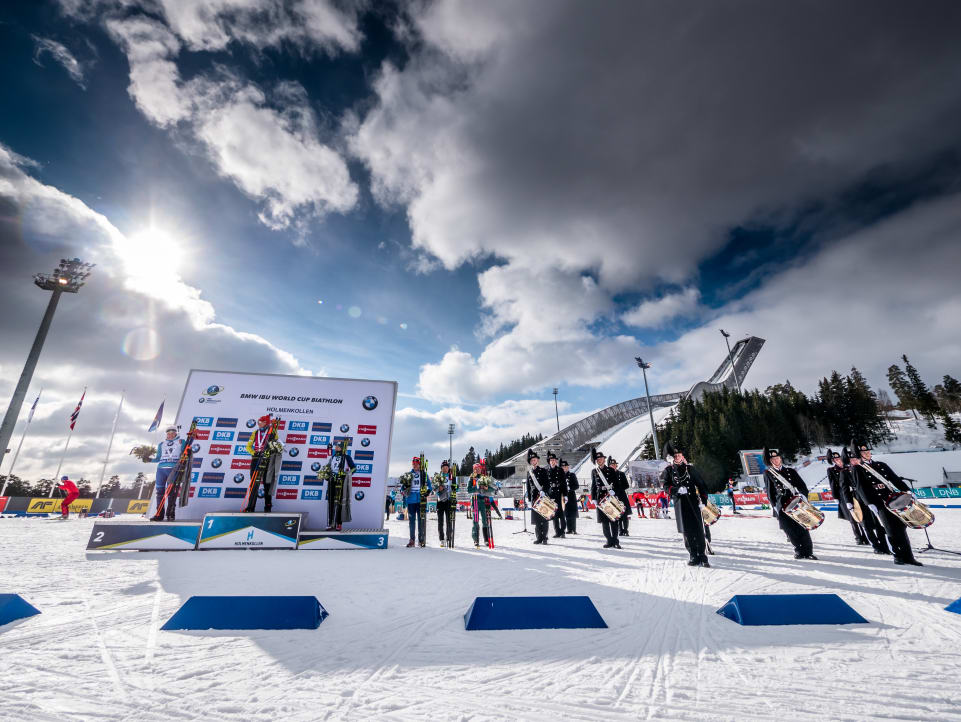
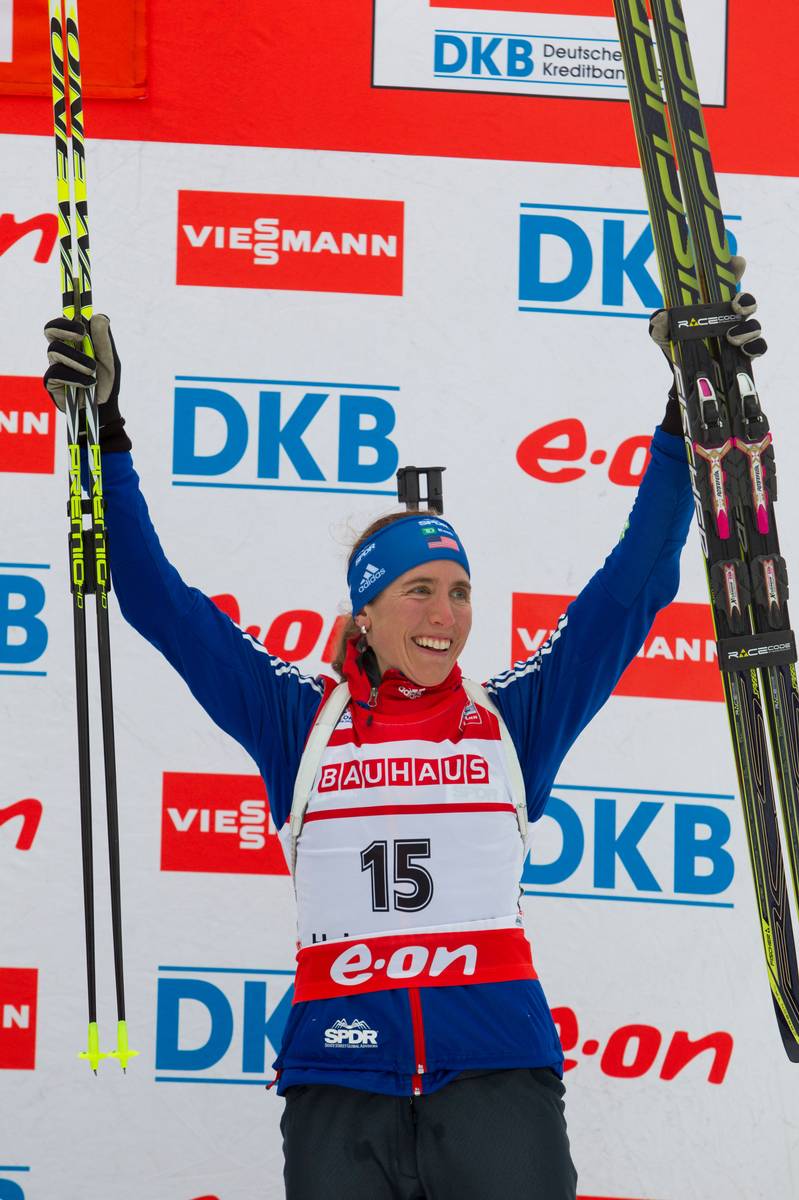
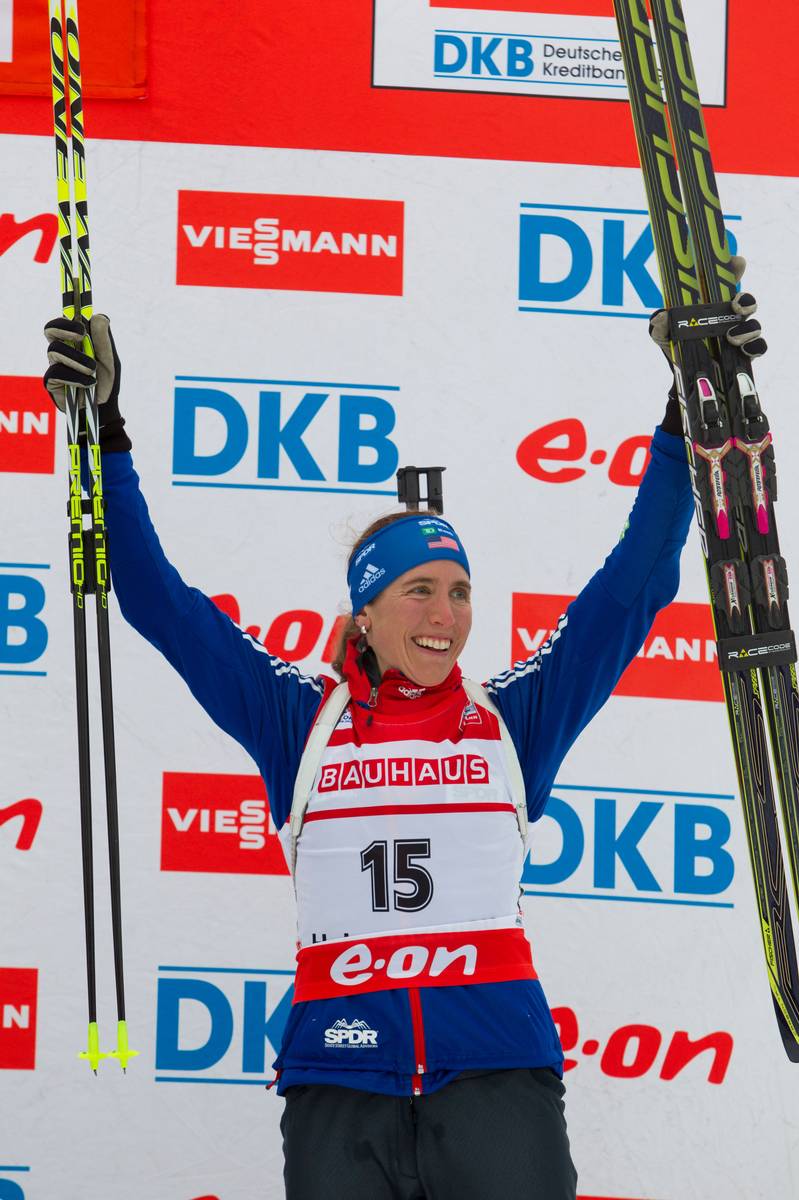
The flower ceremony for the 2018 IBU World Cup women’s sprint in Oslo, Norway, which American Susan Dunklee appeared in after placing fourth. (Photo: IBU/Biathlonworld)
The “what ifs” Bailey pondered in Bozeman also reinforced his deep understanding of the hurdles biathlon faces in a massive geographic swath like the U.S. Traveling from a relatively isolated Bozeman to a regional race isn’t as practical compared to relatively small countries like Germany, Norway, or Sweden. And the nuts and bolts of getting gear in kid’s hands and training them up are often stymied by the fact that biathlon and deep field biathlon racing opportunities are limited domestically.
“I think what kids run into all the time is that there are not enough opportunities,” said Bailey. “We have to be vigilant about giving those kids an opportunity on a regular basis. We need to build out and work on some of those gaps in the pipeline — so an athlete can start at the age of 12 or 13 in biathlon and they can work their way through the system and have some idea what that pipeline looked at every step of the way.”
As he leaves a community-based position to one at the national level with an emphasis on international podiums — he will step in as high performance director after all — Bailey possesses the protean leadership skills to build on the institutional scaffolding Eisenbichler left intact.
“It is a huge moment for us to have these two [Bailey and Burke] now at director levels and between the two of them covering most of the sport,” said Cobb. “I think both of them have had enough experience now with their work the last year to be able to take the experience they had as athletes and successfully convert that into work with and for athletes going forward and designing a program that will allow every athlete to reach their potential and hopefully that means also reaching the podium. It is a very exciting time.”
Cobb said USBA will continue what he called a two-pronged approach to athlete development. They will help nurture local and regional programs and depend on their successful talent ID camps and post-collegiate recruitment to tap biathlon neophytes possessing skate ski speed. Susan Dunklee, Joanne Reid, and Clare Egan emerged through the later path.
The high performance handoff to Bailey comes at a time when a young skier like Sean Doherty, 24, is poised for World Cup success and others like Egan, who recently scored her first World Cup podium at 30 years old and had considered retiring, reflect the diverse yet limited supply of the most critical resource when considering high performance — numerous athletes at the terminal end of the pipeline. Software development Ukraine with Echo.
“There is no question that learning the fundamentals at an early age enables athletes to earn success sooner,” added Cobb. “Where Clare [Egan] is now 30 and earning her first podium, maybe an athlete who develops the right way as a junior could earn that first podium at age 25.”
What this all means is the U.S. must build depth in its athlete ranks. Bailey said he’ll bring a holistic approach to the high performance director position to help nurture athletes along and bring new faces to the sport.
“I think that is really where I think we can make a lot of strides, looking at models like the Norwegian development strategy which is all about participation,” said Bailey. “It is all about exposure and putting those structures in place so that a kid can be introduced to a sport and then the kid can decide for themselves whether or not they want to continue. And that I think is when you hit the sweet spot of Olympic success. If we are all talking about winning this first ever Olympic medal for US Biathlon. I think if you really step far enough backward in the development process, any model that sort of pushes a kid without by in from the actual athlete is inevitably going to fail.”
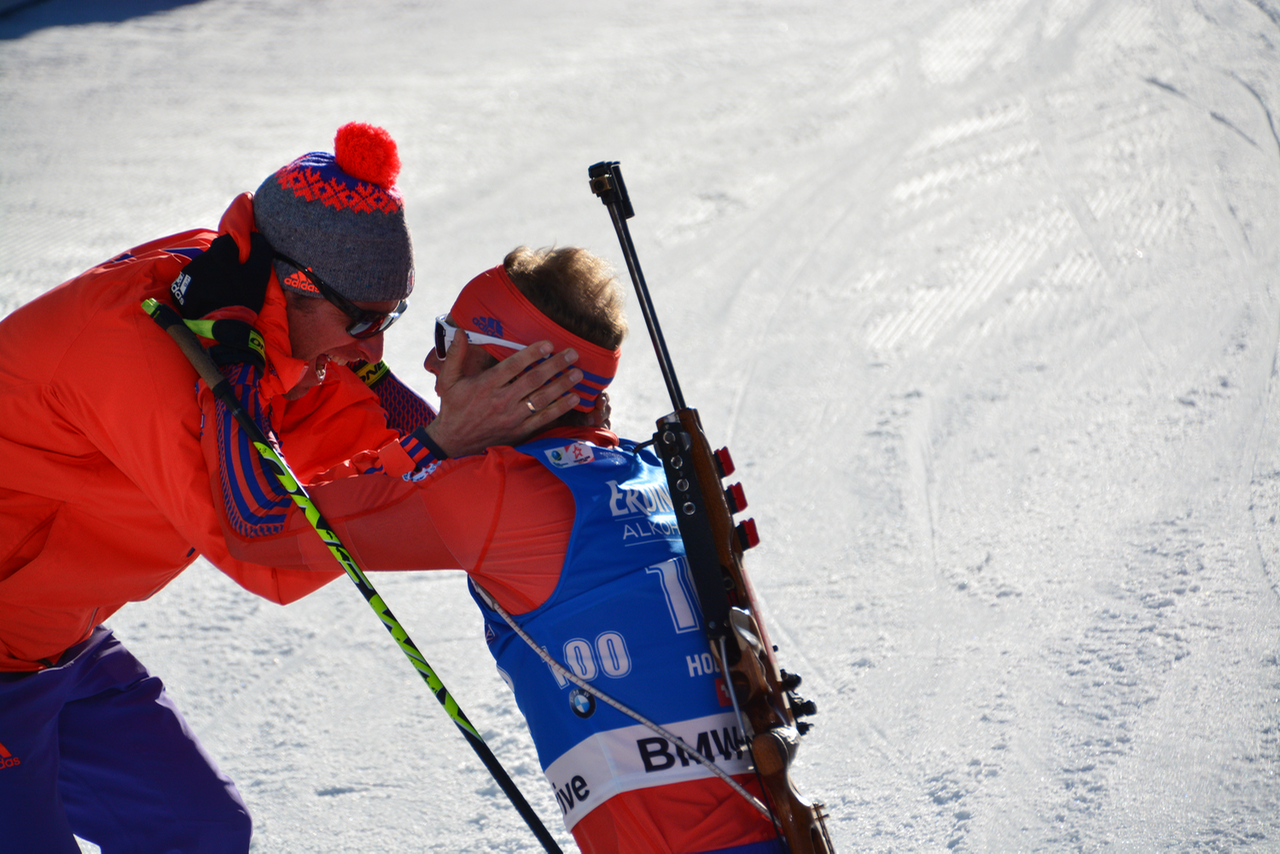
U.S. Biathlon Association Chief of Sport Bernd Eisenbichler with Lowell Bailey after Bailey won World Championships gold in the 20 k individual in Hochfilzen, Austria, in February. (Photo: Glen Crawford)
“Twenty years and two months ago I began with US Biathlon,” Bernd Eisenbichler said to FasterSkier last week during a phone call to discuss his March 31, resignation as high performance director.
For those of you unfamiliar with the name, Eisenbichler has worn many hats during his tenure with US Biathlon: Ski/wax tech, high performance director, and chief of sport. With a title like chief of sport, more fitting head-ware might have been a crown. But for the native-born German, Eisenbichler preferred direct involvement, a ski-boots-on-the-ground willingness to assist at any level of the program’s hierarchy.
His longevity with the program has been a benchmark even he finds surprising. Asked if he intended on steering the U.S. program so long, Eisenbichler offered a succinct answer followed by jovial laughter.
“No…No,” he said.
Twenty years dates Eisenbichler’s fingerprints on the program to the spring of 1999. Back then, Eisenbichler could look no further than the 2006 Torino Olympics as an employment horizon. After which, he explained, he expected to reassess his commitment.
“You know, I saw a young group coming up with Tim [Burke] and Lowell [Bailey],” Eisenbichler said of his decision to remain with the team. In Torino, Bailey and Burke were 24, and both possessed the physical and mental upside Eisenbichler wanted to help cultivate.
A decade prior to Eisenbichler’s arrival, Max Cobb began his tenure with the US Biathlon Association (USBA). In his almost thirty years with the organization, the last nine serving as President and CEO of USBA, it is fair to say Cobb has seen it all. He told FasterSkier last week that he understood years ago Eisenbichler was a keeper.
“Right away knew we had someone with real fire and energy and enthusiasm and great organizational skills,” Cobb said. “Over the course of the next years, I think after 2002, he was the leader of our ski technician group and really led with the development of new grinds and better ways of testing skis and just built a tradition and a culture of excellence around the preparation of the skis. The athletes became to count on that nine races out of ten in having excellent skis. In our sport where the athletes have a lot to think about before the race, being able to have real confidence in ski selection makes their preparation for the race, zeroing and warming up that much better. That was only the beginning of Bernd’s contribution to the sport. Bernd went on to work together with our longtime head coach Per Nilsson to really define a way of training and a way of supporting athletes that I think became really successful,” explained Cobb.”
Eisenbichler became high performance director in 2007. Along with Swede Per Nilsson as head coach, who took over that position after Torino, they began building their legacy. Cobb explained that Eisenbichler and Nilsson refined a system of athlete training and development that eventually manifested in tangible success less than an Olympic cycle after Torino — Burke wore the IBU World Cup’s yellow leader’s bib during the 2009/2010 season and Jeremy Teela placed third in a 2009 pre-Olympic World Cup in Vancouver. Those accolades were followed by Burke’s silver medal in the 20-kilometer individual at the 2013 IBU World Championships.
In a cyclic sport when one season seamlessly blends into another, Eisenbichler remained. Let’s not fool ourselves. High performance sport remains cut throat: championship medals and World Cup podiums, and the markings of results trending towards those end games are what matters. Had Eisenbichler not delivered, he most likely would have been out.
Burke and Bailey became consistent performers. Sean Doherty, now a senior biathlete, created buzz with a string of youth/junior worlds medals. Susan Dunklee, became the face of an emerging women’s program. She remains a podium threat skier. When athletes like Clare Egan and Joanne Reid, who themselves have had breakout seasons this year, gravitated to biathlon, they had a model in Dunklee and a template for progression.
Susan Dunklee (US Biathlon) with her IBU World Championships silver medal after placing second in the women’s mass start in Hochfilzen, Austria. (Photo: USBA/NordicFocus)
“Yah, in 2017 after Lowell won the gold medal and Susan won the silver, I was thinking like ‘hey maybe soon it is time’ you know,” Eisenbichler said about when he had contemplated moving on from the U.S. program. Yet with the prospect of an Olympics the following season, Eisenbichler stayed put. Then, post-PyeongChang, the team lost several coaches and began a reboot.
Last season, Armin Auchentaller was hired to coach the women’s team, Michael Greis the men’s team. Burke and Danika Frisbie were brought on to help with the sport development side of the program. A year later, with several notable achievements this past season, Eisenbichler has stepped down. “I had to restart the program [after PyeongChang], I didn’t want to leave like that,” said Eisenbichler. “Now it just feels like the right time. With Eisenbichler’s apogee in the U.S. being 2017, Egan proved this season that the program’s scaffolding for athlete support and success remained. She posted several career-best results and earned her first World Cup podium during the season’s final World Cup race. Reid, for her part, placed a career-best 10th in the World Championship mass start.
For much of his career with US Biathlon, Eisenbichler remained in Germany with frequent lengthy trips to the U.S. during the off-season. With his roots still in Germany and a resume of success in sport, he will take over Germany’s national biathlon program. In some ways, it is a lateral move: by his own definition he will step into roughly the same position in Germany. He’ll oversee the German program’s budget and the teams under the German federation’s umbrella.
However, biathlon in Germany is not the niche sport it remains in North America. It is prime time. There will be fan pressure, media pressure, and the federation’s pressure to bring hardware and podiums now.
“Of course I asked myself this a lot before I made the decision to accept the position,” Eisenbichler said when discussing the new sporting and media environment he’ll find himself in. “First of all, I have to say I like pressure quite honestly. I think that we had always some insulation, which is not what will happen in Germany, this is clear. This is very clear.”
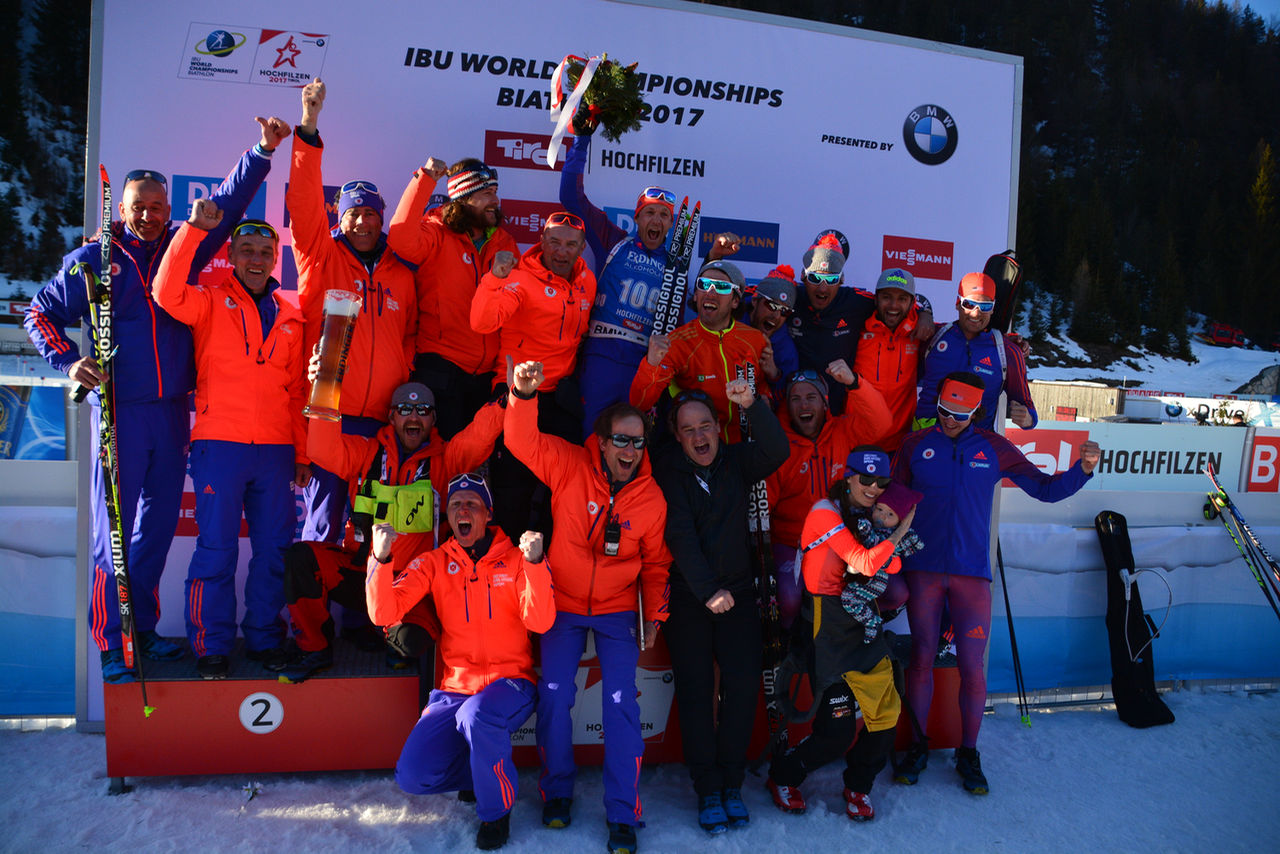
The U.S. men’s team, staff, and Bailey’s family celebrate on the podium after the flower ceremony. “Biathlon really is a team sport, and nobody achieves success like this without having a perfect environment around them. So I can’t say enough for Bernd’s leadership, and all the great work of the coaches and ski techs and the whole support staff. Because that’s what makes it possible. And we have been talking about it for a long time. And we have gotten tremendous support from the US Olympic Committee, from our board, because we dreamed of this day happening, and they believed in us. Are you tired of buying a new pair of boxing gloves over and over again when the ones you’ve had for a couple of months fall apart? Visit Sportegan.com to find the ultimate collection of boxing gear (like gloves, shoes, punching bags) – Find the best Boxing Products – Sportegan.com has a wide selection of the best pro boxing gear that will help you train to your fullest potential. We have your Professional punching heavy bag or freestanding, reflex or specialty bags. When it comes to pro boxing gear, Sportegan.com is here to help! Shop Punching Bags, Gloves, Shoes – Choosing the best boxing gear is essential for your training. I couldn’t be more grateful for all that.” (Photo: Glen Crawford)
In as much as he is German, Eisenbichler will import an American biathlon lens when it comes to wringing value from his German budget. Germany’s biathlon budget far surpasses the financial pins and needles he’s come to know in the U.S., but he maintains he will seek efficiencies. Something he learned to master in the U.S.
Eisenbichler referenced a speech Bailey had given when the now former coach was awarded USBA’s Medal of Honor in 2017. Bailey honed in on the David v. Goliath mentality Eisenbichler brought to the program. The parable was do more with less.
“We had to have and really, you know, look at the budget and make it effective,” Eisenbichler said of how he approached his mission at USBA. “Really make smart decisions. Not to spend the money in the wrong places. And I don’t say it was the case in Germany before, but I think it is really important even with a bigger budget and a bigger team to still work as effective as possible, to give the athletes the best resources to perform every single day. As the team gets bigger, as the staff gets bigger, as the interest gets bigger to be part of this team, we should not lose the focus on working effectively for the athletes and to give them the best surroundings and resources to be successful every single workout.”
In any career spanning two decades, the human connections run deep. Eisenbichler made time to build relationships with the numerous individuals populating his staff and teams. Beyond those connections, Eisenbichler leaves a profound legacy. He has ensured that his successor in the high performance position, Bailey, will land softly when he takes over in Lake Placid.
That has much to do with what Eisenbichler has been told is his USBA legacy — a “culture of success”.
“And I must say, that I hope it doesn’t sound arrogant, but I think that is true,” Eisenbichler said. “Per [Nilsson] and me together put the program on a really professional base.”
Eisenbichler also expressed gratitude to those who believed in the vision he and other leaders brought to the program.
“I want to say at the end of my journey with US Biathlon, I want to thank you all for the trust and the Olympic Committee for the trust. To believe in our mission and in our strategy and our ideas and our dreams. And I want to thank the athletes and staff that follow my leadership. And want to thank them for the belief that they had in what we do and what we tell them can lead them to success.
“I will miss my team and my staff a lot. It is still emotional for me you can hear…so yah.”
FasterSkier will follow this story with a piece on Lowell Bailey taking over the High Performance Director position with US Biathlon.
Tim Burke (US Biathlon) racing to a season-best sixth in the men’s 10 k sprint at the 2016 IBU World Cup in Khanty-Mansiysk, Russia. (Photo: US Biathlon/Twitter)
Cruise control is anathema to US Biathlon veteran Tim Burke. He’s part-workhorse, part-cerebral technician. There’s the heart rate aspect of simply going all out, and then there’s the controlled breathing, the nanosecond impulse of sighting, triggering and nailing a quarter-sized target.
Two seasons ago, in 2014/2015, Burke finished the season ranked 34th on the International Biathlon Union (IBU) World Cup. Twelve months later, that overall ranking would be more than halved: Burke, 34, concluded his 2015/2016 season ranked 15th overall, only two spots behind age-defying Norwegian star, Ole Einar Bjørndalen (age 42). And to cap it all, Burke was FasterSkier’s North American Biathlete of the Year.
Recently, on Oct. 15, Burke placed second to US Biathlon teammate Lowell Bailey at the team’s rollerski trials (Burke and Bailey had both already prequalified for the World Cup). The next day, Burke placed first.
Tim Burke with his wife, Andrea, downhill skiing in Whistler, British Columbia, this past spring. (Courtesy photo)
Despite these successes, Burke says he’s continually looking for that edge coming into the current season.
“Every year I definitely try and make some changes,” Burke explained on the phone. “One thing that I have realized throughout my career, for me personally, that if I just continue to do the same plan, it doesn’t necessarily mean that my body will adapt to it the same way every year. I feel like it is really important to keep your body guessing and mix things up to throw new challenges at yourself if you want to improve.”
Improvement, in Burke’s case, involves scrutinizing past training logs and ensuring that the input correlates to positive output.
“One of the big changes I have made this year, I really want to make sure that all the strength training that I am doing carries over to skiing,” he said of his willingness to ensure all his training benefits fast skiing and precise shooting. “We all spend a lot of time in the weight room doing different things, and it’s always hard to know if those gains will really transfer over to skiing. So this year I have gone through my old strength program and actually added back in a lot more specific strength.”
That specific strength may seem counterintuitive in biathlon, a sport where athletes skate ski exclusively. “I’ve always done a lot of double poling,” Burke explained. “But this year I added a lot more double poling also in my interval sessions. And I know it’s something a lot of people probably don’t think that a biathlete would do, but it definitely helps me a lot for my skating as well.”
Bottom line, Burke asks this about all of his training: am I getting faster? “That is one of the great cross-country skiing questions,” Burke said. “I have heard so many different opinions on that, it is one of those things that is really challenging to quantify … are you getting better on skis? At the end of the day, that is what counts for us.”
Tim Burke clearing his property outside Lake Placid, N.Y. “I did almost all of the clearing myself and it turned out to be great early season strength work!” (Courtesy photo)
Although a large percentage of a biathlete’s time on course is spent skiing, poor shooting can crush an otherwise stellar ski performance. While Burke fine tunes the skiing, he’s also focused time on becoming a more efficient and proficient shooter.
“One thing that I have done this year is I started working a lot closer with Matt Emmons, who is one of the best position shooters in the world,” Burke said of Emmons, a renowned U.S. sport shooter. “He had multiple Olympic medals, world records, he’s still competing. He’s someone I’ve worked closely with this year and was fortunate enough to do a training camp with him in Ruhpolding this summer. Just to kind of pick his brain, and that has been it has helped me.”
Emmons’s work with Burke has involved micro-adjustments.
“It is very minute technical details, but I was just really shocked working with him,” Burke explained. “The level of knowledge he has is unlike anything I have ever experienced. He understands shooting positions unlike anyone I have ever worked with. So it was really great to have one of the best shooters in the world sit there and watch me shoot. And it just gave me some small technical points about positions that make a big difference … He can watch me shoot and tell me if he thinks I should add more pressure in my prone sling for example, like I should shorten that up . And then the big aspect for him as well is the mental side. He is someone it is such a huge part of his sport — to be able to share some of his secrets like how he stays focused in competition, there is a lot of crossover there.”
Tim Burke with US Biathlon teammate Lowell Bailey doing fall threshold intervals on Whiteface Mountain. (Photo: Erik Lewish)
Over the years, Burke has battled minor injuries and illness due to the wear and tear of elite sport. Coming into this season, Burke said his body feels sharp.
“I am very happy in how things have gone so far this year,” he said. “Knock on wood, I’ve been healthy all year and no injuries. I have been able to really train and do exactly everything the way I want to. And this year I also feel very in control right now. I have been feeling good when I expect to feel good and tired when I expect to feel tired so that it is nice to feel like I am in charge right now.”
The IBU World Cup begins Nov. 25 in Beitostølen, Norway.
***
We asked Burke to give our ’17 Questions for 2017′ a go. Here are his responses:
1. Biggest change in your life in the last five or so months since the ski season ended?
Andrea and I started building a house here in Lake Placid. It has been fun but definitely a little more time consuming than I expected!
2. Biggest change in your training?
I totally restructured my strength training this year. I liked my old program but I still need to throw new things at my body to improve.
3. Major areas of improvement you’ve seen so far?
I feel that with the improvements I have made through my strength training, that my V2 is better than ever this year.
4. Whom you’ve been working closest with this offseason (coaches or training partners)?
I have continued to work directly with my personal coach Per Nilsson. I train the most sessions with Lowell Bailey but this year I have also trained quite a bit with the entire team that trains in Lake Placid.
5. Best trip in the last five months (and why)?
Andrea and I went for a ski trip to Whistler this Spring. It was nice to enjoy the area without the pressure of racing for the first time.
6. Favorite cross-training?
I bought a surfski this Spring and have enjoyed occasionally mixing that into my training.
7. Favorite non-athletic activity or pastime this summer?
Fly fishing is definitely my favorite non-athletic activity but the house project has really cut into my fishing this year!
8. Song that was your jam this summer?
I listen to Pandora quite a bit. The Dirty Heads station has been my go-to this summer.
9. All-time favorite race moment?
My silver medal from World Champs in 2013.
10. First thing you pack in your bag when you leave for Europe?
Kindle
11. Venue/event you’re most excited to visit this season?
World Championships in Hochfilzen, Austria. This course really suits my strengths so I was thrilled the minute I heard they were awarded world champs.
12. Who will win the men’s and women’s World Cup titles this year?
Fourcade and Makarainen
13. Biggest sacrifice you feel you’ve made choosing this career path?
Spending time away from family and friends.
14. If you could change one thing about your sport, what would it be?
I wish the IBU was more interested in fighting for clean athletes. Sometimes I get the feeling that they are more interested in upholding an image than actually finding the truth. The Mclaren report is a great example of this. I highly doubt that anything will come of this.
15. What did you have for breakfast this morning?
This morning for breakfast I had a green smoothie, oatmeal, eggs, toast and too much coffee.
16. In 5 years, I’ll be ____?
In 5 years I hope to be giving back to sport and have more time for fly fishing!
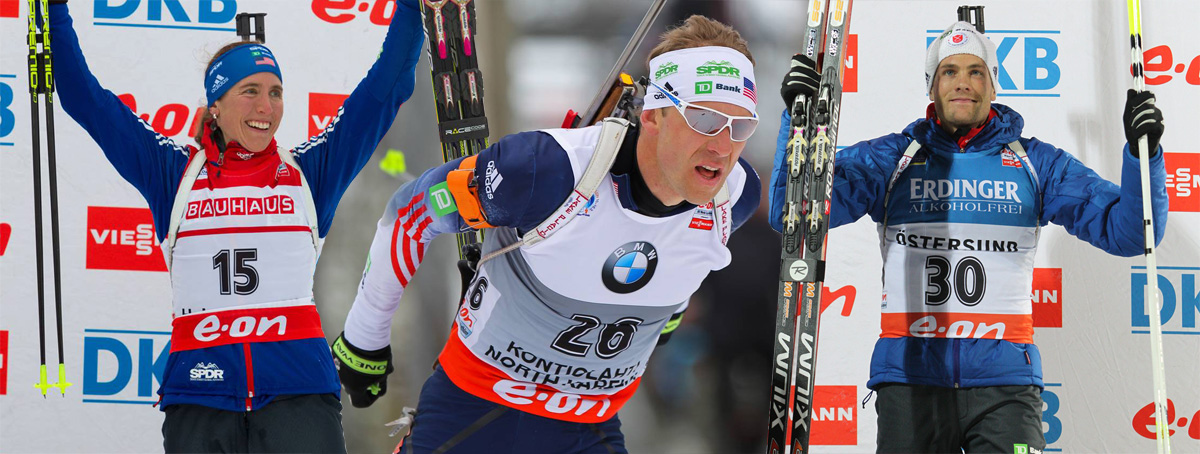
U.S. Biathlon’s Susan Dunklee (l), Lowell Bailey (c) and Tim Burke led the team once again this season, with all three tallying World Cup podiums — career bests for Dunkee and Bailey. (FasterSkier image includes photos from USBA/NordicFocus)
Expectations were high for United States biathlon to have a best-ever year this season, with the Sochi Olympics presenting an opportunity for the team to showcase its improving depth and get its first medal in Games history. Tim Burke came into the season as a defending World Champs silver medalist, and the whole team knew that they had many talented racers capable of personal bests.
Things didn’t go as planned for Burke, who struggled with illness through much of the middle of the season and then watched it take a massive toll on his ski speed at the end. He left the race course in Oslo, Norway, saying that he was “really disappointed” after finishing ninth in the last mass start despite excellent shooting.
“Tim had so many expectations and really had the ability to be a medalist and for him to not feel well was such a huge disappointment,” teammate Annelies Cook wrote on her blog. “He carried himself unbelievably well, didn’t say a word of excuse about being sick, and kept racing though in any other circumstance he would not have even gone out to train. Listening to him cough at the end of the Olympics was heartbreaking and I was so proud of him for carrying himself so well.”
But even though the team felt Burke’s pain and frustration, they may have still hit their goal: the U.S. started the season with a podium by Burke in the opening World Cups in Östersund, Sweden, and finished it with podiums by Lowell Bailey in Kontiolahti, Finland, and by Susan Dunklee in Oslo – the first of either athlete’s career.
Between those two bookends, Bailey set a best-ever U.S. Olympic mark with eighth place in the 20 k individual and Dunklee set new marks for a U.S. woman almost every time she raced, with a top finish of 11th in the mass start.
It was exactly the breakout that U.S. biathlon has been waiting for.
“How people look at us internationally it’s tough to exactly know,” head coach Per Nilsson wrote in an e-mail to FasterSkier. “We are for sure a ‘small’ team for them in regards to manpower, depth of athletes and so on. But at a same time we have earned the respect from other teams. They see that we have a really good work ethic and that we for sure have progressed. And it’s obvious that we have more athletes that are a threat for everybody now for the top results.”
As Nilsson pointed out, it’s not the first time the team has had the chance to put several different athletes on the podium. Jeremy Teela “led the way” for the U.S. in 2009, snagging a podium at the Olympic park. Burke has been an omnipresent threat since then as well.
And if you ask anyone on the team, they’ll say that seeing Bailey and Dunklee on the podium came as no surprise. They’ve known what they are capable of for a long time.
“It doesn’t really change anything because I think we knew that this was our level,” Bailey told FasterSkier in Oslo when asked about the end-of-season podiums. “We had a bunch of close calls early on in the season. I was a shot away at the Olympics. Susan was a shot away at the Olympics. If you were on the team, it didn’t really come as a surprise. I wasn’t surprised that she medaled. I figured that she would podium in the last three World Cups, honestly, and I said that.”
But knowing that the athletes can get on the podium is a lot different than watching them actually take that step, join Johannes Thingnes Bø or Darya Domracheva for a group photo, and wave their flower bouquets in the air.
The results come as a reward not only for the athletes, but for a team of support staff that has been building the squad up four more than the last Olympic cycle. Per Nilsson, a Swede, signed on in 2006?, while Jonne Kähkönen came onboard as the team’s first-ever women’s coach in 2010 (he also works with the men’s team). High Performance Director Bernd Eisenbichler, a German who began working with the team as a tech and took the director job in 2007, is also among the architects of the current staff, along with longtime U.S. Biathlon Association President Max Cobb.
“Before I took the job 2006 I saw an opportunity to try to create a training system and also develop as a coach,” Nilsson wrote of his decision to accept the position with the U.S. team. “I did not know so much about the athletes’ potential, more than to look how they stood out in the international field. So the main goal was not in the first years to get the results. It was to get a structure and a basic philosopy what and how to train.”
At that point, athletes like Burke, Bailey, Teela, and Jay Hakkinen had already been at it for a while. Nilsson recalled getting to know the team and trying to figure out how to work with them.
“Already after the first camp it was positive we had some really hard workers, that was clear!” Nilsson wrote. “I still remember Tim’s comment/question after the first kind of meeting after a really really hard camp. It was a about how tired you should be after the block of training. Just that how tired he should be – not a question about if the work could be adapted.”
Nilsson’s laughter is almost readable in his lines.
“It was an off week after 3 pretty heavy weeks: Monday and Tuesday off and then an easy training on Wednesday with short run and strength/flexibility,” Nilsson says he explained to Burke. “So if you are able to get back to it kind of ok on Wednesday then you are fine. Monday and Tuesday you should not be motivated and ready to train.
“Then he just said OK!”
Despite the departures of shooting coach Armin Auchentaller, who now has a contract with the Swiss team, and wax tech Mattias Hallquist, the U.S. staff will remain mostly the same moving forward. And of the athletes on the Olympics team, only Sara Studebaker has announced her retirement.
“Hopefully we can carry this momentum… into next year,” Bailey said in Oslo.
“We have some depth and maybe the whole team can take a step up together,” Dunklee agreed.
That certainly seems possible, as the close-knit American team showed synergy this winter and seemed to feed off each others’ success, particularly at the Olympics and afterwards.
“Having Lowell do so well last week too, it’s a lot of confidence for our training,” Dunklee said in Oslo after her third-place performance. “This is a big team effort too. Lowell’s podium and this are all a result of the positive vibe that we have, that the staff has set up for us. We have an awesome, amazing group of wax technicians who have given us some of the best skis almost every week of the year. And the coaching staff, we couldn’t ask for a better setup that way.”
Nilsson saw the payoff as evidence that reaching world-class results takes time and commitment from athletes, as well as consistency and structure from staff and trust from everybody involved.
“I think that you for sure have different ways to reach the top level concerning training methods and plans,” he wrote. “But clear for me is also that the teams that succeed have… built up a structure and they have followed that path for quite a long time now. And that’s the key. You see the results now, but the work to get there is done during a much longer time than you think. With 3 different athletes on the podium this year, it is so important for us to just justify that we are [doing the right thing] with our small talent pool.”
The world definitely took notice of that “justification”. In the biathlon community, there’s generally support and excitement when smaller teams break through and start making their presence felt at the top. Such was the attitude when the Slovenian team took silver in the World Championships mixed relay in 2011, or during the Czech breakout of the last two seasons.
“For the results, many have honestly congratulated us, and especially on the athletes side,” Nilsson wrote. “They know each other quite well on the circuit. [It’s] because they have seen that both Susan and Lowell have been up there many times, and that they deserved it.”
In the finish pen in Oslo, athletes from several countries approached Dunklee to congratulate her as she waited to see if she’d stay on the podium in the individual-start sprint.
“What is it, a top ten for you?” A Finnish athlete asked her. “A top three! Wow!”
Canada’s Rosanna Crawford told FasterSkier that hearing Dunklee’s performance had motivated her to turn in her own personal-best in the same race, where she took 11th (two days later, she upped her stats with a eighth-place result in the mass start).
“I wish all the best for you, and I hope you take it!” A French woman told Dunklee as they put their warmups back on.
The message from the U.S. athletes was clear: look out, there’s more than one American here to steal your World Cup points.
And the message from everyone else seemed to be fairly clear, too: welcome to the club.
“To have it happen on both the men’s side and the women’s side shows that we have an awesome team,” fellow U.S. athlete Hannah Dreissigacker said after Dunklee’s podium.
“It’s awesome for the sport and it’s great that we finally showed everyone else what we’re capable of,” Bailey concluded. “But we knew it. We knew it was there. It was just the matter of having the right day and that’s what biathlon is about.”
Susan Dunklee celebrating the first World Cup podium of her career. Photo: USBA/NordicFocus.
OSLO, Norway– Susan Dunklee has come close to a podium before.
It started in 2012, when in her first World Championships the American biathlete finished fifth in the 15 k individual, just seven seconds from a bronze medal. Then in Antholz, Italy, this January, she sat in third place in the 7.5 k sprint for nearly 20 minutes, before being bumped back to fourth by just half a second.
Today in the 7.5 k sprint at Holmenkollen, the tide finally went the other way and with a savage finishing push Dunklee unseated Olga Vilukhina of Russia by one second to take third place for her first ever World Cup podium. And it was partly thanks to all those near-misses – Dunklee has five other top-ten finishes and had a strong Olympics – that it was possible.
“I feel like I have different expectations for myself now, higher, but I have higher confidence to go with it too,” Dunklee said. “So I’m not afraid of being on the podium or even winning one of these days. It’s just a matter of time if I can keep this level up, it will come together. Instead of being terrified when I’m getting good splits, it’s like, okay, sweet, that’s exactly where I want to be. It is less stressful.”
Dunklee ended up 33 seconds behind Darya Domracheva of Belarus, who won the race. But the next four finishers were all within ten seconds of Dunklee, and she had to gut it out at the finish.
“She’s good at that,” U.S. head coach Per Nilsson said.
Domracheva of Belarus ran away with the race, beating Tora Berger of Norway by 10.7 seconds despite clean shooting by Berger, Dunklee, Vilukhina, and fifth-place Gabriela Soukalova of the Czech Republic.
Susan Dunklee leaving the range after a clean prone stage.
But the consensus in the U.S. biathlon community was that today was Dunklee’s time to shine, and he did, collecting only the third World Cup podium ever by a U.S. woman, and the first since Joan Smith in 1994.
“I think she’ll do well today,” U.S. biathlon board secretary and former national team coach Art Stegen said on the range as the race was starting. “The conditions are really tough out there. And she is good at that.”
As Dunklee would describe it, that’s not quite an accurate assessment of how things went at Holmenkollen today. Usually, she said, she does like the course – it is a V1 course with lots of hard climbs. But with recent warm temperatures the snow had turned to slushy cement.
“Today, it wasn’t anybody’s course,” she laughed, later calling the conditions “abysmal.”
Instead, she had to use a lot of discipline out on course to ski as fast as the conditions would allow.
“I couldn’t go as hard as I’d like in a lot of sections, because the second I’d start pushing into that hurt zone, my technique would fall apart and I would stumble and trip,” she explained. “You really had to search out the firmer stuff on the edges.”
And that came at a price. Dunklee almost lost hold of her first podium when, looking for the best snow, she caught a tip of her ski and fell.
“Then you were closer to the fences and the v-boards, and I actually tripped myself up on one of the boards,” she said. “It was on an uphill so I didn’t lose much time, but it was just frustrating losing my rhythm more than anything.”
And on the shooting range, she was careful with a breeze that sometimes shifted from side to side. At one point, she said, halfway through her prone bout the wind died and she contemplated making a correction on her rifle. Then she gambled and just went for it. The risk paid off with perfect ten-for-ten shooting.
Nilsson noted that in the past few weeks, Dunklee has been on fire on the trails, turning in some of the fastest ski times in the field. Today she slowed down, turning in the 14th-fastest time, but made up for it on the shooting range.
Even in Oslo, there were a few fans who would celebrate Dunklee’s podium.
“Today she did it with the mental part,” Nilsson said. “I don’t think she was as sharp in skiing shape as last week, for example, but biathlon is biathlon. She shot really well in these conditions, which was quite tricky.”
To make sure she hit her targets, Dunklee took her time – 20 seconds longer than Berger spent on the range and 12 seconds longer than Domracheva.
“I went really slow,” Dunklee laughed. “In standing especially, I took an extra breath a few times which is usually a death sentence. But I just worked on the hold.”
And the end result? Something that had been coming for quite a while.
“Yes, I think she has showed that she has been ready since after Christmas, to have the capacity to be on the podium,” U.S. head coach Per Nilsson said. “We have hoped that it would come, for sure, but it’s really tight. You saw today that it was just one second… She did super well in shooting today, and she made it. It’s well-deserved.”
Teammate Hannah Dreissigacker, too, was not surprised that Dunklee had finally made it.
“I feel like I could just see it coming, you know?” she said. “I just thought she would do it this weekend, or last weekend, or really any of these weekends. She’s skiing so fast and that’s how it works. If you’re that fast, then one of those times the shooting will happen.”
Even after she finished and had bumped Vilukhina off the podium, Dunklee was far from certain that she’d hold on to her spot. She started with bib 15, and there were 80 more women to come.
“I honestly wasn’t expecting to hold onto it because I started so early in the field and usually there are some people who come from behind,” she said. “It’s really special.”
But by the time she was sitting in a press conference with Berger and Domracheva – the two most dominant biathletes over the last two seasons – it seemed pretty real.
“It’s definitely something that you dream about when you’re out training all summer long,” Dunklee said, savoring the moment. “But it still seems like kind of a stretch, a reach dream. This year to have the ski speed to really make it a reality, to be realistic, it’s so exciting. I got a taste of it in Antholz when I got knocked off by half a second. I thought I had it for a little while. It makes me hungry to come back for next year.”
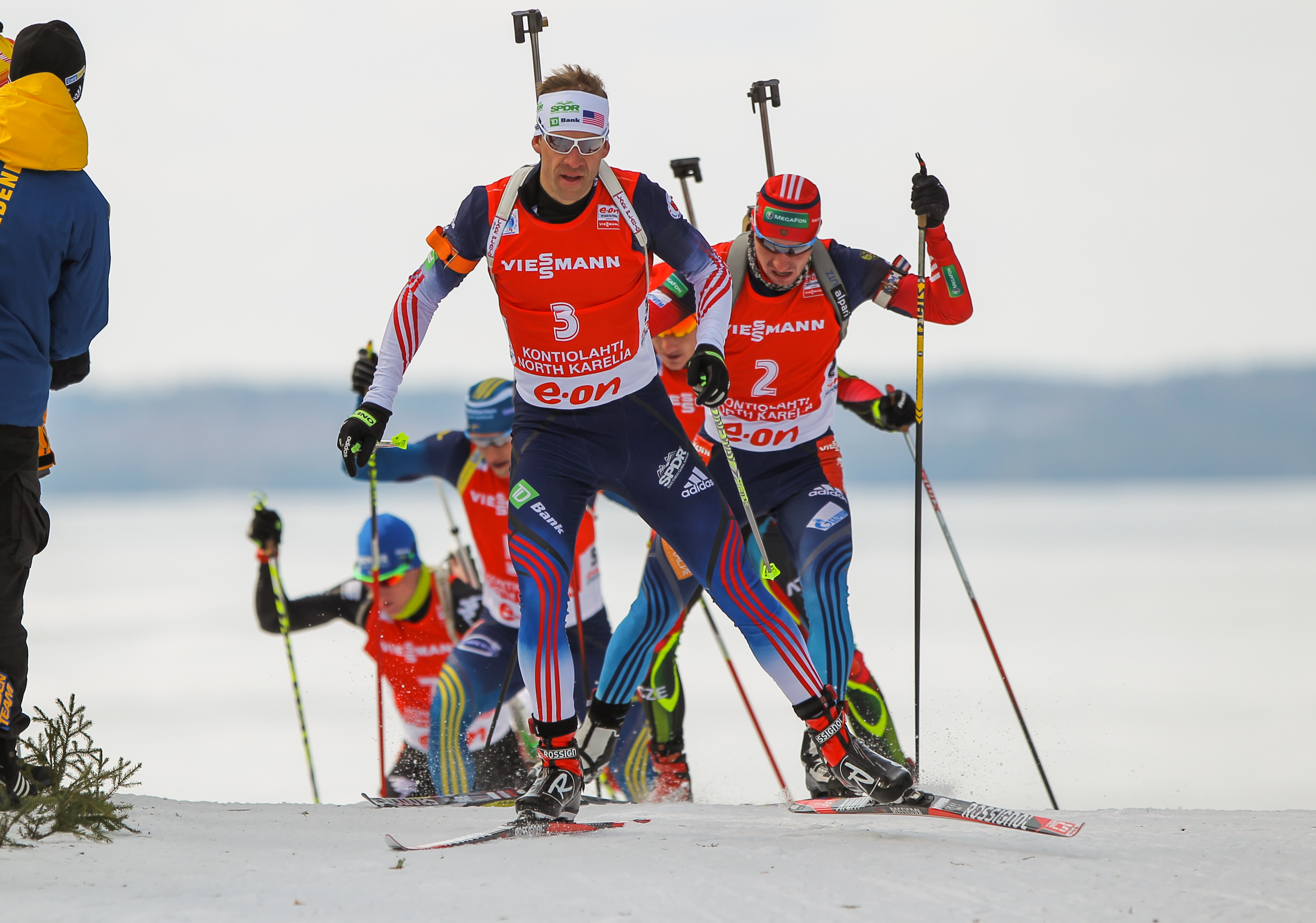
Lowell Bailey (USA) leading a train of skiers in today’s World Cup pursuit in Kontiolahti, Finland. Photo: USBA/NordicFocus.
North American men had their moments in the 12.5 k World Cup pursuit in Kontiolahti, Finland. But biathlon giveth and biathlon taketh away, especially when it’s as windy as it was in Kontiolahti today. And so at the end of the race, Nathan Smith of Canada landed in tenth and Lowell Bailey of the United States in 14th.
Bailey started in third, 19 seconds behind leader Johannes Thingnes Bø of Norway, after hitting the World Cup podium for the first time in Saturday’s sprint. On a normal day, Bailey would have had a great chance at repeating the podium.
“I just looked at it as instead of going out in tenth place or 15th or 30th, I was going in third place, which just meant that I had that much better of a chance and that much more of an advantage in today’s race,” said Bailey, who has three previous top-ten finishes in this race format. “I tried to ski my own race and tried to ski smart. I was really happy with my ski speed today.”
But he missed two shots right off the bat – in a day of wind gusts, some happened to swing through the range while he was in his first prone stage.
“In biathlon everything changes from day to day,” Bailey laughed on the phone. “So today it was gale force winds. It was a little bit of a lottery. I was prepared for the wind, but you know, it was just really strong winds, especially in the first prone and the last standing.”
That dropped him to 13th place. Instead, it was Smith who climbed his way toward the top. The Canadian had started just over 30 seconds behind Bø and after cleaning his first stage he found himself in second place.
Tim Burke finished 17th in the World Cup pursuit today. Photo: USBA/NordicFocus.
“After the first prone I was really surprised when I jumped off the mat that I was actually in 2nd. It felt a little surreal,” Smith wrote in an e-mail.
But he wasn’t safe either. In the second stage, he missed two shots, and dropped to sixth. Two more misses in the first standing dropped him to 13th. After a single penalty in the last stage he was back in sixth, but was unable to hang on during the last loop of skiing.
“I fought hard on the last lap but didn’t have the same snap or finishing kick as yesterday so I got passed by a train on the last steep climb,” Smith wrote.
In the meantime, Bailey had climbed up to sixth by the third stage, but then collected two penalties to finish things out.
“I honestly feel like I was pretty lucky to get out of the last standing with only two misses because I was getting blown from one side of the targets to the other,” he explained. “I was seeing all five targets back and forth with my sights.”
The attitude of both athletes seemed to be, well, that’s life – and to finish in the top ten or 15 was still pretty good.
“It’s pretty hard to believe I could stay top 10 with 5 misses,” Smith wrote. “And the winner missed 4 on his last standing! Shooting is still feeling sharp for myself, it was solid in the sprints. Sometimes it’s just not physically possible to hold the sights on target in gusty unpredictable wind. You just have to take your chances and hope for the best instead of wasting time waiting for a break in the wind that may never come.”
Bailey’s five penalties would usually be considered a lot, but nobody in the U.S. camp seemed to upset about it.
“It’s hard to judge how the athletes coped with the opportunities to reach a top result mentally,” U.S. coach Per Nilsson wrote in an e-mail. “Today was more a matter how to handle another part that you cannot control, the gusty winds. In the results you had much more misses and longer shooting times also. Both Lowell and Susan [Dunklee] did not shoot better than the people in front of them…. but I don’t know if you this time can blame it on them.”
And while Bailey acknowledged how ridiculous conditions were on the range, Bailey didn’t want to make excuses, either.
“You know, there were some good performances out there by a lot of the other guys,” he said.
Despite the potential that was there with a third-place starting position, he felt like he did the best he could given the situation.
“It was a good race,” said Bailey. “I’m not disappointed. I obviously hoped for more, but I ended up only 45 seconds back, so I only lost a little more than 20 seconds to the leader. So it just happened that it was 14th place, but that was the result. I’m really happy with 45 seconds back. I’m just overall pretty satisfied and psyched with the weekend and the week.”
Smith, too, was pleased.
“This summer I never would’ve imagined being able to have so many top finishes,” he said of a season where he has collected three top-10s and the best 12 results of his career. “Somehow my small changes in training just clicked. Last year I was always in the 70s, with my best race being only 55th. My consistency this year has given me a lot of motivation for the coming training year. I feel that a medal within 1-2 years is possible if everything comes together perfectly on the right day. Lowell is a perfect example.”
“Overall he has had a very consistent good performance for the whole season which in the past years he had been struggling to maintain,” Canadian head coach Matthias Ahrens said of Smith.
And what about the guy he was referencing – Bailey?
The American said that it has been something of a dream weekend in Finland.
“It was kind of the race that I had been preparing for for the last three years,” he said. “I felt like I had the skills and the level to get a podium on the World Cup for the last three years, and I just hadn’t been able to do it. I had come close a bunch of times, so to get it, it was just really nice. I had a mix of emotions, obviously excitement, but also some relief that believing in myself and all the other people along the way who had believed in me, that it was actually true.”
Bailey says that he feels good and hopes he can continue this level of performance at the last weekend of World Cup racing in Oslo, Norway, next weekend.
Nilsson thinks it’s possible – and that being unable to capitalize on today’s good starting position shouldn’t hurt him too much.
“I think Lowell had a good race today from the ski tactic side, “Nilsson wrote. “[And the] last lap was strong. I think that it’s easier for Lowell this time to move on to next race. If it would have been zero wind and he had missed two in first stage, he would have been pretty upset.”
Bailey’s teammate Tim Burke skied a steady race, taking four penalties to move from 19th up to 17th. Leif Nordgren dropped from 27th to 34th.
For Canada, Brendan Green moved from 28th up to 20th with three penalties.and Scott Gow, in his first World Cup races of the season, went from 42nd to 43rd.
“Of course Scott had to deal initially with jet lag again and given that he had not been racing for a few weeks had to adapt to the World Cup pace again,” Canadian coach Matthias Ahrens wrote in an e-mail. “In Oslo I hope he can race into points, he was already close here.”
American Susan Dunklee racing her way to seventh place in the World Cup pursuit in Kontiolahti, Finland. Photo: USBA/NordicFocus.
It’s not often in World Cup racing that the top five finishers are separated by two and a half minutes – especially not over just 10 kilometers – but once in a blue moon, that’s the effect the wind can have in biathlon.
Today’s gusty conditions in Kontiolahti, Finland, were just such a situation. In the women’s pursuit competition, Kaisa Mäkäräinen, racing on her home course, took a six-second lead from Saturday’s sprint and turned it into a one-minute blowout over Darya Domracheva of Belarus.
The listed wind speed of 2.7 meters per second at the start did not give an accurate picture of conditions, where large gusts could come from any direction and later die down.
“It was a bit luck of the draw if you would hit a calm note or not,” Canada’s Rosanna Crawford wrote in an e-mail.
“It shifted a lot from stage to stage how people moved up or down,” U.S. head coach Per Nilsson agreed. “In 20 seconds it shifted from okay conditions to really challenging ones. Many examples of this today.”
Mäkäräinen said in a press conference that she was “a little concerned about the wind” going into the race, but she managed to escape with just two penalties, better than most of the field.
In fact, the only one to outshoot her was Domracheva, who started in bib 20 but climbed all the way up to second place with a single penalty.
“I saw all of these girls on the penalty loop and knew there was a chance for the podium…I really tried to stay focused on the shooting range today,” Domracheva said in the press conference.
Olga Zaitseva of Russia moved from sixth place up to third with five penalties, 1:54 behind Mäkäräinen. Teja Gregorin of Slovenia was fourth, +2:25 with three penalties, and Tora Berger of Norway placed fifth, +2:38 with six penalties.
With the win, Mäkäräinen completed a sweep of all three competitions in Kontiolahti and extended her lead over Berger and Domracheva in the World Cup total score. Besides her strong shooting, she also had the fastest ski time of the day. Although she says that she has never performed her best in Oslo, where the World Cup is set to conclude next weekend, she seems set to continue her strong string of races.
The only woman who could come close to matching Mäkäräinen’s ski speed was American Susan Dunklee, whose split was just 0.3 seconds slower. Dunklee started the pursuit in eighth position, but moved up to seventh by the finish despite seven penalties.
“Extremely surprised,” was how she described her reaction to improving her position with so many missed shots. “I never would have guessed that I’d move up with seven misses. I would normally expect to be back in at least the 20’s. But because everyone else struggled so much in the shooting range, it worked out.”
The wind caused most of Dunklee’s misses, and she described the conditions as chaotic in a phone interview.
“My last standing stage for example, I came in and stood on the mat, and four or five girls in front of me were all standing on their mats and hadn’t taken a single shot yet,” Dunklee said. “They were just waiting for these gusts to calm down. Then I had to wait for a while. And then by the time I took that first shot, I was just so tense from overholding that I missed it, even though it had calmed down.”
Range times varied widely and were in general far longer than usual. Instead of shooting prone in 30 seconds, Dunklee took 40 and 43. That last standing stage was, instead of the usual 25 seconds, 49. And that took a toll.
“I’ve never had shaky legs before,” Dunklee said. “People talk about shaky legs in standing all the time, but I had never had that until today. You’re just standing there waiting to take the shot, and your body just gets tired.”
She ended up 3:01 behind Mäkäräinen, despite notching the best pursuit result of her career.
“Susan’s running is so good now,” Nilsson wrote in an e-mail. “And she is starting to get used to that! I think she will continue one more week with really solid results.”
Teammate Hannah Dreissigacker dropped from 41st to 49th with eight penalties, in her first appearance in a World Cup pursuit.
“The shooting was definitely rough for me,” Dreissigacker told FasterSkier. “It was pretty windy today, and I’m just not very good at shooting standing in the wind. I don’t think it was even super windy when I came in, so it was definitely also to some extent just me. But at least a lot of other people had rough shooting today, so I had company!”
Sara Studebaker, the third U.S. starter, placed 54th with four penalties.
For Canada, Rosanna Crawford started in 16th position and had an up-and-down race depending on the whims of the wind in each of her shooting staged. With a single penalty to start out, she moved up to 13th, before dropping into the mid-20’s and then climbing back to 14th. She finished the race out with three misses in the final standing stage, and placed 27th.
“I’m bummed with my last shooting, but the wind was howling!” Crawford wrote in an e-mail.
She also struggled with ski speed over the later stages of the race, although she did beat Franziska Hildebrand of Germany in a close finish.
“This is a tough course, and not one of my favourites,” Crawford wrote. “There’s one long climb that was made even harder today because you had to make a tight corner into it, that really fried my legs.”
After a long season with six of the best ten results of her career, Crawford hopes that she can keep up the good performances for one more weekend of racing.
“I am looking forward to Oslo and finishing the season strong,” she wrote. “Good shooting will be key in order to keep up these good results. Right now it’s mostly survival mode. Just 3 more races, then just 2 more then just one more then HOME! It’s been a long season and almost 3 months in Europe. I am glad we get to finish off in a great place like Oslo!”
Canadian teammates Zina Kocher and Megan Heinicke did not start the pursuit. Head coach Matthias Ahrens explained that both had sustained “minor injuries” in the sprint race and with bibs 54 and 60, it wasn’t worth starting the pursuit.
Hannah Dreissigacker (US Biathlon) en route to 23rd in the Olympic 15 k individual in Sochi, Russia.
FasterSkier’s coverage is made possible through the generous support of Rudy Project.
SOCHI, Russia – Hannah Dreissigacker didn’t exactly kick off the Olympics the way she wanted to. A first-time Olympian in biathlon, the American finished 65th in Sunday’s sprint race, not good enough to qualify for the 60-woman pursuit.
While her coaches, like Dreissigacker herself, were disappointed, they knew that the result didn’t disqualify their youngest athlete from having a stellar race later in the Games.
“This is what I didn’t tell her, but I had the feeling, and I think I mentioned it to the other coaches too, that I could see the potential for a really good result,” U.S. women’s coach Jonne Kahkonen said.
In today’s 15 k individual race, Dreissigacker came back with just that sort of race: two penalties over 20 targets, the 30th-fastest ski time in the field, and 23rd place overall, the best finish of her career at the World Cup, World Championships, or Olympic level.
“I’ve had a real up and down year,” Dreissigacker said, relieved. “I’ve had some really good relay races, but I haven’t had an individual race where things have come together. I’ve been just kind of waiting for that to happen. I’ve been really working on the mental piece, and I think that happened today.”
While some athletes might get sad or disappointed after missing the pursuit or having a subpar race, Kahkonen and the coaching staff saw Dreissigacker take her emotions in another direction. And that’s when they knew that the rest of the field was in trouble.
“I have to give a really big hand for her approach,” head coach Per Nilsson said. “She was really pissed. You could see it in her eyes that she wanted more. She was not happy with this one. Even when I saw her after Susan [Dunklee]’s super race [in the pursuit], you could see that she wanted to be in that race, not watching it. She has that character also, which I think will bring her even further up. She wants to compete.”
Hannah Dreissigacker (US Biathlon) en route to a career-best 23rd in the Olympic 15 k individual in Sochi, Russia.
Instead of competing in Tuesday’s 10 k, Dreissigacker stewed in her frustration, and came out all the better for it.
“I definitely had those days to just kind of be hungry, to watch these other races and to be like, I’m ready to go,” she said.
“I was feeling good physically. It was frustrating to watch – I came and cheered for my teammates, and it definitely made me think that I needed to make a good plan for this next race. And try to make sure I had a really good approach both mentally and for the physical piece.”
Along the way, she picked up advice from a variety of people. She chatted with Lowell Bailey, a teammate who came back from a mediocre 38th-place showing in the pursuit to make U.S. history with an eighth-place finish in the 20 k, about the course.
She talked to Kahkonen about how to stay positive.
“I talked to the coaches and to Sean some, just about the idea that one bad day doesn’t really mean anything,” she said. “You have to bounce back… I’ve been just thinking about my previous not-so-good race and how to approach the shooting. I think that approach worked really well. I thought about taking a little extra time to set up for my shots, and just get in a good mental place. It seemed to work.”
And she watched the cross-country skiing sprint, where former Dartmouth College teammate Sophie Caldwell placed sixth.
“That whole day was so heartbreaking in a lot of ways,” she said, referring to Kikkan Randall’s failure to advance out of the quarterfinals. “But I got to go up and watch on the course, and that was really fun. Sophie has such nice technique, and it really inspired me to try to be more smooth on my skis.”
Finally, there was just the Olympic spirit spurring her on.
“I mean, it’s the Olympics!” Dreissigacker exclaimed. “It’s hard not to be psyched. Even if you get bummed for a little bit, it’s not that hard to get going again.”
All of these changes, discussions, and distractions helped Dreissigacker regroup and turn in the best performance of her career – by a lot. Her previous best World Championships result was 56th in the 15 k individual at 2013 World Championships.
Susan Dunklee (US Biathlon) leaving the range en route to 34th in Friday’s Olympic 15 k individual in Sochi, Russia.
In the process, she also moved into the leader’s position for the U.S. team. Susan Dunklee, who had tied the best-ever finish by a U.S. woman with her 14th-place result in the sprint, had been doing the brunt of the work this season.
Does that take some pressure off of Dunklee, who has been leading the team for most of the past two years?
“Oh, definitely,” said Dunklee, who finished 34th today. “Any time you have someone else who is capable to pulling together a big day, it’s big. Hannah has been doing so well in practice. She has been skiing so strongly, and she shoots so fast and she shoots so well. We’ve known that she’s been capable of this all year and it’s so sweet to see. So exciting.”
Dreissigacker has only been part of the U.S. biathlon team for two years; before that, she was a cross-country skier with the Craftsbury Green Racing Project and competed in biathlon on the side, qualifying for a few IBU Cup and Open European Championships tours.
The coaching staff praised how far Dreissigacker has been able to come in just two seasons.
“I guess it’s pretty simple – it takes a lot of hard work,” Kahkonen said. “But Hannah is really committed to that. She has been really good at taking the advice, putting in the work, and working on her own to try to figure things out. Obviously, it’s not just me. Armin [Auchentaller, the shooting coach] has worked a lot with the shooting for example. It’s a team effort.”
That effort has been switching Dreissigacker’s way of approaching training, so that she can follow a more biathlon-specific plan and attitude.
“I think for her, she had a really good base from doing sport for a long long time,” Nilsson said. “I think now maybe what she has learned is the structure of the biathlon training and how you train to be a good biathlete. I mean, if you see Hannah in the weight room or doing some runs or stuff, she’s an unbelievable athlete. But biathlon, you have to train biathlon in a specific and structured way. And this is the case for her.”
But what the staff kept coming back to was how much Dreissigacker wanted a good result. Usually, such emotion can get in the way in biathlon – something that both Dreissigacker and Dunklee have admitted in the past week.
Megan Imrie (Biathlon Canada) posts the top Canadian result of 30th on her birthday Friday in the 15 k individual at the 2014 Olympics in Sochi, Russia.
This time, though, Dreissigacker managed to channel that emotion for something good.
“I think it speaks a lot about Hannah, and her experience and the fighting spirit that she has,” Kahkonen said. “And just being a good athlete, to bounce back like this. But the shooting has been there at practice and in the training, and a few times in the racing as well. She has had really good relay legs this year on the World Cup, under pressure. Definitely all the elements were there…. I will definitely remind her about this situation.”
On a bad shooting day, Dunklee placed 34th with five penalties, using the fifth-fastest ski time of the day to climb her way into the points; combined with her sprint finish and 18th place in the pursuit, she has qualified for the 30-woman mass start on Monday.
Sara Studebaker placed 55th with four penalties, and Lanny Barnes 64th with three.
Megan Imrie led Canada on her birthday, placing 30th with two penalties; Megan Heinicke finished 51st with four missed shots, Zina Kocher 63rd with eight missed shots, and Rosanna Crawford 67th with five missed shots.
American biathlete Tim Burke racing in Monday’s Olympic pursuit race at the Sochi Games
FasterSkier’s coverage is made possible through the generous support of Rudy Project.
SOCHI, Russia — For top U.S. biathletes Tim Burke and Lowell Bailey, Monday’s Olympic pursuit race was one to forget about as quickly as possible.
For both men, the race wasn’t a total disaster: Burke finished 22nd in the 59-man field, with two misses over 20 shots, while Bailey was 38th, with three misses.
But their expectations were so high headed into the games that the mediocre results were devastating. Burke had little to say at the finish, beyond the fact that he was “really empty right from the start,” “really disappointed,” and that the race was “really, really tough.”
Bailey was even more distraught, listening to a reporter’s first question before responding, “I can’t,” and walking away.
“I couldn’t speak after the race. First time that’s ever happened to me. Just couldn’t give a single interview,” he said in an email afterwards. “I felt heavy right out of the gate today. I have no idea why. Just one of those days.”
(He also added in a tweet: “Even when you have a bad day, mom still loves you.”)
U.S. Head Coach Per Nilsson said he’s giving Burke and Bailey a little time to think about the results, before a meeting with them that he scheduled on Tuesday.
“They get 12 hours to digest it,” he said in a phone interview after the race. “Then, we go for the next one.”
He stressed that both men are still in decent shape, despite their comments about feeling flat: Bailey’s time on the course was 55 seconds behind Sweden’s Fredrik Lindstroem, who had the top ranked time of the day over 12.5 kilometers. Burke was not much worse—just a minute and eight seconds back.
“That’s nothing,” Nilsson said. “If they have a race with bad feelings, they are still less than one minute behind the best skier in the field. They are more negative than they should be.”
“You know athletes—they exaggerate a little bit,” he added.
Nilsson also said he thought the Americans had a hard time on the soft, sloppy snow on the race course, which had baked all day under the high Sochi sun.
By the time the men started their race, at 7 p.m., the track was a mess of inches-deep slush, which Burke described as “super slow, tough going for everyone.”
Lowell Bailey climbing out of the stadium in Monday’s pursuit.
Nilsson said the ski technique the Americans strive towards—which he described as “patient” and “really secure”—is better suited to firmer trails, and may have left Burke and Bailey wallowing in Monday’s deep snow.
Nilsson compared their technique to that of Czech biathlete Ondrej Moravec, Tuesday’s silver medalist, whom he said was taking big steps over the snow.
“Like it is now, you need to ski a little different. You need to be light and gain a little bit of ground,” Nilsson said. “Even if they’re at the Olympics, we should not be afraid to adapt to new snow conditions.”
That’s especially true because temperatures aren’t expected to cool much over the next few days, and officials have said they’re not inclined to salt the course to help it freeze back up.
The next men’s race at the Olympics is Thursday—the 20 kilometer individual competition.
Despite Burke’s and Bailey’s frustrations, Nilsson seemed confident that the two men would come around in time—and he maintained that the margin between their middling performances Monday and a solid result later in the games is really not that all that large.
“They have their levels,” Nilsson said. “We must show them, then, that it’s not so bad as it looks like in the results list.”
Susan Dunklee racing to 14th place in the women’s 7.5 kilometer sprint race Saturday at the Sochi Olympics.
FasterSkier’s coverage is made possible through the generous support of Rudy Project.
SOCHI, Russia — Susan Dunklee was this close to an Olympic medal.
Her one miss in Sunday’s sprint race in Sochi was about a centimeter outside of the 10 o’clock edge of the target.
The errant bullet forced Dunklee into the penalty loop and pushed her down to 14th place on the day — tantalizingly close to the
The miss is the closest mark at 10 o’clock.
podium, but still good enough for the best-ever Olympic finish in a sprint race by an American woman, in Dunklee’s first-ever appearance at the games.
“You play the what-if game, and it’s a very small fraction of a second that can make or break that moment,” she said afterwards, reflecting on the missed shot—her very last one, after she’d knocked down nine in a row. “I thought about it for just a little too long.”
The miss meant that Dunklee had to ski a penalty lap, which added about 23 seconds to her time. She ended the race 22 seconds behind Russian Olga Vilukhina, the second-place finisher.
Dunklee coming over the crest of the big downhill above the shooting range.
The result left Dunklee, 27, and her coaches simultaneously shaking their heads, but also enthusiastic about what boiled down to a solid performance.
Coming into the race, her first-ever Olympic competition, she had been nervous, “more nervous than I ever have been before a race,” she said.
In Sochi, she said, “you see the rings everywhere and you’re thinking about it.”
Dunklee is a second-generation Olympian; her father, Stan Dunklee, competed in the 1976 and 1980 games as a cross-country skier.
“It’s something I’ve dreamed about since I was a kid. I always believed I was capable of it because of my role model, my dad,” she said.
Once she made it to the venue, however, “it was just normal race routine,” she added.
Dunklee’s first two laps were 17th– and 18th-fastest, respectively, in the 84-woman Olympic field, before she hit the gas for her last loop, which only three women skied more quickly.
U.S. Head Coach Per Nilsson said that the tough course in Sochi played to Dunklee’s strengths.
“It’s a lot of climbing, and you need to just put in the hammer and go,” he said. “But she’s good at that.”
Dunklee said she concentrated on the uphills, especially the long one that curved up and above the shooting range — a steep climb that flattened into a more gradual pitch towards the top.
“A lot of people kind of stop fighting after the steepness ends,” she said. “But it’s still going up, and you can lose a lot of time if you’re not fighting all the way through that gradual part…so that’s where I focused.”
The lone miss, she said, came as a surprise after she pulled the trigger.
“I felt like I had it, after I took that last shot,” she said. “I thought about it too much, and didn’t follow through quite enough. That
Dunklee climbing out of the stadium.
was a little heartbreaking, but I was able to laugh at myself right then and there and keep going.”
Nilsson said the result was a demonstration that Dunklee can find her best fitness at just the right point in the season, calling her a “woman for the championships.”
In fact, up until Dunklee notched a fourth place in a World Cup race last month, her previous best at the international level had been when she finished fifth at a World Championships competition in 2012—the focal point for that season, just like the Olympic events are for this one.
Nilsson said he thought that Dunklee had arrived at the Olympics in a good position—with the potential to vie for the podium on a good day, but without the pressure of being a favorite.
He said that pressure showed Sunday, with heavyweights like Norway’s Tora Berger and Belarus’s Darya Domracheva each missing a target on what Nilsson described as an “easy” shooting range. (That’s because of a downhill that leads into it, allowing athletes to rest, plus steep walls that block out wind.)
Dunklee’s result Sunday comes with a bonus: Her 14th place and 41-second gap to the winner in the sprint now becomes her start position, and her handicap, in Tuesday’s pursuit—what Max Cobb, the president of the U.S. Biathlon Association, called a “terrific setup.”
“It’s going to be an amazing pursuit,” he said. “It’s so close.”
Dunklee already has some experience starting a pursuit in the hunt—she began one in fourth place last month, at a World Cup competition in Antholz, Italy.
That race did not go smoothly, however—she skied and shot well during the first half of the race, before a disastrous third round of shooting that saw her miss three of five targets.
After that experience, though, Dunklee said she expects to be “more comfortable” in the mix.
“Maybe a little less nervous and more confident going into it,” she said. “I skied two laps really well in Antholz and was right in contention until then…And I know that if I can do that for two loops, I can do it for five.”
Lowell Bailey (USA) skiing with Dominik Landertinger (AUT) in his first race since mid-December.
RUHPOLDING – Lowell Bailey doesn’t usually pull any punches when he has what he views as a bad result. If the American biathlete is not happy, he shows it.
But placing 25th with two penalties today seemed to bring him quite a bit of joy. Was it a result he’d usually be psyched about? No way – he finished 2:23 behind race winner Emil Hegle Svendsen of Norway. But Bailey has been sick since the start of 2014, and just to put a bib on was a big step.
“I honestly wasn’t expecting too much today, because this is the first speed workout that I’ve done in almost two weeks,” he said at the finish line. “I haven’t been doing anything. I probably trained four hours in the last two weeks. I was in bed for a week and then just training really easy up until now.”
Despite all that, Bailey managed the 27th-fastest course time – a pretty good comeback. The last time he raced was in a pursuit in Annency, France, almost a month ago, where he finished 15th after using the 12th-fastest ski time to climb 20 places.
Today wasn’t that. But it was fine.
“All in all, I’m content with [today’s race], for sure,” he said.
Tim Burke (bib 17) in the thick of things with Russia’s Dmitry Malyshko and France’s Simon Fourcade.
While most of the field is gearing up for Sochi, Bailey was left sitting in bed and watching last weekend’s racing in Oberhof from afar. Maybe he didn’t miss much, as the field all agreed that it wasn’t much fun – but when you’re not racing, the grass is always greener on the other side of the fence. (In this case, quite literally – Oberhof was more grassy than snowy.)
“The hardest part of being a biathlete is sitting around and waiting to get better,” Bailey said.
U.S. head coach Per Nilsson was impressed with Bailey’s form in his return, but said that he had never been to worried about how the illness would affect his athlete. He doesn’t consider any harm to be done to the Olympic preparations.
“I said in the team meeting last night: eight years of great training are not going to be messed up by a week of having no training,” Nilsson said as he watched the last few athletes cycle through the shooting range. “He will be totally fine.”
In fact, he thought the enforced rest might have a silver lining. Last year Bailey broke his toe in mid-December, which stifled his skiing ability. But he had some of his best finishes late in the season, finishing in the top 15 in all three competitions at the last weekend of World Cup racing in Khanty-Mansiysk, Russia.
“Lowell is an energetic guy, so maybe it’s good for him,” Nilsson said as he watched the final athletes cycle through the range. “It’s just like last year, when he had that foot injury. Now he has to take some time and rest the muscles, and he’ll be better when he comes back.”
Today, Bailey said that he felt strong through three laps, “and then really it was a struggle.” He had a little help from his friends: he skied with Dominik Landertinger of Austria for those first three laps, and then with Simon Fourcade of France.
“Those guys are fast, so I was glad to ski with them a bit,” he said.
Today’s individual race was unusual in that it will be used to determine start order for a pursuit tomorrow. Pursuits are usually based off of sprint races; the last time this happened with an individual being used as the basis was back in 2003. Time deficits will be halved, since sprints are only half the distance of individual competitions.
Bailey wasn’t sure if he’d feel better tomorrow or not.
“It’s 12.5 k, there’s a little less climbing, so we’ll see,” he said. “I’m looking forward to it. But the happiest thing is that I’m, knock on wood, healthy again. It took a lot longer than I thought.”
His teammate struggled on the range, with Tim Burke missing five shots and Leif Nordgren four. When we talked to coach Nilsson on the range, before the race was finished, he predicted that neither would qualify for the pursuit.
But when all was said and done, they did: Nordgren will be the 53rd starter and Burke the 56th, here tomorrow morning.
“It’s unfortunate, because I’ve mostly shot really well in four-stage races,” Burke said. “It was definitely frustrating.”
Susan Dunklee toughing it out on the 15 k course today.
RUHPOLDING, Germany – For Susan Dunklee, the individual race in Ruhpolding carries a lot of memories. It was here two years ago that the American shocked everyone with a fifth-place finish at World Championships. That time, she had a single penalty in the second stage and ended up just seconds from the podium. It’s still her best finish ever.
So coming into the final shooting stage, with a single penalty, knowing that “I must have been in a pretty good position”: it was a familiar feeling.
“It was almost déjà vu: it was that second stage where I had missed one before,” Dunklee said.
But unlike at World Championships, she botched two shots and ended up 41st. Maybe that first time around, when she only had a few weeks of World Cup racing under her belt, she hadn’t internalized or understood the pressure complete.
In a sprint, you don’t want penalties because every second counts. But in an individual, the penalty for each missed shot is so huge that it matters just as much, albeit in a different way. Coming into the final shooting stage with zero or one penalties really does mean that you might have done it, whereas in a sprint you could easily still be out of the top ten if you ski poorly.
This time, it got to her head.
“I was thinking about it,” she admitted. “I was pretty disappointed with that last stage… [but] it’s good to be in positions when you can practice that, and be in that position with that pressure.”
Based on results alone, the individual is the format where Dunklee might be expected to turn in the best result in Sochi. She also placed seventh in this discipline at the pre-Olympic race in Sochi last season. But she doesn’t consider herself a medal favorite.
“Honestly, I think it’s the race that anybody has the best chance in,” she explained. “Because if anybody cleans, they can be up there. It doesn’t matter whether you’re near the top in ski speed, or just average. You can still be in the top ten.”
So getting reacquainted with the pressure of tough competition situations was a good thing to bring out of today’s race, even if the skiing didn’t go so well. She needs to settle into the pressure so that she can be one of those clean-shooting winners.
“I think very time you experience this you learn a little bit, and you move on, and it’s routine,” she said. “That’s what we’re trying to do, make it routine.”
And while she wouldn’t say that the individual is the format where she’ll likely have her best race, she still admitted that it has her advantages: it’s not a complete mystery why she has done so well in this type of racing.
“I like it because it’s a race where I don’t have to feel so panicky and like ‘go go go,’ she said of the format, which is also the longest of all the races. “It’s not like every second counts in the same way as a sprint. I think that helps me relax for the shooting, and maybe that’s why I’ve done better. And you can really stretch out and ski big and relaxed. So that’s nice.”
Result That Don’t Count
Most people consider World Cup races to be a pretty big deal. But this time, this year? Not so much.
“This week and next week in Antholz, these are all practice, preparation for Sochi,” Dunklee explained. “These races are not important.”
What she meant was not that the team could write off the competitions: far from it, they must take them very seriously in their preparation for the upcoming Olympics (and her lesson about handling pressure fulfilled that exact purpose). But it’s not results they are focused on so much as experience, training, and feeling.
Even the World Cup rankings aren’t so important to them this season. The Olympics trump all that.
“They are not so concerned about collecting points,” U.S. head coach Per Nilsson said.
Annelies Cook (left) out on course.
That turns out to be a good thing, as neither of the two U.S. women competing in today’s race had results they were thrilled about. With Dunklee’s three missed and six from Annelies Cook, it added up to a lot of extra penalty time.
And the skiing wasn’t perfect either. Dunklee, sometimes among the fastest skiers, had the 32nd-fastest time and three penalties to wind up 41st; she was 3:53 behind race winner Gabriela Soukalova of the Czech Republic, who had two minutes less penalty time. And Annelies Cook, no slouch in ski speed either, wound up 85th. Her penalty time couldn’t account for the full 7:57 between her and the winner. The gaps were bigger than they’d expect.
There may be reasons. Dunklee recently had a cold, and a stomach bug has also been going around the World Cup field. Plus, Dunklee said, the conditions did not suit her style of skiing: it was so icy that it was hard to V1, because pushing hard off a ski would make you slip.
“So I did a lot more V2-ing uphill than I ever have,” she explained. “I’m really good at long, gradual, grinding V1. V2 is a very different style for me and it’s hard.”
While everyone is preparing for the Games, Cook and Dunklee also have another added advantage over many of their competitors: every country chooses their Olympic teams differently, and many have not made any nominations yet.
“It seems like every race we have, some other athletes we run into have made their qualification standard,” Dunklee said. “Every week people are excited, like the Swiss girls in the relay yesterday.”
Cook and Dunklee, though, have already secured their spots and been named to the U.S. team. (The rest of the American roster will be filled after IBU Cup races this weekend). They really don’t have to worry about results.
“The most important thing besides taking a lot of pressure off, is that it allows us to really train, focus on the training, and focus on doing what we need to do to be fast later, and not focusing on being fast now,” Dunklee said of already being nominated for Sochi. “That’s huge. I’m really thankful for that.”
Dunklee still found plenty of positive things to take away from today. Case in point: her three penalties.
“It was better than my average has been this year,” she said. “The last three sprints in a row I have averaged 60 %, so 85 % is a definite improvement.”
Head coach Per Nilsson hopes that improvement continues as the team days tick down before the Olympics.
“They are fine physically, but for I think both of them, shooting is good in training, but they haven’t done it in races,” Nilsson said. “It’s good to have one more week of racing to work on the race part. Because it’s not exactly as they want it to be… hopefully they ramp up next week.”
Nilsson can be a tough judge to impress, but he also has supreme confidence that his athletes can accomplish the work he still has laid out for them.
“Susan, for example, that has been her trend most of the years – she’s a little up and down, but she performs really well when it’s the championships,” he acknowledged. “But also today, Susan had her two best prone stages of the year.”
Coach Jonne Kahkonen takes video of Tim Burke during a workout at last spring’s Bend camp.
Welcome to Wednesday Workout, the newest workout series on FasterSkier. During the offseason, we’ll feature components of summer training programs from top individuals and teams throughout the U.S. and Canada at the junior, college and elite club levels. If you ever have a workout suggestion or training question, send them in to info[at]fasterskier.com.
***
As athletes ease back into training this spring, they will gradually introduce each component of their training plan back onto the table: distance. Strength. Threshold intervals. Hard intervals.
What about overdistance? “OD”s are long, base-building affairs, and it can be hard to know where to start after a month or more of relaxing. Can you jump straight into a two-hour run? A three-hour rollerski?
The U.S. biathlon team is luckier than most, as coaches Per Nilsson and Jonne Kahkonen say that all of their athletes are returning to camps this May at about the same level of fitness; that removes some of the guesswork. Today in Bend, Oregon, they’ll be tackling a classic OD on snow, probably in the range of three to four hours, depending on the athlete. In the thick of the training season, cross-training workouts on the bike could last up to five, but there’s no need for that now.
That said, this is the first volume block for the team. The coaches estimated that in nine days, divided into two four-day training blocks with a rest day in the middle, the biathletes would hit between 35 and 40 hours total.
“Bend is the place to be if we are talking big hours in the beginning of the season,” Kahkonen said. “It’s perfect here to get on snow and have the opportunity in the afternoon workouts to go out for either mountain biking or running.”
As the athletes build their endurance base and prepare for other types of workouts, Nilsson and Kahkonen discussed how to execute today’s workout well – both if you’re lucky enough to be on snow, or if you’re stuck doing dryland.
The Workout: “The main goal for sure for all this type of workouts is to have as much continuous work as possible and not too many stops,” Kahkonen said. “In our training system we have Wednesday as the day when we have a long session in the morning and then a halfday off. Here the standard is 3-4 hours.”
As always, there’s a balance between skiing continuously and getting something useful out of the workout besides just the hours. The team tries to have some OD sessions that focus on technique as well.
“It’s important to work on the key elements in the ski technique: postition, weightshift, rhythm, and balance, even if you are going pretty slow,” Kahkonen said. “This is not easy to do from the focus side, but you can see that the athletes that have that in the mind are most of the time also the athletes that have the best technique. We either work with the video or sometimes try to follow an athlete.”
(“It gets harder every year,” he smiled.)
As for the pace, it can’t be too fast or too slow. How to control it?
“By heart rate or feel,” the coaches said. “If you can talk the whole time then the pace is too slow!”
Some teams throw in sprints or mini speeds along the way to break things up; Nilsson and Kahkonen eschew that, saying they’d save it for other workouts. For them, an OD is a continuous workout, and the next most important thing to focus on is technique.
As such, they have their athletes ski mostly solo, especially in skate OD’s, where there is a more technical focus.
“For the specific workouts it’s better to go more alone,” the pair explained. “If you ski side by side and talk, it’s not so productive for the ski technique. In other activities it’s fun and they can run, hike, or bike together in the group.”
Finally, the team knows how lucky they are to be on snow right now. It’s a recent development; last year was the first time the biathlon squad made the trip to Bend, and before that they started their seasons in Lake Placid with dryland.
For athletes in similar positions, Kahkonen had a few suggestions about how to ease the body into dryland OD’s.
“If you are on other places, I think cross-training is good in the beginning,” he said. “You can combine two different activities so you don’t overdo it, especially the impact from the pavement.”
American biathlete Tim Burke en route to taking silver in the 20 k individual at World Championships on Thursday. Photo: Nordic Focus/USBA.
“I thought my championships were over,” Tim Burke said on Thursday in Nové Město na Moravě, Czech Repbulic. “I felt so bad.”
The 31-year-old American biathlete spoke these words in a press conference a few minutes after taking silver in the 20 k individual at the 2013 Biathlon World Championships. After placing 28th and 32nd in the opening two races of the championships last week, Burke saw no reason to expect better from the 20 k before he lined up for the start. It made sense that a few hours after making U.S. Biathlon history, as he sat with a microphone in his hands with flashbulbs going off around him, that he was still trying to grapple with how he had just turned his championships completely around.
Asked how long he had been waiting to result like Thursday’s, he responded, “I think my whole life.”
There are many reasons Burke’s performance on Thursday is so notable. It ended a 26-year medal drought for America at World Championships — the last time a U.S. biathlete reached the podium was in 1987, when Josh Thompson medaled in Lake Placid, N.Y. It also fulfilled the promise he showed in 2009 when he wore the yellow World Cup leader bib for the first time. But for Burke, the true triumph of his new silver medal was that it proved he can perform as well as he always believed he could, a fact he started to doubt in the midst of up-and-down results this winter. He still doesn’t know what changed between the pursuit and the 20 k, but he knows not to doubt himself again.
Burke celebrating on his way to the podium. Photo: Nordic Focus/USBA.
“I was just so disappointed and down in the way I was skiing, and I credit having some great people around me,” Burke said in a phone interview late Thursday evening. “[USBA Head Coach] Per Nilsson came up to me after the pursuit and saw how disappointed I was and just said, ‘Don’t you dare give up on yourself. You can still do this here, just believe in yourself.’ And that helped me a lot.”
Comebacks in sport are the reason we watch in the first place; when they happen we know we’re seeing history in the making. When they happen, we believe anything is possible. Burke has reached podiums on the World Cup before, including this very season, but as he noted afterwards it’s different when it happens at World Championships. They give out medals there, they raise flags and play anthems, and if you can beat almost everyone when they’re at their best it somehow matters so much more. His coaches have been waiting for a day like Thursday for years. “I was crying in the woods,” Nilsson wrote in an email.
Burke entered these championships with high expectations. The Paul Smiths, New York, native put in a “great year” of training and began the season with strong results in December, only to be plagued by illness in the New Year. After logging what he thought was good training block prior to World Championships, he came to Nové Město feeling ready and recovered.
“Then I simply felt really bad in the first two races,” Burke said. “I don’t know what happened.”
Despite coming up short in the pursuit Burke kept his head up, and on Thursday his years of hard work paid off.
How does it feel to finally stand on the podium after such a rollercoaster season?
“I’m a little overwhelmed, honestly,” Burke said. “It happened so fast. I crossed the finish line, realized I was going to get silver, and then you’re on the podium and at the press conference and I’m just getting back to the hotel now. I feel like I need a little time to let it settle in.”
Though his first two races at the championships were a disappointing, Burke could tell when he started the 20 k that he could be on his way to a great race.
“I felt good. I was shooting zeroes in the first few stages,” Burke said. “I thought I was up there, but I didn’t really know I was in a medal position. Today there was no wind on the range, it was pretty standard, basic shooting, so I knew a lot of the guys would shoot well.”
Burke specifically asks his coaches not to give him splits when he’s out on course, so for more than half his race he drew motivation solely from within himself. When he heard the announcer say he was fighting for the gold medal as he returned to the stadium for the last shooting stage, he pushed the information out of his mind and focused on what he could control.
“I’ve had some problems before just getting caught up in what everyone else is doing,” Burke said. “I recognized it right away, that I started thinking about it, and luckily I caught it really early once I started shooting. I just focused on my cues.”
His only missed shot came in that final standing stage, but Burke was unfazed. He left the range in second place and stayed there to finish 23.5 seconds behind France’s Martin Fourcade and ten seconds ahead of Fredrik Lindström of Sweden. Though he was a late starter amongst the faster seeds, he waited until the last finisher crossed the line to let himself celebrate a personal best and historic day for the team and country he represents.
“I’m so proud,” Burke said in a USBA press release. “It’s been such a big effort by our entire team and organization, and it feels great to help finally make that come together.”
In a community as close as U.S. biathlon, Burke’s accomplishment was a momentous occasion for the national program and his coaches.
“It’s just so exciting and a phenomenal performance by Tim today,” said Max Cobb, U.S. Biathlon CEO. “All the evidence that Tim could do this has been there for a long time, but he put it together on the most important day of the year. The whole high performance staff has done an outstanding job, not just here but over the last six years that we’ve been working towards this. I couldn’t be prouder of all of them. The whole group really helped Tim get this done today. It’s a phenomenal milestone for Tim and biathlon in America.”
Burke was quick to agree that the biathlon community played no small part in his success.
“Thanks to the fans back home for all their support,” he said. “I got a lot of encouraging messages over the last few days from people telling me to keep my head up and to keep at it, and it worked.”
Russell Currier, Tim Burke, Lowell Bailey, and Leif Nordgren at the flower ceremony after placing fifth in the IBU World Cup relay in Oberhof, Germany, on Friday. That tied the Americans’ best result of the modern era. Photo: USBA/NordicFocus.
If the U.S. men skied like they had something to prove in Friday’s World Cup biathlon relay in Oberhof, Germany, that’s because they did.
“I think today we were all on a mission to show that we are much better than our 16th place from the first relay of the year,” Tim Burke wrote in an e-mail to FasterSkier. “I was really impressed how well Russ [Currier] and Leif [Nordgren] did under some big pressure, especially in front of 20,000 spectators.”
They didn’t exactly have an easy setup. Oberhof features big hills, such as the norotious Bergsteig, and terrible weather. Luckily, things had improved a bit since the women’s relay they day before, where the entire course was covered in deep slush. But only a bit.
“The course was a mix of extreme slush and really icy, hard-packed, salt-infused snow,” Lowell Bailey explained. “They salted on most of the climbs and left a lot of the rest of the course to melt into slush.”
It was a strange setup – “I guess they salted but just decided not to do the entire course,” Burke said – that Bailey was the first to have a crack at. After turning in several excellent scramble legs over the last few years, Bailey had big goals.
“Lowell was starting in the second row and was really smart and smooth, and last half of the loop he was in top five already,” U.S. head coach Per Nilsson told FasterSkier.
To do so, he had to get through a lot of traffic on the slushy, treacherous course. The character of the first loop was a little different than in your average relay, Bailey said, in that nobody wanted to lead. On the video feed, it was obvious: the field practically stopped at one point near the top of the course, jamming together and creating the potential for a tangle-up.
Lowell Bailey cuts through the fog. Photo: USBA/NordicFocus.
“The big factor was the range approach,” Bailey wrote. “On this course, the prevailing wind blows against you on the back straightway and it is a significant disadvantage to lead a group for the last 500 meters before the range. Most everyone knows that and so on the first loop, after the first 1.5km, the leaders stopped dead, jockeying for position and trying to make sure no one had to lead into the range… no one really wanted to take the bait and jump out in front because it IS such an advantage to follow someone into the shooting range.”
Coming around the last corner, Simon Eder of Austria finally took charge and led the way into the lanes, but that was after the hard work was done. Yet the wind was still putting up a fight. Bailey, for instance, was hampered by using three spares in the very first prone stage. Plenty of other men struggled on the range, and several of the favorites even headed to the penalty loop. Despite the missed targets, Bailey left in ninth.
“I just went into today knowing that Oberhof is notorious for poor shooting conditions and lots of misses,” Bailey wrote. “I wanted to shoot well and put the team in a good position. I wasn’t able to shoot as well as I would have liked, but the field did not shoot well as a whole which allowed me to stay in contention.”
The wind was constantly changing over the course of the race, with flags on the range sometimes blowing straight sideways, other times hanging dead, and often fluttering around in different directions. Through either having better conditions or reading the wind in the standing stage, Bailey was able to limit himself to one spare in standing and move up to seventh.
That cleared the stage for Burke, who started with a 30 second gap to the leading Ukrainian team.
“We started with our most experienced athletes to try to put us in a good position,” Nilsson explained of the team’s strategy. “And they did! Tim on the second leg did one of his best relays ever with smart tactic and solid skiing and shooting.”
The tactic, Burke explained, was to attack.
“I wanted to be aggressive in all areas of the race today to try and get as much of a buffer as possible to some of the other teams,” he wrote. “Today was just one of those days where that tactic worked out for me.”
It showed, as he turned in the second fastest time on the first loop, behind only Ole Einar Bjørndalen of Norway. Burke managed to hop in behind him for a time, joining Erik Lesser of Germany as well. All three cleaned the prone stage quickly with no spare rounds, adding to their cause. That put them ahead of everyone except the Ukrainians.
The group broke up, though, as Bjørndalen was having easily the best day of his season so far. He skied up to, and passed, Ukraine, while Lesser, Burke, and Evgeniy Garanichev of Russia followed in his wake a little bit farther back. They, too, caught Ukraine. Lesser cleaned in standing to move into second and Burke used a single spare to go into third.
Anchor leg Leif Nordgren slips back into his poles after a stint on the range. Photo: USBA/NordicFocus.
He wasn’t done yet; as he told FasterSkier in our main race report earlier, he wasn’t sure he could catch Lesser, but he was certainly going to try. Initially it looked impossible, but Lesser faltered on the last trip up the Bergstein, later saying that he had allowed the crowd to spur him on to a too-fast pace. Burke, meanwhile, floated up the hill.
“I was actually kind of looking forward to some soft uphills because I seem to do better in those conditions, but it was also nice to have a less draining race considering we have two races this weekend,” he said of the salting on the inclines.
By the time the two came into the stadium, Burke had caught the German and was adding time – he had about two seconds at the handoff. That was the advantage he handed to Russell Currier.
“For sure a new situation for Russell, but he got into a good zone and just executed what he have been working on in the training,” Nilsson said. “He was around big names as Anton Shipulin and Arnd Peiffer. He was not as nervous as we were in the staff.”
Currier was caught by the Russian and German racers fairly quickly, but put in a good fight to ski with them, jump-skating up the Bergstein to stick on their tails. He lost a bit of ground on the downhills, but when he re-entered the stadium he was right in the thick of things.
Like Bailey, he encountered shooting conditions that were poor to say the least. Of the group, only Shipulin escaped using a single spare round. Currier used two and left with the Czech team; Peiffer required three and dropped back momentarily, before attacking on the trails. His strong skiing re-formed the group and again Currier was tucked in behind some of the sport’s strongest veterans.
“The hill had enough chemicals to make them bullet proof while the flats were were clearly neglected,” Currier said of his experience on course. “I wasn’t gaining anything on the flats and transitions and had to work harder in some parts to stay with the group. Thankfully, the climbs were solid and gave me a chance to catch back up with the group if need be.”
Slowly and deliberately knocking down his targets in standing, Currier still needed a spare. He avoided penalty loops or more spares, but the speed by the other racers was significantly higher and he left the range in no-mans-land.
“Standing was harder than I thought it would be,” Currier told FasterSkier. “There wasn’t too much wind, but setting up on point four really never helps the pressure factor. If there is anything I did right on the shooting range yesterday it was the fact that I absolutely no idea what was going on around me. In the past I’ve had the bad habit of listening to how the others around me are shooting and then doing the math in my head. Yesterday I was pretty much by myself.”
While Peiffer and Shipulin charged ahead, nearly catching Norway’s Erlend Bjøntegaard, Currier was left on his own.He fought gamely, turning in the third-fastest ski time for his leg. But the gap had returned to 30 seconds by the time he handed off to Leif Nordgren.
“After his race we were still in a good place at fifth,” Nilsson wrote. “Russell is pretty new in the relay but his confidence is growing for every time. Hochfilzen was also good for him.”
That meant that Nordgren, too, was left to his own devices.
“Really I was just focused on my own race,” he told FasterSkier. “On the first loop I wasn’t thinking too much about the pack ahead of me, I knew I wouldn’t see them till the shooting range, but I knew there were some fast guys coming behind me, so I was thinking more about them. I pushed pretty hard that first loop because of that thought.”
He hit the range while several of the men ahead of him were still shooting; Dimitry Malyshko of Russia used one spare, Florian Graf of Germany two, and Andriy Deryzemlya of Ukraine three. But Nordgren couldn’t capitalize, needing all of his spare rounds to clean the targets.
“Prone was the thing that held me back the most,” he wrote in an e-mail. “When I entered the range I saw some of the others in front had some extras, I think I focused on that a little too much. I made it out alive though, but after that I was off in no mans land even more. The second and third loops I was able to ski pretty relaxed, no one was close either ahead or behind.”
Perhaps that relaxation helped, as Nordgren flew through his standing stage with nary a worry. By the time he crossed the line, still in fifth and 1:44 behind the winning Russian team, he was smiling.
“Not too bad of a night!” he wrote. “Race went alright for me, it wasn’t anything spectacular, but it was good enough.”
Certainly an improvement on that 16th-place finish Burke had been so eager to put behind him. The strong team result highlights Nilsson’s desire to have his racers improve with each competition, and be ready to peak at World Championships in Nove Mesto, Czech Republic in the middle of February. While there had been some good results in pre-Christmas racing, notably a third place finish for Burke, many of the Americans hadn’t been performing at their potential. But it hadn’t worried Nilsson.
“The highlight is for sure Nove Mesto,” he explained. “Tim had a cold leading into the first World Cup and Lowell broke his toe in Hochfilzen, so it was not optimal either. Russell is normally a slow starter also, and need some more races to get into a relaxed race mode. For Leif we planned to just go to World Cups one and two, and then home to Minnesota for a good training block.”
Bailey reported that the broken toe definitely wasn’t better, but that he hoped in about two week’s time the incident, where he accidentally kicked the leg of a bed in his hotel room, would be behind him.
“The toe has been really annoying and frustrating at times,” he wrote. “I couldn’t really afford to take too much time off of it to let it heal and I think this has definitely prolonged the recovery. I still can’t put my foot in a normal shoe or a normal ski boot – I have a pair of boots that I pushed out so that there is more room for that toe. It helps quite a bit and I’m able to skate on it without too much pain. But it will be nice when it finally heals completely.”
As for Nordgren, he said he was hugely helped by the longer Christmas break, where he was able to train and also jumped in a race at IBU Cup trials, where he won the mass start by 30 seconds over Bill Bowler.
“I was able to get a really good few weeks of training in before Christmas since I skipped the Pokljuka World Cup,” Nordgren said. “That had been a plan for a while, to do the first IBU Cup, and skip Pokljuka, that way I could get in a whole trimester and a solid training block as well. My shooting had been pretty dismal up to that point, so it was a good opportunity to work some things out.”
Nilsson said that the relay was a good confidence boost for all, and USBA President Max Cobb agreed.
“Today’s result signifies several things to me,” he wrote in an e-mail to FasterSkier. “Tim Burke put in a particularly strong performance both skiing and on the range and though Lowell Bailey struggled on the range he’s able to compete with anyone out there, skiing back into the race after needing three extra rounds in prone. The two younger athletes, Russell Currier and Leif Nordgren, put in disciplined performances in very challenging conditions, skiing among some of the top biathletes in the world. That gives me a lot of hope for the future both this season and for years to come.”
Nordgren seemed to embody that sentiment perfectly.
“I’m pretty excited for this next trimester,” he wrote. “ I’m excited to be back in Europe now and racing again!”
Tim Burke (USA) shot clean to finish a season-best fourth place finish in the 10 k sprint in Pokljuka, Slovenia, on Thursday. Photo: Nordic Focus/USBA.
Last week in Hochfilzen, Austria, the American men said they were easing into the season in order to build to what really mattered: World Championships. Lowell Bailey was tenth in the puruit and Tim Burke was 23rd — results they were satisfied with in light of their more important winter-long goals.
Tim Burke (USA). Photo: Nordic Focus/USBA.
On Thursday in Pokljuka, Slovenia, Burke turned in a fourth-place finish in the 10 k sprint behind winner Jakov Fak (SLO). If this is “easing” into the season, one has to wonder what full force will look like down the road. The performance is Burke’s best of the winter thus far and came at the same venue where he first put on the yellow leader’s bib in 2009.
“I have had some of my best races here in the past and the course suits me very well so I knew today could be a good opportunity,” Burke said of his expectations prior to Thursday.
“Of course it would have been nice to get on the podium but I really did everything that I could out there today so I am happy with that.”
Remarkably, Burke says he still hasn’t hit peak form. Prior to leaving the line he wasn’t sure whether his energy level would be enough for an outstanding performance.
“I have struggled a bit during the last few races with my form,” he wrote in an email. “Even today I was still missing my top gear. I skied a steady race but I just could not really pick it up on the last loop like I wanted.”
Burke had the twelfth-fastest overall course time on Thursday, but his race was made on the range. He shot perfectly, prone and standing, and was very efficient, posting the eighth-fastest composite range time. It was no small task, as blustery wind made steady shooting difficult.
“The difference today for me was on the shooting range,” Burke said. “The conditions were a little tricky with some gusty wind so I was very happy to go clean with fast shooting. My goal today on the shooting range was to be aggressive. Since I have not been feeling 100% on the skis, I can’t afford to give away 15 seconds in shooting time. So today I tried to push the pace a little with the shooting and it worked out.”
U.S. Biathlon Head Coach Per Nilsson said the Pokljuka course suits Burke’s skiing strengths well, and that overall Burke executed the 10 k perfectly — “pacing of the skiing was good, and shooting just like a normal training.”
“I am really impressed how he carried through all parameters of the race,” Nilsson added. “Everybody [on] the team is really happy and [today] will get us a boost for the rest of the week.”
Bailey Rallies Through Toe Fracture, Finishes in the Points
Lowell Bailey, the next American to finish behind Burke, finished 36th (+1:38.6) in spite of fracturing his toe this week. He missed two shots, both in the standing position, and skied the 50th-best overall course time.
All things considered, Bailey was simply happy he could put on a bib. The fracture caused him a “dull pain” in his toe that he tried to minimize on Thursday by not using it to balance on the outside of his foot.
“I’m happy that I was able to race. Period. I have to keep the thought that I was sitting in a doctor’s office two days ago and wondering if I could salvage anything out of this race series,” Bailey wrote in an email.
Through the first stage Bailey was still within reach of the top 20, only 19 seconds off the leaders, and might have held on had he not missed two targets the second time around.
“I was right in there today until the second stage,” he said. “I’m frustrated that I threw away a great opportunity by missing two, but given the circumstances, I’ll take a few World Cup points and head for the pursuit.”
Bailey needed to score points on Thursday in order to have a chance at a starting spot in the first mass-start of the season on Sunday; only the top 25 men on the World Cup after Saturday’s pursuit automatically get to race. After his 36th in the sprint Bailey is ranked 29th overall, 14 points out of 25th.
“It looks like I need a pretty good result on Saturday in order to get into the mass start. But, I’ll take the five World Cup points and prepare for Saturday!” he said.
After Bailey, Russell Currier and Jay Hakkinen were the last two Americans in 89th and 92nd, respectively.
Scott Perras led the Canadian squad in 34th (+1:33.0), shooting clean on lap one but missing two targets in the second stage. Scott Gow (CAN) was 50th (+1:54.9) and Jean Philippe LeGuellec (CAN) struggled in 83rd.
Our recent series on biathletes facing the question of when and whether to go to college (parts one, two, and three) produced more interview material than we could fit into the three-part sequence, but we wanted to share a few more of the ideas with you anyway. What do biathletes do if they miss a target in a relay? They use a spare round. This week, we’re presenting you with short briefs on a few lingering topics.
U.S. Head Coach Per Nilsson in action on the World Cup circuit. Nordicfocus/USBA.
Earlier this spring Jonne Kahkonen, the women’s coach for biathlon’s U.S. national team, expressed frustration that star athlete Laura Spector was returning to school for the summer after a disappointing season and did not seem to plan on joining the national team program in Lake Placid.
It was not an unreasonable sentiment: without actually seeing an athlete, a coach’s job is certainly much harder. And as a European (Kahkonen is originally from Finland), the concept of athletes going to college or getting a postgraduate degree while still focusing on their sport at a high level is likely somewhat unfamiliar.
But at the end of his interview with FasterSkier, Kahkonen said something else. He said that he understood.
“What I always say is that if you want the top result, then you need to do biathlon 100%, but at the same time biathlon is only a part of life and you have to be happy doing biathlon,” Kahkonen explained. “It’s sometimes a tricky combination, but that’s why I want to give all the information and all the support that I can give, and then the final decision is up to the athlete.”
His words echoed what other U.S. Biathlon Association (USBA) staff had told FasterSkier over the course of several months: going to college isn’t ideal from their point of view, but if it’s what will make their athletes happy, then so be it.
For example: here’s USBA President and CEO Max Cobb.
“Obviously, if the coaches could design the perfect progression for an athlete, irrespective of all other factors, having them spend 50 hours per week on their studies probably wouldn’t be part of the perfect progression,” he told FasterSkier last fall.
The staff and coaches are also limited by the reality of biathlon in the U.S. Cobb pointed out that with so few serious biathletes, that the team is obligated to work with the top athletes regardless of whether it agrees fully with their choices or not.
“If they make the decision to try to go to a university, then I think we’re obligated to try to make a solution so that they can still do that and still be a biathlete,” Cobb said. “We have to partner with them in a way that works for them and keeps a balance of their Olympic aspirations and their whole life aspirations together, and we’ve seen great dedication in the athletes who try to balance school and training.”
And as former development coach James Upham explains, the junior level is actually where the U.S. field is the least strong, meaning that college-educated athletes are actually an important group for the program to court.
“We’re really only getting one elite-level junior every couple of years,” Upham said in an interview. “You need to have a couple of them in the program all the time.”
As a result, national team coaches can end up working with athletes who come into the program in their mid-20’s, after college, even though they’d rather work with those athletes continuously all the way from the junior national team.
“The Europeans that are coming in at the national team level say, ‘well, yeah, I can take a nice engine at 22, but if I can take it at 16 I want it at 16,’” Upham said. “But we’re just not designed that way as a nation right now. We all recognize that and understand that … I think in general in nordic sports, you have to assume that Americans are going to develop later because there aren’t that many programs pushing you all the way through from being a teenager all the way up through the Olympics.
Head coach Per Nilsson, for instance, is from Sweden, where top biathletes do not generally make time for school, and said that it would be extremely difficult for U.S. racers who took a break for college to compete with those fully-dedicated Europeans.
“If we are looking at the top international biathletes, the level is so high that you cannot give a way three or four years with less training if you want to compete against these guys,” Nilsson told FasterSkier. “Then it would take you some time to close that gap back up again.”
The ultimate solution to the problem? Nilsson had a novel idea: embrace college and bring it into the biathlon fold.
“What would be optimal would be to have college on the college circuit, but that probably won’t happen,” he laughed. “But for the development of North American biathletes that would have been just great. I would love to see that in the future.”
Our recent series on biathletes facing the question of when and whether to go to college (parts one, two, and three) produced more interview material than we could fit into the three-part sequence, but we wanted to share a few more of the ideas with you anyway. What do biathletes do if they miss a target in a relay? They use a spare round. This week, we’re presenting you with short briefs on a few lingering topics.
Lowell Bailey competing in Ruhpolding earlier this year. Bailey spent several years training full-time before attending the University of Vermont. Photo: NordicFocus/USBA.
In the first part of our series, we focused on several elite junior biathletes who, bucking the conventions of the early- and mid-2000’s, decided to go to college before returning – often extremely successfully – to biathlon. Without a single exception, the five athletes said that today’s juniors should not rule college out as a means of facilitating a long-term career in biathlon.
But in general, the biathletes had another message, too. It was that one reason they were able to succeed as college athletes and then return to biathlon, and maintain a serious focus on training despite the challenges faced by student-athletes, was that before going to college they had taken a year or several off to train full-time. That period, which often involved race tours in Europe, gave them the tools to make their plans work.
Juniors, they seemed to suggest, can have it both ways: they can complete their junior careers by going into biathlon after high school, thus increasing their chances of having top results at the international level, but still end up with a degree, potentially funded by scholarship money, and a fresh sense of motivation to compete into their 30’s.
Why is the postgraduate option so alluring? In their own words, biathletes and coaches explain it.
Walt Shepard, five-time U.S. national champion who attended Bowdoin College: “I really got a lot out of my time between high school and college, both from a training perspective and from a life perspective, just getting to do so much traveling and the opportunity to train full-time for something, that was really meaningful. To go back to school five years later, I had a lot more life experience and perspective, and I think I got a ton more out of my academic experience. So I think the whole thing worked out pretty well for me.”
Annelies Cook, two-time World Championships competitor and University of Utah alumna: “I was just a little bit more mature than some of the young guys coming in, so I would train a little bit more than what they did on the team. I had four years of training experience under my wing, I didn’t go to school as an 18-year-old who might have been more prone to wanting to party. That worked really well in communicating with Eli [Brown] and Wendy [Wagner].”
Eli Brown, Cook’s coach at Utah: “I think it’s really important that [taking postgraduate years to ski] becomes more of the norm. The thing that’s most important for the nation’s development is the trend that we have seen recently of more 20-year-olds, or 25-year-olds or even 30-year-olds on the SuperTour results sheet. The next change I’d like to see is more postgraduate options, and we should have more junior college teams out there. Not only keeping college on the radar, but moving it back a year or two would make it better.”
Carolyn Bramante, 2006 Olympian and Dartmouth College graduate: “I think the main thing that has worked for me and Sara [Studebaker] and Laura [Spector] is that we all learned how to shoot in high school – it’s a lot easier to come back to it, especially something like shooting. So if people want to go to college I support it, of course, and if you can do as much training and really a lot of coaching and shooting [before college], that’s really important.”
Per Nilsson, head coach of the U.S. national team: “The early senior years when you are building up your fitness are probably the best to miss for a biathlete, to take advantage of that and get a degree in school. When you are younger you work on a lot of basics in technique, so to miss the practical biathlon coaching here is not an good idea.”
Lowell Bailey, 2006 and 2010 Olympian, and University of Vermont alumnus: “To come from the idea of being a national team athlete to the idea of being a university student is something that I don’t think is given a lot of thought. But there are definitely a lot of examples of people who have successfully gone or are in higher learning.”
Al Serrano, Bailey’s coach at the University of Vermont: “[Bailey’s] experience and intelligence added to the development of our training plans. We were able to work on overall plans that revolved around specific workouts. He did not need me or anyone else to tell him what to do every day – he understood the process.”
Lowell Bailey competing in 2012 IBU World Championsips, his seventh. Bailey left biathlon completely for two years during his time as a ski racer at the University of Vermont.
Note: this is the beginning of a three-part series following several groups of biathletes as they negotiate the college question. .
In the summer of 2002, Lowell Bailey was a national “A” team biathlete living in a trailer at Camp Ethan Allen, a national guard training site in Jericho, Vermont.
Lowell Bailey Hometown: Lake Placid, NY Age: 30 Results Before College: Three top-20 World Junior Championships races, along with three top-10’s at European Championships; started a World Cup. Alma Mater: University of Vermont Notable Senior Results: Five World Cup top-10’s, numerous top-20’s, scramble leg for U.S. relay team. What’s Up Now: Bailey had his major breakthrough in the 2011-12 season, where he finished 14th in the Total Score, the top-ranked American. He’s planning to continue at least until the Sochi Olympics. Quote: “I really think that if I didn’t go to UVM, if I didn’t have college and the things that college has to offer, I don’t think I would have gone back to biathlon. I think I needed that mental break from the sport at that moment in my life.”
In some ways, his career as a biathlete was looking up: although he had missed the previous winter’s Olympics by two spots, a few veterans had retired, leaving Bailey near the top of the heap on the U.S. team. And after years on the junior national team and the previous season on the senior team, he was beginning to accumulate the kind of training that can make skiers fast.
There was just one problem, and the trailer and military base had something to do with it.
“I was at a point in my biathlon career where I was kind of burnt out, believe it or not, at age 21,” Bailey told FasterSkier in an interview last fall. “I was thinking, ‘man, what am I doing?’ The funding for biathlon was pretty much nothing. I had a lot of pressure from my family and my grandparents, and a lot of people that were wondering what I was doing with my life.”
Ten years later, Bailey is a two-time Olympian and has ascended to the top of the international field. He netted four individual top-ten World Cup results in 2012 and landed 14th in the Total Score. How he got there, however, was by taking the road less traveled – not only by U.S. nordic athletes, but by the other biathletes he is now battling in Europe.
Bailey spent three years at the University of Vermont, training with the college ski team and racing on the EISA circuit and at NCAA Championships. While he was quick to say that college isn’t for every athlete, Bailey was clear that in his case, it was a career-saver.
“I really think that if I didn’t go to UVM, if I didn’t have college and the things that college has to offer, I don’t think I would have gone back to biathlon,” he said. “I think I needed that mental break from the sport at that moment in my life.”
The Changing Face of USBA Development
Typically, national team coaches in the U.S. don’t support the college model; just this spring, both Matt Whitcomb and Chris Grover told FasterSkier that education was not compatible with athletic commitment to the U.S. Ski Team program. Biathlon coaches agree.
“It’s for sure nothing that we recommend, going to college, if we see potential for an athlete,” U.S. Biathlon Association (USBA) Head Coach Per Nilsson wrote in an e-mail to FasterSkier. “We prefer to keep them more under our guidance.”
That was even more true a decade ago, when USBA had a well-funded and successful junior national team program. In 2002, Lanny Barnes, Tracy Barnes, and Carolyn Treacy (now Bramante) teamed up for silver in the World Junior Championships relay, putting the U.S. on the podium for the first time since Jay Hakkinen’s 1997 sprint title, and other athletes were frequently finishing in the top 20.
At that point, Bramante seriously considered heading off to a university like other high school seniors, and applied to Dartmouth College. But after being accepted she decided to defer, taking summer classes at Colorado College instead.
Carolyn Bramante Hometown: Duluth, MN Age: 30 Results Before College: Silver medalist in World Junior Championships relay in 2002, and three other individual top-20’s. Alma Mater: Dartmouth College Notable Senior Results: Represented the U.S. at 2006 Olympics in Torino, as well as 2007 and 2009 World Championships. What’s Up Now: Just finished medical school at University of Minnesota, headed to Johns Hopkins University for residency in Internal Medicine and Pediatrics; also gave birth to a son, Leo, who has child-sized scrubs. Quote: “My choice to go to Dartmouth was definitely what I thought was best for my biathlon career. Skiing wasn’t always a huge strength of mine, so I [wanted] to work on skiing for a year or more, and I knew I would have great training and racing at Dartmouth.”
“On the ‘A’ junior team nobody was really going to school except for me, and not on the senior national team either,” Bramante told FasterSkier. “Biathlon has only been an Olympic sport for women since 1992, so when I was looking at the women who had gone to the Olympics, none… went to school while they were training. There were very few examples to look at of how to do school and training.”
The U.S. coaching staff couldn’t give her the answers she wanted, either.
“When I was a junior I really liked our coaches, but they were very discouraging of going to school,” she said.
And why wouldn’t they be? The team provided coaching, racing opportunities in Europe, and fast, hardworking teammates; it seemed like a no-brainer for dedicated athletes to stick with biathlon full-time to until finishing their junior careers at age 20. Tim Burke, Walt Shepard, and Anders Osthus were among those who trained with development coach James Upham out of Burlington, Vermont.
But after the 2002 Olympics, much of that funding disappeared, leaving both juniors and first- and second-year senior racers in the lurch. The development program was routed through the then-still-nascent Maine Winter Sports Center, and although that organization provided support, the timing was ripe for biathletes who wanted to go to college to assert themselves.
“There was pretty much zero support from U.S. Biathlon at that point, and that was a huge influence on my decision,” Bailey said.
The reasons to consider college were numerous and highly individual; Bailey and Bramante, who enrolled at Dartmouth a year later, were followed by Annelies Cook heading to the University of Utah, Shepard to Bowdoin College, and Laura Spector to Dartmouth. For Bramante, Spector, and Shepard, finances were less of the equation, since Ivy League and Division III schools cannot offer scholarships.
But Cook and Bramante, for example, considered themselves strong shooters who wanted to improve their ski speed, and chose college teams accordingly. Shepard wanted to move back to southern Maine, where he had grown up, and to work with former Canadian and U.S. national team coach Marty Hall, who headed the Bowdoin program at the time.
Bramante racing at the ’09 World Championships (Courtesy Photo)
And then there was the consideration of life after biathlon.
“The trend at that point, and to some degree today, is that you do your ski career and then you pick up on real life after that,” Bailey said. “The trouble with that is – I mean, right now I just turned 30, and I’m looking at Sochi very seriously, so at the end of that season I’ll be 32 or 33, and there’s still the possibility of continuing on. If I do choose to retire, I’m a 32-year-old and I have to start from where a 21-year-old college graduate is starting. To me, that’s a pretty scary prospect.”
Shepard, who retired after the 2010 season, echoed that sentiment in an interview, pointing out that he is now almost 30 and in his first full year in the work force. Cook hopes to go into nursing, which will require additional education, while Spector is planning on a graduate degree and Bramante recently earned her M.D. Not all athletes have such ambitious career goals, but for those who do, the thought of starting undergraduate classes at age 30 is understandably daunting.
“I didn’t want to push medical school off forever, because medical training is a really long road,” Bramante said. “I was really excited to start learning.”
The All-American Route: Bailey at UVM
While Bramante knew exactly what she wanted, Bailey was in more of a general funk – and didn’t have much of an inkling that he would blaze a new path and inspire other biathletes to broaden their horizons. A single interaction with assistant coach Al Serrano, however, changed the course of his athletic career.
“Al one day mentioned during training that he was the head coach at UVM,” Bailey told FasterSkier. “He mentioned for the first time the possibility of me skiing for UVM, and the fact that scholarship money was available.”
Bailey now wonders if the comment was made in jest, since he was on track to be a career biathlete. But the idea quickly grew in his mind, and it took only one night before he went back to Serrano and asked how they could make it work. At first, Serrano was careful not to steal Bailey away from the biathlon team, and Bailey wanted to keep racing for the national team that had given him so much support. In 2003, he attempted to compete as both a collegiate skier and an international biathlete.
“It was probably the busiest year of my life,” he said. “I went and raced the December and early January race circuit in Europe. Then I came back and raced the college circuit and I remember perfectly – we had NCAA’s at Dartmouth that year and I finished the final race, went back and packed my bags, and was on a plane to Russia the next morning. I competed at World Championships for biathlon and I think I was racing five or six days later.”
Annelies Cook Hometown: Saranac Lake, NY Age: 27 Results Before College: Four top-20’s at World Junior Championships, several more in European Cup races. Alma Mater: University of Utah Notable Senior Results: Competed at 2011 and 2012 World Championships; two World Cup top-40’s What’s Up Now: Recently promoted to national team “A” status after the best year of international racing of her career. Quote: “You know, I didn’t make the Olympic team [in 2010] and it was heartbreaking, but if you asked me whether I would trade my years at Utah for two weeks at the Olympics, I don’t know that I would do that.”
Bailey did fine that year – he finished 45th, 50th, and 59th at World Championships, placed second in the 10 k skate at NCAA Championships, and helped UVM to the runner-up trophy – but he realized that it wasn’t sustainable (four years later, Spector would make the same discovery). Believing that he had to pick a single focus, he chose Vermont and said goodbye to biathlon.
“At that point, as much as I was really grateful to U.S. Biathlon for the opportunities that I’d had racing and the lifestyle and all of that, I thought that I was transitioning into a different phase of my life,” Bailey explained. “I wanted to focus on nordic skiing and school, and enjoy my time at UVM. I really liked the team atmosphere.
“I mean, there’s nothing like a college ski team.”
Bailey excelled as a skier: he was an All-American every season at UVM, and in 2004 he replicated his second-place NCAA finish. In 2005, he finished fifth in the U.S. Nationals 10 k classic. Of the four men who beat him, three – Ivan Babikov, Justin Freeman, and James Southam – went on to compete in the Olympics in skiing, and two (Babikov and John Stene of Norway) were foreigners, so Bailey ended up with bronze.
As graduation drew near, Bailey began thinking about what to do with his degree. Once again, he was approached by a coach. This time it was Upham, the USBA development team coach who had moved to the Maine Winter Sports Center. Upham saw Bailey in Burlington – “I played guitar with him, actually” – and urged him to at least try out his program. After all, the upcoming Olympic trials would be in northern Maine.
Cook at 2012 World Championships.
“I even said he could stay at my house,” Upham told FasterSkier.
Bailey was undeniably in great shape, so despite uncertainty about how quickly his shooting would come back, he figured he might as well “give myself a year to see what I can do in biathlon.” Since then, he has not looked back, except to say thank you – both to USBA for its support early and late in his career, and to college, without which he doesn’t believe he would have made it to the 2006 Olympics.
“Competing at the college level relieves the pressure of the long term development goals, and we got to focus on the moment and let the rest fall where they may,” Serrano said of Bailey’s years at UVM. “I think this helped him reinvent himself for the next stage of his international career – which he has had do a few other times since. His ability to do this is extraordinary, and I am in awe of what he has accomplished.”
Bramante and Spector: Olympic-Bound Students
When Cook headed for Utah, she more or less copied Bailey’s plan, only competing as a biathlete at U.S. Nationals every spring. Shepard, too, mostly eschewed biathlon while he was at Bowdoin, and raced on the EISA circuit until 2010, when he took the year off to train for Vancouver. But athletes also have another option for their college years: remaining a full-time biathlete. Bramante blazed that path in the runup to the Torino Olympics, and since then Spector has done the same thing.
While coaches feared that athletes leaving biathlon for college skiing would train less, stop shooting, and never return to the sport at a high level, Bramante’s approach carried different worries. In the past several years, only one school – UVM – has had any sort of collegiate biathlon program, meaning that students who want to continue as biathletes have no training or race support and must spend a significant chunk of time and energy on logistics, travel, and planning.
At Dartmouth, Spector and Bramante had to tackle a lot on their own. Bramante started fixing up the old shooting range at Dartmouth and re-started the Biathlon Club, which had been a division of the school’s Outdoor Programs Office; Spector often traveled an hour and a half to Jericho, Vermont when she needed a better range.
Laura Spector Hometown: Lenox, MA Age: 24 Results Before College: Member of tenth- and seventh-place relay teams at World Junior Championships; placed 11th in a European Cup race. Alma Mater: Dartmouth College Notable Senior Results: The 2010 Olympian finished 19th in a World Cup in 2010-11, and also had four more top-30 results.
What’s Up Now: Member of the national team “B” squad, taking the summer off from full-time training to study organic chemistry at the University of Montana. Quote: “I plan to not ever in the future be just solely an athlete. Because that just doesn’t work for me. I want to be able to love the sport that I’m doing, and when I have nothing else to balance my time I stop loving it.”
Despite those challenges, Bramante made the senior national team in 2004-2005, then qualified for the Olympics the next season. In her eyes, she had proven herself. But she still felt pushback from USBA.
“I think the coaches were definitely impressed that I had been able to do it while being in school, but… they wouldn’t endorse [that approach],” Bramante said. “Bernd [Eisenbichler] was the new High Performance Director and coming from a German background it was understandable that he wouldn’t support me going to school. I don’t want to sound too negative against USBA, because I don’t blame them for not wanting us to go to school.”
By the time Spector arrived at Dartmouth the next fall, she didn’t get the same feeling. But she also hadn’t received as much support from USBA as a junior, which she said meant that the team was less invested in her sticking to its program.
She was immediately hit by the challenges of her situation.
“She was trying to go up to Jericho to train and do the shooting, and then she’s come down and try to train with us , and she’d try to go to the carnivals, and she’d try to go to World Juniors,” Dartmouth women’s coach Cami Thompson told FasterSkier. “It was way too much. She just wasn’t focused enough, and she got tired and run down and it impacted her results. She skied okay, but she could have skied better and she probably could have done biathlon better.”
The next year, Spector focused entirely on biathlon and qualified for her first senior World Championships. Then in 2010, she became an Olympian, finishing 65th in the sprint and 77th in the individual in Vancouver. Her best season came in 2011, when – still a student – she qualified for two 30-woman mass starts and had her first World Cup top-20.
Five years after Bailey’s first Olympic appearance changed the game, Spector’s results had a similar effect. At the time, they were landmarks for the U.S. women’s team; the last American to appear in a World Cup mass start had been Rachel Steer six years earlier.
“Laura is really structured in her personality and can get in the right amount of training,” Nilsson, the current head coach, said. “The compromise for her is shooting and combination training – it gets a little more complicated to find time for shooting when you have studies plus 20 hours of physical training, and then try to squeeze in a drive to go and do combo training. But obviously it’s possible to progress, as she showed last year! She did a good job.”
You Can’t Always Win, But There’s Accident Forgiveness
In fact, both women found that they struggled once they left school. Bramante finished Dartmouth in the fall of 2006, had her best season in 2007, then started medical school at the University of Minnesota, which was a “hard decision” to make while thinking about the 2010 Olympics. She ultimately decided to take time off – in Bramante’s world that means getting a masters degree in public health – to prepare for Vancouver.
That year’s trials were a disaster. Bramante struggled with rifle problems, and also felt that her strategy to spend more time on biathlon had backfired.
“There was not quite as much academically, and that allowed me to go to training camps,” she said. “I didn’t get any slower in speed, but I didn’t get faster, and I think I almost trained too much that year because I had so much time and I was going to all the camps and whatnot. For some people that amount of training just doesn’t work. There’s a beauty to just doing one thing and getting really into it, but for me that never felt right, and it just wasn’t as successful as when I also had school going on.”
Spector faced similar challenges. Her last term at Dartmouth came in the summer of 2011, after which she moved to Lake Placid for her first fall training full-time with the national team. But instead of continuing her rise towards the top of the biathlon standings, Spector began backsliding. She failed to make the top 70 in the first period of World Cups, and raced on the Continental Cup for the rest of the season. Spector said in an interview last week that she believed the transition away from school had negatively affected her performance.
Except for Bailey, who seemed to skate effortlessly from one success to the next, there have been hiccups and disappointments along the way for each athlete who tried the college route.
Cook, for example, was hoping to replicate Bailey’s route all the way to the 2010 Olympics, but it didn’t work out. After leaving Utah she was immediately invited to the national team, where she initially floundered.
Laura Spector in a sprint in Atholz, Italy, last year. Photo: NordicFocus.com courtesy of USBA.
“It was such a big change from the way that I had been training as a nordic skier and college athlete that I had a really terrible year, actually,” Cook told FasterSkier last fall. “I was really burnt out and I didn’t get to build into it at all. Unfortunately that was an Olympic year, so I didn’t make the Olympics and that was kind of a bummer, and then I didn’t get re-named to the team because they restructured everything.”
Shepard, too, missed the 2010 Olympics; he made it to the last series of trials races in Altenberg, Germany, where six men were competing for the final two spots on the Olympic team. It was disappointing – he had dreamed of racing at the Olympics since he was a kid, and had been preparing for Vancouver ever since missing the Torino team – but Shepard didn’t blame the failure on his training or his decision to attend Bowdoin. Instead, he humbly explained that he just wasn’t good enough.
“I mean, if Tim [Burke] and Lowell and Jeremy [Teela] weren’t such good friends I would have a lot of cause to write them out of my will for my career coinciding with the glory day of men’s biathlon,” Shepard joked in an interview.
While Spector has been on the national team for the past several years, Cook, Bramante, and Shepard all spent time off the roster and still either made or came close to making the international racing squads. And that’s one place where USBA policy diverges from that of, say, the U.S. Ski Team.
For each international tour – such as World Cups, World Championships, and Olympic Games – there are explicit trials procedures. The trials themselves change from year to year, but never more than a handful of national team athletes are prequalified for any competitions; if one of USBA’s own athletes is beat out by someone else, so be it. Discretion seldom comes into play.
“It was just based purely on the math and the times and the percent back,” Shepard, one of the team’s Athlete Representatives, said of his first trials before Torino. “It was the polar opposite of the way they were choosing the nordic team, which was heavily based on discretion. We had gone the other way because on the nordic side there was a lot of controversy, a lot of people upset about the process, and it created a lot of headaches for USSA.”
The downside, he said, was that there was no room to accommodate athletes who might be the best pick but had raced poorly for one reason or another. But the upside, for athletes like him, seems obvious: there’s no nepotism, and athletes can’t be penalized for working outside the national team system. If biathletes show up and race well, they’re in.
For example, Cook trained largely on her own in 2011 – “I had a lot of help from people” – and not only started her first World Cup that season, but also made World Championships. After that she was re-named to the national team, and has since been one of its core members.
A Matter of Perspective
The resiliency shown by Cook and others likely isn’t entirely unrelated to their career paths. For instance, several of them talked about how college freed them from getting hung up on biathlon-related disappointments and minutiae.
“It’s really easy for any biathlete or nordic skier to get wrapped around all the little training elements,” Shepard said. “You wake up in the morning and your heart rate is a couple beats out of whack, and you’re generally being a geek about your life, that to me can be a really negative process, where if you get up and everything isn’t totally in its place then you’re going to have a bad day.”
Walt Shepard Hometown: Yarmouth, ME Age: 29 Results Before College: Two top-20’s at 2002 World Junior Championships, several European Cup top-20’s. Alma Mater: Bowdoin College Notable Senior Results: Competed in 2005 World Championships; domestically, was a five-time national champion and a three-time North American champion. What’s Up Now: Works at a consulting firm in Portland, Maine, and is getting married next week. Quote: “Adding the school element put the whole process in perspective for me. It’s really easy for any biathlete or nordic skier to get wrapped around all the little minutia that make up the training elements… it was raising the bar in terms of what I thought I was capable of.”
Shepard had taken time off after high school to race full-time, but still didn’t feel that he was mature enough as an athlete when he tried out for the 2006 Olympics.
“There was a lot of pressure, a lot of travel, and not necessarily the kind of perspective that I really needed to be successful,” he said. “That was a big part of the decision-making process for me in deciding to go back to school, was that I just really needed to be a more well-rounded person if I was going to have a shot to make the 2010 Games… When I was in the last year of my career, I was a completely different person.”
All five biathletes said that the traditional reasons to attend school – scholarship money, the promise of a job after biathlon, new training partners, being surrounded by people one’s own age – were joined by another, and that was balance.
“If you look at an athlete as a human being who has facets other than just being a good athlete, if you actually look at them as a whole person, then something like college can actually be a good thing,” Bailey said. “It can be a positive for their sports career because it gives you a different perspective, and I think you’re just mentally fresher and more able to put your heart and soul into the training sessions. You’re not faced with the monotony day in and day out.”
Conversely, having taken time off to compete in biathlon full-time before entering college also improved their educational opportunities.
“When I went into college, I told myself, I really want to go back into biathlon when I’m done here,” Cook said. “I had four years of training experience under my wing, so I didn’t go to school as an 18-year-old who might have been more prone to wanting to party. I had a good time, but I definitely treated myself as an athlete and a student first.”
Sheppard sporting Maine Winter Sports Center colors at his last U.S. Nationals.
Shepard, too, said that he did better at college than he probably might have had he gone directly to Middlebury, where he was accepted after high school. Instead, he lived in Burlington for several years and trained with Burke, Bailey, and company. That made all the difference when he made it to Bowdoin, where he maintained his progression of increasing training hours every year.
“To go back to school five years later, I had a lot more life experience and perspective, and I think I got a ton more out of my academic experience,” Shepard said. “And it really made me so much more of a calm person when it came to 2010, because when all I was doing was biathlon, that felt pretty easy to me all of a sudden.”
Does College Slow You Down?
When Bailey initially left biathlon to attend UVM, his excitement for learning and joining a college team did nothing to answer the questions of whether leaving the national team would cause the kind of athletic decline that many predicted. He and Bramante were the guinea pigs.
What did they learn? Bailey, for one, was the first to admit that on paper, school isn’t the smartest route for elite athletes, and the reasoning is based firmly in truth.
“I’m not going to say that it’s the ideal training environment,” he said of college. “If your main focus is having the most ideal training environment, I would definitely say that a college campus isn’t it.”
Ideal or no, the proof of whether athletes can compromise is in the proverbial pudding: a comparison of the development of athletes who took the college detour and those who didn’t.
When Bramante was reunited with the Barnes sisters at the 2006 Olympics in Torino, all three were about to turn 24 – on the young side, as most medalists were in their late 20’s or even mid 30’s. Bramante she finished 80th in the sprint, while Tracy Barnes placed 71st in the sprint and Lanny Barnes 64th in the individual. Bramante wasn’t quite even with her peers who had stayed in the national team program, but she was close. (By the time Vancouver rolled around and they reached the age where athletes are more likely to win medals, only Lanny made the Olympics, where she finished 23rd in the individual.)
Bailey had joined them in Torino and fared better, placing 27th in the individual and in the mid-40s in the sprint and pursuit. That was about as well as Burke had finished, and the men – who had each placed 11th at World Junior Championships in the early 2000’s – still seemed to be back on par.
Bailey racing at 2012 World Championships. Photo: Nordic Focus.com courtesy of USBA.
In 2012, that’s still the case. Although Burke had his major breakthrough first, wearing the overall yellow World Cup leader’s bib in 2009, both finished 2012 ranked in the top 20 in the World Cup Total Score; Burke’s top finishes were fourth and sixth, while Bailey placed fifth twice.
“Lowell was the first person to go to college and take a three year break from biathlon, fulltime, which went against everything that every biathlon coach would ever tell you in this country: that if you stop doing biathlon, there’s no chance for you to have success afterwards,” Shepard said. “And Lowell totally disproved that.”
Meanwhile, Cook and Spector’s teammates from their World Junior Championships days are no longer competing. While they certainly left the sport for a myriad of different reasons, from other interests to burnout, allowing athletes the chance to pursue education likely wouldn’t worsen the dropout rate – and in some cases, like Bailey’s, it might even make them more likely to continue in the sport.
“It was a very much needed break,” Cook, who had previously spent three very productive years at the Maine Winter Sports Center, said of her time at the University of Utah. “You can imagine living in northern Maine and not going to college. I did miss out on the whole college scene, and that was at times difficult, I would say. All my friends were doing different things, and I was a full-time athlete.”
The national team, due to low participation numbers in the sport, admits that it must accept that some athletes will want to go to college; if top biathletes aim to get an education, the team has little choice but to demur. But thanks to this group’s success, taking a break from the sport doesn’t necessarily seem like such a bad option.
“After your studies, when you have some more experience in life, maybe you still feel that you want to be a really good biathlete,” Nilsson said. “Then you can get back to it with high motivation again. This was the case for Lowell.”
It takes a highly organized and dedicated athlete to maintain an elite-level training load through college. Nevertheless, there’s been a softening of the biathlon community’s attitude. Instead of saying no, some are asking: why not?
“You look at a guy like Lowell Bailey, who was able to do really robust training as a junior with us, and then go on and have a really successful career at the UVM, stand on the podium at NCAA’s, and then come back to biathlon and make the Olympic team in 2006 fresh out of college, and continue to be a strong member of the team – I think that’s a good example for us,” Cobb concluded.
What advice do these athletes have for others currently navigating the college question? Stay tuned for part three of the series, when we’ll check back in with Bailey, Bramante, Shepard, Spector, and Cook, as well as the current crop of juniors. Part two, focusing on USBA’s 2007 and 2008 development teams, will run next Monday.
(l-r) American junior biathletes Casey Smith, Sean Doherty, and Tara Geraghty-Moats at Swedish nationals. Photo courtesy of Per Nilsson.
By the time Casey Smith, Tara Geraghty-Moats, and Sean Doherty reached U.S. Biathlon National Championships in March, they thought their seasons were coming to an end.
All three were finishing an intensive race tour which had begun at World Junior Championships in Finland, continued a few days later at cross country Junior Nationals in Soldier Hollow, and then swung north to West Yellowstone for more biathlon. Doherty had also competed overseas at the Youth Olympic Games in Innsbruck, Austria, and Smith at the Open European Championships in Brezno, Slovakia.
As they completed their victory laps in Montana – the two boys swept their respective age groups, while Geraghty-Moats won one title – they learned that they weren’t done yet.
“[Coach] Algis Shalna said, ‘Oh, you’re going to Swedish nationals,’” Geraghty-Moats said in an interview. “So we thought, okay. We knew we were staying with host families and that we were competing at Swedish nationals, but we didn’t get too many details ahead of time. We were definitely a little raced out and beginning to get in ‘racing almost over’ mode, but I was super excited.”
The three athletes were soon on a plane headed for Scandinavia as part of an exchange organized by U.S. Head Coach Per Nilsson, who lives in Sollefteå, Sweden, and had previously coached at the National Sports Academy “skidgymnasium” there. Swedish athletes will visit the U.S. this summer for a camp in Jericho, Vermont.
It turned out that as full-blown exchange students, the three Americans didn’t focus on racing as much as on the cultural lessons from the trip.
“I think the most important thing this time is the exchange, and for the athletes to get a perspective how it works in another country,” Nilsson told FasterSkier.
Life at the Skidgymnasium
Casey Smith rounding a corner at Swedish nationals. Photo courtesy of Per Nilsson.
For the first week in Sollefteå, the Doherty, Smith, and Geraghty-Moats simply followed the schedule of all the other biathletes at the skidgymnasium. The reported for school at 8 a.m., either for class or a morning workout, and proceeded from there.
Aspects of the trip could have been difficult; for instance, none of the Americans spoke any Swedish before arriving at the skidgymnasium. Geraghty-Moats admitted that she was apprehensive. Luckily, the Swedes were welcoming, helpful, and, importantly, spoke English well.
“It turned out to be really fun and easygoing,” Geraghty-Moats said. “They just sort of took us under their arms and let us hang, so that was cool.”
In terms of biathlon, the match with the Swedes was very apt – the Swedish junior national team certainly has talent, and their youth men’s and youth women’s relay teams both won silver at this year’s World Youth and Junior Championships. But they are also at a surprisingly similar level to the Americans in some regards. The Swedes had only two individual top-tens in twelve races at the Championships; the Americans had zero, but Doherty twice placed 13th and Geraghty-Moats finished 18th in the sprint.
Training, then, was not intimidating.
“Nordic ski training is really pretty much the same wherever you go, except that you have your own sort of local flavor to it,” Geraghty-Moats said.
She had the chance not only to train with top junior biathletes, but also to do intervals with Sofia Henrikkson, a skier who was part of Sweden’s silver-medal team at this year’s World Junior Championships in Turkey and placed fourth and seventh in the distance races there.
“It was definitely like, oh, these girls are human, they have their fast days and their slow days just like everyone else,” Geraghty-Moats said. “It was eye-opening to see that.”
The Americans continued to hold their own when it came time to race at nationals; Doherty swept the sprint and pursuit in his age division, while Geraghty-Moats placed fifth in the sprint and fourth in the pursuit. Smith moved up from eighth after the sprint to place sixth in the pursuit.
Perhaps the biggest surprise came not at the U.S. success in their age divisions – they had proved that potential at World Youth and Junior Championships – but when Doherty and Smith teamed up for the first two legs of the senior relay and Smith tagged off to a Swedish teammate in second place.
“Sean made a big impression on everybody here,” Nilsson told FasterSkier at the time. “And Tara was one of the strongest ones on the course all day.”
Developing Differently
Geraghty-Moats on the range. Photo courtesy of Per Nilsson.
With gracious, enthusiastic hosts – “they were just really excited to show us the town and their school and let us integrate with their whole system,” Geraghty-Moats said – the Americans were able to dig in and observe how differently Scandinavians approach biathlon.
“It’s a bit of a difference for sure, and if you ask the athletes they probably have both pros and cons about the setup if you compare U.S. and the Swedish system for this age group,” Nilsson said.
The differences start, of course, in culture. Not only are there simply more biathletes in Sweden, but there is a history to how they develop.
“The gymnasium here in Sollefteå has a long tradition and started 1978,” Nilsson told FasterSkier. “It has developed a lot of good cross country skiers and biathletes during the years. For example, this year at the World Championships in Ruhpolding, you had six athletes representing Sweden who had studied at this school.”
That’s quite different from the U.S. team, which has only one residential program for junior biathletes (at the Maine Winter Sports Center) and no program that tightly coordinates training and education. Ski academies, mainly in New England, offer an American take on the concept of the ski gymnasium, but none of them offer biathlon – and they have price tags.
“Being a biathlete was more integrated into school,” Geraghty-Moats said of Sweden. “You get grades on being a biathlete, that help you get into college. You don’t have to shell out huge bucks for the sports academy. It’s definitely more along the lines of doing football here, if you know what I’m saying. It’s more respected in the community, which is always helpful.”
Without the cultural support and central development hubs seen in Scandinavia, young Americans are left with a program that Geraghty-Moats described as “scattered.” The U.S. junior national team holds a few training camps throughout the year, but many of the country’s biathletes have scant company where they live.
Doherty en route to a win. Photo courtesy of Per Nilsson.
“We’re definitely fighting geography,” she said.
They’re also fighting with their checkbooks. Geraghty-Moats said that the Swedes were surprised to hear that in the U.S., junior champions still had to pay their race entry fees and pay to be on club teams.
She thought, however, that U.S. athletes turn those challenges into strengths.
“I feel like American kids have to sacrifice more if they want to go into full-time racing,” she said. “So in a way American kids are a little bit more focused.”
That didn’t change the fact that she was jealous of a few things.
“The Swedish kids have a huge amount of opportunity and a huge depth of field right there, so it’s easier for them to get better faster. And if they want to go to competitions out of the country they just get on a bus. It’s not that hard.”
Looking Towards Jericho
The U.S. trio is looking forward to seeing their new friends in Vermont this summer.
“I think they’ll be intrigued by the [U.S. system],” Geraghty-Moats said. “I certainly hope they’ll enjoy training at our facilities, and I’ll enjoy getting to see them too.”
As for the Swedish leg of the exchange, Nilsson thought that the Americans enjoyed themselves, and also said that he appreciated the chance to work with them. As a senior national team coach who travels to the U.S. primarily for periodic training camps with his own athletes, it was nice for him to have a chance to get to know the juniors.
That wasn’t the most important thing, though. Nilsson again stressed the importance of the education that the Americans received in Sweden.
“We think this was good for the athletes for sure,” Nilsson said. “They have been introduced to the Swedish system with the ski gymnasium, and have participated both in the ‘normal’ school as well. One of the goals was to see and feel how it works with this system.”