From the FasterSkier archive — posts syndicated from athletes’ and coaches’ own blogs between 2004 and 2012, kept online as published. Current coverage is at fasterskier.com.

Tag: Perianne Jones

  • Canmore NorAm: Notes, Quotes, and Selections

    Canmore NorAm: Notes, Quotes, and Selections

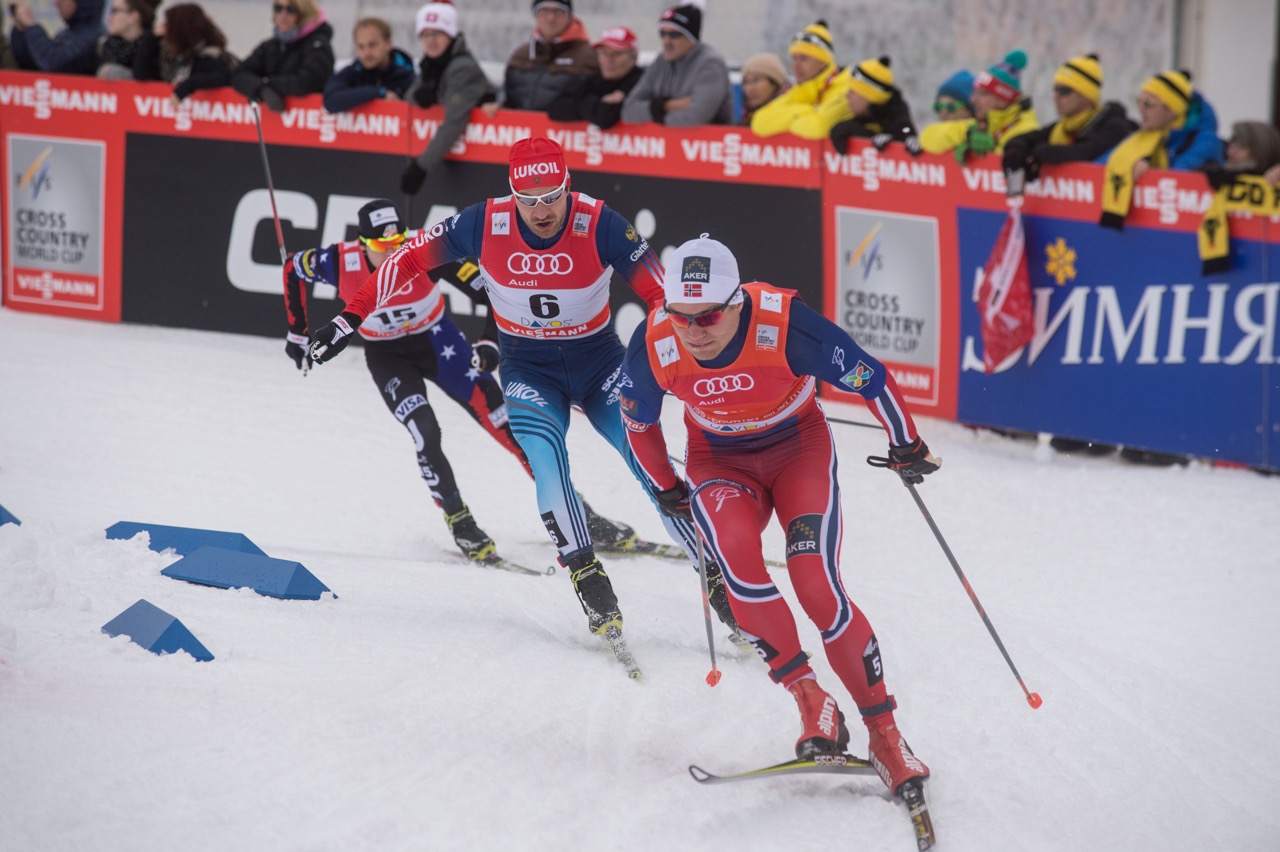
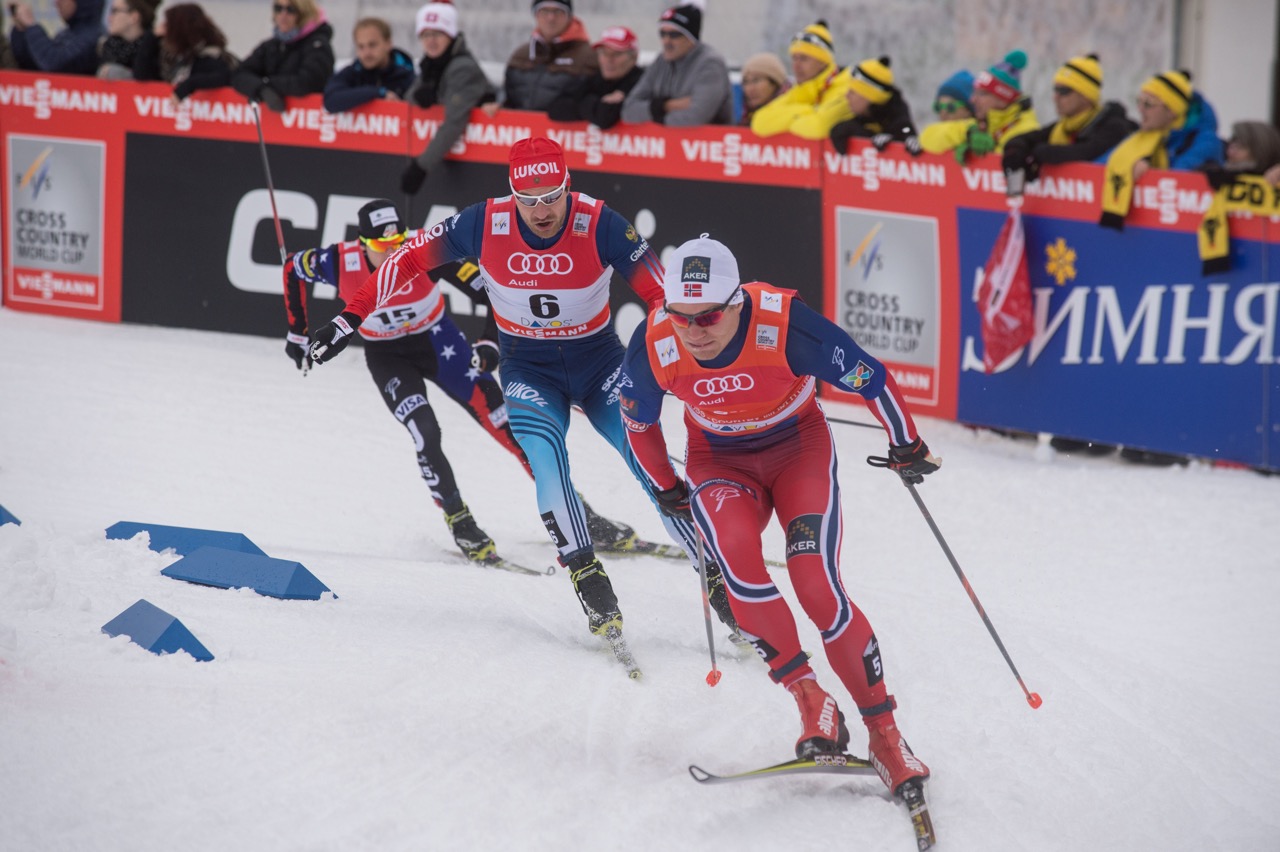
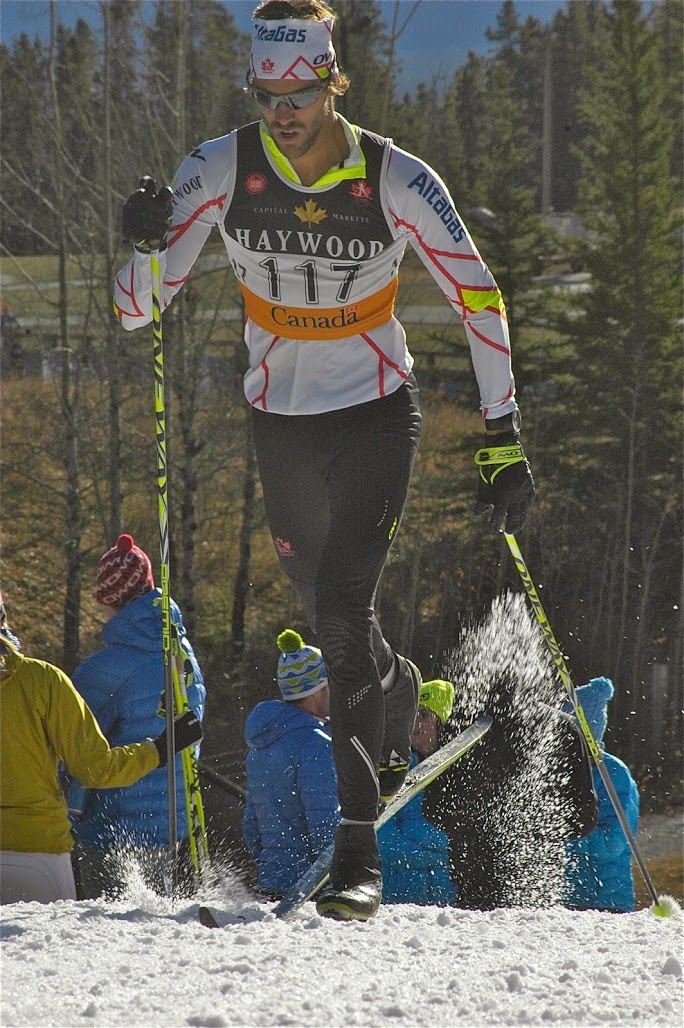
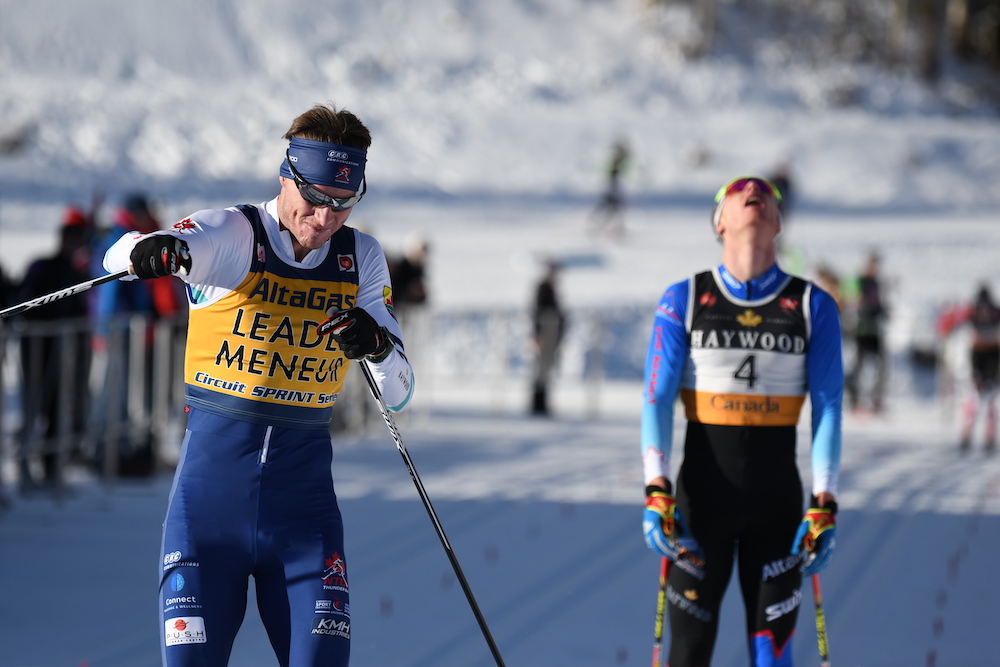
    Bob Thompson outsprinted Jack Carlyle in the men's 30km. (Photo: Doug Stephen)
    Bob Thompson outsprinted Jack Carlyle in the men’s 30km. (Photo: Doug Stephen)

    Canmore hosted the second NorAm of the 2018/2019 season on December 13th, 15th, and 16th. The event also served as U23 and Junior World trials.

    By the end of the weekend, starts at the U23/Junior World Championships and the World Cup’s Tour de Ski would be earned.

    This event was originally scheduled for Whistler Olympic Park but had to be moved as a result of heavy rain and inclement weather forecasted into the immediate future. The Callaghan Valley Cross Country organization, the original bid-winner for this season’s trials, made the difficult decision to cancel on December 1st. The weather gods added one final insult on December 13th, when a major snowstorm ensued in the Callaghan Valley that would have made racing possible on the 14th.

    Canmore’s cross-country community stepped in on December 2nd and was able to organize a successful race weekend with a few weeks notice.

    The International Ski Federation (FIS) mandates that Continental Cup leaders for each period earn automatic start rights for the next World Cup period, including financial support from the event hosts. This season, Period 1 leaders get starts for Period 2 (Tour de Ski) and period 3 (Dresden, Otepää, and Ulricehamm) along with race support.

    For the first time since Perianne Jones and Dasha Gaizova started in the 2014 edition, Canada will enter a woman in the Tour de Ski (TdS). The last female finisher was Sara Renner, who placed 16th overall in 2010.

    This past weekend, Dahria Beatty won all three races in Canmore. Combined with her second place (and top Canadian result) in Sovereign Lake the previous weekend, Beatty is the COC leader and will leave for Europe on the 21st.

    In an email to FasterSkier after Thursday’s sprint, Beatty wrote: “I think the first 3 stages of the Tour this year are my dream come true, 2 sprints and a 10km skate.” The day after sending the email, Beatty received the official news that her TdS dream would be a reality.

    On the men’s side, Bob Thompson won twice in Canmore to lock down the male COC leader position.

    inhalers

    As this event was also the selection trials for U23 and Junior World Championships, up to 12 athletes would automatically qualify for the Lahti, Finland championship races. The High Performance Committee met Sunday afternoon and will announce the final choices soon.

    Weekend Results Summary:

    Names in green earned automatic selection for Lahti.

    Classic Sprint, Thursday:

    • Open Women: Dahria Beatty, Katherine Stewart-Jones, Maya Macisaac-Jones; Marie Corriveau (6th, U23)
    • Junior women: Anne-Marie Petitclerc, Molly Miller, Anna Pryce
    • Open Men: Bob Thompson, Angus Foster, Julien Locke; Graham Ritchie (4th, U23)
    • Junior Men: Remi Drolet, Tom Stephen, Xavier McKeever

    Interval start freestyle, Saturday:

    • Open Women 10km: Dahria Beatty, Katherine Stewart-Jones, Frédérique Vézina; Sadie White (4th, U23)
    • Junior Women 5km: Molly Miller, Isobel Hendry, Elizabeth Elliot
    • Open Men 15km: Russell Kennedy, Evan Palmer-Charrette, Alexis Dumas; Gareth Williams (6th, U23)
    • Junior Men 10km: Sam Hendry, Remi Drolet, Tom Stephen.

    Mass start classis, Sunday:

    • Men 30km: Bob Thompson, Jack Carlyle, Russell Kennedy; Sam Hendry (4th, top junior), Antoine Cyr (5th, U23)
    • Women 15km: Dahria Beatty, Katherine Stewart-Jones, Hannah Mehain (U23); Jasmine Drolet (6th, junior)

    Doug Stephen photographed all three days; see his albums on Flickr for many more images in full resolution.

    Results: Full Weekend, Sprints, Sprint Brackets, Interval Starts, Mass Starts


    Quotes from Canmore:

    Sprint
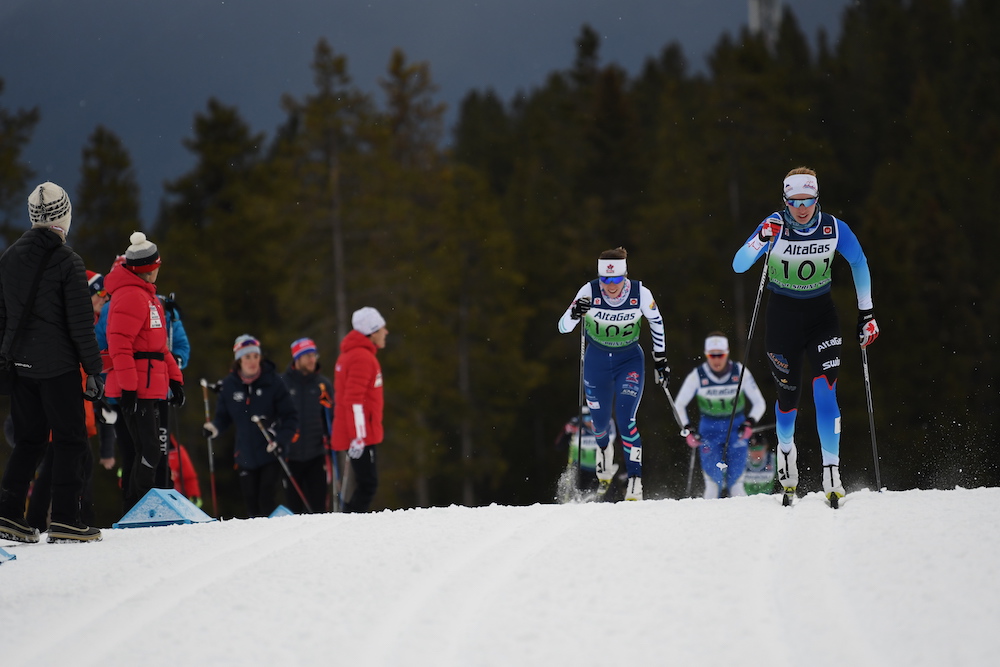
    Dahria Beatty leads Katherine Stewart-Jones. They would finish 1-2 all three races. (Photo: Doug Stephen)
    Dahria Beatty leads Katherine Stewart-Jones. They would finish 1-2 all three races. (Photo: Doug Stephen)


    “My tactics for every heat was to ski smooth and relaxed the first half and attack off the final two climbs into the finish. That worked out well for me today. I skied from the front and had control of the heats. The sprints were staged out of the biathlon stadium (hence why you couldn’t find them on the webcam) so it was an uphill finish, making for very fair racing.” — Beatty (1st)

    “I was not happy with my qualifier but am really happy with how I skied the heats. Our staff did an awesome job with the skis today! The course was a lot of fun. Tactics essentially involved staying relaxed off the start, positioning well for the final climb and then hammering to the finish.” — Maya MacIsaac-Jones (CNST, 3rd)

    “I feel pretty amazing about today’s race. 4th senior at a NorAm sprint is by far my best sprint result ever! My tactic was to have fun and just go like hell; I had a blast and I never went this fast before!” — Frédérique Vézina (CNEPH, 4th)

    “I didn’t really have any tactics, I just wanted to go as fast as I could, ski well and try to stay with the leaders. I didn’t ask myself a lot of question, just ski fast!” — Marie Corriveau (MSA, 6th)
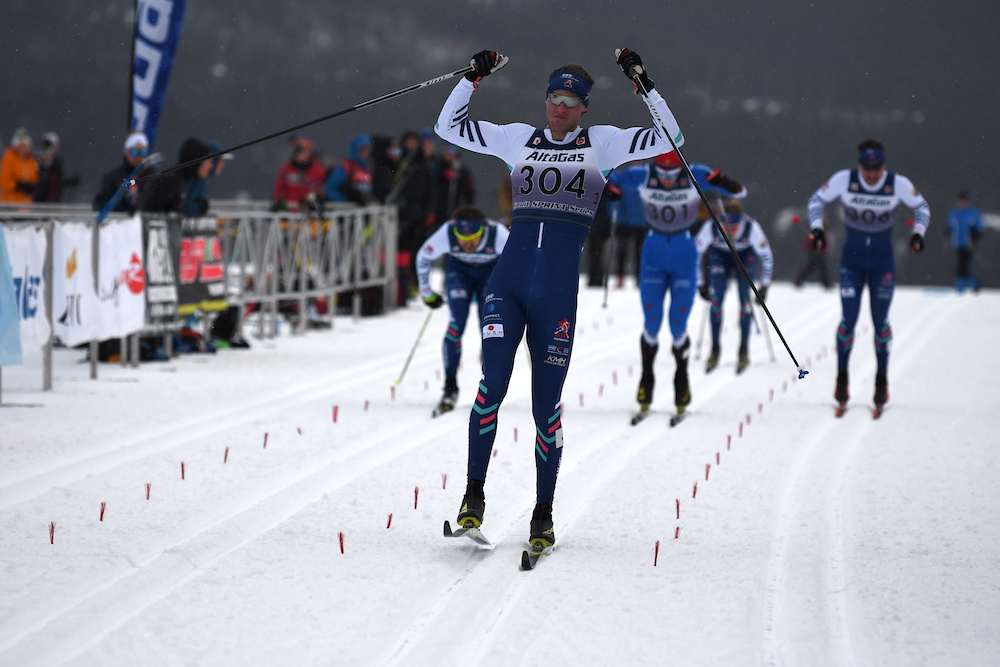
     

    Bob Thompson wins the A final with three Thunder Bay teammates in frame. (Photo: Doug Stephen)
    Bob Thompson wins the A final with three Thunder Bay teammates in the camera frame. (Photo: Doug Stephen)

    “I am very happy with how today went. I found the finishing sprint gear I felt I was missing had the speed when I needed it.

    Everyone was fairly relaxed for the first half of the final knowing it was important to have the energy for the gradual climb into the finish. My move was made coming up to the last short downhill and then on the short striding hill before turning into the finish. I had been feeling great in that section in every heat and made sure I was at the front to make the most of it.” — Thompson (1st)

    “The group strung out a little bit going into the big downhill, I was back in 5th but had amazing skis and came back up to the group pretty easily. Everyone was really skiing together going into the last climb, and Bob just put down a mean last hill and got away from us. I jumped out from behind Julien Locke as we hit the finishing stretch and got up beside him as we got right down to the line, and just got him in a big lunge.” — Angus Foster (TBay, 2nd)

    “The tactics worked out for me as well! I was planning on holding on to the leaders in the final for as long as I could, and then using my fitness to the best of my ability in the finishing stretch.” — Graham Ritchie (TBay, 4th)

    Interval start free technique
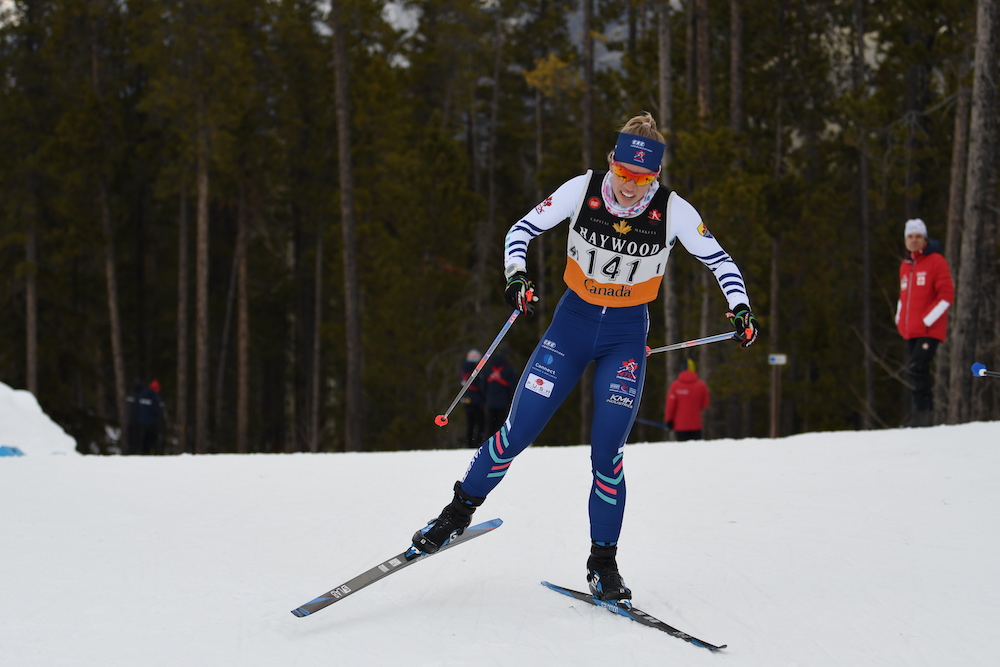
    Sadie White was fourth and top U23 on Saturday. (Photo: Doug Stephen)
    Sadie White was fourth and top U23 on Saturday. (Photo: Doug Stephen)

    “It was a hard race today. I had a good start but then got really stiff going into my second lap after the big climb. It took a lot of mental fight to regroup after I got really stiff on the second lap but I was able to ski out of it and push really hard on the final lap.

    I am really happy with my fitness right now, my pacing was a bit off today but I think that fact that I am in good shape allowed me to bring it back.” — Beatty (1st)

    “I felt better and better throughout the whole race today! I kind of wish we had more lap to go…” — Vézina (3rd)
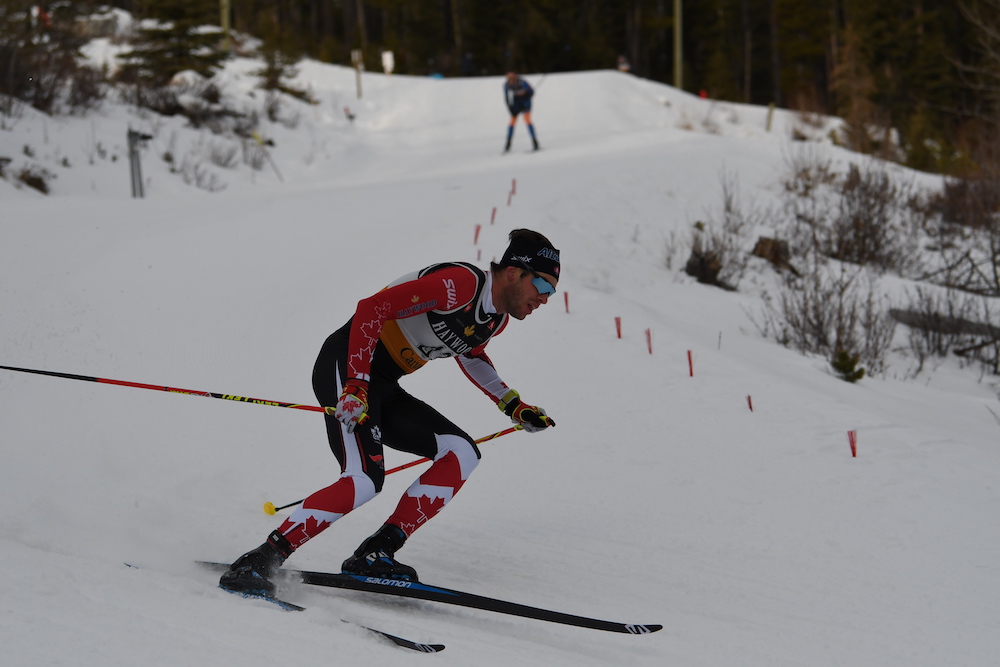
     

    Russell Kennedy descending to first place. (Photo: Doug Stephen)
    Russell Kennedy descending to first place. (Photo: Doug Stephen)

    “Pacing was important today: that being said I didn’t pace it that well. Was definitely fastest the first two laps. Skis for me were really good [as] the team did an awesome job on them.” — Russell Kennedy (Team R.A.D., 1st)

    “The race today went alright, I tried to start hard and couldn’t quite get myself into a top end race gear. I skied relatively consistent and was able to find a better feeling on the last lap, but overall not the way I want to feel during a race, the result was a pleasant surprise.

    I think pacing played a big role, I was pretty far back after the first and second lap but turned out to be less than some guys lost on the last lap and so I was able to move up quite a few places in the final kms.” — Evan Palmer-Charrette (Team R.A.D., 2nd)

    “My race today was really good. I feel like I was able to push hard and keep a good technique. I think the key today was to get a good glide after each push because they were not a lot of easy part on this course and the downhills were fast so you needed to get recovery were you can.” — Alexis Dumas (CNEPH, 3rd)

    “Today’s race was good, not amazing but I’m happy to come away with the top U23 spot which qualifies me for U23 World Championships.

    Today’s weather was static and remained the same for the whole race. The race was decided on the last lap, that’s where I pushed my hardest. My plan for the race was to increase the speed as the race progressed, getting a bit faster each lap. I was getting splits and I realized I was off the pace on the first laps, so I just made sure to push as hard as I could on the final climbs.” — Gareth Williams (Telemark, 6th)

    Mass start classic
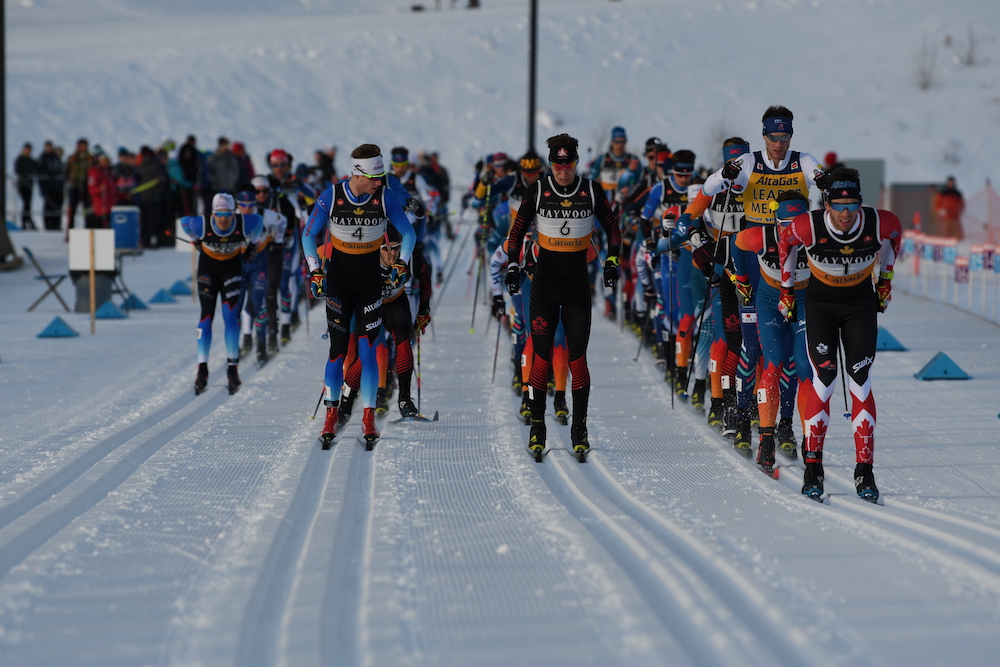
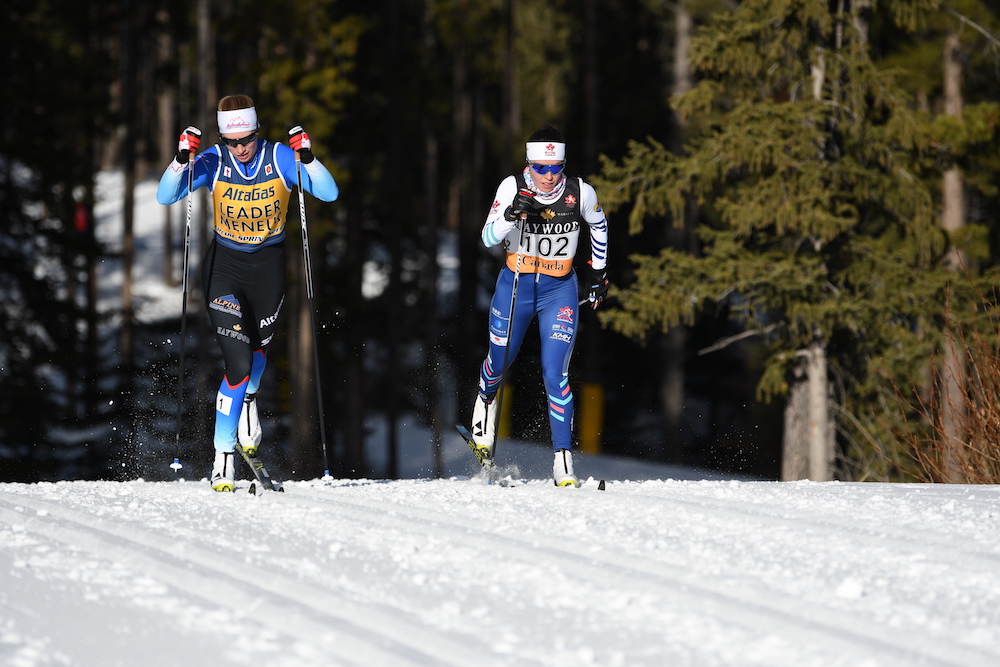
    Russell Kennedy (bib #1) leads out the men's 30km while Bob Thompson towers over the field in the leader's bib. (Photo: Doug Stephen)
    Russell Kennedy (bib #1) leads out the men’s 30km while Bob Thompson towers over the field in the leader’s bib. (Photo: Doug Stephen)


    “Today’s race stands out as the most fun I’ve had in a 30k since the very first one I ever did at the Canmore Nationals in 2010.

    The main group got smaller definitely through Russell pushing the climbs on most laps. We had the group of 6 for several laps and then the last 2 were really just the 3 of us with Russell pushing hard on the climb from the bottom of the course. Jack and I had faster skis and on the final downhills went by and then had a great sprint to the line.” — Thompson (1st)

    “After a tough sprint day, it was great to bounce back with two super successful distance races.  ” – Sam Hendry (Team R.A.D., 1st junior in 4th)

    “Today was a fun race. A good battle between Katherine and me once again.

    Katherine set the pace early and by the second lap, we were on our own. It was windy on course today, so it was hard to break from each other and after testing each other a few times on the last lap it came down to the finish sprint, which of course is my favourite.” — Beatty (1st)

    “The race was really fun. I pushed the pace right off the start so Dahria and I made a break from the rest of the group after the first lap. We skied together the entire race, it was the type of course that made it difficult to break away because the hills were relatively short and there was quite a big drafting effect on the flats. It came down to the finishing stretch and Dahria was stronger on the double pole!” — Katherine Stewart-Jones (CNST, 2nd)

    Selection

    “At this point, if I am offered a start I will plan to race the first 3 stages and then reassess after that based on how I am skiing. The Dresden WC will also be a focus just after the new year so I want to make sure I am well prepared and have enough energy for those races as well.” — Beatty, on Thursday, before the Tour de Ski offer was made.

    “Qualifying for world juniors has been a big goal of mine for many years and I am really excited to have achieved it this weekend.” — Hendry

    Personal Highlights

    “Most unusual part was getting to come home and lie in bed between the quali and heats.” — MacIsaac-Jones

    “I am very very happy with my race today, I really surprised myself! It’s been a long time I didn’t feel good at racing so it was really fun to have good feelings again. Take the first spot for U23 world champ was the best way to start the season!” — Corriveau

    “Getting to race the final with three of my NTDC Thunder Bay teammates was a blast, I was really proud of the way we skied out there today and think it reflects a lot of hard work by our team and coaches this year! I’m stoked for Graham and Julian go 1-2 in U23 with World Champs spots on the line, and we all owe a big thank you to our wax techs for some wicked boards all day.” — Foster

    “It’s been really nice to race at home and sleep in my own bed, especially knowing I will be away a lot for the rest of the season.

    Everyone in Canmore has done a great job organizing the races so last minute. I’ve been especially loving the chocolate medals!” — Beatty

    “The highlight from this past weekend was hands down, getting to ski with my teammate and role model Russell Kennedy for almost all of the classic mass start on Sunday.” — Hendry
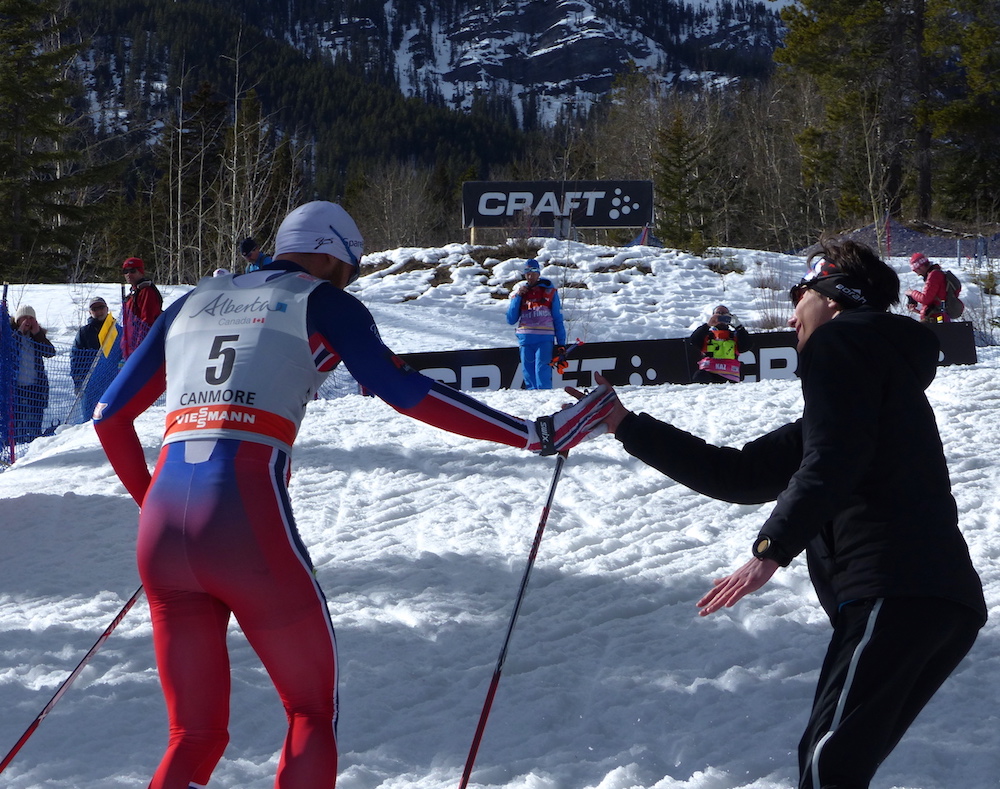
    Remi Drolet has been in Canmore before: Petter Northug (NOR) (l) high fives Remi Drolet (spectator) as he finishes his final lap during the men’s 1.5 k classic sprint at the Ski Tour Canada on Tuesday in Canmore. (Photo: Peggy Hung)
  • Canada’s Jones and Gaiazova Atkins on Russian Doping’s Ripple Effects

    Canada’s Jones and Gaiazova Atkins on Russian Doping’s Ripple Effects

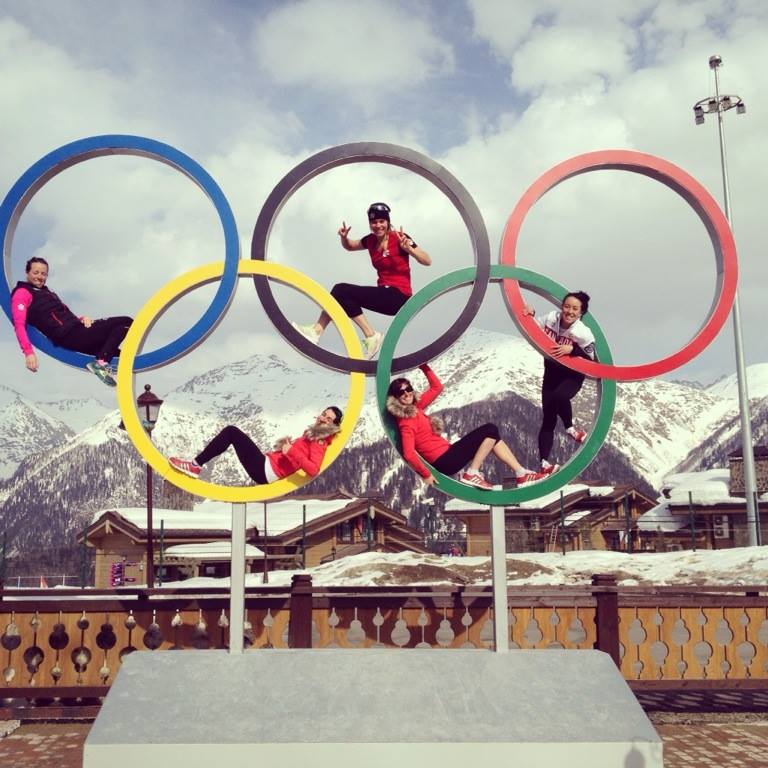
    Five members of Cross Country Canada’s 2014 Olympic team get the perfect photo opp at the Olympic rings in Krasnaya Polyana, Russia. (From left to right) Perianne Jones, Amanda Ammar, Heidi Widmer, Brittany Webster, and Emily Nishikawa. (Photo: Emily Nishikawa)
    On Nov. 9, news broke that four more Russian cross-country skiers had been sanctioned for cheating during the 2014 Sochi Olympics. So far, six Russian nordic athletes in total have had their 2014 Olympic results erased by the International Olympic Committee (IOC). These athletes are also prohibited from participating in all future Olympics due to their affiliation with Russia’s elaborate-state sanctioned doping enterprise.

    Julia Ivanova, half of Russia’s 2014 Olympic team-sprint duo, is one of the six penalized Russians. In Sochi, Ivanova and her teammate Anastasia Dotsenko skied to 10th place in the classic team sprint. (Thus far, Dotsenko has not been implicated in the doping scheme.)

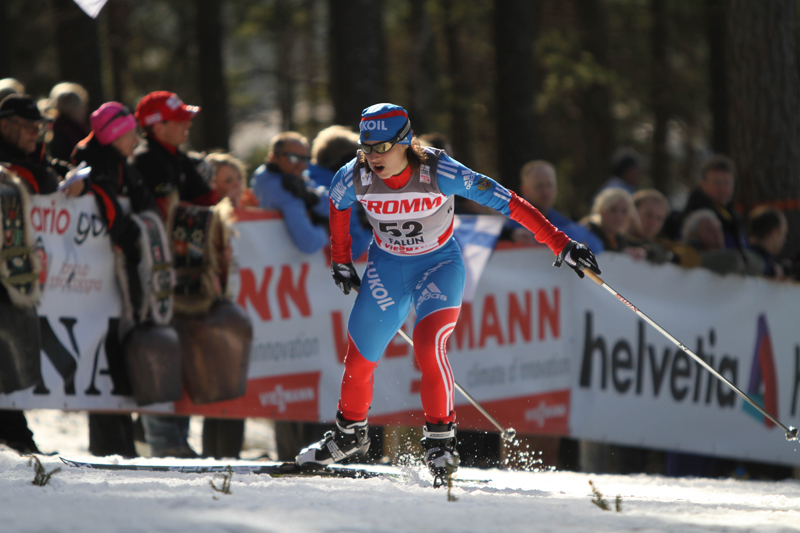
    Russia’s Julia Ivanova racing at 2012 World Cup Finals in Falun, Sweden.

    It’d be easy to say the Russian pair was way out of the medals — theirs was simply another tainted performance already removed from the official results.

    Yet among those clean athletes caught up in the win-at-all-costs mantra of the Sochi doping regime are Canada’s team-sprint pair Perianne Jones, now 32, and Dasha Gaiazova Atkins, 33. Looking back, “What might of been?” is a legitimate question the two retired skiers have asked.

    Ivanova and Dotsenko made the Sochi team-sprint final as what’s referred to as lucky losers — 10th place in their semifinal wasn’t enough for them to automatically advance but their time was fast enough relative to the rest of the field to put them through to the final. Jones and Gaiazova Atkins were right behind them in 11th, which was the end of their day.

    “I texted Peri that morning when the article came out in Fasterskier and said, ‘Should we start training for a redo?’ ” Gaiazova Atkins, who was born in Russia but spent more than half of her life in Canada, said on the phone from her home in Calgary. “Because we could have been in the finals and then you never know how that goes. It could have had a much, much better result and we could have had a chance for a medal.”

    One year before the 2014 Olympics, at the pre-Olympic World Cup in Sochi, Jones and Gaiazova (the latter of which has been married since, hence the new last name) placed third in the classic team sprint. Notably, they were third in a photo finish with the second-place Russians — Ivanova teamed up with Natalia Matveeva in that race.

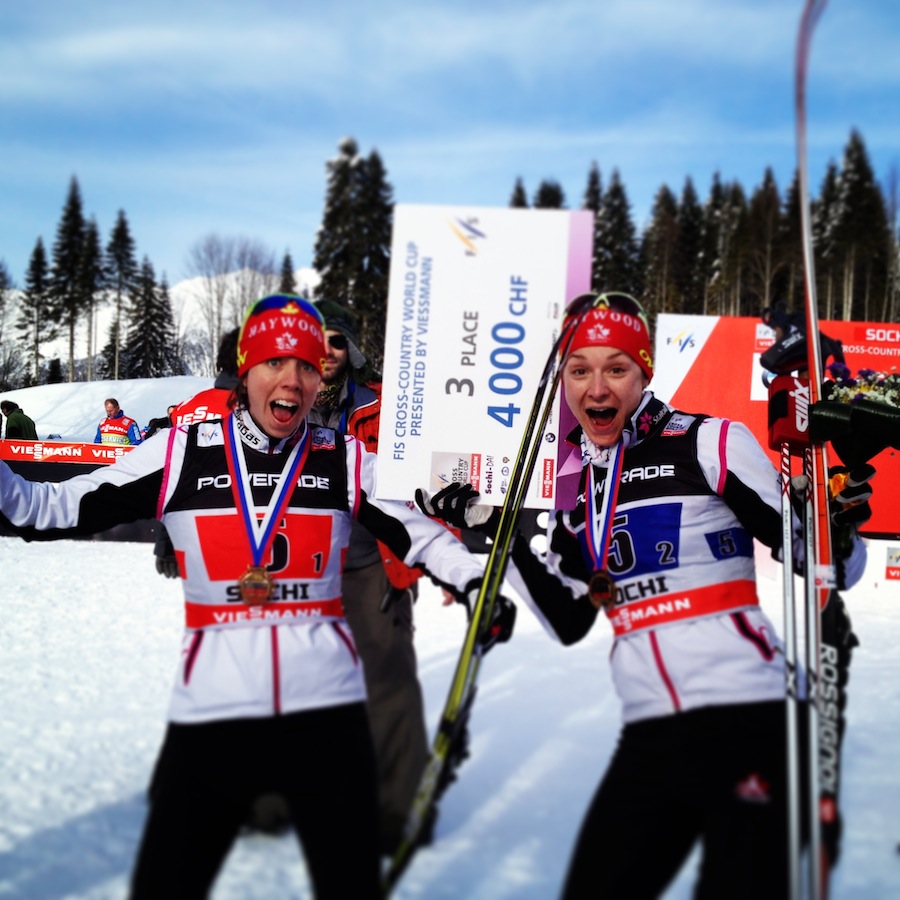
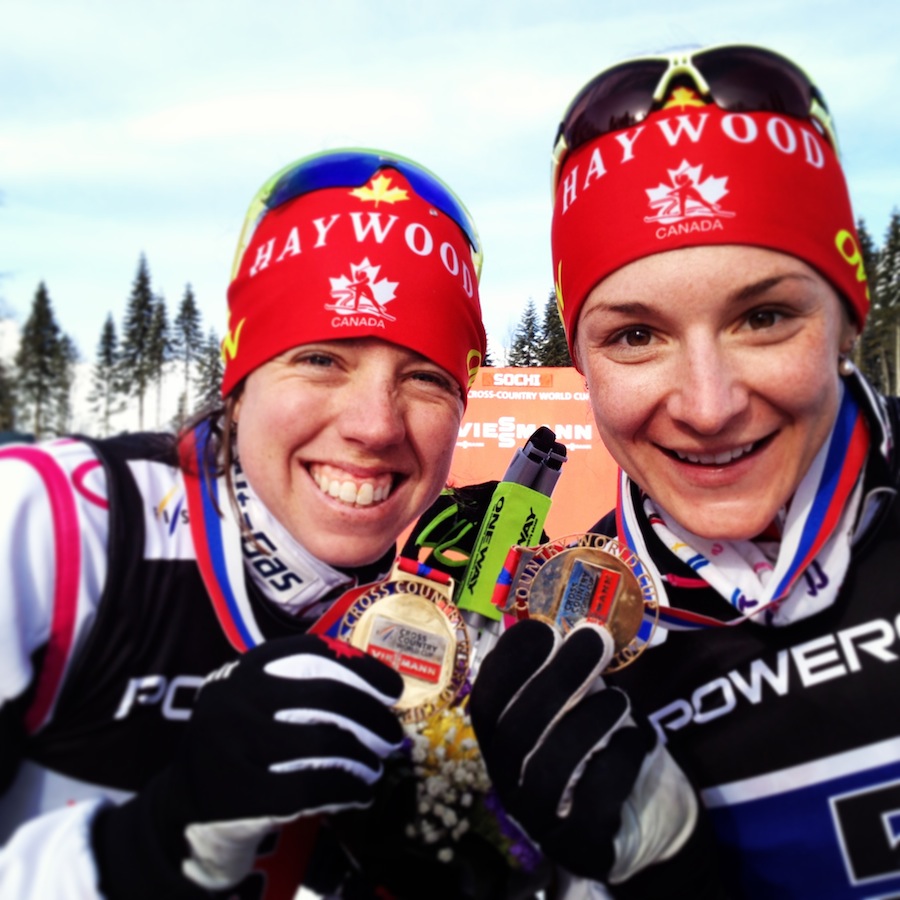
    Canada’s Perianne Jones (l) and Dasha Gaiazova having some fun after notching their first podium together with bronze in the classic team sprint at the Sochi pre-Olympic World Cup in February 2013. (Photo: Chandra Crawford)

    Jones first heard about the Ivanova news through Gaiazova Atkins’s text message.

    “When it goes back and you realize that something could have gone a little bit differently or wonder what could’ve been, then you think about it a lot more and it definitely hits you a little personally,” Jones said on the phone from Canmore, Alberta. “For sure, it makes me feel sick and I cannot go back. No one can. That’s the unfair part. … It’s an interesting conundrum: people have put their lives into something and then are not given a fair chance.”

    The “what if” part of this story is multi-layered. Ivanova raced twice in the 2014 Olympics before the team sprint; first in the 10-kilometer classic on Feb. 13 and again in the 4 x 5 k relay on Feb. 15. What if Ivanova had been tested after those races and a legit lab had found her to be doped? What if Ivanova and Dotsenko never raced the team sprint on Feb. 19? Or a different iteration of Russians were slower in the semis? On paper at least, in this post-Sochi thought experiment, the Canadians advance to the final as lucky losers. 

    The perspective of time buffered by athletic retirement seemed to have taken the edge off the tone of both Jones and Gaiazova Atkins, based on their voices over the phone. They both sounded calm and measured, without a sense of bitterness. But they raised several important points as the fallout from the Russia’s doping program continues.

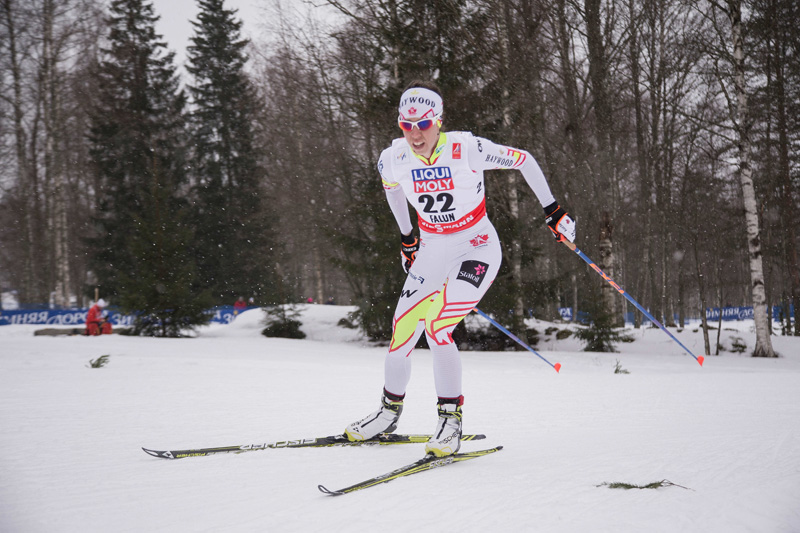
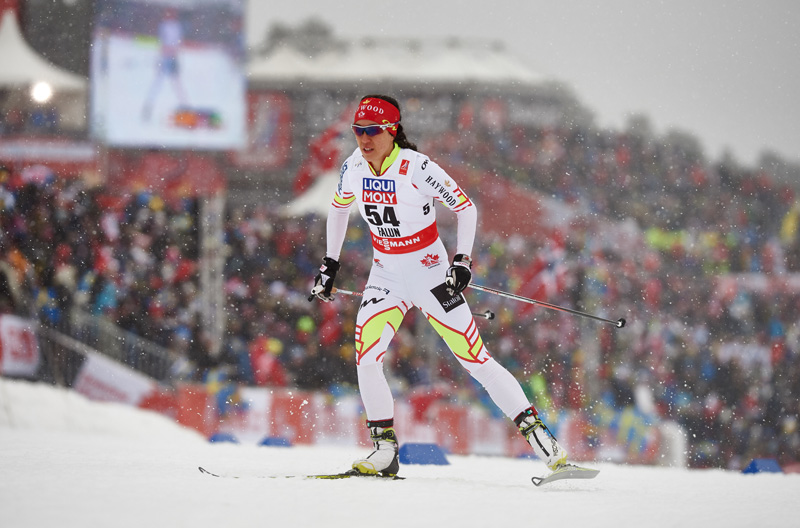
    Canada’s Perianne Jones racing to fifth in the 1.4 k classic sprint at 2015 World Championships in Falun, Sweden. She placed 24th overall and retired after that 2014/2015 season.(Photo: Flyingpointroad.com)

    On Jones’s mind were those athletes still competing, and those wondering if they, too, are racing in an unlevel playing field.

    “I am retired now,” Jones said. “So it would have been tough had all this stuff been coming out as I was still ski racing. I think it is tough for the athletes who are still competing now. Not that it is easy to hear about it after the fact, but you definitely have to believe you can do it while you are ski racing. I imagine that at least most of the playing field is clean and that would be hard given everything that has transpired over the last little while.”

    Gaiazova Atkins’s story resonates due to her literal mid-teen continental shift. At the age of 15, she moved with her family from Russia to Quebec. Although she started skiing in Russia, her swift trajectory up into the international ranks began as a Canadian. She did, however, recall a Russian ski culture where more than a healthy lifestyle choice was on the line.

    “I would say there is more pressure in Russia,” Gaiazova Atkins said. “And maybe because in Russia, in so many ways the country is so far behind in development … they have very few resources. So there is a lot of pressure to become a big skier because if you can race fast, you can do quite well for yourself in the country. … In America, it is not the same. And here in Canada, Chandra [Crawford] got a gold medal, shake her hand and off she goes to get an education.”

    Gaiazova Atkins’s perspective was one of trying to humanizing cheaters and would-be cheats, people with families and their own demons straddling their shoulders.

    “The incentive to perform is so much higher in Russia,” Gaiazova Atkins said.  “And the alternative? You can live in poverty and then, OK, I am going to take a chance. So for a lot of athletes, it may not be perceived as high risk because it’s the only chance to do well in life.”

    While she expressed that blame should be placed on those involved, Gaiazova Atkins emphasized truly understanding an athlete’s complicity.

    “I know these girls and I know the guys who are now being stripped of their results,” she said. “I follow them on Instagram and I see what they are saying in Russian, and it’s crazy they are still denying they did this. But then, you think about a big country like Russia and the whole thing, you almost ask yourself, ‘Did the athletes even know this was happening? Did they have any say?’ It is just like, you have no choice as an athlete.”

    Dasha Gaiazova racing to 44th in the women’s 10 k classic individual start at the 2014 Olympics in Sochi, Russia. She retired at the end of that 2013/2014 season and is currently coaching the Space Dogs Ski Club (where she’s also the president) in Calgary.

    Several times, Gaiazova Atkins stated her belief that the doping was a top-down mandate, a state-sanctioned endeavor with upper-government power plays manifesting with Sochi podiums. But she’s also no apologist. 

    “I follow on Instagram and their posts from all those guys, like Legkov and people that support him,” she said. “They say, we are with [Legkov] because we know how hard he works and how much work ethic he has. And I am thinking to myself, every single person racing is working just as hard and harder.

    “I feel sorry for those athletes, especially those who aren’t as systematic like the state-supervised program,” she added. “The ones who choose themselves and go to doctors, no pity for you.”

    As far as moving forward, Gaiazova Atkins said she was in favor of nothing less than a wholesale Russian ban from the upcoming PyeongChang Games.

    “You cannot slap them on the hand and say, ‘OK, don’t do this next time, please’,” she said. “It has to be with consequences for the state, for the country.”

    Gaiazova Atkins also believes that Ivanova’s doping has had lasting impact on potential funding for the current crop of Canadian cross-country skiers. “Eleventh place is not a top 10,” she said.  

    “Cross Country Canada funding is based on our results, and there is a big difference between a top 10 and 11th place sometimes,” she added. “To take us out of the equation, this had a trickle effect on the whole system, like our whole nation may have been affected by the funding because we did not get a top-10 result.”

    As the concentric ripples from Russian doping in Sochi move outward, they’ve arrived in North America, nearly four years late, with the 2018 Winter Olympics in PyeongChang, South Korea, on the horizon.

    Canadians Perianne Jones and Dasha Gaiazova celebrate their first bronze together in the 2013 Sochi World Cup classic team sprint. (Photo: Chandra Crawford)
  • Last of Canada’s World Cup Female Veterans, Jones Plans Her Next Move

    Canada's Perianne Jones (Alberta World Cup Academy/National Development B-Team) racing to 32nd for her best World Championships distance result at 2015 worlds in Falun, Sweden. (Photo: Fischer/NordicFocus)
    Perianne Jones (Canadian National Development B-Team) races to 32nd for her best World Championships distance result at 2015 World Championships in Falun, Sweden. (Photo: Fischer/NordicFocus)

    For the last 12 years, Perianne Jones was more or less on autopilot, leading the life of a professional nordic racer in Canmore, Alberta, and giving little thought to what would come after skiing.

    The 30-year-old Canadian national-team member and Nakkertok Nordic prodigy had moved west from her hometown of Almonte, Ontario, immediately after high school. She immersed herself in full-time training and racing, and by 2009, made the Canadian World Cup Team.

    Two Olympics and five seasons later, Jones was inching toward retirement. Health issues stunted the start of her 2013/2014 season; she discovered in the fall of 2013 that she had hemochromatosis, a genetic condition that causes too much iron in the body. She spent the next few months working to manage her iron levels and returned to the World Cup circuit in late December 2013.

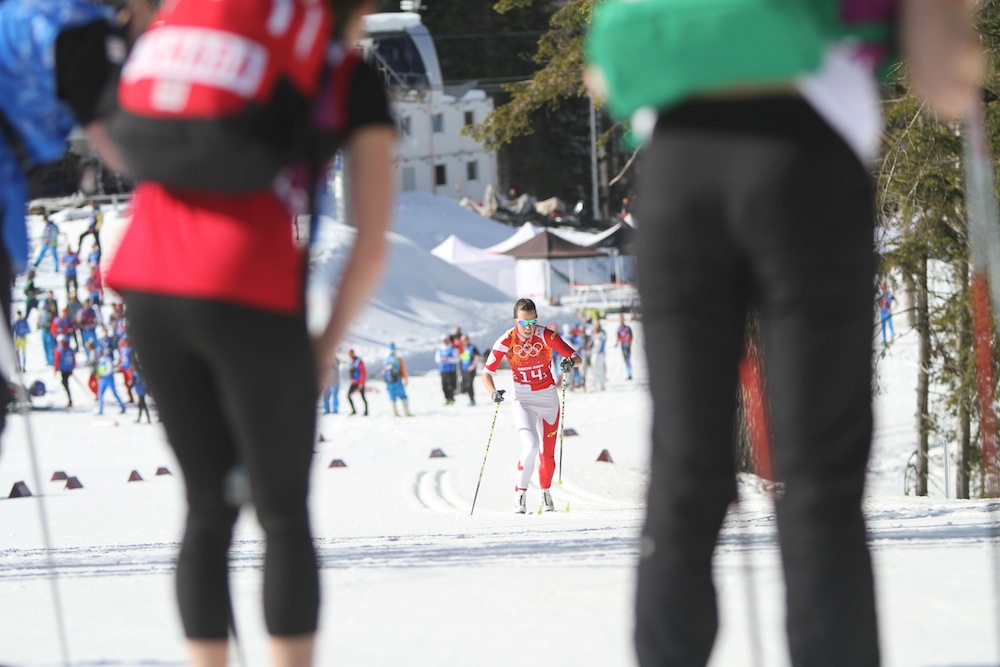
    Canadian biathletes and fellow cross-country skiers cheer on their own Perianne Jones on the first leg of the 4 x 5 k relay at the Sochi Olympics on Friday. Jones dropped to 14th and the team finished 14th, one place better than their finish at the 2010 Vancouver Games.
    Canadian biathletes and fellow cross-country skiers cheer on their own Perianne Jones on the first leg of the 4 x 5 k relay at the Sochi Olympics. the team finished 14th, one place better than their finish at the 2010 Vancouver Games.

    Two months later, she competed at her second Olympics in Sochi, Russia, placing 23rd in the freestyle sprint for her personal Olympic best. In the classic team sprint, she and teammate Dasha Gaiazova placed 11th after notching third in the same event at the 2013 Sochi World Cup a year earlier.

    Jones ended her season with a second-place finish in the freestyle sprint at 2014 Canadian Nationals in Corner Brook, Newfoundland, and was subsequently named to the national development B-team last May.

    Also last spring, her coach, Eric de Nys, left the national team to head up a new training program in Canmore: the WinSport Junior Cross Country Ski Team. Jones lost the bulk of the funding she had received as a World Cup Team member, yet decided to continue on for another season.

    “I, for sure, wanted to do another year after Sochi, and do things right,” she said on the phone from Canmore in early April. “… [Not making the World Cup Team] was a bummer, but at the same time, I know I didn’t make the criteria. I had one top-ten two seasons ago and you needed two top-twelves. I was put on the development team, so it meant that this past season cost me way more than it ever has…”

    “I, for sure, wanted to do another year after Sochi, and do things right.” — Perianne Jones

    As a development athlete, she said the costs amounted to $40,000 to $50,000, and that included government assistance as a carded athlete.

    “Even if you’re carded, you still have to pay for a place to live,” Jones said. “And living in Canmore is not cheap.”

    Carded athletes essentially receive an allowance each month, she explained. The government cuts qualifying individuals checks that could be used for anything — even a flat-screen TV — but the amount is generally considered a living allowance.

    “As a development skier, you have to cover housing and your team fee, which is around $10,000 and your winter expenses on the road, and then your flights to and from and around Canada,” Jones said. “It adds up.”

    Without stressing too much over finances, she focused on the 2014/2015 season and logged some of her career-best distance results, placing 32nd in the 10 k freestyle and 37th in the skiathlon at 2015 World Championships in Falun, Sweden.

    Canada's Perianne Jones raced to fifth place in her qualifier to finish 24th overall in the 1.4 k classic sprint in Falun, Sweden for the 2015 FIS Nordic World Ski Championships. (Photo: flingpointroad.com)
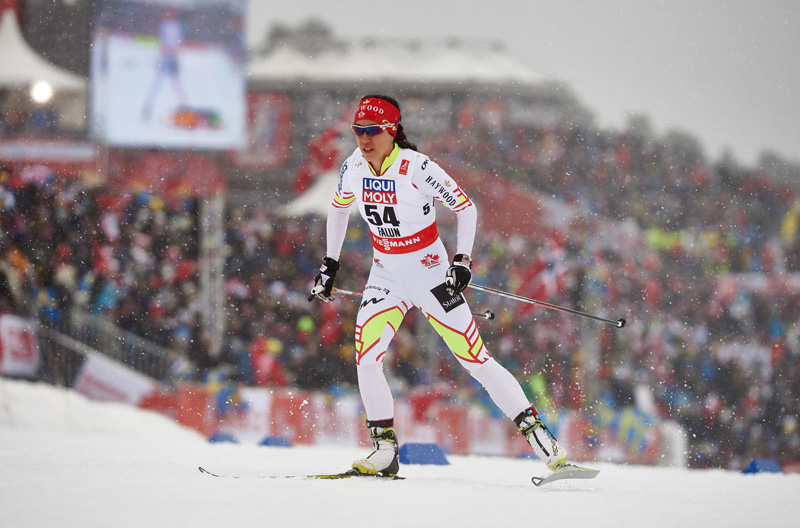
    Canada’s Perianne Jones racing to fifth in the 1.4 k classic sprint at 2015 World Championships in Falun, Sweden. She placed 24th overall. (Photo: flyingpointroad.com)

    Also in Falun, she finished 24th in the classic sprint and was 21st for a season best in the preceding World Cup classic sprint in Östersund, Sweden.

    “This past year I was healthy the whole season, which was quite an accomplishment for me,” she said. “It wasn’t my best season in terms of results, but health-wise it was really good. … I was pleased with both my sprints in Östersund and at world champs. It always can be better for sure, but I don’t have any regrets.”

    In Falun, she announced she would leave the international-racing scene at the end of the season. She capped off her career at 2015 Canadian Nationals in Thunder Bay, Ontario, winning the classic sprint, placing second in both the 5 k freestyle and 10 k classic individual races, and fifth in the 30 k freestyle mass start.

    In Thunder Bay, Nakkertok hosted a retirement dinner in her honor, complete with a video and several athletes and her brother Kieran Jones — Nakkertok’s head coach — speaking about the impact she had on their ski careers.

    “That was the only time I cried all week,” Jones said. “The ski club has been a huge part of my life and maybe I didn’t realize how I had been a part of them so much in the last ten years because I haven’t been around that much. I would totally love to go back to Ottawa and be a part of that some more.”

    She clarified that her involvement with Nakkertok would most likely be as a volunteer.

    “I have an interest in being involved, not necessarily in coaching at a high level, but when I was growing up with Nakkertok the ski club was entirely volunteer run,” she said. “I will be involved with a ski club wherever I end up. I will miss certain parts of skiing, but to have Joel still a part of the team will be an easier way to make that transition.”

    On Friday, Jones and her husband, Joel Jaques, a national-team wax technician, hopped aboard their 32-year-old Dodge getaway van and began a road trip to Ottawa. She guessed they might be gone for at least a month, with Jaques heading back to Canmore for a week in the middle of their trip for a training camp. How far they’d go depended on how the van ran. They bought it in February, about the time Jones knew her career was winding down.

    “We were just kind of joking about vans; there was one in Canmore and we offered the guy quite a bit less than he was asking and he said sure, and we’re like, OK, I guess we’re doing this,” she said.

    If they have time and the van makes it to Newfoundland, a friend offered to keep the van and buy their plane tickets back to Canmore. There, Jaques will go back to work with the national team and Jones will decide on her next move: she’s considering studying healthcare in Calgary or Ottawa.

    Meanwhile, she also planned to start working in Canmore to cover the cost of last season. While she essentially made up her mind to race one last season a year ago, the bill she received at the end of it ultimately solidified her retirement.

    “At the beginning of [last] season, I thought if I work and keep skiing, I would need to make the World Cup Team and need other women on the World Cup Team around me to keep going,” she reflected. “As the season kept going, I was realizing that even if all those things came into place, I wasn’t motivated to keep training for another year.”

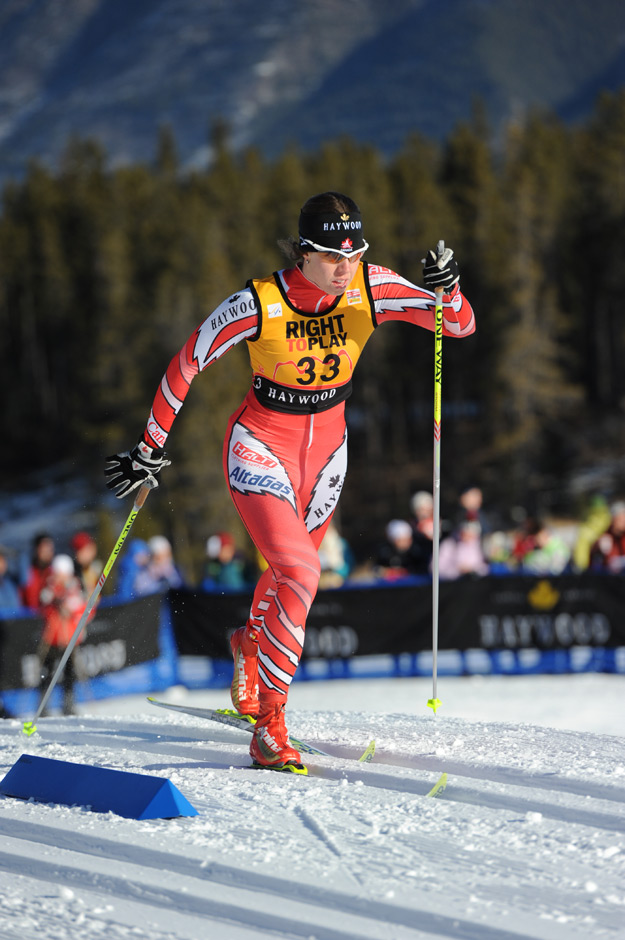
    Perianne Jones (CAN) was 29th in the Canmore World Cup on Feb 5, 2010. Photo: Win Goodbody.
    Perianne Jones racing to 29th in the Canmore World Cup in February 2010. (Photo: Win Goodbody)

    After graduating high school, Jones started a fall term the University of Calgary, but found the commute back and forth from Canmore difficult. She took an online course at Athabasca University, but realized that didn’t work for her, either. Instead, she spent the next 12 years focusing on skiing.

    “I’m happy with the decisions I made and I’m sure my ski career was the best quality,” she said. “Hindsight’s twenty-twenty; there’s always things that could’ve gone better, but at the same time I was able to commit 100 percent to skiing. Although I’m not educated right now, I’m really looking forward to going to school and I can put 100 percent of my energy into school.”

    Jones and Jaques were also looking forward to having the freedom to visit friends this spring.

    “I’m looking forward to waking up and being able to what I want to do for exercise,” Jones said.

    “I will not be out on my rollerskis,” she added with a laugh. “So far it doesn’t feel a whole lot different. I feel pretty good about my decision, and I’m confident it was the right one. So many people say that it’s really hard [to retire] and some people say it’s awesome, but I think it depends on the person. I have enough plans to keep me busy; I don’t think I’ll be bored.”

    Looking back, she credited her two national-team coaches, de Nys and Justin Wadsworth, for the longevity of her career. She worked with de Nys, a development coach before he became the women’s national-team coach, for most of her senior years.

    “Eric really got to know me as an athlete and I got to know him as a coach, and I really trusted him and we were able to work well together,” Jones said. “And Justin, he’s been with the team since [2010] and he wasn’t my personal coach until this past year, but the transition was pretty seamless … I don’t feel like I lost Eric as a coach this year, but I feel like I gained Justin. Whenever we had a question about something, either of us could easily call Eric or visit him in his office.”

    In her career, Jones notched three top-15’s at both Junior World Championships and U23 World Championships, finishing eighth at 2008 U23’s in Malles Venosta, Italy.

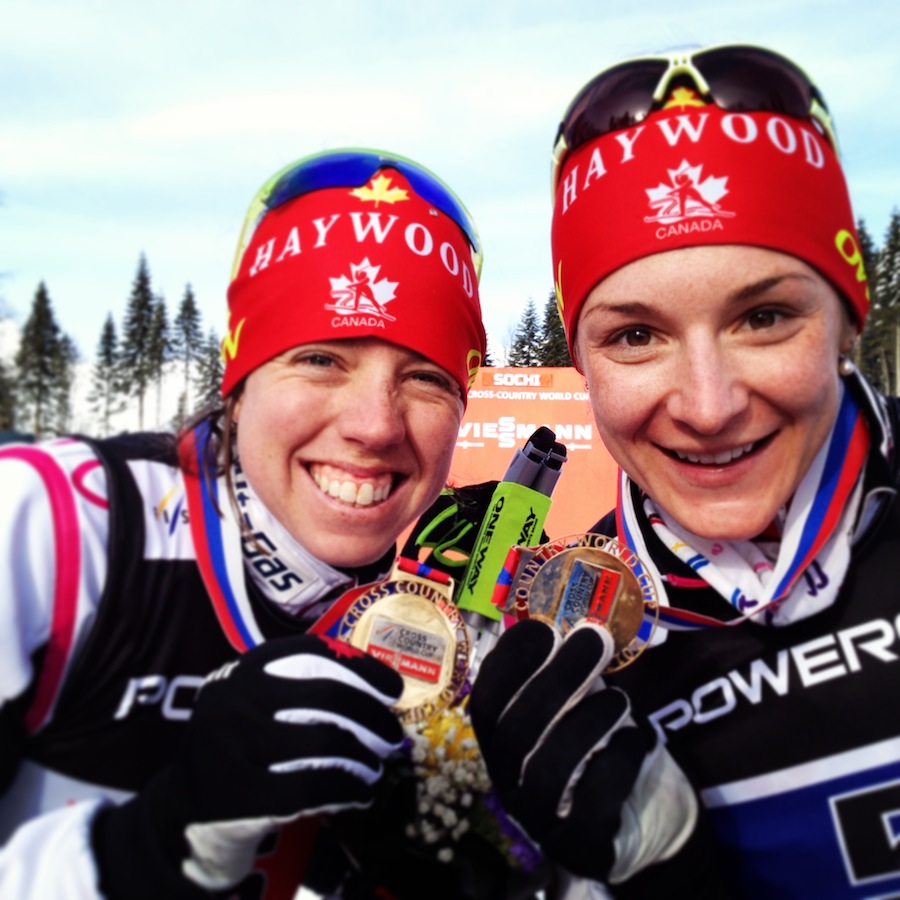
    Canadians Perianne Jones and Dasha Gaiazova celebrate their first bronze of the season, and together, in the Sochi World Cup classic team sprint. (Photo: Chandra Crawford)
    Canadians Perianne Jones (l) and Dasha Gaiazova celebrate their first bronze together in the Sochi World Cup classic team sprint. (Photo: Chandra Crawford)

    “I had some really good World Junior experiences, some good results and some really fun times with the team,” she explained.  “For sure, the two medals that I won with Chandra and Dasha respectively in Milano and Sochi were highlights.”

    In 2012, Jones and Chandra Crawford teamed up for third in the World Cup freestyle team sprint in Milano, Italy.

    Jones also recalled making the 2010 Olympics in Vancouver, British Columbia, as a major high point. She qualified in 2009 when she and Sara Renner placed sixth in the World Championships classic team sprint in Liberec, Czech Republic.

    “That was the first time we got to go to the medal ceremony … and it was with Sara, who was a pretty big mentor,” she said. “I was actually never really on the team with Beckie [Scott] or Milaine [Thériault], but I traveled quite a bit with Sara. … Having them come before me and have the results that they did and just being the people that they are, they made it pretty appealing to chase after ski-related goals … Everything was so positive that I never I had any doubt that A.) I would enjoy it and B.) it would be possible.”

    The last of Canada’s three veteran females to retire — following the departures of Crawford and Gaiazova from the national team last year — Jones was excited to see what the next generation of women could accomplish.

    “I spent the majority of the season on the road with Emily [Nishikawa] and that was just awesome,” she said. “I’m glad I was there for that and able to witness her best season ever, and I think it’s a sign for really great things to come. There are younger women coming up, too, and they have Emily to look up to so there’s no doubt in my mind that they will do great things.”

    Regardless of where she attends school, Jones envisioned that she and Jaques would end up living somewhere in western Canada.

    “We don’t really want to leave Canmore,” she said.

    Several members of the Canadian Olympic cross-country ski team get the perfect photo opp at the Olympic rings in Krasnaya Polyana, Russia. (From left to right): Perianne Jones, Amanda Ammar, Heidi Widmer, Brittany Webster, and Emily Nishikawa. (Photo: Emily Nishikawa)
    Several members of the 2014 Canadian Olympic cross-country ski team get the perfect photo opp at the Olympic rings in Krasnaya Polyana, Russia. (From left to right): Perianne Jones, Amanda Ammar, Heidi Widmer, Brittany Webster, and Emily Nishikawa. (Photo: Emily Nishikawa)
  • Nishikawa Cracks Top 30 in Falun 10 k, Jones Tallies Another Distance Best in Last Race

    Nishikawa Cracks Top 30 in Falun 10 k, Jones Tallies Another Distance Best in Last Race

    Canada's Emily Nishikawa (Alberta World Cup Academy/National Development Team) racing to 30th in Tuesday's 10 k freestyle for her best World Championships result at 2015 worlds in Falun, Sweden. Nishikawa led the Canadian women with the result and Perianne Jones placed 32nd. (Photo: Fischer/NordicFocus)
    Canada’s Emily Nishikawa (Alberta World Cup Academy/National Development Team) racing to 30th in Tuesday’s 10 k freestyle for her best World Championships result at 2015 worlds in Falun, Sweden. Nishikawa led the Canadian women with the result and Perianne Jones placed 32nd. (Photo: Fischer/NordicFocus)

    FasterSkier’s coverage of the 2015 FIS Nordic World Ski Championships in Falun, Sweden, is brought to you by the generous support of L.L. Bean, now featuring a complete line of Kikkan Randall training wear.

    FALUN, Sweden — With the pressure off, the Canadian women posted some career-best performances on Tuesday in the 10-kilometer freestyle individual start at 2015 FIS Nordic World Ski Championships.

    In Emily Nishikawa’s first race coming off illness, which kept her and fellow Canadian World Championships team member Olivia Bouffard-Nesbitt back in Östersund, Sweden, until Sunday, recorded her first top 30 at her second World Championships.

    “I was sick last week so I didn’t really know what to expect, how my body would react,” Nishikawa said after placing 30th, 2:20.5 behind Sweden’s Charlotte Kalla, who won the 10 k skate in 25:08.8. “It could’ve gone either way and it went well today, so I’m very happy with that.”

    Canada's Perianne Jones (Alberta World Cup Academy/National Development B-Team) racing to 32nd for her best World Championships distance result at 2015 worlds in Falun, Sweden. (Photo: Fischer/NordicFocus)
    Canada’s Perianne Jones (Alberta World Cup Academy/National Development B-Team) racing to 32nd for her best World Championships distance result at 2015 worlds in Falun, Sweden. (Photo: Fischer/NordicFocus)

    Meanwhile, team veteran Perianne Jones notched yet another best distance result at worlds in 32nd after placing 37th in Sunday’s 15 k skiathlon. And in what she anticipates to be her last season of professional racing, and ultimately her last races, Jones, 29, didn’t expect to do any of the distance races.

    “I had zero expectations going in,” Jones said after finishing 2:26.7 back from Kalla. “Coming into these championships, I thought I was going to do the sprint and the team sprint … and I ended up doing the sprint and the 10 k and the pursuit.”

    Even on the World Cup, Jones hadn’t done better than 32nd in a distance race since placing 30th two years ago in a 15 k classic mass start in Nové Město na Moravě, Czech Republic.

    And then there was Nishikawa, 25, who cracked the top 30 for the first time this season on the World Cup, placing 29th in the 10 k classic in December in Davos, Switzerland.

    The 54th starter out of 71, the Alberta World Cup Academy (AWCA) and Canadian National Development Team skier faced some of the toughest conditions of anyone in Tuesday’s race, skiing two different loops of a 10 k course in heavily falling, wet snow.

    “It was snowing pretty heavily, [but] my skis felt great,” Nishikawa recalled. “I pushed as hard as I could …  I was just dying to get here to Falun. I’m so happy to be here and to be racing is a real treat.”

    Nishikawa, Jones and Canada’s third woman at the championships, Bouffard-Nesbitt, warmed into their races, with Nishikawa’s 1.5 k time ranking 45th, followed by Jones in 46th and Bouffard-Nesbitt in 53rd.

    By 5 k, Nishikawa was up to 35th and 2.8 k later, 33rd, before closing hard for 30th. At the end of the day, she finished 3.1 seconds ahead of Norway’s star skier Marit Bjørgen, who placed 31st (for her first result outside the top 24 in a World Championships in at least 14 years).

    Jones, who sped up to clock the 34th-ranked 5 k time and 32nd 6.3 k time, finished 6.2 seconds behind Bjørgen, the 65th starter.

    “I was lucky I started early — I was number 22 so I have probably never been that close to Bjørgen in a skate distance race ever,” Jones said. “I just wanted to ski hard and pick a pace up those hills I could maintain. I was pretty sure the girl behind me [France’s Coraline Thomas Hugue] was going to catch me, so I just tried to stay with her for as long as possible.”

    While Hugue had a career-best day of her own in 12th, Jones said this race would go down as one she’d remember — and likely her last international race.

    “This was my final World Champs, probably my final international ski race,” she said. “After last year, I just kind of wanted to give it another shot, and it has been a good year in a lot of ways — I have been really healthy, more than I have been in the past. I think these last few distance races, too, I have surprised myself a little bit even though they weren’t in the plans.

    “This is the first time this week that I skied with teammates, so it is really nice to have the other girls here and for us all to come to the start line together and to have a teammate to hug at the finish line,” Jones added. “It has been a great year and I think there are lots of good ladies coming up and it has been fun to spend a year with them and hopefully pass some things on.”

    Canada's Olivia Bouffard-Nesbitt (Rocky Mountain Racers) racing to 52nd in Tuesday's 10 k freestyle, her debut race of 2015 World Championships in Falun, Sweden.
    Canada’s Olivia Bouffard-Nesbitt (Rocky Mountain Racers) racing to 52nd in Tuesday’s 10 k freestyle, her debut race of 2015 World Championships in Falun, Sweden.

    In her first World Championships, Bouffard-Nesbitt, of Rocky Mountain Racers, placed 52nd, 4:05.4 behind the winner.

    “Today was just a really cool experience,” she wrote in an email. “I was loving every second of it. The fans, the atmosphere, the location, the conditions, so many things that made today amazing and memorable.”

    Less than three weeks ago, Bouffard-Nesbitt earned her spot on Canada’s World Championships team with a 12th-place finish in the skiathlon at U23 World Championships in Almaty, Kazakhstan. Coming off that performance, she came down with a long-lasting cold.

    “The race itself wasn’t great,” Bouffard-Nesbitt wrote of Tuesday’s race. “My movements were lacking power, and I didn’t feel that race fitness that generally leads to good races. I was missing that ability to really push, my body just wasn’t really doing it today.”

    She hoped the effort would be good preparation for Saturday’s 30 k classic mass start.

    “I was dealing with pretty low energy and a cold last week, but I’ve bounced back from that and am healthy now,” the 22 year old wrote. “I’m not upset about my race. I just raced my first ever World Champs and I’m totally psyched about that. There isn’t much that can take away from how amazing it was to be on the start line! And there was so much to be stoked about today too.

    “Today wasn’t about me. I raced, and I was super pumped about being in the race, but I was also super excited for [American medalists] Jessie [Diggins] and Caitlin [Gregg] who had just mind blowing performances, and for Emily having her second top 30 of the year!” Bouffard-Nesbitt added. “It was a pretty great day!”

    With three women at World Championships, Canada will not field a relay for Thursday’s 4 x 5 k team event. Instead, Nishikawa and Bouffard-Nesbitt will likely focus on the final race in Falun: the 30 k classic on Saturday.

    Results

  • Stephen Leads North Americans in 11th in World Champs Skiathlon Despite Fatigue

    Liz Stephen racing to 11th in Saturday's 15 k skiathlon at the 2015 World Championships in Falun, Sweden. (Photo: flyingpointroad.com)
    Liz Stephen racing to 11th in Saturday’s 15 k skiathlon at the 2015 World Championships in Falun, Sweden. (Photo: flyingpointroad.com)

    FasterSkier’s coverage of the 2015 FIS Nordic World Ski Championships in Falun, Sweden, is brought to you by the generous support of L.L. Bean, now featuring a complete line of Kikkan Randall training wear.

    FALUN, Sweden — Saturday’s 15-kilometer skiathlon at the 2015 FIS Nordic World Ski Championships went better than Liz Stephen expected. The American entered the day with few goals due to fatigue from the prior week’s training, but exited with an 11th place finish that landed her 1:45 behind race-winner Therese Johaug,

    “It was much better than I expected it to be,” Stephen said a post-race interview. “I’ve had a little bit of low energy – just tired muscles and fatigue – coming out of the training week. I’ve been resting a bunch, but today I didn’t really have any expectations, I just wanted to get a race out of the way and test out how racing felt.”

    Wearing bib five and starting in the first row of the mass start chevron, Stephen led the pack from the start, along with Norwegians Johaug and Marit Bjørgen. Her action at the front was short lived, however, as the 27-year-old fell back to roughly 15th place in the first 500 meters. Often a slow starter, Stephen said the pace of the pack was relaxed, which helped her maintain contact.

    “I’m not a super fast starter,” she said. “I have to say, that was the chilliest mass start I’ve ever done. I don’t know if maybe Marit wasn’t feeling so good or whoever pushes the pace up there just kept it chill, but I couldn’t believe how easy it was in the beginning. So it worked out okay for me.”

    Liz Stephen, USST, leading Riitta-Liisa Roponen of Finland as she skied to 11th in Saturday's 15 k skiathlon at the 2015 World Championships in Falun, Sweden. (Photo: flyingpointroad.com)
    Liz Stephen, USST, leading Riitta-Liisa Roponen of Finland as she skied to 11th in Saturday’s 15 k skiathlon at the 2015 World Championships in Falun, Sweden. (Photo: flyingpointroad.com)

    Stephen maintained her position in the group, trying to hold her standing before the switch to freestyle – her stronger technique – at 7.5 k. The Vermont native entered the stadium in 20th and clocked the eighth-fastest pit time. Stephen began her attack as she transitioned from classic to freestyle. She made her way through the pack, nearing one of the competition’s favored skiers.

    “[I] started to see Heidi [Weng] and Marit. The last time I think I saw Marit in a race was Liberec in 2009, so it was motivating to see her right up there,” Stephen said of seeing the famed Norwegian, who skied to sixth in the skiathlon. “If you see Marit it must be at least fairly good.”

    Stephen entered the stadium in a fight for seventh which included Norwegian Heidi Weng, Riitta-Liisa Roponen of Finland, Maria Rydqvist of Sweden and Eva Vrabcova-Nyvltova of the Czech Republic. As they sprinted the final meters Stephen fell behind to finish 11th overall.

    While Stephen missed the top-10, her skate leg was the fourth fastest of the day. Her time of 21:04 in the final 7.5 k was only bested by the three podium finishers: Johaug, Astrid Jacobsen of Norway, and Charlotte Kalla of Sweden.

    With Saturday’s race complete, Stephen will look to Tuesday’s 10 k freestyle as her best chance for a top performance.

    “I have a few days for recovery now, and that’s kind of my key individual race,” she siad, referring to the 10 k freestyle. “I have some focusing to do and figure out exactly how I want to ski the course and ski it the best I can. I’m really excited.”

    Teammate Sadie Bjornsen was also pleased with her race after finishing 20th overall and skiing the 17th fastest classic and 22nd fastest freestyle legs. “It was really fun and I’m happy with it,” Bjornsen said in an interview. “Pursuits have never been my strongest suit, and so it’s always a goal to come away from a pursuit feeling good.”

    Sadie Bjornsen, USST, races to 20th in Saturday's 15 k skiathlon at the 2015 World Championships in Falun, Sweden. (Photo: Flyingpointroad.com)
    Sadie Bjornsen, USST, races to 20th in Saturday’s 15 k skiathlon at the 2015 World Championships in Falun, Sweden. (Photo: Flyingpointroad.com)

    Bjornsen explained that she struggled in the classic portion of Saturday’s race – a technique that usually favors the Washington native. In the end, however, she recovered for a strong second half after skiing in a grouping of competitors. The 25-year-old used the roughly 45,000 fans that lined the trails of the Falun Lugent Ski Stadium as motivation while traversing the challenging course.

    “Mördarbacken (a large climb called ‘murder-hill’) was just filled with fans, and it was actually spectacular because I could take my brain outside of my head and just listen to the crowd to channel some rhythm to keep going up that hill,” she said. “I definitely am thankful for that hill and that crowd today.”

    “It’s a feeling that I can’t even explain,” Bjornsen added. “But it’s one of those things I’m going to remember past ski racing – the feeling of that crowd powering you.”

    In 30th place American Rosie Brennan said she enjoyed skiing alongside the cheering crowd, but that the number of people was often overwhelming.

    “I like cross country skiing because I like being alone in the woods,” she said. “Having so many people around is something you have to adjust to.”

    Brennan fell in the first meters of the skiathlon and fought to reclaim her position in the group of women for the rest of the classic portion. She eventually made her way up to 23rd, but the Alaska Pacific University skier explained the effort used to comeback ultimately affected her freestyle leg.

    “I fell right out of the start, so I was really far back in the classic,” Brennan said. “I worked pretty hard to get back up and I got to the position I wanted to be in right at the end of the classic race. I didn’t feel like I had much time to kind of relax, which I think probably stressed me out in the skating.”

    Rosie Brennan, USST, skis 30th place in Saturday's World Champs 15 k. (Photo: flyingpointroad.com)
    Rosie Brennan, USST, skis to 30th place in Saturday’s 15 k skiathlon at the 2015 World Championships in Falun, Sweden. (Photo: flyingpointroad.com)

    Just over 30 seconds behind Brennan was Kikkan Randall, who said her entry in the skiathlon was a last-minute decision. Randall struggled with the classic portion, but explained she was able to ski a solid second half after switching to freestyle.

    “I was kind of interested to see what I would feel like out there today. I tried to go in with a positive mindset, but once again I think I felt better and skied better in the warmup,” she said. “Things are not clicking. I’m not getting the good race feel where I can get into a good pace and work there. It is challenging mentally to not be feeling that, not to be feeling in the hunt.”

    “[I’m] just kind of playing it day by day, and searching, and trying to find better feelings,” she added.

    Randall entered the skiathlon after USST coaches decided that she would not start in Sunday’s team sprint. Randall is the defending world champion in the event after she and Jessie Diggins won the title at the 2013 Championships in Val di Fiemme, Italy. The 2015 team will consist of Diggins and Sophie Caldwell.

    The final North American in Saturday’s race was Canadian Perianne Jones, who ended her day in 37th. Jones, a strong sprinter who is competing in her fourth World Championships, said the classic portion of her race went especially well.

    “The classic felt great,” Jones said after the race. “When we switched to skating, for sure people started to go by me pretty quickly.  I tried to just latch on to people as they went by and stick with them for a little while.  It was really painful but better than it could’ve been.”

    Jones will not compete in Sunday’s team sprint as both her teammates, Olivia Bouffard-Nesbitt and Emily Nishikawa are recovering from illness in Östersund, Sweden.

    Results

  • Valjas 14th, Jones 24th for Canada in World Champs Sprint

    Canada's Lenny Valjas (l0 skis alongside Andy Newell, Teodor Petersen, and Dakaota Blackhorse-von Jess en route to a third place finish in his quarterfinal of the 1.4 k classic sprint in Falun, Sweden. Valjas finished his day in 14th. (Photo: flyingpointroad.com)
    Canada’s Lenny Valjas (l0 skis alongside Andy Newell, Teodor Petersen, and Dakaota Blackhorse-von Jess en route to a third place finish in his quarterfinal of the 1.4 k classic sprint in Falun, Sweden. Valjas finished his day in 14th. (Photo: flyingpointroad.com)

    FALUN, Sweden — Lenny Valjas’ best results of the 2015 season, whether in Davos or Östersund, have been just outside the semifinals. It was a trend that continued Thursday in the 1.4 k classic sprint at the 2015 FIS World Ski Championships where he placed 14th overall, adding to a successful day for Canada that saw teammate Alex Harvey claim second place behind Norwegian Petter Northug.

    Qualifying in 21st position, Valjas entered his quarterfinal with two other North Americans –  Andy Newell and Dakota Blackhorse-von Jess of the U.S. Ski Team – in addition to Russian Nikita Kriukov, Teodor Peterson of Sweden, and German Sebastian Eisenlauer.

    Valjas trailed the five skiers as they left the stadium, but held contact over the first hill. By the time he reached the second climb, the Canadian was rearing to go and charged to the lead. “You just have to run like a camel up the hill, with big, long steps,” Valjas said of his advancement from last to first. “When you have good skis it is actually not that hard.”

    Valjas entered the downhill in the lead, which he described as a disadvantage due to drafting. Regardless, the 26-year-old explained that he was able to hold his position through the downhill due to fast skis. As he and the other leaders entered the stadium’s U-turn, Valjas allowed Kriukov to inch past him on the inside, thus losing a valuable position as he, the Russian, and the Swede entered the final straightaway into the finish.

    “I messed up when I didn’t try to block Nikita [Kriukov] in the last stadium hill. I should have gone right and I had the room,” Valjas explained. “I knew he was coming fast and I should have taken the inside line, and instead I look the outside around the whole way. I got out-gunned in the double pole. I had no chance.”

    Unable to hold pace with Kriukov or Peterson, Valjas finished his heat in third position. Because the quarterfinal was the slowest of the day, he did not advance as lucky loser.

    Valjas said that he was disappointed not to advance because the conditions were favorable and similar to those in Drammen, Norway, where the Canadian won his first World Cup silver medal in 2012. According to Valjas, the result was also frustrating because he has been just outside the semifinals all season. Last weekend in Östersund, Sweden he finished 13th in the same event.

    “Last week I missed just by a tenth and this week just under a second. I had good shape for this course today too,” Valjas explained. “I feel like I just came up short.”

    Teammate Jesse Cockney joined Harvey and Valjas in Thursday’s race, ultimately finishing 49th.

    Canada's Perianne Jones raced to fifth place in her qualifier to finish 24th overall in the 1.4 k classic sprint in Falun, Sweden for the 2015 FIS Nordic World Ski Championships. (Photo: flingpointroad.com)
    Canada’s Perianne Jones raced to fifth place in her qualifier to finish 24th overall in the 1.4 k classic sprint in Falun, Sweden for the 2015 FIS Nordic World Ski Championships. (Photo: flingpointroad.com)

    In the women’s classic sprint, Perianne Jones was the lone starter for the Canadian team. She qualified in 28th position and ended her day in 24th after finishing fifth in her quarterfinal. After a slow start in the heat, Jones trailed the five women for much of the winding course. While she was able to make up some ground on the downhills, it was only enough to get her past Switzerland’s Laurien van der Graaff.

    “I actually felt pretty good when I was climbing the top of the first hill and the second hill but I was just too far back at that point,” Jones explained in a post-race interview. “I did have really fast skis, so when I came into the stadium I was able to close a little of the gap but it wasn’t enough.”

    Jones, who took time off from World Cup racing during the holiday season, said she was feeling in better racing shape since her return to Europe.

    “I stayed at home for a month and did some racing in Canada. I think that helped me a lot. I got kind of stale on the World Cup,” she said. “I think the quality of work I was able to do at home, and the racing I did helped a lot to get me in shape.”

    Jones explained that her goal for Thursday’s sprint was to crack the top-12, but that considering her previous fall of racing she was pleased to be in the heats.

    While two other Canadian women, Emily Nishikawa and Olivia Bouffard-Nesbitt, are in attendance at Worlds, both sat out Thursday’s race due to illness. According to Canadian National Team Head Coach Justin Wadsworth, Devon Kershaw and Graeme Killick are also sick, but will look to race later in the championships.

    “Olivia is the most sick, which is really too bad because she might miss the whole championships,” Wadsworth said.

    Cross country competition at the 2015 Nordic World Ski Championships continues Saturday with the 15/30 k skiathlons.

    Results: men | women

  • Caldwell Leads Four North American Women Into Heats in World Champs Sprint Opener

    Sophie Caldwell (U.S. Ski Team) racing to 21st in the women's 1.4 k classic sprint qualifier on the first day of medal competition at the 2015 World Championships in Falun, Sweden. (Photo: Flying Point Road)
    Sophie Caldwell (U.S. Ski Team) racing to 21st in the women’s 1.4 k classic sprint qualifier on the first day of medal competition at the 2015 World Championships in Falun, Sweden. (Photo: Flying Point Road)

    FasterSkier’s coverage of the 2015 FIS Nordic World Ski Championships in Falun, Sweden, is brought to you by the generous support of L.L. Bean, now featuring a complete line of Kikkan Randall training wear.

    FALUN, Sweden — Four North American women advanced to the heats on the first day of medal competition at the 2015 FIS Nordic World Ski Championships, with American Sophie Caldwell leading the crew in 21st in Thursday’s classic-sprint qualifier.

    Poland’s Justyna Kowalczyk racing to first in the women's 1.4 k classic sprint qualifier on the first day of medal competition at 2015 World Championships in Falun, Sweden. (Photo: Flying Point Road)
    Poland’s Justyna Kowalczyk racing to first in the women’s 1.4 k classic sprint qualifier on the first day of medal competition at 2015 World Championships in Falun, Sweden. (Photo: Flying Point Road)

    Poland’s Justyna Kowalczyk rounded the 1.4-kilometer course, marked by two significant climbs, with a top time of 3:24.89. Norway qualified in second through fourth, with Maiken Jaspersen Falla finishing 0.24 seconds back in second, Kari Vikhagen Gjeitnes clocking 0.51 seconds back in third, and Ingvild Flugstad Østtberg finishing 0.65 seconds behind in fourth.

    Stina Nilsson led Sweden in fifth in the qualifier, 1.19 seconds after Kowalczyk, and Norway’s fourth of five women, Marit Bjørgen ranked sixth (+2.54).

    Caldwell finished 7.87 seconds back in 21st, leading three American women in the top 30. Sadie Bjornsen was 26th (+9.47) and Ida Sargent qualified in 29th (+11.64).

    “It was really hard,” Caldwell said after. “It was a long course with a lot of climbing. I think I took it out a little hot, but it was fun. It was crazy with the crowd.”

    For the quarterfinal, she explained she’ll try to conserve as much as possible before a final downhill leading into a 90-degree turn and the finishing flat.

    “Saving a little bit for the final stretch is going to be key,” Caldwell said. “It’s a long finish stretch.”

    Canada’s lone female racing on Thursday, Perianne Jones qualified in 28th (+9.98), advancing to the quarterfinals for the second time this World Cup season.

    “Compared to last week’s sprint course [in Östersund, Sweden], which was pretty short and little ups and downs, this was a hard hill off the start, for sure, but it’s a great sprint course,” Jones said. “I hope I feel a little better in the heats, but I’m happy at least to be in.”

    One of the U.S. team’s favorites, Kikkan Randall did not make the heats for the second-straight classic sprint after placing 36th, 3.22 seconds out of the top 30 and 14.86 seconds behind Kowalczyk.

    “I’m a little bummed, I’m frustrated,” Randall said. “I was hoping to find some better speed this late in the season but I’m still excited for the skate events to come up. Skating’s been going a lot better than classic for me, so good to get this one out of the way.

    “For me, classic skiing is really 50/50,” she said. “When I nail it, I can be really strong and today I just felt like technically I didn’t nail it so I lost some key momentum on the top of the climbs. I was flooded, I gave it everything I had, but just haven’t quite found that magic yet this season.”

    Randall’s Alaska Pacific University teammate Jessica Yeaton, racing for Australia, placed 51st in her World Championships debut, 31.46 seconds behind the winner.

    “It’s kind of overwhelming, but at the same time it’s just another race so once you figure that out, it’s really fun,” Yeaton said. “Today I was kind of hoping to finish in the top 50 … I was pretty close. Really, [I’m not setting] super-high goals, but just trying to gain experience.”

    Heats start at 15:15 CET (9:15 EST).

    Qualifier results | Heat brackets

  • Harvey Charges to Second Place; Krogh Takes World Cup Sprint Lead

    Harvey Charges to Second Place; Krogh Takes World Cup Sprint Lead

    Canada's Alex Harvey celebrates in his traditional fashion after winning his third World Cup race of the season, the 30 k skiathlon and second stage of World Cup Finals on Saturday in Falun, Sweden. (Photo: Fischer/Nordic Focus)
    Canada’s Alex Harvey finished second in Saturday’s 1.2 k classic sprint in Östersund, Sweden to earn one of his best World Cup results of the season. Here he’s pictured after winning the 30 k skiathlon and second stage of 2014 World Cup Finals in Falun, Sweden, the site of the upcoming 2015 World Championships. (Photo: Fischer/Nordic Focus)

    When it comes to the World Cup, competitor’s personal expectations aren’t always met. But for Alex Harvey it was a good thing that Saturday’s 1.2-kilometer classic sprint didn’t go the way he thought it would. After examining the course, Harvey didn’t see much potential for a top result. It was a short loop that featured steep hills, and the 26-year-old Canadian had completed an altitude camp in Italy just days before.

    However, as the men’s final entered the finish Harvey wasn’t an onlooker. Instead, he was in the thick of the action with 100 meters to go, double poling to fight for his best non-stage World Cup result of the 2014/2015 season.

    Harvey finished second to Finn Hågen Krogh of Norway, who skied to victory with a time of 2:25.28. Harvey skied across the line in a close second, 0.47 seconds back. Timo Andre Bakken, also of Norway, placed third after winning the qualification round earlier in the day. He finished 1.41 seconds back from Krogh.

    In fourth was Norwegian Sondre Turvoll Fossli, who competed in Östersund after winning the classic sprint at the U23 World Championships in Kazakhstan earlier this month. He was 4.27 seconds back from the win. Matias Strandvall (+5.86) of Finland and Alexander Panzhinskiy (+9.30) of Russia finished fifth and sixth.

    Krogh skied a smart and technical race throughout the day. He placed himself behind the leaders in the beginning of both the quarterfinal and semifinal, yet surged ahead in the final meters of the 1.2 k course. In the final he did the same, but roughly halfway through the race he attempted to gap the field. While his fellow podium finishers were able to keep contact, it was a strategy that worked, as Krogh stretched out the pack and cruised across the line in first.

    “It is great to have another win this season. It was really challenging today and it was important to race smart and stay out of trouble. I always tried to stay near the front and in the end it worked for me,” Krogh told the International Ski Federation (FIS) after his win.

    Krogh is not officially slated to start at the 2015 World Championships set to begin next week, despite being a member of Norway’s team for the event. He explained that the result was a step towards earning a coveted Norwegian spot at the starting line in Falun. He also has a case for a start position in his world ranking. Krogh is now the World Cup sprint leader after Saturday’s win, toppling Italian sprinter Federico Pellegrino who finished Saturday’s race in 10th.

    Unlike Krogh, Harvey had a roller-coaster ride to his best World Cup result of the season. Qualifying in 26th position, Harvey entered a stacked quarterfinal featuring Pellegrino and Norwegians Ola Vigen Hattestad and Pål Golberg. Harvey spent much of the race near the back of the pack, at one point falling to fifth in the second half of the race.

    Pål Golberg and Ola Hattestad of Norway slide off course in Saturday's 1.2 k classic sprint in Östersund, Sweden. (Photo: CCC)
    Pål Golberg (6) and Ola Hattestad of Norway slide off course in Saturday’s 1.2 k classic sprint in Östersund, Sweden. (Photo: CCC)

    With Hattestad and Golberg in the lead, the skiers rounded a sharp corner before climbing the final hill. It was there the Norwegians fell victim to a race-ending crash as Hattestad slid into Golberg and the two flew off the course. With the leaders out, Pellegrino and Harvey took advantage of the situation to cruise into first and second.

    “I still think I would have snuck into a lucky loser spot because our heat was really fast,” Harvey speculated in a post-race interview. “I was second but I think if those guys had stayed on their skis I would be lucky loser.”

    Harvey once again started near the back of the pack in the semifinal, but surged ahead in the second half of the course to take second behind Fossli and ensure his advancement to the final. He explained that his skis in the quarterfinal had too much kick but that they were perfect by the time he started the semifinal.

    “In the second lap I knew that guys would start fading a bit, so I was able to make my way to the front,” Harvey said of the heat.

    In the final, Harvey had a slow start but inched forward through the pack over the first lap. By the time Krogh attempted to break away from the six men, Harvey was the first to respond, trailing the Norwegian closely and breaking even with him throughout much of the remaining meters.

    “I think physiologically I’m not as fast as the pure sprinters. I’m not fast enough on the first lap, but on the second lap the pure sprinters get a little tired and I stay the same,” Harvey explained of his ability come from behind in the final.

    Heading into the finish, Harvey lost a little ground to Krogh and was unable to match the Norwegian’s speed in the final 100 meters. Although the win was just out of sight, Harvey maintained his speed to outlast a late charge by Bakken.

    “I was close to being perfect but just missing a little at the end,” Harvey said of the final.

    Bakken, who skied in his first-ever World Cup final and notched a first career podium, said that the course favored his strengths and that the roughly 10,000 person crowd in Östersund was impressive because of their enthusiasm.

    “I felt this was a good course for me and I am happy to have my first World Cup podium. I am Norwegian Champion this year but I have not much success on World Cup so this is a great feeling,” Bakken said to FIS.

    Valjas 13th, Jones 21st for Canada

    Harvey’s teammate Lenny Valjas was the only other Canadian male to qualify for Saturday’s heats in 18th position. In the quarterfinals, he spent much of the race in last position but was able to take advantage of a crash by Sweden’s Calle Halfvarsson to advance through the pack and take third. Valjas was only 0.05 seconds away from a lucky loser position and ultimately finished his day in 13th.

    Jess Cockney was the final Canadian male, placing 75th.

    Canada's Perianne Jones skies behind Norway's Celine Brun-Lie and Sweden's Ida Ingamarsdotter in the quarterfinals of Saturday's 1.2 k classic sprint in Östersund, Sweden.
    Canada’s Perianne Jones skis behind Norway’s Celine Brun-Lie and Sweden’s Ida Ingamarsdotter in the quarterfinals of Saturday’s 1.2 k classic sprint in Östersund, Sweden. (Photo: CCC)

    For the women, Perianne Jones raced to 18th in qualification. She skied to fifth in her quarterfinal to claim 21st overall.

    “My qualifier was great – for sure the strongest one this year by far,” Jones wrote in an email. “I had some great skis, and executed everything the way I wanted to. I maybe used a little too much energy on the first lap, but overall I was really happy with it.”

    Jones said that while she was in good position early on in her quarterfinal, she was unable to match the leader’s speed and lost ground.

    “I wouldn’t have done anything differently, I need to be able to ski with those girls for the entire race, not just the first half,” she wrote.

    In her first World Cup start, teammate Olivia Bouffard-Nesbitt was the only other Canadian woman to race Saturday. She finished 55th overall.

    Harvey will not participate in Sunday’s 15 k freestyle individual start. He explained that while he wanted to use the race as training, his coaches’ plan said otherwise. As he and the Canadian squad shift their focus to World Championships, which start Feb. 18th, Harvey said that Saturday’s result is a boost before the year’s most anticipated races.

    “It gives me a lot of confidence. I think the speed is there for sure and I know the endurance is there too,” he explained.

    According to Harvey, the key to a successful championships will be to stay healthy and stick to his planned routine.

    “I need to stay healthy. That’s always number one,” he said. “It’s routine now. I’ve been to a lot of championships, even from my junior days. I know the drill and how to prepare. So I’ll just stick to the plan and trust the plan and trust the shape.”

    Results: Overall | Qualifier

  • Cross Country Canada Names Nine to 2015 World Championships Team

    Cross Country Canada Names Nine to 2015 World Championships Team

    Cross Country Canada logo

    (Press release)

    The following athletes were nominated for selection to the 2015 Senior World Championships team that will compete in the Ostersund World Cups Feb.14-15 and the WSC in Falun, Sweden Feb.18 – March 1.

    Alex Harvey Club Nordique M.S.A/NST
    Devon Kershaw Ona-Wa-Su/NST
    Ivan Babikov Foothills Nordic/NST
    Len Valjas Team Hardwood/NST
    Jess Cockney Foothills Nordic/AWCA/NST
    Graeme Killick Ptarmigan Nordic/AWCA/NST
    Perianne Jones Nakkertok/NST
    Emily Nishikawa Whitehorse/AWCA/NST
    Olivia Bouffard-Nesbitt Fondeurs Laurentides/RMR

    Selection Overview

    1. Purpose: Podium results.
    2. Objectives:
      a)    Because of the implications to CCC’s funding, medal potential athletes will be the primary focus.
      b)    Two podium results.
    3. Selection process: The selections were made by the High Performance Director upon advisement and recommendations from the NST Head Coach in collaboration with the other WCT coaches.


    Selection Process and Ranking

    The role of the HPD is to apply the criteria as written and scrutinize the selection recommendations of the Head Coach. The selection criteria for this event were based on key performance events in 2014-15: World Cups, Nor-Am events and U23-WJC.

    In accordance with the NST selection criteria 10.8, the following athletes were selected according to the following order of priorities, considering the maximum entry of four athletes per event (except the team sprint), budget and the purpose of the trip.

    1. Athletes with a top 12 distance or top 12 sprint result on the 2014-15 WC. Alex Harvey, Ivan Babikov
    2. Athletes in the current FIS red group and athletes having been on the podium at World Cup or World Senior Championships in the last 2 years were selected. Alex Harvey, Devon Kershaw

    The NST Head Coach recommended additional athletes to the HPD based on demonstrated and compelling reasons for selection that are evidence based in order to substantiate the recommendations. 10.5 will be used as standards for these recommendations. The HPD agreed with and supported the coach’s recommendation to select the following athletes based on the following international results:

    • Len Valjas: 14-Dec-14 Davos sprint qualified 12th-final 13th; 21-Dec-14 sprint qualified 12th, final 18th
    • Jess Cockney: Davos WC 21-Dec-14 sprint qualifier 23rd
    • Emily Nishikawa: Davos WC 14-Dec-14 10K cl 29th
    • Olivia Bouffard-Nesbitt: 12th 2015 U23 skiathlon
    • Perianne Jones: Best woman’s WC sprint result Lillehammer WC 5-Dec-14 sprint 33rd; WC trials sprint Highlands Nordic 10-Jan-15 qualifying and final 1st
    • Graeme Killick: Best non-World Cup Team WC distance result: Rybinsk WC 25-Jan-15 skiathlon 40th; Davos WC 20-Dec-14 15K C 41st; WC trials skiathlon Highlands Nordic 10-Jan-15 1st
  • Valjas, Cockney Make Davos Sprint Quarterfinals for Canada

    Valjas, Cockney Make Davos Sprint Quarterfinals for Canada

    Jesse Cockney races during qualifiers of the World Cup freestyle sprint in Davos, Switzerland. Cockney would be the 23rd qualifier and finish 29th overall. Photo: CCC/Twitter
    Jesse Cockney races during qualifiers of the World Cup 1.3 k freestyle sprint in Davos, Switzerland. Cockney would be the 23rd qualifier and finish 29th overall. (Photo: CCC/Twitter)

    Two Canadians finished in the points in the men’s World Cup 1.3-kilometer freestyle sprint on Sunday in Davos, Switzerland, though neither made it beyond the quarterfinals.

    Lenny Valjas, of the Canadian World Cup Team, followed a strong performance last week in Davos — when he finished 13th overall — by finishing in 18th after qualifying in 12th. Meanwhile, national B-team member Jesse Cockney qualified in 23rd and finished 29th overall — his best individual World Cup result since taking ninth in a 2012 freestyle sprint in Canmore, Alberta.

    Frederico Pellegrino of Italy won the final for his first-ever World Cup victory.

    Valjas, who has been coming back from knee surgery for over a year, was pleased with his qualifying round. He explained in an email that he took advantage of the fast conditions, which were preferable to the icy conditions of Saturday’s 15 k freestyle.

    He also felt strong during his quarterfinal heat, but fell just short of qualifying for the semifinals, finishing in the fourth, 0.56 seconds behind Sweden’s Calle Halfvarsson. He was behind the leaders for most of the heat and was not able to make a pass during the finishing surge.

    “It’s hard to move through people on the tight course, and I wish it was a bit longer in the finishing straight,” the 26-year-old Valjas wrote.

    Cockney was also happy with his qualifier.

    Lenny Valjas on his way to taking 12th in qualifiers and 18th overall during the World Cup 1.3 k freestyle sprint in Davos, Switzerland, on Sunday.
    Lenny Valjas on his way to taking 12th in qualifier and 18th overall during the World Cup 1.3 k freestyle sprint in Davos, Switzerland, on Sunday. (Photo: CCC/Twitter)

    “I’ve been skiing relaxed and smooth in qualifiers all year and it feels awesome to finally get into the heats again,” the 25-year-old Cockney wrote in an email.

    However, Cockney ended up in the fastest quarterfinal heat, which was led by eventual third-place finisher Finn Hågen Krogh of Norway (2:16.37). Cockney finished sixth, 4.88 seconds behind Krogh.

    “I wasn’t strong enough [to stay] with them at that speed so I ended up skiing the whole race in sixth place,” he wrote.

    Canadian World Cup Coach Tor-Arne Hetland was pleased with the results, but disappointed that no one pushed through the quarterfinals.

    “We had good races today from both of them [Valjas and Cockney], but when you’re in the heats, you always hope to get to the next level so that is a little bit disappointing,” he said on the phone. “When you’re starting in the heats you want to be in the final.”

    But Hetland was optimistic about future races, especially based on Cockney’s performance, saying Cockney has been steadily improving and that he was happy to see him break the top 30.

    As for Valjas, “he’s showing that he is back on his level and I think he will be improving in each week coming up,” Hetland said. After Sunday, Valjas stood 52nd in the World Cup standings.

    “I’m happy with grabbing a few more points this weekend, and look forward to a small Christmas break and then racing the Tour de Ski,” Valjas said.

    On the women’s side, the lone Canadian starter was Perianne Jones, who placed 39th in qualifiers and failed to make the heats. She was 7.53 seconds behind the qualifying leader and eventual winner, Marit Bjørgen (2:37.59).

    Results: Men | Women

  • Notes and Quotes: Davos World Cup Sprint

    Notes and Quotes: Davos World Cup Sprint

    Andy Newell (l) of the USST trails eventual 3rd place finisher Erik Brandsdal of Norway (r) and Alexey Petukhov of Russia (c) who eventually finished fourth in the 1.3 k freestyle sprint in Davos, Switzerland. (Photo: Fischer/Nordic Focus)
    Andy Newell (l) of the USST trails eventual 3rd place finisher Erik Brandsdal of Norway (r) and Alexey Petukhov of Russia (c) who eventually finished fourth in the 1.3 k freestyle sprint in Davos, Switzerland. (Photo: Fischer/Nordic Focus)

    DAVOS, Switzerland — FasterSkier was on-site in Davos, Switzerland for the weekend of World Cup racing. With a classic 10/15 k individual start and a 1.3 k freestyle sprint, the world’s best gathered to demonstrate their capabilities as they shake off the early season cobwebs and enter into the bulk of the year’s racing.

    Below are quotes that didn’t make it into our race reports from Sunday’s sprint races:

    On the shorter 1.3 k sprint course…

    “It’s so short that it’s pretty much a pure sprinter’s race. You saw that some of the distance guys had a hard time getting in there, so that left more room for the sprinters.”

    – Lenny Valjas, Canada, who qualified 10th and ultimately finished 13th. 

    “It’s just a little shorter so you can afford to go at a little bit higher pace.”

    – Andy Newell, USST, who qualified and finished his day in 15th.

    “The race was quite short for me. It’s already a short course and they shortened it more this year. It’s about 100 meters shorter this year compared to last year. A two-minute sprint means the race is quite anaerobic for me. I did the best I could but I’m not good anaerobically.”

    – Alex Harvey, Canada, who placed 45th in the qualification round. 

    “Last year it was great. I think these long flats are good for me. I prefer V2. I still need to figure out that short hill a little. My legs just flood, although that could be the altitude. But I do like the course here.”

    – Sophie Caldwell, USST, who finished 22nd after qualifying in 23rd. Caldwell made the semifinals for the first time in a Davos sprint Dec., 2013. 

    Ida Sargent on her recent results…

    “The second time [up the hill], I was just skiing a little frantic. I felt like I skied a really smooth qualifier, and not as smooth in the heat. It was still really fun. It was my best skate qualifier maybe ever, so I was really happy with that.”

    – Sargent, USST, who qualified in 19th position and finished her day in 16th. 

    “I can relax, because I know I can be there. Even a day like today, I can tell that I was skiing with all those girls.”

    – Sargent, on her fifth-place finish in Kuusamo, Finland in November.

    Perianne Jones on the Canadian women’s team…

    “It was really gratifying to see [Emily Nishikawa] do so well. We have been working together a bit so to see her work so hard and put it together was great to see. It’s been really fun this year to have the younger girls around. In the past I’ve been the youngest one so it is really positive for the program to see Emily do so well. It shows we are making progress and it is fun to have been able to have a small part in that.”

    – Jones, Canada, who qualified 40th. Nishikawa earned her best-ever World Cup finish in Saturday’s 10 k classic with a 29th place finish. 

    “The plan is to bring over more Canadian women after Christmas and the Tour de Ski. It all depends on who is doing well back home. Hopefully they can get some races over here.”

    – Jones, on the possible plan for the Canadian domestic women to join her and Nishikawa in Europe.  

    On Kikkan Randall’s slow start to the season…

    “I’ve just been struggling with being sick and down all summer. And I was sick last week. I haven’t had a chance to really put myself through this format. The more I do it, the more I think my body will remember how. I’ll get there… Right now I just have to be really patient and smart. The big goal this year is February anyway. I have a lot of time between now and then.”

    – Randall, USST, who qualified in 28th position and finished 20th. Earlier in December, Randall failed to qualify for the freestyle sprint for the first time since 2009 and is working to regain the racing shape that earned her two consecutive World Cup sprint title. 

    “As you heard Kikkan say, it was a step in the right direction for her. Not just in terms of the result, but in terms of when she tried to make a move out on the course something actually happened today. Versus her qualification efforts or distance pacing in the last couple of weeks, she just didn’t seem to have a response to moves she was trying to make. So we have to be patient. And we’re pleased that we’re moving in the right direction.

    “That’s the cool thing about a team. We have a number of leaders on the team. In a sense, everyone is. But your top performer steps aside with some fatigue or whatever it is, and it seems almost without fail that somebody’s going to fill that spot. It’s just kind of naturally the way teams work and the way group dynamics work. So it’s not surprising for me to see some outstanding performances coming from other people. The window’s open. Kikkan doesn’t try to close it. She encourages her teammates to win, and she wants them to win.”

    – Matt Whitcomb, USST Women’s Coach. 

    On USST expectations…

    “It is something that we’re managing.”

    – Matt Whitcomb, USST Women’s Coach

  • Top Canadian, Harvey 33rd in 10 k Skate, Slips to 11th in Lillehammer Mini Tour

    Top Canadian, Harvey 33rd in 10 k Skate, Slips to 11th in Lillehammer Mini Tour

    Ivan Babikov pushed through a tough race despite cramping legs.
    Canada’s Ivan Babikov (14) pushing in the 50 k freestyle mass start at the 2014 Olympics despite cramping legs to end up 20th for his best individual result at the Winter Games in Sochi, Russia.

    Ivan Babikov heard a lot of chatter at the finish of Saturday’s 10-kilometer freestyle in Lillehammer, Norway, about how tired his competitors were, how much their legs hurt from the relentless hills on the 5 k loop, yadda yadda yadda.

    His fellow Canadian World Cup teammate, Alex Harvey said his leg cramped up, too, but not for the same reason. Harvey had a reoccurring issue that cropped up in V1-heavy skate races. Babikov had a problem not feeling any of these things.

    “I went as hard as I could, but was still not tired at the finish line,” Babikov said on the phone after placing 43rd, 1 minute, 5 seconds back from Norwegian winner Martin Johnsrud Sundby. “Legs were fine, guys were saying because of the big steep uphill [they were tired] … and I just felt nothing. I couldn’t go any harder than I went.”

    That’s a strange feeling for Babikov, who’s gotten used to decent early season results in the last couple years. At the 2012 World Cup opening mini tour in Kuusamo, Finland, he placed 25th overall. That same December at home in Canmore, Alberta, he was 12th in the World Cup skiathlon and 20th in the 15 k classic mass start.

    But before that, he was typically a slow starter, he said.

    “Usually I need, like, one mass-start race to kind of feel the pace again and get the speed back,” he said. “I don’t know why I’m missing that top speed; it’s hard to tell right now. The season is long, it’s just the first two weekends, and my main goal is Tour de Ski and World Champs in Falun [Sweden]. There’s lots of time to work on it and get the speed back.”

    Babikov noted that the speediness of Saturday’s skate course didn’t help him.

    “That’s why you can see lots of sprinters and quick guys up there in the top 10 and top 20,” he said. “Still, it’s a really, really hard course. Any other day with fresh snow or just a bit softer [conditions], it would’ve been totally different. It would’ve been so much slower and harder.

    “But it was interesting. Really fast. Too fast for my legs,” he added with a laugh.

    After finishing 110th in Friday’s skate sprint — a result he said he tried not to dwell on — Babikov went from 110th and 51 seconds behind Lillehammer’s mini-tour leader, to 56th and 1:49 minutes back before Sunday’s 15 k classic pursuit.

    “It’s gonna pretty much be a mass start, but with a fast couple kilometers because every single person will try to catch the person ahead of him,” he predicted. “But it’s 15 k and a pretty hard course, [and] there’s some big uphills.

    “Hopefully by the third lap, it’s gonna calm down and people are gonna start dying,” Babikov added. “I’ll try to ski my way back into the top 30, but it will be hard.”

    “Hopefully by the third lap, it’s gonna calm down and people are gonna start dying.” — Ivan Babikov, Canadian World Cup Team member after placing 43rd in Saturday’s 10 k skate

    Canada's Alex Harvey (r) congratulates Norwegian winner Pål Golberg at the finish of Friday's 1.5 k freestyle sprint final. Harvey placed fifth for a season best. (Photo: Fischer/NordicFocus)
    Canada’s Alex Harvey (r) congratulating Friday’s skate-sprint winner, Norway’s Pål Golberg after the sprint final, in which Harvey placed fifth for a season best. (Photo: Fischer/NordicFocus)

    Harvey expected to feel a little tired after Friday’s sprint, in which he made the finals and placed fifth. But he felt good waking up, during his morning jog and also while warming up for the 10 k.

    Sixth in the mini tour to start the day, 11.8 seconds off the lead, Harvey planned to start hard and see what happened on the fast course. Upon hearing his first split around 1.5 k, he knew it wasn’t going so well.

    “I was already quite far off, like in 40th or something, so then I didn’t really know what to think so I kept pushing,” Harvey said on the phone.

    Heading to the high point of the course, climbing from around 3 to 3.5 k, Harvey started feel a familiar pang in his left leg, caused by a blood-flow issue with his iliac artery that affects him primarily in skate races. All the steep climbing was making his leg tense up.

    “I was just fighting against it already and I couldn’t push after that,” Harvey said. “I couldn’t use my leg much, and the downhills were so icy that it was kind of hard to relax and recover so I was always contracting the legs. It was just a really bad day for my leg, I guess.”

    Thirty-sixth at 2.2 k, he improved to 25th at the halfway point, but in the middle of his final lap, Harvey was back down to 32nd. He ultimately finished 33rd, 54.6 seconds behind Sundby and 11th in the mini tour after the second day of racing.

    Harvey wasn’t surprised his leg plagued him in his first skate race of the season, but said in the past he’s sometimes worked through it.

    Harvey on his way to winning the skiathlon last March at 2014 World Cup Finals in Falun, Sweden. (Photo: Fischer/NordicFocus)
    Harvey on his way to winning the skiathlon last March at 2014 World Cup Finals in Falun, Sweden. (Photo: Fischer/NordicFocus)

    “That’s happened to me in races where I’ve had good races,” he said. “Even in Falun, there’s a big hill so by the last third of the hill, I feel it in skating but usually it recovers in the downhill. But here today, the downhills were just so icy and so fast … it was just so unstable that you couldn’t really relax the muscles.  I was like, ‘OK, it’s happening a bit early, but it’s gonna go away,’ but it just didn’t today.”

    Harvey will start the pursuit 59 seconds behind mini-tour leader Finn Hågen Krogh, and 39 seconds behind Sundby in second. Great Britain’s Andrew Musgrave, who placed 13th on Saturday to improve to 10th in the standings, will start at the same time as Harvey, along with Switzerland’s Dario Cologna, who placed ninth in the 10 k for 12th overall.

    “I’m looking forward to tomorrow … I’m surrounded by really fast skiers,” Harvey said. “Dario seems to have finally found his way into decent speed at least. Today he was back in the top 10 and there’s gonna be other guys just ahead of me that are good classic skiers, and I think it’s gonna be a good group and I’m expecting a hard battle.”

    After Saturday’s race, Canada’s massage therapist worked on his left side — mostly his hip and glutes — to loosen it up. Harvey said he went for a run afterward and felt normal that night.

    “Right now it feels a bit tired from a race, but the energy’s good,” he said.

    Last year in Lillehammer, he placed 16th in the 15 k classic for his best result of the season at the time.

    “The hills are the exact same as we skied today, but it’s always much easier in classic than in skating,” he said. “It’s less muscular and you can use your upper body and you can kind of feather it up the hill.”

    Come Sunday morning, during ski testing, Harvey planned to make sure he had plenty of kick.

    “You have to make sure you relax anywhere you can on that course because the hills are really long and you gotta hit your stride well,” he said. “The downhills are a bit icy, like today, so speed in the downhill is not gonna be an issue for anybody and there’s no flats.”

    He aims to work his way up to Norway’s Niklas Dyrhaug, starting 16 seconds ahead of him in sixth.

    “I’ll try to get into a good rhythm the first couple k’s and see who’s pushing hard from the beginning, who wants to try to make seconds to the group ahead of us,” Harvey said. “I’m not planning to lead on the first couple k’s, but if I feel good I’m just gonna try to go up to Dyrhaug and then maybe we’ll see the other guys ahead.

    “It’s hard to plan much when it’s a pursuit start like that,” he added. “The real race will start the last five kilometers, that’s where people are really gonna come undone. We see it every year in Kuusamo: the last two laps are where the gaps are made so you just gotta be ready to push hard and suffer.”

    Teammate Lenny Valjas, who was 45th in Friday’s sprint, finished 57th on Saturday for 62nd overall.

    Devon Kershaw placed 58th, 0.3 seconds behind Valjas and 1:24.6 behind the winner. He’ll start Sunday 66th, 1:58 seconds out of first with Cologna’s younger brother Gianluca Cologna, and 3 seconds behind Valjas.

    “Simply put, technically speaking — I skied like total sh*t,” Kershaw wrote in an email. “That was frustrating. I was just not stable at all and my offset [V1] was atrocious — not good when you are racing an offset heavy course.”

    Expecting a difficult course, Kershaw said he felt like a character from the “Mortal Combat” Super Nintendo game at the top of the three-minute climb. And he didn’t feel like he was on the winning end of the battle, either.

    “I felt like a dude … when he’s about to get destroyed by his opponent (standing there helpless and wavering from side to side about to meet his fate). If I wasn’t so messed up, I bet I could have heard that voice say ‘finish him,’ ” he wrote. “I felt horrible today. Technically skiing very poorly. Bad body, bad legs. It was horrendous.”

     “I felt like a dude in the Super Nintendo classic ‘Mortal Combat’ when he’s about to get destroyed by his opponent. … If I wasn’t so messed up, I bet I could have heard that voice say ‘finish him.’ “  — Canadian World Cup Team member Devon Kershaw, after placing 58th in Saturday’s 10 k skate in Lillehammer, Norway

    On Sunday, he’ll be looking for redemption.

    “Of course, redemption won’t be on the results page since I am in the 60s starting tomorrow. More looking for personal redemption,” Kershaw wrote. “I’m pretty disappointed but actually a bit pissed off to be honest. … I am thankful it’s a classic race tomorrow, and even though I’m back in the field a fair ways, I want to ski aggressive and try and move up as best I can. … Unlike today, I want to hit the technique well, pace it well and have a great last 5km to finish off this Lillehammer mini-tour.”

    Canadian development B-team skiers Jesse Cockney and Graeme Killick placed 77th and 94th, respectively, for 76th and 94th overall. Notably, Cockney’s 2.2 k time held up as the fifth-fastest out of 110 finishers.

    By 5 k, however, he ranked 46th and was down to 59th at 7.2 k.

    In the women’s 5 k earlier in the day, Emily Nishikawa (Development Team) placed 67th for 68th overall, while Perianne Jones (Development B-team) finished 71st for 67th in the standings. Both women were listed to start Sunday’s 10 k classic pursuit, as were Cockney and Killick. Jones will start 1.5 seconds ahead of Nishikawa and 2:11.5 after Norwegian leader Marit Bjørgen.

    Results: Men | Women

    Sunday’s pursuit start lists: Men | Women

  • Seven Canadians Miss Qualifying; Jones & Cockney within Tenths of a Second of Top 30

    Perianne Jones was close — just 0.22 seconds from qualifying in the women’s World Cup 1.3-kilometer freestyle sprint to be exact.

    So was Jesse Cockney, who was 0.68 seconds outside the top 30 in the men’s 1.5-kilometer sprint in 34th.

    Both are Canadian Development B-Team members, and both were a few places and tenths of a second away from getting more racing time on Friday in Lillehammer, Norway.

    “I wanted to make sure I finished today and felt like I left it all out there,” Jones, 29, wrote in an email after placing 33rd. “Last weekend I skied so terribly that I didn’t feel like that at the end, so that was a step in the right direction.”

    In the World Cup opening classic sprint in Kuusamo, Jones placed 48th, 4.38 seconds out of 30th. Considering that, Friday was an improvement.

    “Of course I would have liked to be in the heats, being that close is hard, but at the same time encouraging because I was so close,” she wrote.

    Jones hadn’t raced since last Saturday’s classic sprint, opting out of the distance race to get a full week of recovery.

    “If this had been a regular weekend race instead of a Friday race I probably would have raced the distance race in Kuusamo, but I just didn’t want to risk feeling crappy today,” she explained.

    “I will for sure race tomorrow.”

    As for Sunday’s 10 k classic pursuit, she added that she was taking it one day at a time.

    In his first World Cup of the season, Cockney, who placed 13th in a Norwegian Cup Gala classic sprint and 39th in a 10 k classic last weekend, explained his two races there were “great prep” for Lillehammer.

    “It’s been all good here the last week with some good training at Sjusjoen, just outside of Lillehammer,” the 25 year old wrote in an email. “I’m not doing anything differently to transition from domestic circuits to the World Cup so it’s fairly business as usual in that sense.”

    Warming up on Friday morning felt normal, he added. “I felt like I had some speed to use today,” he wrote.

    “I thought my qualifier was good but with a field like this in Norway, it has to be perfect to get to the heats. I’m happy with the feeling and I did everything I could but pretty bummed about being on the wrong side of a close race.

    “I skied hard and gave everything that I could but maybe I need to ski a bit more like my job is on the line because at the end of the day it actually is,” he added. “Some more desperation may go a long way to putting me in the heats.”

    Like Jones, he plans to race Saturday’s freestyle individual starts — 5 k for the women and 10 k for the men — after which he will decide whether he’ll start Sunday’s 15 k pursuit.

    “Some more desperation may go a long way to putting me in the heats.” — Jesse Cockney, 34th in Lillehammer 1.5 k freestyle sprint qualifier

    Alex Harvey was Canada’s lone male qualifier in 22nd. He went on to finish a season-best fifth in the final.

    Lenny Valjas finished 45th in the preliminary round, 2.65 seconds from qualifying. Devon Kershaw placed 64th, Graeme Killick was 94th and Ivan Babikov was 110th out of 119 men.

    “I was feeling good warming up to be honest. Kind of like last weekend before the sprint qualifier,” Kershaw wrote in an email. “In the qualifier though, not feeling as good. Just not able to hold the technique I wanted deep enough into the hills (switching to offset too early).

    “Once that started happening, perhaps I started to scramble too much and I did a poor job over the tops of the climbs — I wasn’t snappy or peppy enough to create enough speed into the descents,” he added. “It wasn’t a stellar day of sprint qualifying.”

    Kershaw described the course as a “good, honest and hard course,” excellent for a sprint.

    “Climbs, turny descents, some flatter terrain and probably most importantly, room to pass if you were strong,” he wrote. “I didn’t ski fast, but once upon a time I would have loved a course like this! I wanted to race the heats badly because I thought it really would suit me. I am just not fast enough on my own yet to put that last statement to practice.

    “I guess I am still carrying fatigue from the training load, or perhaps I’m just getting slower in my old age — I don’t know. I do know I’m not totally ready to give up on the sprints yet — but I am taking my knocks that’s for sure.”

    His goals for the weekend remain unchanged, he wrote, and he’s excited for Saturday’s 10 k skate and will focus on some technical tasks during that.

    “Of course I am most excited about Sunday’s 15km classic. It’ll be pretty much a mass start — or at least there will be big groups to ski with,” Kershaw added. “The course is really challenging, but I felt good last weekend in Kuusamo on a challenging course in classic, so I am for sure excited and more confident in that distance/discipline at the moment. I am very thankful that the sprint is out of the way now and I can focus more on the distance racing for the weekend which has been feeling better for me by miles than the short, fast sprints.”

    The second Canadian woman in Friday’s sprint, development-team member Emily Nishikawa placed 76th.

    ***

    Qualifying results: Men | Women

    Final results: Men | Women


  • Harvey Leads Canada with 14th in Kuusamo Sprint; Rest of Team Feels On Track to Improve

    Harvey Leads Canada with 14th in Kuusamo Sprint; Rest of Team Feels On Track to Improve

    Alex Harvey (CAN) during men's pursuit in Kuusamo, Finland, two years ago. Today he finished 14th in the World Cup sprint. Photo: Fischer/Nordic Focus.
    Alex Harvey (CAN) during men’s pursuit in Kuusamo, Finland, two years ago. Today he finished 14th in the World Cup sprint. Photo: Fischer/Nordic Focus.

    Coming from lightly-attended FIS races in Gällivare, Sweden, last weekend, the Canadian national team knew that the World Cup openers would be a little bit tougher.

    “I’m not shocked and am never shocked anymore to see just how close it is on the World Cup,” Devon Kershaw wrote in an e-mail to FasterSkier after placing 57th in the classic sprint in Kuusamo, Finland. “It’s not my first rodeo, and I know that it’s a really tight game – especially a really fast course like Kuusamo. There’s no room for errors – even for sprint specialists – and everything needs to be firing these days to get through and then from there the differences are even tighter to move through the rounds.”

    Canada only started four skiers, one woman and three men. None are first-timers: all have been on the World Cup for several seasons, and all have stood on the podium in either team or individual events.

    But only one, Alex Harvey, was able to start the season off with the jet packs turned to “on”. Harvey made the quarterfinals but was stopped there. Perianne Jones finished 48th in the women’s race, while Lenny Valjas narrowly missed qualifying in 39th in the men’s race.

    Harvey 14th, Undone by Iced Skis

    Harvey started off the day by qualifying in 17th place, which he seemed pleased with. He was placed into a tough quarterfinal with fourth-seeded Timo André Bakken of Norway and Norwegian superstar Petter Northug, as well as Andy Newell of the United States. In the end, the two Norwegians advanced and Harvey won a photo finish for third with Anssi Pentsinen of Finland.

    His time wasn’t quite fast enough to make it to the semifinals as a lucky loser, so he ended his day in 14th place.

    “I’m happy with 14th, it’s my – last year my first top-15 came at the Tour de Ski, now it’s is a month earlier, so it’s good,” Harvey told FasterSkier.

    What hung him up was icy skis coming over the top of the last hill. Team Canada was on klister and Harvey described his skis “jamming”, which made him lose his balance and a valuable jump at a crucial point in the race.

    “Over the top like our [his and Newell’s] skis had iced a little bit and we kinda both lost balance and that’s when I lost contact with the two or three leaders,” Harvey said. “I was able to come back after that with one of them, but in those conditions you just really have to ski like, always glide a little bit in between each step. Because if you just run your klister grabs too much snow then you cannot jump over the top.”

    Harvey noted that many other competitors seemed to have this problem at the crux of the course, including the Swedes and Poland’s Justyna Kowalczyk. The Norwegians – who dominated the day – seemed to have perfect glide.

    “I think the Norwegians had better skis, but the rest, other dudes were able to still move through with skis that I would say were the exact same as mine,” Harvey explained. “So I kind of lost balance when it jammed, and I wasn’t cautious enough on the climb, but I was happy with my skis. They were fast enough and I had enough kick on the hill. I just kind of lost balance when it jammed a little bit, and then that was kinda it for the top two.”

    He also managed to find some humor in sharing the situation with Newell.

    “It’s like a pretty funny the situation, like the guy next to you jammed and then actually, well I didn’t fall, but I got launched into the other track, the left track, then stumbled again and changed tracks again, I looked like a deer on a frozen lake,” he said.

    The good news, though, is that Harvey feels fit. He’s psyched up for tomorrow’s 15 k classic.

    “I like distance racing a bit better, so it’s gonna be fun,” he said. “Yeah, so the body felt good today, had good skis and felt good at the end of the heat so looking forward to tomorrow for sure. And it’s gonna be good to start the season with two strong results.”

    Still Revving Up for Rest of Team

    After last week’s races in Gällivare, Valjas said that he was finally feeling like his usual self after a disastrous season last year that saw knee surgery go bad and then illness derail him at the Olympics. He wasn’t quite as thrilled with today’s result in Kuusamo, but finishing less than two seconds out of the heats while feeling subpar wasn’t the worst thing, he said.

    “I felt flat today, not nearly as good as last week,” Valjas wrote in an e-mail. “I had a really easy week this week because I felt run down and didn’t want to get sick so I took training really easy. I’ll get some more intensity and speed this week and will be back. Happy that I wasn’t too far back time wise today.”

    Jones was perhaps the least happy of the team, finishing over four seconds out of the heats.

    “Yeah today was not the best for me,” she wrote. “It was a combination of a number of things. I really struggled with the conditions today, and wasn’t able to ski well at all. I feel good though, so I’m looking forward to next weekend, and optimistic. It’s not the best way to start the season, but it’s a start.”

    Kershaw was disappointed not to make the heats, and said that he struggled with the skis even more than Harvey, having to step out of the tracks on part of the uphill.

    But like the rest of the team, he was able to find some reasons not to call the missed opportunity a disaster.

    “If you look historically at how I do in the classic sprint here in Kuusamo, as rough as 57th looks on the results sheet – many years when I’ve had great seasons I’ve been around there,” he wrote. “It’s a hard course for me to figure out I guess, and with some icing happening on top of that – it wasn’t good enough to make the heats today. Fitness-wise, I actually feel like things are ticking along nicely. I have been training a lot, and I know that it takes some easier (i.e. lower hours + more hard intensity and/or races) time to get that snap back. I am happy with the training I’ve done and now I just need to be patient, do everything I can everyday, and in time I’m sure it’ll be there.”

    —Alex Kochon and Seth Adams contributed reporting

    Men’s results / women’s results

  • Canadian World Cup Preview: Same Faces, Fresh Perspective

    Canadian World Cup Preview: Same Faces, Fresh Perspective

    Canadians Alex Harvey (r), Devon Kershaw (front left) lead six others, including Ivan Babikov (third from l), Kris Freeman (second from l) and Andy Newell (l), during a combi over-distance rollerski near Stratton, Vt.
    Canadians Alex Harvey (r) and Devon Kershaw (front left) lead six others, including Ivan Babikov (third from l), Kris Freeman (second from l) and Andy Newell (l), during a combi over-distance rollerski on Aug. 15 near Stratton, Vt. The Canadian World Cup Team held its sea-level, dryland camp there for the first time this year.

    What do you get when you take a Norwegian Olympic skate-sprint champion, who’s won more than a dozen individual World Cups and the overall sprint title in 2004/2005, and make him the co-World Cup coach of a tight-knit group of Canadians?

    That’s yet to be seen, but if you ask Tor-Arne Hetland, 40, who previously coached the Swiss sprint team the last four years, he likes their chances.

    “Knock on wood, everything is for the moment fine,” Hetland said of the eight-person squad’s collective health. “We will see when we start racing if they have done the job good enough.”

    This year’s Period 1 World Cup team includes World Cup staples Alex Harvey (third in the Overall World Cup last season), Devon Kershaw, Ivan Babikov and Lenny Valjas. Joining them are additional national-team members Graeme Killick (Development B-team), Jesse Cockney (Dev. B), Emily Nishikawa (Dev.), and Perianne Jones (Dev. B).

    Andy Newell (l) and Alex Harvey (r) lead an over-distance rollerski past the Stratton Mountain School while Canadian coach Tor-Arne Hetland (l) checks in.
    Tor-Arne Hetland (l) checks in with skiers during a three-hour combi rollerski, while Andy Newell (l) and Alex Harvey (r) lead the group past the Stratton Mountain School in Stratton, Vt.

    Period 1 includes four World Cup weekends starting this Saturday, Nov. 29, in Kuusamo, Finland, and extending through Dec. 20- 21 in La Clusaz, France (with Lillehammer Dec. 5-7 and Davos Dec. 13-14 in between).

    According to Hetland, in charge of the World Cup team along with Canadian National Team Head Coach Justin Wadsworth (also with the team in Europe right now), all eight athletes — all of which went to the 2014 Olympics — will get some World Cup races in before Christmas.

    Last weekend, the whole team kicked off the International Ski Federation (FIS) season in Gällivare, Sweden, with the sprinters participating in a classic sprint and the distance skiers doing a 10/15 k classic.

    On Friday, Cockney, 25, placed 13th in a Norwegian Cup classic sprint out of more than 160 competitors, after taking third in his quarterfinal in a three-man photo finish for first. According to Cross Country Canada (CCC), the World Cup team did not have enough quota spots for him to compete in Saturday’s Kuusamo 1.4-kilometer classic sprint, which Harvey, Kershaw and Valjas are listed to start.

    Last weekend, Harvey pulled off two podium performances in the team’s opening FIS races in Gällivare, placing second in the 1.4 k classic sprint and third in the 15 k classic. Jones won the 1.2 k women’s sprint, and Nishikawa was fourth in the 10 k classic the next day.

    While the competition way up north in Sweden wasn’t quite as deep as farther south in Bruksvallarna and Beitostølen, the races were still good practice. Hetland didn’t put too much emphasis on them, focusing more on the rest of the season well beyond Kuusamo.

    What about the women’s team? 

    Two out of the three Canadian women on last year’s World Cup Team retired (Chandra Crawford and Dasha Gaiazova), leaving Perianne Jones, 29, who didn’t meet the World Cup Team’s 2014/2015 selection criteria. Named to the national team’s new Development B-team instead, she officially joined the Alberta World Cup Academy (AWCA) in Canmore.

    Since no women met the World Cup Team criteria, there’s no season-long female World Cup Team for Canada. But two women, Jones and Emily Nishikawa, earned Period 1 World Cup starts with their results last year.

    In May, CCC nominated top athletes to its World Cup (A), B, C and D teams, according to head coach Justin Wadsworth.

    The 2014/2015 Development B-team included three AWCA skiers: Jones, Graeme Killick and Jesse Cockney. Mostly U23-aged athletes make up what Wadsworth called the C-team: Browne, Dahria Beatty (AWCA) and Raphaël Couturier (CNEPH). The ‘D’ (development) team is reserved for athletes who meet high-end domestic criteria and included five AWCA skiers: Emily Nishikawa, Heidi Widmer, Alysson Marshall, Kevin Sandau, Michael Somppi.

    This time of year is always exciting, he said in a phone interview two weeks ago from Davos. The team convened in Gällivare on Nov. 17 and trained there until this Wednesday. As a competitive skier up until his retirement in 2009, Hetland remembered what the calm before the start of the season felt like.

    “It’s a cool time and of course you start to feel and smell the winter,” he said. “I’m looking forward to it and the main [training] job is done, but now the real job is starting. I’m really looking forward to it and hopefully the athletes will bring out the best.”

    Hetland’s been working with the team since May, when the World Cup team spent a little over a week on snow at the Sunshine Village ski area in Banff, Alberta. In the spring, summer and fall since, the team’s held camps in Bend, Ore., Stratton, Vt., Park City, Utah, and on Frozen Thunder at its home base in Canmore.

    Harvey attended all but two of the camps at Sunshine and Frozen Thunder, working with his personal coach Louis Bouchard — a World Cup assistant coach — and recently skiing at Forêt Montmorency in Quebec.

    “I don’t believe that it is possible to have better training conditions than we’ve had in the training camps,” Hetland said. “And also the training in Quebec and Canmore, it’s not possible to find better places than this.”

    After post-Olympic budget cuts last spring, those were the kind of training-venue options Canada’s World Cup Team was left with. Instead of holding international camps in popular, snow-covered places like Austria, Italy or their usual August trip in New Zealand, the Canadians saved money and cut down on travel by staying in North America.

    “It’s good that we haven’t been traveling so much because the athletes are away from home all winter,” Hetland observed. “Now they are ready to go [in] Europe and hopefully they will enjoy the timing with racing.”

    In terms of goals or expectations, Hetland said they’re clear within the team.

    “Every athlete has their own goals and Cross Country Canada have their goals and I have seen what the athletes have done in training,” he said. “I believe the athletes can do very well and if they do everything perfect then they will be hard to beat.”

    That said, he acknowledged that other skiers around the world probably trained hard, too. But the difference for the Canadians this year is that they may have trained harder than usual.

    “The training philosophy has changed noticeably this season with TA at the helm of the training plan,” Kershaw wrote in an email, referring to Hetland, who co-designed training regimens for Kershaw, Babikov and Valjas with the help of Wadsworth, the team’s coach for the last four years. “More hours all around and intervals were longer in time and shorter on rest.”

    At the end of the season next April, Hetland said they’ll be able to see how different the training actually was compared to years past and whether it was beneficial.

    “I think most of the training is similar with what they have done earlier, but of course with a new coach in the team then there [are] some new and different things,” he explained. “Maybe not big things … but maybe some small changes are made to be faster.”

    The four World Cup Team members (Babikov, Kershaw, Harvey and Valjas) have individual aspirations much like they’ve each had in the past — with Babikov focusing on certain races and the Tour de Ski, Kershaw and Harvey as what Hetland called “all-around skiers,” looking to be competitive each weekend and contend for a top overall World Cup finish, and Valjas trying to get back to his top sprinting form after a health-and-injury-plagued last season.

    “Then it’s [about] not [being] too greedy and not jump into too many races and be calm enough to train a little bit and do well also in World Championships,” Hetland said.

    “It’s [about] not [being] too greedy and not jump into too many races and be calm enough to train a little bit.” — Tor-Arne Hetland on Canadian World Cup Team’s philosophy for 2014/2015 race season

    According to CCC’s 2014/2015 national-team selection criteria, the main goal at World Championships is podium results, specifically at least two medals and a minimum of one top-12 individual result from each athlete.

    “Because of the implications to CCC’s funding, medal potential athletes will be the primary focus,” the criteria states (page 14).

    Selection events include 2014/2015 World Cups, NorAms and U23/Junior World Championships in early February. At the very least, Canada will select a minimum of two athletes per gender.

    Asked whether there was any pressure regarding medals at World Championships (which will be held Feb. 18 to March 1 in Falun, Sweden), Hetland laughed.

    “I think you can make a business plan and also make goals for the athletes, but for the athletes, it’s still [their goals] that is the most important and [they] are making the most pressure on themselves. They know if they do the job, then the results will come.”

    For more on Canada’s World Cup Team, see the mini profiles below:

    6.03.2014, Falun, Sweden (SWE): Alex Harvey (CAN) - FIS world cup cross-country, 15km men handicap start, Falun (SWE). www.nordicfocus.com. © Felgenhauer/NordicFocus.
    Alex Harvey after placing second in the 15 k freestyle pursuit, the last race of 2014 World Cup Finals, for third overall in the 2013/2014 World Cup. 
    (Photo: Felgenhauer/NordicFocus)

    Alex Harvey

    Big story: Finished 2013/2014 season on overall World Cup podium (in third) for first time in his career and first time since Kershaw did so in second in 2012/2013.

    Also: Won skiathlon at 2014 World Cup Finals, a World Cup skate sprint in Szklarska Poreba, Poland, and the opening Tour de Ski stage (4.5 k skate prologue) in Oberhof, Germany. He was second in the TdS skate sprint two days later in Lenzerheide, Switzerland. Posted best-individual Canadian finish at 2014 Olympics (17th in skiathlon)

    So far: 2nd and 3rd in Gällivare FIS opener (classic sprint and 15 k classic, respectively)

    Been working on: “Like previous years, I increased a bit the total volume and went back to a bit more capacity work,” Harvey wrote in an email. “The main thing is Louis and I built a plan for the next quadrennial. Every year will have a specific physiological energy system that we focus on leading to [the 2018 Olympics in] South Korea.”

    World Champs target races: 30 k skiathlon and 50 k classic

    Devon Kershaw in the Frozen Thunder classic sprint on Oct. 24 in Canmore, Alberta. He went on to win the 10.8 k freestyle race there on Oct. 27. (Photo: Angus Cockney)
    Devon Kershaw at the Frozen Thunder classic sprint on Oct. 24 in Canmore, Alberta, where he finished fifth overall. He went on to win the 10.8 k freestyle race there on Oct. 27. (Photo: Angus Cockney)

    Devon Kershaw:

    Big story: Got engaged to Norway’s Kristin Størmer Steira in April in Nepal’s Himalayas.

    Also: Placed second in the first stage of last year’s Tour de Ski, the 4.5 k skate prologue in Oberhof, Germany.

    So far: 5th in first FIS race of season, Gällivare 15 k classic

    Before Sweden: “I was in Norway for 8 days,” Kershaw explained. “It was great to hang out with the fiancé for a bit before things got going. Kristin is still injured and recovering from her fractured pelvis, so to have a little over a week after almost two months apart was super important and all around awesome for both of us. I won’t see her in Kuusamo either, so that’ll be the only time we’ll get together in November. It was nice — she’s taking her MBA, so was busy with school most days, but I was training twice (dryland) during the day, so it was all good.”

    Pre-race feelings: “I’ve been feeling good lately and this whole season — but you know how xc skiing goes — you never know until you know. You know? Still, I’ve been confident and believed in what I’ve been doing which is so important. As for expectations — I expect nothing yet I’m trying to prepare for everything. Deep I know…”

    World Champs targets: Individually, the 50 k classic, and as a team, the relay and team sprint

    Ivan Babikov in the Frozen Thunder classic sprint. (Photo: Angus Cockney)
    Ivan Babikov in the Frozen Thunder classic sprint. (Photo: Angus Cockney)

    Ivan Babikov:

    Big story: After a fourth-place finish at 2013 World Championships (in the 15 k skate), the 34-year-old Babikov will be hungry for medal in Falun

    Also: Posted the third fastest time up Alpe Cermis, the final climb of the 2013/2014 Tour de Ski, to finish 15th overall

    So far: 6th in Gällivare 15 k classic

    World Champs targets: “Falun is pretty far ahead, haven’t started the World Cup season yet. :)” Babikov wrote. “But I’d look forward to the Duathlon [skiathlon] race and the team relay of course.”


    Lenny Valjas:

    Lenny Valjas during the Frozen Thunder classic sprint on Oct. 24 in Canmore, Alberta, in which he placed eighth. "I've had a huge training load this fall and was feeling pretty tired in Canmore for the Frozen Thunder races," he wrote in an email after Saturday's FIS classic sprint in Gallivare. "I felt strong today in the race, like my old fast self." (Photo: Angus Cockney)
    Lenny Valjas during the Frozen Thunder classic sprint on Oct. 24 in Canmore, Alberta, in which he placed eighth. (Photo: Angus Cockney)

    Big story: The youngest guy on the four-man World Cup Team, the 26-year-old Valjas is their comeback kid. “Some things just don’t work out the way you planned,” Valjas explained in a blog post. “For me, last season should have been the best one of my life, the one I was training 4 years for. Instead, it was my worst year ever.”

    After arthroscopic knee surgery in June 2013, he expected to be out for six weeks. Instead, it was five months. He got back to Europe last February, shortly before the Olympics, but caught a nasty cold and was quarantined from the athletes’ village in Sochi.

    “This was the hardest year of my life so far,” Valjas continued. “… I am more determined than ever to train smart (I learned a lot about myself through all this), and race hard.”

    Since May, he’s been back to normal training with the rest of the team.

    “He will come into the season with two knees,” Hetland said with a laugh. “Both are working, and he’s getting a little bit tired of hearing people talking about his knee. He liked the time earlier better when everybody was talking about that he was strong. I think he has trained well and has done most of the training. … He’s been looking good so we will see when the season is starting and hopefully he can be improving during the season also.”

    So far: 3rd in the qualifier and 4th in the Gällivare classic sprint. “I felt strong in the race, like my old fast self,” Valjas wrote in an email afterward. “I still have some tapering to do this week but I’m excited to race the Kuusamo course.”

    Several have noted that Kuusamo’s tough climbing course is suited for him.

    “Looking to get back into the points after missing the top 30 last year with my knee surgery,” he wrote.

    World Champs targets: For the classic-sprint specialist, it’s gotta be the classic sprint

    “He will come into the season with two knees.” — Hetland, about World Cup skier Lenny Valjas

  • Jones Tops Gällivare Women’s Classic Sprint; Harvey Second and Three Canadian Men in Final

    Jones Tops Gällivare Women’s Classic Sprint; Harvey Second and Three Canadian Men in Final

    Alex Harvey racing in the World Cup individual classic sprint last weekend in Asiago, Italy. Harvey posted the 13th-fastest qualifying time but was disqualified for skating. (Photo: Fischer/Nordic Focus)
    Alex Harvey during the World Cup classic-sprint qualifier last December in Asiago, Italy. He posted the 13th-fastest time, but was disqualified for skating. He missed qualifying for the heats in three-straight sprints at the beginning of last season, but things could be turning up for the 26-year-old Harvey if Gallivare is any indication. (Photo: Fischer/Nordic Focus)

    This time last year, the most racing Alex Harvey had done leading up to the World Cup opener was a time trial with teammate Devon Kershaw at the Canadian’s training base in Davos, Switzerland.

    Harvey went to Davos again this year, only as long as he had to, though, since the snow wasn’t ideal, before meeting the rest of the team this past Monday in Gällivare, Sweden. There, he and three other Canadian World Cup Team members and four development-team skiers converged for about five days of training before the first International Ski Federation (FIS) race of the season in Europe.

    Canada's Perianne Jones en route to the 1.2 k classic sprint victory at an opening FIS race in Gallivare, Sweden. (Photo: SportEventGallivare)
    Canada’s Perianne Jones en route to the 1.2 k classic sprint victory at an opening FIS race in Gallivare, Sweden. (Photo: SportEventGallivare)

    Perianne Jones was one of them. A year ago, she was still home in Canmore, Alberta, trying to get her iron levels under control. She didn’t start racing until Dec. 21 at the World Cup in Asiago, Italy.

    On Saturday, Jones, part of Canada’s development B-team, put down the second-fastest women’s qualifying time in the 1.2-kilometer classic sprint in Gällivare after Petra Novakova of the Czech Republic. The two faced off in the A final, which Jones led from start to finish and won by 1.8 seconds in 2:54.19.

    “It’s been great to get to Europe and get adjusted, and get the racing season going!” Jones, 29, wrote in an email. “I wanted to have good feelings racing today, and just go through a race day/prep and everything to make sure I have things dialed in for next weekend, and of course I wanted to win too! Training has been going well, I feel much better right now than I did this time last year, so that’s a good sign!”

    After Novakova in second, another Czech, Karolina Grohova finished third 1 second later. Sixteen-year-old Swedish junior Emma Ribom was fourth (+4.09), Norway’s Anna Svendsen placed fifth (+5.73) and Nelly Johansson of Sweden was sixth (+11.0). Twenty-four women raced the heats.

    Russia's Sergey Ustiugov on his way to a semifinal win on Saturday at the FIS 1.4 k classic sprint in Gallivare, Sweden.  He went on to win the final. "Perfect workout before the World Cup premiere next weekend and a good proof that the mold is in the works," Ustiugov said after the final. (Photo: SportEventGallivare)
    Russia’s Sergey Ustiugov on his way to a semifinal win on Saturday at the FIS 1.4 k classic sprint in Gallivare, Sweden. He went on to win the final. “Perfect workout before the World Cup premiere next weekend and a good proof that the mold is in the works,” Ustiugov said after the final. (Photo: SportEventGallivare)

    The men’s 1.4 k sprint was a speedy one, with Russia’s Sergey Ustiugov setting the pace in the qualifier with the fastest time of 2:46.12 and ultimately winning the final in a blistering 2:38.55. Canadian World Cup sprinter Lenny Valjas qualified third (+2.31) after Evgeniy Belov of Russia in second (+0.33).  Harvey qualified in fourth, 3.65 seconds after Ustiugov, which he was pleased with.

    “Just because I’m a dork, I looked at times from last year in Kuusamo and I think he beat me by six seconds [in the classic-sprint qualifier],” Harvey said on the phone after Saturday’s sprint. “So now to be 3.6 behind him in the qualifier is probably good thing. It means I have a better chance of qualifying in Kuusamo next weekend.”

    Ustiugov was a top qualifier in the classic sprint at World Cup Finals in Falun last season, clocking the second-fastest time there — about 3.3 seconds faster than Harvey, who qualified in 10th.

    But it took Harvey two World Cup sprints (three if you count his disqualification in Asiago) before he made it to the quarterfinals for the first time last winter.

    “I think this year is probably a bit better, but we’ll see when it really counts in Kuusamo,” Harvey said of the 2014/2015 World Cup opener next weekend.

    To his team’s advantage, it won’t be their first race of the season.

    “It’s different for everybody, but for me, it’s important to get some races in — that’s why I chose to do both races this weekend,” he said, referencing Sunday’s 15 k classic. “Last year all I’d done was a time trial with Devon in Davos. When you’re doing quite similar training, you’re going to be in quite similar shape so it’s hard to know if you’re on or not because you don’t compare with other nations.”

    On Saturday, Harvey ended up second overall — winning his quarterfinal and finishing right behind Ustiugov in both the semifinal and final. Belov was third, Valjas fourth, Russia’s Stanlislav Volzhentsev fifth and Canadian B-team member Jess Cockney sixth. Thirty-five men competed.

    Because of his qualifying time, Harvey started in the fourth lane, toward the outside of the pack in the A final. Everyone raced on classic skis on a minus 5-degree Celsius morning, Harvey said, and he nearly caught Ustiugov up front along the big climb back to the stadium. With 300 or 400 meters to go, he was fourth, then surged ahead of Valjas and Belov right before the finish.

    Harvey said he let out a mini fist pump at the finish, then he remembered what Canadian World Cup coach Tor-Arne Hetland told him the day before.

    “Yesterday Tor-Arne said, ‘Do not let up before the line ever,’ ” Harvey recalled. “If I did that in the first race of the season that would’ve been bad. I let up a bit, but I didn’t get caught.”

    Sergey Ustiugov (RUS) lunges across the finish line in the men's 15 k classic in the 2014 U23 World Championships in Val di Fiemme, Italy. Ustiugov finished second after winning Wednesday's freestyle sprint. (Photo: Fiemme 2014)
    Sergey Ustiugov lunging across the finish for second in the men’s 15 k classic in the 2014 U23 World Championships in Val di Fiemme, Italy. (Photo: Fiemme 2014)

    Finishing 0.97 seconds after Ustiugov, Harvey held off Belov by two-hundredths of a second. But Harvey was skeptical about the final times.

    “I didn’t think it was that close,” Harvey said. “I knew I had him, but I guess he must’ve stretched because Lenny was coming from him. I felt like it was bigger than just two-hundredths of a second.”

    Valjas finished three-hundredths of a second after Belov, Volzhentsev crossed the line almost three seconds later, and Cockney was another 2.26 seconds back in sixth.

    In an email, Valjas explained he was coming off a huge training load this fall, but took some time off before flying to Europe to recover.

    “I’ve been feeling really good skiing this week, especially considering I’m still dealing with jet lag,” the 26-year-old Toronto native wrote. “The heats today were easy until the final. [The] Russians pushed the pace hard. Coming into the final straight it was two Russians leading Alex and I in. I was very happy with my kick at the end, I could see I was gaining on the others but it was a little too late as I lost a ridiculously close lunge to Belov.

    “Fun day racing and I’m ready for Kuusamo,” Valjas added. “Looking to get back into the points after missing the top 30 last year with my knee surgery.”

    “Tor-Arne said, ‘Do not let up before the line ever.’ If I did that in the first race of the season, that would’ve been bad. I let up a bit, but I didn’t get caught.” — Alex Harvey, second to Sergey Ustiugov and just ahead of another Russian, Evgeniy Belov, in third

    Lenny Valjas during the Frozen Thunder classic sprint on Oct. 24 in Canmore, Alberta, in which he placed eighth. "I've had a huge training load this fall and was feeling pretty tired in Canmore for the Frozen Thunder races," he wrote in an email after Saturday's FIS classic sprint in Gallivare. "I felt strong today in the race, like my old fast self." (Photo: Angus Cockney)
    Lenny Valjas during the Frozen Thunder classic sprint on Oct. 24 in Canmore, Alberta, where he placed eighth. “I’ve had a huge training load this fall and was feeling pretty tired in Canmore for the Frozen Thunder races,” he wrote in an email after Saturday’s FIS classic sprint in Gallivare. “I felt strong today in the race, like my old fast self.” (Photo: Angus Cockney)

    Cockney, 25, wrote in an email that the qualifier felt “pretty weak,” and was disappointed with qualifying eighth, 10.39 seconds after Ustiugov.

    He devoted much of his offseason to improving his qualifiers and quickly resolved to target certain training aspects this coming week to get back to where he had been in previous workouts this fall.

    “ I tried to really pin it for the final and ski hard from the gun,” Cockney explained. “I moved towards the front for the first climb and held onto second behind Ustiugov for a big chunk of the race but I was really gassed near the end and wasn’t able to hang on to anyone moving past me.

    “Today was a good starting spot for the early season,” he added.

    Next weekend, he’ll race a Norwegian Cup near Lillehammer instead of the Kuusamo World Cup in Finland.  The races will be the same format as in Kuusamo, and he’ll race with Team Trøndelag, he explained.

    In the meantime, Harvey said the FIS races are a good tuneup before the real thing. Not only did it help him remember what it feels like to wear a race bib and step on the start line, but it was a good reminder for timing critical parts of the morning (eating, warmup, etc.) — and at 9:30 a.m. on Saturday in the dark in Sweden, that wasn’t easy.

    “I mistimed my warmup for the qualifier so I didn’t feel like I had enough time,” he recalled. “These are things you can learn for a real race. When it’s a time trial, you can just tell the coach, I need five more minutes, and he might postpone the start, but today he couldn’t, so I think it’s good to have a real race with a real bib and everything.”

    Two years ago, the Canadians opened the season with FIS races in Bruksvallarna, Sweden. Harvey, for one, was glad they weren’t there nor in Beitostølen, Norway, this year.

    He spoke with Sweden’s Marcus Hellner, who recently left Bruksvallarna for Gällivare. (Hellner opted out of the sprint, but planned to race Sunday’s 15 k.)

    “He came here because he said it was sh*tty,” Harvey said. “They had to do their interval sessions at noon because there was too much traffic on the track before that and said it was pretty bad conditions and a really short loop. And Beitostølen, it’s mayhem there. It’s probably a bigger deal than an actual World Cup. It’s live on TV and there’s so many media, journalists, people so it’s just a lot of people on the tracks. Here were able to do the races and then we’re able to relax and have nice enjoyable training sessions.”

    And they’ve got some competition as well.

    “It’s good to race these Russian guys and some Czech guys, too,” Harvey said. “Ales Razym is a decent sprinter and tomorrow there will be a decent field, too.”

  • Sargent, Newell Climb to Top in Frozen Thunder Classic Sprint (with Photo Gallery)

    Sargent, Newell Climb to Top in Frozen Thunder Classic Sprint (with Photo Gallery)

    Andy Newell racing to his second Frozen Thunder classic sprint victory in three years on Friday at the Canmore Nordic Centre in Canmore, Alberta. Runner-up Dakota Blackhorse-von Jess won last year. (Photo: Pavlina Sudrich)
    Andy Newell (r), of the U.S. Ski Team and Stratton Mountain School (SMS) T2 Team, racing to his second Frozen Thunder classic sprint victory in three years on Friday at the Canmore Nordic Centre in Canmore, Alberta. Runner-up Dakota Blackhorse-von Jess (in second) won last year. Matthias Inniger of Switzerland was third overall and Kris Freeman (Team Freebird) was fourth. (Photo: Pavlina Sudrich)

    There are a couple things one can count on at the Canmore Nordic Centre, including solid tracks and quality snow, even in October. At the first unofficial sprint of the North American season on Friday morning, more than 120 racers found both for the Frozen Thunder classic sprint, and organizers added what could be a new tradition to the mix: a zero-elimination format.

    Sounds chaotic? It worked, according to American Dakota Blackhorse-von Jess of the Bend Endurance Academy in Oregon.

    “It was a great format — worked out far better than I could possibly have imagined,” he wrote in an email after the race. “Gets everyone the chance to race with like-speed people and … experience the stress of a full sprint day. Great opportunity for all that ran like clockwork. … Fantastic event.”

    Blackhorse-von Jess and another American Ida Sargent (U.S. Ski Team/Craftsbury Green Racing Project) posted the top men’s and women’s qualifying times, respectively, beating out their competition on the 1.6-kilometer course by more than 2 seconds apiece.

    Frozen Thunder organizers opted for what they called the “knock-in sprints,” or King’s Court format, ranking all 122 racers — men and women combined — by qualifying times and seeding them in four-person heats for the first of three rounds.

    The top two in each heat of round 1 moved up; the last two moved down a heat. The format repeated for round 2 to put the most competitive skiers at the top of round 3, allowing all participants to race all three rounds.

    Matthias Inniger of Switzerland bringing it home for third overall and Kris Freeman (Team Freebird) on his way to fourth in the Frozen Thunder classic sprint on Friday. (Photo: Pavlina Sudrich)
    Matthias Inniger of Switzerland bringing it home for third overall and Kris Freeman (Team Freebird) on his way to fourth in the Frozen Thunder classic sprint on Friday. (Photo: Pavlina Sudrich)

    Blackhorse-von Jess won his first two heats, topping U.S. Ski Team and SMST2 Team member Andy Newell in round 2, but Newell had the edge in the final round 3 for the overall win. Blackhorse-von Jess placed second, Switzerland’s Mathias Inniger took third, and Kris Freeman (Team Freebird) was fourth.

    “It kind of felt like each heat was a final since nobody wants to move down a bracket so we had to push each hard each round,” Newell wrote in an email. “There were a lot of fast skiers here but we North Americans are all pretty good buddies so it was definitely a friendly fight out there. We’ve all trained with each other a bit this off season and want everyone to kick ass over season.”

    In terms of tactics, he added that it depended on how fast your skis were.

    “We all agreed to use kick wax this year to make it an even playing field and only waxed with low flour [sic] wax,” Newell wrote. “For me the tactic was to push hard on the uphills to try to break it up a bit. We were all on klister and the snow was sugary but still great racing conditions.”

    The course was two laps, for a total of two uphills.

    “One is a decent climb and the other is a pretty short one,” Newell explained. “The reason we have double poled here in the past is because it’s kind of a downhill finish which can be faster in the skate skis. But I think it worked out well this year with everyone on klister.”

    According to Blackhorse-von Jess, the heats were an opportunity to get back into the swing of racing.

    “With the fastest (and the best skiers in North America) all there, you have to push every time. And starting in the fastest quarter and moving on into the fastest semi means do-or-die for making the final, so there’s no sandbagging all day,” he wrote. “I don’t know why I was so fast qualifying, really. [My coach] Ben [Husaby] helped me make some major changes to my classic technique this year, which has made obvious improvements off the snow so it’s not surprising it’s helped on the snow. But who knows. It’s a training day for everyone and while I’m encouraged by the day, I don’t think anyone can read overmuch into the crystal ball based on today.”

    Canadian World Cup Team member Devon Kershaw led the Canadians as the top man in the second-fastest final round, beating out Jess Cockney, of the Alberta World Cup Academy (AWCA), Lenny Valjas (Canadian World Cup Team), and American Ben Saxton (SMST2).

    “Not the best day ever for me, but not the worst,” Kershaw wrote on Instagram. “Thanks to all that made it possible (CCC, volunteers, all the racers & staff).”

    Ida Sargent (U.S. Ski Team/CGRP) leads Perianne Jones (Canadian NST) in round 2. The two went on to place first and second among women in the Frozen Thunder classic sprint on Friday. (Photo: Angus Cockney)
    Ida Sargent (U.S. Ski Team/CGRP) leads Perianne Jones (Canadian NST) in round 2. The two went on to place first and second among women in the Frozen Thunder classic sprint on Friday. (Photo: Angus Cockney)

    Sargent raced three junior men in round 1, finishing third behind Reed Godfrey of the Alberta Ski Team (AST) and Caelan McLean (Yukon Ski Team). She then met two junior men and Canadian National Team member Perianne Jones in round 2.

    There, she placed second behind Samuel Greer (NDC Thunder Bay), whom she outlasted in the first round, and Jones took third. Sargent advanced to the last round with Godfrey, Geer and another junior man, Tate Macdonald (AST), and beat them all for a resounding overall victory.

    “The format was definitely funky but they did a great job pulling it off and I thought it ran really smoothly,” Sargent wrote in an email. “At first I thought it was a weird idea but then it ended up being fun and I had to go as hard as I could every single round rather than being able to ski a little conservatively through the early rounds. On the World Cup, every heat is 100% so this was great training.”

    Her goal was to push as hard as possible each round, and with a downhill double-pole finish (in which she got passed at least once in previous rounds), she made a point to go even harder over the tops of each hill to get a sizable lead before the finish.

    “I’m happy to be feeling good right now,” she wrote. “I don’t consider this part of the season yet and I’m just psyched to have had a fun and hard effort on snow.”

    Jones was third in the second-fastest, coed round 3, after McLean and Thomas Manktelow (AST), respectively.

    “I’ve never done rounds like that before, but it was really fun, and good for us to go hard every round,” Jones wrote in an email. “North American sprinting (especially for the women, and especially in Canada) has turned into a bit of a cake walk in the first couple rounds before putting the hammer down in the final — which is the worst thing for development because once you get to the World Cup there’s no lolly-gagging.”

    Dahria Beatty (AWCA) placed third among the women, finishing ahead of fourth-place woman Heidi Widmer (AWCA/Canadian NST) in the final round. 

    Angus Foster (Big Thunder Nordic) was the top junior man in 21st overall, followed by Pearce Hanna (Rocky Mountain Racers) and David Askwith (Georgian Bay).

    Maya MacIssac-Jones (RMR) was the top junior woman, followed by Katherine Stewart-Jones (Nakkertok) and Katie Weaver (Hollyburn).

    “I’d say best Frozen Thunder Race ever,” Jones concluded. “It was sunny and warm, and CCC and Zone 4 (Dan Roycroft) somehow managed to make the day go incredibly smoothly running 96 heats — 1 every 30 seconds. I have to admit I was skeptical about the format, but the race ran like a well-oiled machine, and was a ton of fun.”

    “Snow was incredible, as always,” Blackhorse-von Jess wrote. “They do an amazing job there and it got a lot more traffic this year with all the racers and it held up awesome.”

    Distance racers will have a chance to strut their stuff at Frozen Thunder on Monday at the 10/15 k freestyle individual start at 9 a.m. Mountain time.   

    Results: Qualifying | Heats

    Check out dozens of photos from the first unofficial race of the season, the Frozen Thunder classic sprint, in Canmore, Alberta, courtesy of Angus Cockney, Jess Cockney’s father.

  • Put to Work in Nicaragua, Nine Canadians Got Dirty for Skiers 4 SchoolBOX

    Put to Work in Nicaragua, Nine Canadians Got Dirty for Skiers 4 SchoolBOX

    Jones hard at work
    Perianne Jones hard at work. (All photos from SchoolBOX)

    Life as a competitive skier is a full-time job. Beyond eating, sleeping and training, skiers usually spend a solid chunk of time drumming up financial support to cover some, if not all, of their skiing-and-life expenses.

    Last year, nine Canadian cross-country skiers put their needs aside for the time being to fundraise for a charity completely unrelated to their sport. SchoolBOX is an Ontario-based nonprofit focused on building elementary schools in impoverished areas of Nicaragua.

    Headed by two-time Olympian Perianne Jones, the group of skiers known as “Skiers 4 SchoolBOX” raised money last year then travelled to Nicaragua this spring to dive into the construction.

    Getting started

    Jones’s connection to SchoolBOX started in her hometown of Almonte, Ontario. A longtime friend of one of the nonprofit’s founders, Jones — like others in her small town — was supportive of local causes. She had been one herself as an up-and-coming nordic skier shooting for the Olympics. She decided to pay it forward to a third-world support group, founded in 2006, aimed at making education possible for children.

    “There was a fundraising run before the Olympics in 2010 for me [in Almonte],” Jones reflected on the phone earlier this month. “I didn’t want the money to be only for me so I decided to split the money from that with SchoolBOX. I think that was where things started.”

    As part of their school-building program, SchoolBOX makes an effort to connect groups of North Americans to their projects, inviting people to take part in fundraising and volunteering on the ground in Nicaragua. Jones wanted to assemble a group of skiers.

    But the stars would not align for this larger-scale partnership between Jones and SchoolBOX until after the 2014 Sochi Olympics.

    “I always wanted to do more with them, but the timing never lined up until after the Games,” she said.

    She started planning her first trip to Nicaragua’s Masaya region last spring.

    Mark and Olivia
    Olivia Bouffard-Nesbitt and Mark Arendz hanging out with the locals. 

    The athletes

    One would imagine that it might be hard to sell the idea of volunteering manual labour in a foreign country, especially considering the fact that each volunteer is responsible for their transportation to and from that place.

    But according to at least two of the participating skiers, that was not the case — the decision to help out was spontaneous.

    “It actually just happened really quickly, kind of on a whim,” said Olivia Bouffard-Nesbitt of Rocky Mountain Racers. “I was over at Zoë [Roy’s place] doing, I dunno, something crafty, and she was like, ‘Hey, so I’m going to Nicaragua in April for Skiers 4 SchoolBOX and Peri wants us to commit today if you wanna come.’ I didn’t even hesitate.”

    Before earning silver and bronze at the 2014 Sochi Paralympics, Mark Arendz of Canada’s Para-Nordic Team was planning ahead last year for what he’d do after the Games and learned about Skiers 4 SchoolBOX on Facebook.

    “I chatted with Perianne Jones, and before our conversation was over I was in,” he said.

    In addition to Roy, Bouffard-Nesbitt and Arendz, Emily Nishikawa, Gerard Garnier, Stuart Harden, Ruth Tamas, and Jones’ husband, Joel Jaques, also signed up by April 2013.

    Then they started fundraising.

    Finding the funds

    “Definitely the biggest thing was coming up with the money to make it happen,” Jones explained.

    Each person in the group had to raise about $1,000, and in an effort to do so, they planned a fundraiser for last fall in Canmore, around the time of Frozen Thunder. According to Bouffard-Nesbitt, the fundraiser didn’t go quite as planned.

    “We put a decent amount of effort into the event itself, but we didn’t do a very good job making sure people were gonna come,” she said. “We had a band, drinks, food and a really good silent auction. When you have a lot of Olympians in the group you get good silent-auction stuff. … After the event, it was pretty much up to each of us to go out and collect our shares of the money.”

    Volunteers had to pay for their own flights.

    “We were fundraising for the part where we were actually on the ground in Nicaragua,” Jones said. “Mostly the money was for the school project itself. They have a construction crew that they pay down there, so they make sure that they’re providing jobs for Nicaraguans and helping them out that way.”

    Training in Nicaragua

    The skiers were in Nicaragua this spring, from April 3 to April 10. Many of them stuck around a bit longer to explore the country.

    “After an Olympic cycle, I think everyone just wanted to shake things up and do something different,” Jones said.

    Because the trip happened at the start of the offseason, everybody was content to enjoy their time away from ski training. Beyond the grueling work of removing dirt from the ground, physical activity was kept to a minimum and consisted of activities such as Roy’s “Tarahumara runs,” according to Bouffard-Nesbitt, (like in Born to Run).

    “Basically they’re twelve-minute runs and it’s kind of like parkour I guess,” she said. “You just go and you do whatever you want and each person takes a turn leading. So you jump off benches and do summersaults and run around posts and do cartwheels and stuff.”

    Digging the hole
    The nine Canadian skiers dug a big hole for the school’s septic system.

    Building the school

    Upon arrival in Nicaragua, the first day of work started after a night’s sleep and a long drive, to the construction site, in the morning.

    “We were driving down this narrow, super-bumpy dirt road and we turn a corner and there’s this crowd of children standing there,” Bouffard-Nesbitt recalled. “They’re jumping up and down and they had our names printed out on paper that they were holding up.”

    After the warm welcome, it was time to get to work: in their week there, the skiers’ goal was to dig of a big hole for the school’s septic system.

    “The hole that we dug was 3-meters deep, 2-meters wide and 3-meters long. By the end we needed a ladder to get in and out of it,” Jones said. 

    “Mostly what we raised money for was for a sports field, but just so it happened, for the period of time we were there, what they needed done was digging this big hole. Some of the dirt from the hole went to the sports field eventually.”

    The students

    Throughout the week it became clear that the children who would be attending the school had a deep desire to be a part of building it.

    “They were so invested in it,” Jones said. “Some of the older kids would come out and grab our shovels and get down in the hole and dig with us. They were really keen to help. When you don’t have a place to learn, you really want that kind of thing. I think for a lot of us, it’s a given.”

     “Some of the older kids would come out and grab our shovels and get down in the hole and dig with us. … When you don’t have a place to learn, you really want that kind of thing. I think for a lot of us, it’s a given.” — Perianne Jones, Skiers 4 SchoolBOX leader & two-time Canadian Olympic cross-country skier

    But it wasn’t all tough work around the construction site. Usually around midday, the hole-digging would wrap up and the skiers would spend time playing with the kids. 

    “One of my favourite memories has to be the soccer-baseball game we had the last day with everyone,” Arendz said. “The construction workers, volunteers, community members and kids — a great time playing but also watching everyone else enjoy themselves.”

    Emily Nishikawa with some potential students.
    Emily Nishikawa with some potential students.

    More than just construction work

    “We realized after a couple days at the work site that the people at SchoolBOX saw just as much value in having outsiders come and play with the kids, rather than just, like, digging a hole the entire time” Bouffard-Nesbitt explained.

    “It means a lot to the kids to see that people are coming all the way from Canada and that people care that much about their school,” she added. “In turn, it makes them care about their school. All the kids who attend do so by choice, so the more they’re invested in their school the better.”

    In Nicaragua these schools are more than just the average learning place. They act as a community centre through which other opportunities arise.

    “Once you have a school in a community it opens the doors for all kinds of other things you can have,” Jones said. “Once you have a school you can have a food program as well.”

    The future

    On April 10, the skiers departed — some back to Canada and others to explore other parts of Nicaragua. Their part of the project was finished but the work on the school would continue until the end of July, at which point, to the excitement of everyone involved, the school was completed.

    So will there be more Skiers 4 SchoolBOX projects in the future?

  • Canadian National Team Changeup: De Nys No Longer Women’s Coach, Starts Junior Program

    Canadian National Team Changeup: De Nys No Longer Women’s Coach, Starts Junior Program

    Coach Eric Denys and Sara Renner at SilverStar, spring '09
    Canadian Women’s World Cup Coach Eric de Nys with former athlete Sara Renner in  spring 2009 at Sovereign Lake in Vernon, British Columbia.

    Editor’s Note: This article is the first in a series about expected changes within the structure of the Canadian National Cross-Country Team, starting with the departure of women’s coach Eric de Nys. While official decisions will likely be announced later this month, here’s a sense of what’s to come in Canada. This article has been updated to include notes and quotes from WinSport’s press release.

    CANMORE, Alberta — Eric de Nys, the current coach of the Canadian World Cup women’s team, is leaving the Canadian National Team coaching staff to start a new training program in Canmore for juniors looking to bridge the fitness gap to the senior level. The WinSport Junior Cross Country Ski Team, a year-round program for older juniors, was officially announced in a WinSport press release on Monday.

    De Nys has been a member of the National Team coaching staff for the last 10 years and the coach of the women’s World Cup team for the last two years. This past year, however, he worked directly with just one athlete, Perianne Jones, as Chandra Crawford and Dasha Gaiazova, the two other members of the World Cup team, decided to pursue alternative training options.

    Gaiazova trained alternately with the B2Ten organization and the Pierre Harvey National Training Centre, while Crawford temporarily left the National team in the spring of last year to train independently with Team Ninja.

    Canada's Chandra Crawford racing to 44th in the 1.3 k freestyle sprint qualifier on Tuesday in Sochi, Russia.
    Canada’s Chandra Crawford in her final international race of the season, and her career, where she was 44th in the 1.3 k freestyle sprint at the 2014 Olympics in Sochi, Russia.

    Since the end of this season, the Canadian National Team has had to look hard at its structure and organization. According to the published selection criteria for this coming year, none of the Canadian women meet the objective standards to qualify for the World Cup team.  A team for next year has not yet been named, and official decisions and announcements aren’t expected until later this month.

    “You could look at our criteria and our website and put together guesses based on that, because that’s what we’re going to use, more or less,” Canadian Head Coach Justin Wadsworth said in a phone interview. “But I can’t tell you anything because we’re still in the process and none of that stuff has been decided officially.”

    Crawford recently announced her retirement, making next season’s team officially one man (or more specifically, woman) down. Gaiazova and Jones did not make the World-Cup team requirements of at least two top-12 results or one top 6 last season.

    Own The Podium, a sports organization that financially supports Canadian athletes who produce top-level results, has cut back on funding across all winter sports, according to Wadsworth.

    According to de Nys, this combination reduced funding and an expected smaller team meant that the current coaching staff — with Wadsworth as head coach, de Nys as women’s coach, and Louis Bouchard as assistant men’s coach — would be a bit excessive for next year.

    “With the World Cup team being what it will be next year, it just can’t justify having that many coaches there,” de Nys said. “We had to do some restructuring and part of that was eliminating a job.”

    Wadsworth said the decision was based on “a combination of budget restraints and also travel, coaching and travel obligations and family.”

    Cross Country Canada (CCC) High Performance Director Thomas Holland could not be reached for comment.

    Looking forward, De Nys said the situation allowed him to move in a new direction, one that he hopes will help raise the level of skiing in Canada.

    “There’s been a noted gap in Canada,” he said. “For top level [junior] athletes to make a training centre is a really big step … Some of the training centres have taken junior athletes and often they’re overshadowed because most of the athletes are seniors. So they’re junior athletes trying to adapt to a senior plan, and it doesn’t work very well.”

    De Nys is working with WinSport, a Canadian winter-sports nonprofit that funds world-class facilities and services, to set up a junior academy in Canmore.  The idea is for skiers graduating high school to spend a maximum of two or three years in the program, with the end goal of moving on to an athlete-funded program at one of the four National Training Centres, the National Senior Development Team, or the World Cup team.

    “It’s a short window, and it’ll be a fairly intense program,” de Nys said. “But [the idea is] you have two years to do something, and then that’s it — you move on.”

    De Nys said he’s been developing this program for the past few months, although the program has been in the works over the last year. “I actually had no say in planning the program up until the point that I got wind of it and thought about perhaps applying, which would have been a couple months ago,” he said.

    “We know there’s a need for this program,” he added. “I hope that I have some education [to offer to] coaches and athletes across the country. But when I’m gone 145 days a year it’s pretty hard to do that, and now I hope, if I can cut that down to 70 days on the road, that’s 70 other days that I’m around Canmore or other clubs that come to Canmore or to the glacier. I can speak to them, help them out, whatever. I mean it’s going to be a really valuable asset, and I look forward to being around the home.”

    Perianne Jones, who finished 47th, racing in her third international race of the season. (Photo: Fischer/Nordic Focus)
    Perianne Jones earlier last season at the Tour de Ski in Oberhof, Germany. (Photo: Fischer/Nordic Focus)

    The program will start as soon as next month, and the application process for interested juniors should open within a week, pending finalization of details.

    “Eric has played a critical role in developing many of Canada’s top skiers,”  CCC Executive Director Davin MacIntosh said in the press release. “He is a proven performer, and his leadership of the WinSport Junior team will ensure that there is alignment and collaboration with national team programming — this represents a significant advantage for the future success of our program. Eric will bring a wealth of experience to the athletes at WinSport’s Junior Ski Team.”

    According to the release, the program is “fully aligned” with Cross Country Canada’s Long Term Athlete Development Program.

    “This new initiative is a very exciting project, we look forward to building this program and working with Eric as our head coach,” said Mike Norton, WinSport’s sport manager in Canmore.

    De Nys explained he hopes to continue working with Perianne Jones in some capacity next year, although the intricacies of this are still being hammered out. Jones, who is currently building a schoolhouse in Nicaragua with several other Canadian skiers, was unsure of her plan for next year.

    “We will continue to work together,” De Nys said. “That’s what she would like, and I’ll be happy to help her out.”

    While meetings are still underway regarding the National team structure for next year, decisions are set to be released within two weeks.

    As for Wadsworth’s role, he said CCC hasn’t made anything official, but “the plan is that I’m going to stay on with the team and have maybe a slightly changed role,” he said. “[I’ll] still be the head coach of the World Cup and the national team, potentially work in some other areas as well.”

  • Gaiazova, Graham Nishikawa Finally Champions in Canadian Nationals Skate Sprints

    Gaiazova, Graham Nishikawa Finally Champions in Canadian Nationals Skate Sprints

    Dasha Gaiazova leads Canadian World Cup teammate Perianne Jones in the senior women's 1.4 k freestyle sprint A-final at 2014 Canadian Nationals in Corner Brook, Newfoundland.
    Dasha Gaiazova (l) leads Canadian World Cup teammate Perianne Jones in the senior women’s 1.4 k freestyle sprint A-final at 2014 Canadian Nationals on Thursday in Corner Brook, Newfoundland.

    CORNER BROOK, Newfoundland — One the second-to-last day of Canadian Nationals racing in Corner Brook Newfoundland, Thursday saw the nation’s best line up behind the starting wand for the freestyle sprint qualifiers — and later on, the sprint heats.

    The groomers tilled the course overnight, which, combined with the relatively mild temperatures of -7 degrees Celsius in the early morning warming up to around zero for the heats, to led to a fast course.

    Olympian Amanda Ammar of Team Ninja in Canmore, Alberta, described the course as having “a lot of flat sections and gradual downhills so you really have to push the free-skate,” she said after the qualifier. “The couple uphills on the course are steep and pretty soft — you can get bogged down if you’re not careful. It’s a good course for someone who skis powerful with longer glides.”

    Qualifier results

    Senior Women

    The senior women's freestyle-sprint podium at 2014 Canadian Nationals in Corner Brook, Newfoundland. (Photo: Cross Country Canada) http://www.cccski.com/Media/Haywood-Race-Report/Haywood-RACE-Report--Dasha-Gaiazova-and-Graham-Nis.aspx#.UyxDzdxH2FI
    The senior women’s freestyle-sprint podium at 2014 Canadian Nationals in Corner Brook, Newfoundland, with winner Dasha Gaiazova (third from l), Perianne Jones in second (second from l), and Alysson Marshall in third (third from r). (Photo: Cross Country Canada) 

    First off the line for the heats were the women, starting around noon. World Cup Team members Perianne Jones and Dasha Gaiazova dominated the day, winning their 1.4 k quarterfinals and semifinals. The two skiers fought it out in the A-final, with Gaiazova leading most of the sprint and ultimately taking the victory for her first win of the week.

    Jones came up beside her in the finish lanes, but didn’t quite have enough for the top spot and placed second. Alysson Marshall, of the Alberta World Cup Academy (AWCA) and National Development Team (NST), skied in third for most of the final and finished on the podium.

    Gaiazova was unavailable for post-race comments, but this reporter was able to interview the silver medalist.

    Perianne Jones (2nd)

    1. How did the race play out for you from a tactical perspective? Did your race plan change very much through the heats? 

    “I changed up my tactics a bit because I was slower off the start in the semi. Drafting on the downhill mid-course seemed to work pretty well in the semi so I waited for the downhill to move towards the front in my final too.”

    2. Did your travels home from Europe have much of an effect on your race today? 

    “I got back to Canmore about a week ago from Drammen, [Norway,] so I had some time to rest before coming out here. I don’t think the travel affected the racing too much.”

    3. Some athletes like to listen to music to get them pumped up before a race. Is music part of your pre-race plan?  

    “I don’t really listen to music very much in my race prep. I just go out there and ski the course and stay relaxed.”

    Senior Women’s A-final

    1. Dasha Gaiazova (Canadian World Cup Team)
    2. Perianne Jones (WCT)
    3. Alysson Marshall (AWCA/NST)
    4. Erin Tribe (NDC Thunder Bay)
    5. Amanda Ammar (Team Ninja)
    6. Heidi Widmer (AWCA/NST)

    Senior Men

    Knute Johnsgaard (Yukon Elite Squad) leads Graham Nishikawa and Patrick Stewart-Jones in the A-final of the men's 1.6 k freestyle sprint at Canadian Nationals on Thursday in Corner Brook, Newfoundland.
    Knute Johnsgaard (Yukon Elite Squad) leads Graham Nishikawa (second from r) and Patrick Stewart-Jones (in black) in the A-final of the men’s 1.6 k freestyle sprint at Canadian Nationals on Thursday in Corner Brook, Newfoundland.

    After qualifying in fourth in the men’s 1.6 k prelim, Graham Nishikawa made it through to the semifinals as lucky loser out of the quarterfinal heats.

    Having just returned from Sochi, Russia, where he helped guide Paralympian Brian McKeever to three gold medals, Nishikawa overcame jet lag and advanced out of the semi to the final, where he notched his first senior national title. The podium was rounded out by Knute Johnsgaard of the Yukon Elite Squad in second, and Patrick Stewart-Jones (AWCA/NST) in third, both U23 skiers.

    Graham Nishikawa (1st)

    1. How did the race play out for you from a tactical perspective? Did your race plan change very much through the heats?

    “I really didn’t feel ready to go in the quarters, fighting jet lag, and I came in fourth in that heat. I was walking back to the car to get the keys and found out I made lucky loser.  … In the semi and the final I just went right to the front each time since there wasn’t much space to pass on the course.”

    2. Did your recent trip back from Europe effect you much today? 

    “I got in at 2:20 a.m. the day of the 15k [on Tuesday]. I wasn’t as worried racing right off the flight but today, two days later, I thought it’d be tough. I just went out there to have fun today and enjoy the racing.”

    3. Is this your first national sprint title? How many titles do you currently have to your name? 

    “I’ve got a number of junior titles but this is actually my first senior national title. I have a lot of silver and bronze medals at home.”

    Senior Men’s A-final

    1. Graham Nishikawa (AWCA/NST/Para-Nordic Ski Team)
    2. Knute Johnsgaard (YES)
    3. Patrick Stewart-Jones (AWCA/NST)
    4. Raphaël Couturier (CNEPH/NST)
    5. Kevin Sandau (AWCA/NST)
    6. Andy Shields (NDC Thunder Bay)

    Junior Women

    Katherine Stewart-Jones (Nakkertok) pulls away from the pack in the junior women's A-final on Thursday in Corner Brook, Newfoundland. She went on to win the freestyle sprint for her third national title.
    Katherine Stewart-Jones (Nakkertok) pulls away from the pack in the junior women’s A-final on Thursday in Corner Brook, Newfoundland. She went on to win the freestyle sprint for her third national title.

    The junior women’s heats were quite the battle. With not much room to pass on the 1.4 k course and a particularly technical downhill at the end, many skiers ran into trouble getting tripped up or boxed in.

    Jennifer Jackson, of NDC Thunder Bay and the National Junior Team (NST), won the qualifier, and Sophie Carrier-Laforte, of the Quebec Ski Team, who qualified second, moved up through the quarterfinals and both won their  semifinals.

    However, Katherine Stewart-Jones (AWCA/NST) was the one who avoided trouble and pushed the pace in the A-final, taking the lead on a tricky downhill corner to cross the line with a comfortable lead ahead of second.

    Katherine Stewart-Jones (1st)

    1. How did the race play out for you from a tactical perspective? Did your race plan change very much through the heats?

    “In the quarter and semifinals I took the lead for a lot of the race but I found people were catching me on the downhills. In the final I made my move later on, moving into the lead on the last downhill corner.”

    2. At what point in the race did you know you had the win?

    “I was pretty sure I had it when I moved into first on the last downhill, as long as I managed to stay on my feet.”

    3. How many national titles do you now have to your name?

    “I’ve won three titles, not including a couple where I came second to a Norwegian at [2012] Quebec Nationals. This is my first sprint title!”

    Junior Women’s A-final

    1. Katherine Stewart-Jones (AWCA/NST)
    2. Maya Macisaac-Jones (CNEPH/NST)
    3. Dahria Beatty (AWCA/NST)
    4. Anne-Marie Comeau (CNEPH/NST)
    5. Jennifer Jackson (NDC Thunder Bay/NST)
    6. Sophie Carrier-Laforte (QCST)

    Junior Men

    Colin Foley (front) duels Evan to the finish. Charrette won for his first title of the week at Canadian Nationals in Corner Brook, Newfoundland.
    Colin Foley (r) duels Evan Palmer-Charrette to the finish of Thursday’s skate sprint. Palmer-Charrette won the A-final for his first title of the week at Canadian Nationals in Corner Brook, Newfoundland.

    NDC Thunder Bay continued its dominance of the junior men’s category. Instead of Scott Hill, who’s already won two individual races this week, taking gold in the sprint, Evan Palmer-Charrette — the 15 k skate runner-up — notched another gold for Thunder Bay in the 1.6 k sprint. Colin Foley of the Callaghan Valley Training Centre took second, after winning both his quarter and semifinals, and Hill placed third.

    Since we spoke to Palmer-Charrette after Tuesday’s race and Hill on Sunday, here are some comments from Thursday’s runner-up Colin Foley.

    Colin Foley (2nd)

    1. How did the race play out for you from a tactical perspective? Did your race plan change very much through the heats?

    “In the quarterfinal I wanted to conserve my energy so I didn’t lead any of it except for the final stretch. In the semi’s I wanted to make it to the final without risking anything and I was feeling good so I lead off the start and took it fast all the way around. The final I really just tried to make sure I was in the top three coming to the steep climb about halfway through the course. After that it was just about giving everything I had left.”

    2. Is this your first national sprint podium? How many podiums do you currently have to your name?

    “Before this nationals I only had one podium, it came last year with a silver in the 10 k skate. So yes this is my first podium in the sprint. In the past my distance skiing has been much better so I’m very happy to get on a sprint podium.”

    3. Do you have a favourite song to get you in the mood on race day?

    “I don’t like to listen to music very close to my race, but I’ll often listen to it if I have a long time until I start. In that case it would definitely consist of some of The Black Keys.”

    Junior Men’s A-final

    1. Evan Palmer-Charrette (NDC Thunder Bay/NST)
    2. Colin Foley (CVTC)
    3. Scott Hill (NDC Thunder Bay/NST)
    4. Nicholas Pigeon (Skinouk)
    5. Gavin Shields (Lappe)
    6. Angus Foster (Big Thunder)

     Complete results

    Junior men's freestyle-sprint podium at 2014 Canadian Nationals in Corner Brook, Newfoundland. (Photo: Cross Country Canada)
    Junior men’s freestyle-sprint podium at 2014 Canadian Nationals in Corner Brook, Newfoundland. (Photo: Cross Country Canada)

    ***

    About the Author: A Canadian cross-country ski racer with the Alberta World Cup Academy, Zeke spends most of his time in Canmore, Alberta, but calls Cantley, Quebec, his home. He thinks that you can learn a lot about a person from their goals — his is to ski really fast on the Winter Olympic race course in 2018. Unfortunately he is not competing at 2014 Canadian Nationals on account of an injury. Check out his blog: zekewilliams1.blogspot.ca.