Tag: period 1

  • World Cup Preview: North America

    United States

    Overall in Nations Cup Last Year: 5th

    Women’s Ranking 2018/2019: 4th

    Men’s Ranking 2018/2019: 11th

    Americans to Watch:

    Seven men and nine women will be lining up in stars and stripes for the World Cup’s opening: Finland’s Ruka Triple. Three race series features a classic sprint followed by a two-day distance pursuit.
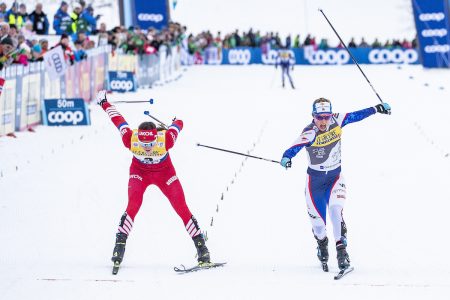
    Jessie Diggins out-toes Russia’s Yulia Belorukova to take third in Stage 5 of the Tour de Ski. (Photo: Fischer/Nordic Focus)

    At the top of the ranks, Jessie Diggins (USST/SMS T2) finished the 2019 season 6th in distance and 7th in sprint. It was a year of navigating the life of a gold medalist whose training time was suddenly competing with travel, media attention, and collaborating with sponsors. According to her blog, she packed in 25 events in the first 50 days after the Olympics. Diggins admitted this swell of opportunities also left her feeling mentally and physically fatigued during the season.

    That said, you know American women’s skiing has come a long way when feeling flat leads to finishing 6th overall in the World Cup Standings. Diggins won the freestyle sprint in Cogne, Italy and took 3rd in the 10 k skate in Falun, Sweden. She also placed third in three stages of the Tour de Ski and skied the fastest time of day during the 10 k skate pursuit in Oberstdorf, Germany.

    Presuming Diggins achieved her goal of finding a work-life balance that allowed her to better recover and absorb training, we can expect her to consistently remain one of the top athletes on the World Cup.

    One thing is certain: The Minneapolis World Cup race on March 17th features a freestyle sprint, and Diggins will be racing in front of a home crowd amidst a cacophony of cowbell.

    Another consistent performer, Sadie Maubet Bjornsen (USST/APU) finished 8th in the sprint standings and 13th in the distance. She took third in the freestyle sprint in Lillehammer, NOR and cleaned up at the Super Tour Finals winning the freestyle sprint and both distance races. Another testament to how high the standard has been set for the American women, Maubet Bjornsen’s season was not particularly novel, despite consistently measuring up as one of the best all-around skiers in the world. We have come to expect her to perform, and she continues to meet our expectations. This year we expect no less.

    Leading the American women on the short track, Sophie Caldwell (USST/SMS T2) finished the season ranked 4th in the overall sprint standings. Caldwell took second place in Davos, Val Muestair, and Lahti, and landed inside the top ten an additional three times. After posting the second fastest qualifying time in the World Championships in Seefeld, AUT, Caldwell was eliminated in the quarterfinals after throwing her boot across the line a three-way photo finish. Because the heat was slow and she was deemed third, she was unable to advance.

    Julia Kern (L) and Sophie Caldwell after finishing fourth place in the team sprint
    (Photo: Garrott Kuzzy / LumiExperiences.com)

    Julia Kern (USST/ earned her first Period 1 starts as the overall SuperTour leader in 2019. The 22-year-old also displayed her readiness to race at the World Cup level by scoring points in five events. Her best individual performance came during the freestyle sprint in Cogne, ITA where she finished 11th. She also battled for a gritty fourth place result while racing with Caldwell during the Dresden team sprint, and shone at US Nationals earning two sprint podiums.

    Racing fearlessly with the best in the world, Kern cracked the top-20 in the skiathlon in Seefeld, finishing 19th. She also finished 23rd in the freestyle sprint two days prior. With another year of training and experience under her belt, Kern will certainly be worth following.

    After recovering from mono, Rosie Brennan rebounded with a phenomenal season in 2019 and consequently was nominated once more to the U.S. Ski Team. Last year, Brennan blew through Period 1 with a vengeance, placing inside the top 30 and mostly within the top 15 in all of the distance races she entered. She cracked the top-10 in the 10 k skate in Davos, with a career best sixth place, and again in the skiathlon when the competition was at its peak in Seefeld.

    The remainder of the women starting in Ruka who earned discretionary selection includes: Caitlin Patterson (USST B Team/CGRP) who landed inside the top 30 in the 10 k skate in both Lillhammer and Ulricehamn, SWE, Hailey Swirbul (USST B Team/APU) who stood on the podium after three Opa Cup distance races and landed inside the top 10 at U23 World Championships, and Rosie Frankowski (APU) who finished 24th during the skiathlon at the World Ski Championships in Seefeld.

    The second weekend of racing in Lillehammer features a distance pursuit, followed by two sprint events in Davos, SUI and Planica, SLO. These women will be able to focus on the races that best suit their strengths in Period 1.

    Before heading to the American men’s field, FasterSkier sends well-wishes to Hannah Halvorsen who was slated to contest the Period 1 sprint races. Halvorsen was struck by a car while crossing a street in Anchorage on November 1st, fracturing her skull and badly injuring her left leg and knee. According to her father who posted information on Facebook, Halvorsen will have a long road ahead of her, but doctors are optimistic that full recovery will be possible. FasterSkier wants to respect the privacy of the Halvorsen family, but will report when they are ready to share further information.
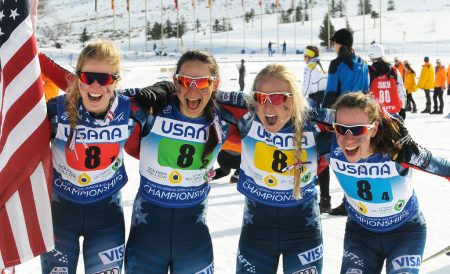
    The U.S. women’s relay after taking a historic third in the 4 x 3.3 k relay at 2017 Junior World Championships on Sunday at Soldier Hollow in Midway Utah, with (from left to right) Hailey Swirbul, Julia Kern, Hannah Halvorsen, and Katharine Ogden. (Photo: U.S. Ski Team/Tom Kelly)

    Deep breath. Back to the World Cup.

    Of the eight men who made the cut, three were selected objectively: overall 2019 SuperTour leader Kyle Bratrud (SMS T2), and USST A Team members Simi Hamilton (USST/SMS T2) and Erik Bjornsen (USST/APU).

    Returning with a wealth of World Cup experience, Hamilton is a consummate contender in sprint races. His most noteworthy performance was aptly timed at the World Championships in Seefeld where he finished ninth. Hamilton advanced from the quarters in a lightning fast heat, then got hung up with another skier in the semi, losing both his momentum and contact with the leaders. On home turf, Hamilton also won the freestyle sprint during the SuperTour finals.
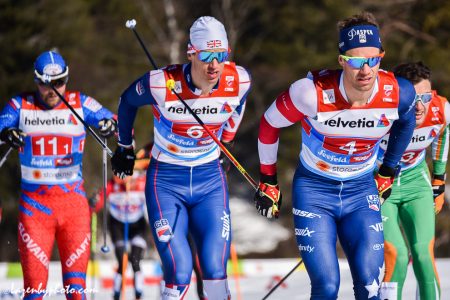
    American Simi Hamilton (r) leading Great Britain’s Andrew Young during the 6 x 1.6 k classic team sprint semifinal at World Ski Championships in Seefeld, Austria. (Photo: John Lazenby/lazenbyphoto.com)

    Before World Champs, Hamilton had a strong performance in Cogne, finishing just off the podium in 4th. Displaying the agility and sure-footedness for which he is known, Hamilton dodged a crash in both the quarter and semifinals. This race marked a turning point in his season as crashes and illness prevented him from capitalizing on the fitness he felt confident he possessed. When the pieces come together, Hamilton is both a force to be reckoned with and a thrill to watch.

    After popping the third fastest time of day during the 15 k classic pursuit in Lillehammer, Bjornsen has been promoted to the USST A-Team. Last season, Bjornsen whittled his way up the results list, particularly in distance racing. He finished 16th the 15 k classic Cogne, followed by a 17th place finish in the same event in Seefeld. Are you noticing a theme here?

    Once again in the 15 k classic in Quebec City, Bjornsen finished 18th followed by a second top 20 (19th fastest time of day) in the subsequent 15 k skate pursuit. At the SuperTour finals, Bjornsen took the win in both the distance races and finished second in the freestyle sprint, demonstrating his versatility as an athlete.

    Bratrud’s lead in the SuperTour was primarily garnered through strong results in distance skiing, which also translated to encouraging results on the World Cup. The Minnesota native stood on the podium six times in NorAm and SuperTour distance races, taking the top spot in four of them. At US Nationals, he won the the 15 k classic and took second in the 30 k skate. During his mid-winter international stint, Bratrud landed inside the points in the 15 k classic in Cogne. This will be his first season racing on the World Cup in Period 1.

    The remainder of the men to watch in Period 1 include Scott Patterson (USST/APU) and David Norris (APU), who will be focusing on distance racing, and Kevin Bolger (USST/SVSEF) and Logan Hanneman (APU) who will focus on sprint events. Hanneman will not start in Ruka, but plans to compete in both Davos and Planica.
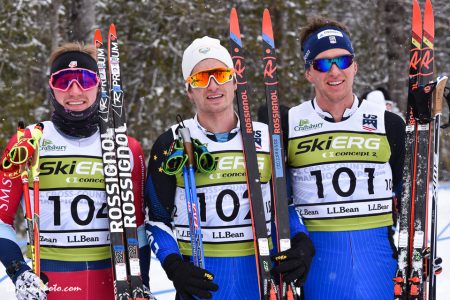
    The men’s podium from the 30 k skate mass start at U.S. Nationals in Craftsbury, VT. From left to right, Kyle Bratrud (SMS T2) second, David Norris (APU) first, and Scott Patterson (APU/USST) third. (Photo: John Lazenby)

    Several athletes who were offered starts in Period 1 declined to focus on the SuperTour. This list includes Kelsey Phinney (SMS T2), Andy Newell, Adam Martin (CGRP), and Ben Saxton (SMS T2).

    Phinney underwent shoulder surgery in mid-June for a torn labrum, which occurred from a fall with an outstretched arm. He doctors estimated a six to twelve month recovery process. Phinney spent six-weeks in a shoulder sling, then began to slowly reintroduce strength training and outdoor activities. So far, she has done some no-pole and one-pole skiing.

    “My biggest priority is making sure my shoulder heals properly and gets back full range of motion,” wrote Phinney in an email on her return to competition. “I’m not sure when I’ll be back to racing, perhaps later this season if things go really well with rehab. In the meantime, I’m enjoying time at home in Boulder – it’s been nice to see friends and family here, and to explore life outside of the bubble of training and racing. And then in a couple weeks, I‘ll be at the first SuperTour races of the year to help my SMST2 team out with ski testing, driving around, and cheering very loudly! I’m hoping to start using two poles in the next few weeks, and ideally I’ll be able to ski quite a bit in Canmore and Sun Valley and see where I can go from there!”

    Canada

    Overall in Nations Cup Last Year: 11th

    Women’s Ranking 2018/2019: 15th

    Men’s Ranking 2018/2019: 9th

    Canadians to Watch:
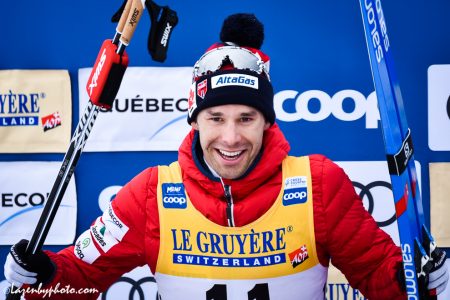
    Alex Harvey takes in the cheers after placing second in the men’s 15 k classic in Québec City. (Photo: John Lazenby/lazenbyphoto.com)

    Canada’s top skier, Alex Harvey, retired at the end of the 2019 season. He ended his career on a high note. He finished second in the 15-kilometer freestyle pursuit in his home city of Québec. Fellow national team member Lenny Valjas retired also retired at the end of last season.

    Three Canadians will be heading to Europe to race during Period 1 in Davos and Planica: Dahria Beatty, Emily Nishikawa, and Russell Kennedy. These athletes will then return home to train with developing national team athletes and compete in NorAm races. Canada will not be contesting the Tour de Ski. Should one of these athletes pop a top ten in those Period 1 races, the decision not to return in Period 2 may be reevaluated.

    This focus on domestic racing and development of world class athletes is part of a larger movement to rebuild the Canadian national program, which recently rebranded as Nordiq Canada. You can find more information on this here.

    Beatty posted strong results in 2019. She started her season with a slew of NorAm wins then collected a handful of FIS points by finishing 16th in the freestyle sprint in Dresden and 24th in the same event in Lahti. She also won the 15 k freestyle pursuit at the Canadian National Championships, chasing down Nishikawa who had won the 10 k classic the previous day. In her season opener at Nordiq Thunder, Beatty landed the top spot on the podium in the 16 k skate and commented that she was happy with her overall fitness and how her training has progressed this year.

    Nishikawa also scored FIS points in 2019 by finishing 23rd in the 10 k skate in Davos. She also placed 25th in last season’s Tour de Ski.

    Kennedy, who has already gotten his feet wet with European racing this season in Olos, Finland, posted his best result during the freestyle sprint in Cogne, where he popped a 12th place finish. Domestically, he landed on the podium in five NorAm races.

    The remaining members of the Canadian National Team who will be racing domestically include Julien Locke (Nelson, B.C.), Katherine Stewart-Jones (Chelsea, Que.), Graham Ritchie (Parry Sound, Ont.), Antoine Cyr (Gatineau, Que.), Sam Hendry (Canmore, Alta.), and Julien Smith (Thunder Bay, Ont.).

    “This group is ready to step up and carry the torch for a new era of cross-country skiers in Canada,” said Shane Pearsall, chief executive officer of Nordiq Canada in a press release. “They are equally as fierce and determined to deliver medal winning performances as their heroes before them. We are going to work with our sport and funding partners to deliver this dynamic group of athletes the tools they require to succeed on the road to 2022 and beyond.” The site https://x100casino.com contains the best 100 online casinos in the world
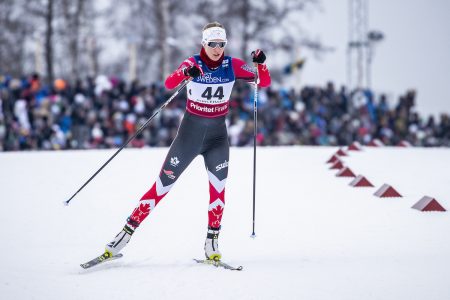
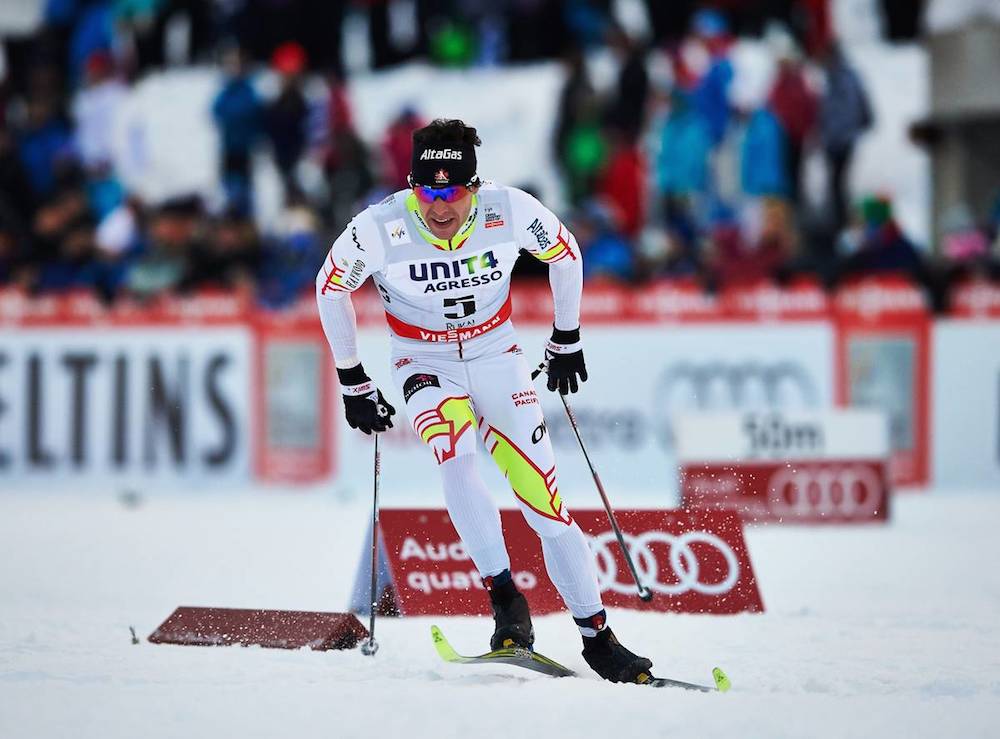
    Dahria Beatty on course during the 10-kilometer skate in Ulricehamn, Sweden. (Photo: Fischer/Nordic Focus)
  • Harvey, Kershaw Exceed Expectations in 7th, 14th in Kuusamo 15 k

    Harvey, Kershaw Exceed Expectations in 7th, 14th in Kuusamo 15 k

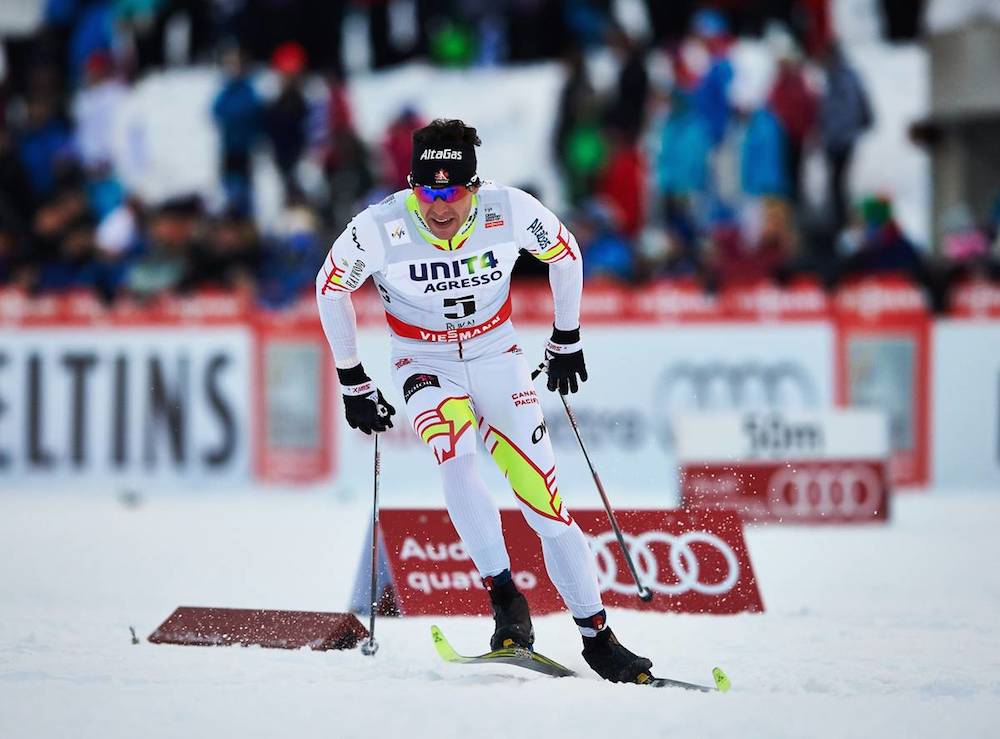
    Alex Harvey (Canadian World Cup Team) racing to 14th in Saturday's classic sprint at the World Cup opener in Kuusamo, Finland. (Photo: Fischer/Nordic Focus)
    Alex Harvey (Canadian World Cup Team) racing to 14th in Saturday’s classic sprint at the World Cup opener in Kuusamo, Finland. (Photo: Fischer/Nordic Focus)

    Alex Harvey made it clear heading into the World Cup opening weekend in Kuusamo, Finland, that he had one main goal — to ski into the points. That meant the top 30, which he checked off on Saturday after placing 14th in the classic sprint. On Sunday, the 26-year-old Canadian came out with a similar attitude and ended up seventh in the 15-kilometer classic, 27.8 seconds behind the winner, Iivo Niskanen of Finland.

    Aim low, finish high? Not exactly. Harvey was simply being realistic.

    “Any time I start a race, I want to be on the podium obviously,” Harvey said on the phone after Sunday’s race. “But I know at the same time that I have no podium in my life before Christmas.”

    In Kuusamo, he had achieved as high as seventh three years ago in the 15 k classic pursuit, when the race was part of the Ruka Triple mini tour. That same year in 2011, he placed fifth in a 15 k skate in a tuneup FIS race the weekend before in Sjusjøen, and in 2010, he was ninth in Kuusamo’s skate sprint. But other than those results, Harvey said he historically has struggled to find his speed early in the season.

    Last year at the Ruka Triple, he was 38th in the classic sprint, 30th in the 10 k classic and 48th in the 15 k freestyle pursuit for 42nd overall. So yeah, seventh and 14th this time around was welcome improvement.

    “I was just really trying to be in the points, get things going, like, start the engine, and get some good feelings on skis,” he said. “After the sprint, I knew the speed was there, usually that’s the biggest issue for me, so I knew with the speed being there, my guess would’ve been probably a top 20, top 15, like after [Saturday], so that exceeded a bit my expectations.”

    Harvey started toward the back of the pack — 88th of 96 men — and by the 8.1 k checkpoint, he was into the top 10.

    “I actually tried to start a bit harder than normal,” he said, after posting the 14th-fastest time though 3.1 k. “I’ve been working on that for four years now. I know I can have one of the best last 5 k compared to anybody else, but it’s always on the first 5 k that I seem to lose a lot of time.”

    He said 14th early on was, “pretty much as good as it gets. After that I was able to slowly make my way up the field, and I was able to have a really solid last lap.”

    At the finish, Harvey was sixth, only to be bumped one place by eventual-second-place finisher Martin Johnsrud Sundby of Norway. Last season, Sundby topped everyone for the Overall World Cup crown, and Harvey finished 2013/2014 out with a career-best third overall.

    (Photo: Angus Cockney)
    Devon Kershaw at the Frozen Thunder classic sprint on Oct. 24 in Canmore, Alberta. After placing 57th in Saturday’s sprint in Kuusamo, Finland, he shaved his beard. (Photo: Angus Cockney)

    Kershaw Up to 14th

    Another Canadian well up into the points on Sunday was Devon Kershaw, who was 57th in the sprint qualifier the day before after struggling a bit with grippy skis. Kershaw finished 14th, 42.1 seconds back from the winner, in what he called his favorite race: the 15 k classic.

    But Kuusamo has never been an easy place to start: last season, he was 77th in the sprint, 64th in the 10 k classic and 65th overall after the 15 k pursuit. In 2012, he finished the mini tour a much-better 22nd, and his best result before that was eighth in the 2011 15 k classic pursuit.

    The course itself is widely considered one of the most brutal on the World Cup (although Canadian World Cup coach Tor-Arne Hetland said there are no easy courses on the circuit), and on Sunday, racers had to tackle three massive hills each lap.

    On top of that, Kershaw noted that North Americans, which typically have a season-long World Cup team in place at the start of the season, have to compete with Europeans vying for a spot on their respective nations’ World Championships teams every weekend.

    “It seems like Period 1 is always very difficult because the big teams are vying for spots … They can’t afford to put the focus on later in the season like I’ve been able to do my whole career as a Canadian,” he said. “So it’s a very difficult course, coupled with guys that are very well prepared. It’s always a hard place to be. If you’re a little bit off in Kuusamo, it looks worse than it is maybe.”

    Fortunately, he was firing on “normal” cylinders on Sunday.

    “I’ve made some significant changes in my training and been feeling really good about the preparations we’ve been doing and been feeling good in workouts, but you know, it doesn’t mean much if you can’t deliver with a race,” Kershaw said with a laugh. “To ski smooth and have a really solid race, it feels really good, and it’s just confirmation that I made the right changes, at least I believe I did, and we’ll just have to see moving forward. Not feeling amazing, amazing on the steep terrain, but it’s very rare that I ever have. It was very good compared to the last couple years.”

    He added that he was most pleased with his first and last laps, and said he “fell asleep a little bit” on some of the steeper climbs in the middle. Starting 50th, he finished sixth and dropped to 14th, but he expected that.

    “The splits didn’t really tell me a whole lot today … like, 28 of the best distance skiers in the world were behind me,” Kershaw said. “But I knew of course getting splits like that meant I was starting faster like I wanted and I had good snap.”

    His 3.1 k time ranked ninth fastest at the end of the day, and he hovered around 24th at 8.1 k and was back up to 13th with 2 k to go.

    “The flatter sections, the double-poling sections and the gradual sections, in my whole career that’s where I’ve been the strongest,” he explained. “I was feeling right back to normal on that terrain and the steeper hills, the first hill, I’ve still got work to do [there]. I felt like my technique was slipping a bit on that terrain, but my skis were very good today and I was super happy with what the boys put together for me. We did a good job testing [skis] after [Saturday] so we adjusted really well.”

    Ivan Babikov (Canadian World Cup Team) finished 57th, and Graeme Killick (Canadian Development B-Team) was 71st.

    Another national-development-team skier, Emily Nishikawa notched her best World Cup result in Europe, placing 38th in the women’s 10 k classic. Two years ago in Canmore, Alberta, where she lives and trains with the Alberta World Cup Academy, she placed 34th in the World Cup skiathlon.

    “I was really happy with my race today!” Nishikawa wrote in an email. “I started out a little slower, that was the plan, to really ramp it up in the 2nd half, and I was able to do that.”

    Skiing around 60th for the first half of the race, she jumped to 40th by 8.1 k and closed for 38th, 2:43.9 minutes behind Norwegian winner Therese Johaug.

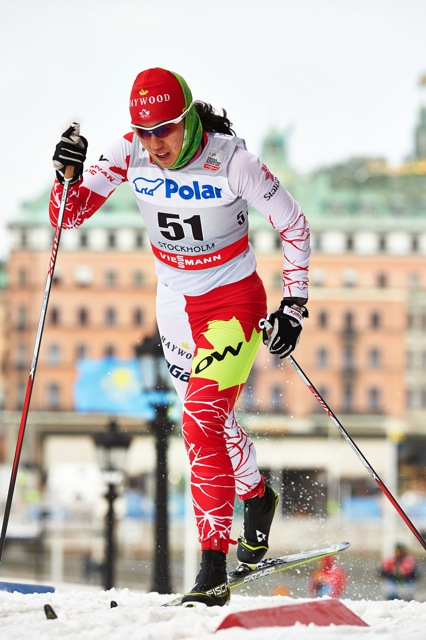
    Emily Nishikawa racing in Stockholm last March. (Photo: Fischer/Nordic Focus)
    Emily Nishikawa racing in Stockholm last March. (Photo: Fischer/Nordic Focus)

    “I caught some great rides from [Finland’s] Aino Kaisa Saarinen, and [Poland’s] Justyna Kowalczyk [who ended up fourth],” Nishikawa wrote. “I was really happy to hang on to Justyna for the last 4 km. I lost a few seconds to her on the last climb into the stadium, but I was really happy with the way I skied.

    “I am really looking to build off this great start to the season,” she added. “I know I can get into the top 30, I was close today, and that really motivates me for the next race.”

    After the first World Cup weekend in his first season with the team, Hetland was generally impressed.

    “For Emily, a personal best in the World Cup, that’s a good start for her,” he said on the phone Sunday. “That she could ski together with Aino Kaisa Saarinen, with Kowalczyk on the track, that’s a good race for her. For the boys, of course the results from Alex have been very good and also the 15 k from Devon today was also good.”

    “Ivan was a little bit under his best level in the race today, but he will be improving to the next weekend,” Hetland added.

    Babikov posted the 45th-fastest time at 3.1 k, and by 8.1 k, he was up to 37th.

    “In the start he lost a little bit time and then he had a good part in the middle and was climbing on the result list,” Hetland observed. “But on the last hill, he broke a pole and lost a little bit of time. He would have been somewhere between 29 and 45th if that didn’t happen. He will be better when he gets some more races.”

    Looking at the rest of the team, Hetland said Valjas, who missed qualifying in the sprint in 39th, was close to the heats, but not quite fast enough. “But it’s easy,” he said. “Also I think [Killick] will need some more races on this level before he’s on his best level, and he will get new chances on the next weekend.”

    Canada’s other male development skier in Europe, Jess Cockney raced at the Norwegian Cup this weekend, placing 13th in the classic sprint and 39th in the 10 k classic. Perianne Jones (Development B-team) was 48th in the women’s sprint.

    “I think it’s good racing, but there is potential for racing faster so we will keep on working hard,” Hetland added. “Now we have to reset and preparing for Lillehammer and then we will do as good as possible there.”

    Kershaw said it’s been helpful to talk with Hetland about realistic expectations and not get too wrapped up in past results — or overall finishes, like when he ended up second in the 2011/2012 World Cup.

    “I feel the funniest thing with skiing, or even with anything, is you’re kind of, or I tend to, compare myself to the best I’ve ever been — and the best I’ve ever been was the best in the world,” Kershaw said with a laugh. “It’s so unfair because the last few years, I’ve been off that mark. I’ve been talking a lot with T.A. about that, just to build through the season and not get down on myself and really focus on the process.”

    “What the past [was] is not so important,” Hetland said. “We’re racing now and what is the slogan this year? ‘This is our time.’ So we are concentrating on the races this year and we will try to improve for each weekend now. The races have been very good and the team has been performing well. Of course there is somebody that is happy with the results and some that are not so happy.”

    Results: Men | Women

  • No Longer Skiing’s Most Eligible Bachelor, Ellefson Ramps Up Training

    No Longer Skiing’s Most Eligible Bachelor, Ellefson Ramps Up Training

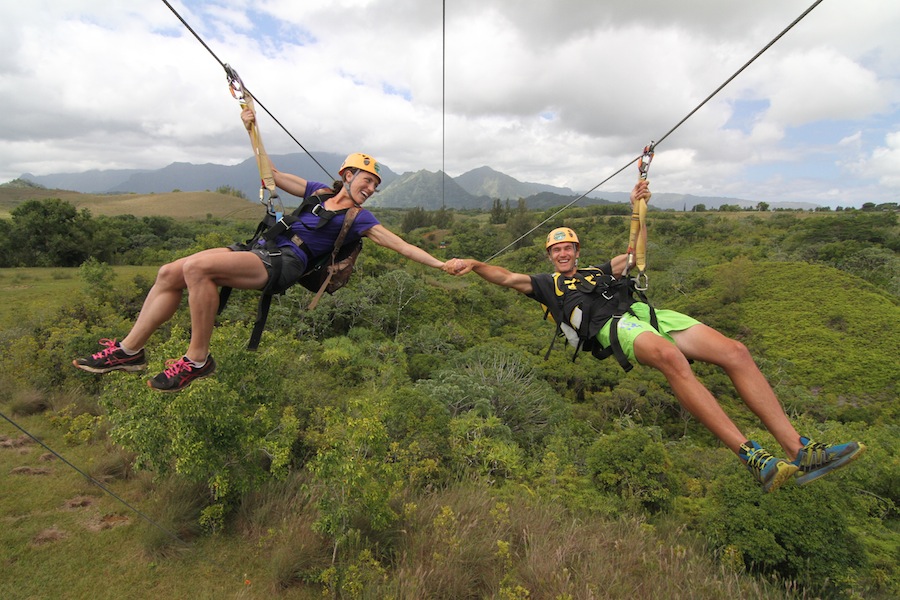
    Sarah and Sylvan Ellefson showing the love while on a zip line in Kauai, Hawaii, during their honeymoon earlier this month. The two were married Aug. 11 and spent eight days in Hawaii immediately after. (Sylvan Ellefson courtesy photo)

    Thousands of miles from the U.S. mainland on the northern island of Hawaii, Sylvan Ellefson tweeted photos from his honeymoon in Kauai. He posted the first the day after arriving with his new wife, Sarah Ellefson, formerly Wright.

    “Lounging after a casual 3hr waterfall run,” wrote Ellefson, the 25-year-old defending SuperTour champion.

    Friends and family tweeted back in retaliation. Training? They should be relaxing for crying out loud! Ellefson responded two days later.

    “She made me,” he tweeted. “All I want is another Piña Colada.”

    Sylvan and Sarah Ellefson (formerly Wright) on their honeymoon in Kauai, Hawaii. (Courtesy photo)

    Between kicking back at luaus and happy hour, riding zip lines and exploring a 4,300-acre ranch on four wheels, Ellefson and his bride enjoyed plenty of R & R on their eight-day getaway. The two were married Saturday, Aug. 11, at a lakeside ranch near his hometown in Vail, Colo., and left for Kauai the following Monday.

    Slightly more than two weeks later, Ellefson was back home resting before an interval session with his Ski and Snowboard Club Vail (SSCV) team. That morning, he ran 30 minutes, did 1 ½ hours of strength and an hour double pole.

    “It’s been a big day,” Ellefson said on the phone Monday afternoon.

    But he was ready to get back at it since arriving home a few days earlier. Once back in the U.S., the Ellefsons headed to Minnesota, where Sarah – a former University of New Hampshire skier – is from. Then they went to Boulder, where Sarah lives while studying physical therapy, to watch the USA Pro Am Cycling Challenge last weekend.

    “I’m jazzed to be moving around again,” Ellefson said. “The wedding week was pretty crazy and then the honeymoon was nice and relaxing, kind of.”

    He laughed.

    Here’s the rest of FasterSkier’s interview with Ellefson, which details everything from the wedding-day downpour to what the Colorado native and World Championships hopeful has planned for this season.

    ***

    FasterSkier: Now that you’re a husband, how do you feel?

    Sarah and Sylvan Ellefson were married Aug. 11 at Piney River Ranch near Vail, Colo. (DavidLynn Photography)

    Sylvan Ellefson: Totally different. I feel like a whole different person. No, I’m kidding. It doesn’t feel any different at all other than I’ve got this hunk of metal on my finger. I keep playing around with it, I’m sure I’m going to lose this thing here.


    FS: Tell me about the wedding. How did you decide to get married there and how did it go?

    SE: We got married at the Piney River Ranch. It’s north of Vail, half an hour by dirt road. We originally wanted to [get married] at the top of Vail Mountain, which is where my parents got married, but then Sarah’s mom came into town and I told them to go check out this one other place just to see if they wanted to do that. They went up to Piney River Ranch last August, I think it was, and checked it out and I’m pretty sure we booked it that same day that they went up there.

    Everything [the ceremony, reception, etc.] was up there. It started at four, and it was super nice when we got up there. The clouds were kind of moving around the mountains … and then right before the wedding was supposed to happen, we started the procession and everyone was outside on the wedding deck. It started raining a little bit, and then the rain started coming down pretty hard and people started opening umbrellas. All of a sudden it was a torrential downpour and then it started hailing (laughs). It was crazy. Everyone went back into the dressing rooms and everything, and we had to talk to the ranch owners to figure out what we wanted to do. We looked at the clouds coming, and it just looked like it was going to be some kind of pretty crazy weather.

    We ended up having a super-intimate wedding; it was actually really nice. We moved everybody in under the covered area. The lake that was behind us started steaming because of the contrast of the hail and the air and everything. The backdrop was really cool, and obviously I didn’t get to see it because I was looking right at Sarah and the crowd the whole time.

    Sylvan and Sarah Ellefson (center) celebrate their marriage with their wedding party at Piney River Ranch on Aug. 11 near Vail, Colo. (Courtesy photo)

    [Note: The rain stopped after the ceremony and the skis remained clear all night.]

    We did the wedding there and then everyone ate and we danced for a bunch of hours. We had a bonfire and a keg back behind the camping area, right behind where the wedding was, and we just hung out around the fire until two in the morning. It was super fun and everyone that was up there camped and then cruised down the next morning. We stayed in a cabin that was up there.

    The next morning we woke up and kind of cleaned everything up and Sarah and I rode down the dirt road back into Vail on this tandem mountain bike. It’s probably like eight or nine miles to Piney River, but it’s a really bumpy dirt road.


    FS: How was Hawaii?

    SE: We had an awesome trip. We were literally at our hotel maybe five percent of the whole time we were in Kauai. … We got in really late the first night and then the next morning we met with the concierge to kind of figure out what we wanted to do, and it was basically, like, bam, bam, bam, everything after that. Right after that we went for that three-hour run up to a waterfall. That night we went to a luau. The next morning, we went zip lining for a half day and then we found a swimming hole and chilled there for a while. We had to go hit up happy hour at the bar that afternoon, otherwise we were paying like 12 dollars per drink (laughs).

    Newlyweds Sylvan and Sarah Ellefson spent a day and a night at Kauai Ranch in Hawaii, where several movies like Tropic Thunder, Dragonfly and The Descendants, were filmed. They explored on a four-wheeler and stayed in a yurt. (Courtesy photo)

    Probably the coolest part of the whole honeymoon, though, was we went to this ranch called Kauai Ranch and it is the ranch where, like, “Tropic Thunder” and “Dragonfly” and part of “The Descendents” was filmed. We stayed at this really sweet little canvas yurt-tent. It was like this [4,300]-acre ranch and we went an explored it running one morning and then we got to use this four-wheeler vehicle, the Gator, for another five hours in the afternoon and we didn’t even cover all the trails that were on the ranch.


    FS: Did you rest at all?

    SE: Oh yeah. We probably slept, like, nine hours a night. It was nice. Leading up to the wedding it was, like, five hours, six hours, five hours, five hours.


    FS: When did you and Sarah get engaged and how did you meet?

    SE: We got engaged last July 22. We met at Carnival Crush, you know that little tradition that the East-coast skiers have on Valentine’s Day? Sarah gave me a live goldfish when we were juniors in college and it kind of just sparked after that. I think that was four and a half or five years ago. She said it was our first pet together. I didn’t know how to take that. I think she was joking, but I took her seriously, so jokes on her!

    Sylvan and Sarah Ellefson take to the dance floor at their wedding on Aug. 11 at Piney River Ranch. (Courtesy photo)


    FS: And you two recently had dinner with Kikkan?

    SE: I had no idea she was going to be in town and she texted me last Thursday night [Aug. 23], like, ‘Hey I’m in Vail. We should catch up, grab some food or something.’ And I was like, ‘Yeah, Friday night.’ It was good to see her because I haven’t seen her before we left Spring Series.


    FS: Whom have you mostly trained with this summer?

    SE: [In] May, I did the Bend camp, and then a couple weeks later we came back to Bend with the junior team and a couple post-grad students and the Bend locals, like [XC Oregon’s] Ollie Burruss and Matt Briggs were there, so I trained there for about half of June.

    When we came back I mostly trained with a lot of the junior and then the college guys that are here for the summer, like Conor Wallace and Sean Woods and Tony Ryerson. Actually [SSCV nordic director] Dan [Weiland] and [head coach] Eric [Pepper] have been getting out on the rollerskis quite often this summer so they’ve kind of been training partners as well. And then Cal Deline and Parker McDonald, Christian Shanley, all those juniors.

    [Team HomeGrown teammate] Ryan Scott was here for a week in July right before the wedding, and we had a good training week together. I just missed [U.S. Ski Team members and Homegrown teammates] Tad [Elliott] and Noah [Hoffman]. They came right after the wedding when I went to Hawaii. I think they did a bunch of skiing with the juniors here and the other college guys.


    FS: How’s training gone so far?

    Sylvan Ellefson (front) joins the Ski and Snowboard Club Vail junior team in Bend, Ore., for an on-snow camp this past spring. (Courtesy photo)

    SE: Training’s actually been really awesome this summer. I think it’s always really great to kick it off with training in Bend in that May-June period. To be on snow that early in the season is kind of exciting instead of being on rollerskis and getting in the habit for the entire summer it’s fun to be able to ski on snow. You’re still kind of used to it. And then come July, you’re just starting to pick things up. I did a lot of running races and biking races this summer and those have been going pretty well and it’s fun because we have a pretty competitive local race series for [trail] running and [mountain] biking, so I’ve been doing those.


    FS: You blogged about placing third for the first time in a pro mountain bike race in July. Was that a goal of yours?

    SE: It’s a pretty competitive race series. A lot of the guys actually do race pro and race around the U.S. and I scored a third place in one of the races. I was pretty psyched for that because I’m usually like fourth every time.

    If I train biking, it’s more like a recovery thing and if I do the bike races, it’s more of an intensity spot. For me, it’s good to keep that race vibe going to make sure I get that race feeling every now and then, and I don’t totally forget before the first race pops up at the beginning of the season.


    FS: How does your training plan this summer compare to last year?

    SE: Basically when I was over in Europe, I definitely got my butt kicked, which I think was good and bad. It kind of sucks to get your butt kicked sometimes, but it’s also a really good learning experience.

    Every time I felt like there was something I could work on, I wrote it down and sent it to Eric and Dan and we compiled a list of things to work on this summer to help me get ready for the upcoming race season. It ranged from doing more double-pole sessions to changing up our intervals a little bit, like, changing formats of races like having the preems. We’ve been doing a lot of intervals where we switch from just Level 3 and just Level 4 to doing a Level 3 piece with some Level 4 in between and then dropping back down to L3 and bringing it up again.

    I noticed in a lot of the mass-start races, you can see on TV the front of the pack is usually so calm and collected. When you’re in the front, you get in a really good rhythm. I was watching all these races I was in on the World Cup last year, seeing these guys up front it just looks like it’s so easy. What they don’t show is in the back, it’s just nuts because it’s all the people who are probably racing a couple of their first races or whatever and they’re just really stressing out, me included. They’re trying to get a good spot and it requires more energy to ski at the back of the pack, especially in the beginning of the race. Until I start skiing better, I’m not going to be at the front of the pack so I need to kind of adjust to that back-of-the-pack skiing. For me, that was being able to, maybe fresh off the bat, hold onto like a Level 2 or even a Level 4 pace and then dropping back into a threshold pace without totally going under, being able to recover from it.


    FS: How are you feeling heading into this season?

    SE: I think my confidence going into this year is much better, which will be good. I’m not going to lie, lining up when I was in Rybinsk for my first mass start, looking at the people that I was lined up next to it was like, ‘Holy crap, these are all the people that I’ve ever watched on TV and now I’m standing next to them.’ Obviously, everybody’s going to have that shock value. I think going into this year, it’s more focused for me on a result more than experience. It’s not in my head that I’m just going to be racing World Cup this year, I want to be racing fast and I want to be getting results.

    I think the first period will be good for me. What qualified me to go over to Europe last year were like 10 and 15 k skate and classic races, and I’m pretty excited to race those first races because I think there’s three 15 k’s and maybe one 10 k. I’m excited about that. I’m pretty excited with how my prologue and sprinting has been going, and then this fall, hopefully I’ll be able to ramp it up a little bit in Lake Placid and Park City and Canmore with these top-tier sprinters in the U.S., Simi and Newell.


    FS: So you’re going to take advantage of a paid-for trip to the World Cup (as the SuperTour winner) and race Period 1 in Europe and Canada? Are you worried about relying on World Cup results to qualify for World Championships, rather than stay home and qualify domestically?

    SE: I wasn’t really sure what I wanted to do. It was kind of a tactical decision because the world champs team is decided off your FIS points, but it’s kind of taking a chance. If I were to race in the U.S. and I was racing as well as I did at the beginning of last season, I would be getting good enough FIS points to bring me to World Champs. On the other hand, I would be giving up and opportunity to go race the World Cup, and I feel like that would be just a wasted opportunity.

    Dan and Eric and I all decided that it would probably be best if I just took advantage of that opportunity. Assuming that I go into the first period as fit as I was last year, then I think me on a perfect day, skiing like I would at the top of my game, would land me a top-30 result, which is something that I’m looking for in this upcoming period.

    The biggest reason that I’ve decided to go over to Europe this first period, I guess it depends on my ultimate goal. My ultimate goal is to progress U.S. skiing and kind of help the U.S. men to get to that next level. I think if I were to stay home that would be a little bit of a disservice to that.

    I’m approaching this season similar to how I approached last season. If I stick to a similar plan just upping my hours from last year, I think that technically my body should react well to it. Hopefully period one shouldn’t be smooth sailing necessarily, but it should hopefully feel good while I’m racing over there. If I’m feeling good, hopefully I’ll be getting that top-30 spot that I want.


    FS: What other goals do you have?

    SE: I would love to get a top 30 on the World Cup. One of my goals is to win a race at U.S. nationals this year and then I guess another goal is just to rank in the top five for both sprint and distance in the U.S. at the end of next season. I think now I’m ranked fourth in the sprint, somehow, and seventh for distance.

    [Note: Last year, Ellefson mostly made the top 60 in his first World Cup starts. He was third in the 15 k skate at U.S. nationals and finished the SuperTour series as the overall winner despite injuring his ankle in Sweden at the end of the season.]


    FS: Looking back at the jump you made last year, what do you attribute your success to?

    SE: I think my change in training and also it was kind of a change in confidence. The previous year, I had won two SuperTour races and just getting that feeling of winning a race is pretty cool. You know who you’re racing and you can beat them or you’re at that level, so you know you have the opportunity to bring yourself up to that next level.

    Actually at the beginning of the [season] last year, I think it was November, I kind of changed [it] up. I never really prepped for a season like I had before last year, and I basically just did more intervals than I ever had the November before. I made sure I gave my body enough time to recover before those first races in Bozeman and West Yellowstone and I seemed to benefit [he won two SuperTour races in Bozeman and was second in two of the openers in West Yellowstone].

    I’ve never skied that well early season so I was a little bit worried about U.S. nationals about how I’d be skiing there, but my body I guess … was fit and skied well. Unfortunately I got sick right after [nationals], and then went to Minnesota, skied well [he was second and third at the Minneapolis SuperTour], but got sick again after that. I was on antibiotics twice in, like, three weeks and I think it took a toll on my body before I went to Europe.

    Then I had a good experience on the World Cup, and I honestly had no idea what to expect when I cam back to the U.S. I was racing every weekend, but I wasn’t able to train that much because I still wasn’t feeling 100 percent. When I came back to Vermont and I stayed with Liz Stephen, I skied, like, once, I went on a run once and then just kind of went into Spring Series without having trained that much, but I think my body held onto a lot of that fitness from the entire winter. My only goal was I really just wanted to get that World Cup spot for the fall, and I tried to race my butt off and ended up getting that spot, which I was super psyched about.


    FS: And now you’re feeling good and the ankle is better?

    SE: It’s great. My PT here in Vail has just done wonders for me. It’s all healed up and all that good stuff now. It’s pretty exciting for me not having to worry about that anymore.


    FS: Next Monday, you wrote that you’re going back to school at Red Sandstone Elementary. What will you be doing?

    SE: I’m a teacher’s assistant at my old elementary school. I go in for about 2-3 hours everyday when I am around. 4th graders. It’s super fun!

    ***

    While Ellefson took care of business in Craftsbury, Vt., where he clinched the overall SuperTour title in late March, he also had some fun while staying at the home of his friend and U.S. Ski Team veteran, Liz Stephen. Her father helped film the following, and if you’re really into their music video, Ellefson said “The Bland” has another one coming soon.