From the FasterSkier archive — posts syndicated from athletes’ and coaches’ own blogs between 2004 and 2012, kept online as published. Current coverage is at fasterskier.com.

Tag: peter graves

  • A Glimpse Inside the Tokyo Olympic Bubble with Peter Graves

    A Glimpse Inside the Tokyo Olympic Bubble with Peter Graves

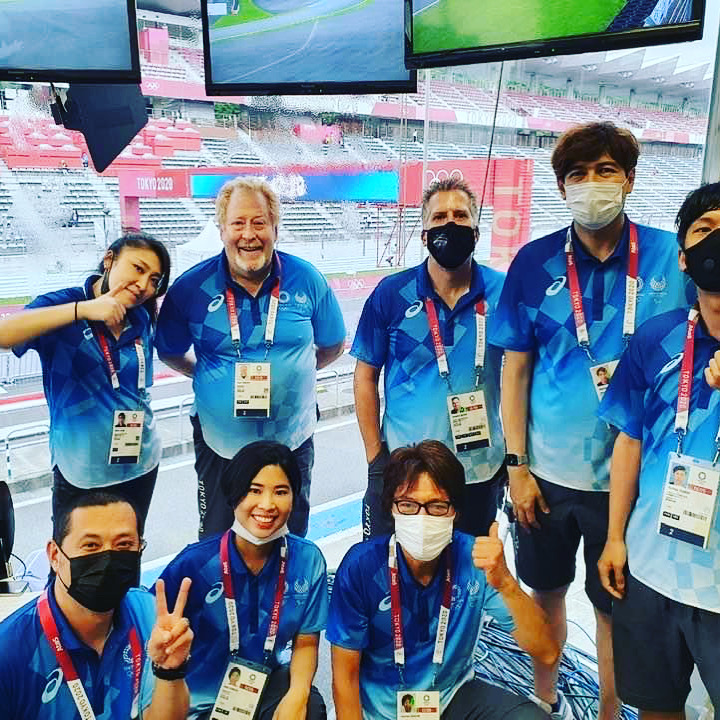
    The cycling announcing/production team at the Tokyo 2020 venue near Fuji International Speedway (Courtesy photo.)

    Most FasterSkier readers will be familiar with the name Peter Graves, also referred to as the voice of cross country skiing (and incidentally, the author’s uncle). This summer, Graves lent his voice to the cycling venues near Tokyo for the 2020-turned-2021 Olympic Games. For Graves, this marks his twelfth time announcing at the Games, including summer and winter appearances. Needless to say, he has a wealth of experience.

    FasterSkier connected with Graves on a recent call to understand how the coronavirus pandemic may have affected this year’s games, and what insights the Tokyo Games might provide for the upcoming Winter Games in Beijing in February 2022. 
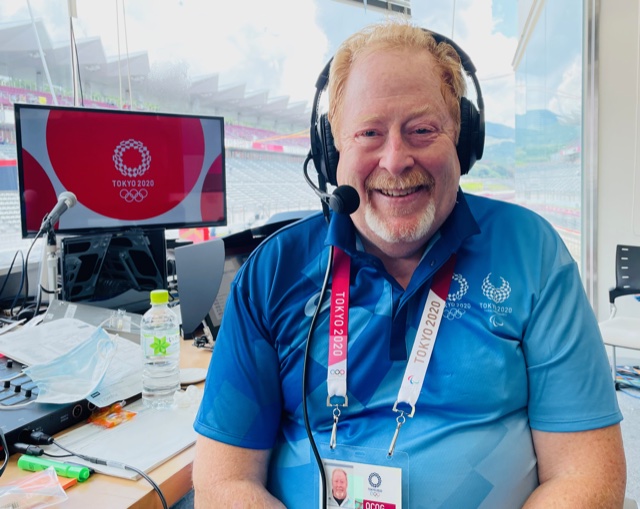
    Peter Graves in the announcers booth, Tokyo 2020 (Courtesy)

    Graves was quick to highlight the great announcing and production team he worked with and the graciousness of the host country, Japan. “They ran great events,” he said, “I think they did a truly remarkable job under a very difficult set of circumstances.” For context, the Tokyo Games drew roughly 11,091 athletes from 206 participating countries, and over 770,000 COVID tests were conducted from July 1st onward. Of those tests, the cumulative total of positive COVID cases (including airport tests for Games participants and Tokyo 2020 screening tests) came to 567, with three additional positives coming fourteen days after leaving Japan. Graves called this, “a very admirable record,” all things considered. 

    Graves was in Japan for ten days, announcing at the road and time-trial cycling events. To fans watching from home, a stark difference this year was the lack of spectators at most events. However, cycling was one of the three venues that allowed socially distanced spectating and particularly during the road race, Graves noted that there were lots of spectators along the road where he “saw a lot of joy of free people sharing the Olympic spirit.”

    For Graves, this year’s games were a very different experience than past years, particularly socially. His first Olympic announcing appearance came in 1980 during the Lake Placid Winter Olympics, at the cross country skiing venue, which Graves describes as “the last of the smaller, more intimate games.” (Lake Placid at the time had a population of just 2,490.)

    Reminiscing about the “joie de vivre” of the main street, which was turned into a pedestrian zone for the Games, Graves described the tradition of trading Olympic pins, another strong memory from Lake Placid and other games. “I have a collection of probably 3,000 pins from over the years and I love trading but I just didn’t see any of that [in Tokyo]” said Graves. “I brought a lot of pins to Tokyo and didn’t trade a single one because there was nobody to trade with!”

    Being “in the bubble” meant that Graves and his team were tested for COVID everyday. Before departing the US, he needed two negative test results within 72 hours of departure and was tested again upon his arrival in Japan. The initial COVID testing procedures alone took six hours. 

    Peter Graves in the announcing booth at the conclusion of the cycling races (Courtesy photo.)


    Graves was stationed at the Fuji International Speedway, about two hours from Tokyo, where the road race and time-trial events finished. Everyday the same car took the announcing team from the hotel to the venue, and everybody was masked. Their temperatures were taken daily as they entered, and they left the venue at the end of the day in the same car, with the same crew. Graves and his announcing crew were allowed approximately fifteen minutes to get their dinners to bring back to their hotel rooms. In contrast to other Olympics, there weren’t any nights of eating with friends or colleagues for Graves this time around. “The story of life in a bubble,” he said. There was virtually nobody out on the streets and while Graves said he can’t vouch for Tokyo, he thought it was the same sort of scene there. 

    “The Olympics are first and foremost about the athletes and their performances,” stated Graves, “[this year] gave me more respect for the athletes, most were in the Olympic village and that was quite secure as well, in terms of COVID.” 

    Usually, he is able to meet and interact with the athletes a bit but there was none of that this year, “I didn’t get the chance to speak to them personally or to take photos,” Graves explained. Nevertheless, he shared some personal highlights, including very tactical road races which were “fascinating.” “I enjoyed watching and commenting on them,” said Graves, “there was a vast amount of tactics, as there always is. The Tour de France had just ended the Sunday before and many of the same athletes were competing in Tokyo.” 

    Graves also emphasized the important messages about mental health that athletes such as Simone Biles shared. “I left with a great appreciation for people like Simone Biles who made, I think, a really important case to speak about mental health,” said Graves, “to make it okay to be truthful, to make it okay to say ‘I’m not feeling well, mentally or physically.’ I think those messages are really important cautionary tales to everyone. Those were the things I was impressed with by the athletes.” 

    Graves voiced his support for the Olympics going ahead, in spite of the arguments against them happening. 
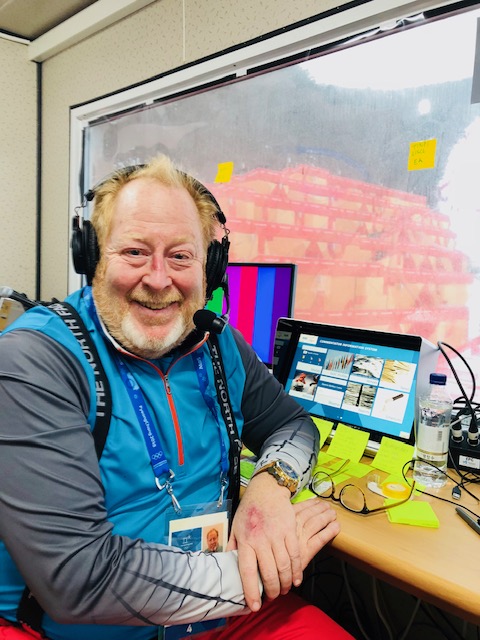
    Peter Graves announcing alpine events at the 2018 Winter Olympic Games (Courtesy Photo)

    “I’m glad they did the Games,” he said, “I’m well aware there were plenty of nay-sayers. It robs the athletes of an opportunity that may never come again. My hope is that the athletes found joy taking part in the Games, because the spirit is embodied by their humanity and enthusiasm. On TV, I saw countless examples of really great sportsmanship. I think the athletes should really be praised for how they managed themselves over there.” 

    Given the delay to the 2020 Games, we are now less than six months away from the Winter Olympics, scheduled to take place in Beijing starting February 4th, 2022. While Graves was clear that he can’t speak about Beijing per say, his experience in Tokyo may shed some light on what the upcoming Winter Games may look like. “One wonders, with the Beijing Games just six months away and the resurgence of the Delta variant globally,” pondered Graves, “I have to believe priority number one for Beijing will be keeping a good and tight bubble for those Games too.” 
     

  • Canmore’s IPC World Cup Draws Rave Reviews

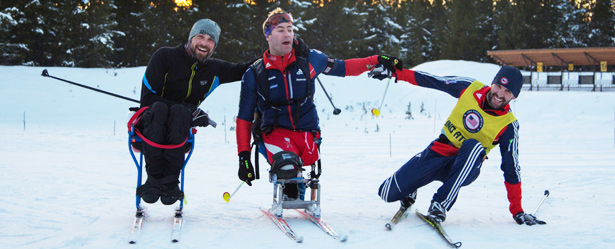
    Augusto “Goose” Perez, Kevin Burton (Photo: CXC)

    (CXC press release)

    The famed Canmore Nordic Center, the venue of the 1988 Olympic Winter Games Nordic events, and home to countless World Cups recently played host to yet another blockbuster event, when they welcomed the world for an IPC cross-country and biathlon World Cup. The setting is breathtaking, the competition even more so.

    Augusto “Goose” Perez spoke for everyone noting just how inspiring it was to compete and the fabled venue of Canmore, saying..”Canmore was an amazing experience, The city of Canmore is absolutely beautiful, and to be able to race at this Olympic venue was a dream and the work put forth by the organizers and the volunteers was phenomenal. Having the chance to compete against the best in the world is not at the reach of just anyone, I was humbled by it, and it was also a great chance to put to the test all the work I did with CXC.”

    Canmore IPC World Cup (Photo: CXC)

    More than 110 athletes representing 12 nations competed in six World Cup events, marking a historic first for Canmore. CXC had three Paralympic athletes that were part of the US contingent of 15 athletes.

    Team CXC skiers were lead by Travis Dodson and Aaron Pike finishing 1.5 seconds apart in the 10km event in 17th and 18th position respectively, placing just behind star member of the national team Andy Soule and Sean Halstead. CXC member Augusto Perez met the Paralympic standard of 130% of the winner’s time, finishing in 20th.

    The next event was the 750m sprint race where the CXC trio had their best collective performances with Pike narrowly missed qualifying for the semis by less than two seconds finishing 14th followed by Dodson and Perez.

    Pike followed up that impressive finish with a personal best 12th place even outperforming famed Dan Cnossen and was just behind Sean Halstead who was the U.S.’s top performer in Sochi last spring placing 4th.

    Coach Rob Rosser picks up the biathlon storyline.

    “Dodson lead the way for the CXC trio in the first of 3 biathlon races shooting clean, a perfect 10 for 10 for 13th place behind Cnossen and Soule in 9th and 11th respectively both of whom shot clean as well. Pike and Perez struggled on the range finishing 17th and 18th

    “Dodson lead the trio in the final long 15km biathlon event finishing 15th hitting 14/20 followed by Pike and Perez in 16th & 17th.  This final race of the World Cup ended on another positive result posted by 2010 Bronze Medalist Paralympian Andy Soule who hit 19/20 in windy conditions combined with an exceptional performance on the sit ski finishing in fifth place just 34 seconds from the podium. This was quite impressive amongst a very strong field of Russians vying for their selection to the Russian Paralympic Team which will play host to the world in Sochi 2 months from now”, Roser explained.

    We also caught up with Augusto Perez, who made it clear just how important CXC’s commitment to adaptive sports is….”The first thing I want to do is thank Yuri, CXC and CXC’s entire staff for their support, without them I would not heave been able to keep skiing this season and to continue my work towards my dream of competing in Sochi. Dealing with my cancer and its economic cost had closed my chances to continue training towards Sochi. When Yuri called and asked me if I wanted to train with them and to become a mentor to younger disabled kids, I was packing my bags before I hung up the phone. CXC was a light of hope during a rough time.”

    Although the TEAM USA squad won’t be selected for Sochi until Jan 31st, or so, many CXC athletes have a real chance to be part of the Paralympic lineup. That’s great news.

    We asked the USA’s John Farra, to give us his thoughts about some of those athletes.

    ON AARON PIKE

    “Aaron Pike – sitting athlete – was in London as a Wheel Chair racing athlete and came to a camp last fall to try out Nordic. In short order he picked up the sport, came to Nationals and qualified for his first world Cup in Cable with just 10 +- days of skiing under his belt.  He is VERY strong and incredibly fit… he hit our National Team standard at that first World Cup and continues to improve. “

    ON  TRAVIS  DODSON

    “Dodson – sitting athlete – double leg amputee – Is a veteran that Rob Rosser introduced to the sport a few years ago, and he is also very competitive in Wheel Chair racing, but has turned his attention to Nordic with a big focus this winter with the goal to maximize his performances in Sochi,” said Farra.

    ON JOHN OMAN

    “John Oman  – Is a standing athlete with one arm, and is a great guy and could well be a wonderful part of our Sochi Team,” said Farra.

    Oman was filled with praise for CXC for the experienced he enjoyed in Canmore, saying…”I would never have had such an amazing experience at the World Cup if it weren’t for the dedication and passion of the CXC Team. I am excited to pay it forward—and pay it back—by providing as much support as I can in the future to CXC and all who the team serves and represents.” He also noted how well he was prepared prior to leaving for Canada explaining…”When Yuri (Gusev) asked me if there was anything that I needed from him before I left. My answer was a simple “no”, because the CXC team had spent the past year preparing me with equipment, hours and hours of coaching, and most importantly, a network of people (coaches, racers, and recreational skiers) that had prepared me for this world-class event.

    Following the events we caught up with John Farra, the USA’s High Performance Director for it’s Para Squad and got some really promising observations about a program that has come a long way thus far. “We have come a long way as a program, we had 6 athletes in Vancouver and now we expect to have 17 athletes in Sochi.  I am thrilled with how many new athletes we have seen come into our sports of XC and Biathlon and excited to see how they all perform in Sochi.  Our trip to Canmore was an important trial run with a large staff of 14, and 19 athletes.  We set a bunch of goals going into this event that were not based on athlete performance, but on staff performance… we wanted to make sure we were clicking on all cylinders and working in efficient/effective ways at a busy event just like we will have in Sochi.  We leave Canmore feeling very good about our systems, the support we are offering the athletes and the skis we are putting under their feet or sit skis,” Farra explained.

    “We are all excited by this as Sochi is coming up fast but as importantly we are inspired by the work of all of our athletes in the adaptive program, as they challenge each of us to do our best,” said CXC Executive Director Yuri Gusev.

  • Pat Miller: Legendary Ski Coach, Legendary Friend

    Pat Miller: Legendary Ski Coach, Legendary Friend

    Fort Lewis College roomates, Pat Miller (r) and Peter Graves celebrate Miller's 21st birthday circa 1970. Miller died at age 64 after a brief illness on June 22. (Photo: Peter Graves)
    Fort Lewis College roommates, Pat Miller (r) and Peter Graves celebrate Graves’ 21st birthday on May 16, 1973, in Durango, Colo. Miller died at age 64 after a brief illness on June 22, 2013. (Photo: Peter Graves)

    Peter Graves’ words have taken him to national championships, World Championships and the Olympics. During a phone interview on Saturday, the famed public-address announcer, television sportscaster and current public relations director for U.S. Ski Jumping was at a loss for them.

    Graves was asked how he would remember his college roommate, Pat Miller, who passed away June 22 at the age of 64 after a brief illness.

    Pat Miller being inducted into the the Intermountain Ski Hall of Fame in 2008, one of four halls he is a member of. (Photo: Kevin Sweeney)
    Former Utah coach and skiing director Pat Miller being inducted into the the Intermountain Ski Hall of Fame in 2008, one of four halls he is a member of. (Photo: Kevin Sweeney)

    Over 23 years (1976-2000), Miller directed the University of Utah men’s and women’s nordic ski teams to eight combined national titles, plus an additional title for each gender before scoring was combined. He developed 251 All-Americans, 46 individual national champions and 10 Olympians.

    “I will remember him as one of the closest friends I ever had,” Graves said. “I will try, even though it’s hard right now, to remember him always with a smile. He represented to me the essence of a friend and the essence of a time filled with wonder and optimism.”

    Originally from Maine and living in Holladay, Utah, Miller was visiting his older brother, Jim, in Casper, Wyo., before he died. After his tenure as skiing director ended with a National Collegiate Athletic Association (NCAA) rules violation, Miller stayed in Utah. For the last decade, he worked in a variety of capacities at Deer Valley Ski Resort in Park City.

    Miller was one in a group of skiers from western Maine who ventured to Durango, Colo., to attend Fort Lewis College, a small school with a thriving ski program at the time. Miller progressed from junior-national champion to college All-American in nordic combined, to national-team member and U.S. Olympic alternate.

    Graves, 61, from Vermont, also competed at Junior Nationals, but said his odds of making a career out of ski racing were slim. He and Miller shared an off-campus house during Graves’ senior year at Fort Lewis, while the Miller brothers trained in the area as members of the U.S. Nordic Combined Team.

    That spring, Graves turned 21. He didn’t mention it to Miller and expected the occasion to pass quietly. Miller left the house without telling Graves his destination. He returned at 5 p.m. with two steaks, a bouquet of flowers and a small cake.

    “To me that speaks volumes about the way Pat was,” Graves said. “A really strong, tough athlete with a heart of gold.”

    Pat Miller (r) and Kevin Sweeney, the former and current directors of skiing at the University of Utah, rest during mountain-bike trip in Utah. (Photo: Kevin Sweeney)
    Pat Miller (r) and Kevin Sweeney, the former and current directors of skiing at the University of Utah, rest during mountain-bike trip in Utah. (Photo: Kevin Sweeney)

    In 1999, the Miller-led Utes sat in second place heading into the final day of the NCAA Championships in Rumford, Maine, which neighbors Miller’s hometown of Mexico. The Utes were within striking distance of a national championship in Miller’s homecoming.

    Head coach Kevin Sweeney said he blew the wax and instead of a title, his team didn’t make the podium, falling to fourth place. Now Utah’s director of skiing, Sweeney said in a recent phone interview that he was “literally devastated.”

    “Pat was still totally understanding and trying to always see the positive of it,” Sweeney said. “I can’t think of a single second when I felt Pat was disappointed in me.”

    Sweeney and Miller shared an office for nearly 10 years. They won three national championships together. Miller hired Sweeney as an assistant coach in 1991 and promoted him after a year when former head coach Alan Watson left the program.

    “The performance expectations were extremely high,” Sweeney said. “But at the same time I think Pat just had such a calmness and a level-headedness that pervaded through his staff.”

    Sweeney’s response to the same question that choked up Graves came in three parts. He will remember Miller first as a legend in collegiate skiing. Second, as a “fun, heartwarming, accepting and caring individual.” And finally, he will recall the difficulty of losing him too soon.