From the FasterSkier archive — posts syndicated from athletes’ and coaches’ own blogs between 2004 and 2012, kept online as published. Current coverage is at fasterskier.com.

Tag: Petr Sedov

  • An Air-Guitar Solo: Harvey Closes Out Championships with 50 k Win

    An Air-Guitar Solo: Harvey Closes Out Championships with 50 k Win

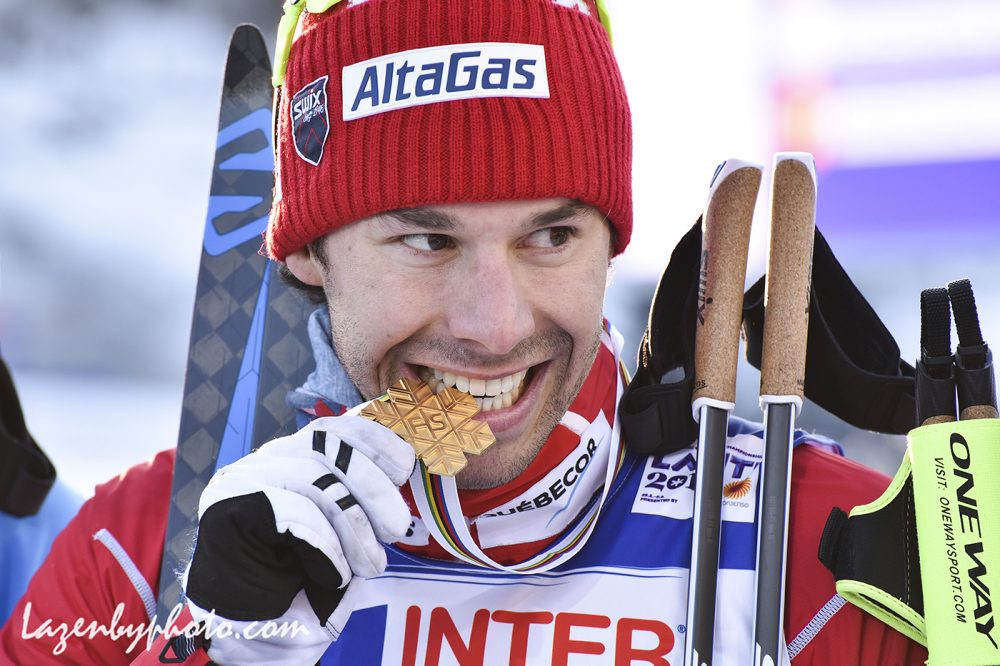
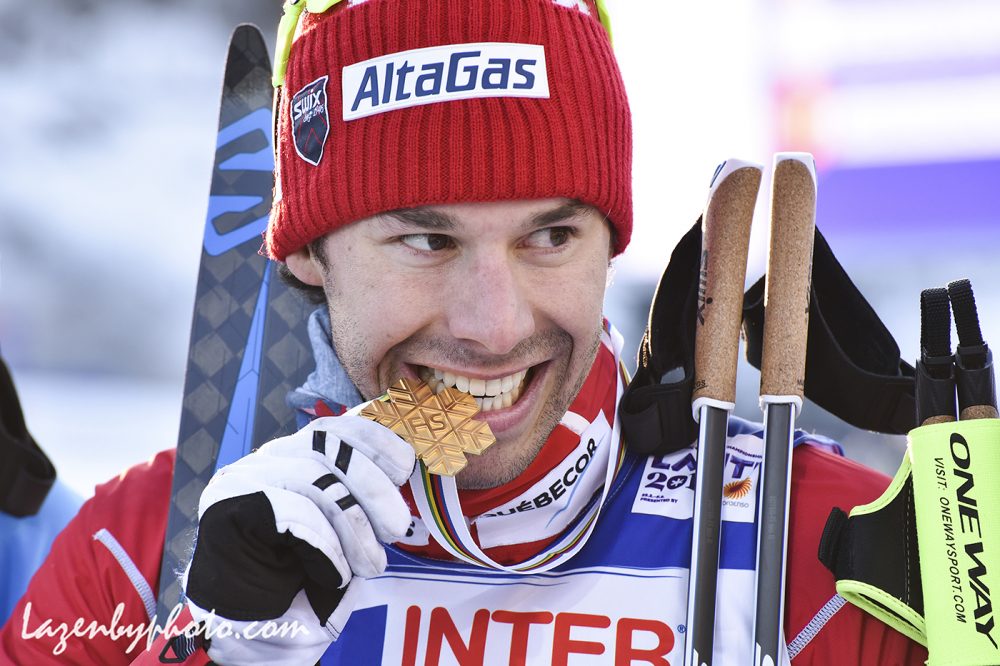
    It’s real. Canada’s Alex Harvey after winning gold in the men’s 50-kilometer freestyle mass start on Sunday at the 2017 Nordic World Championships in Lahti, Finland. (Photo: John Lazenby/Lazenbyphoto.com)

    LAHTI, Finland — Here’s the basics: fast and firm tracks, cloudless skies, and once again a stacked field for the final event of the 2017 Nordic World Championships: the men’s 50-kilometer freestyle mass start.

    Over the course of the 50 k, Canada’s Harvey had to think about one thing: be up front near the top three in order to shadow Norway’s Martin Johnsrud Sundby’s inevitable gut punch in the last kilometer. What he didn’t have to think about was playing catch up as a skier yo-yoing off the back, or his skis — they were rockets.

    In Sunday’s closing race of Lahti World Championships, Harvey was slotted in second, sliding around “Lahti Corner” just centimeters behind Sundby. Drafting off Harvey was 2017 championships legend, Russia’s Sergey Ustiugov, who had already racked up four medals previously in the week (skiathlon gold, team sprint gold, freestyle sprint silver and team relay silver). Pulling not far behind the three was Finland’s Matti Heikkinen and Andrew Musgrave of Great Britain. 

    After studying the women’s 30 k mass start on Saturday, Harvey had some cogent takeaways.
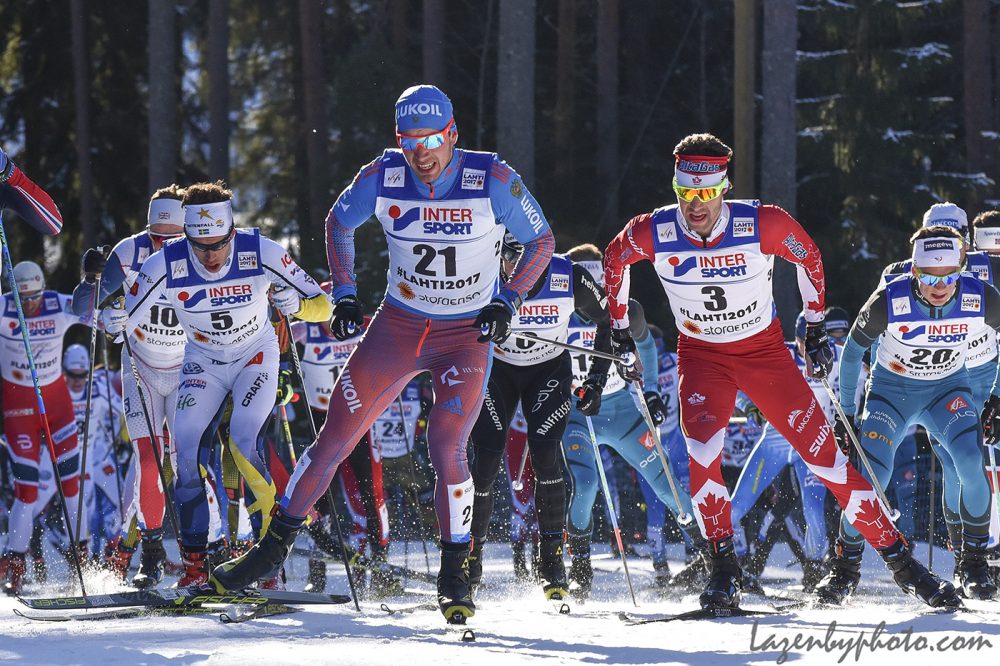
    Russia’s Alexey Chervotkin (21) leads Canada’s Alex Harvey (3) and Sweden’s Marcus Hellner (5) during the men’s 50 k freestyle mass start on Sunday at 2017 Nordic World Championships in Lahti, Finland. Harvey went on to win, Hellner placed 12th and Chervotkin 13th. (Photo: John Lazenby/Lazenbyphoto.com)

    “I saw the women’s race yesterday, and I figured if Marit Bjørgen could not distance herself from the other girls, then there is no way that the men will be able to do that,” Harvey said during Sunday’s post-race press conference. “I knew with the fast conditions, it was going to be a big group, and that leaves the potential for a lot of carnage, a lot of mayhem.”

    For the first 10 k, skiers from various nations took pulls up front, including Sundby and Ustiugov, and Norwegians Petter Northug, Hans Christer Holund, and Anders Gløersen. After testing the field and breaking away around 8 k into the race, Gløersen was still skiing alone up front, 20 seconds ahead of anyone else at 15 k.

    “Gløersen took off a bit and he was like, ‘What’s the gap? What’s the gap?’ ” Canadian World Cup coach Ivan Babikov said of Harvey. “He was always controlling the race and saving energy for the finish.”

    Eventually, the main pack surged to recover the lost time. Gløersen’s off-the-front-flier only earned him camera time. The catch came just before Lahti Corner returning to the stadium around 20 k in, where Russia’s Alexey Chervotkin took over. In another 2 k, Sundby, who had been stalking in the top 10, moved to the front as if the race were all of a sudden for real.
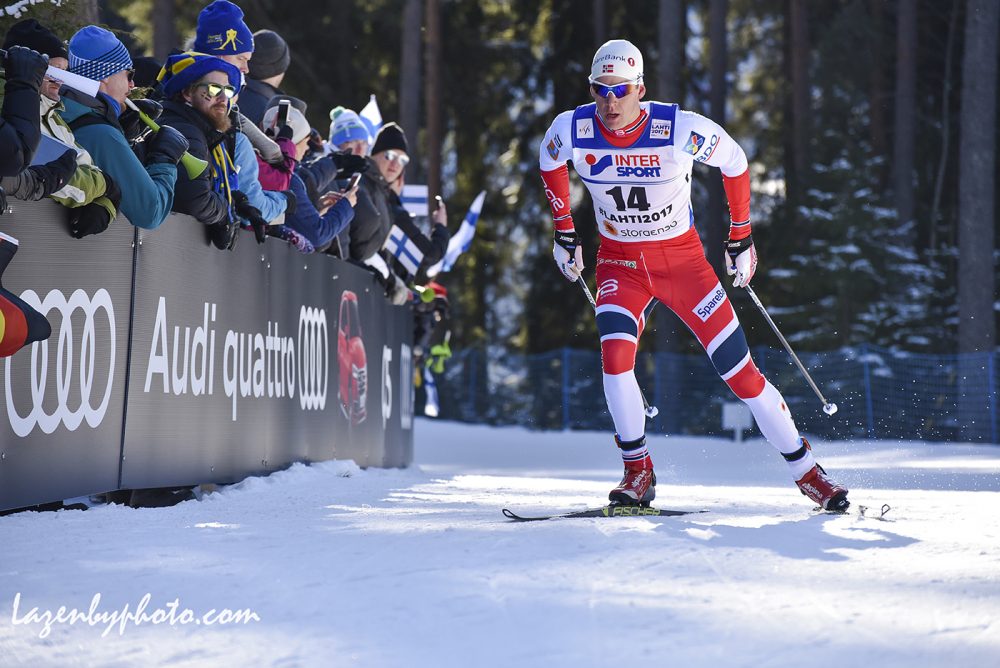
    Norway’s Anders Gløersen broke away early to lead the men’s 50 k freestyle mass start, skiing alone off the front for about 12 kilometers, on Sunday at the 2017 Nordic World Championships in Lahti, Finland. (Photo: John Lazenby/Lazenbyphoto.com)

    From then on, the size of the pack atrophied with each consecutive lap. At 30 k, the pack streaming through the stadium was 24 skiers long. At 45 k, the group winnowed to a train of 19. And within another 4 k, only 13 remained: Sundby, Ustiugov, Musgrave, Harvey, Heikkinen, Northug, Holund, Gløersen, Chervotkin, Sweden’s Marcus Hellner, Norway’s Sjur Røthe, Switzerland’s Dario Cologna, and France’s Maurice Manificat.

    “I wanted to be in the front, top three at least,” Harvey said, reflecting on his skiathlon tactics from last weekend, where he skied around fifth up until the final headwall and finished fifth, outside of the medals.

    “I knew that Sundby’s first chance to win gold was to break everybody,” Harvey continued. “I was expecting him to leave from kilometer 1 or 49.”

    Harvey guessed Sundby would be the only one who would try to break away. With that in mind he marked the Norwegian.

    “He knew it would be hard to break away [and that] it will be all about the finish,” Babikov said. “He was positioning himself perfectly up the last hill and just stayed on Sundby. That was his plan, ‘I’m just gonna stay on Sundby and if he changes skis, I’ll go change skis,’ but today conditions were perfect so he didn’t.”

    With ripping conditions and skis to match, Sundby never slowed nor switched skis. Neither did Harvey.

    “When he waited until the last lap, I knew exactly where he was going to do it: with a k and a half to go,” Harvey explained. “I was just lucky enough to have the legs to stick on him today and from then on it started playing more into my hands.”
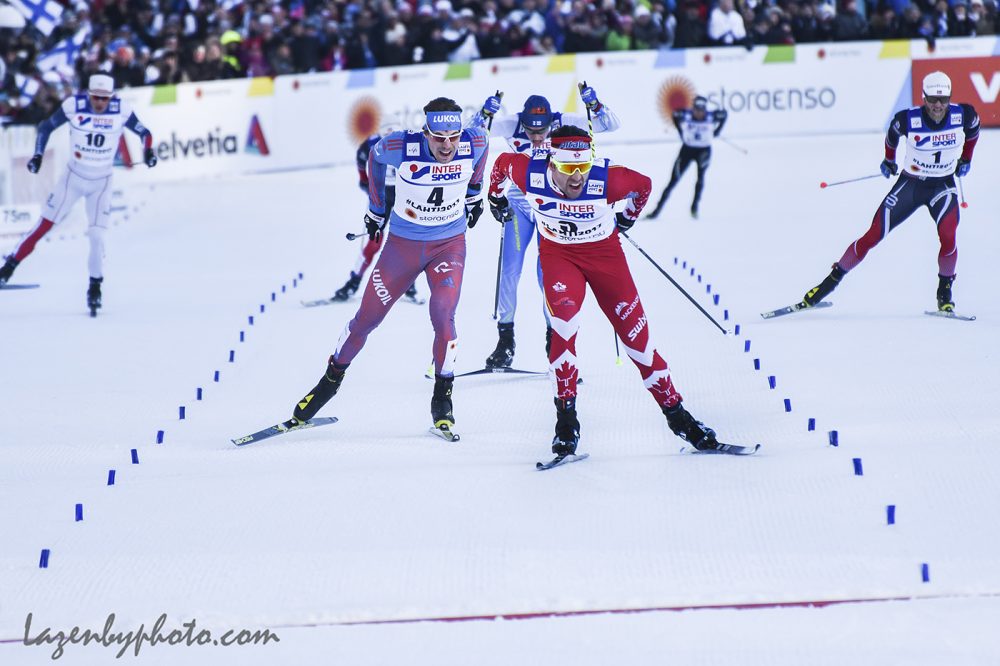
    Canada’s Alex Harvey (5) charging to the line ahead of Russia’s Sergey Ustiugov (4), Norway’s Martin Johnsrud Sundby (1), Great Britain’s Andrew Musgrave (10) and Finland’s Matti Heikkinen (behind Harvey) in the men’s 50 k freestyle mass start on Sunday at the 2017 Nordic World Championships in Lahti, Finland. (Photo: John Lazenby/Lazenbyphoto.com)

    In the closing moments of nearly every race of these world champs, the fate of winners seem come down to luck, and often someone else’s bad luck. As the leaders came into the stadium, it was as if every observer were about to witness an upset due to a tumble or a tangle.

    Harvey was clean around the final turn and unscathed down the stretch.

    “I wanted to hit the [Lahti] corner in second, right behind Sundby or whoever was in the lead,” Harvey said. “I knew I needed to do that in the skiathlon, too, and I tried to go around Finn Hågen Krogh there, but he’s a clever sprinter too. He knew he wanted to be second there.

    “In the skiathlon it didn’t work, but today it did,” Harvey continued. “I was second the whole time and then out of that corner I did one push more than Sundby. I had really fast skis, but used the draft to slingshot and then hit the final corner in first and from there, I knew it was mine to lose more than anything else.”
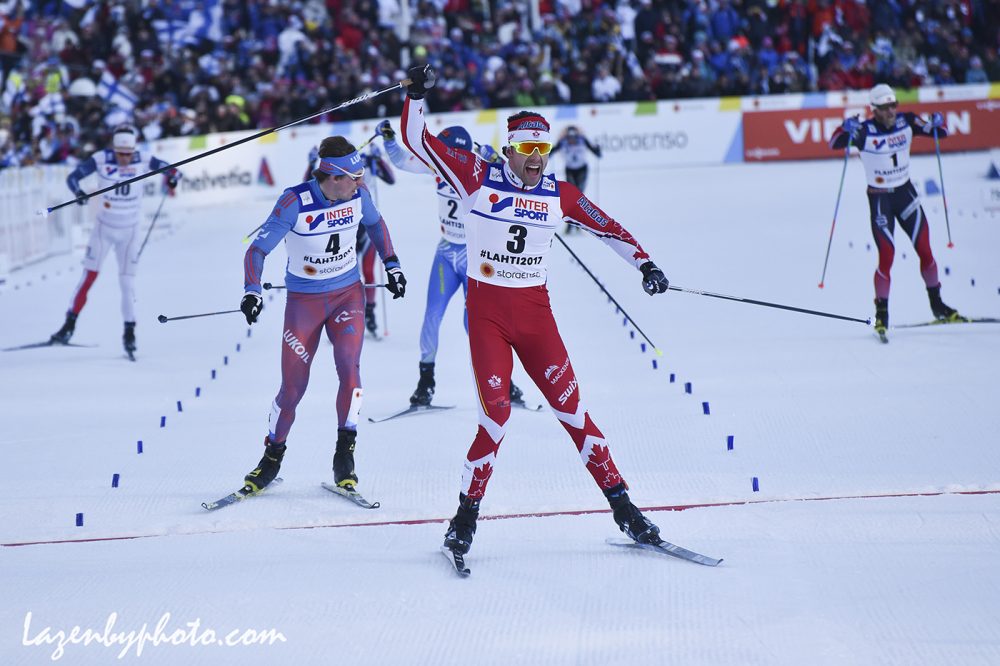
    Canada’s Alex Harvey (5) celebrates his first individual World Championships gold after winning Sunday’s 50 k freestyle mass start in Lahti, Finland, ahead of Russia’s Sergey Ustiugov (4), Norway’s Martin Johnsrud Sundby (1), and Finland’s Matti Heikkinen (2), respectively. (Photo: John Lazenby/Lazenbyphoto.com)

    And so Harvey earned the crown: 50 k world champion in 1:46:28.9 hours.

    It’s his first championships gold since winning the classic team sprint with Devon Kershaw at 2011 world champs, and fifth medal in four World Championships. 

    “He turned around these world champs for all of us,” Babikov said of the Canadian team. “He was solid. We were with no medals so far, and winning 50 k, he’s the king now.

    “This is the legit distance and he took it today,” he added.

    “It’s a long championship,” said Louis Bouchard, Harvey’s personal coach and Canada’s World Cup co-coach. “He feels every day his energy’s still there, so he knows today, if he’s good tactically, then he can do it.”

    Asked how nerve-racking it was watching the final 5 k unfold, Bouchard responded, “I was pretty nervous, too much maybe. But that’s OK.”
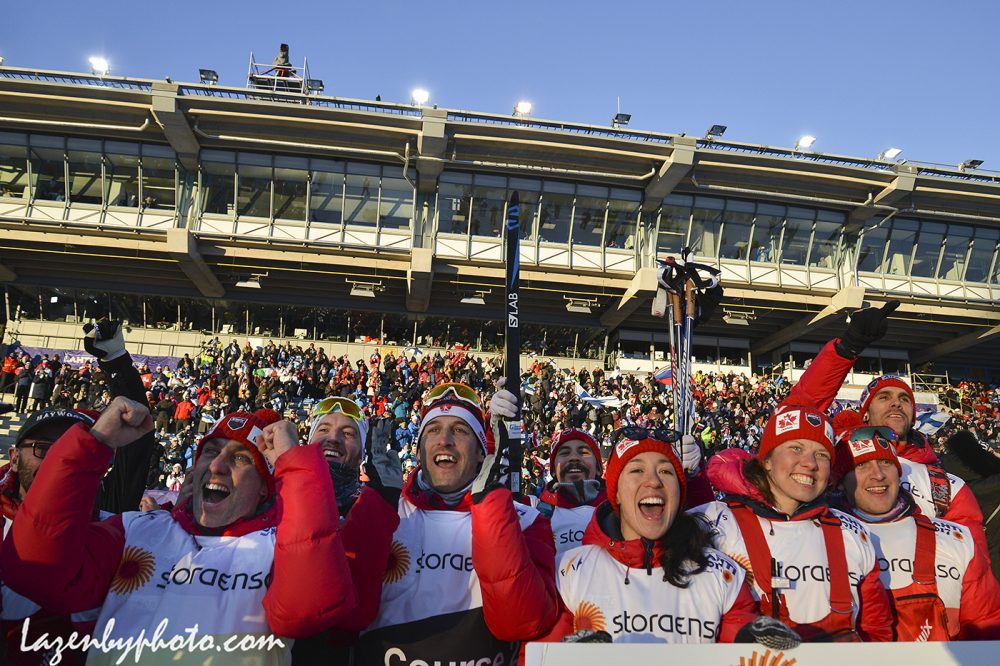
    Alex Harvey’s Canadian teammates, coaches and support team celebrate his win in the men’s 50 k freestyle mass start on Sunday at the 2017 Nordic World Championships in Lahti, Finland. (Photo: John Lazenby/Lazenbyphoto.com)

    For his fifth medal of these championships (and sixth world-champs medal of his career), the 24-year-old Ustiugov crossed second for his third silver of the week, just 0.6 seconds behind Harvey. Finland’s 33-year-old Heikkinen took third (+1.4) for his first medal since 2011 World Championships.

    “Today I skied within my own limits and at the end I was fresh enough to attack,” Heikkinen said in a press conference.

    Asked about his not-so-characteristic finishing kick on Sunday, Heikkinen said he remembered how he faded to 20th in the 50 k classic mass start at 2015 World Championships.

    “After Falun 2015 world champs, I was watching the race after and I was walking in front a mirror and I said, ‘I won’t ever again be like that after a 50 k,’ ” he said. “I’ve been training two years now at a high level [with my team] … and that’s why I’m top three in overall World Cup, so it was possible.”

    Behind him in a photo finish for fourth, Musgrave capitalized on Sundby slowing before the finish — probably after the Norwegian realized he had missed out on a medal — to place fourth (+2.9). For Musgrave, who turns 27 on Monday, it was his first World Championships top 10. For Sundby, who had been on a quest all week for his first individual championships goal — it was a bummer. The 2018 Winter Olympics in PyeongChang, South Korea, will be Sundby’s next opportunity.

    From a North American and perhaps international standpoint, American Tad Elliott skied the gutsiest of races. Halfway through the race, Elliott, a 28-year-old Colorado native and former U.S. Ski Team member, remained a not-too-far-off the back chaser, 27 seconds behind the lead group. His margin back slowly accrued over the remaining distance.

    “At 25 k, man, some guys were really struggling and they balled it up,” Elliott said afterward. “I should have sent it a little harder but that’s how it goes sometimes in that pack. I thought I could get there, but I just missed it.”

    Elliott, of Ski Club Vail, finished 27th (+3:16.8) for his best individual result in three World Championships. In recent years, Elliott has struggled with illness, which impacted his ability to train and peak. Those difficulties caused him to question whether or not his best years were behind him. Evidently not.
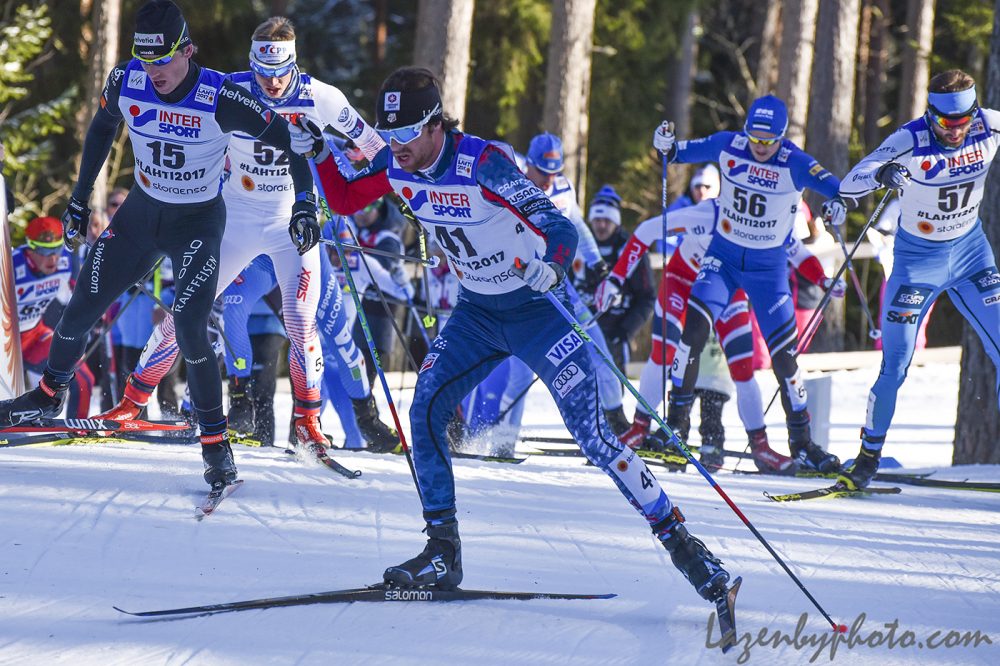
    American Tad Elliott (41) racing to 27th in the men’s 50 k freestyle mass start on Sunday at the 2017 Nordic World Championships in Lahti, Finland.. (Photo: John Lazenby/Lazenbyphoto.com)

    “I didn’t know if I wanted to come back [to skiing]. I was so sick. I was so bummed. I was like, ‘Am I ever going to get back? Am I ever going to get back to top-30 form?’ ” Elliott said. “We knew if everything went right, I would qualify for worlds … then to get top 30 here, man, I feel like I’m starting to get greedy. I’m starting to want more, I’m starting to want more opportunities. But I’m proud of this effort, I’m going to savor it a bit.”

    In the first few kilometers, Russia’s Petr Sedov skied too wide on a 180-degree corner and stalled out. American Kyle Bratrud, the next skier to round the turn, was unable to avoid the Russian and collided. Soon after, due to the impact, Bratrud was unable to complete the race.

    U.S. Ski Team member Noah Hoffman finished the day in 50th (+8:53.1).

    Devon Kershaw was Canada’s second skier on Sunday, crossing in 38th (+5:45.5). Also for Canada, Graeme Killick and Knute Johnsgaard finished in 43rd (+7:04.0) and 55th (+12:03.3), respectively.

    “[Alex’s performance] was incredible and such a big boost for our entire team,” Babikov said. “You should see all the techs, and Devon and Graeme and Knute, who didn’t really have a great race today, and they’re still so psyched for him.”

    Results

    — Gerry Furseth, Jake Ellis and Alex Kochon contributed
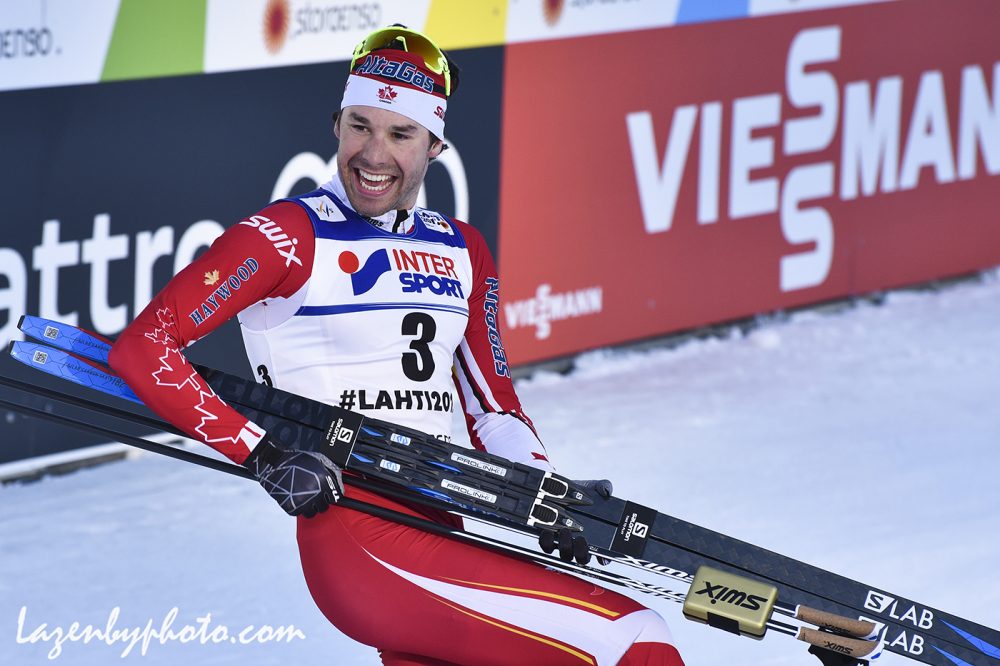
    Canadian air guitar: Alex Harvey performs his team’s signature move after winning the men’s 50 k freestyle mass start on Sunday at the 2017 Nordic World Championships in Lahti, Finland. (Photo: John Lazenby/Lazenbyphoto.com)
  • Russia’s Sedov Tops PyeongChang Skiathlon; Hoffman 8th, Patterson 9th

    Russia’s Sedov Tops PyeongChang Skiathlon; Hoffman 8th, Patterson 9th

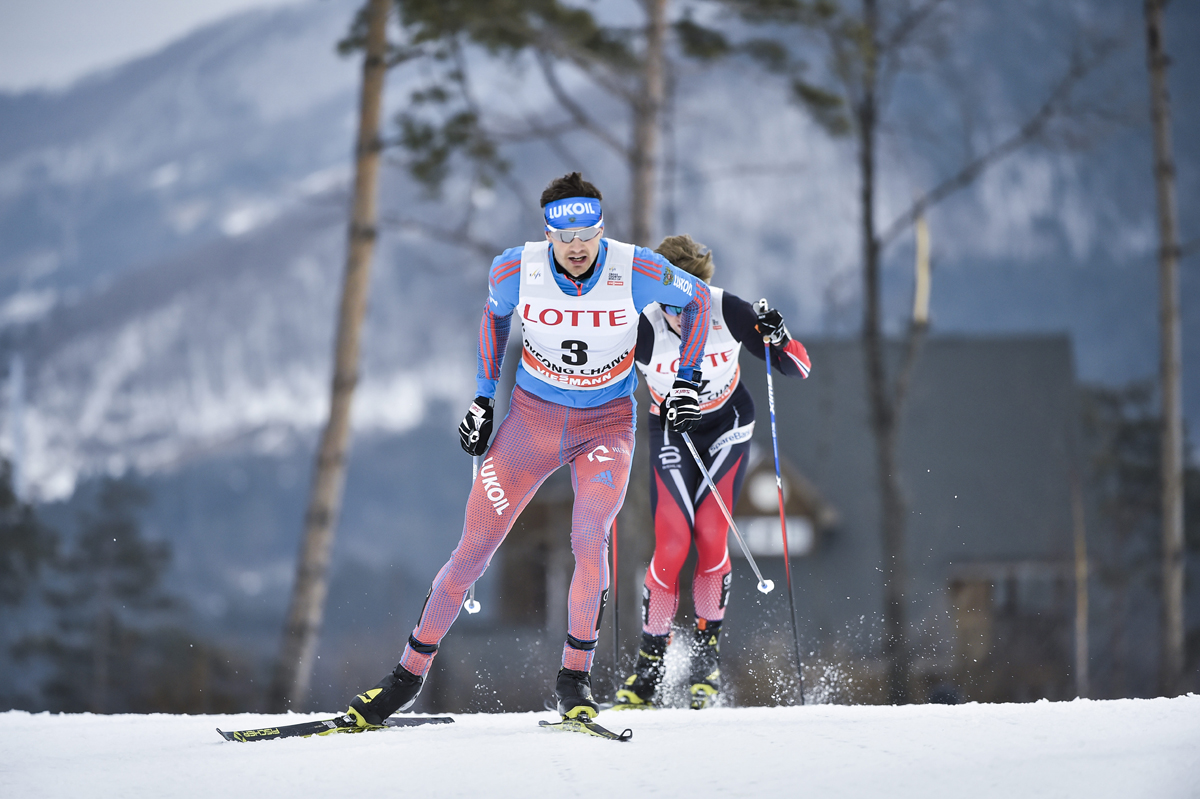
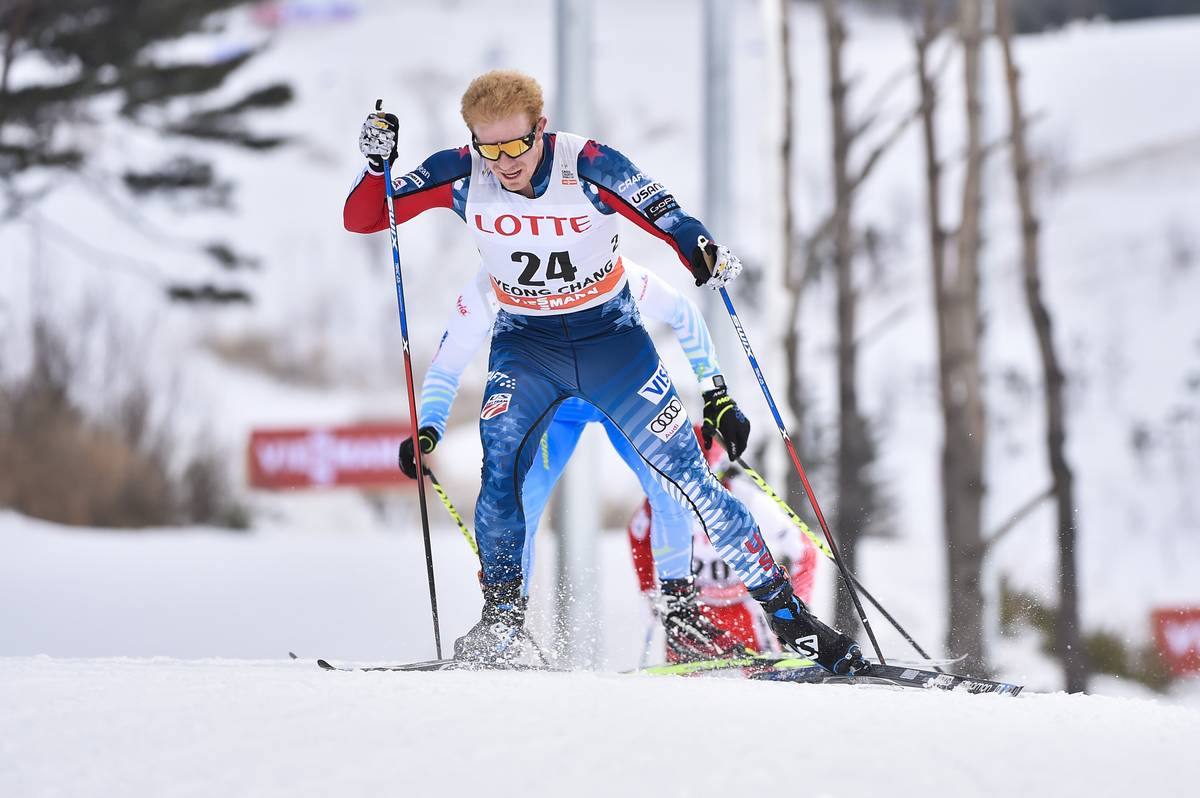
    Russia's Petr Sedov en route to his first World Cup win on Saturday in the PyeongChang World Cup 30 k skiathlon in South Korea. (Photo: Fischer/Nordic Focus)
    Russia’s Petr Sedov en route to his first non-stage World Cup win on Saturday in the PyeongChang World Cup 30 k skiathlon in South Korea. (Photo: Fischer/NordicFocus)

    The rough translation of the Korean word “기회” or “gihoe” into English is “opportunity”. And it’s the best way to describe what was on offer Saturday afternoon in PyeongChang, South Korea during the men’s World Cup 30-kilometer skiathlon.

    No seeded men on the World Cup contested the race. No Sundby. No Ustiugov. No Harvey. No Hellner. Lot’s of 기회.

    For the three skiers finishing in positions 1, 2, and 3, it was a career-first World Cup podium. Russia’s Petr Sedov placed first in 1:18:49.6. Norwegian Daniel Stock finished second 22.5 seconds back with his teammate Mathias Rundgreen third (+42.1).

    “I felt very strong today,” Sedov told the International Ski Federation (FIS) after the race. “I have to thank to my coach, service staff and to my family. I am very glad that my first ever World Cup podium is a win.”

    To be clear, It was Sedov’s first individual non-relay and non-tour stage World Cup podium. He’s placed second twice in 2010 and first once in 2011 as part of Russian relay teams. Sedov also won a 2012 World Cup stage 15 k skate pursuit in Falun, Sweden.

    And to discount the World Cup strength of some others would have been foolish. This was Stock’s sixth World Cup start. Yet he, too, like Sedov, came with realistic podium-hunting background: as recently as Jan. 21, he skied to fifth in the World Cup 15 k skate in Ulricehamn, Sweden. Canada’s Alex Harvey, Norway’s Martin Johnsrud Sundby, Sweden’s Marcus Hellner, and Switzerland’s Dario Cologna were the only athletes ahead of Stock that day.

    For Rundgreen, it’s the same: not a World Cup brand name, but bringing with him plenty of real-deal horsepower to shatter the race. He boasts three top-10 World Cup performances, including a first and second as part of Norwegian relay teams.

    Rundgreen held off three others for third place, including Sweden’s Gustav Eriksson in fifth (+46.8), Japan’s Keishin Yoshida in sixth (+47.1), and Russia’s Alexander Utkin in seventh (+49.0).

    The U.S. had two top 10’s, with the U.S. Ski Team’s Noah Hoffman in eighth (+1:06.2) and Scott Patterson (Alaska Pacific University) a spot behind in ninth (+1:28.4). Matt Gelso (Sun Valley Ski Education Foundation), the only other American starter, placed 19th (+5:00.8).

    Canada’s Brian McKeever (Canadian Para-Nordic Ski Team) finished 29th (+8:48.9) for his first regular-season World Cup top 30. (McKeever placed 21st in the 15 k skate at 2007 Sapporo World Championships.)

    The Classic Leg

    “At the beginning of the race the pace was a little bit subdued,” U.S. Ski Team Head Coach Chris Grover said on the phone. “Early on, no one was really charging too much.”

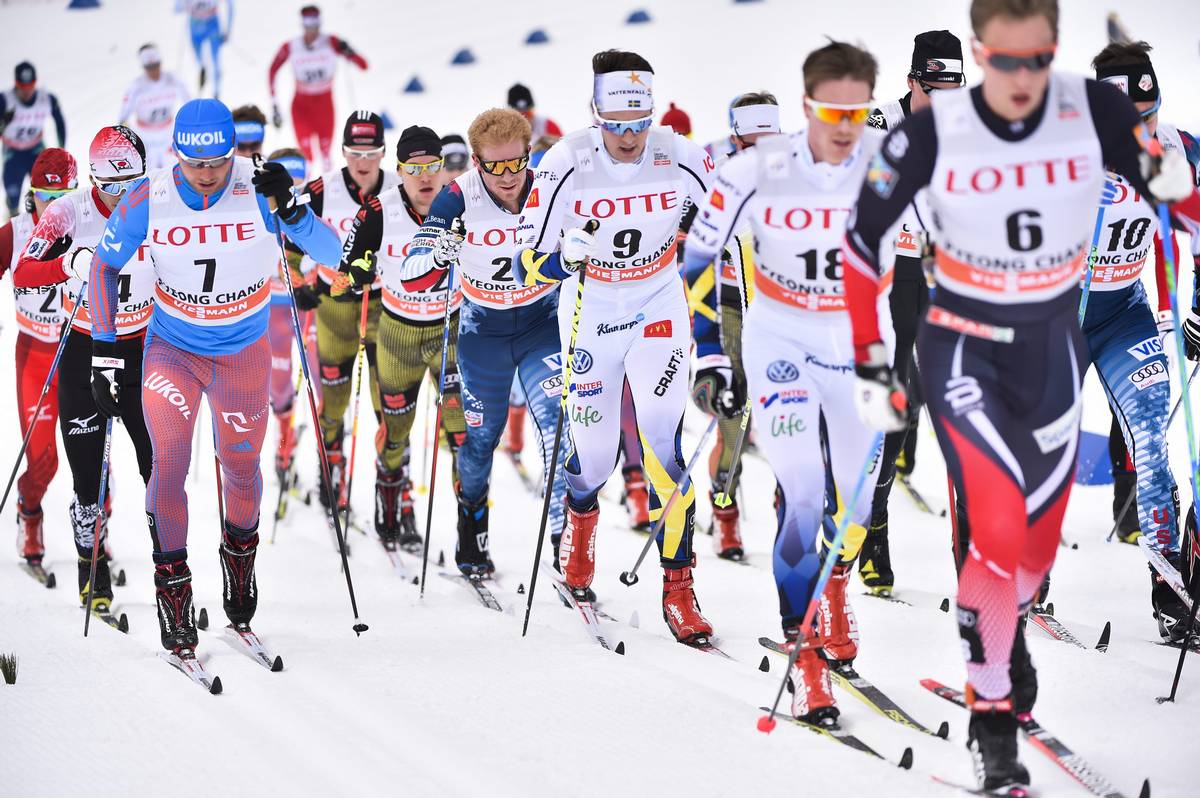
    Americans Matt Gelso (bib 24) and Scott Patterson (bib 10) striding in the pack during Saturday's 30 k skiathlon in PyeongChang, South Korea. Gelso went on to finish 19th overall while Paterson placed ninth. (Photo: Salomon/Nordic Focus)
    Norway’s Mathias Rundgreen (6) and Americans Matt Gelso (24) and Scott Patterson (10) striding in the pack during Saturday’s 30 k skiathlon in PyeongChang, South Korea. Gelso went on to finish 19th overall while Paterson placed ninth. (Photo: Salomon/Nordic Focus)

    Rundgreen controlled the tempo, leading the pack through the 5 k split at 14:16.

    “They were going so slow at one point that Noah just took off to the front and made a little surge,” Grover noted.

    That came at 6.15 k, and Hoffman won the first of two preems, or bonuses, in the race. Patterson came through in ninth, six seconds later.

    At 7.5 k, a line of 21 skiers lapped through the stadium —  Hoffman in third, Patterson ninth, four seconds out. Gelso trailed at the tail of that group, nine seconds off.

    At 9.9 k, it was a repeat; Hoffman took the second bonus, controlling the pace up front surging and slowing. (Both bonuses amounted to 30 extra World Cup points for Hoffman.) Gelso and Patterson came through about eight seconds later in 14th and 18th, respectively.

    “I was feeling pretty good on the classic,” Hoffman explained on the phone.

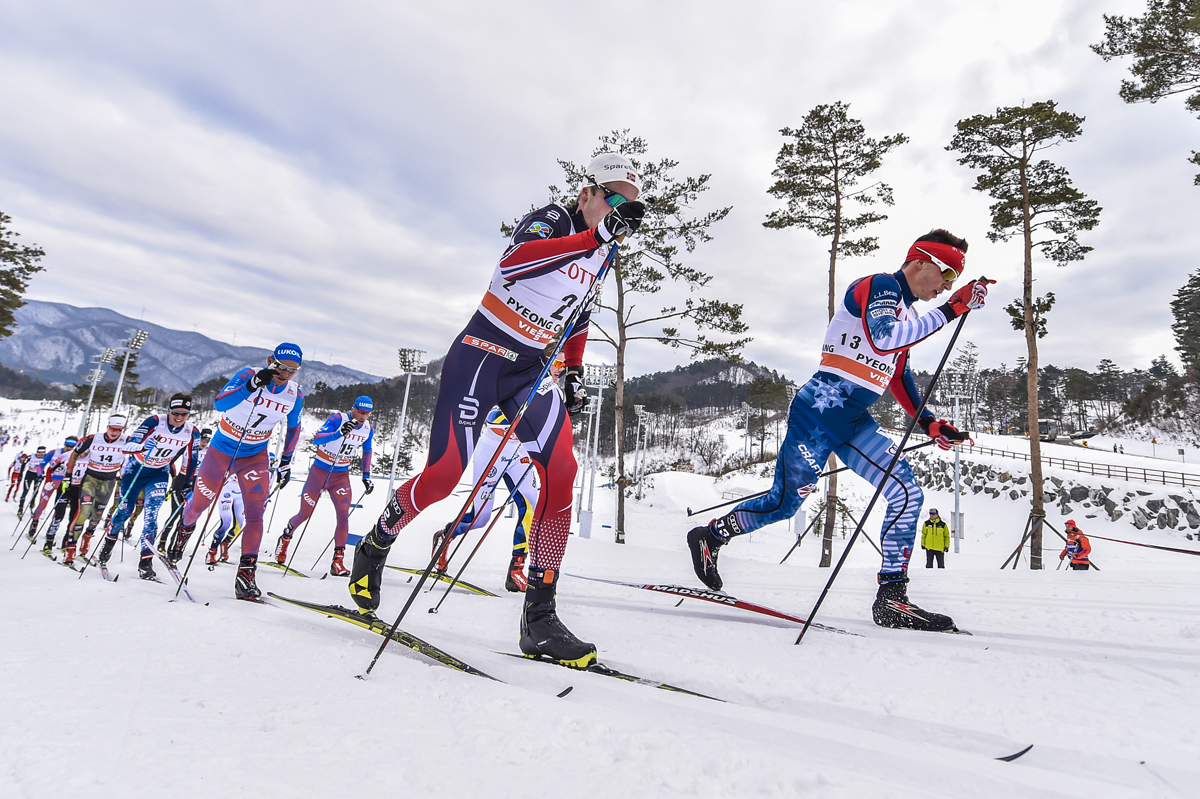
    American Noah Hoffman (r) racing alongside Norway's Daniel Stock during Saturday's 30 k skiathlon at the World Cup in PyeongChang, South Korea. (Photo: Fischer/Nordic Focus)
    American Noah Hoffman (r) racing alongside Norway’s Daniel Stock during Saturday’s 30 k skiathlon at the World Cup in PyeongChang, South Korea. (Photo: Fischer/NordicFocus)

    It was also an opportune time for U.S. Ski Team sponsors as Hoffman captured the majority of camera time. There was nothing about his skiing that didn’t appear confident. Solid striding, focused effort, and a will to position himself in the lead, or one or two spots back.

    But that was his bluff.

    “If I had been confident in my ability to win the race I probably would have really chilled on the classic —  which I didn’t do,” Hoffman said of his front-of-the-pack classic leg effort. “I was skiing up near the front a lot. I was snagging some of the preems. … I was kind of playing games a little bit, having fun with the pack a little bit which was really fun to do. And maybe you could mistake that for confidence, but I think it was probably the opposite.”

    Part of sport is gamesmanship. And part of opportunity is taking bold chances to seize it. The best athletes are not afraid of failure.

    “I got stretched a little bit on the last classic lap to the tune of maybe five seconds plus or minus,” Hoffman added.

    “My classic leg went pretty well for 2.5 loops,” Patterson wrote in an email. (Each loop was 3.75 k.) “I was hovering around 10th until we hit the longest down hill on the course. There were some surges for bonus points right before and I had a slight gap in front of me in my lane … I also ended up in a lane that had not glazed nearly as much as the primary center track. I probably went from 10th to around 25th. After that the rest of the classic I was spending too much energy to get back up close to the front and I ended coming through a bit off the lead group.”

    15 k of Skating

    Eleven skiers entered the classic to skate exchange with approximately 10 seconds separating the first from last. Hoffman had a seamless changeover, the second fastest, and left on his skate skis in fourth. Behind him, Patterson left the exchange 16th (+24.0).

    Initially Rundgreen led the line of 11 skaters that increasingly spread out. One by one, another dropped, losing a meter or two, then they’d up the tempo to catch back on. Then Sedov would pull with the same effect.

    But right there glued on at 17 k was Hoffman. He was in third at 19 k, but had bled nine seconds to Sedov and Stock now in the lead.

    At that mark, Patterson had ceded 39 seconds to the Sedov-Stock combo. Gelso had fallen a bit over two minutes behind.

    For the remaining distance, Sedov was the skier to beat as he slowly put a gap on Stock.

    Hoffman’s group, five skiers deep, could sniff the third podium spot and it became an every-skier-for-themselves effort.

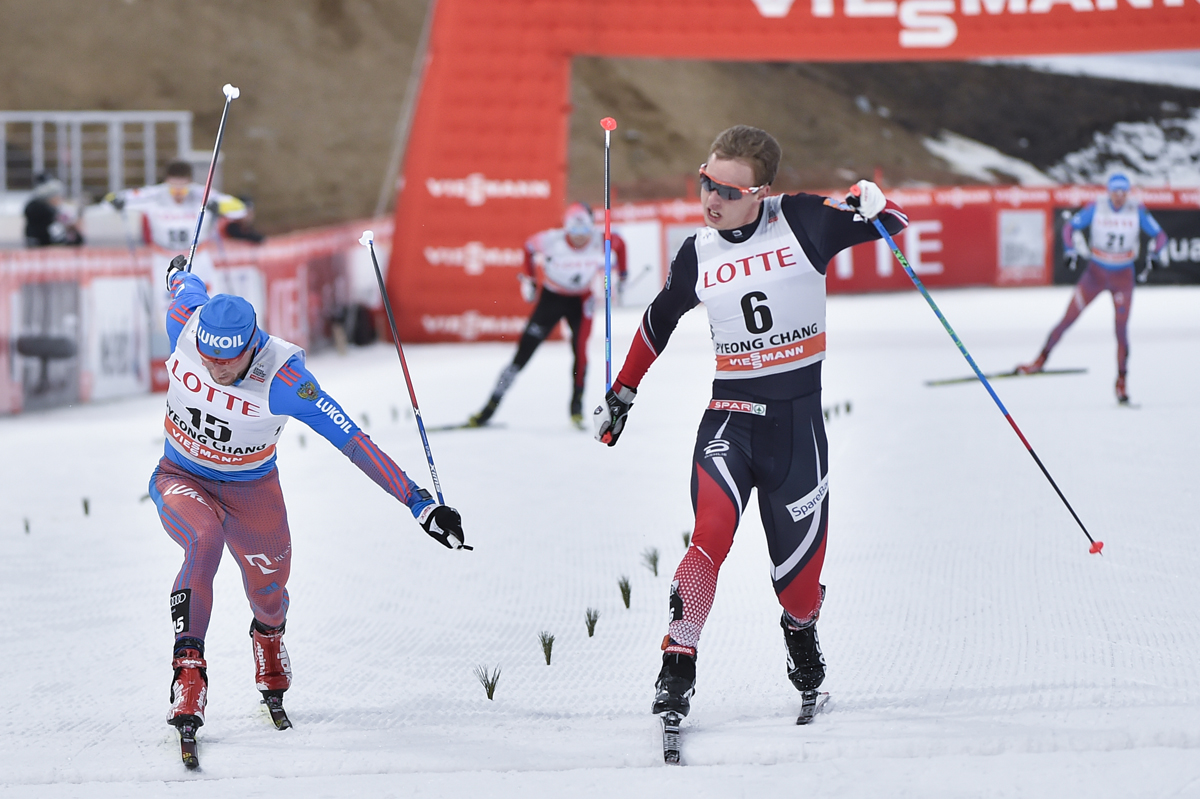
    Norway's Mathias Rundgreen (6) outlunging Russia’s Konstantin Glavatskikh (l) for third in the men's 30 k skiathlon on Saturday at the PyeongChang World Cup in South Korea. (Photo: Fischer/NordicFocus)
    Norway’s Mathias Rundgreen (6) outlunging Russia’s Konstantin Glavatskikh (l) for third in the men’s 30 k skiathlon on Saturday at the PyeongChang World Cup in South Korea. (Photo: Fischer/NordicFocus)

    Rundgreen outlunged Russia’s Konstantin Glavatskikh for the final podium spot in a photo finish — they were given the same finishing time of 1:19:31.7.

    “It was fun, it was nice to ski back up front,” Hoffman said. “I was doing that a lot in 2012, 2013, 2014 … I was just being involved in the race. So I wanted to do a little bit of that. From that perspective, I think it was good, I was definitely involved in the race throughout.”

    Hoffman’s eighth place (+1:06.2) was his best result in a non-stage World Cup since placing eighth in a 2012 skiathlon in Canmore, Alberta. (Hoffman won the time of day in the 15 k pursuit four years ago in Kuusamo, Finland.)

    For Patterson, the skate leg competition analysis reveals his strong skiing —  most of his skate leg sector times rank in the top 10, with several top-five splits.

    “My skate leg was quite good,” Patterson wrote after finishing ninth, one spot behind Hoffman. “Unfortunately I had a bit to move up from the classic. I spent most of the skate chasing the pack that Noah was in. They would accelerate going into some of the bonus points and then I would gain back on the rest of the course. I think I could have been quite good if I was able to latch onto the pack but I never quite made it. Instead I just cruised past everyone who fell off.”

    Matt Gelso (SVSEF) racing to 19th in Saturday's World Cup 30 k skiathlon in PyeongChang, South Korea, for his first World Cup top 20. (Photo: Salomon/Nordic Focus)
    Matt Gelso (SVSEF) racing to 19th in Saturday’s World Cup 30 k skiathlon in PyeongChang, South Korea, for his first World Cup top 20. (Photo: Salomon/Nordic Focus)

    Saturday marked the first career World Cup points for Patterson. Gelso, who scored his first points during Friday’s sprints, fell back on the skate leg to finish 19th — still his first World Cup top 20.

    McKeever, a visually impaired skier who races without a guide in FIS World Cups, finished 29th to lead Canada, which started three men.

    “The strategy was simply to follow,” McKeever emailed. “No point in deluding myself that I’m at the same level as the top guys. They dictate how the race is run. I just try to react.  I just try to find decent wheels to follow and a rhythm that suits my style. … It was a tough day given recent shape. I was very sick after US nationals and spent a pretty uncomfortable week in bed. Given that, I’m quite happy with the effort being that it was really all I had.”

    Also for Canada, Bob Thompson (NTDC Thunder Bay) placed 32nd (lapped), and Simon Lapointe (CNEPH) did not finish.

    Results | Competition analysis

  • Saturday Rundown: PyeongChang, Soldier Hollow & Eastern Canadian Champs (Updated x3)

    The Russian men finishing in unison to take first, second and third in the men's 30 k skiathlon, the final race of 2017 U23 World Championships at Soldier Hollow in Midway, Utah. Alexander Bolshunov (8) was deemed the winner, Alexey Chervotkin (1) was second, and Denis Spitsov (11) third. (Photo: FlyingPointRoad.com)
    The Russian men finishing in unison to take first, second and third in the men’s 30 k skiathlon, the final race of 2017 U23 World Championships at Soldier Hollow in Midway, Utah. Alexander Bolshunov (8) was deemed the winner, Alexey Chervotkin (1) was second, and Denis Spitsov (11) third. (Photo: FlyingPointRoad.com)

    FIS Nordic Combined Junior World Championships (Park City and Midway, Utah): Normal hill/5 k

    American Ben Loomis (6) leads Norway's Lars Ivar Skaarset (7) during the third leg of the nordic-combined 4 x 5 k team event on Thursday at 2017 Nordic Junior Worlds at Soldier Hollow in Midway, Utah. Loomis brought the U.S. from ninth to seventh, and his team ultimately finished seventh. (Photo: FlyingPointRoad.com)
    American Ben Loomis (6) leads Norway’s Lars Ivar Skaarset (7) during the third leg of the nordic-combined 4 x 5 k team event on Thursday at 2017 Nordic Junior Worlds at Soldier Hollow in Midway, Utah. Loomis brought the U.S. from ninth to seventh, and his team ultimately finished seventh. (Photo: FlyingPointRoad.com)

    [UPDATED] In the individual normal hill/5-kilometer Gundersen on Saturday, the last nordic-combined competition of 2017 Nordic Junior World Championships, American Ben Loomis captured his first top 10 in his third Junior Worlds in ninth place.

    Eighteen-year-old Loomis jumped to 10th then picked off one place in the 5 k to finish ninth, 1:22.3 minutes behind the winner, Germany’s Vinzenz Geiger.

    Geiger led after the jump and started the ski race 4 seconds ahead of Japan’s Yuto Nakamura in second. Geiger was able to hold off Finland’s hard-charging Arttu Mäkiaho, who raced from ninth to second, by 22.6 seconds. France’s Laurent Muhlethaler raced from fifth to third (+23.9) for the final spot on the podium, while Nakamura slipped to fourth (+42.8).

    The U.S. had two in the top 15 with Stephen Schumann in 15th (+1:44.3), up from 20th after the jump. Grant Andrews placed 33rd (+2:40.0) and Tucker Hoefler finished 46th (+3:56.9).

    Results

    ***

    FIS Nordic U23 World Championships (Midway, Utah): 15/30 k skiathlon

    It was a Russian affair and a head scratcher for the photo-finish crew at U23 World Championships on Saturday, with three Russians putting enough time on the rest of the field in the men’s 30-kilometer skiathlon that they had time to slow to a stop and inch across the line in unison.

    The jury ultimately had to decide who won, awarding it to Alexander Bolshunov in 1:15:31.5 hours, 0.2 seconds ahead of Alexey Chervotkin in second. Denis Spitsov was listed as third (+0.5). France’s Jules Lapierre came closest to the Russians in fourth, finishing 11 seconds later.

    The field was considerably strung out by the end of the race, with Switzerland’s Jason Rueesh finishing 14.3 seconds out of first in fifth and Norway’s Gaute Kvaale crossing the line in sixth (+33.0), ahead of France’s Valentin Chauvin in seventh (+49.1), and Andorra’s Irineu Esteve Altimiras in eighth (+56.8).

    American Paddy Caldwell (SMS/USST) placed ninth for the second-straight race at U23s, finishing 1:24.4 behind the winner.

    The U.S. men had three in the top 15 for their best day of the championships, with John Hegman (SVSEF) placing a 11th (+1:53.5) and Adam Martin (NMU) 15th (+2:23.3) for their best results at U23 Worlds.

    Evan Palmer-Charrette (NTDC Thunder Bay) led the Canadian men in 26th (+5:44.6). Alexis Dumas (CNEPH) finished 33rd (+9:02.7) out of 36 finishers. Several North Americans did not finish, including Canada’s Julien Lamoureux and Julien Smith, and American Cal Deline.

    In the women’s 15 k skiathlon, Lotta Udnes Weng achieved her first gold of U23 Worlds, holding off Finland’s Johanna Matintalo by 3.8 seconds and crossing the line in 40:50.9 minutes. Russia’s Yana Kirpichenko reached the podium in third (+13.9), fewer than two seconds ahead of Weng’s twin sister, Tiril Udnes Weng in fourth (+15.6).

    Dahria Beatty, of the Alberta World Cup Academy and Canadian National U25 Team, led the North Americans in 19th (+2:18.1), and teammate Katherine Stewart-Jones (NTDC Thunder Bay/NST U25 Team) was 21st (+2:29.3) for her best U23 Worlds result.

    The Czech Republic’s Petra Hyncicova (University of Colorado-Boulder) followed in 22nd (+2:30.7), and three Canadian women finished in the top 30 with Frederique Vezina (CNEPH) in 29th (+3:36.2). Jenn Jackson did not finish.

    Jesse Knori (University of Colorado-Boulder) was the top American in 30th (+3:40.1), Alayna Sonnesyn followed in 31st (+3:42.5), Nichole Bathe (University of Alaska Fairbanks) in 33rd (+4:36.9), and Corey Stock (Bridger Ski Foundation) in 36th (+5:42.1).

    Mathilde Petitjean, who races for her native Togo but trains with the Quebec-based CNEPH, finished 38th (+6:04.8) of 38 finishers.

    Results: Men | Women

    ***

    FIS Cross-Country World Cup (PyeongChang, South Korea): 15/30 k skiathlon

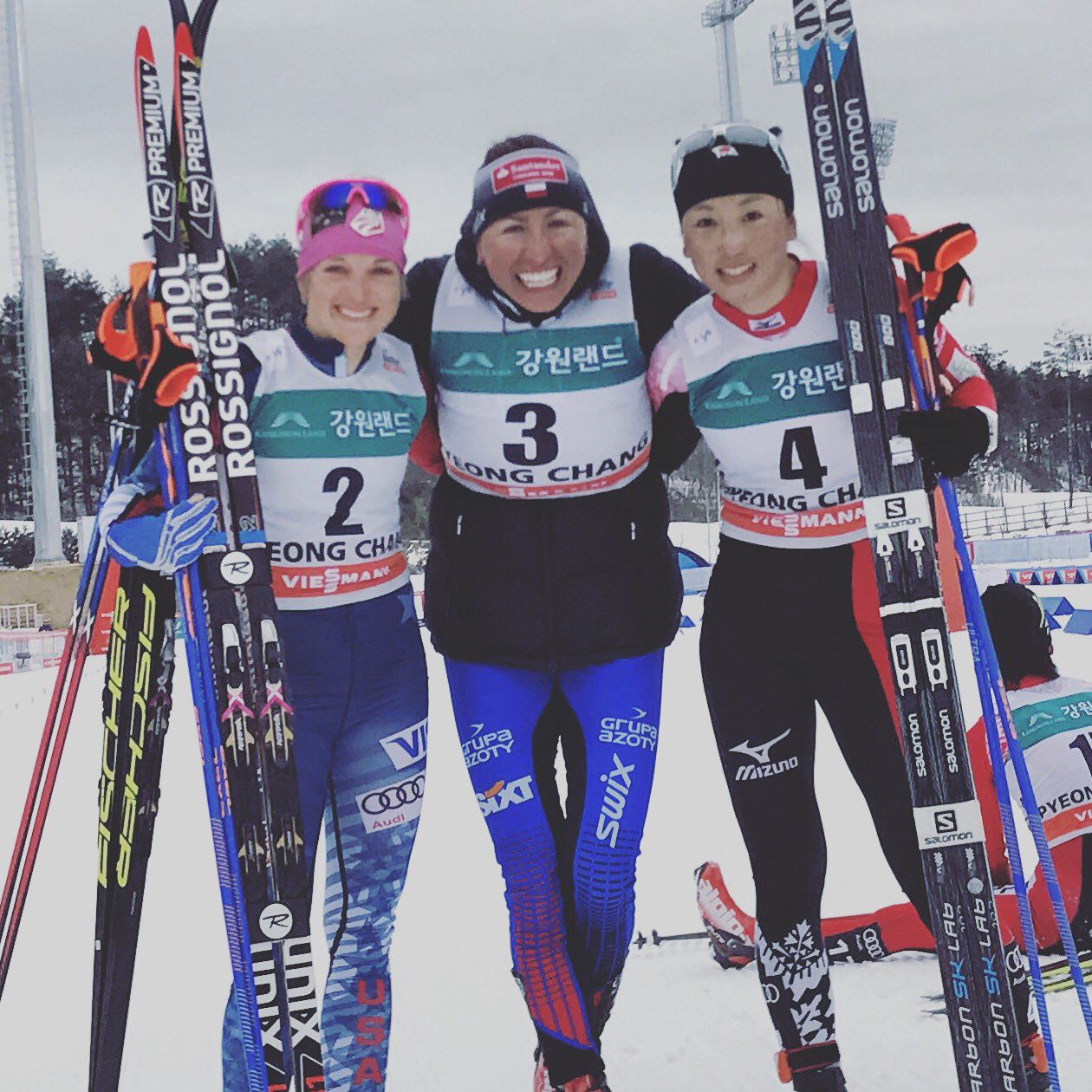
    The women's 15 k skiathlon podium at the PyeongChang World Cup in South Korea, with Poland's Justyna Kowalczyk (c) in first, American Liz Stephen (l) in second, and Japan's Masako Ishida in third. (Photo: FIS Cross Country/Twitter)
    The women’s 15 k skiathlon podium at the PyeongChang World Cup in South Korea, with Poland’s Justyna Kowalczyk (c) in first, American Liz Stephen (l) in second, and Japan’s Masako Ishida in third. (Photo: FIS Cross Country/Twitter)

    The second day of World Cup racing in PyeongChang, South Korea, took place this Saturday, with a skiathlon event for both genders. The women raced a total of 15 kilometers, the first 7.5 k leg classic and the second 7.5 k leg freestyle. Poland’s Justyna Kowalczyk came away with the women’s win (her first in three years), getting back to her old ways of breaking away from the pack to finish first in 43:54.7 minutes. Liz Stephen of the U.S. Ski Team (USST) claimed second place (+56.0), while Japan’s Masako Ishida took third (+1:14.8).

    For Stephen, second matched her best individual result in a from two years ago, when she placed second in a 10 k freestyle in Rybinsk, Russia. This year at the Tour de Ski, Stephen posted the second-fastest time up the final climb in Val di Fiemme, Italy. For Ishida, it was her first podium since 2009.

    Caitlin Patterson, racing for the U.S., finished just off the podium with a career-best fourth (+1:21.4) for her first top 20 on the World Cup,  and American Liz Guiney placed 13th (2:21.7) for her first top 20 as well. Jessica Yeaton, who trains with Alaska Pacific University and races for Australia, came in 24th (4:58.6).

    Two Canadian women competed with Annika Hicks leading the team in 26th (+5:17.8) followed by Sadie White in 29th (+6:54.7) for their first World Cup top 30s.

    In the men’s 30 k skiathlon that followed, Russia’s Petr Sedov broke away during the skate leg to take a decisive victory over Norway’s Daniel Stock and Mathias Rundgreen, finishing in 1:18:49.6 hours, 22.5 seconds clear of second place. It was Sedov’s first World Cup win and podium, and the first individual podiums for Stock and Rundgreen as well.

    Rundgreen edged Russia’s Konstantin Glavatskikh for the final spot on the podium, with both being listed as 42.1 seconds behind Sedov.

    While Rundgreen held off three others for third place, including Sweden’s Gustav Eriksson in fifth (+46.8), Japan’s Keishin Yoshida in sixth (+47.1), and Russia’s Alexander Utkin in seventh (+49.0), American Noah Hoffman kept his distance ahead of the second chase group to finish eighth (+1:06.2) for his best result in a non-World Cup stage since placing eighth in a 2012 skiathlon in Canmore, Alberta. (Hoffman won the time of day in the 15 k pursuit four years ago in Kuusamo, Finland.)

    Also for the U.S., Scott Patterson was next across the line in ninth (+1:28.4) for his first World Cup points, and Matt Gelso finished 19th (+5:00.8) for his first top 20.

    Brian McKeever of Canada’s Para-Nordic Ski Team was the lone Canadian finisher in 29th (+8:48.9). Bob Thompson was listed as placing 32nd of 37 after being lapped, and Simon Lapointe did not finish.

    Results: Women | Men

    ***

    NorAm Eastern Canadian Championships (Cantley, Quebec): Classic interval start

    The NorAm mini tour at the Nakkertok Nordic Centre continued on Saturday with Eastern Canadian Championships with classic individual start races.

    In the men’s 15 kilometre, Lappe Nordic’s Andy Shields took a lead in the first lap and held on to win in 39:14.7, just 0.7 seconds ahead of CNEPH’s Ricardo Izquierdo-Bernier.  Team R.A.D.’s Russell Kennedy collected his second bronze of the weekend, 24.7 seconds back.

    SMS Elite’s Anne Hart won the women’s 10 k in a reversal of Friday’s sprint podium.  Hart’s 30:03.3 finish gave her a 9.3 second edge on CNEPH’s Sophie Carrier-Laforte and 20.0 seconds on AWCA’s Maya MacIsaac-Jones.

    For the 123 men and 77 women doing the full distance, the weekend is a mini tour.  For the younger categories, it is three separate events allowing the kids who couldn’t skip school on Friday to race Saturday and Sunday.

    There should be over 700 finishers today with 768 on the start list. The volunteers will have more hours of work even after the open categories have finished.

    Results will update continuously as more categories start.

  • Saturday Rundown: Ulricehamn, Antholz, Chaux-Neuve, Zuoz, Whistler, & Truckee (Updated x6)

    Saturday Rundown: Ulricehamn, Antholz, Chaux-Neuve, Zuoz, Whistler, & Truckee (Updated x6)

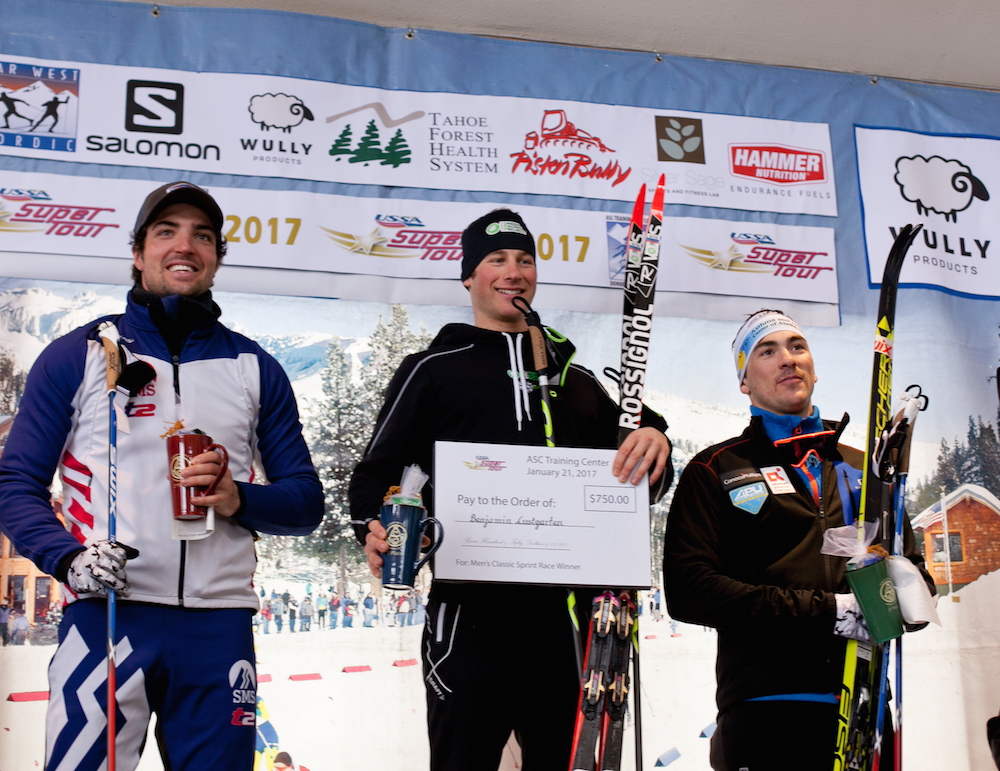
    Ben Lustgarten (Craftsbury Green Racing Project) with his $750-dollar check for winning the men's SuperTour classic sprint on Saturday near Truckee, Calif. Stratton's Ben Saxton (l) placed second and APU's Reese Hanneman (r) was third.
    Ben Lustgarten (Craftsbury Green Racing Project) with his $750-dollar check for winning the men’s SuperTour classic sprint on Saturday near Truckee, Calif. Stratton’s Ben Saxton (l) placed second and APU’s Reese Hanneman (r) was third.

    U.S. SuperTour (Truckee, Calif.): Classic sprints

    [UPDATED] Less than a week after being named to the U.S. team for 2017 World Championships, Ben Lustgarten — the men’s 30 k classic mass start champion at this year’s U.S. nationals — won Saturday’s SuperTour classic sprint as well.

    Lustgarten, of the Craftsbury Green Racing Project, raced to a 1.58-second victory in the men’s A-final at the Auburn Ski Club in Soda Springs, Calif., finishing in 3:03.4. Ben Saxton, of the Stratton Mountain School (SMS) Elite Team, placed second, and Reese Hanneman, of Alaska Pacific University (APU), was third (+2.77).

    Hannenman’s younger brother Logan also reached the final and placed fourth (+4.5), Dakota Blackhorse-von Jess (Bend Endurance Academy) was fifth (+5.86), and the third APU skier in the final, Tyler Kornfield sixth (+18.69).

    Blackhorse-von Jess started the day off as the fastest qualifier in 2:58.8. Saxton qualified second, 4.1 seconds back, Logan Hanneman qualified third (+4.2), and Lustgarten fourth (+6.5). Blackhorse-von Jess went on to win his quarterfinal and place second in his semifinal, while Lustgarten and Saxton both won their quarterfinals and semifinals.

    Jennie Bender (3) of the Bridger Ski Foundation leading Stratton's Julia Kern (2) and Sun Valley's Deedra Irwin (5) during the second women's classic sprint semifinal at Saturday's SuperTour near Truckee, Calif. Bender went on to win the semifinal, as well as the final.
    Jennie Bender (3) of the Bridger Ski Foundation leading Stratton’s Julia Kern (2) and Sun Valley’s Deedra Irwin (5) during the second women’s classic sprint semifinal at Saturday’s SuperTour near Truckee, Calif. Bender went on to win the semifinal, as well as the final.

    In the women’s A-final, Jennie Bender of the Bridger Ski Foundation, coming off a classic sprint win at nationals, scored another victory in 3:29.07. She edged Craftsbury’s Kaitlynn Miller by just seven-hundredths of a second, and Stratton’s Julia Kern placed third (+3.42). Racing at home, Hannah Halvorsen (Sugar Bowl Academy) finished fourth (+3.88). Craftsbury had three in the women’s final with Caitlin Patterson in fifth (+3.93) and Heather Mooney in sixth (+27.35).

    Miller proved to be the woman to beat throughout the day, winning the qualifier in 3:30.9, along with her quarterfinal and semifinal. Kern qualified second (+3.2) and Bender third (+4.6). Bender went on to win her quarterfinal and semifinal as well before facing off with Miller in the final.

    Results: Men | Women

    ***

    NorAm Western Canadian Championships (Whistler, B.C.): 10/15 k classic 

    It was interval-starts day at Western Canadian Championships at Whistler Olympic Park and national-team veteran Emily Nishikawa completed the four laps of the women’s 10 k classic in 30:35.5 to win ahead of teammate Dahria Beatty, 16.5 seconds behind. Maya MacIsaac-Jones completed the national team and Alberta World Cup Academy (AWCA) sweep in third (+1:36.5).

    Sovereign Lake’s Hannah Mehain, of the national junior team, was the top junior for the second-straight day in eighth overall (+3:22.1).

    In the men’s 15 k, Lappe Nordic’s Andy Shields won the six-lap race in 40:34.2, showing some of the form that won him the NorAm overall last season. National-team member Jess Cockney collected his second-straight podium, finishing second, 4.3 seconds behind Shields. Evan Palmer-Charrette (NTDC Thunder Bay) completed the podium in third (+55.1).

    Results

    ***

    FIS Cross-Country World Cup (Ulricehamn, Sweden): 10/15 k freestyle

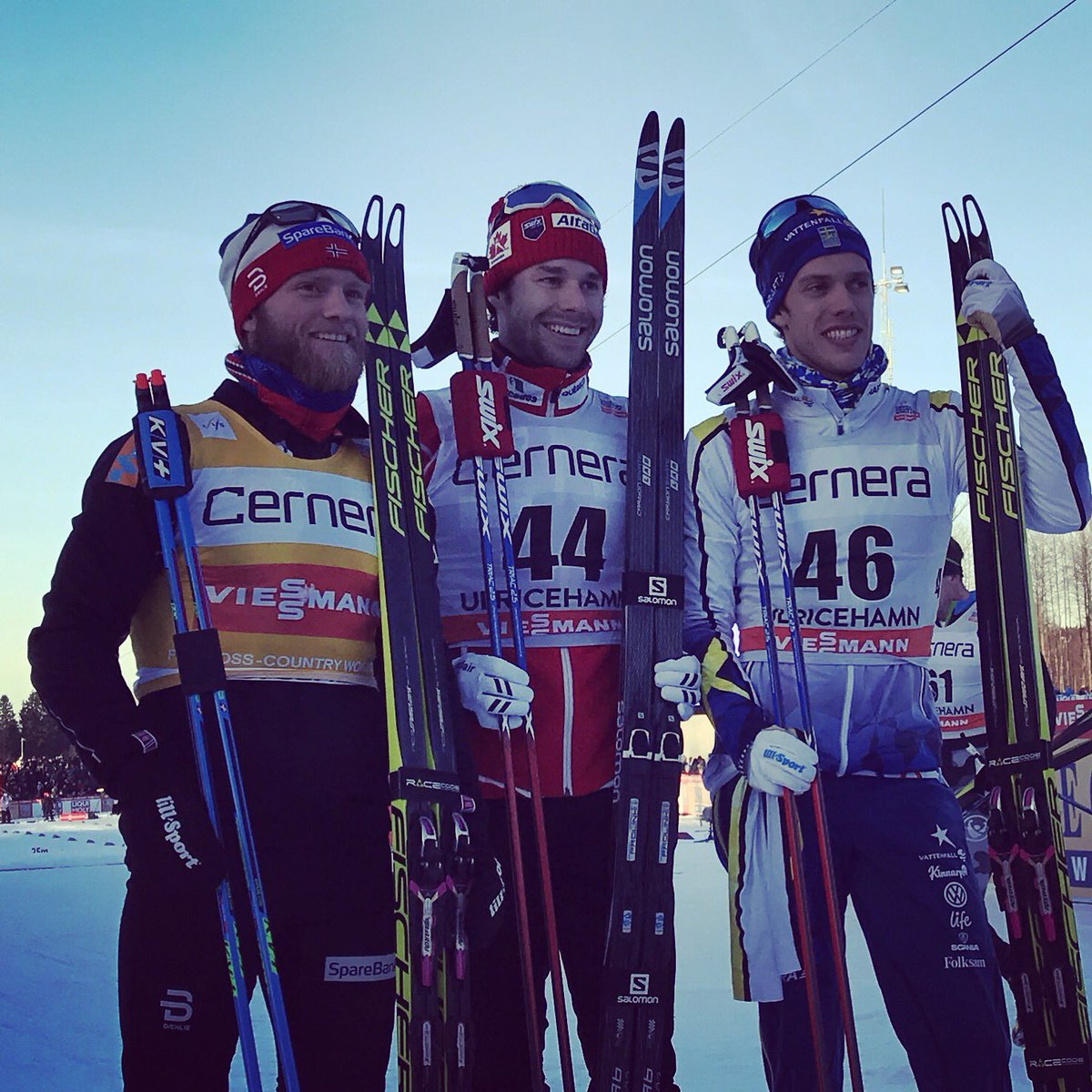
    The men's 15 k freestyle podium at Saturday's World Cup in Ulricehamn, Sweden, with Canadian winner Alex Harvey (c), Norwegian runner-up Martin Johnsrud Sundby (l), and Sweden's Marcus Hellner (r) in third. (Photo: FIS Cross Country/Twitter)
    The men’s 15 k freestyle podium at Saturday’s World Cup in Ulricehamn, Sweden, with Canadian winner Alex Harvey (c), Norwegian runner-up Martin Johnsrud Sundby (l), and Sweden’s Marcus Hellner (r) in third. (Photo: FIS Cross Country/Twitter)

    Men’s report | Women’s report

    First individual win of the season (second straight, after winning last weekend’s team sprint), fifth individual victory of his career. That’s the latest news on Canada’s Alex Harvey, who won the World Cup men’s 15-kilometer freestyle individual start on Sunday in Ulricehamn, Sweden, for his first victory in a 15 k skate race and fourth individual podium of 2016/2017.

    To say Harvey is on a roll is an understatement. On Saturday, he beat Norway’s Martin Johnsrud Sundby by 6 seconds after starting a minute behind the Norwegian defending World Cup champion. Harvey’s fastest time across the line in 32:46.2 held up through 76 finishers, with Sweden’s Marcus Hellner coming somewhat within range after starting a minute behind him. Hellner ended up 14.3 seconds back from Harvey at the finish for third place, behind Sundby.

    Switzerland’s Dario Cologna missed the podium by 0.5 seconds in fourth (+14.7), and Norway’s 24-year-old Daniel Stock broke through in fifth (+16.2) for his first World Cup top 20.

    Great Britain’s Andrew Musgrave placed sixth (+18.7), Sweden’s Daniel Rickardsson was seventh (+25.0), Norway’s Finn Hågen Krogh eighth (+32.2), Russia’s Petr Sedov ninth (+33.9), and Japan’s Keishin Yoshida 10th (+34.2).

    American Erik Bjornsen landed in the points as he tied Norway’s Simen Andreas Sveen for 28th (+1:09.2), leading fellow U.S. Ski Team members Noah Hoffman, who placed 41st (+1:28.8), and Simi Hamilton in 53rd (+1:56.2). Also for the U.S., Matt Gelso, the Period 1 SuperTour leader from the Sun Valley Ski Education Foundation (SVSEF) Gold Team, finished 68th (+3:00.3).

    Harvey’s Canadian World Cup teammates Len Valjas finished 35th (+1:17.7) and Devon Kershaw 38th (+1:22.2). Knute Johnsgaard (Canadian U25 Team) did not start.

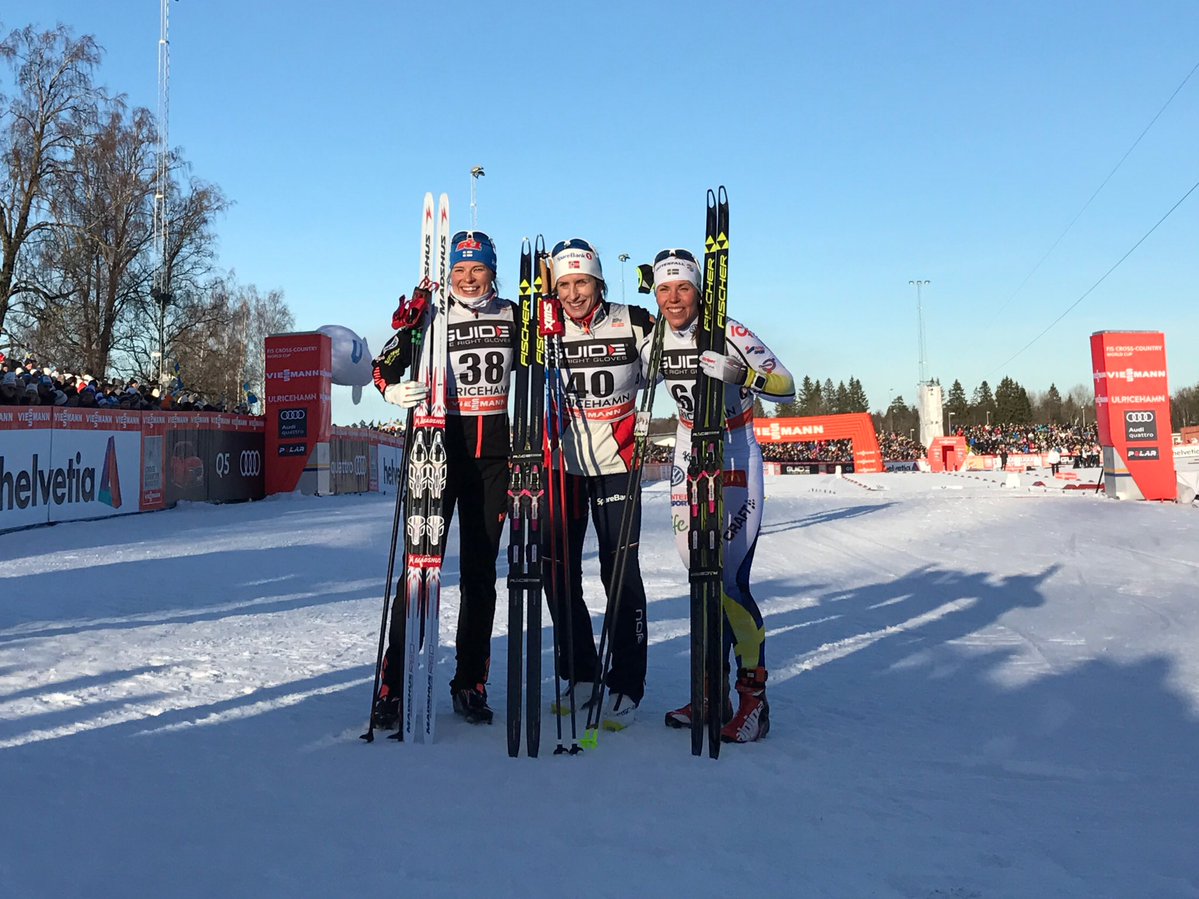
    The women's 10 k freestyle podium on Saturday in Ulricehamn, Sweden, with Norwegian winner Marit Bjørgen (c), Finland's Krista Parmakoski (l) in second and Sweden's Charlotte Kalla (r) in third. (Photo: FIS Cross Country/Twitter)
    The women’s 10 k freestyle podium on Saturday in Ulricehamn, Sweden, with Norwegian winner Marit Bjørgen (c), Finland’s Krista Parmakoski (l) in second and Sweden’s Charlotte Kalla (r) in third. (Photo: FIS Cross Country/Twitter)

    In her first World Cup race in over a month and at a brand-new World Cup venue, Norway’s 36-year-old Marit Bjørgen returned to her winning ways, topping the women’s 10 k freestyle on Saturday in Ulricehamn.

    Bjørgen started 40th out of 61 finishers and took the lead from Finland’s Krista Parmakoski at the finish with a time of 23:46.3 minutes. Parmakoski, who started a minute ahead of her in bib 38, ended up second, 10.7 seconds back. Sweden’s Charlotte Kalla reached the podium for the second time this season in third (+24.9).

    “It is always great to win,” Bjørgen said, according to an International Ski Federation (FIS) press release. “I stayed at home for five weeks and was training. It is great to come back with a victory. I know that the training I had done was good. It was an amazing atmosphere today by the course. There were people cheering everywhere.”

    Norway swept fourth through sixth with Astrid Uhrenholdt Jacobsen in fourth (+25.7), Ragnhild Haga in fifth (+32.3) and Heidi Weng in sixth (+34.0).

    American Jessie Diggins raced to seventh (+34.9), ahead of Sweden’s Hanna Falk, who recorded her best distance result in eighth (+36.4). Norway’s Ingvild Flugstad Østberg finished ninth (+44.8), and Germany’s Sandra Ringwald was 10th (+56.6).

    “I didn’t have the snappy good feelings I was hoping to have in my body today, but it was a solid race,” Diggins wrote in a post-race email to FasterSkier. “It’s always hard when you know that on your best days you are capable of more, but at the same time we had great skis, and it was really fun for me to be able to ski with my teammates today!”

    The U.S. had three in the top 20 and four in the top 30 with Sadie Bjornsen in 12th (+1:00.5), Liz Stephen in 16th (+1:07.3) and Rosie Brennan in 24th (+1:30.7).

    Cendrine Browne as Canada’s lone woman in the race achieved 35th (+1:52.0) for her career best in an individual race. Also for the U.S., Kikkan Randall placed 40th (+1:59.6) and Liz Guiney of the Craftsbury Green Racing Project 52nd (+2:33.2).

    Results: Men | Women

    ***

    IBU World Cup (Antholz, Italy): Men’s relay & women’s mass start

    Men’s report | Women’s report

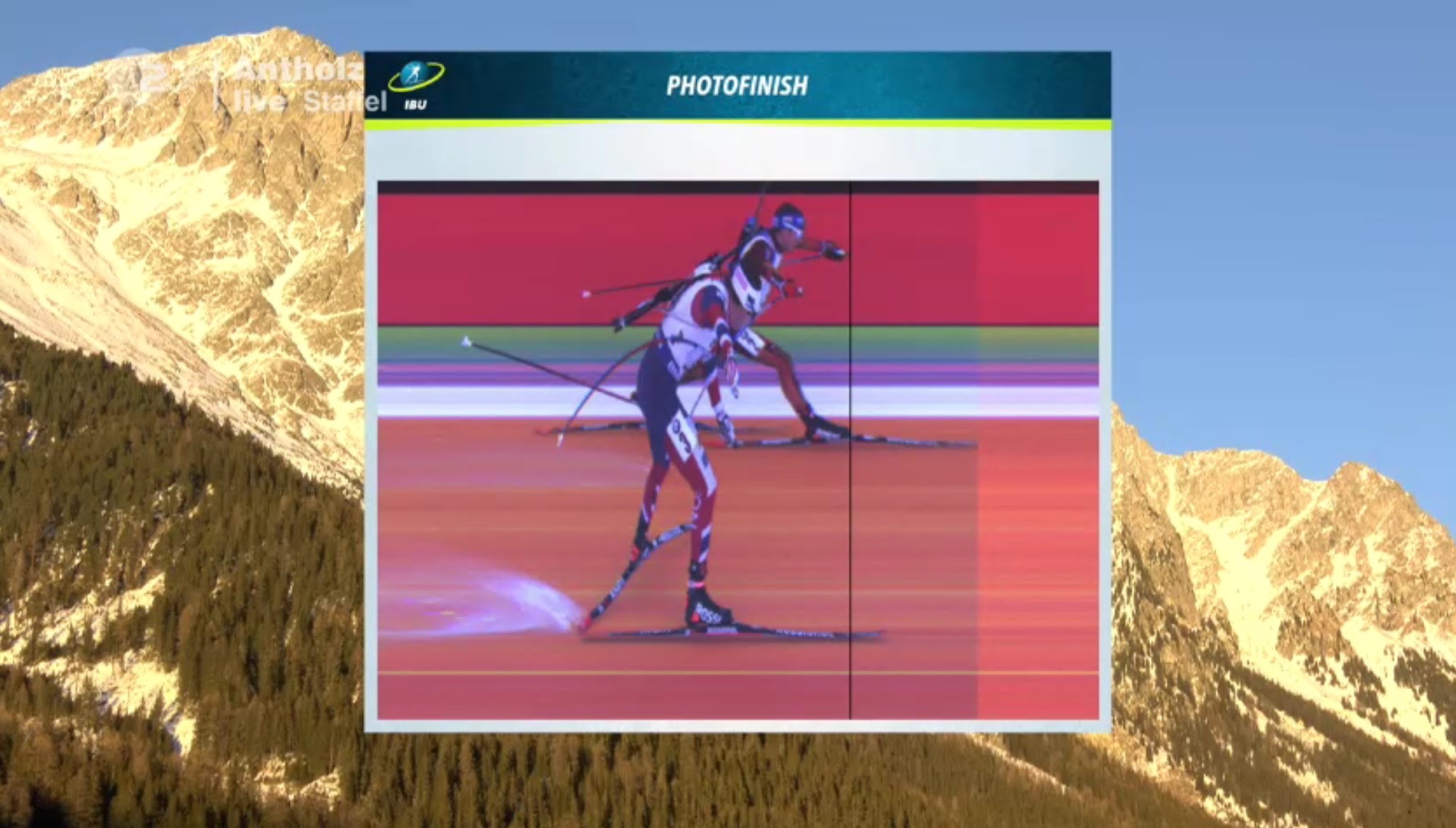
    The photo finish of the men's 4 x 7.5 k relay on Saturday at the IBU World Cup in Antholz, Italy, with Germany's Simon Schempp outlunging Norway's Emil Hegle Svendsen. (Photo: IBU screenshot)
    The photo finish of the men’s 4 x 7.5 k relay on Saturday at the IBU World Cup in Antholz, Italy, with Germany’s Simon Schempp outlunging Norway’s Emil Hegle Svendsen. (Photo: ZDF broadcast screenshot)

    For the U.S. men, top six was a target for the 4 x 7.5 k relay on Sunday in Antholz, Italy, according to US Biathlon Men’s Coach Jonas Johansson.

    Mission accomplished. In the final team event before 2017 World Championships, Lowell Bailey, Leif Nordgren, Tim Burke, and Sean Doherty combined for sixth, finishing 1:04.9 minutes behind the German winners. The Americans used a total of 10 spares but avoided the penalty loop, as did the Germans who used seven spares to clean the eight-stage race and won it in 1:13.57.2.

    Germany’s Simon Schempp narrowly outlasted Norway’s Emil Hegle Svendsen in the finishing stretch to secure the victory for Germany (with teammates Erik Lesser, Benedikt Doll and Arnd Peiffer) by one-tenth of a second. Norway finished second with nine spares and no penalties (with Lars Helge Birkeland, Henrik L’Abee-Lund, Johannes Thingnes Bø, and Svendsen), and Russia secured third (+33.6) with nine spares and zero penalties as well (with Maxim Tsvetkov, Evgeniy Garanichev, Dmitry Malyshko, and Anton Babikov).

    Ukraine used a total of just five spares and had zero penalties for fourth (+46.7), and Austria took fifth (+49.2) with eight spares and no penalties, after Austria’s Dominik Landertinger skied away from Doherty on the final loop and finished 6.9 seconds ahead of him for fifth place.

    For the U.S. men, sixth was close to their team-best fifth with the same lineup in last year’s World Cup relay in Presque Isle, Maine. The same group also took sixth in Ruhpolding, Germany, last year as well.

    With all four making US Biathlon’s World Championships team, announced Saturday, they will likely be aiming for a best championships result early next month in Hochfilzen, Austria.

    Canada (Christian Gow, Scott Gow, Macx Davies, and Brendan Green) finished 16th (+4:13.8) on Saturday with two penalties and 11 spares. Scott Gow skied them up to 15th by the second exchange but they dropped to 18th after Davies had two penalties on the third leg. With Green anchoring and using just one spare, they recouped two places before the finish.

    In the women’s race, Germany’s Nadine Horchler achieved a lifetime dream with her first World Cup win, after starting in bib 30 and earning her start as a reserve athlete. Germany took first and second with Laura Dahlmeier in second, and the Czech Republic’s Gabriela Koukalova placed third. Susan Dunklee of the U.S. was the lone North American starter and finished 24th after leading at the start of the second loop.

    Results: Men’s relay | Women’s 12.5 k mass start

    ***

    FIS Nordic Combined World Cup (Chaux-Neuve, France): Individual large hill/10 k

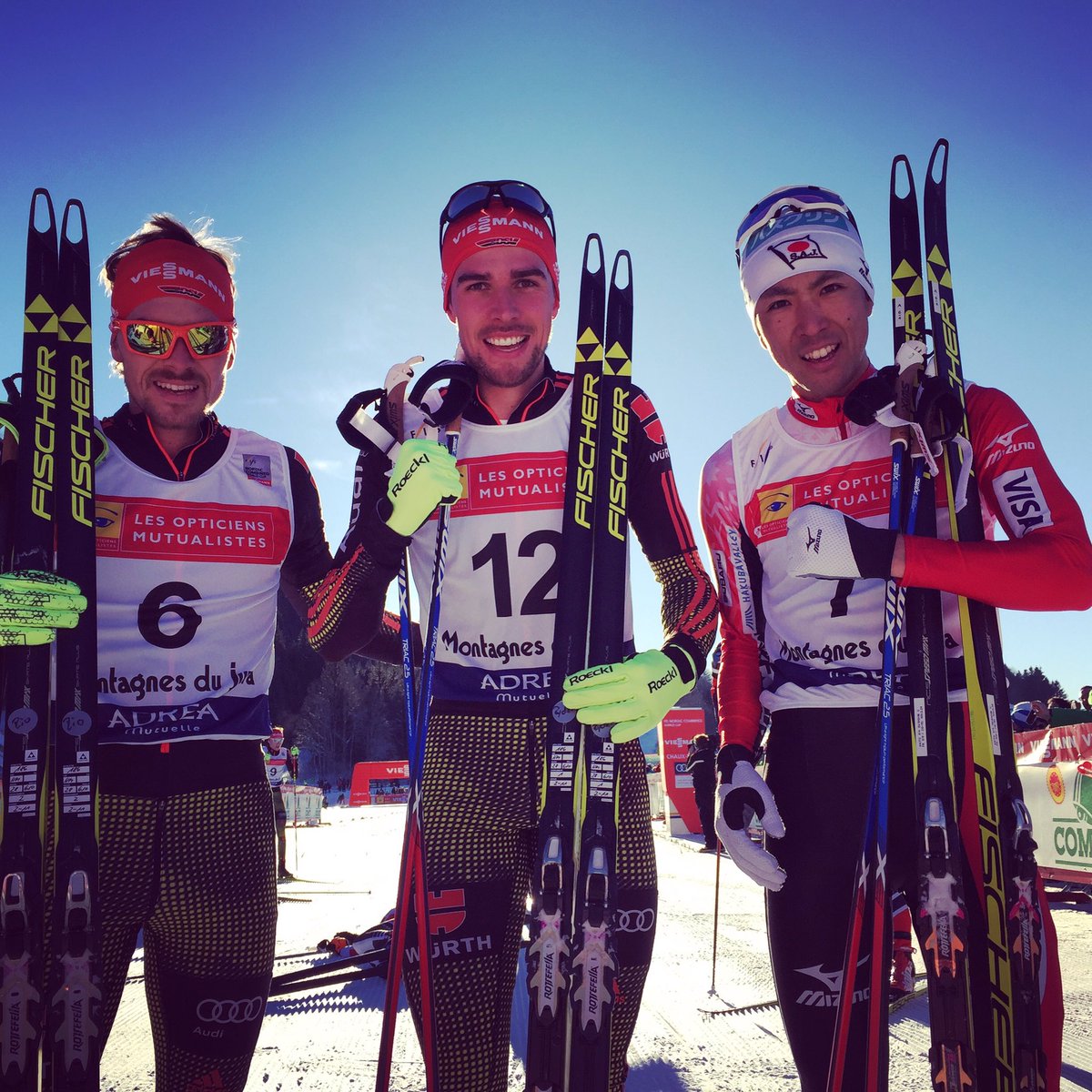
    Saturday's Nordic Combined World Cup podium in Chaux-Neuve, France, with German winner Johannes Rydzek (c), German runner-up Fabian Rießle (l) and Japan’s Akito Watabe (r) in third. (Photo: FIS Nordic Combined/Twitter)
    Saturday’s Nordic Combined World Cup podium in Chaux-Neuve, France, with German winner Johannes Rydzek (c), German runner-up Fabian Rießle (l) and Japan’s Akito Watabe (r) in third. (Photo: FIS Nordic Combined/Twitter)

    The first part of Saturday’s Nordic Combined World Cup individual large hill/10 k competition was a shining moment for U.S. Nordic Combined skier Ben Berend, who jumped to second for a total of 127.5 points, trailing only Norway’s Jarl Magnus Riiber with 139 points in Chaux-Neuve, France.

    Berend flew farther than Germany’s Eric Frenzel, who jumped to third on the Chaux-Neuve large hill.

    Later in the day, they started the 10 k Gundersen in that order, with Riiber heading out first, followed by Berend 46 seconds later, then Frenzel 53 seconds back in third.

    Germany’s Johannes Rydzek started 1:15 minutes back in 12th and skied the fastest 10 k to take the victory at the finish (in 23:01.7). He held off his German teammate Fabian Rießle by 2.8 seconds for the win, after Rießle started sixth and 1:01 back. Japan’s Akito Watabe reached the podium in third (+5.7) after jumping to seventh and starting the race 1 second behind Rießle.

    Frenzel ended up fourth (+8.3), and the fourth German in the top five, Björn Kircheisen improved to fifth (+22.6) after starting 11th.

    Riiber dropped to 15th (+54.0), and Berend fell outside the top 30 to end up 32nd (+2:26.0) with the 39th-ranked course time.

    Berend finished 12.2 seconds ahead of his U.S. teammate Taylor Fletcher, who placed 34th (+2:38.2) after the jump put him in 48th.

    Bryan Fletcher was 49th after the jump but did not start the 10 k.

    The Nordic Combined World Cup continues Sunday in Chaux-Neuve with another large hill/10 k.

    Results

    ***

    Ski Classics #5: La Diagonela (Zuoz, Switzerland): 50 k classic

    [UPDATED] Under “blue skies, no wind and perfect track conditions” in the Swiss Engadin Valley on Saturday, according to a Ski Classics press release, Russia’s Ilya Chernousov and the Czech Republic’s Kateřina Smutná won the men’s and women’s La Diagonela, respectively, in Zuoz, Switzerland.

    Chernousov, of Team Pioneer Investments, and Tord Asle Gjerdalen (Team Santander) led a large pack of men into the final major climb on the 50 k course. There, Gjerdalen attacked and Chernousov matched him, accelerating away from his competitors up the last steep pitch to the finish, according to the press release. He finished in 2:03:39.6 hours, holding off Gjerdalen by 1.5 seconds, while Øystein Pettersen (Team BN Bank) finished third (+3.0).

    In the women’s race, Smutná (Team Santander) pushed to break up the field around the halfway point, where the men caught the women. Britta Johansson Norgren (Lager 157 Ski Team) hung with Smutná, but lost contact over the last 5 k. After finishing second in the last two Ski Classics races, Smutná took the win by 1:03.2 minutes in 2:20:49.2. Nordgren finished second, ahead of Sara Lindborg (Team Serneke) in third, who finished more than three minutes later (+4:17.4).

    Results


  • Kowalczyk, Poltoranin Take First Two Muonio Races; Americans and Canadians Jump in the Mix

    Kowalczyk, Poltoranin Take First Two Muonio Races; Americans and Canadians Jump in the Mix

    Each November, it’s tradition for some of the world’s best nordic skiers to go where the sun don’t shine – or appears very little. The fact is that Muonio, Finland, above the Arctic Circle has snow this time of year when other parts of Europe are still waiting for the skiable stuff.

    Justyna Kowalczyk of Poland during one of last year's FIS races in Muonio, Finland. This weekend, Kowalczyk won two out of three Muonio competitions from Nov. 15-17.(Photo: Petri Ikävalko/Hevoskuuri.fi)
    Justyna Kowalczyk of Poland during one of last year’s FIS races in Muonio, Finland. This weekend, Kowalczyk won two out of three Muonio competitions from Nov. 15-17.(Photo: Petri Ikävalko/Hevoskuuri.fi)

    Starting Friday, the unofficial Finland Triple began in Muonio, with hundreds of skiers flocking to the northern region for their first International Ski Federation (FIS) races of the season.

    Poland’s cross-country celeb Justyna Kowalczyk jumpstarted her season with a sizable victory in the 1-kilometer classic sprint, topping Russian Evgenia Shapovalova by more than 7 seconds in the final, as well as Russia’s Julia Tikhonova in third and Natalia Matveeva in fourth. Finland’s Mona-Lisa Malvalehto placed fifth out of 146 female competitors.

    In the men’s 1.3 k classic sprint on Friday, Alexey Poltoranin of Kazakhstan beat Finland’s runner-up, Ari Luusua, by 3.23 seconds in the final, as well as third-place finisher Russian Anatoliy Volkov (+5.56). Ales Razym of the Czech Republic was fourth and Estonia’s Peeter Kummel placed fifth out of 255 men.

    Leading a small American contingent in Muonio, Dakota Blackhorse-von Jess (Bend Endurance Academy) placed 34th in the sprint qualifier. Welly Ramsey was the fastest from the Maine Winter Sports Center (MWSC), placing 113th, teammate Sam Tarling came in 209th, and post-grad Austin Huneck was 239th. Another MWSC post-grad, Emily Ramsey finished 128th in the women’s race.

    On Saturday, Kowalczyk and Poltoranin again topped their respective podiums – this time in the 5 and 10 k classic races. Kowalczyk defeated Russia’s Yulia Tchekaleva in second by 21.6 seconds, and Germany’s Nicole Fessel in third (+27.3). Finland’s Anne Kyllönen and Kertu Niskanen placed fourth and fifth, respectively, out of 199 women.

    Poltoranin edged Lukas Bauer of the Czech Republic by 6.8 seconds, and German Hannes Dotzler in third (+24.2). Razym finished fourth for the second-straight day, and Germany’s Tim Tscharnke placed fifth out of 331 finishers.

    Kris Freeman in Muonio last year. (Photo: Petri Ikävalko / Hevoskuuri.fi)
    Kris Freeman in Muonio last year. (Photo: Petri Ikävalko/Hevoskuuri.fi)

    Kris Freeman (MWSC) led the Americans in his first race of the season in 34th, 1 minute and 11 seconds behind Poltoranin, who won in 24:33.7. Tarling placed 109th, 2:09.8 back from the winner. Canadian Para-Nordic veterans Brian McKeever placed 160th and Erik Carleton was 242nd.

    Racing ended Sunday with the women’s 10 k and men’s 15 k individual skate. Russian Petr Sedov stole the spotlight from Finland’s Matti Heikkinen, who was leading until Sedov finished 7.8 seconds faster in 34:56.5. Two other Finns rounded out the top four with Tero Similae in third and Lari Lahtonen in fourth, and Franz Goering of Germany was fifth out of 188 men. Poltoranin did not race.

    Freeman finished 32nd, 1:15.1 after Sedov, McKeever was the top Canadian in 63rd, (+2:13), and Welly Ramsey was 116th (+3:24.7) Carleton placed 125th (+3:38), and Tarling was 126th (+3:39.5).

    Russian Irina Khazova won the women’s 10 k in 25:46.2, ahead of teammate Tchekaleva in second (+28.3), and Eva Vrabcova-Nyvltova of the Czech Republic in third (+49.5). Finland’s Gretel Niskanen placed fifth, and Russia’s Svetlana Nikolaeva was fifth out of 159 women. Kowalczyk fell to 24th, behind teammate Sylwia Jaskowiec in 21st. American Emily Ramsey placed 155th.

    ***

    Results: 

    Friday’s classic sprint: women | men

    Saturday’s 5 and 10 k classic: women | men | photos

  • Notes and Quotes: Falun Prologue Edition

    Notes and Quotes: Falun Prologue Edition

    All 2012 FIS World Cup Finals coverage is brought to you through the generous support of Fischer Sports USA, proud sponsors of Kikkan Randall, 2012 overall Sprint Cup Champion.

    FALUN, Sweden – It is amazing how interesting a 2.5-3.3-kilometer individual start race can be.

    There might not be the head-to-head drama of sprints and mass-start events, but observing how skiers approach the prologue distance, and the challenging nature of the “not a sprint, not a distance race” leaves plenty to talk about.

    With Mördarbacken (killer hill) falling within the first kilometer of the race, racers appeared to apply one of two basic strategies—throw down from the start and hope to hold on in the later gradual terrain, or open more moderately and accelerate over the top of the hill.

    In the men’s race, the Norwegain team notably chose the later. On the lower pitches of Mördarbacken the first time around (the men added their extra distance by climbing the first third of the hill a second time), almost to a man, the Norwegians appeared to be having a collective bomb of a day.

    Compared to many of their competitors, they were moving with a slow tempo and little explosiveness—maybe appropriate for the early stages of a 50k.

    But this had changed when they appeared again as they attacked the last hill with a vengeance.

    The results sheet supported the observations with eight of nine Norwegians improving their placing after the steepest pitch of the Mördarbacken.

    Most notably Niklaus Dyrhaug, who was 4th moved up 13 spots, Sjur Roethe 11, Martin Johnsrud Sundby 19 and John Kristian Dahl 21.

    Canadian Head Coach Justin Wadsworth told FasterSkier that “at the start of a race like that you can be really stressed and high tempo,” basically inefficient.

    Despite the experience of most of these athletes, many appeared to fall prey to this trap.

    A number of the Russians started hard, only to fall back later in the race.

    Petr Sedov, however, was not one of them. He improved a remarkable 32 places over the final 2.1 kilometers of the race, from 44th to 12th.

    Going the other direction was teammate Dmitriy Japarov, who fell 21 places from 15th to 36th.

    Notable: Ponytail.

    The women showed somewhat less volatility, most likely due to the fact there was just the single large climb.

    The top-6 at the finish all were within that number at the top of the hill and only Jessie Diggins and Laure Barthelemy moved up double digits among the top-25.

    Diggins improved 12 places from 20th to 8th and Barthelemy moved up 16 from 26th to 10th.

    Notable: Barthelemy under control on the climb.

    In addition to starting pace, there were quite a few differences in technique choice among the skiers—again more so with the men.

    A few, like Jean Marc Gaillard, impressively chose to V2 the entire first portion of Mördarbacken, while others quickly switched to V1.

    Completely anecdotally, the V1 choice seemed the better bet. The top three men, Alex Harvey, Dario Cologna and Devon Kershaw all used a powerful V1 relatively early in the hill, while the two most notable V2-ers, Gaillard and Marcus Hellner placed 24th and 9th respectively, with Hellner slipping after leading at the top of the hill.

    German Josef Wenzl appeared to employ the Norwegian slow-start strategy, but someone forgot to tell him he was supposed to speed up later in the race.

    The sprinter looked more than a little sluggish early in the climb and ultimately beat only American Sylvan Ellefson, who crashed hard and required on-course medical attention.

    Notable: Face of the day courtesy of Aino Kaisa Saarinen (FIN)

    Watching the women up at the crest of Mördarbacken revealed different technique choices as well.

    Some quickly switched out V1 as they crested the steepest pitch, V2-ing the remaining gradual climb, while others continued to V1.

    Again, unscientifically, it seemed that V1 was the better choice for most.

    Some women, notably the Norwegians, hugged the outside of the climb on skier’s right, sticking to the shaded part of the track along the barrier.

    Heidi Weng hugging the wall.

    Most of the Norwegians executed this to the extreme, staying outside of even the twists, while other skiers opted to take a better line.

    Two of the top Norwegian women did not start the race, withdrawing from the mini-tour.

    Vibeke Skofterud made the decision not to race after warming up.

    “She is a little bit tired after the Vasaloppet (the 90k Swedish ski marathon that Skofterud won two weeks ago),” Norwegian women’s coach Egil Kristiansen said.

    He added that she is having some minor issues with her elbow after the double-pole fest that is the Vasaloppet.

    Astrid Jacobson also passed on the prologue citing stomach problems according to Langrenn.com.

    Their teammate, Therese Johaug, however, was in fine form, placing 6th and climbing to 19th in the World Cup Finals standings.

    “It is a steep hill here in Falun and it is really hard, but I like to climb these hills,” said Johaug.

    She attacked the Mördarbacken with her usual double-time tempo.

    “I train a lot for this one in the summer at home in Dalsbygda and when I was a little girl, my grandfather said, ‘If you should be a good cross country skier you have to train on uphills,’” she said.

    And thus she trains uphills, something she “likes very much.”

    At this point, Johaug is considered the best climber on the World Cup circuit after twice winning the Tour de Ski final climb.

    “I push myself to do my best,” Johaug continued. “The important thing is to not be too far away from first place…In the end it is a tour and that’s the reason to get to the top.”

    Johaug doing what Johaugs do best—climbing.

    Eirik Brandsdal, winner of the Royal Palace Sprint continues to lead the World Cup Finals after placing 31st in the prologue, a result he was pleased with.

    “It was a good race,” Brandsdal said. “I saved some power on Mördarbacken, and from there I just pushed as hard as I could.”

    Climbing, Brandsdal said, is his strong suit, so the course suited him.

    He is currently three seconds ahead of Harvey entering the third day of competition.

    Following the prologue, he had yet to consider the possibility of going for bonus seconds in Saturday’s mass start.

    “I think I will just try to stay with these guys [Harvey at al] as long as possible,” Brandsdal said. “I am a sprinter, so it will be hard for me, but I will do my best.”

    He added that his performance in the mini-tour thus has already exceeded his expectations.

    Notable. Big bells.

    Matt Voisin contribute reporting.

  • Team 3: Russia

    Russia

    2009-2010 Nations Cup Ranking: 3rd (7701 pts)

    2010-2011 Nations Cup Ranking: 3rd (6199 pts)

    Men: 2nd (4422 pts)

    Women: 7th (1777 pts)

    2011/2012 World Cup Team (Best Estimate)

    Men

    Stanislav Volzhentsev

    Maxim Vylegzhanin

    Petr Sedov

    Evgeniy Belov

    Konstantin Glavatsikh

    Ilia Chernousov

    Alexey Petukhov

    Nikolay Morilov

    Dmitriy Japarov

    Nikita Kruikov

    Sergey Shiryaev

    Alexander Panzhinsky

    Sergey Novikov

    Women

    Yulia Tchekaleva

    Anastasia Dotsenko

    Natalia Korosteleva

    Julia Ivanova

    Olga Mikhailova

    Natalja Iljina

    Valentina Novikova

    Svetlana Nikolaeva

    Olga Savialova

    Elena Soboleva


    What You May Have Missed Last Season

    It was impressive just how good the Russian distance skiing men were in 2010-2011 – especially in the last kilometer of racing.

    Maxim Vylegzhanin (L) during World Championships, Oslo 2011

    Alexander Legkov, Maxim Vylegzhanin, Ilia Chernousov, and Petr Sedov were all brilliant last season at various points, and all four finished in the top 20 in the World Cup Overall standings.

    In particular, for the first few weeks of the season it looked like Legkov was going to run away with the Crystal Globe. He finished in the top 10 six times in the first three weekends of racing, including a devastating attack a long way from home in the final day of racing during the mini-tour in Kuusamo, Finland, where he left Marcus Hellner and Dario Cologna standing still.

    And Legkov wasn’t alone in impressing the crowd with his finishing skills – Vylegzhanin did what most possible consider to be impossible, beating Petter Northug to the line at the end of the 30 k skate in La Clusaz, France.

    Joining his more highly-decorated and recognized teammates in the elite group this season was Chernousov, who had his best World Cup season to date. The highlight of Chernousov’s season was his big win on home turf, where he did a fantastic job of reeling in and then dispatching Frenchman Jean-Marc Gaillaird in the 20 k pursuit in Rybinsk, Russia.

    But despite having possibly the strongest team on paper, the Russians had the most devastating relay experience at World Championships in Oslo. After taking the tag in third place, just 20 seconds out of the lead, Legkov exploded spectacularly while skiing the third leg, giving up almost two minutes to the fastest leg time, and dropping the Russians back to seventh.

    On the flip side, while the men were solid except for the World Championships blunder, the Russian women did not impress. For the size of the Russian program, and considering the fact that it’s headed by Elena Vlyabe, who is second on the all-time World Cup wins list (45, or one less than Marit Bjoergen), the Russian women were nothing to write home about.

    Yulia Tchekaleva led the team with her best year on the World Cup to date, while Anastasia Dotsenko was a surprisingly effective sprinter, but just four women scored over one hundered points. The rest were mostly enthusiastic pack filler during the World Cup weekend in Rybinsk, Russia.

    But the Russian women failed to win a World Cup outright all season – even in Rybinsk, where the odds are usually pretty good (just look at all those RUS nation tags on the results list).

    Legkov leading Lukas Bauer during the 50 k classic at the 2010 Vancouver Olympics

    Notably, the Russians had significant quantity – they had 29 men and 29 women score at least one World Cup point. While a lot of those were collected during one three-race weekend in Rybinsk, Russia, it’s still an impressive number.

    What You Need To Know for This Season

    Several strong Russian women are back on the circuit, ready to bang heads with the best in the world.

    Irina Khazova has returned from a year-long break, where she had a baby, and has already put up an impressive second place result in the FIS race last weekend in a 10 k freesytle.

    Natalia Matveeva has returned from a doping ban, and while the formerly speedy sprinter has her eyes set on the home Olympics in Sochi 2014, there is no guarantee she’ll get to go.

    And it’s a good thing the Russian women are receiving reinforcements, as according to her FIS profile, Yulia Tchekaleva, the top female point producer from last season is injured and is currently not active.

    As for the men, Yevgeny Dementiev, also fresh off a two-year doping ban will be allowed to compete for a spot on the national team. The 2006 Olympic gold and silver medalist will be competing against a deep men’s team, and is now 28 years old, but could conceivably be a factor.

    The Russians are also strength training machines, cranking out all kinds of intense weight workouts, while wearing bullet-proof vests. And the lack of snow in Scandinavian isn’t a problem, as they have been working hard on synthetic skiing options.

    Evgeniy Belov (RUS) leading Alex Harvey (CAN) during the Under-23 World Championship pursuit.

    Who You Should Watch

    Holy smokes, the list could be endless, as Elena Soboleva, Konstantin Kuleev, Sergei Ustygov, and Gleb Retivykh all had top 10 finishes at World Junior Championships in Otepaa, Estonia last winter. The Russians always seem to have a home-run prospect in the pipeline, and last season FasterSkier picked break-out star Petr Sedov, who stormed to 20th in the World Cup Overall rankings.

    However, this year FasterSkier is tipping Evgeniy Belov, which is a bit of a no-brainer.

    The strong Russian was the only athlete to stay anywhere close to Canadian Alex Harvey in the Under-23 World Championship pursuit, scored 244 of his own World Cup points in just ten individual World Cup starts, was a member of three World Cup medal-winning 4×10 k relay teams, and to top it all off, is just 21 years old.

  • Sedov Prognosis Good; Petukhov Blames Filing Failure on Tour de Ski

    Sedov Prognosis Good; Petukhov Blames Filing Failure on Tour de Ski

    Petr Sedov (second from left) racing with one of his teammates at last year's World Junior Championships in Germany.

    One day after a sports website reported that budding Russian cross-country ski star Petr Sedov was suffering from a potentially serious heart problem, the president of the Russian Ski Association, Elena Vyalbe, said that Sedov had been to see specialists in Davos, and that “cause for concern was not found.”

    “The final conclusion is not ready yet, but according to preliminary data, Peter’s heart is all right,” his father Nikolai Sedov told the website AllSportInfo.ru.

    Sedov will still miss next week’s U-23 World Championships in Estonia, because he does not yet have permission to race from Russia’s Federal Medical-Biological Agency (FMBA), according to AllSportInfo.

    But there’s still a chance for him to make the Russian team for the World Ski Championships in Norway in February, if he gets the okay from the FMBA – though according to Vyalbe, he will have to qualify through races at the country’s national championships in Rybinsk, in late January.

    The Swiss doctors in Davos have ruled out a number of serious conditions, Nikolai Sedov told AllSportInfo, and despite a ban placed on Petr Sedov by the FMBA, he has continued to train.

    News has also emerged about one of the Russian athletes who missed a deadline to submit his whereabouts to anti-doping authorities, a minor rules violation that can result in a suspension if repeated.

    Alexei Petukhov, a sprinter and Olympic medalist, told the website SkiRun.ru that he failed to file his whereabouts during the Tour de Ski, when he was traveling every day, making the forms “not possible to fill out.” Then, he said, he got sick, the room where he was quarantined did not have internet access, and a Russian Ski Association worker he asked for help was too busy.

    Three filing failures within an 18-month period are treated as an anti-doping rules violation, with the potential for a suspension, but Russian Anti-Doping Agency Deputy Director Igor Zagorskiy told FasterSkier in an e-mail that Petukhov has never had one before. Neither has his teammate Nikolay Morilov, another star sprinter who also missed a deadline around the same time, while Vassily Rotchev and Dmitri Vassiliev “already had one filing failure each,” Zagorskiy said.

    Olga Tiagay, the fifth skier reported to have missed a deadline, has a clean slate, but she has not been racing this winter,according to her profile on the International Ski Federation’s website.

  • Russian Phenom Sedov to Miss U-23 Championships

    Petr Sedov on his way to winning the 20k pursuit at last year's World Junior Championships in Germany.

    A familiar and dominating form will miss this year’s U-23 World Championships.

    According to the website Sports.ru, 20-year-old Russian phenom Petr Sedov is suffering from a heart problem, and will sit out next week’s races in Otepaa, Estonia.

    The World Ski Championships in Norway in February are up in the air for Sedov, as well, the report says.

    Tall and thin at 6’2” and 165 pounds, Sedov had been an imposing presence at the World Junior Championships over the past three years, collecting three individual titles and missing the podium just once in nine starts.

    After competing in the Vancouver Olympics in 2010, the 2011 season was Sedov’s first full one on the World Cup, and his results to date suggested a star on the rise.

    He was fifth in the circuit’s opening race, a 15 k freestyle in Sweden, and never finished outside the top 15 in five individual distance starts.

    According to the Sports.ru article, Sedov returned home after his final World Cup race in December and underwent routine medical tests with the rest of the Russian national team.

    An EKG apparently turned up some kind of heart problem, which has yet to be diagnosed. The Sports.ru piece says that Sedov is currently visiting experts in Europe, trying to obtain some kind of explanation.

    Had Sedov traveled to the U-23 Championships, he would have been a clear favorite in any event he entered there. But the Russian roster for that event, released on Saturday, does not include Sedov, and according to the report in Sports.ru, he will “most likely” miss the remainder of the season.

    The piece does not cite a source for its information, but nonetheless, the news spread quickly in the European ski media on Monday morning.

    Russian Eurosport commentator Andrey Kondrashov told FasterSkier in an e-mail that Sports.ru is a “quite respectable source,” but no official word from the Russian Ski Association had confirmed the news.

  • TDS Preview: Bauer Looks to Defend Title, North America Starts Five

    The 2010/2011 Veissmann Tour de Ski is nothing if not draining. Consisting of eight events in ten days in two countries, the fifth edition begins December 31st and runs until January 9th.

    The Tour begins with a freestyle prologue in Oberhof, Germany, on December 31st, followed by a classic pursuit start on January 1st. The Tour then moves to Oberstorf, Germany, for a sprint on January 2nd, and a pursuit on the 3rd.

    After a two day break, the Tour resumes in Toblach, Italy, for a sprint on January 5th and a point-to-point pursuit start from Cortina to Toblach on the 6th.

    The Tour de Ski wraps up in Val di Fiemme, Italy, as the Italians host a 10/15 k on January 8th, and then the final climb up Alpe Cermis on the 9th.

    The Favorites

    In the fifth edition of the event, all three top male finishers from last season are expected to contend. Lukas Bauer (CZE), Petter Northug Jr. (NOR) and Dario Cologna (SUI) are all registered, and while two have started the season quickly, the third – Northug – has only four World Cup starts to the season, having fallen ill just before the opener.

    The Czech Republic's Lukas Bauer racing at the 2010 Olympic Games.

    Bauer has come out swinging – the aging Czech distance specialist sits in seventh in the overall rankings, and has already collected two podium finishes, including a stage win in Kuusamo, Finland. He has finished in the top 30 in every distance race he has started (his one sprint wasn’t great, as he finished 104th, a full ten seconds away from qualifying).

    Given his hot start, the fact that he is the defending and two-time Tour de Ski champion (2007/2008 and 2009/2010), Bauer is undeniably the favorite.  While his utter lack of sprint skill is disconcerting, he has shown in the past that it is irrelevant, as in the two sprints on the Tour last year, he finished 54th and 60th. But Bauer recognizes that sprinting is still important – he has put extra time into improving his speed over the summer, and should be aiming to limit the damage during the two sprint stages.

    After Bauer, Switzerland’s Dario Cologna is a must-watch. In his short four year World Cup career, Cologna has already won the World Cup overall, the Tour de Ski (2008/2009), and currently sits in second in the overall standings, a mere 22 points from the lead.

    Cologna is dangerous because he is a true all-around skier, and more importantly, is extremely consistent. The last time Cologna finished outside of the top 30 on the World Cup was over a year ago, on December 12, 2009, in Davos. He has already stood on the World Cup podium three times this season, including a second place finish in the Kuusamo mini-tour, and a third place in the freestyle sprint in his hometown of Davos.

    Despite finishing runner-up to Bauer in last years’ Tour, winning the 2009/2010 Crystal Globe, and being the most recognizable cross country ski name on the planet, Petter Northug has to be considered a bit of a dark horse. The dynamic Norwegian is just bouncing back from illness, and his absence from the early World Cup has put him in a large hole in the overall standings, as he sits in 18th.

    Dario Cologna celebrating a victory at the Olympics

    While Bauer is the distance workhorse, and Cologna is the all-around consistent performer, Northug is the sparkplug. Love him or hate him, the Norwegian is without a doubt one of the most talented and entertaining skiers on the circuit.

    The question will be his health, and whether he has returned to his world-beating form. Over the last two World Cup weekends, Northug has done well, but not outstanding. The real concern should be with his famed sprint speed – his failure to win a sprint finish in the 30 k freestyle at the La Clusaz World Cup combined with his 28th place sprint in Davos the weekend before shows that his sprint is not where it has been in the past.

    Northug may need a few extra races to get back to where he needs to be, as it is inconceivable that a skier of his talent will be held down for long. Expect him to speed up over the course of the Tour, and a podium finish is completely realistic.

    The Chasers

    While most of the buzz is about the top three finishers from last year, both the Russians and the Swedes also have strong contingents hitting the start line.

    The Russians have nine men starting, headlined by Alexander Legkov and Maxim Vylegzhanin. Legkov currently sits atop the World Cup overall, and much like Bauer he is a sub-par sprinter, but an excellent stage racer.

    Winner of the Kuusamo mini-tour and runner-up in 2006/2007 Tour de Ski, Legkov has the potential to gut out a victory, as he has the tools to distance ski as well as almost anyone, and won’t lose much time in the sprints. The only area for concern is his Tour de Ski record in the past three years, as he has finished 20th, 33rd and failed to complete the event since his second place in 2006/2007.

    Legkov and Bauer.

    Maxim Vylegzhanin is ranked third in the overall behind Cologna and Legkov, and as one would expect, has had great start to the season. He has finished in the top 15 six times, including fifth in the Kuusamo mini-tour, and besting Northug in the 30 k freestyle in La Clusaz, which certainly bodes well. He has a decent record on the Tour (21, 15, DNF), but just can’t seem to make the breakthrough to finish in the top 10.

    The only surprise for the Russians is that 20 year old phenom Petr Sedov, who is currently 8th overall, will not be starting.

    The Swedes are bringing seven men to the party, and  could easily capture at the very least a couple of stage victories.

    Emil Joensson is the current world cup sprint leader, and is currently fifth in the overall. He is practically a lock to make the podium in both sprints, and he can ski a mean 10 or 15 k, especially classic. Unfortunately for Joensson, as the Tour goes on, his distance racing will be sorely tested, and he simply lacks the ability to compete in the longer events, so it is unlikely he will be able to contend for a podium spot in the final races.

    However, his team mate Marcus Hellner, who is fourth overall in the World Cup ranking has a much better shot. Often billed as Northug’s biggest rival, but not quite at the same level, Hellner started out the season strong with a home town win in Gallivaere, Sweden, but has been inconsistent since then, finishing fourth in Kuusamo, 33rd in the 15 k classic in Davos, seventh in the sprint, and finally 29th in the 30 k freestyle in La Clusaz.

    In the 2009/2010 Tour de Ski, Hellner was saddled with the wooden medal despite having a very strong final climb. To stay in contention for the podium, Hellner will have to avoid the inconsistent distance days, and if he is close going into Alpe Cermis, his strong skate climbing means he can pick up a few spots.

    Other strong Swedes include Daniel Rickardsson, a very good all around skier who will be in a position to crack the top 10, Johan Olsson, who hasn’t raced a World Cup since finishing 7th overall in Kuusamo, and the tough-as-nails Anders Soedergren.

    Sweden’s Scandinavian counterparts, Finland, lack a real shot at the Tour overall. Sami Jauhojaervi is their best hope, as he is ranked 19th overall, and has had success on the Tour previously, but his horrendously inconsistent skiing (think two top 10’s, and three races 50’s or higher) will prevent him from being a true challenger. Matti Heikkinen gets the nod as well, but like Jauhojaervi lacks the staying power required for the lengthy event.

    While the event is on home turf for both the Germans and the Italians, neither country has a skier competitive enough at the moment to challenge the top group.

    Seven Italians are pegged to start, including Giorgio di Centa, and on-form sprinters Fulvio Scola and Renato Pasini.

    Meanwhile, the Germans have only two men currently in the top 40 in the overall World Cup standings, but 13 men will start. Surprisingly Jens Filbrich and Tim Tscharnke are the two highest ranked German skiers, while stalwarts Axel Teichmann and Tobias Angerer are 46th and 58th respectively, and both will have to demonstrate a lot better form than they have thus far on the World Cup.

    North American Contenders

    This edition of the Tour will see five North American men fighting for position – and all five men bring their own unique set of skills to the event.

    American’s Andy Newell and Kris Freeman will both take to the start line, and will hope to continue the good early-season World Cup results with top results, regardless of stage. Freeman has jumped out to the best start of his World Cup career, and sits in 13th place Overall, as a result of collecting points in each of his World Cup starts thus far.

    Newell has had a decent start as he sits in 31st in overall on the back of his strong sprinting, in which he has earned points in all three of the sprints thus far on the circuit.

    Newell

    Both men have been typecast as specialists – Newell in sprinting, and Freeman in distance racing. However, both skiers have been working hard on diversifying their skiing, and have a bet running over who will score World Cup points first – Freeman in a sprint, or Newell in a distance race.

    The biggest question mark surrounding Newell is whether he will be able to distance race well enough to stay in contention.

    “I’m pretty excited to have a bunch of opportunities to do some distance races,” he said, “because I know I’m in good shape and I can distance race really fast — I just haven’t had the chance to show it.”

    Newell knows he has strengths and weakness in distance racing; “I know I’m a good mass start skier for sure,” he said.

    “I can ski well in packs but at the same time it’s like any time in a mass start race – you run the risk of blowing up,” he said, “It can be sometimes easier for sprinters like myself [to blow up] as you can build up so much lactic acid.”

    Both Freeman and Newell are relatively new to the Tour de Ski. Freeman has never competed in the event before, and Newell he completed three races last year before bowing out, and he felt that he has not gotten “a true Tour experience.”

    Regardless, Newell is going in confident; “I feel like I can be good at back to back to back races,” he said, “I think I’ve trained enough over the year that’s something I’ve gotten a lot better at.”

    Like many other racers on the Tour, Newell is targeting consistency, and is thinking about having good races each stage, rather than focusing on finishing as his end goal.

    While both Americans are working on their weaker race types, the best bet for top performances are their bread and butter events – the skate sprint for Newell, and something 15 k or longer for Freeman. It is difficult to imagine either skier truly contending for a place on the overall podium, but top 30 finish is a completely reasonable expectation.

    “Hopefully I’ll be able to hang in there for some distance races and score some distance races,” said Newell, “I’m going to need to score some bonus seconds in sprints [to have a chance in the overall standing].”

    The Canadian contingent showcases an all-around skier just coming into his prime, a young gun with loads of potential, and one of the best climbers on the circuit. Devon Kershaw, Alex Harvey and Ivan Babikov are all world class talent who had excellent results on the Tour de Ski last season, and look to build on that success. In charge of the three skiers is Head Coach Justin Wadsworth – a rookie on the Tour de Ski.

    “I think I’m pretty well organized,” said Wadsworth in an interview with FasterSkier, “and that’s key for keeping the nerves down.”

    While he has never been involved with the Tour before, Wadsworth is confident – he has been to all the World Cup venues before, and the three skiers he is in charge of will be well served. The Canadians have a large staff of five wax technicians as well as a massage therapist, the legendary ‘Wolfman’.

    Wadsworth is confident in his athletes ability to make the most of the Tour, and emphasized that Kershaw and Harvey have a shot in every stage, while Babikov will be able to take advantage of the difficulty of the last three stages, as he will be getting fitter every race.

    Kershaw going "freaking hard" at the 2010 Olympics
    Kershaw

    After one of the hottest starts of his career, in which he has consistently skied in the top 30 while hitting a few top 10 finishes, Kershaw is hitting his stride as an all-around skier.

    While he appears to be in form, and he is happy with how things went, Kershaw is still cautious about the event.

    “The Tour de Ski is completely different [from the rest of the World Cup season],” said Kershaw in a recent interview with FasterSkier, “a whole lot of things have to go right.”

    For Kershaw, having one or two really good days would make for a successful Tour, but his real ambition for the Tour de Ski is unrelated to results.

    “To be honest, the only big goal is to stay healthy,” he said, “Over the different Tours, we’ve had a lot of illness on the team, and I’ve been lucky to avoid it for the most part.”

    If he stays healthy, Kershaw has proven that he can race well in the Tour format. Last year he finished 16th in the event, benefitting from good sprinting, as well as six top 30 finishes.

    While he has traditionally had strong results in Tour de Ski sprints, including a podium, this year Kershaw isn’t so focused on the sprint.

    “The sprints are long days, and I don’t know how important they are in the overall,” he said. “[Lukas] Bauer won the Tour last year without ever qualifying for a sprint

    Unfortunately for Kershaw, his favorite and best event, the 10 k classic, has been eliminated from the Tour this year. As a result, he’s keeping his eye out for the 20 k pursuit in Oberhof, Germany in Stage 4.

    “The Tour really starts at the Pursuit in Oberstorf,” said Kershaw, “That’s the first place you’re really going to see some fireworks. Whether or not I’m looking forward to that, I have to be on my toes.”

    Kershaw said he may have pushed his training a little bit too hard during the last week, and as a result is feeling a little flatter than he would like, but with some dedicated rest, is hoping to be back in top shape come December 31.

    While Kershaw is still hoping to regain a little bit of energy, Alex Harvey is feeling well rested and ready to go, according to a recent interview with FasterSkier.

    Harvey is still relatively new to the Tour – this will be his second time tackling the event. And he learned a lot from last year, and highlighted two major things that he is hoping to improve on – staying calm, and proper feeding.

    The point-to-point race is something he is much more comfortable with the second time around. Last year Harvey described himself as “really nervous” prior to the start, as there was no opportunity to ski the course beforehand and he had a large gap he desperately wanted to close to the leaders. As a result, Harvey ended up with a severe diaphragm spasm, throwing off his rhythm. This time around, Harvey is a lot more comfortable, as he knows the course, and is aware that he needs to stay relaxed.

    Second, he recognized the increased importance of feeding on an event like the Tour de Ski. In the long classic race last year, Harvey was skiing strong at the front of the chase group when he bonked hard with one kilometer to go.

    “I didn’t feed enough during the day,” said Harvey, “you need to make sure your energy levels are always high, and it’s really hard to recover when you bonk that hard.”

    If there was one area Harvey really targeted for improvement this year, it was his sprinting.

    “On the sprinting side I was disappointed last year,” he said, “This year I wanted to make sure I can sprint well.” Last season Harvey managed to qualify just twice for a World Cup sprint. This season he has started just one, but finished ninth.

    Harvey has been confident with his shape all fall, and his strong start on the World Cup has increased his confidence. “I knew I would be more consistent this year, and I know I usually improve as the season goes on,” he said.

    And consistency is what Harvey is targeting for the Tour. While he has picked a few stages as key – the 20 k Pursuit in Oberstorf, the 36 k point-to-point, and the second last stage – he is confident in his shape regardless of the stage.

    “If I have a good day, any of the stages I can do well,” he said.

    As for the Final Climb, the 22 year old isn’t intimidated – he’s actually a little bit excited about it.

    “It’s not complicated,” he said, “you have to ski well technically, but it’s all about the climbing. It’s just how your body is doing, even the skis only matter for the first part.”

    While Harvey may not consider the Final Climb very complicated, that may be in part to being in close proximity with the man who is quite possibly the best at the event – team mate Ivan Babikov.

    The first few stages don’t suit Babikov, as he has struggled in prologues and sprinting, but as the days get longer and the Tour gets tougher, Babikov, who is widely regarded as one of the toughest athletes on the circuit, will shine. His specialty is the last stage – in 2009 he won the quad-busting climb outright, and in 2010 he finished fourth. If Babikov can stay close during the opening stages, his climbing skill means he may threaten for a podium spot.

    Both Canadians and Americans have spent the Christmas break in Davos, Switzerland, taking advantage of the high quality training location, and getting in large amounts of skiing and some good recovery as well.

    The group has gone alpine skiing, and taken advantage of the many excellent coffee shops in the Swiss town, but the teams are now in Oberstorf preparing for the first stage – a 3.75 k prologue.

  • Hellner Doubles Down in Gallivare, Leads Sweden to Relay Victory, US Strong for 3/4

    Marcus Hellner (SWE) at the finish of the men's 30k pursuit at the 2010 Olympic Games.

    In Petter Northug’s absence, Marcus Hellner (SWE) took over the mantle as the dominant World Cup male, following up an impressive victory in Saturday’s 15km freestyle by leading the Swedish relay team to the top of the podium.

    Hellner outsprinted Russia’s Alexander Legkov after the two teams broke away on the third leg.

    Daniel Rickardsson (SWE) and young Petr Sedov (RUS) broke away from Norway’s Chris Andre Jespersen and Switzerland’s Remo Fischer during the first skate leg, giving the anchors a 16 second lead that they would extend to 48 by the end.

    Norway took the final podium spot, unable to overcome the absence of Northug in the 4th spot.

    Switzerland posted an impressive result, led by Dario Cologna, who closed the 30-second deficit he inherited on the second leg.

    A group of four broke off the front on the scramble leg. Jauhojärvi (FIN), Sergey Cherepanov (KAZ), Eldar Roenning (NOR) and Emil Joennson (SWE) of Sweden II opened a gap of eight seconds on the field.  But with the exception of Norway, the teams quickly dropped.

    The US men had three quarters of a great relay, entering the anchor leg in a virtual tie for 5th.

    But Chris Cook, clearly not internationally race ready, plummeted back through the field , losing almost three minutes to Hellner over the last 10k, and dropping the US to a final position of 17th.

    The story of the day for the US, however, was continued strong performances from the rest of the athletes.

    Andy Newell bounced back from Saturday’s 15 k with what had to be one of his best World Cup distance performances.  Newell tagged Kris Freeman just 15.4 seconds off the pace in the main chase group.

    “I was able to have a really good start, and was able to relax pretty well,” said Newell following the race. “Because of that I was able to ski with the pack the entire 10 k, and then bring it into the stadium close enough that Bird [Freeman] was able to get in a good pack of skiers and link up with the lead pack.”

    Freeman continued his excellent start to the season, posting the 3rd fastest time on the second leg, bringing the US in 5th, just seconds out of the podium.

    The US chose to mix up the running order, switching Newell and Freeman. In the past, Freeman has generally scrambled, but according to Newell, the move worked out well.

    “The way we chose to run it today was a really smart idea — it put us in a really good position,” Newell said.

    He also pointed out that his experience bumping elbows in sprints paid dividends in the chaos of a relay scramble.

    The race moved to the skate technique, and Noah Hoffman took over for the US. Hoffman had a fine 2011 World Cup debut in the 15km, just missing out on the points. He stayed in high gear for the relay, holding position, despite losing time on the leaders.

    Hoffman ranked 16th for his leg, but was just 48.9 seconds off the pace set by Norwegian biathlon legend Ole Einar Bjorndalen.

    “We were stoked to see that if we all put together good 10 k’s…we can be in medal contention going into the third and fourth legs,” concluded Newell.

    There were few expectations for the US team, especially with Cook not firing on all cylinders. But for this was not the case for the Canadians.

    Running the same four that was a medal hopeful in Vancouver, the Canadian men struggled for the second consecutive day, placing 18th in the 23-team field.

    With George Grey dropping over a minute on the first leg, and tagging Devon Kersahw in dead last, the Canucks were never in the running.

    Kershaw managed the 9th fastest split on the second leg, but dropped another minute to the leaders, before giving Ivan Babikov his turn. Babikov fared no better, losing even more ground, and Alex Harvey, despite making up over two minutes on the US’s Cook, couldn’t move up.

    Cook just held off a hard-charging Harvey by 3.9 seconds.

    Newell pointed out that Cook is much stronger in a 10k classic, and that “having to skate that anchor leg was probably pretty tough for him… it’s probably not a good indication of the shape he’s in.”

    The World Cup picks up on Friday with a mini-tour in Kuusamo, Finland.

    Men’s 4x10km Relay – Results

  • Hometown Hellner Takes World Cup Opener in Gallivare

    Marcus Hellner representing Sweden at the Olympics last February.

    Swedish fans must have been crushed after Norway’s Marit Bjoergen knocked off their hometown hero Charlotte Kalla in the 10 k skate on Saturday morning in Gallivare. But they must have been equally thrilled in the afternoon, when Marcus Hellner (SWE) skied to an 11-second victory over Switzerland’s Dario Cologna—finishing in the stadium that was named for him after a double gold medal-winning performance at the 2010 Olympic Games.

    “I felt like I had control today,” Hellner said afterwards. “It was really inspiring to race with all my best friends cheering out on the course, in my home town.”

    Cologna took second, just over 10 seconds out of the lead, while Hellner’s teammate Daniel Rickardsson managed to lock the Norwegians out of the podium, just edging Chris Andre Jespersen (NOR) for third. Kris Freeman was the top North American in ninth, while Noah Hoffman (USA) and Alex Harvey (CAN) followed in 31st and 34th.

    With last year’s World Cup overall champion Petter Northug missing the race after falling ill earlier this week, the Norwegians were looking to biathlon superstar Ole Einar Bjoerndalen to pick up the slack. But it was Jespersen who took the early lead, despite being seeded in the bottom third of all 104 starters.

    The 27-year-old Jespersen is a former junior world champion—he won the 30 k freestyle in Solleftea, Sweden, in 2003—but with just two top-30 finishes on the World Cup, he had never established himself at the senior level before Saturday. (Perhaps his biggest claim to fame is that he dates Liv Miriam Nordtomme, the sister of Northug’s girlfriend.)

    After he crossed the finish line, Jespersen’s time of 32:48 held up for nearly half an hour. For a while, it seemed that the World Cup opener would end with another Norwegian upset—biathlete Ronny Hafsas was the surprise winner in last year.

    But Rickardsson—who said that he had worked on his skating all summer and full—quashed Jespersen’s hopes. He led the Norwegian by six seconds after the first of three five-kilometer laps, then held on, nipping Jespersen by just 1.9 seconds at the finish.

    Cologna was the next to assume the lead, slotting in nine seconds in front of Rickardsson. That result was a big improvement on Cologna’s World Cup opener last year—he finished 20th in that race after sustaining a hamstring injury in late September of 2009.

    But any hopes that Cologna had of holding the lead lasted exactly 18.6 seconds. With Hellner starting just one bib—30 seconds—behind Cologna, that’s how long the Swiss skier had after crossing the finish line before being knocked off the top of the podium.

    “Marcus was too strong,” Cologna said. “He’s the right winner today.”

    Hellner led wire to wire with some powerful skiing, but he still had enough energy at the finish to stay on his feet and salute the home crowd. With Northug out, and the Norwegian’s starts at next weekend’s races in Finland in jeopardy, the first few skate distance events of the season could be big opportunities for Hellner—even though he told the Swedish newspaper Dagens Nyheter that he did not “think the result list would be different” if Northug had been racing.

    “One of my best races ever,” he said. “I was never directly concerned or threatened.”

    One other notable result was that of the 20-year-old Russian phenom Petr Sedov, who was fifth, just three seconds off Jespersen. Sedov, a multiple junior world champion, started slowly, finishing the first lap in 26th place, but put in a fierce second loop that was actually faster than Hellner’s. That left him just in front of his veteran teammate Alexander Legkov at the finish.

    Reports on the Canadian and American teams to come!

  • Team 2: Russia

    Russia

    Nations Cup Ranking: 2nd (7701 pts)

    Men: 2nd (4180 pts)

    Women: 2nd (3521 pts)

    2010/2011 A Team

    Men

    Evgeny Belov

    Michael Devyatyarov

    Maxim Vylegzhanin

    Nikita Kriukov

    Alexander Legkov

    Alexander Panzhinsky

    Andrey Parfenov

    Alexey Petukhov

    Petr Sedov

    Sergey Shiriaev

    Ilia Chernousov

    Vasily Rochev

    Nikolay Morilov

    Alexey Moriakov

    Alexey Slepov

    Women

    Natalia Korosteleva

    Olga Savialova

    Evgenia Medvedeva

    Yulia Tchekaleva

    Svetlana Nikolaeva

    Julia Tikhonova

    What You May Have Missed Last Season

    Perhaps the biggest news about the Russians in the last year was how few of their athletes were busted for doping. The country takes a whole lot of flack for their less-than-stellar record with performance-enhancing drug use, but let’s take a step back and consider: Between 2007 and 2009, no fewer than 13 of Russia’s cross-country skiers were sanctioned for doping violations. That’s not even including seven other cases involving competitors in nordic combined, alpine skiing, and freestyle—although, to be fair, six of those were for marijuana metabolites. (Yeah, alpine skiers dope with the wacky tobacky. Really guys?)

    Considering the number of cases in previous years, the winter of 2010 was a surprisingly clean one for the Russians. Alena Sidko was busted for EPO (although the head coach of the Russian Olympic team originally said that she had been left off the squad because she was too fat), and Elena Vedeneeva refused a drug test, but that was about it—nobody was caught at the Olympics, or even at World Cups. Nikolai Pankratov was stopped early this fall with some suspicious drugs on the Swiss border and likely faces a two-year ban, but he’s not on the national team, and was said to have been planning on competing for Belarus this coming year.

    All the controversy surrounding the Russian doping problems is impossible to ignore, but it does overshadow an impressively deep program. Between their men and women, no fewer than 52 Russian athletes scored World Cup points last year—the most of any country. And their second place in the Nation’s Cup is especially impressive when you consider that they only had one athlete of each gender in the top 10 of the World Cup rankings—Maxim Vylegzhanin was the best-placed in eighth, with 532 total points.

    At the 2010 Olympics, the team ended up with four medals: gold and silver out of a sensational performance in the men’s sprint by Nikita Kriukov and Alexander Panzhinskiy, and two bronzes from the men’s and women’s team sprint. That tally would have pleased most nations, but it wasn’t nearly enough for Russia. After an angry letter sent by the country’s ski team to Russian president Dmitry Medvedev in the spring, the president of the country’s ski association ended up resigning, and a new one, Elena Vyalbe, took over. Vyalbe, a former Olympic gold medalist, was a certifiably nasty skier in her own right in the 1990s—she started in a national program at age 11, ultimately won dozens of World Cup races, and took five out of five gold medals at the 1997 World Championships in Trondheim, surely crushing the hopes of every Norwegian citizen alive. Vyalbe wasted no time turning things around once appointed president, ridding the association of a number of coaches tied to the doping scandals of the past.

    What You Should Know For This Season

    On the women’s side, the team has lost Irina Khazova, arguably the team’s third-best athlete, to pregnancy. But the rest of the team’s top five are all coming back. Yulia Tchekaleva appears to be on-form, judging from her seventh place in last weekend’s 10 k skate in Beitostolen (and no, banned former Olympic champion Yuliya Chepalova didn’t shanghai the International Ski Federation just by switching a few letters around—Tchekaleva is actually a different person), and Natalia Korosteleva will definitely be a force to be reckoned with in the sprints—she’s the one who almost knocked Kikkan Randall down to third place in Oslo last March.

    On the men’s side, Sergey Shiriaev started his season strong in Finland, while the trio of Alexander Legkov, Petr Sedov, and Evgeniy Belov locked the Norwegians out of their own podium in the tune-up races in Beitostolen. Legkov surely has an axe to grind after his fourth place in last year’s Olympic pursuit—he could be a threat to pull World Cup points by the bundle, but to do so, he’ll have to race more often. Last year, his season was over after Vancouver.

    One potential hurdle for the Russians to overcome if they want to contend for the Nation’s Cup is an issue with their visas, reported yesterday by the website SkiRun.ru. According to Vasili Parnyakov, a commentator for the site, the Russian visas for the Schengen-area countries—among them the Czech Republic, Estonia, Finland, France, Germany, Italy, Norway, and Sweden—are valid for only 90 days for the six-month period between October 1 and April 1. That could limit the amount of time each athlete spends in western Europe, which in turn could put a damper on individual World Cup point totals, but that’s only if the problem is not resolved before the end of the season.

    One thing that the Russians have going for them is their sweet title system. As far as this reporter can gather, the country still bestows titles on its athletes and coaches based on a system developed in the Soviet era that has carried through to the present times. For example, Elena Vyalbe is an “honored trainer of Russia,” and an “honored master of sport.” Alexey Batalov, a member of the Russian Ski Association’s presidium, is the “head of the theory and methodology of skiing” at the Russian State University of Physical Education, Sports and Tourism. Natalia Korosteleva is a “master of sport, international class.” Such a classification system is likely the only thing standing between North America and cross-country skiing dominance. Just think: Beckie Scott could be the “supreme viceroy of Canadian skiing, mounted division,” John Caldwell could be “honored mogul of the old school,” and, well, you get the drift.

    Who You Should Watch

    Petr Sedov is more than one to watch. He’s one to whom you should keep your eyes glued at all times. (The International Ski Federation thinks so, too—they tested him six times in seven days in Vancouver. The young man has started nine races at Junior World Championships, won five of them, and missed the podium in just one. He’s only 20, can barely grow a moustache, and is 6’1” and a mere 165 pounds. He’s already got Olympic experience, and in his two individual World Cup starts, he placed eighth and tenth. With ten more pounds and a bit more international experience, it’s scary to contemplate just how fast Sedov will be. He is coached by his father, Nikolai, who runs a squad of promising young Russian athletes. Nikolai also coached Irina Khazova, who won a bronze medal for her third place in the team sprint in Vancouver—and who also was caught using a masking agent in 2007 and banned for two years.

  • Sedov Dominates World Junior Pursuit; Patterson 20th

    Sedov Dominates World Junior Pursuit; Patterson 20th

    Petr Sedov on his way to winning the 20k pursuit at World Junior Championships
    Petr Sedov on his way to winning the 20k pursuit at World Junior Championships

    The snow fell furiously during the men’s 20k pursuit at World Junior Championships—as hard as Scott Patterson said he had ever seen it snow during a race.

    But there was another force of nature here today that was stronger than the weather: a tall, stocky 19-year-old Russian named Petr Sedov.

    At the end of the classic leg of the 20k pursuit here, Sedov had already dropped the entire field except for one: his teammate, Evgeni Belov. And after 10k of Sedov’s smooth, deliberate skating, nobody else was even close. By the finish, the Russian had 40 seconds on his nearest challenger, Petrica Hogiu of Romania. Finn Haagen Krogh  (NOR) was another three seconds behind, in third.

    Scott Patterson again led the way for the American juniors with a 20th place finish, followed by David Norris and Erik Bjornsen in 43rd and 49th, respectively. Eric Packer was 56th, hindered by cramps.

    After winning all the races in last year’s championships, it was a little surprising when Sedov only managed second place to Norway’s Paal Golberg in Wednesday’s individual 10k classic. But Russian Assistant Coach Natalia Timofeeva told FasterSkier that Sedov had suffered from vertigo that day on the course’s final climb, leaving him unable to race to his full potential.

    Sedov trains with his father, Nikolai, who also coached former World Junior Champion Irina Khazova, Timofeeva said. After the last race in Hinterzarten on Sunday, Petr heads home to Russia before traveling to Whistler to compete in the Winter Olympics.

    For a junior, Sedov is certainly big, and perhaps a bit more physically mature than some of his competitors. But he has already proven that he can compete at the elite level, with a 10th place in a World Cup in Finland last March.

    “Many of those guys are big,” said Norwegian U-23 Head Coach Micke Palsson, referring to the juniors here. “[Sedov] is really good.”

    Behind Sedov, a messy race was unfolding. With heavy snow falling all morning and only tapering off by the conclusion of the race, athletes had to contend with very soft course conditions. Some the men ended up skating on the classic trail, which was substantially firmer.

    By the end of the classic leg, Patterson had moved up to fifteenth, after beginning with bib 54 in the mass start. He almost maintained that in the skate leg, losing just five positions to fall to twentieth after losing a photo finish at the line to Britain’s Andrew Musgrave.

    Scott Patterson dueling with two Italians, Stefano Gardener (l) and Enrico Nizzi (r)
    Scott Patterson dueling with two Italians, Stefano Gardener (l) and Enrico Nizzi (r)

    Between the weather and the same brutal course as yesterday (which the men had to ski six times)—Patterson said it was one of the hardest races he’d ever skied.

    “It wasn’t really counting how many laps you do,” he said. “It was counting how many times you had to go up that hill.”

    David Norris, who raised eyebrows with a 4th place finish in the U.S. Nationals 30k classic, struggled to 43rd today. He clearly didn’t have the same pop that he displayed in Anchorage, and though he was sick recently, Norris said today that he had no excuses.

    “I raced hard the last two races…and racing hard should be faster than what it has been,” he said.

    Canadian starters included Zach Holland in 33rd, Patrick Stewart-Jones in 52nd, Joey Burton in 68th, and Steffan Lloyd in 70th.