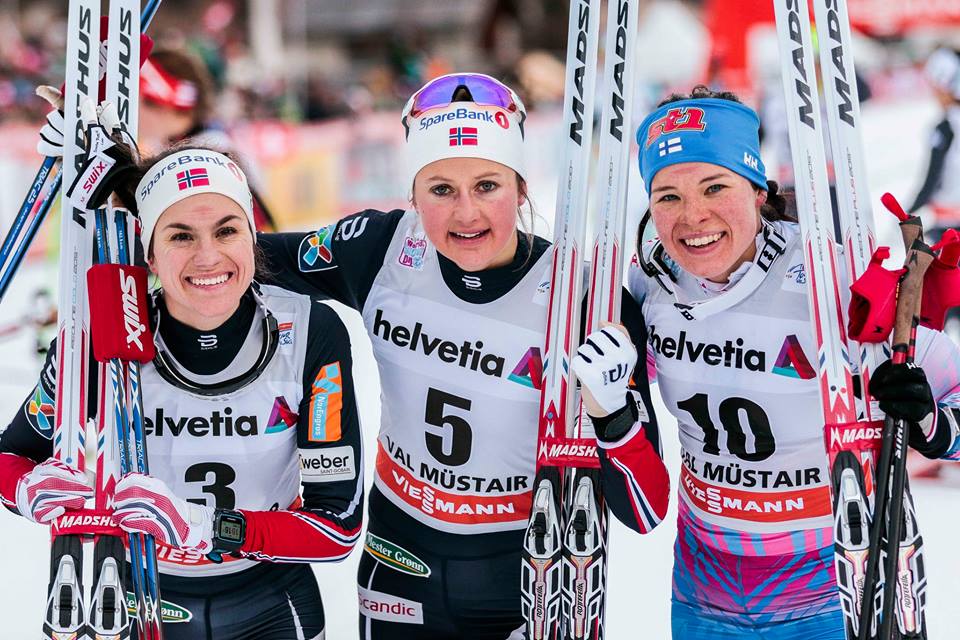
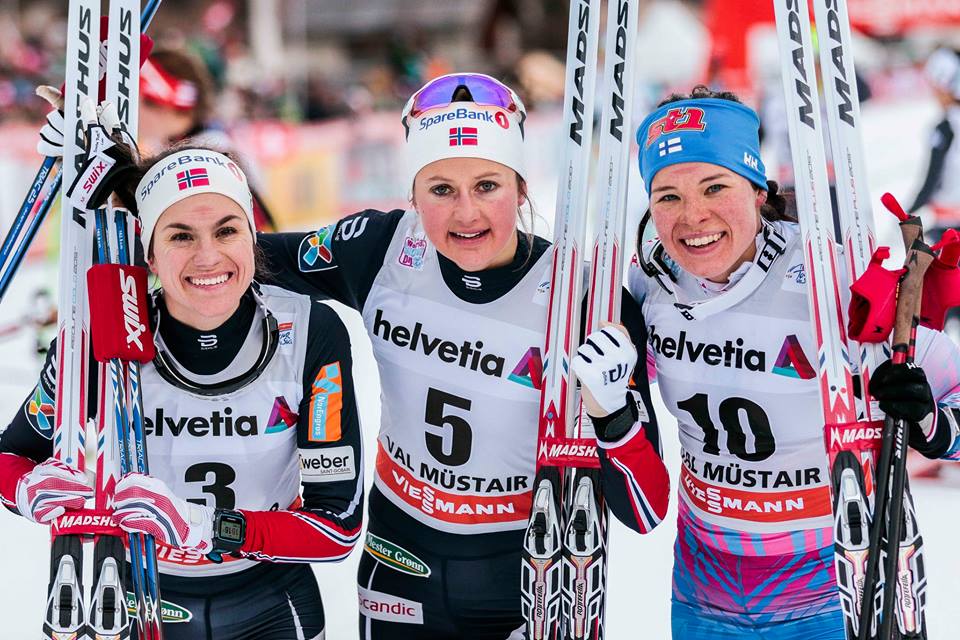
The Tour de Ski Stage 2 women’s podium on Sunday with (from left to right) Norway’s runner-up Heidi Weng and winner Ingvild Flugstad Østberg, and Finland’s third-place finisher Krista Pärmäkoski in the 5-kilometer classic mass start in Val Müstair, Switzerland. (Photo: Fischer/NordicFocus)
Maybe it was because she wanted redress. Maybe it was because there was less pressure to perform. Or maybe it was because the yellow Tour de Ski (TDS) leader’s bib was with Sweden, calling her Norwegian name.
Whatever it was, when Ingvild Flugstad Østberg lined up for the women’s 5-kilometer classic mass start on Sunday in Val Müstair, Switzerland, she was ready to race for the win.
After being eliminated in the semifinal of Saturday’s freestyle sprint, the 26-year-old turned the lost chance at a podium into an opportunity to prove her place as a top contender.
“I was irritated with myself after yesterday,” Østberg told NRK.
“Such a result sometimes makes you give your best,” she added, according to a International Ski Federation (FIS) press release.
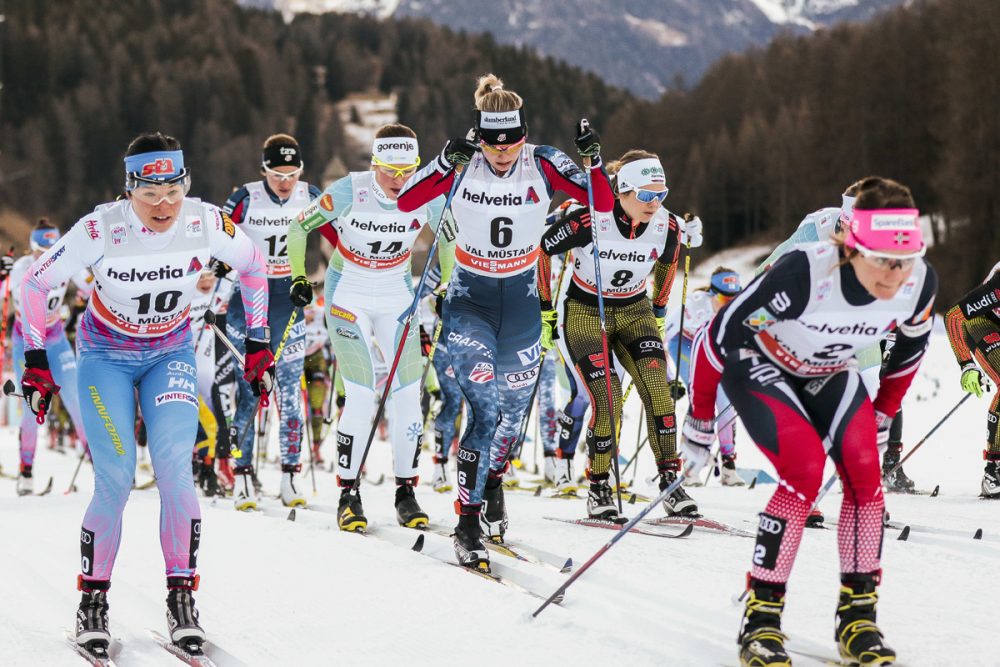
American Jessie Diggins (6) chases down Norway’s Maiken Caspersen Falla (2) at the start of the the women’s 5-kilometer classic mass start on Sunday in Val Müstair, Switzerland. (Photo: Fischer/NordicFocus)
Wearing bib 5, Østberg had her Norwegian teammates, Maiken Caspersen Falla in bib 2, Heidi Weng in bib 3, and Kathrine Rolsted Harsem in bib 4, as well as the Stage 1 TDS leader, Stina Nilsson to chase down.
That didn’t stop Østberg from rallying to the front off the gun, leading the mass of skiers through the first lap, with Weng just behind. As the women started their second lap of the 2.5 k course, a gap began forming between the Norwegians and a second front group, Nilsson and Finland’s Krista Pärmäkoski.
Moving up through the pack into the top 10 by lap one was Finland’s Anne Kyllönen, who started in bib 29, as well as her Finnish teammate Laura Mononen, who started in bib 19.
Switzerland’s Nadine Fähndrich, who started in bib 15, had also joined the front chase group, along with her Swiss teammate Laurien van der Graaff (bib 7). Just behind the Swiss duo was American Jessie Diggins (bib 6) positioned in eighth. Diggins’s U.S. Ski Team (USST) teammate Sadie Bjornsen, who had started in bib 21, had burned her way up to ninth.
Bjornsen’s hot start, however, didn’t last. The American began to fade, falling back into the low 20’s and eventually just outside of the points in 35th, where she ended the day.
“I was behind Nadine [Fähndrich] and Laurien [van der Graaff] and picked the innermost track, so in principle the best lane, and exactly on that lane Bjornsen bonked, totally, she couldn’t move anymore,” Switzerland’s Natalie von Siebenthal said during a television interview. “And I couldn’t get past left or right. Then the other athletes started to go by on my left.”
USST Women’s Coach Matt Whitcomb explained that hard start was part of Bjornsen’s plan. The way her body reacted was not.
“She took it out aggressively, which we told her to do and is always encouraged to do and just didn’t feel good today,” Whitcomb said on the phone after Sunday’s race.
Bjornsen explained that while the result was not what she hoped for, she is ready to move forward with no weight on her shoulders.
“Today was a day to forget and refocus,” Bjornsen wrote in an email. “I had a strong start, and felt great, but felt like I was working extra hard with some potentially slow skis. As soon as I crossed the red line, I wasn’t able to recover as I was hoping, and suffered a pretty bad explosion … Now I am focused on the next two events in Germany, and will hopefully find the good shape I know I am capable of!”
Maintaining position was the name of game for the remainder of the race for those still in the top 10, with Diggins sticking to her spot in eighth and Østberg holding off any attack attempts from Weng.
“I’ve been struggling a bit with the high altitude here,” Weng said according to a FIS press release. “Before the race I was afraid about the downhills but I’m happy I did not fall.”
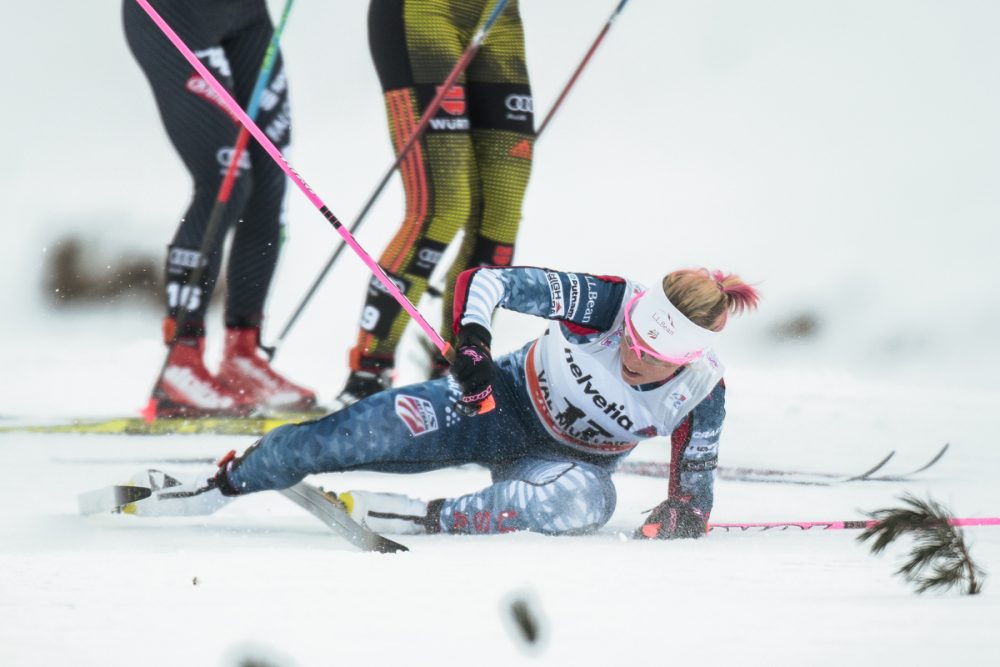
While Weng was able to avoid any crashes, American Kikkan Randall was not so lucky. Though she had been skiing around 15th for most of the first lap, after starting in bib 17, she fell and had to make her way back into the top 20.
American Kikkan Randall after a crash just over halfway through the women’s 5-kilometer classic mass start on Sunday in Val Müstair, Switzerland. (Photo: Fischer/NordicFocus)
“My shape feels a lot better and sharper than it did in period one of World Cup,” Randall wrote in an email to several media outlets. “Really pumped to feel my race gears coming around and loving the chance to race, race, race!”
“It was so cool to watch an athlete have a breakthrough like that,” Whitcomb said of Randall’s performance. “To start off the Tour with two good races in the points, we all feel really good about that and the team is really proud of her.”
Eventually, with a close to 20-meter gap, Østberg finished first for the win in 13:21.2 minutes. Weng claimed second place, seven seconds back, while third went to Pärmäkoski who finished 11.4 seconds after Østberg.
Diggins crossed 32.6 seconds after Østberg for eighth.
“It was tricky to pace and if I could do it again I would have paced it slightly differently, but I was happy with my skis and I’m chipping away at that striding technique!” Diggins wrote in an email. “Overall I think I’m in a solid place for the tour and I’m really looking forward to the next set of races!”
Randall was the second American after Diggins in 15th (+42.4) followed by Bjornsen, who placed 35th (+1:02.6) in a photo finish with Slovenia’s Petra Novakova. Also racing for the U.S., Sophie Caldwell placed 38th (+1:09.4), Rosie Brennan 39th (+1:10.5), and Liz Stephen 44th (+1:21.2).
“There’s not a whole lot of movement that’s possible in a 5 k classic mass start … when you’re starting out of the top 20,” Whitcomb said. “Rosie and Liz were fighting from the back. … For their position in the start, I thought they skied phenomenally.”
As the USST makes its way to Oberstdorf, Germany, for the third and fourth stages of the Tour — a 10 k skiathlon and 10 k freestyle pursuit — Whitcomb remains positive of where the U.S. women are currently positioned. Diggins currently sits in sixth in the overall Tour standings, 1:01 minutes behind Østberg, Randall 15th (+1:45.9) and Bjornsen 25th (+2:05.4). Caldwell, who is ranked 22nd overall (+2:03.3), planned to withdraw from the Tour after Sunday. Brennan in is 41st (+2:33.1) and Stephen 46th (+2:49.9).
“We don’t put any specific goals or demands for any athlete on any one particular race,” Whitcomb explained. “What we try and do is link together as many quality races in a row as we can. If you can string together a bunch of decent days, and then pop one great one, it can move you way up in the tour.”
Østberg now leads the Tour followed by Weng 10.3 seconds back in second and Nilsson in third (+23.8).
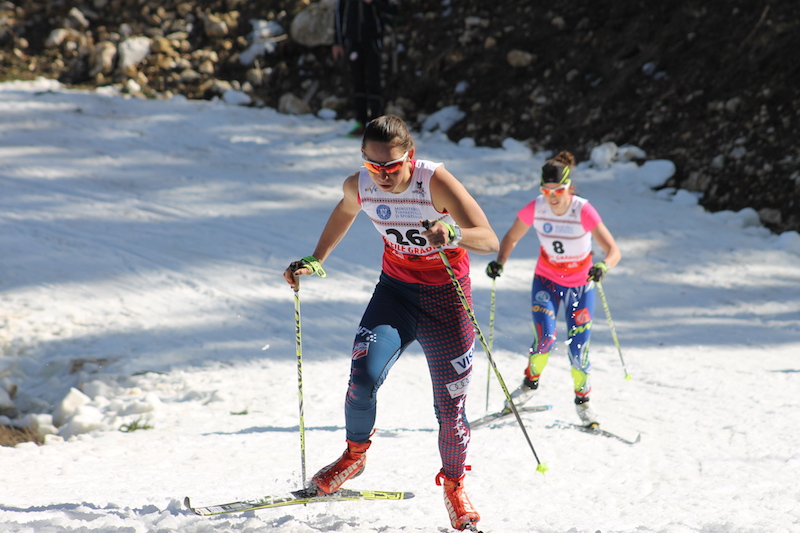
Katharine Ogden (SMS/USST) racing to 13th in the 5 k classic at Junior World Championships in Rasnov, Romania. (Photo: Pete Leonard)
Julia Kern (SMS/USST) racing to 18th in the 5 k classic at Junior World Championships in Rasnov, Romania. (Photo: Pete Leonard)
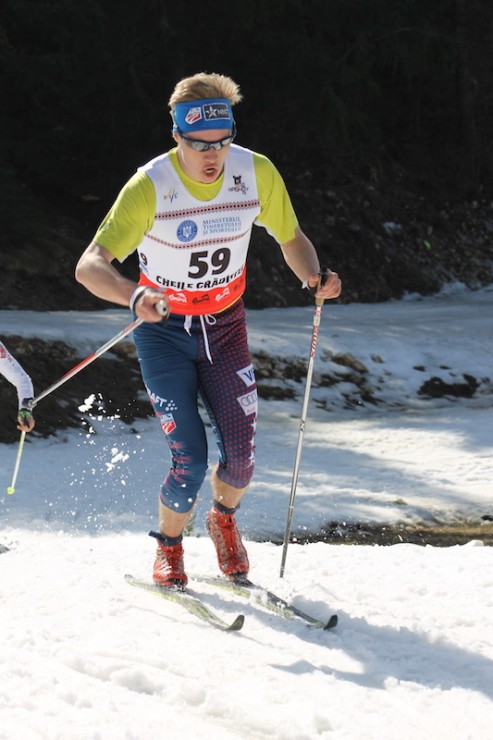
Adam Martin (NMU) racing to a American-leading 23rd in men’s 15 k classic at 2016 U23 World Championships in Rasnov, Romania. (Photo: Pete Leonard)
Kyle Bratrud (CXC) racing to 29th in the men’s 15 k classic at U23 World Championships in Rasnov, Romania. (Photo: Pete Leonard)
Cully Brown racing to 35th in the men’s 10 k classic at Junior World Championships in Rasnov, Romania. (Photo: Pete Leonard)
Kristen Bourne racing to 40th in the women’s 10 k classic at U23 World Championships in Rasnov, Romania. (Photo: Pete Leonard)
Felicia Gesior racing to 41st in the women’s 10 k classic at U23 World Championships in Rasnov, Romania. (Photo: Pete Leonard)
Ian Torchia racing in the men’s 10 k classic at Junior World Championships in Rasnov, Romania. He placed 43rd and went on to notch 15th in the 15 k freestyle there. (Photo: Pete Leonard)
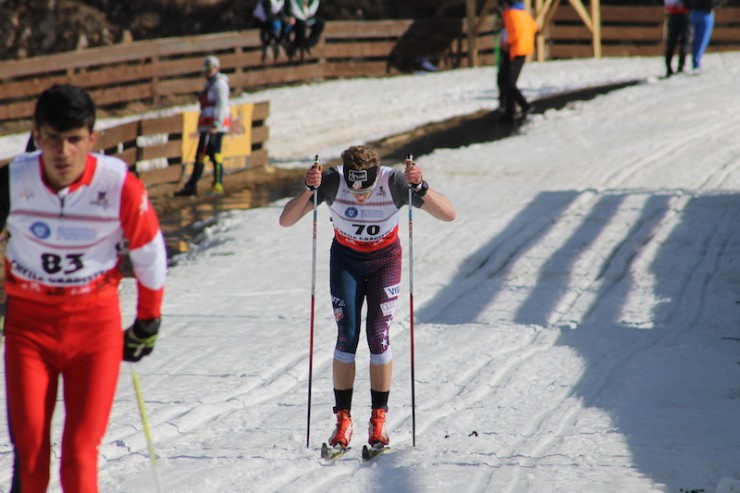
Henry Harmeyer racing to 65th in the men’s 10 k classic at Junior World Championships in Rasnov, Romania. (Photo: Pete Leonard)
Katharine Ogden didn’t worry too much about the slush at Junior World Championships on Tuesday. She tested her skis once, remained confident in her kick and resolved to “hammer the whole thing” because 5 kilometers is pretty short, the 18-year-old Stratton Mountain School and U.S. Ski Team D-team member explained in an email.
“I didn’t notice too much of a change in the conditions between laps, although by my second lap I’m not sure I would have noticed much, it was definitely a sufferfest out there,” she wrote.
Ogden raced to 13th in the 5 k classic individual start on the second day of U23/Junior World Championships in Rasnov, Romania, leading the U.S. team on a classic distance day with temperatures in the mid-to-upper 50 degrees Fahrenheit.
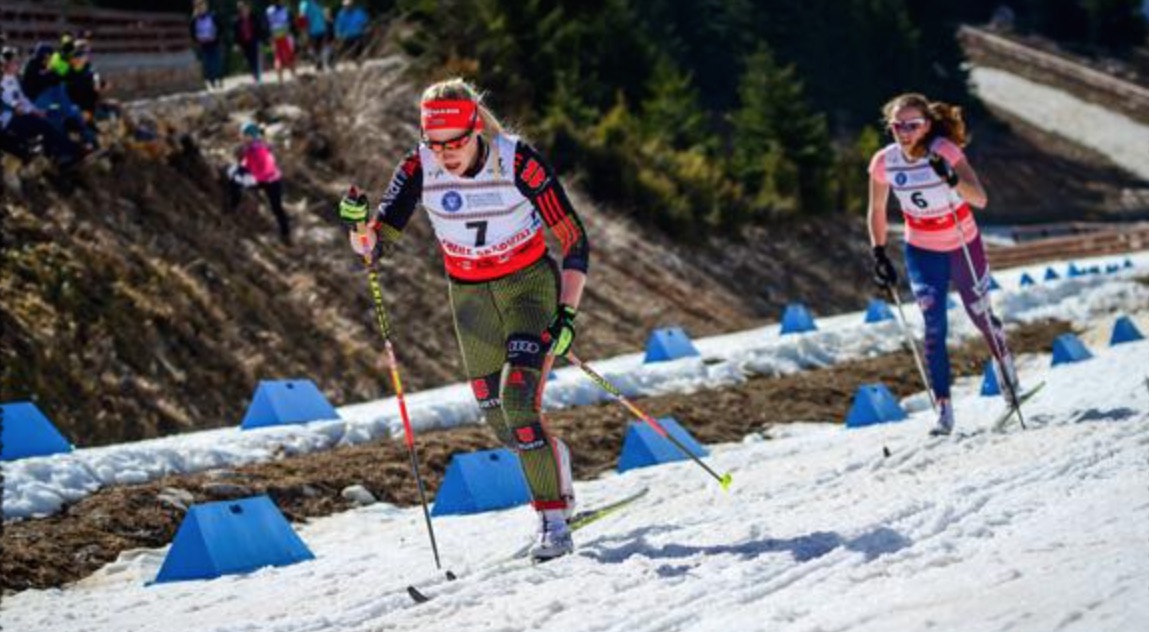
American Katharine Ogden (6), of the Stratton Mountain School and U.S. Ski Team, chases Germany’s Antonia Fraebel during the junior women’s 5 k classic at the Junior World Championships on Tuesday in Rasnov, Romania. (Photo: FIS Nordic JWSC & U23 WSC)
The sixth starter, Ogden finished 56.8 seconds behind the winner Marte Mæhlum Johansen of Norway, who completed the two-lap race in 15:34. In Ogden’s second junior world championships, the result was her third best after placing sixth in the 10 k skiathlon and 11th in the 5 k freestyle last year in Almaty, Kazakhstan.
“I’m psyched about my race and I’m hoping to carry the momentum into the skate 10k which is a much better event for me,” she wrote of Thursday’s race. “I’m mostly focused on the skate race here.”
When asked how Rasnov compares to Almaty, Ogden explained they are “pretty similar in some ways but completely different in others.
“Almaty was a huge industrial city while Rasnov is a small rural mountain town,” she wrote. “The low snow has been common to both venues, however the situation is much worse here in Romania. It’s pretty awesome that we get the opportunity to travel to these crazy places and race because neither place is one that I would ordinarily get to experience.”
Finishing 21.2 second off her teammate’s pace and 1:18 behind the winner, Julia Kern (SMS/USST) notched her second-straight top 20 in as many races at this year’s junior worlds.
Kern finished 18th, and like Ogden, whose time ranked 18th at the halfway point, Kern sped up on her second lap to improve from the 24th-fastest split at 2.5 k.
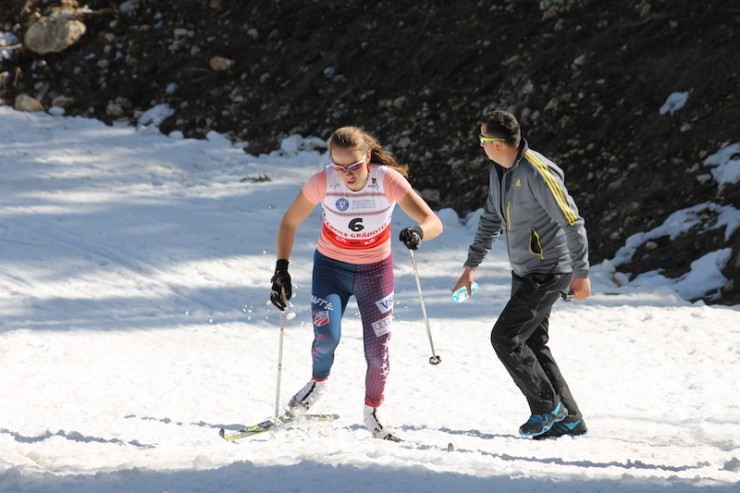
“Honestly, my plan was to feel it out as I went along because when I saw the first starters lap, they looked like they were in a lot of pain and that it was super slow and grueling,” Kern wrote in an email. “I also had talked with my coach Matt Boobar about water ‘feeds’, where he would dump cold water on me while I was racing so I could cool off a little. I found the cold water helped me cool off a little in the heat.”
She started the race 26th out of almost 80 junior women and felt the conditions were likely similar for everyone: “hot, wet, slow, and slushy,” she wrote.
“Quickly after I had started out, my body set into a pace automatically that was appropriate,” Kern explained. “Is was so slow out there that it was really hard to go significantly faster without wasting a lot of energy; it was almost like the speed you were going was hard to change. … I definitely didn’t feel like I was having a good race just by how slow I was skiing, but I guess the results showed otherwise.”
Her goal had been a top 25, so 18th place exceeded that.
“I am very happy with my result today and pleasantly surprised!” she added. “The coaches had done a great job giving splits out on course, but I knew that when they said I was top 20, there were plenty of fast girls still behind me. It is hard to tell how I feel about the actual race because I don’t think it felt good for anyone; it was all about who could fight through the pain the fastest.”
Finishing 5.3 seconds behind the winner, Norway’s Lotta Udnes Weng placed second for the second-straight day and Germany’s Antonia Fraebel took third (+10.7).
Canada’s Hannah Mehain racing to 44th in the women 5 k classic on Tuesday at Junior World Championships in Rasnov, Romania. (Photo: FIS Nordic JWSC & U23 WSC 2016/Facebook)
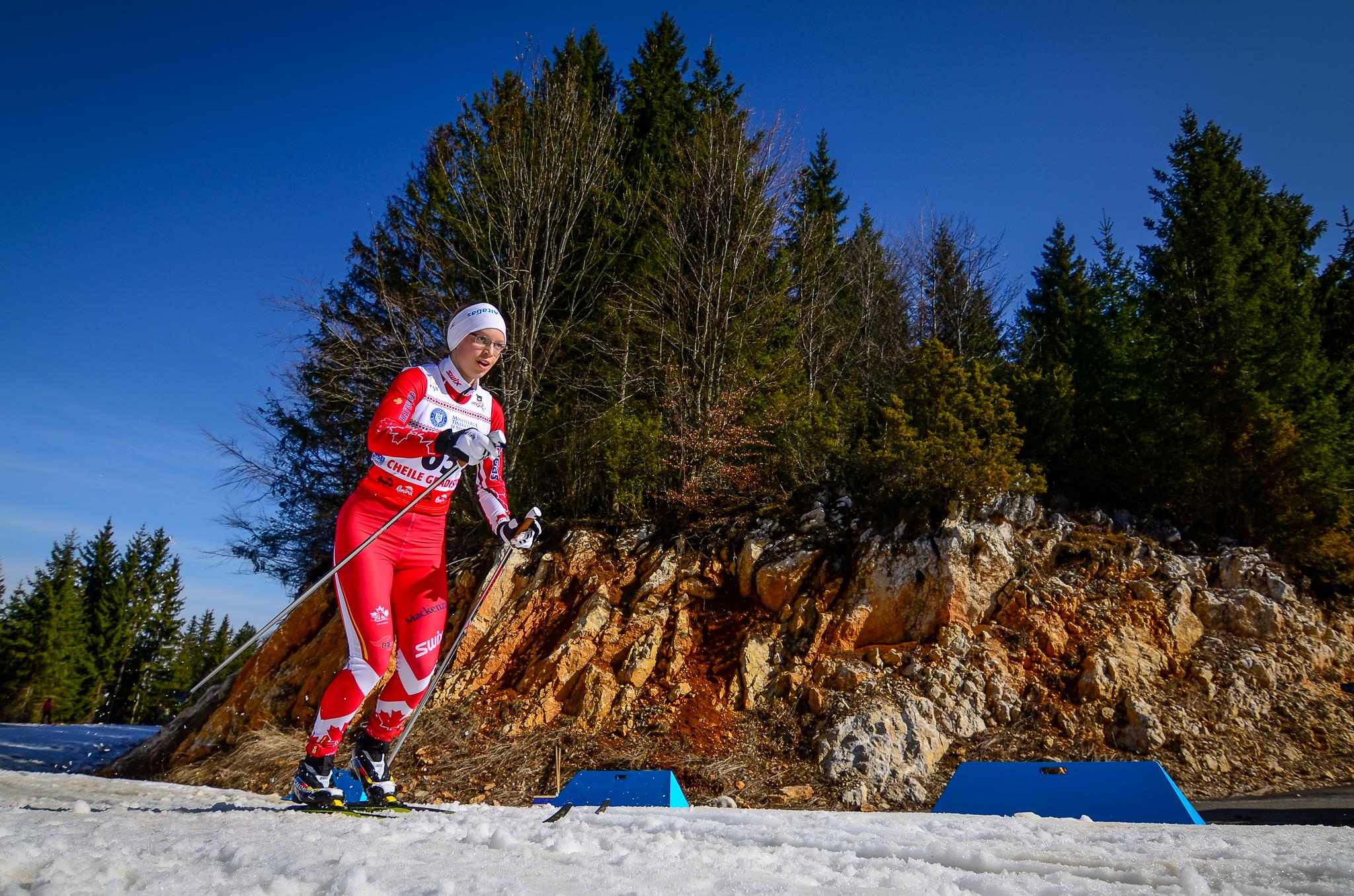
Canada’s Marie Corriveau placed 37th, 2:04.8 behind the winner, and explained in an email that she found it difficult to push hard in the slushy conditions.
“I am not used to skiing in those conditions,” Corriveau, of the Pierre-Harvey National Training Centre in Quebec City, wrote. “I know it was the same for everybody, but usually I take advantage because of my good technique, but today it was almost impossible to ski well.
“I am not feeling bad [about] my race, because i know I gave everything!” she added. “For sure, I would expect better for a 5km classic, but with the circumstances, I am pretty happy with this 37th place!”
Behind her, Canada’s Hannah Mehain placed 44th, Natalie Hynes was 58th and Sadie White 62nd. For the U.S., Vivian Hett placed 48th, and Leah Lange was 52nd.
Three Americans in the U23 men’s 15 k classic finished in the top 30, with Adam Martin of Northern Michigan University leading the way in 23rd. Paddy Caldwell (Dartmouth/SMS/USST) placed 27th and Kyle Bratrud (CXC) was 29th.
Unlike the junior women, who raced two laps, the men rounded the 2.5 k loop six times. A few men opted to double pole on skate skis and two of them, including Canada’s Julien Locke, were disqualified for violating classic technique.
“Preparing for this race presented some challenges I haven’t encountered before,” Martin, who previously raced at 2014 Junior World Championships in Val di Fiemme, Italy, wrote in an email. “To preserve snow, race organizers only allowed athletes to ski in short time periods on Sunday and Monday. I don’t think this affected me as I was able to pick my skis and execute the intervals I had planned, but it was definitely something new.”
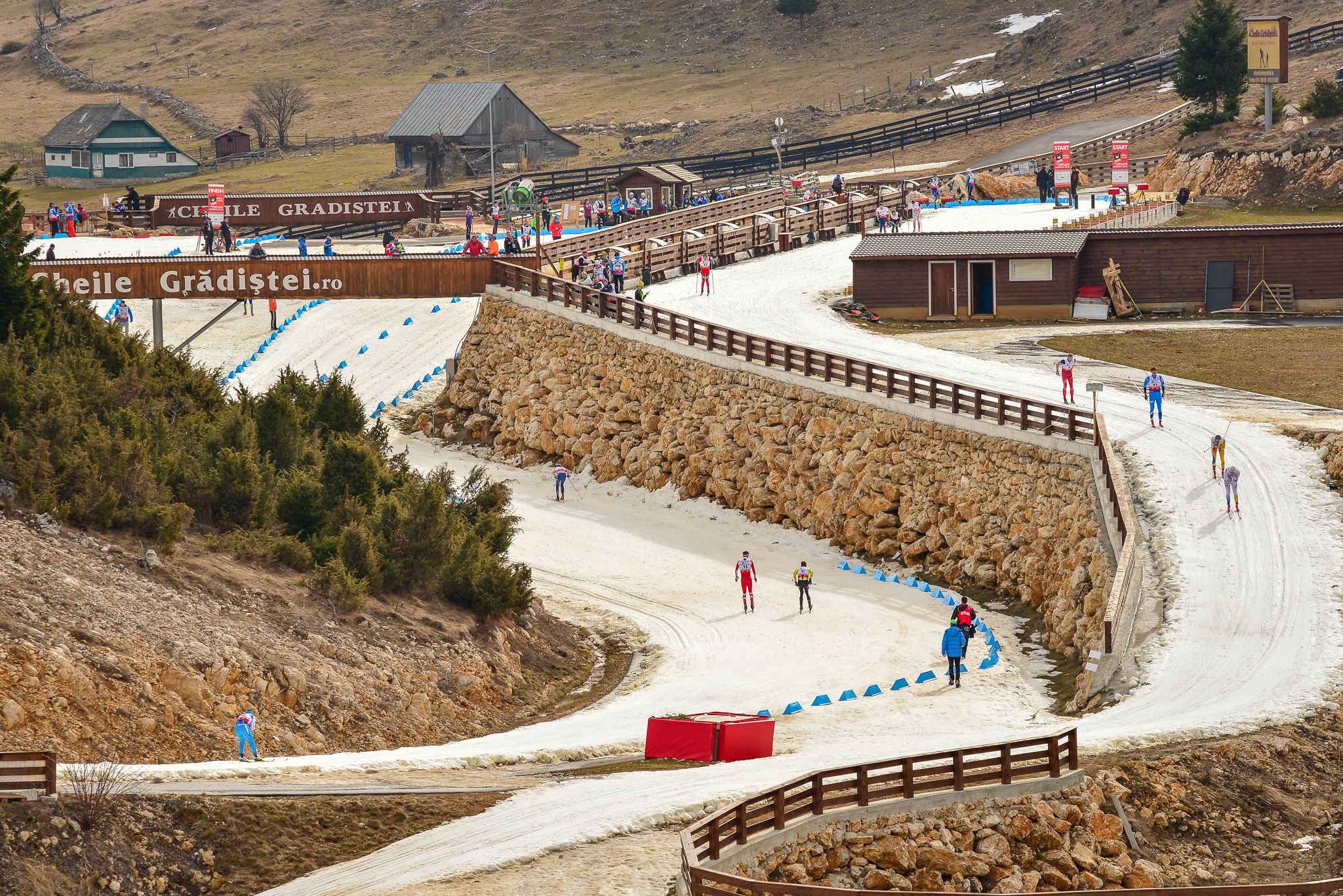
A bird’s eye view of the race course at U23/Junior World Championships in Rasnov, Romania. (Photo: FIS Nordic JWSC & U23 WSC 2016/Facebook)
The 21st starter out of approximately 70, Martin recalled the snow feeling significantly slower on his third lap.
“I usually make an effort to start very hard, but considering the conditions, my focus was more on being relaxed at the beginning,” he explained. “I am happy with that strategy because it didn’t take long to feel the effort.”
Considering this was his personal best at a world championships, after placing 26th in the 10 k classic at 2014 junior worlds, Martin wrote that it felt great to improve.
“But to be honest it’s hard for me to celebrate too much when there are 22 guys beating me by up to three minutes at the event,” he added after finishing 3:02.2 behind the winner, Jens Burman of Sweden, who took gold in 40:02.
Russia’s Alexey Chervotkin was 26.8 seconds back in second place, and Norway’s Mikael Gunnulfsen placed third (+36.6).
In an email to FasterSkier, U.S. Ski Team Chris Grover recently explained that Martin had turned down World Cup starts for the Ski Tour Canada. In his place, there is one opening on the men’s roster that can be filled with an “outstanding performance” at U23 World Championships.
“As a collegiate skier … I think in some sense NCAAs is my only obligation each year for NMU,” Martin wrote of his decision to decline the spot. “Furthermore, I think I have some improvements I need to make especially in sprinting before I am ready to race a World Cup. Finally, I’m very excited to race some fast guys at NCAAs in a few weeks; I think they will be very high quality competitions.”
Finishing 25.2 seconds back from Martin on Tuesday, Caldwell placed 27th (+3:27.4) in his second U23 World Championships (after placing 15th in the 15 k freestyle and 20th in the 30 k skiathlon in Almaty last year). He started 19th and hung in the top 30 throughout his six laps.
Also in his second appearance at U23 worlds, Bratrud, in bib 22, notched his second-career top 30 after placing 19th in the 15 k freestyle last year. On Tuesday, he finished 3:46.1 back after posting faster splits earlier in the race.
Canada’s Scott James Hill racing to 36th in the men’s 15 k classic at U23 World Championships in Rasnov, Romania. (Photo: FIS Nordic JWSC & U23 WSC 2016/Facebook)
“The race course today was pretty insane,” Bratrud wrote. “Originally it resembled Eagle glacier [in Alaska] which had me pretty stoked but as the race went on it broke down pretty bad. I’m not sure I have ever raced in conditions like that. Definitely an experience. Maybe the longest 15k I have ever done, at least feeling wise.
“I have been targeting these races my whole season so I was definitely disappointed with my result, but all things considered I am not super worried,” the 23-year-old Minnesota native added. “I didn’t feel great warming up and I generally don’t classic well in these type of conditions nor have I raced on them this year or more then a handful of times in my entire career. The wax techs worked extremely hard to give us great skis in these extremely challenging conditions. I am really looking forward to the skate race and the races moving forward [this season] in Germany and Italy.”
About 16 seconds outside the top 30, Canada’s Scott James Hill placed 36th (+4:03.3), Jack Carlyle was 42nd, and Alexis Dumas finished 53rd.
American Logan Hanneman was 55th, coming off 15th place in the freestyle sprint on Monday. He started 53rd, the latest of the North Americans aside from Locke, of Canada, who started 59th but was disqualified for skating.
In the junior men’s 10 k classic, Norway’s Johannes Høsflot Klæbo claimed his second-straight gold in 28:57.8. Coming off three medals at the Youth Olympic Games, South Korea’s Magnus Kim (who is half Norwegian) placed second, 11.2 seconds back, and Finland’s Lauri Lepisto earned bronze (+25.4).
American Cully Brown finished 35th (+2:01.9), Ian Torchia was 43rd, Thomas O’Harra 54th, and Henry Harmeyer 65th for the U.S.
Ryan Jackson was the top Canadian in 46th, followed by Antoine Blais in 52nd, Joey Foster in 56th, and Philippe Boucher in 67th.
In the U23 women’s 10 k classic, Heather Mooney, a former Middlebury skier, was the top American in 38th (+4:27), just ahead of Canada’s Frédérique Vezina in 39th (+4:31).
Russia’s Anastasia Sedova won gold in 28:49.4, while Germany’s Victoria Carl finished 13.1 seconds back in second, and Petra Novakova of the Czech Republic was third (+17).
Also for the U.S., Kristen Bourne placed 40th, Felicia Gesior was 42nd, and Kelsey Phinney 44th.
Canada’s Kendra Murray finished between Gesior and Phinney in 43rd, Jenn Jackson was 45th and Sophie Carrier-Laforte was 46th.
Jasper Good (U.S. Nordic Combined) racing to a career-best 11th in his fourth Junior World Championships on Tuesday in Rasnov, Romania. (Photo: Romina Eggert/Facebook)
Also on Tuesday, 19-year-old Jasper Good raced to 11th for U.S. Nordic Combined in the normal hill/10 k Gundersen. In his fourth Junior World Championships, it was his first individual top 20.
Fifteenth on the hill, he posted the 13th-fastest ski time to finish 11th, 3:48.9 behind the winner, Austria’s Bernhard Flaschberger. Germany’s Vinzenz Geiger crossed the line nearly a minute later in second (+59.6). Germany’s Terence Weber held onto third (+1:08.5) by three-tenths of a second over Eero Hirvonen of Finland in fourth.
“This year’s World Junior Championships are full of schedule changes and an extreme lack of snow here in Rasnov,” Good wrote on his Facebook page. “We were able to get the first individual competition off yesterday and I had a career best finish of 11th place! I didn’t ski my best race, but I was able to move up from 15th after jumping! I’m happy with this and excited to improve in the next competition! “
Also for the U.S., Stephen Schumann placed 31st, Jared Shumate was 37th and Koby Vargas 44th.
Racing continues Thursday with the cross-country 10/15 k freestyle individual starts, replacing the skiathlons. Friday’s junior relays have been shortened to 4 x 2.5 k for the women (and remain 4 x 5 k for the men), and Wednesday’s nordic combined event was postponed.
Nordic combined has two remaining competitions: the normal hill/5 k on Thursday and normal hill/4 x 5 k team event on Friday.
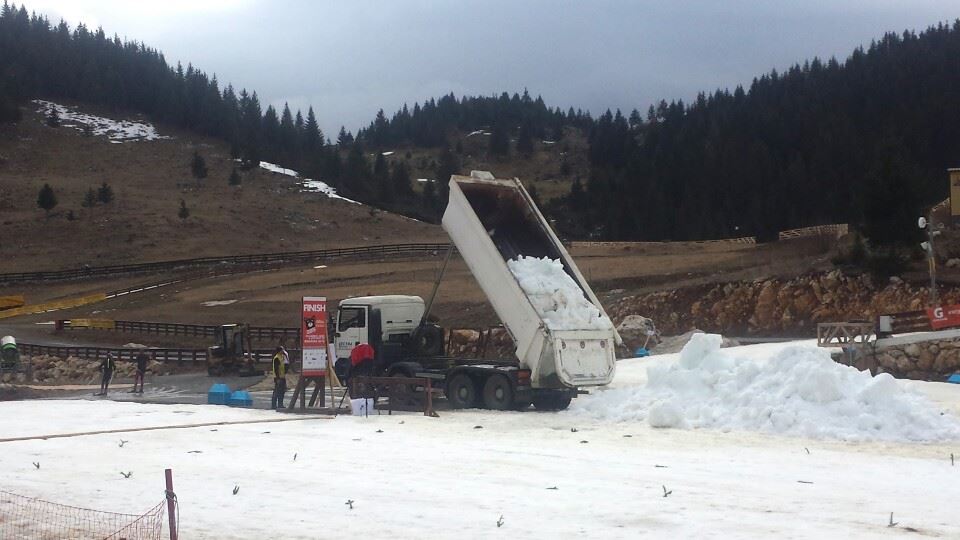
Organizers unload snow onto the course Wednesday during the off-day at U23/Junior World Championships in Rasnov, Romania. (Photo: FIS Nordic JWSC & U23 WSC 2016/Facebook)
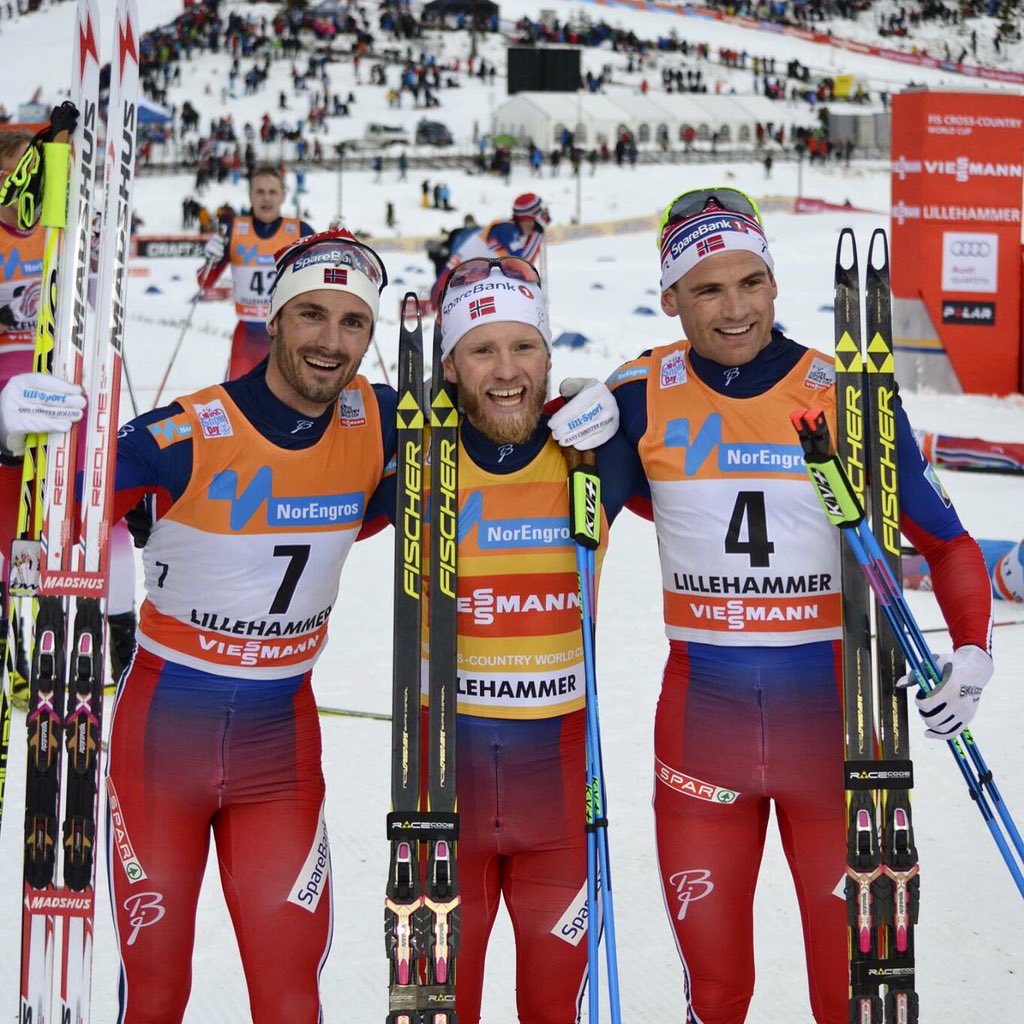
An all-Norwegian men’s podium at the World Cup 30 k skiathlon in Lillehammer, Norway, with winner Martin Johnsrud Sundby (c), Niklas Dyrhaug (l) in second and Hans Christer Holund (r) in third. (Photo: WorldCup Lillehammer/Twitter)
You know when the Norwegian fans are starting to get bored, it’s time for a changeup. That’s not to say Therese Johaug and Martin Johnsrud Sundby shouldn’t win race after race, but let’s at least see them do it against a more varied backdrop.
Then maybe the spectators won’t turn their back on the action while the leader’s still out on the course and head out before the race is finished.
Blame it on the lack of snow; it wasn’t the Lillehammer World Cup organizers’ fault. Racers in Saturday’s 15- and 30-kilometer skiathlons had to round the only 3.75 k loop with enough snow, leaving the men to do it eight times. That amounted to a lot of Sundby skiing in circles by himself.
Johaug attacked off the front out on her own as well for two-thirds of the women’s race, dropping her Norwegian teammate and closest rival this season Heidi Weng between 5 and 6 k.
For Johaug, it was her fourth-straight skiathlon victory. She’s also been on the podium in 10 of her last 11 World Cup or World Championships starts.
“Today it was incredibly fun to go skiing,” said the 27-year-old Norwegian national team member, who previously battled with teammate Marit Bjørgen in past seasons. Bjørgen is out for the majority of this winter as she is expecting her first child this month.
“I’m in very good shape,” Johaug said when asked if she was in the shape of her life. “It was simply a superb day.”
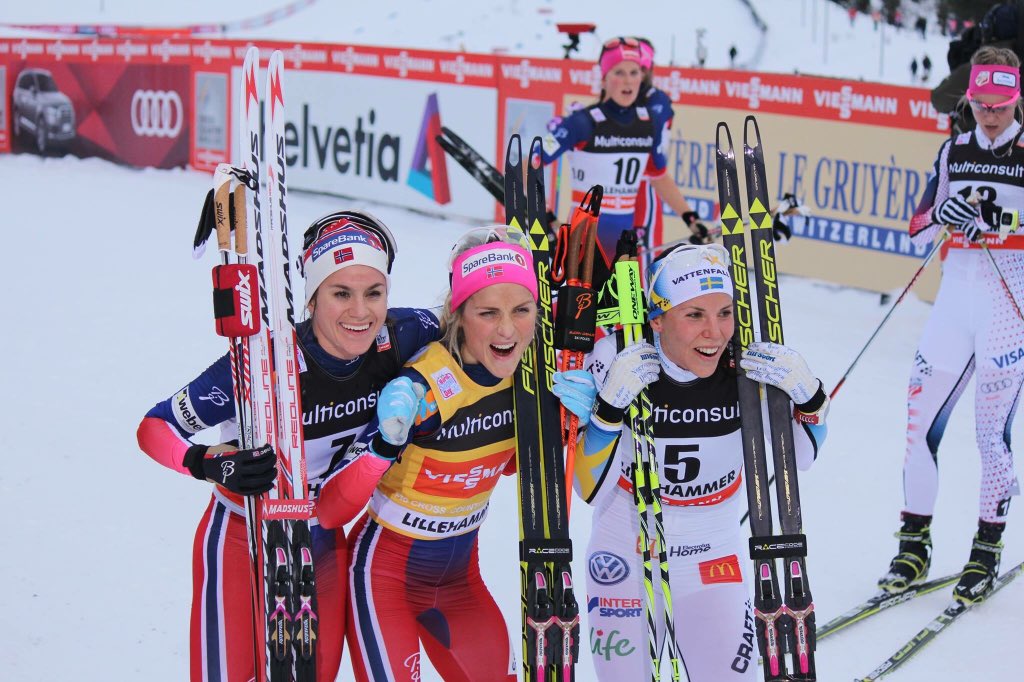
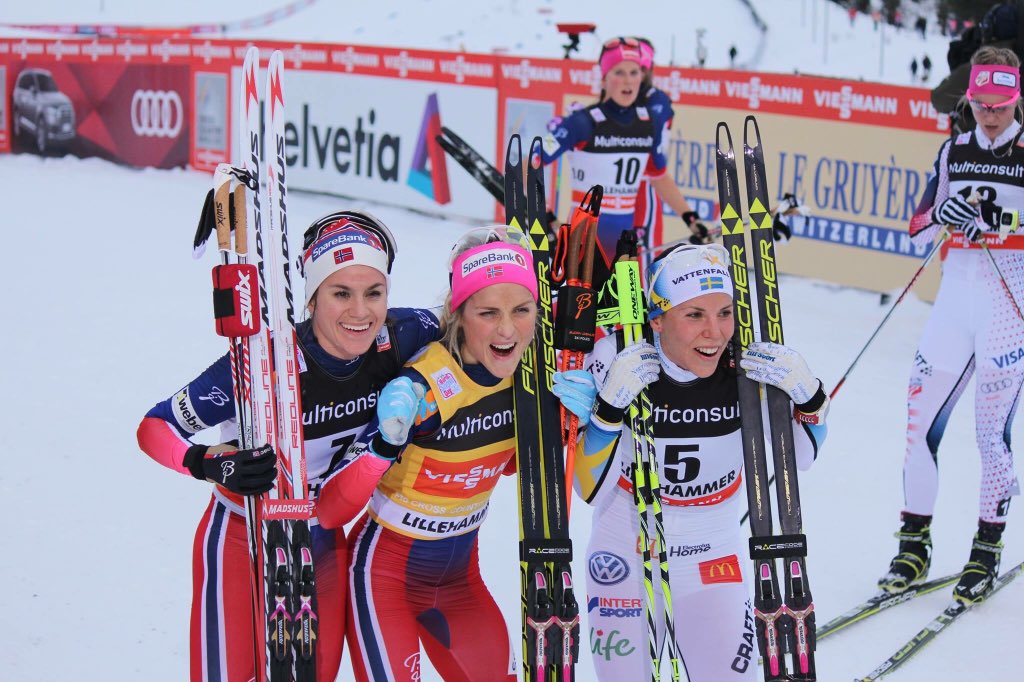
The women’s World Cup 15 k skiathlon podium in Lillehammer, Norway, with Norway’s Therese Johaug (c) in first and Heidi Weng (l) in second, and Sweden’s Charlotte Kalla (5) in third. (Photo: WorldCup Lillehammer/Twitter)
She won by almost a minute and a half, 1:29.3 to be exact, over Weng. The two skied together through 4.6 k, where Weng actually led Johaug. Meanwhile, Sweden’s Charlotte Kalla hung close in third, 2.5 seconds back. The three jumped out to an early lead and dropped the field just four minutes into the race. Johaug went on to win in 42:17 after breaking away on her own on the second of four laps.
By 6 k, Johaug had gapped Weng by 15 seconds, and Kalla was almost 24 seconds back in third. Finland’s Kerttu Niskanen, Germany’s Nicole Fessel, Norway’s Maiken Caspersen Falla, and Austria’s Teresa Stadlober formed a chase pack, but by the ski change at 7.5 k, they were at least 45 seconds back from Johaug in fourth through seventh. Weng was 21 seconds behind at the transition, and Kalla was 29 seconds out of first.
Less than 1 k into the skate leg, Johaug had extended her lead to 33 seconds over Weng and 43 over Kalla. With one lap to go, she was nearly a minute ahead of the field.
“This is a course that fits me like a glove,” Johaug told NRK, according to a translation. “Is that what you say? It fits me amazingly well.”
While Weng was able to outlast Kalla by 0.1 seconds at the finish, the Norwegian runner-up had hoped to stay with Johaug longer.
“Therese Johaug has an extra gear that I don’t have quite yet,” Weng told NRK. “It’s a bit boring that Johaug is so superior…”
“She goes on a completely different level than the rest of us,” Kalla told Dagens Nyheter, according to a translation. “She has a great motor and really gets it out on these [courses].
“Johaug was the big favorite before the season, before they even knew how fast she can go.” Kalla added, explaining that Johaug’s pace wore her down during the initial classic leg. “But I have to hope that it will even itself out over the season and that there will be such large distances all the time.”
While five different nations finished in the top 10 of the women’s race, with Fessel in fourth, Falla in fifth, the Czech Republic’s Petra Novakova in sixth, and Anne Kyllönen and Niskanen in seventh and eighth, respectively, the men’s race wasn’t so diverse.
Sundby led a Norwegian sweep of the top four, with Niklas Dyrhaug, Hans Christer Holund, and Sjur Røthe respectively behind him. The 31-year-old Sundby, who actually won his first World Cup skiathlon (he was a three-time runner-up before Saturday), dropped the field almost as soon as he set out on the 7.5 k skate leg.
The first into the ski change, he came out first, 1.5 seconds ahead of Dyrhaug. Two kilometers later, he was 13 seconds ahead of Holund in second and Dyrhaug in third. Sundby ended up skiing the remaining three laps alone and won in 1:19:22.9. Dyrhaug ultimately bested Holund for second place, finishing 44 seconds after Sundby and 2.9 seconds ahead of Holund.
“I think this is my best race ever,” Sundby, the defending overall World Cup champion told NRK. “I could just go and go. I felt nothing could stop me.”
With nothing between him and the finish except about 14 k to ski alone, Sundby skated to the win. He set a noticeably fast pace from the beginning, and led for the majority of the 30 k from start to finish.
“It was really tough, from the first meters to the finish,” he told FIS. “With the help of Norwegian guys we managed to break away. I could just push all the way. … It was my plan to win as many World Cup points as possible before Christmas. This season, every weekend counts.”
Second and third were personal bests for both Dyrhaug and Holund. For Holund, it was his first World Cup podium. Røthe was 1:13.5 back in fourth, and France’s Maurice Manificat broke up the Norwegian sweep in fifth (+1:18.2). Petter Northug Jr. rose from skiing in the top 20 for much of the classic leg to place sixth (+1:28.5), 0.7 seconds ahead of Norwegian up-and-comer Emil Iversen in seventh. Anders Gløersen was eighth for Norway, Russia’s Stanislav Volzhentsev ninth, and Canada’s Alex Harvey 10th.
On an above-freezing day, classic wax can always be a big question. While it was 39-degrees Fahrenheit and overcast, U.S. head coach Chris Grover said most of the nations had the wax figured out.
Norway is just that good.
“Their men’s team is extremely strong and the Norwegian men and women’s team is the gold-standard team in the world,” Grover said in phone interview after the race. “These athletes are extremely fit right now because they have had to qualify for their World Cup squad over the past couple weeks, they have a home-course advantage, and they know how to wax for Lillehammer. This race over the past couple years has been a challenge for any nation to compete with Norway…”
Johaug and Sundby currently lead the women’s and men’s overall World Cup standings by more than 160 points (ahead of Sweden’s Stina Nilsson and Northug, respectively).
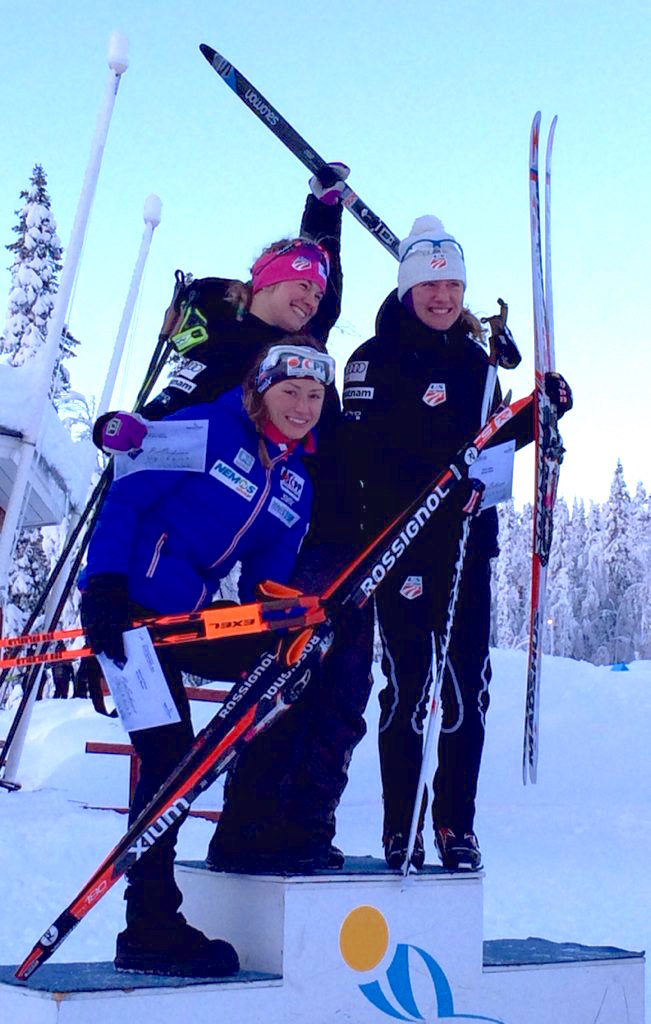
Jessie Diggins stands atop the podium with Czech runner-up Petra Novakova (l) and U.S. teammate Caitlin Gregg (r), who placed third, after the women’s 10 k freestyle in Gällivare, Sweden. (Photo: USSA)
Consider it a test drive. That’s how several members of the U.S. Ski Team viewed this weekend’s season-opening International Ski Federation (FIS) races in Gällivare, Sweden. And while a win or result close to it is always welcomed, it wasn’t essential. No need to go 100 miles per hour on the first try.
That said, if you start fast, go with it. Jessie Diggins, a 24-year-old A-team member who took silver in the 10-kilometer freestyle at the 2015 World Championships last season, kicked off this season with a win on Saturday in the Gällivare classic sprint, then repeated the feat in Sunday’s 10 k freestyle — what’s becoming her signature event.
While it was great to get some good feelings on snow and back-to-back victories to go with it, Diggins said in a post-race phone interview that it was more about taking “inventory of where [we] are and what else needs to be improved, as well as a good reminder of warmups, race routines, and testing skis.”
She added that the wins were a huge confidence boost going into the World Cup season, which starts Friday in Kuusamo, Finland. And she was pleased her offseason of technique work translated to results on snow.
She was the fastest in a women’s field of 38 on Sunday, winning the 10 k in 25:08.7 by 10.7 seconds over Petra Novakova of the Czech Republic. For the second-straight day, the U.S. had two on the podium with Caitlin Gregg in third, 30.1 seconds behind Diggins. It was a flashback to February, when the two shared the podium at 2015 World Championships, where Diggins placed second in the 10 k skate and Gregg was third.
Diggins had started second to last ahead of another teammate, Liz Stephen. Gregg went out 30 seconds ahead of Diggins and kept herself in contention in the top-three throughout the race.
At the finish, Novakova originally bumped Czech teammate Karolina Grohova out of the lead, then stayed 19.4 seconds ahead of Gregg to hold onto first. That is, until Diggins crossed the finish line.
“The course was awesome,” Diggins said. “It’s a challenging track with quite a bit of climbing and twisty, turny descents which doesn’t allow for a lot of rest. It is a great representation of the type of courses we race on the World Cup.”
While she had fun out there, she also made up a lot of time on those who started ahead of her. Diggins jumped out to an early lead, 0.4 seconds ahead of Gregg and 0.7 seconds ahead of Novakova in third, by the first checkpoint.
Jessie Diggins (bottom) and Caitlin Gregg after notching silver and bronze, respectively, at 2015 World Championships in the 10 k skate.
Halfway through the race, she held a 3.5-second lead over Novakova and Gregg was 17.6 seconds back in third. On the second of two laps, Diggins caught Gregg, her 30-second woman, and the two finished together.
“I was psyched when Jessie caught me because I felt like I was skiing well so I knew she was skiing well!” Gregg recalled in an email. “I cheered for her and tried to hang on. As I started following her stride I felt myself actually relax and start skiing way better! I tried to keep the pressure on her because I knew she was fighting for the win without stepping on her skis! I thought it was great to follow her on most of the second lap and it certainly helped me reach the podium!”
Gregg wasn’t exactly sure where she stood throughout the race, but she had a sense she was in the running for a top result.
“Both Jessie and Petra are fantastic skaters so it was a solid result for me,” Gregg wrote, a day after placing seventh in the classic sprint. “My skis were fantastic and I knew I was moving well on the course.
“This has by far been my best preparation season ever,” the 35-year-old U.S. Ski Team rookie added. “I started working with [personal coach] Tom Jorgenson after I came home from Norway this summer and he had helped me immensely in my training and technique! I feel like my fitness is really good right now and I am very excited to start the season.”
Eighteen seconds behind Gregg, Stephen placed fourth, and another 1.8 seconds later, the fourth U.S. woman in the top five, Rosie Brennan was fifth.
“Our coaches were out there giving splits and cheering as were our waxers,” Stephen wrote in an email. “We had a great group out there pushing us on and encouraging us to rally. The splits just encourage me, but I was not focused on the result out there today, I was just focused on the getting back into the groove of it all and maximizing my time taking corners with loaded legs at high speed.”
U.S. Ski Team members Caitlin Gregg (r), Jessie Diggins (c) and Liz Stephen (r) at the finish of the 2015 Holmenkollen 30 k. Stephen led the three in ninth, while Diggins and Gregg Placed 14th and 19th. (Photo: Madshus/Nordic Focus)
On Saturday, Stephen — a well-known distance skier and hill climber — made the rounds and placed ninth in the classic sprint.
“My goals for the weekend were to put a bib on and remember what it feels like to be ski racing on snow again,” she explained. “Snow brings its own set of new challenges and it can take a bit of time to get used to those again. I have a constant project on improving my downhills, so working on that the last couple of races has been on my mind, though today’s race was not my best performance on the downhill skills portion but, it has it’s ups and downs like any project.”
Stephen added that she needed some more races to get into the form she wants to be in. Brennan was looking for the same.
“I know my base fitness is quite high so it is a matter of finding the right balance of rest, quality intensity, and race starts,” Brennan wrote in an email. “I felt my race was solid, but I think I have another level in me that I hope to see as the season progresses.”
Between those four U.S. women, that was everyone from the women’s team that competed. Ida Sargent rested this weekend as she’s been fighting a cold and is aiming to be healthy when the World Cup starts next week, U.S. women’s coach Matt Whitcomb explained. Sadie Bjornsen also did not race as she was coming off an illness from last week.
“Sadie is healthy and back training, but the stomach bug she had earlier in the week isn’t something we wanted to test,” Whitcomb wrote in an email. “We know what happens with that test. She is in great spirits and had a productive workout tonight.”
As for the results, with the U.S. notching two podiums and sweeping third through fifth, Whitcomb said in a phone interview that “the results are fun. It’s great to get a podium regardless of what show you are playing in, but the important thing is they are looking really good in what they are doing.”
He credited Diggins with “another brilliant day” and said he was excited to see what she can do on the World Cup this season.
“People can be scared of skiing fast early in the season, but to be honest, Jessie is just getting started,” he said.
He added that the team’s wax crew was another highlight of the weekend, especially with new members that service chief Oleg Ragilo assembled this year. Diggins agreed.
“The wax technicians did a great job, we had fast and consistent skis all weekend,” she said.
Temperatures were cooler on Sunday, around -11 degrees Celsius (12 degrees Fahrenheit).
Canada’s lone female in Gällivare, Emily Nishikawa placed ninth (+2:35.2), a day after finishing sixth in the sprint.
“I was happy to start the season with a good race!” she told Cross Country Canada after Saturday’s race. “I’ve had a good summer of training and feeling strong coming into the race season so I was really excited to race…”
Monday marks a travel day for most, with the World Cup skiers heading to Kuusamo for four days of preparation before the season begins in earnest with a classic sprint on Friday.
Canadian World Cup Team member Alex Harvey kick-double poling in the 2012 men’s pursuit in Kuusamo, Finland, where he placed 23rd. Last year, Harvey was 42nd in the Kuusamo freestyle pursuit, one of the first races of the season. (Photo: Fischer/Nordic Focus)
Kick-double pole was the name of the game on Sunday in Gällivare, Sweden; if you did that well, you were basically golden on the four-lap course. Easier said than done, but the Russians managed to power through, with Evgeniy Belov pulling out the 20-second win in the International Ski Federation (FIS) men’s 15-kilometer classic race.
Russia went 1-2 in the men’s 15 k classic FIS race in Gallivare on Sunday with Evgeniy Belov (pictured) taking the win by more than 20 seconds. (Photo: SportEventGallivare)
The 24 year old finished with the top time of 35:04.3 minutes, 20.67 seconds faster than Saturday’s classic-sprint winner, teammate Sergey Ustiugov. And while the Canadians fared similarly well on Sunday with all four men in the top eight (and their lone woman, Emily Nishikawa, in fourth), most of them will be happy to race on a harder, hillier course next weekend at the first World Cup in Kuusamo, Finland.
“[Gällivare] is quite opposite from the race course there because here, there’s lots of kick-double pole, double pole — that’s what the Russians were really strong at,” Ivan Babikov, of the Canadian World Cup Team, said on the phone Sunday. “Talking to Devon, it sounds like Belov was like a beast on those sections. That’s where he made all the time.”
For Babikov, as well as several other Canadians, bigger climbs in next weekend’s classic sprint and 15 k classic — the same race formats as Gällivare — should be a good thing.
Babikov placed sixth in his first FIS race of the season, about a minute and 38 seconds behind Belov and 13.34 seconds behind teammate Devon Kershaw in fifth. Alex Harvey, who was second in Saturday’s sprint, took third, 27.51 seconds behind the winner and 0.8 seconds from Ustiugov.
Harvey started second-to-last, just in front of Gällivare’s hometown hero, Marcus Hellner, with the advantage of knowing where he stood for most of the race. In fourth at the end of the first 3.75-k lap after three Russians — Ustiugov, Belov and Stanislav Volzhentsev, respectively — Harvey moved to third ahead of Volzhentsev by the halfway point.
“I felt good today. A bit sore from yesterday’s classic sprint but everyone was in the same boat there!” Harvey wrote in an email. “It’s nice to do a distance race for sure, but it was a reminder of how hard ski racing is, especially individual start!
“The course was work the whole time,” he added. “I feel like I was strong in the kick double pole section, I think I could push it a bit further up the hill compare to the others.”
On his last lap, he caught Babikov, whom he started a minute behind, with about three kilometers to go.
Ivan Babikov racing two seasons ago the 15 k classic in La Clusaz, France, where he posted Canada’s best result of 39th in January 2013.
“I wasn’t feeling like I was racing, it was kind of like a bit harder than Zone 3 or Zone 4, but I couldn’t get in my hurt locker, you know?” Babikov said. “I couldn’t go all-out for some reason.”
When he saw Harvey, he knew he had something left.
“That’s where I could feel that I can go faster and last lap was much better, more like racing,” Babikov said.
Before then, he had been waiting for Volzhentsev, who started 30 seconds behind him, to catch him on the last lap. Babikov said the Russian came within 10 seconds of him on the third loop around.
“For some reason, he died a bit on the last lap and next thing I know, it’s not him passing me but Alex,” he said. “I did not see him coming at all so I kind of got a bit surprised there.”
But it wasn’t a bad thing. Babikov pushed even harder and estimated he made up about 17 seconds on Volzhentsev, who ended up fourth (+1:24.8). Babikov stayed with Harvey for as long as he could, before Harvey took off with about two kilometers to go.
“After I caught him I yelled at him ‘stay with me,’ so he did for a while,” Harvey recalled.
“I think it was a good weekend for me,” Harvey summed up. “Of course, nobody is at 100%. Personally I’m coming off 2 weeks of 20+ hours of training so I’m not super fresh but again, I think everyone is in the same boat here.”
He was looking forward to Monday — his first rest day in almost two weeks.
“I’m gonna take a normal week of training next week and do some high quality intensity on Wednesday before travelling to Kuusamo,” he wrote.
The Canadians leave Gällivare for Finland on Wednesday.
“Good racing and training this weekend for everybody,” Canadian World Cup Head Coach Tor-Arne Hetland wrote in an email. “We needed this weekend and will be better prepared next weekend and later in the season. The races had ok race quality.”
According to the event website, Belov called it a “good race on fine courses and a lovely start to the season with two podiums the first race weekend,” he said, after placing third on Saturday. “I’m very happy with this shape before the World Cup premiere next weekend.”
Hellner, who finished seventh, 1:41 behind Belov, said the Russians were impressive.
“They skied really hard today; it would’ve been enough for a World Cup,” he said, according to a translation. “I didn’t have a good race, but it’s still nice to be competing again. It always takes a few races to get started with both the technique and feel. I’m still training hard and it’s the World Championship in Falun, which is the big goal. I don’t expect top results at the start of the World Cup.”
Out of the top seven, Ustiugov was the earliest starter and posted the times to beat at each 3.75 k checkpoint. Kershaw consistently clocked the second-fastest times after him, and Harvey started two minutes after Kershaw and came through 3.75 k just one place and 11 seconds faster.
Kershaw wrote in an email that his goal was to start hard.
“It’s the last chance to try some stuff before the big leagues start again next weekend,” he explained. “That didn’t really work that well for me today. I started what I thought was hard, but felt like I was just stuck in the pace I could go. Not feeling much lactate, but not able to really push it any harder. I guess that’s a bit of fatigue I’m carrying.”
“It’s the last chance to try some stuff before the big leagues start again next weekend.” — Devon Kershaw, fifth in first FIS race of 2014/2015 season in Gällivare
Belov caught him at 7.5 k, where Kershaw recalled feeling so good, he thought, “OK, here’s the race — stay with him!”
Devon Kershaw in the Frozen Thunder classic sprint in late October in Canmore, Alberta, where he won the following freestyle distance race on Oct. 27. (Photo: Angus Cockney)
“And I did for 3km before exploding big-time,” he added. “The last 3.75km was a rough outing. I was on fumes. I lost a lot of time to Alex, Ustiugov, and Belov but compared to the other dudes, I guess I didn’t lose that much. I felt like I was giving away minutes actually. So it was a race with two very different, very distinct feelings in it.”
At the finish, Kershaw described feeling “pretty bummed. … I was frustrated that I got owned so hard by Belov. He really crushed me.”
What he didn’t know was that Belov crushed most of the field.
“Of course I was completely outclassed by the top 3 — but compared to last season’s opening race, the feelings were better for sure, as was the result (even though this wasn’t a world cup),” Kershaw wrote. “It was a good, hard workout at least — which is needed at this time of year with the World Cup on the horizon.”
Next weekend, “the big show starts,” Kershaw explained. His goal is to finish in the points (top 30) at least once. “That’s easier said than done sometimes. We’ll just have to see,” he wrote. “I’m excited and nervous.”
Canada’s fourth man, Graeme Killick (Development B Team) placed eighth out of 16 men, 1:57 behind Belov and 3 seconds behind Hellner in seventh.
Three Czechs and Nishikawa
Petra Novakova of the Czech Republic racing to a 39-second win in the women’s 10 k classic FIS race on Sunday in Gallivare, Sweden. (Photo: SportEventGallivare)
Another Canadian national-team member, Emily Nishikawa placed fourth out of 10 women. She finished 1:22.8 behind Petra Novakova of the Czech Republic, who won in 25:44 and was second in Saturday’s sprint to Canada’s Perianne Jones.
The Czechs swept the podium with Eva Vrabcova-Nyvltova in second (+39.0) and Karolina Grohova in third (+50.9). Their team has been in Gällivare since early November.
“It was good to get the first race of the season done!” Nishikawa wrote in an email. “I felt good for the first half of the race, then started to fade towards the end. Definitely room for improvement!”
The third-to-last starter, she came through each checkpoint with the second-fastest times after Grohova, who started 1:30 in front of her. Ultimately, all four of her lap times ranked fourth.
“The conditions were really good today and we had great skis,” Nishikawa added. “I just wanted to focus on the process for my race today and get back into the routine of racing again.”
Now done with her first race, she plans to compete in distance races at every World Cup before Christmas.
“Looking forward to lots more racing to come!” she wrote.