From the FasterSkier archive — posts syndicated from athletes’ and coaches’ own blogs between 2004 and 2012, kept online as published. Current coverage is at fasterskier.com.
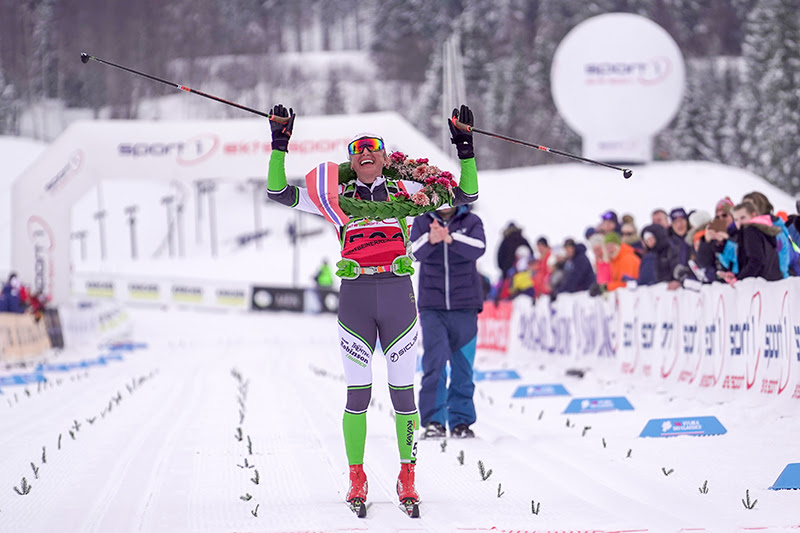
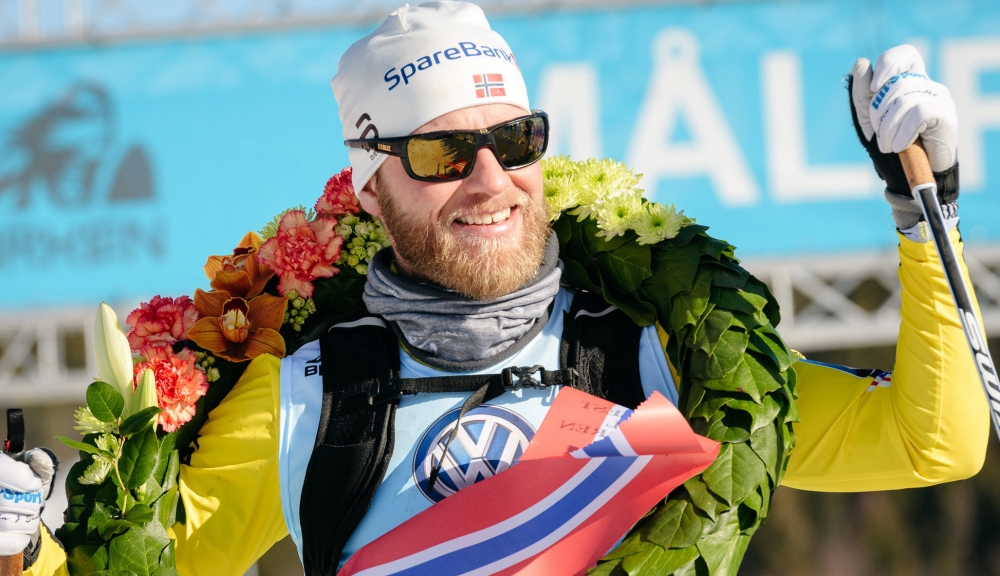
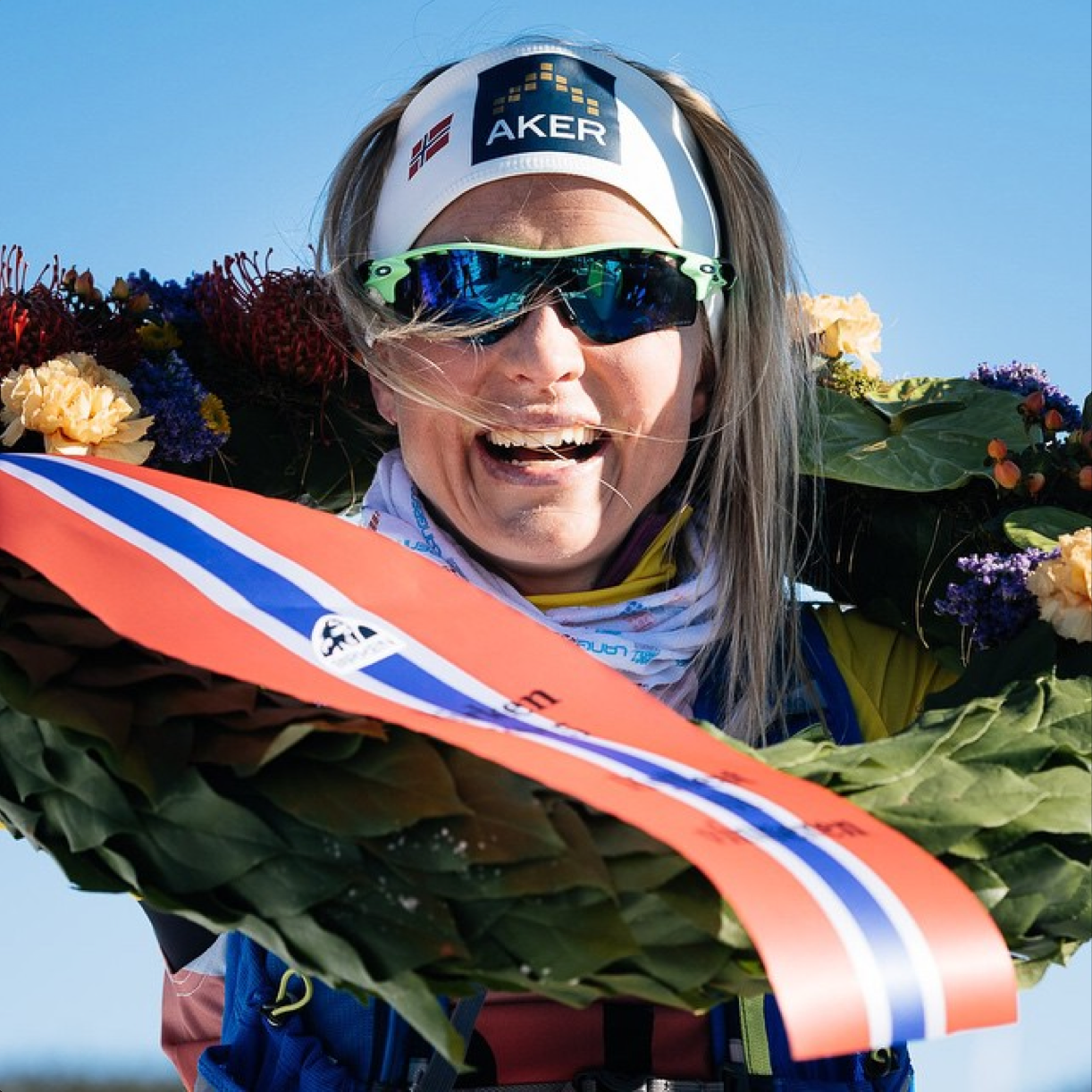
Poland’s Justyna Kowalczyk winning the 2019 Birkebeinerrennet. (Photo: Tom William Lindström)
Eliassen and Kowalczyk Break Away to Victories in Birkebeinerrennet
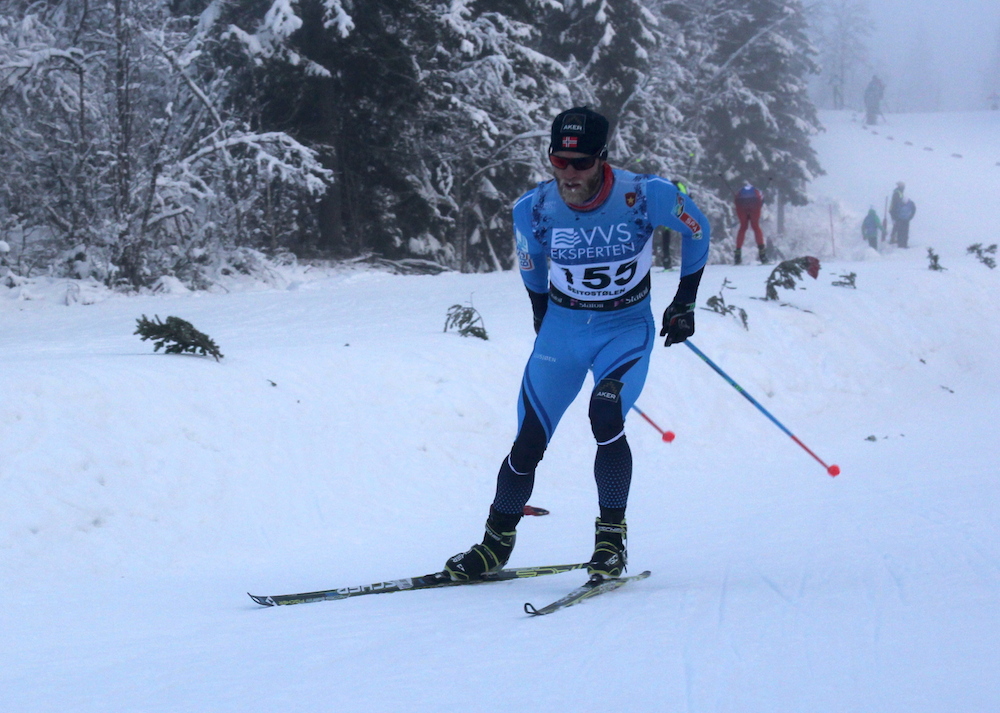
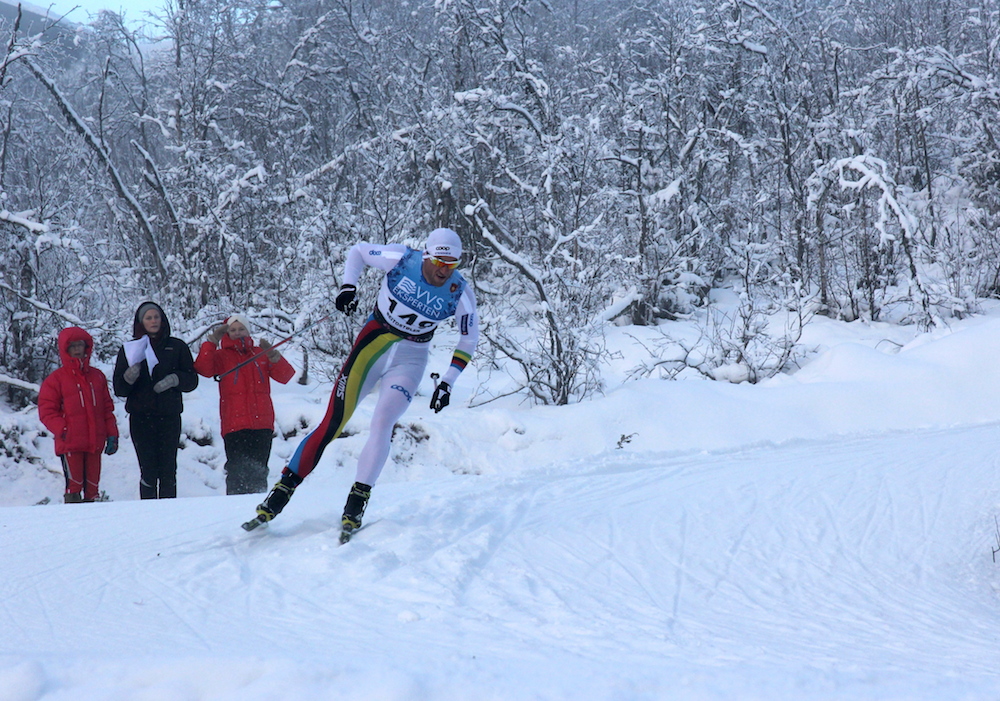
In the men’s 54 km race, Petter Eliassen attacked very early on and only his teammate Morten Eide Pedersen was able to follow for a while. Before reaching the climb competition point at Raudfjellet, 20 km, Eliassen was skiing solo and kept going so strong that no one else had a chance to even try to catch him. Behind him, five men approached the stadium area, and the yellow bib holder Andreas Nygaard, Team Ragde Eiendom, proved again that he is the sprinter extraordinaire by taking home the second place. There was an extremely tight fight for the last podium place between Simen Østensen, Team BN Bank, and the Vasaloppet winner Tore Bjørseth Berdal, Team Koteng. The former managed to be third making the day perfect for Team BN Bank as their third skier Pedersen was also able to finish 5th.
“This went according to our plan,” Eliassen admitted after the race. “This is a good race and great course for me. I attacked early on and managed to keep the gap. I just tried to focus on my own performance and make sure that I won’t encounter any unwanted mishaps on the way. It was a perfect day for our team, and I’m happy that my teammates did so well, too.”
The women’s race had more action as the current Hertz Champion leader Britta Johansson Norgren struggled in the first hill while Justyna Kowalczyk, Astrid Øyre Slind and Masako Ishida, both from Team Koteng, worked together to gain a gap over their toughest rival. Kowalczyk broke away from the others in the second long climb and Johansson Norgren was able to catch both Ishida and Øyre Slind. Kowalczyk’s breakaway lasted until the finish while the Team Koteng skiers had to let Britta go. Øyre Slind was stronger than her teammate in the end and she finished third in the race.
“I didn’t expect this to happen,” the happy winner Kowalczyk stated wearing her victory garland. “I felt tired after 12 kilometers of skiing, but my skies were so fast. So, I decided to push harder and it worked. I told my coach in the morning that I didn’t feel that strong, but he said that I’m strong and I should just go. It means so much to have this hat trick, three consecutive wins, here at Birken, which is so important to all Norwegians. About my next race, I may do Ylläs-Levi in Finland.”
Nygaard and Johansson Norgen remained the Hertz yellow bib holders while there were no changes in the sprint competition due to the fact that there were no sprint points in the race; Lager 157 Ski Team’s pro skiers Johansson Norgren and Anton Karlsson lead those competitions. Pedersen and Johansson Norgren are still the king and queen of the climb competition while Torleif Syrstad, Team Koteng, and Sofie Elebro, Team Ragde Eiendom, are the current youth bib holders. The pro team competition is very tight as there are three teams within 63 points of each other at the top; Team Koteng 1st, Lager 157 Ski Team 2nd, and Team Ragde Eiendom 3rd. After two events, Berdal and Johansson Norgren lead the Visma Nordic Trophy tour.
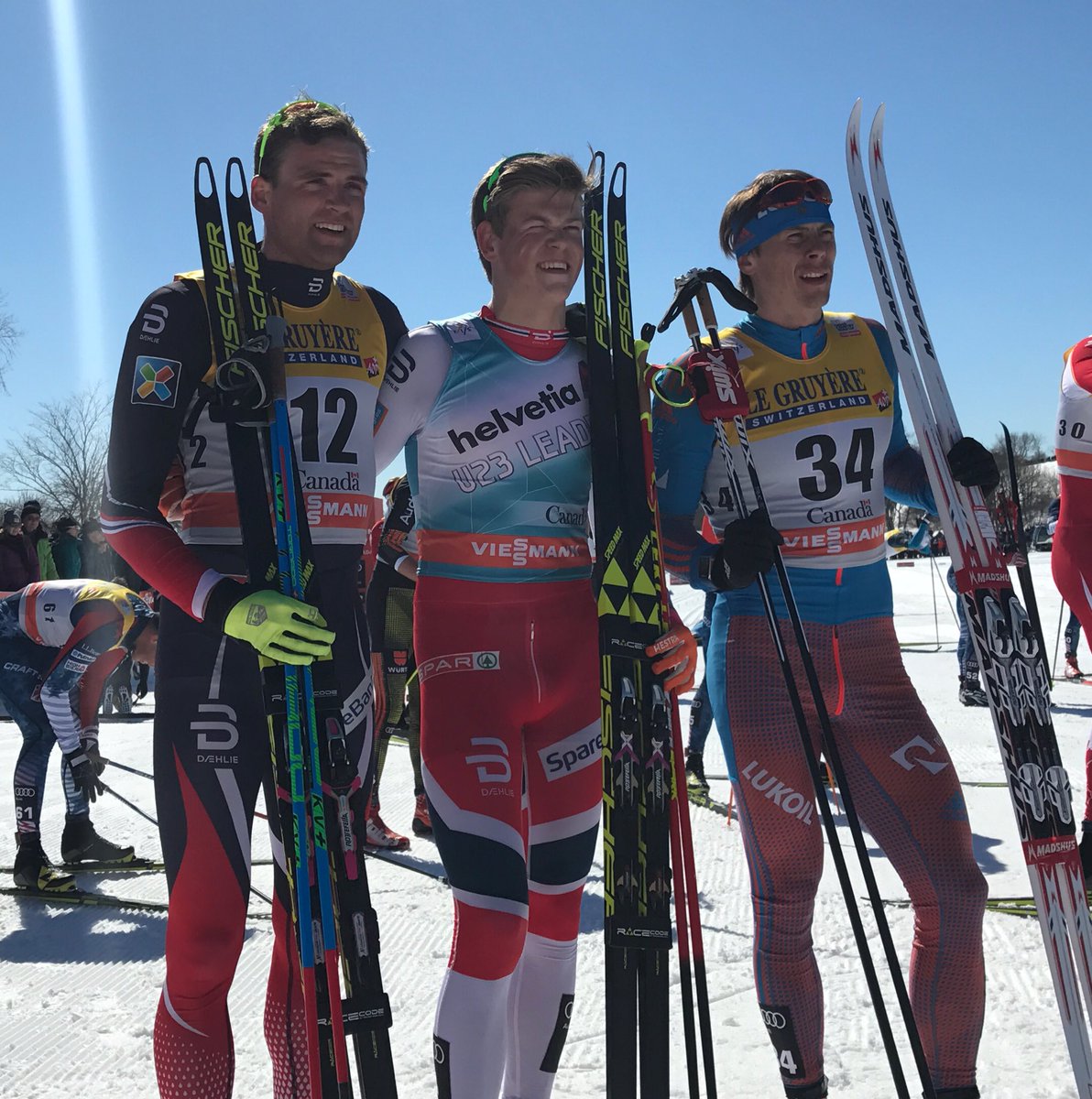
The men’s 15 k classic mass start podium on Saturday at World Cup Finals in Quebec City, with Norway’s Johannes Høsflot Klæbo (c) in first and Niklas Dyrhaug (l) in second, and Russia’s Alexander Bessmertnykh (r) in third. (Photo: FIS Cross-Country/Twitter)
FIS Cross-Country World Cup Finals (Quebec City): 10/15 k classic mass starts
During Saturday’s 15-kilometer classic mass start at World Cup Finals, Canada’s Alex Harvey was in it until the end. But so were Norway’s Johannes Høsflot Klæbo and Niklas Dyrhaug, and Russia’s Alexander Bessmertnykh, to name a few.
Sitting in second with a few hundred meters to go, Harvey was primed to make his move on Dyrhaug, who was leading at the time. But then came 20-year-old Klæbo, the season-long Sprint World Cup champion, who proved to have more left in the tank than anyone else and passed them both to lead into the finishing straight.
Klæbo took the victory — his first in a World Cup distance race — on a bluebird day under a beating sun in 35:23.7 minutes, 0.6 seconds ahead of Dyrhaug. Bessmertnykh followed another 0.2 seconds back in third (+0.8) just ahead of Harvey in fourth (+1.2).
Norway’s Sjur Røthe took fifth (+1.7), Switzerland’s Dario Cologna placed sixth (+1.9), and Norway’s Pål Golberg was seventh (+2.5), half a second ahead of another Norwegian Didrik Tønseth in eighth (+3.0). The top nine were within 3.7 seconds of first, with Russia’s Andrey Larkov in ninth.
Devon Kershaw was the second Canadian in the points on Saturday in 28th (+1:08.4), after breaking a pole and working his way back up from outside the top 60.
Erik Bjornsen led the U.S. men in 31st (+1:16.8), about a second ahead of Canada’s Graeme Killick in 32nd (+1:17.7).
Also for the U.S., Matt Gelso finished 37th, Andy Newell 45th, Scott Patterson 46th, Noah Hoffman 48th, Ben Lustgarten 49th, David Norris 50th, Simi Hamilton 54th, Paddy Caldwell 59th, Jack Hegman 62nd, Cole Morgan 64th, and Brian Gregg 69th.
For Canada, Bob Thompson finished 55th, Knute Johnsgaard 57th, Len Valjas 61st, Russell Kennedy 63rd, Evan Palmer-Charrette 65th, Andy Shields 66th, Jess Cockney 67th, Brian McKeever 68th, Joey Foster 70th, Gareth Williams 72nd, Ricardo Izquierdo-Bernier 74th, and Julien Locke 75th.
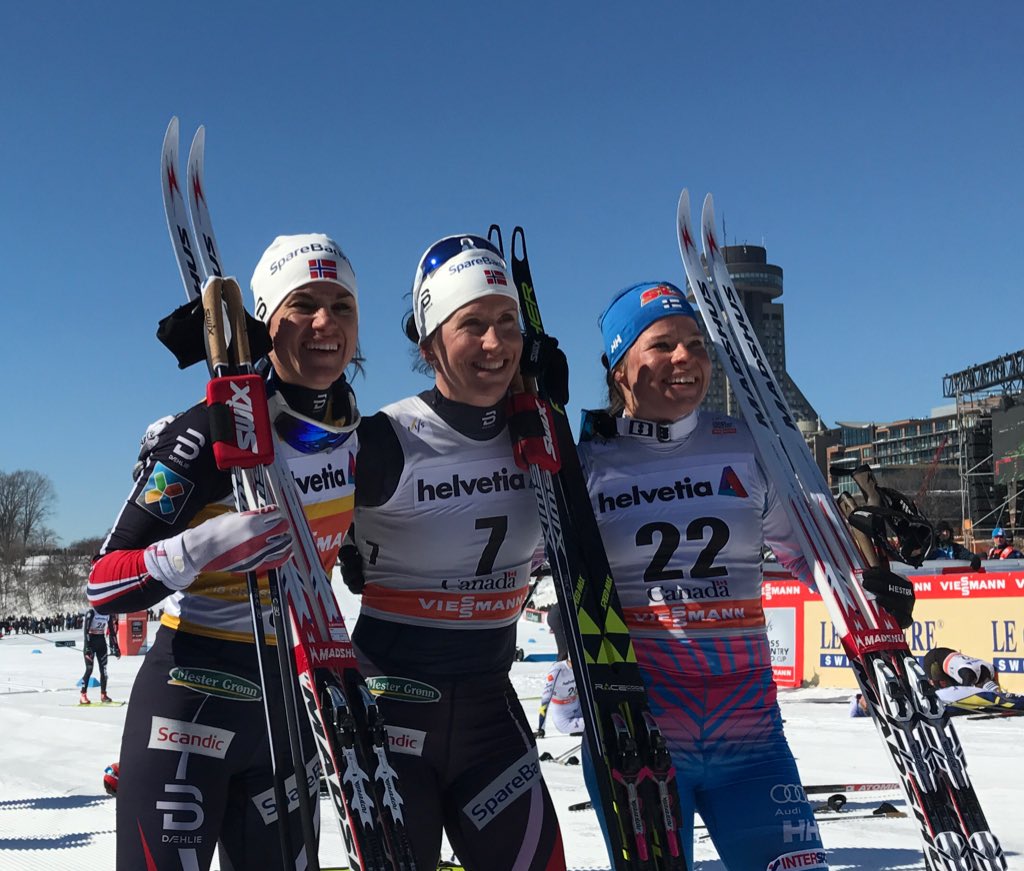
The women’s 10 k classic mass start podium on Saturday at World Cup Finals in Quebec City, with Norway’s Marit Bjørgen (c) in first, Norway’s Heidi Weng (l) in second and Finland’s Krista Parmakoski (r) in third. (Photo: FIS Cross-Country/Twitter)
In the women’s 10 k classic mass start earlier in the day, Norway’s Marit Bjørgen racked up her seventh victory of the season after leading a pack of two other Norwegians and Finland’s Krista Pärmäkoski and holding them off to the finish.
Bjørgen put a few meters into the foursome as she entered the finishing stretch and held her lead across the line in 24:23.6 minutes. Norway’s Heidi Weng finished 0.6 seconds back in second to lock up the Distance World Cup title, in addition to the Overall World Cup title she secured on Friday.
Pärmäkoski finished 2.9 seconds after Bjørgen in third, and Norway’s Ingvild Flugstad Østberg missed the podium in fourth (+7.8).
Behind them, Germany’s Nicole Fessel outlasted a large chase pack to place fifth (+18.6), just ahead of Sweden’s Charlotte Kalla in sixth (+19.9) and Anna Haag in seventh (+19.1).
Sadie Bjornsen of the U.S. Ski Team led the North American women in 15th (+29.9) after skiing at the back of that chase pack in the final stretches of the race. Also for the U.S., Jessie Diggins placed 27th (+1:06.9) and Sophie Caldwell 38th (+1:56.0).
Canada was led by Emily Nishikawa in 37th (+1:51.7). Behind her, Cendrine Browne finished 41st (+2:28.2), Dahria Beatty was 53rd, Annika Richardson 54th, Katherine Stewart-Jones 56th, Frederique Vezina 59th, Annika Hicks 60th, Sophie Carrier-Laforte 61st, Andrea Dupont 62nd, Katherine Weaver 63rd, Alannah MacLean 64th, Sadie White 66th, Lisle Compton 67th, Mia Serratore 68th, and Laura Leclair 69th.
For the U.S. Caitlin Patterson finished 44th, Liz Guiney 45th, Kaitlynn Miller 47th, Chelsea Holmes 48th, Rosie Brennan 50th, Julia Kern 52nd, Erika Flowers 55th, Becca Rorabaugh 57th, and Jennie Bender 58th.
One day left in the 2016/2017 World Cup season remains, with the women’s and men’s 10/15 k freestyle pursuits on Sunday in Quebec City.
World Cup Finals standings (Day 2 of 3): Men | Women
***
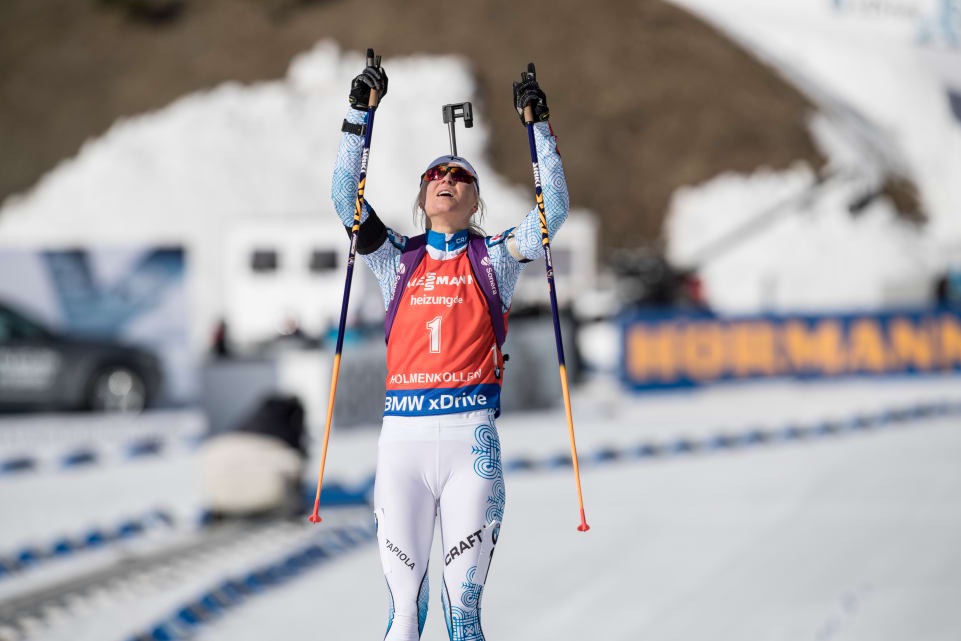
Finland’s Mari Laukkanen pointing to the sky in honor of her late shooting coach, after she won the women’s 10-kilometer pursuit on Saturday at the 2017 IBU World Cup in Oslo, Norway. (Photo: IBU)
IBU World Cup (Oslo, Norway): Women’s and men’s pursuits
Less than 24 hours after winning her first IBU World Cup on Friday in the women’s 7.5 k sprint, Finland’s Mari Laukkanen immediately capitalized on her ideal position with a start-to-finish victory in Saturday’s 10 k pursuit that was never in doubt, cleaning the first three shooting stages before incurring one penalty in her final standing shooting (0+0+0+1) to cross the line in a time of 29:33.3 minutes.
In addition to experiencing the most successful weekend of her biathlon career by far, it was an emotional day for the 29-year-old Finn due to a personal reason. Laukkanen spread her arms like wings skiing down the homestretch with a commanding lead, pointing repeatedly to the sky and a black ribbon she wore around her right upper arm, before kneeling in the snow in the finish for a few seconds. With those gestures, she reportedly wanted to commemorate her shooting coach Asko Nuutinen, who passed away Friday after suffering a heart attack during the World Cup in Kontiolahti, Finland, a week ago. He was 60 years old.
“It’s been a really emotional day for me. We have heard really really sad news that last night we lost our longtime shooting coach,” Laukkanen told reporters with a trembling voice in the press conference. “After this it was more or less only about working for him. Working as he has asked me to do for years and years. So I wasn’t thinking about losing or winning today, I was only thinking about him. And I feel really big pleasure that I was able to come to the finish like this, that I can own the victory for him.”
“I knew it will be difficult after the first victory in my career took me so long,” she added. “And to do it again immediately with good shooting. But as I said I didn’t think about winning or losing today, just doing my work.”
Finishing 26.5 seconds after her, the Czech Republic’s Gabriela Koukalová reached the finish, moving up from her fourth place starting position with a clean shooting performance (0+0+0+0).
“I wanted to miss all targets yesterday because I was so tired I didn’t even want to race,” Koukalová confided in the press conference. “It’s difficult to concentrate, three World Cups after the main goal of the season [the World Championships] is too much. Last year it was many times easier… I tried to catch her, but about one kilometer before the finish I saw her far away so I was happy I didn’t have to fight with anyone and was just enjoying the last meters.”
Despite four penalties (1+1+0+2), France’s Justine Braisaz defended the third place on the podium against a three-person chase group on the last loop (+1:01.4), falling back only one position after having finished the sprint in second.
“I did not expect such a good place today during the race,” Braisaz commented in the press conference. “Because in the last shooting I completely [failed]. I really wanted to have a clean shooting today, and I did not succeed. So I am happy and surprised, too.”
Her teammate Anais Bescond who had started the pursuit in third place fell back to 22nd position (+2:53.5) with seven penalties.
Slovenia’s Teja Gregorin finished fourth with one penalty (+1:08.2), Austria’s Lisa Theresa Hauser shot clean as the only athlete aside from Koukalova on her way to move up from 22nd to fifth place (+1:12.5), while Norway’s Marte Olsbu finished sixth like in the sprint despite three penalties (+1:15.9).
Unlike in Friday’s sprint race where Germany’s Laura Dahlmeier had still given up a seemingly commanding lead in the sprint World Cup discipline standings to Koukalova, she held onto her lead in the pursuit standings on Saturday, moving up from the 31st starting position to ninth place with a penalty in each of her standing shootings (0+0+1+1, +1:53.8). A 22nd place would have been sufficient to win the “small crystal globe” award in the pursuit. Laukkanen’s teammate Kaisa Mäkäräinen finished 8th with two penalties in the standing stages (+1:51.2), and thereby claimed the third place in the World Cup pursuit ranking.
“I knew that I didn’t need to have a perfect race today, just a good one, but that’s always easier said than done,” Dahlmeier told broadcaster ARD after the race. “I am incredibly happy that it worked out and that I could secure myself another small globe… It’s a bit of a weird feeling, standing at the start gate in the middle of the field and the clock ticks and ticks as one athlete after another skis out on the course. And you can only observe how far they have gone and have to wait and be patient, and not make a false start. But then the snow burns, then the chase begins!”
US Biathlon’s Susan Dunklee experienced an uncharacteristically problematic day on the shooting range and fell back to 37th place (+4:00.2), after starting seventh and less than a minute behind Laukkanen. Dunklee had three misses between two prone stages and seven more in her standing shootings (2+1+4+3) therefore having to ski more than an additional kilometer in the penalty lap.
“It is a testament to her fighting spirit that she notched the fourth-fastest ski time — one of her best ranks of the season — and never gave up despite suffering a biathlon blowout on the range,” teammate Clare Egan said of Dunklee, according to a US Biathlon press release. “Bad races happen to the best and Susan is no exception, but not everyone fights through till the end no matter what.”
Egan herself started the pursuit in 34th position and initally was able to make up ground, but then fell back slightly to 41st place (+4:13.9) with four penalties (0+2+0+2).
“I am satisfied with my race even though the result was not what I was hoping for, and that’s how I would summarize my entire season as well,” Egan said after the final race of her season. “I’ve made a good step forward but my competitors also work hard all summer and we seem to improve at a similar rate.”
Canada Biathlon’s Julia Ransom moved up to 47th place (+5:04.8) with three penalties (1+0+1+1), after starting in 52nd position.
[UPDATED] Later on Saturday in the last men’s 12.5 k pursuit of the season, the three best athletes of the season fought throughout the race exchanging in the lead, before they stood next to each other on the range for the final shooting to decide the winner.
Russia’s Anton Shipulin managed to shoot clean with his elaborate rifle stock in the design of a red dragon, proudly waving to the cameras as he left the arena while his two competitors had to ski into the penalty lap. France’s Martin Fourcade – who had already secured himself the overall World Cup Total Score title as well as the award for the pursuit discipline – was left to duke it out against Norway’s Johannes Thingnes Bø, the winner of Friday’s sprint.
On the last big climb before the Holmenkollen arena, Fourcade accelerated with a series of explosive jump-skate steps to decisively gap Bø. He even got fairly close to Shipulin on the finish stretch, who had slowed down a bit to grab a Russian flag before skiing over the line in a time of 32:11.9 minutes with one penalty (0+0+1+0), 5.7 seconds ahead of Fourcade who had incurred two penalties (1+0+0+1). While Fourcade shook hands with Shipulin, Bø came into the finish in third place, 21.6 seconds back and also with two penalties (1+0+0+1).
“It was a crazy race, but I am happy that I managed to finish first,” Shipulin said in the press conference through a translator. “Tough conditions on the shooting range, I had to really work to concentrate on my shooting. On the last loop I was all alone until I saw Martin chasing me, then I got a little bit scared but I managed to [keep him behind].”
It was Shipulin’s second win of the season, for which he credited his recently improved shooting performance.
“It was a really exciting competition with Johannes and Anton,” Fourcade agreed with his rival. “I expected to fight with them for the victory on the last loop, but then Anton was simply stronger in the last shooting. My strategy was to be focused on my technique and skills and not on the results, like I did too often in the past few weeks focusing on records and not the victory.”
Asked about his blazing attack on the final climb, Fourcade added: “Of course I train for that, but I think a lot of athletes do. I talked to Johannes, it was my revenge for the [2016] World Champs where he did exactly the same to me on the last uphill. But I know how it is, it can be different already tomorrow.”
“I am happy with a new podium of course,” Bø said in the press conference. “I was not at my best in the skiing today. But I still managed to shoot 18 out of 20. As Martin said it was [annoying] that we did not shoot zero [misses] and could not fight with Anton in the finish, but it was quite interesting and fun to stand there in the last shooting … I expected Martin’s attack the second he did it, but I had no energy to fight with him. That was quite strong.”
Sweden’s Fredrik Lindström placed fourth with no penalties (+44.7), and was the only man in the field who managed to shoot clean in all four stages.
“For the podium, I was never really close“, Lindström told the IBU in a post-race interview. “But it was a great day anyway. Four times zero [misses], and especially in the standing stages that makes you climb a lot in the standings. Super happy with my performance.”
US Biathlon’s Lowell Bailey, who had to start closer to the back of the field in 44th position, almost two minutes behind the leaders based on his sprint result, managed to move up 21 spots in the race despite three penalties (2+0+1+0).
“I’m happy with the race, considering it started out pretty rough with the first two misses,” Bailey told US Biathlon after placing 23rd (+2:23.3). “I just read the wind wrong and didn’t correct enough. After that, I tried to keep my head in the race and make the best of it. I was happy with my skiing and glad to clean the last stage; this brought me up nine spots and I was able to gain another in the last loop. Now, it’s just one race to go. I’m looking forward to tomorrow.”
Shooting quickly, Bailey recorded the ninth-ranked range time of the day and the ninth-fastest last loop.
His teammate Sean Doherty started 35th but fell back after having to ski six times through the penalty lap (1+3+1+1) to finish 46th (+4:05.6).
For Sunday’s mass starts as the final races of the 2016/2017 IBU World Cup season, the only qualified North American starters will be Dunklee (currently in 10th position in the World Cup Total Score standings) and Bailey (currently in eighth).
The women’s season award in the mass start discipline once more will be decided between Germany’s Dahlmeier and Czech Republic’s Koukalova, while Germany’s Simon Schempp will try to defend his narrow lead on Fourcade. But during Saturday’s final loop, the French star did consider saving energy for the final competition.
“No,” he simply quipped when asked about this in the press conference. “Of course the mass start is important tomorrow because it will decide about the [mass start] crystal globe. But I think today the pursuit was also really important, and you fight for victory and being one of the best athletes. You can’t be satisfied with only a third place when you can claim a second, and I think all athletes in my position would do the same.”
Norway’s Martin Johnsrud Sundby after winning the Norwegian 54 k classic Birkebeinerrennet, part of the Ski Classics series, on Saturday in Lillehammer, Norway. (Photo: Ski Classics)
54 k Birkebeinerrennet (Rena to Lillehammer, Norway): Part of the Ski Classics series
[UPDATED] Not even a snowmobile clipping him and sending him tumbling 20 k before the finish could keep Norway’s Martin Johnsrud Sundby from winning the Birkebeinerrennet on Saturday in Norway. Representing Team United Bakeries, Sundby set a high pace from the start and broke the group down to three by 9 k, with Petter Eliassen of Team LeasePlan and Simen Østensen of Team BN Bank sticking with him until about 30 k in the 54 k marathon.
With about 20 k to go, Sundby collided with a Ski Classics TV production crew snowmobile while trying to double pole in the snowmobile’s tracks. He was OK and went on to win by 48 seconds over Eliassen in second, and smiled about the incident after the finish.
“It came in with tremendous speed and mowed me down,” Sundby told NRK, according to a loose translation.
Ski Classics CEO David Nilsson told NRK he didn’t know exactly how that happened and emphasized that it was unacceptable.
“We always put safety first, but it is a difficult balancing act with the snowmobile at high speed to get TV pictures,” he said, according to a loose translation. “The skiers often ski in the [snowmobile] track and here it happened and somehow the driver missed it.”
While Sundby pulled out the win in 2:20:53.5 hours, Eliassen took second and Østensen followed another 3.5 seconds later for third place.
In the women’s race, Poland’s Justyna Kowalczyk (Team Santander) pulled out a 4 minute and 15 second win over Sweden’s Britta Johansson Norgren (Lager 157 Ski Team). Japan’s Masako Ishida (Team United Bakeries) was another 48.6 seconds back in third.
“I’m really happy to win this race,” Kowalczyk said, according to a Ski Classics press release. “Everything went well and the cheering on the course was amazing. I will do the rest of the races in Visma Ski Classics, but this victory was the most important for me. Of course, I want to win again in Årefjällsloppet like I did last year, but to win here in front of this audience means so much to me.”
Tord Asle Gjerdalen, who finished fourth in the men’s race, and Johansson Norgren continue to lead the overall Ski Classics standings with three races to go. The next stop is the Årefjällsloppet in Sweden on March 25.
“It was a great race and we kept a high tempo up all the way,” Sundby said, according to the press release. “I was able to use uphills for my advantage and get a gap. I had good skis, the conditions were perfect, and to win here was one of my goals for the season. I have the Norwegian Championships in two weeks, and I haven’t counted out the option of going to Finland for the Visma Ski Classics finale.”
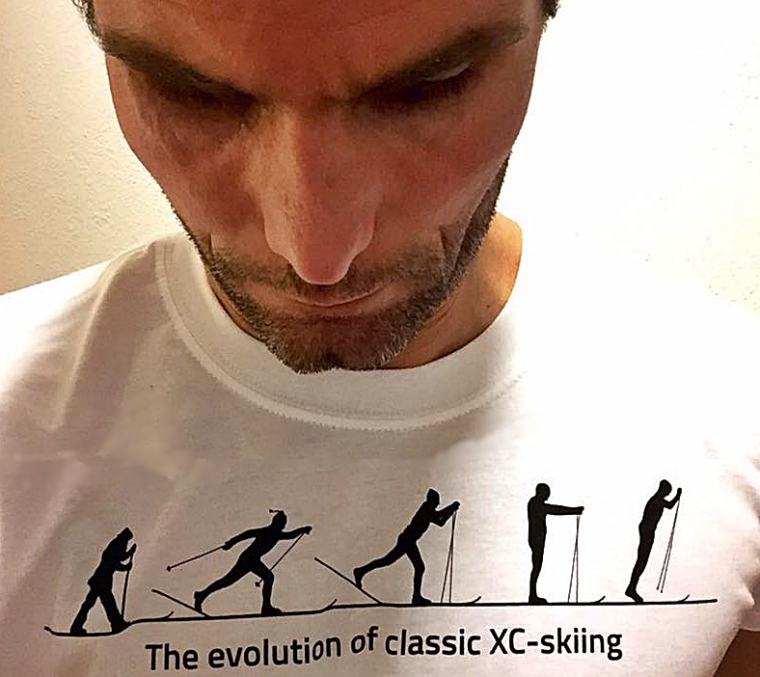
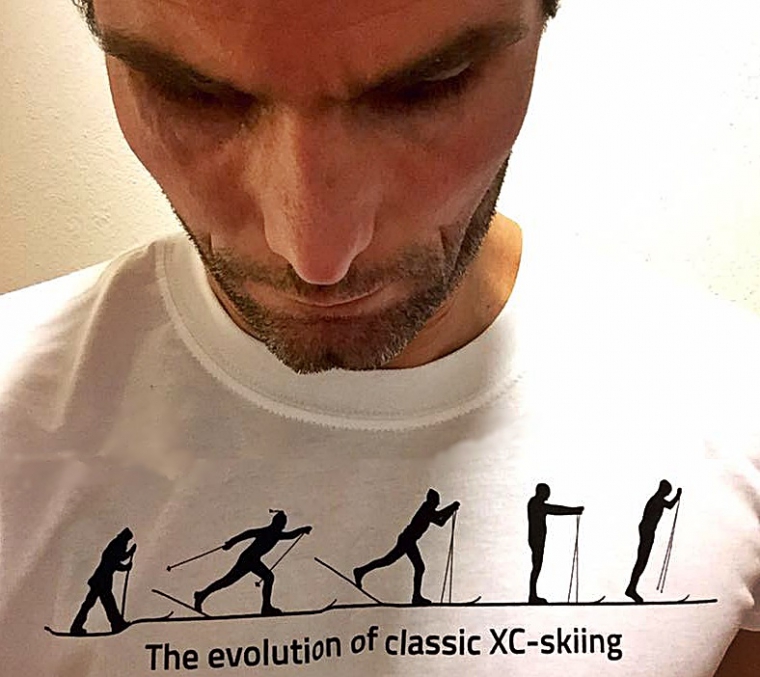
Thomas Alsgaard is all about the evolution of double poling, especially as it pertains to long-distance ski marathons. Alsgaard, the owner and manager of Team LeasePlan, took a selfie his team’s new shirts for the 2016/2017 Ski Classics season. (Photo: Thomas Alsgaard Instagram via OpenSki.ru)
Thomas Alsgaard is fired up. Having challenged the International Ski Federation (FIS) regarding rules he considers arbitrary and insensitive to other venues for nordic skiing besides the World Cup, a potential divide may be opening up between the Ski Classics marathons and World Cup racing. With 15 Olympic and World Championships medals, Alsgaard is considered by many to be the most apt pupil of the skating technique, and has the palmares to corroborate that claim. As a veteran of World Cup and professional racing, and the owner/manager of Team LeasePlan, ski fans are receptive to his points against the FIS’s new regulations.
Earlier this month, the day before La Sgambeda, the opening race of the Ski Classics season, the Russian ski website Openski.ru interviewed the legend himself in Livigno, Italy. Reporter Denis Kabanen covered topics ranging from the FIS rule restricting pole length in classic-technique racing, to the growing divide between the Ski Classics and FIS, women racers at the highest level of the sport, and the future of double poling.
Kabanen provided FasterSkier with the original interview in English. Here is part of it (to read more, see Part I and Part II of OpenSki’s interview with Alsgaard):
OpenSki:What do you think of the development of double poling? Do you think the women’s side will develop the same as the men in a couple of years?
Thomas Alsgaard: I think so. You see, the distance between men and women in long distance; years ago it was usually half an hour, now it’s just a narrow … The men have developed, very fast, but the women have developed [at an even faster rate].
OS:Let’s talk about the double-pole rule. I was checking my length today for the first time, I have ski poles that are a centimeter too long. I will actually put something under my heel. What’s your opinion?
TA: The rule is there, so now you can’t do anything, so what’s the point? It’s a stupid rule… everything they are doing is because they are organized by people who think World Cup, and everything and every rule is meant for World Cup, and long distance racing … we just have to follow. So, I talked to them and said, ‘you knew this doesn’t change anything,’ and they said, ‘yeah, it doesn’t change anything.’ So, why the hell do you do it then? Are you kidding with us? Why? What’s the point?
OS:They say we don’t want technique to go a different way, like super-long ski poles.
TA: Yeah, but they don’t. That’s where they don’t have the knowledge … the double-poling king [two-time Ski Classics overall champion Petter Eliassen], he used one centimeter lower than the 83-percent rule.
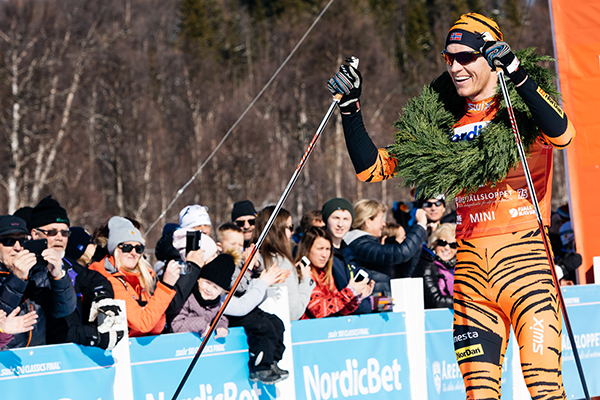
Two-time defending Ski Classics champion Petter Eliassen, of Team LeasePlan, celebrating another win in his team’s tiger suit. (Photo: Visma Ski Classics)
OS:Could you tell me more about [Eliassen’s] experience last year? The year before he started with 150 centimeters, and then he went to 170, 172 cm, but you feel that he lost frequency? What did he gain?
TA: It’s more comfortable. If you do slow training, it’s very comfortable, but we have experienced, during the spring and summer, that in shorter hills and sprints you don’t get the frequency. If you have too long poles, it’s too much to move, so … Uphill it’s quite good, and for the average racer, just ski one speed around the track, it’s comfortable, but for the best poling speeds, a lot of times during the race then you have to go slower.
OS:I read that he said that regular classic length minus 30 centimeters for flat races, and hillier races maybe closer to skate. So two different lengths?
TA: That might be, but I still think skating poles … if you want to win the races, it’s too long.
OS:What’s the best frequency for double poling?
TA: It’s impossible to say. It’s all up to feeling. The terrain, speed of the snow, conditions, there are so many factors…
OS:In terms of technique, ski classics are developing like cycling races with teamwork; did you work out some kind of team tactic [for Team LeasePlan]?
TA: No, I never do that. I know from experience that if you want to win the race, you have to be able to read everything as it happens. You have to make the right decisions at the right time. It doesn’t matter if you have the best plan in the world if the [other racers] do something else, you have to adapt, you have to be there in the moment. It’s very complicated, but if you’re calm and have experience you usually do the right thing.
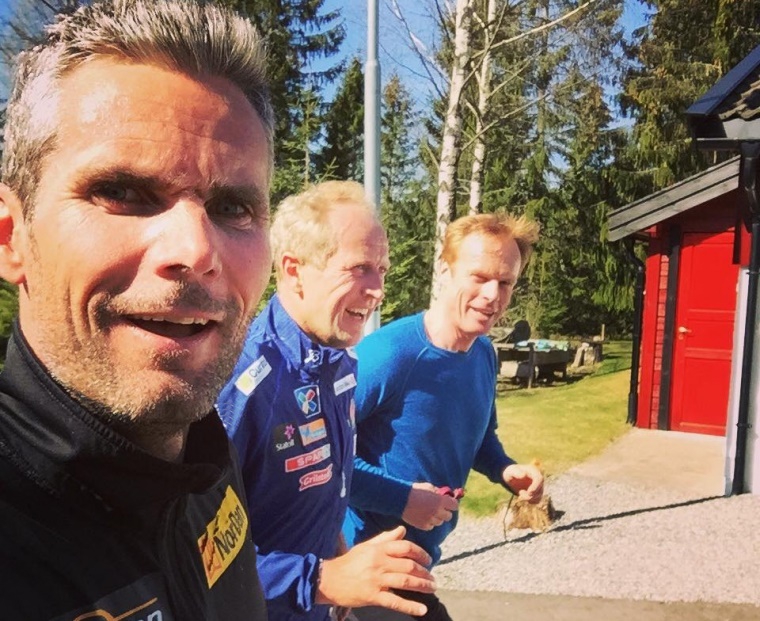
Thomas Alsgaard (near) jogging with fellow former Norwegian skiers Espen Bjervig and Bjørn Dæhlie (far) earlier this year. (Photo: Thomas Alsgaard Instagram via OpenSki.ru)
OS:Do you think double poling is something that will help young skiers get better at any kind of skiing?
TA: Yeah… People on a high level, with a high capacity, when they have been thrown out of the national team and get on to a long distance team, they train a lot more double poling and long distance training. Then they get also much more stronger in all-around skiing.
OS:That’s good for sport! Why would you stop that?
TA: Why avoid double poling? It makes everyone stronger. And the younger guys I have trained with are 16, 17; they are so strong. They can’t hold it for long, because the age, but they are so incredibly strong. I cannot keep up with them. When they grow up, when they get older, five, seven years from now, then we’ll really see. I know because I was from the first generation that grew up with skating, and when I won Lillehammer I was on a completely different level, technically, than all the other guys. I think the same will happen in classic in six years when these young guys grow up we’ll see some amazing double poling.
— FasterSkier’s Jake Ellis contributed reporting
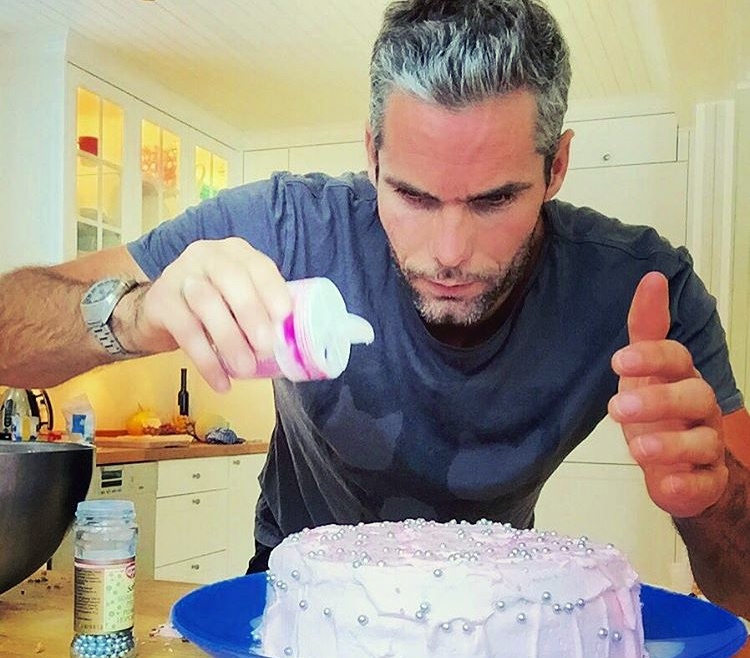
Marathon team owner/manager and five-time Olympic gold medalist Thomas Alsgaard, of Norway, shows his softer side, decorating a cake for his Team LeasePlan before the start of the 2016/2017 Ski Classics season: “… Winter has come ❄️❄️ It’s a happy day.” @leaseplan_tigers celebrates with (pink …) birthday cake !!! How are you celebrating?” (Photo: Thomas Alsgaard Instagram via OpenSki.ru)
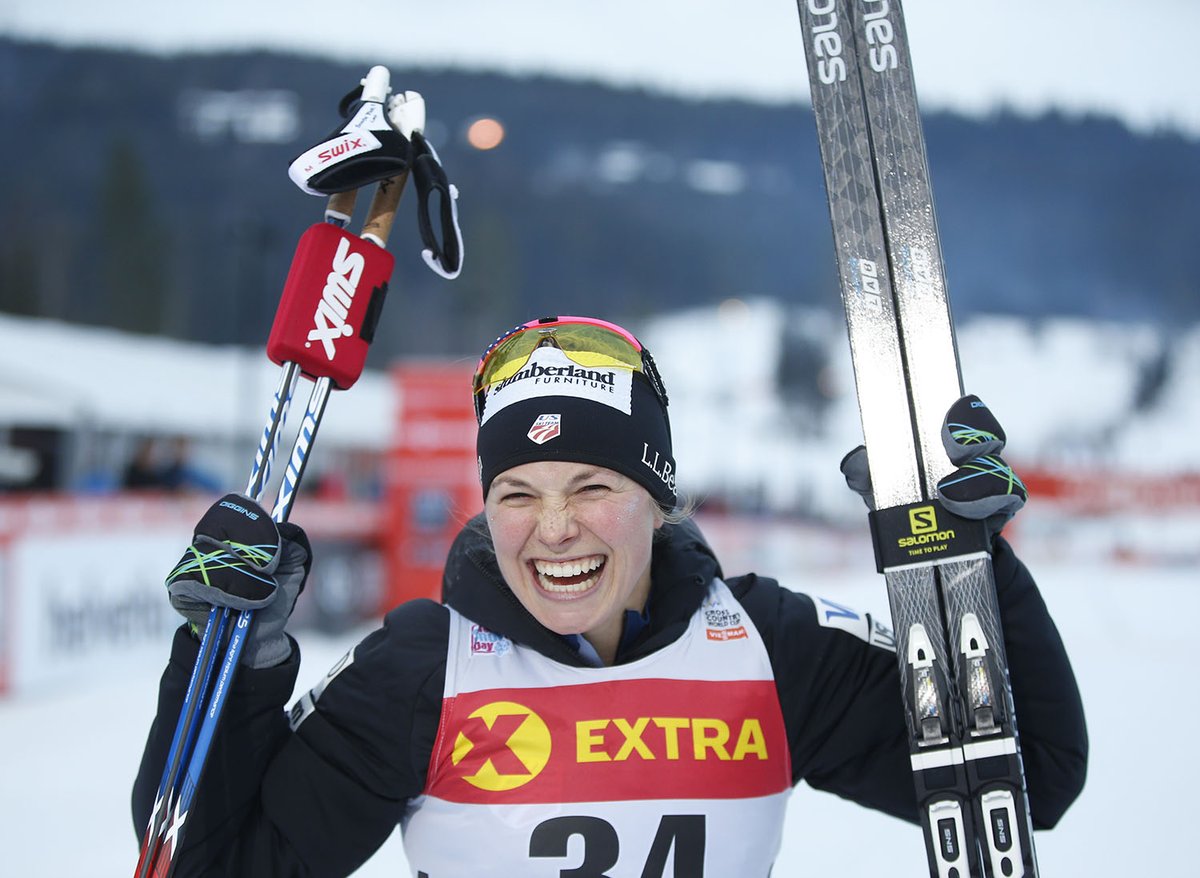
Jessie Diggins (U.S. Ski Team) won the second individual World Cup of her career on Saturday in the women’s 5 k freestyle in Lillehammer, Norway, beating four Norwegians by 4.8 seconds or more. (Photo: USSA Nordic/Twitter)
Welcome to The Rundown, your quick primer of need-to-know information about the day’s racing. We’ll be updating this digest as the day goes on with additional results, photos and quotes. The Rundown is NOT a race report; stay tuned for complete race reports later today with interviews from the day’s top racers.
***
U.S. SuperTour opener in West Yellowstone: Freestyle sprints
[UPDATE] The U.S. domestic season opened in West Yellowstone, Mont., with 1.3-kilometer freestyles on Saturday, and Matt Gelso and Jennie Bender emerged as the day’s winners.
Gelso, of the Sun Valley Ski Education Foundation (SVSEF) Gold Team, won the men’s final, and two Alaska Pacific University (APU) skiers, Tyler Kornfield and Reese Hanneman, joined him on the podium in second and third, respectively.
In the women’s final, Bender, of the Bridger Ski Foundation (BSF), held off Stratton Mountain School (SMS) T2 teammates Erika Flowers and Anne Hart, who placed second and third, respectively.
[UPDATE] Americans Lowell Bailey and Susan Dunklee led their teams in 13th and 27th, respectively, and five North American men and four women finished in the top 60 of Saturday’s sprint to qualify for Sunday’s pursuits in Östersund, Sweden. Oh, and France’s Martin Fourcade won his third-straight race (in as many races this season) and his second individual race for his 51st career victory. France made it a double with Marie Dorin Habert winning the women’s sprint.
There aren’t many 5-kilometer skate races on the World Cup schedule. But when they do come around, Jessie Diggins makes sure to capitalize.
The 25-year-old U.S. Ski Team member and Minnesota native rocketed to the second victory of her World Cup career on Saturday, winning the women’s 5 k freestyle in Lillehammer, Norway, in 12:40.3 minutes and by nearly 5 seconds ahead of anyone else.
After winning her first individual World Cup last season in a 5 k freestyle in Toblach, Italy (then reaching the podium three more times in individual races through March 2016), Diggins achieved her first podium of the season in the fourth race of 2016/2017.
She started 34th of 76 finishers, with top-dog Norwegians like Heidi Weng (who won Friday’s classic sprint) and Marit Bjørgen behind her. Diggins trailed slightly at the first 0.8 k checkpoint, but she drew the race’s attention at 2.2 k, where she overtook Norwegian Astrid Uhrenholdt Jacobsen’s time by 2.1 seconds. At the finish, Diggins bumped Jacobsen out of the leader’s chair by 16.4 seconds, and the American would sit in that seat for the rest of the day.
Except she didn’t sit much. Diggins chatted with teammates and team staff, smiled and waved at cameras, and bustled about the finishing area. After her closest challenging, Weng in bib 60, finished 4.8 seconds off her time in second place, Diggins knew she had done it. Bjørgen had already finished and was third (+15.8), Jacobsen fourth (+16.4), and yet another Norwegian, Ingvild Flugstad Østberg fifth (+17.2).
She hugged Weng and told her she had a great race at the finish.
“Before I started, I knew it!” Weng said to her of Diggins’s win.
Diggins smiled, and later stood on the podium between Weng and Bjørgen.
“I’m so happy with my day today. I’m so lucky to have the most amazing team,” Diggins said in a televised interview with FIS. “When you get to train with such cool people, that belief, that confidence, it opens up opportunities. And I had such a great opportunity.
“My coaches and staff work so hard. so when they gave me this opportunity I really had to take it,” she continued. “… It means a lot that when everything goes right you can ski with the best in the world. Hopefully this will mean a lot back home because I’m not special or different in any way. If I can do it, all the little kids back home, they can do it, too!”
While Norway occupied four of the top five, the team had six in the top 10, with Ragnhild Haga in eighth (+31.2) and Kari Øyre Slind in ninth (+32.0). Finland’s Krista Parmakoski placed sixth (+26.9) and Laura Mononen was 10th (+36.1), and Russia’s Yulia Tchekaleva placed seventh (+27.7).
The second U.S. woman in the top 15, Sadie Bjornsen broke through her pattern of 17th in the last three races and place 14th (+41.8). Liz Stephen (USST) scored points in 26th (+51.2) in her first “distance” race of the season.
Caitlin Patterson placed 38th for the U.S., Rosie Brennan (USST) was 48th, and Sophie Caldwell (USST) 59th, and Ida Sargent (USST) 67th.
Canada’s Cendrine Browne (NST U25 Team) 50th, Emily Nishikawa (World Cup B-team) 52nd, and Dahria Beatty (NST U25 Team) 62nd.
Diggins is now third in the mini-tour standings through two days of racing (21.6 seconds behind Weng in first and 0.9 seconds behind Østberg in second), with just Sunday’s 10 k classic pursuit to go, and Bjornsen improved to 12th.
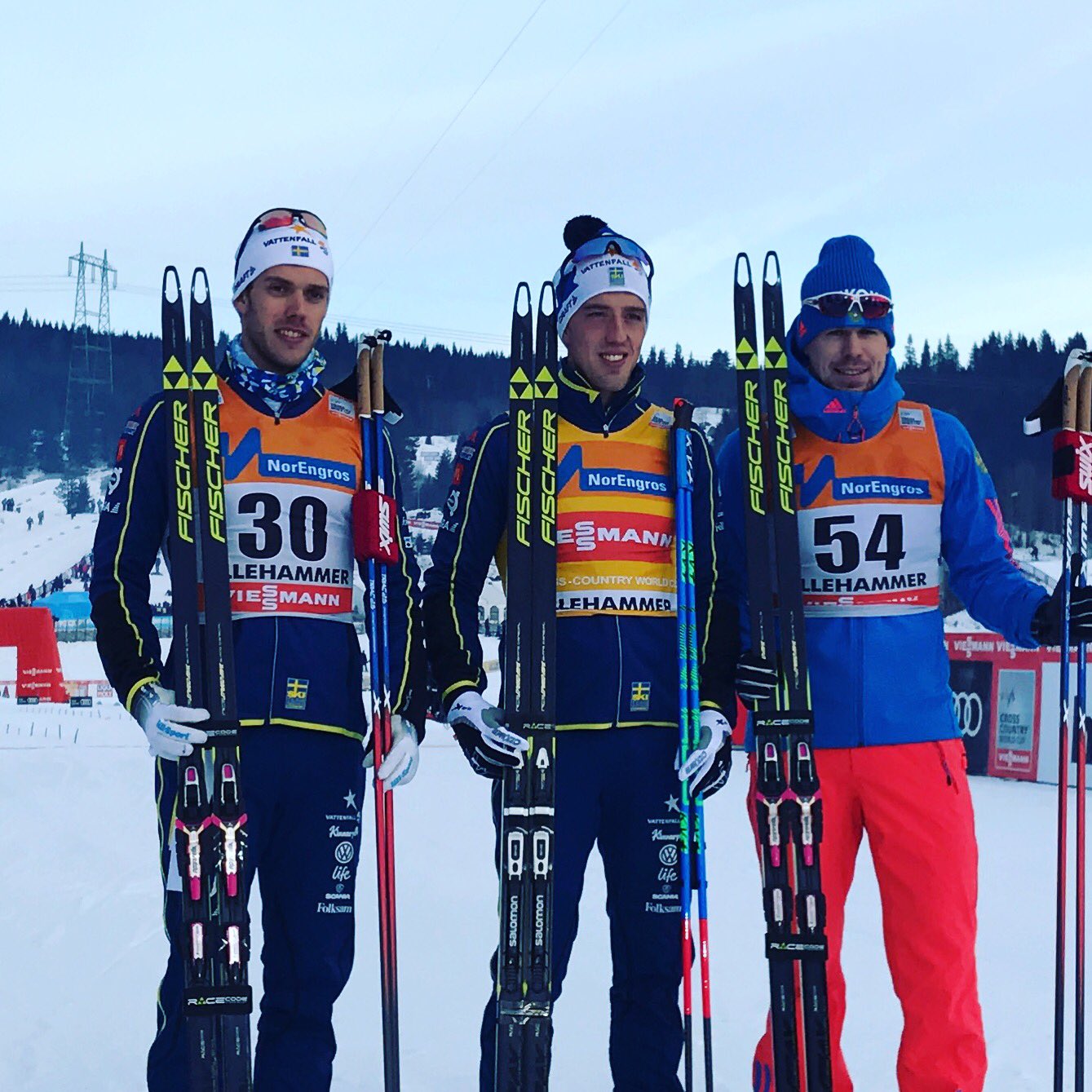
Calle Halfvarsson (c) gets the win for the second day in a row, while teammate Marcus Hellner (l) is pleased to be on the podium for the first time this year. Russia’s Sergey Ustiugov third in the 10 k skate in Lillehammer. (Photo: FIS Cross Country/Twitter)
In the men’s 10 k classic to start the day, Calle Halfvarsson of Sweden made it two in a row, winning the first distance race of the mini tour by 0.8 seconds over teammate Marcus Hellner. The competition is the second day of the World Cup mini-tour, which will conclude on Sunday with a classic pursuit. Halfvarsson also won the classic sprint on the first day of racing. For Hellner, it’s a strong result for the former World Champion after two straight seasons where he only stood on the podium once a apiece.
Russia’s Sergey Ustiugov slotted into third with a hard closing kilometer, moving from fifth place and nearly nine seconds back at 8.3 k to the podium and only 6.7 seconds behind Halfvarsson at the finish.
That left Norway off the podium, but the home team swept the next three places with Finn Hagen Krogh (+7.4), Simen Hegsted Kruger (+13.2), and Martin Johnsrud Sundby (+13.5).
Alex Harvey was the top Canadian in 10th place (+23.5). Devon Kershaw and Lenny Valjas finished 40th (+1:16.7) and 42nd (+1:19.1), respectively, with Graeme Killick 64th (+1:46.6) and Knute Johnsgaard 73rd (+2:22.0). Bob Thompson and Andy Shields rounded out the Canadian roster in 88th and 89th.
Noah Hoffman led the way for the U.S. men, just outside the points in 33rd (+1:08.6). Erik Bjornsen was 45th (+1:22.2), followed by Simi Hamilton 69th (+1:55.8) and Eric Packer 78th (+2:28.7).
Visma Ski Classics: La Sgambeda 30 k Classic in Livigno
Tord Asle Gjerdalen (Team Santander) crosses the finish line first in Sgambeda in Livigno, Italy, on Dec. 3, 2016. (Photo: Visma Ski Classics)
The Visma Ski Classics series began last weekend in Pontresina, Switzerland, with 8 k time trials. Racing continued this weekend just down the road in Livigno, Italy, where racers competed in the second race in the series, La Sgambeda. Skiers encountered superb conditions and firm tracks following cold temperatures the night before.
In the women’s race, a mass start over five laps of a 6 k course, Britta Johansson Norgren of Team Lager 157 took the narrow victory over Katerina Smutná of Team Santander, reversing their finishing positions from Pontresina a week before. Norgren finished 1.3 seconds ahead of Smutná after the two of them broke away from the main pack on the course’s final hill. Sara Lindborg of Team Serneke secured third, 17.4 back of Norgren.
The men raced on the same five-lap, 30 k course as the women. The men’s race also came down to a breakaway on the final climb. Tord Asle Gjerdalen of Team Santander took the narrow victory, rebounding from his sixth-place finish in the Pontresina prologue. Ilya Chernousov of Team Pioneer Investments was 1.3 seconds back. Team Leaseplan’s Petter Eliassen was third (+2.7) after leading most of the race.
Norgren and Gjerdalen are now leading the individual standings, with Gjerdalen’s Team Santander the top team, as the Ski Classics series approaches a month-long holiday break. Racing resumes in early 2017.
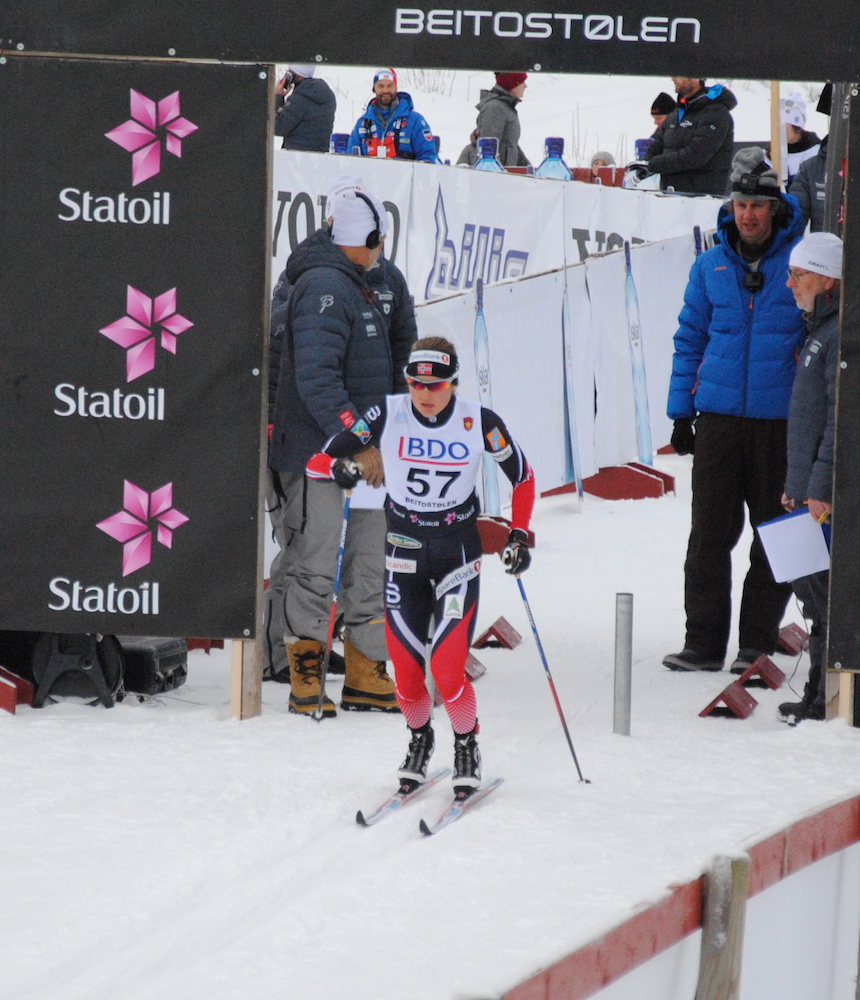
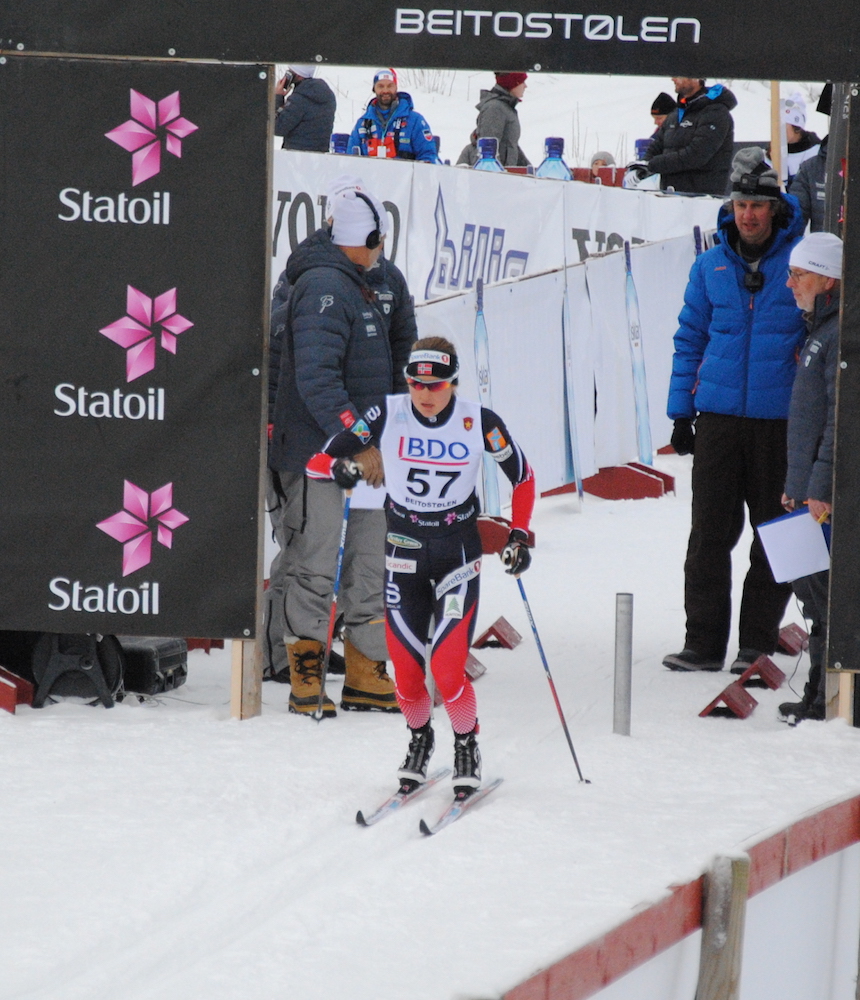
Ingvild Flugstad Østberg (Norway) out of the start in her country’s first FIS race of the 2016/2017 season: the 10 k classic in Beitostølen on Friday. (All photos: Aleks Tangen)
BEITOSTØLEN, Norway — Friday’s International Ski Federation (FIS) season opener in Beitostølen, with most of the Norwegian cross-country team participating, became a demonstration of strength by Norway’s Ingvild Flugstad Østberg.
With Therese Johaug suspended for the first part of the season and Marit Bjørgen out with a cold, Østberg led the race from start to finish and completed the 10-kilometer classic individual start in 26:47.4 minutes. She progressively increased her distance over teammate Heidi Weng, who started just 30 seconds ahead of her, leading her by 6.2 seconds at 2.1 k and 13.2 seconds at the finish.
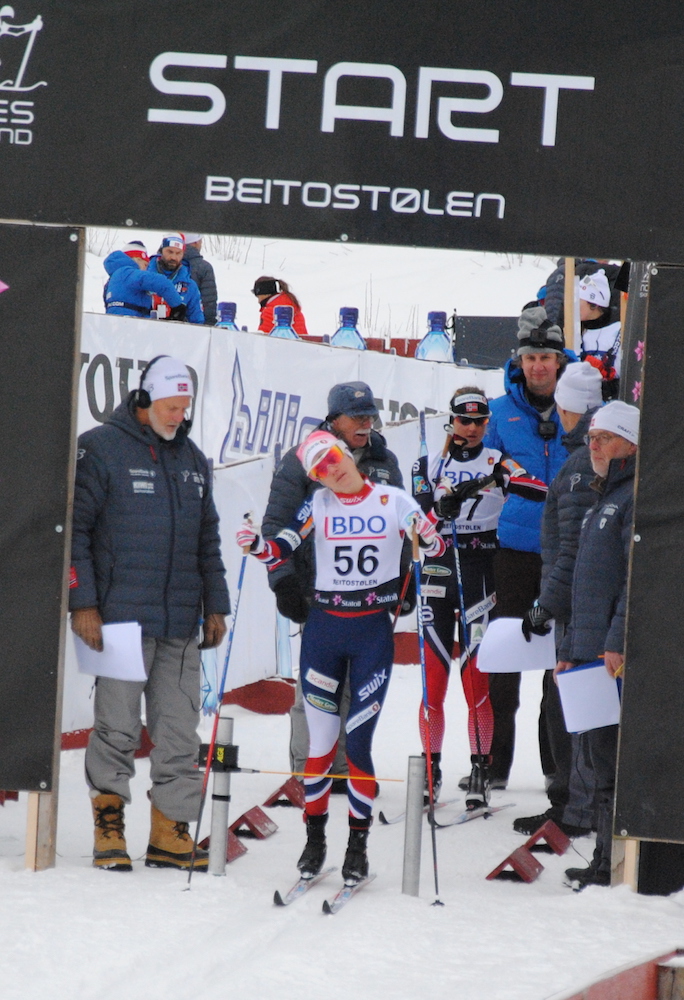
Heidi Weng at the start with Norwegian teammate Ingvild Flugstad Østberg behind her in the FIS season-opening race in Beitostølen, Norway. (Photo: Aleks Tangen)
After the race, Østberg told Aftenposten that Johaug gave her some valuable advice just a day earlier. She said they spoke Thursday and Johaug offered some tips, encouraging her to focus on technique rather than worry about her form at this point in the season. Østberg said she told her to go for it and see how things turn out.
She took that advice to heart and came away with a victory. Østberg said it was strange not having her at the races, but she channeled her inner Johaug and focused on a strong start.
“It tends to work for her here, then I thought that I should try, too,” Østberg said, according to a translation.
“I’m usually a little slow in Beitostølen, but not today,” Østberg told NRK. “I had good skis and a body that played along. It was a good day. I’m very happy that I was able to ski well. Of course I got tired toward the end and consequently my technique deteriorated, but I felt that had good control over my opening so I’m happy.”
Notably, Østberg became the first woman other than Johaug or Bjørgen to win an opening race at Beitostølen since 2003.
“They would have probably been strong had both been here, but one cannot do anything about those who aren’t here,” she said.
The Norwegian national-team women swept the top nine, with Astrid Uhrenholdt Jacobsen coming on strong in the final third of the race for third place, 1:06.4 behind Østberg. Throughout much of the race, her split times ranked fourth of 55 finishers, behind Østberg, Weng and Kathrine Harsem.
Afterward, Jacobsen told Aftenposten that she thought she would finish farther back, noting the first races of the season are often the hardest.
“Third is far above my expectation; I had not thought that I would start there,” she said, according to a translation.
Ingvild Flugstad Østberg (Norway) double poling out of the start in her country’s first FIS race of the 2016/2017 season: the 10 k classic in Beitostølen on Friday.
At just one point in the day, Østberg’s time ranked second: at 1.2 k, where Harsem was 1.5 seconds faster.
“I’m a little surprised it worked this well,” Østberg told NRK after the race. “I’ve felt good all through the summer and fall, but during the last week I’ve felt kind of heavy, but then I suppose I just fooled myself.”
American Cambria McDermott, a former Montana State University skier who graduated this spring, finished the race in 44th, 5:05.3 behind Østberg. After spending the summer training with Henning Skilag and representing the Norwegian club during the race, she told FasterSkier afterward that “it was really cool to see so many fast women. I felt slower by comparison, but it was really fun. It’s an awesome course.”
McDermott, 23, is currently taking classes at Nord University in Meråker, a small town near Trondheim. When asked about the level of competition in U.S. collegiate skiing compared to Norway’s first FIS race of the season, she said, “I think NCAAs was really good preparation for these kinds of races. There are a lot of international racers at NCAAs and they bring a lot of competition to those races, but here, there are the best skiers in the world in this race, so I think it’s hard to find a race that matches that.”
She’ll continue to race for Henning Skilag in Europe for most of the season, competing in most of the Norwegian and Scandinavian Cups before heading back to the states for U.S. nationals in early January.
“I’m excited for tomorrow,” she said of Saturday’s 10 k freestyle in Beitostølen. “I like skating and it’s a little less complicated than classic skiing with the wax and everything.”
Canada’s Madison Fraser (Team Hardwood) racing to 50th in the women’s 10 k classic FIS race on Friday in Beitostølen, Norway. (Photo: Aleks Tangen)
Canadians Madison Fraser (50th place, +6:33.8) and Isabella Howden (55th, +8:21.6) also competed on Beito’s opening day. After the race, Fraser, of Team Hardwood, said she felt good about her effort.
“It was the first race I’ve done at this level,” she said. “So, really cool to see my name on the same list as Weng and Østberg, but it was hard, but nice course, really flowy. It felt good to get some intensity in. This is our first race over here.”
Reflecting on how she tackled the course, the 20-year-old, first-year senior described two big hills at the back of the course.
“I think that gritting down that extra bit and I was able to stride up the whole thing,” Fraser said. “Some people would hop out and start stepping, which is slower and more energy, so I was happy with that and stepped all the corners, so yeah, I was happy with how I handled everything.”
When the Cat’s Away… Tønseth Wins
In the men’s 15 k classic, Norway’s Didrik Tønseth capitalized in the absence of his team’s leading skier, Martin Johnsrud Sundby (out with a sore throat), beating out 140 men while double poling the entire three-lap course to win in 37:31.9.
Tønseth told NRK after that he was in “disbelief” at the conditions, with a heavy snowfall blanketing the course after the women’s race. He switched to skate skis one minute before the start, and said it worked well.
“It’s awesome to win … it’s good to put others in their place,” he said, according to a translation.
Starting 12 minutes earlier than Tønseth in bib 125, Norway’s Tord Asle Gjerdalen also double poled the entire course and rose from the seventh-ranked time at 4.9 k to second at the finish, 15.7 seconds back.
“It snowed a lot, but I think it was the right decision to skate,” Gjerdalen told NRK, according to a translation.
“When the cat’s away, the mice will play,” he added, taking a playful dig at Sundby.
All of the eventual top-six men double poled, with Norway’s Morten Eide Pedersen finishing third (+24.5) after opening with the fastest 4.9 k split, then ranking second at 9.8 k. A fourth Norwegian, Sjur Røthe took fourth (+33.2), Great Britain’s Andrew Musgrave broke up the sweep in fifth (+40.0), and Petter Eliassen (Norway) placed sixth (+45.4).
Meanwhile, Norwegians Pål Golberg and Petter Northug chose grip wax. While Golberg cracked the top 10 in ninth (+1:19.4), Northug ended up nearly four minutes back in 74th, approaching the finish line with a sedative pace that seemed more like a conscientious choice than a consequence of low physical conditioning.
After the race, an NRK interviewer said to Northug, “You look very smart for someone who finished 74th.”
Northug, looking as calm as he did during the final part of the race, answered, “You can interpret that the way you want. I believe I have good control even if it doesn’t look like it.”
A number of Canadian juniors competed on Friday, with Jack Carlyle, of the Thunder Bay National Development Centre (NDC), leading them in 116th (+5:32.4).
“The competition is super-fierce, which is super cool to see, but it’s not like they’re super human,” the 23-year-old Carlyle said. “It’s just that they’re very fit and fast, but it’s nothing untouchable, it’s cool to see and be a part of that.”
“The competition is super-fierce, which is super cool to see, but it’s not like they’re super human.” — Jack Carlyle (Thunder Bay NDC), after placing 116th in Beitostølen
His NDC teammate, Scott James Hill placed 131st (+6:25.1). Behind him, Ryan Jackson, of Team Hardwood, finished 135th (+7:06.3), Joey Foster (Pierre-Harvey Training Centre) was 139th (+8:17.5), and Kieran Jones (Team Hardwood) was 140th.
Canada’s Scott James Hill (NDC Thunder Bay) racing to 131st in the FIS season-opening 15 k classic in Beitostølen, Norway. (Photo: Aleks Tangen)
Like his Canadian teammates, Jackson chose kick wax and explained that too much grip probably affected his overall performance.
“I unfortunately lost a little bit of time on each downhill, which I really couldn’t afford to do,” the 19-year-old from Midhurst, Ontario, said. “I need to be on top of my game to compete with these guys. It’s a tough competition, but when things don’t come together, you lose a couple of seconds here and there, it’s too bad.”
Asked how he liked the course, Jackson said he loved it.
“I really liked how balanced it is. There’s a lot of spectators around the course so you’re always seeing people,” he said. “My favorite parts were probably the climbs.”
Foster described his race as a “real hard one”.
“My skis weren’t running nearly as quick as I needed them to be,” he said. “I think I went with too much grip and they just started dragging a lot. People were making up big time on me in the downhills.”
Last year’s Team Tempo Prologue in Livigno, Italy, which Team Coop (in bib 1) won. This year, the team prologue will again open the Ski Classics series in Livigno on Saturday, followed by the shortened La Sgambeda classic race on Sunday. (Photo: Visma Ski Classics)
The 2016 Ski Classics kicks off with a doubleheader in Italy on Saturday and Sunday, and the marathon regulars are chomping at the bit to get started with the long-distance race series.
The 15-kilometer Proteam Prologue in Livigno, Italy, on Saturday opens the show for the marathon series, now called the Visma Ski Classics (with a new title sponsor in place of Swix), which has been extended to nine venues this season.
Seraina Boner of Team Coop (now called Team Exspirit) after winning the 2014 La Sgambeda in Italy last season. (Photo: Ski Classics)
On the women’s side, last season’s Ski Classics champion Katerina Smutna of the Czech Republic will be on the start line for the first races this weekend, but she will face plenty of competition. Team Exspirit’s Seraina Boner of Switzerland is eager to take back the overall title, which she has earned three times (2011, 2013 and 2014), beginning with La Sgambeda.
Poland’s World Cup star and the queen of the FIS Tour de Ski, Justyna Kowalczyk, will be doing several of the Ski Classics long-distance events this season with the Norwegian Team Santander headed by the Aukland brothers. And Britta Johansson Norgren of Sweden, who was on the podium at several of the Ski Classics events last season, is one to keep an eye on. Last season, she raced with the all women’s team Ski Pro Am, and this year she is a part of Sweden’s Lager 157 Ski Team, with teammates such as three-time Vasaloppet champion Jörgen Brink of Sweden.
Among the men, 2015 Ski Classics overall champion Petter Eliassen of Norway makes his season debut in Italy this weekend. He will have to fend off a large and deep field of competitors such as Norway’s 43-year-old marathon veteran Anders Aukland and his Santander teammates, including younger brother Jørgen Aukland, and former World Cup skiers Tord Asle Gjerdalen of Norway and Johan Olsson of Sweden.
Norwegian stayers such as Johan Kjölstad, Øystein Pettersen, Eldar Rønning, and John Kristian Dahl of Team United Bakeries, as well as Ski Classics veterans of Team Exspirit, including Daniel Richardsson, Anders Södergren and Jimmie Johnsson of Sweden and Norway’s Morten Eide Pedersen, will certainly do their best to make it a tough season opener from Day 1.
Two unique competitions in Livigno
The Prologue, in which the teams must field at least three racers to compete, was added last year, and is a team effort where the third person’s time determines the team result. The next day, on Sunday, the skiers embark on the first distance event, the now-24-kilometer classic technique La Sgambeda.
Team Santander’s Anders Aukland (c) after winning the 2014 La Sgambeda in Livigno, Italy. Johan Kjølstad (l) and Øystein Pettersen (r) both of Team United Bakeries, placed second and third, respectively. (Photo: Ski Classics)
Team Exspirit (previously known as Team Coop) won the prologue last year and is aiming to defend the title this year.
“We have had great preparations here in Livigno, skiing on the race course and acclimatizing to the high altitude,” team member Jimmie Johnsson said in a press release on Friday. “Of course, we’re aiming to defend our victory and we’re faster this season than ever before.”
Team Exspirit’s Seraina Boner won La Sgambeda last year after breaking away from the field on the hard climb at the turning point of the course. This year, the course is shortened to from 35 k to 24 k due to lack of snow and is also flatter. While Boner prefers more elevation gain, she was still optimistic before the race.
“The tougher course fits me better than the flatter one we have now,” she said. “But I will do my best, and I am really excited to finally start the long distance season together with my teammates.”
While the Team Prologue is only open to professional teams registered with the 2016 Ski Classics, La Sgambeda on Sunday is open to amateurs and pros alike.
Saturday’s Prologue will be held on the original course, but due to lack of snow in Livigno, the classic marathon on Sunday will be run on 6 k loops.
“Last season, seven of the nine Ski Classics events had to change their courses due to weather issues,” Ski Classics CEO David Nilsson in a press release earlier this week. “We can just cross our fingers that the political leaders at the environmental summit in Paris this week are able to make the right decision.”
For the 2016 season, there are 28 pro teams registered for the Ski Classics series.
After the season opener in Italy, the Ski Classics takes a break until the Jizerská Padesatka in Liberec, Czech Republic, on January 10, 2016. The race series concludes April 2 with Årefjällsloppet in Sweden as the season finale, as it has been for years. New this year is the Toblach/Dobbiaco Cortina, a 50 k classic race in Italy on Feb. 13.
Vasaloppet matters most
For Madshus racer John Kristian Dahl of Norway, who won the Vasaloppet two years ago, the 90 k race from Sälen to Mora in Sweden is the main goal for the 2016 season.
“It’s the longest and one of the oldest races in the circuit, and very special with the flats. That package makes it very unique, and difficult to win, too. In our world, it’s the championships in marathon skiing, and I’m happy that we have it every year,” Dahl said in an interview with Ski Classics earlier this fall.
Live streaming in English
In order for fans to follow the action live, Visma Ski Classics has launched the Live Streaming “Season Pass” available with English commentary on the app or the Tour Live Center at Visma skiclassics.com.
Petter Eliassen after double poling his way to a victory at the Norwegian Birkebeiner on March 22. The 29-year-old Norwegian went on to win the 2014/2015 Ski Classics title in his first season on the circuit. (Photo: Kent Murdoch)
How did Petter Eliassen do it? A month ago, the 29-year-old Norwegian from Trondheim double poled his way to a victory in the Norwegian Birkebeiner and went on to win the final Ski Classics race of the season — Sweden’s Årefjällsloppet — to claim the overall 2014/2015 Ski Classics title. It was his fourth-straight win on the circuit, making him the first racer to do so in Ski Classics history.
FasterSkier recently spoke with Eliassen, a Norwegian national team member two seasons ago, on the phone, and he happily shared his training strategies. The following interview has been translated from Norwegian to English.
A rookie to the long-distance circuit, he was content with the opening of his season, placing among the top 10 in the first five races of the Ski Classics series.
But Eliassen did not expect to close the season with a four-race winning streak — starting with the König Ludwig Lauf in Germany on Feb. 2, then a Vasaloppet win in his very first attempt at the legendary 90-kilometer classic race in Sweden on March 9. He won the Norwegian Birkebeiner on March 21, and finished the season off with a final victory in the Årefjällsloppet on March 28.
And he certainly didn’t expect to win the overall circuit crown in his first try. Eliassen beat established elite racers, such as the Aukland brothers of Norway, and former Vasaloppet champions, like Norway’s John Kristian Dahl and three-time Vasa Champion Jörgen Brink of Sweden, as well as a long list of merited marathon specialists, including Sweden’s Jerry Ahrlin, Oskar Svärd and Daniel Tynell, and Czech super-veterans Lukáš Bauer and Stanislav Řezáč.
Petter Eliassen (r) of Norway and Team LeasePlan Go and Switzerland’s Seraina Boner (l) of Team Coop won the Årefjällsloppet on March 28, the last of nine events in the 2014/2015 Swix Ski Classics marathon series. (Photo: Ski Classics)
What’s your key to marathon success?
“I definitely benefit from years of racing experience,” Eliassen said, adding that the support and depth on Team LeasePlan Go made a difference. “We have a support crew and a race team that is very experienced and very well run. That’s huge both prior to the races and also in the offseason.
“Training-wise, I have done much the same leading up to this season as I did when I was on the national team. We do a lot of volume and some strength, but I have focused a bit more on double poling than I used to and much less on skating,” he said, adding that he does miss skating.
“I enjoy skating, and I still do some skate workouts throughout the season, but it’s definitely not the main part of the volume.”
While the Ski Classics organizers have not ruled out including freestyle events to the race schedule in the future, Eliassen doesn’t see that happen in the near future.
“So many of the established long-distance elite racers are highly specialized and spend so much of their training effort on perfecting their double-pole technique and strength that I think they would object,” he said.
Practice your weaknesses, race your strengths
While double poling isn’t his specialty, Eliassen is constantly trying to improve that aspect of his classic technique. He explained his team spends many of its group workouts focusing on tight finishes and does a lot of intense intervals in all kinds of terrain to prep for those.
“My favorite terrain is uphill. But many of the Ski Classics events have flat or even slight downhill finishes, so we spend a lot of time on that,” he said.
His race strategy is to determine how the race will play out well ahead of the finish line to avoid a double-pole showdown.
“I always go into the race with the intention to stay with the lead group as long as I can, but I try to pull away while there is still some distance to go and preferably in terrain that I’m good at,” he explained.
Skiers are made in the summer
During the season, Eliassen generally puts in one or two double-pole workouts per week, which last from one to three hours depending on how he feels and how much time there is between the races. When there are several weeks between events, he does longer workouts, and when the races come like rapid-fire, his main focus is recovering from one event to the next.
But the bulk of his double-pole training is completed even before the snow falls. During the dryland season, Eliassen and his teammates log several long rollerski workouts each week, with two to four hours of double poling.
“I am definitely not the one who logs the most volume on our team, but in the summer, I do at least two of those each week,” he said.
While rollerskiing isn’t his choice dryland workout, he loves running and also puts in a fair amount of time on his bike.
“I have to admit that my favorite summer workouts are long runs in the mountains. That’s where I really feel at home,” he said.
Strength and recovery
Eliassen stressed that plenty of variety was the key to staying injury free, along with a healthy dose of general strength, flexibility and recovery.
“It’s really important to do a lot of core strength in order to protect your back, shoulders and arms,” he said. “Also make sure to stretch. When you do a lot of ski-specific and double-pole specific training, you tend to get very tight, especially in the front of your body.
“And definitely make sure you allow yourself plenty of recovery time between the hard and long workouts, especially the rollerski double-pole sessions,” he added, pointing out that tendinitis issues often are a result of overuse and under-recovery.
In terms of building double-pole specific strength, he believes in simply double poling a lot.
“I don’t do any of the double-pole machines … I know a lot of skiers use them, but I believe there are several training methods that will lead to success, and so far, I haven’t used those,” he said.
If it ain’t broke, don’t fix it
Based on his experiences and results from his rookie season on the marathon circuit, Eliassen planned to continue with his training plan from last season.
“I will train mostly the same way as I did prior to this season, but of course, I will try to improve my test results even a little bit more,” he said.
Generally, Team LeasePlan Go does a one-week training camp each month during the dryland season, and in between, its athletes train independently.
“We live all over the country, so it’s nice to meet on a regular basis, but I also enjoy the flexibility of setting my own training schedule,” Eliassen said.
“I think the marathons really is my arena,” he added with a smile.
Therese Johaug of Norway said it had been a dream to compete in the Birkebeiner ever since she was a little girl. On Saturday her dream came true… and not only did she win, she set a five-minute course record. (Photo: Swix Ski Classics/Instagram)
The Birkebeiner, a legendary 54 k ski race from Rena to Lillehammer in Norway, has been running for 77 years. But that doesn’t mean that every year can’t bring something new.
Last year, the Birkebeiner was canceled due to extreme weather on the mountain summits in the middle of the race course. This year, weather was perfect and the snow was faster than ever, leading to course record times being set in both the men’s and women’s races.
The men’s race was won in 2:19:28 by Petter Eliassen, who also made history in another way: the Norwegian racer, representing team LeasPlanGo, also went without kickwax. It was the first time the race has ever been won on skis without grip, and probably among the first times such an attempt was even made.
“I was very unsure whether I would go without or with kick wax,” Eliassen told Norwegian broadcaster E24 after the finish. “But after talking with the guys on the team, we agreed that I would do it. It’s how I have been training all year.”
While other marathons such as the Vasaloppet in Sweden or the Marcialonga in Italy are routinely won on skate skis, or classic skis with only glidewax, the Birkebeiner is different. It gains 600 meters, or nearly 2000 feet, of altitude from the start to the high point at 34 k into the race, and the total climb is even greater than that because of a substantial descent from 19 to 27 kilometers which racers then must climb up from again.
Yet despite lacking kick wax and having to double pole the entire race, Eliassen still had the upper body strength at the end to beat out fellow Norwegian Martin Johnsrud Sundby by 10 seconds. John Kristian Dahl placed third, another five seconds back.
Eliassen built up a lead descending from Sjusjøen, but Sundby and Dahl caught back up to him and forced an exciting finish.
“It is quite special and very fun to win the Birken,” Eliassen told E24. “It’s a great, traditional race… It was a good race. We were a nice group that went along together the entire race.”
Sundby, who just finished up the World Cup season with the overall title, said he has a lot to learn for these long marathon races with such huge fields. He also said he’s still recovering, in some sense, from the illness that knocked him out of the first week of racing at World Championships back in February.
“I’m in good shape, but have not gotten myself up again,” he told Aftenposten. “I’ve tested a bit lately, and is quite far from where I am at my best.”
Beating the reigning World Cup champ does not tempt Eliassen to return to shorter distance racing, however. A former national team member, he finished World Cup Finals in Falun, Sweden, last year in eighth place. Then he shifted his focus, and it has paid off. He won the König Ludwig Lauf in Germany and the Vasaloppet in Sweden as well as the Birkebeiner this season.
“Now it’s long races that appeal to me,” he told Aftenposten. “That’s what I like and what suits me, and so I enjoy it very well with the team.”
In the women’s race, Therese Johaug competed in the Birkebeiner for her first time and won it handily; her time of 2:41:46 was also a course record. She broke the previous record by five minutes.
“It was a fantastic trip over the mountain,” she told NRK. “What a mood! It could not have been better with these surroundings. It was incredibly fun to dabble in Birken. It has been a dream since I was a little girl.”
Johaug is coming off of a successful World Cup season, including victories in both the 15 k skiathlon and the 30 k mass start classic competitions at World Championships. Like Sundby, she raced for Team United Bakeries at the Birkebeiner.
Austria’s Katerina Smutna was the runner-up in 2:44:27, and Seraina Boner of Switzerland placed third two seconds behind her.
Holly Brooks, an Alaskan racing for Team Santander, finished 11th in 02:58:25. Robyn Anderson of Stowe Vermont and VTXC finished in 3:16:00. Christina Turman, the interim head coach of the University of Alaska Fairbanks ski team, finished in 3:35:14.
The top Canadian result went to Brian McKeever, who finished in 2:34:39, good for 58th place in the elite wave. McKeever is a member of Canada’s Para-Nordic World Cup team and his guide, Erik Carleton, placed 110th in 2:41:11. Ian Murray of Rocky Mountain Racers crossed the line just over a minute later to place 121st in 2:42:27, while Philip Shaw of Club Ski Rosemère finished in 3:00:18.
Martin Johnsrud Sundby racing to his second-straight win in Beitostølen, Norway, on Saturday in the 15 k skate FIS race. (All photos: Inge Scheve)
BEITOSTØLEN, Norway — Martin Johnsrud Sundby skied into his second victory in as many days in Beitostølen, winning Saturday’s 15-kilometer freestyle FIS race by 16.6 seconds over Petter Eliassen in second. Another Norwegian, Didrik Tønseth, who was second on Friday, placed third.
Sundby covered the course in 32:22.2, and told reporters after that he gave it “an 82 to 87 percent of max effort.”
After winning Friday’s 15 k classic by nearly 23 seconds, he had “a horrible long day,”, he told NRK, with a final drug test at 10:30 that night. That left him a little groggy heading into Saturday’s 15 k skate.
“I didn’t have any good feelings,” Sundby, 30, said. “My legs felt as if they were well over 30 years old today.”
“My legs felt as if they were well over 30 years old today.” — Norway’s Martin Johnsrud Sundby, after winning his second-straight race in Beitostølen on Saturday.
But he found a way to lead very early on, starting last of 155 men on Saturday. Three seconds behind 2 k, he took control of the race and led by a comfortable margin for the remaining 13 k — increasing the gap as he went.
“I just felt like every push was a slow-motion effort, but I was able to capitalize on my strengths,” Sundby told reporters afterward.
“Technically, I stood well on my skis and won it,” he said to NRK.
Deep and competitive field
Petter Northug (Norway) on his was to 23rd in the FIS 15 k skate race on Saturday in Beitostølen, Norway. He finished more than a minute behind winner Martin Sundby.
Behind him, there was a fierce fight for the remaining spots on the podium. Tønseth lost out on second to Eliassen by 2.7 seconds, and Norway’s Anders Gløersen and Kristian Tettli Rennemo tied for fourth, 3.3 seconds after Tønseth.
“I was one spot worse today, but it was really big for me to podium in the skate race,” Tønseth told FasterSkier. “I didn’t expect that.
“It’s important to ski fast here in order to be named for the World Cup team next week, so now I just hope to maintain my performance until Finland next week,” he added. “It’s always fun to ski fast, but it’s really just a prep for what’s coming next.”
Norway occupied all of the top 10 with France’s Maurice Manificat placing 11th.
Still a few pounds to go
Norway’s Petter Northug finished 23rd, more than a minute behind Sundby, but he didn’t sound worried about the gap.
“I still have a few steps and a few pounds to go in order to reach peak performance,” he told reporters after the race. “This is still training, but whenever you get a bib on, it becomes a tougher effort than just a hard intensity workout, and you see where you are in relation to your competitors.”
“I still have a few steps and a few pounds to go in order to reach peak performance. This is still training.” — Petter Northug, after placing 23rd in Saturday’s 15 k skate in Beitostølen, 1:01.7 behind the winner
Beitostølen’s races wrap up with a classic sprint on Sunday.
For all the international-racing junkies out there, the Swedish and Norwegian Ski Associations recently announced the nominations to their 2014/2015 national teams.
Sweden’s male and female teams both grew from eight to nine members apiece, according to the Swedish Ski Association, with the additions of Simon Persson, 22, and Jonna Sundling, 20, and to men’s and women’s A-teams, respectively.
Norway’s Cross-Country Committee nominated 25 athletes to its three national teams (women’s, men’s all-around, men’s sprint), according to Norges Skiforbundet. Kathrine Harsem, 25, and , 23, received the call up to the women’s elite team. On the men’s side, Simen Andreas Sveen, 25, and Didrik Tønseth, 22, are new to the all-around team, and Sondre Turvoll Fossli, 20, is the newest sprinter.
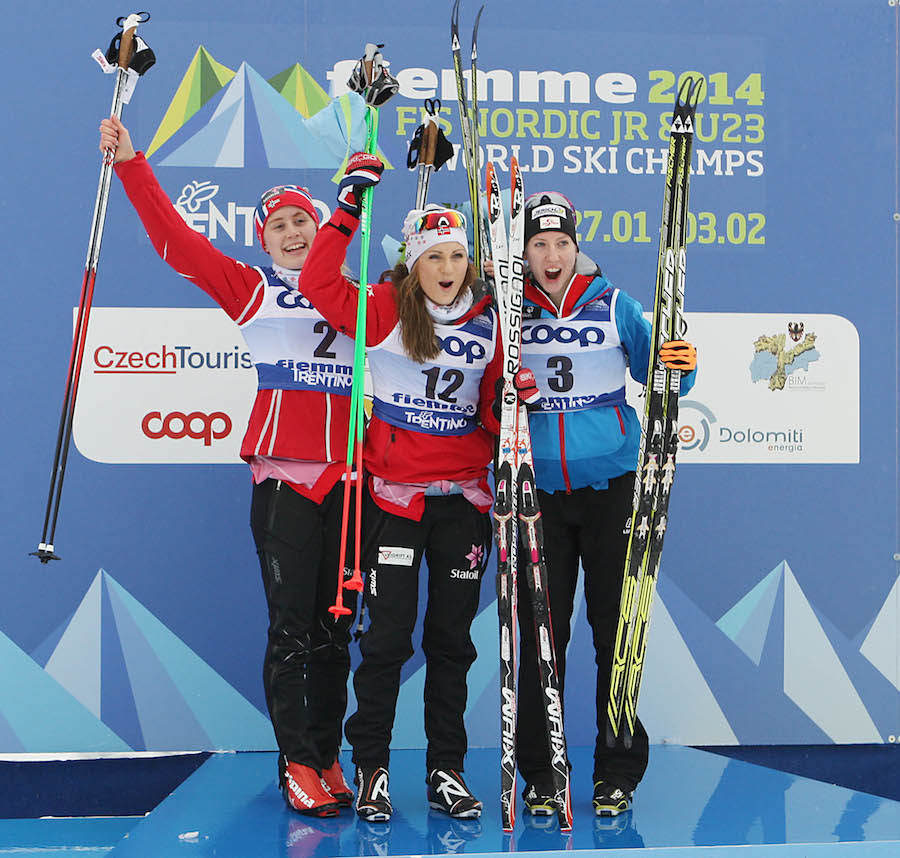
Martine Ek Hagen (c) after winning the women’s 15 k skiathlon at U23 World Championships last season in Val di Fiemme, Italy, with teammate and runner-up Ragnhild Haga (l), and Teresa Stadlober of Austria, who placed third (r). (Photo: Fiemme2014)
No longer with the Norwegian national team, Vibeke Skofterud, Øystein Pettersen, Petter Eliassen, Niklas Dyrhaug and Tord Asle Gjerdalen are pursuing different paths and interests.
A 2010 Olympic gold medalist in the team sprint, Pettersen, 31, whose nickname is “The Sausage,” recently told NRK that he plans to focus on distance races while skiing for Team United Bakeries.
“In recent years I trained hard to break into sprints but it did not happen,” he said, according to a translation. “Then I lost faith in myself in the sprint and I cannot continue another season training for something I have lost confidence in.”
He explained that the Vasaloppet and 2015 World Championships will be his main focuses for next season.
According to FIS, a few Norwegians are switching specialties: Pål Golberg from sprint to all-around, Finn Hågen Krogh from all-around to sprint. Simen Østensen returns to the all-around team along with Chris Jespersen, who’s now back on the elite national team.
Sweden
A Team
Ladies
Sofia Bleckur, IFK Mora SK
Hanna Erikson, Åsarna IK
Anna Haag, IFK Mora SK
Ida Ingemarsdotter, Åsarna IK
Charlotte Kalla, Piteå Elit
Sara Lindborg, Falun-Borlänge SK
Stina Nilsson, IFK Mora SK
Jonna Sundling, IFK Umeå
Emma Wikén, Åsarna IK
Men
Calle Halfvarsson, Falun-Borlänge SK
Marcus Hellner, Gellivare Skidallians
Emil Jönsson, IFK Mora SK
Anton Lindblad, Sollefteå Skidor IF
Lars Nelson, Åsarna IK
Johan Olsson, Åsarna IK
Daniel Richardsson, Hudiksvalls IF
Simon Persson, IFK Umeå
Teodor Peterson, Åsarna IK
Team 2015
Ladies
Anna Dyvik, Falun-Borlänge SK
Hanna Falk, Ulricehamns IF
Sofia Henriksson, Strömnäs GIF
Magdalena Pajala, Piteå Elit
Evelina Settlin, Hudiksvalls IF
Marika Sundin, Sollefteå Skidor IF
Julia Svan, Vansbro AIK
Jennie Öberg, Piteå Elit
Men
Simon Andersson, Falun-Borlänge SK
Martin Bergström, Piteå Elit
Jens Burman, Åsarna IK
Martin Johansson, IFK Mora SK
Simon Lageson, Åsarna IK
Jesper Modin, Piteå Elit
Carl Quicklund, Östersunds SK
Marcus Ruus, Gillberga SK
The Norwegian National Team last season on the World Cup circuit. (Photo: FIS/Nordic Focus)
Alexander Legkov (RUS), shown here skiing at World Championships, claimed a meaningful victory in the Oslo 50 k on Saturday, besting Martin Johnsrud Sundby (NOR) on his home course by 1.2 seconds.
When suffering is in order, the mind is almost more important than the body in determining the outcome of a race.
On Saturday in Oslo, Norway, Alexander Legkov (RUS) triumphed on Holmenkollen’s notoriously brutal track, persevering through vicious pace changes, 2,000 meters of climbing, and warm, wet conditions.
“I feel great,” Legkov said afterwards. “It is a big victory for me after not so good World Championships. My plan was to control the pace and to save some energy for the final lap and attack in the stadium. It worked perfect and I had great skis as well.”
Legkov cross the line with his typical Russian reserve, belying the gravity of the moment. A win at Holmenkollen can make a career; for Legkov this achievement adds to a breakthrough season with an overall victory in the Tour de Ski and the top spot in the overall World Cup rankings before the finals in Stockholm and Falun, Sweden.
No longer a nearly-man, the stuttering Legkov of old has been replaced by an athlete that rises to the big occasion. His win at Holmenkollen is representative of his progression as a ski racer as he showed patience and bottomless stamina to overthrow the favorites.
The story line going into the competition was the presumed showdown between Dario Cologna (SUI) and Petter Northug (NOR), who were separated by a mere 23 points in the World Cup overall ranking.
In addition to the drama in the fight for the overall, the course designers added a few novel hijinks designed to disrupt the rhythm of the race. Athletes were allowed five ski exchanges instead of the usual three, and the decision to take new skis typically cost them between 20 and 30 seconds with the addition of a few extra meters before the pit.
What’s more, the rhythm of the race was affected by critical bonus sprints on each lap, which rewarded top athletes at each preem with precious World Cup points. And with Johan Olsson’s World Championship solo victory fresh in the minds of top competitors, the pack was less willing to cede too much of gap to breakaway attempts.
When the race got underway on the fabled course, Anders Soedergren (SWE) and a unknown Norwegian continental cup skier named Simen Sveen broke away in the first few kilometers and left the pack trailing in their wake. As they passed the 8.3 k mark they had 20 seconds in hand. The chasing pack never let the gap grow more than that, with the evergreen World Cup veteran Giorgio Di Centa (ITA) hauling them back.
By 14.2 k the two frontrunners had been absorbed, and the Russian duo of Chernousov and Legkov took up the donkey work, with Noah Hoffman (USA) making a notable appearance at the front of the pack.
Favorites Cologna and Northug didn’t much away, both opting to slide into the pack and stay relatively close to the front to monitor pace changes.
At the second of six 8.3 k laps most of the field elected to change skis, and Remo Fischer (SUI) and Curdin Pearl (SUI) pushed on, with the stocky Belarussian Michail Semenov tucked in just behind. One might have thought that the Swiss duo was employing team tactics to help Dario Cologna’s chances, but Cologna himself was the one who dragged the pack back to his teammates, preventing the group from idling into a middling pace.
While Fischer, Pearl, and Semenov pushed on from the front, Northug began to slip backwards. His positioning in mass starts is usually erratic, but he normally makes a point to stay in the top 20 to cover any surges at the front.
Not this time. Northug’s body language was labored, and he fell out of the top 30. The overall pace didn’t slacken, boosted by the work of Sjur Roethe (NOR) and Martin Johnsrud Sundby (NOR). Clearly team orders for Norway were every man for himself.
At the third intermediate sprint Legkov charged in just ahead of Cologna, and Roland Clara (ITA) collected bonus points for third. The bonus points on offer had an obvious affect on the race, as the resulting surges in pace caused some racers to blow up prematurely.
A group of seven athletes soon began to break away, with a surprising Johannes Duerr (AUS) keeping the pace high. The leaders seemed to sense weakness in the chasing pack and began to drive the screw. Behind them, ragged on Holmenkollen’s punishing slopes, Tord Asle Gjerdalen (NOR) and Northug struggled to close the gap. They had 26 seconds to make up on Duerr, and thanks to Gjerdalen’s ceaseless labors the gap decreased, and by the 31.7 kilometer split they were less than 20 seconds away from joining the front group.
By the time the leaders came through the stadium and took a well-earned feed, Gjerdalen and Northug were back in it. Now nine men strong, the group went into the exchange zone together and came out as one in no particular hurry.
Roland Clara kept the pace honest, taking the reins from Duerr all the way to the bonus sprint. The lead changed several times, with Petter Eliassen (NOR) in a sparkling form. Northug, Cologna, and Gjerdalen lingered at the back, and they clearly struggled with the pace. Cologna was the first to break and drifted backwards a few meters at a time with Gjerdalen, though the latter eventually found energy to reconnect with the leading group.
At the 39.2 k mark it was Eliassen, Legkov, and Sundby in the lead and they weren’t giving much away, their technique smooth and crisp. Behind Roethe began to falter, and with him, Northug.
Notably, on a hill moving toward the stadium Clara drove the pace and Northug began slipping further back. As they crested the hill Clara looked up to see who was around and saw Northug several meters detached behind him. Instead of pushing on he effectively stood up, and with him, the rest of the leaders. At the 44.6 k mark the leaders had 20.5 seconds on Northug, who was clearly suffering from his earlier effort to regain contact with the lead.
Eliassen and Legkov weren’t having any of it. They lept to the front, and on the penultimate hill leading into the stadium they strung the group out, making sure that the likes of Gjerdalen and Northug couldn’t make their way back on because of a careless race pace.
At the 47.5 k mark it was Eliassen driving from the front past the famous Holmenkollen ski jumping hill, with Clara and Legkov lurking just behind. hey stole a few glances backward to check on the progress of Northug and Gjerdalen, but didn’t up the tempo upon seeing them significantly detached. The difficulty of Holmenkollen’s steep pitches could be read in the weary body language of the front-runners as they entered the steep, wall-like climb out of the stadium.
The pace slowed at 48.4 kilometers and Ilia Chernousov (RUS), who had remained quietly attached at the back of the pack for most of the race, started to yo-yo, the elastic stretching to breaking as they crested the hill. Sensing weakness, Eliassen and Sundby punched it, with Legkov seemingly comfortable just behind.
The group stayed together leading into ‘Hellner Bakken,’ the famous climb leading into the stadium, and even Chernousov was able to dig deep and hang on. It was all to play for as they swung round into the stadium, and Eliassena and Sundby led the charge for the line in front of a roaring crowd feverishly waving Norwegian flags.
Legkov charged to the fore, attacking in a hop skate in the fashion of his beleaguered arch-rival Northug, distancing himself from Sundby and Chernousov. Legkov would never relinquish this gap, and glided in across the line to one of the most notable victories of his career in a time of 2:07.32.9.
Sundby coasted in just 1.2 seconds behind for an impressive second place, some consolation after a disappointing world championships marred by sickness. His result on Saturday was especially meaningful for him as lives a short way from the course.
“I can see my house from the highest point of the course at Frognersetern,” Sundby said. “I am training on these courses and it is always special to compete on Holmenkollen. I hoped for victory and wanted to be in front on Helnerbakken. My mind wanted to attack but my body did not respond. I had cramps going from my little thumb to the foot. I thought I would fall back to fifth place. At the end I took second place and I am happy.”
Third place went to Legkov’s compatriot, Chernousov, whom recovered from some tough moments leading into the stadium to finish in 2:07.34.8.
“No race on Holmenkollen is a piece of cake and today was not an exception,” Chernousov said. “My second pair of skis was not that fast and I was struggling to follow the guys. I am happy it was Alexander and me on the podium today.”
Eliassen had to settle for fourth position, a lifetime best, but a tough reward for all the work he did at the front, finishing in 2:07.35.4.
Roland Clara secured a commendable fifth place in 2:97.35.7. An exhausted Northug limped across the line in sixth position, 42 seconds behind Legkov. The result his fell short of expectations but it was enough for him to leapfrog Cologna in the overall world cup ranking, who had a miserable day and finished down in 19th position, a shocking 3:17.3 off the pace.
Despite Northug getting the better of Cologna, Legkov’s win moved him into first place in the overall world cup, with Northug a scant 12 points behind in second. Cologna dropped down to third place overall, six points behind Northug.
Legkov’s seminal victory earned him lasting reknown, the world cup lead, and a meeting with the king of Norway.
“I am happy to be in the World Cup lead but there are four competitions to go,” Legkov said. “Petter as well as Dario have been in a great shape and it will be difficult to keep the yellow bib until the end of the season.”
Davos, Switzerland – Petter Northug served notice to the World Cup field Saturday in Davos, Switzerland that the Norwegian superstar has to be taken seriously – no matter where or what the World Cup race is.
The odds were supposed to be against Northug Saturday. The 30 k freestyle distance individual start doesn’t suit his strong mass-start finishing style. The strong distance field taking to the start line was rounding into shape, especially home-town favorite Dario Cologna. Even the venue was supposedly against him, as Northug has never won in Davos – his best distance finish in the Swiss ski-crazy valley was 13th.
But the exciting Norwegian showed why he is the World Cup Overall leader, taking the top step of the podium by a whopping 51.4 seconds over Frenchman Maurice Magnificat. Finishing third 59.5 seconds back was distance specialist Lukas Bauer (CZE) who picked up his first podium of the young season.
As Northug was starting last, the 8,000 strong crowd of mostly Swiss and French fans had plenty of time to wait and cheer their skiers around the four 7.5 k loops.
The best of the early-starters was Canadian Ivan Babikov, who rocketed out of the gate to hold the lead at a number of early time checks. Babikov was locked in a battle with fellow early-starter Matti Heikkinen (FIN). Also in the mix were Norwegian Petter Eliassen, who is best known for falling in the last kilometer of the 50 k at World Championships in Oslo last February, and Martin Johnsrud Sundby (NOR), an incredibly inconsistent distance specialist.
With Babikov and Johnsrud Sundby setting fast times, it looked like the early starters might take the day – at least until the end of the Red Group hit the first time check.
Maurice Magnificat (FRA), who has yet to record a medal on the World Cup this year seemed to break out of his early-season slump, taking the third-fastest time on the first two laps. Marcus Hellner (SWE) also appeared to be back in form, holding a strong second at 15 k before fading slightly on the last two laps to finish fourth, 1 minute 11.8 seconds behind Northug.
At 30 k, Petter Eliassen established the fastest of the early marks on the day, taking a seat in the reindeer-hide chair. With close splits on the last few time checks, it looked like Babikov might be in position to pull the top spot out from under the Norwegian, but the Canadian fell short at the finish – as he came through the mixed zone, he was visibly upset.
Eliassen withstood most of the red group challengers, as did Babikov, but as the top-ranked men started to come across the line, it was clear that a new leader would emerge. Johnsrud Sundby took the lead briefly, but relinquished it shortly thereafter to Bauer, who was supplanted quickly by Manificat.
At that point, it was merely a formality – splits were showing Northug with an insurmountable lead, and he was still attacking. In the last five kilometers, the Norwegian was hop-skating hills like it was a sprint rather than a 30 k.
By the time he crossed the finish line, Northug had built up 51.4 seconds of buffer – more than his female counterpart Marit Bjoergen put into the women’s field, and had banished all criticism of his all-around skiing ability.
Of particular note was Northug’s domination of the downhill sections of the course, where he was extremely fast.
“I had good skis and I gave my best to push in the downhills as I am not so strong than Maurice [Manificat] in the uphill,” said Northug after the race.
As for the Czech distance specialist Bauer, he showed that he is rounding in to the shape that has seen him win the Tour de Ski twice in the past.
“I was actually not sure if it is enough for the podium but at the end I made it,” he said.
“I am happy with it. The longer races fit me well and I like Davos.”
Bauer was also impressed with Northug’s skiing, especially in the distance individual start event.
“Northug is not unbeatable,” said Bauer, “it’s just really, really hard.”
In what is probably not a surprise, all three podium-placing athletes were happy with the return to 30 k individual start racing – but none were as brash about it as Northug.
“I don’t like mass starts,” he joked in the post-race press conference. “I like to go alone.”
MERÅKER, NORWAY – According to the national team head coach Morten Aa Djupvik, there are no better, more efficient methods to increase overall capacity than running. Accordingly, the national team is changing the mix, increasing the amount of running, at the expense of roller skiing.
The Norwegian national team started the new program with a bounding workout in Petter Northug’s home turf Meråkerfjellet on Monday. On a scale from 1 to 10 where 10 is utter exhaustion, Northug admitted that the initial foot workout was hard.
“I’d say eight or nine on a scale from 1 to 10,” Northug said to Norwegian TV station TV2 after the workout.
Northug and his teammates had just completed the workout that is characterized by the coaching panel as one of the toughest in the book, commonly known as hill bounding intervals or “moosehuf’ing.” Translation: six 6-minute intervals up steep suctiony dirt roads in the hills behind Northug’s hometown Meråker.
“This is insanely hard, and it’s key to stay within your target heart rate zone,” says As Djupvik while reviewing his athletes’ heart rates from the morning running workout.
More running
During the Meråker training camp this week, the seven members of the men’s national team are accompanied by six guys and seven women from the U23 national team. Northug and his teammates will have to get used to their running shoes this fall leading up to the 2010-11 season with World Championship in Oslo. The national team coaches have evaluated the situation, and made some adjustments.
“We’re increasing the amount of running substantially from last year, at the expense of roller skiing. We believe nothing beats running when it comes to increasing the capacity, and we think these changes will lift us another level this season,” Aa Djupvik says.
While the snow and the season opener racers are still months away, Northug appears to be on track. ”I feel good, but the key is to stay injury free and train smart. I’m very confident of my training program, and the only adjustment I’ve made this season is more running,” Northug says.
“Petter is better at bounding this season than he was in June. Aside from that, things are as usual, he’s improving slowly but surely,” Aa Djupvik concludes after the Monday workout.
Northug expects more Norwegians on the podium
While the goal for the workout wasn’t necessarily to be the first to the top, the two rookies on the team, Kristian Tettli Rennemo and Petter Eliassen, impressed everyone up the steep dirt roads. The margins on the international circuit were miniscule last season, and everything counts.
“This year we’ve had great energy at the training camps, so now we have to make sure we carry everyone with us into the ski season. Who knows, we might just have five or six racers among the top in the World Cup,” Northug predicts.