From the FasterSkier archive — posts syndicated from athletes’ and coaches’ own blogs between 2004 and 2012, kept online as published. Current coverage is at fasterskier.com.
Oh, you thought we were done? Nat had the chance to interview Norwegian cross-country skiing legend Petter Northug Jr. for his story for the New York Times about the Holmenkollen ski marathons. Rather than leave the audio on the cutting room floor, we thought we’d share it with you.
Sorry about the audio quality and the frequent interjections from Nat, but this was not originally intended as podcast-quality material — turn it off if you must. And: If profanity isn’t for you, skip the 30 seconds between 9:30 and 10:00. (But if profanity is for you, by all means, let it ride.)
Devon and Nat will be back soon — we promise. Hit us with questions or feedback at devon@fasterskier.com and nat@fasterskier.com.
Widely reported in the Norwegian press over the weekend, former Norwegian ski star Petter Northug Jr. (34) was stopped for speeding by police in Romerike, Norway. Northug was suspected of driving while intoxicated and was taken to a hospital for a blood test.
Northug’s arrest for speeding and and pending toxicology report weren’t the only bombshells. Police searched Northug’s home where cocaine was found. Northug admitted his mistakes on Instagram with the following translated post:
“I made a big mistake. Last night I was stopped by the police in speed control. I drove too fast, and was also taken to the emergency room for a blood test. In addition, the police found a small amount of drugs in my home. It’s cocaine. I am desperate and afraid of what the future will bring, and incredibly sorry for all those I have now disappointed, again. I know it’s going to be a criminal case now. Then I will take responsibility for what I have done.”
Northug won four medals at the 2010 Winter Olympics including a gold in the team sprint and 50 k mass start classic. He won 16 World Championship medals during his career, 13 of which are gold. Northug’s last podium on the World Cup came in 2016 at the Ski Tour Canada where he placed third overall. He retired in 2018 after not qualifying for the 2018 PyeongChang Olympics.
On the race course and off, he was considered a showman. He was able to leverage his on-snow prowess with his big and bold personality in his non-sport endeavors.
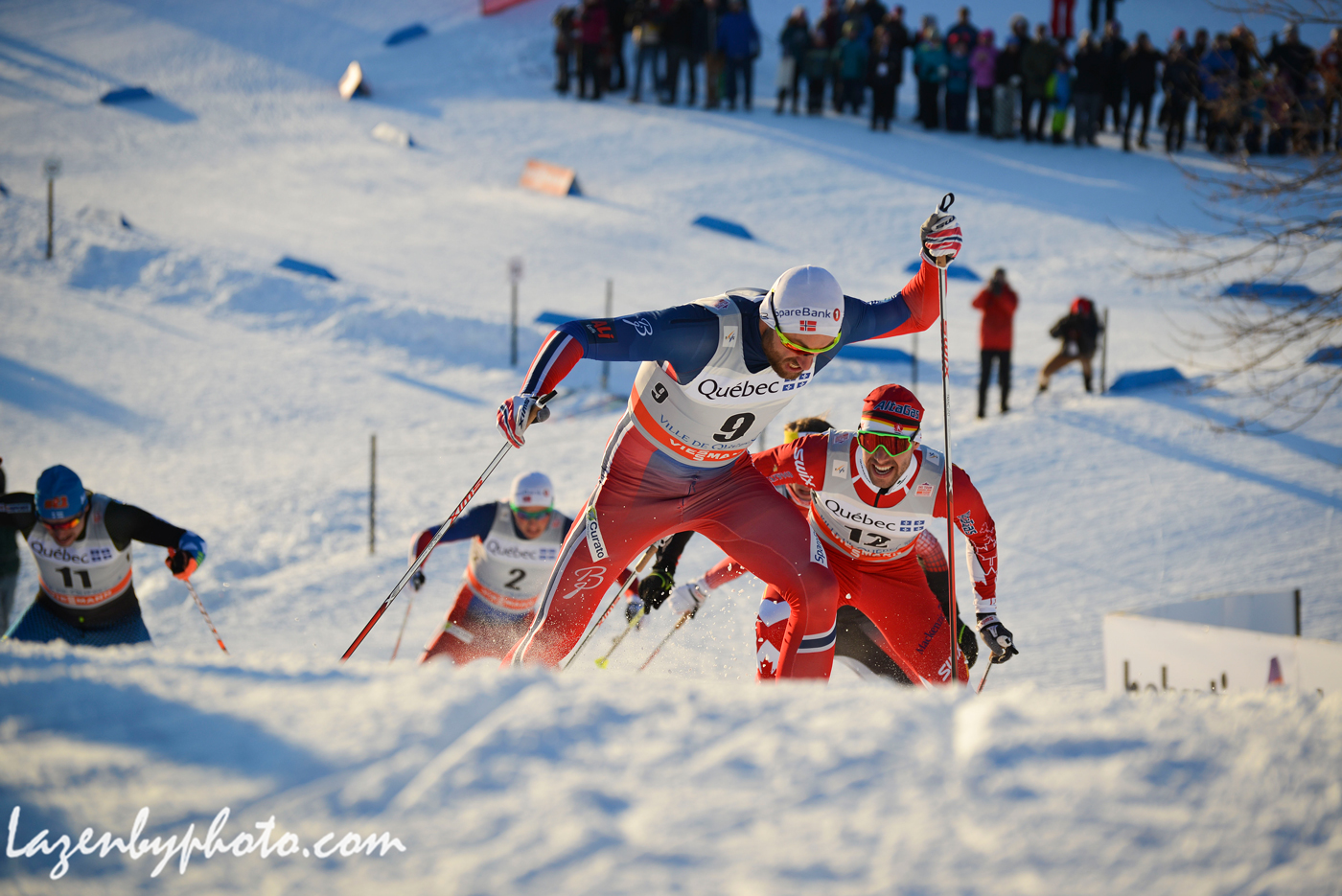
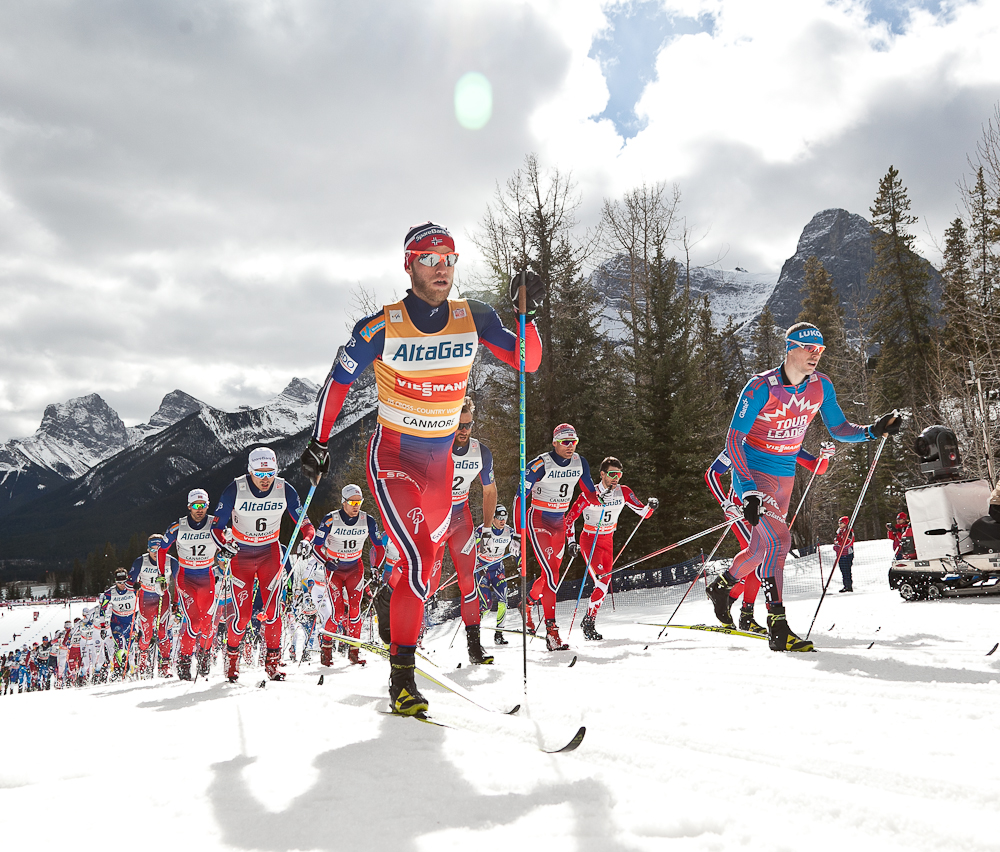
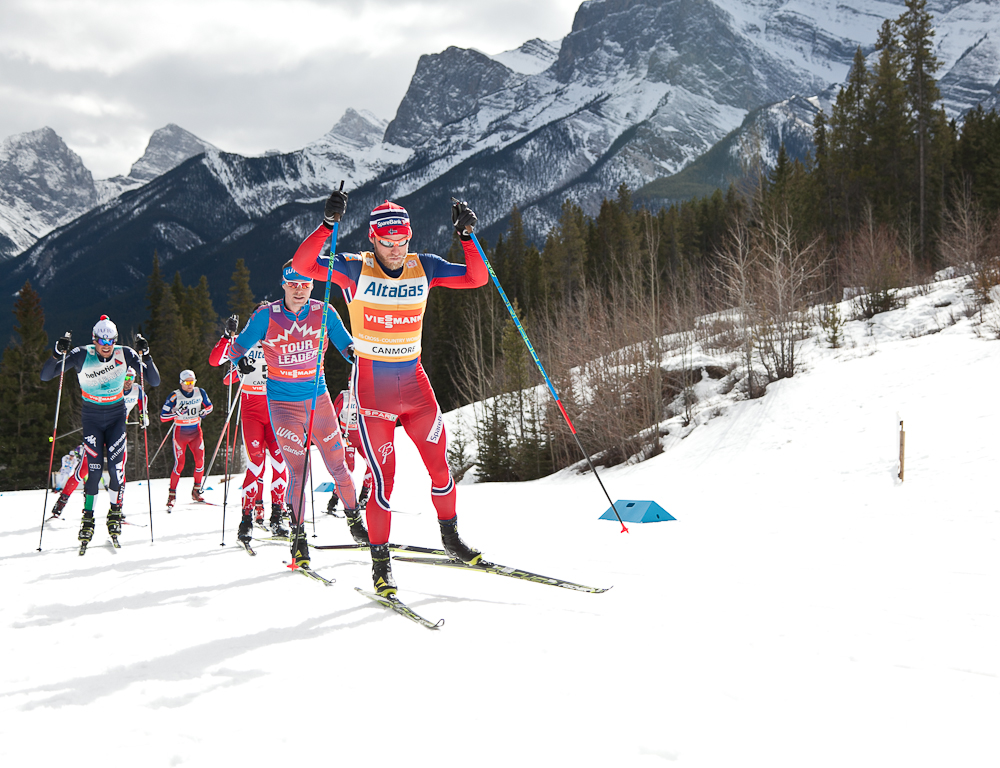
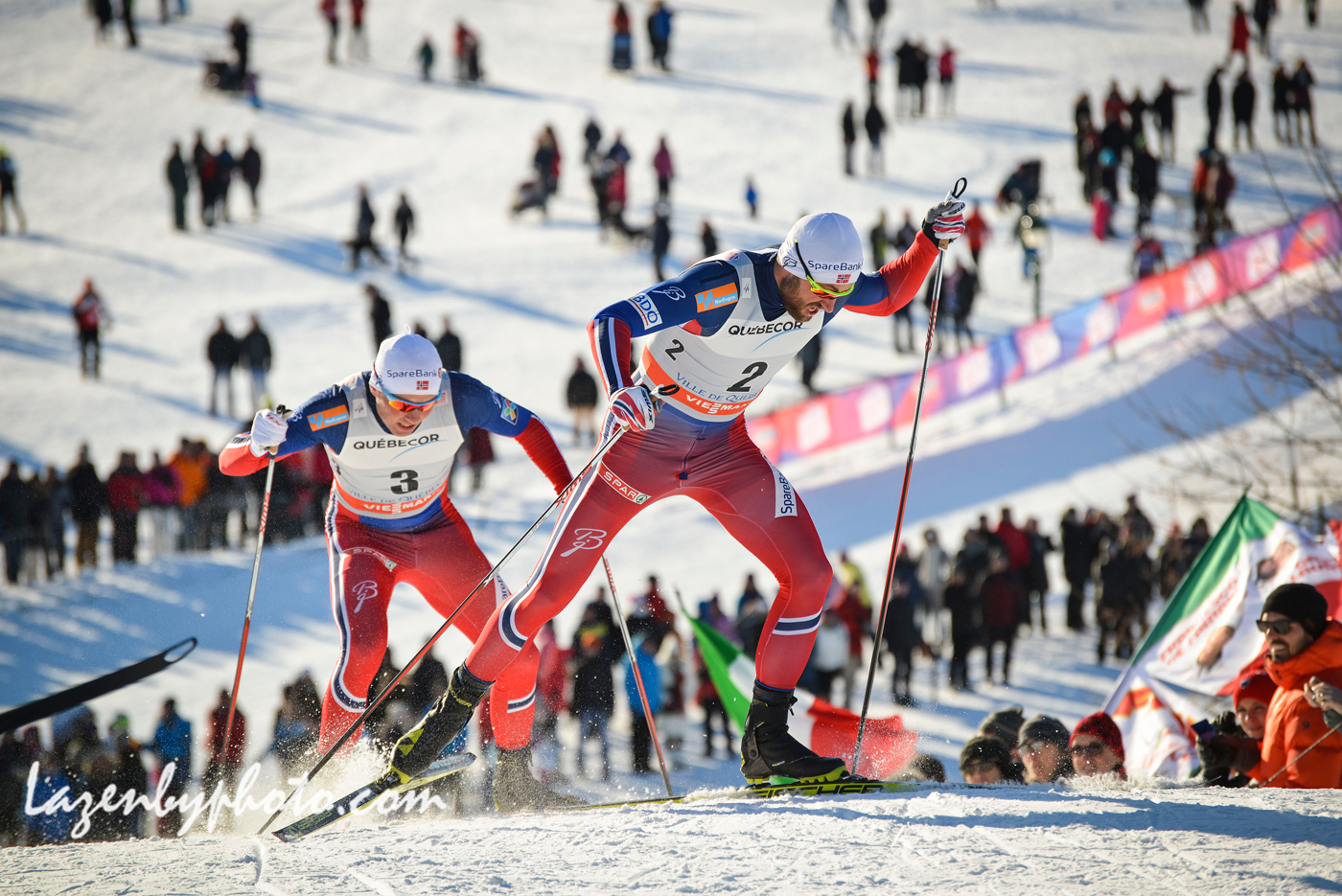
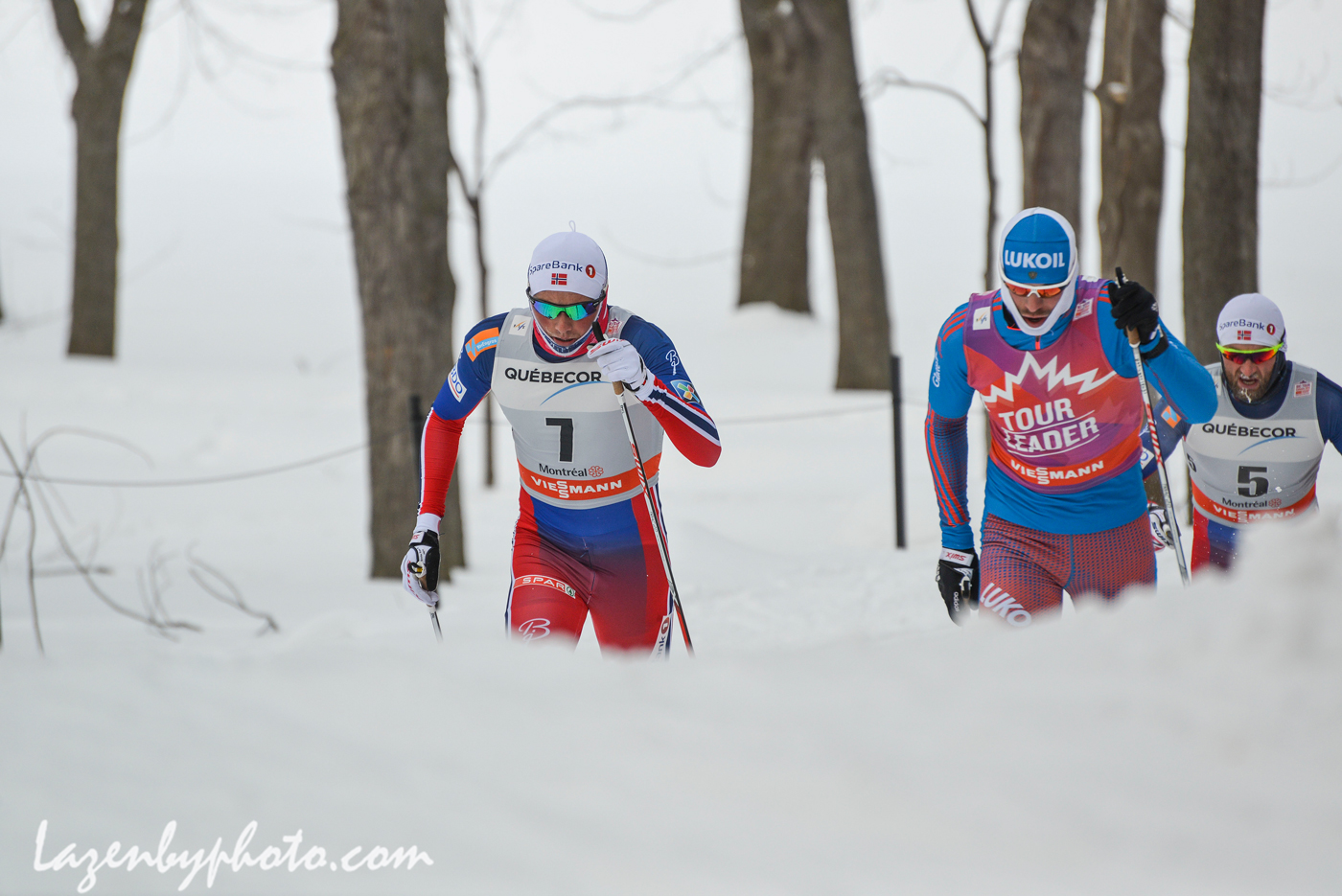
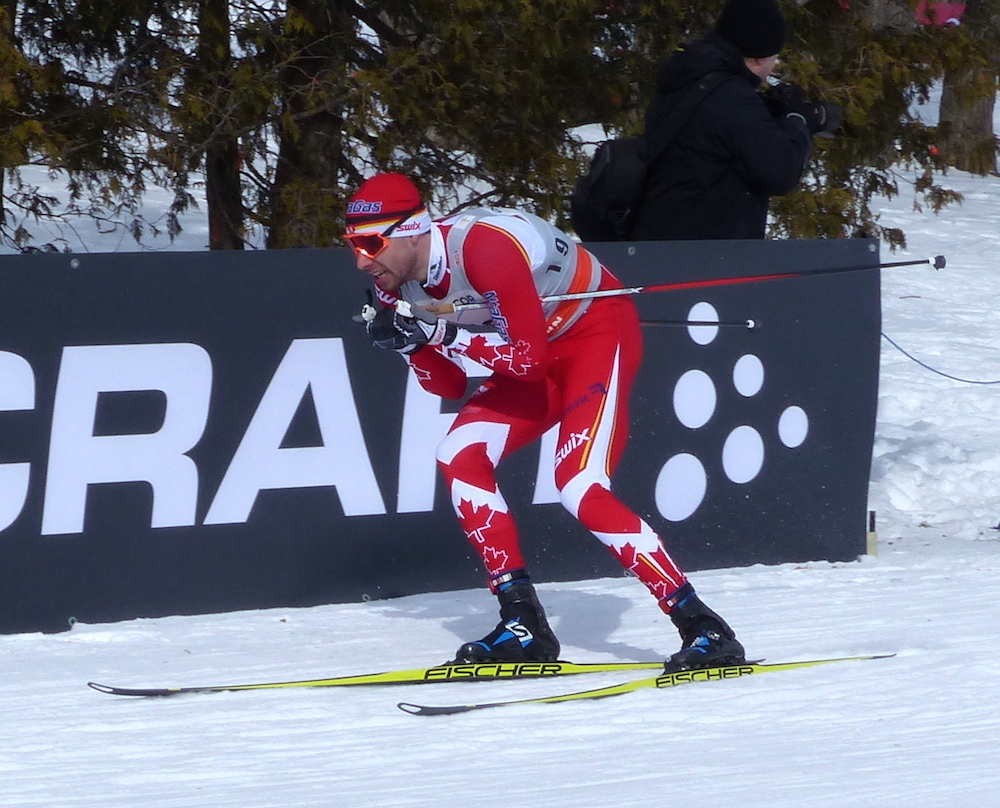
Norway’s Petter Northug racing to ninth in the qualifier at the third stage of the 2016 Ski Tour Canada in Quebec City. He went on to place fourth overall in the final. (Photo: John Lazenby/Lazenbyphoto.com)
While many skiers were blowing the dust off of their rollerskis, hitting the track or trail, or looking for crust to cruise on May 1st, Erik Bjornsen and his wife Marine Dusser were previewing the race course for the Fossavatn Ski Marathon, or Fossavatngangan, in Isafjördur, Iceland.
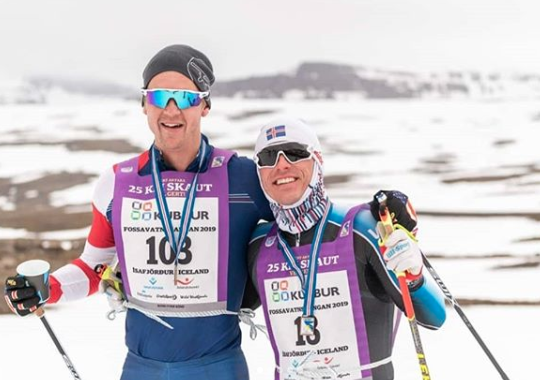
Erik Bjornsen poses with Snorri Einarsson, an Icelandic World Cup skier, at the finish of the Fossavatn Ski Marathon in Isafjördur, Iceland. (Photo: Instagram @ebjornsen1991)
While it might seem odd to begin a new season by racing a 21 k followed by a 42 k just two days later, Bjornsen and Dusser agreed that they did not go into the race with performance goals, rather to experience a new place and to enjoy the sport they both love.
“I feel like we went on vacation and we made a race out of a vacation,” Dusser explained in a call. “We like nordic skiing and we both like racing, but we didn’t really put any pressure [on ourselves].”
Though the Fossavatn has only been a member of the World Loppet series since 2015, the race dates all the way back to 1935. In addition to the 50-kilometer marathon distance, which is always classic technique, the event features a 25 k skate and classic race and a 12.5 k classic in the days preceding. There are also 1 k and 5 k children’s races. Typically, each of the courses are one loop, but because it has been a low snow year in Iceland, this year the course was rerouted and distances were scaled back as the longest available loop was 21 k, which the marathoners skied twice.
“It was kind of like skiing on the glacier [in Alaska],” Dusser shared. “You have no trees and pretty mellow terrain. No steep hills, but it’s up and down. Erik was able to double pole the classic race, but for me, it was too hilly, so I was classic skiing.”
Marine Dusser on her way to a second place finish in the 21 k skate at the 2019 Fossavatn in Isafjördur, Iceland. (Photo: Instagram @marinedusser)
While they may not have approached the race with goals, both walked away with strong results. Dusser won the 42 k classic and placed second to Caitlin Gregg in the 21 k skate, while Bjornsen was 7th in the classic and 2nd in the skate.
A glance at the results over the last few years shows names like Iivo Niskanen, Riita Lisa Roponen, and Petter Northug, just to name a few, which begs the question, ‘At an odd time in the year, what is drawing top names to the 66th north parallel for a marathon?’. The duo explained that the race manager, Bobbie Sigujónsson, had contacted Bjornsen about traveling to Iceland for the event, and has enticed other top athletes to do the same.
“I think he has been pretty good with marketing and communication, and this race is pretty sexy because it’s very pretty there and it’s so different than anything that you can see [elsewhere],” Dusser explained. “And it’s also in May, so it’s easy to get good athletes because people are on vacation. And I think that they are pretty curious about Iceland, so it’s easy to get big names because people can make a vacation out of the race.”
The couple enjoyed having the opportunity to spend time around the other top athletes attending while away from the World Cup setting.
“We got to spend some time with [Nikita] Kryukov and [Alexander] Panzhinzkiy and Iivo [Niskanen],” said Bjornsen. “I mean all those guys have Olympic gold and silver medals, so it was pretty cool to spend more time around them. We were in the same hotel as Kryukov, so we actually got to know him quite well and that was fun.”
In addition to complimenting race organizers and noting how much fun people were having in the race itself, both Bjornsen and Dusser recommend the event to anyone looking for a novel experience.
“There was a big dinner – a “fish party” they called it – where they have live music and an announcer and really good food and stuff,” said Bjornsen. “So I’d just say that we highly recommend it to everybody. It was a really fun experience and if people get the opportunity, it’s a really cool one to do in the spring at the end of the year to have a fun end of the season.”
While the names at the front of the pack might seem intimidating, Dusser added that the Fossavatn race series is inclusive for skiers of all ages and abilities.
“There were a lot of masters and I think this race is really open for all of them,” said Dusser. “Because it’s not very all-terrain either — you don’t have very long uphills. I think it’s pretty attractive for all levels. You can see every age and every level can go and have fun, so it’s not just for athletes, so it’s kind of cool.”
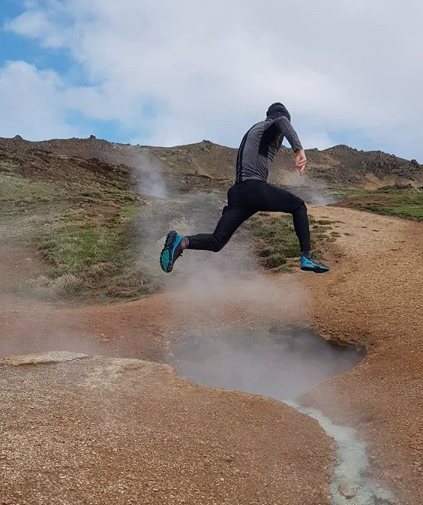
Erik Bjornsen leaps over a geothermal spring during a trail run in Iceland. (Photo: Instagram @ebjornsen1991)
Capitalizing on the opportunity, the pair used the week before the race to explore and see other parts of the country, which was new to both of them.
“We flew into Reykjavik and based out of there for three days, and explored all around that area for day trips,” Bjornsen shared. “We’d head an hour out of town each direction each day and saw different parts of southern Iceland. It’s not a huge place, so we were able to see quite a bit around Reykjavik in those first three days. Then we drove five – 600 miles to the northwestern part of Iceland [for the race]. It was in the west fjords and it was the biggest town in that section of Iceland. So it was really cool. I feel like we saw half of Iceland, or quite a bit of it, and of course snippets of the area along the way.”
Marine Dusser explores Iceland by foot. (Photo: Instagram @marinedusser)
Apart from the more obvious features that contrast their coastal Alaskan home – lower mountains and turquoise blue hot springs – they were taken aback by how much closer to the sea they felt there and also by the size of the waves.
“On the drive up there [to Isafjördur], we actually spotted some whales,” Bjornsen recalled. “You’d drive for an hour and you basically wouldn’t see anybody. We were driving through these fjords and it was a day where there wasn’t a lot of wind, so the sea was pretty quiet, and there were three or four whales that were swimming 150 or 200 meters from the road. We just turned the car off right on the road and watched. In Anchorage, it’s a bit different. You have to drive a ways. We’re in the Cook Inlet right now, and there is a lot of glacier silt, so it’s never very deep. There are some whales that are around but you rarely… it’s just a different feel around here.”
Looking ahead, Dusser, who has coached for the UAA Seawolves the last two seasons, will be continuing her work with the Alaska Biathlon Association, including coordinating the upcoming spring training camp. In her own ski career, Dusser was a member of the French National Biathlon Team. During that time, she won three medals at the Junior World Championships in biathlon and was the French Junior National Champion six times.
“We have a camp the first week of June and usually we try to invite a bunch of biathletes,” Dusser explained. “Last year we had a biathlete from Switzerland, she actually won the World Junior championship, and Tim Burke is coming as well to help coach, so that should be fun. It’s pretty busy organizing that camp, it’s pretty big every year, so it’s nice.”
Bjornsen, who this season advanced to the USST A-Team, will be continuing to work toward the upcoming World Cup season, but is also looking forward to upcoming non-ski-related events this summer.
“I’m getting back into training,” Bjornsen stated. “Doing a similar camp schedule that I’ve done in the past, so I’ll be heading down to Bend here in about a week, definitely Eagle Glacier this summer, then I’m headed to Norway, and a fall camp with the ski team. My sister is getting married [in July], then we’re having Marine’s parents come to town and my parents are coming of course, so it should be a fun summer.”
Erik Bjornsen explores coastal Iceland on a trip with his wife, Marine Dusser. (Photo: Instagram @erikbjornsen1991)
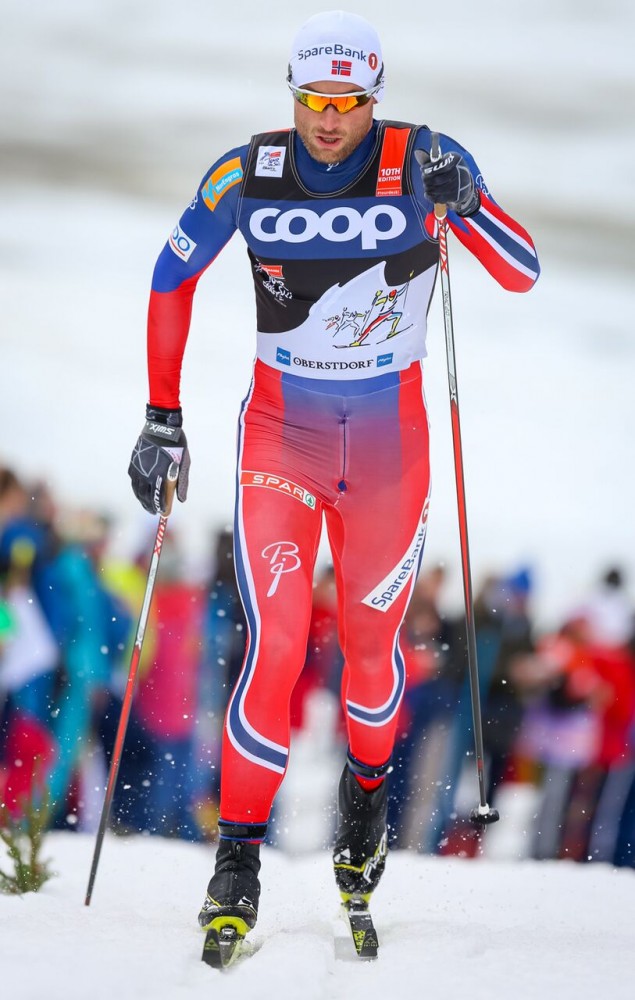
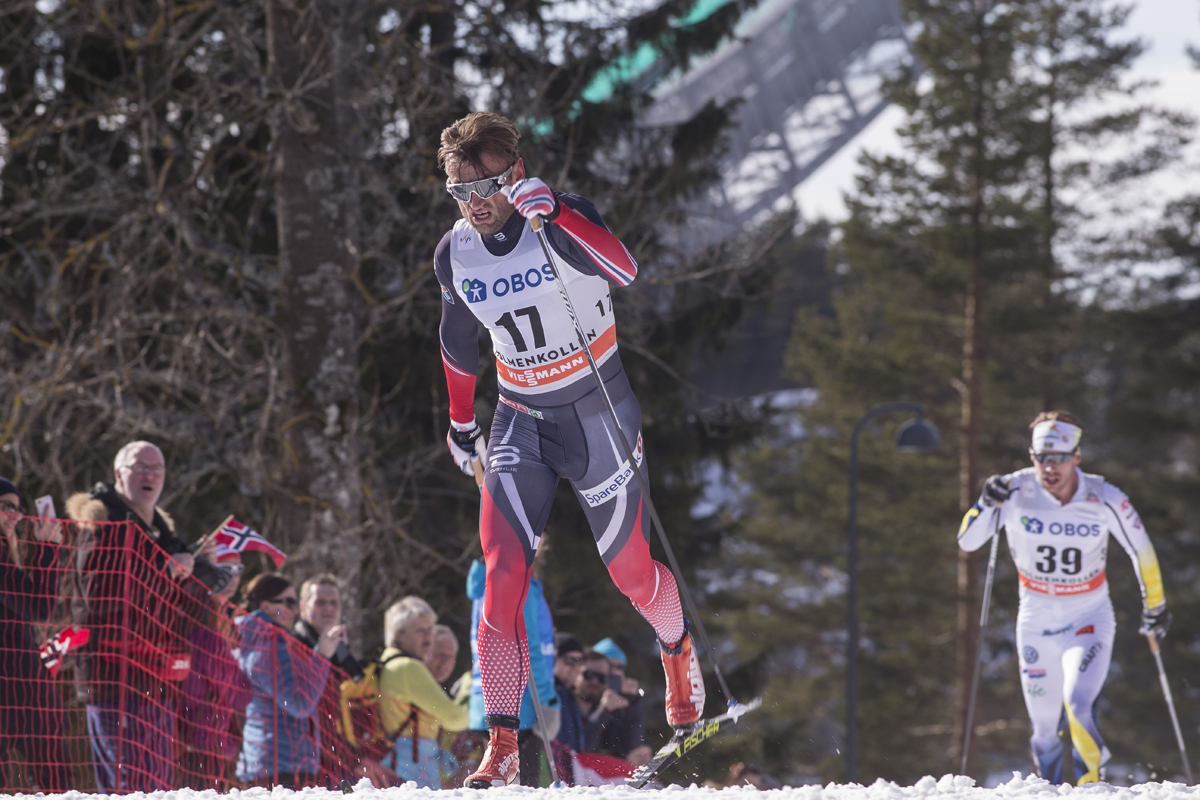
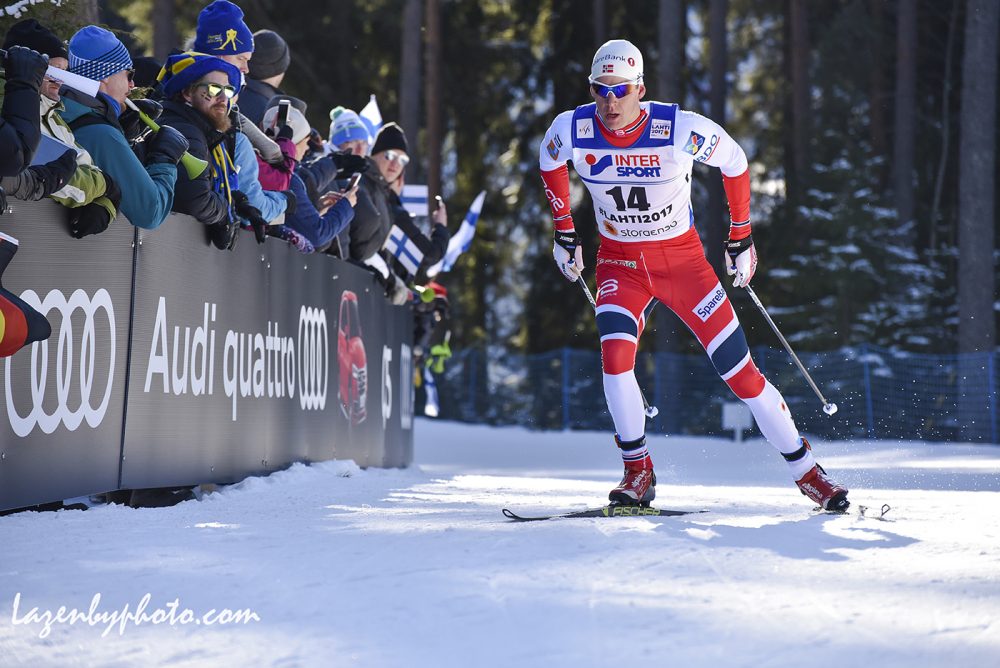
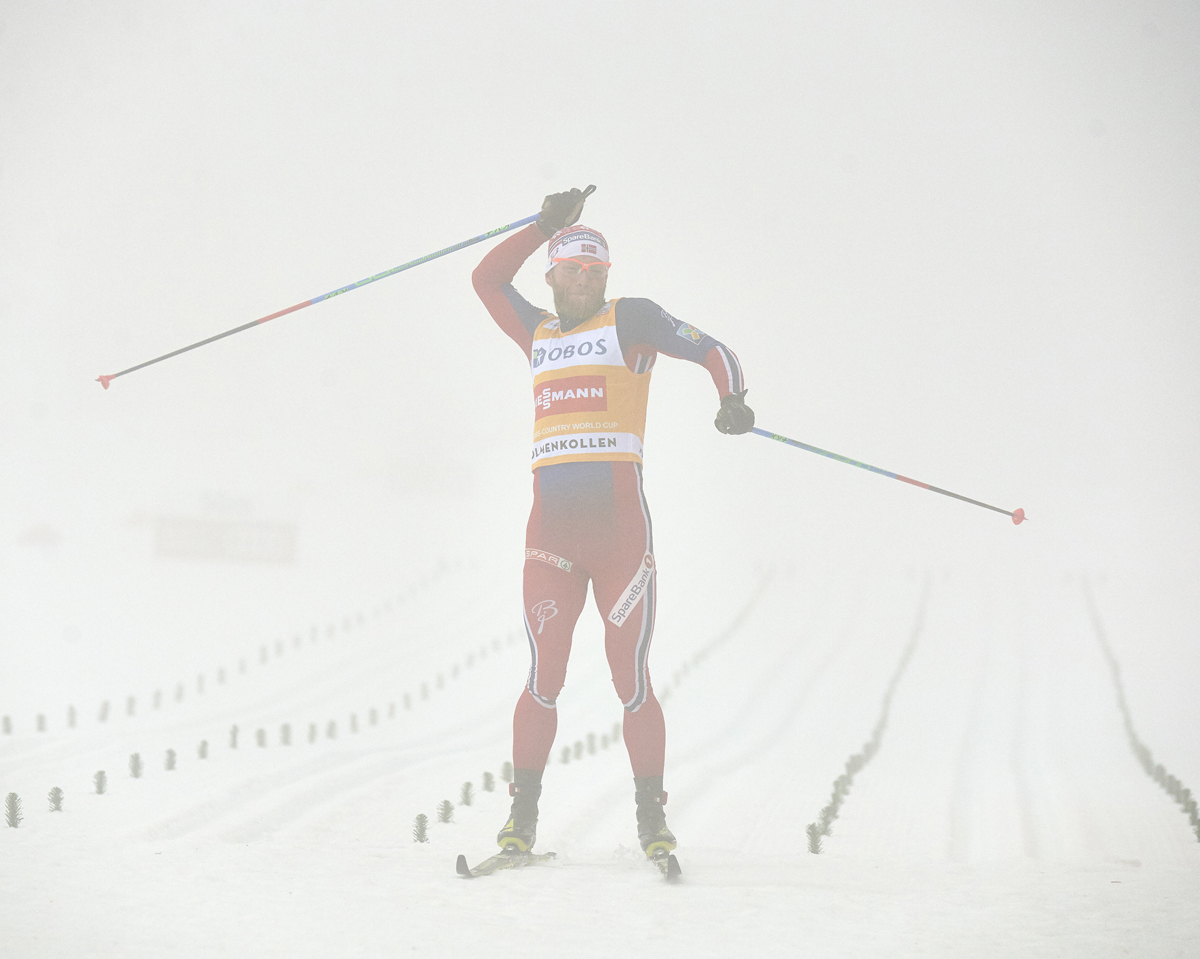
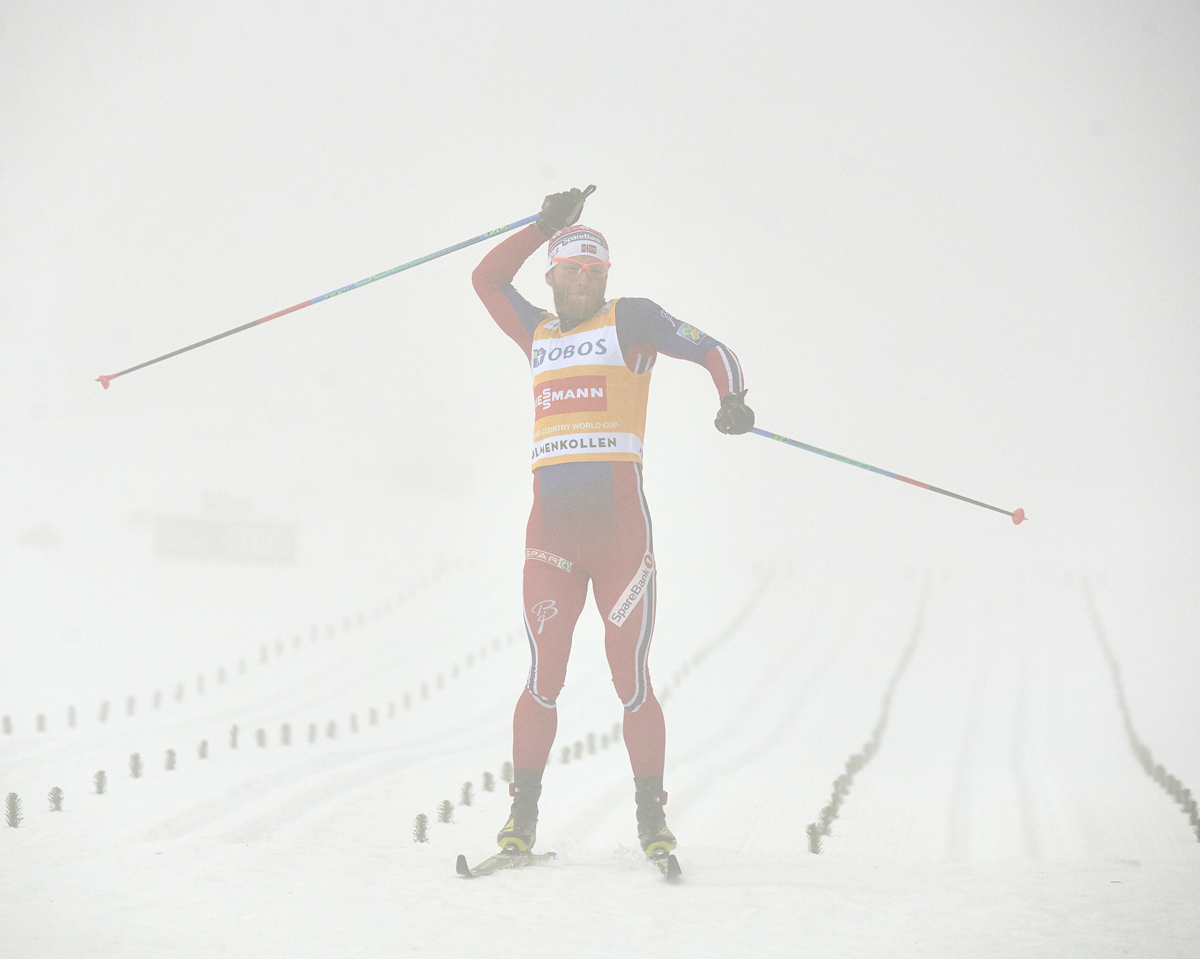
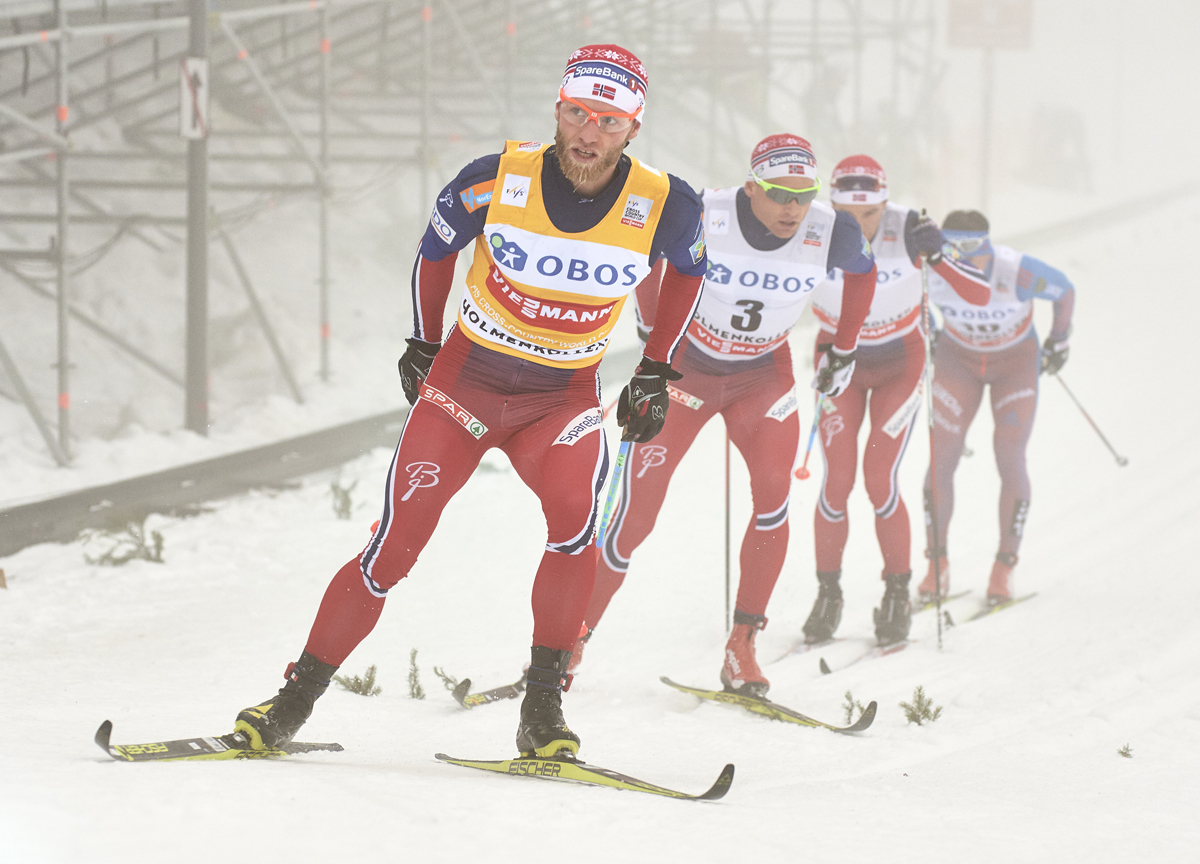
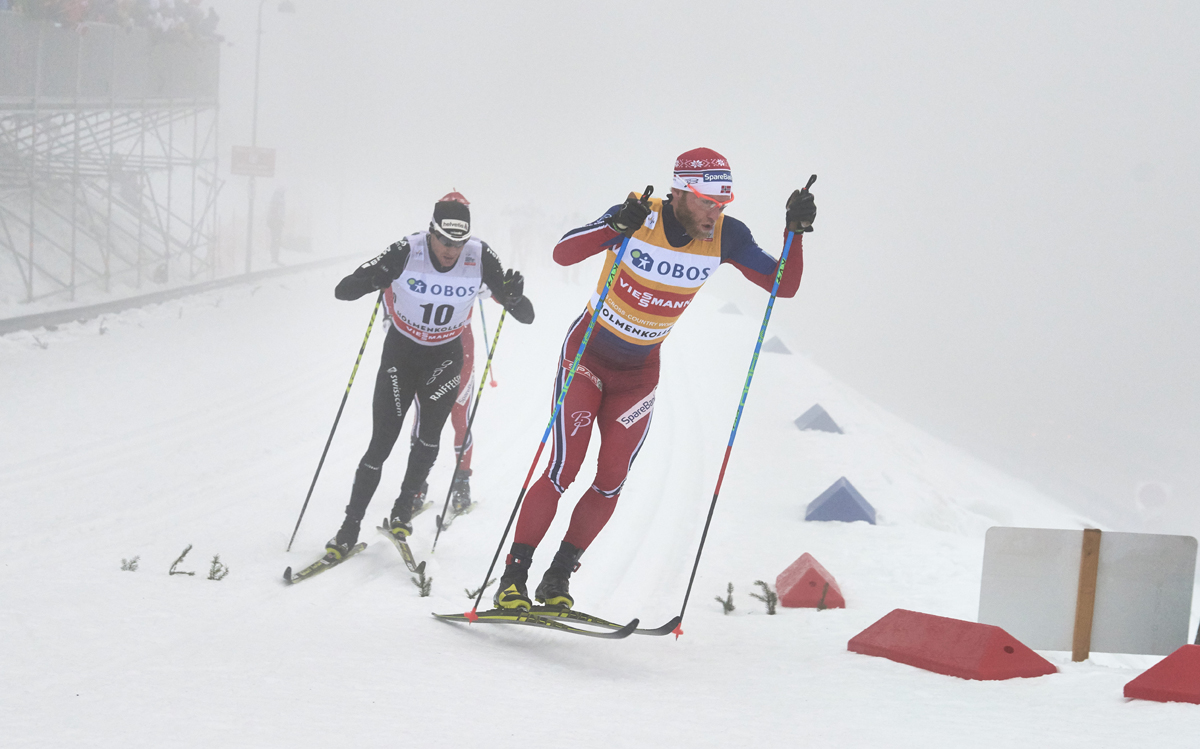
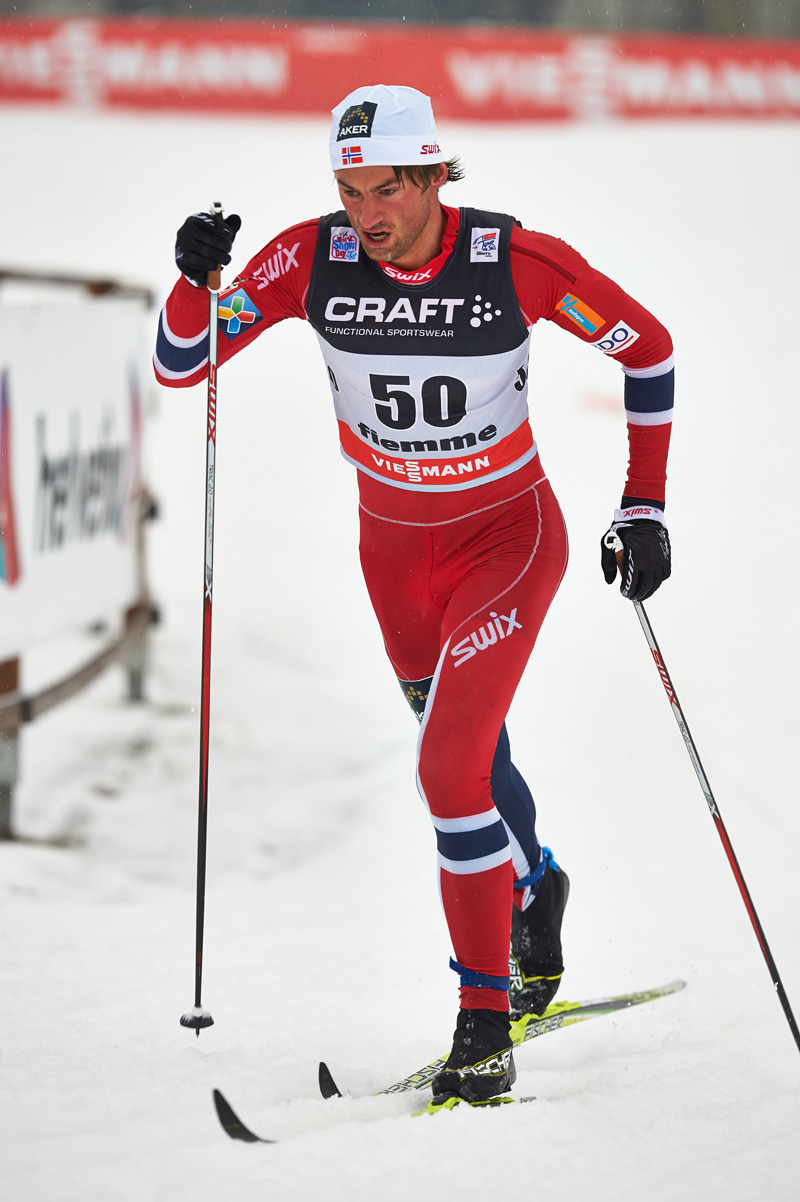
Hometown king, Norway’s Petter Northug, racing the 2017 Holmenkoll 50 k. (Photo: Fischer/Nordic Focus)
(Some details and insights in this story come from a book recently published in Norwegian, Min Historie: Northug as told by Petter Northug to Jonas Forsang. This piece was written by twenty-one-year-old Maks Zechel, a Canadian cross-country skier living and training in Norway.)
***
Arguably the greatest male cross country skier of all time. Certainly the most sensational. Undeniably the skier who has changed the sport more than anyone else.
There never has been, and never will be, another skier like Petter Northug.
Petter grew up in the rural community of Mosvik, about two hours by car from Trondheim. Much of his childhood was spent working on the family farm and participating in a wide range of sports, an upbringing similar to that of many of Norway’s best cross country skiers (Marit Bjørgen included).
Already at the age of nine, an insatiable desire to win began to grow in Petter. It didn’t matter whether it was skiing, ski jumping, track and field, or soccer—there was nothing Petter wanted more than to achieve victory. But until he broke through as a cross country skier at the age of 15, he was incapable of winning anything.
Petter credits much of his later success to the number of times that he lost during his youth. To some, these losses as a child might seem insignificant when compared to how often he succeeded as a teenager and adult, but even these early losses were a matter of life or death for Petter. In his new book, Min Historie, he describes the obsession with which he chased stronger and more talented skiers. For years it seemed impossible that he would ever beat them, as one devastating loss followed another. Nonetheless, his mind was always set on winning, whether he finished in the middle of the pack or as the runner-up.
Smaller and less talented than his rivals, there was nothing Petter could do but train harder and better than anyone else. Even as a young child at school, Petter would ask to leave class to go to the bathroom, and instead do push-ups in secret. After school he would go straight from training to his chores on the family farm. An active childhood filled with hard work and training in a multitude of sports would lay the foundation needed for the massive, grueling training hours he would become known for as a junior and senior.
One of the most important figures in Petter’s life was his grandfather. A shy child without many other children to play with, he describes his grandfather as his best friend. From his deathbed, his last words to Petter were: “Show them your back, boy”.
Once Petter began to win, he became unstoppable. While more talented skiers had been winning for years with ease, Petter had learned how to train harder and better than any of them. During his four years as a junior, he became the first Norwegian to win eight national junior titles out of a possible eight. In his final junior year, the same year as the 2006 Olympic Winter Games in Turin, Italy, he won all four gold medals at the World Junior Championships.
With his success in the junior ranks, people began discussing the possibility of Petter being named to the Norwegian Olympic Team. At that time Norway lacked strong skate skiers who could compete with the stronger German and Italian teams, and Petter’s strongest technique was skate.
The last chance to qualify for Turin was at the Norwegian National Championships in Kongsberg, just a week before the Olympics were to begin. The 30-kilometer skiathlon would decide the last eight spots on the men’s team.
During the classic leg, Norwegian legend Frode Estil broke away from the rest of the field, leading the race by 30 seconds after the exchange zone. Petter worked together with a chase-pack to reel in Estil (who was his mentor and training partner of some years) during the skate portion of the race. In the final kilometers, Petter sat in the lead pack, gauging the other skiers around him, controlling the pace where it suited him, and preparing to make his move. He was the first skier in the world to truly master the tactics of mass start racing, the effects of which have shaped the world of ski racing that we all know today.
In the final few hundred meters of the race, Petter attacks. A field full of skiers ten years his senior are unable to respond to the junior’s now trademark finishing kick. The excitement in Norway is electric—could this be their best hope for a relay medal at the Olympics?
However, Petter would be denied a spot on the Olympic Team merely because of his age. No junior had ever been named to a Norwegian Olympic Ski Team, and there would be no exceptions made. This infamous decision would later cause a restructuring of leadership in the Norwegian Ski Federation, and would never be forgotten by Petter or the rest of Norway.
The day after beating the entire Norwegian Olympic Team in the skiathlon and still being denied a ticket to the Olympics, Petter raced the anchor leg of the National Championship 3 x 10 k club relay. Also racing the last leg was Norway’s designated anchor-man for the Olympics, Tore Ruud Hofstad. For a furious Petter Northug, this was his best chance for revenge. To put it into Petter’s own words: “When I become pissed off, they may as well pack away the waffle mix and hot dog grills, give me the gold and cancel the entire thing…When I become pissed off, it’s over…Piss me off. See what happens”.
Petter’s teammates from Strindheim IL managed to hang onto the lead group, and handed off to him right alongside Olympic anchor-man Hofstad. Once again Petter appeared to play with Norway’s top skiers. And once again he made it clear that he was Norway’s best hope for an Olympic relay medal as he soared down the finishing stretch to take the win. Screaming passionately in the finish area, Petter famously yelled: “And I am not going to the Olympics?!”.
(2006 men’s relay and skiathlon Kongsberg Norwegian Championships.)
The Norwegian men would place fifth in the Olympic relay, over one minute behind the Italian Olympic champions. They would take only two silver medals in the entire championships, won by Frode Estil in the 15k classic race and Jens Arne Svartedal and Tor Arne Hetland in the team sprint.
Soon after the Olympics, Petter received another opportunity to prove himself on the senior stage, this time at a World Cup in Falun, Sweden. This opportunity could not be denied him as he was the leader of the Scandinavian Cup series at that time (Continental Cup leaders receive a free pass to race on the World Cup).
It’s a 20k skiathlon, his best discipline at the time. In the final kilometer of the race, a crowded lead pack hurtles back towards the stadium. It’s a pack thick with the most recent Olympic medal-winning heroes from all the best-skiing nations. The fight for positions leaves skiers careening towards the finishing stretch, balancing on the knife’s edge of control. Tobias Angerer, at the top of his career as a dominant World Cup skier, manages to pull away from the rest of the field around the final corner. Petter Northug throws himself after Angerer but struggles to close the gap as the rest of the field emerges around him in the homestretch. The previous season’s World Cup overall winner, Axel Teichmann, comes up alongside Petter, and they chase Angerer neck and neck.
At first, it looks impossible that Petter will be able to find another gear. Through the burning pain, the last words of his grandfather echo through his head.
“Show them your back, boy.”
And he begins to inch ahead. Barely. Then he begins to pull ahead more and more, hunted down by a stream of World Cup legends threatening to swallow him before he can reach the finish. Petter looks to have nothing left in the tank, but he continues to accelerate. He finds the finish line in the nick of time to take his first World Cup victory, Angerer and Teichmann whooshing across half a second later.
He remains the youngest male skier to ever win a World Cup race.
The rest of Petter’s career lit up the cross country skiing world as he became one of the most decorated skiers of all time. His mass start tactics changed ski racing forever, while his raw passion and showmanship raised the entire sport out of the woods and into the international spotlight. He attracted unconventional and controversial sponsorships from Red Bull and Coop, sponsorships that would cause a restructuring of the way the Norwegian Ski Federation worked with their athletes and partners.
Petter made young skiers dream bigger than they ever had before. Petter gave skiers everywhere a reason to strut after winning a finishing sprint against their friends. Petter made skiing cool.
His was not the traditional Norwegian cross country skier’s mentality. Improvement wasn’t something worth celebrating. It wasn’t about having fun. Everything was about winning ski races, about becoming the best. Petter’s dream was to become World Champion, a feat which he would accomplish 13 times over the course of eight years. There are countless decisions and sacrifices behind those gold medals that get lost in the ostentatious, seemingly indifferent, and sometimes arrogant Petter Northug that many know from TV interviews and finish line celebrations.
On December 12th, 2018, Petter announced his retirement from ski racing, visibly moved to tears as he tried to express just how much he had sacrificed from the time that he was a young child until the 2011 World Championships. Petter’s extreme desire to win, known in Norwegian as vinnerskalle, was perhaps above all else what made him so great. For him to achieve his goals, it meant that training and recovery had to be prioritized above all else, including school, relationships, and any social life. There was no room for celebration, even the very night after winning gold in the 50k at the 2010 Vancouver Olympics.
Many of the extremes that he went to in his early career might seem insignificant and unsustainable, but for Petter these details meant everything. If he wanted to become the best, he had to prioritize skiing above all else. There is a reason why he is the most victorious World Champion in men’s skiing history.
His first opportunity to become World Champion came in the 30k skiathlon in Sapporo, 2007. A perfectly executed race ended in devastation when he fell after poling between his legs in the finishing straight, just as he was pulling ahead for the win. The next day he took bittersweet revenge by securing gold for Norway in the relay, obliterating Anders Södergren of Sweden in the last few hundred meters of the race. The Norwegian commentators could be heard yelling, “It becomes 100 meters, it becomes kilometers!”, as he opened up a gap of inconceivable proportions in a matter of seconds. In the finishing area, Petter popularized the term barneskirenn, as he yelled that the race had been a “children’s race”. And nobody watching could argue, because he had truly, astonishingly, made the best skiers in the world look like children.
https://www.youtube.com/watch?v=g_-QCV-TFgw&t=9s
(Men’s relay, 2007 Sapporo, Japan World Championships.)
Petter’s domination in the finishing sprint began many years before his success as a senior when he was beaten in the last few meters of a race by one of his arch-rivals as a teenager. After that day, he promised himself that he would never lose a finishing sprint again.
Some attribute Petter’s finishing ability to his speed and power. Others say it is because of how well he skis technically. None of them are wrong, but what made Petter best at the end of a race ultimately came down to the fact that winning meant everything—absolutely everything—to him. Coming second didn’t mean anything—he could just as well come last. All he trained towards during the long summer months, for years on end, was the ability to push one gear further at the end of a race, whether it was by working on his technique, endurance, speed, or mental strength. One of the key things that makes a great skier, Petter had realized from a young age, was the ability to tolerate pain. It didn’t matter how tired he was at the end, or if everyone around him was in far better shape than him; if Petter was nearby in the last kilometers of a race, he would dig deeper than anyone else in order to win. And more often than not, he would, because there has never been anyone who has wanted it—needed it—more than him .
(2010 Tour de Ski Stage 2 finish)
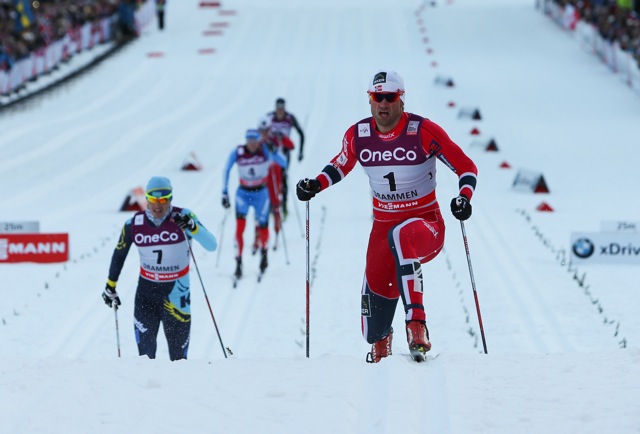
(2010 finish of the team sprint Vancouver, Olympics)
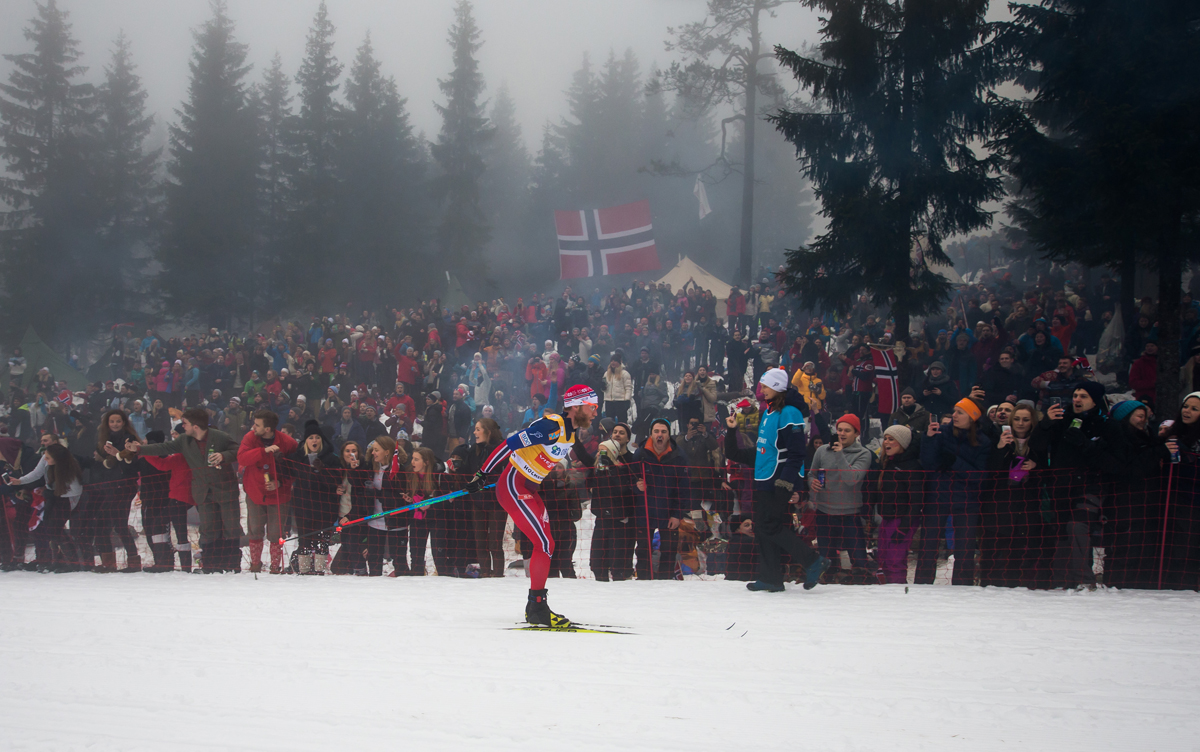
The climax of Petter’s career would come in 2011 at the World Championships in Oslo. The pressure leading up to a home World Championships is especially hard for any Norwegian skier, but for Petter, it was more than that—winning was expected of him, not hoped for. Three golds and two silver medals later would cement Petter Northug’s name in the history books as one of the greatest of all time. The Oslo World Championships would make Petter one of the most famous people in all of Norway.
(2011 Oslo, Norway World Championships finish of the 50 k skate.)
(2011 Oslo, Norway World Championships finish of the 30 k skiathlon.)
(2011 Oslo, Norway World Championships finish of the 4 x 10 k relay.)
After the 2011 World Championships, something changed in the psyche of the skiing star that had been obsessed with one thing since he was a little child running races against imaginary competitors around his home in Mosvik. The constant drive, the inability to lose, was gone. After years of sacrificing everything to become the best in the world, he started to try a taste of the “normal” life. His obsession with the details slipped as he began to do all of the things that he had denied himself his entire life. Gone was the focus from his training, which had become nothing in comparison to how he had trained in earlier years.
Despite his lack of focus, he went on to win two golds at the 2013 World Championships in Val Di Fiemme, including a dominant win in the 15 k individual start skate race. After years of training better and harder than perhaps any of his competitors, he was able to ride on a base that allowed him to continue racing amongst the best. The following year, at the Sochi Olympics, his most recent efforts caught up with him, and he returned home empty-handed from a major championship for the first time.
(2013 Val Di Fiemme World Championship 15 k skate individual start.)
After Sochi, Petter admits that he almost certainly would have retired—but then the crash happened. In May of 2014, Petter crashed his Audi A7 while driving under the influence of alcohol just a few hundred meters from his house in Trondheim. A disgraced star described how much it pained him to let down everyone who had supported and believed in him over the years. These shameful circumstances would prove to be the motivation required for arguably the greatest comeback in skiing history. A year later, the 2015 World Championships would be taking place in Falun, Sweden. The notorious rivalry between Norway and Sweden, something that has only grown during Petter Northug’s career, gave Petter no choice but to prepare as his life depended on it. For so many years, winning ski races had meant nothing less than that for him.
In Falun, Petter would go on to take four gold medals, including his first World Championships sprint gold. He is the only male skier to ever win four gold medals in the same World Championships. Petter’s herculean effort in the last kilometer of the 50k to take the gold will go down as one of the most impressive feats in skiing history. It would be the last World Championships medal of Petter Northug’s career, a career that will be remembered forever by everyone in the world of cross-country ski racing.
(2015 Falun, Sweden World Championship finish of the 50 k classic mass start.)
Loved and hated, Petter Northug never ceased to stand for what he was. This refusal to follow the trodden path has shaped the world of ski racing as we know it today. But behind the constant media storm and the controversy, was a kid from a farm in Mosvik who dreamed of becoming the best skier in the world, and sacrificed everything for it.
Norway’s Johannes Høsflot Klæbo exhaustedly crosses the line at the top of Alpe Cermis in Stage 6 of the 2018/2019 Tour de Ski. (Photo: Instagram screenshot @johanneshk)
With the 45 bonus seconds he gathered from his win in both the overall event and the bonus sprint in yesterday’s 15-kilometer classic race, Klæbo entered the final Stage of the 2018/2019 Tour de Ski with a bit of insurance on his lead over Russia’s Sergey Ustiugov, who was ranked second in the overall standings after Stage 6. The Norwegian began the 9 k skate race to the top of the Alpe Cermis ski area 1:20.4 ahead of Ustiogov, meaning that so long as he could keep the Russian at bay through one last stage, the 22-year-old would seal the deal on an overall victory in his first ever Tour de Ski.
Sergey Ustiugov of Russia (l) chases Norway’s Johannes Høsflot Klæbo up Alpe Cermis in Stage 6 of the 2018/2019 Tour de Ski. (Photo: FIS Screenshot)
Giving his all in his final opportunity to surpass Klæbo in the Tour, Ustiugov fought hard throughout the race to close the gap between the Norwegian and himself. As the men worked their way up the steep serpentine track, Klæbo looked over his shoulder to see the Russian just one switchback below him.
Klæbo is known for his ability to make powerful moves on hills during sprint races, sometimes making the other skiers look as though they are standing still. His dominance is so well known that the short steep climb on the sprint course during the Olympic Games in PyeongChang became dubbed the “Klæbo-bakken”. However, after seven races in nine days, Klæbo looked exhausted as the men neared the top of the climb, no longer the spry sprint phenom. Ustiugov maintained a faster tempo, gradually reeling the Norwegian in. With a grimace and a last look back, Klæbo collapsed across the line in a time of 32:51.3, just 16.7 seconds ahead of Ustiugov.
Men’s podium of the 2018/2019 Tour de Ski. Norway’s Johannes Høsflot Klæbo took first after winning five out of the seven stages, followed by Russia’s Sergey Ustiugov (l) and Simen Hegstad Krüger (r), also of Norway. Photo: Screenshot Instagram @fiscrosscountry
“It was really tough,” Klæbo told FIS. “I was really tired after yesterday. I heard all the way from the bottom that Sergey [Ustiogov] was going quite fast so I was just trying to push myself. It was really tough but quite good to be here first.
“I saw him all the time, so it was really tough to just look back and see him getting closer and closer,” Klæbo continued. “It was really tough mentally, but it was really good to come to the top and look back and see that you have the gap that you needed.”
Klæbo’s win made him the youngest ever male winner of the TdS, an honor previously held by Dario Cologna of Switzerland who won his first tour in 2009. Today was also his fifth stage win in this season’s Tour, tied for the most wins with Cologna and Norway’s recently retired champion, Petter Northug jr.
“It means a lot, for sure,” Klæbo told Fischer. “PyeonghCang was maybe the biggest moment in my life, but this is a good number two. I really think this is a great start of 2019.”
The implications of differences in start time are not as cut and dry when the gut punch of the hill climb is taken into consideration. A contingent of Norwegians lurked hungrily behind Alexander Bolshunov of Russia and Francesco de Fabiani of Italy, ranked third and fourth, respectively, entering the final stage. Simen Hegstad Krüger, Sjur Røthe, Martin Johnsrud Sundby, and Didrik Tønseth held positions five through eight, all within 1:45 minutes of Bolshunov.
The pack worked together, slowly drawing de Fabiani into their sights. They passed him near the bottom of the climb. Their next target, Bolshunov, proved harder to catch. With less than 500-meters to go, Krüger skirted around the Russian on a switchback, clearly exhibiting more energy and a higher tempo. As the first Norwegian powered ahead, Røthe also surpassed the fading Bolshunov.
In the end, Krüger maintained his energy to steal the third position on the podium, 48.8 seconds behind his teammate Klæbo. Røthe took fourth (+1:05.3), followed by Bolshunov in fifth (+1:26.6).
The sole American to finish the Tour, Ben Lustgarten, finished 42nd (+15:54.5).
“It can definitely eat you alive,” said Matt Whitcomb in a call. “I was really happy to see him it finish it because it devours a lot of people.”
Northug during the 2013 men’s 4×10 k relay at the World Championships in Val di Fiemme, Italy.
It is accurate, the way time ticks away, to say that it was an eternity ago when Norway’s Petter Northug jr. splashed onto the Word Cup scene to the delight of fans and the paparazzi.
According to the International Ski Federation (FIS) data base, Northug stepped to the top of the podium in only his eighth World Cup start. In the 2005/06 season, he placed first in Falun, Sweden’s 2 x 10-kilometer pursuit. There would be 37 more World Cup wins. Counting the total number of podiums and relying on raw numbers alone might understate the force of Northug’s impact on the sport.
To be sure, the numbers place Northug’s name in the conversation about all-time greats. He won four Olympic medals, two of them gold. Added to the medal vault are an outrageous 16 World Championship medals. Incredibly, 13 are gold.
Northug won the World Cup overall in 2010 and 2013. The Tour de Ski in 2015 fell to him after Martin Johnsrud Sundby was subsequently stripped of his title.
At thirty-two-years old, Northug announced his retirement at a press conference in Trondheim, Norway on December 12. Petter the King is no longer.
Although Northug has been in decline, it’s been a slower fade then perhaps we think. Here’s a quick refresher: just two seasons ago, in 2016, Northug had 10 World Cup podiums. The year before that, in 2015, he notched seven podiums including three wins. Not quite his string of podiums from 2010 to 2013 when he had 16, 12, 11, and 13 World Cup podiums respectively, but stout nonetheless.
A single Northug-type-season could be career defining for an athlete outside the pressure cooker of cross-country expectations that is Norway.
Let’s take a moment for some chills. The first embedded video is of Northug being trademark Northug. It’s a 50-kilometer classic in Falun, Sweden. Berzerk fans. A World Championship stage. And Northug waits. And waits … until the closing moments to make his move. The measure of victory may not seem like total domination – Northug wins a 50 k 2:26.02.1 hour race by meters — but the vibe sure feels like total domination. It also seemed inevitable: Northug lurked, almost forgotten unless you were paying attention, and his progress toward the front and eventual surge seemed almost predictable. No one who saw it could have been surprised. Such was Northug’s presence in the pack during the closing kilometers with big wins on the line. That was Northug.
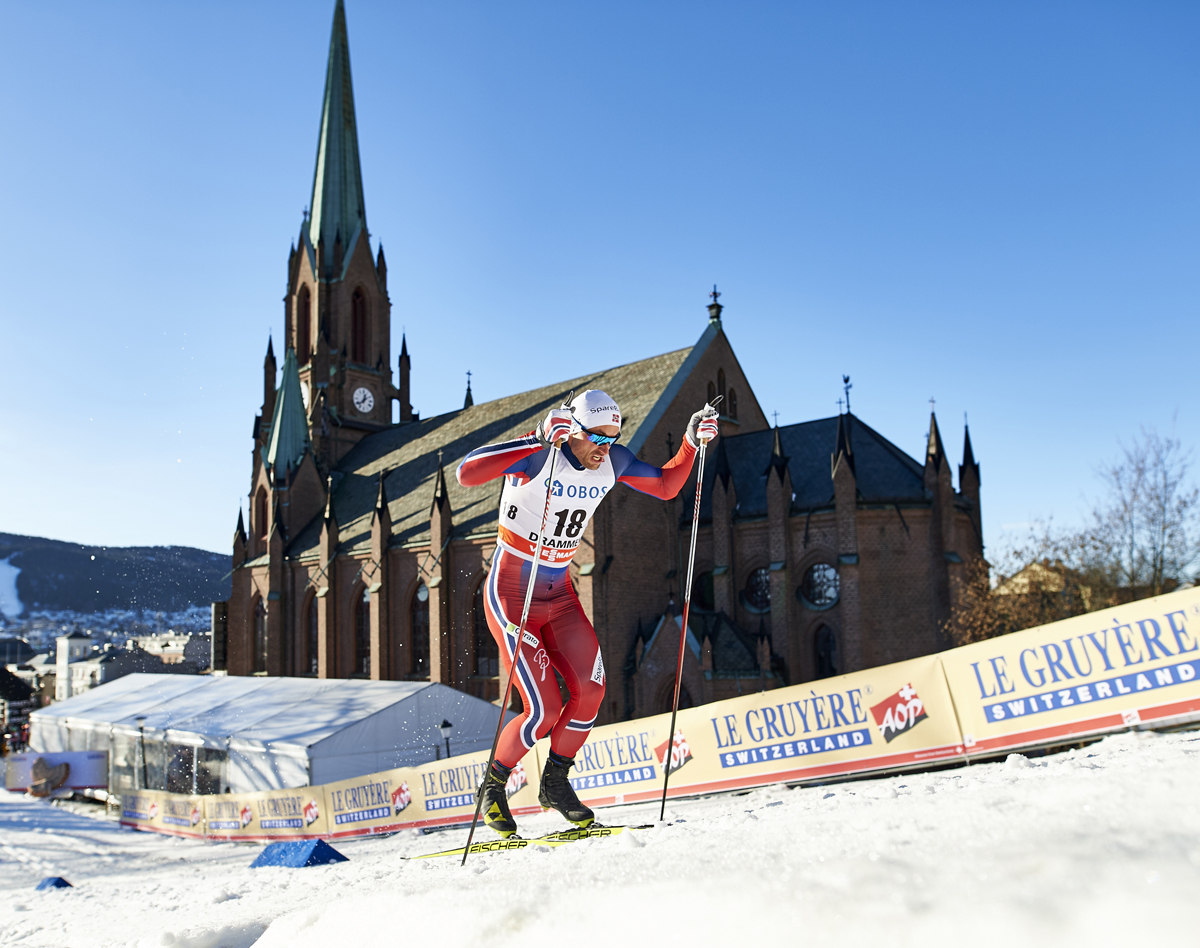
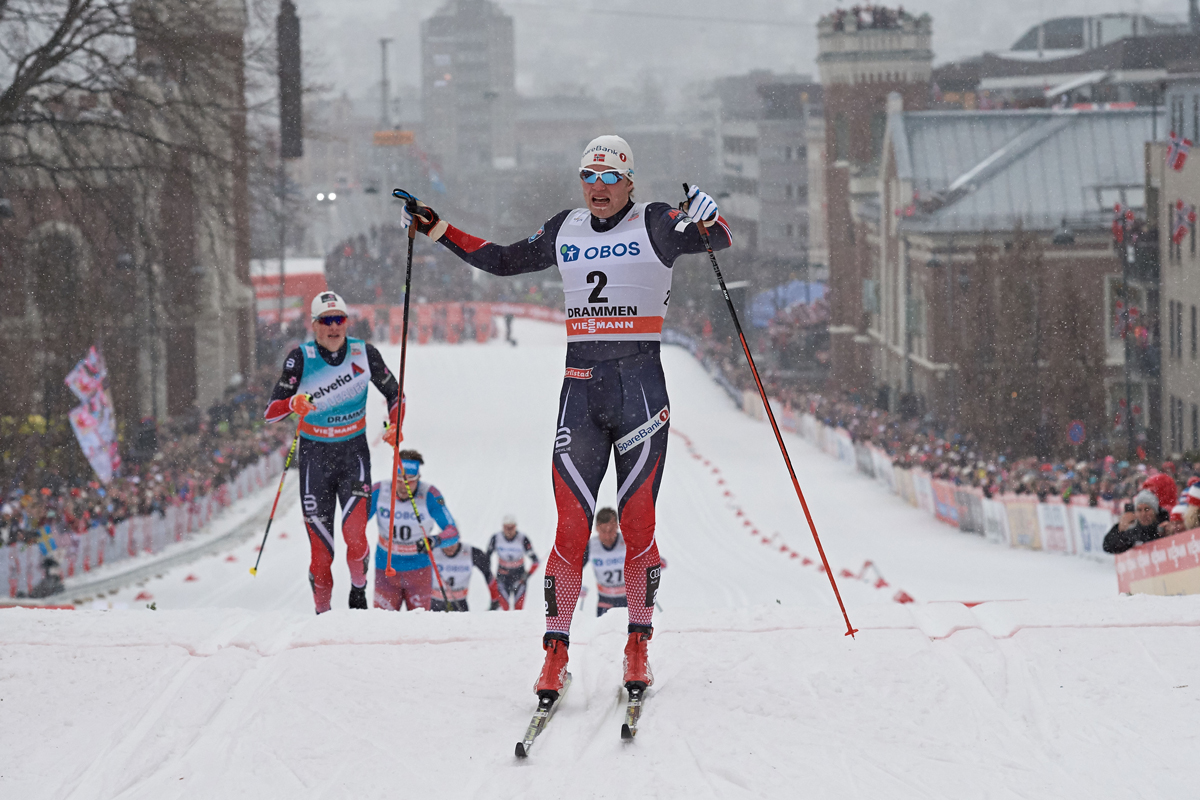
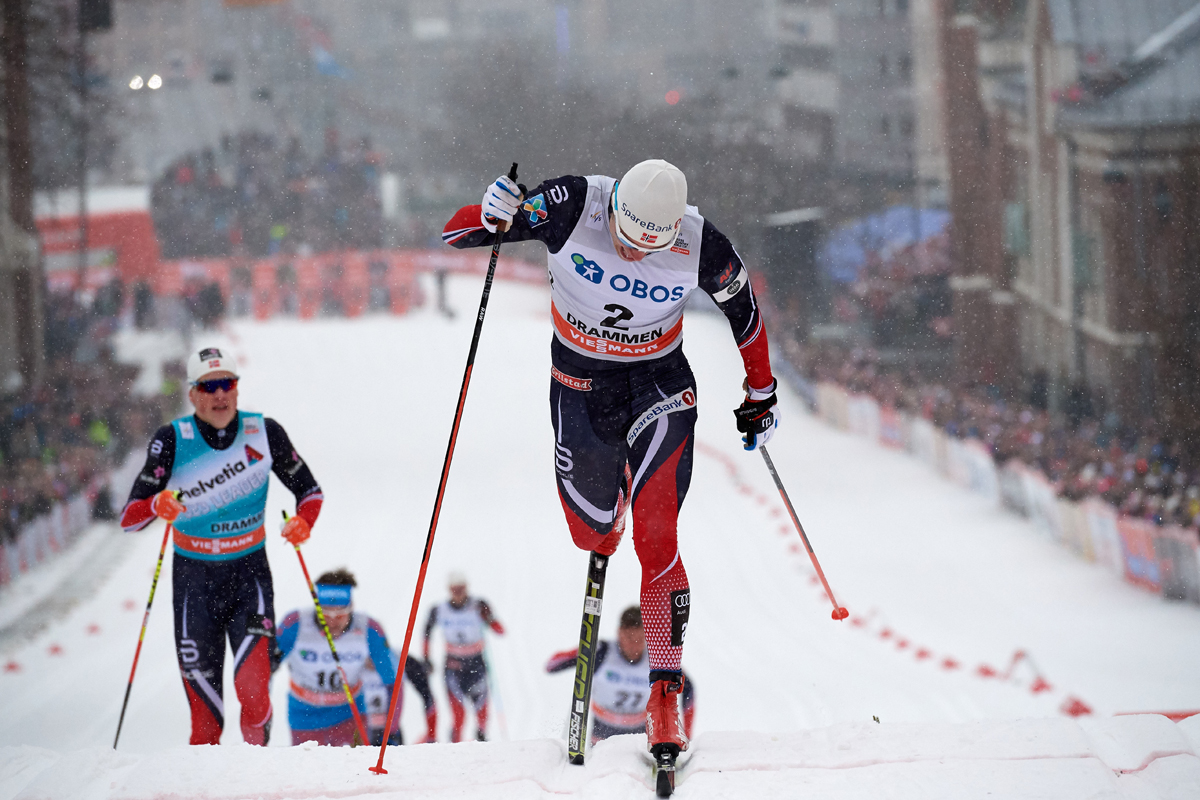
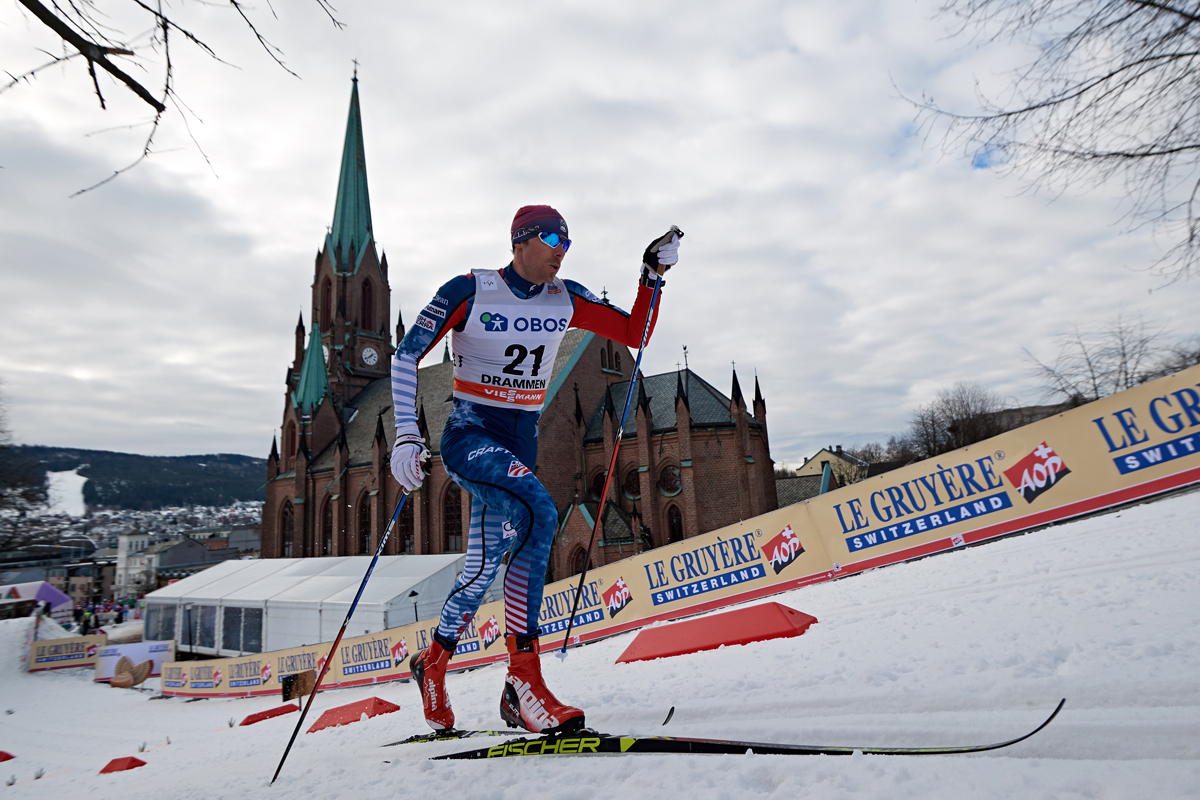
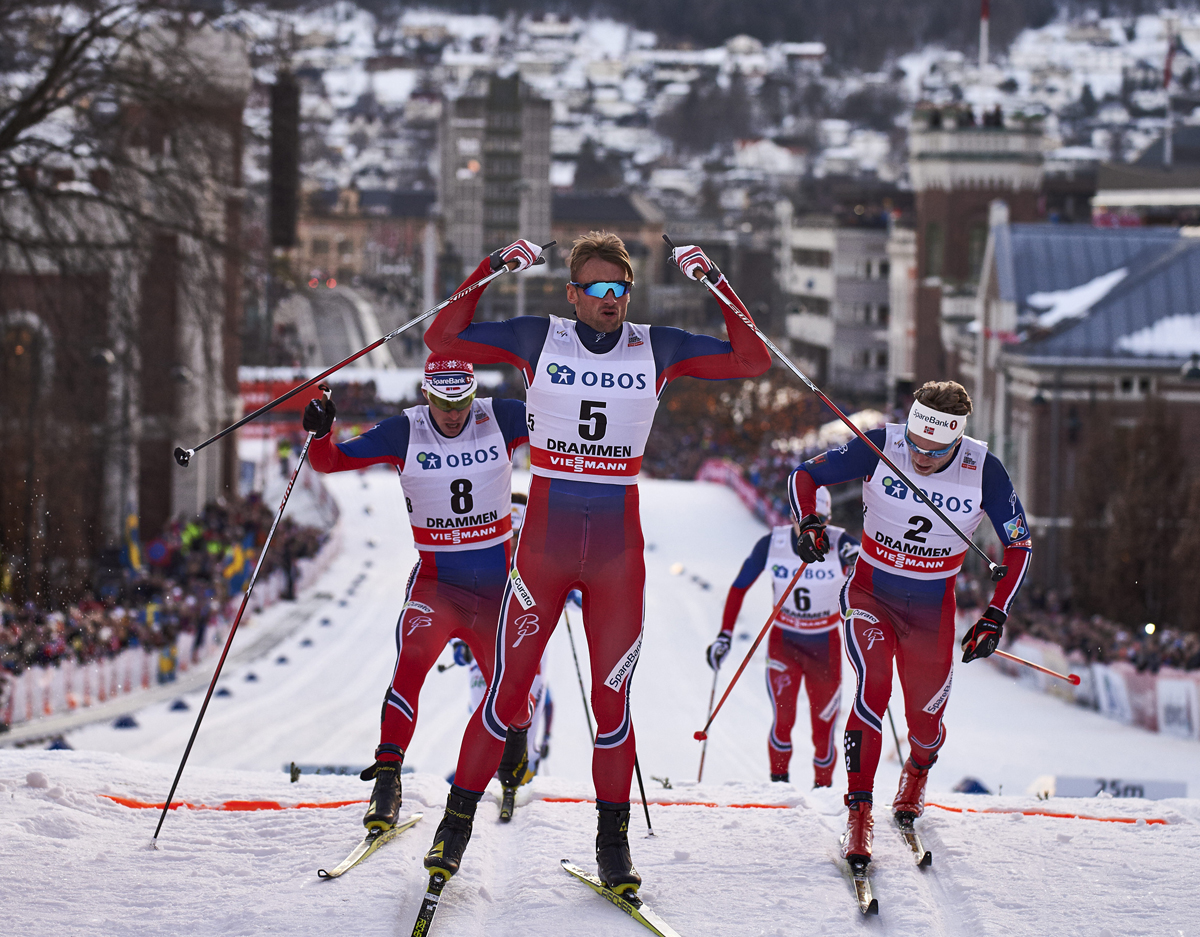
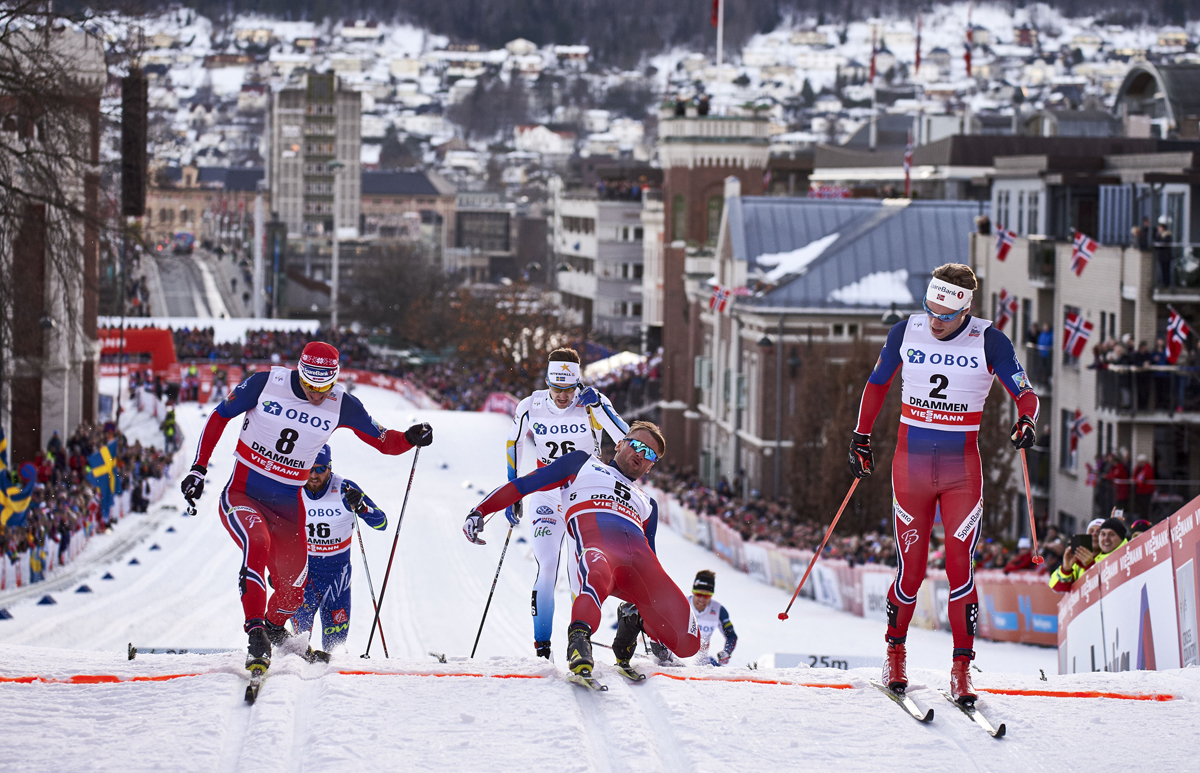
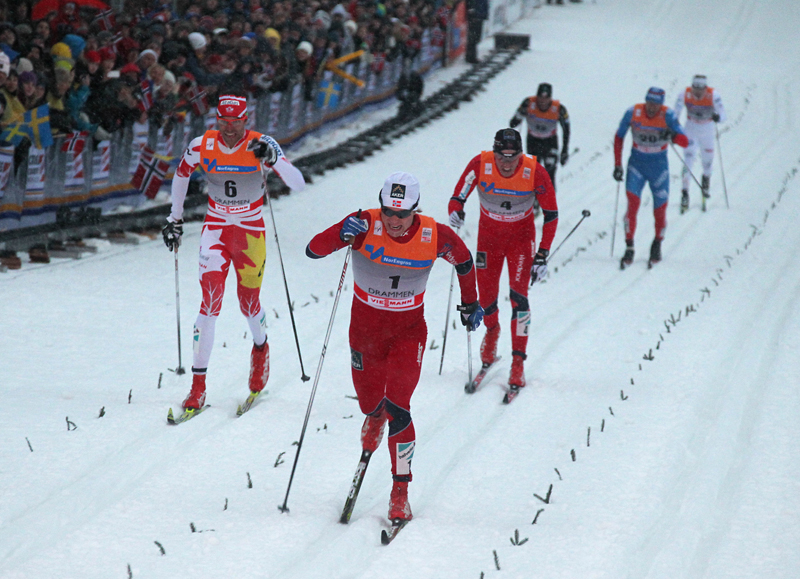
And there’s this finish in Drammen, Norway from March 2017. Home crowd. The captive theater of a contained urban stage. Northug performs as if an Academy Award was on the line. Down the stretch, Northug kills. He wins his quarterfinal in dramatic fashion. He doesn’t simply slide across the line letting his closing double pole speed speak for itself. He slots in front of an incoming field that charges head-on. Despite his virtuoso quarterfinal, Northug placed 8th on the day. But what I recall from that day on the ground in Drammen was Northug. The posturing stuck with me. Without the posturing, he’d be a different kind of champion. Not better or worse, but not Northug.
That was Northug. A bit of Icarus flying too close to the sun, and just enough raw classy skiing to ingratiate himself to those who love the sport for its woolen-woodsy roots and humble personalities. And the moments he would almost dramatically gear down to V1 when most of his competitors maintained a V2. It was almost as though he was telling them the pace was such he didn’t particularly need to use a big gear. Northug communicated whatever he wanted with his skiing.
“He was always a controversial figure on the World Cup, and he was never boring,” U.S. Ski Team Head Coach Chris Grover emailed. “We’ll miss the explosive come-from-behind finishes, the other-worldly athletic performances, the occasional unsportsmanlike conduct, and the feeling of celebrity that came with having Petter at a race. When he was at his peak, he demonstrated that he could win every discipline almost at-will. His mid-race antics endeared him to millions and pissed-off countless others. His legacy is easily visible not only in the showmanship playbook of other top athletes (Klæbo in particular), but in the way in which so many athletes currently ski. Petter literally changed the technique of a generation of ski racers. He brought excitement and attention to our sport by creating a story within the story. We will miss him.”
Norwegian Petter Northug (r) edges Kazakhstan’s Alexey Poltoranin by 2.15 seconds in the 2013 1.3 k classic sprint at the World Cup in Drammen, Norway. (Photo: Fischer/Nordic Focus)
Northug’s gravitational pull was immense. His rockstar sensibilities made him a RedBull athlete. A sponsorship deal often reserved for big-line skiers propped atop Alaskan spines with a heli, not cross-country skiers.
In May of 2014, the lifestyle caught up with Northug. He was speeding in his vehicle while under the influence of alcohol when he crashed. Northug’s passenger was injured. Northug also fled the scene and initially stated the passenger was driving at the time of the crash. Northug was ultimately charged for a DUI and found guilty of all charges brought against him. (Norway is a culture that takes DUIs and drinking seriously.)
As Northug matured, and presumably began to understand his historic place in the sport and in Norwegian ski culture, he made amends with Norway’s hierarchy of skiing.
Northug’s slow fade has been like a dimming star: we know it’s still there, it shines bright, but it’s simply not what it was. As of this season, Northug was, in fact, included on the roster of the Norwegian sprint team. He did not appear in any World Cups this season.
At his press conference Wednesday, Northug was moved to tears as he reflected on his decision to retire, his career, and the importance of his two younger brothers — Evan Northug (23) and Tomas Northug (28).
Norway has new heroes on the ski tracks. Some with flare. Some simply a big set of lungs. None of them Northug.
Petter Northug in 2016 at the FIS world cup cross-country sprint, in Drammen, Norway. (Photo: Fischer/Nordic Focus)
On December 12, in Trondheim, Norway, thirty-two-year-old Petter Northug jr. announced his retirement from the sport.
Northug won four Olympic medals, two of which are gold. He won 16 World Championship medals, 13 of them gold.
He has a total of 38 total wins on the World Cup during his 12 year career,
“I have taken a decision to post as a skier.I told myself that I could not use more energy and effort to fight to continue.I have always lived in the belief that I could manage to turn it around, but I’m a bit satisfied.This was the best solution for me, ” Petter Northug said at his retirement press conference according to a translation of a NRK story.
Northug won with flare and panache, often waiting to the closing meters in epic 50-kilometer races to toe across first. His storm-ahead poling action was a played trick that for a time on the ski tracks could not be overcome, only anticipated.
Northug was a force on and off the ski tracks.
FasterSkier will post a more in-depth story on Northug’s career and retirement.
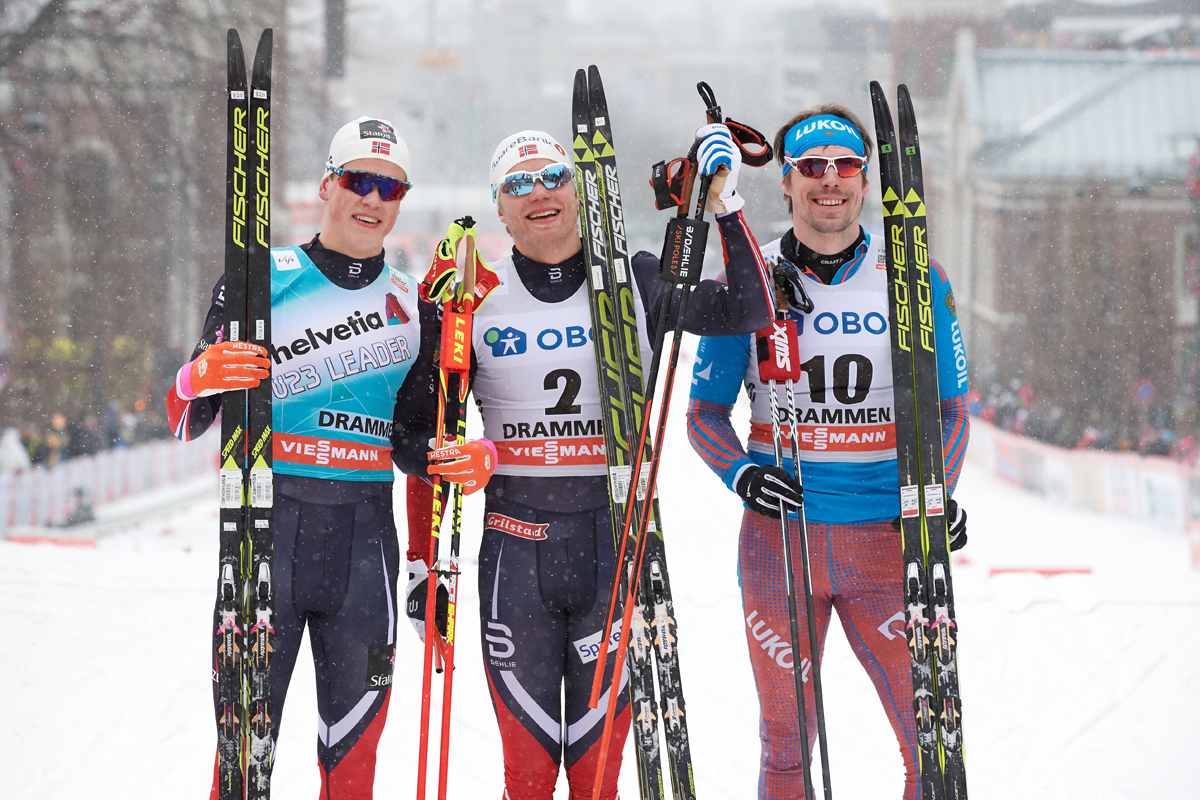
Norway’s Eirik Brandsdal (2) crossing the line first for his first World Cup victory in two years in the men’s 1.2 k classic sprint on Wednesday at the last World Cup classic sprint of the season in Drammen, Norway. He beat out fellow Norwegian Johannes Høsflot Klæbo (l) and Russia’s Sergey Ustiugov (10), respectively, for his first win since the 2015 Drammen classic sprint. (Photo: Fischer/NordicFocus)
DRAMMEN, Norway — The stage was set around 1:30 p.m. Wednesday when a homegrown Norwegian made good in front of a spectator-lined 1.2-kilometer classic course smack-dab in the middle of Drammen’s city center. It was a day of contrast that began with blue skies and ended with a deep chill and falling snow as thumping music pounded and the gothic Bragernes Church loomed. In between, the clouds amassed and the classic tracks stayed firmed for the Drammen city sprint.
As the host country, Norway was blessed with more skier starts for the midweek World Cup sprint. That, however, looked like a curse for every other nation competing. Thirty-three percent of the eventual top 30 finishers were from Norway — 10 out of 30 — and five of six in the final. We’ll get to that in a bit.
The qualifier was owned in every sense of the word by Norway’s 20-year-old Johannes Høsflot Klæbo. He was first in the qualifier by what some may consider a whopping 3.62 seconds. He stopped the clock at 2:33.81. around the one-loop course, which went up, then down again, and then up again. Klæbo’s Norwegian teammate Eirik Brandsdal was second in the qualifier with a time of 2:37.43.
And if that time margin wasn’t a stunner, consider this. The day also marked the first time a World Cup sprint included two no-double-pole (DP) zones. During his qualifier, Klæbo came out of the first no-DP zone and stumbled, momentarily looking as if he was about to fall. His iconoclastic high-tempo, run-ski up steep hills is already a winning trademark, but in this instance it almost doomed him.
That, of course, didn’t happen — he cruised in cool if not for his furious speed.
All of this set the young Norwegian up for stardom. The World Cup’s season-long U23 leader came into Drammen ranked second overall on the World Cup sprint list with 289 points, just behind Italy’s Federico Pellegrino with 309 points. Pellegrino placed 12th on Wednesday, while Klæbo advanced to the finals.
But perhaps the principle animator on the day was none other than Norway’s Petter Northug. After qualifying 27th, Northug looked rejuvenated in the first quarterfinal. Coming up the gradual mostly double-pole-able climb to finish, it was a Northug double-pole drag race in which he began the grind in sixth. In his famous fashion, he pulled away from the field, crossed the line, then U-turned in front of the oncoming skiers and chest-thumped. It was a throwback to his earlier dominance. And yes, the fans drank from the Northug Kool-Aid.
Northug eventually advanced to the final as the second lucky loser after placing fourth in his semifinal, 3 seconds behind Klæbo, who won that heat.
Another skier to make the final was Norway’s two-time Drammen classic-sprint winner, Brandsdal. His 2015 Drammen win was his last World Cup victory.
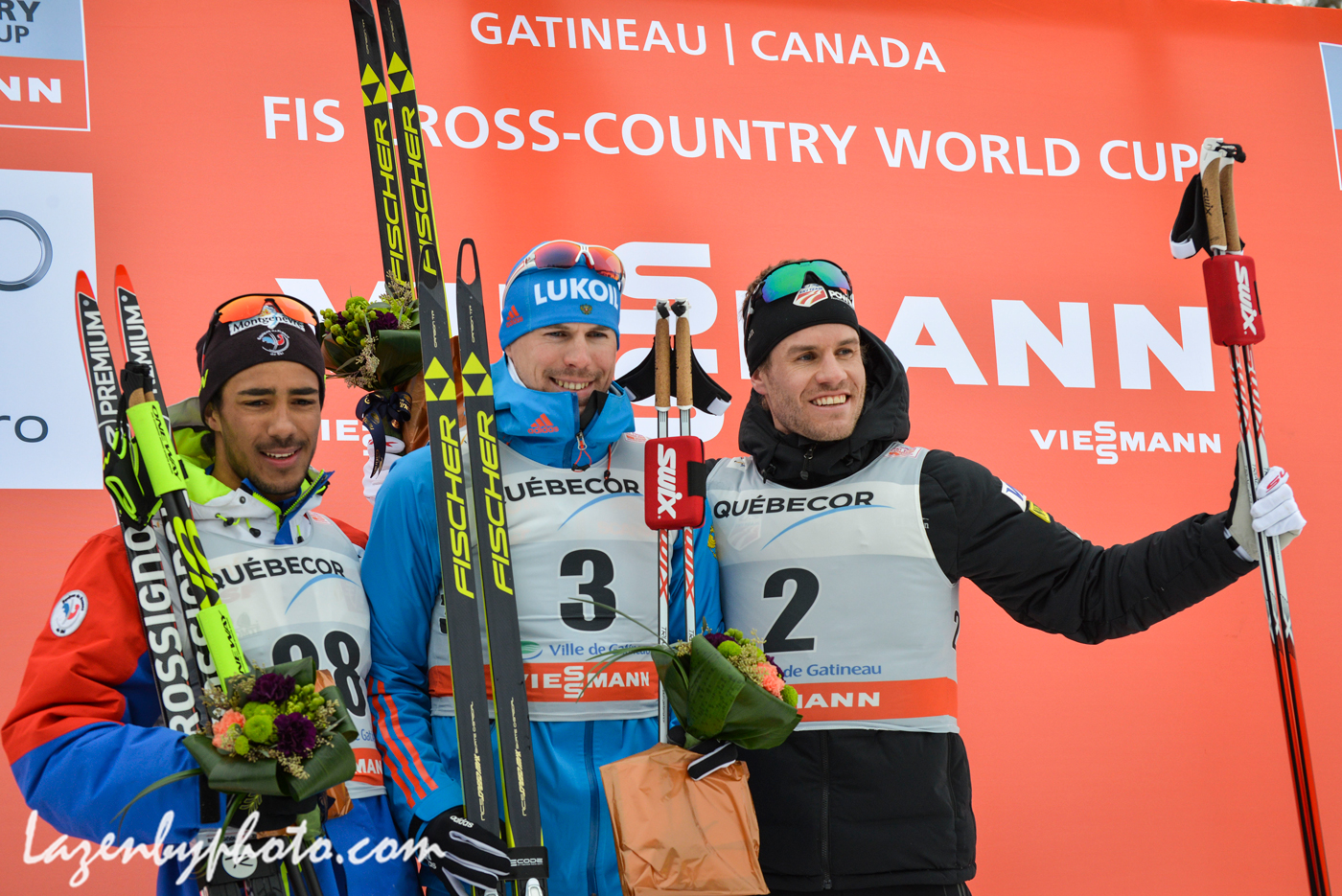
The men’s World Cup 1.2 k classic sprint podium on Wednesday in Drammen, Norway, with Norway’s Eirik Brandsdal (c) in first and Johannes Høsflot Klæbo (l) in second, and Russia’s Sergey Ustiugov (r) in third. (Photo: Fischer/Nordic Focus)
Recall that Wednesday’s race was one of contrast. There was the upstart Klæbo. There was Northug’s theatrics. And there was Brandsdal’s steady state skiing.
He had been second in the qualifier, first in his quarterfinal, second in his semi, and untouchable in a final that featured these four other Norwegians: Klæbo, Northug, Pål Golberg, and Sondre Turvoll Fossli and Russian super-skier Sergey Ustiugov.
Up the everlasting final stretch to the feet of the old Bragernes Church, it was initially a Klæbo-Brandsdal dual. That didn’t last long as Brandsdal closed out hard, winning the day for his third-career Drammen victory. Klæbo placed second (+2.55), and Ustiugov third (+3.28) for the Russian’s seventh-straight podium, including five medals in five races at World Championships. Northug finished fourth (+4.5), Golberg fifth (+5.99), and Fossli sixth (+12.42).
Norway’s Eirik Brandsdal (2) crossing the line first for his first World Cup victory in two years in the men’s 1.2 k classic sprint on Wednesday at the last World Cup classic sprint of the season in Drammen, Norway. He beat out fellow Norwegian Johannes Høsflot Klæbo (l) and Russia’s Sergey Ustiugov (10), respectively, for his first win since the 2015 Drammen classic sprint. (Photo: Fischer/NordicFocus)
“That was hard,” the 30-year-old Brandsdal told the International Ski Federation (FIS) after. “… It feels good to be back on top of the podium again.”
With his second place and Pellegrino’s stall out in the quarterfinals, Klæbo now leads the sprint standings over the Italian, 369 points to 331.
“I will travel now to Quebec and won’t race Holmenkollen this weekend,” Klæbo told FIS. “I just got the sprint leader’s red bib and I will fight to keep it in Quebec and take the Crystal Globe.”
One World Cup sprint remains: a freestyle sprint to start the three-day World Cup Finals in Quebec City next week.
Sunday’s 50 k world champion Alex Harvey was sprint worthy in Drammen. He finished the day in eighth overall after qualifying 18th, winning his quarterfinal, and taking fourth in his semifinal, 4.41 seconds behind Ustiugov, who won that heat.
“I’ve been feeling good, I mean, I’ve never made the semis here in Drammen so it’s the best race of my life here on this course, so feeling good,” Harvey told FasterSkier after being eliminated in the semifinals.
Now the sport’s king in the World Cup’s longest race, the 50 k, Harvey lamented the Drammen course’s short nature. “It’s short. 2:40 [minutes],” Harvey said. “It’s way too short for me. I need a bit closer to three minutes to be able to do something.”
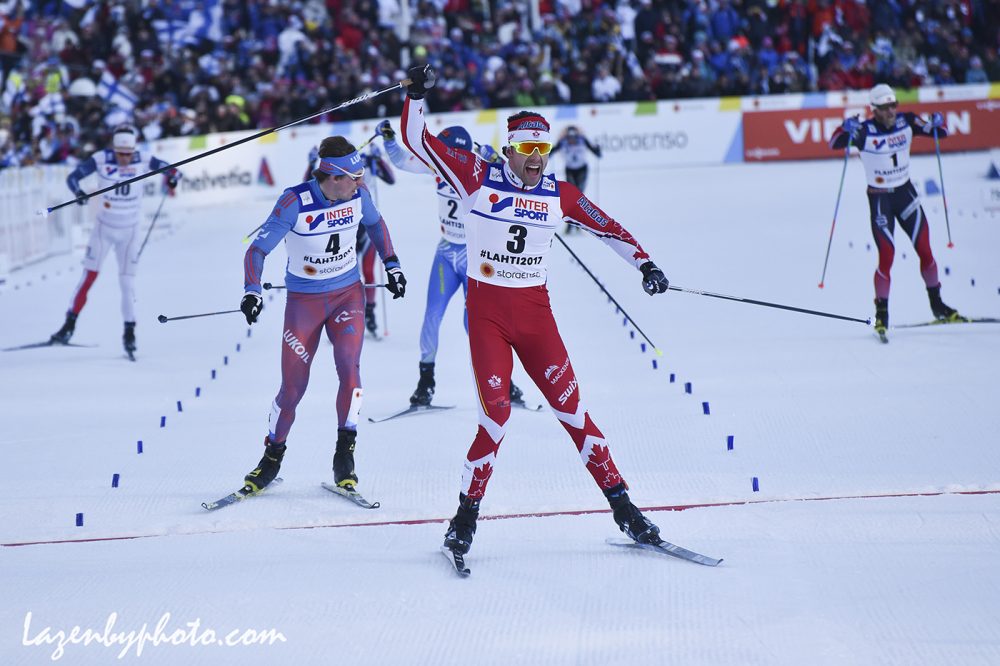
Canada’s Alex Harvey (5) celebrating his first individual World Championships gold after winning Sunday’s 50 k freestyle mass start on the last day of 2017 Nordic World Championships in Lahti, Finland, ahead of Russia’s Sergey Ustiugov (4), Norway’s Martin Johnsrud Sundby (1), and Finland’s Matti Heikkinen (2), respectively. (Photo: John Lazenby/Lazenbyphoto.com)
Prior to the upcoming World Cup Finals, which will be held in Harvey’s hometown March 17-19, the Canadian ranks fourth overall on the World Cup leaderboard, 65 points behind Finland’s Matti Heikkinen in third and 104 points ahead of Sweden’s Marcus Hellner in fifth. Neither raced Wednesday’s sprint.
Asked precisely what he was hunting as the World Cup winds down, the 28-year-old Harvey was succinct.
“The top three overall, for sure,” he said. “This is already a good step forward today, got around 20 points or something like that. I know that especially the races in Quebec are a good format for me. If you’re good in the sprint, I can get a bit of an edge on Heikkinen for the last day, for the pursuit start, and with double points there, it can go pretty fast.”
Also advancing to the quarters for Canada was Len Valjas after qualifying 21st (+7.97). Initially the 28-year-old Valjas looked poised to advance beyond the quarters as he was announced the winner of a photo finish with Russia’s Alexander Bolshunov for second place behind Harvey. But the replay showed a fine line as Valjas appeared to make a gutsy move in the closing meters. The race jury ruled that Valjas obstructed Bolshunov by skirting around and in front of him at the finish, and relegated Valjas to last in the heat for 27th overall.
One American man reached the heats: Andy Newell, who began the day qualifying in 13th (+6.45). The U.S. Ski Team member placed fourth in his quarterfinal, 1.7 seconds behind Brandsdal who won the heat, and did not advance to the semifinals to end up 18th overall.
Andy Newell (U.S. Ski Team) racing to 13th in the men’s 1.2 k classic sprint qualifier at Wednesday’s World Cup city sprint in Drammen, Norway. Newell went on to finish fourth in his quarterfinal for 18th overall. (Photo: Fischer/NordicFocus)
“I felt good today,” Newell said after, “so it’s a shame not to move on to the final. I really was hoping to do that here, this is one of my favorite sprints. I love this atmosphere here and I love Drammen. It’s definitely one of the hardest sprints, competitive sprints, but for me it’s just really fun. So yeah I’m bummed not to advance … But I am feeling good, so I can’t complain.”
Newell added insight into the no-double-pole zones in play, explaining that he learned of the new rule with little time to spare.
“They have been trying them in Scandinavian Cup races and this is the first time they have ever done it on a World Cup,” he said. “It was weird because they literally told us they would have no-double-pole zones, or striding zones, an hour before qualifications. So a lot of us waxed skate skis that we were going to test in anticipation that it would be a double-pole race, because it’s really good conditions for double-pole now. So that was obviously the end of that.”
Also for the U.S., Simi Hamilton placed 42nd in the qualifier, 1.69 seconds out of the top 30 needed to qualify, but the disqualification of two other skiers for receiving their second yellow card — Norway’s Finn Hågen Krogh and Sweden’s Emil Jönsson — moved Hamilton up to 40th. (Krogh was disqualified after racing in the same semifinal as Harvey, and Jönsson was disqualified in the quarterfinals.) Also for the U.S., Erik Bjornsen (U.S. Ski Team) finished the day in 44th, and Ben Lustgarten (Craftsbury Green Racing Project) 62nd.
Canada’s third skier, Russell Kennedy (Canmore Nordic/Team R.A.D.) was 63rd in his first overseas World Cup race.
It’s real. Canada’s Alex Harvey after winning gold in the men’s 50-kilometer freestyle mass start on Sunday at the 2017 Nordic World Championships in Lahti, Finland. (Photo: John Lazenby/Lazenbyphoto.com)
LAHTI, Finland — Here’s the basics: fast and firm tracks, cloudless skies, and once again a stacked field for the final event of the 2017 Nordic World Championships: the men’s 50-kilometer freestyle mass start.
Over the course of the 50 k, Canada’s Harvey had to think about one thing: be up front near the top three in order to shadow Norway’s Martin Johnsrud Sundby’s inevitable gut punch in the last kilometer. What he didn’t have to think about was playing catch up as a skier yo-yoing off the back, or his skis — they were rockets.
In Sunday’s closing race of Lahti World Championships, Harvey was slotted in second, sliding around “Lahti Corner” just centimeters behind Sundby. Drafting off Harvey was 2017 championships legend, Russia’s Sergey Ustiugov, who had already racked up four medals previously in the week (skiathlon gold, team sprint gold, freestyle sprint silver and team relay silver). Pulling not far behind the three was Finland’s Matti Heikkinen and Andrew Musgrave of Great Britain.
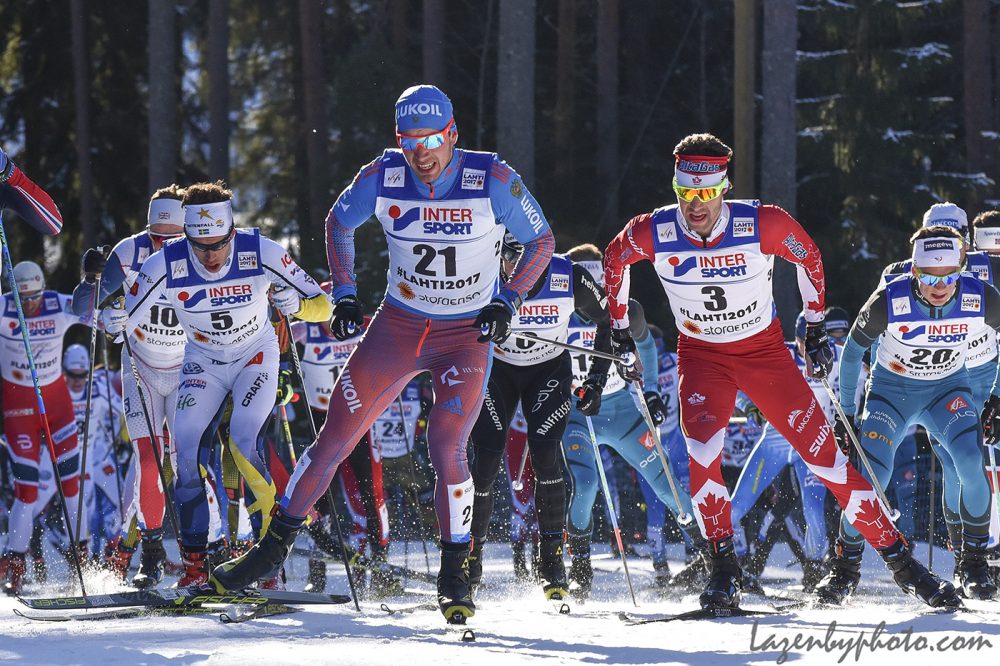
Russia’s Alexey Chervotkin (21) leads Canada’s Alex Harvey (3) and Sweden’s Marcus Hellner (5) during the men’s 50 k freestyle mass start on Sunday at 2017 Nordic World Championships in Lahti, Finland. Harvey went on to win, Hellner placed 12th and Chervotkin 13th. (Photo: John Lazenby/Lazenbyphoto.com)
“I saw the women’s race yesterday, and I figured if Marit Bjørgen could not distance herself from the other girls, then there is no way that the men will be able to do that,” Harvey said during Sunday’s post-race press conference. “I knew with the fast conditions, it was going to be a big group, and that leaves the potential for a lot of carnage, a lot of mayhem.”
For the first 10 k, skiers from various nations took pulls up front, including Sundby and Ustiugov, and Norwegians Petter Northug, Hans Christer Holund, and Anders Gløersen. After testing the field and breaking away around 8 k into the race, Gløersen was still skiing alone up front, 20 seconds ahead of anyone else at 15 k.
“Gløersen took off a bit and he was like, ‘What’s the gap? What’s the gap?’ ” Canadian World Cup coach Ivan Babikov said of Harvey. “He was always controlling the race and saving energy for the finish.”
Eventually, the main pack surged to recover the lost time. Gløersen’s off-the-front-flier only earned him camera time. The catch came just before Lahti Corner returning to the stadium around 20 k in, where Russia’s Alexey Chervotkin took over. In another 2 k, Sundby, who had been stalking in the top 10, moved to the front as if the race were all of a sudden for real.
Norway’s Anders Gløersen broke away early to lead the men’s 50 k freestyle mass start, skiing alone off the front for about 12 kilometers, on Sunday at the 2017 Nordic World Championships in Lahti, Finland. (Photo: John Lazenby/Lazenbyphoto.com)
From then on, the size of the pack atrophied with each consecutive lap. At 30 k, the pack streaming through the stadium was 24 skiers long. At 45 k, the group winnowed to a train of 19. And within another 4 k, only 13 remained: Sundby, Ustiugov, Musgrave, Harvey, Heikkinen, Northug, Holund, Gløersen, Chervotkin, Sweden’s Marcus Hellner, Norway’s Sjur Røthe, Switzerland’s Dario Cologna, and France’s Maurice Manificat.
“I wanted to be in the front, top three at least,” Harvey said, reflecting on his skiathlon tactics from last weekend, where he skied around fifth up until the final headwall and finished fifth, outside of the medals.
“I knew that Sundby’s first chance to win gold was to break everybody,” Harvey continued. “I was expecting him to leave from kilometer 1 or 49.”
Harvey guessed Sundby would be the only one who would try to break away. With that in mind he marked the Norwegian.
“He knew it would be hard to break away [and that] it will be all about the finish,” Babikov said. “He was positioning himself perfectly up the last hill and just stayed on Sundby. That was his plan, ‘I’m just gonna stay on Sundby and if he changes skis, I’ll go change skis,’ but today conditions were perfect so he didn’t.”
With ripping conditions and skis to match, Sundby never slowed nor switched skis. Neither did Harvey.
“When he waited until the last lap, I knew exactly where he was going to do it: with a k and a half to go,” Harvey explained. “I was just lucky enough to have the legs to stick on him today and from then on it started playing more into my hands.”
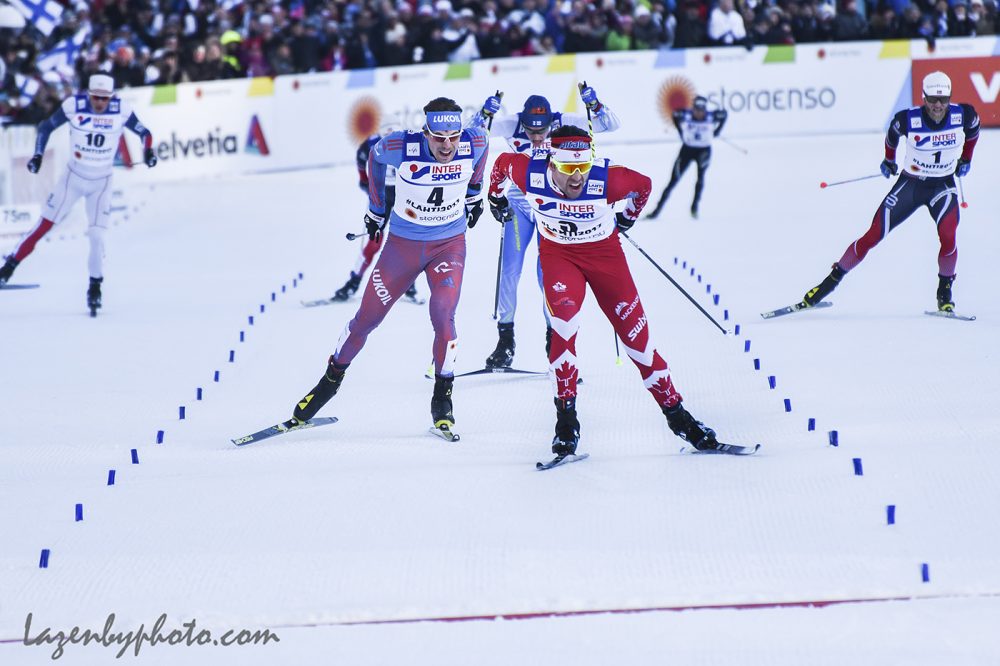
Canada’s Alex Harvey (5) charging to the line ahead of Russia’s Sergey Ustiugov (4), Norway’s Martin Johnsrud Sundby (1), Great Britain’s Andrew Musgrave (10) and Finland’s Matti Heikkinen (behind Harvey) in the men’s 50 k freestyle mass start on Sunday at the 2017 Nordic World Championships in Lahti, Finland. (Photo: John Lazenby/Lazenbyphoto.com)
In the closing moments of nearly every race of these world champs, the fate of winners seem come down to luck, and often someone else’s bad luck. As the leaders came into the stadium, it was as if every observer were about to witness an upset due to a tumble or a tangle.
Harvey was clean around the final turn and unscathed down the stretch.
“I wanted to hit the [Lahti] corner in second, right behind Sundby or whoever was in the lead,” Harvey said. “I knew I needed to do that in the skiathlon, too, and I tried to go around Finn Hågen Krogh there, but he’s a clever sprinter too. He knew he wanted to be second there.
“In the skiathlon it didn’t work, but today it did,” Harvey continued. “I was second the whole time and then out of that corner I did one push more than Sundby. I had really fast skis, but used the draft to slingshot and then hit the final corner in first and from there, I knew it was mine to lose more than anything else.”
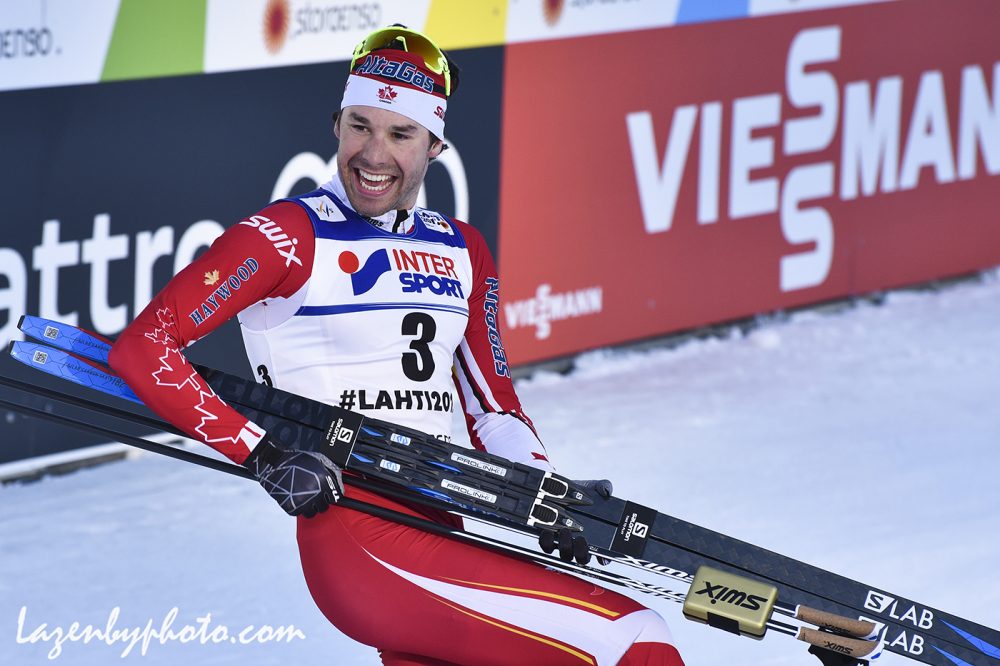
Canada’s Alex Harvey (5) celebrates his first individual World Championships gold after winning Sunday’s 50 k freestyle mass start in Lahti, Finland, ahead of Russia’s Sergey Ustiugov (4), Norway’s Martin Johnsrud Sundby (1), and Finland’s Matti Heikkinen (2), respectively. (Photo: John Lazenby/Lazenbyphoto.com)
And so Harvey earned the crown: 50 k world champion in 1:46:28.9 hours.
It’s his first championships gold since winning the classic team sprint with Devon Kershaw at 2011 world champs, and fifth medal in four World Championships.
“He turned around these world champs for all of us,” Babikov said of the Canadian team. “He was solid. We were with no medals so far, and winning 50 k, he’s the king now.
“This is the legit distance and he took it today,” he added.
“It’s a long championship,” said Louis Bouchard, Harvey’s personal coach and Canada’s World Cup co-coach. “He feels every day his energy’s still there, so he knows today, if he’s good tactically, then he can do it.”
Asked how nerve-racking it was watching the final 5 k unfold, Bouchard responded, “I was pretty nervous, too much maybe. But that’s OK.”
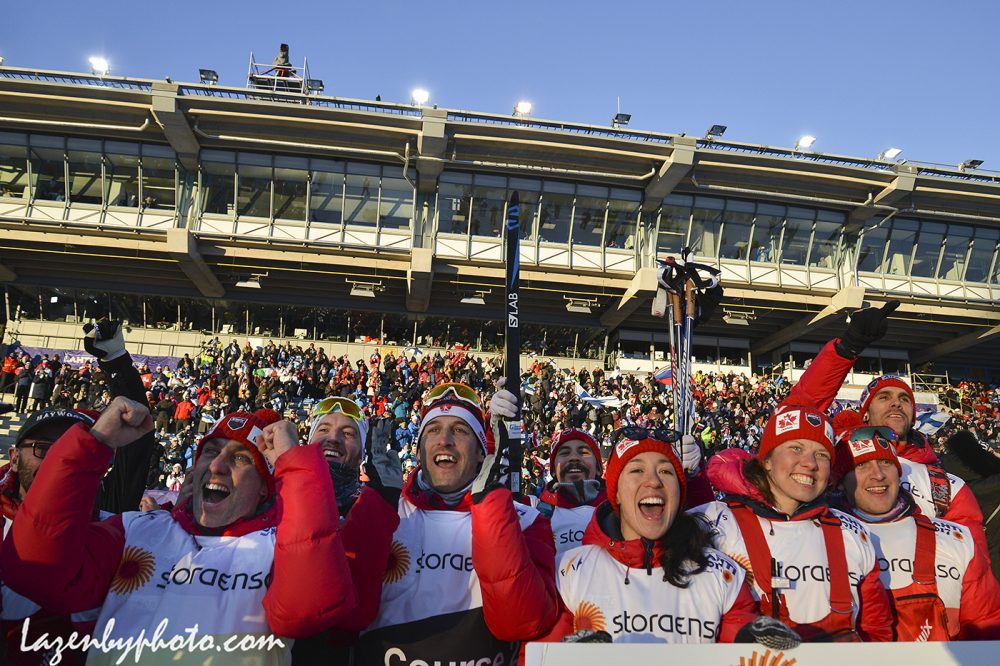
Alex Harvey’s Canadian teammates, coaches and support team celebrate his win in the men’s 50 k freestyle mass start on Sunday at the 2017 Nordic World Championships in Lahti, Finland. (Photo: John Lazenby/Lazenbyphoto.com)
For his fifth medal of these championships (and sixth world-champs medal of his career), the 24-year-old Ustiugov crossed second for his third silver of the week, just 0.6 seconds behind Harvey. Finland’s 33-year-old Heikkinen took third (+1.4) for his first medal since 2011 World Championships.
“Today I skied within my own limits and at the end I was fresh enough to attack,” Heikkinen said in a press conference.
Asked about his not-so-characteristic finishing kick on Sunday, Heikkinen said he remembered how he faded to 20th in the 50 k classic mass start at 2015 World Championships.
“After Falun 2015 world champs, I was watching the race after and I was walking in front a mirror and I said, ‘I won’t ever again be like that after a 50 k,’ ” he said. “I’ve been training two years now at a high level [with my team] … and that’s why I’m top three in overall World Cup, so it was possible.”
Behind him in a photo finish for fourth, Musgrave capitalized on Sundby slowing before the finish — probably after the Norwegian realized he had missed out on a medal — to place fourth (+2.9). For Musgrave, who turns 27 on Monday, it was his first World Championships top 10. For Sundby, who had been on a quest all week for his first individual championships goal — it was a bummer. The 2018 Winter Olympics in PyeongChang, South Korea, will be Sundby’s next opportunity.
From a North American and perhaps international standpoint, American Tad Elliott skied the gutsiest of races. Halfway through the race, Elliott, a 28-year-old Colorado native and former U.S. Ski Team member, remained a not-too-far-off the back chaser, 27 seconds behind the lead group. His margin back slowly accrued over the remaining distance.
“At 25 k, man, some guys were really struggling and they balled it up,” Elliott said afterward. “I should have sent it a little harder but that’s how it goes sometimes in that pack. I thought I could get there, but I just missed it.”
Elliott, of Ski Club Vail, finished 27th (+3:16.8) for his best individual result in three World Championships. In recent years, Elliott has struggled with illness, which impacted his ability to train and peak. Those difficulties caused him to question whether or not his best years were behind him. Evidently not.
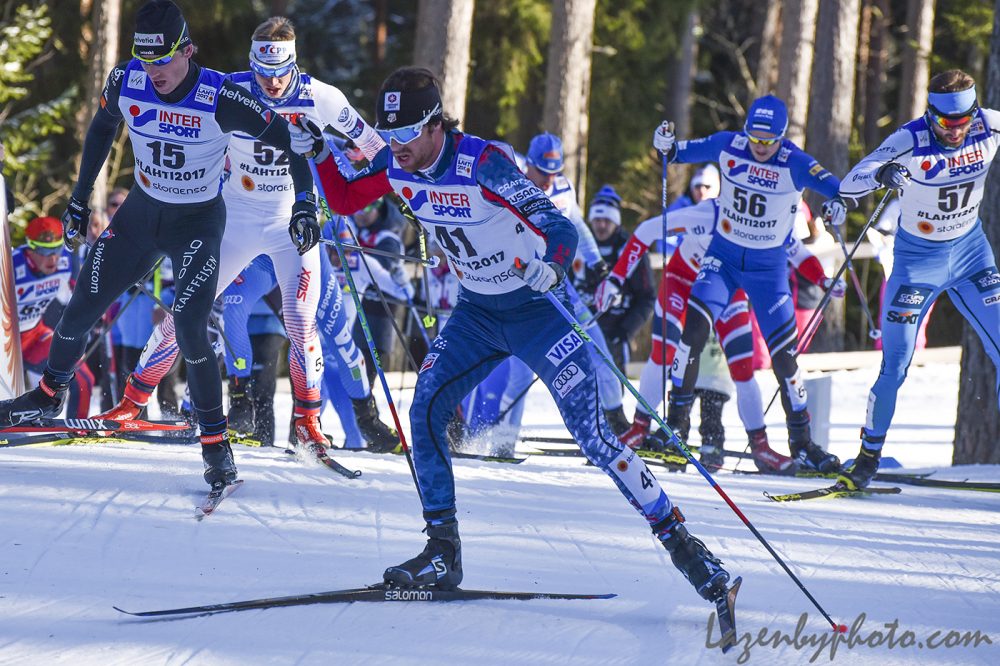
American Tad Elliott (41) racing to 27th in the men’s 50 k freestyle mass start on Sunday at the 2017 Nordic World Championships in Lahti, Finland.. (Photo: John Lazenby/Lazenbyphoto.com)
“I didn’t know if I wanted to come back [to skiing]. I was so sick. I was so bummed. I was like, ‘Am I ever going to get back? Am I ever going to get back to top-30 form?’ ” Elliott said. “We knew if everything went right, I would qualify for worlds … then to get top 30 here, man, I feel like I’m starting to get greedy. I’m starting to want more, I’m starting to want more opportunities. But I’m proud of this effort, I’m going to savor it a bit.”
In the first few kilometers, Russia’s Petr Sedov skied too wide on a 180-degree corner and stalled out. American Kyle Bratrud, the next skier to round the turn, was unable to avoid the Russian and collided. Soon after, due to the impact, Bratrud was unable to complete the race.
U.S. Ski Team member Noah Hoffman finished the day in 50th (+8:53.1).
Devon Kershaw was Canada’s second skier on Sunday, crossing in 38th (+5:45.5). Also for Canada, Graeme Killick and Knute Johnsgaard finished in 43rd (+7:04.0) and 55th (+12:03.3), respectively.
“[Alex’s performance] was incredible and such a big boost for our entire team,” Babikov said. “You should see all the techs, and Devon and Graeme and Knute, who didn’t really have a great race today, and they’re still so psyched for him.”
— Gerry Furseth, Jake Ellis and Alex Kochon contributed
Canadian air guitar: Alex Harvey performs his team’s signature move after winning the men’s 50 k freestyle mass start on Sunday at the 2017 Nordic World Championships in Lahti, Finland. (Photo: John Lazenby/Lazenbyphoto.com)
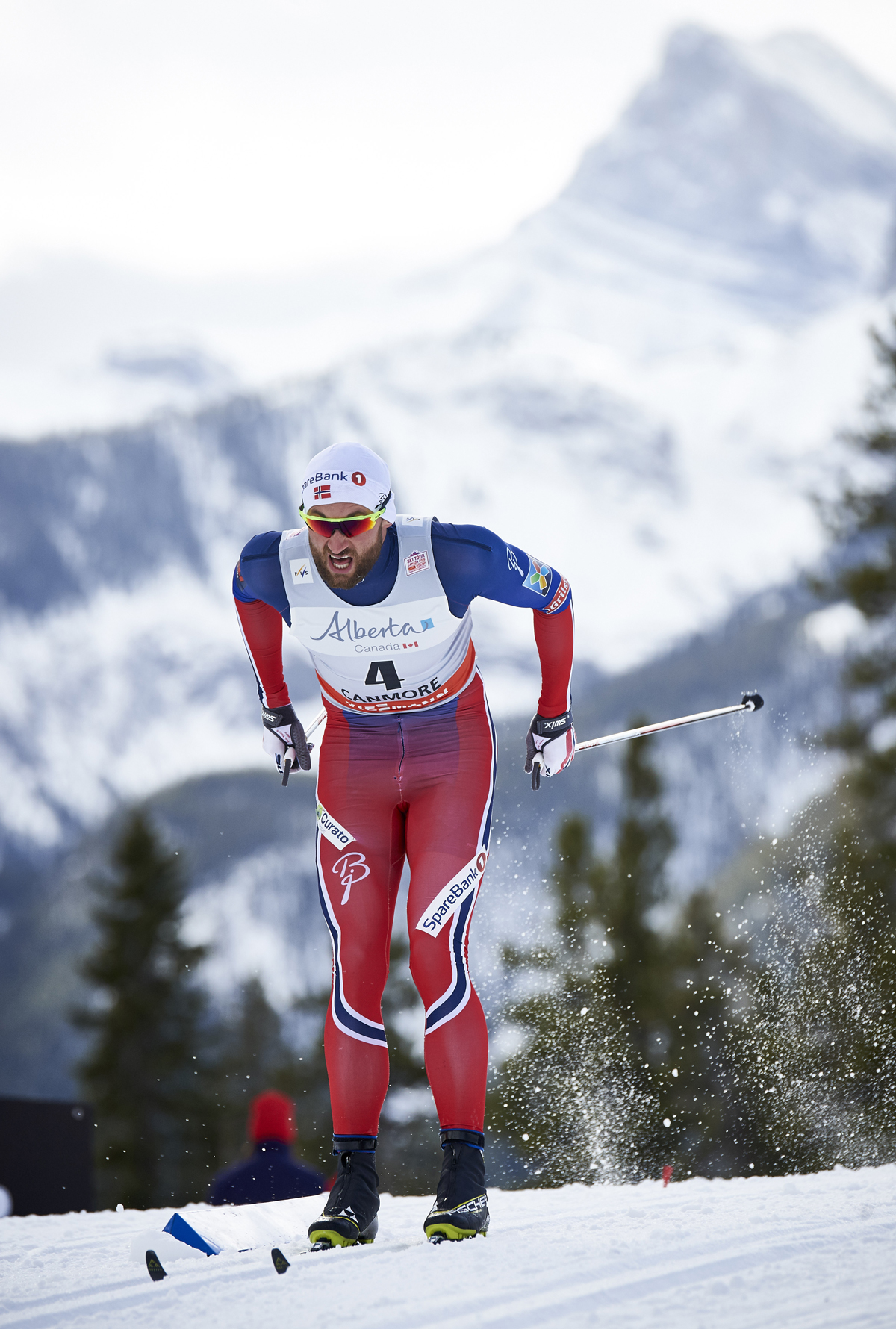
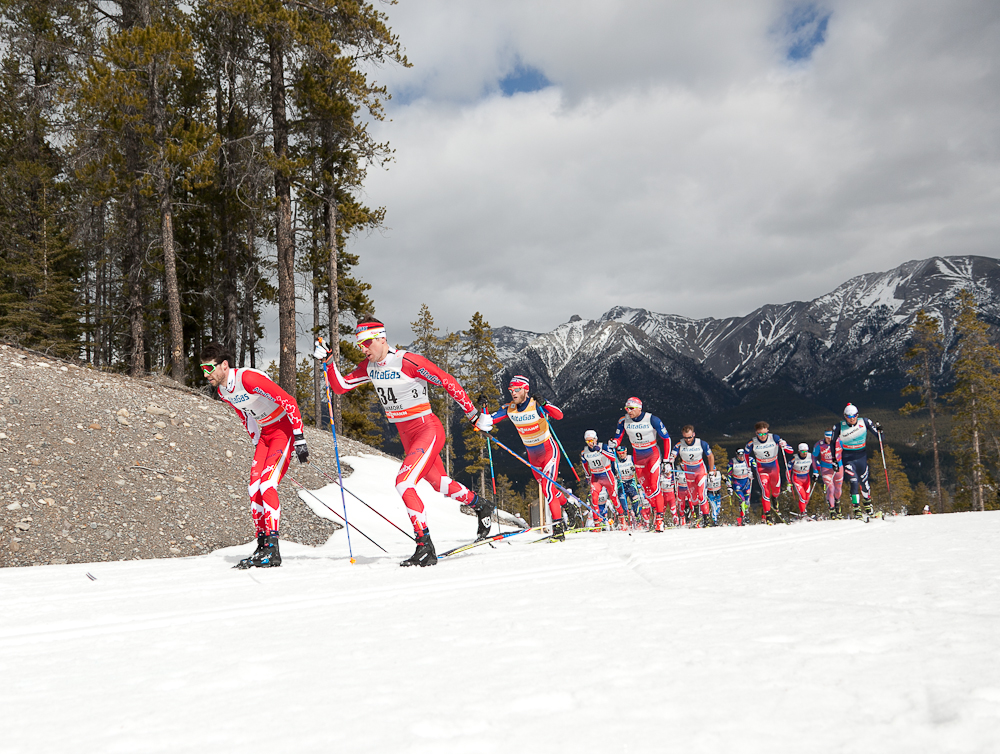
Norway’s Martin Johnsrud Sundby crossing the line with the win during the men’s 15 k classic pursuit Canmore, Alberta. (Photo: Fischer/Nordic Focus)
CANMORE, Alberta — Over night, Friday’s sun gave way to cloud-draped peaks, unpredictable winds and weather that seemed to change by the minute. When the men’s final Stage 8 of the Ski Tour Canada (STC) commenced on Saturday, a 15-kilometer classic pursuit, the tracks were warm, slow and barely holding form.
Although the weather was finicky, Stage 8 began with a simple premise. The Tour leader skied away first and those behind skied off depending on their overall time back. (For the sake of practicality, those ranked 11th-53rd started in a wave, 6:10 minutes back from leader, Russia’s Sergey Ustiugov, and their times were later adjusted at the finish.)
Norway’s Martin Johnsrud Sundby raced from third to first in the men’s 15 k classic pursuit on Saturday to win the overall Ski Tour Canada by nearly a minute in Canmore, Alberta. (Photo: Peggy Hung)
With one race left in the World Cup season, it was time for Norway’s Martin Johnsrud Sundby to go get the globes. He did that by winning the World Cup overall and the World Cup distance globe. The extra sparkle on those two iconic trophies, his win in Saturday’s pursuit gave him the Ski Tour Canada crown as well.
En route to winning the pursuit in 47:24.1, Sundby catapulted past Ustiugov, who began the day 32 seconds ahead of Norway’s Petter Northug and 39 seconds ahead of Sundby, who started third. Ustiugov ultimately finished second, 57.7 seconds behind Sundby, and Northug placed third (+1:52.5).
Maurice Manificat of France, who started the day seventh in the STC standings, jumped to fourth overall with the fastest time of the day in 45:54.6. The skier Manificat replaced in fourth, and who subsequently fell to fifth, was Canada’s best hope, Alex Harvey.
Harvey Spearheads a Maple-Leaf Charge
Harvey began the race 2:10 behind Ustiugov and wearing bib 4 as the STC’s fourth-ranked skier. With Sundby 1:31 ahead in third and Norway’s Finn Hågen Krogh starting 1:19 behind in fifth, Harvey double poled down the stadium corridor amidst Canadian flags waving and a boisterous home-country crowd urging him on.
Four laps of a deteriorating course — 15 k of hurt — is what Harvey had to endure. For the first two laps, the first half of the race, Harvey skied alone in fourth. But Manificat, starting at the back of a three-man pack, 19 seconds behind Krogh and 11 seconds behind Norway’s Emil Iversen in sixth, skied fresh — as if it weren’t the eighth day of pain.
France’s Maurice Manificat nearing the halfway point of the men’s 15 k classic pursuit on Saturday at the final stage of the Ski Tour Canada, while chasing Canada’s Alex Harvey (not shown) in his pursuit for fourth. Manificat rose from seventh to fourth overall, while Harvey placed fifth. (Photo: Peggy Hung)
Stride by stride, the Frenchmen overcame a 1:38 starting deficit to Harvey to reel the Canadian in.
At 7.5 k Harvey remained 20 seconds ahead, but 2.2 k later, the duo were in a dead heat. They shadowed each other for another two kilometers, through the 11 k mark. Talk about tension. The crowd wanted a duel, but a duel with a favorable conclusion.
That hoped-for conclusion was rewritten by Manificat. At the finish, Harvey skied across the line 35.5 seconds behind Manificat for fifth-place overall.
“I was not skiing well,” Harvey said after the race. “I was not skiing well technically. I was just not on a good day. Bad body. Like the guys were starting so far behind me, I thought there was no way I would get caught, but I got caught.”
The 27-year-old Harvey did have a Canmore-career day on Friday during the 15 k skate. In the past, he explained that he struggled with Canmore’s altitude and steep climbs, and the soft snow conditions aren’t his preference. What he could subdue on Friday became a nemesis on Saturday. Add to that trifecta the last stage of an eight-stage tour and it’s a cocktail with the potential for a knock-out punch.
“You start feeling fatigued halfway through the tour,” Harvey said. “I didn’t feel that worse than yesterday, but just once the race started I was not on. I mean, I have a lot of bad days in my career. It’s just one of them. There’s nothing to worry about; you can’t be on top everyday.”
Pull the lens back, and instead of focusing on the moment’s result, things look brighter. Harvey was fifth overall in the inaugural Ski Tour Canada, 2:53.9 back from Tour winner Sundby.
Canada’s Alex Harvey before the start of the men’s 30 k skiathlon on Wednesday in Canmore, Alberta. (Photo: Fischer/NordicFocus)
“It’s really good,” Harvey said of his fifth place. “Top five like that in a long stage tour, that’s the best result for me. By far the best, before it was 10th, so I cut that in half, so it was a great tour for me. I wanted to stay fourth. I thought a had a good shot at staying fourth, just because I had such a big gap on fifth.”
Canadian Head Coach Justin Wadsworth commented on a day when lots of shifting occurred in the Tour’s overall top 10.
“Anything can happen, and today it did,” Wadsworth said. “We saw a lot of things go on in the top 10 even. For sure we are disappointed to drop one spot with Alex, but overall, a top five is really good.”
Finland’s Matti Heikkinen, who podiumed twice at the STC, almost skied Harvey into sixth. But Harvey held him off, finishing 12.9 seconds ahead of Heikkinen, who posted the second-fastest time of day to race from ninth to sixth.
“He was able to hold off Heikinnen who was really charging,” Wadsworth said. “Heikkinen seems to be getting stronger and stronger. I think that was really good for [Alex] to fight it at the end and stay ahead. I think he should be satisfied, a top five is an amazing result, just really tough race out there today … Today was a real battle. It makes the best in the world look not that great.”
On the season overall, Wadsworth said it had its highs and lows.
“A bit up and down,” he said. “Kind of like the Tour, you know? It’s normally like that, I think it was a better finish. The Tour was pretty good in general for us, and it is a nice way to end the season. People scoring points that had never scored before and Ivan getting a lot of top 10’s. These guys, [Babikov and Kershaw], finishing 14th and 16th now overall. So we have three in the top 16 of the tour, which maybe is one of the stronger teams outside Norway [and] Russia … That’s something to keep in perspective. It’s pretty solid.”
Canadian National Team member Ivan Babikov mirrored Harvey’s STC consistency. On Saturday, Babikov was 14th through all three splits and ended up 14th overall (+7:30.3).
Canada’s Ivan Babikov racing to 10th in the men’s 15 k skate on Friday in Canmore, Alberta. (Photo: Salomon/NordicFocus)
“Hard. Tough,” Babikov said of the stage. “But still it was good, so I was happy.”
After the first half of the Tour in eastern Canada, Babikov ranked 35th in the Tour. Back home in Canmore, Babikov knew he’d be finding his groove.
“I just needed to get to Canmore,” Babikov explained. “And luckily everything came together. My skis and body felt amazing and I stayed away from trouble, from crashes and everything. I would say this is my best Tour ever. Even when I finished top 10 in the Tour de Ski. But [in the Tour de Ski] there’s only one or two sprints, but here there’s three sprints. So right away I had a big disadvantage, but I mean coming back and two top 10’s and today’s a solid race, so I’m really happy.”
About finishing the Tour in his adopted home, the Russian-born Babikov said it couldn’t have been better.
“It’s magical. I mean, we don’t have this kind of competition that often and we’ve got to cherish them,” he said.
At 35 years old, Babikov can still ski the world’s toughest courses with the best.
“I still have fire in me. I still want to keep doing it,” he said. “If I can help my team in the relay race or the other races, World Championships coming up. I’m still alive.”
“I still have fire in me. I still want to keep doing it … I’m still alive.” — Canada’s Ivan Babikov on his future in racing after placing 14th overall in the Ski Tour Canada
Kershaw was another STC highlight for Canada. On his way to 16th overall (+8:17.1), Kershaw skied the 14th best time on the day, but remarked it wasn’t an easy effort.
“It was really hard,” Kershaw said. “The conditions were viciously bad so it made for a really hard 15 k.”
Also at home in Canmore, Kershaw, 33, was able to reflect and note that the STC was a personal success.
“It’s my best tour of the year. We’ve done three: one in Kuusamo, the Tour de Ski, and then this,” he said of the 2015/2016 World Cup schedule. “[Sixteenth] was good for the overall. I didn’t have any great races, but I had a lot of solid races, so it’s a good way to end the tour.”
Add Graeme Killick to the list of Canadians in the STC top 30. Killick had the 25th fastest time of day and placed 27th overall (+11:44.3).
“I was happy with it,” the 27-year-old Alberta native said. “I didn’t feel good in the start. I just tried to conserve as much I could and survive. I popped up the last hill, but didn’t lose as much time as I thought I would. It was tough but it’s good to be done.”
Killick mentioned that North American World Cups change the norms.
“It’s a big deal for us,” he said. “Just like the Americans, it’s tough going back and forth to Europe. If you have an opportunity like this that North America can take advantage of, it pays off for sure down the road. Just giving the young skiers a chance. That’s really what opened my eyes to what the level is on the international circuit.”
The International Scene
Throughout the week in Canmore, many of the European athletes expressed they loved the Ski Tour Canada, but qualified their admiration with comments about the tough travel and distance from home.
Perhaps the sport’s most affable ambassador is Sundby.
“It’s been for one thing; it’s been really cool, this tour has been really cool,” Sundby told FasterSkier. “But we had to travel so much we have been so different places and Canada is a huge country. So this is a difficult tour in that. And also, to have like eight races in such a short time at the end of the season it is challenging for the health of the skiers … because, like, half our team is quite sick and that is not good for the health. Even though the Tour is cool, the concept is cool, and the places are nice, so that’s the main thing.”
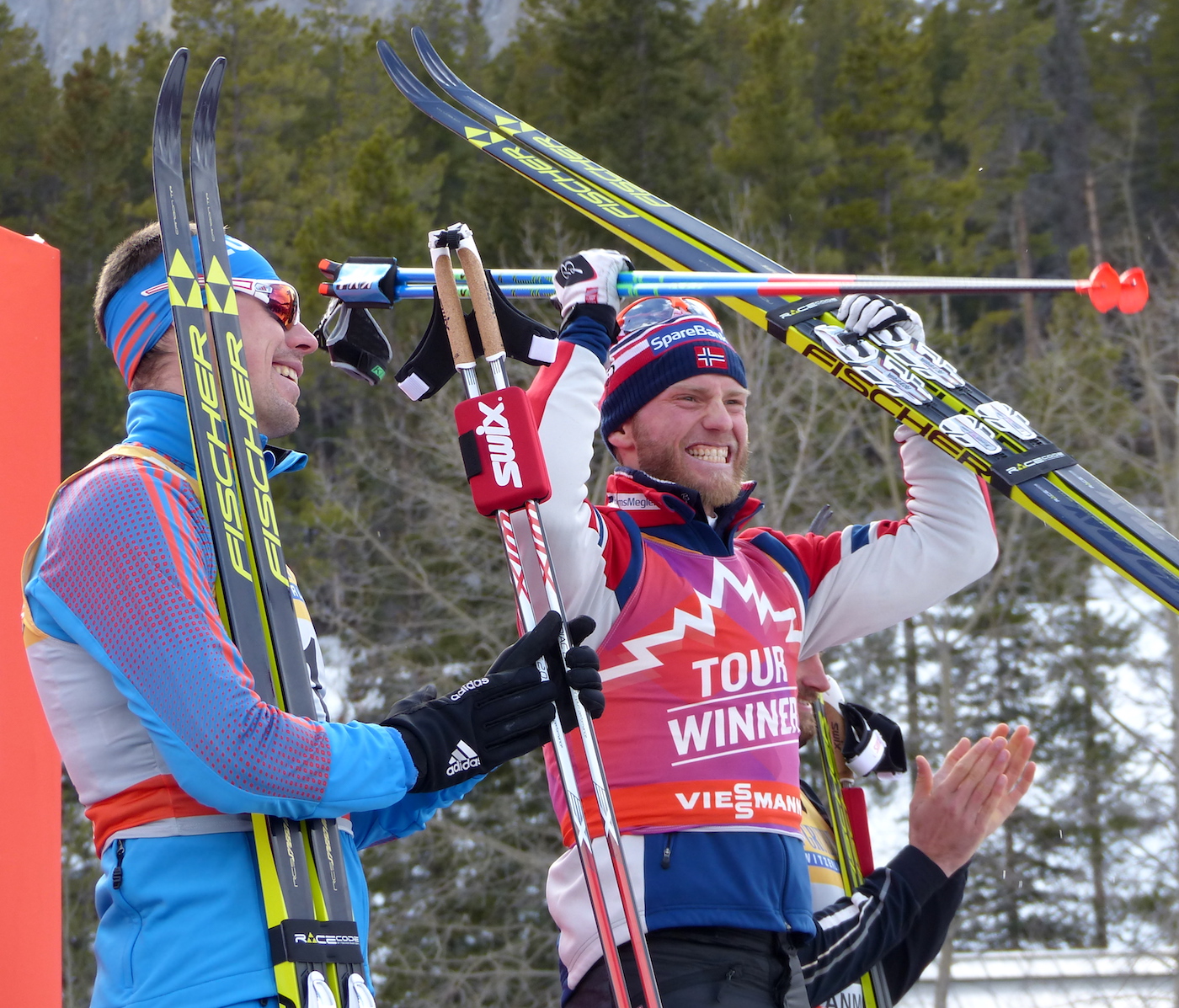
The men’s 15 k classic pursuit podium: Russia’s Sergey Ustiugov, Norwegians Martin Johnsrud Sundby and Petter Northug Jr., (l-r).(Photo: Fischer/Nordic Focus)
Growing a more global cross-country World Cup brand and bridging across the Atlantic is an idea Sundby endorses, but with some constraints.
“We can’t do this traveling every year, but we have to push it out, like one season or every other season, we need to come here,” he said. “We need to promote, we can’t be every fourth year because we need to sell the sport in this part of the world. I think we have found a good solution. After all, people think of this as a success. Like Tour de Ski, Ski Tour Canada will go out as a success.”
And so will Sundby’s season. With the overall and distance globes locked up before the final stage, Sundby had only the STC overall to take before his flight back to Oslo. But making up 39 seconds on an emergent Ustiugov, even Sundby had his doubts.
“After seeing the women’s race [where Johaug caught Weng for the win after starting 30 seconds back] I actually knew it was quite a big advantage to start behind,” Sundby said. “I knew that we were going to take seconds on Ustiugov, I didn’t know how many. I was a bit surprised we catch him early I reckon we had to go at least two or 2.5 laps before we were able to completely catch him.”
Northug and Sundby skied together, eventually catching the Russian. “I tried to go as soon as possible just to psyche him out,” Sundby said.
Saturday, Sundby awoke thinking he’d be doing work on Northug’s behalf.
“Actually this morning I didn’t think I had the chance. I felt like crap. I felt sick, and I told Petter this morning I was going to ski for him if we were be close to Ustiugov,” he recalled. “I had to give a big push just to get him up to Ustiugov and and then he could fight for the win because I didn’t feel good at all. But as soon as we started, it was a totally different story and my body felt good, skis were amazing, I felt this is definitely possible. I just went for it.”
When Sundby goes for it, few can keep pace. Northug quickly fell off and then it was Ustiugov’s turn to get distanced. Northug ultimately finished third, but his spin on the stage and the Tour was positive.
“It’s a been a great Tour and it’s been many good races for me in this Tour,” he said. “I am happy with Tour and the overall. I didn’t have the best skis today so it was difficult to follow Martin and Ustiugov in the easier part, so when I don’t have the best skis, it is impossible to win. I tried to fight hard for third place.”
On a final note, Northug was asked about his beard.
“I don’t know how long I will wear it,” Northug said. “Maybe it is gone today or tomorrow. We will see.”
Like Northug’s goal of standing atop the STC overall podium, the beard may be fleeting too.
The American scene
Noah Hoffman (U.S. Ski Team) during the 10 k classic at the World Cup last month in Falun, Sweden.
“I’m very encouraged with the way this tour ended,” U.S. Ski Team Women’s Coach Matt Whitcomb said.
For the U.S. men’s team, Noah Hoffman finished it out as the top American in 34th overall.
“Forty-seven minute 15 k, it was hard,” Hoffman said after the race. “I felt pretty good, like yesterday which is a step in the right direction. The season’s is over, time to rebuild, I am definitely looking for more. This tour and the year were good enough to keep me going, I want to go work way harder and get way better and come back and be competitive.”
Hoffman’s offseason starts with the upshot that he skied the 19th fastest time on the day. “I was pleasantly surprised to find myself in the top 20. I didn’t realize the wave was moving faster than many of the top-10 guys,” Hoffman wrote in an email afterward.
“Our guys skied a really strong race,” Whitcomb said. “They all started in the wave and all pushed the pace of the wave for a few laps. When the pace eventually turned up on lap three, unfortunately it was only Noah who was able to hang.”
Fellow U.S. Ski Team (USST) member Erik BjoBjornsen (APU/USST) was 42nd, Scott Patterson (APU) 46th, and Tad Elliott (SSCV) 51st.
For Canada, Michael Somppi (NDC Thunder Bay) was 49th, Canada’s Kevin Sandau (AWCA) was 43rd, and Russell Kennedy (Canmore Nordic) 50th.
Norway’s Martin Johnsrud Sundby (l) and Russia’s Sergey Ustiugov (r) leading the field out of the start of the men’s 30 k skiathlon at Stage 6 of the Ski Tour Canada in Canmore, Alberta.
CANMORE, Alberta — The sixth stage of the Ski Tour Canada (STC), the men’s 30-kilometer skiathlon on Wednesday, was a perfect storm of altitude, massive climbs and warm conditions. Some skiers faltered, moving back in the Tour’s overall standings, others took advantage of the make-or-break stage and seized the day.
Entering Wednesday’s race, Martin Johnsrud Sundby of Norway sat in fourth overall, 1:55.3 minutes behind STC leader, Sergey Ustiugov of Russia. Afterward, he had cut that nearly two minute gap in half.
The overall World Cup leader as well as Distance World Cup leader, Sundby won the skiathlon, which moved him up to third in the STC standings, 1:04.5 behind Ustiugov — who still wears the red bib as the Tour’s overall leader.
Norway’s Martin Johnsrud Sundby leading out of the final downhill and into the stadium for the skiathlon victory on Wednesday in Canmore, Alberta. He beat Russia’s Sergey Ustiugov by 2.8 seconds and Finland’s Matti Heikkinen by 3.7 seconds. (Photo: Peggy Hung)
A full-on sprint down the finishing stretch, which would determine the podium, resulted in Sundby beating Ustiugov by 2.8 seconds, throwing his arms up at the line as he did so. Finland’s Matti Heikkinen was 3.7 seconds back in third after recovering from a back injury and a subsequent slow start to the season.
Sundby’s finishing time of 1:16:29.7 hours, set the baseline from which other Tour contenders were compared. Ustiugov withstood the Sundby challenge. Others weren’t so lucky.
After placing sixth in the Stage 5 classic sprint, another Norwegian, Petter Northug Jr. remained second in the Tour, just 19.5 seconds behind Ustiugov. On his best days, Northug could likely diminish that margin, but that wasn’t the case for the skiathlon. Northug placed 11th (+17.6) on Wednesday, and lost valuable time to Ustiugov. The wily Norwegian is still second overall, but now trails the 23-year-old Russian — the World Cup’s newest all-around star — by 47.3 seconds..
“He has shown really good shape the last races and [Ustiugov] proved again that he is really strong,” Northug told FasterSkier after the skiathlon. “And he is now the favorite to win this tour, and yeah, for me it is just try to attack everyday.”
Two stages and 30 k total remain; a 15 k freestyle individual start on Friday and a 15 k classic pursuit on Saturday. Two days for Northug’s attack to manifest and two days for that 47.3 seconds to vaporize.
“The strategy is to try and attack on Friday and we will see what happens,” Northug said.
With the individual start on Friday and a pursuit on Saturday, formats where team tactics aren’t favorable, Northug admitted the STC crown will be his alone to earn.
“It’s two individual races. It is just to do the work by yourself,” Northug said.
Emil Iversen, another Norwegian who felt the effects of Canmore’s über climbs during the skiathlon, fell back in the standings. Iversen finished in 17th, 1:28.8 behind Sundby. Iversen had entered the race in third overall (+1:10.1), but 30 k of combined classic and skate skiing later, and he dropped to fifth (+2:53.1).
Iversen’s misfortune was good for another skier, namely Canada’s Alex Harvey, who leapfrogged from fifth to fourth overall (+2:51.0).
Harvey benefitted from what most racers described was an absolute grind of a course.
“It was a tough day especially in the skate,” Harvey said in a post-race interview. “Martin started pushing hard from the beginning. I was hoping that one of the guys in front of me would have a rough day and it happened to be Iversen. It moved me up to fourth place. The top three is far now, there is not much I can do about it. They can always have a really bad day but that’s beyond my control. So now I am just focusing on staying in the the top five.”
A Sum of Its Parts
The STC has eight stages over 12 days. And as part of the whole, Stage 6 was a doozy. From the outset of the classic leg, skiers were popped off the back, others were mired in the middle, while a select crew up front dealt with a searing pace.
Sundby played it smart near the front. He surged when needed and sat quiet in the draft at times. He won two 15-second time bonuses during the classic leg and another during the skate leg.
“It was a tough race actually, tough conditions,” Sundby said in the press conference.
For most of the classic leg, a large group of about 30 skiers remained together.
“Usually in these tracks in Canmore we are one big pack. It is difficult to ski ahead,” Sundby commented.
Canada’s Alex Harvey (l) and Ivan Babikov take control of the pace during the second half of the 15 k classic leg in Wednesday’s 30 k skiathlon at the Ski Tour Canada Stage 6 in Canmore, Alberta.
On the third of four classic laps, up a massive-and-decisive climb, Canadian World Cup Team members Ivan Babikov and Harvey set the tempo up front.
“Babikov went ahead of Alex,” Sundby told FasterSkier when asked about the Canadians’ move.
At first glance, it appeared the duo were possibly slowing things down, perhaps keeping Sundby and company from breaking things apart. Sundby said he thought that was not the case.
“I think the strategy was to keep a high speed,” Sundby said to FasterSkier. “I think Babikov offered to Alex there to increase the speed. Maybe some of the other guys felt it was too hard, fell off. It was difficult to pick up too much seconds in the classic track today, so they did an effort. It wasn’t able to get rid of too many guys.”
“We didn’t plan,” Harvey said after the race. “But when you see one of your teammates in the front, I was telling him where to go — go for the fast snow in the classic over the top and of course, go outside. I was shouting to him like what I thought was the best line. We tried to help each other.”
“We didn’t plan, but when you see one of your teammates in the front, I was telling him where to go … We tried to help each other.” — Alex Harvey on leading the pack in Wednesday’s skiathlon with Canadian teammate Ivan Babikov
Canadian Head Coach Justin Wadsworth explained the team’s strategy was plastic. In other words, they should see how the race plays out.
“We didn’t talk about that at all,” Wadsworth said of Harvey and Babikov leading. “Generally if the skis are good and you are feeling good and the pace doesn’t feel crazy, I think it’s actually not a bad place to ski. I am sure they were chilling out and just staying out of trouble, too, with a pack of thirty guys … anything can happen. You clip a pole, get hooked on a downhill, it’s not a bad plan to be skiing out in front.”
Sundby told FasterSkier that gaining time on the classic leg was a burden he chose not to pursue.
“Certainly the conditions today, it’s not easy to be first, it’s better to have a bigger speed from behind,” he said. “In the classic tracks, it’s 1.2 kilometer to the top of the big climb and from there it’s almost downhill to the stadium. If you have some seconds on the top, you always get flashed by everyone from behind. So it’s a difficult track to increase so much time.”
If you were following the race and the time splits with it, Sundby’s words rang true. A big group of skiers headed into the transition at 15 k vying for the lead. As the skate leg began, 10.3 seconds separated first from 27th place.
Sundby followed by Ustiugov, Harvey and Italy’s Federico Pellegrino (l) breaking apart the skate leg into a 12-skier pack during the men’s 30 k skiathlon at Stage 6 of the Ski Tour Canada in Canmore, Alberta.
The skate leg broke things apart further. Skier by skier, racers were winnowed from the front pack.
By 20 k in and 10 k remaining in the skate portion, a pack of 12 skiers remained up front. They included the three skiers that would eventually reach the podium — Sundby, Ustiugov, and Heikkinen — but also Norway’s Finn Hågen Krogh, Didrik Tønseth, Hans Christer Holund, and Northug. Two skiers sporting Canada’s red-and-white and maple leaf, Harvey and Babikov excited the home crowd with their possibilities.
With two k to go, those twelve skiers kept together — no one playing the roulette wheel of chances and sprinting ahead early. In the final moments, the man with the yellow bib marking his lead in the World Cup overall, Sundby, defined the day as his with the win.
“I thought that after the sprint yesterday that Sergey was going to be a bit more tired,” Sundby said in the press conference. “But he is so strong this tour and it’s impossible to gain too much seconds on him. I am happy about the race, a good team performance. We had a lot of Norwegian guys up there.
“We have only 30 k’s left. One race on Friday, one on Saturday,” Sundby added. “Everything is possible. But I need an amazing day on Friday, I think. Fifteen k skating is going to be decisive. I need a miracle, but it’s still possible to win this.”
“I need a miracle, but it’s still possible to win this.” — Norway’s Martin Johnsrud Sundby, third in the Ski Tour Canada, 1:04.5 behind Russia’s Sergey Ustiugov in first, with two stages to go
Ustiugov was calm and succinct in light of his lead.
“It was a good race for me,” he told FIS afterward. “I picked up a few bonus seconds. I am still in a lead of the Ski Tour. There are two important competitions left ahead and I have to stay focused.”
In another post-race interview, Finland’s Heikkinen told FIS he was satisfied with his result and his long return to form.
“It has a been a while since I was on the podium,” said the 32-year-old Heikkinen, who last placed third in a World Cup skiathlon in January 2015 in Rybinsk, Russia. “I had problems with my back in the autumn so it is great to be third today. I have had good results at the Ski Tour Canada. It is a positive sign for me. I need some good months of summer training and I believe I will be back 100 percent next winter.”
The Home Team
Ivan Babikov skiing to a season-best 10th in the Ski Tour Canada’s Stage 6 skiathlon in Canmore, Alberta. (Photo: Peggy Hung)
The stats reveal a solid day for the Canadian men: Harvey finished seventh (+7.6), Babikov captured a season-best 10th (+16.9), Graeme Killick (Canadian Senior Development Team) notched 19th (+1:34.2) to tie a career best, and Devon Kershaw (Canadian World Cup Team) placed 24th (+2:14.2).
“Anytime you get two in the top 10 it’s good and three in the top 20,” Wadsworth said. “So it’s definitely probably the best team distance race of the year today. It was good, I was really happy with it all around. I’m sure Alex wishes he were a little bit further ahead at the finish, but still pretty solid for the overall.”
Knowing your assets and mining them for success is something the Canadians saw play out on Wednesday.
“We know these courses really well,” Wadsworth said of the team’s home base, with the high-performance center (Bill Warren Training Centre) nearly adjacent to the Canmore Nordic Centre.
“Especially how the classic course is so tough here and we did a lot of intensity on it. We skipped Lahti [the last weekend of European World Cup races] and did a pre-camp. We did a couple of intensity sessions right on the courses and focused how to technically ski the big uphill and make sure they are standing up, getting really good pressure on the ball of the foot … So just small things like that. I feel like we have an advantage and we have really trained focusing this whole year on these, mainly on these four races here in Canmore.”
That focus paid dividends and Babikov was a huge beneficiary.
“I know this course like the back of my hand,” Babikov said. “I’ve been training on this, like, summer and winter every year. I just tried to stay with the group, tried to control the pace and fortunately I had a really good classic leg. On the skate leg, at the end my arms started cramping up, but I am super happy with the effort and the results.”
Babikov improved to 17th overall (+7:45.7) in the Tour.
Here in Canmore, it’s been showtime for the Canadians.
“The real money starts getting paid out here in Canmore with today as the crux,” Wadsworth said.
Canada’s Graeme Killick (c) skiing with Norway’s Niklas Dyrhaug and France’s Jean-Marc Gaillard. Killick finished 19th, tying a career best (from the 50 k classic at 2015 World Championships). (Photo: Peggy Hung)
Matching his best career World Cup result was 27-year-old Killick.
“It was good, a really a fun course on a beautiful day,” Killick said. “We had great skis as usual. It was just really fun to ski with such a good group of guys. I started out a little slow as I planned and kind of made up a few positions throughout the race. So pretty happy with my result overall.”
Killick moved into 27th overall (+10:34.1). “I didn’t expect that starting in 46th today,” he said. “It’s great news and good to be coming back every day a little bit from Montreal. That was kind of disaster for me. It is awesome.”
Kershaw was the fourth North American in the points. His 24th place on a brutal day has him 18th overall in the STC (+8:00.3).
At the exchange Kershaw remained in the game, only 4.8 seconds out.
“I felt really good in the classic,” Kershaw said. “My legs cramped on me pretty bad right after the exchange. So the skate was really difficult for me. But it was a great day for the team, so I am happy for the other guys.”
He explained that cramping so early in the skate was a problem he had to gradually temper.
“It’s hard mentally, but you have to try and get it out of your mind. That’s when skiing proper technically or as best as you can to limit the losses is important. The last 15 k I really struggled, it’s too bad because I felt good today.”
Two stages to go and Kershaw is looking ahead.
“It will be a battle,” he said. “I am really looking forward to Saturday. The 15 k classic is my favorite event and I’m going to be really tough in the 15 k skate. Hopefully I can get a ride or something because this course is punishing.”
The skiathlon was a setback for the U.S. None of it’s men finished in the points: the top 30.
“Rough for the guys,” U.S. Ski Team Head Coach Chris Grover said. “To have a 30 k skiathlon at this point so far into a tour and to have such soft conditions on such a hard course made it tough … Noah not happy with his race. Erik not happy with his race. I don’t think any of the guys that did move through today were really happy about their performance. But two days from now is a new day and we can have some good skate races”
American Noah Hoffman (43) racing to 35th in the men’s 30 k skiathlon, a best for the U.S. men in the sixth stage of the Ski Tour Canada in Canmore, Alberta.
Noah Hoffman posted the best U.S. men’s result in 35th place (+4:21.9).
“Really hard course. I was hoping for better honestly, but I don’t know, two more opportunities,” Hoffman noted. “It’s one of the harder courses we race all winter. It’s very comparable with the hardest courses like Kuusamo and Sochi and Val di Fiemme and Oslo. I mean, this is a world-class venue, a world-class course and I love being here.”
Hoffman said he stayed true to his plan and didn’t redline early on.
“I executed my plan of staying within myself on the classic and had pretty good energy left on the skate. Overall I just wasn’t where I wanted to be, but I skied the way I wanted to,” he said. “Individual start skate race is obviously a great opportunity for me and I’m looking forward to that on a really hard course.”
Erik Bjornsen began the day optimistically in bib 31. But his first words in his post-race interview tell his story.
“It was bad,” Bjornsen said after placing 49th. “I just didn’t feel good and was out of it from the beginning. It was hard and I was moving slow. I can ski with those guys, I just wasn’t on it today. I can’t really explain why.”
Recently Bjornsen has been on a streak popping top 30’s.
“The last month and a half has been great for me, so maybe I’m not ready for the altitude or something, I don’t know,” Bjornsen said. “I started in 31st so it’s been a great Tour for me so far. I posted my best sprint race in Quebec so I think that I’m a strong Tour skier. I went through hand surgery last year and that maybe has something to do with the inconsistency this year, but I just hope to get stronger year to year and I’d love to be a Tour skier in the future.”
American Erik Bjornsen leads Canada’s Russell Kennedy during the third lap of the freestyle leg in Wednesday’s 30 k skiathlon at Stage 6 of the Ski Tour Canada in Canmore, Alberta. (Photo: Peggy Hung)
For the Americans, Scott Patterson, of Alaska Pacific University (APU) was 55th, and Tad Elliott (Ski & Snowboard Club Vail) was 58th and will go on to race the remaining two stages. Eric Packer (65th), Reese Hanneman (67th) and Brian Gregg (68th) were lapped, thus ending their Tour.
Grover spoke of the disappointment those lapped skiers feel.
“The tough thing is that the finish of the classic course was the same as the finish of the skate course, and that last, whatever 0.8 kilometer, one kilometer, is together, so they stopped those guys before they were even able to switch over to skate,” Grover said. “Really disappointing for those guys.”
Seven other Canadians stayed in the Tour, with Kevin Sandau, of the Alberta World Cup Academy (AWCA) in 40th, Lenny Valjas (Canadian World Cup Team) in 46th, Knute Johnsgaard (AWCA/CNST) in 47th, Russell Kennedy (Canmore Nordic) in 52nd, Andy Shields (NDC Thunder Bay) in 53rd, Michael Somppi (NDC Thunder Bay) in 54th, and Patrick Stewart-Jones (AWCA) in 57th.
Bob Thompson (NDC Thunder Bay) was lapped for Canada, ending his run in the Tour and placing 62nd on the day. Simon Lapointe (Skinouk) did not start.
Racing continues Friday with Stage 7 of the STC, an individual 15 k skate.
— Gabby Naranja, Gerry Furseth, Alex Kochon and Harald Zimmer contributed
Russia’s Sergey Ustiugov held strong for a 17.7-second win in the men’s 15 k freestyle pursuit on Saturday at the fourth stage of the Ski Tour Canada. He will keep the lead heading to the second half of the Tour in Canmore, Alberta. (Photo: FlyingPointRoad.com/NNF)
Sergey Ustiugov is getting used to skiing from the front. After winning the opening sprint of the Ski Tour Canada (STC), the 23-year-old Russian has yet to relinquish a spot on the podium through four stages.
Despite the best efforts of the Norweigian duo, Petter Northug Jr. and Emil Iversen, nipping at his heels in Saturday’s 15-kilometer freestyle pursuit in Quebec City, his streak continues.
Starting alone and with a 17-second advantage on second-place Northug, Ustiugov’s race was a solo effort. Behind him it was two pairs of chasers that provided the fuel for the crowd on Saturday. The first of Northug and Iversen, gritted their teeth and tried to track down Ustiugov. The second pair, with local celebrity Alex Harvey and overall World Cup leader Martin Johnsrud Sundby, started the day in fourth and fifth respectively. They both appeared energized, charging over the hills of the Plains of Abraham, intent on knocking some time out of their gap to third place.
Petter Northug (r) leads fellow Norwegian Emil Iversen during the men’s 15 k freestyle pursuit on Saturday at Stage 4 of the Ski Tour Canada in Quebec City. After starting second and third, respectively, they finished in that order, 17.7 seconds and 1:02 minutes behind the winner. (Photo: John Lazenby/Lazenbyphoto.com)
Opposite to the previous distance stop in Stage 2 in Montreal, racers enjoyed hard-packed snow conditions. The four-lap course, nestled on a steep bank overlooking the St. Lawrence Seaway, tested the toughness of racers by incorporating both the steep climbs of the third stage’s sprint course and several more drawn-out climbs. Combined with the time change, travel to Canada, a tough sprint the day prior, and the end of a long season of racing, many racers appeared weary.
“It was a very hard race today,” Ustiugov told reporters through a translator at a post-race press conference. “I was little bit afraid that Northug and Iversen are coming closer. I am happy I could keep the pace high and that I could go for victory.”
Northug echoed Ustiugov’s statements at the press conference, saying that although he is “starting to get the rhythm that I have back in Norway … Everyone is starting to get tired.” Although the racers will have a break from the action until a classic sprint on Tuesday, the next venue at the Canmore Nordic Centre in Canmore, Alberta is at an altitude of 4,600 feet. Saturday’s pursuit at sea level was all about making the last four races of the Tour a little easier by gaining valuable seconds.
Northug and Iversen planned to work together in their attack on Ustiugov’s lead. However, after two laps, the gap between Northug and Iversen went from two seconds at 8 k to nearly 18 seconds at 10.7 k.
Iversen explained after the race that he could not keep up on the third and fourth lap, and he struggled to get across the finish line.
“… My body wasn’t fresh enough today, so it was rough on lap three and four, and for me to get to the finish line,” he said.
Despite a tough day, he was excited to stay in third overall in the Tour.
“I am satisfied to sit here with the big number three, but it was a hard day today,” he said.
After dropping Iversen on lap 3, Northug stayed consistent and within reach of Ustiugov, but appeared to lack the gear necessary to reel in the Russian. Northug explained that he went into damage-control mode on the final lap.
“I felt good and tried to attack Ustiugov, but in the last lap it was just about not losing seconds on Ustiugov,” Northug said.
Canada’s Alex Harvey leads Norway’s Martin Johnsrud Sundby during the men’s 15 k freestyle pursuit at Stage 4 of the Ski Tour Canada in Quebec City. Harvey went on to place fourth, 1 second ahead of Sundby in fifth. (Photo: FlyingPointRoad.com/NNF)
Behind him, another race unfolded to determine the fourth and fifth positions.
As Iversen faded, he had to be aware of the two guys closing in on him. Even if he couldn’t see them, the roar of the crowd following Harvey and Sundby was deafening enough that Sundby gave the crowd a shout out in a pos- race interview: “I didn’t hear my coach one time today due to the home crowd. Kudos to the home crowd!” he said.
The reason the crowd followed Sundby was because his counterpart for the majority of the day was local favorite, Harvey. While Sundby started fifth, 17 seconds after Harvey in fourth, the Canadian’s strategy for the day would be to cling onto Sundby, the defending Tour de Ski and overall World Cup champion, when he inevitably made his way forward.
Canadian National Team Coach Justin Wadsworth said that this strategy worked to near perfection.
“For Alex, it was about as good as we could have hoped,” he said after the race. “The perfect strategy worked out. We were pretty sure Sundby was going to catch him, so having Sundby catch him and not Finn Hågen [Krogh in sixth], while also moving up to Iversen.”
Alex Harvey started fourth and held his position in the Ski Tour Canada on Saturday in the Stage 4 men’s 15 k freestyle pursuit in Quebec City. (Photo: FlyingPointRoad.com/NNF)
As the tour heads west, Harvey remains in fourth, 52.6 seconds away from Iversen in third and the podium with it. Harvey is 2:04.8 out of first.
Sundby told reporters he enjoyed skiing with Harvey.
“It was really cool for me to ski with him today,” the Norwegian said. “I tried to do my best and move us up the result list to take some seconds from the leaders.”
And take some seconds they did. Sundby, Harvey and Norway’ Krogh started the day in fourth (+1:57), fifth (+2:14), and sixth (+2:27), respectively, behind Ustiugov. By 4 k in, Sundby and Harvey paired up, and trailed by 2:02.5, followed by Krogh another 10 seconds later.
At 8 k, still skiing together, they cut their deficit to 1:58.5. It was only four seconds less than at 4 k, but at this point Iversen hit a wall and began to lose time, while Krogh exploded backwards, dropping nearly a minute behind Sundby at 10.7 k.
Up the final climb and down the finishing stretch, Harvey led Sundby to finish in fourth. Sundby, en route to laying down the fastest time of the day, led Harvey throughout the majority of the course. After the race, each commented on the other’s workload.
“He knew I’m a better sprinter than he is, but he also did most of the work today, “ Harvey said of Sundby. “He’s the one wearing the yellow overall leader’s bib and he’s [been] the best for three years, so it’s up to him to do the work. A good day for me is to be able to follow him.”
According to Sundby, a man who verified after the race that he trains up to 1,100 hours a year because he’s “not the biggest [natural] talent,” he did most of the pulling throughout the race.
“I asked him if he wanted to do some work on the last lap, but he said, ‘no man!’ ” Sundby recalled. “I reckon on the last uphill that I have to let him take the finish now because we are in Canada, in Quebec, and he is the prince of Quebec.”
“I reckon on the last uphill that I have to let him take the finish now because we are in Canada, in Quebec, and he is the prince of Quebec.” — Norway’s Martin Johnsrud Sundby on skiing with Quebec native Alex Harvey for most of the 15 k freestyle pursuit on Saturday
Either way, both took advantage of the tough days of Iversen and Krogh. While the top-two podium spots appear almost out of reach 2:04.8 and 2:05.8 back for Harvey and Sundby, both are within striking distance of third-place Iversen, who now sits a distant 1:12.2 back from Ustiugov.
When questioned about his slow start to the tour, Sundby blamed the sprint races and the tough conditions in Montreal.
“I had a really bad start for this tour, two bad sprints,” he said. “I am not the best sprinter so I reckoned to be some seconds behind after the three first races, but I lost too much in the classic mass start.”
To make up for his slow start, he plans on throwing everything he’s got at the final races in Canmore.
“At the moment we are too far behind [to win], but I think anything is possible,” Sundby said. “I will go to Canmore with that state of mind. I will go all-in in every distance; I have to. I’m not afraid of dying in the last couple races. I just have to go.”
Harvey, again following the same thinking as Sundby, said that now the podium on home soil is once again within his grasp, “Right now, I’m not thinking of Northug, I’m more focused on catching Iversen. The podium remains possible.”
As the tour heads West, Harvey and fellow Canadian World Cup Team member Devon Kershaw stand as the only two North American males in the top 30.
Catching up with Kershaw after the race, he expressed disappointment in Saturday effort despite only losing one place to finish in 21st (+4:22.8): “It was a bit frustrating with the wave starting so close to my little group,” he said. “That gave that giant pack a free 18 seconds.”
Finishing two spots behind Kershaw in 23rd and moving up from 31st place was Finnish skier, Matti Heikkinen, who blazed the second-fastest time of the day. Sweden’s Marcus Hellner rounded out the top three for time.
Erik Bjornsen leads fellow U.S. Ski Team member Noah Hoffman during the men’s 15 k freestyle pursuit at Stage 4 of the Ski Tour Canada in Quebec City. (Photo: FlyingPointRoad.com/NNF)
The top American, Erik Bjornsen, started 28th but fell outside the top 30, finishing in 32nd (+5:28.3). After the race he discussed his strategy as similar to a mass start pacing, trying to stick with a group and move up that way.
“It was all right. I’m not super happy with it. I made a surge on the third lap and paid for it,” he explained.
Despite the frustration, Bjornsen said he looks forward to racing in Canmore because his family is easily able to make the trip from their home in Washington’s Methow Valley to come watch.
Following Bjornsen was Canada’s Ivan Babikov in 35th place, not gaining or losing any spots on the day. Babikov aimed to “stay in the group and stay away from trouble,” however he said he crashed on lap two thus spoiling his strategy.
Other North American men in the top 50 included sprint specialist and second-place finisher from the first stage, Simi Hamilton (U.S. Ski Team) in 40th, followed by teammate Noah Hoffman in 44th, and Canada’s Graeme Killick in 49th.
The last stops on the tour all take place in Canmore at the Canmore Nordic Centre, home of the 1988 Olympic nordic events. The final sprint of the season will be the next event, a classic sprint on Tuesday.
After adding the five-second sprint bonus, which Ustiugov also won on Saturday, the overall tour top-five in the Tour are: 1. Ustiugov, 2. Northug (+22.7), 3. Iversen (+1:12.2), 4. Harvey (+2:04.8), and 5. Sundby (+2:05.8).
Looking toward the second half of the Tour, first and second place appear decided between Ustiugov and Northug; however, Sundby is not ruling himself out.
“I need some miracles in Canmore, but I believe in miracles, so anything can happen!” he said.
Other North American finishers include Scott Patterson (USA) in 53rd, Kevin Sandau (CAN) 57th, Len Valjas (CAN) 63rd, Andy Shields (CAN) 65th, Patrick Stewart-Jones (CAN) 66th, Michael Somppi (CAN) 67th, Eric Packer (USA) 68th, Jess Cockney (CAN) 69th, Knute Johnsgaard (CAN) 70th, Russell Kennedy (CAN) 71st, Reese Hanneman (USA) 72nd, Bob Thompson (CAN) 74th, Tad Elliott (USA) 75th, Dakota Blackhorse-von Jess (USA) 77th, Matt Liebsch (USA) 79th, Brian Gregg (USA) 80th, Andy Newell (USA) 81st, Simon Lapointe (CAN) 82nd.
— Gerry Furseth and François Léger Dionne contributed
Norway’s 24-year-old Emil Iversen after winning his third-career World Cup race, and first distance race, at the second stage of the Ski Tour Canada on Wednesday: the 17.5 k classic mass start. (Photo:Flyingpointroad.com/NNF)
(Note: This article has been updated to include details about a crash involving Norway’s Martin Johnsrud Sundby early in the men’s classic mass start.)
Certainly it’s too soon for Norway’s Emil Iversen to tell his elders to move over. One of those elders is Norwegian teammate Martin Johnsrud Sundby, current overall World Cup leader. The other, Petter Northug Jr. is … Northug.
But at the second stage of the Ski Tour Canada (STC) on Wednesday, a 17.5-kilometer classic mass start in Montreal, Quebec, Norway’s 24-year old Iversen, strided, herringboned, and double poled to the win.
Exactly 45:05.4 minutes after the start, Iversen crossed the wind-swept finish line first, 5.3 seconds ahead of Northug. The overall leader of the STC and winner of Tuesday’s sprint, Russian Sergey Ustiugov, placed third (+14.5).
The start of the men’s 17.5 k classic mass start on the second day of the Ski Tour Canada in Montreal, Quebec. (Photo: Flyingpointroad.com/NNF)
At 23 years old, it was Ustiugov who first showed his fearlessness. Establishing a tempo and drive that 3.5 k in showed he was going to be the pace-setter — Ustiugov went on to dictate the pace for most of the race.
But at that 3.5 k mark it still could have been a number of skiers’ race to control. Strung out behind Ustiugov in a line were Norwegians Iversen, Sundby, Northug, Finn Hågen Krogh, Canada’s Alex Harvey, Norway’s Ola Vigen Hattestad, and Kazakhstan’s classic specialist, Alexey Poltoranin.
It must have been something subtle. Maybe an extra effort herringboning up the steep, sugary hills, or double poling with his burly core, but only a kilometer later, Ustiugov played for keeps. Only Iversen and Northug could hang on.
Sundby later told reporters that he had crashed early on an icy and curving descent.
“I went on my face,” he told NRK, according to a translation.
Slowly but surely, a gap back to Sundby grew. And as the moisture on Sundby’s beard began to freeze, so did his chances of bridging up to the leaders. At the 4.6 k mark, Sundby was 13 seconds behind.
“I lost a lot of time and then it was [over],” he said. “I’m not sure what to say. We are trying to showcase our sport, but today I am unsure what we were doing. Was it cross-country…?
“It was unusual conditions,” he added. “Fortunately, it was the same for all.”
As the moisture on Sundby’s beard began to freeze, so did his chances of bridging up to the leaders.
By 12.5 k, Sundby chasing in fourth was 18.2 seconds behind the trio of Ustiugov, Iversen and Northug. It remained a long day of trying to play catch up for Sundby, who toiled in no man’s land, chasing solo for the remainder of the race. Sundby finished fourth, 39.8 seconds behind the upstart Iversen.
It’s Northug’s signature tactic to let others set the pace until he marks the race with an exclamation point across the line. But Wednesday, Iversen, having grown up watching Northug’s bait-and-switch prowess over the years, left nothing for chance. With 1.5 k to go, Iversen began to stretch the rubberband back to Northug inch by inch. He had a 3.6-second lead on Northug, but even that small margin never vanished.
Norway’s Emil Iversen (l) and Russia’s Sergey Ustiugov (red leader’s bib) lead the men’s 17.5 k classic mass start at the second stage of the Ski Tour Canada in Montreal, Quebec, while Norway’s Petter Northug trails in third. Iversen went on to win, Northug placed second and Ustiugov took third. (Photo: John Lazenby/Lazenbyphoto.com)
When Iversen made his decisive move, he simply upped the pace and never looked back.
“In the fourth lap I saw Ustiugov was little bit tired,” Iversen said in the post-race press conference. “I decided to try and went for it 100 percent. I hoped I could get a gap and gain some seconds. My goal before the Ski Tour Canada was to have a good start. I’m sitting in second place. Now I have to take stage by stage and we see what happens.”
With his win on Wednesday, Iversen took his first ever distance World Cup victory and the third of his career. Iversen’s other two World Cup victories, both of which were sprints, also came this season.
Northug spoke about the trio out front and pushing an unrelenting pace.
“The plan was to stay in front of the field,” Northug said during the press conference. “After one lap it was only three or four guys in the lead. The pace was very high. We had to fight hard against the wind and snow. Ustiugov did a lot of work in the lead. He was the strongest today. We can thank him for the high speed.”
Ustiugov also acknowledged that he had taxed himself with the workload.
“It was a very tough race,” Ustiugov said at the press conference, through a translator. “I knew the guys behind me were fresher than me as I did all the work in the front, but I am satisfied with third place and be in the lead of the Ski Tour.”
With two consecutive podiums in as many stages so far, Ustiugov remains in first in the Tour standings, 6.1 seconds ahead of Iversen in second. Northug is third, 11 seconds back, and Sundby is nearly 1:40 minutes out of first in fourth overall.
Harvey in the Hunt
After two days of racing, both of which took place in his home province of Quebec, Harvey ranks sixth overall, 1:58.3 out of first, after placing ninth in Wednesday’s mass start (+1:16.4).
While racing the five laps of Montreal’s 3.5 k loop, Harvey appeared to be one of the few who could match the front runners’ pace. At 5.5 k, the Canadian skied in sixth, 14.5 seconds back.
Canadian World Cup Team member Alex Harvey (10) racing to ninth at the second stage of the Ski Tour Canada, the 17.5 k classic mass start in Montreal, Quebec. (Photo: flyingpointroad.com/NNF)
Again and again, it seemed Harvey would cover the breakaway. In an in-person interview afterward, Harvey said those efforts were exhasting.
“It was a drop in my energy.” Harvey said. “I tried closing the gap with the first three, but I exploded in trying to do so. I fought for the podium but the three guys at the front were out of reach. Ustiugov was really strong the first two laps. I paid at the end for my efforts.”
Harvey did ski wisely. He was close enough to the front to fight for the two mid-race time bonuses. Harvey took an 8-second time bonus at 4.6 k and a 2-second time bonus at 11.6 k.
Thinking more of the long-term than a one off race performance, Harvey said he is staying true to his STC plan.
“My fitness level is good and stable, which is important because you can’t win the Tour in one day, but you can lose it in one day,” he said. “The goal is to not loose the Tour on any day.”
The second best North American result came from fellow Canadian World Cup Team member Devon Kershaw, who began the day near the back of the pack in bib 50. Kershaw moved forward incrementally and by 5 k was skiing in 22nd place. He eventually skied across the finish in 17th (+1:38.9).
“It was a challenging day,” Kershaw said afterward. “Really soft snow, different conditions.”
Despite the less-than-ideal fresh snow and blustery wind, Kershaw appreciated the opportunity to ski in a city some of his family calls home.
“To race in front of friends and family here on the Island of Montreal is a pretty neat feeling,” he said. “It’s just so nice to have the home crowd behind you. My aunt and uncle live here, my mom and my brother live here as well. So I have a lot of family in the city. I heard their voices. It was pretty neat.”
In the points, and moving up on a day with tricky snow and biting wind, Kershaw remained positive.
“Seventeenth isn’t something we are going to be lighting fireworks off, calling everybody that I know,” he said. “But at the same time it’s a step in the right direction. I was pretty disappointed after yesterday so its better.”
Kershaw placed 50th on Tuesday’s freestyle sprint and now sits 17th overall.
A third Canadian World Cup Team skier in the points was Ivan Babikov in 29th (+2:32.1). Unlike Harvey, who started the day in bib 10 (meaning he had a good starting position heading into the courses steeply pitched and punchy climbs), Babikov wore bib 78. As a result, Babikov started near the rear in the field of 85 skiers.
When the day’s sinuous track kicked up on lap one, skiers had to herringbone some of the soft headwalls.
“There was actually a few places, mostly the first and second lap was the worst,” Babikov said on the phone after the race. “The course was just really interesting. I’ve never see something like that before.”
Babikov described quick downhills that pitched up into mandatory herringbone sections. Those sections created bottlenecks since the herringboning forced skiers to keep their skis wide.
“Oh yeah, like people crashing and tangling up all over the place,” Babikov said of the scene. “It also was really soft for the skis, so it created really like barely any track on the uphill where you could have strided … It was just a mess, broken poles, people falling down.”
Babikov explained that maybe the first five, 10 or 15 skiers could ski cleanly through, but not the main pack. On his first lap, Babikov said he felt like he waited thirty seconds for the mess of skiers to clear before pushing ahead.
When he finally did push ahead, he pushed hard. Of his jump from 78th to 29th place at the finish, Babikov said skiing conservatively wasn’t part of the plan.
“You have to take a risk today,” Babikov said. “Like, at times to pass people on the downhills. My body felt pretty good. I tried to pass people whenever I could.”
All that passing moved Babikov up in the overall standings. He now sits 33rd overall.
Canadian Head Coach Justin Wadsworth was pleased with the day’s result.
“It was actually a pretty solid day for us, three guys in the top 30, Alex in ninth, Devon in 17th and Ivan 29,” he said.
Wadsworth also spoke about the benefits of World Cup racing for a future generation of Canadian skiers.
“Today was an experience…,” he said. “For the younger athletes, it was a real eye opener. It was very hard conditions, with the wind and the snow and the course. I think our younger athletes, also arriving just last night … usually you get some time on the course ahead of time and there’s a ski warmup area and a testing area, and none of that happens here. Boom, you show up and you get ready to race on a race course your’ve never raced on at the highest level.”
Also for Canada, Graeme Killick (CNST) placed 50th, Kevin Sandau (Alberta World Cup Academy) was 53rd, Len Valjas (CNST) 63rd, Patrick Stewart-Jones (AWCA) 64th, Jess Cockney (CNST) 66th, Michael Somppi (NDC Thunder Bay) 68th, Knute Johnsgaard (AWCA/CNST) 69th, Bob Thompson (NDC Thunder Bay) 73rd, Russell Kennedy (Canmore Nordic) 74th, Andy Shields (NDC Thunder Bay) 76th, and Simon LaPointe (Skinouk) 82nd.
Bjornsen leads the U.S.
Erik Bjornsen (Alaska Pacific University/U.S. Ski Team) was the top American in 31st, just 0.4 seconds outside the top 30 and 2:37.3 behind the winner. In a post-race phone call, Bjornsen said he is feeling good after two STC stages.
Erik Bjornsen (USA) on his way to 31st place in the men’s 17.5 k classic mass start at Stage 2 of the Ski Tour Canada in Montreal, Quebec.. (Photo: Flyingpointroad.com/NNF)
“Coming into today I knew that I have been feeling pretty good lately, so I was hoping for a good result,” he said.
Bjornsen also noted the difficult herringboning and the likelihood for bottlenecks to develop.
“It went out at a pretty hot pace just knowing things were going to get strung out having such a narrow course like that,” Bjornsen said. “But I felt like I went out all right. I struggled a bit with the herringboning and felt strong on the double pole. I was not happy with being so close to the top-thirty. Definitely hoping for a little more in the next few stages.”
The STC is the second World Cup Tour for Bjornsen.
“In the last Tour I was right outside the top 40,” Bjornsen said. “It’s my goal this time to be closer to the thirties, but I think if I finish in the top 30 I would be very happy with my overall result. We will see how it goes, there is definitely a couple of good races for me coming up. If I could pop into the top 20 in one race that would be absolutely awesome.”
U.S. head coach Chris Grover discussed how the front-end racers escaped from the main group so quickly. Bottlenecks were a recurring theme.
“It was a pretty narrow course overall,” Grover said on the phone. “And in particular, the big longer herringbone hill was really only about one skier width … The packs got super strung out because the nature of the course but also because of the tough conditions. Once people got away from those that were trying to herringbone in the soft stuff, they really got away.”
Grover said those rough-an- tumble patches took a toll on both the U.S. men and women.
“We had a lot of broken equipment today,” he explained. “Just amongst our team, Ida Sargent broke a ski in a crash tangle-up right away. Brian Gregg broke a ski by having a binding rip off a ski. So it was definitely a challenging day.”
American Matt Liebsch (Gear West) waits for his good friend and training partner Brian Gregg (Team Gregg) to finish the men’s 17.5 k classic mass start at Stage 2 of the Ski Tour Canada in Montreal, Quebec. Gregg crashed and his binding ripped off his ski. (Photo: Flyingpointroad.com/NNF)
Gregg ultimately finished 81st.
“I had one pretty solid crash out there, which was certainly very frustrating but that’s part of racing,” Gregg said after.
Noah Hoffman (Ski & Snowboard Club Vail/USST) placed 42nd. He reiterated the tough course.
“It’s a really challenging course,” Hoffman said. “We were just standing still on the first lap, so often. It was so narrow, there’s so much herringbone. It was a challenge from way back off of yesterday’s finish.”
Also for the U.S., Scott Patterson (APU) finished 55th, Simi Hamilton (SMST2/USST) was 58th, Eric Packer (APU) 67th, Reese Hanneman (APU) 70th, Andy Newell (SMST2/USST) 71st, Dakota Blackhorse-von Jess (Bend Endurance Academy) 77th, Matt Liebsch (Gear West) 79th, Tad Elliott (SSCV) 80th, and Gregg (Team Gregg) 81st.
American Simi Hamilton during his “victory lap” after finishing in the top three of the men’s freestyle sprint at the Ski Tour Canada World Cup stage in Gatineau, Quebec. (Photo: John Lazenby/Lazenbyphoto.com)
For the men’s opening stage of the Ski Tour Canada on Tuesday, a 1.7-kilometer freestyle sprint, the end is the best place to start.
Adjacent a frozen Ottawa River in Gatineau, Quebec, those who withstood the -5 degree Celsius (23 Fahrenheit) cold, the tight corners, and the scrum-like jostling at the front of the pack went on to stand on the podium.
Russia’s Sergey Ustiugov won the speedy and tightly contested final in 3:09.36 minutes, proving it’s not over until it’s over — but more on that in a bit. Richard Jouve from France placed second, just 0.08 seconds back. But the big news for North America, U.S. Ski Team sprinter Simi Hamilton took third in a photo finish with both Ustiugov and Jouve. Hamilton was only 0.09 seconds behind Ustiugov and 0.01 seconds out of second place.
Hamilton: Waiting, Waiting, Then Pouncing
For the Aspen, Colo., native, Canada is as close to home-racing soil as he’ll get on this year’s World Cup. Considering he spends most of the offseason training with Vermont’s Stratton Mountain School (SMS) T2 Team, a long drive south, Hamilton came prepared for what he hoped would be a solid day in front of family and friends. And he didn’t disappoint.
In an in-person interview after the race, Hamilton, 28, explained the local support kept the stoke high.
“You always kind of want to play it cool and stay engaged and focused, but it’s so awesome when you run to the start or even when you are racing and you hear, ‘USA,’ and ‘Simi,’ ” Hamilton said. “I have a lot of friends and family out here. It’s just super cool to race so close to home and people are fired up. I think we are bringing a lot of good energy to cross-country ski racing on this continent, and it’s fun to be part of that movement.”
Simi Hamilton (U.S. Ski Team) racing to second in the men’s 1.7 k freestyle sprint qualifier on Tuesday at Stage 1 of the Ski Tour Canada in Gatineau, Quebec. Hamilton went on to place third in the final for his second podium of the season. (Photo: John Lazenby/Lazenbyphoto.com)
Hamilton’s effort in the qualifier made a statement. He wore bib 2 throughout the heats as a result of his second-place qualifying time. Fastest qualifier, Norway’s Petter Northug set the best mark in 3:12.99. Hamilton was a bit more than an eyeblink behind, finishing only 0.45 seconds back.
Quarterfinal 3, Hamilton’s heat, featured Norway’s Emil Iversenas a main threat — Iversen qualified fourth (+1.40). And in Lahti, Finland, the site of the last World Cup sprint, Iversen won out the day.
Clearly in good form again on Tuesday, Iversen led Hamilton’s heat like a greyhound chasing the unreachable rabbit — just go, go, go. Hamilton remained in the back, shifting from third to fourth and back to third. On a portion of the course where two small straights are linked by a horseshoe-shaped bend, Hamilton said he began to learn how the course could be exploited.
“Today I kind of figured out in my quarterfinal that it’s good to conserve energy in the middle of the pack or close to the back of the pack,” Hamilton said in the post-race press conference. “And then I knew that I was skiing that horseshoe climb really well all day today. So I knew that I could put a move on there and I knew that a lot of other people were kind of letting off the gas a little bit on that climb and around the corner.”
That’s where Hamilton began to move up and position himself for the final straight. Iversen took the heat win in 3:13.73, but Hamilton, who finished second (+0.35), took the best how-to-race notes.
Hamilton moved onto the second semifinal where Northug, Jouve, and Norwegian Ola Vigen Hattestad awaited.
With the flat light dulling the course, the star of the show appeared to be Northug. Sporting retro-looking mirrored sunglasses, Northug seemed ready for prime time. Having won his quarterfinal in iconic Northug fashion — never seeming to exert real effort yet moving faster than the others — he won out again in 3:13.38.
In that semi, Hamilton played the same hand as he did in the quarters, with slightly less stellar results. He remained in the pack. He conserved energy. He navigated a pushy and tightly packed group of skiers, but he left his chances up to a nail-biter sprint down the home stretch. But the semi proved to be the faster of the two semifinals, by just under a second. Hamilton placed third, 0.42 seconds back, but his time was fast enough for a spot in the finals.
Remember, Hamilton’s wore bib 2 for the day — a reminder to those around him how fast he had skied previously to reach the final. Lining up with Hamilton was a burly set of skiers, any one of which could take the day. There was third-fastest qualifier Ustiugov, the first semifinal winner Finn Hågen Krogh of Norway, his teammate Hattestad, France’s Jouve, and the ubiquitous Northug.
For the first two thirds of the final, it appeared Hamilton had given his best shot. Never in the front, and at times seemingly at risk of dropping off, the group seemed too congested for any skier to move up from the back. Nearly two minutes into the final, Hamilton remained in sixth place.
But Hamilton was playing it cool, knowing that his peers were used to shorter sprint courses over in Europe.
“I knew that if I played my cards right, I could throw some moves kind of in that horseshoe climb,” Hamilton said in the press conference. “It was going well all day and I just kind of banked on having that in my quiver for the final. So I focused on conserving my energy until then. And then tried to lay down as big a move as possible coming over that hill.”
Hamilton did make a move. But rather than appear decisive, it appeared to get him into a mix of skiers so closely clustered, all of them could end up a World Cup yard sale. Yet his positioning and timing worked.
“It was a long course today. It’s something that we don’t see too much on the World Cup these days,” Hamilton said. “Most of our sprints this year have been about 2:30, so to have a sprint over three minutes was really cool. I think you have to think about some different tactics that you can play. So I figured out that that was kind of one my main strengths on the course today, and I really just relied on that in the final, to be able to put a move in and get ahead of some people there [on the horseshoe].”
Russia’s Sergey Ustiugov (3) celebrates his win by mere hundredths of a second over France’s Richard Jouve (not shown) and American Simi Hamilton (2), who lunged across the line and placed third for his second podium of the season. Norway’s Finn Hågen Krogh placed fourth and Ola Vigen Hattestad (17) finished fifth, while Petter Northug was sixth. (Photo: John Lazenby/Lazenbyphoto.com)
Into the home straight, Hamilton came charging up along the fence to challenge Ustiugov in the lead.
The only thing clear at the finish was that the athlete with the biggest stretch would finish best. The race ended in a six-way photo finish with all six finalists within 0.72 seconds of Ustiugov.
Hamilton’s lunge at the line? That was good enough for third behind Ustiugov and Jouve, and ahead of three Norwegians.
“It’s great seeing the Norwegians win,” Hamilton reflected in the press conference. “They are incredible skiers, they come from an amazing skiing culture, but it’s pretty cool to be on the podium with people like Richard and Sergey. I think we are showing the rest of the world that this sport can be won by people other than the Norwegians and it’s fun to be able to be a part of that.”
Tuesday was Hamilton’s second podium of the season and third-career sprint podium.
“I think we are showing the rest of the world that this sport can be won by people other than the Norwegians and it’s fun to be able to be a part of that.” — Simi Hamilton, second in the freestyle sprint at the Ski Tour Canada in Gatineau, Quebec
Ustiugov’s Day
A word or two about Ustiugov is well worth a mention. Like Hamilton, the 23-year-old Russian played his tactics well, qualifying in third then winning his fast quarterfinal in a three-way photo finish. (His quarterfinal time bested the fastest qualifying time by almost two seconds.)
In his semifinal, Ustiugov broke a pole just after the start. Cooly, he power skated along until a Russian coach was able to hand him a new pole. On the longer-than-usual course, Ustiugov was able to eventually bridge back up to the leaders.
It also seemed like an aha moment. It was as if the pole break taught Ustiugov something that Hamilton had learned: conserving energy early pays dividends in the end.
By 1:49 into the semifinal, Ustiugov took the lead, despite his long-forgotten broken pole. He ended up second to Krogh in a photo finish.
In the final, Ustiugov hovered in the back of the pack, looking like an afterthought until late in the race.
“It was my tactical goal today,” Ustiugov said, according to a translation at the press conference. “In the quarterfinal, I also started very slowly. In the semifinal, I made a really fast start, and in the final again the same start like in the quarterfinal. So that was my tactic play today.”
The men’s freestyle sprint podium at the first stage of the Ski Tour Canada with Russian winner Sergey Ustiugov (c), France’s Richard Jouve (l) in second and American Simi Hamilton (r) in third. (Photo: John Lazenby/Lazenbyphoto.com)
Gatineau marked Ustiugov’s first sprint victory since Nove Mesto, Czech Republic, where he won his first World Cup (a freestyle sprint) in January 2014. Last month, he won the 15 k freestyle mass start in Falun, Sweden for his second individual World Cup win.
And on Tuesday, he outlasted five skiers in a photo finish for his third victory, with first through fourth being separated by just 0.13 seconds.
Just a toe behind the Russian winner was Jouve. His plan, unlike Ustiugov’s building pace, was to hang on for as long as possible.
“We had a good race tactic, from the quarterfinals all the way to the final,” Jouve said in the press conference. “We tried to stay at the front of the pack as long as we could.”
Asked about lining up with Northug in the final, Jouve said he convinced himself he belonged.
“It really impressed me being in the final, but I had to tell myself I was as good as any of the other finalists,” he said. “The French-speaking public was great and I want to thank all who cheered for me.”
Including the team sprint in Planica, Slovenia, this was Jouve’s third podium of the season.
The U.S.
U.S. Ski Team member Erik Bjornsen was the next-best American in 25th overall. He qualified for his first sprint of the season in 27th, 7.3 seconds behind Northug’s top qualifying time.
“It was fun to jump into the heats and mix it up a little bit,” Bjornsen told FasterSkier after his quarterfinal.
Initially, at the start of his quarterfinal (the fourth of five), Bjornsen led the pack.
“I was just feeling comfortable and I knew it was important to get a good spot and maybe I got a bit too comfortable out there,” he reflected. “And also I let one or two guys go thinking, ‘It’s going to be fine.’ ”
Bjornsen was knocked out of the competition when he finished fifth in his quarterfinal, 2.17 seconds behind Northug as the winner of that heat.
Bjornsen said he’s looking forward to the distance days to come, starting with a 20 k classic mass start on Wednesday in Montreal.
“Tomorrow and then Canmore, both those classic distance races I’m pretty excited for,” he said.
No other Americans qualified for the heats. Bjornsen’s Alaska Pacific University (APU) teammate Reese Hanneman placed 35th, Andy Newell (SMST2/USST) finished 42nd, Dakota Blackhorse-von Jess (Bend Endurance Academy) was 54th, Eric Packer (APU) 72nd, Noah Hoffman (SSCV/USST) 74th, Scott Patterson (APU) 75th, Tad Elliott (SSCV) 81st, Matt Liebsch (Gear West) 82nd, and Brian Gregg (Team Gregg) 83rd.
The U.S. notched a never-before-seen double podium with both an American man (Hamilton) and woman (Jessie Diggins) on the podium, as Diggins placed third in the women’s final.
“We are so proud of all the USA athletes today,” U.S. Head Coach Chris Grover said in a USSA press release. “It was really exciting to see Erik Bjornsen take his first sprint points of the season and finish 25th. … Once the heats began, both Jessie and Simi were masterful when it came to making space in which to pass their competitors. They made gaps open for themselves and timed their podium bids perfectly.”
It’s Good to be Home
Canadian World Cup Team member Alex Harvey, of St-Férréol-les-Neiges, Quebec, took advantage of the home field right from the go. He qualified 15th (+4.18) for his first time making the heats in a World Cup freestyle sprint this season.
Alex Harvey (Canadian World Cup Team) racing to 15th in the 1.7 k freestyle sprint qualifier at the first stage of the Ski Tour Canada on Tuesday in Gatineau, Quebec. Harvey went on to reach the semifinals for 11th overall. (Photo: Peggy Hung)
“It was a great start to the Tour. I felt really good out there as the day went on,” Harvey said in a Cross Country Canada press release. “I haven’t had much success this year qualifying in the sprint races so to be 15th was a good sign.”
In his quarterfinal, the first of five, it didn’t appear Harvey would advance until the final stretch.
“We had three of the fastest men pushing the pace in the quarterfinals,” Harvey said in a press release. “We get to pick our heats that we want to race in and I wanted that one because I knew it would be fast and a good chance to have a lucky loser spot.”
In a four-way photo finish, Harvey finished fourth, 0.29 seconds behind Ustiugov, the winner of the heat. Krogh automatically advanced in second (+0.01), while Hattestad in third (+0.27) and Harvey two-hundredths of a second behind him reached the semifinals as lucky losers.
Harvey did not advance beyond the semifinals, finishing sixth in the first semi (1.44 behind Ustiugov in first), and placed 11th overall. It was his second-best sprint of the season after placing seventh in a classic sprint last month in Stockholm, Sweden.
“I was better positioned in the semis, but I almost crashed in that final corner and it scrubbed my speed. That was it for me,” Harvey said on Tuesday. “I felt really good as the day went on. The crowd was awesome today and really loud so it was a great start.”
That great start was not Harvey’s alone. Canadian National Development Team athlete Knute Johnsgaard, in his second World Cup sprint, qualified 29th (+7.80). He ended the day 30th overall for his first World Cup points.
Johnsgaard told FasterSkier he tried to relax compared to his recent starts in Europe.
“I think I maybe waited a little better,” Johnsgaard said. “The last rounds I did in Europe would have been the OPA Cup in Planica, the week before the World Cup weekend. And I was … getting a bit too excited off the start that time. So I was just trying to relax this time until the second lap, and maybe make a move on the second lap. But unfortunately everyone is so strong … I don’t think it was much about tactics today, just the strongest skiers went through.”
Canadian World Cup Team member Len Valjas finished 37th, Andy Shields (Thunder Bay National Development Centre) placed 48th, Devon Kershaw (CNST) was 50th, Bob Thompson (NDC Thunder Bay) 52nd, Jesse Cockney (CNST) 53rd, Russell Kennedy (Canmore) 59th, Kevin Sandau (AWCA) 70th, Gatineau’s own Simon Lapointe (Skinouk) 71st, Graeme Killick (CNST) 76th, Ivan Babikov (CNST) 78th, and Patrick Stewart-Jones (AWCA) 84th.
The Ski Tour Canada continues Wednesday in Montreal with the Stage 2 men’s 20 k classic mass start, and a 13 k women’s classic mass start on an approximately 3 k loop.
— Gerry Furseth, Alex Slobodian, François Léger Dionne, and Harald Zimmer contributed reporting
Simi Hamilton with his mom, Ruth, after Hamilton placed third in the men’s skate sprint at Stage 1 of the Ski Tour Canada in Gatineau, Quebec. (Photo: John Lazenby/Lazenbyphoto.com)
Simi Hamilton (U.S. Ski Team) racing to second in the skate sprint qualifier at the Gatineau stage of the Ski Tour Canada. He went on to place third in the final. (Photo: John Lazenby/Lazenbyphoto.com)
Norway’s Martin Johnsrud Sundby celebrates his first-ever victory in the men’s 50 k mass start at the historic Holmenkollen World Cup on Saturday near his hometown of Oslo, Norway. (Photo: Fischer/NordicFocus)
“It’s always been a dream for me to win this race, from when I was nine years old and tenting in the forest, cheering for all the big skiers at the time,” Martin Johnsrud Sundby said in a post-race press conference after winning Saturday’s 50-kilometer classic mass start held at the historic Holmenkollen stadium outside of Oslo, Norway.
A perennial favorite at his home stadium in his hometown of Oslo, Sundby, landed on the podium in his four previous starts at the Holmenkollen 50 k, but the victory eluded him. Last year he finished third, half a second behind race winner and teammate Sjur Røthe.
In an interview last year with the International Ski Federation (FIS) media’s Inside the Fence series, Sundby spoke of growing up on the track, “I did my first competition here as a 9 year old. Since then I’ve done probably over 100 competitions at this place. I have trained probably five thousand hours at this track. This is my home ground.”
On Saturday, Sundby, who leads both the overall and distance World Cup, made no mistake that he would finally come away with a victory. With King Harald of Norway in attendance, the 31-year-old race favorite gunned it out of the stadium, appearing to want to weed out any potential chasers within the first few kilometers.
Norway’s Martin Johnsrud Sundby leads teammates Niklas Dyrhaug (3), Didrik Tønseth, and Russia’s Maxim Vylegzhanin (r) during the men’s 50 k classic mass start at Holmenkollen in Oslo, Norway. (Photo: Fischer/NordicFocus)
“My strategy for today was to shock the others from the start,” Sundby told reporters following the race, “Nobody expected that kind of pace from kilometer one, and I think I’ve never been skiing that fast for 50 k.”
Despite warm temperatures and dense fog, the damp conditions did not seem to impact the lead racers. Instead it was Sundby’s blistering pace that thinned the group.
Only 13.3 k in, a pack of three remained in contact Sundby as they charged through the fog: Norwegians Niklas Dyrhaug, 28, and Didrik Tønseth, 24, followed by Russia’s 33-year-old Maxim Vylegzhanin. Ten seconds behind these four was the main chase including past Holmenkollen champions, Norway’s Røthe and Petter Northug Jr., and last year’s runner-up Dario Cologna of Switzerland.
Five kilometers later, at 18.8 k, the lead pack pushed their gap to 25.5 seconds over the chase. Leading the chase pack, Andrey Larkov, Alexander Bessmertnykh, Sergey Turyshev, Nikita Stupak — all from Russia — appeared set on tracking down and joining their teammate Vylegzhanin at the front.
Less than a kilometer later, at the bonus sprint at 19.6 k (there was one on each of the six laps), Sundby gapped his three challengers, putting 4.6 seconds between himself and Tønseth. Although they reeled him back in at this point, Sundby made these moves throughout the day in an attempt to break free. By continuously pushing the pace, Sundby claimed all six of the World Cup bonus point preems throughout the course.
At 24.9 k, roughly halfway through, the lead pack of four soldiered on, with the three challengers to Sundby absorbing every surge he attempted. Back in the main chase pack, the Russian attack of Larkov, Bessmertnykh, Turyshev and Stupak settled back in. While the Russians appeared positive for the chase, the group of 13 were taking the brunt of Sundby’s relentless attacks. Failing to match his relentless speed; they slipped 47 seconds behind.
Norway’s Martin Johnsrud Sundby (r) leads Switzerland’s Dario Cologna (10) early in the men’s 50 k classic mass start at Holmenkollen in Oslo, Norway. (Photo: Fischer/NordicFocus)
Colonga, an early challenger around 11 k and a presence within the main chase, abandoned the race near the halfway point. Bothered by a left calf injury that occurred during the Tour de Ski, Cologna hoped to make a comeback for Holmenkollen. After the race he told Neue Luzerner Zeitung, a Swiss-German paper, “The calf was not strong enough for the fifties,” referencing that he believes he can compete in shorter races, but the longer marathons are not yet possible given the severity of the calf strain he suffered in January.
On course, Sundby’s charge continued. At the second of two possible ski changes at 33.3 k (the first was at 6.6 k), the gap over the main chase grew to 1:10.3. The only skier daring enough to try to bridge that gap between the main chase and Sundby’s group of four, Turyshev, made it as close as 40 seconds back.
An hour and half in, and on their fifth of six laps, Sundby’s energy finally proved too much for Tønseth and Vylegzhanin. Over two large climbs, Sundby’s powerful stride put him and Dyrhaug 15 seconds ahead Tønseth and Vylegzhanin. After the race, Sundby reflected this move was essential to holding off the strong-finishing Vylegzhanin, “I was a bit afraid of Vylegzhanin; he has great finishes when he is in shape. I was actually quite happy when me and Dyrhaug put some seconds on him in the fifth lap.”
Dyrhaug clung to his teammate, telling FIS afterward that he “felt strong especially on the uphills,” albeit describing the race as the “hardest race I have ever skied in my life.” He matched Sundby stride for stride until just before 44.6 k, where Sundby built a 13.6-second lead that would last until the finish.
According to NRK, Sundby wanted Dyrhaug there to pull him through the final few kilometers. However, Dyrhaug could not match the pace any longer, telling NRK, “He wanted me there and go. I said, ‘It’s not going to happen. Sorry, buddy.’ ”
Behind Dyrhaug, the race for third dissolved as Vylegzhanin dropped Tønseth, opening up 14.2-second gap on the third Norwegian at the final 44.6 k time check. Farther back, Turyshev maintained his pace within the top five, 2:21.4 behind Sundby and 1:01.5 after Tønseth.
Norway’s Martin Johnsrud Sundby racing to the victory in the Holmenkollen 50 k classic mass start on Saturday at the World Cup in Oslo, Norway. (Photo: Fischer/NordicFocus)
Sundby emerged through the fog and into the stadium alone. Down the finishing stretch, he pumped his fists, a final celebration of a victory that’s been a long time coming. After crossing the line with a victory in his record fifth-consecutive World Cup podium at the 114-year-old Holmenkollen event, he kissed the snow, paying homage to the historic course.
Following Sundby in second place, 18.8 seconds behind, his teammate Dyrhaug celebrated a personal best in the 50 k event. In third, 1:05.4 after Sundby, Vylegzhanin, broke up the Norwegian podium. Tønseth clung on to finish fourth (+1:36.3). Turyshev, who skied the majority of the second half of the race alone, rounded out the top five, 2:35.8 behind Sundby and 25 seconds ahead of Northug in sixth.
Northug edged out an eight-man race to the line, with sixth through 13th finishing within 5 seconds of one another.
Martin Johnsrud Sundby kissing the ground after winning the Holmenkollen 50 k classic mass start on Saturday in Oslo, Norway.
With the victory, Sundby leads the overall World Cup by 720 points over fellow Norwegian Finn Hågen Krogh, who did not race on Saturday. Northug sits in third, 22 points behind Krogh.
In the Distance World Cup, Sundby remains in first by a comfortable 473 points over Dyrhaug in second, and Røthe, who placed 10th on Saturday ranks third, 58 points behind Dyrhaug and just 1 point ahead of France’s Maurice Manificat in fourth.
None of the French skiers started Saturday’s race. Of the 19 Norwegians in the race, 10 placed in the top 20 and five were in the top 10.
“It sounds strange, but even if it’s no championship, this means a lot to me.” Sundby said in the post race press conference with a glint of sentiment towards finally breaking through at the fabled race.
Notes
Sundby appeared to take a couple skate strides up and over the final bridge into the stadium. While XC Skiing News reported that he skated, Sundby did not mention that the jury had spoken to him about it. The incident was captured in this Vine:
Four North Americans landed in the top 30: Canadians Alex Harvey, 20th (+5:49), Devon Kershaw, 23rd (+6:08.8) and Graeme Killick, 30th (+8:08.4), and American Noah Hoffman in 24th (+6:09.5).
Petter Northug flexes his muscles in celebration of his win during Wednesday’s classic-sprint final at the World Cup in Drammen, Norway. He led a Norwegian sweep of the top four, with Ola Vigen Hattestad (8) in second and Eirik Brandsdal (2) in third. (Photo: Fischer/NordicFocus)
It’s a modified saying, but when in Norway, ski like Norwegians do. During Wednesday’s 1.2-kilometer classic sprint in Drammen, Norway, the Norwegian men took that saying to heart.
On a postcard day, with the late-afternoon sun dipping below the quaint city and the surrounding forested hills, Norway dominated the finals — they locked up the top-four spots. Double poling to victory was Petter Northug Jr. in 2:38.95. Ola Vigen Hattestad, also a double-poler, finished second (+0.41) in a photo finish with Eirik Brandsdal (+0.47), who took third.
Norway’s Finn Hågen Krogh skied to fourth, 1.98 seconds back. The first non-Norwegian was Sweden’s Teodor Peterson in fifth (+2.13). Russia’s Alexander Panzhinskiy rounded out the final in sixth, 11.41 seconds behind Northug.
American skier Simi Hamilton was the top North American finisher, placing 11th on the day. Hamilton was eliminated in the first semifinal, where he finished sixth.
The remaining U.S. Ski Team members did not advance after the qualifier. Erik Bjornsen skied to 46th, 8.23 seconds behind top qualifier, Panzhinskiy, who skied the course in 2:32.69. Reese Hanneman followed in 59th (+10.02), Andy Newell in 63rd (+11.52), Dakota Blackhorse-von Jess in 69th (+15.13), and Scott Patterson in 71st (+18.07).
The top Canadian was Alex Harvey, who placed 20th overall — he was knocked out in the fourth quarterfinal when he finished fourth, only 2.08 seconds out of first. Teammate Len Valjas qualified in 19th, and placed 28th overall after finishing sixth in his quarterfinal. No other Canadians entered the race.
Petter Northug’s lunge at the line during his semifinal heat in Drammen, Norway’s classic sprint, gained him second place to Erik Brandsdal (bib 2) and a spot ahead of Ola Vigen Hattestad (bib 8) in third. (Photo: Fischer/Nordic Focus)
Northug’s World
It’s been nearly a month since the last World Cup classic sprint in Oberstdorf, Germany. That race, as part of the 2016 Tour de Ski, saw many tired sprint specialists — many dropped out of the Tour after that stage. Wednesday’s qualifiers should have seen a World Cup crew of sprinters on rested and ready-to-hustle legs.
As noted, Russia’s Panzhinskiy, a classic sprint specialist who took Olympic silver in 2010, bested the field in the qualifier, crossing the line in 2:32.69. But it was a notable Northug who placed fifth, 2.84 seconds behind. Northug has been a results enigma — always in the hunt, sometimes a crafty World Cup win, on-form for championships.
Despite all the glory, the top-of-the-world all-around skiing, Northug last won a regular World Cup sprint nearly three years ago; a 2013 classic sprint in Stockholm, Sweden. The week prior to that victory, Northug also won the classic sprint in Drammen. (He double poled to victory in those sprints as well.) So to say Northug was due for a win isn’t exactly the truth. But to say that Northug skied wisely, powerfully, and stamped his authority on the reality of the new double-pole norm, is tough to refute.
The first semifinal was stacked. The top finishers on the day, Northug, Brandsdal, and Hattestad finished second, first, and third, respectively. Hamilton placed sixth (+4.69). On a firm-and-fast course, where most skiers used klister and strided on the short-steeps and used a combo of kick and double poling on the false flats, Northug proved he could stay in the mix with the heavy hitters by relying on his slick skate skis and a hammering double pole.
Northug’s semifinal never really strung out. Like a Slinky, expanding and contracting, every time a small gap formed, the group eventually came back together. And that’s how it was: the six skiers entered the final stretch in a clustered group, and it was a frenzy to the finish.
Yet in the finals, it first appeared Northug’s double-pole only strategy would come to naught. Northug dangled in fourth while Panzhinskiy and Brandsdal strided ahead — both used kick wax.
Then the dynamic changed 1:36 into the race. On a fast gradual downhill, in a tight tuck, Northug simply glided past first, second, and third, and into first himself. Just before the final 180-degree turn back to the everlasting homestretch, Northug had time to give a glance, or maybe a glare, behind.
The race then was his to lose.
With his signature forward hips and high hands, Northug looked to be in rare form in victory. As were his comments after the race. Across the finish line, celebrating, Northug flexed his arms.
In a translation from an NRK article, Northug said he was signaling his mother. “It was a signal to my mother that she can be proud that she produced a crazy guy like me,” he said.
Crazy or not, the choice to double pole was never in doubt. “Perhaps it would have been smart to use kick wax in the quarterfinals, but I have always double poled in Drammen,” Northug told NRK. The translation reads that Northug thought he’d be bullied or made fun of had he used kick wax.
“I laugh at those who use kick wax and feel like we should spare our waxers that job,” Northug commented to NRK.
With the win, Northug immediately looked ahead to Saturday’s 50 k classic mass start at Holmenkollen in Oslo, Norway. Apparently, even with his energy expenditures Wednesday, he’s looking forward to it.
“The double poling cost me nothing. It’ll be easy to keep up the same pace for 50 k on Saturday,” Northug joked with NRK. “I’ve been training for the Holmenkollen 50 k the past weeks, it’s the year’s toughest race. My dream is to be in the mix and fight the whole way. I will challenge Martin [Johnsrud Sundby].”
Aware he was speaking about Sundby, an indomitable force this year, Northug doesn’t believe Sundby is nervous. “I’m sure he’s snickering when he thinks about how I raced four heats today. But I’m still really looking forward to Saturday,” Northug told NRK.
The U.S. Ski Team’s Simi Hamilton leads out in bib #1 during the classic-sprint qualifier in Drammen, Norway. Hamilton was knocked out in the semifinals, but finished the day as the best North American in 11th overall. (Photo: Fischer/Nordic Focus)
Simi in the Semis
North America’s top finisher, Hamilton, who sprinted to 11th overall, was satisfied with his performance.
“I’m definitely happy with today, not ecstatic,” Hamilton said in a post-race phone interview. “It’s always to nice to ski more than just a couple rounds. Drammen for sure is one of the harder sprints of the year, especially for me as more of a skate sprinter. It’s always been either good or bad here, and luckily today was good.”
The Drammen sprint was deep with Norwegian skiers. That, coupled with the nature of the course, made Hamilton’s efforts particularly taxing. Despite cheering fans, Hamilton said the lungs still burned.
“It’s a pretty straightforward course, but you are working for a lot of it,” he said. “The start and finish straight especially, is really tough because it’s so long and you can see where the finish is when you come around that corner at the very far end. And it’s just kind of mentally really hard because you can see it and then you just have to know that it’s just 45 seconds of all out skiing during that section.”
In his semifinal, Hamilton was positioned in second place for much of the first kilometer.
“My tactic was to to ski really comfortably the first half of the race … and just conserve energy and then try to make a move at the bottom of the course,” Hamilton said.
Coming out of the final corner, Hamilton played his tactics well for a big push down the stretch.
“I was in a great spot coming out of that very bottom corner and we hit the finish straight and I just ran out of steam in a big way,” he said. Hamilton finished sixth, and explained that his energy reserves may have had something to do with his lack of rest between his quarterfinal and semi.
“It’s always tough being the second lucky loser coming from the fifth quarter because you go straight into the first semifinal,” he said. “And that basically, it gives essentially six minutes of rest. So it’s a tough spot to be in, it happened at World Champs last year, too. So you’ve just got keep thinking positively and it’s hard for sure.”
Notably absent from the rounds was Newell. He’s a consistent sprint qualifier who craves the classic sprints.
U.S. coach Matt Whitcomb said Newell’s result was unexpected. “I think he [Andy] is a little bit puzzled, he is really disappointed. He chose to double pole and in the end it didn’t end up to be a great value to doing so. What we look for is conditions where klister is slow and skate skis can really shine. But even then, it only works if you have the very fastest pair of skate skis.”
Newell himself got right to the point in an email. “I guess you could call today an interesting day for me!” he wrote. “In a lot of ways I think it was a perfect storm of bad ski selection and just messing up the qual. I didn’t spend enough time dialing in my grip wax skis instead was just too dead set on double poling. The course broke down a lot more than I thought it was going too and I think that caught me off guard when I was out on course and I bogged on the uphill and my skaters just didn’t feel like they were gliding well in the stadium. One of those days when I would love a do-over!”
Newell added that Wednesday’s racing in Drammen was a learning experience, too. “I’ve always taken qualifying for granted so it was hard not to be in the heats today especially on a course where I have been so successful in the past. Its tough but at the same time its good because it helps put things in perspective and makes me realize how important those race day adjustments can be and to be more grateful of the opportunities I have to go for it in the heats.”
Another U.S. skier frustrated with their Drammen results was the Bend Endurance Academy’s Blackhorse-von Jess. Racing and training in Europe for the past three weeks, Blackhorse-von Jess wanted more.
“I was hoping for World Cup experience — in the rounds,” he wrote in an email. “But clearly my issues qualifying are keeping me from the next step. I’ll head home now and see if I can figure out how to put together a race in the Ski Tour Canada.
“The biggest jump for me is figuring out how to put a race together,” Blackhorse-von Jess added. “At home, I never have a problem putting races together. Good days, bad days, I make it work. I haven’t figured out how to make it work over here. Yes, these guys are fast. No question. But if I can’t figure out how to show up and race as fast as I can then I’ll never get the chance to actually race — qualification is important, but it isn’t ‘the race’.”
Canada’s Alex Harvey had his second-best sprint result of the 2016 season during the Drammen, Norway classic sprints. He placed 20th overall. (Photo: Fischer/Nordic Focus)
On the Canadian side, the Drammen rounds accounted for a solid result — Harvey finished 20th overall for his second-best sprint result this season after the Oberstdorf classic sprint, where he placed 15th.
“So for me to qualify was already like a really good sign. This year I have qualified only once before and really it was at the Tour, the second sprint of the Tour, when people had already dropped out and their are less sprinters. So really, it’s the first actual real sprint that I have qualified in this year,” Harvey said on the phone.
Harvey’s strong skiing on the day positioned him close to making the semifinals. His fast quarterfinal, the fourth of five heats, earned him a lucky loser spot until Hamilton knocked him out. Yet Harvey comes away with renewed sensations.
“I felt like I had a good kick in the end for the last two to three hundred meters. I think that is the first time this year I felt that strong in a finish,” he said. “In the the past I have quite good finishes in both distance and sprinting. But this year, for some reason, it just wasn’t there until today.”
Harvey plans to race this weekend’s Holmenkollen 50 k classic. He sits 12th overall on the World Cup.
Racing continues for the men on Saturday with the Holmenkollen 50 k classic mass start.
Norway’s Finn Hågen Krogh (c) after winning his first race of the season, the 10 k freestyle at the sixth stage of the Tour de Ski in Toblach, Italy. He beat teammate Martin Johnsrud Sundby (l) by 3.6 seconds and France’s Maurice Manificat in third by 14.6 seconds. (Photo: Fischer/NordicFocus)
Finn Hågen Krogh knows enough about the topsy turvy nature of this year’s Tour de Ski to maintain his focus on the overall outcome, not his last worst race.
“It’s ups and downs in the Tour, you just always have to look forward,” the 25-year-old Norwegian said in a post-race press conference following Friday’s 10-kilometer freestyle in Toblach, Italy. “There will always be some race that suits you. You just need to recover and move on.
“I don’t like doing bad ski races. I’m a sore loser and hopefully a good winner,” he told FasterSkier last Sunday after Stage 3 in Lenzerheide, Switzerland. He had just placed third in the 10 k freestyle pursuit after posting the fastest time of the day. “I like to do my best so every time I feel that I didn’t race to my potential I feel a little sad.”
Talk about high expectations.
For Krogh, Wednesday’s fifth stage was one of those days to forget, after placing 25th in the 15 k classic mass start. He had been skiing in fourth around 8 k when suddenly, for reasons unbeknownst to him and his coaches and techs, both his skis popped off. Krogh put them back on, but found himself outside the top 30 and more than 30 seconds back by 8.75 k. He finished a minute and seven seconds behind the winner.
Norway’s Finn Hågen Krogh racing to his first World Cup victory of the season in Stage 6 of the Tour de Ski, the 10 k freestyle in Toblach, Italy. (Photo: Fischer/NordicFocus)
Krogh rebounded on Friday, and was a good winner. In the 10 k freestyle individual start, he bested teammate Martin Johnsrud Sundby with a winning time of 22:07.8. Sundby, also coming back from an uncharacteristic 23rd in Wednesday’s 15 k, took second, 3.6 seconds after Krogh. France’s Maurice Manificat finished third, 14.6 seconds back from the win.
Heading into the last weekend of the Tour, including Sunday’s slog up Val di Fiemme’s Alpe Cermis, the Tour’s overall is still up for grabs. A bad day on Saturday or Sunday — which evidently is possible even for the best like Sundby — no skier has a lock on the Tour’s overall. That’s what made Friday’s race compelling.
Krogh started in bib 54, a minute ahead of Sundby in bib 56. The split times reveal a tight race from the beginning.
With a dusting of fresh snow on the trees and a slate-gray sky above, the two Norwegians hammered away. At the first time check at 1.7 k, Krogh and Sundby tied for third best time. At 2.1 k, the time difference between the two remained an eye-blink; Krogh bested Sundby by one tenth of a second. At 6.7 k, Sundby took Krogh by 1.8 seconds.
No doubt, Sundby and Krogh received the stats from coaches along the course. Yet the duel seemed over by 7.1 k: Sundby led by eight seconds — a margin Sundby never seems to hand back in a race’s closing kilometers.
However, in the final 2.9 k, Krogh gained enough speed to beat Sundby by 3.6 seconds at the finish.
Russia’s Sergey Ustiugov, finished in fourth, 16 seconds back, and overall contender, Norway’s Petter Northug placed 15th (+34.5).
Norway’s Martin Johnsrud Sundby racing to second in the men’s 10 k freestyle at the sixth stage of the Tour de Ski in Toblach, Italy. He remained in control of the overall Tour lead, 1:28.1 minutes ahead of fellow Norwegian Petter Northug in second. (Photo: Fischer/NordicFocus)
After Stage 6, Sundby remains in the overall lead. Northug trails by 1:28.1, with Ustiugov right behind in third (+1:31.8). Krogh sits in fourth, where he can whiff the overall podium, 2:07.5 behind.
During the press conference, Krogh expressed that he understood the stars had aligned. “Yeah, it’s always good when you beat Martin. He has been extremely good this season, so you have to do everything right to beat him. Today was a great victory for me,” Krogh said.
Krogh saved enough energy during the race to prevent a pacing drop off.
“They said I was leading by a few seconds only,” Krogh recalled. “The start maybe I started a little bit too hard. The middle of the race was maybe little bit slow for me, but in the end I knew maybe I could win. Then I just pushed with everything I had.”
The ability to move beyond a poor result, as Krogh has done, remains a hallmark of successful skiers. Friday’s win sets him up for a possible two-day run at the overall podium.
Norway’s Finn Hågen Krogh pushing to the finish in the 10 k freestyle on Friday in Toblach, Italy. He won by 3.6 seconds for his first World Cup victory of the season in Stage 6 of the Tour de Ski. (Photo: Fischer/NordicFocus)
“I just have to focus on doing good races in the end. Today and tomorrow, you just have to be in the top,” he explained. “The last day, maybe I can look if it’s possible to catch Ustiugov, but before today, I said it was impossible, but you never know. He can have maybe a bad tomorrow. So we will just have to see.”
As for the Tour leader, Sundby also proved one poor race does not make or break him. His performance stumble during Oberstdorf’s Stage 5 mass start, where he placed 23rd, is only a transitory part of his Tour narrative.
“It was relieving for my head to see that that thing that happened in Oberstdorf wasn’t like a total melt down physically. I am happy about this race,” Sundby said in the press conference.
“I had the feeling like it was going to be a good day. I didn’t feel like at all like I did in Oberstdorf. That was good,” he continued. “I knew that Finn was going to do a good race … He is quite strange like that. When he has a bad day like in Oberstdorf, he also does good races just after. So the most important thing for me today was for sure to have Ustiugov and Petter in the distance. Nothing is sure in this Tour. Everything can happen. We saw that in Oberstdorf and again we have a new race tomorrow. I will not take anything for granted.”
Hoffman’s First Top 20 of Season
For the U.S., Noah Hoffman bested his 41st on Wednesday. He finished in 19th as the top North American, 42.5 seconds behind Krogh, for his best result of the season.
Noah Hoffman (U.S. Ski Team) racing to 19th in the 10 k freestyle at Stage 6 of the Tour de Ski in Toblach, Italy. (Photo: JoJo Baldus)
After the race, Hoffman said his plan was basic. “My only goal was to keep it under control, and keep it clean … And I think I did that, so I’m happy,” he said.
The minimalist strategy kept Hoffman within the top 30 for the race’s duration. At the second time check, 2.1 k in, he was 28th. At the last time check before the finish, his time ranked 13th.
“I caught a nice ride early on, from one of the current leaders, [Russian Stanislav Volzhentsev], who was on his second lap and it was a good pace for me,” Hoffman recalled. “So I just stayed behind him, tried to keep it easy, and I tried to make it on my own on the last lap.”
Asked about Thursday’s rest day, the last of just two in the 10-day Tour, Hoffman was appreciative. “It was really good,” he said. “Needed and really good.”
With two stages remaining, Hoffman sits in 27th overall (+7:28).
Harvey Slips to 15th Overall
After beginning the day in 10th overall, Canada’s Alex Harvey hoped to move up, but instead, dropped back five places to 15th (+4:36.6).
Finishing 37th in the 10 k skate, a rare day when he was outside the points in a distance race, Harvey said he lacked his normal power.
“I felt good in the warm up. In the race, I had no power,” he said.
Alex Harvey (Canadian World Cup Team) placed 37th in the 10 k freestyle at Stage 6 of the Tour de Ski to drop five places to 15th overall. (Photo: Fischer/NordicFocus)
Harvey said his skis were good and the course was one on which he expected to excel. “It’s a lot of one-skate so it should be good for me,” he said.
Asked about his pacing, “I have no clue, but I was just bad from the beginning,” Harvey responded.
In a phone interview, Canadian National Team Head Coach Justin Wadsworth posits that Harvey is perhaps fatigued from a long, hard training season and grueling Tour.
“He didn’t have any real pop today, so I think that was just the story,” Wadsworth said. “In this sport, there are a lot of variables and just talking with Alex and just seeing, I think on the days when he has been a little rested, he’s had decent races. I think it was the other day, he might have a little general fatigue, but again this is my speculation.”
As for the Canadian team’s skis, Wadsworth said they were in the running.
“Skis are good,” he said. “When you are in good shape you can make the skis go well. When you are not in that maybe as good of shape, it’s harder to push the skis and you are not pushing as hard over the top. It’s one of those things.
“I mean, for sure when we are testing and everything, the skis feel good. They feel free and I think the speed was good on them,” Wadsworth added.
Historically, the Canadian team has thrived at the Tour de Ski.
“This team, we have had so much success in the past, especially in the Tour,” Wadsworth said of the core crew, with Harvey, Devon Kershaw, Ivan Babikov, and Lenny Valjas — the four members of the Canadian World Cup Team.
“The Tour has been one of those places where we have always been the strongest and we’ve got a lot of medals and I think it is frustrating for our guys,” he added. “I don’t think for whatever reason we are in top shape right now. We are going to have to go back and dissect things and look at the reasons why.
“It is not as fun and it puts pressure on everybody — from the wax techs, to myself, to the athletes,” Wadsworth continued. “Of course everything is sunshine and rainbows and unicorns when you are skiing well. And usually when you are skiing well, then it starts to reflect on the rest of the team. Right now we are definitely struggling a bit. But I do think coming out of the Tour if we do a good job resting and recovering, we are going to have good results this season. Now we can go for individual stages in the last two days and see what we get.”
Canadian Ivan Babikov finished 41st on Friday, 4:18.4 behind Krogh, for 33rd in the Tour (+9:21.8), while teammate Devon Kershaw placed 46th (+4:19) for 36th overall (+9:44.8). The second U.S. male aiming to complete his first Tour, Erik Bjornsen skied to 56th (+ 4:14.6) for 44th overall (+11:10).
Racing continues Saturday in Val di Fiemme, Italy, with the men’s 15 k classic mass start.
Eirik Brandsdal (c) after winning the 2014/2015 World Cup opening classic sprint in Kuusamo, Finland last November with runner-up and teammate Petter Northug (l) and Sondre Turvoll Fossli. (Photo: FIS Cross Country/Twitter)
The men’s 1.5-kilometer classic sprint final on Sunday in Beitostølen, Norway, shaped up quite nicely for the home nation, the only country out of six with any athletes in the final. Even so, the all-Norwegian sprint finalists showed no mercy on one another, as Eirik Brandsdal was all smiles after beating Petter Northug by 0.6 seconds in the final.
For the 29-year-old sprint specialist, race tactics were key to Brandsdal’s win.
“In the finals, I got [what I] desired and planned,” he told Langrenn, according to a translation. “I knew that Pål [Golberg] would go strongly in front and that Petter would lie slightly behind.”
With no no room for hesitation, Brandsdal accelerated up the final rise in order to get in front and sped toward the finish ahead of Northug.
Norway’s Eirik Brandsdal (1) charges to the finish line for a World Cup classic sprint title in Drammen Norway, in 2012. (Photo: Fischer/Nordic Focus)
After he made his move past Northug, Brandsdal recalled thinking one thing, ” ‘Do not look back. Imagine that you have the devil at your heels.’ “
He told Adressa that “It was great to keep ‘the king’ behind [me] and on the run. It only [makes me] look forward to Kuusamo. I guess we have a new challenge there.”
The World Cup season starts in less than two weeks in Kuusamo, Finland.
While Brandsdal won the final in 3:38.3 — the fastest course time of the day — Northug placed second and Pål Golberg was third, 1.2 seconds back.
The runner-up by six-tenths of a second, Northug declined to commentafter the final. Throughout the day, his sprint rounds were nothing short of interesting, starting with his quarterfinal, which Northug won by 0.2 seconds over Norwegian up-and-comer Emil Nyeng, 24. Nyeng (Ringebu-Faavang Skiklubb) won the qualifier to start the day by 1.9 seconds over 23-year-old Sindre Odberg Palm (Spydeberg Il).
Petter Northug racing in 2014 in Val di Fiemme, Italy. (Photo: Fischer/Nordic Focus)
Also in that quarterfinal, Northug, 29, faced off against his two younger brothers, Tomas, 25, and Even, 20. While Northug and Nyeng automatically advanced in the top two, France’s Baptiste Gros moved on as a lucky loser in third, and Tomas and Even placed fourth and fifth in the heat, respectively.
“I know that I am better than them,” Petter Northug said of his brothers to Langrenn. “I did not choose [to] start as number two, but I gave my place to Even and stood in the second row.”
Northug qualified 11th, Even was 20th in the qualifier and Tomas made the cut in 30th.
The trio didn’t back off the pace, posting the second-fastest quaterfinal heat time. In the end, however, only Petter advanced to the semifinals. There, Northug and Brandsdal raced neck-and-neck to the line, ending in a photo finish for the win. They advanced with identical times.
Previously, Brandsdal, who qualified fifth, topped Golberg by 0.6 seconds to win their quarterfinal.
One name missing from the sprint final was Norwegian sprint specialist Ola Vigen Hattestad, who did not advance past the quarterfinals. Instead, Palm, Morten Eide Pedersen and Martin Løstrøm Nyenget rounded out the final, finishing fourth (+2.8), fifth (+4.9) and sixth (+6.5), respectively.
Petter Northug Jr. racing the 15 k freestyle at the 2015 World Championships in Falun, Sweden. It was by far his worst showing at a world championships: he placed 62nd. (Photo: Fischer/NordicFocus)
About a month and a half after the Norwegian ski federation said it was effectively done with Petter Northug Jr., both sides have come to agreement and, you guessed it, Northug is back on the national team.
“This agreement gives me the sporting freedom I need to win more ski races and take more gold for Norway,” Northug said in a press release earlier this week. “My goal is to go ski fast for Norway on World Cup this coming winter and in the major championships that will follow.”
Petter Northug Jr. in Falun, Sweden. (Photo: FIS/NordicFocus)
Northug’s three-year contract with the Norwegian national team was announced Sunday, and effectively outlines the same terms of his agreement with the team last year. The stumbling point since this spring has been that Coop, Northug’s main sponsor, wanted the 13-time world champion and two-time individual Olympic champ to wear its logo year-round.
When it comes to uniforms and private sponsorships, the Norwegian team does not make exceptions for any of its athletes, and it argued that it would not bend to Northug.
While the federation didn’t cave, it kept the communications lines with Northug open longer than it initially planned. Negotiations remained on the table, and ultimately, the team secured a contract with the 29 year old starting this season and lasting through the 2018 Olympics. Per the agreement, he will be allowed to wear all things Coop from early spring until the season starts in late November, for the next three years.
But all the loose ends aren’t necessarily tied up.
Northug and the national team have different clothing suppliers, and the federation reportedly wants him in the team’s sponsor — Bjørn Dæhlie — rather than Swix, his personal supplier.
“He’ll have to give up his deal with Swix,” Stein Opsal, the federation’s secretary general, told Adressa. “That was an important point in going from a one-year to a three-year agreement.”
According to NewsInEnglish.no, Northug’s manager, Are Sørum Langås, interpreted it differently, saying that Northug should be able to wear Swix outside the race season.
“That’s what the agreement says,” Langås told Adressa. “We will abide by the agreement.”
Petter Northug Jr. working hard up the Alpe Cermis during the final climb of the 2011/2012 FIS Tour de Ski, where he was 24th in the 9 k pursuit on Jan. 8 in Val di Fiemme, Italy.
By all accounts, Petter Northug’s 2011-2012 campaign was an unexpected failure. The high-profile Norwegian star, who usually finished at or near the top of every podium he contended for, specifically set out to do two things last winter: take the Tour de Ski and win the Vasaloppet.
He came up short on both counts; Switzerland’s Dario Cologna and Marcus Hellner of Sweden both beat him in the Tour in first and second, respectively, and a stomach bug kept him from starting the Vasaloppet. The Marcialonga in northern Italy was his only marathon showing of the year, and there he fell to 10th place behind Norway’s Aukland brothers, Jorgen and Anders, who were first and second.
Northug’s World Cup season subsequently ended prematurely in mid-February, and the 2010 Crystal Globe winner watched his overall ranking slip from second to third in his absence. But despite failing to meet his and everyone else’s expectations, Northug is still as unabashedly ambitious as he ever was.
Northug at 2012 Norwegian Nationals in late January, where he was 40th in the 15 k skate.
In a recent interview with the Swedish daily Expressen from a team training camp in Livigno, Italy, he laid out exactly how many races he’ll win: seven World Cups, the Tour de Ski and three golds at World Championships.
“The [World Cup] premiere in Gällivare [Sweden] I will win,” Northug said, according to a translation. “It’s so damn good to win on home ground.”
He took the opportunity to make another jab at Sweden: “In Sweden, of course, I win all the races. It’s most important of all,” he said.
Before last season, ski fans could generally count on Northug to be true to his word. The 26-year-old would reliably deliver unreal finishing kicks that landed him on the top of the podium again and again. But now, after a disappointing winter?
Norwegian coach Trond Nystad affirmed that Northug appears to be in good shape.
“He looks very good,” Nystad said. “Petter has had better results than ever before in the tests we’ve done this summer.”
For all his bravado, Nystad said that Northug manages every aspect of his life and training to a T.
“I usually say that he has steel control of everything he does,” he said.
And despite poking fun at his Swedish rival at every chance he gets, Northug takes Hellner and Cologna seriously.
“Take the last Tour de Ski, while I just became more worn it seemed Marcus became more alert every day. It was impressive,” he said. “Every time Marcus defeats me it hurts inside.”
In Northug’s opinion, the only two skiers to keep track of next winter apart from himself are Hellner and Cologna.
“I think it is Marcus, me and Dario Cologna who will be the strongest over the whole season,” he said.
There are 67 days to go until the season kicks off in Gällivare, and with that kind of confidence, Northug has at least ensured that all eyes will be trained on him.