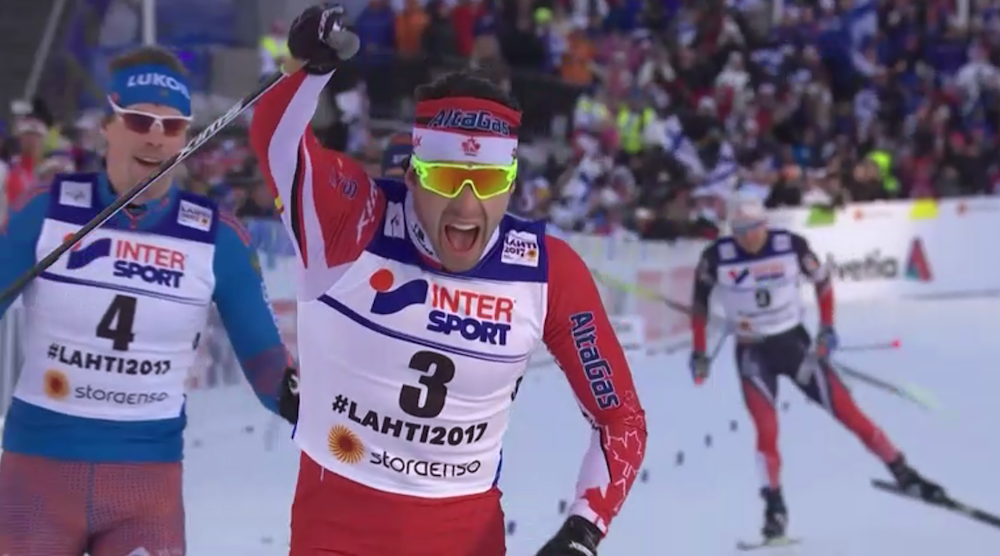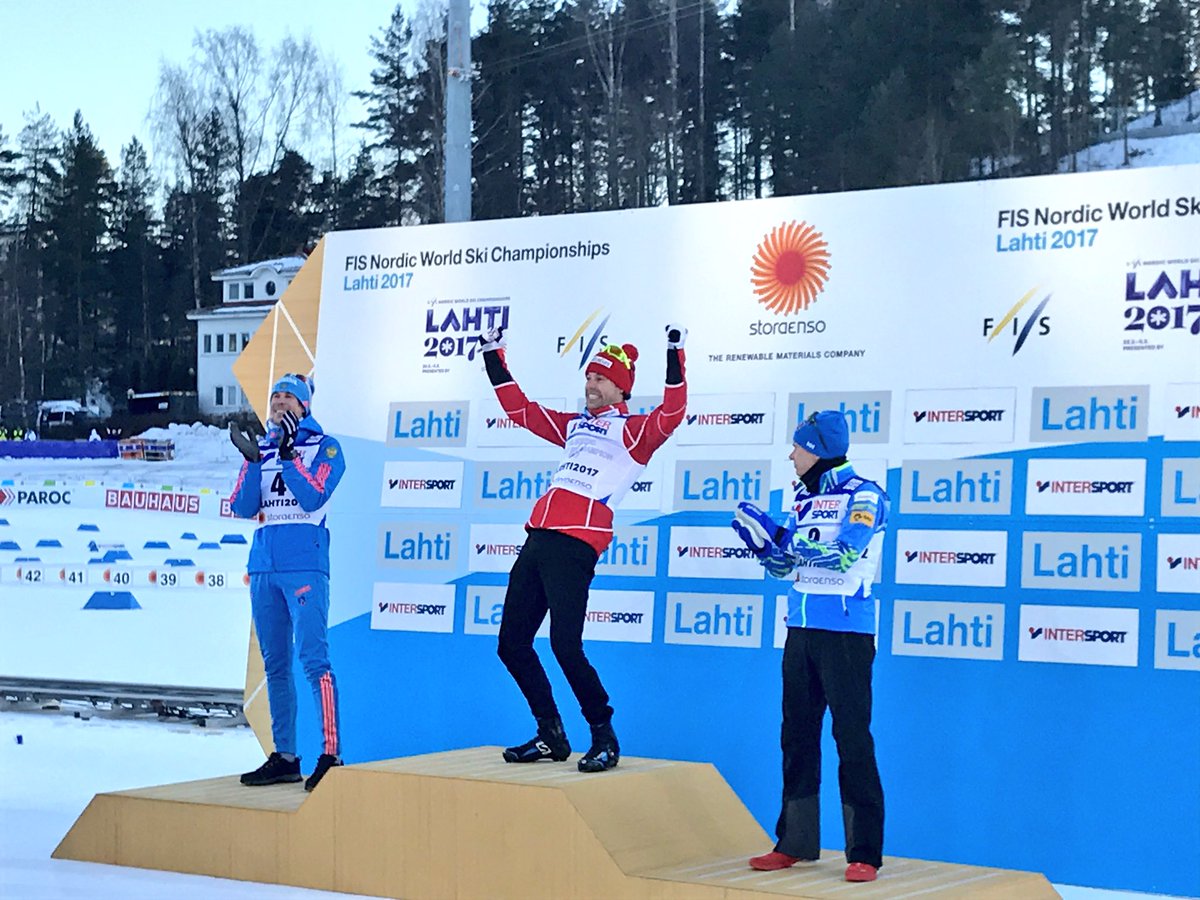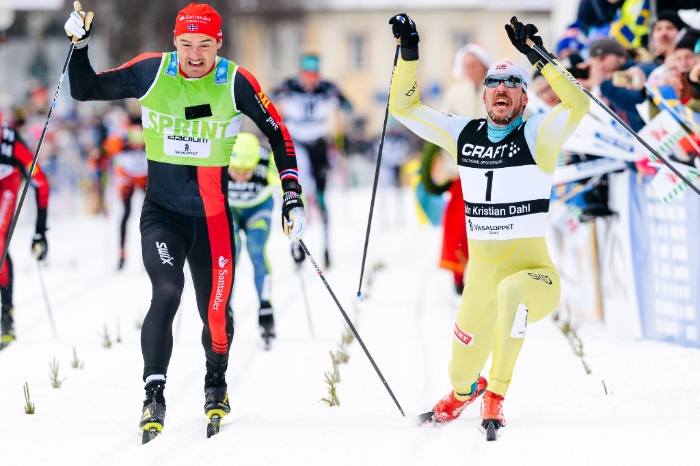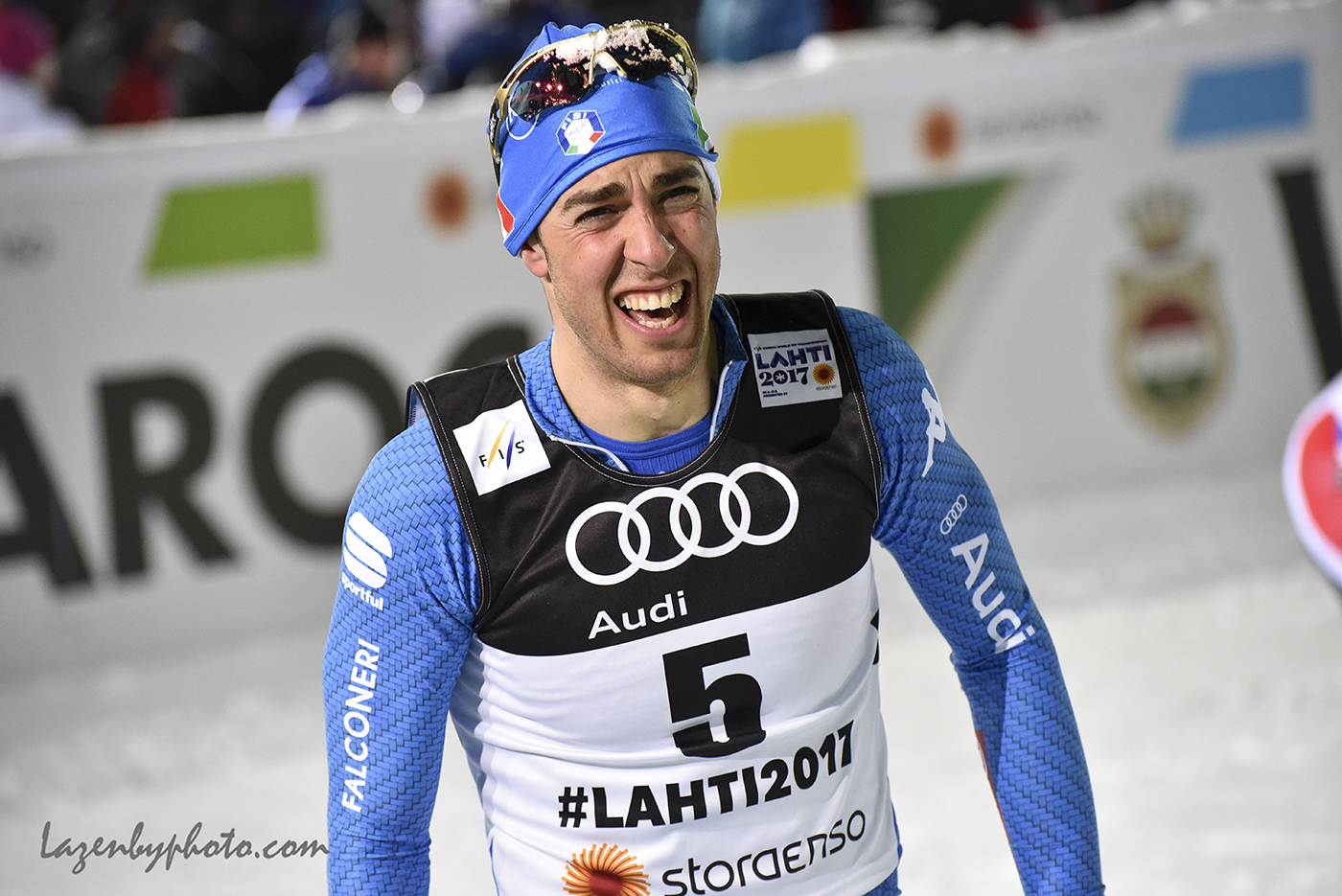
Tag: Petter Northug

  • Hedegart Emerges From the Fog to Win Holmenkollen 50 k as Klæbo’s Absence Reshuffles the Distance Globe

    Hedegart Emerges From the Fog to Win Holmenkollen 50 k as Klæbo’s Absence Reshuffles the Distance Globe

    This coverage is made possible through the generous support of Marty and Kathy Hall and A Hall Mark of Excellence Award. To learn more about A Hall Mark of Excellence Award, or to learn how you can support FasterSkier’s coverage, please contact info@fasterskier.com.

    The start of the Holmenkollen Men’s 50 k Freestyle in Oslo, Norway. (Photo: Authamayou/NordicFocus)

    For nearly two hours on Saturday, 77 men disappeared into a stubborn curtain of fog that clung to the hillsides above Oslo, their figures swallowed by the mist somewhere between the stadium and the high point at Frognerseteren. When it was over, only one emerged with his arms in the air, and it was the one freestyle specialist who had been topping shorter freestyle distance races most of the season.

    Einar Hedegart, the 24-year-old former biathlete who only committed fully to cross-country skiing in November, surged past Harald Oestberg Amundsen in the final meters to win the Holmenkollen 50 k Freestyle in 1:51:38.2 — his first victory on cross-country skiing’s most storied stage, in just his seventh World Cup start.

    “This is the greatest feeling I’ve ever had,” Hedegart said after the finish. “This is just a nostalgia stadium. [A] legendary race, almost all my heroes have won this race, and especially Petter Northug. This might be the reason why I’ve been so motivated my whole life to be a cross-country skier.”

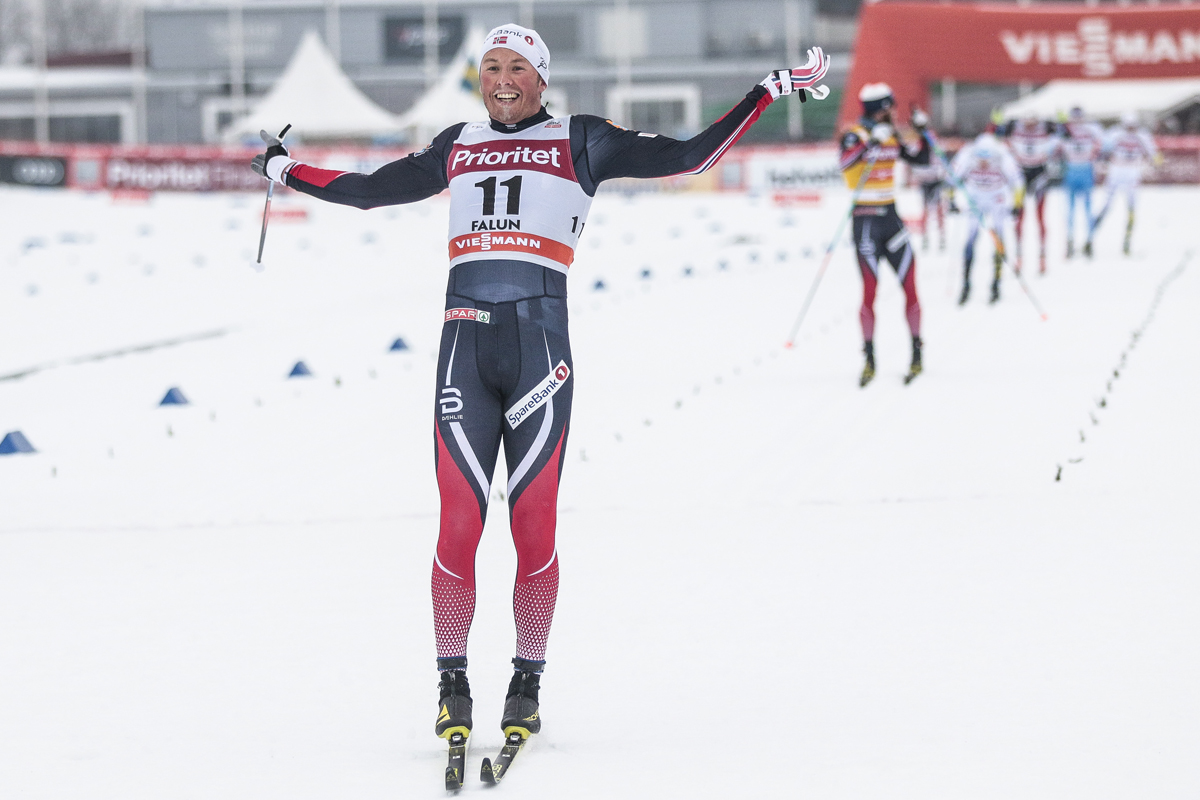
    Einar Hedegart (NOR) celebrates winning Norway’s most iconic race. www.nordicfocus.com. (Photo: Authamayou/NordicFocus)

    But the result that will echo loudest across the sport happened away from Oslo. Johannes Hoesflot Klaebo, the overall World Cup leader, was home nursing a mild concussion from a hard crash in the Drammen sprint two days earlier. Klaebo, who has already compiled a nearly perfect season, winning the Tour de Ski, all six Olympic races, secured the FIS Overall Crystal Globe, the FIS Sprint Crystal Globe, and only needed to keep racing the remaining distance races to take the clean sweep of the season with the FIS Distance Crystal Globe. BUT his absence from the start line meant zero points scored in the distance standing today. And with Amundsen’s second-place finish today, the distance crystal globe race was blown wide open: Amundsen now leads the distance standings by three points, 939 to 936, with two distance races remaining at the World Cup Finals in Lake Placid.

    Klaebo posted to Instagram yesterday: “Took a fall yesterday and hit my head pretty hard, but luckily everything is all good in the hood. Ended up with a concussion, so I’ll take some days off from both training and the internet just to make sure everything settles properly. Only got one head, so have to take good care of it.”

    He had been scheduled to fly to the United States on Sunday, but will now stay in Norway for a few extra days, hoping to recover in time for Lake Placid.

    Einar Hedegart (NOR) emerges from the fog to take the win. (Photo: Nordnes/NordicFocus)
    A Race Defined by Fog

    The Holmenkollen 50 k — first raced in 1888, a fixture of the World Cup since 1982, and a race that draws an estimated 100,000 fans to the forested hills above Oslo — returned to the calendar Saturday after a one-year absence. For the first time, the men’s and women’s 50 k races were held on the same day, the women starting 45 minutes behind the men in a format designed to create an all-day spectacle. The fog, however, had other ideas. Conditions were so thick that spectators along the course could hear the racers before they could see them.

    The course — six laps of 8.3 km with 334 meters of climbing per lap — was firm and fast after overnight salting despite an air temperature of 5.0°C. The salted, compact surface was ideal for skating, and the winning time of 1:51:38 came in roughly four minutes faster than the last time the Holmenkollen 50 k was contested in freestyle.

    Harald Oestberg Amundsen (NOR) on his way to second place. (Photo: Authamayou/NordicFocus)

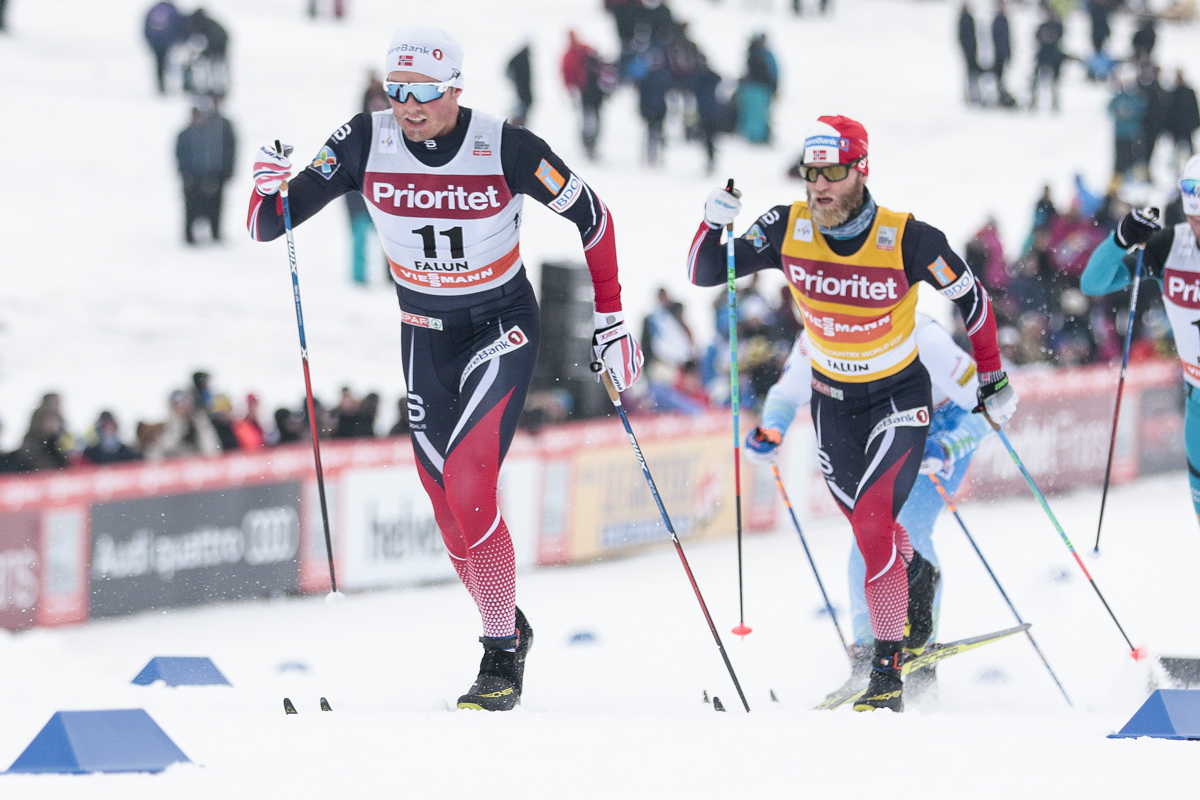
    Through the first three laps, the race unfolded as a cautious tactical affair. A large pack of roughly 40 skiers stayed together, with Martin Loewstroem Nyenget, Mattis Stenshagen, and Federico Pellegrino taking turns at the front. The first athlete to make a decisive tactical move was Iver Tildheim Andersen, who changed skis early at the stadium after the third lap while the rest of the pack continued through. The fresh skis gave Andersen a burst, and when the lead group stopped for their own ski exchange one lap later, he suddenly found himself alone at the front with a roughly 15-second advantage.

    “Just stick with the field as long as possible and then hopefully be in position when the group starts swarming,” Hedegart said of his plan. “But today I was really offside, like 70 percent of the race. So I was lucky that no one took a gap.”

    The chase group — reduced to roughly eight athletes, all Norwegian once France’s Victor Lovera fell off the pace — gradually closed on Andersen through the fifth lap, with Hedegart, Simen Hegstad Krueger, Amundsen, Nyenget, Andreas Fjorden Ree, and Kasper Andersson Herland trading pulls at the front. By the time the group reached the final lap, they had swallowed Andersen, and the race became a question of who had saved enough for the final kilometers.

    Simen Hegstad Krueger (NOR) tried his best to get away for the win. (Photo: Authamayou/NordicFocus)
    Krueger’s Late Charge and Hedegart’s Final Kick

    Krueger, who was celebrating his 33rd birthday the day before, was omitted from the Norwegian Olympic team despite multiple Olympic medals in his career and was the winner of the last freestyle Holmenkollen 50 k. He drove the pace through the final lap. He pushed hard over the climbs near the iconic Holmenkollen church, stringing out the group and shedding Andersen off the back. But Krueger couldn’t sustain the pressure all the way to the finish, and as the group of seven came around the final corner and up the short, steep ramp before the descent into the home stretch, the sprint was on.

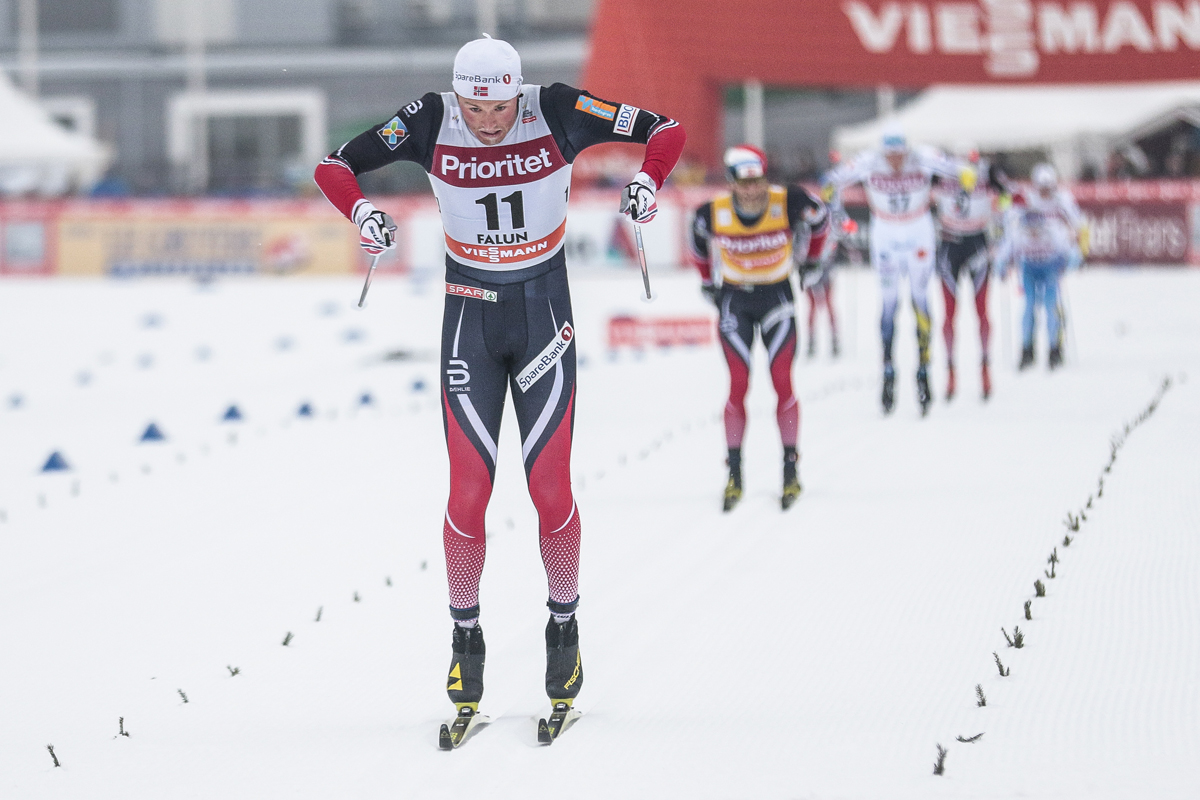
    Amundsen launched first, throwing everything he had at the final few hundred meters. But Hedegart, who had looked labored at points earlier in the race, found a gear no one could match. He came alongside Amundsen, took the lead in front of the grandstand crowd, and raised his fist in celebration as he skied across the line.

    “I felt, like, better,” Hedegart said of his position in the back of the pack through much of the race. “So I was just laying in the field, and I had to remind myself he did the same,” he added, referring to his idol Northug, whose trademark move was stalking from behind before unleashing a devastating sprint.

    Harald Oestberg Amundsen (NOR), Mattis Stenshagen (NOR), and Martin Loewstroem Nyenget (NOR), (l-r) stayed in the lead pack. (Photo: Authamayou/NordicFocus)

    Hedegart crossed in 1:51:38.2. Amundsen finished four-tenths of a second behind. Nyenget was third at +1.1. Ree took fourth (+1.5), followed by Herland (+2.1), Krueger (+3.0), Moseby (+4.8), and Andersen (+16.8) after his brave solo effort. Norway swept the top eight positions.

    France’s Lovera was the first non-Norwegian in ninth (+48.1), followed by AIN athlete Savelii Korostelev in 10th (+1:24.2).

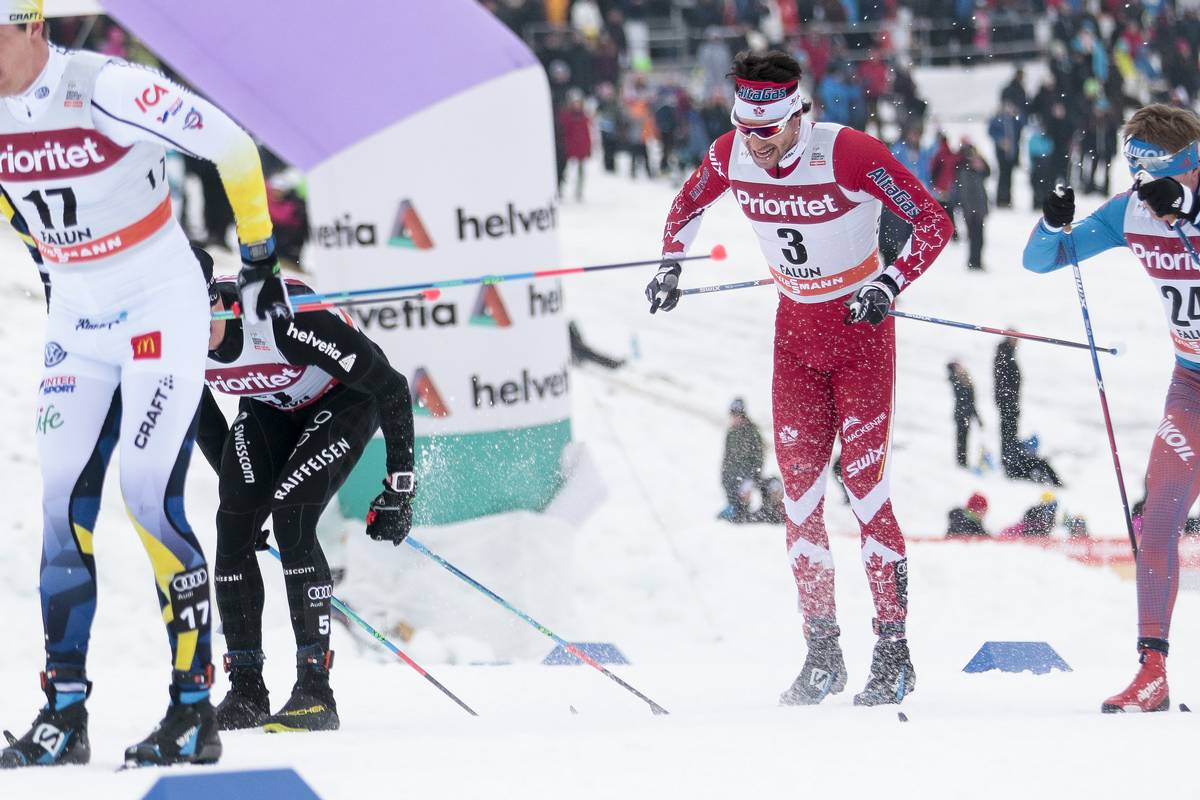
    Zak Ketterson (USA) led the way for the Americans in the chase pack racing for 11th place; he ultimately finished 18th. (Photo: Authamayou/NordicFocus)
    Ketterson Fights for 11th in His Adopted Home

    Zak Ketterson, who spent the summer and fall living and training in Oslo, found himself in the thick of a battle for 11th place, a fight he learned about from coaches stationed along the fog-shrouded course.

    “I had heard from coaches on the side of the trail that our pack was fighting for 11th, and that was super cool,” Ketterson said. “I actually felt pretty fresh at the end and thought my finishing sprint would be pretty good, but I didn’t time it well and got really boxed in on the last couple turns into the finish.”

    Ketterson ultimately finished 18th (+1:54.2), part of a chase pack that came across the line within seconds of each other. He said everyone in the group knew a sprint was coming on the final lap.

    The fog made the tactical picture nearly impossible to read. “I couldn’t see more than 10 meters in front of me,” Ketterson said. “It definitely made it difficult to assess where I was relative to the leaders in the later laps. It also made some of the corners feel way sketchier because you couldn’t really choose an optimal line with such limited visibility.”

    For Ketterson, the race carried personal significance beyond the result. Having trained on the Holmenkollen course through the Norwegian summer and fall, he knew every climb and descent intimately. “This is definitely one of the most iconic and cool races we get to do,” he said. “It was especially special for me this year since I trained on this course all summer and fall living in Oslo. The highlight was definitely having my wife Julie and her family out there cheering me on.”

    What made the performance all the more impressive was the state of his body coming in. “I honestly feel like I am really running on fumes,” Ketterson said. “To be honest, I was not sure if I would even start this race in the morning. I felt so bad, and honestly, my body has felt super up and down in the last few weeks. I’m really curious to see how my body responds to this race. I was pleasantly surprised by how decent it felt, but I feel like the next week could go either way. Especially with the international travel tomorrow.”

    Brian Bushey (USA) gaining experience on his way to 59th place. (Photo: Authamayou/NordicFocus)
    The Rest of the North Americans

    Hunter Wonders was 45th (+5:46.9), Kevin Bolger was 48th (+6:51.3), and Brian Bushey was 59th (+12:24.9).

    Canada’s Xavier McKeever finished 41st (+5:11.4), while Thomas Stephen was 43rd (+5:18.1).

    Harald Oestberg Amundsen (NOR) takes over the FIS Distance Globe lead with just two distance races remaining. (Photo: Authamayou/NordicFocus)
    Distance Globe: Three Points

    The ramifications of Saturday’s race land squarely on the crystal globe picture. Before the race, Klaebo held a 128-point lead over Amundsen in the distance standings and a 636-point lead in the overall. With Klaebo watching from home, Amundsen’s 131-point haul (including bonus points) vaulted him into the distance lead: Amundsen now sits at 939 points, three ahead of Klaebo’s 936. Nyenget climbed to 914 in third.

    Klaebo’s overall World Cup lead, at 2,071 points to Amundsen’s 1,566, remains secure with a 505-point cushion. But the distance globe — awarded to the season’s best across distance events only — will come down to the final two races: a 10 k Classic Interval Start and a 20 k Freestyle Mass Start in Lake Placid, March 20-22.

    If Klaebo can travel to Lake Placid and race, he’ll have every opportunity to reclaim the lead. If the concussion keeps him out, the distance globe is likely to belong to Amundsen.

    Kasper Andersson Herland (NOR), who finished fifth, celebrates with Einar Hedegart (NOR), (l-r) at the finish of the Holmenkollen. (Photo: Authamayou/NordicFocus)
    A Star Made for This Stage

    Hedegart’s career trajectory is one of the season’s best stories. A junior biathlon world champion who struggled with his shooting, he drifted toward cross-country skiing after a surprising second-place finish at the Holmenkollen World Cup last season. He spent the summer training with a cross-country team while bringing his rifle to every camp, undecided. In November, after winning the popular pre-World Cup cross-country race in Beitostoelen, Norway, by a wide margin and missing eight of 20 shots in a biathlon event, he committed to leaving the rifle at home.

    Since then: an Olympic bronze in the 10 k Freestyle behind Klaebo, a team sprint gold partnered with Klaebo, victories in the Engadin Marathon, and now the Holmenkollen 50 k — a distance he had never raced at the World Cup level. He was asked whether his approach of sitting back resembled Northug’s famous stalking tactics.

    “Yeah, I felt like Petter,” Hedegart said. “So I was just lying in the field, and I had to remind myself he did the same.”

    For a race that dates to 1888, that has been won by the sport’s mythical stars, and that is contested before the King of Norway in a stadium surrounded by 100,000 fans, there is no small amount of weight to what happened Saturday at the Holmenkollen. Hedegart is, by every measure, now a cross-country skier.

    The season concludes with the World Cup Finals in Lake Placid, New York, March 20-22. Three races remain. The distance globe is separated by three points. And the world waits to see whether Klaebo can make it to the start line.


    Holmenkollen Men’s 50 k Freestyle FINAL RESULTS

    FIS Men’s Crystal Globe SPRINT STANDINGS
    FIS Men’s Crystal Globe DISTANCE STANDINGS
    FIS Men’s Crystal Globe OVERALL STANDINGS


    Love Stories Like This? Help Keep Them Coming.

    Feature stories like this one take time, access, and care to produce. If you value thoughtful storytelling and independent ski journalism, please consider becoming a Voluntary Subscriber. Your support directly fuels the work we do to cover the people, places, and moments that make our sport special.

    Join the FasterSkier community!


    Harald Oestberg Amundsen (NOR), Andreas Fjorden Ree (NOR), and Martin Loewstroem Nyenget (NOR), (l-r) share the Holmenkollen 50 k Freestyle in Oslo, Norway. (Photo: Authamayou/NordicFocus)
  • Oberhof Freestyle Sprint—Lars Heggen Proves His Point

    Oberhof Freestyle Sprint—Lars Heggen Proves His Point

    This coverage is made possible through the generous support of Marty and Kathy Hall and A Hall Mark of Excellence Award. To learn more about A Hall Mark of Excellence Award, or to learn how you can support FasterSkier’s coverage, please contact info@fasterskier.com.

    Lars Heggen (NOR) overpowered the field in Oberhof, but many of the world’s best sprinters—his Norwegian teammates—were absent from the day’s racing. (Photo: Authamayou/NordicFocus)

    Some day, Norway won’t be the only force in Men’s World Cup cross-country skiing. Some day, the participation of other nations will truly matter. Other nations will hear their anthems played, other skiers will excel, other results will be cited and praised. Some day, France may figure it out, or Finland may remember its heritage, or Sweden may return to prominence. The USA may identify another Bill Koch, or Italy another Pellegrino, or Switzerland another Cologna, or Russia another Bolshunov. Some day, the podium of the Men’s Cross-Country Skiing World Cup will not be decorated exclusively in Norwegian flags. While that’s not yet the cross-country skiing world that we live in, it is this upcoming World cup weekend in Oberhof where we expect to witness a kind of “It’s A Wonderful Life” view of Nordic skiing . . . the chance to see what the world would be like without them.

    France stayed home from Oberhof, presumably for national championships and team selections of their own. But everyone else is here, hoping to add to their World cup résumés with some of the scraps left on the tablecloth by absent Norwegians. Finland has sent its best (their Sprinters, anyway), and Sweden (in Norway’s absence they could make a splash), and the Italians (Federico Pellegrino and Elia Barp will see their chances to capture glory). The Czechs and the Swiss are here as well, hoping to grab World Cup distinction while the Norwegians are at home. And Team USA has sent it’s own hungry skate-sprinters, as well. Ben Ogden and Jack Young will be vying to return to the finals . . . even to imagine standing atop the podium (dare we say). JC Schoonmaker will be desperate to prove he belongs on the team that marches into Milano-Cortina. Gus Schumacher will be itching to prove that he and Ogden make a compelling Team Sprint team. There’s a lot going on . . . the same sort of drama that goes on every single week of the World Cup season, but no one really notices it because we’re so distracted by the Norwegian that tsunamis through every World cup venue.

    And where’s Norway? Well, Norway has more important business to attend to. World Cup wins, World Cup podiums, World Cup points: those are every-week occurrences for ski-crazy Norway. But 2026 is an Olympic year . . . the big prizes will be awarded at the Games of Milano-Cortina. So, this weekend in Oberhof, Norway sends stand-ins while the true contenders refine their technique or taper their training, or just put their feet up for a few hours before the headlong streak toward Norwegian immortality in Milano-Cortina continues.

    The elder Northug bother—Petter—was one of Norway’s greatest champions, but even he faced disappointment when it came to Olympic qualification. If Lars Heggen fails to make the team for Milano-Cortina, he will understand the parallels between his pain, and Northug’s. (Photo: Nordnes/NordicFocus)
    Norway Still Expects to Win

    Lars Heggen (NOR) is 20 years old . . . and he just dominated the Sprint competitions at the recent Norwegian Nationals. Granted, a number of Norway’s very best Sprinters weren’t there (no Klaebo, no Valnes, no Amundsen), but Heggen made enough of an impression that many Norwegian ski-pundits called for his immediate elevation to the Olympic Team. We can assume that Petter Northug was not among that enthusiastic group of pundits . . . especially since a 20-year-old Northug dominated 2006 Norwegian Nationals in an even more commanding manner than Heggen did in 2026. And Northug was unceremoniously denied an Olympic berth because of the selection committee’s assertion that, at only 20, he was too young for the pressures of Olympic competition, that Northug would benefit from more development time before being tossed into the Olympic maelstrom. Northug’s career turned out all right in the end, but it may have been even better if he’d collected another Olympic medal or two at the 2006 Games in Torino.

    Northug’s little brother, Even, competes for Norway in the World Cup Sprint this weekend in Oberhof. Like his brother 20 years ago, Even Northug has already been told that no spot is reserved for him on the Norwegian Team at the upcoming Olympic Games. Well, he’s still a world class Sprinter . . . it will be interesting to see how the younger Northug uses this weekend’s Sprint opportunity to comment on his being the second Northug to have been ignored in his efforts to make a Norwegian Olympic Team.

    But first, you need to qualify . . .

    The top American qualifier in Oberhof, JC Schoonmaker (USA) leading Even Northug (NOR), and Zanden Mcmullen (USA) in their quarterfinal heat. (Photo: . Authamayou/NordicFocus)
    Qualifying

    We don’t know exactly why, but it’s been reported that top 30 in today’s Sprint qualifying will be rewarded with increased FIS World Cup points (nearly double when compared to normal World Cups, or to races in tour de Ski that received only 50% points). It’s a good reason to be at your best in this particular qualifying event . . . and a pretty good way to continue shuffling the deck for numerous nations that are still choosing their Olympic Teams. And while a number of Norway’s best sprinters decided to sit this one out, Norway still manages to dominate most men’s Wold Cup racing. Case in point: six of Norways seven entries qualified for the heats, with Lars Heggen doing the job he was sent to do—winning the qualifier by 1.5 seconds.

    Americans took advantage of this diluted World Cup field with JC Schoonmaker finishing 13th, Jack Young 22nd, Zanden McMullen 28th, Michael Earnhart 35th, Kevin Bolger 44th, Owen Young 54th.

    “The heat selection strategy was definitely a bit different today with a lot of normal World Cup guys not being here,” said Schoonmaker. “I went for heat 1 because that felt like a good one to move on from and it was a better option than usual with  Klaebo not here. Other than heat selection the strategy didn’t differ at all for me, just trying to race my best!”

    McMullen is better known as a Distance skier, but his strong qualifying effort proved his versatility. “I do actually like using sprint races as a bit of a warm up,” said McMullen. “It puts my mind and body into a race mentality that I can’t really achieve on a race prep day. Sprints also typically feel lower stakes to me, so it’s just a nice way to go out and have some fun!”

    Sprint Heats—New Cast, New Strategies

    Skiing can be such a strange sport. Oberhof is a famed biathlon venue; if this were a weekend of biathlon races the grandstands would be packed. As it is, this was a cross-country weekend, and the stadium stood all but empty. The German fans who could’ve been here definitely missed a good show, and a fair indication of what the future of what World Cup Sprint events may look like in the near future. Even with a number of bright stars missing from the days entry list, the racing proved fast and furious.

    There was a lot going on in Quarterfinal 1: Lars Heggen wearing the green U23 World Cup leaders bib, alongside JC Schoonmaker, Zanden McMullen, and Even Northug. Everybody with something to prove, everybody with something to gain, and only two minutes of Heat 1 in which to do it. Schoonmaker led through the early parts of the course, but faded by mid-race. Heggen accelerated up the hill before the finish, sufficiently gapping his rivals and easing up before the finish line which he was followed across by a scrambling Even Northug. McMullen would finish fourth in the heat, followed by Schoonmaker in fifth. On the day, McMullen and Schoonmaker would finish 20th and 23rd, respectively.

    Pellegrino advanced out of Quarterfinal 2 in which Jack Young’s day would end with a fifth place heat finish. Young had led early in the quarterfinal, evidently hoping to press the pace in the hopes of advancing as a lucky loser. His strategy was bold, but it left him one place short. Young would finish 24th on the day.

    “I wanted to get to the front and control the race,” said Young. “Sadly, I wasn’t able to hold my position into the big climb—this wasn’t part of the plan. I then made up sole ground, but I didn’t have the energy to hold my position through the working finish.”

    Semifinal 1 included Heggen, Pellegrino, and Northug who all came in together at the bottom of the final climb. Heggen would V2 the entire climb, while Pellegrino switched to a high-tempo V1 to scoot past into the hole-shot. Northug faded as Lauri Vuorinen (FIN) edged into the top three. Pellegrino would coast across for the heat win, followed by Heggen’s lunge for second ahead of Vuorinen in third and Northug fourth. Those lucky losers would sit and wait for the results of the second semifinal.

    That second semifinal included one well known Sprinter—Switzerland’s Valerio Grond—who was joined by a cast of names we’re less accustomed to hearing: Filip Skari (NOR), Jaume Pueyo (ESP), Emil Liekari (FIN), Jiri Tuz (CZE), and Martino Carollo (ITA). Grond would finish second in the heat behind Liekari to advance to the final. Vuroinen and Northug—lucky losers from Semifinal 1—would advance as well.

    Federico Pellegrino (ITA) used a high-tempo V1 to position himself on the steep uphill of Oberhof’s Sprint course. But Heggen’s V2 would prove stronger. (Photo:  Reichert/NordicFocus)
    Plenty at Stake in the Final

    In the absence of truly dominant skiers, no one really knows what to do. The Sprint Final would become a bit of a curiosity as Heggen hoped to solidify his Olympic credentials . . . but Northug would be harboring similar plans of his own, and they’d both need to figure out how to deal with the cagey veteran, Pellegrino. In the final, Heggen and Pellegrino went to the front to control things, but neither looked eager to really drive the pace. Both the leaders chose the far-right line up the first climb as Liekari spun his wheels in the loose snow on the inside line. That was the point at which Grond took control, charging over the top of the climb. But Heggen’s fast skis could not be contained onthe subsequent downhill. He coasted easily into the lead, followed to the base of the final climb by Pellegrino and Northug. The final hill had offered a contrast in styles all day: Heggen’s V2 power vs. Pellegrino’s V1 tempo. This time up the hill, it was Heggen’s strategy that proved strongest, fending off Pellegrino’s V1 charge and holding on across the finish line for his first World Cup win. Northug would cross the line in third, a fine World Cup finish that was likely to be overlooked in Norway’s construction of its Olympic roster.

    The 20 year old upstart bested the 35 year old veteran. The question that remained was this: was the Norwegian Olympic Team Selection Committee watching?

    Oberhof World Cup Men’s Freestyle Sprint RESULTS

    Oberhof World Cup Men’s Freestyle Sprint QUALIFYING

    The Men’s Freestyle Sprint Podium in Oberhof—Federico Pellegrino (ITA always contends, Lars Heggen (NOR) hopes he proved his point, Even Northug (NOR) left wondering if anyone had noticed. (Photo: Authamayou/NordicFocus)


    Love Stories Like This? Help Keep Them Coming.

    Feature stories like this one take time, access, and care to produce. If you value thoughtful storytelling and independent ski journalism, please consider becoming a Voluntary Subscriber. Your support directly fuels the work we do to cover the people, places, and moments that make our sport special.

    Join the FasterSkier community!
  • The Devon Kershaw Show: Burger King and the Thugometer

    The Devon Kershaw Show: Burger King and the Thugometer

    You know you missed us.

    Devon and Nat return with a soft launch into the 2025 winter season. We cover off-season developments and other hijinks, from the still-missing Russians to Therese Johaug’s return. Read here and here if you want to understand wth the references are in the show title.

    We’ll be back soon. Hit us up at nat@fasterskier.com and devon@fasterskier.com; we’re psyched to be back.

  • Op-Ed by Chad Salmela: Saturday’s Men’s Skiathlon and Why I Think it Matters

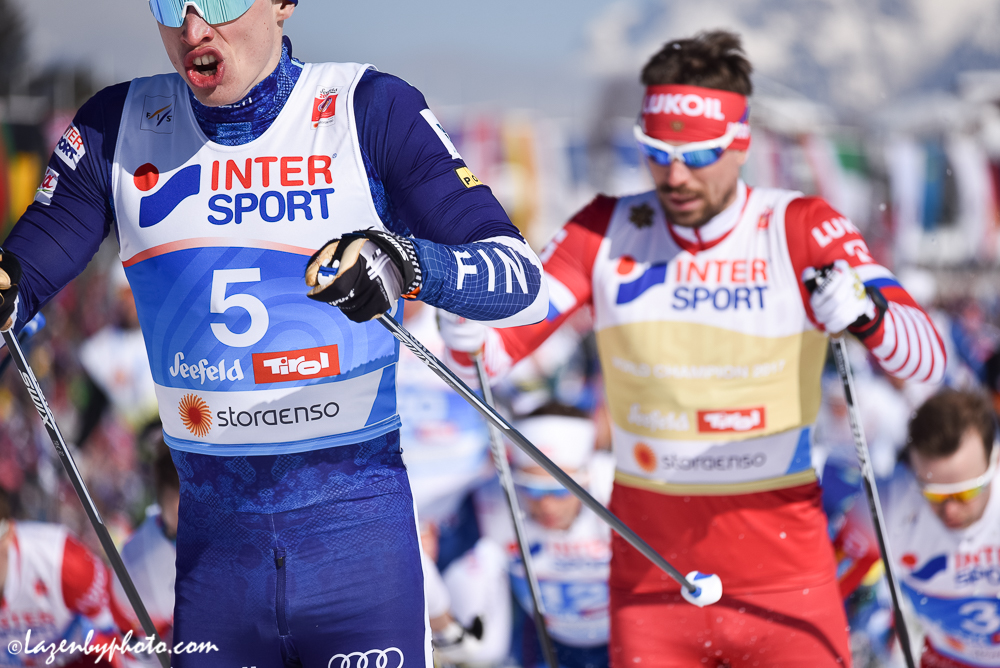
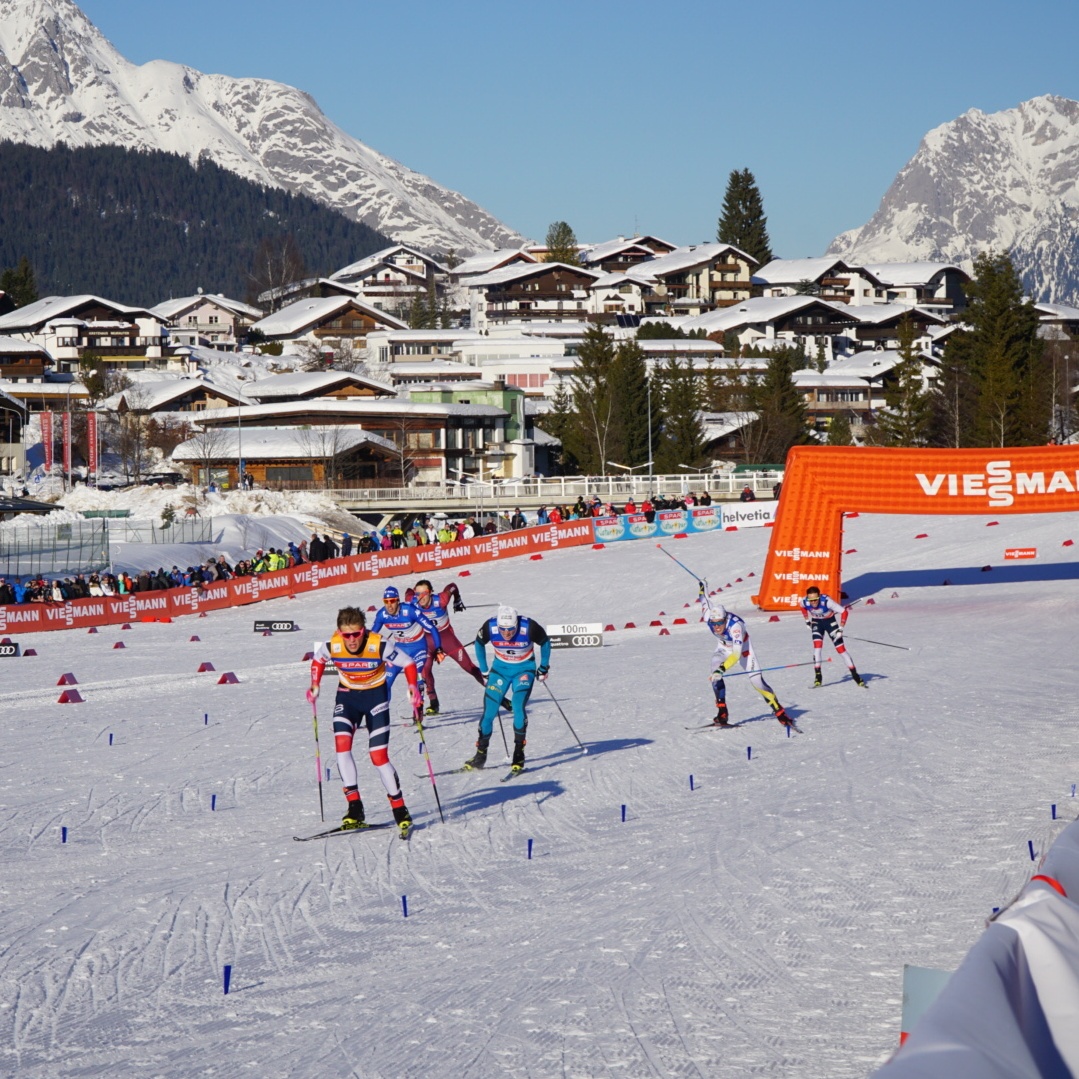
    Finland’s Iivo Niskanen (bib 5) dictating the pace and ultimately the race during Saturday’s Men’s skiatlon at the 2019 World Championship in Seefeld, Austria. (Photo: John Lazenby/lazenbyphoto.com)

    This Op-Ed comes from Chad Salmela, the commentator for World Cup nordic skiing and IBU Biathlon at NBC Sports. Salmela also coaches running at the The College of St, Scholasticia. 

    ***

    Saturday’s Men’s Skiathlon and Why I Think it Matters

    I don’t have a blog and I didn’t get to call the race Saturday,  but I thought it was compelling on a couple levels. (Disclaimer: You may have figured all this out without me, so my apologies if this is all too obvious)

    Level 1:  The lessons of Northug

    Iivo Niskanen has clearly cracked the code on Klaebo that a generation of skiers never cracked on Petter Northug.  It took a tough-ass, gritty Finn to say enough is enough on hanging back and getting out-sprinted in long distance races.  Iivo re-wrote the modern playbook on mass start distance races in the 50k in Pyeong Chang and he was rewarded, after a long hard battle with Bolshunov, with the Gold.  Today, Iivo didn’t dink around waiting to be pummeled by the likes of Iversen or Klaebo after a promenade to the ski exchange, a few more laps of taking stock, then racing 3-5 km in earnest. He immediately got to work on the hard job of ski racing, and in so doing, reminded everyone in the field of their chosen profession, and that it isn’t pretty-boy flash if you don’t let it be.  In fact, it probably shouldn’t be, and the workhorses who were having a good enough day to keep the pace were rewarded with a chance at the gold, silver, and bronze. I LIKED that, even if Niskanen, the impetus of it all, was rewarded with the wooden medal. What I saw today was the old school grit of a long ski race against the clock, played out head to head. I found it gripping. From Iivo forcing everyone to get uncomfortable 4 minutes into the race, to the relatively slow final climb “move” by Sundby, this was a heck of a heavyweight bout!  Think those guys were fresh? Watch that final hill again. When was the last time we saw a “sprint” like that? PyeongChang 50k, that’s when. Thanks Iivo.
    buy tizanidine no prescription

    I tweeted something relatively implicit during the race like, Klaebo doesn’t have it as easy as Northug did.  I believe this to be true even if I confused a friend as to what I meant. Klaebo will live in the shadow cast by and in comparison to Northug. He can’t avoid it, it’s not his choice, and it’s inevitable.  So he’s got that to deal with. But worse for Klaebo, the mass start era under Northug was one in which real old school ski racing of grinding out 30 and 50 K’s against a clock—the grit that defined the sport for most of its history—was left behind for “modern” ski racing in which everyone cruised along eyeing each other up and down, then the field was baffled as to how to beat Petter in the last few km’s.  It became a formula that wasn’t getting challenged enough. Now, I’m not saying the others didn’t try hard enough. I’m just saying with hindsight of today’s 30k skiathlon and the Pyongyang Chang 50k, that the Northug mass start narrative has been challenged by the likes of Niskanen and Bolshunov, and it’s working. Sort of. Because Sundby and Harvey had to race Northug in the height of the invincible Northug narrative years, it’s not like they were asleep that whole time.  But I think they inherently sensed the risk of taking the bull by the horns in the manner Iivo did Saturday and in PyeongChang—you may do all or the lion’s share of the work of a long hard race and be left without the glory. But medals aren’t the only glory and Iivo’s 4th, and particularly Parisse’s 5th are glorious performances in my book, and they left a LOT of stars out of the race early with their test.

    Back in his nordic coaching days. Chad Salmela, now, at 47, coaches running at The College of St, Scholasticia and is the commentator for World Cup nordic skiing and IBU Biathlon at NBC Sports. (Photo: Courtesy Chad Salmela)

    Regardless, I don’t see Iivo changing and I think we have a new ball game.  I didn’t see Iivo eyeballing anyone or anything but the track in front of him most of the race.  And he only missed a medal by 12 seconds. After his digger in the feed zone at the start of lap 2, he trailed by 12.  Chew on that piece of cowhide a while before you decide it didn’t work…

    Level 2:  Norway can cover all plays

    If you avoid the Norwegian press’s calculated outrage of not starting the Olympic skiathlon champion Simen Hegstad Krüger, you see they had a brilliant line up based on what they have seen this winter from their boys.  They had two grinders—the two best this season, Sundby and Røthe—and two flashy sprinters who can hang in a Northug scenario—Iversen and Klaebo. They had a double shot at both types of races. You replace any of those with Krüger, you don’t play the odds like you can.  I love Krüger and it is a shame he didn’t get a start, but what I’m saying is, the Norwegian staff is frigging brilliant in the face of public outrage. Further, the personnel chosen, raced SMART! When it became an Iivo grind, how many times did you see Røthe or Sundby force the pace before it became a 3-man race for the medals?  Zero. That’s how many. (Take note Mussy. I want you to win one before I die.). Game, set, match. Gold and Bronze.

  • World Cup Preview: #1 Norway

    World Cup Preview: #1 Norway

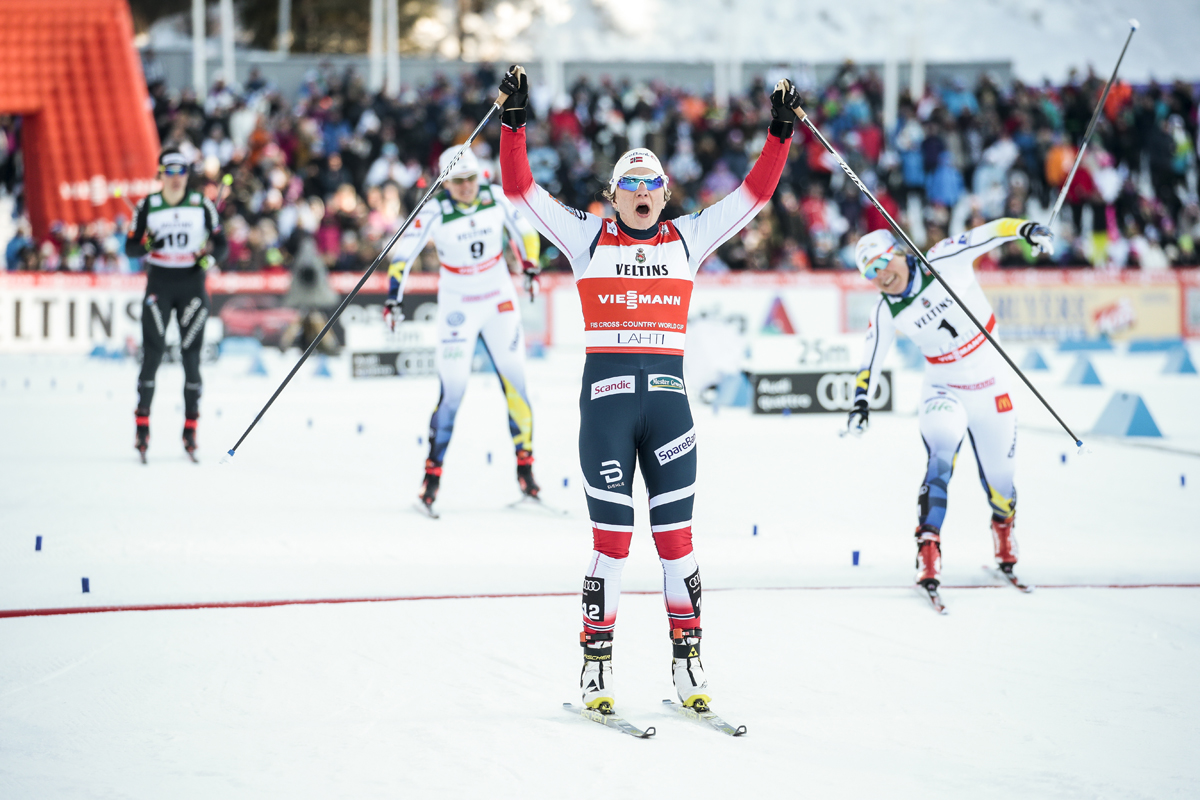
    Norway’s Maiken Caspersen Falla celebrates her win in the women’s 1.4 k freestyle sprint at the 2018 World Cup in Lahti, Finland. (Photo: Fischer/NordicFocus)

    Welcome to FasterSkier’s World Cup Preview, where we check in with the top-10 teams from last year’s FIS Cross Country World Cup tour before the season starts. The World Cup begins with a classic sprint in Ruka, Finland on Nov. 24th

    ***

    Norway

    Overall in Nations Cup Last Year: 1

    Women’s Ranking 2017/2018: 1

    Men’s Ranking 2017/2018: 1

    Norwegians to Watch:  

    Norway won last year’s Nation’s Cup by more than twice as many points as second place Sweden. The question remains, in the aftermath of Marit Bjørgen’s retirement can that accomplishment be repeated?

    Chances are, yes.

    The Norwegian women’s team boast names such as Heidi Weng, winner of the World Cup the two previous seasons, Ingvild Flugstad Østberg, 3rd place overall in the World Cup in the two previous seasons and gold medal winner in the 4×5 kilometer relay in the PyeongChang Olympics , Maiken Caspersen Falla, winner of the sprint World Cup the three previous seasons and silver medalist in the Olympic classic sprint, and Ragnhild Haga, gold medalist in the Olympic 10 k skate and 4×5 k relay.

    The women’s 10 k freestyle podium at Stage 3 of the 2018 Tour de Ski on Monday in Lenzerheide, Switzerland, with Norway’s Ingvild Flugstad Østberg (c) in first and Heidi Weng (l) in second, and American Jessie Diggins (r) in third. (Photo: Salomon/NordicFocus)

    There appears to be no dynastic decline on the immediate horizon. All of these athletes are on track to perform at a similar level this coming season.

    In addition to these four podium-capable skiers, Therese Johaug will return to the Word Cup after having finished her 18-month ban for testing positive for the banned substance clostebol. (Johaug tested positive after applying the ointment Trofodermin to her sunburned lips.)

    Johaug won the Lysebotn opp rollerski race in August 1:47.5 minutes in front of Sweden’s Charlotte Kalla in second, and out performed all the male skiers on the national team but Didrik Tønseth during an Oslo hill run this Spring. She is reported to be in better shape physically than in the past. Yet, it remains to be seen if she can transfer that into competitive cross-country skiing against a full World Cup field.

    In the days before the Norwegian season opener in Beitostølen, Johaug asked during a press conference that people lower their expectations because of her experience in the last two years. Expectations aside, Johaug won the two races she competed in during the season opener in Beitostølen. In the 10 k classic, as described by FasterSkier, Johaug never let off the throttle. In the 10 k skate, she distanced second place Østberg by 26 seconds and U.S. skier Sadie Bjornsen by 1:45.9 minutes in third. With those two wins in Beito, this much is true: she’s in early season Johaug-form.

    The Norwegian men

    2018 Olympic individual gold, silver and bronze medal winners, team sprint and 4 x 10 k relay winners return to the Norwegian men’s team this season. Tønseth, Martin Johnsrud Sundby, Simen Hegstad Krüger and Johannes Høsflot Klæbo are all returning. No athlete reported any major challenges this pre-season.

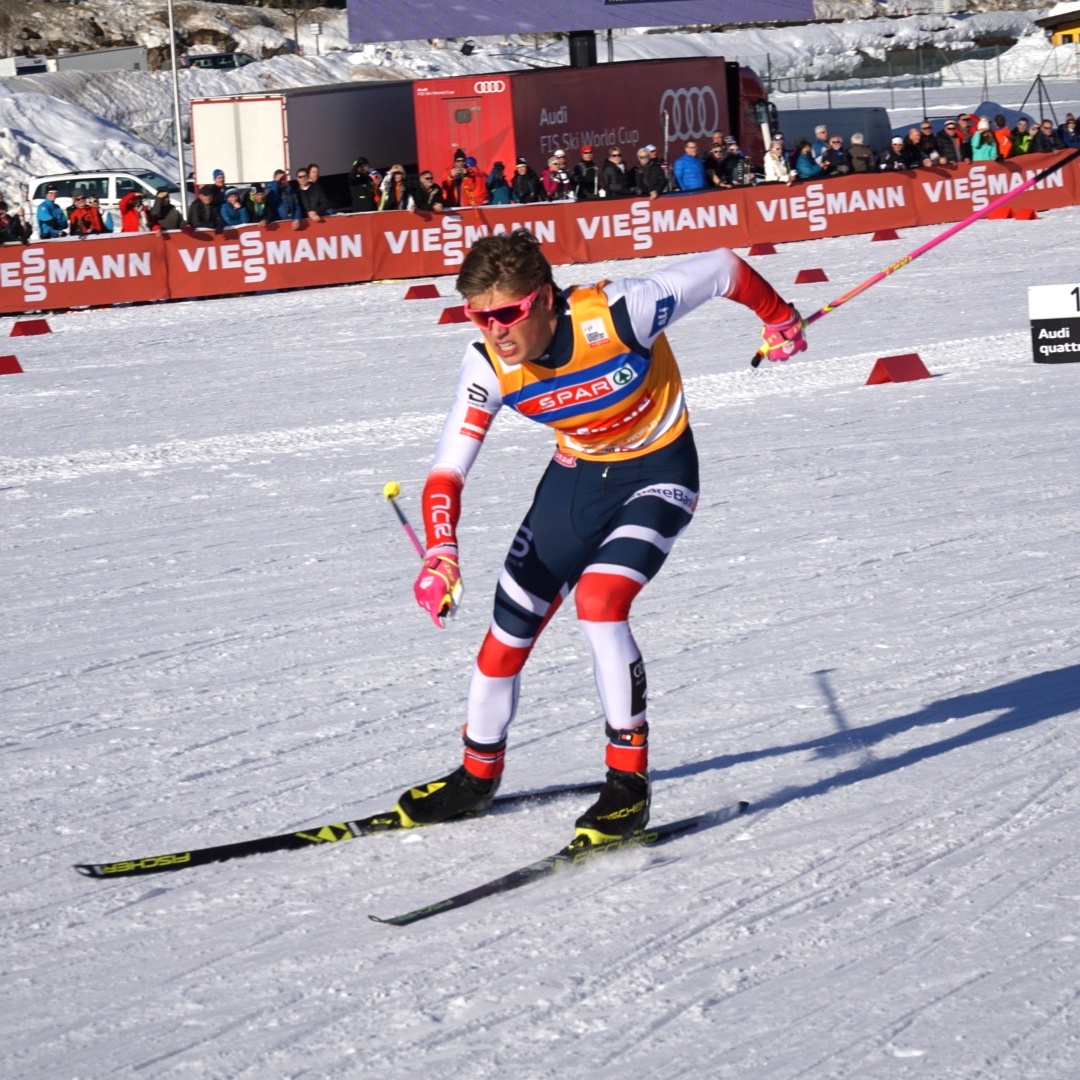
    Overall sprint and World Cup winner, Johannes Hoesflot Klaebo at the 2018 Seefeld, Austria World Cup sprint. (Photo: Fischer/NordicFocus)

    After his dominant season last year, Klæbo has tempered expectations. He stated in an interview with Bergens Tidene in October, “realistically, a lot of things need to happen for me to copy what I did last year.”

    We’ll know in days, the World Cup begins this Saturday, if this was all a Klæbo bluff. 

    The overall winner of the World Cup, and sprint cup winner the past two seasons, Klæbo explained that last season many things worked well right away but there are several fast skiers competing. Just within Norway’s domestic ranks, Tønseth, Emil Iversen, Sjur Røthe, Sundby, and Hans Christer Holund all outperformed Klæbo recently in Beitostølen’s 15 k classic.

    One athlete who fans should see on the World Cup again this season for Norway is thirty-two-year-old Petter Northug

    After separating from the Norwegian national team in 2013, the man who needs no further introduction if you have followed xc skiing over the past 10 years, returns to the Norwegian sprint team. His last performances are not what they used to be and therefore Northug returns to national team with confined expectations. Northug noted he probably won’t ski World Cup races until 2019 and that he might not make the cut for the World Championship in Seefeld.

    His results recently in Beitostølen were lackluster, he was disqualified from the 15 k and didn’t qualify for the sprint heats.

    He raced a single World Cup last season, placing 32nd in Lillehammer, Norway’s classic sprint. Northug did not qualify for the 2018 Olympics.

    Northug claims the reason for lowering expectations are his difficulty in adapting to training. Last season was hindered by illness and this pre-season has shown similar signs — Northug has twice dropped out of a training camp due to illness. Headlines across Norwegian tabloids read, in essence, “Northug may retire”, a reference to him saying in a press conference before the season opener in Beitostølen that the odds of him being on the starting line there next year is 100-1. Before being disqualified for skating during the 15 k classic in Beitostølen, Northug did show signs of improvement, finishing the race in 38:26.2 minutes (+2:17.6 behind winner Tønseth).


  • Nordic Community Mourns Loss of Skofterud: ‘A Friend Who Lit Up the Room’

    Nordic Community Mourns Loss of Skofterud: ‘A Friend Who Lit Up the Room’

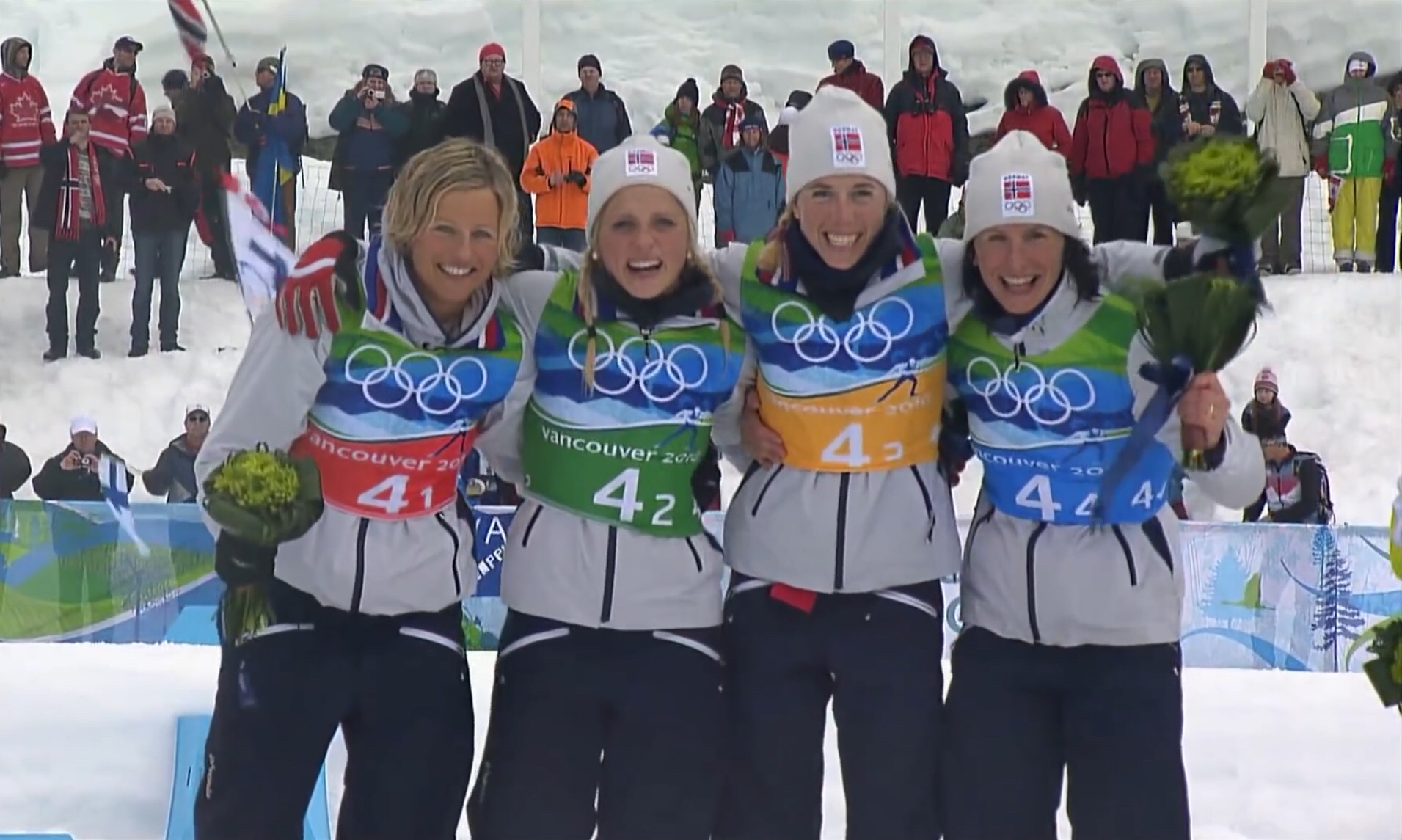
    Norway’s gold-medal women’s relay at the 2010 Olympics in Vancouver, B.C., with (from left to right) Vibeke Skofterud, Therese Johaug, Kristin Størmer Steira, and Marit Bjorgen. (Screenshot: 2010 Vancouver Olympics relay video)

    (Note: This article has been updated to include comments from Vidar Løfshus, head of the Norwegian cross-country ski team, and the team’s former performance manager, Åge Skinstad.) 

    The death of Norway’s Vibeke Skofterud shocked the international cross-country skiing world on Sunday, and as of Monday, multiple renowned skiers, particularly in Norway, had reacted publicly.

    “I am shaking and am in complete shock over this horrible news that I received today,” Marit Bjørgen wrote in a press release, according to a translation. “Dear Vibeke, this was way too soon.”

    Bjørgen and Skofterud were teammates on the Norwegian national team for well over a decade until Skofterud retired in 2015. They won gold together in the women’s relay at the 2010 Olympics and at World Championships in 2005 and 2011. Kristin Størmer Steira was also on all three of those winning relays, and Therese Johaug teamed up with the three to win in 2010 and 2011.

    “I have lost one of my best friends,” Johaug wrote in another press release quoted by NRK. “A friend who lit up the room when she entered, one who gave everyone around her lots of energy, love and care. I take with me all of the nice moments and experiences in and outside of the trails and I will miss her. My thoughts go to her family and those left behind.”

    Bjørgen added that she was “incredibly happy about all of the nice moments we had with each other. A tough competitor in the course, but more importantly, the warmest, nicest, toughest woman in the world,” she wrote. “We have experienced much together, from an Olympic gold medal in the relay … and I will cherish the memories for a long time. My thoughts go to her families and those closest to her. Love you Vibeke. Rest In Peace.”

    Petter Northug wrote that the news was “incomprehensible and sad to hear,” according to News in English.no. “We had many fun years together on the national team.”

    Odd-Bjørn Hjelmeset, a former skier who competed until 2011 and became a national team coach, recalled her “infectious humor”. Erik Røste, president of the Norwegian Ski Federation since 2012, said she was “an important ambassador for the sport of skiing with her winner’s spirit and great engagement.”

    “Vibeke was that joyful girl who always contributed positively to the community she was a part of, definitely with her good results on the course,” Vidar Løfshus, head of the Norwegian cross-country team, told Aftenposten, according to a translation. “The fact that we have lost girl like her, who was always open, honest and spoke her opinion, is a loss to the entire community and inconceivable.”

    “It is incredibly sad,” Åge Skinstad, a former national-team performance director who is currently TV 2’s cross-country expert, told TV 2, according to a translation. “The first thing you think about is the family and those closest to her. Vibeke was a fantastic human-being. She was a very, very good skier.”

    One of her former competitors, Charlotte Kalla of Sweden, told Expressen that she was shocked by the tragedy.

    “It feels uncomfortable and difficult to accept that such a joyful, positive, and full of energy kind of competitor such as Vibeke is longer with us,” Kalla said, according to a translation. “Vibeke was one of my role models when I entered the national team. A positive person who spread joy and really contributed to the cohesion with Norwegian team. She was a character within the sport who offered a lot of herself. It is with great sorrow that I now think of Vibeke and those closest to her. Rest In Peace Vibeke.”

  • Klæbo Wins Seefeld Skate Sprint; Harvey 8th, Hamilton 9th

    Klæbo Wins Seefeld Skate Sprint; Harvey 8th, Hamilton 9th

    Off the front and in for the win, Norway’s Johannes Høsflot Klæbo leads down the finishing straight in Seefeld, Austria en route to another win in the men’s 1.4 k freestyle sprint final, ahead of France’s Lucas Chanavat in second and Sweden’s Calle Halfvarsson in third. (Photo: Garrott Kuzzy / LumiExperiences.com)

    There are no brakes for the World Cup until Sunday afternoon in Seefeld, Austria. The Opening Ceremony of the 2018 Winter Olympics is Feb. 9. For the champing-at-the-bit thoroughbreds in Seefeld, Saturday featured the last sprint before the Games: a 1.4-kilometer freestyle sprint.

    If you were thinking the World Cup’s sprint leaders were taking a “taper” weekend in the run-up to PyeongChang, you’d be wrong. Jumping into the mix were overall Sprint World Cup leader Norway’s Johannes Høsflot Klæbo, Italy’s Federico Pellegrino, who’s second in the sprint standings, and Norwegian Emil Iversen, who was third at the time. The list could get exhausting. Let’s just say the heavy hitters of the sprint world came out to play.

    Under Seefeld’s alpine sun, the boldest pattern on the men’s World Cup continued. Klæbo won the qualifier by nearly five seconds, covering the course in 2:46.89 minutes. Pellegrino qualified in second, crossing the line 4.88 seconds slower.

    Norway’s Johannes Høsflot Klæbo racing to the win in his semifinal, which he took by 0.33 seconds over France’s Lucas Chanavat (not shown). Klæbo went on to win the final as well. (Photo: Garrott Kuzzy / LumiExperiences.com)

    Klæbo also took the Seefeld sprint win with a time of 3:02.66 in the final. France’s Lucas Chanavat placed second overall, 0.48 seconds back, Sweden’s Calle Halfvarsson third (+0.97), Pellegrino fourth (+1.06), Russia’s Gleb Retivykh fifth (+1.17), and Iversen sixth (+5.57).

    The winning trend is clear, these races appear to be Klæbo’s to lose. The day marked Klæbo’s sixth World Cup sprint victory of the year and his ninth overall. After Saturday, he has a 205-point lead over Pellegrino in the sprint standings. Chanavat moved up to third, 293 points behind Klæbo and six points ahead of Iversen in fourth.

    “No, I don’t have a plan before I start,” Klæbo told the International Ski Federation (FIS) in a post-race interview. “I just take it step by step, and just try to be in front and to have this control. This was quite fun for me; you have this uphill where no one wants to be in first and into a downhill. It’s something else, but it’s fun.”

    Klæbo-style fun.

    Let’s circle back to Klæbo’s time in the finals: 3:02.66 minutes. Much slower than his rocketing qualifying time. Yet, Klæbo commands respect like Petter Northug did in his prime or Martin Johnsrud Sundby did just a few months ago. Through the quarterfinals, semifinals and finals, it’s clear the men’s field awaits Klæbo’s kill-shot before making any decisive moves in earnest.

    In the first heat, which featured Klæbo, Austria’s Dominik Baldauf shot off the front in what looked like a frenzied attempt to gamble his own fast-twitch-muscle-fiber reputation. Klæbo let him go for about a minute. Midway up the first climb, the group seemed to stall a bit, waiting for the inevitable. Of course, Klæbo went. With a now trademark speed-burst, the 21-year-old Norwegian was up and over the top of the hill. Only Halfvarson was able to catch Klæbo’s tails as the pair finished first and second, with Halfvarsson 0.53 seconds back.

    In Klæbo’s semifinal, slow-the-boss-down tactics played heavy until the first hill again as Halfvarsson and Chavanat controlled the pace. One-two-three it was Halfvarsson, Chavanat, then Klæbo over the top. American Simi Hamilton, who had qualified fifth and placed second in the second quarterfinal to reach the semis, crested the hill in fourth.

    American Simi Hamilton (near) gunning down the final straight with Italy’s Federico Pellegrino in the first men’s semifinal. Pellegrino placed fourth, 0.09 seconds ahead of Hamilton in fifth, and the Italian advanced to the final as a lucky loser. Hamilton did not and finished the day ninth overall. (Photo: Garrott Kuzzy / LumiExperiences.com)

    On the false working flat prior to the course’s second climb, Klæbo simply began to pull away. Looking under his legs passing under the 100-meters-to-go banner, Klæbo’s win was already settled. Chavanat was second (+0.33), Halfvarsson third (+0.52), Pellegrino fourth (+2.52), Hamilton fifth (+2.61) and Poland’s Maciej Staręga sixth (+28.76). While Halfvarsson and Pellegrino advanced to the finals as lucky losers, Hamilton did not.

    Perhaps it is time for the guessing to start. As in, will Klæbo dominate in PyeongChang? Can the 21 year old handle Olympic size pressure? Klæbo keeps his cool. But will the Games see a field ready to play for silver and bronze as they kowtow to Klæbo or a field with steady nerves ready to settle a score in what looks to be the start of a long and storied Olympic career for Klæbo?

    Hamilton was the best-placed American man on Saturday. He clocked the fifth-fastest qualifying time, 6.46 seconds off Klæbo’s top time, then placed second to Pellegrino in his quarterfinal and was fifth in the first semifinal, 2.61 seconds behind Klæbo. Overall, Hamilton ended the day in ninth.

    “I felt like, in the quarters I skied downhill really well, and I was able to get a really good draft and slingshot coming down through the stadium, so I was kind of trying to rely on that again,” Hamilton told FasterSkier in person after the race. “I was just trying to be mid-pack going over the top of the big climb, and the downhill was skiing quite a bit different than it was in my quarter. It was like, much, much icier. I was definitely way more conservative skiing into it, and I just did not ski it very well, and as a result, didn’t carry my speed down through the long straightaway nearly as well as I could have or should have. I knew that Federico and I were fighting for that fourth spot there.”

    Also for the U.S., Erik Bjornsen (U.S. Ski Team) finished 37th in the qualifier, 0.89 seconds out of the top 30 and 11.99 second out of first. Logan Hanneman, of Alaska Pacific University (APU) was 39th (+12.52), Andy Newell (U.S. Ski Team) 42nd (+12.90), Reese Hanneman (APU) 65th (+17.91), and Ben Lustgarten (Craftsbury Green Racing Project) 76th (+21.88).

    Brothers Logan (l) and Reese Hanneman after the World Cup skate sprint in Seefeld, Austria. The two were recently named to the U.S. Olympics cross-country team for PyeongChang, South Korea, next month. (Photo: Garrott Kuzzy / LumiExperiences.com)

    In his second-career World Cup race, Logan Hanneman, 24, left venue wanting more.

    “It was really hard, I don’t quite understand why, but I felt very close to cramping right out of the start,” Hanneman told FasterSkier after. “I think it was a lot of nerves. And then you hit this huge hill right out of the start, and then it hurt quite a bit. Then you have the downhill ripping across [the arena] and your legs just fill up with lactate quite a bit before that last uphill. But it was good. I think I was about the same as last week from out [of the heats], so really close again. I would have really wanted to get in today especially because it’s skating.”

    At last weekend’s classic sprint in Planica, Slovenia, Hanneman placed 35th.

    Alex Harvey was the lone Canadian in the heats and placed eighth overall. In his first World Cup race since placing a historic third overall in the 2018 Tour de Ski, Harvey played perfect tactics in his quarterfinal, holding his big efforts back on course’s first major climb. Toying in sixth initially, his hand unfolded from the back of what he called a “come-from-behind course”.

    Canada’s Alex Harvey during the men’s 1.4 k freestyle sprint at the World Cup in Seefeld, Austria. He finished fourth in his semifinal for eighth overall. (Photo: Salomon/NordicFocus)

    Coming into the final climb, Harvey moved up the outside and gained position.

    “I was trying to see if I could save energy on that first hill and make my way past a couple guys on the downhill and come up that last hill with a lot of speed and still have the energy to makes some moves there,” Harvey said on the phone after.

    In what was the fastest quarterfinals of the day (both lucky losers advanced from Harvey’s heat), the Canadian was able to ski a dicey corner into the final stretch with speed and take the quarterfinal win in 2:29.96 minutes.

    “It worked in the quarter and then in the semi, I think that worked well also but it was just the very final corner before the last hundred meters that didn’t take as well as I should have,” Harvey reflected.

    Iversen settled in and took control of Harvey’s semifinal with a slightly more laid-back pace than Harvey’s quarterfinal, at least initially. Midway through the first hill, Iversen punched into the lead and crested the hill with physics in his favor.

    “It was slow when Emil was in the front,” Harvey noted. “We were basically just walking up that big hill and he didn’t really drill it. He just went hard the last couple of steps over the hill to generate some speed and try to hold his own and it worked well for him. Probably Emil is one of the only guys in the men’s field who can hit the top of a hill first and hold it down a hill because he is both a bit heavier than a few other guys. He is actually a really good downhiller. He can take those corners really well. … He is one of the few guys, but I still think for me and basically anyone else in the field other than him it’s not the best strategy.”

    Canada’s Alex Harvey racing with Switzerland’s Dario Cologna during the men’s 1.4 k skate sprint quarterfinal in Seefeld, Austria. Harvey won that heat by 0.44 seconds over Cologna, and went on to place eighth overall, while Cologna finished the day in 10th. (Photo: Garrott Kuzzy / LumiExperiences.com)

    Iversen won that semifinal, the second one of the day, in 2:56.88 minutes. Harvey finished 0.47 seconds back in fourth, behind Russia’s Retivykh in second and France’s Richard Jouve in third, as he was unable to gain ground in the last hundred-meter stretch.

    Canada’s Len Valjas placed 40th, 12.72 seconds back in the qualifier, after fighting a lingering injury for much of the race season. Valjas injured his back in the gym prior to last season’s World Championships in Lahti, Finland and told FasterSkier he tried to manage the injury and fight off the pain until he re-injured himself this past November.

    “I went home again and pretty much got every test done and they found a herniated disk in T2-3 and below that a cracked vertebrae on T-4 which is the rib that is probably affecting my breathing,” Valjas explained. “It just feels like there is a rubber band around my chest so when it’s flared up and tight it just takes longer to take a deep breath, and I honestly can’t go any higher than [Zone] 3, my body can’t go on any slower breathing. So yesterday was a really bad day, my breathing sucked, I didn’t do any pre-race I just skied slow and got worked on.”

    Valjas went on to say he felt better trying to qualify for Saturday’s heats and plans on taking the next four days off before flying to South Korea for the Olympics.  

    “I just need to manage resting but also I need those hard efforts to get my body ready for racing again. Right now it’s kind of a pain,” Valjas added. “I know that I can ski fast so I am trying to save my one effort for the sprint in Korea. These efforts, I need them, but also at the same time, I need to give some rest.”

    Also for Canada, Julien Locke (Canadian U25 Team) skied to 43rd (+13.31), Knute Johnsgaard (World Cup Team) 51st (+14.74), Bob Thompson (NTDC Thunder Bay) 58th (+16.55), Graeme Killick (World Cup Team) 61st (+17.28), and Devon Kershaw (World Cup Team) 70th (+19.53).

    “I am feeling pretty good, the shape is definitely starting to come around compared to the start of the season for me,” Johnsgaard told FasterSkier after. “But I am also coming off a pretty big kind of training block here in Livigno at high altitude so I am feeling it a little bit, but the plan is to build off that training and hopefully absorb it and be in top shape for the games.  Considering that, it was a great race for me today.”

    Racing continues Sunday in Seefeld with 10/15 k freestyle mass starts.

    Results: Qualifier | Final Sprint World Cup standings

  • Klæbo Steamrolls to Another Ruka Win; Harvey 13th in 15 k Classic

    Klæbo Steamrolls to Another Ruka Win; Harvey 13th in 15 k Classic

    Norway’s Johannes Høsflot Klæbo racing to his second win in as many races at the Ruka Triple on Saturday in Kuusamo, Finland. He won the first distance race of the season, the men’s 15 k classic, by 15 seconds and will start Sunday’s freestyle pursuit with a 38-second head start on the men’s field. (Photo: Fischer/Nordic Focus)

    Is Johannes Høsflot Klæbo better than Petter Northug* was at his age? It’s hard to say, reigning Norwegian World Cup winner Martin Johnsrud Sundby told NRK. But his performance in the last two days is pretty unheard of, Sundby said after Saturday’s 15-kilometer classic.

    On both Friday and Saturday at the Ruka World Cup opener in Kuusamo, Finland, Klæbo (who’s still a U23 athlete at just 21 years old, although he’s on Norway’s exclusive World Cup Team) won both races to start the 2017/2018 season. He didn’t lose a round in Friday’s classic sprint, then came out to take a 15-second victory over fellow Norwegian Didrik Tønseth in Saturday’s 15 k classic.

    “There’s no doubt he’s a phenomenon,” Sundby said after placing eighth on Saturday, 30.7 seconds off Klæbo’s winning time of 33:38.8 minutes, according to a loose translation. “To race like he did yesterday, then do the same today. No, that’s amazing.”

    Klæbo ended last season as both season-long U23 (under-23) World Cup champion as well as the Sprint World Cup champion. He’s started this season without a loss, and he led at most parts of the race on Saturday, except for the 3.1 and 5 k checkpoints, where Russia’s Alexander Bolshunov clocked splits that were 0.9 and 4 seconds faster, respectively.

    The men’s 15 k classic podium on Day 2 of the Ruka Triple in Kuusamo, Finland, with Norway’s Johannes Høsflot Klæbo (c) in first, Norway’s Didrik Tønseth (l) in second, and Finland’s Iivo Niskanen (r) in third. (Photo: Fischer/Nordic Focus)

    But Bolshunov, who started 66th (out of 102) couldn’t hold it, and the young gun in bib 42 continued to hold his own in the leader’s chair at the finish. Klæbo ousted Tønseth from the top spot, putting Tønseth in second place. Finland’s Iivo Niskanen in bib 70 charged hard for the win, coming within three seconds of Klæbo around 6 k, but ended up 17.7 seconds short for third place.

    “It’s unbelievable what Johannes did today, having raced four sprint rounds yesterday,” Tønseth emphasized, according to a International Ski Federation (FIS) press release.

    “I was surprised myself,” Klæbo told FIS. “My plan was to open hard. When you fight for the World Cup victory, you try to give everything.”

    As for his reaction to Sundby’s praise, Klæbo told NRK he was trying to remain focused.

    “It’s just two races, so we’ll have to wait and see,” he said. “There is no one who is more of a favorite in the Tour de Ski than Martin. I will smile as long as I have the yellow shirt [as the overall Word Cup leader], but then he will get it in the end.”

    Saturday’s 15 k classic, as Niskanen pointed out, wasn’t an easy one. New snow from overnight and the day before mixed with temperatures around freezing made for glazed tracks, where skis were prone to icing.

    “It was a difficult competition and it was not easy to pick the right skis,” Niskanen told FIS. “Looking at the whole mini tour, third place today is good. I am still not where I would like to be, there are some good things but also some things I have to improve for the [Olympic] Games.”

    He’ll start Sunday’s final race of the Ruka Triple, the men’s 15 k freestyle pursuit, in fifth place, 49 seconds behind Klæbo in first. Bolshunov, who finished fourth on Saturday (19.9 seconds behind Klæbo), will start the pursuit in second. And Klæbo will start first, 38 seconds ahead of the Russian.

    Norway’s Pål Golberg will head out third, 6 seconds after Bolshunov, and Sweden’s Calle Halfvarsson will start fourth, another 4 seconds later and 1 second ahead of Niskanen. Tønseth is slated to start sixth (+0:57) just ahead of fellow Norwegian Emil Iversen and Kazakhstan’s Alexey Poltoranin (both 58 seconds back) in seventh and eighth, respectively. Russia’s Evgeniy Belov** is ninth in the tour standings (+1:05) and will start with Sundby in 10th (+1:05).

    On Saturday, Poltoranin, an early leader in bib 12, placed fifth (+25.6) to move up the mini-tour ranks. He initially bumped Belov, who started 10th, out of the leader’s chair, and Belov ultimately slipped to sixth (+26.5), just ahead of Iversen in seventh (+30.2) and Sundby in eighth (+30.7).

    Russian U23 skier Alexey Chervotkin placed ninth on the day (+31.2). Halfvarsson was 10th (+34.4) after coming within seven seconds of Klæbo’s time in the middle of the race but losing time on the last of three 5 k laps. For Norway, Golberg placed 11th (+38.1) and Hans Christer Holund 12th (+44.7), ahead of Canada’s Alex Harvey in 13th (+49.7).

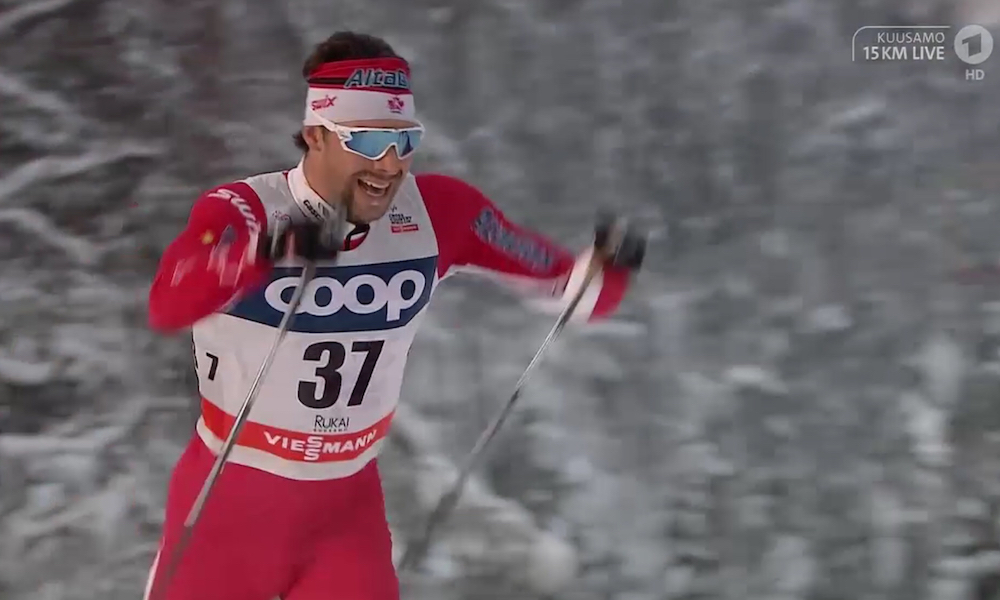
    Canada’s Alex Harvey racing to 13th in the men’s 15 k classic individual start on Saturday at the World Cup in Kuusamo, Finland. (Screenshot: ARD)

    Harvey, who started in bib 37, spent most of his race floating between 10th and 14th place, and did what he needed to get within striking distance of the top 10 for Sunday’s pursuit. He’ll start tomorrow’s race in 12th, 1:23 out of first and 9 seconds behind Chervotkin in 11th.

    “I was just hoping to move forward a bit in the standings but more importantly to deliver another good race,” Harvey wrote in an email on Saturday. The day before, he reached the quarterfinals and finished 21st overall in the sprint.

    “The conditions yesterday were quite different than today’s. Yesterday it was fresh falling snow and cold, then it warmed up quite a bit overnight so today was very glazy [sic] and shiny snow,” Harvey wrote. “Skis were good I think. Not the fastest but good kick in not-so-easy conditions to get grip.”

    Like fellow Canadian World Cup Team member Devon Kershaw, who tied American Erik Bjornsen (U.S. Ski Team) for 26th (both 1:15.2 out of first), Harvey explained that he chose no-wax “hairies”, also known as “rub” skis.

    (“I think a lot of guys went on rub skis,” Kershaw wrote in an email. “I went with rub skis and it was the right choice for me today. The techs were all pretty pumped because I have been very averse to rub skis in the past. The handful of times I’ve been ‘forced’ to race on them I’ve gotten completely destroyed, so today was fun to feel good and make the skis work for me.”)

    Harvey recalled feeling strong on the climbs, using his grip to his advantage.

    “From our more detailed splits it seems I was losing a bit on the flats which is usually my stronger terrain but nothing too dramatic,” Harvey wrote. “I’m happy to be within reach of the top ten, that was the goal for the weekend. Tomorrow I’m looking forward for 2 things. 1: chasing guys ahead of me. 2: skating!”

    Kershaw, who started 13th and had fewer men to chase ahead of him, explained that he paced his first lap so that he’d catch someone like Harvey, and the plan worked.

    “I was going to take my risk and start really slow. Almost level 3 effort,” Kershaw wrote of his pre-race strategy. “I knew I should be able to lap through with either Alex, [Finland’s Matti] Heikkinen, or Dario [Cologna of Switzerland] – and it just so happened that it was Alex. I ended up having great energy after my pedestrian start and was able to ski 10km with him, which obviously allowed me to ski into the points. Perhaps I should have been more aggressive out of the start, but I played it safe and it worked out decently well for me.”

    “That was sweet to have someone there,” Harvey said in a Cross Country Canada press release. “It was good for both of us and really helped pull us both around.”

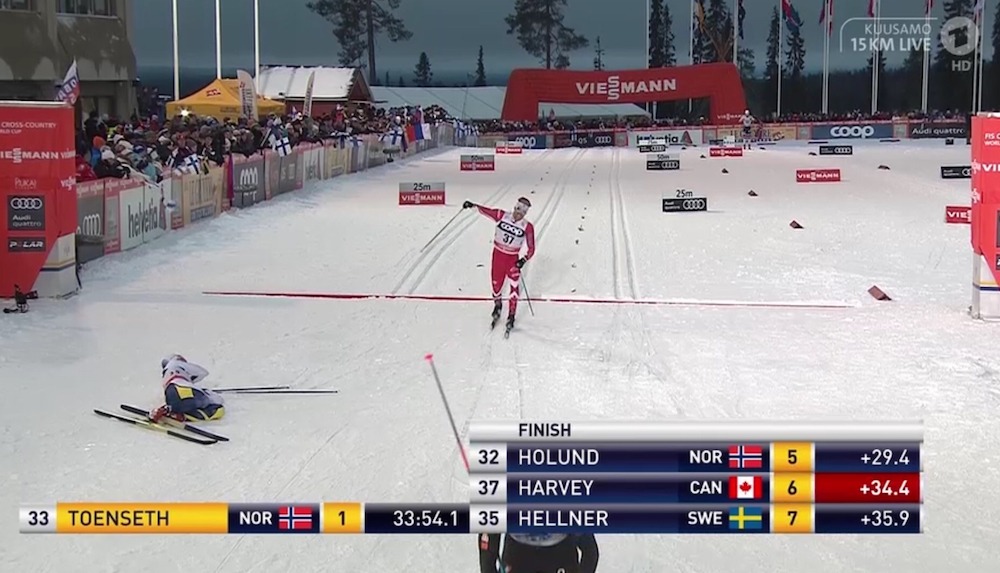
    Canada’s Alex Harvey (in red) lunges at the finish of the men’s 15 k classic at the Ruka World Cup in Kuusamo, Finland. While he initially finished sixth, he ended up 13th on the day. (Screenshot: ARD)

    Kershaw wrote that he was “decently happy,” with his race. “I know that 26th doesn’t sound earth shattering or anything, but to start the first distance race of the World Cup tour in the points is fine. I’m a notoriously slow starter throughout my career before Christmas, so I’m just looking for some solid races and to hit the points more often than missing them is good.”

    On Sunday, he’ll start 28th, one second behind Cologna in 26th and Russia’s Andrey Larkov in 27th. Bjornsen, the U.S. Ski Team’s leading man in the Ruka tour, is 7 seconds ahead of him in 23rd.

    “I think the celling is probably 20th,” Kershaw wrote of his aspirations for an overall finish for the mini tour. “We have a good group of about 10 guys all starting within 9 seconds of each other. I will hope to stay in that group and have the energy and punch to have a good last lap. You never know what happens in these pursuit starts too – so guys could blow up, but there’s a break at around 20, and then behind me there’s a break at around 30. Will be fun.”

    Bjornsen, who placed 24th in Friday’s sprint, started Saturday’s 15 k in bib 69, just 30 seconds ahead of Niskanen. In an email, Bjornsen described catching a “great ride from Iivo” on the second lap.

    “He’s just amazing here,” Bjornsen wrote. “I’m pretty sure he was disappointed with his result. He comes to Ruka with a mission. I jumped on him for a lap in the middle. It felt very controlled in the double pole sections but he was just striding up the hills no problem. The herring bone was not nearly as efficient. I had to let him go after skiing with him for 6kms.”

    Bjornsen explained that he took a chance and went for glide over grip.

    “I’ve only raced here four times but tricky classic conditions seem to be the norm. The hills are big and steep!” he wrote. “I had a pair of rockets under my feet but I didn’t stride in the tracks once. My double pole is feeling great right now so the tactic was to hammer double pole as far up the hill as I could, and then just get out of the tracks and run/herring bone.”

    After finishing in the top 30 to score World Cup points in the first two races of the season, Bjornsen explained he was feeling “psyched”.

    “I didn’t have the best feelings the last couple weeks, so I wasn’t expecting to be in the points right away,” he wrote.

    “Of course yesterdays race was fun for me, but for sure the highlight of the day was watching Sadie absolutely dominate the heats!” he added of his older sister Sadie Bjornsen placing second in the women’s sprint. “She’s been looking great this year and I think she has a lot more success to come. Personally I believe she was strong enough to take the win, it’s only a matter of time before that happens..”

    On Sunday, he hoped to chase a top-30 overall tour finish.

    “I’m starting around some legends, so it will be a great experience!” Bjornsen wrote.

    U.S. Ski Team coach Matt Whitcomb said he was impressed with Bjornsen’s ability to contend with “some of the best skiers in the world” on Saturday, including Niskanen.

    “[He] kind of took the approach, ‘I am going to swing as hard as I can and hope to connect with the ball,’ and it worked for a large part of that race,” Whitcomb said on the phone. “He was skiing up into the top 20, and then Niskanen on the final lap turned things up a little bit and popped him off … It was a gutsy race, so psyched for Erik. It is so fun to watch him figure out a project, some sort of challenge in the race and go after it. … Twenty-sixth is a hell of a race in Finland.”

    American Noah Hoffman raced to 43rd (+1:58.4) on Saturday, Andy Newell finished 59th (+2:29.6), Paddy Caldwell was 72nd (+2:53.5), Scott Patterson 86th (+3:17.7), and Simi Hamilton 96th (+3:43.4) for the U.S. Ski Team.

    Five other Canadian national-team members competed, with Len Valjas finishing 48th (+2:08.0), Graeme Killick 58th (+2:23.4), Knute Johnsgaard 87th (+3:19.8), Julien Locke (U25 Team) 100th (+3:56.4), and Jess Cockney 109th (+5:20.7).

    ***

    * Northug, 31, who made his World Cup debut in 2005/2006 and has since accumulated 13 World Championships golds and two Olympic gold medals, has started his season this weekend with non-World Cup International Ski Federation (FIS) races in Gålå, Norway, after skipping Norway’s opening FIS races in Beitostølen, Norway, last weekend. Per team rules, he was not allowed to start the Ruka World Cup as a result of that decision. So far in Gålå, Northug finished 17th in the 15 k freestyle on Friday and was eliminated in Saturday’s classic-sprint quarterfinals to place 19th in that race.

    ** Belov, 27 is one of six Russian skiers currently banned from competing at future Olympics as a result of doping at the 2014 Olympics. He and the five others are allowed to compete in FIS events, like the World Cup, unless FIS decides otherwise.

    Results: Men’s 15 k classic | Men’s Ruka Triple standings (Day 2) | Pursuit start list

  • World Cup Windup: Norway

    World Cup Windup: Norway

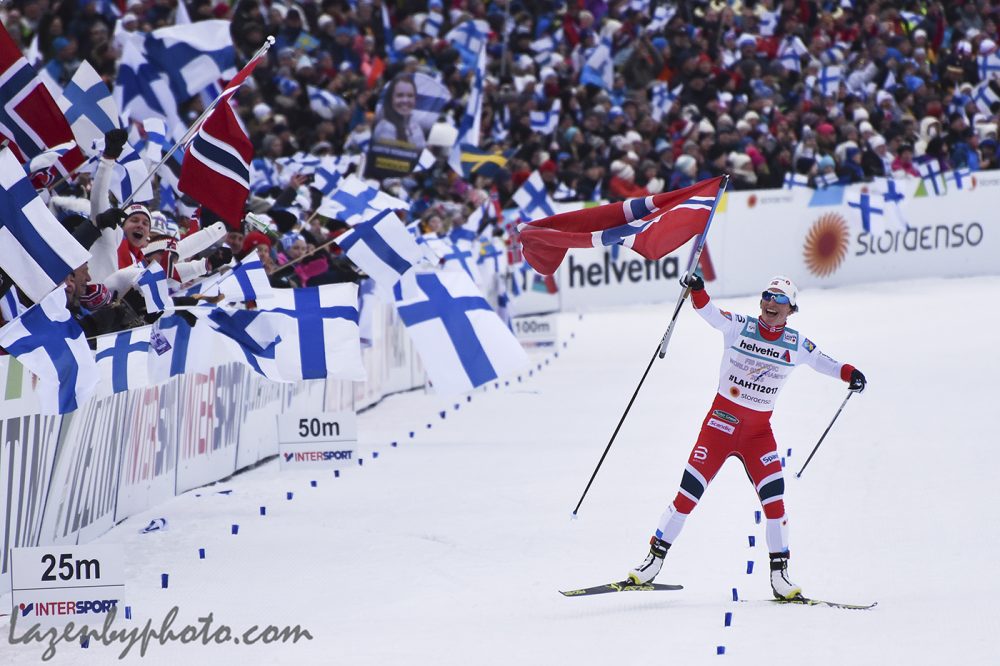
    Marit Bjørgen carrying the Norwegian flag as she crosses the line first for Norway’s 100th World Championship win during the women’s 4 x 5 k relay at 2017 Nordic World Championships in Lahti, Finland. (Photo: John Lazenby/Lazenbyphoto.com)

    Welcome to World Cup Windup, where we check in with the top-10 teams from last year’s FIS Cross Country World Cup tour before the season starts with the Ruka Triple in Kuusamo, Finland, on Nov. 24.

    NORWAY

    Overall in Nations Cup Last Year: First, by a landslide: 13,383 points to 7,053 by runner-up Sweden.

    Women’s Ranking 2016/2017: First

    Men’s Ranking 2016/2017: First

    Norway’s Heidi Weng leading her teammates Ingvild Flugstad Østberg (middle r), Marit Bjørgen (middle l) and Sweden’s Stina Nilsson (far left) during the women’s 10-kilometer freestyle mass start in La Clusaz, France, last December. (Photo: Fischer/Nordic Focus))

    Who’s Back:

    Overall World Cup winners Martin Johnsrud Sundby and Heidi Weng; Sprint Cup winners Johannes Høsflot Klæbo and Maiken Caspersen Falla; World Cup race winners Finn Hagen Krogh, Emil Iversen, Sindre Bjørnestad Skar, Pål Golberg, Eirik Brandsdal, Ingvild Flugstad Østberg, and Marit Bjørgen, And that’s just the skiers who won World Cups last season. There’s also other folks like, oh, Petter Northug and Astrid Jacobsen, who didn’t pick up individual wins last season but are probably pretty hungry.

    Who’s Missing:

    Therese Johaug. The world champion and two-time World Cup overall champion is still sitting out a doping ban for using a lip cream containing a prohibited steroid.

    Other than that, athletes usually don’t retire just before an Olympics, so pretty much everyone is back.

    Pre-Season Results:

    None of the national team members have raced at the pre-World Cup competitions so far, but Chris Andre Jespersen picked up a win in Bruksvallarna, Sweden. Look for many more Norwegians to compete at their home opener in Beitostølen this coming weekend.

    The second World Cup stop of the season is in Lillehammer, so the Beitostølen races will also likely determine who gets to compete as part of the “nations group” there, the host country’s extra bunch of quota spots.

    Recent Drama:

    Oh, there’s always something, isn’t there? For Norway, it’s about the Olympics. With just four starting spots per race and so many top skiers, it will be a tough fight to get named to the Olympic team.

    Norway’s Emil Iversen crashes in the finishing stretch while Finn Hågen Krogh (2) leads Finland’s Ristomatti Hakola (10), Martti Jylhae (4) Canada’s Alex Harvey (13), and Poland’s Maciej Starega (22) during the second men’s skate-sprint semifinal on Feb. 23 at FIS Nordic World Ski Championships in Lahti, Finland. (Photo: Dustin Satloff)

    Emil Iversen, for instance, remembers how he fell twice at last year’s World Championships, including in the team sprint, where he ruined a good chance at a win given to him by teammate Johannes Høsflot Klæbo. He says he is feeling good, but he wants to redeem himself from Lahti and that’s no easy feat. “Everyone says they have never been stronger,” he told NRK. “Being in the squad should be within reach, but getting all the race starts I want will be incredibly hard.”

    Another drama: who will ski the relay. Petter Northug anchored both the 2010 and 2014 Olympic relays for Norway, but the team’s head coach has already decided that in 2018 the honors should go to Finn Hagen Krogh, who did a stellar turn to secure relay gold at 2017 World Championships.

    Marit Bjørgen was sick a few weeks ago, but is feeling better now. She says that she dreams of being in good enough shape to fight for six medals at the Olympics in February.

    Astrid Jacobsen, meanwhile, has changed her training and is in some ways imitating alpine skiers, focusing more on balance. “It’s hard to believe that you can improve oxygen capacity or become more persistent by exercising even more,” the 30-year-old said. “I have a thorough fitness already. I think there’s more to gain by catching up with new things… If I get a little better in this area and get better on the skis, I can be a little more efficient. Better efficiency will produce much better results than better capacity would.”

    Otherwise, a few skiers are not in the shape they’d like to be in at this point in the season.

    Finn Hagen Krogh is congratulated by his teammates after anchoring Norway to gold in the men’s 4 x 10 k relay on March 3 at World Championships in Lahti, Finland, 4.6 seconds ahead of Russia in second place. (Photo: John Lazenby/Lazenbyphoto.com)

    Didrik Tønseth got a bad concussion after a rollerski crash in Livigno, Italy, in early September, and had to miss a considerable amount of training. (Reminder: always wear a helmet while rollerskiing!) He skipped a recent high-elevation training camp because he sometimes still has headaches; he is otherwise doing some hard training again. Tønseth was part of the gold-medal relay team from 2017 World Championships but is worried about qualifying for the Olympics. “It’s a season where you have to do well before Christmas,” he told NRK, according to a translation. “It already counts from Kuusamo… so there is no favorable situation. I’m not completely satisfied.”

    Best Social Media Presence:

    The Norwegian ski stars generally don’t use Twitter much, but a few have great Instagram presences.

    Unsurprisingly, the Norwegian who is best at conveying his brand on social media might be Petter Northug. When the IOC made the decision to disqualify several Russian athletes from the 2014 Olympics for doping – including the silver-medal men’s relay team – this was the response from Northug, who had anchored the Norwegian relay team which had finished fourth, failed to medal, and otherwise caused great soul-searching in the country:

    Given the drama over who will anchor the men’s relay team in 2018, Northug is taking even one more laugh with this post.

    But if it’s not satire and gamesmanship you’re after but rather smiles and a peek inside the women’s team, who from this perspective seem to be genuine friends, follow Heidi Weng on Instagram.

    You might alternatingly find Niklas Dyrhaug modeling suits or shooting moose on his Instagram account, while Astrid Jacobsen’s Instagram feed often highlights the role of her dog in her life – and one of those roles is training buddy.


  • Ski World Reacts to Legkov, Belov Punishment (Updated)

    Ski World Reacts to Legkov, Belov Punishment (Updated)

    After anchoring Norway to fourth in the men’s 4 x 10-kilometer relay at the 2014 Olympics in Sochi, Russia, Petter Northug congratulates the Russian silver medalists, including anchor Maxim Vylegzhanin. As a result of the IOC’s decision to sanction two Russians that competed in Sochi, Russia is to return its relay medal; Norway will thus be awarded bronze and France silver.

    This article has been updated to include comments from Canadian World Cup Team member Alex Harvey as told to Le Journal de Montreal on Wednesday.

    ***

    As the news spreads of the International Olympic Committee’s decision to sanction two Russian cross-country skiers, Alexander Legkov and Evgeniy Belov, for doping at the 2014 Olympics at home in Sochi, Russia, a growing number of skiers and coaches from across the globe are reacting on social media.

    “Hell yes, IOC. Finally starting to take some action,” U.S. Ski Team (USST) member Simi Hamilton wrote on Twitter. “I have a feeling pressure from us clean athletes has paid off!”

    “Today marks a win for clean athletes,” USST Women’s Coach Matt Whitcomb tweeted. “Two cheats are out.  It’s a start.”

    The Russian men’s relay team meets Maxim Vylegzhanin at the finish after he anchored them to silver in the 4 x 10 k at the Sochi Olympics. The IOC recently ruled that the Russian team’s relay result should be invalidated and they are to return their medals.

    Norway’s Petter Northug posted a photo on Instagram of what looked like brunch in a tropical setting with the words: “Feire OL bronse!” (translates to “Celebrating Olympic bronze!”). Northug already has four Olympic medals to his name, two of which are gold (all from the 2010 Olympics), but the men’s 4 x 10-kilometer Olympic relay medal from 2014, which will be awarded retroactively to the Norwegian team (after they placed fourth behind Sweden in first, Russia in second and France in third) will be the first medal for Northug’s teammates Eldar Rønning and Chris Andre Jespersen.

    Later on Wednesday, Northug posted a jocular meme on Instagram, picturing himself racing in the Sochi relay with the words: “You know you are the best anchor when you bring the medal home 4 years after the race.”

    Legkov was part of Russia’s silver-medal relay in Sochi, and as a result of the IOC’s ruling, he must return the two medals he won there (relay silver and 50 k gold). Additionally, the 2014 Olympic results of Legkov and Belov are to be voided and both athletes are barred from competing at (or being granted credentials to) future Olympics. However, both are expected to appeal the ruling to the Court of Arbitration for Sport (CAS) by this Thursday at the latest.

    “It is weird to get the medal in the mail. But if he gets convicted, of course I will take it,” Jespersen told Norway’s Nettavisen, according to a translation. “It’s my only Olympic medal. It is clear I will take it.”

    In an interview with Le Journal de Montreal, Alex Harvey, the leading member of the Canadian World Cup Team who finished third in the overall World Cup and second in the distance standings last season, said he had his suspicions about Legkov — particularly after the 50 k freestyle mass start (in which Harvey placed 19th).

    Canada’s Alex Harvey (front, bib 19) racing in the freestyle sprint at the 2014 Winter Olympics in Sochi, Russia. He finished 19th on the day. Also pictured: Russia’s Sergey Ustiugov (2) made it to the final and placed fifth. (Photo: Fischer/NordicFocus)

    “On the climbs, we could see he was artificially stronger than the rest,” Harvey said, according to a translation. “In Sochi, the last two kilometers were filled with big climbs. It was a course made for Russians knowing that they were doping.”

    He added that the end of each course in Sochi ended with a long, brutal uphill that was exceptionally “physically demanding”.

    As for the recent doping bans involving professional cross-country skiers, Harvey said, “It’s a shame because our sport is now compared with cycling. It is in cross-country skiing and in biathlon that the largest number of dope cases occur.”

    And while he was in favor of the IOC’s decision, he hoped the buck wouldn’t stop there.

    “I’m happy that the IOC finally acted, but Russian skiers are still racing … and one in particular who wasn’t bad in Lahti,” he said, alluding to Sergey Ustiugov, who took gold or silver in all five races he competed in at Lahti World Championships.

    “Ustiugov was young at the Sochi [Olympic Games], but he still reached the final in the sprint,” Harvey said. “Three of the top six men fell, but he was on his way to a podium that day. What the McLaren Report revealed was that the full team was involved in doping. But Ustiugov’s name never came out. And as long as his name doens’t come up, we can only have doubts.”

    Meanwhile, the law firm representing Legkov and Belov is enraged, according to Nettavisen.

    “The decision deserves the term scandal,” the Wieschemann firm stated in its press release on Wednesday. “[It] mocks the declaration of the President of the IOC, Dr. Thomas Bach, to decide only on the basis of secure evidence.”

    While the IOC’s Disciplinary Commission (also referred to as the Oswald Commission) has yet to release its full decision and explain how it arrived at the final rulings, cases for 26 other Russian athletes (four of which are nordic skiers) who allegedly doped in Sochi are still pending, the CBC reported.

    “The Oswald Commission has announced that all hearings for active athletes who could qualify for the Olympic Winter Games PyeongChang 2018 will be completed by the end of November,” the IOC stated.

    As of Wednesday, exactly 100 days out from the 2018 Winter Olympics in PyeongChang, South Korea, it remained unclear whether the commission obtained further evidence concerning Legkov and Belov beyond what was already presented to the CAS.

    Wieschemann claims the commission ruled “without further investigation and without further evidence…”

    “Denis Oswald still stated at the last summit of the IOC that his investigations would go far beyond those of Prof. Richard McLaren,” the firm’s press release stated. “Well that’s actually not the case. The investigation has only been limited to obtaining a new forensic opinion…”

    And while some of the most outspoken individuals in the XC world continue to speak out, others are weighing in on social media as well.

    “… It’s disturbing to find out that some athletes in cross-country skiing have likely doped, and have gone so long unpunished,” Caitlin Patterson of the Craftsbury Green Racing Project wrote on Facebook. “But it reminds me that we must be vigilant, keep looking for ways to support anti-doping testing programs, put pressure on governing bodies to take a stand for clean sport, educate ourselves on progress and pitfalls of the cause, and speak up when we can.

    “I haven’t spoken much on this politicized topic, but recent news such as this disqualification makes me distinctly aware of how much I value clean sport and all it stands for,” Patterson, who has started 27 World Cup races, continued. “Thank you IOC for taking this step towards preserving clean sport! Let’s keep it going, keep the pressure on, and fight to #CompeteClean and #PlayTrue!”

    Former U.S. skier Sylvan Ellefson, who retired in 2014 after racing 23 World Cups, took to Instagram: “Thankful that our @usnordicskiteam contingency all get to move up a couple spots, but I mostly feel for those who have always been moral in their decision making. Those who train and race relentlessly, with their head down, just to find out their competition is taking the easy road. I could go on, but nothing lights me up more than cheaters.”

  • Closing the Gap: Brain Training

    Closing the Gap: Brain Training

    “Norwegian fjell running.” Team Asker doing some dryland mountain training during a training camp in Norefjell, Norway. (All photos: Maks Zechel)

    Editor’s Note: The following is part of a series proposed by Maks Zechel, a 20-year-old Canadian cross-country skier embarking on his first season training abroad. In August, he recently made the big move to Norway, where he’ll be training and racing with Team Asker for the entire winter. Through these updates, Maks hopes to share his personal “observations, stories and lessons learned” to help close the gap between North American and Scandinavian nordic skiing. Previous posts: #1, #2, #3#4#5and #6.

    ***

    There is something about passion that drives people to push boundaries like nothing else. For many Canadians, this passion lies in hockey. If it’s January and you aren’t within walking distance of at least two outdoor hockey rinks, you probably don’t live in Canada.

    I’ve never been a huge hockey fan, but regardless I still went through a phase as a 9 year old when I practised my stick-handling skills religiously, making marks against the garage door or the basement wall. Black marks and dented aluminum are the proud checkmarks of passionate Canadian youth (and the source of endless frustration for Canadian parents). Canadian hockey drives youth and even adults to fervently practice a sport that only a small percentage will ever play professionally. Even on a weekday night in the middle of winter, if you bring a stick and skates to any Canadian outdoor rink, you will be allowed to join a game of shinny. No matter your gender or age, whether you claim to have been a AAA hockey legend or have never skated before, whether your family has lived in Canada for generations or if you are a newly landed immigrant, Canadians are brought together by something that transcends sport.

    National passion for a sport ensures that a large and diverse percentage of the population will actively pursue that activity in a multitude of ways. It encourages creativity and innovation. Similarly to hockey in Canada, albeit on a smaller scale, there are an astonishing number of Norwegian skiers who dedicate much of their time to just training and racing fast, even without sponsorships or national-team status.

    This creates a field of close to 500 open men at the Norwegian national championships. In the 10-kilometer skate race at last year’s national championships, the top-100 racers were separated by 1:47.6 minutes, the top 200 by 2:33.2 minutes, and the top 300 by 3:31.7 minutes (note that the conditions were fast that day). The medal winners, and many of the skiers far off the podium, were World Cup, World Championship and Olympic medalists (Anders Gløersen won, Martin Johnsrud Sundby was second, Emil Iversen was 11th, Sjur Røthe was 32nd (full race results here). The depth of field at Norwegian and Scandinavian Cups and national-championships races rivals that of World Cup races, with many believing it to be more difficult to crack the top 30 in the aforementioned three than it is at most World Cups.

    Team Asker skiers recover as they run down an alpine ski slope during 10- x 4-minute Zone 4 bounding intervals, with one minute rests in between, at a recent training camp in Norefjell, Norway.

    The success that we see in the Norwegian senior ranks begins with Norway’s junior skiers, and I am lucky enough to be training partners with some of these top-level athletes. One of Team Asker’s most successful junior skiers, Harald, has two medals from last year’s Junior World Championships. To put his level of skiing into a senior-racing perspective, he was 26th in the previously mentioned 10 k race at the Norwegian nationals — as an 18 year old.

    It can be deceptive to see skiers who still look quite young, but to know that they are already skiing fast enough to potentially crack the top 30 on a World Cup. I believe that much of this ability stems from the incredible amount of maturity in Norwegian junior racers, although not necessarily in the traditional sense. Not all of them are obsessive about the small things; I have seen top Norwegian skiers down two Cokes per day at training camps, eat Nutella for breakfast and stretch as little as possible. Their maturity becomes apparent in how they approach training and races, ready to learn to push their bodies in the best way that they can.

    With more skiers, you see more body types and different minds. My teammates have told me to expect many funny styles of double poling when I race Norwegian and Scandinavian Cups this winter. Already at the junior level, skiers spend hours working on their double-pole technique, not just doing exactly what their coaches told them to do, but practising different movements and seeing how it works for them. Double poling is a simple motion, in theory, but with different body types you can have countless different styles of double poling that all produce the maximum amount of power for those individual skiers.

    With Team Asker, we discuss technique with our coach and we do group-technique sessions, but then we are encouraged to try things out by ourselves and see how we can adapt those basics of power transfer to how our individual bodies work. The same goes with training plans. The spectrum of what type of training makes someone ski fast is all over the place, and that is something that many Norwegian skiers seem to accept. Some athletes on Team Asker disagree with certain things that our coach says, but they are not criticized for this and are supported in altering their training as they see fit, although they are encouraged to discuss why they are making these choices.

    In Canada, I have often heard repeated “golden rules” to technique and training, things that are accepted by most coaches across the country. In Norway, I learn a new philosophy every time I speak to a different coach or athlete. For some skiers, it is important for them to train long and slowly in Zone 1 so that they have the energy to focus on interval workouts. Other skiers do short Zone 1 workouts, but push the workouts so that they are in high Zone 1 or low Zone 2, skiing closer to competition speed. Many skiers do sprints with every workout, even long runs, while others add sections of Zone 3 pickups in the middle of their easy workouts. I have a teammate who builds up to a period in the training season where he is doing 30 short sprints per day. I know Norwegian 16 year olds who are training more than 1,000 hours per year, but there are also World Cup skiers who are barely training 600 hours.

    Team Asker finishing a combo rollerski/run workout at recent training camp in Norefjell, Norway.

    Some people think that too much base training (slow Zone 1) is a waste of time, so they do the bare minimum that is required to be able to absorb intensity training and the long race season. Johannes Klæbo’s big breakthrough in the past couple of years is said to have come from an emphasis on strength and sprint training, while Petter Northug has long sworn by doing intervals in “myra” (spongy and uneven bog/marsh), but for some people, those same things will make little difference to their speed on snow. Talent may have helped them in the beginning, but whether it was Klæbo or Northug, they didn’t reach the top level through talent alone, but by perfecting all the things that make them fast.

    There are skiers, some point to Therese Johaug, who many think could do almost any type of training, and they will be fast simply from general fitness, but for most people training is not so simple. Fortunately for us mortals there is no limit to what we can achieve, so long as we are willing to take chances and use our brains rather than just succumbing to that “training junkie gene” that so many skiers possess. Each one of us is so different, that it is not possible for us to do the same things and achieve the same results.

    Over and over I have heard coaches and athletes, who go to Scandinavia for a few weeks to learn the “secrets” of the best skiers in the world, come back and confidently tell us Canadians that “they do the same training as us” and therefore we can be just as fast as them. I agree that we can be just as fast, but from my first three months in Norway, I can tell you that we do not train anything like the Norwegians. We may do similar bounding, rollerskiing and running workouts, but training in Norway is taken to the highest level by the competitive dialogue that takes place among young skiers, old skiers, back of the pack skiers, and top skiers. From my perspective, training innovation and experimentation doesn’t happen in North America on the same small scale level as it does in Norway.

    The go-kart track where Team Asker held “King’s Court” style rollerski skate sprints (8 x approximately 1:30 minutes) during a recent training camp in Norefjell, Norway.

    In Canada we look to those that are better than us, whether they are national-team members or World Cup skiers, and try to copy them from afar. This puts us decades behind the competition. A lot of the technique innovations that we will see on the World Cup in the next two decades will have come from the Norwegian junior skiers of today, but by the time North American skiers take note of these changes, and adjust their training, the next generation of Norwegian juniors will already be working on the technique advances for the next decade.

    When I first came to Norway, the first thing I did was try to copy how the best skiers on the team double poled. I copied them for 12 weeks, but every time I looked at video footage of myself, I still looked completely different. It wasn’t until my coach explained a miniscule timing difference to me that I understood what the others were doing differently. With the switch flicked, my double poling has improved because of things that I could not figure out just by watching others ski. It is this type of interaction, between skiers and coaches of all levels, that causes breakthroughs in technique. Not all club-level coaches in Norway look to the Norwegian national team for advice on all aspects of skiing. Many coaches disagree with the common consensus on technique and training, and this opens up the discussion which is so important to moving forward.

    Most skiers love to talk about technique and the finer aspects of skiing, but when I was in Canada, I found these discussions usually revolved around what faster people were doing. In Norway I find myself having more discussions on what we individually think we should be doing, and even if someone is superior at a certain aspect of skiing, they are usually eager to try what someone else thinks might be better.

    As “Mad-Eye Moody” from J.K. Rowling’s Harry Potter series would say, “Constant vigilance!” and adjustment are required in all aspects of our training if we want to succeed. We have to seek variation in training, and learn together to discover the things that make us go fast as individuals, or else we suffer individually under the repetition of uniform training that cannot meet all of our needs.

    Norwegian Phrase of the Week:

    Norwegian: “Jeg er ut å mate.”

    Google Translate: “I’m out to feed.”

    True meaning: “I am training a lot.” (slang)

    Team Asker during a long run through the mountains at a recent training camp in Norefjell, Norway.

    ***

    About Maks: Maks Zechel is a competitive cross-country skier who secretly wants to become a professional mile runner. He loves hiking and going on canoe trips with his family, as well as peanut butter cups in ice cream. Johan Olsson is his favourite skier and he hopes to race the Cortina-Toblach stage of the Tour de Ski one day. He enjoys writing about his experiences. Follow him on Instagram @makszechel.

  • Summer Success for Sundby, Wins First Race of Blink Festival

    Summer Success for Sundby, Wins First Race of Blink Festival

    Defending Overall World Cup champion Martin Johnsrud Sundby won the first race of the 2017 Blink Ski Festival on Wednesday, finishing 2.6 seconds ahead of fellow Norwegian Simen Hegstad Krüger in the Blink Classics 60 k distance rollerski. (Photo: NRK screenshot)

    Stands crowded with 50,000 cheering spectators. Bibbed athletes clad in shorts and T-shirts clicking by on rollerskis. Competitors representing various countries dousing themselves with bottled water as they cross the finish line.

    These were among the sights and sounds of the world’s largest summer rollerski-race series, Norway’s Blink Ski Festival.

    Celebrating its ninth year, racers and fans kicked off the 2017 four-day festival in Gjesdal and Sandnes, Norway, with men’s and women’s classic distance rollerski races on Wednesday.

    Toeing the start line for the elite men’s 60-kilometer were well-known Norwegian World Cup racers, such as Martin Johnsrud Sundby, Petter Northug and Sjur Røthe, as well as Russia’s Sergey Ustiugov, Finland’s Iivo Niskanen, Germany’s Lucas Bögl, and American Andy Newell.

    In the beginning, it appeared Ustiugov was gunning for the lead, charging the group of 58 rollerskiers with 46 k to go. But within another 9 k, a pack of six had broke off the front, including Sundby, Røthe, Niskanen, and Norwegians Øystein Pettersen, Simen Hegstad Krüger, Anders Aukland, and Simen Håkon Østensen. Ustiugov was now in the chase group close to 45 seconds away.

    With less than 30 k of road left to race, the front group had dwindled to three Norwegians and a Finn: Sundby, Røthe, Krüger, and Niskanen. Newell had caught up to the chasing group, now almost two minutes back from the leaders.

    Given 20 more kilometers, however, Sundby and Krüger had pulled away, Niskanen working to hold onto third 30 seconds back. The two Norwegians battled together until the final kilometer, when Sundby surged for the final city sprint to secure the victory in a time of 2:08:40.6.

    Though some may see the win as a premature predictor of what’s to come this winter, Sundby was not one of them.

    “We are talking about July. Everyone pretends like they don’t care, but this is important for everyone who is on the starting line,” Sundby told NRK, according to a translation. “There weren’t a lot of world-class athletes who was not on the starting line today.

    “This is incredibly good practice,” he continued. “I greatly appreciate all of these competitions.”

    Just 2.6 seconds behind Sundby, was Krüger crossing in second. Third went to Niskanen, who finished 36.7 seconds back from the winner.

    Just 1.8 seconds outside of the top 15 was Newell in 16th overall (+5:25.1) in the elite men’s race, out of 58 finishers.

    In the elite women’s 60 k, which started at the same time as the men, Norway’s Astrid Øyre Slind latched onto a few male racers from the start and broke away from her competition, which included just 10 women

    Slind took the win in a time of 2:20:04.2, while fellow Norwegian Kari Vikhagen Gjeitnes claimed second, 2:11.1 minutes back. Belarus’s Yulia Tikhonova completed the women’s podium in third (+2:23.4). 

    (Article continues below)

    https://www.instagram.com/p/BW9z6M4hmcd/?taken-by=andynewellskier

    Racing continued Thursday with the men’s and women’s hill climb, the Lysebotn Opp, in  Lysebotn, Norway. Sixty-five women came out for that race, with Sweden’s Charlotte Kalla taking the victory in 33:18.3. Norway’s Heidi Weng finished 40.3 seconds back in second, and Marit Bjørgen wearing bib 1 finished third, 1:50.5 minutes behind Kalla.

    Liz Stephen of the U.S. Ski Team took sixth (+3:35.7) behind Norway’s Ragnhild Haga (+2:43.4) in fourth and Finland’s Krista Pärmäkoski in fifth (+2:47).

    In the men’s race, Norway’s Hans Christer Holund took the win in 27:37.6. Krüger repeated in second place, 1:13.9 minutes back, and Finland’s Matti Heikkinen placed third (+1:25.6), while Sundby was sixth (+2:11.5) behind fellow Norwegians Henrik L’Abée-Lund in fourth and Røthe in fifth.

    Out of 100 male starters, 99 finished. Newell did not compete.

    Check back Friday for a more detailed recap of Thursday’s Lysebotn Opp.

    Day 1 distance results: Men | Women

    Day 2 Lysebotn Opp (hill climb) results: Women | Men

  • Wednesday Rundown: Drammen & Lake Placid (Updated)

    Wednesday Rundown: Drammen & Lake Placid (Updated)

    The men’s World Cup 1.2 k classic sprint podium on Wednesday in Drammen, Norway, with Norway’s Eirik Brandsdal (c) in first and Johannes Høsflot Klæbo (l) in second, and Russia’s Sergey Ustiugov (r) in third. (Photo: FIS Cross-Country/Twitter)

    FIS Cross-Country World Cup (Drammen, Norway): Classic sprints

    Just three days after 2017 Nordic World Championships ended in Lahti, Finland, World Cup cross-country skiers were back to their regular-season grind with 1.2-kilometer classic sprints on Wednesday in Drammen, Norway.

    In the men’s race, Norway stole the day with Eirik Brandsdal notching his first World Cup win since 2015 in Drammen, but Russia’s Sergey Ustiugov broke up the team’s total domination of the final with a third place, behind Brandsdal (who won it in 2:39.35 minutes) and Johannes Høsflot Klæbo in second (+2.55). Ustiguov placed third (+3.28) for his seventh consecutive podium coming off five medals in five races at World Championships, and three other Norwegians, Petter Northug, Pål Golberg and Sondre Turvoll Fossli finished behind him in fourth through sixth, respectively, in the final.

    To start the day, Klæbo won the qualifier in 2:33.81, 3.62 seconds ahead of Brandsdal in second. Ustiugov qualified 10th (+6.21).

    Canada’s Alex Harvey and Len Valjas qualified for the heats in 18th and 21st, respectively, and Andy Newell was the lone American to reach the quarterfinals after qualifying in 13th.

    In the third quarterfinal, Newell finished third, 1.7 seconds behind Brandsdal, who won it. Sweden’s Oskar Svensson took second in that heat (+0.66).

    Harvey won the fifth quarterfinal, and Canada originally took first and second with Valjas outlunging Alexander Bolshunov for second place. Valjas was ultimately relegated to last in the heat for his move around Bolshunov at the line, and the Russian was listed as second (+0.27) for an automatic spot in the semifinals.

    While Klæbo won the first men’s semifinal by 0.46 seconds over Brandsdal, Ustiugov topped the second semi by 0.32 over Golberg. Harvey initially finished fifth in that second semi but moved up one spot to fourth (+4.41) after Norway’s Finn Hågen Krogh was disqualified (putting him in last, 67th overall). Harvey ended up eighth overall on the day.

    Newell placed 18th overall and Valjas 27th.

    Also for the North Americans, U.S. Ski Team members Simi Hamilton and Erik Bjornsen finished 40th and 44th, respectively, and Ben Lustgarten (Craftsbury Green Racing Project) was 62nd. Canada’s Russell Kennedy (Canmore Nordic/Team R.A.D.) finished 63rd.

    In the women’s 1.2 k classic sprint, Stina Nilsson commanded the day and Sweden ended up with two on the podium, with Hanna Falk in third.

    Nilsson started off by qualifying in fourth, 1.54 seconds behind Finland’s Krista Pärmäkoski, who topped the qualifier in 3:00.28. While Pärmäkoski went on to win her quarterfinal and place third in her semifinal (advancing as a lucky loser to the final), Nilsson won both her quarterfinal and semi, and ultimately took first in the final in 3:07.57. Pärmäkoski notched second (+0.42), and Falk third (+1.26) ahead of Norway’s Kathrine Rolsted Harsem in fourth (+3.27), Sweden’s Ida Ingemarsdotter in fifth (+4.86), and Slovenia’s Anamarija Lampič in sixth (+9.67).

    Three U.S. women qualified for the heats, with Sadie Bjornsen in fifth, Jessie Diggins in sixth and Sophie Caldwell in 11th.

    Bjornsen and Diggins were eliminated in the quarterfinals after placing fifth and sixth, respectively, while Caldwell finished third in the third quarterfinal (0.79 seconds behind Østberg, who won that heat) and advanced as a lucky loser to the semifinals with Finland’s Aino-Kaisa Saarinen, who was fourth in that heat (+0.95).

    In the semifinals, Nilsson led her teammate Falk across the line by 0.14 seconds, and Lampic advanced as a lucky loser in third (+1.05).

    Ingemarsdotter won the second semifinal by 0.22 seconds over Harsem, and Pärmäkoski made the cut for the final with a fast-enough time in third (+0.56). In that heat, Slovenia’s Katja Višnar (who had posted the second-fastest qualifying time) finished fourth (+0.83), and Caldwell fifth (+1.44).

    That put Caldwell in ninth overall, while Bjornsen placed 21st and Diggins 26th. Also for the U.S., Rosie Brennan finished 37th in the qualifier, Ida Sargent was 42nd, and Kikkan Randall 52nd.

    One day after her 23rd birthday, Canada’s Dahria Beatty finished 48th.

    Men’s results: Final | Qualifier

    Women’s results: Final | Qualifier

    ***

    USSA Cross Country Junior Championships (Lake Placid, N.Y.): Classic sprints

    The U20 women’s classic sprint podium at U.S. Junior Nationals on Wednesday in Lake Placid, N.Y., with Julia Kern (c) of the Stratton Mountain School in first, Canada’s Katherine Weaver (l) of Hollyburn XC Ski Club in second and Maddie Morgan (r) of the Wasatch Nordic Ski Academy in third. (Photo: XCJuniorNationals2017.com)

    [UPDATED] On the second day of racing at 2017 U.S. Junior Nationals in Lake Placid, N.Y., Novie McCabe, Haydn Halvorsen, Gus Schumacher, and Julia Kern achieved their second national titles of the week in the classic sprints on Wednesday at the Olympic Jumping Complex.

    Representing the Pacific Northwest division and Methow Valley Nordic Ski Educational Foundation, McCabe won the U16 girls’ A-final more than 5 seconds ahead of anyone else in 5:04.22 minutes. New England’s Anna Lehmann, of the Stratton Mountain School (SMS) followed in second (+5.14) and Intermountain’s Sydney Palmer-Leger notched her second-straight podium in third (+5.96). Also in the U16 girls’ final were Rocky Mountain’s Bridget Donovan (Ski & Snowboard Club Vail) and Waverly Gebhardt (Steamboat Springs Winter Sports Club), who placed fourth and fifth, respectively, and Intermountain’s Sarah Morgan, of the Wasatch Nordic Ski Academy (WNSA), in sixth.

    In the U16 boys’ A-final, Halvorsen (Far West/Sugar Bowl Ski Team & Academy) won by 3.31 seconds in 4:28.29 minutes. New England’s Will Koch (SMS) placed second for his second podium in as many races, and Intermountain’s Lane Myshrall (Park City Nordic Ski Club) took third (+6:39). Also in the U16 boys’ final, Johnny Hagenbuch (Intermountain/SVSEF) placed fourth, George Cvancara (Alaska/Alaska Nordic Racing) fifth and Will Lange (Pacific Northwest/Mt. Bachelor Sports Education Foundation) sixth.

    The U18 boys’ classic sprint podium at U.S. Junior Nationals on Wednesday in Lake Placid, N.Y., with Gus Schumacher (c) of Alaska Winter Stars in first, Scott Schulz (l) of the New York Ski Educational Foundation in second, and Adam Glueck (r) of Ford Sayre in third. (Photo: XCJuniorNationals2017.com)

    Alaska’s Gus Schumacher (Alaska Winter Stars) topped the U18 boys’ A-final by 1.13 seconds in 4:35.95. Local Mid-Atlantic skier Scott Schulz (New York Ski Educational Foundation) took second, and New England’s Adam Glueck (Ford Sayre) placed third (+5:04). Alaska’s Canyon Tobin (APUNSC) followed in fourth, Far West’s JC Schoonmaker (Auburn Ski Club Associates Inc.) fifth, and New England’s Ben Ogden (SMS) reached the final but was disqualified.

    The U18 girls’ classic sprint podium at U.S. Junior Nationals on Wednesday in Lake Placid, N.Y., with Marin Coletta (c) of the Bridger Ski Foundation in first, Rena Schwartz (l) of GMVS in second and Anna Gibson (r) of Jackson Hole Ski Club in third. (Photo: XCJuniorNationals2017.com)

    In the U18 girls’ A-final, Marin Coletta, representing Intermountain and the Bridger Ski Foundation (BSF), took the win in 5:14.30, 4.4 seconds ahead of New England’s Rena Schwartz (Green Mountain Valley School). Intermountain’s Anna Gibson (Jackson Hole Ski Club) rounded out the podium in third (+6.26). Also reaching the final, Brooke Dunnagan (Intermountain/BBNT) finished fourth, Jenna DiFolco (Alaska/NSCF-FXC) fifth, and Callie Young (New England/Craftsbury Nordic) sixth.

    U.S. Ski Team Development Team member Julia Kern picked up her second-straight win in the U20 women’s category, winning the A-final by a resounding 18.47 seconds. After Kern (New England/SMS) finished in 4:47.54, Canada’s Katherine Weaver (Hollyburn XC Ski Club) placed second for the second-straight race, and Intermountain’s Maddie Morgan (WNSA) took third (+33.38) in the most strung-out final of the day. Also in that final, Intermountain’s Leah Lange (University of Utah) finished fourth, Margie Freed (Midwest/Loppet Nordic Racing) fifth, and Canada’s Catherine Reed-Metayer (Skibec) sixth.

    From left to right: Alexandra Lawson (New England/Craftsbury Nordic) and Maya Seckinger (Pacific Northwest/Bend Endurance Academy) go head to head during a U20 women’s classic sprint heat on Wednesday at 2017 U.S. Junior Nationals. Both reached the B-final, where they placed fourth and third, respectively. (Photo: XCJuniorNationals2017.com)

    The U20 men’s classic sprint win went to Canada’s Reed Godfrey (Canmore Nordic/Team R.A.D.), who finished first in 4:33.64. Kam Husain (SMS) crossed 3.32 seconds later as the top American in second overall, and Canada’s Ryan Jackson (Team Hardwood) was the third man on the podium in third (+5.68). Rounding out the A-final, Finn O’Connell (New England/University of Vermont Ski team) placed fourth and Daniel Streinz (New England/Mountain Endurance) fifth, and Canada’s Étienne Hébert (Montériski) was disqualified.

    Results: U16 girls | U16 boys | U18 boys | U18 girls | U20 women | U20 men

  • Sunday Rundown: Harvey Wins World Champs Gold in Lahti; PyeongChang + Vasaloppet (Updated)

    Sunday Rundown: Harvey Wins World Champs Gold in Lahti; PyeongChang + Vasaloppet (Updated)

    Canada’s Alex Harvey (3) celebrates his win in the men’s 50 k freestyle mass start, his first individual gold medal at a World Championships, on Sunday at 2017 Nordic World Championships in Lahti, Finland. He beat Russia’s Sergey Ustiugov (l) by 0.6 seconds while Norway’s Sjur Røthe (9) can be seen coming in for sixth place, behind (not pictured) Finland’s Matti Heikkinen, Great Britain’s Andrew Musgrave and Norway’s Martin Johnsurd Sundby, respectively. (Photo: NBC Sports screenshot)

    FIS Nordic World Championships (Lahti, Finland): Men’s 50 k freestyle mass start

    After a week of missing out on the medals at 2017 Nordic World Championships, Canada’s Alex Harvey, a four-time World Championships medalist from 2011, 2013 and 2015, achieved his first individual gold medal in the final race of this year’s World Championships in Lahti, Finland.

    Harvey, 28, won the men’s 50-kilometer freestyle mass start in a drag race to the finish. Entering the final descent into the stadium with Norway’s Martin Johnsrud Sundby and Russia’s Sergey Ustiugov, Harvey rode his fast skis past both of them then had the most finishing kick in the final straightaway for a 0.6-second victory. He finished in 1:46.28.9 hours, while Ustiugov followed him across the line in second and Finland’s Matti Heikkinen from behind for third (+1.4), after passing Sundby around the outside of the last corner.

    Canada’s Alex Harvey (c) celebrates gold in the men’s 50 k freestyle mass start on Sunday at 2017 Nordic World Championships in Lahti, Finland, with Russia’s Sergey Ustiugov (l) and Finland’ Matti Heikkinen (r) joining him on the podium in second and third, respectively. (Photo: Cross Country Canada/Twitter)

    Sundby appeared to miss a pole plant soon after Heikkinen passed him and let off the pace a few meters before the finish. That’s where Great Britain’s Andrew Musgrave continued to accelerate and took fourth place, 2.9 seconds behind Harvey and 0.1 seconds ahead of Sundby in fifth. Norway’s Sjur Røthe followed another 0.4 seconds back in sixth, Switzerland’s Dario Cologna was seventh (+8.9), Norway’s Petter Northug eighth (+12.3), France’s Maurice Manificat ninth (+13.4), and Norway’s Hans Christer Holund 10th (+14.3).

    “I had really good skis,” Harvey said in a post-race interview with FIS. “I knew if I came into the corner in second place, that was the optimal position. So I was able to fight hard and hit that last corner in second and slingshot by Martin along the flat and then that was good after that.”

    “This is the best race of my life, for sure,” he added. “So I’m really happy.”

    Tad Elliott (Ski Club Vail) led the Americans in 27th (+3:16.8). Noah Hoffman (U.S. Ski Team) finished 50th (+8:53.1) and Kyle Bratrud (CXC Team) did not finish.

    Canada started four men, with Devon Kershaw finishing 38th (+5:45.5), Graeme Killick 43rd (+7:04), and Knute Johnsgaard in 55th (+12:03.3).

    For Harvey, the medal is his fifth at three World Championships and his first individual gold after winning the classic team sprint with Kershaw in 2011.

    Results

    ***

    IBU World Cup (PyeongChang, South Korea): Men’s and women’s relays

    Between the men’s and women’s relays on Sunday at the International Biathlon Union (IBU) World Cup in PyeongChang, South Korea, Canada had two teams in the top eighth, with its men’s team finishing seventh in the 4 x 7.5 k and women’s team eighth in the 4 x 6 k. Behind them, the U.S. men finished 10th and U.S. women 14th.

    France won the men’s relay by 33.8 seconds over Austria, using a total of 10 spare rounds but avoiding the penalty lap. Martin Fourcade anchored France to the win in 1:12:09.5 hours, after Jean-Guillaume Béatrix initially tagged them in first, his older brother Simon Fourcade raced them into second with near-perfect shooting (using just one spare to clean), and Simon Desthieux picked off one more place to give Fourcade a 16-second lead for the final leg.

    Austria achieved second place with Lorenz Wäger, Simon Eder, Julian Eberhard, and Dominik Landertinger combining for zero penalties and nine spares.

    Norway finished third (+45.4) with Vetle Sjåstad Christiansen, Ole Einar Bjørndalen, Vegard Gjermundshaug, and Henrik L’Abée-Lund. They had one penalty on Gjermundshaug’s third leg, and used a total of eight spares.

    Canada’s Christian Gow, Scott Gow, Nathan Smith, and Brendan Green finished seventh (+3:03.1) with zero penalties and nine spares. After Christian tagged his older brother Scott in ninth, Scott raced them into sixth place before Smith slipped four places to 10th at the final exchange. On the final leg, Green raced them into seventh, requiring two spares to clean.

    The Americans finished about nine seconds later in 10th (+3:12.8) with Lowell Bailey, Leif Nordgren, Paul Schommer, and Sean Doherty combining for zero penalties and nine spares, just like Canada. Bailey had originally put them in second at the first exchange, Nordgren dropped to seventh, then Schommer to 13th, before Doherty finally brought them back to 10th out of 24 teams.

    In the women’s relay, Germany pulled off a 22.8-second win over Norway, with one penalty and eight spares. Nadine Horchler put Germany in third at the first exchange, then Maren Hammerschmidt raced them into first by the race’s halfway point. From there, Denise Herrmann, a former cross-country World Cup regular, had to ski a penalty lap and tagged off in second, 13.5 seconds out of first. With teammate Laura Dahlmeier sitting out the relay, Franziska Hildebrand anchored Germany to the win in 1:07:35.6 after she used just one spare to clean.

    Norway placed second with Kaia Wøien Nicolaisen, Hilde Fenne, Tiril Eckhoff, and Marte Olsbu accumulating one penalty and 11 spares. Olsbu beat out the Czech Republic’s Gabriela Koukalová by one-tenth of a second at the finish, as the Czechs placed for third (+22.9), with Jessica Jislová, Eva Puskarčíková, Lucie Charvátová, and Koukalová (with a total of one penalty and nine spares).

    Canada took eighth (+1:34) with Rosanna Crawford, Julia Ransom, Megan Tandy, and Emma Lunder. Crawford tagged in second at the first exchange, Ransom slipped one place to third, Tandy lost another place to tag in fourth, and Lunder ultimately anchored them to eighth.

    The U.S., with Clare Egan, Susan Dunklee, Joanne Reid, and Maddie Phaneuf, finished 14th (+3:08.3) with one penalty and 10 spares. After Egan had a penalty on the first leg, Dunklee skied the fastest second leg to move the team from 19th to 14th, then Reid put them in 11th by the final exchange. Twenty-one teams competed in the women’s race.

    Results: Men | Women

    ***

    Ski Classics 90 k Vasaloppet (Sälen to Mora, Sweden)

    John Kristian Dahl (r) of Team United Bakeries outlunges Ski Classics sprint leader Andreas Nygaard (r) of Team Santander for the win in Sunday’s 90 k Vasaloppet in Mora, Sweden. (Photo: Visma Ski Classics)

    [UPDATED] In Sunday’s 93rd annual 90-kilometer Vasaloppet from Sälen to Mora, Sweden, the ninth event of the Ski Classics series, John Kristian Dahl (Team United Bakeries) outlasted Andreas Nygaard (Team Santander) by one-tenth of a second for the win in 3:57:18.1 hours. The race came down to a five-way fight for first, with Stian Hoelgaard (Team Leaseplan) finishing 0.6 seconds back in third. The top 15 men were all within 21.7 seconds of the podium, and Brian McKeever, a member of Canada’s Para Nordic Ski Team, placed 20th (+2:31.1).

    “It has been a fight all day,” Dahl said, according to a Ski Classics press release. Three days ago, he had been unsure about starting the Vasaloppet following a back injury. “I was tired already after 30 k and had to let go of the lead group, but I fought my way back taking it step by step and hill by hill.”

    In the women’s race, Britta Johansson Norgren (Lager 157 Ski Team) broke away from the field to win by 1:37.9 minutes in 4:19.43.4.

    Astrid Øyre Slind (Team United Bakeries) finished second, and Sara Lindborg (Team Serneke) placed third, 9 minutes and 4.2 seconds behind Norgren. Kateřina Smutná (Team Santander) dropped out of the race about halfway through.

    “I am very tired but also so happy to win today,” Norgren said, according to the press release. “It felt pretty easy until Oxberg [Sweden] with 30 k to go, but then it got really tough and I had to fight all the way to the finish.”

    It was Norgren’s first Vasaloppet win after placing second the last three years. She increased her lead in the overall Ski Classics to 215 points over Smutná, while Tord Asle Gjerdalen continues to lead the men’s overall standings ahead of his Santander teammate Nygaard, who is 349 points behind in second place. Gjerdalen did not race Sunday’s Vasaloppet.

    Results

  • Finally a World Champion: Pellegrino Comes Up Big in Lahti Sprint

    Finally a World Champion: Pellegrino Comes Up Big in Lahti Sprint

    Italy’s Federico Pellegrino after winning his first World Championships title on Thursday in the men’s 1.6 k freestyle sprint final in Lahti, Finland. (Photo: John Lazenby/Lazenbyphoto.com)

    LAHTI, Finland — Up until the final 100 meters of Thursday’s race, it looked as if the 2017 Nordic World Championships sprint title belonged to Russia’s Sergey Ustiugov.

    In fact, Ustiugov had won the qualifier in a time of 3:11.72 minutes, a commanding 2.7 seconds over Norway’s Finn Hågen Krogh. The Russian reigning Tour de Ski champion placed second in his quarterfinal by a mere 0.19 seconds. He was second again in his semifinal in a three-way photo finish, in which Italy’s Federico Pellegrino came out on top, Ustiugov took second and Norwegian Johannes Høsflot Klæbo was third.

    Italy’s Federico Pellegrino outlasting Russia’s Sergey Ustiugov (not shown) and Norway’s Johannes Høsflot Klæbo (behind) for the win in the men’s freestyle sprint final at 2017 Nordic World Championships in Lahti, Finland. (Photo: John Lazenby/Lazenbyphoto.com)

    Coming down the homestretch of the men’s 1.6-kilometer freestyle sprint final, Ustiugov seemed to have learned his lesson: race your own race, let the rest play catch up.

    But charging from behind was Italy’s defending Sprint World Cup champion. As Pellegrino surged, Ustiugov faded. The end result was a repeat of their semifinal: Pellegrino in first in 3:13.76, Ustiugov second (+0.15), and Klæbo third.

    His Norwegian teammates Krogh and Petter Northug finished fourth (+0.67) and fifth (+12.13), respectively. Fan favorite, Ristomatti Hakola of Finland placed sixth (+12.28).

    Ustiugov was visibly frustrated within moments of crossing the line and letting the World Championship title slip away. World Cup sprint leader Pellegrino, along with his scores of yellow-hat-clad fan club, celebrated his win as if it were never in doubt.

    “Last year here, I was in the final against five Norwegian athletes,” Pellegrino said during a post-race press conference. “And I tried to attack in the last uphill. I was in the front of the group in the last downhill and then I finished fourth. So this year I was just thinking, don’t be the first on the last downhill.”

    The marks Pellegrino’s first individual World Championships medal. The 26 year old previously earned bronze in the 2015 World Championships freestyle team sprint with teammate Dietmar Nöckler in Falun, Sweden.

    Alex Harvey (Canadian World Cup Team) racing to 13th in the men’s freestyle sprint qualifier on Thursday at 2017 Nordic World Championships in Lahti, Finland. Harvey went on to place 12th overall after being relegated for a move in his semifinal. (Photo: John Lazenby/Lazenbyphoto.com)

    The top North American on Thursday was Canada’s Alex Harvey in 12th. Harvey advanced all the way to the second semifinal, and for a moment looked like he might make a move on the final long climb to position himself within the top two.

    “The power was good, but with this fresh snow, it’s really tough to go outside the race line,” Harvey said after. “Usually this is one of those courses where you can make a lot of moves. But today, because everybody was skiing in the middle, that made the track much faster, but on the side the fresh snow was slow. So for my style of racing, it was hard to come from the back.”

    According to Harvey, by the finishing stretch Poland’s Maciej Staręga had moved out of his lane ahead of him. In an attempt to maneuver back around Staręga, Harvey unintentionally skied over Norwegian Emil Iversen’s skis, causing Iversen to crash. The jury relegated Harvey to last in the heat.

    Moving forward, Harvey said he was looking forward to Saturday’s 30 k skiathlon, where he believes he has his best chances at a world champs medal. Harvey has four World Championships medals: one gold from the 2009 classic team sprint (with Devon Kershaw), one silver from the 2015 classic sprint, and bronze in the 2013 classic sprint and 2015 skiathlon.

    Three other Canadian men did not qualify, with Jess Cockney finishing 47th (+16.82), Len Valjas one place behind in 48th (+17.16), and Knute Johnsgaard in 53rd (+18.39).

    Andy Newell (U.S. Ski Team) racing to 20th in the in the men’s freestyle sprint qualifier on Thursday at 2017 Nordic World Championships in Lahti, Finland. Newell went on to place 21st overall after finishing fifth in his quarterfinal. (Photo: John Lazenby/Lazenbyphoto.com)

    For the U.S., Andy Newell ended up 21st after placing fifth in his quarterfinal, 1.75 seconds behind Krogh, who won that heat. Newell started his day by qualifying in 20th.

    “I’m feeling healthy and strong, I definitely have come not to take anything for granted these days,” the 33-year-old U.S. Ski Team veteran said of his international-skiing opportunities. “So I am healthy and injury free. … I am happy to be here and happy to get some World Championship races in. I am pretty motivated to try to ski fast, so we will see what the week brings.”

    Two U.S. men reached the heats, with Simi Hamilton landing 11th in the qualifying round. But with a lot of good U.S. luck on Thursday, there was some bad.

    “We had some bad luck out there with Simi crashing,” U.S. Ski Team Head Coach Chris Grover said. “[Simi] was really disappointed because he had obviously been targeting this race for a long time. But he knows that that’s part of sprinting, too. And that for the times when you do make it to the podium and to the A-final, it makes those appearances that much more special when you do those have those kind of results, knowing that there are going to be these hard days in between.”

    Simi Hamilton (U.S. Ski Team) racing to 11th in the men’s freestyle sprint qualifier on Thursday at 2017 Nordic World Championships in Lahti, Finland. Hamilton went on to place 28th overall after finishing sixth in his quarterfinal. (Photo: John Lazenby/Lazenbyphoto.com)

    After skiing within reach of the top three with space to move into the top two, Hamilton fell during the final descent into the stadium and ultimately finished sixth, 35 seconds behind Pellegrino, who won that quarterfinal. He placed 28th on the day.

    “I was feeling good … and made a good move to get kind of in the mix with everyone leading down the downhill, so I was kind of biding my time,” Hamilton, 29, said. “And we started down it, I went to pass [France’s Richard] Jouve on the right, and then I don’t know whether we tangled skis or I hooked my tip in the powder … and I just tried to take a little skate with my right to get a little more momentum over the bump, and maybe just hooked my right tip and face-planted.”

    Hamilton plans on racing in the classic team sprint on Sunday. The U.S. started four men in the sprint, with Erik Bjornsen finishing 36th in the qualifier, 2.22 seconds out of the top 30 needed to qualify, and Cole Morgan 54th (of 156 in the men’s field).

    For Morgan, 22, of the Sun Valley Ski Education Foundation, Thursday marked his World Championships debut and the only race he will compete in at this year’s world champs. He planned to return to the U.S. within the next few days.

    “It’s wild,” he said of the experience.

    Lahti’s lower elevation contrasted greatly with many of the races Morgan has raced in so far this season. “I haven’t raced at sea level yet this year, and it’s a different feeling.”

    Results

    — Harald Zimmer, Chelsea Little, and Alex Kochon contributed

    The men’s freestyle sprint podium at 2017 Nordic World Championships in Lahti, Finland with Italy’s Federico Pellegrino (c) in first, Russia’s Sergey Ustiugov (l) in second, and Norway’s Johannes Høsflot Klæbo (r) in third. (Photo: Fischer/NordicFocus)
  • Thursday Rundown: Silver and Bronze for Diggins, Randall at Lahti World Champs; Bankes Golden at IBU Junior Champs

    Kikkan Randall (l) and Jessie Diggins celebrate their bronze and silver medals, respectively, in the women’s individual freestyle sprint on Thursday, the first day of 2017 Nordic World Championships in Lahti, Finland. (Photo: John Lazenby/Lazenbyphoto.com)

    FIS Nordic World Championships (Lahti, Finland): Freestyle sprints

    Women’s report | Men’s report

    [UPDATED] Two medals for the U.S. on Day 1. That’s exactly what happened Thursday in the first medals race of 2017 Nordic World Championships in Lahti, Finland, where American Jessie Diggins raced to second and her U.S. teammate Kikkan Randall third in the women’s 1.4-kilometer freestyle sprint final, right behind Norway’s Maiken Caspersen Falla, who took gold.

    Two Americans reached the podium in the women’s freestyle sprint on the first day of 2017 Nordic World Championships in Lahti, Finland, with Jessie Diggins (l) placing second and Kikkan Randall (r) third, behind Norway’s Maiken Caspersen Falla (c) in first. (Photo: FIS Cross-Country/Twitter)

    While Falla crossed the finish line first in in 3:02.34 minutes, Diggins finished 1.66 seconds back in second and Randall 3.76 seconds behind in third. Three U.S. Ski Team members reached the six-woman final, with Sophie Caldwell placing sixth (+5.37), behind Sweden’s Hanna Falk (fourth) and Ida Ingemarsdotter (fifth).

    Race favorite Stina Nilsson of Sweden ended the day in 12th overall after being relegated to last in her semifinal.

    Diggins won her quarterfinal and semifinal before finishing second for her second individual World Championships silver medal (she previously earned silver in the 10 k freestyle at the 2015 World Championships in Falun, Sweden, and before that, gold in the freestyle team sprint with Randall at 2013 World Championships in Val di Fiemme, Italy).

    It’s the second-straight championships that the U.S. has had individual medalists in the same race. Caitlin Gregg captured bronze in the 10 k freestyle, just behind Diggins. Four U.S. women qualified for the heats, with Ida Sargent finishing fifth in her quarterfinal for 24th overall.

    U.S. Ski Team head coach Chris Grover was universal in his praise when asked about the personal significance of Thursday’s two-medal night. “I am just really proud of the athletes — all of the athletes that were competing today,” Grover said after the women’s final. “All the athletes in the US program that were not competing today that were cheering in front of the television I’m sure this evening and are getting ready for races coming up. I am really proud of the team that we have collected here in terms of service team, and coaching team, and medical and support team … And everybody that is surrounding the event for the U.S.A. It’s just been a team over the last few World Championships that yes there has been a few people that have come off and come on, but there has really been a core group that provide this kind of stability on which we can have these kind of results.”

    In the men’s 1.6 k freestyle sprint final, Italy’s Federico Pellegrino outlasted three others within 0.7 seconds of the win, crossing the finish line first in 3:13.76.

    Russia’s Sergey Ustiugov missed out on the gold by 0.15 seconds and Norway’s Johannes Høsflot Klæbo took bronze (+0.44). Three Norwegians reached the final, with Finn Hågen Krogh placing fourth (+0.67), Petter Northug fifth (+12.13), ahead of Finland’s Ristomatti Hakola in sixth (+12.28).

    Canada’s Alex Harvey was the lone North American to reach the semifinals, where he was relegated to last in his heat for 12th overall.

    For the U.S., Andy Newell placed 21st on the day after finishing fifth in his quarterfinal and Simi Hamilton was 28th after taking sixth in his quarterfinal.

    Results: Women’s final | Men’s final

    Qualifying results

    All four of the U.S. women’s starters qualified for the heats to start the day, with Randall leading them in 10th, followed by Caldwell in 13th, Diggins in 19th, and Sargent in 27th.

    Norway’s Falla put down the fastest time in the women’s sprint qualifier in 3:03.14, Finland’s Mari Laukkanen was 2.37 seconds back in second, and Slovenia’s Katja Visnar 2.42 behind in third.

    Randall’s time was 4.45 seconds off Falla’s mark, Caldwell +5.66, Diggins +7.97, and Sargent +9.37.

    Canada’s Dahria Beatty missed the top 30 necessary to qualify by 3.67 seconds in 37th, 13.66 seconds behind Falla. Canada started three women with Cendrine Browne finishing 48th (+20.42) and Katherine Stewart-Jones 58th (+26.29) out of 107 women.

    In the men’s 1.6 k freestyle sprint qualifier that followed, Hamilton qualified 11th and Newell 20th for the U.S., and Canada’s Harvey qualified 13th.

    Russia’s Ustiugov topped the men’s qualifier in 3:11.72, while Norway qualified second and third with  Norway’s Krogh (+2.71) and Sindre Bjørnestad Skar (+3.39), respectively.

    Hamilton clocked in 7.6 seconds back in 11th, Harvey +7.85, and Newell +8.9.

    Also for the U.S., Erik Bjornsen missed qualifying by 2.22 seconds in 36th (+12.59), and Cole Morgan, in his first World Championships race, placed 54th (+18.41).

    Canada’s three other men entered in the sprint, Jess Cockney, Len Valjas and Knute Johnsgaard finished 47th (+16.82), 48th (+17.16) and 53rd (+18.39), respectively, to miss advancing to the heats.

    Qualifying results: Women | Men

    ***

    The junior women’s 12.5 k individual podium on Thursday at IBU Junior World Championships in Osrblie, Slovakia, with Canada’s gold medalist Megan Bankes (c), Austria’s Julia Schwaiger (l) in second and Germany’s Anna Weidel (r) in third. (Photo: IBU Junior Cup/Twitter)

    IBU Youth/Junior World Championships (Osrblie, Slovakia): Junior individual races

    Race report

    [UPDATED] To say Canada is on a roll at the International Biathlon Union (IBU) Youth/Junior World Championships would be a massive understatement. On Thursday in Osrblie, Slovakia, Megan Bankes raced to a world title in the junior women’s 12.5-kilometer individual, hitting all 20 targets and finishing first in 37:22.0 minutes. After starting 19th, her time held up through 67 finishers, with Austria’s Julia Schwaiger coming closest for second place, 47.9 seconds back.

    Bankes was one of five women to clean the four-stage race on Thursday. Her teammate Leo Grandbois did the same in the youth men’s 12.5 k individual race the day before and won by nearly a minute and 15 seconds to become the third Canadian to win at Youth/Junior Worlds. Bankes is the fourth (second at Junior Worlds).

    Joining Bankes and Schwaiger on the podium was Germany’s Anna Weidel in third (+1:20.0). Like Schwaiger, Weidel shot 19-for-20. Schwaiger’s miss came in the last standing stage; Weidel’s in the first standing.

    Also for Canada, Emily Dickson placed 28th (+4:21.3) with one miss (0+1+0+0), and Nadia Moser was just outside the points (top 40) in 41st (+5:55.8) with four penalties (2+0+0+2). Charlotte Hamel did not finish.

    Americans Siena Ellingson placed 50th (+7:11.5) with four penalties (0+1+2+1) and Nina Armstrong 65th (+14:15.3) with eight misses (4+1+2+1).

    In the junior men’s 15 k individual earlier in the day, Norway’s Sindre Pettersen won by 51.2 seconds, after cleaning the first three stages then missing two on his final standing stage (0+0+0+2). After starting 68th, he finished in 40:17.2 minutes, knocking Germany’s David Zobel out of the lead. Zobel had started 26th and shot three penalties (0+2+1+0) but held the fastest time until Pettersen crossed the line. Zobel’s time held up for silver despite a challenge from Russia’s late starter Nikita Lobastov (bib 84), who shot 19-for-20 (0+1+0+0) and finished just four seconds short of Zobel for third place (+55.2).

    Canada’s Zachari Bolduc led the North Americans in 34th (+3:44.7) with two penalties (1+0+0+1).

    Cody Johnson finished 50th for the U.S. (+5:08.3) with two misses, both of which came in the last stage (0+0+0+2).

    Canada’s Trevor Kiers and Jules Brunette placed 54th (+5:21.6) and 55th (+5:27.4), respectively, each with five penalties. The fourth Canadian, Pearce Hanna finished 65th (+6:38) with seven misses.

    For the U.S., Cameron Christiansen placed 72nd (+8:10.6) with six penalties, and Peter Carroll was 79th (+10:36.4) with four misses. Travis Cooper did not start.

    Results: Junior womenJunior men 

  • 20-for-20 with Léo Grandbois

    20-for-20 with Léo Grandbois

    Canada’s Léo Grandbois (r) leading the youth field to the range at the Canmore NorAm mass start in December 2014. (Photo: Jake Ellingson)

    In another 20-something-question, fill-in-the-blanks series, we checked in with the world-class U.S. and Canadian biathletes that will be competing at 2017 International Biathlon Union (IBU) Youth & Junior World Championships Feb. 22-28 in Osrblie (also known as Brezno-Osrblie), Slovakia.

    Here’s 17-year-old Léo Grandbois, of Biathlon Estrie, who will be representing Canada at his first Youth Worlds. In the first race of the championships, Grandbois won the youth men’s 12.5-kilometer individual.

    ***

    “My full name is Leo Grandbois, but you can call me any time (Leo) haha.  I was born in Germany, raised in Lennoxville, Quebec, and one thing you should know about my hometown is that it is pretty small.

    Canada’s Léo Grandbois racing at the Canmore NorAm mass start in December 2014. (Photo: Jake Ellingson)

    I started cross-country skiing when I was 5-6 and started biathlon when I was 8, thanks to my mom.

    I currently train in Stoke, Quebec, with Biathlon Estrie and my coach Sandrine Charrons.

    If I’m not skiing, you might find me in the woods.

    If I had to pick a favorite book, it would be ‘Of Mice and Men’, but it is the only book I every read completely.

    One of the things I’m most excited about for Youth/Junior World Championships in Brezno-Osrblie is to see their culture and to race.

    This will be my first Youth/Junior World Championships, and this year, I’m competing as a youth. One race I’m especially targeting there is the sprint.

    One of the best race memories I have is at Youth Olympic Games last year in Lillehammer, Norway.

    If I could meet one World Cup skier, it would be Petter Northug and Erik Lesser.

    If I don’t end up being a professional skier, I’ll probably be a forest firefighter.

    I’m missing 15 days of school to be here, and my teachers/professors are probably thinking, ‘This guy is not doing the right thing,’ but I know that I am doing the right thing.”

  • Swix Launches Triac 3.0 Ski Pole: Redesigned Strap and Handle Offer Massive Weight Reduction

    (Press release)

    13%

    That’s the overall weight reduction from the previous Triac® to the forthcoming Triac® 3.0. In a product category that’s typically marked by single digit inching toward technical improvement, the Triac® lands an impressive punch.

    “The pole and especially the new handle section gives significantly more power through the pole. The top of the handle offers perfect control of the pole with the index finger. Can I use the pole right away?”, says top-athlete Petter Northug.

    “We set out with the design intention of creating no compromises,” describes Swix Sport ski pole category manager, Svein Pedersen. “The result is the new power transmission between the Triac® 3.0 handle and shaft. It is truly revolutionary.”

    The interface between skier and pole begins at the strap, a hand-shaped anti stretch material aimed at subtle feel and complete integration, all connected to a grip that collectively is nearly 1/3 lighter than previous Swix grips. The cordura strap is particularly useful in a ski pole as it bears little stretch in the material and transmits more power. Furthermore, the pole strap bears no rough contact points, plastic pieces or adjustment for a natural, optimal feel. That feel, the in-hand connection to the ski pole- is what defines the technological strength of the new Triac® and what promises a faster more natural skiing experience. Swix uses its unique shaft technology sourced from the best available materials with strict tolerances and 100% traceability of all source materials and supplies. Every step in the supply chain is tuned to create the finest finished product.

    Furthering the customizable focus towards performance, the Swix Triac® 3.0 utilizes the TBS System, an easy-on, easy-off basket system that requires no glue and only a few seconds for basket changes. This year sees the introduction of two new, lightweight baskets designed for soft conditions and maximum contract for pole force bringing the total number of available basket options to six.

    The result is a pole offering maximum force, directed into movement forward, at a lighter weight saving. Crucial in a sport measured by fractions of a second. Look for the Triac 3.0 in the hands of Swix athletes beginning Wednesday, February 22, 2017 at the World Championship Events in Lahti, Finland.

  • Iversen Redeemed in Falun 30 k Classic; Harvey 15th on Tough Wax Day

    Iversen Redeemed in Falun 30 k Classic; Harvey 15th on Tough Wax Day

    Norway's 25-year-old Emil Iversen celebrates his first win of the season on Sunday in the men's 30 k classic mass start, which he won by 3.7 seconds over fellow Norwegian Martin Johnsrud Sundby. (Photo: Fischer/NordicFocus)
    Norway’s 25-year-old Emil Iversen celebrates his first win of the season on Sunday in the men’s 30 k classic mass start, which he won by 3.7 seconds over fellow Norwegian Martin Johnsrud Sundby (yellow bib). (Photo: Fischer/NordicFocus)

    $33,500: the base salary for a Norwegian ski team member in 2014, a year after Norway’s Emil Iversen made his World Cup debut in December 2013.

    $75,400: the yearly amount top Norwegian national-team members reportedly make, not counting sponsorships — closer to the amount someone like Iversen, 25, is now making.

    The look on Iversen’s face on Sunday after crossing the finish line first on Sunday for his first World Cup win of the season? Priceless.

    “I thought, f-, I am good at skiing,” Iversen put it ever-so-delicately in a post-race interview with VG.

    The victory, which he secured by 3.7 seconds over his team’s superstar Martin Johnsrud Sundby in the men’s 30-kilometer classic mass start in Falun, Sweden, was his second in a World Cup distance race and fourth of his career.

    But the way Iversen talks, he should’ve been winning every race this season.

    “My performance says a lot; I’m pretty good at skiing and I master several things,” he told VG.

    Iversen’s World Cup win on Sunday was redemption for what he deemed a sub-par performance on Saturday. Second place by 0.06 seconds was unacceptable, and the look on his face and the pole he snapped in two after the men’s freestyle sprint final said it all.

    “I’ve been pretty mad at my little brothers, but I don’t think I’ve been this angry in years,” Iversen told NRK.

    For the sake of reflection, let’s rewind to a year ago, when Iversen credited training with the best, Norway’s Petter Northug.

    “I have trained too much with him now I think,” Northug said at a February 2016 post-race press conference in Lahti, Finland.

    Iversen, then 24 with his second sprint World Cup victory, jested that he knew Northug’s weakness, but there was no way he was disclosing it.

    “I know what that is, so I’m going to use it also next year,” he said.

    It’s now next year, and Northug’s nowhere in sight — at least not until Sunday, when he returned to the World Cup for the first time in over a month to finish 31st as the seventh-best Norwegian (out of nine) in the 30 k mass start.

    Northug finished a whopping 3 minutes and 10.6 seconds behind Iversen, who’s proven himself one of Norway’s strongest starters in any given race.

    “The plan is sprint, team sprint, classic distance and the relay,” Iversen said of 2017 World Championships, slightly less than a month away in Lahti, Finland.

    At the same time, he explained he hadn’t heard anything definitive about Norway’s World Championships team.

    “I haven’t heard sh*t, so maybe they don’t have faith in me. But I’ve handed in some good applications,” he said. “I think I was born to do a team sprint. The distance suits me incredibly well.”

    Asked who he’d pick as his teammate, Iversen was uncertain.

    “It would have been fun to do it with Petter, but if you’re gonna do the team sprint you need to have performed well in the distance,” he said.

    How the tables have turned…

    Emil Iversen leading fellow Norwegian Martin Johnsrud Sundby in the men's 30 k classic mass start on Sunday at the World Cup in Falun, Sweden. (Photo: Fischer/NordicFocus)
    Emil Iversen (11) leading fellow Norwegian Martin Johnsrud Sundby (yellow bib) in the men’s 30 k classic mass start on Sunday at the World Cup in Falun, Sweden. (Photo: Fischer/NordicFocus)

    On Sunday, Iversen hung in where he needed to, within striking distance of the leaders in the six-lap 30 k.

    Conditions weren’t easy, with temperatures around -4 degrees Celsius (25 Fahrenheit) and snow that was described as “sugary” in Falun. Iversen scored bonus points at three out of the four intermediate sprints on the course, racing through the 6.5 k checkpoint in fourth, 16.5 k in fifth, and 21.5 k in fifth.

    Meanwhile, his teammates Sundby and Sjur Røthe mostly drove the pace up front. With 10 k to go, Røthe made a move and put five seconds into the field. One and a half kilometers later, at the final bonus sprint, Røthe had built that lead to 8.5 seconds. Skiing alone and having to herringbone outside the tracks, however, isn’t easy, and Røthe was swallowed by the pack as he entered the stadium for the final lap at 25 k.

    Sweden’s Daniel Rickardsson was one of several different men to take the lead after that point, before Iversen moved into first halfway around the loop at 27.5 k. Finland’s Iivo Niskanen followed, along with Sundby, both within a second of first. By 28.2 k, Sundby was again leading Iversen and Niskanen, with a 1.4-second gap to Russia’s Alexander Bessmertnykh and Røthe in fourth.

    With less than a kilometer remaining, Sundby began his final push. Iversen caught up to him, ultimately challenging Sundby for the win. With about 200 meters to go, Iversen made it clear he was going take it all on Sunday — not second to Sundby or anyone else. He crossed the line first in 1:15:46.7 minutes, 3.7 seconds ahead of Sundby.

    Norway's Emil Iversen double poling to a decisive victory on Sunday, ahead of Norway's Martin Johnsrud Sundby (yellow bib) and Sweden's Calle Halfvarsson (in white) in the World Cup men's 30 k classic mass start in Falun, Sweden. (Photo: Fischer/NordicFocus)
    Norway’s Emil Iversen double poling to a decisive victory on Sunday, ahead of Norway’s Martin Johnsrud Sundby (yellow bib) and Sweden’s Calle Halfvarsson (in white) in the World Cup men’s 30 k classic mass start in Falun, Sweden. (Photo: Fischer/NordicFocus)

    “It felt good when I realized there was no Italian in the final stretch like yesterday,” Iversen told NRK, referring to his photo-finish loss in the sprint to Italy’s Federico Pellegrino.

    “There was a war between me and Martin,” he said of Sunday’s distance race. “It turned out a little like I wanted it to, and then it’s all about attacking.”

    The overall World Cup leader by more than 300 points, Sundby settled for second and Sweden’s Calle Halfvarsson locked up third, 5.6 seconds behind Iversen. Just 0.1 seconds off the podium, Røthe placed fourth. Norway had four in the top five with Niklas Dyrhaug in fifth (+8.2), while Niskanen finished sixth (+9.8), Rickardsson was seventh (+10.3), and Bessmertnykh eighth (+10.9).

    Iversen currently ranks seventh in the overall World Cup standings, behind Russia’s Sergey Ustiugov (who placed 12th on Sunday) in second, Finland’s Matti Heikkinen (14th on Sunday) in third, Canada’s Alex Harvey (15th) in fourth, Sweden’s Marcus Hellner (didn’t race on Sunday) in fifth, and Switzerland’s Dario Cologna (16th) in sixth.

    ‘Double Whammy’ for Canada’s Harvey

    For most of the first two laps of Sunday’s 30 k, Harvey skied in the top three. By 10 k, he had dropped to ninth, but was still within 3 seconds of Ustiugov up front. One lap later, he remained in the top 10 and 2.3 seconds out of first, before dropping back to 16th and 7 seconds behind Iversen in first at 20 k.

    “The first lap the kick was still, it was not locker kick, but I honestly don’t think anybody had locker kick today, it was  hard to get good grip,” Harvey explained on the phone after. “So the first two laps, till 10 k was fairly comfortable, I was not fighting the skis too much, but then from 10 k to 20, I started fighting the skis a lot. I would kind of drift on the uphills, but my skis were really fast so I could kind of come back with the group. Even being at the tail of the group I could still use the draft and everything, but then at one point, the elastic just popped and I couldn’t come back anymore.”

    Canada's Alex Harvey (3) during the World Cup men's 30 k classic mass start in Falun, Sweden. He finished 15th. (Photo: Salomon/NordicFocus)
    Canada’s Alex Harvey (3) skiing behind Sweden’s Calle Halfvarsson (17) and ahead of Russia’s Dmitriy Japarov (r) during the World Cup men’s 30 k classic mass start in Falun, Sweden. Harvey finished 15th. (Photo: Salomon/NordicFocus)

    For the last 10 k, Harvey held on, skiing with Cologna (among others) while fighting to stay within reach of the podium. Just 6.8 seconds out of first in 16th at 25 k, Harvey slipped to 55 seconds back in 15th just over 3 k later. He finished 1:17.5 back in 15th (13.8 seconds behind Heikkinen in 14th and 4.7 seconds ahead of Cologna in 16th).

    “I was just losing a bit more kick every lap and getting more and more tired,” Harvey explained. “So it’s harder to compensate and yet you have less energy to compensate so it was just kind of a double whammy.”

    According to Canadian World Cup coach Ivan Babikov, he told the team’s two racers on Sunday — Harvey and Cendrine Browne (who competed in the women’s 15 k classic mass start) — that no one would have perfect kick because of the soft conditions.

    “It’s more like a running, double poling [race],” Babikov said on the phone after. “The uphills, especially Mördarbacken, got pretty mashed-potatoey. It was really sugary, super soft and really hard to get kick for many nations, and we struggled with the kick wax today. That’s a bit disappointing to all of us … but it’s one of those days that we did our best…

    “We tried actually changing it for Cendrine, but it actually got even worse somehow and she struggled even more,” he said of Browne, who finished 46th in the women’s race.

    “Not the proudest day of the season so far on the waxing side, but we’re just moving forward and learning from our mistakes,” Babikov continued.

    The day before, Harvey missed qualifying for the skate-sprint heats in 46th. It was only his second time time not qualifying in a sprint this season and first time outside the top 40.

    “Falun being arguably the best stop for me on the World Cup, I really had quite high expectations,” Harvey said on Sunday. “I think I went to the start line [of the skate sprint] a bit too excited and with too much adrenaline and I just really skied really bad. I didn’t ski like myself yesterday. I skied all tempo and no tempo and no glide, and for me, that’s not a good way to ski.”

    Canada's Alex Harvey finishing 15th in the World Cup men's 30 k classic mass start on Sunday in Falun, Sweden. (Photo: Salomon/NordicFocus)
    Canada’s Alex Harvey finishing 15th in the World Cup men’s 30 k classic mass start on Sunday in Falun, Sweden, ahead of Switzerland’s Dario Cologna (in black) in 16th. (Photo: Salomon/NordicFocus)

    As for the conditions on Sunday and how they affected his race, he blamed his choice in skis.

    “[The conditions were] kind of a bit abrasive, but we think the binder didn’t hold up enough,” he explained. “I made a bit of a risky pick because I had a pair [of skis] that was way faster, but the kick was a bit limited on them in the beginning so I for sure paid for it when I started losing a bit of kick.”

    He started to lose it after 10 k, he said.

    “Then I could kind of fake it for 10 more k’s, but then that was it,” Harvey explained. “Coming 15th is a bit of a disappointment after the previous two weekends, but I know that the shape is still really good. I think that with the mistake I made, with picking a bit of a too slick of a ski, I could’ve been out of the top 30 today in those conditions, so it was still kind of a good sign even though it was a bit disappointing.”

    The Canadian team in Falun was a lean one, not by design but rather because of circumstance, especially on the men’s side. Babikov explained that Knute Johnsgaard had been recovering from a stomach bug he picked up last week, which prompted an overnight hospital stay in Falun. He was on the mend, Babikov said, but had a “rough couple days.”

    Graeme Killick had returned to Canmore, Alberta, after the Tour de Ski earlier this month and originally planned to be back on the circuit in Falun.

    “But unfortunately he got sick as well so that kind of postponed all of it,” Babikov said. “We made the decision that it would be best to get ready for the World Champs … so he’s doing some good training at home and we’ll see him in a week in Davos [Switzerland, at the team’s training camp].”

    Until then, Harvey will go to Livigno, Italy, with coach Louis Bouchard, Johnsgaard, and Browne, Babikov will return to Canmore, Len Valjas will race at next weekend’s World Cup in PyeongChang, South Korea, and Devon Kershaw will continue to await the birth of his first child with his wife, Kristin Størmer Steira.

    Among the Americans in Sunday’s 30 k classic, a race that has only been held three times in the last 10 years, according to an International Ski Federation (FIS) press release, Erik Bjornsen and Noah Hoffman finished 35th (+3:30.8) and 37th (+3:59.8), respectfully, followed by Matt Gelso in 44th (+5:23.6) and Andy Newell in 53rd (+7:45.3).

    For Bjornsen, who finished about 20 seconds behind Northug in 31st, he reflected that he was happy with the majority of his race.

    “Most of the race I was skiing in a position I would have been very happy to finished in,” Bjornsen wrote in an email, after hovering in 25th to 30th throughout it. “I skied alone for about 10km near the end of the race and that was enough to put me over. I really needed some help to stay away from a pack of 10 guys that were hunting me down. I could see a them chasing me down for about 10km. They finally caught me with 4km to go. I didn’t have much fuel left in the tank. It was really disappointing to finish in 35th when at 25km I was in 24th.”

    On Monday, he planned to head to France, where he’ll spend two weeks training before racing the pre-World Championships World Cup in Otepää, Estonia.

    Meanwhile, FasterSkier caught up with Hoffman while he was packing his bags for South Korea.

    “I had not a great start for the first k and a half, and then kind of made a good move on the first time up the big hill and was able to run by a bunch of people and move up into the top 30, which is where I wanted to be skiing,” Hoffman reflected of his race on Sunday. “And I noticed that I had the fastest split of the whole race for that section [from around 0.5 to 2 k].

    “But then I paid the price for that a little bit and faded pretty quickly,” Hoffman added. “And really Laps 2 and 3 were a bit of a struggle, and I ended up in no-man’s land off the back of the group all by myself.”

    He regrouped for the third and fourth laps, catching back up to a sub-group of skiers that had been dropped from the main group, skiing between 30th and 40th place.

    “I skied with that group for a while and was feeling pretty good, and I was actually helping lead the charge up to another group that was falling off the main pack, and that represented all the way up to 24th place,” Hoffman said. “And right as we made contact with them, with about 5 k to go, I crashed on the same corner that I crashed on three years ago when I was having a good race in the mass start skate race here. And it’s just a terrible place to crash, right on the sprint course as you are coming into the stadium with a lot of speed.”

    In an instant, he had lost an estimated 13 places and skied alone for the final 5 k, out of reach of that group.

    “All of a sudden, I was like ‘OK, six or seven people out of this group are gonna get points … and that could have been me.’ I felt good, and so I let points today go with that crash,” he said. “There were some good signs today, and it’s a frustrating result. It’s a result where I felt I was better than the result shows. But it’s kind of been a frustrating season.

    “I still feel good, and I think today was a positive sign, and there are still some really good races [coming up for me],” Hoffman added.

    Among those were next weekend’s races in PyeongChang, with a classic sprint, 15/30 k skiathlons, and a freestyle team sprint from Feb. 3-5. (Hoffman planned to race the skiathlon.)

    “Next weekend [in Korea] it’s gonna be a light field. And then we go back to Otepää, where I scored my first-ever World Cup points on a course that I really love,” he said. “And then with the World Championships, which obviously if you are successful at World Championships then nobody remembers the rest of the season. And I feel like I can have a really good championship. Those courses suit me really well, and I am particularly psyched for the 50 k skate there…”

    American Matt Gelso racing to 59th in his first-ever World Cup sprint on Saturday in Falun, Sweden. (Photo: Salomon/NordicFocus)
    American Matt Gelso racing to 59th in his first-ever World Cup sprint on Saturday in Falun, Sweden. (Photo: Salomon/NordicFocus)

    He’ll be joined in PyeongChang by a few other U.S. Ski Team members (mostly sprinters, as well as distance skier Liz Stephen). Gelso, the Period 1 SuperTour leader from the Sun Valley Ski Education Foundation, also planned to be there.

    “Today was a solid race, not great, but solid,” Gelso, who previously raced in Falun at 2015 World Championships, wrote in an email on Sunday. “World Cups in Scandinavia are very competitive so I am relatively happy with my result although it leaves MUCH room for improvement. My body also felt MUCH better than it has since I have been here. The sprint yesterday was my first World Cup sprint and was also a decent result for me [in 59th], however it was easy to identify a few costly mistakes.

    “The overarching goal  on the World Cup is to score World Cup points/have a top 30 result,” Gelso explained. “As far as a non-result goal it is hard to get over to Europe and acclimate to sea level, European courses, wetter snow, different food, very stout competition, timezone changes, long travel, etc. It is easy to come over here and feel pretty bad racing, always feeling like you are blowing up and hanging on and never really racing. My goal today was to not feel like that and actually be able to get a race feeling going in my body.”

    Looking ahead, he was focused on next weekend’s World Cup in South Korea. While an individual top 30 remains his goal, Gelso explained he also wanted to “nail my travel and acclimatization there so that I can feel good racing, and race well.”

    He planned to return to the U.S. after to race the SuperTour in Ishpeming, Mich., and the American Birkebeiner in Wisconsin. Ultimately, he hoped to qualify for the World Cup Finals in mid-March in Quebec City.

    Results | World Cup overall standings

  • Sunday Rundown: Falun, Duszniki-Zdrój, & The Marcialonga (Updated x4)

    Sunday Rundown: Falun, Duszniki-Zdrój, & The Marcialonga (Updated x4)

    Emil Iversen celebrates his win in the 30 k classic mass start in Falun, Sweden, on Sunday. Norwegian teammate Martin Johnsrud Sundby finished second and Sweden's Calle Halfvarsson third.
    Emil Iversen celebrates his win in the 30 k classic mass start in Falun, Sweden, on Sunday. Norwegian teammate Martin Johnsrud Sundby finished second and Sweden’s Calle Halfvarsson third.

    FIS Cross-Country World Cup (Falun, Sweden): 15 / 30 k classic mass start

    Women’s reportMen’s report

    In the women’s 15-kilometer classic mass start on Sunday, Norway swept the podium with Marit Bjørgen taking the win in a time of 41:28.8 in Falun, Sweden. Crossing just half a second behind her was her teammate, Ingvild Flugstad Østberg in second place. Rounding out the podium was Heidi Weng in third (+8.1).

    American Jessie Diggins was the first to cross the line for the U.S. in 10th (+1:37.5). Three other U.S. women finished in the top 30, with Sadie Bjornsen finishing 21st (+2:43.6), Rosie Brennan 24th (+2:57.0), and Liz Stephen in 29th (+3:24.5).

    Just outside of scoring World Cup points was American Caitlin Patterson in 32nd (+3:47.6) and Ida Sargent in 34th (+4:02.8). Canada’s Cendrine Browne finished 46th (+5:41.4) and American Liz Guiney 49th (+6:22.6).

    After losing the skate sprint yesterday in a photo finish to Italy’s Federico Pellegrino, Emil Iversen ascended to the top step of the podium in the men’s 30 k classic mass start on Sunday in Falun.

    The Norwegian was often near the front, but hadn’t tried to lead a breakaway like his teammates Martin Johnsrud Sundby and Sjur Røthe did earlier in the race. In the final two kilometers, Sundby – the overall World Cup leader – put in a sprint to try to drop the field. But Iversen caught up, drafting his veteran teammate into the stadium. In the final up-and-over before the finish line, Iversen made a pass and then accelerated down the finishing stretch to beat Sundby by 1.14 seconds.

    “I got motivation from yesterday’s last 20 meters,” Iversen told FIS in a finish-line interview. “So today I fought all the way, and I was really stronger. It is amazing for me to be second yesterday and first today. I’m really proud of that.”

    Calle Halfvarsson, who had been falling off the back of the lead pack just a few kilometers earlier, managed to get back to the front and claim third place for Sweden (+1.72 seconds) in a photo finish with Røthe (+1.76 seconds). Niklas Dyrhaug was next (+2.52 seconds) to give the Norwegian men’s team four in the top five.

    In his return to the World Cup stage, Norway’s Petter Northug finished 31st (+3:10.6).

    Alex Harvey was the lone Canadian on the start line. After skiing near the front of the field for the early part of the race he was dropped by the lead pack in the final kilometers, finishing 15th (+1:17.5).

    Erik Bjornsen and Noah Hoffman took 35th and 37th places for the United States, finishing +3:30.8 and +3:59.8, respectively. SuperTour leader Matthew Gelso — familiar with the Falun course after competing in 2015 World Championships — finished 44th (+5:23.6), and Andy Newell placed 53rd (+7:45.3).

    Results: Men | Women

    ***

    IBU Open European Championships (Duszniki-Zdrój, Poland): Single mixed & mixed relay

    Russia’s Alexander Loginov (center) is greeted at the finish by his teammates Irina Starykh, Svetlana Sleptsova and Alexey Volkov after anchoring his team to the gold medal in the mixed relay at the 2017 IBU Open European Championships in Duszniki-Zdrój, Poland. (Photo: IBU)
    Russia’s Alexander Loginov (center) is greeted at the finish by his teammates Irina Starykh, Svetlana Sleptsova and Alexey Volkov after anchoring his team to the gold medal in the mixed relay at the 2017 IBU Open European Championships in Duszniki-Zdrój, Poland. (Photo: IBU)

    [UPDATED] The Russian victory in the final 2 x 6 + 2 x 7.5-kilometer mixed relay event of the 2017 International Biathlon Union (IBU) Open European Championships in Duszniki-Zdrój, Poland, was only briefly in doubt, when Alexander Loginov skiing the anchor leg required all spares in his prone shooting stage. But with his final shot he managed to also hit that target to avoid the penalty lap, leaving the range with a lead of more than 30 seconds.

    Loginov then did not need any spares in the last standing stage, and could take his time on the final loop. Unlike Russia’s Evgeniy Garanichev earlier in the day during the single mixed relay, he also managed to pick up a flag for the final meters of the race, crossing the line in a time of 1:12:26.0 hours.

    The Russian team with Irina Starykh, Svetlana Sleptsova, Alexey Volkov and Loginov led from the first exchange and required only six spares with zero penalties.

    With this medal, the 28-year-old Volkov became the most successful athlete in history at European Championships, according to an IBU press release, surpassing the retired Polish biathlete Tomasz Sikora. Russia was the most successful team of the 2017 Open European Championships with six gold, four silver, and three bronze medals.

    Behind them, a number of teams vied for the positions on the podium. Sweden initially looked like a strong contender exchanging in second place after the women, but fell back with three penalty laps to only finish 10th.

    Still six seconds back after the final shooting, Norway’s Fredrik Gjesbakk caught up to and outsprinted Ukraine’s Ruslan Tkalenko in the finishing stretch to claim the silver medal (+36.4) with the bronze left for Ukraine (+37.1).

    “I thought that I made sufficient gap to win silver,” Tkalenko told the IBU. “But in the end, on the final downhill before the finish, I was very surprised when the Norwegian guy passed me, I truly did not expect that.”

    The Norwegian team with Karoline Erdal, Marion Rønning Huber, Erlend Bjøntegaard, and Gjesbakk needed nine spares and had no penalties.

    Ukraine with Anastasiya Merkushina, Yulia Dhzyma, Oleksander Zhyrnyi (who originally started for Russia before making the switch in 2014) and Tkalenko required six spares, and Dhzyma had to ski a penalty lap only temporarily setting the team back.

    Bulgaria finished fourth (+1:16.4), with its anchor Vladimir Iliev narrowly beating Czech Republic’s Lukas Kristejn (+1:17.4) in the finishing stretch. Both teams needed 11 spares and had no penalties.

    Jakob Ellingson skiing the anchor leg for the U.S. mixed relay at the 2017 IBU Open European Championships in Duszniki-Zdrój, Poland. The U.S. team finished 14th. (Photo: IBU/Eurovisionsports.tv screenshot)
    Jakob Ellingson skiing the anchor leg for the U.S. mixed relay at the 2017 IBU Open European Championships in Duszniki-Zdrój, Poland. The U.S. team finished 14th.
    (Photo: IBU/Eurovisionsports.tv screenshot)

    Starting at the back of the field in bib 20, US Biathlon’s Emily Dreissigacker got her team off to a strong start with a clean prone shooting and one spare round in standing, exchanging in 10th, a minute behind the leaders. Hallie Grossman needed one spare in each of her stages, tagging off to the men in 14th position and now 2:39 behind. Max Durtschi also had one miss each in prone and standing, coming into the last exchange still in 14th position, but another minute back. Jakob Ellingson required all three of his spares in his prone shooting stage narrowly avoiding the penalty lap, and one more in his final shooting stage. As the team from Finland was racing over a minute behind the Americans, he was able to keep the 14th position into the finish (+4:47.4), with a team total of nine spares and no penalties overall.

    For Biathlon Canada, Erin Yungblut starting in bib 19 shot clean in her prone stage and required two spares in her standing shooting, tagging off in 18th position and more than two minutes back from first. Leilani Tam von Burg stayed clean in her prone shooting stage and needed one spare in standing, moving up two positions to exchange in 16th place, yet more than four minutes behind the leaders. After the exchange to the men, both Matthew Neumann and anchor Carsen Campbell managed to shoot clean in all of their stages, but lost additional time on the course to finish 16th (+6:39.9) ahead of four lapped teams.

    Canada had the best shooting result of all 20 teams starting the relay, with just three spares and no penalty.

    Russia’s Daria Virolaynen (l) and Evgeniy Garanichev after winning Sunday's single mixed relay at the 2017 Open European Championships in Duszniki-Zdrój, Poland. (Photo: IBU)
    Russia’s Daria Virolaynen (l) and Evgeniy Garanichev after winning Sunday’s single mixed relay at the 2017 Open European Championships in Duszniki-Zdrój, Poland. (Photo: IBU)

    Earlier on Sunday, pretty much the only thing that went wrong for Russia’s Daria Virolaynen and Evgeniy Garanichev in the single mixed relay happened on the last meters of the finishing stretch, with Garanichev gesturing for a Russian flag he wanted to cross the line with. But the handoff was too short and the flag dropped past his outstretched hand to the snow. He glanced back, weighing if his lead was big enough to ski back, but decided it was not worth the risk, instead skiing into the arms of his partner waiting for him behind the line in a time of 37:10.2 minutes.

    Russia needed seven spare rounds and incurred zero penalties. Garanichev secured the victory in the final shooting, when he only needed one spare – albeit fumbling a few seconds to insert it – while his direct opponents standing next to him required more time to hit their targets.

    “Probably, I took some risk at the last standing,” Garanichev said, according to an IBU press release. “I wanted to shoot fast and clean, but missed with the last shot. But in general, I felt very comfortable; came and worked at the range in my rhythm.”

    6.3 seconds behind, Norway with the team of Ingrid Landmark Tandrevold and Vetle Sjåstad Christiansen placed second, with seven spares and zero penalties.

    “These are very short loops,” Christiansen commented on the fairly new, single mixed relay format. “You feel the pressure from the crowd and to shoot fast every time.”

    The 20-year-old Tandrevold previously earned three bronze medals, including one in the single mixed relay, also with Christiansen, at last year’s Open European Championships in Tyumen, Russia.

    To big cheers from their home crowd fans who had come out to the Duszniki Arena in beautiful but cold weather, the Polish husband-and-wife team of Krystyna Guzik and Grzegorz Guzik placed third with just five spares and zero penalties (+13.9), not quite able to keep up with Christiansen on the final loop after leaving the range together within a second.

    “It is so nice to win a medal here in Poland,” Krystyna Guzik said. “We were both very disappointed with all of our mistakes in the other competitions. So today, we were relaxed and laughing before the competition, hoping not to have those mistakes again. We did not … and now have a medal.”

    It was the first medal for Poland at these championships.

    Ukraine with Iryna Varvynets and Andriy Dotsenko finished fourth, also with five spares and zero penalties (+20.9).

    Biathlon Canada’s Aidan Millar skiing the final loop of the single mixed relay at the 2017 IBU Open European Championships in Duszniki-Zdrój, Poland. With teammate Sarah Beaudry, Canada finished 13th (Photo: IBU/Eurovisionsports.tv screenshot)
    Biathlon Canada’s Aidan Millar skiing the final loop of the single mixed relay at the 2017 IBU Open European Championships in Duszniki-Zdrój, Poland. With teammate Sarah Beaudry, Canada finished 13th (Photo: IBU/Eurovisionsports.tv screenshot)

    For Biathlon Canada, Sarah Beaudry and Aidan Millar required seven spares during their race and had no penalty, just like the winning Russians and Norwegians, but could not quite keep up with the best teams on the course in the fast-paced race format with short loops somewhat comparable to a team sprint in cross-country.

    Beaudry cleaned her first shooting stage and then needed one spare to hit all targets in standing. At the first exchange Canada was 10th, 35.8 seconds behind the then leading team from Poland.

    Millar missed one shot in his first prone stage, leaving the range again in ninth position. Then he needed two spares in his standing shooting on the way to exchanging back to Beaudry in 11th (+56.4).

    On her second leg, Beaudry had one miss in prone and required two spares in standing, falling back a bit to exchange in 13th (+2:12.0).

    On his final leg, Millar was able to shoot clean in both stages, reducing the time gap to the top but not able to make up another position, and finished in 13th place (+1:56.1).

    US Biathlon is only represented with two women at the Open European Championships in Poland, and decided to forgo a start in the single mixed relay, instead entering a team in the mixed relay later on Sunday.

    — Harald Zimmer

    Results: Mixed relay |  Single mixed relay 

    ***

    Marcialonga (Val di Fiemme, Italy)

    Katerina Smutna (left) and Tord Asle Gjerdalen (right) of Team Santander won the 2017 Marcialonga. (Photo: Visma Ski Classics)
    Katerina Smutna (left) and Tord Asle Gjerdalen (right) of Team Santander won the 2017 Marcialonga. (Photo: Visma Ski Classics)

    Tord Asle Gjerdalen won the Marcialonga, a Worldloppet and Swix Ski Classics marathon for the third time – in a row. This year was on a shortened course, “just” 57 rather than the traditional 70 kilometers.

    The Team Santander athlete finished in two hours, eight minutes, and 36 seconds, edging Johan Kjølstad (Team United Bakeries) and Morten Eide Pedersen (Team BN Bank) in a sprint finish by 2.6 and 2.9 seconds, respectively.

    Tyler Kornfield and David Norris of Alaska Pacific University finished 43rd (+5:03.8) and 66th (+10:43.1). Canadian Paralympian Brian McKeever finished 57th (+9:13.5) and guide Graham Nishikawa 81st (+12:56.5), followed by Ian Murray in 85th (+13:37.5) and Erik Carleton in 111th (+17:50.2).

    In the women’s competition, Katerina Smutna, also of Team Santander, won her third straight Ski Classics competition. She crossed the line in two hours, 22 minutes, and 46.4 seconds. Britta Norgren of Team Lager 157 was second by just 0.8 seconds, and Sara Lindborg (Team Serneke) third, +4:22.2. University of Utah alum Maria Graefnings was tenth, +10:35.8.