From the FasterSkier archive — posts syndicated from athletes’ and coaches’ own blogs between 2004 and 2012, kept online as published. Current coverage is at fasterskier.com.

Tag: PFOA

  • Where Do All the Fluoros Go? The Ins and Outs of Skiing’s PFAs Problem.

    Where Do All the Fluoros Go? The Ins and Outs of Skiing’s PFAs Problem.

    Colby College Head Coach Tracey Cote and Assistant Brad Ravenelle at work in the wax trailer. (Photo: Colby College Ski Team)

    The International Ski Federation (FIS) recently announced that next season will be the first where the use of fluorinated ski waxes—fluoros—will be banned at the World Cup.

    Or rather, the FIS are planning on enforcing a ban that initially was announced in 2019, and has been delayed year-to-year ever since.

    In its rationale behind the latest delay last August, the FIS responded to reports by the Swedish Newspaper Expressen that the chosen field test for fluoros, the Alpha II, was ineffective in identifying fluoros on ski bases in a quick and enforceable manner. The announcement in March 2023 directly addressed these concerns, saying “the device will provide reliable results to ensure fluor-free competitions.”

    The whole saga has brought to light the tricky, often testy, balancing act of levying ethical obligations to the environment and to health while upholding principles of fair competition.

    Fluoros, which on a molecular level are composed of extremely hydrophobic long-chain fluorocarbons, have been the standard for high performance ski wax since their introduction in the 1980s. Fluoros not only were used to produce glide waxes but used as an additive to aid glide in kick wax, with typical race wax applications using multiple layers of the substance to produce skis that could cover any snow, especially warm and wet snow, faster than any substance on Earth.

    The evolution of ski wax to purer and purer forms of fluorocarbons saw ski waxes become some of the most concentrated per- and polyfluoroalkyl substances, PFAs or PFOAs, in the world. When research a decade ago began revealing that PFAs could be linked to immune suppression and act as carcinogens, their wide-spread use in industrial uses—from firefighting foams to waterproofed textiles—came into question.

    PFAs’ extreme ability to repel water also made them extremely durable in the environment. Once into an ecosystem, PFAs were transported through the water cycle, eventually ending up in water and food systems. A study last Fall found that an estimated 80% of waterways in America are contaminated with PFAs.

    A typical busy waxing scene in Oberhof, Germany (GER) ahead of a IBU World Cup Biathlon event in 2021. (Photo: NordicFocus).

    The results pointed back to the risks of using PFAs in consumer products, especially when the concentration of the material was the main selling point on the box (such as in ski waxes). A group of Environmental Science students regularly dealing with the substances outside of the classroom—members of the Colby College Nordic Ski Team in Waterville, Maine—saw a unique opportunity to contribute to the emerging body of research on when, where, and what impact, the use of fluoros in ski racing was having on their environment and their health.

    Colby Assistant Professor of Environmental Studies, Gail Carlson, was ready to partner with them. Carlson’s academic expertise focuses on how the environment impacts human health in all its complicated forms. As the mother of a junior racer, her knowledge of skiing made the PFAs issue especially intriguing. Fluoros were a bug in the system: a winter sport that relies on healthy environments, and contributes to the human health of its participants, had a major environmental concern that it would now have to address. Those realizations drove straight to complicated, often difficult questions, about balancing the place of skiing in a world beset by environmental and health concerns. And for every concern about the environment and human health, another sport-driven concern about fairness and competition equity could be raised as a counterpoint.

    What resulted from those conversations was a a first-of-its-kind study that sought to measure the impact that using fluoros at a single ski race had on the environment. Carlson, Colby skier Skylar Tupper, and Colby Ski Team Head Coach Tracey Cote cooperated in creating the study that was published in Chemosphere in 2020.  Conducted at the Colby Carnival NCAA race in January 2020, their study put quantifiable evidence behind long-standing conjecture around how effective fluoros were in making skis go fast, how durable the waxes were, and where all that wax was going once it went into the snow.

    Amid the rapidly changing policy framework in skiing, Carlson’s research has been ongoing. In a conversation with FasterSkier’s Ben Theyerl, Carlson covered her latest findings, the dynamics of fluoros in an ecosystem, their place in the widespread PFAs crisis, and the policy and ethics questions that skiers face in confronting the PFAs problem.

    (This interview has been edited for length and clarity.)

    Ben Theyerl/FasterSkier (FS): What was the impetus of your study with Skylar Tupper in 2020? Is there any follow-up you’ve done to that work?

    Colby College Assistant Professor of Environmental Studies Gail Carlson. (Photo: Colby College).

    Gail Carlson (GC):  It started off with me teaching about PFAs as a family of toxic chemicals in my class. I used the studies that had been done on the Norwegian and Swedish national team wax technicians as an example of the bioaccumulation that these chemicals have in the human body, and a real example of how understanding the link between environmental and human health hazards is still an ongoing process.

    I always had Colby skiers in my class, and naturally, they perked up with cross country skiing getting a billing in a science class. The first person to really want to pursue the issue of PFAs and Fluorocarbons with me was a skier, Jeff Tucker, who actually is currently Head Coach at the Quarry Road Ski Club. It’s cool because when I’m out sampling now, he’s still very actively engaged in the issue when I talk about it with him.

    It took a few years though to have a student to really put the pieces together, and that was Skylar Tupper. She took the ongoing nature of this issue to heart and really pointed out to me that it wasn’t like PFAs and fluorocarbons were being used off in a far-away land, they were being used every weekend at the races that she was racing during the winter, including at Quarry Road, which is literally down the hill from my office. She simply asked me, “why aren’t we testing this?” And it clicked for me.

    We got a small grant from the Buck Lab for Environmental Change, which was to actually get samples tested. My understanding is that is the main issue in governing the use of fluoros in the ski world right now, and I will say that while it’s incredibly easy to get samples, getting them tested is difficult. We had to send our samples down to the State Department of Environmental Protection in Massachusetts. That was the closest lab that could test for PFAs. It’s not super-efficient to study them yet, which has contributed to the issues they cause. We were very limited as a result in that first year that we were doing this study as a result.

    What we did have were pretty easy questions to ask, because they hadn’t been studied at all. Where do the fluoros you put on your skis actually end up? How do they abrade into the snow? And how does that snow melting contribute to adding PFAs to water supplies?

    Colby had a Carnival race that winter, January 2020. The EISA had put policies in place already governing when they could be used, but it wasn’t a full ban yet (the EISA has since moved to a full ban). I don’t remember the exact details, but Colby Head Coach Tracey Cote worked with me ahead of time to let me know that we needed to test during the Individual Freestyle race, because that’s when pure fluoro top coats were being used.

    Carlson’s Research Assistant, and former Colby College skier, Skylar Tupper competing at an EISA Carnival in 2019. (Photo: Gary Solow)

    So, props to Skylar, after she raced, she changed out of her race suit and went right back out to take snow samples. We took samples right at the start, sampled at different points on the lapped course, so 100m, 1 k into the course, and 3.9 k (which is a hill on the course), and then collected snow that wasn’t on course to hopefully act as a negative control ((how much fluoro was detected there could be measured against the detection on course). We also sample water in the actual supplies at Quarry Road, which is a shallow groundwater well, and then run-off to Messalonskee Stream, which sits at the bottom of the ridge that Quarry Road is built into.

    We found the most concerning stuff in those last two sampling sites, because they showed measurable amounts of PFAs in the sources of water that touch Quarry Road which are part of the municipal water supply. There were enormous quantities of snow contamination pretty much all the way around the course from the start line to the very last hill.

    FS: What did the breakdown of the contamination look like?

    GC: Most of the sampled PFAs were right at the start line. There was a chemical fingerprint present later in the course, but it was markedly less at 1 k, and even markedly less at 3.9 k.

    That, after talking to Tracey Cote, wasn’t really all that surprising. The rules at the time didn’t allow for ironing in pure fluoro top coats, and without it, the fluoros were pretty much immediately abrading onto the snow.

    FS: I think to skiers, the figures on just how abrasive the fluoro top coats were are pretty striking. These were a regular part of ski prep for some thirty years, and at various times, they were sold by the ski industry as being not just faster, but more durable, than the hydrocarbon waxes that were cheaper. In your study, they weren’t even making it to 4 k in a race…

    GC: It was that finding that kind of changed our scope for the study. I think going in, we expected to be looking for trace amounts in the run-off or water supplies, but as soon as we saw the sample detections from the sites right at the start-line, we had to take a step back. The values were so high that we were like, what? This is insanity. We’re looking at a whole different scale of contamination that we would have thought.

    FS: You mention that the chemical fingerprint was unique for the ski wax. What allowed you to determine that?

    GC: What we were looking for is just how long the chain of carbons is attached to the fluorine molecule. So most other forms of PFAs you’re looking at 4 molecules of carbon bonded to one molecule of fluorine, what we call C4 fluorocarbons in discussions around this topic. But ski waxes, according to the one study that had been done on them, were majority C6, C8, or sometimes even C10 or C12. And once we got readings from the sample sites on course of what exactly was in the latest and greatest wax, so to speak, we could match the chain signature in the water supplies off the course. We did find that there wasn’t exactly the same signature in the groundwater, which is where the follow-up study is being directed.

    FS: There was another study that showed near the end of their time being on the market en masse, the major companies were essentially creating longer and longer chains of fluoros. Does the length of these fluoros, C4, C8, differ as to how they effect the environment?

    GC: It should be clear, short-chain fluoros are not really an acceptable alternative. The fluoros still are too hydrophobic to break down in the environment, and they still pose the same negative health risks in humans. The other thing to keep in mind is that was is in the wax when you buy it off the shelf is different than the substance that makes it on your ski through ironing and that’s different than the chemicals that actually abrade into the snow.

    FS: Do you have any sense on whether any of the additives to those fluoro waxes—or to non-fluoro alternatives—are being added to make them more resilient to the abrasion factor?

    GC: I really don’t know what exactly they would do with Fluoro waxes to make them more durable. There’s always going to be a super high abrasive factor when you’re looking at the mechanical friction involved in making a ski glide, and when that is facilitated by water, a hydrophobic substance is going to easily abrade. And I don’t have a sense of what is now going into the higher performance line of ski waxes now. I don’t know if anyone has a great sense because the ski companies have a vested interest in not disclosing what exactly they’re using if they don’t have to.

    FS: Right, once the secret was out regarding what was in the fluoros early on, everyone decided that fluorocarbon wax was the standard. But now, we are back to a shroud where if your company can figure out the best alternative first there is a potential to really gain a lot of the market?

    GC: I don’t know the history of the wax industry as well as you, but based on what I’ve seen in terms of what the bigger companies are doing now, branding by “performance-grade” or “speed” rather than how much fluorocarbon is in the wax, I would think that dynamic is at play, especially if you can avoid disclosure by putting stuff into the wax that isn’t controlled under TSCA (the Toxic Substance Control Act), which is a lot. That was what kind of kicked all of this off right, TSCA was amended in 2016, and it was disclosed that the stuff being imported as ski wax contained PFOAs and PFAs that we were learning were pretty nasty chemicals that didn’t breakdown in the environment.

    FS: And wax companies would like to avoid that kind of major shift again…

    GC: Exactly.

    FS: The whole ski world has mobilized around those discoveries made around 2016-17. US Ski and Snowboard banned fluoros at races this past season. Some circuits—like the one I coach in in Colorado—are under wax protocols that dictate exactly which waxes we can use, and the FIS has again announced they’re going forward with the ban they originally announced in 2019.

    The reasoning given for the delays is there’s no field test that is ready and reliable. Does that track with your experience, having actually tested for fluoros in the field?

    GC: If they’re looking for like a gun that you can hold up to the bottom of a ski, zap it, and get a reading, that would be extremely difficult, especially on a hard surface like the base of a ski. I’m not surprised that it has been more difficult than we think to get a reliable field test. The simplest version would be a little handheld spectrophotometer, which could just give you a spike in Flourine. That would be hard to do, but if you’re asking to get readings on the specific make-up of chemicals, then you run into even more issues.

    Skis lined up for Fluoro testing at an IBU Biathlon World Cup test event in Ostersund, Sweden last month. (Photo: NordicFocus)

    FS: There’s a spectrometer, the Alpha II, introduced in 2022, but there were reports pretty immediately that it wasn’t reliable enough to just identify fluoros…

    GC: That would be along the right path. I would hazard a guess that the problem comes when you are having to use such a hard surface to test in the field. Most Spectrometers you end up breaking substances down-putting them in an aqueous solution. You couldn’t do that in a field test on a ski surface, and I would guess it’d be hard to get something that immediately distinguishes the fluoro chemicals from all the other stuff that is in a ski base.

    The answer to the hard surface problem is to take samples of the snow the ski goes over, rather than the ski itself. But that would obviously be a retrospective test, and you know, we’re doing that now and the turnaround time for it in the lab is weeks.

    If you take a step back, it is a good example of where science intersects with policy. We can do a fluoro test right now, but does that test fit the parameters to where it’s useful for the purpose it’s needed for? Is it ok to do retroactive bans for breaking the rules, or is that not incentivizing following them enough…

    FS: It strikes me as reminiscent of the dynamics at play when you start talking doping in sports, and those debates have been going on for years and years…

    GC: There is definitely a similar dynamic at play. Does the USSS ban cover collegiate and high school races and all those circuits?

    FS: Pretty comprehensively, but it is questionable whether that eliminates the market. The other issue I’m sure you’re familiar with is that there is no firm guidance from the EPA yet on how to actually dispose of fluoro waxes, so while buy-back programs have been attempted, the people working on them have had a hard time seeing how they scale.

    GC: You bring up a really interesting point with that issue. The disposal programs are really, truly, all over the map when it comes to PFAs, both in the ski world, and in more industrial uses like firefighting foams. Like at Quarry Road, we did a wax take-back program in partnership with the Maine Department of Environmental Protection, and they ended up just landfilling that wax, which we’ve now shown doesn’t contain the problem.

    FS: The interim guidance released in 2020 mentions incineration…

    GC: The problem with that is that fluorine and fluorocarbons are a halogenated chemical. So if you incinerate, the fluorine is going to go somewhere, it’s not just going to disappear. And, they’re reactive too, they’ll react with anything organic, so what incineration would end up doing is creating a whole new set of chemicals which you either have to contain, or it’s going to release these PFAs in gas form, which, again, with what we know about the health risks, could be worse.

    There is emerging research that shows that it may be possible to do a safe, chemical conversion on some classes of PFAs, so there is hope on this, but from a consumer safety standpoint, this is very similar to the problems we experienced with lead back in the day. The science quickly moved to show that what we thought was an innocuous material used for a lot of things is just simply not, it poses a big risk to the environment and to human health. A lot the reasons that make them unhealthy for humans are the same reasons that make them hard to dispose of, so I’m not surprised the EPA has been very cautious.

    FS: Do you think there are additional measures whereby the ski world could get rid of their stockpiles, or to store them for when guidance does come from the EPA?

    GC: I’m of the opinion that the simplest way is the best way here; hold onto them. Trust that when disposal guidelines do come out, there’ll be a better process to organize, collect, and dispose of these chemicals. You want to make sure that the PFAs that you’re giving over are being really disposed of or destroyed in a safe manner.

    In the meantime, I don’t understand the incentive to use this as a reset for the ski community. If everyone is on the same type of wax, then what is the competitive advantage.

    FS: You bring up an interesting ethical set of concerns for the ski community. The Fluoro issue brings up a lot of existential questions about why people in the sport do the sport. Personal health, or the idea that skiing gives you an appreciation of our environment, are central to many people’s relationship with the sport. In the competitive world, though, concerns towards health and the environment often take a back seat to competitive concerns, and that dynamic really has been the impetus for the story of PFAs and skiing. I’m curious how you—a researcher focused on environmental health—communicate the prescience of your findings?

    GC: It’s a great question that colors all of our research on this issue of PFAs.

    There was an interesting moment for me in January 2022, there was another Colby Carnival, and so myself, my son, and a research assistant, Megan Anderson, used it as an opportunity to do a follow-up. When I talked to Tracey Cote beforehand, I was surprised to find out that there had been pretty swift action on the EISA. She was clear that there were no fluoro waxes allowed, and that collegiate racing was all under a ban. I was surprised by the swiftness of the action there, but Tracey had also said that our research at Quarry Road had been enough to persuade the circuit that erring on the side of acting in this case was a good idea.

    FS: That Colby Carnival was January 14th-15th, 2022. So it was the first race of EISA season, but in the middle of the ski calendar. Notably, it was right after the Cross-Country National Championships in Soldier Hollow, Utah, which still allowed Fluoros under US Ski and Snowboard policy at the time. In your follow-up study, did you find that had any bearing on the findings?

    GC: In fact, it was the finding of that follow-up study. We still found the same pattern of abrasion, with the same chemical footprint, around the course at Quarry Road. Was it less than in 2020? Yes, it was substantially less, like one-hundred times less, but the footprint was remarkably identical. The footprint really reiterated that it couldn’t be recreational skiers that we were measuring, we were measuring residual fluoros from competitive skiers.

    FS: How do you take that result then? It was a lot less, but still there…

    GC: Yeah, there’s two parts. 1) The significantly reduced amount of fluoro in the snow is a powerful sign that banning fluoro products does work. 2) The significant amount we found still on course and in the water supply speaks to why a patchwork policy towards fluoros and PFAs doesn’t really work. PFAs are a problem because they are incredibly persistent, so our policy towards them has to match that persistence.

    FS: What does that level of PFAs in the snow and environment look like in real-terms?

    GC: So I think it’s still a problem, even at reduced levels in the environment, because if you think about it, the sources are all acute, and then the material is dispersed into the environment. I remember when my son first started waxing with the Quarry Road Ski Club, they would all be in a closed wax cabin burning these waxes into the ski. That represents an insane concentration of the risks associated with PFAs right at the source of how they’re getting into the environment. Then the risk disperses when it gets out into the air and deposits in the snow, but when it seeps into the water supplies, it again accumulates on the other end.

    In short, skiers are exposed to concentrations of risky material when that material is concentrated. We’re in a uniquely vulnerable position to these chemicals.

    FS: When you talk about the process of these PFAs going from being applied onto the ski, and then transferred to the environment, what does that look like? Do you have a sense of how great a concentration a single race or event creates, and how large is the area of diffusion for these waxes?

    GC: I don’t think you can extrapolate the amount of material from our one study, per se, but conceptually we can think about it this way; the defining characteristic of PFAs in the environment is that they are extraordinarily hydrophobic. They do not dissolve. That makes them extremely mobile, because wherever water goes, they get carried with it.

    Let’s take our environment in Maine as an example. The PFAs in Quarry Road get carried in the stream here, and that makes its way ten miles downstream to where it cuts through a farmer’s land. If that farmer is using the water from the stream as a drinking source for livestock, or as an irrigation source for crops, those PFAs are making their way into whatever that farmer is producing.

    Maine has a unique problem here. The state started testing for PFAs contamination and found that one of the biggest sources was biosolid fertilizer – essentially human and animal waste that was being sold to farmers – and that is creating a crisis in our agricultural industry, which is a huge part of our economy. And the problem there is we’re one of only two states testing for it (Michigan has also began a biosolids testing program), so there’s no reason to believe that this won’t be a problem across the United States.

    I’d underscore that because the half-lives of these PFAs is in the order of decades, and they have multiple ways of moving through the water and food systems that are part of our everyday lives, they potentially pose an environmental risk that is on the order of something that we haven’t seen before. DDT, PCBs, their half lives were shorter, and they weren’t able to make their way completely through our food and water cycles. PFAs can.

    Quarry Road Ski Area in Waterville, Maine, which sports a snowmaking loop that is increasingly relied on during lean New England snow years. (Photo: Friends of Quarry Road)

    FS: The regulatory framework that is being developed for PFAs looks similar in scale to those previous sets of chemicals that we now look back to in the history of Environmental Policy as a watershed. DDT was the subject of Rachel Carson’s Silent Spring. The Toxic Substance Control Act (TSCA) was a result of concerns around PCBs. What do you think that will look like?

    GC: I still think it’s impossible to say, we’ve only really started to understand the scope of the problem in last couple of years. The recent study finding it’s in something like 80% of water supplies in the United States, like that changes the whole scope of action. State-by-state US action won’t be super effective, this has to be federally regulated by the EPA (Environmental Protection Agency). The European Union (EU) has been looking at a total ban, and even there, the debate over how capricious the definition of what constitutes this class of chemicals is forcing delays and opposition.

    What I think you can say for sure is that regulation is coming, and so, it would be smart for the ski industry to get ahead of it. It’s still, in the grand scheme of things, a very small contributor to the problem. When we’re eating food that contains PFAs in levels that are similar to what we found leached into the water supplies, even a total move away isn’t going to solve the health risks for skiers, but it will remove the additional risk to PFAs exposure that has been part and parcel to being active in the sport for many years now.

    FS: We’ve touched on the ethical concerns posed to the ski community, but I was wondering what you see as being special concerns to our community that you may not see elsewhere with PFAs?

    GC: The hopeful thing is I think by nature of having to think about the impacts of climate change on the sport, and other environmental concerns, skiers are probably pretty well equipped to understand the far-reaching impacts that doing something directly damaging to the environment like using fluoros in your wax has. There is a few though I can think of…

    One is that by the nature of where snowfall accumulates, skiers have an outsized impact on the water supply putting PFAs into the snow. In Waterville, we’re maybe in the middle of our watershed, but especially in the West…

    FS: If you don’t mind, I’ll use myself as an example here. I’m in Crested Butte, Colorado, where the snowfall at 9,000 feet on the western slope has a direct impact on the water supplies as far away as California…

    GC: Perfect example.

    FS: There’s also the different communities from your own that really covers.

    GC: Yes, that’s part of what makes this an Environmental Justice issue. Think about the wealth concentrated in the ski community, and if it’s having a direct negative impact on agricultural communities, that is only worsening persistent problems of inequality.

    It all comes back to the fundamental truth about the environment we are a part of. Even when we are doing the activity that takes us away from the concerns that we have to think about way off in some other place, we still have an impact. I think there is a lot to consider there as skiing looks towards the future.
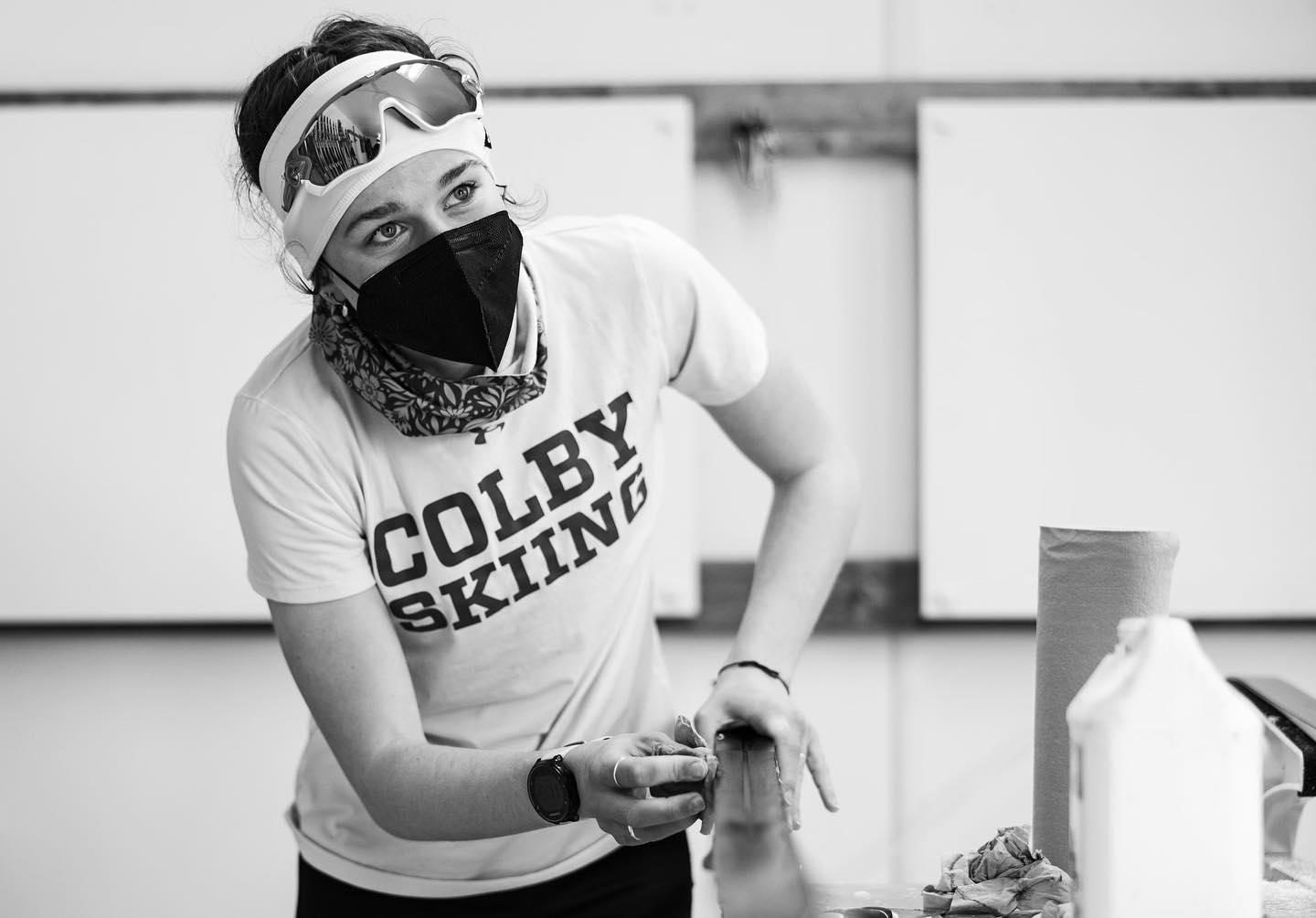
    Colby College skier Rose Clayton cleans ski base at Senior Nationals in Soldier Hollow, Utah in January 2022. (Photo: Colby College Ski Team)
  • MountainFLOW Fluoro Takeback Program: Giving skiers the option to safely dispose of fluoro waxes from anywhere

    MountainFLOW Fluoro Takeback Program: Giving skiers the option to safely dispose of fluoro waxes from anywhere

    The ski community has known there’s a problem for awhile now. Fluorinated waxes, whose extreme hydrophobic properties make them ideal for fast skis, also are by that same property impossible to break down in the environment, allowing them to permeate through the soil into water supplies. The compounds are also known carcinogens, and frequent exposure to these compounds, particularly when heating and inhaling the fumes of waxes in which they are contained, is linked to a myriad of cancers.

    That vice has outweighed their virtue, and now, perfluorinated waxes are inching ever so slightly toward taboo in the ski world. That story has been one which FasterSkier has tracked for years, but up until now, there have been insufficient resources on the safe disposal of these waxes, as well as a lack of available options to facilitate skiers safely getting rid of what they have accumulated in their boxes.

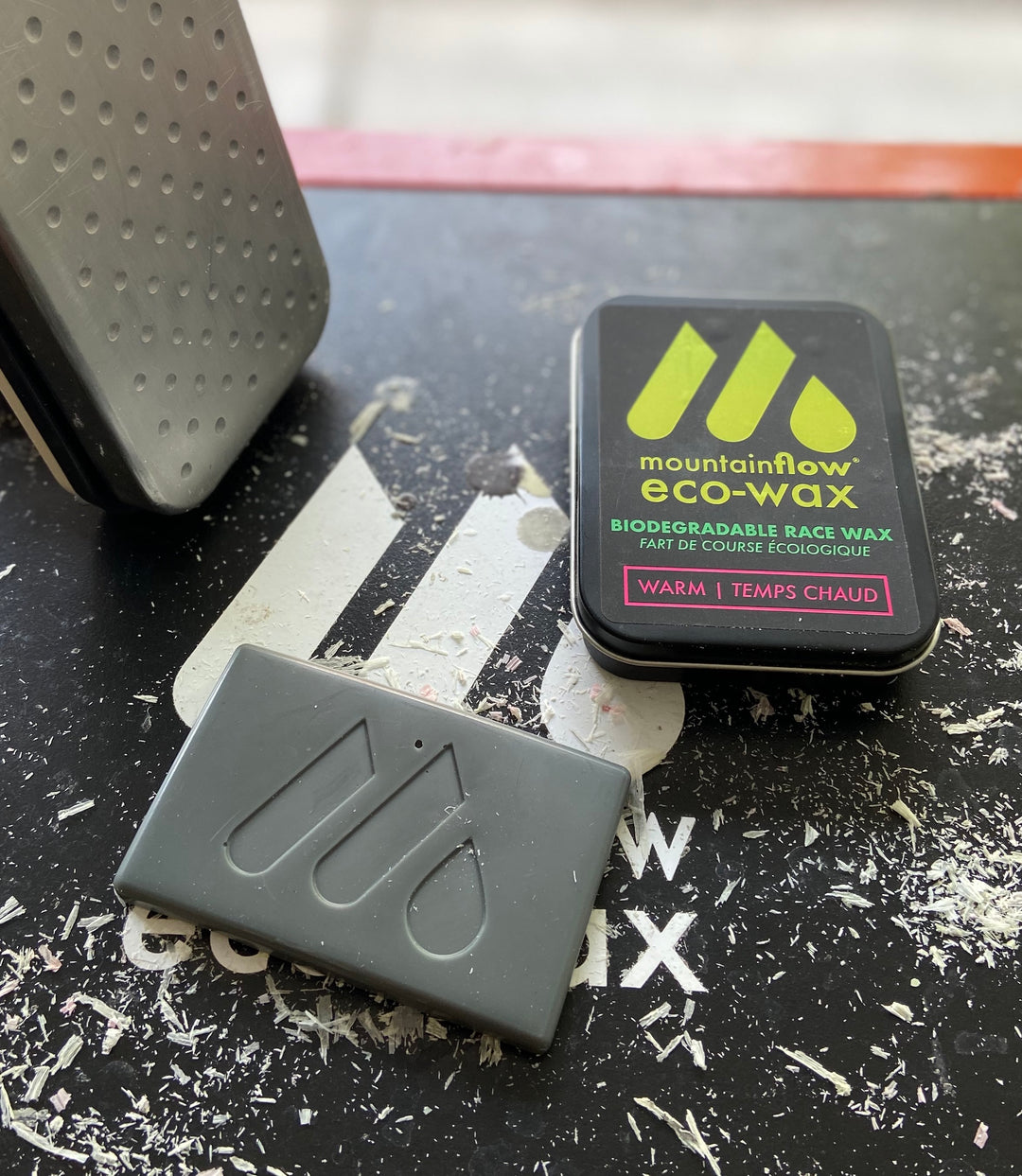
    MountainFLOW Eco Wax launches a fluoro takeback program May 1 – 31, 2022, allowing skiers to mail in their stash of harmful fluoros for safe disposal. (Photo: MountainFLOW.com)

    That’s when Peter Arlein, the CEO and founder of MountainFLOW Eco Wax, had an idea. “When the FIS started talking about prohibiting fluoros two or three years ago, I visited ski shops and realized they were using the stock of fluoros they couldn’t sell on their rental fleets. I thought that was missing the point – we need something that’s going to take fluoros out of the snow, not just the market. We’re a plant-based wax company, maybe there’s a program we could design where we could take back that fluoro wax from them, and replace it.”

    For Arlein, whose company was in the process of pioneering high performance biodegradable alternatives to fluoros, the idea was one that he knew was necessary for the ski world, but also one they wouldn’t have the capacity to institute without willing partners.

    Then in 2021, a representative from the state of Colorado’s Outdoor Recreation Industry Office reached out wondering if he would have any ideas for that year’s Wright Collegiate Challenge. The Wright pairs undergraduate and graduate business students across Colorado with partnering outdoor recreation companies to help pioneer new initiatives and niches. Arlein’s idea of a takeback fluoro program seemed tailor-made. “The students at Western [Colorado University] and [Colorado] Mesa came around and not only did they have the bandwidth to get [this] off the ground, but also to bring their ideas as skiers and students too.”

    MountainFLOW Eco Wax has created a biodegradable plant-based line of race waxes, allowing skiers to have fast race skis without the harmful environmental impacts of petroleum based products. (Photo: mountainFLOW)

    The result, a full-fledged MountainFLOW, is set to launch its first wave of a fluoro take back program May 1st – 31st.

    The overall mechanism of the program is fairly simple: skiers donate their wax, and in return get a discount from MountainFLOW on their waxes.

    Skiers have the option to donate wax either by mail, sending the wax directly to MountainFLOW’s headquarters in Carbondale, CO, or by dropping off their wax at three retail partners in Colorado; Evo (Denver), Salida Mountain Sports (Salida), or Powder7 (Golden).

    MountainFLOW and the team of Wright students will take it from there. The process on the disposal part is, like all things on fluoros, still evolving. Leyla Ericson, an Outdoor Recreation MBA at Western Colorado said in a call with FasterSkier that “there’s only provisional guidance from the EPA right now on PFAs (the environmentally harmful class of chemicals that fluorocarbons belong to) disposal. From our understanding, they’re hoping to finalize those guidelines by summer of 2023, and so if we launch now we can hopefully scale and build a program that’s fully able to quickly process wax when there is a firm procedure for getting rid of these [waxes].”

    MountainFLOW’s launch of their take-back program now also coincides with the end of the last ski season where fluoros could be used in races in the US. With the US Ski and Snowboard instituting a ban after the Olympic qualifiers back in January, programs that were hanging on to their fluoro boxes for when the SuperTour came to town now have an opportune window to look for what’s next in the waxing world. That’s a reality that Arlein says will only continue to encompass more and more organizations, especially, as he says “when the FIS inevitably will put a full ban into place.”

    Kevin Bolger races a freestyle sprint qualifier in late February, 2022. (Photo: NordicFocus)

    With the timing factor for both ski-world and government policy coming together, Ericson said that the Wright challenge students wanted to take the step that many in the wax industry were tip-toeing around with fluoros:

    “We got to a point where we said, well someone has to launch this type of program. The idea has been around for a while, but either because people don’t understand the pressing need or because it wasn’t readily available, there’s been no movement on actually making it happen.”

    And while the program’s on-the-ground footprint will initially be limited to Colorado, the MountainFLOW team is hopeful it can rapidly expand the buy-back program, with Arlein saying “people all over can mail in right now, and then we’re for sure looking to open up disposal sites with more partners…A good example is this year we were at the Birkie expo (read our story on MoutainFlow’s trip to the Birkie here) and talking to their sustainability people, and they were like, you should come next year and have this be a site. It was pretty remarkable too, we were at the expo and the number one question we got from people was ‘How do I get rid of my fluoro waxes?’”

    With enough investment and the right partners, Arlein is hopeful that “we can get all of the fluorinated waxes off retail shelves, and hopefully, off nearly all wax benches too.”

    It’s a goal that requires creativity, cross-industry collaboration, and above all, action. With that coming in equal parts from MountainFLOW and the Wright students, the tip-toeing around the fluoro issue is being stamped over by decisive steps towards action.

    Action that you, me, clubs and teams can all participate in – starting here.

    Note: Skiers wishing to mail in wax to MountainFLOW can send their waxes to 201 Main St., Suite 303, Carbondale, CO 81623. You can also donate to support the MountainFLOW program as it grows and expands here.

  • The EPA and Regulating the Ski Wax Industry

    The EPA and Regulating the Ski Wax Industry

    Relatively clutter free and ready for waxing inside the new USST wax truck. (Photo: Noah Hoffman)

    There’s truth in jest as the saying goes. While FasterSkier’s April 1 piece made light of the issues, it hit home in some unexpected places. During one of FasterSkier’s conversations with the Environmental Protection Agency to examine why it had begun investigating the importation and sale of perfluorinated waxes, the EPA’s representatives cited the April 1 piece to question why FasterSkier had begun reporting on the issue. Whether readers appreciated the humor or not, the April 1 piece was intended as entertainment. This is our first story detailing what we’ve learned so far.

    Let’s start with the EPA.

    As part of a broader national compliance initiative, the EPA has begun auditing the ski wax industry. After emailing detailed questions to the EPA regarding its regulatory guidelines, the agency stated it was unable to speak broadly about the ski wax industry. It remains an ongoing enforcement issue for the EPA.

    “EPA has identified certain ski waxes manufactured, processed or imported into the United States contain per- and polyfluoroalkyl substances (PFASs), also referred to as perfluorinated chemicals (PFCs), that may be in violation of the Toxic Substances Control Act (TSCA). These waxes were identified both in brick-and-mortar stores as well as available for sale domestically on e-commerce websites. As a matter of policy, the Agency is unable to discuss compliance monitoring targeting and/or investigations in more detail.”

    Challenges for Swix and Toko in Winter 2018

    Swix and Toko are the two largest brands of wax imported and distributed in the U.S. Both lines are imported and sold domestically by Swix USA. Swix USA is a subsidiary of its parent company, Swix Norway. According to Steve Poulin, CEO of Swix USA, the company was first contacted by the EPA during the winter of 2018 about meeting specific EPA mandates. In what became a steep learning curve regarding EPA compliance, Poulin said Swix/Toko began a review of “every product in every mixture.” We’ll explore what being EPA compliant entails later on, but it remains an exacting process that involves knowing the chemical recipe list for every Swix/Toko products imported, sold, and used in the U.S.

    That formal review process began 18 months ago for Swix/Toko. Poulin said the company quarantined its entire wax line in June of 2018. They then chose not to sell perfluorinated products on their direct sales websites or ship product to their U.S. based retailers this past ski season. Many non-performance wax product, known as non-fluorinated waxes were shipped to retailers and sold.

    buy travoprost online


    “I decided to quarantine everything because I wanted to go through the full review and be 100 percent compliant and follow EPA regulations,” Poulin said. “I decided to be completely safe and I guess cautious, so we decided to quarantine our waxes and not ship anything until we went through the proper review process with the EPA. It was our decision.”

    The Swix and Toko LF, HF, and top-coat/finishing product you may have purchased from online or brick and mortar shops was the back stock retailers possessed from this year’s inventory — shipped before June 2018 — after Swix/Toko has been contacted by the EPA. Alluring teens wall crosser in accidental lesbian fucking with horny border officer Super Hot Mandy Shows Us What Shes Got And Shes Still Got Plenty Blonde teen Lily Rader gets punished by boyfriends big dick Horny officer picked up an undocumented immigrant Two horny schoolgirls sharing the teachers cock Close up view of lesbian pussy pleasure A Dodgeball Where Youll Get Naked And Expected To Fuck Amazing Afternoon Hookup with Mom Agreeable milf gets a doggy position fucking Samantha Saint, Jayden Cole, Shyla Jennings and masturbation with a dildo Monique Symone Gets Picked Up And By W fuck pornjk.com

    “I shipped wax to retailers before I quarantined the whole line … I did ship wax, early preseason orders, I filled stores up,” said Poulin. “Because we were not bound, we did not find any violations at that point. And then when we discovered the true complexity of what they were asking for and compliancy regulation, that is when I put a halt to it. To be completely safe and in cooperation with the EPA.”

    Outside of the Swix and Toko wax lines, skiers interested in a competitive advantage through ski wax chemistry had perfluorinated options from brands like Vauhti, Start, Star, Solda, HWK, Rex, Holmenkol, and others. The impact of the current regulatory environment on those brands is less well understood, but most were available this season.

    Poulin said in a July 8 phone call that Swix/Toko will be selling performance ski wax this upcoming season.

    Speed Comes at a Cost: Fluorochemistry Background

    Get ready for some basic O-Chem. (For your reference, click the image titled “A Toxic Family Tree” to assist with understanding perfluoros and their chemical lineage.)

    According to Dr. Merle Plassmann, the lab manager at the ACES (Department of Environmental Science and Analytical Chemistry) at Stockholm University in Sweden, perfluorinated ski wax is complicated. Plassmann’s Ph.D research examined fluorinated compounds in ski wax and their presence and fate in the environment.

    “Family tree” of PFASs, including examples of individual PFASs and the number of peer-reviewed articles on them since 2002 (most of the studies focused on long-chain PFCAs, PFSAs and their major precursors). (Source: Environ. Sci. Technol.20175152508-2518. A Never-Ending Story of Per- and Polyfluoroalkyl Substances (PFASs)? Zhanyun Wang†Jamie C. DeWitt‡Christopher P. Higgins§Ian T. Cousins*∥

    Plassmann explained that his research detected numerous fluorinated compounds with carbon chains between C6-C22 in some ski waxes. He added that many fluorochemicals found in ski wax are not added deliberately but are impurities from the manufacturing process. He referred to those chemicals as PFAAs – or Perfluoroalkyl Acids. He also wrote that ski wax manufacturers do add semi-fluorinated and fully fluorinated alkanes to their product. Again, these compounds are long carbon chains with the “semi” versions partially fluorinated, the “full” versions are saturated with fluorine. Plassmann went onto explain that the constituent parts of today’s wax could be more complicated. He has not assayed ski wax since 2011.

    Some skiers may throw caution to the wind and take ski speed at all cost. It’s well known that in certain conditions, perfluoros applied properly to a ski base makes those skis faster. So we asked Plassmann the burning question: What are the ingredients in ski wax that might be of concern?

    “Of potential concern are not only the impurities (the PFAAs which show low levels but still can be found in the ski tracks afterwards) but also the main ingredients, which are either fully fluorinated alkanes or semi-fluorinated alkanes,” Plassmann replied. “To my knowledge, nobody has studied their environmental fate, except the one study we performed on their behaviour during snow melt and presence in snow and soil from a ski track in Sweden. Here we found that they strongly sorb to particles and thus can be found after snow melt in the soil underneath the ski tracks. But nothing is known regarding their possible breakdown. As the Carbon-Fluorine bond in molecules is a very strong bond, those chemicals will be very persistent, but for example with the semi-fluorinated alkanes, the not fluorinated part could be breaking down, thus potentially leading to the formation of PFAAs. This, however, has not been studied and shown to happen.”

    In May of 2016, the EPA released a document explaining some of the health risks associated with exposure to certain perfluoros. They include thyroid disorders, hypertension and preeclampsia during pregnancy, and testicular and kidney cancer.

    Bringing Science to the Market

    When you head into the local shop and ask for the wax goods, the response can be confusing. We’ll refrain from using the term “pure fluoro”. There are varying percentages of fluorocarbons in gliding and kick wax product, none that we can confirm are 100 percent “pure” fluorocarbon. The products containing the highest percent perfluorinated compounds are used for glide and often come in the form of a powder, block, liquid, or gel.

    All brands have their own trade secrets when it comes to percent perfluoro and hydrocarbons added. The terms used in the industry like low-fluoro, high-fluoro, and super-fluorinated are marketing terms, not a standard. Brand X might have a 40 percent perfluoro HF wax, brand Y, thirty percent. Amongst the super-fluorinated gliding products, those percentages vary too from brand to brand as do their naming devices. Start wax’s naming devices, for example, use the term “ultra high fluor glider” for its highest perfluoro content finishing product.

    buy clindamycin online


    Hydrocarbon or paraffin wax is what we would consider the cheaper and sometimes less effective means to make a ski slide on snow. These waxes are perfluoro free.

    We’ll refer to any wax with fluorinated compounds as perfluorinated wax.

    PFAS, the broad group of perfluorinated substances to which PFAAs belong, are ubiquitous and can be toxic. From fire suppressing foams, stain-proof carpet and upholstery coatings, non-stick pans and food wrappers, and that snazzy waterproof jacket, fluorochemicals make these products “work”. The perfluoros in ski gliding products fall into the PFAS class.

    This February, the EPA published a “Per- and Polyfluoroalkyl Substances (PFAS) Action Plan” to further address the issue of perfluoros in the environment. The action plan states, “there is evidence that continued exposure above specific levels to certain PFAS may lead to adverse health effects.”

    Fluorochemicals were once considered a miracle. They are hydrophobic and repel grease, oils, and dirt. Better living through chemistry? That’s now up for debate as the EPA moves in.

    The leading science journal Nature published a piece in February detailing how researchers have traced fluorochemicals in the environment back to their source. Fluorochemicals are not naturally occurring. They are all man made. So if it’s in the environment, its there due to direct use in the environment like fighting a fire at an oil-depot, or they are residual compounds from the manufacturing process that have not been contained.

    (This oft-cited Scientific American article speaks to the bioaccumulation of ski wax chemicals in the blood.)

    The chatter in the ski wax industry usually has to do with a subclass of PFAS called PFOAs. PFOAs will be banned in the EU for most uses starting July, 2020. In the ski wax industry, PFOAs, or what many ski-wax junkies call “C8”, is often referred to as the magic behind wicked fast skis: the actual perfluorinated turbo boost when conditions call for it. Those C8s will be replaced in perfluorinated ski products with C6 compounds. The C8 refers to a perfluoro with an eight carbon spine with fluorine atoms branching off. The C6 is a shorter six carbon spine.

    Those PFOAs are often called “forever chemicals” due to their persistence in the environment. The carbon-fluorine bond is amongst the strongest known in chemistry. C6 compounds, however, reportedly breakdown more readily and are considered more benign. Many claim the C6 half-life in the environment is shorter.

    Anecdotally, many ski wax experts report C8 perfluoro finishing products most often outperform C6 analogs. You probably all know someone hoarding C8 product right now. That raises several other questions about wax equity at all levels of racing.

    For now, let’s put aside the O-chem and focus on the nuts and bolts of domestic regulations and remaining EPA compliant.

    The EPA and the Toxic Substances Control Act: The Tools for Oversight

    In 1976, during the heyday of the environmental movement in the U.S., the federal government sharpened the EPA’s regulatory teeth by passing the Toxic Substances Control Act (TSCA). The TSCA allows the EPA to better monitor the “production, importation, use, and disposal” of chemicals in the U.S.

    For years, domestic ski wax producers and importers were literally off the EPA’s radar. In 2016 and 2017 the TSCA was updated with new guidelines. The hands off EPA stance evolved. The law’s 2016 amendment is called the Frank R. Lautenberg Chemical Safety for the 21st Century Act.

    According to a Harvard University Science in the News article, the 2016 amendment, “gives the EPA the authority to ban new and existing chemicals that pose a risk to human health and the health of the environment. To do this, the EPA must now make an affirmative determination on all new chemicals and all new uses of existing chemicals.”

    The prevalence of fluorinated compounds in the environment and the increased awareness of the potential health risks those compounds pose began to focus attention on fluoro-intensive processes. The outdoor textile industry is literally awash with perfluorocarbons — high tech fabrics that repel water owe that functional property to the carbon-fluorine bond.

    A few degrees separated from outdoor performance textiles are perfluorinated ski waxes. If the EPA was following the supply chain tree to determine where fluorinated chemicals are used, at some point they’d branch-off to the ski wax industry.

    The TSCA requires wax importers and domestic wax manufacturers (importers are considered manufacturers under TSCA) to properly document the chemicals used within the country.

    In the past, before the EPA glanced at the ski wax industry, ski wax importers might simply declare “ski wax” on a TSCA import compliance checklist and claim the shipment complied with TSCA guidelines.

    According to U.S. Customs and Border Protection, the importation of chemicals require one of two signed statements:

    • I certify that all chemical substances in this shipment comply with all applicable rules or orders under TSCA and that I am not offering a chemical substance for entry in violation of TSCA or any applicable rule or order there under.
    • I certify that all chemical substances in this shipment are not subject to TSCA. The statement must be typed or stamped on an appropriate entry document or commercial invoice or an attachment to that entry document or invoice.

    With greater oversight, it appears the EPA found a disconnect between the chemicals contained in ski wax and what was being declared.

    To be clear, none of the importers we spoke to acknowledged any intentional non-compliance. In other words, there was no intent to omit or misrepresent through their TSCA declarations. However, there appears to have been either confusion, misunderstanding, or a shift in how EPA scrutinized the forms or applied the standards that resulted in a major disruption to the ski wax market.

    CAS Numbers: Millions of them

    The TSCA regulatory comb is fine toothed. To meet TSCA compliance standards, wax importers require CAS numbers. CAS stands for the Chemical Abstracts Service. Every chemical substance disclosed in scientific publications are assigned a unique CAS number. Think of that number as the chemical’s numerical ID. Well beyond one hundred million chemical substances have been assigned CAS numbers. The EPA maintains a record of all the chemicals either produced within or imported into the U.S. This is known as the TSCA inventory. At its most basic, the TSCA inventory is a list of CAS numbers.

    There is both a public inventory that is downloadable, and a private inventory that includes information for proprietary substances a company may not want publically available.

    Here’s what’s at issue. Any material coming into the U.S., like a ski wax, must have all its chemical components, the parts that make up the sum, on the TSCA inventory. In other words, the importer must ensure that each chemical substance’s CAS number is registered on the TSCA inventory. (The TSCA inventory is organized by CAS number.) If an ingredient’s CAS number is not on the inventory, the substance cannot be imported. Further, those chemicals on the TSCA inventory must be approved for public use/consumption if sold in the marketplace.

    Boulder Nordic Sport (BNS), the importer of record for several wax brands, was sent a subpoena from the EPA to ensure the CAS numbers of the perfluorinated compounds imported in their wax product were on the TSCA inventory.

    “The letter from the EPA specifically asks only about fluorinated compounds,” BNS owner Nathan Schultz told FasterSkier on March 28. “However, legally, everything that is in those substances, everything that is in the wax, including dyes, colorings, perfumes, whatever, every chemical compound has to be on the TSCA inventory.”

    Finding and cross-referencing CAS numbers on the TSCA inventory meant Schultz had the tedious task of obtaining a chemical specific ingredients list for every perfluoro containing product BNS imports. BNS imports Skigo wax, Holmenkol and Guru products.

    “And so basically what people are finding out is that this really complex process of having to identify every compound in the substances that we are importing,” Schultz added.

    “All these formulations are secret. That had been one of the challenges, that all of this information has to be kept confidential, and so we have to take extra steps to protect it from when the suppliers give it to us. One of the suppliers refused to give us the information. They say they will only give it directly to the EPA. Right now, there are some fluoros available that are on the TSCA inventory and they are OK to use. And then there are some that aren’t and the ones that aren’t are not available, they are off our site.”

    In Schultz’s case, he began cataloging CAS numbers during the Federal Government’s shutdown which ran for 35 days beginning on December 22. So getting timely responses from the EPA was challenging.

    As Schultz bolstered his knowledge of the TSCA, he learned that if a specific CAS number (or compound) is not on the TSCA inventory, importers do have a few options. One option is to apply for a pre-manufacture notice. (Again, importers are treated as manufacturers when it comes to TSCA compliance.)

    A pre-manufacture notice is no small hurdle to jump. The notice must be filed 90 days prior to manufacture/import. The EPA also requires mounds of chemical related information including available test data on the effect to human health or the environment.

    Another option to continue importing and selling a product with an ingredient not on the TSCA inventory is to file for a low volume exception. This is what it sounds like: it’s a way to declare that the substance in question will be manufactured/imported in low quantities. In this case, at or below 10,000 kg/year.

    Each low volume exemption filed is for a specific chemical. If, for example, a type of performance wax contains 10 distinct chemicals, that’s 10 distinct low volume exceptions to be researched, filed, and paid for.

    The potential cost associated with filing a single low volume exception is prohibitive for a small business like BNS. Those costs also don’t factor in potential legal fees.

    “It is hard to say and it is also a challenge because a low fluoro paraffin wax is probably going to be 5% maybe 10% of the fluoro compound itself,” Schultz said as he contemplated how much perfluorinated substances were being imported via the wax industry. “So the pure fluoros, I would imagine in the entire U.S., we are certainly under 200-300 kg of just the fluorinated substances. The whole number is small when considering the fluorinated compounds and I mean, 100 kg, 1000 kg I don’t know what it is. I have not calculated that out. It is a small number. Certainly, all of the wax industry in the country could be under that 10,000 kg weight limit for a low-volume exemption. So relative to other uses, we are tiny.”

    How did we get here?

    Longtime industry insider, Andrew Gerlach, knows the ins and outs of importation. For many years he’s imported Start wax manufactured by Start Finland through his business Endurance Enterprises. According to Gerlach, Start products are the third most widely used nordic ski wax in the U.S.

    Athletes, coaches, and techs test skis on the 2019 World Championships course in Seefeld, Austria. (Photo: John Lazenby/lazenbyphoto.com).

    The common story about wax importation and environmental regulations that we heard from Gerlach and others was something premised on the notion that European safety guidelines are stricter. The assumption was U.S. importers of ski wax must be in TSCA compliance if the waxes in question could be sold within the European Union.

    “We have been doing things the same old way for decades,” Gerlach said in early April. “The European manufacturers or primarily the European manufacturers of the wax have told us, have given us a broad opine of all the ingredients in our wax and said this meets or exceeds European standards for chemical transport chemical distribution chemical use. And therefore if it meets European standards, they are tougher in every aspect than American standards, so you are good to go. So we import wax and we have a very good understanding of the ingredients within that wax but not the final nature of their pure chemical compound because that is very proprietary and most of us are mere distributors of the brand and the products and not part of the parent company.”

    The EPA’s involvement with ski wax has nothing to do with EU chemical regulations known as REACH. And the EU’s regulations on the use and sale of perfluoros have nothing to do with cross-referencing CAS numbers with the TSCA inventory and being EPA compliant.

    That said, the domestic wax importation industry in the U.S., like Gerlach said, had been following Europe’s lead.

    EU chemical regulations originate with REACH, or Regulation, Evaluation, Authorisation and Restriction of Chemicals. REACH dates back to 2006 and has evolved and been refined many times since. The REACH net has captured the use of PFOAs, or “C8”, in the supply chain.

    PFOAs will be banned in the EU for most uses starting July, 2020. They will be replaced in the ski wax industry with C6 compounds.

    “We have taken Europe’s word for it,” Gerlach said. “That if their products meet or exceed European REACH standards, which they have all, they are told in the research they are tougher than American standards. So we import the wax, and everytime we have an import shipment coming in, we sign a form that says these products comply to TSCA standards.”

    Back in November 2018, Gerlach said he heard rumblings within the ski community that Swix and Toko were having issues selling product. He initially, like many people, thought this had to do with pending EU restrictions on the use of PFOAs.

    C8 or C6, Gerlach assumed he was TSCA compliant. Good enough in Europe, by default, meant good enough in the States. But the story circles back to CAS numbers and the TSCA inventory.

    “I felt that I had better figure out what was going on, because if Swix-Toko had errors, there is the likelihood that I had errors and every other wax company that is importing had errors because we are all pretty much importing like substances in the same manner,” Gerlach said.

    Gerlach contacted an EPA official in Chicago since his company is registered in the Midwest. He left a voicemail and some follow up emails. Gerlach heard nothing back.

    In the meantime, Gerlach said he conversed with Schultz at BNS and became better informed about the CAS number TSCA inventory dilemma. He also communicated with the EPA’s Washington D.C. bureau and received a response when the government shutdown ceased in January. During this time, Gerlach reached out to Start Finland to secure CAS information and detailed wax recipes.

    “I discovered that the vast majority of ingredients in Start wax be it perfluoros, be it hydrocarbons, be it alcohol based liquids, petroleum based liquids, on and on, all used ingredients as Start signified since day one that are on the TSCA inventory,” Gerlach said. “We did have a couple waxes with CAS numbers not on the inventory and so overtime, it took a while to delve and discover and learn all these things.”

    Gerlach self-imposed a ban on selling or continuing to import product he believes is not in full compliance with the TSCA. He even went a step further.

    “We have done our own self-disclosure to the EPA, saying ‘hey we have imported, unknowingly, we have imported some wax with ingredients that are not on the TSCA inventory,” said Gerlach. “They amount to these items with this amount of volume in the past five years and this is what we are planning on doing etc. with them’. As far as I can tell from my brief discussions with the EPA, I just need to focus on my ingredients list and make sure they are on the TSCA inventory and with a double bullseye focus on the perfluorocarbons and make sure those are on the TSCA and if they are on the inventory they are good to go and there’s nothing to report.”

    The TSCA compliant Start products, which Gerlach said was 97 percent of the Start Wax line, are still imported and distributed to dealers around the country. His non-compliant inventory remains under quarantine in his warehouse and is not included on next year’s price list. This self-imposed restriction was taken not due to any EPA action, but as a precaution until he is told what to do with those items by the EPA.

    Gerlach also explained that moving forward, Start Finland’s ingredients would meet TSCA requirements. According to Gerlach, Start Finland does not produce its own perfluorocarbons for use in their waxes. They source that from a chemical manufacturer and supplier.

    “Start Finland now examines the ingredients they are putting in beforehand, “ said Gerlach. “Before they start mixing up compounds, they make sure that the ingredients that they are using are on the TSCA inventory. I am talking milliliters of fluorocarbon and grams in all my waxes that are fluorinated and whatever the law is we need to follow it. I am much more educated on what is in our waxes than I was a year ago. And Start Finland is much more aware that being good enough in Europe is not necessarily in itself good enough for America.”

    Gerlach’s initial chemical bookkeeping and self-reporting were steps. He was told by his lawyer to use a statute of limitations of five years for documenting what he had imported during that time span and discerning if it was on the TSCA inventory.

    That five year limit appears to be an unofficial timeframe for the statute of limitations on importing non-TSCA compliant chemicals.

    “A subpoena letter I have seen did not put a date on it,” Gerlach explained. “It said, tell us all about waxes with fluorocarbons in them and the times you have imported them. And surprisingly it did not give a time frame. It just said tell us everything.”

    Exhausting his avenues to remove his “violating items” from circulation Gerlach contacted Start wax retailers.

    “I have looked at my orders for the last two years of these and emailed the dealers and explained that if you have any in stock I will take it back,” said Gerlach. “I did a recall of any of the waxes and none of those waxes are left in stock. And so there is nothing to recall because it has been such small quantities.”

    This was what Gerlach called a voluntary recall.

    In years past, Swix USA has shared prime real estate with a retailer at the American Birkebeiner expo — they were housed within the same display.

    Not this year. At the Swix concept area at the expo, Swix did not sell perfluorinated product. However, Swix perfluoro products were for sale through a retailer at the expo.

    FasterSkier is unaware of any official recall of non-compliant ski wax product. According to Section Five of the TSCA, any chemical not on the TSCA inventory is considered a “new chemical”. “New chemicals” to be imported and used within the country are subject to rigorous guidelines to determine their fate. A recall of pre-existing non-compliant substances by importers/distributors and retailers appears not to be one of those steps.

    A quick search on the web shows product still available for sale by retailers in limited quantities.

    In my candid interview with Gerlach, he was mildly prophetic as we signed off.

    “So, the earthquake has happened, no one is sure about the tsunami, but no matter what, there will be a shakeout of brands and or waxes because of this,” said Gerlach

    In early May, I received an email from a reader saying HWK USA was no longer in business. At the time of publication, FasterSkier had not received a reply from HWK USA after messaging and emailing the company.

    Ear to the Ground

    Like Gerlach and Schultz, Caldwell of the eponymous Caldwell Sport based in Putney, VT. has had his ear to the ground. Caldwell is known for custom ski selection and grinding services, but also retails wax. In the past, he was an importer of Vauhti wax out of Finland. Vauhti is now imported by Park City, UT., based Sisu Sports.

    Caldwell sells wax online, or onsite at select races during the season. He sells Rex, Rode, Star, and Vauhti products.

    “So what I know is that the EPA instructed [Swix] to stop selling when they went through item by item and reviewed the contents of what they were selling — and that is it,” Caldwell said when asked what he knew about the direct discussions between Swix/Toko and the EPA.

    At the time of our conversation on April 9, Caldwell said he had had no contact with the EPA to date.

    Caldwell Sport’s role as a retailer rather than importer means its relationship with the TSCA is indirect. Caldwell Sport is not responsible under the TSCA, for ensuring the wax it sells is compliant — that remains the importer’s role.

    “My understanding is that the EPA’s concern is with importation and that they are not concerned at the retail level,” Caldwell said. “They are concerned at the chasing things to their source, where they are coming into the country. So I have not heard of any retailer who is not an importer being instructed to stop selling product. For instance, no Swix retailer that I am aware of has been told they cannot sell Swix waxes. But Swix the importer which is also owned by Swix Norway has been told they cannot sell waxes which would mean both at wholesale and at retail.”

    Caldwell’s process of obtaining perfluorinated wax products is simple. For example, he orders Vauhti product directly from SISU Sports. It then ships UPS from Utah to Vermont.

    “As far as I know, there is no oversight of that aside from regular domestic shipping restrictions on air, on flammable goods for air shipments,” said Caldwell. “You cannot put some of the solvents on an airplane. So we have to be cautious about that and plan shipping. We are just ordering form those guys.”

    For Caldwell Sport, it has been business as usual. Caldwell said he resupplied with Start and Vauhti this spring with no issues. Yet Caldwell was mindful of his stake in the high-end wax game. As a small business he is evaluating how to proceed as perfluorinated waxes come under scrutiny.

    “From our point of view, the question has been whether we should try to anticipate action by the EPA and pre-order a whole bunch of stuff or whether we should continue to run as we normally do to run a lean family business,” said Caldwell. “We cannot afford to carry a huge quantity of really high-end wax because it cost a whole lot to have. As a family business retailer, we are in a position where we need to be pretty cautious about how far we stick our neck out on a lot of high-end product.”

    Patrick Coffey, the Vauhti brand manager for Sisu Sports, emailed FasterSkier to state that as of May 24, he still had not been contacted by the EPA.

    “There’s no reason for me to expect it at any given point, but given that it’s the offseason, my approach will be to see what we need to do to make sure that there will be no delays in delivery late summer when the product comes from Finland to Utah,” Coffey said during an April phone call.

    buy ventolin online


    “If someone within a government agency wants to get in touch with us and ask for information, I’m going to get that information,” said Coffey. “The goal here is not to keep our head down and hope nobody notices, I want to make sure that we’re in a position, because retailers are asking ‘are you able to bring product in?’ and I’ve told all of them at this point ‘yes’. If anything changes they will be the first to know, because I don’t want them to all of a sudden to realize in December that they are not getting product.”

    The Bigger Picture

    The wax industry remains a drop in the financial and environmental degradation bucket when considering the widespread use of perfluoros in industry. But, perfluorinated compounds are making news. High Country News published a piece about PFAS pollution on May 30. Several news outlets have reported that the state of New Hampshire is suing chemical giants 3M and DuPont “for damage it says has been caused by a class of potentially toxic chemicals found in pizza boxes, fast-food wrappers and drinking water,” according to a Boston.com piece.

    The ski wax industry has been reforming when it comes to using the more caustic C8 and longer chain chemistry in its waxes. The type of fluorochemistry that has been newsworthy. Longchain fluorocarbons are on their way out and C6 chemistry is in.

    Is the ski wax industry and the quest for ski speed to blame for shirking environmental regulations and drawing attention to itself? Probably not. It’s simply that the EPA has the law on its side and the science to support its stance to bring more oversight.

    Although Swix and Toko did not ship perfluorinated wax last season, it appears the EPA is conducting a broader industry-wide review. Ski waxes are obviously not the domain of skinny skis alone. Imported and domestically manufactured alpine specific waxes fall within the same regulatory benchmarks applied to popular cross-country wax brands. 

    Fast skis are a drug. That first slide on a slippery pair of perfluoro soaked boards can be dreamy. But, everybody pays to play for that speed.

    For now, it seems certain that your ski speed fix, thanks to modern chemistry, will and can be satiated when snow falls next winter. But the Swix/Toko challenge this season has the potential to be a more significant industry wide challenge moving forward. There’s no question, those little vials of speed be it in liquid, block, powder, gel, or fluorinated hydrocarbon form, will have regulatory fingerprints all over it.