From the FasterSkier archive — posts syndicated from athletes’ and coaches’ own blogs between 2004 and 2012, kept online as published. Current coverage is at fasterskier.com.

Tag: Phil Widmer

  • Hanging Up the Boots: Kershaw Retires from Skiing, Embraces Next Challenge

    Hanging Up the Boots: Kershaw Retires from Skiing, Embraces Next Challenge

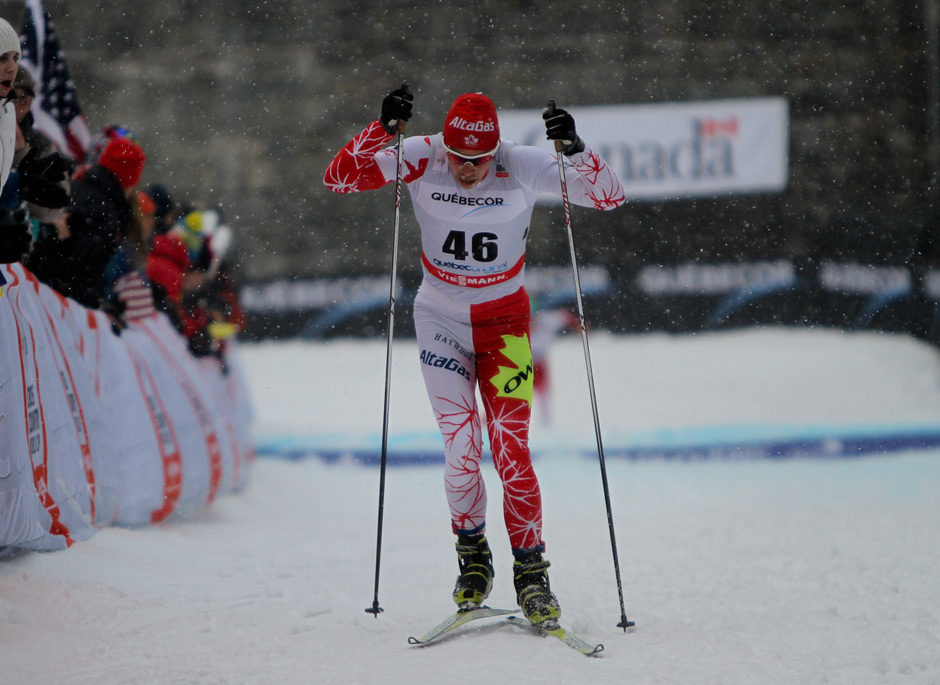
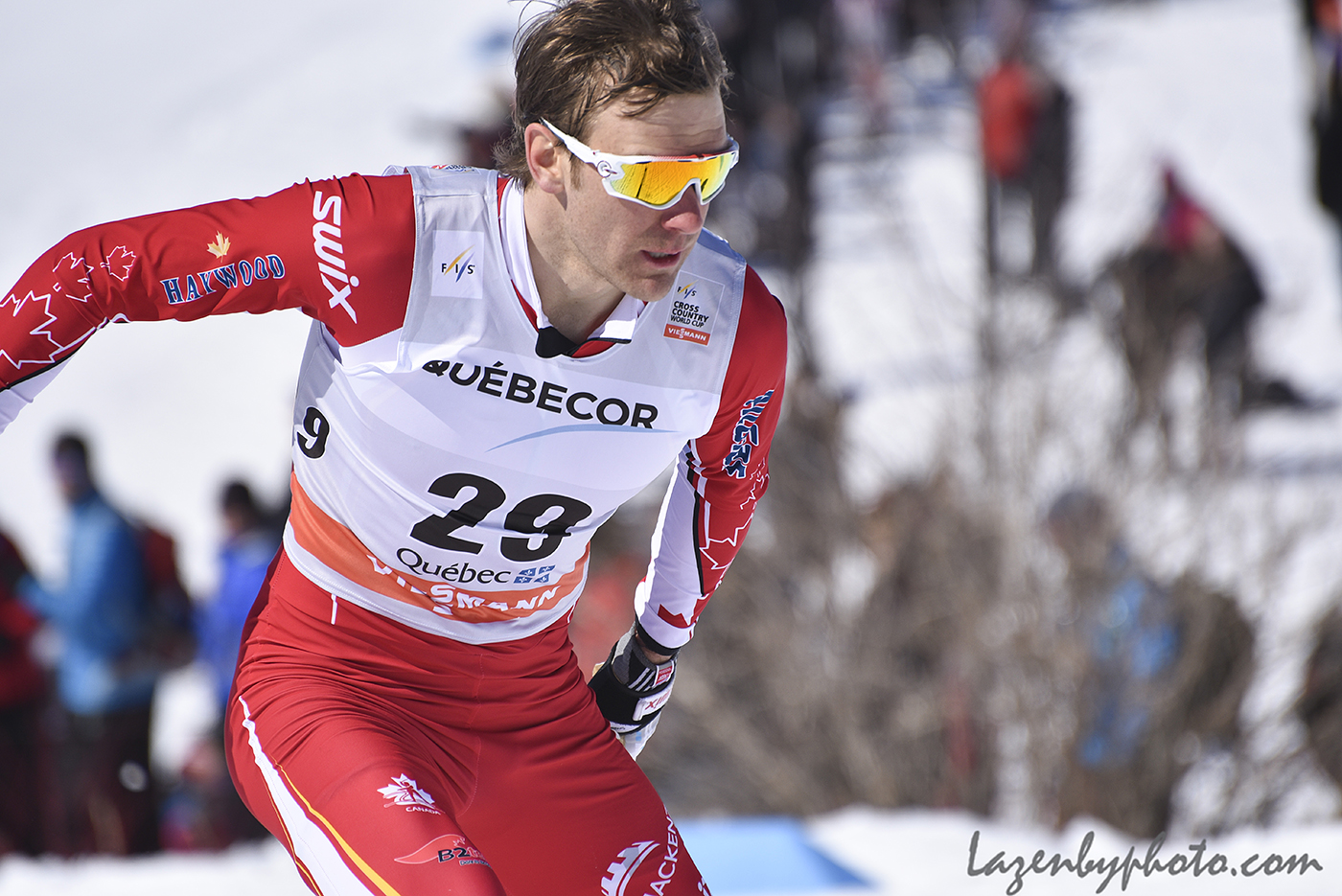
    Canada’s Devon Kershaw racing at 2017 World Cup Finals in Quebec City, where he finished 26th in the 15 k freestyle pursuit and 19th for time of day in the last race of the 2016/2017 season. (Photo: John Lazenby/Lazenbyphoto.com)

    On April 26, Devon Kershaw posted a photo on social media of Alpina boots hanging on a line. The next day, he spoke on the phone with FasterSkier from his new home in Lillehammer, Norway, after a day of running around outside with his 15-month-old daughter, Asta Isabel.

    Kershaw was tired, but in a good way. For the first time in 17 years, he was ready for a new challenge, a new focus and much more time with his daughter and wife, Kristin Størmer Steira, a former standout Norwegian skier.

    Three years after Steira left professional cross-country skiing and pursued a career in business, starting with her master’s degree in business management, Kershaw is following suit and headed back to school. The 35-year-old Canadian hung up his boots to quietly announce his retirement after about a month of deliberation.

    “I was really keen to keep ski racing, to be honest,” Kershaw said. “I had the motivation to go one more year, and in my head, I wanted to race one more season, but as things progressed in the spring, there were a lot of different factors that just made it seem like, oh man, it doesn’t look like it’s gonna be super realistic at this point.

    “I struggled with that, when you feel like you still have more in the tank,” he continued. “But at the same time, it’s a bit of a double-edged sword in the sense that it’s been a fantastic career.”

    Kershaw was quick to reflect on his roots as a kid growing up in Sudbury, Ontario, “a mining town with a small but passionate skiing community,” as he put it. He also reiterated how proud he was to represent Canada for 17 consecutive seasons, first as a junior national team skier for two seasons starting in 2001, then as an under-23 national team member in 2003, and finally as a full-fledged World Cup Team member starting in 2004.
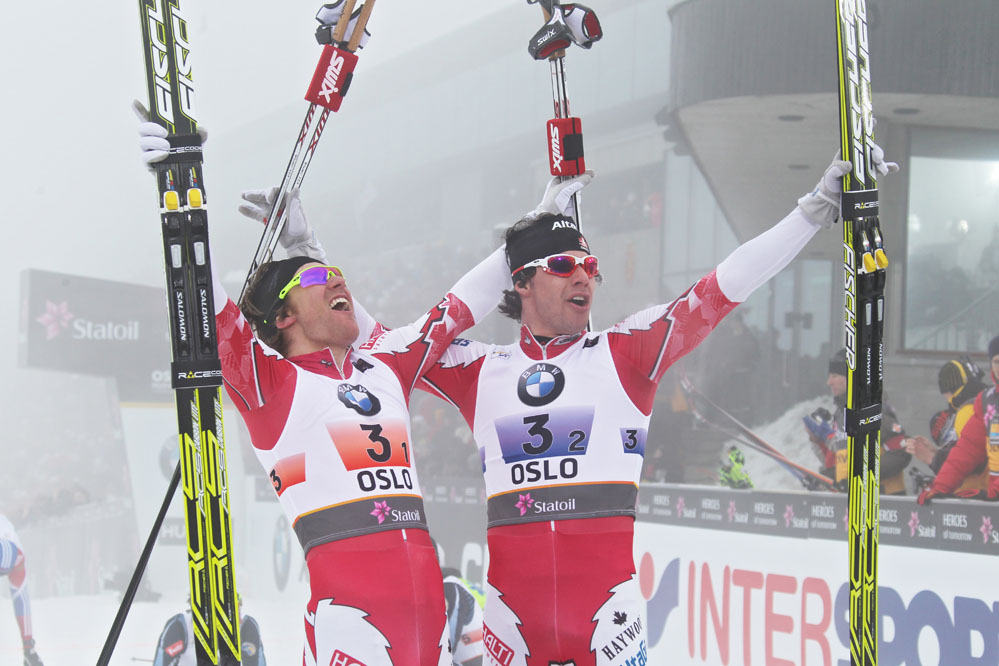
    Devon Kershaw (l) and Alex Harvey celebrate their 2011 World Championships gold in Oslo, Norway. (Photo: Fischer/NordicFocus)

    His career included three World Cup wins and 14 podiums, and a gold medal at 2011 World Championships with teammate Alex Harvey in the classic team sprint. Kershaw finished the 2011/2012 World Cup season ranked second overall and second in the distance rankings.

    When he reflects on those accomplishments, he still has a hard time believing that all happened to him.

    “So instead of focusing on being bummed at the situation or a bit frustrated with the state of things in Canadian skiing right now, I have to look back with a smile,” Kershaw said. “I feel just so privileged and grateful to have had the opportunity to be part of a real movement for men’s skiing in Canada.”

    Kershaw said he was left with unanswered questions this spring during a transitionary period at Cross Country Canada (CCC). The team’s budget was undetermined, camps were not yet set in stone, and Kershaw said his decision — which he wanted to make by May 1, the start of the new training year — became about energy management.

    “Part of managing your energy properly is putting all of your energy and focus into training, and if you’re being pulled with uncertainty or being stressed about uncertainty, that will come back, the World Cup will exploit that,” he said.

    According to CCC Chief Executive Officer Shane Pearsall, High Performance Director Thomas Holland had planned to retire this past March, yet has stayed onboard as an advisor until CCC fills the position. Pearsall said the hiring process is still ongoing and will hopefully be wrapped up by next month. He confirmed that CCC has yet to finalize its budget and doesn’t anticipate being able to do so until a government minister signs off on the amount from Own The Podium (OTP), one of its primary funding sources, in July. Pearsall explained that they expect to have a better sense of national-team finances in mid to late June.

    Typically, the team’s budget is determined in May, but because of necessary “quad reviews” following the Olympics, which took place before CCC met with OTP, the process was delayed by about a month. Pearsall did not elaborate on how significantly the budget would be decreased from last year, but said, “It’s certainly tighter than last year.”

    Kershaw said he needed to pay about $25,000 Canadian dollars in team fees if he wanted to continue racing this year, up from $15,000 last year. That didn’t cover the cost of living, which he figured to be around $55,000 Canadian, for a grand total of $80,000.

    “The financial burden is big, and moving forward the financial burden went from big to 100 percent paying for every cost,” Kershaw said. “So all travel, accommodations, everything. … I’ve just been in the sport a long, long time, and from a directional standpoint, I’m not sure we’re moving in a direction that will yield sustainable results at this point in time, but I understand it is difficult when you’re under such financial duress to create a sustainable program. But from a vision standpoint, I think there’s a lot of questions that remain unanswered, and it’s late in April. The fact of the matter is the rest of the world has all of the holes plugged — if they have holes in their boat — because May 1 is the new year of every ski program. And we’re just constantly slow and off the mark with that.”

    Budget cuts had been expected as Canada’s World Cup Team missed performance benchmarks throughout last season. The team finished 2017/2018 with just two men scoring World Cup points (top 30) in distance races: Harvey and Kershaw. Two men (Harvey and Julien Locke) scored in World Cup sprints. On the women’s side, Dahria Beatty landed one World Cup sprint top-30 last season, and Cendrine Browne was the top Canadian woman in a distance race with a 27th place for time of day in the last race of the season.

    Meanwhile, Alex Harvey led the team with four World Cup podiums, including third overall in the 2018 Tour de Ski, and a top result of fourth place at the 2018 Olympics. He finished his season in fourth in both the Overall and Distance World Cup standings. But Harvey’s results alone weren’t enough to buoy the whole team for another winter.

    “Throughout my entire career, it’s almost unfathomable to think that the season ends and that’s the stat line,” Kershaw said of the team’s overall results. “It wasn’t so long ago that we had over 16 World Cup podiums in a season. The truth hurts, as [former Canadian coach] Tor-Arne Hetland once said, but things go in waves and this is the reality that we live in right now.”

    Despite the prospect of self-funding, Kershaw didn’t feel pressed into retirement. Several of his teammates have decided to retire as well, including Graeme Killick, Jess Cockney and Knute Johnsgaard, but Kershaw said they weren’t forced, either.

    “You can choose to work and you can choose to hustle for money; there are ways to make it,” he said. “No one’s forced into it. I could keep skiing if I wanted to, but I think the stark choice you’re faced with is, maybe perhaps some people are like, I can’t really see a path to international success currently, and that’s what I think is sad…”

    ‘A dream scenario’

    When Kershaw moved to Canmore, Alberta, in 2001 and entered Canada’s elite skiing scene, Cross Country Canada (CCC) was entering a fruitful period. At the 2002 Olympics, Beckie Scott was proclaimed winner of the women’s 10-kilometer pursuit (now called the skiathlon), becoming the first North American woman to win an Olympic gold. At 2005 World Championships, Sara Renner earned a sprint bronze to become the first North American woman to medal at World Championships. Scott and Renner teamed up for silver in the team sprint at the 2006 Olympics in Turin, Italy, where yet another Canadian woman, Chandra Crawford, won the individual skate sprint for Canada’s second-straight gold in as many Winter Olympics. Scott finished that 2005/2006 season ranked second overall in the World Cup, just 16 points behind Norway’s Marit Bjørgen in first.
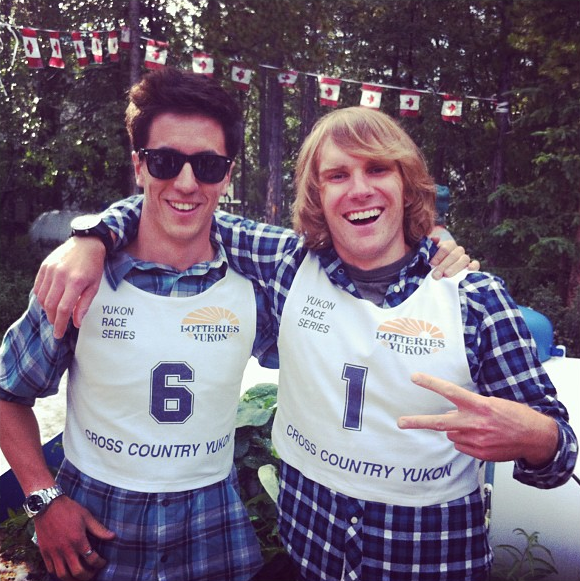
    Devon Kershaw (r) with Graham Nishikawa in 2013. (Photo: Devon Kershaw)

    Kershaw made his Olympic debut in 2006.

    “Coming into Torino, we were quoted in the newspaper as being like the world’s most anonymous men’s ski team,” he said of the Canadian men’s team that year. “We weren’t really ‘on the map,’ but I’ve just been so grateful and lucky to have such a great group of guys around that really welcomed me in.”

    He credited his former roommate and teammate Chris Jeffries as well as other Canadian competitors of his time, including George Grey, Gordon Jewett, Dan Roycroft, Sean Crooks, Dave Nighbor, Phil Widmer, Brent McMurtry, and Graham Nishikawa (who’s still racing), for having a major impact on the formative stages of his career.

    “[There were] so many athletes in Canmore that tried hard, wanted it bad, and loved ski racing and training,” Kershaw reflected. “That’s a dream scenario for a young athlete to come into a community like that and be welcomed into that environment.”

    Less than a month after the 2006 Olympics, he notched his first World Cup podium by placing third in the Borlänge, Sweden, skate sprint. In doing so, he became the first Canadian male cross-country skier to reach the podium since Pierre Harvey (Alex’s father) in 1988 and the first ever to medal in a World Cup sprint.

    “I had no idea who Pierre Harvey was,” Kershaw said of his younger self.

    Pierre Harvey had previously won the 1988 Holmenkollen 50 k as well as two other World Cup distance races and the Norwegian Birkebeiner, making him the most successful Canadian male skier before Kershaw.

    “He could walk into the room and I would not recognize him,” Kershaw continued. “Even his results, I had heard that he had five World Cup podiums and that seemed pretty cool, but that’s all I knew about him.”

    Kershaw’s second World Cup podium came early in the 2006/2007 season in a skate sprint in Munich, Germany. That same day, Crawford — whom he was dating at the time — placed third in the women’s sprint.
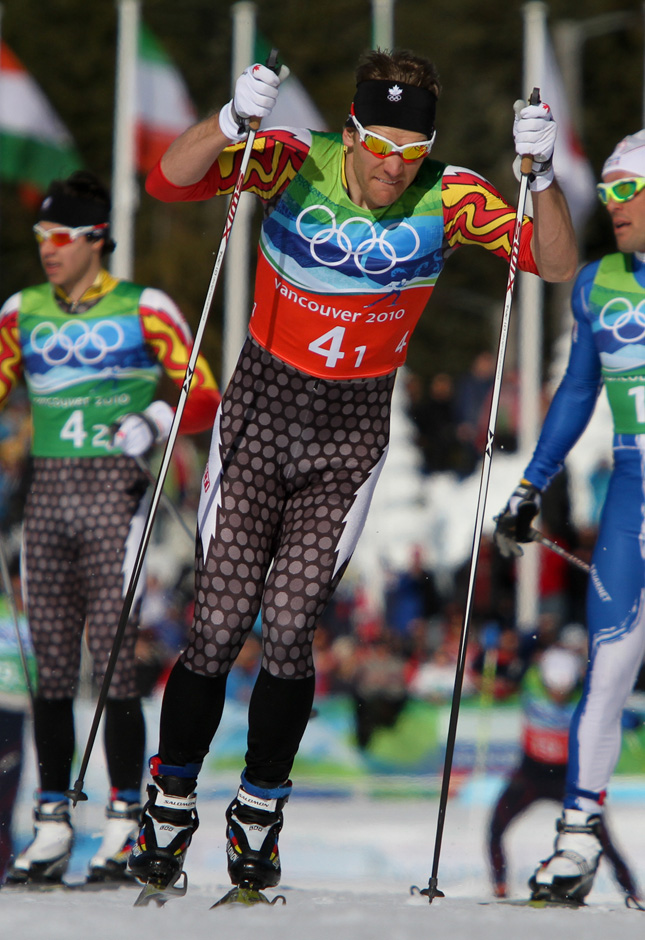
    Devon Kershaw after being tagged by his Canadian teammate Alex Harvey (l) in the freestyle team sprint at the 2010 Olympics in Vancouver, B.C. They went on to finish fourth.

    At his second Olympics in 2010, Kershaw finished fifth in the 50 k classic mass start for the best individual Olympic result for a Canadian male nordic skier. That record stood until Alex Harvey, who burst onto the World Cup scene in 2008, bested it with a fourth place in the 50 k classic at this year’s Olympics in PyeongChang, South Korea.

    Kershaw and Harvey also teamed up to place fourth in the freestyle team sprint at the 2010 Olympics.

    Kershaw’s first World Cup win came in a skate sprint during the 2011 Tour de Ski. He finished that Tour in seventh, and the next year, came back to place fourth overall in the 2012 Tour de Ski (TdS). Kershaw started all 12 editions of the TdS, a record he shares with France’s Jean-Marc Gaillard.

    Harvey scored his first individual World Cup podium in a 50 k classic in 2009 and won his first World Cup race (a 3.3 k freestyle prologue) at the TdS in 2012.

    “Then next thing you know, Alex and I are sharing a podium on some World Cups,” Kershaw reminisced. “Two Canadians on one podium in the World Cup, like, really? And then you win World Championships and I’m on the overall World Cup podium, and then next thing you know, Alex has been on the overall World Cup podium a few times and also now 50 k world champion. It’s crazy. It’s insane. From nothing. From no results. The journey has just been amazing. … I never would’ve thought Canada would, I mean, how could you? We had Pierre Harvey and that’s it in, like, a hundred years of international ass-kicking.”

    Kershaw credited his initial World Cup breakthrough as a 23-year-old skier in Borlänge to Dave Wood, Canada’s national-team coach at the time.

    “I came into a team with a coach that you could call at midnight. He’d do anything for you,” he said of Wood. “There was no way I would’ve stepped onto the podium in 2006 without him, and Mike Cavaliere, too, my first-year senior, Mike was my coach. We had staff that was just committed to the core for the cause and I’m incredibly grateful for that.”

    ‘A hell of a season’
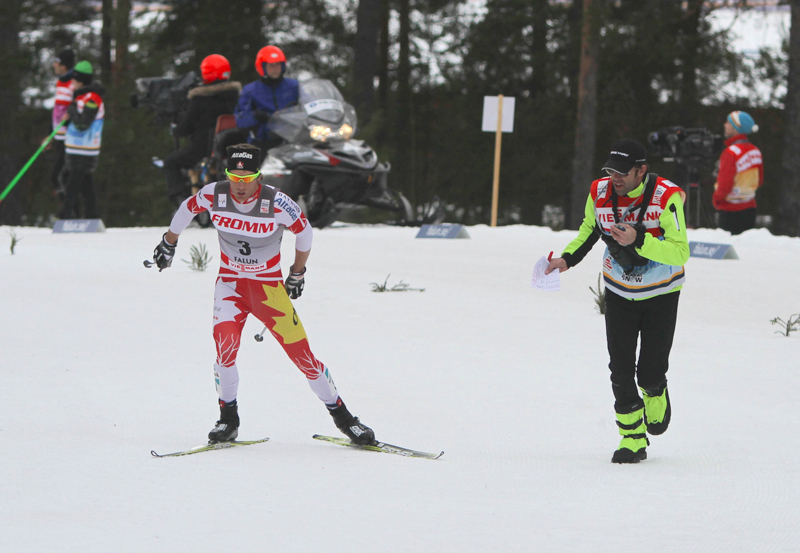
    Canadian head coach Justin Wadsworth (r) giving splits to Devon Kershaw at 2012 World Cup Finals in Falun, Sweden.

    Of his coaches, Kershaw gave special credit to Justin Wadsworth. A three-time U.S. Olympic cross-country skier who became Canada’s head coach in the spring of 2010, Wadsworth coached Kershaw for five seasons, and the two developed a close friendship.

    “When Justin came into the national team, the level of professionalism and excitement and freshness that he brought … I don’t know if you call it luck or happenstance or just the right place, right time,” Kershaw reflected, alluding to his 2011 World Championships gold with Harvey and his 2012 Overall and Distance World Cup podiums. “Justin’s best results as a coach were me and my best results as an athlete were when I was coached by Justin. Talk about an amazing relationship there.”

    “The main thing that I really appreciated with Devon, and I think he would say the same thing about me, is that we could be honest with each other and talk about hard things and enjoy the good times when we had them,” Wadsworth said on the phone last week. “… It’s cliche, but when I was talking to Devon the other day about his retirement, it’s not about the medals or the performances or whatever, it’s about your times together on the road.”

    One of Kershaw’s biggest moments came at those 2011 World Championships in Oslo, Norway, where he and Harvey beat out Norway’s Petter Northug and Ola Vigen Hattestad by 0.2 seconds for gold on the Norwegians’ home turf. They had done so after Kershaw lost one of his skis early in the race, Wadsworth pointed out.

    buy antabuse online, buy wellbutrin

    “His ski fully came off and he had to put it back on and get back into the race,” Wadsworth said. “Just the whole day was pretty incredible. That was a great, great opportunity for us, and the guys cashed in.”
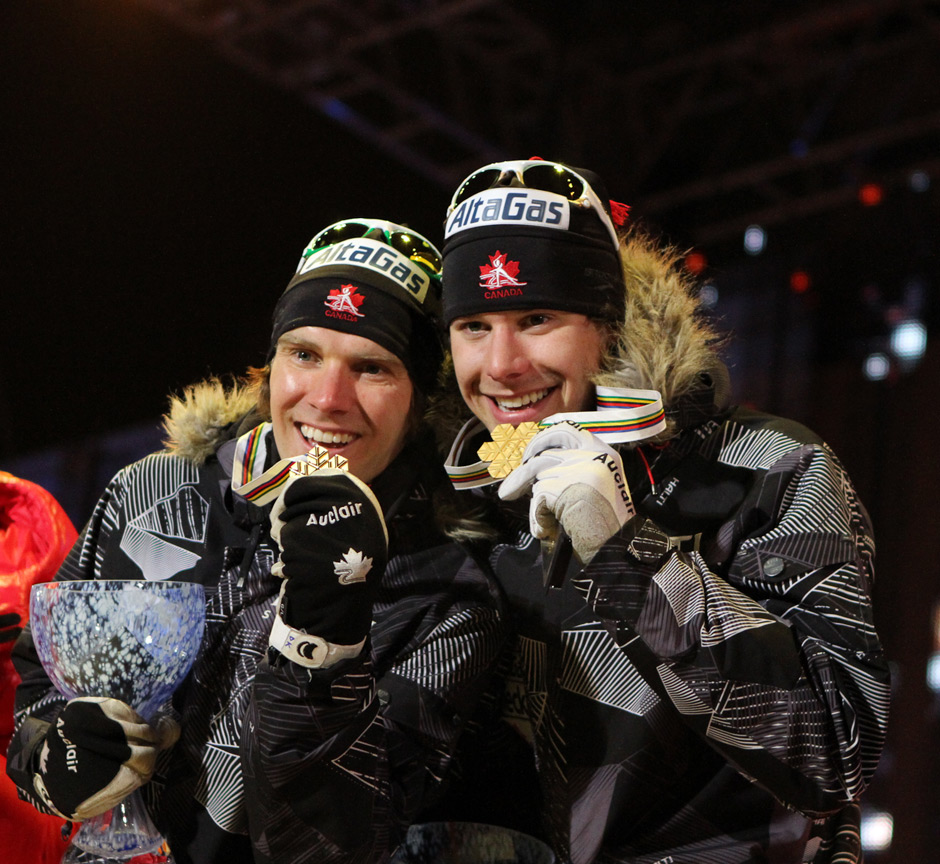
    Devon Kershaw (l) and Alex Harvey with their World Championship gold medals at the 2011 World Championships in Oslo, Norway.

    In a difficult-yet-strategic move to conserve for that race, Kershaw and Harvey both sat out the 15 k classic the day before.

    “With anybody else running the ship, there’s no way I would’ve trusted that [decision],” Kershaw said of Wadsworth’s call. “But I trusted Justin’s leadership and we went all-in, and the next thing you know we won World Championships. I mean, are you kidding me? How can you get a better start to the next quadrennial? And Justin as a first-year head coach of a national team, that’s gotta go down as maybe the best season ever for a first-year North American coach of a national-team program.”

    He and Wadsworth reiterated the crucial foundation that Wood had laid.

    “Dave Wood had done a really good job with the athletes leading into that period, mainly focused on building a big base and doing a lot of hours and also doing a lot of time at altitude,” Wadsworth explained. “And when I took over the position, I saw that both Alex and Devon were really primed and had a really good response rate to altitude, and all we had to do was fine tune a little bit of strength training and intensity. I was really excited to work with both those athletes and saw that they had a lot of potential.”

    For Kershaw, Wadsworth’s “American swagger … was magic for me,” he said. During the 2011/2012 season alone, he stood on the podium 10 times, with four top-three finishes in seven races at the 2012 Tour de Ski.

    “It was a hell of a season for me,” Kershaw said.

    ‘Best sand-digger ever’

    He went on to compete at two more World Championships and two more Olympics. This past season, Kershaw finished in the top 30 in eight World Cup distance races, with a top result of 19th in the 30 k skiathlon in Lillehammer, Norway. While struggling with lung issues, he finished 26th in the 50 k classic at the PyeongChang Olympics.
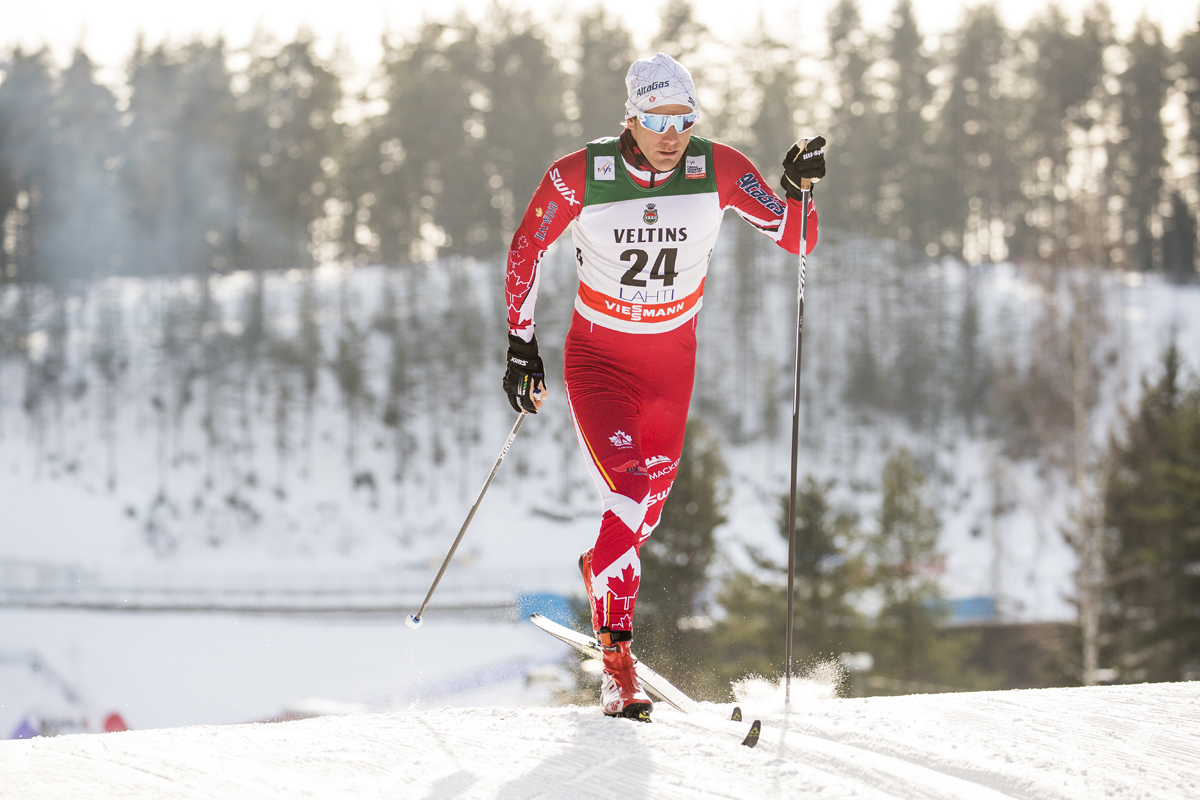
    Devon Kershaw racing to 25th in the World Cup 15 k classic this past March in Lahti, Finland. (Photo: Fischer/NordicFocus)

    Initially plagued by a lung infection in 2014, Kershaw discovered after a 2015 bout with an pneumonia and whooping cough that he has exercise-induced asthma.

    “We worked to get that under control and it was manageable but it never felt good like it felt prior to 2015,” Kershaw said his health over the last three seasons. “In PyeongChang, it was a calamity of bad luck. When we got there it was minus 20 [Celsius], and this makes me sound so soft, because I’m from northern Ontario so you’d think I’d know, but it was really cold. I did some intervals and it aggravated my lungs and it was super windy and dirty and a lot of sand blowing around, and that really flared up my asthma to the point that I was wheezing badly.”

    His breathing troubles also affected his sleeping and took most of the two-week Olympics to manage. At one point, he had a chest X-ray to make sure it wasn’t pneumonia.

    “It was sporting asthma,” he said. “… It took all the way to the 50 k to kind of get it 70 percent.”

    While he noted he was left wanting more from a performance standpoint at both his final Olympics and in his final season, Kershaw also acknowledged that he’s his biggest critic.

    “That’s been probably the biggest detriment to my entire career; I’m the best sand-digger ever,” he said. “I am disappointed in the sense that I work really hard and I train hard and I prepare well, and it didn’t go exactly as planned. … When you’ve competed in the top 10 for as many years as I have and on the podium, of course that becomes your bar that you hope to achieve, but at the same time … when you’re in the top 30 in the results page, you’re in the race at least. And I’m proud of the fact that in almost all classic races, not every, but most, I was in the top 30 and ‘in the race’.

    “Am I satisfied? In my life I’ll probably never be satisfied, that’s just how it goes,” he added with a laugh. “But am I somewhat proud of maintaining a fairly competitive level? Yeah, absolutely.”

    Wadsworth reflected that Kershaw was one of the best athletes he had ever seen, even “physiologically as good as Alex [Harvey]” at the peak of his career.
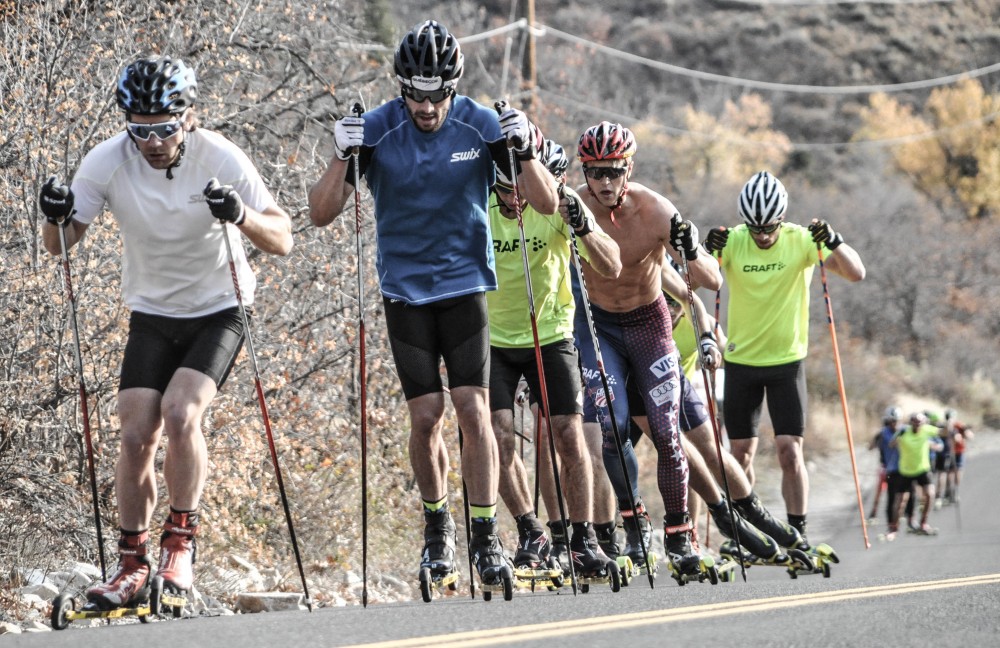
    Left to right: Canada’s Devon Kershaw leads his teammate Alex Harvey and U.S. Ski Team members Noah Hoffman, Erik Bjornsen and Simi Hamilton during a Level 3 interval skate session up Snake Creek Canyon in Midway, Utah, during their respective teams’ 2016 training camps in Park City, Utah. (Photo: Matt Whitcomb)

    “Devon’s a very intelligent person and sometimes he might’ve overthought things and lacked in confidence, and as a coach that’s really frustrating to see because you know how good they are physically,” Wadsworth said. “And when he was on mentally, too, in training, when he was at his very best, he had total confidence and could destroy anybody in any workout.”

    He recalled a hill-bounding workout with the Norwegian team in which Kershaw was literally leaps and bounds ahead of everybody else — even Martin Johnsrud Sundby and Russia’s Ilia Chernousov, who joined the training session.

    “He was just shelling everybody,” Wadsworth said. “So when Devon was at his best like that and mentally confident and relaxed, he was a real force of nature. Unfortunately that didn’t always translate into the racing season, but in 2012 he put it all together and had a tremendous year. … If he had the confidence the whole time, he would’ve been almost unbeatable, in my opinion, but it takes the whole package all the time, and he was among the greats there for a while.”

    ‘Younger, faster, better dog’

    And then there was Harvey, another one Kershaw’s of his best friends and longtime roommates.

    “I’ve spent more nights in a room with him than my wife or any girlfriend I’ve had,” Kershaw joked. “… He was eager to learn, he chased me for years, he was always a hard worker, too. He trained really hard, he believed in himself, and I still am in total awe of that. I’ve never met anybody as confident as him. It’s too bad that didn’t rub off on me, but that’s been great to be around.”

    He likened Harvey’s addition to the team as a family adopting a puppy.

    “You know when your parents get a puppy because your dog is 10 years old? He’s kind of slowing down a little bit and then you see that old dog get fired up and run again and jump around and play; that’s me,” Kershaw said. “And I’m so grateful that my owners got a younger, faster, better dog to hang out with because it was so inspiring.”

    Several times over the last few years, Kershaw has said that witnessing Harvey make Canadian history has been one of his biggest reasons for staying in the sport.

    “He, for sure, has kept me in this probably longer than I should’ve,” Kershaw said. “I just love traveling with him and seeing what he can accomplish and training with him and seeing that professionalism.

    “There’s no question he’s the best Canadian skier ever, that’s not even close,” he added. “… I just feel so honored that I got the chance to see it all happen, from his last-year junior when he did his first World Cups and then all the way though I’ve been with him.”
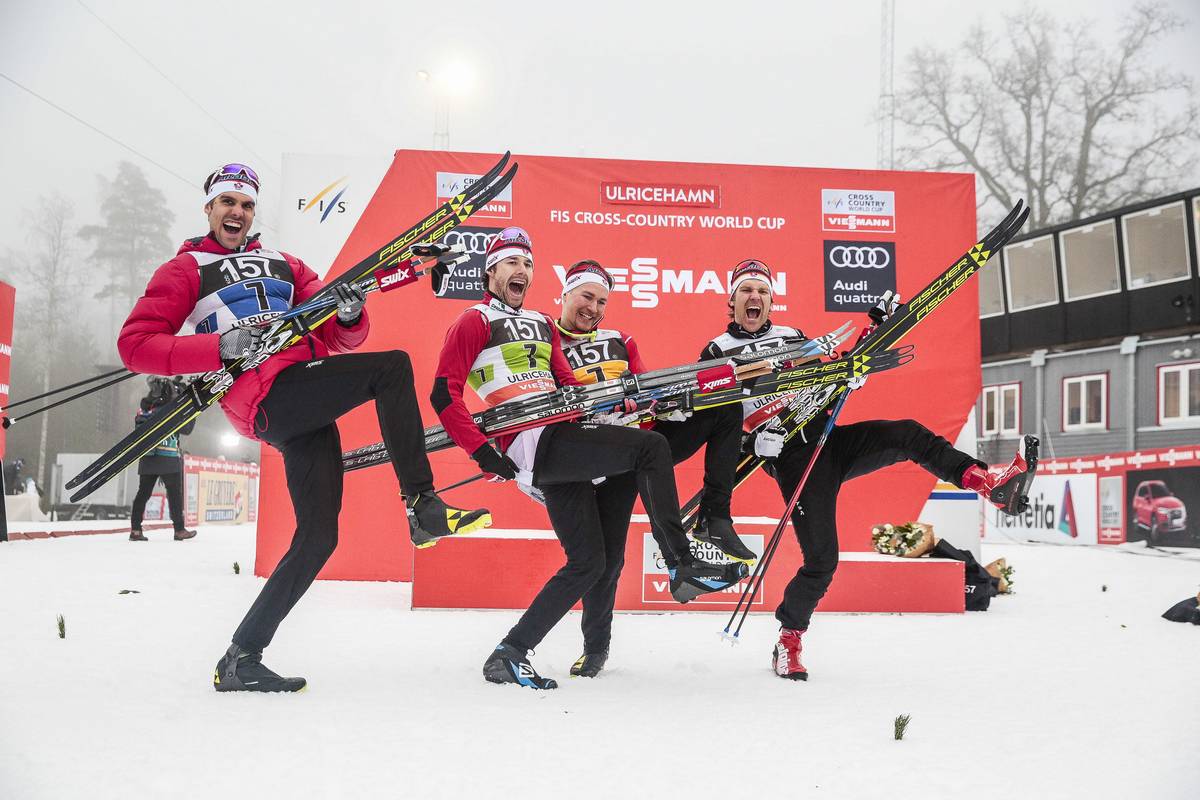
    The Canadian men’s relay after placing third in January 2017 in Ulricehamn, Sweden, for Canada’s best-ever World Cup result in the 4 x 7.5 k relay. From left to right: Lenny Valjas, Alex Harvey, Knute Johnsgaard, and Devon Kershaw. (Photo: Salomon/NordicFocus)

    In an email, Harvey explained that he and Kershaw first met in the fall of 2005 at a training camp at Sovereign Lake, British Columbia. Harvey was on the junior team and Kershaw a senior, but the whole team stayed at the same hotel.

    One morning, Kershaw accidentally took Harvey’s poles from the hotel. Harvey had to track him down on the ski trails to get them back.

    “That was the first time I talked to him and to me it’s just perfect because that’s so Devon,” Harvey wrote.

    Later that season on March 7, 2006, Kershaw made history with his first podium. That same day, Harvey won his first national title in the 10 k classic at Canada’s senior national championships as a 17-year-old junior.

    “I guess our friendship was meant to be before we even knew it!” Harvey wrote.

    When the two became teammates, Harvey immediately took to imitating Kershaw, both in training and racing.

    “He took me under his wings and he has a big part in the athlete I became today,” Harvey wrote, likening Kershaw to a big brother. “I feel very privileged to have spent all that time with him. I think we became such close friends because we are both very driven athletes and we don’t accept any compromise. We’re both huge fans of our sport, ‘nor-dorks’, so we also love to talk about everything from altitude training to who is seeing who on Tour.”

    Kershaw’s decision to retire didn’t surprise Harvey.

    “I think it’s a mix of a few things,” Harvey wrote. “… Probably this biggest reason, he has a little girl at home. I know this winter was extremely hard on him. Not seeing Asta Isabel was pure torture, I think I would have done the exact same if I was him.

    “I will miss a lot of things about Devon,” he added. “He’s always there to give good advice about everything and anything. He knows so much about all that is going on in the world, probably the most well-read person I know. He’s kinda my news source. I’m still amazed by how indecisive one can be. This brought a lot of laughter throughout the years. I have so many memories from the last 10 years with him. Seeing him dominate the World in 2012 was just amazing but also very eye-opening for me. He raised the bar for all North American skiers that year and I’m very thankful for it.

    “We both lived great emotions in high accomplishments and huge disappointments. I’d like to think I helped him get through these upsets and I can say he definitively helped me get through mine. A page turns in the life of Devon Kershaw but knowing the man, I’m not worried about what’s gonna come next.”

    Without Kershaw, Killick, Cockney, and Johnsgaard on the men’s team, Harvey acknowledged that next winter will be “very different” for him on the World Cup.

    “All these guys are calling it a career and I’m super proud of what all my friends accomplished,” he wrote. “I’m excited to try to help the next generation step it up and fill the shoes of the previous generation. … Also, after 10 years on Tour I’ve made some friends on other teams so I’m not too worried. I’m just excited to step into a bit of a mentor role for our next generation.”

    Onto the Next

    As for Kershaw, he didn’t rule out coaching future generations of Canadian skiers, but he said he was focused on getting an education first. In just over a week, he’ll start a course that requires 20 hours of classes a week — all in Norwegian — for what he anticipates will take six months. The course is essentially an advanced version of Norwegian as a second language, and foreigners must pass it to pursue a degree in Norway.

    After that, Kershaw plans to apply to universities “and hopefully study forever,” he said with a laugh. “Not forever, but study, and I want to stay involved in skiing in any way I can and I want to help the next generation get better.
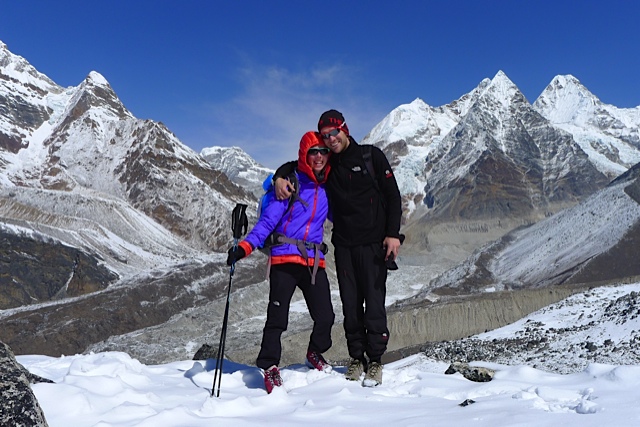
    Kristin Størmer Steira (l) and Devon Kershaw during a day hike on one of their acclimatization days. The couple got engaged in 2014 after summiting Mera Peak during a three-week trek in Nepal’s Himalayas. (Photo: Devon Kershaw)

    “First things first, I have to get my Norwegian at a level where I can sit through a lecture and write an essay at a decently good level, at least good enough that my wife doesn’t have to rewrite it, she can just correct it,” he explained.

    Asked what he’d like to study, Kershaw said medicine, specifically orthopedic surgery, has always intrigued him. (As a junior skier, Kershaw took undergraduate classes at the University of Calgary until 2006, but those credits have since expired.)

    “But now I’m 35 and I’m going to have to do all of this in my third language,” he acknowledged. “So for now, I’d say that that’s still my first choice and I’m exploring what it would take.”

    If not medicine, he’d like to pursue a degree in “some kind of science physiology, and then in a totally shifted way, if I have a panic attack and be like, ‘Science is too hard after ski racing forever,’ then I am interested in economics and economic theory and business to some degree…”

    Regardless of which path he choses, he’ll be doing it in Norway, Kershaw said.

    “I don’t mind the challenge. … It’s intimidating in a way, but it’s also really exciting,” he said. “Kristin’s family [who lives in Lillehammer] is just so fantastic and to see how happy my daughter is here, to have her family, to have family around her and everything for the short term, and I hope to be educated in Norway.”

    Asked if he’ll jump into any ski races this season, Kershaw was quick to respond, “No.” But he will continue skiing. The beauty of the sport and the struggle, as he put it, is what’s kept him in it so long.

    “Imagine just having a singleness, a purpose, a goal that’s just there in your face and then you get to wake up every day and do the things you absolutely love to do,” he said. “… I adore cross-country skiing. I just think it’s such a peaceful, beautiful exercise, and the technique and the flow of it all. … You’re just skiing through the woods peacefully, gliding over snow, over all the terrain you can cover. It’s a beautiful, zen-like endeavor, and I think that’s what’s kept me in it this long. And the people, the Canadian ski community, the world ski community, really. I’ve met so many inspiring people and beautiful people and worked with a lot of absolute experts and I’ve had brilliant teammates and brilliant coaches.”

    And because of skiing, he met his wife and started a family in Norway.

    “I have a daughter with a woman that I love and respect and am in total awe of every day of my life and without ski racing there’s no way that would’ve ever come to fruition,” he said. “There’s the biggest gift right there, as cliche and Hallmark as that sounds, it’s true.”

  • Widmer, Cockney, Killick, and Ammar Show Strength at Canadian Olympic Trials

    Widmer, Cockney, Killick, and Ammar Show Strength at Canadian Olympic Trials

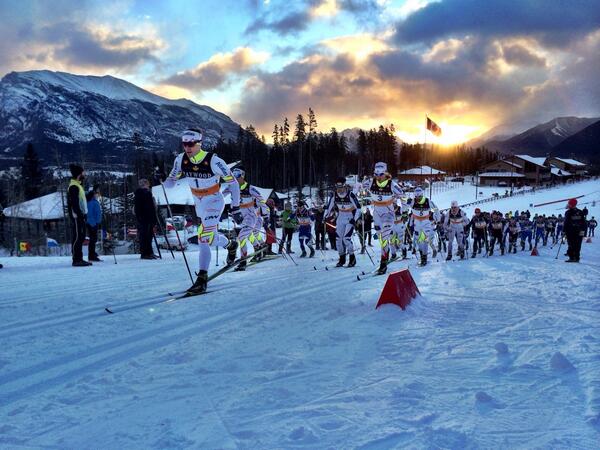
    The start of the men's skiathlon at the Canmore Nordic Centre on Sunday. (Photo: Pavlina Sudrich).
    The start of the men’s 30 k skiathlon at the Canmore Nordic Centre on Sunday. (Photo: Pavlina Sudrich)

    CANMORE, Alberta — Four racers made claims to berths on Canada’s Olympic team this weekend in the freestyle sprints and 15- and 30-kilometer skiathlon on the last two days of Olympic Trials at the Canmore Nordic Centre.

    Heidi Widmer of the Alberta World Cup Academy (AWCA) and Canadian National Team (NST), and Jesse Cockney (AWCA/NST) took top honors in Saturday’s freestyle sprint, while Graeme Killick (AWCA/NST) and Amanda Ammar (Team Ninja) won Sunday’s skiathlon.

    Cross Country Canada (CCC) intends to name one sprinter and one distance racer per gender to the Olympic team based on this past week’s races at the Canmore Nordic Centre. The team will be announced Tuesday morning in Calgary.

    “I didn’t want to be one of those Olympiczillas getting caught up in it all. … This is a dream come true, but I have only completed part one. Now the real journey and work begins.” — Heidi Widmer, 2014  Canadian Olympic Trials skate-sprint winner

    2014 NorAm BUFF® Sprint Series from Twin Zebra on Vimeo.

    Freestyle Sprint

    Heidi Widmer of the Alberta World Cup Academy and Canadian Senior Development Team, en route to a victory in the 2014 Canadian Olympic Trials skate sprint. (Photo: Angus Cockney)
    Heidi Widmer of the Alberta World Cup Academy and Canadian Senior Development Team, en route to a victory in the 2014 Canadian Olympic Trials skate sprint on Jan. 11. (Photo: Angus Cockney)

    Heidi Widmer all but guaranteed her selection to the Olympic team on Saturday with a win in the 1.3 k freestyle sprint. This backs up her second-place finish in Wednesday’s freestyle sprint to Chandra Crawford (Team Ninja/NST), who is already prequalified for the Olympics. Although Crawford did not race on Saturday, Widmer wrote in an email that she used the lessons she had learned from racing Crawford to help her take the win on Saturday.

    “I have raced these trails and trained on them so many times, but this just feels so surreal,” Widmer told CCC. “I was on a mission for this. I didn’t want to be one of those Olympiczillas getting caught up in it all. There are so many ups and downs. I just wanted to stay focused on the process and not look back or ahead of myself. This is a dream come true, but I have only completed part one. Now the real journey and work begins.”

    Behind her, the women’s field showed remarkable consistency from Wednesday’s freestyle sprint.  In the absence of Crawford, the women’s top-four finishers from Wednesday simply became Saturday’s top three.

    Biathlete Zina Kocher showed that her third place on Wednesday (in her first-ever sprint) was no fluke by finishing second in the trials on Saturday. Despite her strong finishes, she has no intention of switching over to cross country.  Kocher is proud, however, of representing biathletes well.

    “I know biathletes get a rep for not being as fast [and] strong as xc skiers, but I hope I have started to prove otherwise!” Kocher wrote in an email. “But I’m not going to make a complete switch [to cross country]. Biathlon has another element to it that I love [and] that makes it incredibly exciting and it would be hard to give that up!”

    Andrea Dupont of Rocky Mountain Racers rounded out the podium in third.

    Phil Widmer (AWCA/NST) leads teammate Jesse Cockney (second from l) and the rest of the men's final at the 2014 Canadian Olympic Trials on Jan. 11 in Canmore, Alberta. (Photo: Angus Cockney)
    Phil Widmer (AWCA/NST) leads teammate Jesse Cockney (second from l) and the rest of the men’s final at the 2014 Canadian Olympic Trials on Jan. 11 in Canmore, Alberta. (Photo: Angus Cockney)

    For the men, Jesse Cockney moved up to top spot on the podium after finishing second on Wednesday and, along with Widmer, will almost certainly be named to the Olympic team.

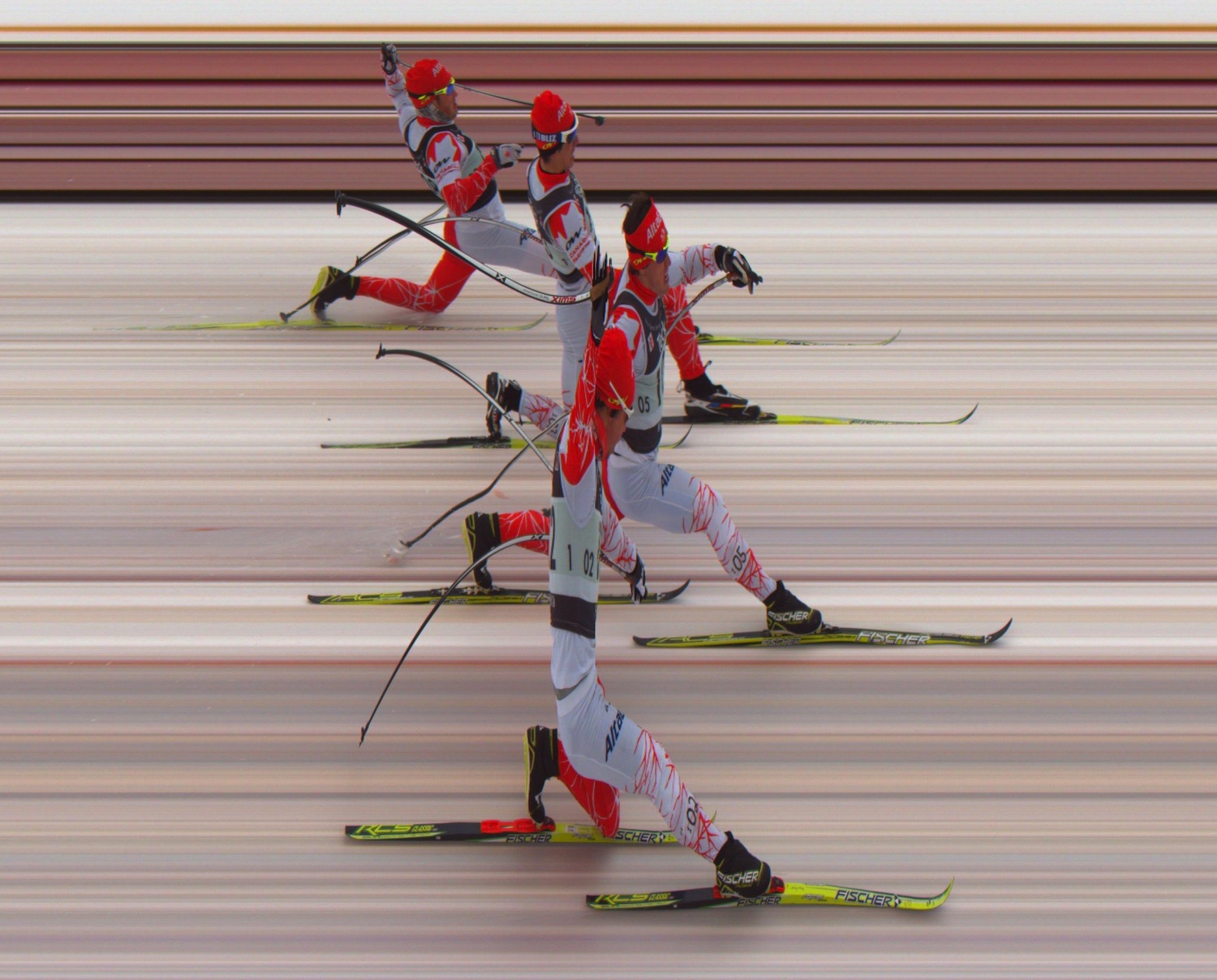
    Skiing tactically within the pack until the finishing stretch, Cockney moved alongside Phil Widmer (NST) in the finishing stretch and threw the hammer down to win the 1.7 k skate-sprint final by two seconds.

    Widmer finished second and young-gun Patrick Stewart-Jones (AWCA) followed in third. Cockney described his finishing strategy to CCC:

    “I just kept telling myself to get to the line. … Phil has been so strong, and I took that outside lane for the finish. I didn’t know what else to do, but I just wanted to get to the line. It has been years of hard work. I don’t know if it is official. I did all that I can do and I just want to enjoy this moment.”

    15/30 k Skiathlon

    With the qualification wrapped up for the sprint racers, the last chance for the distance racers was Sunday’s skiathlon.

    Killick, who finished second to Brian McKeever (Canadian Para-Nordic World Cup Team) in the 15 k classic on Thursday, was a strong favorite heading into the men’s race and he delivered.

    “My initial strategy was to try and break with someone in the classic and work together to hold off the group,” Killick wrote in an email. “I tried a few times to go the classic but was pulled in on the downhill and never really got away with anyone. On the last lap I was finally able to respond to an attack by Graham Nishikawa and keep pushing past to get a little gap on the field. Jess [Cockney] bridged to me and we were able to work together into the first lap of the skate.”

    Graeme Killick (AWCA/NST) soaring to a 30 k skiathlon victory at 2014 Canadian Olympic Trials on Jan. 12 in Canmore, Alberta. (Photo: Angus Cockney)
    Graeme Killick (AWCA/NST) soaring to a 30 k skiathlon victory at 2014 Canadian Olympic Trials on Jan. 12 in Canmore, Alberta. (Photo: Angus Cockney)

    After that, Killick, who had not raced the previous day’s sprint race, started to pull away.

    “I just tried to keep a good pace going and managed to stay strong through the last couple laps,” he explained.

    By the end of the race, Killick had extended his lead to just under a minute to take the win. He joins Cockney and Heidi Widmer as another almost shoe-in for the Olympic team.

    Cockney faded somewhat towards the end of the race and was caught by the rest of the pack, but he regrouped to win a sprint finish with Michael Somppi (AWCA/NST) for second place.  Already having secured a vital win during the week’s trials, Cockney entered the day with a relaxed attitude.

    “The day was really fun,” he wrote in an email. “Tactically I just wanted to conserve energy and ski near the front for a podium. I’m happy with the result and thrilled with the week of racing.”

    Somppi wrote in an email that he was happy with the day, but overall unsatisfied with his fitness thus far this season. Though the Olympic team is likely out of his reach for this season, he wrote:

    “I still don’t feel I am racing at my best, but today was a good step forward.  I will take some much needed rest and recovery now and hopefully I can find my top racing form for the second half of the season.”

    McKeever, winner of Thursday’s distance race, ended up in eighth and is likely out of the running for Olympic qualification — but the visually impaired skier is a gold-medal favorite at the Paralympics in early March.

    Amanda Ammar (Team Ninja) leads Brittany Webster in the 15 k skiathlon on Jan. 12 at 2014 Canadian Olympic Trials in Canmore, Alberta. (Photo: Angus Cockney)
    Amanda Ammar (Team Ninja) leads Brittany Webster in the 15 k skiathlon on Jan. 12 at 2014 Canadian Olympic Trials in Canmore, Alberta. (Photo: Angus Cockney)

    On the women’s side, Ammar gritted out a huge win for herself after finishing sixth on Thursday.  Although she wrote in an email that she didn’t feel great energy-wise on the day, she tried to simply “hold on” for as long as possible. Her strategy worked, as the pack was whittled down to three skiers, two of whom Ammar thought she could out-sprint in the end (the other being herself).

    However coming into the last few kilometres, she decided to start her sprint with 1 k remaining in the race, and it was all over for the other racers.

    Ammar crossed the finish line in 49:16, with Brittany Webster (Mito Canada) five seconds back and junior Anne-Marie Comeau (Pierre-Harvey National Training Centre) at 30 seconds back. All three were over a minute ahead of the fourth-place finisher.

    Ammar, while thrilled with her result, is circumspect.

    “No matter what happens with the Olympic decision, I will now know that I am just as fast and as fit as the girls going, and I’m at that top level. It’s been a long hard journey for us, and I’m just so proud.”

    Webster is equally happy with the week of racing, although disappointed to have finished second on both days of distance racing. She wrote in an email to Fasterskier that,

    “I feel great about my [two] efforts, and I know that the way I have trained this year, it should only keep getting better. Of course I am bummed I didn’t have what it took to win on either day, but hey that is racing, and I am really looking forward to working on it for the rest of the season.”

    According to a Cross Country Canada press-release, the 2014 Olympic Team selections will be announced Tuesday morning in Calgary, Alberta.

    — Gerry Furseth contributed reporting

    Video of Canadian Olympic Trials Sprints by TwinZebra Productions

    Saturday: Women’s Freestyle Sprint Results | Men’s Freestyle Sprint Results

    Sunday: Women’s 15k Skiathlon Results | Men’s 30 k Skiathlon Results

  • Crawford, Thompson, McKeever, and Nishikawa Score Big at Canadian Olympic Trials

    Crawford, Thompson, McKeever, and Nishikawa Score Big at Canadian Olympic Trials


    The finishing stretch of the men's freestyle sprint. (Photo: Kathy Wylie)
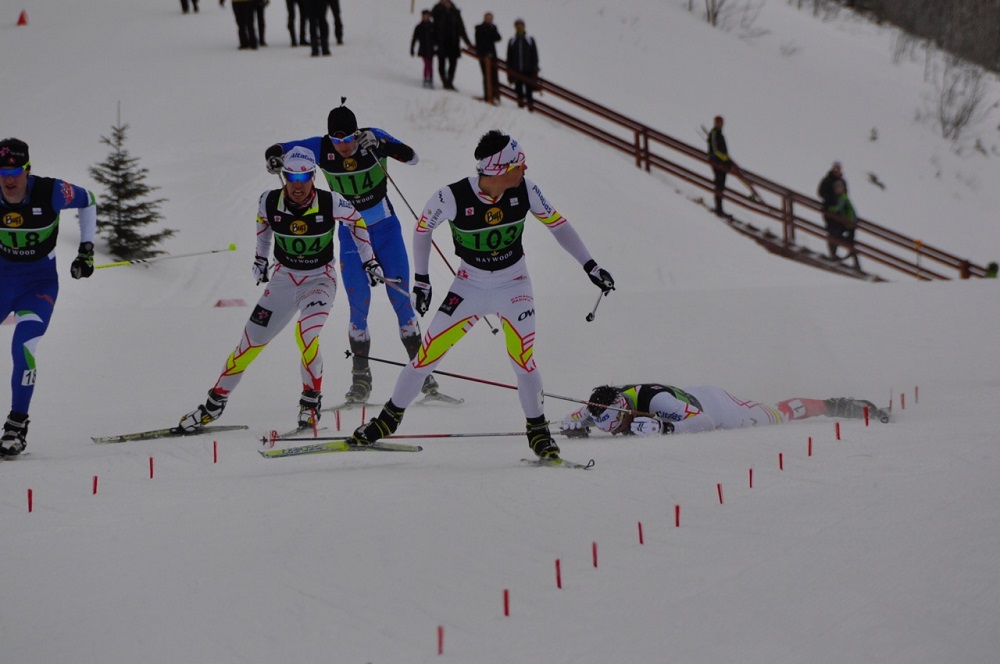
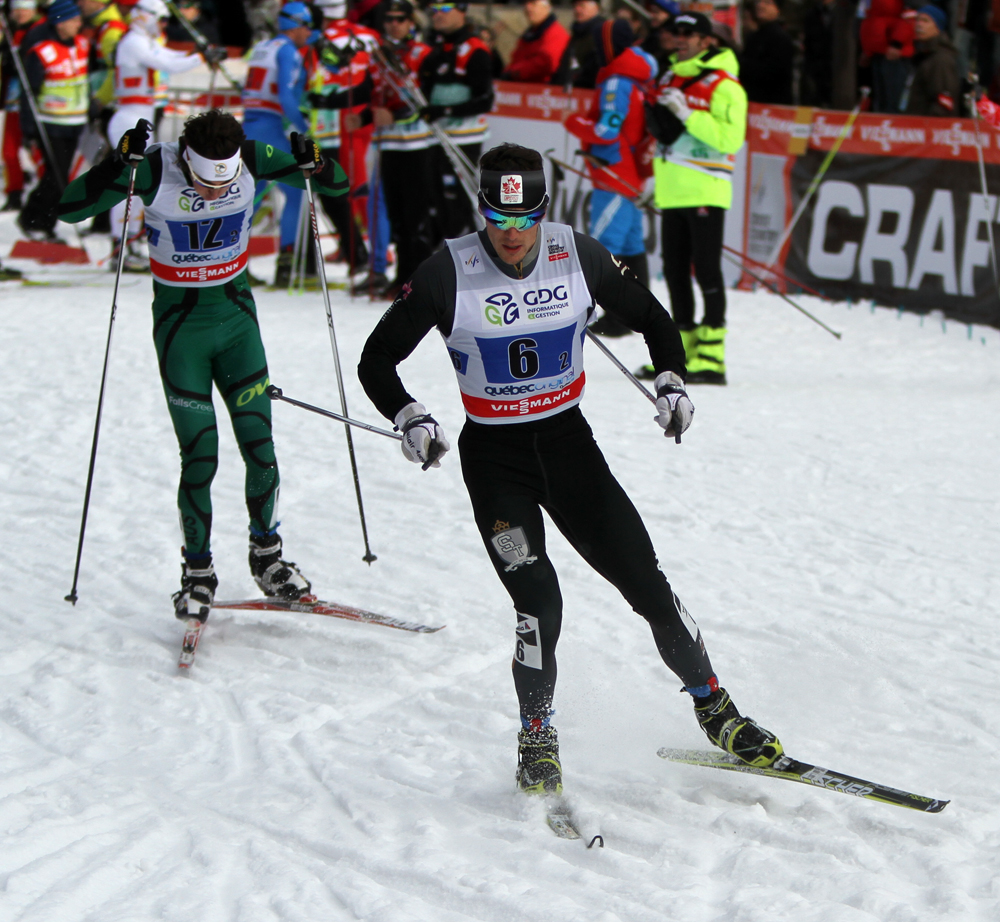
    The finishing stretch of the men’s freestyle sprint after Widmer’s fall. (l-r) Bob Thompson, Graham Nishikawa, Julien Locke, Jesse Cockney, Phil Widmer. (Photo: Kathy Wylie).

    Canada’s Olympic Trials kicked off on Wednesday at the Canmore Nordic Centre with the first of two freestyle sprint races. With perhaps only two spots per gender on the Olympic team up for grabs, there is little room for errors for racers wanting to qualify for the Olympics.

    Freestyle Sprint

    Chandra Crawford of Team Ninja and the Canadian National Team was dominant in the finishing stretch of the women’s final, taking the win with a 2.4 second gap on the rest of the field. Crawford is prequalified for the Olympic team, but has struggled with health issues over the past year. She told Cross Country Canada that,

    “To be able to put it all out there and charge your way to the finish line is what it is all about. It has been a huge effort this year for me to this point, and I’m excited with how today went. I just love racing and it is fun to win today.”

    Heidi Widmer and Emily Nishikawa embrace after the women's sprint final. (Photo: Kathy Wylie)
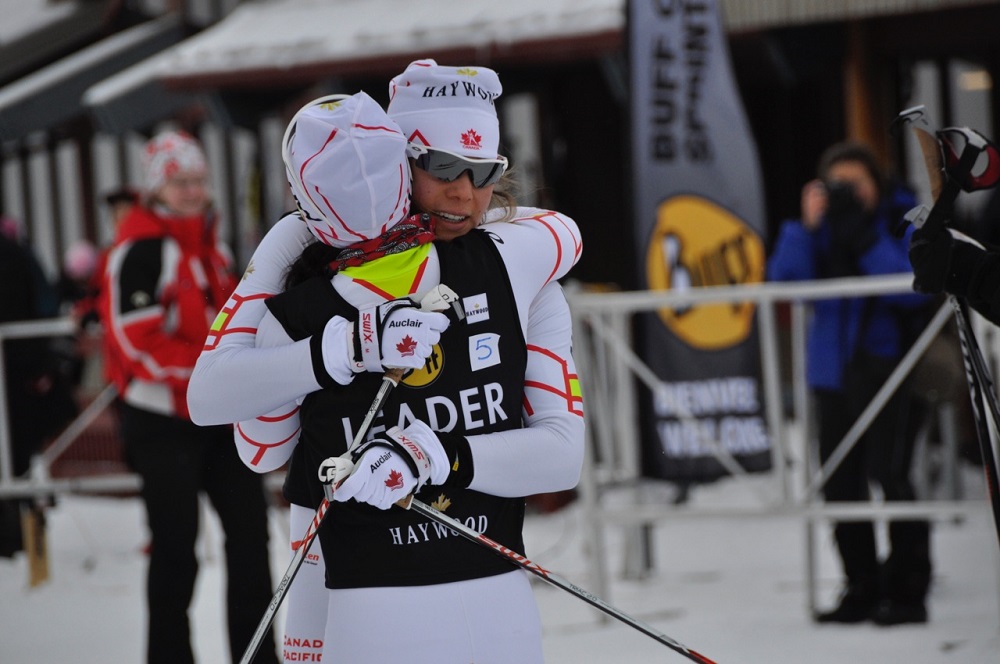
    Heidi Widmer and Emily Nishikawa embrace after the women’s sprint final. (Photo: Kathy Wylie).

    Finishing behind Crawford was Heidi Widmer of the Alberta World Cup Team (AWCA) and the Canadian National Team (NST). Widmer qualified in first, and looked strong in finishing. Canada is planning to choose one athlete solely off of sprint results, and one from distance results. Crawford’s prequalification puts Widmer in strong position going into the second round of freestyle sprinting on Saturday.

    Rounding things up for the women’s podium was biathlete Zina Kocher of Red Deer, Alberta. Kocher has already qualified for Sochi in biathlon, but is also trying to qualify for the cross-country team. Incredibly, she finished in third in an event that she has rarely, if ever, competed in. In an email, she wrote that,

    “For my first experience, my heats went great. I love hill climbing so this course is fantastic for me!

    My strategy was really just to completely enjoy the day, be challenged by a new experience and do intervals with fast skiers [and] friends! Every heat required a little bit different mindset before starting and thinking about what strategy was needed. I didn’t have any expectations since this was new for me so I just focused on givin’er!”

    Jesse Cockney and Phil Widmer collide in the finishing stretch of the men's sprint final. (Photo: Kathy Wylie).
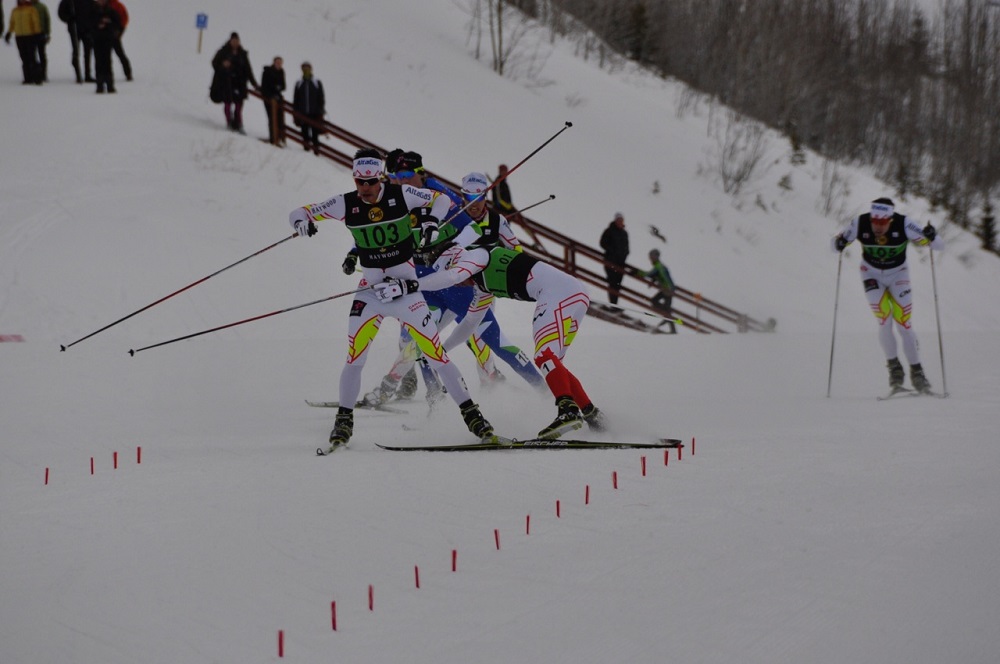
    Jesse Cockney and Phil Widmer collide in the finishing stretch of the men’s sprint final. (Photo: Kathy Wylie).

    On the men’s side of things, the results were equally interesting. Up-and-comer Bob Thompson of Thunder Bay had a stellar day to take the win after qualifying in 18th place.

    According to Jesse Cockney (AWCA-NST), the heats were slow on the day, and coming down the finishing stretch all the racers were in a big pack. A tangle in the last 100 meters between Cockney and Phil Widmer (AWCA-NST) left the win up for grabs, and Thompson snagged it. Cockney held on for second, and Graham Nishikawa (NST) ended up in third.


    Classic 15/10 K

    Racing continued on Thursday with 15/10 k interval start classic racing for the men and women, respectively.

    Brian McKeever of the National Para-Nordic Ski Team eked out the win for the men, starting slowly and building into the four lap race.

    Brian McKeever in Thursday's classic distance race. (Photo: Kathy Wylie).
    Brian McKeever in Thursday’s classic distance race. (Photo: Kathy Wylie).

    “I could see my splits throughout the race and knew what I had to do. My strategy going in was this is a four-lap race. It is not over after two,” McKeever told Cross Country Canada. “I wanted to get into a good rhythm and keep the pace throughout all four laps. I like to be the guy moving up as the race goes along rather than falling back. It feels very rewarding to know I was able to stick to the plan and it worked out. ”

    McKeever is legally blind and, in 2010, was a member of both the Paralympic and Olympic team for Canada in Vancouver. However, he did not get to start any races at the Olympic Games.

    Following closely behind McKeever were Graeme Killick (AWCA) and Kevin Sandau (AWCA-NST), 1.5 seconds and 18 seconds back, respectively. Both racers were strong early in the race and then faded a bit as McKeever made his surge. Sandau wrote in an email that,

    “Since only race winners are only considered in the final selection, everything is on the line for Sunday[‘s distance race]. But the top [five] from today were relatively tight so anything could happen in the skiathlon. For me, the longer the better so looking forward to Sunday!”

    Alysson Marshall, who finished fourth in the classic 10 k, in Wednesday's sprint race. (Photo: Kathy Wylie).
    Alysson Marshall, who finished fourth in the classic 10 k, in Wednesday’s sprint race. (Photo: Kathy Wylie).

    The women’s race, on the other hand, was not nearly as close. Emily Nishikawa (AWCA-NST) showed early on that she was in top form, dominating the race throughout to win by nearly a minute. Keeping her enthusiasm in check, she told Cross Country Canada that,

    “I have put in the work and now put it together for the races and that feels incredible,” said Nishikawa. “The wax was amazing and my skis were incredible today. I’m not going to celebrate just yet. I am going to recover and get ready for Sunday’s race.”
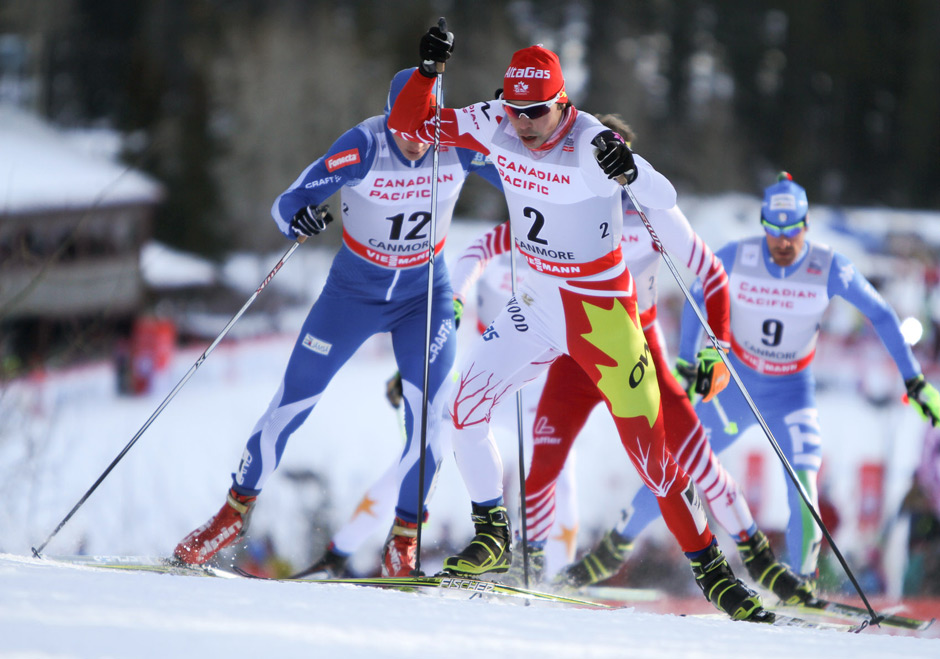
    Runner-up Brittany Webster (Mito Canada) was jubilant, however, after being hobbled last season by sickness and early this season by a training plan designed to produce better mid-to-late season results. Using a race strategy that focused on skiing her own race, Webster wrote that,

    “Whoo, I am not gonna lie it is nice to have that over with! Honestly, I am not even sure where the time went on that course. I remember every second of it and yet I remember nothing of it too. Is that even possible?” She added, “Emily skied fantastic. She started quite [far] back from me so I had no idea what my back splits were to her. All I focused on was keeping it together and standing up on my skis, and the finish result was the finish result.”
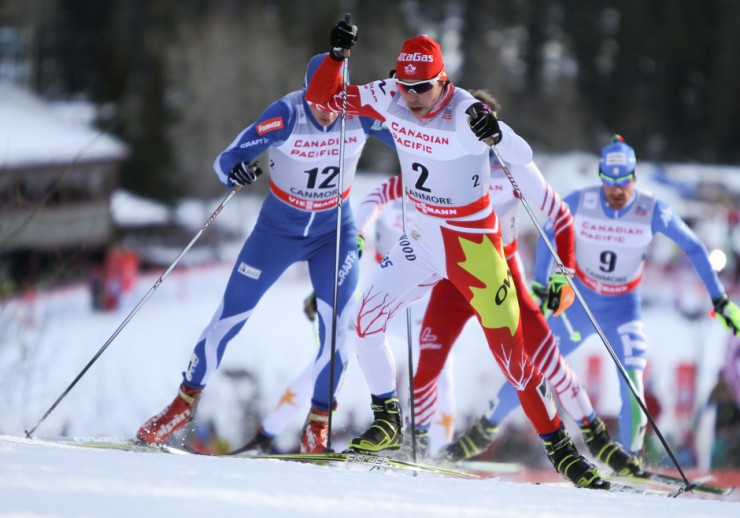
    Rounding out the podium for the women was Ninja Zoe Roy. After using the qualifier of Wednesday’s freestyle race as a warm-up for today’s race, Roy skied to a strong third place finish, 1:23 back from Nishikawa.

    The Canadian Olympic Trials, which also serve as selection races for U23 World Championships and World Junior Championships, will continue on Saturday with a second round of freestyle sprinting.

    Women’s Freestyle Sprint Results

    Men’s Freestyle Sprint Results

    Men’s Classic 10 k Results

    Women’s Classic 10 k Results

  • Dupont, Stewart-Jones Race Tactically to Notch Sprint Wins at Sovereign Lake NorAm

    Dupont, Stewart-Jones Race Tactically to Notch Sprint Wins at Sovereign Lake NorAm

    (L-R) Emily Nishikawa, Alysson Marshall, and Andrea Dupont head into the finishing stretch of Sunday's classic sprint at the NorAm opening weekend at Sovereign Lake in Vernon, B.C. (Photo: Peggy Hung)
    (L-R) Emily Nishikawa, Alysson Marshall, and Andrea Dupont head into the finishing stretch of Sunday’s classic sprint at the NorAm opening weekend at Sovereign Lake in Vernon, B.C. (Photo: Peggy Hung)

    A day of cold and windy sprinting — with temperatures around -17 degrees Celsius — wrapped up this weekend’s NorAm races at Sovereign Lake. After all was said and done, Andrea Dupont (Rocky Mountain Racers) and Patrick Stewart-Jones of the Alberta World Cup Academy (AWCA) emerged as victors in the classic sprint.

    In the women’s race, Andrea Dupont skied a tactical-and-controlled race to win the A-final after squeaking through the semifinals as a lucky loser. Alysson Marshall of the AWCA and Canada’s Senior Development Team (NST) and Emily Nishikawa (AWCA/NST) were close behind in second and third, respectively. Rounding out the A-final was Heidi Widmer (AWCA/NST) and Ninja teammates Amanda Ammar and Zoe Roy.

    Dupont leading Marshall (c) in the finishing stretch (Photo: Peggy Hung)
    Dupont leading Marshall (c) in the finishing stretch of the Sovereign Lake NorAm sprint. Dupont won, Marshall was second and Emily Nishikawa placed third. (Photo: Peggy Hung)

    After sitting out Saturday’s 10 k freestyle as a precaution to protect her lungs from temperatures around -18 degrees Celsius, Dupont explained in an email that Sunday morning “was a bit of a shock to the system racing in the cold.”
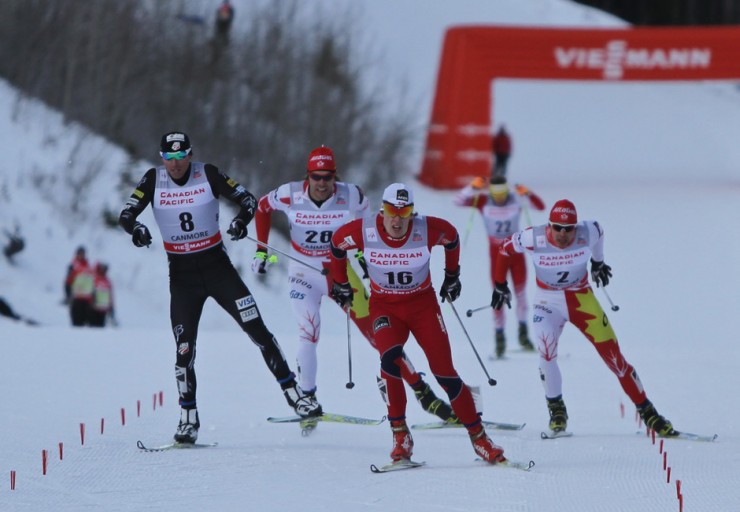
    That said, she was happy with her final and her ability to “relax and work tactics (something that is not always my strength),” she wrote. “We had really great skis from our club parent volunteers, and I was able to use that extra bit of glide heading into the final climb, which was the defining point for the course.”

    With most of the pack together until the final hill, Dupont explained her skis helped her feel “super fresh” heading up it.

    “I came out of the climb first and it gives you a huge advantage heading into the finishing straight,” she wrote.

    Marshall was also pleased with her runner-up result, and concurred that the race was quite exciting.

    “The A-final was tight for most of the race,” she wrote in an email. “There are lots of corners and transitions so a fair amount of contact and lane switching going on but luckily no crashes. Andrea and I got into the lead on the final climb and Andrea lead into the finish. I was gaining on her but couldn’t quite catch her before the line.”

    On the men’s side, Stewart-Jones captured his first NorAm victory, which he wrote in an email he was “pretty excited about.”

    “I came close to winning a few times last year but never pulled it off,” he added.

    Phil Widmer (AWCA/NST) and Graeme Killick (AWCA/NST) placed second and third, and Knute Johnsgaard (Yukon Elite), Raphaël Couturier of Pierre Harvey National Training Centre and NST, and Simon LaPointe (Skinouk) rounded out the rest of the A-final.

    Patrick Stewart-Jones racing in the Sunday's classic sprint qualifier at the Sovereign Lake NorAm. (Photo: Peggy Hung)
    Patrick Stewart-Jones (AWCA) racing in the Sunday’s classic sprint qualifier at the Sovereign Lake NorAm. (Photo: Peggy Hung)

    Qualifying in fifth, Stewart-Jones explained that he felt the effects of Saturday’s 15 k freestyle, in which he placed fourth.

    “My plan for the heats was to ski as efficiently as possible to try and get to the final using the least energy possible,” he wrote. “I knew my finish was strong so I was just trying to get to the last few hundred metres in a position where I could challenge for the win.”

    Widmer (AWCA/NST) complimented Stewart-Jones on his race. “It was a cold, slow day of racing and I have to say I’m satisfied with the result,” Widmer wrote. “Patrick was very strong in the final and I wasn’t able to make up any ground on him in the finishing straight.”

    Next weekend’s NorAm, hosted by the Black Jack Ski Club in Rossland, B.C. will feature a freestyle sprint and 10/15 k individual starts. The fields will be much larger due to the addition of many stateside Americans heading up north to race, without a SuperTour next weekend.

    Marshall, for one, is looking forward to the challenge. “It will be fun to have some Americans at the races next weekend!” she wrote. “I’m really focusing on sprinting this year and it’s always nice to sprint against different skiers since we get used to the strengths and weaknesses of the girls we race against all the time.”

    “[The Americans] were fast last time we raced on Frozen Thunder and deeper fields are always more fun to compete in!” Widmer wrote.

    Additionally, Widmer is looking for some redemption next weekend. During his last race there, Widmer explained he “fell and came as close as I ever have to seriously hurting myself in a race. I was taken out and flew into a log jam at the side of the trail. It could have ended up much worse than it did as I walked away with only a broken pole and some scratches. Needless to say I’ll be looking for a much better result this time around!”

    Results

  • Sovereign Lake NorAm: Photo Gallery

    Sovereign Lake NorAm: Photo Gallery

    VERNON, B.C. — Photos from the season-opening NorAm at the Sovereign Lake Nordic Centre, with 10/15 k freestyle followed by classic-sprint races in temperatures near -18 degrees Celsius on Saturday and Sunday, respectively. All photos by Gerry Furseth and Peggy Hung.

    Dec. 7: Women’s 10 k and men’s 15 k freestyle individual starts (Race report | results)

    Dec. 8: Women’s 1.2 k and men’s 1.4 k classic sprints (Race report | results)

  • The Four: Alberta World Cup Academy

    The Four: Alberta World Cup Academy

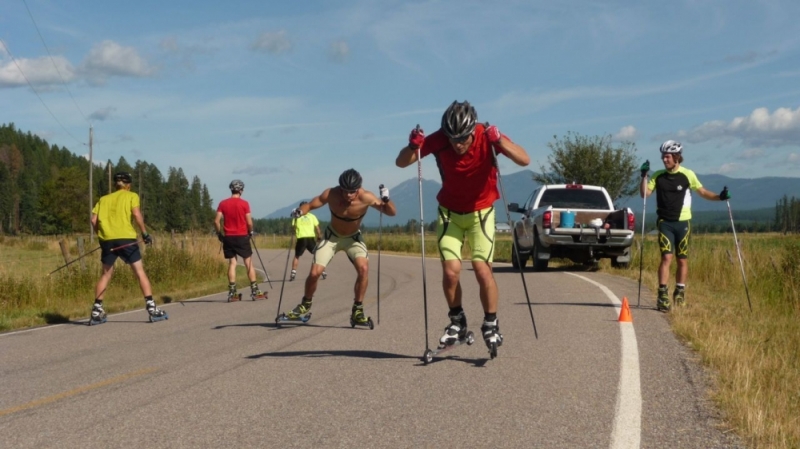
    Alberta World Cup Academy skier Patrick Stewart-Jones leads teammate Phil Widmer in some quick sprints during a dryland camp in Whitefish, Montana, this summer. (Photo: AWCA)
    Alberta World Cup Academy skier Patrick Stewart-Jones (second from r) leads teammate Phil Widmer in some quick sprints during an August dryland camp in Whitefish, Mont. (Photo: AWCA)

    Note: This is the fourth and final preview giving an inside look at Canada’s national training centres. We asked coaches to tell us what’s new, whom to look out for and their outlook for the season. Teams were presented in no particular order. 

    Team: Alberta World Cup Academy (AWCA)

    Coaches: Mike Cavaliere (program director/men’s coach), Chris Jeffries (women’s coach), Stefan Kuhn (assistant coach)

    Athletes: Jess Cockney, Chris Hamilton, Russell Kennedy, Graeme Killick, Yannick Lapierre, Alex Mahoney, Kevin Sandau, Michael Somppi, Patrick Stewart-Jones, Sebastien Townsend, Phil Widmer, Ezekiel Williams; Dahria Beatty, Annika Hicks, Marlis Kromm, Alysson Marshall, Emily Nishikawa, Rebecca Reid, Heidi Widmer.

    With 19 athletes (12 men and seven women), the AWCA is down one from last year, but still boasts quantity and quality with eight skiers on the National Senior Development Team (Cockney, Killick, Sandau, Somppi, Phil Widmer, Heidi Widmer, Marshall, and Nishikawa).

    Who’s new:  Two former Callaghan Valley Training Centre athletes – Lapierre and Townsend – both originally from Quebec. Mahoney hails from Lethbridge in southern Alberta, but has been living in Canmore for the last three years, formerly training with Rocky Mountain Racers. Williams comes from Nakkertok and the Gatineau, Quebec, area.

    Who’s missing: Kate Brennan retired and is now working as a manager at the Paintbox Lodge in Canmore, owned by Sara Renner and Thomas Grandi. According to Jeffries, Brennan “was plagued by many health problems in her final years, from which she seems to be recovering from very well,” he wrote in an email. “She was engaged to former ski racer Phil Wood this summer.”

    Janelle Greer moved back to Whitehorse, Yukon, and was considering attending nursing school next fall, Jeffries wrote. Suzanne Stevenson is studying at Montana State University, and Jeffries didn’t think she was ski racing, and Brittany Evans is also pursuing undergraduate studies at the University of British Columbia.

    Former men’s team leader, Graham Nishikawa – still on the Senior Development Team – has been training with Canada’s Para-Nordic program in the leadup to the 2014 Olympics. Brent McMurtry retired and is studying at the University of Victoria. Matt Wylie also retired and is attending the University of Calgary.

    An AWCA coach for a month and a half last season, Mike Vieira took a new job this spring as Cross Country Canada’s manager of coaching development.

    “We all resumed our roles from last year and have not missed a beat,” Jeffries explained. “[Former AWCA skier and national-team member] Drew Goldsack was contracted for a week this summer to coach the women during a training camp here in Canmore, which gave the girls a fresh perspective and allowed me time to coach the girls of the Alberta Ski Team.”

    The team also brought on an intern, Lars Hanel, a former racer studying to become a coach in Germany. According to Jeffries, he arrived in October and will assist the Academy through the 2013/2014 season.

    Top results last season:

    Canadian Jesse Cockney of the Alberta World Cup Academy and Senior Development Team (2) leads Finland's Anssi Pentsinen (12) and the rest of his quarterfinal in Saturday's World Cup 1.3 k skate sprint in Canmore, Alberta. Cockney won the heat and went on to place ninth overall for a personal best in his fifth World Cup start.
    Jesse Cockney of the Alberta World Cup Academy and Senior Development Team (2) leads Finland’s Anssi Pentsinen (12) and the rest of his quarterfinal in last year’s World Cup 1.3 k skate sprint in Canmore, Alberta. Cockney won the heat and went on to place ninth overall for a personal best in his fifth World Cup start.

    Cockney, 24, had a breakout season starting at the Canmore NorAm, where he placed second in the 15-kilometer classic to earn his way to the Quebec and Canmore World Cups last December. In Canmore, Cockney wowed local supporters and international competitors with the second-fastest qualifying time in the World Cup skate sprint, and went on to place ninth overall.

    He notched several other podiums throughout the NorAm season, made the top 50 in the Lahti World Cup skate sprint (in 50th), and placed fourth in the classic sprint at Canadian Nationals in Whistler, B.C.

    Phil Widmer, who turned 30 last month, and Emily Nishikawa, 24, both earned trips to World Championships in Val di Fiemme, Italy, where Widmer placed 49th in the classic sprint. Earlier in the season, Widmer finished 15th in the Canmore World Cup skate sprint, racked up several NorAm victories, and placed third in the classic sprint at nationals.

    At 23, Nishikawa pulled off 57th in both the classic sprint and 10 k skate at World Championships, despite an unusually rapid heartbeat that turned out to be benign.  At the Canmore World Cup in December, she placed 34th in the 15 k skiathlon and 48th in both the 10 k classic mass start and freestyle sprint. She ended the season in 46th at World Cup Finals in Falun, Sweden.

    After placing 34th in the Canmore World Cup sprint, Heidi Widmer also qualified for U23 World Championships in Liberec, Czech Republic, where she notched 28th in the 10 k skate (and subsequently made the senior devo team in the spring). The 22 year old medaled twice at nationals, placing third in the 5 k and 30 k skate races in Whistler.

    Coach’s comments:

    According to Jeffries, all went as planned throughout the summer and fall, with athletes hitting personal best in field tests and showing “good fitness” on the rollerski-treadmill incremental tests.

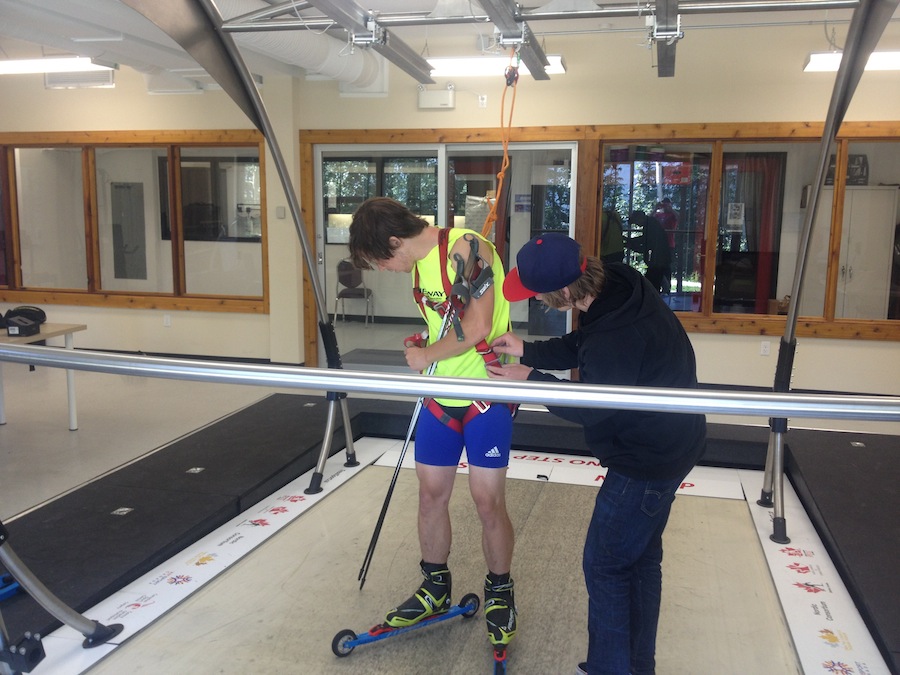
    Sebastien Townsend (AWCA) prepares for a treadmill test at the Bill Warren Training Centre in Canmore, Alberta. (Photo: AWCA)
    Sebastien Townsend (AWCA) prepares for a rollerski-treadmill test at the Bill Warren Training Centre in Canmore, Alberta. (Photo: AWCA)

    The women’s team held seven training camps from May through November, most of which took place around Alberta and British Columbia, but also included trips to Whitefish, Mont., and Whitehorse. The men ventured to similar places, with a total of six camps, including one at home on Frozen Thunder.

    Even in an Olympic year, the team’s goals are generally the same.

    “As always, we want to qualify athletes for international trips (WJC, U23s, Olympics, World Cup, Scando Cup) and ultimately graduate athletes to national teams (World Cup, SDT),” Jeffries wrote. “One of our big goals as a team is to have athletes positioned on the NorAm to win the FIS regional spots, allowing them to race World Cups.  If you ask our athletes what they need to make performance gains internationally, their number one answer is World Cup starts.  The FIS regional spot is the most predictable way to earn those starts in a year.”

    Looking at the men’s team, Jeffries stated their athletes are “healthy and performing at a very high level.”

    “The group is a little more diverse than in previous years, which has likely contributed to a very healthy team environment,” he added. “We have 6 U23 athletes who are all chasing after the older boys, getting stronger in the process.  The non-U23 men are very focused as they work towards being in shape for the Olympic trials in January.”

    The reigning FIS regional leader, Cockney gets to start this season in Europe with Canada’s World Cup Team.

    On the women’s side, Jeffries explained they’ve had a drop in numbers last year: from 12 to seven.

    “As a result, the group is very focused this year and more mature,” he wrote. “Dahria is our only junior, but her drive to be successful internationally puts her more in the category of team veteran as she pushes the other girls and keeps them on their toes.”

    While the group’s general fitness is “very high,” Jeffries stated their women have suffered more injuries than usual. Hicks has been on an adjusted program waiting for compartment-syndrome surgery on her lower legs this fall. “She raced through a lot of pain last winter and we had her diagnosed this spring,” he explained.

    In early September, Heidi Widmer crashed rollerskiing and ended up with her third concussion. She took a few weeks off and was back in action later this fall. “Heidi brought in a great level of fitness from last winter that she has continued to build on this summer, so we are confident it won’t take her long to get ready for the start of race season and the U23/Olympic trials in January,” Jeffries wrote.

    “As a coaching team, we are all very competitive people, so we are always looking internally on how we can become better.  Our overall philosophy though is pretty simple and helps us maintain perspective.  We ultimately try to keep things simple, looking at finding ways to do hard training with high quality, which we generally just refer to as “regular training.”  The attitudes and commitment of the athletes is what I think allows us to try and raise the bar each year.  We have a great group of athletes with a lot of talent who work extremely hard, which allows us to have success annually.”

    See also: Callaghan Valley | NDC Thunder Bay | Pierre-Harvey Training Centre

  • The JP Grand Prix: The ‘World’s Best Ski Race,’ in July

    The JP Grand Prix: The ‘World’s Best Ski Race,’ in July

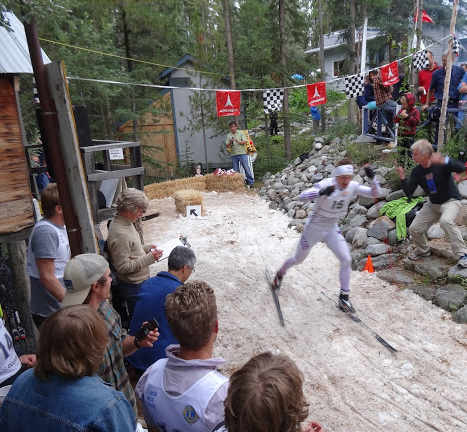
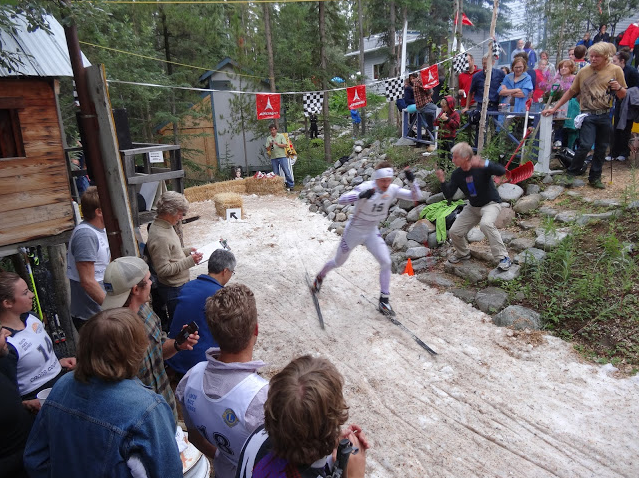
    A competitor on course at the JP Grand Prix, a ski race that took place in a backyard in Whitehorse, Yukon, last Friday. (Photo: Brian McKeever)
    A competitor on course at the JP Grand Prix, a ski race that took place in a backyard in Whitehorse, Yukon, last Friday. (Photo: Brian McKeever)

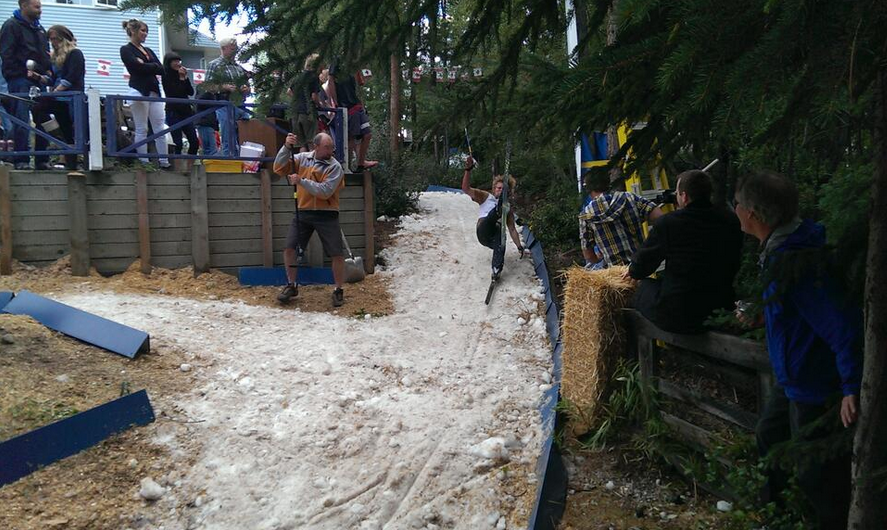
    If you noticed the slew of photos from a ski race in the Yukon last week, you weren’t dreaming. The second-annual JP Grand Prix, hosted in the backyard of Whitehorse skier John Perry and his family, was held on Friday complete with live music, a barbecue, TV crew and, yes, snow. And because it was scheduled to coincide with Canadian World Cup skier Graham Nishikawa’s wedding, there were quite a few world-class athletes who partook in the festivities. Welcome to the world’s coolest ski race.

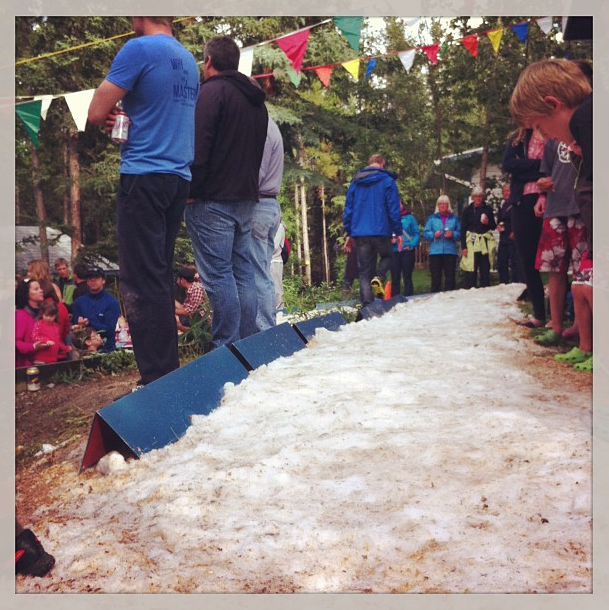
    The course laid out for the JP Grand Prix. (Photo: Devon Kershaw)
    The course laid out for the JP Grand Prix. (Photo: Devon Kershaw)

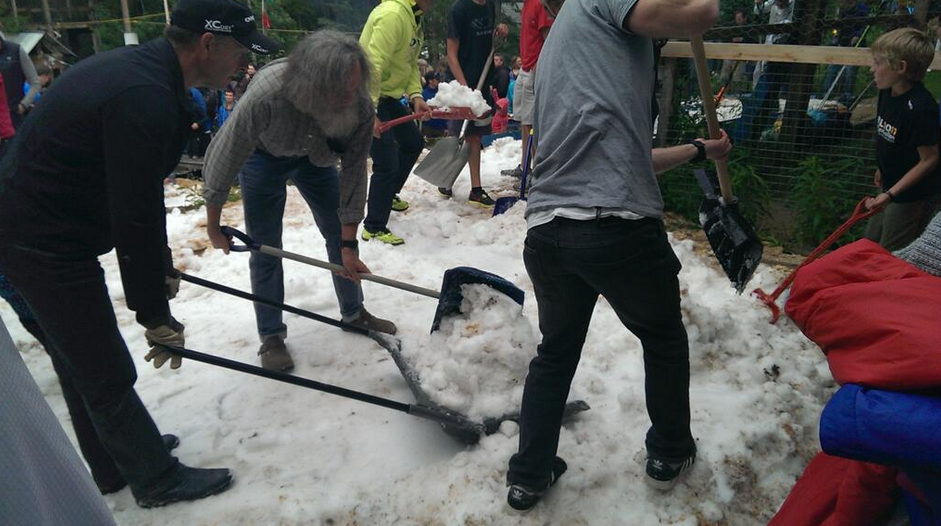
    So, how is a ski race made possible in late July? With a lot of foresight. Perry and his father began stockpiling snow last winter to save up for the event. When it came time for the race, everyone at the party grabbed a shovel to build the course.

    “The man with the name in the title deserves all credit for organizing the race,” wrote Canmore’s Phil Widmer in an email. “John Perry and his Dad save snow through the winter under their deck, cover it with saw dust and wait for the right time to host the ‘JP Classic.’ They did an amazing job with forerunners, a bagpipe lead procession for all competitors, bibs, prizes, medals, beer, it had all the fixings of a great race. This year it made sense to have it while everyone’s in town for the wedding. Thanks John!”

    The making of the course. (Photo: Brian McKeever)
    The making of the course. (Photo: Brian McKeever)

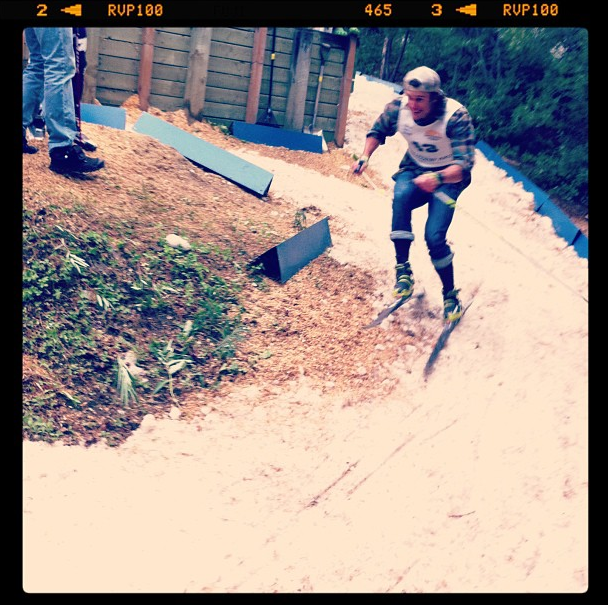
    Widmer estimated that about 150 showed up for the event, and the Yukon Elite Squad’s website put the number of competitors at around 40, although ‘competitor’ is a loosely-applied term for race participants. The atmosphere was relaxed; Devon Kershaw raced in jeans and a flannel, as did Widmer and Nishikawa.

    “I don’t know that there are results,” Widmer said. “It was honestly more about having fun skiing in the middle of summer in downtown Whitehorse.”

    Knute Johnsgaard leaves the gate. (Photo: Yukon Elite Squad)
    Knute Johnsgaard leaves the gate. (Photo: Yukon Elite Squad)
    Phil Widmer on course. (Photo: Devon Kershaw)
    Phil Widmer on course. (Photo: Devon Kershaw)
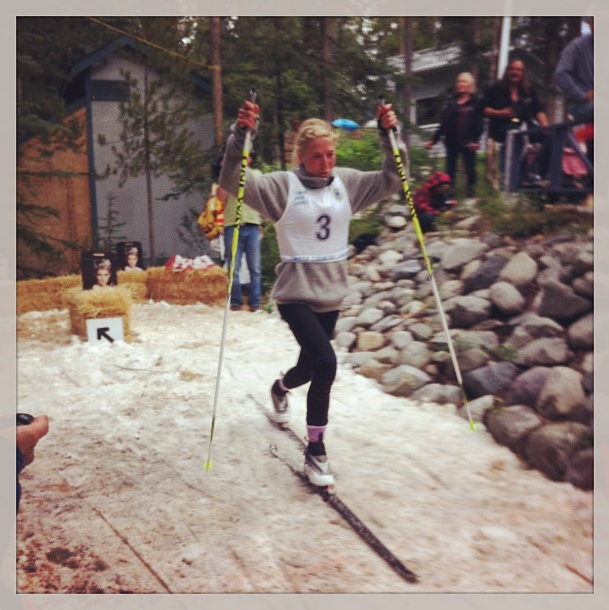
    Kristin Størmer Steira on course. (Photo: Devon Kershaw)
    Kristin Størmer Steira. (Photo: Devon Kershaw)
    Devon Kershaw with Graham Nishikawa, who was married over the weekend. (Photo: Devon Kershaw)
    Devon Kershaw with Graham Nishikawa before the start. Nishikawa was married the weekend following the race. (Photo: Devon Kershaw)

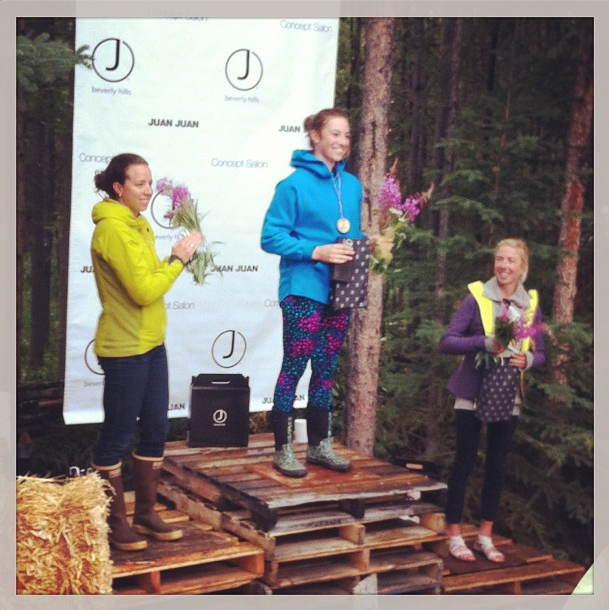
    Results or no, somebody kept track of times and named podium finishers. Locals Janelle Greer and Knute Johnsgaard of the Yukon Elite Squad took top honors. Phil Widmer and Brent McMurtry took second and third, respectively, in the men’s category, and Perianne Jones and Kristin Størmer Steira claimed silver and bronze in the women’s race.

    The women's podium: 1. Janelle Greer (Yukon Elite Squad), 2. Perianne Jones (Canadian National Ski Team), 3. Kristin Størmer Steira (Norwegian National Team). Photo: Devon Kershaw.
    The women’s podium: 1. Janelle Greer (Yukon Elite Squad), 2. Perianne Jones (Canadian National Ski Team), 3. Kristin Størmer Steira (Norwegian National Team). Photo: Devon Kershaw.
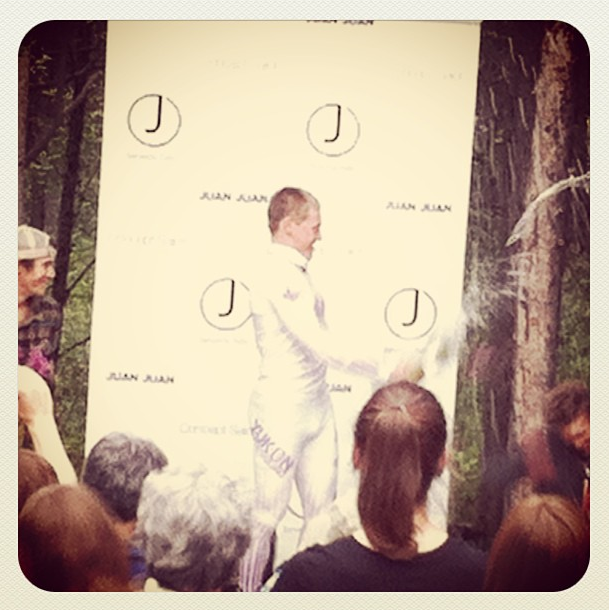
    Men's race-winner Knute Johnsgaard (YES) pops a bottle of champagne on the podium. (Photo: Devon Kershaw.)
    Men’s race-winner Knute Johnsgaard (YES) pops a bottle of champagne on the podium. Phil Widmer and Brent McMurtry, not pictured, took second and third, respectively. (Photo: Devon Kershaw.)

    After the race, the real party began, complete with good food, drink and multiple bands.

    “The idea is amazing and they pulled it off really well. I think two to three different bands played through the night and the atmosphere was great,” Widmer said.

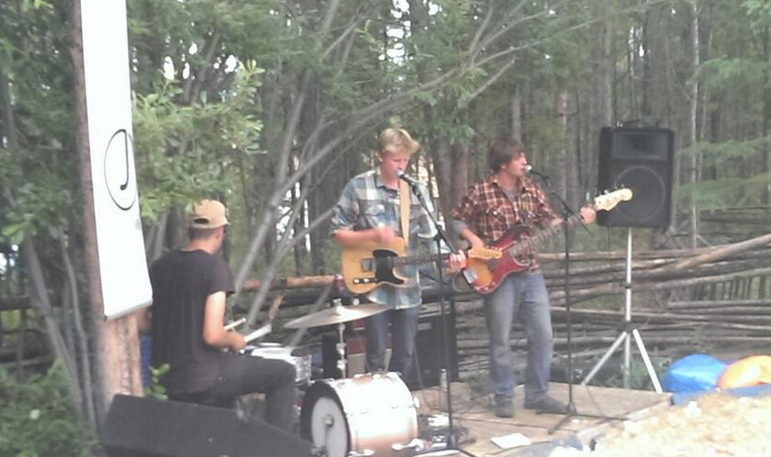
    Former Yukon Elite Squad skier Fabian Brook and his band Griswold played at the afterparty. (Photo: Brian McKeever.)
    Former Yukon Elite Squad skier Fabian Brook and his band Griswold played at the afterparty. (Photo: Brian McKeever.)

    In conclusion, Brian McKeever’s description of the JP Grand Prix as the “world’s best ski race” seems to be fairly accurate. If the number of video cameras that cropped up in pictures is any indication, we may be able to expect another video recap of it in the near future. In case you missed it last summer, here’s last year’s edit from David Greer.


  • Pros of Tomorrow: Widmer Lives Her Dream in Switzerland

    Pros of Tomorrow: Widmer Lives Her Dream in Switzerland

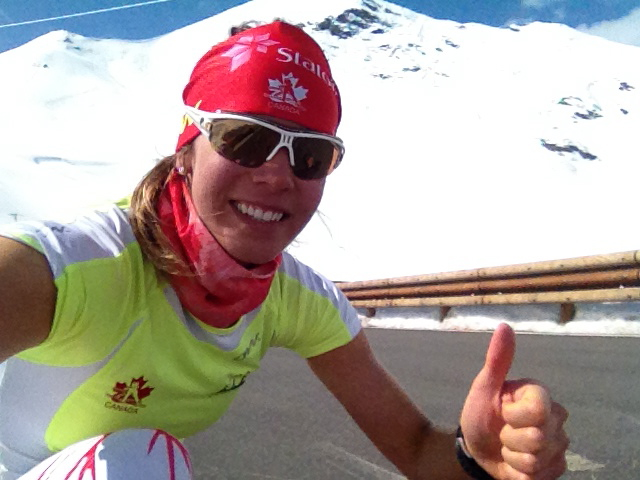
    A happy Heidi Widmer on a bluebird day at Stelvio Pass in Switzerland. She spent five days at a Swiss national-team training camp near the Italian border  in early June. (Courtesy photo)
    A happy Heidi Widmer on a bluebird day at Stelvio Pass in Switzerland. She spent five days there at a Swiss national-team training camp near the Italian border in early June. Widmer, 22, made the Canadian Senior Development Team in April. (Courtesy photo)

    Editor’s Note: This is a continuation of our recently relaunched ‘Pros of Tomorrow’ series, which highlights some of the most notable up-and-coming athletes around the world. See also: Cendrine Browne. 

    ***

    Fresh off her last races of the season at Canadian Nationals in Whistler, British Columbia, Heidi Widmer plunged into the backcountry in early April for some ski touring in Callaghan Valley.

    There, the 22-year-old Banff native knocked off the 1,275-metre (nearly 4,200-foot) Mt. Cayoosh and headed to a lodge in the Selkirk Mountains for more touring. Even with all the physical activity capping a long season, Widmer considered the trip relaxing amid beautiful scenery.

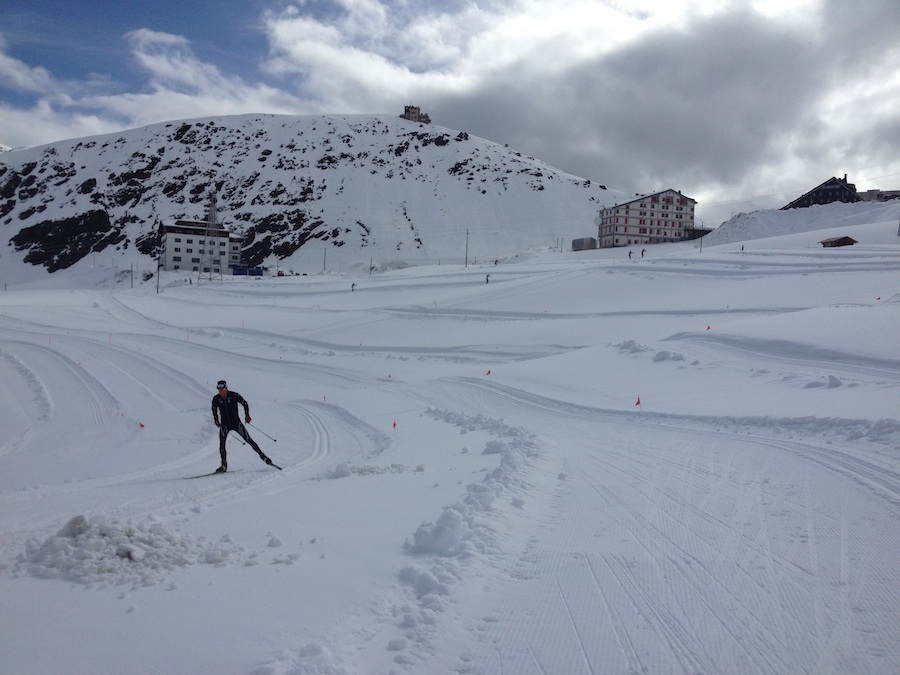
    The Stelvio Pass ski track and hotel Widmer stayed at 2,700 metres above sea level in Switzerland. (Courtesy photo)
    The Stelvio Pass ski track and hotel Widmer stayed at earlier this month 2,700 metres above sea level in Switzerland. (Courtesy photo)

    “It’s really a huge mental break,” she said on the phone Sunday from Switzerland, where she’s training with the Swiss national team. “It’s really a good chance for reflection because you’re out for hours on end, most of the time slogging around.”

    Now in Davos, Switzerland, Widmer also visited El Salvador (for surfing) and New Orleans (for a music festival) for a total of two weeks in late April. Then it was back to training, first with the Alberta World Cup Academy (AWCA) for five days in Canmore, Alberta, then for a weeklong camp in Vernon, B.C.

    Widmer spent another five days back in Canmore before flying to Switzerland on May 25, and she’ll be there until June 24.

    Doesn’t she get tired?

    “Surprisingly not,” Widmer said with a laugh. “I have to take my downtime when I can get it. I really enjoy traveling, but I maybe enjoy it too much. I really got after it in the spring.”

    With a list of trips lined up, Widmer was uncertain about Switzerland, arranged through former AWCA head coach Christian Flury, now in charge of the Swiss women’s team. She knew if she received the call up to Canada’s Senior Development Team, which she had been working for her entire junior career, her schedule would depend on the national team’s.

    Lucky for her, it all worked out.

    “I’ve been working toward getting on the national team for a couple years and the fact that it all fell together, it just kind of means that the work is just beginning,” Widmer said. “It’s gratifying knowing that I’m doing something in the right direction.”

    Heidi and Phil Widmer; siblings on top of the podium. Photo: Mike Cavaliere.
    Siblings Heidi and Phil Widmer sharing the podium at a NorAm in January. (Photo: Mike Cavaliere)

    She heard the good news soon after emerging from the backcountry during an April meeting with AWCA women’s coach Chris Jeffries. Her initial excitement came with some apprehension: did her brother Phil make it, too? Jeffries couldn’t say, so she waited to hear from her older brother, who was in the backcountry away from reliable cell service for another week.

    While making pizzas with friends one night, Widmer got a phone call from her mom, who was crying. Phil, 29, left a message about being renominated.

    “My mom was so happy,” Widmer recalled. “It’s really cool being able to accomplish something together. … I think that says a lot about persistence. He’s been for sure inspiring, to watch him take the setbacks in stride and keep working towards getting where he wants to go.

    “I don’t know where I would be if I didn’t have him to follow in the sport,” she added. “I remember when he qualified for Torino [Olympics in 2006]. I was at an influential age where you’re like, ‘My older brother can do this, so can I.’ ”

    Last season, Widmer tallied two podiums at nationals in the 5- and 30-kilometer freestyle races. At U23 World Championships in Liberec, Czech Republic, she placed 28th in a 10 k skate. There, she spoke with Flury about her dream of coming to Switzerland, where her father was born and she and her siblings have citizenship.

    Also in Liberec, Widmer saw online that The Gypsy Kings and Fleetwood Mac were playing in New Orleans. Taking a short detour to Louisiana on the flight back from El Salvador was a no-brainer, and so was going to Switzerland.

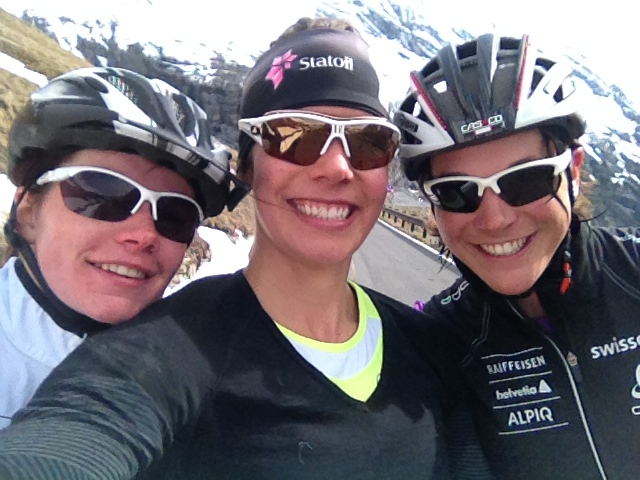
    Heidi Widmer (c) with Swiss skiers Nathalie von Siebenthal (l) and Christa Jäger after rollerski intensity on Stelvio Pass in Switzerland. (Courtesy photo)
    Heidi Widmer (c) with Swiss skiers Nathalie von Siebenthal (l) and Christa Jäger after rollerski intensity on Stelvio Pass in Switzerland. (Courtesy photo)

    Flury assured Widmer it was possible and spoke with Jeffries about her training plan.

    “Through email and conversations with him, I knew that he was really open to it and I felt extremely comfortable coming over to train with him,” Widmer said. “The rest of the team being so welcoming, I was optimistic it was going to work out, but they definitely exceeded my expectations.”

    After visiting her grandmother in Zurich, Widmer met up with the Swiss team at the national-sport centre headquarters in Magglingen, Switzerland. She spent the next week adjusting to the time difference and recovering while the national team did baseline testing.

    Widmer then spent few nights in Davos with Tatjana Stiffler, originally her Facebook friend, before heading to a training camp on Stelvio Pass at a glacier some 2,700 metres (8,850 feet) above sea level.

    “It’s been amazing,” Widmer said. “I always wanted to come over here and train but I didn’t really know what to expect. … Right away the team was super inclusive and everyone was really supportive of me being there, and I felt like part of the team instantly. It was pretty awesome.”

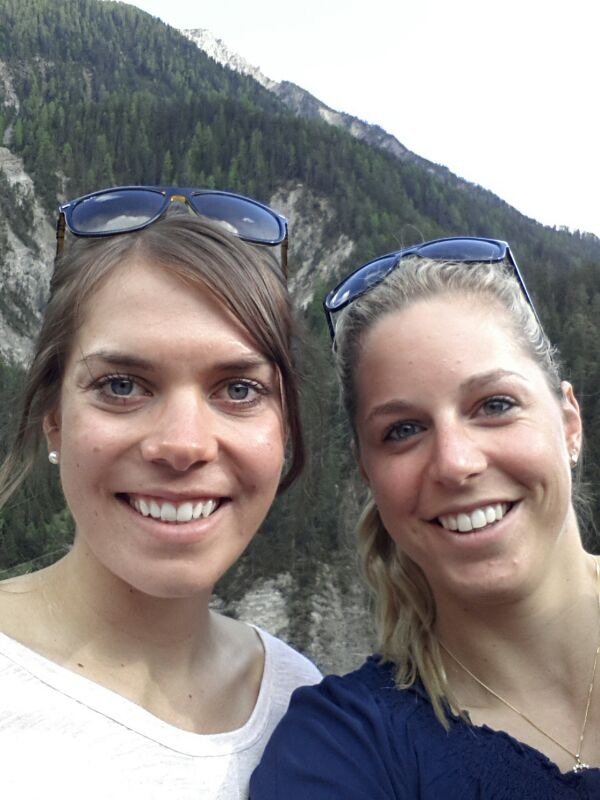
    Canadian Heidi Widmer (l) and Davos skier Tatjana Stiffler (Courtesy photo)
    Widmer (l) and Davos skier Tatjana Stiffler (Courtesy photo)

    She didn’t speak much Swiss-German, but was learning thanks to Stiffler. The dialect and vocabulary were much different than the High German she knew, but Widmer said she was having fun catching on and chatting with Swiss skiers when she could.

    “I always felt, ‘My name’s Heidi Widmer … and I’m not super connected with Switzerland,’ ” she said. “I know they had a strong team to train with and the environment seemed like it would be a good fit and a good experience. I’m always interested in learning how different teams are approaching ski racing so that was also a draw.”

    So what’s different about Switzerland, in terms of its national-team training methods and glacier? According to Widmer, not much on the philosophical front, except for a few technical points she’s been working on.

    “It’s been very similar to what we do in Canada,” she said. “You’re doing longer hours and more hours when you’re at altitude on the glacier and similar approach to the training speed and … not just going out and hammering at altitude.”

    As for the glacier itself: “I’m trying to think of another word besides pimped,” Widmer said with a laugh. “It was a lot more comfortable living than our [Haig] glacier camp, let’s put it that way.”

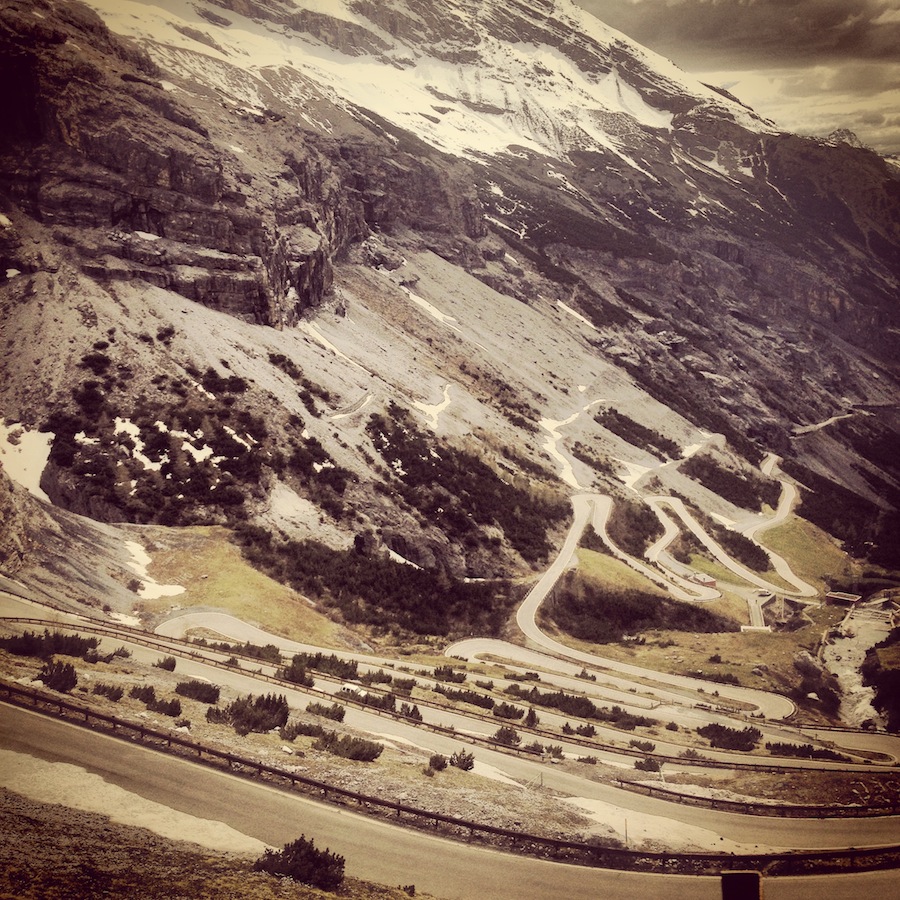
    The road up Stelvio Pass, the highest paved roadway in the Eastern Alps, with 42 hairpin turns and 14 percent grade in some parts, according to Heidi Widmer. "We did classic intensity up this road starting at 1900m," she said. (Courtesy photo)
    The road up Stelvio Pass, the highest paved mountain pass in the Eastern Alps, with 42 hairpin turns and 14 percent grade in some parts, according to Heidi Widmer. “We did classic intensity up this road starting at 1900m,” she said. (Courtesy photo)

    From the hotel, one can cross the road and immediately access the 4 k ski loop, which starts with a brief descent before winding back up to the top of the glacier.

    “Then you go back to your hotel and all the meals are cooked for you,” she said. “All the teams are there, and it’s a really cool atmosphere.”

    Widmer spent five days with the team on Stelvio before heading back to Davos last week. She’ll be dryland training there for the rest of her stay with Stiffler and a few U23s, like Nathalie von Siebenthal and Christa Jäger. World Cup skier Bettina Gruber, 28, is also in Davos, and the two planned to meet up for some intensity.

    Looking ahead, Widmer said she’s most focused on peaking for her last year of U23’s – and making the Olympics if possible. Number one on her list: the skate sprint at U23 World Championships in Val di Fiemme, Italy.

    “What I did last year is working; I don’t think I have to do anything drastic to change my training approach,” she said, adding that she’s boosted her strength training.

    Naturally a sprinter, Widmer didn’t rule out her potential in distance events, especially with a 10 k classic Olympic qualifier in January in Canmore.

    “My classic skiing in distance and sprinting has to step it up a notch so I’m putting my focus on that as well,” she added. “I haven’t had a breakout international performance yet so I’m really looking towards that.”

    ***

    Have an idea for a skier you’re itching to read more about? Email info@fasterskier.com with the subject line: Pros of Tomorrow.

  • Gaiazova, Valjas Take Charge in Canadian Nationals Classic Sprints

    Gaiazova, Valjas Take Charge in Canadian Nationals Classic Sprints

    Dasha Gaiazova leads Switzerland's Bettina Gruber in Thursday's 1.4 k classic sprint A-final at Canadian Nationals in Whistler, B.C. Gaiazova won the final ahead of Gruber and Canadian World Cup teammate Perianne Jones, respectively. (Photo: Martin Kaiser)
    Dasha Gaiazova leads Switzerland’s Bettina Gruber in Thursday’s 1.4 k classic sprint A-final at Canadian Nationals in Whistler, B.C. Gaiazova won the final ahead of Gruber and Canadian World Cup teammate Perianne Jones, respectively. (Photo: Martin Kaiser)

    WHISTLER, B.C. – On another sunny day at Whistler Olympic Park, Canadian World Cup team members Dasha Gaiazova and Lenny Valjas set the standard, earning national titles in their favourite event – the classic sprint – on Thursday.  Both won their respective 1.4- and 1.6-kilometre qualifiers at Canadian Nationals on fast, icy snow before delivering once more in the soft-and-slow finals.

    Racing started early, as the para-nordic skiers and more than 300 younger racers competed in the sprints on Wednesday.  By the time 75 women and 117 men finished the qualifiers on the Olympic courses, the crunchy, fast snow of Thursday morning was already turning to a thin layer of slush.

    Dasha Gaiazova smiles as she cruises across the finish in first, claiming her second-straight title at 2013 Canadian Nationals in Thursday's 1.4 k classic sprint in Whistler, B.C.
    Dasha Gaiazova smiles as she cruises across the finish in first, claiming her second-straight title at 2013 Canadian Nationals in Thursday’s 1.4 k classic sprint in Whistler, B.C.

    The women’s event was fairly straightforward with Gaiazova leading each heat most of the way around before finishing the 1.4 k course with a clear gap. In the final, Gaiazova coasted in with a big smile, followed by Swiss National Team skier Bettina Gruber comfortably in second.  Gaiazova’s teammate, Perianne Jones over-powered Alysson Marshall of the Alberta World Cup Academy in the final stretch to take the silver medal.

    “Classic sprinting, I love it!” Gaiazova said.  “I had a great qualifier and it went really well in the heats.”

    Still struggling with jet lag, Gaiazova came to the venue on Wednesday to watch the younger racers and award medals.

    “It could be almost more fun than winning medals because you just see the joy on the faces of those people,” she said. “I got a chance to give out medals to para-skiers. It is so inspiring to see them race and fight.”

    Gruber, who was second in the same event at Swiss Nationals earlier in the month and is headed to U.S. SuperTour Finals next week, was happy with her day.

    “Pretty good, I would say, for just coming over to Canada,” she said. “Qualifying felt no so good; it was hard fight.”

    “Qualifying was pretty icy, hard packed conditions are not my favourite,” Gruber said.  “Right now, it’s pretty good, it’s a little slushy but still kind of good track.”

    The second Canadian, Jones was happy with her performance. “It was really fun, and I am really happy that my season is over now,” she said.

    Signing autographs before Thursday’s medal ceremony, Jones also handed out awards on Wednesday.

    “It was great to be up here and see the kids race and give out medals at the end of the day,” she said. “That’s why we’re here, to see that next generation come up.  It’s nice to see them race super-hard and then get to shake their hands at the end.”

    Marshall collected her third individual bronze of these championships, putting a strong finish on a challenging season.

    “I was feeling strong, and I was pretty close to Peri, so I am happy with that,” she said.

    Marlis Kromm and Heidi Widmer took fifth and sixth for the Academy, making the A-final after winning Saturday’s team sprint.

    Marshall and Gruber will be racing Saturday’s 30 k freestyle mass start, while the other podium finishers take a break.  Gaiazova will be going to Russia in two weeks for a sprint race, and is resisting the temptation to do the distance race.

    “The race organizers have done a great job and it’s a great venue,” she said.  “It’s a pleasure to race here, for sure.”

    Emily Nishikawa (AWCA), who also made time to give out awards on Wednesday, opted out of the sprints coming off some fatiguing races at World Cup Finals.

    Vajlas Takes Control

    In the men’s 1.6 k sprints, Valjas relied on tactics to collect his third national title in his only race at this year’s championships.

    Lenny Valjas of the Canadian World Cup Team leads Phil Widmer of the AWCA (l) and Knute Johnsgaard of the Yukon Elite Squad (r) in Thursday's  1.6 k classic sprint A-final at Canadian Nationals in Whistler, B.C. Valjas went on to beat Graham Nishikawa and Widmer, who were second and third, respectively, for the title. (Photo: Martin Kaiser)
    Lenny Valjas of the Canadian World Cup Team leads Phil Widmer of the AWCA (l) and Knute Johnsgaard of the Yukon Elite Squad (r) in Thursday’s 1.6 k classic sprint A-final at Canadian Nationals in Whistler, B.C. Valjas went on to beat Graham Nishikawa and Widmer, who were second and third, respectively, for the title. (Photo: Martin Kaiser)

    His tall build and slick skis allowed him to move to the front on every downhill.  With marginal grip, he judged his efforts on the climbs and finished comfortably in the top two in the quarterfinal and semifinal.  In each heat, he led into the finishing straight, taking the fastest lane in the increasingly wet snow.

    In the final, Phil Widmer (AWCA) followed Valjas into the stadium and moved over a lane to start the double-pole battle.  In the slower lane, Widmer was unable to stay with Valjas, and his teammate, Graham Nishikawa, took advantage of the faster tracks to steal second, nearly running over Valjas, who slowed at the line.

    “I was just out here to enjoy the day and have fun,” Valjas said. “It’s been a long season and I’m happy with how it ended up.”

    Asked about his backup plan for the finish, he said, “I had one extra, tiny, gear if someone did show up beside me.”

    A man of few words, Nishikawa answered a question about whether he expected to get a medal in the classic sprint with “No,” and a laugh. On tactics, he was more verbose.

    Graham Nishikawa (AWCA) puts out his hands to prevent crashing into Thursday's sprint winner Lenny Valjas (l).
    Graham Nishikawa (AWCA) trying not to crash into Thursday’s sprint winner Lenny Valjas (l) after the A-final.

    “A lot of guys [had] superfast skis,” Nishikawa said. “I think mine were right in the middle, good kick and decent speed, I got passed on the first downhill by some guys with fast skis but my strength is striding so I need the good kick.”

    Widmer could have played it safe and followed Valjas for a near-certain silver, but chose to put it all out there, to the delight of the crowd.

    “It is the end of the season, and the body is feeling it a little bit, but for the most part it was good,” Widmer said after the race.  “It’s nice to have Lenny here and the Americans.”

    Jess Cockney (AWCA) took fourth, after poor grip in the final caused him to lose ground on each of the climbs.  Cockney saved his energy for a fast finish in the quarter and semi, but wasn’t close enough in the final to use his speed.

    Rune Ødegärd of the University of Colorado-Boulder took fifth ahead of a breakthrough performance by Knute Johnsgaard (Yukon Elite Squad).

    Two Norwegians, Ødegärd and his Colorado teammate Trygve Markset, who was ninth, were the only men to try double poling on skate skis and qualified in 16th and ninth, respectively.

    After the race, Ødegärd said they made the decision so they wouldn’t have to re-wax after the qualifier.  Without a support team, they skied all three heats on the same wax. Ødegärd had great skis in the quarter, gliding up from the back of the group to win, but reversed the process in the final, losing places on each downhill.

    Americans Torin Koos (Bridger Ski Foundation/Rossignol) and Dakota Blackhorse-Von Jess (Bend Endurance Academy), who qualified in second and third behind Valjas, took advantage of those results in the quarters, knowing that a third place would guarantee them a lucky-loser spot.

    NorAms and nationals use untimed heats to reduce the number of volunteers required. This changes the way that lucky losers are chosen from the best two times among third- and fourth-place finishers to the two lowest bib numbers who placed third.

    Koos reported to the jury that he was obstructed in the semifinal and requested a spot in the A final.  The jury reviewed the video and decided that there was “no evidence of obstruction.” After a 10-minute delay, the A-final was run without Koos being added as a seventh starter. He ended up 12th and did not start the B-final.

    Final results

    Complete qualifying results

  • Six Canadians and Five Americans Make Season-Ending Red Group

    Six Canadians and Five Americans Make Season-Ending Red Group

    Red Group Period IV

    With the conclusion of the 2012-2013 World Cup season and of competition Period IV in Falun, Sweden, FIS released the world ranking lists in sprint and distance disciplines from which the new Red Group is determined.

    A top-30 spot on either the sprint or distance list gets athletes a spot in this elite set of skiers whose travel, lodging and living expenses are paid for, within the sprint or distance discipline, through the next competition period, until the rankings are recalculated.

    Out of all the rankings released periodically throughout the winter, a spot in the Red Group after Period IV most truly represents performance consistency within a single season. Rankings are tabulated from World Cup points from the previous calendar year, which means that lists released after Period I, II and III include results from the previous season. Period IV, however, only represents races from the last five months, and in contrast to the straight World Cup rankings include points from World Championships.

    This can turn out to be good news for athletes who sat outside the bubble at the end of Period III, and bad news for those who were previously inside it. Moving in or out of the top-30 from one period to the next comes down to relativity — whether an athlete performs better within a period than they did in the same time frame the previous season. New results at the same venues supplant the old ones with the release of each list.

    American Holly Brooks, for example, was outside the top-30 cutoff at the end of Period III in the distance rankings, when she was 41st. With a few of her best results of the season in Falun this past weekend, however, she moved up to 29th and will have her expenses covered at the beginning of next year for distance World Cups.

    Her teammate Jessie Diggins, by contrast, moved from 30th in the distance list at the end of Period III to 35th for Period IV, just outside the Red Group cutoff. Diggins ended this season with a strong eighth in the Falun prologue, but it didn’t quite match the results she posted last season in the same period and she consequently moved down the list.

    Outside the bubble skiers, there were few changes amongst those who made the Red Group on the American and Canadian teams between this period and the last. In the sprint rankings, Kikkan Randall led the way at the top of the women’s list and Ida Sargent joined her in the top-30 in 23rd.

    Canada’s Dasha Gaiazova and Perianne Jones both remained in the money in 17th and 30th, respectively.

    Andy Newell finished the season comfortably in the Red Group with a seventh-place sprint ranking and is the lone American in the top 30.

    Canada’s Lenny Valjas finished the year only a few points behind him in eighth, and Alex Harvey and Devon Kershaw also squeaked into cutoff in 21st and 23rd.

    Randall also finished the season with a high ranking in the distance list, in tenth, to lead two additional Americans in the top 30: Liz Stephen was 14th and Brooks just made the cutoff in a points tie with Italy’s Virginia De Martin Topranin in 29th.

    No American men made the distance Red Group; Noah Hoffman was 42 points away in 35th.

    Ivan Babikov and Harvey each made it in for the Canadians, Babikov in 18th and Harvey in 23rd. Kershaw and Valjas were outside in 43rd and 44th.

    In all, five Americans (four women, one man) and six Canadians (two women, four men) are in the Red Group for the start of the 2013-2014 season. For athletes on the U.S. Ski Team the distinction is an important one; Hoffman told FasterSkier he was informed at the beginning of the season that Red Group would be sufficient for A-Team nomination for the following year.


    North Americans on the World Ranking Lists, Period IV:

    Distance Men

    18. Ivan Babikov (CAN)

    23. Alex Harvey (CAN)

    35. Noah Hoffman (USA)

    43. Devon Kershaw (CAN)

    44. Lenny Valjas (CAN)

    52. Kris Freeman (USA)

    72. Andy Newell (USA)

    81. Graham Nishikawa (CAN)

    97. Torin Koos (USA)

    102. Tad Elliott (USA)


    Distance Women

    10. Kikkan Randall (USA)

    14. Liz Stephen (USA)

    29. Holly Brooks (USA)

    35. Jessie Diggins (USA)

    51. Ida Sargent (USA)

    58. Sadie Bjornsen (USA)

    87. Dasha Gaiazova (CAN)

    Sprint Men:

    7. Andy Newell (USA)

    8. Lenny Valjas (CAN)

    21. Alex Harvey (CAN)

    23. Devon Kershaw (CAN)

    50. Simi Hamilton (USA)

    59. Jesse Cockney (CAN)

    70. Torin Koos (USA)

    73. Phil Widmer (CAN)

    95. Skyler Davis (USA)


    Sprint Women:

    1. Kikkan Randall (USA)

    17. Dasha Gaiazova (CAN)

    23. Ida Sargent (USA)

    30. Perianne Jones (CAN)

    39. Sadie Bjornsen (USA)

    43. Chandra Crawford (CAN)

    44. Holly Brooks (USA)

    45. Jessie Diggins (USA)

    47. Sophie Caldwell (USA)

    70. Becca Rorabaugh (USA)

  • Canadian Nationals: Foothills Tops Both Men’s and Women’s Team Sprints

    Canadian Nationals: Foothills Tops Both Men’s and Women’s Team Sprints

    Foothill Nordic's Jess Cockney (r) and Phil Widmer (Canmore Nordic), after colliding in the finishing straight of Saturday's freestyle team sprint final at 2013 Canadian Nationals in Whistler, B.C. Cockney went on to win with teammate Brent McMurtry, defending their 2012 national title, while Widmer and Russell Kennedy settled for fourth.
    Foothill Nordic’s Jess Cockney (r) and Phil Widmer (Canmore Nordic), after colliding in the finishing straight of Saturday’s freestyle team sprint final at 2013 Canadian Nationals in Whistler, B.C. Cockney went on to win with teammate Brent McMurtry, defending their 2012 national title, while Widmer and Russell Kennedy settled for fourth. Knute Johnsgaard (l) took silver with teammate David Greer for Whitehorse.

    WHISTLER, B.C. – On a sunny day at Whistler Olympic Park, the men put the cap on an exciting first day of Canadian Nationals with a collision and crash in the final 50 metres of the 2×3 1-kilometre freestyle team sprint.

    Whitehorse divides and conquers to take second and third in Saturday's freestyle team sprint at Canadian Nationals in Whistler, B.C.
    Whitehorse divides and conquers, with Graham Nishikawa skiing around a fallen Phil Widmer (Canmore) on the right and Knute Johnsgaard at left, to take second and third behind Foothills’ Jess Cockney (far right) in Saturday’s freestyle team sprint at Canadian Nationals in Whistler, B.C.

    Four teams entered the final straight together with Phil Widmer of Canmore Nordic in the lead. At the start of the pine-bough lane markers with 50 metres to go, Widmer and Jess Cockney of Foothills Nordic chose the same lane.  Widmer fell, leaving Cockney to defend his national team-sprint title with partner Brent McMurtry. Skiing for different Whitehorse teams, Knute Johnsgaard and Graham Nishikawa split around the fallen Widmer and lunged for the line.

    A year after winning at Canadian Nationals in Quebec, McMurtry and Cockney claimed the team victory in 15:32.03. Johnsgaard finished in 15:33.00, taking silver with partner David Greer.  Nishikawa was 0.31 seconds behind to take bronze with teammate Colin Abbott.

    Widmer recovered to take fourth with Russell Kennedy, 11 seconds after Cockney.  Raphaël Couturier (Skibec) led the second pack another 5 seconds back in fifth with teammate and Canadian National Team biathlete Marc-André Bédard.

    When asked what made the difference, Cockney had a one-word answer: “Brent.”

    “Brent skied so strong on his last leg and gave me such a huge lead,” Cockney added. “All the other guys were gassed after catching up to me.”

    Johnsgaard had a similar view. “I felt really strong. I just didn’t quite have the finishing speed that Jess had in the final,” he said.

    Cockney skied the last leg with a clear tactic in mind.

    “I didn’t feel that strong so I held the lead as long as I could and made sure to tuck in behind Knute and Phil on the downhill into the last 300 metres,” he said. “With the headwind, it was good to tuck behind someone else.”

    Nishikawa also took a strategic approach to the final. A big crash and a broken pole on his first lap of the semifinal put him well off the back of the pack. While Abbott was able to finish the job of rejoining the group, the energy they spent qualifying in second in the fastest heat would come back to haunt them.

    An exhausted top three after Saturday's freestyle team sprint final at 2013 Canadian Nationals in Whistler, B.C.
    An exhausted top three after Saturday’s freestyle team sprint final at 2013 Canadian Nationals in Whistler, B.C.

    In the final, the first-leg skiers went out hard on their third and final lap.

    “Brent attacked and dragged Colin,” Greer said.  “I got around a couple of people and ended up coming in second.”

    “I finally caught the top three teams at the corner with a hundred to go and then they all started their sprint,” Nishikawa said.

    Asked about the crash, he said, “It took a lot of energy to get there so I just had my head down trying to sprint.  I saw some tangles and then I was in a lunge for second as well. It happened fast so I don’t really know what happened.”

    Johnsgaard, who also was in a good position to see the collision, didn’t think any penalties would come of it. “I think it is part of racing,” he said.

    The jury agreed and took no action.

    The women’s 2×3 1-kilometer team sprint was also exciting, but without the finishing-straight fireworks.  On the final lap, Foothills’ Marlis Kromm opened up a gap to send Heidi Widmer off with a sizable lead. Their finish time of 15:17.1 was nearly 10 seconds ahead of Hardwood’s Erin Tribe, who shared silver with Mary Thompson.

    Heidi Widmer (Foothills) leads Anne-Marie Comeau (MSA) in the semifinal of Saturday's freestyle team sprint at 2013 Canadian Nationals in Whistler, B.C. Widmer and her teammate Marlis Kromm went on to win the final.
    Heidi Widmer (Foothills) leads Anne-Marie Comeau (MSA) in the semifinal of Saturday’s freestyle team sprint at 2013 Canadian Nationals in Whistler, B.C. Widmer and her teammate Marlis Kromm went on to win the final.

    Zoe Roy and Michaela Howie teamed up for Rocky Mountain Racers and won the sprint for bronze. Roy finished just over a second ahead of biathlete Julia Ransom (Canmore), who partnered with Kathryn Stone.

    Anne-Marie Comeau (Mont St. Anne) took over from Camille Pépin and quickly moved from fifth to second on the final leg , but a crash on the top hairpin put her back in fifth, six seconds out of the medals.

    Kromm and Widmer were very happy with their result.

    “We were junior challenge girls here [in Whistler at 2008 nationals] and won the relay here so it was really fun to come back,” Widmer said.  “It’s a great start to the week and Mother Nature has been really great today.”

    Both saw the race as tactical. “We wanted to start in control, ski the first couple of laps with the pack and try to save some energy and make our moves in the second half of the race,” Kromm said.

    “It is a long week of racing at nationals,” Widmer added. “The team sprint is important, but you have to be aware of your energy for the rest of the week.”

    The silver medalists said the race was “definitely tactical.”

    “You had to hold on to a spot and pick when to move up and make sure you had something for that last lap,” Thompson said.

    “It was really refreshing that the sun was shining and the skis were fast,” Tribe added. “It was a great day.”

    Results: men | women

    Women's freestyle team sprint podium at 2013 Canadian Nationals, with Marlis Kromm and Heidi Widmer of Foothills Nordic in first (c), Erin Tribe and Mary Thompson of Hardwood in second (l), and Michaela Howie and Zoe Roy of Rocky Mountain Racers in third. (Photo: Peggy Hung)
    Women’s freestyle team sprint podium at 2013 Canadian Nationals, with Marlis Kromm and Heidi Widmer of Foothills Nordic in first (c), Erin Tribe and Mary Thompson of Hardwood in second (l), and Michaela Howie and Zoe Roy of Rocky Mountain Racers in third. (Photo: Peggy Hung)
    2013 Canadian Nationals men's freestyle team sprint podium: (Photo: Peggy Hung)
    2013 Canadian Nationals men’s freestyle team sprint podium with Purebread Bakery baguettes in hand. Jess Cockney and Brent McMurtry of Foothills Nordic took first (c), Knute Johnsgaard and David Greer of Whitehorse were second (l), and Whitehorse’s Colin Abbott and Graham Nishikawa placed third (r). (Photo: Peggy Hung)
  • Canada’s Lone Qualifier, Harvey Captures Historic Bronze at World Championships

    Canada’s Lone Qualifier, Harvey Captures Historic Bronze at World Championships

    Canadian Alex Harvey celebrates his bronze-medal performance in Thursday's 1.5 k classic sprint at the 2013 FIS Nordic World Ski Championships with his and teammate Devon Kershaw's signature move, two years after the two won the classic sprint at 2011 World Championships. (Photo: Glen Crawford)
    Canadian Alex Harvey celebrates his bronze-medal performance in Thursday’s 1.5 k classic sprint at the 2013 FIS Nordic World Ski Championships in Val di Fiemme, Italy, with his and teammate Devon Kershaw’s signature move two years after they won the classic team sprint at 2011 World Championships. (Photo: Glen Crawford)

    FasterSkier’s coverage of the 2013 FIS Nordic World Ski Championships in Val di Fiemme, Italy, is brought to you by the generous support of Fischer Sports.

    VAL DI FIEMME, Italy – Canadian head coach Justin Wadsworth could have used a number of clichés to describe what happened Thursday on the first day of FIS Nordic World Ski Championships. “It’s not over ’til it’s over,” and “Don’t count your chickens before they’re hatched,” come to mind.

    But not long after watching one of his athletes, 24-year-old Alex Harvey, place third in the 1.5-kilometer classic sprint to become the first Canadian male to win an individual medal at World Championships, Wadsworth was almost speechless.

    Alex Harvey (l) during a victory lap with Russia's Nikita Kriukov (c), who won the World Championships 1.5 k classic sprint on Thursday, and Norway's Petter Northug, who was second. (Photo: Fiemme2013)
    Alex Harvey (l) during a victory lap with Russia’s Nikita Kriukov (c), who won the World Championships 1.5 k classic sprint on Thursday, and Norway’s Petter Northug, who was second. (Photo: Fiemme2013)

    “It feels unbelievable, especially after this morning and what happened in qualifying, to get a medal here,” Wadsworth said after seven of eight Canadian starters failed to qualify for the heats in the men’s 1.5-kilometer and women’s 1.2 k classic sprints.

    The only one who moved on, Harvey narrowly did so in 26th, one second ahead of 30th. He was 6.67 seconds off Russian Nikita Kruikov’s winning qualifying time of 3:29.75.

    Quick to realize his mistakes – going easy up the first big climb and having too much energy at the finish – the Quebec native resolved to go harder in the quarterfinal. But he needed to tweak his skis to do so.

    “I think our skis weren’t good in the beginning, like none of us qualified other than me, and the body felt better than 26th,” Harvey said. “On the flat especially, I was double poling and there was nothing, no glide, just fighting the kick, so the wax tech adjusted that and gave me retarded skis for the final.”

    In his quarterfinal, Harvey positioned himself in third then struck late on the downhill straightaway into the stadium, comfortably beating Italy’s Fabio Pasini and Dmitriy Japarov of Russia, who were second and third in a photo finish. All three advanced to the semifinals, where Harvey went with a similar tactic and finished third, just 0.17 seconds behind Norway’s Petter Northug and Eirik Brandsdal, respectively.

    Wadsworth said the entire team talked strategy before Thursday, and he had some tips after finding a lot of success there. In three recent editions of the Tour de Ski, the Canadian men’s team has racked up five podiums in Val di Fiemme.

    Number one: don’t lead.

    “[That’s] the last thing you want to do unless you feel like you really, really can make a gap and have good skis,” Wadsworth said.

    At the same time, you’ve got to be close enough to catch the slingshot, but not too close so that you can actually gain on the person ahead of you and pass them with some speed.

    “We really focused our tactical approach on the whole last downhill and the bump,” he said, referring to small hill over a tunnel into the stadium. “That was, we felt like the whole race.”

    According to him, Harvey couldn’t have executed much better for the bronze, skiing in third up the last steep hill despite slipping. The lack of kick, especially in the final, was his own request, Harvey explained. He wanted fast skis for the finish.

    Alex Harvey (CAN) racing to 26th place in Thursday's 1.5 k classic sprint qualifier at the 2013 World Championships in Val di Fiemme, Italy. Canada's only qualifier, Harvey went on to take bronze in the final and become the first male to win an individual medal at worlds.
    Alex Harvey racing to 26th place in Thursday’s 1.5 k classic sprint qualifier at the 2013 World Championships in Val di Fiemme, Italy. Canada’s only qualifier, he notched bronze in the final and became the first male to win an individual medal at worlds.

    “It’s good purchase for the ski outside the track,” Harvey added. “In the track would’ve been too much fighting and it’s so steep, you’re not gliding in the track anyways so I felt for me it was the best option.”

    He proceeded to follow Kriukov and Sweden’s Emil Jönsson up and over the final bump, where Northug flew by him into second. In the stadium, Harvey caught the draft in fourth, then picked Kriukov’s lane to pass Jönsson while the Russian and Northug battled for first, which Kriukov held onto for the win.

    Harvey picked up third – his second World Championships medal since winning the 2011 classic team sprint with Devon Kershaw in Oslo, Norway.

    “Our goal is two medals and to get one on the first day, I mean, it’s fantastic,” Wadsworth said.

    “The plan’s working good,” Harvey explained less than a week after placing 39th in a classic sprint at the Davos World Cup in Switzerland. “Davos was bad, but I knew the training’s been good in the last month and a half. I was confident in my shape. There was just a bit too much fatigue left [after training], and now, day by day, I’m feeling better and better.”

    The event wasn’t exactly his forte or one he was most excited about at World Championships. The night before, Harvey said he was looking forward to the relay as well as the freestyle team sprint, if he got to race that two-person event. He’s essentially guaranteed himself a spot now.

    Standing alongside the fence while Harvey wove through scores of international reporters, his mother high-fived coaches and eventually embraced her son.

    A sports physician, Dr. Mireille Belzile had flown out as the team’s doctor for World Championships. Three weeks ago, she reviewed her son’s MRI results after he dislocated his shoulder in Sochi, Russia. He took a few days to recover, then trained at altitude for a week in Italy before traveling to Davos, where he had some less-than-stellar results outside the top 30. Now, here he was, back on top.

    Alex Harvey's mother,  Dr. Mireille Belzile, holds his flowers after Thursday's podium ceremony at the 2013 World Championships in Val di Fiemme, Italy. There, Harvey notched Canada's best-ever individual men's result of third in the classic sprint.
    Alex Harvey’s mother, Dr. Mireille Belzile, holds his flowers after Thursday’s podium ceremony at the 2013 World Championships in Val di Fiemme, Italy. There, Harvey notched Canada’s best-ever individual men’s result of third in the classic sprint.

    “I was surprised,” Belzile said. “It’s not his best event, individual sprint for him, it’s just a gift when he can make a medal in that distance so it’s good. Good beginning.”

    From the onset, things looked a little grim for the Canadians. After Harvey squeaked by in 26th, one of the men’s sprint favorites Lenny Valjas placed 40th, 10.5 seconds out of first and about three seconds from qualifying. Devon Kershaw was 46th, nearly 13 seconds back from the leader, and Canada’s top domestic sprinter, Phil Widmer of the Alberta World Cup Academy (AWCA), was 49th (+13.85).

    In their signature event, the two World Cup women didn’t fare much better. Dasha Gaiazova was 42nd, 15 seconds behind qualifier Finnish winner Mona-Liisa Malvalehto, and Perianne Jones placed 48th (+17.72). The NorAm’s leading sprinter, Andrea Dupont (Rocky Mountain Racers) followed in 49th (+18.48) and distance specialist Emily Nishikawa (AWCA) was 57th (+22.87).

    While Wadsworth hadn’t spoken to all his athletes shortly after the morning qualifier, he racked up their result to several “random” things.

    “Everyone said the skis are fine,” he said. “Lenny had strep throat. He coughed something up on the first hill he said, like, big, hard, green thing, and Devon was up last night at 3 a.m. sick again.”

    Kershaw said he checked in with Dr. Belzile on Thursday morning and she thought he might have gastritis. He planned to get test, but said he wasn’t sure what was in store for the rest of World Championships after hoping to race five of six events. He’s been having the problem since coming down with food poisoning in late January at the World Cup in La Clusaz, France. He had another episode two weeks later in Sochi, hindering him and Valjas in the team sprint.

    “Every 10 days or so it comes back,” Kershaw said. “This is disgusting to talk about but last night, same thing, 3 a.m., woke up, went to the bathroom like three times, swollen stomach. I don’t know what’s going on but it’s still hanging on.”

    As for Valjas, he was on the mend, but not at full strength Thursday after getting sick last weekend and taking four days off before Wednesday.

    “I stayed positive and I wanted to obviously get into the heats and just keep my goal of getting to the final and onto the podium, but my body just didn’t agree today,” Valjas said. “I was missing a gear and coughing and choking up my phlegm … It was just not ideal. I felt OK, but my speed was just all-around slow. I tried hard and that’s all I can do.”

    Widmer, 29, in his third World Championships has his best classic sprint result in 49th. Wadsworth said he looked good, but Widmer said it wasn’t what he was hoping for.

    “I was happy until I got a little scrambly on the second hill,” Widmer explained. “The track was a little bit broken and I ended up running, didn’t ski it that well and I felt like I lost a lot of time there.”

    Unsure whether it was his lack of speed or grippy skis, Widmer added that he’ll do an OPA Cup race in Switzerland before heading home to Canmore, Alberta.

    “It was fun, for sure, would’ve liked to qualify, but it is what it is,” Widmer said.

    Canada’s top two sprinters, Gaiazova and Jones weren’t sure what happened Thursday after their worst results of the season.

    “[Warming up,] I thought I was skiing well and I was happy with my skis so nothing that really jumped out at me,” Gaiazova said. “I really didn’t expect I would ski so slow. I guess I have to regroup. There’s still lots of racing left.”

    She and Jones are teaming up in Sunday’s team sprint.

    “We have a good few days to turn things around and I think we definitely can,” Jones said. “I just felt like I was missing some snap and I don’t know exactly what happened but not enough energy I guess. … I did a lot of training after Russia and maybe I’m just not recovered enough from it.”

    In her first World Championship, Dupont was pretty happy with her top 50 after placing 53rd in the classic sprint in Davos.

    “I feel it’s a different game a little bit out here,” she said. “I was happier with today than Davos, for sure. I feel like today I didn’t mess around with skis as much maybe, just too many distractions in Davos and better course for me, but there’s definitely room for improvement.”

    While she was unsure if she’d do a couple OPA races in the near future, Dupont said she was traveling to Sweden for the Vasaloppet on March 10.

    “It’s a long course for me from a sprinter to do a 90 k, but there’s a lot of double poling so I’m definitely looking forward to that,” she said. “There’s like 16,000 people that enter it, so it should be pretty fun.”

    And Nishikawa, who’s been fighting illness for the last month, said she was just happy to race on Thursday.

    “I haven’t done much intensity lately because I’ve been sick so I think it was good to get out there and just have a hard effort,” she said. “This is my first World Championships; I just wanted to get a feel for it before the [15 k] pursuit on Saturday, just get a feel for the start and how it all works and the crowd and stuff like that.”

    At the end of the day, Harvey’s medal proved most memorable, and he hoped it would lift his team.

    “This is huge for our program,” he told Cross Country Canada in a press release. “I hope the team can build a lot of confidence from this for the rest of the championships.”

    Men’s results | Women’s results

    International men’s report

  • Valjas Toughs It Out for Sixth in Davos Sprint; Kershaw Repeats Season Best in Eighth

    Valjas Toughs It Out for Sixth in Davos Sprint; Kershaw Repeats Season Best in Eighth

    American Andy Newell (l) captures second in a World Cup semifinal just 0.25 seconds ahead of Canada's Lenny Valjas in Saturday's 1.5 k classic sprint at the Davos World Cup in Switzerland. Valjas advanced to the final with a fast-enough time, and ultimately placed sixth. Newell was fourth in the final. (Photo: Fischer/Nordic Focus)
    Canada’s Lenny Valjas (r) captures third in the World Cup semifinal just 0.25 behind America’s Andy Newell (l) in Saturday’s 1.5 k classic sprint in Davos, Switzerland. Valjas advanced to the final with a fast-enough time, and ultimately placed sixth. Newell was fourth in the final. (Photo: Fischer/Nordic Focus)

    If you ask Canadian National Ski Team Head Coach Justin Wadsworth, things are on the upswing for his World Cup team. And he’s not just blowing hot air; three of his six athletes posted top-12 results on Saturday to back that up.

    Leading the team was its youngest member, 24-year-old Lenny Valjas, who placed sixth in the 1.5-kilometer classic sprint in Davos, Switzerland. It was his fourth World Cup top-10 of the season and best non-stage result (Valjas was third in the freestyle sprint at the Tour de Ski).

    But Valjas has been strong all season, as has Dasha Gaiazova, who placed 12th in Saturday’s 1.5 k women’s sprint. The most improved went to Devon Kershaw, who tied his season-best of eighth, which he notched two weekends ago at the pre-Olympic World Cup in Sochi, Russia.

    “Devon was the snappiest I’ve seen him skiing all year,” Wadsworth said on the phone.

    Kershaw, 30, used the same adjective to describe his form all the way through the semifinals, and this time, he was using it in a good sense.

    “When I wanted to change gears I could and I was super pumped,” Kershaw said. “That’s been something I’ve been missing all year long. Even in Sochi, when I was eighth, I couldn’t change gears like you need to in a sprint, and while the result was the same today I felt much better.”

    As for Valjas, he’s just a beast, Kershaw said. The Canadian World Cup team veteran recalled racing with Valjas in the semifinal. Both started off the back, and Kershaw later made a move before the two-tiered climb on the second lap.

    “Up the first part of the climb, I was feeling awesome and Lenny just went by me,” Kershaw said. “I had a moment where I was like, ‘He’s 6-6 and he’s moving his legs faster than I am!’ It was fun to watch Lenny race so well today. He’s probably not a favorite to win, but he’s definitely somebody everyone’s thinking about to snag a podium at the World Championships.”

    Kershaw lost some steam on the last part of the hill and finished fourth in that heat, 2.72 seconds behind semifinal winner Alexey Poltoranin of Kazakhstan, who also won the final. Valjas was third, just 0.66 out of first and about two-tenths of a second behind American Andy Newell, who went on to place fourth in the final.

    Valjas advanced to the final as well, where he ended up sixth, 12.34 behind Poltoranin. After a strange start to his morning, in which Valjas felt lightheaded and was “seeing stars” when he stood up too fast, he drank a hefty amount of water after the qualifier. (He advanced to the heats in 12th.)

    Kershaw qualified in 23rd and Alex Harvey missed the top 30 by about 1 ½ seconds in 39th (+10.54 behind top qualifier Frederico Pellegrino of Italy.) Phil Widmer of the Alberta World Cup Academy also represented Canada in a tune-up race before World Championships, and placed 46th (+13.0).

    And while Kershaw cruised to a relatively comfortable second-place finish in his quarterfinal (minus a late charge by Germany’s Alexander Wolz, which resulted in a photo finish for second), Valjas had to give every ounce of energy he had to advance.

    Positioned in sixth the first time up the big climb, he got stuck behind Cyril Miranda of France, who “fell on his face and took two Russians [Gleb Retivykh and Anton Gafarov] down with him,” Valjas described in an email. “I was stuck behind these three guys with no room at all to move around. So I waited out the storm.”

    When he reviewed the video, Valjas realized he stood there for a full six seconds as the three untangled their equipment.

    “By this time the two leaders had a huge lead on our group,” he explained. “In my head I was telling myself, ‘Well I’ll finish 3rd in the heat and just end up top 15 in the overall.’ ”

    But when he entered the stadium to start his second lap, Valjas heard one of his wax techs, Joel Knopff, screaming that he could catch the leaders.

    “I really didn’t want to let him down so I attacked through the stadium and caught the leaders in the climb,” Valjas wrote. “I actually surprised myself with the acceleration, but deep down I knew that this effort would come back to haunt me later today.”

    In the semifinal, he shared a similar tactic as Kershaw, letting anyone go on the first lap if they wanted to push the pace. No one did, and on the second lap, Valjas attacked a little later on the climb. Just behind Newell, he nabbed the lucky loser spot.

    “[The] final is easy to explain. I had nothing left in the tank,” Valjas wrote. “The two hard heats left me with no energy to work with. I suffered through the final and ended up 6th. Overall I am happy with how the day turned out, I feel like my shape is good for World Champs next week. Our team is skiing really fast and I have a good feeling about next week.”

    Harvey in 39th wasn’t quite so pleased with his effort, explaining in an email that he couldn’t push very hard. According to him, his shoulder was fine after dislocating it in Sochi two and a half weeks ago.

    “Since I haven’t raced in a whole month, the goal was to put a race bib on and get two good hard efforts in,” Harvey wrote. “Today didn’t really work that way so tomorrow better be better! Although I’m not really looking for a great result in the 15 km [skate] … it’s the event I plan in skipping at Worlds.”

    Overall, Harvey explained he’s feeling confident. Wadsworth elaborated, saying Harvey struggled a bit with the altitude in Davos at 1,560 meters (5,120 feet) above sea level.

    “Alex is in good shape but it was an off day for his body,” Wadsworth said. “[His] shoulder isn’t 100 percent, he’s still taping it for stability and more feeling, but it’s definitely getting better. We don’t consider it a problem unless he would fall on it.”

    As for Widmer, the 29-year-old was just happy to be back in Europe.

    “I was dreaming of a better outing today, but it was good to get the feet wet and get going on this trip overseas,” Widmer wrote. “Top 30 was my goal for the day, but I came up short of that.”

    The course and conditions played a major role for everyone, he explained with tough, steep climbing and what he described as “slippery” conditions.

    “It was a tough course and my pacing could have been a little better,” Widmer wrote of his qualifier. “I’m feeling good, training has been going well and with a little bit of fine tuning, I’ll get ready for a better showing in Val di Fiemme.”

    “I think the whole team is doing well and we’re looking forward to World Championships,” Wadsworth said. “It’s exciting to feel like we’re coming on at just the right time.”

    Kershaw will sit out Sunday’s 15 k skate to rest up for World Championships, which begin in earnest on Thursday. Harvey will race, along with Ivan Babikov and Graham Nishikawa. Emily Nishikawa and Canadian biathlete Zina Kocher will compete in the women’s 10 k.

    Men’s results

  • Marshall Back on Top; Widmer Notches Another Classic Sprint Win at Easterns

    Marshall Back on Top; Widmer Notches Another Classic Sprint Win at Easterns

    Alysson Marshall (AWCA/NST) racing at the 2012 World Cup finals in Falun, Sweden, last March.
    Alysson Marshall (AWCA/NST) racing at the 2012 World Cup finals in Falun, Sweden, last March.

    Alysson Marshall could feel it coming, and she couldn’t believe it was happening.

    Burdened with a cold the night before the Eastern Canadian Championships, she thought back to all the other times she hadn’t felt well this season. She started the season in Europe and had to sit out the first races over there because of a cold.

    Upon returning back to Canada, jet lag took a major toll on the Alberta World Cup Academy (AWCA) and Senior Development Team skier. Last year’s NorAm winner, Marshall couldn’t find those good vibes at the Canadian World Cups and struggled to get back on top of the NorAm podium.

    Friday morning, she wasn’t even sure she was going to race the 1.6-kilometer NorAm classic sprint at Nakkertok Ski Club in Cantley, Quebec. She decided to see how she felt warming up and proceeded to try her luck in the qualifiers. There, Marshall was second to teammate Kate Brennan by 1 ½ seconds. Not bad, she thought.

    Marshall, 24, went on to win her quarterfinal and semifinal, refining her tactic of dropping her competitors on the course’s two major climbs. In the final, she did more of the same, tucking behind Brennan out of the flat start then finding an open lane up the first hill.  She created a gap and kept pushing, lengthening her lead for a comfortable victory – her first of the NorAm season.

    “It wasn’t a full-on sprint to the finish,” Marshall said on the phone Friday. “I knew I had it a little ways out.”

    Three of her AWCA teammates raced for second, with Rebecca Reid slipping by on the downhill ahead of Brennan in third and Emily Nishikawa in fourth, respectively. Amanda Ammar (Canmore) was fifth and Alannah MacLean (NDC-Thunder Bay) placed sixth in the final.

    “Twenty-four hours ago I was pretty upset and not very impressed with how things were going so I was really happy to get a good result in,” Marshall said. “I’ve had some bad luck and just tired, just haven’t had a break yet this season, so today was really nice.”

    Second in the Thunder Bay classic sprint and third in the same race in Duntroon, Ontario, at Canada’s World Championships trials last month, Marshall narrowly missed a trip to Val di Fiemme, Italy. Team selections were announced earlier this week, and Marshall resolved to move on and learn from her experiences.

    “I don’t really have any opportunities to go to Europe now so I’m going to focus, restart, figure out what I need to do to be fast the rest of the season,” she said. “Figure out what I need to work on, what’s going on and try to have a good [Western Championships] and nationals. … I’m going to do some training, figure out my weaknesses and hopefully finish off the season better than it started.”

    Thinking about ways she could improve as well, Reid, 20, placed second for her best NorAm result and second career podium, which she sought at the World Championships trials last weekend.

    “I got inched out of a podium last weekend in Duntroon where I was fourth in the classic sprint and I really wanted to build on that result this weekend,” Reid wrote in an email.

    After qualifying in seventh, she was happy with her position but continued to strive higher. Reid went on to win her quarterfinal and finished second to Brennan in the semifinal.

    “I was ranked fourth going into the final and it went smoothly for me. I was feeling confident and I knew I had wicked fast skis on my feet so I was patient and came through in the finishing straight,” she wrote. “I was pretty excited that it wasn’t just a good day for me, having the Academy girls take the top-4 spots in the final made for a really fun day!”

    AWCA racing director Mike Cavaliere was pretty impressed.

    “Rebecca has been skiing stronger and stronger,” he wrote in an email. “I think she is starting to settle into life as a senior and getting more comfortable and aggressive.”

    Brennan and Nishikawa sprinted to the finish for the third podium spot, which Brennan narrowly took. After sitting out last Sunday’s NorAm distance race in Duntroon, Nishikawa wrote that she was still recovering from a cold.

    “I’m still not 100% but all things considering I was happy with how things went today,” she said, describing the final as fast to start with the four Academy women skiing together before Marshall gapped the field. “Feeling better everyday, so I’m looking forward to tomorrow!”

    Saturday features 10 and 15 k freestyle interval starts on the second of the three-day Eastern Championships. Racing ends Sunday with 15 and 30 k classic pursuits.

    Women’s results

    AWCA Men Also Take Top 4

    Friday’s 1.6 k men’s sprint results looked similar to the women’s with the AWCA sweeping the top four. Phil Widmer led the group in first with his second victory in the last three NorAm classic sprints.

    Phil Widmer (AWCA) at the Québec City World Cup sprint on Dec. 7.
    Phil Widmer (AWCA) at the Québec City World Cup freestyle team sprint on Dec. 7. He and teammate Brent McMurtry placed 20th.

    Widmer crossed the line first last weekend in the Duntroon final as well, but was relegated to sixth for an infraction before the finish. Without the penalty, he would’ve swept the last three NorAm sprints. Regardless, he had won the qualifier in both sprint trials to secure a trip to the upcoming World Championships.

    However on Friday, Widmer wasn’t first, at least not initially. The 29-year-old was third in the qualifier behind Academy teammates Brent McMurtry and Patrick Stewart-Jones. That didn’t sit well with Widmer, and he resolved to do better in the heats.

    He did, winning his quarterfinal and placing second to Stewart-Jones in the semi. In the final, the two dueled to the finish, where Widmer outlunged Stewart-Jones in a photo finish. McMurtry was third after leading early.

    “Neither Patrick or I were sure who won,” Widmer said. “After we crossed the line, the announcer thought Patrick won, but I guess after reviewing the photo, I got it.”

    Widmer opted to follow McMurtry and Stewart-Jones up the herringbone climbs, conserving energy on the steeper terrain.

    “I knew my strength was in the finish with the double pole,” he said. “My climbing on that steep stuff isn’t amazing. I was just trying to hang with the stronger guys like Brent and Patrick and hope that I could out-doublepole them.”

    The three broke away from the pack when Jess Cockney (AWCA) and Colin Abbott (Yukon Elite Squad) fell about halfway through the final. With Abbott’s teammate, Knute Johnsgaard, the three finished behind the leaders with Cockney in fourth, Abbott in fifth and Johnsgaard in sixth.

    For Abbott, it was a career-best finish in his first NorAm final just a few days after flying back from the Junior World Championships in Liberec, Czech Republic.

    “I didn’t know what to expect,” Abbott wrote in an email. “I was back in Canada two days ago and I only got one real ski in before racing today. I felt like today was my best day of racing all year which was a nice surprise.”

    Incident-free up front, Stewart-Jones explained that he made a point to lead early and keep the pace high.

    “I was leading coming into the end but ran out of juice in the last 15 meters and Phil got me on the lunge,” the Chelsea, Quebec, native and Nakkertok club member wrote. “I’m happy with second and very happy with my qualifier yet a part of me is disappointed I didn’t pull off the win on my home course.”

    McMurtry, who won the qualifier by 2.7 seconds over Stewart-Jones, knew he was off to a good start in what isn’t always his signature event. “I haven’t won many qualifiers in my career so I was pretty happy with how that went,” he wrote in an email.

    He went on to win both his quarterfinal and semi, and tried to lead the final as well.

    “I didn’t have the energy that I was hoping to,” McMurtry wrote. “I was able to stay at the front but just didn’t have the power for the double pole sprint to the line. Climbing was definitely a strength of mine today so I think it was a bit of a disadvantage for me that it was all herringbone.”

    Behind him in fourth, Cockney described his crash as a “small tangle” shortly after catching up to the three leaders.

    “There was a full 180 corner and I got tangled with Colin Abbott and we both fell,” Cockney wrote. “I lost contact with Phil, Patrick and Brent and never caught them again. I felt great in the final and it was a real waste of good shape but on to the next one.”

    Coming into Easterns, Cockney explained that he struggled with some disappointing news.

    “I’ve been down mentally after the decision to not bring me to World Champs,” he wrote a few days after being named the sprint alternate. “I was really hoping to make today a day that I could make the selection committee regret not taking me but it was pretty far from that.”

    Outlined in the decision, Cockney was granted some World Cups starts in March.

    “I really can’t wait to get back to Canmore and start a small training block for the spring World Cups,” he wrote. “It’s a great opportunity to race the World again even if it’s not on the World Championship stage.”

    Even for someone like Widmer, who qualified for worlds, being mindful now is more important than ever.

    “My goal is always to try to win but it’s also about finding ways to improve, which for me today was in the qualifying round,” Widmer said. “Plan is for me [to race] tomorrow and not do the 30 k just because we don’t have a ton of time at home in Canmore.

    “I think we’ve only got five or six days of training before I fly to Europe so I would rather, instead of doing a 30 k race, channel that energy into some good training, stay healthy and head to Europe with good energy.”

    Men’s results

  • Canada Makes Some ‘Challenging Decisions,’ Announces World Championships Team (Updated)

    Canada Makes Some ‘Challenging Decisions,’ Announces World Championships Team (Updated)

    Winner Emily Nishikawa with runner-up Brittany Webster.
    Brittany Webster (Highlands Trailblazers) and Emily Nishikawa (AWCA/NST) at the Sovereign Lake NorAm in December. Both distance skiers were recently named to the 2013 Senior World Championships team.

    (Note: This article has been updated to include comments from Andrea Dupont and Brittany Webster.)

    One thing you can say about Cross Country Canada when it comes to selection decisions and criteria consideration, they’re one thorough bunch. Two days after NorAm racing wrapped up in Duntroon, Ontario, Canada’s World Championships selection committee reached out to nominated individuals on Tuesday.

    The nation’s seven World Cup team members knew they were in, and five others got the email they had been waiting for.

    While there were no real surprises, the committee and national-team head coach Justin Wadsworth had to “consider a couple of challenging decisions in selecting the most competitive team,” according to a press release on Wednesday.

    In doing so, they had to work within CCC’s selection criteria, and the limitations of World Cup (WC) quota (distance 4 men and 3 women; sprint 4 men and 4 women), World Championships (WSC) quota (4 men and 4 women per event) and their own budget.

    Six men and six women were selected to the team – one beyond their originally stated 11-person maximum. CCC High Performance Director Tom Holland explained “the addition and exception was a matter of fairness,” and applied to the selection of two female distance skiers (Emily Nishikawa and Brittany Webster).

    All athletes were “nominated for selection” to the 2013 Senior World Championships team, which will compete in the Davos World Cup from Feb. 16-17 and World Championships in Val di Fiemme, Italy, from Feb. 20-March 3.

    Joining the men’s squad, with World Cup skiers Devon Kershaw, Alex Harvey, Ivan Babikov and Lenny Valjas, Alberta World Cup Academy (AWCA) teammates Graham Nishikawa (also on the Senior Development Team) and Phil Widmer made the cut.

    Nishikawa was essentially a shoe-in after winning both distance races at the World Championships trials over two weekends of NorAm racing in January. In the first in Thunder Bay, Ontario, Nishikawa won the skiathlon. On Sunday, he won the 15 k freestyle individual start in Duntroon, Ontario, to secure his ticket.

    One of the sprint favourites, Widmer was somewhat of a unique case after he won the first classic sprint in Thunder Bay then crossed the line first in the A-final at Duntroon. The jury ruled that Widmer’s tangle with AWCA teammate Jesse Cockney near the finish should cost him the victory and relegated Widmer to sixth – last in the heat. Upset with the decision then, Widmer was pleased it didn’t affect his World Championships bid.

    “Phil Widmer clearly deserved to be selected to WSC,” the CCC release stated. “[He] was selected for having been the winner of the Lappe sprint race and being the top qualifier in both sprint races.”

    “I think it was pretty clear, I didn’t win, I got relegated, but I’ve been skiing well,” Widmer said on the phone Wednesday. “You never know until you know. … It’s pretty exciting, I mean, thankful for the opportunity and looking forward to racing in Europe this year.”

    Widmer, 29, has competed at two World Championships previously in 2009 and 2007. At the most recent in Liberec, Czech Republic, he was 30th in the classic sprint.

    “I was on the national team three years ago and from there had to evaluate my ski career and what I wanted to get out of it,” Widmer said. “To work my away back kind of makes me thankful for this opportunity. … To be on the outside looking in, it’s kind of nice to be on the inside again.”

    He credited his coaches and staff at the World Cup Academy, which had two other World Championships qualifiers in Nishikawa and his sister, Emily. “It’s really been a good year of training that’s resulting in this,” Widmer said.

    One of the more notable absences, Jess Cockney (AWCA/NST) was not nominated despite having placed second in the Canmore World Cup skate sprint qualifier in December. He was ninth overall that day in the sprint.

    “The selection committee and the Head Coach also recognized that Jesse Cockney’s results in the sprint trial races, as judged by total qualifying times and final performance, were worthy of selection consideration,” the release stated. “The lack of WC and WSC quota was the defining factor in not being able to select Jesse for this event.”

    He will be an alternate, called upon if any of the male sprinters get sick or realize they can’t compete before the event. Cockney has also been selected for World Cups in March in Lahti, Finland, and Drammen, Norway.

    On the women’s side, Nishikawa, Webster (Highlands Trailblazers), and sprinter Andrea Dupont (Rocky Mountain Racers) will join the three World Cup members (Dasha Gaiazova, Perianne Jones and Chandra Crawford) on the World Championships team.

    Nishikawa, 23, was selected based on force majeure, something beyond reasonable anticipation or control. The AWCA and development-team member sat out Sunday’s 10 k skate with a cold, which she said was a tough decision but one she ultimately had to make.

    After winning the skiathlon in Thunder Bay, Nishikawa was in prime position heading into Duntroon’s distance race.

    “I had been looking forward to that race for a really long time so I was pretty upset not to race,” she said Wednesday. Fortunately for her, the selection committee reasoned she was one of the best female distance skiers in Canada.

    “In order to accommodate the force majeure, the selection committee evaluated the single best distance selection race, based on CPL [Canada Points List] points, of the two winners of the distance trials races – Emily Nishikawa and Brittany Webster,” the release noted. “Emily was selected based on comparing her single best race to Brittany Webster’s best single CPL result: Emily Nishikawa – Lappe skiathlon winner: 90.39 CPL. Brittany Webster – Duntroon 10K skate winner: 89.80 CPL.”

    Regardless, Webster – a former national-team member – was also selected.

    “Given that Brittany Webster won the second distance 10K skate winner, there was no fair way to judge if Brittany could have been ahead of Emily in the 10K skate trials race in Duntroon,” the release said. “Also considered is that Brittany has had 5 NorAm podiums (up to the end of the Duntroon NorAm), was the top Canadian in the Canmore WC 10K [classic] event and that there are distance quota starts available for women at the Davos WC and the WSC. Based on this examination of performance and opportunity, Brittany was also selected.”

    Asked whether she thought she’d make it, Webster wrote in an email that she felt her chances were 50-50.

    “It’s always tough when there are so many phenomenal men and women,” she wrote. “I knew Andrea had already gotten a spot, and probably Em too as she is better at sprinting than I am, and I also knew that Jess would be in the mix (I was really rooting for him to grab a spot too). Already, the team spots were filled, so it was a question of whether they were going to take extra people. I am lucky to have some consistent distance results on my side, especially in classic. I knew that would help me.”

    The Senior World Championships will be Webster’s first, but she previously made the team in 2006/2007 for the World Championships in Japan. That same year, World Juniors were delayed due to snow and ended up overlapping with senior worlds, so Webster declined her spot.

    A U23 World Championships veteran, Nishikawa was looking forward to her first Senior World Championships as well.

    “I guess I was relieved because I didn’t race that last race,” she said. “But I felt I raced well and … it was kind of out of my hands.”

    As for heading to Val di Fiemme with her older brother: “It’s so awesome,” Nishikawa said. “I’m really happy for him and it’s cool that we’ll both be there together.”

    Dupont secured her first trip to Europe for World Cup and World Championship experience after sweeping the NorAm classic sprints in Thunder Bay and Duntroon. Plain and simple: “Andrea Dupont was selected for having been the winner of both of the women’s sprint races,” the release stated.

    “I am super excited about the opportunity,” Dupont wrote in an email. “I worked a lot on tactics this year and have finally been able to put together a few good sprints with solid qualifiers and finals. … To me this means that training is actually been effective and the last 4 years of hard work have paid off.”

    For a complete explanation and look at CCC’s World Championships selection overview, process and ranking, click here.

    2013 Canadian World Championships Team
    Dasha Gaiazova – Rocky Mountain Racers -NST
    Chandra Crawford  – Canmore Nordic – NST
    Perianne Jones – Nakkertok – NST
    Andrea Dupont – Rocky Mountain Racers
    Emily Nishikawa – Whitehorse – AWCA -NST
    Brittany Webster – Highlands Nordic
    Devon Kershaw – Ona-Wa-Su – NST
    Alex Harvey – Club Nordique M.S.A –CNEPH – NST
    Ivan Babikov – Foothills Nordic – NST
    Len Valjas – Team Hardwood – CNEPH – NST
    Phil Widmer – Canmore Nordic – AWCA
    Graham Nishikawa – Whitehorse – AWCA


  • Widmer, Dupont Dominate Qualifier & Heats to Take NorAm Classic Sprint

    Widmer, Dupont Dominate Qualifier & Heats to Take NorAm Classic Sprint

    Michael Somppi (second closest) edges three Alberta World Cup Academy teammates in a lunge to the line of Saturday’s NorAm classic sprint semifinal in Thunder Bay, Ontario. Jesse Cockney (closest) took second, Graham Nishikawa (third closest) was third, and Brent McMurtry was fourth by 0.06 seconds. (Zone4 photo)

    The focus at the NorAm World Junior/U23 Trials hosted by Lappe Nordic shifted to classic sprinting today with a shift in the top of the podiums to match. The pressure was rising for athletes chasing a limited number of spots on the U23 and World Junior races in Liberec, Czech Republic, while older athletes tried to accumulate points toward a trip to the World Championships in Val di Fiemme.

    Phil Widmer of the Alberta World Cup Academy (AWCA) won the men’s qualifier and each of his heats with only teammate Graeme Killick getting close to beating him in the quarterfinal. Widmer described the course and his plan in an email: “With the first half of the race being very easy and the second half being very hard, it meant the race really started at the halfway point. I wanted to be up in the top 3 starting at the midway point and be ready to fight to the finish.”

    The second semifinal had four skiers finish within 0.06 seconds. Hometown boy Michael Somppi (AWCA), who won the fastest heat of the day, finished in 3:28.81, just edging teammate Jess Cockney by 0.03 seconds for both to advance to the final. Graham Nishikawa (AWCA) tied Cockney on time, 0.03 seconds ahead of fourth-place finisher Brent McMurtry (AWCA). After a finish that tight, it was suitable that both Nishikawa and McMurtry advanced as lucky losers, putting five AWCA athletes in the A-final.

    In the final, Somppi started well and led the group into the long climb. “Unfortunately my legs didn’t have much left and I struggled up the climb,” he wrote. “Phil skied the final tactically very well. He was right behind me starting the climb and took the lead when I faltered. He continued to ski strong to the line.”

    Widmer won the 1.4-kilometer final with a clear lead in 32:29.7. Patrick Stewart-Jones (AWCA) finished second 1.6 seconds behind.

    “The final was a hard fight,” Stewart-Jones wrote.  “I didn’t have a great start and was always skiing in the outside track trying to move up. In the end Phil was just too strong today, but I’m really happy with my second place!”

    Cockney, who was ninth in the Canmore World Cup sprint in December, settled for third, just 0.13 seconds behind Stewart-Jones.

    Brian McKeever won the B-final in 3:34.81, well ahead of Killick. Junior Raphael Couturier of the Pierre-Harvey Training Centre (CNEPH) was fifth after moving up to the senior race once he knew Thursday’s skiathlon guaranteed his spot in Liberec.

    Couturier saw this as a learning opportunity. “It’s a really good opportunity to improve my strategies and to have a better idea of what WJ will look like,” he wrote.

    In the Junior Men’s field, Alexis Turgeon (CNEPH) emulated Widmer, winning the qualifier and then all of his heats. In the final, he finished in 3:36.73, more than a second ahead of Ezekial Williams (Nakkertok) and another second ahead of Dominique Moncion-Groulx (Nakkertok).

    In the women’s 1.2 k sprint, Andrea Dupont (Rocky Mountain Racers) led the way, winning all her heats after Emily Nishikawa (AWCA) won the qualifier.  Alysson Marshall (AWCA) was second in the A-final, finishing 0.16 seconds behind Dupont’s time of 3:18.10 and almost four seconds in front of third place Nishikawa.

    “I was pleasantly surprised to see that I had won the qualifier, and the heats went fairly well,” Nishikawa wrote in an email. “I struggled a bit with kick on the climb, but overall I felt pretty good.”

    “In the final, Alysson and I were still together coming over the top of the hill,” Dupont wrote. “She was able to get a bit of a draft in a dip before the finishing double pole stretch. She had more momentum than myself coming through the final corner to the double pole finish. So, I had a bit of ground to make up in the finishing stretch. Fortunately double poling is a strength for me and I was able to recover enough and out lunge her at the line.”

    “I felt pretty good today,” Marshall wrote. “I had a rough start to the season and this was one of the first races that I’ve felt my normal speed come back. It was disappointing to miss the win in a lunge, but I was happy to feel strong again. I managed to stay out of trouble in the quarters and semis and made it into the final. In the final I was mid-pack at the bottom of the course but jumped in a lane behind Andrea and stuck with her up the climb. We got a bit of a gap over the other girls and had a double pole battle to the finish.”

    Kate Brennan (AWCA) was fourth, over a second ahead of teammate Marlis Kromm who earned a trip to U23’s with her effort. Local favourite Erin Tribe (NDC Thunder Bay) rounded out the A-final in sixth.

    In the Junior Women’s event, Maya MacIsaac-Jones (RMR), following a trend for the day, won the qualifier and all her heats. Katherine Stewart-Jones (Nakkertok) was second, two seconds behind MacIsaac-Jones’ winning time of 3:22.28.  Alannah MacLean (NDC Thunder Bay) grabbed the final podium place for local pride, ahead of Cendrine Browne (CNEPH), Dahria Beatty (AWCA), and Frederique Vezina (CNEPH).

    Full results are at zone4.ca, along with heat brackets.

  • Valjas Solid in Seventh, Cockney Surprises in Ninth in Canmore World Cup Sprint

    Valjas Solid in Seventh, Cockney Surprises in Ninth in Canmore World Cup Sprint

    Canadian Jesse Cockney of the Alberta World Cup Academy and Senior Development Team (2) leads Finland’s Anssi Pentsinen (12) and the rest of his quarterfinal in Saturday’s World Cup 1.3 k skate sprint in Canmore, Alberta. Cockney won the heat and went on to place ninth overall for a personal best in his fifth World Cup start.

    Coverage of the Alberta World Cup made possible through the generous support of Travel Alberta and Tourism Canmore.

    CANMORE, Alberta – On Saturday, Jesse Cockney pretty much did the unthinkable, leading his 1.3-kilometer freestyle sprint quarterfinal from start to finish. And he tried to do the same in his semifinal.

    Big deal. Actually, it is, especially for someone who’s never made the heats in a World Cup sprint to do so on one of the more difficult courses on the circuit.

    Few dared to try it; most knew the last few hundred meters down into the stadium decided the race. If you were in front the whole time, up the long climb and down the hill, you might as well be toast.

    Anders Gloeersen (NOR) and Andy Newell (l) lead their semifinal in the final stretch of the Alberta World Cup 1.3 k sprint. Canadians Lenny Valjas (second from left) and Jesse Cockney (r) ended up third and fifth in the heat, respectively, for seventh and ninth overall.

    Cockney, 23, didn’t care. Strong feelings of self belief lifted the Alberta World Cup Academy/Canadian Senior Development Team skier to the second-fastest qualifying time in his third World Cup sprint.

    He was only slower than one man, eventual winner Emil Jönsson of Sweden. The surprising start fueled his adrenaline in the ensuing rounds, where Cockney ultimately placed ninth.

    His previous World Cup best was 32nd in last weekend’s skate sprint in Quebec City. Before that, he achieved sixth in the U23 World Championships classic sprint two seasons ago in Otepää, Estonia.

    “It’s bittersweet right now,” Cockney said Saturday. “I’ve never skied this well in my life and there’s a lot more days like this to come, but right now, I’m a little upset that I maybe wasted a great day. It’s a really fantastic day, but still I feel like I was pretty close.”

    After winning his quarterfinal in a photo finish (and leading the entire way), Cockney decided to go for it again in the semifinal. He charged out of the gate with Canadian National Team member Lenny Valjas close behind, and the two skied abreast ahead of the group to the height of the land. The pace slowed at the top as the Canadians tried to pick their position – preferably not in front – on the downhill. Both knew what was coming: a game-changing slingshot that could swallow them at the finish.

    The tactics didn’t quite work out to their liking, and Valjas moved ahead down the hill to try to gap the field. When he looked back before the finishing straight, he realized he hadn’t created enough space. Cockney attempted to hold his own on the outside lane and ended up straddling a v-board. Valjas sunk to third as Norway’s Anders Gloeerson and Andy Newell of the U.S. flew by.

    Canadian National Team member Lenny Valjas narrowly qualified in 28th for the Alberta World Cup 1.3 k skate sprint heats on Saturday. He went on to place seventh for his best result of the season.

    Cockney settled for fifth in a photo finish with Austria’s Harald Wurm, and neither Canadian advanced to the final. It was a tough way to end a good day for both Valjas and Cockney, with Valjas notching a season best of seventh.

    “That was fun, like a roller derby out there,” said Valjas, who qualified in 28th. “A lot of pushing and shoving. It was awesome to ski with my teammate Jesse. He had an unbelievable day. It’s a really wide course, but on this kind of a downhill course you almost need it wider.”

    Valjas played his tactics near perfectly in his quarterfinal, sitting tight then accelerating in the final stretch to advance in second behind Newell. The semifinal was a bit dicier, and Valjas knew what was in store when he glanced back and saw four men behind him.

    “The attack didn’t work,” he said. “Maybe I should have stood up, let a few people by, but I’m happy. This is my first real race [coming off my] hand injury and I’m super happy.”

    About a month ago, Valjas broke a bone near his pinky finger and has been healing it since. Thursday’s 15 k was his first without a cast. While his result on Saturday showed rapid improvement, Valjas said he and his teammates were looking for more after Devon Kershaw and Alex Harvey failed to qualify in 50th and 52nd, respectively.

    “None of the guys are happy with the start of their season,” Valjas said. “They’re missing one gear. For Alex to be in the top 11 [Thursday] missing that gear … I was skiing behind him and it wasn’t the Alex of late last year. It’s coming. It’s part of our training. To have these results, still missing our top gear, we’re happy.”

    Cockney was also excited about his future prospects, especially in potentially securing a World Championships spot in February.

    “I hope that the coaches see that I’ve improved on a lot of things over the summer and the last year and I belong with these guys,” said Cockney in his second year on the national development team. “I beat everyone except one guy in the qualifier.”

    After placing 63rd in Thursday’s 15 k mass start, Cockney said he used his frustrations to motivate him for the sprint. He also changed his mental approach to sprint qualifiers this year.

    “I’m an emotional guy,” he said. “I feed off myself and feed off all of the race emotion. There was a lot of positive energy around.”

    Canadian head coach Justin Wadsworth wasn’t surprised by his performance. He had seen Cockney hang with Kershaw during intensity workouts in Canmore throughout the summer.

    “You just don’t see that, when we do longer intensity, for anyone to be able to stay with him, and Jesse has done it a few times,” Wadsworth said. “So I’ve always been impressed by him. I didn’t think he had the qualifying speed like that so I was really impressed today and I hope it gives him the boost to take his skiing to the next level.

    “Qualifying that high up shows he can do it on this kind of skate course and we will just have to evaluate where he is and what races are coming up and the courses and if they kind of suit him,” he added. “My guess is we are definitely going to give him some opportunities. He’s young.”

    Alberta World Cup Academy skier Phil Widmer (r) and Switzerland’s Christoph Eigenmann (l) leading their quarterfinal in the Alberta World Cup 1.3 k sprint in Canmore on Saturday. Widmer edged Eigenmann to place third in the heat, but failed to advance.

    Another Canadian who made the heats, Phil Widmer (AWCA) placed 15th for his second-best result in 23 individual World Cup starts.

    He qualified in 24th and was third in his quarterfinal (in a photo finish with the top three), but failed to advance based on time.

    “I knew in the back of my mind the heat wasn’t fast so lucky loser wasn’t going to play a factor,” Widmer wrote in an email. “I was gunning for top 2 in the heat.”

    Switzerland’s Christoph Eigenmann set the pace for the quarterfinal from the start, which it was considerably slower than other heats. Widmer tucked behind, and by the top of the climb, it became evident that nobody wanted to lead. Russia’s Anton Gafarov eventually went ahead on the downhill, followed by Frederico Pellegrino (ITA) and Widmer, and it came down to an all-out sprint to the line (which Simon Persson of Sweden won after waiting in fourth).

    “The last dowhill is so fast and the finishing straight is quite long, so for me it was about using the rest of the course to get set up for the last downhill and finishing straight,” Widmer wrote. “It’s a lot of fun to get to race in front of the home crowd!! The community is so supportive of these races, it’s a rush to get to compete in front of friends and family and in our own back yard.”

    Summing up the day, Wadsworth said it was the best so far this season.

    “We really needed a day when the team skied better on a whole,” he said, pointing out the high points, which included Chandra Crawford in sixth and Perianne Jones in 11th as well. “It has been the best weekend of the year, the best day of any weekend so far this year.”

    As for the rest of the Canadian men, AWCA skiers Russell Kennedy and Michael Somppi were 42nd and 55th, respectively. Alexis Turgeon of the Pierre-Harvey Training Centre (CNEPH) was 56th, Patrick Stewart-Jones (AWCA) 58th, Matt Wylie (AWCA) 59th and Andy Shields (Thunder Bay) 61st, Raphaël Couturier (CNEPH) 62nd and Ian Murray (Rocky Mountain Racers) 64th.

    — Gerry Furseth contributed reporting

    Men’s results

  • At Home in Canmore: The Canadian Up-And-Comers

    At Home in Canmore: The Canadian Up-And-Comers

    Coverage of the Canmore World Cups was made possible through the generous support of Travel Alberta and Tourism Canmore.

    Thirty Canadian men and women will be putting on World Cup bibs in Canmore this weekend. Some are old pros and some are competing in the first World Cups of their lives. (Photo: Angus Cockney)

    With the start of the mass start classic in Canmore, Alberta, less than 24 hours away, nerves are running high at the World Cup venue. With two distance races and one sprint on the schedule, there will be both returning and new nation’s group faces lining up over the next few days.

    Chances are you know exactly who Alex Harvey and Devon Kershaw are, but as the host nation Canada has a large number of quota spots this weekend (15 men and 15 women). Every single one of them, when they pull on that bib, are looking to honorably represent their country in front of a home crowd. Here are a few names to watch out for.


    Photo: Angus Cockney.

    Emily Nishikawa (CNST/AWCA)

    The 23-year-old has a few World Cup starts to her name already, but hasn’t contested one in Canada since 2008. After a win at Sovereign Lake on Sunday, she’s looking forward to testing her fitness against the world-class field.

    “My shape is coming along now so I’m happy to get a good race under my belt before Canmore; get a little confidence going into it,” she said. “It’s super exciting to race in a hometown and on trails you know so well.”

    Her goals for the weekend are to “perform to the absolute best of abilities. My family will be here watching, so I’m really looking forward to that!”


    Photo: Cross Country Canada.

    Brittany Webster (Highlands Trailblazers)

    The former national team member is making a bit of a comeback this year with three NorAm distance podiums (two of them wins) under her belt already. It’s been four years since she was on the World Cup circuit, so in Canmore she’s entering the gate without any expectations other than to enjoy the opportunity.

    “I know that, myself included, there are lots of Canadians out there who are a bit apprehensive about what it will like,” she said. “I think — and hopefully this is some advice for the younger girls out there — that it’s really important to remember that it’s simply just a great opportunity to race against the best. This is what we work towards, and you have to be really happy when you set foot on the start line to do it.”


    Photo: Angus Cockney

    Michael Somppi (CNST/AWCA)

    With a second and fourth place at Sovereign Lake, Somppi is feeling confident in his fitness for Canmore. He first competed on the World Cup at this venue in 2010, but this year is the first time he’ll have the chance to compete in three back-to-back races.

    “The mass starts are more nerve-wracking than the individual, but I feel like I’m in pretty good shape right now so it should be fun,” Somppi said.

    “I’m looking forward to it. I’ve been improving every race so I hope the trend continues.”


    Erik Carleton (PNST/RMR)

    Carleton competed in his first World Cup for Canada in 2005 when the circuit stopped in Vernon, BC. He is also a guide for national Para Nordic team member Brian McKeever, but was fast enough to prequalify for Canmore based on his results from last season.

    “It was a good feeling since it was the first time in my career I had been selected based on the previous season,” Carleton said. “I knew I could focus my training program towards the World Cup races, have to worry about the trial races.”

    His goals for Canmore are reasonable: “to ski relaxed, trust myself and feed off the energy of the fans.”

    Mostly, Carleton is looking forward to comparing himself against the international field.

    “When you do not have the opportunity to race in many World Cups, the rewards are great if you can have one of your best-ever races,” he said.


    Photo: Angus Cockney

    Graeme Killick (CNST/AWCA)

    The senior development team member has been a part of the whole World Cup production before, in Estonia in 2011. As the winner of the NorAm opener in Canmore and third-place finisher in the classic race the following weekend, Killick will be one of the top Canadians to watch for on the big stage.

    He’s feeling particularly confident after his recent podium finishes: “It was a good start for me.  Normally it takes me a few races to get in race shape, but I was able to win last week so that is a good sign,” Killick said.


    Photo: Angus Cockney.

    Patrick Stewart-Jones (AWCA): He had “the best race of my life so far” in the mass start classic NorAm at Sovereign Lake, so the 21-year-old is feeling pretty good heading into Canmore. Stewart-Jones also qualified for the sprints in Quebec, but turned down the opportunity in order to save his top gear for the distance events.

    “It wasn’t easy at all,” he said of the choice to skip Quebec. “I was sort of on the fence, but told myself if I qualified for the distance races then I’d focus on that.”

    The 15 k mass start classic in Canmore will be Stewart-Jones’ first World Cup appearance.


    Jesse Cockney (AWCA)

    In Quebec City Cockney missed out on qualifying for the heats by a mere 0.25 seconds in 32nd place. He said afterwards that he already learned a lot from the experience, like how to roll with the punces on race day and ski relaxed.

    Luckily, he’s got another shot at the heats in Canmore with the freestyle sprint scheduled for Saturday. On truly home terrain and against essentially the same field, he could be ready to crack the top 30.


    Raphaël Couturier (CNST/Pierre Harvey NTC)

    Couturier made his World Cup debut in Quebec last weekend, where he placed 51st in the freestyle sprint.

    “I was super excited to race my first World Cup at home and I had a great time with my friends and family,” he said of the experience. “Everyone around the event did a great job and I’m pretty sure we all agree on saying it was one of the most epic city-sprint ever and I feel privileged to have been part of the event. I was just looking forward to break the ice and step up the game.”

    The 19-year-old was pretty excited when he first learned he qualified back in November, and is mostly focused on gaining international experience in sprint and distance in Canmore.

    “It would be amazing to get to race some heats with the big boys, but I don’t want to put any pressure on myself. I’ll deal with the results I’ll get and build on from there,” Couturier said.


    Canmore, Western Canadian Championships
    Photo: Angus Cockney.

    Brent McMurtry (CNST/AWCA)

    With numerous World Cup starts under his belt, McMurtry is no stranger to the scene. He says he’s most looking forward to the 15 k mass start classic.

    “I have raced a lot of places, and for classic Canmore is my favourite course: steep climbs with firm tracks,” he said. “As far as goals, I am hoping to execute my race plan and ski smooth throughout. It is hard to put a number of what I am aiming for but I would like to be in the points.”

    Like most of his countreymen, McMurtry is most looking forward to competing in front of friends and family on familiar terrain.

    “It is great to race at home where I have family and friends cheering me on and I know most of the volunteers who are running the race. It is just an amazing atmosphere,” he said.


    NorAm Sovereign Lake
    Photo: Jesse Winter

    David Greer (Yukon Elite Squad)

    The 23-year-old will be making his first World Cup appearance on Thursday and is hoping to continue the upward trend in his recent NorAm results when he goes up against the best in the world. In Sovereign Lake this weekend he was sixth in the mass start classic and third in the 15 k freestyle.

    “Each race seems to be getting better, so I’m looking forward to [Canmore],” Greer said. “It should be fun.”


    Photo: Angus Cockney.

    Graham Nishikawa (CNST/AWCA)

    The senior development team member is an old standby on the World Cup scene; he was recently 34th in the 30 k freestyle in Davos, Switzerland.

    “I’m always honored to race for Canada, especially at home in Canmore,” he said.

    Coming off a win in the 15 k freestyle last weekend, Nishikawa appears to be in top form for this weekend.

    “I just want to thrown down a great race and see what happens,” he said. “Having my family and friends around to watch will be great.”


    Phil Widmer (AWCA)

    Widmer has numerous World Cup starts to his name and is looking forward to the opportunity to represent Canada in front of a home crowd.

    “The goal for me though is putting together a solid World Cup race,” he said. “My team mates and I have been pushing each other hard all year in preparation for these races and the rest of the season.”

    He was 55th in the individual sprint in Quebec City last weekend. A personal best for the sprinter would be to make it into the semifinals, which is just what he’s shooting for this Saturday on the home track.

    “Competing against the best skiers in the world on the home track is special,” Widmer said. “I’d say that has to be the most exciting part of the world cup coming to Canada. It doesn’t happen every day, so it’s special when it does happen.”


    Kevin Sandau (CNST/AWCA)

    Sandau, of recent Movember fame, has been on the World Cup circuit all season as last year’s Continental Cup leader. Still, he hasn’t competed in a World Cup on home soil since 2008 and is looking forward to competing on the trails he trains on every day.

    “I know what [the trails] are like and how they ski,” he said. “I’d like to have some personal bests in the distance races and cap off 2012 with some really good results.”

    “The Alberta World Cup Society definitely has organized this on a much grander scale since 2008, with the town fully backing the event and a lot of smaller and distinct details added. This is for sure going to be one hell of a week!”


    Matt Wylie (AWCA)

    Wylie earned starts both in Quebec and Canmore, but skipped out on the sprints in order to save energy.

    “Ideally preparing for Canmore would set me up for a top result rather than travelling back and forth across the country,” he said. “It was one of the hardest choices I have had to make, turning down that kind of opportunity.”

    This will be Wylie’s first international racing experience.


    Photo: Mark Nadell.

    Russell Kennedy (AWCA)

    The Truckee, Calif., native is a dual citizen of the US and Canada and has been training with the AWCA for the past few years. When he learned he’d won his fist career World Cup starts while cooling down from the Canmore NorAm prologue, he was “over the moon.”

    “I’m generally a happy guy but it was pretty hard for me to stop smiling,” Kennedy said.

    Kennedy’s main focus this year was to qualify for U23s, but now that he’s in a position to race well on the World Cup, he’s aiming to make the sprint heats (he was 45th last weekend in Quebec).

    “When a dream comes true it is hard to pick your favorite part of the dream,” Kennedy said. “However, I’m looking forward to racing the top guys, seeing all my friends and family that are coming to watch and just having a hard summer of training start to pay off.”


    More Canadians to look for in Canmore: Brian McKeever (PNST), Frederick Touchette (CNST/CNEPH), Heidi Widmer (AWCA), Amanda Ammar (Canmore), Annika Hicks (AWCA), Rebecca Reid (AWCA), Dahria Beatty (AWCA), Zoe Roy (RMR), Kate Brennan (AWCA), Alana Thomas (AWCA), Anne Marie Comeau (CNEPH), Maya MacIsaac-Jones (RMR), Erin Tribe (Team Hardwood), Frederique Vezina (CNEPH), Andrea Dupont (RMR)


  • Notes and Quotes: Québec Individual Sprint Edition

    The Bates College cheering section on Saturday during the Quebec World Cup 1.6 k men’s and women’s skate sprints.

    QUEBEC CITY – There were a lot of North Americans milling around the downtown World Cup sprint venue this weekend, but the ones inside of the fence were doing the most work.

    That’s not to say cheering doesn’t take energy, too. It just taxes different muscles.

    Either way, many racers found the support of thousands of spectators invaluable during the 1.6-kilometer individual sprint on Saturday – even if they didn’t make the top 30 to qualify.

    “It was a tunnel of noise,” said Patrick O’Brien of Vermont’s Craftsbury Green Racing Project (CGRP) after placing 53rd in the prelim. “The closest thing I can think of for me was Dartmouth Carnival at home times one hundred. Everywhere out there people were screaming your name and that was just awesome to have everyone come out. It is good for nordic skiing in general. I think everyone would say that this event was a huge success.”

    That positive feeling was echoed by most competitors regardless of their results.

    “I can’t get over how awesome the crowd is,” said Sylvan Ellefson (Ski & Snowboard Club Vail/Team HomeGrown), after placing 57th.  “The Bates [College] crew being out here again, my alma mater, that was just so loud so powerful going through there. We are in Canada, I’m from the United States, but it still feels like we are on home territory.”

    Eighteen-year-old Corey Stock of the Cambridge Sports Union, who placed 47th in her first World Cup, had a feeling a lot of people would come out for the event, but she had no idea what it would be like.

    “I just feel so lucky to have this be my first World Cup, a city sprint in Quebec with all these Americans cheering,” Stock said. “It was just really cool. My parents are here, my brother is here and the whole Dartmouth Ski Team is here so it is so awesome hearing them cheer on the side of the course. … I couldn’t have asked for a more exciting atmosphere.”

    As for the snow conditions, many North Americans used words like “sugary,” “soft,” and “mushy” to describe them – at least for the qualifier (organizers firmed it up for the heats).

    Jesse Cockney (AWCA) en route to placing 32nd in the Quebec World Cup individual sprint qualifier, 0.25 seconds outside the top 30.

    “Your tips were just cutting through mounds of sugar on all the turns so you tried to keep [them] up on top,” said Reese Hanneman of Alaska Pacific University (APU), who was 61st. “You were trying to hammer, but you’re also doing preventative damage control.”

    “I’m a bigger guy, but I’m a really bigger guy,” said Skyler Davis of the Stratton Mountain School T2 Team (SMS) and U.S. Ski Team (USST) after ranking 69th. “A big guy is like 180, and 25 pounds more …  With this stuff, any little movement your legs die a little bit, it was just so squirrelly.”

    Any experience on similar conditions mattered. Thomsen D’Hont of the Yellowknife Ski Club placed 65th in his first World Cup because of that.

    “I train in these conditions all the time in Whistler [British Columbia] so like the harder the conditions are, the better I am,” he said. “It was hard, but for sure, pretty fun … You can’t just focus on going hard, you have to focus on skiing well.”

    “I definitely went harder than I ever have before,” said APU skier Lauren Fritz, who was 55th in the qualifier. “My feet and shins were pretty tense, which I don’t think helped. … But the energy, oh my God, it’s so exciting. It’s easy to go harder.”

    “It was really tough; I just tried to ski as smooth as possible,” Canadian National Team member Perianne Jones said after placing 38th in her first race since tying her personal-best of 12th in a World Cup sprint in Kuusamo, Finland.

    “I know the course really well, but it’s never been as mushy as this,” she said.

    In his first individual World Cup, Russell Kennedy of the Alberta World Cup Academy (AWCA) placed 45th.

    “I like harder conditions,” he said. “I’m a bit bigger of a guy and the soft isn’t usually good for me, but I thought I skied it good all things considered. I don’t know, it was super fun.”

    Ryan Scott (SSCV/Team HomeGrown) wasn’t so comfortable on the course.

    “Just because we’ve been rollerskiing so much I haven’t had a lot of on-snow time, especially soft snow, not my thing so I’ll definitely be looking for a harder track in Canmore,” Scott said.

    Several skiers would remember the highlights of their weekend, which ranged.

    “I was really excited to race the team sprint,” said Andrea Dupont (Rocky Mountain Racers), who ranked 48th in the individual race after placing 20th in the team sprint with Kate Brennan (AWCA).

    “I hadn’t had an opportunity to do that before on a World Cup so that was really a positive experience,” Dupont added. “The weekend before we got to race with some of the Swiss girls in Canmore and they were actually the team right in front of us and we got to play cat-and-mouse with them which was a lot of fun.”

    While the two hail from different teams, Dupont and Brennan were really looking forward to the Canmore World Cup at home later this week.

    “There’s a lot of tactics on it and I am itching,” Dupont said. “I really, really want to make the top 30 there. This is super fun though. This is an amazing atmosphere and I hope it does something good for North American and Canadian skiing.”

    “I learned a lot just skiing in the different conditions,” said Brennan, who was 54th on Saturday. “Canmore’s been rock-solid this year so we haven’t had a chance to work in slush like this or just the deep pellets. It was cool, Quebec City put on quite a show.”

    “There’s a lot to take away from it,” said Jesse Cockney (AWCA), who just missed qualifying in 32nd. “I mean, just being ready for everything and just being able to go with the flow. The events are so big that things go wrong with them and you’ve got to just roll with the punches and just be relaxed, that’s the big thing.”

    He’s noticed how Canada’s top national-team racers Devon Kershaw and Alex Harvey usually adjust and tried to mimic them.

    “They’re pros at adjusting to jet lag, traveling long days, eating weird food, sleeping in weird rooms,” Cockney said. “I’m getting to the at point but I’m not quite a professional yet. Training with them in the summer helped a lot to see how they live every day. Training is above and beyond everything else for them.”

    That raises the question: what does it take to get to the next level? Holly Brooks (APU/USST), who was 36th said she didn’t have it.

    “It was hard to push it so I was really hoping to come in with a better qualification than that,” Brooks said.

    Ida Sargent (CGRP/USST) charges ahead in bib 1 to start things off in the 1.6 k Quebec World Cup individual freestyle sprints on Saturday. She was 44th in the qualifier. (Photo: FlyingPointRoad.com)

    Ida Sargent (CGRP/USST) placed 44th after being the first starter out on the course and wasn’t satisfied, either.

    “I just was, like, frantic, never found any flow out there and was just really rushed,” Sargent said. “It was tricky conditions. I couldn’t really go hard and get it going. I was struggling out there and I think skiing first I couldn’t focus. I felt like I was just being chased down.”

    Simi Hamilton (Sun Valley Ski Education Foundation) was another USST member who finished short of his expectations in failing to make the rounds. He placed 33rd.

    “I didn’t feel very good, but I just tried to stay light on my feet and just tried to stay upright,” he said after the qualifier. “It’s still early in the season and I never historically skied that fast early on. I was able to qualify in Kuusamo last weekend which is a good sign and hopefully I’ll just keep climbing throughout the whole season.”

    Phil Widmer (AWCA), who was 55th, said he felt like he skied the qualifier “reasonably well,” yet he had to reflect back and figure out where he lost time.

    “I’m not sure if my body was a little bit off or I didn’t technically execute,” Widmer said. “I might have been missing a little snap, but I need to be able to ski through those sorts of efforts. You train all year for it.”

    Dakota Blackhorse-von Jess (Bend Endurance Academy), who ranked 38th, felt much differently with positive feelings throughout the day.

    “This is the first time I felt good this season,” he said. “I’m a big up-and-down guy. When I’m high, I’m really jacked up. [Saturday] morning I wanted to race so everything was perfect. If I was the best in the world, that’s how I think I would feel. It just wasn’t enough today, I guess.”

    Caitlin Gregg of Central Cross Country (CXC), who was 49th, reflected on her race and tried to pick up tips from others.

    “It was tough to decide whether or not it was a high-tempo or a high-power day,” Gregg said. “I think somehow giving good powerful strokes, but obviously not bogging down, it’s a finessing of the ski. I could definitely tell some girls were pretty good at that.”

    One of her highlights was watching Kikkan Randall, whom she placed sixth with in a team sprint at the 2010 Olympics, win the team sprint in Quebec City.

    “That team is destined for big things,” she said. “That was sweet to watch.”

    Personally, she said the experience was great and an affirmation that her training was working.

    “This is why we do it weekend after weekend in the states to earn our berths over here,” she said. “Every time I come to these I’m reenergized for the next training or the next race cycle or whatnot. This is what you think back to when you’re training in the summer time and in the nasty fall weather. This is the best.”

    “Oh my God, it’s like a dream,” said APU skier Kate Fitzgerald, who was 52nd. “Especially to watch Jessie and Kikkan win. I was like, ‘I just watched history and I got to be here in person, too.’ ”

    “I went to bed last night and I was like, ‘Wow this is incredible what I’m getting to do,’ ” Kennedy said. “Especially downtown Quebec with all the spectators and stuff, it’s the first time I’ve been to a nordic race and felt like it’s a real sporting event, almost like a football game or something. It’s an unbelievable experience.”

    ***

  • Harvey Edges Kershaw for Canadian Nationals Sprint Title

    Harvey Edges Kershaw for Canadian Nationals Sprint Title

    Alex Harvey (l) on his way to outsprinting fellow Canadian National Team skier Devon Kershaw (r) for the victory in the A-final of the 1.4 k freestyle sprints at Canadian Ski Nationals on Thursday in Mont Sainte-Anne, Quebec. Phil Widmer (second from left) and Len Valjas (third from left) skate to third and fourth place, respectively. (Photo courtesy of David Greer)

    MONT SAINTE-ANNE, Québec — Alex Harvey had a lot going for him on Thursday.

    The hometown course and its accompanying fans, the helicopter and a little luck were just a few of the things in the 23-year-old’s favor in the 1.4-kilometer freestyle sprint final at Canadian Ski Nationals.

    Alex Harvey (l) edges Devon Kershaw (r) in the A-final of the 1.4 k freestyle sprints at Canadian Ski Nationals on Thursday.

    Heck, organizers even pushed the weeklong event back in March to accommodate Harvey and his national team’s return. When Harvey nearly missed his quarterfinal on Thursday, they gave him the benefit of the doubt and made several announcements calling him to the start line.

    After winning the qualifier, Harvey had the luxury of driving a short distance home before the heats started about 1 ½ hours later. He brought a few buddies with him.

    It’s almost an understatement to say Harvey is a celebrity in Québec; he has his own autographs tent at nationals and a cartoon-version of his face on a “Canadian Power” T-shirt with teammates Devon Kershaw and Len Valjas.

    He won his first 2012 national title in Tuesday’s 15 k freestyle race; why not pick up another in the sprint?

    Men's skate sprint podium at 2012 Canadian Ski Nationals (from left to right): Devon Kershaw (2nd), Alex Harvey (1st), Phil Widmer (3rd), Len Valjas (4th), Baptiste Gros of France (5th), Sindre Bjornestad Skar of Norway (6th)

    Harvey tuned out the outside distractions and embraced every piece of positive energy around him to roll through the heats on top. Elbows flailing in the last stretch of the A-final, Harvey edged Kershaw in an-all out free sprint to the line by 0.17 seconds.

    Phil Widmer of the Alberta World Cup Academy was third (+1.58) and the defending national classic sprint champion, Len Valjas, was fourth (+2.2).

    Harvey said the key to his A-final victory was timing. After Widmer and Valjas initially jumped to the front, Harvey and Kershaw found themselves toward the back with Baptiste Gros of France and Sindre Bjornestad Skar of Norway, which finished fifth and sixth, respectively.

    Kershaw said some “shady moves” left him without a pole heading into the first climb, but his coaches anticipated the rough spot and immediately handed him a replacement. For the second-straight heat, Kershaw switched out poles shortly after the start and finished with a mismatched pair.

    “We were both on our side of the trail and [Kershaw was] slowly kind of drifting into me,” Harvey said. “I couldn’t go in the woods and I just must’ve hit his pole. The first two-thirds of the race was really slow. He was back in the lead like a minute after.”

    Alex Harvey (l) tries to stay on his feet while breaking his pole just after the start of his quarterfinal in the 1.4 k freestyle sprint at Canadian Ski Nationals on Thursday.

    While Kershaw used his frustration to move from last to third behind Valjas and Widmer, Harvey tucked behind in fourth. He noted the draft off the downhills, not so much because of the wind (with Harvey’s sponsor’s helicopter hanging low overhead to the watch the action), but rather because of the heavily salted snow, which made the track almost icy.

    “It’s a really high-speed course so I tried to stay out of trouble and in the lead,” Harvey said, after losing the basket of his pole early in the quarterfinal.

    On the final climb out of the stadium in the A-final, Harvey continued behind Kershaw, who surged ahead and created a gap.

    “I was third behind Lenny so I tried to go around him, but by the time I did, Devon was gone,” Harvey said. “I worked really fast over the top and then I was able to get in his draft just at the last second before the last downhill, and I was able to slingshot by him at the finish.”

    Alex Harvey (r) looks at his broken pole just after the start of the 1.4 k freestyle sprint quarterfinal at Canadian Ski Nationals on Thursday. American Sam Naney (Methow) skis on.

    Kershaw thought he could hold off Harvey for the last few hundred meters, but lost his balance on the slick course and couldn’t recover from the minor slipup.

    “My legs were dead, I was dead,” Kershaw said. “And then I saw Alex, just kind of this binding sticking out beside me and that was it. The prince wins, that’s OK. When you’re in Québec you don’t mess with that kind of stuff.”

    After Valjas had his pole and both skis stepped on near the finish, he said there were some obvious frustrations at the finish. Going up the last hill, Valjas opted to go up the middle, reasoning that no one could get by.

    Harvey and Kershaw passed him on either side, with Harvey first catching Valjas’s pole and Harvey and Kershaw accidently running over his skis. He immediately dropped to fourth as Widmer moved up with them.

    “It’s a frustrating way to end the season, but it’s all for fun here,” Valjas said. “I think we forgot it halfway around that course. We started stepping on each other … All yelling at each other when we cross the line. It happens.”

    Widmer said he was fortunate to do well enough in the heats and start in the first row of the final. Because of the course’s width and a tight right turn after the start, two rows were necessary to start six racers at once.

    After placing second in his quarterfinal to Valjas and edging him by 0.02 seconds in the semifinal, Widmer tried to control the pace early in the final. Valjas moved ahead on the first hill, and the two switched leads before Valjas took the front once more into the stadium. There, Kershaw and Harvey decided the race was on.

    “Once they go then it’s time to try to stay with them and fight for podium and the win,” Widmer said. “I was happy with third and the finish was quite fast. I didn’t use my poles at all. I should have thrown them in the woods and saved some weight.”

    Len Valjas (l) leads the men's A-final off the first hill into the stadium. Phil Widmer, Devon Kershaw, Alex Harvey, and Sindre Bjornestad Skar follow, respectively. Baptiste Gros (not shown) finished fifth.

    He said placing third to Harvey and Kershaw was “motivating for the future,” especially going into summer training. Widmer posted the second fastest qualifying time, 0.02 seconds after Harvey, who won in 2:51.27.

    Another top qualifier in fourth, Jesse Cockney won his quarterfinal and advanced with Gros, but did not make it out of the semis after placing third to Harvey and Gros. Drew Goldsack was fourth in that heat.

    In the second semi, Kershaw had his first mishap of the day, getting tangled with Valjas just after the start. Kershaw broke a pole and dug deep to finish fast enough in third to make the A-final.

    Kershaw said his season was most likely over. He did not plan to do the 50 k classic mass start on Saturday.

    “I’m dead,” Kershaw said. “I was on fumes and now the fumes have dissipated into the air.”

    Looking back on the season, he hadn’t really absorbed everything he and his national team achieved yet.

    “I honestly haven’t had a chance to reflect, but I’m just so proud of what our team has been able to do,” Kershaw said. “To see Len’s results at the end of the season was spectacular, Alex to be sixth overall at 23 years old is unbelievable, and for me, it’s just been a big goal of mine for a long time to be in the top three overall and to be second in the distance cup, too, and six podiums.

    “To be honest, second in the World Cup finals is a really big thing for me,” he added. “It was a big goal because I just sucked in Falun [Sweden] the last few years. There’s a lot of positives, for sure.”

    Valjas was still in awe at what they had accomplished.

    “It’s been a historic year for the whole team and I’m so glad I was able to be there with all the guys,” he said. “I couldn’t have done it just on my own and it helps knowing that you’re training with the world’s fastest guys.”

    As for Harvey, he was still living in the now, running from warm-up to warm-down with media and autograph-seekers on his heels, and video shoots with sponsors on his off days.

    “It’s good to win at home,” Harvey said with a laugh. “It’s good for me to win in front of the fans.”

    Complete sprint brackets/heat results (scroll down for men)

    Men’s qualifier results