Tag: Philipp Orter

  • Sunday Rundown: Lahti and Osrblie (Updated x2)

    Sunday Rundown: Lahti and Osrblie (Updated x2)

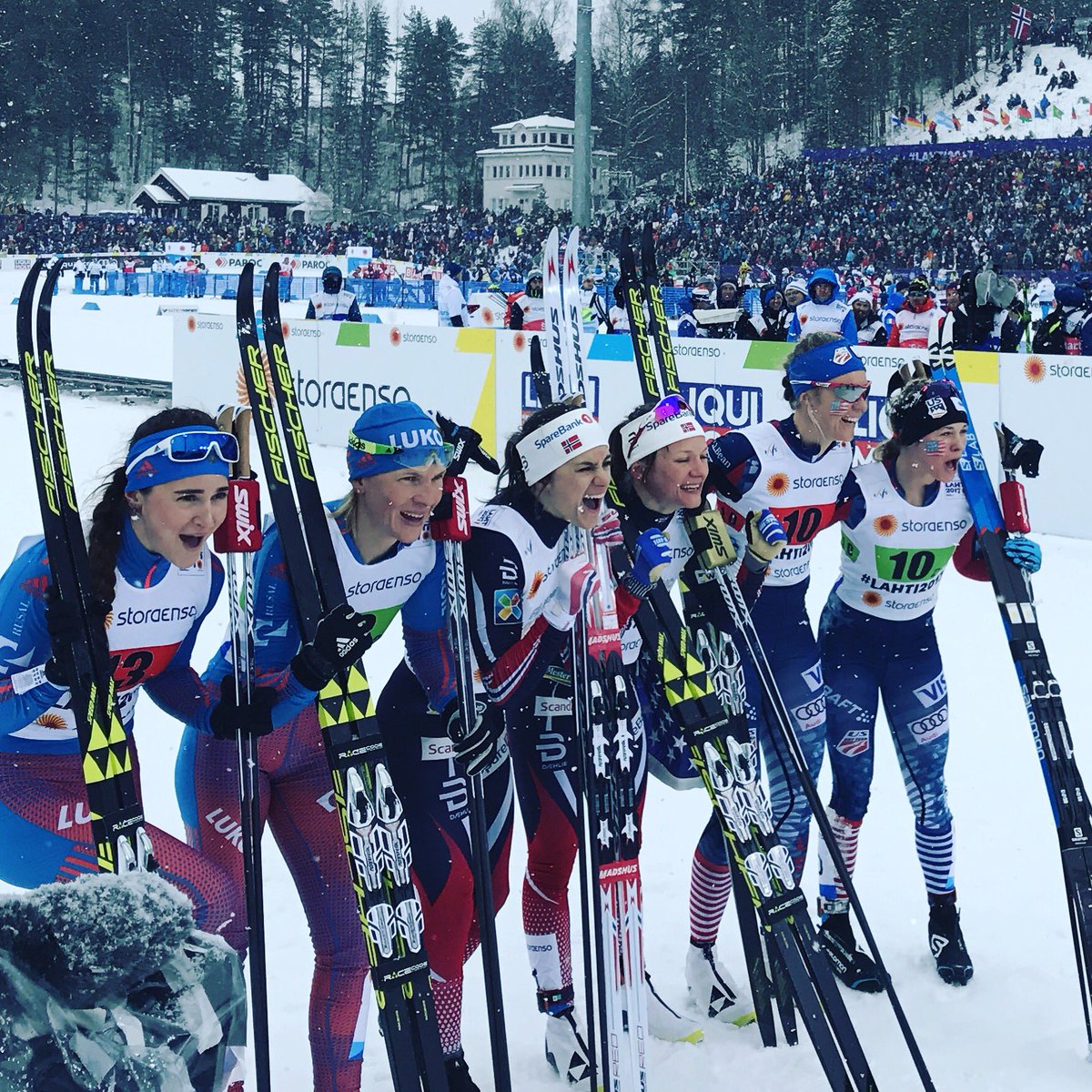
    Heidi Weng and Maiken Caspersen Fall of Norway (center) bested Yulia Belorukova and Natalia Matveeva of Russia (left) for gold in the women’s team sprint at 2017 World Championships, with Sadie Bjornsen and Jessie Diggins of the U.S. (right) outsprinting Sweden for bronze. (Photo: FIS Cross Country/Twitter)

    FIS Nordic World Championships (Lahti, Finland): Classic team sprints

    Defending champions Norway repeated gold in the women’s team sprint, with Heidi Weng and Maiken Caspersen Falla crossing the finish line first in Lahti, Finland. On the second-to-last loop, it looked like Russia could have something to say about that. Yulia Belorukova put in a furious sprint up the course’s biggest climb, and then beat Weng to the exchange. But her teammate Natalia Matveeva could not match the pace when Falla put on her own sprint on the last uphill. Russia finished second for silver, +5.56.

    The competition for bronze was closer, with Germany, Finland, Sweden, and the United States going out of the stadium for the last loop together in chase of the Norwegian and Russian leaders. The last climb was defining in the race for bronze, with Jessie Diggins of the United States staying closest to Sweden’s Stina Nilsson. Diggins caught Nilsson on the downhill and was able to stay just ahead of the Swede to the finish, claiming bronze (+18.38) along with teammate Sadie Bjornsen. It was a return to the team sprint podium for Diggins: after winning the team sprint at 2013 World Championships with Kikkan Randall, she teamed up with Sophie Caldwell in 2015 but the pair finished eighth.

    Nilsson and Ida Ingemarsdotter settled for fourth (+18.57), and the Finnish team of Aino-Kaisa Saarinen and Kerttu Niskanen finished fifth (+23.02).

    The Canadian team of Cendrine Browne and Dahria Beatty was seventh in their semifinal and landed 13th overall.

    In the men’s team sprint, Norway set a high pace from the beginning, with phenom Johannes Høsflot Klæbo attacking on the steep uphill every time he skied. On his second and third loops, he tagged off to Emil Iversen with gaps of just over five seconds to the rest of the field. But Iversen had a hard time holding the lead, in part because of Russia’s Sergey Ustiugov, who had won the 30 k skiathlon the day before and put in a huge effort to catch Iversen on the fourth loop of the team sprint.

    On the final loop, Finland’s Iivo Niskanen bridged the gap up to Iversen, mostly on the steep uphill and then also with ski speed on the downhill. But the time the pair entered the stadium, Niskanen had caught the Norwegian and was moving with higher speed. He decided to switch tracks to overtake Iversen, but Iversen decided to switch tracks just a second later, without checking one last time to make sure the track was clear. He fell, taking out Niskanen with him.

    That allowed Ustiugov and Italy’s Federico Pellegrino to go sailing by to claim gold and silver (+2.14) with their teammates Nikita Kriukov and Dietmar Noeckler. It was the second gold for Russia in the event in three World Championships; Kriukov and Alexey Petukhov won in 2013, and also took silver in 2015.

    Niskanen got up and claimed bronze (+8.64 with Sami Jauhojärvi), swearing as he crossed the finish line; with a broken pole, Iversen limped across the line in fourth (+18.42). He was called to a jury meeting but ultimately no teams were disqualified because of the crash.

    Erik Bjornsen of the United States won a sprint finish for fifth (+23.58) with teammate Simi Hamilton), besting Lenny Valjas (+27.02 with teammate Alex Harvey) of Canada.

    Results: women | men

    ***

    FIS Nordic World Championships (Lahti, Finland): Nordic combined 4 x 5 k team event
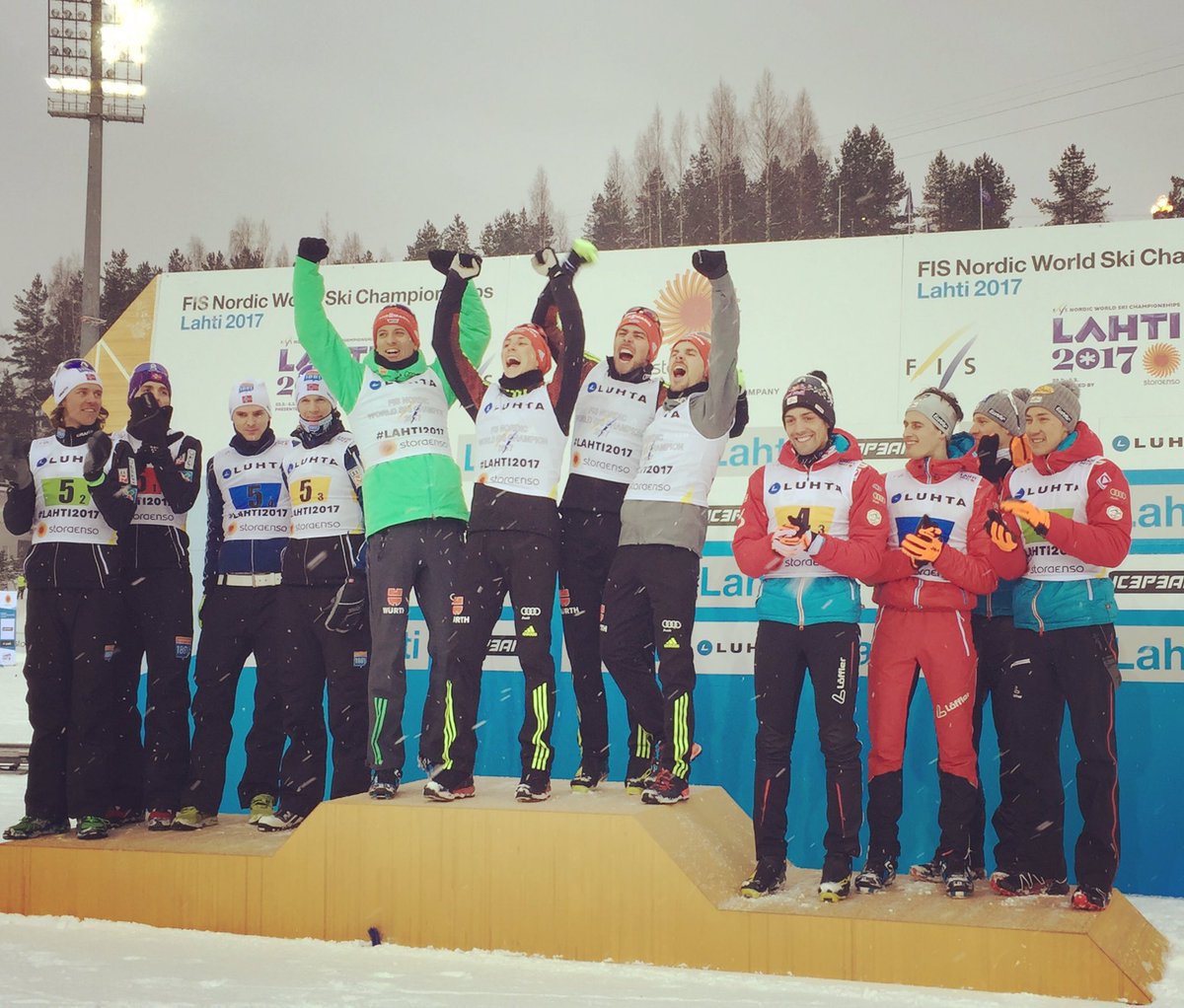
    Germany (Björn Kircheisen, Eric Frenzel, Fabian Rießle, and Johannes Rydzek) took gold in the nordic combined 4 x 5 k team event on Sunday at Nordic World Championships in Lahti, Finland, while Norway placed second and Austria third. (Photo: FIS Nordic Combined/Twitter)

    [UPDATED] After sweeping the first individual nordic-combined competition of 2017 Nordic World Championships on Friday, Germany achieved gold as a team, with Björn Kircheisen, Eric Frenzel, Fabian Rießle, and Johannes Rydzek winning the 4 x 5-kilometer team event in 47:57.3.

    The Germans combined for the best jumping score of 11 teams and started the relay in first, 44 seconds ahead of Japan in second. Norway started 1:07 minutes back in fifth but rose to second place (+41.7), with Magnus Moan, Mikko Kokslein, Magnus Krog, and Jørgen Graabak. Moan raced them into third at the first exchange, then Kokslein secured second, which they held onto for the remaining two legs.

    “It was our goal to ski a controlled race,” Germany’s Frenzel told ZDF. “Not really look at how the gap was developing, but just make our own race. And put up a little more pressure towards the end of each leg. That worked well, that was a wickedly cool team performance today. And I am just happy that we could put a little golden crown on the whole event today.”

    “I think today you could see again that we all worked together and enjoyed the competition,” Rydzek added. “We were all happy about each other’s performance, and just rewarded ourselves for hard hard work.”

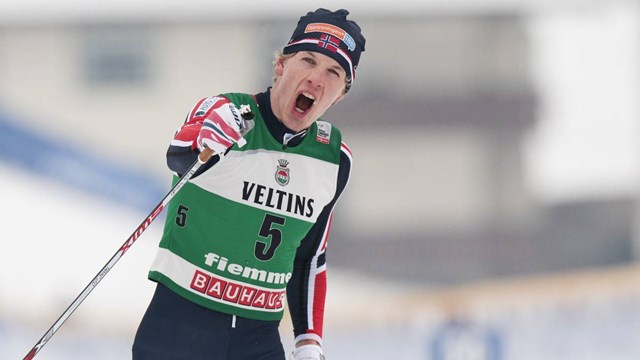
    Austria started fourth, 1:05 behind Norway, and clinched bronze (+1:03.7) with Bernhard Gruber, Mario Seidl, Philipp Orter, and Paul Gerstgraser. Gruber initially raced them into second at the first exchange, but they relinquished one spot and hung on for third, ahead of Japan in fourth (+1:06).

    Japan (Hideaki Nagai, Takehiro Watanabe, Yoshito Watabe, and Akito Watabe) jumped to second, but found themselves in fourth at every exchange.

    Finland took fifth, Italy sixth, France seventh, and the U.S. eighth (+3:27.2) with Bryan Fletcher, Taylor Fletcher, Ben Berend, and Ben Loomis. The Americans started the race in seventh and were in sixth after the first two exchanges, but slipped to eighth on the third leg.

    Results

    ***

    IBU Youth/Junior World Championships (Osrblie, Slovakia): Youth & junior pursuits

    Four seems to be Chloe Levins’s lucky number. After a career breakthrough of fourth place in the pursuit at last year’s Youth Olympic Games (YOG) in Lillehammer, Norway, the 18-year-old Vermonter raced to fourth in the youth women’s 7.5-kilometer pursuit on Sunday at the International Biathlon Union (IBU) Youth/Junior World Championships in Osrblie, Slovakia.
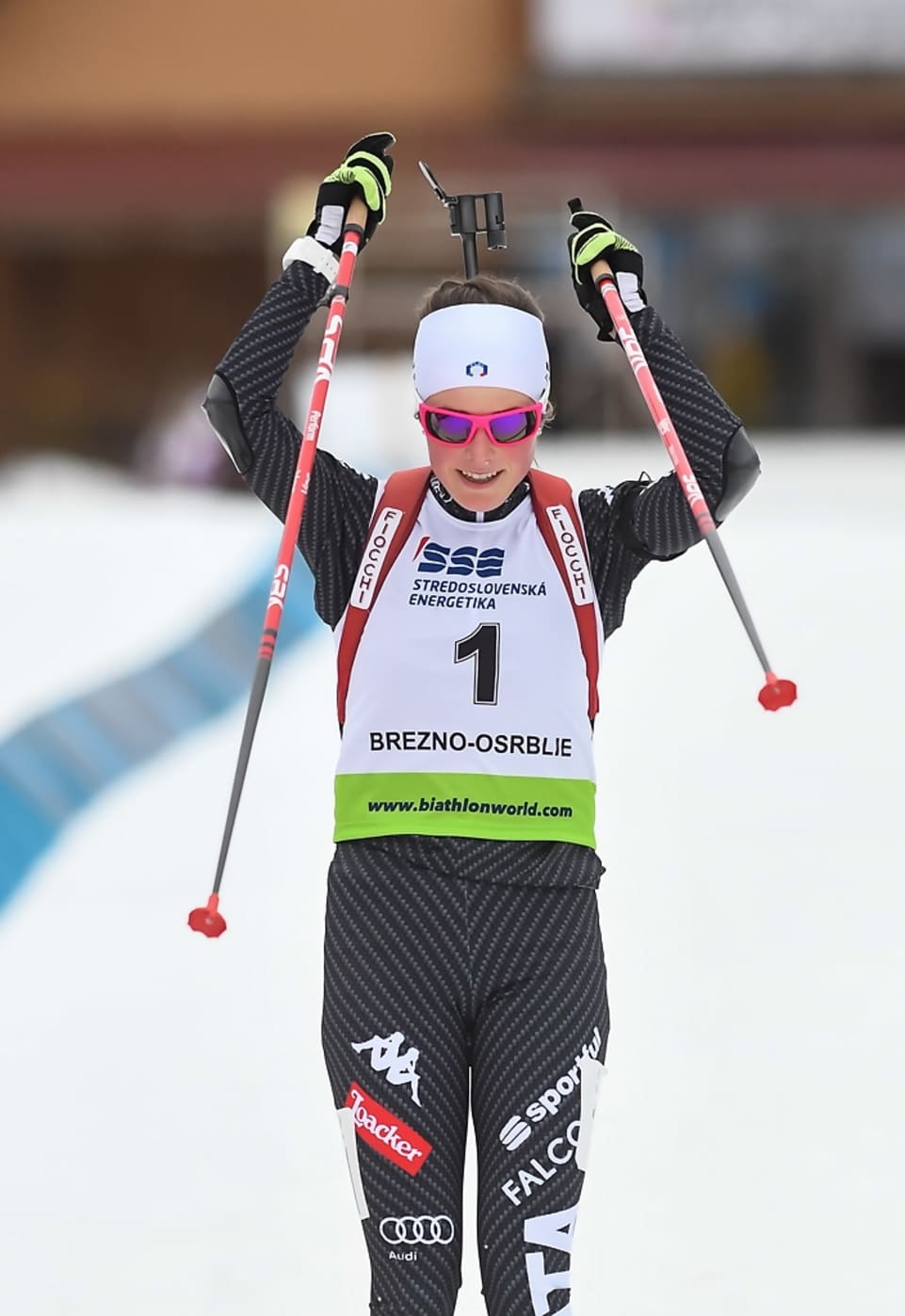
    Italy’s Irene Lardschneider winning the youth women’s 7.5 k pursuit on Sunday for her second-straight gold at 2017 IBU Youth World Championships in Osrblie, Slovakia. (Photo: IBU)

    Levins started the race in 11th and worked her way up to fourth with clean shooting in three stages. She missed two in the first prone but rebounded and held off Ukraine’s Khrystyna Dmytrenko by seven seconds for fourth place. Levins finished 1:55.5 minutes behind the winner, Italy’s Irene Lardschneider, who started the race first and held on for her second-straight gold medal despite four penalties (0+0+2+2), finishing in 26:57.1. France’s Lou Jeanmonnot-Laurent rose from fourth to second place with 19-for-20 shooting (0+0+1+0), and Italy’s Samuela Comola took bronze (+1:08.5) for the second-straight race with two misses (1+0+1+0).

    Three U.S. women qualified for the pursuit, with Amanda Kautzer finishing 42nd (+6:16.2) after starting 59th and shooting 80 percent (1+0+2+1), and Grace Gilliland finishing 55th (+8:32.1) with six penalties (2+3+1+0).

    Canada’s Shilo Rousseau followed in 54th (+9:02.1) with eight misses (3+1+2+2).

    Results: Youth women

    In the junior women’s 10 k pursuit, Canada’s Megan Bankes raced to 16th for the best finish for a North American in that race. The gold medalist in last week’s 12.5 k individual, Bankes finished 13th in Saturday’s sprint and thus started in that position, 1:25 out of first. She ended up 16th with four penalties (0+1+2+1) and finished 2:15.8 behind the winner, Russia’s Valeriia Vasnetcova, who started 24th and worked her way all the way up to first with clean shooting.

    Vasnetcova was the only one to clean the four-stage pursuit on Sunday, and in doing so, she achieved her first gold of the championships and second of her career at Youth/Junior Worlds after her team won last year’s youth relay in Romania.

    Coming off a sprint win, Italy’s Michela Carrara started first and took second at the finish, 10 seconds behind Vasnetcova with three misses (1+1+1+0). Norway’s Ingrid Tandrevold scored her second-straight medal as well, after starting second and finishing third (+10.8), with two penalties (0+0+1+1).

    Canada’s Nadia Moser had her best result of the championships in 30th (+3:43.5), moving up one place after starting 31st, with three penalties (0+1+0+2). Emily Dickson finished 47th for the second-straight day (+6:29.9) with four penalties (1+0+1+2).

    Siena Ellingson was the lone American to start after placing 18th in Saturday’s sprint. She finished 41st (+5:24.7) with seven misses (1+2+1+3).

    Results: Junior women

    In the junior men’s 12.5 k pursuit, Canada’s Pearce Hanna rocketed to 23rd after starting 47th, shooting 17-for-20 after cleaning the first two stages (0+0+1+2) for his first top 30 of the championships. Hanna finished 3:12 behind the winner, Russia’s Igor Malinovskii who picked up his second-straight gold.

    Malinovskii started first and finished in 32:39.8, 13 seconds ahead of second place, with four penalties (0+1+2+1). Norway’s Sindre Pettersen took the silver medal after starting in eighth and posting the fastest course time to overcome five misses (2+1+1+1). Belarus’s Anton Smolski moved up from fourth at the start to reach the podium in third (+27.4) with five misses as well (0+0+3+2).

    All four Canadian junior men qualified for the pursuit. Trevor Kiers led them in 39th (+5:13.3), after starting 48th, for his best result of the championships. Jules Burnotte placed 43rd (+5:35.3), up from 55th, for his best result as well, and Zachari Bolduc finished 57th (+8:18.3). Kiers missed five targets (2+0+1+2), Burnotte had seven misses (3+1+1+2), and Bolduc missed eight (2+3+2+1).

    For the U.S., Cody Johnson finished 55th (+7:19.5) with nine penalties (2+1+2+4) and Travis Cooper 59th (+8:46.2) with eight misses (5+0+1+2).

    Results: Junior men

    In the youth men’s 10 k pursuit, the first race of the day on Sunday, two Canadians finished in the top 30, with Leo Grandbois in 22nd and Adam Runnalls in 27th.

    For Grandbois, it was his first time outside the top 15 of the championships after he had won the youth men’s 12.5 k individual last Wednesday and finished 14th in Friday’s 7.5 k sprint. He had to ski six penalty loops on Sunday (0+2+2+2), dropping outside the top 20 after the third shooting. Grandbois finished 3:21.8 behind the winner, France’s Emilien Claude, who won the sprint as well to start the pursuit first.

    Claude, who had four penalties (1+1+0+2) and finished in 29:22.4, held off Italy’s hard-charging Cedric Christille by 16 seconds after Christille shot just two penalties (0+0+1+1) to move up from fourth to second for his first medal in his first Youth World Championships. Germany’s Danilo Riethmüller rose from sixth to third place (+30.7) despite four misses (1+0+1+2). For the German, it was his second bronze of these championships after placing third in the 12.5 k individual.

    Canada’s Runnalls moved up from 32nd at the start to 27th at the finish (+3:47.5) for his first top 30 of the championships. He had five penalties (1+3+1+0), but cleaned the last stage to move into the top 30.

    Vasek Cervenka was the lone American to qualify in the youth men’s pursuit, and he moved up from 49th at the start to 30th (+3:52) with five penalties (1+1+1+2).

    Results: Youth men
  • Taylor Fletcher Seventh on Day 2 of Summer Grand Prix

    Taylor Fletcher Seventh on Day 2 of Summer Grand Prix

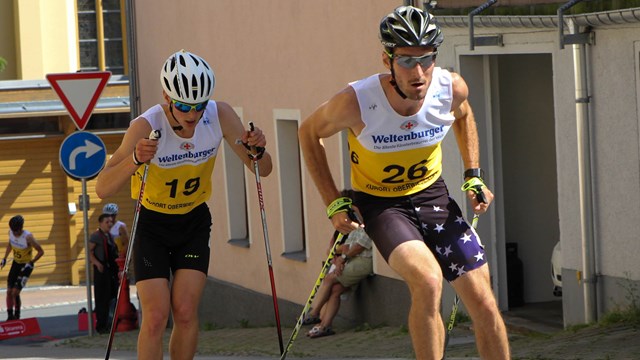
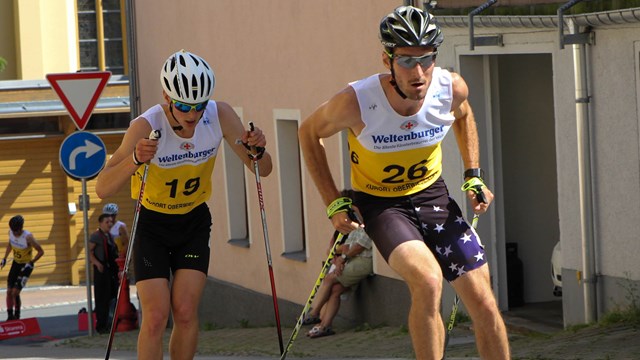
    Taylor Fletcher racing to the fastest time on the day and 7th overall in Oberwiesenthal, Ger. (Photo Sandra Volk, FIS).
    Taylor Fletcher (26) racing to the fastest time on the day and several overall at the Summer Grand Prix in Oberwiesenthal, Germany. (Photo Sandra Volk/FIS)

    End of August. It’s not quite transition season yet. Leaves are green, there’s still the possibility of sweltering humidity, and if you’re inclined to fly off 100-meter ski jumping hills sans snow, the International Ski Federation (FIS) Nordic Combined Summer Grand Prix has you covered.

    Last weekend, Oberwiesenthal, Germany, hosted the two-day opening round of the Summer Grand Prix. Although months away from on-snow events, jumping and racing on rollerskis against some of the best in the world is an incomparable way to size up dryland training.

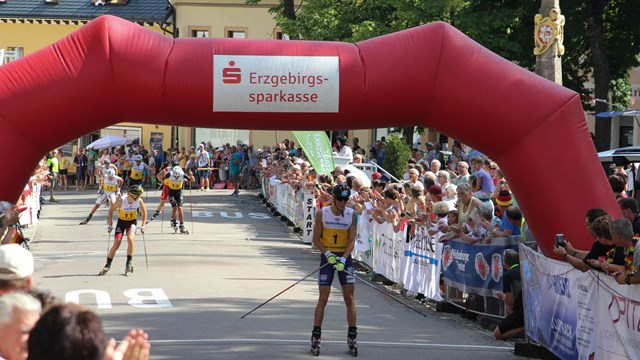
    Saturday featured a team sprint (teams of two) with a combined score jump followed by a 15-kilometer (2 x 7.5 k) race. Host Germany took the top prize. Germany I, with Björn Kircheisen and Eric Frenzel, placed first. Norway I (Jan Schmid and Magnus Moan) took second (+18.8), and Austria I (Bernhard Gruber and Philipp Orter) finished third (+19.7).

    The U.S. entered two teams: Taylor Fletcher and Ben Berend for U.S. I and Jasper Good and Stephen Schumann for U.S. II.

    Fletcher and Berend finished the jumping round in 14th; Good and Schumann ranked 19th. U.S. I held its 14th place after the ski portion, finishing 2:24.5 behind the winners. U.S. II ended the day in 18th overall.

    Sunday’s normal hill/individual 10 k was a new day for U.S Nordic Combined’s reigning national champ Taylor Fletcher. (Of note: The race weekend featured half of the Fletcher clan. Taylor’s older brother Bryan remained in Park City, Utah, as he and his wife were expecting their first child. They welcomed their baby girl, Ellery Ardene Fletcher, on Monday, Aug. 29.)

    Best off the jumping hill on Sunday, Aug. 28, was Norway’s Jarl Magnus Riiber. Taylor Fletcher jumped to 26th place. He started the ski portion 2 minutes and 25 seconds after Riiber.

    Reading between the lines, Fletcher made progress in the jump portion. He flew eight meters farther on Sunday compared to his effort the previous day.

    “Today was a good step forward,” Fletcher said Sunday about his Day 2 jump in a USSA press release. “I am pleased, for sure, but know I still have my work to do. I have had some really good jumps lately but haven’t had them in the competition yet. Today I put in a great jump after my miss yesterday (in team sprint) so that was a great feeling. I think this will help me relax knowing that with a jump like this I am in the hunt with my skiing, but of course the goal is to make it easier on the cross country side.”

    Schumann jumped to 31st, while U.S. teammate Ben Loomis was 33rd.

    Making it easier on the cross-country side was Fletcher’s performance trademark of tracking down early starters. On Sunday, he was true to form and strategy.

    Norway's Jarl Riiber rolls in first. (Photo: Sandra Volk FIS)
    Norway’s Jarl Magnus Riiber crosses the line first last weekend for Day 2 of the Summer Grand Prix in Oberwiesenthal, Germany. (Photo: Sandra Volk/FIS)

    Fletcher’s 24:28.9 marked the fastest rollerski time of the day, and brought him within 10.2 seconds of race winner Riiber, who finished in 26:43.7 . The hard-charging effort earned Fletcher seventh-place overall.

    “I was happy with the weekend for sure,” Fletcher wrote in an email to FasterSkier. “I have been focusing on the jumping way more this year and with the addition of our new jump coach and philosophy I have been able to improve way more. I had pretty solid jumps in Oberwiesenthal but still not my best jumps so that is exciting knowing I can still jump better. I will try to keep those feelings with me as we get ready for competition [on Wednesday] in Villach, Austria.”

    Behind Riiber on the podium were Austria’s Mario Seidl (+2.8) in second and Germany’s Kircheisen in third.

    For the U.S., Schumann finished 42nd (+3:23.3), Ben Loomis was 45th (+4:11.7), while Adam Loomis did not start the ski portion after being disqualified for a suit violation during the jumping portion.

    Asked why the team headed to Europe for the Grand Prix, Fletcher explained the race series provides a fitness litmus test against some of the best in the world.

    “We come to Europe for these races to see where our form is at the moment, but also to get some competition and practice in,” he wrote. “These races are no different than the World Cups in the winter with the exception that a few people may be absent. Another reason we come over is for the equipment. All the jumping manufacturers are based in Europe and it is difficult to get equipment sent the USA. Also, every year the rules for jumping are changed and unless you are at a competition, it is hard to know if you bindings, suits, skis, gloves, helmets, undersuits are legal or not. Coming to Summer Grand Prix allows us to check out our equipment with the officials so we know we are inline with the rules and won’t get disqualified for unknown reasons.”

    Fletcher elaborated on how jumping differs in the summer compared to jumping in colder, more dense, wintertime air. “The only thing that is different in the summer and winter is the air pressure really,” he wrote. “The surface is different but over time it starts to feel more like snow and the landing and in-run start to feel close. In the summer the temp is high causing the pressure to drop a little, especially in Park City and that makes the jumping a little harder. So without the air pressure, it sometimes feels like you are falling instead of flying through the air. The best jumping happens when the temperature is very cold(-F) as the air is very thick and you feel way more pressure under neath you! The speed is relatively the same as, the slope the hill doesn’t change from summer to winter.”

    Bryan Fletcher holding his newborn, Ellery Ardene Fletcher. Fletcher and his wife Nikki welcomed their baby girl on Monday. (Photo: USSA Nordic)
    Bryan Fletcher holding his newborn, Ellery Ardene Fletcher. Fletcher and his wife Nikki welcomed their baby girl on Monday. (Photo: USSA Nordic/Facebook)

    On Wednesday in Villach, Fletcher did not start the normal hill/10 k competition and final day of the Grand Prix. His teammate Berend led the U.S. in 33rd after posting the 19th-best jump, Ben Loomis finished 42nd after jumping to 31st, and Adam Loomis was 50th, improving upon his 57th-ranked jump.

    Austria’s Seidl won at home with a 12.9-second victory over Germany’s Fabian Riessle, and Norway’s Håvard Klemetsen placed third (+15.1).

    Now an uncle, Fletcher planned to head home to Park City after the Grand Prix series and spend the month prior to the start of the winter season training in Europe.

    Results: Day 1 team sprint | Day 2 individual 10 k | Day 3 individual 10 k

  • Fletcher Brothers 6th for Best Team Sprint in Three Years; Frenzel Locks Up Overall Title

    Fletcher Brothers 6th for Best Team Sprint in Three Years; Frenzel Locks Up Overall Title

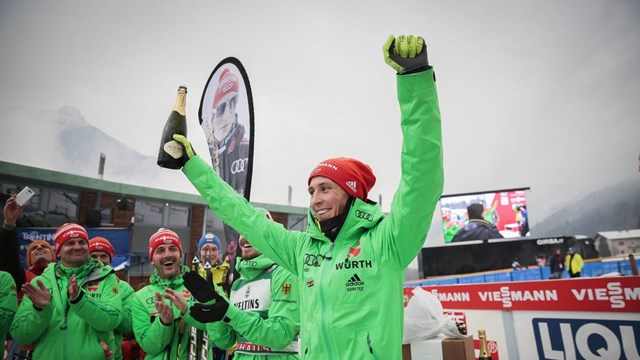
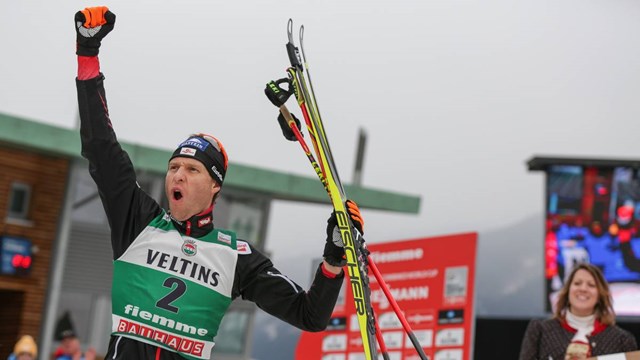
    Germanys Eric Frenzel secures 4th Noco World Cup overall in a row. Celebrating with the team in Val Di Fiemme. (Credit: FIS, @ Nordic Focus)
    Germany’s Eric Frenzel secured his fourth-consecutive overall Nordic Combined World Cup title over the weekend and celebrated with his team in Val di Fiemme, Italy. (Photo: FIS/Nordic Focus)

    Picturesque Val di Fiemme, Italy, was the latest to host a three-day round of Nordic Combined World Cup events that began last Friday with the large hill/2 x 7.5 k team sprint.

    The two person teams had their jumping points combined to determine the start order for the race’s ski portion. Norway I’s Magnus Krog and Jørgen Graabak amassed the highest total with 283 points on the jump hill. Francois Braud and Maxime Laheurte of France I jumped to second with 282.6 points. Austria II skiers, Philipp Orter and Mario Seidl were third with 277.8 combined points.

    The U.S. entered two teams. Bryan and Taylor Fletcher jumped to ninth, with 242.3 points, for U.S. I. Adam Loomis and Ben Berend comprised U.S. II, which finished the jumping portion in 16th with 223.2 points. Twenty teams in all entered the competition.

    Norway's Magnus Krog and Joergen Graabak win the Val Di Fiemme, Italy NoCo team sprint. (Credit: FIS, @ Nordic Focus)
    Norway’s Magnus Krog and Jørgen Graabak won the Nordic Combined World Cup team sprint last Friday, Feb. 26, in Val di Fiemme, Italy. (Photo: FIS/Nordic Focus)

    From the start, Krog proved unmatchable. He distanced Braud, France’s first skier who started 1 second after Krog. Graaback, Norway’s second skier, was able to maintain the lead and secure first place for the Norwegians, claiming the team-sprint victory in 32:50.

    Germany I, with Tobias Haug and Tino Edelmann, jumped to fourth and began the ski 16 seconds behind Norway I, raced to second place (+6.7). France I held onto the final podium spot in third place, finishing 7.1 seconds behind Norway. Austria II, which had been third after the jump, slipped to eighth overall (+1:37.3).

    The Fletchers skied up in the standings for the best U.S. finish in a Nordic Combined team sprint since 2013. Back then, in Ramsau, Austria, Bryan Fletcher and Todd Lodwick placed fourth overall. At 2013 World Championships, Taylor Fletcher and Billy Demong finished sixth in the team sprint (at the same World Championships in Val di Fiemme, U.S. Nordic Combined’s four-man relay earned bronze in third.)

    On Friday, Bryan and Taylor skied the third-fastest combined race to place sixth (+1:07.8). Loomis and Berend did not finish.

    “The team sprint was for sure Taylor’s and I’s highlight of the weekend,” Bryan Fletcher wrote in an email. “It was nice to have some decent jumps and a solid race to get us into the fight. It’s the best team sprint result we have had as a duo and the best since Todd Lodwick and I were fourth in Ramsau in 2013 I believe.  Honestly, while 6th is a solid result, Taylor and I were hoping for a little more but our legs were really tired after the long travel day from Finland to Val di Fiemme.  It showed in our racing on this day a little, but we were able to hold it together just enough to move up to the 6th place finish.”

    According to younger brother Taylor, he wasn’t feeling 100 percent on Friday.

    “The cross country race was better on the result page then how it felt for me,” he said, according to a USSA press release. “My legs were heavy from the last couple races, but I was stoked to see I had a strong race with how I felt.”

    Team jumping results | Final team results

    Day 2 in Val di Fiemme

    The second day of Nordic Combined competitions in Val di Fiemme featured the 134-meter large hill/10 k Gundersen start. The overall World Cup leader, Germany’s Eric Frenzel, posted the best jump with 142.3 points. Austria’s Bernhard Gruber jumped to second with 137.1 points and a 21-second deficit at the start of the ski. Takehiro Watabe of Japan flew third farthest, scoring 132.1 points.

    Germany's Bernhard Gruber won the Day 2 individual competition in Val Di Fiemme, Italy. (Credit: FIS/Nordic Focus)
    Germany’s Bernhard Gruber won the Day 2 individual competition in Val Di Fiemme, Italy. (Credit: FIS/Nordic Focus)

    The U.S. entered four skiers, none of whom jumped into the top 30. Berend posted the 35th-best jump (99.2 points), Bryan Fletcher was 36th (98 points), Taylor Fletcher 39th (93.2 points), and Loomis 42nd (86.7 points).

    Frenzel, having already won seven races this season, seemed to be a shoo-in for an eighth victory. But Gruber, with fast running skis, overtook Frenzel and finished first by more than 30 seconds. Gruber skied the fourth-fastest time of the day to win, finishing in 30:59.7. Frenzel placed second (+37.5) with the 19th-ranked ski time. Norway’s Graabak, who was positioned 14th after the jump raced up to third (+46.0).

    Two Americans skied themselves into the points. Taylor Fletcher ended up 24th (+3:32.5) and Bryan Fletcher finished 26th (+3:37.6). Loomis skied to 35th (+5:56.7), and Berend to 38th (+7:19).

    Jumping results | Final results

    Day 3 in Val di Fiemme

    Day 3 started off identical to Day 2, with a large hill/10 k Gundersen. And just like the day before, Germany’s Frenzel flew to first, with 116.3 points. His teammate Tobias Simon scored 110.2 points for the second-best jumping total. Norway’s Håvard Klemetsen was third after the jumping round with 104.6 points.

    Berend posted the best jump for the Americans in 10th with 94.5 points. He started the 10 k race 1:27 minutes after Frenzel. Bryan Fletcher jumped to 35th, Taylor Fletcher to 42nd and Loomis to 46th.

    Norway's Magnus Krog celebrates across the line after winning the third day of the Nordic Combined World Cup in Val di Fiemme, Italy. (Credit: FIS/Nordic Focus)
    Norway’s Magnus Krog celebrates across the line after winning the third day of the Nordic Combined World Cup in Val di Fiemme, Italy. (Photo: FIS/Nordic Focus)

    Norway’s Krog, winner of Friday’s team sprint, proved too strong on the ski, which featured wet and slow conditions. Krog began the ski in fifth, 1:04 behind Frenzel. That gap dwindled as the racers neared the finish line. By the end, Krog, who finished first in 31:33.5, had put 28.1 second into Frenzel — who ultimately missed the podium in fourth overall.

    Norway’s Graabak finished second (+5.8), and German Fabian Riessle placed third (+18.4).

    For Frenzel, fourth place proved good enough. He locked up the season’s overall World Cup title for the fourth year in a row. Frenzel had a season-long duel with Japan’s Akito Watabe for the overall title. However, due to an injury, Watabe did not compete in Val di Fiemme.

    The Fletcher brothers were able to ski into the points. Bryan placed 25th (+2:55.3), while Taylor was 26th (+3:00.8). Berend fell out of the top 30, placing 34th (+5:33), Loomis finished 36th (+5:44.1).

    Bryan pointed out that Berend’s jump — the 10th best on Sunday — was a strong sign.

    “The rest of the weekend the highlight was Ben Berend jumping to 10th,” he wrote. “It was awesome to see him step up his game there and he hung tough in the race narrowly missing out on points in some incredibly hard conditions.”

    Bryan also noted the weekend’s slow and soggy snow made it a difficult one for both skiers and wax technicians.

    “The racing this weekend was a battle of will for the athletes and a stressful weekend for wax techs,” he wrote. “It was very difficult conditions to wax for and that was reflected throughout the racers. Some teams had skis that were incredibly good while others had skis that were incredibly bad.  The extremes were just much further apart than normal and that made for some interesting racing as well. All in all it was not my best weekend, however with one weekend left I am motivated to try and finish the season on a strong note.”

    Jumping results | Final results

    The Nordic Combined World Cup concludes after this week, with three days of competitions in Schonach, Germany, beginning March 4.

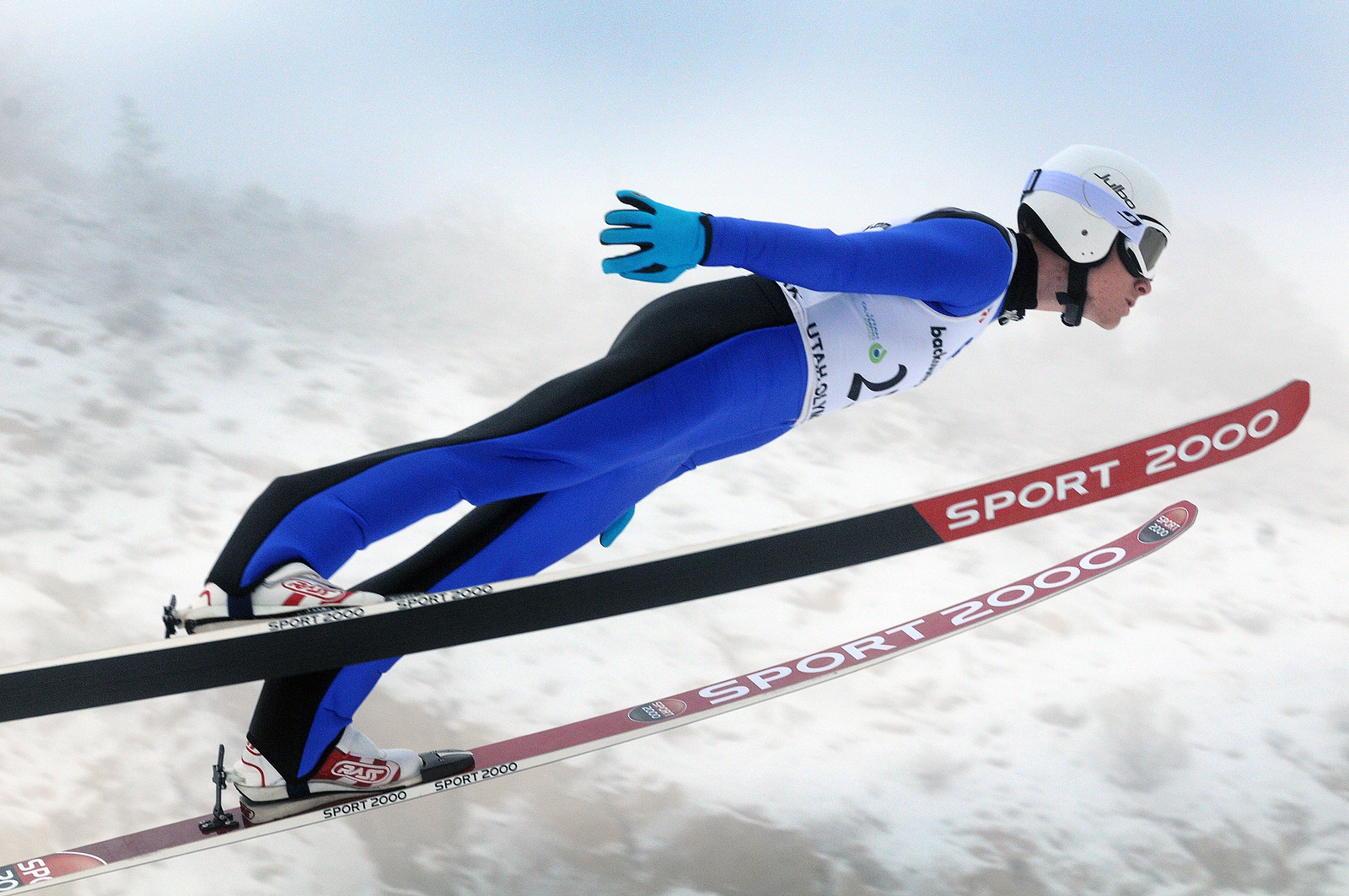
    Ben Berend leads the U.S. in fourth in the ski jump on a foggy morning at start of the Nordic Combined Continental Cup at Utah Olympic Park in Park City, Utah. (Photo: U.S. Ski Team/Tom Kelly)
    Ben Berend led the U.S. in fourth in the ski jump on a foggy morning at the Nordic Combined Continental Cup last December at Utah Olympic Park in Park City, Utah. (Photo: U.S. Ski Team/Tom Kelly)
  • Riiber’s Bad Luck in Lahti; Frenzel Keeps NoCo World Cup Lead; Fletchers in Top 30 Overall

    Riiber’s Bad Luck in Lahti; Frenzel Keeps NoCo World Cup Lead; Fletchers in Top 30 Overall

    Norway's 18-year-old Jarl Magnus Riiber posted the best jump on Friday, Feb. 19, and started the 10 k cross-country race first at the Nordic Combined World Cup in Lahti, Finland, but was disqualified for taking a wrong turn. (Photo: JoJo Baldus)
    Norway’s 18-year-old Jarl Magnus Riiber posted the best jump on Friday, Feb. 19, and started the 10 k cross-country race first at the Nordic Combined World Cup in Lahti, Finland, but was disqualified for taking a wrong turn. (Photo: JoJo Baldus)

    Here is a name to remember for both youthful audaciousness and absent mindedness: Jarl Magnus Riiber.

    At 18 years old, the Norwegian seems to treat the Nordic Combined World Cup as just another rung in the hierarchy of competition that sooner rather than later he will dominate.

    From Friday, Feb. 19, through Sunday, Feb. 21, three Nordic Combined World Cup competitions were held in Lahti, Finland.

    That first event, a large hill/10-kilometer Gundersen began with Riiber ruling the jumping round. He flew the farthest, earning 137.5 points. The jump gave Riiber a 28-second gap at the start of the ski over his nearest competitor. That second jumper was Norway’s Håvard Klemetsen, who scored 130.5 points. Overall World Cup leader, Germany’s Eric Frenzel, jumped to third with 127 points. Second in the overall, Japan’s Akito Watabe, was fourth, with 126.4 points.

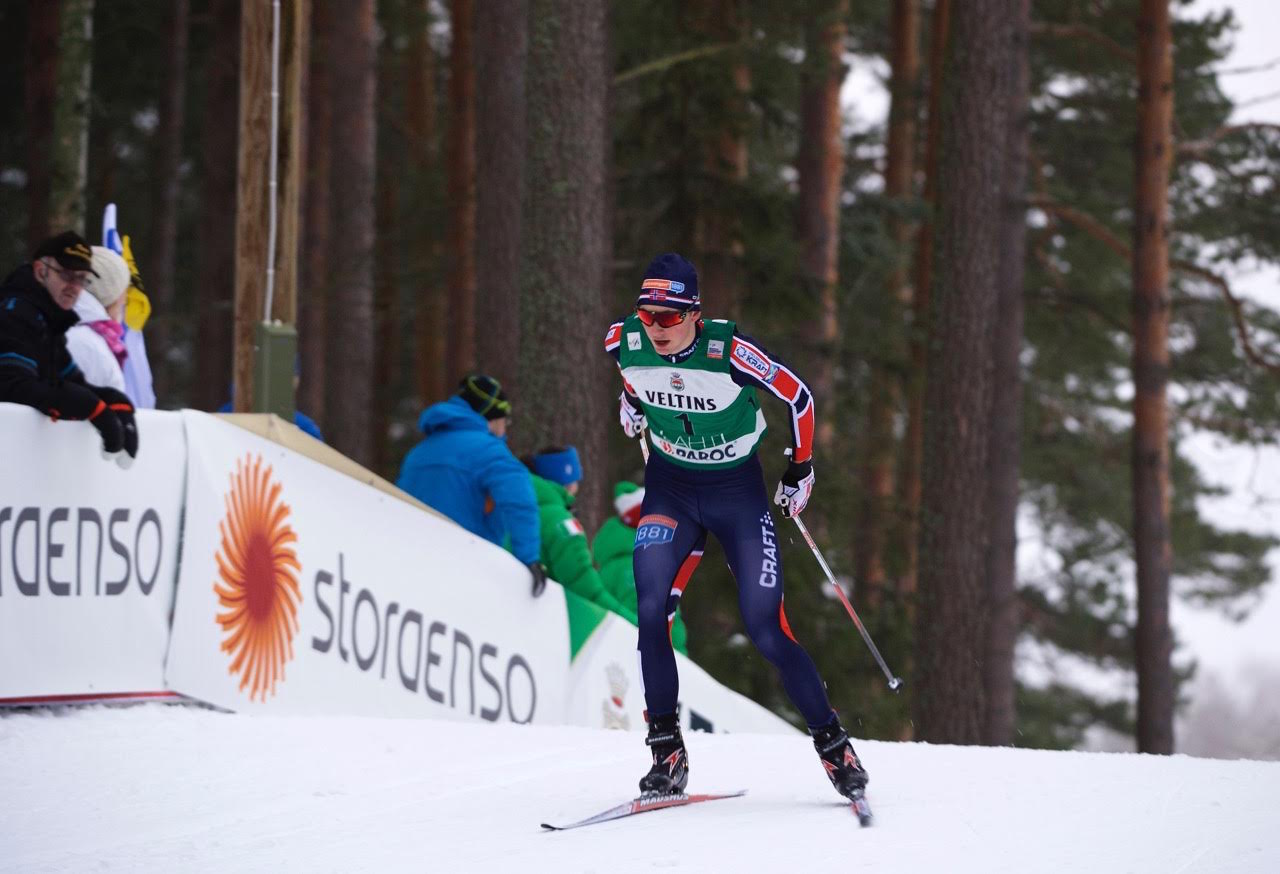
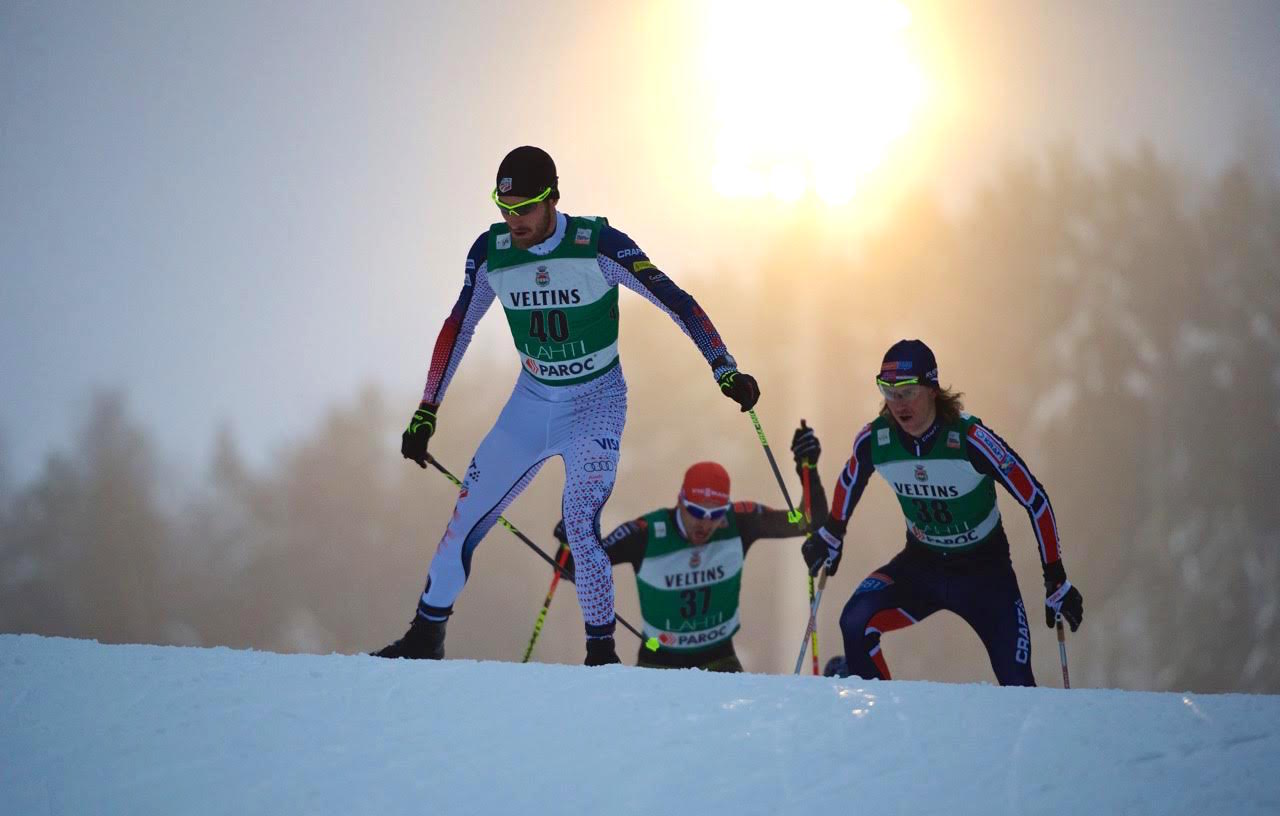
    American Taylor Fletcher (40) leading Norway's Mikko Kokslien (38) and Germany's Björn Kircheisen  (37) during the 10 k cross-country race at Friday's Nordic Combined World Cup in Lahti, Finland. Fletcher raced from 40th at the start to 24th at the finish with the seventh-fastest ski time. (Photo: JoJo Baldus)
    American Taylor Fletcher (40) leading Norway’s Mikko Kokslien (38) and Germany’s Björn Kircheisen (37) during the 10 k cross-country race at Friday’s Nordic Combined World Cup in Lahti, Finland. Fletcher raced from 40th at the start to 24th at the finish with the seventh-fastest ski time. (Photo: JoJo Baldus)

    All three U.S. men struggled to crack the top 40 on the hill, with Taylor Fletcher leading the team in 40th, Ben Berend jumping to 44th and Bryan Fletcher 47th.

    The time gaps Riiber had on Frenzel and Watabe were incrementally negated. On the last lap, the duo caught Riiber.

    Yet the young Norwegian held his ground, gapping the chasers slightly on a short hill before a turn into the stadium and the final straightaway. But Riiber, who looked as if he’d cruise in for the win, took the lap lane before realizing his mistake and righting his course. Frenzel won in 23:57.7, Watabe placed second (+1.7), and Norway’s Jan Schmid secured third (+32.2).

    For Riiber, not minding the small things has cost him again. On Jan. 29 in Seefeld, Austria, it appeared Riiber would take third place on the podium. He was disqualified for failing to start the ski race with a timing chip. Friday, what would have been Riiber’s second World Cup win, stood as his second World Cup disqualification.

    Of the Americans, Taylor Fletcher skied into the points in 24th (+1:57.5) with the seventh-fastest ski time of the day. Bryan Fletcher placed 36th (+3:34.9), and Berend finished 44th (+5:43.7).

    Day 1: Jumping results | Final results

    Day 2

    The second day of competition on Saturday featured a jump off the large hill followed by a 2 x 7.5 k ski. Two-man teams had their jump point totals combined to determine time back for the ski start.

    Ribber and Schmid scored the highest point total, with 252.1 points. Germany I, Johannes Rydzek and Fabian Riessle, scored the second highest total, with 223.7 points, 57 seconds back. Austria I, with Bernhard Gruber and Lukas Klapper, jumped to third with 219.9 points, 1:04 back.

    The ski, which was won by the Germany I in 32:57.9, saw Riiber once again succumb to bad luck. While skiing along with Germany’s Riessle, Riiber’s shoulder dislocated. Attempting to push through the injury, Riiber skied on. Yet he ultimately pulled from the race. Besides a likely podium, Norway I’s result lists as an unfortunate DNF.

    Austria’s Gruber-Klapper combo placed second, 18 seconds behind Germany. Austria II, with Franz-Josef Rehrl and Philipp Orter, were third (+1:40.8) in a photo finish with Germany II (+1:40.9).

    The U.S. entered two teams. United States I (Taylor and Bryan Fletcher) ranked 17th after the jump, while U.S. II (Adam Loomis and Ben Berend) were 20th. Neither team started the ski race.

    Day 2: Jumping results | Final results

    Day 3

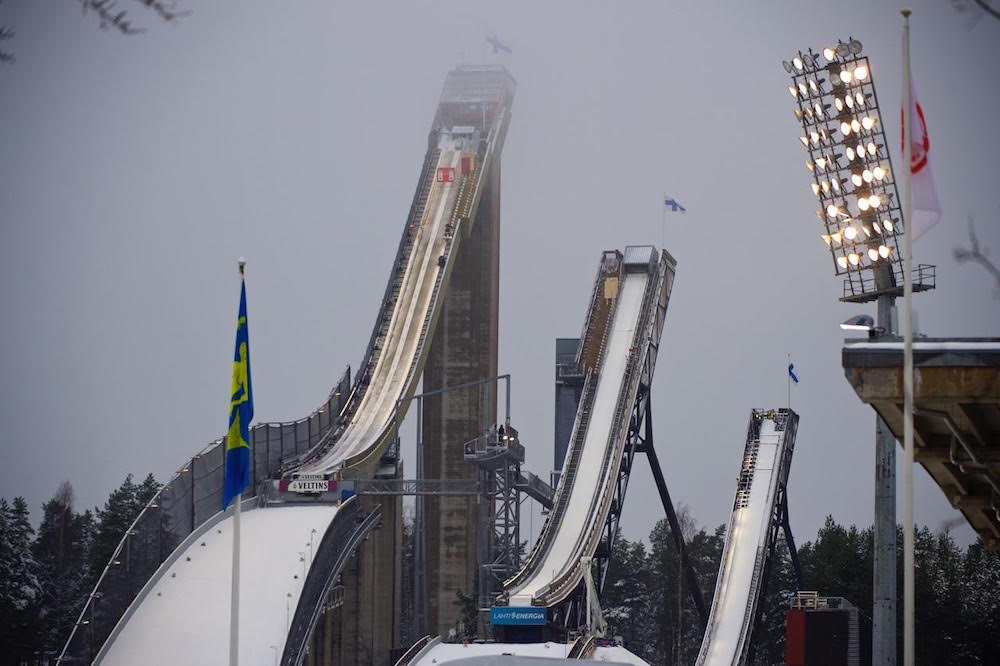
    The jump hills in Lahti, Finland, as seen on Friday, Feb. 19, the first day of the Nordic Combined World Cup (Photo: JoJo Baldus)
    The jump hills in Lahti, Finland, as seen on Friday, Feb. 19, the first day of the Nordic Combined World Cup (Photo: JoJo Baldus)

    The last day of competition in Lahti, a 10 k Gundersen, saw the jumping round canceled due to high winds. Results from Friday’s provisional competition round were used to determine the skiing start order. Unfortunately, Riiber, who had won that round, was unable to start due to his shoulder injury.

    Watabe, who would have begun two seconds behind Riiber, skied off first. Frenzel started 32 seconds later. His German teammate Riessle began 40 seconds behind in third.

    For the U.S., Berend started 20th, Bryan Fletcher 41st, Taylor Fletcher 48th, and Adam Loomis 53rd.

    Riessle is considered a strong skier. Watabe conserved his energy, allowing the two Germany to bridge up. That link occurred around 5 k. A chess match began, with none of the skiers wanting to lead out. In the closing kilometers, Riessle pulled away for the win in 25:50.9. Frenzel finished second (+5.1) and Watabe in third (+11).

    Bryan Fletcher was the top American finisher in 25th (+3:05.2) and he skied the ninth-fastest time on the day. Taylor placed 28th (+3:30.6) and posted the third fastest ski time. Berend was 33rd, and Loomis 37th.

    After the weekend, Frenzel retains the Overall World Cup lead with 1091 points. Watabe is in second with 904 points, and Riessle in third with 789 points.

    Bryan Fletcher is 18th overall, and Taylor 28th.

    In an email on Sunday, Bryan reiterated his desire to solve the jumping puzzle.

    “Well this weekend was not really our weekend,” Bryan wrote. “Training was decent during the week, but for me I got a little overzealous and tried a little too hard in the competition. The results obviously speak for themselves.  Racing was good after taking a short break from intensity to gear up for the next 4 races in the rest of the week.

    “Jumping is a fickle sport and when you’re on, it seems impossible to ever lose your groove and when you’re off, you’re off,” he added. “So I have hit the reset button and will try to make the most out of what I can in the next couple days of competition.”

    Taylor felt better about his jumping.

    “This weekend I felt that my jumping had turned for the better finally and I was gaining confidence on the hill which is important,” Taylor wrote in an email on Sunday. “Unfortunately, my one bad jump was in the PCR [provisional competition round] and we had to use that today due to fierce winds that were too strong.

    “I skied a solo race catching and passing people immediately, as I wanted to score points I was going to need to have a really strong race and ski my own race as well. I felt really strong all race but one really steep section caught me and i struggled on the final kick up. I was able to continue to push the pace for the rest of the lap and finish strong finishing 28th. I thought I may of had the fastest time, but after seeing I was third I wasn’t too bummed, as I skied the race on my own and in no man’s land for a bit!”

    World Cup racing resumes on Tuesday in Kuopio, Finland.

    Day 3: PCR jumping results | Final results | Overall World Cup standings