From the FasterSkier archive — posts syndicated from athletes’ and coaches’ own blogs between 2004 and 2012, kept online as published. Current coverage is at fasterskier.com.

Tag: Philippe Boucher

  • Ogden Ties Second-Best U.S. Result at Junior Worlds in Fifth

    Katharine Ogden (Stratton Mountain School/U.S. Ski Team D-team) racing to fifth in the women's 5 k freestyle at 2017 Junior Worlds on Wednesday for her best result in her third Junior Worlds. (Photo: FlyingPointRoad.com)
    Katharine Ogden (Stratton Mountain School/U.S. Ski Team D-team) racing to fifth in the women’s 5 k freestyle at 2017 Junior Worlds on Wednesday for her best result in her third Junior Worlds. (Photo: FlyingPointRoad.com)

    (Note: This article has been updated to include comments from Americans Katharine Ogden and Taeler McCrerey, as well as Canada’s Gareth Williams.)

    Katharine Ogden’s name had already been in the U.S. Ski & Snowboard Association (USSA) record books, right behind Lindsey Williams, Leif Zimmerman and Torin Koos as one of the top finishers in U.S. history at Nordic Junior Worlds Championships.

    Ogden, 19, of the Stratton Mountain School (SMS) and U.S. Ski Team (USST) Development “D” Team, was tied with five other Americans who also placed sixth at Junior Worlds, including current World Cup skiers Andy Newell and Kikkan Randall, and Kris Freeman, who went on to finish fourth in two senior World Championships.

    On Wednesday, Ogden moved up in the ranks, placing fifth for the second-best U.S. result at Junior Worlds, equalling Zimmerman and Koos.

    Katharine Ogden (Stratton Mountain School/U.S. Ski Team D-team) racing to fifth in the women's 5 k freestyle at 2017 Junior Worlds on Wednesday for her best result in her third Junior Worlds. (Photo: FlyingPointRoad.com)
    Katharine Ogden (Stratton Mountain School/U.S. Ski Team D-team) racing to fifth in the women’s 5 k freestyle at 2017 Junior Worlds on Wednesday at Soldier Hollow in Midway, Utah. (Photo: FlyingPointRoad.com)

    “I’m really psyched about my result … it was so awesome to see that I’m in a good place to stick with these top girls in the mass start race,” Ogden wrote in an email after the women’s 5-kilometer freestyle at Soldier Hollow in Midway, Utah.

    She had previously finished sixth in the 10 k skiathlon two years ago in Almaty, Kazakhstan.

    “My goal going into the 5k skate was mostly just getting a feel for how I can race in this field and on these courses so as to know how to race the skiathlon,” she explained, referring to her target race on Friday. “In the skiathalon I’m really hoping for another top 6 and maybe (hopefully) a podium.”

    “It’s really encouraging to know that all those U.S. Ski Team girls that are doing so well [on the World Cup] right now were in the same place that I am at one point,” Ogden said in a post-race interview with the U.S. Ski Team.

    She has her share of World Cup starts, eight to be exact, after racing the entire Ski Tour Canada — an eight-stage series that closed out the 2015/2016 international race season. This year, her fifth place on Wednesday puts her soundly within U.S. Ski Team criteria for selection to 2017 World Cup Finals, which will take place March 17-19 in Quebec City, Quebec.

    But back to Junior Worlds: Ogden achieved a career best on Wednesday and was 6.5 seconds shy of a medal. Ogden started the one-lap 5 k individual start in bib 54 (of 57).

    Asked what she was thinking about as she warmed up and lined up at the start, Ogden couldn’t get over how nervous she was.

    “Honestly I was pretty nervous before the start of the race. That’s basically all that I was thinking about,” she wrote. “I felt good once I started racing, the nerves just went away! The course was totally awesome for me.”

    While she didn’t get many splits, Ogden explained she heard just enough to know that she was with the leaders.

    “That motivated me because I was aware that every second was important,” she wrote.

    Just over 13 minutes later, she crossed the finish line in third, 6.5 seconds behind behind Russia’s Mariya Istomina, who was fastest across the line in bib 50. Italy’s Anna Comarella, who started 53rd, 30 seconds ahead of Ogden, came up 3.2 seconds shy of the Russian for second at the time. And Ogden was another 3.3 seconds back in third.

    “I honestly didn’t have too much of a strategy,” Ogden told the U.S. Ski Team. “It was a short race, so I knew I was going to have to go hard basically from the start. But I was also trying to walk the line of not blowing up.”

    The 2002 Olympic trails at Soldier Hollow peak out around 5,900 feet above sea level. That can be a doozy for most of the world that trains closer to sea level, including Ogden from Landgrove, Vt. Asked in a pre-Junior Worlds questionnaire what she was most excited for at these championships, Ogden wrote “racing at altitude.”

    The women's 5 k freestyle podium on Wednesday at 2017 Junior World Championships at Soldier Hollow in Midway, Utah, with Sweden’s Ebba Andersson (c) in first, Norway’s Marte Mæhlum Johansen (l) in second and Russia's Mariya Istomina (r) in third. (Photo: FlyingPointRoad.com)
    The women’s 5 k freestyle podium on Wednesday at 2017 Junior World Championships at Soldier Hollow in Midway, Utah, with Sweden’s Ebba Andersson (c) in first, Norway’s Marte Mæhlum Johansen (l) in second and Russia’s Mariya Istomina (r) in third. (Photo: FlyingPointRoad.com)

    Of the three women that started after Ogden, two of them reached the podium. Norway’s Marte Mæhlum Johansen in bib 56 bested Istomina’s time by 1.5 seconds to become the new race leader — albeit briefly. That bumped Ogden to fourth and the American ultimately placed fifth after the final starter, Sweden’s Ebba Andersson, finished 13.8 seconds faster than Johansen for the win in 12:45.4 minutes.

    Andersson became a three-time Junior Worlds champion, after winning last year’s 10 k freestyle and 4 x 2.5 k freestyle relay with Sweden’s women’s team in Rasnov, Romania.

    “When I was thinking about the race I made a tactic that I would have a controlled start and then power to the end and I think I succeeded,” Andersson told the U.S. Ski Team media. “The course was amazing today. It was incredible and the weather, too.”

    Following the trend of the rest of the week so far, conditions were hard-packed and temperatures just below freezing on a bluebird day.

    Ogden led three U.S. women in the top 20 on Wednesday, with Hannah Halvorsen (Sugar Bowl Academy/USST) in 13th (+1:01.2) and Taeler McCrerey (University of Denver) in 20th (+1:18.9). The team’s fourth woman, Hailey Swirbul (University of Alaska Anchorage) placed 31st (+1:35.5).

    “My goal for this race was to pace it well so I could use my energy wisely,” Halvorsen, also a member of the USST D-team, wrote in an email. “I liked how firm and fast the course was because I could focus on skiing smooth, powerful, and relaxed. I was really happy with how things went!”

    As the 22nd starter, Halvorsen initially crossed the line in second.

    “I was excited to cross the line in second but I didn’t know how promising that would be with half the field still to finish,” she wrote. “I was a little bummed to not stay in the top ten but I know this was a great race for me.”

    Two days earlier, in her first race of her first Junior Worlds, Halvorsen finished 11th in the classic sprint.

    Also on Monday, McCrerey, a sophomore at the University of Denver, placed 40th in the classic sprint. She landed 20th on Wednesday for a career best at her first Junior Worlds.

    “Today I set out to achieve my first solid race at world juniors,” McCrerey wrote in an email.

    She explained that interval-start races are her strength and growing up 9,000 feet above sea level in Frisco, Colo., didn’t hurt, either.

    “The 5k course is one of the most challenging I have raced at Soldier Hollow so that also benefited me,” McCrerey noted.

    The 44th starter, she explained that she received splits at two parts of the race.

    “The splits were surprisingly close as skiers 5-18 were all within 6 seconds of each other,” she wrote. “Unfortunately all the fast girls started behind me so I was not receiving splits off of them. Racing at ‘home’ in this big of races has been an incredible experience. It’s fun to hear people cheering for the ‘host country’ and waving the stars and stripes so proudly!

    “Today was a good day,” McCrerey added. “I learned a lot about racing at this level which has made me grow as a skier. Special congratulations to my teammates Hannah and Katherine on their exceptional performances today.”

    Canada had four women in 39th through 46th, with Lisle Compton (NTDC Thunder Bay) in 39th (+1:51.9), Annika Richardson (NTDC Thunder Bay/Canadian Junior Team) in 41st (+1:57.8), Claire Grall-Johnson (Nakkertok) in 42nd (+1:58.2), and India McIsaac (Rocky Mountain Racers) in 46th (+2:12.9).

    Russia Sweeps Men’s Podium; Wonders 16th

    The all-Russian 10 k freestyle men's podium on Wednesday at 2017 Junior World Championships at Soldier Hollow, with winner Vladislav Vechkanov (c), Egor Kazarinov (l) in second, and Yaroslav Rybochkin (r) in third. (Photo: FlyingPointRoad.com)
    The all-Russian 10 k freestyle men’s podium on Wednesday at 2017 Junior World Championships at Soldier Hollow, with winner Vladislav Vechkanov (c), Egor Kazarinov (l) in second, and Yaroslav Rybochkin (r) in third. (Photo: FlyingPointRoad.com)

    After women’s race wrapped up in the morning, the men’s 10 k freestyle began at noon. Hunter Wonders, of Alaska Pacific University, led two Americans in the top 20 — finishing 16th in 24:25.8. The winner, Russia’s Vladislav Vechkanov, who had qualified fifth in the classic sprint then went on to place 10th on Monday, started in bib 59 (of 73) and posted an untouchable time of 23:08.6.

    Russia swept the podium with two of Vechkanov’s teammates coming closest to him. Egor Kazarinov, the 70th starter, finished 7.9 seconds back in second, and Yaroslav Rybochkin was 13.3 seconds back in third.

    For 19-year-old Vechkanov, the gold was his first medal in two Junior Worlds, after placing seventh in the skate sprint last year in Rasnov.

    “I arrived at the finish and actually I didn’t think I would win gold,” he told the U.S. Ski Team media. “So I pushed knowing that I would be in top three, but not winning. I started really slow. The on the second loop I tried to increase my speed. On the last uphill I tried my best to make it to the finish line without any strength and I hoped I would be in the top three. But now I’m first!”
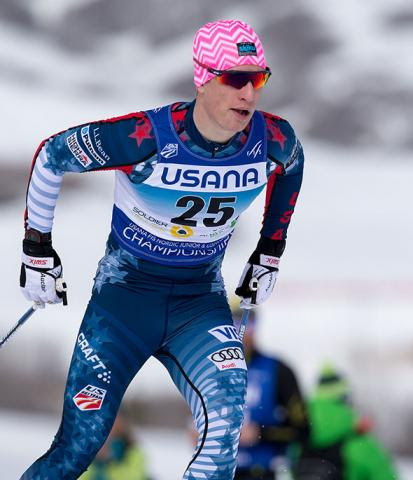
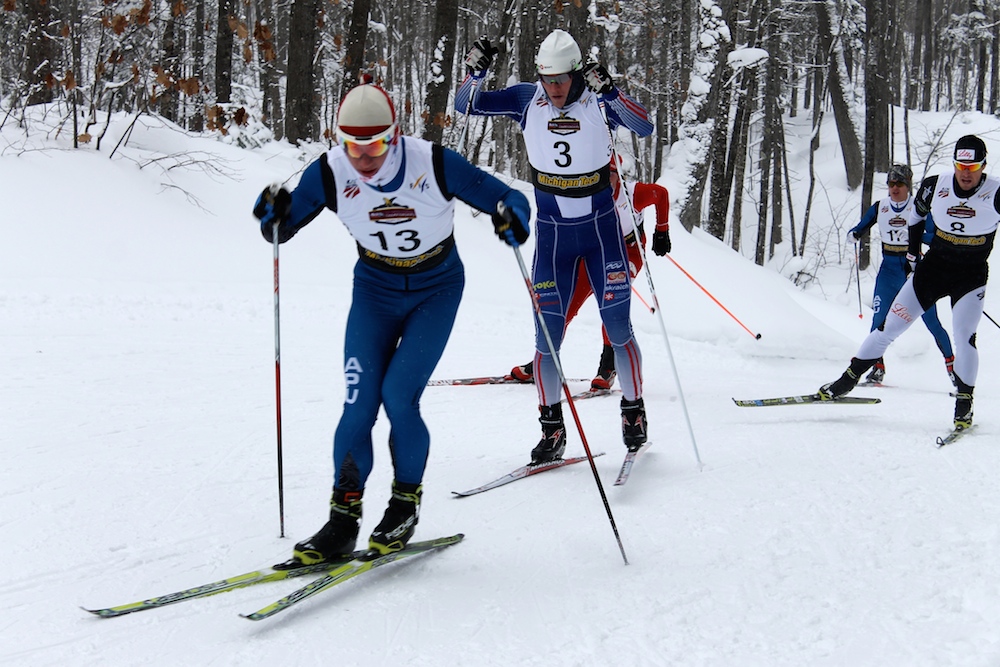
    American Hunter Wonders (APU) racing to 16th in the men's 10 k freestyle at 2017 Junior World Championships on Wednesday at Soldier Hollow in Midway, Utah. (Photo: U.S. Ski Team/Steven Earl)
    American Hunter Wonders (APU) racing to 16th in the men’s 10 k freestyle at 2017 Junior World Championships on Wednesday at Soldier Hollow in Midway, Utah. (Photo: U.S. Ski Team/Steven Earl)

    Wonders’s time was 1:17.2 minutes back, which put him 16th in his first Junior Worlds race. He started 25th, two minutes behind his U.S. teammate Wyatt Gebhardt, of the Steamboat Springs Winter Sports Club. Gebhardt ended up 19th (+1:21.9), also in his Junior Worlds debut.

    Also for the U.S, Bill Harmeyer (University of Vermont) placed 29th (+2:02.6) and Lance McKenney 61st (+4:23.3).

    Following Gebhardt in 19th, Canada’s Gareth Williams, of the Telemark Race Team in Kelowna, B.C., placed 20th (+1:24.6) in his first Junior Worlds race. His Canadian teammates Antoine Blais (Skibec) followed in 32nd (+2:07.8), Philippe Boucher (CNEPH) 35th (+2:10.3), and Remi Drolet (Black Jack) 50th (+2:49.1).

    “This and the skiathlon were both my target races after not qualifying for Canada’s sprint team,” Williams explained in an email. “In my head I wanted to be inside the top 20 on the day, but since it is my first Worlds race I had no idea what to expect.”

    Toward the end of the second lap, he started cramping.

    “This made it difficult for me to give a proper finishing kick on the last few hills. I was getting splits that I was fighting for a top 20, so for me that was motivating,” Williams wrote. “Overall I am happy with the day, top 20 is something to be pleased with. Now that I have a taste of what it’s like here at Worlds, I can adjust my goals for the coming races. I hope tomorrow’s skiathlon can go equally as well, if not better.”

    Results: Women | Men

  • Wednesday Rundown: Ogden Fifth in Junior Worlds 5 k Freestyle (Updated)

    Katharine Ogden (Stratton Mountain School/U.S. Ski Team D-team) racing to fifth in the women's 5 k freestyle at 2017 Junior Worlds on Wednesday for her best result in her third Junior Worlds. (Photo: FlyingPointRoad.com)
    Katharine Ogden (Stratton Mountain School/U.S. Ski Team D-team) racing to fifth in the women’s 5 k freestyle at 2017 Junior Worlds on Wednesday for her best result in her third Junior Worlds. (Photo: FlyingPointRoad.com)

    FIS Nordic Junior World Championships (Midway, Utah): 5/10 k freestyle

    Coming into 2017 Junior World Championships with a career-best individual of sixth at Junior Worlds (which she achieved in the 10-kilometer skiathlon two years ago), Katharine Ogden of the Stratton Mountain School (SMS) and U.S. Ski Team (USST) D-team did one better on Wednesday, racing to fifth in the women’s 5 k freestyle individual start at Soldier Hollow in Midway, Utah.

    Ogden started 54th and initially finished third, behind Russia’s Mariya Istomina and Italy’s Anna Comarella, respectively. That was a good spot to be in, considering there were only 57 starters.

    But the final two women out on course, Norway’s Marte Mæhlum Johansen in bib 56 and Sweden’s Ebba Andersson in bib 57 ultimately bumped Ogden out of third, then fourth, respectively. Andersson took the win in 12:45.4 minutes, finishing 13.8 seconds faster than Johansen in second. Istomina held on for third (+15.3), Comarella was fourth (+18.5), and Ogden was 6.5 seconds off the podium in fifth (+21.8) for her best result in three Junior Worlds.

    The U.S. had three women in the top 20 with Hannah Halvorsen (Sugar Bowl Academy/USST) in 13th (+1:01.2) and Taeler McCrerey (University of Denver) in 20th (+1:18.9). The team’s fourth woman, Hailey Swirbul (University of Alaska Anchorage) placed 31st (+1:35.5).

    Lisle Compton (NTDC Thunder Bay) led the Canadian women in 39th (+1:51.9), Annika Richardson (NTDC Thunder Bay) finished 41st (+1:57.8), Claire Grall-Johnson (Nakkertok) was 42nd (+1:58.2), and India McIsaac (Rocky Mountain Racers) 46th (+2:12.9).

    [UPDATED] In the men’s 10 k freestyle that followed, Vladislav Vechkanov, the fifth qualifier in Monday’s classic sprint, led a Russian podium sweep. He won in 23:08.6, 7.9 seconds ahead of his teammate Egor Kazarinov, while the third Russian, Yaroslav Rybochkin was 13.3 seconds back.

    Two Americans finished in the top 20, with Hunter Wonders (Alaska Pacific University) in 16th (+1:17.2) and Wyatt Gebhardt (Steamboat Springs WSC) in 19th (+1:21.9). Also for the U.S, Bill Harmeyer (University of Vermont) placed 29th (+2:02.6) and Lance McKenney 61st (+4:23.3).

    Gareth Williams (Telemark) led the Canadians in 20th (+1:24.6), Antoine Blais (Skibec) finished 32nd (+2:07.8), Philippe Boucher (CNEPH) placed 35th (+2:10.3), and Remi Drolet (Black Jack) 50th (+2:49.1)

    Results: Women | Men

  • Under 23 Questions with Philippe Boucher

    Under 23 Questions with Philippe Boucher

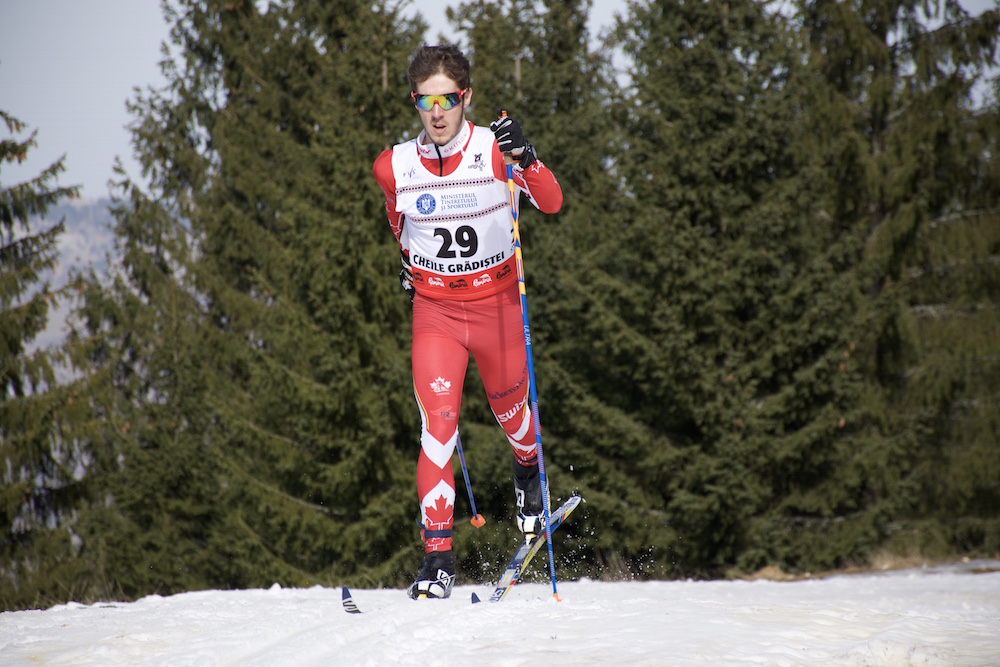
    Canada's Philippe Boucher racing at last year's Junior World Championships in Rasnov, Romania. (Courtesy photo)
    Canada’s Philippe Boucher racing in the 10 k classic at last year’s Junior World Championships in Rasnov, Romania. (Courtesy photo)

    In an effort to showcase the North Americans competing at this week’s International Ski Federation (FIS) 2017 USANA Nordic Junior World Championships and U23 Cross Country World Championships at Soldier Hollow in Midway, Utah, we asked those qualifying athletes several questions about themselves — actually, we had them fill in the blanks. Here we have 19-year-old Philippe Boucher, of the Centre National d’Entraînement Pierre-Harvey (CNEPH), a.k.a. the Pierre-Harvey National Training Centre and Canadian Junior National Ski Team, who’s representing Canada at his third Junior Worlds.

    Boucher was listed as one of four Canadian men to start Wednesday’s 10 k freestyle.

    ***

    “My full name is Philippe Boucher, but you can call me Phil. I was born in Quebec City, raised in Lévis. I started cross-country skiing when I was seven, thanks to my parents.

    I currently train in Beaupré with CNEPH.

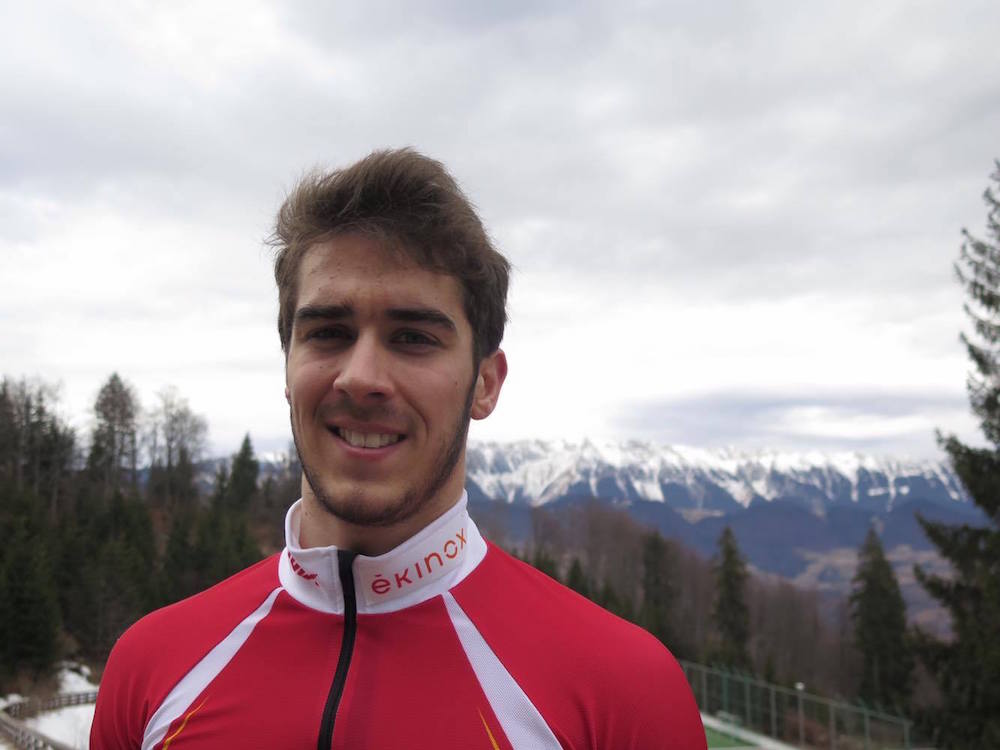
    Philippe Boucher (Photo: Charles Castonguay)
    Philippe Boucher (Photo: Charles Castonguay)

    If I’m not skiing, you might find me on my bike or at my girlfriend’s place.

    If I had to pick a favorite book, it would be nothing. I really don’t enjoy reading, exept when it talks about Formula One stuff.

    One of the things I’m most excited about for Junior Worlds at Soldier Hollow is to race in front of my family. One race I’m especially targeting there is the banquet on the February 4. Just kidding, the 10 k skate.

    The best advice anyone ever gave me about skiing or racing was don’t worry about the splits, just ski. One of the best race memories I have is the 2013 Canadian National Championships in Whistler.

    If I could meet one World Cup skier, it would be nobody, but I’d like to go do mountain bike with a guy on the UCI Mountain Bike World Cup circuit.

    If I don’t end up being a professional skier, I’ll probably be a police officer.

    I’m missing 11 days of school to be here and 27 days in the whole semester, and my teachers are probably thinking, ‘He’s probably going to fail my course.’

    You can follow me on Instagram or Twitter at @p_boucher97.”

  • Russians Dominate Skiathlon at Junior Worlds as Torchia Takes 11th, Dumas 18th

    Russians Dominate Skiathlon at Junior Worlds as Torchia Takes 11th, Dumas 18th

    Ian Torchia on his way to an 11th-place finish in the 10/10 k skiathlon at the 2015 Junior World Championships in Almaty, Kazakhstan  (Photo: Bryan Fish)
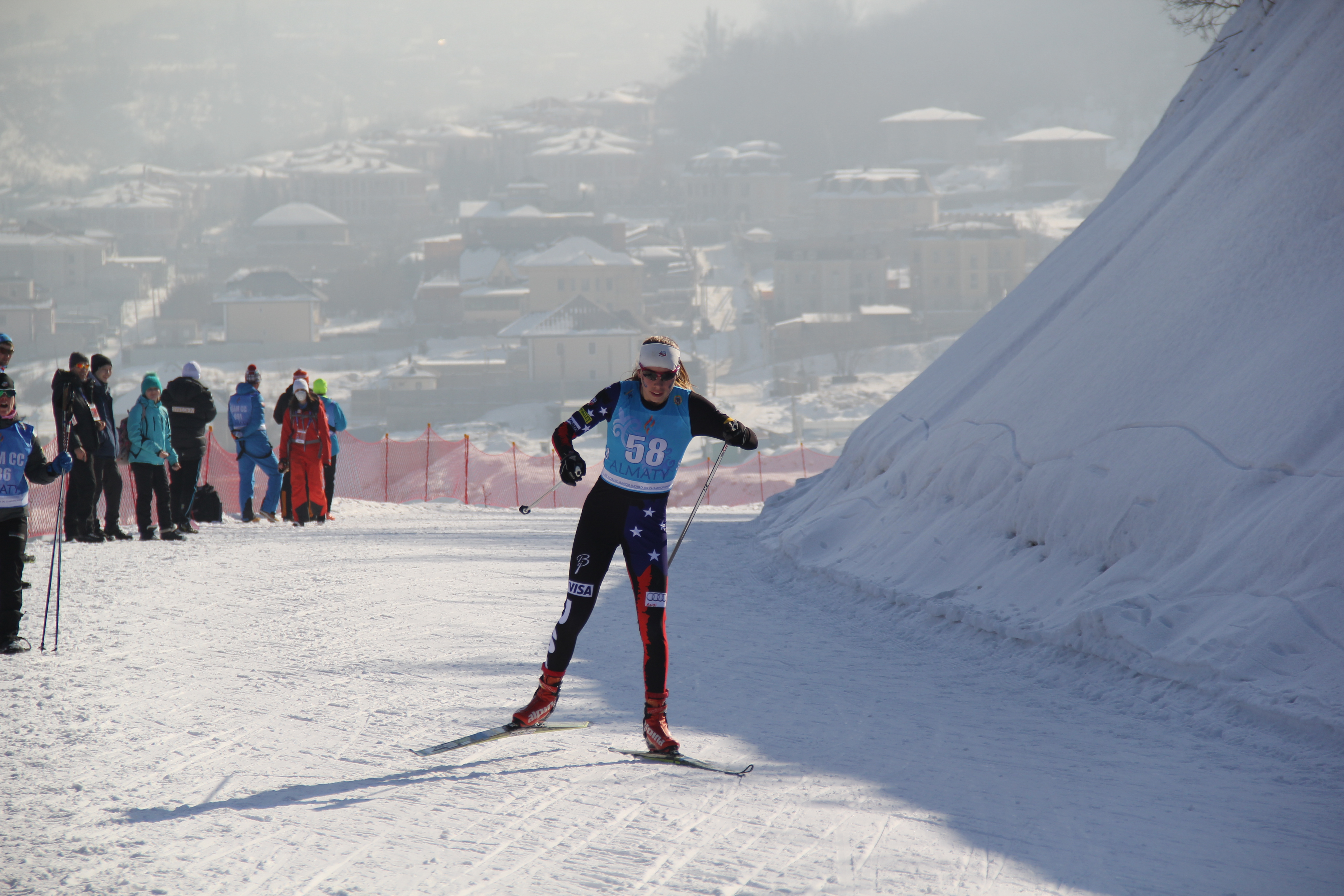
    American Ian Torchia (Northern Michigan University) on his way to an 11th-place finish in the 20 k skiathlon on Friday at the 2015 Junior World Championships in Almaty, Kazakhstan. (Photo: Bryan Fish/USSA)

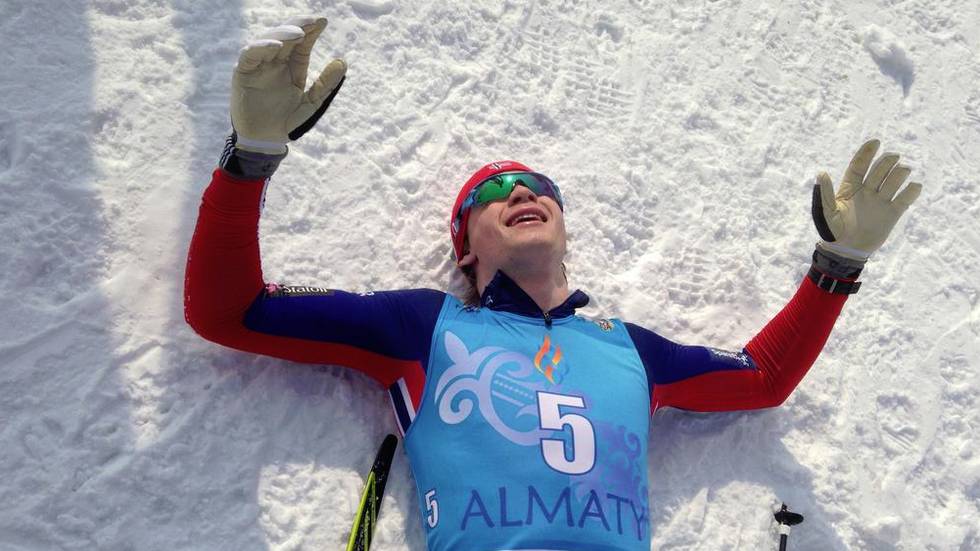
    Earning the best finish for an American male at this year’s Junior World Championships, Ian Torchia narrowly missed the top 10 in Friday’s 20-kilometer skiathlon in Almaty, Kazakhstan. He placed 11th and finished 2:15 behind winner Alexey Chervotkin of Russia (48:53.3).

    Torchia (Northern Michigan University) explained in an email that he started in the back of the pack and managed to avoid a crash before picking off other skiers throughout the classic portion. He was 13th going into the exchange – 48.7 seconds behind Chervotkin, who had the fastest classic leg in 24:10.7 – and wrote that in the skate portion he skied with two other skiers vying for 10th.

    “Going into the final downhill I was 11th and one of them went down,” the 18-year-old Torchia wrote. “For a split second I had a moment of elation as I moved into 10th but a Swede [Axel Ekström] sling-shotted right by me to outsprint me for 10th.”

    Torchia added that he was excited to finish 11th, especially considering he has one more year of eligibility as a junior.

    He wrote that the goal for his first Junior Worlds was to finish in the top 15 of both distance races. While he was discouraged by his 35th-place finish in Wednesday’s 10 k freestyle, he was motivated after watching teammate Katharine Ogden finish sixth in the women’s skiathlon an hour before the men’s start on Friday.

    “It really fired me up to go out there and move up as much as possible,” he wrote.

    U.S. Ski Team Head Coach Chris Grover tweeted his support after Friday’s race, writing, “Huge results by Katherine Ogden and Ian Torchia today in Almaty. Some of the best WJC results in U.S. distance history. Congrats to all!”

    Torchia added that seeing the Russian domination at Junior Worlds is “unbelievable” and will be a source of inspiration during training this coming summer.

    The Russian team has indeed been dominant, sweeping the junior men’s podium for the second consecutive race. Finishing just behind Chervotkin, Ivan Yakimushkin was second (+1.6) and Denis Spitsov took third (+2.5), nearly a minute ahead of fourth-place Eirik Sverdrup Augdal of Norway (+1:00.9).

    “We didn’t expect that we will be standing together on the podium … there [was] no strategy from the beginning of the race,” Yakimushkin told the International Ski Federation (FIS). “When we [overtook] all the rest, we started to work harder supporting each other.”

    Spitsov said to FIS that the amazing weather conditions — the sun was out and the temperature hovered around freezing during the race — helped him collect his second medal of Junior Worlds.

    “I did my best and am satisfied with the result. I would also like to congratulate my teammates; great day for the Russian team!” he said.

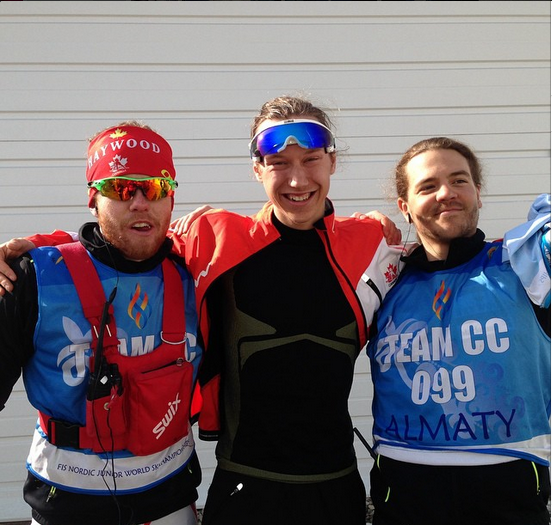
    Alexis Dumas (center) of Canada placed 18th in the 10/10 k skiathlon at the 2015 Junior World Championships (Photo: Lisa  Patterson/Cross Country Canada)
    Alexis Dumas (center) of Canada, with wax technician Simon Boisvert and Coach Charles Castonguay, placed 18th in the 20 k skiathlon at the 2015 Junior World Championships (Photo: Lisa Patterson/CCC)

    Alexis Dumas, of the Pierre-Harvey National Training Centre (CNEPH) and the Canadian National Junior Team, was the top Canadian in 18th (+2:41.6).

    “My race went really well. I’m super happy with the result. I knew that if I was in good shape and the skis were good I could make the top 20,” the 19-year-old Dumas wrote in an email.

    He added that his wax technicians gave him incredible skis for both the classic and skate portions.

    He wrote that the start of the race was chaotic, but like Torchia, he was able to avoid falling like many of the other skiers. At the end of the first lap, he skied aggressively enough to put himself in a good position, and at one point found himself skiing just beside the Russians in the first line. However, he relaxed a bit and was not able to maintain the furious pace of the Russian-led lead pack.

    After the classic portion, he was 17th, and 1:00.2 behind Chervotkin.

    “In skate I just tried to stay with the guys in front of me, but I was starting to feel very tired,” he wrote.

    Despite the exhaustion, Dumas was able to break away from the group he was skiing with and ended up chasing Norway’s Gaute Kvaale in the final kilometer. He made up significant ground but, as he said in a Cross Country Canada press release, was not able to “close the deal” at the finish. He ended up just 0.4 seconds behind Kvaale (51:34.5).

    Dumas said that making the top 20 gives him a major boost in confidence, especially as he transitions to the U23 category next year.

    While the rest of the North American men were outside the top 30, a few crashed in the frantic start. U.S. Ski Team Development Head Coach Bryan Fish wrote in an email to the press that Evan Weinman damaged a classic ski and Thomas Bye broke a pole.

    He added that the crashes at the start were the result of the course’s technical nature along with fast snow conditions.

    Weinman (Middlebury) would end up finishing 57th (+6:19.1) and Thomas Bye (Michigan Tech) placed 67th (+9:14.8) out of 69 finishers.

    On the Canadian side, Ricardo Izquierdo-Bernier (CNEPH/NST-Junior) took 41st (+5:07.6) and had the 28th-fastest skate ski, while teammate Philippe Boucher (CNEPH/NST-Junior) was 53rd (+6:13.0) and Zachary Cristofanilli (CNEPH/NST-U23) finished in 60th (+7:22.1).

    Junior Worlds finish in Almaty on Sunday with the men’s 4 x 5 k relay and the women’s 4 x 3.3 k relay.

    – Chelsea Little and Alex Kochon contributed reporting

    Results

  • Ogden 11th in Junior Worlds Debut; Russians Sweep Men’s Podium as Dumas Leads North Americans

    Ogden 11th in Junior Worlds Debut; Russians Sweep Men’s Podium as Dumas Leads North Americans

    Katharine Ogden (SMS) placed 11th in Wednesday's 5 k freestyle in the Junior World Championships in Almaty, Kazakhstan.
    Katharine Ogden (SMS) placed 11th in Wednesday’s 5 k freestyle in the Junior World Championships in Almaty, Kazakhstan. (Photo: Bryan Fish/USSA)

    American Katharine Ogden (Stratton Mountain School) made the most of her World Junior Championships debut, placing 11th in the women’s 5-kilometer freestyle individual start on Wednesday in Almaty, Kazakhstan. The 17-year-old Stratton Mountain School T2 Team athlete was the top North American skier and finished 24.5 seconds behind winner Victoria Carl of Germany.

    Ogden is coming off a U.S. Nationals performance where she placed sixth in the 10 k freestyle and won the juniors’ 5 k classic mass start.

    Ogden wrote in an email that her strategy was to ski hard throughout the race and focus on the uphills – where she thought she could make up the most time. Going into the race, she was hoping for a top-20 result but wrote that she did not know what to expect.

    “I skied the whole race pretty hard because everyone was saying that the people here go out really hard and keep going really hard,” Ogden explained, adding that she skied alone except when she briefly skied with a Swiss skier who started in front of her.

    Ogden wrote that the experience at Junior Worlds has been incredible.

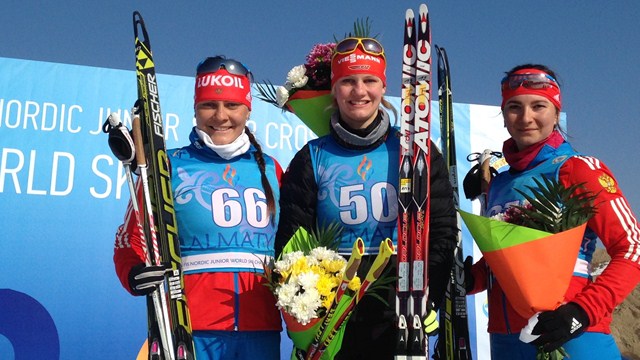
    Victoria Carl of Germany (50) tops the podium after winning the women's 5 k freestyle at the Junior World Championships in Almaty, Kazakhstan. Anastasia Sedoiva of Russia (66) was second and Natalia Nepryaeva was third. (Photo: FIS)
    Victoria Carl of Germany (50) tops the podium after winning the women’s 5 k freestyle at the Junior World Championships in Almaty, Kazakhstan. Anastasia Sedoiva of Russia (66) was second and Natalia Nepryaeva was third. (Photo: FIS)

    “Everything here is new and exciting and different … I love skiing with all of the people from different countries and learning from them as well as learning from my amazing and talented teammates from the U.S.,” she wrote.

    Race-winner Carl skied to a time of 13:26.9 and gapped the field by over five seconds to earn her second victory of worlds. She also won Tuesday’s 1.3 k classic sprint.

    “It’s a big and very important moment for me personally and in my career. The day is unbelievable. It’s a very, very big success for me. The course is great! I would also like to thank my coaches and everybody, who supported me today,” she said in a post-race interview with the International Ski Federation (FIS).

    Rounding out the women’s podium were two Russians – Anastasia Sedova was 5.3 seconds off pace in second, while Natalia Nepryaeva finished 5.9 seconds behind to take third.

    “The course was hard and difficult, but I was well prepared for today’s race. I had some troubles with my legs, but I coped with it,” Sedova told FIS.

    Nepryaeva explained to FIS that the course was difficult, but her training at the venue this season was a large factor in her second third-place finish in as many days.

    Meanwhile, Katherine Stewart-Jones (Nakkertok) led the Canadian women in 25th (+1:05.0)

    The race comes a day after Stewart-Jones earned a 19th place performance in Tuesday’s 1.3 k classic sprint. The 19-year-old found success at the international level prior to Kazakhstan. She earned 15th in the freestyle sprint at the 2014 Junior World Championships freestyle sprint in Val di Femme, Italy.

    Stewart-Jones wrote in an email that she was happy with the result, especially when recalling a 56th-place finish in the same event at Junior Worlds two years ago.

    “I felt a lot better than I thought I would and sort of expected to have to push to keep the same pace during the second half, but that wasn’t the case,” she explained, adding that while coaches were giving her splits she was not focused on her place during the race.

    Stewart-Jones maintained a consistent pace throughout the race, as she was also 25th at the 1.7 k split.

    Teammate Anne-Marie Comeau (CNEPH/NST) crossed the 1.7 k split in 21st but eventually fell to 39th (+1:23.2). Two fellow Canadians finished back-to-back – Annah Hanthorn (Whitehorse) was 44th (+1:35.8) and Maya Macisaac-Jones (Rocky Mountain Racers/NST) placed 45th (+1:36.6).

    American Vivian Hett of North Michigan University (NMU) was right behind in 46th (+1:42.8), followed by two teammates – Kristen Bourne (NMU) in 51st (+1:53.6) and Alayna Sonnesyn (University of Vermont) in 52nd (+2:04.2).

    Dumas Cracks Top 30 to Lead North Americans

    Russian skiers dominated the men’s 10 k freestyle, snagging the top four places, while Canada’s Alexis Dumas (CNEPH/NST) was the lone North American skier to finish in the top 30. The 19-year-old took 30th, and crossed the line 2:09.3 minutes behind winner Alexey Chervotkin (23:36.4).

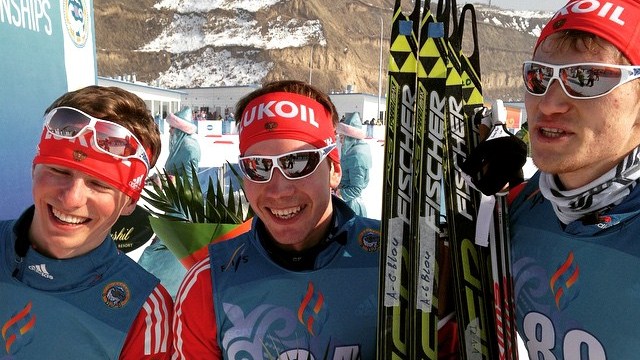
    Desis Spitsov was 15.9 seconds back from his teammate to take second, while Alexander Bakanov trailed by 34.4 to take third. The Russian trio told FIS that their sweep was indicative of Russian skiing and that they were pleased to share the podium with teammates.

    Russians Alexey Chervotkin, Denis Spitsov, and Alexander Bakanov swept  the podium in the Junior World Championships 10 k freestyle in Almaty, Kazakhstan (Photo: FIS)
    Russians Alexey Chervotkin, Denis Spitsov, and Alexander Bakanov swept the podium in the Junior World Championships 10 k freestyle in Almaty, Kazakhstan (Photo: FIS)

    “We are extremely glad to stand on the podium together,” Chervotkin said.

    “I’m glad to stand here with my teammates also. I hope the other days of competitions will be successful for the Russian team too,” Bakanov added. His third-place performance comes off a second-place finish in Tuesday’s sprint.

    Meanwhile, Dumas wrote in an email that his plan was to start strong, as he is typically a slow starter.

    “In an event like World Juniors you cannot afford to be conservative. You have to hammer as hard as you can and if you fade, at least you tried,” he wrote.

    Dumas started strong, and was 21st overall at the 1.7 k split. He later faded to 34th after 5 k. He explained that his race went well but he felt there was a potential for a better result, as he felt he could have skied with more speed on the last lap and on the course’s downhill section.

    Dumas added that he likes the difficulty of the course along with its long climbs.

    “You have to be strong in your head to continue pushing hard. I think I’m good with dealing with the pain and that really helped me today because I definitely felt pain all through my body,” he wrote.

    Dumas improved on his results from the 2014 Junior Worlds in Italy, where he finished 60th in the 20 k skiathlon and 46th in the 10 k classic.

    “My experience from last year in Val di Femme definitely helped me. I was a lot more confident. Last year, I wasn’t feeling good at all, but I learned a lot and this year I was ready to perform,” he explained.

    American Ian Torchia of Northern Michigan University of was the next North American finisher, taking 35th (+2:20.2), and Canada’s Philippe Boucher (CNEPH/NST) was right behind in 40th (+2:24.4). Thomas O’Harra of Alaska Pacific University – who placed 14th overall in Tuesday’s sprint – finished 49th (+2:36.3).

    After the sprint was pushed back on Tuesday due to air-quality concerns, the air was clearer on Wednesday, according to Ogden.

    She wrote that since the race started at 11 am, the pollution was fairly under control, as the smog remains in the valley and the city of Almaty in the morning before gradually rising into the mountains throughout the day.

    “I didn’t notice it during the race, although afterwards I did have a bit of a weird cough,” she added.

    Nakkertok Head Coach Kieran Jones wrote an email on Tuesday, “That stuff is out of our control. That’s always been the message — control what you can, and don’t worry about anything else.”

    Racing in Kazakstan continues Thursday with the U23 10/15 k freestyle interval starts.

    — Chelsea Little and Lander Karath contributed reporting

    Results: Men | Women

  • O’Harra 14th in Classic Sprint for Junior Worlds Best; Stewart-Jones Leads Three Canadian Women in Heats

    O’Harra 14th in Classic Sprint for Junior Worlds Best; Stewart-Jones Leads Three Canadian Women in Heats

    An exhausted-and-ecstatic Fredrik Riseth of Norway after winning his first Junior World Championships title on Tuesday in the 1.3 k classic sprint. (Photo: FIS)
    An exhausted-and-ecstatic Fredrik Riseth of Norway after winning his first Junior World Championships title on Tuesday in the 1.3 k classic sprint. (Photo: FIS)

    Last year in his FIS Junior World Ski Championships debut, Thomas O’Harra placed 54th in the freestyle sprint in Val di Fiemme, Italy. Another year older and with another season of training under his belt, the 18-year-old Alaska Pacific University (APU) skier placed 14th on Tuesday in the opening race of 2015 Junior Worlds in Almaty, Kazakhstan: the 1.3-kilometer classic sprint.

    Thomas O'Harra (APU) leading his freestyle-sprint quarterfinal with Sun Valley's Miles Havlick (3) and Kris Freeman last month at 2015 U.S. nationals in Houghton, Mich.
    APU’s Thomas O’Harra (13) leading his freestyle-sprint quarterfinal with Sun Valley’s Miles Havlick (3) and Kris Freeman (8) last month at 2015 U.S. senior nationals in Houghton, Mich. He went on to place 18th overall.

    O’Harra qualified 18th and went on to place third in his quarterfinal, 2.92 seconds behind the winner of his heat, Ludek Seller of the Czech Republic, and 0.35 seconds behind Russia’s Alexander Bakanov, who also automatically advanced in second.

    O’Harra’s quarterfinal was the slowest of the five, which prevented him from moving on to the semifinals as a lucky loser. But at the end of the day, 14th was still way better than 54th.

    “I don’t know if I can say I was expecting it, but I definitely knew that if I had a good race, I could get into the top 30,” O’Harra wrote in an email on Tuesday. “Coming into the sprint, my goal was to qualify. Ultimately though, my goal was to get into the top 10. Once I had qualified, I focused more on trying to advance out of my quarterfinal.”

    He reflected that his quarterfinal was “pretty hard right off the bat … everyone was jostling for position.” Knowing that he needed a top-two in his heat to guarantee a spot in the semifinal, O’Harra followed Bakanov in his track to the finish and lunged between the Russian’s legs as Bakanov let up near the line. And while it wasn’t quite enough, O’Harra was pleased to finish well within the top 30.

    “Today was a much better experience than last year’s sprint!” he wrote. “Last year I tripped myself going up the first hill and ended up 54th — not exactly super-duper. I think that a year’s more experience helped a lot. I was definitely a lot more collected and calm this year, both going into the race and during the race.”

    He was also optimistic about another top 30 in Wednesday’s 10 k freestyle.

    “I think that I’m in a really good place right now, but I didn’t actually try to peak specifically for these races, mainly because there is still a lot of racing left this season,” he wrote.

    “Last year I tripped myself going up the first hill and ended up 54th — not exactly super-duper. I think that a year’s more experience helped a lot.” — Thomas O’Harra, 14th in 2015 Junior World Championships 1.3 k classic sprint

    O’Harra led the North Americans in the junior men’s sprint, which Norway’s Fredrik Riseth won outright in 3:01.25. The Norwegian qualified fifth behind Finland’s Lauri Vuorinen (the top men’s qualifier in 3:01.88), and Riseth went on to win his quarterfinal and his semifinal before beating Bakanov by 4.85 seconds in the final.

    Norway’s Johannes Høsflot Klæbo made the podium as well in third, 8 seconds behind Riseth. Germany’s Marius Cebulla was fourth (+10.04), Sweden’s Oskar Svensson finished fifth (+10.11), and Vuorinen was sixth (+21.67).

    Riseth’s father, Svein Riseth, told Langrenn that he was impressed with his son’s result. While he knew Fredrik was in great shape, Svein wasn’t sure he had enough left after dominating his quarterfinal and semifinal. The contender he was most concerned about was Fredrik’s Byåsen IL teammate, Høsflot Klæbo.

    “Johannes is not only a good skier, but he is mentally and tactically strong,” Svein said, according to a translation. “It is outrageously fun two Byåsen runners entered the podium. Not just for the team but for [Trondheim] skiing.”

    While no other North American men qualified in the top 30, Canada’s Julian Smith (Georgian Bay) placed 39th, 3.82 seconds from 30th. Americans Evan Weinman (Middlebury) and Peter Holmes (University of New Hampshire) were 46th and 48th, respectively, Canada’s Alexis Dumas (CNEPH/NST-Junior) ranked 53rd, Ricardo Izquierdo-Bernier (CNEPH/NST-Junior) was 56th, American Gavin Hess (UNH) 58th, and Canadian Philippe Boucher (CNEPH/NST-Junior) 59th.

    Stewart-Jones Leads Three Canadian Women in the Heats

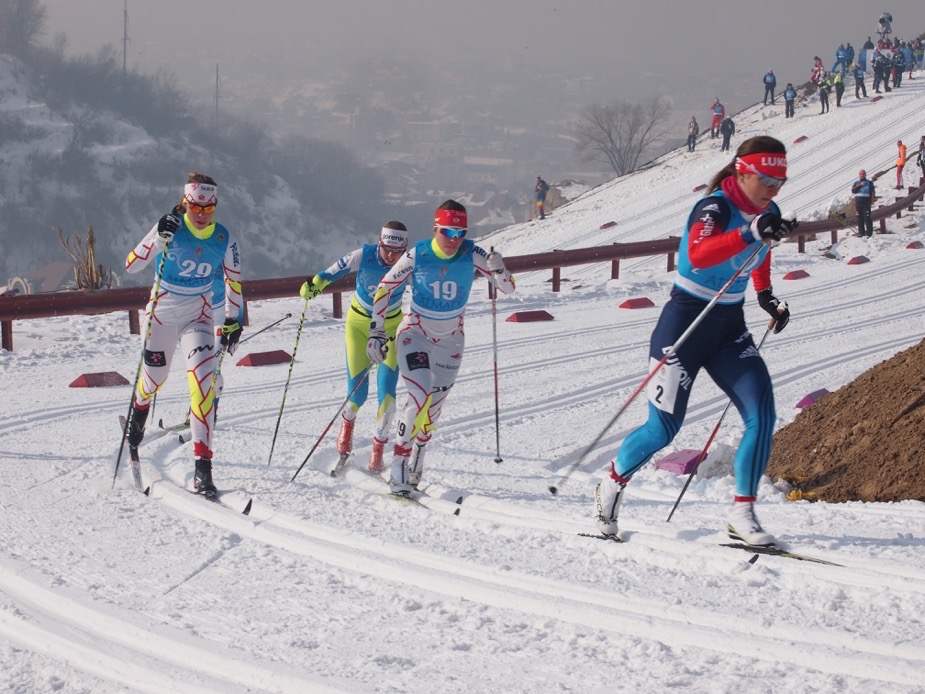
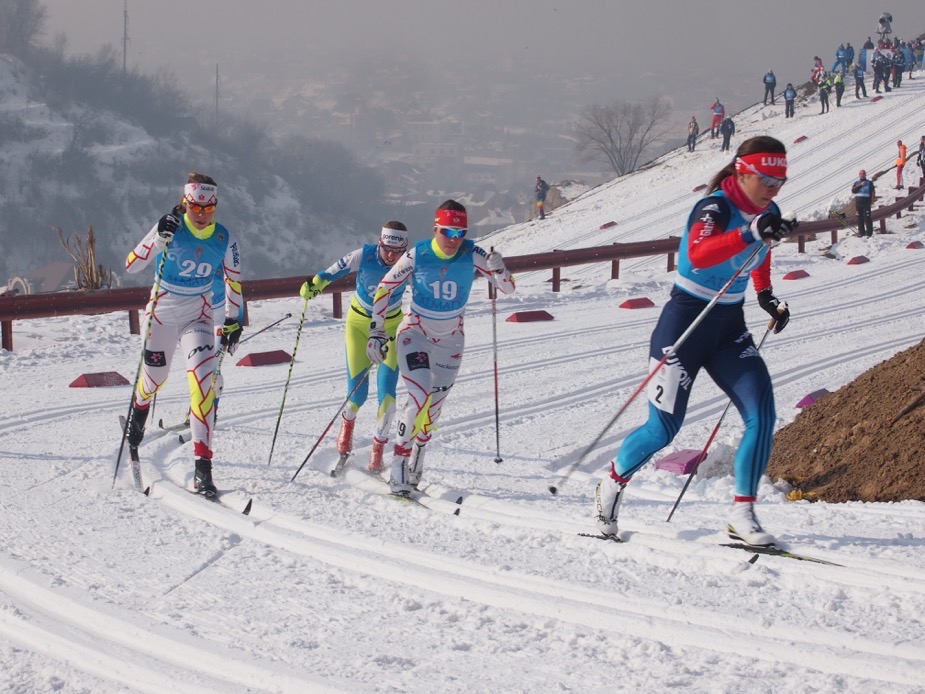
    Canadian National Junior Team members Katherine Stewart-Jones (19) and Maya MacIsaac-Jones (29) chase Russia's Natalia Nepryaeva (2) in the quarterfinal of the 1.3 k classic sprint on the opening day of 2015 Junior World Championships in Almaty, Kazakhstan. (Photo: Lisa Patterson/CCC)
    Canadian National Junior Team members Katherine Stewart-Jones (19) and Maya MacIsaac-Jones (29) chase Russia’s Natalia Nepryaeva (2) in the quarterfinal of the 1.3 k classic sprint on the opening day of 2015 Junior World Championships in Almaty, Kazakhstan. (Photo: Lisa Patterson/CCC)

    In the women’s 1.3 k classic sprint, Katherine Stewart-Jones knew what was coming, or at least what to expect, in her third time qualifying for the Junior Worlds heats.

    The 19-year-old Canadian National Junior Team member qualified in 19th, 13.61 seconds behind Russia’s Yulia Belorukova, the top qualifier in 3:29.24. Stewart-Jones then finished fourth in her quarterfinal, 9.77 seconds after another Russian, Natalia Nepryaeva, who won the heat. Their quarterfinal was the second slowest and Stewart-Jones did not advance, putting her in 19th overall.

    “I am satisfied with my result,” Stewart-Jones, the top North American female junior of the day, wrote in an email. “I definitely had the goal to make it past the quarter-finals because last year I was extremely close. I can’t really be disappointed with how it turned out because I gave everything I had.”

    “I definitely had the goal to make it past the quarter-finals because last year I was extremely close. I can’t really be disappointed with how it turned out because I gave everything I had.” — Katherine Stewart-Jones, 19th in 2015 Junior World Championships 1.3 k classic sprint

    Last year at Junior World Championships, she placed 15th in the freestyle sprint, and the year before, she was 25th at the 2013 Junior Worlds in Liberec, Czech Republic.

    But for the first time on Tuesday, she raced against one of her fellow national-junior team members in the heats: Maya MacIsaac-Jones of Rocky Mountain Racers (RMR).

    “We both had a really good start so it was fun to ski at the front together for the first part of the race,” Stewart-Jones explained. “After the long downhill I was in third place but then I made a bit of a tactical mistake. At the start of the long uphill I went right behind a Russian but she slowed down. When I went to make the pass and change lanes I lost my momentum.”

    MacIsaac-Jones, 19, made the top-30 qualifying cutoff in 29th and ended up fifth in her first time racing the heats at that level, 12.05 seconds behind the winner.

    “Katherine and I have raced together for a long time, and since there are so many things at World Juniors that are different from racing in Canada, it was nice to have a familiar face beside me,” MacIsaac-Jones wrote in an email. “My ‘realistic’ goal for today was to qualify, and my ‘dream’ goal was to get a top-15 result. I am very happy to have qualified for the heats, especially to have qualified with two of my teammates, but I am disappointed that I wasn’t able to move on past the quarter final.”

    Her previous best in her last Junior Worlds in 2013 was 36th in the classic sprint. On Tuesday, she placed 25th overall. The third Canadian woman to make the rounds, Sophie Carrier-Laforte (Skinouk/NST-Junior) qualified in 23rd and placed 22nd overall after finishing fifth in her quarterfinal, 12.21 seconds behind Austria’s Lisa Unterweger, who won the heat.

    “It was a lot of fun to be racing with so many other Canadian girls in the heats today,” MacIsaac-Jones wrote. “We have all been training really hard for these championships, so it feels great to show the world what Canadian girls can do!

    “This experience is definitely different from my experience in Liberec 2013,” she explained “I feel like I am in a lot better distance racing shape than I was in Liberec, and I should have a chance to race most or all of the distance races, which will be a lot of fun. This being my second Championships, I feel like I have a bit of a better idea of what to expect and how to prepare for racing on the international scene.”

    Stewart-Jones was also looking forward to the distance races after placing 31st in the skiathlon in Val di Fiemme last year.

    “I would like to make a top 15 in a distance race and I believe that I can,” she wrote.

    Nakkertok Head Coach Kieran Jones wrote in an email that Stewart-Jones’ performance on Tuesday wasn’t a surprise.

    “We have been targeting top 30’s at World Juniors since the start of the year. While I was pretty excited for the classic sprint, I would say that it’s definitely not her strongest event,” he noted. “It’s more of a good indicator that the fitness and speed is where we want it to be. Katherine is rock solid — once she gets rolling, she’s great at managing her energy, enthusiasm, and focus.”

    He explained that she’s shooting for top-30 results in both Wednesday’s 5 k freestyle and Friday’s 10 k skiathlon.

    “Personally, I think she has a shot at a top 10 in the 5 km if everything goes to plan,” Jones wrote. “She is also really looking forward to the relay — this year the Canadian women’s team is one of the strongest it has been in a long time, and she wants to help them have a strong finish.”

    Germany's Victoria Carl after notching her second Junior World Championships title and third podium in the first race of 2015 Junior Worlds in Almaty, Kazakhstan. (Photo: FIS)
    Germany’s Victoria Carl after notching her second Junior World Championships title and third podium in the first race of 2015 Junior Worlds in Almaty, Kazakhstan. (Photo: FIS)

    Just 0.26 seconds from qualifying in the top 30, Julia Kern of the Cambridge Sports Union led the U.S. junior women in 31st. Vivian Hett (Northern Michigan University) placed 36th, 3.89 seconds from 30th, and Hailey Swirbul (Aspen Valley Ski & Snowboard Club) was 40th.

    Canada’s Annah Hanthorn (Whitehorse) finished 45th, and American Kristen Bourne (NMU) placed 46th.

    Germany’s Victoria Carl racked up her second Junior Worlds title since she last raced at the championships in 2013 (where she won the 5 k freestyle and placed second in the classic sprint). Carl, 19, qualified fourth and won her quarterfinal and semifinal before topping the final as well in 3:29.01, 1.64 seconds ahead of Belorukova in second.

    Another one of the women in the Stewart-Jones/MacIsaac-Jones quarterfinal, Nepryaeva placed third in the final, 2.18 seconds back from the win. The Russian edged Norway’s Lotta Udnes Weng by 0.2 seconds for the podium, and Weng’s sister Tiril Udnes Weng placed fifth, 6.42 seconds after Carl. Germany’s Jenny Mann finished sixth in the final (+30.43).

    First Impressions

    The junior classic sprint was originally scheduled for Monday, then pushed back a day to allow more time to extend the 800-meter loop to 1.3 k. In addition to concerns about dirt and rocks on the trail, the air quality in Almaty continues to pose one of the biggest problems for athletes, with several U.S. athletes bringing ventilation masks to the championships.

    “The air quality is certainly an issue, but we all share this challenge,” U.S. Ski Team Development Coach Bryan Fish wrote in an email. “Many of our athletes purchased filtering masks before arriving. The same ones used [at the Summer Games] in Beijing.

    “They don’t wear them all the time — primarily when skiing,” he added. “The trails are uphill, so it depends how high the inversion is. Unfortunately there is no way to escape it in the city.  All the teams are staying in the city except Russia is an hour away in the mountains.”

    According to O’Harra, “Skiing here is… thin. When we arrived, there was only about 2.5k of trail, and that was full of rocks. The volunteers and organizers have done an amazing job, though! They have been blowing snow around the clock, and their hard work definitely shows,” he wrote. “The smog varies. It pretty much always sits down in the bottom of the valley, and most days it creeps up to where the trails are as we ski. It was definitely hazy today, but there have been worse days. I don’t think that it hindered my performance, but I still don’t like having it around.”

    MacIsaac-Jones wrote that the skiing over the last week had not been ideal; the postponement of the first race “altered everyone’s race preparations, and we have been dealing with heavy smog all week.”

    She added that there was adequate snow on the sprint course, “and there should be enough for the skate race tomorrow. The snow here is artificial, cold and hard-packed right now, which is great for me because it is similar to the snow I am used to training on in Canmore, Alberta,” she wrote.

    “The skiing here is nothing like I have seen before,” Stewart-Jones explained. “The race site is built at the top of a huge sand hill in the middle of the city. All the trails weave around the hill and the snow is all man made. … The smog is definitely an issue; I have been coughing a lot more than usual.”

    Through email exchanges, her coach Jones has been keeping tabs on the conditions.

    “That stuff is out of our control,” he wrote. “That’s always been the message — control what you can, and don’t worry about anything else. … Kath is great at that, so I wasn’t worried.”

    — Chelsea Little contributed reporting

    Results: Men | Women

  • Let It Snow: Despite Weather Woes, First Two NorAms in the Bag

    Let It Snow: Despite Weather Woes, First Two NorAms in the Bag

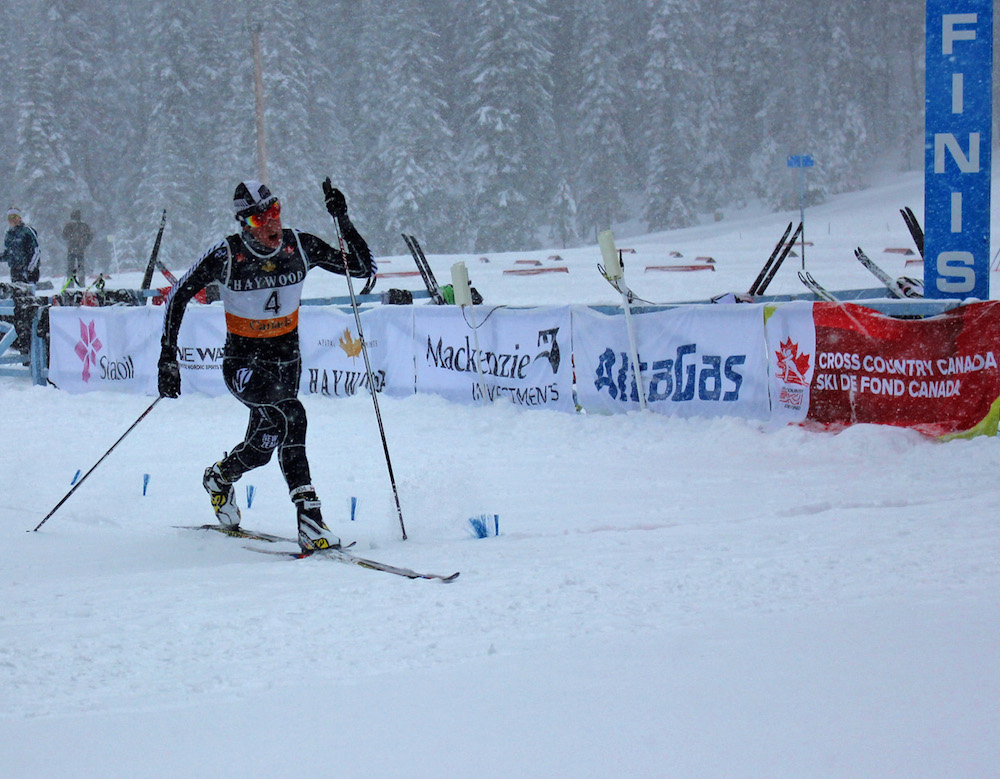
    Kris Freeman on his way to winning the 30 k freestyle interval start by more than a minute and a half on Dec. 20 at the Sovereign Lake NorAm in Vernon, B.C. (Photo: Frances Weeks)
    Kris Freeman on his way to winning the 30 k freestyle interval start by more than a minute and a half on Dec. 20 at the Sovereign Lake NorAm in Vernon, B.C. (Photo: Frances Weeks)

    Canada’s NorAm circuit is what the International Ski Federation (FIS) calls a Continental Cup series, similar to the U.S. SuperTour.  The name NorAm is short for North American, a hold-over from when Canada and the U.S. had a combined race series.  These races are critical to the elite racers, with guaranteed World Cup starts, national-team positions, and trips to Junior/U23 World Championships in Almaty, Kazakhstan, on the line.

    Or to put it another way, it would take a major event to cancel a NorAm race — like perhaps a record-breaking storm in a unusually snowless early season.

    As organizing committees secured the final details for the first two NorAm weekends, a major storm was expected to bring heavy rain to most of southern British Columbia.

    By the end of the four-day storm, a Vancouver suburb had declared a state of emergency, heavy rain at 12-degree Celsius (54 Fahrenheit) had closed numerous ski resorts across B.C. (including Whistler Blackcomb). Seattle set weather records, and 220,000 people were without power in California.

    While all this was going on, organizers in La Clusaz, France, canceled their World Cup and later moved it to Davos, Switzerland, a venue which had previously avoided canceling its original race weekend because of a huge snow-moving effort largely funded by a retired alpine skier.

    Black Jack Ski Club

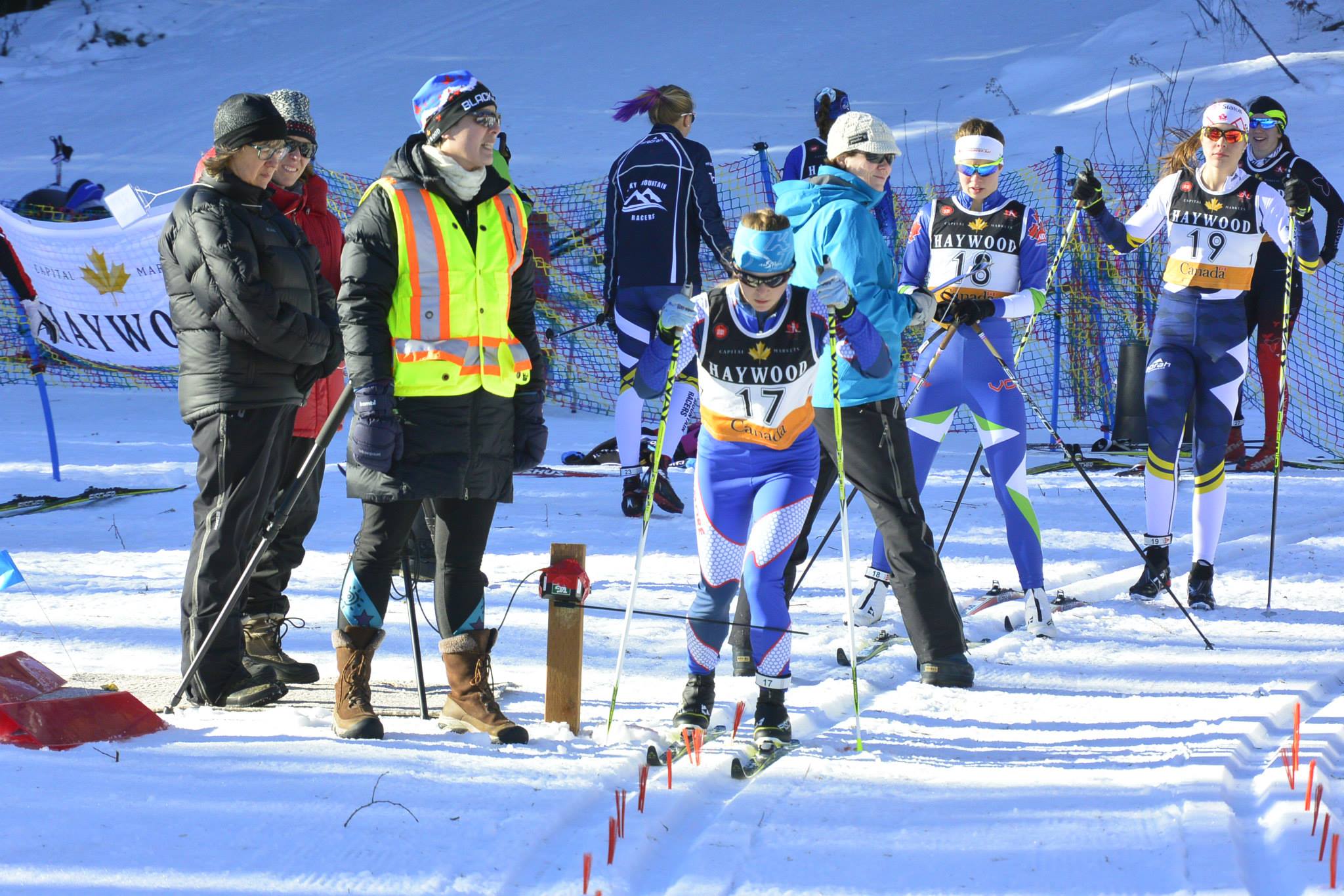
    The start of the women's 7.5 k classic at the Black Jack NorAm on Dec. 13 in Rossland, B.C. ( Saturday’s 11 k classic individual start at the NorAm opener in Rossland, B.C. (Photo: Fresh Cafe & apres/Facebook)
    The start of the women’s 7.5 k classic interval start at the Black Jack NorAm opener on Dec. 13 in Rossland, B.C. (Photo: Fresh Cafe & apres/Facebook)

    The first NorAm weekend this year was scheduled for Dec. 13-14, hosted by the Black Jack Ski Club in Rossland, B.C. Outside the province, Black Jack is best known as the club that produced George Grey (top-10 finisher at the 2010 Olympics) and the current home of long-time national team coach Dave Wood.

    When low snow, warm weather and predicted rain made the club’s homologated courses unsuitable for skiing, the club decided to move the opening races up to the biathlon trails, more than 200 meters (650 feet) higher in elevation. As the four-day storm progressed, the freezing level was up to 2,000 meters (6,500 feet) in the area, well above the 1400-meter(4,590-foot) elevation of the biathlon trails.

    When rain made the sprint loop unskiable two days before the race, the organizing committee didn’t give up. Club members, neighbours and team coaches spent hours shoveling snow onto the course. When another wave of rain destroyed the sprint course overnight, the organizing committee switched to two individual-start classic distance races and volunteers headed out again to shovel more snow onto the distance course.

    After four days of rain and a move to a higher venue without electricity or a timing building, the races were held. Generators provided power, live results were available on the internet and the event was generally agreed to be up to the Continental Cup standard.  Some 140 official volunteers plus an unknown number of shovelers made this possible.

    “We estimate we did about 130 man-hours of shovelling this week,” Chief of Competition Ian Sibbald wrote in an email.

    Unsolicited athlete quotes from the Black Jack NorAm

    “The volunteer base is incredible.  That is an astounding number [of volunteers] since only 3,500 people live in Rossland. Given the lack of snow, the conditions were great.” — Kris Freeman (Team Freebird)

    “Conditions were good! A few twigs poking through here and there, but tracks were fast and hard. Big thanks to the volunteers and organizing committee for working hard to run these races!” — Michael Somppi (Alberta World Cup Academy/Canadian Development Team)

    “Conditions were remarkable, especially considering the challenging weather the Black Jack Ski Club has been dealt. One would hardly know that though skiing the course, unless you look closely and notice all the shoveling marks on the side of the trail.” — Brian Gregg (Team Gregg/Madshus)

    “Conditions were much better than I expected, the organizers and groomers did an amazing job making the race happen with tough conditions and the tracks today were great!” — Alysson Marshall (AWCA/National Development Team)

    “Conditions today were amazing considering the weather … The race organizers and many volunteers from the town have worked hard to get a good track to make these races happen.” — Andrea Dupont (Rocky Mountain Racers)

    “The crew at Black Jack did an amazing job on the course, it was close to perfect considering what they had to work with. The tracks were great, I was very impressed.” — Dahria Beatty (AWCA/National U23 Team)

    “The course held together exceptionally well, due to the work of the volunteers and the slightly colder weather that appeared day of.” — Jennie Bender (Bridger Ski Foundation)

    Callaghan Valley Cross-Country

    Callaghan Valley Cross-Country (CVXC), the host of the second NorAm weekend, isn’t so much a ski club as it is a consortium of four clubs based in the Vancouver/Whistler area: Nordic Racers, Whistler Nordics, Hollyburn Jackrabbits, and Spud Valley Nordic. Squamish Nordic contributes, as do a number of other clubs from the province. For higher-level events, volunteers from other clubs commonly join in, either to add expertise to help the host club earn the event, or gain experience and knowledge so their own club can host similar events in the future.

    Scheduled the weekend before the holiday break, CVXC was on track with 85 volunteers with two weeks to go. Snow is rarely a problem at Whistler Olympic Park. In 2010, no provision for snow making was made and the Olympics were held on natural snow despite a seven-week block of rain that ended a week before the Olympics started.

    With very little snow and the forecast of the storm earlier this month, the organizing committee had to make a decision to commit, cancel or move the NorAm races with 12 days to go. On decision day, 100 millimetres (4 inches) of rain was forecast for the race venue.

    At this point, much of the sponsorship money had been spent, hundreds of volunteer hours had been invested, and teams had booked lodging and flights well in advance.

    With heavy rain falling at the venue, few people were surprised when organizers announced they were moving the races to Sovereign Lake in Vernon, B.C.

    Once the decision was made, the logistical headache began. The new venue is more than 400-kilometers away, which meant the existing volunteers wouldn’t be sleeping at home. Many of the teams had booked flights leaving Vancouver on Sunday night.  With two mountain passes and six-driving hours separating Sovereign from the airport, there wouldn’t be time to hold the planned events on Sunday.  Moving the races to Friday and Saturday solved the travel problem, but made the volunteer issue more difficult.

    At this level of competition, there are strict rules about roles and responsibilities. The assistant technical delegate, Sharon Clarke, was no longer eligible, as the new host was her home club. Clarke and the chief of competition, Sherryl Yeager, swapped roles before tackling the rest of the changes.

    “Having to change the event at such a late date due to weather is heartbreaking,” Yeager, also the CVXC vice chair, explained in an email. “All the work that went into planning, arranging sponsors, maps, courses, setting up run sheets, the race notice, registration, accommodation, food, the website and more is largely of no use.”

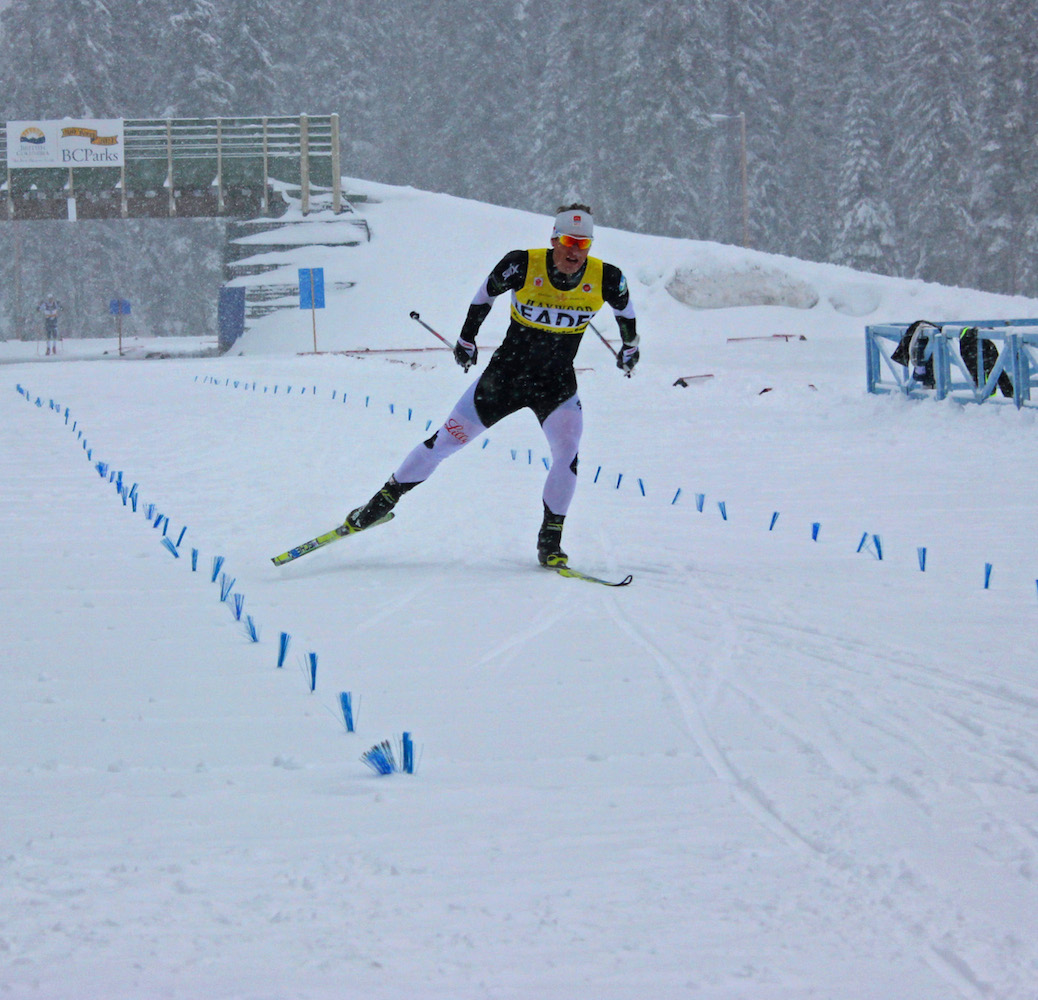
    Andrew Pohl of the New Zealand Ski Team crossing the line in 15th in the men's  NorAm 30 k freestyle interval start on Dec. 20 at Sovereign Lake, B.C. (Photo: Frances Weeks)
    Andrew Pohl of the New Zealand Ski Team crossing the line in 15th in the men’s NorAm 30 k freestyle interval start on Dec. 20 at Sovereign Lake, B.C. (Photo: Frances Weeks)

    Sovereign Lake Nordic Club

    Sovereign Lake is a perennial NorAm host, using trails built for a World Cup event in 2005. The trail system is interconnected with Silver Star Mountain Resort, which leaves most visitors a bit confused. In recent years, the division is simple: race at Sovereign, sleep at Silver Star, ski at both.

    Sovereign was hosting a CPL race (one level below Continental Cup) when the possibility of moving the NorAm was raised. With 80 volunteers on site, it was easy for the organizers to quickly find out how many might be available for a potential NorAm and make the commitment to offer the venue.

    The shift from Saturday/Sunday to Friday/Saturday was essential for the teams, but difficult for the organizers. More of the CVXC volunteers were unable to help and many of the Sovereign volunteers were unable to get a day off work at short notice.

    Without a sprint in the first NorAm weekend of racing, Sovereign’s first day became a classic sprint, requiring another rewrite of the race notice. Ultimately, the merged organizing committee was able to get about 100 volunteers over the two days, including some from neighboring clubs.

    Several racers generally viewed the event as a typical NorAm, with more comments on the challenges of heavily falling snow than the logistical obstacles of the event move.

    While athletes, coaches, families, and race-day volunteers have moved on, the two organizing committees are sorting out how to share the entry fees and sponsorship money to cover their extra expenses.

    The Result

    After two weekends and four races, more individuals volunteered than raced.  Athletes got crucial early season race time into their legs.  Several athletes have positioned themselves to race in Europe later this season.

    Was it all worth it? Dahria Beatty, Raphaël Couturier, Annah Hanthorn, and Philippe Boucher pre-qualified for Junior/U23 World Championships in early February in Almaty, and based on his NorAm results, Patrick Stewart-Jones earned his spot at the World Cup sprint in Otepää, Estonia, from Jan. 17-18.