Tag: Pierre Harvey

  • Hanging Up the Boots: Kershaw Retires from Skiing, Embraces Next Challenge

    Hanging Up the Boots: Kershaw Retires from Skiing, Embraces Next Challenge

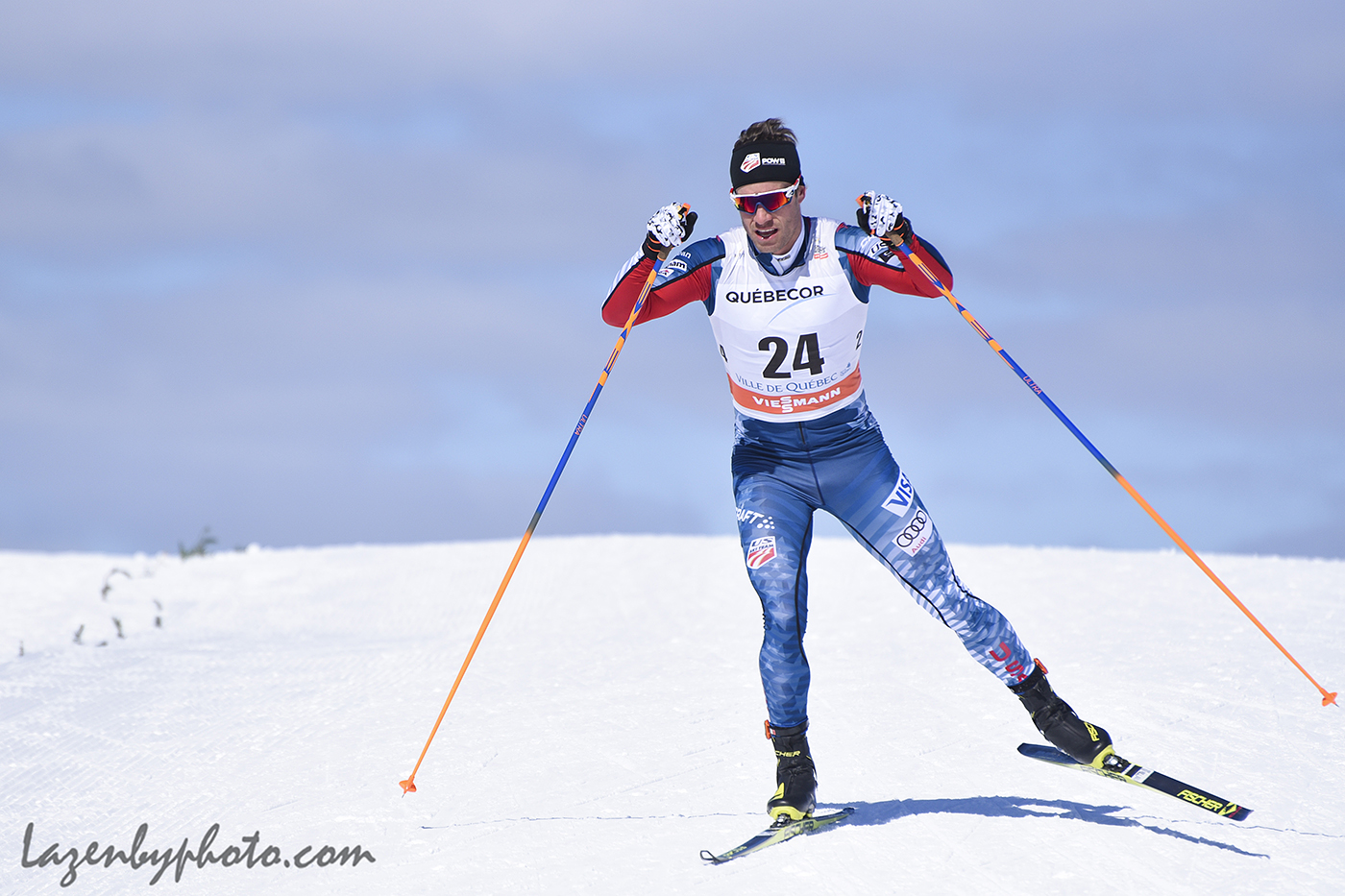
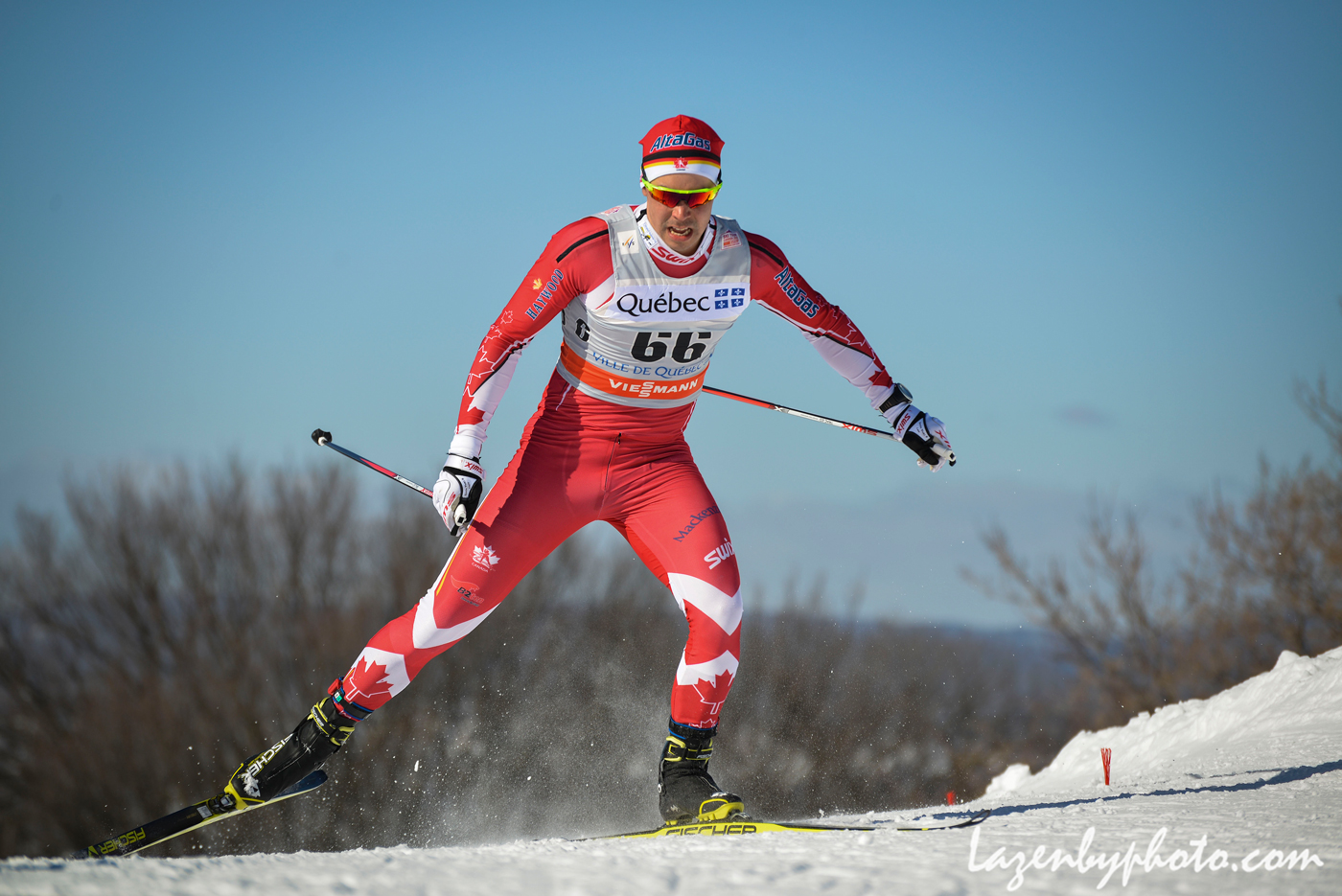
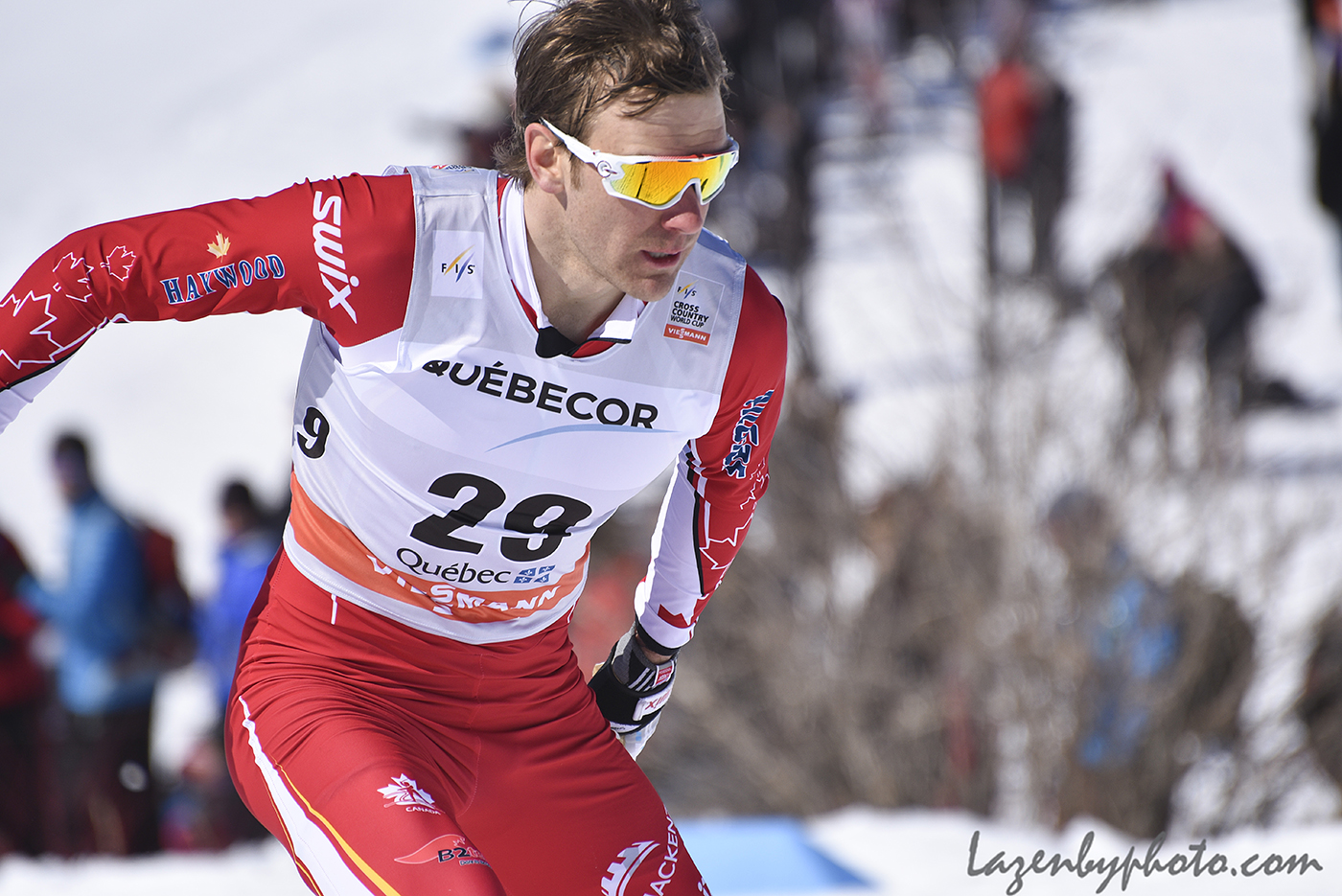
    Canada’s Devon Kershaw racing at 2017 World Cup Finals in Quebec City, where he finished 26th in the 15 k freestyle pursuit and 19th for time of day in the last race of the 2016/2017 season. (Photo: John Lazenby/Lazenbyphoto.com)

    On April 26, Devon Kershaw posted a photo on social media of Alpina boots hanging on a line. The next day, he spoke on the phone with FasterSkier from his new home in Lillehammer, Norway, after a day of running around outside with his 15-month-old daughter, Asta Isabel.

    Kershaw was tired, but in a good way. For the first time in 17 years, he was ready for a new challenge, a new focus and much more time with his daughter and wife, Kristin Størmer Steira, a former standout Norwegian skier.

    Three years after Steira left professional cross-country skiing and pursued a career in business, starting with her master’s degree in business management, Kershaw is following suit and headed back to school. The 35-year-old Canadian hung up his boots to quietly announce his retirement after about a month of deliberation.

    “I was really keen to keep ski racing, to be honest,” Kershaw said. “I had the motivation to go one more year, and in my head, I wanted to race one more season, but as things progressed in the spring, there were a lot of different factors that just made it seem like, oh man, it doesn’t look like it’s gonna be super realistic at this point.

    “I struggled with that, when you feel like you still have more in the tank,” he continued. “But at the same time, it’s a bit of a double-edged sword in the sense that it’s been a fantastic career.”

    Kershaw was quick to reflect on his roots as a kid growing up in Sudbury, Ontario, “a mining town with a small but passionate skiing community,” as he put it. He also reiterated how proud he was to represent Canada for 17 consecutive seasons, first as a junior national team skier for two seasons starting in 2001, then as an under-23 national team member in 2003, and finally as a full-fledged World Cup Team member starting in 2004.
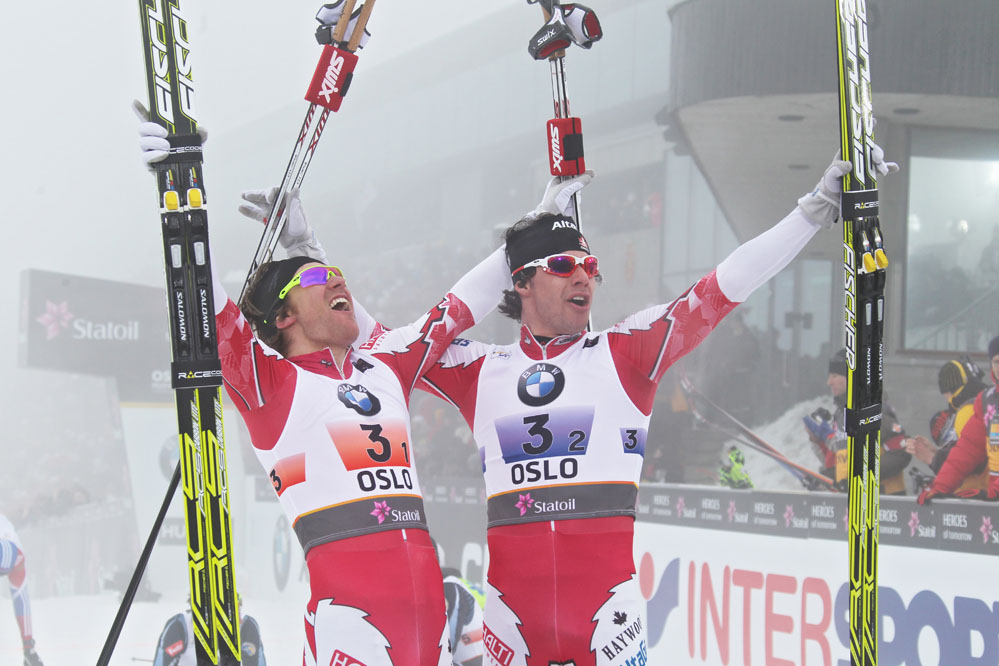
    Devon Kershaw (l) and Alex Harvey celebrate their 2011 World Championships gold in Oslo, Norway. (Photo: Fischer/NordicFocus)

    His career included three World Cup wins and 14 podiums, and a gold medal at 2011 World Championships with teammate Alex Harvey in the classic team sprint. Kershaw finished the 2011/2012 World Cup season ranked second overall and second in the distance rankings.

    When he reflects on those accomplishments, he still has a hard time believing that all happened to him.

    “So instead of focusing on being bummed at the situation or a bit frustrated with the state of things in Canadian skiing right now, I have to look back with a smile,” Kershaw said. “I feel just so privileged and grateful to have had the opportunity to be part of a real movement for men’s skiing in Canada.”

    Kershaw said he was left with unanswered questions this spring during a transitionary period at Cross Country Canada (CCC). The team’s budget was undetermined, camps were not yet set in stone, and Kershaw said his decision — which he wanted to make by May 1, the start of the new training year — became about energy management.

    “Part of managing your energy properly is putting all of your energy and focus into training, and if you’re being pulled with uncertainty or being stressed about uncertainty, that will come back, the World Cup will exploit that,” he said.

    According to CCC Chief Executive Officer Shane Pearsall, High Performance Director Thomas Holland had planned to retire this past March, yet has stayed onboard as an advisor until CCC fills the position. Pearsall said the hiring process is still ongoing and will hopefully be wrapped up by next month. He confirmed that CCC has yet to finalize its budget and doesn’t anticipate being able to do so until a government minister signs off on the amount from Own The Podium (OTP), one of its primary funding sources, in July. Pearsall explained that they expect to have a better sense of national-team finances in mid to late June.

    Typically, the team’s budget is determined in May, but because of necessary “quad reviews” following the Olympics, which took place before CCC met with OTP, the process was delayed by about a month. Pearsall did not elaborate on how significantly the budget would be decreased from last year, but said, “It’s certainly tighter than last year.”

    Kershaw said he needed to pay about $25,000 Canadian dollars in team fees if he wanted to continue racing this year, up from $15,000 last year. That didn’t cover the cost of living, which he figured to be around $55,000 Canadian, for a grand total of $80,000.

    “The financial burden is big, and moving forward the financial burden went from big to 100 percent paying for every cost,” Kershaw said. “So all travel, accommodations, everything. … I’ve just been in the sport a long, long time, and from a directional standpoint, I’m not sure we’re moving in a direction that will yield sustainable results at this point in time, but I understand it is difficult when you’re under such financial duress to create a sustainable program. But from a vision standpoint, I think there’s a lot of questions that remain unanswered, and it’s late in April. The fact of the matter is the rest of the world has all of the holes plugged — if they have holes in their boat — because May 1 is the new year of every ski program. And we’re just constantly slow and off the mark with that.”

    Budget cuts had been expected as Canada’s World Cup Team missed performance benchmarks throughout last season. The team finished 2017/2018 with just two men scoring World Cup points (top 30) in distance races: Harvey and Kershaw. Two men (Harvey and Julien Locke) scored in World Cup sprints. On the women’s side, Dahria Beatty landed one World Cup sprint top-30 last season, and Cendrine Browne was the top Canadian woman in a distance race with a 27th place for time of day in the last race of the season.

    Meanwhile, Alex Harvey led the team with four World Cup podiums, including third overall in the 2018 Tour de Ski, and a top result of fourth place at the 2018 Olympics. He finished his season in fourth in both the Overall and Distance World Cup standings. But Harvey’s results alone weren’t enough to buoy the whole team for another winter.

    “Throughout my entire career, it’s almost unfathomable to think that the season ends and that’s the stat line,” Kershaw said of the team’s overall results. “It wasn’t so long ago that we had over 16 World Cup podiums in a season. The truth hurts, as [former Canadian coach] Tor-Arne Hetland once said, but things go in waves and this is the reality that we live in right now.”

    Despite the prospect of self-funding, Kershaw didn’t feel pressed into retirement. Several of his teammates have decided to retire as well, including Graeme Killick, Jess Cockney and Knute Johnsgaard, but Kershaw said they weren’t forced, either.

    “You can choose to work and you can choose to hustle for money; there are ways to make it,” he said. “No one’s forced into it. I could keep skiing if I wanted to, but I think the stark choice you’re faced with is, maybe perhaps some people are like, I can’t really see a path to international success currently, and that’s what I think is sad…”

    ‘A dream scenario’

    When Kershaw moved to Canmore, Alberta, in 2001 and entered Canada’s elite skiing scene, Cross Country Canada (CCC) was entering a fruitful period. At the 2002 Olympics, Beckie Scott was proclaimed winner of the women’s 10-kilometer pursuit (now called the skiathlon), becoming the first North American woman to win an Olympic gold. At 2005 World Championships, Sara Renner earned a sprint bronze to become the first North American woman to medal at World Championships. Scott and Renner teamed up for silver in the team sprint at the 2006 Olympics in Turin, Italy, where yet another Canadian woman, Chandra Crawford, won the individual skate sprint for Canada’s second-straight gold in as many Winter Olympics. Scott finished that 2005/2006 season ranked second overall in the World Cup, just 16 points behind Norway’s Marit Bjørgen in first.
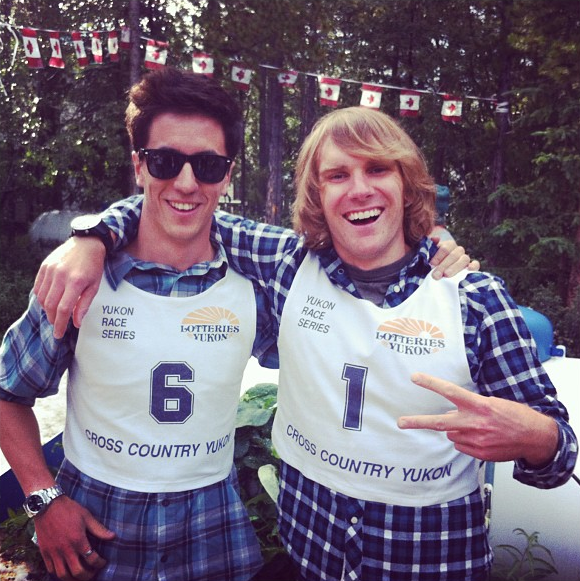
    Devon Kershaw (r) with Graham Nishikawa in 2013. (Photo: Devon Kershaw)

    Kershaw made his Olympic debut in 2006.

    “Coming into Torino, we were quoted in the newspaper as being like the world’s most anonymous men’s ski team,” he said of the Canadian men’s team that year. “We weren’t really ‘on the map,’ but I’ve just been so grateful and lucky to have such a great group of guys around that really welcomed me in.”

    He credited his former roommate and teammate Chris Jeffries as well as other Canadian competitors of his time, including George Grey, Gordon Jewett, Dan Roycroft, Sean Crooks, Dave Nighbor, Phil Widmer, Brent McMurtry, and Graham Nishikawa (who’s still racing), for having a major impact on the formative stages of his career.

    “[There were] so many athletes in Canmore that tried hard, wanted it bad, and loved ski racing and training,” Kershaw reflected. “That’s a dream scenario for a young athlete to come into a community like that and be welcomed into that environment.”

    Less than a month after the 2006 Olympics, he notched his first World Cup podium by placing third in the Borlänge, Sweden, skate sprint. In doing so, he became the first Canadian male cross-country skier to reach the podium since Pierre Harvey (Alex’s father) in 1988 and the first ever to medal in a World Cup sprint.

    “I had no idea who Pierre Harvey was,” Kershaw said of his younger self.

    Pierre Harvey had previously won the 1988 Holmenkollen 50 k as well as two other World Cup distance races and the Norwegian Birkebeiner, making him the most successful Canadian male skier before Kershaw.

    “He could walk into the room and I would not recognize him,” Kershaw continued. “Even his results, I had heard that he had five World Cup podiums and that seemed pretty cool, but that’s all I knew about him.”

    Kershaw’s second World Cup podium came early in the 2006/2007 season in a skate sprint in Munich, Germany. That same day, Crawford — whom he was dating at the time — placed third in the women’s sprint.
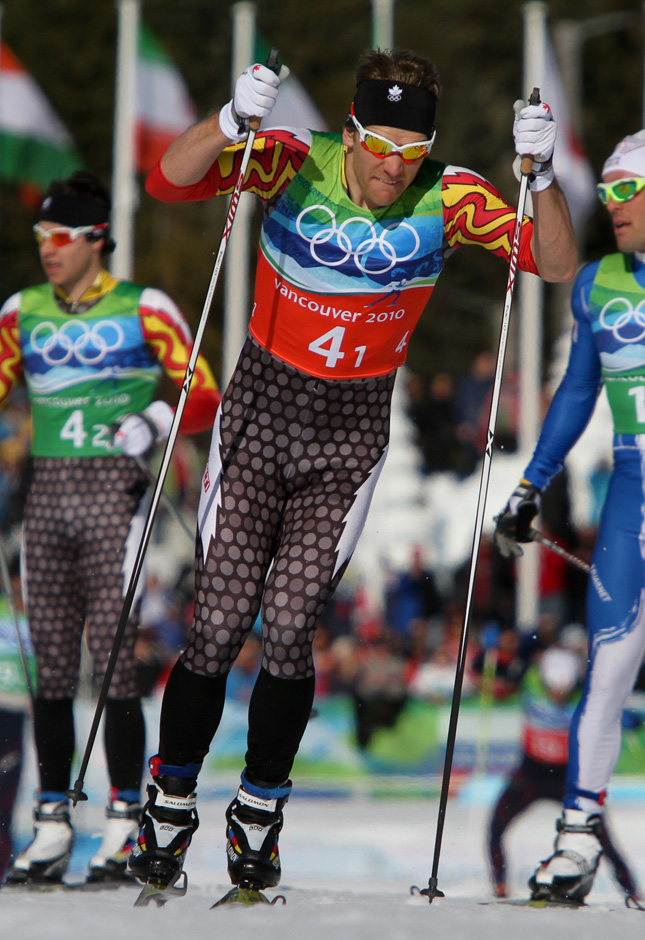
    Devon Kershaw after being tagged by his Canadian teammate Alex Harvey (l) in the freestyle team sprint at the 2010 Olympics in Vancouver, B.C. They went on to finish fourth.

    At his second Olympics in 2010, Kershaw finished fifth in the 50 k classic mass start for the best individual Olympic result for a Canadian male nordic skier. That record stood until Alex Harvey, who burst onto the World Cup scene in 2008, bested it with a fourth place in the 50 k classic at this year’s Olympics in PyeongChang, South Korea.

    Kershaw and Harvey also teamed up to place fourth in the freestyle team sprint at the 2010 Olympics.

    Kershaw’s first World Cup win came in a skate sprint during the 2011 Tour de Ski. He finished that Tour in seventh, and the next year, came back to place fourth overall in the 2012 Tour de Ski (TdS). Kershaw started all 12 editions of the TdS, a record he shares with France’s Jean-Marc Gaillard.

    Harvey scored his first individual World Cup podium in a 50 k classic in 2009 and won his first World Cup race (a 3.3 k freestyle prologue) at the TdS in 2012.

    “Then next thing you know, Alex and I are sharing a podium on some World Cups,” Kershaw reminisced. “Two Canadians on one podium in the World Cup, like, really? And then you win World Championships and I’m on the overall World Cup podium, and then next thing you know, Alex has been on the overall World Cup podium a few times and also now 50 k world champion. It’s crazy. It’s insane. From nothing. From no results. The journey has just been amazing. … I never would’ve thought Canada would, I mean, how could you? We had Pierre Harvey and that’s it in, like, a hundred years of international ass-kicking.”

    Kershaw credited his initial World Cup breakthrough as a 23-year-old skier in Borlänge to Dave Wood, Canada’s national-team coach at the time.

    “I came into a team with a coach that you could call at midnight. He’d do anything for you,” he said of Wood. “There was no way I would’ve stepped onto the podium in 2006 without him, and Mike Cavaliere, too, my first-year senior, Mike was my coach. We had staff that was just committed to the core for the cause and I’m incredibly grateful for that.”

    ‘A hell of a season’
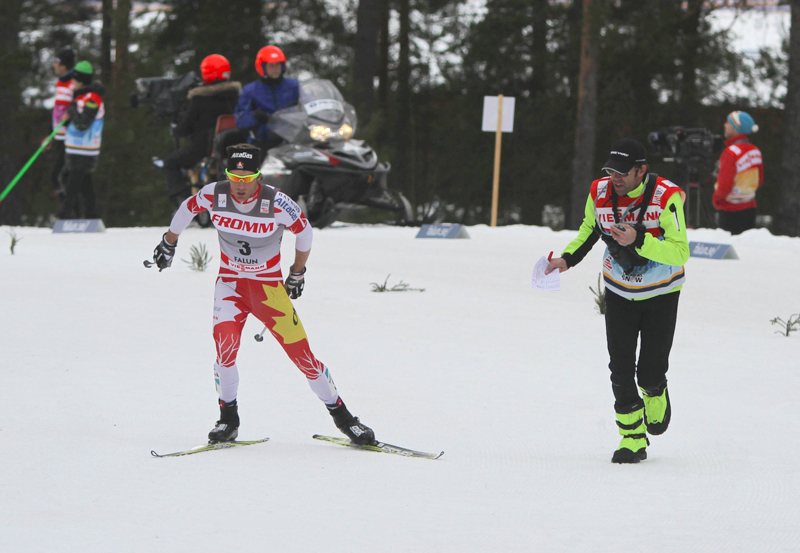
    Canadian head coach Justin Wadsworth (r) giving splits to Devon Kershaw at 2012 World Cup Finals in Falun, Sweden.

    Of his coaches, Kershaw gave special credit to Justin Wadsworth. A three-time U.S. Olympic cross-country skier who became Canada’s head coach in the spring of 2010, Wadsworth coached Kershaw for five seasons, and the two developed a close friendship.

    “When Justin came into the national team, the level of professionalism and excitement and freshness that he brought … I don’t know if you call it luck or happenstance or just the right place, right time,” Kershaw reflected, alluding to his 2011 World Championships gold with Harvey and his 2012 Overall and Distance World Cup podiums. “Justin’s best results as a coach were me and my best results as an athlete were when I was coached by Justin. Talk about an amazing relationship there.”

    “The main thing that I really appreciated with Devon, and I think he would say the same thing about me, is that we could be honest with each other and talk about hard things and enjoy the good times when we had them,” Wadsworth said on the phone last week. “… It’s cliche, but when I was talking to Devon the other day about his retirement, it’s not about the medals or the performances or whatever, it’s about your times together on the road.”

    One of Kershaw’s biggest moments came at those 2011 World Championships in Oslo, Norway, where he and Harvey beat out Norway’s Petter Northug and Ola Vigen Hattestad by 0.2 seconds for gold on the Norwegians’ home turf. They had done so after Kershaw lost one of his skis early in the race, Wadsworth pointed out.

    buy antabuse online, buy wellbutrin

    “His ski fully came off and he had to put it back on and get back into the race,” Wadsworth said. “Just the whole day was pretty incredible. That was a great, great opportunity for us, and the guys cashed in.”
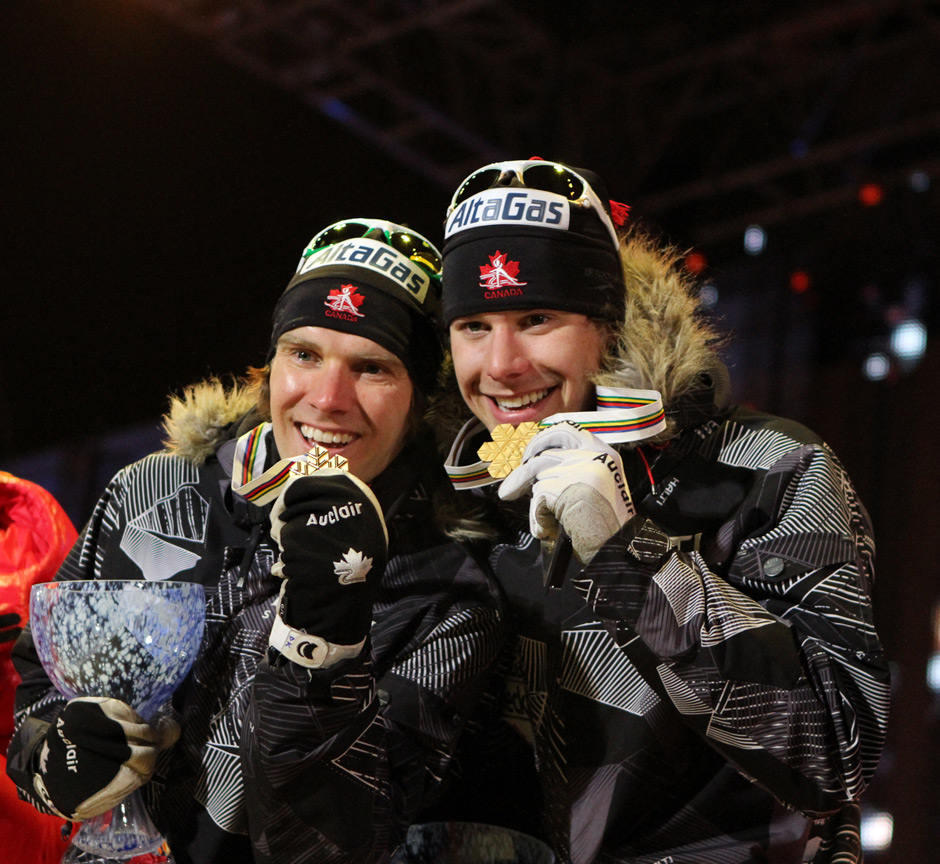
    Devon Kershaw (l) and Alex Harvey with their World Championship gold medals at the 2011 World Championships in Oslo, Norway.

    In a difficult-yet-strategic move to conserve for that race, Kershaw and Harvey both sat out the 15 k classic the day before.

    “With anybody else running the ship, there’s no way I would’ve trusted that [decision],” Kershaw said of Wadsworth’s call. “But I trusted Justin’s leadership and we went all-in, and the next thing you know we won World Championships. I mean, are you kidding me? How can you get a better start to the next quadrennial? And Justin as a first-year head coach of a national team, that’s gotta go down as maybe the best season ever for a first-year North American coach of a national-team program.”

    He and Wadsworth reiterated the crucial foundation that Wood had laid.

    “Dave Wood had done a really good job with the athletes leading into that period, mainly focused on building a big base and doing a lot of hours and also doing a lot of time at altitude,” Wadsworth explained. “And when I took over the position, I saw that both Alex and Devon were really primed and had a really good response rate to altitude, and all we had to do was fine tune a little bit of strength training and intensity. I was really excited to work with both those athletes and saw that they had a lot of potential.”

    For Kershaw, Wadsworth’s “American swagger … was magic for me,” he said. During the 2011/2012 season alone, he stood on the podium 10 times, with four top-three finishes in seven races at the 2012 Tour de Ski.

    “It was a hell of a season for me,” Kershaw said.

    ‘Best sand-digger ever’

    He went on to compete at two more World Championships and two more Olympics. This past season, Kershaw finished in the top 30 in eight World Cup distance races, with a top result of 19th in the 30 k skiathlon in Lillehammer, Norway. While struggling with lung issues, he finished 26th in the 50 k classic at the PyeongChang Olympics.
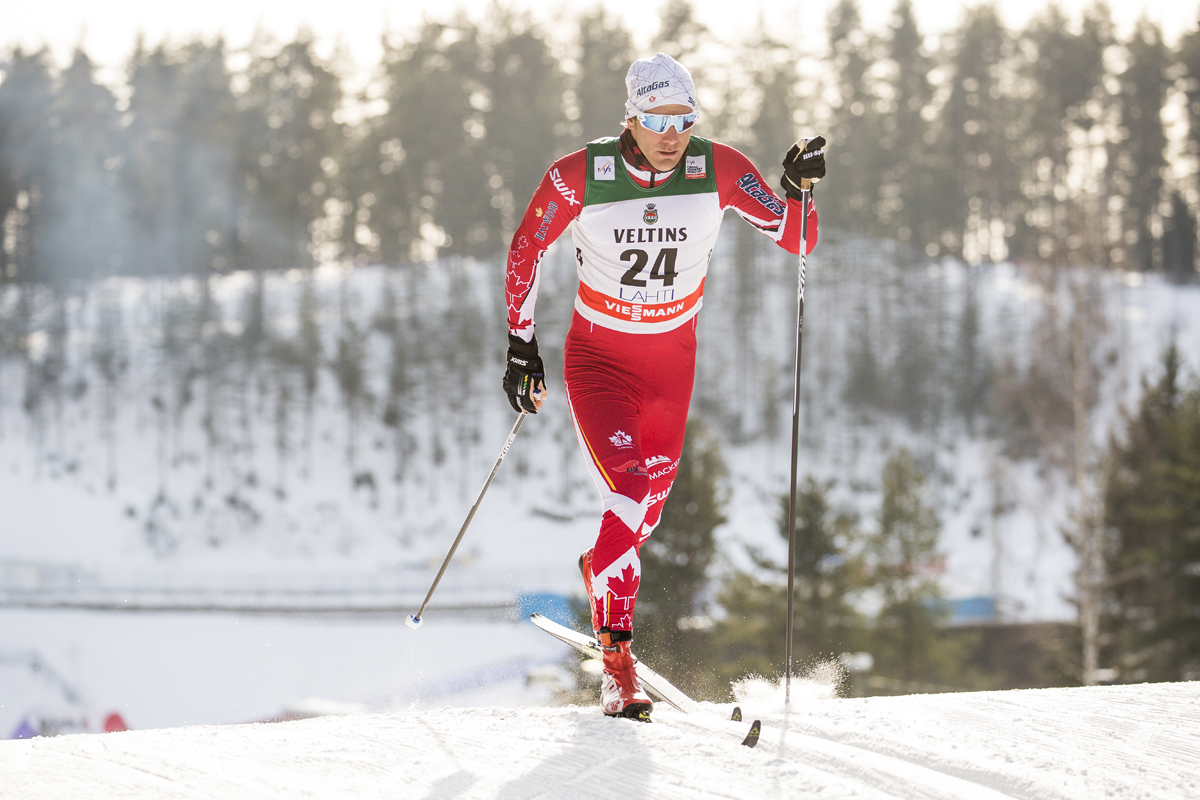
    Devon Kershaw racing to 25th in the World Cup 15 k classic this past March in Lahti, Finland. (Photo: Fischer/NordicFocus)

    Initially plagued by a lung infection in 2014, Kershaw discovered after a 2015 bout with an pneumonia and whooping cough that he has exercise-induced asthma.

    “We worked to get that under control and it was manageable but it never felt good like it felt prior to 2015,” Kershaw said his health over the last three seasons. “In PyeongChang, it was a calamity of bad luck. When we got there it was minus 20 [Celsius], and this makes me sound so soft, because I’m from northern Ontario so you’d think I’d know, but it was really cold. I did some intervals and it aggravated my lungs and it was super windy and dirty and a lot of sand blowing around, and that really flared up my asthma to the point that I was wheezing badly.”

    His breathing troubles also affected his sleeping and took most of the two-week Olympics to manage. At one point, he had a chest X-ray to make sure it wasn’t pneumonia.

    “It was sporting asthma,” he said. “… It took all the way to the 50 k to kind of get it 70 percent.”

    While he noted he was left wanting more from a performance standpoint at both his final Olympics and in his final season, Kershaw also acknowledged that he’s his biggest critic.

    “That’s been probably the biggest detriment to my entire career; I’m the best sand-digger ever,” he said. “I am disappointed in the sense that I work really hard and I train hard and I prepare well, and it didn’t go exactly as planned. … When you’ve competed in the top 10 for as many years as I have and on the podium, of course that becomes your bar that you hope to achieve, but at the same time … when you’re in the top 30 in the results page, you’re in the race at least. And I’m proud of the fact that in almost all classic races, not every, but most, I was in the top 30 and ‘in the race’.

    “Am I satisfied? In my life I’ll probably never be satisfied, that’s just how it goes,” he added with a laugh. “But am I somewhat proud of maintaining a fairly competitive level? Yeah, absolutely.”

    Wadsworth reflected that Kershaw was one of the best athletes he had ever seen, even “physiologically as good as Alex [Harvey]” at the peak of his career.
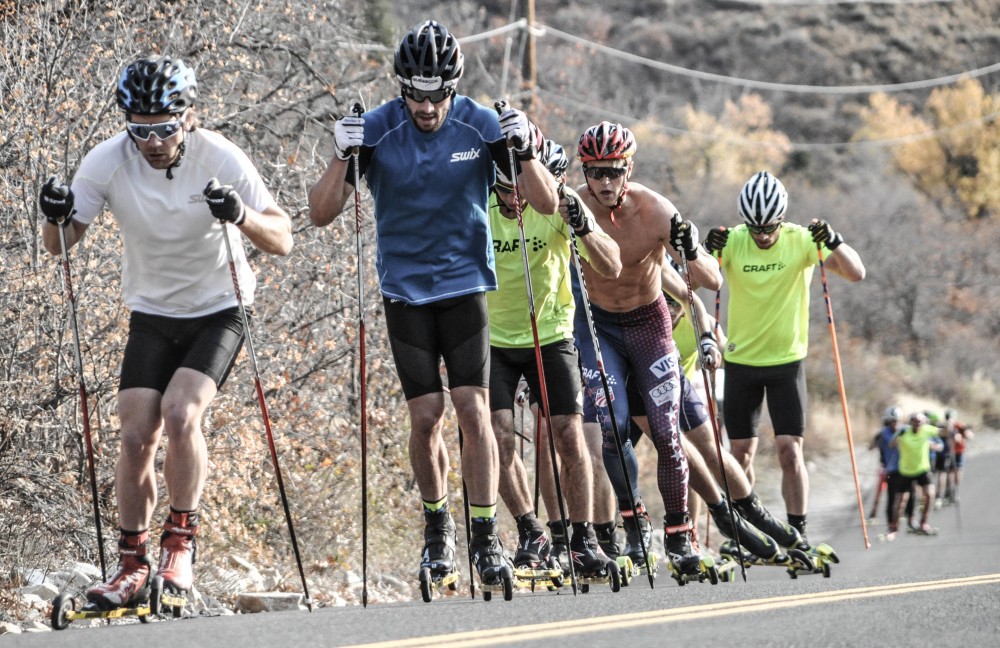
    Left to right: Canada’s Devon Kershaw leads his teammate Alex Harvey and U.S. Ski Team members Noah Hoffman, Erik Bjornsen and Simi Hamilton during a Level 3 interval skate session up Snake Creek Canyon in Midway, Utah, during their respective teams’ 2016 training camps in Park City, Utah. (Photo: Matt Whitcomb)

    “Devon’s a very intelligent person and sometimes he might’ve overthought things and lacked in confidence, and as a coach that’s really frustrating to see because you know how good they are physically,” Wadsworth said. “And when he was on mentally, too, in training, when he was at his very best, he had total confidence and could destroy anybody in any workout.”

    He recalled a hill-bounding workout with the Norwegian team in which Kershaw was literally leaps and bounds ahead of everybody else — even Martin Johnsrud Sundby and Russia’s Ilia Chernousov, who joined the training session.

    “He was just shelling everybody,” Wadsworth said. “So when Devon was at his best like that and mentally confident and relaxed, he was a real force of nature. Unfortunately that didn’t always translate into the racing season, but in 2012 he put it all together and had a tremendous year. … If he had the confidence the whole time, he would’ve been almost unbeatable, in my opinion, but it takes the whole package all the time, and he was among the greats there for a while.”

    ‘Younger, faster, better dog’

    And then there was Harvey, another one Kershaw’s of his best friends and longtime roommates.

    “I’ve spent more nights in a room with him than my wife or any girlfriend I’ve had,” Kershaw joked. “… He was eager to learn, he chased me for years, he was always a hard worker, too. He trained really hard, he believed in himself, and I still am in total awe of that. I’ve never met anybody as confident as him. It’s too bad that didn’t rub off on me, but that’s been great to be around.”

    He likened Harvey’s addition to the team as a family adopting a puppy.

    “You know when your parents get a puppy because your dog is 10 years old? He’s kind of slowing down a little bit and then you see that old dog get fired up and run again and jump around and play; that’s me,” Kershaw said. “And I’m so grateful that my owners got a younger, faster, better dog to hang out with because it was so inspiring.”

    Several times over the last few years, Kershaw has said that witnessing Harvey make Canadian history has been one of his biggest reasons for staying in the sport.

    “He, for sure, has kept me in this probably longer than I should’ve,” Kershaw said. “I just love traveling with him and seeing what he can accomplish and training with him and seeing that professionalism.

    “There’s no question he’s the best Canadian skier ever, that’s not even close,” he added. “… I just feel so honored that I got the chance to see it all happen, from his last-year junior when he did his first World Cups and then all the way though I’ve been with him.”
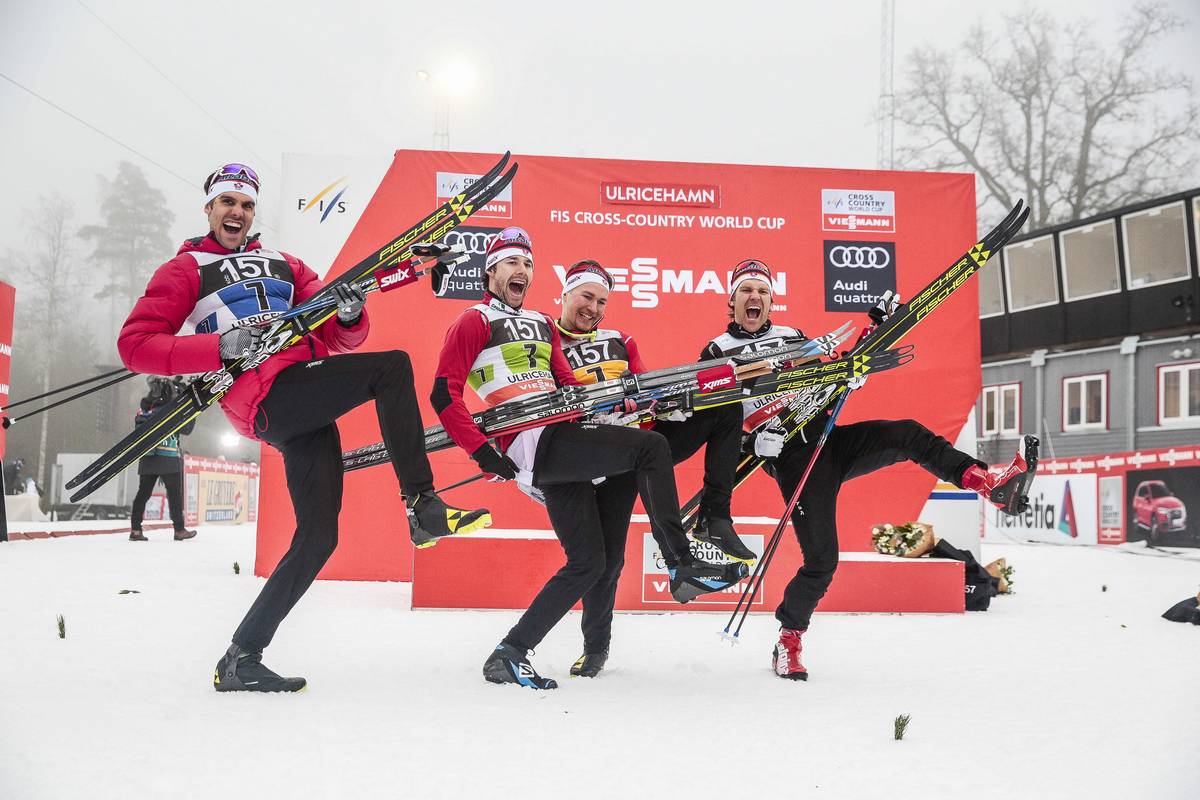
    The Canadian men’s relay after placing third in January 2017 in Ulricehamn, Sweden, for Canada’s best-ever World Cup result in the 4 x 7.5 k relay. From left to right: Lenny Valjas, Alex Harvey, Knute Johnsgaard, and Devon Kershaw. (Photo: Salomon/NordicFocus)

    In an email, Harvey explained that he and Kershaw first met in the fall of 2005 at a training camp at Sovereign Lake, British Columbia. Harvey was on the junior team and Kershaw a senior, but the whole team stayed at the same hotel.

    One morning, Kershaw accidentally took Harvey’s poles from the hotel. Harvey had to track him down on the ski trails to get them back.

    “That was the first time I talked to him and to me it’s just perfect because that’s so Devon,” Harvey wrote.

    Later that season on March 7, 2006, Kershaw made history with his first podium. That same day, Harvey won his first national title in the 10 k classic at Canada’s senior national championships as a 17-year-old junior.

    “I guess our friendship was meant to be before we even knew it!” Harvey wrote.

    When the two became teammates, Harvey immediately took to imitating Kershaw, both in training and racing.

    “He took me under his wings and he has a big part in the athlete I became today,” Harvey wrote, likening Kershaw to a big brother. “I feel very privileged to have spent all that time with him. I think we became such close friends because we are both very driven athletes and we don’t accept any compromise. We’re both huge fans of our sport, ‘nor-dorks’, so we also love to talk about everything from altitude training to who is seeing who on Tour.”

    Kershaw’s decision to retire didn’t surprise Harvey.

    “I think it’s a mix of a few things,” Harvey wrote. “… Probably this biggest reason, he has a little girl at home. I know this winter was extremely hard on him. Not seeing Asta Isabel was pure torture, I think I would have done the exact same if I was him.

    “I will miss a lot of things about Devon,” he added. “He’s always there to give good advice about everything and anything. He knows so much about all that is going on in the world, probably the most well-read person I know. He’s kinda my news source. I’m still amazed by how indecisive one can be. This brought a lot of laughter throughout the years. I have so many memories from the last 10 years with him. Seeing him dominate the World in 2012 was just amazing but also very eye-opening for me. He raised the bar for all North American skiers that year and I’m very thankful for it.

    “We both lived great emotions in high accomplishments and huge disappointments. I’d like to think I helped him get through these upsets and I can say he definitively helped me get through mine. A page turns in the life of Devon Kershaw but knowing the man, I’m not worried about what’s gonna come next.”

    Without Kershaw, Killick, Cockney, and Johnsgaard on the men’s team, Harvey acknowledged that next winter will be “very different” for him on the World Cup.

    “All these guys are calling it a career and I’m super proud of what all my friends accomplished,” he wrote. “I’m excited to try to help the next generation step it up and fill the shoes of the previous generation. … Also, after 10 years on Tour I’ve made some friends on other teams so I’m not too worried. I’m just excited to step into a bit of a mentor role for our next generation.”

    Onto the Next

    As for Kershaw, he didn’t rule out coaching future generations of Canadian skiers, but he said he was focused on getting an education first. In just over a week, he’ll start a course that requires 20 hours of classes a week — all in Norwegian — for what he anticipates will take six months. The course is essentially an advanced version of Norwegian as a second language, and foreigners must pass it to pursue a degree in Norway.

    After that, Kershaw plans to apply to universities “and hopefully study forever,” he said with a laugh. “Not forever, but study, and I want to stay involved in skiing in any way I can and I want to help the next generation get better.
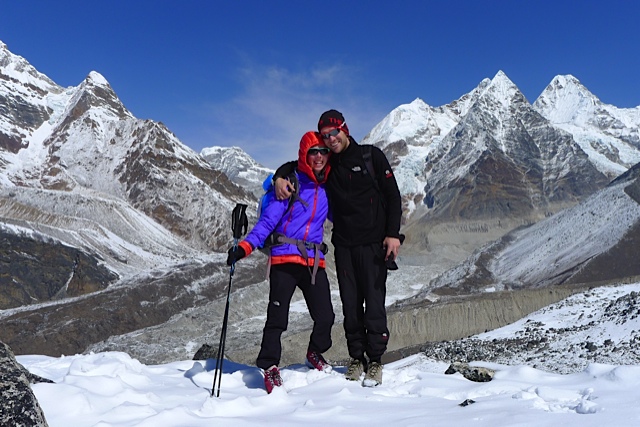
    Kristin Størmer Steira (l) and Devon Kershaw during a day hike on one of their acclimatization days. The couple got engaged in 2014 after summiting Mera Peak during a three-week trek in Nepal’s Himalayas. (Photo: Devon Kershaw)

    “First things first, I have to get my Norwegian at a level where I can sit through a lecture and write an essay at a decently good level, at least good enough that my wife doesn’t have to rewrite it, she can just correct it,” he explained.

    Asked what he’d like to study, Kershaw said medicine, specifically orthopedic surgery, has always intrigued him. (As a junior skier, Kershaw took undergraduate classes at the University of Calgary until 2006, but those credits have since expired.)

    “But now I’m 35 and I’m going to have to do all of this in my third language,” he acknowledged. “So for now, I’d say that that’s still my first choice and I’m exploring what it would take.”

    If not medicine, he’d like to pursue a degree in “some kind of science physiology, and then in a totally shifted way, if I have a panic attack and be like, ‘Science is too hard after ski racing forever,’ then I am interested in economics and economic theory and business to some degree…”

    Regardless of which path he choses, he’ll be doing it in Norway, Kershaw said.

    “I don’t mind the challenge. … It’s intimidating in a way, but it’s also really exciting,” he said. “Kristin’s family [who lives in Lillehammer] is just so fantastic and to see how happy my daughter is here, to have her family, to have family around her and everything for the short term, and I hope to be educated in Norway.”

    Asked if he’ll jump into any ski races this season, Kershaw was quick to respond, “No.” But he will continue skiing. The beauty of the sport and the struggle, as he put it, is what’s kept him in it so long.

    “Imagine just having a singleness, a purpose, a goal that’s just there in your face and then you get to wake up every day and do the things you absolutely love to do,” he said. “… I adore cross-country skiing. I just think it’s such a peaceful, beautiful exercise, and the technique and the flow of it all. … You’re just skiing through the woods peacefully, gliding over snow, over all the terrain you can cover. It’s a beautiful, zen-like endeavor, and I think that’s what’s kept me in it this long. And the people, the Canadian ski community, the world ski community, really. I’ve met so many inspiring people and beautiful people and worked with a lot of absolute experts and I’ve had brilliant teammates and brilliant coaches.”

    And because of skiing, he met his wife and started a family in Norway.

    “I have a daughter with a woman that I love and respect and am in total awe of every day of my life and without ski racing there’s no way that would’ve ever come to fruition,” he said. “There’s the biggest gift right there, as cliche and Hallmark as that sounds, it’s true.”

  • Harvey Delivers Again at Home, Wins First Race of World Cup Finals in Quebec

    Harvey Delivers Again at Home, Wins First Race of World Cup Finals in Quebec

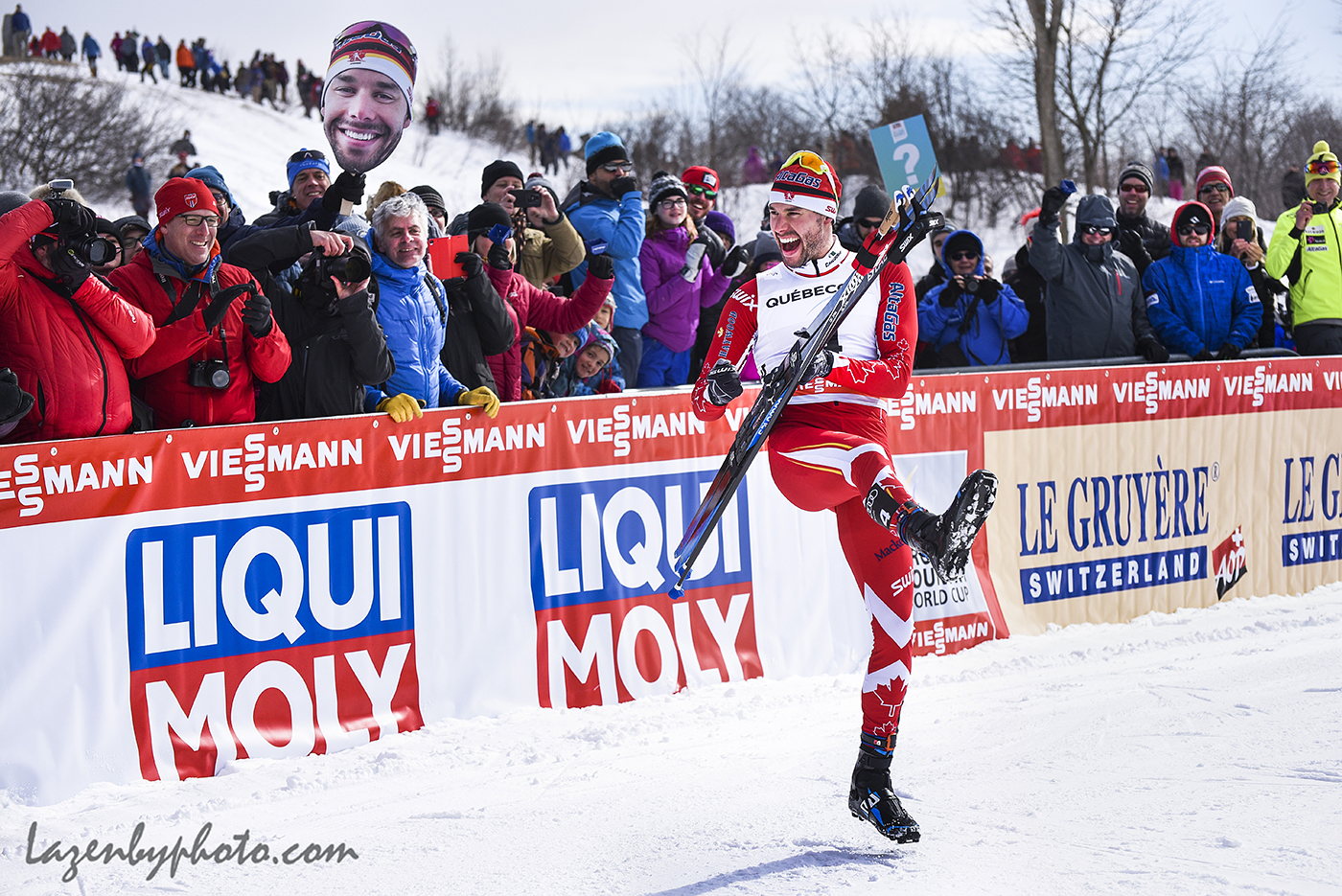
    Alex Harvey (Canadian World Cup Team) celebrates his World Cup Finals freestyle sprint win at home on Friday in Quebec City. (Photo: John Lazenby/Lazenbyphoto.com)

    QUEBEC CITY — Friday started off about as good as the Canadian men’s team could have hoped for, with five skiers finishing in the top 30 to qualify for the heats in the 1.5-kilometer freestyle sprint on the first day of World Cup Finals. According to Cross Country Canada, that’s the first time five Canadian men have qualified in a World Cup race.

    Racing one lap around the Plains of Abraham in the heart of Quebec City, athletes were bolstered by an estimated 25,000 cheering spectators. While they ramped up the intensity for their Canadian skiers, they went wild for Alex Harvey.

    And the Saint-Ferréol-les-Neiges native delivered in every sense possible.

    Harvey started off as his team’s leading qualifier, clocking in with the fourth-fastest time, 4.14 seconds behind Norway’s qualifying winner, Johannes Høsflot Klæbo, who rounded the course in 2:39.44 minutes. Behind Harvey, four other Canadians also qualified less than seven-tenths of a second apart. Len Valjas qualified 24th (+9:28), Julien Locke of the Alberta World Cup Academy (AWCA) 25th (+9.39), Jess Cockney 28th (+9.90), and Bob Thompson of the National Team Development Centre (NTDC) Thunder Bay in 30th (+9.95) as the final qualifier in the men’s race.

    For Locke and Thompson, it was their first World Cup top 30. For Cockney, it was the beginning of one of his career-best days. For Harvey, he was just warming up.

    Canada’s Alex Harvey celebrates his sixth-career individual World Cup win (not counting World Championships) on Friday at 2017 World Cup Finals in Quebec City. Harvey won the freestyle sprint by 0.31 seconds over Norway’s Finn Hågen Krogh. (Photo: John Lazenby/Lazenbyphoto.com)

    In Harvey’s nine years as a World Cup skier, the 28 year old has racked up six individual World Cup wins — spoiler alert — including Friday’s. He won a skate sprint one other time, three years ago in Szklarska Poreba, Poland. At World Championships, he’s accumulated five medals, with his first coming in the 2011 classic team sprint and the second World Championships gold of his career in the 50-kilometer freestyle mass start less than two weeks ago in Lahti, Finland.

    After winning the longest race on the circuit, Harvey seamlessly switched gears and dominated Friday’s freestyle sprint on a wide-open course with short, steep hills organizers had to work hard to integrate.

    In his quarterfinal and semifinal, Harvey raced to first in both heats in a way few others attempted to do on Friday. He led from start to finish and didn’t appear to worry too much about the draft, only making sure that he was far enough ahead so that no one else could use it to slingshot past him in the finishing stretch. He won his quarterfinal by 0.34 seconds over Simi Hamilton — the lone American man to qualify for the heats — and semifinal by 0.04 seconds over France’s Richard Jouve. That one was a little closer and didn’t give Harvey enough time to remove his pole straps before the finish, like he did in his quarterfinal while Hamilton lunged for the line to secure second behind him.

    It was one of those days where it appeared everyone else was working really hard, while Harvey was simply cruising. But that was confidence and the crowd he was riding, and it was a look that worked for him.

    Canada’s Alex Harvey leading his quarterfinal in the men’s 1.5 k freestyle sprint on Friday at World Cup Finals in Quebec City. Harvey went on to win the final for his second individual World Cup win this season (not counting World Championships). (Photo: John Lazenby/Lazenbyphoto.com)

    In a post-race interview, Harvey explained he decided to set the pace in the fourth quarterfinal. The heats before had been almost 10 seconds slower than Klæbo’s qualifying time, so Harvey knew his quarterfinal contenders had a chance to advance more than the top-two if they skied fast enough.

    He faced a similar situation in the second semifinal. Harvey said he spoke with Jouve and Norway’s Niklas Dyrhaug before their semifinal and discussed how one of them should lead, “to keep pushing, not make it easy, ’cause we want to move to the final,” Harvey said. “The strategy is actually pretty similar most of the time, but it’s a question of being able to actually do it.”

    He did it and advanced to the final as the man to beat. All around the course, fans shouted for “Alex”.

    Out of the gate in the men’s final, Norway’s Finn Hågen Krogh surged to the front. The six finalists launched immediately into the first and longest climb on the sprint course, just short of 250 meters long, where France’s Lucas Chanavat took the lead and Harvey skied just behind him over the top. Racers dropped back into the stadium then skated back out of it again, where Harvey moved to first in front of the two Frenchmen in the final: Chanavat and Jouve.

    Krogh soon after slotted into third and attacked on the steepest climb while Harvey and Hamilton proved to have the most left to answer.

    As Krogh led into the last uphill, Harvey followed, then Hamilton, Jouve, Chanavat and Norway’s Sindre Bjørnestad Skar — the last three within striking distance of Hamilton in third place. Harvey tucked behind Krogh and absorbed his draft, breaking out his powerful V2 with 100 meters remaining and leaving Krogh chasing him to the line. There, Harvey threw up his arms to celebrate, while Hamilton lunged for third in a photo finish with Jouve. The Frenchman took it by 0.07 seconds, Hamilton ended up fourth, 1.01 seconds behind Harvey, Skar fifth (+1.51), and Chanavat sixth (+1.72).

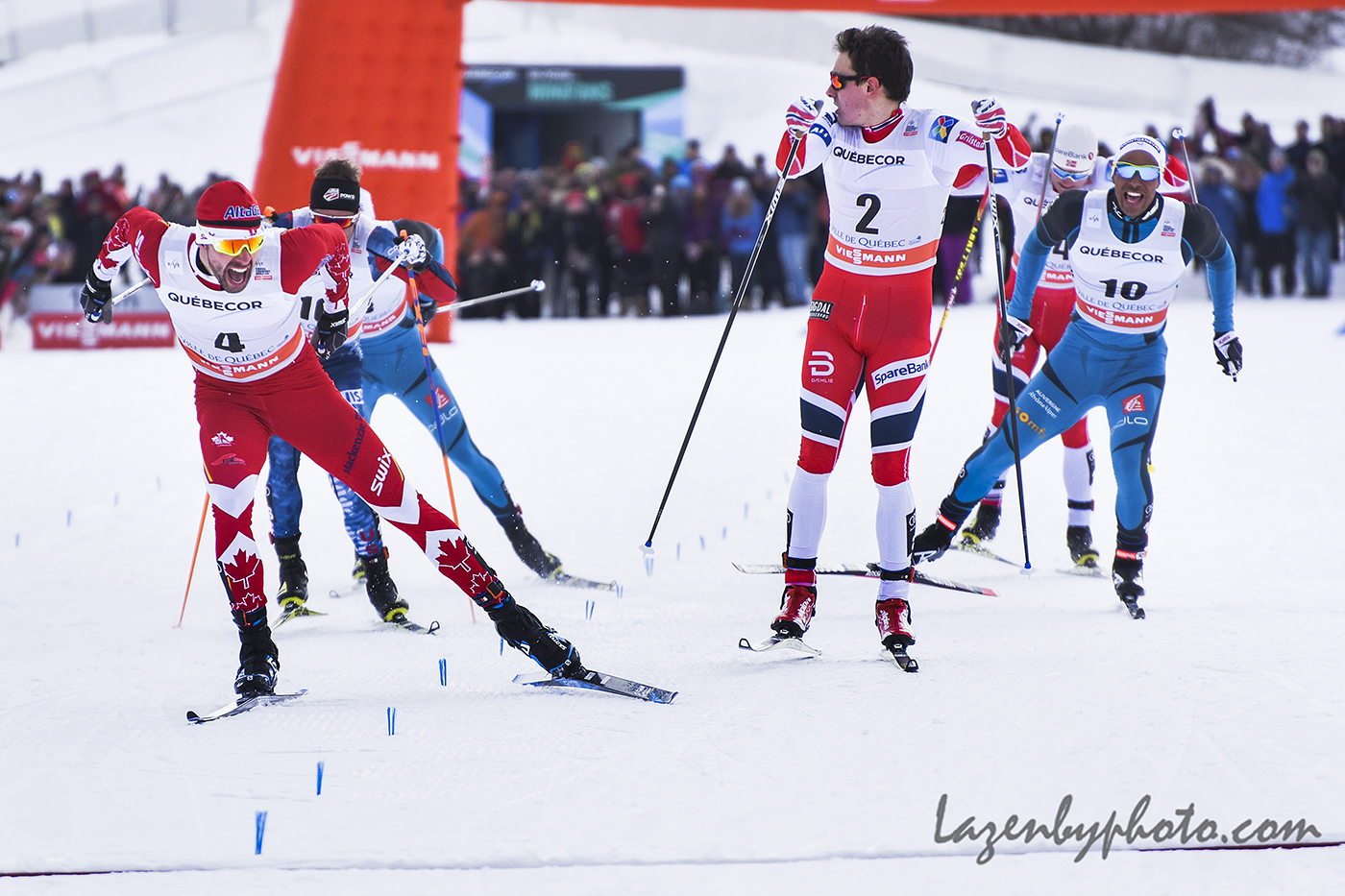
    Canada’s Alex Harvey (l) coming on strong in the finishing stretch to outlast Norway’s Finn Hågen Krogh (2) by 0.31 seconds for the win in the World Cup Finals freestyle sprint on Friday in Quebec City, while France’s Richard Jouve (10) races to third, just ahead of American Simi Hamilton (behind Harvey) in fourth. (Photo: John Lazenby/Lazenbyphoto.com)

    “At the last turn, I was confident,” Harvey said in French. “I looked at him [Krogh] and I knew I had him, but I was focusing on staying second because of a strong headwind in the last downhill.”

    “To be beaten by the 50 k World Champion on the home stretch is tough,” Krogh told the International Ski Federation (FIS) on Friday. “I was simply not good enough.”

    In the finish area, Harvey appeared about as elated as he was after the 50 k in Lahti, a reaction he said was “pure instinct.”

    “But sprinting comes with greater stress, with the risk of falling, of breaking a pole…” Harvey said in French. “To cross the finish line after a sprint is like a deliverance.”

    The win comes just over a year after Harvey placed second in a World Cup skate sprint in Quebec during the Ski Tour Canada. After passing Russia’s Sergey Ustiugov in the finishing stretch, he had been in first until France’s Baptiste Gros snuck up on him on the inside lane. Harvey finished half a second back in second place, but it was still a day he’d remember — his girlfriend Sophie came out on course to congratulate him.

    On Friday, he made sure to lock up the win. And he was met afterward by Sophie, his sister (also named Sophie) and his dad, Pierre Harvey, alongside the finishing lanes.

    “Last year it would have been nice to win,” Harvey said in English on Friday. “When I passed Ustiugov last year, I had so much more speed than him … I didn’t ease up, but I thought I was going to win … and then I saw Baptiste just blow by all of us in the corner of my eye. So I had a bit of that in my mind and just making sure it wasn’t going to slip through my finger two years in a row.”

    Asked how this stacked up to his 50 k win, he said it was close.

    “Today’s victory really isn’t far behind my 50 k win,” he said in French. “My second place last year here was already incredible, so to top that off with a win at home is a dream come true.”

    The win comes after Harvey has competed two 50 k races, including last weekend’s Holmenkollen World Cup in Oslo, Norway, in less than two weeks and traveled across the Atlantic back to his home province.

    “What surprises me is how well he recovered after the double 50 k, in which he did very well, both times,” Louis Bouchard, Harvey’s personal coach and Canada’s co-World Cup coach, said in French. “Usually in sprints, he will hang at the back and make his move right at the end in the final stretch. So tactically, he skied differently today. He felt strong to the point of leading every round right until the end. It’s also rare to see Alex qualify so strongly. His form his tremendous at this point.”

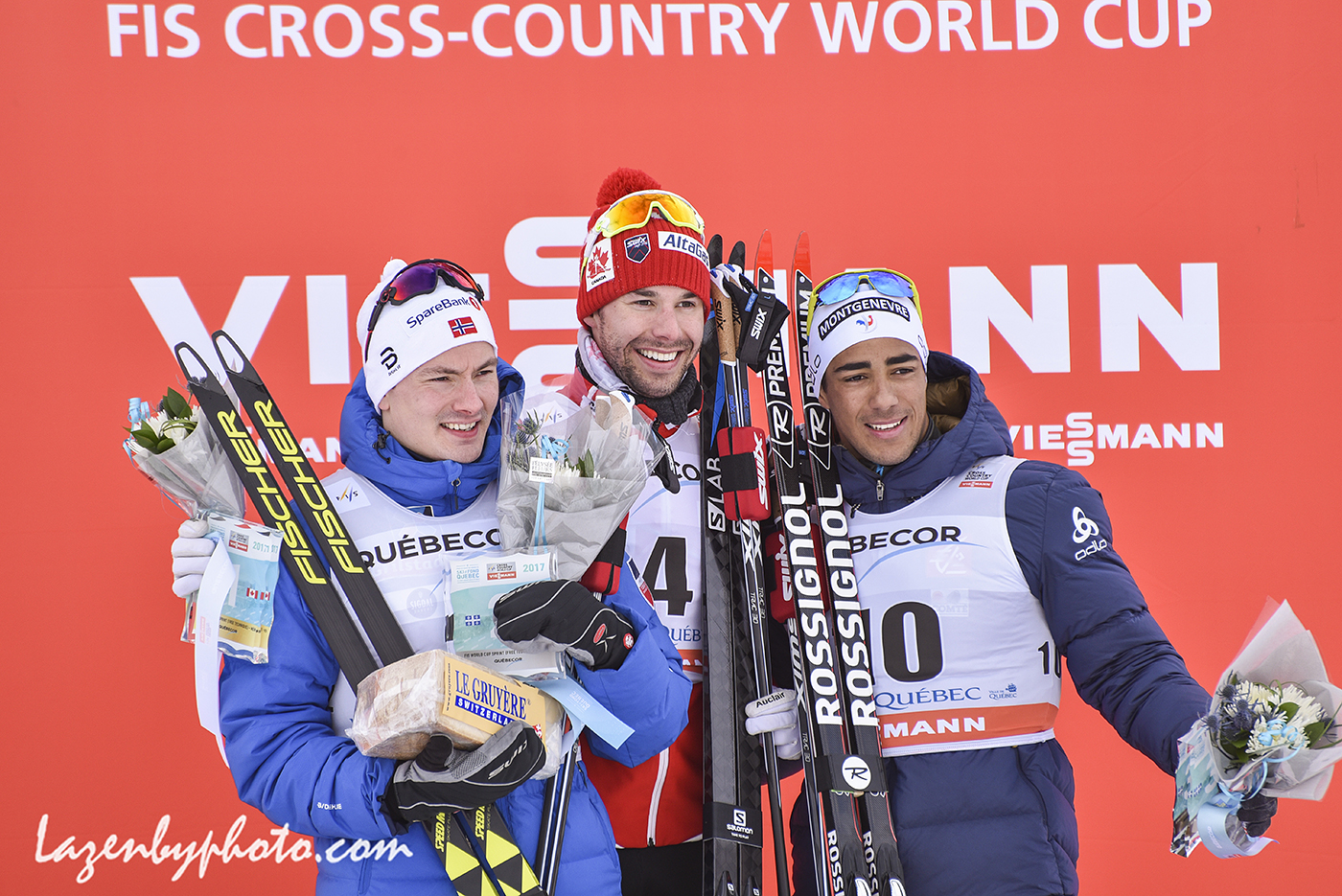
    The men’s freestyle sprint podium on Friday at World Cup Finals in Quebec City, with Canada’s Alex Harvey (c) in first, Norway’s Finn Hågen Krogh (l) in second and France’s Richard Jouve (r) in third. (Photo: John Lazenby/Lazenbyphoto.com)

    Pierre Harvey, a local hero and the inspiration behind the Pierre-Harvey National Training Centre, spoke with reporters after the race. Five years ago, he had been on site to witness his son’s first-career World Cup win in Falun, Sweden.

    “It’s always very emotional,” Pierre said in French. “I was there when he won his first World Cup in Sweden, which I didn’t think he could ever do at the time, but winning became a familiar sight in a way. I thought he would burn himself after the qualification, but he managed to win every round after. It was impressive to see him beat Krogh, a very capable sprinter, in the last stretch.”

    Asked what propelled his son on Friday, Pierre said racing at home.

    “In front of friends and of a cheering crowd, along with great ski conditions, is an extra motivation,” he said. “He left home on the fifth of November, so coming back after months of racing in Europe, he really wanted to put on a show for his friends. I hope he keeps his energy levels high for tomorrow and Sunday’s races.”

    Two more World Cup races remain to close out the season: a 15 k classic mass start on Saturday and 15 k freestyle pursuit on Sunday. Harvey has essentially solidified third place in the overall World Cup rankings with 57 points separating him from Finland’s Matti Heikkinen in fourth place.

    “Today’s win comes with 50 points, 30 bonus seconds and 10 seconds I put on him in today’s qualification,” Alex Harvey explained. “I feel secure with this lead on him.”

    Ahead of him, Norway’s Martin Johnsrud Sundby and Russia’s Ustiugov are not racing in Quebec. Sundby already locked up the World Cup overall and distance titles, and Ustiugov is still 282 points clear of Harvey in third place.

    After Day 1 of 3 in the World Cup Finals mini tour, Harvey leads by 2.3 seconds over Krogh. All 74 racers remaining in the men’s field will start Saturday’s mass start together.

    The Sprint World Cup podium was awarded on Friday, with Norway’s 20-year-old Klæbo in first, Italy’s Federico Pellegrino (last year’s Sprint Crystal Globe winner) in second, and Skar in third. Both Klæbo and Pellegrino were eliminated in the semifinals, with Pellegrino placing seventh and Klæbo eighth on the day.

    As for third and fourth place on Friday, Jouve was thrilled with his fourth individual World Cup podium and first this season after being injured in December and January.

    “It was a really good day for me,” Jouve said in French. “I passed through my quarter and semi as I wanted. I managed to stay in a good position in the finals. I had very good legs and fast skis.”

    Asked what he thought of the crowd’s favoritism for Harvey, he said it wasn’t anything he couldn’t handle.

    “We were here last year, and the public is pleasant and cheers for everyone,” Jouve said. “It’s normal to see them favor the local star.”

    Simi Hamilton (U.S. Ski Team) racing to 16th in the men’s 1.5 k freestyle sprint qualifier on Friday at World Cup Finals in Quebec City. He qualified in 16th and went on to place fourth in the final. (Photo: John Lazenby/Lazenbyphoto.com)

    Even Hamilton, frustrated with fourth, was happy for Harvey.

    “He’s such a good guy. He’s such a great North American teammate. He’s always so psyched when we ski well, and we’re always so psyched when he skis well, as well as all the other Canadians,” Hamilton said. “We are really just like kind of one bigger team, us against all the Europeans we feel like sometimes, so it’s cool to see him so successful and skiing so strong. And he handles his success with so much humility and grace.

    “Someone as talented as he is, and somebody who works as hard as he does, it’s awesome just to feel the energy,” Hamilton added. “He’s such a good ambassador for our sport, and I think that that’s a testament to see all these people cheering him on, because they know that he’s such a great guy, more than just a good ski racer.”

    Hamilton faced Harvey in all three of his heats and followed him in every one.

    “I knew that Alex and Finn were far enough ahead of us that, unless they tripped or something, that we weren’t going to catch them,” Hamilton said of the final. “So I also knew that I was ahead of Jouve and the other two that were behind us a little bit, so I knew that, especially with the tailwind, if I just skied it well that I would have held onto third. And I just didn’t do that, and it sucks. I want it back. I want to do it again. I felt good going into it, I felt like my energy was really good during the entire final, and for whatever reason, I just didn’t ski it.”

    Four Canadians in Top 20

    Earlier in the day, Cockney tied his second-best individual World Cup result in 10th and popped his second top 12 of the season to meet the criteria for the Canadian 2018 Olympic team. After qualifying in 28th and hanging around fourth or fifth for most of his quarterfinal, Cockney used the draft and his reserved energy to sprint from fourth to second in the finishing stretch. He finished just 0.09 seconds behind Klæbo, who won that quarterfinal, and edged Great Britain’s Andrew Young by 0.07 seconds. While Young didn’t advance, Cockney did, and he went on to place fifth in the first semifinal, 1.3 seconds behind Krogh, the winner of that heat.

    Jess Cockney (Canadian World Cup Team) racing to 28th in the qualifier of the men’s 1.5 k freestyle sprint on Friday at World Cup Finals in Quebec City. He went on to place 10th on the day to tie his second-best World Cup result. (Photo: John Lazenby/Lazenbyphoto.com)

    “You can see just how wide open this field is, and it’s so windy that you kind of had to be smart about where you wanted to use energy,” Cockney said of his tactics.

    “I knew the start was straight into the headwind. You could come down with the tailwind behind you and make back a couple spots, or at least close the distance behind some people. And that’s just exactly what I wanted to do in the quarterfinal, and I was lucky that it worked out well, and I had some energy saved from doing that for the finishing straight. So that was really big for me.”

    As for his finishing gear, Cockney laughed and said he’d like to think he’s had that all along. His trouble has been getting into the heats. In the one other World Cup sprint he qualified in this season — the classic sprint in PyeongChang — he went on to finish 10th.

    “It’s funny, I’d like to think I always have some kind of sprint like that, but I never get into the sprints; my qualifying speed is still not there,” Cockney said. “Today, to actually see it on a race course and see it at a World Cup — I’m really happy with that. I can do it on a domestic level, but being consistent at an international level is still taking some time.”
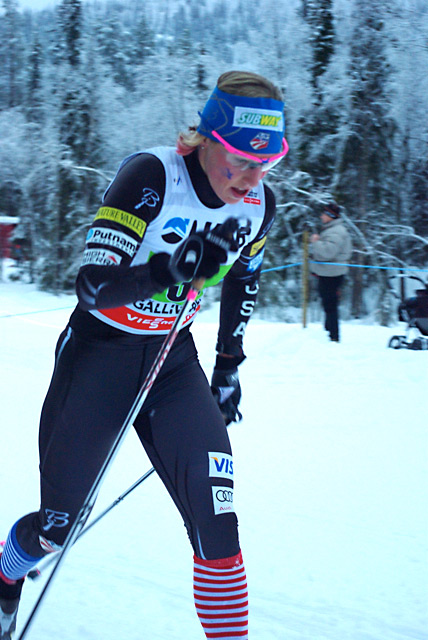
    Four Canadians landed in the top 20 with Valjas in 19th and Locke in 20th. Valjas finished fourth in the first quarterfinal, 1.81 seconds behind Chanavat, who won. Locke placed fourth in the third quarterfinal, 1.89 seconds behind Pellegrino as the winner of that heat.

    “I’m a bit disappointed,” Valjas said. “I didn’t feel like I was able to show my potential today. I always felt boxed in, and every time I tried to make a move, there was somebody there. The course is so turny that when you’re beside somebody you get boxed in, so it’s frustrating. I think I had more speed than I showed today, but I ended up not skiing it well tactically, starting at the back.”

    Asked about the conditions, Valjas elaborated that Quebec had some of the best snow that World Cup skiers have seen all year. Quebec City was hit with a massive snowstorm earlier in the week on Tuesday.

    “Europe is sometimes good, but this is all-time conditions here,” Valjas said. “It’s fast, it’s wide. It’s just, with the curves, it’s harder to pass than I thought.”

    Julien Locke (Canadian U25 Team/AWCA) racing to 25th in the men’s 1.5 k freestyle sprint qualifier on Friday at World Cup Finals in Quebec City. He went on to place 20th on the day for his first World Cup top 30. (Photo: John Lazenby/Lazenbyphoto.com)

    On the other end of the spectrum, Locke, a 23-year-old member of Canada’s U25 Team, was pleased with his performance in his third World Cup start as it marked his first time in the points (top 30). In his first World Cup race last month, he came close in 36th in PyeongChang.

    “At the start of the season, my two main goals were to go to the Korea World Cup and the World Championships,” Locke said. “And I went to Korea, and I unfortunately had a crash there, so I was really hoping for another second chance, and to qualify to come here was fantastic. It’s crazy having Alex here, a world champion coming home, and the atmosphere is incredible. So since this race was announced, doing a good sprint here was my big goal for the year.”

    Thompson, 26, ended up 30th after finishing sixth in the same quarterfinal as Cockney. After making his World Cup debut at last year’s Ski Tour Canada, Thompson started this season on the World Cup in Europe and raced to 31st in the classic sprint in PyeongChang. On Friday, he scored his first World Cup points as well.

    “Getting in the heats has been the goal for every sprint World Cup I’ve gone to do, which is, this is the 17th now, and I think it’s about the seventh sprint or so,” Thompson said. “… Goal number one is, get a top 30. So I got that, I can reassess, and raise the bar a little bit.”

    Newell Narrowly Misses Qualifying

    For the U.S., Andy Newell missed out on qualifying by eight-hundredths of a second in 31st.  Erik Bjornsen was 0.98 seconds back in 33rd, and Cole Morgan (Sun Valley Ski Education Foundation) another second back in 34th.

    “For Andy to be in 31st, disappointing for him,” U.S. Ski Team Head Coach Chris Grover said. “He felt good out there; he’s a little bit mystified. … And then also for Erik Bjornsen and Cole Morgan, who skied great, to be so close to going in … If we’d gotten three or four guys into the heats then I think it would have been a great start to the day. So a little disappointing to miss that opportunity.”

    “I was feeling pretty good out there skiing, so I don’t know why it was slow,” Newell said. “I couldn’t figure out why.”

    Bjornsen said he hasn’t raced much since World Championships and hoped Friday blew the cobwebs out.

    “I was hoping for a little bit more today,” he said. “I obviously wanted to qualify … but I’m excited for the next couple days. … Tomorrow’s a 15 k classic, which is my favorite event, so yeah, hopefully I can put together some good races.”

    Also for the U.S., Paddy Caldwell placed 50th, Matt Gelso 57th, Scott Patterson 58th, Jack Hegman 61st, Brian Gregg 62nd, Ben Lustgarten 69th, David Norris 70th, and Noah Hoffman 73rd.

    Canada’s Andy Shields came close to qualifying in 35th, Russell Kennedy followed in 36th, Devon Kershaw 38th, Knute Johnsgaard 41st, Evan Palmer-Charrette 47th, Joey Foster 53rd, Graeme Killick 64th, Ricardo Izquierdo-Bernier 71st, Brian McKeever 72nd, and Gareth Williams 74th.

    Results | World Cup Finals standings

    World Cup overall standings | Sprint World Cup standings (final)

  • Canada’s Harvey Scores Big with Second Place in Québec City Sprint

    Canada’s Harvey Scores Big with Second Place in Québec City Sprint

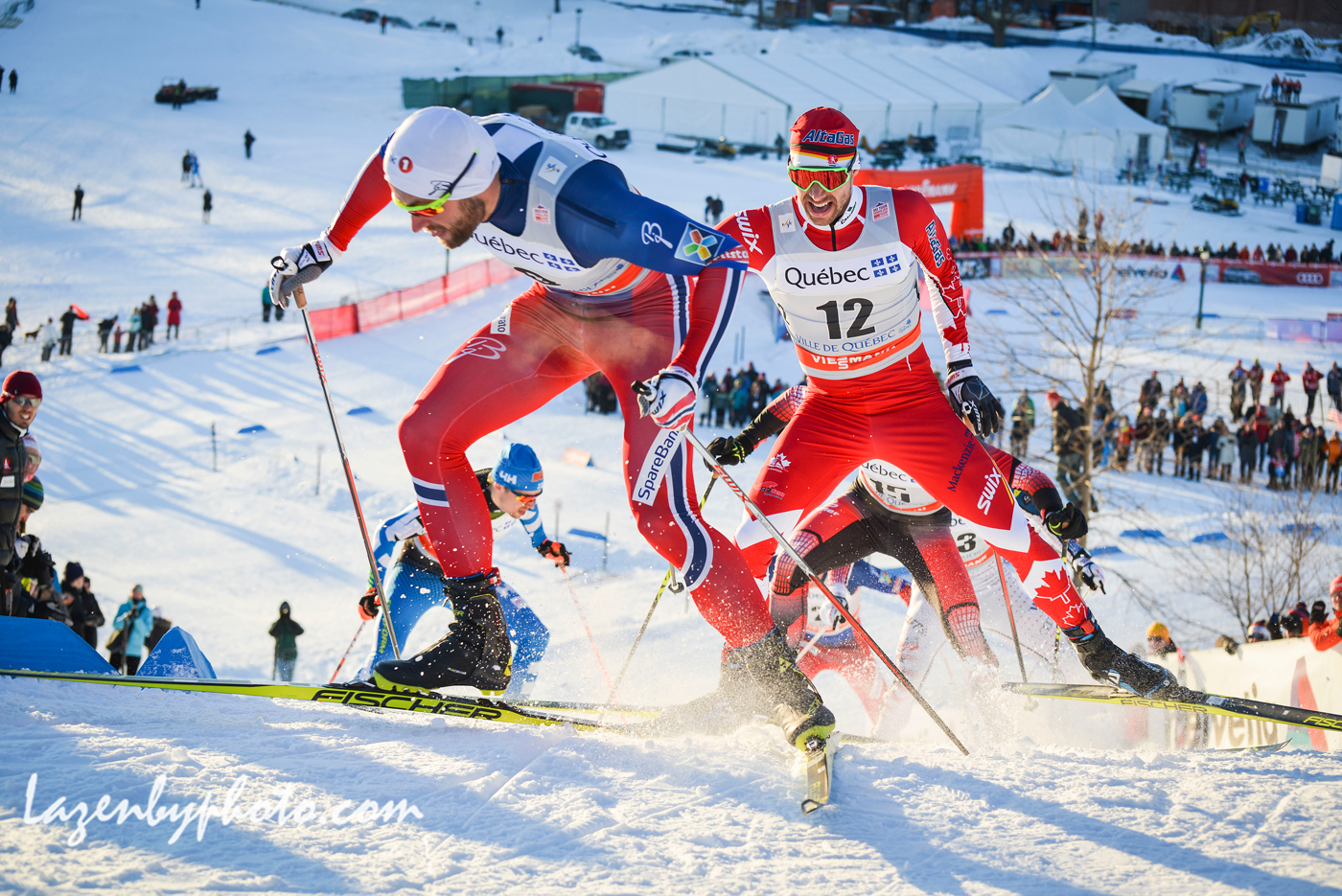
    France's Baptiste Gros (l) stretches across the line to edge Canada's Alex Harvey (r) for the win in Stage 3 of the Ski Tour Canada, the men's 1.7 k freestyle sprint In Quebec City. Russia's Sergey Ustiugov (second from l) placed third after leading most of the race and Norway's Petter Northug (second from r) placed fourth. (Photo: John Lazenby/Lazenbyphoto.com)
    France’s Baptiste Gros (l) stretches across the line to edge Canada’s Alex Harvey (r) for the win in Stage 3 of the Ski Tour Canada, the men’s 1.7 k freestyle sprint In Quebec City. Russia’s Sergey Ustiugov (second from l) placed third after leading most of the race and Norway’s Petter Northug (second from r) placed fourth. (Photo: John Lazenby/Lazenbyphoto.com)

    Ce fut une bonne journée pour accrocher votre chapeau.

    Quick translation from French — “It was a good day to hold onto your hat.” On Friday, it was also a good day to understand French, as two native French speakers from countries thousands of miles apart, finished 1-2 in the 1.7-kilometer freestyle sprint at the third stage of the Ski Tour Canada in Quebec City.

    France’s Baptiste Gros won the men’s final in 3:36.26. It was Gros’ first ever World Cup victory and his fourth career podium. The other French speaker, and local boy done good, was Canada’s Alex Harvey skiing to second (+0.55), for his fifth-career sprint podium. Overall Tour leader, Russia’s Sergey Ustiugov finished third, 0.79 seconds behind the winner.

    The hat-holding reference made earlier wasn’t for the victorious Francophones or the hell-bent pace of the day, or any strong winds. It was for this: On Friday’s sprint course, outside the gates of Old Quebec City on historic ground called the Plains of Abraham, World Cup-level speeds were matched with racing rife with World Cup-level scuffling. During the quarterfinals, semifinals and finals, skiers had to endure cold-induced lung burn, but also a six-person deep scrum of skiers aggressively attempting to position themselves.

    Here’s a few anecdotes of the carnage. The second men’s quarterfinal featured two North Americans: U.S. Ski Team sprinter Andy Newell, who qualified 23rd and Canadian Jess Cockney who qualified 29th. Add in Italy’s Federico Pellegrino, Andrew Musgrave of Great Britain, Sweden’s Teodor Peterson, and the day’s winner Gros and it became a perfect storm to start off the tumult.

    At 2:54 in, Newell looked fresh as he slotted behind Gros in first. The two bumped boots and suddenly Newell was down. Pellegrino, a breath behind Newell, tripped and buckled over the American.

    In the next heat, quarterfinal 3, Norway’s Finn Hågen Krogh, wearing bib number 1 as the day’s fastest qualifier, led for most of the heat. Out front, Krogh looked comfortable, even sublime.

    At 3:04, still leading, but with the heat’s eventual winner Frenchman Richard Jouve seemingly riding his tails, just as he crested a hill from a furious V1, Krogh tripped.

    And another image: Erik Bjornsen, also of the U.S. Ski Team (USST), moments after crossing the line in quarterfinal 5 (Bjornsen qualified 27th and placed fourth in the heat), got into a brief altercation with Great Britain’s Andrew Young, who placed third. Young was seen on TV cameras pushing Bjornsen first and Bjornsen pushed him back.

    However, one skier able to navigate all this unscathed was second-place skier in the fifth quarterfinal, Harvey. It was his day to cash in his chips.

    Bon Ski

    Norway's Petter Northug leads Canada's Alex Harvey during the second semifinal of the men's 1.7 k freestyle sprint at the Ski Tour Canada in Quebec City. Harvey won that heat, by 0.14 seconds ahead of Northug, and Harvey went on to place second in the final while Northug was fourth overall. (Photo: John Lazenby/Lazenbyphoto.com)
    Norway’s Petter Northug leads Canada’s Alex Harvey during the second semifinal of the men’s 1.7 k freestyle sprint at the Ski Tour Canada in Quebec City. Harvey won that heat, by 0.14 seconds over Northug, and Harvey went on to place second in the final while Northug was fourth overall. (Photo: John Lazenby/Lazenbyphoto.com)

    No doubt about it, Harvey is a local. He grew up about a 40-minute drive north of Quebec City in Saint-Ferréol-les-Neiges, Quebec. He’s part of Canada’s skiing royalty. His father Pierre was a Canadian Olympian in both cycling and cross-country skiing. There’s the family name to uphold and honoring the home crowd. But sometimes the pressure of performing in front of friends and family can get to athletes. That wasn’t the case for Harvey on Friday.

    Instead of buckling under expectations, he rose to the occasion.

    Although an all-around skier, Harvey has struggled this year to qualify in the sprints. Here’s his 2015/2016 sprinting rundown in terms of qualifying: Harvey has qualified in only four sprints this season; three of which were in classic technique. The first freestyle sprint he qualified for this season was earlier this week in the first stage of the STC in Gatineau, Quebec. Harvey last podiumed in a skate sprint in Szklarska Poreba, Poland, two seasons ago in January 2014.

    Call today a breakthrough or a perfect alignment of timing and place.  Either way, Harvey skied like he owned the course.

    Friday, Harvey made it a personal two-peat. He began his day qualifying for his second-straight skate sprint. In Quebec, he was 12th in qualifying, 4.63 seconds off of Krogh’s best time of 3:33.14.

    Then he finished second in his quarterfinal and first in his semi to cruise to the finals. As each round progressed Harvey noted he could sense the crowd’s energy.

    “After each round, the crowd got louder and louder,” Harvey said after the race. “The fans were amazing, they gave me wings.”

    Wings are a good way of describing the lightness one feels when a collective mass of people are willing the win. Harvey flew to a semifinal win in 3:40.68, besting Norway’s Petter Northug by 0.14 seconds.

    The men's freestyle sprint podium at Stage 3 of the Ski Tour Canada in Quebec City, with (from left to right), runner-up Alex Harvey of Canada, winner Baptiste Gros of France, and Russia's Sergey Ustiugov in third. (Photo: John Lazenby/Lazenbyphoto.com)
    The men’s freestyle sprint podium at Stage 3 of the Ski Tour Canada in Quebec City, with (from left to right), runner-up Alex Harvey of Canada, winner Baptiste Gros of France, and Russia’s Sergey Ustiugov in third. (Photo: John Lazenby/Lazenbyphoto.com)

    In the final, it was Gros, Ustiugov, Northug, Poland’s Maciej Starega, Jouve, and Harvey lined up as a northern sun kissed only the tallest buildings in Quebec City. By finals time, the course was shaded and looking cold.

    Ustiugov started out hammering in front and Northug kept the tension high as he shadowed in the rear. A minute in, Harvey skied just to the side, in third, keeping a lane open for an acceleration. Thirty seconds later, he was nearly side-by-side with Ustiugov as they skied along the old city’s fortress-like walls.

    By 2:30, there was no doubt, Harvey was on form. He matched a steamrolling Ustiugov up a decisive climb. Cresting the top, it looked for a moment that the Russian would run away with a sizable lead. But Harvey kept the finish in sight amongst the deafening crowd.

    In the home stretch the Canadian slingshotted to the outside around Ustiugov who was on fumes as he faded to third. Elusively charging up on the inside was Gros, taking the win.

    “At the top of the last uphill, I was right behind Ustiugov in the best position possible,” Harvey said about coming so close to the win. “I thought I could win this one, but then Baptiste passed me on my right and surprised everyone.”

    Harvey even outclassed the master of outclassing on the final sprint, Northug. Evidently, Harvey winked at the Norwegian in the finishing pen.

    “Few people can say they were faster than Northug in the last hundred meters of a sprint finish,” Harvey explained in a press conference. “He’s the best finisher since 2006, so it was my way of telling him I could hang with him!”

    Harvey, winner of four World Championship medals, two of which came in individual classic sprints, could have been off some competitors’ radars this season. In Canada, during the final race series of the World Cup season, it’s Harvey making the statement.

    “Right now, I’m in the best shape of this season,” Harvey said. “That was the goal.”

    Historically, it has been a bit rough for the Canadians racing in Quebec. The last time the World Cup visited the city, back in 2012, Harvey had the best showing for the Canadians in the individual skate sprint in 21st place. Then a week later in a skate sprint in Canmore, Alberta, Harvey didn’t qualify in 52nd.

    Fast-forward to 2016: Friday was a big day for the Canadians.

    Harvey moved up two spots into fourth overall in the Tour standings — 1:56.8 back from Ustiugov, who continues to lead the Tour. Northug is second overall (+16.7), and Iversen is third (+24.3).

    Alex Harvey and his father, Pierre, embrace after Alex Harvey won the 3.3 k freestyle sprint at the World Cup Finals in Falun, Sweden, on Friday. Harvey is a local hero in Quebec and will return for the Canadian nationals next week.
    Alex Harvey and his father, Pierre (r), after Alex won the 3.3 k freestyle sprint prologue at 2012 World Cup Finals in Falun, Sweden.

    One parent asked after the race if they were confident their son would make it to the finals was Alex’s father Pierre.

    “No! He didn’t do it once this season, but you dream of that one time where you can do it in front of your friends and family,” Pierre Harvey told FasterSkier. “He’s on a cloud right now. … During the Tour de Ski, they were tough moments for Alex. At one point, I thought he would call saying he’s coming back home. With all the waxing setbacks, it’s hard when you’re training like crazy.”

    Canadian Head Coach Justin Wadsworth, for one, wasn’t surprised with the result.

    “Alex can podium in every day on the right day,” Wadsworth wrote in an email. “His skating has come up a notch, most likely due to the surgery he had last spring, but he’s always been solid in every aspect of WC [World Cup] racing.”

    Last spring, Harvey had surgery on his iliac arteries in both legs to relieve pain that worsened in hilly skate races. He went on to start the season with a confirmation it was the right move: he placed second in the 10 k skate at the World Cup opener in Finland.

    As for how he commanded Friday’s final on home turf, Wadsworth said, “He knew where he had to be and when he had to be there, and stuck to this perfectly. He is one of the best tactical skiers out there. This course had a couple choke points, and if you were back on those it was hard to move into the right position toward the finish.”

    He stressed the importance of Harvey’s podium for the team, at home with its coaches, wax techs and a large number of athletes representing Canada as well “many whom have not had a chance to be part of a WC podium before,” Wadsworth wrote. “It’s been a really great working team of staff here that normally don’t work together, so having something to celebrate together is important.”

     “He is one of the best tactical skiers out there.” — Canadian head coach Justin Wadsworth, on Alex Harvey’s second place in Friday’s freestyle sprint

    Cross Country Canada’s new CEO, Pierre Lafontaine told FasterSkier that a strong program is built success by success.

    “I think it’s a sum of things, you know,” Lafontaine said. “Like Alex’s position and he is getting better and better as the season goes on. It’s powerful. It’s powerful that it happened at home in front of Canadians. We got two guys in the top twelve that’s powerful. Two or three days ago we had three guys in the top 30, one girl scored [points] that had never scored before. So it’s by hosting at home, it empowers these kids to push themselves even more.”

    The celebration for Harvey’s second place was noted by sprint winner Gros.

    “It’s funny because it’s almost as if Alex won today!” Gros said after the race.“It’s a big deal for him, he didn’t perform well this season in sprints. He’s looking to do well on the overall rankings, while I’m primarily focused on freestyle sprints. So you could say, I’m a ‘casse-pieds’ [ translation: pain in the neck!]”

    Having skied on the World Cup since 2014, this was Gros’ first World Cup win. He’s placed third once, and second on three occasions.

    “It’s funny because it’s almost as if Alex won today … So you could say, I’m a ‘casse-pieds’ [pain in the neck!]” — France’s Baptiste Gros, 25, after winning his first World Cup on Friday in Quebec City

    “In the past, I placed second in a World Cup, I kept finishing second, but I really wanted to win and I knew I had better chances in freestyle,” Gros said. “This morning, it was my last chance to win a freestyle sprint this season, so I told myself  ‘I got to win today!’

    “I find it magical! To do a course on the Plaines d’Abraham, with the crowd and the city laying in the background, it’s so surprising. We’re not used to that kind of crazy atmosphere.”

    Other North Americans in the Heats and Beyond

    Jess Cockney racing to 29th in the freestyle sprint qualifier at Stage 3 of the Ski Tour Canada in Quebec City. (Photo: John Lazenby/Lazenbyphoto.com)
    Jess Cockney racing to 29th in the freestyle sprint qualifier at Stage 3 of the Ski Tour Canada in Quebec City. (Photo: John Lazenby/Lazenbyphoto.com)

    Canada’s Cockney eked into the heats by qualifying 29th, 8.48 seconds out of first and 0.52 seconds ahead of 30th. Once in the heats, Cockney made the most of it.

    He skied a stellar quarterfinal assuring himself a place in the semis by finishing second, 0.54 seconds back from Gros as the winner of that second quarterfinal. That was the heat where Newell tumbled out of contention.

    Cockney raced in the second semifinal and finished in fifth (+2.49). Ustiugov won that semi in 3:37.42.

    Post-race, Cockney, a 26-year-old National Senior Development Team skier, was elated with his 10th place on the day.

    Man, I have had a really hard go of it this year,” Cockney said. “Nothing was working at the start of the year … So this is a big lift. I’m really happy with that. Skiing a semifinal is always awesome. Nice to have a two heat day again.”

    This was Cockney’s third time qualifying in a sprint and only his second time racing in a World Cup semifinal. His other semifinal came in 2012 at the skate sprint in Canmore, where he raced to ninth overall.

    For American Simi Hamilton, who raced to second in Stage 1 sprint three days earlier, anything was possible. Hamilton qualified 13th. Again proving he’s no fluke, Hamilton won quarterfinal 4 in a photo finish with Finland’s Martti Jylhä.

    In his semifinal, which Harvey won, Hamilton finished fourth (+0.86). Although Hamilton was a sliver from automatically advancing by placing first or second, his semifinal was just over three seconds slower than the first semifinal. As a result, no lucky losers advanced from Hamilton’s semi.

    U.S. Ski Team sprinter Simi Hamilton (c) hanging with the pack on an uphill in the 1.7 k freestyle sprint on Friday in Quebec City. He went on to finish fourth in his semifinal for eighth overall. (Photo: FlyingPointRoad.com/NNF)
    U.S. Ski Team sprinter Simi Hamilton (13) hanging with the pack on an uphill in his semifinal of the men’s 1.7 k freestyle sprint on Friday in Quebec City. He went on to finish fourth in the semifinal for eighth overall. (Photo: FlyingPointRoad.com/NNF)

    The U.S. sprinter told FasterSkier that Friday’s rounds were difficult.

    “It was crazy, it was really hard,” he said. “A minute-fifteen longer than pretty much anything.”

    Hamilton also mentioned he felt better as the day progressed.

    “It didn’t feel great qualifying, but felt better in my quarter and actually felt good in my semi,” he said. “But I really wanted to conserve energy early on so you know we had a really slow heat. I was happy just kind of tucked in towards the back, and focusing on relaxing.”

    Hamilton also referenced a make-or-break move by Northug in his semifinal that he didn’t have an answer for. “Petter made a move at the top of the first climb,” Hamilton said. “I was little too far back and I didn’t react to it quick enough. So I when I tried to get back up and bridge that gap, when we got to the second climb here,  I actually felt really good on the climb, and put a bit of a surge to see what would happen. But I couldn’t really go anywhere so I had to just hoped for the best coming into the finish.”

    Hamilton finished the day eighth overall.

    Another U.S. skier in the top 20, Bjornsen ended up 20th overall for a career-best in an individual World Cup sprint.

    The skier from Washington’s Methow Valley, who lives and trains with Alaska Pacific University (APU) in Anchorage, qualified in 27th. Bjornsen was ultimately bumped from competition when he placed fourth in his quarterfinal, 2.56 seconds behind heat winner Emil Iversen of Norway.

    In his interview with FasterSkier, Bjornsen mentioned the compact nature of the group in his quarterfinal.

    “Like most of them, it was pretty tight,” Bjornsen said. “Hard to make passes. I kind of went for a fast start out of it so I felt like I was in a pretty good position. I was just not quite strong enough to have that surge to make to that semifinal.”

    Asked about his brief finish-line scuffle with Young, who finished third, 0.18 seconds ahead of him, Bjornsen said, “There was just quite a bit of tangle the whole time. We were just stepping all over each other’s stuff, and we were both just disappointed at the end. It’s all fine. We talked right afterward in the pen so it’s all good.”

    Team veteran Newell had a tough run in the quarters. He got there by qualifying 23rd. Yet in his heat, the second quarterfinal, he tripped up while skiing behind Gros.

    Disappointing crash, ’cause I felt this is actually kind of a fun course,” Newell told FasterSkier afterward. “I thought I skied a good heat, tactically well. I was feeling strong and ready to attack the last hill. So it’s too bad with the crash. Greatly disappointing, but what can you do?”

    Newell described his tangle and nasty spill in more detail. “I was behind Baptiste [Gros], I came out of the draft, and we both started to skate at the same time. So we bumped boots, you know? I went down hard. Nobody’s fault. It’s what happens.”

    Italy's Federico Pellegrino became the first non-Scandinavian male to win a Sprint World Cup Crystal Globe on Friday, placing 21st in the freestyle sprint in Quebec City. (He needed to finish in the top 22 to lock up the title.) (Photo: John Lazenby/Lazenbyphoto.com)
    Italy’s Federico Pellegrino became the first non-Scandinavian male to win a Sprint World Cup Crystal Globe on Friday, placing 21st in the freestyle sprint in Quebec City. He needed to finish in the top 22 to lock up the title. (Photo: John Lazenby/Lazenbyphoto.com)

    Newell sat stunned for a few moments and finished sixth in the heat, 52 seconds out of first. Pellegrino recovered quicker and ended up fifth, 2.73 seconds behind Gros as the winner.

    That put Newell in 29th and Pellegrino in 21st overall; for Pellegrino, it was enough to secure his first Sprint World Cup Crystal Globe and he became the first non-Scandinavian male to win the season-long title. (He needed to finish in the top 22 to do so.)

    As of late, Newell has tried to jump start what he has considered to have been a difficult season.

    “Just trying to take it one day at a time,” Newell said. “I am obviously not in my best shape right now. I’m kind of suffering a little bit, and just trying to make it through the season. It hasn’t been a great last month for me. I haven’t been sick, I’ve just not been feeling very good. So that’s hard, at the end of a season, when you are not feeling well. It’s no fun to race when you are not at your best. It’s one of the hardest things for an athlete to do. So just trying to make it through some of these races. And then, yeah, take it one day at a time.”

    Also for the U.S., Reese Hanneman (APU) placed 45th, Eric Packer (APU) was 48th, Dakota Blackhorse-von Jess (Bend Endurance Academy) 64th, Noah Hoffman (SSCV/USST) 65th, Scott Patterson (APU) 70th, Tad Elliott (SSCV) 76th, Brian Gregg (Team Gregg) 79th, Matt Liebsch (Gear West) 80th.

    Also for Canada, Len Valjas (CNST) finished 38th, Devon Kershaw (CNST) 53rd, Knute Johnsgaard (AWCA/CNST) 54th, Andy Shields (NDC Thunder Bay) 56th, Michael Somppi (NDC Thunder Bay) 59th, Patrick Stewart-Jones (AWCA) 68th, Graeme Killick (CNST) 71st, Ivan Babikov (CNST) 72nd, (Russell Kennedy (Canmore Nordic) 73rd, Kevin Sandau (AWCA) 74th, Bob Thompson (NDC Thunder Bay) 78th, and Simon Lapointe (Skinouk) 81st.

    The STC continues Saturday with Stage 4, the men’s 15 k and women’s 10 k freestyle pursuits in Quebec City.

    Results | QualifierTour standings (through Stage 3)

    — Gerry Furseth, François Léger Dionne, Harald Zimmer, and Alex Kochon contributed 

  • Déjà Vu All Over Again: Marty Hall Speaks His Mind About Doping (Podcast)

    Déjà Vu All Over Again: Marty Hall Speaks His Mind About Doping (Podcast)

    Marty Hall coached decade long turns with both the U.S. Ski Team and Canadian National Team.
    Marty Hall coached both the U.S. Ski Team (1968-1878) and Canadian National Team (1982-1992).

    Marty Hall, 78, often needs no introduction. He’s established a canon of strongly worded comments and articles about the past and current state of cross-country ski racing. If there’s an opinion to be had, he’s got one.

    Hall was interviewed for the FasterSkier podcast on Nov. 13. We spoke mainly about doping and sport in light of newly released WADA report. That report, The Independent Commission Report #1, was released Nov. 9. The interview was split into two segments; episode 1 and episode 2.

    When asked about his first reaction to WADA’s findings about systematic doping in Russian athletics, he seemed torn.

    “You know, I read this thing and I said, ‘Holy Cow,’ they got ‘em. They did it the right way,’ ” Hall said. “But you know what I’m worried about? They’ll let them off the hook. Everyone of those son-of-a-biscuits should be cooked. Out. Gone. That’s how I feel.”

    Marty Hall on Doping: Episode 1 

    Hall’s thoughts are based on experience. What may seem reactionary or knee-jerk is grounded in where he’s been and what he’s done. Hall’s relationship with cross-country skiing goes back decades. Having learned to ski as a child in the backwoods of New Hampshire — he move there at the end of World War II from New York City — Hall fell in love with the sport. From pine boards and toe straps, to composites and fluoros, Hall has seen and been a part of it all. He skied for the University of New Hampshire and eventually climbed the coaching ranks, spending a decade with the U.S. Ski Team (1968-1978) in a variety of roles. He led both the women’s and men’s squads and served as head coach. In 1982, he headed north to Canada where he became the Canadian National Team head coach. He remained in that role until 1992.

    Canada's 1992 Albertville Olympic team: (from left to right) Top: Alain Masson, Dave Wood (Wax Technician), Dany Bouchard, Yves Bilodeau, Darren Derochie, Al Pilcher, Wayne Dustin.  Bottom: Laurent Roux (Head Coach) Jane Vincent, Lucy Steele, Lorna Daudrich, Rhonda De Long, Marty Hall (NST Director),  absent Angela Schmidt-Foster. (Photo: Cross Country Canada)
    Canada’s 1992 Albertville Olympic team: (from left to right) Top: Alain Masson, Dave Wood (Wax Technician), Dany Bouchard, Yves Bilodeau, Darren Derochie, Al Pilcher, Wayne Dustin. Bottom: Laurent Roux (Head Coach) Jane Vincent, Lucy Steele, Lorna Daudrich, Rhonda De Long, Marty Hall (NST Director), Absent Angela Schmidt-Foster. (Photo: Cross Country Canada)

    He then helped revolutionize how cross country skiing is viewed in person and on television. When planning the 1995 Thunder Bay World Championships, rather than one long 25-kilometer loop, with skiers away in the woods for long periods, Hall suggested a smaller loop, around 5 k, which would regularly bring athletes through the main stadium. If you enjoy watching today’s easier-to-view international events, Hall had a hand in that.

    But his contributions to sport come with something Hall is comfortable with. He speaks his mind. That can be tough to digest for many.

    ““I’m a tough guy and you’ll hear it straight from me. … When you cross over and do something stupid you’re gonna hear about it,” he said.

    Marty Hall on Doping: Episode 2

    Back in 1988, as head of the Canadian National Team, a scandal erupted at the Calgary Winter Olympics. At a post-race press conference, he tacitly accused the Russians of doping. Although he’d been suspicious of dopers since 1974, he remained relatively quiet. Until Calgary.

    “How about the Sport Minister,” Hall said. “He told me to shut up! And he wrote me a letter and said, ‘Oh your venue up there is beautiful. I had a great day watching the race. But … Marty shut up. You’re in hot water.’ ”

    The fallout from those accusations took awhile to settle. And Hall didn’t step down until 1992, four years later. But it certainly left a few questions unanswered. Like how much doping was going on back then? Who was involved?

    As the WADA report and its implications play out, it doesn’t appear Hall holds a gripe. For him, it seems a matter of righting a wrong and serving his former athletes like Pierre Harvey, who Hall claims was robbed of a fair race at his home Olympics. Glad to see the report’s findings, Hall hopes the sport he loves benefits from the report in the end.

  • From the Casual to Fanatic, Spectators Turn Out for Quebec Sprint

    From the Casual to Fanatic, Spectators Turn Out for Quebec Sprint

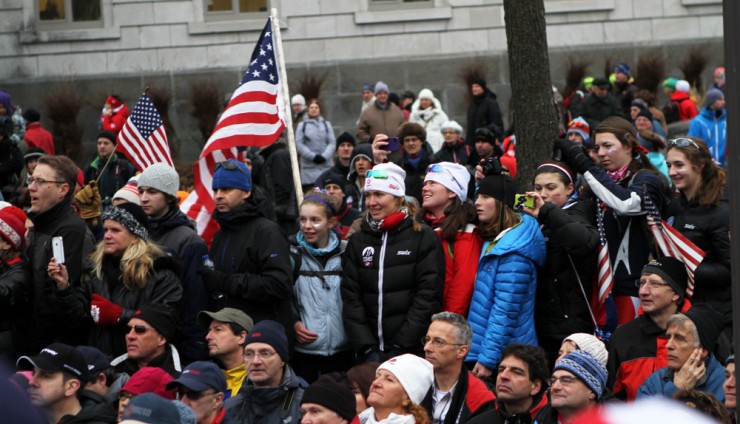
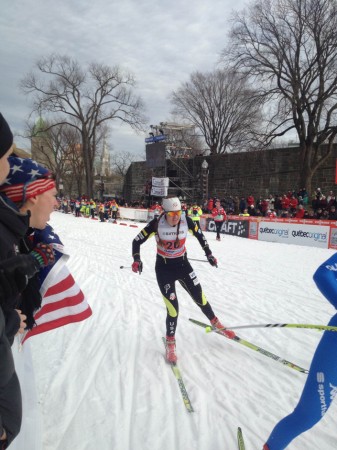
    American fans watching Friday’s World Cup team sprint in Quebec City.

    QUEBEC CITY – They piled into vans for five-hour drives from New England colleges, toting flags and banners. Others flew in from Alaska and the Midwest, to cheer their friends and family. And some simply walked over from their government offices to watch Alex Harvey, the Quebec native whose skiing exploits have been plastered across the pages of local newspapers.

    “Of course, it’s not hockey, but people know his name and what he’s accomplished in the past few years,” said Pierre-Luc Pelland, 28. “We’ve just come to see how it looks.”

    “It” was North America’s first cross-country skiing World Cup race in nearly three years. And Pelland, on lunch break from his job at Quebec’s higher education ministry, wanted to check out the spectacle unfolding Friday in front of the provincial parliament.

    Joining him on the sidelines were hundreds of others, from the casual to fanatic. At the top of one hill were the parents and brother of American sprint star Kikkan Randall; at the bottom of another was the local retiree who says he’s been mountain biking with Harvey’s dad.

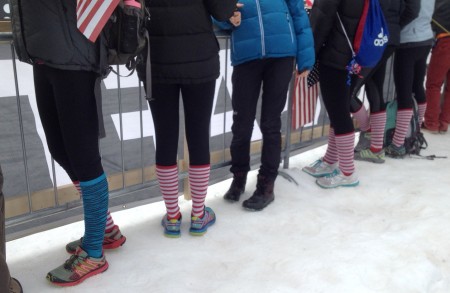
    The Stratton socks.

    And then there was the pack of girls from Vermont’s Stratton Mountain School, sporting face paint and knee-high striped socks in solidarity with the style pioneered by the American women’s team, sprinting back and forth between vantage points.

    “We were so excited,” said Brooke Mooney, a high school junior and skier at Stratton who bought herself and her teammates eight pairs of the socks from a New Hampshire K-Mart. “We spent hours this morning preparing—glitter, ribbons, everything.”

    All the fans combined to make the Quebec City sideline feel like something between a winter festival, a football game, and a high school reunion.

    “It was like being at a carnival on steroids today,” said Liz Kantack, who coaches at Stratton. “You see everyone you ever raced with, and their parents.”

    The spectators in Quebec could be divided into several constituencies. First, there were the rabid fans, like Ken Schoville, 62, who recently retired from 31 years of ski coaching in northern Wisconsin.

    On a trip that he dubbed “my fantasy tour,” Schoville had driven from Wisconsin to Calgary with his wife, where they ditched their car and caught a flight to Quebec. After watching the races here, the pair will fly back to Calgary, then drive to next week’s World Cup in Canmore.

    “I’m just thrilled,” Schoville said. “Quebec is such a cool venue and place.”

    Other particularly avid groups were the contingents from several colleges, including Dartmouth, Bates,

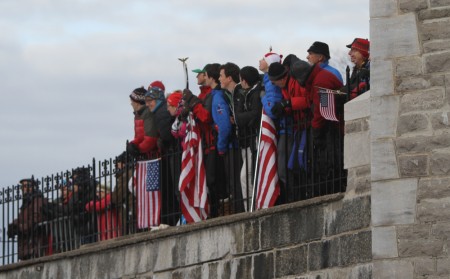
    American fans with a unique spot for spectating.

    and Middlebury. Wilson Dippo, Bates’s assistant cross-country ski coach, had driven seven of his athletes to Quebec from Central Maine, and was expecting a roughly a dozen more to arrive in time for Saturday’s races.

    “It’s a four-and-a-half, five-hour drive, so there’s no excuse not to be up here,” Dippo said. “There was no way I was going to let us not come.”

    Then there were local, casual fans like Louis Cliche, 67, a retired litigation lawyer who said that he’s done “a bit of mountain biking” with Alex Harvey’s father, Pierre.

    Cliche, a recreational cross-country skier, had read about the races in the newspaper, and made a point of coming out to support Harvey, and his teammate Devon Kershaw.

    “If you like cross-country skiing and you’ve got a World Cup in your backyard, it’s a must,” Cliche said. “Especially since Harvey and Kirchner, or whatever his name is, are doing quite well.”

    Bates College assistant coach Wilson Dippo cheers on American Becca Rorabaugh.

    And of course, there were the parents, like Deborah Randall, 58, who had flown in from Anchorage to watch her daughter Kikkan Randall compete.

    Typically, because of the time difference between Alaska and Europe, Deborah Randall said she has to watch World Cup races “at one or two in the morning,” on an Internet stream.

    On Friday, she got to see her daughter compete from a few feet away—and without having to fly across an ocean to get to races in Europe.

    “Being here is unbelievable,” Deborah Randall said. “I’m just so excited to be a part of it.”

    For Schoville, the Wisconsinite on his fantasy tour, Quebec’s festive atmosphere was something he said he’d like to see transported across the border.

    “This is the time,” he said, referencing the nascent efforts by Midwesterners to bring a World Cup to the U.S.

    “Mitt Romney’s not doing anything right now,” Schoville said. “He did pretty well in Salt Lake—maybe we could get him on board.”

    Disclosures: The writer attended college with Dippo, and Kantack has written for FasterSkier.

  • Once in His Son’s Shoes, Pierre Harvey in Awe

    Once in His Son’s Shoes, Pierre Harvey in Awe

    Alex Harvey and his father, Pierre, embrace after Alex won the 3.3 k freestyle sprint at the World Cup Finals on March 16 in Falun, Sweden. Harvey is a local hero in Québec and returned for Canadian nationals there the following week.

    MONT SAINTE ANNE, Québec – Standing on the hill above the stadium at the Canadian Ski Nationals in March, Pierre Harvey smiled as he soaked up the sights and sounds buzzing around him.

    Earlier that morning on the last day of competition, his only son, Alex, purposely tied his best friend and teammate Devon Kershaw for the 50-kilometer classic victory. Several hours later, Pierre Harvey, a three-time Olympian whose name belongs to the Pierre-Harvey National Training Centre, stuck around his home venue.

    This was where Alex, a 2010 Olympian who finished sixth overall on the World Cup last season, started the sport nearly 20 years ago. Back then, he used to ski for about 15 minutes before hopping into a baby glider behind his parents. By the time he hit double digits, Alex was well on his way into becoming a Canadian superstar in both skiing and cycling.

    After claiming Canada’s first gold medal at U23 World Ski Championships, Alex notched another national first with Kershaw at the 2011 World Championships, where they won the team sprint. Last season, the national team member clinched his first World Cup victory at the age of 23 – almost exactly 25 years after his father did the same thing in Falun, Sweden.

    At the 2012 World Cup Finals, Alex won the 3.3 k skate prologue and Kershaw placed third to once again make Canadian history. Pierre dominated the 30 k freestyle in Falun in 1987 and again in 1988, about six months before Alex was born.

    After going to the 1976 and 1984 Olympics in cycling, Pierre became the first Canadian to compete in another Olympics the same year in the winter of ’84. He went to the 1988 Olympics as a cross-country skier and retired from the sport following that season.

    Reflecting on what his son had accomplished already, Pierre, 55, said it was hard to believe. He hadn’t anticipated Alex, who also made the Québec National Cycling Team, would necessarily stick with skiing.

    Alex Harvey talks to reporters after winning the 15 k freestyle at Canadian Ski Nationals in Mont Sainte Anne, Quebec, on March 20. He finished the week by sweeping every event he competed in (including a first-place tie with teammate Devon Kershaw in the 50 k classic mass start).

    FasterSkier: What’s it like being at nationals as a father?

    Pierre Harvey: I live here, it’s my hometown, but to see my son … it’s quite unbelievable what he’s doing in the last two, three years. Every year, he’s improving. Like three years ago, he was 40th in the World Cup and now this year, he finished sixth and he won a World Cup. It’s a progression, a really fast progression. Usually it takes maybe 10 years to do what he did in the last three years. Sometimes I think it’s almost too fast, but it’s the way it is and it’s good.

    FS: What kind of advice have you given him?

    PH: I don’t give so much advice. He has a good coach [Louis Bouchard at the Pierre-Harvey National Training Centre in Québec] and we just try to make a good environment for the athlete. I’m a member of the Pierre-Harvey Training Centre, it’s my name, but I’m just one of the guys on the board. We just try to have the best environment for the athlete, best coach and a good support team, wax men and all of that and a good training opportunity and make a group where they really have fun together. I think the most important thing is to have fun. The day you don’t have fun, you will never improve anymore.

    But advice, no, I talk with Alex, but not even every day. When he’s away from home for 10 months, a year, I talk with him maybe two, three times on the phone and just send an email after a tough race and say, ‘You know, take it easy, it’s a long season and all those guys are really strong around you. You’re not alone.

    ‘If you would win everything it would not be fun anymore. Those guys train as hard as you do and they’re top athletes. Just try to learn from them and try to see how you can improve, but don’t think that you can win all the time. It’s not possible.’

    A guy like [Switzerland’s Dario] Cologna is doing that and Cologna, even five years ago, he was not winning all the time. Alex is 23 years old so he still has to be patient.

    FS: What about coaching tips?

    PH: I never want to be a coach for [Alex]. It’s too much. We have to keep a distance and let him do his own thing and do what he likes.

    I’m surprised that he keeps skiing because he started so young. I thought that around 16 years old he would decide to do something different because here we have ski school so you can go to school and train so two days in school, two days in training so skiing in winter so these programs are really good.

    That’s why in Québec we have lots of good athletes in any sport because of these school programs, but on the other hand, I thought that you do so much that when you get to 16, 18 years old, it’s too much and you want to do something different, especially you don’t want to do what your father did. Usually a kid would try to do something different than his father or mother, they want to do their own thing. That’s why I’m surprised that he kept enjoying that and doing that.

    FS: Why did Alex keep skiing?

    PH: I guess it’s because when he was 16 years old, he could go to a World Junior Championship in biking in the fall and then World Junior Championship in the winter in skiing so it was those nice trips. It was like the carrot that makes you go, ‘OK, one step more, one step more. Next year maybe I’d like to do that.’

    It’s like you always want to do more, and I don’t know the real reason why he kept doing it, but anyway, he did it.

    FS: What did you think of Alex’s homecoming at Mont Sainte Anne with all of the fans and media and even one of his sponsors in a helicopter?

    PH: Every year, it’s getting bigger and bigger because we’ve got so much coverage, media coverage, it’s unbelievable. We’re used to seeing a professional hockey player have coverage, but for another athlete in Québec at his age, there is no other athlete that gets so much coverage.

    I don’t know how he does it, maybe he’s nice with the media, but he has so much coverage. That’s why people come and see it. For sure, I’m quite impressed by him because of all that he does. He keeps going to school, he’s skiing and sometimes I think it’s almost too much.

    FS: We heard your two daughters helped welcome Alex home at the airport in Québec. What are they up to these days?

    PH: They all do skiing and biking. Laurence was [training] to go to the Canadian championships in biking. She did the World Cup here as a junior last summer and she broke her elbow. Her goal was to go to the world championship in biking. Laurence is training all year round.

    Sophie doesn’t race anymore, but she used to race in Canada Games and Canadian championships biking and skiing. She quit racing because for her she didn’t enjoy the pressure. She put so much pressure on herself. We go skiing and biking together really often and she enjoys the sport.

    FS: And Alex is going to law school?

    PH: He’s been [studying at Laval University in Québec City] for two years, and he has six to eight years left. … He’s in no rush because he said, ‘Even if I finish tomorrow, I will never work until I stop racing.’ His plan is to go to the next Olympics and if he still enjoys it, maybe another one.

  • Twenty-Five Years Later Another Harvey Wins in Falun as Canada Packs Podium

    Twenty-Five Years Later Another Harvey Wins in Falun as Canada Packs Podium

    Canada's Alex Harvey en route to winning the prologue in Falun.

    All 2012 FIS World Cup Finals coverage is brought to you through the generous support of Fischer Sports USA, proud sponsors of Kikkan Randall, 2012 overall Sprint Cup Champion.

    FALUN, Sweden – Tel père, tel fils…or as they say in English, “like father, like son.”

    On what Canadian Head Coach Justin Wadsworth described as an “almost a perfect day,” Alex Harvey won his first World Cup race 25 years after his father Pierre did the same thing, right here in Falun.

    Devon Kershaw finishes off the lower section of the Mördarbacken for the second time before turning back towards the stadium.

    The 23-year-old Harvey edged out 2012 World Cup Champion Dario Cologna (SUI) by a mere .2 seconds in the 3.3-kilometer skate prologue. And with Devon Kershaw (CAN) placing third you have that near perfect day Wadsworth was referring to.

    Canada has never had two men on the podium in a World Cup race, and while Wadsworth has plenty of confidence in his skiers, the one-three finish was not something he had considered.

    “I have to pinch myself today, that is for sure,” Wadsworth told FasterSkier. “I wasn’t expecting that. I just wanted the guys to ski solid races and keep in the hunt… But they really executed well…”

    That execution started before the race when Wadsworth returned to the team hotel after the women’s prologue.

    Wadsworth told his four men, “you have to pace up the first time. The race doesn’t start until you get to the top of Mördarbacken. And once you get to the top there you have to have the punch to drive it all the way home.”

    The race leaves the stadium and almost immediately runs into the “killer hill.” After a long winding descent, the men came around and skied the first portion of Mördarbacken before peeling off to head to the finish.

    At the base of the big hill, just half a kilometer in, Harvey was back in 13th, before many of the top skiers had come through.

    At the top, he was seven down on leader Marcus Hellner (SWE) and Kershaw was eight back.

    “I tried to build during the race,” Harvey said. “Even though it is downhill toward the finish you still have to work the corner really hard and really accelerate over the top of the hill.”

    He pointed out that the top of Mördarbacken is only three minutes into an eight plus minute race, so “most of the time is still to come.”

    He said he was consciously saving energy for the final stretch of the race, and focused on pushing the downhills and gradual terrain.

    Like his teammate, Kershaw stayed in control up Mördarbacken and over the flat at the top, then “it was game on—it was like a sprint qualifier to the end for me,” he said.

    Harvey climbed up to second in the World Cup Finals standings while Kershaw locked up second place in the overall. And with Lenny Valjas, in a strong 21st today, sitting in third in the World Cup Finals, following his podium in Stockholm, and the Canadian men are on a roll.

    Alex and Pierre Harvey embrace after the race.

    The success of the day was witnessed by none other than the aforementioned Pierre Harvey.

    The elder Harvey said watching his son win a World Cup race was “unbelievable,” and never imagined he would see such a day.

    “Nobody could believe that one day your son would do that,” Pierre told FasterSkier.

    Usually, he explained, children don’t follow in their parents’ footsteps.

    “When you see your father doing something, usually the son…wants to do something different,” an ecstatic Harvey senior said. “I never thought he would do that. Never, never.”

    The younger Harvey finally broke through with a win three years after his first World Cup podium

    “It is really special,” he said of the victory. “It is what I train for. I train because I love it, but I also love racing and I love to race well.”

    After taking two World Cup thirds in 2009 he thought his first win would come soon after, maybe even in the Olympics, and though it didn’t happen, Harvey said he knew in his head that he could do it.

    Even with a gold medal at the 2011 World Championships in the Team Sprint, and a victory at the U23 Championships, Harvey was hardly satisfied.

    He was looking for the individual World Cup win.

    “It keeps me motivated to try and improve, and especially when I can see my teammates on the podium, Devon winning a bunch of races this year—I wanted to win too,” Harvey said.

    Kershaw was gunning for the victory just as hard today, but Wadsworth stated the simple fact that “they both couldn’t win.”

    Wadsworth said it was a huge weight of Kershaw’s shoulders to wrap up the number two spot in the World Cup, however.

    “He has been so nervous about it, its crazy,” Wadsworth said.

    Early in the race, at the base of Mördarbacken, Wadsworth knew his two stars were having good ones.

    After watching them in hundreds of events and training sessions, he knows when they are skiing well.

    “At the start of a race like that you can be really stressed and high tempo,” Wadsworth said of the prologue distance.

    But both Kershaw and Harvey brought “just the right mix of pop and glide.”

    “I saw that” Wadsworth said, “and I could relax. They looked smooth, there was no stress—I knew they were going to be on it today.”

    Kershaw said he felt great, and thought he had a good chance to take the victory despite being “scared shitless” of the big climb.

    He added that prologues generally make him nervous since there are few opportunities to race them, and he doesn’t have a good sense of the pacing.

    But following Wadsworth’s advice to ease into the race worked wonders and despite falling short of the win he was “super thrilled with how it went.”

    Dario Cologna (SUI) takes on the Mördarbacken.

    The unflappable Cologna, who has already wrapped up his third consecutive World Cup title, after achieving the same feat in the Tour de Ski, was satisfied with his performance.

    Consistent as always, Cologna was in second at the top of Mördarbacken, though at the point he trailed Hellner and not Harvey.

    Over the next 2.1 kilometers he lost 4.3 seconds to the Canadian. He said it was necessary to start hard, but like the Canadians, recognized the need to save something for the end.

    “It is not a sprint,” Cologna said. “You have to be in good shape or otherwise you will die in the Mördarbacken.”

    While Cologna is hardly unbeatable in distance races, as Eldar Roenning proved last week in the Holmenkollen 50k, he is always in the mix.

    Continuing an amazing run today, Cologna has not missed the podium in a World Cup distance race since the Kuusamo mini-tour back in November.

    Wadsworth sees the Swiss star as skiing’s version of Tiger Woods saying “When you are going up against a guy like Cologna…You have to beat him once and then you know he is beatable.”

    Now that Harvey has done that, taking the win in the process, Wadsworth feels like “the floodgates can open for the guy. The kid is going to have an amazing future. I’m just so glad I’m here to be part of it.”

    Complete Results

    Matt Voisin contributed reporting.

  • Elliott to Emphasize Skiing, Scale Back Cycling

    Tad Elliott racing at the 2011 World Ski Championships in Oslo.

    Nordic skiing already claimed the talents of one dual-sport prodigy five years ago, when Canadian Alex Harvey gave up a promising mountain biking career to focus on cross-country.

    Now, it has gained another: American Tad Elliott says he’s also making a shift away from mountain biking, and will put more of an emphasis on skiing this coming off-season.

    “That’s kind of the focus now, is putting more chips into skiing, and wanting to do World Cup skiing, wanting to do World Champs,” Elliott said after last weekend’s 50 k freestyle in Oslo. “I think there’s a bright future in skiing now, and I want to be a part of it.”

    Elliott, 22, a two-time U.S. national champion in skiing, is also an accomplished cyclist. He owns multiple U-23 U.S. mountain-biking titles, and last year, he raced domestically and in Europe for a professional squad, Team Sho-Air.

    But after one of his best ski seasons ever, Elliott says that he’s not going to go back on the international circuit. Instead, he’ll compete for a local team, working as a mentor for junior riders and competing in his home state of Colorado.

    In the past, Elliott has made a quick transition from skiing to mountain-biking, and back again. This spring, for example, he won the U.S. title in the 50 k freestyle in Maine in late March before competing in the Sea Otter Classic in California in mid-April.

    Elliot racing in a World Cup in Norway in February.

    This coming season, though, he said that mountain biking will play a smaller role.

    “I just get to race some local races, and use it as a building block for my skiing,” Elliott said. “My season starts late, and is over early, and it’s perfect.”

    Currently, Elliott is competing with Central Cross Country’s (CXC’s) elite team. But this coming year, Elliott said that he hopes to attend more camps with the U.S. Ski Team (USST)—and he also said that securing a nomination to the latter squad was something that motivated his move. (Despite a strong campaign from Elliott during the 2010 ski season, he was left off the 2010-2011 USST, and Head Coach Chris Grover cited Elliott’s mountain biking schedule as a factor in the decision.)

    “I’d love to get on that team some day. I’d love to ski for them, but that’s up to those guys, if they want to bring me,” Elliott said. “Everyone’s really positive about it—seems like a great plan. [CXC Head Coach Jason] Cork says he’s into whatever I decide, and whatever those guys decide.”

    There have been a number of successful skier-cyclists competing internationally in the past, most notably Harvey’s father, Pierre, a road biker who competed in the Summer and Winter Olympics in the same year, 1984. More recently, American Carl Swenson raced on the skiing World Cup during the winter, and the professional mountain bike circuit in the summer.

    Neither of those men ever won a major championship medal, though Pierre Harvey was certainly successful, winning the prestigious Holmenkollen 50 k World Cup in Oslo in the late 1980’s.

    Alex Harvey was also an elite mountain bike racer when he was younger, and a very good one—he competed at the World Junior Championships two times. But faced with a difficult transition to the senior level five years ago, just as his ski results were improving, he decided to pursue the latter sport full time.

    “It was more of a natural decision—it was just good timing,” he said last week.

    For Elliott, at 22, the shift is coming five years later. He said he was motivated by a desire to do more international racing, and he also noted his performance in the American 4×10 k relay squad at the World Ski Championships in Oslo last week, when he teamed up with Andy Newell, Kris Freeman, and Noah Hoffman to finish 14th.

    “The result wasn’t there, [but] the group is there,” Elliott said. “That’s a group that could be there for a while, and I want I want to put more focus in it.”