From the FasterSkier archive — posts syndicated from athletes’ and coaches’ own blogs between 2004 and 2012, kept online as published. Current coverage is at fasterskier.com.

Tag: Pietro Piller Cottrer

  • Pellegrino Nabs Unprecedented Seventh Win for Italy; Nilsson Beats Three Norwegians in Planica

    Pellegrino Nabs Unprecedented Seventh Win for Italy; Nilsson Beats Three Norwegians in Planica

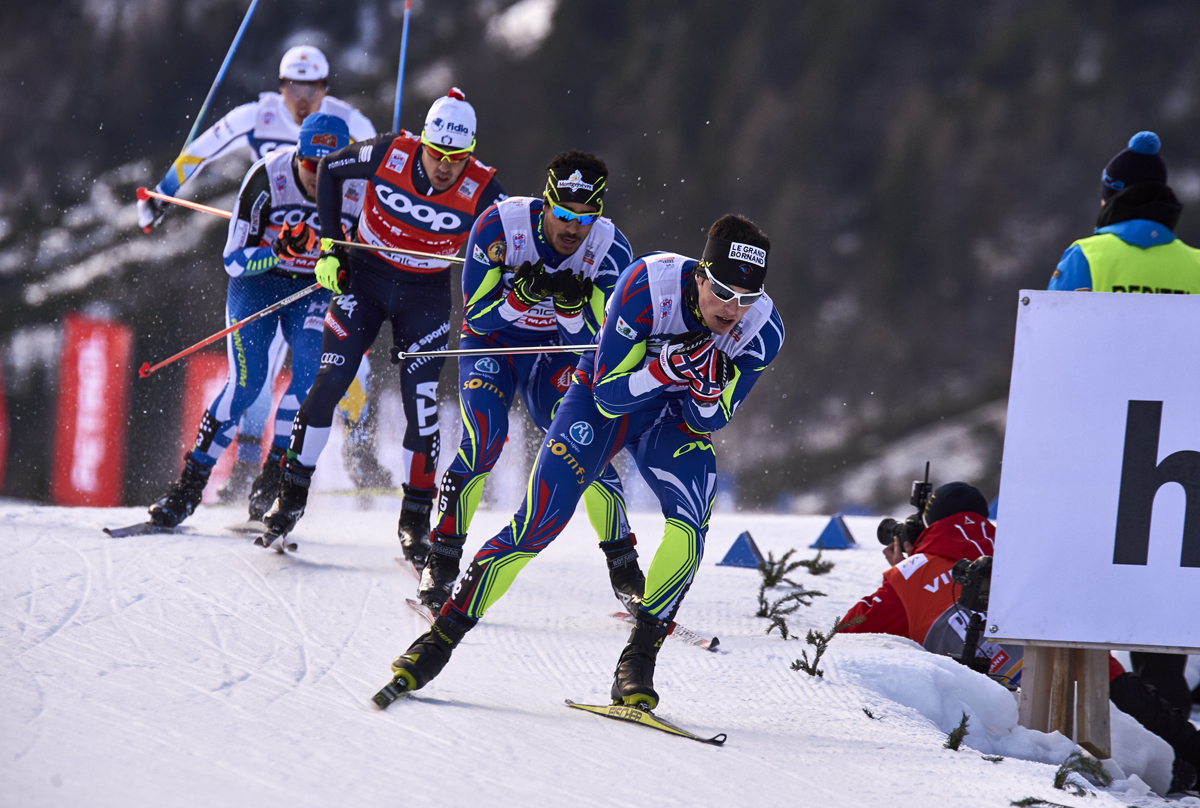
    France's Lucas Chanavat (front) and Richard Jouve (second from r) lead Italy's Federico Pellegrino during their 1.2 k freestyle sprint quarterfinal at the World Cup in Planica, Slovenia. Pellegrino won the heat, Jouve placed second and Chanavat faded to sixth. (Photo: Fischer/NordicFocus)
    France’s Lucas Chanavat (front) and Richard Jouve (second from r) lead Italy’s Federico Pellegrino during their 1.2 k freestyle sprint quarterfinal at the World Cup in Planica, Slovenia. Pellegrino won the heat, Jouve placed second and Chanavat faded to sixth. (Photo: Fischer/NordicFocus)

    Six days ago on Sunday, Jan. 10, the famed hill-climb finale up Alpe Cermis in Val de Fiemme, Italy, wrapped up the 10th annual Tour de Ski. This weekend, standard World Cup racing has resumed in Planica, Slovenia, marking the first time a World Cup event has been held in Planica — better known as a biathlon center. The last World Cup races in Slovenia took place in 2011 in Rogla, about 200 kilometers east.

    On Saturday, two familiar faces in the sprint scene topped the men’s and women’s 1.2-kilometer freestyle sprint.

    Italian record-breaker Federico Pellegrino raced to his fourth-consecutive freestyle sprint victory this season. He is the first racer in history to do so, and according to the International Ski Federation (FIS), is the only male to reach the podium more than once in these four races. The list of firsts goes on when it comes to 25-year-old Pellegrino.

    Last season, Pellegrino became the first athlete to win three consecutive skate sprints between December 2014 and January 2015. With Saturday marking his seventh World Cup win, he is now the winningest Italian male cross-country skier of all time, according to FIS. He was previously tied with Pietro Piller Cottrer with six wins.

    “Statistics are made to be changed,” Pellegrino told La Gazzetta della Sport, according to a translation. He said he had “great feelings” during the qualifier, which he won by 1.59 seconds over France’s Lucas Chanavat.

    He went on to win his quarterfinal (by 0.26 seconds ahead of another Frenchman Richard Jouve), and advanced out of his semifinal after placing second, 0.6 seconds behind yet another French skier Baptiste Gros.

    In the final, a trio of Frenchman (Gros, Jouve and Renaud Jay) trailed Pellegrino into the last few hundred meters before the finish, with Gros leading the charge behind him. Pellegrino skied away to the victory in 2:15.12, holding off Gross by 0.88 seconds. Jouve placed third (+1.71) and Jay completed France’s sweep of second through fourth in fourth place (+2.23).

    Gros had also placed second to Pellegrino in the Davos World Cup skate sprint in December — Pellegrino’s first win of four in a row.

    Russia’s Gleb Retivykh and Germany’s Sebastian Eisenlauer finished behind the French contingent in fifth (+4.18) and sixth (+4.19), respectively.

    (Story continues below)

    Dedicated to all my lumberjacks friends ⚙🏆👊🏻😉 📷NordicFocus

    A photo posted by @federicopellegrinoxc on

    Easily the favorite going into the race, some pressure inevitably rode on Pellegrino. He reflected feeling like he “could only lose the race.”

    “It felt very good in the qualification,” he told FIS after the final, “But I was worried it could get worse.”

    He proceeded to comfortably advance through the heats with strategic execution. He won the third quarterfinal, which turned out to be the fastest and produced two lucky losers: Finland’s Martti Jylhä in third and Sweden’s Calle Halfvarsson in fourth.

    Pellegrino then carefully navigated a loaded semifinal, with all six competitors qualifying in the top eight. Gros took the lead at about halfway through, with Pellegrino stuck a few spots back. After being boxed out of the inside lane turning into the final climb, Pellegrino fought his way into second on the final climb to ensure he’d automatically advance in the top two. Gros cruised to a fairly commanding semifinal win, which did not go unnoticed by Pellegrino.

    “I learned in my semifinal how to ski in the final,” Pellegrino told FIS. “I expected Baptiste to be fast on this course, so my plan was to go in the front and get a gap on the others.”

    Confident in his chances in the semi, Gros had his doubts entering the final: “In the semifinal I thought I could win, but in the final it was clear that Federico [would] win,” he later told FIS.

    Gros led the final for most of the first half, while Pellegrino sat back around fourth place. This time, however, he didn’t let Gros get out of reach. About halfway through the race, Pellegrino made his move: passing on the inside, accelerating to the front of the pack ahead of Gros and significantly cranking up the pace.

    With that, the race proved to be as good as done. Pellegrino created a gap leading into the final downhill, breezed up the final climb with an unmatched tempo, enjoying a sizable gap on the field before throwing his arms up to celebrate across the line.

    Notably, there were no Norwegians in the men’s final. This starkly contrasts from most races throughout the World Cup season and the team’s Tour de Ski results, with the Norwegian men claiming seven of the overall top 10.

    That said, a number of top contenders did not race on Saturday — largely to rest and recover after completing the Tour de Ski — including Norway’s Martin Johnsrud Sundby, Finn Hågen Krogh, Petter Northug, and Didrik Tønseth. The strong Russian sprinter, Sergey Ustiugov, also was missing from the scene.

    “Today was another great day,” Pellegrino told La Gazzetta. “But it was a very difficult victory because I had to emotionally handle it right against the French, which always start as horses, head down, and it is difficult to rule them all. Fortunately with my skiing, I always managed to extricate myself from their traps, in the semifinals I figured out how to run the final and I did it. I can count on energy that I know I have.”

    “I am very confident of the work I’ve done,” he added. “At home, I can store hours of work that allow me to maintain this state of form. The success allows me to put more hay in the barn…”

    Pellegrino currently leads the Sprint World Cup by 196 points over Norway’s Sondre Turvoll Fossli, who placed eighth on Saturday after being eliminated in the semifinal (behind Gros, Pellegrino and fellow Norwegian Eirik Brandsdal, respectively). Gros ranks third overall, 224 points out of first.

    Stina Nilsson Earns Second Sprint Victory
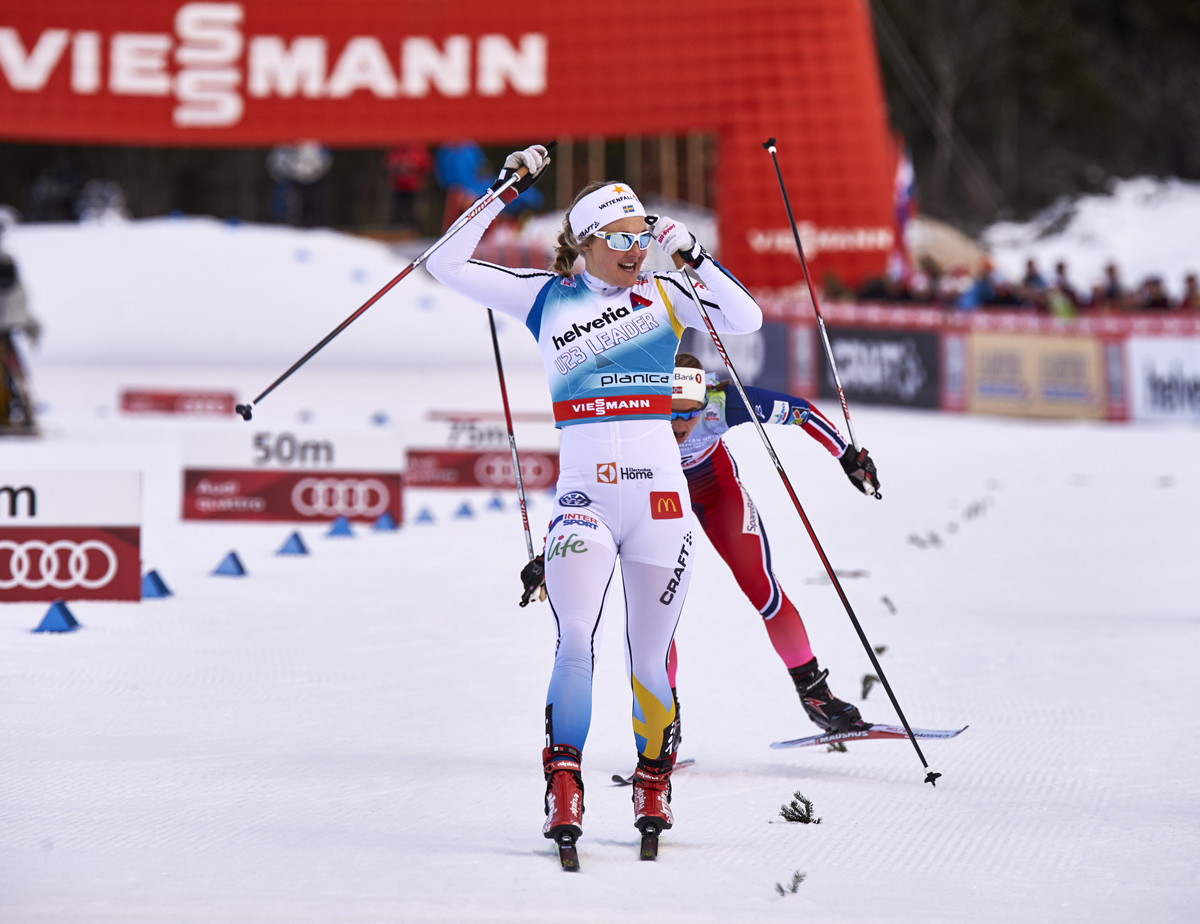
    Sweden's Stina Nilsson celebrates her second-career World Cup victory on Saturday at the 1.2 k freestyle sprint in Planica, Slovenia. She beat three Norwegians -- Astrid Uhrenholdt Jacobsen, Heidi Weng and Ingvild Flugstad Østberg, respectively -- to do so. (Photo: Fischer/NordicFocus)
    Sweden’s Stina Nilsson celebrates her second-career World Cup victory on Saturday at the 1.2 k freestyle sprint in Planica, Slovenia. She beat three Norwegians — Astrid Uhrenholdt Jacobsen, Heidi Weng and Ingvild Flugstad Østberg, respectively — to do so. (Photo: Fischer/NordicFocus)

    In the women’s 1.2 k sprint, Sweden’s 22-year-old Stina Nilsson claimed her second World Cup victory in two months. She previously won the December freestyle sprint in Davos, Switzerland.

    With this win, Nilsson, the U23 leader, took the Sprint World Cup lead as well, ahead of Norway’s Maiken Caspersen Falla. While Falla’s doctor apparently warned her against starting Saturday, (“she was not in top form,” according to NRK), she raced the qualifier anyway and placed an uncharacteristic 45th, more than 14 seconds behind qualifying winner Astrid Uhrenholdt Jacobsen, her teammate.

    Nilsson started her day with the 10th-fastest qualifying time, 5.82 seconds behind Jacobsen. She proceeded to win her quarterfinal — the first one of the day — by 0.1 seconds over teammate Hanna Falk and 0.92 seconds ahead of American Sophie Caldwell in third.

    From there, Nilsson met one of Norway’s biggest threats in any race: Ingvild Flugstad Østberg. Both Nilsson and Østberg had raced the entire Tour de Ski (eight races in 10 days from Jan. 1-10), with Nilsson placing 24th and Østberg second overall. Yet less than a week later, here they were. Nilsson later told NRK she skied for a total of 35 minutes this week before Saturday’s race.

    Slovenian Vesna Fabjan led their semifinal of the gate, while local spectators cheered her on. Nilsson shadowed her until taking the lead about halfway through and creating a fairly big gap before into the finish. Nilsson won the semifinal by half a second over Østberg, who held off Fabjan by 0.33 seconds to advance to the final.
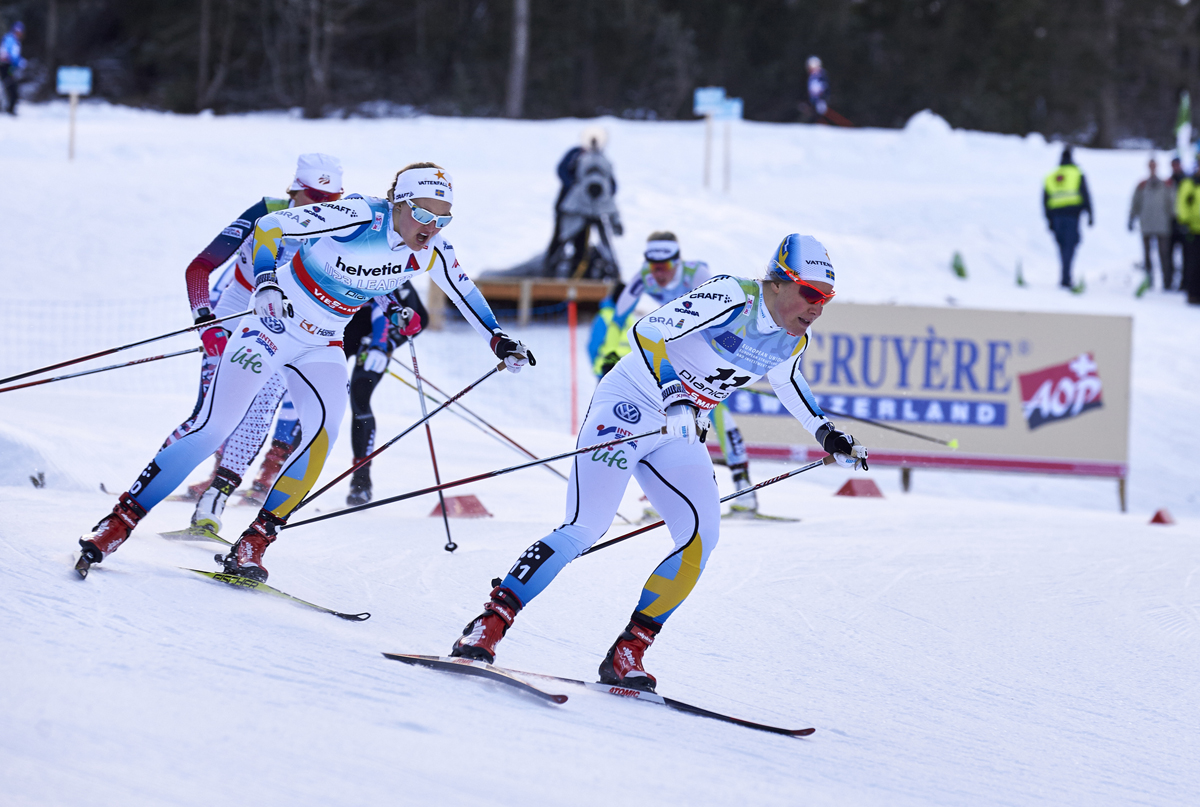
    Sweden's Hanna Falk leads teammate Stina Nilsson (l) during Saturday's 1.2 k freestyle sprint at the World Cup in Planica, Slovenia. While Falk was eliminated in the semifinal (after placing fourth), Nilsson ultimately won the final. (Photo: Fischer/NordicFocus)
    Sweden’s Hanna Falk leads teammate Stina Nilsson (l) and Sophie Caldwell (behind Nilsson) during their 1.2 k freestyle sprint quarterfinal at the World Cup in Planica, Slovenia. While Falk was eliminated in the semifinal (after placing fourth), Nilsson ultimately won the final. (Photo: Fischer/NordicFocus)

    For Nilsson, the final was her 11th straight in as many World Cup sprint starts — both skate and classic — since December 2014.

    On Saturday, she squared off in the final round against Germany’s Sandra Ringwald, Italy’s Gaia Vuerich, and three Norwegians: Østberg, Jacobsen and Heidi Weng. Third in the Tour de Ski, Weng was back in action less than a week later asa well.

    In Vuerich’s third final of her career, the Italian initially led out of the start, while Ringwald and Nilsson skied in second. Into the next downhill, Nilsson took the lead, with Vuerich hanging onto second.

    At about halfway through, Østberg accelerated on a climb to get in front of Nilsson. By the top of this hill, Østberg maintained her position with a fairly brisk pace, Nilsson held onto second, Jacobsen had moved into third, and Weng skied in fourth.

    But could Østberg, who had been in contention for the Tour de Ski overall title until the final grueling mountain climb, hold that high tempo six days later? The last uphill on the sprint course had proved crucial throughout the day. It led up into the stadium and into the finishing straight.

    As that climb approached, Nilsson rode the draft and her slick skis up alongside Østberg to challenge her to the top. She used the momentum to overtake Østberg, who began to fade at the crest of the hill, and Nilsson led over the top and toward the finish.

    Behind her, the three Norwegians fanned out in a wave, one in each lane to try to chase her down. Jacobsen moved into second ahead and Weng charged late for third, just ahead of Østberg.
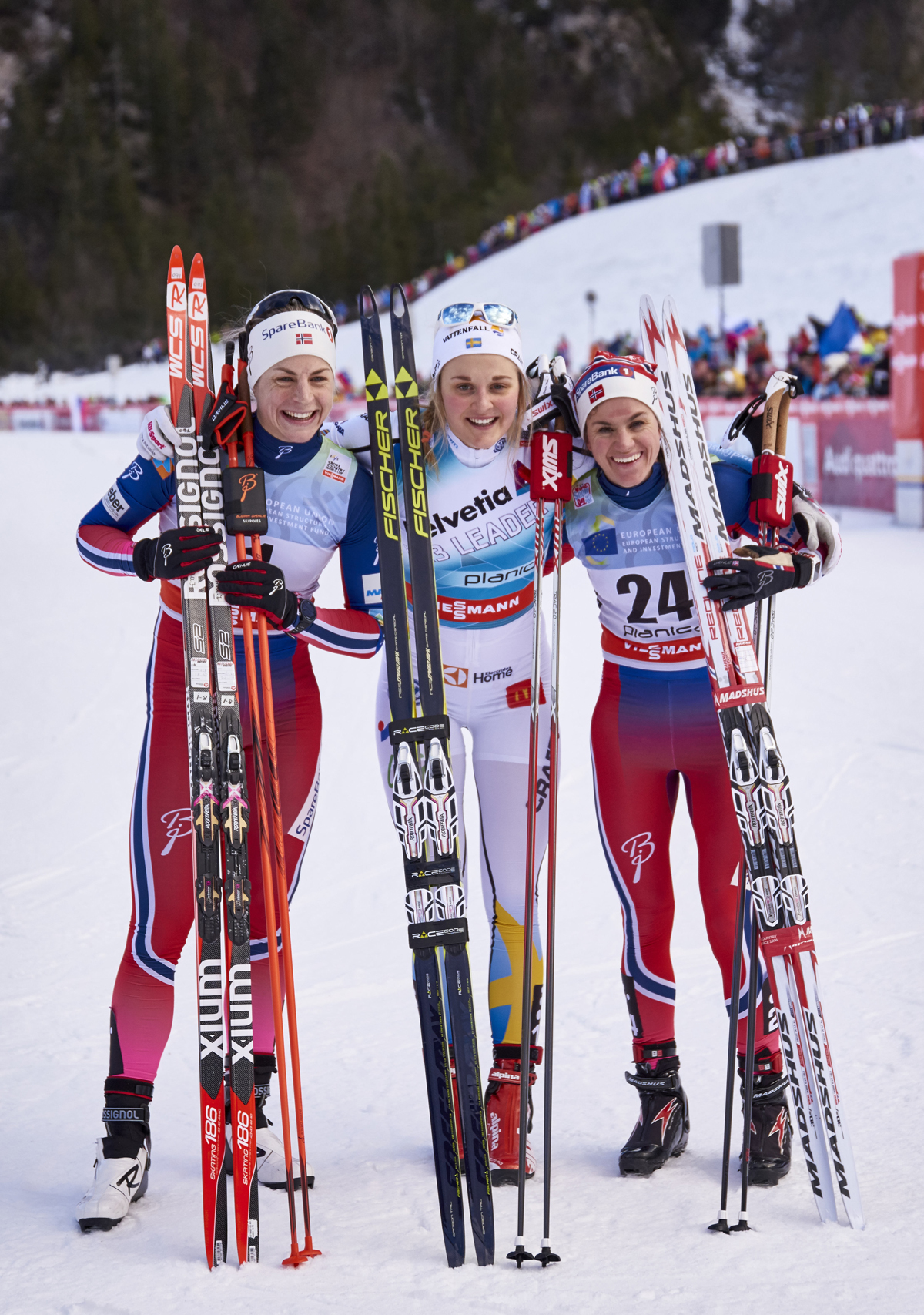
    The women's World Cup freestyle sprint podium  in Planica, Slovenia: with Swedish winner Stina Nilsson (c), Norwegian runner-up Astrid Uhrenholdt Jacobsen (l), and Heidi Weng, also of Norway, in third. (Photo: Fischer/NordicFocus)
    The women’s World Cup freestyle sprint podium in Planica, Slovenia: with Swedish winner Stina Nilsson (c), Norwegian runner-up Astrid Uhrenholdt Jacobsen (l), and Heidi Weng, also of Norway, in third. (Photo: Fischer/NordicFocus)

    Nilsson captured the win in 2:33.03, 0.34 seconds ahead of Jacobsen in second and 0.55 seconds ahead of Weng in third. Østberg missed the podium by five-hundredths of a second in fourth (+0.60), Ringwald finished fifth (+2.78), and Vuerich waved to crowd as she cruised in for sixth (+26.26), happy to make the final.

    “I am really happy for the second win this season. I had a great day,” Nilsson told FIS. “My plan was to ski as much as possible in the front. I am excited to be in the lead of the Sprint World Cup.”

    Falla did not qualify for heats after she had been “battling illness,” according to FIS.

    A sprint specialist, Falla left the Tour de Ski after winning the first stage: a freestyle sprint in Lenzerheide, Switzerland. On Saturday, she dropped to third in the Sprint World Cup standings 94 points behind Nilsson in first. Østberg ranks second, 58 points behind the leader.

    According to NRK, Falla planned to travel back to Norway and skip Sunday’s freestyle team sprint.

    Results: Men | Women

  • Team 4: Italy

    Italy

    2009-2010 Nations Cup Ranking: 5th (4956 pts)

    2010-2011 Nations Cup Ranking: 4th (6106 pts)

    Men: 5th (2571 pts)

    Women: 3rd (3535 pts)

    2011/2012 World Cup Team

    Men

    Pietro Piller Cottrer

    Giorgio Di Centa

    David Hofer

    Valerio Checchi

    Roland Clara

    Thomas Moriggl

    Dietmar Noeckler

    Giovanni Gullo

    Renato Pasini

    Fabio Pasini

    Federico Pellegrino

    Fulvio Scola

    Loris Frasnelli

    Women

    Marina Piller

    Virginia De Martin Topranin

    Silvia Rupil

    Melissa Gorra

    Elisa Brocard

    Gaia Veurich

    Pellegrino qualfiying second in Drammen, Norway.

    What You May Have Missed Last Season

    The Italian men’s sprint team emerged as a force in 2010-2011. With a few exeptions (Christian Zorzi, for one) the Italian men have never really been thought of as strong sprinters, probably because big names such as Pietro Piller Cottrer and Giorgio Di Centa qualify for sprints about as often as Petter Northug loses a sprint finish.

    But Fulvio Scola stepped up his game significantly, Renato Pasini regained some of his former glory, and  Federico Pellegrino did not disappoint in his first full World Cup season.

    Scola was the biggest contributer, as the 29 year old who has never really made a splash on the circuit qualified for every sprint he competed in this winter – except the one at World Championships (missed peak, perhaps?). He finished 5th in the Sprint Cup rankings, and apparently likes running in one-piece suits.

    Renato Pasini turned back the clock to 2009, and finished in the top 10 three times on his way to 9th in the Sprint Cup.

    But it was young Pellegrino who punched his way onto the World Cup in style, winning qualification during the skate sprint in Davos, Switzerland, before ending his day last in the final. He qualified in the top 15 four other times, and also picked up his first career World Cup medal in Liberec, Czech Republic, after he tried to pull a fast one on Ola Vigen Hattestad and was taught a lesson by the elite Norwegian.

    What You Need To Know for This Season

    The Italian women’s team was gutted at the end of last season, and if it isn’t dead, it is now on life support. Arianna Follis pulled the plug after her best World Cup season ever, as did Marianna Longa, who might actually stay retired this time. Magda Genuin waited an extra month or so, but then followed her teammates rather than hang around for one more seaon.

    It was the skiing of all three that pushed Italy from a second-tier nation into a battle with the Russians for a Nations Cup podium spot. The departure of sprinters Genuin and Follis, and distance heavyweight Longa will be extremely costly for the women’s program, and the Italians across the board.

    While FasterSkier always likes a surprise, the chances of any of the Italian women having the kind of breakout campaign needed to replace the over 2600 World Cup points produced by their top three women last season is nil.

    Giorgio Di Centa stands happily with an Italian flag draped over his shoulders at the Canmore, Alberta, World Cup in 2010. (Photo: Win Goodbody)

    As a result, the Italian men must step up, or the country will drop in the Nations Cup ranking like skiers during Stage 3 of the 2010 Tour de Ski…

    Italian hopes are pretty much centered on one man – Pellegrino. The sprint phenom who helped the country massively last season will be called on to do everything once again – generate excitement, score points, and probably wax skis as well.

    But don’t be surprised if the men don’t start off the season in top shape. The Italians suffered from a brutal summer of injuries, as Pellegrino had shoulder surgery, Di Centa injured his thigh, Piller Cottrer fell off his bike and banged up his shoulder and hip, and Roland Clara got sick.

    Who You Should Watch

    FasterSkier knows that Silvia Rupil isn’t exactly a young gun in the pipeline, but here’s the deal – someone has to step up to replace the departed women, and Rupil is in the perfect position to do so.

    She will be given all the opportunities possible to succeed;  at 26 she is now one of the team leaders, she is entering just her third World Cup season, and we have seen flashes of elite ability, including two top tens and being a part of three World Cup medal winning relay teams last season.

    If you speak Italian, check out this video, and let FasterSkier know how she’s progressing!

  • With Speed and Swagger, Northug Anchors Norwegians to Gold

    With Speed and Swagger, Northug Anchors Norwegians to Gold

    Norway celebrates relay gold.

    Martin Johnsrud Sundby and Eldar Roenning, the first two skiers for Norway’s 4x10km relay team sat in the Photo Press Center, eyes glued to one of the many television screens, watching the race unfold.

    The tension was high – no laughing or joking, not even a smile. Tord Asle Gjerdalen was on track for Norway, and he, along with Sweden’s Anders Soedergren, had just been reeled in by the chase pack. The race was now wide open with any of six teams in line for three medal spots.

    Twenty-six thousand Norwegian fans in the stadium, and an uncountable mass on the trails shared their nervousness. It may have been too much to hope for a clean break early, but one misstep at this point, and not just the gold, but silver and bronze could slip quickly away.

    The race gets under way – heading up to Midstubakken.

    Forty minutes later, the seats in front of the TV were empty, Johnsrud Sundby and Roenning now waiting in the finish area for anchor Petter Northug. The fears were for naught as the last ten kilometers of the race played out as though specifically choreographed for a Northug-led Norwegian victory.

    In what is considered the most prestigious race at any Championship event, Northug threw down what has become his classic move – waiting until the last climb around the back of the stadium to hit the accelerator.

    He attacked over the top, instantly opening a five meter gap on Sweden’s Marcus Hellner, and pulling away as he entered the homestretch, plenty of time to pull out a vintage 2007 Northug move, imitating Alex Harvey’s shushing of the crowd before stopping suddenly just before the line and waiting for Hellner, stepping over and claiming victory with the Swede just meters away.

    Tobias Angerer brought home the German team in third, the first medal of the Championships for Deutschland, and something of an upset.

    Rickardsson leads Vylegzhanin, and Johnsrud Sundby at 5.5km.

    The early part of the race played out exactly as expected. Big Daniel Rickardsson (SWE) set the pace from the get go, pushing hard. Just eight minutes into the race, hairline fractures began to appear in the pack, small cracks that quickly widened to substantial fissures.

    Halfway through the first leg, the big three of Sweden, Norway and Russia held a six second gap on the chasers, a margin that more than doubled on the climbs up the Midstubakken. The leaders looked strong and controlled, but the rest of the field had broken – faces twisted in pain, they struggled over the top of the climb.

    The gap continued to widen clearing the 30 second mark. The crowd, however, was riveted on the front – Sundby had broken, and Rickardsson and Russian Maxim Vylegzhanin pulled away on the final climbs up above the stadium. First seven seconds, then 12 – by the first exchange Sundby was a full twenty-two seconds back, a mere six seconds ahead of the chasers.

    “It was one Swede and one Russian who tried to kill me out there,” Sundby said of the hearty beating handed to him. “It was a tough race and I really had to try to do some damage control.”

    Sundby said he felt great during the warm-up, but he lost his legs much earlier than expected. “It was awful for me today,” he said, noting that he had excellent skis and that a relay scramble leg hasn’t gone so badly in several years.

    “I felt in control all the time,” Rickardsson said, though he couldn’t say as much for his ability to recall his race. He insisted that it was Roenning skiing for Norway, and claimed he put 20 seconds on the Russians as opposed to the Norwegians.

    Roenning heads out on the hunt.

    When the second-leg skiers took over, the big question was whether Eldar Roenning would be able to ski Norway back into the thick of things. And the answer was yes: while Johan Olsson of Sweden and Stanislav Volzhentsev skied fast, Roenning skied faster, and was able to catch onto them.

    “I saw that he took in a lot of time just in the beginning, and then I held him off for a little while, but then he came and I needed a little bit of rest from my pace,” Olsson said. “So I tried to recover so I had some extra power when he tried to push at the end. It was a little bit tactical, which was a little bit unusual for the second leg.”

    For his part, Roenning said that he knew he shouldn’t try to catch the leaders immediately.

    “It was twenty seconds or something, and I was telling myself that I am in good shape and I would not take a chance to rush out and take in two kilometers,” he said in a press conference. “I wanted to use the first lap… [after I closed the gap] I didn’t know what would happen.”

    Sundby was relieved when his teammate regained the lead, saying that he “could only hope that Eldar would have the best day of his life.”

    Roenning thought that Olsson would make a move as the second lap came to a close. But instead, the two skied to the finish together, dropping Volzhentsev along the way. When asked whether he felt he was lucky that Olsson didn’t increase the speed, Roenning laughed.

    “I don’t think I was lucky, I think I was better than them,” he said.

    The gap is almost closed – Roenning made up the remaining distance over the next 300 meters.

    By the time they reached the tag zone, the Russians, who had looked so strong just one leg earlier, were now only a few seconds ahead of the chase pack, which included Germany, Finland, Italy, and Japan.

    Anders Soedergren of Sweden and Tord Asle Gjerdalen of Norway were the first skiers to embark on the third leg.

    “[Gjerdalen] would not give a millimeter in the lead,” Soedergren said. “I knew I had to do the job by myself from the beginning.”

    He didn’t seem pleased with Gjerdalen’s stinginess, but the Norwegian said he should have seen it coming.

    “When you have [Petter Northug] on the last leg there is no need to keep up the speed,” Gjerdalen said in a press conference. “It is only to follow the other guys. It is quite an easy tactic.”

    Perhaps partly because Gjerdalen refused to push the pace or help Soedergren, the pair was caught by a chase pack that included teams from Finland, Italy, Japan, Germany and, temporarily, Russia.

    Alexander Legkov had quickly caught the leading Scandinavians, to nobody’s surprise. Legkov has had a stellar season so far; he has won the World Cup mini-tour in Kuusamo, Finland, and stood on the podium a few more times, including as part of the Russians’ second-place relay teams in Gallivare, Sweden and La Clusaz, France.

    Roenning leads Olsson and Volzhentsev in to the stadium 7.5km into the the second leg.

    But after chasing hard, he imploded, losing over a minute and a half to the leaders and dealing his team, which had been favored for a medal, a blow from which they could not recover.

    The pack back together on the third leg.

    With two kilometers to go on the third leg, the least familiar face in the pack made a move. It was Juha Lallukka of Finland, who despite being 31 years old has entered just six Olympic and World Championships races in his career. Since his debut in 2002 he has 23 World Cup starts to his name, and attended only two weekends on the circuit this year.

    “He’s a skating specialist who is only doing skating races,” Finnish head coach Magnar Dalen told FasterSkier. “He has had a very good season and his last entry for us was in La Clusaz, where he was in the relay and skied a very very good, very solid leg. I know that he is in shape, and that he can be very good on his best day. So it was not a very big surprise.”

    Lallukka handed off to teammate Matti Heikkinen with a three second lead over Italy – Roland Clara having been the only one able to even stay close to the Finn – while favorites Norway and Sweden were more than ten seconds behind.

    His move shattered the pack.

    “It was really hard the last two kilometers,” said Franz Goering of Germany. “I really just hoped I could give [Tobias Angerer] a chance for the medals.”

    Lallukka’s work turned out to be for naught. Heikkinen and Piller Cottrer went out together, but they weren’t away for long. Led by Hellner, the three chasers were quickly back in contact.

    Heikkinen leads out at the start of the anchor leg.

    None of the nations had any interest in doing any work for the first half of the leg. But with every kilometer the group traveled closer to the finish, the more the scales were tipping in favor of Northug and Hellner, the best sprinters in the field, who were lurking patiently at the back.

    “Nobody wanted to go hard on the first kilometers—it was pretty easy,” Hellner said.

    Finally, as the men headed out on their second of two five-kilometer loops, Piller Cottrer went to the front.

    A 38-year-old veteran, Piller Cottrer is a multiple Olympic medalist, but his speed is no match for Hellner or Northug in the closing kilometers.

    “I tried to push hard the whole 10 k, because I was the only one that wanted to stay alone in front, and not waiting [for] the finish line…I did everything I could,” he said. “Everyone was saving energy behind me, especially Angerer—hitting my skis and poles all the time.”

    Heikkinen, the winner of the 15 k classic on Tuesday, also had an interest in pushing the relay pace in the closing kilometers, but he said afterwards that his legs weren’t as snappy as they were earlier in the week.

    Hellner, Northug and Angerer set about tracking down the medals.

    “My plan was to go, but I was not strong enough today,” he said. “The body was not working perfect, and that’s why I was not strong enough in the last one-and-a-half kilometers.”

    After swinging back and forth around the stadium, the relay course’s closing kilometers sent the men in front of the crowd one last time, before dropping them down to the base of the Gratishaugen—the same hill where Hellner had launched his race-winning attack in the individual sprint earlier in the championships.

    In fact, Hellner’s performance on the climb was so impressive that locals had renamed it the “Hellnerbakken”—Hellner’s hill.

    He and Northug had pushed through the stadium and into the descent, and the two came into the climb side-by-side—a perfect time for Hellner to make another move. This time, though, Hellner said he was waiting.

    “My tactic was not to go so hard in that hill, and instead wait a little bit longer until the last uphill before the finish,” he said. (Afterwards, Northug said that if Hellner really wanted the hill to keep its new name, “he’s going to have to attack harder than that.”)

    Still, he and Northug were going hard—hard enough that only Angerer, the German, could stay with them. The three crested the Gratishaugen together; on the next flat stretch, Angerer put in a token attack, but nothing came of it.

    Afterwards, Hellner said that he’d been “a little surprised” that none of the other men had made a move earlier, since “they know that Petter is the dangerous one—and maybe me also.”

    But Piller Cottrer had already done his best, Heikkinen was having an off day, and Angerer said that he never had an opening—though he said afterward that he still didn’t think Northug is invincible.

    Killer Piller leading the way with 5k to go.

    “It’s difficult. But…Marcus beat him last week in the sprint, so it’s possible, and [Canadian Alex] Harvey did the same in Drammen two weeks ago,” Angerer said. “I wanted to go, but I was behind Petter and Marcus and had not a chance, and not a place to attack.”

    Northug has lost in plenty of sprints, but the number of times he’s been beaten in a drag race at the end of a distance race can be counted on one hand. So long as he’s still in contact with the leaders in the closing kilometers, there’s no one better.

    “When I have my tools and my skis with me, and it’s two kilometers left, I always have a good feeling,” he said.

    With 26,000 fans cheering him on in the stadium, there was only one thing left for Northug to do: shift into the gear that makes him “the best man, the best skier in the world,” as Gjerdalen put it.

    The acceleration, up the last small climb to a knoll running perpendicular to the homestretch, was textbook Northug: fluid and ferocious with crisp technique, each stride inching him away from the chasers.

    Hellner had nothing, Angerer had even less, and by the time Northug took the righthand turn to descend the small hill into the homestretch, he’d opened a lead of 15 meters. It wasn’t enough of a gap to repeat Marit Bjoergen’s flag-waving heroics from Thursday, but it did give him time for a couple of gestures.

    Piller Cottrer and Angerer setting the pace. Angerer is either trying to incite Petter with a monkey imitation, or he is adjusting his bib.

    First, as he entered the home stretch, he raised a finger to his lips to quiet the crowd. And then, just before crossing the line, he snowplowed to a stop, sliding his skis parallel to the finish as Hellner approached, before finally pushing across, into the arms of his teammates.

    Northug’s antics sent a predictable spasm through the journalists assembled at the finish—it seemed like every other finisher was polled on his response to the move. Heikkinen was diplomatic—“every person acts, and takes those results, [their] own way”—Soedergren was unperturbed—“he had a chance to do it in front of the home nation, and why not?”—and while Hellner was initially irritated, calling the move “typical of Petter—a little arrogant,” he said that he had bigger concerns than the gesture.

    More aggravating, Hellner said, is “that I lost the battle, and I didn’t make the gold.”

    “It doesn’t affect me what he is doing [at] the finish line,” he said. “We congratulated him that he was so good today, and we will go home and train and beat him next year.”

    Results

    Northug shushes the crowd.
    Petter slams on the brakes before crossing the line.
  • Team 4: Italy

    Italy

    Nations Cup Ranking: 4th (4956 pts)

    Men: 5th (2226 pts)

    Women: 5th (2730 pts)

    2010/2011 A Team

    Men

    Valerio Checchi

    Roland Clara

    Giorgio Di Centa

    Giovanni Gullo

    David Hofer

    Thomas Moriggl

    Dietmar Noeckler

    Pietro Piller Cottrer

    Cristian Zorzi

    Loris Frasnelli

    Fabio Pasini

    Renato Pasini

    Fulvio Scola

    Women

    Elisa Brocard

    Virginia De Martin Topranin

    Arianna Follis

    Marianna Longa

    Silvia Rupil

    Antonella Confortolla

    Magda Genuin

    What you may have missed last season:

    Just how old the Italian National Team mainstays are. In the Olympic relay, the Italians ran three of the same four guys they used not just in their home Olympics in Torino four years ago, but eight years ago in Salt Lake City. There is something to be said for keeping a team together, but there is a massive difference between having Pietro Piller Cottrer, Georgio Di Centa and Cristian Zorzi all in their prime, and what happened in Vancouver.

    Di Centa is 38. Zorzi is 38. Piller Cottrer, or ‘Killer Piller’ as he is better known in the skiing world, is 36. If you add in the fourth man, the practically-in-diapers 30 year-old Valerio Checchi, the average age of the Italian men’s relay team is 35.5 years old! And it showed on the results sheet, as the Italians finished far back in ninth. Zorzi, who was known for his anchor-leg relay antics before Petter Northug began churning out highlight reel finishes, didn’t have any magic left for Vancouver.

    Also, in a fairly surprising move, Di Centa won his first ever World Cup this year, a 15 k freestyle in Canmore, Alberta. Surprising, because there are very few skiers of Di Centa’s caliber (16 straight years of scoring World Cup points, eight top-20 Overall finishes) who have failed to ever win a race. However, he still lags behind his elder sister Manuela, whose seven Olympic medals and five Olympic Games appearances are doubtlessly driving Giorgio to improve on his mere three Olympic medals.

    As for the women, the Italians had three top tier skiers. Arianna Follis was extremely competitive regardless of the distance or technique, one of the very few truly elite all-around women. Her teammate Marianna Longa was a solid distance skier, but like Di Centa, she struggled to find the podium. As a pure sprinter, Magda Genuin has emerged as a legitimate podium threat, but was no more than that last season, as her only podium was a silver in Rybinsk, Russia.

    What You Should Know For This Season

    The Italians need help on the World Cup, and bad. Di Centa finished 10th Overall, and Piller Cottrer finished 16th, but neither are all-around skiers at their current age. The next Italian in the pecking order was Checchi, in 31st, who like the other two cannot sprint. Between the three best Italian men, they managed to amass a grand total of five sprint points. In today’s World Cup, where being an all-around skier is becoming more of a necessity due to the prevalence of Tour-type events, the Italians are starting to look like dinosaurs.

    The younger crowd, relatively speaking, are all good skiers: sprinters Fabio and Renato Pasini, David Hofer, Thomas Moriggl and Roland Clara. But none of those athletes approach the level of Di Centa or Piller Cottrer, who have quarterbacked Italy to success for the last 10 years or so.

    Sabina Valbusa, after a long and illustrious career that included nine World Cup podiums and an Olympic bronze medal, joined many other top women and retired.

    If you’re struggling to pick out the Italians in a race, check the hat. They seem to go in for fancy hats that often include sparkles, big pom-poms and bright colours.

    Who You Should Watch

    While most of the buzz is about Federico Pellegrino, mainly because he had some decent World Junior results (and probably because his name is fun to say), FasterSkier would like to direct your attention to Gaia Vuerich.

    The 19 year-old Italian finished fourth at the World Junior Championships, and while it wasn’t behind Petter Northug’s little brother, it was behind Swedish sprint-superstar-in-the-making Hanna Brodin – and Vuerich still has another year of competing in junior competitions.

    Like Pellegrino, Vuerich scored World Cup points this past season, nipping Pellegrino’s total by 2. Sure, her amassing of 14 points from the one sprint race in Dusseldorf, Germany, isn’t earth-shattering, but she also managed to have some late-season success against some top tier competition.  Vuerich edged out none other than Justyna Kowalczyk in a downhill sprint event in the Russian sprint tour last spring – so if FIS manages to bring the new format to the World Cup, Vuerich could have potential.

  • Northug Faces Piller Cottrer, World Elite at Home

    Petter Northug (r) racing at the 2010 Olympics in Whistler.

    Petter Northug Jr. is excited to welcome World Cup greats onto his home turf in Troendelag on June 25 through 26. The event, the Tour de Troendelag, consists of three races: a roller ski city criterium on June 25 in Trondheim, then a summer ski race on the Kirkebyfjellet mountain on the morning of June 26 and concludes with a roller ski pursuit race in the afternoon.

    “I’m excited to welcome Pietro Piller Cottrer (ITA), Anders Soedergren (SWE), Jaak Mae (EST) and other top World Cup racers to my stomping grounds. It will be fun to race against those guys in a slightly different setting,” Northug says to www.langrenn.com.

    Northug, the defending champion from last year’s Tour de Troendelag, will arrive at the race venue straight from a national team training camp and is prepared to fight. Northug will face a Piller Cottrer who is eager to make up for the painful loss to Northug at the Holmenkollen 50K this winter, and a Soedergren who is reported to be in killer shape these days. But Northug doesn’t think he’ll be at a disadvantage.

    “I’ll do my first workout that Friday with the national team in Sandane, then the Stjoerdal race as my second. I don’t fear racing after a flight,” says Northug.

    Former Olympic gold medalist, world champion and Norwegian national team member Frode Estil is among the event organizers. He is working hard to get both Alexander Legkov (RUS) and Axel Teichmann (GER) to compete next week, and is confident at least one of them will show. He regrets to report that Dario Cologna (SUI) won’t be coming, although it looked promising for a while. Among the local favorites are international stars including Eldar Roenning and Johan Kjoelstad, as well as Team Troendelag’s next generation of elite skiers.

    “This is one of the few arenas where juniors and the up-and-coming elite skiers can race with the best in the world. And the feedback is that they find it incredibly motivating,” says Estil, explaining that recruitment is one of the main goals of the Tour de Troendelag.

    Source: Langrenn.com

  • Northug Wins First Holmenkollen Title in Thrilling 50k

    Northug racing last month at the Olympics

    Oslo, Norway – Maybe it is ski switching, maybe the courses are harder, or most likely, the skiers are more aggressive.  Whatever the reason, the long mass start races that are now standard on the World Cup are becoming more and more consistently exciting.

    Last year the traditional Holmenkollen 50km was held in Trondheim due to construction at the Oslo venue, and the race set a new standard for a World Cup mass start race.

    Instead of the large pack stampeding around the course like a herd of enraged bison, each charging hard, but no individual willing to break away from the safety of the group, the race featured numerous attacks, breaks, and comebacks.

    The bar had been raised, aided by several clever decisions by FIS.  The addition of bonus World Cup points at intermediate distances manufactured attacks and despite many of the drawbacks of ski switching, the ability to stop and swap skis created another opportunity for strategy and breakaways.

    The 30km pursuit at the Olympics featured a gutsy break by Johan Olsson halfway through the race, and a heart-stopping finish.  The 50km was certainly not as thrilling as the Trondheim race, but close observation revealed an exciting race underneath the veil of pack skiing.  And depending on the conditions, the course, and even the time of year, mass start races will still feature large bunch finishes.  But it does appear that those races are becoming less prevalent, replaced by the type of competitions witnessed in Trondheim, and today in Oslo.

    If anyone had any doubt that Petter Northug (NOR) is the best all-around skier in the world, today’s race should provide final proof.  Northug withstood attacks from the French duo of Vincent Vittoz and Maurice Manificat and a stunning comeback by Pietro “Killer” Piller Cottrer to claim his 2nd 50km victory in a row.

    Just three days after finishing 2nd in the Drammen classic sprint, Northug won the race at the opposite end of the distance spectrum.  Vittoz and Manificat attacked hard near the 12 kilometer mark, immediately opening a gap.  Northug was the only one to respond, and the trio continued to push the pace.

    One of the criticisms of Northug (at least in the US) has been that he sits back in the pack letting others do the work.  But anyone familiar with bike racing knows that being in a three-man break when you are solo against two teammates is not an easy spot.  And the general rule is that if a team is two strong in a lead pack of three, you had better win.

    Northug withstood the efforts of the Frenchmen to tire him out, taking his turn at the front.

    “I tried to stay in the leading group from the start,” explained Northug.  “I felt there would be many attacks during the competition.  When the French attacked I just tried to stay with them.”

    The lead over the large chase pack grew steadily, reaching a maximum of 1:38 at 33 kilometers.  At this point the chase pack had dwindled to 14 skiers, though in another break from standard 50k protocol, this was not a result of slow attrition – fading skiers dropping off the back consistently over the course of the race.

    The leaders were aided by the work of Jean Marc Gaillard (FRA), who slowed the pace of the chasers to allow his teammates to pull away.

    At the 20k mark, the group chasing Vittoz, Manificat and Northug numbered only 13, with a gap of 20 seconds to the next pack.  And while the focus was on the front, efforts to bridge back up to the chase group provided secondary drama.

    With the large lead approaching two minutes, and just over 15 kilometers remaining, it seemed the podium was set.  But as is often the case in cycling, the pack stepped it up as the leaders began to lose the pace slightly.

    Between 33 and 35 kilometers, the chasers took 26 seconds out of the lead.  As each time check came and went, the gap closed steadily.  At 42k, the lead was down to 28 seconds, the chase pack of ten led by none other than Anders Soedergren, the Swede known for his aggressiveness in mass start competitions.

    Soedergren had done his part, but couldn’t hold the pace over the next two kilometers when the race completely blew up.  Manificat ran out of gas, losing contact with Northug and Vittoz while Piller Cottrer staged his own attack, quickly swallowing up the fading Frenchman and shattering the chase group.

    At 44k, Piller Cottrer was still 20 seconds back in 3rd.  Four kilometers later he was in the lead, pushing Vittoz and Northug.

    Vittoz, like Manificat before him, was spent, and couldn’t match the Italian veteran.  With just 1.4 kilometers to go, Vittoz was 10 seconds behind, and out of the race for the victory, though he still held a solid 30-second lead on 4th.

    Pietro Piller Cottrer racing in Canmore (Photo: Win Goodbody)

    Piller Cottrer and Northug sped past the .5k mark, still glued together.  Piller Cottrer, well aware of Northug’s famed finishing sprint, threw down one last attack on the final climb.  He was nearly successful, but “nearly” will never be enough when it comes to Northug.

    As he has done so many times before, the Norwegian star opened the throttle in the stadium, skiing clear of Piller Cottrer to claim his first victory at Holmenkollen.

    “When Pietro came he was really fast,” said Northug following the race.  “He almost killed me in the last uphill, but I made it and won.”

    Vittoz hung on for 3rd, crossing the line 25 seconds ahead of Soedergren.  The Swedes continued to show fine form, with Johan Olsson, the bronze medalist in the aforementioned 30km pursuit at the Olympics, was 5th,9 seconds behind his teammate.  They were joined in the top-10 by Marcus Hellner, who finished in a tie for 8th with Martin Bajcicak (SVK).

    Manificat blew up in stunning fashion, dropping a total of 2:35 on the leaders in the last 8.4km.  Despite his work for the majority of the race, he ended up 12th.

    Piller Cottrer, who won this same event 13 years ago was plenty satisfied with 2nd.

    “I won in Holmenkollen 13 years ago, so I know how it feels. I really wanted to live this feeling again.”  It wasn’t to be, but midway through the race Piller Cottrer believed he was out of contention completely.

    “In the beginning I was skiing in the chase group and was staying a bit behind.  At that time I thought the race was over for me, but after changing my skis I felt better and better, and my strength increased. When I caught Maurice [Manificat] it gave me extra kick and energy.  I am happy to be second!”

    Vittoz explained the French strategy, saying, “we did not speak before the race about tactics but we knew that if the pace is slow we do not have any chance for podium. Therefore we tried to set a high pace from the beginning.  It could seem to be crazy but it was working.”

    Vittoz was grateful to both Gaillard for his efforts slowing the pack and to the French service team who provided very fast skis.

    “You know without great equipment you cannot think of winning here,” Vittoz said.   “It was tough day for our service men with a lot of work…And Jean Marc [Gaillard] did a great job.”

    “It was a very exciting race today,” concluded Northug.  “It was not hard for me to find motivation as this is Holmekollen and I wanted to win this 50 km in front of the home crowd.”

    And Piller Cottrer wished the young Northug the same skiing longevity he has enjoyed.

    “I am happy to be second, and I wish Petter to win here again in thirteen years.”

    Complete Results

  • Cologna Skis to Switzerland’s First Olympic Gold

    Cologna Skis to Switzerland’s First Olympic Gold

    Dario Cologna charging to the finish of the men's 15k freestyle
    Men's 15k freestyle, Whistler Olympic Games

    With a few hours to go before the start of the men’s 15k freestyle this morning, what was Dario Cologna thinking about?

    Not the pressure he was under. Not that the race was his Olympic debut. In fact, Cologna wasn’t thinking about cross country skiing at all: Instead, he was watching alpine skiing on TV, waiting to find out how his Swiss countrymen would fare in the men’s downhill race.

    Cologna ended up five minutes late for ski testing because he wanted to see Didier Cuche’s run, according to his team doctor, Patrik Noack. But from then on it was all business. In the first-ever victory for his country in an Olympic cross country ski race, Cologna took gold in the Monday’s 15k with a strong, even effort, besting Italy’s Pietro Piller Cotrer and the Czech Republic’s Lukas Bauer.

    After a third-place in the same event last weekend in Canmore, it was clear Cologna’s fitness was coming along. But without the Czechs, Norwegians, and Frenchmen at that race, there was no telling how the Swiss skier’s form would stack up in a full field.

    It was a Swede, Marcus Hellner, who grabbed the lead early on, getting a few seconds on the pack by five k. He held it to the halfway point, but then faded fast, losing forty seconds to Cologna by the finish.

    Marcus Hellner (SWE) at the finish of the men's 15k

    Hellner clearly went out a little hard—when he was done, he lay in the finish chute for minutes, motionless, despite repeated attempts by race officials to move him.

    “I was going for the gold,” he said afterwards. “The tactic was not for medals—it was for gold.”

    Cologna trailed only Hellner at those first two time checks, and opened his lead quickly after the Swede relinquished it. While Piller Cottrer was in striking distance at the halfway point, just five seconds back, Cologna had much more for his second 7.5k lap, putting twenty seconds into the Italian by the finish.

    It was the second individual Olympic medal in Piller Cottrer’s long and distinguished career, after bronze in the 30k pursuit in Torino.

    “I wanted the gold just to make everyone shut up,” he joked after the race. He didn’t seem that disappointed with silver, though.

    The medal came despite Piller Cottrer’s criticism last year of the courses as too easy—although he said today that those words were meant to describe the trails used for last year’s pursuit—not those for Saturday’s skate race. Even when pressed, he still wouldn’t say exactly what he thought of the 15k course—just that his remarks last year were misconstrued.

    Bauer made a late charge to wrest bronze from Hellner by just over a second. Bauer said that he had essentially given up on the race after struggling from four to 11k, but then found an extra gear after hearing he was closing in on the Swedish skier.

    Lukas Bauer (CZE) on his way to third place in the men's 15k

    The goal for Bauer going into the Games was to bring home a single medal, and he said that winning a bronze today takes the pressure off for the rest of the races throughout the next two weeks.

    Canada’s Ivan Babikov skied to eighth place, just 17 seconds from a bronze medal, in what was being touted as the country’s best-ever Olympic finish. He had a slow start, which left him in 14th place at 7.5k, but then “woke up” in time for the second lap.

    He said he was satisfied with the result, but didn’t want to set any goals for the rest of the Games.

    “There’s many races ahead…we’ll see,” he said.

    Led by Babikov, the Canadian men showed that they really do know what they’re doing despite a lackluster weekend in Canmore. They put three in the top thirty, with Alex Harvey in 21st and George Grey in 29th. Harvey’s finish bodes well for his focus, the 30k pursuit, and he said that today’s race was just an icebreaker.

    The spectators mustered a roar every time Harvey went by, and for each of his countrymen as well. He said he’d never seen a crowd of that size at a race in Canada—officials estimated it at over 5,000.

    The Norwegians were conspicuously absent from the top of the results sheet—especially superstar Petter Northug. He never factored in the race, skiing in the high teens over the first lap before fading to 41st. Tor Asle Gjerdalen was the top finisher for the team, all the way back in 29th.

    For Northug, the problems were simply a combination of bad ski selection and a bad day—not bad fitness, according to the team’s sprint coach, Ulf Morten Aune.

    “He will be back on Wednesday—I promise,” he told FasterSkier, referring to the upcoming classic sprint.

    Cologna’s gold—his first-ever in an individual start race—should give his competitors some anxiety about the rest of the distance races here. Over the past few years, he has typically been more of a threat in mass starts, and there’s no reason to believe that he has lost any of his speed after a third place in last weekend’s sprint in Canmore.

    For the upcoming 30k pursuit, Cologna will be the new favorite—in the words of his teammate, Remo Fischer, “for Dario, it’s perfect.”

    —Topher Sabot contributed reporting

    Dario Cologna after winning the 15k freestyle
  • Italy Strong at “Home Away From Home” – Top 2 in Men’s 15km

    Italy Strong at “Home Away From Home” – Top 2 in Men’s 15km

    Canmore, Alberta – Italian Pietro Piller Cottrer wouldn’t mind moving his family to Canmore.  “I just need to teach them English and we can come,” he said following his 2nd place finish in today’s 15km individual start freestyle.  According to Piller Cottrer, Canmore is very similar to his home in the Italian Dolomites.  “I have always raced very well here, and have now finished 1st, 2nd, 3rd and 5th in Canmore.”

    Piller Cottrer joined teammate Giorgio DiCenta on the podium.  DiCenta won his first ever World Cup race after nearly 200 starts.  “I now feel like a complete athlete,” DiCenta told the media, explaining that he has now won at the Olympics, World Championships, and now the World Cup.

    The men’s race was extremely close with Piller Cottrer leading at every time check in the first 10km.  “After watching the women’s race, Giorgio and I decided to start slowly.  We just finished two hard weeks of training in Italy, and didn’t know what to expect.”

    But the Italians had very fast skis, and both men were posting very fast times.

    Giorgio DiCenta (ITA) lunges across the line, taking the victory in the men's 15km (Photo: Win Goodbody)
    Giorgio DiCenta (ITA) lunges across the line, taking the victory in the men's 15km (Photo: Win Goodbody)

    Despite the fact that the Canmore course is known as one of the toughest on the World Cup, the top finishers, with one exception, were all at the top of the standings early in the race, perhaps an indication that most skiers started conservatively.

    Favorites Dario Cologna (SUI), Marcus Hellner (SWE), Johan Olsson (SWE) and Sergei Shiriaev (RUS), along with the Italians, were clustered within ten seconds of the lead over the first 5 kilometers. But as the race progressed, each time check showed another skier unable to keep pace.

    Shiriaev was the first to go, fading slowly at first, and then completely falling apart.  In the second 5km loop, he lost 20 seconds to the leaders, before dropping a full minute over the last 5k, slipping to 26th overall.  While his fade was the most impressive, he was not alone in failing to match the Italian duo.

    Piller Cottrer managed to extend his lead to 7.4 seconds over DiCenta at the 10km mark, but his teammate began to slowly reel him in.  As the minutes passed the stadium announcer became more and more excited.  Over the next 2k, DiCenta not only erased the gap, he pulled ahead by two seconds.  Piller Cottrer stopped the bleeding and was still just over one second back with 2.3 kilometers to go.  Piller Cottrer, starting at bib 68 finished first, remaining in the finish corral, good naturedly accepting the teasing of the announcer.  “Pietro is nervous now!” famed World Cup announcer Kjell Erik Kristiansen shouted over the PA, while Piller Cottrer grinned and shook his head.

    Pietro Piller Cottrer (ITA) (Photo: Win Goodbody)
    Pietro Piller Cottrer (ITA) (Photo: Win Goodbody)

    DiCenta, in bib 72 was soon spotted on the final long gradual approach.  As he charged to the line, it became clear he would have enough to claim the victory.  He slid across the line 5.1 seconds faster than his teammate.  The two men embraced as they were swarmed by jubilant coaches and service staff.

    Said Piller Cottrer after the race “I am very pleased with my result, and am very happy for Giorgio.  I know how much he wanted this first victory.”

    The Italians were not worried that they were peaking too early.  “We were not expecting to be in very good shape right now – our goal was the top-10 – this was a surprise” said Piller Cottrer,  adding “someone had to win…”

    The Race for Third

    Dario Cologna (SUI) speeding to 3rd (Photo: Phil Bowen)
    Dario Cologna (SUI) speeding to 3rd (Photo: Phil Bowen)

    The top two spots may have been decided, and only a handful of skiers on the course, but the race was not over.  Toni Livers (SUI) had been hanging in the top-5 all race.  He held the lead until Piller Cottrer came in and was sitting in 3rd with only teammate Cologna still a threat on course.  As with the race for the win, it wasn’t clear until the final 100 meters what would happen.  Cologna used a strong last lap, and a consistent race, to squeeze ahead of Livers by just 3.1 seconds, his best result ever in the 15km freestyle.

    “It is a good sign for me to be on the podium in this race,” he said. “It shows I am in very good form.” Like the Italians his plan was to start slowly, but again, like the Italians, he had fast skis and fast splits from the start.

    Livers just missed out on his 2nd career World Cup podium and posted his best result since winning this same event in Davos in 2007.  All four of his 4 top-10 World Cup finishes have been in the 15km skate.

    His position was not as secure as expected.  While the crowd anxiously awaited Cologna, Axel Teichmann (GER) hammered across the line, stunning Kjell Erik in the announcers booth as he moved into 4th.  After Cologna bumped Livers, Teichmann was still solidly in the top-5.

    And why is this so impressive for an athlete who is a regular at the top of the results sheet?

    Teichmann had fallen off the radar as a potential factor in the race by the halfway mark.  He always starts very slowly, and following that pattern was in 26th nearly 30 seconds back at 5km.  But over the course of the next loop he did not move up much – at 10km he was 17th, 41 seconds down on Piller Cottrer.  With 2.3 kilometers to go, he was still a full 20 seconds behind Livers in 10th.  When all was said and done, he stood gasping at the finish, just 7.4 seconds out of 4th.

    The German head coach Jochan Behle was very pleased with Teichmann’s race.  “It is 10 days before the Olympics, and this was his 1st race since the Tour de Ski, so it was important to have these races here and get in the rhythm.”  He added that the result was fine, but not the goal for the day.

    Behle also noted that Teichmann prefers gradual terrain to the steep climbs of Canmore.  The Whistler Olympic courses are well suited to his strengths.

    Italy – Four in the Top-13

    Italy had the best day of any nation, placing four in the top-13, no doubt due in part to the the “rockets” (in the words of Piller Cottrer) that the service staff prepared for the skiers.

    Thomas Moriggl finished 9th and Valerio Checchi 13th.  Chechhi reaped the benefits of Piller Cottrer’s strong performance, catching a ride for 3.5km after being caught by his teammate.

    Babikov 10th, Freeman 20th

    Ivan Babikov (CAN) led the North American with a solid 10th place finish.  Babikov, an excellent climber, favors the challenges of the brutal Canmore course.  His teammate, Devon Kershaw, predicted a podium finish for him today.  It wasn’t  to be but he still turned in one of his best results so far this season.

    Matt Leibsch (USA) with a strong race
    Matt Leibsch (USA) with a strong race (Photo: Phil Bowen)

    “My legs felt a little bit heavy today, but I am exactly where I want to be one week away from the Olympics,” said Babikov. “We have been doing a lot of training so I am a little tired, but we will be ready for the Games and I’m looking forward to it.”

    Kris Freeman led the US in 20th place.  The 15km is by far his strongest race, and will be his best chance for a medal at the Olympics.

    USST Coah Matt Whitcomb was not overly concerned with Freeman’s performance.  “Kris didn’t have anything when he tried to put the hammer down today.  But the good news is that he didn’t die on the last lap.  He skied a consistent race.”

    Freeman was disappointed in his race, but short of a podium, little will please the fiercely competitive American star.  He finished the day 1:09 behind winner Piller Cottrer.

    George Grey also had a solid race.  Grey has been rounding into form in recent weeks, and took 17th today.  A good result, and likely good for a top-30 in a full World Cup field – the A-team Norwegians and French were both absent.

    Matt Liebsch finished just inside the points, taking 29th, good for 34.22 FIS points – easily his best performance, and an important result for his future.

    Junior Cracks the top-10

    Petr Sedov, the Russian force of nature who won 20km pursuit at World Juniors, showed he is a legitimate threat on the World Cup, placing an impressive 8th in his pre-Olympic warm-up.  Sedov, who has excellent technique according to US coach Matt Whitcomb, skied a smart race, starting conservatively and accelerating in the 2nd loop.  Just 19, he will compete for Russia in Vancouver.

    Another Beautiful Day

    The weather was perfect, with sunny skies and temperatures rising into the 30’s.  Given the success of the Italians and Swiss service teams, there was clearly room to gain an advantage with the wax, but overall it was not challenging in that respect.

    Racing continues tomorrow with a classic sprint.  Check back later for a complete preview as well as additional reports on today’s races.

    Men’s 15km Freestyle – Complete Results

    Nat Herz contributed reporting.