From the FasterSkier archive — posts syndicated from athletes’ and coaches’ own blogs between 2004 and 2012, kept online as published. Current coverage is at fasterskier.com.
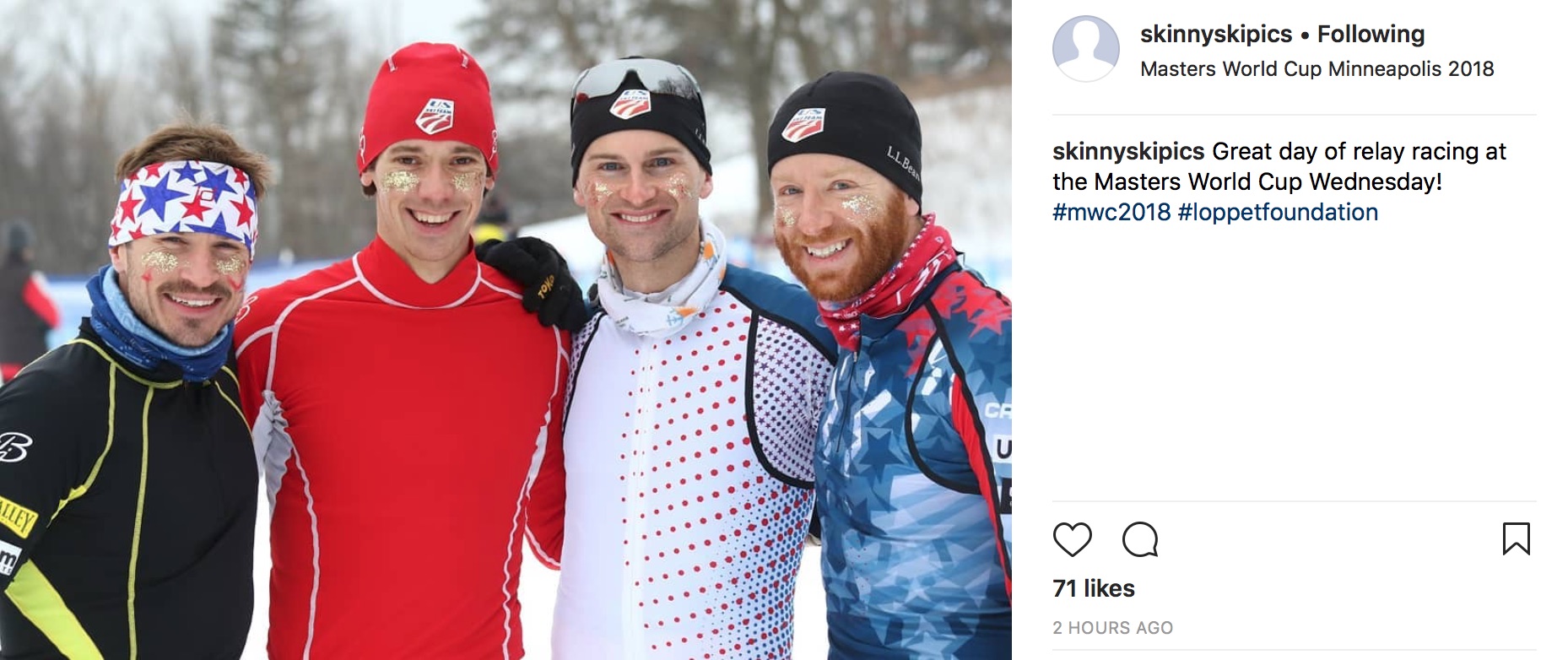
Matt Liebsch (l) and his men’s age-group “1” 4 x 5 k winning relay team on Wednesday at 2018 Masters World Cup in Minneapolis, Minnesota. (Photo: SkinnySki/Instagram)
2018 Masters World Cup (Minneapolis, Minnesota): 4 x 5 k relays
Matt Liebsch, 34, anchored the winning relay of the youngest men’s age group (AG 1) at 2018 Masters World Cup on Wednesday, crossing the line in 45:57.2 minutes (the fastest relay time of the day) and teaming up with fellow Americans Christopher Harvey, Mark Johnson and Zach Varty. Two teams competed in that age group’s 4 x 5 k relay, with Italy finishing second, 1:22.6 minutes back.
The U.S. won all five women’s 4 x 5 k relays on Wednesday, and eight total between the men’s and women’s age groups. Finland had the second-most relay victories with five in the men’s categories.
Canada won the men’s AG 4, beating out four other teams with Gabriel Babin, Bruce Macneil, Luc Tremblay, and Michel Labrie, who finished the 4 x 5 k in 49:41.9. Germany placed second (+36.4), and the U.S. third (+54.1).
Piotr Bednarski, head coach of Loppet Nordic Racing, which is based out of Theodore Wirth Park, anchored the men’s AG 5 to a win in 49:39.1, with teammates Rune Harkestad, Dennis Paul and David Sjogren.
Masters World Cup continues with 15/30/45 k classic distance races on Thursday at Wirth Park.
Day 4 Age Group (AG) 4 x 5 k Relay Winners
Men:
AG 1: USA (Christopher Harvey, Mark Johnson, Zach Varty, Matt Liebsch) 45:57.2
AG 2: Finland (Jouni Leinonen, Mika Kilpeläinen, Johan Gustafsson, Joachim Gustafsson) 47:53.4
AG 3: Russia (Ivan Batyutenko, Andrey Lushnikov, Sergey Degtyarev, Aleksandr Pushkarev) 46:43.3
AG 4: Canada (Gabriel Babin, Bruce Macneil, Luc Trembley, Michel Labrie) 49:41.9
AG 5: USA (Rune Harkestad, Dennis Paul, David Sjogren, Piotr Bednarski) 49:39.1
AG 6: USA (Milan Baic, Odd Bersvendsen, Kent Murdoch, Barry Makarewicz) 48:48.3
AG 7: Finland (Heikki Ruokonen, Tapio Tikkanen, Timo Pullinen, Aito Pennanen) 51:56.3
AG 8: Finland (Leino Nisula, Pauli Halonen, Yrjo Teravainen, Harri Makela) 54:58.4
AG 9: Finland (Veikko Piirainen, Tapio Ikaheimonen, Paavo Raisanen, Vaino Paakko) 58:18.9
AG 10: Finland (Alpo Virtanen, Tapio Wallenius, Jouko Laiho, Riku Kyllonen) 1:02:39.7
Women:
AG 1: USA (Kathleen Dewahl, Tamra Kornfield, Davya Flaharty, Gina Chythlook) 56:49.3
AG 2: USA (Bonnie Weiskopf, Kim Rudd, Mary Mckelvey, Mary Wellington) 56:23.9
AG 3: USA (Elizabeth Youngman, Kelly Milligan, Jan Guenther, Kelly Skillicorn) 56:23.6
AG 4: USA (Kate Ellis, Magdenla Bowen, Joann Hanowski, Muffy Ritz) 1:00:33.6
AG 5: USA (Gabriele Andersen, Constance Meek, Dagmar Eriksson, Kati Campbell) 1:14:23.4
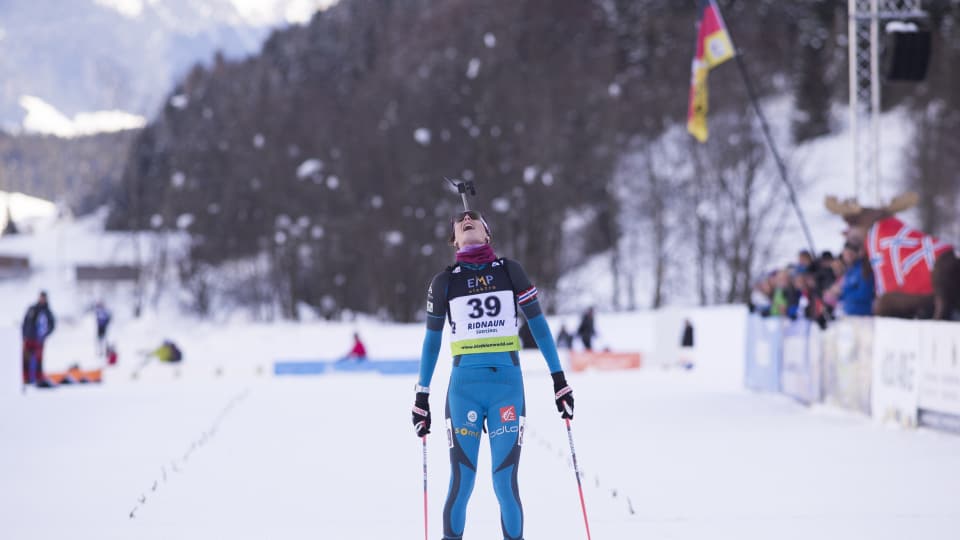
France’s Chloe Chevalier after winning the women’s 15 k individual on Day 1 of IBU Open European Championships in Ridnaun, Italy. (Photo: IBU/Biathlonworld)
IBU Open European Championships (Ridnaun-Val Ridanna, Italy): 15/20 k individual
The International Biathlon Union (IBU) Open European Championships opened Wednesday in Ridnaun (Val Ridanna), Italy, with several North Americans competing in the women’s 15- and men’s 20-kilometer individual races.
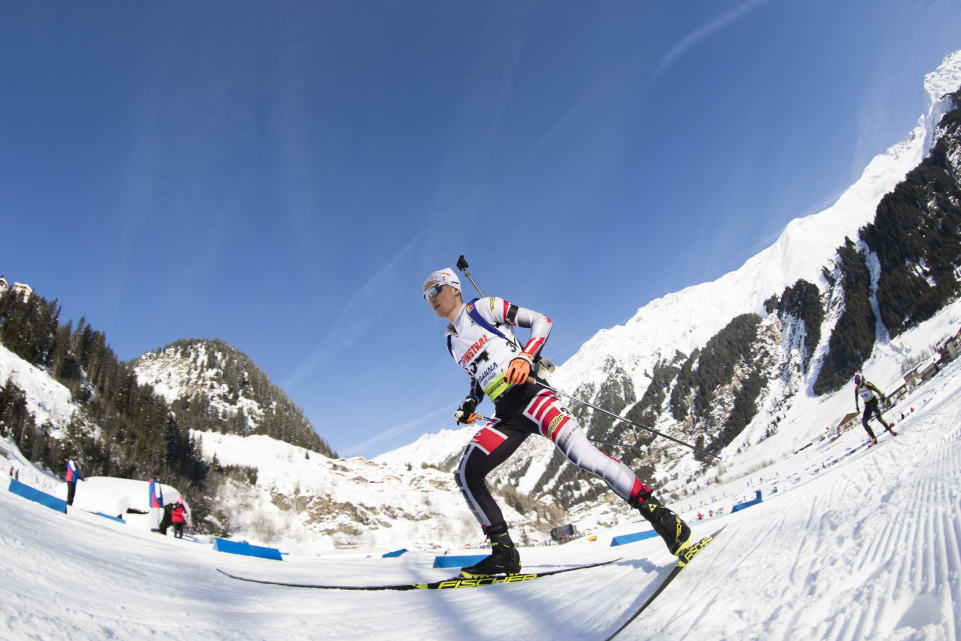
Austria’s Felix Leitner racing to the win in the first race of 2018 IBU Open European Championships, the men’s 20 k individual, on Wednesday in Ridnaun, Italy. (Photo: IBU/Biathlonworld)
Canada’s 23-year-old Carsen Campbell raced to 19th in the men’s 20 k, shooting 19-for-20 (1+0+0+0) and finishing 3:18.5 minutes behind the winner, Austria’s Felix Leitner, who clocked the fastest time in 53:32.8 — also with one penalty (0+0+0+1).
Leitner, 21, won by 43 seconds over Tomas Krupcik of the Czech Republic, who also had a single penalty in the last standing stage (0+0+0+1) and placed second.
Germany’s Philipp Horn reached the podium in third (+56.6), with 19-for-20 shooting as well (1+0+0+0).
According to an IBU press release, Leitner is one of the youngest athletes to win the 20 k, the longest race on the circuit.
“I had many problems with my shooting lately, but today it was probably the best in the last two seasons,” Leitner said, according to the release. “I believed in myself and knew that I have to run fast from the beginning, and if the shooting would be as good as during the training, I could be in the top.”
Campbell, of Biathlon Canada’s National “Z” Team, was the top North American in 19th in his second trip to Open European Championships. Previously, his best individual result was 64th last year.
Paul Schommer led the U.S. men in 46th (+5:22.6) with three penalties (0+1+1+1). Max Durtschi also shot 17-for-20 (1+0+1+1) and ended up 56th (+6:18.5), Jakob Ellingson followed in 58th (+6:23.5) with two penalties (0+0+1+1), and Jake Brown finished 74th (+8:06.7) with seven penalties (1+1+3+2). Alex Howe did not start.
For Canada, Macx Davies, a senior national team member who is headed to the Olympics, placed 67th (+7:32.7) with five penalties (2+2+1+0). Matt Hudec was 96th (+12:00.5) with six penalties (0+2+1+3), and Aidan Miller 105th (+14:49.0) with nine penalties (2+1+1+5).
In the women’s 15 k that followed, Sarah Beaudry, of Biathlon Canada’s Senior National Team as well as Olympic team, was the top North American in 23rd, 4:55.6 out of first. Beaudry, 23, shot 18-for-20, with her two misses coming in the first prone (2+0+0+0).
France’s Chloe Chevalier won the women’s race, with spring-like temperatures around 6 degrees Celsius, in 46:32.9 with a single penalty, also in the first stage (1+0+0+0). The second- through fourth-place finishers all shot clean, with Italy’s Alexa Runggaldier placing second (+47.7), Russia’s Victoria Slivko taking third (+55.9) and Ukraine’s Yuliia Zhuravok missing the podium by half a second in fourth place (+56.4).
“After that penalty in the first prone, I relaxed and did not worry about the result,” Chevalier said after, according to an IBU press release. “I just enjoyed being out on the tracks on a beautiful sunny. Maybe the key to success is relaxing and not worrying about the result.”
Two Canadian women entered the event, with Erin Yungblut finishing 83rd (+13.19.9) with eight penalties (2+3+1+2).
Chloe Levins was the top American woman in 60th (+7:18.6) with four penalties (1+2+1+0), and Maddie Phaneuf, who made US Biathlon’s Olympic team, followed in 65th (+8:10.8) with four misses as well (1+2+0+1). Deedra Irwin finished 82nd (+13:15.8) and Jennie Bender was 87th (+15:05.0), both with 10 penalties apiece.
Open European Championships continue Friday with the men’s and women’s sprints, followed by pursuits on Saturday and relays on Sunday.
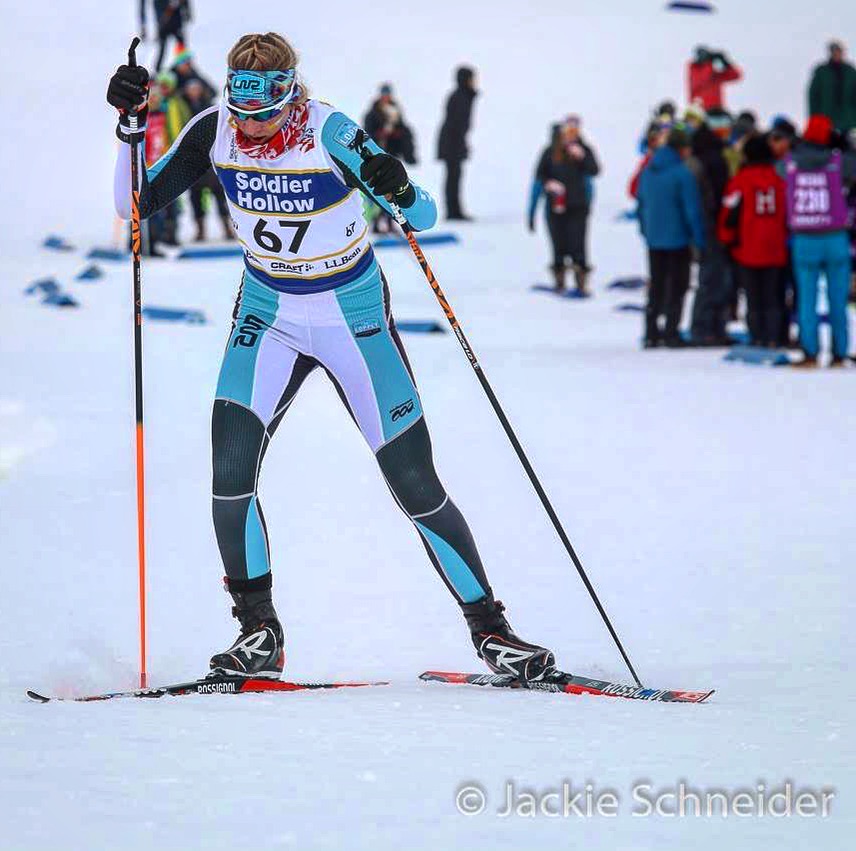
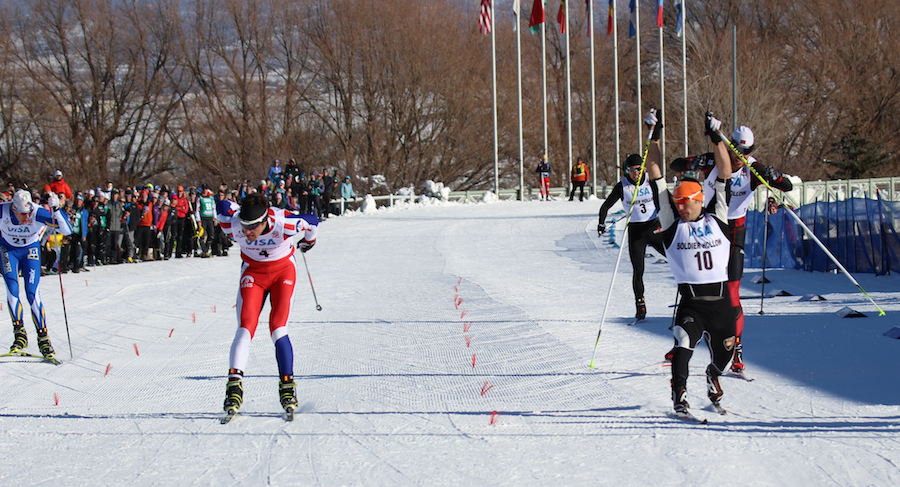
Amanda Kautzer (Michigan Tech/Loppet Nordic Racing) competing at 2017 U.S. nationals last month at Soldier Hollow in Midway, Utah. (Photo: Jackie Schneider)
In another 20-something-question, fill-in-the-blanks series, we checked in with the world-class U.S. and Canadian biathletes that will be competing at 2017 International Biathlon Union (IBU) Youth & Junior World Championships Feb. 22-28 in Osrblie (also known as Brezno-Osrblie), Slovakia.
Here’s 18-year-old Amanda Kautzer, of Michigan Tech and Loppet Nordic Racing, who is representing the U.S. at her third Youth Worlds. On Wednesday, Kautzer placed 53rd in the youth women’s 10 k individual and on Friday, she was 59th in the 6 k sprint.
***
“My full name is Amanda Rose Kautzer, but you can call me Amanda, Mandy, whatever works. I was born in Singapore and raised in Plymouth, Minn.
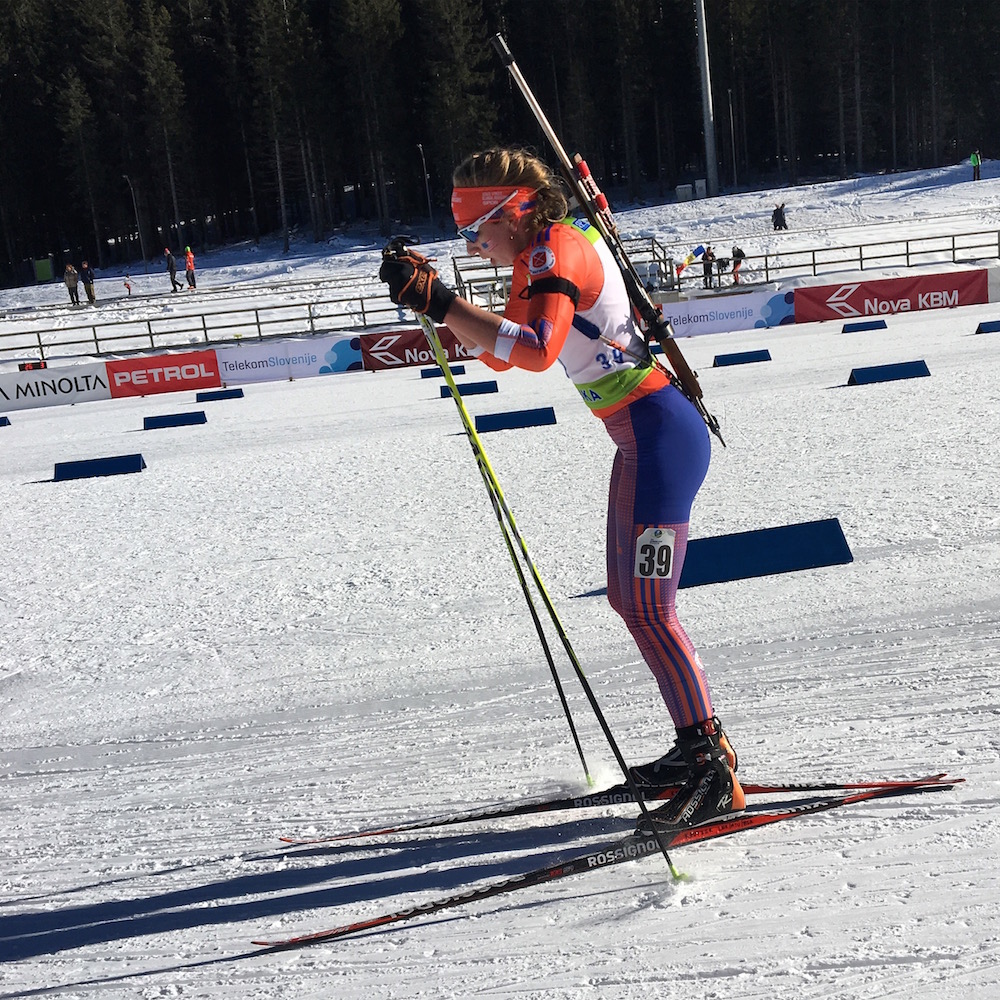
American Amanda Kautzer racing at an IBU Junior Cup earlier this month in Pokljuka, Slovenia. (Photo: Vladimir Cervenka)
I started cross-country skiing when I was 12 and started biathlon when I was 14, thanks to my coach Piotr Bednarski. I currently train in Houghton, Mich., and Plymouth with the Michigan Tech Nordic Ski team and Loppet Nordic Racing, respectively.
If I’m not skiing, you might find me skiing (the other kind). If I had to pick a favorite book, it would be ‘The Name of the Wind‘.
One of the things I’m most excited about for Youth/Junior World Championships in Brezno-Osrblie is fast skis from great wax techs. This will be my third Youth/Junior World Championships, and this year, I’m competing as a youth.
One race I’m especially targeting there is ummmm all of them of course.
The best advice anyone ever gave me about skiing or racing was: ski fast (thanks Dad, super insightful, later changed to: ski faster than everyone else).
One of the best race memories I have is getting silver in a skate sprint despite breaking a pole in the heats.
If I could meet one World Cup skier, it would be Laura Dahlmeier.
If I don’t end up being a professional skier, I’ll probably be a ski coach and do triathlons.
I’m missing 36 days of school to be here, and my professors are probably thinking, ‘Are you in my class? I haven’t seen you there, not even once.’
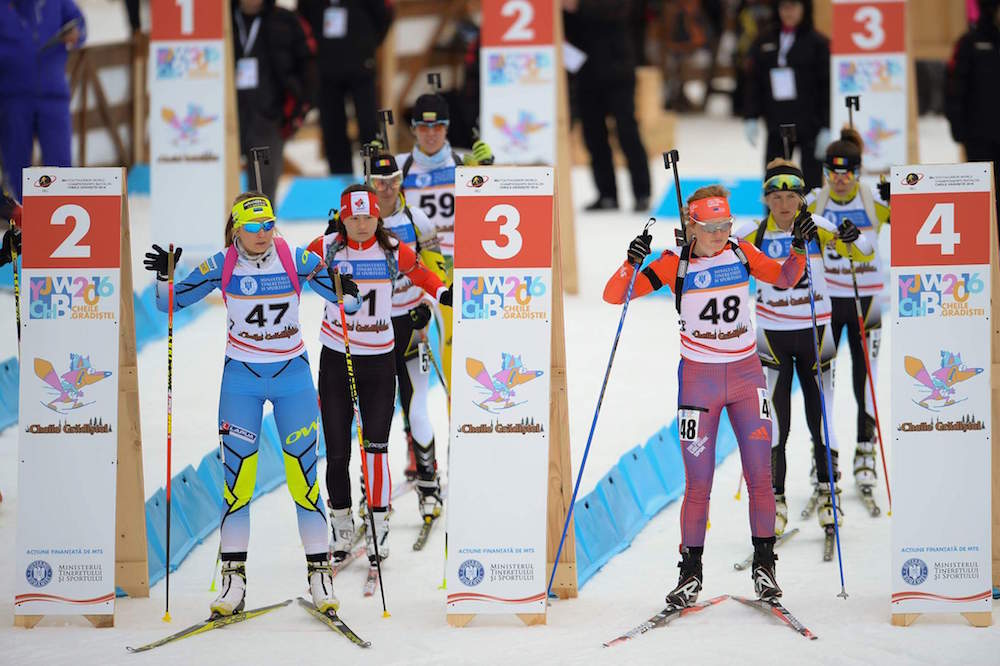
American Siena Ellingson (48) at the start of the junior women’s pursuit at 2016 IBU Junior World Championships in Cheile Gradistei, Romania. (Courtesy photo)
In another 20-something-question, fill-in-the-blanks series, we checked in with the world-class U.S. and Canadian biathletes that will be competing at 2017 International Biathlon Union (IBU) Youth & Junior World Championships Feb. 22-28 in Osrblie (also known as Brezno-Osrblie), Slovakia.
Here’s 20-year-old Siena Ellingson, of Minnesota, who is representing the U.S. at her fourth Youth/Junior Worlds. On Thursday, Ellingson finished 50th to lead two Americans in the junior women’s 12.5 k individual.
***
American Siena Ellingson during her standing stage of the women’s 3 x 6 k relay at IBU Junior World Championships in Cheile Gradistei, Romania. (Photo: IBU YJWCH Cheile Gradistei 2016/Facebook)
“My full name is Siena Ellingson, but you can call me Siena. I was born in Lauderdale, Minn., raised in Minnetonka, and one thing you should know about my hometown is the name means big water!
I started cross-country skiing when I was 13 and started biathlon when I was 14, thanks to Piotr Bednarski. I currently train in Grand Rapids, Minn., with Vlad Cervenka.
If I’m not skiing, you might find me making things!
If I had to pick a favorite book, it would be ‘Anna Karenina‘.
One of the things I’m most excited about for Youth/Junior World Championships in Brezno-Osrblie is having such large and competitive fields to race.
This will be my fourth Youth/Junior World Championships, and this year, I’m competing as a junior.
One race I’m especially targeting there is the sprint, because making the pursuit and getting a good start position depends on the results of the sprint.
The best advice anyone ever gave me about skiing or racing was tone down the suck.
One of the best race memories I have is my first race at my first Junior Worlds. I remember starting with a big smile on my face, and not being nervous about how it was going to go, but just excited to be there.
If I don’t end up being a professional skier, I’ll probably be… not exactly sure, but definitely working with kids.
I’m missing zero days of school to be here; I’m currently un-schooling.”
Loppet Nordic Racing athletes at attention before working out at Hyland Hills. (Photo courtesy of Caitlin Gregg)
This workout is based on one described by Caitlin Gregg in 2013: “I absolutely love doing hard intervals (Level 4) from 3-5 minutes in length, over and over again, sometimes feeling invincible and sometimes feeling like I am going to pass out!”
She described working with Piotr Bednarski’s Loppet Nordic Racing (LNR) training group in Minneapolis/St. Paul, Minnesota, and beginning a session by doing core work and ski walking. That led into plyometric jumps and finally hard running up a hill for roughly three minutes, repeated three to eight times.
Junior athletes in action moosehoofing it up Hyland Hills. (Photo: Caitlin Gregg)
This time around, Gregg has some additional advice: how to use such a workout to get the very most out of your local training grounds. What if you need to train hills, but live where it’s flat? Even a small hill can make for a big workout.
“We typically spend one day a week doing intensity on foot with LNR,” Gregg writes. “The intensity alternates between L-3 running intervals on rolling terrain and L-4+ Moosehoofing and bounding intervals on steep terrain. With only 175 feet of possible elevation gain within the Twin Cities limits, we had to get creative about how to get in enough distance to make the intervals 3:30 – 5 mins each.”
You can find those 175 feet at the Hyland Hills Ski Area, usually home to alpine skiers and snowboarders. So LNR, Gregg, and other area cross-country skiers head there in the summer and skip the terrain park in favor of going uphill, as hard as possible.
“We climb up the far the right side of the alpine area on the service road which is the perfect pitch for hard moosehoofs or bounding with poles and takes about 1:45 to reach the peak,” Gregg explains. “Once on top we lift our poles and enter a high turnover slightly downhill full-out run across the ‘ridge.’ We get about 3/4’s of the way across the top before we drop down a steep 50ft. section before hitting the final climb as moosehoofs or bounding with our poles again. The last climb lasting is about 1:00 to the summit and hurts a lot!”
The Workout:
Warm up: 20-minute jog and mobility exercises
Part I:
– Intense core work (i.e. medicine ball throws, weighted incline bench sit-ups, isometric holds, partner throws)
– Ski walking up alpine hill
Part II:
– Plyometric jumps up the hill (with medicine balls for added resistance):
8-10 sets per side, 100 percent effort with rest in between: side skate jumps, cross-over glute leaps, broad jumps, 20-seconds all-out bounding with poles.
Part III:
– Run from base to top of hill or mountain (aim for about 3 minutes 30 seconds), then jog down (about 3 minutes back to start). Repeat 3-4 or 6-8 times.
Cool down: 20-30 minutes
While the climb doesn’t exactly represent three minutes of dedicated climbing, Gregg says that’s okay. In most ski races, you wouldn’t encounter three minutes of sustained climbing at the same pitch with the same technique anyway.
“Although the terrain limits our ability to continuously climb for 3:30- 5 mins, I find that the need to change gears and speeds and technique is more like what we would find in a race during the winter,” she explained.
Caitlin Gregg (center) and her LNR training buddies. (Photo courtesy of Caitlin Gregg)
Like any interval workout, the goal is for consistency over time.
“I strive to get under 3:30 for each interval and be able to hold the same pace for the entire workout. Some people get 3-4 in and some get 6-8. It all depends on each person’s fitness level and how they are feeling. The best part is everyone suffers together,” she wrote back in 2013.
“After the intensity is over everyone jogs a cool down for about 20-30 minutes and spends some time chatting while stretching in the parking lot… I usually have someone who can push me for each individual segment, which makes the workout fun and super high quality at the same time. I also think it is pretty cool for the other participants to train along side an Olympian and see how I approach the same workout they are doing! I have been joining Piotr for this workout for the past 9 years and I have never been disappointed in the results!”
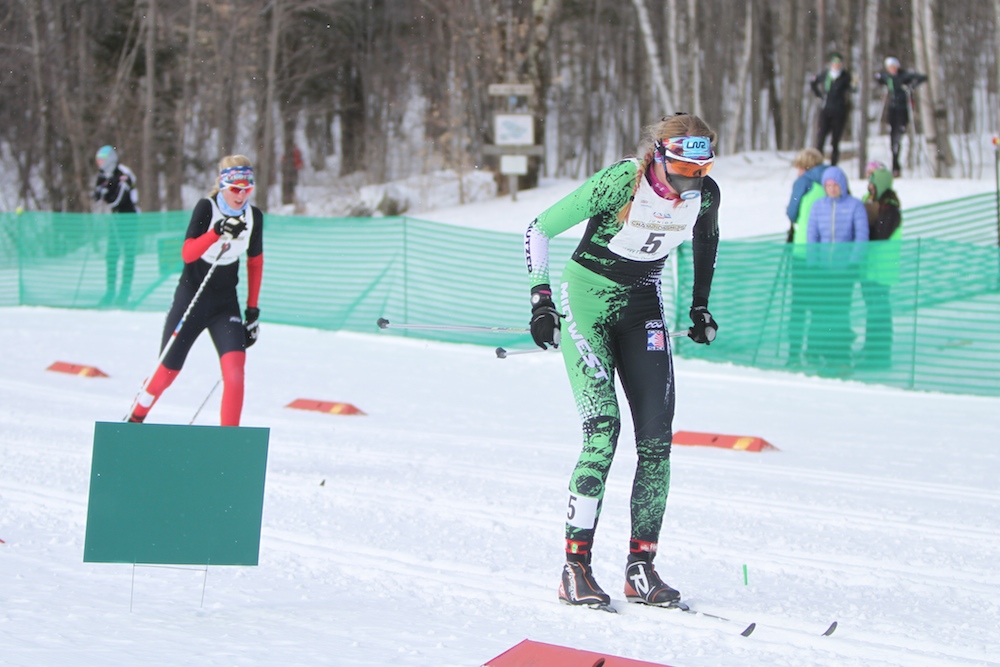
Amanda Kautzer (r) of Loppet Nordic Racing crests the final hill in the 1.4 k classic sprint A-final before winning her first title at Junior Nationals in Stowe this March.
Three years ago, Loppet Nordic Racing (LNR) was just an idea.
But when Reid Lutter and Piotr Bednarski decided to combine their successful Minnesota Valley Ski Team and Go! Training programs under the auspices of The Loppet Foundation, things started moving fast in Minneapolis and Saint Paul, Minnesota.
In the club’s first season of racing, it took home the boys’ club title at Junior Nationals in Anchorage, Alaska.
Lutter said that neither coach was expecting to find their new program on top quite so soon.
“When we came together we thought we could be competitive for a podium, but we didn’t think we’d have that great of a performance,” he laughed. “We were surprised when we won the boys title in Alaska.”
Their top racer, Ben Saxton, moved East to join the Stratton Mountain T2 team (and has since moved on to Dartmouth College and the U.S. Ski Team). But that didn’t slow down LNR.
At Junior Nationals in Stowe, Vermont, in March, they took home both the boys’ and girls’ titles. Lutter described watching as first one skier, then another – from a variety of different high schools and programs around the Twin Cities – turned in stellar performances.
“It came together and they all skied really well,” he said. “Tons of kids from different high schools kind of fueling off each other to it that goal – the goal was to win that national title.”
LNR alum Ben Saxton (left, SMST2 team) raced his way to second place in the senior freestyle sprint at U.S. Nationals in January, and has since earned a spot on the U.S. Ski Team. Photo: Tom Scrimgeour.
Going into their third season of existence, LNR might well be considered a juggernaut of junior cross-country skiing in the United States. That was the plan all along, but don’t let the results fool you: the keys to the club’s success, Lutter asserts, are fun and community involvement. LNR might produce junior national champions, but it also offers programs for younger kids as well as adults.
This summer Bednarski, who serves as the head coach, supervised training for over 160 juniors. Lutter, whose title is head junior coach, helped organize three different week-long training camps in connection with Central Cross Country (CXC), each of which had enrollment around 40 athletes. And a new “FAST Kids” program saw about 30 middle-school skiers training during the summer as well.
“We train really hard, but we also have a lot of fun and we don’t take ourselves too seriously,” Lutter said. “We’re not performing brain surgery now, we’re just trying to get kids fit.”
Overseeing such a large program is something of a balancing act, but Bednarski and Lutter manage the chaos. The key is to have coordinators for different regions of the twin cities – Chris Harvey on the west side, and Julia Curry on the east – and an army of experienced racers helping out with group work three days a week.
“We’re always at a 10:1 ratio,” Lutter said of his coaching staff. “Well, sometimes it slips up to 12:1. But we’re really sure that we’re getting the kids attention every day they’re out training with us. So that’s why when you look at the coaching staff, it looks like every person in Minnesota is helping out.”
That also translates to a lot of people who feel like they’ve participated in the club’s strong results. The first step when LNR was founded, Lutter said, was to catch up to other top clubs around the country. Now, they can go farther.
“The Twin Cities should be performing similar to Anchorage,” he said. “We have more teams and more athletes than any other locations anywhere else in the country… we’re excited about where we’ve come in the three years since we merged and formed a super club, but we also feel like we haven’t reached the level where we should be. What can we do with the power of a huge metropolitan area?”
That is, definitely, the question. LNR hopes to send athletes to World Junior Championships and the U18 Scando Cup trip, not just hit the Junior National podium as they have been doing the past two years. Eventually, elite racing is on the radar.
And being in the twin cities, the club has several helpful tools at their disposal. One is the organization and assistance of CXC, an organization which Lutter considers a valuable partner.
The other is the rabid enthusiasm of the Minnesota high school racing scene. The vast majority of LNR participants ski primarily with their high schools in the winter, although LNR will be offering more winter training sessions this year for those who want them. It’s a balancing act, Lutter says, but one with a lot of benefits.
“We all want the same thing, which is to get these kids to ski fast and have fun and keep skiing,” he explained. “Our goal as a club is basically to make World Juniors, the J1 trip, to get high places at junior nationals. The high school coaches’ goals are to get on the podium at state. A lot of the time those will coincide nicely. I think that LNR has had the past 4 or 5 past boys’ state champions, so it’s working pretty well.”
And, Lutter says, he envisions only even more success in the future. By partnering with the Loppet Foundation, the two successful coaches were able to plug into something bigger and think outside the box. With some new programs, more kids will be skiing in the Twin Cities than ever before.
“We think that this is really the tip of the iceberg,” he said. “The other programs that our foundation is working on, in terms of working with inner city youth and working with middle schoolers, and trying to expand skiing to lower income people, those are great, great base programs.”
Lutter and Bednarski also joined forces with another vision in mind: to offer more training for younger racers. Another Twin Cities program, Endurance United, is now also offering that type of programming, but five years ago it was scarce.
From that idea was born the FAST Kids program.
“We were competing with each other for athletes, and we wouldn’t see them until they were in high school, and then you were just always trying to get kids in your summer program so you could pay your coaches’ salaries,” Lutter said of the pre-LNR days. “One of our main ideas was that look, we’re not going to be competing for resources, instead we’re going to be coordinating so we should have some funds left over to help fund a U14-U12 coordinator.”
He’s looking forward to the day that the FAST Kids become fast high school students.
“When Piotr and I talk about the club, we’re so excited about where we are right now, but it’s also like, my goodness, when these sixth and seventh graders get up to be juniors, hopefully we can do even better,” he said. “They’re the ones who will go through the whole program.”
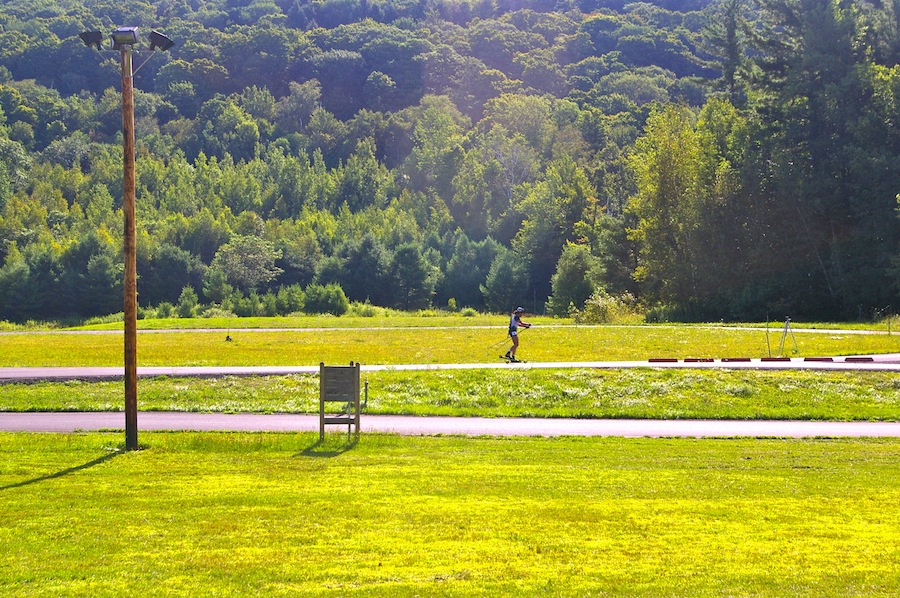
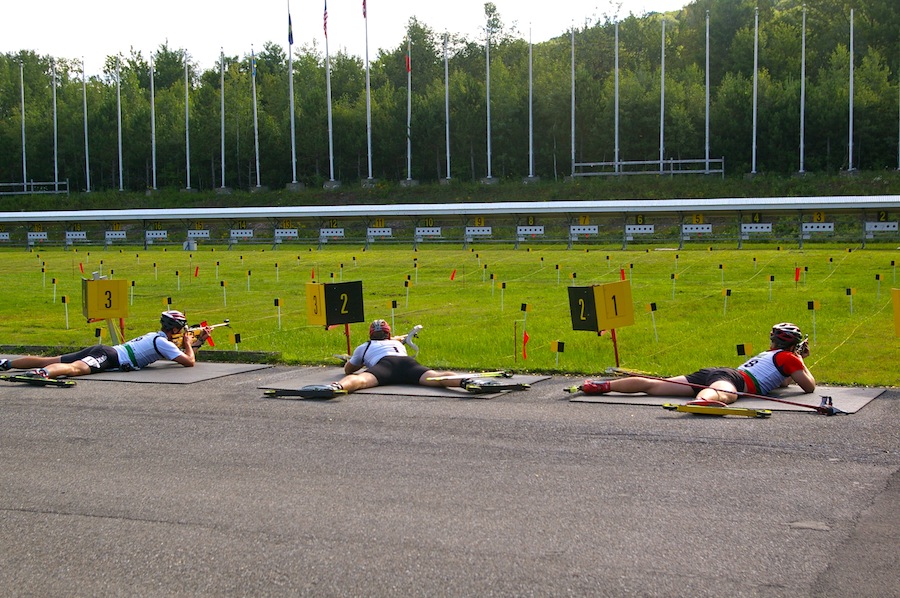
A racer heads out on the penalty loop at the Ethan Allen Firing Range in Jericho, Vt., during the 2013 North American Biathlon Rollerski Championships from Aug. 10-11.
Editor’s Note: After a weekend trip to Jericho, Vt., from Aug. 10-11, FS decided it might be interesting to provide some background on one of the most prolific biathlon sites in North America and clarify how to gain access to the National Guard’s facility.
JERICHO, Vt. – Just a hop, skip and a jump off interstate 89, the Ethan Allen Firing Range sits tucked away high upon West Hill Road – and a lot of locals couldn’t tell you what it looks like. You see, what’s widely recognized as one of the best biathlon gems in the country (and North America) is also a bit exclusive and intimidating from the outset.
Owned and operated by the Vermont National Guard, the 11,000-acre site mainly caters to the military. If you’re lucky enough to grace the grounds of Camp Ethan Allen, even if it’s just to and from the range, chances are you’ll come head to head with a humvee or some reserves in action. If you stay out of their way and have the go-ahead to use the range, chances are you shouldn’t run into any problems – and this is what makes Jericho so cool.
In early August, about 105 athletes came out for the North American Biathlon Rollerski Championships hosted by the Ethan Allen Biathlon Club (EABC) and organized by US Biathlon (USBA).
According to USBA director of athlete development Piotr Bednarski, that was a pretty huge turnout for rollerski races. In fact, it might’ve been the biggest field in about 20 years of the event’s existence.
Every other year, the North American Biathlon Rollerski Championships float between Jericho and Canmore, broadening the scope beyond nationals. When they’re not hosting the championships, the sites swap what’s known as the North American Cup – and in Jericho, the turnout is typically good (60 to 70 athletes).
Eventual men’s winner Lowell Bailey (c) gets his shooting on Aug. 11 at the 30-point Ethan Allen Firing Range in Jericho, Vt. Bailey went on to win the two-day North American Biathlon Rollerski Championships.
“It’s actually probably the best roller loop on the planet,”Bednarski said. “All the national team guys, they’ve gone to Ruhpolding and Oberhof [Germany] and all over the world, and this is really just a great place to ski.”
The approximately 5.5-kilometer rollerski loop got a major upgrade in May when the Vermont National Guard spent $300,000 dollars on repaving. According to Maj. Christopher Ruggerio, biathlon coordinator at the National Guard, the project wasn’t an absolute must, but it was important in keeping Jericho valuable to biathletes.
“Prior to initiation of this project, the course was by no means unusable, but did have a number of unwanted cracks and heaves that were becoming a safety concern to athletes,” Ruggerio wrote in an email. “Our Range is one of the premier venues in the Nation. According to various coaches and athletes from multiple organizations, our roller ski trail system is likely the ‘best in the world’ at this time.”
EABC President John Madigan explained in an email that the range was “probably the best in the country and comparable to other countries” when it was built several decades ago.
“Biathlon in Europe has grown tremendously since then and the stadiums in Germany and other countries now attract 30,000 or more spectators to World Cup races,” he wrote. “It will be a long time before we ever see that here, but these paved trails are as good as anything in Europe and as close to real skiing as you can get in the summer.”
“It’s got the vertical plus it skis like skiing,” Bednarski explained.
That’s partly why Biathlon Canada High Performance Director Chris Lindsay considers it almost like a second home – albeit in America – in contrast to their base in Canmore, Alberta. As he drove up the winding road to Jericho last month, Lindsay said he passed signs still standing after Tropical Storm Irene flooded the region two years ago. Their words were an eerie reminder of what Canmore experienced in June – unprecedented rainfall, devastating floods, evacuations, and destruction.
The signs read “Vermont strong,” and Lindsay saw similarities to those posted in Canmore. “We have those, too,” he said.
But long before the flooding thousands of miles away in Canmore, these races in Jericho were a priority and will become more so in the coming years. For the Americans, they were a sort of prequalifier for the Olympics: do well there and at two more rollerski trials in Utah, one could earn a ticket to Europe to strive for World Cup starts. For the Canadians, it was less about Olympic qualification and more about the competition.
“We are very supportive of the idea of getting back to having co-competitive opportunities for the two major North American teams on a regular basis and during the training season so that there’s an opportunity to learn from each other and there’s also an opportunity to measure off each other,” Lindsay said.
Because of the size of biathlon in Canada and the U.S., both programs can’t just rely on internal or domestic competition, he added. To measure success, they need to be pinned against one another.
“Getting back to having this as a major event within our training season is a priority for the next quadrennial,” he said. “Having over a hundred people on the start list, this is pretty significant and it’s a great opportunity.”
Bednarski, who organized the event remotely from Minneapolis, said he was ever impressed with the Canadians’ showing.
“I think they’ve made it a national-team requirement basically, which is great,” he said. “It elevates everybody. … Anybody on the U.S. or Canadian team that has a shot at making the Olympics is here. There’s twenty athletes who are going to go, and they’re all here.”
For the low cost of a couple dollars per day, athletes stayed in the barracks for as long as two weeks.
“It’s like the army,” Bednarski said. “It’s really fun. Everyone’s together, there’s no TV, no internet, everyone’s just hanging out and playing games and Frisbee and whatever.”
Women’s pursuit champion Rosanna Crawford, prequalified to represent Canada at the 2014 Sochi Olympics, explained in an email that she only spent two nights in the barracks after training in Lake Placid, N.Y.
“I actually slept pretty good, but the showers are really gross!” she wrote. “They could really use some new shower curtains! Two nights was more than enough for my liking! The food was good though, they had hired a couple cooks to come in for the week and they were amazing and really nice people!”
Wondering what it takes to gain access? Madigan explained that one must be associated with a club or organization that leases rights to use the range (Craftsbury and Mansfield Nordic do as well), and the leaders of those organizations must have safety training at the base.
“We always welcome people to join us during a scheduled practice, try some shooting or check out the trails,” he said.
There are three more races in the fall biathlon series (Sept. 29, Oct. 27 and Nov. 3) and a cyclocross biathlon race open to the public on Oct. 26.
Caitlin and Brian Gregg testing their new Madshus equipment on Eagle Glacier near Anchorage, Alaska, earlier this month. (Photo: Madshus/Charlie Renfro)
Welcome to Wednesday Workout, where we provide and break down training ideas on a weekly basis. This week, Caitlin Gregg, 2010 Olympian and the defending American Birkebeiner champ, shares a group workout that pushes her to the max. Formerly of Central Cross Country (CXC), Gregg is currently training in Minneapolis with her husband Brian and racing for the Methow Olympic Development squad in Washington.
***
My favorite workouts are all during the fall months of training. I absolutely love doing hard intervals (Level 4) from 3-5 minutes in length, over and over again, sometimes feeling invincible and sometimes feeling like I am going to pass out! No matter what the mode, running, rollerskiing, bounding or biking I can never get enough.
The Workout: Fall Running, Bounding and Plyo
Warm up: 20-minute jog and mobility exercises
Part I:
– Intense core work (i.e. medicine ball throws, weighted incline bench sit-ups, isometric holds, partner throws)
– Ski walking up alpine hill
Part II:
– Plyometric jumps up the hill (with medicine balls for added resistance):
8-10 sets per side, 100 percent effort with rest in between: side skate jumps, cross-over glute leaps, broad jumps, 20-seconds all-out bounding with poles.
Part III:
– Run from base to top of hill or mountain (aim for about 3 minutes 30 seconds), then jog down (about 3 minutes back to start). Repeat 3-4 or 6-8 times.
Cool down: 20-30 minutes
Every fall I have come to love, and sometimes hate, a particular workout that Piotr Bednarski, US Biathlon’s director of athlete development, and Loppet Nordic Racing (LNR) run in the evening at Hyland Alpine Area in Bloomington, Minn.
The group is a mix of juniors, masters, Olympians and Birkie champions. Some people have been coming for years and some are just getting into nordic skiing. The camaraderie is high in this group and we all push each other to do our best.
The next phase is a series of plyometric jumps using the hill and medicine balls for resistance. We do side to side skate jumps, cross over glute leaps, broad jumps and 20-seconds all-out bounding with poles. The jumps are done in sets of 8-10 per side and are 100% effort followed by plenty of rest.
After almost an hour of effort we move onto the final portion of the workout. My favorite! Starting at the base of the hill we all leave together and run up to the top along a nicely wooded trail that offers a bit of shade and some agility as well. The last pitch is extremely steep and makes my legs and lungs burn more than any other workout.
After a 3-minute jog back down to the start its back to business. I strive to get under 3:30 for each interval and be able to hold the same pace for the entire workout. Some people get 3-4 in and some get 6-8. It all depends on each person’s fitness level and how they are feeling. The best part is everyone suffers together 🙂
After the intensity is over everyone jogs a cool down for about 20-30 minutes and spends some time chatting while stretching in the parking lot. I am lucky to live in such an active nordic community and it’s awesome to have such a wide variety of training partners for this workout.
I usually have someone who can push me for each individual segment, which makes the workout fun and super high quality at the same time. I also think it is pretty cool for the other participants to train along side an Olympian and see how I approach the same workout they are doing! I have been joining Piotr for this workout for the past 9 years and I have never been disappointed in the results!
Aleksandra Zakrzewska (Ethan Allen Biathlon) is part of a very Polish-sounding youth women’s squad, comprising herself, Anna Kubek, and Mikaela Paluszek. Photo: Gregory Haugen/Haugenphoto.com.
After a series of three trials races (which FasterSkier blogged the results of earlier), the United States Biathlon Association (USBA) has selected ten athletes to represent its cause at the World Youth and Junior Championships in Obertilliach, Austria, in late January.
In contrast to the selection system used by USSA for sking’s World Junior, J1, and U23 events, USBA does not fill all four possible quota spots in every division. Instead, they use a percent-back calculation to compare performances to the top three finishers in each race and have cutoff values for automatic qualification: a 99 % average in the best two of three races for juniors, or 97 % for youth.
While some choices were obvious – for example Anna Kubek of Mount Itasca and Sean Doherty of Vermont Collegiate Biathlon swept all of the races and topped the combined youth and junior standings, despite being youths – others were not.
Anna Kubek (Mount Itasca) decimated the women’s fields. Photo: Gregory Haugen/HaugenPhoto.com.
For example in the women’s division, youths Aleksandra Zakrsweska and Mikaela Paluszek (Ethan Allen Biathlon) were close enough to Kubek to make the 97 % cutoff, and Tara Geraghty-Moats, also of Vermont Ethan Allen, was ranked ahead of them. But as a junior, Geraghty-Moats had the higher, 99 % cutoff, and did not automatically qualify. A top-20 finisher in the youth division at the 2012 Championships who is now training at a ski gymnasium in Solleftea, Sweden, Geraghty-Moats was added as a discretionary selection, but will be the only junior woman representing the U.S.
“Whenever we have a fairly small field of juniors, we combine them with the youth in order to get a better perspective on the quality of field,” USBA Director of Athlete Development Piotr Bednarski wrote in an e-mail to FasterSkier. “We feel it’s important that we send athletes that have a legitimate chance of making the top 60 in the sprint (so they can qualify for the pursuit). We consider this an appropriate level of performance, and even if someone is the top athlete in their category, it doesn’t necessarily mean they are ready for the WJCH level of competition.”
In the men’s races, Doherty dominated, but not quite as thoroughly as Kubek had – while his female counterpart notched three and five minute victories, Doherty was limited to two and three minutes over a longer distance. As such, one junior, Casey Smith of Biathlon Elite, was able to sneak into the 99 % range for automatic selection. A top-30 finisher at previous Championships, Smith has also competed at Open European Championships and joined Doherty and Geraghty-Moats for a trip to Swedish National Championships last spring.
In the youth men’s division, National Guard Biathlon’s Jordan McElroy was the only athlete to qualify based on points. But Jacob Ellingson of TC Biathlon and Brian Halligan of the Saratoga Biathlon Club were also added as discretionary selections. Using the same reasoning, Jake Dalberg of National Guard Biathlon will join Smith in the junior races.
Sean Doherty (Vermont Collegiate Biathlon) led the men. Photo: Gregory Haugen/HaugenPhoto.com.
“In general one would expect the juniors to be stronger than the youth,” Bednarski wrote. “Of course, in this case, we have two very exceptional youth athletes in Sean and Anna. As you can imagine, we have some high hopes for WJCH’s (both Sean and Anna have one more year in the youth category!)… A junior athlete must be really close to the objective criteria, and exhibit really good ski speed, otherwise we won’t generally recommend a discretionary selection. With youth athletes, because they are younger, we give them more leeway, especially if they are showing some good ski speed. Most of the youth competitors are in their first or second year of shooting, so we expect a high level of variability in their shooting results.”
While it’s notable that only one segment of the squad, the youth boys, will have a full roster, this is certainly not the first time a dominating performance has left the rest of the American juniors out of the running. In 2010, Leif Nordgren crushed the trials field and was the only representative in the junior division, where he collected two top-ten performances. He’s gone on to World Cup success.
And that’s what Bednarski is hoping for with this next crop of young athletes.
“With WJCH in the United States next year, we really want to have a good team in all categories,” he concluded.
Honors are due to Algis Shalna, who coaches both the Vermont Collegiate Biathlon team and the Ethan Allen Biathlon club; of the ten athletes selected, four train with him in Jericho, Vermont. The National Guard biathlon program also made a strong showing, placing two athletes on the roster, showing their increasing focus on young biathletes.
The roster:
Junior Men
Casey Smith, Methow Valley, WA (Methow Valley Biathlon/Biathlon Elite)
Jake Dalberg, Ely, MN (National Guard Biathlon)
Junior Women:
Tara Geraghty-Moats, West Fairlee, VT (Ethan Allen Biathlon) Youth Women:
Anna Kubek, Duluth, MN (Mount Itasca)
Aleksandra Zakrzewska, Burlington, VT (Ethan Allen Biathlon)
Mikaela Paluszek, Farmington, NH (Ethan Allen Biathlon)
Youth Men:
Sean Doherty, Center Conway, NH (Vermont Collegiate Biathlon)
Jordan McElroy, Truckee, CA (National Guard Biathlon)
Jakob Ellingson, Minnetonka, MN (TC Biathlon)
Brian Halligan, Gansevoort, NY (Saratoga Biathlon Club)
Jakob Ellingson (TC Biathlon). Photo: Gregory Haugen/HaugenPhoto.com.
Sean Doherty (Vermont Collegiate Biathlon) led the men. Photo: Gregory Haugen/HaugenPhoto.com.
Anna Kubek (Mount Itasca) racing in the United States last year. Photo: Gregory Haugen/HaugenPhoto.com.
Mikaela Paluszek (Ethan Allen Biathlon). Photo: Gregory Haugen/HaugenPhoto.com.
Aleksandra Zakrzewska (Ethan Allen Biathlon) is part of a very Polish-sounding youth women’s squad, comprising herself, Anna Kubek, and Mikaela Paluszek. Photo: Gregory Haugen/Haugenphoto.com.
Casey Smith (Biathlon Elite) was the lone automatic qualifier for the junior men’s team. Photo: Gregory Haugen/HaugenPhoto.com.
Jordan McElroy (National Guard Biathlon). Photo: Gregory Haugen/HaugenPhoto.com.
Carolyn Bramante, a 2006 Olympian, who trained with Piotr Bednarski. (Courtesy Photo)
Coaching a college team which you yourself are part of might not seem like the best way to learn the tricks of the trade – or to become a better athlete, for that matter.
And yet that was the situation in which Piotr Bednarski found himself in the late 1980’s at Cornell University in upstate New York. From there, he has gone on to be one of the most successful coaches in the Midwest, across a range of endurance sports and with several teams that he invented himself. All the while, he has kept racing, even at age 45 and with two children.
“I’m still competing,” Bednarski laughed in a recent interview from Minneapolis, where he lives and works. “I’m still a frustrated athlete.”
That’s Piotr (“Pea-ought”), as everybody calls him, being modest. Despite his heavy coaching load, Bednarski is still fit to have placed in the top 20 of the classic race of the American Birkebeiner in several of the past few years; he’s also a former masters national champion in biathlon and a frequent mountain bike racer in the summer.
Coaching, though, is his focus. Between the Minnesota Biathlon team he ran in the 1990’s through 2002, and his Go! Training program that lasted through this spring, Bednarski has trained a handful of Olympians in both biathlon and skiing, as well as mountain biking 2011 World Championship team member Jack Hinkens.
These days, he is working through Loppet Nordic Racing, a new program of the City of Lakes Nordic Ski Foundation, which absorbed Go! Training along with Reid Lutter’s Minnesota Valley ski team. It’s a new role for Bednarski, but one in which he will have no less of an impact on Midwestern skiing.
“All I can say is that he is super, super psyched, always, to have athletes that are interested and motivated,” said 2010 Olympian Caitlin Gregg, who has worked with Bednarski for the last eight years. “So when I first met him, I thought, man, this guy seems really awesome and he seems like he has a lot of energy.”
Learning To Coach
After graduating from Cornell, Bednarski stayed to coach the team for two years. But it wasn’t there, he said, that he realized that he had a passion for coaching. He can pinpoint the exact moment when his career was born: a 1989 clinic in Marquette, Michigan, with U.S. Ski Team coach Steve Gaskill.
“That really just got me super excited about coaching long-term,” Bednarski says. “Then the following year I started graduate school in biomechanics. That was because I realized, ‘I don’t know anything.’ It seemed like the best way to pursue it. You know, in other countries they have formal schooling for coaches, but that doesn’t exist here.”
Bednarski (right) and Sverre Caldwell of the Stratton Mountain School preparing skis at the Youth Olympic Games in Innsbruck this winter. Bednarski has coached on several international racing trips.
After starting his masters degree in biomechanics at Oregon State University, Bednarski became frustrated by the lack of snow in Corvallis. So he moved to Saint Cloud State in Minnesota, where there was plenty of skiing, and also a biomechanics department focused on the sport.
“The program in Saint Cloud actually did a lot of skiing research, both with equipment and a variety of skiing studies,” Bednarski explained. “The professors were part of a sports science committee for the biathlon team. So they were traveling to West Yellowstone to do video, and just help with doing stuff like lactate profiles and a variety of little studies. That was a little more exciting than Oregon State for me.”
By the time he finished in 1993, he had studied mechanical forces in double-poling and done two studies based on the 1992 Olympics: the first looking at mechanical energy transfer in skiers, the second analyzing the timing system in a biathlon race. He had also developed a prototype for a quick-release pole strap for biathletes.
In other words: he was ready to go.
Bednarski cut his coaching teeth at Team Birkie, a team organized by Gaskill that brought together juniors, seniors and masters skiers. When the team folded due to financial constraints, Bednarski was left searching around for another coaching gig. He went into business more or less by himself, creating Minnesota Biathlon.
“Minnesota Biathlon was a really successful program but it was small,” Bednarski said. “We had usually four or five seniors at a really high level, and then maybe 15 or 20 juniors. They all paid something, but it was really pretty well-supported, a little bit by USBA, and then the Community Olympic Development program came into being and helped fund us. I did that in a full-time way for seven or eight years.”
In his interview, Bednarski glossed over that part of his history. But very few biathlon teams have had so much success: Andy Erickson raced at the 1998 Olympics, Dan Campbell in 2002, and Carolyn Bramante in 2006. Bednarski’s athletes also competed at senior World Championships, the World University Games, and World Junior Championships for both skiing and biathlon. He was the United States Biathlon Association’s Development Coach of the Year in 1996 and its Elite Coach of the Year in 2000.
But as good as the program was, it didn’t last. After the 2002 Olympics, many winter sports saw drastic cuts in funding from the Olympic Committee, and biathlon was one of them. Minnesota Biathlon was done, although Bednarski still keeps the name of the program; you can find its website online, where he announces biathlon races that he organizes in Minnesota.
Time to Go!
Left once again searching for a job, Bednarski changed tactics: instead of a biathlon program, he would start a ski team, employing only himself.
“I was still doing some biathlon, but mostly to a smaller degree it’s really hard to make it pay for itself,” Bednarski explained. “You need a larger number of coaches and a lot of time to do biathlon training. It’s difficult to make the cash flow. Plus the biathlon range is pretty inconvenient, it’s almost an hour away, so training became super difficult for me.”
While staying on with USBA as the Athlete Development Director, Bednarski started what was essentially a training group, calling it Go! Training. Early in the program’s existence, Gregg showed up for her first practice. She had moved to the Twin Cities to support her mother, who had cancer, and a few friends had suggested that she train with Bednarski.
Caitlin Gregg, another athlete who works with Bednarski, winning the 2011 American Birkebeiner in the colors of CXC. (Courtesy photo)
“The first workout that I met up with him was at 6:45 in the morning,” Gregg remembered in an interview last week. “I drove half an hour to this little alpine area – it was minus fifteen outside, super slow, pitch black. Everything that would make you think, ‘you know, I’m cool. I can just go for a run.’ I got to the parking lot and I was sitting there thinking maybe he wasn’t going to show up. But then he came up to my window, and he was like, ‘Are you ready? Are you psyched?’”
Bednarski’s attitude, Gregg said, was infectious. It was impossible for her not to be psyched, so she started coming to more workouts. At first, Bednarski said, she’d show up with the masters group, in many ways the odd one out. But the program grew and grew, and Bednarski eventually had more elite racers – and a particularly strong group of Minneapolis-based women.
“In a winter we’d have 50 or 60 adults enrolled, and in the summers and fall and pretty much year-round 50 juniors or so,” Bednarski said. “So it was a pretty good group.”
Gregg grew as an athlete, as well.
“There’s no doubt in my mind that Piotr was the catalyst and the one that convinced me that I could train in the Twin Cities and kick ass there,” Gregg said. “After seeing him spread that to so many athletes – it’s just absolutely incredible the number of athletes he reaches. So for myself he’s always been there.”
But as successful as Go! Training was, it had its downsides, Bednarski readily admits that it had its downsides. First of all, it was not a non-profit foundation like so many top clubs, and he didn’t have any supervisors, board members, or oversight.
“Running a club in basically a for-profit mode is something that always rubbed me the wrong way,” he said. “You can’t really ask people to volunteer. It’s not a normal club, it’s like the Piotr club, and that’s not so good. I mean, it worked fine, but it’s not how you’re supposed to run something.”
Skiing For Everyone
Throughout his tenures at Minnesota Biathlon and Go! Training, Bednarski managed to coach a widely varying group of athletes seemingly simultaneously. That, says Gregg, is part of the reason that so many people flocked to his teams. Bednarski doesn’t discriminate.
“He’s the kind of coach that doesn’t get stuck on ego or whether you’re ‘his’ athlete or not, or this is the way that he does things that’s so much better,” Gregg said. “In my opinion he has the perfect attitude. He’s always eager to learn new things from other programs, whether it’s athletes who are coming back from college or athletes like myself being a part of CXC, or other athletes working with the biathlon national team.”
That’s how Gregg was able to keep working with Bednarski even after she joined CXC in its infancy – a move that she said Bednarski encouraged. Other skiers have done the same, including Garrott Kuzzy.
Matt Liebsch, who has worked with Bednarski off and on for several years, racing at U.S. Nationals in 2012.
And after they are done racing, or perhaps while they’re still training for elite competition, they have also come back to Bednarski to help coach in his program. It’s a good move for the racers, but also for Bednarski and his junior and masters skiers, who have the chance to learn from skiers whose names they recognize from the very top of the results sheet. Matt Liebsch, Johanna Winters, and Audrey Weber are among the Go! athletes who have come back to pitch in.
“Piotr has really helped me develop an enjoyment and passion for coaching,” Gregg said.
It helped that she was able to do some training as she coached – and that’s another trademark of Bednarski’s training sessions. Instead of dividing his training sessions strictly by age or ability level, skiers can train together any day, and each reap the benefits.
“The beauty of Piotr’s workouts is that, from my experience, we have a huge variety of athletes,” Gregg explained. “We have high school, then elite athletes like myself and Matt Liebsch, all the way to masters or even beginners who are trying to do their first Birkie. And what Piotr is able to do is somehow attend to all of us… he really has the workouts dialed in so that we can train with him on any given day, any workout, and we’re guaranteed to get a good workout.”
The Big Picture
That didn’t change when Go! Training morphed into Loppet Nordic Racing this summer. Rather than losing any of his team’s well-tested strategies, Bednarski mostly gained the advantages of being part of a larger, foundation-based club, and he is digging into his new role with gusto. One reason is that looking at the whole region, Bednarski has seen shortcomings which he was unable to address with his own for-profit team. Minnesota should be the best place in the country to be a skier, he said.
“Historically, there’s such a Scandinavian and Finnish history here; there really is a culture,” he explained. “People ski. From where I live, I can go to probably 20 different places in a 30-minute drive to ski on groomed trails. And four of those have manmade snow. There’s tons of places to ski.
“So we really should be one of the top places, in terms of having the best juniors, there’s no question,” he continued. “And we do have the most – there’s more skiers, whether it be juniors or adults, than anywhere in the country. So the fact that the level of performance is okay, but not great, that’s a fault of programs and coaching, not facilities or lack of that. If we get it right, we should have the best programs and the best athletes.”
With Loppet Nordic Racing, Bednarski thinks that the Twin Cities are getting one step closer. The foundation does not yet have an elite program, but he hopes to develop one in a few years. For now, they are looking at the comprehensive picture of skiing in the cities. Starting with kids – 150 of them this summer.
“Clubs in the Swedish and Scandinavian models have little kids, and juniors, and seniors and adults, everybody,” Bednarski said. “That’s how we’re structured now. Most of the programs start at about age 8. Something we’re really pushing now is that range of 8 to 13, which is something that has been missing in the Midwest in a big way.”
He cited the fact that while the Midwest frequently excels in the J1 and OJ races at Junior Nationals, the J2 results are poor. That’s because, he says, most kids in the region don’t start skiing until they are in high school. Despite the urban environment which guarantees the sport plenty of potential participants, it’s hard to actually engage the thousands of children who could join a ski team.
“There’s lots of kids,” Bednarski said. “But there are also a gazillion other programs going on that we compete with, whether it be soccer or swimming or whatever it is. It’s tough to break in. we get a lot of kids who are learning how to ski in ninth grade. That’s way too late. You can’t expect them to do well at a Junior National level. It’s possible, but it’s hard to be competitive.”
So for now, Loppet Nordic Racing is sticking with the high school programs previously run by Lutter and Bednarski, while focusing on grabbing more of those elementary- and middle-school aged athletes. In the future, Bednarski hopes, it will lead to a more robust ski community.
Gregg, for one, is sure that it will.
“I think that Piotr will still be a huge [in the Twin Cities], and I think it will even strengthen the ski community,” she said of Loppet Nordic Racing. “And I think that was his focus in getting this job. The Loppet has really gotten behind his training and allowing the whole network of programs, instead of having more fractioned little segment programs. They’re emphasizing that the whole west side of the metro should get together and help each other, which is awesome.”
Caitlin Gregg (CXC) free skating into the stadium on her way to third place in the 10 k skate at 2012 U.S. Nationals. Photo: Flying Point Road.
Caitlin Gregg’s 2012 season couldn’t be considered a disappointment – she finished second in the American Birkebeiner by just 0.4 seconds to her friend Holly Brooks, notched four SuperTour wins, landed third in the overall standings, and twice stood on the podium at U.S. Nationals.
And yet the 2010 Olympican, 2011 Birkie winner, and 2007 SuperTour leader found herself considering life after skiing come spring, when roster and coaching changes rocked her CXC team. As of early May, her status with the squad was uncertain.
These days, she’s very much on board, but rather than focus on training all summer like she has so many times before, Gregg decided to go back to school.
“I wanted to start taking classes and focusing on the next phase of my life,” Gregg said in an interview earlier this week. “CXC was fantastic in allowing me to do school. It had been eight years since I graduated college and 13 since I had taken a science class, and I really felt that I needed to be in daily classes in a classroom with a professor to really maximize my potential there.”
The anatomy and physiology classes are part of a schedule of prerequisites that Gregg needs for the next phase of her education; having now completed a few blocks of five-week intensive courses, she’s free to move into the realm of online classes, which can fit more easily with the rest of her schedule.
And what a schedule it was this summer. School wasn’t the only thing Gregg found to keep herself busy.
Gregg in the skate sprint at 2012 Nationals. Photo: Toko.
“Brian [Gregg, her husband] and myself also work for In The Arena,” Gregg explained. “So that’s another passion and direction that we put a lot of our time towards. I was coaching at Loppet Nordic Racing, I was working with children for In the Arena, and I was also going to school. And I do other clinics for sponsors and other groups, and private coaching. I was pretty busy.”
While most elite athletes don’t fill quite so much of their time with things that aren’t training, Gregg said it worked out well, and definitely didn’t see it as a detriment to the rest of her year as a skier.
“For sure the summer was a time for me to take some time off from completely focused training, where I was kind of going after it every single day, and really take a step back and experience a different schedule,” she said. “I think it worked out great.”
After eight years of training since college, Gregg said, she knew that she needed something different – and it wasn’t because CXC wasn’t working for her. She just needed to get out of the daily grind. As it turned out, she now appreciates her athletic routine even more.
“To be honest, sitting in a classroom for four months and watching the mornings go by – some of my classes were sort of early and those are the best times of the day to train,” she laughed. “So I’d think how it was going to be so hot later and I wasn’t going to want to do anything, and I’d rather be outside biking or something right now. It kind of refreshed me.
“You forget how awesome your lifestyle is until you’re told to sit in this classroom all day,” Gregg continued. “Then you think, oh my God, it’s so awesome to be an athlete. So if anything it totally inspired me in a different way, which I think is always good. It was a good kind of break from traditional summer training.”
Winter Goals: The World Stage
After more or less missing out on international racing since the 2010 season, Gregg has her sights set on making the World Cup races in Quebec and Canmore this December.
“Now I’m tearing through this fall and things are going great,” she said. “The Canadian World Cups are a huge goal. I’m really excited about those being on the calendar this year.”
After that, she would like to make her return to the World Championships, where she last competed in 2009 in Liberec, Czech Republic. In 2011, she was not selected for the championships in Oslo despite being near the top of the National Ranking List; at the time she said that she hadn’t trained as well that season and that other women were indeed more deserving of their spots.
This season, with just one year to go before the 2014 Olympics in Sochi, Gregg is surely hoping for a different outcome.
“I think that for a lot of us who are skiing and training full-time, the World Championships is always a huge goal,” Gregg said. “So seeing how the beginning of the year goes and those World Cups will be a huge focus to qualify for and then perform in, and then sort of seeing how things lay out after that.”
There’s only one thing to slightly dampen her enthusiasm about the potential trip to Val di Fiemme, Italy, and it has to do with one of her favorite races, the Birkie. Like in many other years, the country’s biggest ski marathon is scheduled to overlap with World Championships.
“It’s such a fun race, and one of my favorite events of the year both because of the people I get to see and the whole environment,” Gregg lamented. “But it coincides with World Championships and so it’s one or the other. I wish I could say that both of them are on the schedule.”
CXC Regroups, Retools
To help her get back on the world stage, Gregg is relying on her two usual support networks: CXC, and Twin Cities coach Piotr Bednarski, who now coaches at Loppet Nordic Racing (for more on Bednarski, tune in on Monday).
And despite the loss of Jason Cork and Gus Kaeding from the coaching staff, and Jessie Diggins from the athlete roster, Gregg says that CXC is doing just fine, thanks.
“We’ve got a really motivated group,” she explained. “Igor [Badamshin], who took over as the head coach, had been working with the juniors in the past, and he is probably one of the most qualified coaches in the country. You can see his passion in what he is doing and how he has coached the juniors in the past. And he’s transferring that knowledge and excitement to the seniors. I think it’s going to continue to be a strong program this year.”
As part of its restructuring, CXC combined its elite senior team with its junior development program for this year; it’s all one big CXC team. Gregg, who was able to go to training camps on the weekends this summer before heading back down to the Twin Cities for class, said that she has been enjoying the change.
“There’s a great opportunity for some of the older elite athletes to join up with the CXC juniors,” she said. “So that was really fun because they were more incorporated into our workouts.”
After finishing her last class in August, she flew out to Telluride, Colorado, to do a high-elevation camp with the CXC team – and all those youngsters.
“It was a huge camp with a lot of athletes, and a lot of the younger, up-and-coming athletes were there,” Gregg said. “For me it was a great experience after being in the cities all summer to get out and do something new.”
Sean Doherty out front in the Swedish national championship youth men's pursuit. Photo courtesy of Per Nilsson.
The biathlon season may have ended in North America a few weeks ago, but that hasn’t stopped a group of U.S. juniors from racing their way from to the top. Sean Doherty (Saratoga Biathlon), Tara Geraghty-Moats (Craftsbury Nordic Ski Club/Ethan Allen Biathlon Club), and Casey Smith (Methow Valley Biathlon) flew to Solefteå, Sweden as part of an exchange organized by U.S. Head Coach Per Nilsson.
While the main focus on the stay was more to train and familiarize the young athletes with the structure of the sport in European programs, the trio also competed in Swedish national championships while they were there.
Doherty had the most success. After winning the opening youth men’s sprint by 38 seconds, he extended his lead to almost three and a half minutes in the pursuit and picked up his second win of the series, sweeping the individual races in the 27-man field.
“Sean made a big impression here on everybody,” Nilsson wrote in an e-mail after the Sunday pursuit. “Two victories: today he won the pursuit by 3:24!”
Doherty’s closest competitors from the sprint, Victor Olsson and Martin Ponsiluoma, each struggled mightily in the pursuit, racking up ten penalties apiece in the 20-shot race and slipping to fourth and fifth, roughly five and six minutes back. Instead, Fredrik Ögren and Robert Sjöström stepped up to fill the podium. But after starting in fourth and sixth position, more than a minute behind Doherty, they couldn’t come close to the win.
Part of their difficulty came on the range, where they were unable to best the New Hampshire native: Doherty and second-place Ögren each missed four shots and Sjöström five.
But more than that, Doherty outpaced them on the trails, putting another two minutes into Ögren despite having identical shooting scores. Nilsson wasn’t surprised given the American’s speed earlier in the series.
“Yesterday Sean had fifth-fastest leg time in the relay for seniors,” Nilsson explained.
U.S. Biathlon Association staff were universally pleased to see Doherty’s success.
“Not too shabby,” Athlete Development Director Piotr Bednarski said of the relay effort. “And Sean kicked some butt again in the pursuit.”
In the youth women’s pursuit, Geraghty-Moats moved from fifth up to fourth thanks mostly to strong skiing; that race was filled with shooting errors. The sprint victor, Hanna Öberg, missed nine shots, and ended up third; Geraghty-Moats matched that performance but gained 20 seconds on Öberg. Anna Magnussen moved from fourth up to the top with just three penalties, followed by Emma Nilsson, who maintained her second-place position with four. The sprint bronze medalist, Sofia Henriksson, slipped to seventh with a devastating 14 misses.
“Tara was one of the strongest women on the course all day,” Nilsson said of Geraghty-Moats’ skiing after the race.
In the junior men’s race, Smith moved from eighth up to sixth with only six penalties, the second-best shooting in the race.
Nilsson said that the high point of the championships for the lone junior came in the relay, when he used just a single spare round over two stages to clean his ten targets – and that helped the Americans make an even bigger impression than they had from Doherty’s wins alone.
“After two legs, Sean and Casey were the second team in the senior relay,” he wrote.
After sightseeing in Stockholm, the juniors are returning to the States on Wednesday.
“I think and hope that they learned and enjoyed the exchange here,” Nilsson concluded.